
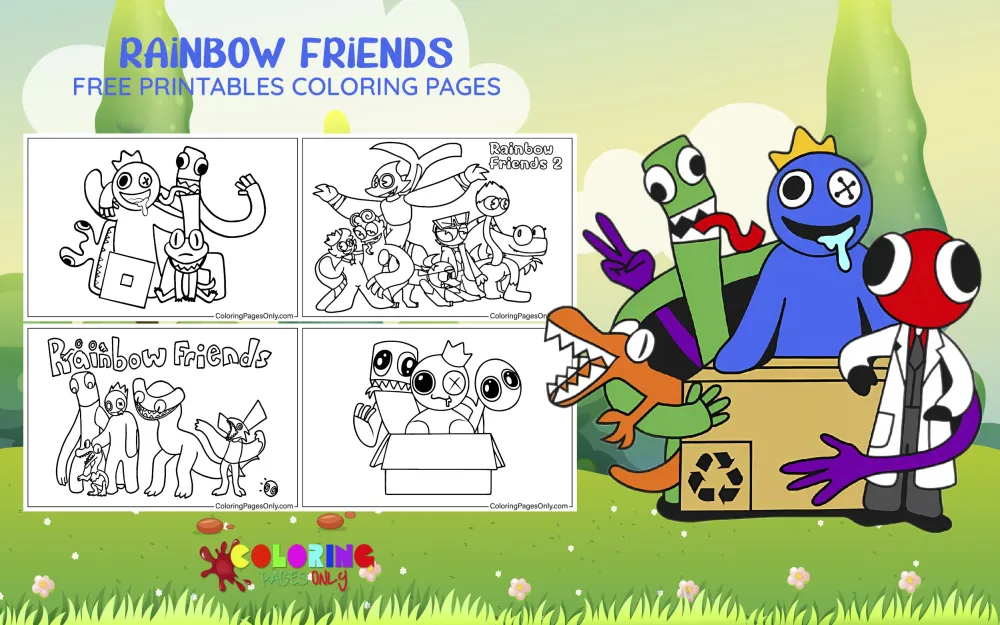
Rainbow Friends Coloring Pages at ColoringPagesOnly.com covers 210+ free printable pages organized across 10 dedicated sub-collections – one for each major character in the game and an additional collection for Rainbow Friends Chapter 2. Whether you are looking for Blue’s iconic round form, Green’s lanky no-armed silhouette, the underground-lurking Purple, or the newer characters introduced in Chapter 2, each character has its own gallery so you can find exactly what you want without browsing through mixed pages. The full Games collection is available through our Games Coloring Pages hub.
Every page is completely free – download as PDF to print or color online in your browser. No sign-up, no cost.

What Is Rainbow Friends?
Rainbow Friends is a Roblox survival horror game developed by Roy and Charcle, first released in May 2022. Players are transported against their will to a mysterious theme park called Odd World and must survive multiple nights by completing tasks – collecting items, fixing machines, and hiding – while avoiding a group of colorful monsters that hunt them using different detection methods. The game drew a massive audience across Roblox’s young player base and became one of the most-watched gaming categories on YouTube in 2022, with dozens of YouTubers and streamers uploading gameplay that introduced the characters to millions of children who had never played the game directly.
The game has two chapters. Chapter 1 introduced the five core characters – Blue, Green, Orange, Purple, and Red – each with a distinct hunting behavior. Chapter 2 expanded the roster with Cyan, Yellow, Pink, and the small secondary creatures called Lookies, alongside a new setting and new mechanics.
The Characters: Who’s in This Collection
Each Rainbow Friends character is built on a single dominant color and a specific body shape that makes them instantly recognizable in silhouette. The collection is organized by character, with each sub-category containing pages focused entirely on that one monster.
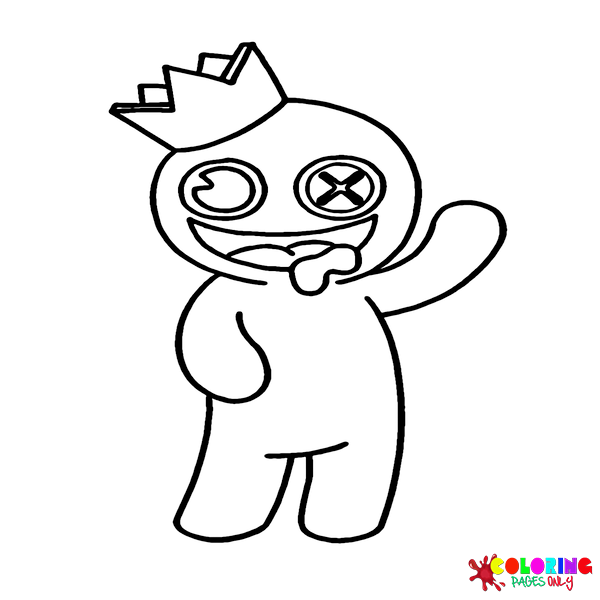
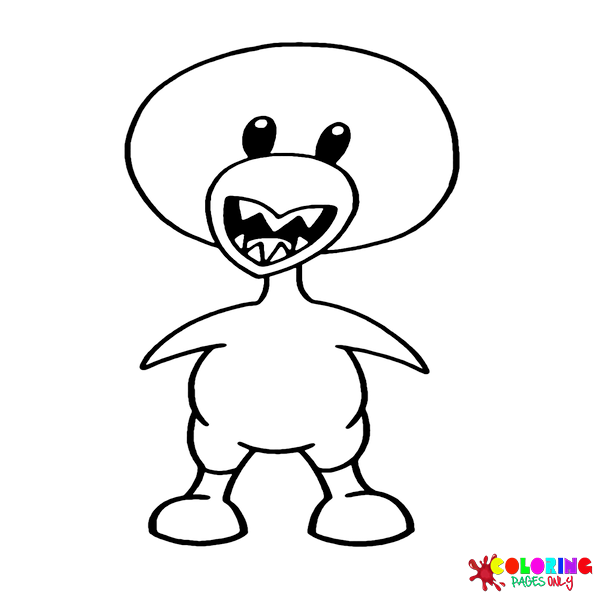
Blue Rainbow Friends is the most iconic character in the game – a large, round, dark blue creature with no visible eyes, a wide open mouth showing jagged white teeth, and a heavy lumbering movement. Blue hunts entirely by smell, which means players must hide behind objects rather than run. Blue’s round, simple shape makes the pages the most accessible for young children and the most frequently searched in the collection.
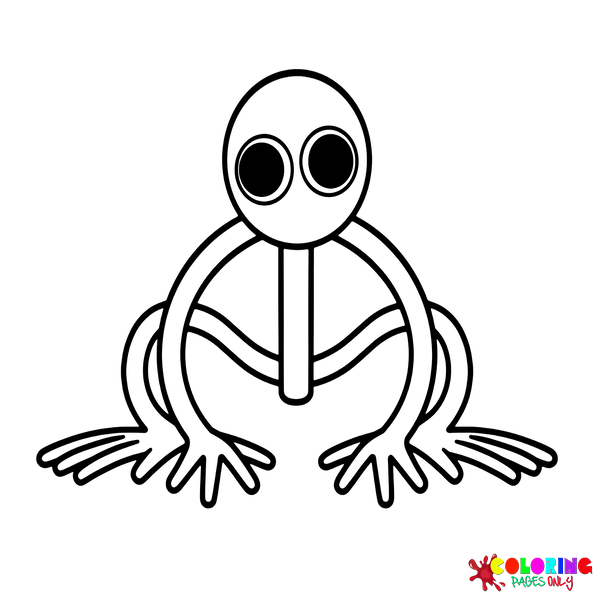
Green Rainbow Friends is a tall, elongated green monster with no arms. Green watches from ventilation shafts above the map, and players who make eye contact with it while it is watching trigger a chase. Its long, narrow form and distinctive lack of arms make it visually unlike any other character in the game.
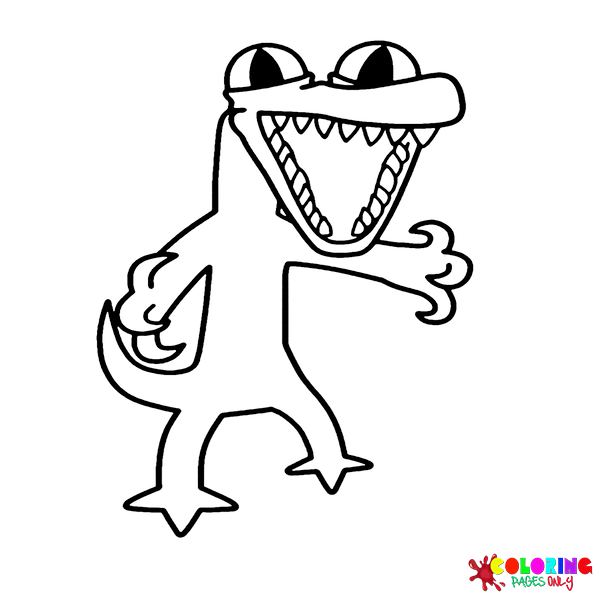
Orange Rainbow Friends is a tall, lanky orange monster with extended limbs that checks hiding spots during the night phase. Players hiding in boxes or under objects must hold still as Orange approaches – if it detects them, it strikes immediately. Orange’s long proportions contrast strongly with Blue’s round form.
Purple Rainbow Friends is a serpentine purple creature that moves beneath the floor rather than on the surface, emerging through floor grates to grab players who step on them. Purple’s underground movement and grate-based attack make it the most conceptually unusual of the Chapter 1 monsters.
Red Rainbow Friends is a spider-like red character with multiple legs, appearing in the early stages of Chapter 1. Red’s multi-legged design gives it a distinctly different silhouette from the other largely bipedal characters.
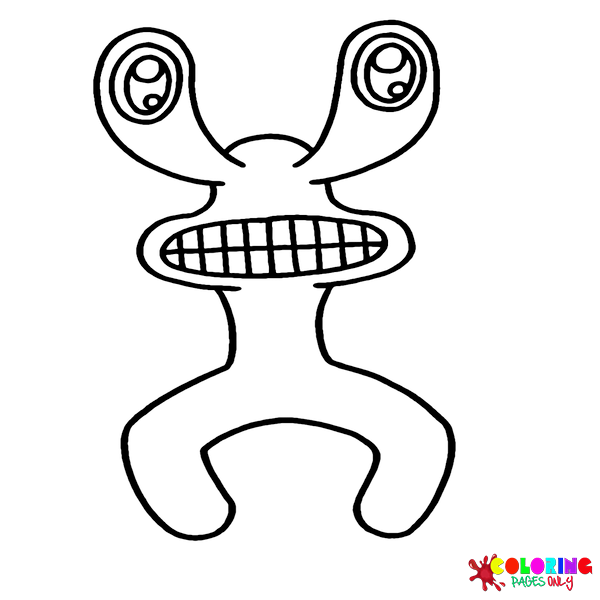
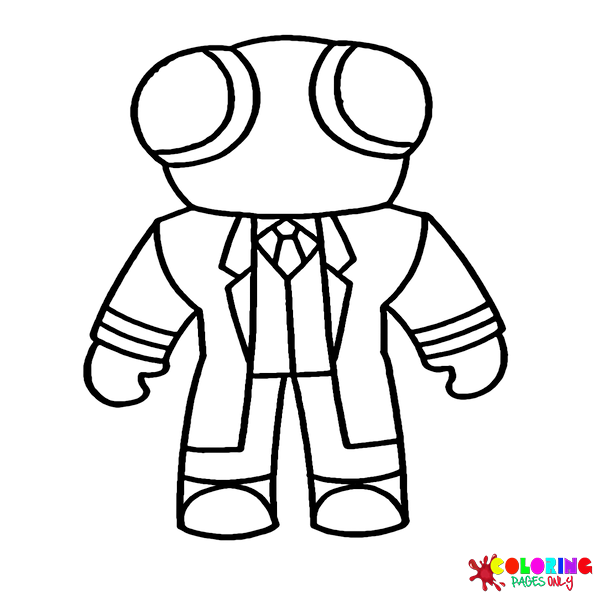
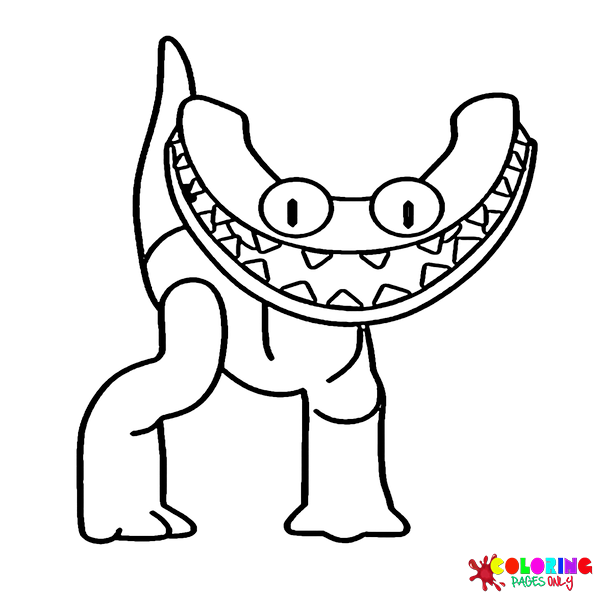
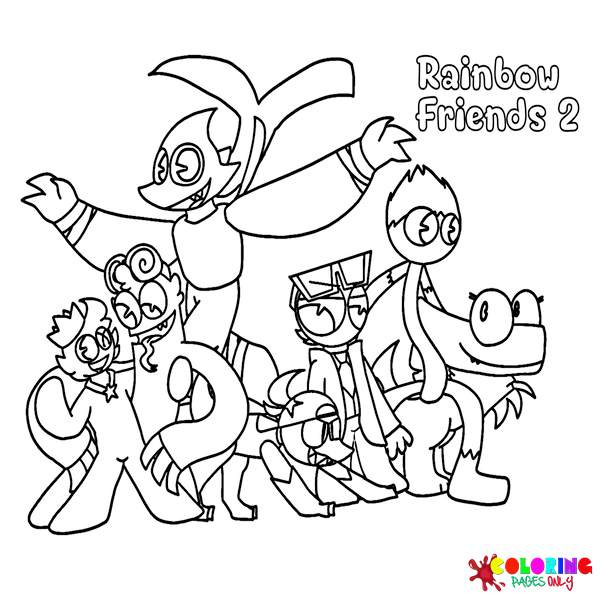
Cyan Rainbow Friends, Yellow Rainbow Friends, and Pink Rainbow Friends are the three additional monsters introduced in Chapter 2, each with a new hunting behavior and body shape expanding on the original roster. Lookies Rainbow Friends covers the small secondary creatures that appear in Chapter 2 as ambient threats alongside the larger monsters. Rainbow Friends 2 covers the characters and designs from the second chapter more broadly.
Coloring Guide: Getting Each Character Right
Every Rainbow Friends character is built on one primary color – which is also their name – but the specific shade and the supporting details around each character’s face, teeth, and body make the difference between a finished page that reads immediately as the character and one that doesn’t. Here is what to use for each main character.
Blue should be a deep, dark blue – closer to navy or midnight blue than to a bright royal blue or sky blue. The body is large and uniform in this dark tone, with the mouth interior in a lighter, slightly warm off-white or cream, and the jagged teeth in bright white. The area where eyes would normally be is simply a slightly darker patch of the same dark blue, with no colored pupils. The overall impression should be heavy and dark, which gives Blue its unsettling quality even on a coloring page.
Green should be a vivid medium green – not lime (too yellow), not forest (too dark), but the clear, somewhat saturated green that reads as “bright” against a white page. The body is consistently this single green tone with minimal variation. The most important coloring decision for Green is keeping the proportions readable: the very long torso and legs against the very short arms (or complete armlessness, depending on the art style of the specific page) are what make Green recognizable, so the outline needs to stay clean and unobscured by coloring.
Orange should be a vivid, warm orange – fully saturated rather than muted, leaning slightly toward red-orange rather than yellow-orange. Orange’s defining visual feature is its extreme height and thin limbs, so the coloring should preserve those proportions rather than filling in the outline so heavily that the leanness of the figure is lost.
Purple should be a rich, medium-deep purple – not pink-purple (too light), not blue-purple (too dark), but a vivid grape-to-violet tone that reads clearly as purple at a distance. Purple’s serpentine body shape means the color should flow continuously across the full form without hard breaks, which is easiest to achieve with a single consistent crayon or marker pressure throughout.
Red should be a vivid, saturated primary red – the clearest, most immediately readable red possible, with no orange or brown bias. The multi-leg structure of Red’s body means there is more surface area and more outline to stay within than any other character in the collection, making the Red pages among the more technically involved in the set.
Cyan should be a vivid, light turquoise-to-cyan – notably lighter and more blue-green than either Blue’s dark navy or Green’s medium green, landing in the bright aqua range. Yellow should be a vivid, clear primary yellow rather than golden or mustard. Pink should be a vivid, warm pink that is distinctly bright rather than soft or pastel – the Chapter 2 characters all use highly saturated versions of their namesake colors.
5 Ideas for Using Your Rainbow Friends Pages
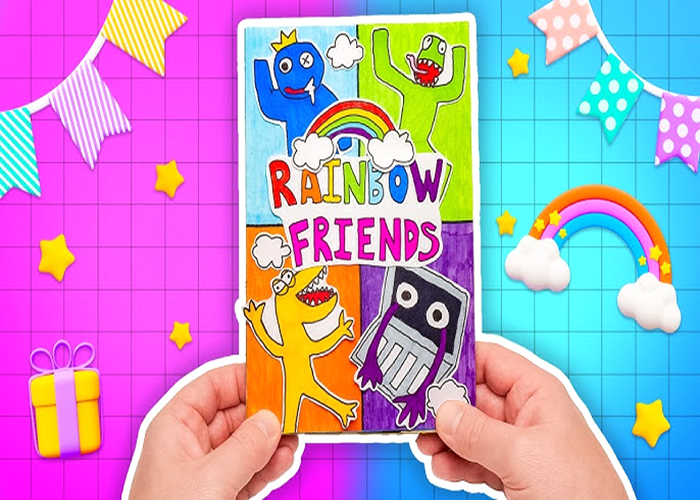
Make a Rainbow Friends Greeting Card
From the Rainbow Friends coloring pages, choose the images you like best and print them on cardboard. After coloring, trim the images carefully with scissors. Fold the cardboard in half to form the card base, paste the colored Rainbow Friends images onto the cover, and add a message inside. Each character makes a surprisingly effective card cover – Blue’s large, round form fills a card front well, while the ensemble pages showing multiple characters work for group cards.
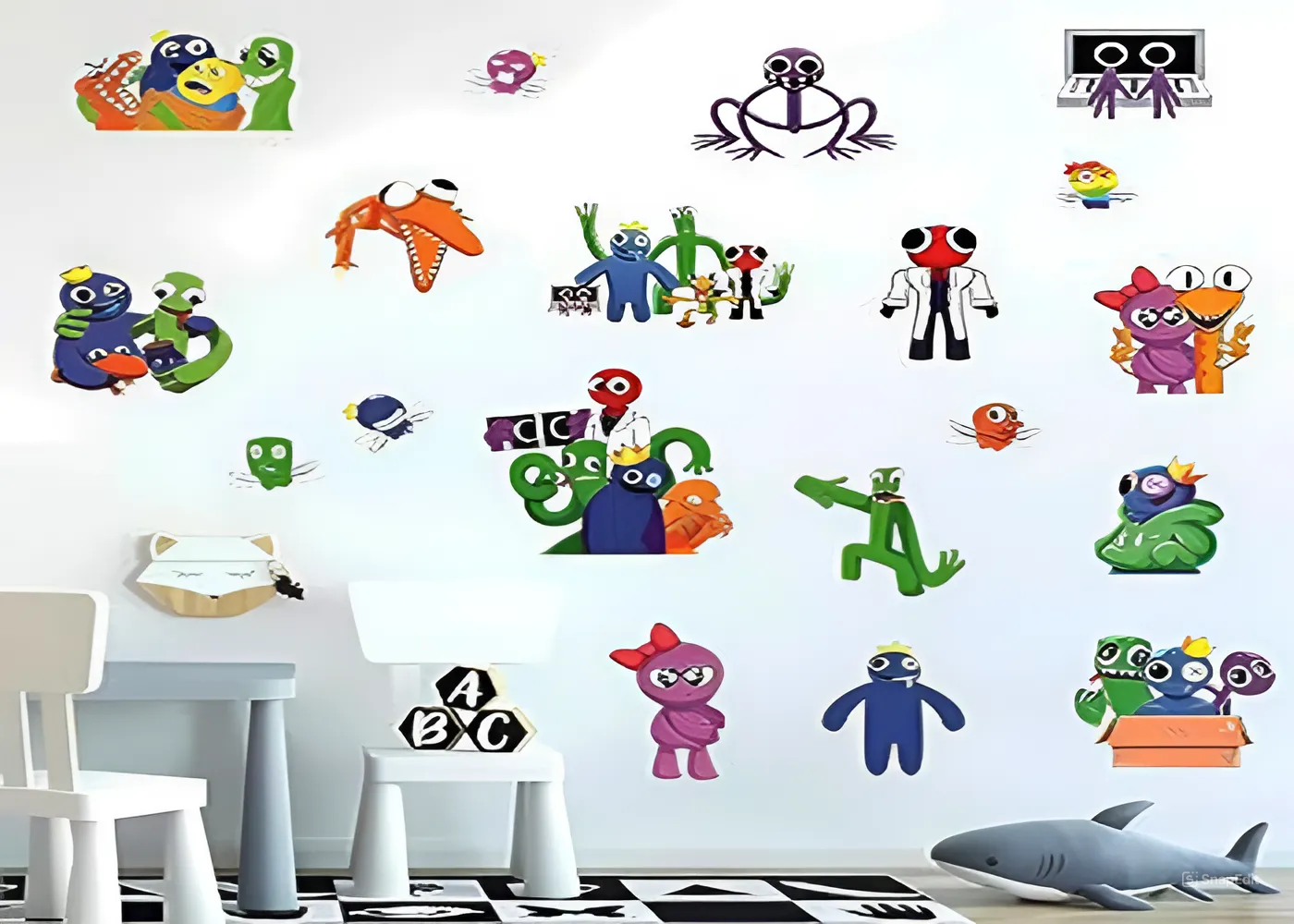
Create Rainbow Friends Wall Stickers
Print Rainbow Friends pages on decal paper, color them in each character’s canonical color, then cut out each character individually. Peel the backing paper to reveal the adhesive, align the character to the desired spot on the wall or a notebook, and press flat. Running your hand over the sticker firmly ensures it sits flush. The single-character pages – particularly Blue’s large, round form – transfer especially cleanly because the simple silhouette cuts without complex edges.
Build a Rainbow Friends Puppet Set
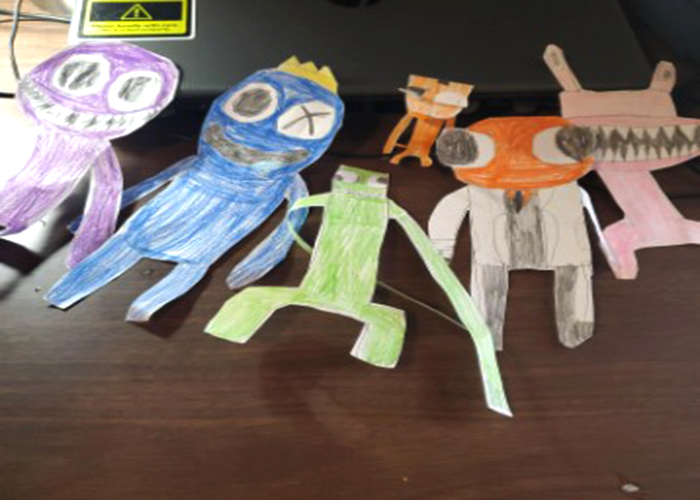
Print each character at a consistent small size, color them in their respective canonical colors, and cut them out cleanly. Back each figure with a piece of thick cardboard for durability. Attach a wooden stick or straw to the back of each character using strong craft glue. When the glue dries, you have a complete set of Rainbow Friends stick puppets – Blue, Green, Orange, Purple, Red, and the Chapter 2 additions – that can be used for imaginative play, recreating in-game scenarios. Young children should have adult supervision when using scissors.
Make a Rainbow Friends Blind Bag
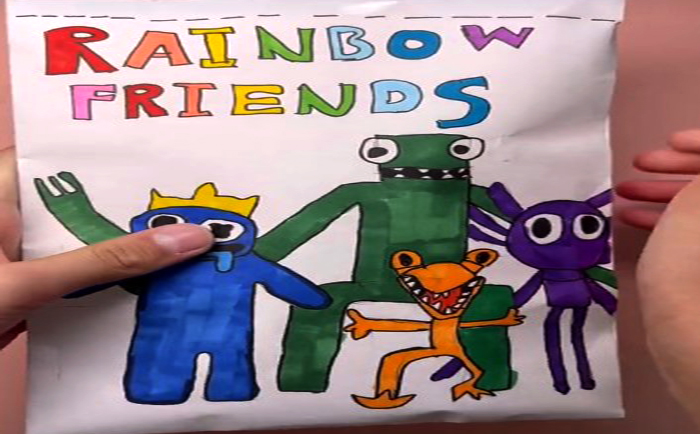
Print an ensemble Rainbow Friends page, color all characters, and cut each character out individually. Fold a piece of paper into a small envelope shape and glue the edges to form a sealed blind bag. Place one character inside each bag, seal it, and label the outside with the bag number rather than the character name. Give the bags to friends or siblings and let them open to discover which Rainbow Friends character they received – a simple activity that recreates the blind box/bag format that children already associate with toy collecting culture.
Play a Rainbow Friends Memory Game
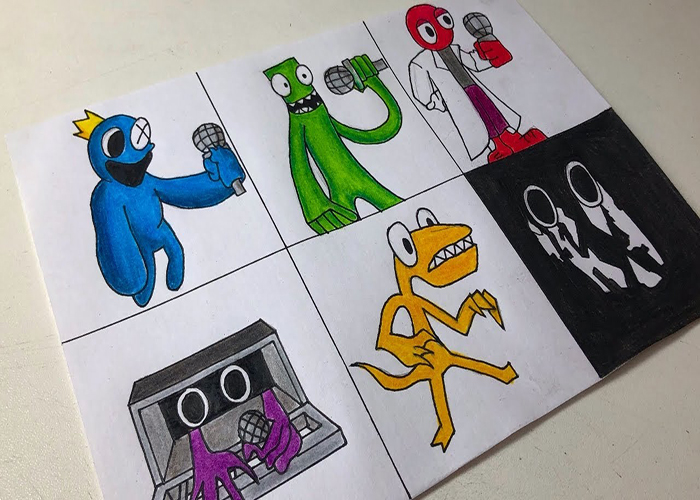
Print two copies of the same Rainbow Friends page and color both in matching canonical colors. Cut each character from both copies into identical rectangles to create matching card pairs. For added durability, laminate the cards with clear adhesive film. Shuffle all cards and place them face-down in a grid. Players take turns flipping two cards – a matched pair (same character, same color) is kept by the player who found it. Mismatched cards are flipped back face-down. The player with the most pairs when all cards are collected wins. The strong color identities of the Rainbow Friends characters – each named for their own color – make the matching mechanic immediately clear for even very young players.
FAQs
What is Rainbow Friends? A Roblox survival horror game released in 2022, where players survive nights in a theme park while avoiding colorful monster characters. Each monster has a different hunting behavior.
How many characters are in Rainbow Friends? Chapter 1 introduced five characters – Blue, Green, Orange, Purple, and Red. Chapter 2 added Cyan, Yellow, Pink, and the Lookies, bringing the total roster to nine named monsters plus the secondary Lookies creatures.
What color is Blue in Rainbow Friends? Blue is a deep navy/midnight blue – significantly darker than a standard blue crayon – with white jagged teeth and a dark body.
Is Rainbow Friends appropriate for kids? The game has survival horror themes but is played on Roblox within a cartoonish visual style. The characters are monsters, but not graphically violent. The coloring pages in this collection use the same cartoonish aesthetic and are suitable for children of all ages.
All 210+ Rainbow Friends Coloring Pages are free – download as PDF or color online. Share your finished pages on Facebook and Pinterest.