England Premier League Team Logos Coloring Pages

England Premier League Team Logos Coloring Pages at ColoringPagesOnly.com brings together 29 free pages – one for each club that has competed in England’s top football division, rendered as black and white line-art crests ready to color in each club’s canonical colors. Download any page as a PDF to print, or color online in your browser. The full Soccer Clubs Logos collection is at Soccer Clubs Logos Coloring Pages.
What is the Premier League?
The Premier League is the top tier of the English football pyramid, contested by 20 clubs each season from August to May. Each club plays 38 matches – home and away against every other team – with three points for a win, one for a draw, and none for a defeat. The bottom three clubs at the end of each season are relegated to the Championship; three Championship clubs are promoted to replace them. This promotion and relegation system means the Premier League’s membership changes every year, which is why this collection covers clubs across multiple eras rather than only the current 20.
Founded in 1992 when the First Division’s top clubs broke away from the Football League to form a new competition under the Football Association, the Premier League quickly became the most commercially successful football league on the planet. It is broadcast in 212 territories worldwide, with an estimated potential audience of several billion. The league is known for its pace, physicality, and the competitive depth that allows teams outside the traditional elite to win titles – Leicester City’s 2015–16 championship, achieved at odds of 5,000-to-1 before the season, remains one of the most remarkable sporting upsets in history.
The Clubs and Their Crests
The 29 pages cover clubs across the full history of the Premier League era, from its founding members to recent participants. The crests range from simple geometric designs to elaborate heraldic compositions with animals, shields, stars, and Latin mottos.
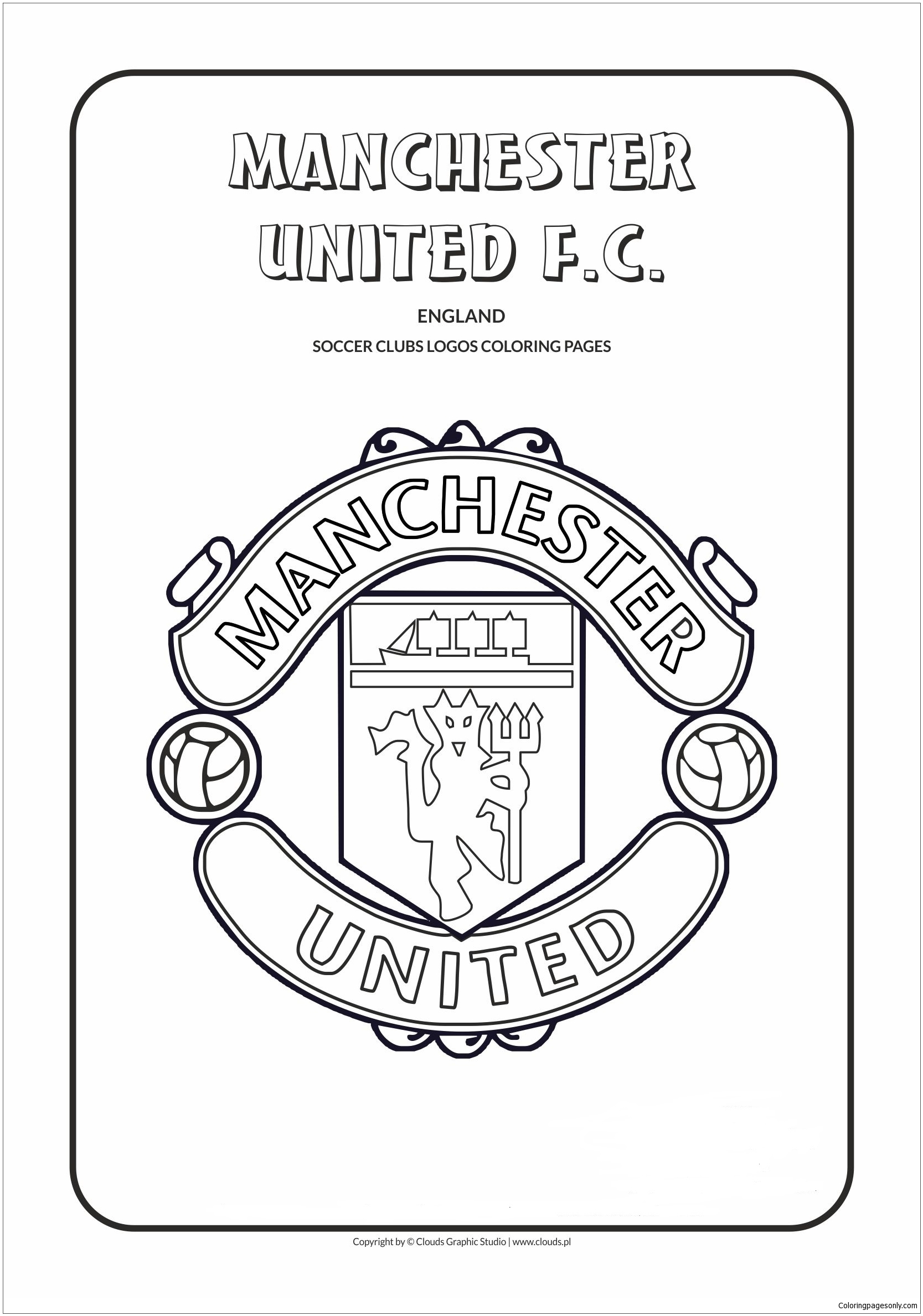
The traditional “Big Six” – Manchester United, Manchester City, Liverpool, Arsenal, Chelsea, and Tottenham Hotspur – are the clubs that have dominated Premier League broadcasting, commercial revenue, and European competition across the league’s history. Their crests are among the most recognized in world football. Manchester United’s red shield carries a ship, a red devil, and a football. Liverpool’s crest centers on the Liver Bird – the mythical cormorant-like bird of the city – flanked by the Shankly Gates and the eternal flame of the Hillsborough memorial. Arsenal’s cannon on a red background is one of the simplest and most immediately legible designs in English football. Chelsea’s lion standing on a staff is a heraldic composition in royal blue. Manchester City’s crest contains the ship of Manchester, three stars, and an eagle. Tottenham’s cockerel on a ball, standing on a shield, is one of the most distinctive animal crests in the game.
Clubs with strong regional identity include Aston Villa (claret and blue – the colors that later inspired West Ham and several other clubs), Everton (royal blue with a tower representing Prince Rupert’s Tower in Everton’s Toffee Row neighborhood), Newcastle United (whose black and white stripes are among the most recognizable home kits in world football), West Ham United (whose crossed hammers reference the industrial heritage of East London’s Ironworks), and Sunderland (the black cat of their crest a reference to a historical folk tradition of the city).
Clubs outside the current top flight but represented in this collection include Leeds United – whose white owl crest reflects their long history as a major English club, most recently returned to the Premier League before relegation – Blackburn Rovers, champions in 1994–95, with their blue and white crest incorporating the Lancastrian rose; Middlesbrough, whose red lion on a white shield reflects their North East identity; Leicester City, whose blue and gold fox crest became globally famous after the 2015–16 title; and Birmingham City, Bolton Wanderers, Burnley, Charlton Athletic, Crystal Palace, Fulham, Hull City, Norwich City, Sheffield Wednesday, Southampton, Stoke City, Swansea City, West Bromwich Albion, and Wigan Athletic.
Coloring Tips
Research each crest’s canonical colors before you start. Premier League club crests are among the most precisely color-specified designs in sport – clubs have official brand guidelines that specify exact shades. Getting the blue of Chelsea’s crest to match the royal blue of Everton’s (they are noticeably different – Chelsea’s is warmer, Everton’s cooler and more saturated) requires looking at reference images rather than guessing. The most useful approach before coloring any crest is to look up the club’s current badge online, note the exact colors used, and match them as closely as your available tools allow.
The red clubs – Manchester United, Liverpool, Arsenal, Charlton Athletic, Southampton, Sunderland, Middlesbrough, Stoke City – each use a different version of red. Manchester United’s is a warm, saturated scarlet. Liverpool’s is slightly darker and cooler. Arsenal’s is similar to United’s, but applied differently on the crest. Southampton and Sunderland both use strong reds but with different secondary colors (white for Southampton, black for Sunderland historically). Middlesbrough’s red is applied within a circular badge. Getting these reds to read as distinct from each other when you have multiple club crests displayed together requires using slightly different values and temperatures of red.
The blue clubs divide sharply between royal blue (Everton, Blackburn, Wigan, Birmingham, Swansea) and sky/light blue (Manchester City, Leicester). These are very different colors and should never be treated as interchangeable. Everton’s royal blue is deep and saturated; Manchester City’s sky blue is soft and pale. Leicester’s blue falls between the two – a mid-saturated cornflower blue paired with gold, which is one of the most visually distinctive color combinations in the collection.
Gold and yellow appear across many crests as accent colors – the gold stars on Arsenal’s crest, the yellow detail on Tottenham’s, the gold of Leicester’s fox and shield, the amber of Wolverhampton clubs’ traditions, Hull City’s amber-and-black. The distinction between warm metallic gold (which should be rendered with an ochre-to-yellow gradient suggesting metal) and flat yellow (which is simpler but less heraldically appropriate for most crests) is worth making consistently.
Black and white crests – Newcastle United’s black and white stripes, Fulham’s black and white – are the most graphically stark in the collection. For Newcastle’s crest specifically, the black should be a true deep black rather than a dark grey, and the white areas should be left as the paper unless you are adding a background. The high contrast of black-and-white crests means they read with more graphic impact at small sizes than most colored crests, which is part of why Newcastle’s kit is among the most recognizable in English football.
For multi-color crests with shields divided into quarters – like Bolton Wanderers or Sheffield Wednesday, whose crests contain multiple color sections within the badge body – treat each quarter as a separate color field and apply each color to all instances of that quarter before moving on to the next. Consistency within each color field is more important than the order in which you color the sections.
The gold/silver metallic elements – outlines, stars, text on ribbon banners – that appear on most heraldic crests are best rendered with a warm mid-gold rather than a bright yellow. Some colorists prefer a metallic gel pen for these elements, applied after the base colors are dry, to suggest the literal metallic quality of embossed crest detail on real club badges.
5 Activities with Your Premier League Crest Pages
Color all 29 crests as a complete historical set. Print every page in the collection and color each one in its correct canonical colors. The challenge is maintaining color accuracy across 29 different crests – many of which share similar colors (multiple red clubs, multiple blue clubs) but must be rendered distinctly from each other. When all 29 are finished, arrange them chronologically by the club’s first Premier League appearance and display them together. The complete set is a visual history of English football’s top tier across its full existence from 1992 to the present.
The red-club comparison exercise. Print Manchester United, Liverpool, Arsenal, Sunderland, Southampton, and Charlton Athletic. Color all six using only your available reds – no looking at color guides, just your instinct about each club’s red. Then look up the actual canonical colors and compare your versions to the originals. This exercise shows how much variation exists within what we casually call “red” in football contexts and trains your eye to see color temperature and saturation differences that aren’t immediately obvious.
Color your own club’s crest in three different alternate palettes. Print three copies of whichever club crest you feel most connected to. Color the first in the canonical colors. Color the second in a completely different palette – imagine the club had been founded with different colors; what palette suits the crest’s shape and heraldic elements? Color the third in a monochromatic scheme using only values of a single color. Display all three. The exercise reveals how much of a crest’s identity comes from its color rather than its form – the same design can feel like a completely different club depending on the palette.
Color the promoted and relegated clubs for one specific season. Choose a Premier League season that interests you – perhaps 2015–16 (Leicester’s title year), or 2019–20, or any other. Research which three clubs were promoted that season and which three were relegated. Find those crests in the collection, print all six, and color them – the three promoted clubs in their canonical colors with a green “UP” arrow added underneath, the three relegated clubs in their canonical colors with a red “DOWN” arrow. Display the six as a promotion-relegation record card for that season.
Design a league table as coloring art. Print five crests from different clubs – your five picks for a hypothetical top-five finish. Color each crest. Then create a handmade league table on a blank sheet of paper: five rows, one row per club, with the colored crest on the left, the club name in the middle, and space for Points, Goal Difference, and Wins on the right. Fill in real statistics from any Premier League season you choose. The finished page combines your colored crests with actual football data – a coloring activity that produces a functional reference piece rather than just a standalone illustration.