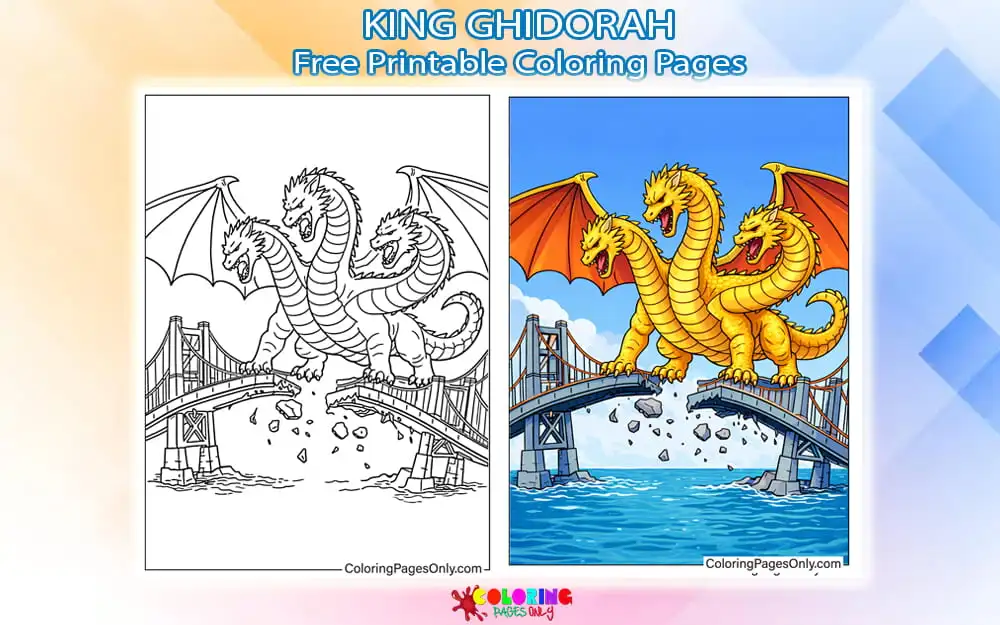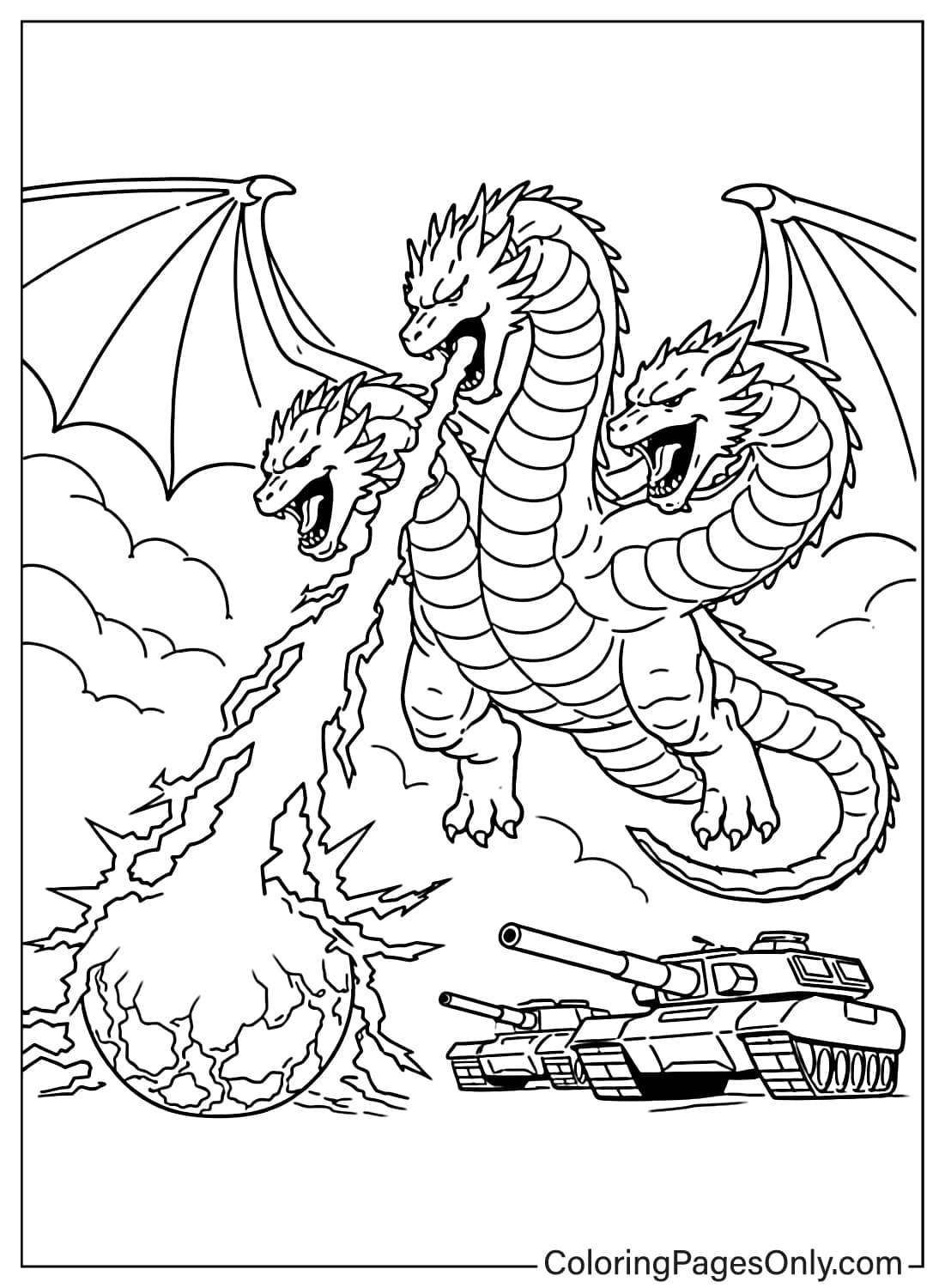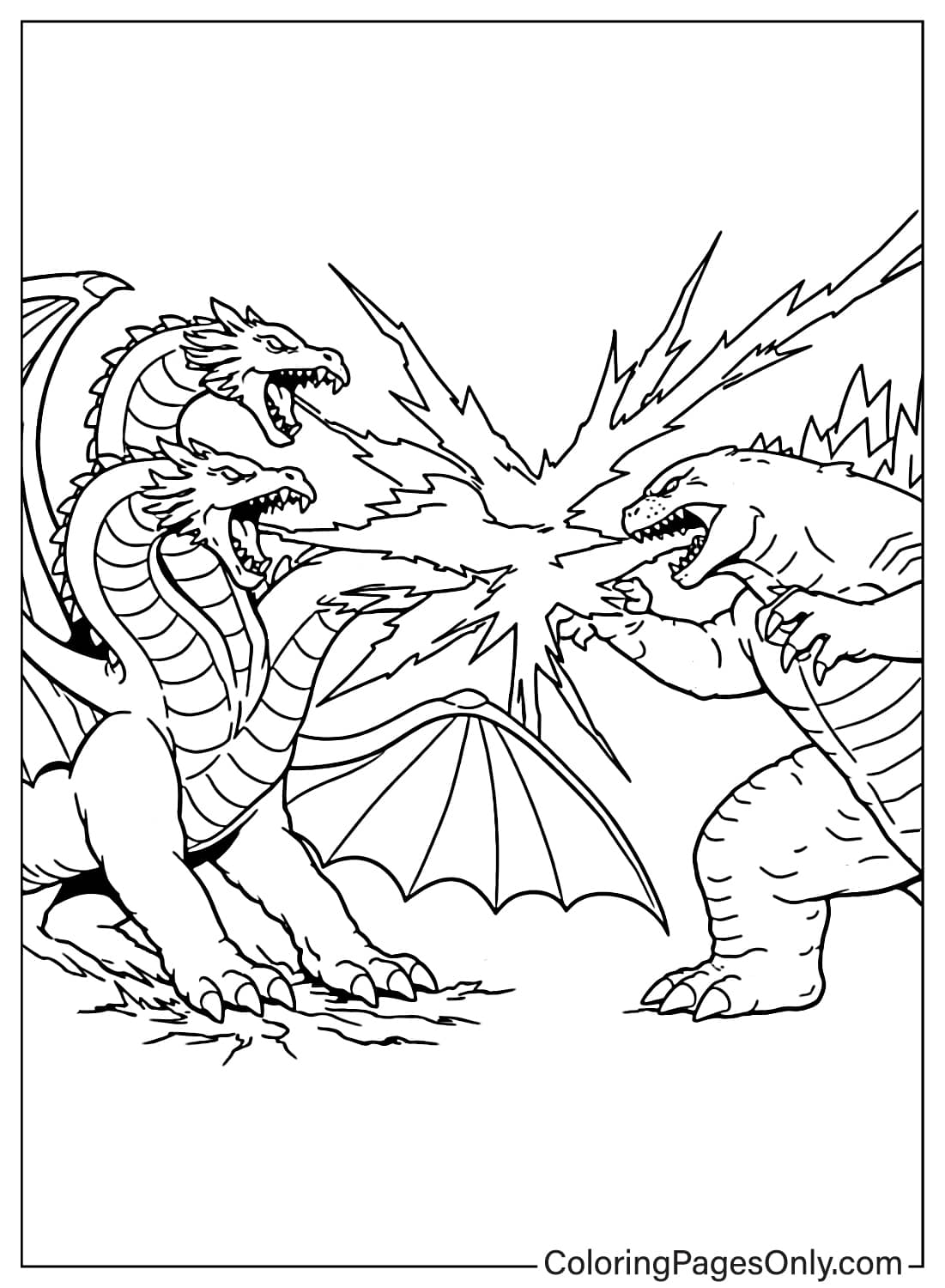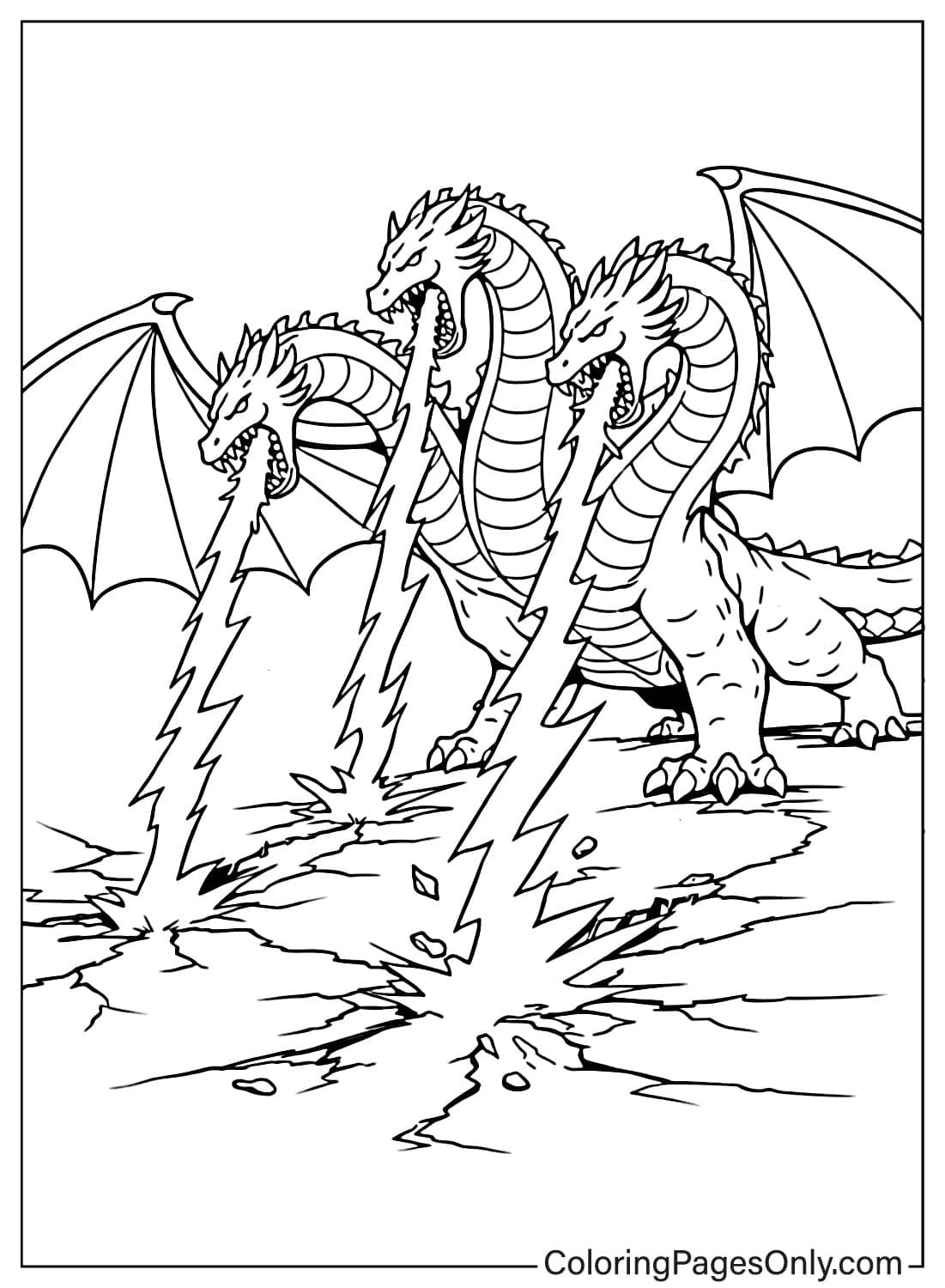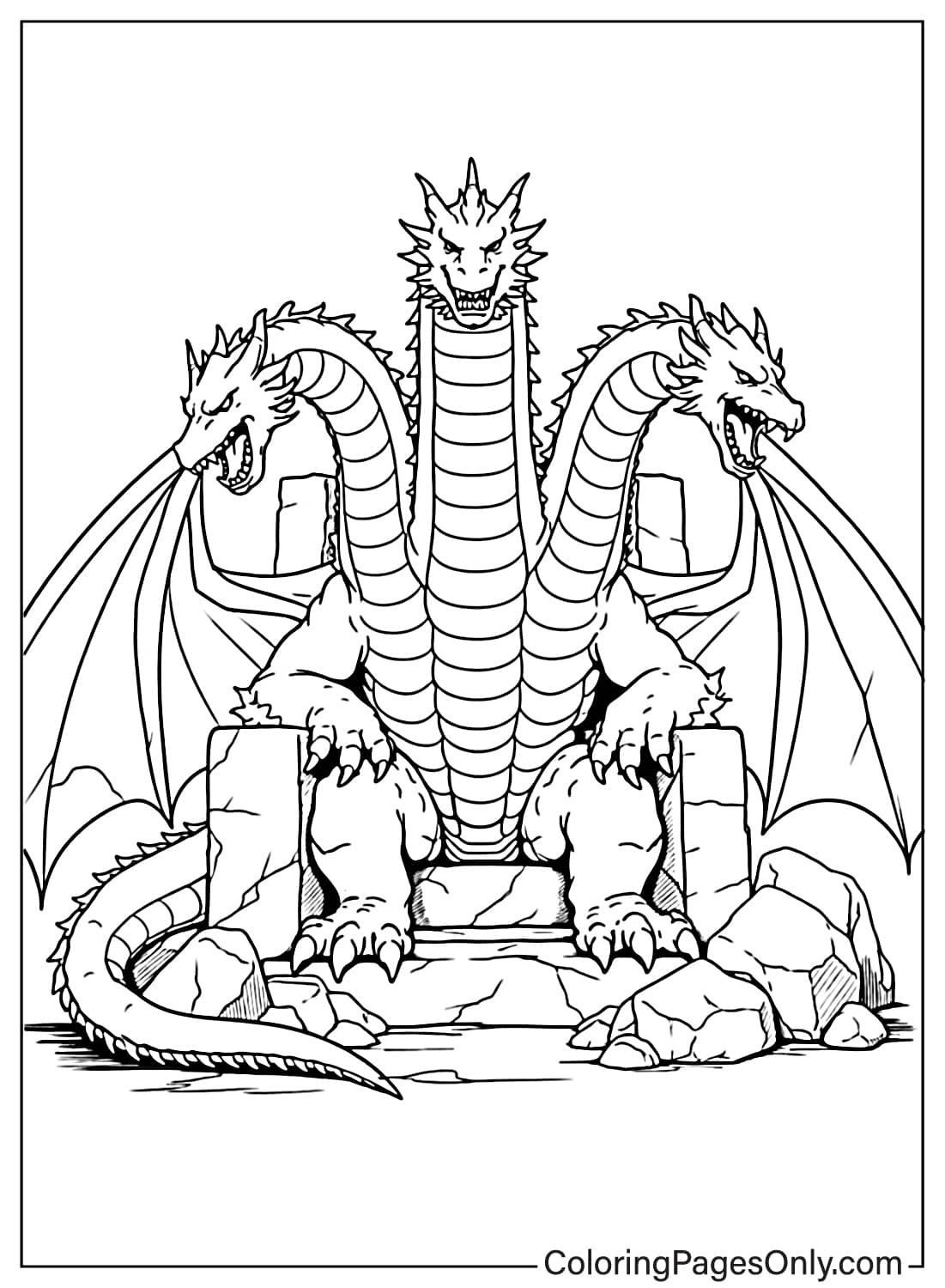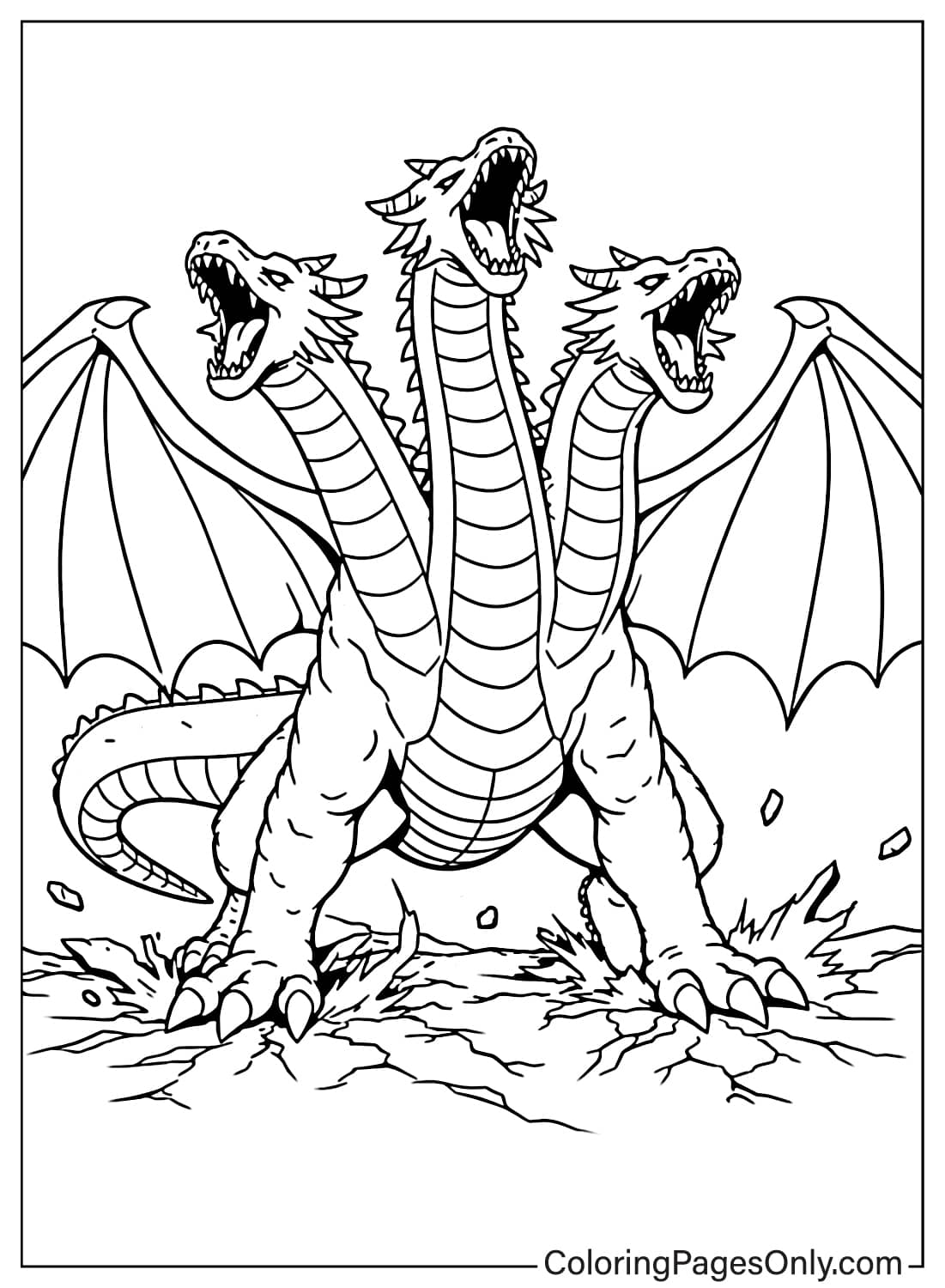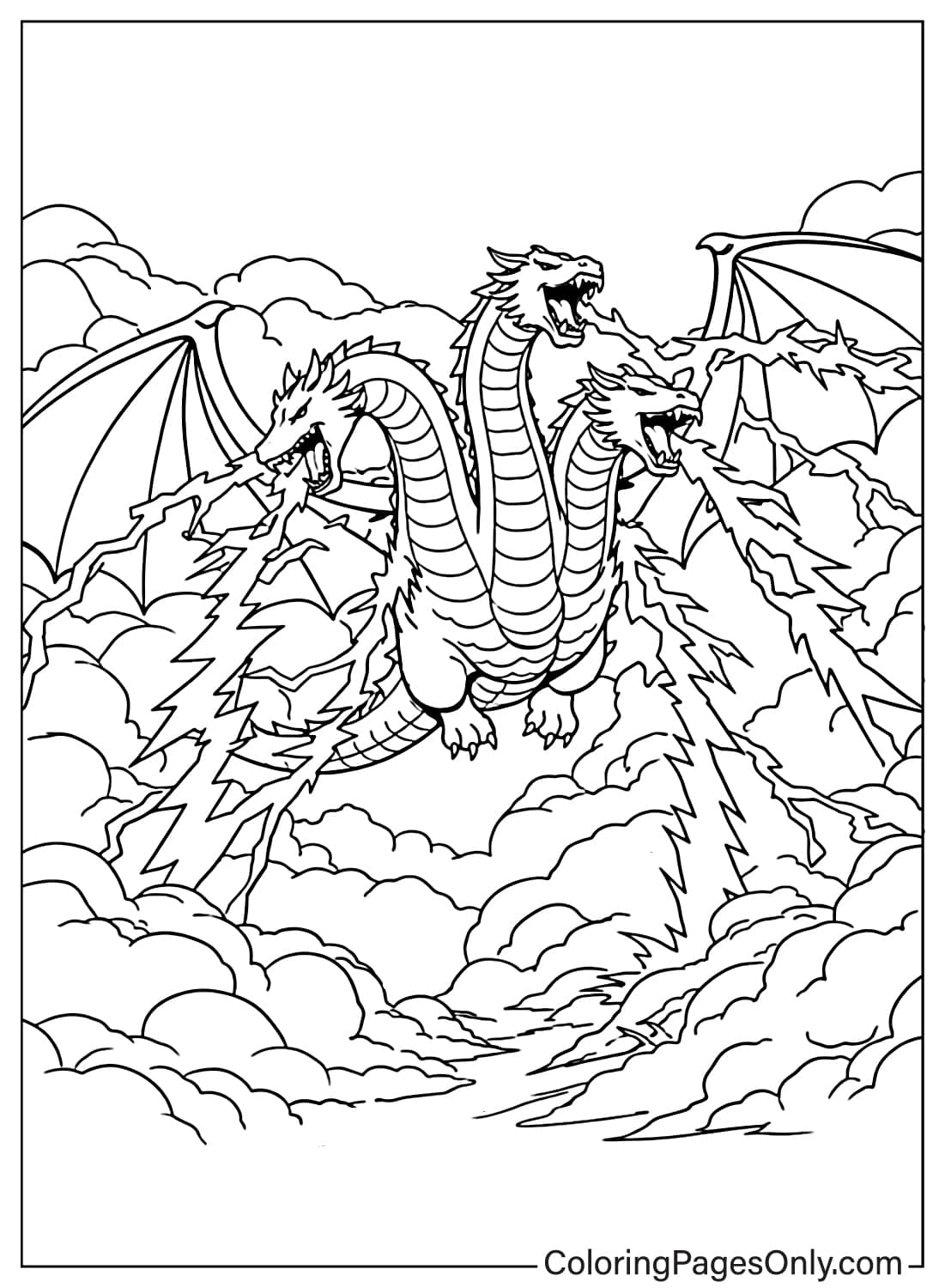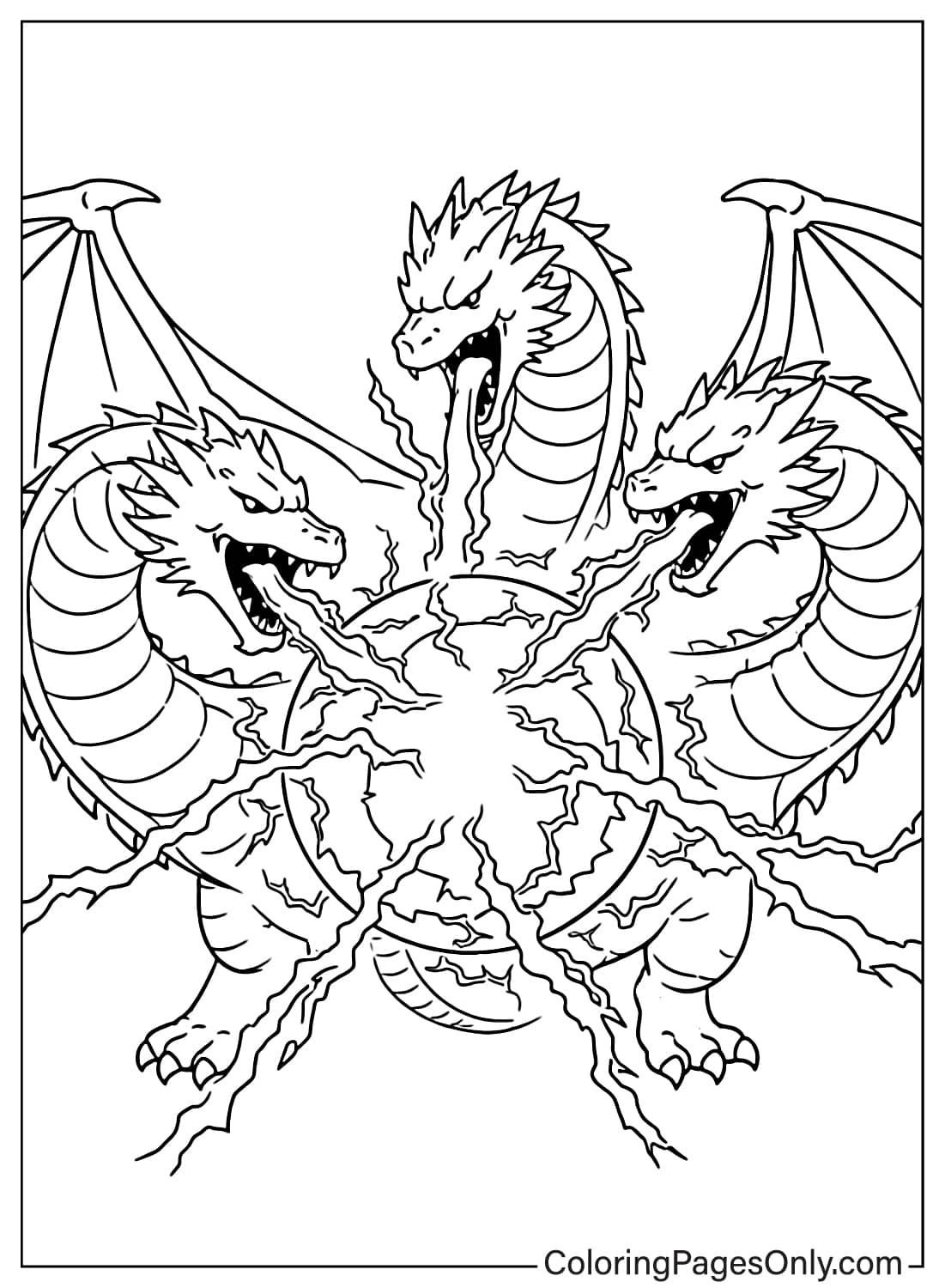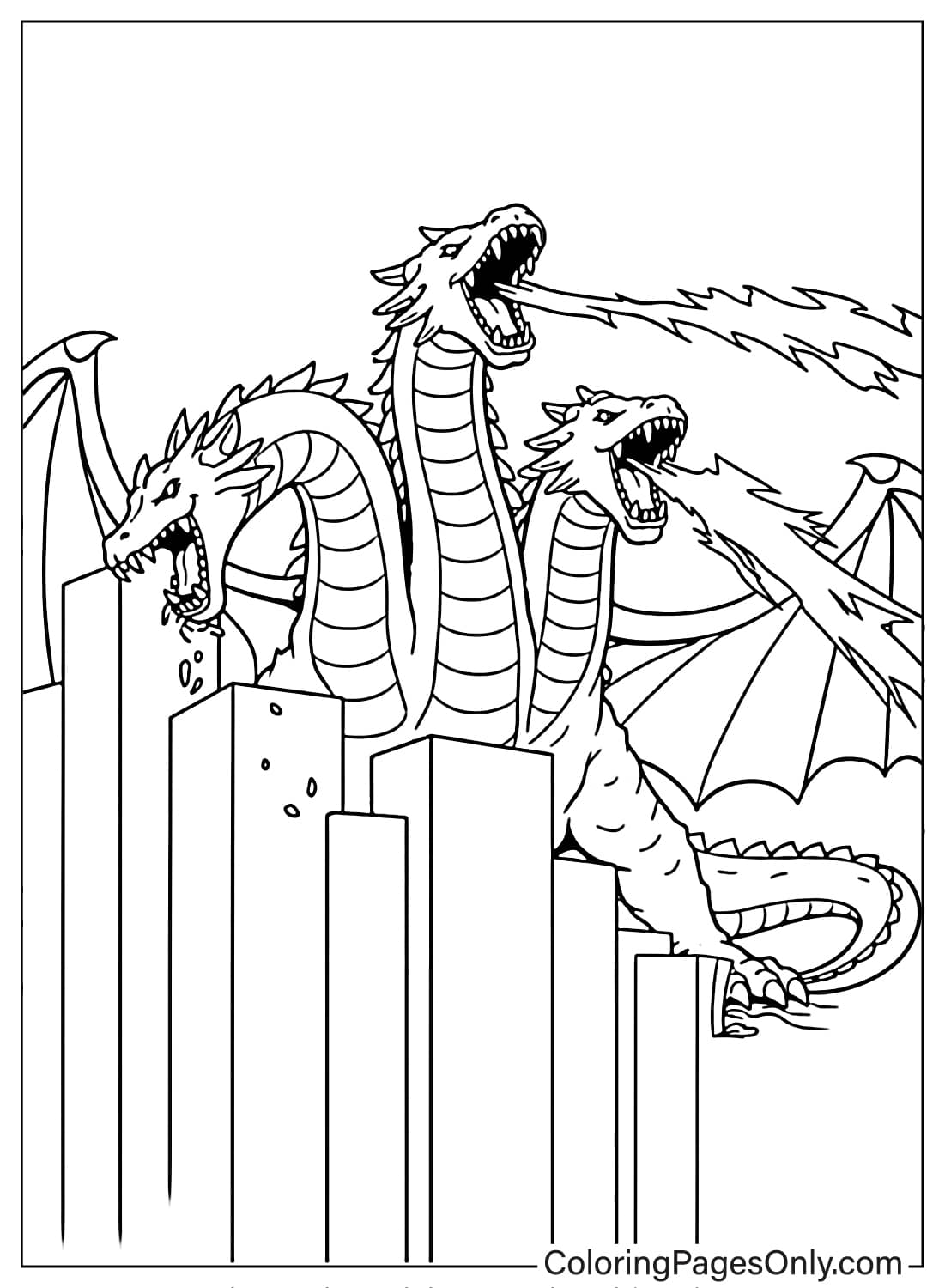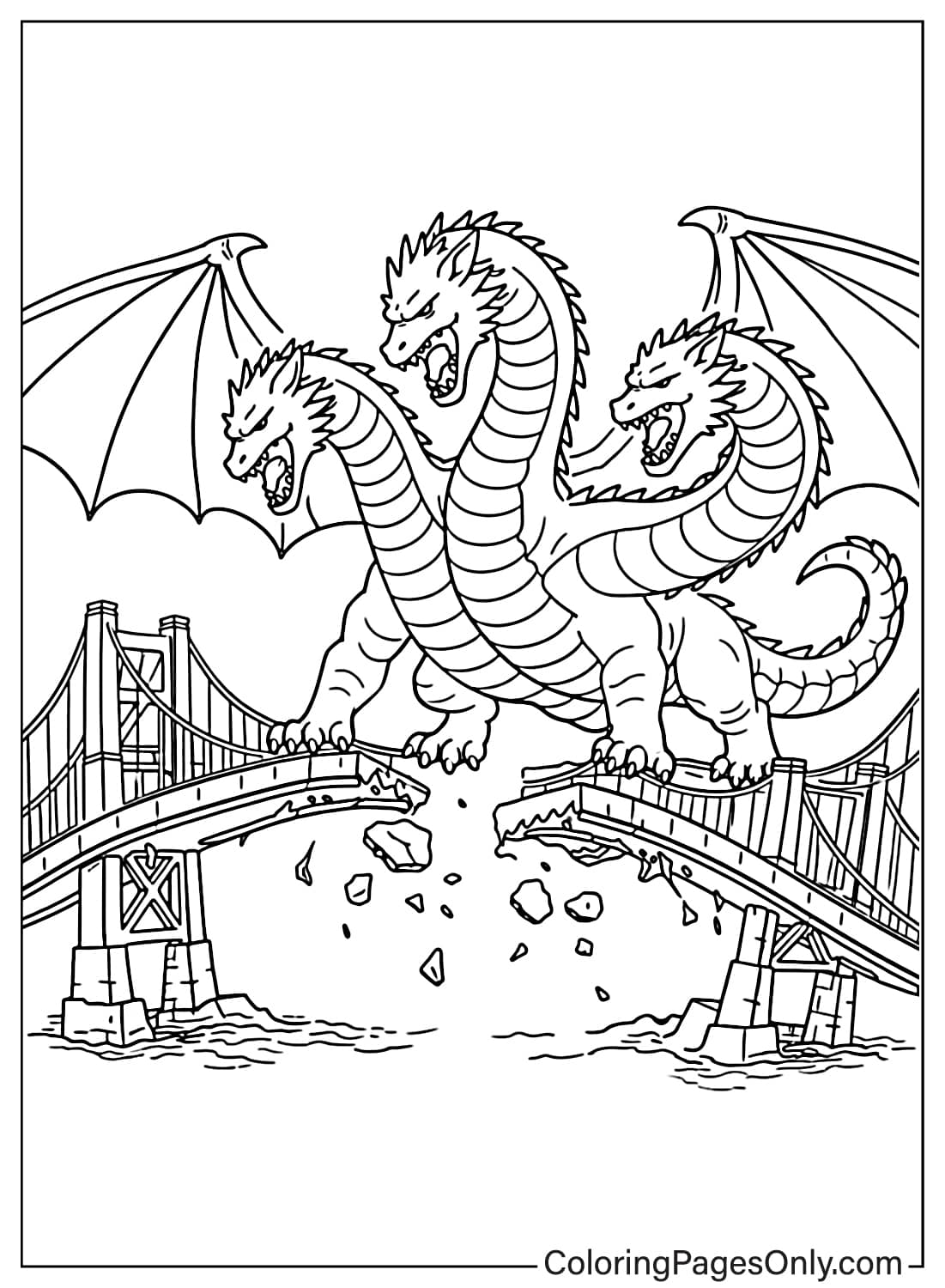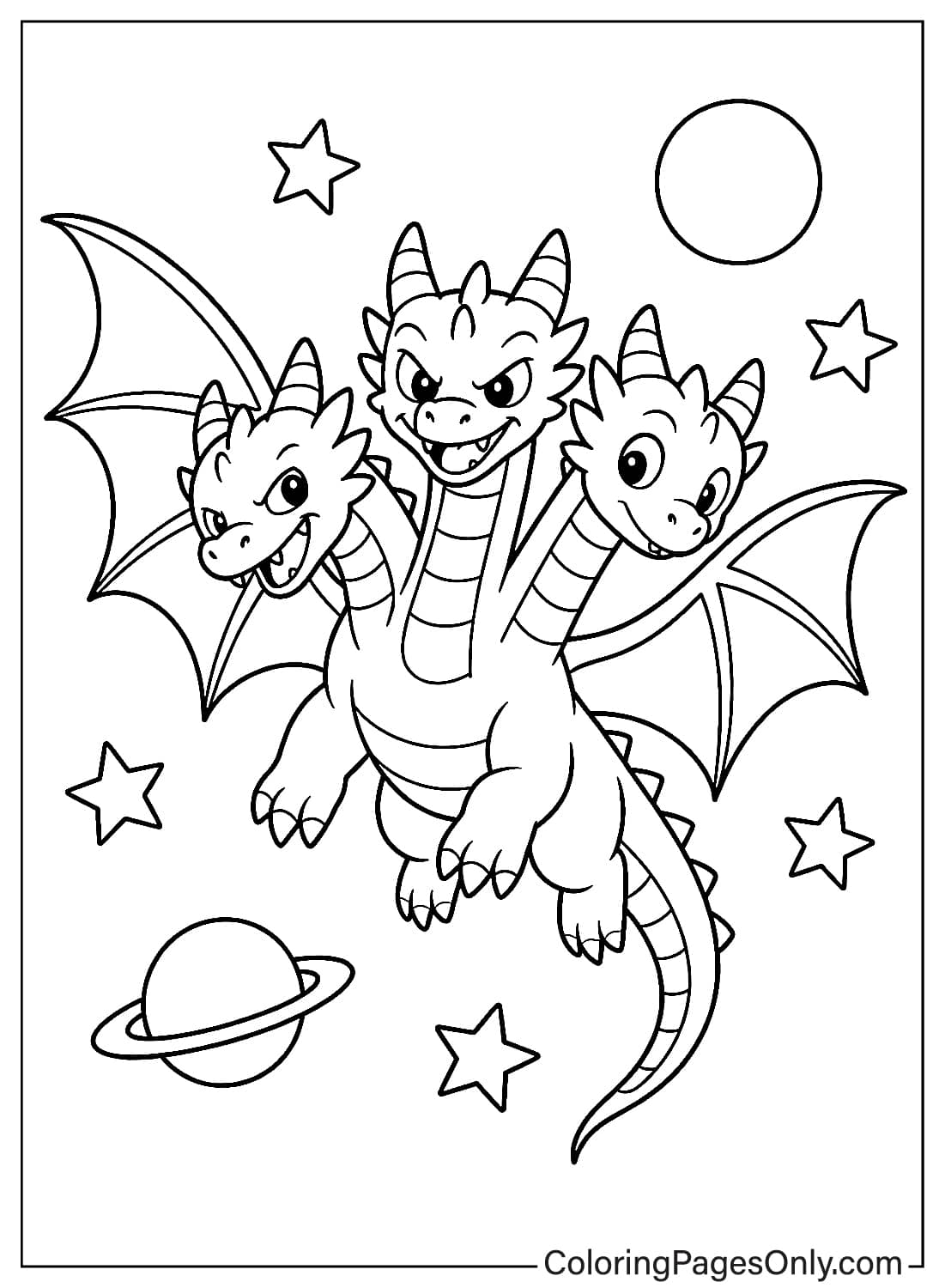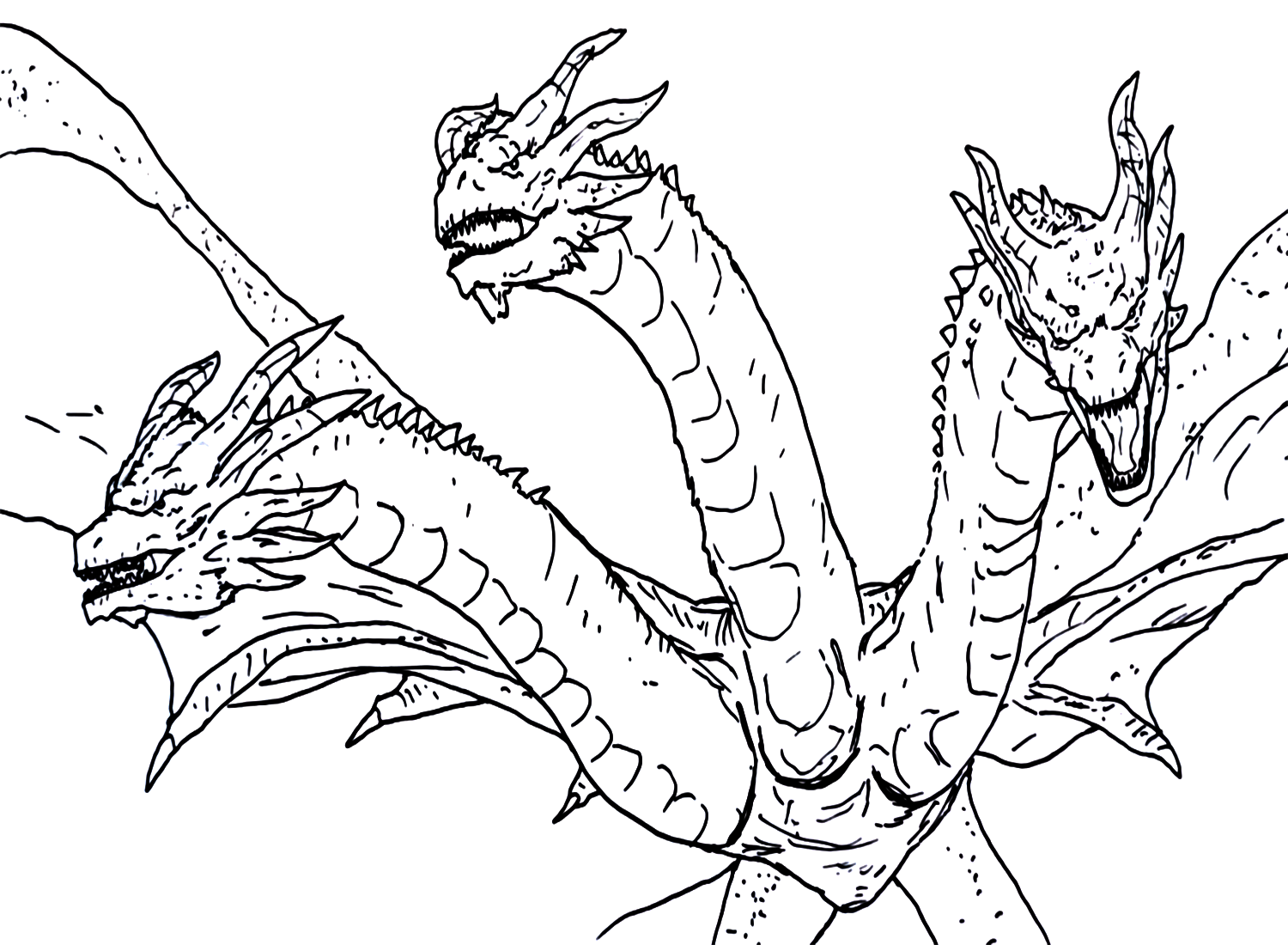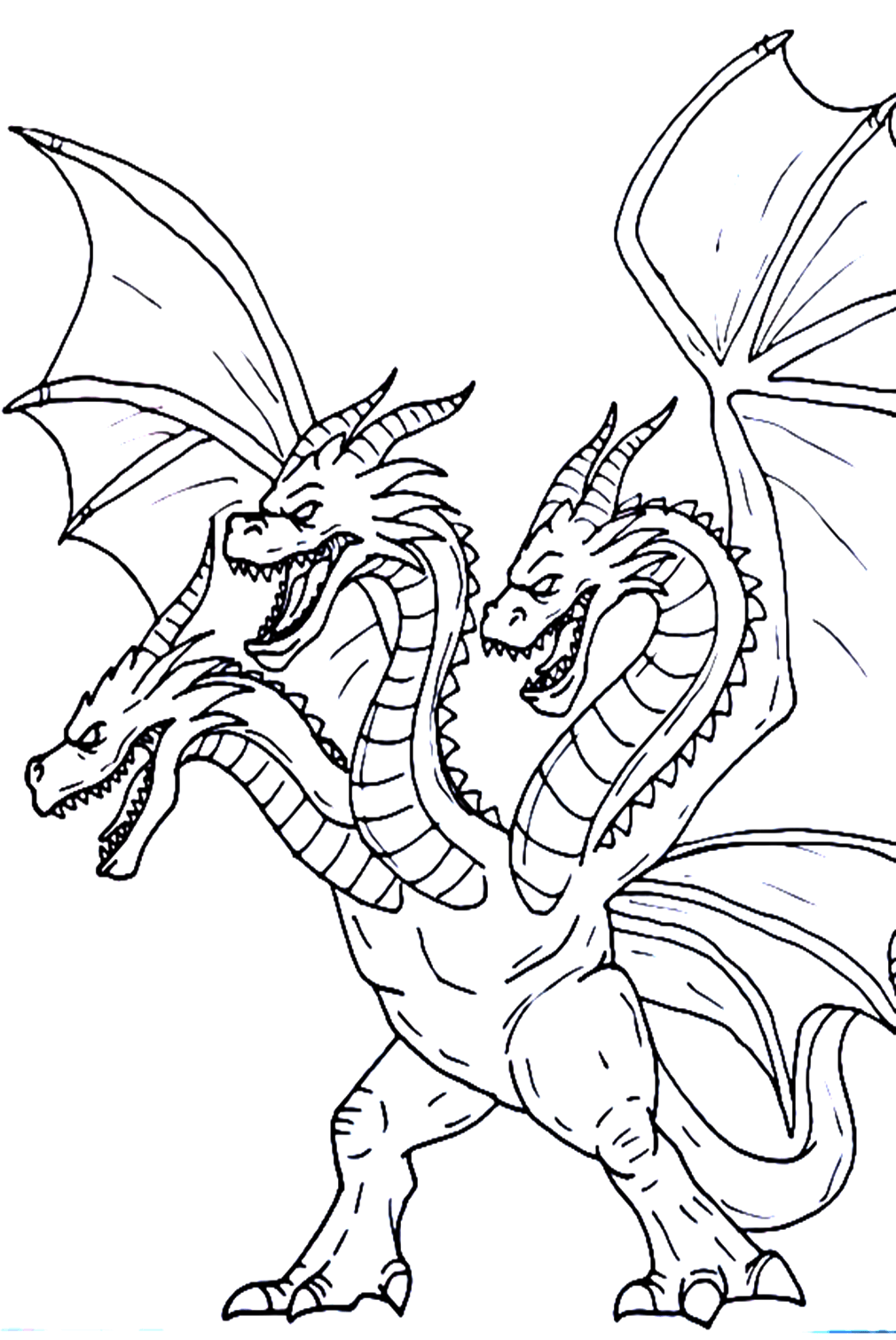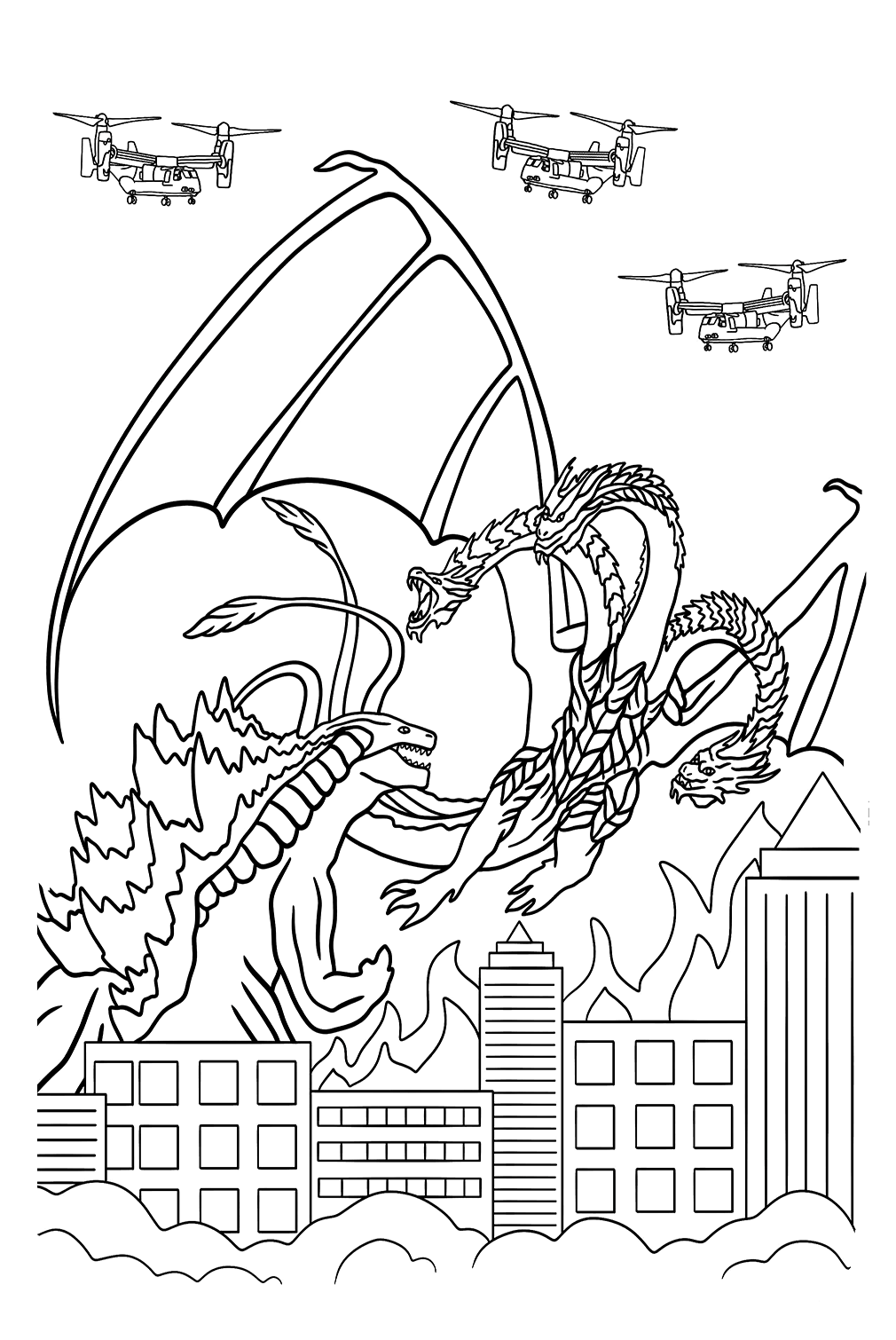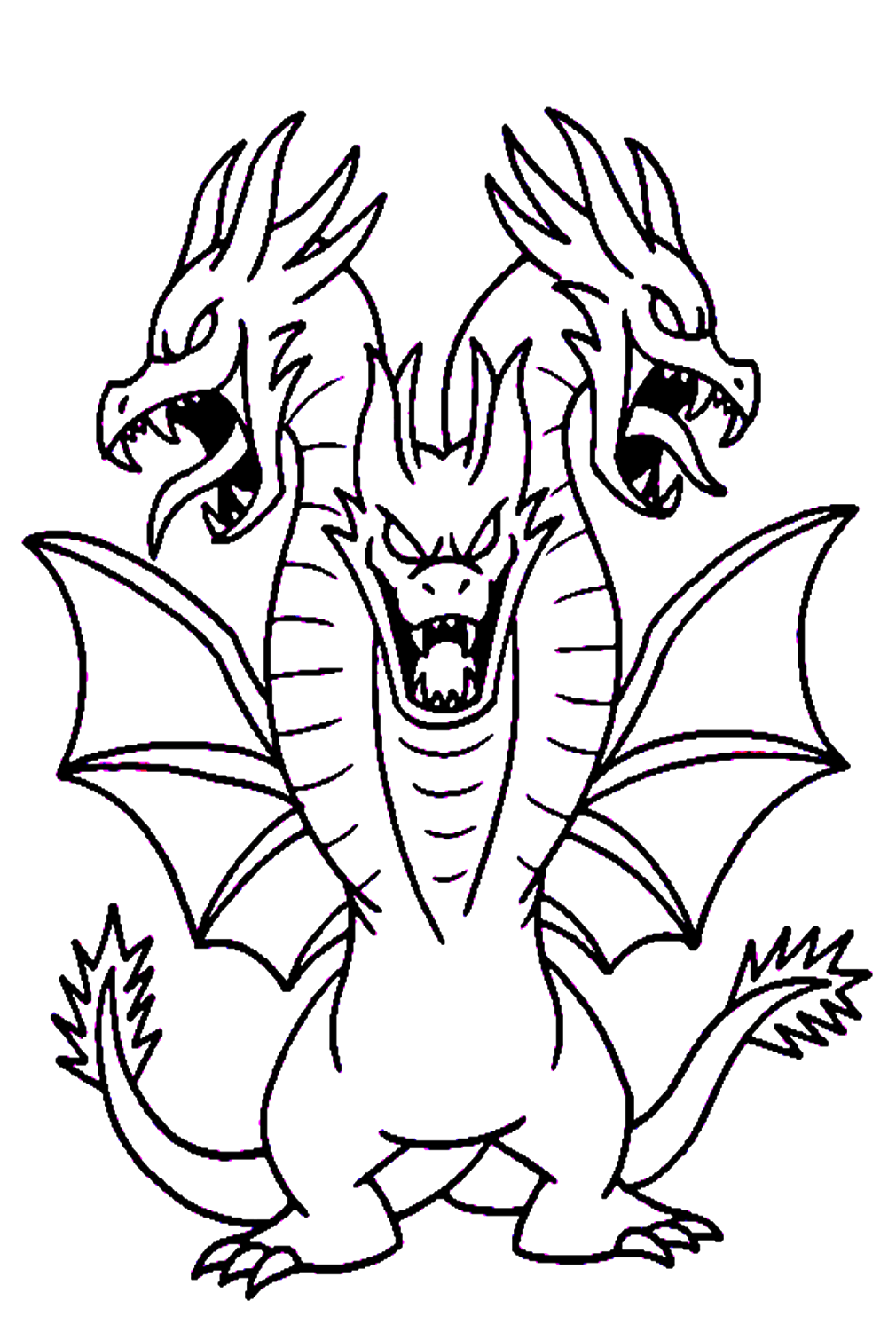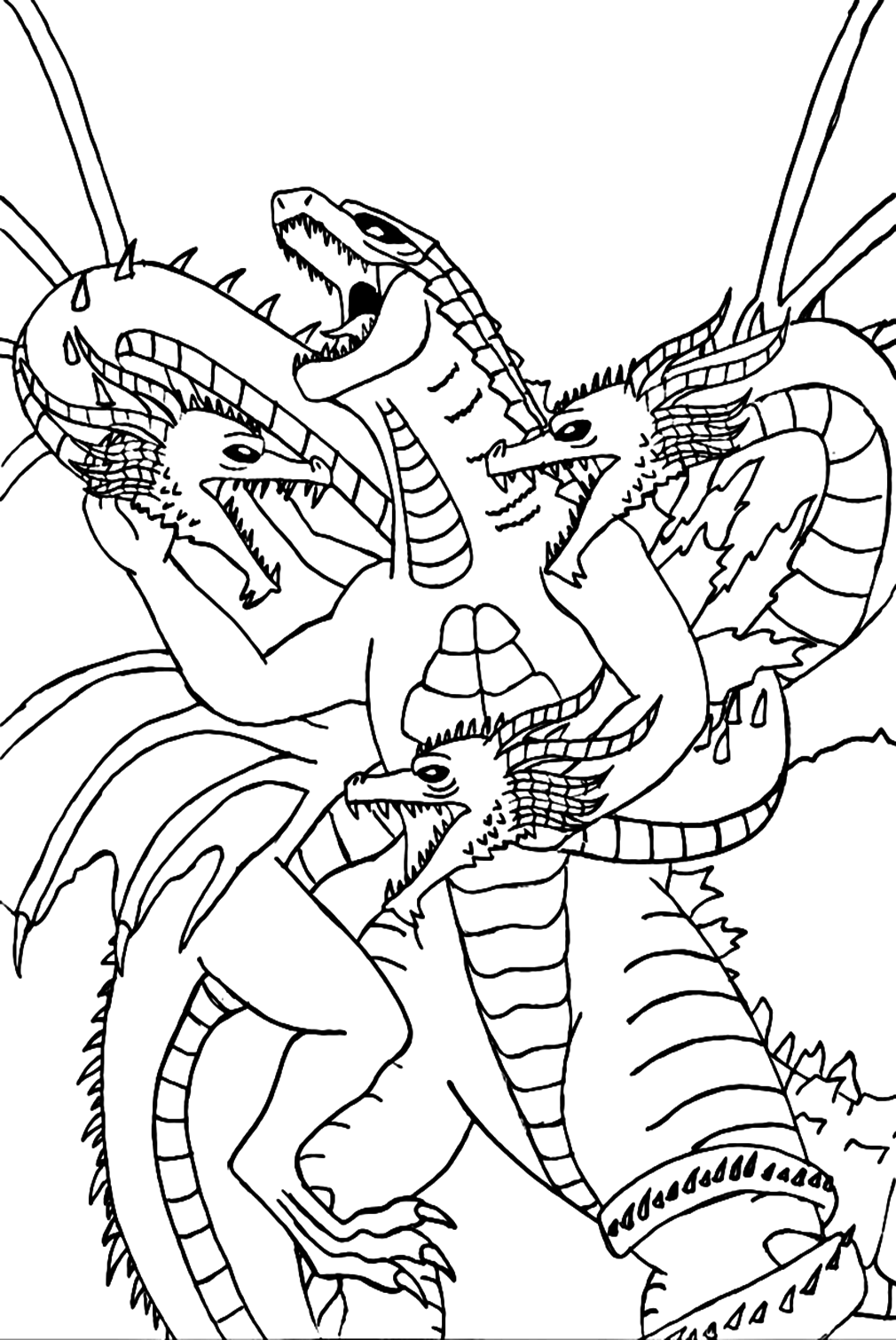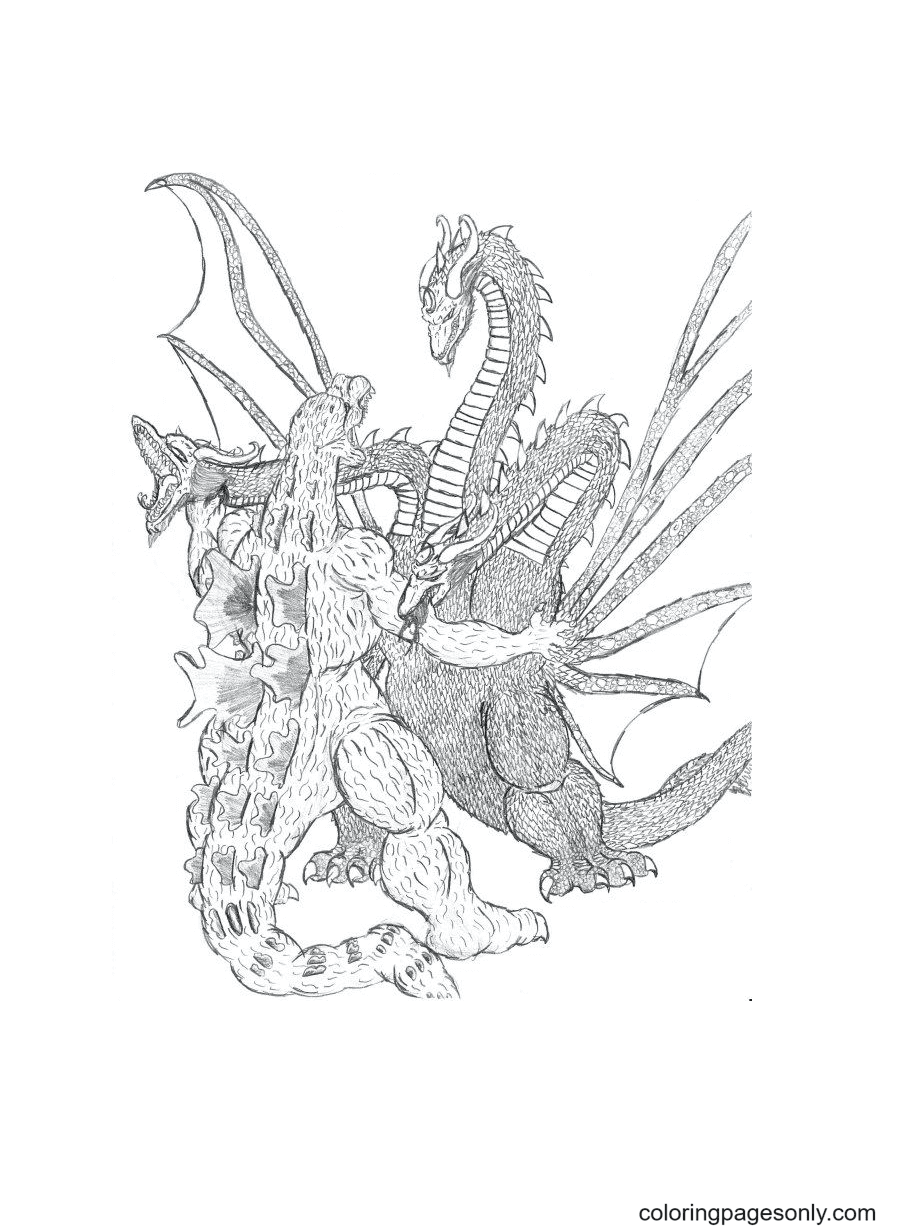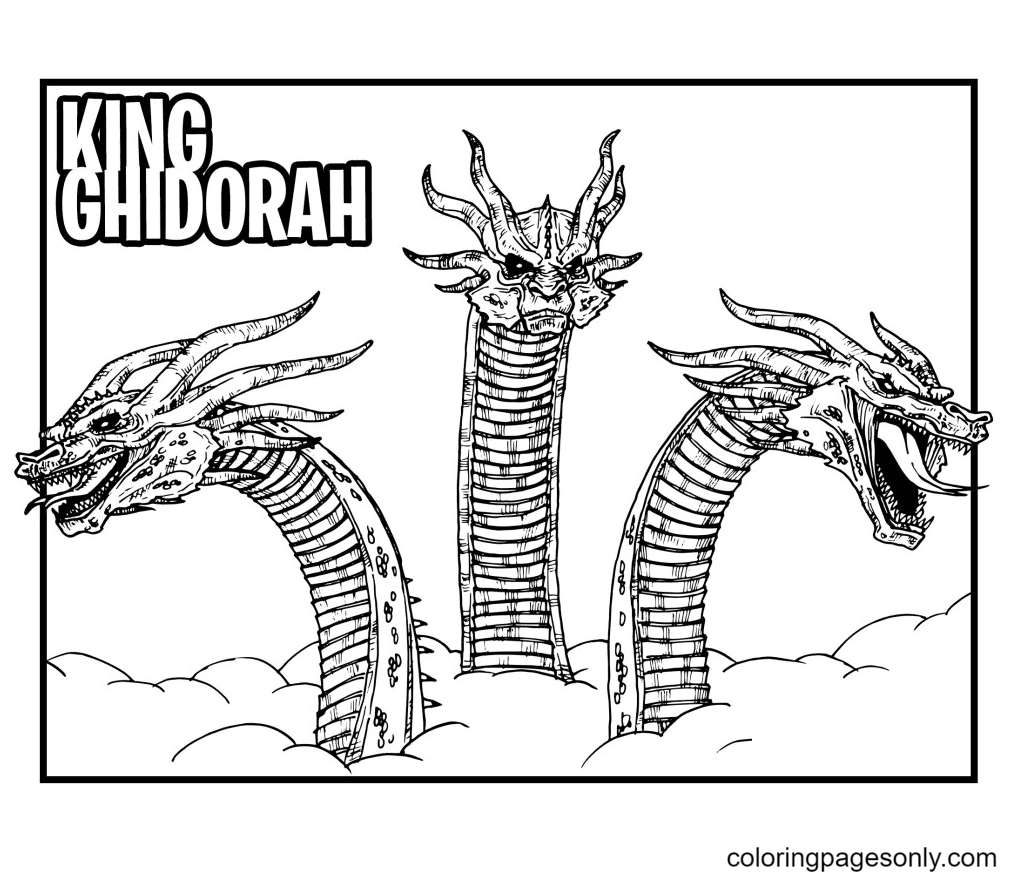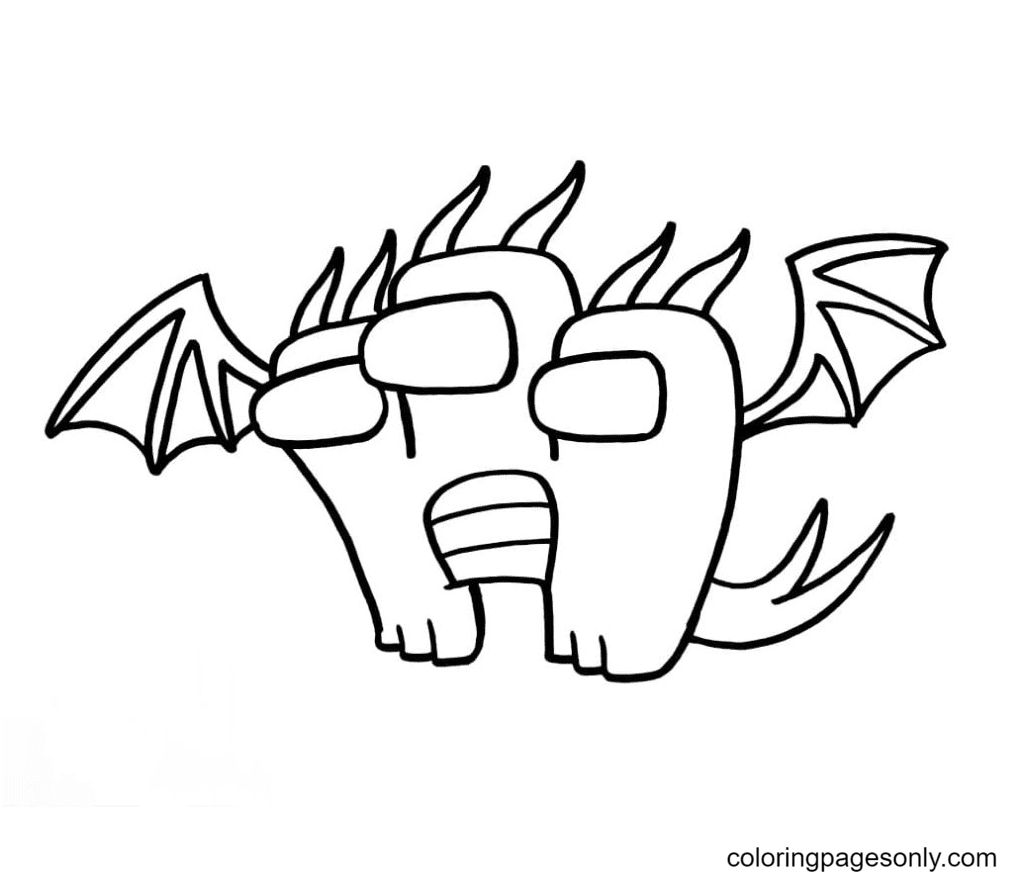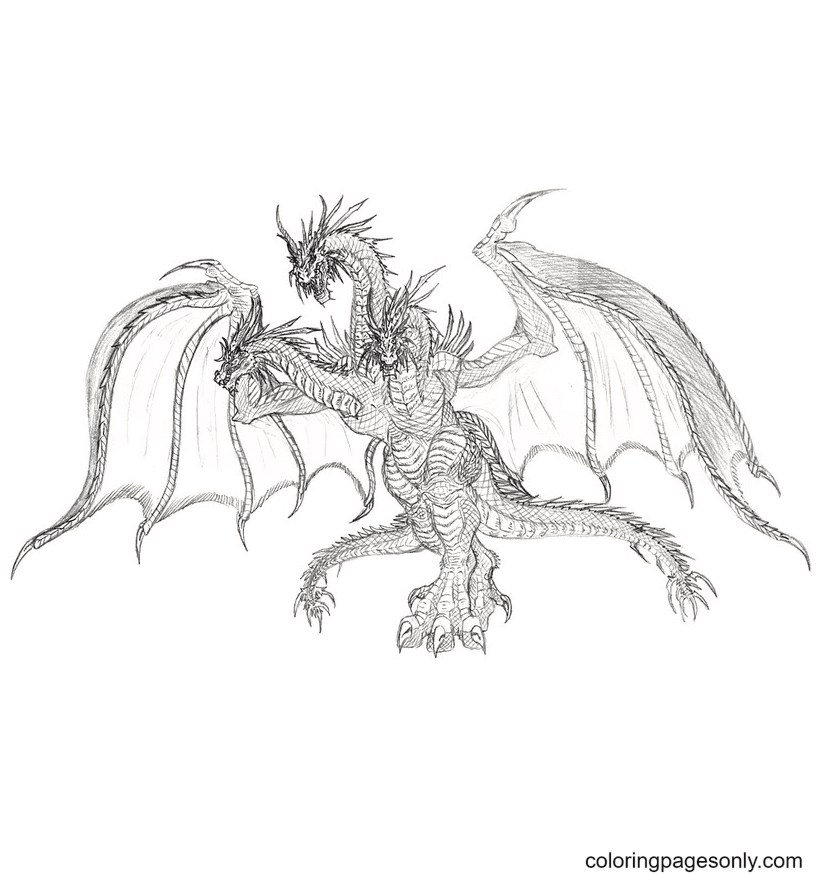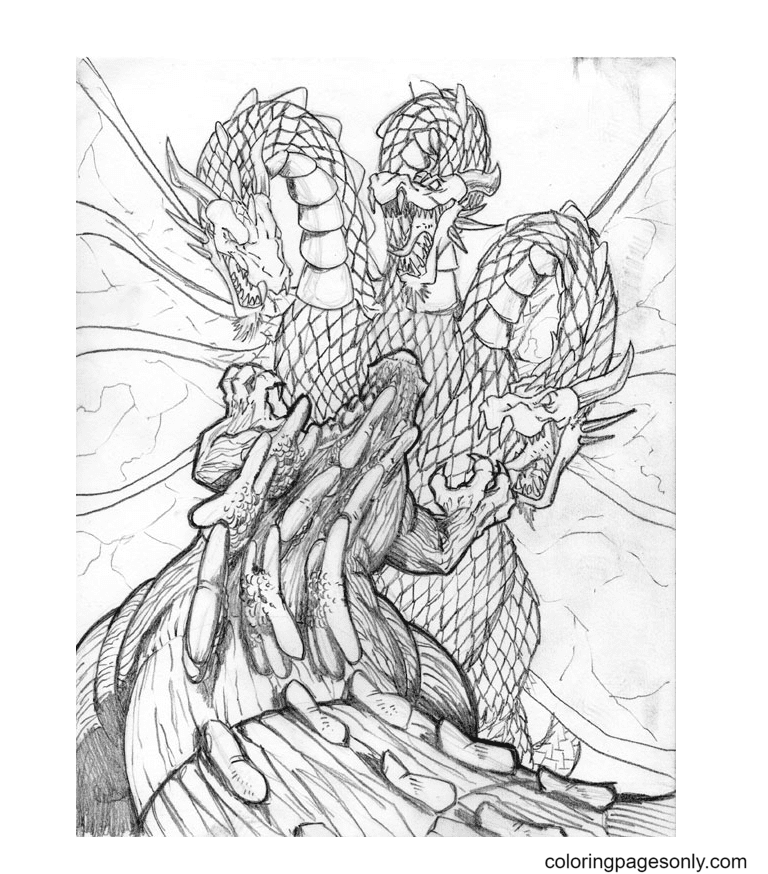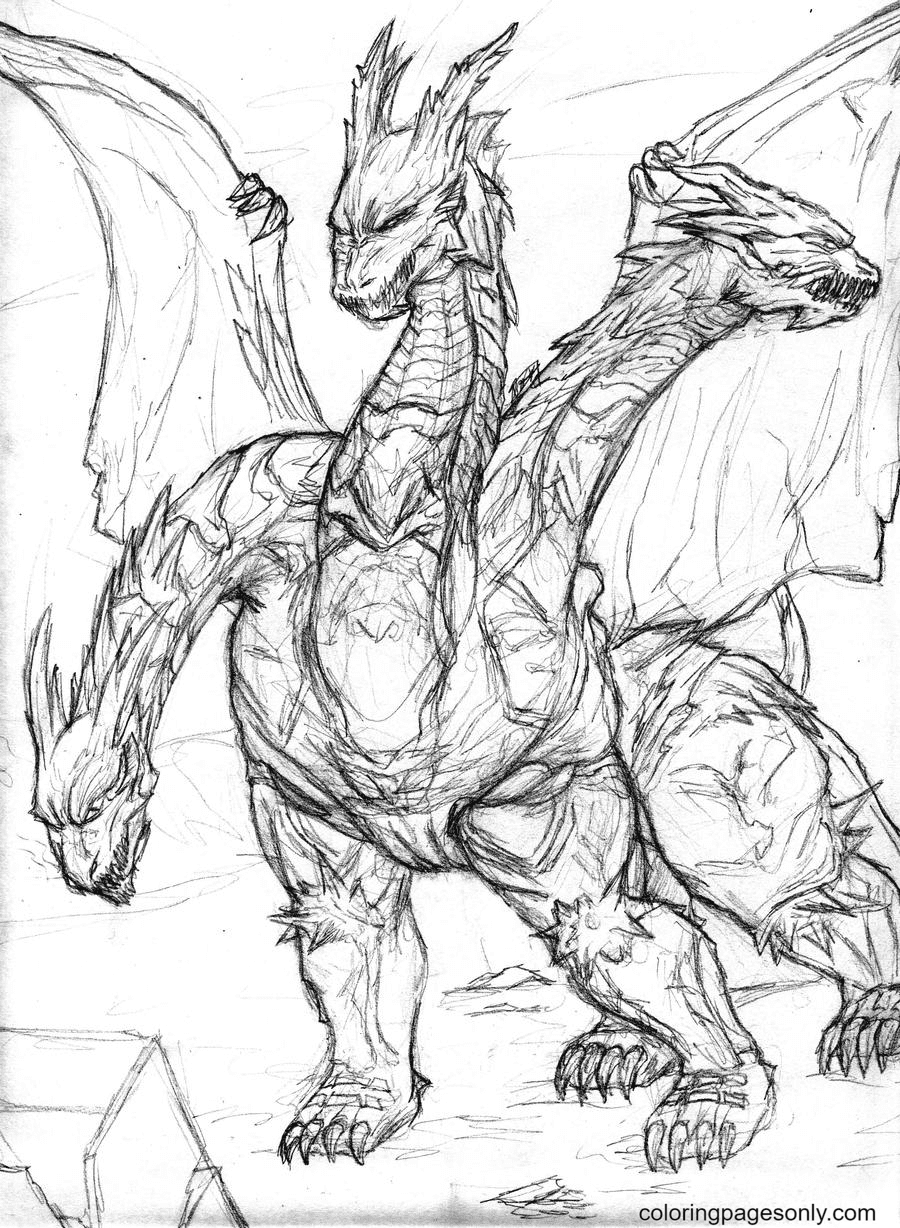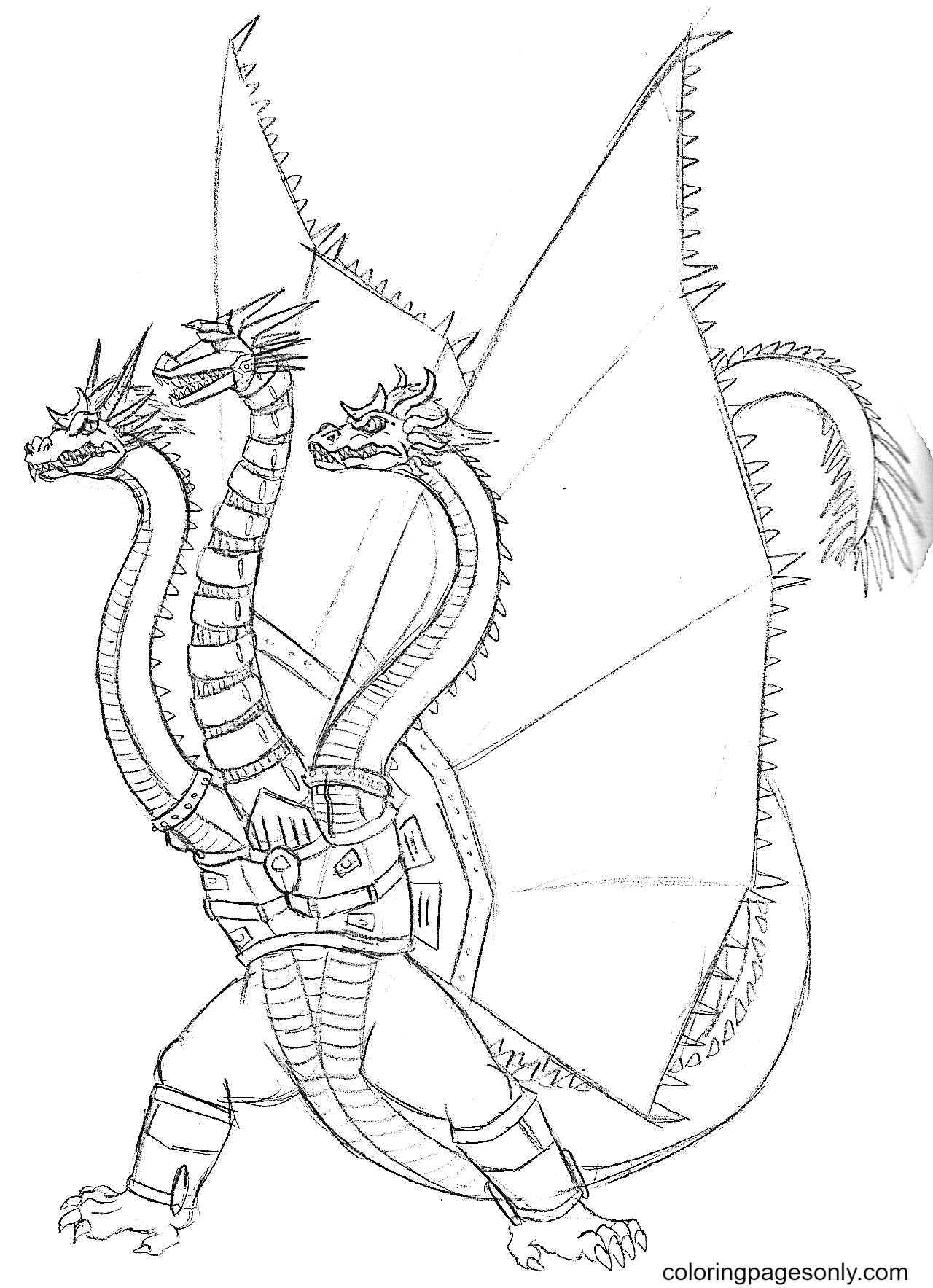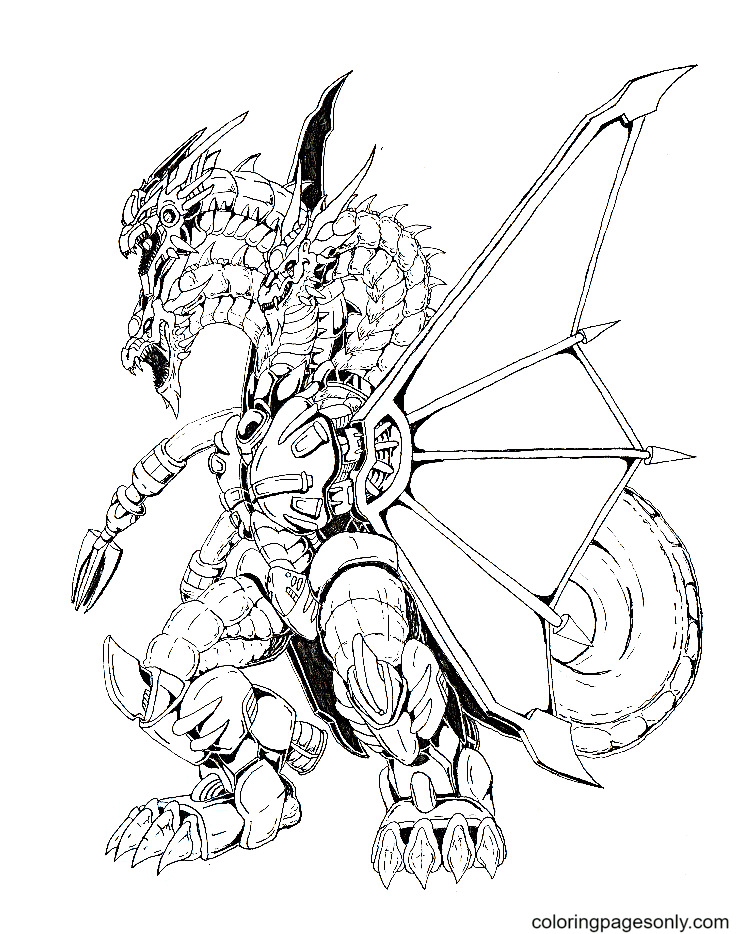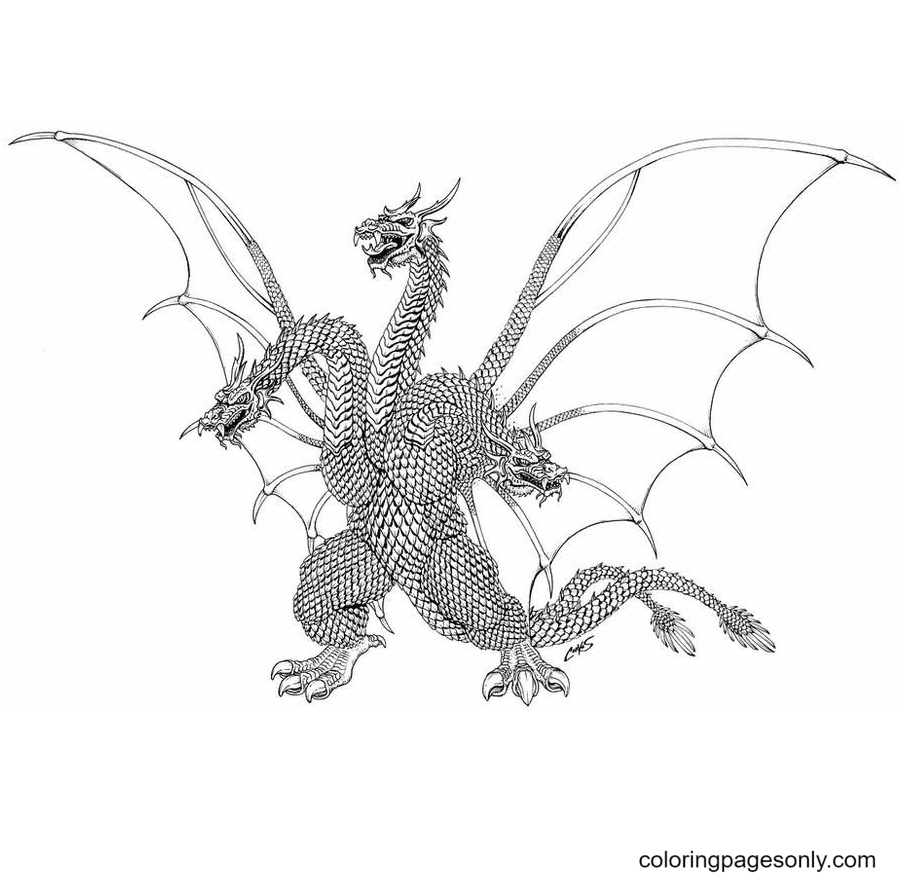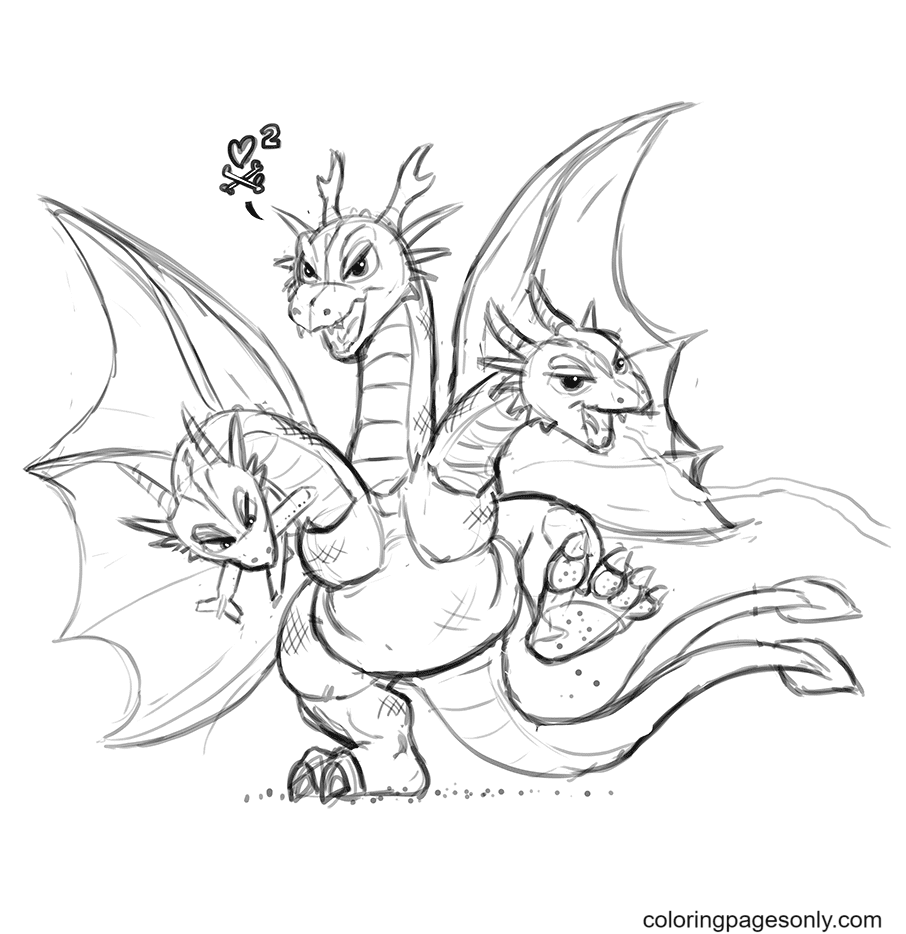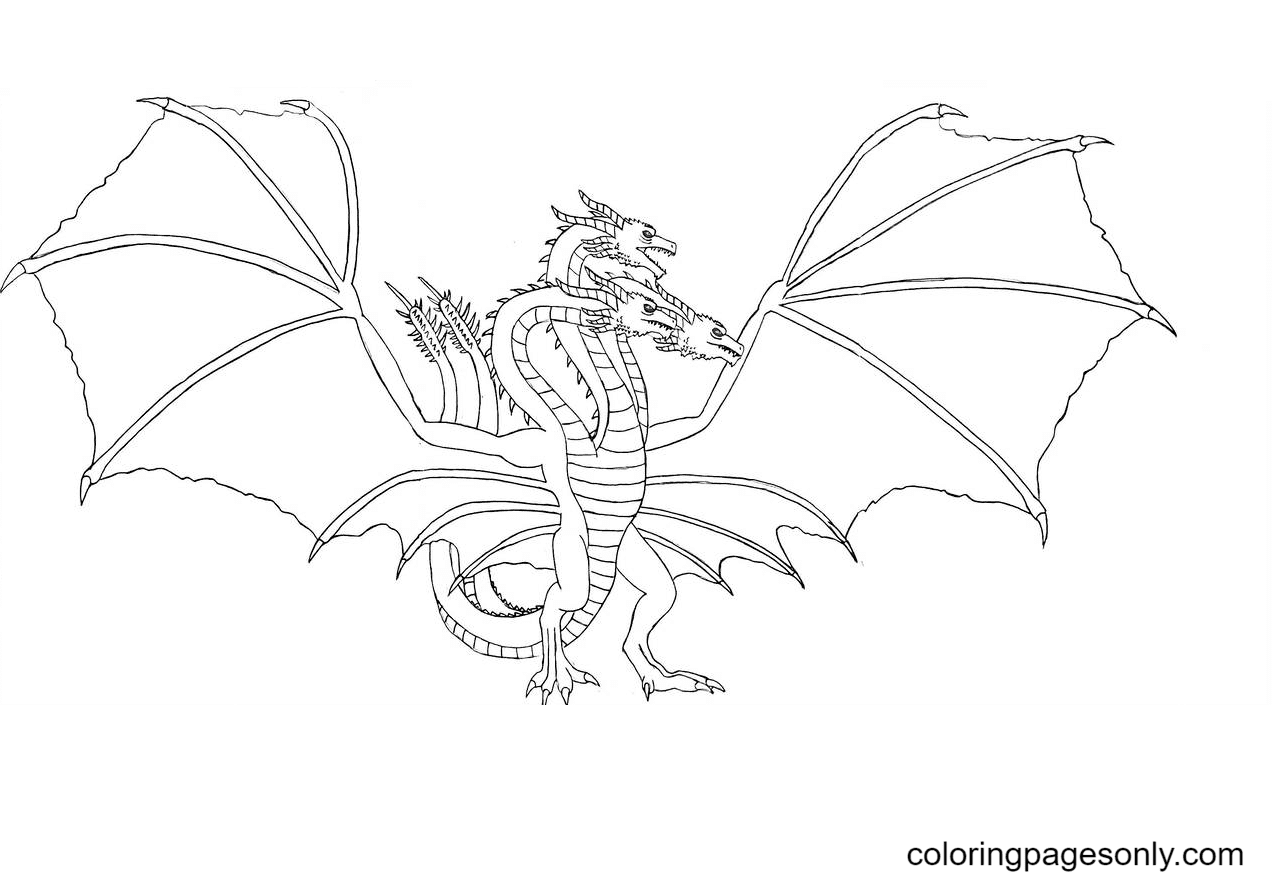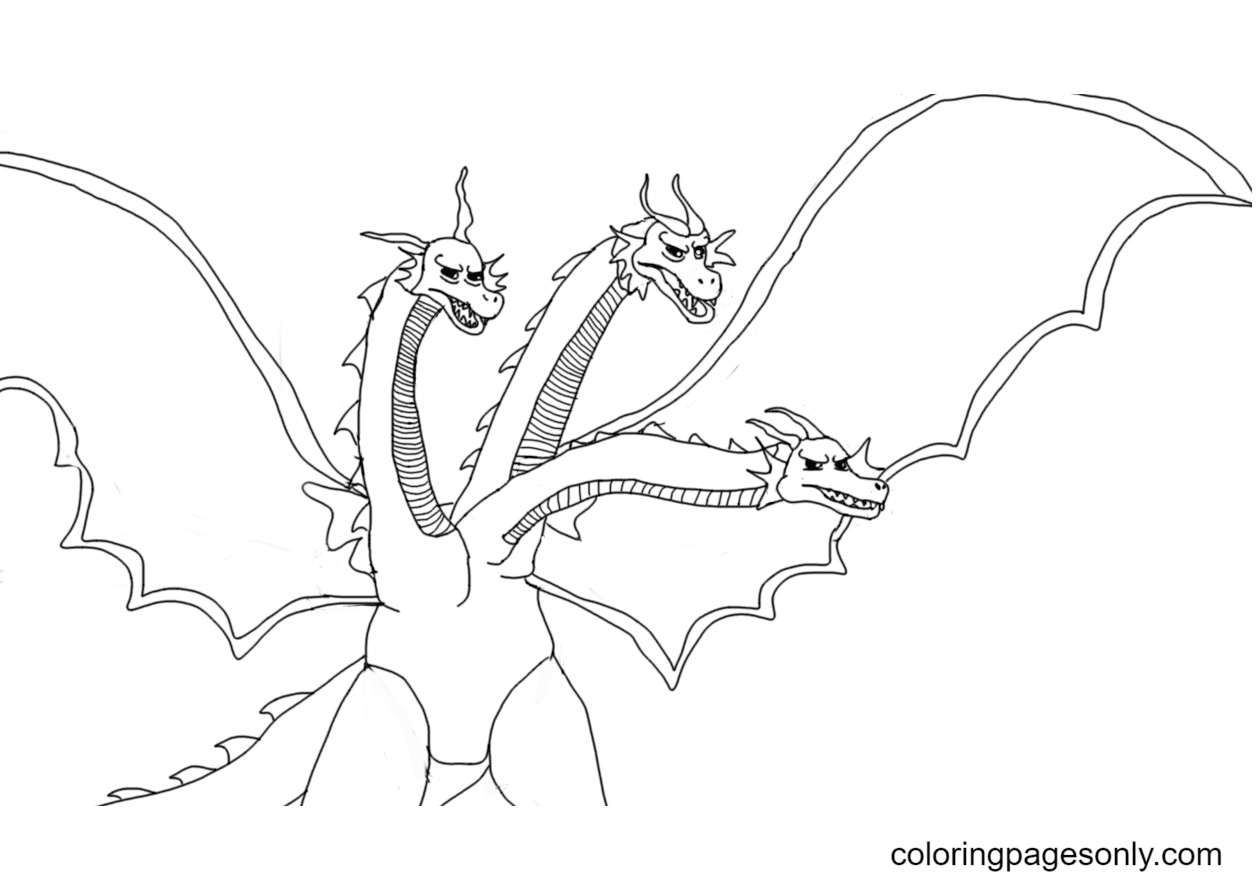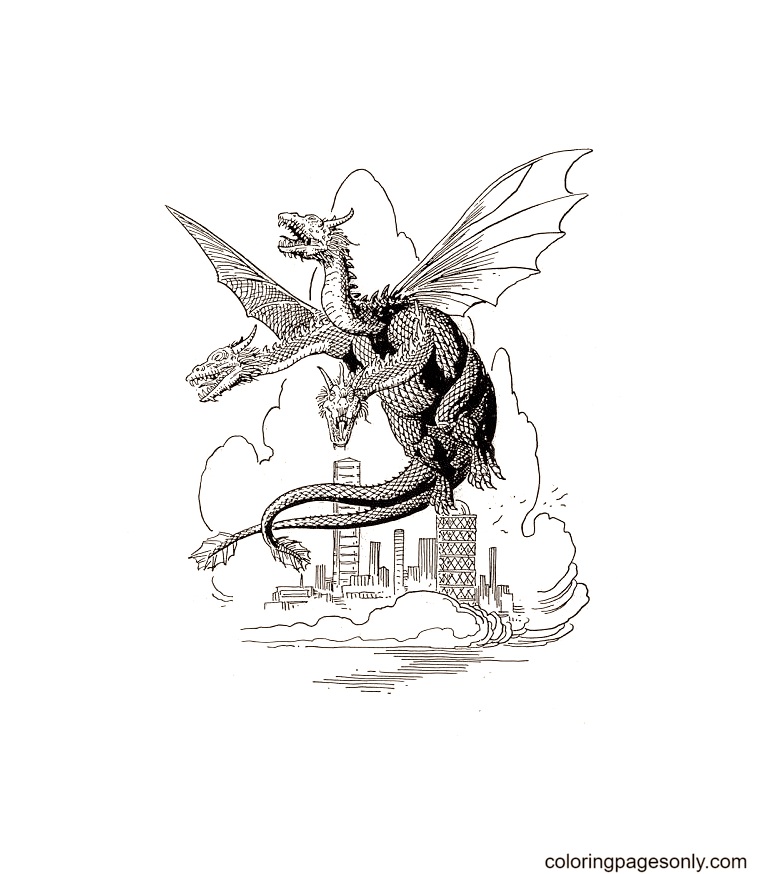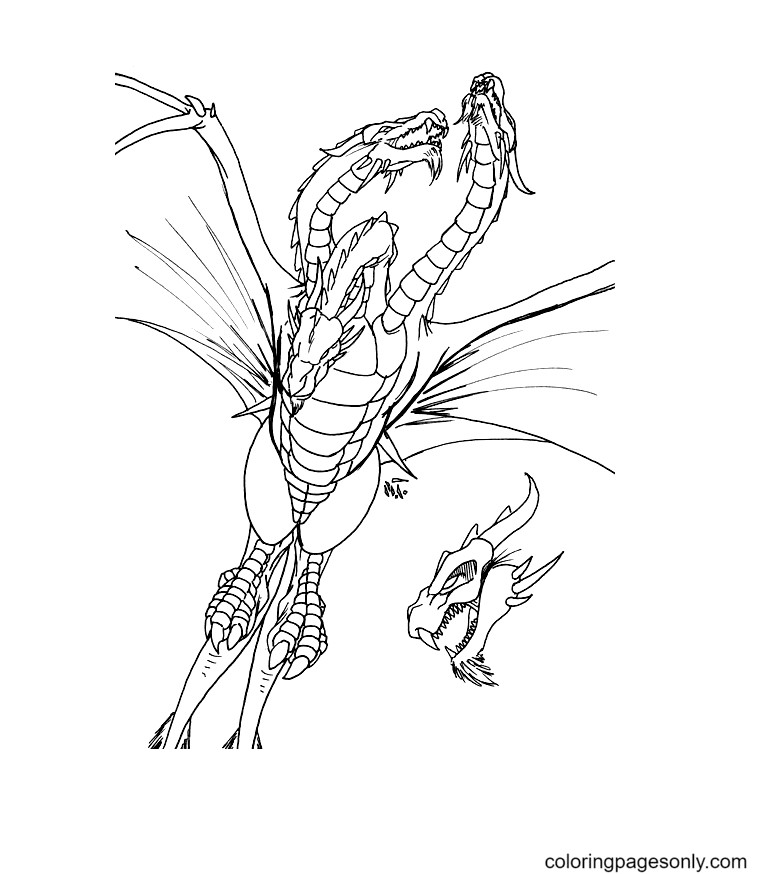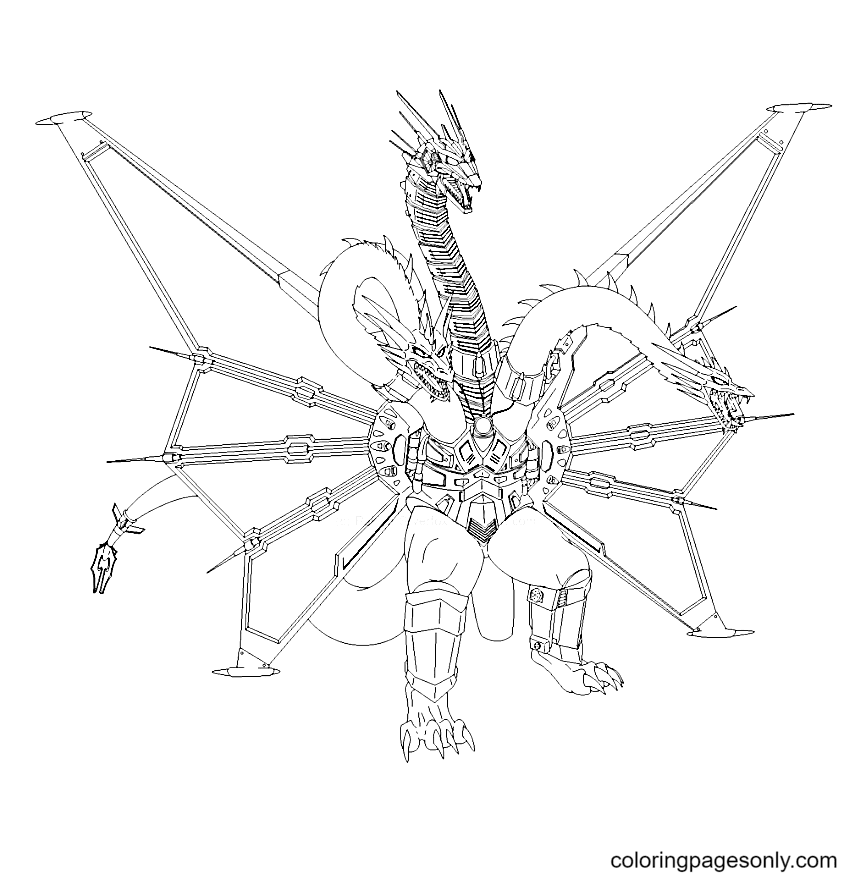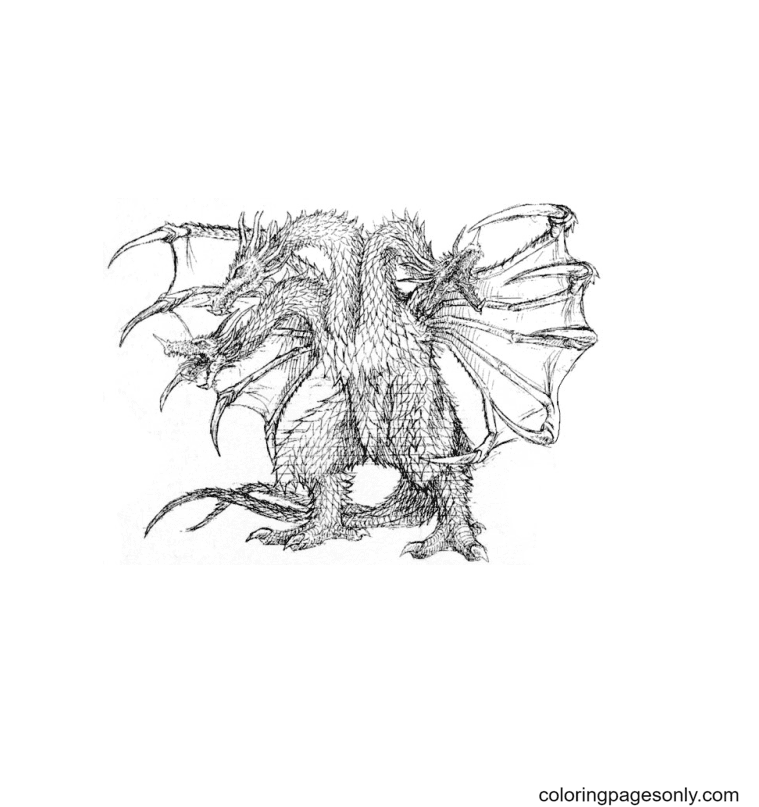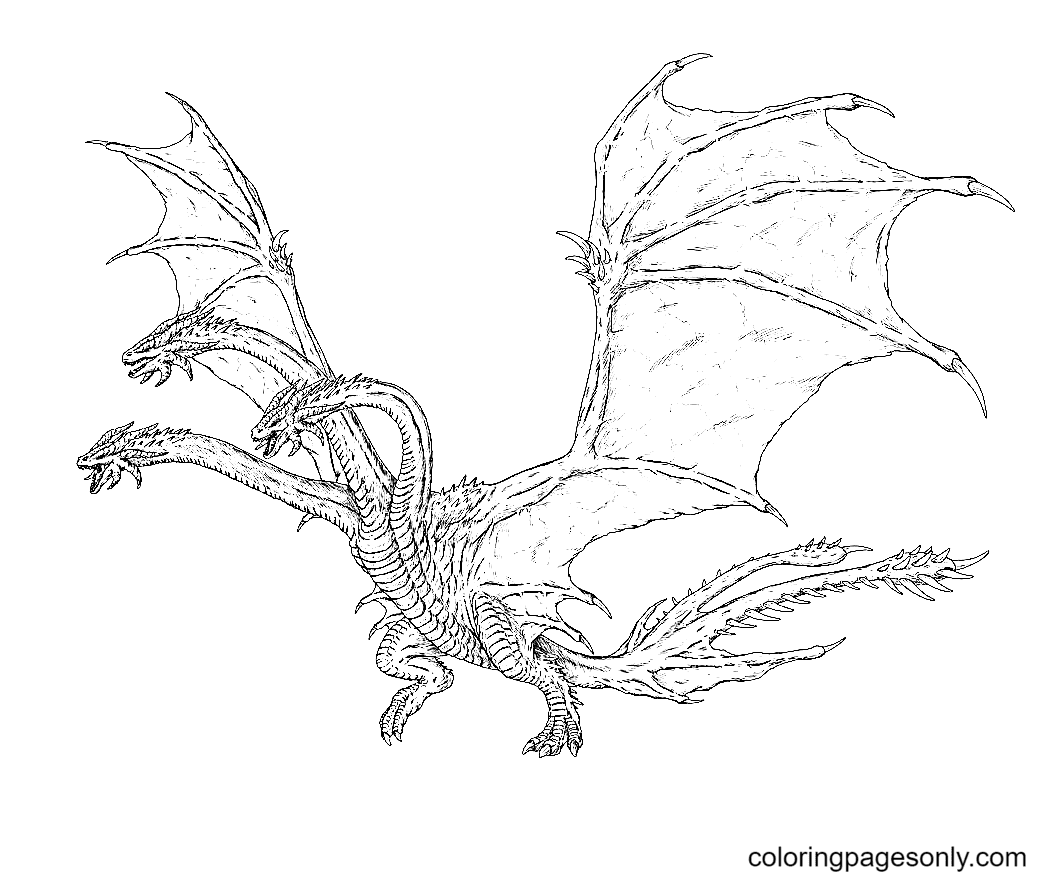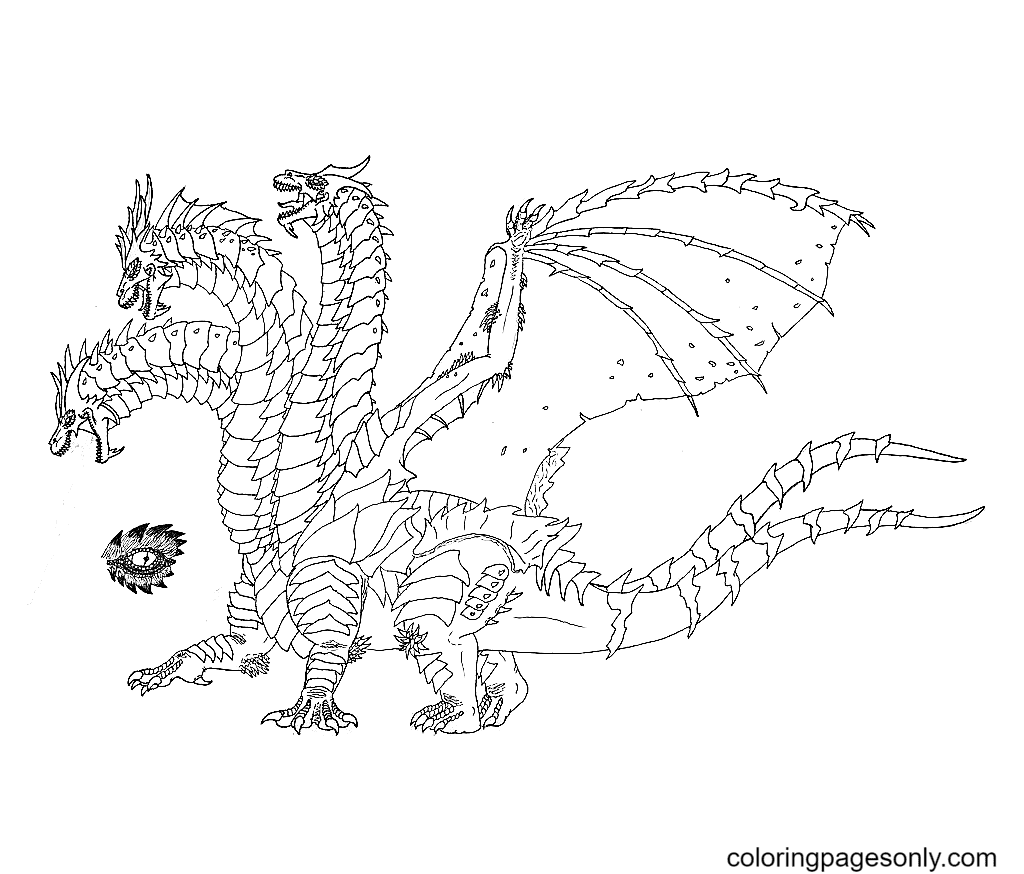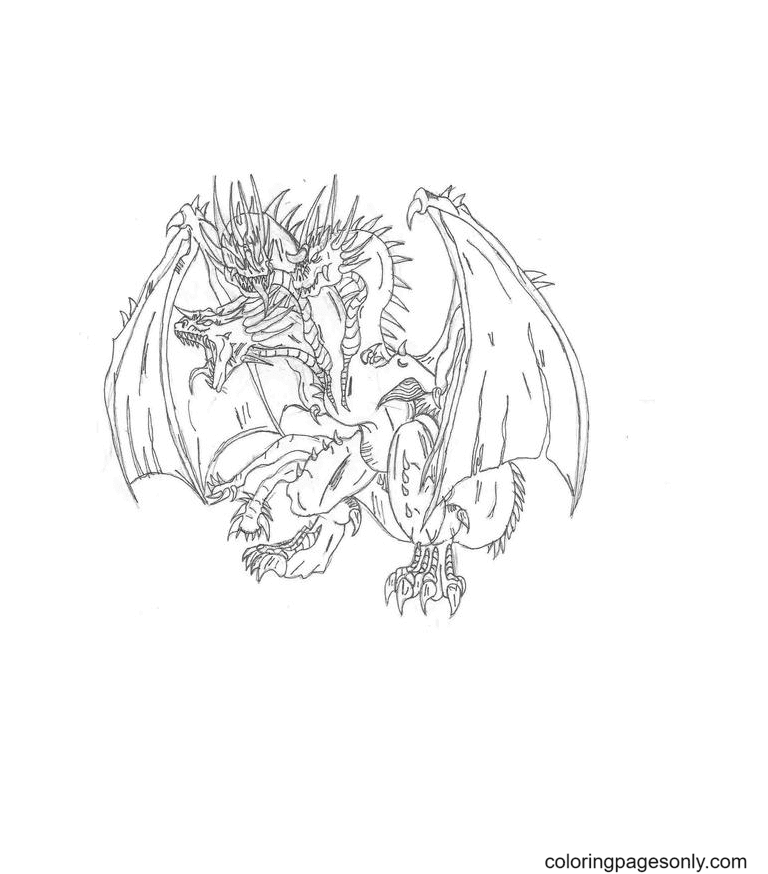
King Ghidorah Coloring Pages at ColoringPagesOnly.com brings together 30+ free pages covering Toho’s iconic three-headed dragon across six decades of kaiju history – solo portrait pages in multiple poses, battle scenes against Godzilla, city destruction compositions, the throne pose, triple gravity beam attacks, and a baby Ghidorah space variant. Download any page as a PDF to print, or color online in your browser. The collection connects to the broader Godzilla Coloring Pages hub and the full TV Show and Films collection.

What is King Ghidorah?

King Ghidorah is a three-headed dragon kaiju created by Toho Co., Ltd. – the Japanese studio that originated Godzilla in 1954 – and has served as Godzilla’s primary arch-enemy for over sixty years. The character first appeared in the 1964 film Ghidorah, the Three-Headed Monster, directed by Ishirō Honda, conceived by Tomoyuki Tanaka, special effects director Eiji Tsuburaya, and screenwriter Shinichi Sekizawa as an homage to Yamata no Orochi, the eight-headed serpent of Japanese mythology – though reduced to three heads for practical suit construction and visual clarity.

The character’s core design has remained recognizable across every version: a golden-scaled bipedal dragon with three long serpentine necks and heads, two massive bat-like wings, two tails, and no forelimbs. The attacks fired from its three mouths – called Gravity Beams or Lightning Beams depending on the era – are roughly equivalent in destructive power to Godzilla’s atomic breath. Wing flaps generate hurricane-force winds capable of leveling city blocks. These abilities, combined with its alien origin and galaxy-destroying history, made Ghidorah the benchmark against which all other Godzilla antagonists are measured.

The character is officially trademarked by Toho as “King Ghidorah” but was marketed in early American releases as “Ghidrah,” “Ghidorah,” or “Monster Zero” – the last name given to it by the alien Xiliens in the 1965 film Invasion of Astro-Monster. Monster Zero remains an alternate name used across multiple eras of the franchise.

Across six decades, King Ghidorah has appeared in four distinct continuity eras with significantly different visual designs, origin stories, and power levels. Understanding which era a coloring page references is one of the most important questions a colorist can bring to this collection, because the design differences between eras are substantial and intentional.
King Ghidorah Across the Eras – Design and Color Guide

The Showa Era (1964–1975)

The original King Ghidorah introduced the character’s fundamental design template. In the Showa era, Ghidorah stands approximately 100 meters tall, weighs 30,000 tons, and carries a 150-meter wingspan. Its body is covered in golden-yellow scales throughout – a uniform, warm metallic gold from head to tail. The three heads each have a single pair of curved horns (one on each side of the skull), large oval eyes, and elongated jaws. The overall silhouette is somewhat rounder and more suit-like compared to later digital-era incarnations, with the necks in particular having a softer, more rubber-textured appearance.

The critical coloring distinction for Showa-era pages: The gold is warm and bright – close to 24-karat gold or a rich, warm yellow, not a cool metallic gold. The Showa Ghidorah reads as brightly colored against backgrounds rather than as a dark, threatening presence. Gravity Beams in Showa-era depictions are golden or yellow-white bolts of energy that match the body color.

In the Showa storyline, King Ghidorah is a cosmic destroyer – it annihilated Venus’s entire civilization thousands of years before arriving on Earth, and is described as “Venus Hellfire” and “Demon of the Galaxy” in various sources. It arrives on Earth inside a meteorite, emerges in Japan, and proceeds to level cities until Mothra convinces her former enemies Godzilla and Rodan to cooperate against it. This scene – three monsters versus one giant dragon – established the franchise’s ensemble battle formula that persists to the present day.

The Heisei Era (1991 – Godzilla vs. King Ghidorah)

The Heisei King Ghidorah is significantly larger: 150 meters tall, 70,000 tons, 175-meter wingspan. The design is visually upgraded from the Showa version – sharper, more angular scale detail, more defined musculature visible across the necks and body, and a slightly more metallic rather than costume-rubber quality. The horns on each head are larger and more prominent.

The origin story in this era is the franchise’s most complex and controversial: the Heisei Ghidorah was not a cosmic destroyer from birth but was engineered from creatures called Dorats – small genetically modified organisms created by time travelers from the 23rd century – who were left in the path of a nuclear explosion in the 1940s and merged and mutated into King Ghidorah. This origin reframes the character as a product of human interference with time, rather than a purely alien threat.

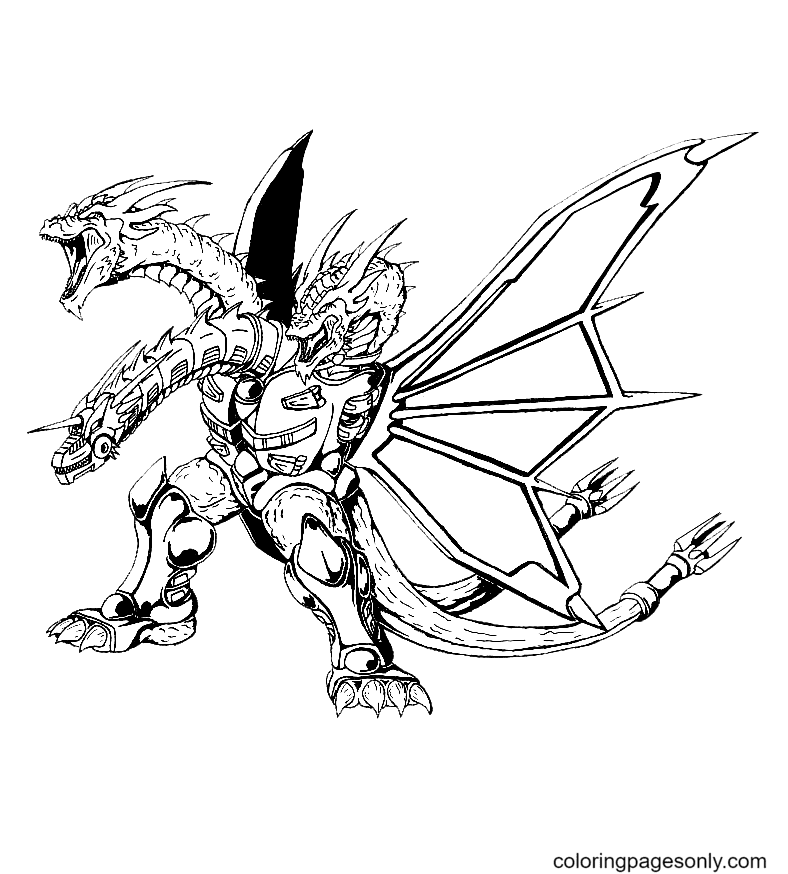
After being defeated by Godzilla, the Heisei Ghidorah was recovered by the future humans and rebuilt as Mecha-King Ghidorah – a cybernetic reconstruction with its destroyed middle head replaced by a mechanical unit, energy restraints added to its wings, and control systems installed. This version has a distinctive split-design visual: the left and right heads and their associated necks retain the organic golden appearance of the original, while the mechanical middle head is silver-grey metal with visible mechanical joints and circuitry.

For Mecha-King Ghidorah pages: The color challenge is managing two completely different material types in one composition – warm organic gold on the outer necks and body versus cool metallic grey-silver on the central head and control equipment. These must read as genuinely different materials, not just different shades of the same tone.

The Millennium Era – GMK (2001, Godzilla, Mothra, and King Ghidorah: Giant Monsters All-Out Attack)

The GMK King Ghidorah is the franchise’s only heroic version. Standing only 49 meters tall – substantially smaller than any other incarnation – the GMK Ghidorah is a Guardian Monster of ancient Japan rather than a destroyer. This version’s heads have broader, flatter skulls with more rounded features than the Showa or Heisei designs, and the overall impression is more powerful but dignified than threatening.

The scale difference matters for coloring: because GMK Ghidorah is significantly smaller, pages depicting it alongside Godzilla will show a creature that is actually shorter than Godzilla, which is the opposite of the typical size relationship.

The MonsterVerse (2019 – Godzilla: King of the Monsters)

The Legendary Pictures MonsterVerse incarnation is the largest King Ghidorah ever filmed at 521 feet / 158.8 meters tall, 141,056 tons, with a 250-meter wingspan. According to Monarch’s in-universe research notes established in the film’s promotional materials, the MonsterVerse Ghidorah’s scales are overlapping and golden, and actually contain trace amounts of real gold. The wing membranes are smooth golden skin rather than scaled surfaces – a visual distinction from the body – and the fronts of the necks and the chest feature a ridged skin texture rather than scales.

The three heads in the MonsterVerse are explicitly designed with distinct personalities. The left head (designated “Kevin” by the film’s fan community, based on production notes) is the most curious and distracted, often looking around independently. The right head (designated “Ni”) is the most aggressive. The central head (designated “Ichi”) is the dominant, most intelligent personality. This behavioral independence is reflected in the film’s fight choreography and is visible in still imagery – the three heads frequently face different directions and express different emotional states simultaneously.

The MonsterVerse Ghidorah generates localized electrical storms through its mere presence and can absorb energy, including Godzilla’s nuclear output, to grow stronger. It is described in the film as a “living extinction event” – not merely a monster but a force analogous to a mass extinction. Its origin is explicitly extraterrestrial: it fell to Earth in the ancient past and battled Godzilla before being sealed under Antarctic ice for thousands of years. This alien origin means it does not fit into Earth’s natural hierarchy of Titans – Ghidorah commands other Titans not through the natural alpha hierarchy but through corruption and overriding their instincts.

For MonsterVerse pages: The gold is richer and more metallic than the Showa version – less “bright yellow-gold” and more “genuine reflective gold metal.” The scales have visible layering and overlap, creating a surface texture richer than the Showa suit. The wing membranes, by contrast, are smooth and slightly translucent at the edges. The Gravity Beams in MonsterVerse depictions are electric gold-white arcs – shorter, more electric-bolt shaped than the smooth beams of earlier eras.

Coloring Tips

The central challenge of every King Ghidorah page is the gold. Every version of Ghidorah across every era is defined by its golden color – but the specific quality of that gold differs significantly across eras, and the difference between “warm bright yellow-gold” (Showa), “rich metallic gold” (MonsterVerse), and “organic golden-yellow with slight green tint” (some Heisei references) is visible. Before starting any Ghidorah page, identify which era the design references from the visual style, then apply the appropriate gold register.

For the three-head compositional challenge, King Ghidorah’s three heads are the most complex element of any of his coloring pages because they require consistent color application across three separate subjects at different positions in the composition. A common error is applying the gold at slightly different saturation or value levels across the three heads, making them read as three different creatures rather than one. Before starting on the heads, commit to a specific gold mixture or pencil combination and test it. Then apply that exact combination to all three heads before adding any shading variation.

The gold-versus-beam contrast: King Ghidorah’s Gravity Beams are fired from the same gold-colored mouths as the rest of his body. The beams must visually separate from the body despite both being in the gold-yellow range. The solution is temperature: the beams should be pushed cooler and brighter – more white-yellow, more electric-energy colored – while the body stays warm and deeper in tone. On the triple lightning attack page, the three beams emanating from three mouths should read as the brightest, most vivid elements in the entire composition, even brighter than the body’s gold.

For Godzilla vs. Ghidorah battle pages: The two kaiju have fundamentally different color temperatures – Godzilla is typically dark grey-charcoal with an atomic blue glow, Ghidorah is warm gold-yellow. This complementary color contrast (warm versus cool) is the primary visual engine of every Godzilla/Ghidorah battle page. Lean into it deliberately: make Godzilla’s grey as cool as possible, make Ghidorah’s gold as warm as possible. The tension between the two color temperatures is what makes these confrontation pages visually dynamic.

For the city destruction and tank scenes: The architectural elements – buildings, bridges, tank bodies – should be rendered in neutral grey-brown tones that keep the focus on Ghidorah. A common mistake is coloring the background city elements in interesting colors that compete with the main subject. Buildings in Ghidorah destruction scenes should be utilitarian grey, slightly warmer toward the base (street-level brick and concrete) and cooler at the upper floors (glass, steel). The tanks similarly should stay in olive drab or military grey, not the warmer tones that might pull visual attention.

For the baby Ghidorah space page: Chibi or infant versions of Ghidorah appear in several franchise properties. The “cute” register works best when the gold is pushed toward a warmer, softer yellow – less metallic, more cheerful – and the space background provides maximum contrast. Deep space backgrounds should go near-black with very cold blue-purple in the deepest shadow areas, with distant stars rendered as tiny white or pale yellow dots. The warm baby Ghidorah floating in cold dark space creates the visual contrast that makes baby kaiju designs work.

For Mecha-King Ghidorah pages: The mechanical/organic split requires two distinct color palettes that must coexist without the page feeling inconsistent. The organic portions (left and right heads, wings, tail, body) remain in the warm gold of the Heisei era. The mechanical center head and control equipment are cool grey-silver – the specific grey should be a cool metallic tone, not warm. Where the mechanical and organic elements meet, a very small transition zone is allowed, where the gold and grey briefly overlap or touch – this prevents the two areas from reading as separate images pasted together.

5 Activities

The era comparison study. Find reference images of King Ghidorah from three different eras – Showa, Heisei/MonsterVerse, and any Millennium incarnation – and print two copies of the same Ghidorah portrait page. Color the first copy as Showa Ghidorah: bright warm yellow-gold throughout, relatively uniform in saturation, the gold of old treasure. Color the second copy as MonsterVerse Ghidorah: richer, more metallic gold with visible scale depth, slightly more variation in tone between the raised scales and the recesses between them. Display both pages side by side with their era labels. The exercise makes visible something that is easy to intellectually understand but harder to see until rendered: that the same essential design – three gold heads, golden body, bat wings – reads as a completely different creature depending on how the gold is handled.

Color the triple gravity beam attack page as a three-head personality exercise. Print the King Ghidorah Triple Lightning Attack Coloring Page. In the MonsterVerse canon, the three heads have distinct personalities – the left head is most curious, the right is most aggressive, and the center is most dominant. Color all three heads in the same fundamental gold, but make subtle adjustments to the eye treatment and expression shading on each to reflect these different personalities: the curious left head with wider, more open eye rendering; the aggressive right head with tighter, more intense shadow on the brow; the dominant central head with the most powerful, direct rendering. After finishing, see if someone who knows the MonsterVerse can identify which head is which personality without being told.

Build the Godzilla vs. Ghidorah battle scene using color temperature contrast. Print the King Ghidorah vs. Godzilla Battle Coloring Page. Before starting, establish a strict color temperature rule: Ghidorah uses only warm tones (golds, yellows, warm whites for beams), Godzilla uses only cool tones (grey, charcoal, cold blue for atomic breath). Apply this rule strictly across the entire composition – even Godzilla’s teeth should lean cooler than Ghidorah’s. The finished result should demonstrate one of the most effective principles in illustration: that two subjects sharing the same page read as protagonists in conflict when their color temperatures are placed at opposite ends of the warm-to-cool spectrum.

Render the King Ghidorah Destroying City Coloring Page as a scale exercise. Kaiju art lives or dies on scale communication – the sense that the monster is genuinely enormous relative to its environment. The buildings and vehicles on this page are the scale reference that makes Ghidorah feel enormous. Color all architectural elements in deliberately dull, muted, neutral tones – grey concrete, off-white facade panels, dark window glass. Render any human-scale details (windows, doors, street furniture) in fine, tight strokes that emphasize their miniature quality. Then render Ghidorah in full saturated gold with maximum visible detail. The contrast between the detailed, muted architecture and the vivid, large-scale Ghidorah should create a genuine sense of scale difference even on a flat page.

Design a new Ghidorah variant following the franchise’s evolution logic. Across its history, each new era of Ghidorah has reinterpreted the three-headed golden dragon through the lens of its decade’s anxieties: the Showa version reflected Cold War-era fears of alien invasion; the Heisei version engaged with time travel and genetic engineering ethics; the GMK version inverted the monster as a guardian of tradition; the MonsterVerse version tied to themes of ecological collapse and an alien force incompatible with Earth’s natural order. On a blank page, design a new King Ghidorah variant for a hypothetical new era. What contemporary anxiety or cultural theme would your version embody? How would this theme affect the visual design while maintaining the three-head/gold/wing silhouette that makes Ghidorah recognizable? Write one sentence describing the new origin story and one sentence describing the design change that reflects it.

These related coloring collections will help you explore the wonderful world of colors. Let’s choose, be creative, and show us your great pictures!

Charlotte Taylor – Writer

I'm Charlotte Taylor, a former preschool teacher turned content creator at Coloringpagesonly.com. Fueled by my love for children and a deep passion for exploring the world through colors, I’m dedicated to inspiring creativity and spreading a vibrant, positive artistic spirit to all.