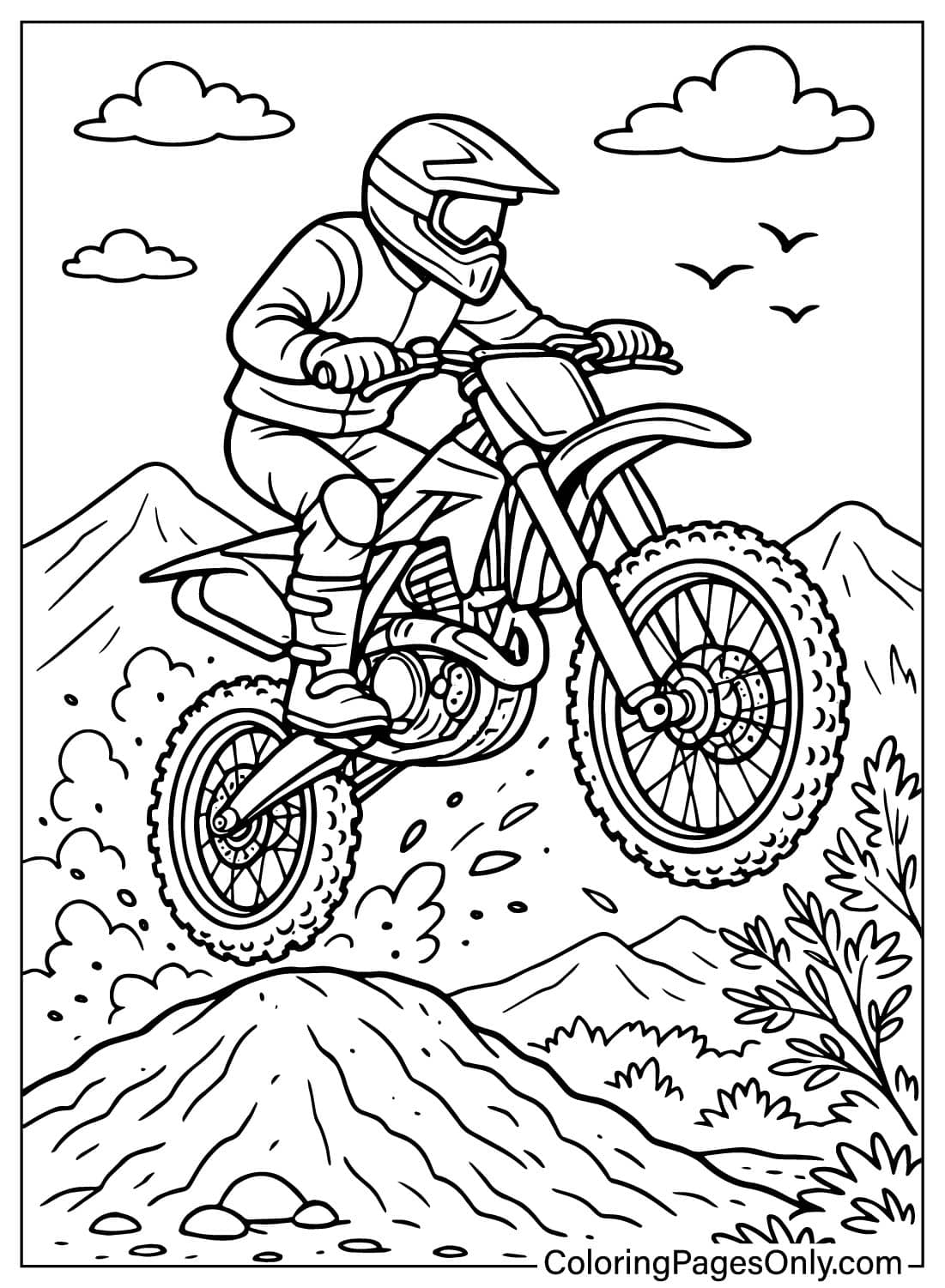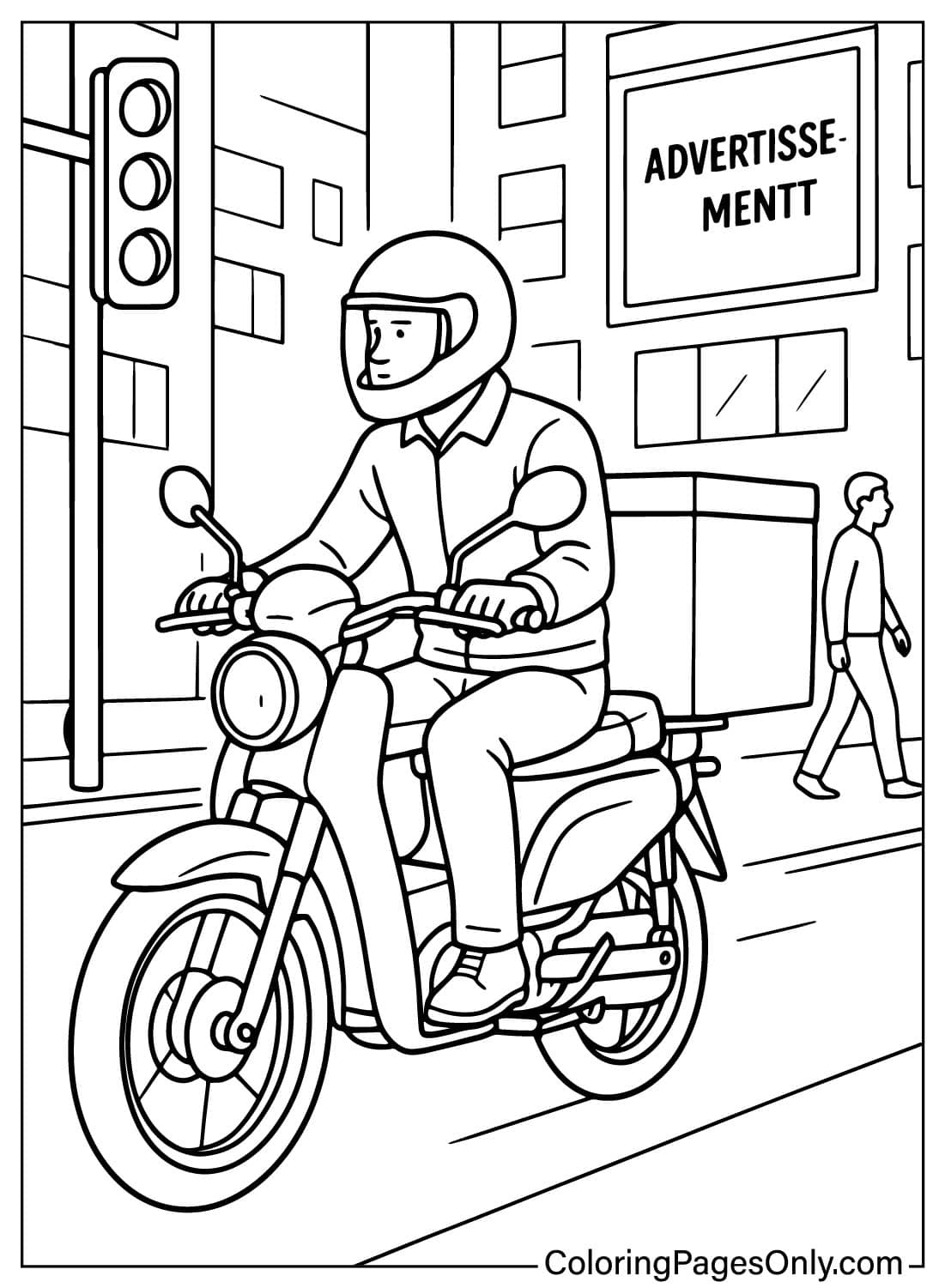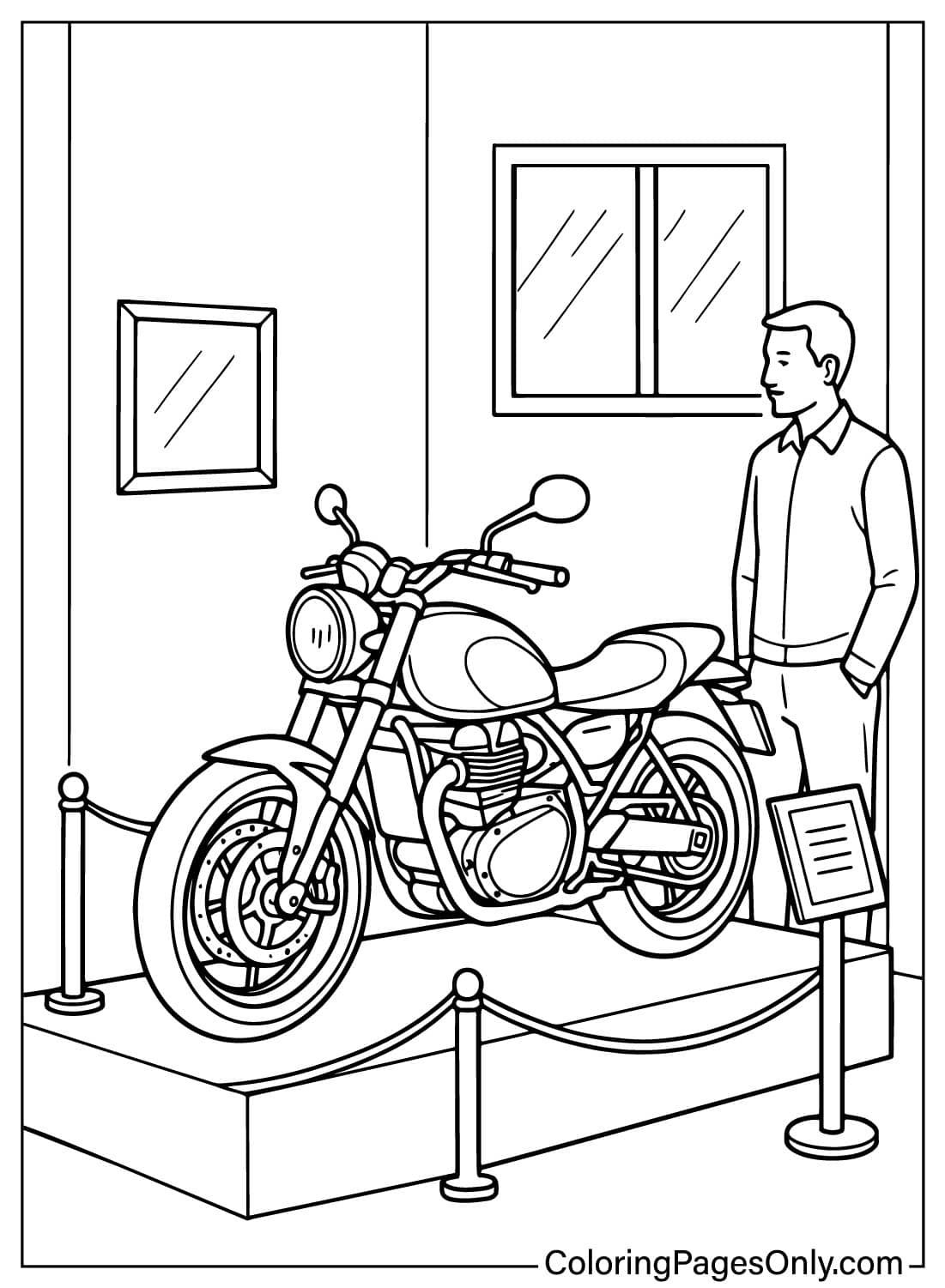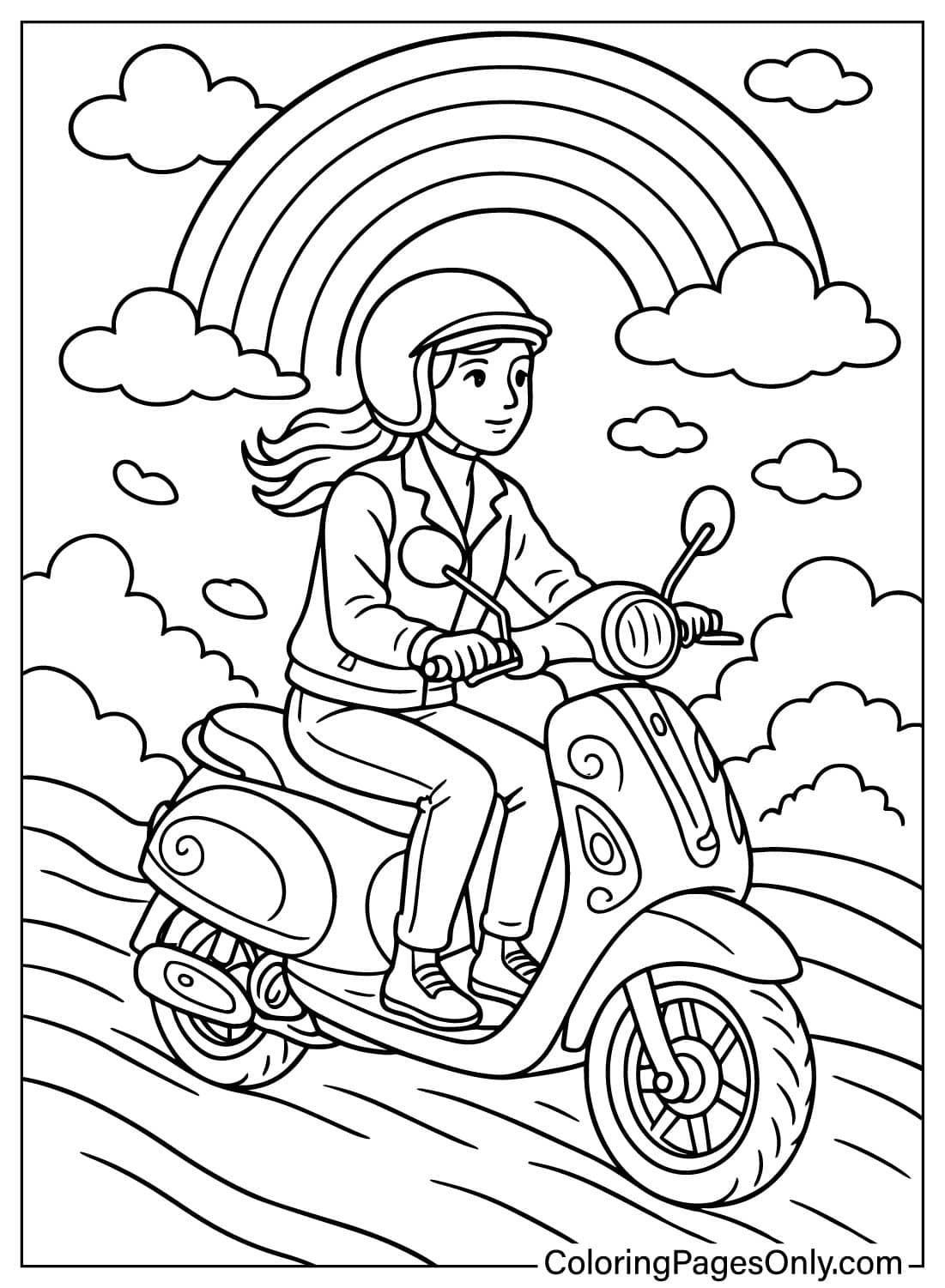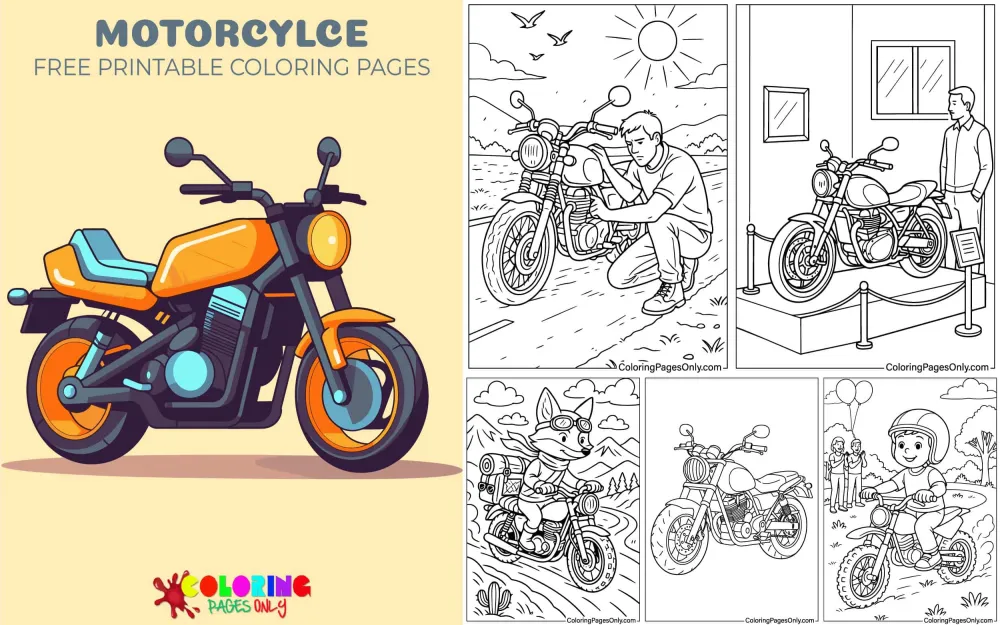
Motorcycle Coloring Pages at ColoringPagesOnly.com bring one of the most visually dynamic machines ever built to your coloring table – and this collection of 30+ free pages covers the full range of motorcycle life: sport bikes and racing machines with their aerodynamic fairings and tucked rider positions, police motorcycles on duty, civilian riders in rain and snow, an admirably thorough series of animal characters on motorcycles, and the quieter everyday scenes of a motorcycle shop and a repair session. Whether you are here because a child loves anything with an engine and two wheels, or because you want to spend time with one of the most compositionally interesting vehicle types in the coloring page universe, the full Transport collection is available through our Transport Coloring Pages hub.

Every page is completely free – download as PDF to print or color online in your browser. No sign-up, no cost.

What Makes Motorcycles Worth Coloring

The motorcycle is one of the oldest powered vehicles still in continuous development. The first gasoline-powered motorcycle was built by Gottlieb Daimler in 1885 – the same year as the first practical automobile – and the fundamental concept of a two-wheeled vehicle with an internal combustion engine has evolved in parallel with car technology ever since, diverging into dozens of distinct machine types each with its own visual identity, riding culture, and coloring page opportunities.

What distinguishes a motorcycle from a car as a coloring subject is the visibility of the machine’s structure. A car conceals most of its mechanical components inside bodywork – you color a box with windows. A motorcycle exposes the engine, the frame, the fork assembly, the exhaust pipes, the swing arm, and the wheel spokes as visible design elements. Every coloring page in this collection shows a machine whose form follows its function – the radiator fins, the cylinder heads, the brake discs, the chain guard – and understanding even a little of what each part does makes the coloring more intentional and the finished page more accurate.

Motorcycles also exist in more visually distinct types than most other vehicles. A sport bike and a cruiser are as visually different as a racing yacht and a tugboat – same basic concept, completely different proportions, silhouettes, and aesthetics. This collection captures several of those distinct types.

What’s Inside the Motorcycle Coloring Collection

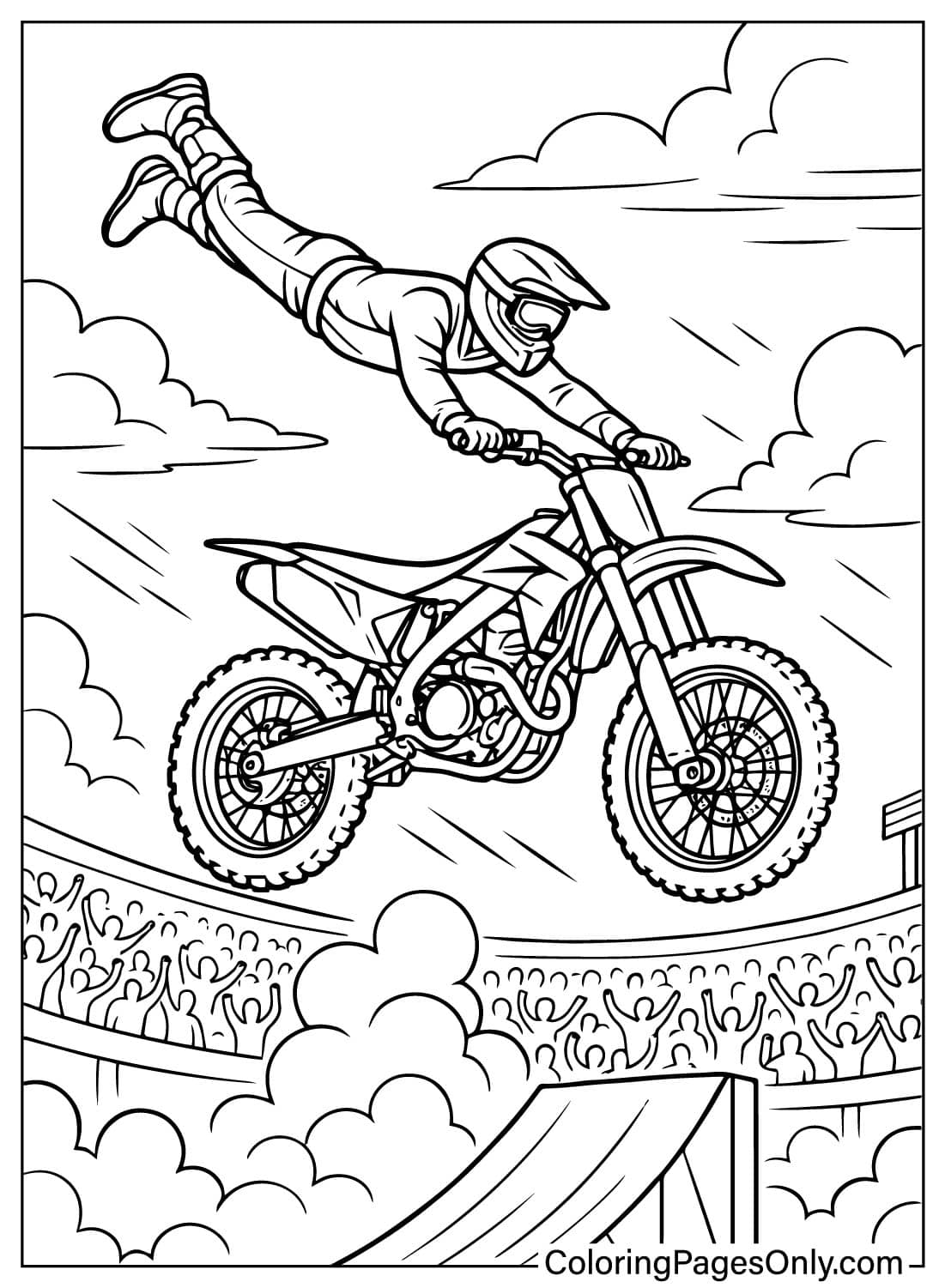
The sport bike and racing pages – Sport Motorcycle, Racing Motorcycles, Motorcycle Race – represent the highest-performance end of the motorcycle world. Sport bikes (also called supersports or superbikes) are built for speed and cornering: full fairings that enclose the engine and create an aerodynamic shell, handlebars positioned low to put the rider in an aggressive forward-leaning tuck, and a visual profile that is narrow, pointed, and purposeful. The Racing Motorcycles and Motorcycle Race pages show multiple bikes in a competition context, which adds the compositional element of motion, proximity, and the track environment.

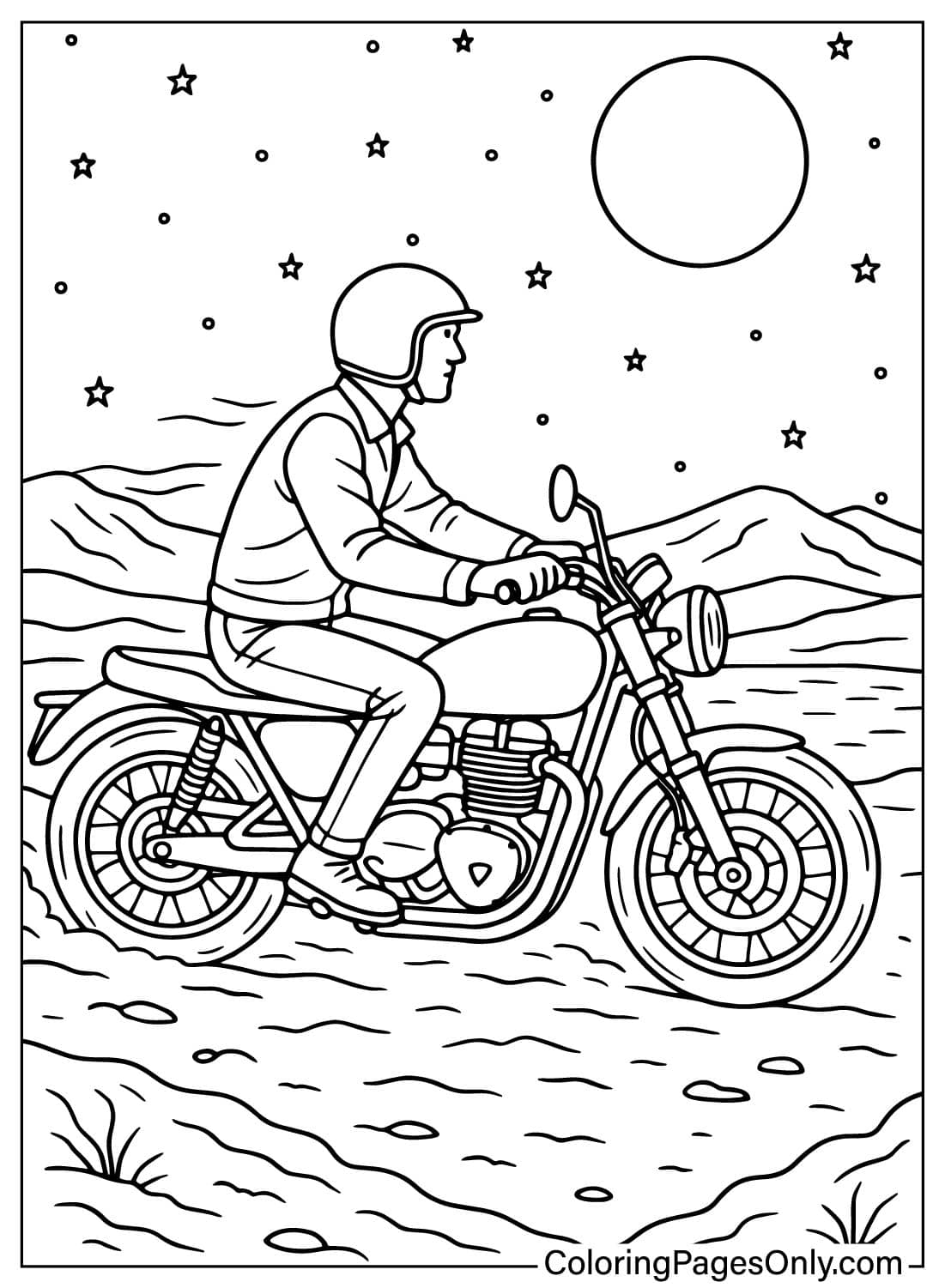
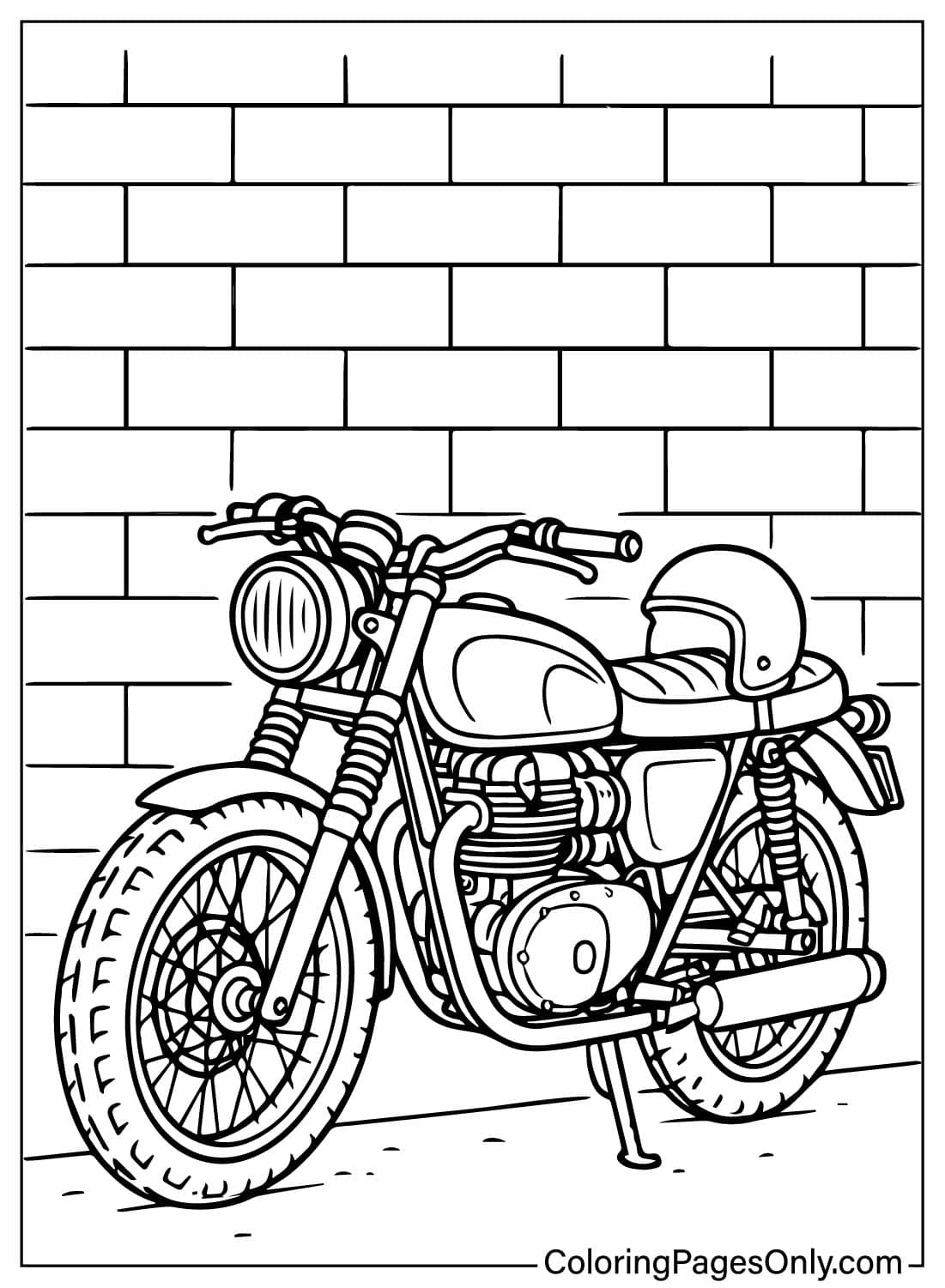
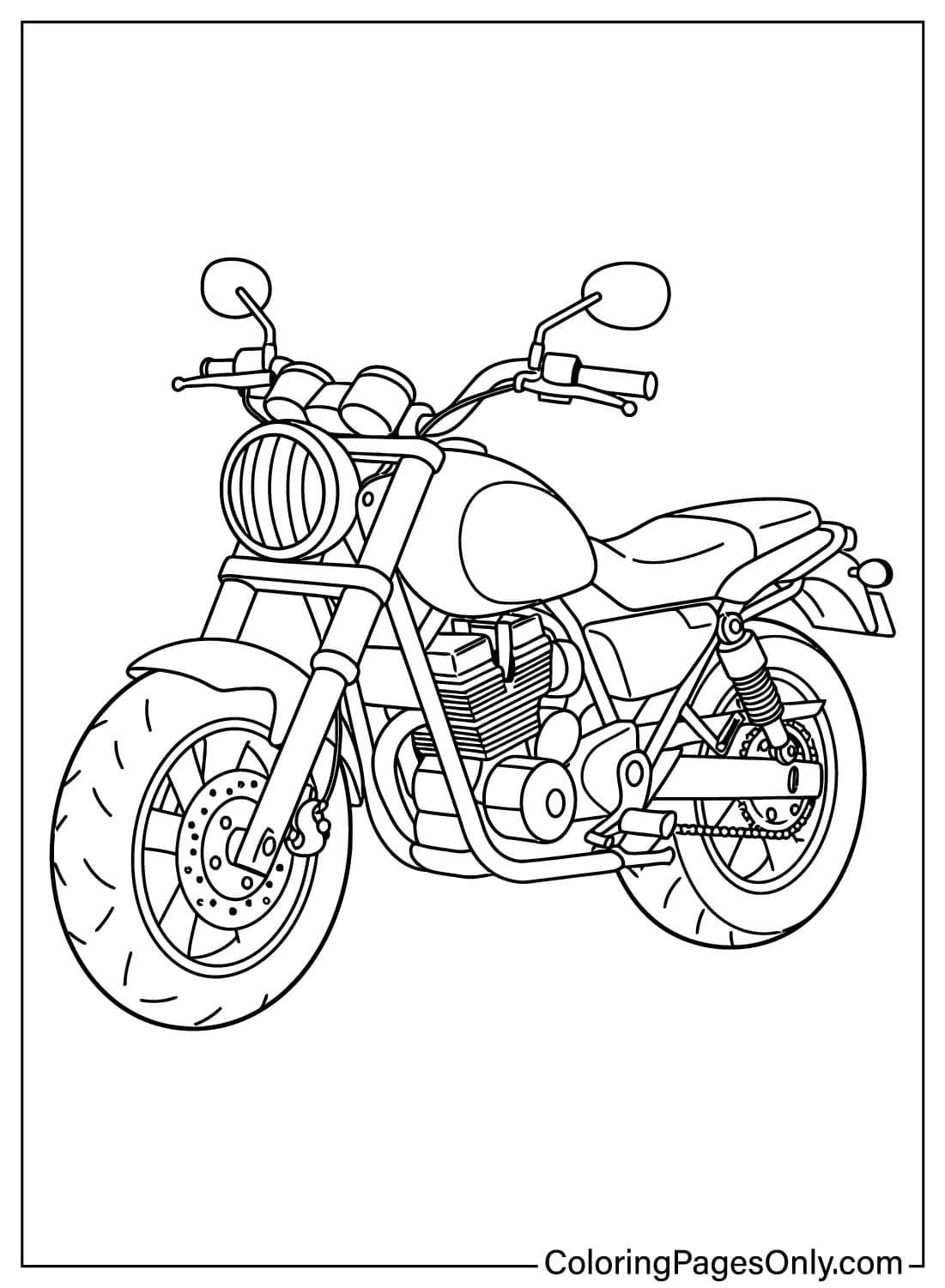
The street and adventure pages – Street Bike, Adventure Motorcycle – cover the most practical end of motorcycle ownership. Street bikes (also called naked bikes or standards) are motorcycles without full fairings, exposing the engine as a visual centerpiece of the design. The Adventure Motorcycle page covers the tall, upright adventure-touring style – high ground clearance, wide handlebars, dual-sport tires – designed for long-distance travel on both paved and unpaved roads.

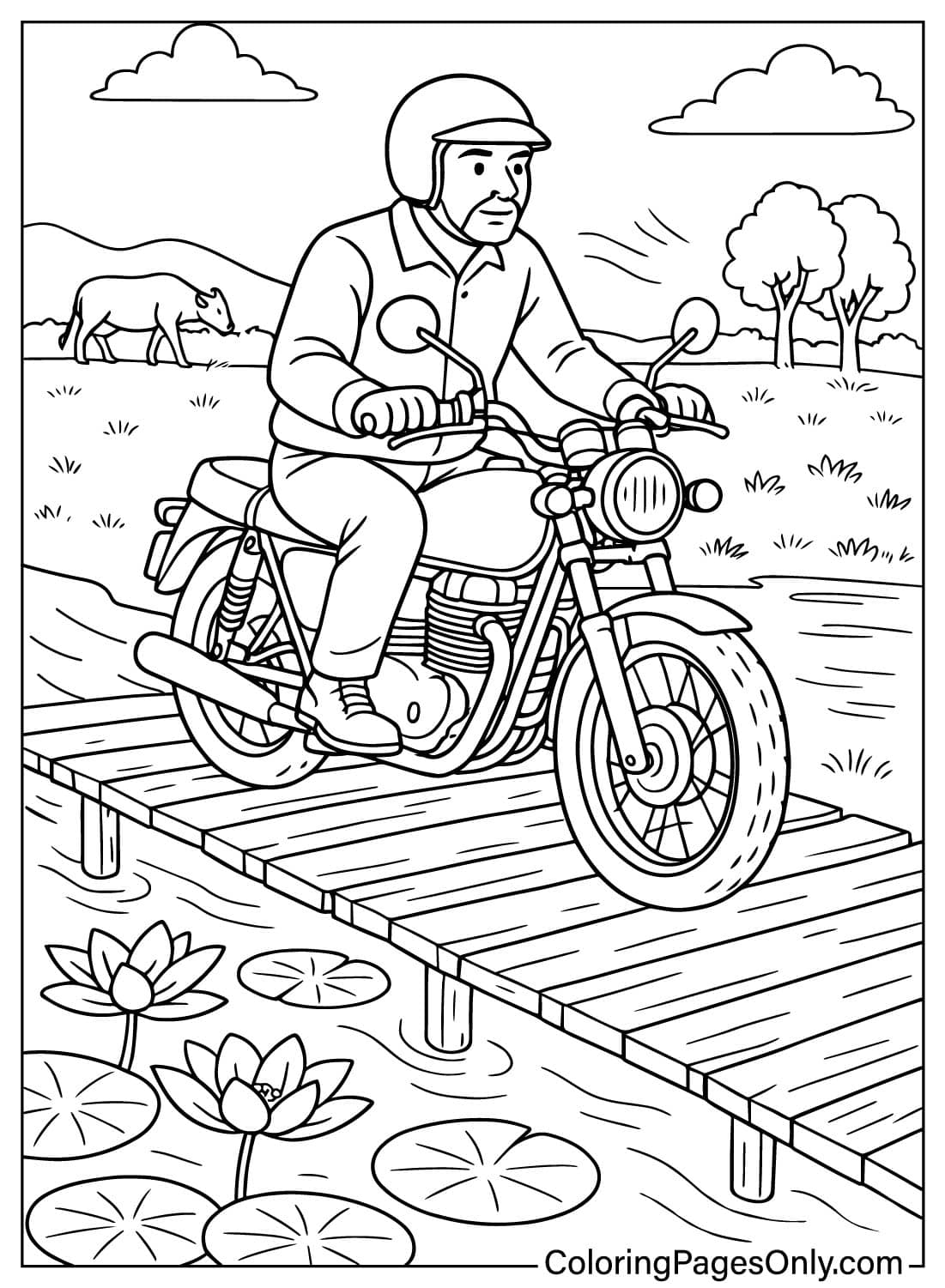
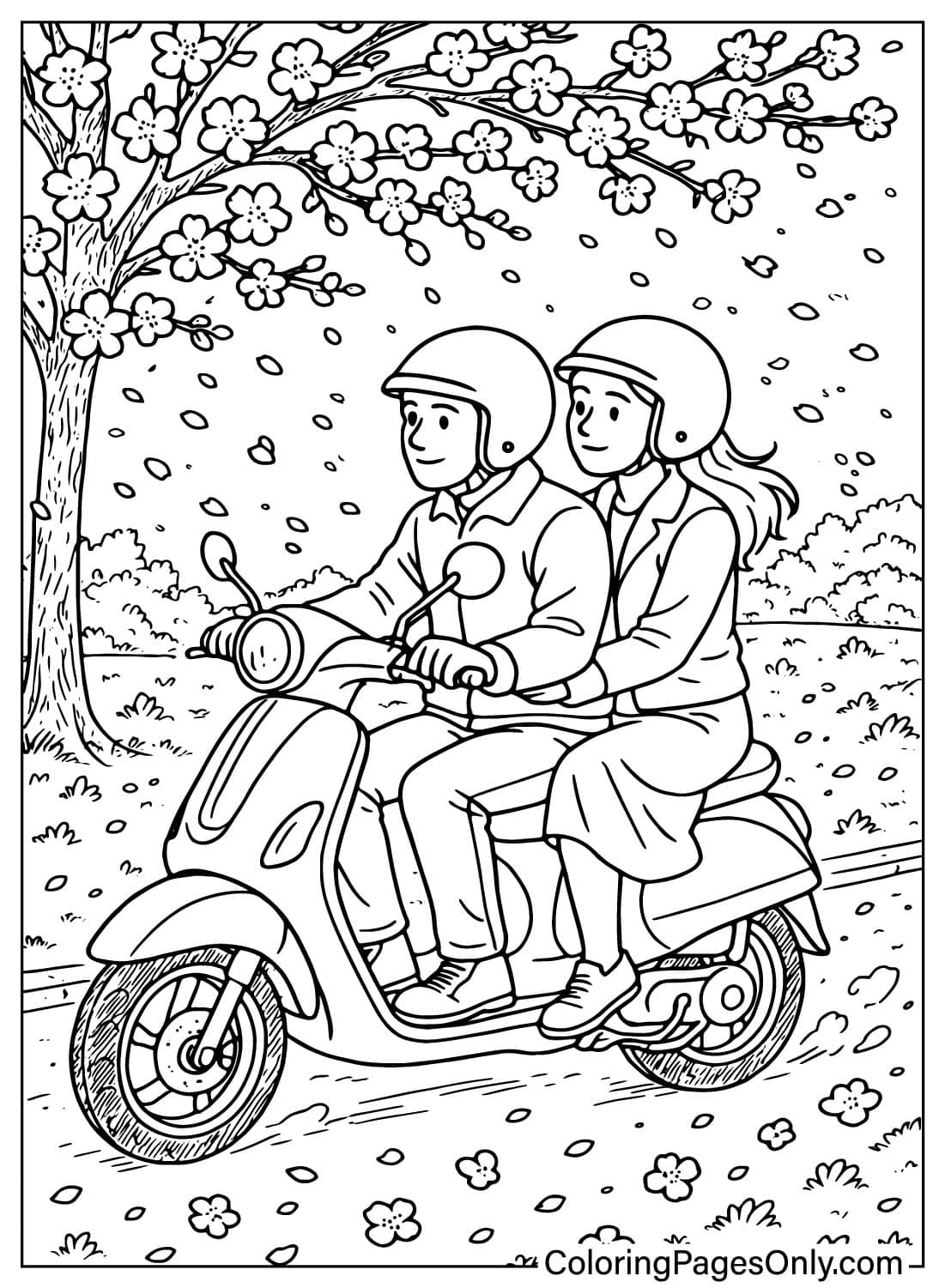
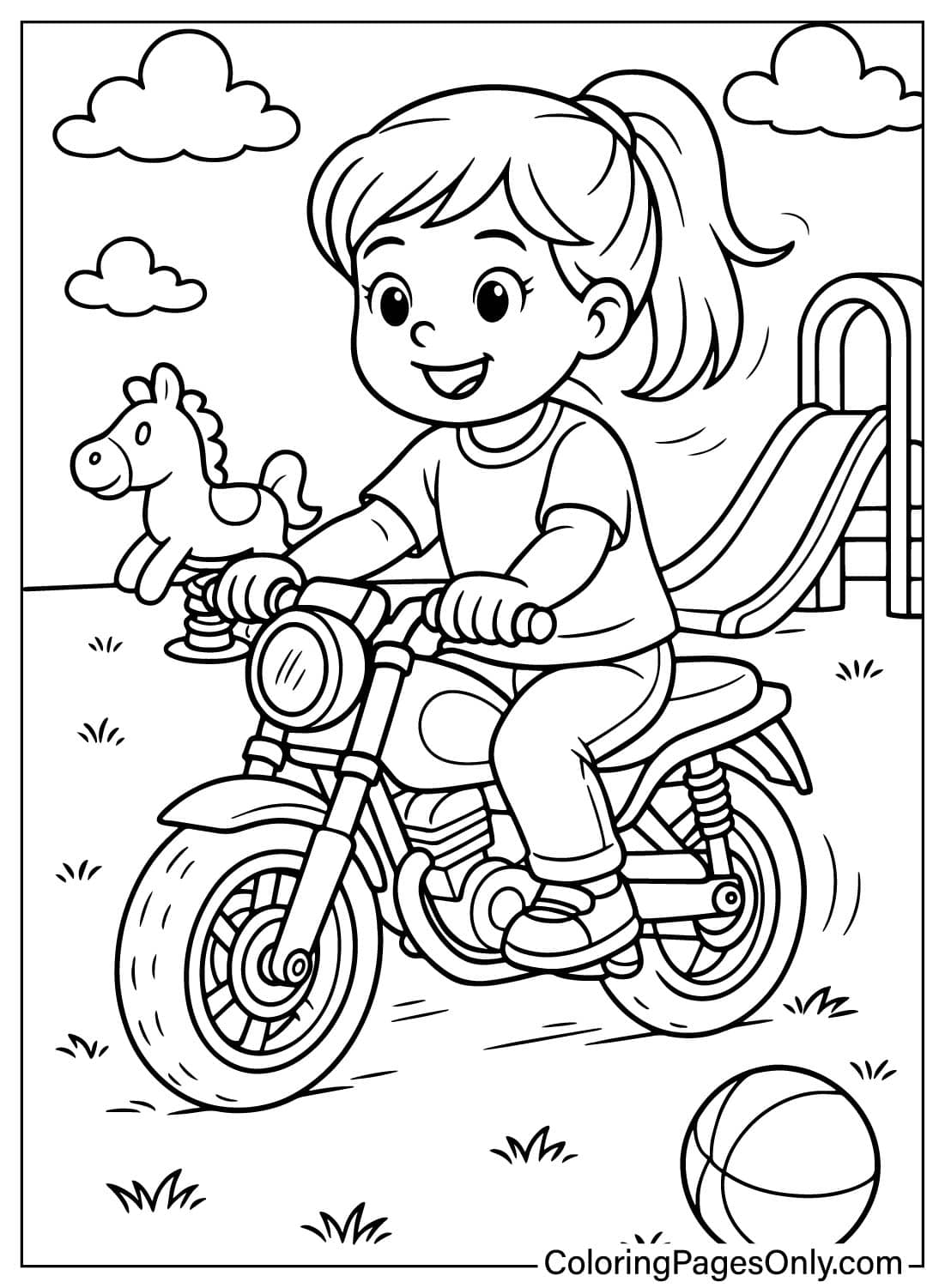
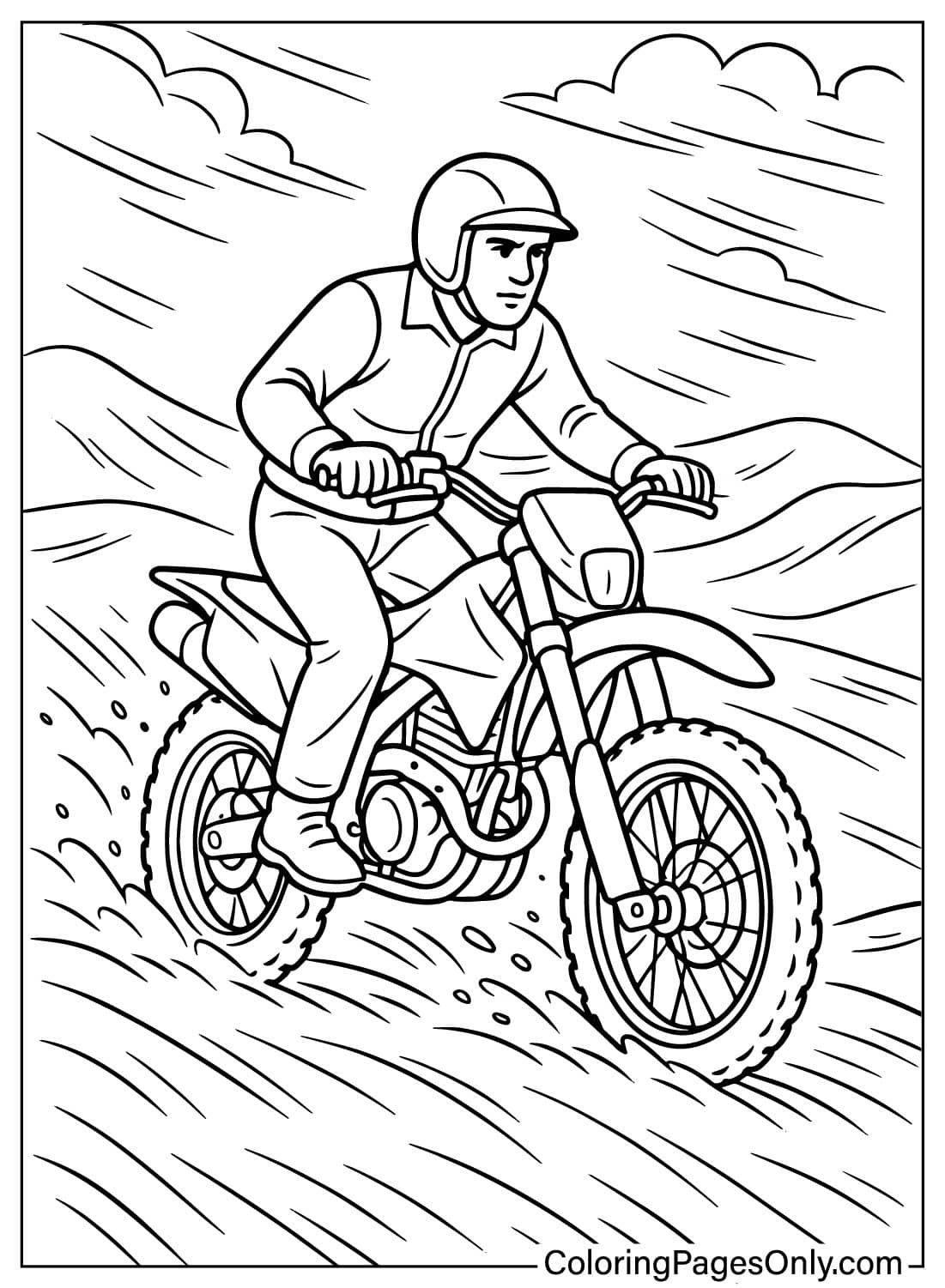
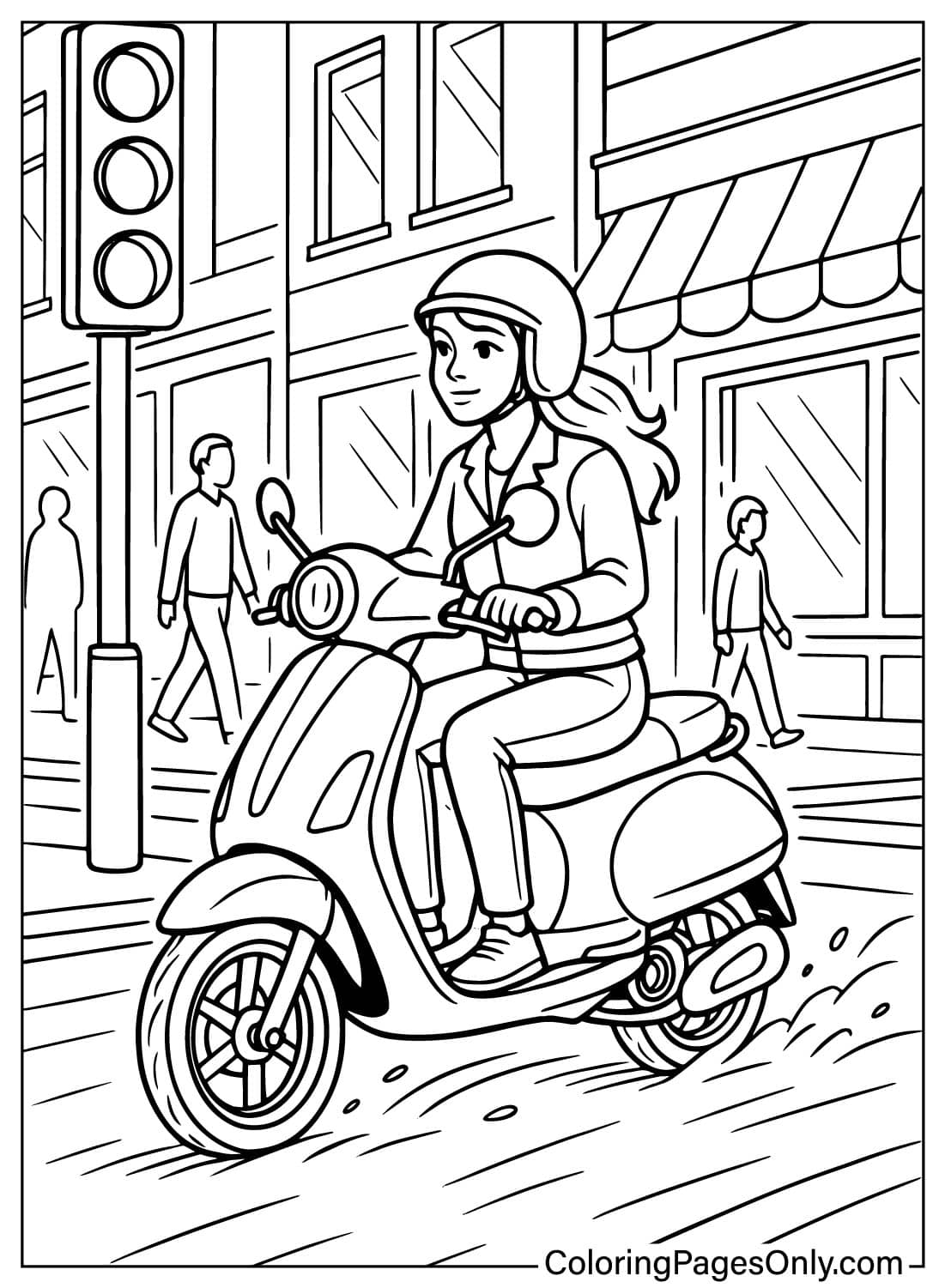
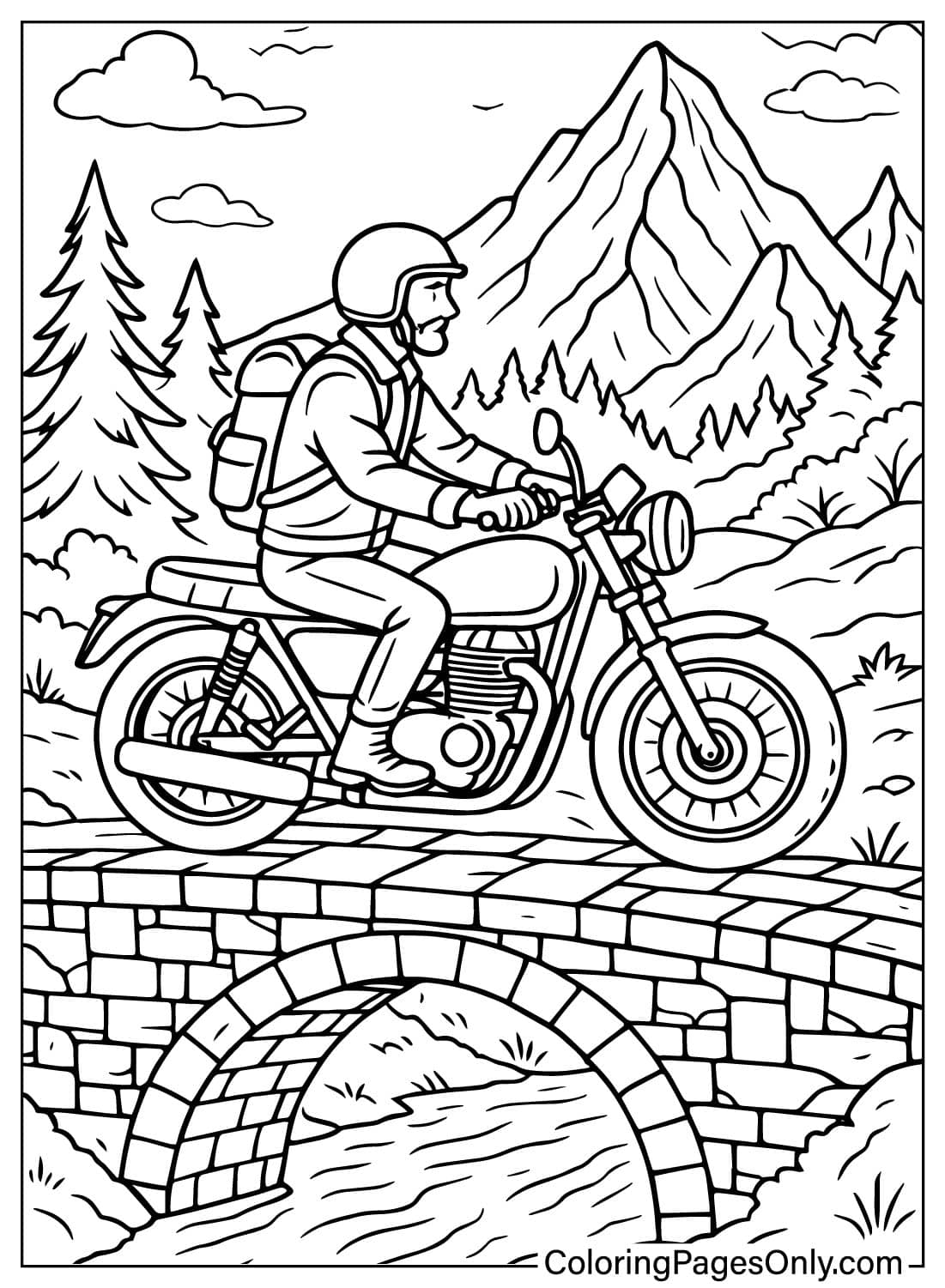
The rider pages – Motorcycle Ride, Motorcycles For Women, Girl on Motorbike, Cute Girl Playing with Motorcycle – show motorcycles in the context of their human relationship. The rider pages in particular offer the opportunity to color both the machine and the person riding it – the helmet, the jacket, the gloves, the body position that changes completely between a sport bike rider’s tuck and a cruiser rider’s relaxed upright sit.

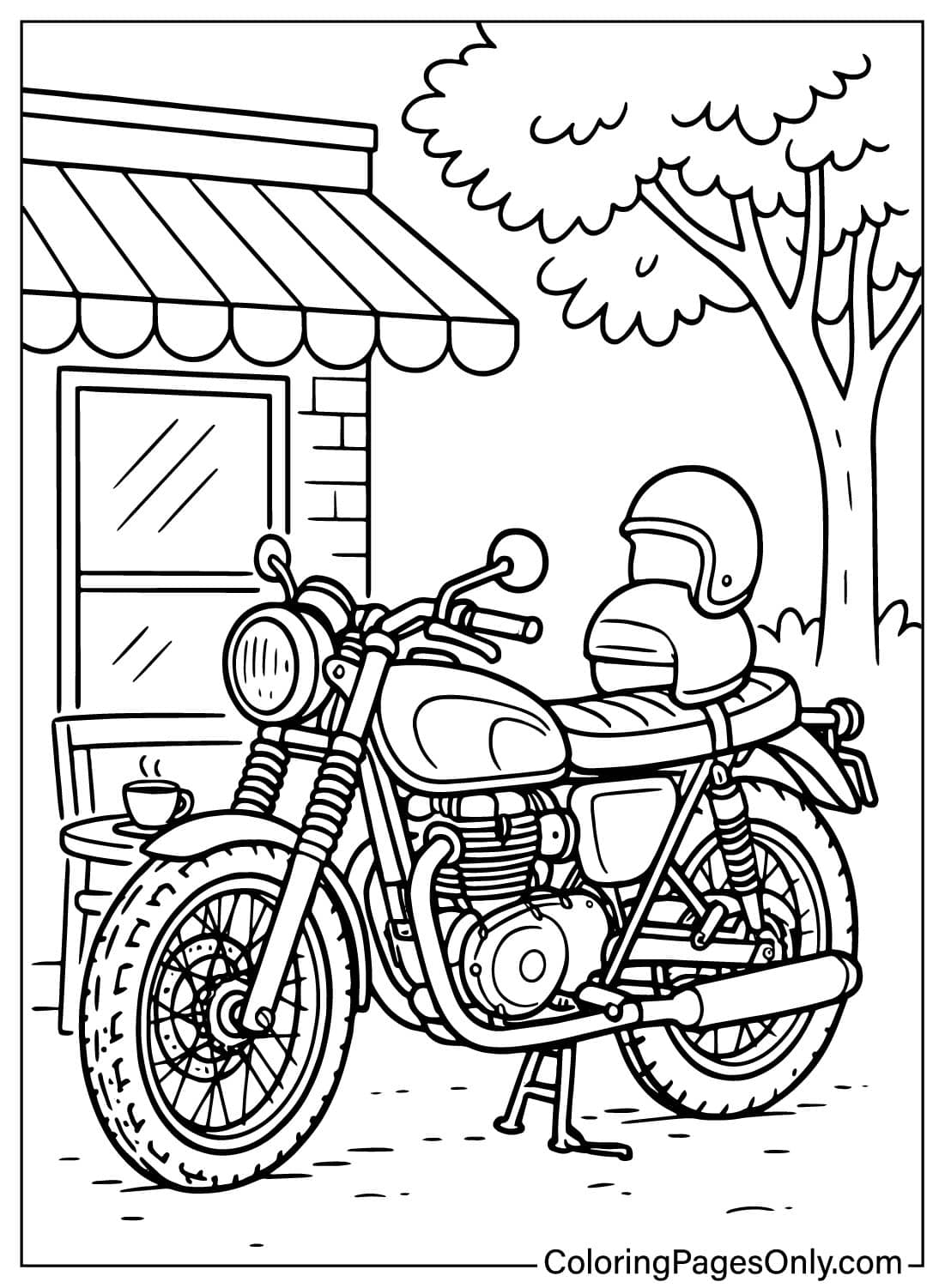
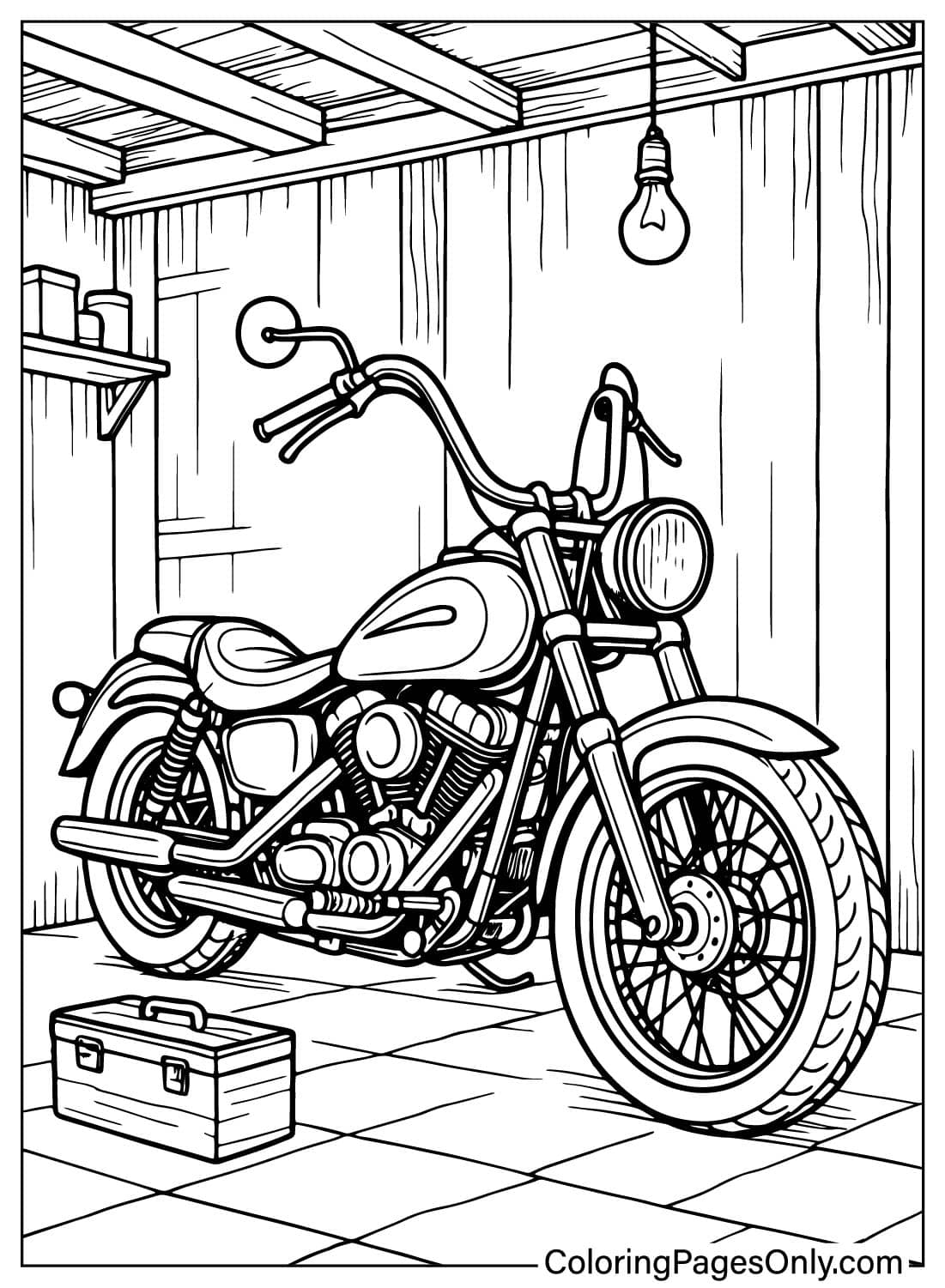
The service and environment pages – Motorcycle Shop, Motorcycle Repair, Motorcycle Obstacle Course – move the subject from the road into other contexts. The Motorcycle Shop page shows the retail and service environment where bikes are sold and maintained – tools, signage, and bikes in various states of completion. The Motorcycle Repair page shows the mechanical intimacy of working on a bike with the engine partially disassembled. The Motorcycle Obstacle Course shows competition-focused precision riding rather than speed.

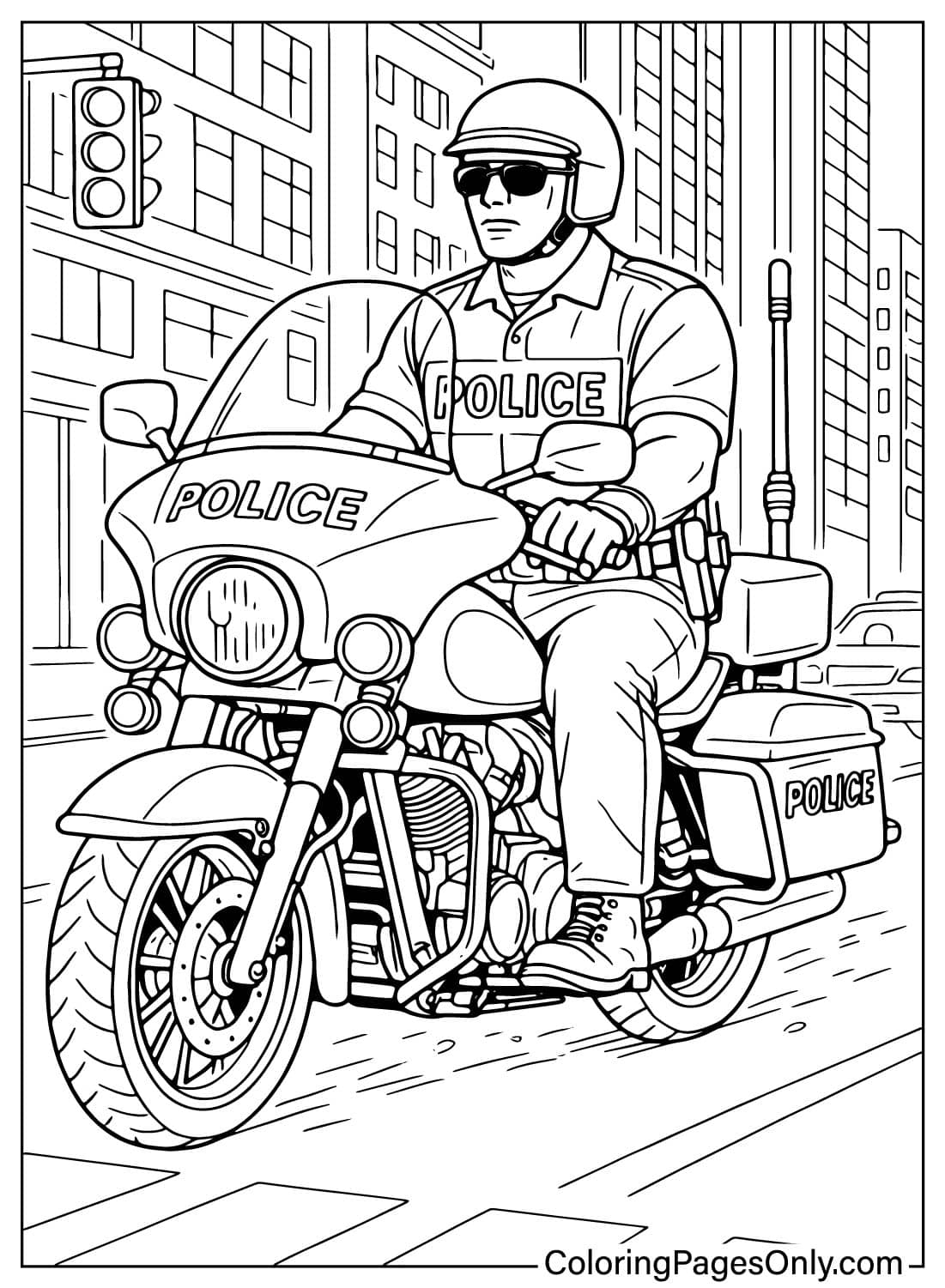
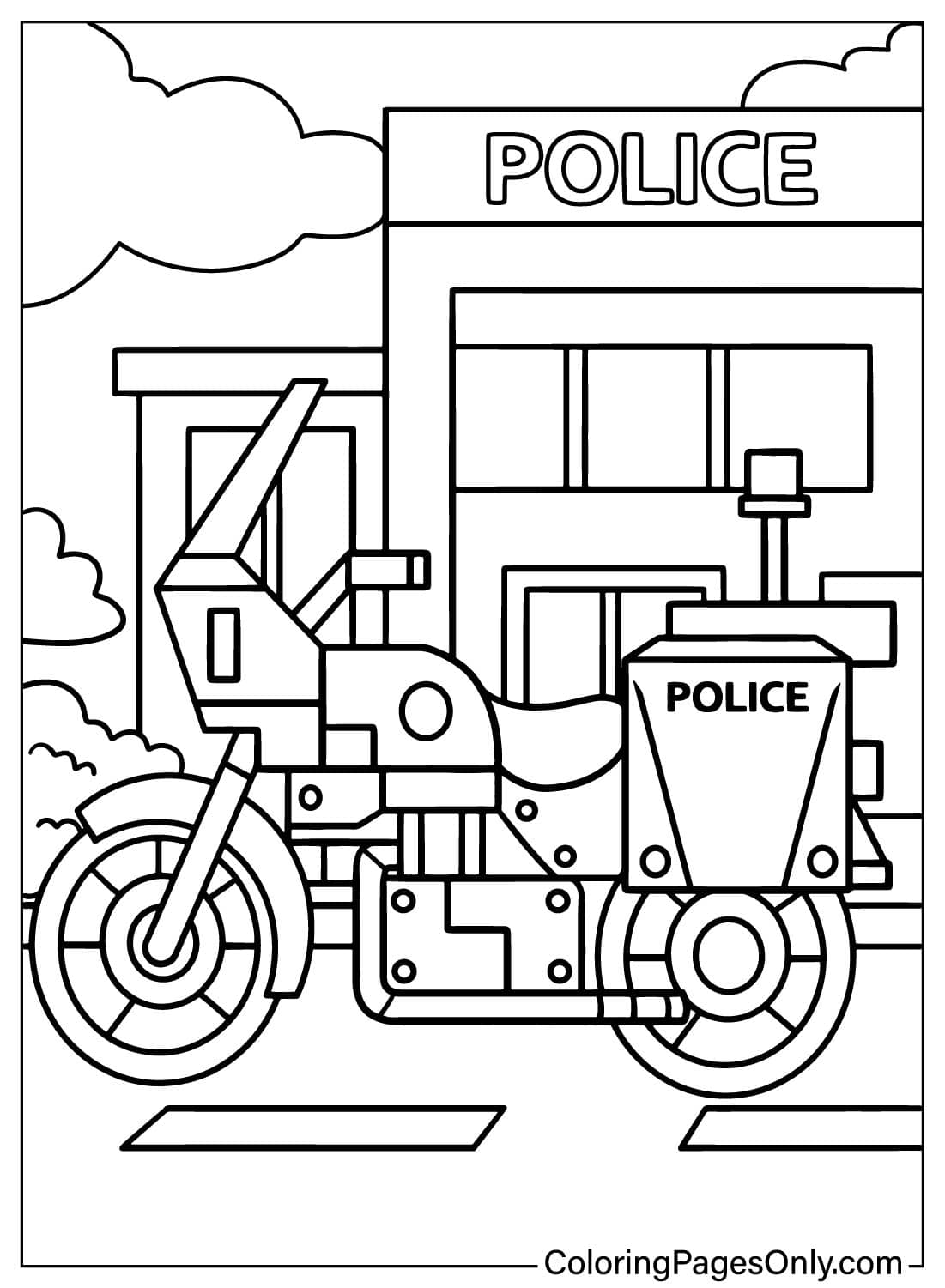
The police pages – Police Motorcycle, Motorcycle for Police – cover the law enforcement motorcycle in its service configuration: the large-displacement touring bike fitted with police equipment, the high-visibility markings, the lights, and sirens. Police motorcycles differ significantly from civilian bikes in their upright riding position, large windscreen, and the added hardware of emergency equipment.

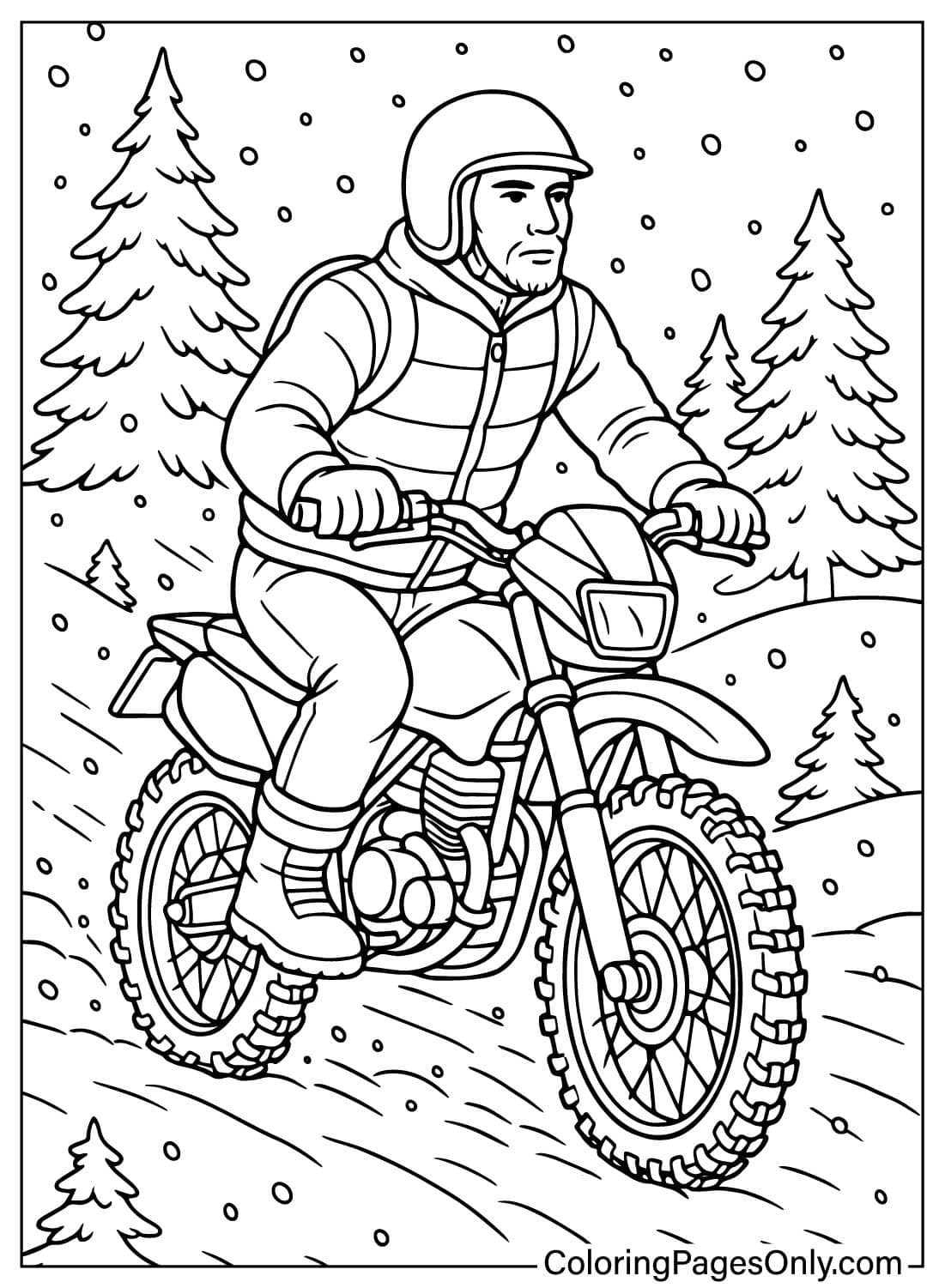
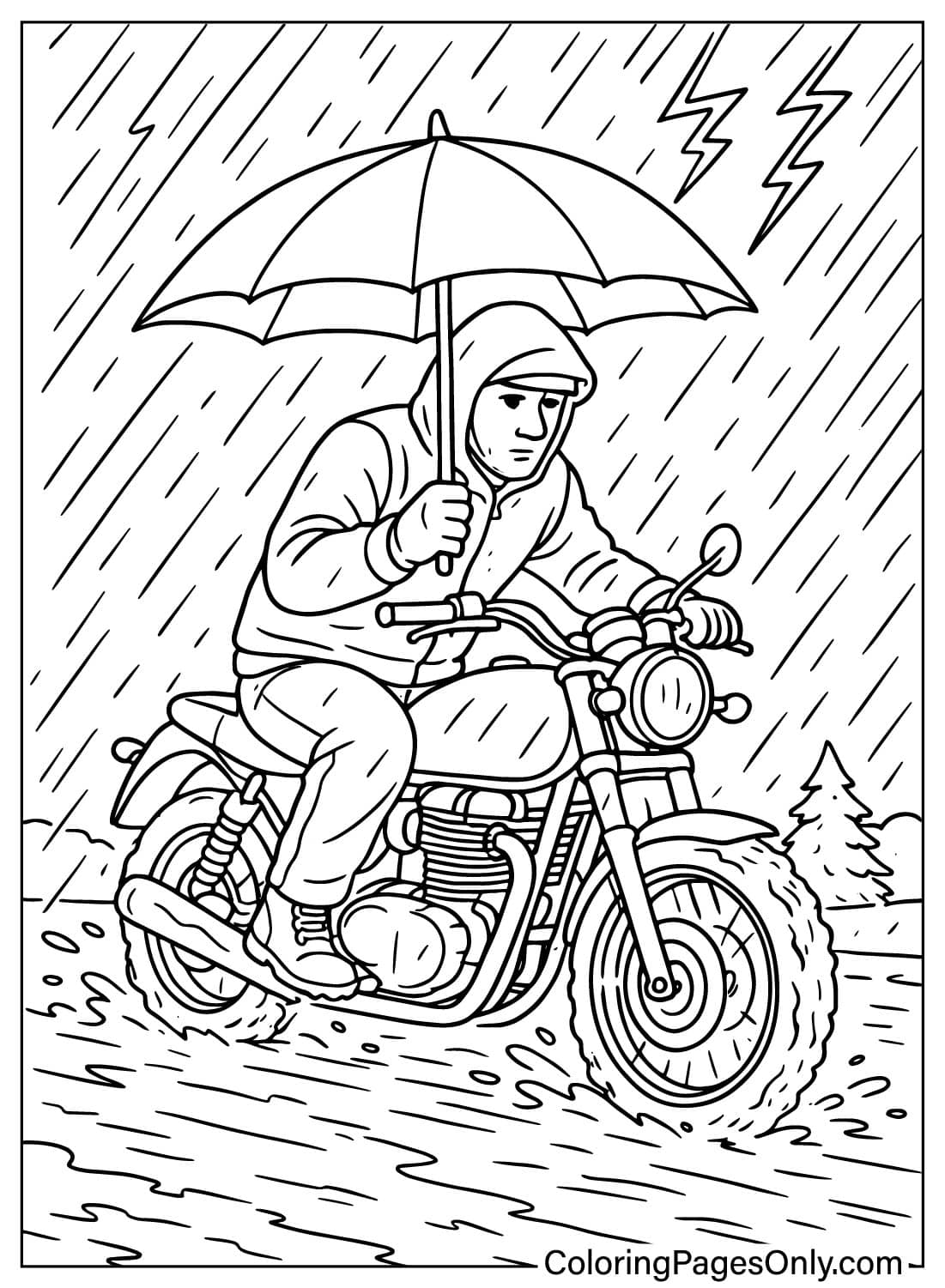
The weather and atmospheric pages – Motorcycles in the Snow, Motorcycle in the Rain – place the machine in challenging environmental conditions that create distinctive coloring opportunities: the grey and white palette of a snowy scene, the wet-road reflections and dark sky of rain, the visual drama of riding in weather that most people avoid.

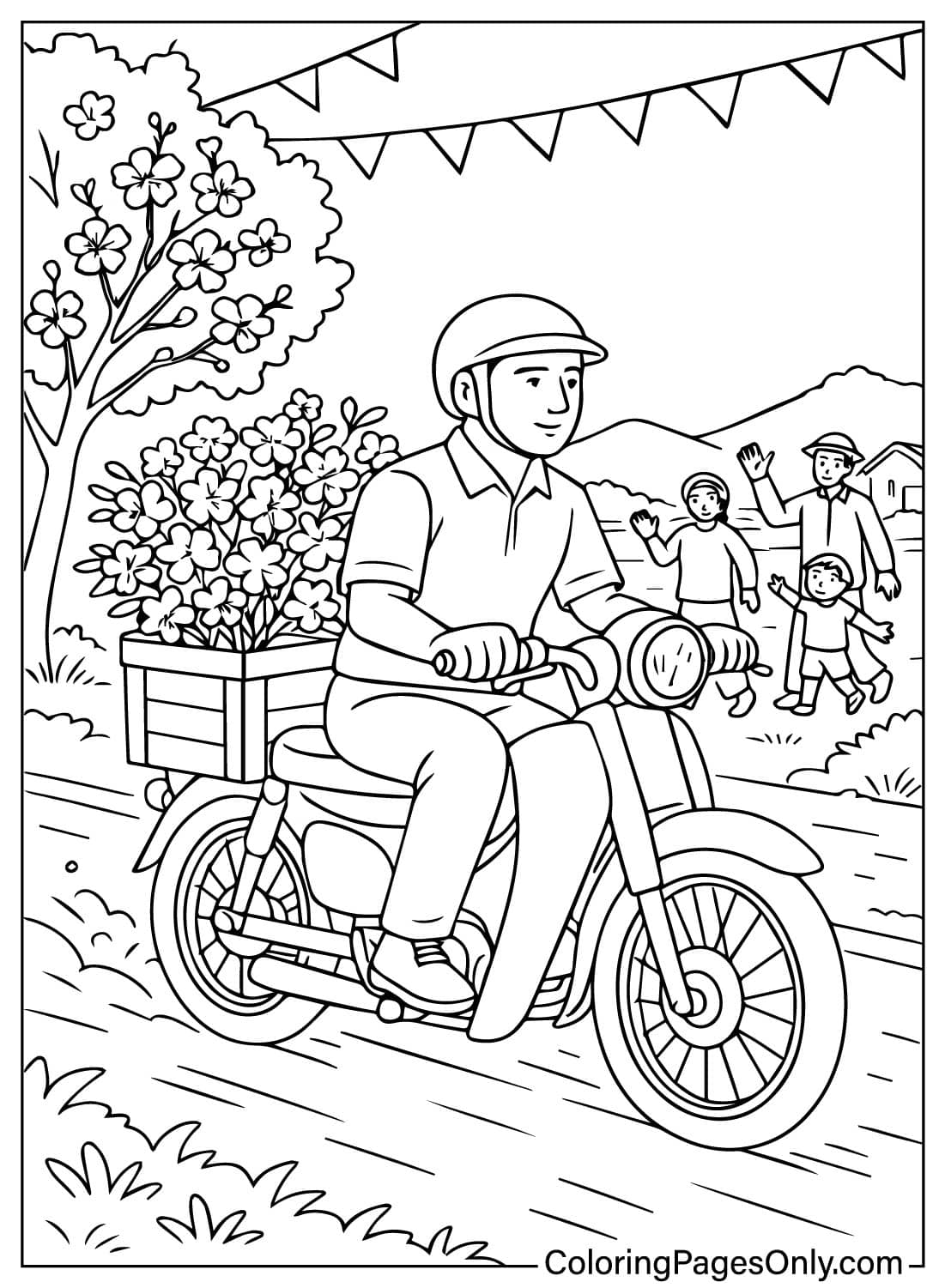
The flower and decorative page – Flower Motorcycle – applies floral decorative elements to the motorcycle form, producing a page that sits between realistic vehicle illustration and decorative pattern work.

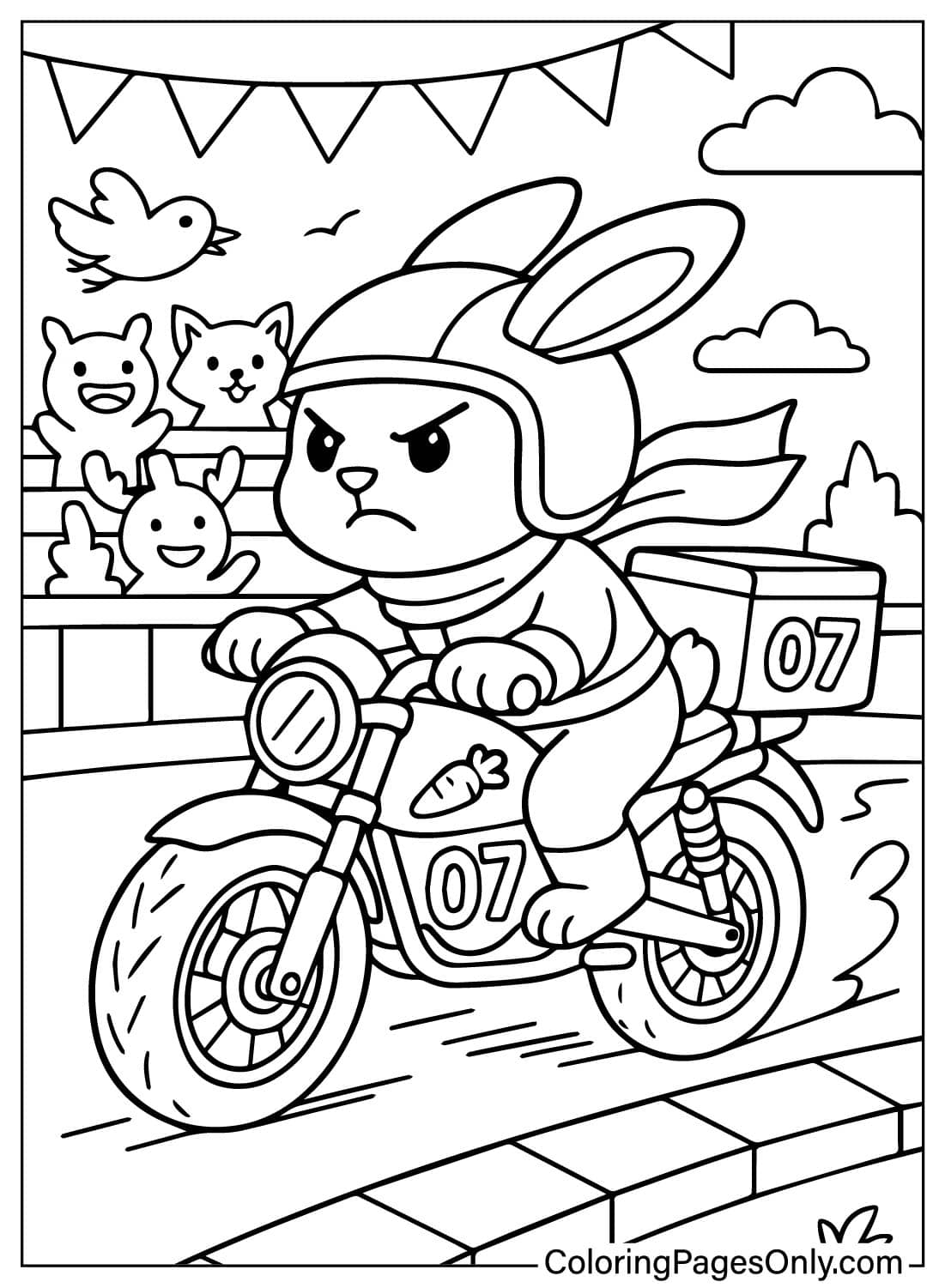
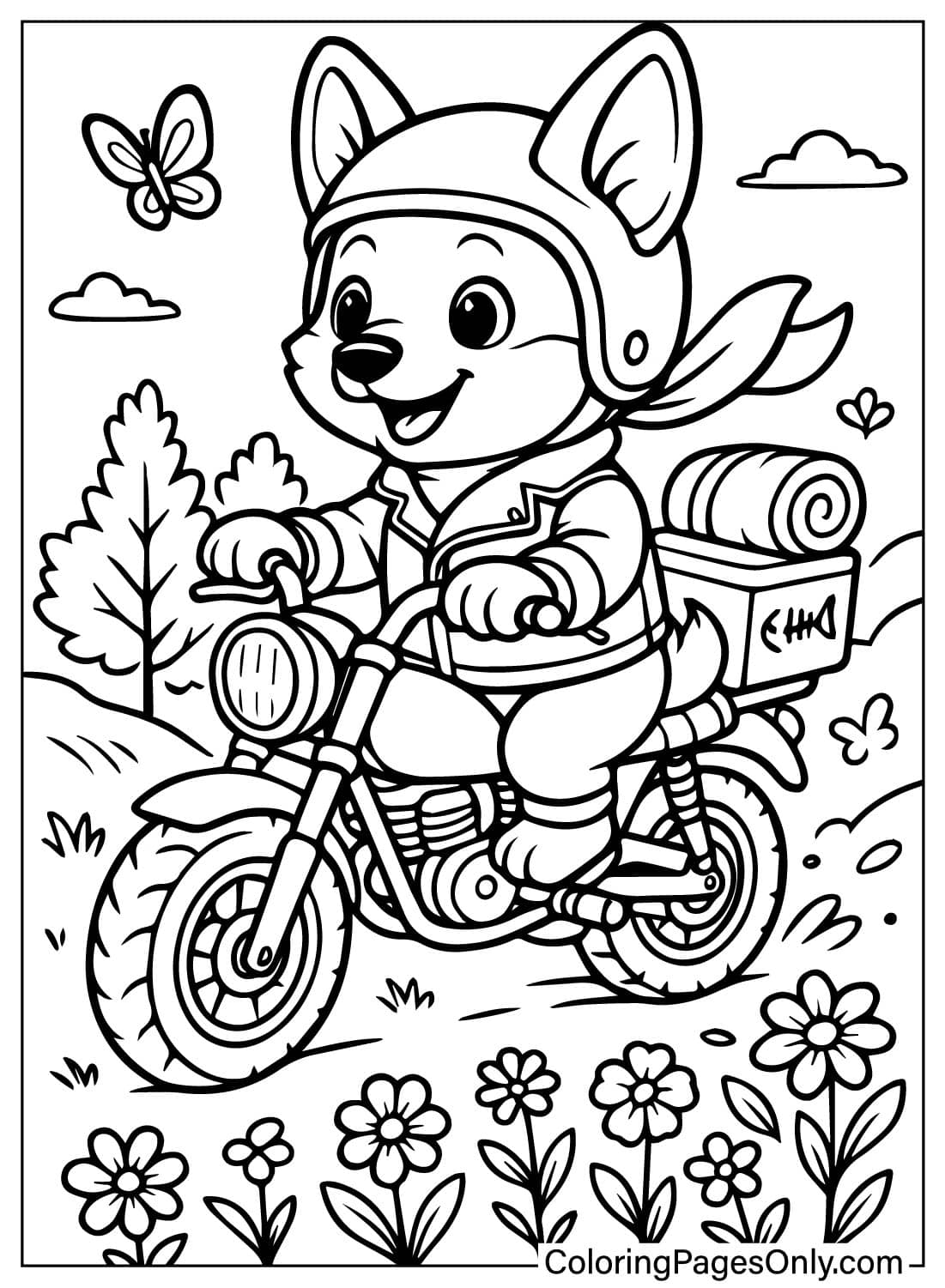
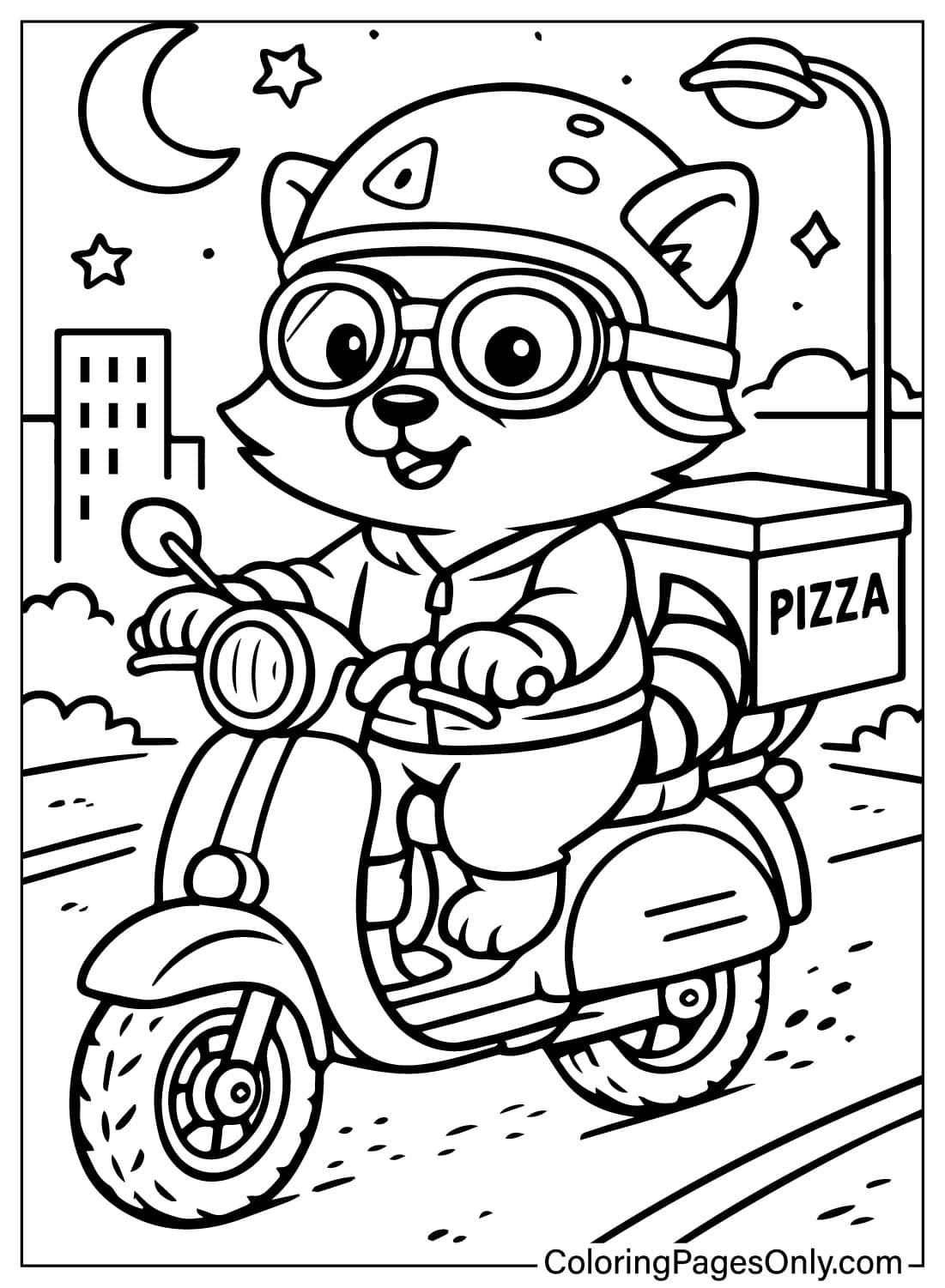
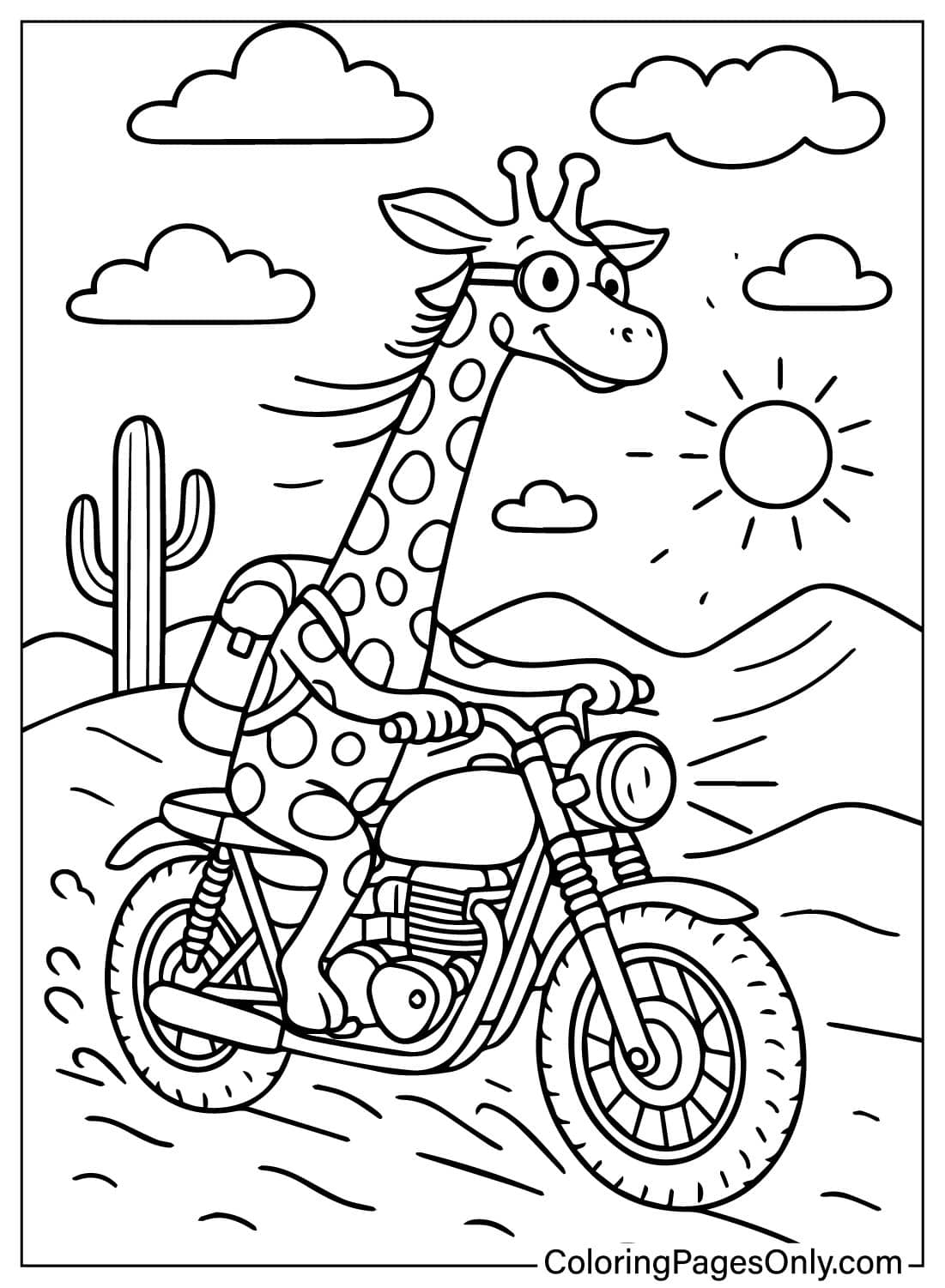
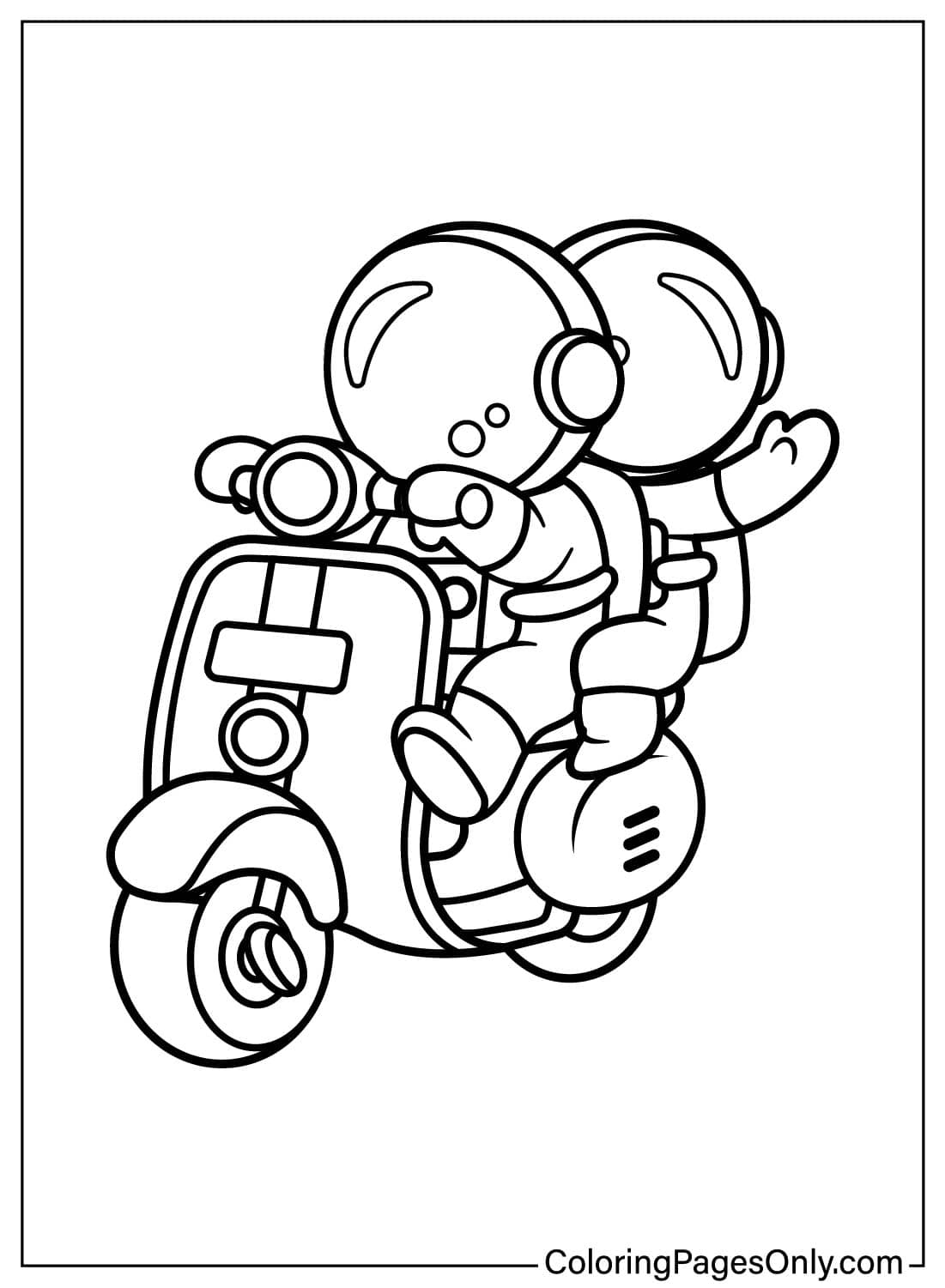
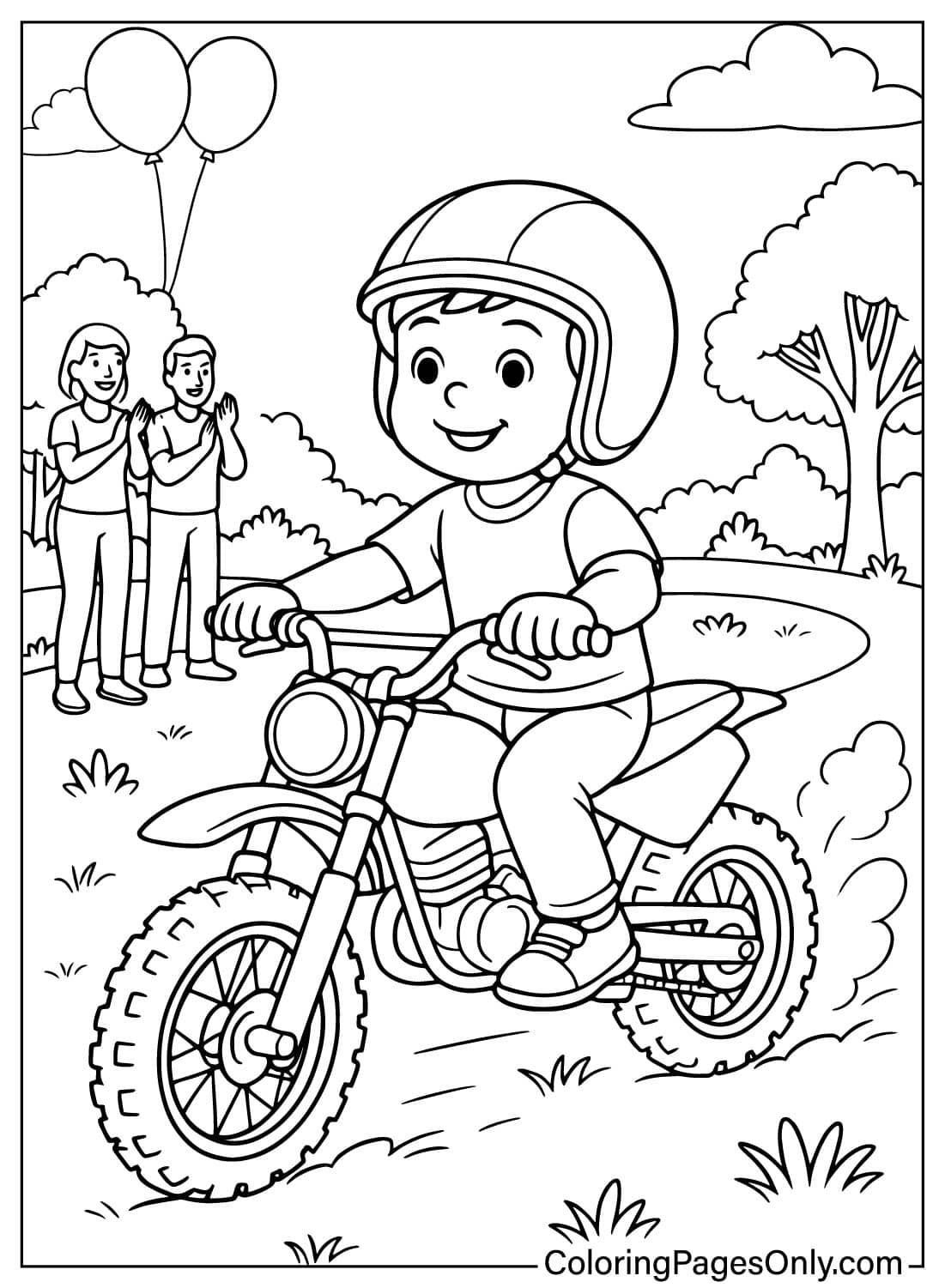
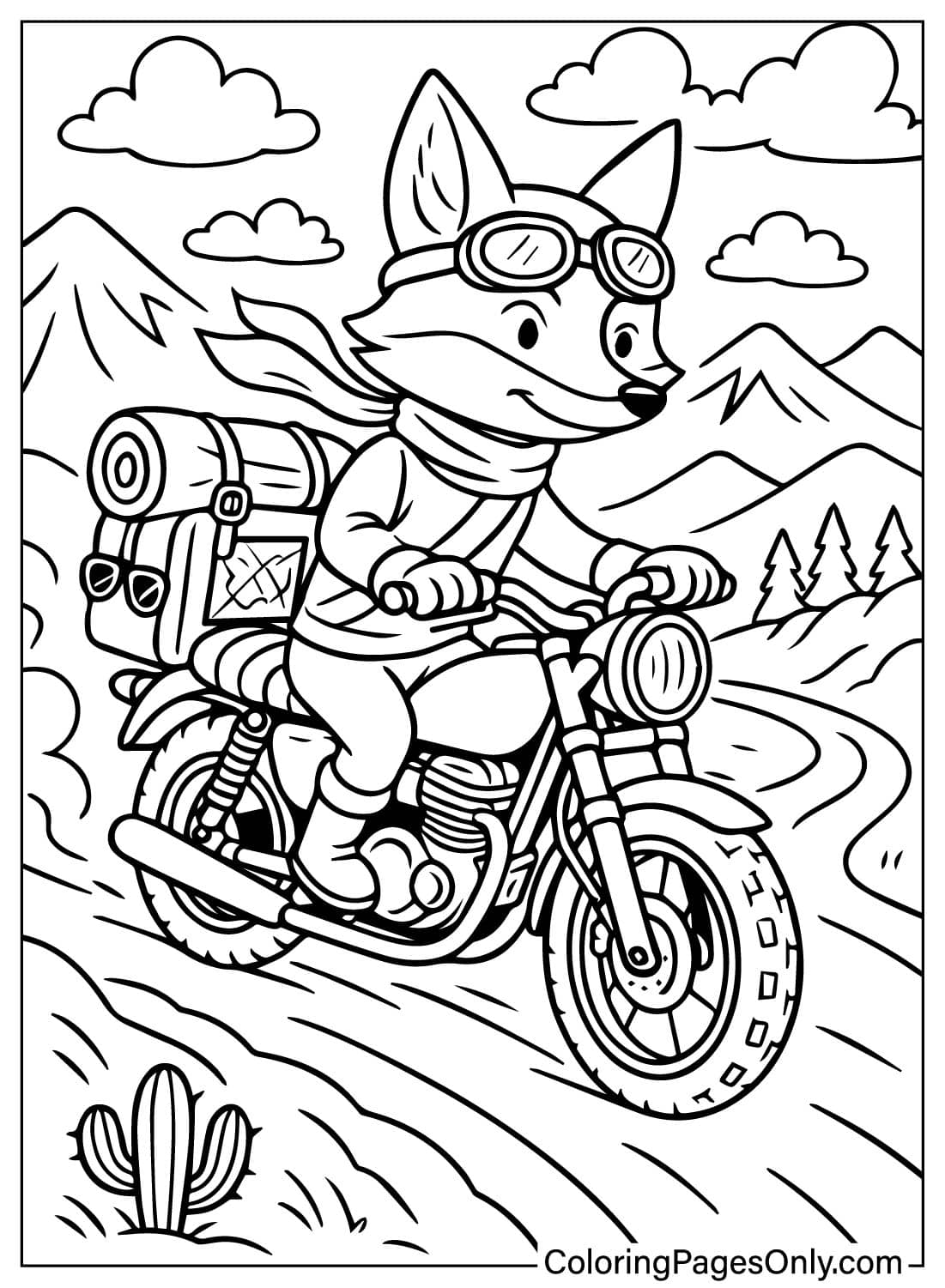
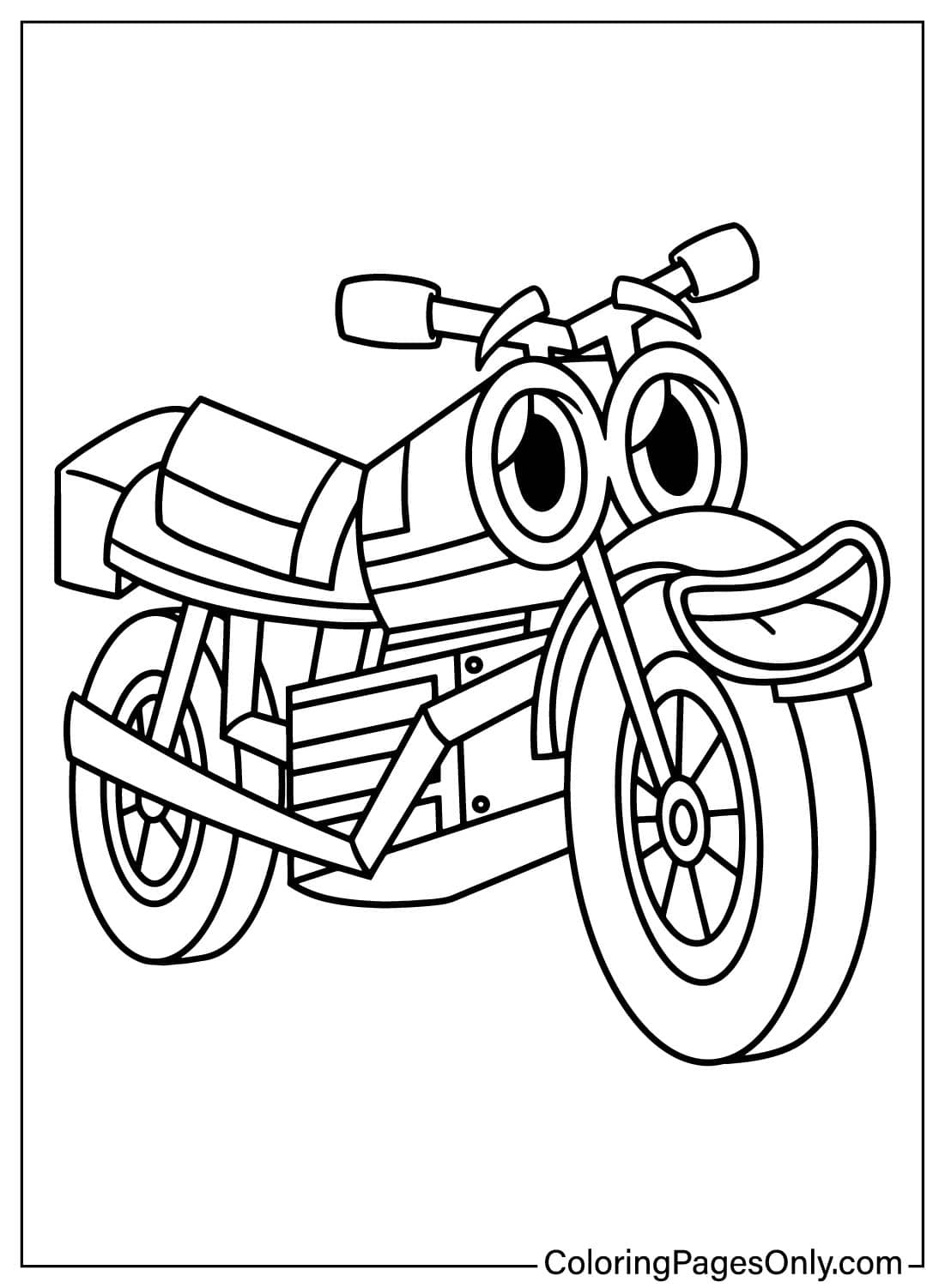
The character crossover pages – Fun Bunny and Motorcycle, Cute Dog and Motorcycle, Cute Cat and Motorcycle, Cartoon Fox and Motorcycle, Funny Giraffe Riding A Motorcycle, Funny Astronaut And Motorcycle, Boy Rides Mini Motorcycle, Cartoon Motorcycle – are the most playful sub-group in the collection. The animal-on-motorcycle pages follow the same charming visual logic as surfing animals or cooking animals elsewhere on the site: the contrast between the animal’s natural character and the human-scale mechanical context they inhabit. A bunny on a sport bike, a giraffe on a cruiser, a cat on a standard – each of these requires maintaining the animal’s canonical appearance (white bunny, spotted giraffe, tabby or solid cat) while rendering the machine accurately enough to be recognizable. The Funny Astronaut and Motorcycle page extends this logic to a human figure who is equally incongruous on a road motorcycle.

The accessible pages – Easy Motorcycle, Basic Motorcycle, Basic Motorcycle for Coloring – provide simplified, reduced-detail versions of the motorcycle form suitable for younger colorists or anyone who wants a less technically demanding page.

Coloring Tips for Motorcycle Pages

The motorcycle frame and bodywork are where the most consequential color decision happens. Most motorcycles have a dominant body color that defines their visual identity – bright competition red, vivid yellow, deep blue, classic black, or silver – and this color appears across the tank, side fairings, and often the seat cowl. Getting this color right and applying it consistently across all the body panels that share it is the first task on any motorcycle page.

The body color should be a saturated, confident application rather than a pale or washed-out version. Motorcycles are designed to be seen – the body color is chosen for visibility and impact, not subtlety. A sport bike in competition red should be a vivid, pure red without orange or brown undertones; a classic police motorcycle should be a deep, flat matte black; an adventure bike should be a medium to neutral grey or a sandy desert tan.

The engine and mechanical components are where motorcycle pages most reward knowledge of the actual materials involved. The engine cases – the main body of the engine – are typically cast aluminum, which in real life reads as a light silvery-grey with some warmth. The cylinder head fins (the ridged projections that dissipate engine heat) catch light on their upper edges and show shadow in the gaps between fins, creating a pattern that calls for alternating lighter and darker strokes. The exhaust system – the pipes that route combustion gases from the engine to the rear of the bike – is typically chrome (bright silver with blue-grey shadows) or black/titanium heat-wrapped, and they are one of the most visually interesting mechanical details in the composition because the pipes curve and change diameter in ways that create natural highlight-and-shadow interest.

The wheels present a specific coloring challenge: the tire, the rim, and the spokes (if visible). Tires on modern motorcycles are large, squat, and very dark – a near-black rubber with subtle surface texture. The rim, depending on the bike type, might be cast aluminum (similar grey tone to the engine), painted to match the body color (on sport bikes), or a bright chrome finish (on cruisers). Spoke wheels, found on classic and cruiser-style bikes, have very thin individual spokes that are typically chrome, crossing from the hub to the rim in a pattern that requires either carefully following each spoke line or acknowledging that a gestural silvery impression across the wheel area reads as convincingly as strict accuracy.

For racing pages – Racing Motorcycles, Motorcycle Race – the primary additional element is the number board and sponsor livery. Real racing motorcycles are covered in sponsor logos and team color graphics that are typically applied over a white base with accent colors identifying the team. If you want to color a racing page with a real race team reference, choose a canonical racing livery (Repsol Honda’s white-red-blue, Yamaha’s blue, Ducati’s red) or design your own. The number circle is typically white or yellow with a large black number.

For the animal crossover pages – Fun Bunny and Motorcycle, Cute Dog and Motorcycle, Cute Cat and Motorcycle, Cartoon Fox and Motorcycle, Funny Giraffe Riding A Motorcycle – maintain each animal’s canonical coloring (white bunny, golden-brown dog, orange or grey cat, rust-red fox, yellow-tan giraffe with brown patches) while choosing a complementary color for the motorcycle that contrasts with the animal rather than blending into it. A white bunny reads best against a vivid red or blue bike; a yellow giraffe against a dark blue or black bike; a rust-red fox against a silver or grey machine.

For the Police Motorcycle and Motorcycle for Police pages – the canonical police motorcycle palette is black or dark navy for the vehicle body, with white painted markings, chrome or silver hardware, and the high-visibility equipment (light bar, reflective stripes) in yellow-amber and red-blue depending on the jurisdiction. The rider in full motorcycle police gear typically wears a white or black helmet, high-visibility vest, and leather boots.

For the atmospheric pages – Motorcycles in the Snow, Motorcycle in the Rain – the environment provides the primary palette direction. Snow pages call for a cool, low-contrast background (white, pale blue, grey) that makes the motorcycle’s body color stand out clearly as the warm or vivid focal element. Rain pages call for a dark, wet atmosphere – deep grey sky, reflective road surface, reduced visibility – that creates a moody, atmospheric result very different from the bright-day pages.

5 Activities to Do With Your Motorcycle Pages

Design a racing livery. Print two copies of the Sport Motorcycle or Racing Motorcycles page. Color the first using a canonical real-world racing livery as reference – Repsol Honda’s white/red/blue, Yamaha’s factory blue, or Ducati’s deep red are the most recognizable starting points. Color the second as your own original team: choose a primary color, a secondary accent color, design your own team number, and position your colors across the fairing panels as a genuine livery design. Display both pages side by side – the reference livery and your original – and compare how different the same bike shape reads in different color systems.

Create the four-seasons motorcycle set. Print four identical motorcycle pages and color each one as a different season: spring (bright body color, green road, flowers at the roadside), summer (vivid blue sky, heat haze on the road, the saturated colors of a hot day), autumn (the motorcycle’s color against fallen leaves in orange and brown), and winter using the Motorcycles in the Snow page as your reference (cool grey atmosphere, snow on the seat and tank, the cold isolation of an unridden bike in winter). The four-page set becomes a study in how the same subject reads completely differently depending on environmental color.

Color the animal crossover series as a family portrait. Print Fun Bunny and Motorcycle, Cute Dog and Motorcycle, Cute Cat and Motorcycle, Cartoon Fox and Motorcycle, and Funny Giraffe Riding A Motorcycle, and color all five with each animal in their canonical palette and a matching color motorcycle for each animal – designing the motorcycle color to complement the animal rather than compete with it. Arrange the five finished pages in a row as a “motorcycle club” family portrait. The exercise forces five separate color relationship decisions and produces an ensemble that reads as a coherent set.

Study the mechanical details: the repair page. Print the Motorcycle Repair page and use it as a focused study in mechanical coloring – identifying each visible component before you color it and making a conscious color decision based on what that component is made of: aluminum engine cases (light silver-grey), steel bolts (dark silver), rubber hoses (dark grey or black), plastic covers (body color), chrome exhaust pipe (bright silver with blue-grey shadows). This activity builds the habit of coloring by material rather than by instinct, which produces more realistic results on any mechanical subject.

Make a before-and-after service story. Print the Motorcycle Shop page and the Motorcycle Repair page and color both as part of a connected narrative: the Motorcycle Shop page as the bike before service (choose a body color and stick with it), and the Motorcycle Repair page as the same bike mid-service – same color scheme, but in the repair context the bodywork might be partially removed, showing the unpainted components beneath. Add a caption below each page telling the story of what is happening. This narrative exercise connects the coloring activity to storytelling and gives the two pages a relationship to each other that makes displaying them together meaningful.

Download Your Free Motorcycle Pages Today!

All 30+ Motorcycle Coloring Pages are completely free – download as PDF to print or color online with one click. No sign-up, no cost.

Share your finished pages with us on Facebook and Pinterest at ColoringPagesOnly.com!

These related coloring collections will help you explore the wonderful world of colors. Let’s choose, be creative, and show us your great pictures!

Jennifer Thoa – Writer and Content Creator

Hi there! I’m Jennifer Thoa, a writer and content creator at Coloringpagesonly.com. With a love for storytelling and a passion for creativity, I’m here to inspire and share exciting ideas that bring color and joy to your world. Let’s dive into a fun and imaginative adventure together!