
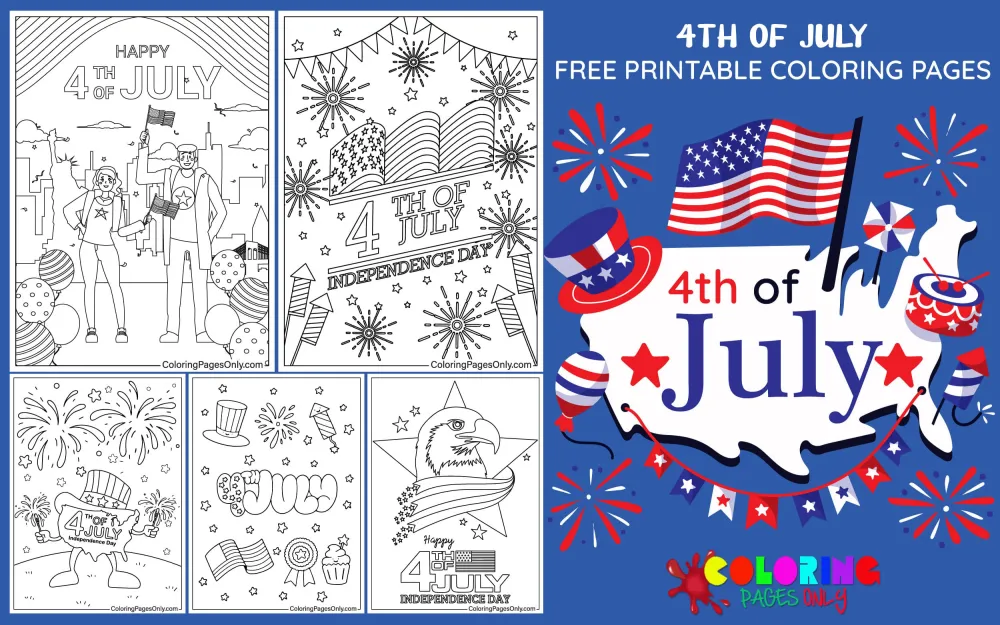
Free 4th of July coloring pages: 30+ pages featuring the American flag in full Stars and Stripes design, fireworks bursting against night skies, the Liberty Bell with its famous inscription, the Statue of Liberty in harbor views, Uncle Sam in patriotic costume, bald eagles with flag elements, “Happy Independence Day” typographic compositions, patriotic stars and bunting border designs, barbecue and picnic celebration scenes, parade imagery with marching bands and floats, Capitol Building and Washington Monument silhouettes, and the full visual vocabulary of America’s most broadly celebrated national holiday. All free, printable PDF and online coloring for families, classrooms, and communities celebrating the Fourth of July.
The Fourth of July commemorates July 4, 1776, the date on which the Second Continental Congress, meeting in Philadelphia, Pennsylvania, approved the final text of the Declaration of Independence and ordered it printed. The Declaration declared thirteen American colonies to be free and independent states, severing their political ties with Britain. The document was primarily drafted by Thomas Jefferson with revisions contributed by the Committee of Five, which also included John Adams, Benjamin Franklin, Roger Sherman, and Robert R. Livingston.
The vote for independence itself took place two days earlier, on July 2, 1776. John Adams wrote to his wife Abigail on July 3, 1776, that July 2 “will be the most memorable Epoch in the History of America” and predicted it would be celebrated “with Pomp and Parade, with Shews, Games, Sports, Guns, Bells, Bonfires and Illuminations from one End of this Continent to the other.” Adams was right about the nature of the celebrations and wrong by two days about the date: July 4, the date the Declaration’s text was finalized and ordered to be printed, became the date of annual commemoration. Independence Day was made an official federal holiday in 1870 and a paid federal holiday in 1938.
These 30+ free pages at ColoringPagesOnly.com cover the Fourth of July’s full patriotic visual tradition. All free, PDF or PNG, print or color online.
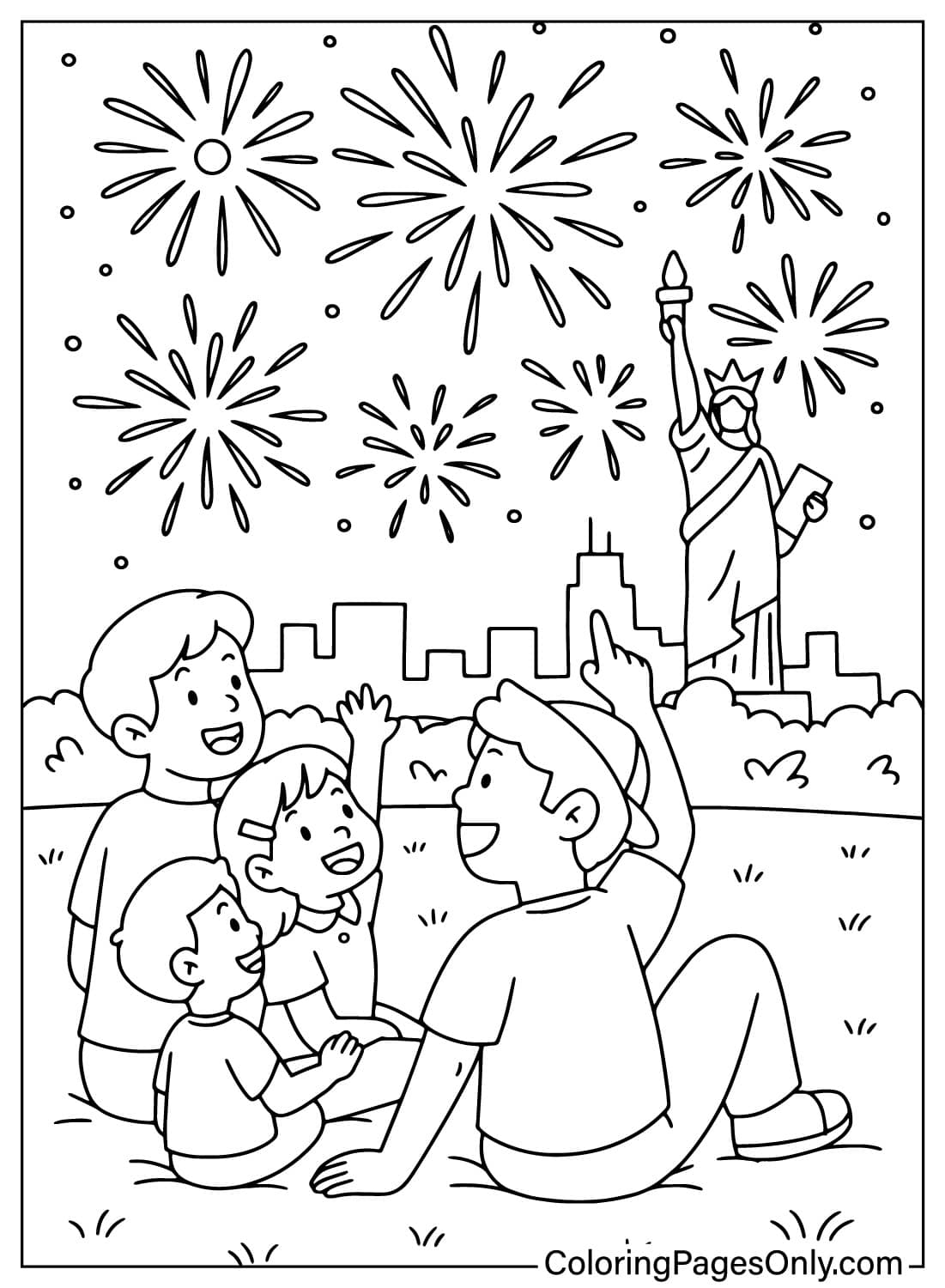
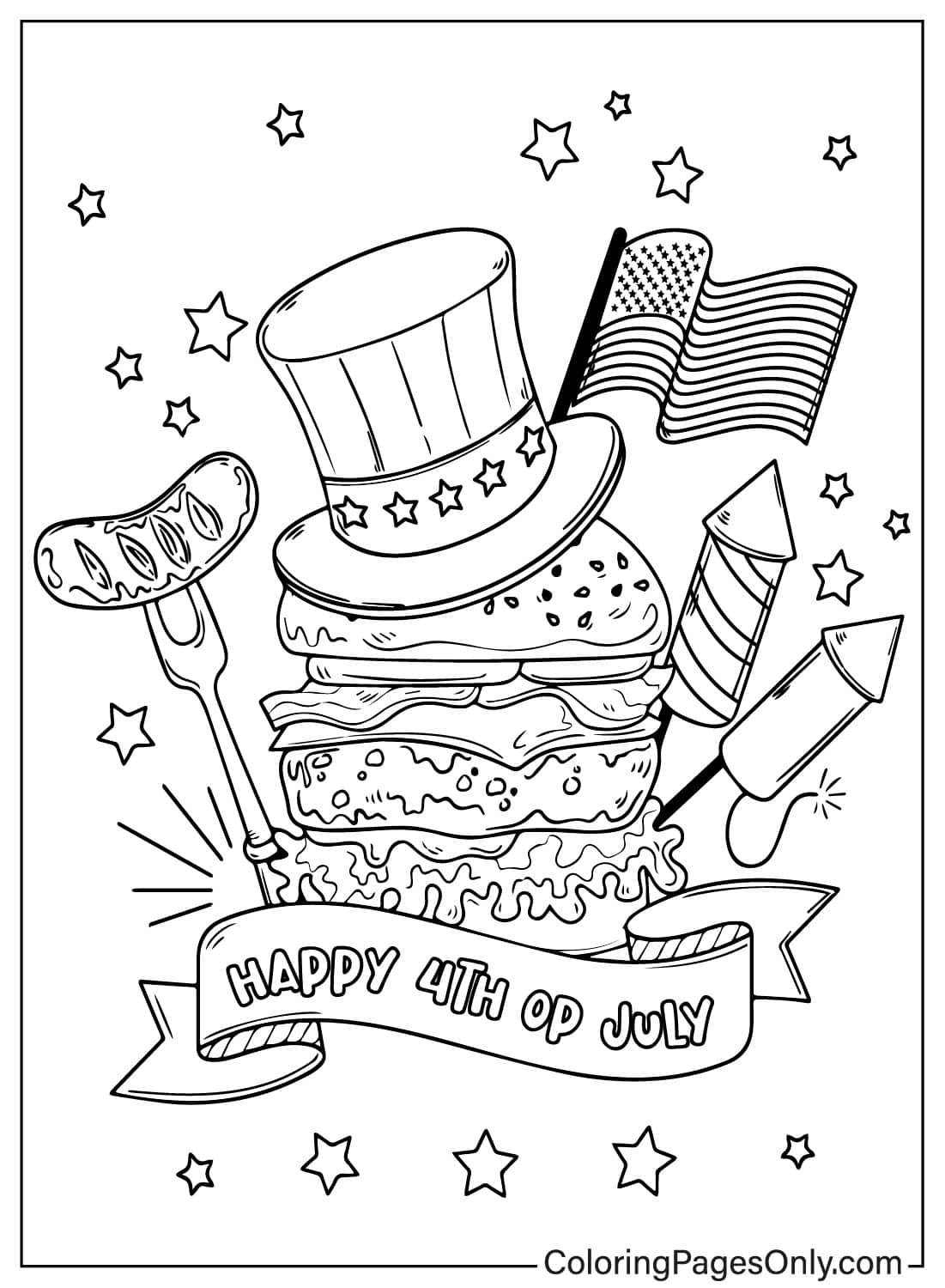
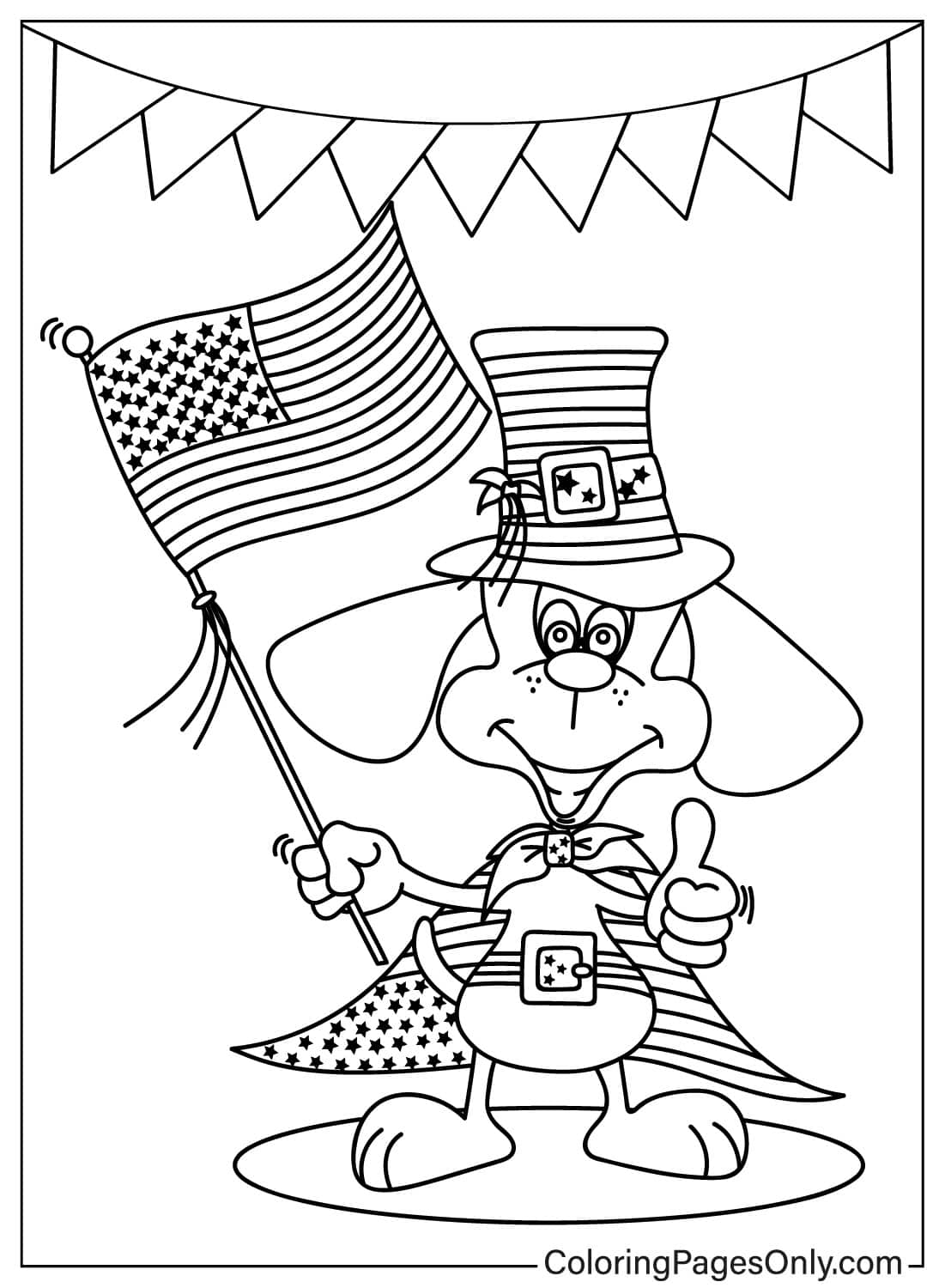
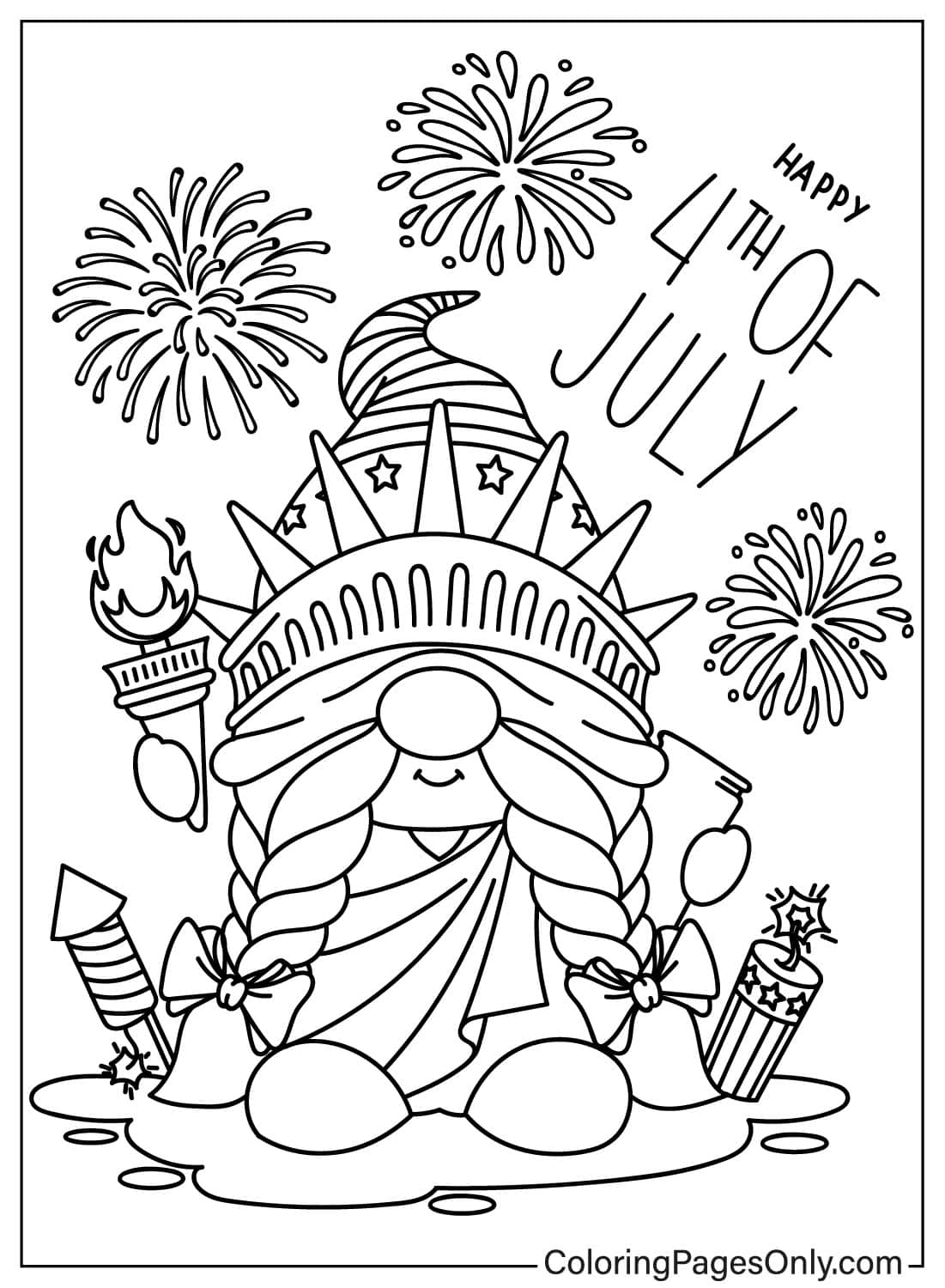
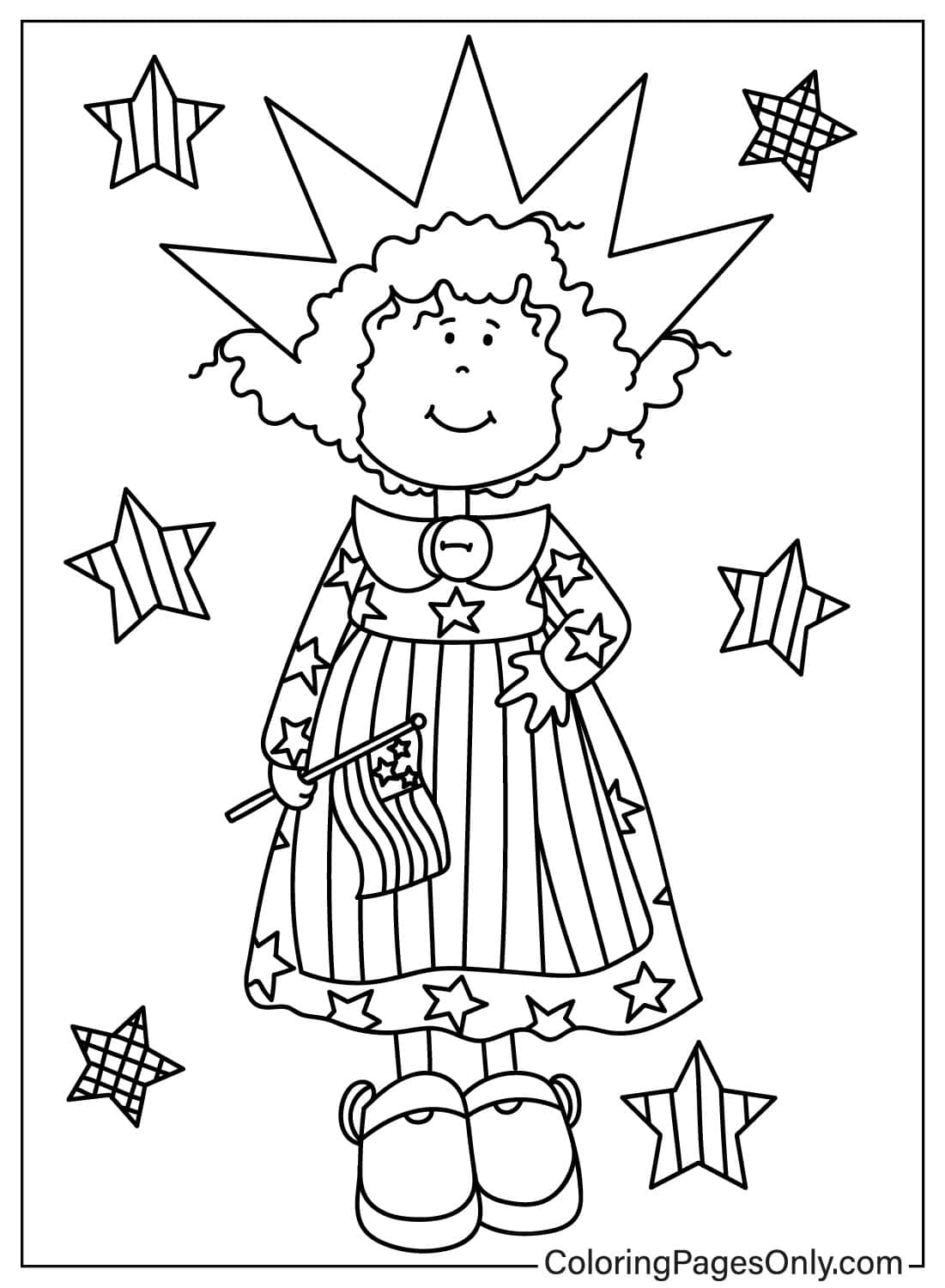
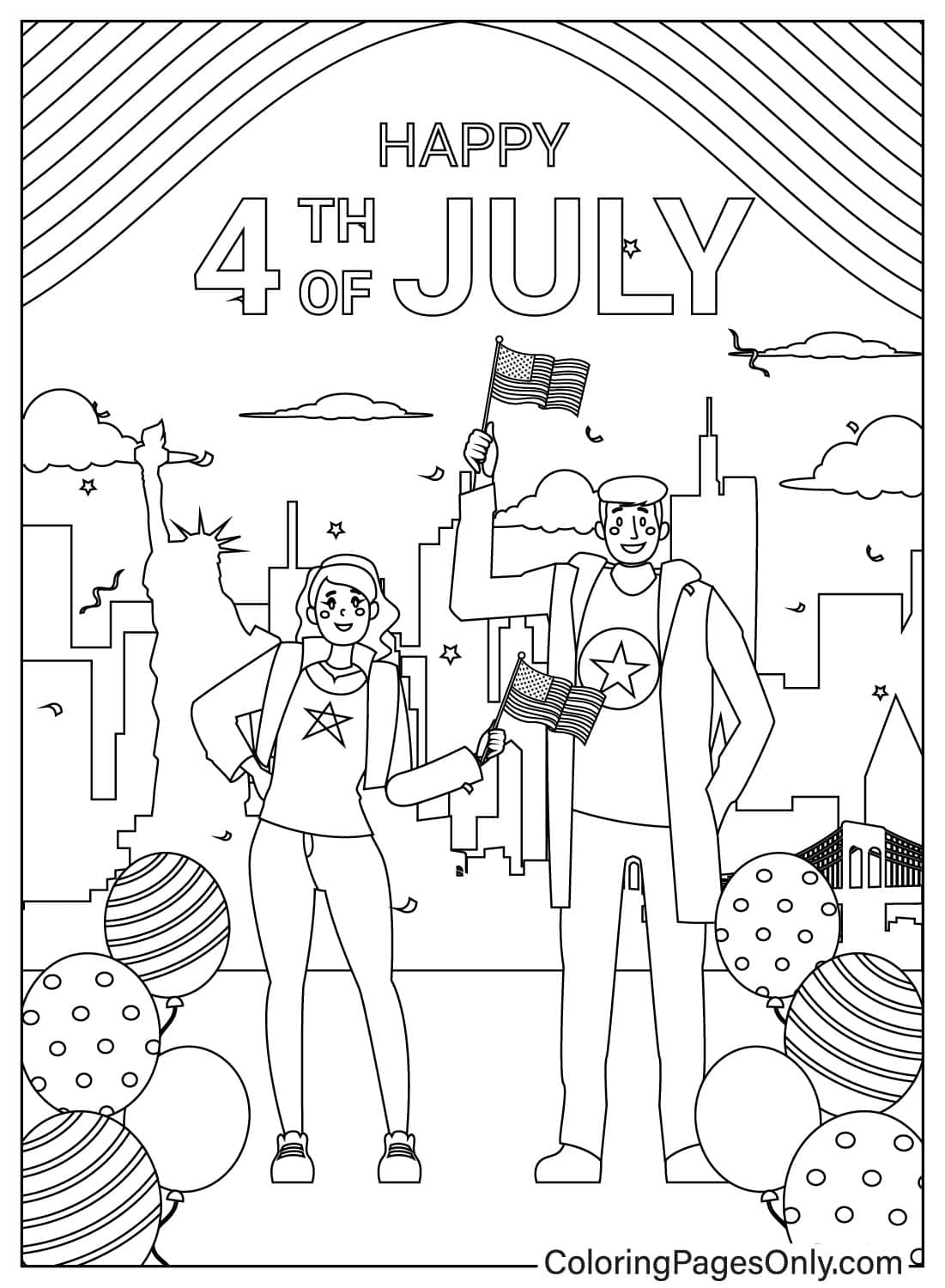
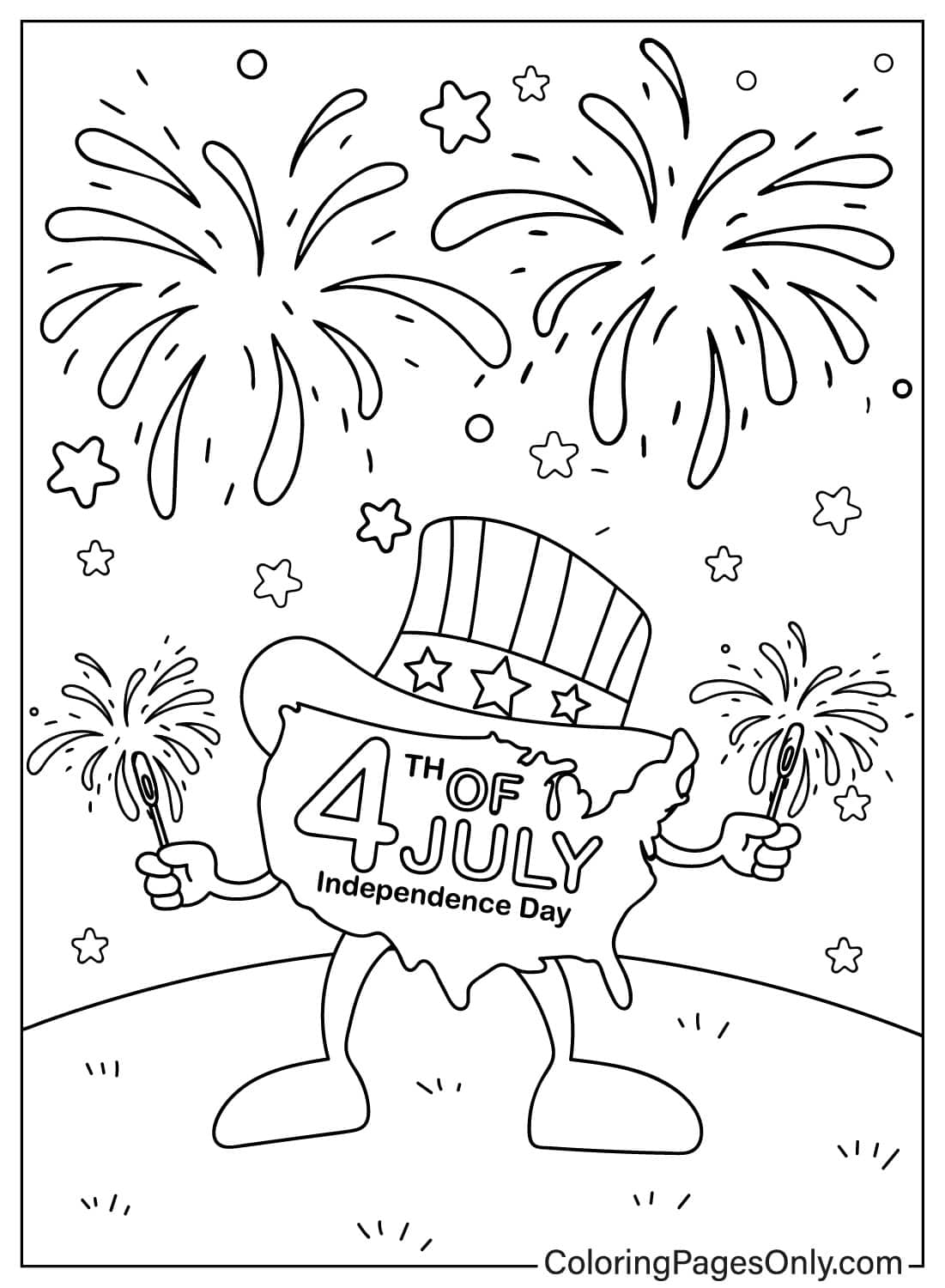
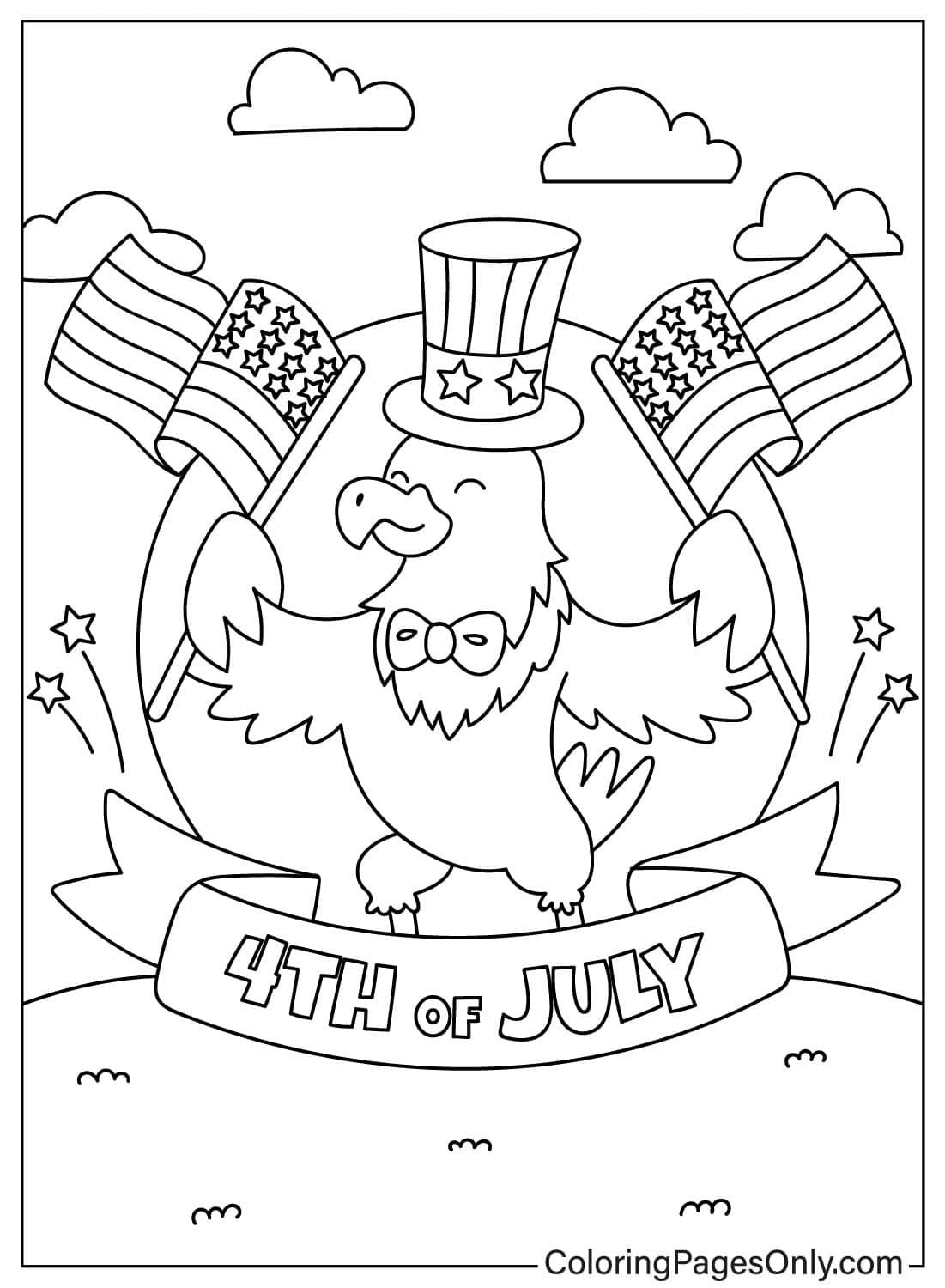
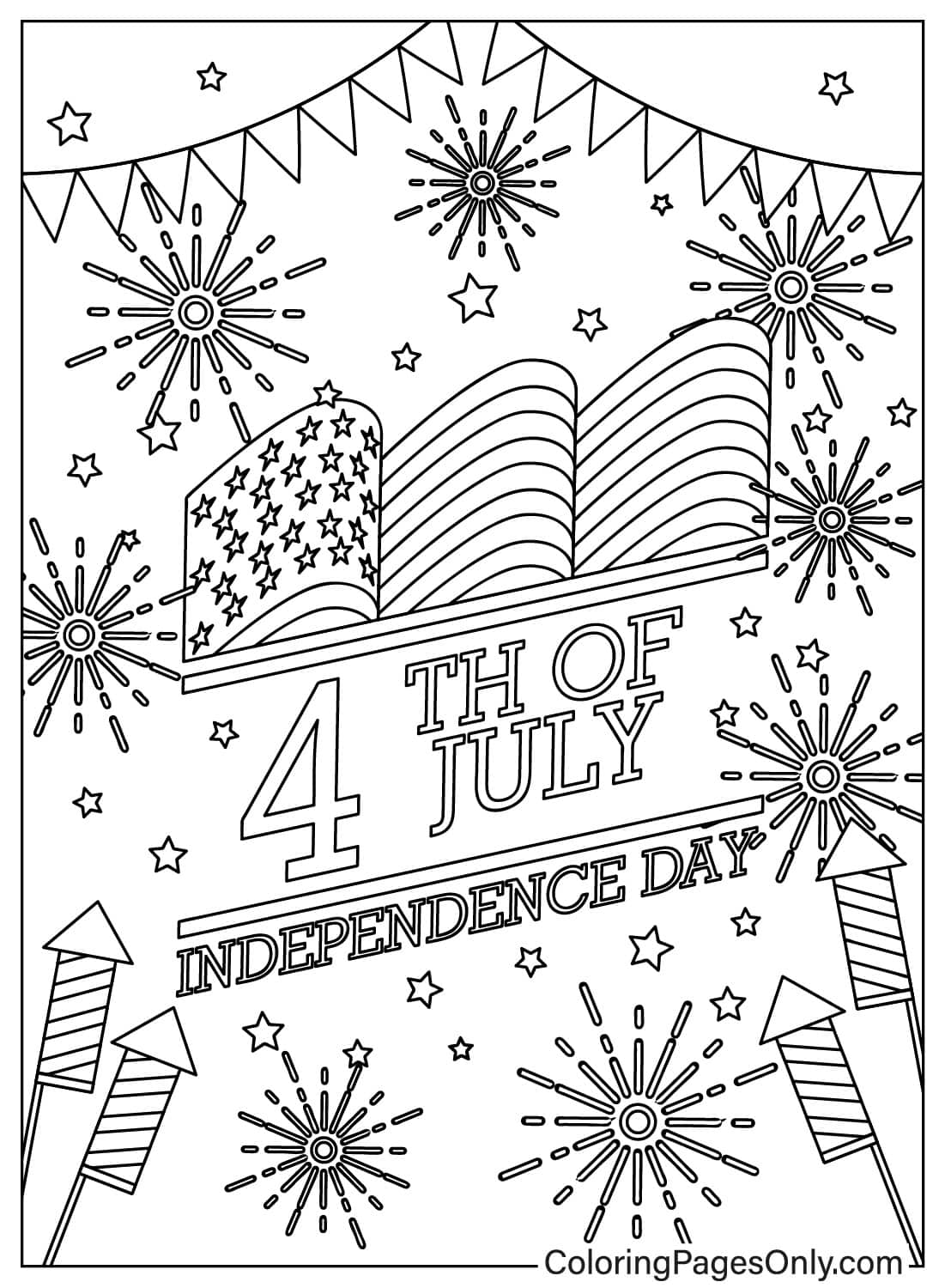
What’s Inside
American Flag Pages
The American flag is the Fourth of July collection’s most broadly represented subject and its most specific coloring challenge. The flag’s design is precisely defined by federal law and tradition: thirteen alternating stripes (7 red, 6 white, running horizontally), a blue canton (the rectangular area in the upper left corner), and 50 white stars arranged in alternating rows of 6 and 5 stars within the blue canton.
The current 50-star flag design became official on July 4, 1960, following Hawaii’s admission as the 50th state on August 21, 1959. The flag’s previous design had 49 stars (after Alaska’s admission as the 49th state on January 3, 1959). In the flag’s 248-year history, it has been redesigned 27 times as new states were admitted to the Union, with the number of stars increasing with each new state and the star arrangement reconfigured each time.
The flag’s nickname “Old Glory” was given by sea captain William Driver of Salem, Massachusetts, in 1831. The flag’s specific colors are defined in federal standards: the red is officially “Old Glory Red” (a specific warm, vivid red), the white is white, and the blue is “Old Glory Blue” (a specific deep navy blue).
Coloring flag pages: The stripes alternate beginning with red at the top and white beneath it, continuing in red-white sequence to the bottom with red at both the top and bottom (7 red stripes, 6 white stripes, 13 total). Apply the red first across each red stripe at full, warm saturation. The white stripes remain at the paper’s natural white or very pale cream. The canton (blue rectangle in the upper left covering the height of four red and three white stripes) is deep navy blue applied at full saturation. The 50 stars within the canton are white: they can be drawn carefully over the blue base or left as the paper’s natural white if the page design leaves star outlines.
Fireworks Burst Pages
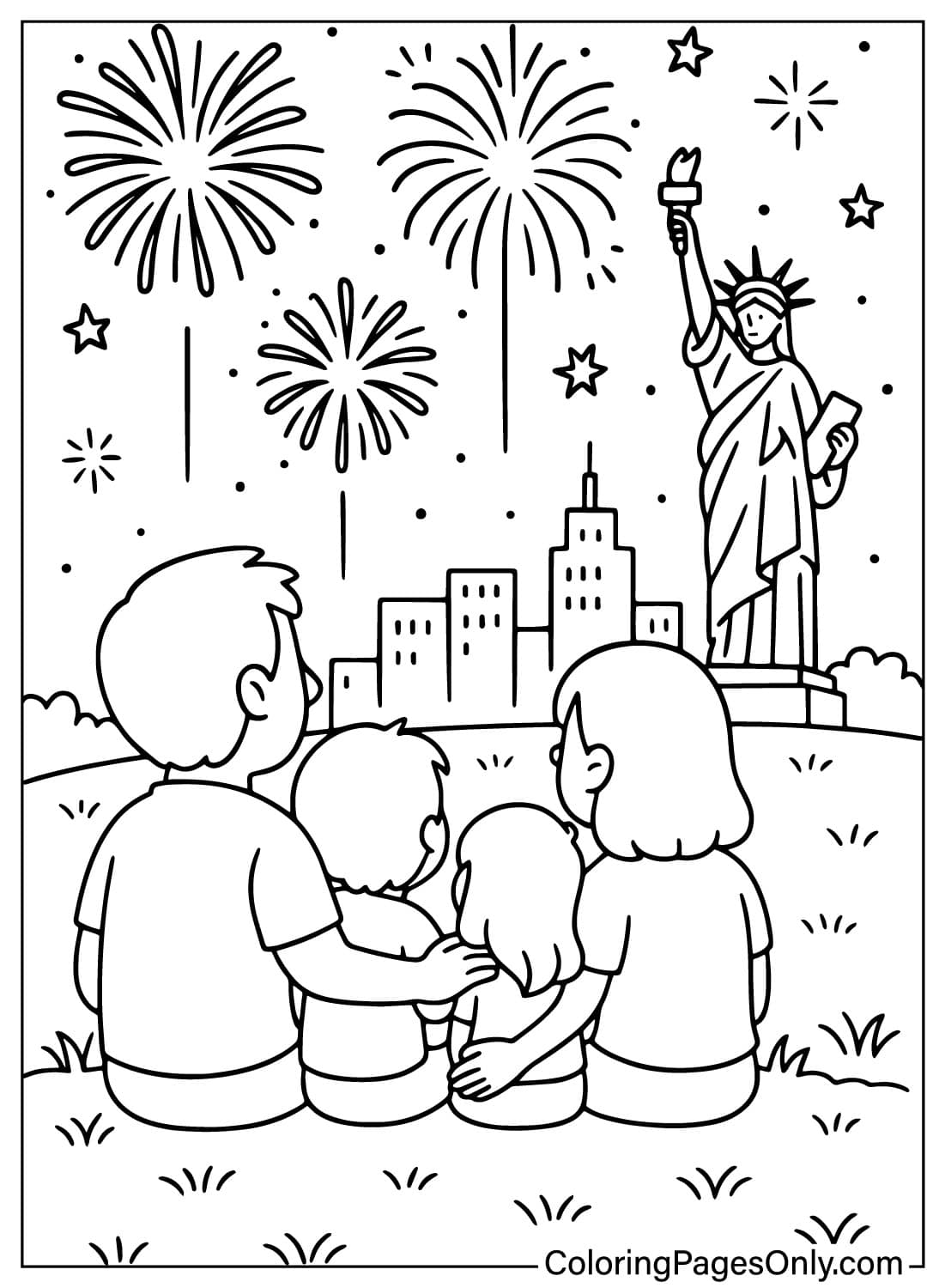
Fireworks have been part of Independence Day celebrations since the first anniversary of independence in 1777, when fireworks were set off in Philadelphia. Americans spend approximately $1 billion on fireworks annually, and the Fourth of July is the year’s largest fireworks occasion. The Macy’s Fourth of July Fireworks in New York City and various municipal displays across the country draw some of the largest annual outdoor audience gatherings in the United States.
The colors in fireworks are produced by specific chemical compounds that emit different wavelengths of visible light when burned. Red comes from strontium compounds. Orange from calcium compounds. Yellow from sodium compounds. Green from barium compounds. Blue from copper compounds (the most technically difficult color to achieve in fireworks chemistry, requiring precise combustion temperature). White or silver from titanium, magnesium, or aluminum powder. Purple from combinations of red-producing (strontium) and blue-producing (copper) compounds.
Each fireworks burst page shows a distinct explosion form: the chrysanthemum (a sphere of streams radiating from the center), the willow (streams that curve downward like willow branches), the peony (a sphere of streams without trailing sparks), and the palm (streams that first rise then cascade downward). These burst forms are specifically named types in professional fireworks design.
Coloring fireworks pages: The background night sky is very deep midnight blue or near-black, applied at full coverage before addressing any fireworks element. Stars in the background are small white dots applied with the finest available tool. Each burst uses the center-to-edge gradient technique: the center point of the burst is the hottest, most vivid element (brightest, lightest color), and the streams radiating outward graduate from the base vivid color to lighter, more diffuse versions at the tips. Red burst: vivid warm red at the core streams, paling to warm pink at the tips. Green burst: vivid medium green at the core, lighter yellow-green at the tips. Blue burst: vivid electric blue at the core, pale blue-white at the tips.
The Liberty Bell Pages
The Liberty Bell, now housed at the Liberty Bell Center in Philadelphia, adjacent to Independence National Historical Park, is one of America’s most recognizable historical objects. It was cast in 1752 by the Whitechapel Bell Foundry in London and shipped to Philadelphia, where it cracked on its first test strike and was recast twice by Philadelphia craftsmen John Pass and John Stow (whose names appear on the bell).
The bell’s inscription is drawn from Leviticus 25:10: “Proclaim LIBERTY throughout all the land unto all the inhabitants thereof.” This inscription gave the bell its name when abolitionists adopted it as a symbol of the freedom they were working toward in the decades before the Civil War. The bell was not originally called the “Liberty Bell”; it became known by that name through the abolitionist movement in the 1830s and 1840s.
The bell weighs approximately 2,080 pounds (943 kilograms) and has a diameter of 12 feet (3.7 meters) at the base. The famous crack that runs from the sound bow upward through the body of the bell developed gradually over the 19th century. The bell was last rung on February 23, 1846, George Washington’s birthday. After that ringing, the crack extended and the bell became unringable.
Coloring Liberty Bell pages: The bell is cast bronze: a warm, medium bronze-brown tone rather than the yellow-gold of polished brass or the dark brown of aged copper. Apply warm tan-bronze across the bell’s full body surface. The crack runs visibly from the sound bow (the lower edge where the clapper strikes) upward, and is darker bronze-brown within the crack line. The inscription text around the bell is the most precise coloring element: the raised letters should be slightly lighter than the surrounding bell surface.
The Statue of Liberty Pages
The Statue of Liberty (officially “Liberty Enlightening the World,” La Liberté éclairant le monde) stands on Liberty Island in New York Harbor and was dedicated on October 28, 1886. The statue was a gift from the people of France to the United States, proposed by French political thinker Édouard de Laboulaye, designed by sculptor Frédéric Auguste Bartholdi, and with its internal iron framework engineered by Gustave Eiffel (who also designed the Eiffel Tower in Paris).
From the ground to the torch tip, the statue measures 305 feet 1 inch (93 meters). The statue itself (from heel to torch) stands 151 feet 1 inch (46 meters). The crown has seven spikes, representing the seven seas and seven continents. The tablet she carries in her left arm is inscribed with “JULY IV MDCCLXXVI” (July 4, 1776, in Roman numerals). She holds a torch in her right hand, raised above her head. Broken chains lie at her feet.
The statue’s current color is the distinctive blue-green of patinated copper: the copper sheets of the outer skin have oxidized over more than a century to produce the specific teal-blue-green that is now among the most recognizable colors in American imagery. When first unveiled in 1886, the statue was shiny copper-brown.
Coloring Statue of Liberty pages: The statue is the specific teal-blue-green of oxidized copper: a cool, slightly blue-shifted green that reads as neither vivid green nor blue but as the specific muted teal of the patina. Apply this teal across all visible statue surfaces at medium saturation. The torch’s flame is vivid warm gold-orange, the warmest color in the composition. The harbor water below or around the statue uses medium blue-grey.
Uncle Sam Pages
Uncle Sam is the national personification of the United States government, most famously depicted in the recruitment poster “I Want YOU for U.S. Army,” painted by James Montgomery Flagg in 1917 and used both in World War I and World War II. Flagg based the image partly on his own self-portrait.
The character is depicted as a tall, lean older man with white hair and a goatee, wearing a top hat in the red, white, and blue of the American flag (tall top hat with a star-spangled blue band and red-and-white striped hat body), a blue jacket, red and white striped trousers, and a red bow tie. He points directly at the viewer in the iconic pose.
The historical origin of Uncle Sam as a name is traced to Samuel Wilson, a meat packer from Troy, New York, who supplied barrels of beef to the U.S. Army during the War of 1812. The barrels were stamped “U.S.,” and soldiers joked that it stood for “Uncle Sam” Wilson. The story was first documented in a New York newspaper in 1830.
Coloring Uncle Sam pages: The hat uses the flag’s colors: vivid red and white horizontal stripes on the hat body with a deep navy band and white stars. The jacket is deep navy blue. The trousers have vivid red and white vertical stripes. The bow tie is vivid red. The beard and hair are clean and white. The overall composition uses all three flag colors in a concentrated form.
Patriotic Celebration Scene Pages
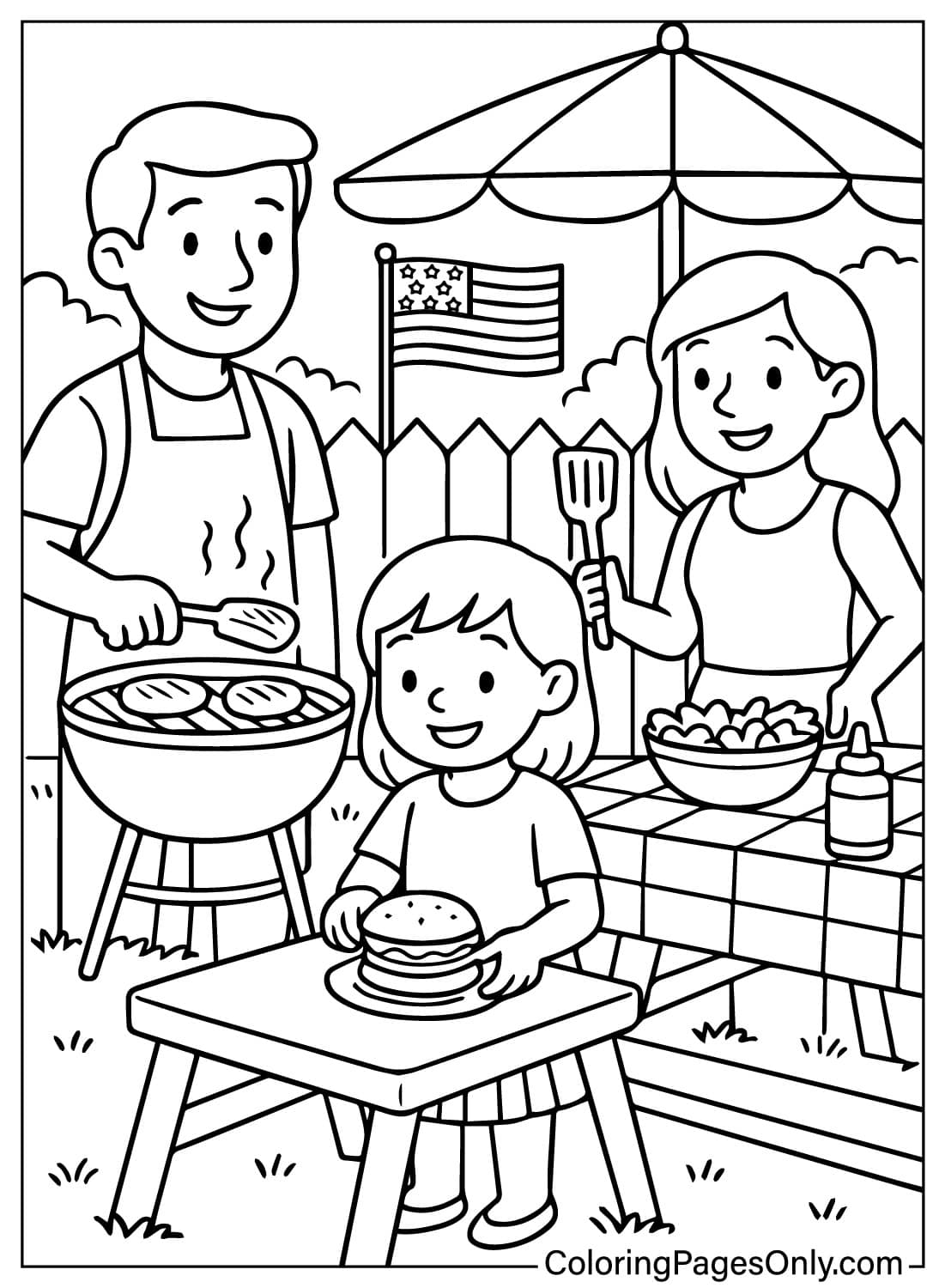
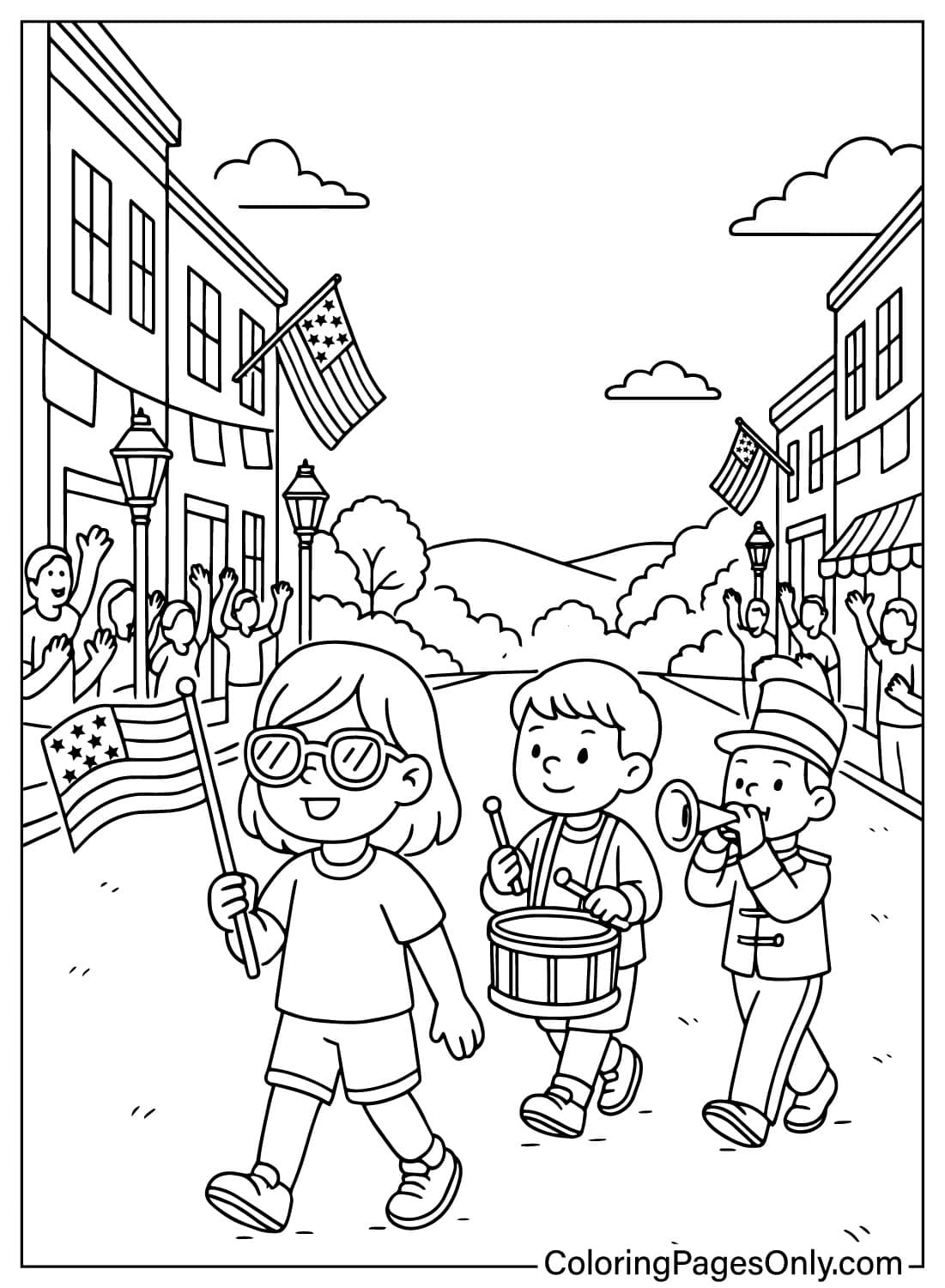
Celebration scene pages show the activities associated with Independence Day across American communities: barbecue gatherings with grills and picnic tables, parade scenes with marching bands and flag-bearing participants, family celebrations on lawns and in parks, children with sparklers, and community gatherings at waterfront locations watching fireworks.
These pages are the collection’s most narratively warm: they depict the specific social quality of Independence Day as a shared community experience rather than as a historical commemoration. The food, the gathering, the fireworks watched together, and the flags displayed represent the holiday’s living practice.
Coloring celebration scene pages: Warm summer palette throughout: warm amber and golden light of late afternoon, vivid green of summer lawns and trees, the red and white of checkered tablecloths and decorations, and the red-white-and-blue of flag decorations as accent elements throughout. Sparkler effects, if depicted, use pale gold-white at the sparkler tip with small scattered star-dots suggesting the spraying sparks.
Declaration Text and Founding Father Pages
Pages featuring the Declaration of Independence text, images of Founding Fathers, or the historical setting of the Constitutional Hall in Philadelphia connect the holiday’s festive present to its specific historical foundation. The Declaration’s most famous sentence, “We hold these truths to be self-evident, that all men are created equal, that they are endowed by their Creator with certain unalienable Rights, that among these are Life, Liberty and the pursuit of Happiness,” remains the most frequently quoted document text in American public discourse.
Thomas Jefferson, John Adams, and Benjamin Franklin appear in historical portrait style pages that reference the imagery of 18th-century American civic life: the specific clothing of the colonial American period (frock coats, waistcoats, powdered wigs), the quill pen that signed the Declaration, and the parchment that bore it.
Coloring historical portrait pages: Colonial-era clothing uses deep navy blue, forest green, burgundy, or dark grey for frock coats; cream or warm white for shirts and cravats; warm tan or dark brown for leather-style accessories. Quill pens are warm cream-white. Parchment and paper are aged, with warm cream and darker warm brown lettering.
What These Pages Do
Independence Day is the most broadly observed national holiday in the United States: unlike Memorial Day or Veterans Day, which primarily honor military service members, or Thanksgiving, which has specific regional variations, the Fourth of July is observed across all fifty states in broadly similar ways, with fireworks, flags, community gatherings, and parades as the common visual and experiential vocabulary. The shared visual language of the holiday, the red, white, and blue, the Stars and Stripes, the fireworks against the night sky, produces one of the most nationally cohesive symbolic environments of the American calendar year.
The Declaration of Independence, adopted July 4, 1776, is a founding document of democratic governance whose influence extends well beyond the United States. The French Declaration of the Rights of Man and of the Citizen (August 26, 1789), the Haitian Declaration of Independence (January 1, 1804), and numerous subsequent declarations of independence worldwide have drawn directly on the language and logic of the American Declaration. The phrase “all men are created equal” has been cited, interpreted, and debated in American civic life for 248 years, most significantly in Abraham Lincoln’s Gettysburg Address (November 19, 1863), in which he described the nation as having been “conceived in Liberty, and dedicated to the proposition that all men are created equal.”
The American Academy of Pediatrics identifies fine motor skill development as a key childhood milestone throughout early childhood. The flag’s precise stripe pattern, the star arrangement in the canton, the Liberty Bell’s inscription lettering, and the fireworks burst gradient work all provide motivated fine motor practice calibrated to the collection’s wide age range. The 2005 Art Therapy Journal study on structured coloring and anxiety reduction applies throughout.
The Fourth of July coloring pages serve an additional seasonal function: they are most immediately relevant in the days immediately before July 4, giving the collection specific practical utility as a family or classroom activity in the late June through early July period.
How to Color These Pages Well
The flag’s three colors must be at their correct specific tones. The red is a warm, vivid red that reads as clearly red without approaching orange or dark crimson. The blue is a deep navy blue, deeper and darker than the medium blue of Bumblebee or Superman. The white stays at the paper’s natural white or very pale warm cream. These three colors, together at their correct tones, produce the specific flag palette. If any one of the three drifts from its specific tone (red too orange, blue too bright and light, white too grey), the flag reads as incorrect.
Apply flag stripes from the top red stripe downward, establishing the stripe width early. Count the visible stripes on the page and divide the flag’s height by that number to establish the width of each stripe before beginning. The most common flag coloring error is misallocating stripe widths, producing stripes of unequal width. Apply the top red stripe first, using its width as the template for all subsequent stripes. Alternate red and white to the bottom edge, verifying the count: the bottom stripe is red.
Fireworks bursts require a dark background before any burst color is applied. Apply the complete midnight blue or near-black background across the entire sky area first, covering every square of the composition that is not a fireworks burst. Only after the background is fully in place should individual burst colors be applied. Attempting to apply the dark background around pre-applied burst colors results in muddied burst colors and an uneven background.
The Statue of Liberty’s teal-green is the most specific and most commonly miscolored element. The patinated copper color of the Statue of Liberty is neither vivid green (too bright, too yellow-shifted) nor blue-green (too blue-shifted toward teal). It is a specific muted teal that reads as aged copper oxidation: apply a medium green with a very slight blue shift, then add a very light grey layer over it to mute the saturation to the specific quality of aged metal. The result should feel like the specific weathered green of a very old copper roof rather than the vivid green of fresh paint.
Parade and celebration scene pages benefit from a warm summer light palette throughout. Apply a very subtle warm amber-gold over the entire composition at minimum pressure before adding any other colors: this establishes the warm late-afternoon light quality of a summer outdoor celebration. Individual colors applied over this warm base will carry the ambient warmth of summer light rather than the neutral quality of indoor artificial light.
5 Creative Craft Ideas
The Committee of Five Page
The Declaration of Independence was drafted by a “Committee of Five” appointed by the Second Continental Congress on June 11, 1776. Thomas Jefferson was assigned as the primary drafter. John Adams later explained that Jefferson was chosen because of his reputation as an excellent writer and because Adams felt that a Virginian should be the primary author of the document for political reasons.
Print the most formal, historically-referenced flag page in the collection. Color it with careful precision: correct stripe sequence, deep navy canton, clean white stars.
On the backing card: “The Committee of Five. Appointed June 11, 1776. Thomas Jefferson (Virginia): primary author. John Adams (Massachusetts): revised. Benjamin Franklin (Pennsylvania): revised. Roger Sherman (Connecticut). Robert R. Livingston (New York). The Declaration: adopted July 4, 1776. Most delegates signed: August 2, 1776. John Hancock: first signer, largest signature. 56 total signers. Price paid by some: property confiscated, families imprisoned, lives lost. The document survived.”
The Fireworks Chemistry Page
The colors of fireworks are produced by specific metal compounds that emit different light wavelengths when burned at high temperatures: strontium salts for red, calcium salts for orange, sodium salts for yellow, barium salts for green, copper salts for blue, and titanium or magnesium powder for white/silver. Blue is the most technically difficult color to achieve.
Print a multi-burst fireworks page. Color each burst in a different chemical compound’s associated color: vivid red (strontium), vivid orange (calcium), vivid yellow (sodium), vivid green (barium), vivid blue (copper), silver-white (titanium).
On the backing card: “Fireworks colors: the chemistry. Red: strontium. Orange: calcium. Yellow: sodium. Green: barium. Blue: copper (most difficult). White/silver: titanium or magnesium. First used in Independence Day celebrations: July 4, 1777, Philadelphia. Fireworks originated in China (7th century). Annual US fireworks spending: approximately $1 billion. The night sky: a chemistry demonstration. The audience: everyone who looks up.”
The Liberty Bell Inscription Page
The Liberty Bell’s inscription is drawn from Leviticus 25:10: “Proclaim LIBERTY throughout all the land unto all the inhabitants thereof.” The full text on the bell also includes the verse citation and the names of the bell’s foundry workers: “Pass and Stow, Philada, MDCCLIII” (Philadelphia, 1753, in Roman numerals). The bell weighs approximately 2,080 pounds, and its famous crack developed gradually over the 19th century. It has not been rung since February 23, 1846.
Print a Liberty Bell page. Color the bell in a warm bronze tone with careful attention to the crack running from the sound bow upward.
On the backing card: “The Liberty Bell. Cast: 1752, Whitechapel Bell Foundry, London. Recast: 1753, by Pass and Stow, Philadelphia. Inscription: Leviticus 25:10. Weight: approximately 2,080 pounds (943 kg). Last rung: February 23, 1846 (George Washington’s birthday). The crack: developed gradually; the bell became unringable after 1846. Name ‘Liberty Bell’: given by abolitionists in the 1830s-1840s. Now at: Liberty Bell Center, Philadelphia. The inscription was chosen in 1752. The abolitionists chose it as their symbol in the 1830s. The connection held.”
The “Four Score and Seven Years” Page
Abraham Lincoln’s Gettysburg Address, delivered November 19, 1863, during the dedication of the Soldiers’ National Cemetery in Gettysburg, Pennsylvania, began: “Four score and seven years ago our fathers brought forth on this continent, a new nation, conceived in Liberty, and dedicated to the proposition that all men are created equal.” Four score and seven years (87 years) counted back from 1863 reaches 1776: the Declaration of Independence.
Print the most formal flag or patriotic page in the collection. Color with maximum precision in the flag’s three canonical colors.
On the backing card: “July 4, 1776: The Declaration of Independence adopted. November 19, 1863: Abraham Lincoln, Gettysburg Address. ‘Four score and seven years ago our fathers brought forth on this continent, a new nation, conceived in Liberty, and dedicated to the proposition that all men are created equal.’ Four score and seven years: 87 years. 1863 minus 87: 1776. Lincoln connected the Civil War directly to the Declaration. The proposition was still being tested.”
The Statue of Liberty Inscription Page
The Statue of Liberty’s pedestal carries the poem “The New Colossus” by Emma Lazarus, written in 1883 and engraved on a bronze plaque inside the pedestal in 1903. Its most famous lines: “Give me your tired, your poor, / Your huddled masses yearning to breathe free, / The wretched refuse of your teeming shore. / Send these, the homeless, tempest-tost to me, / I lift my lamp beside the golden door!”
Print a Statue of Liberty page. Color the statue in the specific patinated copper teal-green with a warm gold-orange torch flame.
On the backing card: “The Statue of Liberty. Designed by Frédéric Auguste Bartholdi. Iron framework: Gustave Eiffel. Dedicated: October 28, 1886. A gift from France to the United States. Height to torch tip: 305 feet 1 inch (93 m). Crown spikes: 7, representing 7 seas and 7 continents. Original color: copper-brown (1886). Current color: teal-green (oxidized copper, 140 years of weather). Tablet inscription: JULY IV MDCCLXXVI. Pedestal inscription: Emma Lazarus, ‘The New Colossus,’ 1883. The lamp: still raised. The door: still golden.”
Frequently Asked Questions
What are 4th of July Coloring Pages?
4th of July Coloring Pages are 35 free printable designs of Independence Day symbols, including the American flag, fireworks, bald eagles, Uncle Sam, picnic food, and festive gnomes and pets. Each page downloads as a PDF or colors online, with no account required.
How did the Fourth of July become a holiday?
The Fourth of July was first celebrated in Philadelphia in 1777 and became widespread after the War of 1812. Congress made it an official holiday for federal workers in Washington, D.C., in 1870 and a paid federal holiday in 1938.
Why is the bald eagle a 4th of July symbol?
The bald eagle has been the national emblem of the United States since 1782, when it was placed on the Great Seal. It became the official national bird by law in December 2024. Color the head and tail white, the body Crayola Sepia, and the beak Goldenrod.
Who is Uncle Sam?
Uncle Sam is the national personification of the United States. The name comes from Samuel Wilson of Troy, New York, whose army beef barrels were stamped “U.S.” during the War of 1812. His famous pointing pose comes from James Montgomery Flagg’s 1917 recruiting poster.
Why are gnomes, cats, and dogs in a 4th of July set?
Gnomes, cats, and dogs give younger children a friendly, simple subject in holiday colors. Their large shapes are easy to fill, and a gnome’s tall hat is a good place to practice red and white stripes before coloring a full flag.
What colors are needed for these pages?
Crayola Red and Navy Blue cover the flag, with white left as bare paper. Midnight Blue or Black works for fireworks skies, Sepia and Goldenrod for eagles, and Yellow, Green, and Violet for the bursts. Keep each burst a single color so the explosions stay distinct.
What age group are 4th of July Coloring Pages for?
These pages suit ages 4 and up. Preschoolers do well with the gnome, cat, dog, and balloon designs, children 6 to 10 can handle the eagles and the Uncle Sam map, and teens and adults enjoy blending colors on the fireworks and poster pages.
Why is Independence Day on July 4 and not July 2?
Congress voted for independence on July 2, 1776, and John Adams expected that day to become the national holiday. The final text of the Declaration of Independence was approved on July 4, and the printed copies carried that date, so July 4 became the day Americans celebrate.
Share your work on Facebook and Pinterest and tag #Coloringpagesonly. The fireworks chemistry page and the Liberty Bell inscription display are particularly worth sharing.
Color the seven red stripes. Apply the deep navy canton. The fifty stars go last, white against the blue. The flag has been this color since 1960. The stripes have been thirteen since 1777.