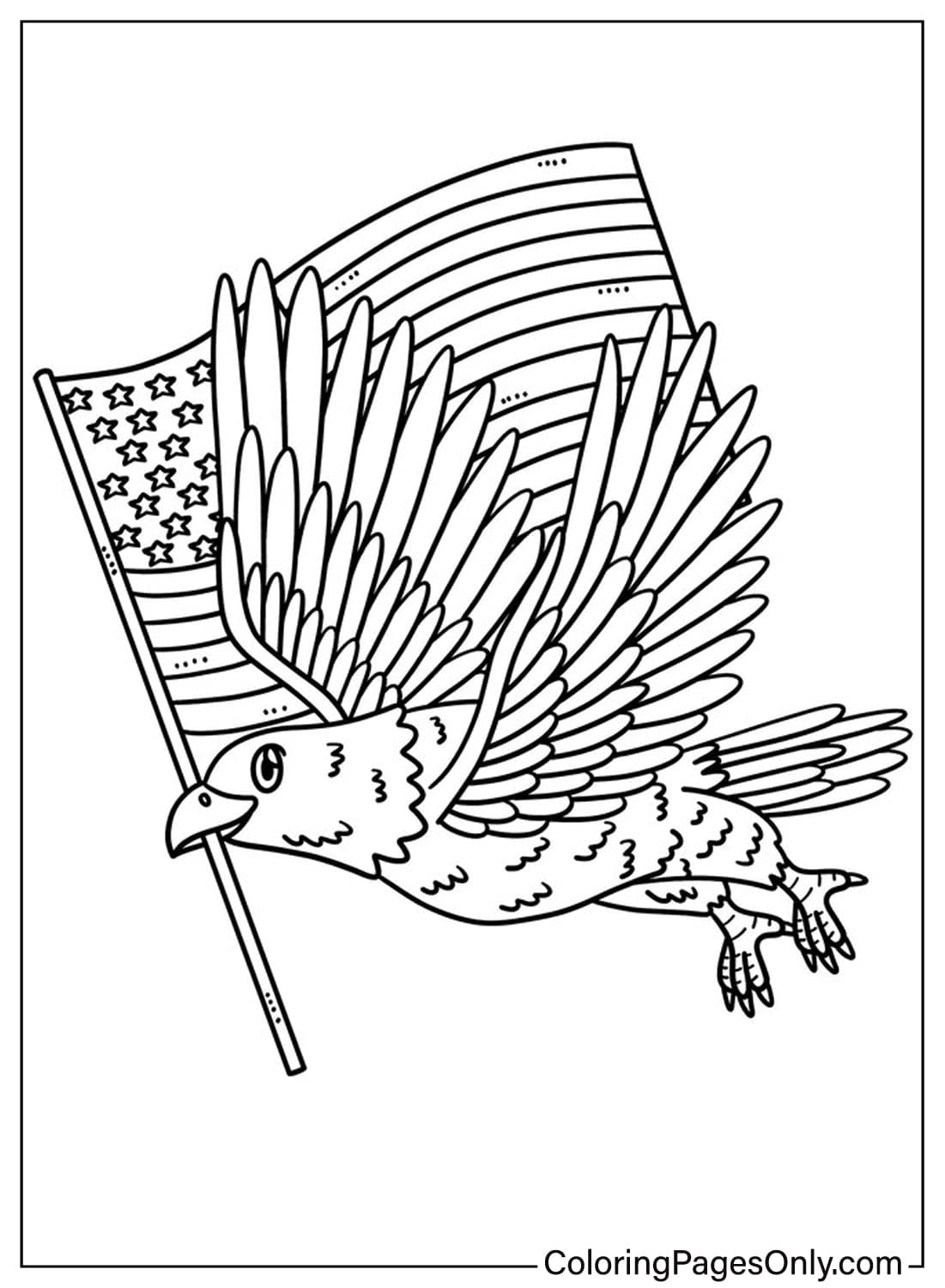
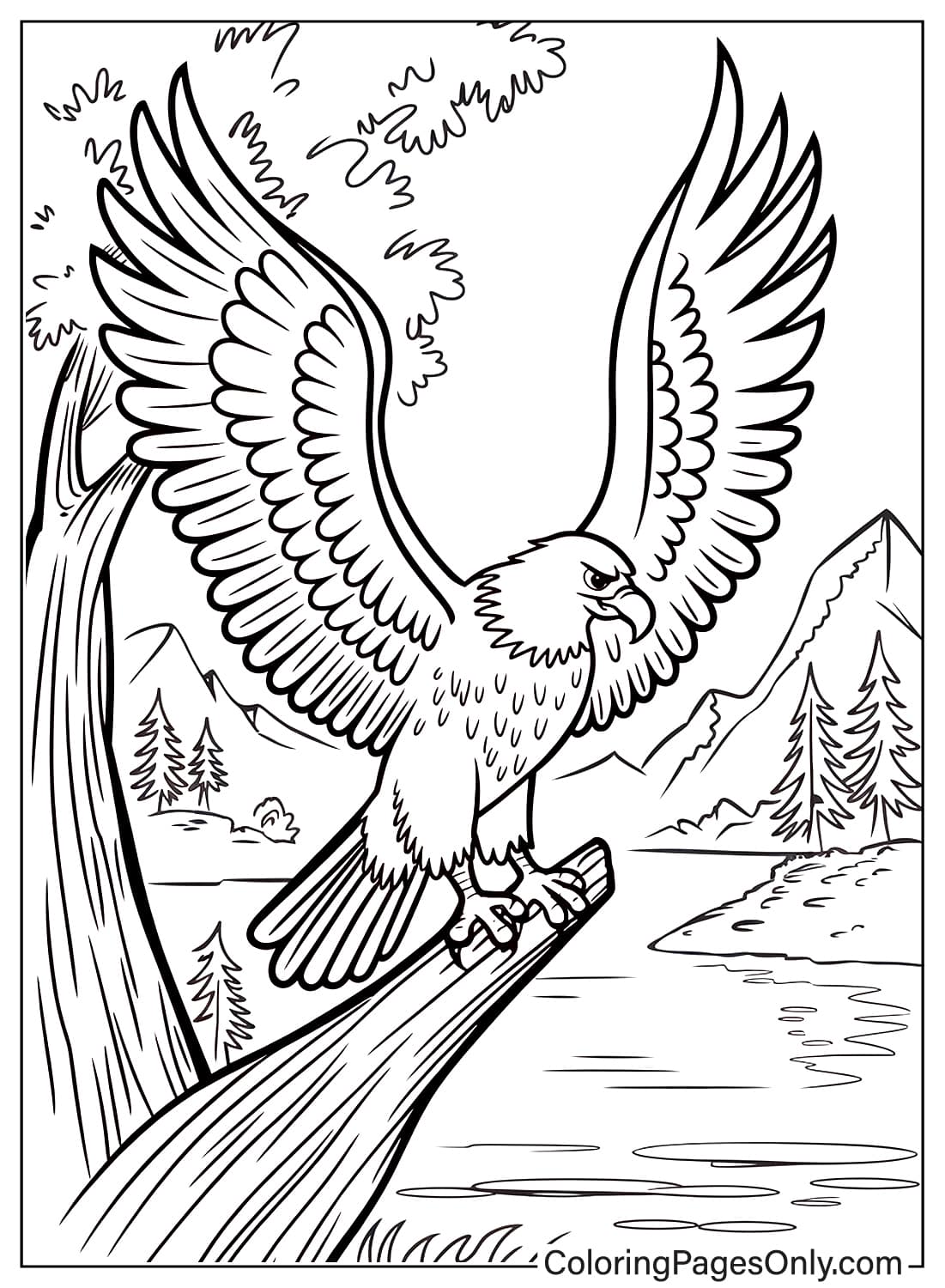
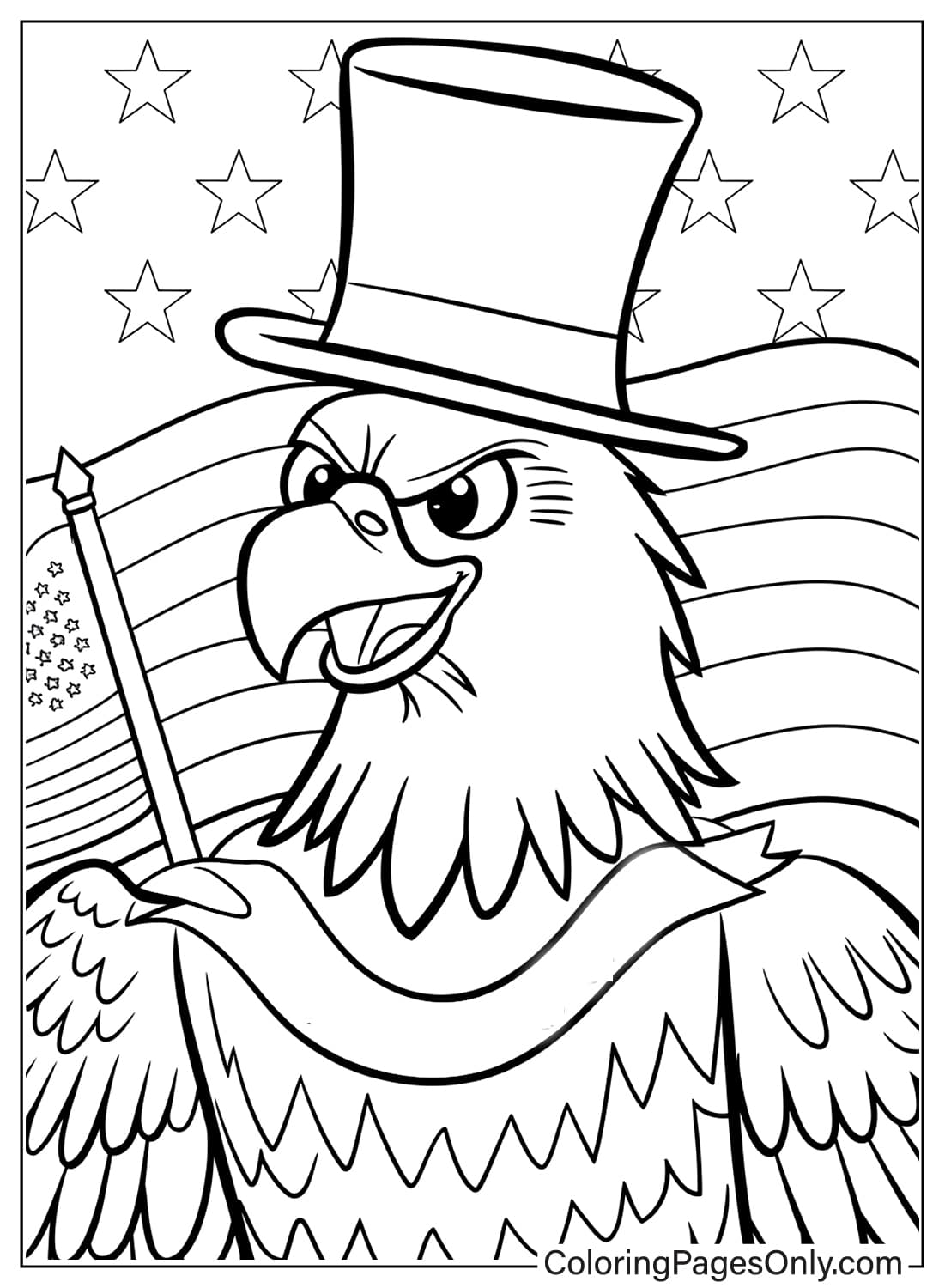
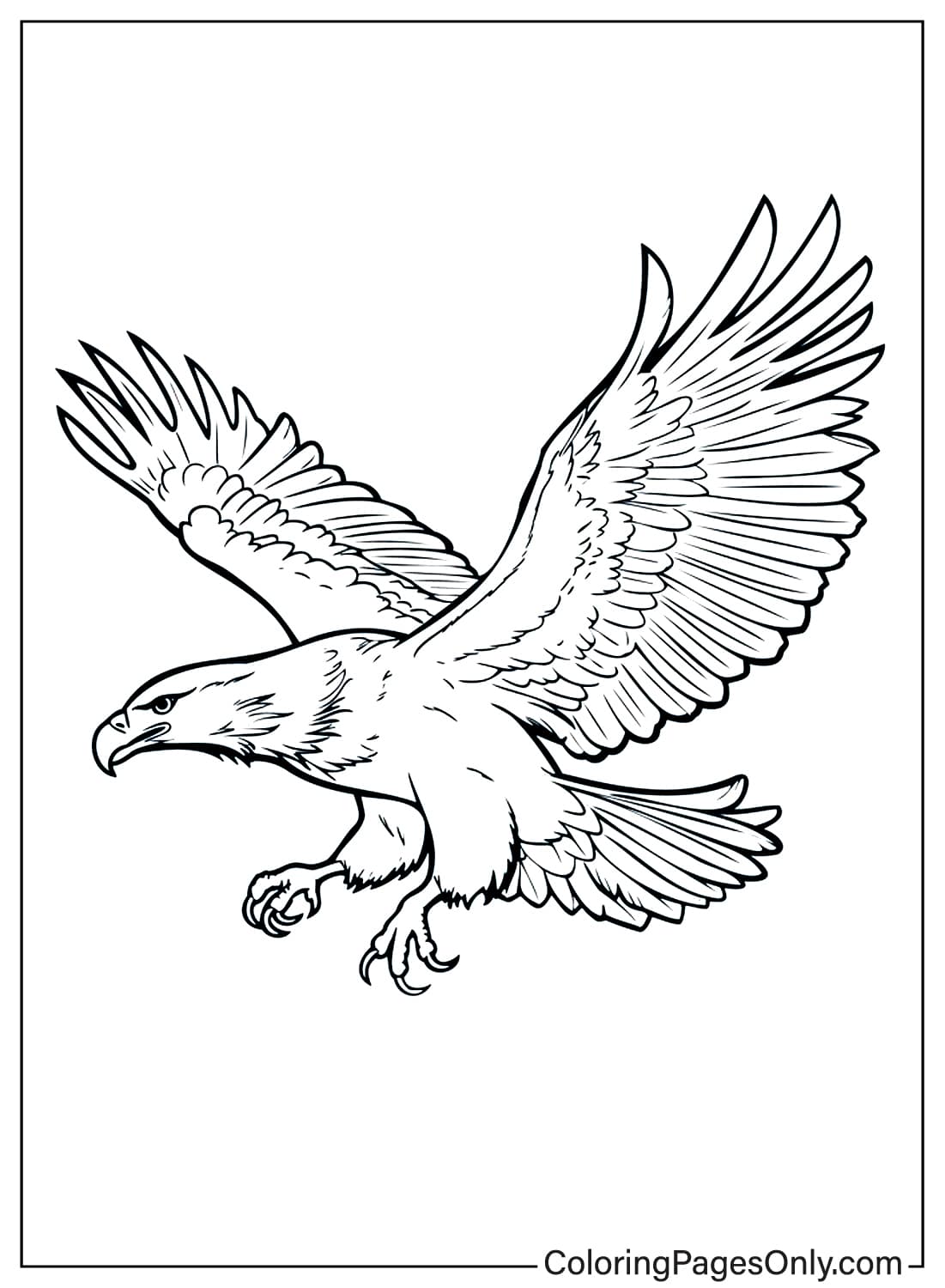
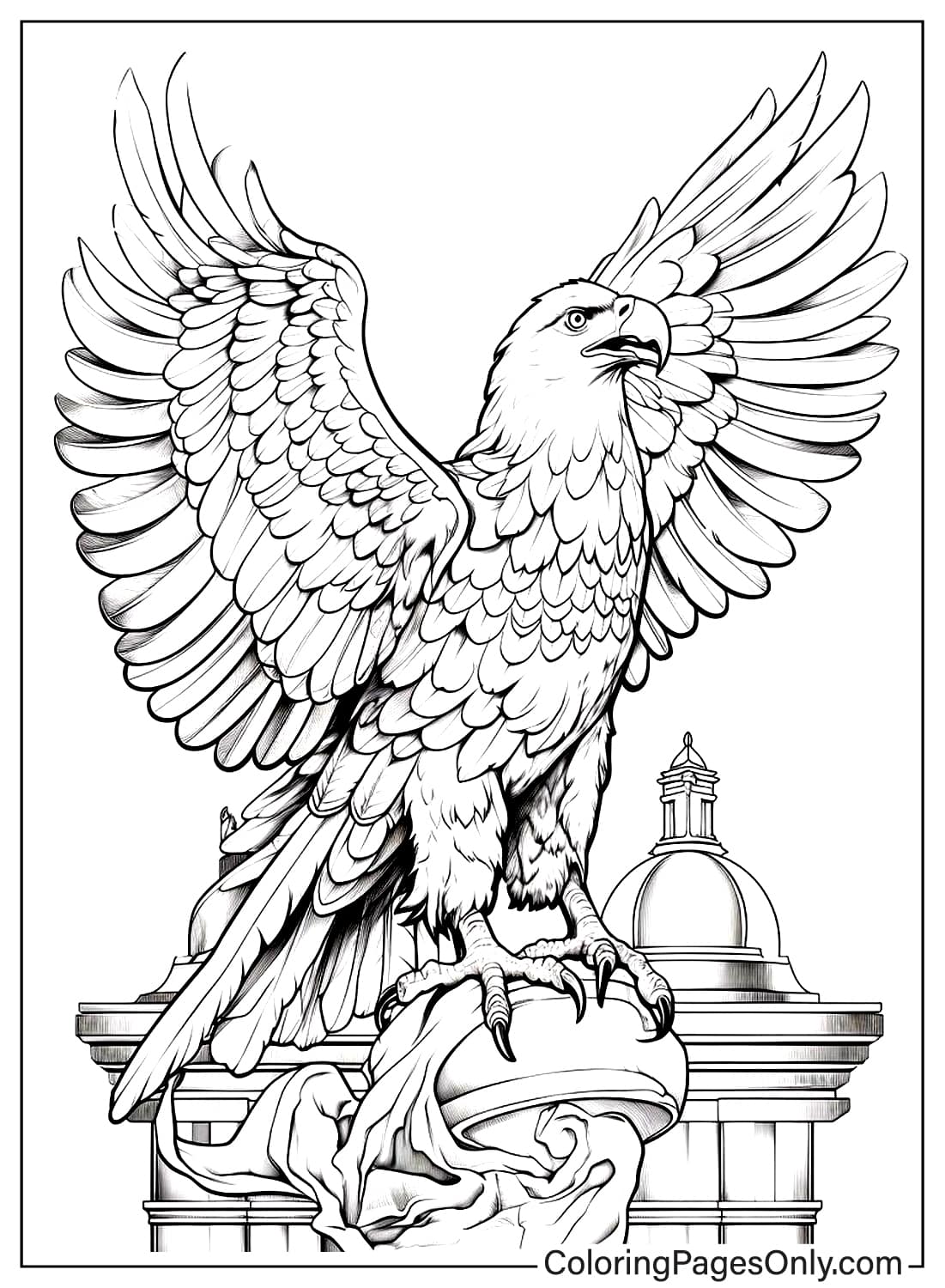
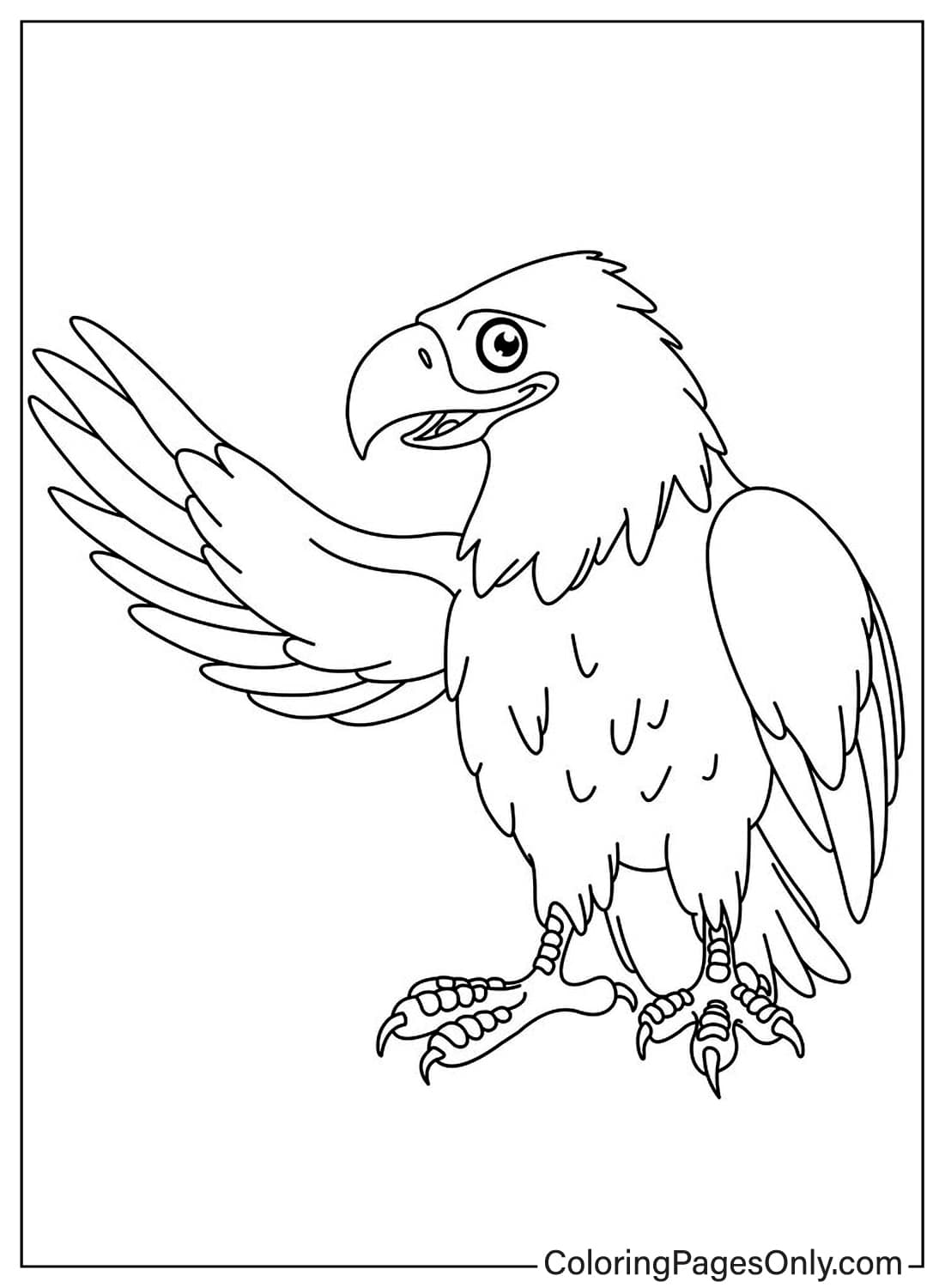
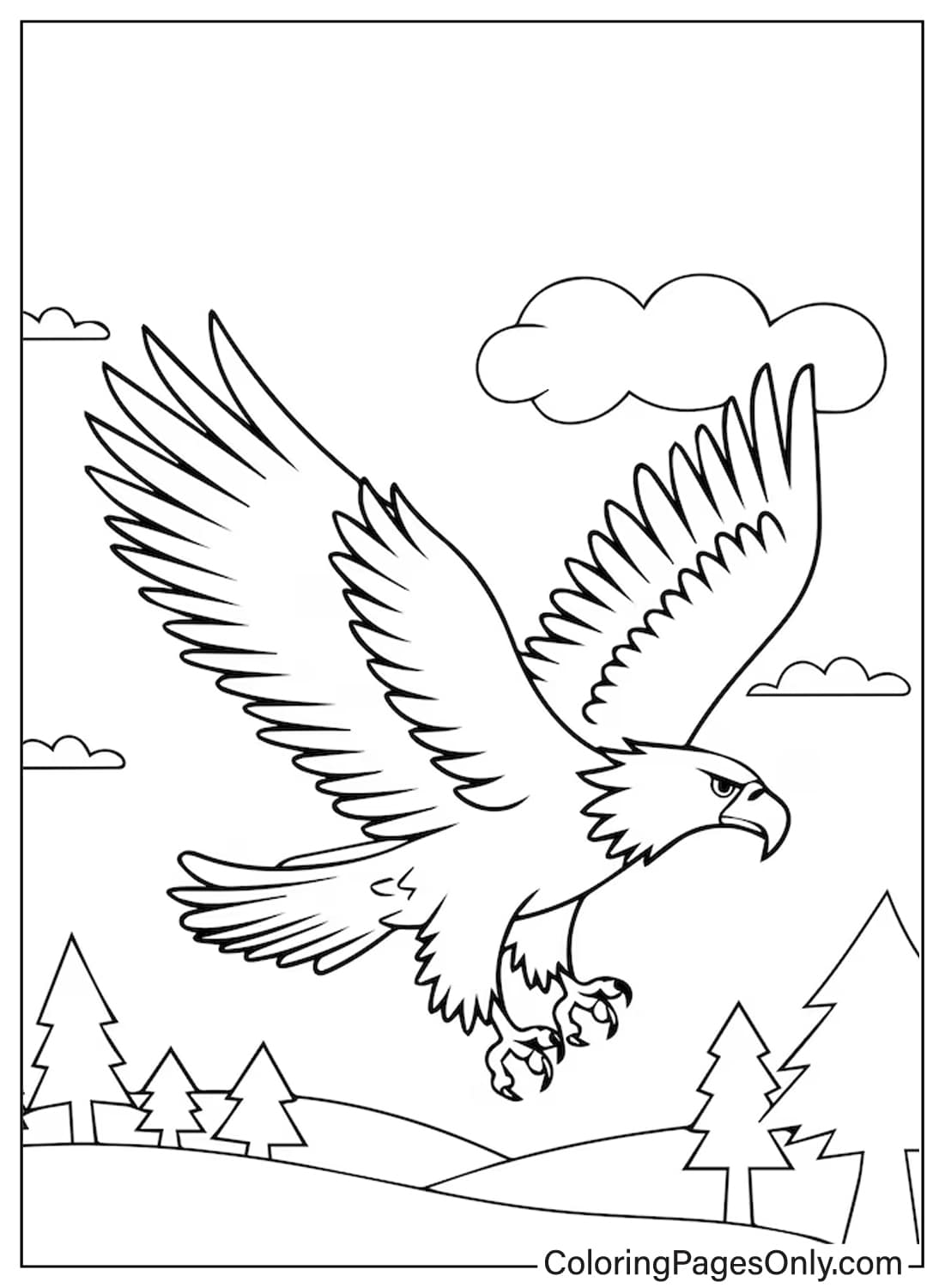
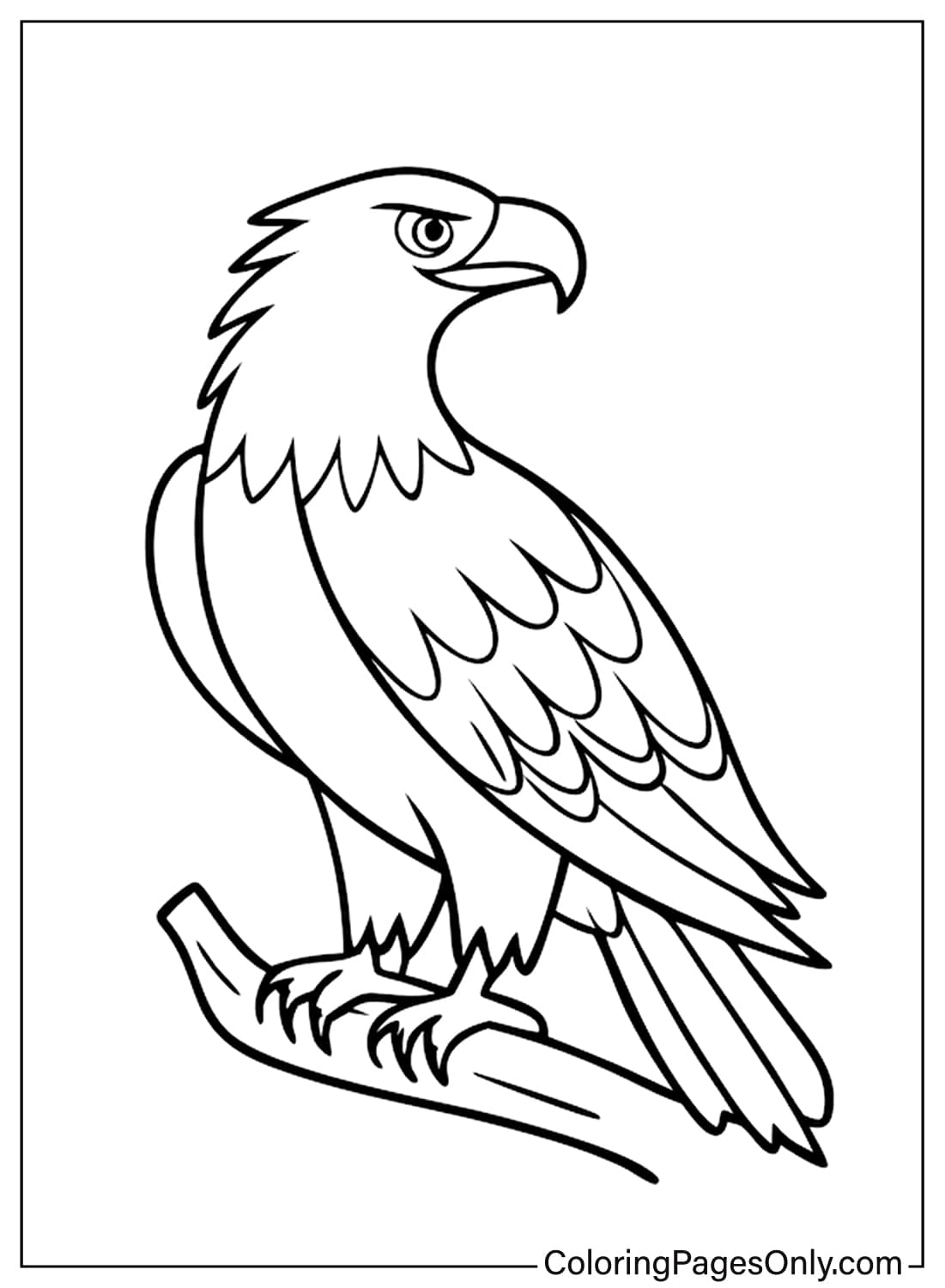
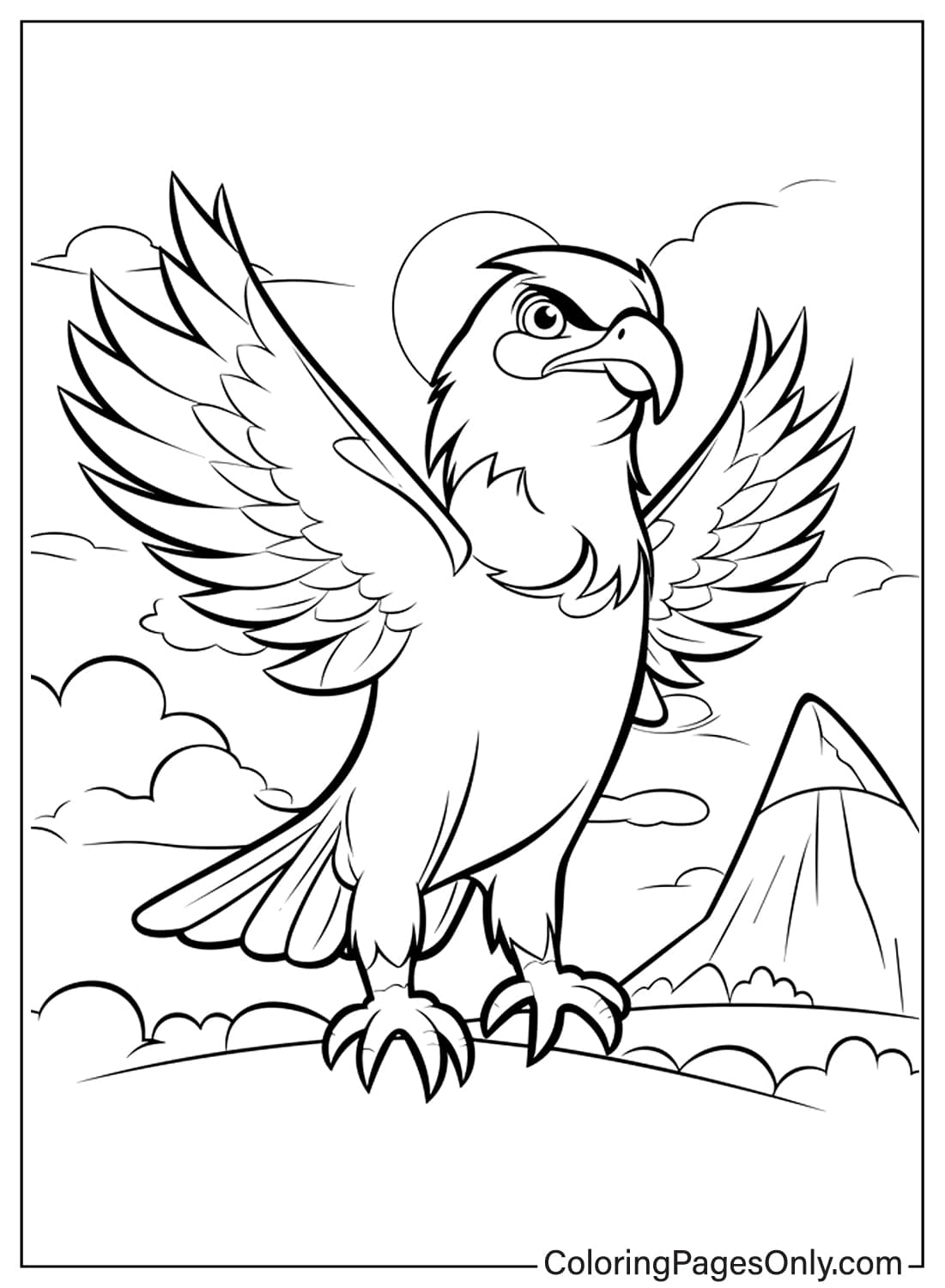
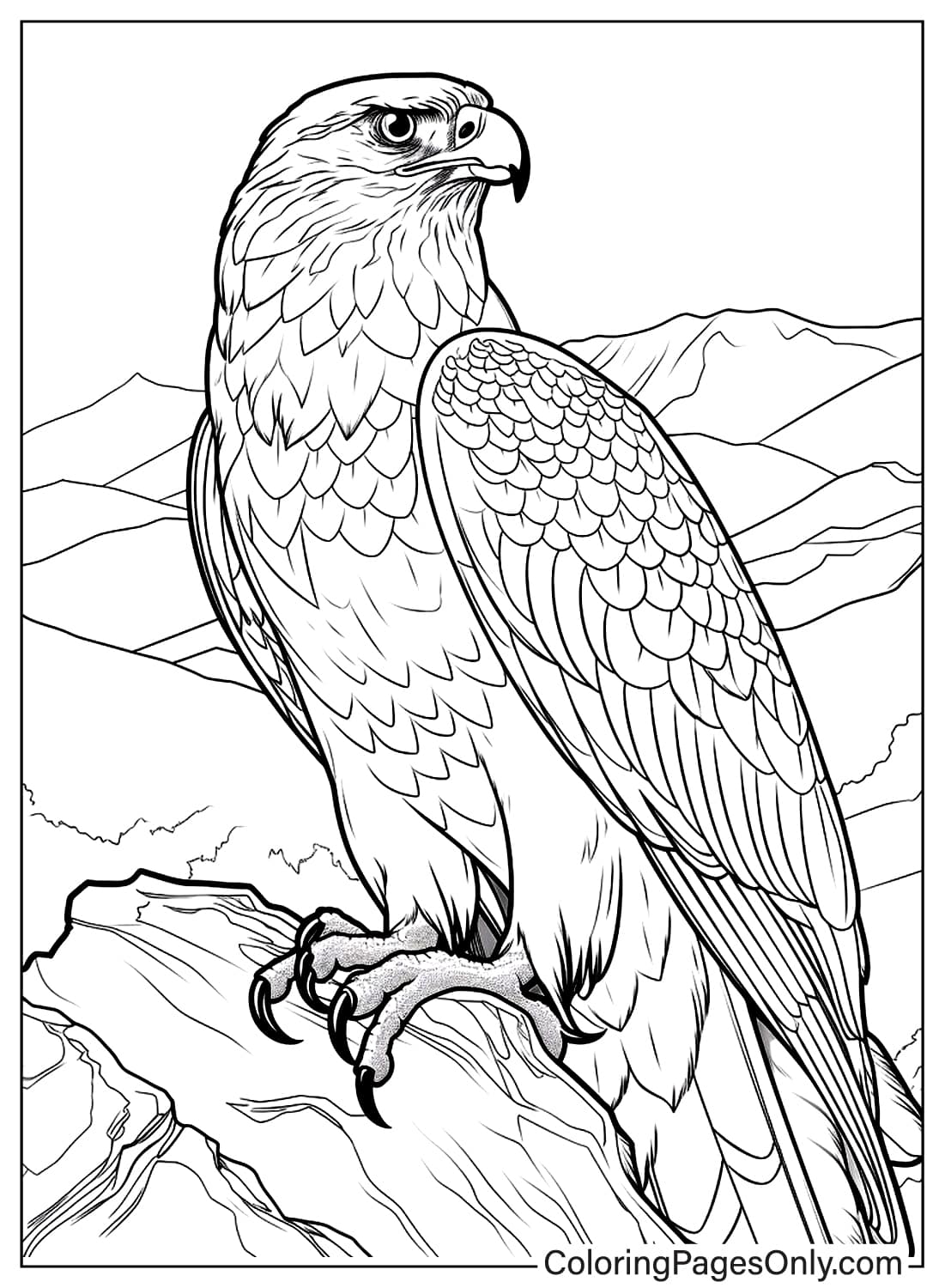
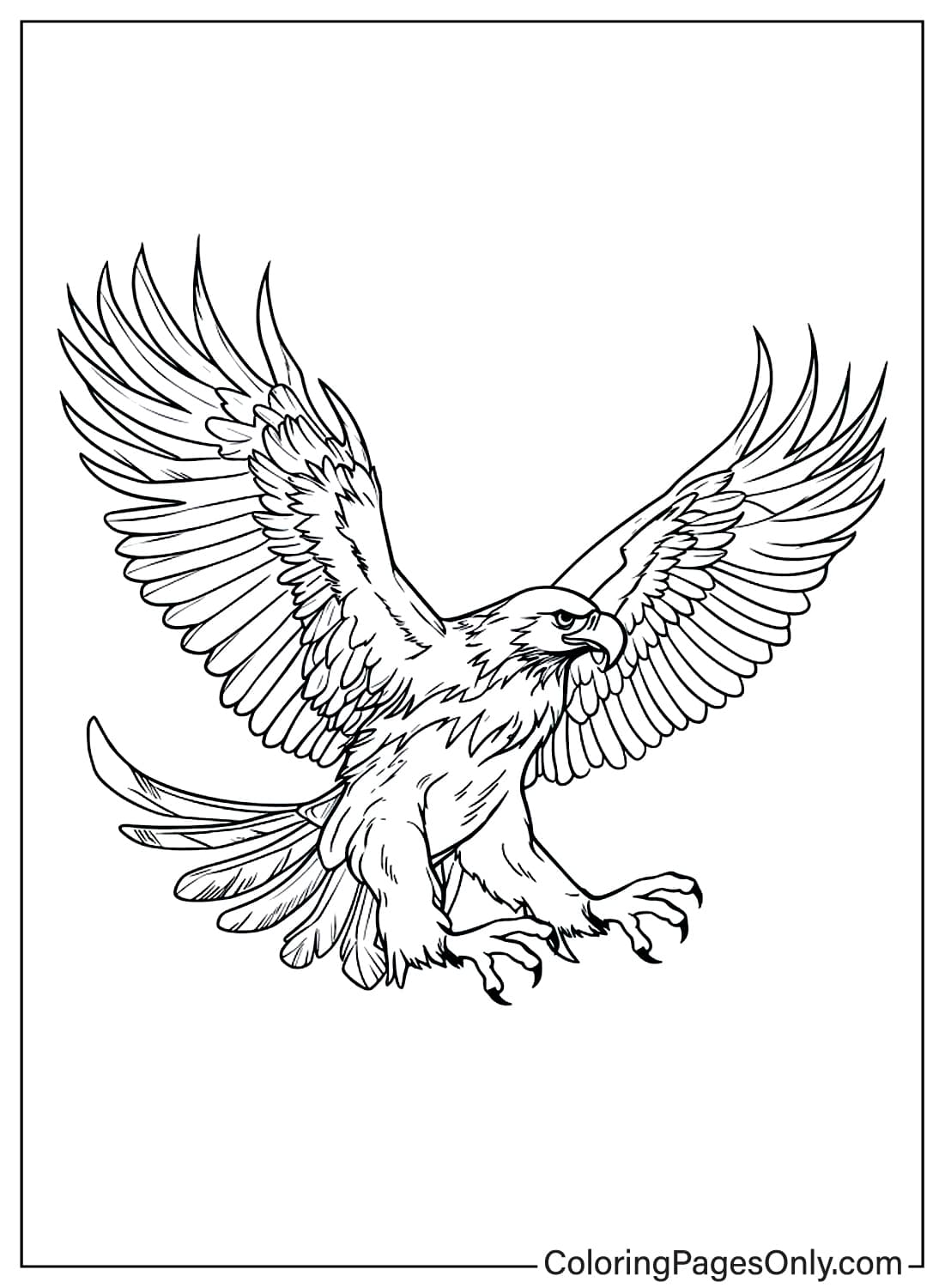
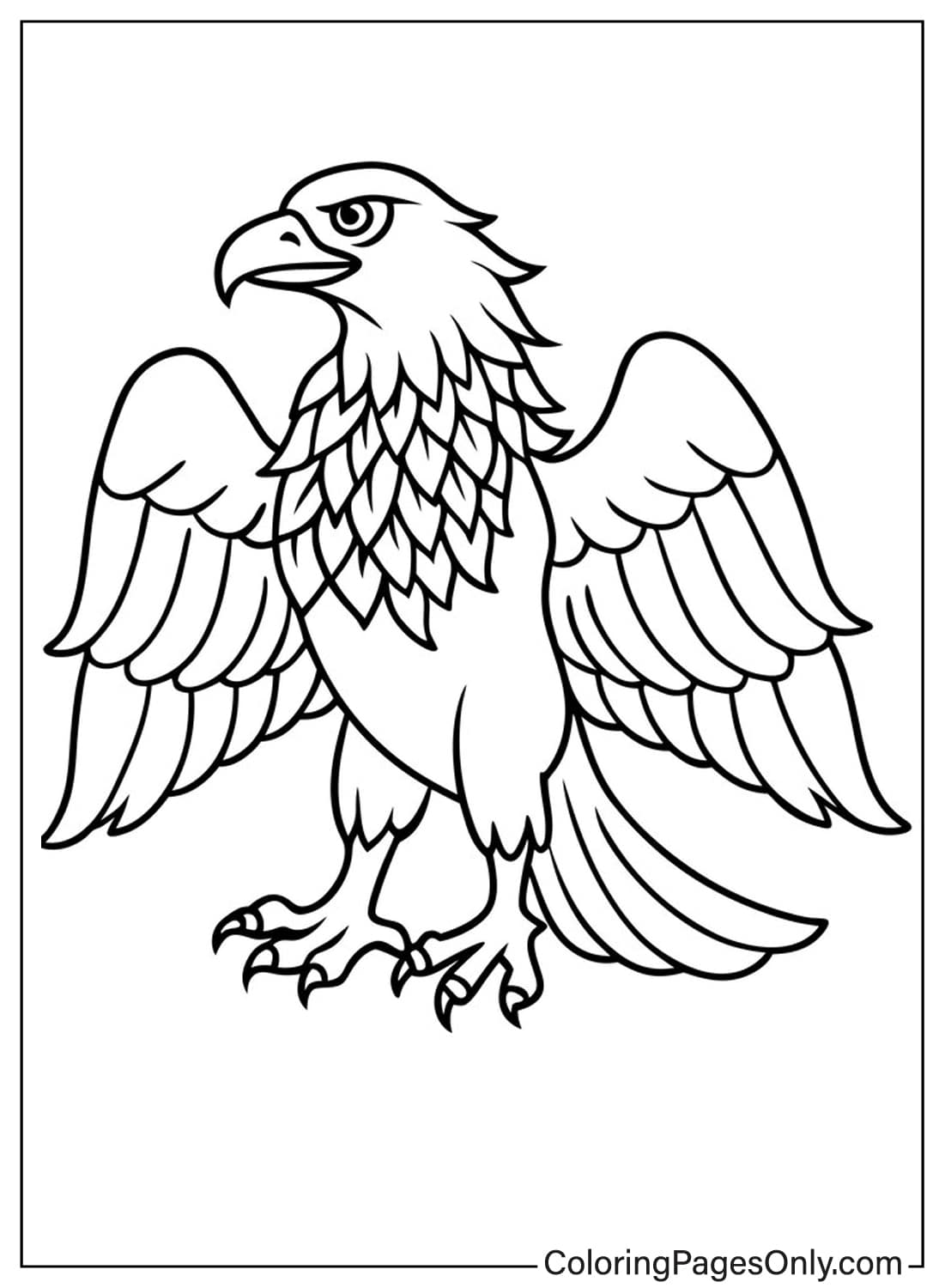
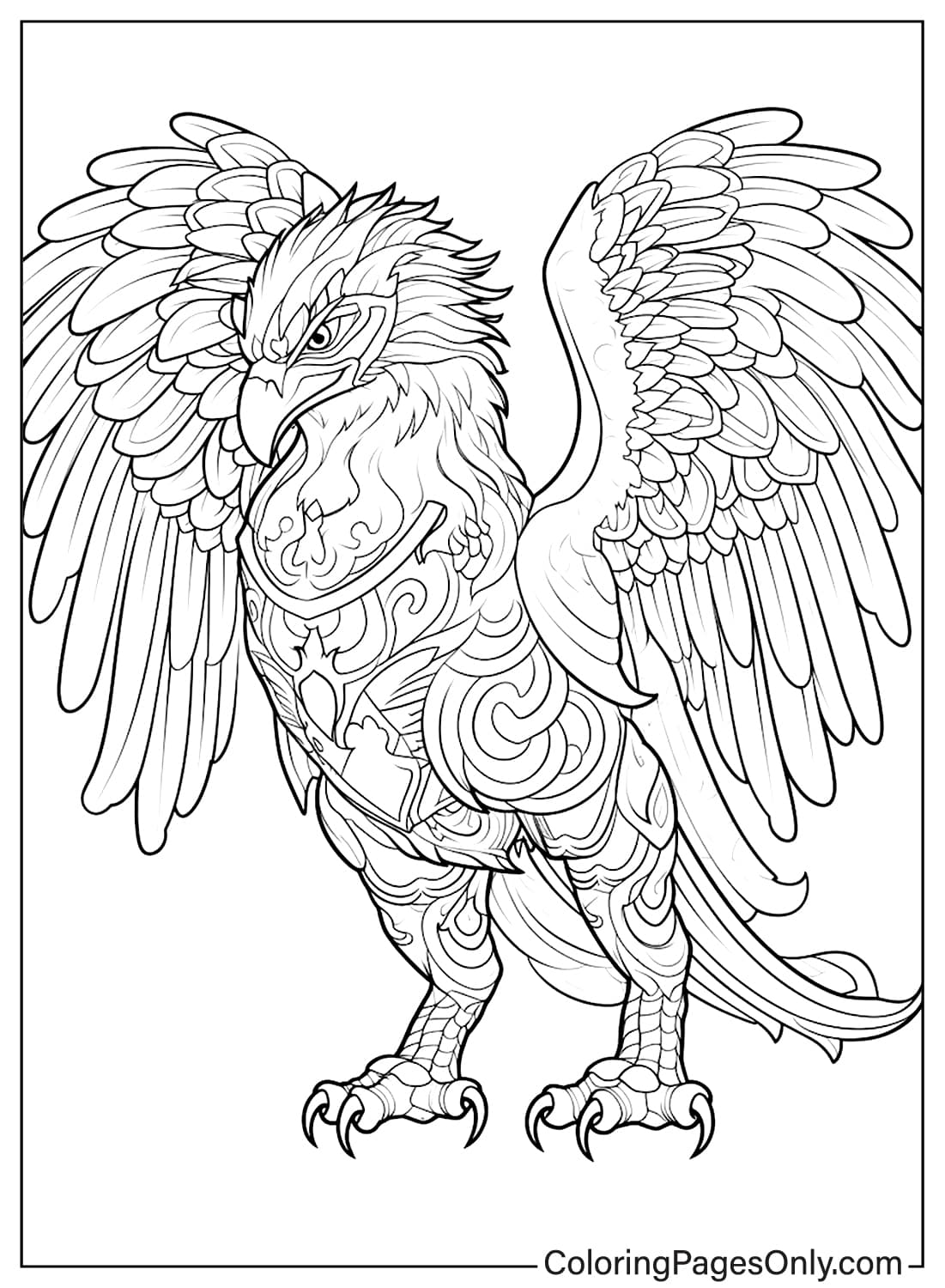
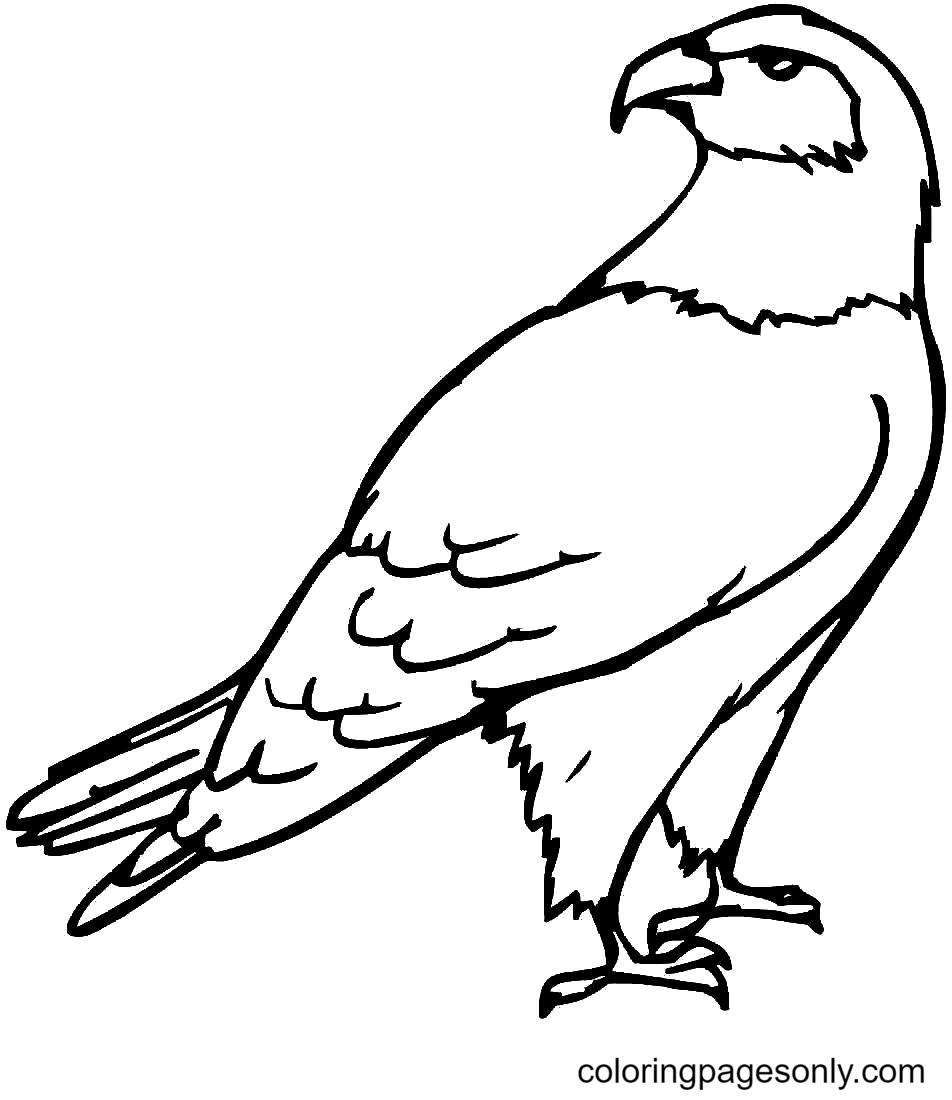
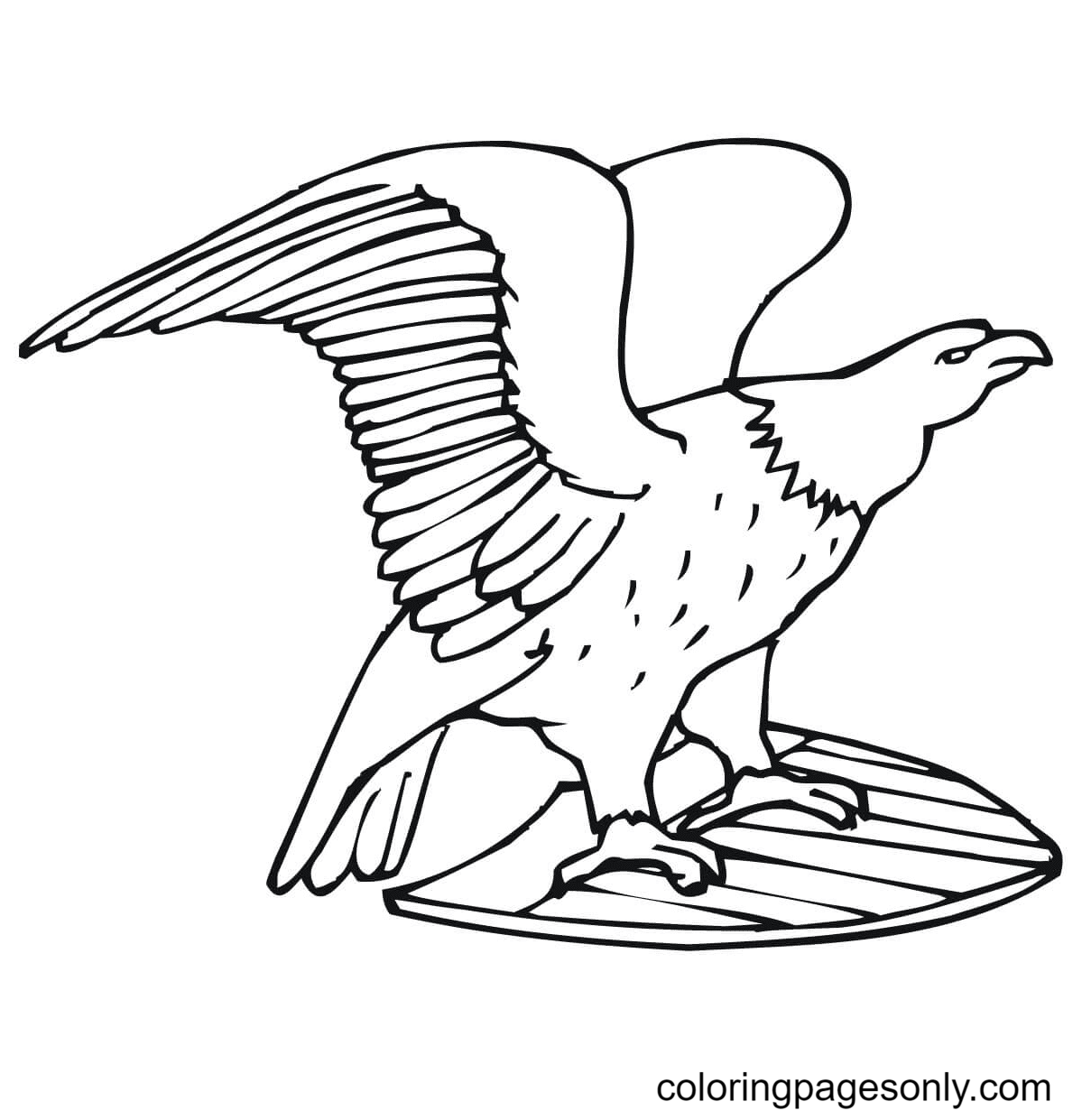
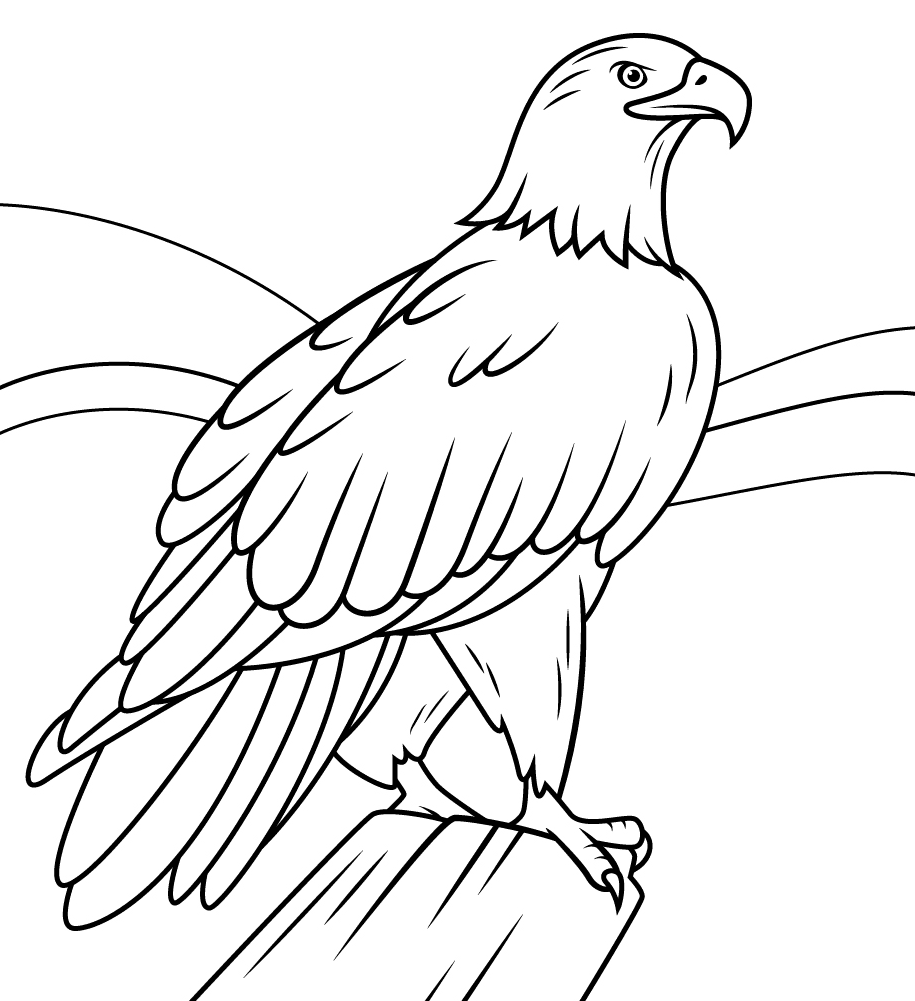
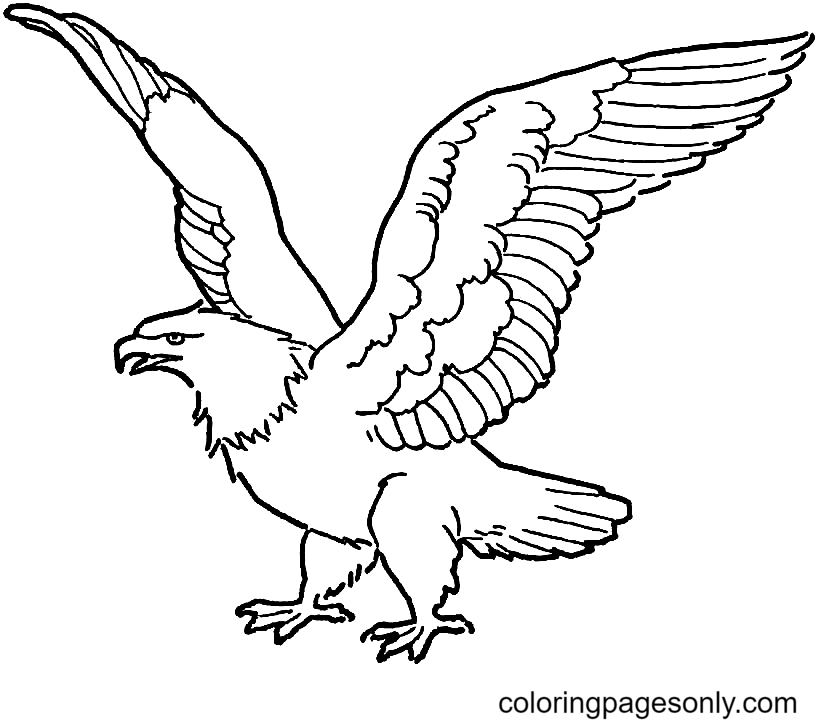
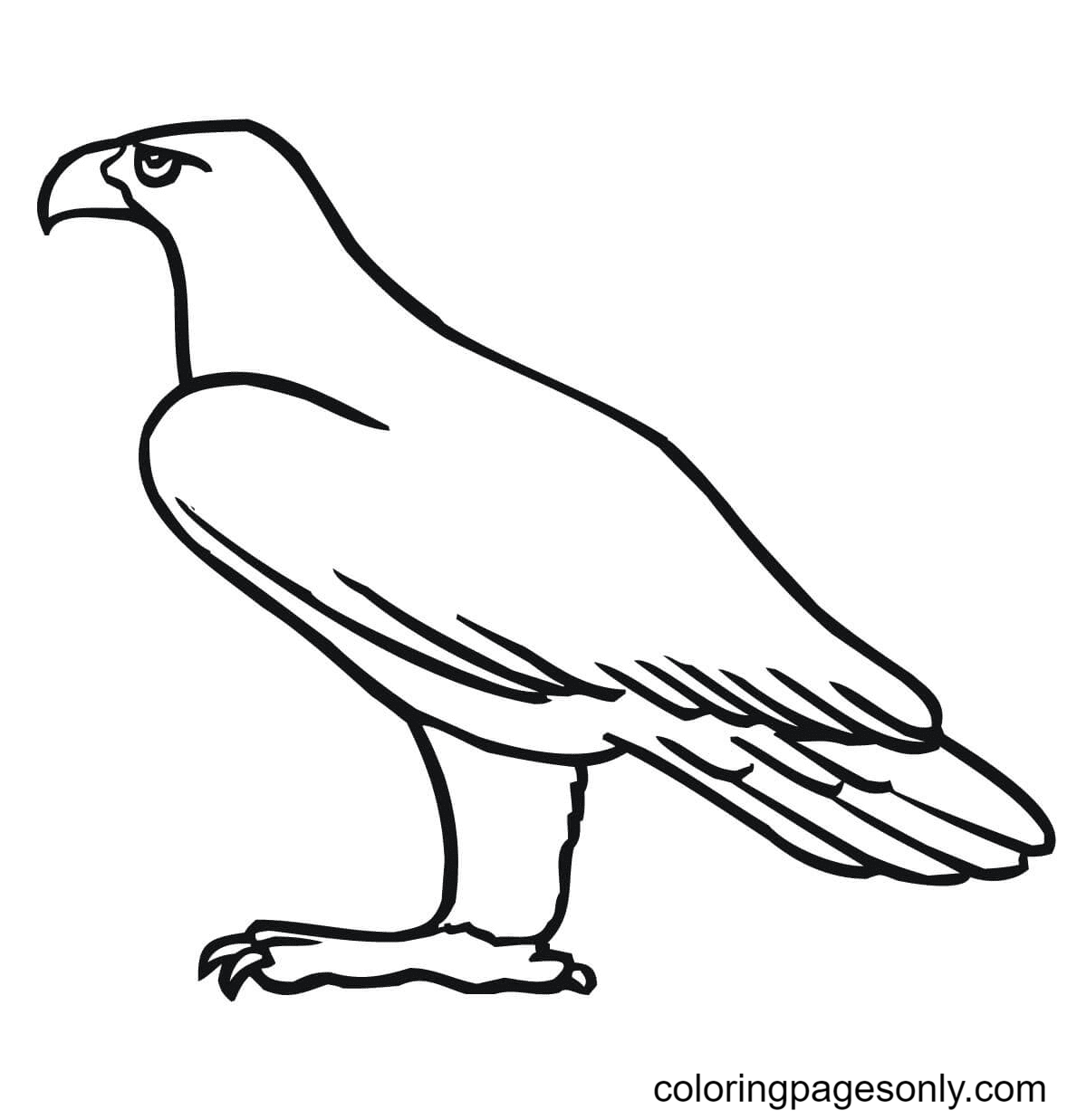
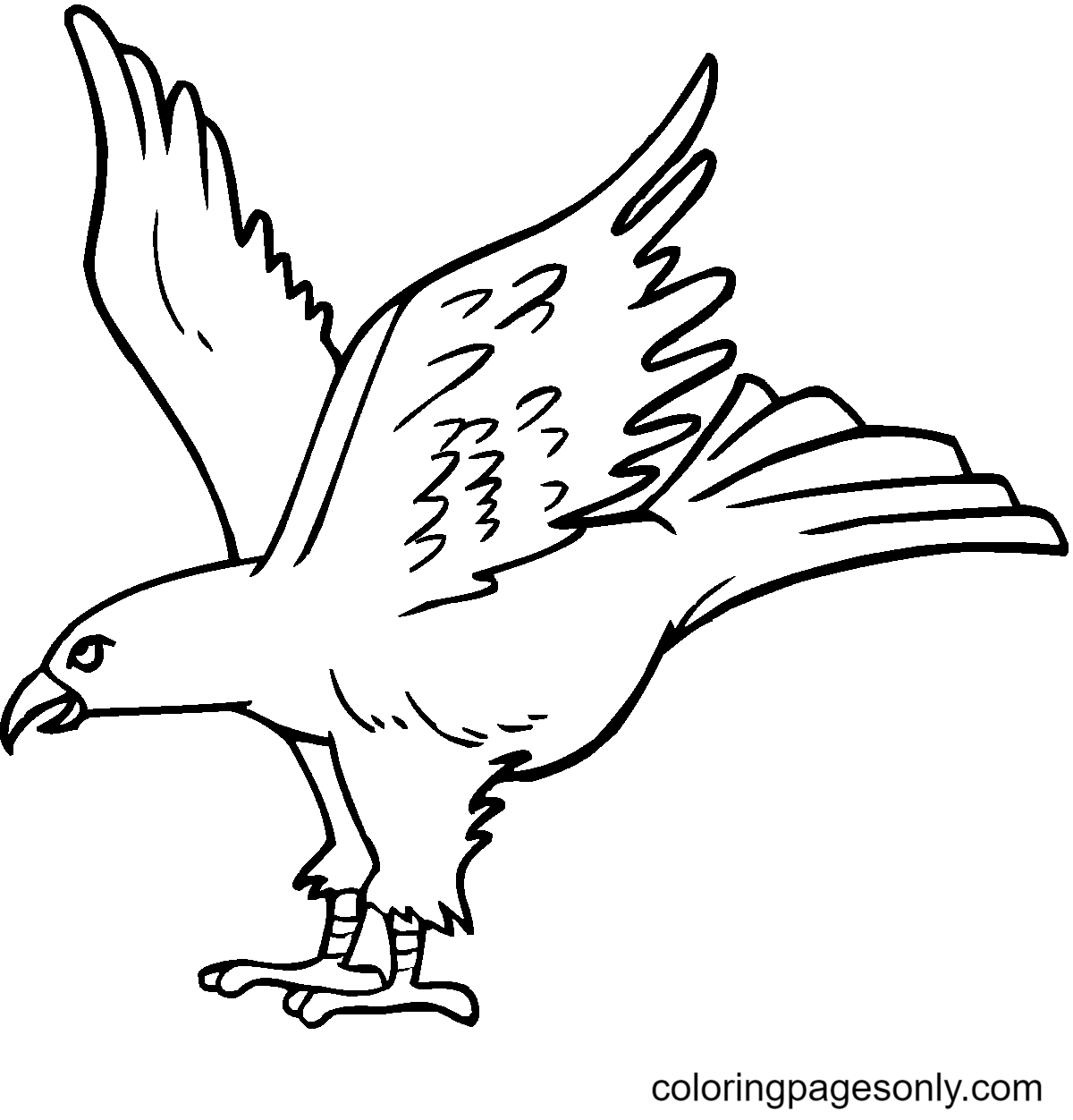
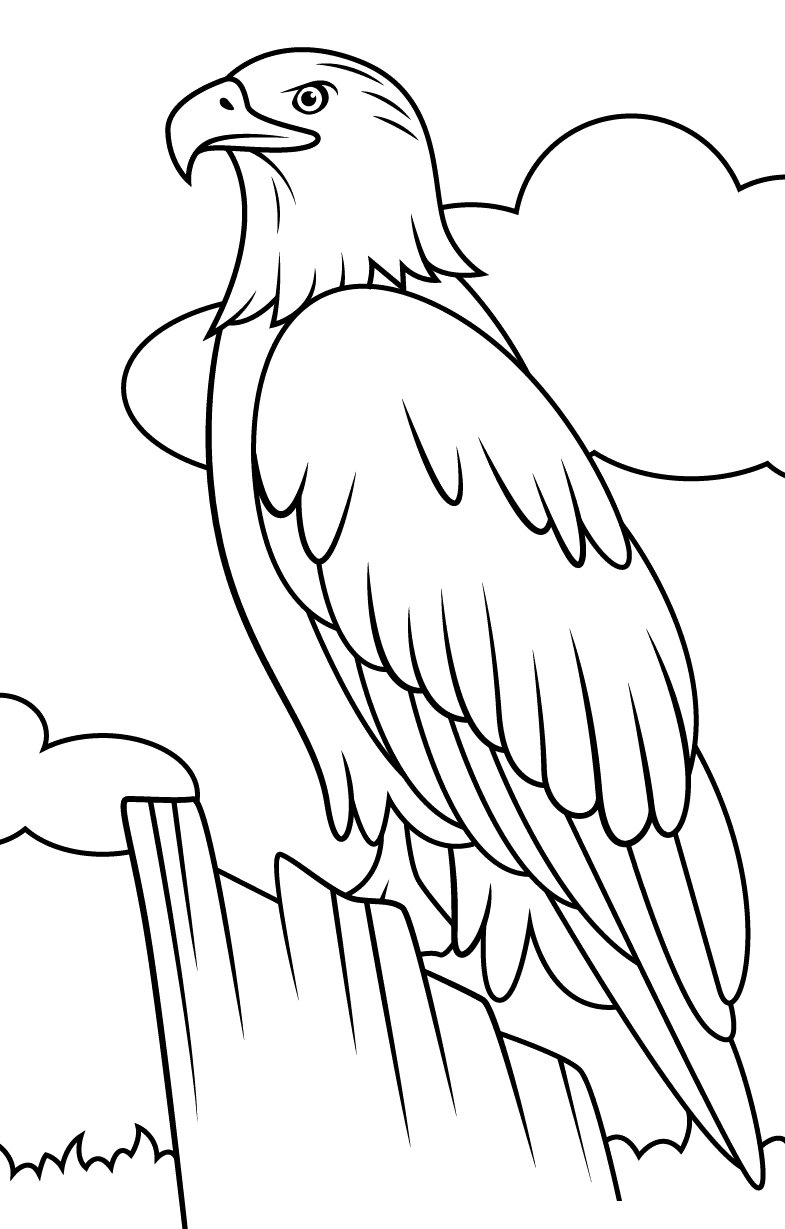
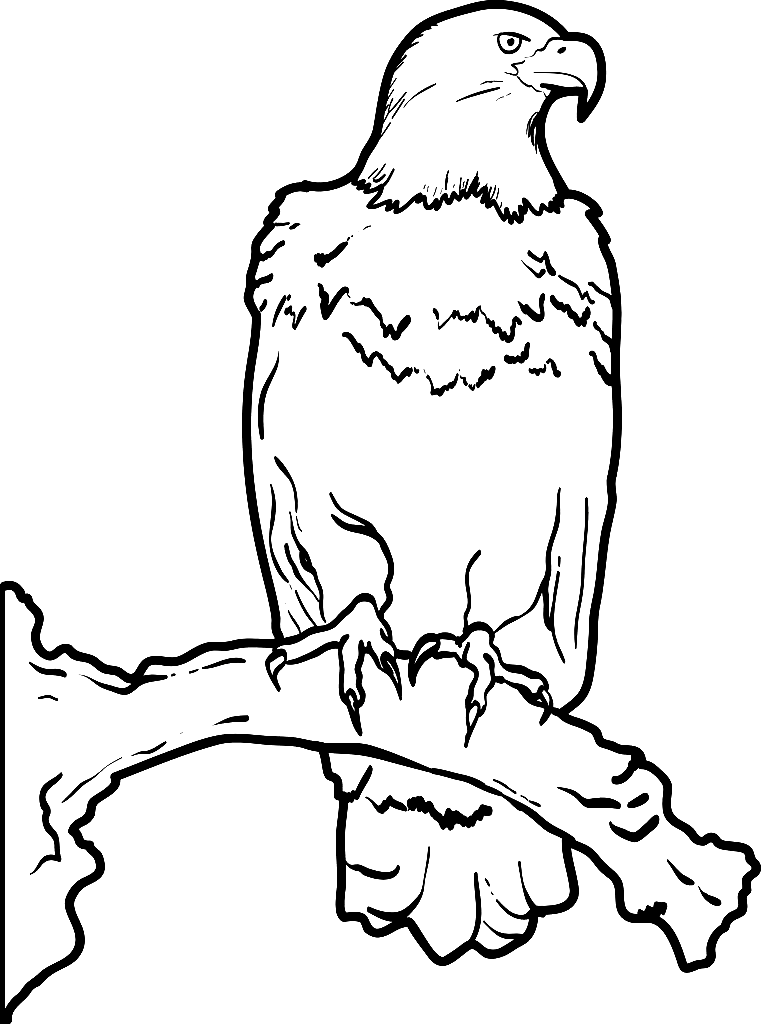
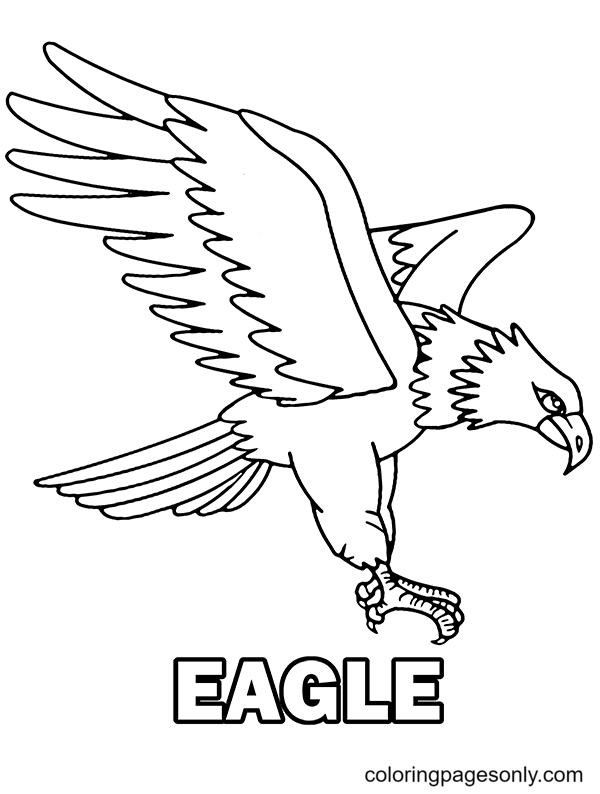
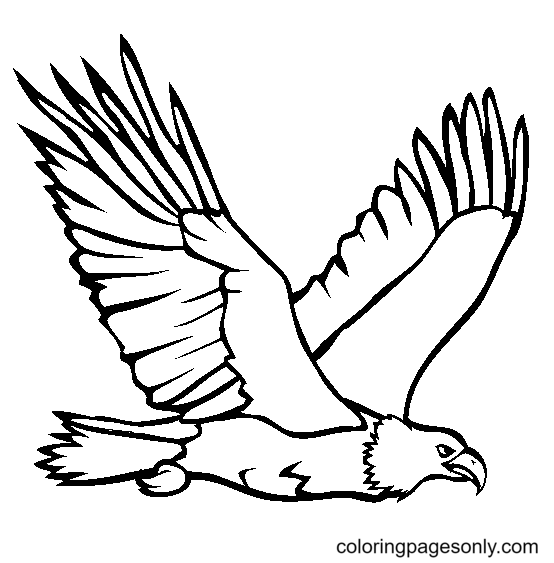
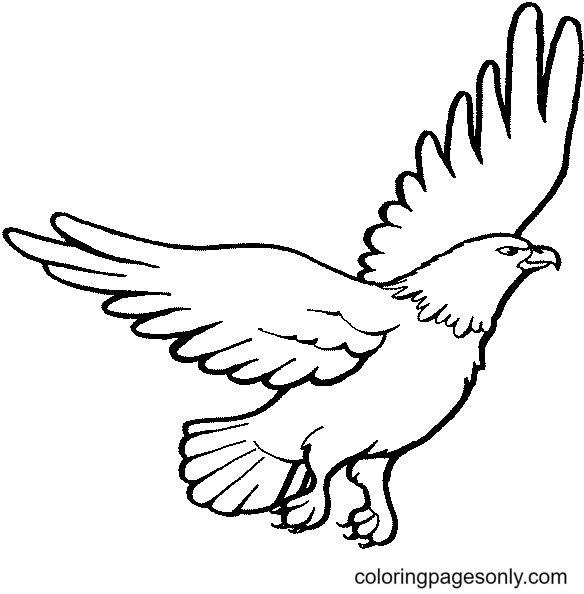
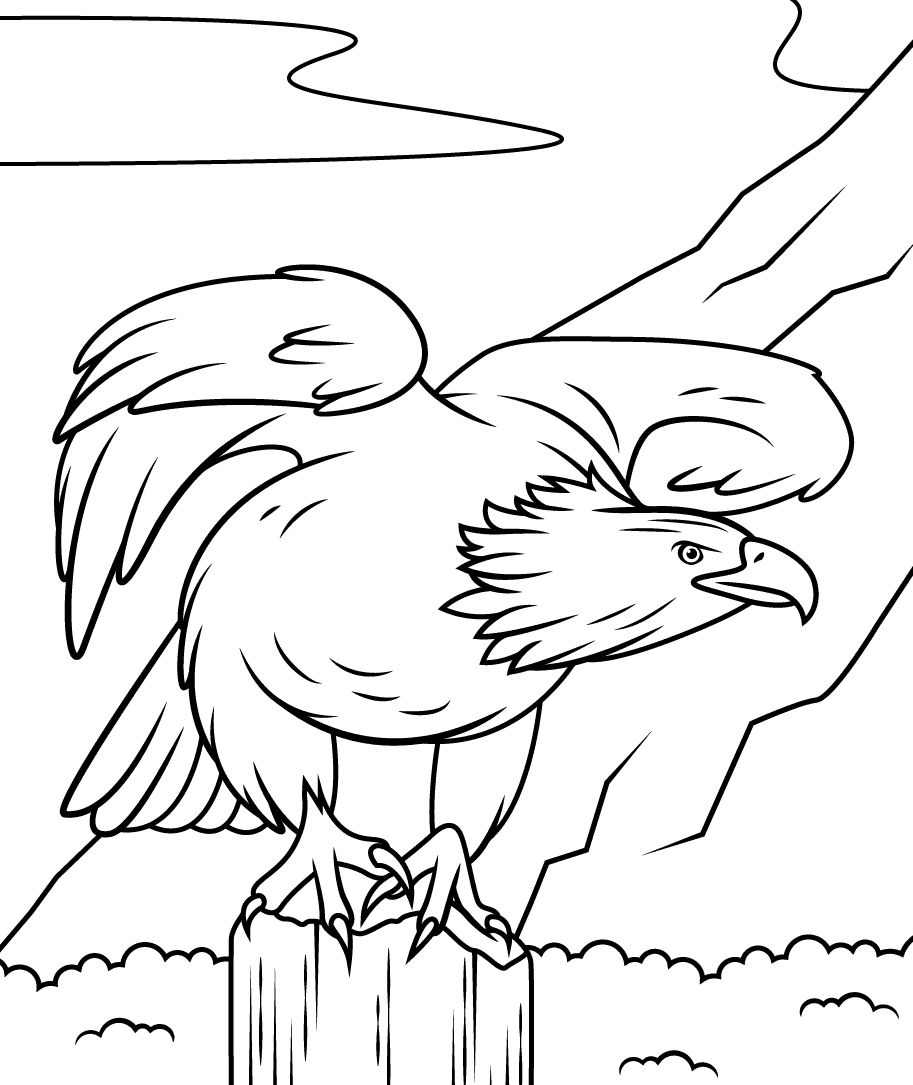
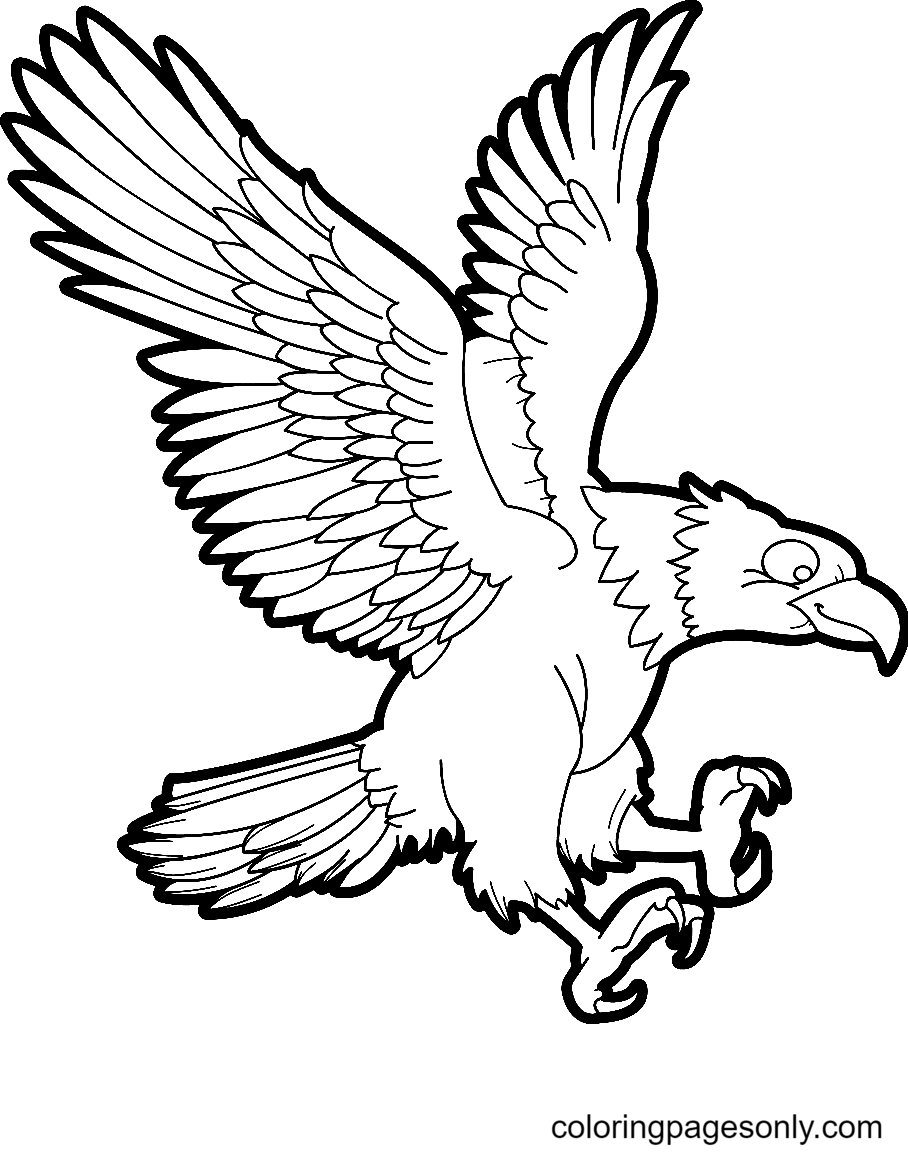
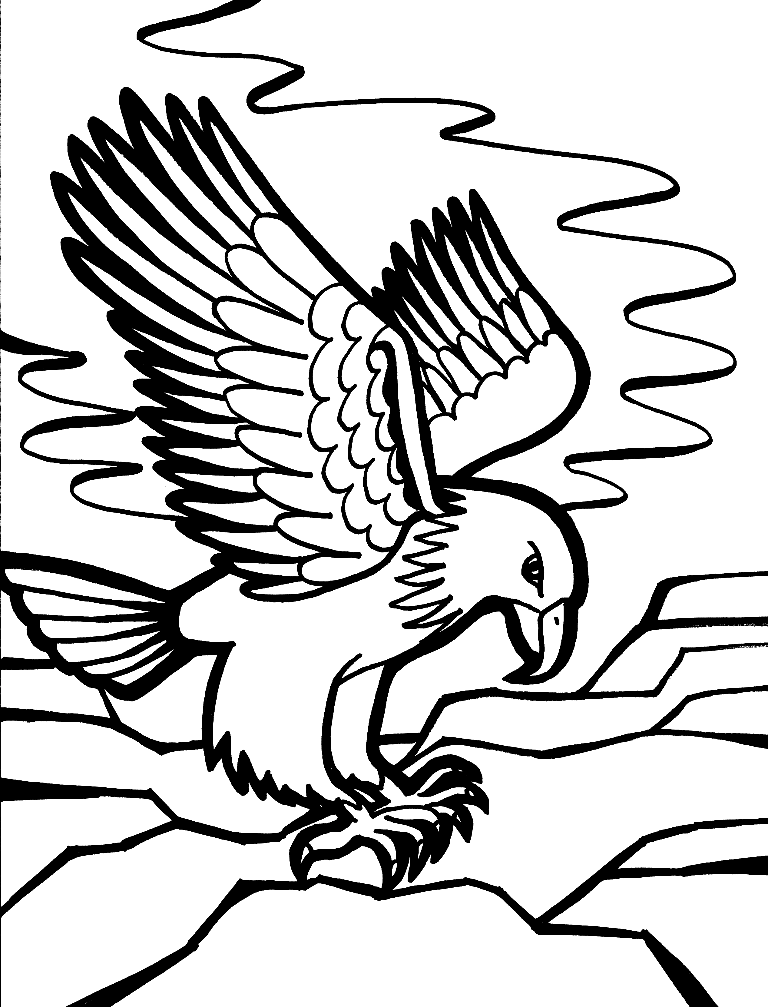
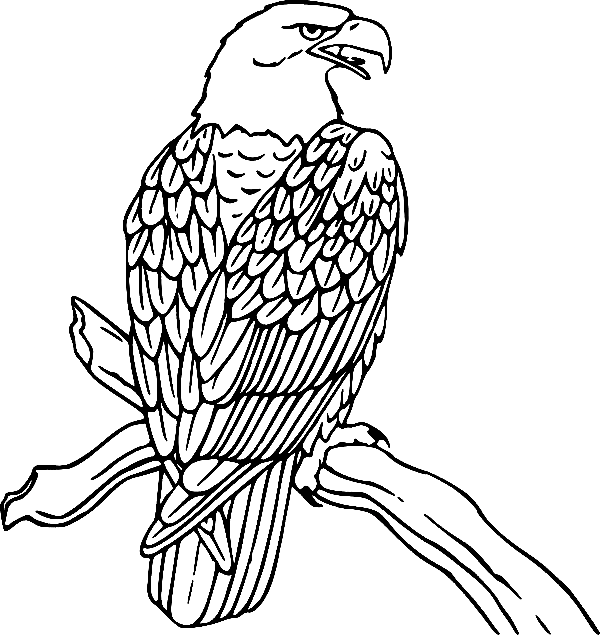
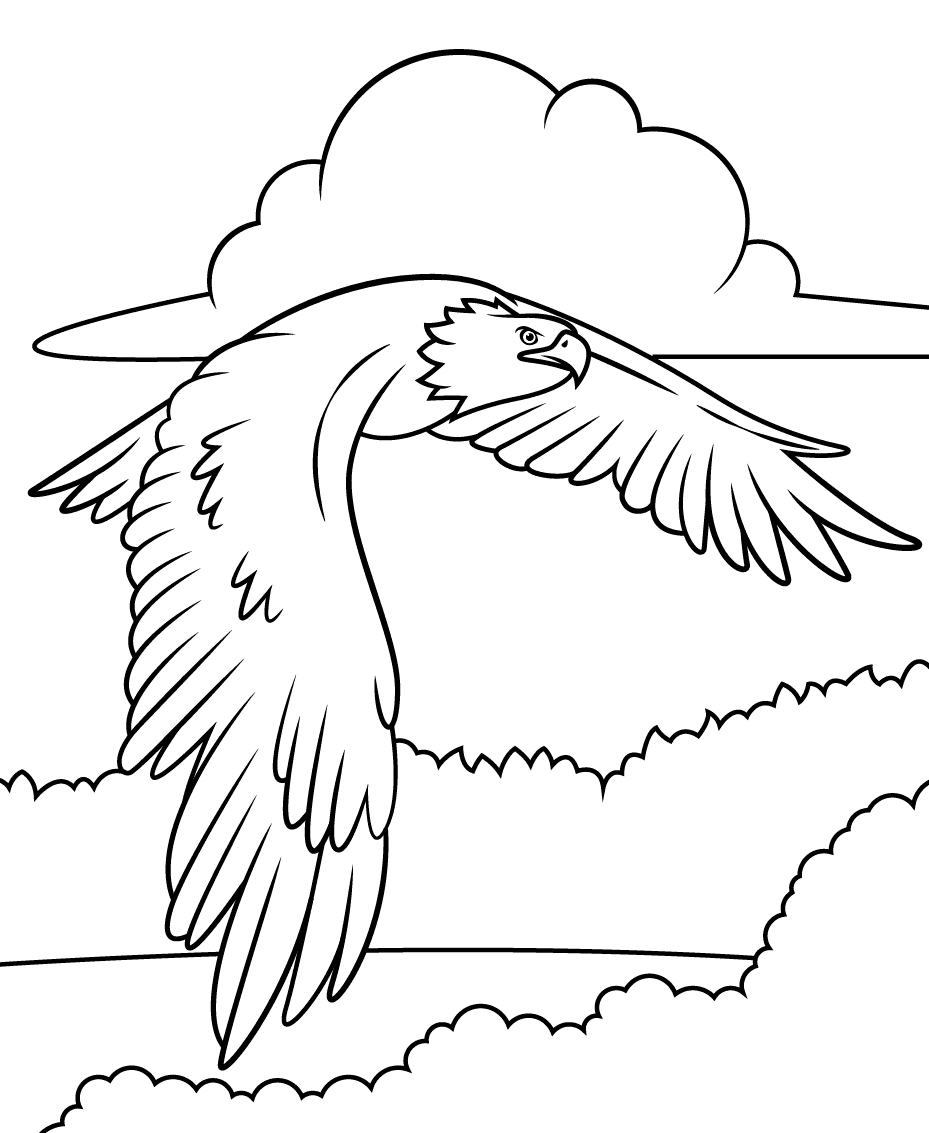
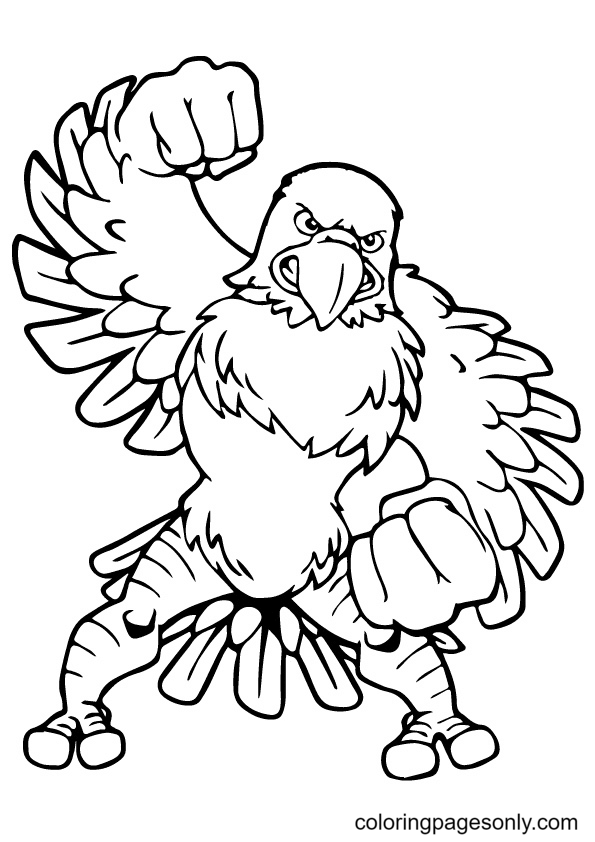
Free eagle coloring pages: 30+ pages featuring bald eagles in full-body perching poses with distinctive white head and dark brown body, bald eagles in flight with wingspans fully extended, close-up portrait studies of the yellow hooked beak and fierce eye, golden eagles in hunting dive postures, fish-catching sequences at the water surface, eagle nest and chick scenes, patriotic compositions with American flag elements, tribal and Native American art-style eagle designs, eagle silhouettes against sunset skies, and the full visual vocabulary of the birds that have served as symbols of power, freedom, and divine authority across human cultures for thousands of years. All free, printable PDFs and online coloring for wildlife enthusiasts and bird fans of all ages.

Eagles belong to the family Accipitridae within the order Accipitriformes, the same family that includes hawks, kites, and Old World vultures. The term “eagle” is applied across multiple genera within this family and refers broadly to large raptors rather than to a single taxonomic group. Eagles are found on every continent except Antarctica. The most species-rich eagle groups include the sea eagles (genus Haliaeetus, including the bald eagle and white-tailed eagle), the booted eagles (genus Aquila, including the golden eagle), the harpy eagles (including the harpy eagle of Central and South America and the Philippine eagle), and the snake eagles of Africa and Asia.

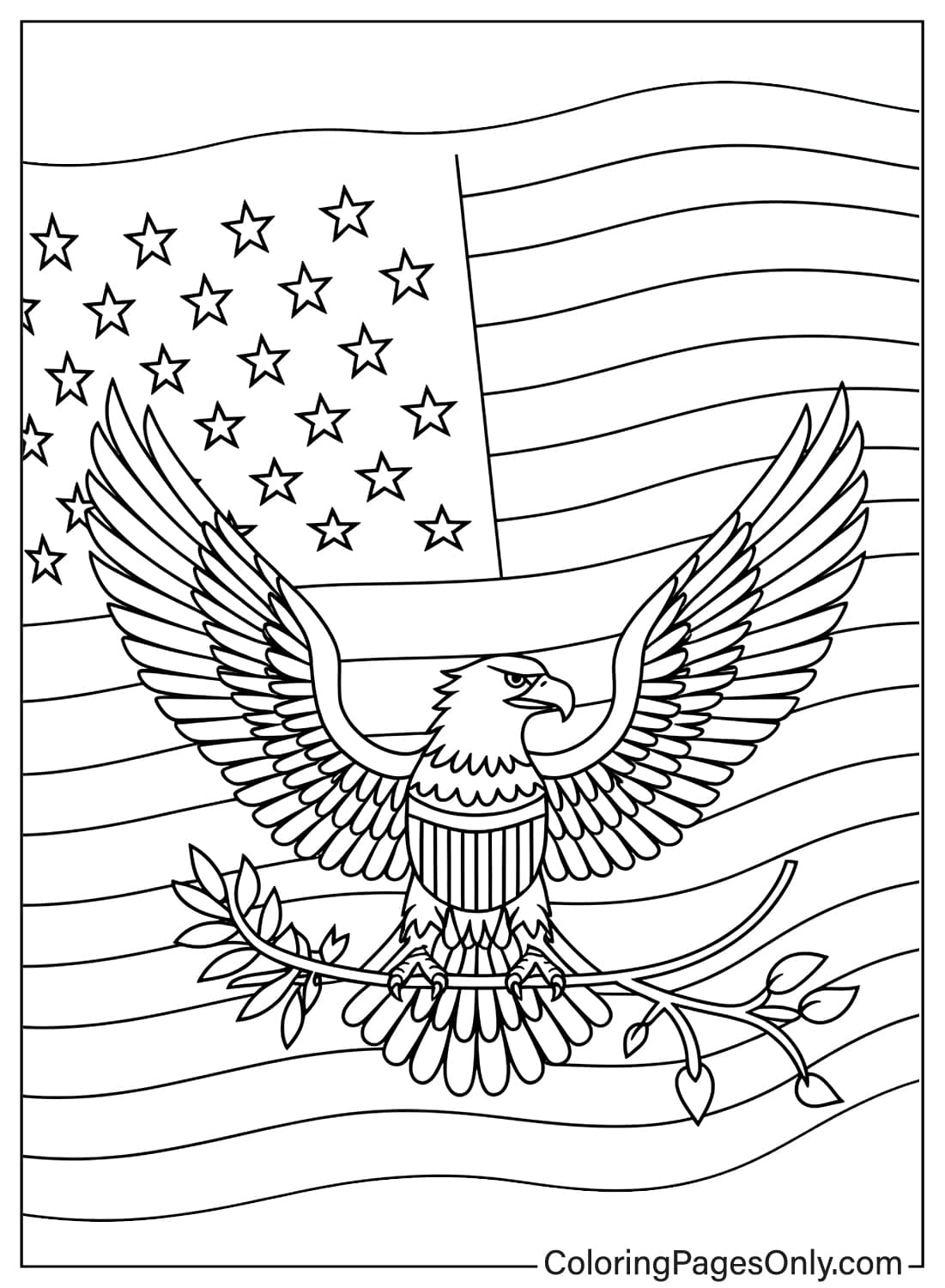
The bald eagle (Haliaeetus leucocephalus) was designated the national bird of the United States by the Second Continental Congress on June 20, 1782, when the Great Seal of the United States was adopted. The bald eagle appears on the Great Seal holding 13 arrows in its left talon (representing the 13 original colonies) and an olive branch in its right talon (representing peace), facing toward the olive branch. The eagle carries a scroll in its beak bearing the motto “E pluribus unum” (Latin: “Out of many, one”).

These 30+ free pages at ColoringPagesOnly.com cover the eagle across its major species and its cultural dimensions. All free, PDF or PNG, print or color online.

What’s Inside

Bald Eagle Portrait Pages

The bald eagle’s adult plumage is one of wildlife’s most graphically striking color combinations: a pure white head and tail against a dark brown body, with a vivid yellow hooked beak and yellow eyes and feet. This two-tone design is the bird’s most immediately recognizable feature and the element that makes adult bald eagle portraiture one of wildlife illustration’s most visually direct subjects.

The white head that gives the species its common name is not present in juvenile and immature birds. Young bald eagles are predominantly brown with varying amounts of white mottling, and they do not develop the full white head and tail until they reach sexual maturity at approximately four to five years of age. The transition happens through a series of annual plumage changes: second-year birds show increasing white in the body, third-year birds show patches of white on the head and belly, and fourth-year birds approach the adult pattern before the full white head and clean dark body appear in the fifth year.

The bald eagle was listed as endangered under the Endangered Species Act in 1978, following dramatic population declines caused by hunting, habitat loss, and the widespread use of DDT (dichlorodiphenyltrichloroethane), a pesticide that caused the thinning of eagle eggshells and reproductive failure across raptor populations. DDT was banned in the United States on December 31, 1972. After decades of conservation management, the bald eagle was removed from the endangered species list on June 28, 2007, and is now protected by the Bald and Golden Eagle Protection Act of 1940.

Coloring bald eagle portrait pages: The head is clean, with bright white applied at full coverage. The beak is vivid warm yellow, the specific warm yellow of a raptor’s beak: more vivid than pale cream and warmer than lemon yellow. The eye is a striking pale yellow-gold, the specific color of the adult bald eagle’s iris, with a dark pupil and a white highlight dot. The body feathers are the darkest element: very dark brown or near-black, applied at full coverage across the neck, body, and wing surfaces. The transition from white head to dark neck is a sharp, clean boundary rather than a gradual gradient.

Bald Eagle in Flight Pages

The bald eagle in full flight, wings spread, is the most dramatically compositional of the collection’s eagle pages: the wingspan of an adult bald eagle ranges from 6 to 7.5 feet (1.8 to 2.3 meters), giving the open-wing silhouette an extraordinary presence relative to the bird’s body mass of 6.5 to 14 pounds (3 to 6.3 kilograms). The combination of the large wing area and relatively light body mass gives eagles their characteristic effortless soaring flight, achieved through exploitation of thermal updrafts with minimal active wingbeating.

Flight pages show the wing’s detailed feather structure: the long primary feathers at the wing’s outer edge (typically the ten longest individual feathers, splayed apart like fingers during soaring), the secondary feathers in the middle wing section, and the covert feathers layered over the wing’s upper surface. The under-wing of the bald eagle shows a pattern of dark brown flight feathers with paler brown covert feathers, and the white tail is visible from below as a clean fan.

Coloring flight pages: The upper wing surface is predominantly dark brown, slightly darker than the body on the flight feathers. The primary feathers at the wing tips are the darkest brown, nearly black at the shafts. Individual feather separation can be suggested by applying slightly darker brown along the bottom edge of each visible primary, where it overlaps the next feather in the sequence. The under-wing shows more variety: dark brown at the flight feathers, slightly lighter warm brown at the covert areas.

Golden Eagle Pages

The golden eagle (Aquila chrysaetos) is one of the most widely distributed eagle species in the world, found across much of the Northern Hemisphere, including North America, Europe, Asia, and northern Africa. It is the national bird of Mexico, Germany, Austria, Albania, Kazakhstan, and several other countries. The name references the golden-buff plumage at the nape and crown, which distinguishes the adult from the otherwise uniformly dark brown body.

The golden eagle is primarily a hunter of mammals: rabbits, hares, ground squirrels, and prairie dogs constitute its primary diet across most of its range, though it also takes birds, reptiles, and carrion. It hunts using a technique called the stoop: a high-speed dive from altitude, reaching speeds of up to 150 miles per hour (241 kilometers per hour) in the steepest dives. This hunting speed requires precise aerial maneuvering at high velocity, and the golden eagle’s flight control is among the most studied in raptor biology.

Coloring golden eagle pages: The body is uniformly dark brown at full saturation, slightly warmer and slightly lighter than the bald eagle’s near-black. The distinctive golden nape is the critical differentiating element: a warm golden-buff or tawny-golden color at the back of the head and upper neck, clearly lighter and warmer than the surrounding dark brown. The eye is dark brown (golden eagles have dark brown irises, unlike the bald eagle’s pale yellow). The beak is dark grey at the base, transitioning to yellow-grey at the tip.

Eagle Hunting: Fish-Catching Pages

Bald eagles hunt fish by flying low over water and seizing fish near the surface with their talons, an action called “plucking.” They can also wade into shallow water to catch fish stranded in low water conditions and will steal fish from ospreys (a behavior Benjamin Franklin specifically criticized when he objected to the bald eagle’s selection as the national bird).

The gripping force of bald eagle talons has been measured at forces exceeding several hundred pounds per square inch. The eagle’s ability to grip and carry prey is specifically adapted for the combination of grip strength (to hold slippery fish) and lifting capacity (to carry the catch to a perch or nest for consumption).

Fish-catching sequence pages show the eagle in the moment of water contact: wings spread and angled back to slow the approach, head angled downward toward the target, talons extended forward and downward to grip the fish at or just below the surface, water splashing in the impact.

Coloring fish-catching pages: Water splash effects use pale blue-white at the center of impact, graduating outward to the water’s deeper blue. The fish, if visible, uses the specific silvery tone of a fresh-caught water fish: pale silver-grey with a subtle iridescent quality. The eagle’s feet gripping the fish should show the yellow of the feet and the dark grey of the talons.

Patriotic and American Symbol Pages

The bald eagle’s cultural role as the primary symbol of American national identity gives several collection pages a specifically patriotic register: eagle-and-flag compositions, the Great Seal eagle design (with arrows and olive branch), eagle portraits framed by stars and stripes elements, and the specific visual language of American civic iconography.

The Great Seal of the United States, adopted June 20, 1782, features a bald eagle at its center. The eagle’s chest carries a shield with thirteen vertical red and white stripes and a blue chief. The thirteen red and white stripes and the thirteen stars in the crest above the eagle represent the thirteen original colonies. The 13 arrows in the left talon and the olive branch in the right represent the power of war and the preference for peace. The eagle faces toward the olive branch.

Coloring patriotic eagle pages: The flag elements use the specific American flag colors: vivid red (warmer than cool red, slightly orange-shifted), white, and bright royal blue. The shield on the Great Seal eagle’s chest uses the same red, white, and blue. The overall composition should treat the eagle itself as the primary focus, with the patriotic elements as context rather than as the dominant color area.

Tribal and Native American Art Style Pages

Eagles hold profound spiritual significance in many Indigenous cultures of North America. In numerous traditions across different Nations, the eagle is considered the highest-flying bird and therefore the bird closest to the Creator: a messenger between the human world and the spiritual realm. Eagle feathers are among the most sacred objects in many Indigenous cultures, representing honor, courage, and spiritual power.

Eagle imagery is central to the visual traditions of many Pacific Northwest Nations, including the Haida, Tlingit, Tsimshian, and Kwakwaka’wakw peoples, where the eagle appears prominently in totem poles, carved house posts, bentwood boxes, and woven textiles. The stylized, formline-based visual language of Northwest Coast art produces eagle representations that are simultaneously specific biological references and complex symbolic systems encoding family lineage, spiritual relationships, and cultural history.

In United States federal law, only members of federally recognized Native American tribes may legally possess bald eagle and golden eagle feathers (under the Bald and Golden Eagle Protection Act and the Migratory Bird Treaty Act), reflecting the specific cultural and spiritual significance of the birds.

Coloring tribal art style pages: Northwest Coast formline-based designs use the specific palette of traditional Pacific Northwest art: black for the primary formline lines, red for secondary formlines, and blue-green or teal as the tertiary color. The white of unpainted areas (or the background paper) functions as the fourth color. Apply the black formline design elements at full coverage and full depth. Apply red in its designated secondary positions. Apply teal or blue-green in the remaining design positions.

What These Pages Do

The eagle’s cultural role as a symbol of sovereignty, power, and divine authority spans recorded human history and extends into prehistoric art. Eagle imagery appears in ancient Mesopotamian seals dating to at least 3000 BCE, in ancient Egyptian art, in Roman military standards (the aquila carried by each Roman legion and its dedicated standard bearer, the aquilifer), in Greek and Roman religious iconography associating the eagle with Zeus/Jupiter, and in the founding mythology of multiple nations.

The Aztec/Mexica founding myth of Tenochtitlan (now Mexico City) centers on an eagle sitting on a cactus and devouring a snake, the sign that the god Huitzilopochtli gave the Mexica to indicate where they should establish their capital. This image appears on the Mexican flag and national coat of arms, making it one of the few national symbols whose mythological origin is specifically documented in pre-Columbian sources as well as Spanish colonial records.

Eagles’ visual acuity is among the most extraordinary of any vertebrate: they see 4 to 8 times more sharply than humans, can detect prey from distances up to 2 miles (3.2 kilometers), have two foveas (concentrated photoreceptor areas) compared to the human eye’s one, and can perceive ultraviolet light. This last capability allows them to detect the UV-fluorescent urine trails that small rodents leave on vegetation and soil, effectively mapping prey activity across their hunting territory through a spectrum of light invisible to human observers.

The American Academy of Pediatrics identifies fine motor skill development as a key childhood milestone throughout early childhood. The individual primary feather rendering in flight pages, the close portrait detail of the beak and eye, the layered covert feather patterns on perching bird pages, and the intricate form-line-based design of tribal art style pages all provide sustained fine motor challenge across the collection’s full age range. The 2005 Art Therapy Journal study on structured coloring and anxiety reduction applies throughout.

How to Color These Pages Well

The bald eagle’s white head requires absolute protection from the surrounding dark brown. The most important technical decision on any bald eagle portrait page is maintaining the specific, clean, sharp boundary between the white head and the dark brown body. Apply the white head area first and let it establish clearly. Then apply the dark brown body working inward from the wings and back toward the neck boundary, keeping the edge clean. Any dark brown migrating onto the white head significantly reduces the bird’s visual impact.

The yellow beak and yellow eye of the bald eagle are the portrait’s two vivid accents and must both read as warm, vivid yellow. The beak and the iris (the ring of color around the dark pupil) are both warm, vivid yellow in adult bald eagles. Apply the same vivid warm yellow to both. The beak is the larger of the two elements and should be colored carefully along the curved hook at the tip. The eye iris is small and requires precise application within the eye outline.

Dark brown on raptor feathers benefits from directional stroke application rather than flat fill. Apply the base dark brown across all feather surfaces. Then add a slightly darker brown in short directional strokes following the natural lie of the feathers: on the back, strokes run toward the tail; on the wing upper surface, they run toward the wing tip; on the breast, they run downward. This directional texture suggests the specific quality of individual feathers within the overall mass.

Primary flight feathers at the wing tip require individual separation. In flight, pages showing the wing spread, the ten primary feathers at the outer wing tip are clearly separated from each other, spreading like fingers. Apply the dark brown at full coverage across all primary feathers. Then apply a slightly darker brown along the bottom edge of each visible primary where it overlaps the next, creating the visual separation that makes each primary read as a distinct feather rather than as a merged dark mass.

The golden nape of the golden eagle must be distinctly lighter and warmer than the surrounding body. The golden patch at the back of the head is the golden eagle’s defining visual feature and the element that distinguishes it from similar-sized dark eagles. Apply the golden-buff or tawny-golden color to the nape and crown with enough saturation that it reads as clearly lighter and warmer than the surrounding dark brown, even when the two colors are adjacent. If the golden area appears to merge with the brown, add a small amount of warm orange-gold to strengthen the golden area’s distinctiveness.

5 Creative Craft Ideas

The Great Seal Study

The Great Seal of the United States was adopted on June 20, 1782. Its design was developed by William Barton (a heraldry expert) and Charles Thomson (Secretary of the Continental Congress). The bald eagle at its center holds 13 arrows in the left talon, an olive branch in the right, and carries a shield of 13 red and white stripes with a blue chief. A scroll in the eagle’s beak reads “E pluribus unum” (Out of many, one). Thirteen stars appear above the eagle’s head in a glory, arranged in a six-pointed star formation.

Print the most formal eagle portrait page in the collection. Color the eagle in canonical bald eagle colors. Then, on the backing sheet, draw a simplified version of the Great Seal’s additional elements: the shield, the arrows, the olive branch, and the scroll.

On the backing card: “The Great Seal of the United States. Adopted: June 20, 1782. Designers: William Barton, Charles Thomson. The eagle faces toward the olive branch: symbolizing preference for peace over war. 13 arrows: the 13 original colonies and the power of war. Olive branch: peace. E pluribus unum: Out of many, one. The bald eagle: national bird of the United States since June 20, 1782.”

The Recovery Story

In 1963, a survey counted approximately 417 nesting pairs of bald eagles in the contiguous United States, down from an estimated 100,000 birds at the time of European arrival. Hunting, habitat loss, and DDT-caused eggshell thinning had reduced the population to near-extinction levels. DDT was banned on December 31, 1972. The bald eagle was listed as endangered in 1978. By 2007, when the species was removed from the endangered species list, more than 10,000 nesting pairs had been documented.

Print a bald eagle in flight page. Color in full adult canonical colors.

On the backing card: “Bald eagle population, contiguous United States. Estimated 1782: approximately 100,000. Counted 1963: approximately 417 nesting pairs. DDT: a pesticide that caused eggshell thinning and reproductive failure. DDT banned: December 31, 1972. Endangered species listing: 1978. Nesting pairs documented at removal from endangered list: more than 10,000. Removed from endangered list: June 28, 2007. The population at each stage is the result of specific decisions made by specific people. The decisions in 1972 and 1978 produced the eagle in this picture.”

The Vision Study

An adult bald eagle sees 4 to 8 times more sharply than a human with normal vision and can detect a fish in water from a height of more than 1 mile (1.6 kilometers). They see ultraviolet light (allowing them to detect UV-fluorescent rodent urine trails on vegetation), have two foveas in each eye (compared to the human eye’s single fovea), and can resolve detail that human vision cannot register.

Print a close-up eagle eye page or a portrait page with the eye clearly visible. Color the eye carefully: warm yellow iris, dark pupil, white highlight. Color the surrounding feathers in dark brown.

On the backing card: “Bald eagle visual acuity: 4 to 8 times sharper than human normal vision. Detection distance for prey: up to 2 miles (3.2 km). Foveas per eye: 2 (humans: 1). UV light perception: yes (allows detection of rodent urine trails). Maximum dive speed: up to 100 mph (161 km/h). Human visual acuity (20/20): 1.0. Eagle visual acuity equivalent: approximately 20/5 or sharper. The eagle saw this page before you started coloring it. From 2 miles away.”

The Founding Debate

When the bald eagle was being considered as the national bird, Benjamin Franklin wrote privately in a 1784 letter that he objected to the choice. He described the bald eagle as having “bad moral character” because it does not get its living honestly (he was referring to its habit of stealing fish from ospreys). He wrote that the eagle was “a rank coward” compared to the wild turkey and suggested the turkey would be a more respectable choice for the national bird. His letter was a private joke to his daughter rather than a formal objection, but it has been widely cited in discussions of the choice.

Print a dignified bald eagle portrait. Color it formally in full adult canonical colors.

On the backing card: “Benjamin Franklin on the bald eagle, 1784: ‘He is a bird of bad moral character. He does not get his living honestly… He watches the Labor of the Fishing Hawk [osprey], and when that diligent Bird has at length taken a Fish, and is bearing it to his Nest for the Support of his Mate and young ones, the Bald Eagle pursues him and takes it from him.’ Franklin preferred the wild turkey. The Second Continental Congress chose the bald eagle. The decision stands.”

The Eagle Standards of Rome

Every Roman legion carried an eagle standard (aquila) made of silver or gold, mounted on a tall pole and carried into battle by a dedicated soldier called the aquilifer (eagle bearer). The aquila was the legion’s most sacred possession. To lose it in battle was considered the deepest possible disgrace; entire campaigns were mounted specifically to recover lost standards. The Roman general Julius Caesar used the eagle standard’s symbolism to motivate troops at the landing in Britain in 55 BCE, when soldiers hesitated to jump from boats into the sea.

Print the most heraldic or formal eagle pose in the collection. Color it in gold or silver tones, referencing the metal-worked Roman standard rather than the living bird.

On the backing card: “The aquila. Standard of a Roman legion. Material: silver or gold. Bearer: the aquilifer. Function: rallying point in battle, sacred possession of the legion. To lose the aquila: the deepest military disgrace in Rome. Caesar’s use at Britain, 55 BCE: when soldiers hesitated to land, the aquilifer jumped first with the eagle, and the soldiers followed rather than allow the standard to fall into enemy hands. The eagle as symbol of military power: Rome to the United States, 2,000+ years.”

Frequently Asked Questions

What makes an eagle an eagle and how many eagle species exist? Eagles are large birds of prey belonging to the family Accipitridae within the order Accipitriformes. The term “eagle” is applied across multiple genera within this family and refers broadly to large raptors rather than to a single taxonomic unit. Approximately 68 species are commonly referred to as eagles across the world. Major groupings include the sea eagles (genus Haliaeetus, including the bald eagle and white-tailed eagle), the booted eagles (genus Aquila, including the golden eagle), the harpy eagles (including the harpy eagle and Philippine eagle), and the snake eagles of Africa and Asia. Eagles are distinguished from other raptors primarily by their large size, powerful build, heavy hooked beaks, and strong talons adapted for gripping prey.

Why was the bald eagle chosen as the national bird of the United States? The bald eagle was selected as the national bird of the United States by the Second Continental Congress on June 20, 1782, when the Great Seal of the United States was officially adopted. The eagle was chosen as a symbol of strength, freedom, and long life, and because it was believed to be a bird unique to North America (the bald eagle is indeed endemic to North America). The Great Seal design placed the eagle at its center, holding 13 arrows in one talon and an olive branch in the other, with the eagle facing toward the olive branch to symbolize preference for peace. Benjamin Franklin is often cited as preferring the wild turkey, but his comments were made in a private letter to his daughter in 1784, two years after the decision had already been made, and were largely a private joke.

What is the difference between a bald eagle and a golden eagle? Bald eagles (Haliaeetus leucocephalus) and golden eagles (Aquila chrysaetos) are two distinct species from different genera. Adult bald eagles are unmistakable: dark brown body with a white head and white tail, yellow beak, and pale yellow eyes. Immature bald eagles (under 4-5 years) are mostly brown with white mottling and resemble golden eagles. Adult golden eagles are uniformly dark brown with golden-buff plumage at the nape and crown, dark brown eyes, and a beak that is grey at the base and yellowish at the tip. Bald eagles specialize in fish and water-associated prey, while golden eagles primarily hunt mammals. Bald eagles are found near large bodies of water throughout North America; golden eagles inhabit open and semi-open terrain across the Northern Hemisphere.

How large are eagle nests and how long are they used? Eagle nests, called eyries (also spelled aeries), are among the largest bird nests in the world. Bald eagle pairs often return to the same nest year after year, adding material each season. The largest recorded bald eagle nest was measured at 9.5 feet (2.9 meters) wide and 20 feet (6.1 meters) deep, with an estimated weight of over 2 tons (1,800 kilograms). This nest near St. Petersburg, Florida, was used by a pair of bald eagles for approximately 34 years before a storm collapsed the supporting tree in 1963. Average bald eagle nests measure 4 to 5 feet wide and 2 to 4 feet deep when first constructed and grow with each year of additions. Nest material includes large sticks for the structural framework and softer materials such as grass, moss, and feathers for the interior cup.

What is the significance of eagle feathers in Native American cultures? Eagle feathers hold profound spiritual significance across many Indigenous cultures of North America. In numerous traditions, the eagle is considered the highest-flying bird and therefore the messenger closest to the Creator or the spiritual realm. Eagle feathers represent honor, courage, wisdom, and strength, and are awarded for acts of bravery, service, and achievement within many communities. The possession of eagle and eagle feather items by non-Native people is restricted by United States federal law: the Bald and Golden Eagle Protection Act and the Migratory Bird Treaty Act prohibit non-Native possession of eagle feathers. Federally recognized tribal members may legally possess eagle feathers obtained through the National Eagle Repository in Commerce City, Colorado.

How fast can eagles fly and how do they hunt? Eagle flight speeds vary by species and situation. Bald eagles typically fly at 35 to 45 miles per hour (56 to 72 km/h) during level soaring flight, using thermal updrafts to gain altitude with minimal wingbeating. Golden eagles can reach speeds of approximately 30 miles per hour in level flight and up to 150 miles per hour (241 km/h) during a hunting stoop (high-speed dive). Bald eagles hunt by flying low over water surfaces and plucking fish with their talons, or by waiting at favored fishing spots. Golden eagles hunt by gaining altitude and then stooping at high speed onto prey, using the impact to stun or kill before gripping with the talons. Both species have eyesight 4 to 8 times sharper than human vision, allowing prey detection from distances of a mile or more.

What age group are these pages best suited for? Eagle coloring pages serve a wide age range. The simplest cartoon eagle face pages with large, clearly defined areas are accessible from ages three and four, where the bold contrast of white head against dark brown body provides an immediately clear and rewarding coloring target. The bald eagle portrait pages with beak detail and eye rendering are most rewarding from ages five to nine, where developing fine motor control allows for the more precise work these pages require. The full flight pages with individual primary feather rendering, the fish-catching sequence pages with water splash effects, and the detailed tribal art style pages with formline design elements are most engaging for ages eight and up. Adult wildlife art enthusiasts find the most detailed portrait pages and the golden eagle hunting pages the most satisfying for sustained, careful coloring work.

Browse the full collection at ColoringPagesOnly.com. All 30+ pages free, no sign-up, PDF or PNG, print or color online.

The Second Continental Congress adopted the Great Seal on June 20, 1782. The eagle holds thirteen arrows and an olive branch. It faces toward the olive branch. The decision to face toward peace rather than war was a design choice by William Barton and Charles Thomson. It has not been changed.

In 1963, 417 nesting pairs of bald eagles remained in the contiguous United States. DDT was banned on December 31, 1972. The species was listed as endangered in 1978. By 2007, more than 10,000 nesting pairs had been documented. The species was removed from the endangered list on June 28, 2007.

The eagle saw the fish from more than a mile away. It saw it through ultraviolet light that reveals the urine trail the rodent left on the ground. It was traveling at 150 miles per hour. The fish did not see it coming. The eagle has been doing this since before the Great Seal, before Rome, before the earliest cave paintings that show something with wings descending.

Pick up your clean white for the head. The boundary with the dark brown is sharp. Pick up your vivid warm yellow for the beak and the eye. The dark brown for the body goes last, deepest at the wingtip primaries.

Share your work on Facebook and Pinterest and tag #Coloringpagesonly. The recovery story pages and the Great Seal study displays are particularly worth sharing.

Color the white head. Apply the dark brown body. The eagle faced the olive branch in 1782. The decision stands.

These related coloring collections will help you explore the wonderful world of colors. Let’s choose, be creative, and show us your great pictures!

Jennifer Thoa – Content Editor & Designer

Jennifer Thoa is Content Editor and Designer at ColoringPagesOnly.com. Degree in Journalism and Creative Writing, University of Kansas. She writes and edits long-form educational articles on anime, film, animals, world cultures, and automotive history - verified against named primary sources before publication.