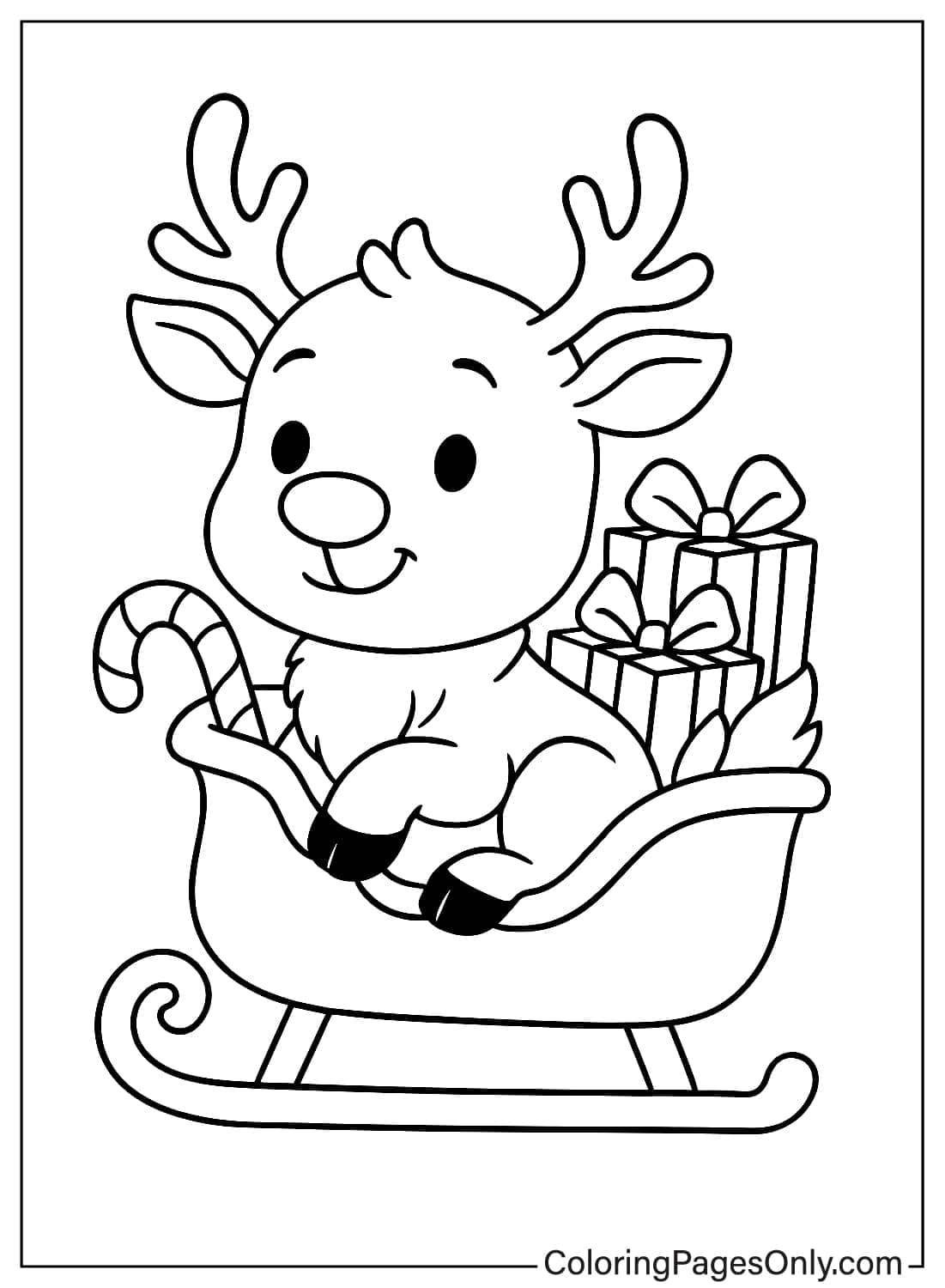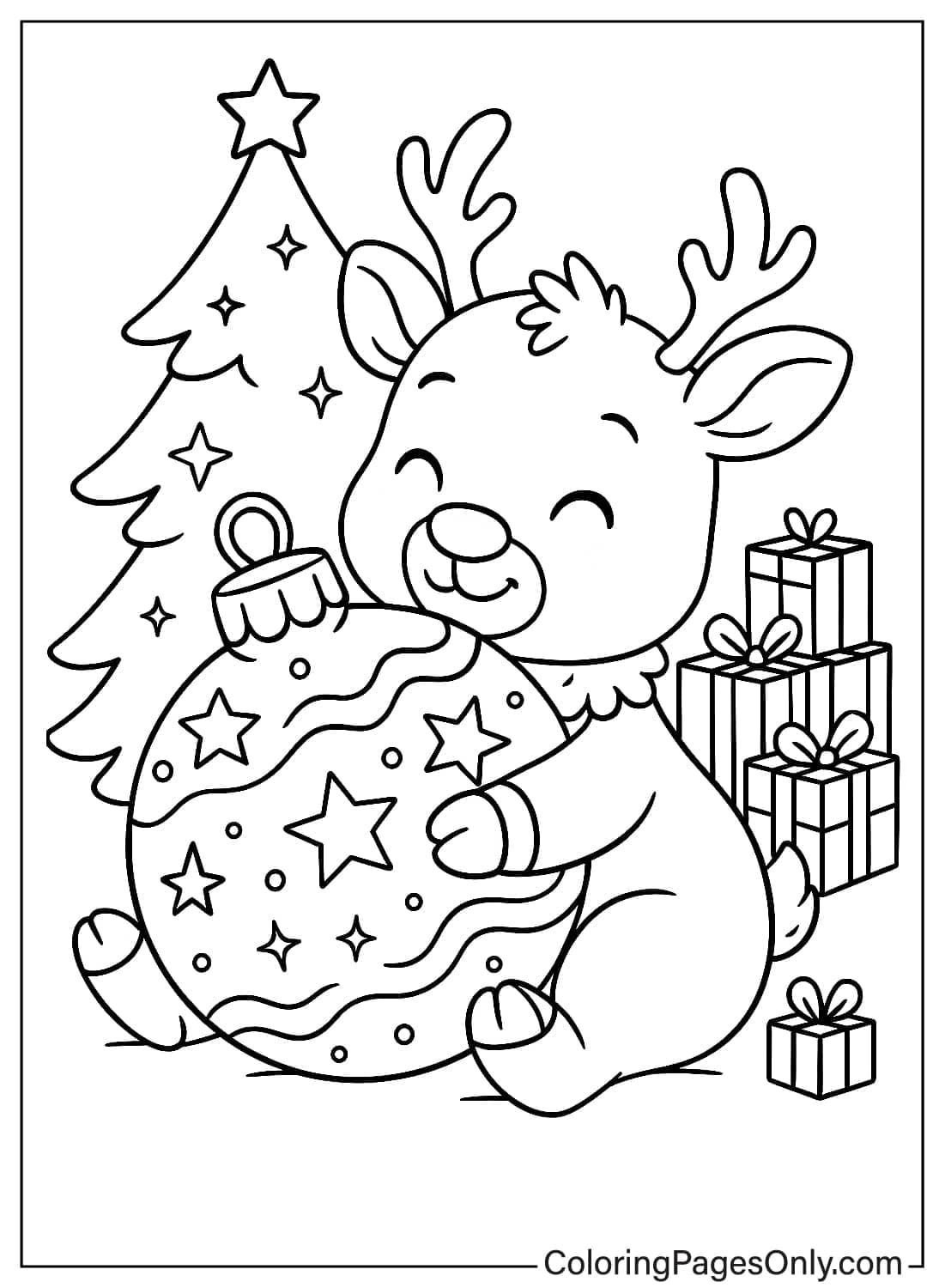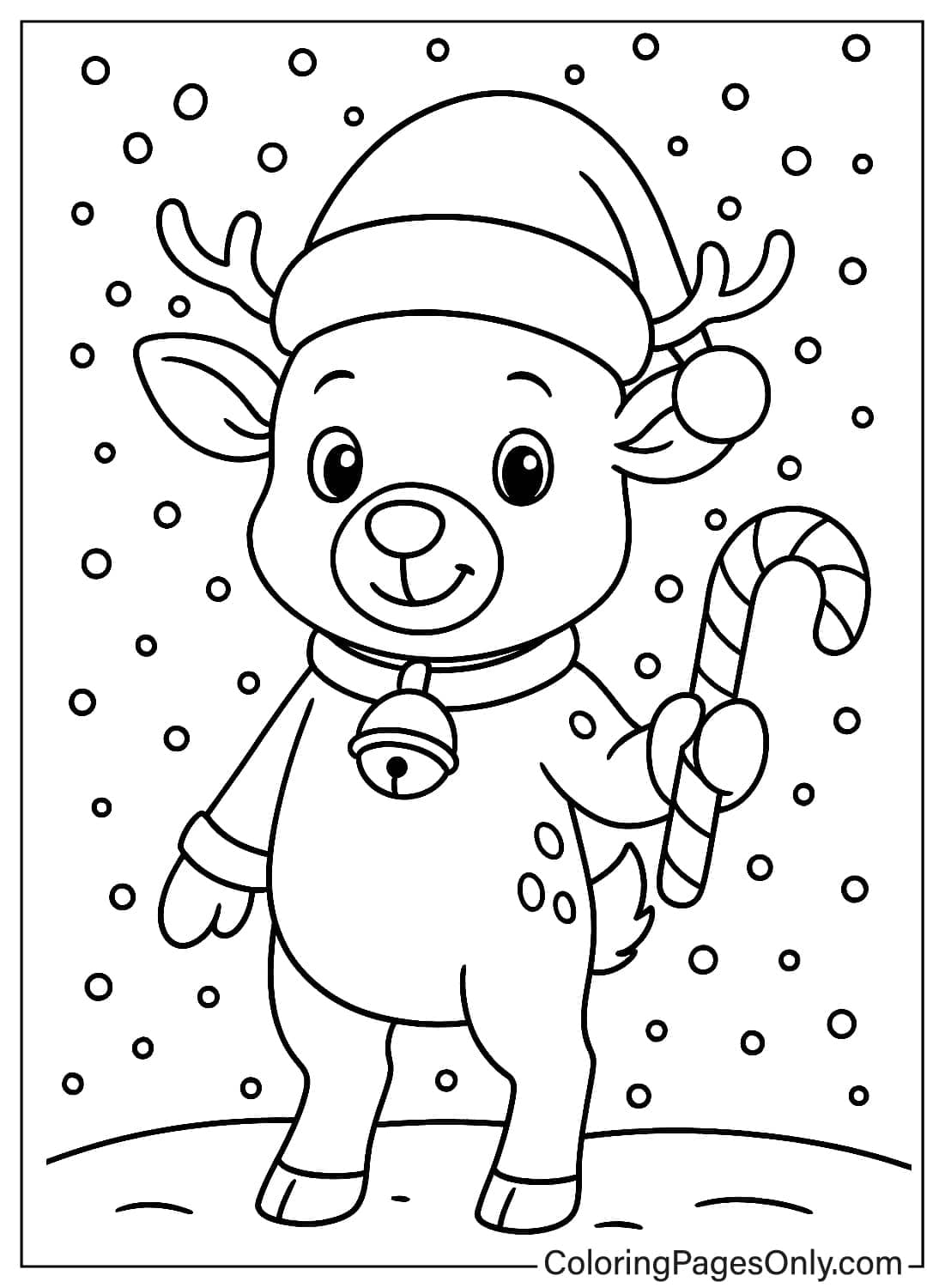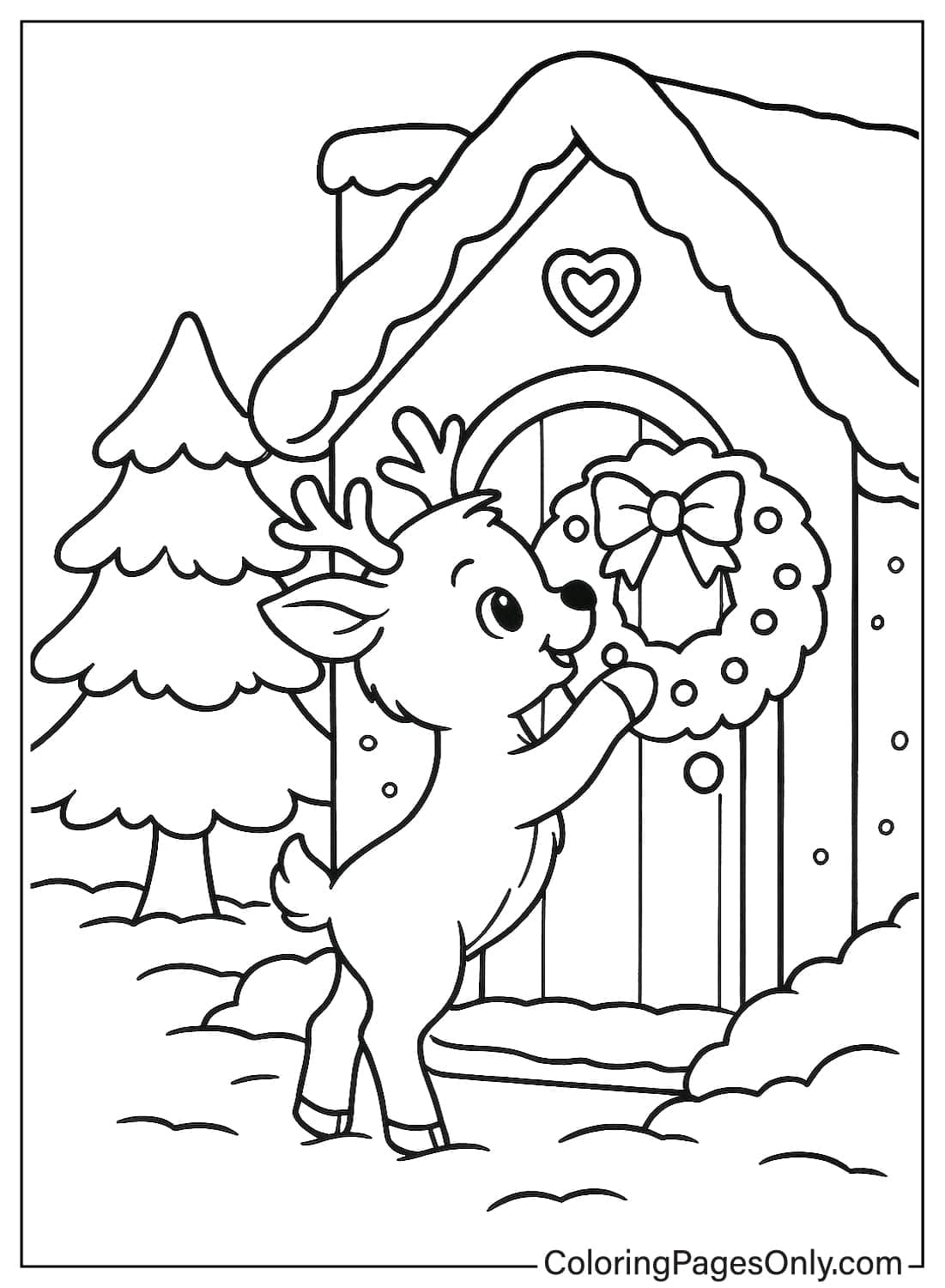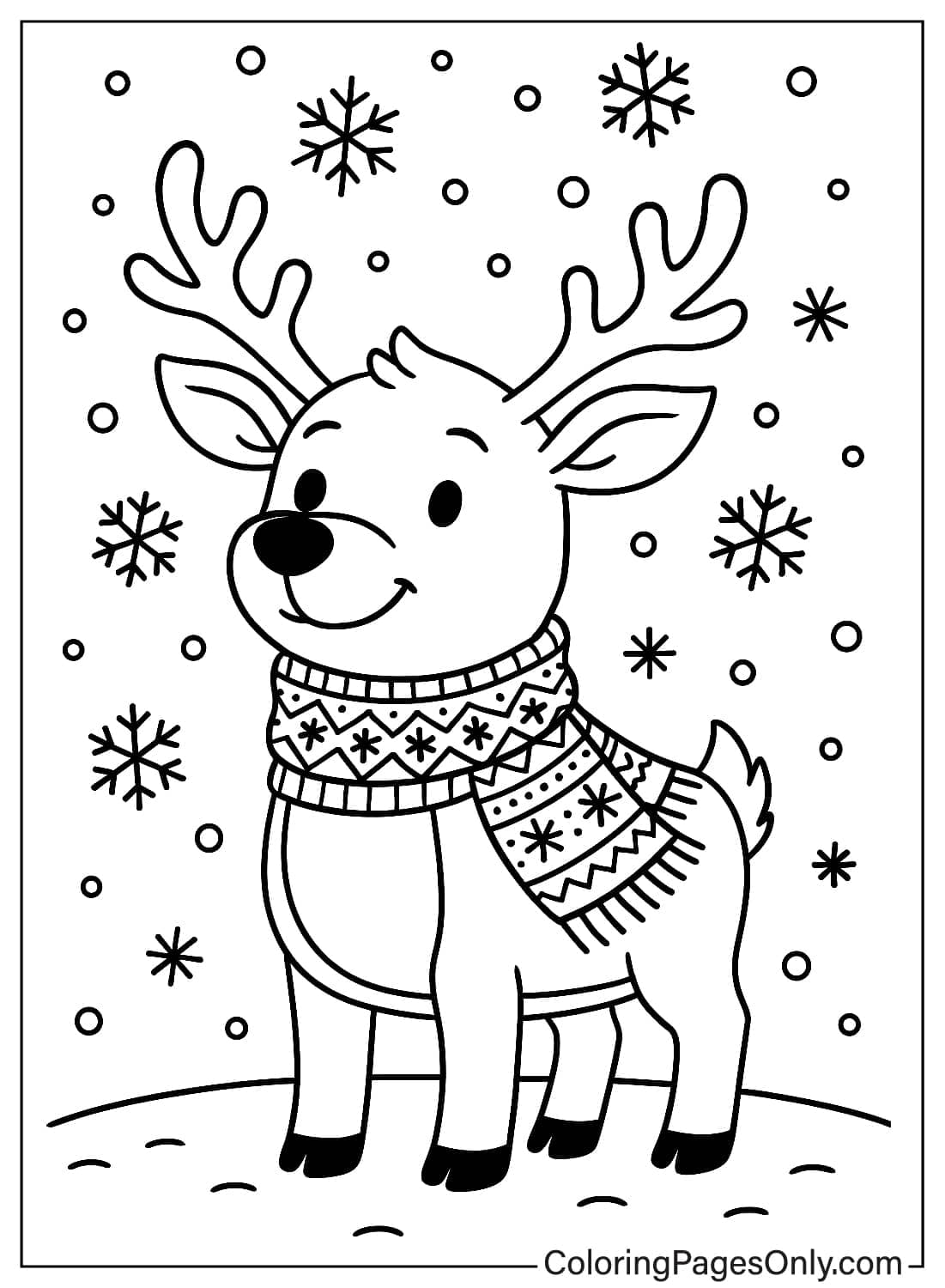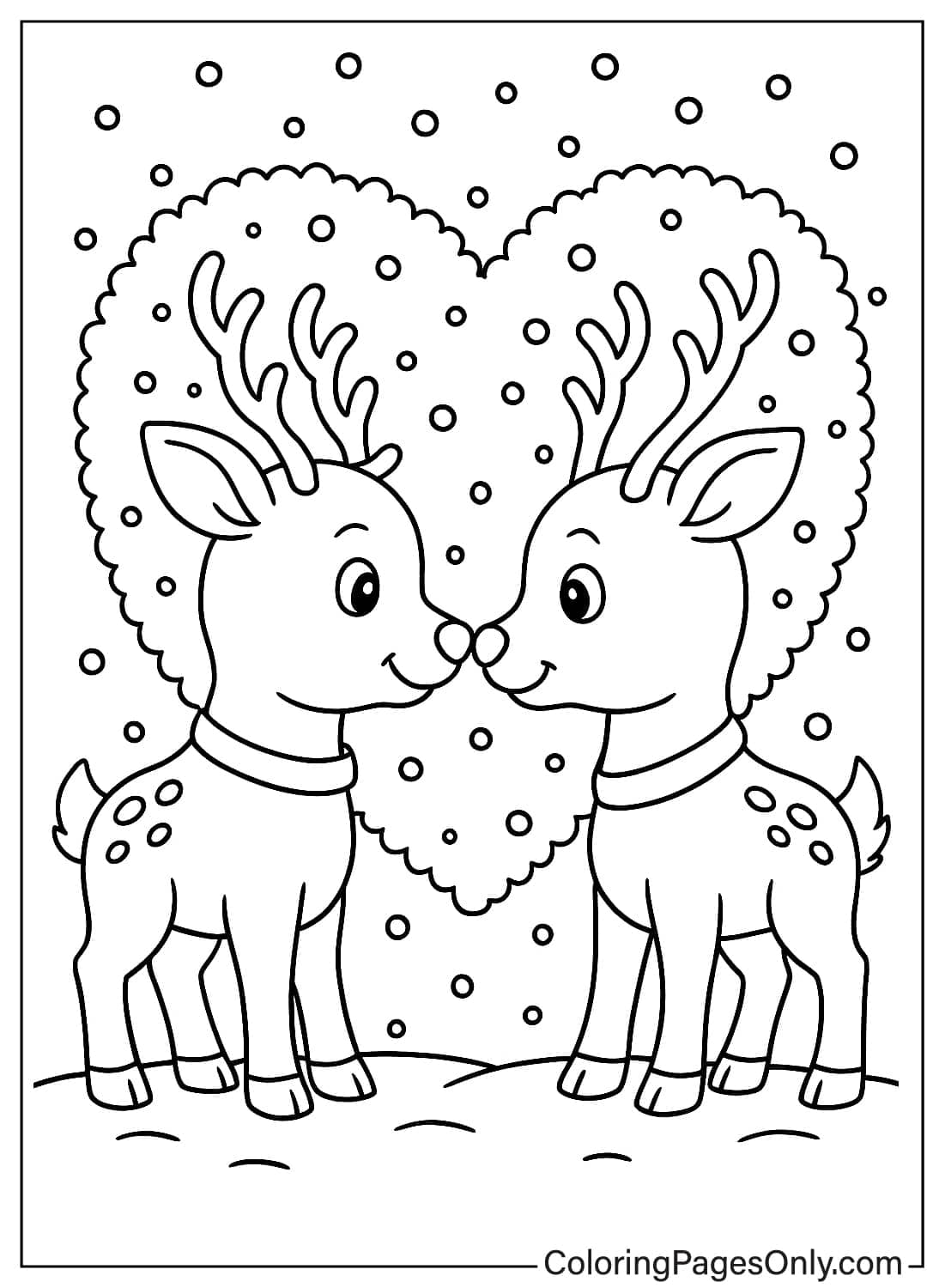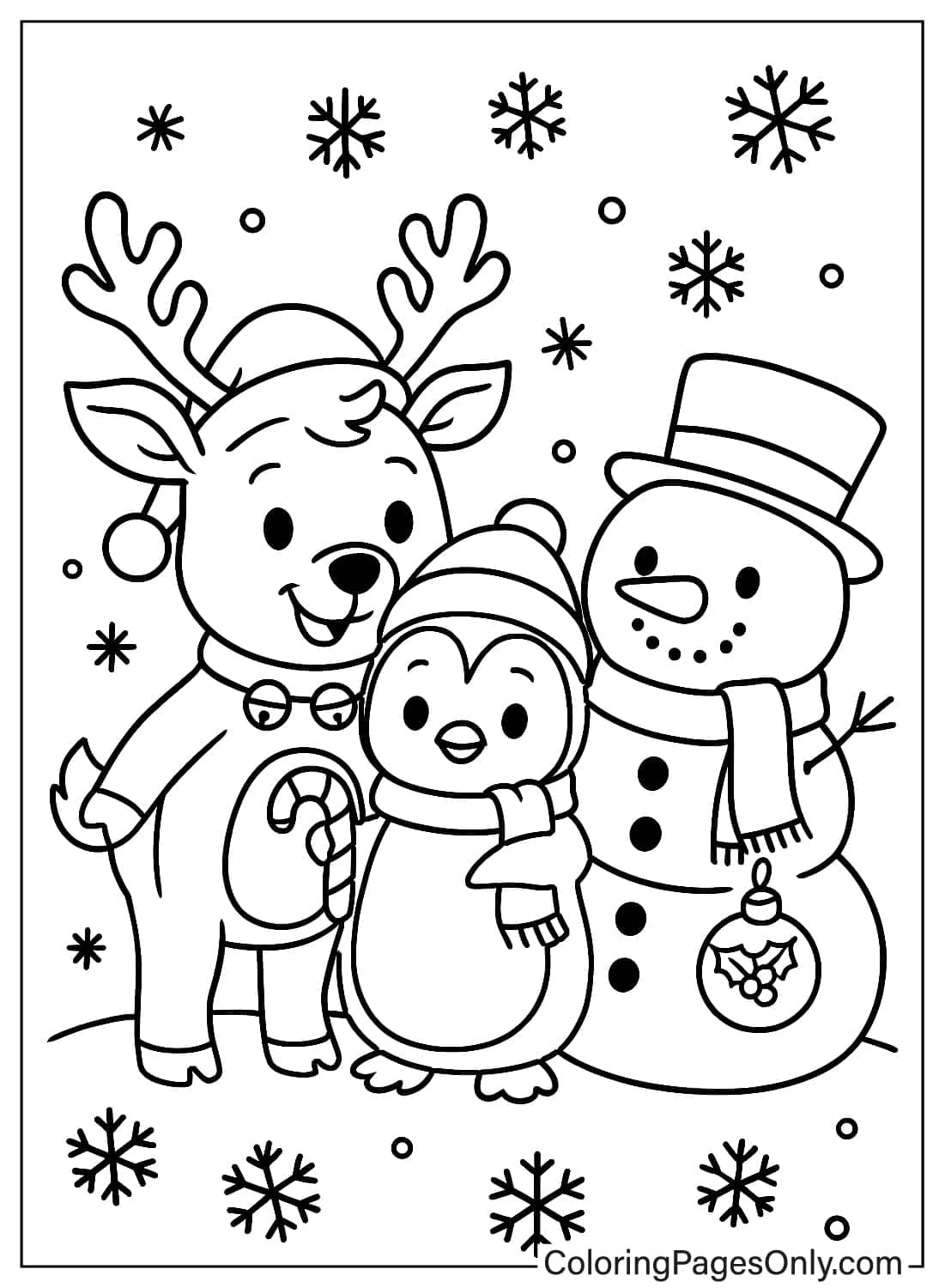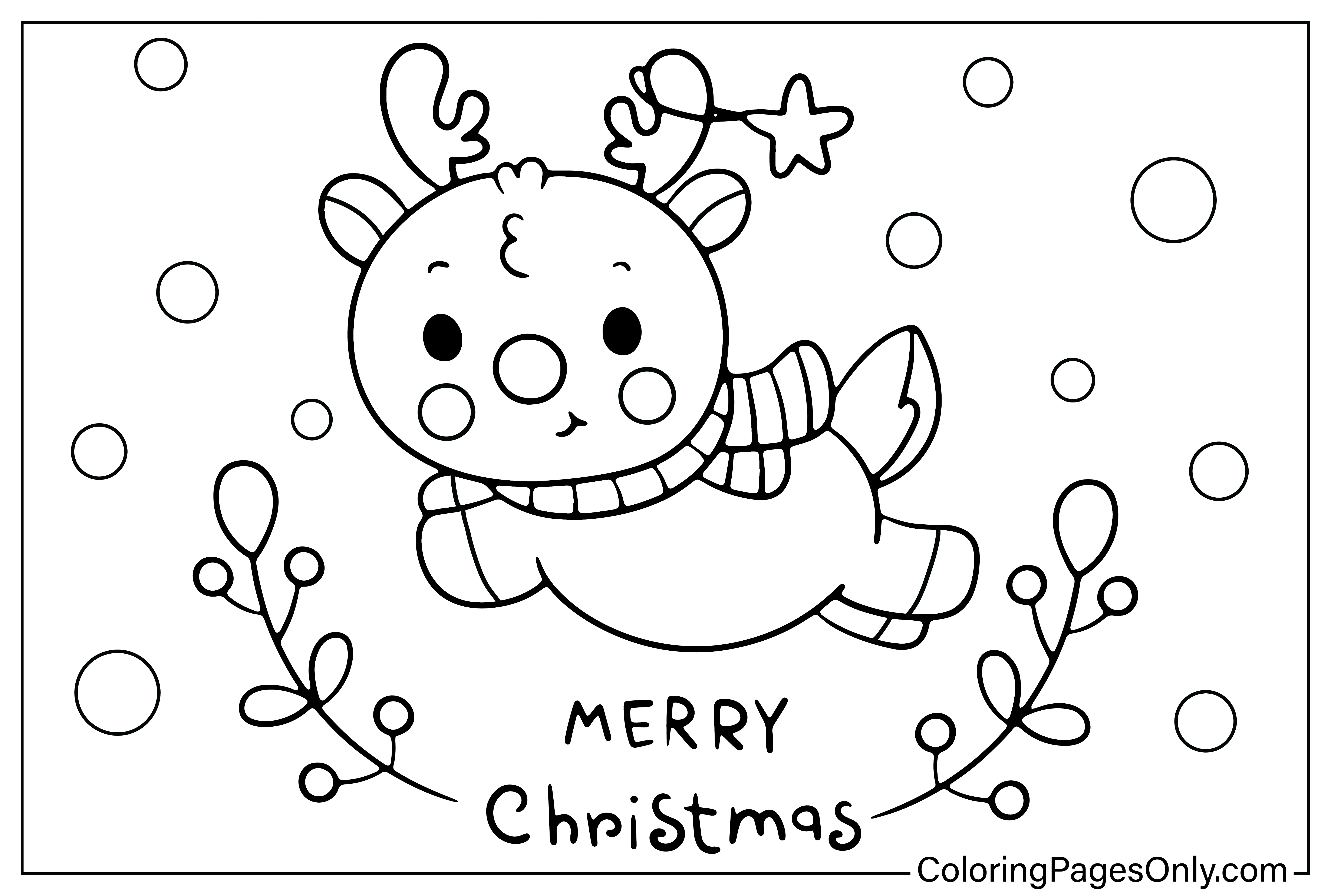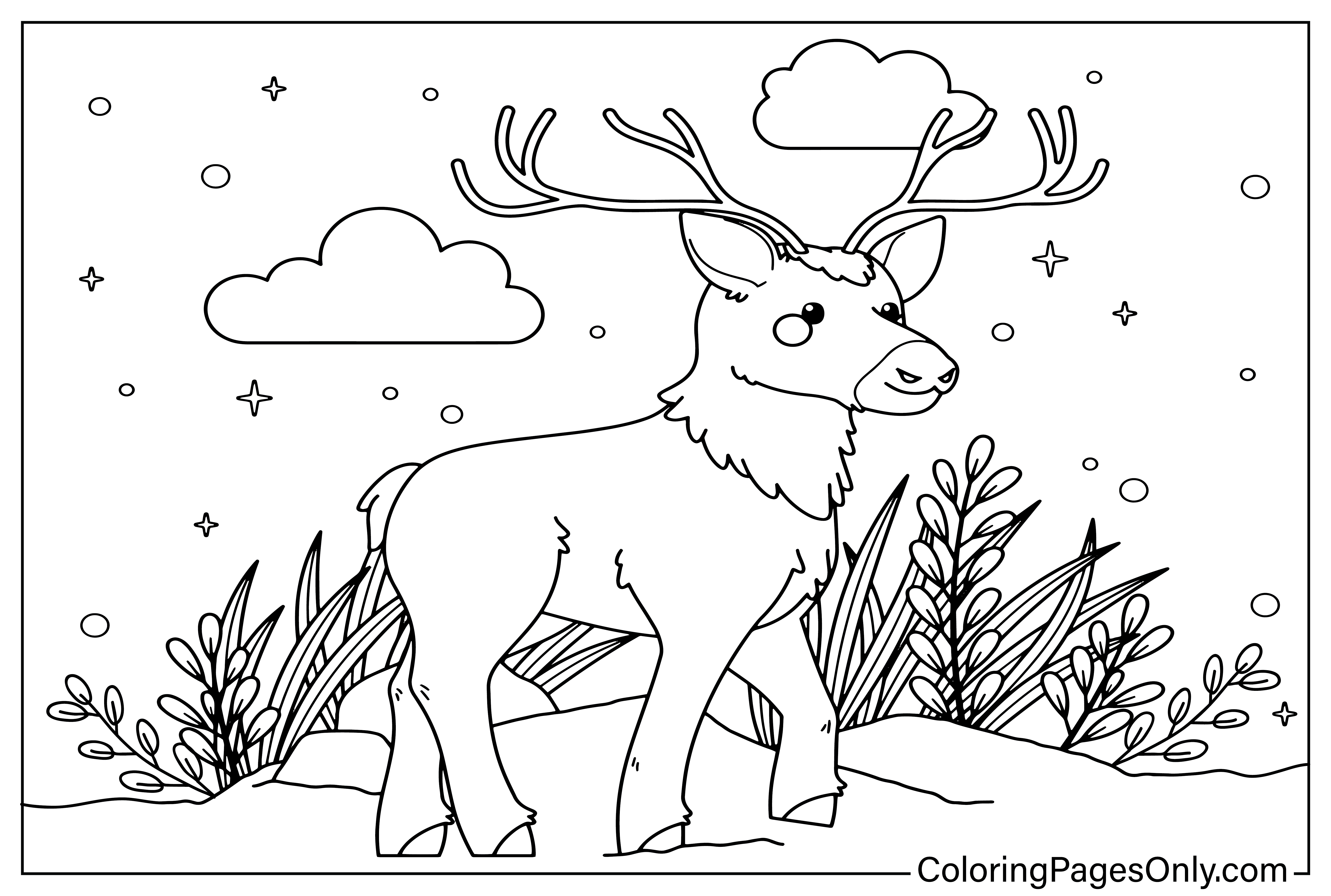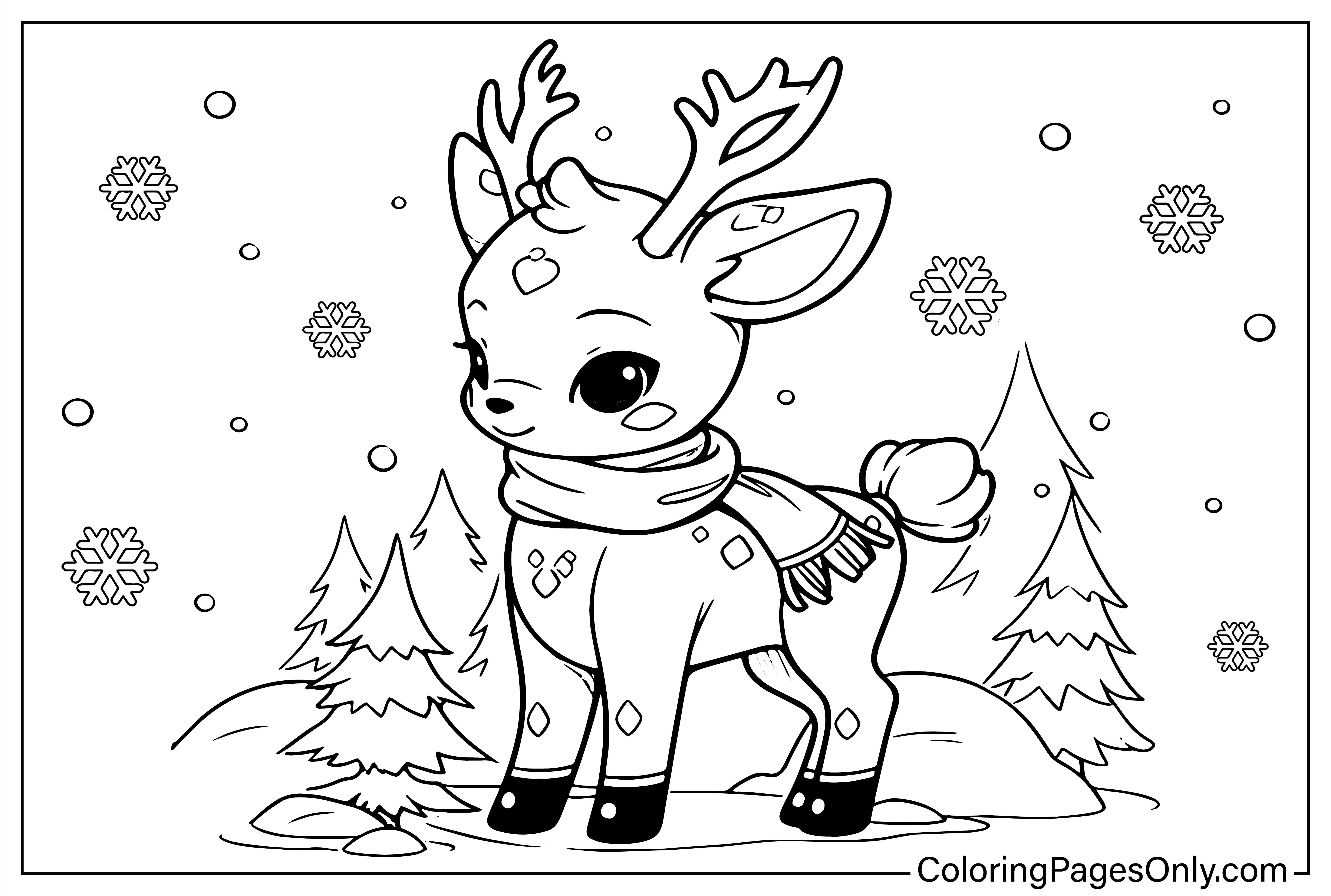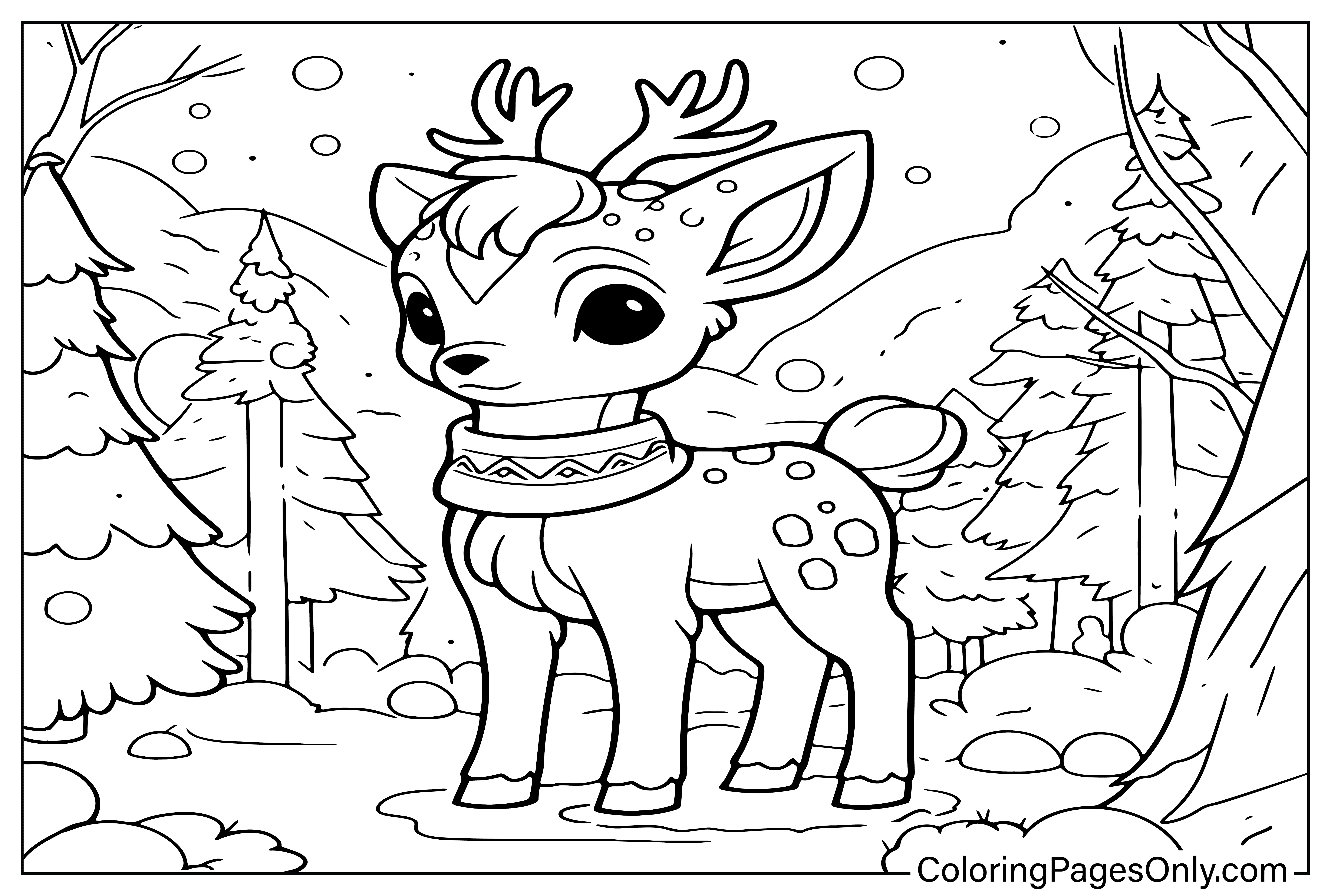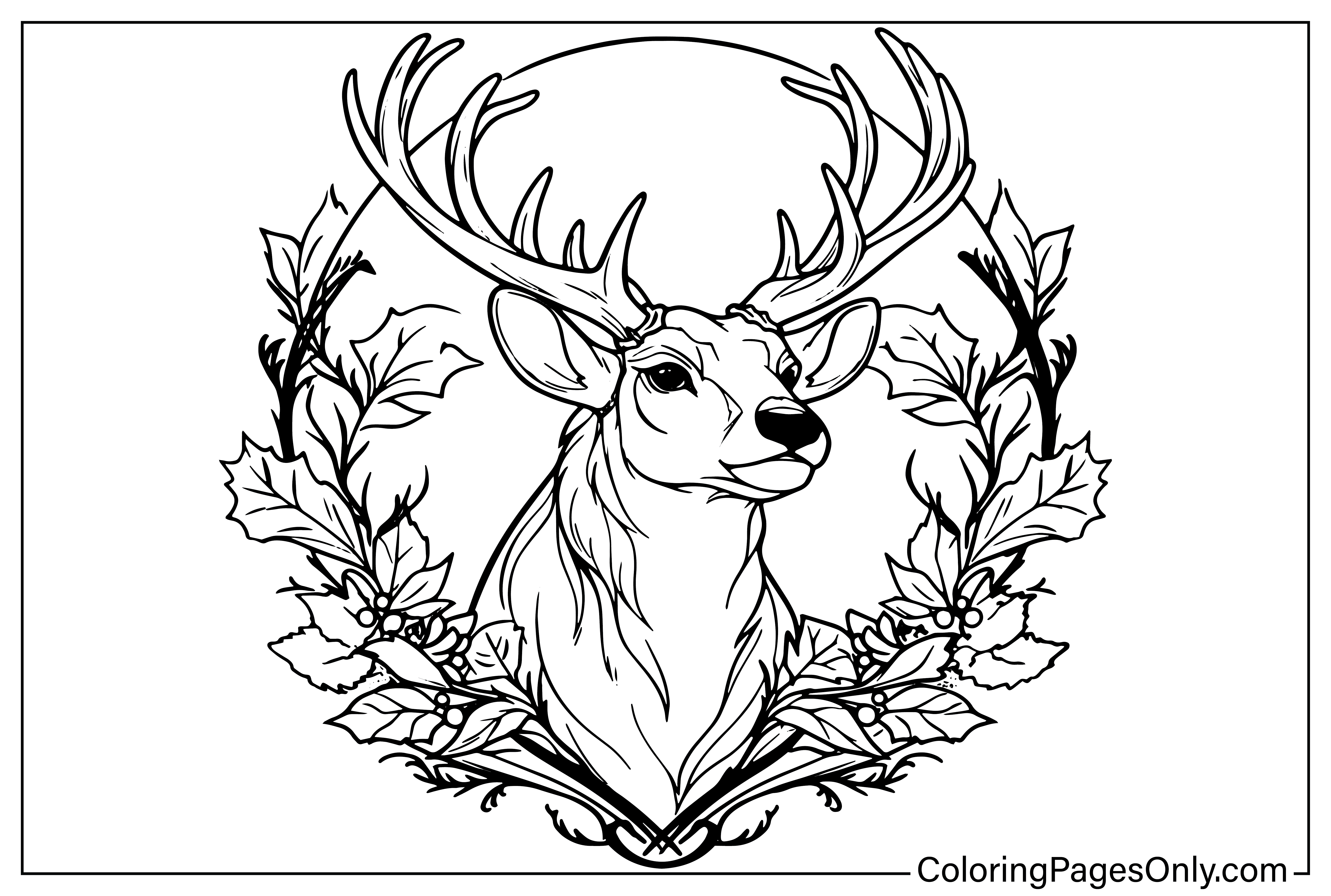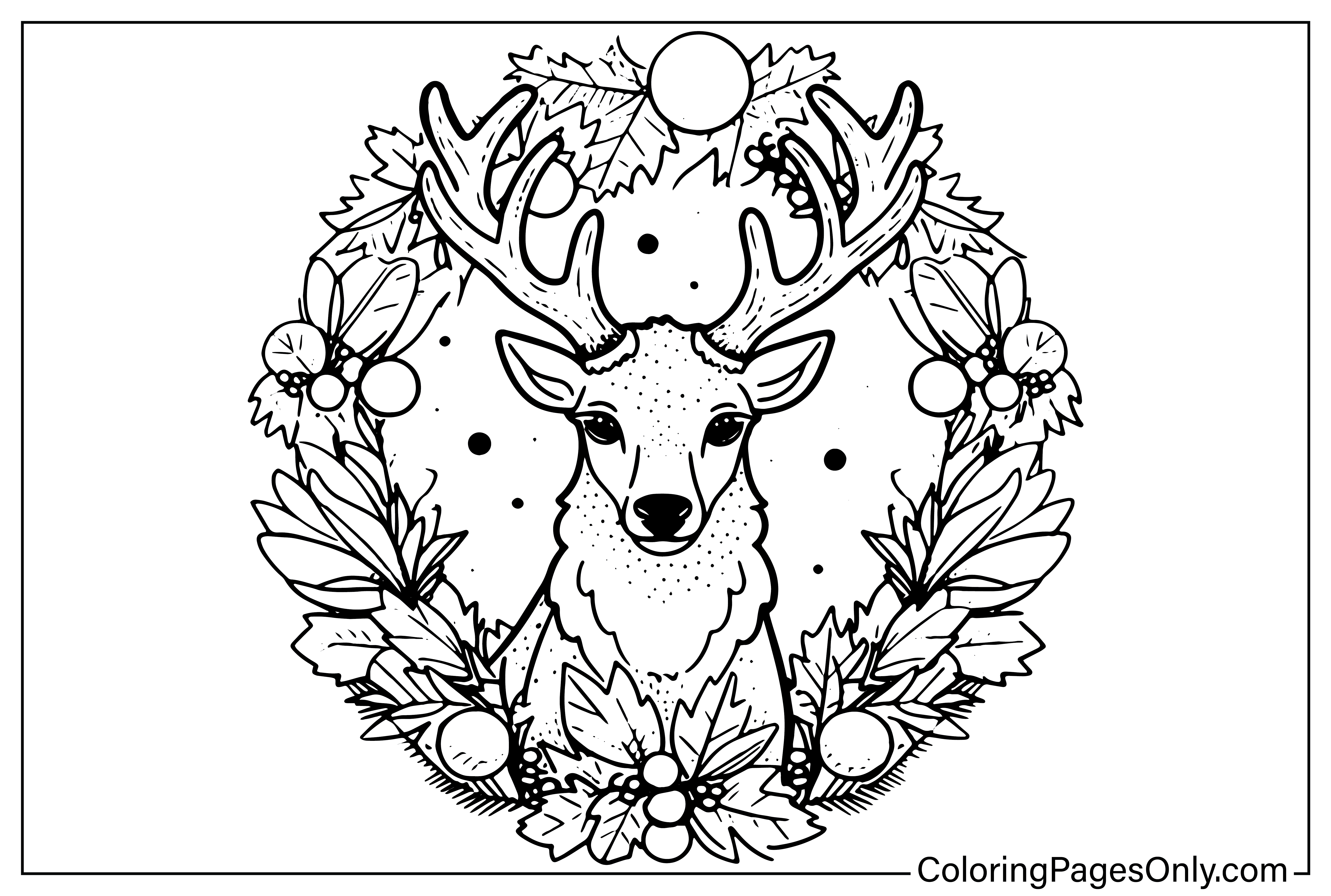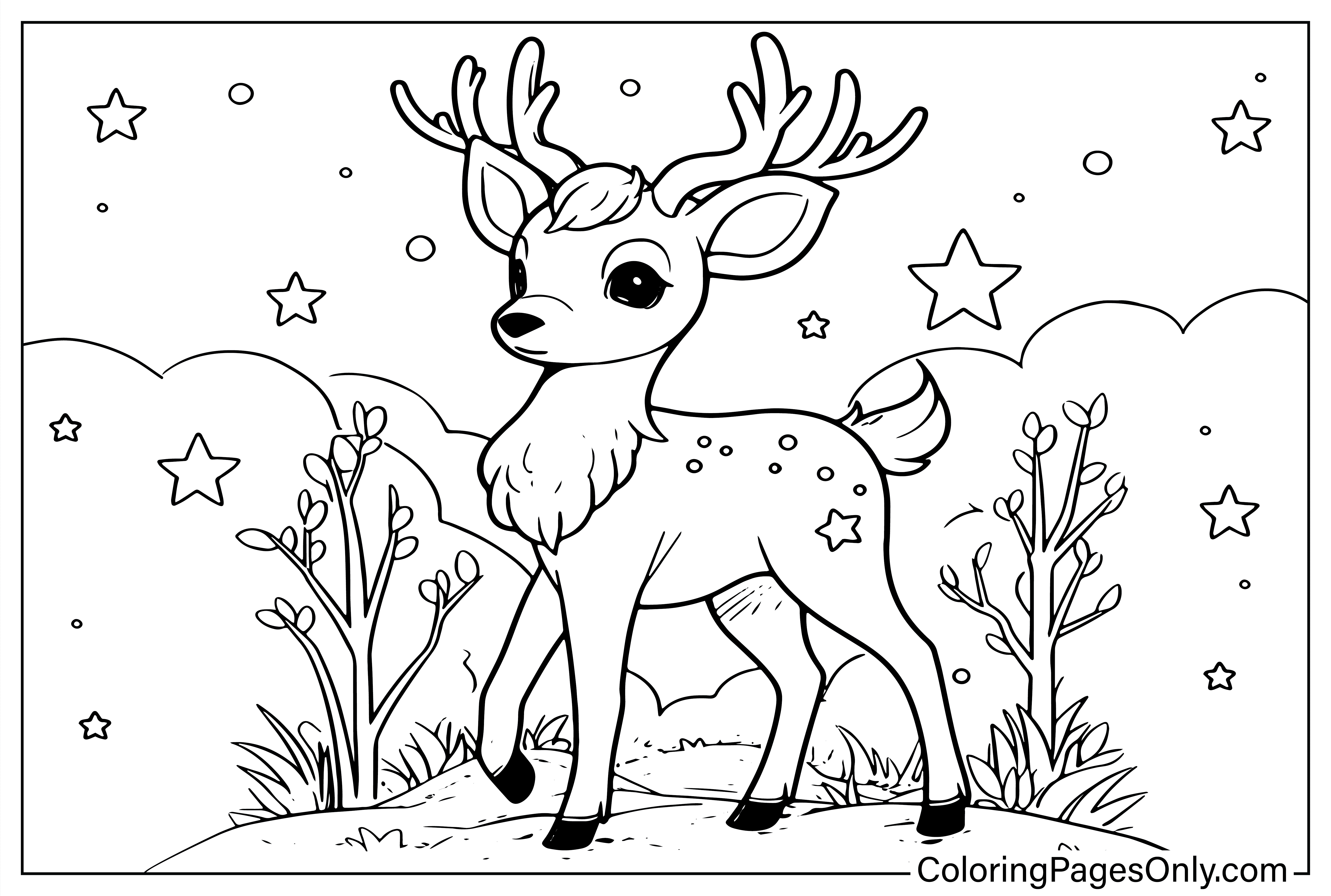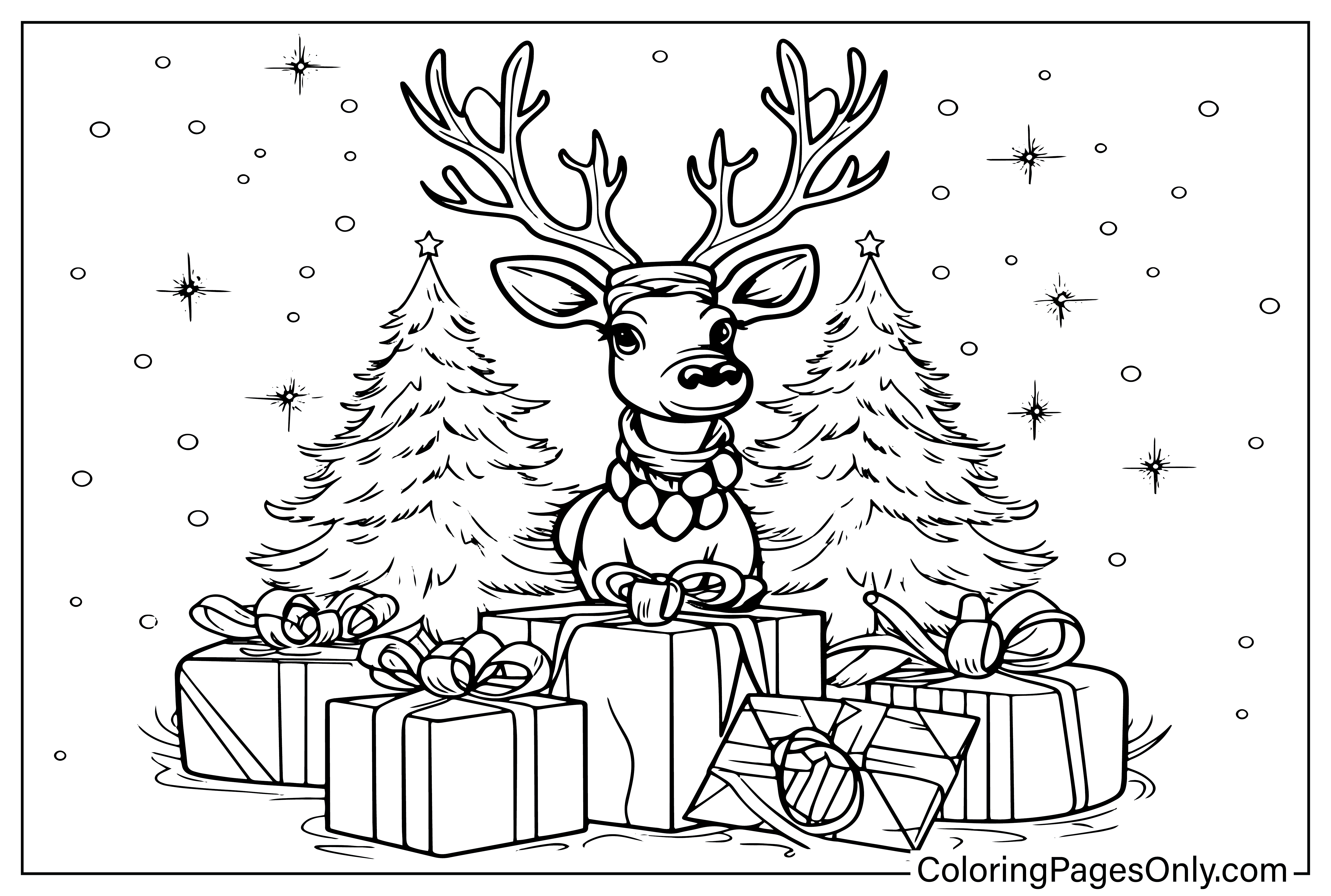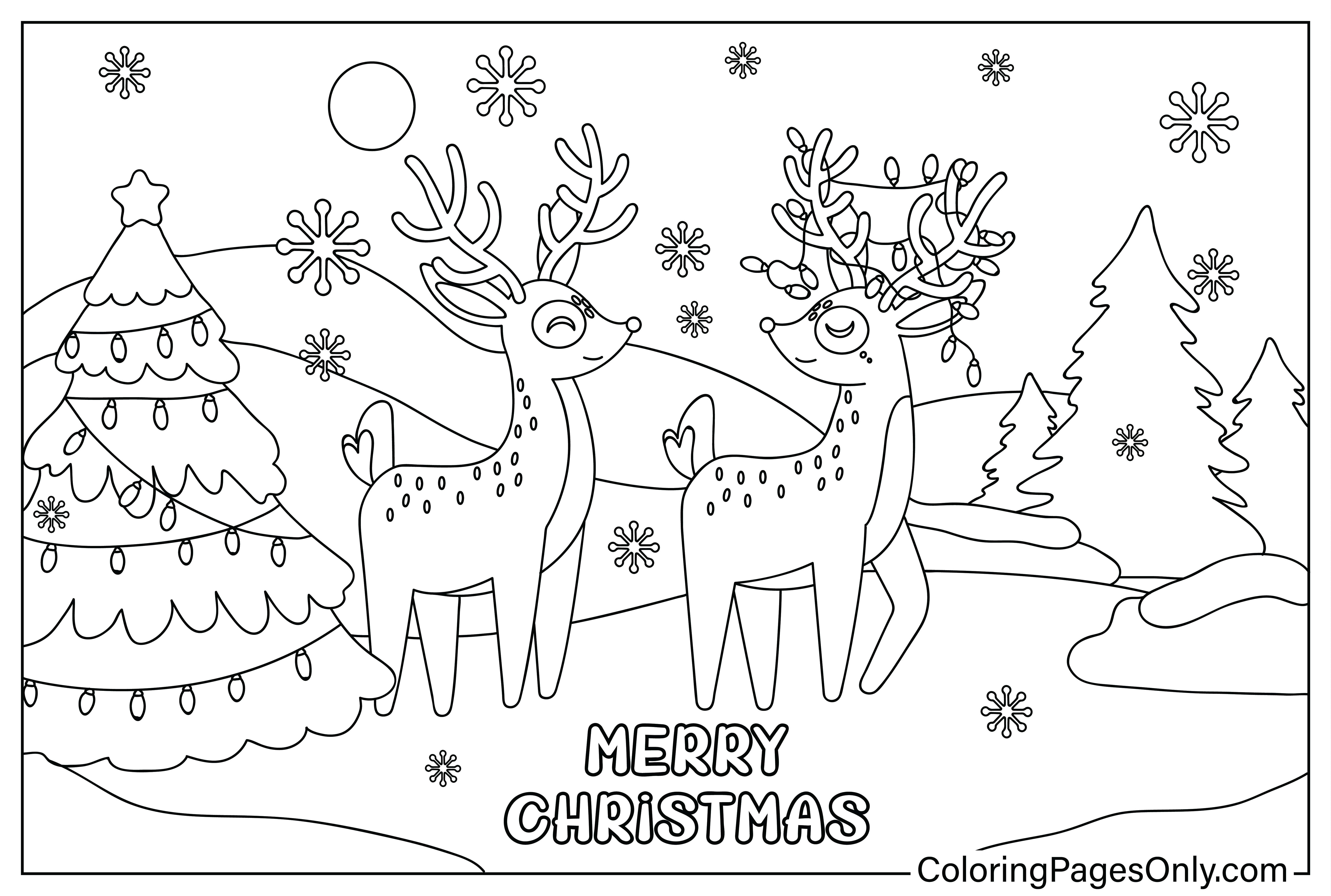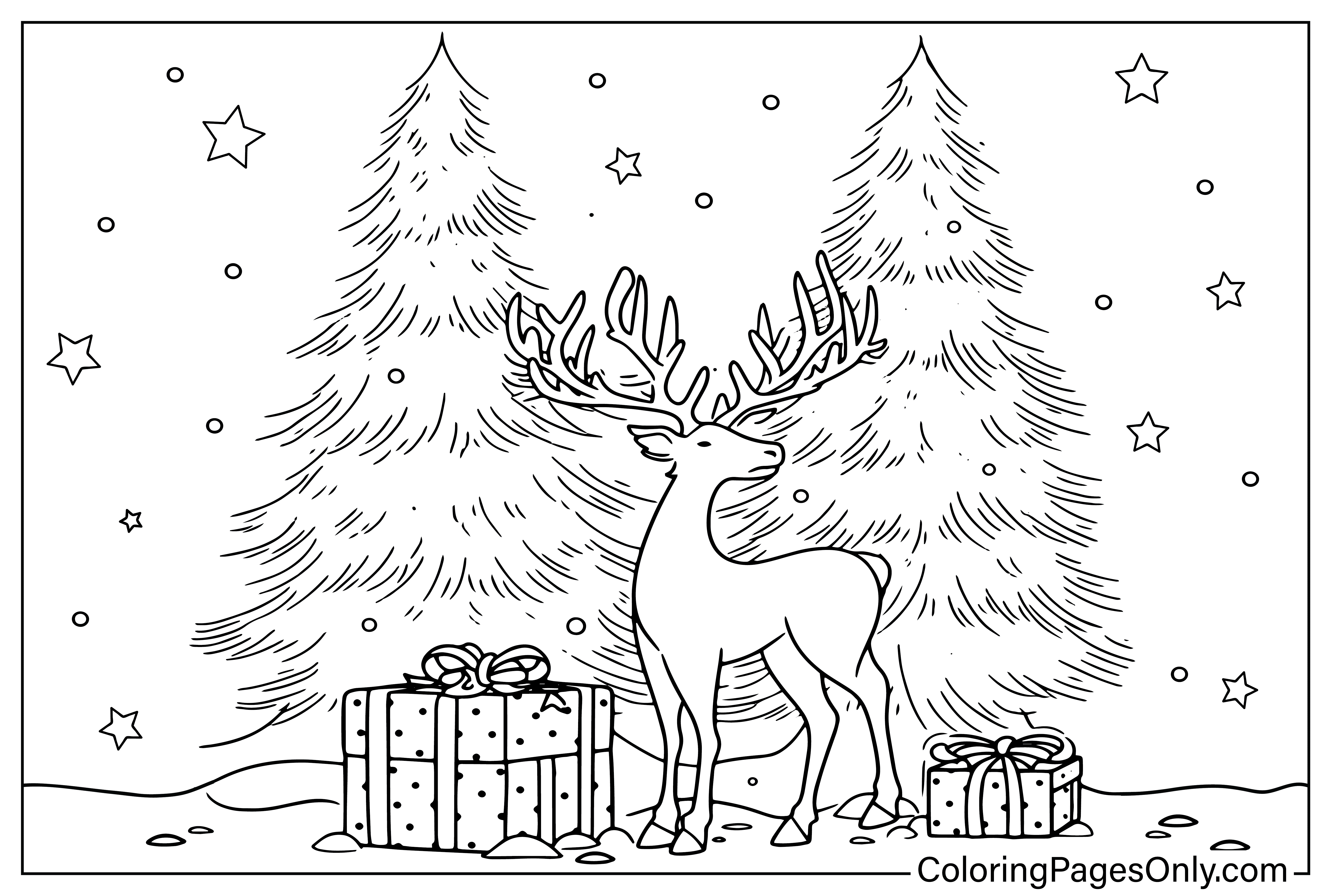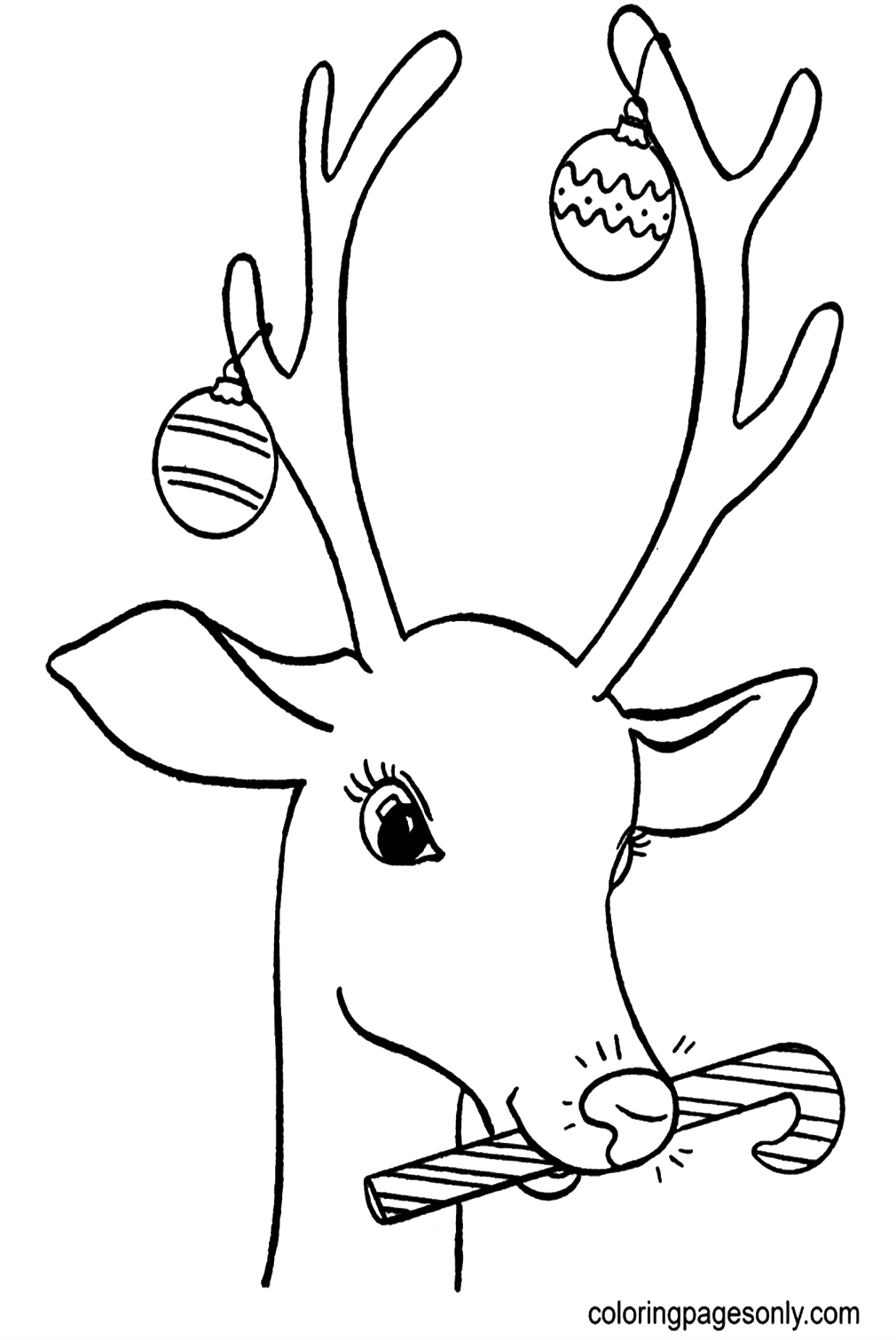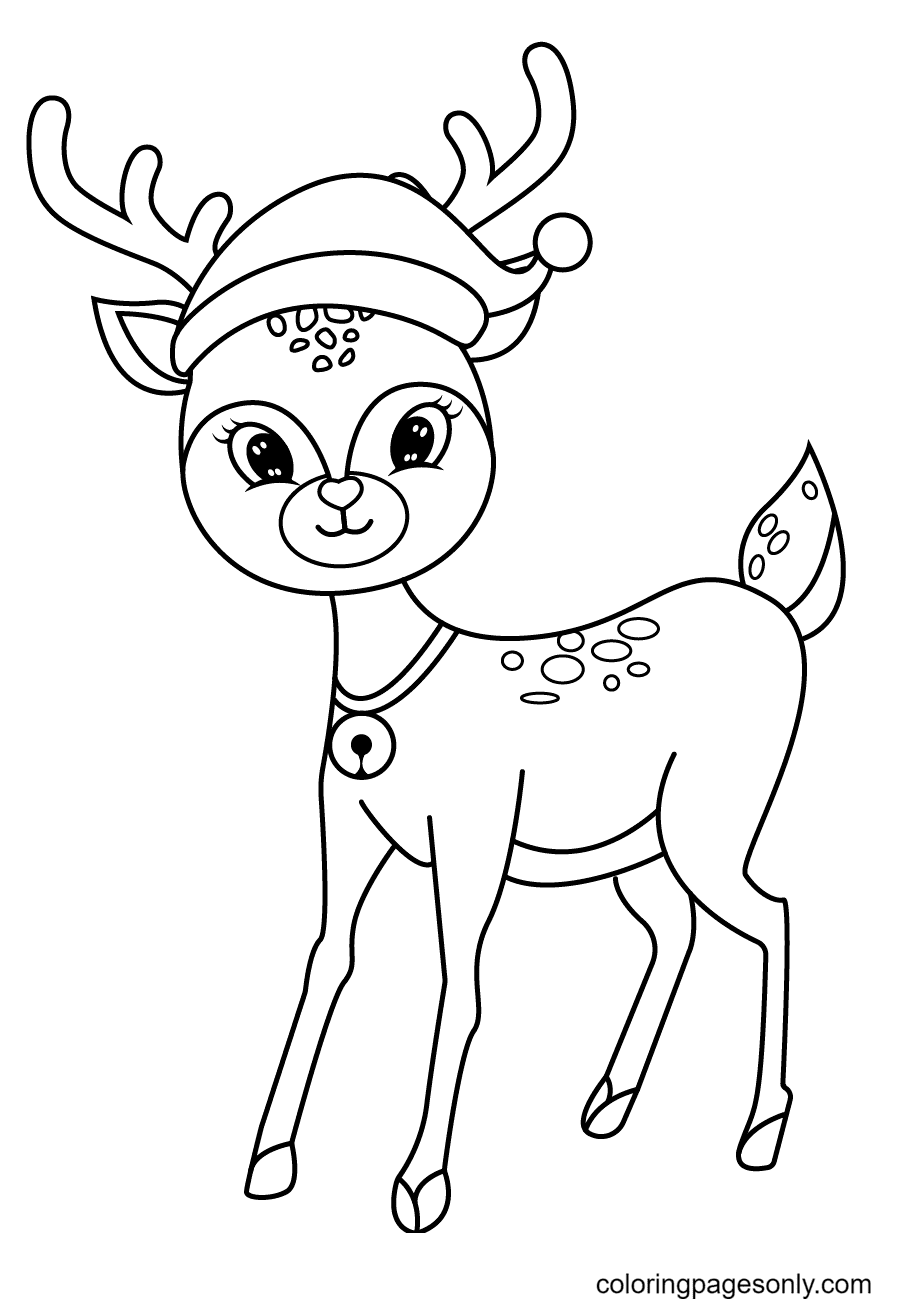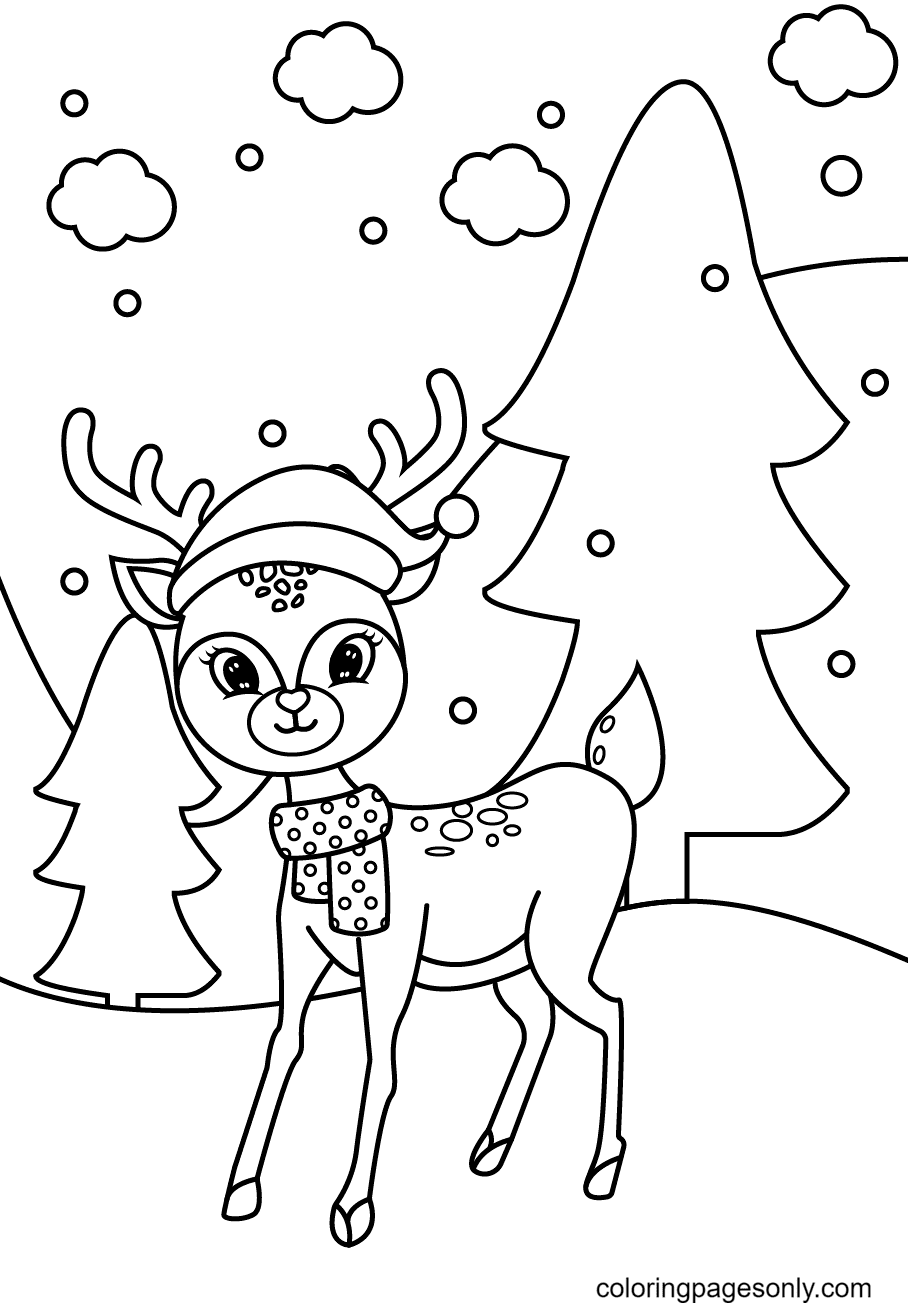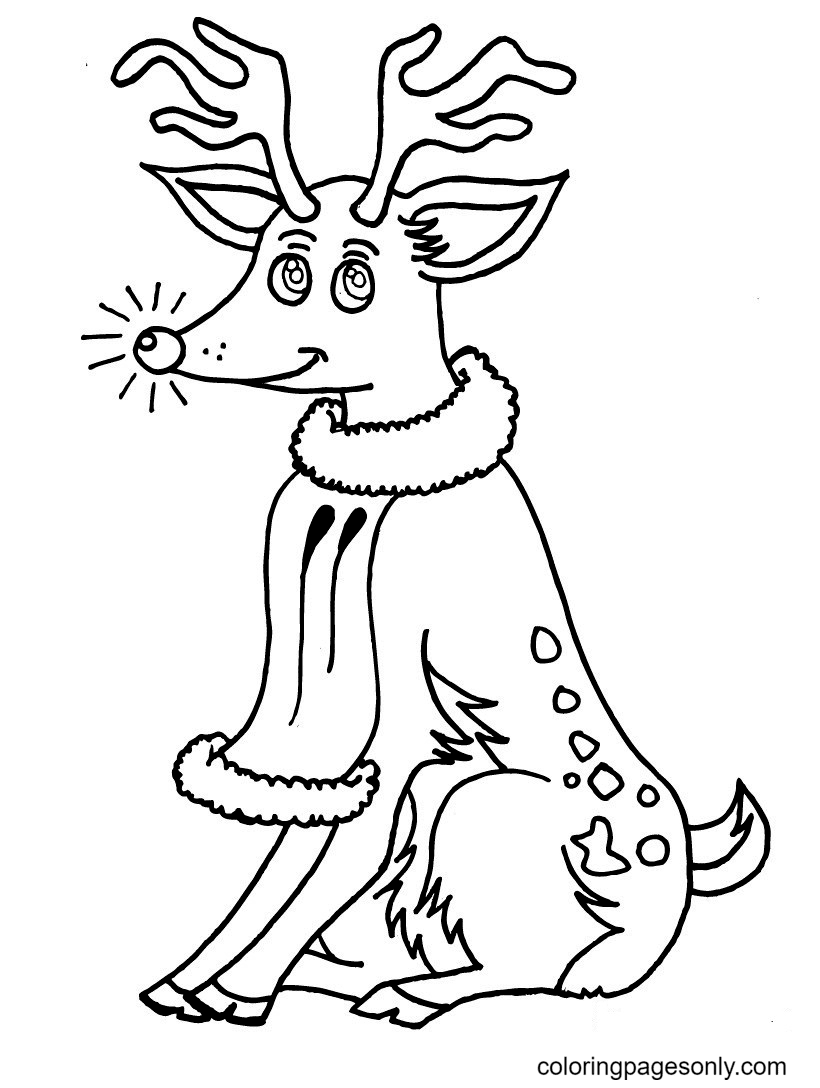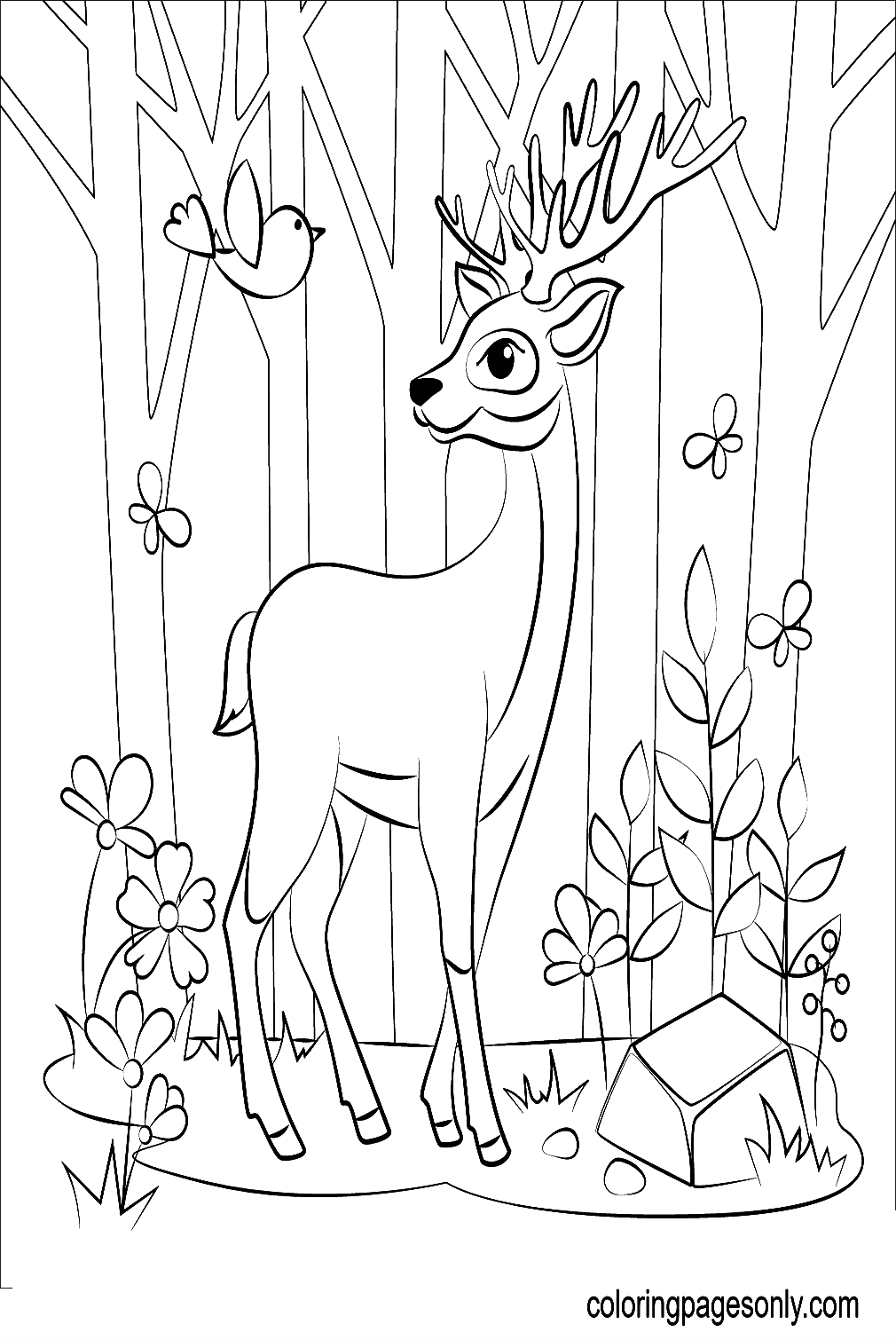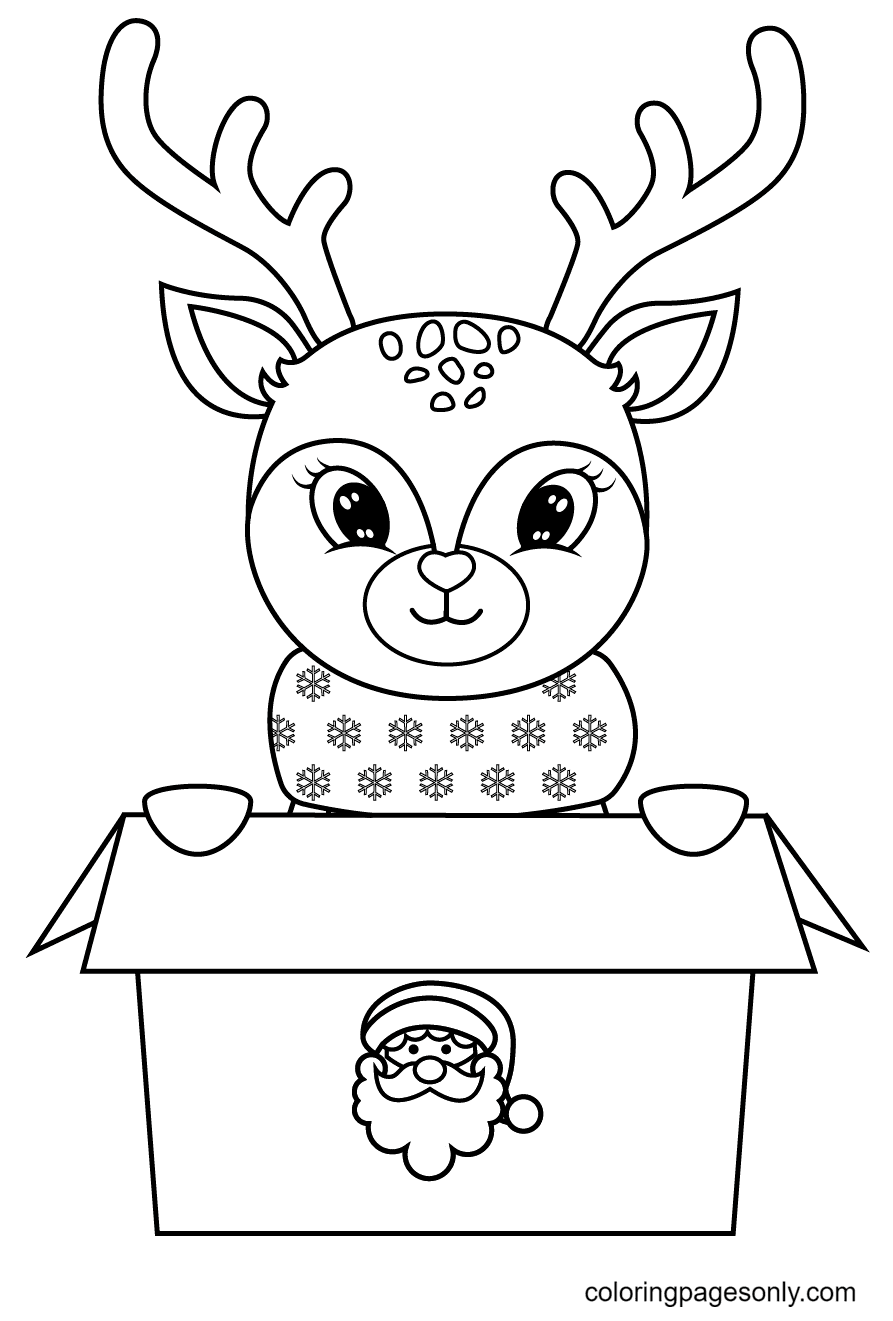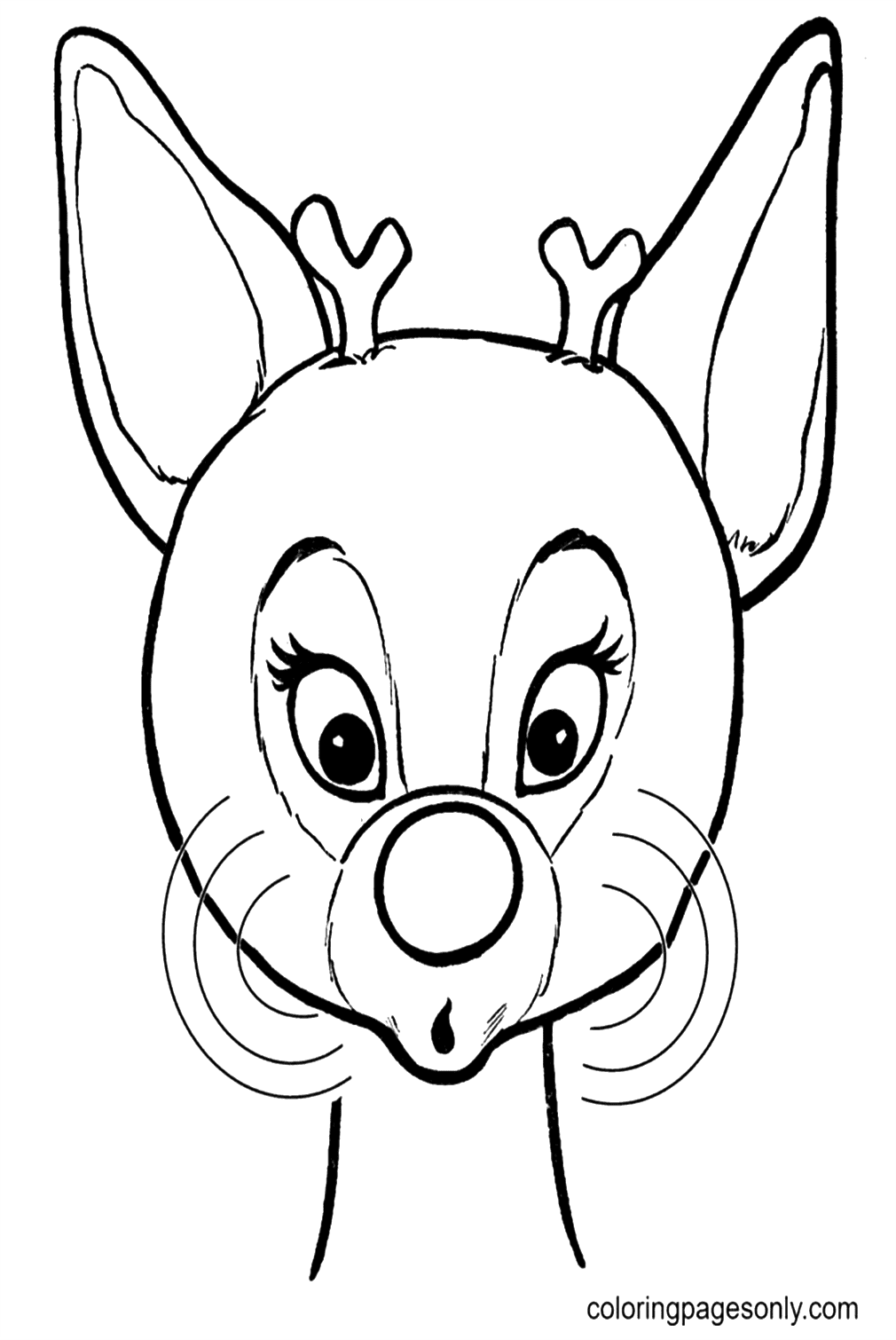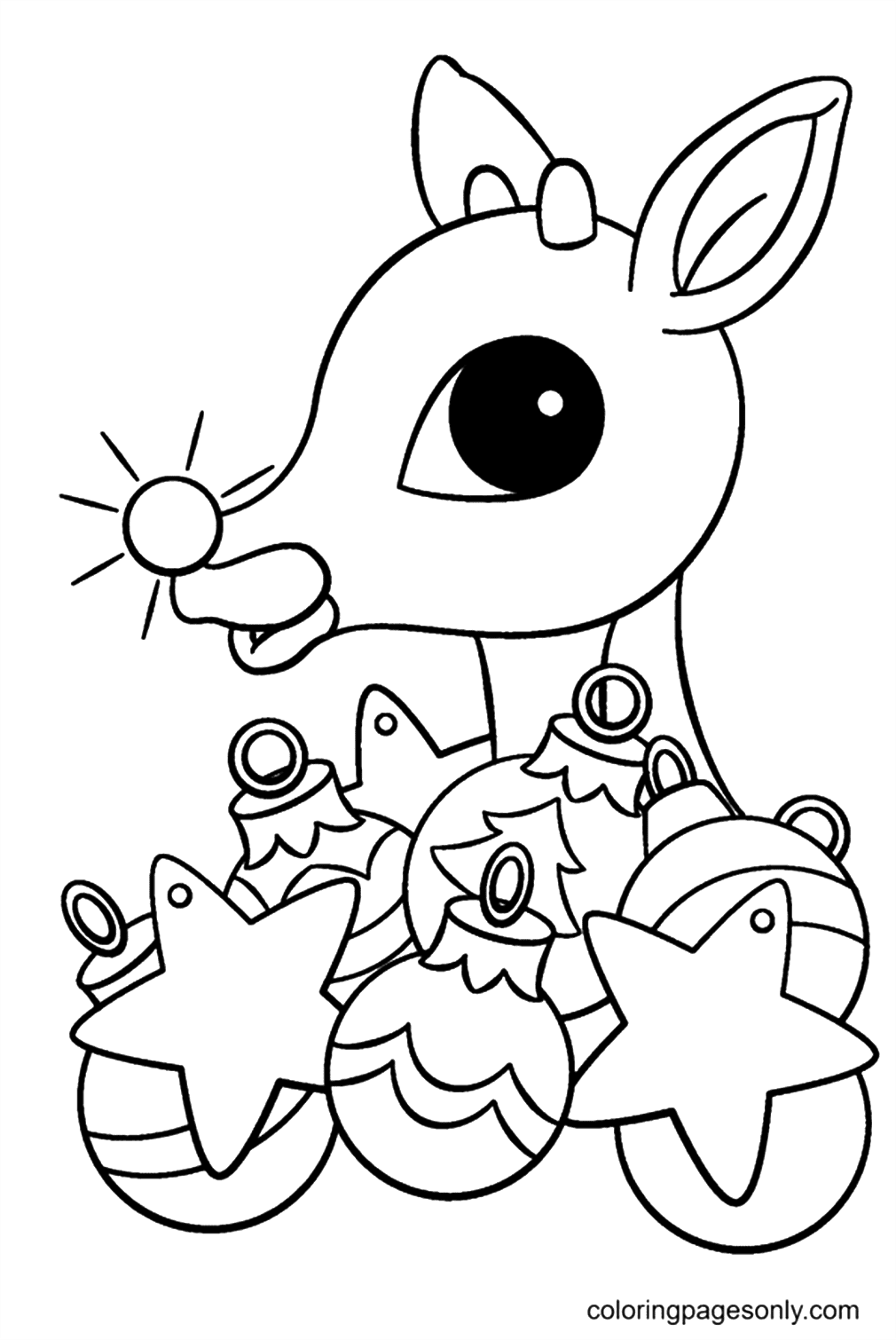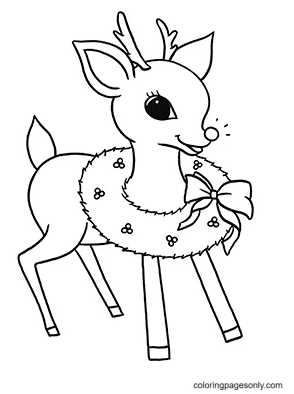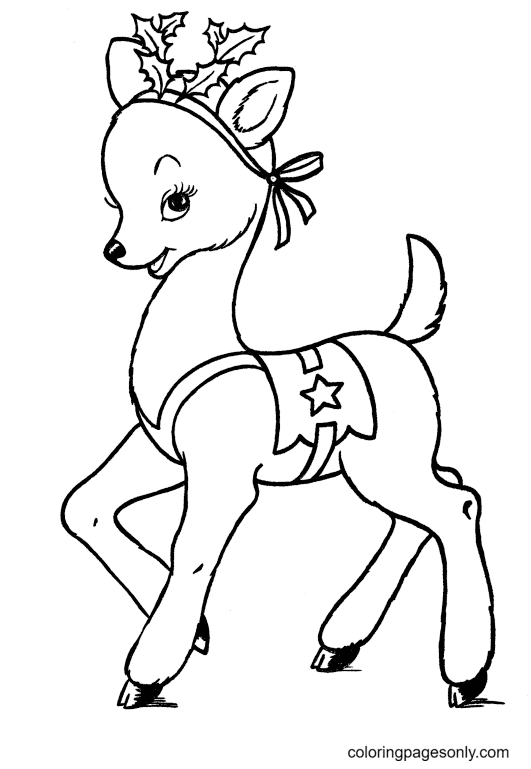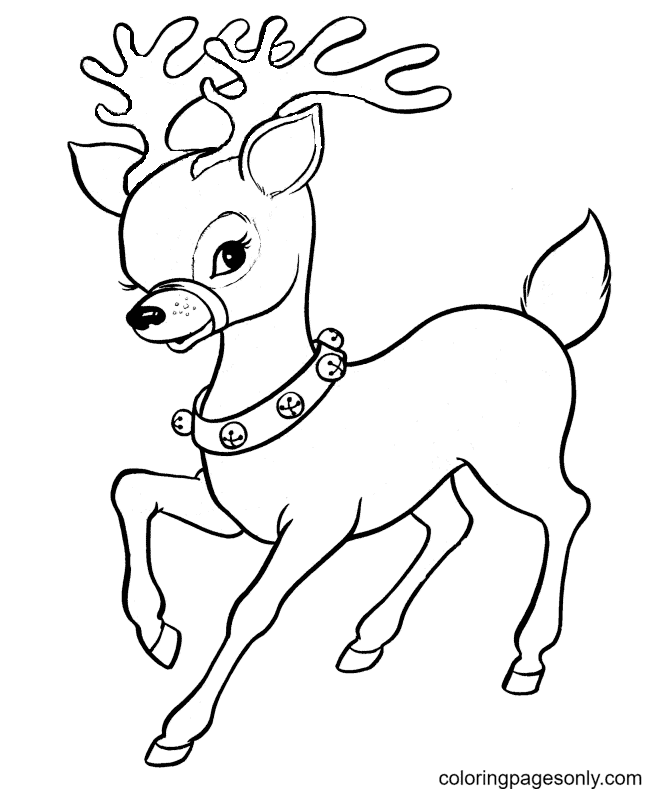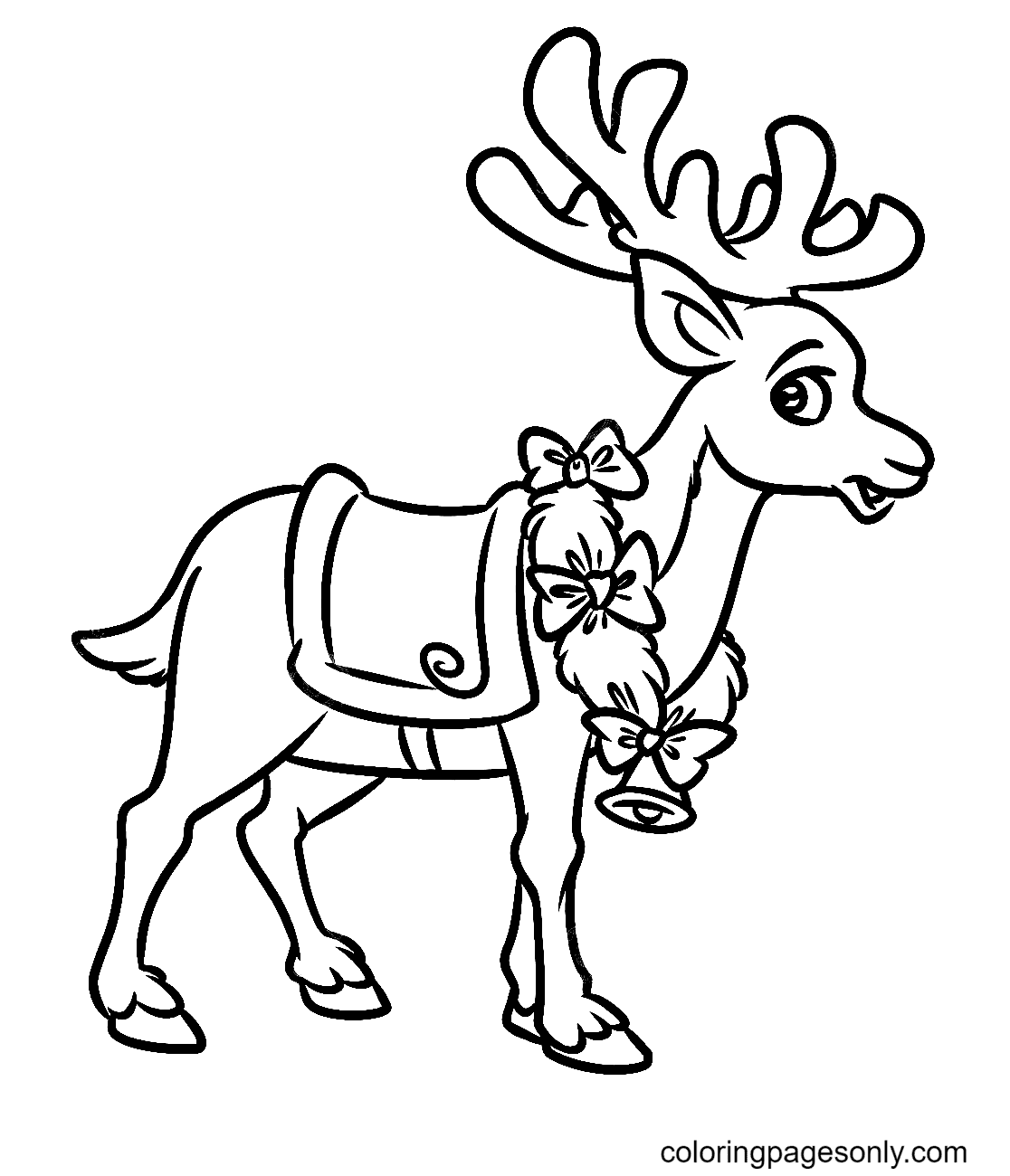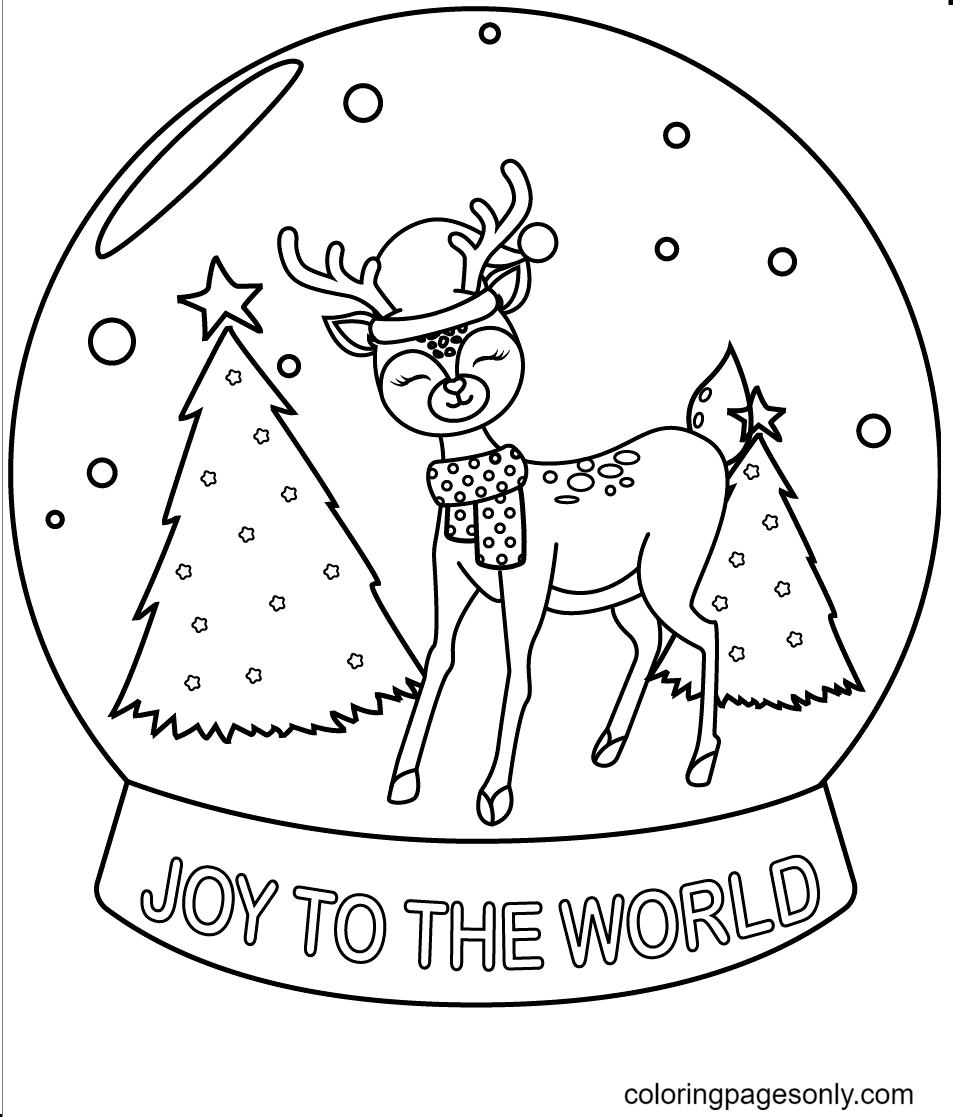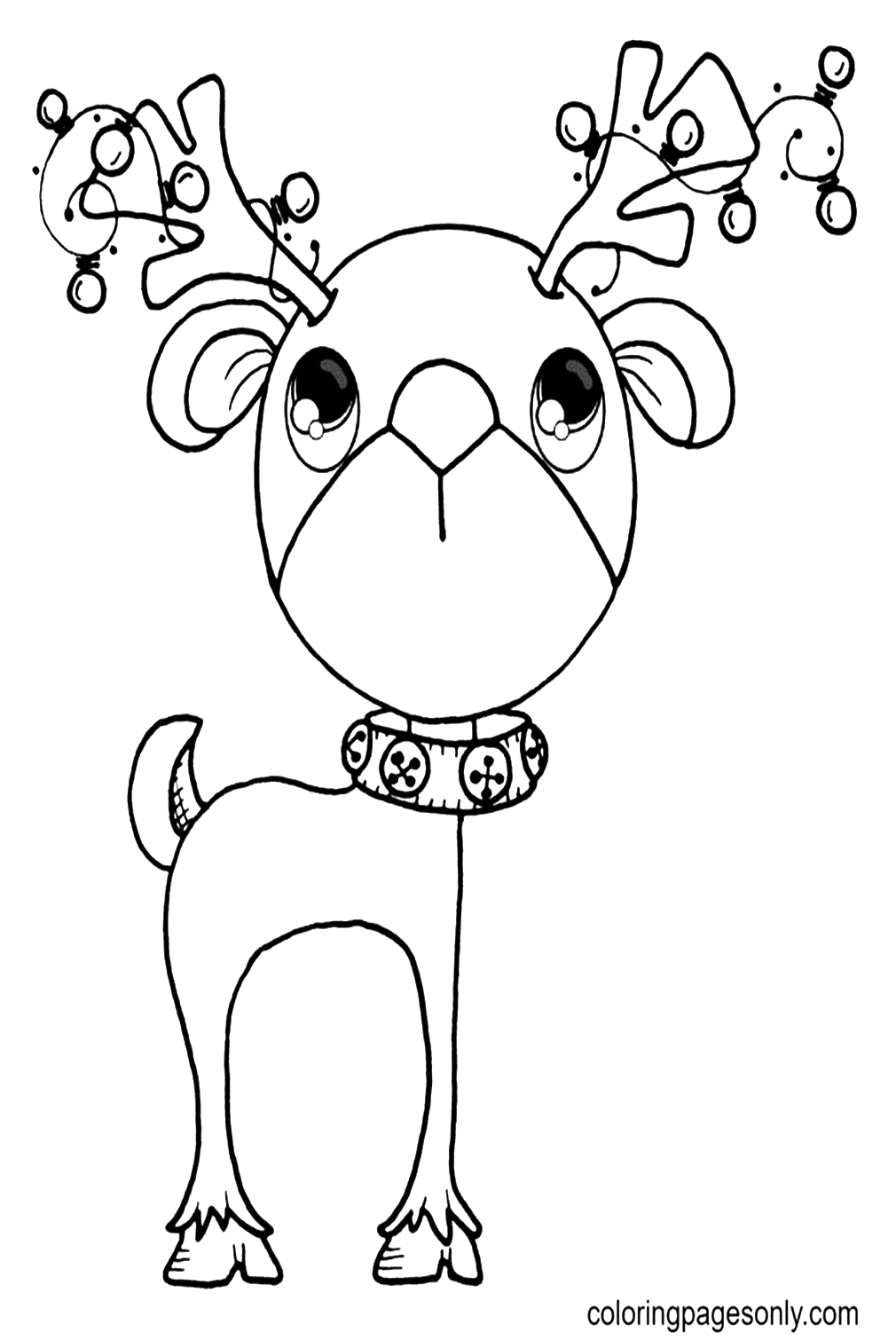
90+ free reindeer coloring pages – Rudolph, Santa’s sleigh, Sven from Frozen, baby reindeer, kawaii, and Christmas scenes. PDF or color online. Reindeer are among the few deer species in which both males and females grow antlers. The species, Rangifer tarandus, inhabits Arctic and Subarctic regions across northern Europe, Siberia, and North America, where the same animal is called caribou. The connection between reindeer and Christmas traces to a poem published anonymously in the Troy Sentinel on December 23, 1823, commonly attributed to Clement Clarke Moore. That poem named eight reindeer for the first time: Dasher, Dancer, Prancer, Vixen, Comet, Cupid, Donner, and Blitzen. A ninth – Rudolph – arrived more than a century later, created by Robert L. May for Montgomery Ward department stores in 1939.
This collection spans the full range of how reindeer appear in Christmas culture: the classic sleigh team in flight with Santa, Rudolph with his glowing red nose, Sven from Disney’s Frozen, baby reindeer in cartoon style, kawaii-style character pages, adult-level zentangle designs, and a large group of 2025 additions featuring reindeer in specific holiday scenarios – decorating, reading, singing, carrying presents, and interacting with elves.
These 90+ free pages at ColoringPagesOnly.com cover reindeer across every style and age range. All free, PDF or PNG, print or color online.
What’s Inside
Cartoon Reindeer in Holiday Scenes
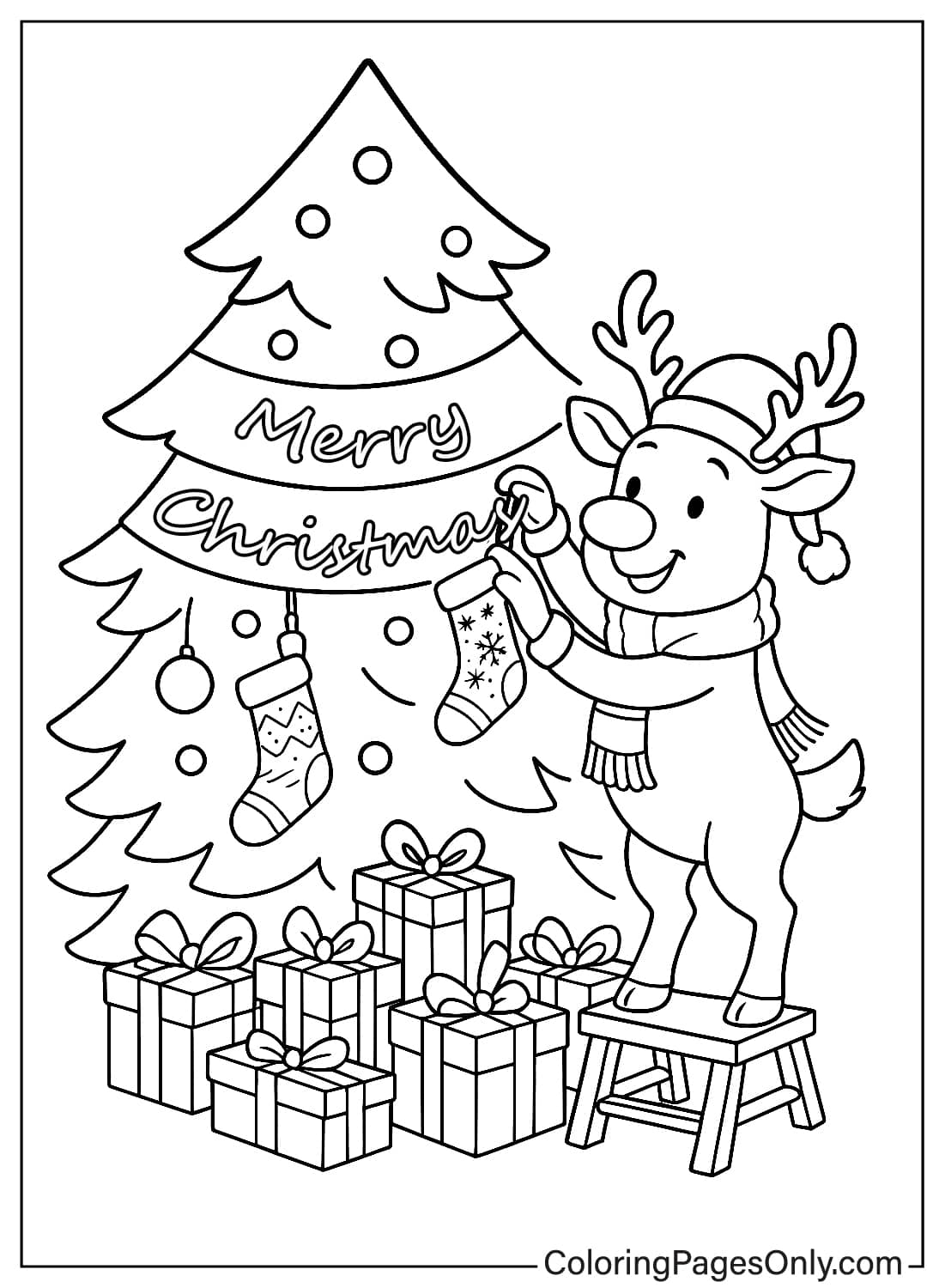
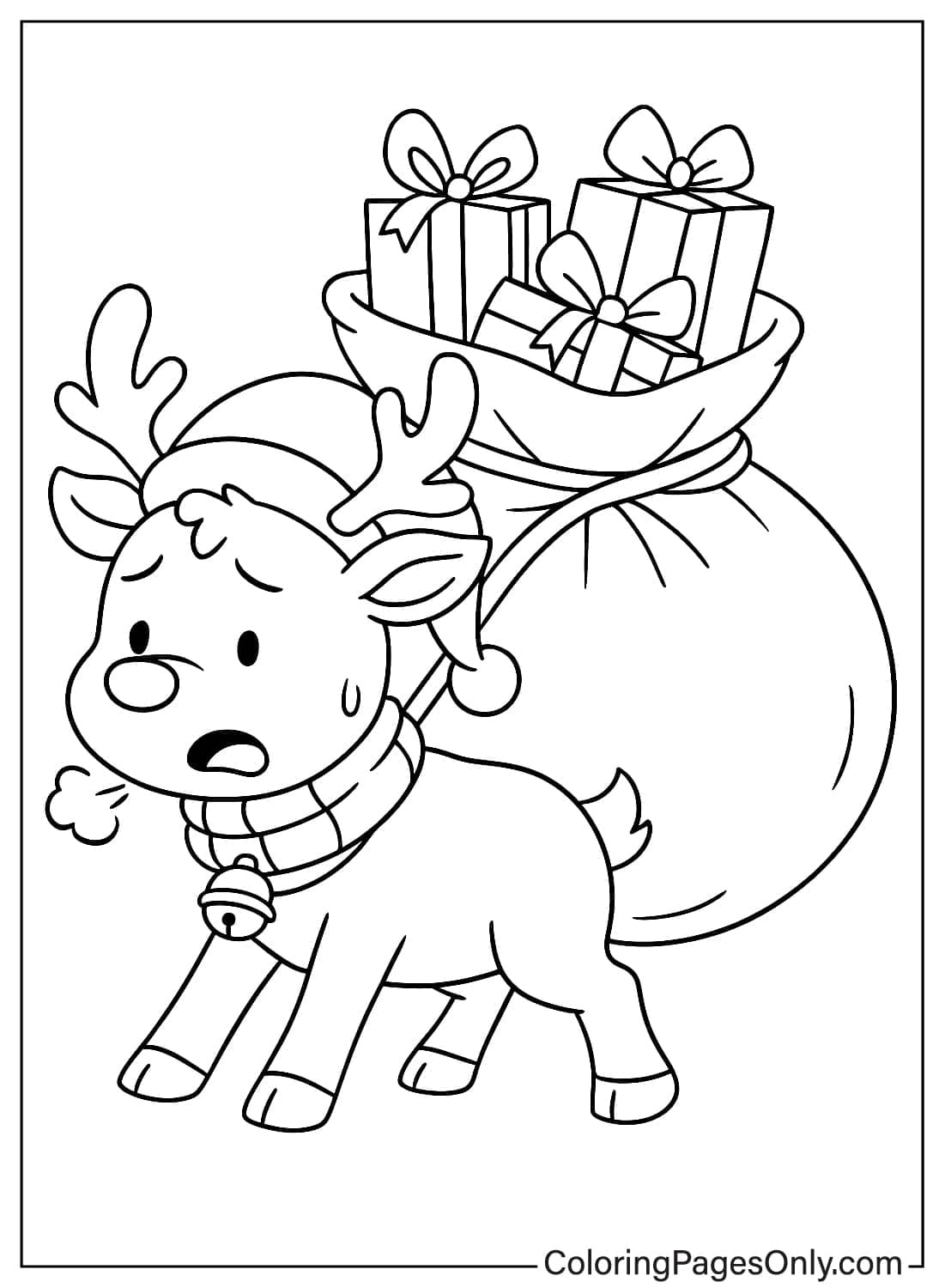
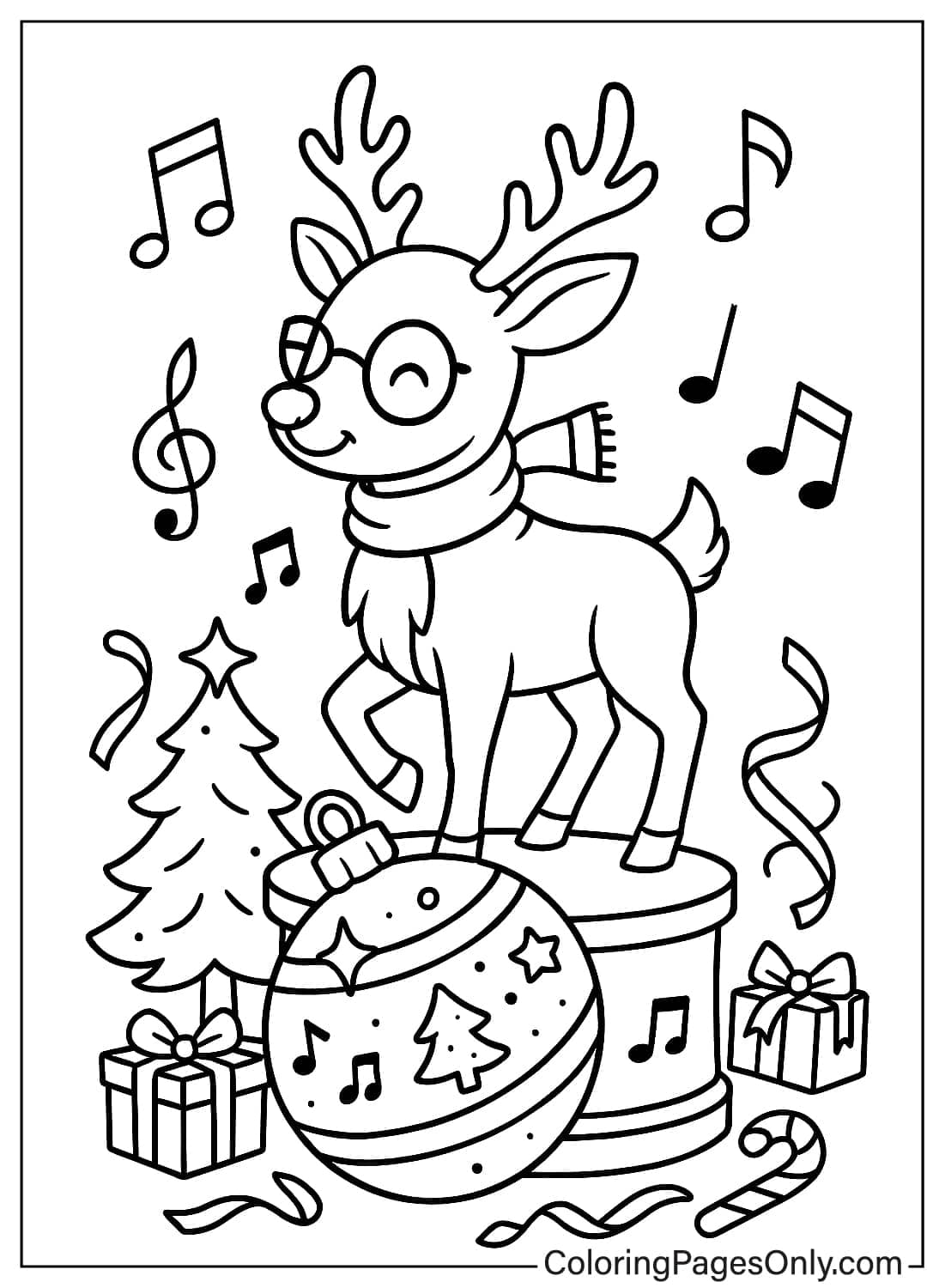
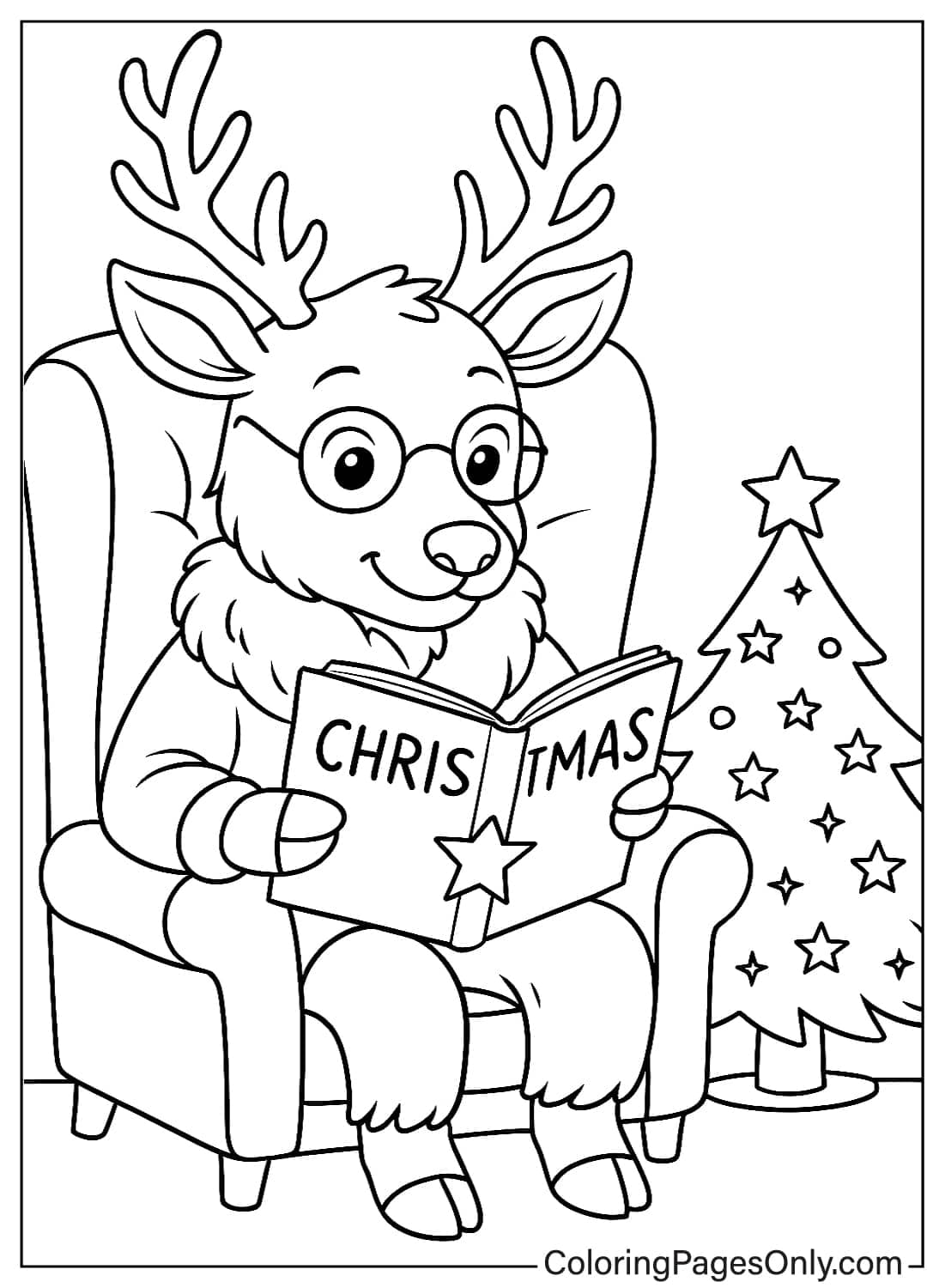
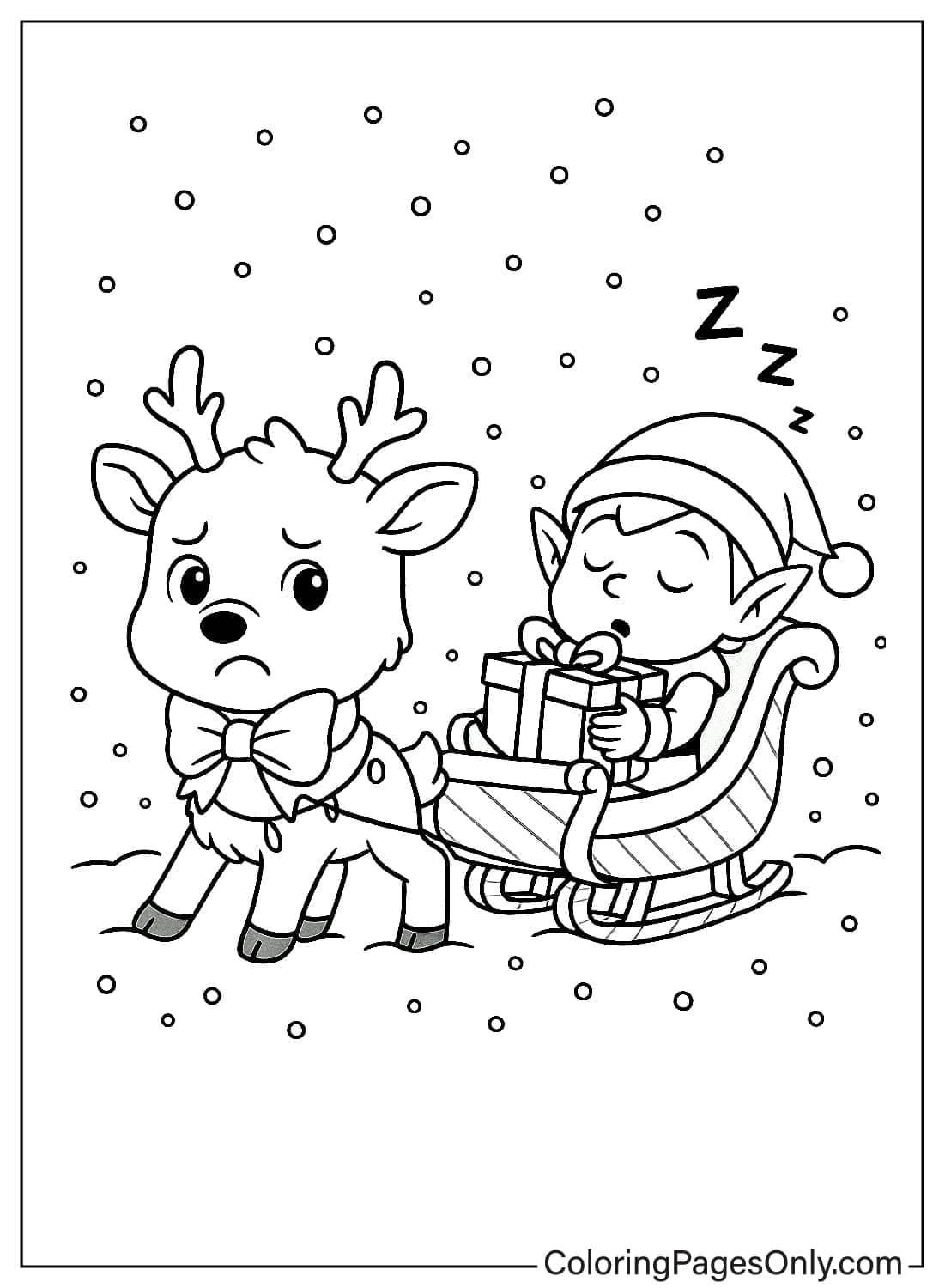
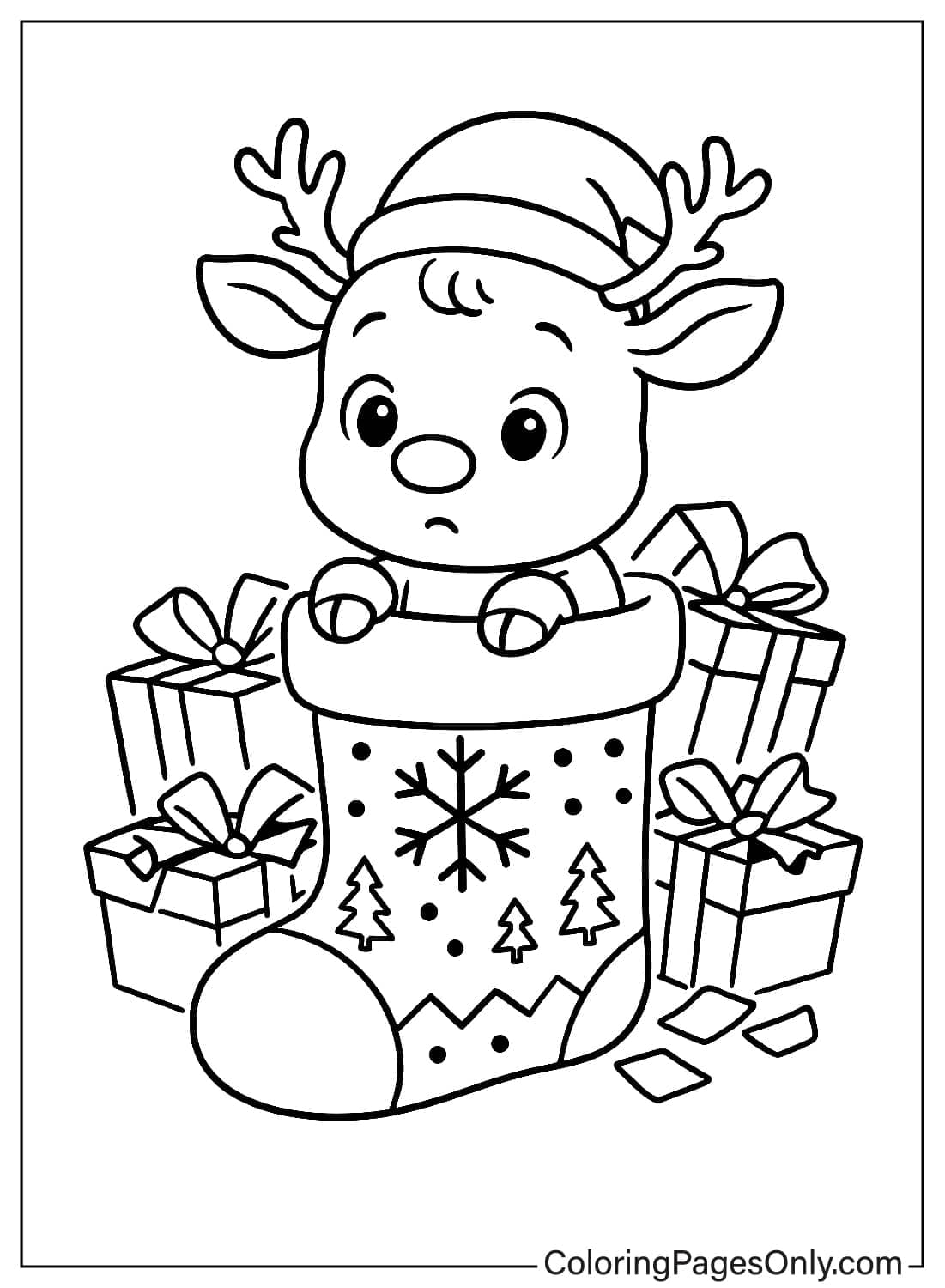
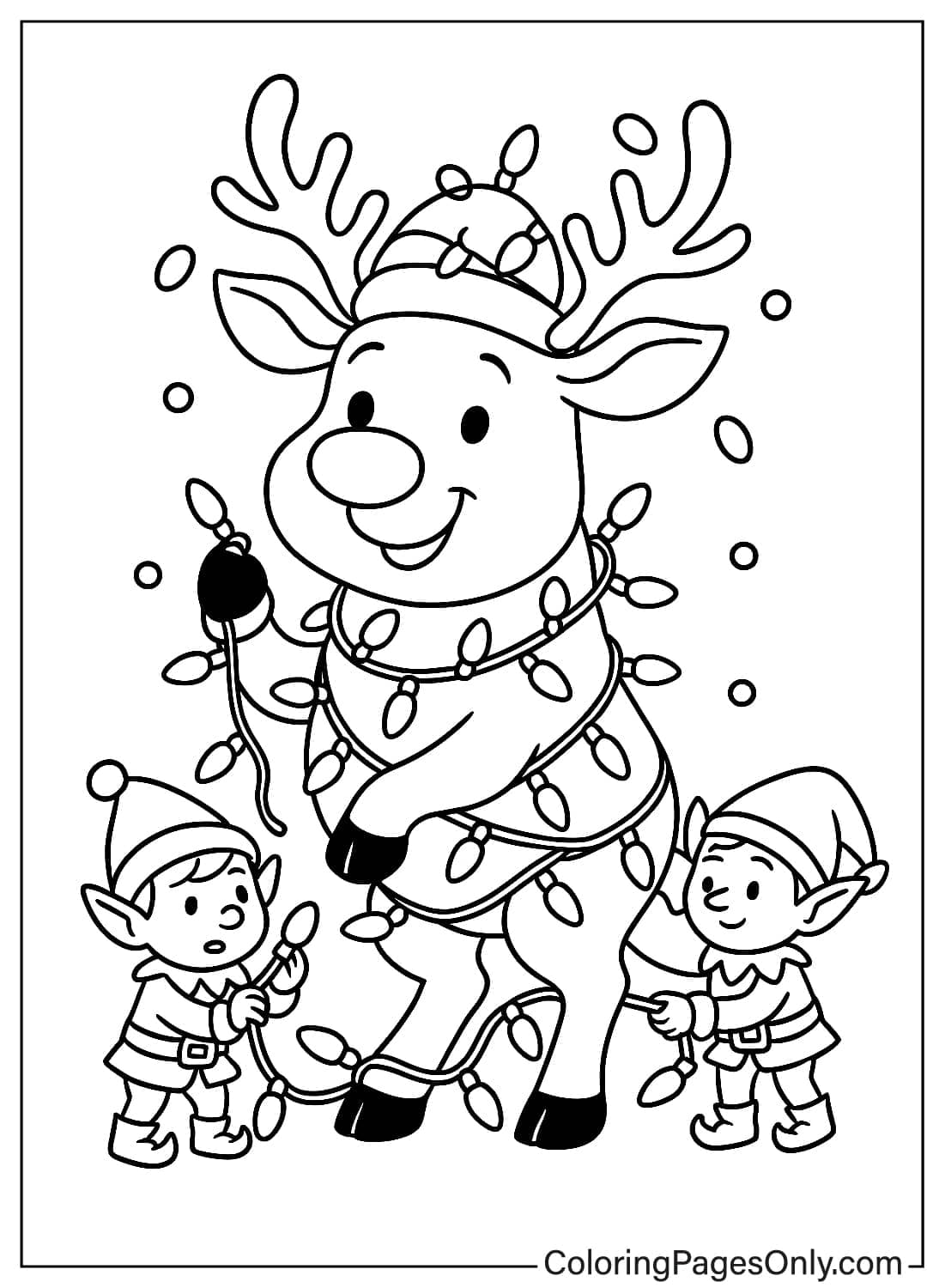
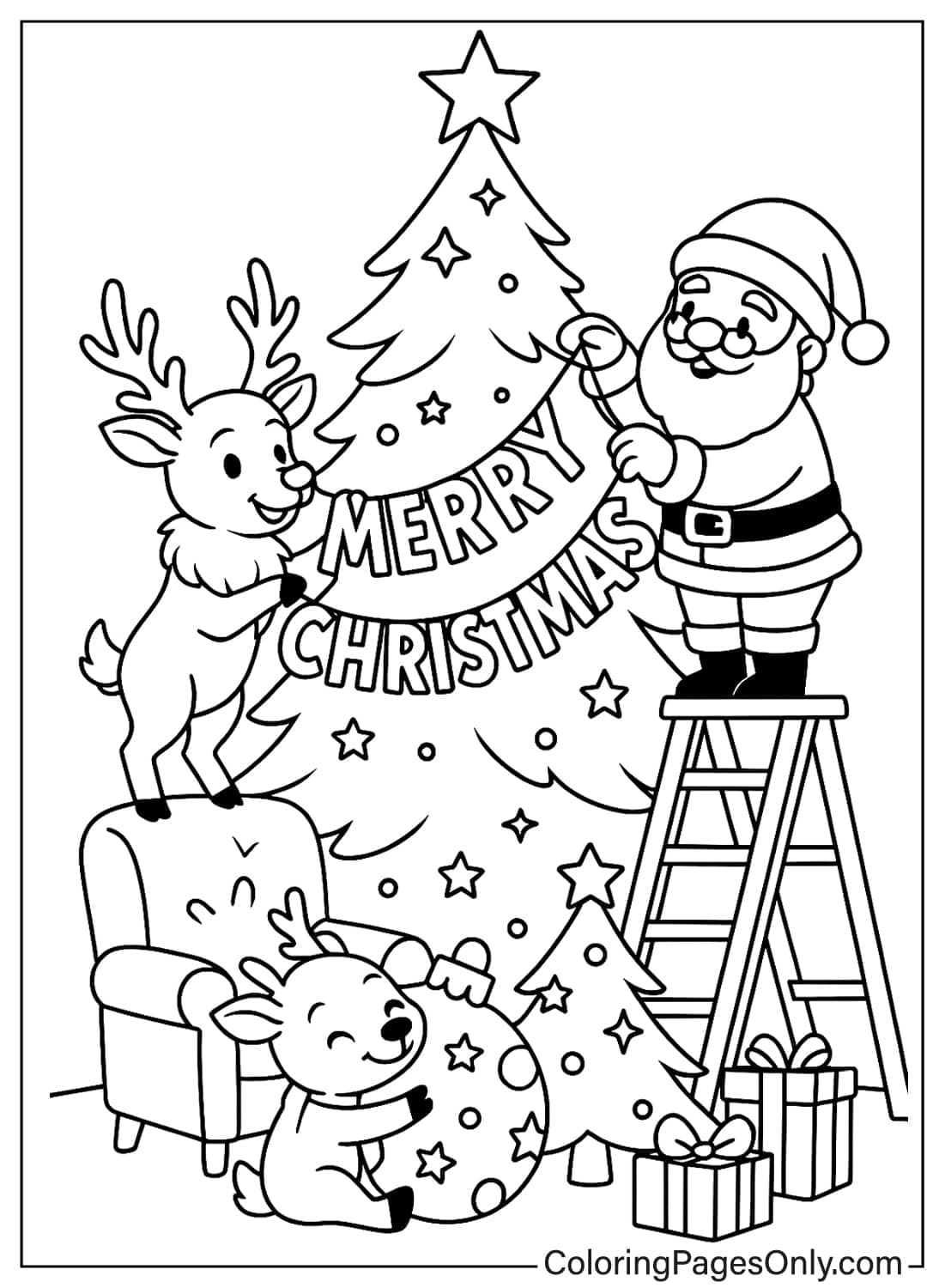
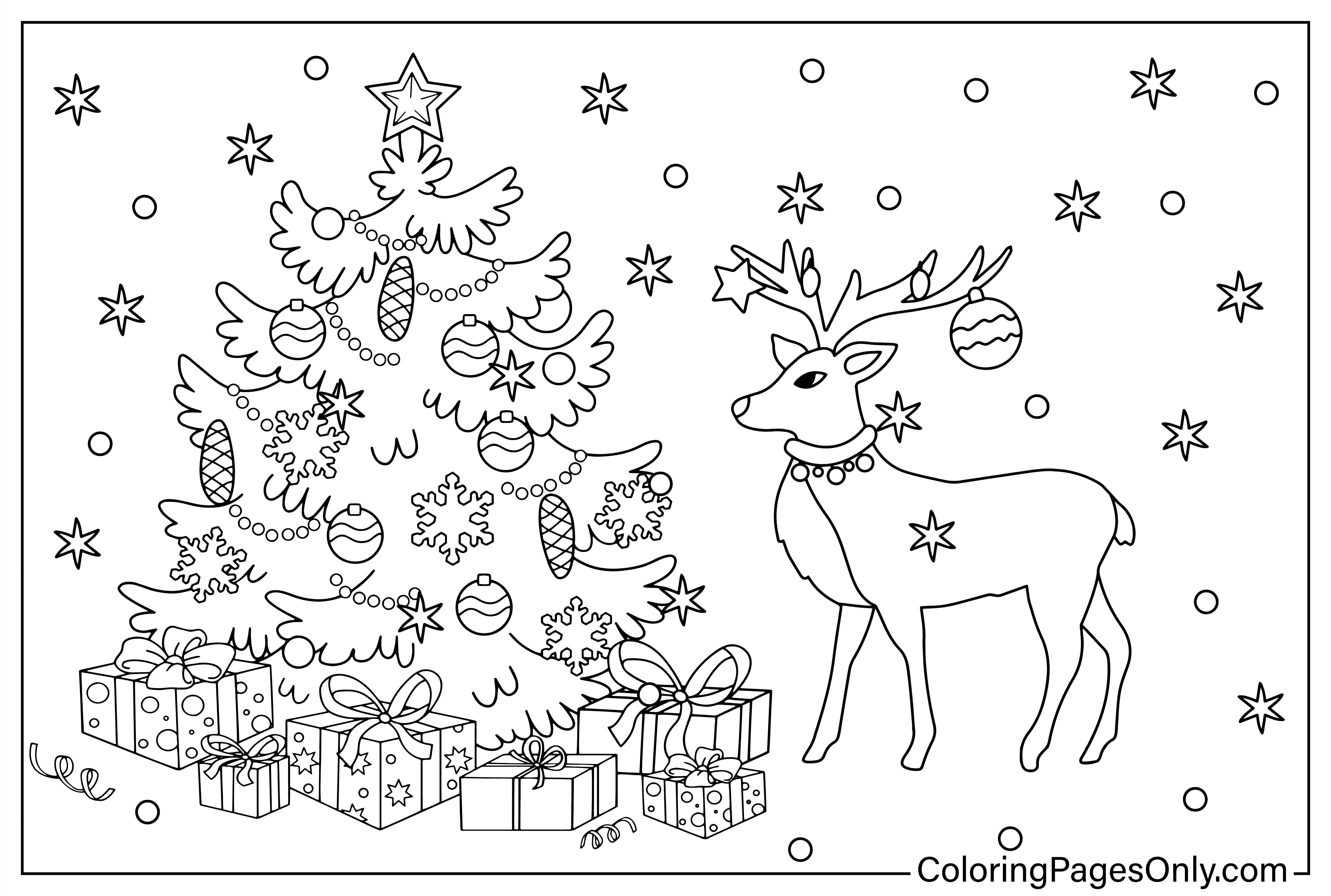
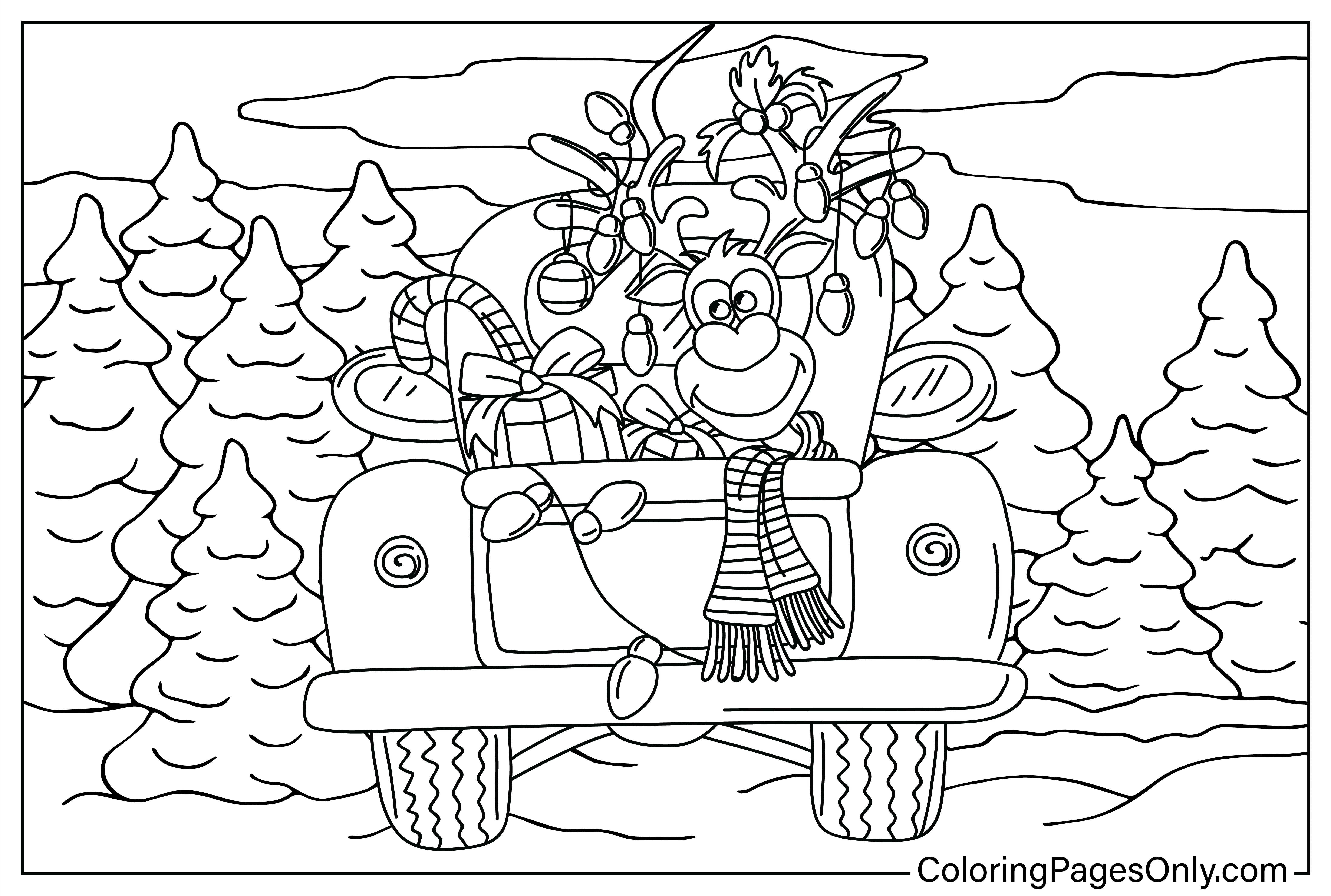
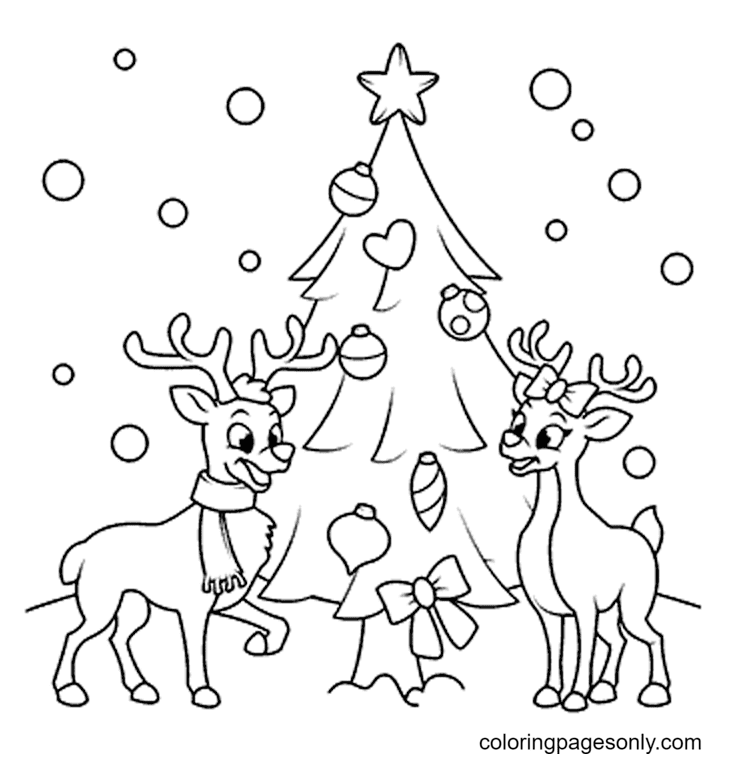
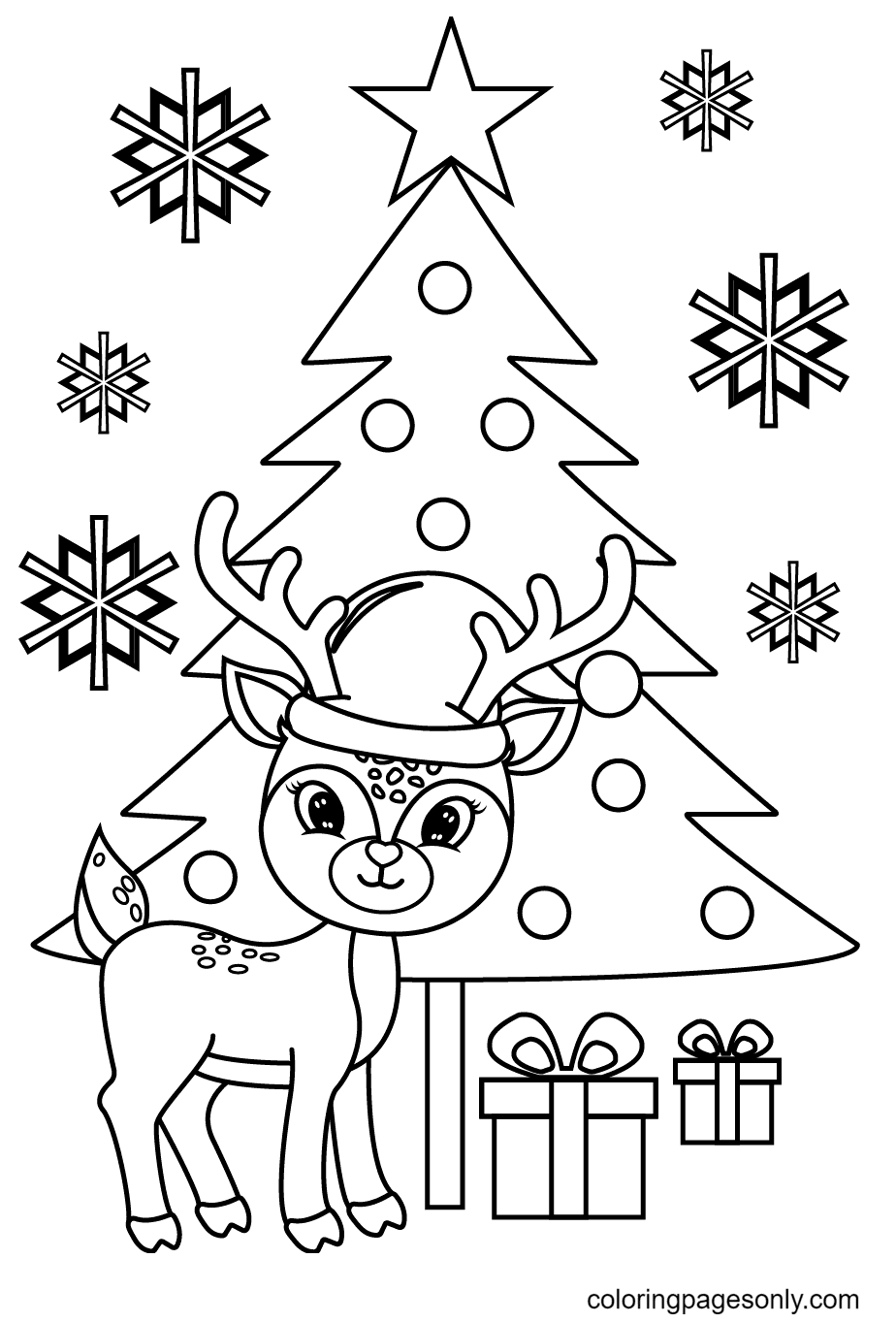
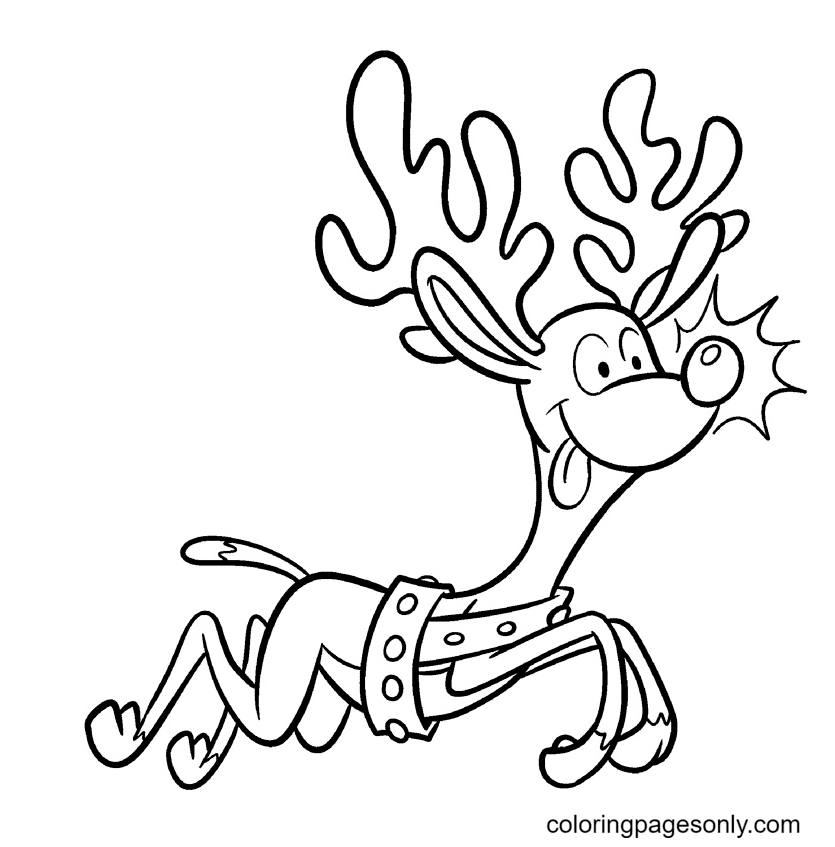
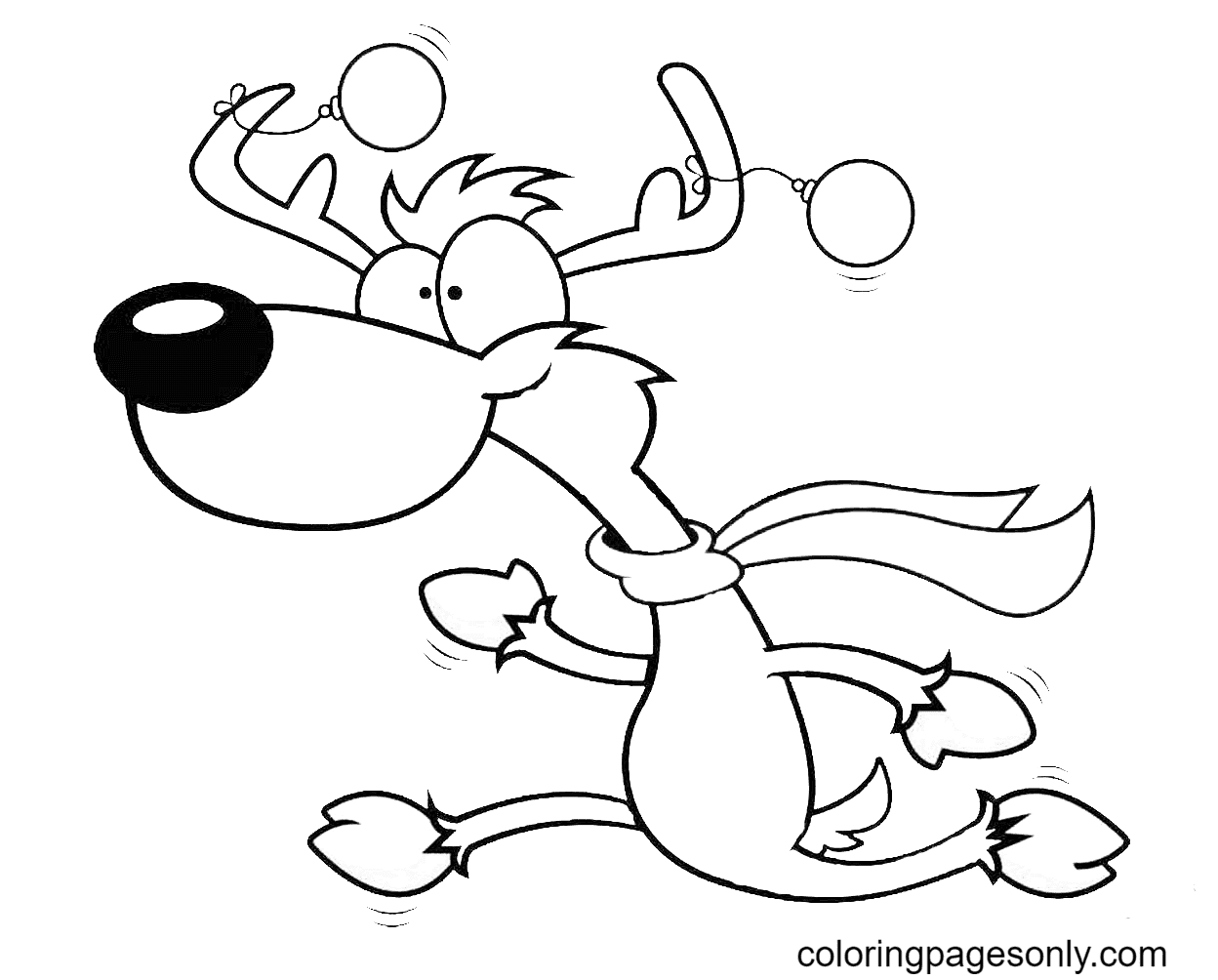
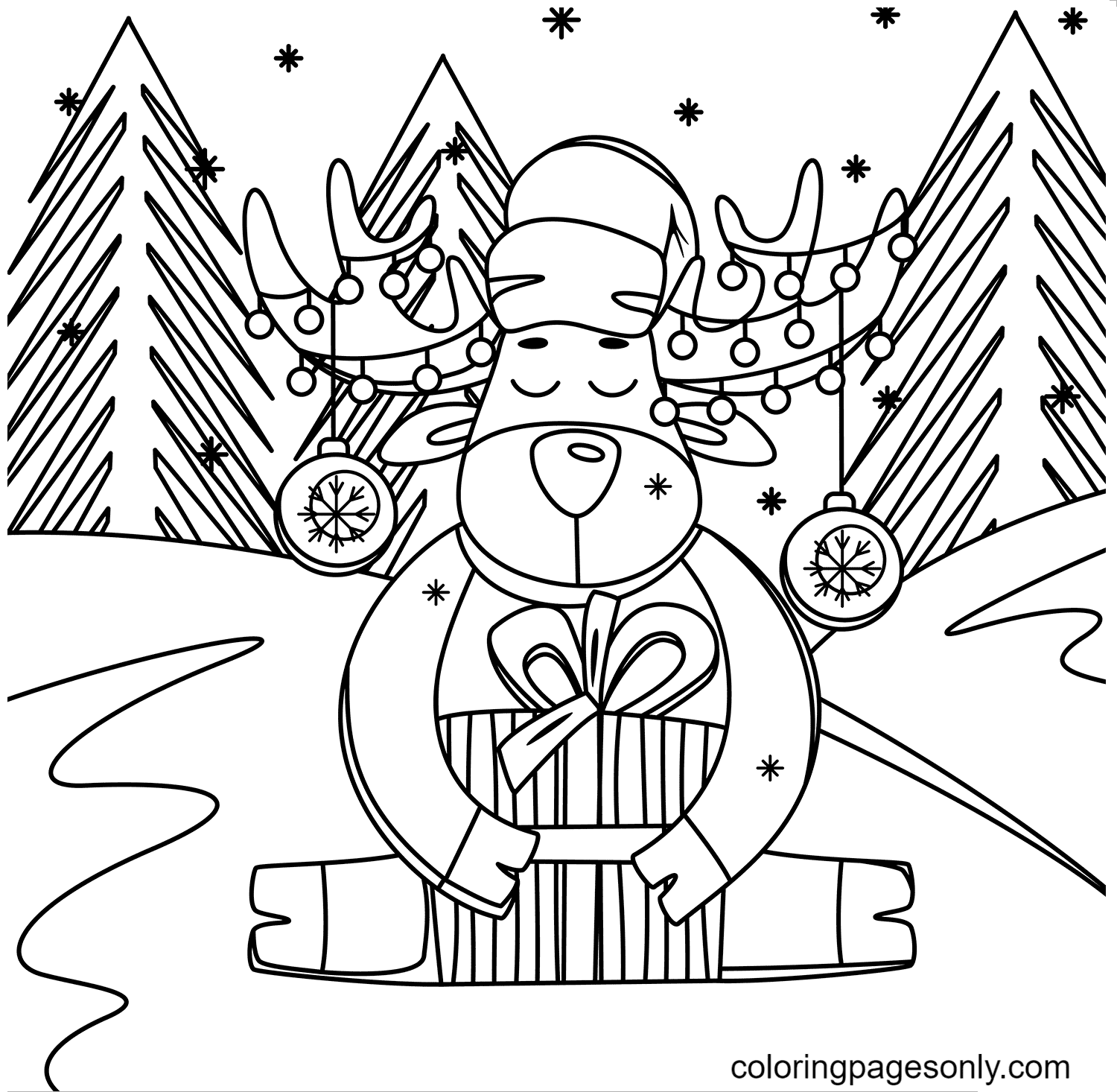
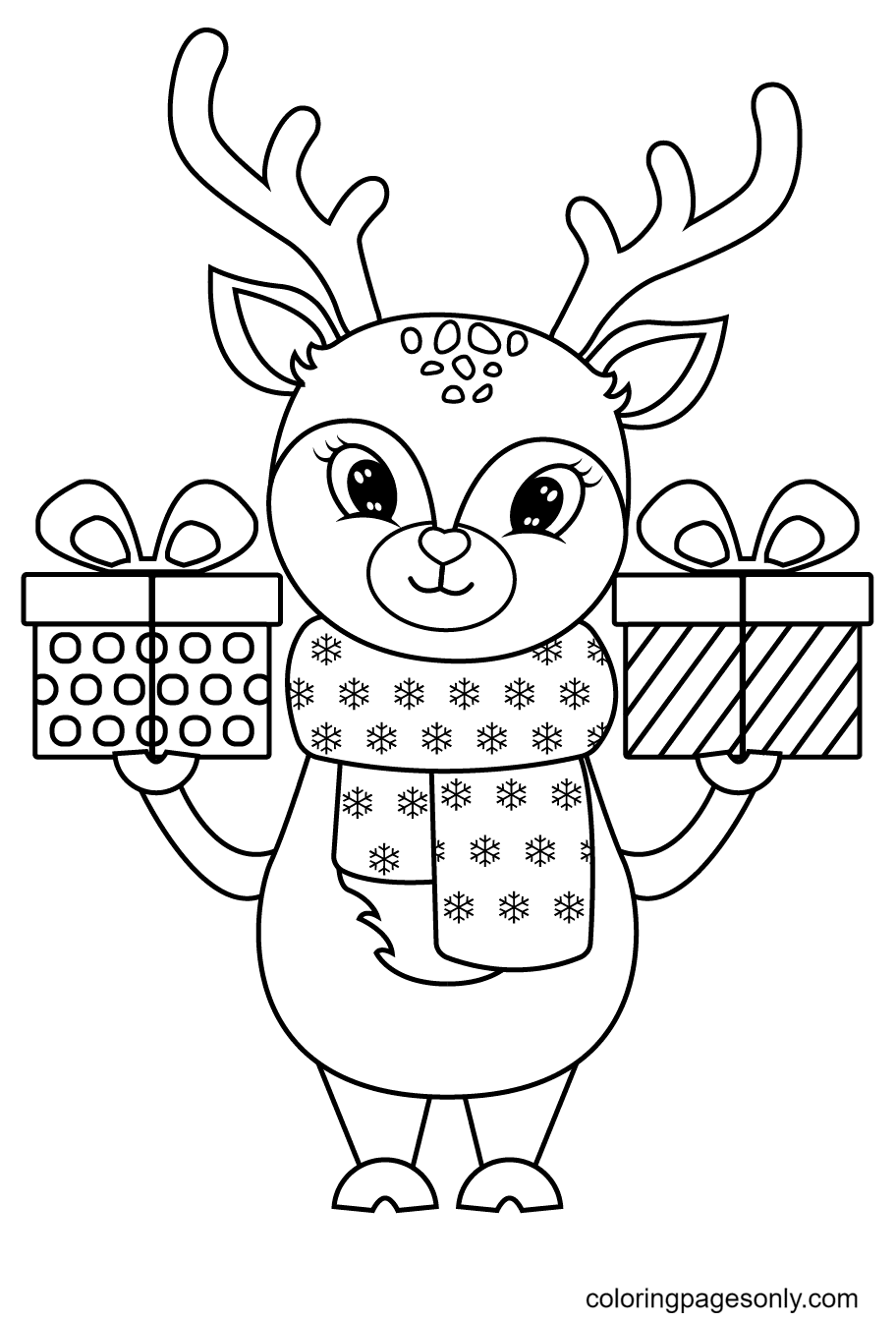
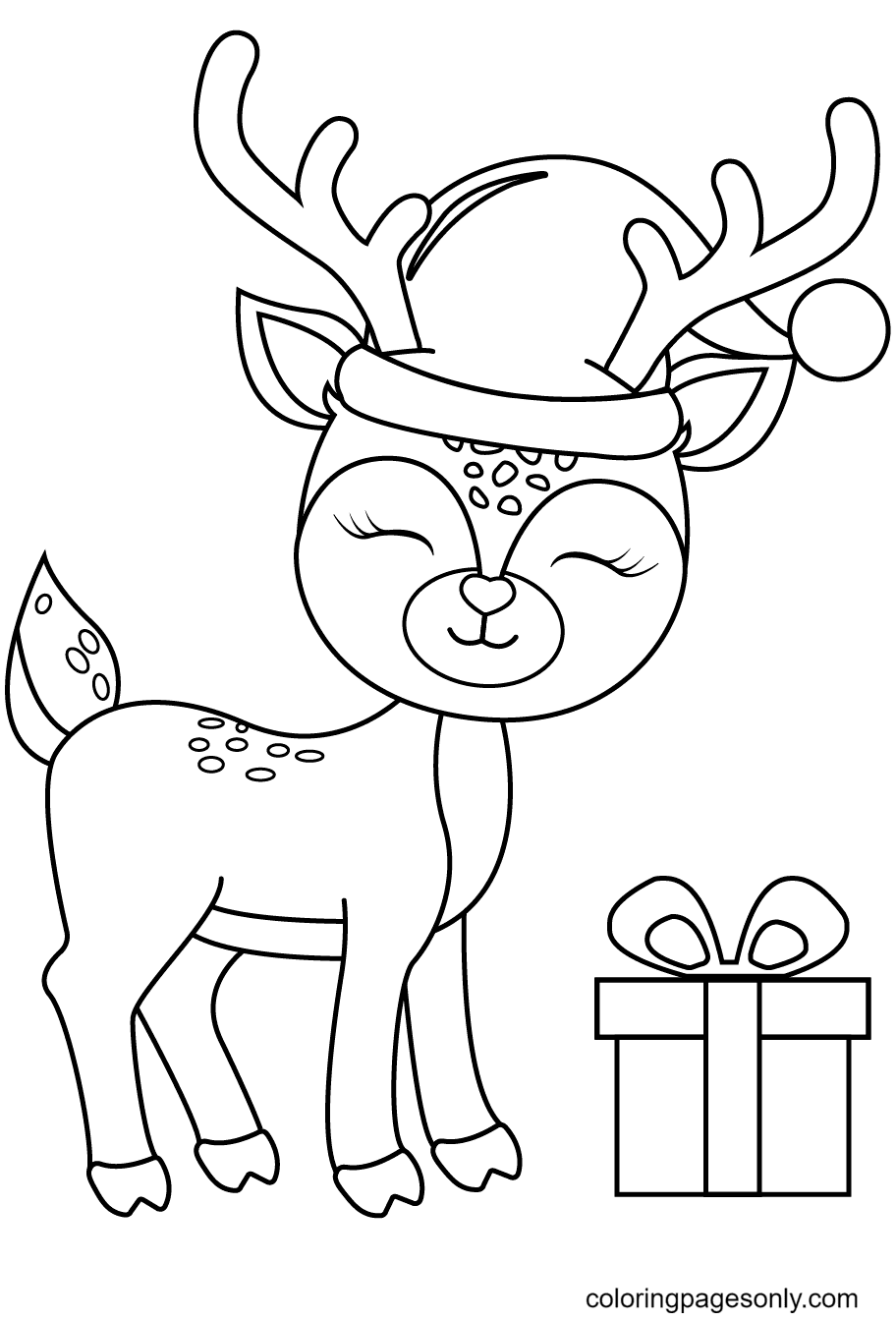
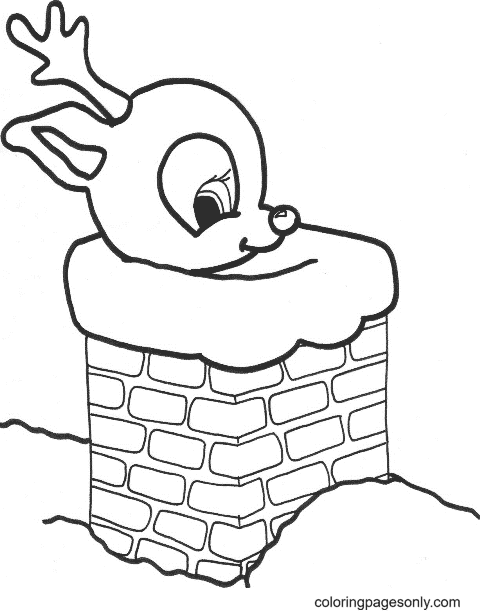
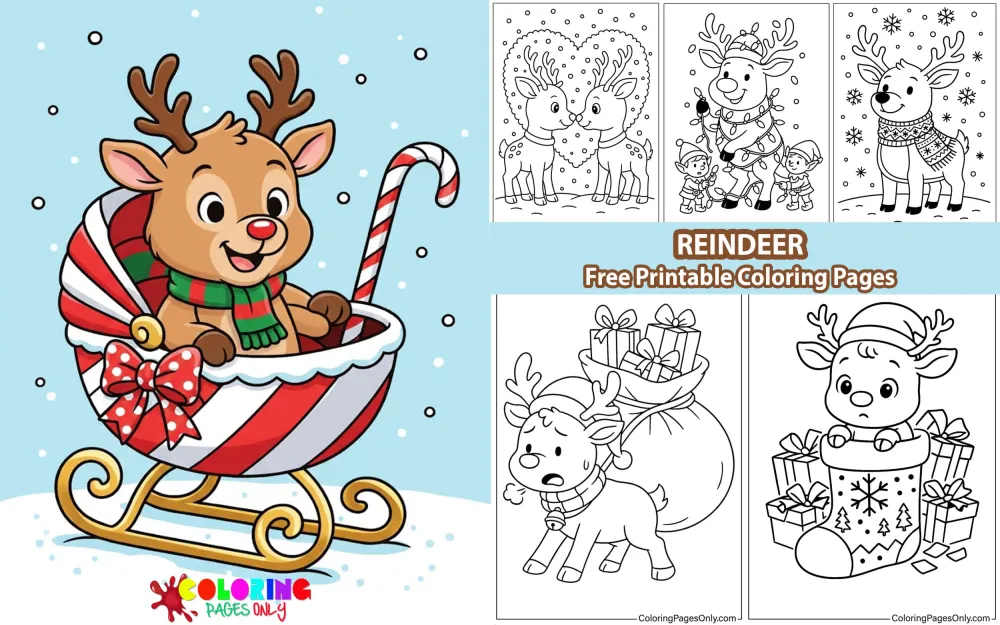
The collection’s newest additions were created for the 2025 Christmas season. These pages show reindeer in specific domestic and festive scenarios rather than in flight or in isolation: decorating a Christmas tree, hanging a wreath, reading by a chair, singing carols, pulling a sleigh with a sleeping elf aboard, popping out of a Christmas stocking, carrying Santa’s sack. The scenes are warmly observed – the reindeer in these pages have expressions and situations that tell small stories.
Coloring cartoon scene pages: The reindeer in these illustrations are warm, medium brown – not orange-brown, not grey-brown, but the natural brown of a chestnut-coated deer. Keep the body tone consistent across all the reindeer in the collection for visual coherence if working through multiple pages. The Christmas props in each scene – candy canes in red-and-white stripes, ornaments in red or gold, wrapping paper – are where the festive color enters the page. Let the reindeer stay warm, brown, while the props carry the Christmas palette.
Rudolph the Red-Nosed Reindeer
Robert L. May created Rudolph in 1939 as a promotional character for Montgomery Ward, the Chicago-based department store chain. The story was distributed as a free booklet to children shopping with their parents; approximately 2.4 million copies were given out in its first year. May’s brother-in-law, Johnny Marks, adapted the story into a song recorded by Gene Autry in 1949, which became one of the best-selling Christmas singles of all time. The 1964 television special, produced by Rankin/Bass Productions and narrated by Burl Ives, has aired annually on NBC and CBS since its debut.
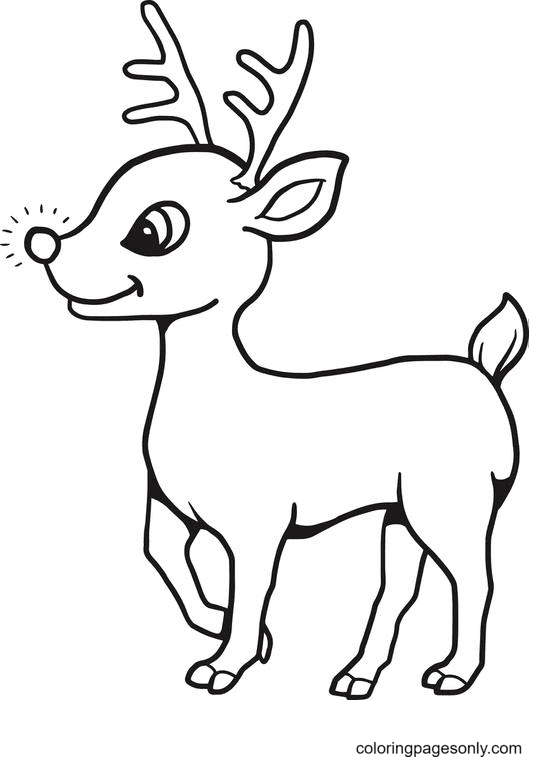
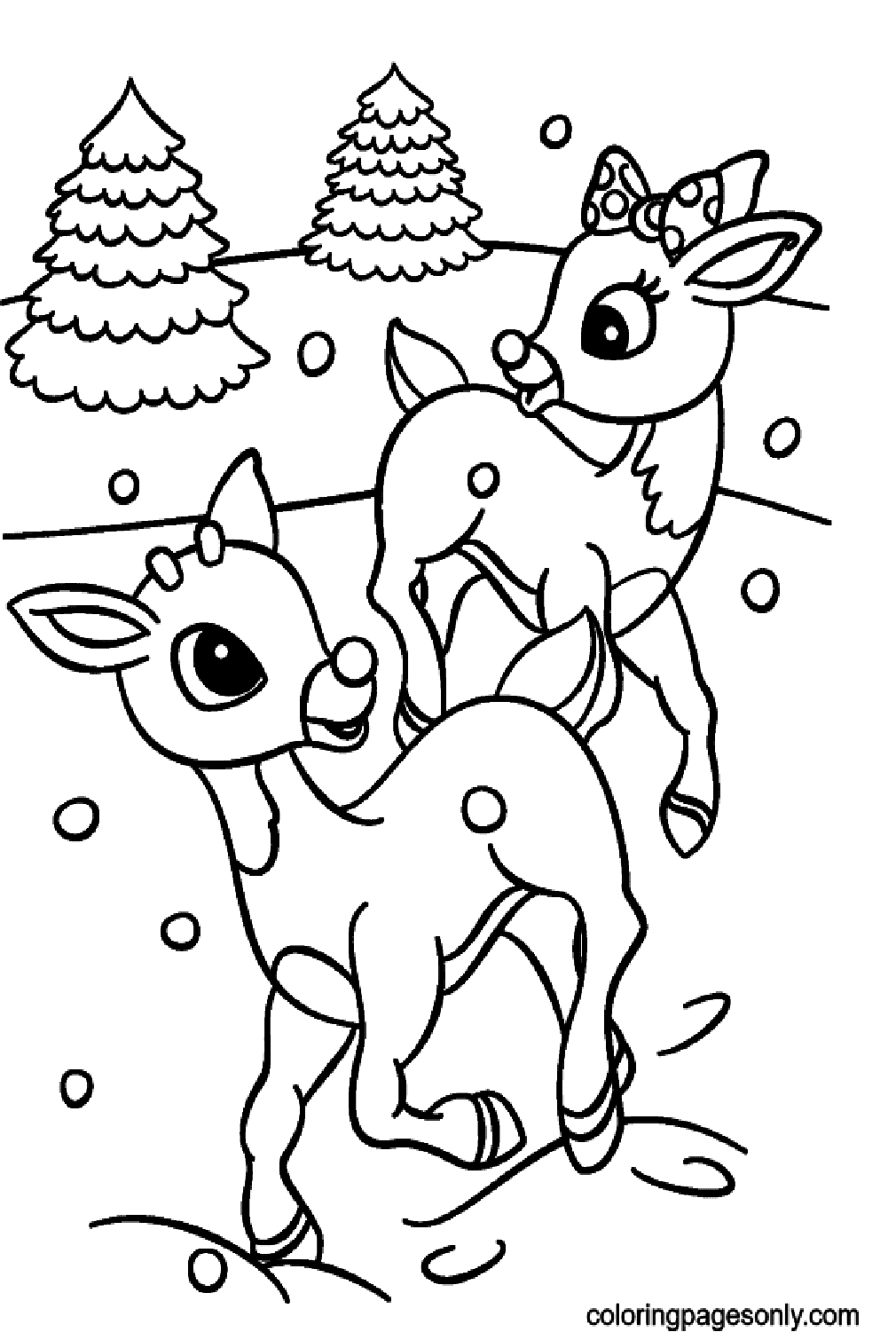
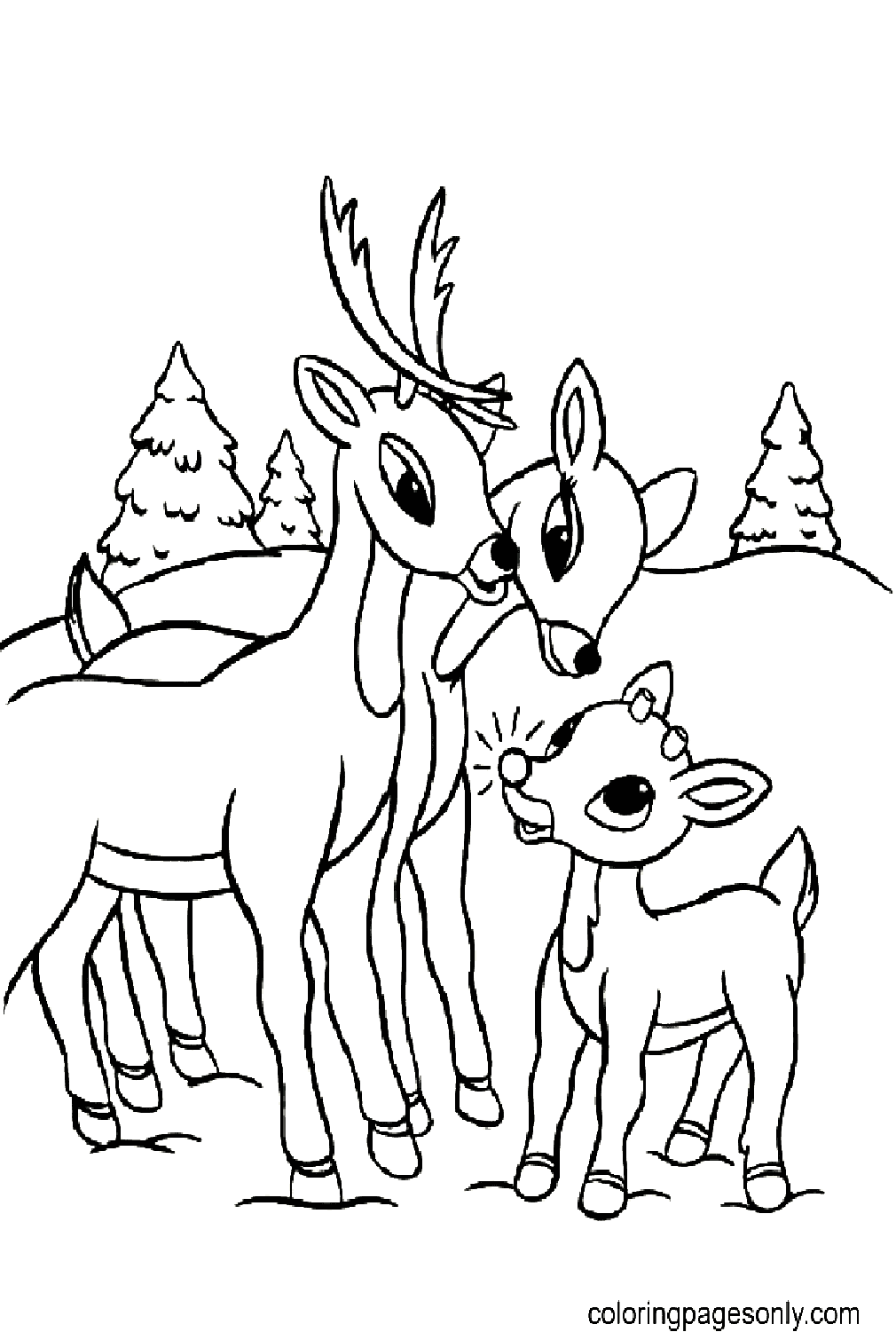
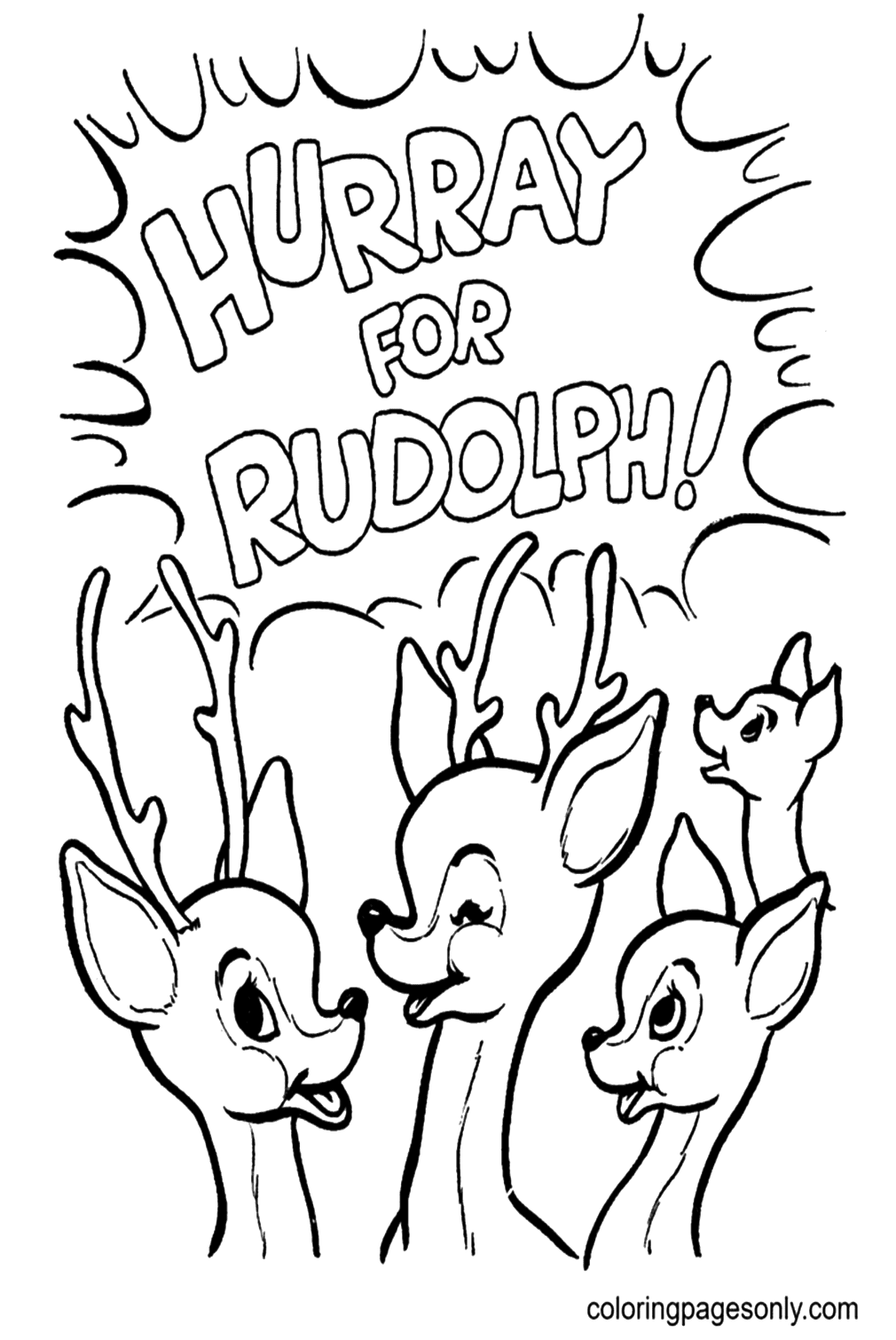
The collection’s Rudolph pages include standalone Rudolph portraits, Rudolph with family, and Rudolph in flight. His nose is the page’s coloring anchor – the one element where standard bright crayon red is exactly correct.
Coloring Rudolph: His body is the same warm medium brown as the other reindeer. The nose is round, prominent, and bright red – the specific candy-apple red that reads as luminous, not dark. On pages that show the nose glowing, leave the very center slightly lighter than the outer edges to suggest the light source. His antlers are a slightly lighter, more golden-brown than his body coat, with the tips reading as the lightest part of the antler structure.
Santa and the Sleigh Team
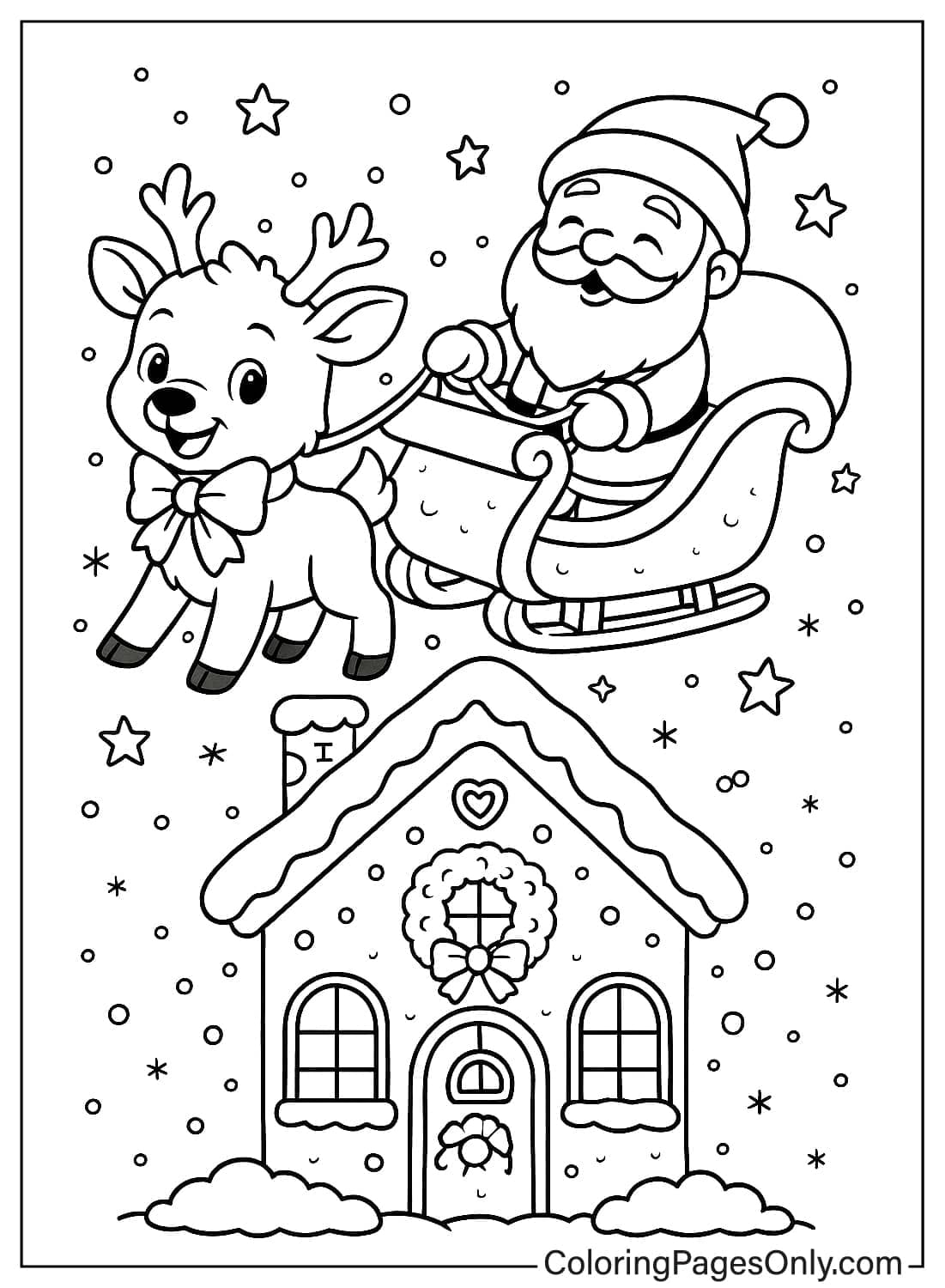
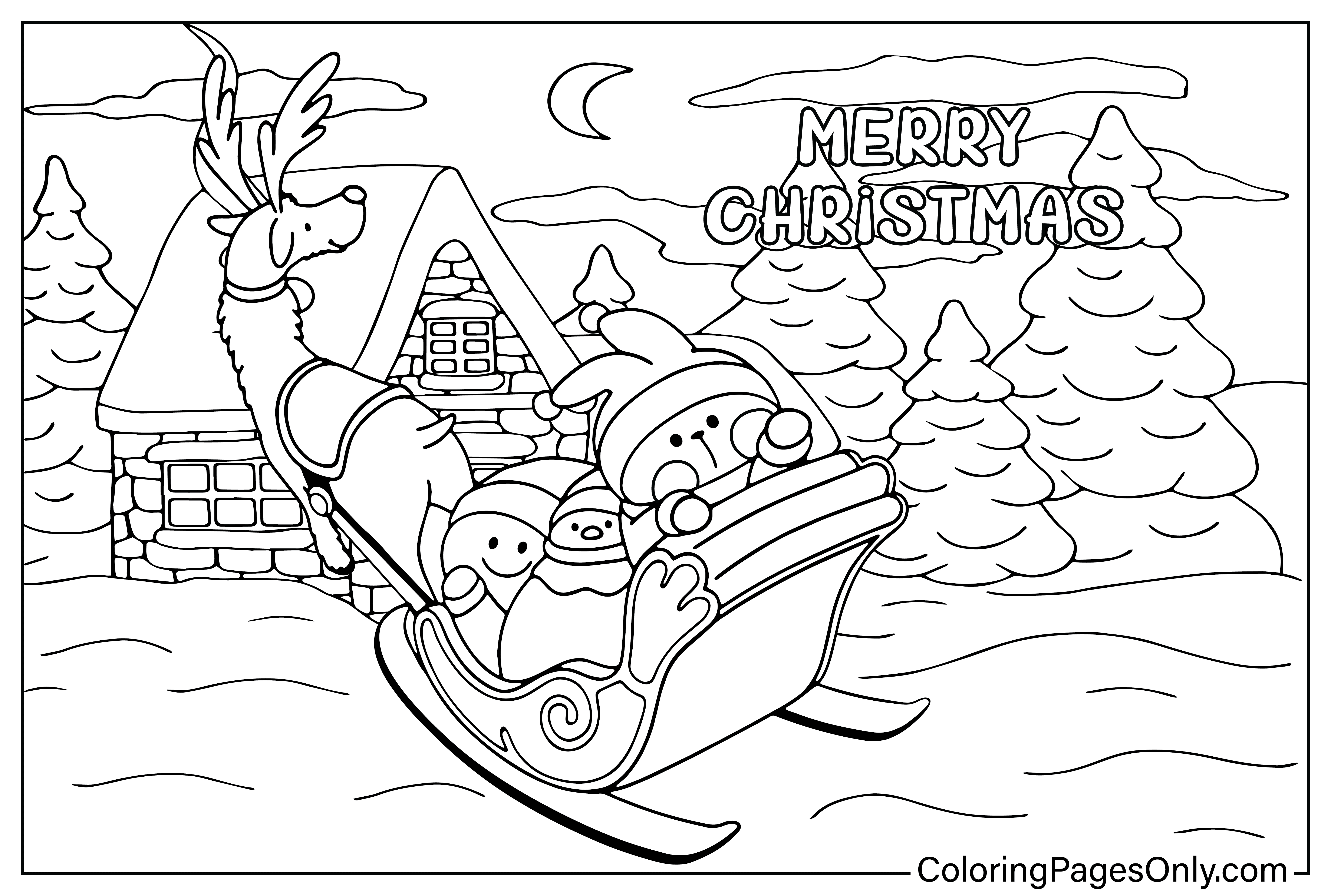
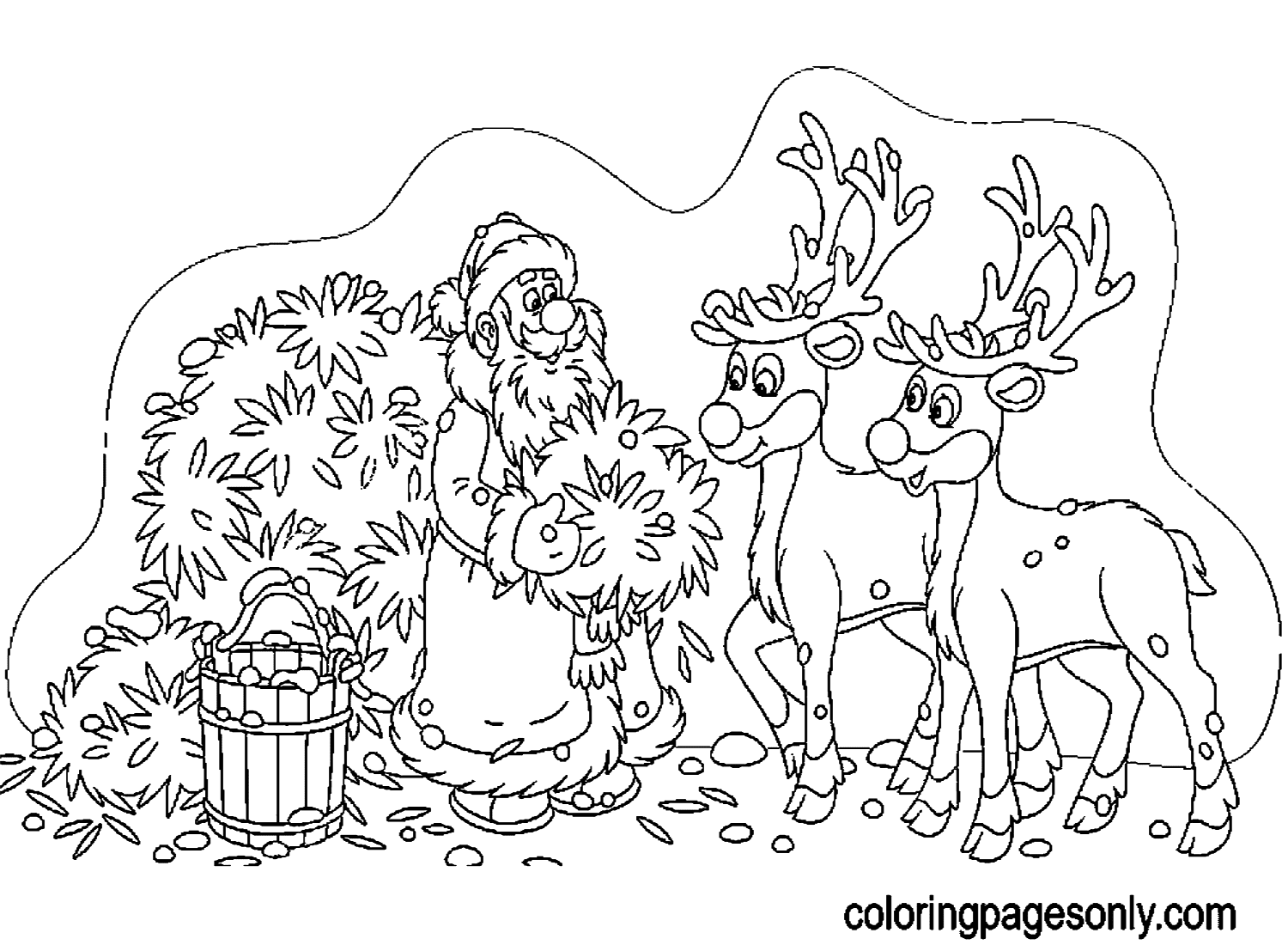
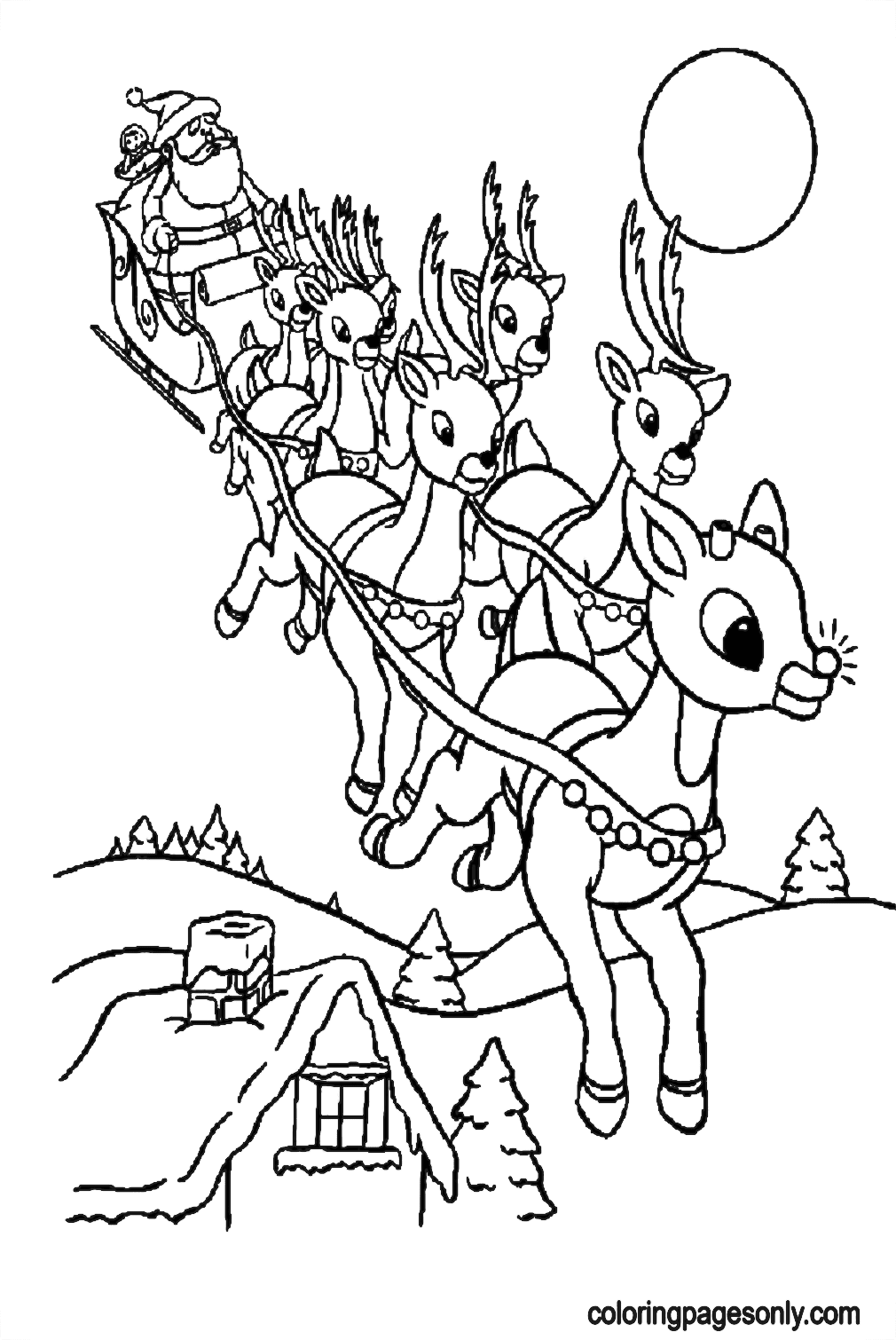
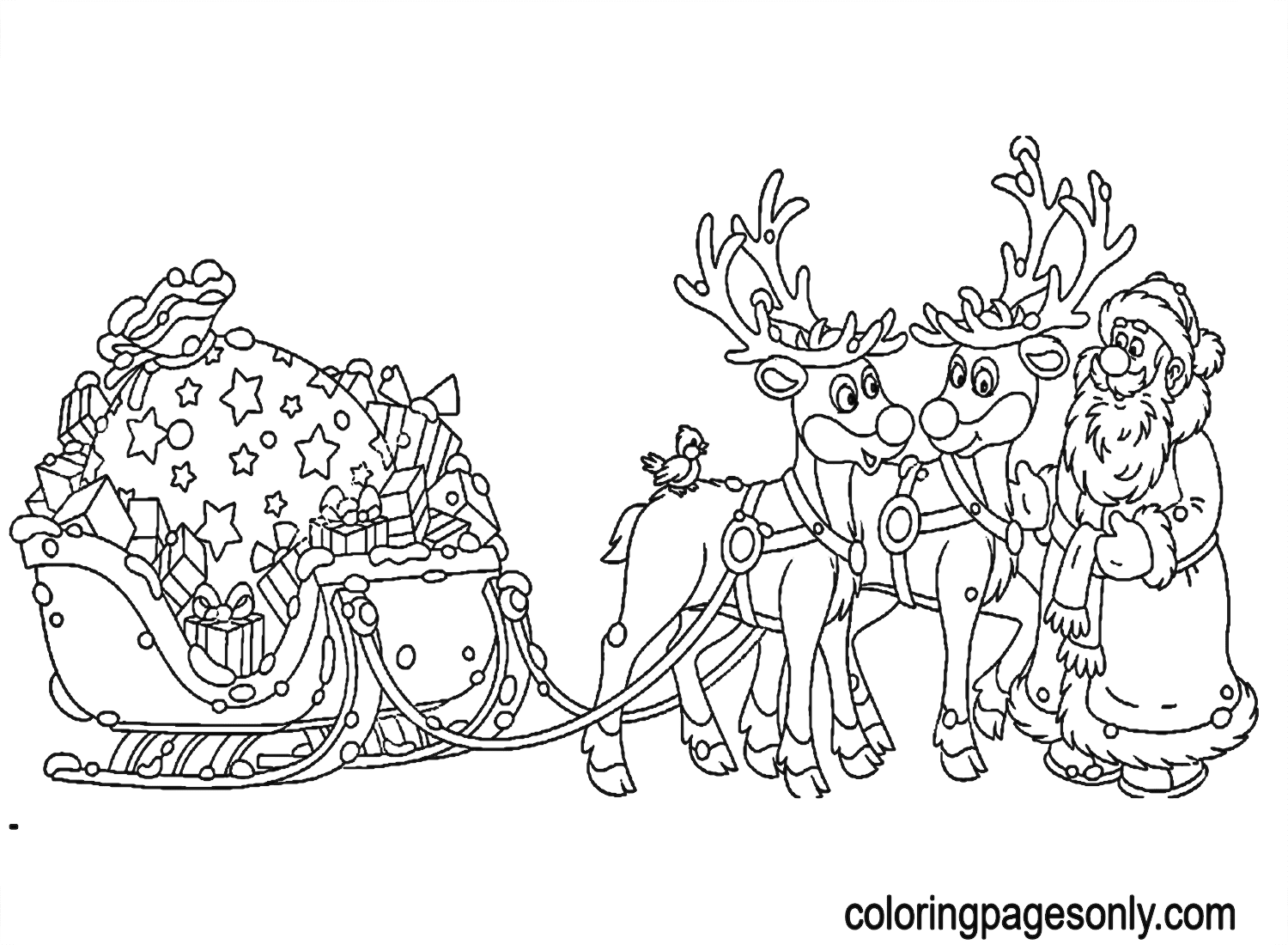
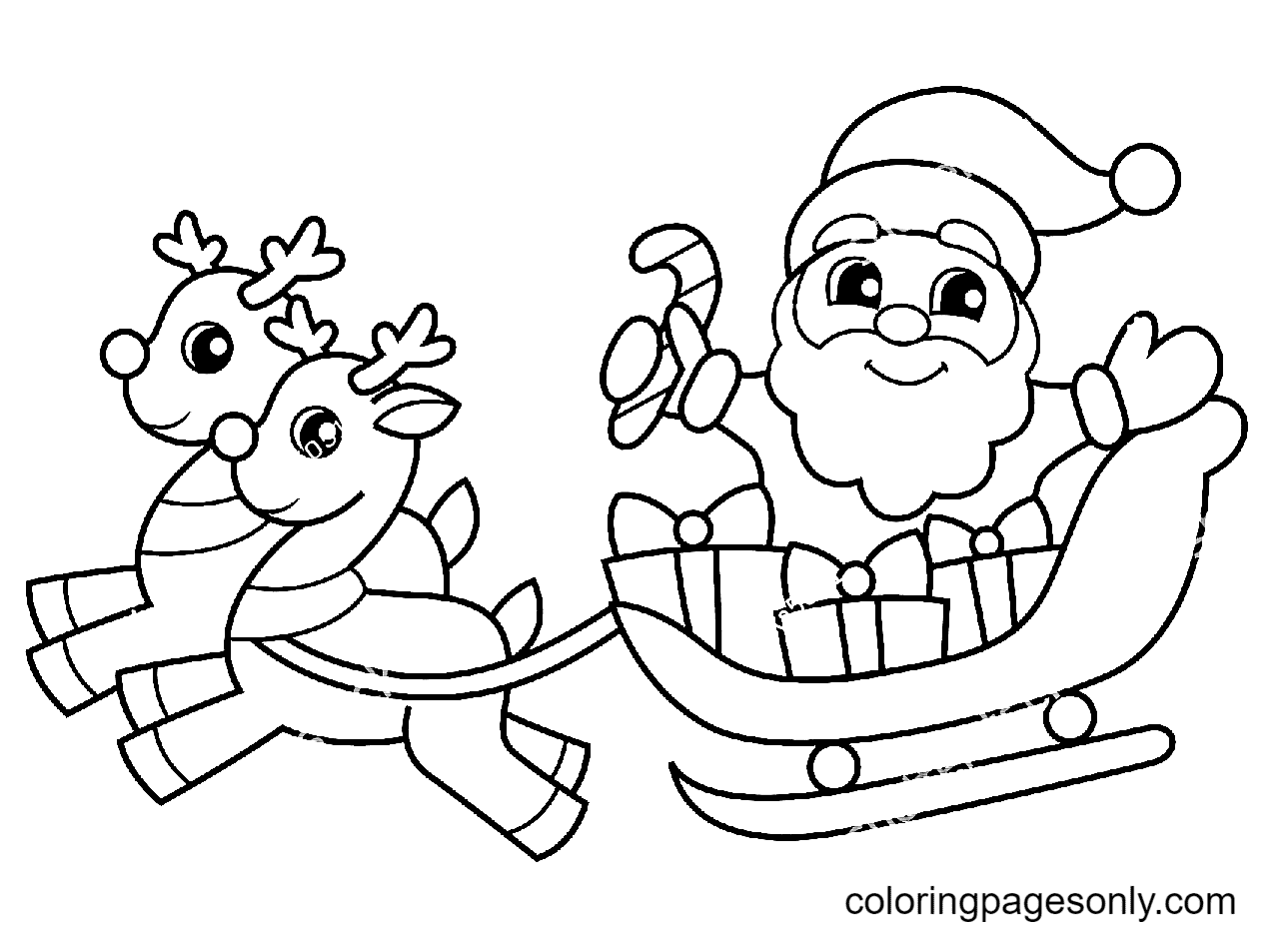
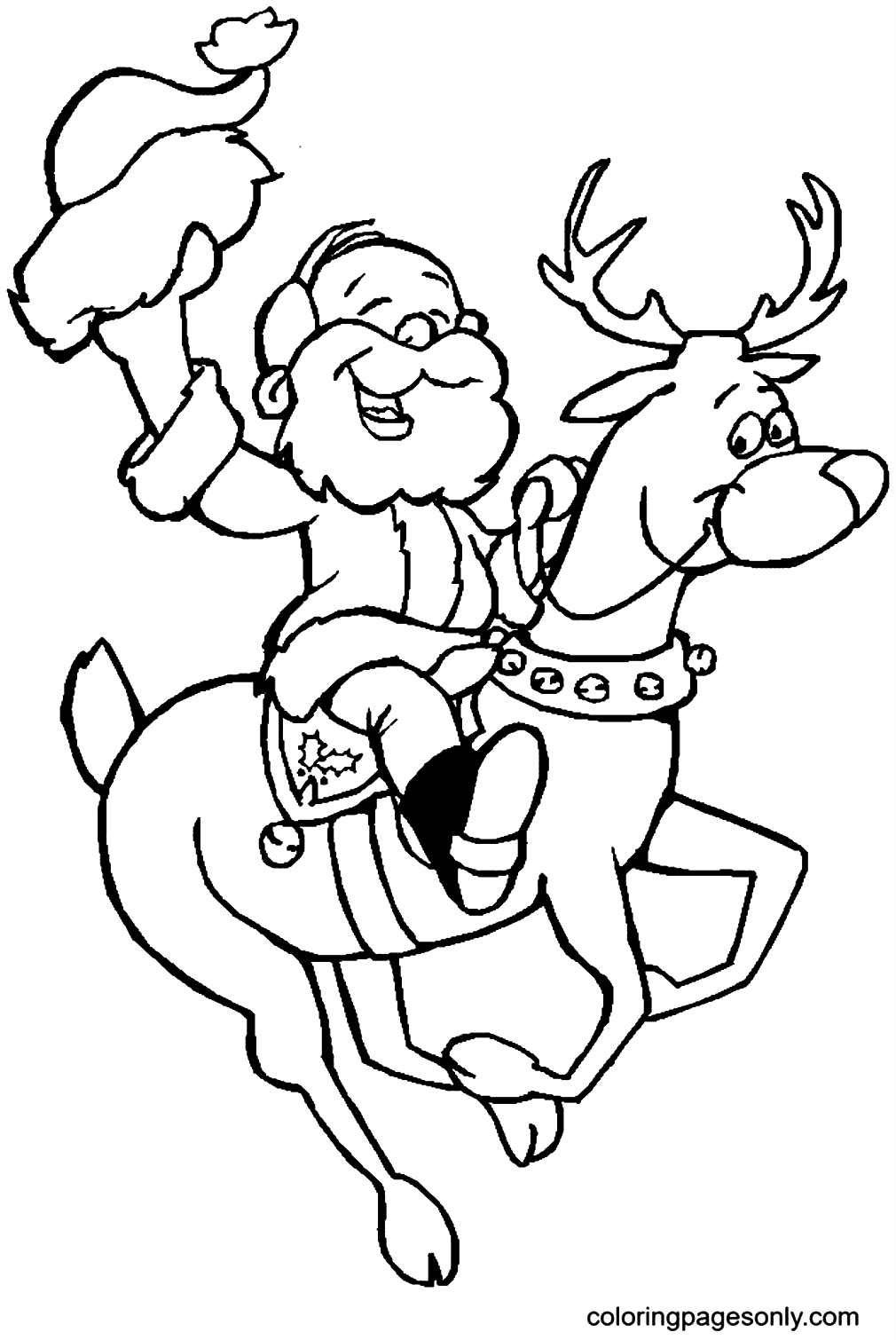
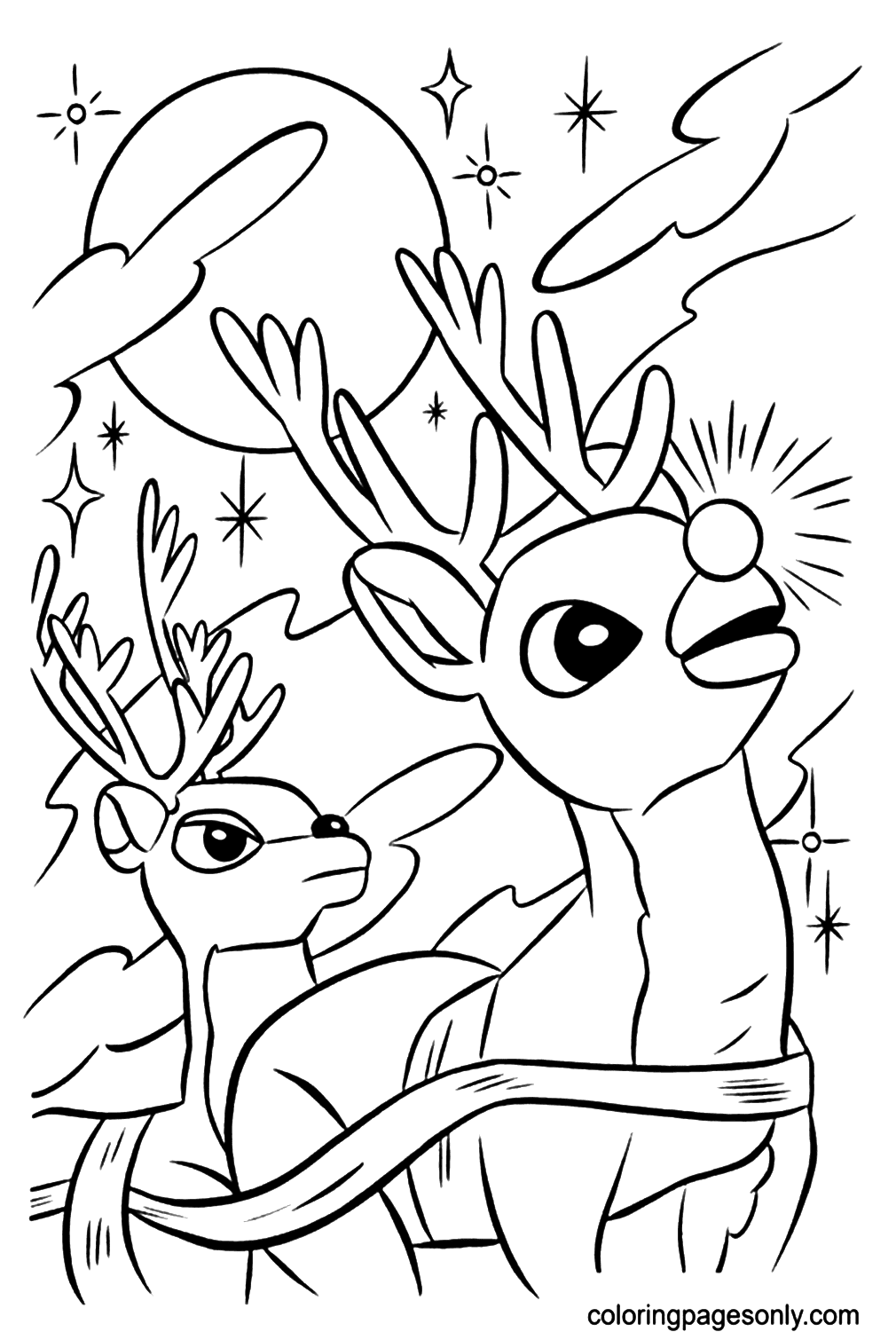
Pages showing Santa Claus with reindeer in flight, in harness, feeding, or decorating together. The sleigh team traditionally includes all eight named reindeer from the 1823 poem in formation – four pairs, with Rudolph leading since 1939. Multi-reindeer pages are the collection’s most complex for coloring, requiring consistent body color across multiple animals while keeping their individual harness details distinct.
Coloring the harness and sleigh: Santa’s sleigh is traditionally shown in dark red – a deep burgundy rather than bright red, consistent with the historical depiction of a lacquered wooden sleigh. The harness connecting the reindeer is brown leather with brass or gold metal fittings; render the fittings in warm yellow-gold, distinct from the leather straps in dark warm brown. On flight pages, the background sky is deep midnight navy behind the warm-colored sleigh, reindeer, and Santa – the contrast makes the figures read forward against it and reads correctly as the darkest hour of Christmas Eve.
Sven from Frozen
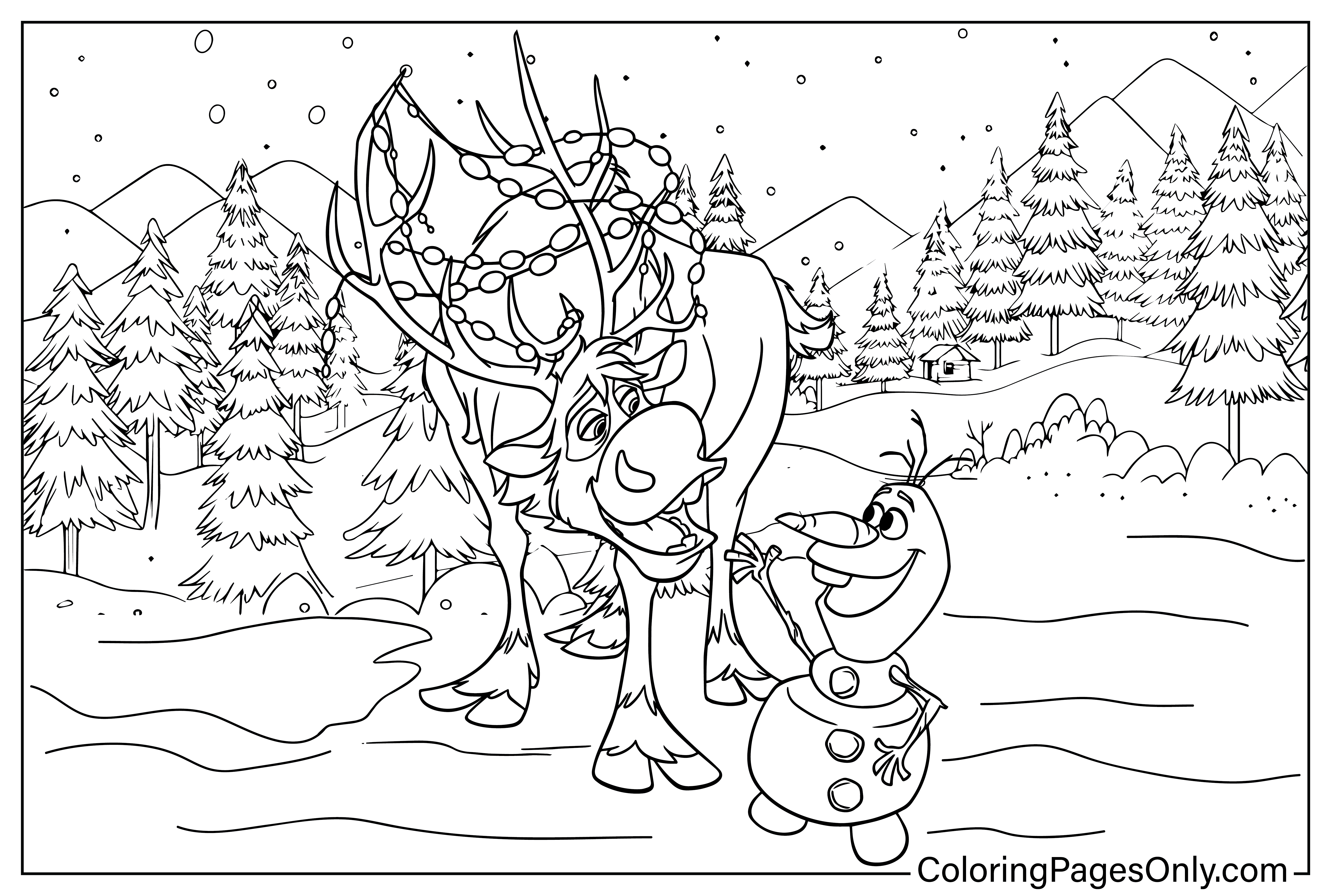
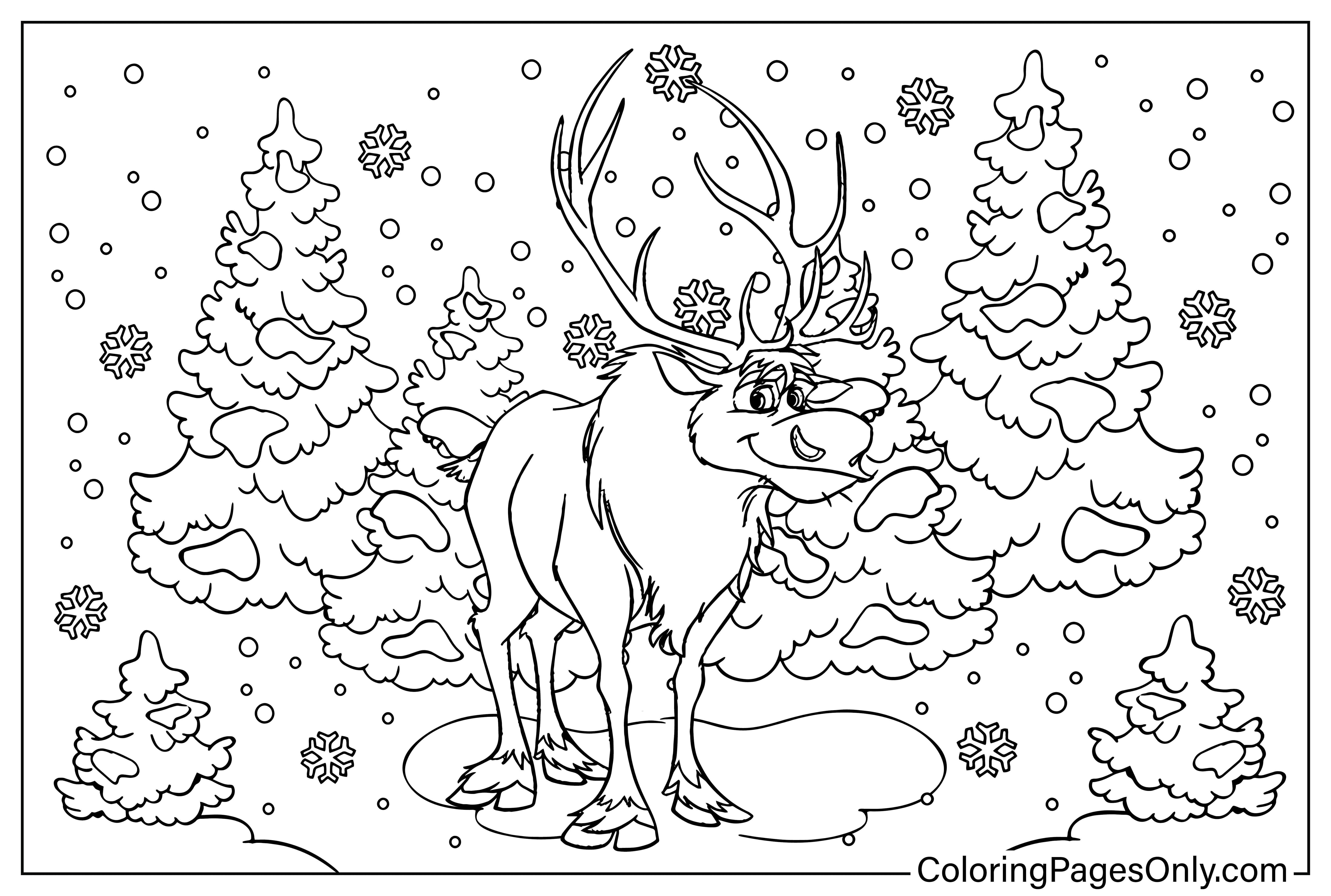
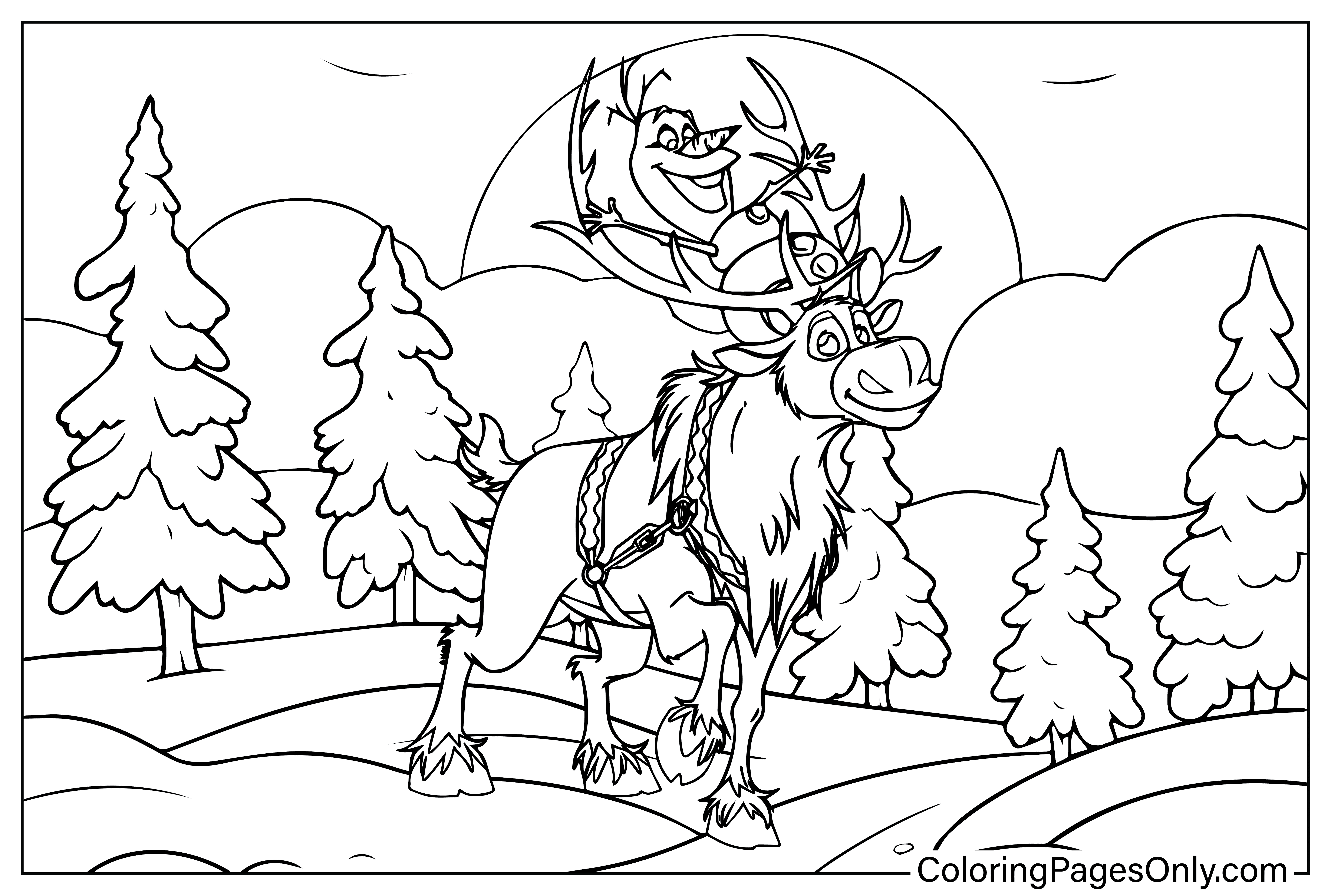
Sven is the reindeer companion of Kristoff in Disney’s Frozen (2013), directed by Chris Buck and Jennifer Lee. Unlike the other reindeer characters in this collection, Sven does not speak; he communicates through expressions, actions, and the voice Kristoff provides for him in their scenes together. In the film, Sven’s coloring is a warm dark brown with a reddish-brown saddle area across his back, lighter fur on his muzzle and underbelly, and prominent antlers.
The collection includes Sven alone and Sven with Olaf, the snowman. The Sven-and-Olaf pages are among the most visually contrasting in the collection – the warm brown of Sven against the white of Olaf, with Olaf’s carrot nose providing an orange accent.
Coloring Sven: His base coat is a warm, medium-to-dark brown. The saddle area across his back and shoulders is a slightly darker, more reddish tone – closer to auburn than his main coat. His muzzle and lower belly are a lighter, slightly sandy brown. His antlers are the pale tan of dried wood. Olaf, on the paired pages, is rendered almost entirely in white, with very light cool grey in the deepest shadow areas of the snow body, and an orange carrot nose at full saturation.
Kawaii and Cute Standalone Reindeer
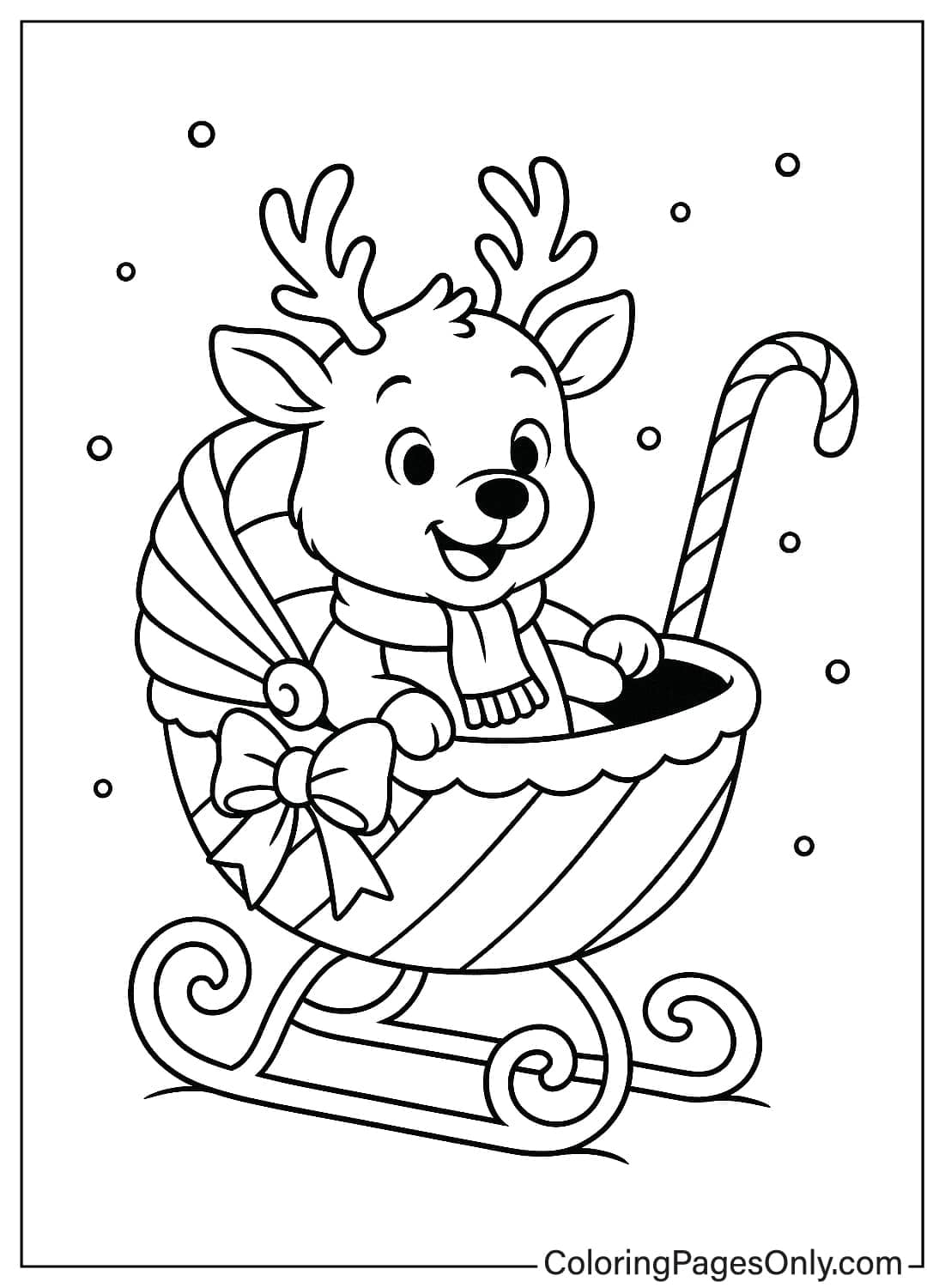
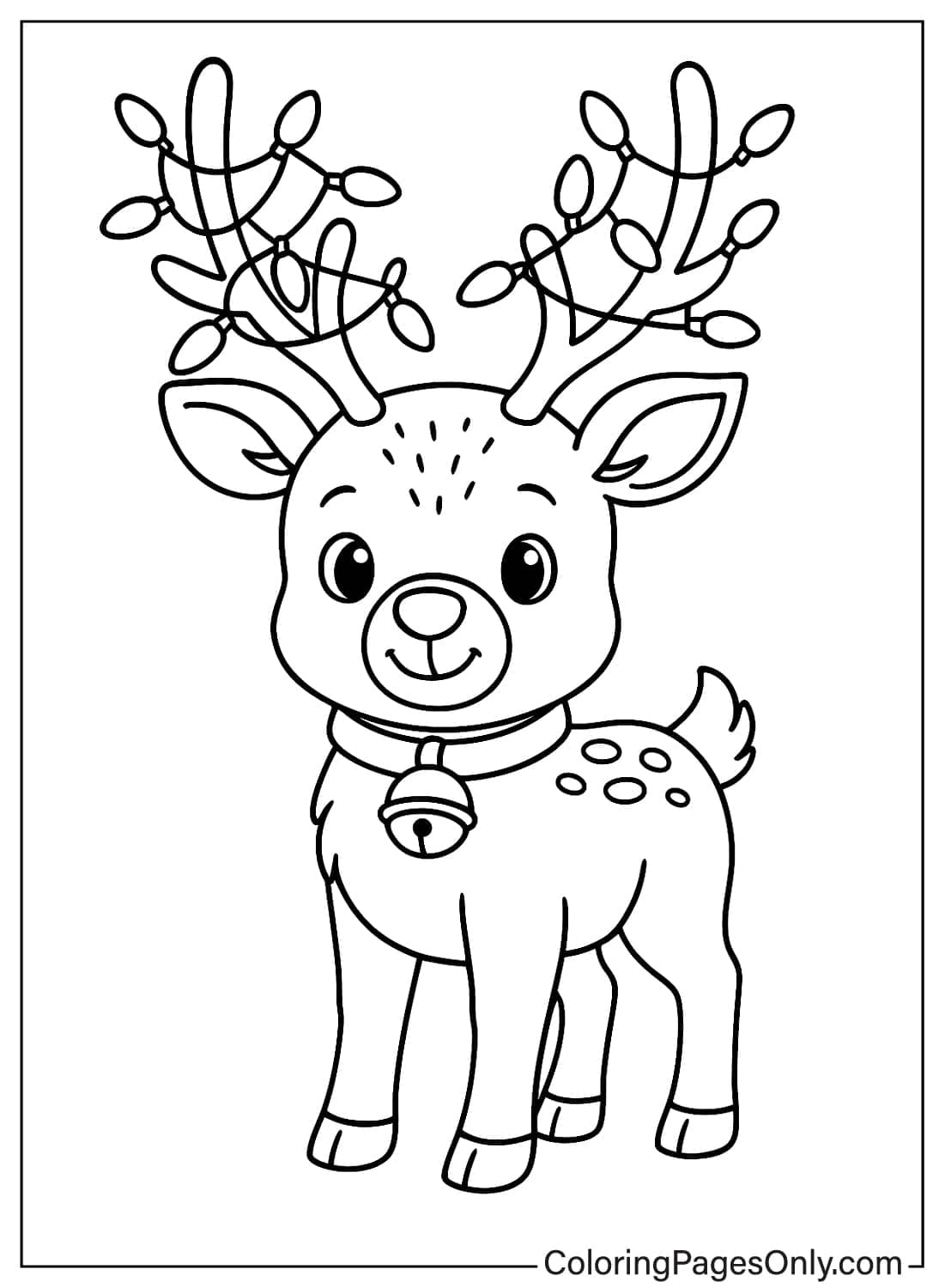
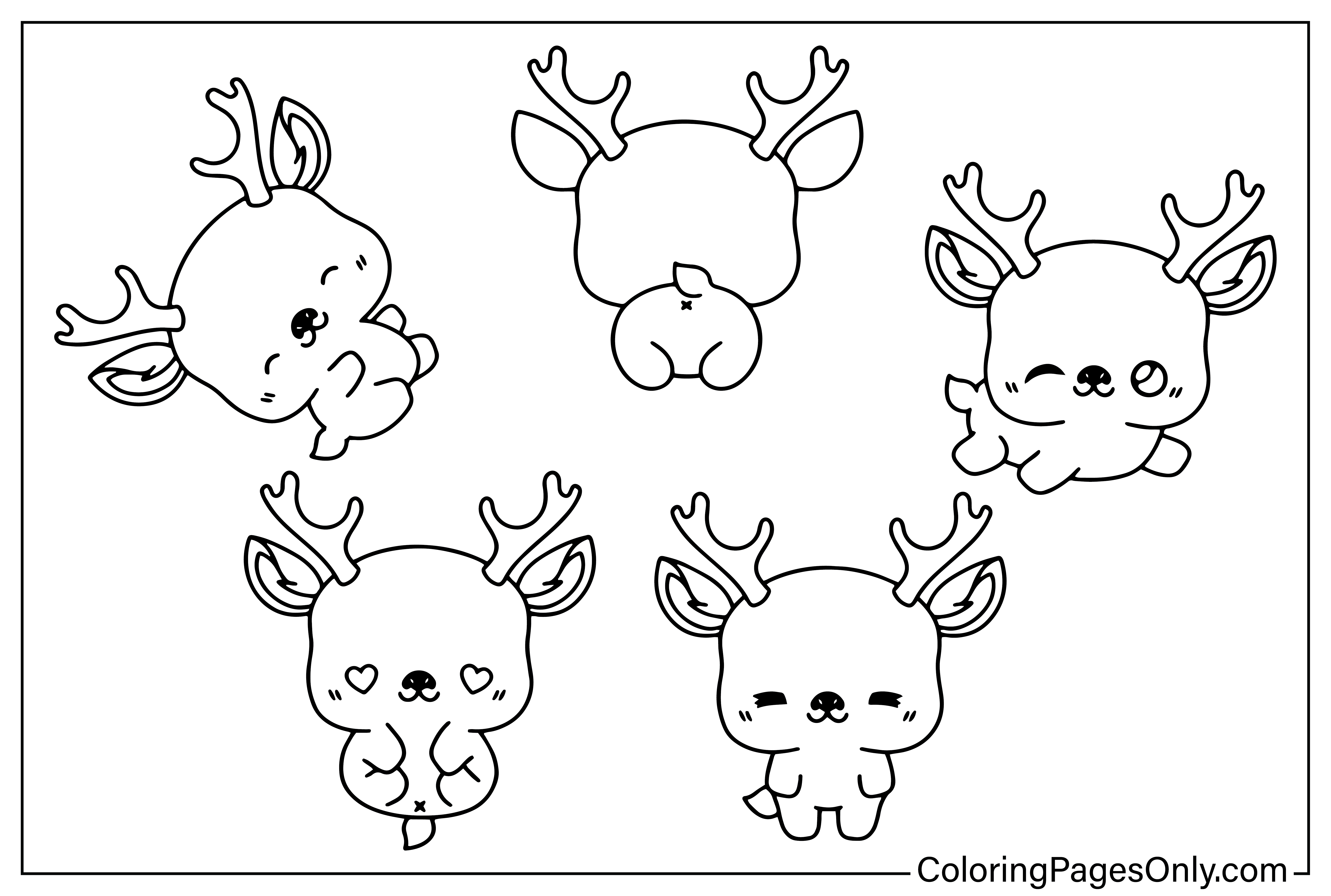
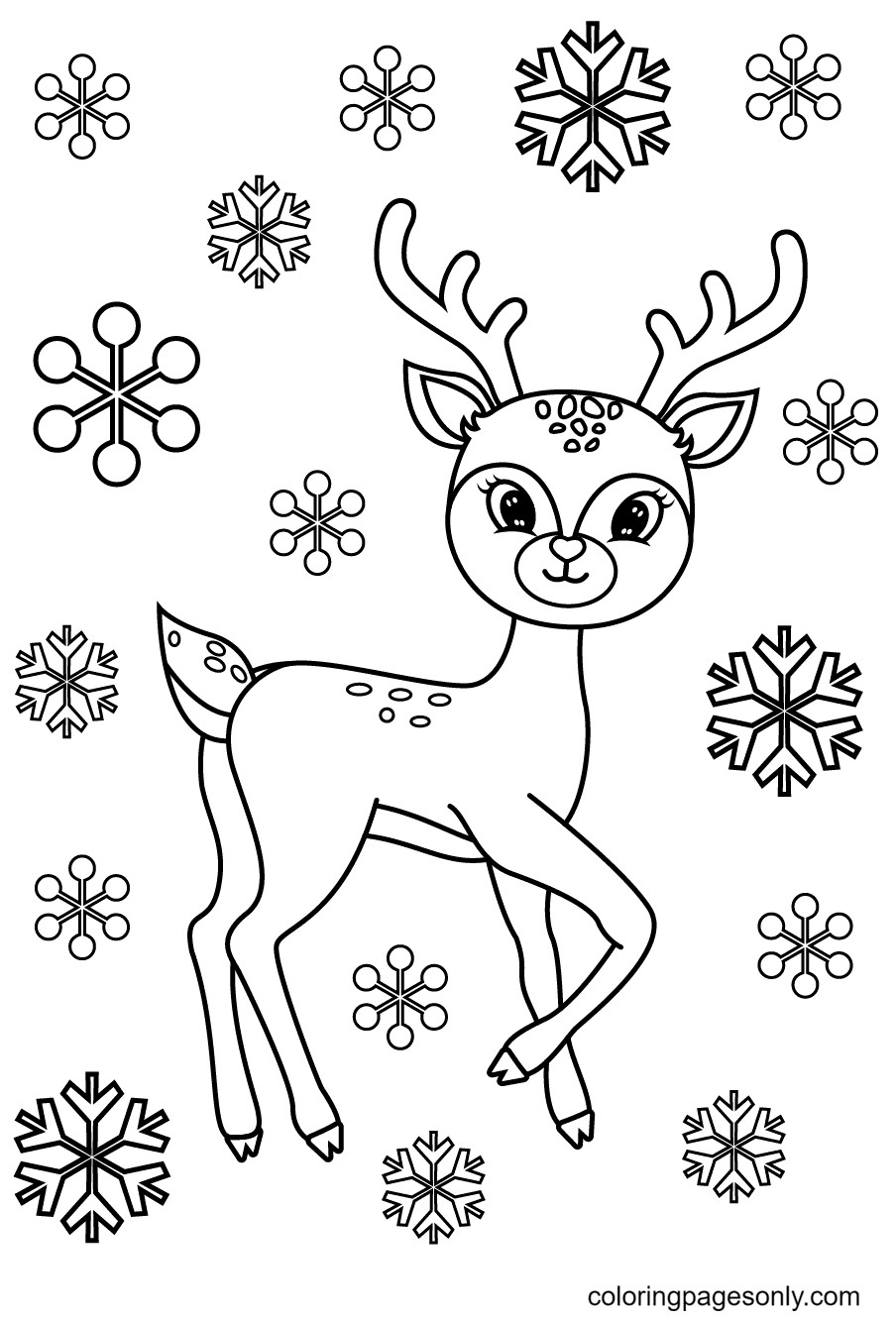
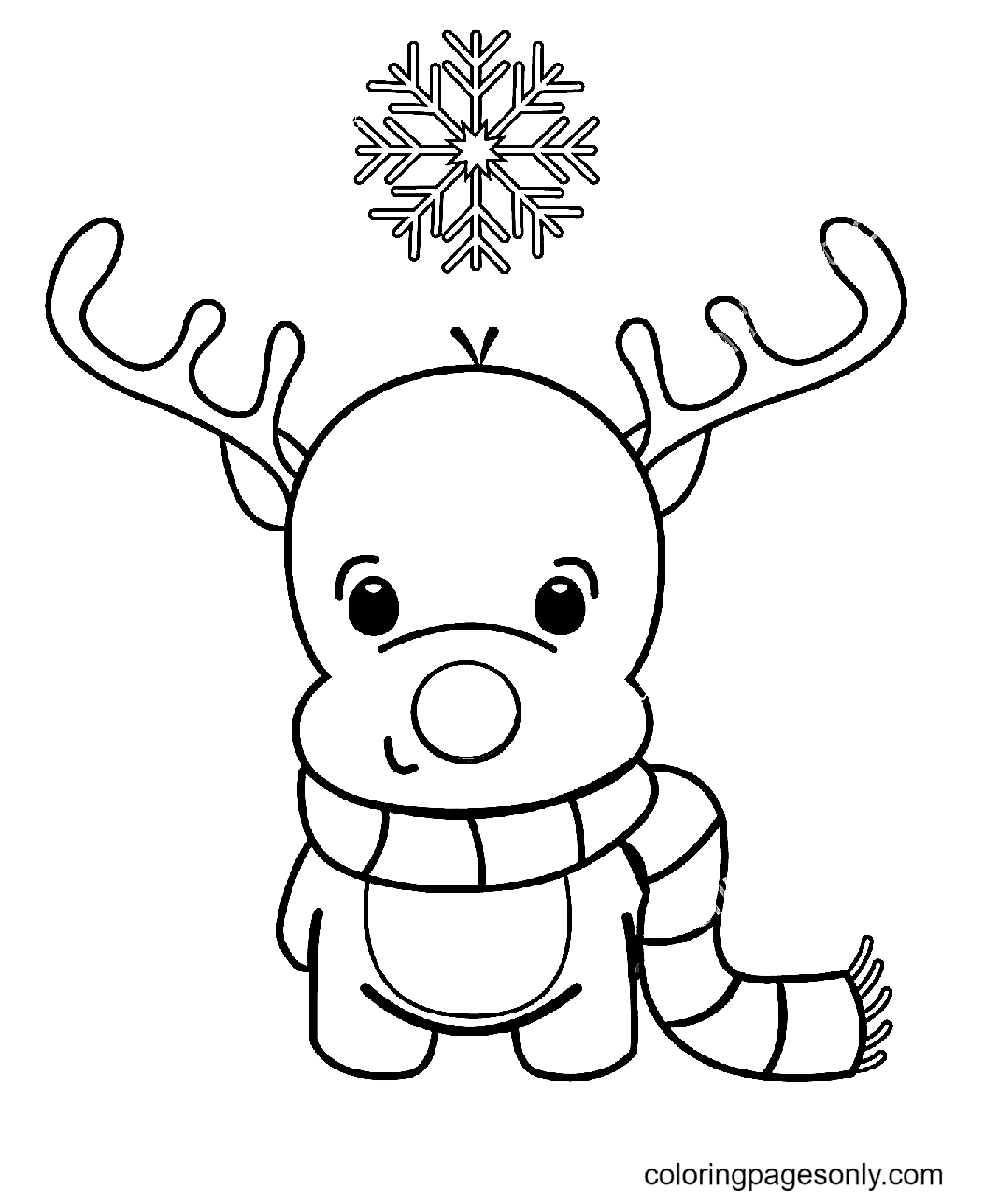
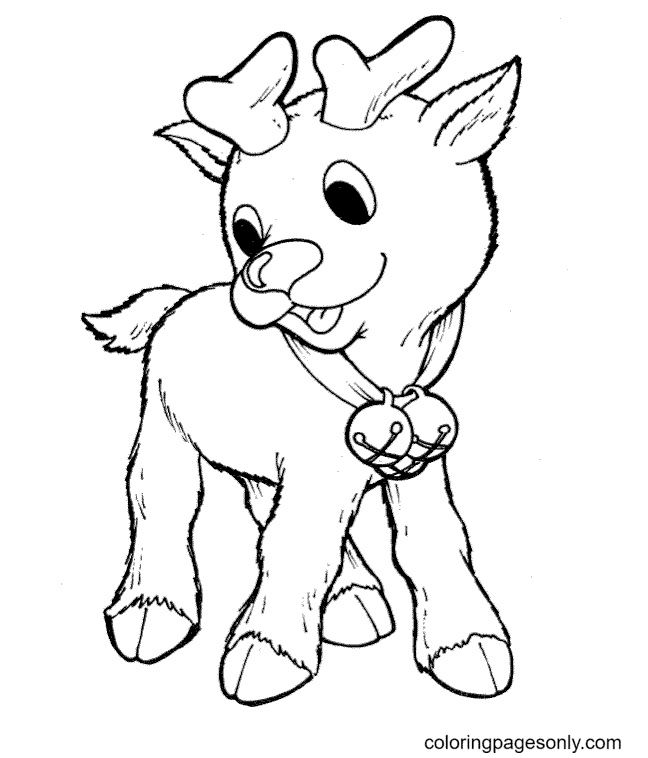
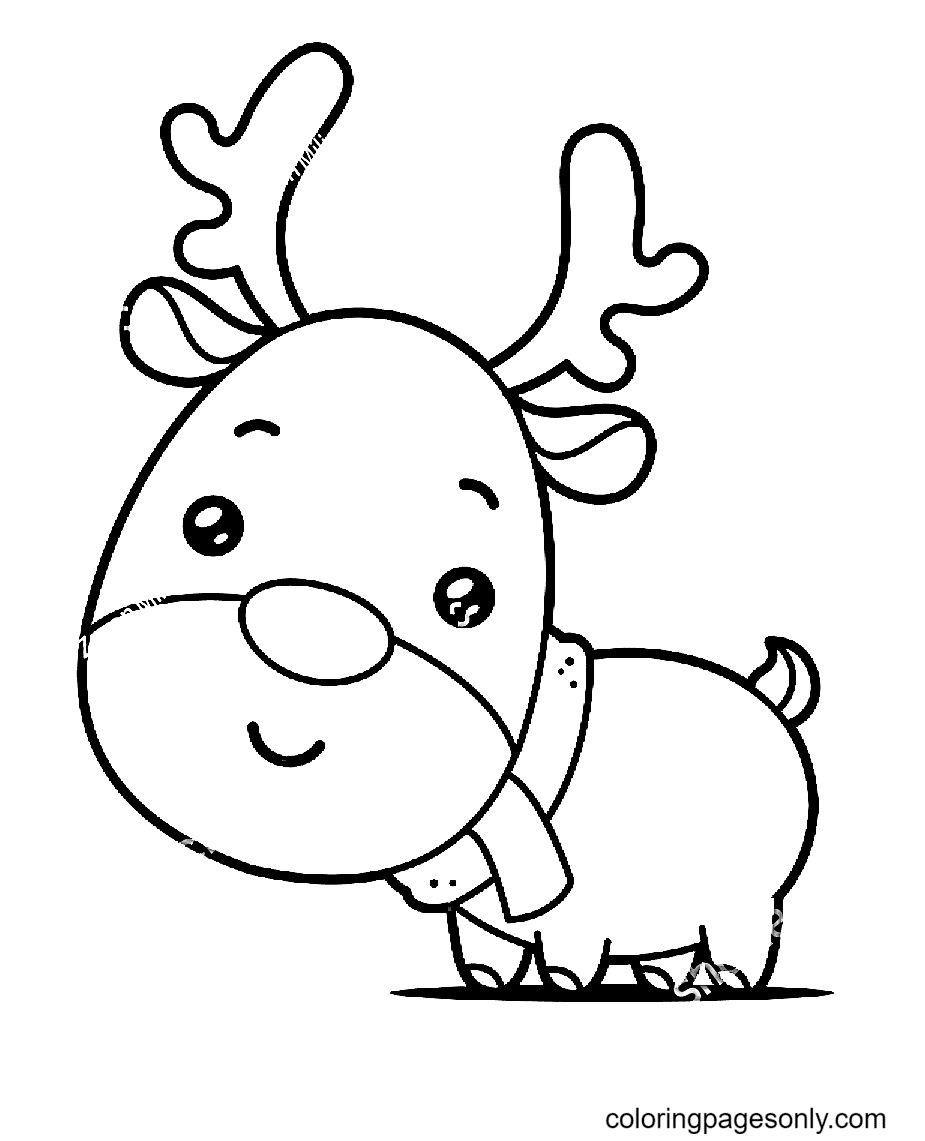
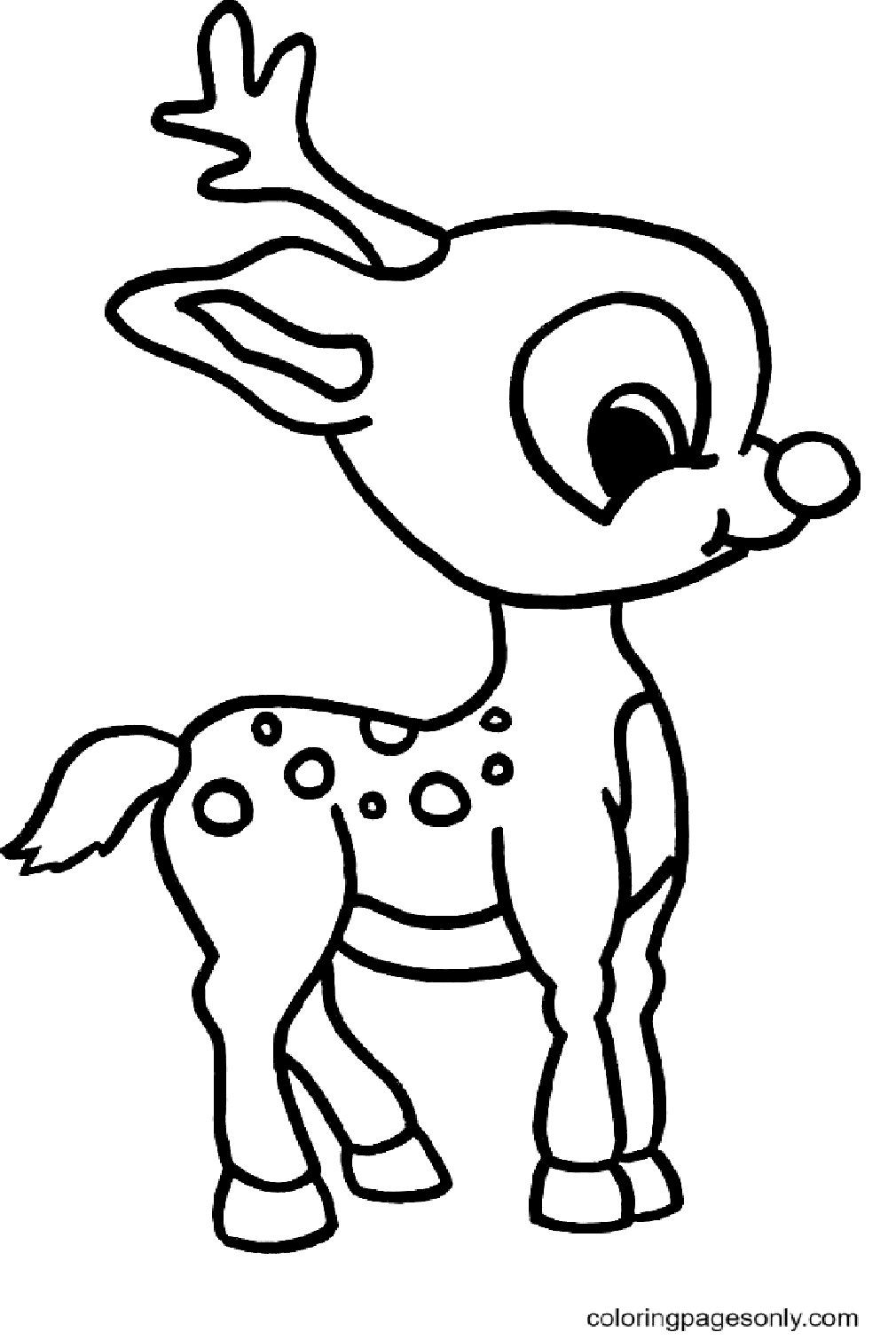
Kawaii reindeer are what happens when the artist’s priority shifts entirely from accurate anatomy to emotional warmth. Round bodies, oversized eyes, simplified features, minimal interior line detail – the kawaii style asks nothing of the colorist except that they engage with the expression on the page. This group includes kawaii variants in several poses, baby reindeer wrapped in a blanket, reindeer with oversized blinking eyes, and a general set of cute standalone characters. The style suits ages 3 and up reliably.
Coloring kawaii reindeer: The kawaii style works best with soft, slightly desaturated colors rather than full-saturation fills. The reindeer’s body is in a warm, light caramel tone – lighter than the naturalistic pages – with blush-pink cheeks as the single accent detail. Eyes are black with a small white highlight dot; this is the kawaii style’s most important detail, and keeping the highlight dot white (leaving the paper uncolored in that small spot) is what makes the eyes read as living rather than flat.
Detailed and Adult Reindeer Pages
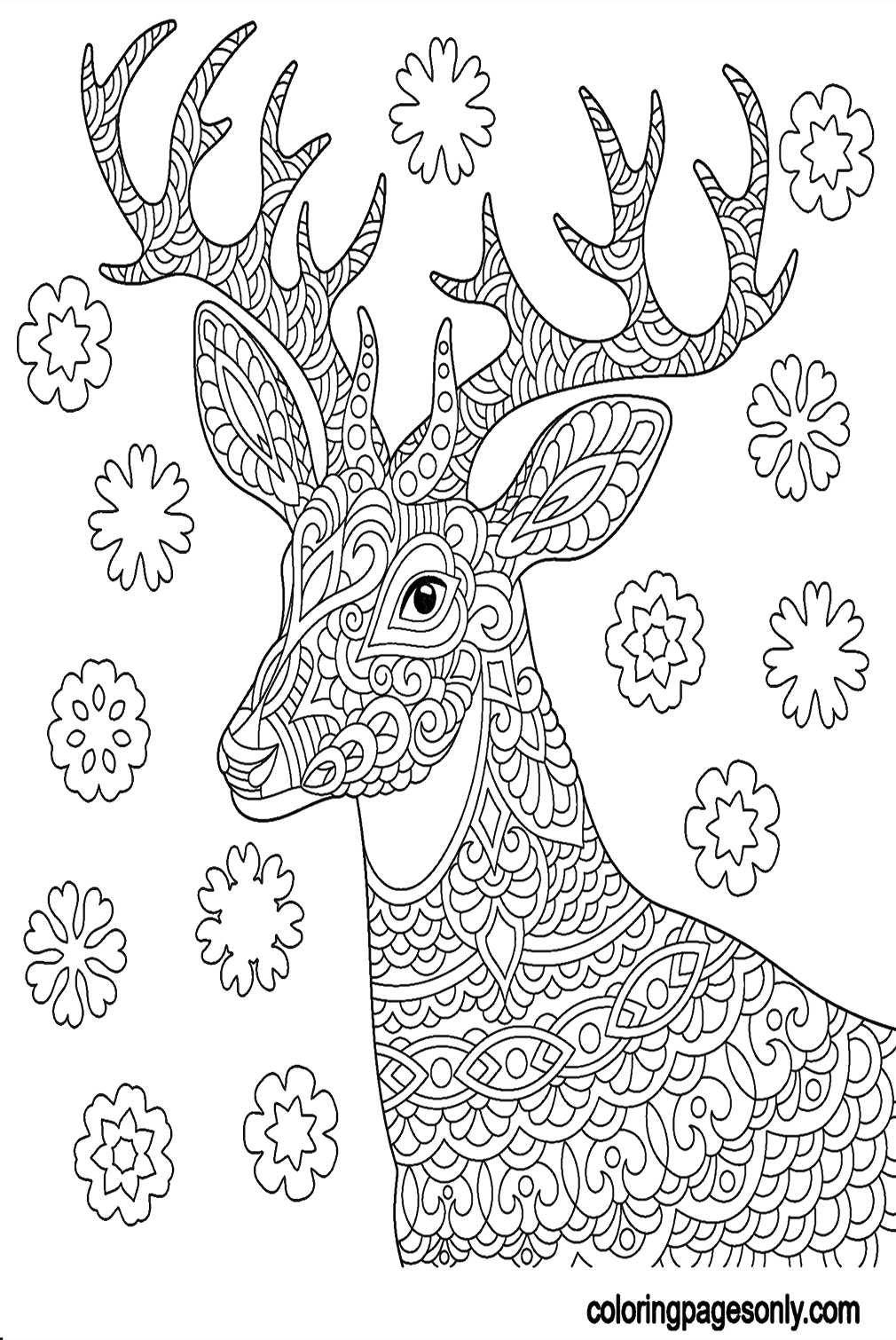
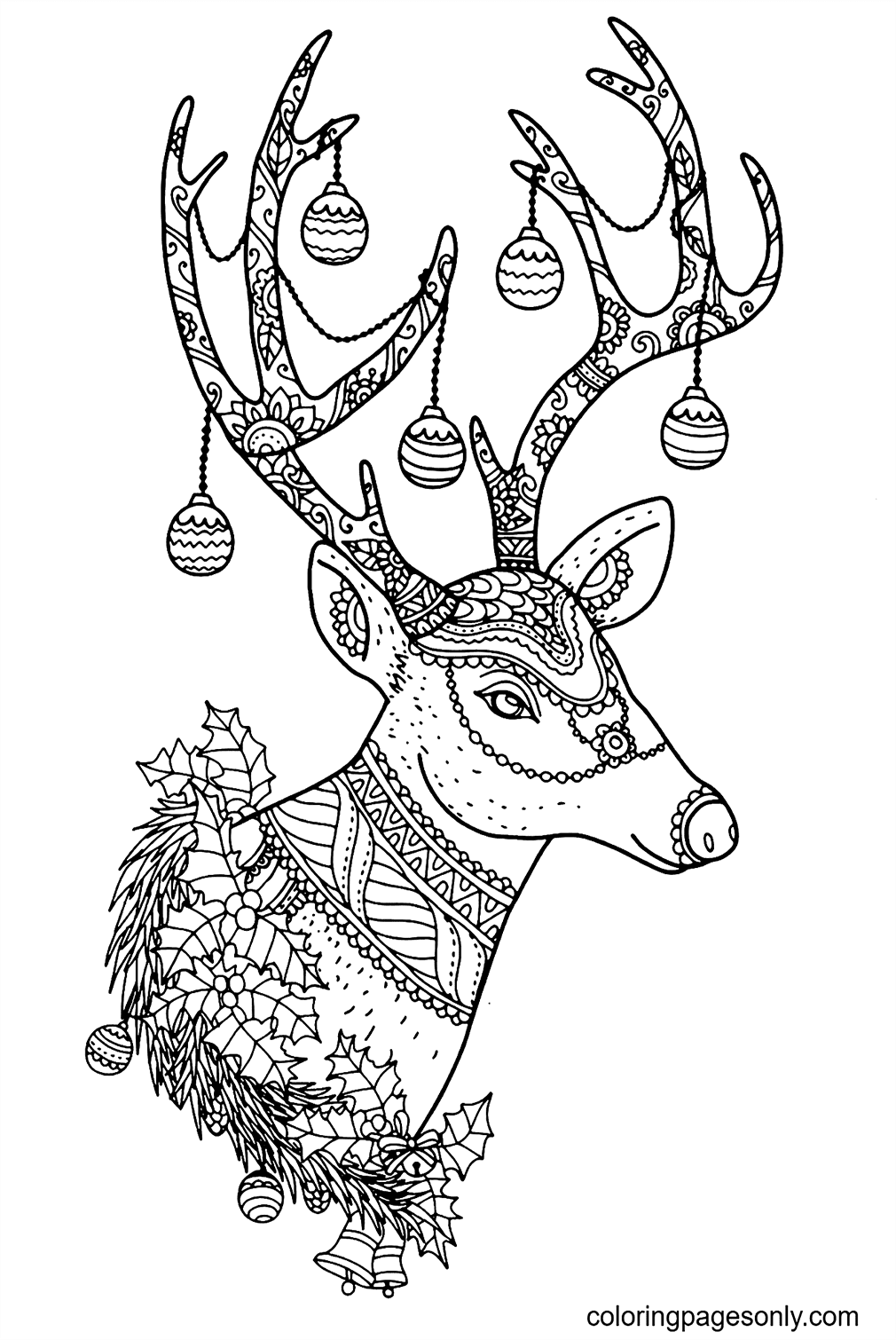
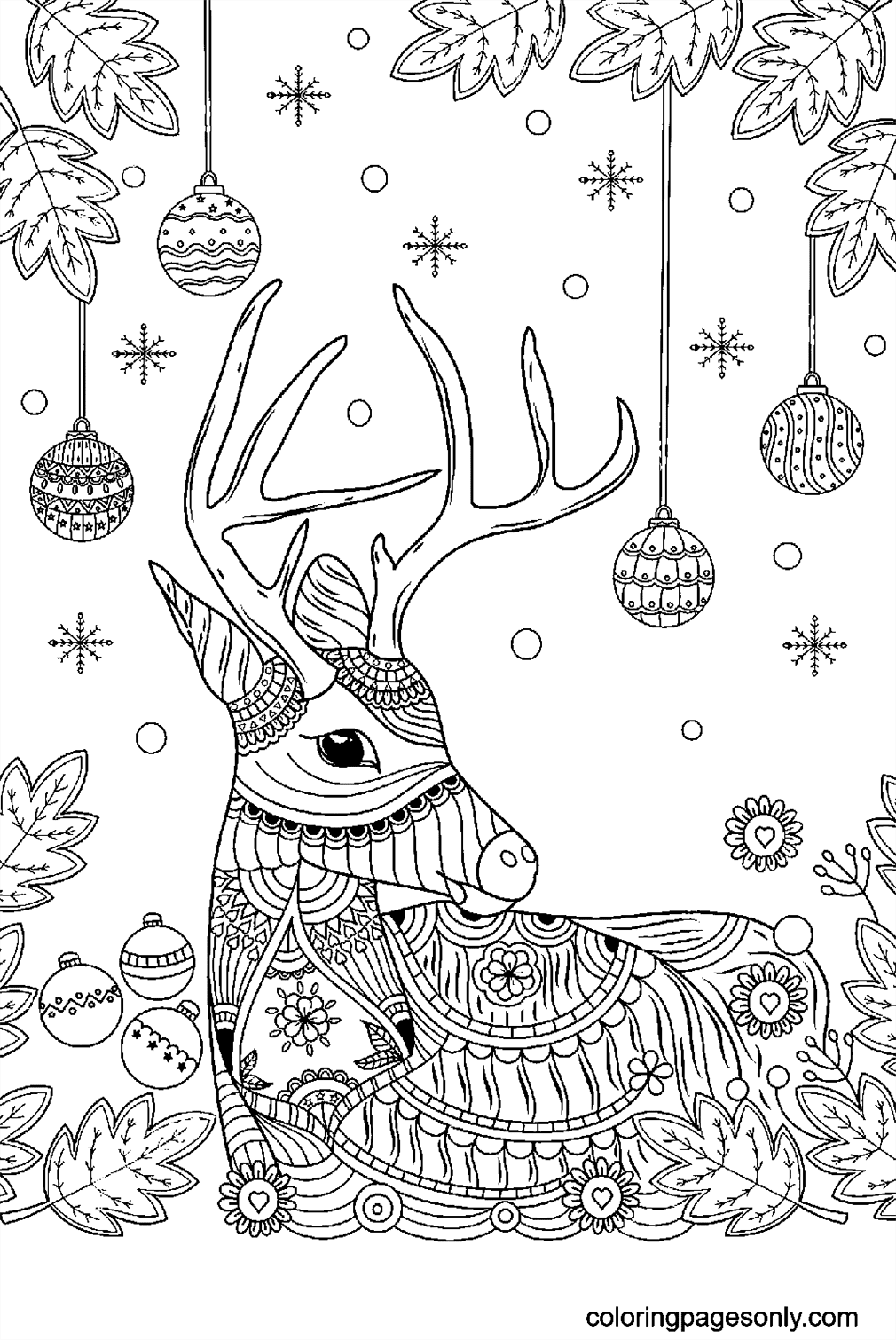
The zentangle reindeer page and the “Reindeer Coloring Page for Adults” are the collection’s most technically demanding pages – intricate interior patterning, fine line detail across antlers and body, pattern-fill areas that require sustained attention. These pages are designed for adult colorists or children ages 10 and up who want a longer, more detailed coloring project.
Coloring zentangle reindeer: The zentangle style applies patterned fills to sections of the figure rather than flat color. Assign a different pattern to each major zone – the body, the neck, each antler section, the face – and apply those patterns in consistent ink or fine-liner before adding color washes. If coloring without the ink-pattern step, still treat each zone as a separate color decision and vary the tones to maintain visual separation between adjacent areas. A limited palette of three to five tones reads more cohesively than a wide color range on zentangle pages.
What These Pages Do
Reindeer carry two distinct visual traditions that this collection draws from simultaneously. The naturalistic reindeer – standing in snow, flying in harness, eating in a winter landscape – connects to the actual animal: a large-bodied Arctic deer with distinctive palmated antlers, found across northern regions of four continents. The Christmas reindeer – Rudolph with his glowing nose, the eight named members of Santa’s team – connect to a storytelling tradition that began in 1823 and has been continuously extended through songs, films, and television specials for two centuries. Coloring through this collection engages both, moving between factual animal portraits and character-based illustrations that have their own documented histories.
Working through different styles teaches the eye to read different visual rules. A naturalistic reindeer and a kawaii reindeer are drawn with completely different priorities – one aims for accurate proportion and texture, the other for emotional readability and accessibility. A child who colors both in the same session is learning, without being taught, that different illustrations follow different internal logic. The zentangle page adds a third layer: pattern-based decoration applied systematically, which is its own discipline with its own decisions.
Fine motor development benefits from the full range of complexity this collection offers. The American Academy of Pediatrics identifies fine motor skill development as a key milestone across early and middle childhood – and this collection provides entry points at every developmental level. The kawaii pages with their large open zones serve the youngest colorists working with chunky crayons. The scene pages with prop details and costume elements serve middle-range skill levels. The zentangle page and multi-reindeer harness-and-sleigh compositions serve older children and adults who have the hand control to manage fine linework.
Structured coloring reduces anxiety across age groups. The 2005 Art Therapy Journal study on structured coloring found statistically significant anxiety reduction when participants worked within defined forms compared to open-ended drawing. The reindeer pages in this collection – even the most complex – provide that defining structure: a form to work within, a decision framework, a finished result that looks like the thing it is. For children who find the Christmas season overstimulating, the focused attention that detailed coloring requires is genuinely useful.
How to Color These Pages Well
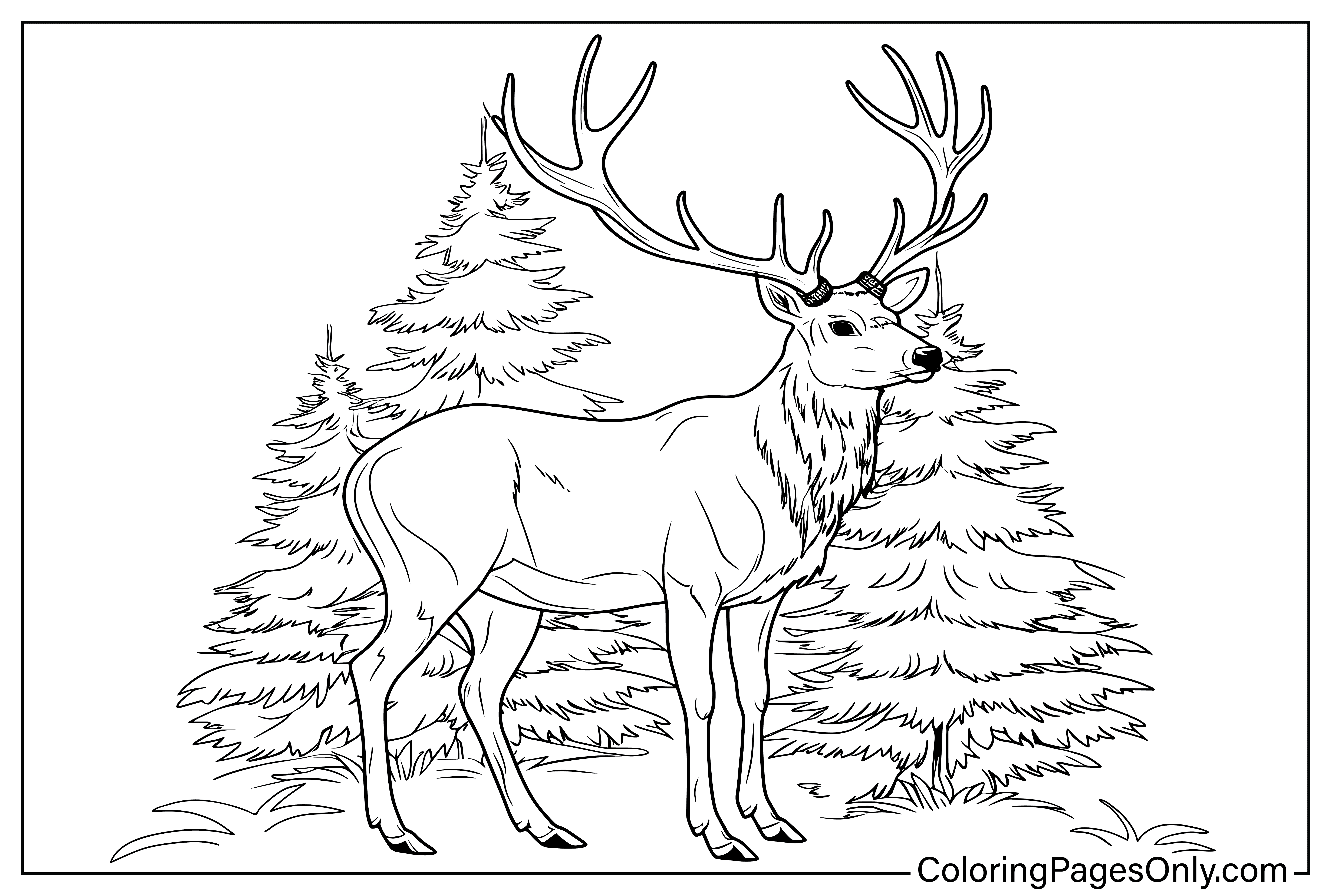
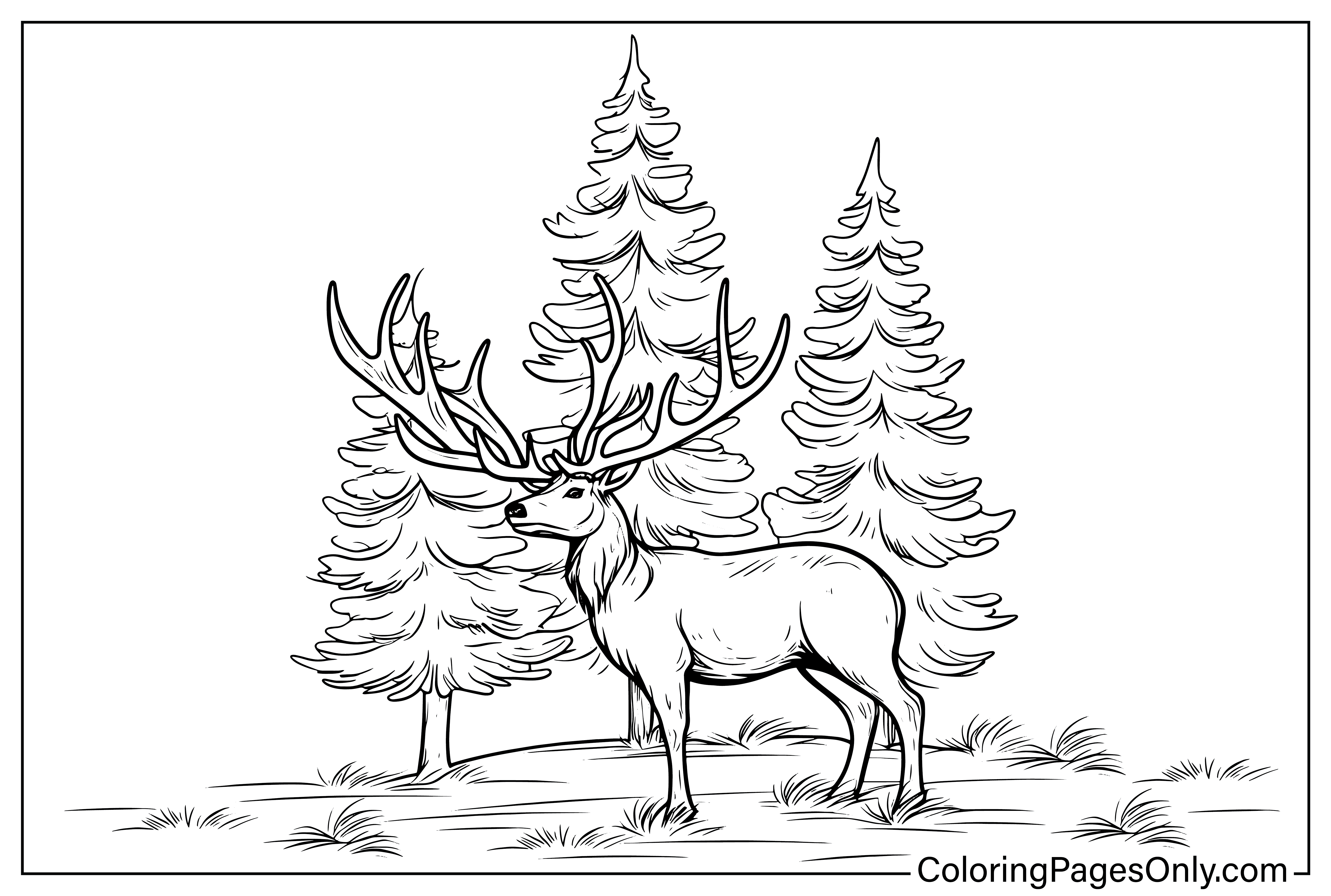
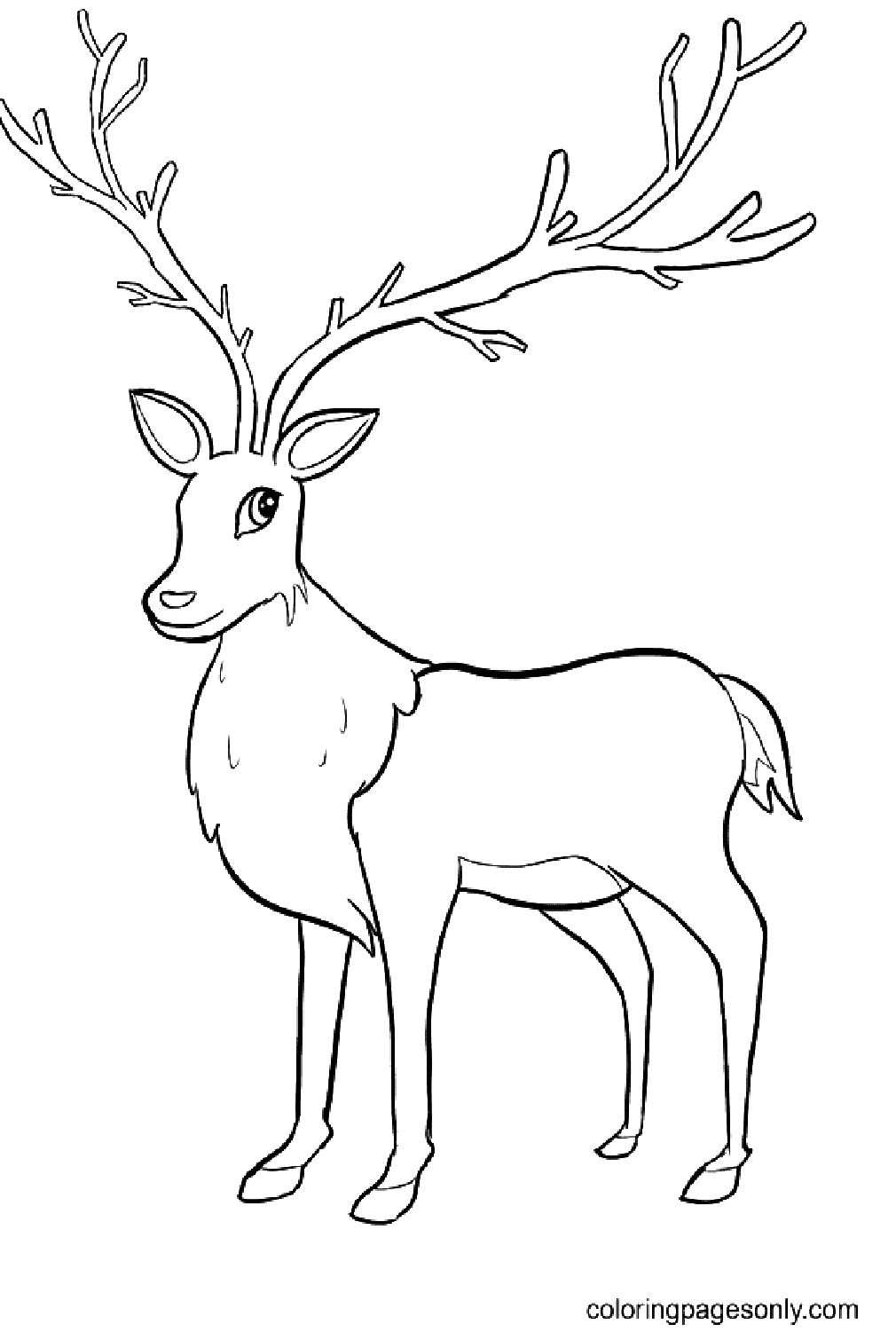
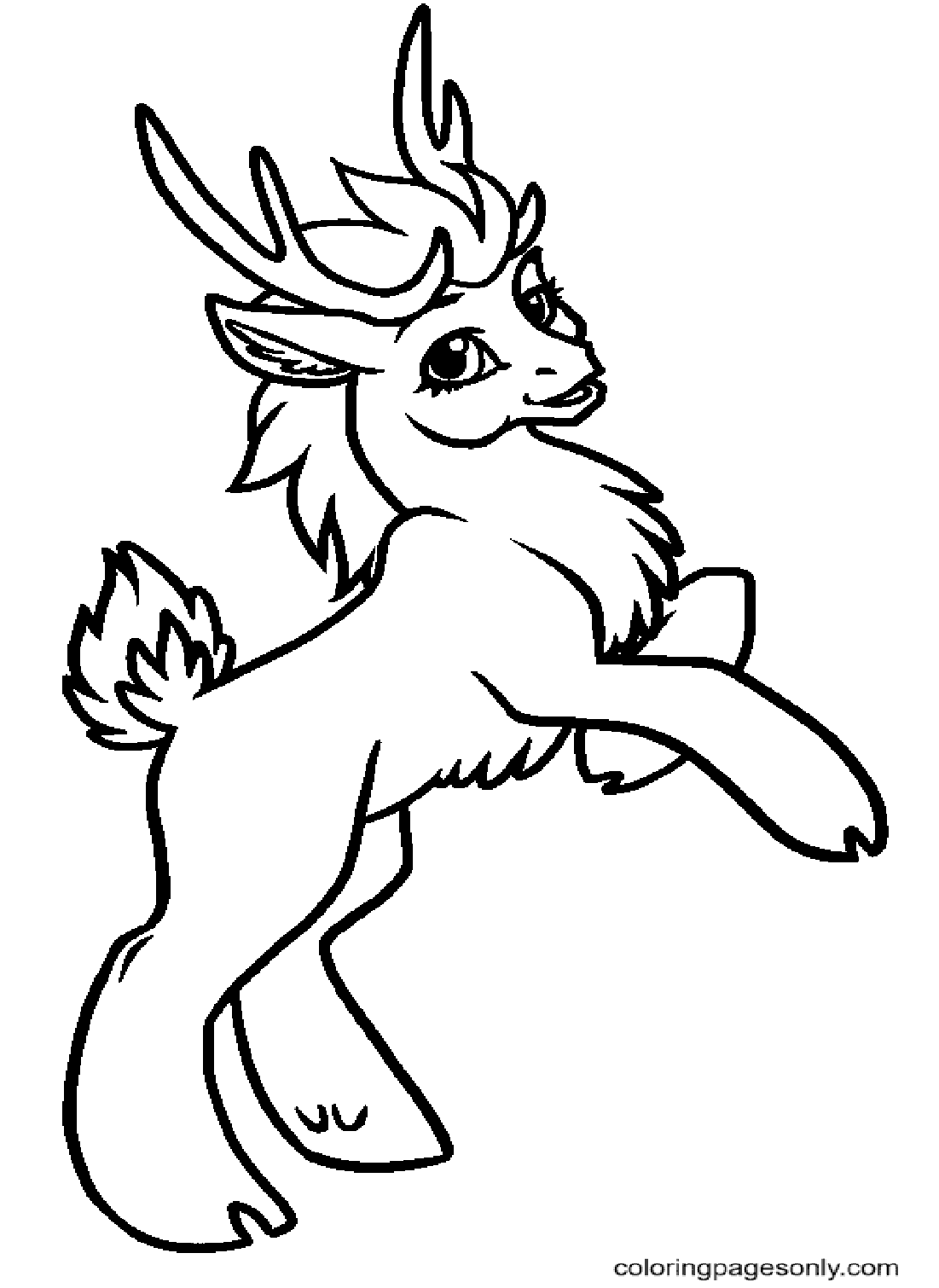
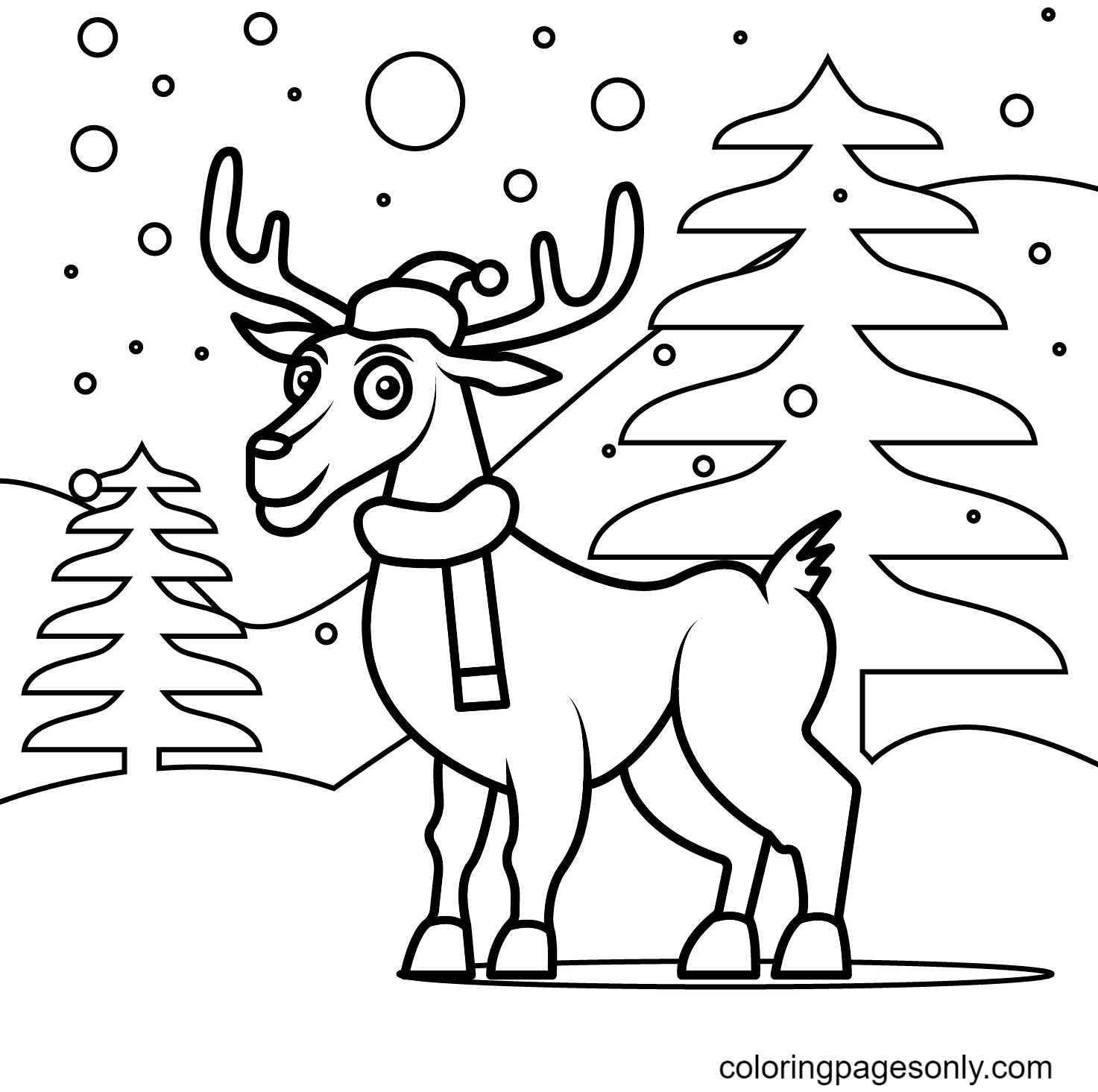
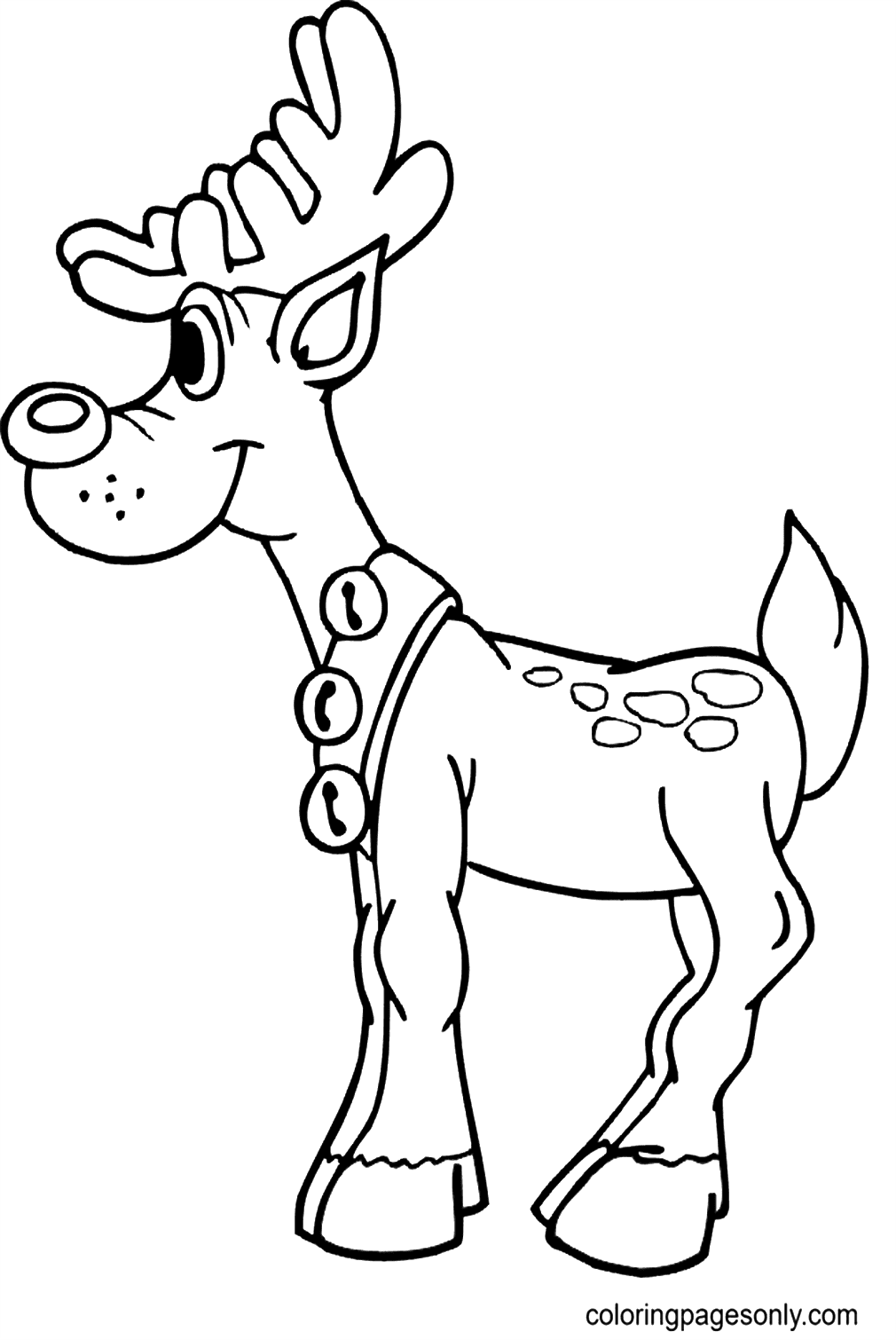
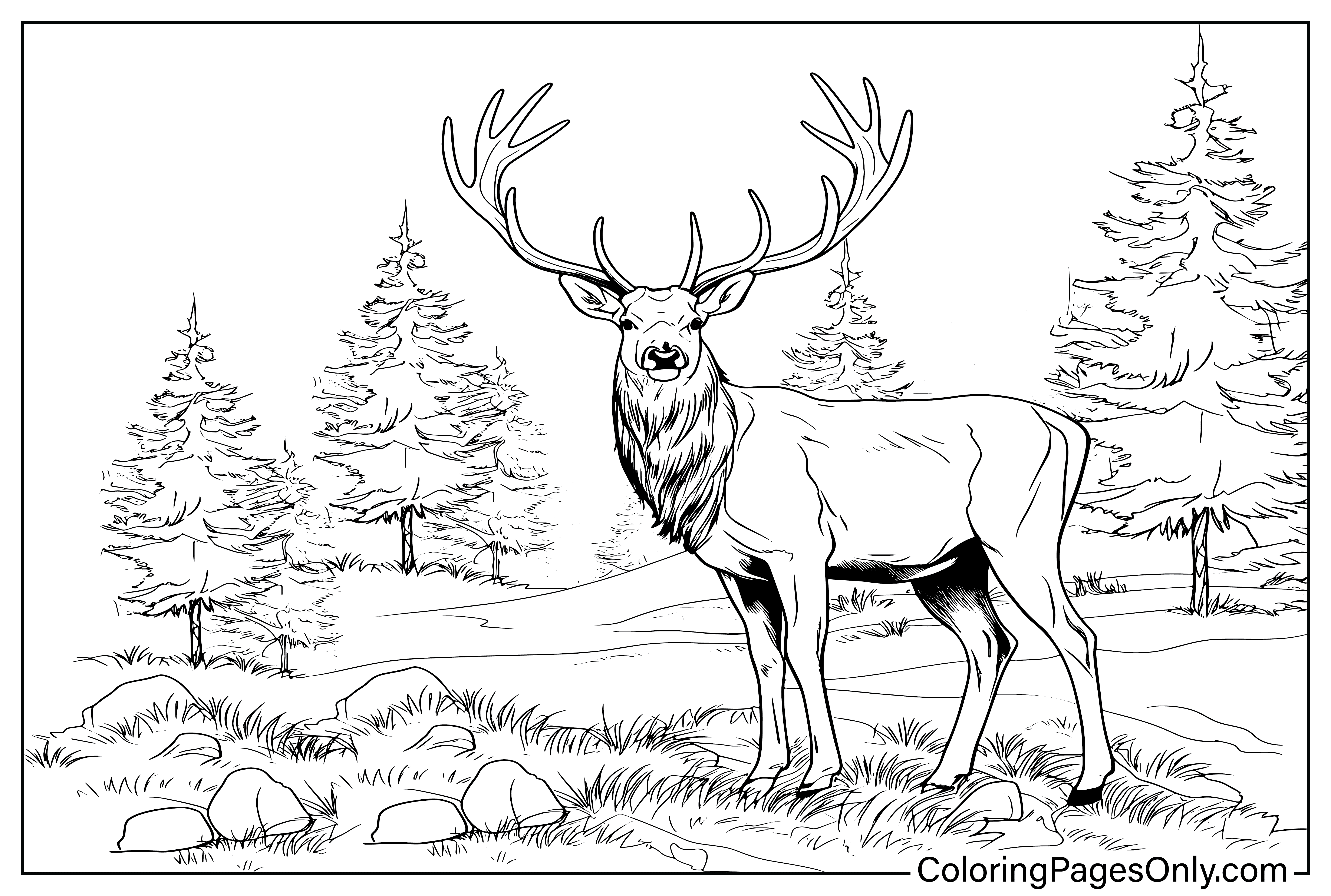
Reindeer fur is warm brown, not orange and not grey. The most common coloring error on reindeer pages is reaching for the wrong brown. Crayon brown is often too orange; pencil grey-brown is too cool. The naturalistic reindeer’s coat reads as a warm, medium chestnut – the brown of a wooden tabletop or a milk chocolate bar, with warmth rather than coolness in the undertone. If working with colored pencils, a base layer of warm tan followed by a layer of medium brown in the shadow areas produces a more naturalistic result than a single flat application.
Antlers are lighter than the body, not darker. Reindeer antlers are made of bone covered in velvet during growth, hardening to a pale, sandy tan by late autumn. On coloring pages, antlers should read as a lighter, slightly more golden tone than the warm brown body coat – not the dark brown that instinct often reaches for. The lightest points are at the very tips of each tine. Working from a darker base at the antler base toward lighter tips gives the antler structure depth and reads correctly.
Rudolph’s nose is the one place where bright red is right. Every other reindeer element benefits from deeper, more muted tones – but Rudolph’s nose is specifically described in the 1939 story as glowing and luminous. Bright candy-apple red applied at full saturation is accurate here. On pages that show the nose’s glow affecting surrounding snow or the nearby reindeer’s face, a very light pink is applied in the snow area immediately around the nose, suggesting light emission without overcomplicating the page.
Santa’s red is darker than standard crayon red. Santa Claus’s suit in most Christmas illustration traditions is a deep, slightly warm red – closer to the red of old lacquer than to a fire engine. This is consistent across the Clement Clarke Moore poem tradition and the Coca-Cola advertising imagery from the 1930s that reinforced the modern Santa visual. Apply a first pass of standard crayon red, then add a layer of dark red or burgundy in the shadow areas of the suit folds. The result reads as rich velvet rather than flat red.
Sky backgrounds on flight pages work best as deep navy. Pages showing reindeer in flight – Santa’s sleigh crossing a night sky, reindeer soaring in formation – set the entire mood through the background color. Deep midnight navy behind the warm-brown reindeer and the red-suited Santa creates the strongest visual contrast and reads as the darkest hour of Christmas Eve. Lighter blue backgrounds read as daytime; the flight pages are specifically set at night.
On multi-reindeer pages, establish one consistent body color and do not deviate. When coloring a page that shows the full sleigh team – eight or nine reindeer in harness – using slightly different browns for different animals creates visual confusion. Decide on one warm medium brown and apply it consistently across every reindeer body in the frame. The visual variety should come from the harness details, the positions of the animals, and the background – not from individual coat variation.
Five Creative Craft Ideas
The Eight Reindeer Name Banner
Print eight simple or cartoon reindeer pages from the collection – one per reindeer. Color each in warm brown with consistent body tone. Below each finished page, write one of the eight names from the 1823 poem in the order they appear: Dasher, Dancer, Prancer, Vixen, Comet, Cupid, Donner, Blitzen. Add Rudolph at the front if a ninth page is available.
Connect all nine pages with a piece of twine or ribbon through small holes punched at the top corners, spacing them evenly across a wall or mantelpiece. The finished banner runs the full team in order – a visual that connects the coloring activity to the poem that named them 200 years ago. Suited to ages 5 and up; younger children can color the pages while an adult adds the names.
Rudolph Story Timeline
Print three Rudolph pages from the collection – a portrait page, a flying page, and one with other characters if available. Color all three. On a horizontal backing strip, create a simple three-point timeline:
1939: Robert L. May writes Rudolph for Montgomery Ward – write this above the portrait page. 1949: Johnny Marks’s song was recorded by Gene Autry – write this above the flying page. 1964: Rankin/Bass television special premieres – write this above the third page.
Mount the colored pages below their corresponding dates. The finished display shows Rudolph’s eighty-year journey from a department store booklet to an annual television event, best for ages 7 and up as a combined coloring and research activity.
Sven and Olaf Winter Scene
Print the Sven and Olaf paired page and color both characters in their canonical palettes – Sven in warm dark brown with reddish saddle area, Olaf in white with very light cool grey shadows and an orange carrot nose.
On a separate backing sheet, draw or paint a simple winter scene: snow on the ground, a few pine trees, a pale winter sky. Cut out the colored Sven and Olaf figures and mount them into the scene, positioning them so they appear to stand on the snow surface. Add a simple title: “Sven and Olaf – Adventure in Arendelle.”
The finished piece pairs the coloring activity with basic collage construction and background design. Suited to ages 6 and up; younger children can do the coloring while an adult handles the cutting and assembly.
Reindeer Facts Flip Cards
Print four simple reindeer pages – standalone reindeer in different poses. Color all four in the collection’s warm brown palette. Fold each page in half, keeping the colored reindeer on the front.
On the inside of each card, write one fact about real reindeer:
- Card 1: Both male and female reindeer grow antlers – the only deer species where this is true.
- Card 2: The scientific name is Rangifer tarandus. In North America, the same animal is called a caribou.
- Card 3: Reindeer are among the farthest-migrating land mammals on Earth – some herds travel up to 5,000 kilometers per year.
- Card 4: Male reindeer shed their antlers in winter. Because Santa’s reindeer have antlers on December 24, they are most likely female.
The flip cards are a coloring activity that doubles as an animal science reference. Best for ages 7 and up for the reading component; younger children can do the coloring with an adult writing the facts.
Christmas Eve Scene Diorama
Print three or four scene pages from the 2025 additions – Santa and reindeer flying over a house, reindeer and elves decorating with lights, Santa and reindeer decorating a Christmas tree. Color all pages in their full palettes: the night sky in deep navy, the warm brown of the reindeer, the Christmas lights in multicolor, the tree in deep green with gold and red ornaments.
Fold a large piece of cardboard into a three-sided box shape (two sides and a back). Mount each colored page on one surface of the diorama – the flying page on the back, the decorating pages on the sides. The finished three-sided display creates a small Christmas Eve environment from multiple page scenes. Best suited for ages 8 and up; this is the most construction-intensive craft in the collection.
Frequently Asked Questions
What are reindeer, and where do they live? Reindeer (Rangifer tarandus) are large deer native to Arctic and Subarctic regions of northern Europe, Siberia, and North America, where the same species is called caribou. They are the only deer species in which both males and females grow antlers. Reindeer are well adapted to cold climates: their fur has hollow hairs that trap warm air, their wide hooves act as snowshoes in winter and paddles when swimming, and their eyes shift from gold in summer to blue in winter – a change that helps them detect objects in Arctic UV light. Wild reindeer populations exist across Scandinavia, Russia, Canada, and Alaska; domesticated reindeer have been herded by indigenous Sami people in northern Scandinavia for at least two thousand years.
Where did the tradition of Santa’s flying reindeer come from? The flying reindeer appear in a poem first published in the Troy Sentinel newspaper on December 23, 1823, under the title “A Visit from St. Nicholas” and beginning with the line “Twas the night before Christmas.” The poem is commonly attributed to Clement Clarke Moore, a New York scholar, though some researchers have argued the true author was Henry Livingston Jr., a New York poet. The poem names eight reindeer – Dasher, Dancer, Prancer, Vixen, Comet, Cupid, Donner, and Blitzen – and describes them pulling Santa’s sleigh across the sky. It established virtually every detail of the modern Santa Claus visual tradition in a single text.
Who created Rudolph the Red-Nosed Reindeer? Rudolph was created by Robert L. May, a copywriter working for Montgomery Ward, the Chicago-based department store chain. May wrote the story in 1939 as a promotional booklet for children shopping at Montgomery Ward during the Christmas season. Approximately 2.4 million copies were distributed free in the first year; by 1946, an estimated 6 million copies had been given out. May’s brother-in-law, composer Johnny Marks, adapted the story into a song in 1949, which Gene Autry recorded and which became one of the top-selling Christmas singles in history. The Rankin/Bass animated television special, narrated by Burl Ives, first aired on NBC on December 6, 1964, and has aired annually since.
Who is Sven in the reindeer coloring pages? Sven is the reindeer companion of Kristoff Bjorgman in Disney’s Frozen, directed by Chris Buck and Jennifer Lee and released on November 27, 2013. Sven does not speak in the film; he communicates through facial expressions, physical reactions, and the voice that Kristoff playfully provides for him in their conversations. Sven’s character design draws from real reindeer anatomy, giving him a stockier build and more expressive face than a strictly realistic reindeer portrait would show. He appears in Frozen (2013), Frozen Fever (2015), Olaf’s Frozen Adventure (2017), and Frozen 2 (2019).
Is it true that Santa’s reindeer might be female? This is a genuine observation from biology. Male reindeer typically shed their antlers in late November or December, before Christmas. Female reindeer retain their antlers through winter until spring calving. Because Santa’s reindeer are depicted with antlers on Christmas Eve, December 24, a strictly biological reading suggests they would need to be female to have antlers at that time of year. The observation was popularized in a 1998 essay in Scientific American and has since been widely repeated. It is, of course, a playful application of reindeer biology to a fictional scenario – but it is grounded in accurate seasonal antler-shedding facts.
What age group are these pages best suited for? The kawaii and baby reindeer pages – large zones, minimal interior lines, simple compositions – are accessible for children as young as 3, working with chunky crayons or broad-tip markers. The cartoon scene pages (reindeer decorating, reading, singing) are most engaging for ages 4 to 8, where the story situation adds interest to the coloring activity. The naturalistic reindeer portraits, Rudolph pages with detailed antler structure, and Santa-and-sleigh compositions suit ages 6 and up. The zentangle reindeer and the detailed adult page are best for ages 10 and up or adult colorists who want a sustained, complex project.
What is the correct color for a reindeer? Wild reindeer vary by subspecies and season: summer coats are brown, grey-brown, or dark chocolate-brown; winter coats lighten toward greyish-brown or beige as the hollow insulating hairs grow in. The neck and underbelly are typically lighter than the back. Antlers shade from darker brown at the base to pale golden-tan at the tips. For coloring pages, a warm medium brown for the body, a slightly lighter golden-tan for antlers, and a pale sandy tone for the muzzle and underbelly areas produce a naturalistic result. Rudolph’s nose is the one element where the fictional version overrides the naturalistic: bright, luminous red.
What are all eight of Santa’s reindeer names? The eight names come from the 1823 poem: Dasher, Dancer, Prancer, Vixen, Comet, Cupid, Donner, and Blitzen. “Donner” appears in some versions as “Dunder” and in others as “Donder” – the poem’s original 1823 publication used “Dunder” and “Blixem,” Dutch-influenced names meaning thunder and lightning, which were later anglicized to Donner and Blitzen in German. Rudolph, the ninth reindeer, was not part of the original poem but was created by Robert L. May in 1939 and has been associated with the team ever since. No other reindeer have been officially added to Santa’s named team.
Browse and Color
The 1823 poem established eight names and the image of a flying sleigh crossing a night sky. Robert L. May added a ninth in 1939, working from a desk at a department store during a difficult period in his personal life – his wife was seriously ill, and he wrote the story to amuse his young daughter. He named Rudolph. His brother-in-law set the story to music ten years later. The Rankin/Bass studio turned it into a television special fifteen years after that. The special has aired every December since 1964.
This is how Christmas mythology accumulates: one text at a time, each adding to a tradition the previous generation had not imagined. A newspaper poem in Troy, New York. A department store booklet in Chicago. A song sung by a country music star. A stop-motion animated special for network television. These are the specific things that made the reindeer into what they are now – warm brown, antlered, flying, and named.
The pages in this collection cover all of it: the named team in flight, Rudolph alone and with family, Sven on his Frozen adventures, and the newer additions showing reindeer decorating, reading, and carrying presents. The warm brown is consistent across all of them. The antlers catch the light.
Browse the full collection at ColoringPagesOnly.com. All 90+ pages free, no sign-up, PDF or PNG, print at home or color online.
Share your finished pages on Facebook and Pinterest and tag #Coloringpagesonly. We especially want to see the Eight Reindeer Name Banners and the Reindeer Facts Flip Cards.
Dasher, Dancer, Prancer, Vixen. Comet, Cupid, Donner, Blitzen. Rudolph at the front. The team is complete.
More from Our Christmas Collections
More from our Christmas and Holidays collections: