Star Coloring Pages

Free star coloring pages: 50+ pages featuring five-pointed star outlines in single and cluster arrangements, cartoon stars with expressive smiling faces, shooting star trails across night sky compositions, constellation pattern pages, decorative mandala-style star designs with intricate geometric interiors, star clusters with moon and cloud companions, nautical star compass designs, patriotic star arrangements referencing flag elements, Christmas star pages, star-and-stripe design combinations, multi-pointed decorative star variations, and the full visual vocabulary of the star symbol across its scientific, cultural, and decorative dimensions. All free, printable PDF and online coloring for everyone, from young children discovering the night sky to adult colorists working through geometric design.
A star, in the astronomical sense, is a luminous ball of plasma held together by its own gravity and generating energy through nuclear fusion in its core. In the most common stellar fusion process, hydrogen atoms are fused into helium, releasing the energy that produces a star’s light and heat. The Sun, Earth’s nearest star, is a G-type main-sequence star approximately 4.6 billion years old, located 149.6 million kilometers (93 million miles) from Earth. Its light takes approximately 8 minutes and 20 seconds to reach Earth’s surface.
The Milky Way galaxy, the galaxy containing our Solar System, contains an estimated 100 to 400 billion stars. The observable universe contains an estimated 2 trillion galaxies. The total number of stars in the observable universe has been estimated at approximately 10 to the power of 24 (one septillion): a number larger than the total count of grains of sand on all of Earth’s beaches by several orders of magnitude.
The five-pointed star shape that appears throughout this collection has an entirely separate history from the astronomical objects that inspired the name. Its use in human visual culture dates to at least Sumerian clay tablets from approximately 3000 BCE.
These 50+ free pages at ColoringPagesOnly.com cover the star in every form. All free, PDF or PNG, print or color online.










































What’s Inside
Simple Star Shape Pages
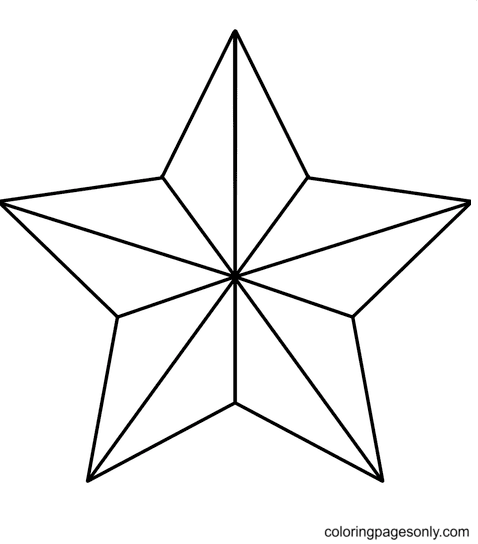
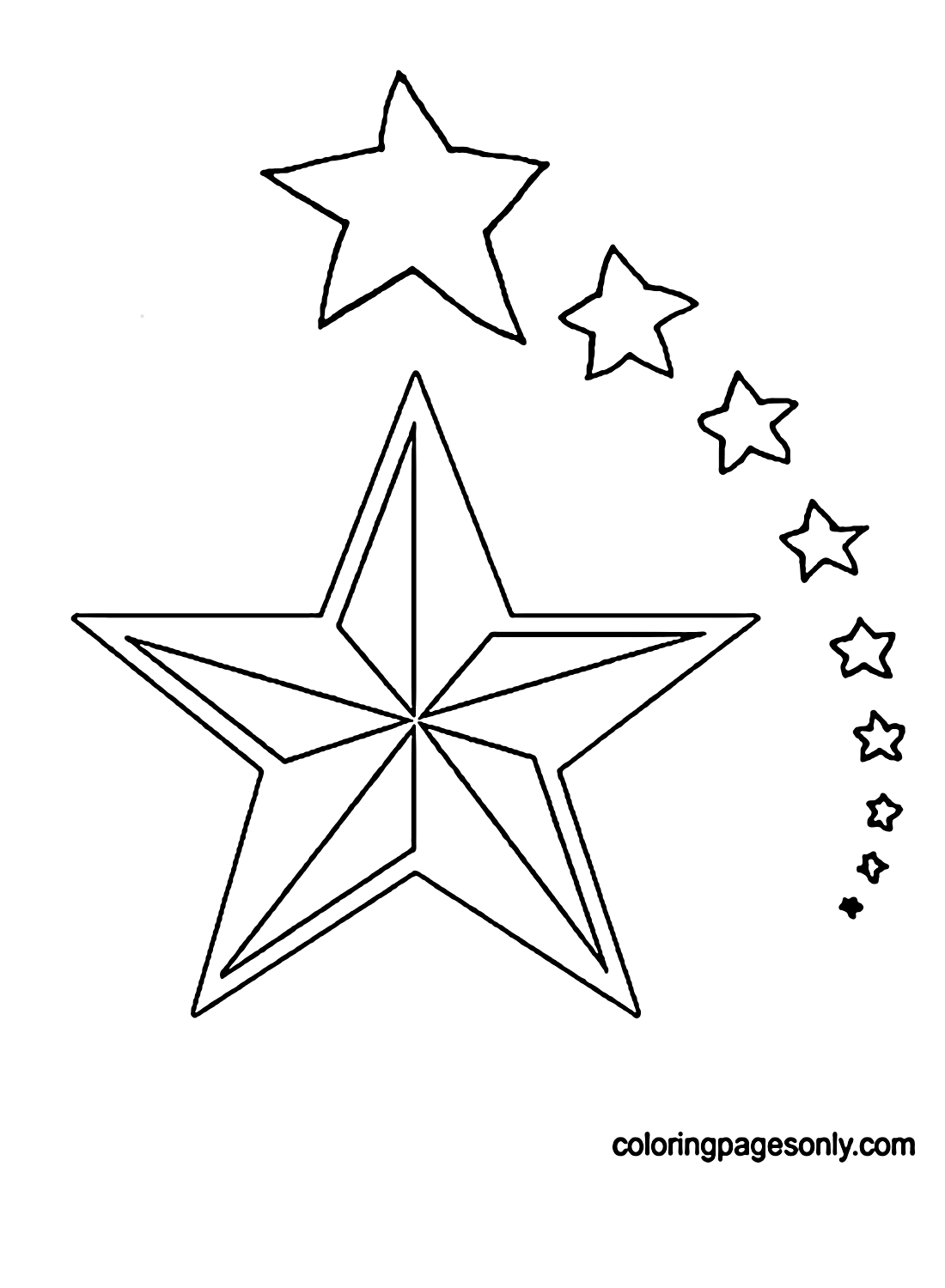
The five-pointed star is one of geometry’s most specifically satisfying shapes: constructed from five line segments that cross each other symmetrically, it produces a form that reads as complete and stable from any rotational orientation. Its five points are equally spaced at 72-degree intervals around a circle. The interior pentagon at the center connects the star’s inner vertices, and the five triangular points extend outward from this pentagon. No other polygon of this point-count produces the same ratio of outline complexity to visual simplicity.
Simple star pages show this form in various sizes, from small star outlines appropriate for young colorists’ large-stroke application to larger single-star pages that allow detailed interior filling. Single large star pages are among the collection’s most immediately versatile: the clear, simple form accepts any color at full saturation and reads correctly regardless of the colorist’s specific choice.
The five-pointed star’s geometry has been studied since antiquity: Pythagorean mathematicians of ancient Greece considered it a symbol of mathematical perfection because the ratio between any longer and shorter segment within the pentagram equals the Golden Ratio (approximately 1.618:1), the ratio that appears repeatedly in natural growth patterns and that has been associated with aesthetic beauty across human visual culture since at least the 5th century BCE.
Coloring simple star pages: Apply any single vivid color at full saturation and full coverage across the entire star surface. The five-pointed star has no interior complexity to manage and no secondary color elements: it rewards the boldest, most vivid color choice available. Gold, vivid yellow, or warm amber are the most classically associated colors, but vivid red, vivid blue, or vivid green all read equally correctly. The outline should remain clearly dark and clean.
Cartoon Star with Face Pages
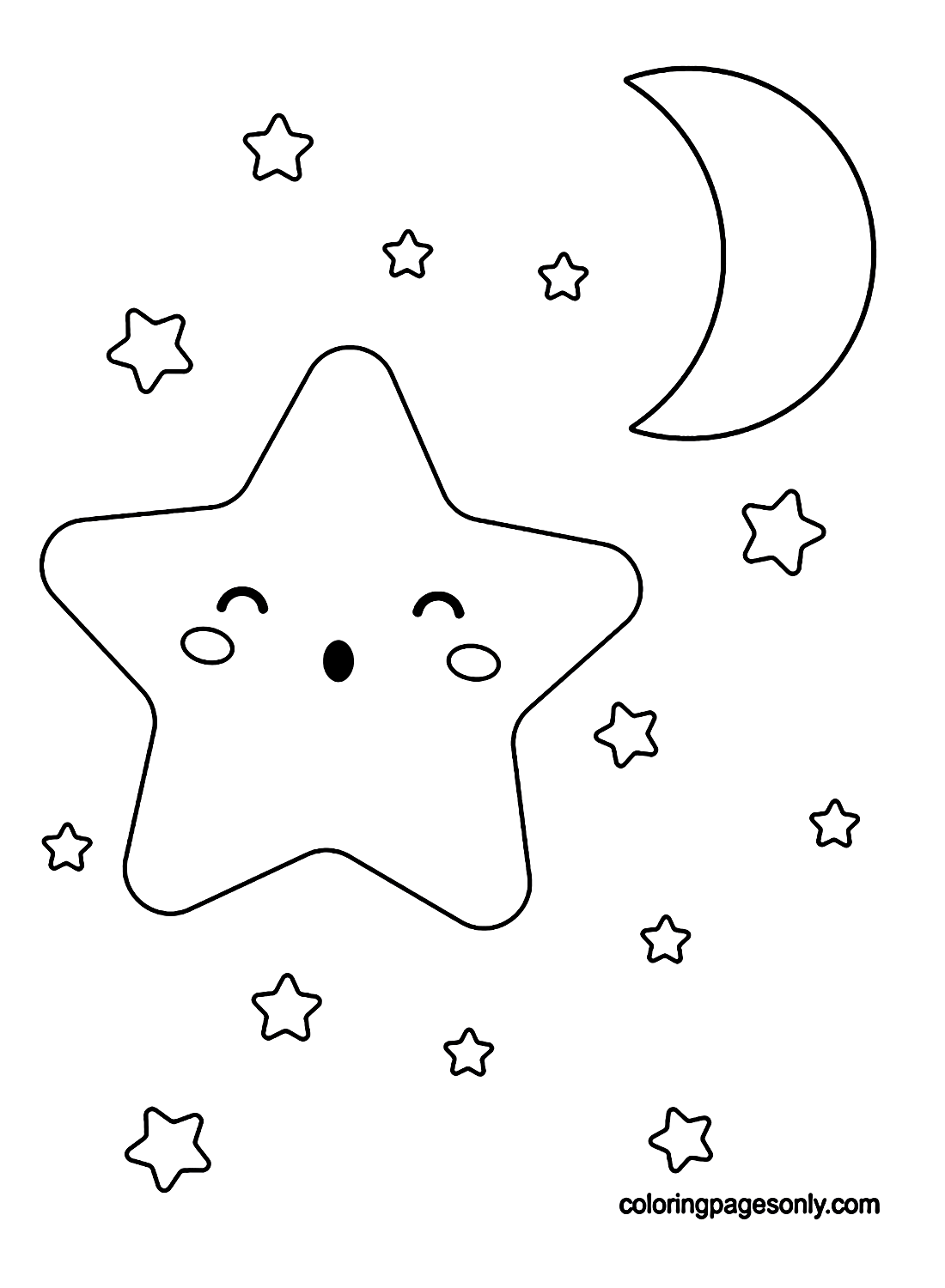
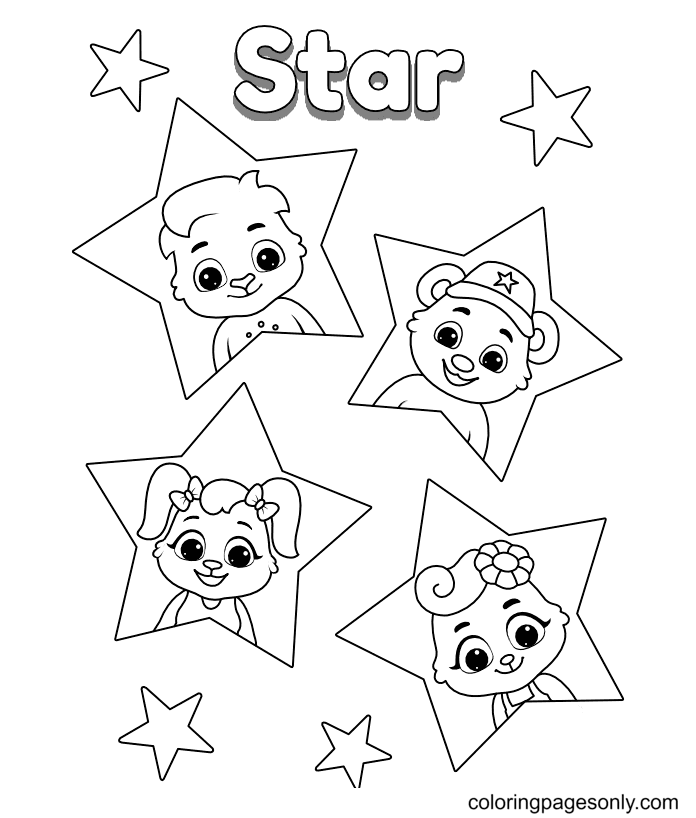
Cartoon stars with expressive faces are the collection’s most immediately accessible pages for very young colorists: the face within the star’s body converts the geometric form into a character, giving the star an emotional register that engages children’s social instincts as effectively as their geometric instincts. The combination of the star’s symmetrical points with the centrally placed face creates a specific cheerful visual that is one of children’s illustrations’ most widely reproduced designs.
The face in a cartoon star typically follows the kawaii or simplified animation face vocabulary: large, round eyes (often with a bright white highlight dot suggesting inner light or happiness), a small, upturned mouth, and sometimes rosy cheek circles suggesting warmth and friendliness. The expressiveness of the face varies across the collection’s pages: some stars beam with wide open smiles and sparkling eyes, others show a more restrained, pleasant expression.
The cartoon star face often includes a small internal sparkle or shine effect on one of the star’s points or body areas: a small four-pointed star-burst shape suggesting the specific visual quality of a star catching light.
Coloring cartoon star face pages: The body uses vivid warm yellow or warm gold at full saturation. The face elements use warm peachy-pink for any cheek circle elements, near-black or dark brown for the eye outlines and mouth, and clean white for the eye whites and highlight dots. Any sparkle effects use the palest available yellow or near-white to suggest the bright point of reflected light against the golden body.
Shooting Star and Trail Pages
A shooting star is not a star: it is a meteor, a piece of space debris (typically ranging from dust-grain size to boulder size) entering Earth’s atmosphere at high speed and burning up through friction with the atmospheric molecules. The streak of light is the heated gas and vaporized material from the object’s surface. The terms “shooting star” and “falling star” are long-established colloquialisms for this phenomenon, despite the objects being entirely unrelated to stars.
Nevertheless, the shooting star’s visual, a bright point trailing a curved arc of diminishing light across the night sky, is one of the sky’s most emotionally affecting and most universally recognized images. The tradition of wishing upon a shooting star exists in numerous cultures and is most familiar in the Western tradition through the 1940 Disney song “When You Wish Upon a Star” (from Pinocchio, composed by Leigh Harline with lyrics by Ned Washington), which won the Academy Award for Best Original Song at the 13th Academy Awards in 1941.
Meteor showers occur when Earth passes through streams of debris left by comets: the Perseids (mid-August, debris from Comet Swift-Tuttle), the Leonids (mid-November, debris from Comet Tempel-Tuttle), and the Geminids (mid-December, debris from the asteroid 3200 Phaethon) are among the most documented annual meteor showers, producing dozens to hundreds of visible meteors per hour at peak.
Coloring shooting star pages: The night background is deep midnight blue or near-black, applied at full coverage before addressing any other element. The star itself at the leading edge of the trail is the brightest, most vivid element in the composition: pale yellow-white or near-white at the star’s point. The trail behind it graduates from pale yellow immediately behind the star through increasingly darker and more diffuse pale grey-blue, suggesting the fading light of the vapor trail. Small secondary sparkle dots scattered behind the main trail suggest the specific visual of a bright meteor crossing the sky.
Constellation Pattern Pages
Constellations are officially recognized patterns of stars as seen from Earth. The International Astronomical Union (IAU) recognizes 88 official constellations covering the entire sky. The most widely recognized in the Northern Hemisphere include Orion (with its distinctive three-star belt), Ursa Major (containing the Big Dipper asterism), Cassiopeia (the distinctive W or M shape), and the zodiac constellations along the ecliptic.
Constellation pages show stars connected by lines in the specific patterns established by convention: the lines between stars in a constellation are not physical connections (the stars in any constellation are at dramatically different distances from Earth and are often not near each other in three-dimensional space at all) but are patterns as seen from Earth’s specific vantage point.
Orion is one of the most widely recognized constellations across multiple cultures. Its three belt stars (Alnitak, Alnilam, and Mintaka) form a nearly perfectly straight line and are visible worldwide. The bright star Betelgeuse marks Orion’s upper left shoulder: a red supergiant approximately 700 light-years from Earth that is expected to eventually explode as a supernova, though “eventually” in this context means within the next 100,000 years.
Coloring constellation pages: The background night sky is deep midnight blue or near-black. Individual stars are small, vivid white or pale gold dots at the star positions. The connecting lines between stars are very thin, pale blue-white or silver-grey, lighter and thinner than the stars themselves, reading as the conventional lines of a star map rather than as structural elements. Star sizes should vary slightly: brighter stars (like Betelgeuse or Sirius) get slightly larger dots than dimmer stars.
Mandala and Geometric Star Pages
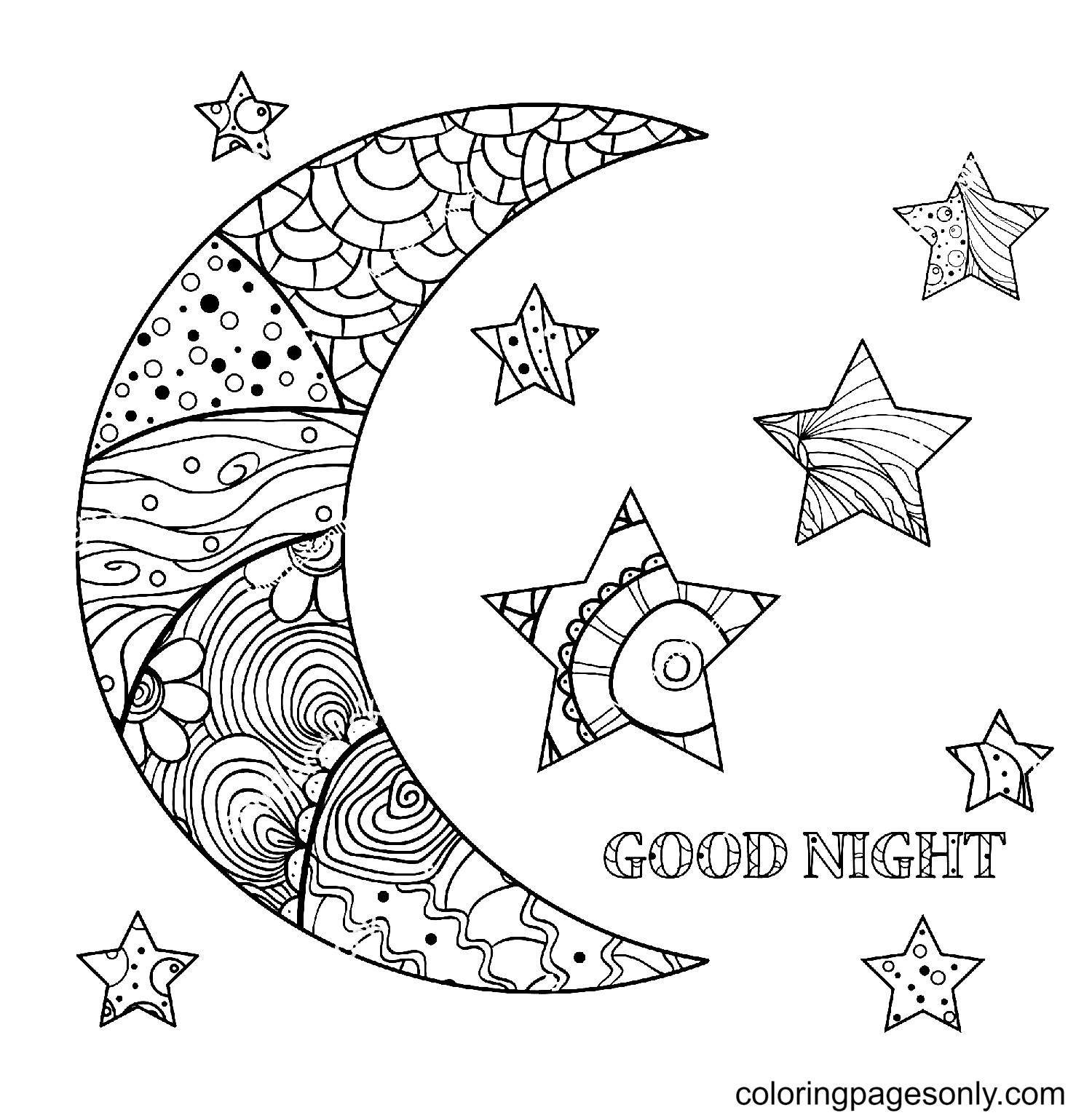
Geometric star mandala pages are among the collection’s most complex and most meditative: elaborate star forms with intricate interior divisions created through overlapping geometric constructions, producing compositions that reward sustained, careful coloring attention across extended sessions.
The six-pointed star (Star of David or hexagram) creates a particularly rich geometric interior when its two overlapping equilateral triangles are elaborated: the center hexagon, the six triangular points, and any added concentric ring elements produce a natural division of the composition into multiple distinct color zones.
The eight-pointed star, formed by two overlapping squares rotated 45 degrees from each other, has a long history in Islamic geometric art, where it forms the basis of the girih (geometric interlace) patterns that appear in mosque tile work, carved plaster, and wooden screen design across the Islamic world from the 11th century onward. Eight-pointed stars are central to the geometric vocabulary of the Alhambra palace in Granada, Spain (completed 14th century), the Süleymaniye Mosque in Istanbul (completed 1558), and the Sheik Lotfollah Mosque in Isfahan (completed circa 1619).
Coloring mandala star pages: Planning the color sequence before beginning is mandatory for multi-zone geometric star pages. Identify all the distinct zones created by the geometric construction and assign a color to each before applying any color. Adjacent zones should use colors from different parts of the color wheel to maximize the visual separation between them. For Islamic-inspired eight-pointed star pages, the traditional palette uses deep blues, turquoise greens, and vivid red-orange with gold accents as the reference palette.
Night Sky Star Pattern Pages
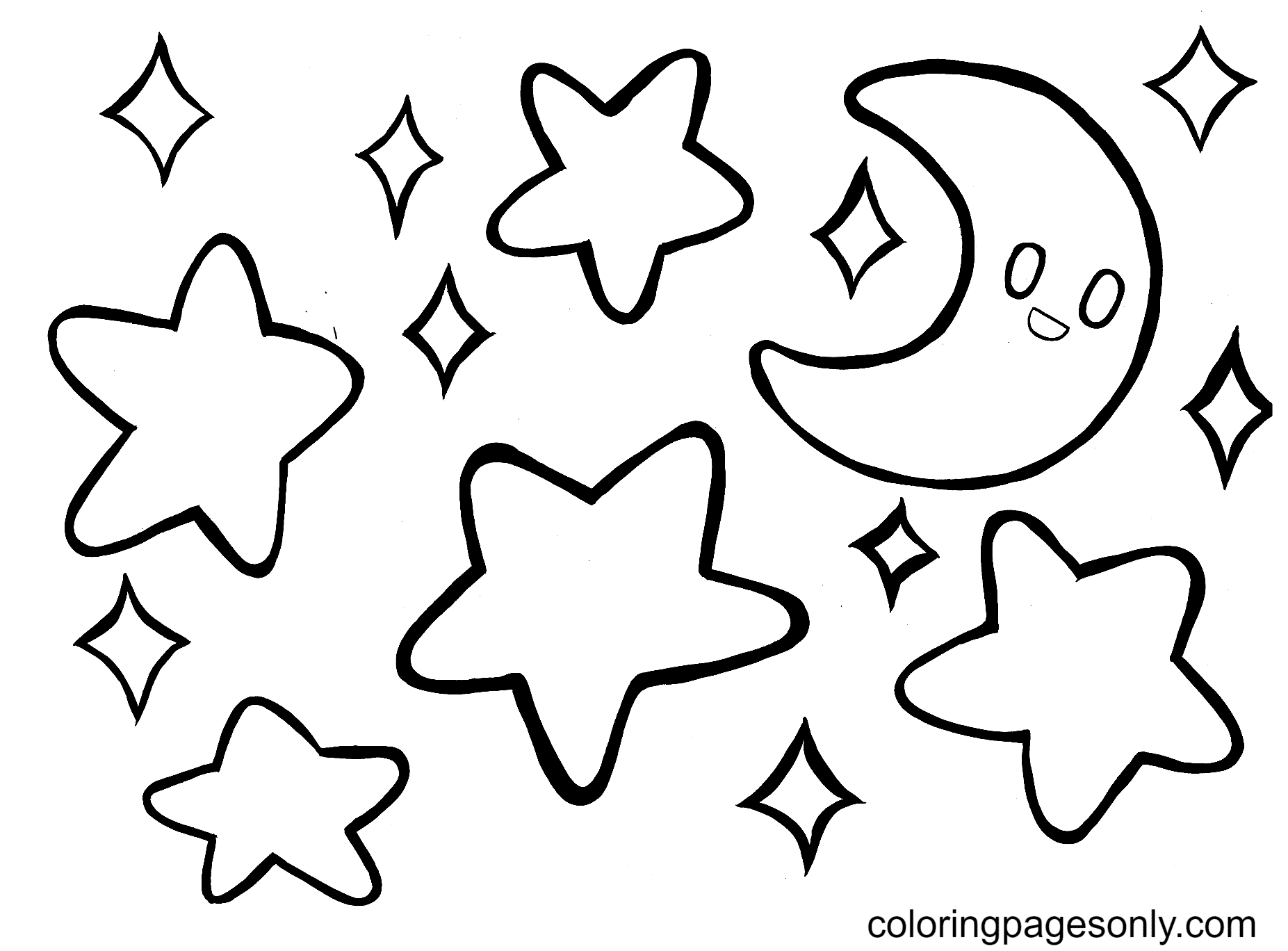
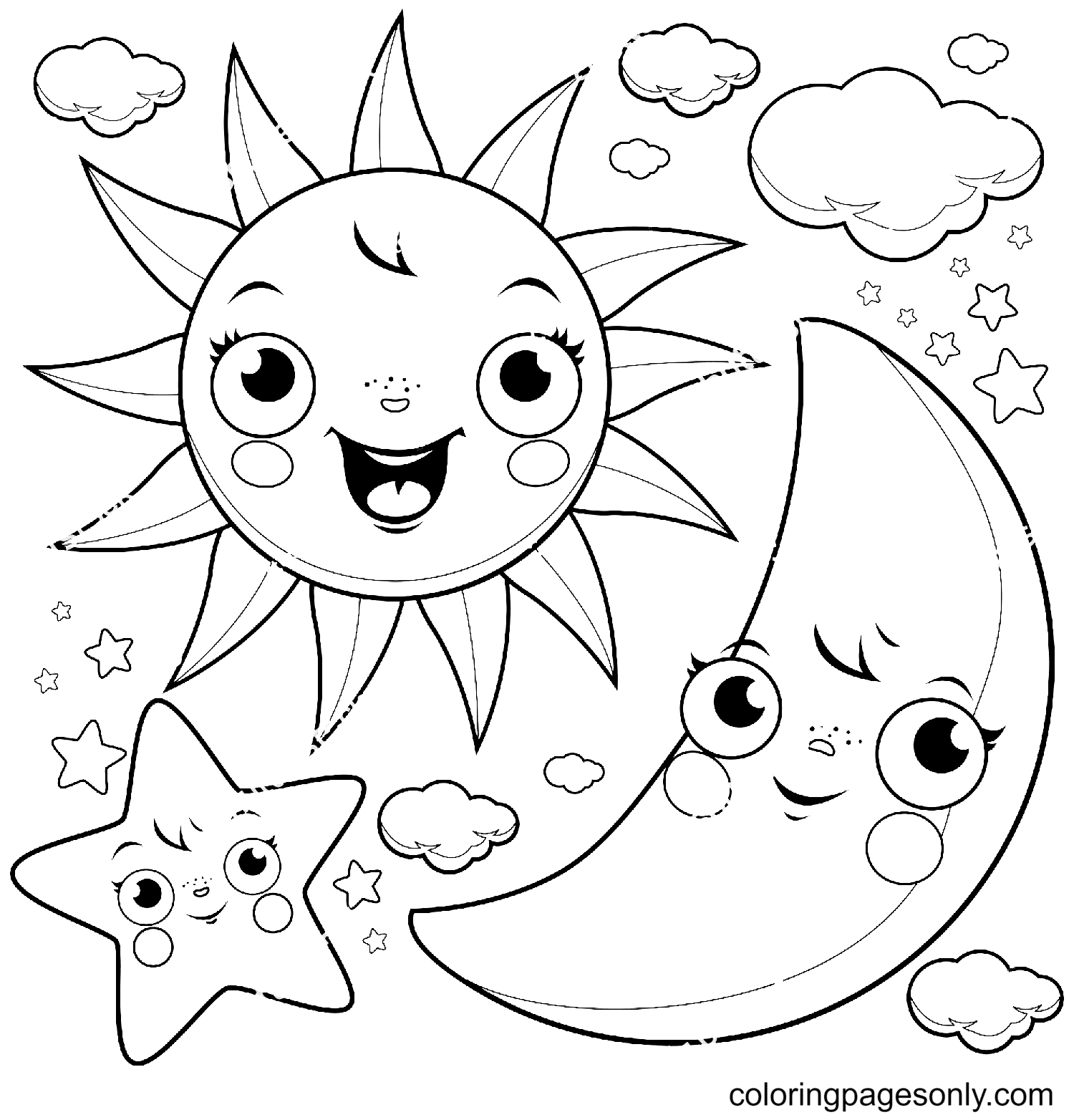
Pages showing fields of stars against a night sky background, with or without moon and cloud elements, are the collection’s most atmospheric: they represent the actual visual experience of looking up at a clear night sky in a dark-sky location, where the Milky Way is visible as a band of light and individual stars are distributed across the full 360-degree dome overhead.
Before the development of artificial lighting, the night sky was a constant and detailed presence in human experience: ancient civilizations used stars for navigation, calendrical calculation, and mythological storytelling. The development of light pollution over the past century has made the full night sky invisible to the majority of the world’s population in their normal environment: approximately 99% of Europeans and Americans live under light-polluted skies where only the brightest stars are visible.
The International Dark-Sky Association, founded in 1988, designates Dark Sky Parks and Dark Sky Communities where artificial lighting is controlled to preserve dark-sky observation opportunities. As of 2024, there are more than 200 International Dark Sky Places designated worldwide.
Coloring night sky pages: The background transitions from deep midnight blue at the top (representing the darkest part of the sky at zenith) through slightly lighter blue-grey toward the horizon. The Milky Way band, if visible in the page design, uses a slightly lighter, slightly more diffuse blue-white applied in a diagonal swath across the sky background. Individual stars are white or pale gold dots applied with the finest available tool at varied sizes: the brightest stars slightly larger, the dimmer stars smaller, creating the specific irregular distribution of a real night sky.
What These Pages Do
The star symbol’s presence in human visual culture across five millennia, from Sumerian clay tablets through medieval Islamic geometric art through the flags of more than fifty modern nations, reflects the star’s status as one of visual culture’s most universally meaningful simple forms. The five-pointed star appears on the national flags of the United States, China, the European Union, Morocco, Ethiopia, Vietnam, and dozens of other countries, making it arguably the most widely used symbol on national flags globally. It functions simultaneously as a symbol of the cosmos (the actual stars), of excellence (the five-star rating system, gold star awards), of authority (military rank insignia, sheriffs’ badges), and of aspiration (the “wishing on a star” tradition across cultures).
The actual stars of the night sky were humanity’s primary timekeeping and navigation tools for most of human history. The ancient Egyptians used the heliacal rising of Sirius (the day it first becomes visible at the eastern horizon just before sunrise) to predict the annual flooding of the Nile. Polynesian navigators used star positions for open-ocean navigation across thousands of miles of the Pacific Ocean without instruments. The North Star (Polaris) guided travelers and sailors in the Northern Hemisphere for millennia. The 88 constellations recognized by the International Astronomical Union preserve naming traditions from ancient Mesopotamia, ancient Egypt, ancient Greece, and other cultures across their specific patch assignments.
The American Academy of Pediatrics identifies fine motor skill development as a key childhood milestone throughout early childhood. The simple five-pointed star’s five precise points, the gradient trail work of shooting star pages, the intricate multi-zone division of mandala star pages, and the small-scale star dot placement of constellation and night sky pages all provide sustained fine motor challenge calibrated to the collection’s wide age range. The 2005 Art Therapy Journal study on structured coloring and anxiety reduction applies throughout, with the night sky pages specifically connected to the documented calming effects of stargazing in the psychological literature.
How to Color These Pages Well
Yellow and gold are the default star body colors, but are not the only correct choices. The cultural association of stars with yellow and gold (reflecting the color of our Sun and of bright stars seen with the naked eye) makes these the first instinctive choices for star pages. But vivid red stars, vivid blue stars, and vivid silver-white stars are all astronomically accurate to different star types, and all four color choices produce equally valid and visually effective results. Blue stars are the hottest (O and B type stars), white stars are hot (A type), yellow is moderate (G type like our Sun), orange is cooler (K type), and red is the coolest (M type). Astronomically informed colorists can apply the color that matches the specific stellar type being depicted.
The night sky background must be complete before any star is placed. On any page featuring a dark night sky background, apply the full background color at complete coverage across every sky area before placing a single star. The sequence matters: attempting to paint the dark background around pre-placed yellow or white stars results in the dark color contaminating the lighter star colors at their boundaries. Apply the background first, then place the stars over it as a second layer.
Mandala star pages require the planning step before any color is applied. The most common error on geometric mandala star pages is beginning to apply colors before the full zoning plan is established, resulting in color choices that conflict when two adjacent zones receive colors too similar to each other. Before applying any color, count every distinct zone in the composition and assign each a specific color. Write the color assignments in the zones using a light pencil if needed. Then apply the colors systematically, working from the largest zones inward to the smallest.
The gradient trail technique for shooting star pages works inside-out from the brightest point. Apply the palest, brightest element first: the near-white or vivid yellow-white at the very tip of the shooting star’s leading point. Then work backward along the trail, applying progressively darker and more diffuse color as the trail extends away from the leading point. The gradient from bright to dark should be the most pronounced change in the composition. The trail’s final visible portion should be barely distinguishable from the dark background.
Star clusters and pattern pages reward a consistent size hierarchy for different star types. When a page shows multiple stars of different sizes (as in a night sky or constellation page), apply the larger size specifically to the stars that should read as brighter or more prominent, and the smaller size consistently to all background stars. The size difference does not need to be large: a dot approximately 50% larger than the smallest dots is sufficient to establish the hierarchy. Inconsistent sizing (large and small dots distributed randomly rather than according to a planned hierarchy) makes the page read as arbitrary rather than astronomical.
5 Creative Craft Ideas
The Star Color Temperature Page
Astronomers classify stars by their temperature using a spectral classification system: O type stars (hottest, blue), B type (very hot, blue-white), A type (hot, white), F type (yellow-white), G type (medium, yellow, like our Sun), K type (cooler, orange), and M type (coolest main sequence, red). The mnemonic for remembering the sequence: “Oh Be A Fine Girl/Guy, Kiss Me.”
Print seven-star pages. Color each in the sequence of stellar spectral types: O (vivid electric blue), B (vivid blue-white), A (clean white), F (pale yellow-white), G (vivid yellow, the Sun’s color), K (vivid orange), M (vivid warm red).
Mount all seven in sequence with labels: “Star temperature classification. O: blue, over 30,000 K. B: blue-white, 10,000-30,000 K. A: white, 7,500-10,000 K. F: yellow-white, 6,000-7,500 K. G: yellow, 5,200-6,000 K (our Sun). K: orange, 3,700-5,200 K. M: red, 2,400-3,700 K. The color of a star tells you its temperature. Blue means hot. Red means cool. Our Sun is yellow because it is a medium-temperature star.”
The One Septillion Stars Page
The estimated number of stars in the observable universe is approximately 10^24: one septillion. This is larger than the estimated number of grains of sand on all of Earth’s beaches. The Milky Way alone contains 100 to 400 billion stars.
Print the most detailed star field page in the collection: the page with the most individual star dots visible. Color the background deepest midnight blue. Apply as many individual star dots as possible across the background.
Count the number of star dots you placed on the page. On the backing card: “Stars on this page: [your count]. Stars in the Milky Way: approximately 200 billion. Stars in the observable universe: approximately 1,000,000,000,000,000,000,000,000 (10^24, one septillion). The number of grains of sand on Earth’s beaches: approximately 7.5 × 10^18. The number of stars: larger. Your page has [your count]. The night sky has slightly more.”
The Light Travel Time Study
Light from the Sun takes 8 minutes and 20 seconds to reach Earth. Light from the nearest other star (Proxima Centauri) takes approximately 4.24 years. Light from the bright star Sirius takes 8.6 years. Light from Betelgeuse (the red supergiant in Orion) takes approximately 700 years. When you see Betelgeuse tonight, you are seeing light that left it around 1325 CE, during the Hundred Years’ War.
Print a shooting star or night sky page. Color the background midnight blue and the stars in appropriate colors for different star types.
On the backing card: “Sun: 8 minutes 20 seconds. Proxima Centauri: 4.24 years. Sirius: 8.6 years. Betelgeuse: approximately 700 years (light left approximately 1325 CE). Andromeda Galaxy (nearest large galaxy): 2.537 million years. When you look at the night sky, you look at the past. Every star is showing you what it looked like when the light left it. The farther away, the older the light.”
The Five-Pointed Star Geometry Study
The five-pointed star can be constructed by extending the five sides of a regular pentagon until they meet. The resulting pentagram is the oldest known occurrence of the Golden Ratio in geometry: the ratio of the longer to the shorter segment in any line of the pentagram is exactly 1.618:1, the Golden Ratio (phi, φ). This ratio appears in the shell of the nautilus, in the spiral arrangement of sunflower seeds, in the proportions of the human body, and in many other natural growth patterns.
Print a large, simple five-pointed star page. Before coloring, use a ruler to draw lines inside the star connecting its points: this will reveal the internal pentagon at the star’s center and the five triangles forming its points. Color the pentagon in one color and the five triangles in a second color.
On the backing card: “The five-pointed star. Geometry: five isosceles triangles arranged around a regular pentagon. The Golden Ratio (phi, φ ≈ 1.618): found in the ratio of longer to shorter segments in any line of the pentagram. First documented use: Sumerian clay tablets, approximately 3000 BCE. Used by Pythagoreans as a symbol of mathematical perfection. Appears today on: the flags of approximately 50 countries, five-star rating systems, military rank insignia, sheriffs’ badges, and the Hollywood Walk of Fame. Same shape. Many meanings.”
The Polaris Navigation Page
Polaris (the North Star) currently sits within approximately 0.7 degrees of the true celestial north pole, making it the most reliable fixed reference point in the Northern Hemisphere night sky for navigation. Ancient and medieval sailors, explorers, and travelers used Polaris to determine their latitude: the altitude of Polaris above the horizon equals the observer’s latitude. A navigator at the North Pole sees Polaris directly overhead; a navigator at the equator sees it at the horizon.
Polaris is not permanently the North Star: Earth’s axis precesses (wobbles slowly like a spinning top) over a cycle of approximately 25,772 years. Around 3000 BCE, the North Star was Thuban in Draco. In approximately 12,000 years, the bright star Vega will be nearest the north celestial pole.
Print a decorative North Star or nautical star page. Color the central star in vivid gold or warm white. Color surrounding compass-direction elements in deep navy and warm red.
On the backing card: “Polaris (the North Star). Current angular distance from the north celestial pole: approximately 0.7°. Navigation: altitude above horizon = observer’s latitude. Ancient use: Phoenician navigators, medieval European sailors, medieval Arab navigators. Duration as North Star: approximately 2,000 more years, then replaced due to axial precession. Previous North Star (3000 BCE): Thuban. Next North Star (~14,000 CE): Vega. The star that has guided travelers for 2,000 years will not always point north. Use it while it does.”
Frequently Asked Questions
What is a star in the scientific sense? A star is a luminous ball of plasma held together by its own gravity, generating energy through nuclear fusion in its core. In the most common fusion process, hydrogen atoms fuse to produce helium, releasing the energy that produces the star’s light and heat. A star’s life depends on the balance between gravity (which compresses the stellar material inward) and radiation pressure from fusion (which pushes outward): while hydrogen fuel is available, this balance maintains the star on the “main sequence.” When hydrogen is exhausted, the star evolves into other stages depending on its mass: lower-mass stars like our Sun will eventually become red giants and then white dwarfs, while higher-mass stars end their lives in supernova explosions that produce neutron stars or black holes.
How many stars exist, and how do we estimate the number? The total number of stars in the observable universe is estimated at approximately 10^24 (one septillion, or a trillion trillion). This estimate is built up from nested estimates: astronomers estimate the number of stars in a typical galaxy (approximately 100 billion), then estimate the number of galaxies in the observable universe (approximately 2 trillion, a figure updated from earlier estimates in a 2016 paper by Christopher Conselice and colleagues published in the Astrophysical Journal), and then multiply the two estimates. This number exceeds the estimated count of grains of sand on all of Earth’s beaches by roughly five orders of magnitude. The Milky Way galaxy itself contains an estimated 100 to 400 billion individual stars.
Why do stars appear to twinkle? Stars appear to twinkle (the scientific term is scintillation) because of atmospheric turbulence: variations in air density, temperature, and wind create variations in the refraction of the starlight as it passes through Earth’s atmosphere, causing the light path to shift slightly and randomly, which makes the star appear to flicker and change position very slightly. Planets do not twinkle as noticeably as stars because they present a disc to Earth’s view rather than a point source: the disc is large enough that random variations in different parts of the disc cancel each other out. Stars, being so far away that they appear as point sources even in large telescopes, show the twinkling effect clearly. The “twinkle, twinkle, little star” nursery rhyme (text by Jane Taylor, published 1806) references this visible phenomenon.
What is the five-pointed star shape, and where does it come from? The five-pointed star is a geometric figure constructed from five straight line segments that connect five evenly spaced points on a circle, crossing each other in the process. The shape has been used in human visual culture for at least 5,000 years: the earliest known examples are found on Sumerian clay tablets from approximately 3000 BCE. Ancient Greek Pythagorean mathematicians used the pentagram as a symbol of mathematical perfection because of its relationship to the Golden Ratio (phi, approximately 1.618), which appears in the ratio of any longer segment to any shorter segment within the pentagram’s geometry. Today, the five-pointed star appears on the national flags of more than 50 countries, in five-star rating systems, in military rank insignia, in sheriffs’ badges, and in the Hollywood Walk of Fame stars.
What are the different types of star shapes used in coloring pages? Star coloring pages typically feature several geometric star forms. The five-pointed star (pentagram) is the most common, constructed from five points evenly spaced and connected by five crossing lines. The six-pointed star (Star of David or hexagram) consists of two overlapping equilateral triangles, creating six points and a central hexagon. The eight-pointed star is formed by two overlapping squares rotated 45 degrees from each other, creating eight points and a central octagon; this form appears extensively in Islamic geometric art from the 11th century onward. Four-pointed stars appear as compass roses and as the four-pointed “sparkle” shape in illustration and graphic design. Multi-pointed decorative stars (10, 12, or more points) appear in mandala designs. Each star form has distinct historical and cultural associations.
What is the difference between a meteor and a shooting star? A “shooting star” or “falling star” is a popular name for a meteor: a piece of space debris entering Earth’s atmosphere at high speed and burning up through friction with atmospheric molecules. The visible streak of light is produced by the heated gas and vaporized material from the object’s surface as it travels through the atmosphere. Despite the popular name, shooting stars are not stars at all: they are typically pieces of rock, metal, or ice ranging from sand-grain size to boulder size. Objects that survive the atmospheric entry and reach Earth’s surface are called meteorites. Annual meteor showers occur when Earth passes through streams of debris left by comets or asteroids: the Perseids (mid-August) and Geminids (mid-December) are two of the most consistently active annual showers.
What age group are these pages best suited for? Star coloring pages serve an exceptionally broad age range due to the variety of complexity levels within the collection. The simplest large single-star outline pages, with their single large color area and minimal detail, are accessible from ages two and three, where the bold symmetrical shape provides an immediately clear, achievable coloring target. The cartoon star with face pages, with their additional face detail elements, are most rewarding for ages three to seven. The constellation pattern pages with their small star dots and connecting lines, the shooting star gradient trail pages, and the themed star arrangement pages are most engaging for ages five to twelve. The intricate mandala and geometric star pages, with their multiple color zones requiring advanced planning, are most appropriate for ages ten and up and for adult colorists who appreciate the meditative quality of sustained, precise geometric coloring work.
Browse the full collection at ColoringPagesOnly.com. All 50+ pages free, no sign-up, PDF or PNG, print or color online.
The observable universe contains an estimated one septillion stars. The Milky Way contains approximately 200 billion of them. Light from our nearest stellar neighbor, Proxima Centauri, takes 4.24 years to reach Earth. When you see Betelgeuse in the winter sky, you are seeing light that left it approximately 700 years ago.
The five-pointed star that appears in this collection has been drawn by human hands for at least 5,000 years. The Pythagoreans found the Golden Ratio inside it. It appears on more national flags than any other symbol. It marks excellence, authority, aspiration, and the cosmos simultaneously.
The shooting star is not a star. It is a rock burning up. The wish people make on it is for something the rock cannot provide. They make the wish anyway. This is consistent with what people do.
Pick up your most vivid yellow or warm gold. The simple star body goes first at full saturation. If it is a night sky page, the deep midnight blue background goes first. The stars go last, as small bright dots over the completed dark ground.
Share your work on Facebook and Pinterest and tag #Coloringpagesonly. The star color temperature display and the light travel time study pages are particularly worth sharing.
Color the star gold. Apply the night sky dark first. The actual stars are yellow and orange and blue and red, depending on how hot they are. Every color you choose is astronomically correct for some star somewhere.