Space Coloring Pages at ColoringPagesOnly.com covers over 700 pages across 17 sub-categories organized around the full range of humanity’s relationship with outer space – the scientific (the real planets, moons, stars, and astronomical phenomena of our universe), the exploratory (the astronauts, rockets, and space stations that represent humanity’s physical reach beyond Earth), and the imaginative (the aliens, science fiction worlds, and galaxy aesthetics that space has inspired in human storytelling and art). These three modes are not in competition – they reflect the three genuinely different reasons people are drawn to space as a subject, and all three are fully represented in this collection. A child who wants to color a realistic Saturn with its rings gets that page here. A child who wants to color a cartoon rocket and a friendly alien also gets that page here. An adult who wants to work with the deep color palettes of galaxy nebulae and cosmic photography also finds exactly that in the Galaxy sub-category. Space as a subject accommodates all of these approaches simultaneously, which is one of the reasons it produces such a naturally rich coloring page collection.

Every page in this collection is completely free to download as a PDF and print, or to color online directly in your browser.

Our Solar System: The Planets and Their Worlds

The most scientifically grounded cluster of sub-categories in the Space collection covers the actual astronomical objects of our solar system – the planets, moons, and celestial phenomena that exist in verifiable, photographically documented reality and that carry specific, canonical color palettes derived from space photography and planetary science.

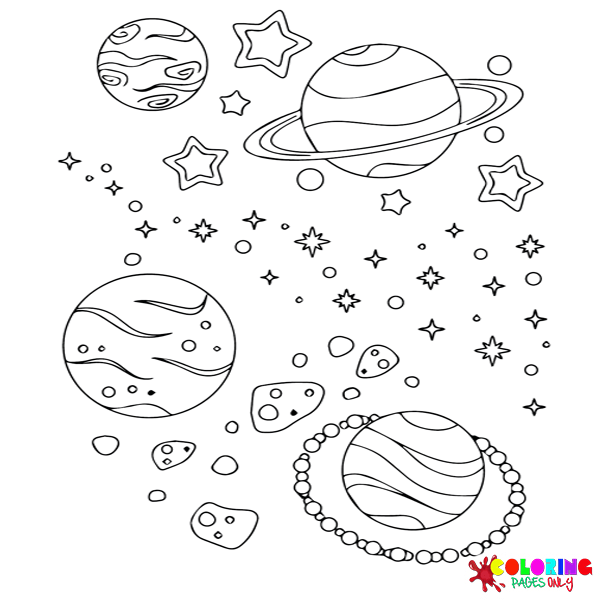
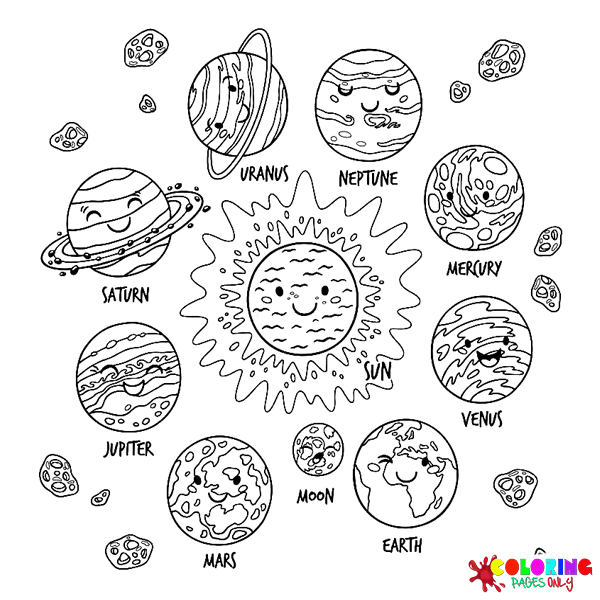
Solar System provides the broadest single view of our planetary neighborhood – pages that show multiple planets together, often arranged in orbital sequence from the Sun outward or in scale comparison that makes the dramatic size differences between planets visually legible. The Solar System as a coloring subject presents one of the most genuinely educational color exercises in the entire collection: each planet has a specific, scientifically documented appearance that a colorist can research and attempt to render accurately, and doing so produces an authentic astronomical portrait of our corner of the universe. The Sun at center, Mercury and Venus close in, Earth and Mars in the inner system, then the gas giants Jupiter and Saturn, and the ice giants Uranus and Neptune in the outer system – each with its own color, size, and surface character.

Planet covers individual planets across the solar system, allowing more focused attention on the specific visual character of each world. The canonical planetary colors are among the most visually diverse objects in the known universe: Mercury is a muted gray-brown, heavily cratered like Earth’s moon, with no atmosphere to add color variation. Venus appears from space as a uniform bright white-yellow, its surface entirely hidden under dense clouds of sulfuric acid that reflect sunlight almost completely. Mars is the most immediately recognizable planet after Earth – the rust-red of its iron oxide surface, the white of its polar ice caps, and the occasional yellow-tan of dust storms define a color palette so distinctive that it has entered common language as “the red planet.” Jupiter is a marvel of banded color – the alternating tan, white, orange-brown, and red-orange bands of its atmospheric cloud layers, punctuated by the vivid red-orange oval of the Great Red Spot (a storm larger than Earth that has persisted for centuries). Saturn presents its iconic ring system – the rings themselves ranging from bright white to tan to darker gray across their different bands, with the planet’s body showing similar atmospheric banding to Jupiter but in softer, more muted gold and tan tones. Uranus is a smooth, featureless pale cyan-blue-green – its atmosphere of methane gives it this specific color that distinguishes it from all other planets. Neptune is the deepest, richest blue in the solar system – a vivid cobalt-to-navy blue that is darker and more saturated than Uranus, with visible white cloud streaks in its upper atmosphere.

Earth covers our own planet specifically – the “Blue Marble,” as it was named from the famous 1972 Apollo 17 photograph that showed Earth as a complete sphere for the first time. Earth pages range from the globe illustration showing continents and oceans (the iconic blue ocean, green and brown land masses, white ice caps at the poles, and swirling white cloud patterns) to continent-map outlines, to the view from space showing Earth floating in the black void, to the perspective from Earth’s surface looking upward at the atmosphere above. Earth is the only planet in the solar system where coloring from a surface-upward perspective is as natural as coloring from a space-downward perspective, because we actually live here and know what it looks like from inside.

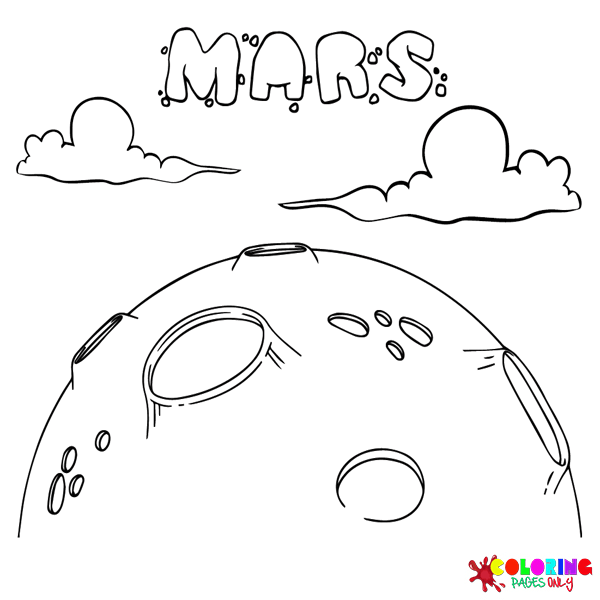
Mars has its own dedicated sub-category reflecting the particular intensity of human fascination with the Red Planet – the most Earth-like of our solar system neighbors, the target of more spacecraft missions than any planet except Earth itself, and the destination that human space exploration programs have identified as the most likely next destination for crewed missions. Mars pages cover the planet from space (the rust-red globe with its white polar caps), the surface landscape (the vast rust and iron oxide terrain, the Olympus Mons volcano – the largest volcano in the solar system – the Valles Marineris canyon system), and the human exploration context (the rovers that have driven across its surface, the landers that have touched down, the vision of future human habitation on Mars that has captured the imagination of scientists, engineers, and storytellers alike).

Sun covers our star – the gravitational and energetic center of the entire solar system, a sphere of plasma 109 times the diameter of Earth and 330,000 times its mass, fusing hydrogen into helium at its core and radiating the energy that makes life on Earth possible. Sun pages range from simplified, child-accessible representations (the classic circle-with-rays icon that appears in children’s drawings universally) to more scientifically accurate depictions showing the corona (the outermost atmosphere of the Sun, visible during total solar eclipses as a white-light halo), solar flares (arching eruptions of plasma from the surface), and sunspots (dark regions on the surface where magnetic activity reduces the temperature and therefore the brightness). The canonical color of the Sun in coloring illustration is a vivid golden-yellow to orange-yellow, though its actual light is white – the yellow-orange appearance is a result of our atmosphere’s scattering of blue light wavelengths.

Moon covers Earth’s natural satellite – the only extraterrestrial body that humans have physically visited, and the astronomical object that has the most immediate daily presence in human life through its cycle of phases. Moon pages cover the full-moon face with its dark mare (the ancient volcanic plains that form the familiar “face in the moon” pattern), the crescent moon as the most artistically depicted lunar phase, the moon in different atmospheric contexts (rising over a horizon, appearing behind clouds, illuminated against a star-filled night sky), and the historical Apollo landing context. The canonical coloring of the Moon is a pale gray-white for the brighter highland regions and a slightly darker gray for the mare regions, often with a warm cream tint that reflects the Moon’s actual color as seen through Earth’s atmosphere near the horizon.

Solar Eclipse covers one of the most dramatic and visually extraordinary astronomical events observable from Earth – the moment when the Moon passes directly between Earth and the Sun, blocking the Sun’s disk and revealing the corona. The visual of a total solar eclipse – the perfectly circular black disk of the Moon silhouetted against the brilliant white corona spreading in all directions, the sky darkened to a deep twilight blue-purple despite being daytime, the planets and brightest stars becoming visible – is among the most spectacular images that the Space collection offers. Eclipse pages vary in complexity from simple symbolic renderings (circle within circle) to more elaborate compositional images showing the corona’s structured rays and streamers against a darkened sky.

Space Exploration: The Human Presence in Space

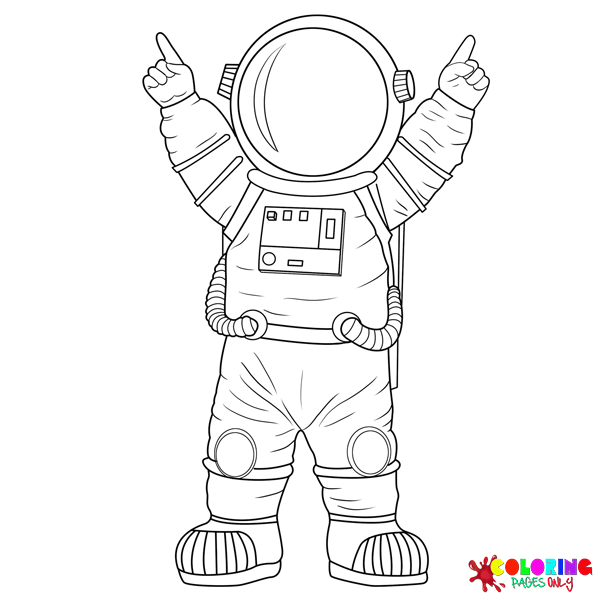
Astronaut is the most human-centered sub-category in the entire Space collection – the point where the vast, impersonal scale of the universe meets a recognizable person in a spacesuit. Astronaut pages bring space exploration down to the human scale: the individual in their white EVA suit (extravehicular activity suit – the pressurized garment worn during spacewalks), floating in the black void with Earth visible below, working on the exterior of a space station, planting a flag on a lunar surface, or performing the precise technical tasks of scientific research in a zero-gravity environment.

The spacesuit is the defining visual element of astronaut pages. The standard NASA EVA suit – the Extravehicular Mobility Unit (EMU) used during spacewalks – is white overall, with the helmet visor coated in a thin layer of gold that gives it its characteristic golden-mirror reflective appearance. This gold visor is not decorative but functional: it filters ultraviolet radiation and the intense unfiltered sunlight of space. The suit has various colored elements – mission patches on the shoulders, different colored stripe configurations used to identify individual astronauts during EVA operations, and the gold visor – against the predominant white. The backpack life support system (the Primary Life Support System, or PLSS) is also white. Getting the visor’s specific gold-mirror tone right is the most visually important single coloring decision in any astronaut page.

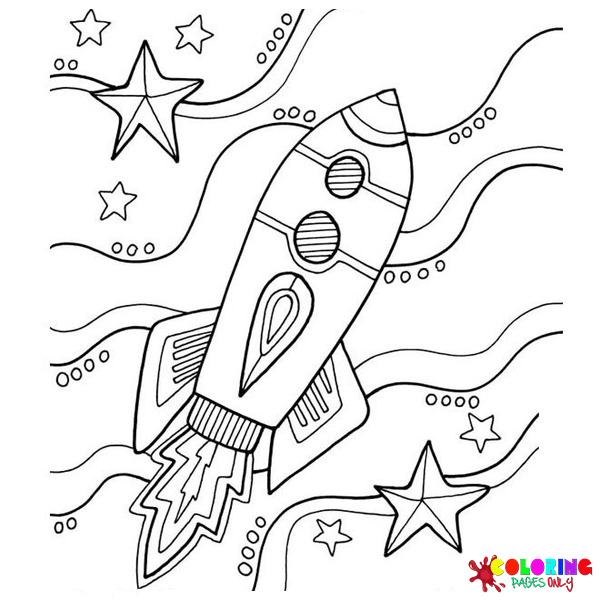
Rocket covers the launch vehicles that make all space exploration possible – the controlled combustion engines powerful enough to accelerate a vehicle to escape velocity (approximately 11.2 kilometers per second) and break free of Earth’s gravity. Rocket pages span the full history of human spaceflight: the early V-2 rockets of the 1940s that established the basic technology, the Saturn V that carried Apollo missions to the Moon (still the most powerful operational rocket ever built, at 363 feet tall and generating 7.6 million pounds of thrust at liftoff), the Space Shuttle orbiter with its distinctive delta-wing form and external orange fuel tank, the contemporary rockets of the new space era (SpaceX Falcon 9, Falcon Heavy, and Starship; NASA’s Space Launch System; United Launch Alliance’s Atlas and Vulcan rockets).

The Saturn V remains the most visually striking rocket in coloring illustration history: its three stages painted in white overall with black lettering, the four orange-to-tan colored F-1 engines at the base of the first stage, the American flag on the side, and the Apollo command module at the apex – a complete vehicle taller than the Statue of Liberty and wider at the base than a city street. Coloring the Saturn V accurately produces one of the most satisfying space-related coloring page results in the collection.

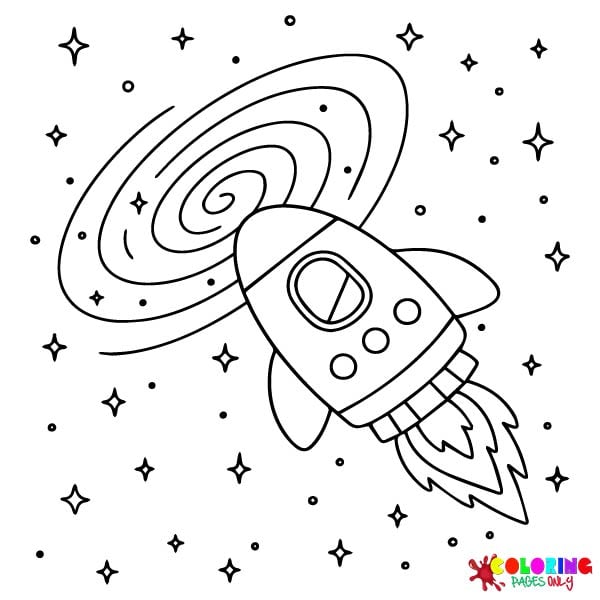
Spaceship extends beyond the real-world launch vehicle category into the broader category of spacecraft – both the actual operational spacecraft that orbit Earth and travel to other worlds (the International Space Station, the Apollo lunar module, the Mars rovers, the Voyager probes) and the fictional and conceptual spacecraft that appear in illustration, science fiction, and the visual imagination of space exploration enthusiasts. This sub-category bridges the scientific and imaginative modes of the Space collection most directly, accommodating both a realistic rendering of the International Space Station (with its solar panel arrays, pressurized modules, and distinctive truss structure) and a more fantastical spacecraft design from science fiction or original illustration.

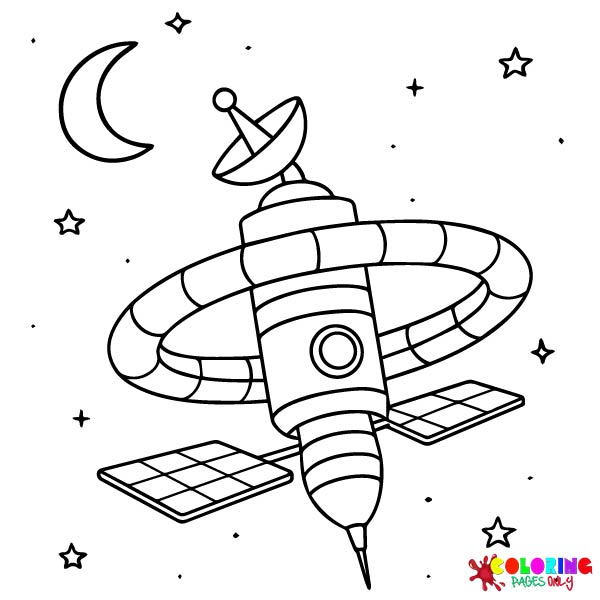
Space Stations focuses specifically on the orbital platforms where humans live and work in space – the most significant being the International Space Station (ISS), the largest human-made structure in space and a continuous human presence in low Earth orbit since November 2000. The ISS is visually extraordinary: its enormous solar panel arrays (each panel spanning 73 meters) extend from the central truss structure, the pressurized habitation and research modules form the inhabitable core, and the whole structure spans 109 meters from end to end – roughly the length of an American football field. Against the black void of space with Earth’s curved blue surface below, the ISS produces one of the most complex and striking coloring page compositions in the entire Space collection.

The Wider Universe: Stars, Galaxies, and Deep Space

Star covers stars both as the simple five-pointed geometric symbol that has represented them in human illustration for centuries and as the actual astrophysical objects – enormous spheres of plasma in which nuclear fusion converts hydrogen to helium and releases the energy that makes all light and life in the universe possible. Star pages range from the simple, iconic five-point star shape in various arrangements (single stars, star clusters, star patterns) to more scientifically engaged depictions showing stellar phenomena: binary star systems (two stars orbiting each other), red giant stars (aging stars that have expanded enormously and cooled to an orange-red surface temperature), blue supergiant stars (the hottest and most luminous stars, appearing blue-white), and neutron stars and supernovae (the dramatic end stages of massive stellar lives).

The star’s color is one of the most directly scientific coloring facts in the entire collection: stellar color is determined by surface temperature, following a precise spectrum from the coolest red stars through orange, yellow (like our Sun), yellow-white, white, and into the hottest blue-white stars. Understanding this means that coloring a realistic star illustration requires knowing something real about stellar physics – a fact that makes star pages among the most quietly educational in the entire Space collection.

Galaxy covers the deep-universe scale – the enormous structures of hundreds of billions of stars, gas, dust, and dark matter that are the largest organized structures in the known universe. The Galaxy sub-category contains the most visually ambitious and the most aesthetically distinctive pages in the entire Space collection. Galaxy illustration draws directly from the extraordinary images produced by the Hubble Space Telescope and its successor, the James Webb Space Telescope – images showing the spiral arms of distant galaxies, the vivid colored clouds of stellar nurseries, the ring and elliptical galaxies in collision, and the deep-field views that reveal thousands of galaxies in a region of sky the size of a grain of sand held at arm’s length.

The color palette of galaxy pages is unlike anything else in the coloring page world: deep cosmic indigo and blue-black for the void between stars, vivid magenta, pink, and crimson for hydrogen emission nebulae (the glowing gas clouds where new stars are forming), electric blue and cyan for the hottest young star clusters embedded in those nebulae, warm gold and amber for older stellar populations, and bright white for the densest concentrations of stars. This palette – working from absolute black through to pure white with all of the vivid intermediaries – requires the most advanced coloring technique of any sub-category on the site, but it also produces some of the most spectacular finished results. Galaxy pages rendered with full commitment to their deep-space color palette look genuinely astronomical when finished.

Galaxy also covers the Milky Way specifically – our own galaxy, a barred spiral galaxy approximately 100,000 light-years in diameter – as seen from within, both in the romanticized night-sky band of stars visible to the naked eye from dark locations and in the more detailed astrophotographic view of the galactic core (the densest concentration of stars at the center of our galaxy, visible as a luminous cloud in the direction of the constellation Sagittarius). The Milky Way’s galactic core, in deep-sky astrophotography, shows a palette of warm gold and amber stellar light suffused with pink and magenta nebulosity – one of the most beautiful astronomical color palettes in the natural universe.

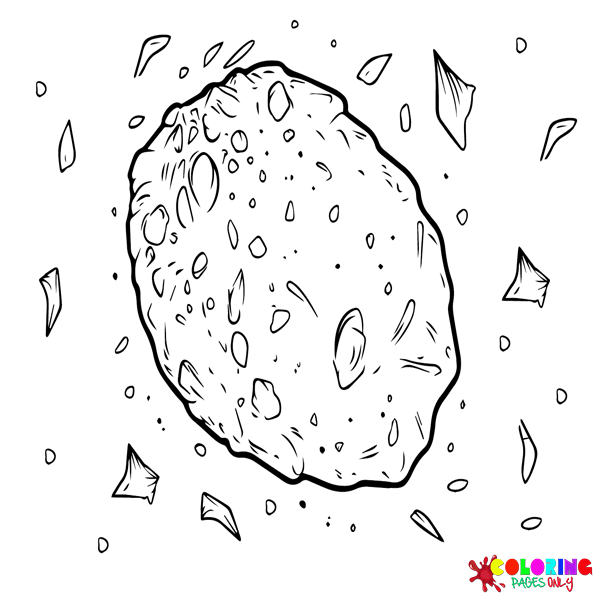
Asteroid covers the rocky, irregular bodies of the solar system – the remnant material from the formation of the solar system 4.6 billion years ago that never coalesced into a planet. Asteroids range in size from dust particles to objects hundreds of kilometers across, and they occupy the asteroid belt between Mars and Jupiter as well as various other orbital populations throughout the solar system. Asteroid coloring pages capture the irregular, cratered, gray-brown rocky surface that defines these ancient objects – visually among the least colorful subjects in the Space collection, but scientifically among the most important as records of the solar system’s early history.

Shooting Stars covers the streak of light produced when a meteoroid (a small rocky or metallic fragment from space) enters Earth’s atmosphere and heats to incandescence through air friction – a meteor, or more popularly a “shooting star.” Despite the name, shooting stars have nothing to do with stars; they are typically fragments of comets or asteroids no larger than a grain of sand. The visual of a shooting star – a bright point of light with a luminous trail extending behind it across the night sky – is one of the most universally recognized astronomical images, carrying cross-cultural associations with wishes, luck, and fleeting beauty. Shooting star pages capture this streak against the star-field background, often with the star trail in a warm gold-white graduating to the deep blue-black of the night sky.

The Imaginative Universe: Science Fiction and Alien Worlds

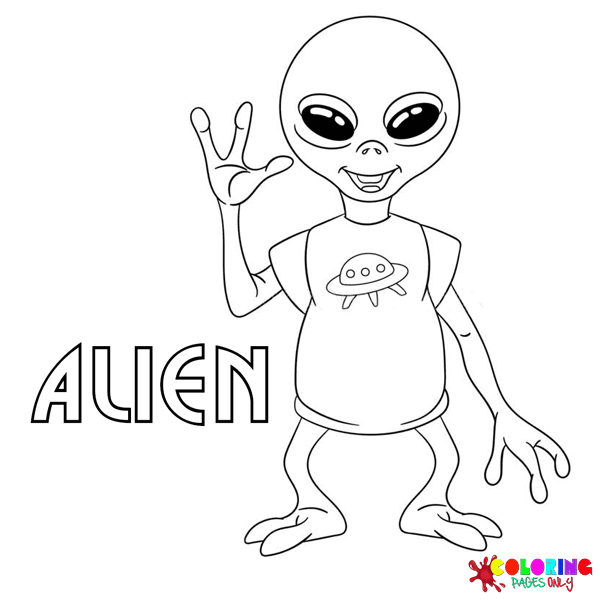
Alien covers the imagined inhabitants of other worlds – the full range of extraterrestrial life forms that human imagination has produced across science fiction literature, film, television, video games, and illustration. Alien coloring pages range from the most familiar and friendly iconography (the smooth green-skinned, large-eyed, small-mouthed alien of children’s illustration that has become the default visual shorthand for extraterrestrial life) through the more elaborate and biologically inventive alien designs of science fiction (tentacled beings, crystalline entities, insectoid forms, energy-based life forms) to the more naturalistic alien creature designs inspired by astrobiology’s actual thinking about what life elsewhere in the universe might look like given different planetary environments.

What makes alien pages distinctively creative in the coloring page context is that they have no canonical color – unlike the scientifically documented colors of actual planets and stars, an alien can be any color, have any surface texture, emit any light. This complete creative freedom makes Alien pages some of the most genuinely open-ended coloring exercises in the Space collection: the colorist’s choices are the alien’s reality. A choice to color an alien deep purple with bioluminescent green patterns produces a creature that suggests a dark ocean world. A choice to color an alien vivid orange-red with reflective metallic patches suggests a hot, mineral-rich desert planet. The color choices are the worldbuilding.

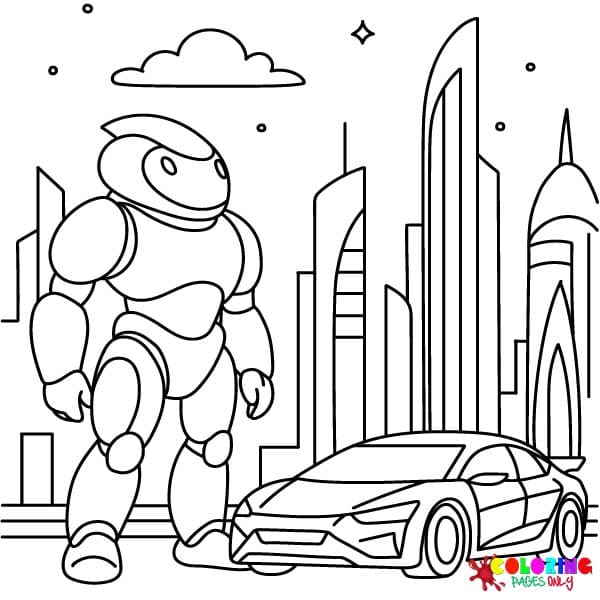
Science Fiction is the most culturally hybrid sub-category in the entire Space collection – the point where astronomical science meets narrative storytelling. Science fiction as a coloring page genre brings together the visual vocabulary of space (spacecraft, planets, stars, aliens, space stations) with the design traditions of science fiction world-building: the sleek technology aesthetic of optimistic space opera, the gritty industrial design of more pessimistic future visions, the alien architecture of civilizations that developed on different worlds under different evolutionary pressures, and the human figures navigating all of these extraordinary environments.

Science fiction coloring pages draw on the broadest possible visual range: from the iconic silhouettes of science fiction spacecraft (the triangular command ship, the ring station, the exploration vessel) to the alien city on a world with two suns, to the space battle with colored energy weapons against a star-field background, to the lone explorer in a spacesuit on the surface of an alien world. The color palette of science fiction pages tends toward the dramatic and high-contrast: deep blacks of space punctuated by vivid energy effects, the luminous quality of advanced technology against darker backgrounds, and the use of vivid, often non-realistic colors (glowing blues and purples, intense greens, vivid magentas) to suggest technologies and environments beyond our present experience.

Mantasstonys Allen – Designer

Hello! I'm Mantasstonys Allen, a web designer at Coloringpagesonly.com. My passion is bringing creativity to life through beautiful and user-friendly designs. I'm here to make your experience on our site smooth, fun, and inspiring—so you can focus on what matters most: coloring and unleashing your imagination!