
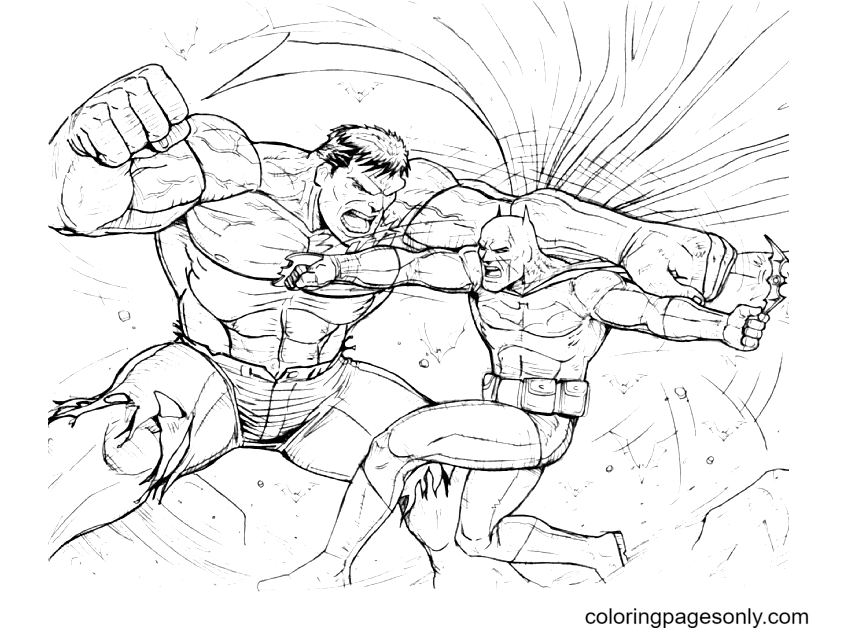
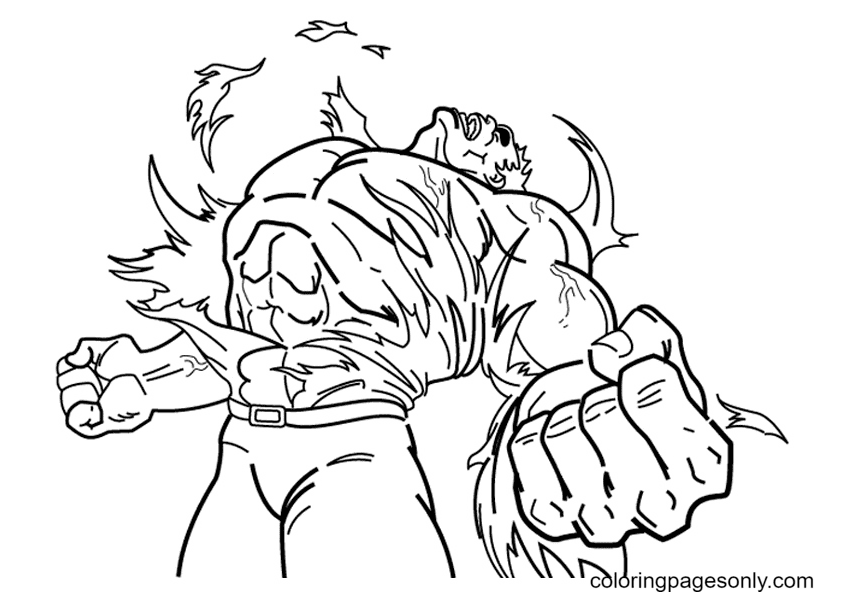
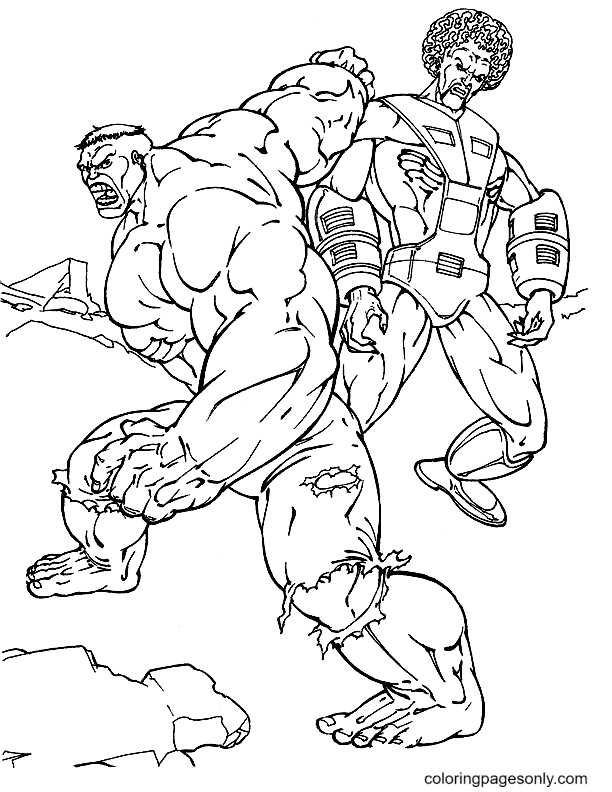
Free Hulk coloring pages: 40+ pages featuring the Hulk in his classic roaring fists-raised stance, the Thunderclap pose with both hands driving together to produce a shockwave, mid-leap action compositions with the Hulk airborne above a city, ground-smash scenes showing the impact of his landing, close-up portrait studies of the green skin and furious expression, Bruce Banner in transformation sequence, the Hulk alongside the Avengers ensemble, Hulk versus Abomination battle scenes, chibi and kawaii Hulk designs for younger colorists, Smart Hulk portrait pages, and the full visual vocabulary of one of Marvel Comics’ most powerful and most enduring characters across sixty-three years of publication. All free, printable PDF and online coloring for Marvel fans of all ages.
The Hulk was created by Stan Lee and Jack Kirby and first appeared in The Incredible Hulk #1, published by Marvel Comics in May 1962. The character’s premise inverts the conventional superhero formula: Dr. Robert Bruce Banner, a nuclear physicist, was exposed to gamma radiation from a bomb he had designed during a test at a desert site, where he had rushed onto the range to push teenager Rick Jones to safety before the detonation. The gamma radiation transformed Banner into the Hulk, a massively powerful being whose strength increases without a known upper limit as his anger intensifies. The character was explicitly inspired by two sources that Stan Lee identified in interviews: the Frankenstein Monster (a misunderstood, powerful being alienated from society) and Dr. Jekyll and Mr. Hyde (a dual personality split between rational control and primal force).
The original Hulk in The Incredible Hulk #1 was grey, not green: Stan Lee chose grey to avoid associating the character with any particular ethnic group. The grey ink proved inconsistent across printing, producing results that varied from issue to issue between grey, green, and brown. From issue #2 onward, colorist Stan Goldberg standardized the character in vivid green, which has remained his primary color throughout his publication history.
These 40+ free pages at ColoringPagesOnly.com cover the Hulk across his full visual and narrative range. All free, PDF or PNG, print or color online.
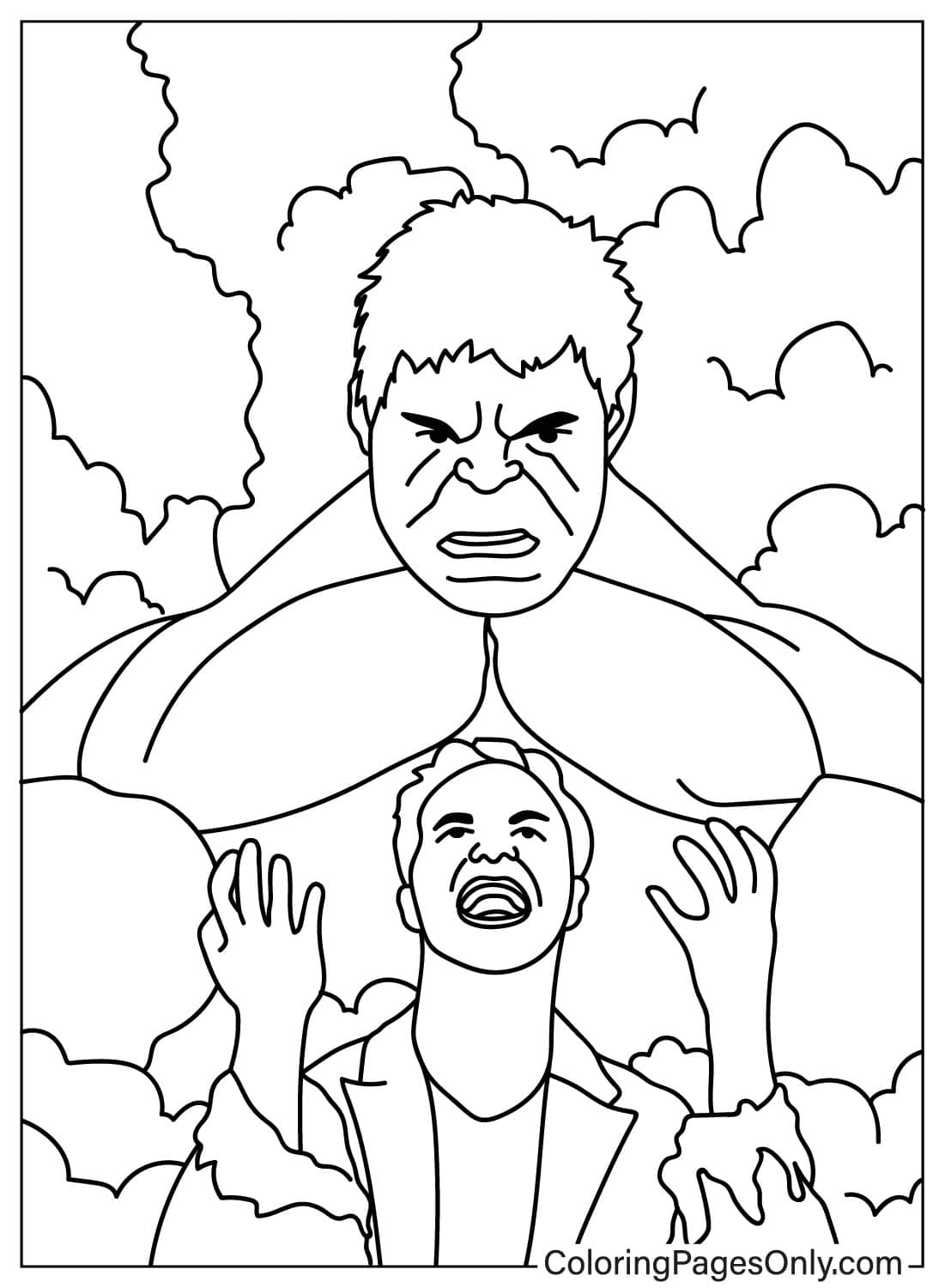
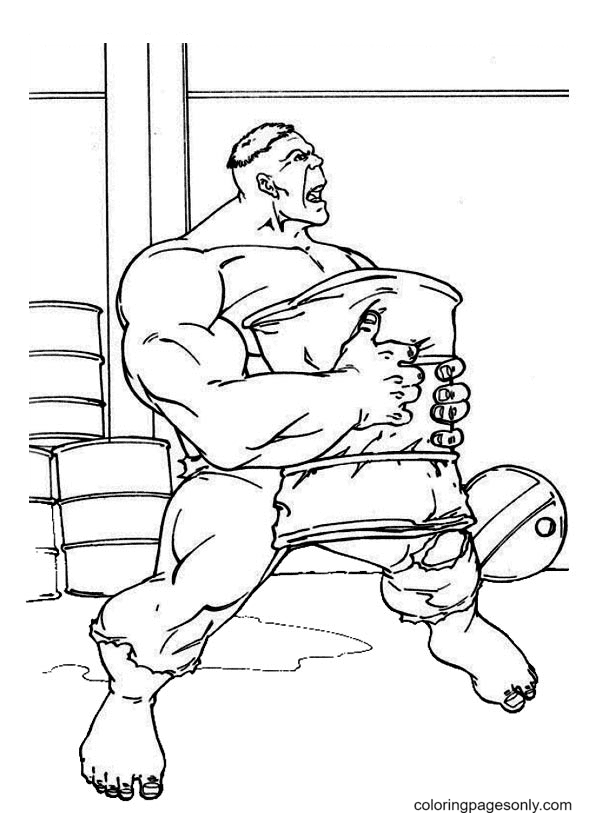
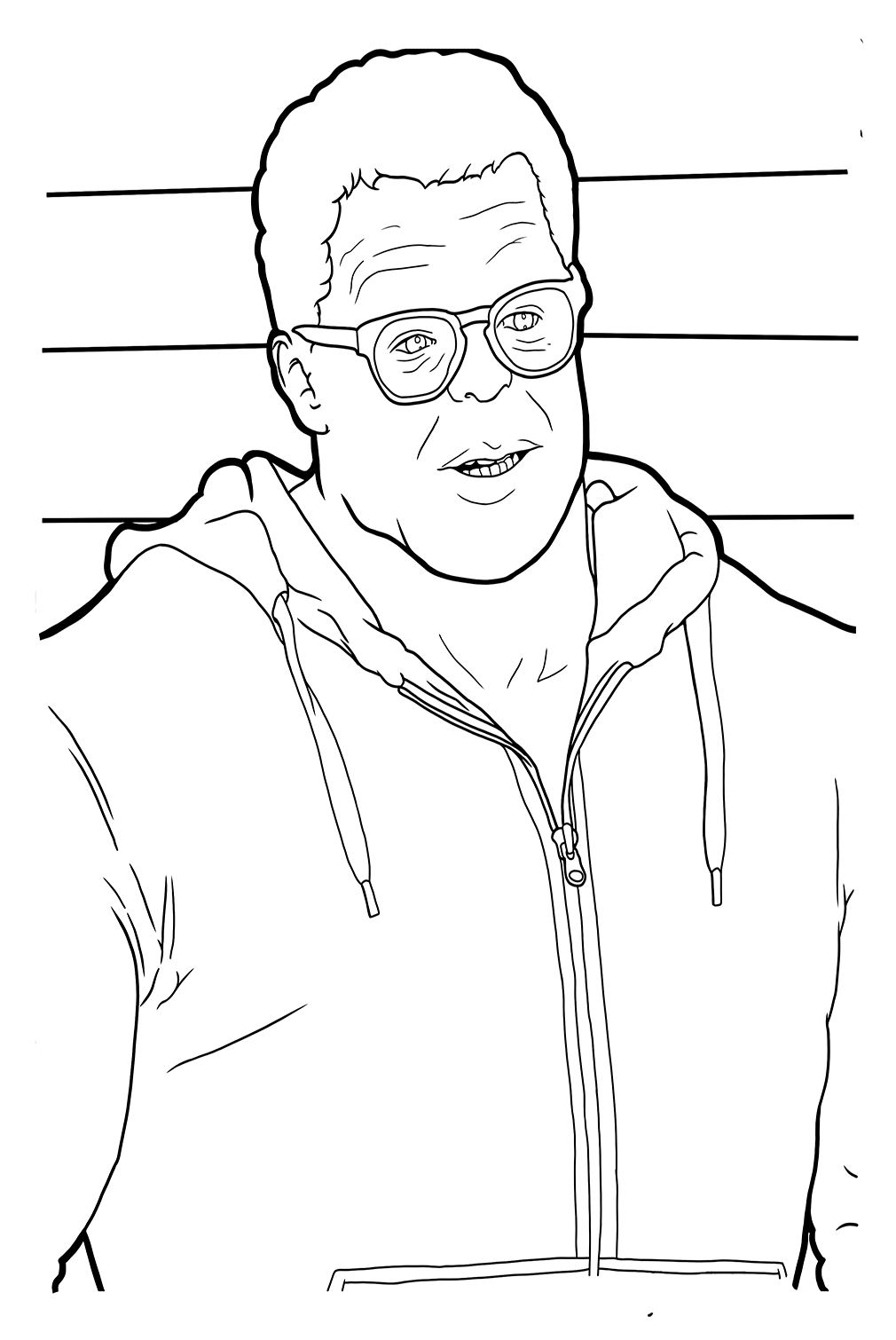
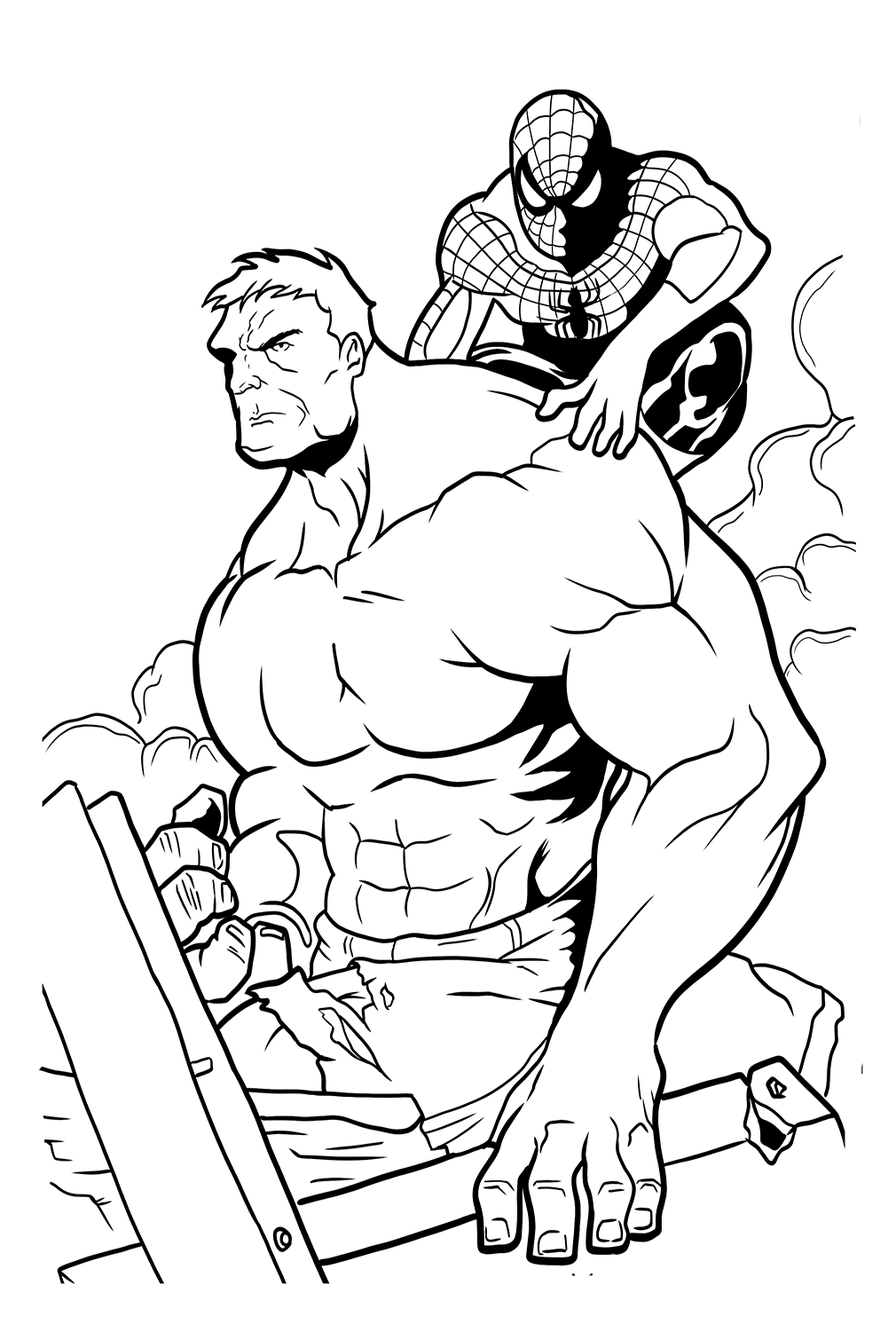
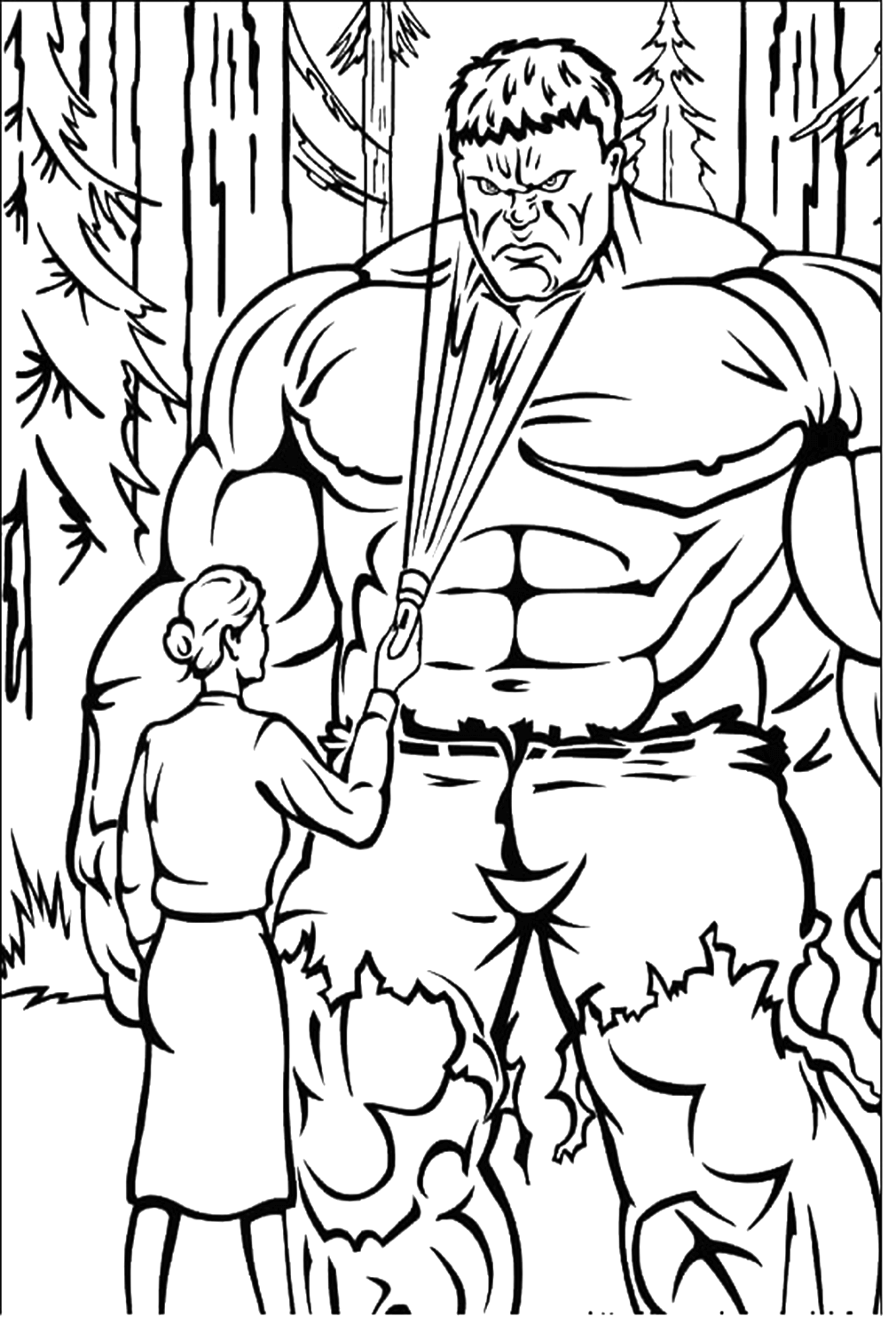
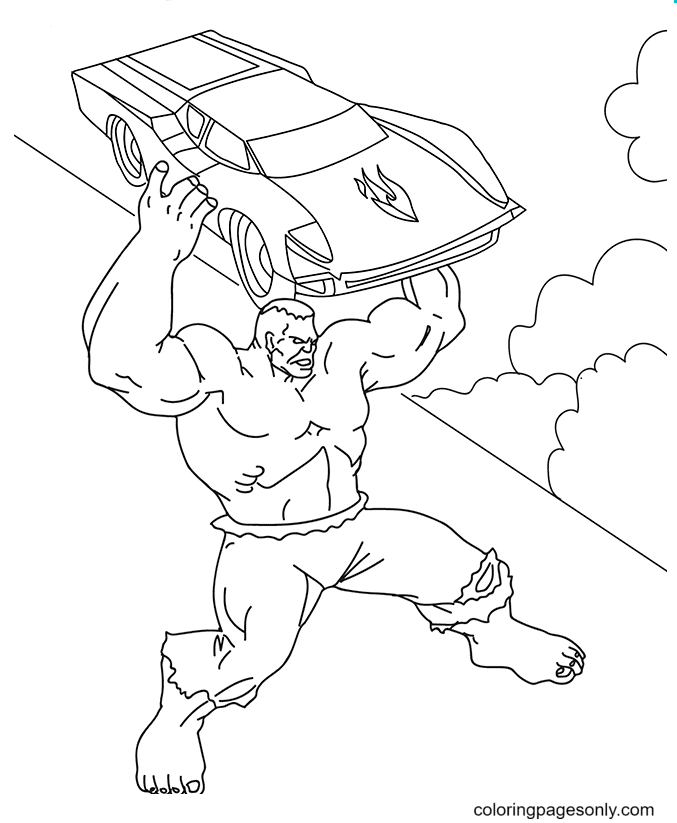
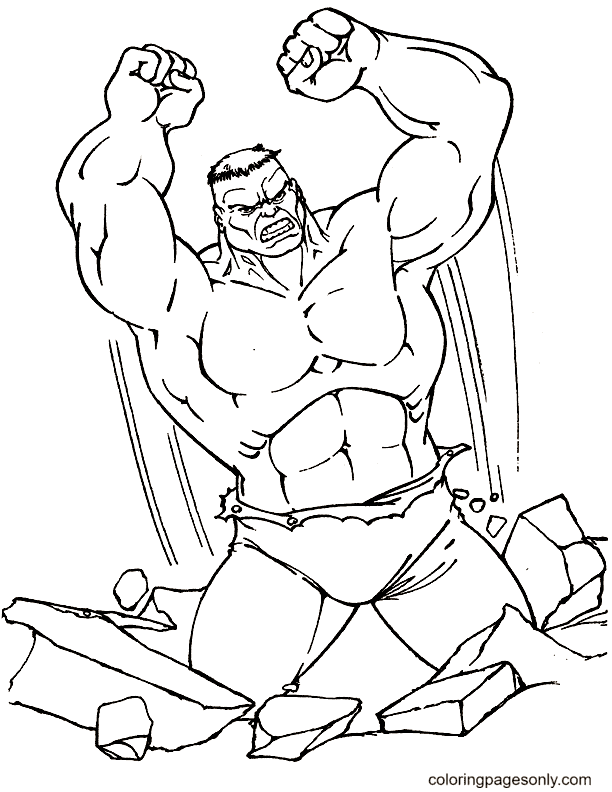
What’s Inside
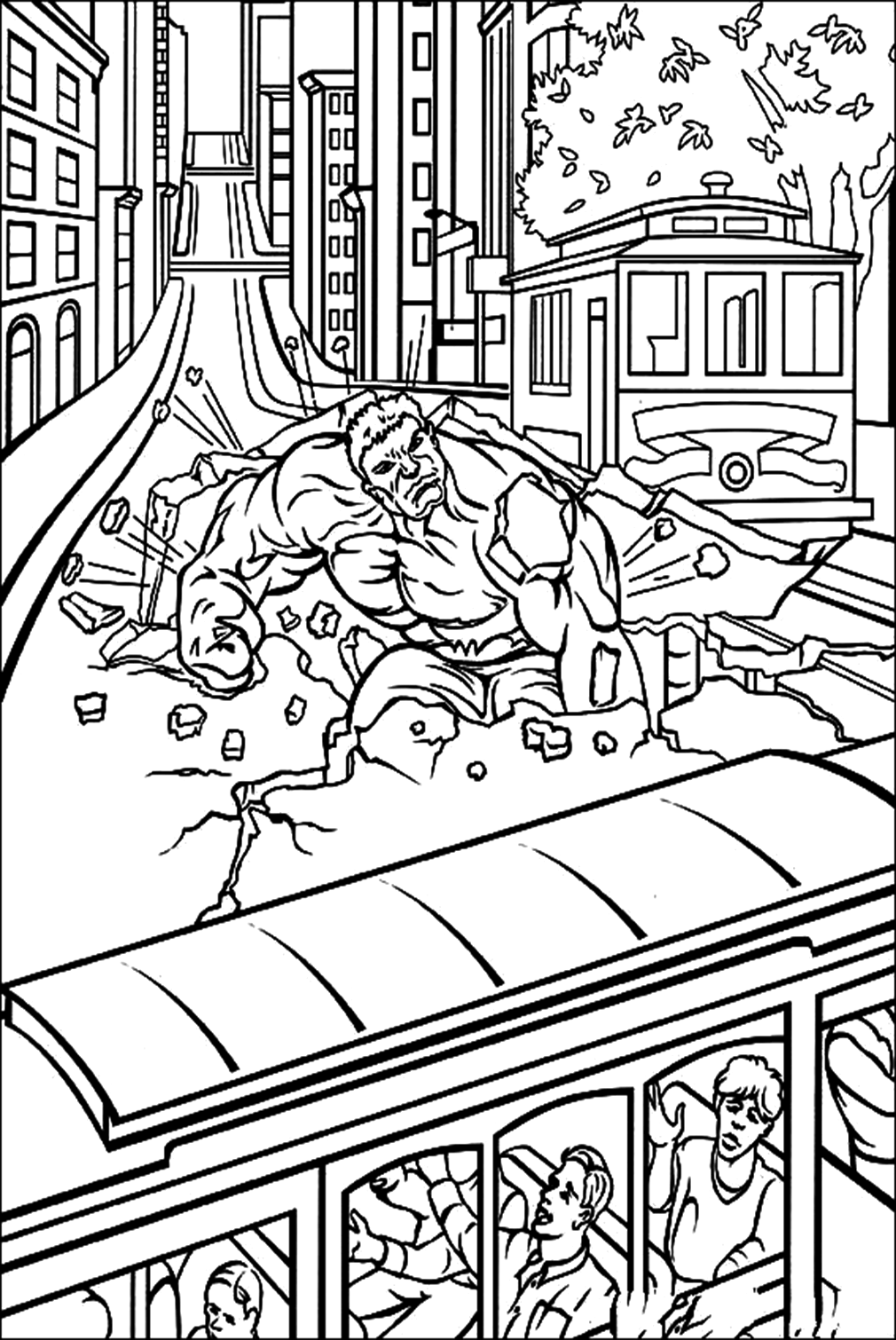
Classic Hulk: Roar and Smash Pages
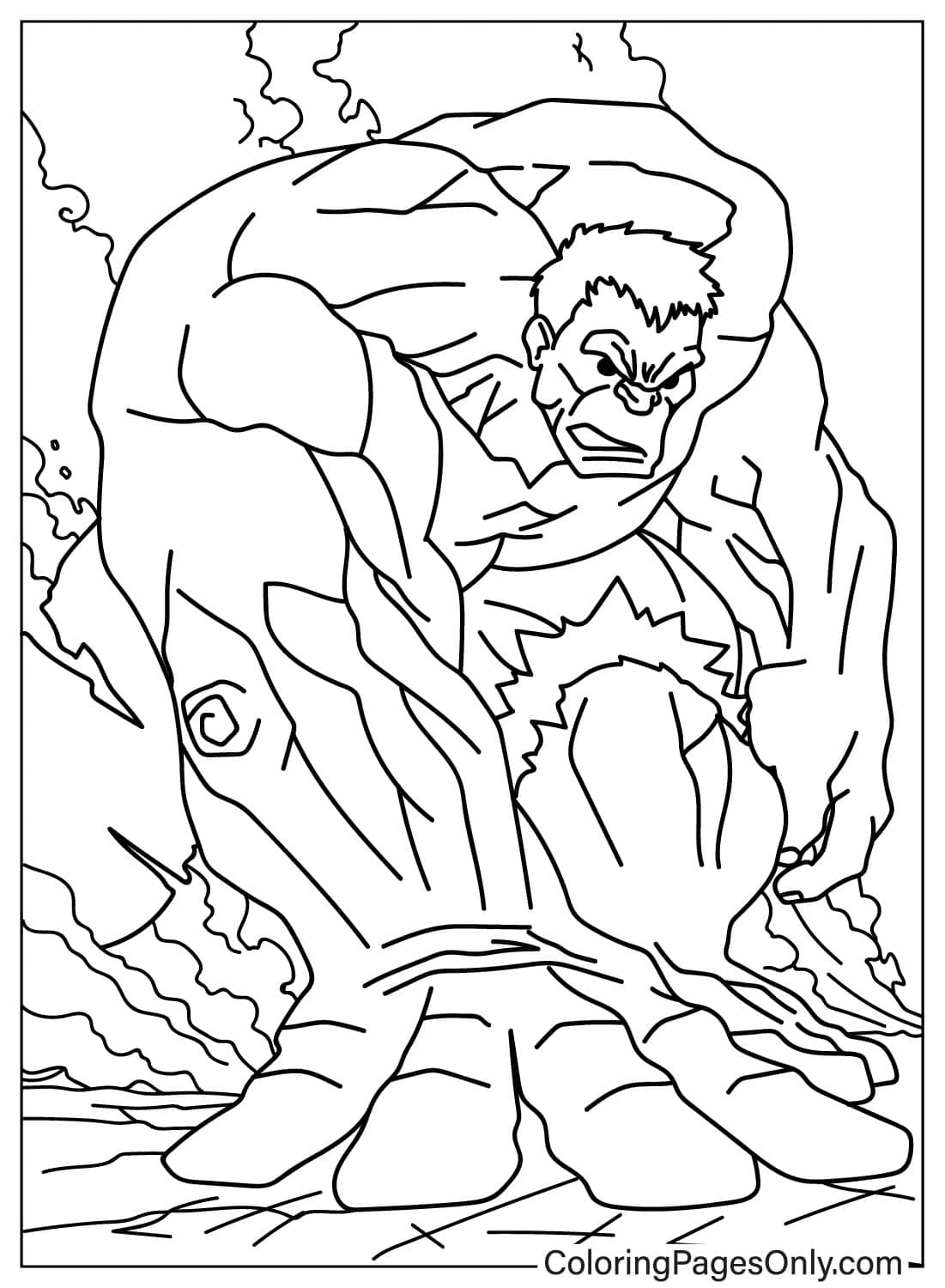
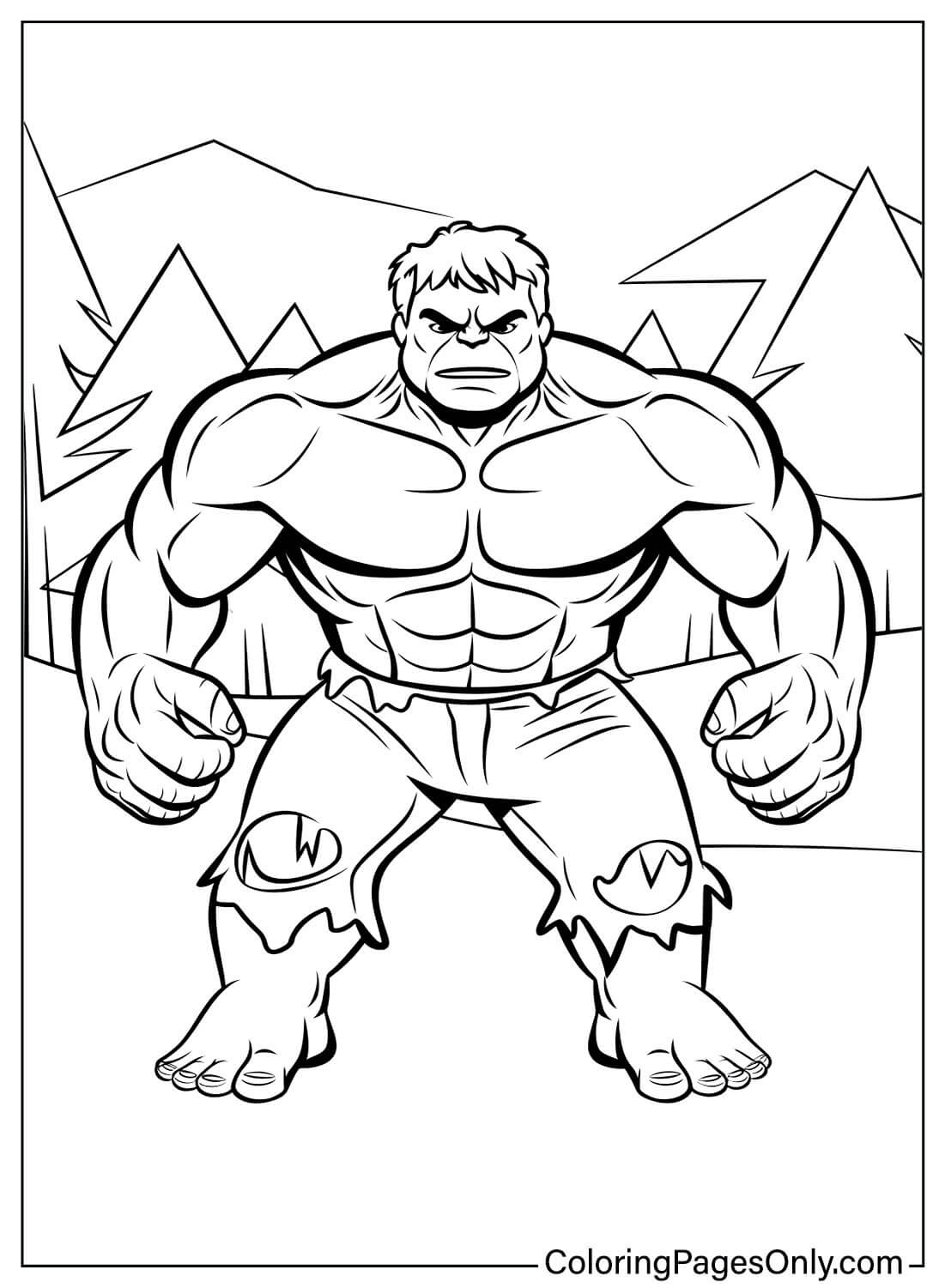
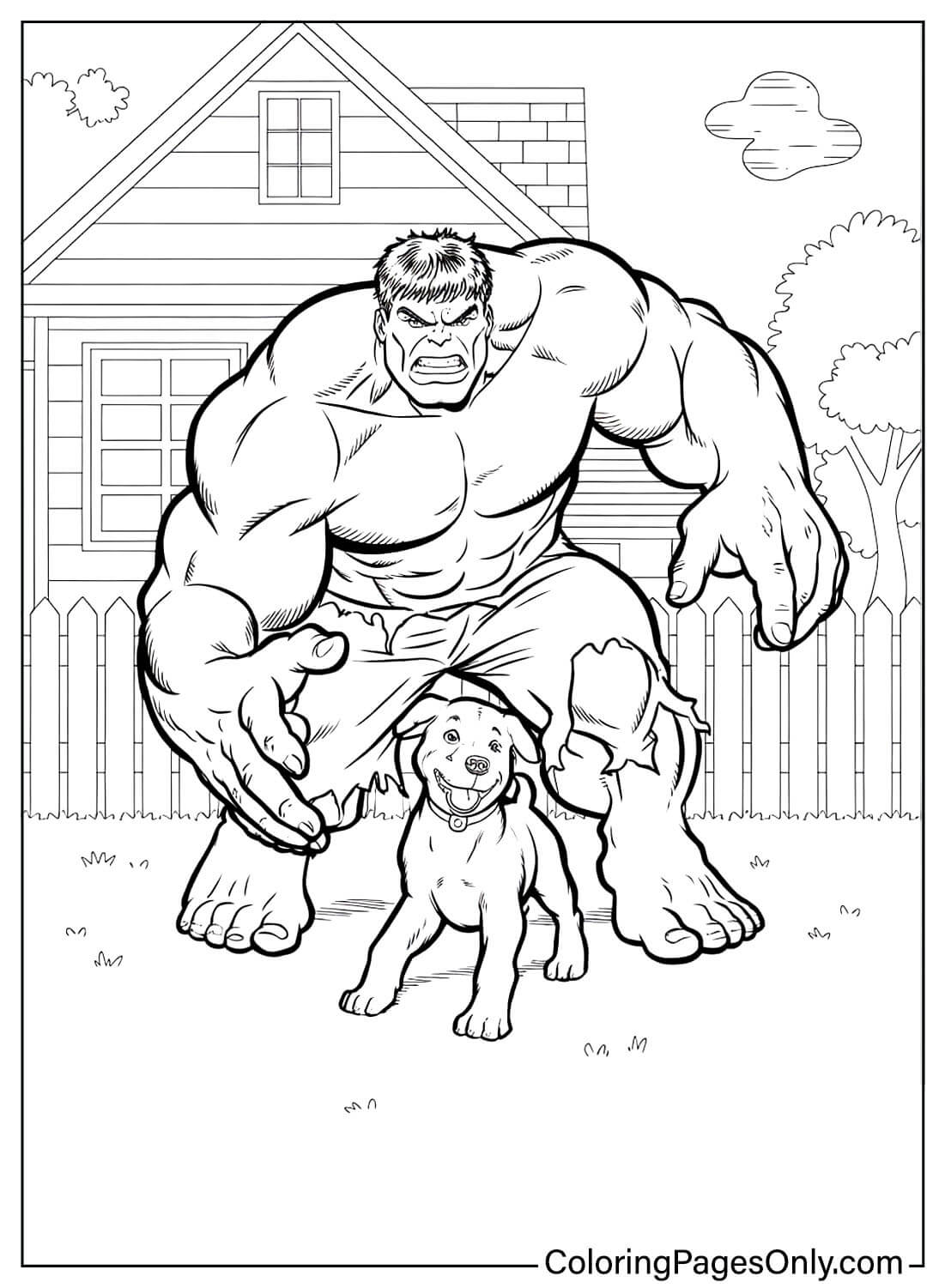
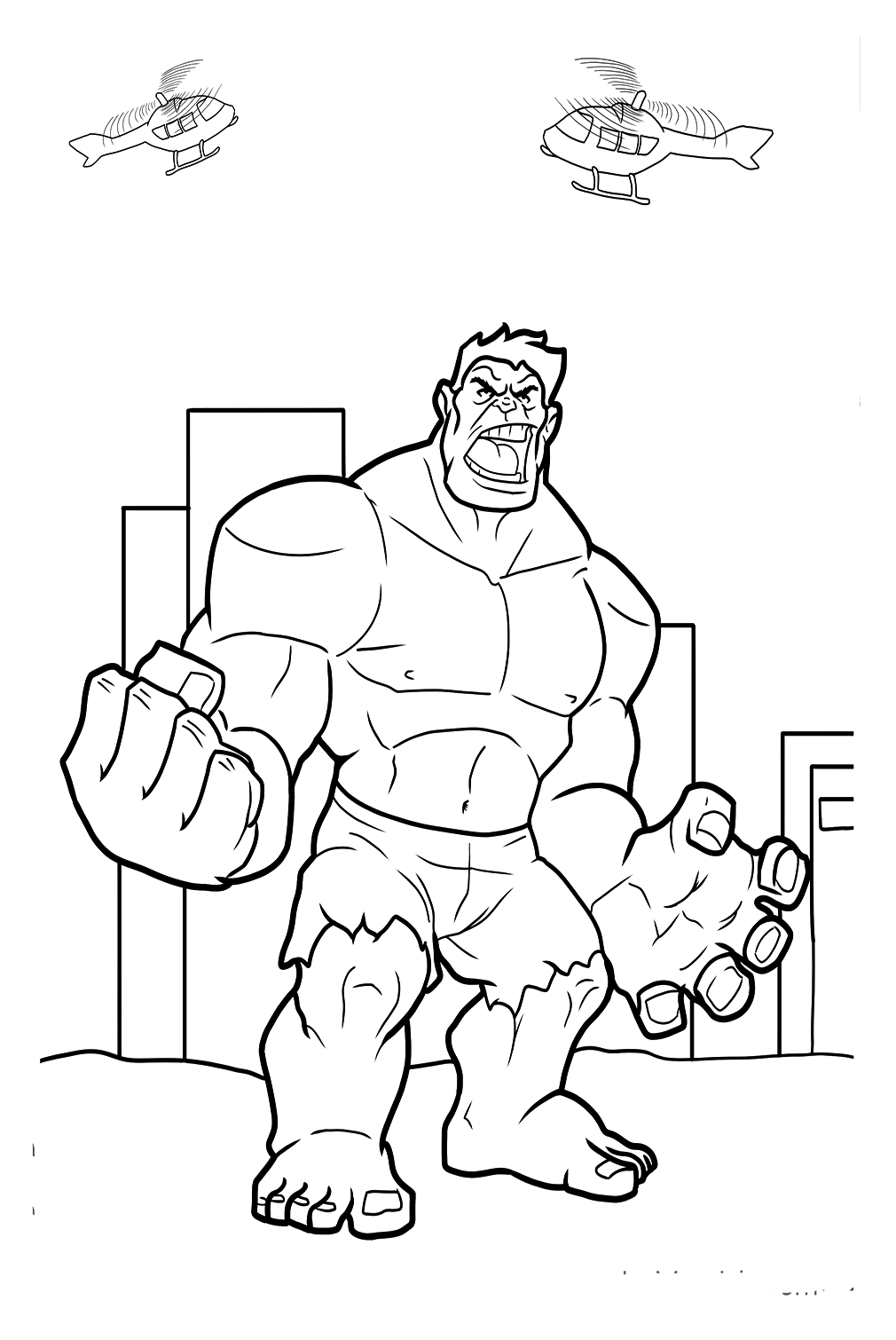
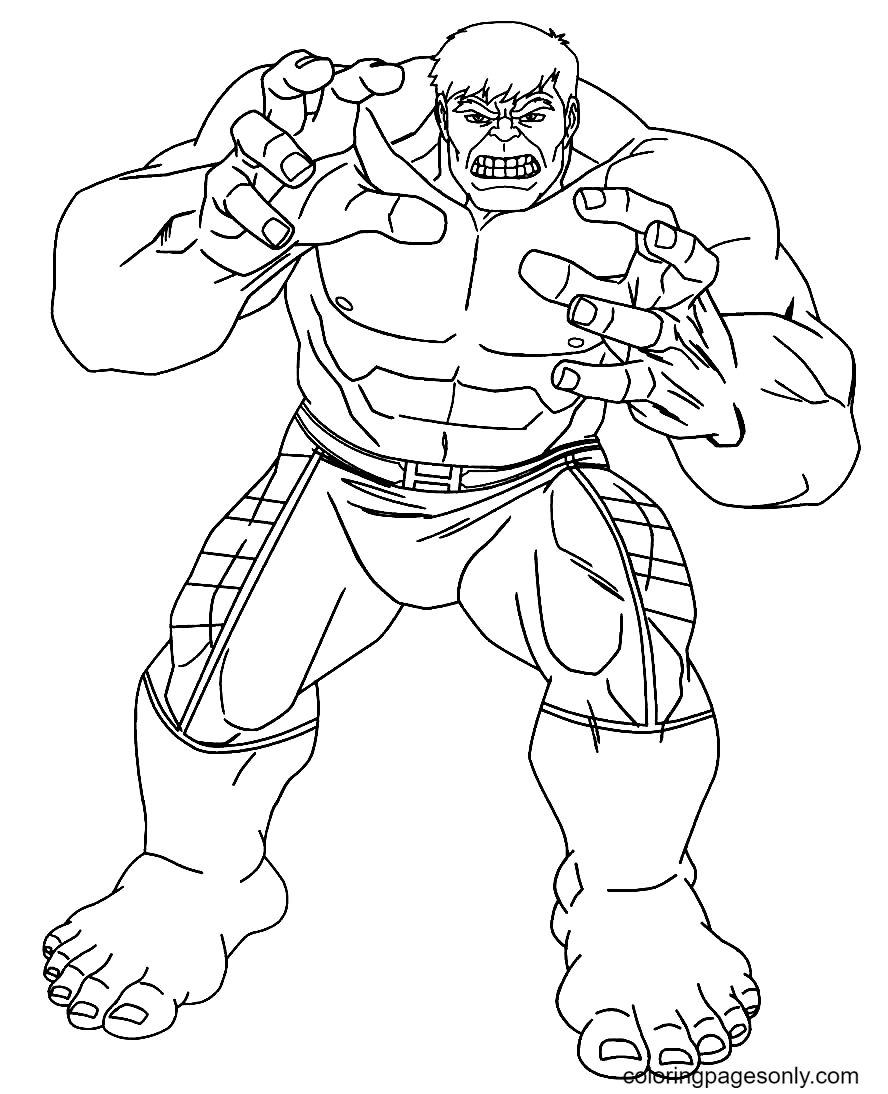
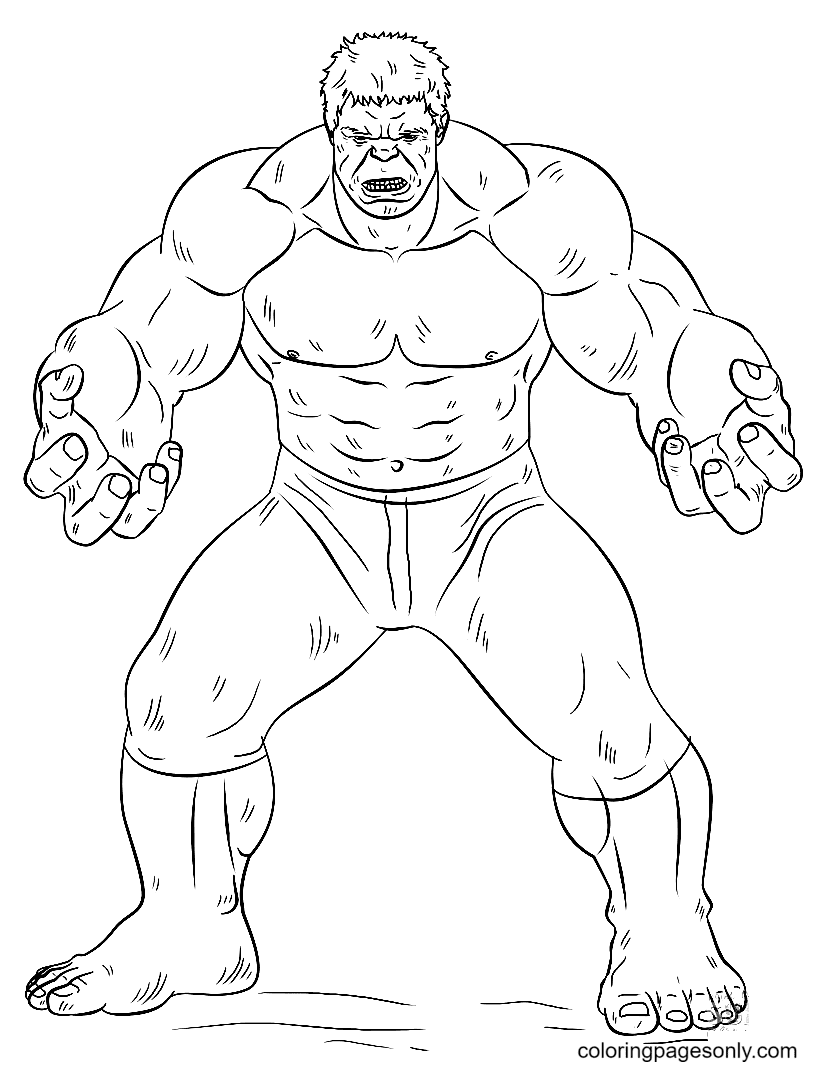
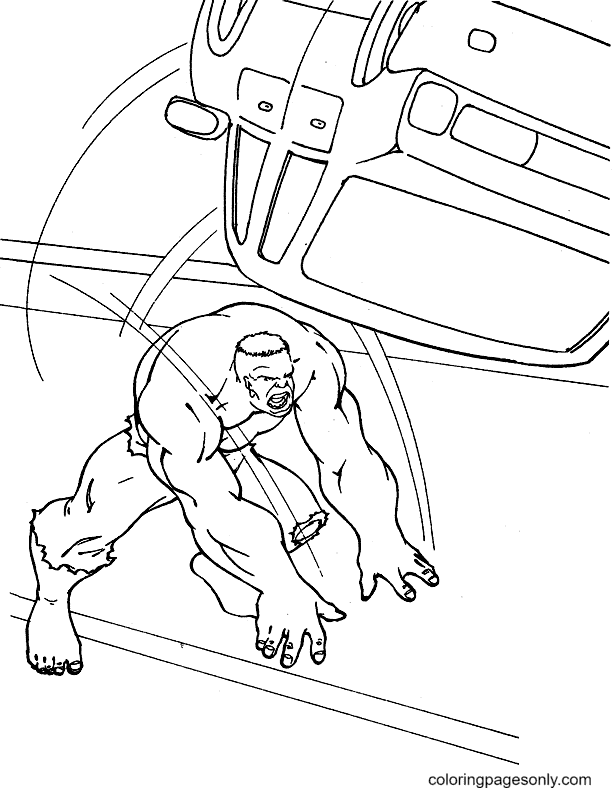
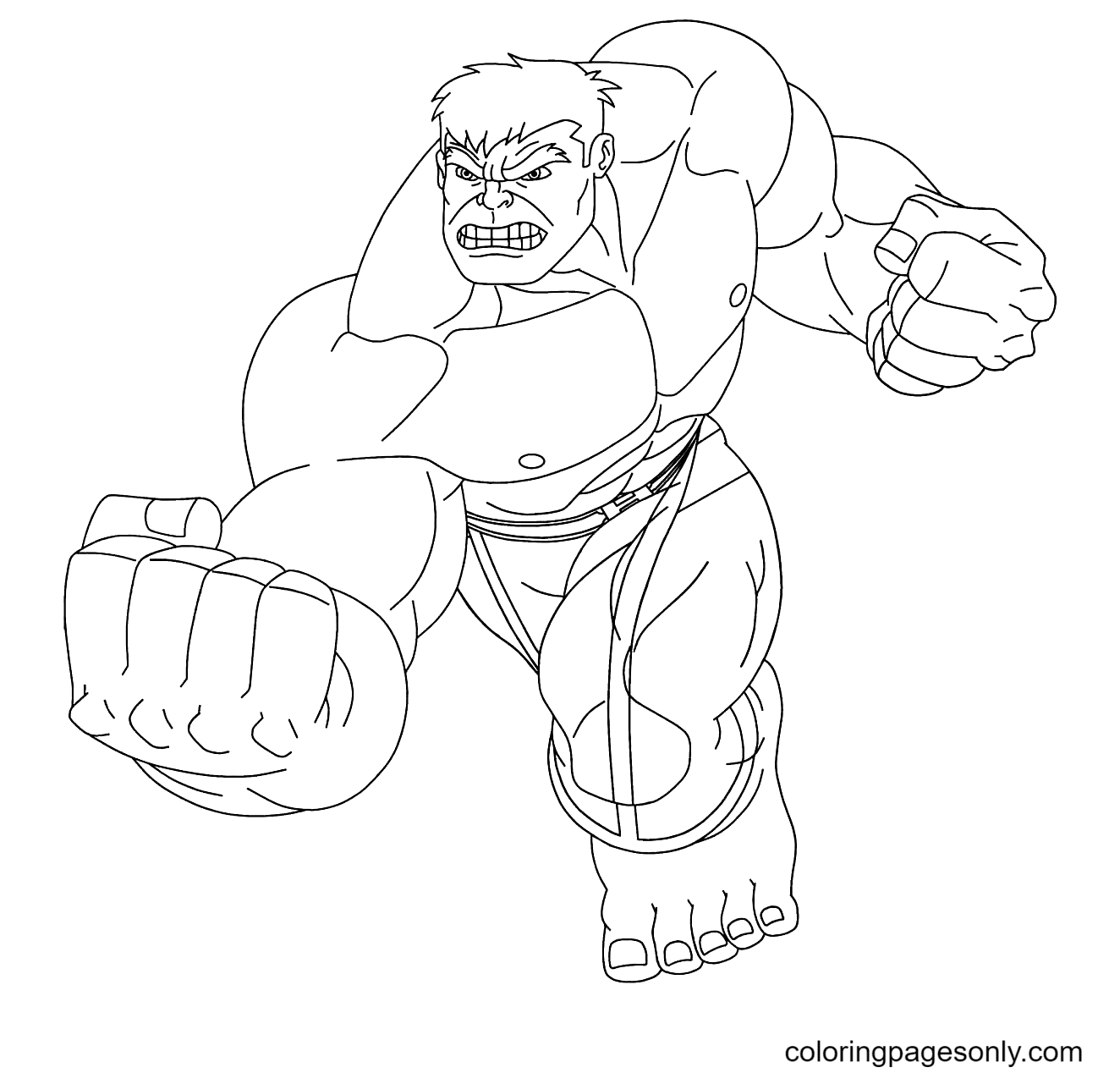
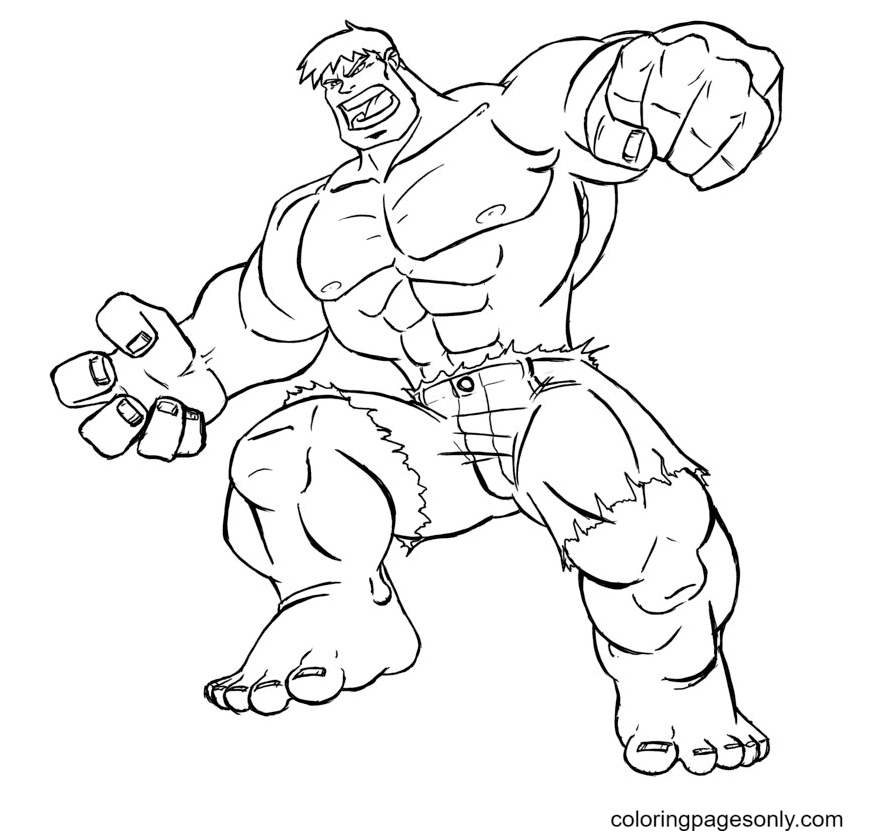
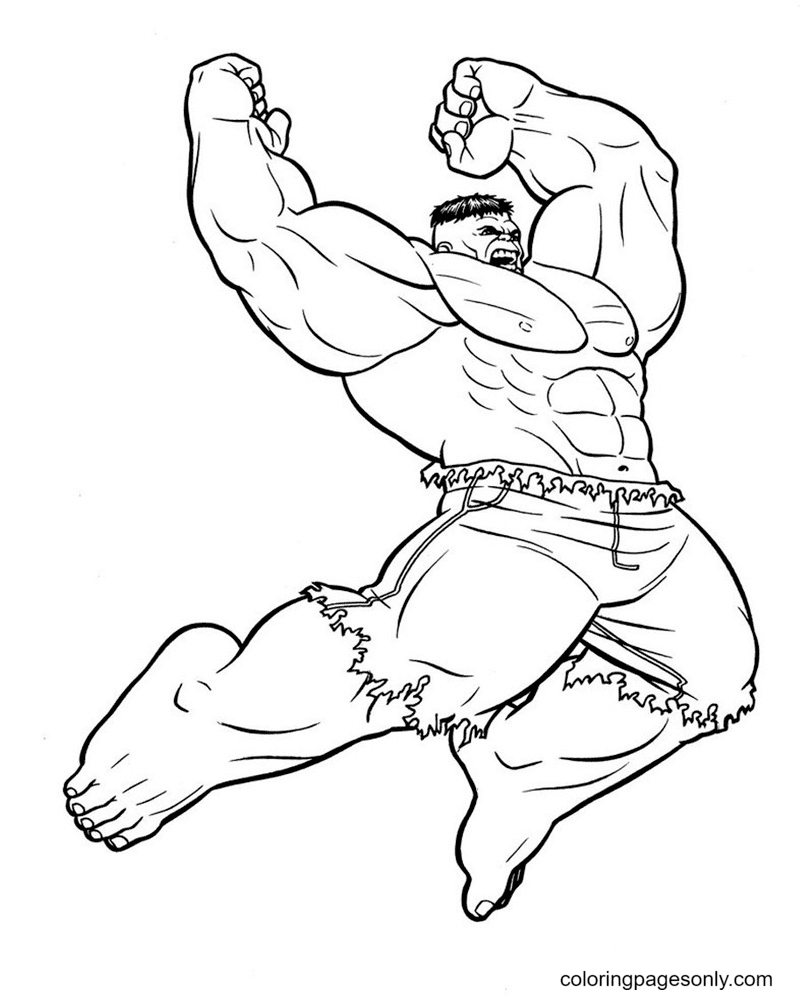
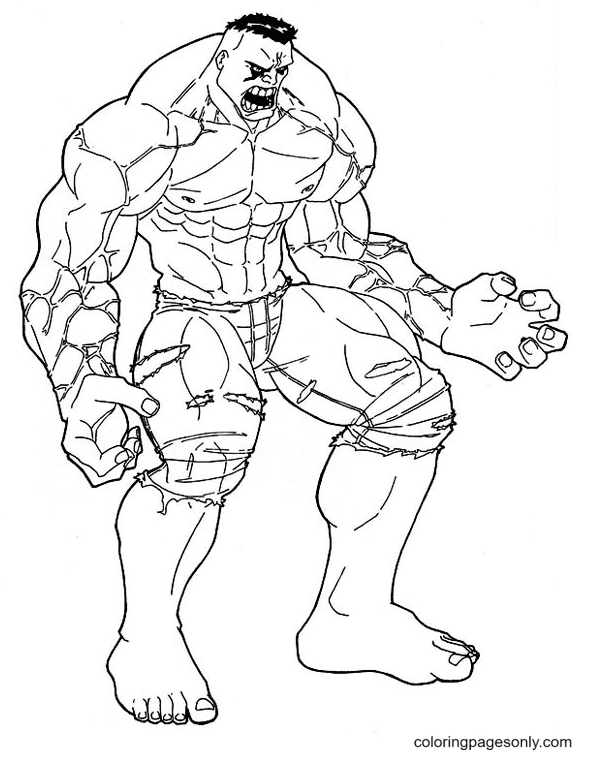
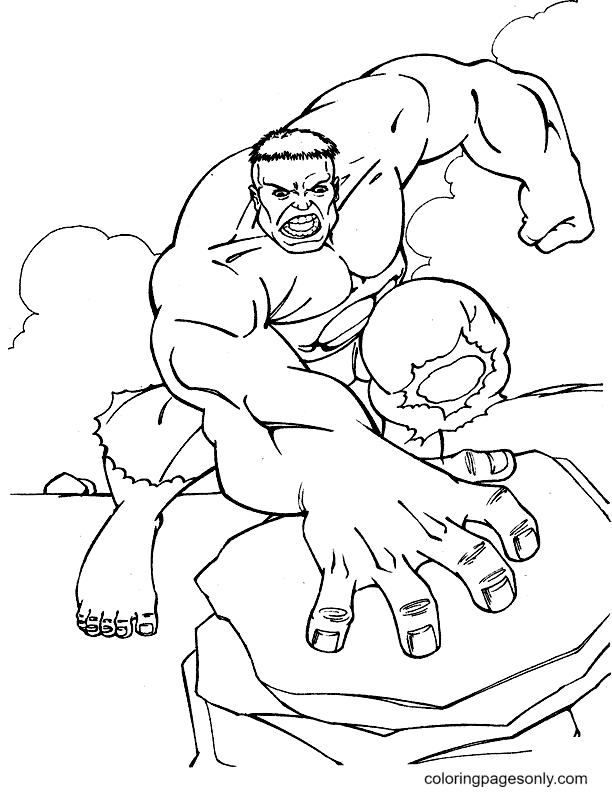
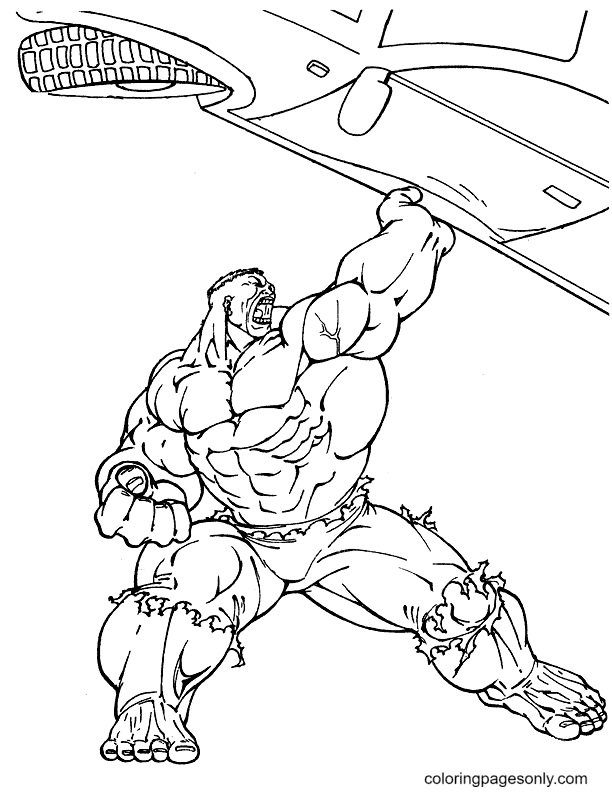
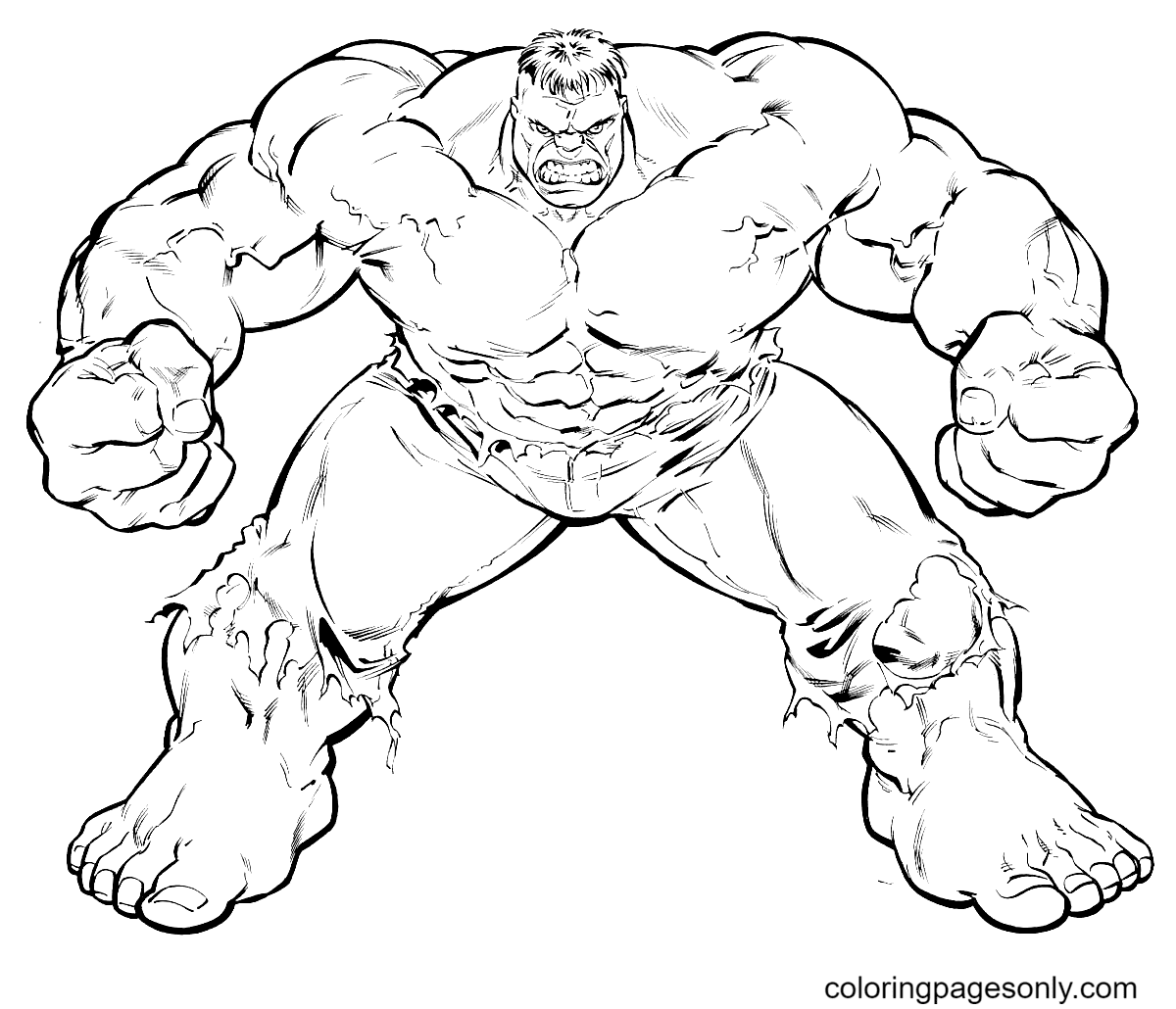
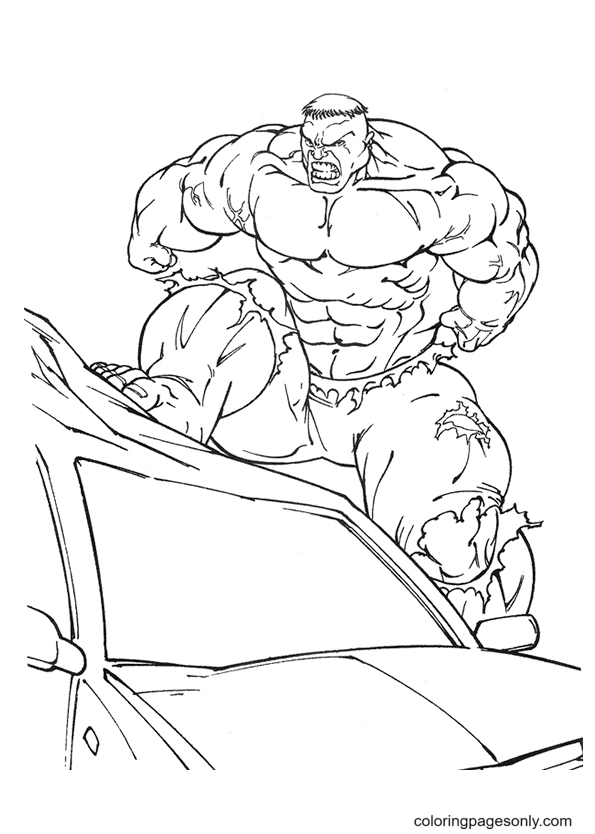
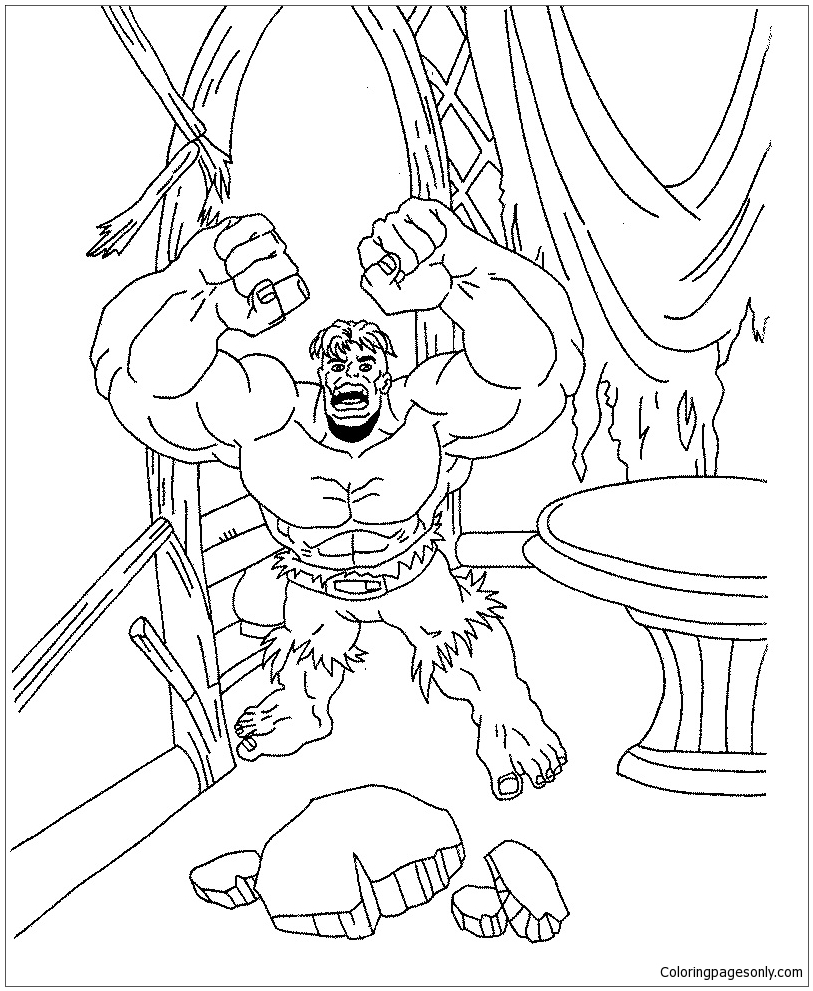
The classic Hulk roaring pose is the character’s most immediately recognizable visual and the one that has defined his public image since 1962: the massive green body, arms raised or fists clenched, head thrust forward or upward, jaw open in a roar that communicates both his immense power and his emotional state. The specific visual quality of this pose, a massive humanoid figure at the extreme edge of expressible rage, is the character’s single most depicted moment across sixty-three years of comics, animation, film, and merchandise.
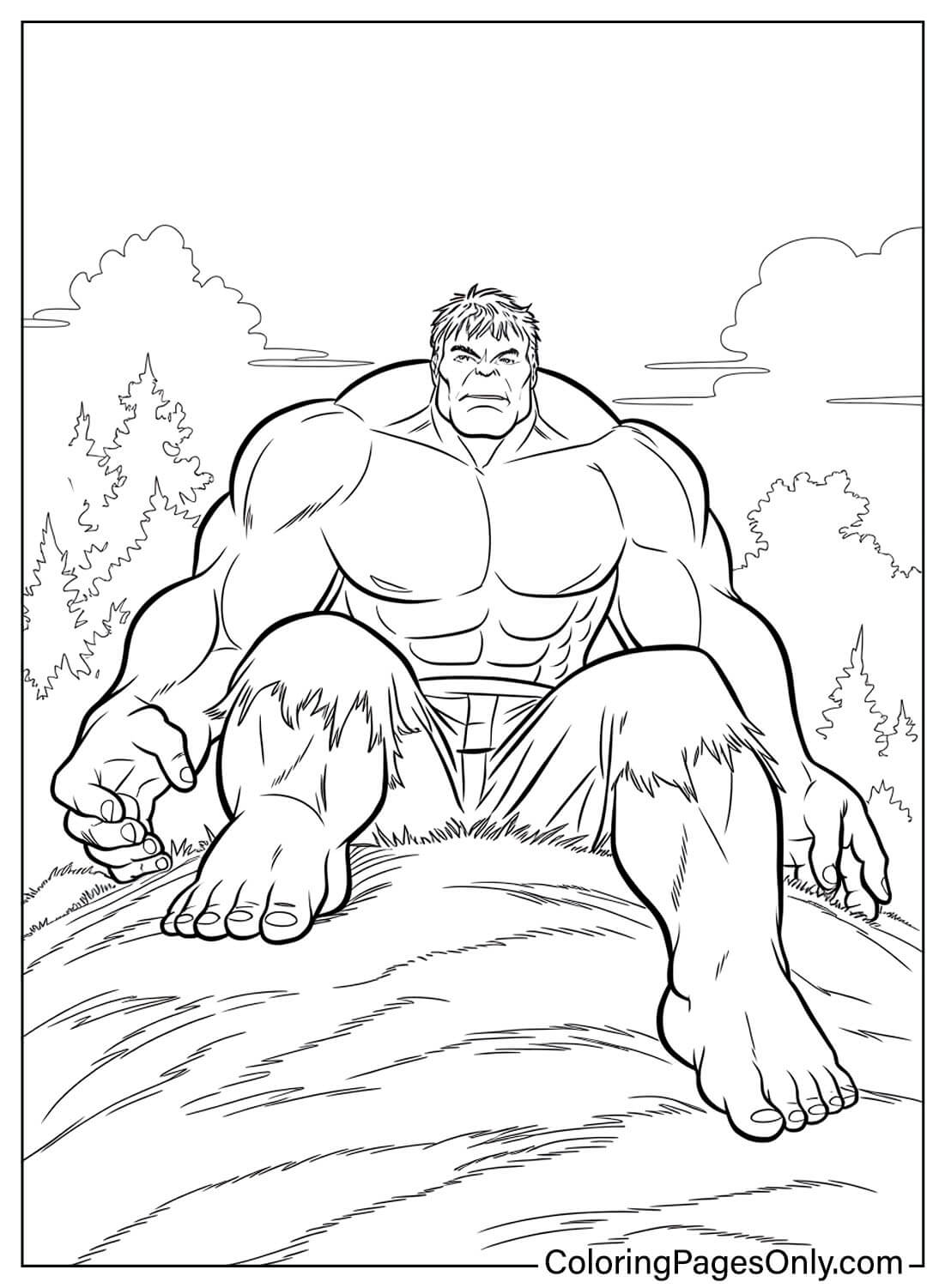
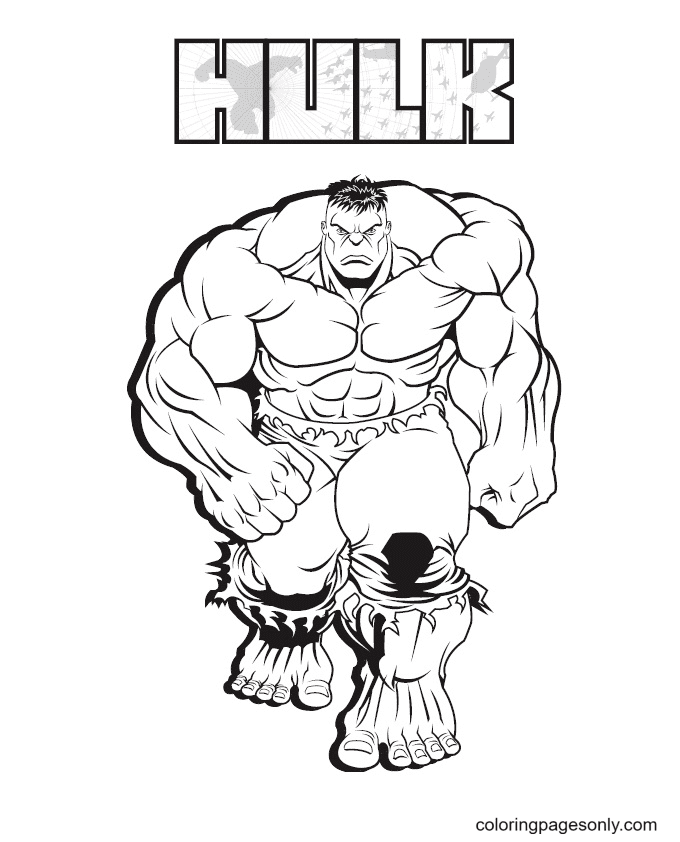
The Hulk’s green skin is a specific vivid medium green: not the yellow-shifted grass green, not the blue-shifted teal, but the specific vivid, fully saturated green that has been the character’s canonical color since 1962. His body proportions are deliberately exaggerated beyond human anatomy: the shoulder width significantly exceeds what any human skeleton could support, the arms are thickened to match the torso’s mass, and the overall silhouette is that of pure muscle accumulated beyond biological plausibility. This exaggeration is the character’s visual representation of his premise: a being whose power has no human equivalent and whose physical form reflects that limitlessness.
His purple pants are the character’s most consistently depicted costume element and the franchise’s most specifically unusual design choice: the pants survive his transformations because they are made of stretch fabric, and they remain purple through every artistic interpretation of the character. Bruce Banner was wearing purple pants when he first transformed, and this visual choice became so associated with the character that subsequent artists maintained it as a defining element.
Coloring classic Hulk roar/smash pages: The skin uses vivid, fully saturated medium green applied at maximum pressure across every skin surface. This green must not drift toward yellow-green (too light) or toward teal-green (too blue): it should read as unmistakably vivid green from any viewing distance. The purple pants use a medium, slightly warm purple rather than deep violet or bright lavender: the specific worn-and-torn purple of fabric that has survived a transformation. The black hair uses near-black at full coverage. Eyes in the classic roaring pose are typically white with visible iris or fully white when rage is at maximum, with vivid green pupils when calmer.
Hulk Thunderclap Pages
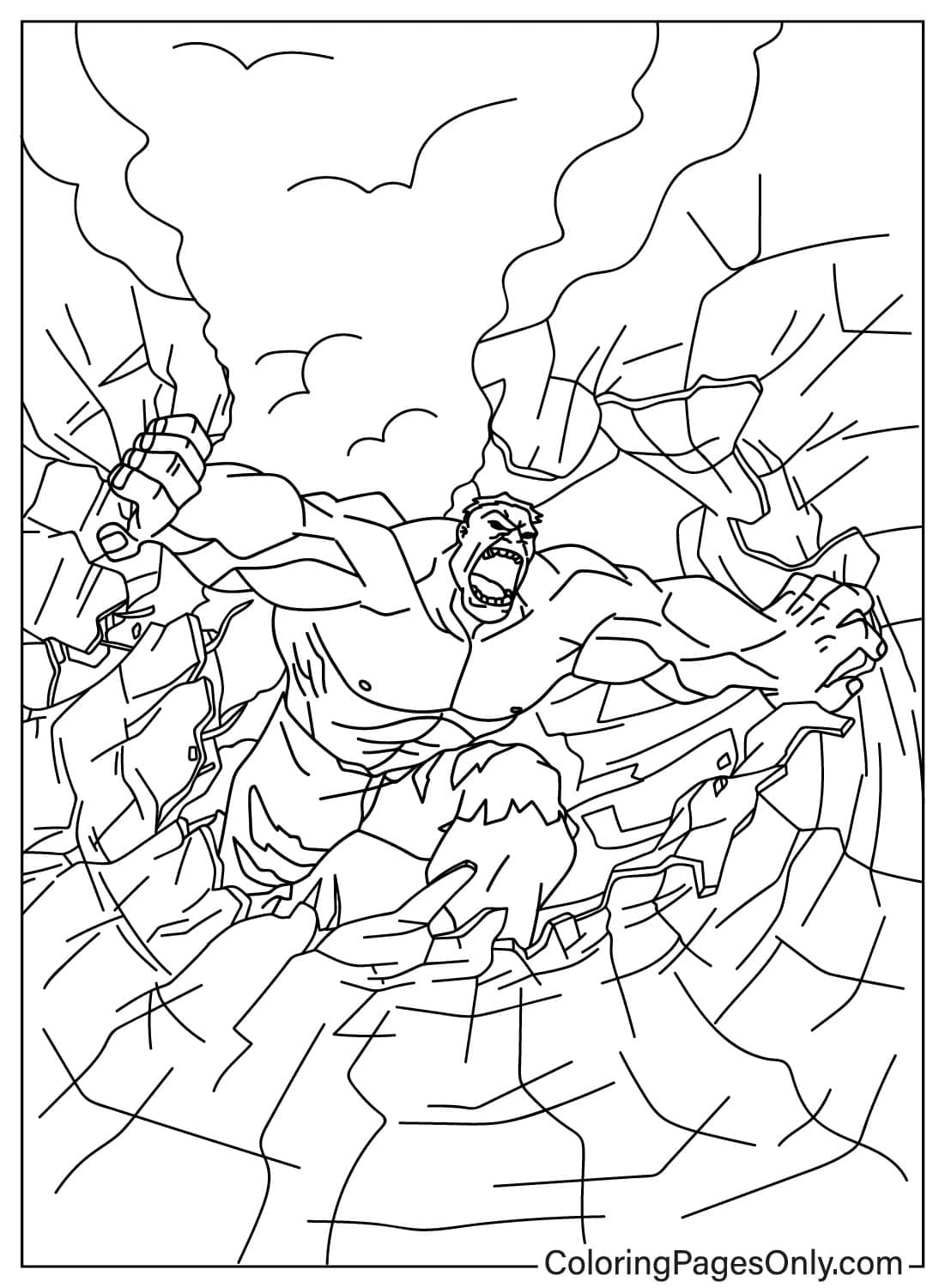
The Thunderclap is one of the Hulk’s most specifically depicted combat maneuvers: driving both hands together with sufficient force to create a pressure wave that can shatter matter, disorient opponents, and clear an area by sheer acoustic and physical force. The visual of the Thunderclap, both hands coming together at midline with a burst of energy, wind, and debris radiating outward from the impact point, is one of the collection’s most dramatically dynamic single-action pages.
The Thunderclap was first depicted in early Hulk comics and has been a consistent element of the character’s combat repertoire across every subsequent medium. In the Marvel Cinematic Universe, it appears in various Hulk and Avengers scenes. The specific visual language for the Thunderclap across the comics tradition shows the energy burst as concentric circles or radiating lines extending outward from between the Hulk’s hands, with debris, wind effects, and the specific visual shorthand of extreme physical force.
The energy effect produced by the Thunderclap has been depicted in several color conventions across artists and media: white or pale yellow-white energy, blue concentric shock rings, or the warm yellow-orange of displaced air and compressed force. All are visually effective for different coloring interpretations of this page type.
Coloring Thunderclap pages: The Hulk’s green skin at maximum vividness, as always. The energy burst between the hands uses the shock-wave radiation technique: apply the most concentrated, most vivid energy color at the very center (between the palms, at the impact point), then graduate outward through progressively lighter and more diffuse versions of the same energy color toward the outer edges of the burst radius. White or pale blue-white at the absolute center, graduating through vivid blue-white to medium blue at the burst’s outer rings. Any debris or wind-swept material in the burst’s path uses warm grey or the specific colors of whatever material is shown being displaced.
Bruce Banner Transformation Pages
Pages depicting the Bruce Banner-to-Hulk transformation sequence show the most narratively concentrated moment in the character’s mythology: the specific visual of Banner’s body and features shifting from the slender, quiet scientist to the massive, rage-filled Hulk. This transformation is the character’s central dramatic device, the moment at which the story’s emotional tension (can Banner control his anger?) reaches its resolution (he cannot, or he can, depending on the narrative’s needs).
The transformation visual tradition in comics shows the body mid-change: Banner’s face distorted, skin beginning to shift toward green, clothing starting to tear, the muscle mass beginning to increase. The specific visual of the torn shirt is among the most recognizable transformation imagery in superhero comics and has been reproduced thousands of times across the character’s history.
Bruce Banner’s appearance contrasts with the Hulk’s in every visual dimension: average build rather than massive, dark hair but in an academic, controlled style rather than the Hulk’s wild dishevelment, clothing intact, expression controlled or frightened rather than enraged. The visual contrast between the two forms is the character’s most fundamental design statement.
Coloring transformation pages: The Banner portions of transformation pages use warm light skin tone for the face and arms, standard clothing colors (typically purple-grey or muted purple for the pants, various colors for shirts), and the controlled, slightly anxious expression of someone aware of what is coming. The transforming areas use the green shift technique: apply the base skin tone, then apply a semi-transparent layer of vivid green over it at reduced pressure in the areas transitioning to Hulk skin, creating the specific mixed-tone quality of skin in the process of changing. The torn clothing uses the same base clothing color but with darker jagged edges at the tear lines.
Smart Hulk / Professor Hulk Pages
Professor Hulk, also called Smart Hulk or the Merged Hulk, is a synthesis personality in which Bruce Banner’s intelligence operates within the Hulk’s physical body: the result is a being with the Hulk’s strength and Banner’s analytical mind, without the Savage Hulk’s rage-driven behavior. This personality was first developed during writer Peter David’s landmark 1987-1998 run on The Incredible Hulk, in which Banner and the Hulk’s various personalities were explored through a psychotherapy narrative framework.
The MCU depiction of Smart Hulk in Avengers: Endgame (released April 26, 2019, earning $2.798 billion worldwide) presented this synthesis as Bruce Banner having spent eighteen months forcing the Hulk and Banner to coexist, resulting in a permanent merged form. This version wears glasses, speaks with Banner’s voice and vocabulary, and behaves with Banner’s social intelligence while inhabiting the Hulk’s body, allowing him to function in settings the Savage Hulk’s behavior would make impossible.
Smart Hulk’s visual differs from the classic Hulk primarily in expression and posture: the face shows thoughtfulness rather than rage, the posture is relaxed or engaged rather than aggressive, and the overall body language communicates control rather than unconstrained force.
Coloring Smart Hulk pages: The same vivid green skin as the classic Hulk, applied at full saturation. The expression is the critical differentiating element: the face should show thoughtfulness, amusement, or engagement rather than the open-jaw rage of the classic pose. If the page depicts Smart Hulk in casual clothing (as in Endgame, where he wears specially designed large clothing rather than the iconic purple pants), apply muted, casual clothing colors. The glasses on Smart Hulk, if depicted, use the three-zone metallic technique for the frames: silver-white highlight on the frame’s top edge, mid-grey on the main frame face, slightly darker grey on the frame’s shadow-facing underside.
Hulk versus Abomination Pages
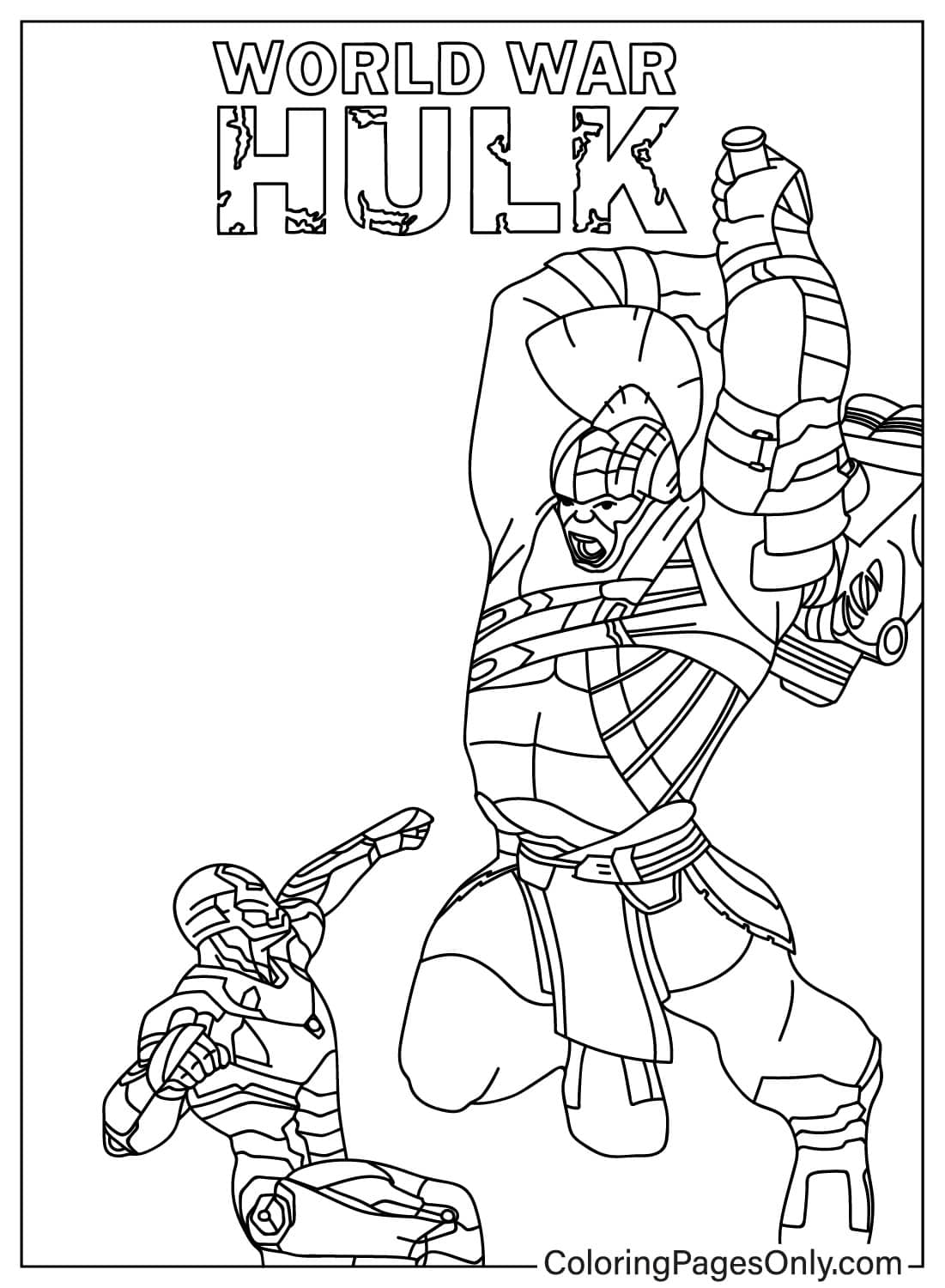
The Abomination (Emil Blonsky) is the Hulk’s most closely matched and most thematically specific villain: a Soviet intelligence agent who deliberately exposed himself to even higher levels of gamma radiation than Banner received, transforming permanently into a creature larger and initially stronger than the Hulk at base level, but without the Hulk’s ability to increase strength with anger and without the ability to revert to human form.
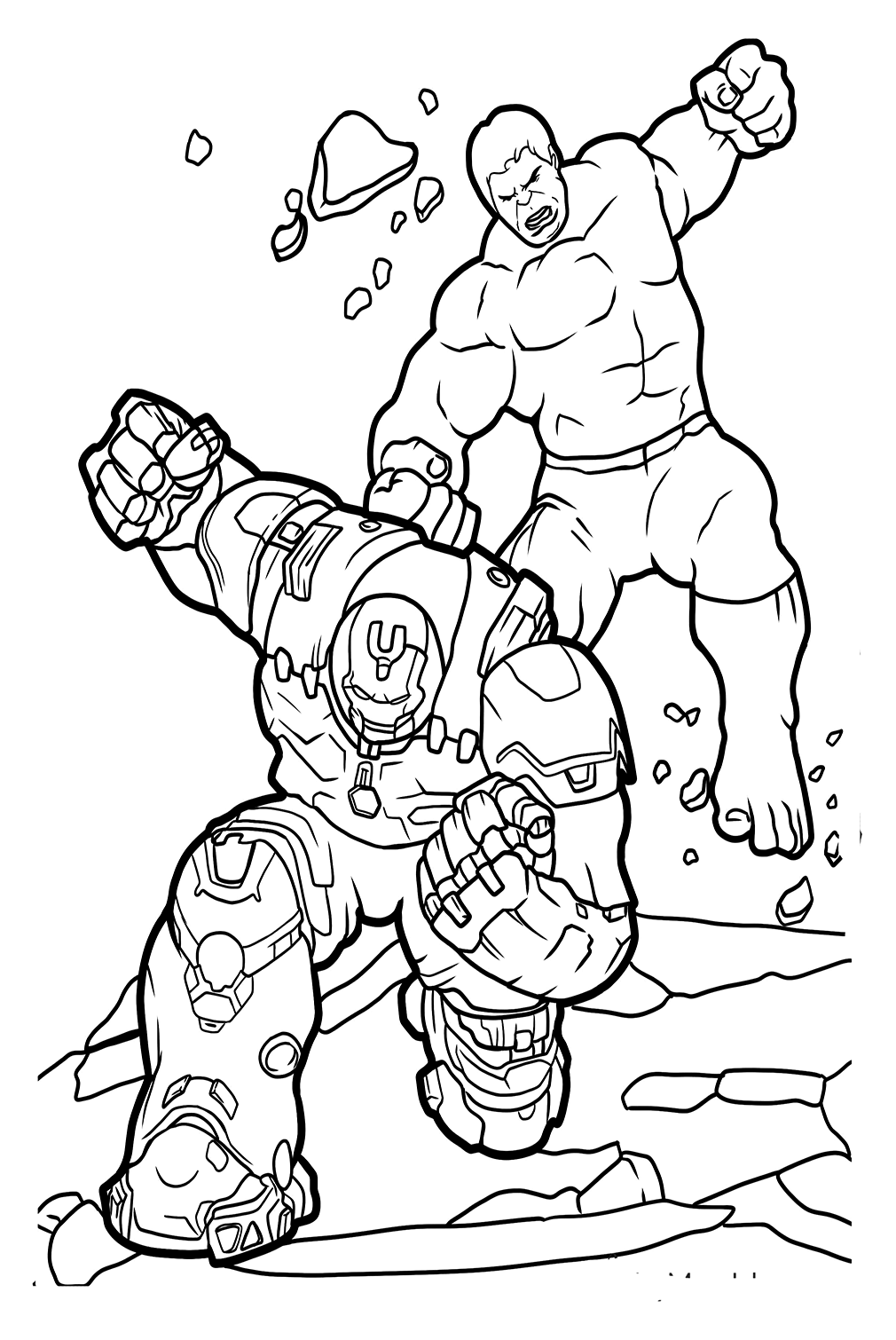
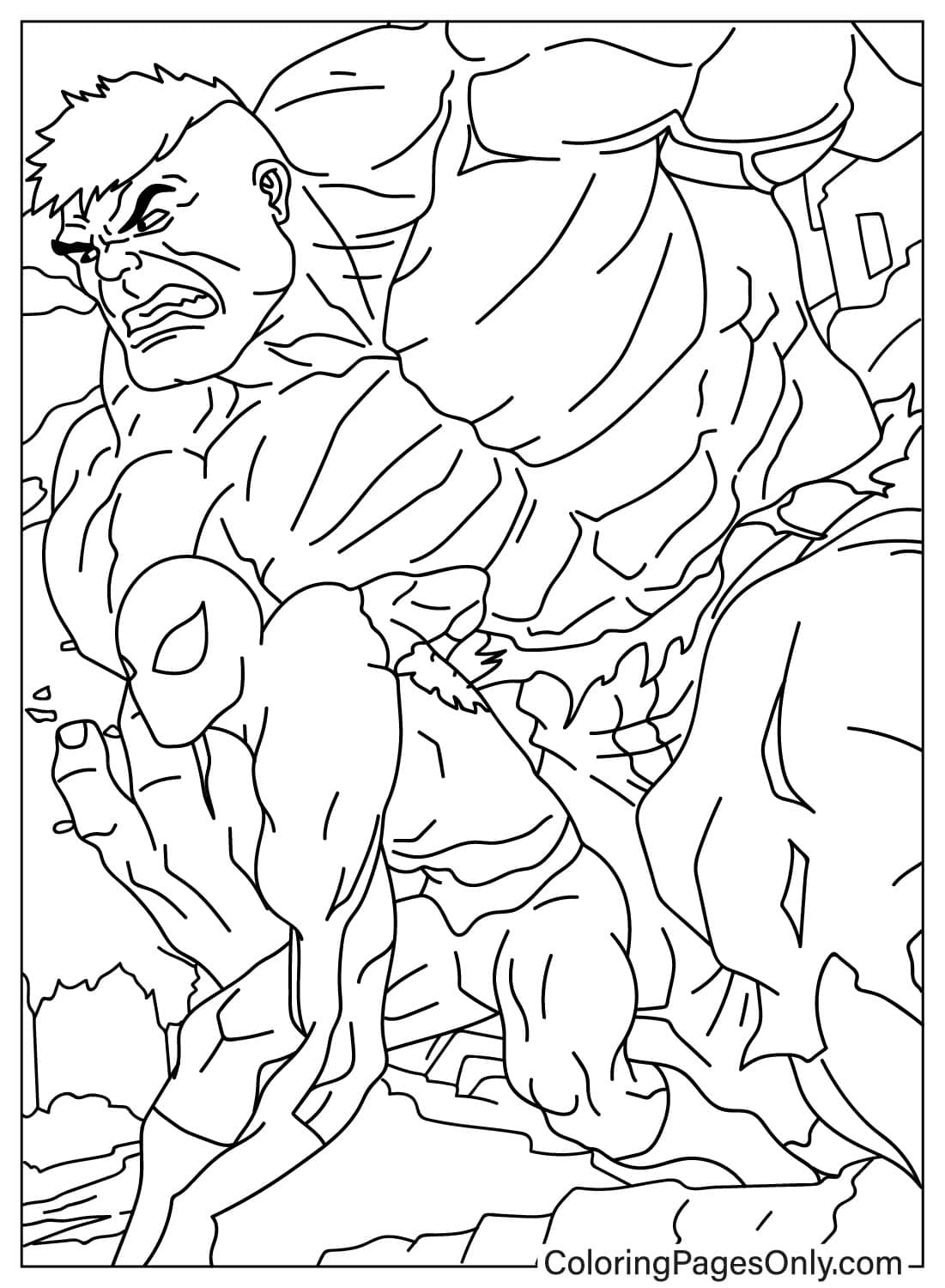
The visual contrast between the Hulk and the Abomination is the collection’s most dramatically compositionally complex battle scene setup: two massive green humanoids, each exaggerated beyond human scale, in direct confrontation. The Abomination’s design distinguishes him from the Hulk through specific physical differences: reptilian or fish-scale-like skin texture rather than the Hulk’s smooth green skin, visible bony protrusions at the elbows and knees, a different facial structure with more overtly monstrous features, and a generally more alien, less humanoid quality to the overall form.
The Abomination first appeared in Tales to Astonish #90 (April 1967), created by writer Stan Lee and artist Gil Kane.
Coloring Abomination pages: The Abomination uses a slightly different green family from the Hulk: typically a darker, slightly more grey-shifted green compared to the Hulk’s vivid medium green. This color distinction visually separates the two characters in combat scenes while maintaining their shared gamma radiation origin. The scale or reptilian texture on the Abomination’s skin uses the three-zone scale rendering technique: base dark green at full coverage, slightly lighter green on each scale’s raised center surface, near-black in the deepest recesses between scale rows.
Chibi and Action Ensemble Pages
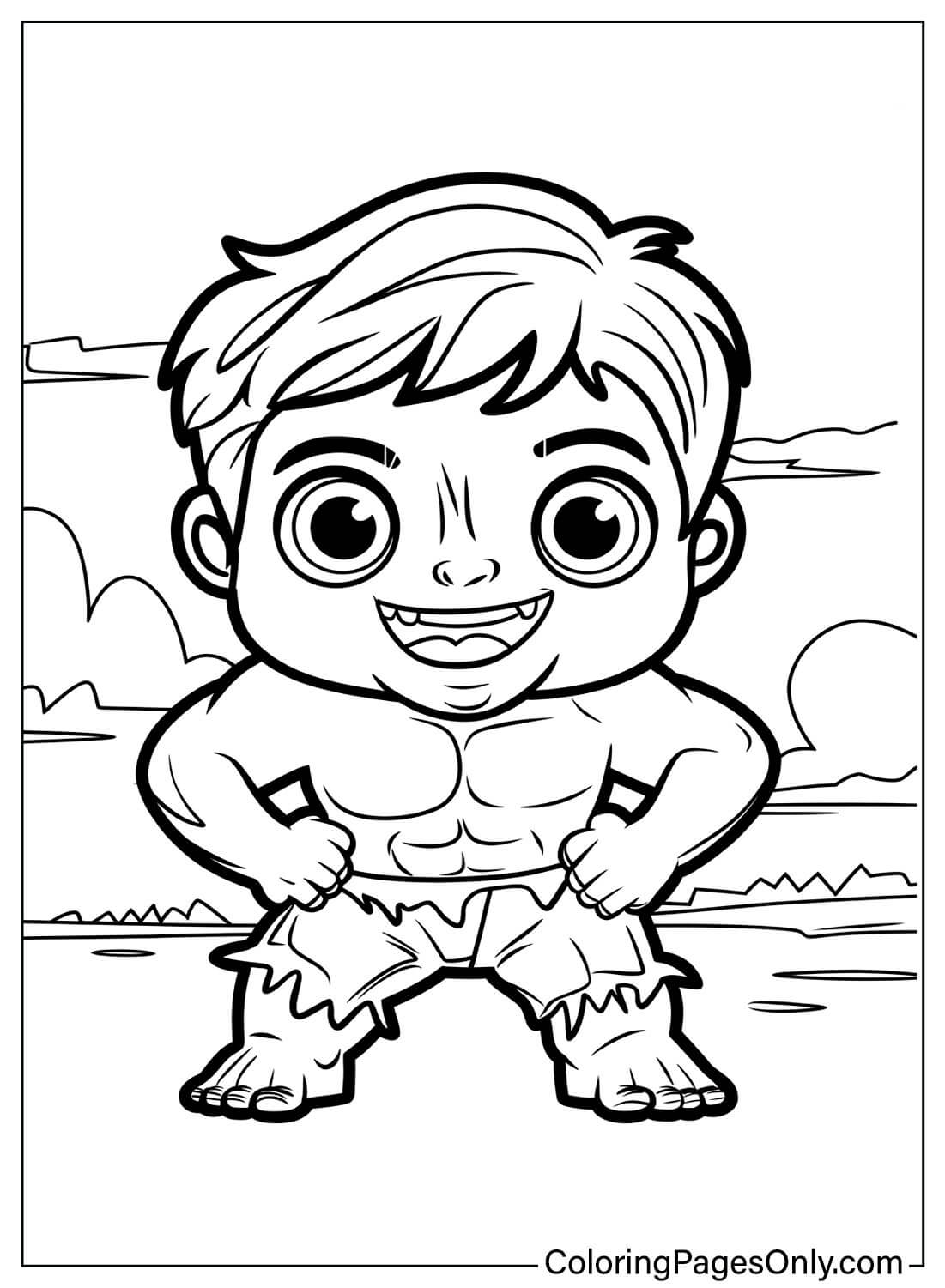
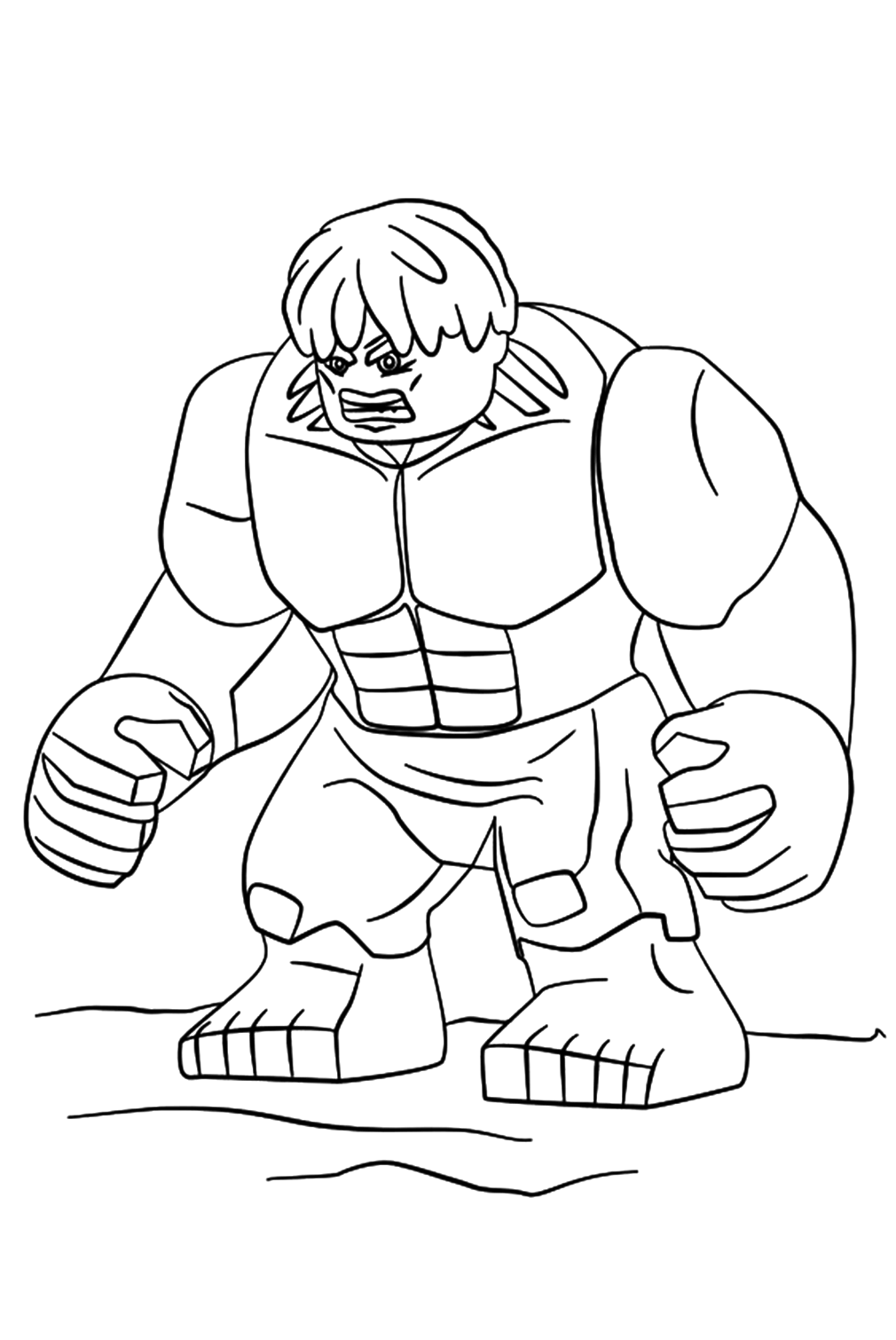
Chibi Hulk pages apply the simplified, exaggerated-proportion kawaii design vocabulary to the character in a particularly effective way: the Hulk’s naturally exaggerated proportions (large body relative to head in the realistic design) are inverted in the chibi format, producing a rounded, large-headed version that is simultaneously the most powerful and most adorable interpretation of the character. The chibi format works especially well for the Hulk because his emotional extremity (maximum rage) becomes endearingly absurd when applied to a character with rounded chibi proportions and oversized eyes.
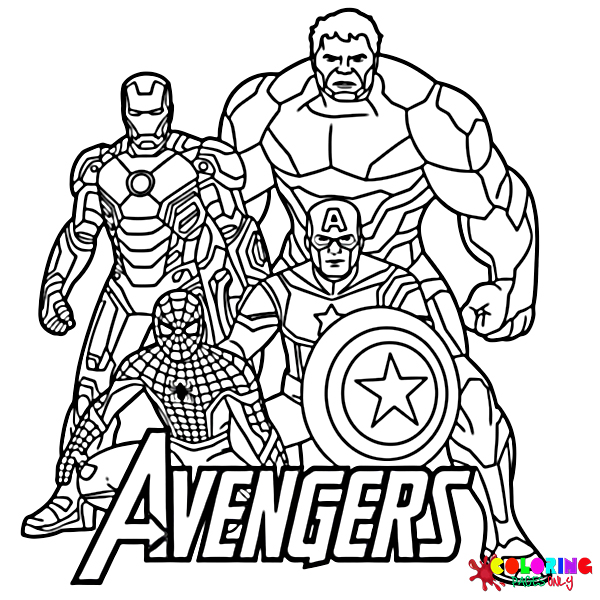
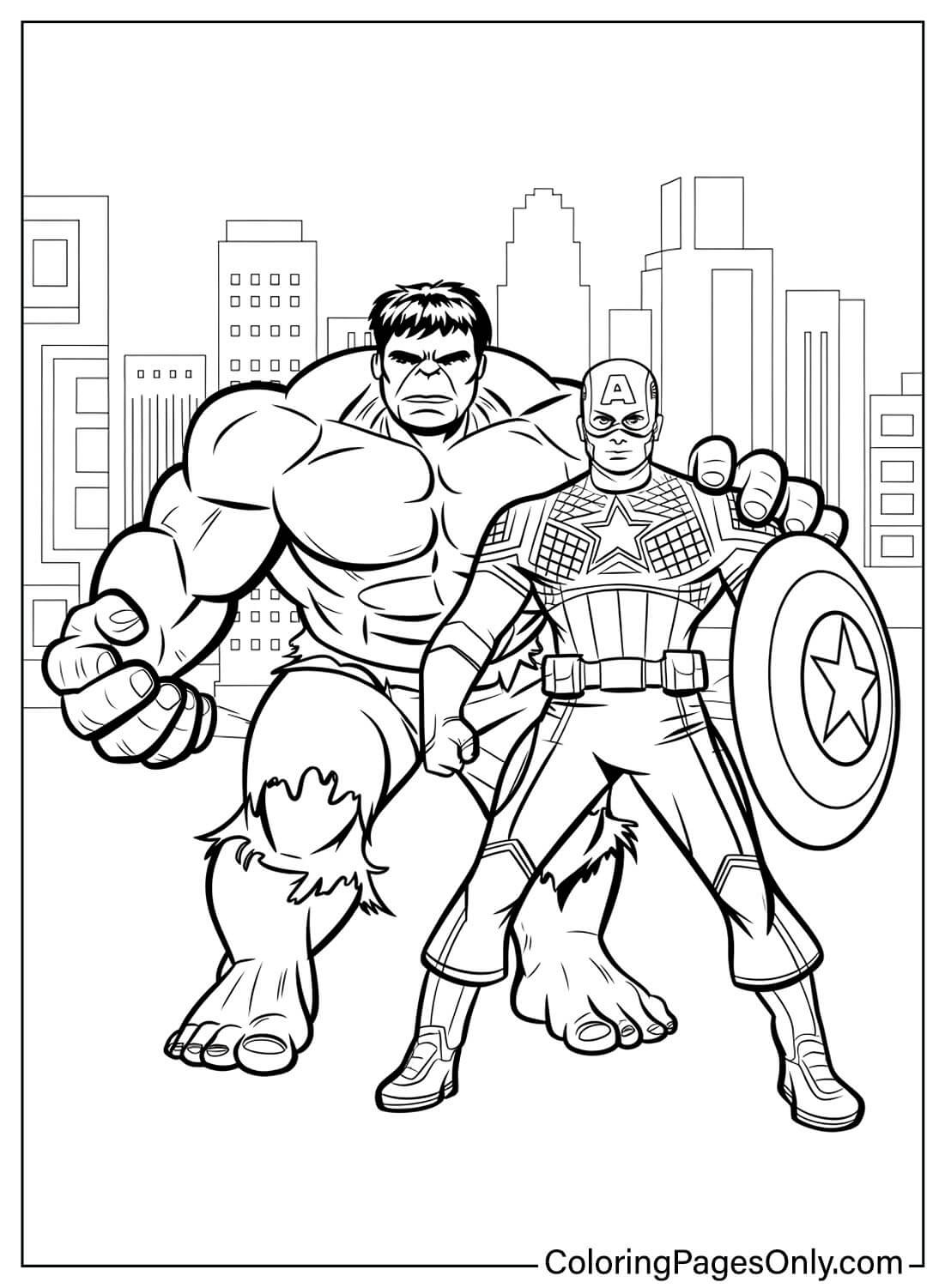
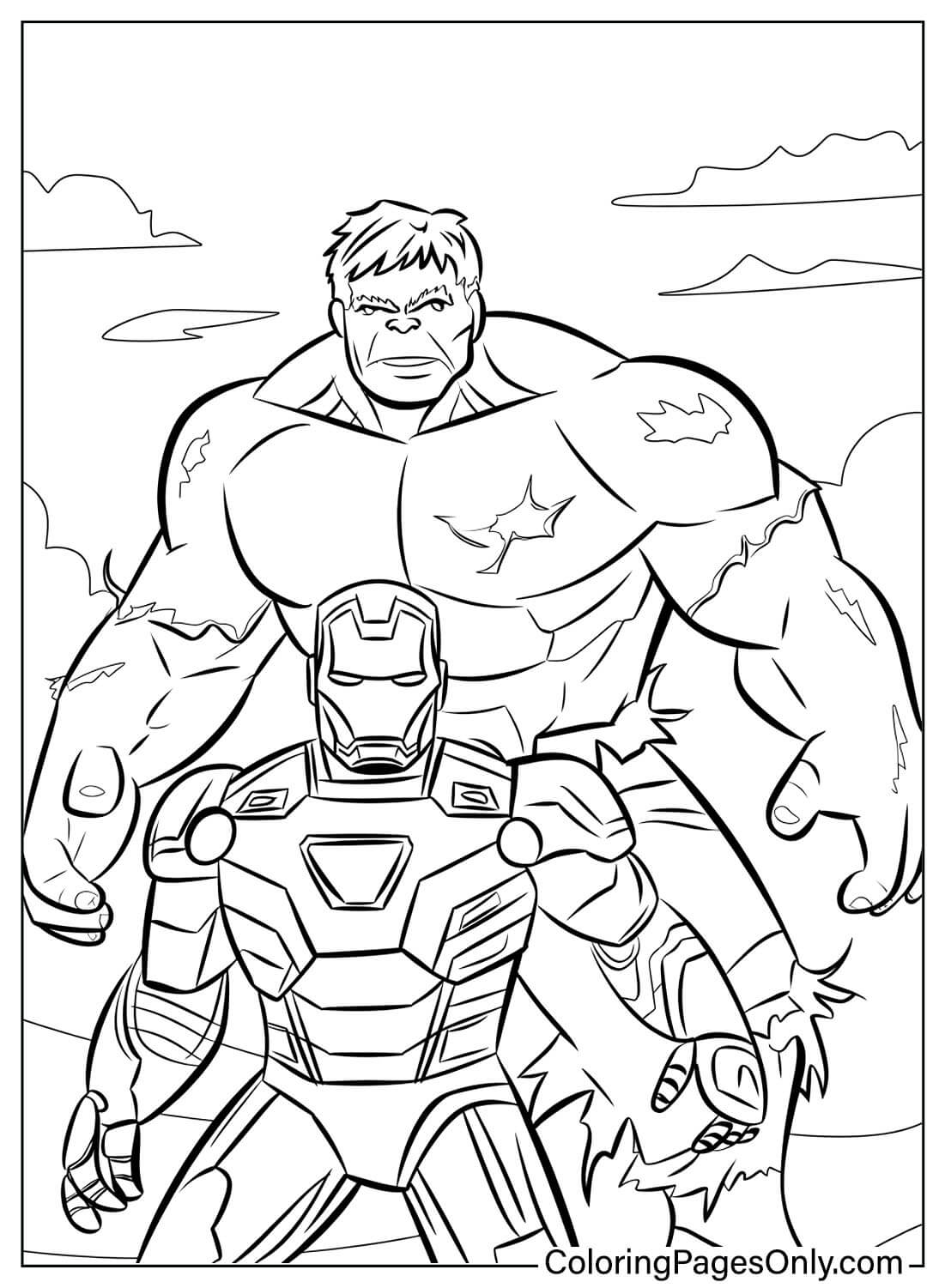
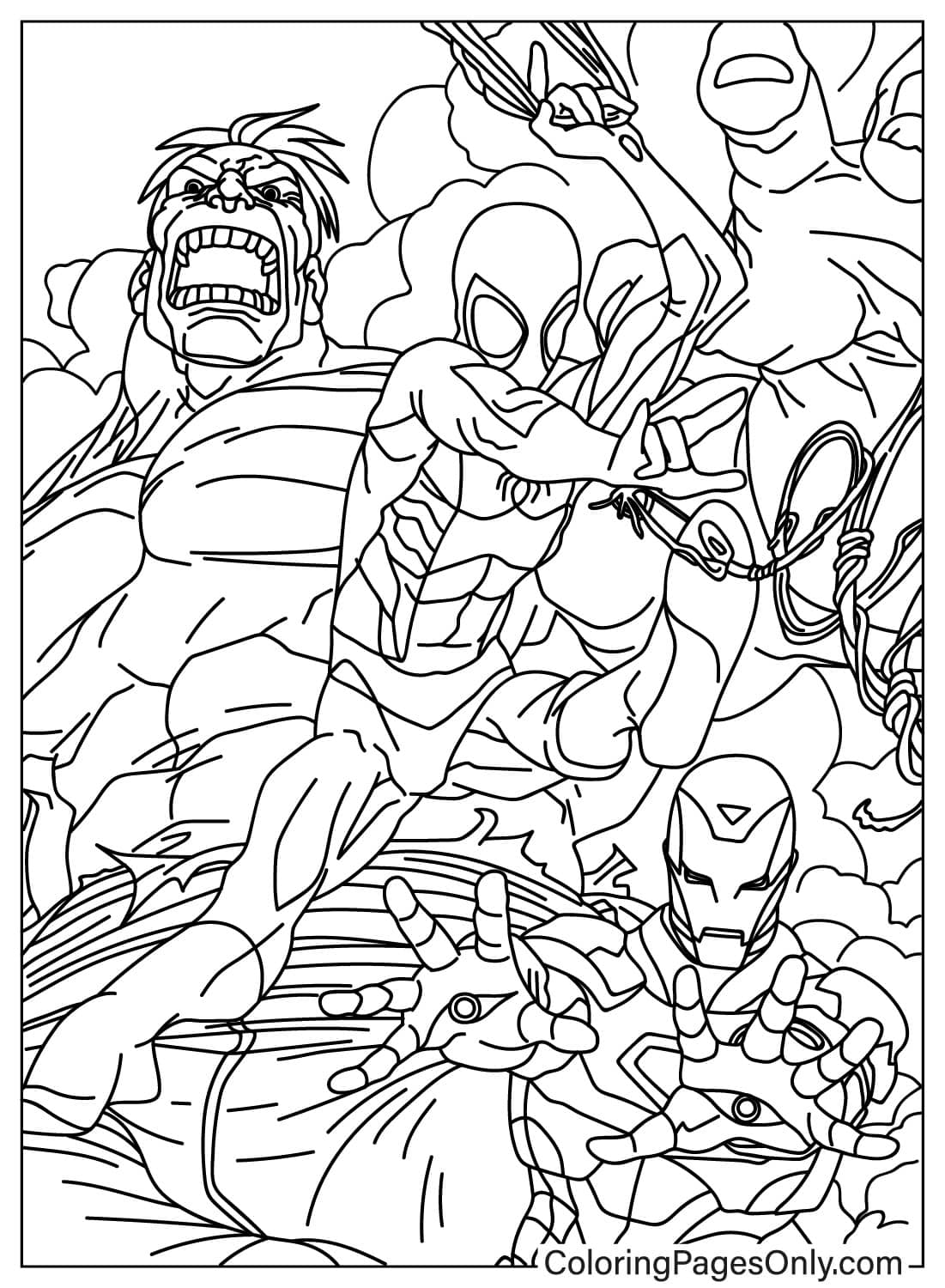
Avengers ensemble pages show the Hulk alongside Thor, Iron Man, Captain America, Black Widow, and Hawkeye (the original MCU Avengers lineup from The Avengers, released May 4, 2012), providing the collection’s most chromatically diverse compositions: the Hulk’s vivid green, Thor’s red cape and silver armor, Iron Man’s red and gold suit, Captain America’s blue and red uniform, and Black Widow’s black tactical wear create a palette spanning most of the color wheel.
Coloring chibi Hulk pages: The same vivid green skin at full saturation, but in the simplified, rounded forms of the chibi format. The face features are oversized and simplified: very large, round eyes (vivid green or white with no visible iris for maximum rage comedy), simple mouth expression, large, rounded head on a compact body. The chibi’s purple pants remain purple even at a small scale. Coloring Avengers ensemble pages: Apply each character’s canonical colors simultaneously, using the Hulk’s green as the composition’s most vivid color anchor. Thor’s red cape uses vivid warm red. Iron Man’s suit uses vivid warm red and vivid warm gold in equal measure. Captain America’s uniform uses vivid royal blue.
What These Pages Do
Stan Lee and Jack Kirby introduced the Hulk in May 1962 at the specific historical moment when nuclear anxiety was at one of its highest points in American public life: the Cuban Missile Crisis would occur in October 1962, five months after the Hulk’s first appearance, and the character’s origin story, in which a scientist is transformed by the radiation of a weapon he designed, directly encoded the period’s specific anxiety about nuclear technology and its creators’ responsibility for its consequences. Comics scholar Bradford Wright and others have written about the Hulk as one of the clearest examples in superhero comics of a character whose power is presented as a threat as much as an asset: the Hulk is frequently as dangerous to his allies as to his enemies, a premise that has driven the character’s most significant narrative arcs across six decades.
Writer Peter David’s run on The Incredible Hulk (1987-1998, approximately 130 issues) is consistently cited in comics criticism as one of the most sustained and most sophisticated character studies in the superhero genre: David used the framework of dissociative identity (then called multiple personality disorder) to organize the various Hulk personalities into a coherent psychological narrative about trauma, specifically about Banner’s documented childhood abuse at the hands of his father Brian Banner. The narrative framework David established, in which the Hulk’s various personalities represent different aspects of Banner’s response to that trauma, has influenced every subsequent major Hulk creative run and is the primary reason the character has sustained critical and creative interest across a period when simpler concepts have cycled out of relevance.
The American Academy of Pediatrics identifies fine motor skill development as a key childhood milestone throughout early childhood. The muscle mass rendering across the Hulk’s exaggerated physique, the energy burst gradient work in Thunderclap pages, the transformation sequence’s skin-color blend technique, the scale texture on Abomination pages, and the six-character color management in Avengers ensemble compositions all provide sustained fine motor challenge across the collection’s age range. The 2005 Art Therapy Journal study on structured coloring and anxiety reduction applies throughout.
How to Color These Pages Well
The Hulk’s green must be the most vivid medium green available, applied at maximum pressure, and must never drift toward yellow-green or teal. The single most important coloring decision on any Hulk page is the green: vivid, balanced, fully saturated medium green with no yellow shift and no blue shift. Test the chosen green against white paper before applying: it should read as clearly, unmistakably vivid green, matching the specific green that has been the character’s canonical color since 1962. If the available green reads as lime (too yellow) or as teal (too blue), it is incorrect for this character.
The three-zone muscle rendering technique gives the Hulk’s exaggerated physique its dimensional quality. Apply the base vivid green at full coverage across all skin surfaces. Then identify the muscle group peaks (the highest, most directly lit surfaces of each muscle): the top of each bicep, the upper chest, the top of each shoulder, and the upper knees. Apply a slightly lighter, slightly more yellow-shifted vivid green at these peak positions. Apply a slightly darker, slightly more blue-shifted deep green at the deepest muscle valley areas (the shadow between bicep and tricep, the underside of the chest, the inner thigh shadow). These three tones give the musculature its dimensional quality.
The purple pants require a specific medium warm purple that reads as clearly purple, not grey. The purple pants are among the most important accuracy elements on any Hulk page and the most frequently colored incorrectly. The pants should be a clearly recognizable medium purple: warm enough to read as clearly purple (rather than as grey or blue-grey), muted enough to read as worn fabric (rather than as vivid stage costume). Apply medium purple at approximately 70 percent of maximum pressure, then add slightly darker purple at the fold lines and shadow areas to create fabric dimension.
Energy effect pages use the center-to-outer gradient applied in cool blue-white tones for Thunderclap bursts. At the absolute center of the Thunderclap burst (between the palms), apply near-white or pale blue-white at maximum pressure. Work outward from this center in progressively larger rings, each ring applying the same blue-white energy color at progressively lower pressure and progressively more diffuse application. By the burst’s outer edge, the energy should be barely distinguishable from the surrounding air, suggesting that the force is dissipating as it travels outward.
In transformation pages, the skin-color blend from Banner to Hulk requires pressure reduction rather than color mixing. The areas of Banner’s skin transitioning to Hulk green should show the two colors overlaid rather than mixed: apply the normal warm skin tone across all areas first. Then apply vivid green at reduced pressure (40 to 60 percent) over the transitioning areas. The result shows the green appearing through the skin tone beneath it rather than the two colors mixing into an intermediate brown-green, which would read as illness rather than transformation.
5 Creative Craft Ideas
The Grey Origin Page
The Hulk in The Incredible Hulk #1 (May 1962) was grey, not green. Stan Lee chose grey to avoid any ethnic association. Printing technology of the era could not consistently reproduce grey ink: the printed result varied between grey, green, and brown across different copies and print runs. Colorist Stan Goldberg standardized the character as green from issue #2 onward. The grey Hulk was revisited in the late 1980s as a separate personality named “Joe Fixit,” who worked as a Las Vegas enforcer and was more cunning but less powerful than the green Hulk.
Print a classic Hulk roar page. Color it in the grey Hulk scheme: cool medium grey skin rather than green, same purple pants.
On the backing card: “The Hulk, The Incredible Hulk #1, May 1962. Original color: grey. The reason Stan Lee chose grey was to avoid ethnic association with any skin tone. Problem: The printing technology of 1962 could not consistently reproduce grey ink. Result: printed copies varied between grey, green, and brown across different print runs. Solution: colorist Stan Goldberg standardized the character as vivid green from issue #2 onward. The grey Hulk: revisited in 1986 as ‘Joe Fixit’ personality during writer Peter David’s run. Joe Fixit: un enforcer de Las Vegas. More cunning. Less powerful. Still grey.”
The Anger-to-Strength Scale Study
The Hulk’s central power concept is that his strength increases without a known upper limit as his anger increases: the calmer he is, the weaker he is; the angrier he becomes, the stronger he becomes. This creates the franchise’s most specific narrative tension: the situations that most demand the Hulk’s maximum strength (severe threats) are also the situations that require Banner’s minimum emotional control.
Print three copies of the same Hulk page. Color the first in a lighter, slightly yellow-shifted green (calmer state). Color the second in the standard vivid medium green (moderate anger). Color the third in a darker, more intense, slightly deeper green (maximum rage).
Mount all three with a scale: “Hulk’s anger-to-strength correlation, per Marvel Comics canon. State 1 (calm): green, reduced strength. Several hundred tons of lifting capacity. State 2 (moderate anger): vivid green, standard strength. Several hundred to over 1,000 tons. State 3 (maximum rage): deep, intense green, potentially unlimited strength. The theoretical upper limit: not established in 63 years of publication. The Hulk has been this color since issue #2 (1962). The strength: still increasing.”
The Jekyll and Hyde Study
Stan Lee explicitly identified Robert Louis Stevenson’s 1886 novella, ” The Strange Case of Dr Jekyll and Mr. Hyde as one of the Hulk’s two primary inspirations (alongside Mary Shelley’s Frankenstein, 1818). Stevenson’s novella depicts Dr. Henry Jekyll, a respectable scientist who discovers a potion that separates his rational self from his repressed desires and drives, producing Mr. Hyde: a creature of pure id, smaller than Jekyll but of greater physical force in some depictions.
Print a Bruce Banner portrait page and a Hulk roar page. Color Banner in calm, measured tones: muted clothing, controlled expression, warm but subdued skin tone. Color the Hulk at maximum vivid green intensity.
On the backing card: “Stan Lee’s identified inspirations for the Hulk. Source 1: Robert Louis Stevenson, Strange Case of Dr Jekyll and Mr Hyde (1886). Concept applied: dual identity, rational scientist and primal force occupying the same body. Source 2: Mary Shelley, Frankenstein; or, The Modern Prometheus (1818). Concept applied: a powerful being misunderstood and feared by society despite not choosing its situation. The Hulk: created May 1962. The sources: 1886 and 1818. The dual-identity concept: approximately 76 years old when the Hulk first appeared.”
The Peter David Personality Map
Writer Peter David’s landmark run on The Incredible Hulk (1987-1998, approximately 130 issues) established that the various Hulk personalities represent different psychological responses to Bruce Banner’s childhood abuse by his father, Brian Banner. The main personalities documented in David’s run: the Savage (child-like rage, pure id, speaks in third person), Grey/Joe Fixit (cunning teenager-level adult, suppressed anger expressed as coolness), and Professor Hulk (Banner integrated with Hulk, mature synthesis). David used a dissociative identity framework to make this structure clinically coherent.
Print three different Hulk pages representing different emotional registers: one enraged (Savage Hulk), one coolly engaged (Smart/Professor Hulk), one action-ready but measured (a composite pose).
On the backing card: “Bruce Banner’s Hulk personalities as mapped by writer Peter David’s run (1987-1998, approximately 130 issues). Savage Hulk: the child self, pure rage, speaks in third person (‘Hulk is the strongest one there is!’). Grey Hulk/Joe Fixit: the adolescent self, cunning rather than powerful, operates covertly. Professor Hulk (merged): the integrated adult, Banner’s intelligence with the Hulk’s strength. The framework: drawn from dissociative identity psychology. The root cause in the comics: Banner’s abusive father, Brian Banner. Developed by writer Peter David. Considered by critics as one of the most sustained character studies in superhero comics.”
The Lou Ferrigno Build Study
In the CBS television series The Incredible Hulk (1977-1982), the Hulk was portrayed physically by Lou Ferrigno, a professional bodybuilder who had won Mr. America in 1972 and Mr. Universe in 1973 before twice competing for Mr. Olympia in 1974 and 1975 (both times placing second to Arnold Schwarzenegger). The production required a physically imposing actor to portray the Hulk’s practical effects form, and Ferrigno’s bodybuilder physique became the specific physical reference that defined the live-action Hulk for the generation who watched the series across its five seasons.
Print the most muscularly detailed Hulk page in the collection. Color at full vivid green with careful three-zone muscle rendering.
On the backing card: “The Incredible Hulk. CBS television series. Premiere: November 4, 1977. Run: 1977-1982. Banner: Bill Bixby. The Hulk: Lou Ferrigno. Ferrigno credentials: Mr. America 1972, Mr. Universe 1973. Mr. Olympia appearances: 1974, 1975 (placed second both times to Arnold Schwarzenegger). The series’ catchphrase (Banner): ‘Don’t make me angry. You wouldn’t like me when I’m angry.’ The transformation scenes: Banner’s eyes turn green, the shirt tears, and Ferrigno appears. The series introduced the Hulk to a television audience of approximately 12 million viewers per week at its peak. Ferrigno’s green makeup: applied by makeup artist Leo Lotito Jr., taking approximately 2 hours per session.”
Frequently Asked Questions
Who created the Hulk, and when did he first appear? The Hulk was created by writer Stan Lee and artist Jack Kirby, first appearing in The Incredible Hulk #1, published by Marvel Comics in May 1962. Stan Lee has stated in interviews that the character was inspired by two literary sources: Robert Louis Stevenson’s 1886 Strange Case of Dr Jekyll and Mr Hyde (providing the dual-personality transformation concept) and Mary Shelley’s 1818 Frankenstein (providing the misunderstood, powerful being alienated from society). The original Hulk in issue #1 was grey rather than green: grey was chosen to avoid ethnic association, but printing inconsistency led colorist Stan Goldberg to standardize the character as vivid green from issue #2 onward, establishing the color that has defined the character for sixty-three years.
What is Bruce Banner’s backstory, and why does he become the Hulk? Dr. Robert Bruce Banner is a nuclear physicist who was exposed to gamma radiation when a bomb he had designed detonated at a desert test site. He was on the test range because he had rushed out to push teenager Rick Jones to safety before the blast. The gamma radiation transformed him into the Hulk, with transformations initially triggered by sunset and sunrise and later by emotional stress, particularly anger. Writer Bill Mantlo developed Banner’s backstory to include a traumatic childhood: his father, Brian Banner, physically abused him and his mother, and Brian Banner believed Bruce was a mutant. Writer Peter David’s landmark 1987-1998 run built the entire multiple-personality framework around this documented childhood trauma, producing what comics critics consider the most psychologically sophisticated superhero character study of its era.
Why is the Hulk always shown in purple pants? Bruce Banner was wearing purple pants when he first transformed into the Hulk, and the pants survived the transformation because of a stretch-fabric composition. The purple pants have remained a consistent visual element of the character across every subsequent artist and era for sixty-three years, becoming one of the most specifically recognizable single costume elements in superhero comics. The pants are typically shown torn or frayed at the legs from the transformation and wear of the Hulk’s activities, but never completely destroyed. Their survival through transformations that destroy everything else Banner wears is explained within the franchise by the specific stretch properties of the fabric.
What is the Hulk’s Thunderclap, and what other powers does he have? The Hulk’s primary power is physical strength that increases without a known upper limit as his anger intensifies: at the base level, his lifting capacity is measured in hundreds of tons; at extreme anger, the theoretical maximum has never been established in sixty-three years of publication. Additional powers include extreme durability and resistance to physical damage, a rapid regenerative healing factor that can repair severe injuries quickly, the ability to survive in space and underwater without biological support, and exceptional leaping ability (he cannot fly but can leap distances of several miles in a single bound). The Thunderclap is one of his signature combat maneuvers: driving both hands together with sufficient force to create a shock wave of compressed air that can shatter structures, disorient opponents, and clear an area with physical and acoustic force.
How many different Hulk personalities exist in the comics? Multiple distinct Hulk personalities have been documented across the character’s publication history, most systematically organized during writer Peter David’s 1987-1998 run. The Savage Hulk is the most fundamental: a child-like entity of pure rage who speaks in the third person (“Hulk is the strongest one there is”), seeks to be left alone, and possesses virtually unlimited strength driven by anger. The Grey Hulk (Joe Fixit) is a cunning, more adult personality with less strength but more strategic intelligence, who worked as a Las Vegas enforcer. Professor Hulk (the Merged Hulk) synthesizes Banner’s intelligence with the Hulk’s physical capabilities. The Devil Hulk, developed in Al Ewing’s Immortal Hulk run (2018-2021), represents Banner’s deep self-hatred and presents as a more coldly purposeful entity. Various additional personalities have been depicted across different creative runs.
What Hulk films and television productions have been made? The Hulk has appeared across multiple productions. The CBS television series The Incredible Hulk (1977-1982) starred Bill Bixby as David Banner (the name changed from Bruce for the show) and Lou Ferrigno as the Hulk’s physical form. The series ran five seasons and had approximately 12 million weekly viewers at its peak. The Incredible Hulk (2008), directed by Louis Leterrier, starred Edward Norton as Bruce Banner and earned $263.4 million worldwide. Edward Norton was replaced by Mark Ruffalo for the character’s appearances beginning with The Avengers (2012), which earned $1.518 billion worldwide. Ruffalo has portrayed Banner and the Hulk in seven subsequent MCU productions through 2025, including Avengers: Endgame (2019), which earned $2.798 billion worldwide.
What age group are these pages best suited for? Hulk coloring pages serve a wide age range. The simplest chibi and cartoon Hulk pages with large, rounded forms and minimal detail are accessible from ages three and four, where the vivid green skin and the simple roaring expression provide clear, immediately satisfying coloring targets. The classic roar and smash pages with the Hulk’s detailed musculature and torn clothing are most rewarding for ages five to ten. The transformation sequence pages (requiring the blended skin-color technique) and the Thunderclap energy burst gradient pages are most engaging for ages seven and up. The Avengers ensemble pages with six simultaneous character color palettes and the thematic craft projects connecting the character to literary history and psychology are most appropriate for ages ten and older. Adult Marvel Comics fans with knowledge of the character’s publication history find the personality study and origin history craft projects most personally meaningful.
Browse the full collection at ColoringPagesOnly.com. All 40+ pages free, no sign-up, PDF or PNG, print or color online.
Stan Lee and Jack Kirby published the first issue in May 1962. He was grey. The printing was inconsistent. They made him green. He has been green since issue #2. Sixty-three years.
Peter David wrote the character from 1987 to 1998. He said: The multiple personalities come from Banner’s abusive father. He said: The Savage Hulk is the child self, the Grey Hulk is the adolescent self, the Professor Hulk is the integrated adult. He wrote approximately 130 issues of this. Critics consider it one of the best character studies in superhero comics.
The CBS television series ran from 1977 to 1982. Bill Bixby played Banner. Lou Ferrigno played the Hulk. Ferrigno won Mr. America in 1972 and Mr. Universe in 1973. The makeup took two hours per session. The catchphrase: “Don’t make me angry. You wouldn’t like me when I’m angry.” The series averaged approximately 12 million weekly viewers at its peak.
Pick up your most vivid medium green. The skin goes first at maximum pressure and maximum saturation. The three-zone muscle rendering goes second: lighter green at the muscle peaks, darker green at the valleys between. The purple pants go last: medium warm purple, not grey.
Share your work on Facebook and Pinterest and tag #Coloringpagesonly. The grey origin page and the anger-to-strength scale study are particularly worth sharing.
Color the skin vivid medium green, neither lime nor teal. Apply the muscle peak highlights in slightly lighter green. Apply the shadow valleys in slightly darker green. He has been this color since 1962. The pants remain purple. They always do.