
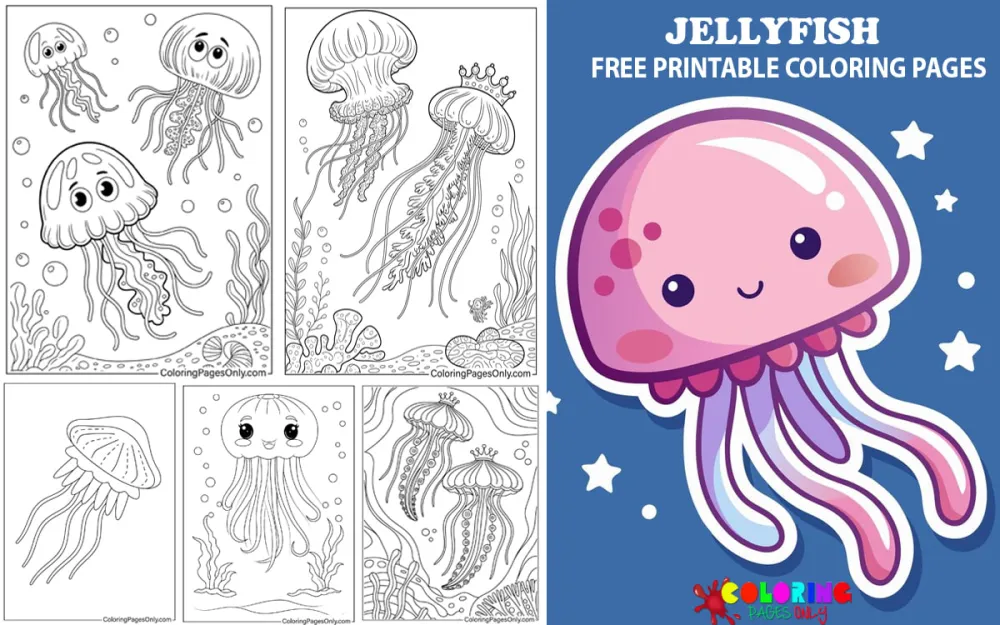
Free jellyfish coloring pages: a collection of pages featuring moon jellyfish with their translucent disc bells and visible four-lobed interior organs, lion’s mane jellyfish with their dramatic flowing tentacle clusters, box jellyfish in their distinctive cube-shaped forms, spotted jellyfish with their patterned translucent bells, kawaii and cartoon jellyfish with expressive faces, jellyfish in full underwater ocean settings with coral reef and tropical fish, jellyfish bloom scenes showing multiple individuals together, bioluminescence glow effect pages, mandala-style jellyfish design compositions, close-up bell and tentacle studies, and the full visual vocabulary of one of the ocean’s most visually extraordinary and most biologically ancient animal groups—all free, printable PDFs and online coloring for ocean enthusiasts of all ages.
Jellyfish are members of the phylum Cnidaria, subphylum Medusozoa, and are not fish in any biological sense: the common name persists despite scientists preferring the term “sea jelly” or “medusa.” The medusa stage (the free-swimming, bell-shaped form that the collection depicts throughout) is one of two alternating life stages in most jellyfish species, with the attached polyp stage being the other. Jellyfish fossils have been documented from the Cambrian period, approximately 500 to 530 million years ago, making the basic body plan one of the most ancient among multicellular animals still living today.
The body of a jellyfish is approximately 95 to 98 percent water by composition. They have no brain, no heart, no bones, and no blood. They do have a nervous system (a simple distributed nerve net rather than a centralized brain), muscles for pulsing the bell to move, and in some species (notably box jellyfish), they have sophisticated eyes. The same central opening serves as both the mouth and the digestive opening. They exchange oxygen and carbon dioxide directly through their thin body surface rather than through a respiratory system.
These free pages at ColoringPagesOnly.com cover the full range of jellyfish visual forms. All free, PDF or PNG, print or color online.
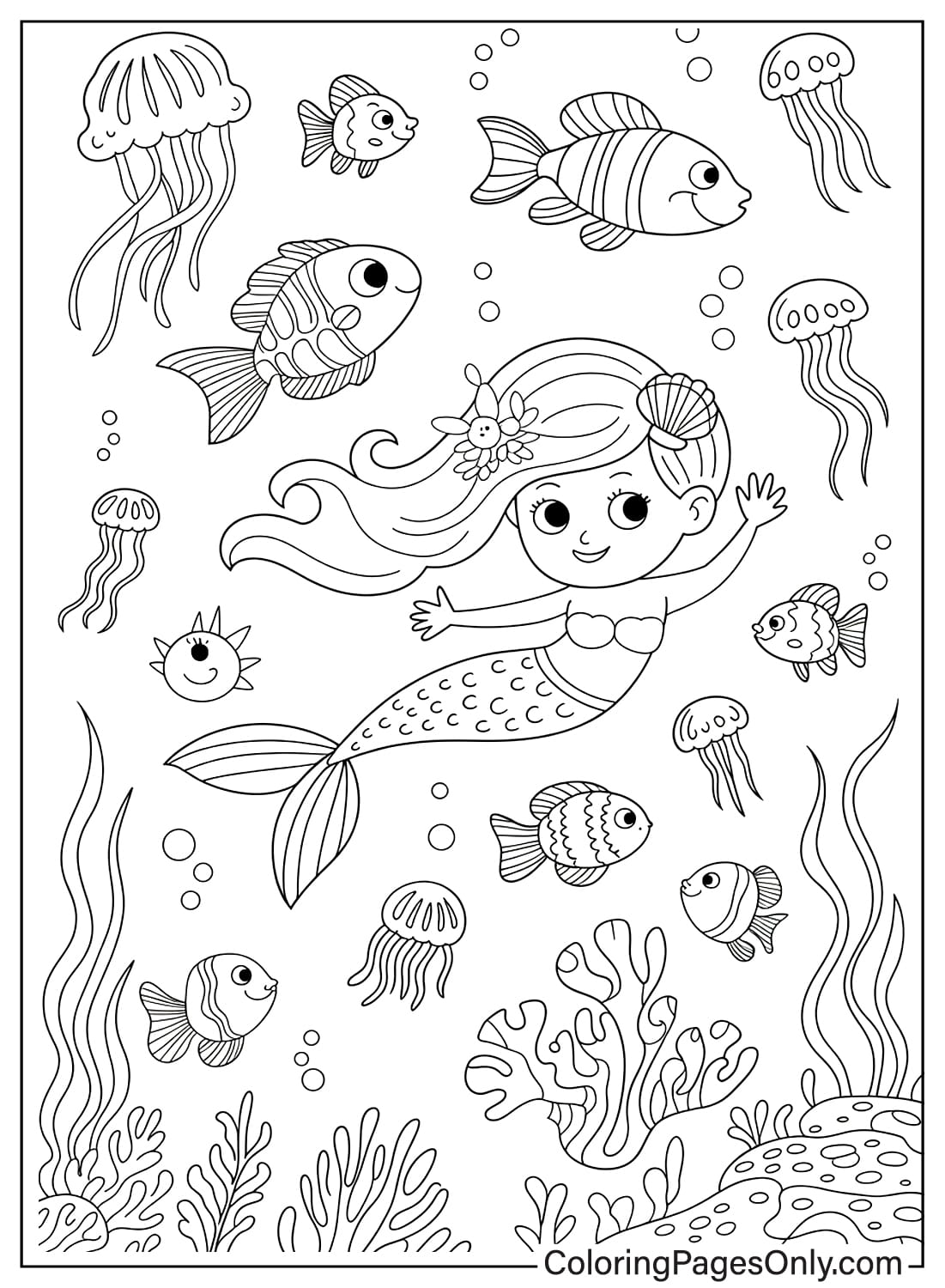
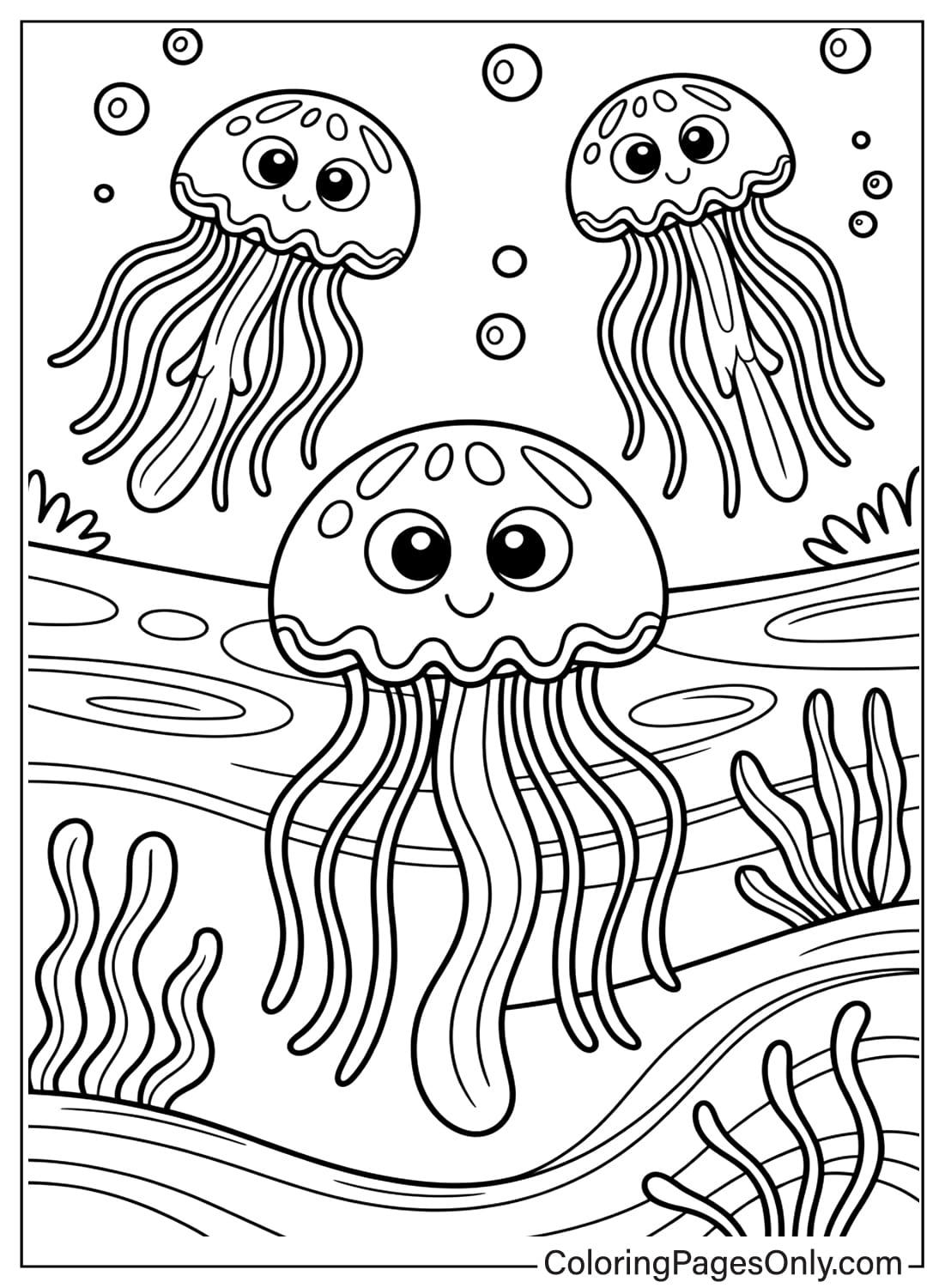
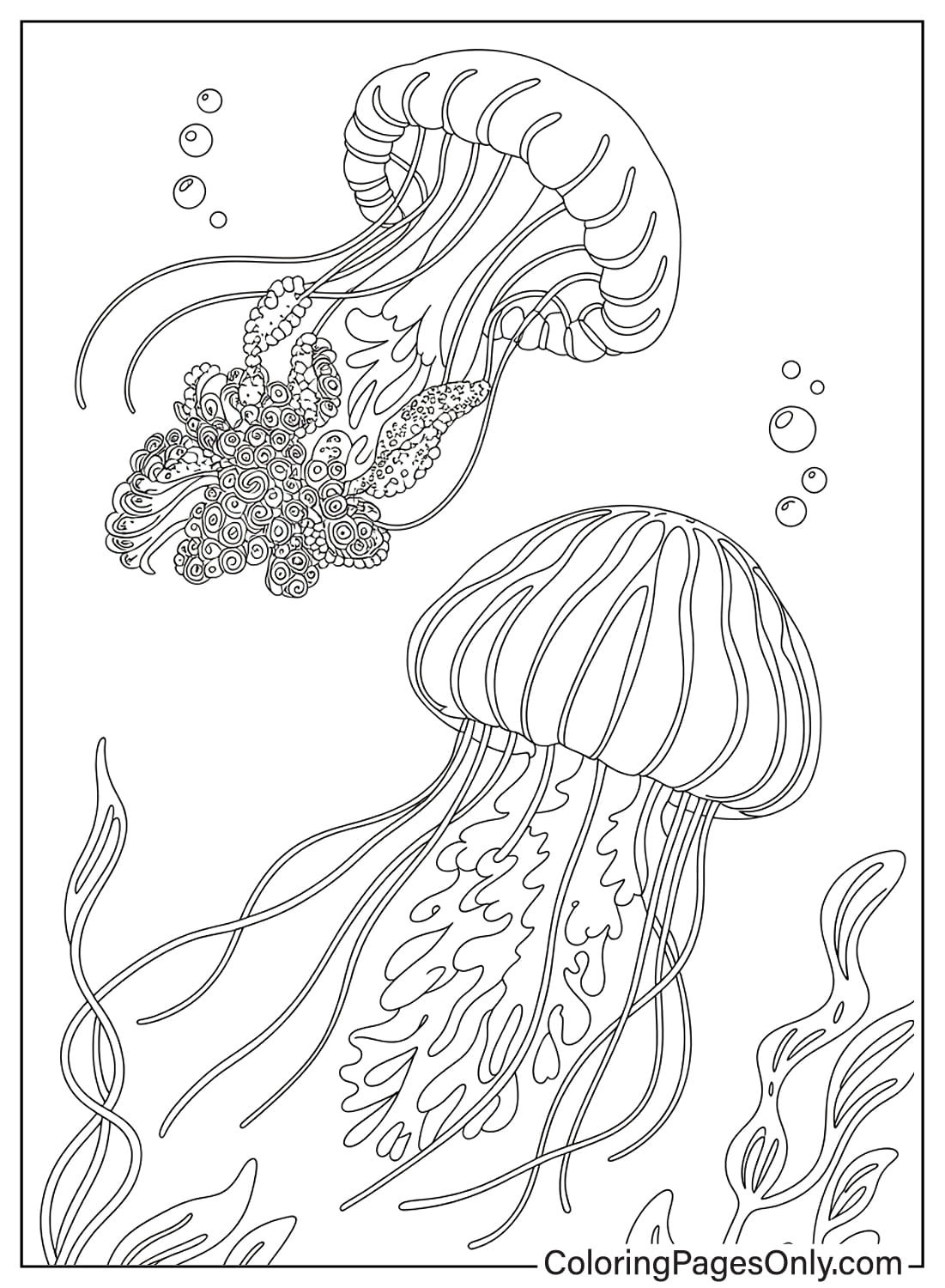
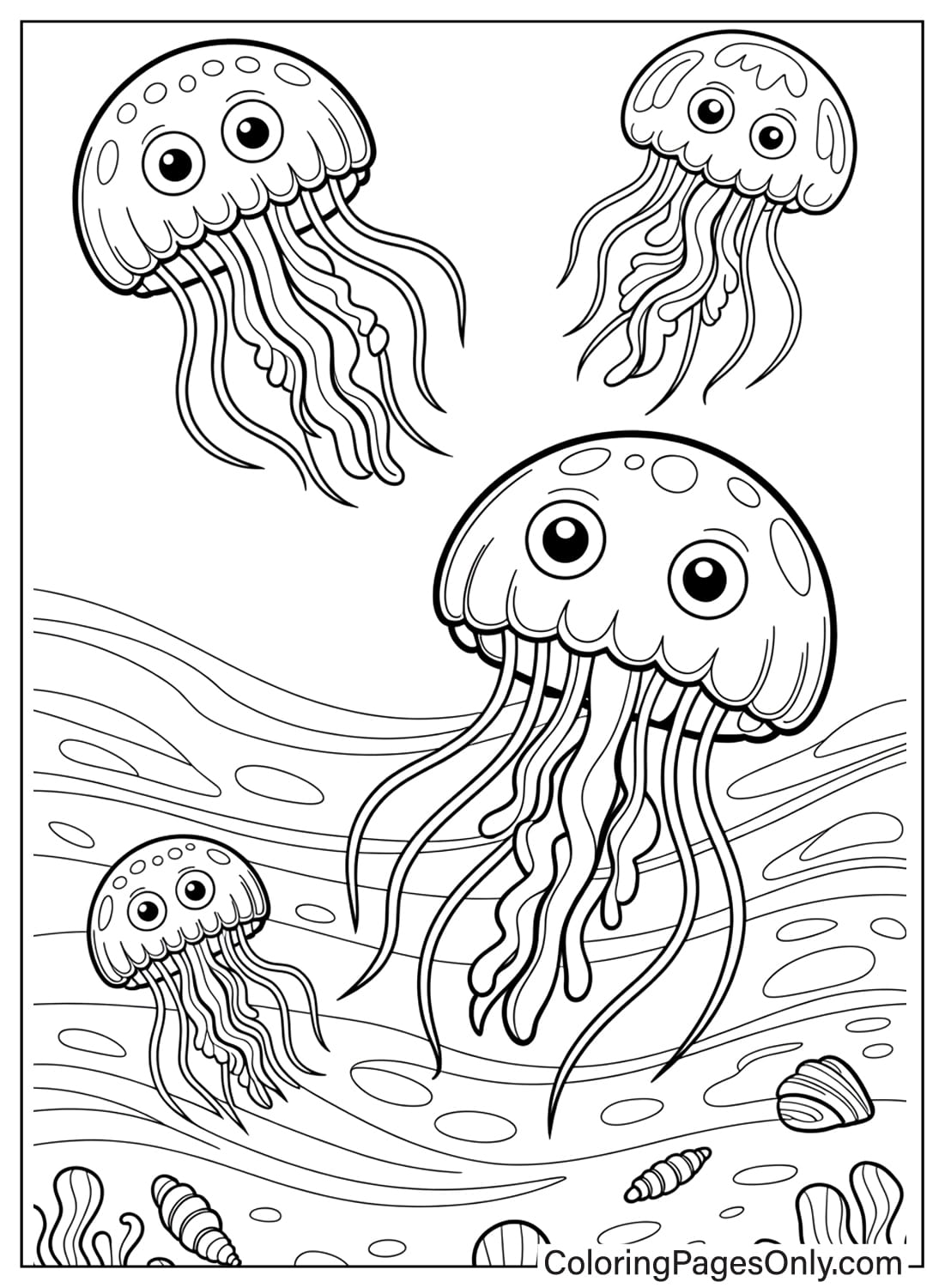
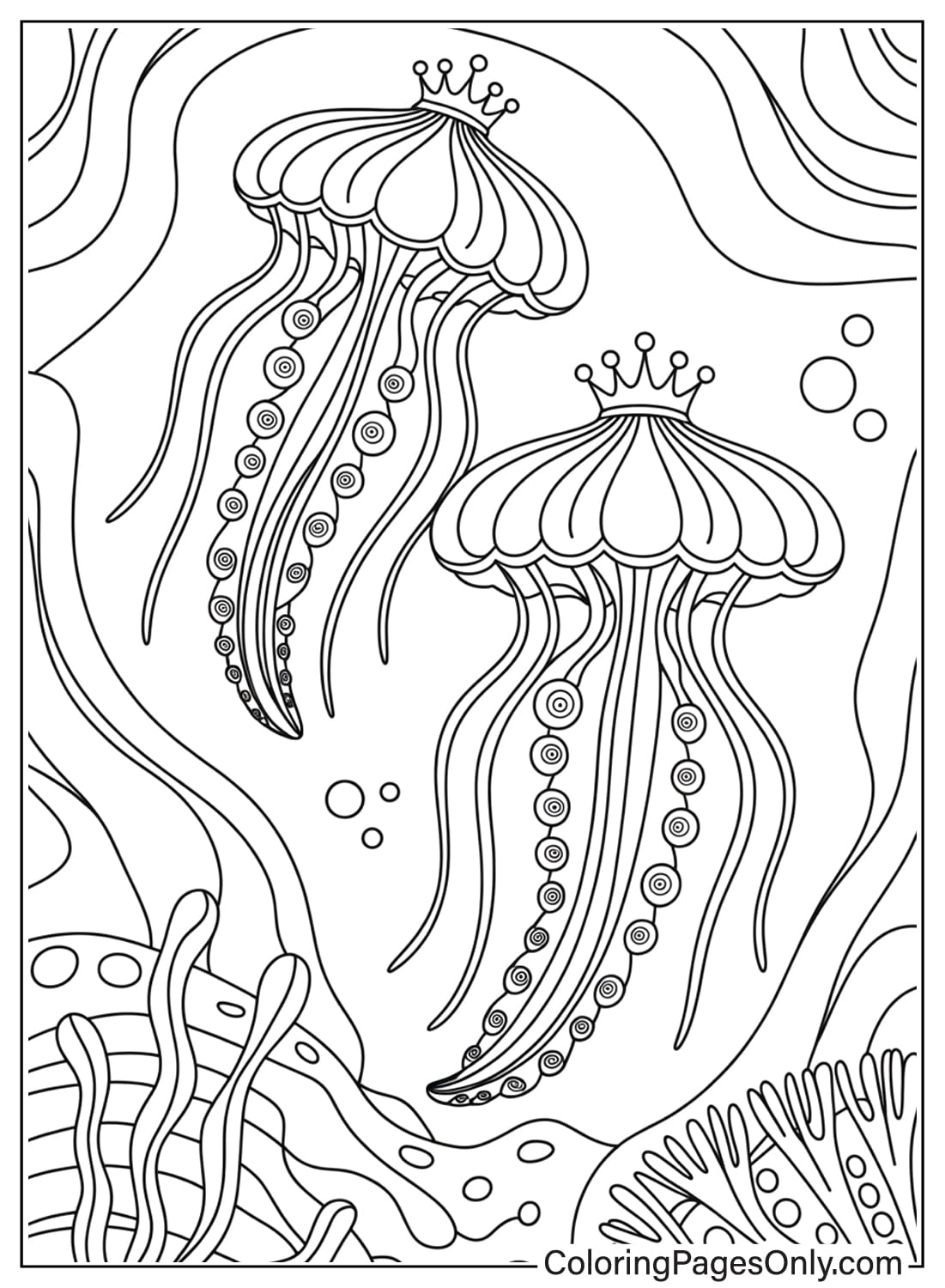
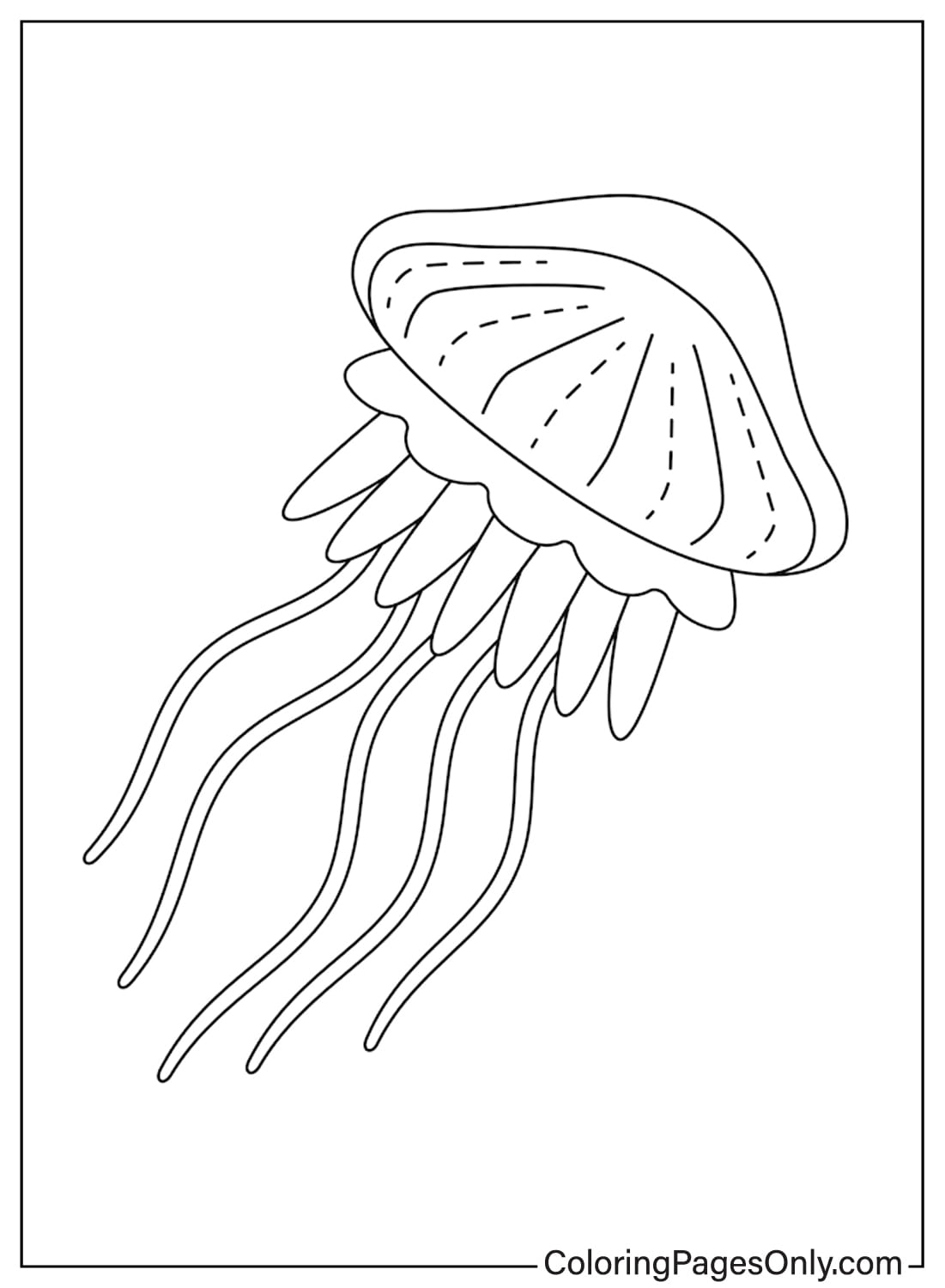
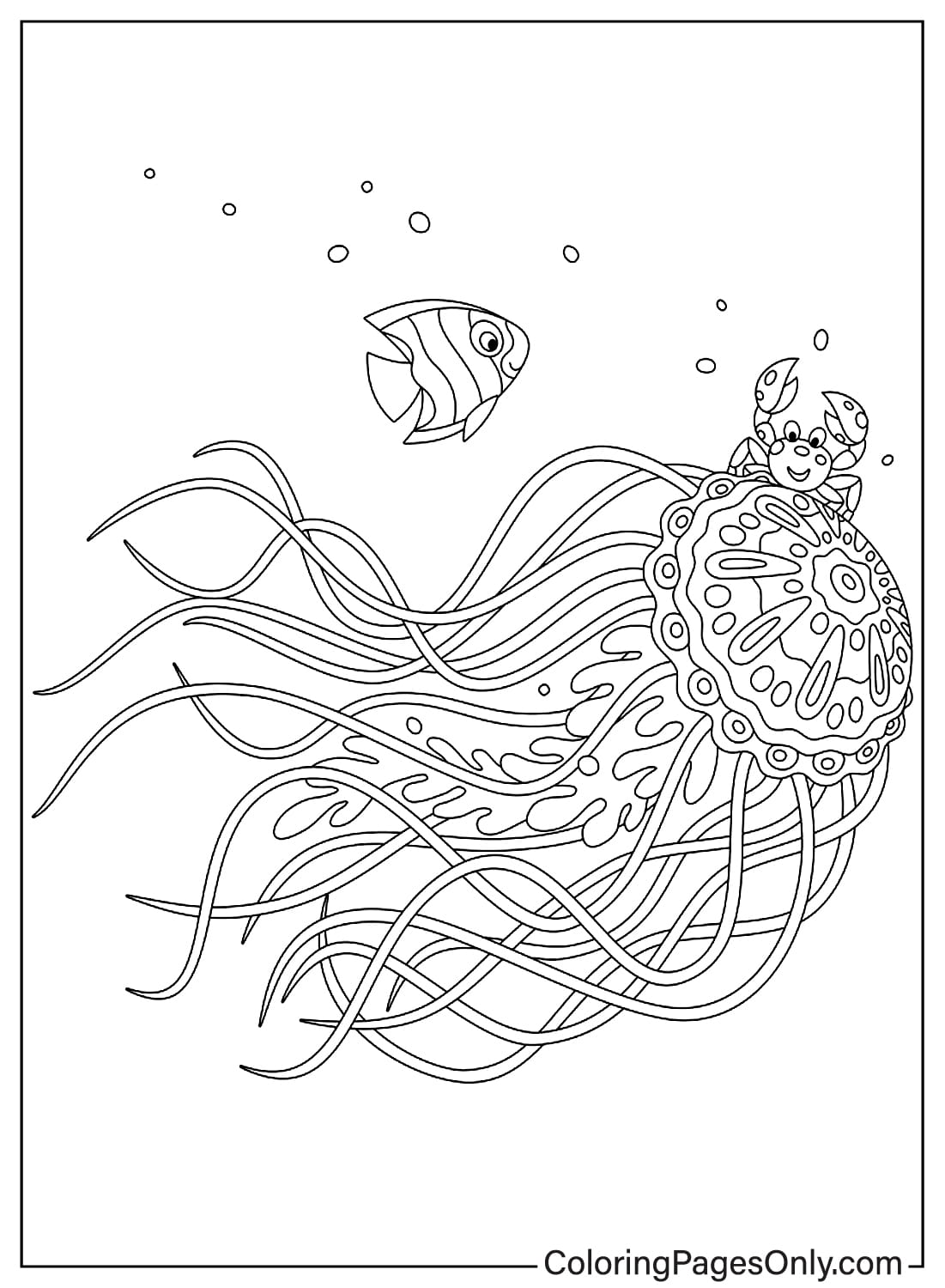
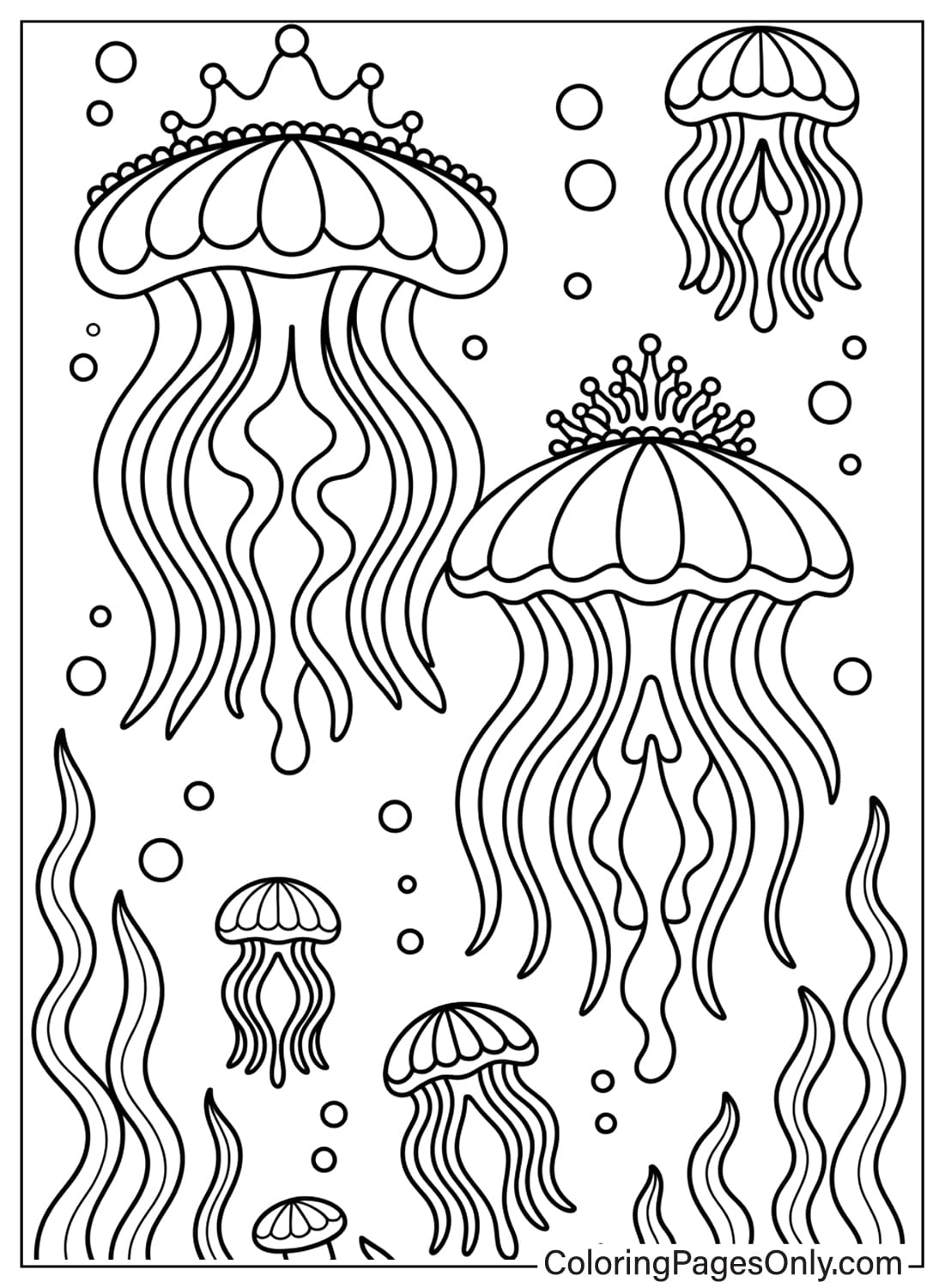
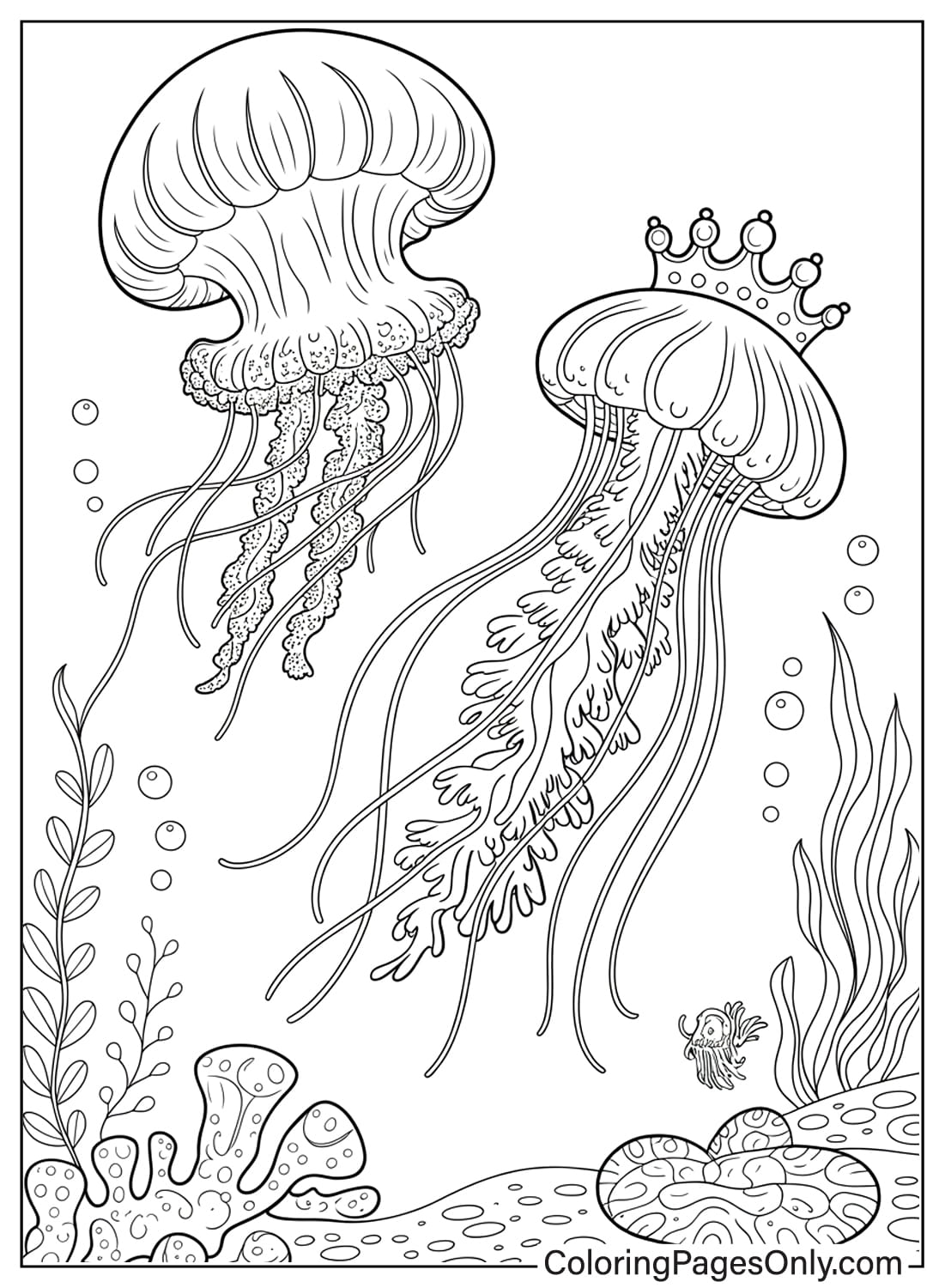
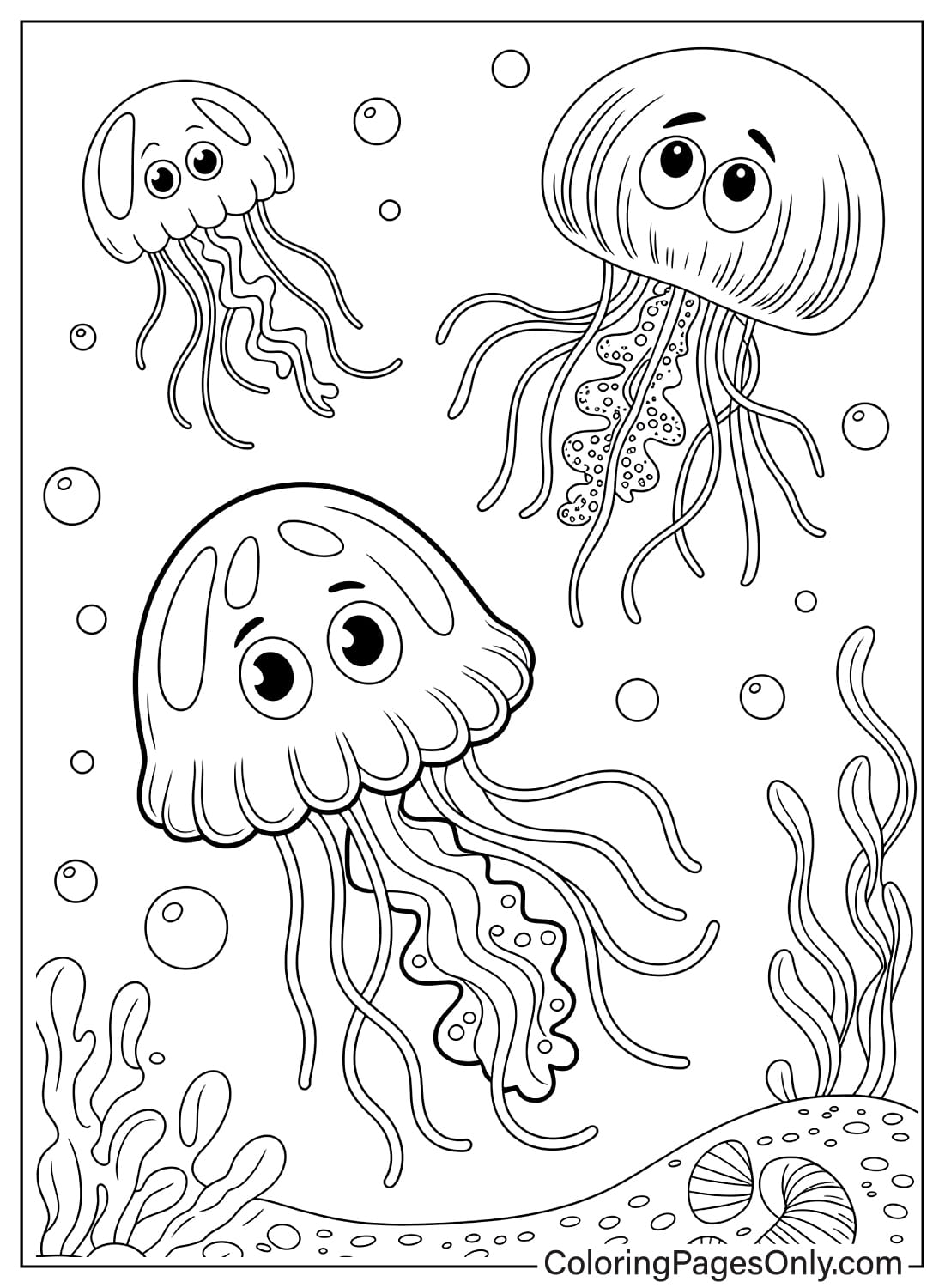
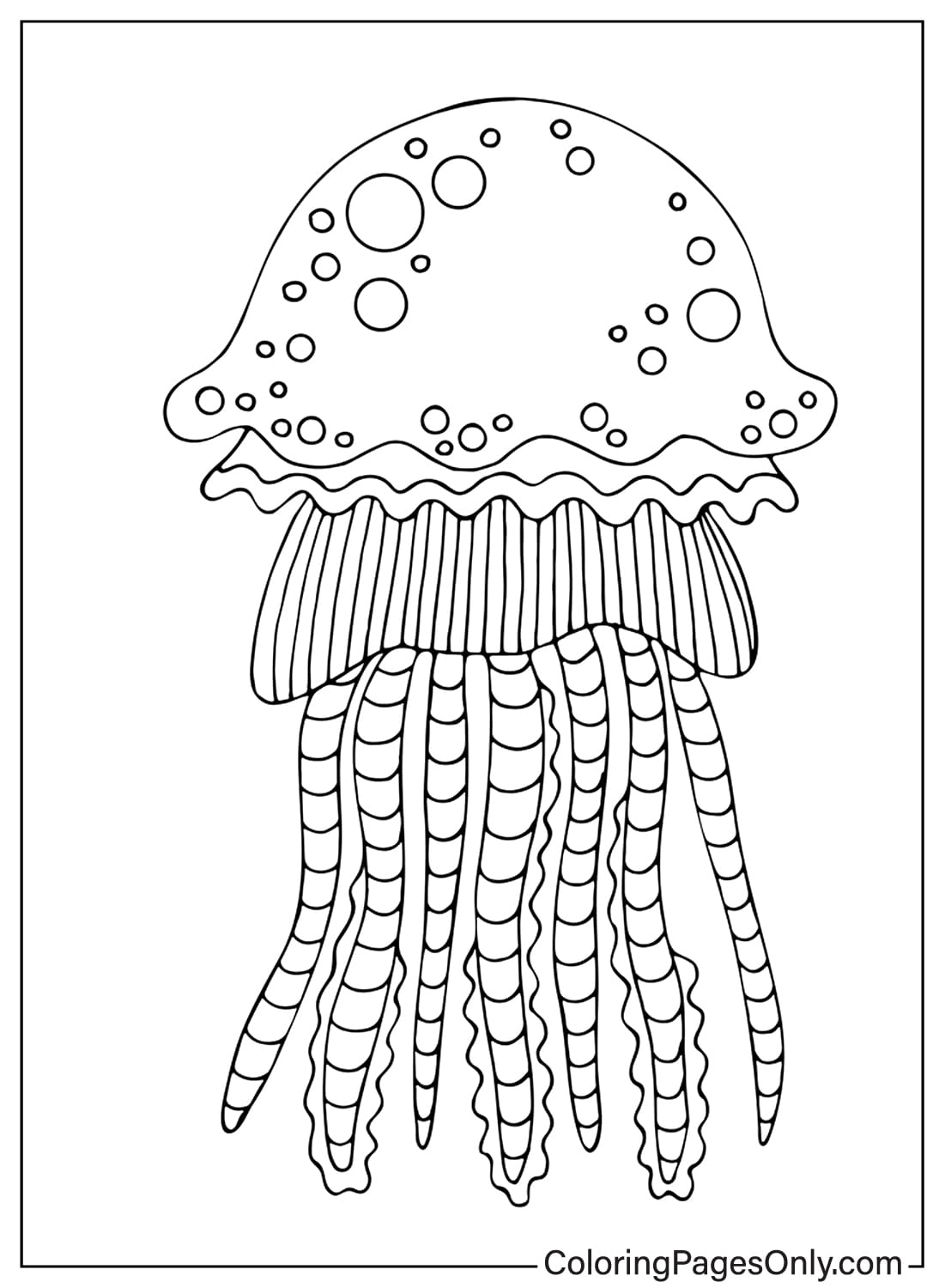
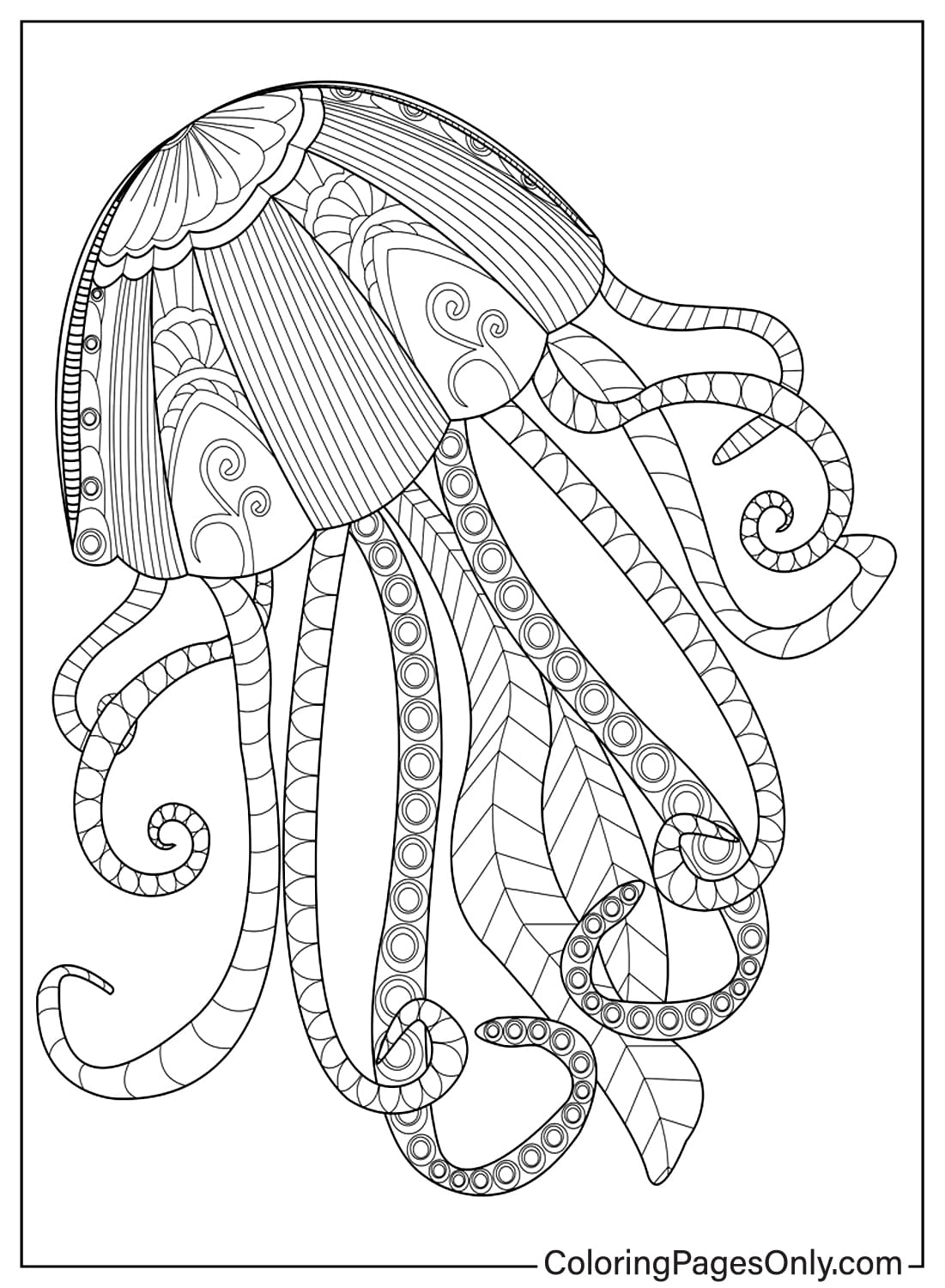
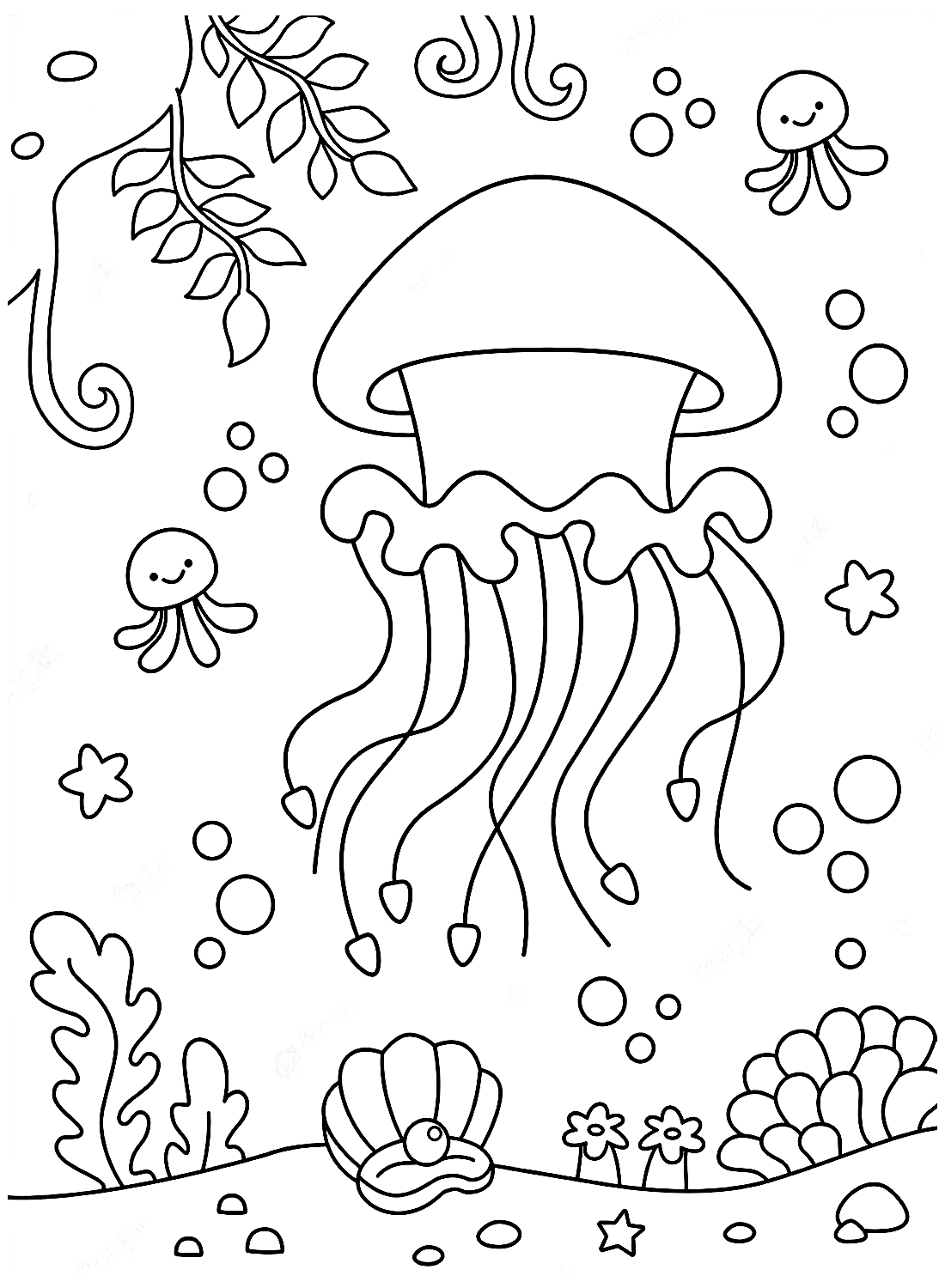
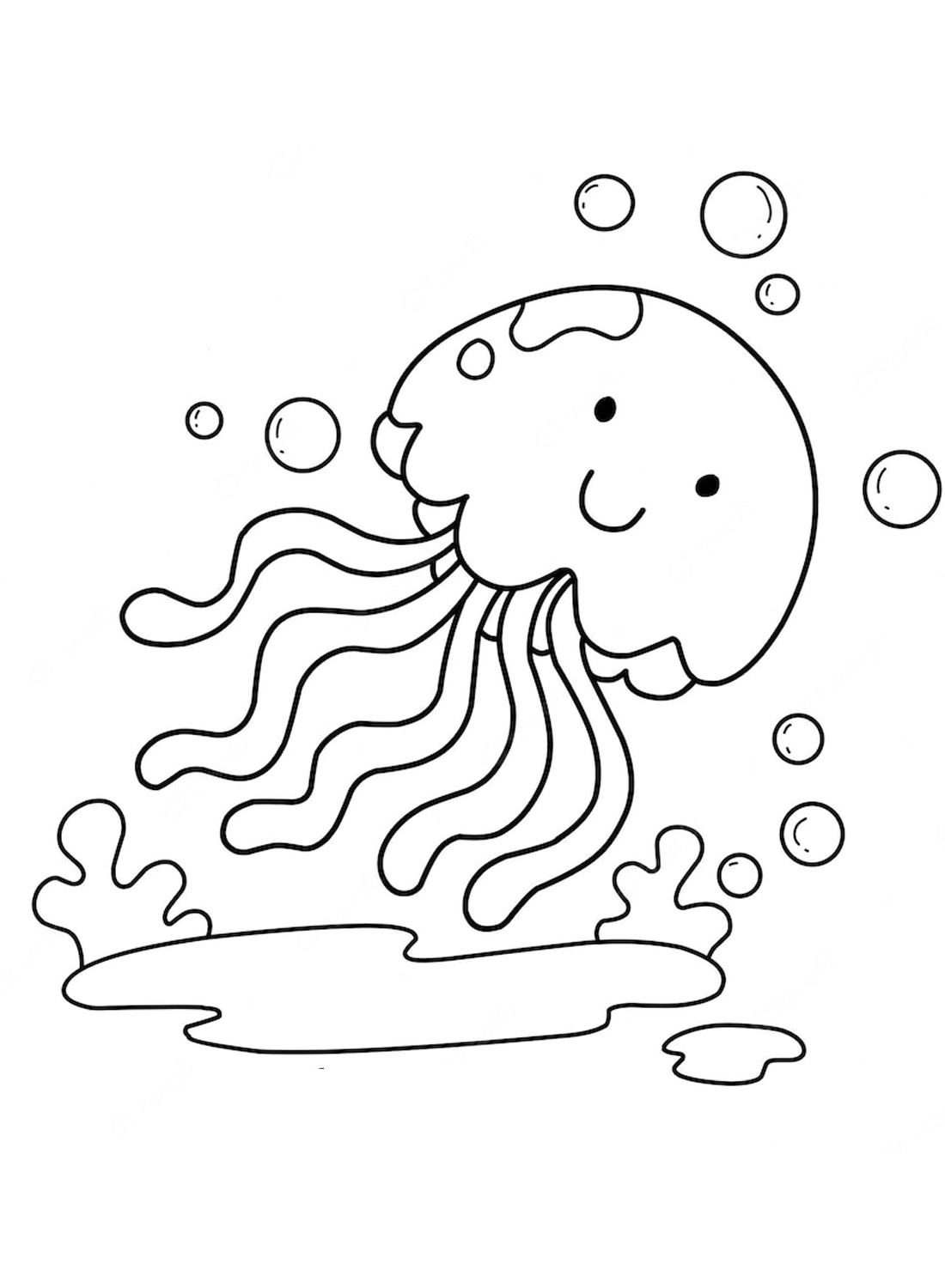
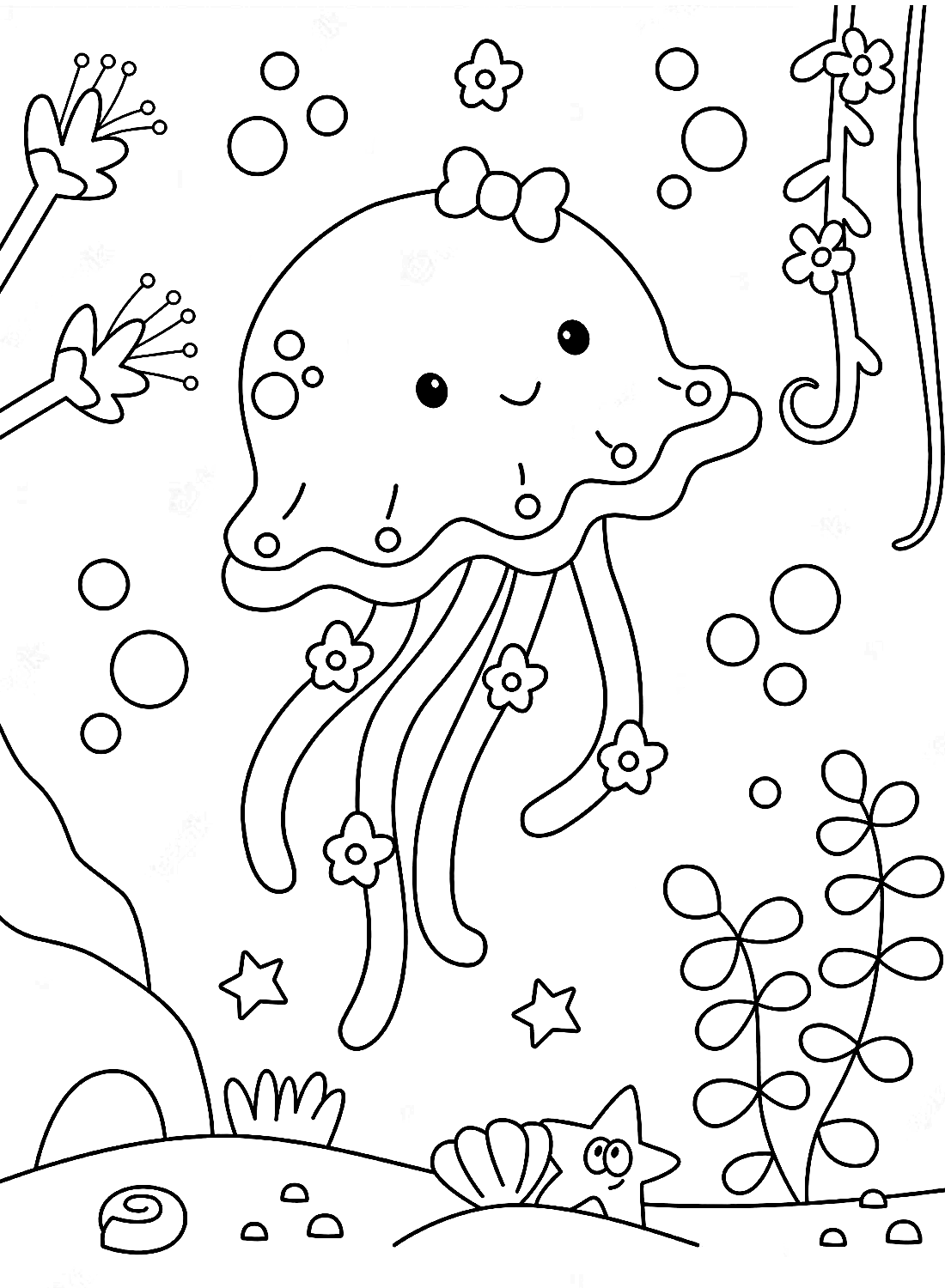
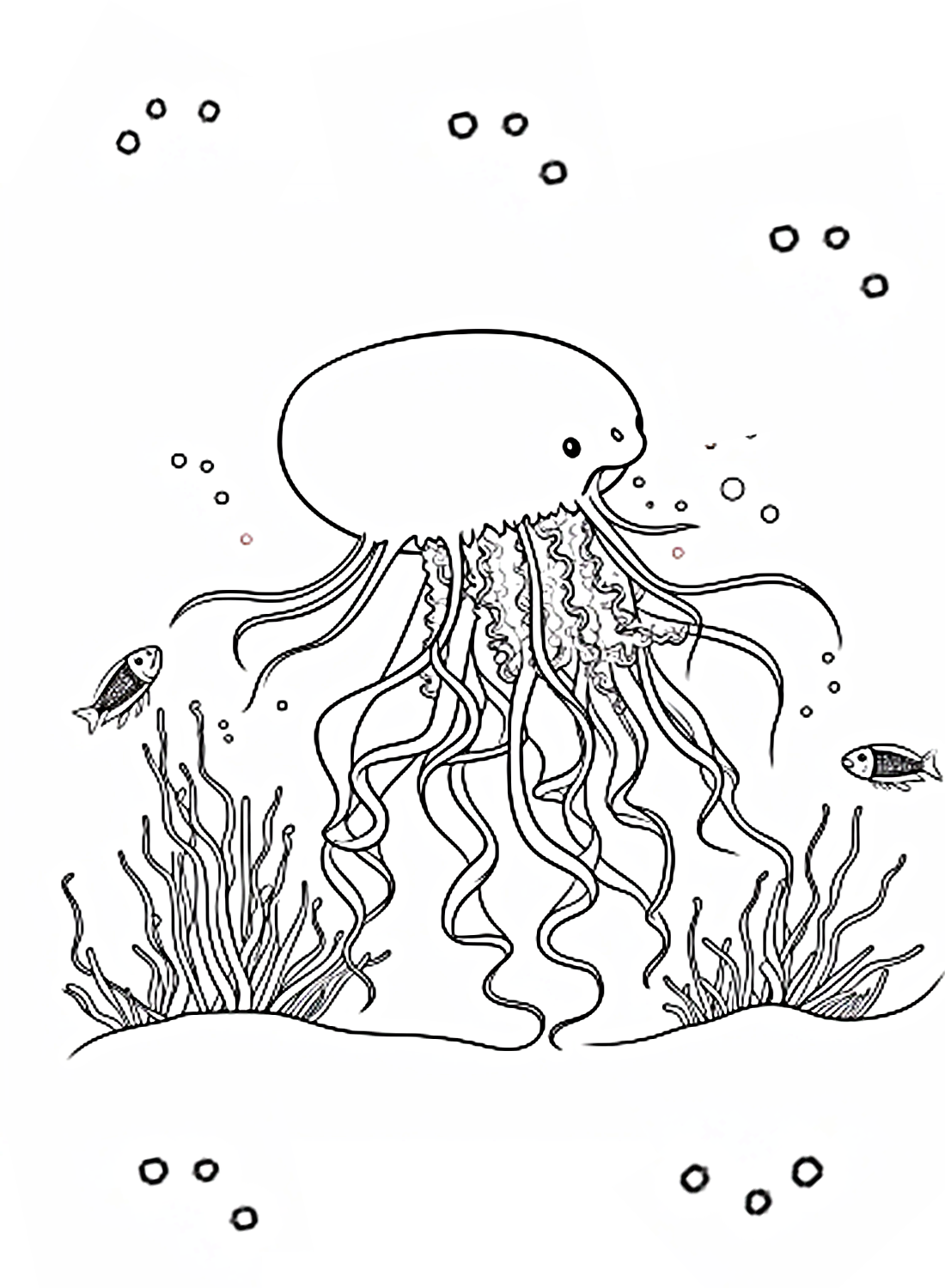
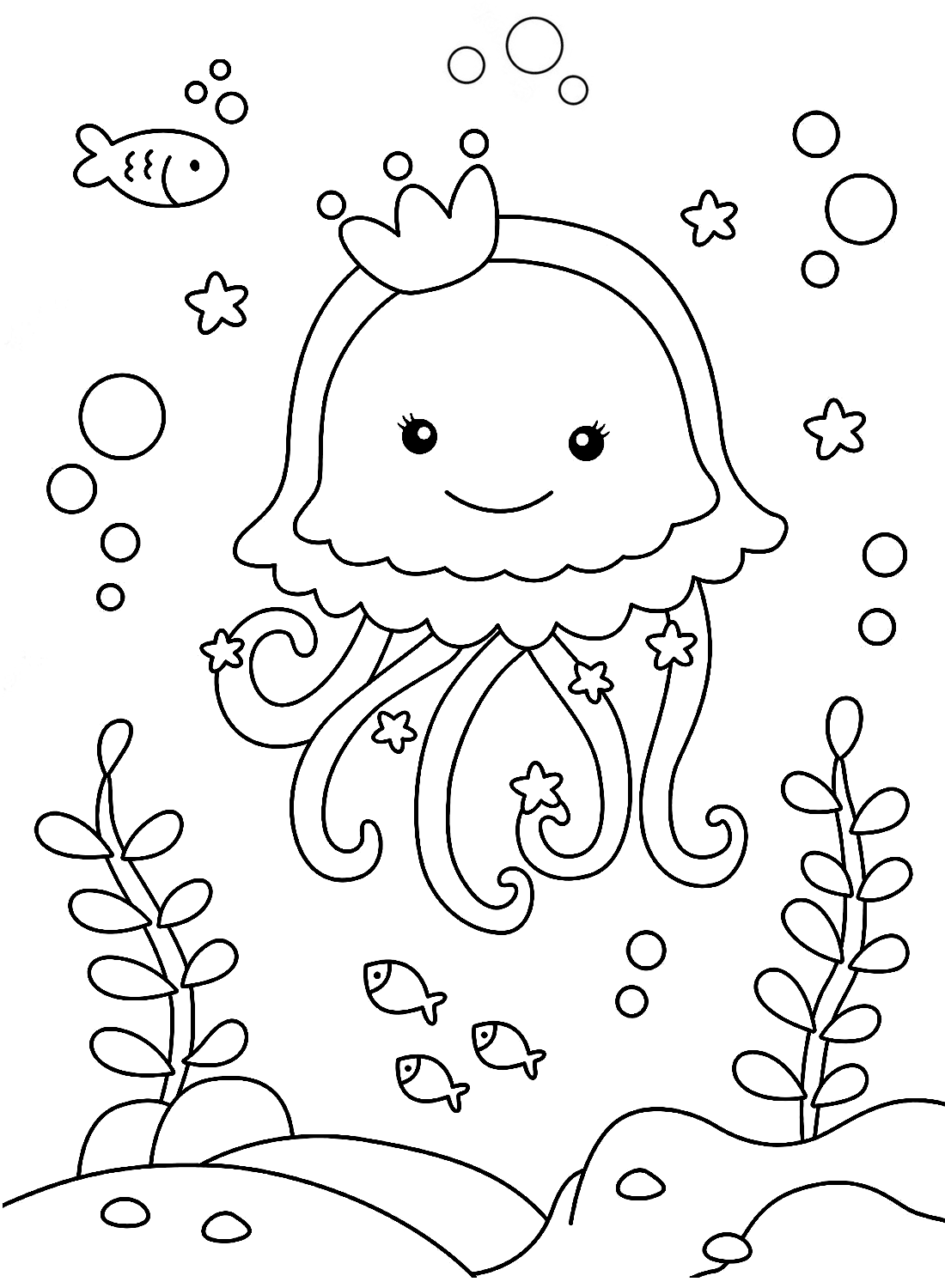
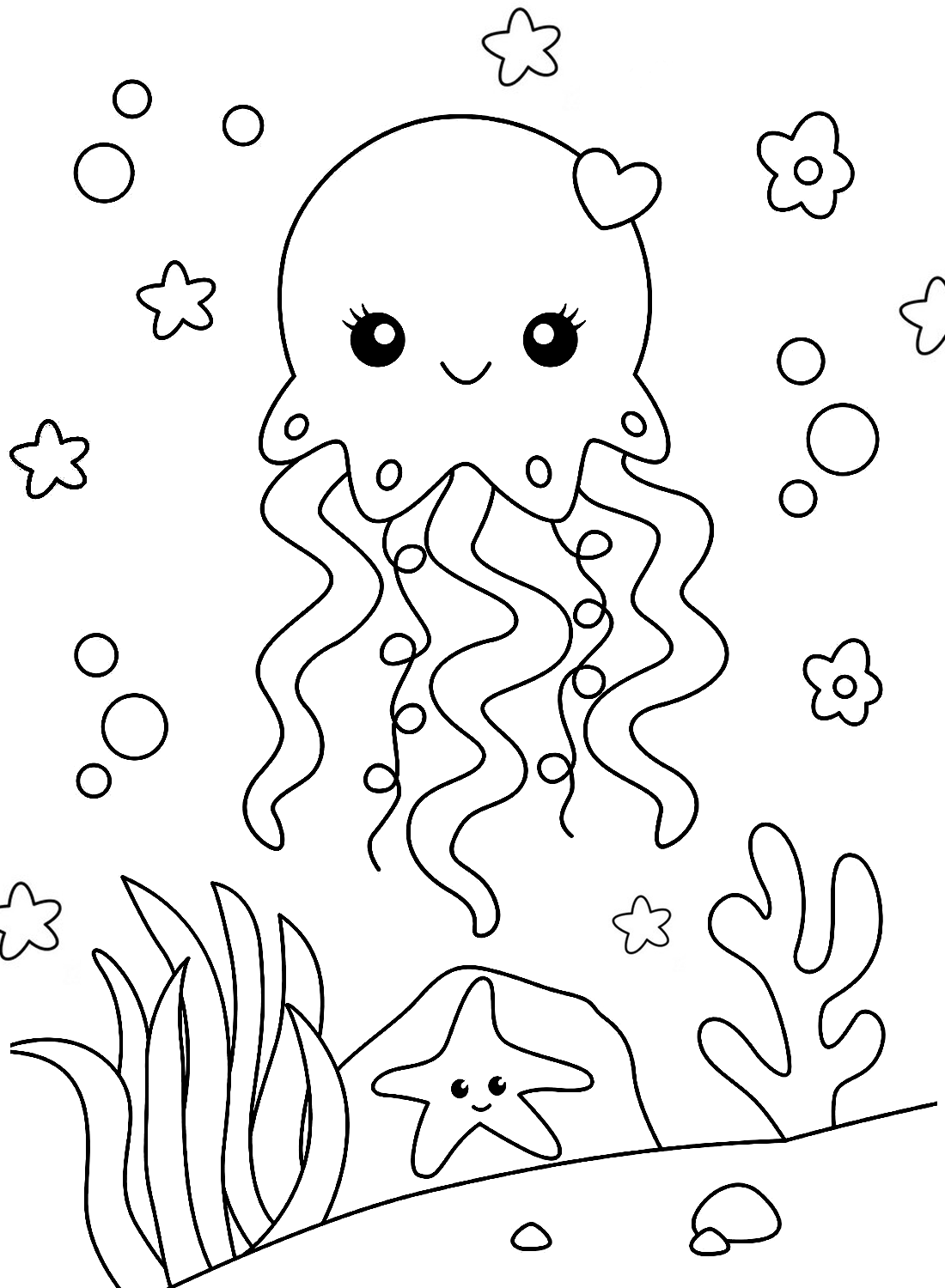
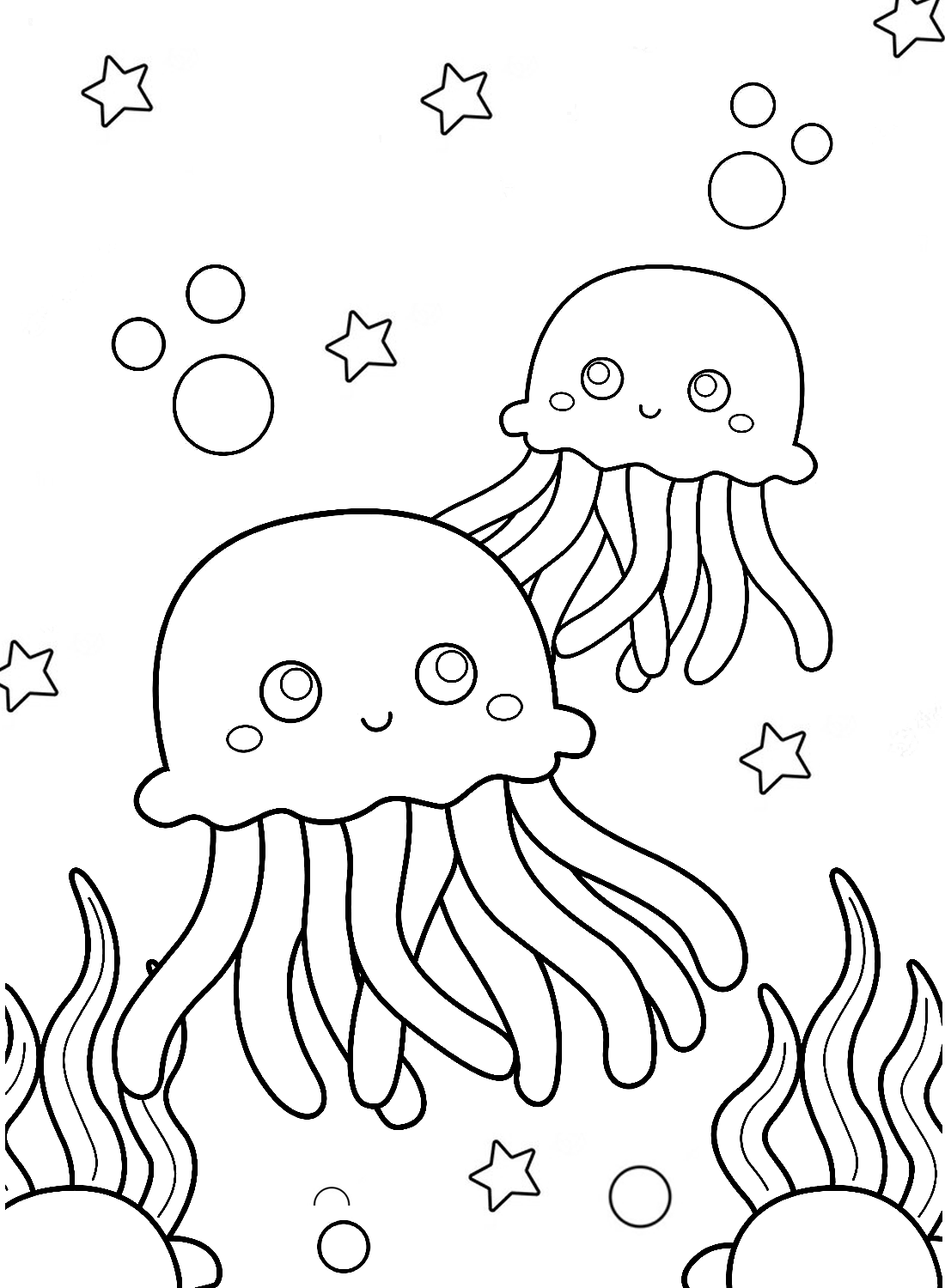
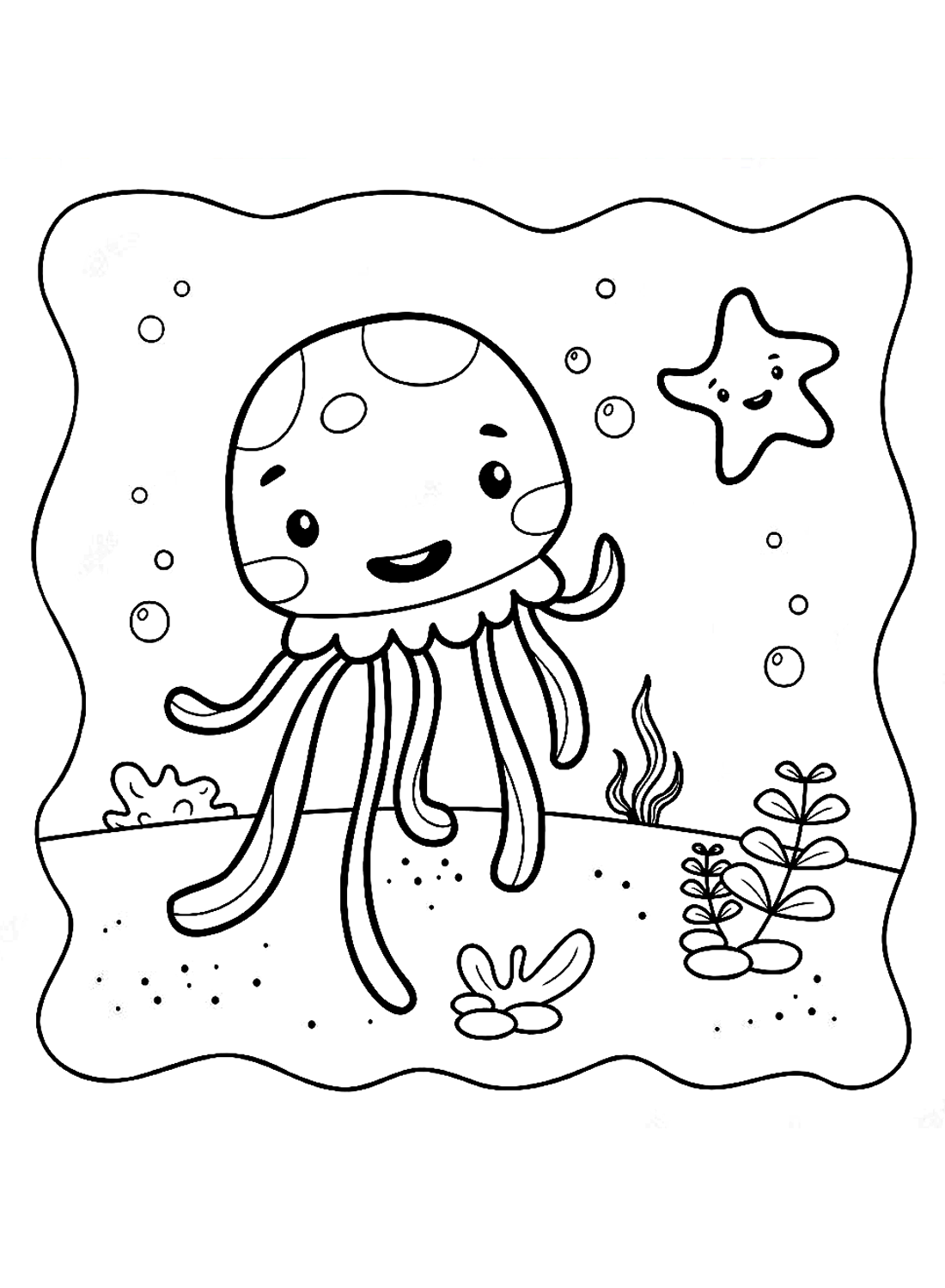
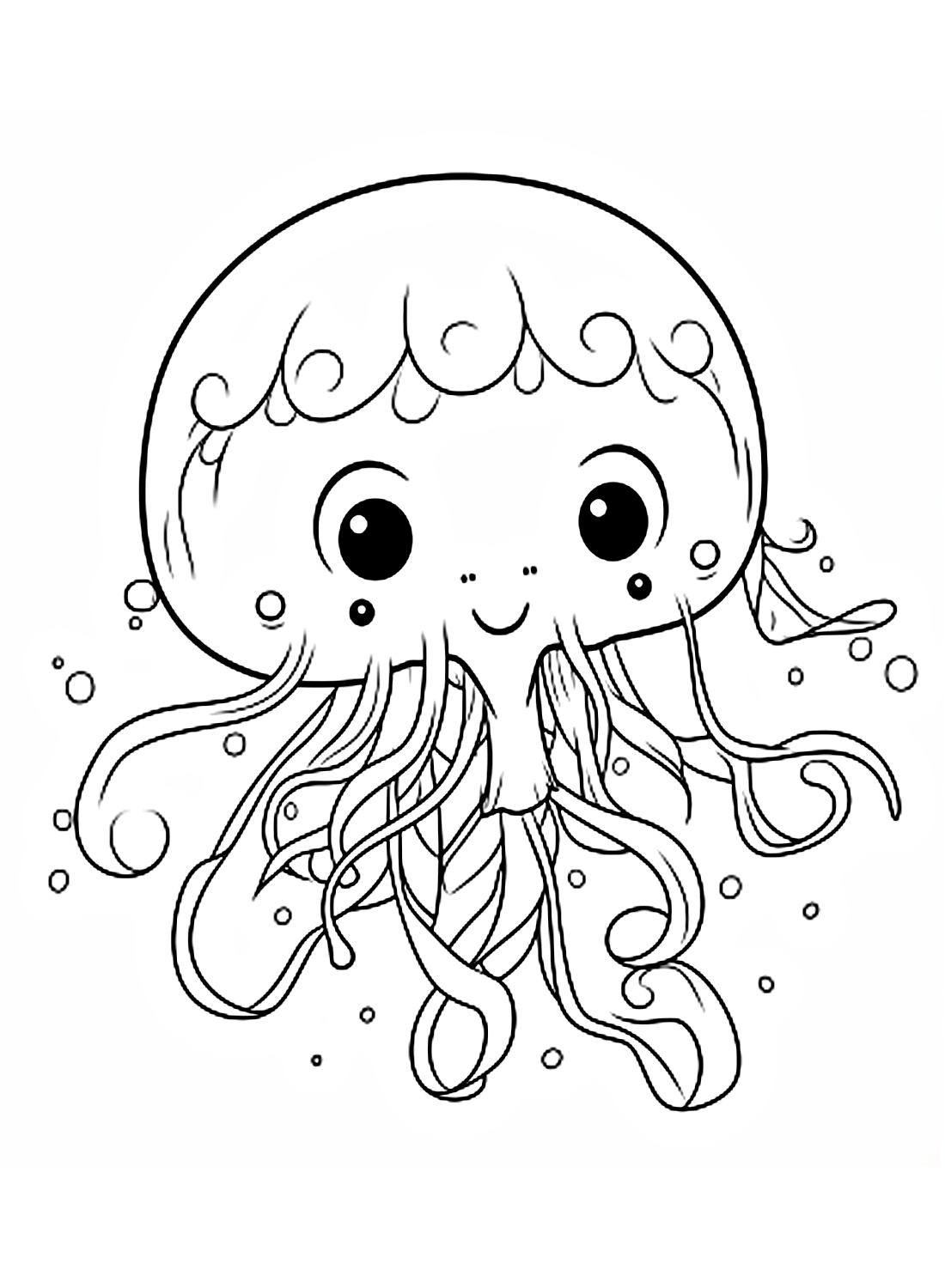
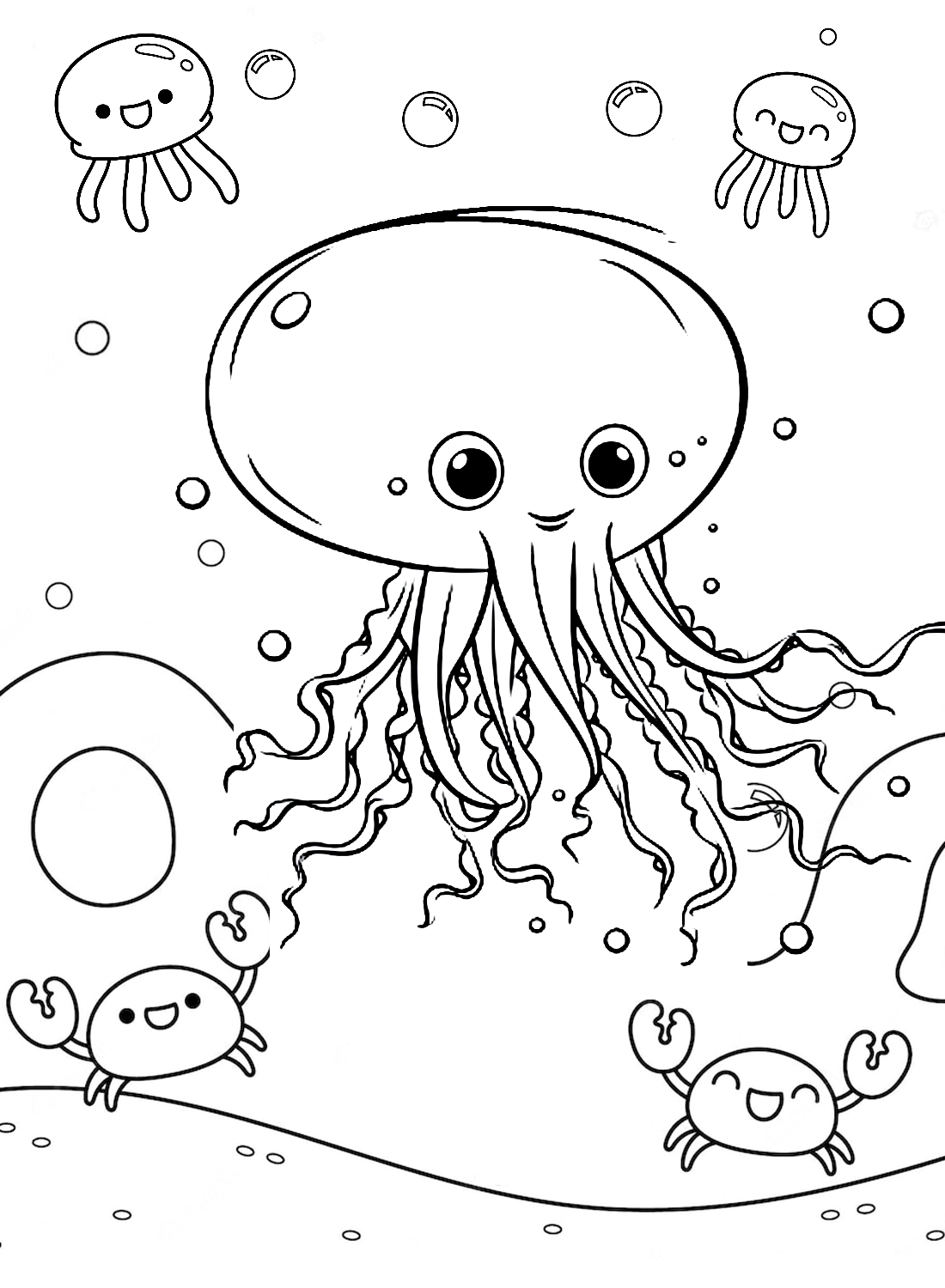
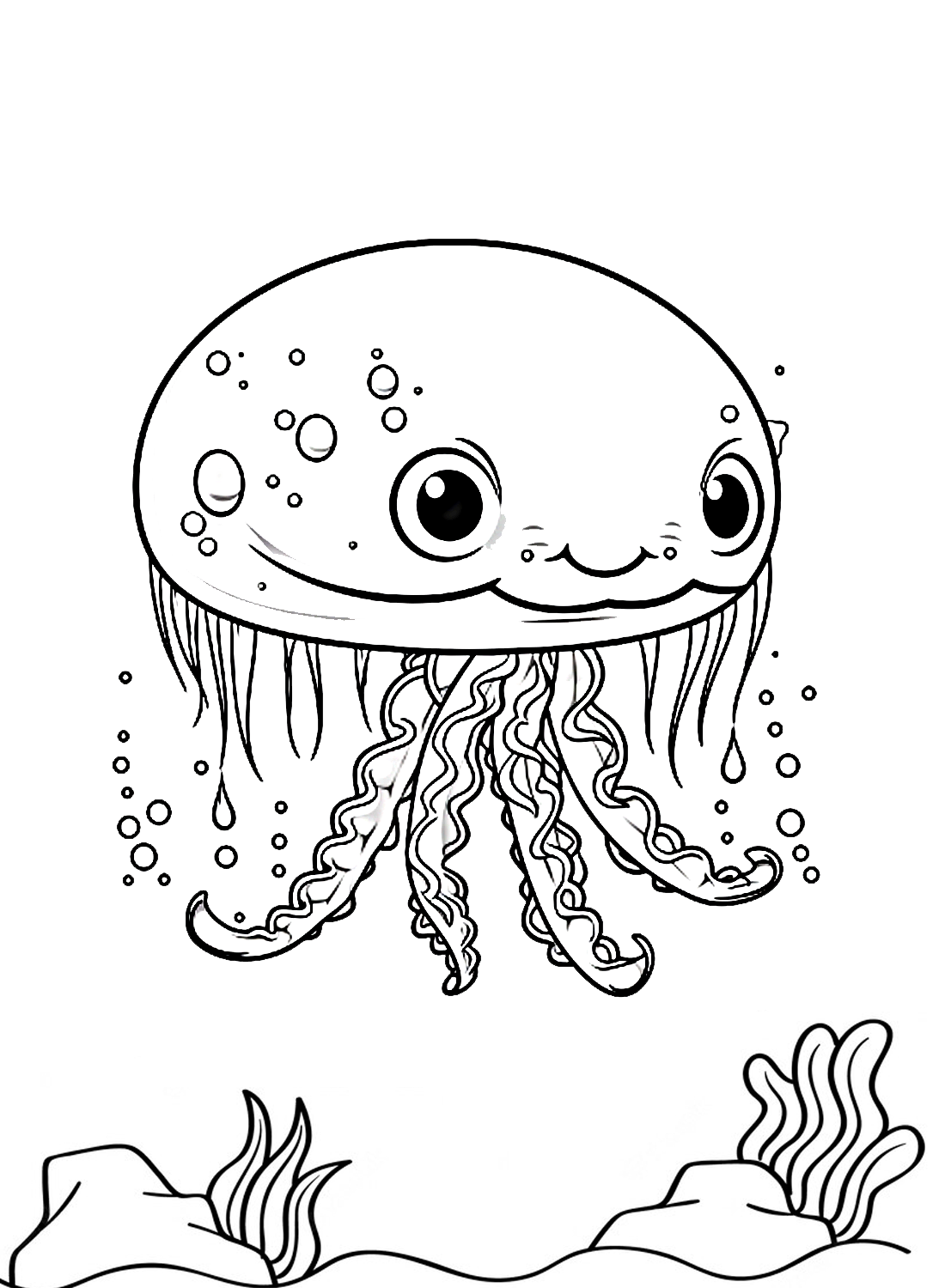
What’s Inside
Moon Jellyfish Pages
The moon jellyfish (Aurelia aurita) is the world’s most widely distributed jellyfish species and the one most frequently depicted in illustrations, aquarium exhibits, and popular media. Its common name references its visual: a flat, disc-shaped, translucent bell that, when viewed from above or from the side in calm water, reads as pale and circular as a full moon seen through thin cloud.
Its bell typically ranges from 5 to 40 centimeters (2 to 16 inches) in diameter. The most distinctive visual feature, and the most important coloring challenge on moon jellyfish pages, is the four-lobed structure visible through the translucent bell: the horseshoe-shaped gonads (reproductive organs) that appear as four symmetrical curved shapes arranged in a clover or four-leaf pattern at the bell’s center. These appear purple or pink in females and white or cream in males. Short, fine tentacles fringe the bell’s outer edge.
The moon jellyfish is found in coastal waters, bays, and harbors worldwide, tolerating a wide range of temperatures and salinity levels, which makes it one of the most ecologically adaptable jellyfish species. It feeds on plankton, fish eggs, and small sea creatures, which it captures using its fine tentacles and moves toward its central mouth along its oral arms.
Coloring moon jellyfish pages: The bell is very pale blue-grey or pale blue-white, applied at light to medium pressure with a very slight cool tone suggesting the translucency of the gelatinous material. The four horseshoe-shaped interior organs are the page’s most vivid accent: apply vivid lavender-purple or warm pink to these four curved shapes, visible as distinct shapes through the pale bell. The tentacle fringe around the bell’s edge uses the same pale blue-grey as the bell at minimum pressure, suggesting fine and delicate structure.
Lion’s Mane Jellyfish Pages
The lion’s mane jellyfish (Cyanea capillata) holds the documented record as the world’s largest jellyfish: the largest recorded specimen had a bell diameter of 2.29 meters (7 feet 6 inches) and tentacles extending approximately 37 meters (121 feet), making it longer than a blue whale. The species is found in cold Arctic and boreal waters of the North Pacific and North Atlantic and is rarely encountered in tropical regions.
Its common name is earned by the dense, thick cluster of tentacles that hang from beneath the bell’s outer edges: when viewed from below or when the creature is moving through water, the reddish-brown, yellow, or cream-colored tentacles spread and flow in a pattern that directly resembles a lion’s mane. The bell itself is typically a rich red-orange to dark reddish-brown in the outermost areas, graduating toward yellow or pale amber toward the bell’s center.
The sting of the lion’s mane is painful and can cause skin irritation, nausea, and muscle cramps, but it is not considered lethal to healthy adults in typical encounters. The tentacles can sting even after the jellyfish is dead and the tentacles are separated from the bell, a hazard for beachgoers who encounter stranded specimens.
Coloring lion’s mane pages: The bell uses the warm gradient that defines this species: deep red-orange or dark reddish-brown at the outermost bell surface, graduating inward through orange-brown to pale amber-yellow at the bell’s center. The tentacles are the page’s most voluminous element: apply the same red-orange to warm yellow-cream in long, flowing, directional strokes, suggesting the tentacles’ movement through water. The overall composition should read as the warmest-toned of the collection’s jellyfish pages.
Box Jellyfish Pages
Box jellyfish (class Cubozoa) are the jellyfish family’s most specifically unusual members and the one whose biology most clearly departs from the general characteristics of the group. Named for the cube-shaped bell that distinguishes them from the round or dome-shaped bells of other jellyfish (the box’s four flat sides are visible when viewed from above), they have several biological characteristics not found in other jellyfish.
Their most remarkable biological feature is their visual system: each of the four flat sides of their bell carries a cluster of six eyes, giving each box jellyfish a total of 24 eyes. These eyes include both simple (pit-type) eyes that detect light levels and more complex eyes with corneas, lenses, and retinas capable of forming images. Despite having no brain, box jellyfish use this visual system to navigate toward and away from objects actively, making them the only jellyfish capable of true directed swimming rather than passive drift.
The Australian box jellyfish (Chironex fleckeri) is considered the world’s most venomous marine animal: its venom can cause cardiac arrest within minutes in severe cases. The Irukandji jellyfish (Carukia barnesi), a tiny box jellyfish approximately 1 centimeter in bell diameter, causes Irukandji syndrome: excruciating pain, hypertension, pulmonary edema, and, in some cases,s death.
Coloring box jellyfish pages: The bell is pale translucent blue or pale blue-green, with the distinctive flat sides of the cube shape visible in the design. The four clusters of tentacles (one from each corner of the cube) are slightly more opaque and slightly more vivid than the bell: pale blue-white with more defined structural lines. The visual system (24 eyes in four clusters) is shown in some detailed pages as small, ll round elements on each bell face.
Kawaii and Cartoon Jellyfish Pages
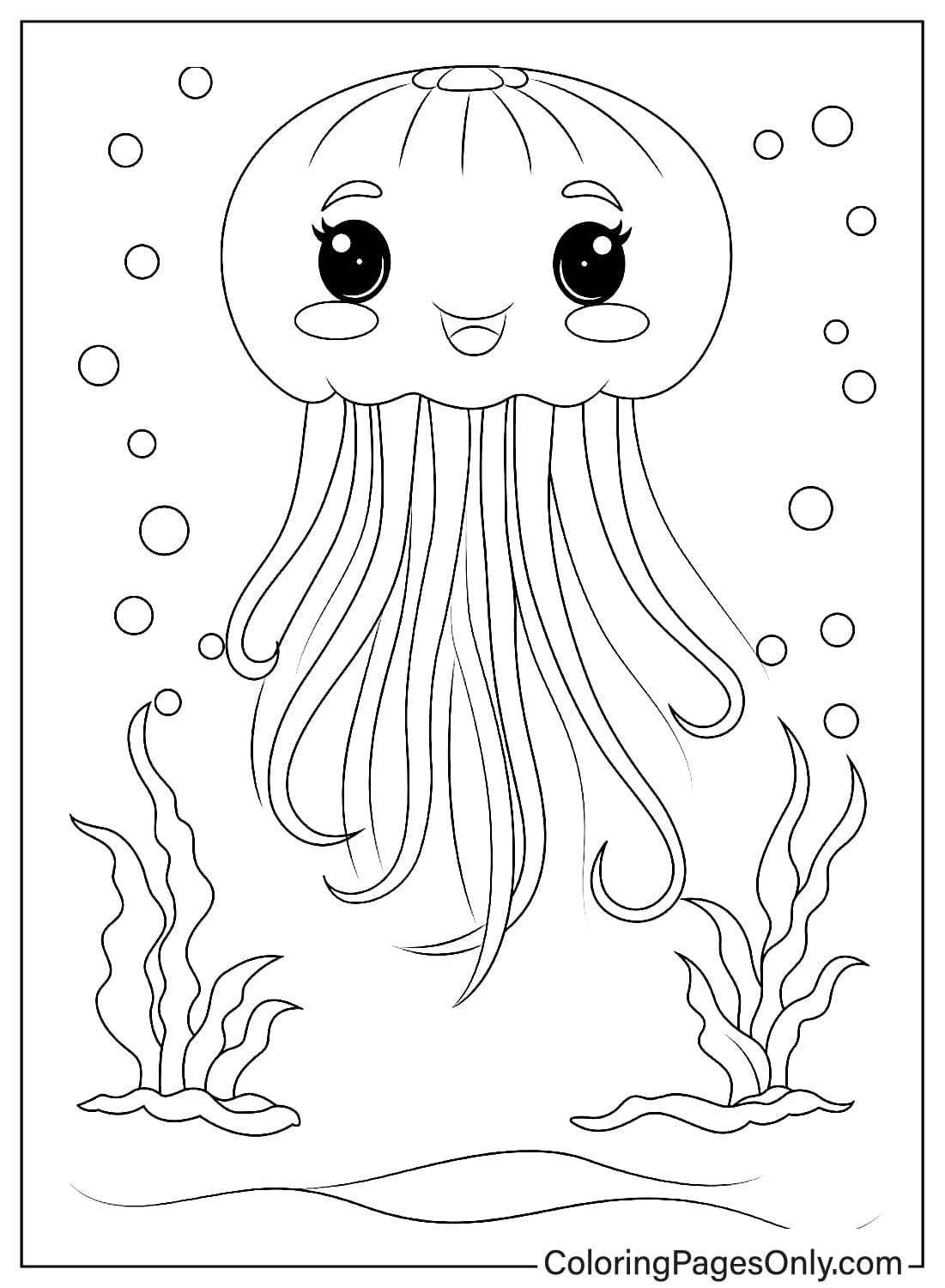
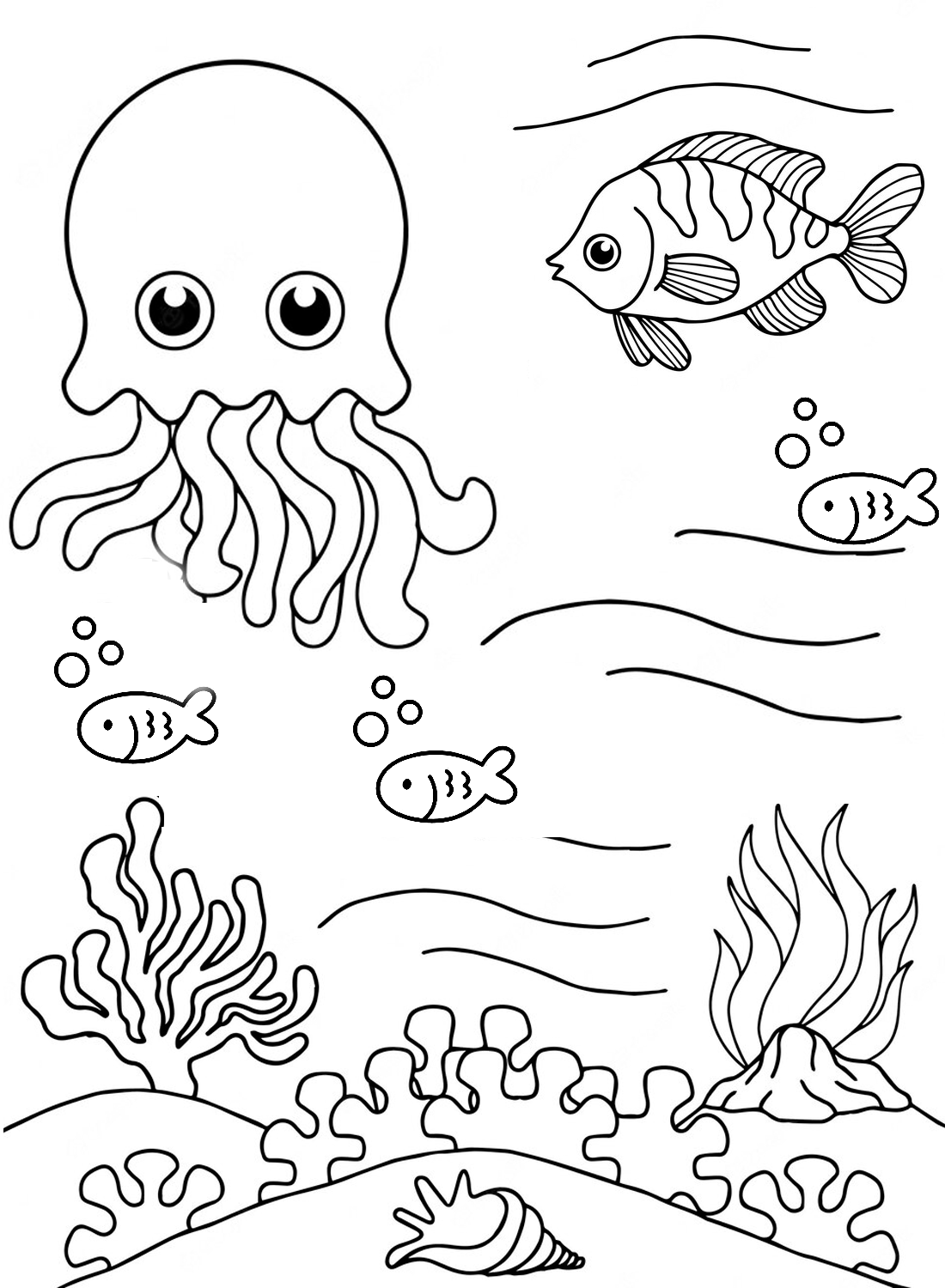
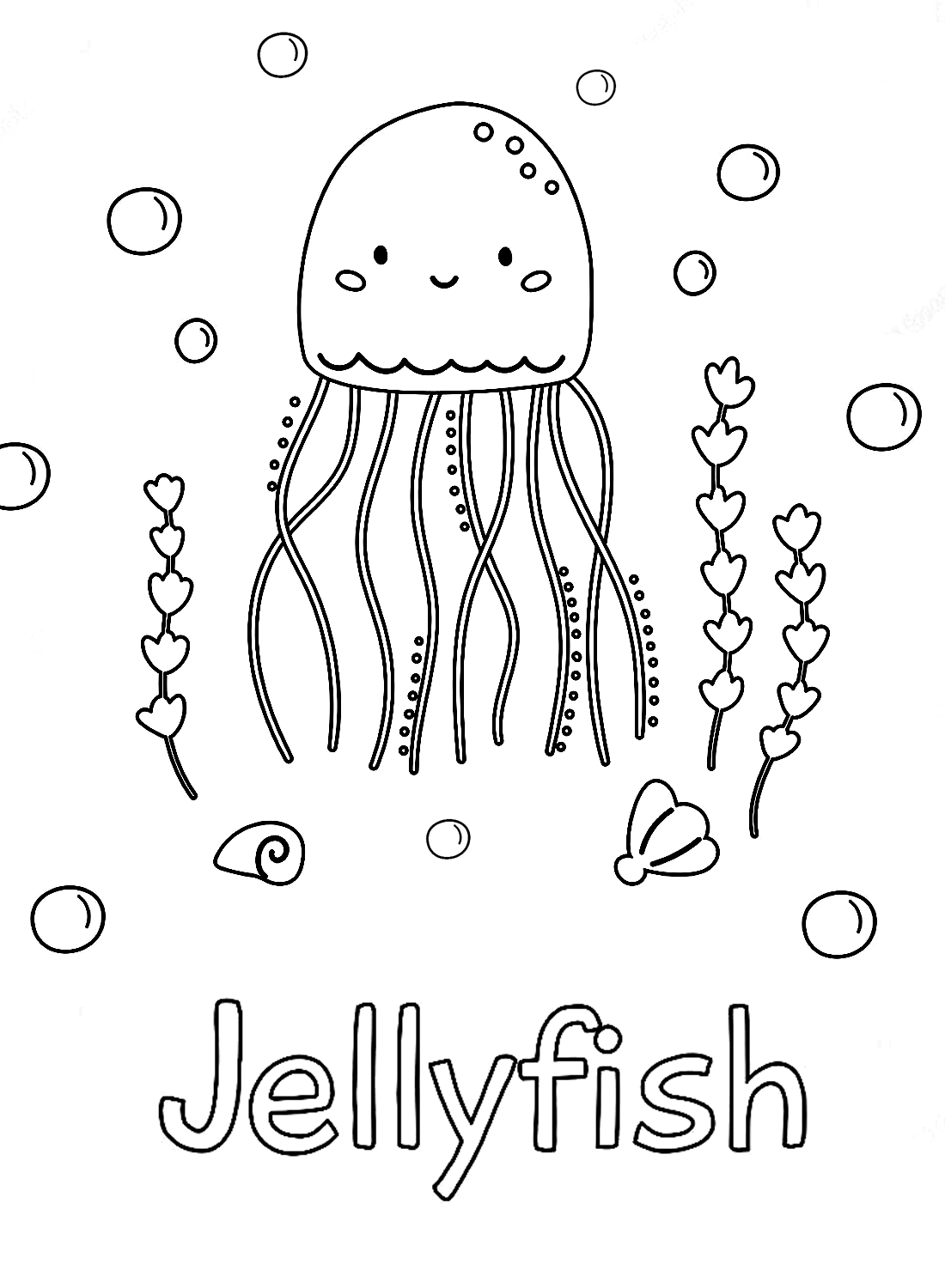
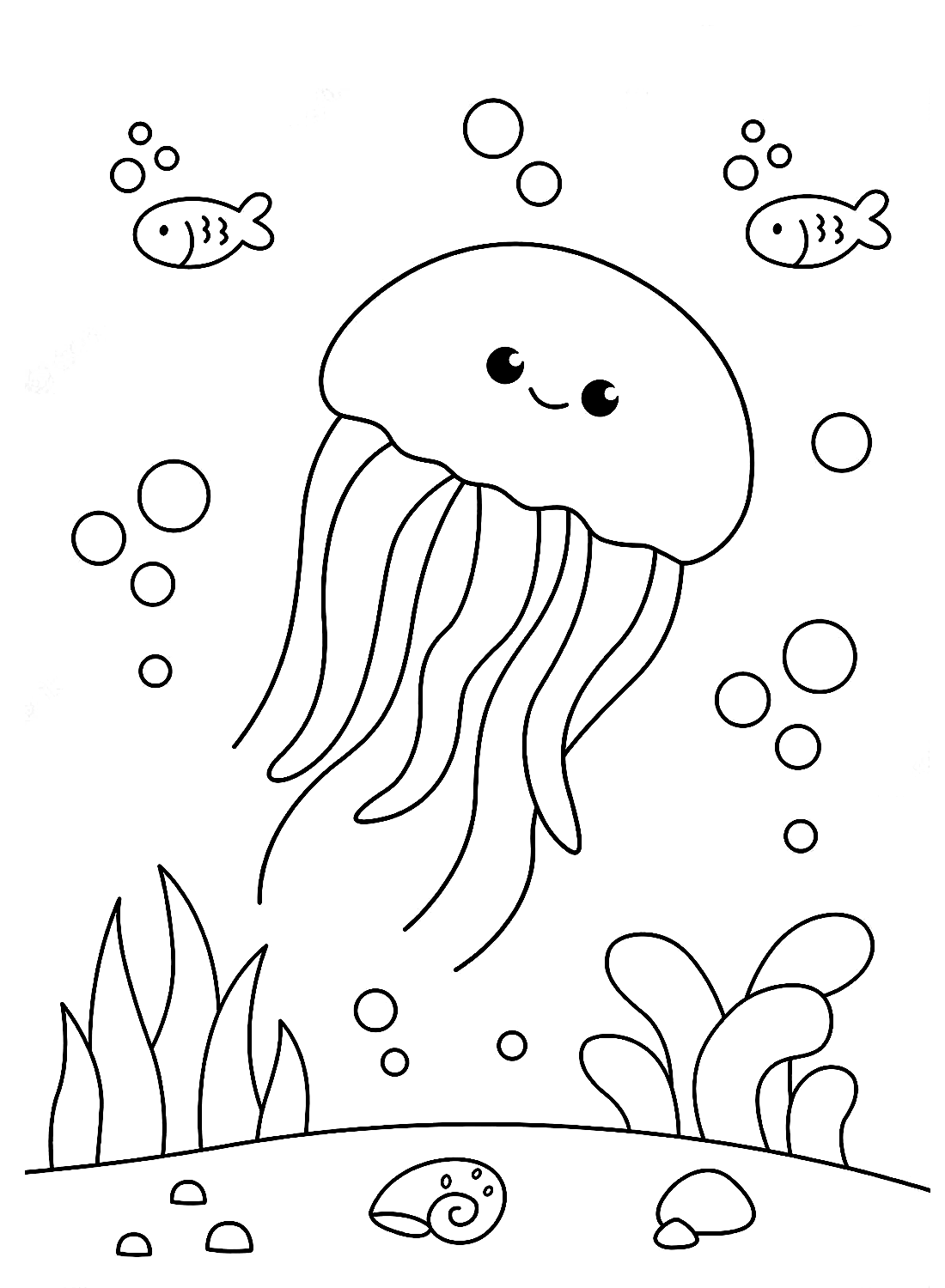
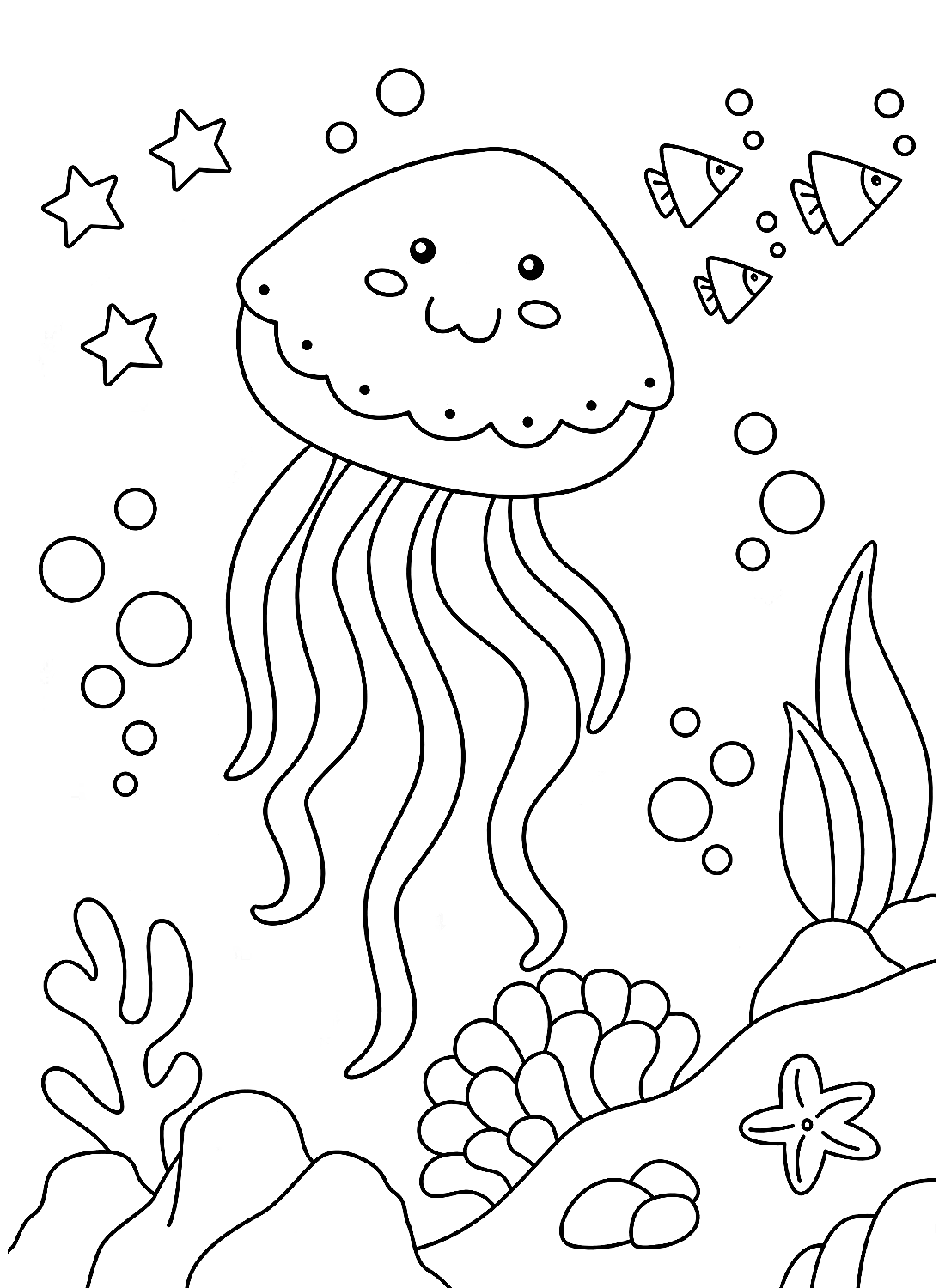
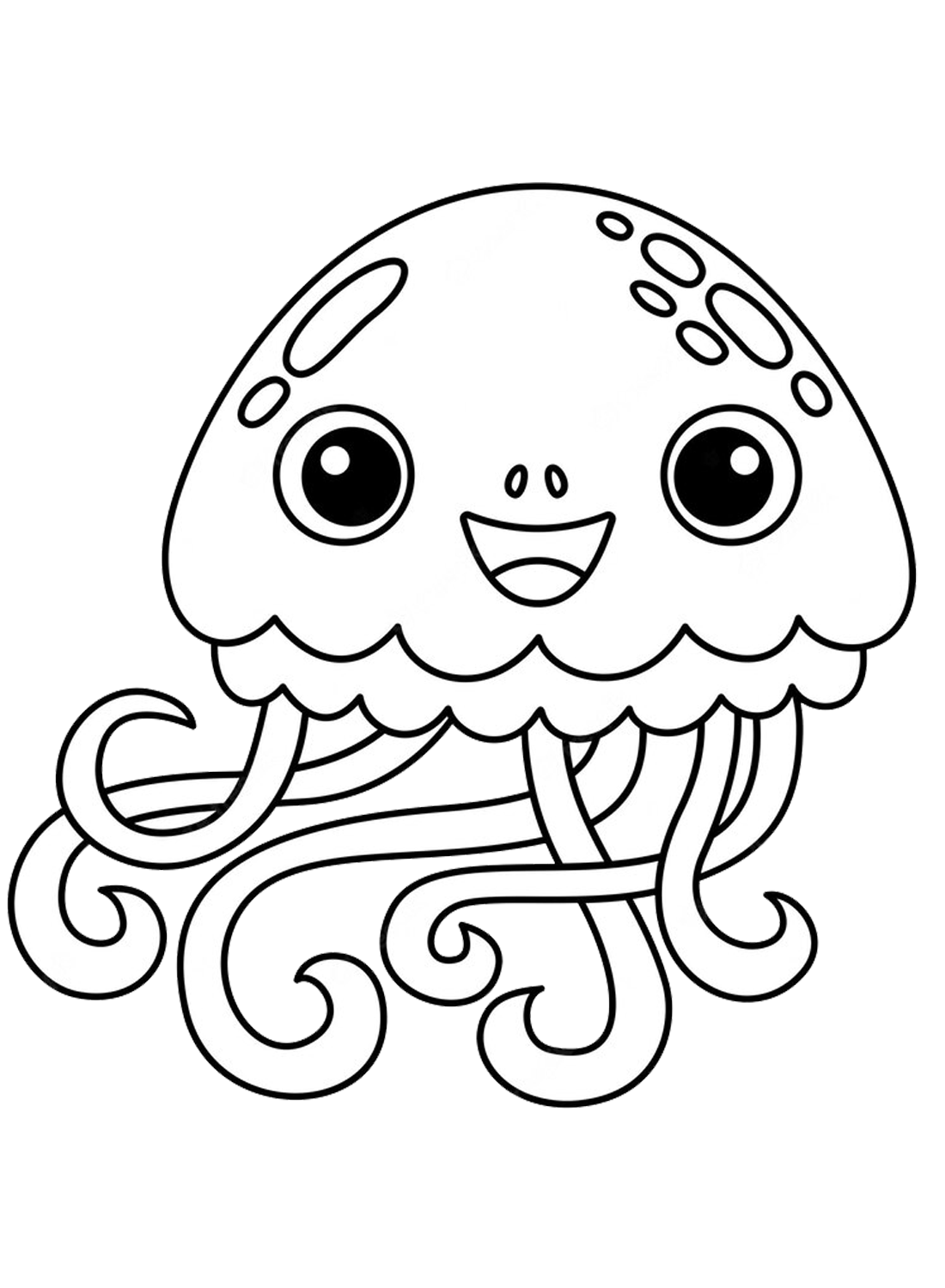
Cartoon and kawaii jellyfish pages apply the standard anthropomorphization approach to the jellyfish form: the bell becomes a rounded head, the tentacles become expressive arms or hair-like extensions, and the face (placed on the flat underside of the bell that would face downward in reality) gives the creature the large, round eyes, small, upturned mouth, and rosy cheeks of the kawaii design vocabulary.
The jellyfish’s natural form is particularly well-suited to kawaii anthropomorphization: the round, smooth bell is already head-like in proportion; the flowing tentacles can suggest hair, ribbons, or expressive arms; and the translucency of the actual animal’s body translates into the characteristic pale, soft pastel palette of kawaii design.
These pages are the collection’s most immediately accessible for very young colorists: the simplified, rounded form, the large face area, and the clearly defined tentacle elements provide clear, achievable coloring targets with maximum emotional engagement.
Coloring kawaii jellyfish pages: The bell uses soft pastel versions of the jellyfish’s natural color range: soft lavender, soft pink, soft aqua, soft peach. The face elements use the standard kawaii vocabulary: white eye areas, vivid iris (in a complementary or contrasting color to the bell), near-black pupil, and white highlight dot. Cheek circles are small, warm pink dots. The tentacles use the same pastel color family as the bell, applied in flowing, slightly wavy strokes.
Bioluminescence Glow Effect Pages
Many jellyfish species produce bioluminescence: chemical reactions involving proteins called photoproteins and green fluorescent protein (GFP) that allow them to emit their own light. The crystal jellyfish (Aequorea victoria) is the species from which GFP was first isolated in 1962 by Osamu Shimomura. The subsequent development of GFP as a biological research tool by Shimomura, Martin Chalfie, and Roger Y. Tsien earned the three scientists the Nobel Prize in Chemistry in 2008: GFP is now one of the most widely used markers in molecular biology, attached to proteins of interest to make them glow inside living cells.
In the ocean at night, bioluminescent jellyfish produce flashing displays of blue, blue-green, or occasionally other colors, triggered by physical disturbance (movement of the water, contact with other organisms, or predator attack). A bioluminescent bloom of jellyfish at night produces one of the ocean’s most dramatically beautiful spectacles.
Pages depicting bioluminescence show jellyfish against a very dark (near-black or deep midnight blue) background with vivid glowing effects: the bell and tentacles emit blue or blue-green light that illuminates the surrounding dark water.
Coloring bioluminescence pages: Apply the complete near-black or deep midnight blue background before addressing the jellyfish. The jellyfish bell uses vivid electric blue or blue-green at the outer edges (the surface that emits the most light), graduating to slightly lighter, more vivid blue-white at the bell’s center. The tentacles show the same vivid blue-green as the bell surface but in a linear, flowing form. Small scattered dots of the same blue-green around the jellyfish suggest the light diffusing into the dark water.
Coral Reef and Ocean Setting Pages
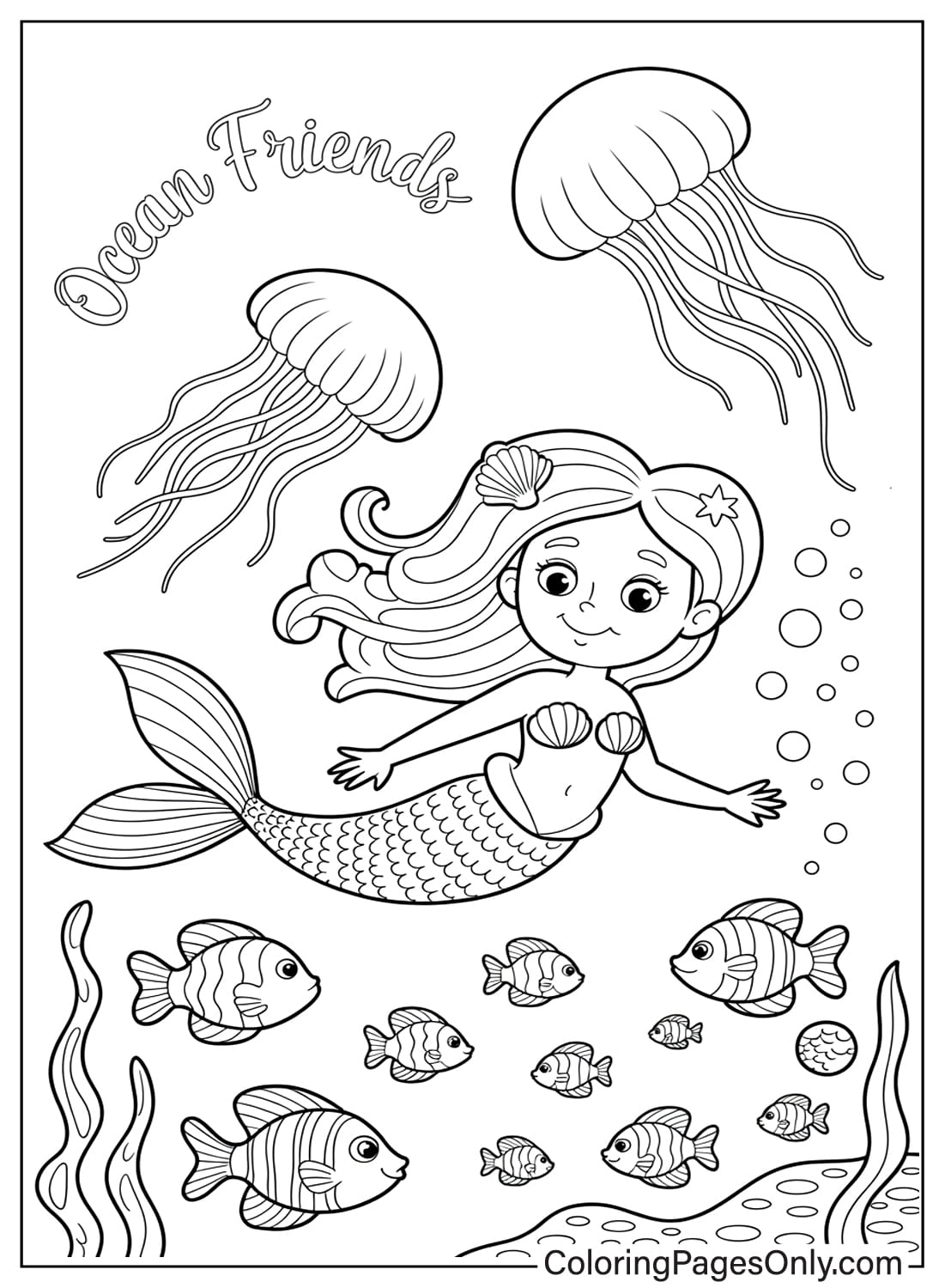
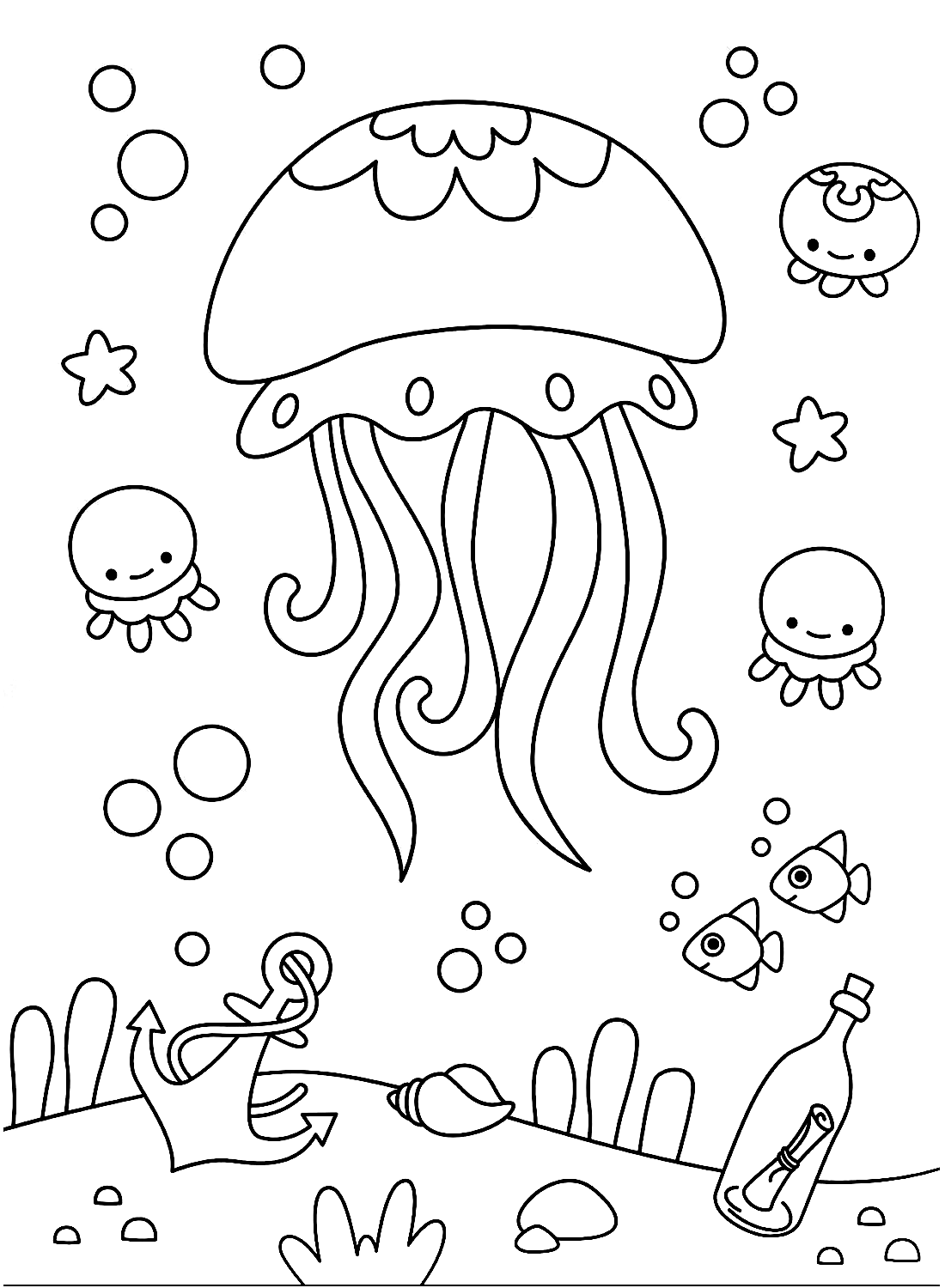
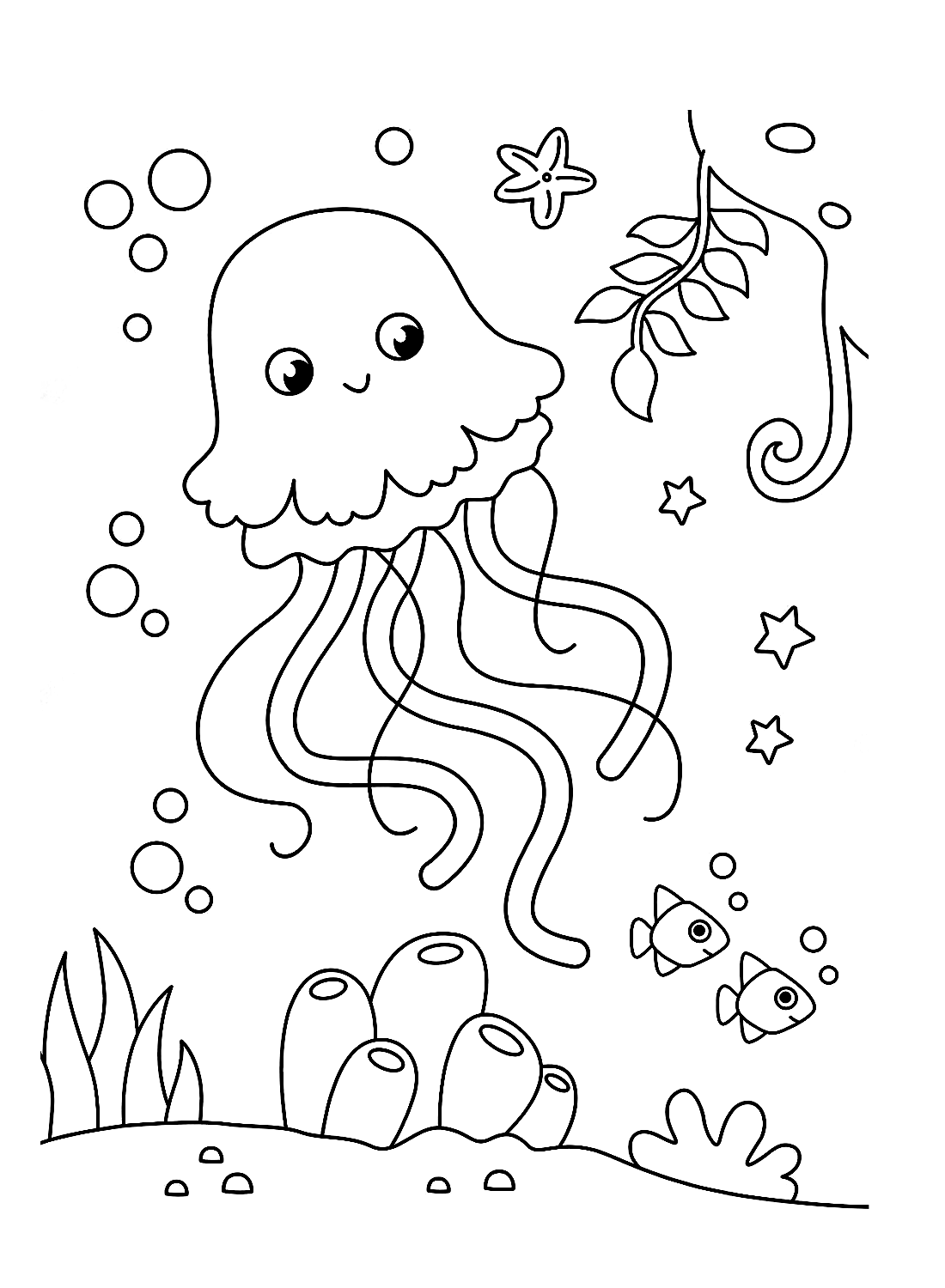
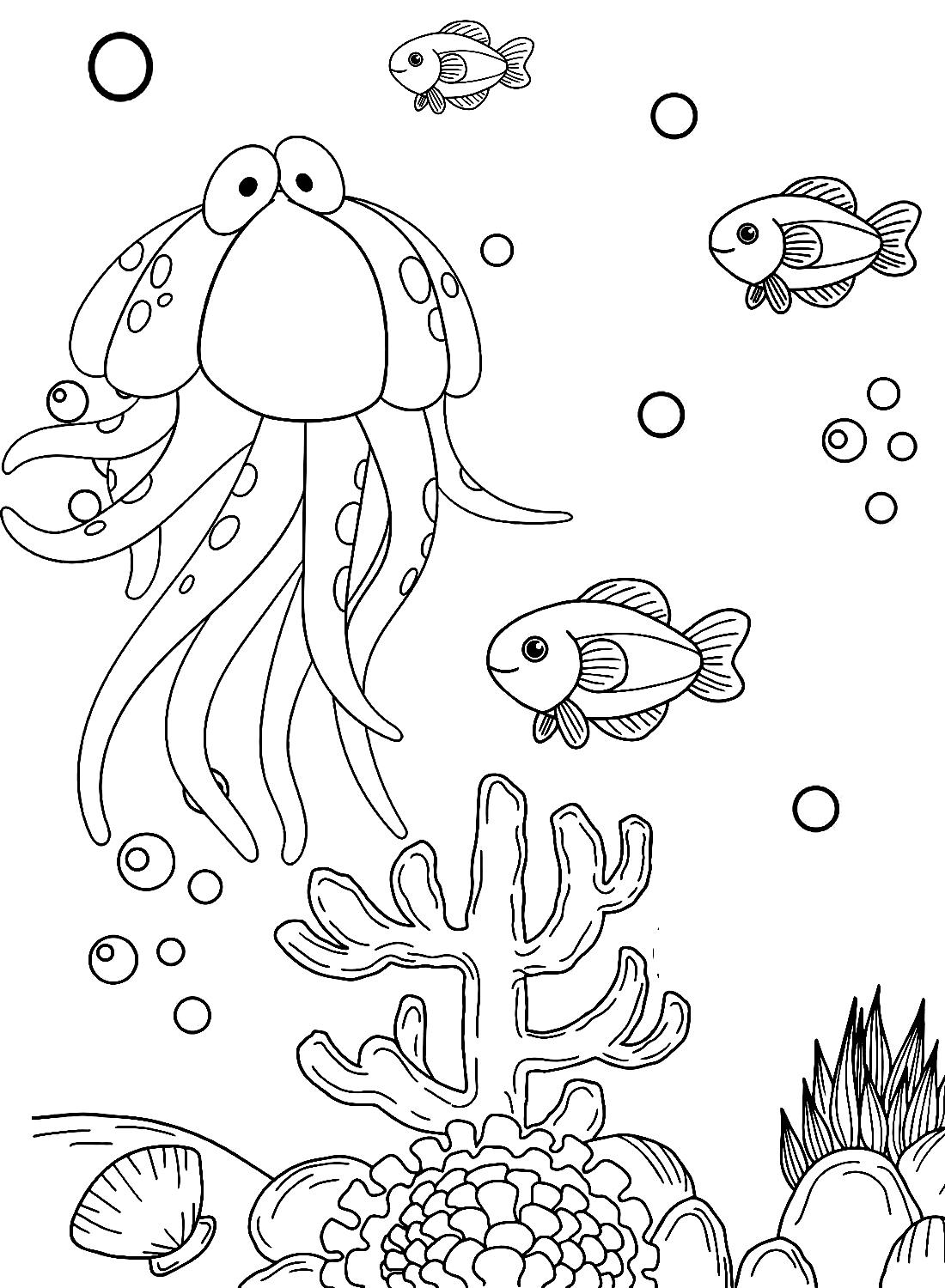
Pages placing jellyfish within their ocean habitat context show the full range of environments jellyfish inhabit: open ocean pages with jellyfish drifting against deep blue-black water, shallow coastal pages with jellyfish above sandy bottoms and seagrass, and coral reef pages where jellyfish appear alongside the full chromatic richness of reef life: vivid fish, coral polyps in orange and pink and purple, sea anemones, and the varied textures of the reef structure.
Coral reef setting pages provide the collection’s most chromatically diverse compositions: the reef environment’s vivid colors (orange coral, vivid purple and yellow fish, pink sea fan coral, green seagrass) contrast with the jellyfish’s characteristically pale, translucent bell, creating compositions where the jellyfish reads as the cool, quiet center of a vivid surrounding environment.
Coloring reef setting pages: Apply the deepest background ocean blue first at full coverage. Coral elements use vivid warm orange, vivid pink-rose, or warm tan-white, depending on the coral type shown. Any tropical fish possesses their specific real-world color patterns. The jellyfish in this context remains pale and translucent against the vivid reef setting, creating the maximum contrast between the animal’s natural translucency and the reef’s vivid color.
What These Pages Do
The Nobel Prize in Chemistry 2008 was awarded for GFP research, derived from the jellyfish Aequorea victoria, which is the clearest documented example of a marine organism providing the foundation for a transformative scientific tool. Osamu Shimomura’s initial 1962 isolation of GFP was basic research: he was studying how the crystal jellyfish produces light, with no immediate application in mind. The subsequent decades of GFP development by Chalfie and Tsien produced a tool that is now used in thousands of laboratories worldwide to visualize biological processes inside living cells in real time. The jellyfish’s bioluminescent protein became one of molecular biology’s most important instruments.
The documented increase in jellyfish blooms in multiple ocean regions over recent decades has been the subject of research published in journals including the ICES Journal of Marine Science and Global Change Biology. Contributing factors include warming ocean temperatures (which jellyfish generally tolerate better than fish), reduced predator populations (overfishing of tuna, swordfish, and other jellyfish predators), and increased coastal nutrient runoff. A 2012 review in Proceedings of the National Academy of Sciences examined global jellyfish population trends.
The American Academy of Pediatrics identifies fine motor skill development as a key childhood milestone throughout early childhood. The tentacle flow rendering on lion’s mane pages, the four-lobed interior detail on moon jellyfish pages, the glowing effect gradient of bioluminescence pages, the multi-element coral reef setting work, and the small face detail of kawaii jellyfish pages all provide sustained fine motor challenge across the collection’s age range. The 2005 Art Therapy Journal study on structured coloring and anxiety reduction applies throughout, with ocean and underwater environment pages carrying the specific calming quality associated with aquatic imagery in structured coloring research.
How to Color These Pages Well
Jellyfish translucency is the collection’s most specific and most consistently important technical challenge. All jellyfish pages, regardless of species, require the suggestion of translucency: the bell is not opaque, not flat, not like the solid surface of a fish or a mammal. Apply the bell color at light to medium pressure rather than maximum pressure: the result should feel like colored light rather than a painted surface. The translucency is what makes a jellyfish page look like a jellyfish rather than like a blob.
The four-lobed interior of the moon jellyfish is the page’s most important detail and must be clearly distinct from the surrounding bell. Apply the vivid lavender-purple or pink to the four horseshoe-shaped organs as the second step (after the pale bell base is in place). The interior organs must read as clearly more vivid and more opaque than the surrounding translucent bell, communicating that they are solid structures seen through a transparent outer surface.
Bioluminescence pages require the dark background to be complete before any jellyfish color is applied. Apply the deep midnight blue or near-black background at full coverage across the entire composition before touching the jellyfish. Only after the background is fully established should the vivid electric blue of the glowing jellyfish be applied. Attempting to paint the dark background around a pre-applied blue jellyfish produces muddy edges and an uneven background that undermines the glow effect.
The lion’s mane’s warm palette must use a consistent gradient from deep red-orange at the outer bell edge to pale amber at the bell center. This gradient is the species’ defining coloring feature. It must be applied directionally: start with the deepest red-orange at the very outermost ring of the bell, then work inward through progressively lighter orange-brown to the pale center. Any break in this gradient’s continuity makes the bell read as irregularly patterned rather than as the natural warmth gradient of the actual animal.
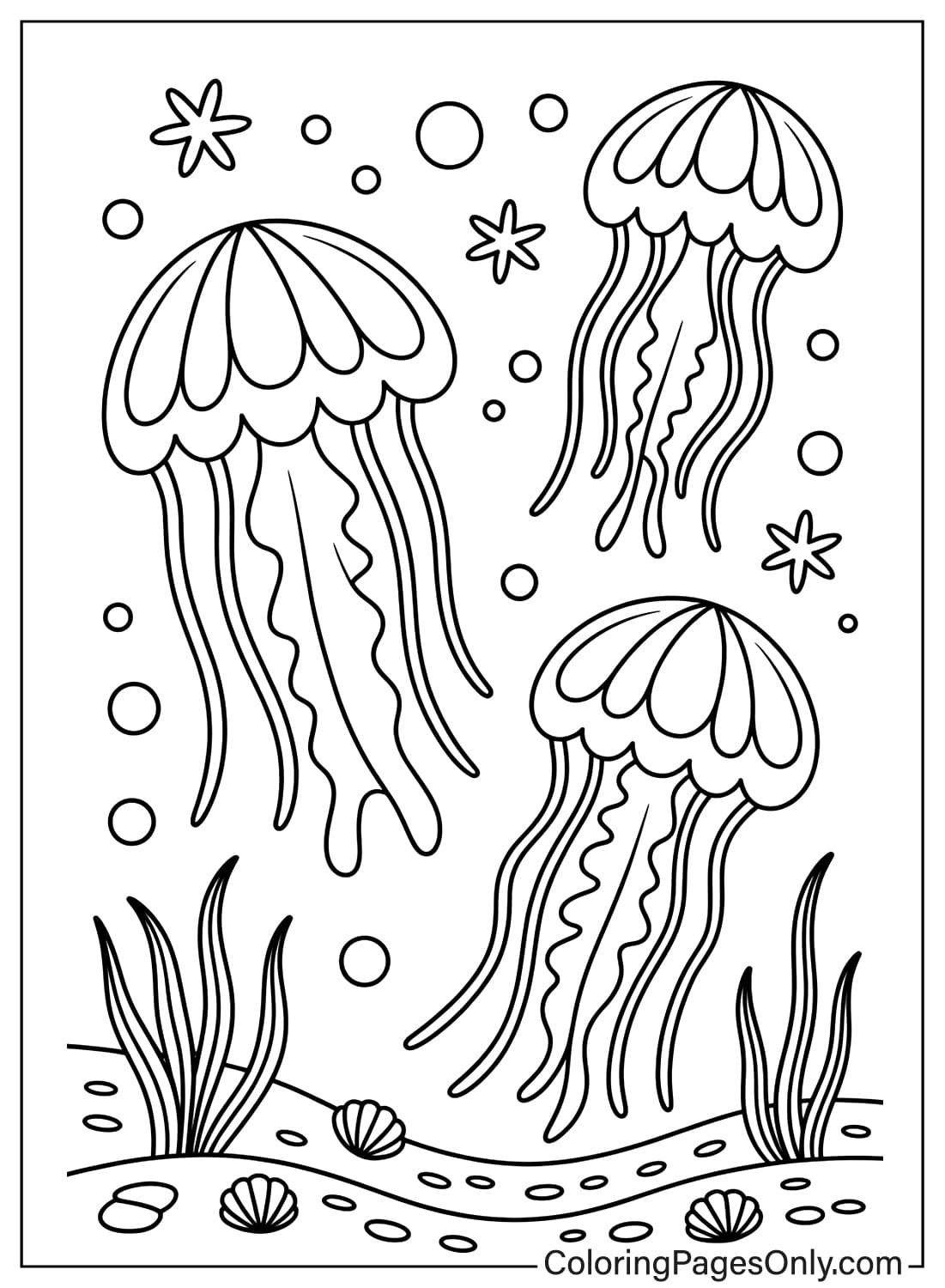
Tentacle flow lines require directional stroke work rather than flat fill application. Jellyfish tentacles are not flat shapes: they are linear structures that flow and trail in the water. Apply tentacle color using long, continuous directional strokes that follow the tentacles’ natural falling or trailing direction (typically downward or curving in the direction of the page’s implied water current). Each stroke should be slightly lighter at the tentacle’s far end (furthest from the bell) than at its base, suggesting the tentacle’s diminishing substance at its extremities.
5 Creative Craft Ideas
The Nobel Prize Jellyfish Page
In 1962, Osamu Shimomura was studying how the crystal jellyfish (Aequorea victoria) produces bioluminescent light. He isolated a protein he called aequorin (which produces blue light) and, in the same isolation, a second protein he called green fluorescent protein (GFP) that converts the blue light to green. He published his findings without predicting GFP’s future importance.
Print a bioluminescence page. Color the jellyfish in vivid electric blue-green against a deep midnight blue background.
On the backing card: “The crystal jellyfish (Aequorea victoria). GFP (Green Fluorescent Protein): isolated by Osamu Shimomura in 1962 while studying how this jellyfish produces light. The isolation: basic research, no immediate application planned. What GFP became: one of molecular biology’s most important tools, used to make specific proteins glow inside living cells so researchers can see them. Nobel Prize in Chemistry 2008: awarded to Osamu Shimomura, Martin Chalfie, and Roger Y. Tsien for the discovery and development of GFP. The jellyfish that made it possible: still glowing in the Pacific Ocean.”
The Immortal Jellyfish Study
Turritopsis dohrnii, the immortal jellyfish, is a small species (approximately 4-5 millimeters in diameter) native to the Mediterranean Sea and now found in oceans worldwide. It is the only known animal capable of reverting from its adult medusa stage back to the juvenile polyp stage when stressed by age, illness, or environmental challenges. This reversal process (called transdifferentiation) can repeat indefinitely, making the jellyfish theoretically biologically immortal: it dies only through predation, disease, or accident, not through aging.
Print a small, simple jellyfish page. Color in pale translucent tones.
On the backing card: “Turritopsis dohrnii. Common name: the immortal jellyfish. Size: approximately 4-5 mm (smaller than a fingernail). Native habitat: Mediterranean Sea, now found worldwide. The ability, when stressed by age, damage, or environmental conditions, can revert from adult medusa form back to juvenile polyp. The process: transdifferentiation (cells change type). Can repeat: indefinitely. Scientific mortality: only from predation, disease, or physical damage. Not from age. First described: 1883 (by H.B. Hansson). The reversibility confirmed: 1996. One of the more specific things a jellyfish has accomplished.”
The 95% Water Page
A jellyfish is approximately 95 to 98 percent water by composition. The remaining 2 to 5 percent consists of protein, minerals, and lipids. A jellyfish that washes up on a beach will, within hours on a warm day, appear to almost completely dissolve. What the observer sees is nearly all water evaporating, leaving almost nothing of the animal that was there.
Print a moon jellyfish page. Color the bell in the most translucent possible application of pale blue-grey: barely-there, almost-not-there, the specific challenge of coloring something that is mostly not solid.
On the backing card: “Jellyfish body composition: approximately 95-98% water. Remaining 2-5%: protein, minerals, lipids. Brain: none. Heart: none. Bones: none. Blood: none. Respiratory system: none (gas exchange through the skin surface). Fossil record: approximately 500-530 million years old (Cambrian period). The jellyfish has persisted for 500 million years without a brain, bones, blood, or a respiratory system. It is 95% water. It still exists in quantities large enough to block power plant cooling systems. Evolutionary persistence does not require complexity.”
The Jellyfish Lake Migration Page
Jellyfish Lake (Ongeim ‘ l Tketau) is a landlocked marine lake in Palau’s Rock Islands, separated from the ocean by limestone ridges. It contains millions of golden jellyfish (Mastigias papua etpisonii) that have evolved over thousands of years in isolation from their ocean relatives. Their most unusual adaptation: each day, the entire jellyfish population migrates horizontally across the lake to follow sunlight (they carry photosynthetic algae within their tissues that require light to produce food).
Print a jellyfish page and color it in warm golden-yellow tones rather than the standard cool palette.
On the backing card: “Jellyfish Lake (Ongeim ‘ l Tketau). Location: Palau, Rock Islands (Micronesia). Contents: millions of golden jellyfish (Mastigias papua etpisonii). Isolation: the lake is separated from the ocean by limestone ridges. Duration of isolation: thousands of years. Adaptation: evolved to have minimal sting (no predators to use it against). Daily behavior: the entire population migrates across the lake to follow sunlight, powered by photosynthetic algae living within their tissues. The lake: one of a small number of marine lakes in the world with a similar evolutionary story. The jellyfish: golden because of their algae. Color them accordingly.”
The Bloom Study
A jellyfish bloom is a large aggregation of jellyfish in a specific area, sometimes containing millions of individuals. Blooms have clogged the cooling systems of coastal power plants, collapsed fish farming operations, and disrupted commercial fishing. Research published across multiple marine science journals has documented increasing bloom frequency in various ocean regions since the 1970s, with contributing factors including warming ocean temperatures, reduced jellyfish predator populations due to overfishing, and increased coastal nutrient runoff.
Print three to five copies of the same jellyfish page. Color all in the same species palette. Mount them together in a cluster.
On the backing card: “Jellyfish bloom. Definition: a large aggregation of jellyfish in a specific area. Size: can contain millions of individuals. Documented effects: clogged power plant cooling systems; collapsed fish farm operations; disrupted commercial fishing. Contributing factors to increasing bloom frequency: warming ocean temperatures; reduced predator populations (overfishing of tuna, swordfish, and other jellyfish predators); increased coastal nutrient runoff. Documented trend: a 2012 review in Proceedings of the National Academy of Sciences examined global jellyfish population data. The bloom in this project: [number] jellyfish. An actual bloom: more than that.”
Frequently Asked Questions
What are jellyfish, and are they actually fish? Jellyfish are members of the phylum Cnidaria, subphylum Medusozoa, and are not fish in any biological sense: the word “fish” in their common name is a historical misnomer. Scientists increasingly prefer the terms “sea jelly” or “medusa” for the free-swimming life stage that the coloring pages depict. Jellyfish lack the backbone, scales, gills, and fins that define fish as a group. Their body is approximately 95 to 98 percent water by composition, with no brain, no heart, no bones, and no blood. They exchange oxygen and carbon dioxide directly through their body surface (skin diffusion) rather than through a respiratory system. The same central opening functions as both the mouth and the digestive exit. Jellyfish fossils have been documented from the Cambrian period, approximately 500 to 530 million years ago.
What are the main types of jellyfish depicted in these pages? The collection includes several major species and types. The moon jellyfish (Aurelia aurita) is the world’s most widely distributed species, recognizable by its flat translucent disc bell and four visible horseshoe-shaped interior organs. The lion’s mane jellyfish (Cyanea capillata) is the world’s largest jellyfish, with bell diameters reaching over 2 meters and tentacles extending up to 37 meters, characterized by its dramatic reddish-brown bell and dense tentacle cluster. Box jellyfish (class Cubozoa) have distinctive cube-shaped bells and 24 eyes distributed across their four bell faces; the Australian box jellyfish (Chironex fleckeri) is considered the world’s most venomous marine animal. Spotted jellyfish, barrel jellyfish, and various cartoon and kawaii interpretations of the jellyfish form complete the collection.
What is bioluminescence, and which jellyfish can produce it? Bioluminescence is the production of light by a living organism through chemical reactions. Many jellyfish species produce bioluminescence, including the crystal jellyfish (Aequorea victoria), the moon jellyfish, and comb jellies (which are not true jellyfish but related cnidarians). The crystal jellyfish produces green bioluminescence using a protein called green fluorescent protein (GFP), first isolated by Osamu Shimomura in 1962. GFP subsequently became one of the most important tools in molecular biology, allowing researchers to attach the glowing protein to other proteins to make them visible inside living cells. Shimomura, Martin Chalfie, and Roger Y. Tsien were awarded the Nobel Prize in Chemistry in 2008 for the discovery and development of GFP. In the ocean, bioluminescent jellyfish produce blue or blue-green flashing displays, typically triggered by physical disturbance.
What is the immortal jellyfish? Turritopsis dohrnii, commonly called the immortal jellyfish, is a small species approximately 4 to 5 millimeters in diameter, native to the Mediterranean Sea but now found in oceans worldwide. It is the only known animal capable of reverting from its adult medusa stage back to the juvenile polyp stage when stressed by age, illness, physical damage, or environmental challenges, through a process called transdifferentiation in which cells change their type. This reversal can repeat indefinitely: the jellyfish experiences biological aging but can reset to an earlier developmental stage rather than dying from age. It dies only through predation, disease, or physical damage, not through the aging process itself. This capability makes it theoretically biologically immortal and has attracted significant research interest from scientists studying aging mechanisms.
Why are jellyfish blooms increasing? Research published across multiple marine science journals, including a 2012 review in the Proceedings of the National Academy of Sciences, has documented increasing jellyfish bloom frequency and duration in various ocean regions over recent decades. Contributing factors identified by researchers include: rising ocean surface temperatures, which jellyfish generally tolerate better than many fish species; reduced populations of jellyfish predators, including tuna, swordfish, and ocean sunfish,h due to overfishing; increased nutrient runoff from agricultural and urban sources that promotes the plankton jellyfish feed on; and ocean acidification, which affects fish and mollusks more severely than jellyfish. The ecological consequences of large jellyfish blooms include disruption of commercial fishing operations, clogging of power plant cooling water intake systems, and significant damage to fish farming operations.
What do jellyfish eat, and how do they catch prey? Jellyfish are carnivores that feed on plankton, small fish, fish eggs, crustaceans, and other small marine organisms. They capture prey using their tentacles, which are lined with specialized cells called cnidocytes that contain harpoon-like structures (nematocysts) that fire and inject venom when the tentacle contacts prey. The venom paralyzes or kills the prey, which is then moved along the tentacles toward the central mouth and digestive cavity (called the gastrovascular cavity). Some jellyfish, including the moon jellyfish, also use cilia (tiny hair-like structures on their oral arms) to move food particles toward the mouth. A few jellyfish species have photosynthetic algae living within their tissues that provide some nutrition through photosynthesis.
What age group are these pages best suited for? Jellyfish coloring pages serve a wide age range, with different page types appropriate for different developmental stages. The simplest kawaii and cartoon jellyfish pages, with large, rounded bells and clearly defined, simple shapes, are accessible from ages two and three, where the soft pastel colors and cheerful expressions provide immediate appeal. The moon jellyfish pages with the four-lobed interior detail and the tentacle fringe rendering are most rewarding for ages four to eight. The lion’s mane tentacle flow technique, the box jellyfish cube-shaped form, and the bioluminescence gradient pages are most engaging for ages six to twelve. The coral reef setting pages with multiple simultaneous elements and the mandala-style jellyfish design pages with complex geometric structure are most appropriate for ages ten and up and for adult colorists who appreciate both the scientific context and the detailed artistic work.
Browse the full collection at ColoringPagesOnly.com. All pages free, no sign-up, PDF or PNG, print or color online.
The jellyfish has been on Earth for approximately 500 to 530 million years. It has no brain. It has no heart. It has no bones. It is 95 percent water. It has tentacles lined with harpoon-like structures that fire on contact. It can be smaller than a fingernail or larger than a blue whale from tentacle tip to tentacle tip.
Osamu Shimomura was studying how the crystal jellyfish produces light. He found a protein. He published his findings without predicting their importance. Forty-six years later, in 2008, he received the Nobel Prize in Chemistry for it. The jellyfish was not consulted.
The immortal jellyfish can revert from adulthood to the juvenile stage when stressed. It does not age to death. It is still approximately 4 millimeters in diameter.
Pick up your palest available blue-grey for the moon jellyfish bell. Apply at light pressure. The bell is 95 percent water. The color should feel like colored light rather than a painted surface. Pick up your vivid lavender or pink for the four horseshoe shapes at the center. Apply at full saturation. This is the only solid structure in the composition.
Share your work on Facebook and Pinterest and tag #Coloringpagesonly. The Nobel Prize jellyfish page and the immortal jellyfish study are particularly worth sharing.
Apply the bell pale. The interior organs go vivid. The tentacles flow outward in long directional strokes, lightest at their tips. The jellyfish has been doing this for 500 million years without a brain. It does not need one.