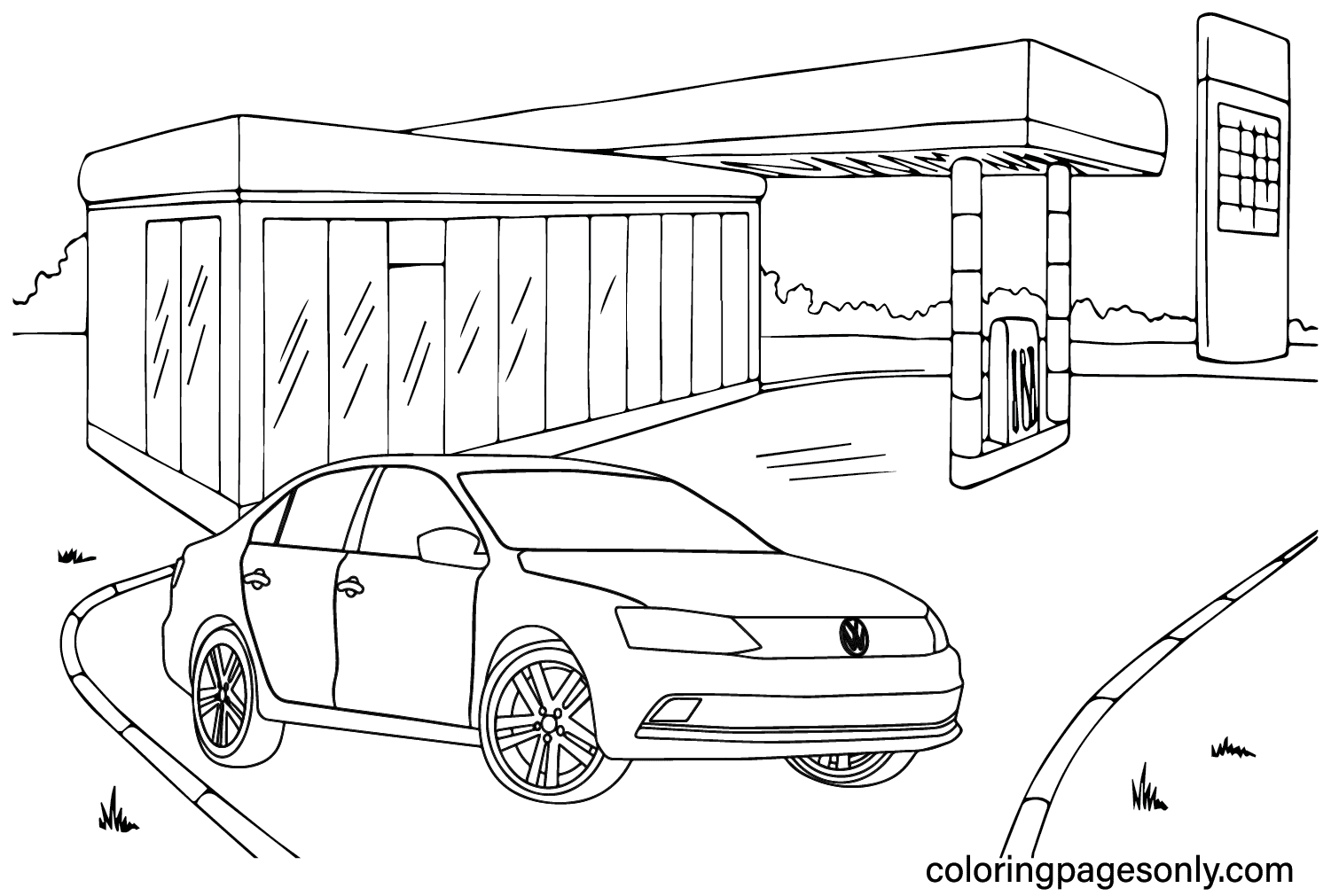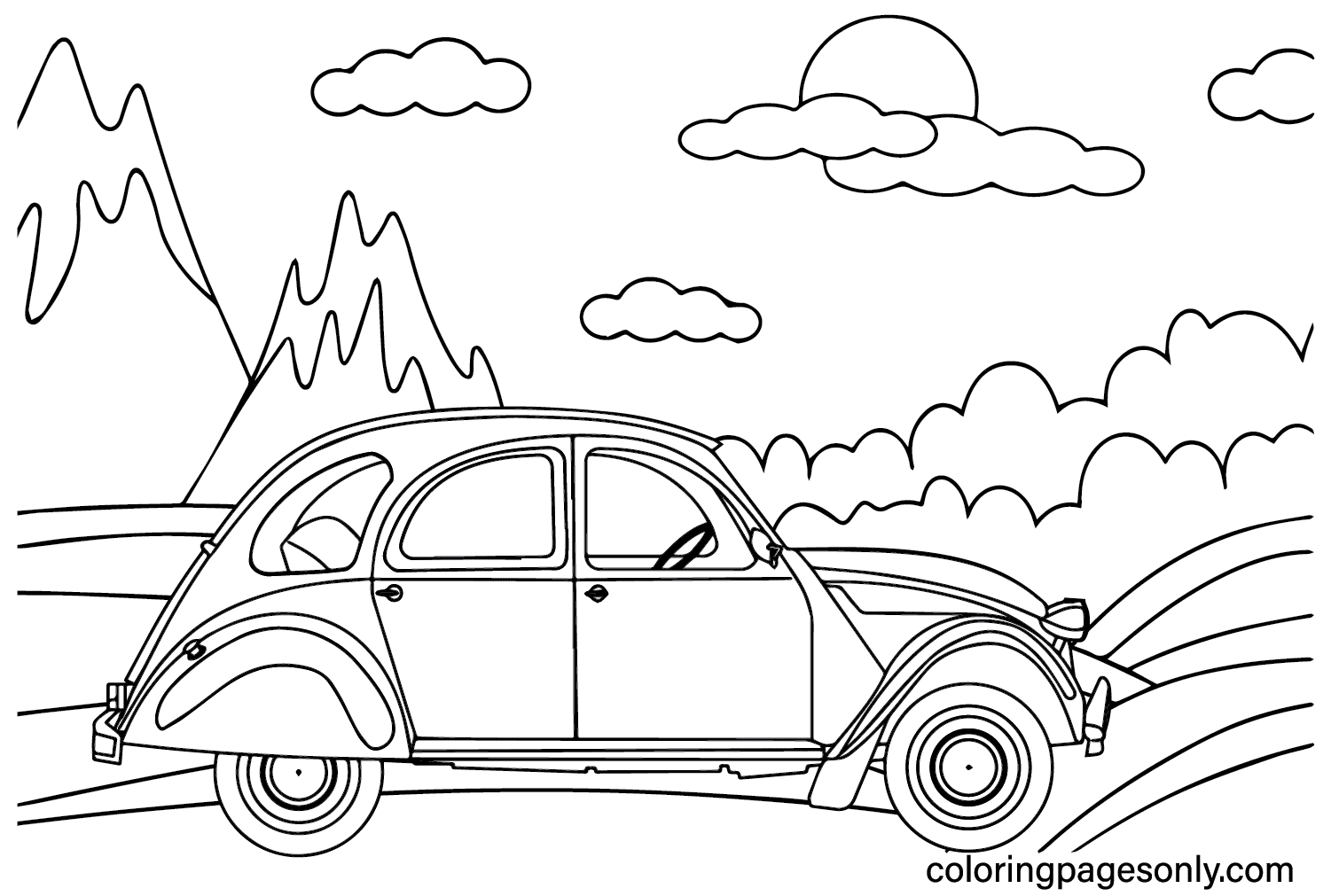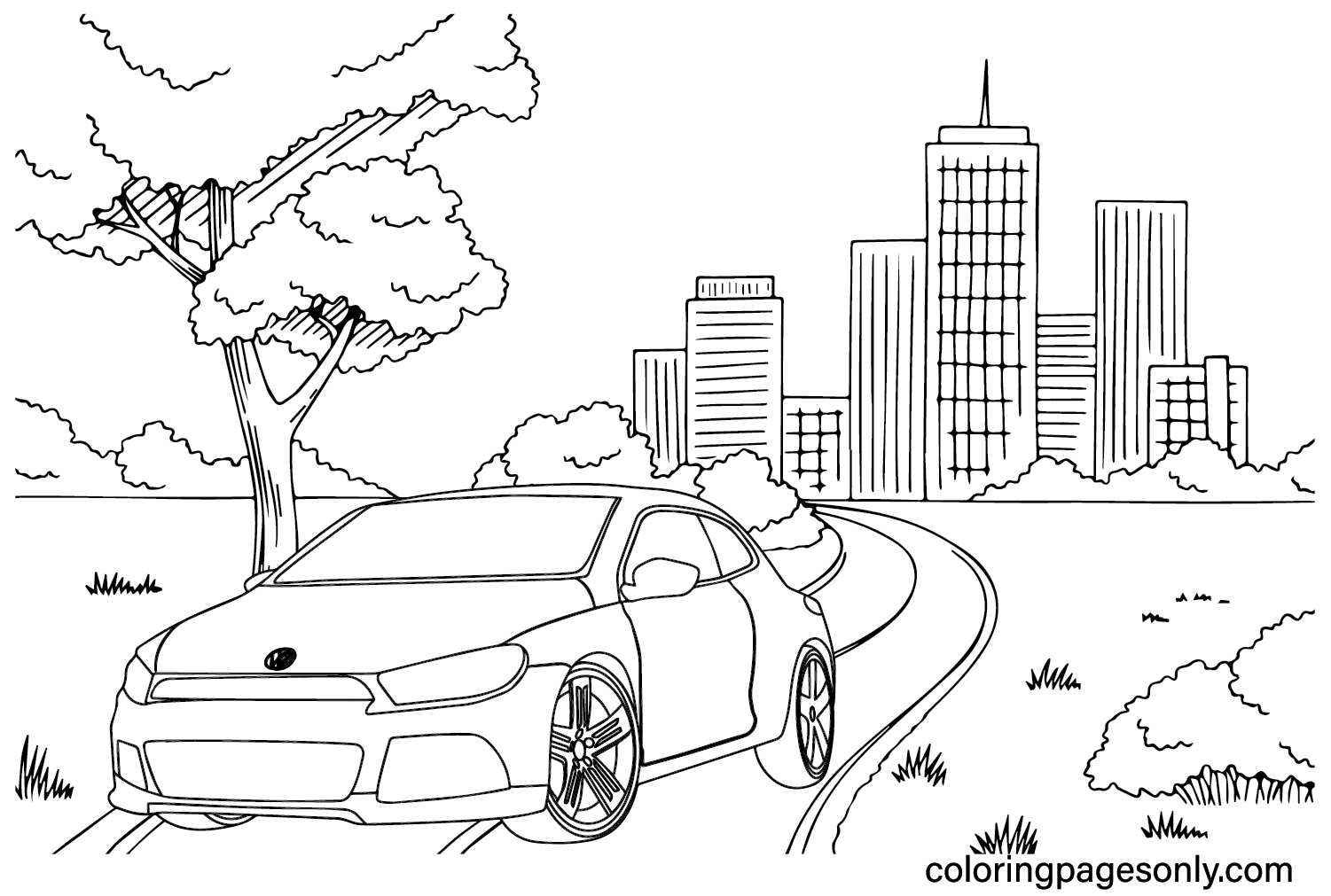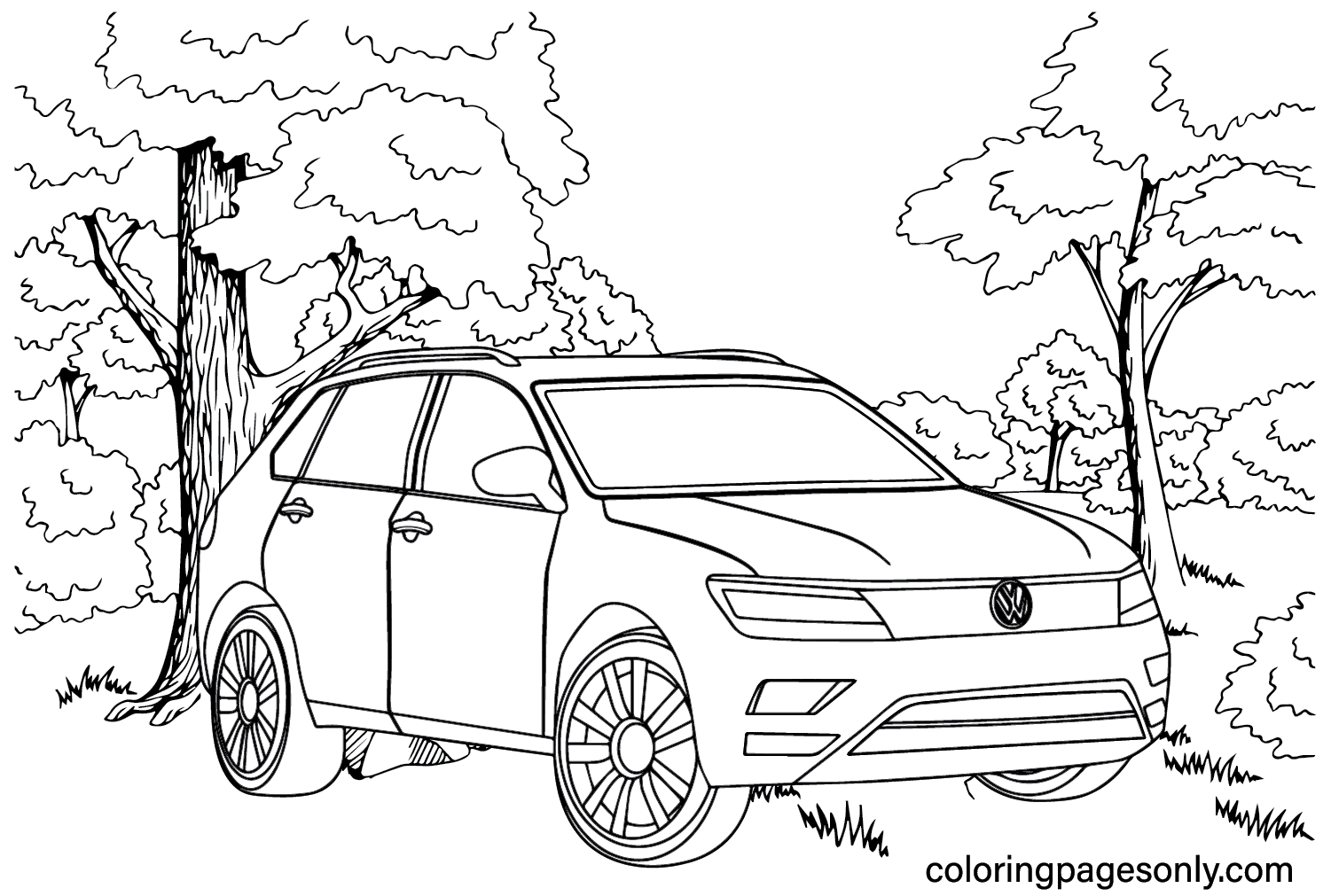
Free Volkswagen coloring pages – 20+ pages featuring the iconic Beetle, the VW Bus/Microbus, the Golf GTI, the Passat, the Tiguan, and the electric ID. Buzz, the Volkswagen roundel logo, and models from across the brand’s history from 1938 to the present – free printable PDF and online coloring for automotive fans and admirers of one of the world’s most culturally significant car brands.
Volkswagen – the name means “People’s Car” in German, from Volk (people) and Wagen (car) – was founded on May 28, 1937, in what became the city of Wolfsburg in Lower Saxony. The company was established under the direction of the German government and engineer Ferdinand Porsche, with the explicit brief to design an affordable car that ordinary German families could purchase. The factory built to produce that car gave Wolfsburg its reason to exist – the city was constructed around the plant.
The car Porsche designed met the brief: two adults, three children, 100 km/h, affordable. It did not reach civilian production before the Second World War. After the war, British occupying forces found the factory largely intact and made the decision to restart production rather than dismantle it. Under Major Ivan Hirst’s direction, the factory was producing cars for the British military and German civilians within months. Heinrich Nordhoff became director in 1948 and guided the company through its transformation into a global manufacturer.
The Beetle – the car Porsche designed in the 1930s – was produced in its original form from 1945 to 2003, accumulating 21,529,464 units across 58 years: the most produced single automobile model in history to that point. The 1959 “Think Small” advertising campaign by Doyle Dane Bernbach repositioned the car in the American market as an honest alternative to American excess and redefined what automotive advertising could accomplish. The Beetle became a cultural object that transcended the category of car.
These 20+ free pages at ColoringPagesOnly.com span Volkswagen’s full model history. All free, PDF or PNG, print or color online.
What’s Inside
The VW Beetle – The People’s Car
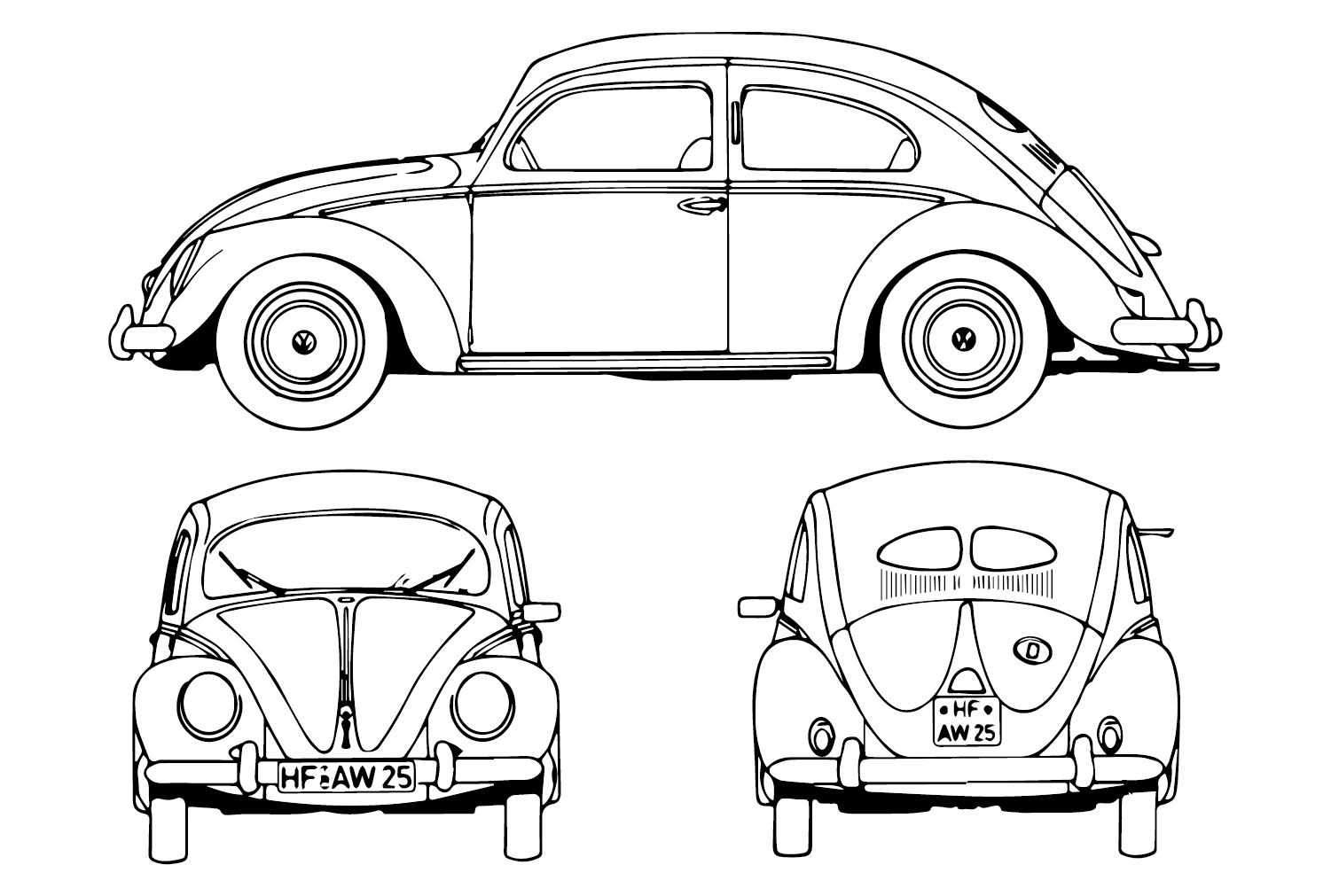
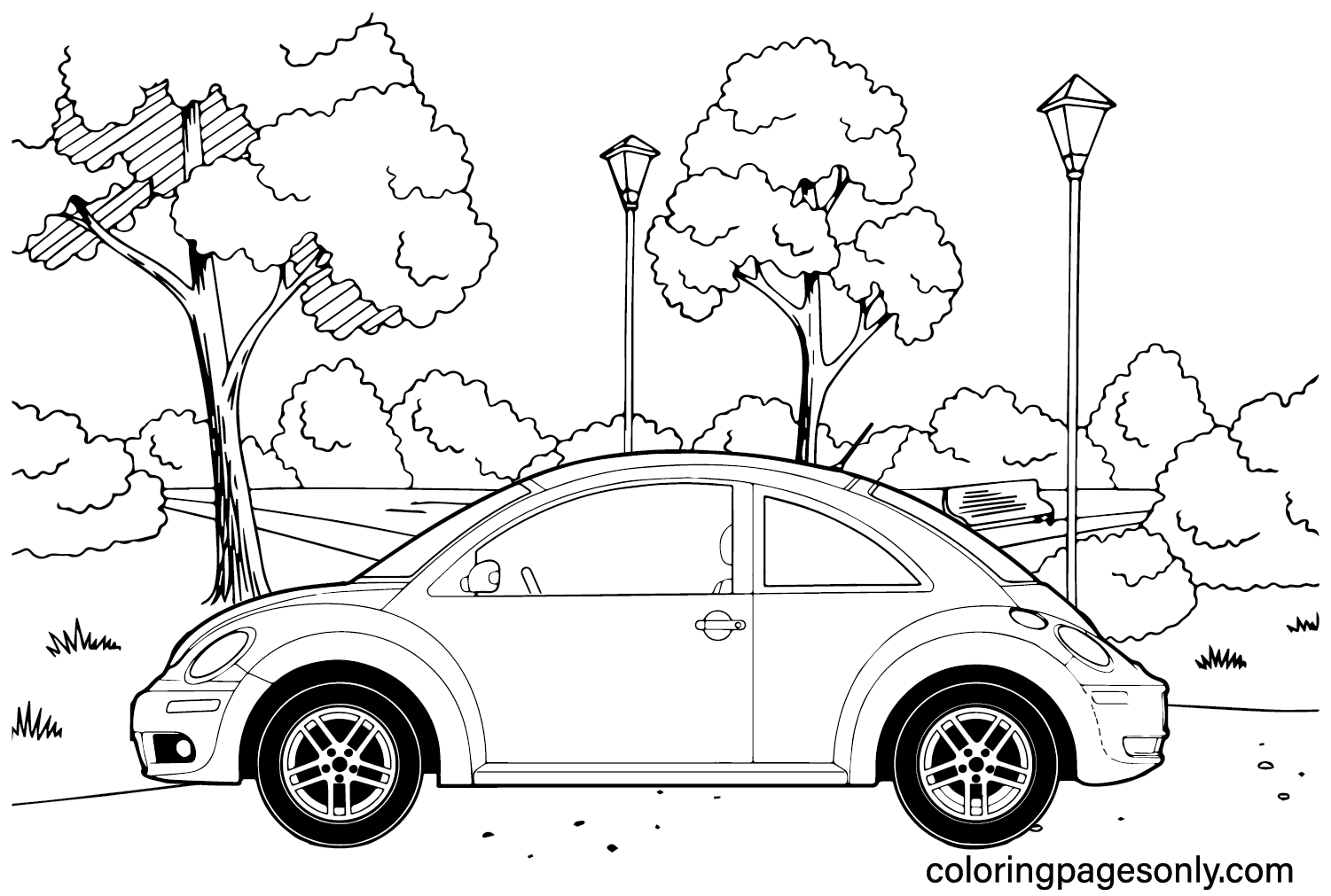
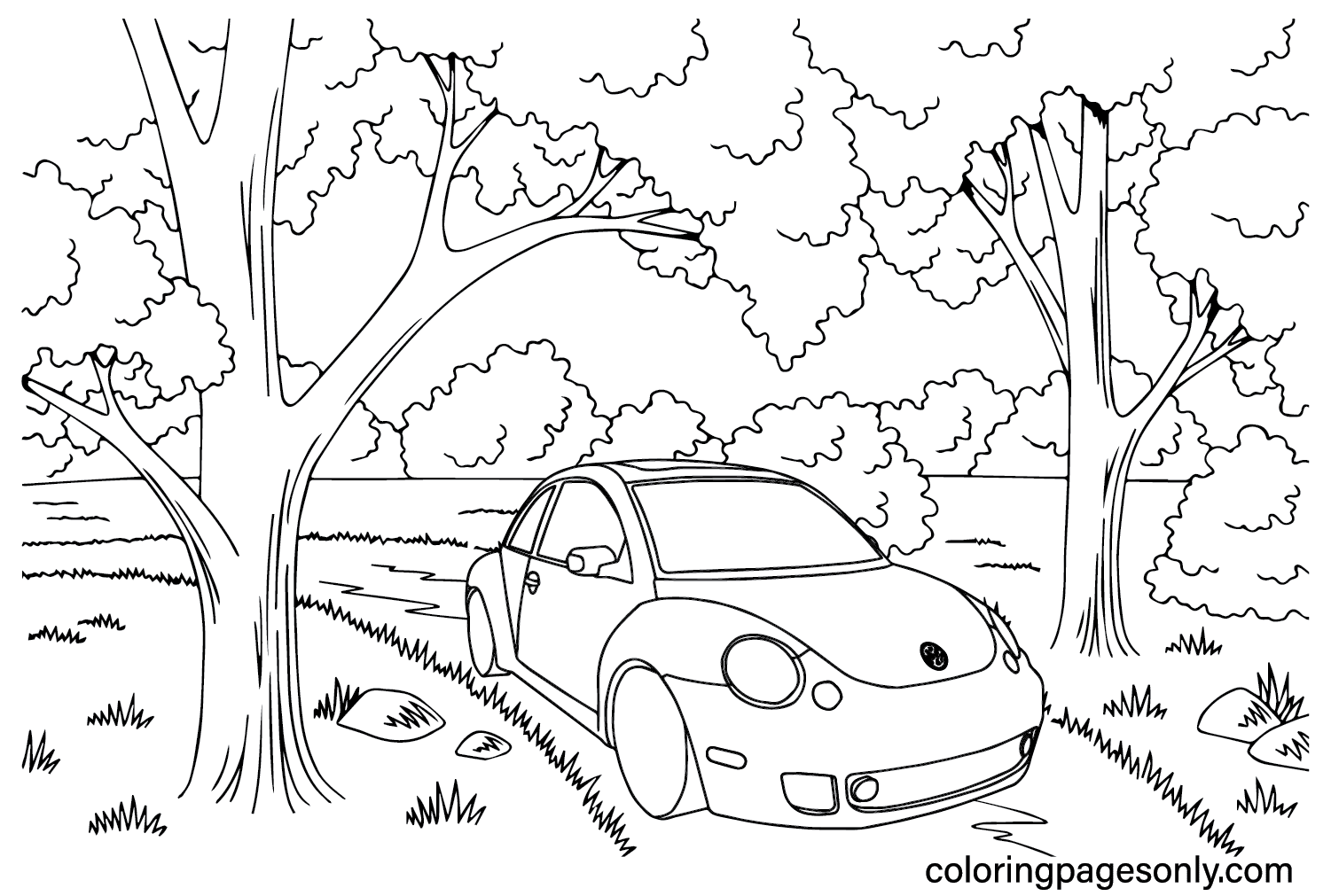
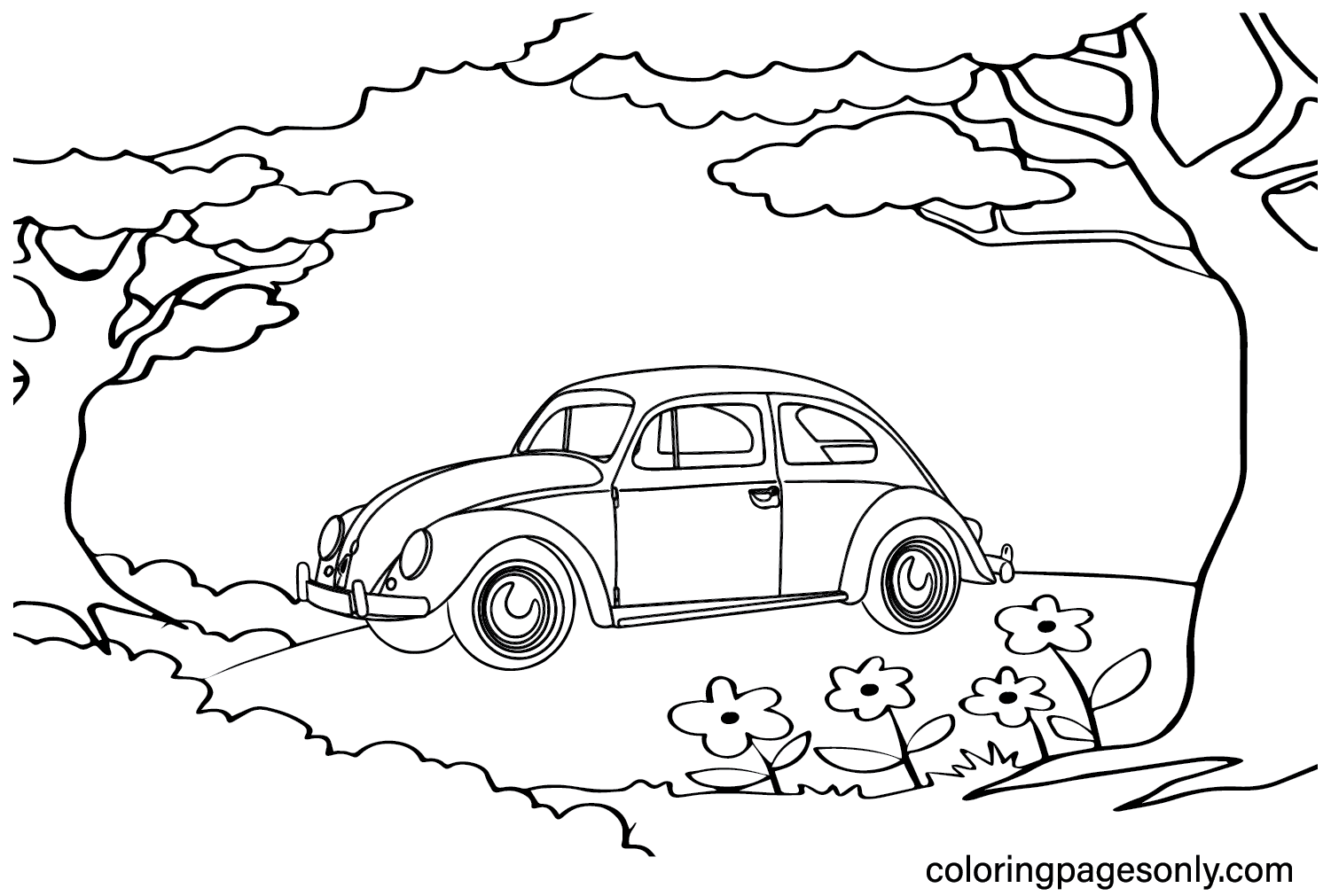
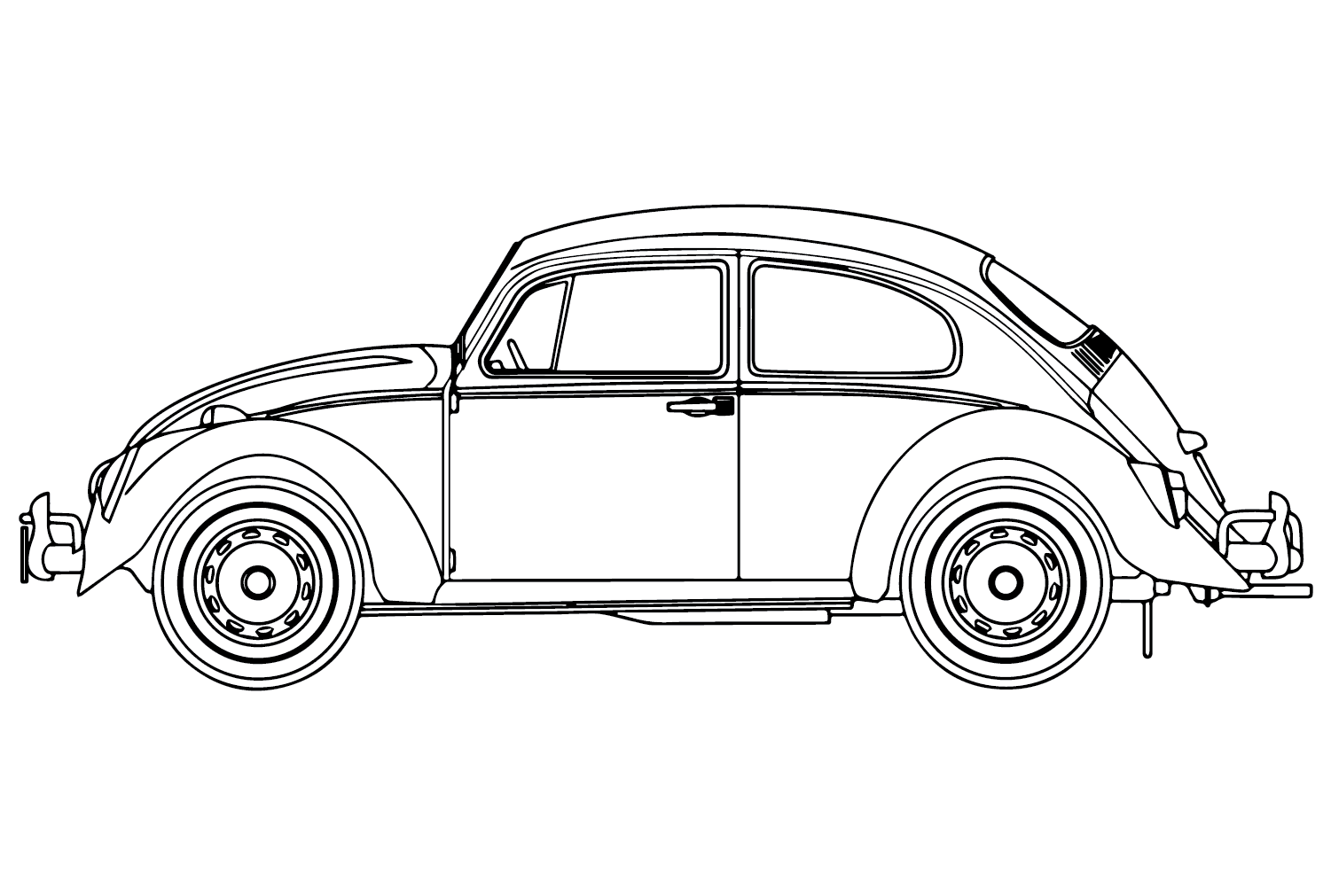
The Beetle is where everything in the collection begins and where Volkswagen’s cultural significance is most concentrated. Its design – the rounded body, the curved roofline that flows continuously from front to rear, the separate rounded fenders, the rear-mounted engine that produced the sloping hood ahead of the windshield – was Ferdinand Porsche’s answer to a specific brief that nobody expected to produce something beautiful. The brief was affordability and capability. The beauty was incidental to the engineering and became permanent.
In the United States market, the Beetle arrived in meaningful numbers in the 1950s at a moment when American cars were growing larger and more ornamented by the year. The 1959 DDB “Think Small” campaign – widely cited as the greatest advertising campaign of the twentieth century – positioned this difference not as a liability but as a virtue. The Beetle was honest about what it was. American cars in the Tailfin Era were not. The campaign sold the difference as an argument for integrity, and it worked.
The 1960s counterculture adopted the Beetle as a vehicle whose specific qualities – mechanical simplicity, ease of owner maintenance, freedom from automotive status anxiety – aligned with the movement’s values. The flower-painted Beetle became an image of that decade that has never entirely left the cultural memory.
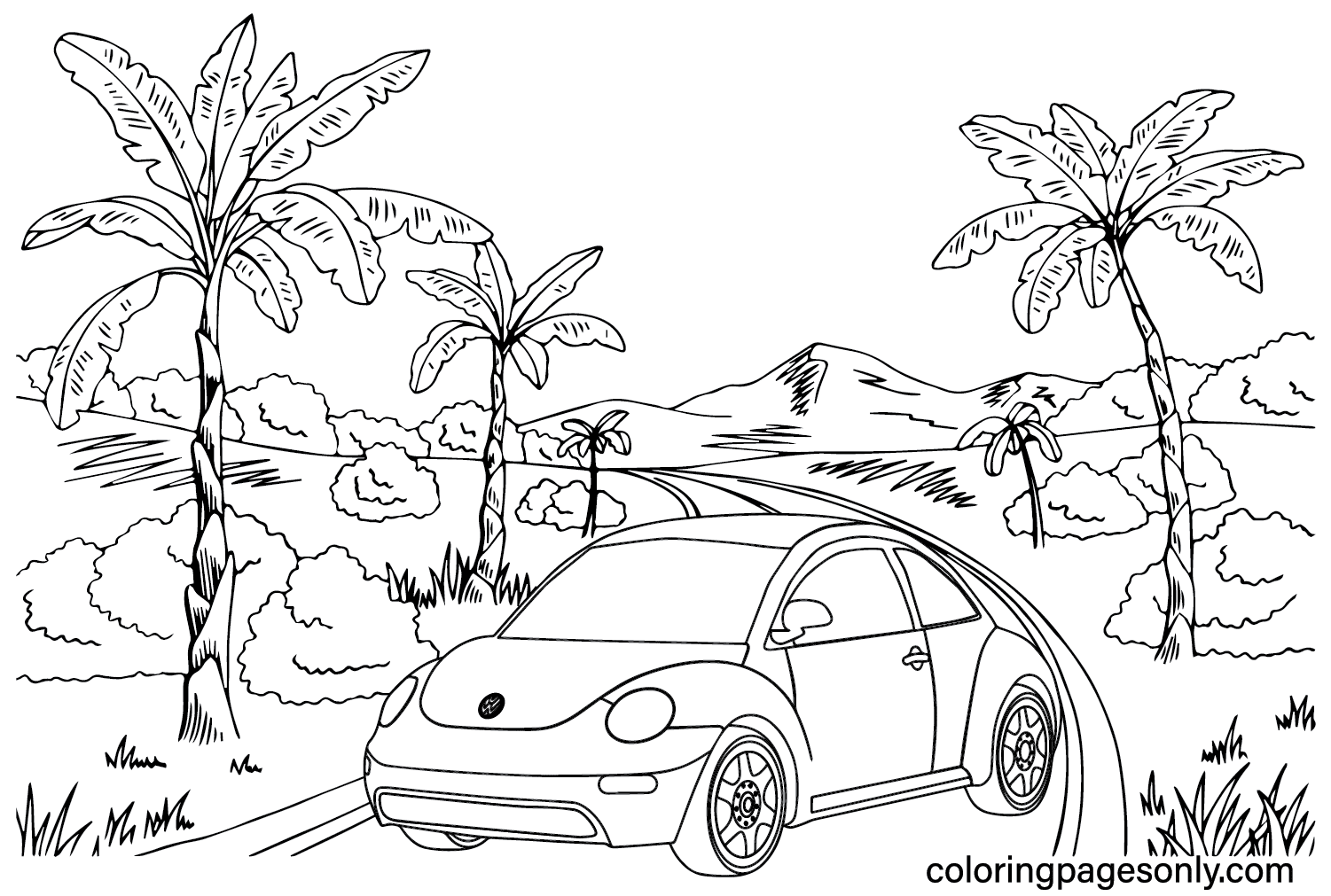
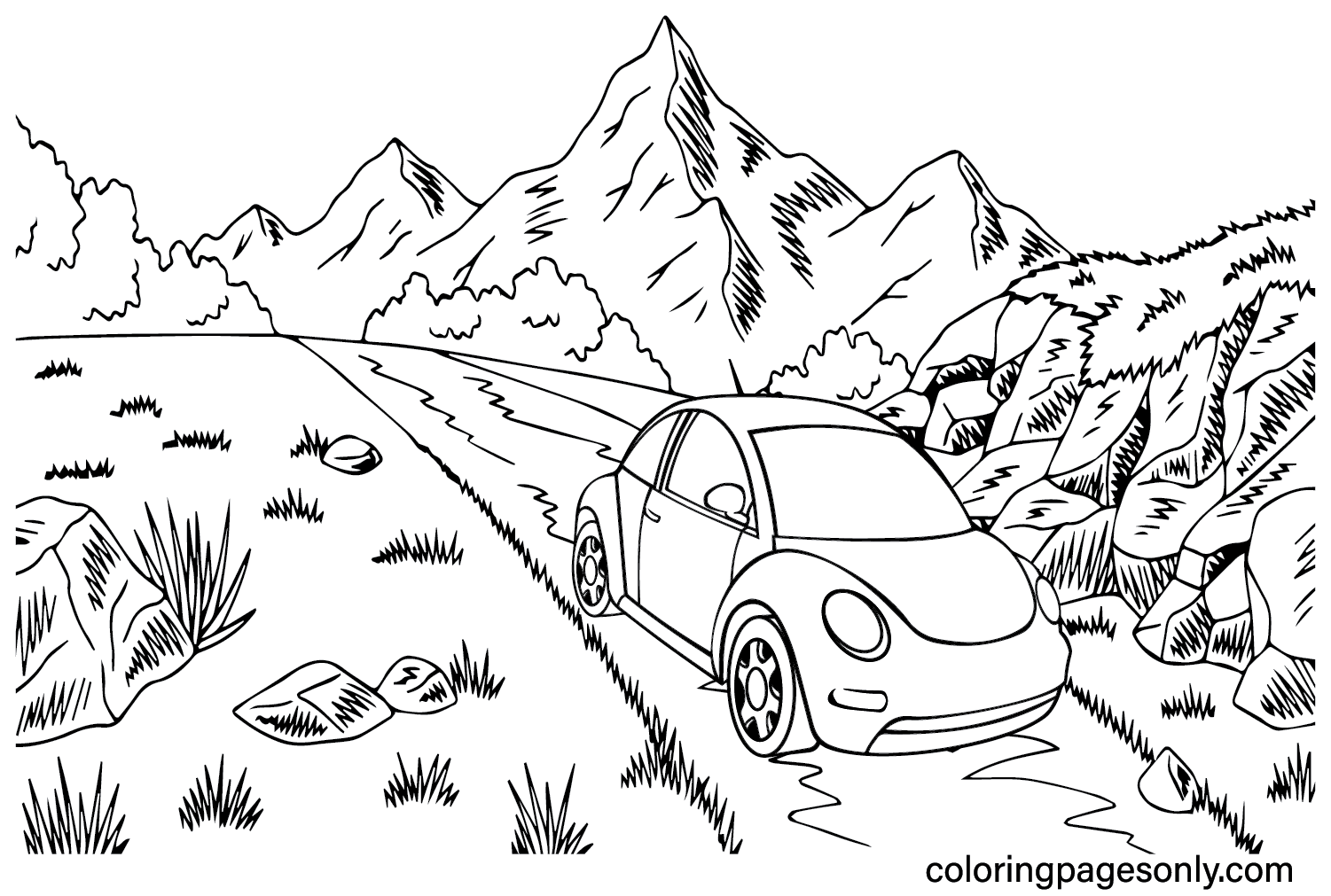
Coloring the Beetle: The rounded body translates to the smoothest, most gradual gradient shading in the automotive collection – no sharp character lines, only the gentle curve of surfaces rounding from top to bottom. Apply the lightest tone of the chosen body color along the roofline and upper body. The mid-tone covers the main door and side surfaces. The darkest tone sits below the door sills and at the wheel arch interiors. The round headlights – circular lenses set in chrome rings – should receive the pale blue-grey of glass with a white highlight arc at the upper portion.
The VW Bus – The Microbus
The Volkswagen Type 2 – known variously as the Microbus, the Camper Van, the Transporter, the Peace Bus, and the Hippie Van – entered production in 1950 on the same platform as the Beetle and has been in production in some form ever since. Its design was the logical extension of the Beetle’s engineering premise: if the engine is in the rear, the entire front of the vehicle is available for cargo or passengers. The Type 2 van exploited this directly, producing a vehicle with maximum interior volume relative to external size.
The T1 generation (1950-1967) is the most immediately recognizable: the split windshield (two separate windshield panes meeting at a central divider), the rounded boxy body, the flat front face with the VW roundel prominently centered. The T2 generation (1967-1979) replaced the split windshield with a single bay window – still a defining design but slightly less distinctive than the split.
The VW Bus became associated with the 1960s counterculture in America as completely as the Beetle. The specific combination of its capacity (it could carry people and equipment), its mechanical simplicity (the same engine as the widely available Beetle, serviceable by the owner), and its affordability made it the vehicle of choice for communities, bands, and travelers who needed to move people and belongings without institutional resources.
Coloring the VW Bus: The flat front face with the centered VW roundel is the collection’s most graphically distinctive automotive front – a near-vertical surface with the logo as the primary design element. The two-tone paint treatment that many Type 1 and Type 2 Buses featured – a white upper body above a dividing chrome strip with a contrasting lower body color – is the most historically resonant coloring choice. Apply white to the upper body (above the chrome divider), then a vivid contrasting color to the lower body: classic red-and-white, cream-and-green, or the orange-and-white that appears in many period photographs.
The VW Golf – The Successor
The Golf replaced the Beetle in 1974 as Volkswagen’s primary volume model – a front-wheel-drive, water-cooled hatchback designed by Giorgetto Giugiaro (the same designer who would later work on the Hyundai Pony and numerous other significant vehicles) that represented a complete departure from the Beetle’s mechanical philosophy. Where the Beetle was rear-engined, air-cooled, and built on a platform that had not fundamentally changed since the 1930s, the Golf was modern in every respect.
It was more capable than the Beetle. It was also less distinctive. The Golf did not aspire to cultural significance in the way the Beetle had achieved it accidentally – it aspired to competence, and it delivered competence so reliably across eight generations that it became a touchstone of the European automotive middle class. The Golf GTI – the performance variant introduced in 1976, the original “hot hatch” – added a specific kind of significance: affordable performance, accessible to buyers who could not budget for sports cars but wanted the driving experience.
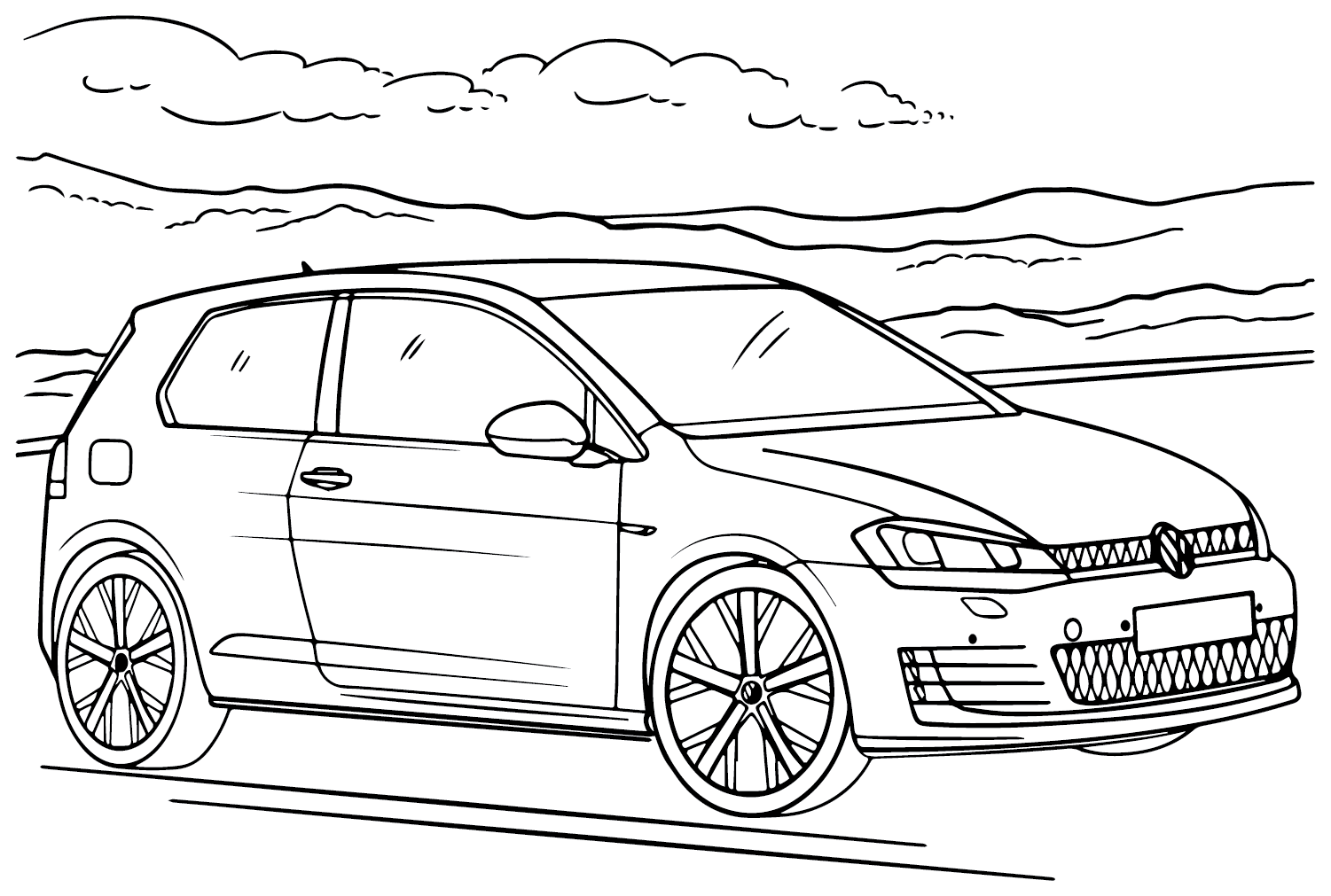
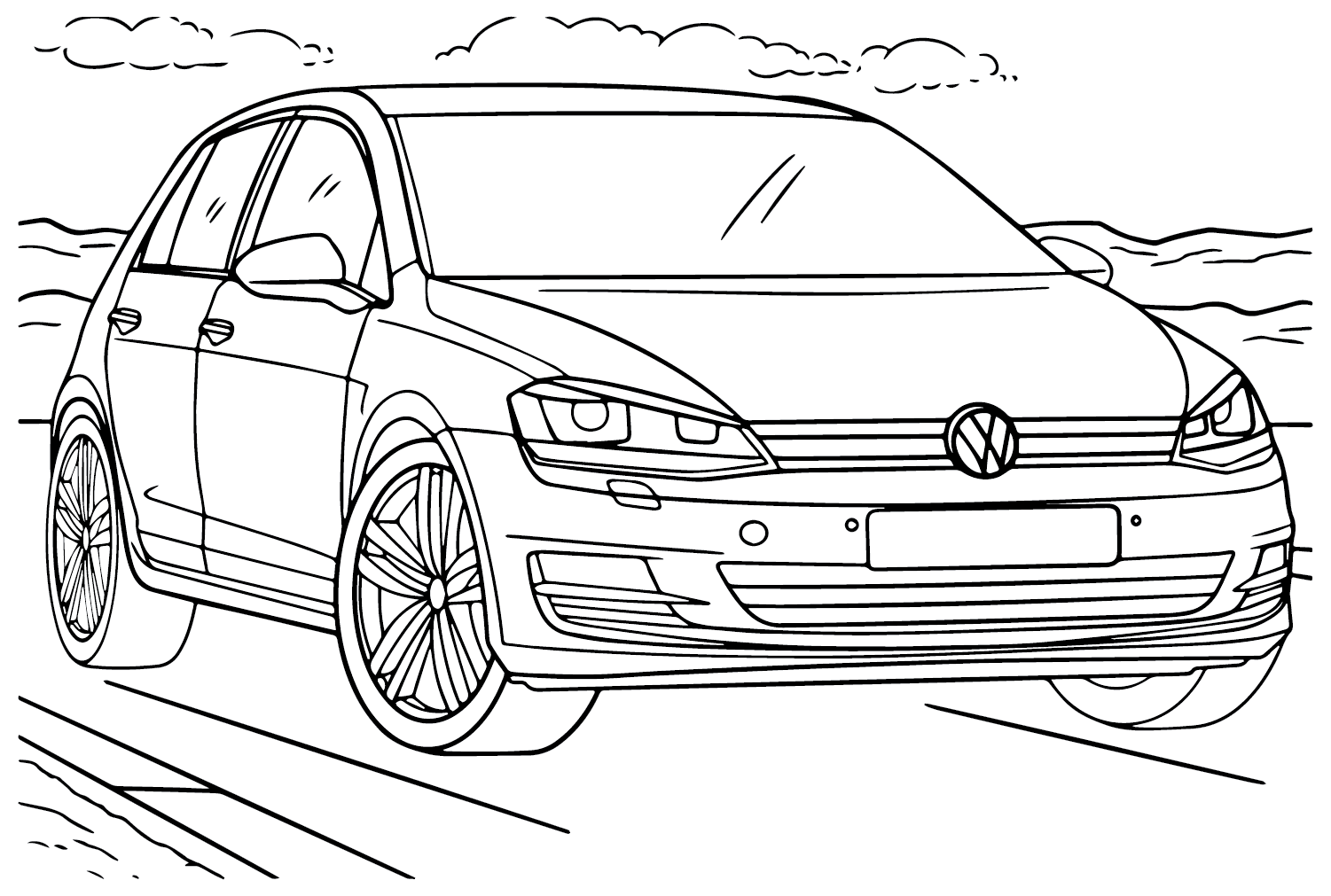
Coloring the Golf GTI: The Golf GTI’s most distinguishing visual elements are the red stripe along the lower body (present on the original Mark 1 GTI and maintained as a design reference on subsequent generations), the red GTI badging, and the plaid “Tartan” seat fabric visible through the windows in close-up pages. The body color is most iconically red (the original campaign color for the GTI) or black. The red lower stripe should be a thin, vivid red line running along the body’s lower edge – precisely applied, without wavering.
The ID. Buzz – The Electric Revival
The ID. Buzz is the most emotionally resonant product in Volkswagen’s current lineup – an all-electric van that revives the visual language of the original Type 2 Microbus for the battery-electric era. Its rounded silhouette, its flat front face with the centered VW logo (now illuminated), its split color treatment referencing the original two-tone Bus – these are deliberate visual references to the vehicle that became the brand’s most culturally significant product in the 1960s, now applied to an electric vehicle that emits nothing from its operation.
The ID. Buzz entered production in 2022 and has been offered in two- and three-row configurations. Its design won multiple awards on announcement and release, reflecting both the specific quality of the execution and the emotional weight that the Van’s visual language carries for the generations who grew up with the original.
Coloring the ID. Buzz: Two-tone paint treatment is the most historically correct choice – white upper body above a contrasting lower body, with the specific boundary between the colors following the vehicle’s character line. The illuminated VW roundel on the flat front face should be rendered as the brightest element on that face – a white or pale blue-white glow against the surrounding body color—the round headlights of the ID. Buzz is an LED unit arranged in circular patterns that reference the original round headlights of the T1.
The VW Logo Pages
The Volkswagen roundel – the V and W letters interlocked within a circle – is one of the world’s ten most recognized logos. It was updated in 2019 to a flatter, more simplified version for the brand’s transition into the electric era: the three-dimensional, chrome-look logo of the combustion-engine period gave way to a flat, two-dimensional logo that works in both light and dark versions. This 2019 redesign is itself a design history document – the specific moment when Volkswagen changed its visual identity to signal that it was no longer primarily a combustion-engine brand.
What These Pages Do
The Volkswagen Beetle’s advertising history is a documented case study in how design context changes meaning. The “Think Small” campaign of 1959 did not change the Beetle – it changed how Americans understood what they were looking at. A small, odd, foreign car was reframed as an honest vehicle for people who preferred truth to pretension. Coloring the Beetle while understanding this context is engaging with one of the twentieth century’s most significant design-and-communication arguments.
The VW Bus’s cultural adoption is the most complete example in automotive history of a vehicle becoming a cultural symbol. The Type 2 Microbus was not designed as a symbol of anything – it was designed to use the Beetle’s platform efficiently. Its adoption by the American counterculture in the 1960s, and the persistence of that association through fifty subsequent years, is a case study in how objects accumulate meaning through use.
Volkswagen’s history spans the most consequential period in automotive history. From Ferdinand Porsche’s 1930s brief to the 1959 American advertising revolution to the 2015 Dieselgate emissions scandal – in which Volkswagen was found to have installed defeat device software in 11 million diesel vehicles to cheat emissions testing – to the 2022 ID. Buzz electric revival, the brand’s story runs through every major moment in the industry’s history.
Fine motor development. The American Academy of Pediatrics identifies fine motor skill development as a key childhood milestone throughout early childhood. The Beetle’s rounded panel gradients, the Bus’s two-tone color separation, the Golf GTI’s precise red stripe, and the ID. Buzz’s illuminated roundel detail all provide motivated, sustained fine motor practice. The 2005 Art Therapy Journal study on structured coloring and anxiety reduction applies throughout this collection.
How to Color These Pages Well
The Beetle’s rounded body is an exercise in gradient without edges. Unlike the Golf or the current Tiguan, the Beetle has no sharp character lines – the body is one continuous curve from the roof peak to the sill. This means the three-zone metallic technique applies differently here: the transitions between light and shadow zones should be as gradual as possible. Apply the lightest tone at the absolute peak of the body’s curve, graduate to mid-tone across the main surface, and add the shadow tone only at the very lowest body panels and deepest shadow areas. The result should show no line where one zone ends, and another begins – only a gentle progression from lighter to darker.
The VW Bus two-tone treatment requires a clean, precise color boundary. The horizontal dividing line between the Bus’s two paint colors – where the white upper body meets the contrasting lower color – is the vehicle’s most important single design element. Apply the upper body color first, being careful to stop exactly at the chrome dividing strip’s position. Apply the lower color second, from the divider downward. The boundary between the two colors should be sharp and precise – any bleeding across the divider line degrades the most characteristic visual of the Bus design.
The Golf GTI’s red stripe is smaller than it appears in photos. The original Mark 1 GTI’s red lower body stripe is a thin, precise line – not a broad band. On coloring pages that reference this design, apply the red with the finest tool available, keeping the stripe’s width consistent along its entire run from front to rear. A thick or uneven stripe reads as incorrect regardless of color accuracy.
Window glass on rounded vehicles follows the body’s curve. The Beetle’s windshield is curved – both front-to-back and side-to-side – which means the sky reflection in the glass also curves. Apply window glass in a very pale blue-grey, with the reflection arc curving to follow the windshield’s actual shape. The curved reflection is one of the subtle details that make a rounded vehicle page read as correctly rendered rather than as a flat diagram.
The ID. Buzz’s illuminated elements should be the page’s light sources. The ID. Buzz’s front lighting – the illuminated VW roundel, the LED light strip running across the flat front face, the individual LED headlight units – are points that produce light rather than reflect it. Render them in the brightest available white or pale cool white, surrounded by a very subtle halo of slightly warmer white that suggests the light’s spread onto the surrounding body surface. These illuminated elements against the dark body color (if the ID. Buzz is rendered in a dark color) produce the most visually effective result.
5 Creative Craft Ideas
The Decade Beetle – Cultural History Through Color
Print three copies of the same Beetle page. Color the first in the muted, conservative colors of the early 1950s – the modest dark greens and blacks of the post-war German market. Color the second in a vivid 1960s counterculture paint job: flower decals (drawn by hand), peace symbol, vivid colors. Color the third in the clean white of the 1990s New Beetle era.
Mount all three in chronological order: “1950s – Postwar Germany,” “1960s – American Counterculture,” “1990s – Nostalgia.” The display shows sixty years of cultural context attached to the same basic shape.
Think Small – The Ad Recreation
The 1959 DDB “Think Small” advertisement is the most famous car advertisement ever produced. Its composition: a small Beetle in the upper left corner of a white page, with empty white space around it, and the words “Think small. below.
Print any Beetle page. Color it in the advertisement’s simple black-and-white or the most understated color available – pale grey against white. Cut it out carefully. Mount it in the upper left corner of a large white backing sheet, leaving most of the sheet empty. Hand-letter “Think small” in small, clean text at the lower center.
The finished display recreates the most significant automotive advertisement of the twentieth century as a coloring-page-based mixed media piece.
The People’s Car Through History
Volkswagen’s name – People’s Car – describes a specific mission that has been fulfilled differently in each generation. Print one page each of the Beetle (1950s-1970s People’s Car), the Golf (1970s-2000s People’s Car), and the ID.4 or ID.3 (2020s electric People’s Car).
Color each in a palette appropriate to its era. Mount in chronological order. Below each: the model name, the approximate era in which it served as the brand’s volume leader, and one technical achievement that defined it – “Beetle: 21.5 million units produced,” “Golf: the original hot hatch,” “ID.4: zero tailpipe emissions.”
Bus Color Custom
The VW Bus’s two-tone paint tradition has produced some of the most memorable automotive color combinations in history: Dove Blue over Chestnut, Seagull Grey over Coral Orange, Beige over Pale Blue. Print the most complete VW Bus page available.
Plan a custom two-tone combination before applying any color: choose an upper color and a lower color that work together. Reference period VW Bus color combinations for historical accuracy, or invent a new one. Apply the upper color precisely down to the chrome dividing strip. Apply the lower color from the divider to the bottom of the body. The finished page is a specific, personal color statement within the Bus’s established design tradition.
Electric Past and Future
Print the most classic Type 2 VW Bus page available and the most contemporary ID. Buzz page. Color the Type 2 in the warm, slightly faded tones of a 1960s-era vehicle – the colors of something old and well-used. Color the ID. Buzz in vivid, contemporary colors – the cool, clean tones of new technology.
Mount both side by side: “Type 2 – 1950. Air-cooled. Rear-engine. People’s Van.” on the left. “ID. Buzz – 2022. Battery electric. 408 km range. People’s Van.” on the right. The display frames seventy years of the same vehicle concept across the most significant technology transition in automotive history.
Frequently Asked Questions
What does “Volkswagen” mean, and when was the company founded? Volkswagen means “People’s Car” in German – Volk (people) + Wagen (car/vehicle). The company was founded on May 28, 1937, under the official name Gesellschaft zur Vorbereitung des Deutschen Volkswagens mbH. It was established under direction from the German government, with engineer Ferdinand Porsche assigned to design a car affordable for ordinary German families. The factory was built in what became the city of Wolfsburg – a city constructed specifically around the Volkswagen plant. After the Second World War, British forces restarted production under Major Ivan Hirst’s direction, and Heinrich Nordhoff became director in 1948, guiding the company’s growth into a global manufacturer.
What is the history of the VW Beetle? The Beetle – officially the Volkswagen Type 1 – was designed by Ferdinand Porsche in the 1930s to meet the specific brief of a car capable of carrying two adults and three children at 100 km/h at an affordable price. Civilian production began after the Second World War, and the model was produced continuously from 1945 to 2003, accumulating 21,529,464 units – the most produced single automobile model in history at that point. In the United States, the 1959 “Think Small” advertising campaign by Doyle Dane Bernbach – widely cited as the greatest advertising campaign of the twentieth century – repositioned the car as an honest alternative to American excess. A modern retro-styled New Beetle was produced from 1998 to 2019, with the final unit produced on July 10, 2019.
What is the VW Golf GTI? The Volkswagen Golf GTI is a performance variant of the Golf hatchback, introduced at the Frankfurt Motor Show in 1975 and entering production in 1976. It is the original “hot hatch” – the concept of taking a practical family hatchback and fitting it with a performance engine and chassis tuning to create an affordable sports car in a practical body. The original Mark 1 GTI’s 1.6-liter fuel-injected engine produced 110 PS, and the car’s distinctive red lower body stripe became one of automotive design’s most recognized performance identifiers. The Golf GTI established a vehicle segment – the hot hatch – that has been commercially significant in European and global markets for five decades.
What is the ID? Buzz? The Volkswagen ID. Buzz is an all-electric van that revives the visual language of the original Type 2 Microbus for the battery-electric era. It entered production in 2022 and is offered in two-row and three-row configurations. Its design – the rounded silhouette, the flat front face with illuminated VW roundel, the two-tone paint treatment – directly references the original VW Bus that became one of the most culturally significant vehicles of the 1960s—the ID. Buzz’s combination of its emotional visual heritage and its zero-emission electric drivetrain makes it the clearest single statement of Volkswagen’s intention to connect its historic identity to an electric future.
What was the Volkswagen Dieselgate scandal? In September 2015, the United States Environmental Protection Agency found that Volkswagen had installed defeat device software in approximately 11 million diesel vehicles worldwide. The software detected when a vehicle was undergoing emissions testing and adjusted engine performance to produce lower emissions results than the vehicle achieved in normal driving conditions, where nitrogen oxide emissions were up to 40 times the legally permitted level. Volkswagen CEO Martin Winterkorn resigned on September 23, 2015. The company paid approximately $33 billion in fines, settlements, and vehicle buyback costs in the United States alone, making it the largest automotive scandal in modern history. The event significantly damaged Volkswagen’s reputation and accelerated the company’s stated transition toward battery-electric vehicles.
What brands does the Volkswagen Group own? The Volkswagen Group is one of the world’s largest automotive conglomerates, owning multiple distinct brands across market segments. The group includes Volkswagen (mass market), Audi (premium), Porsche (sports and luxury), SEAT (now transitioning toward the Cupra performance brand in Spain), Škoda (value positioning in the Czech Republic and European markets), Lamborghini (ultra-luxury supercar), Bentley (ultra-luxury), and Ducati (motorcycles). Each brand operates with significant independence while sharing platforms, components, and engineering investment across the group. The group’s total vehicle sales have consistently placed it among the top two or three global automotive groups by volume.
Browse the full collection at ColoringPagesOnly.com. All 20+ pages free, no sign-up, PDF or PNG, print or color online.
Ferdinand Porsche was given a brief in the 1930s: a car that ordinary families could afford. The car he designed was not put into civilian production until after the war that the government commissioning it had lost. The British rebuilt the factory. Heinrich Nordhoff ran the company. The Beetle sold 21.5 million units. A 1959 advertising campaign told Americans to think small and changed how advertising worked.
The Bus became a symbol of a decade it was not designed for. The Golf replaced the Beetle as the car that ordinary people drove. The GTI invented a vehicle segment—the ID. Buzz brought back the Van’s shape with an electric motor.
Volkswagen. People’s Car. Seventy years of building it differently each time.
Pick up your white. Two-tone the Bus. Apply the red GTI stripe precisely.
Share your work on Facebook and Pinterest and tag #Coloringpagesonly. We especially want to see the “Think Small” ad recreations and the Electric Past and Future displays.
Color the People’s Car. Think small. The future is electric.
More from our automotive collections: