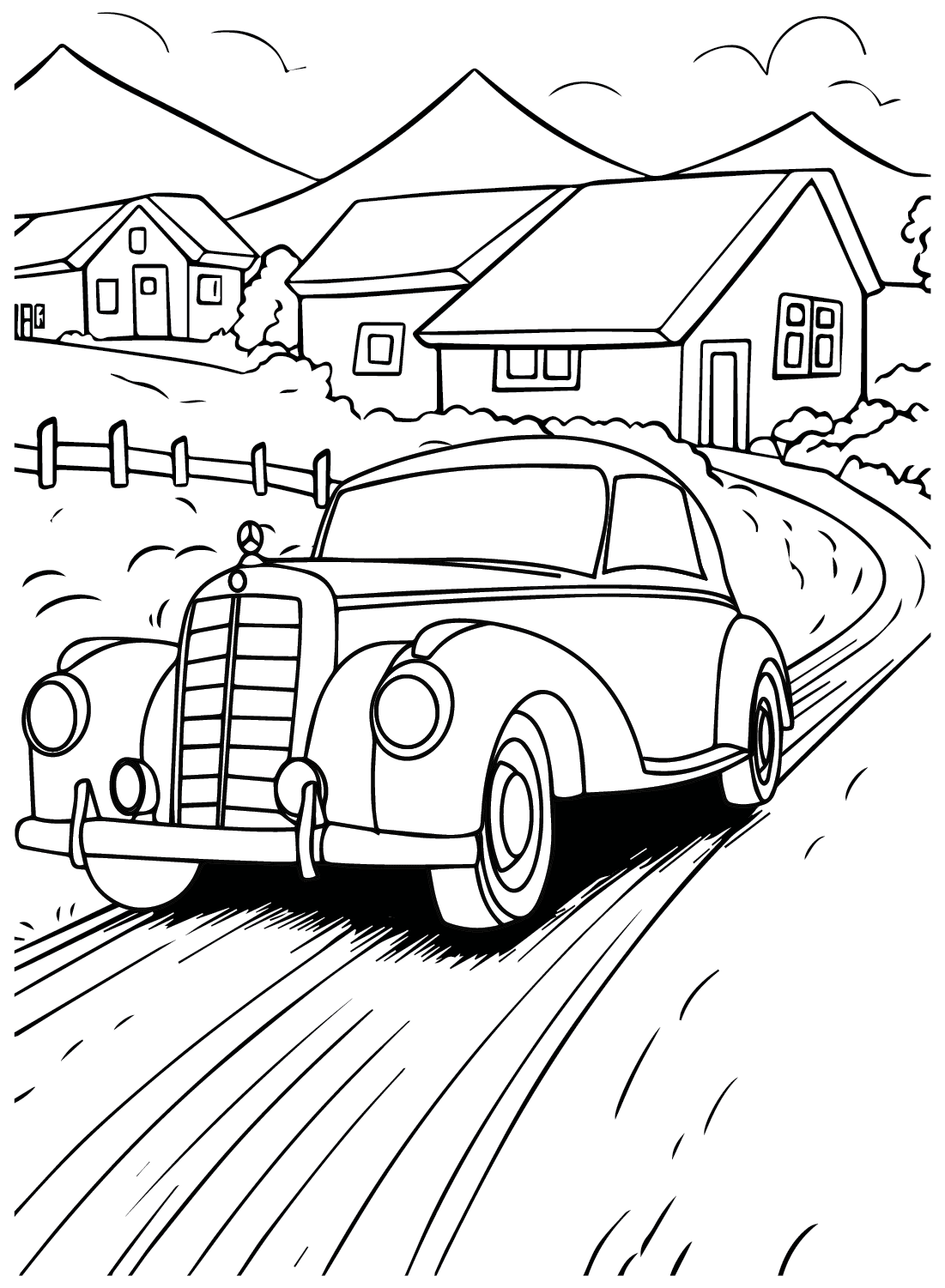
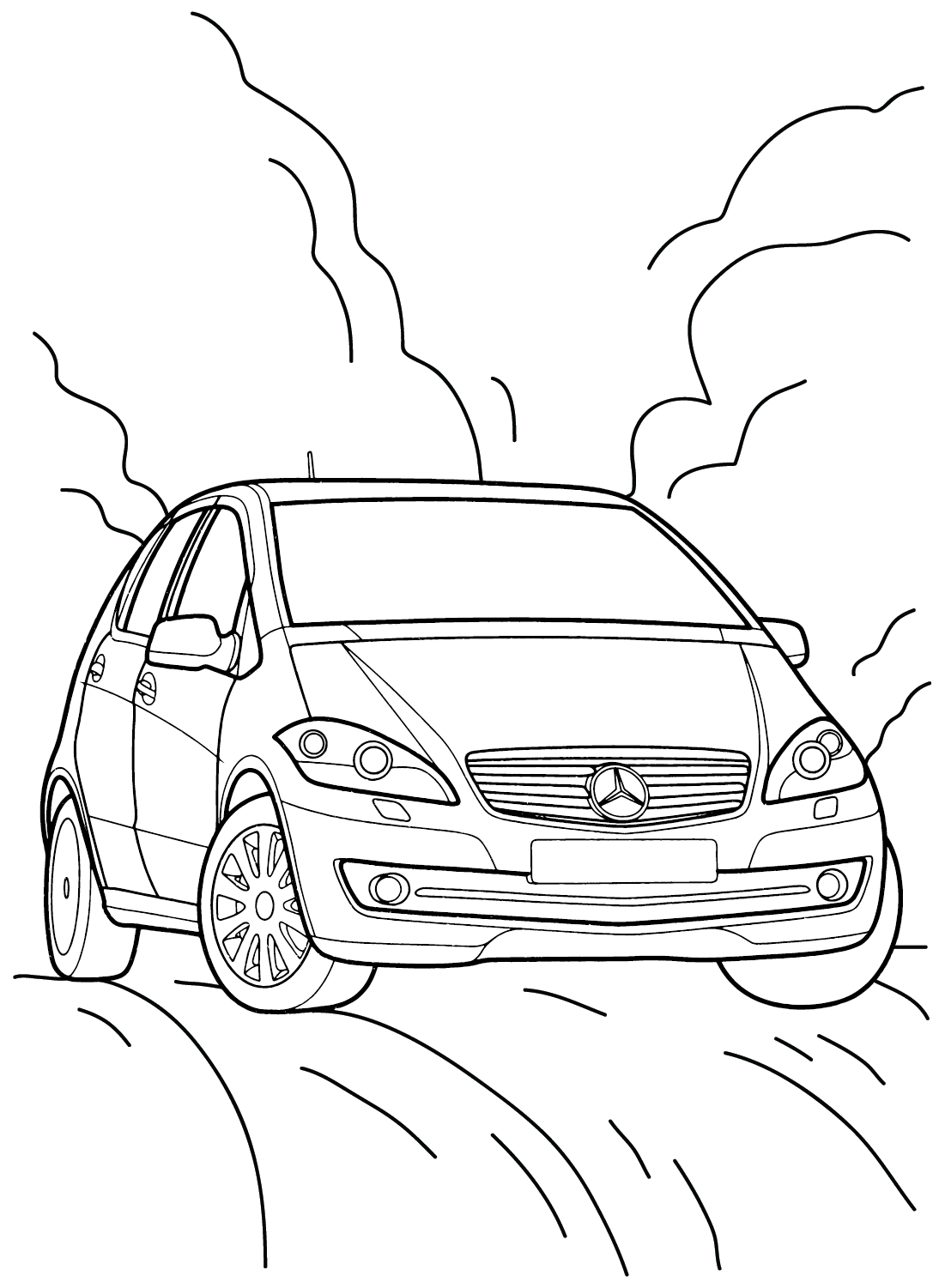
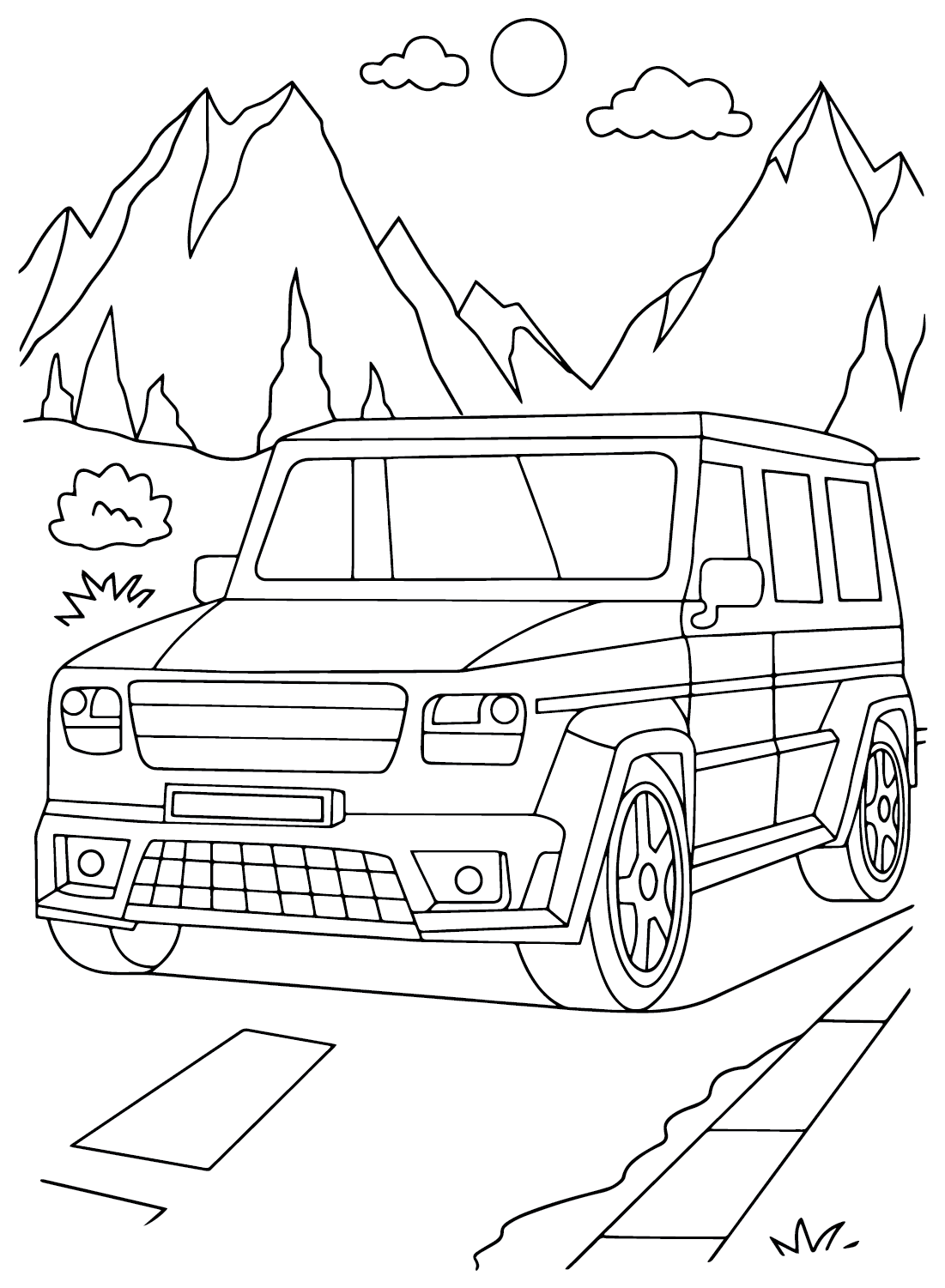
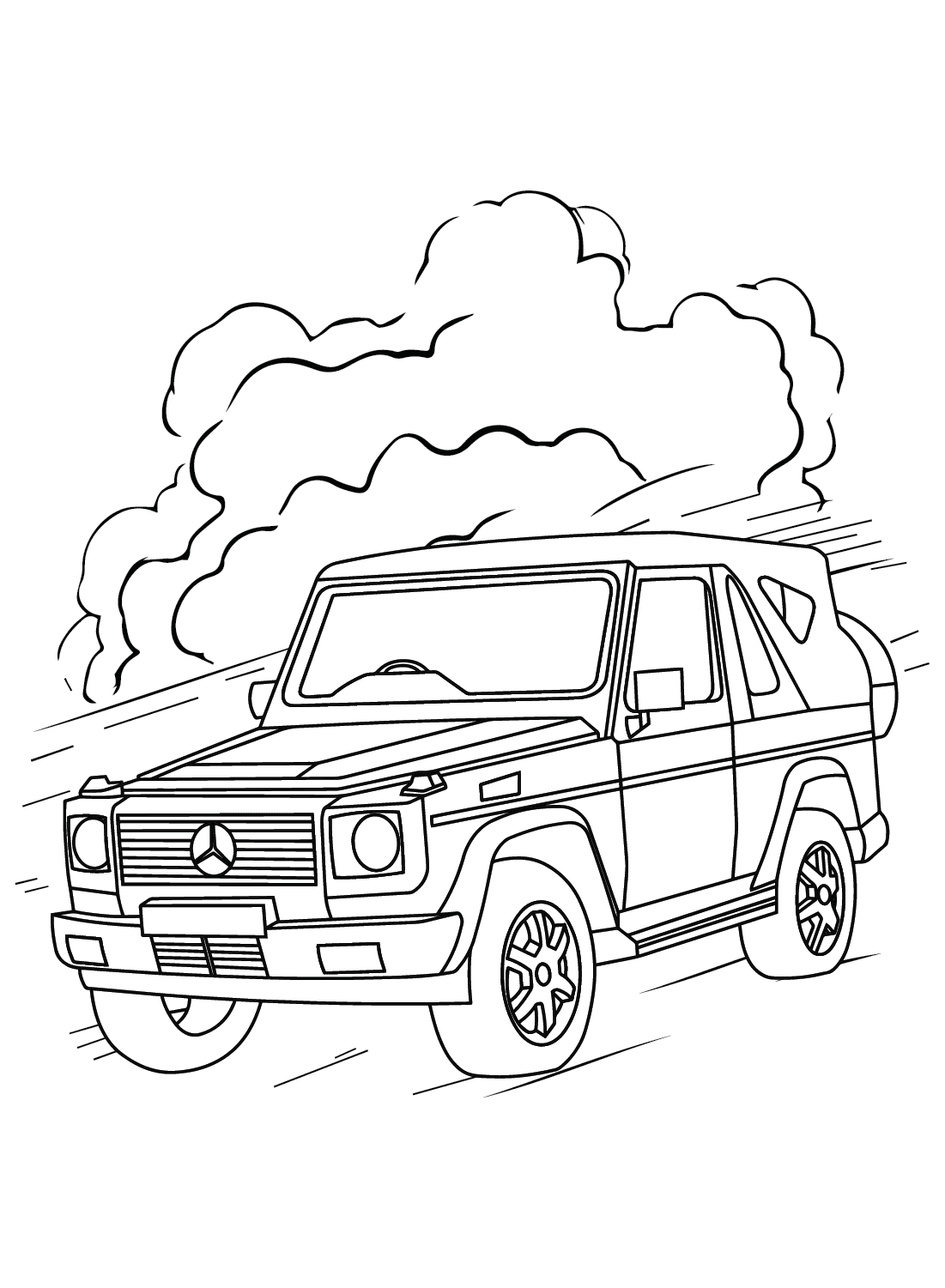
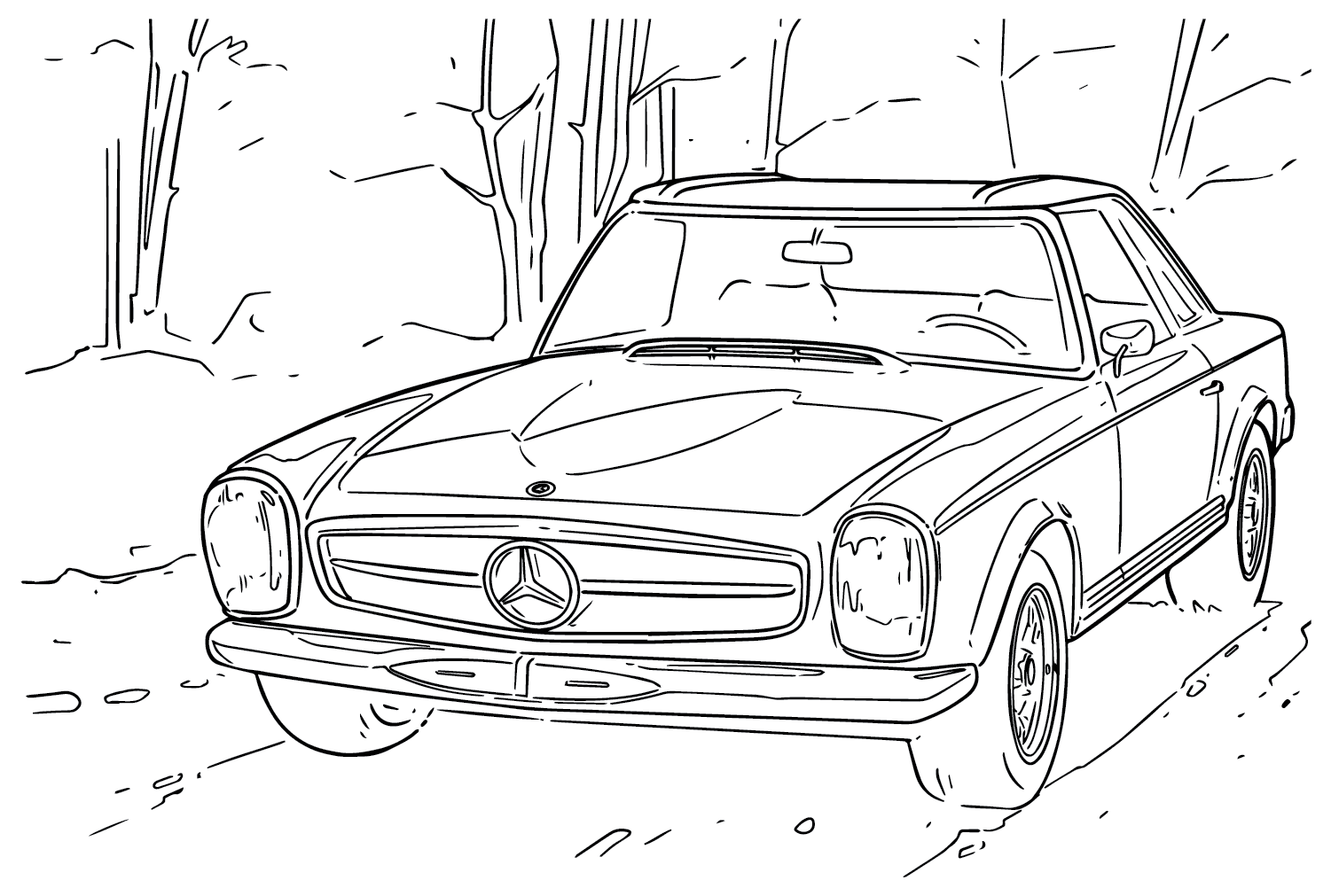
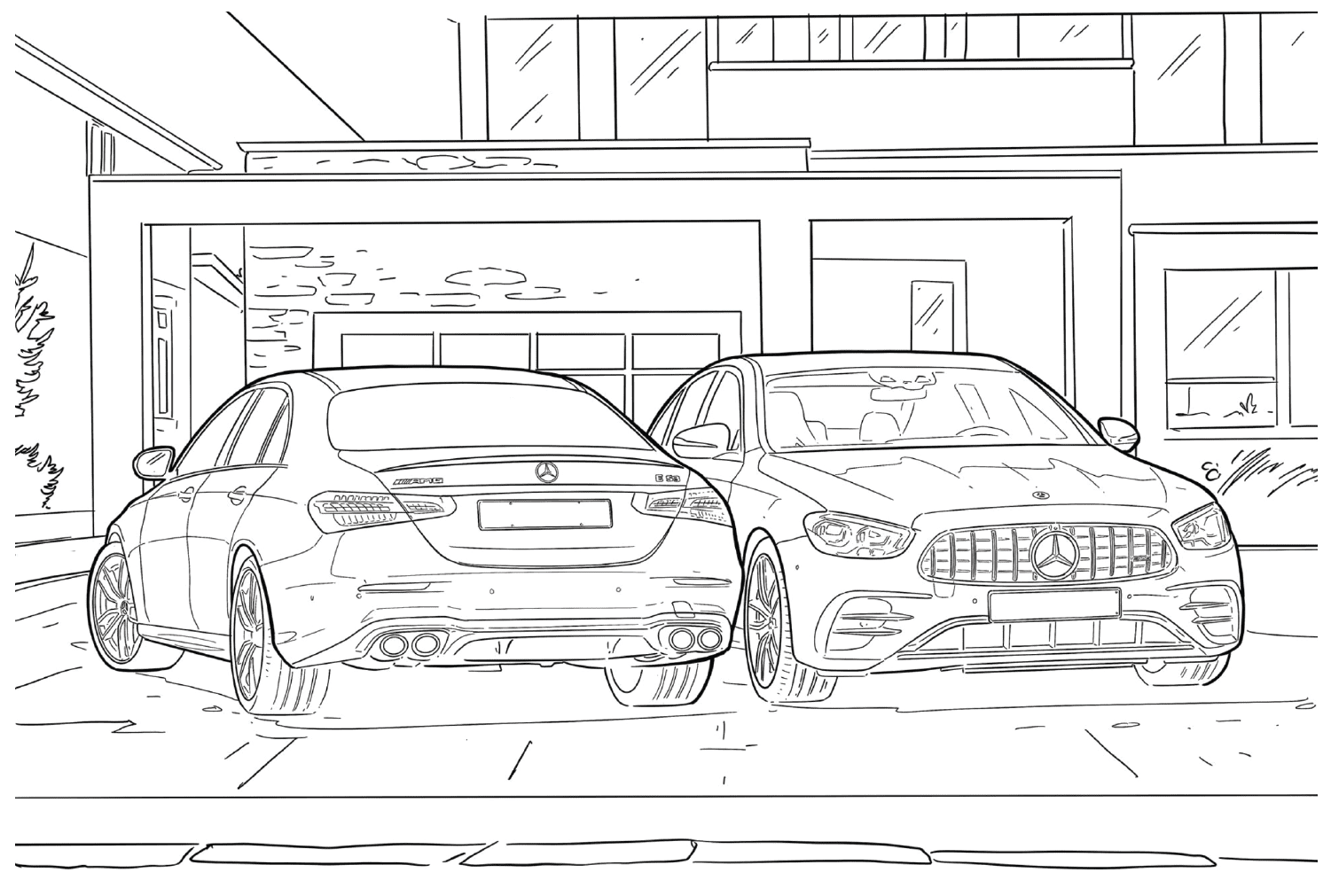
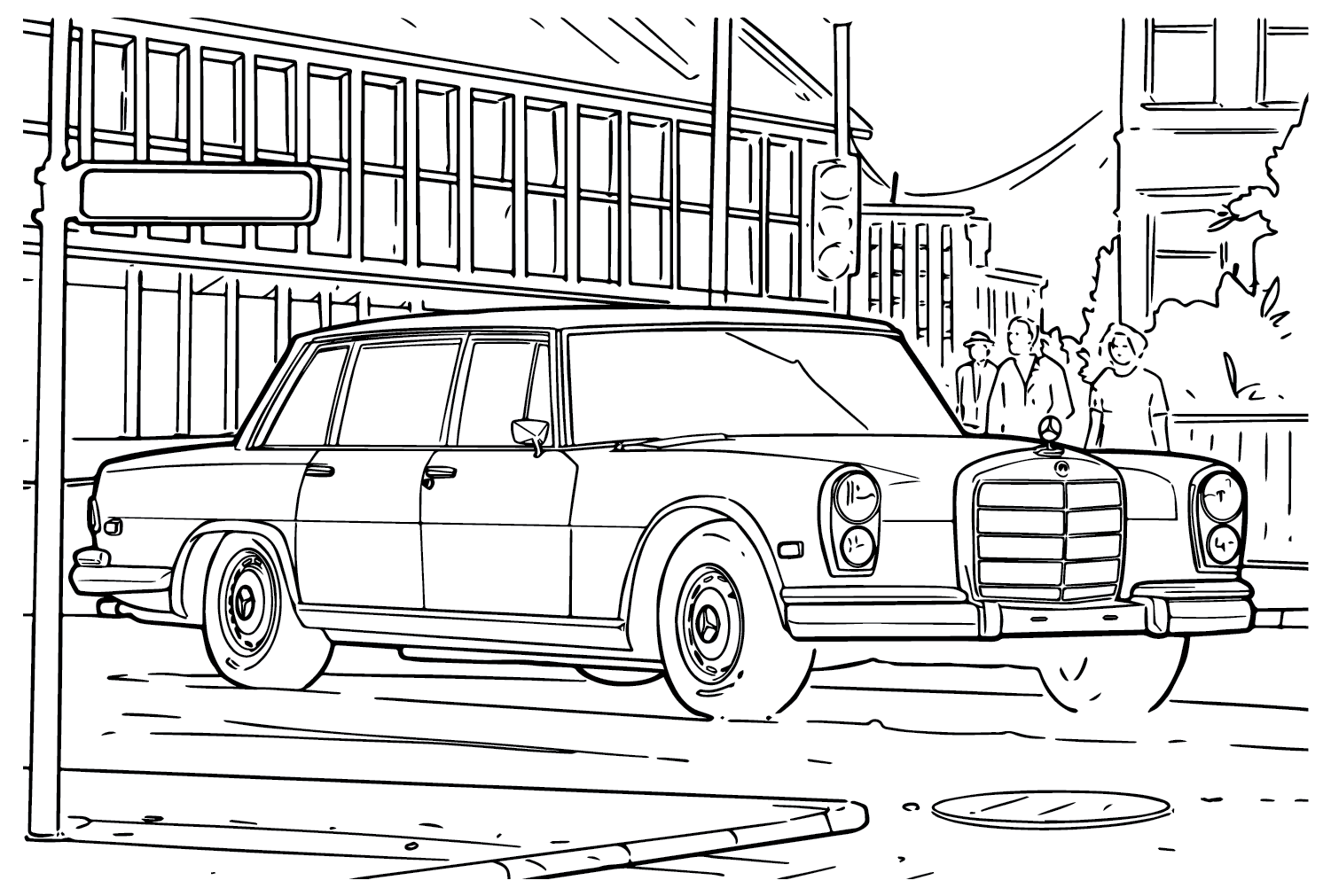
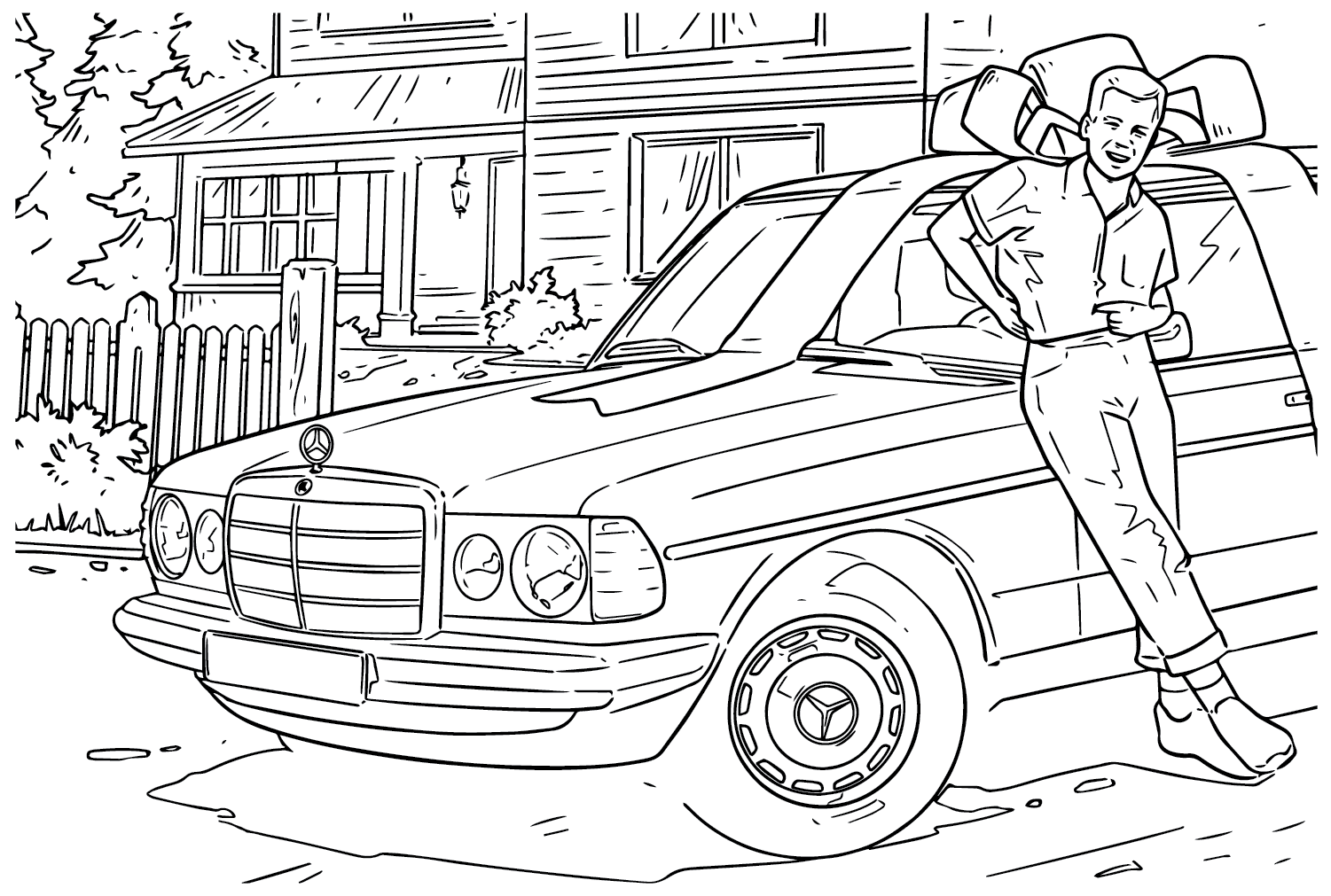
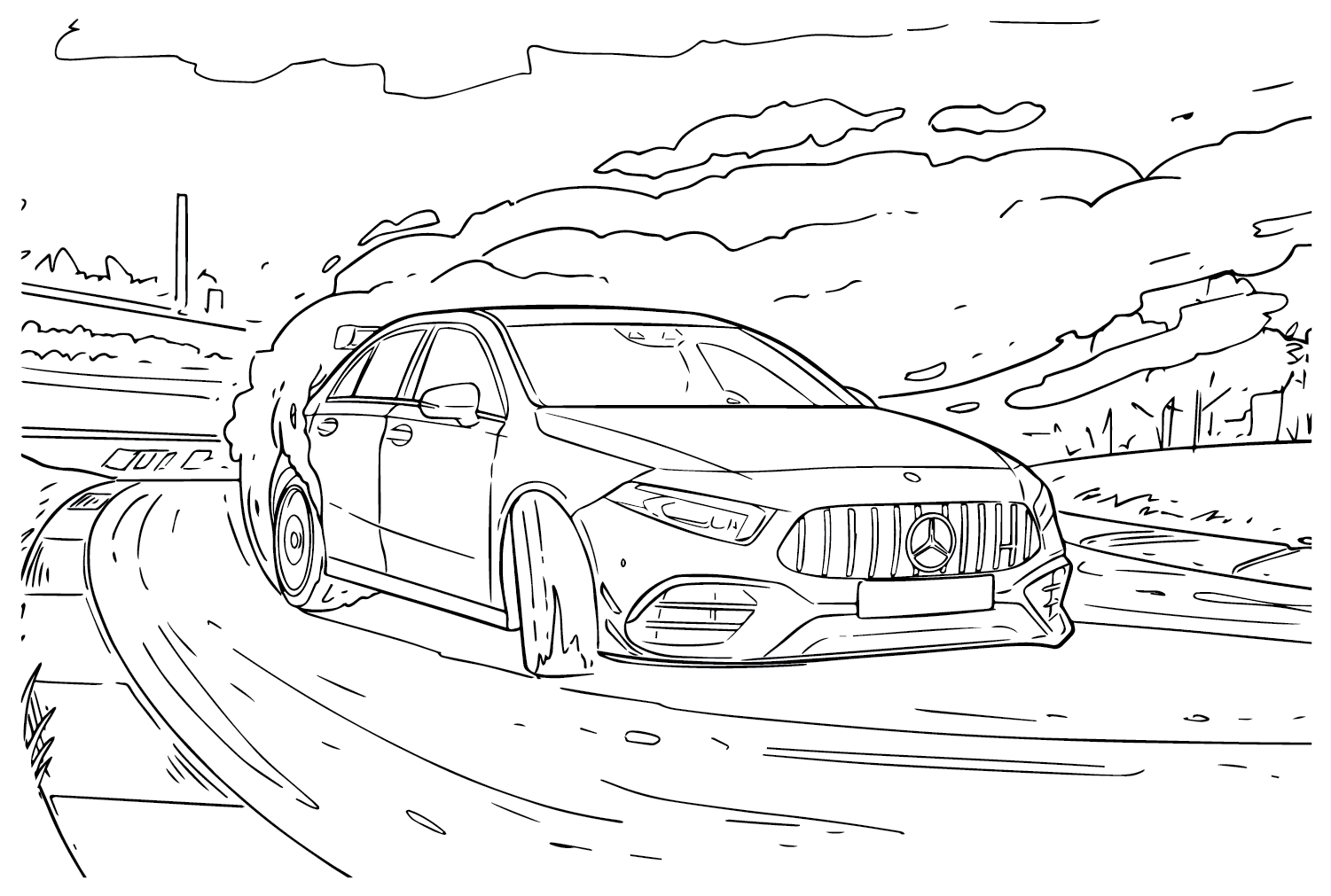
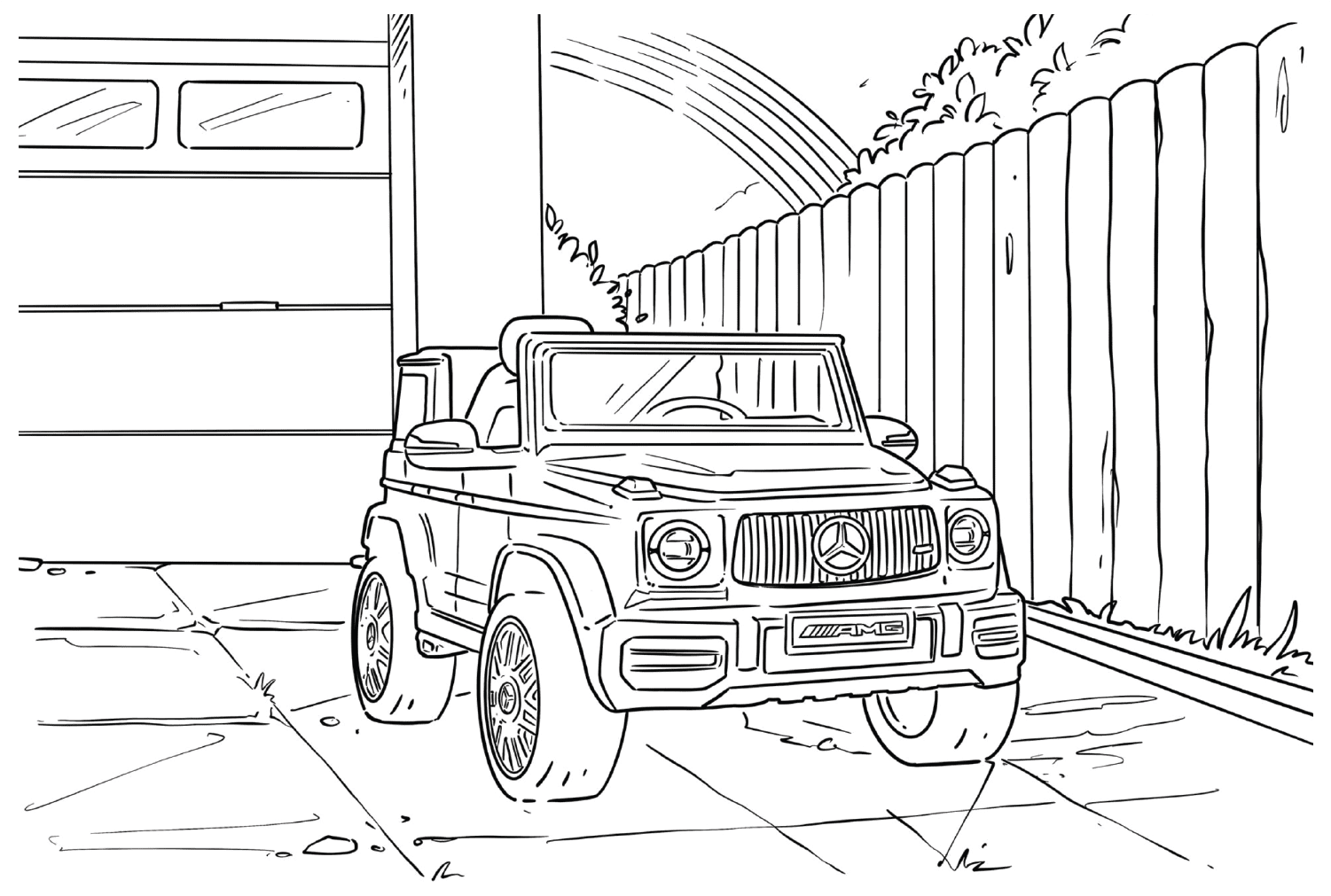
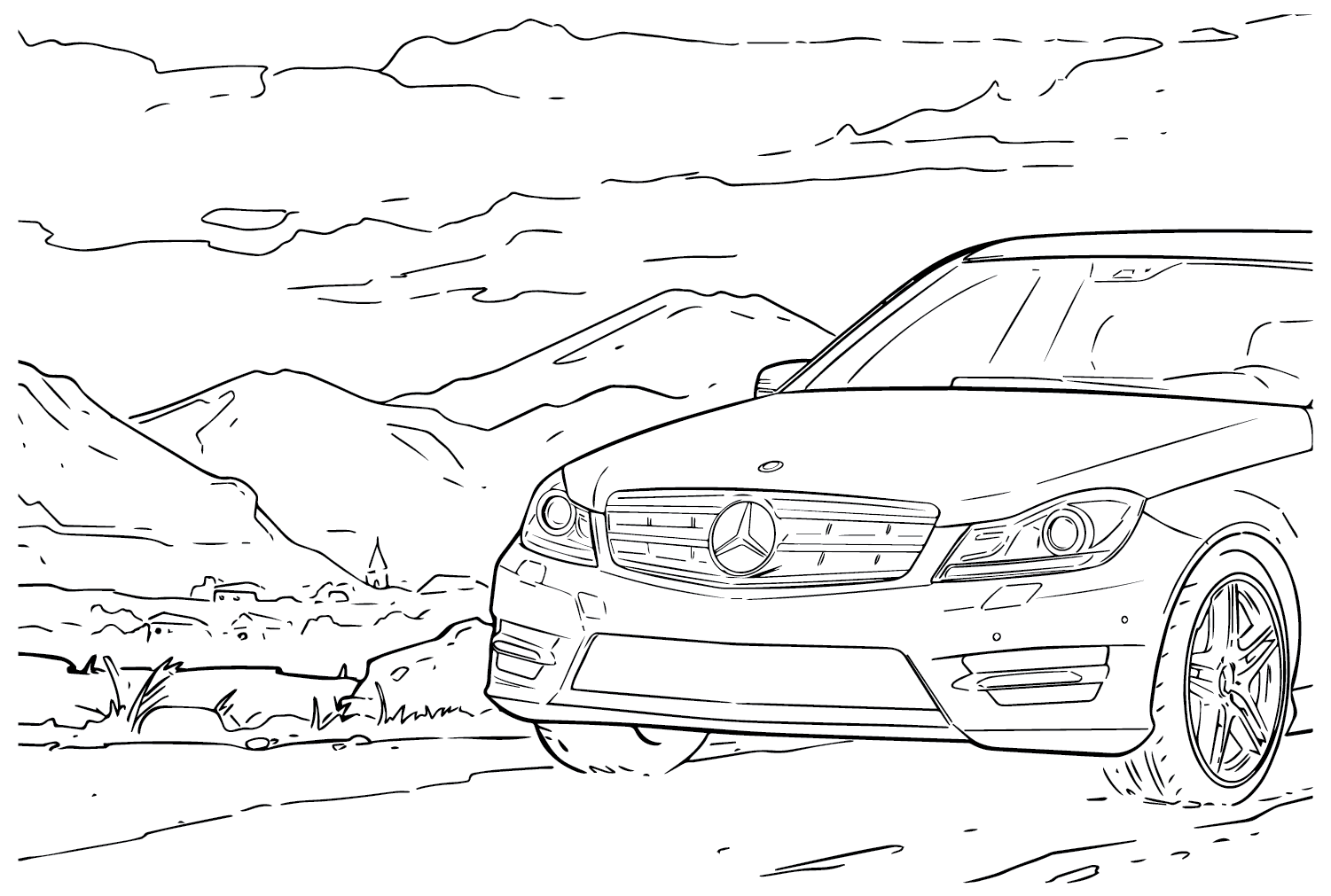
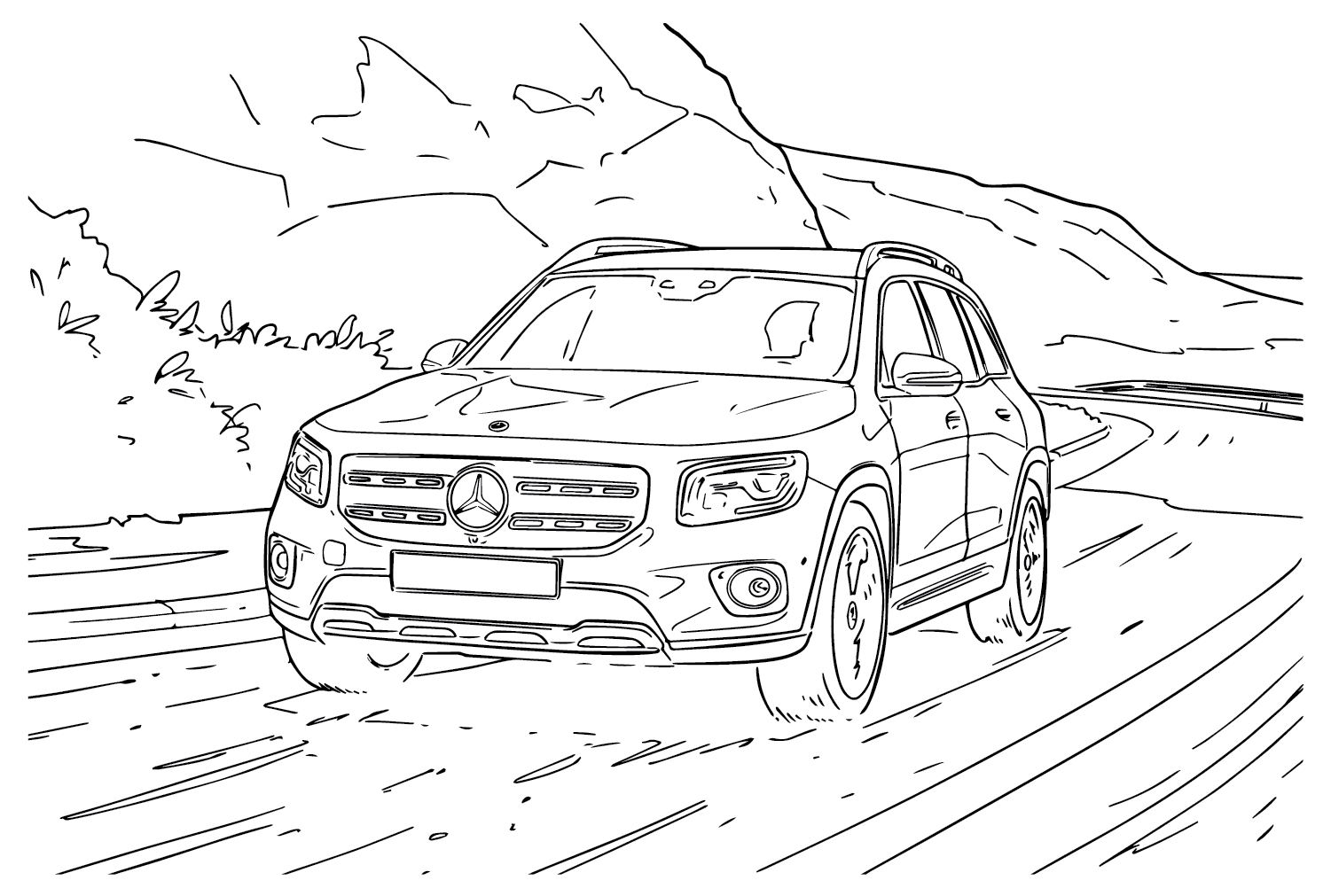
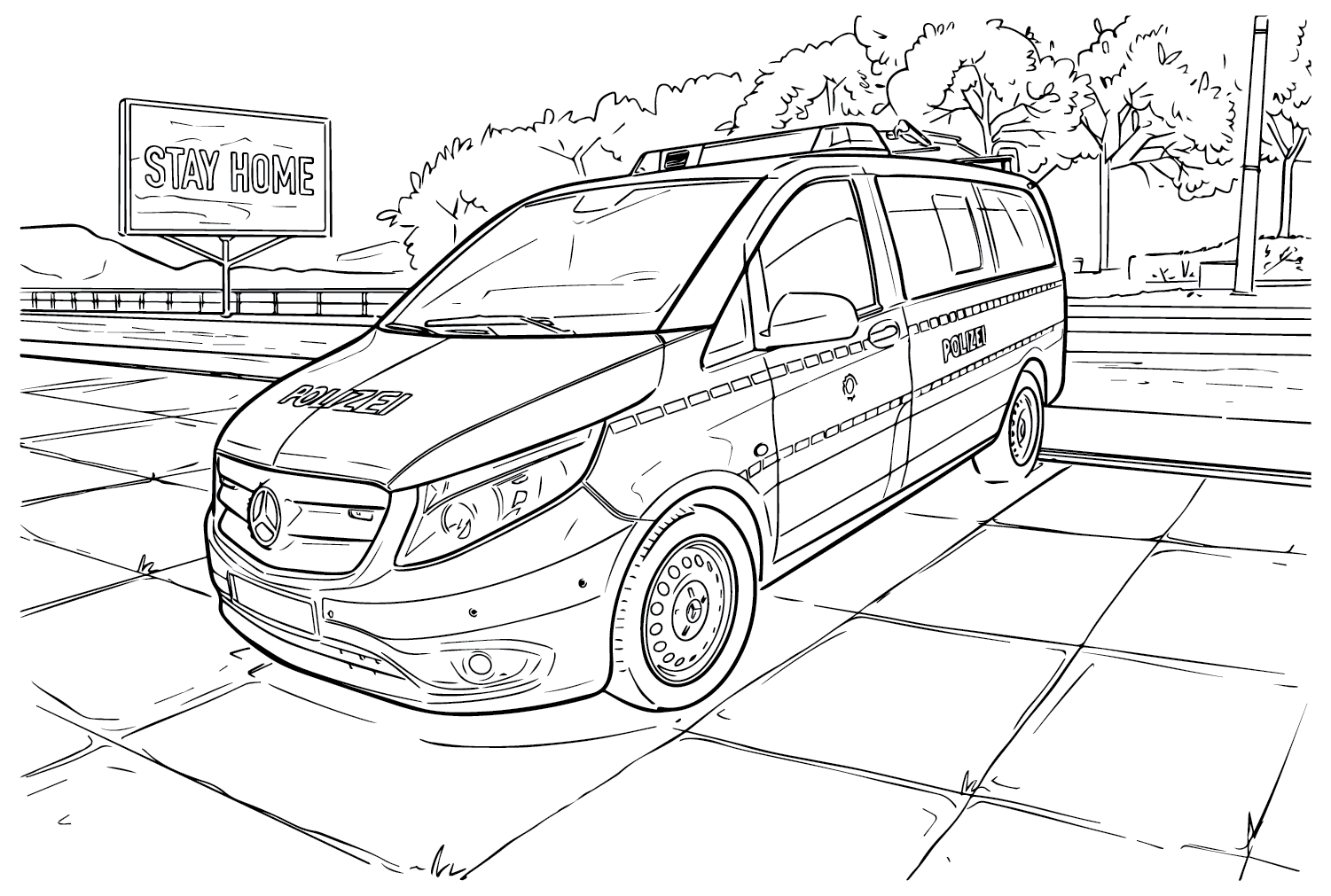
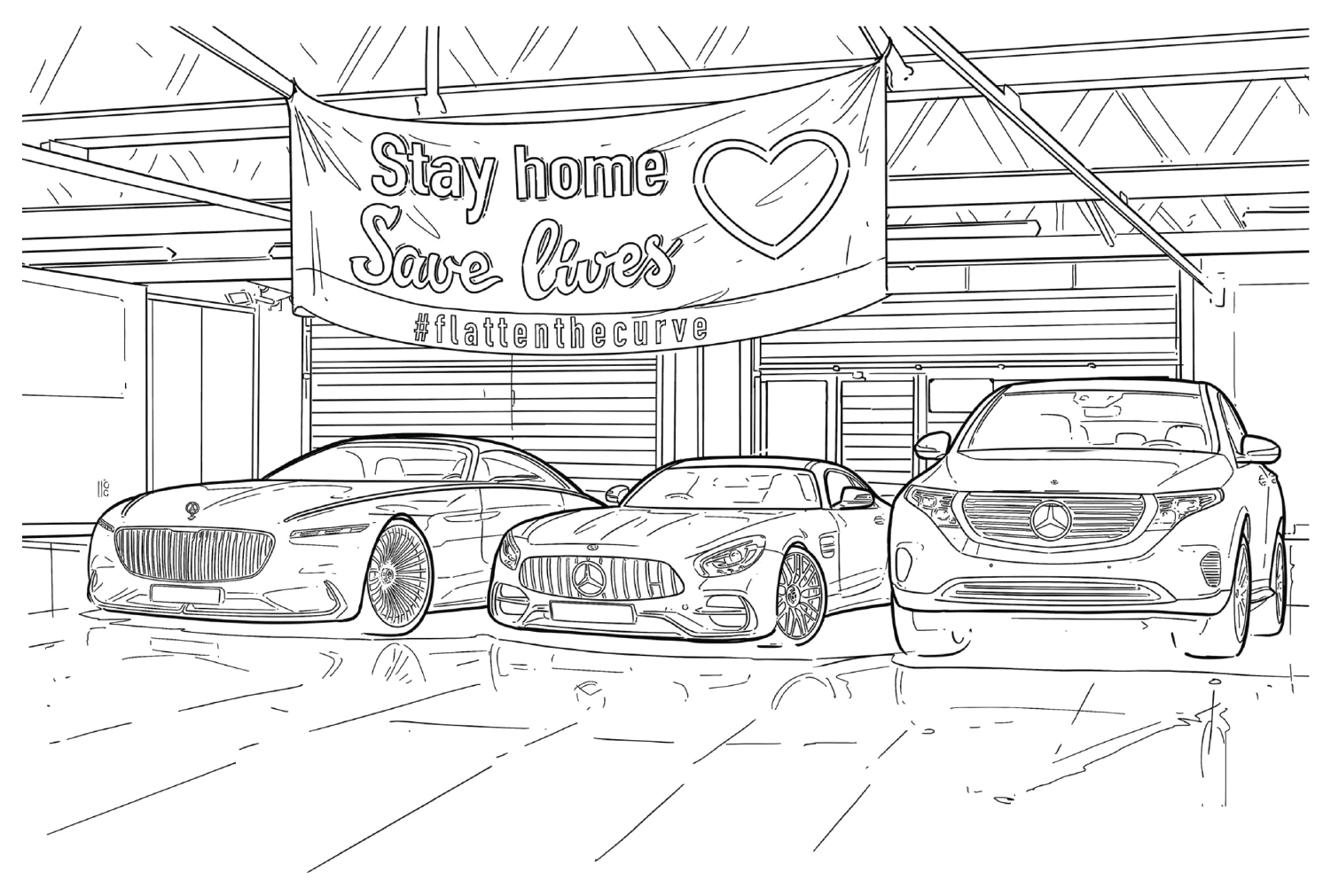
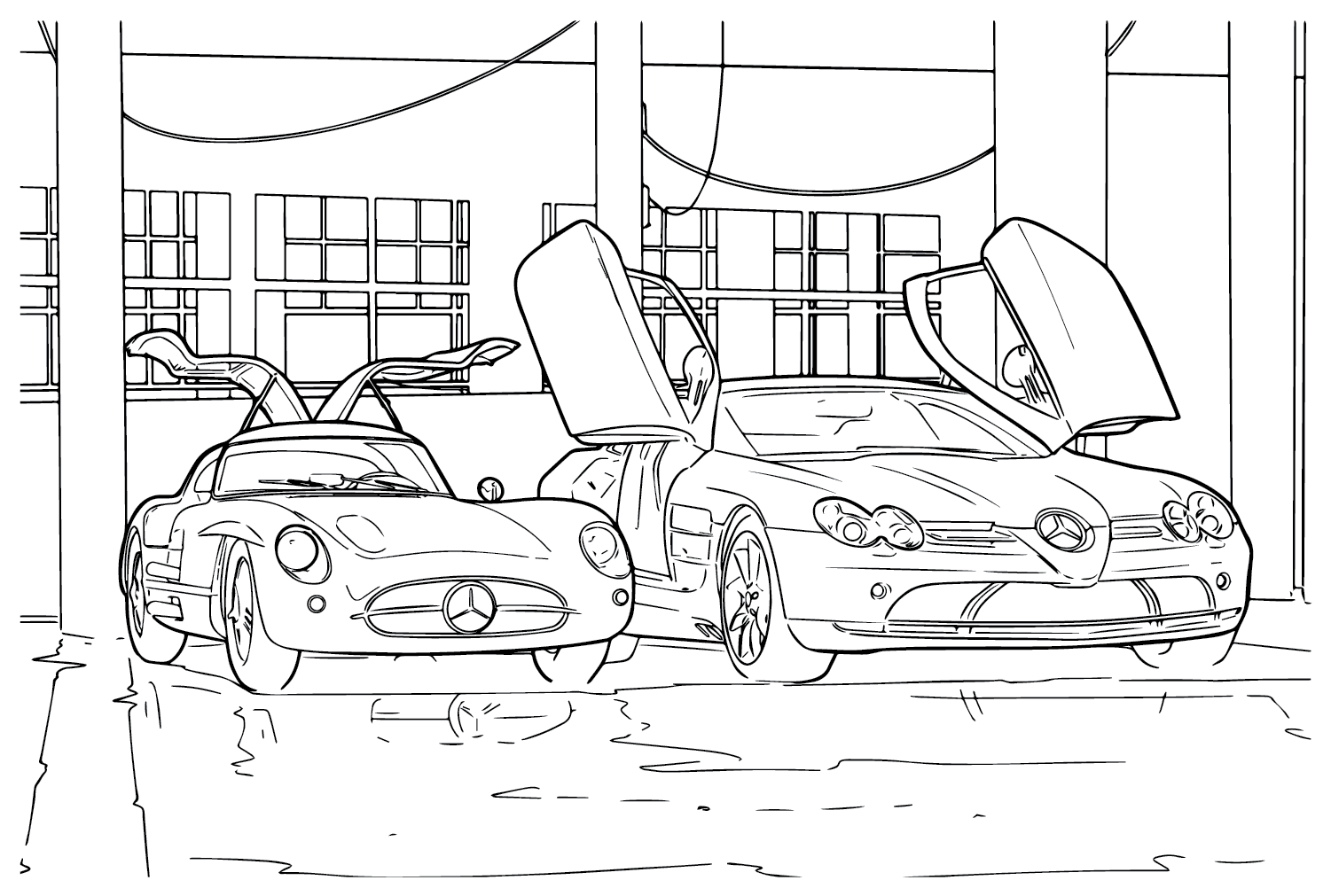
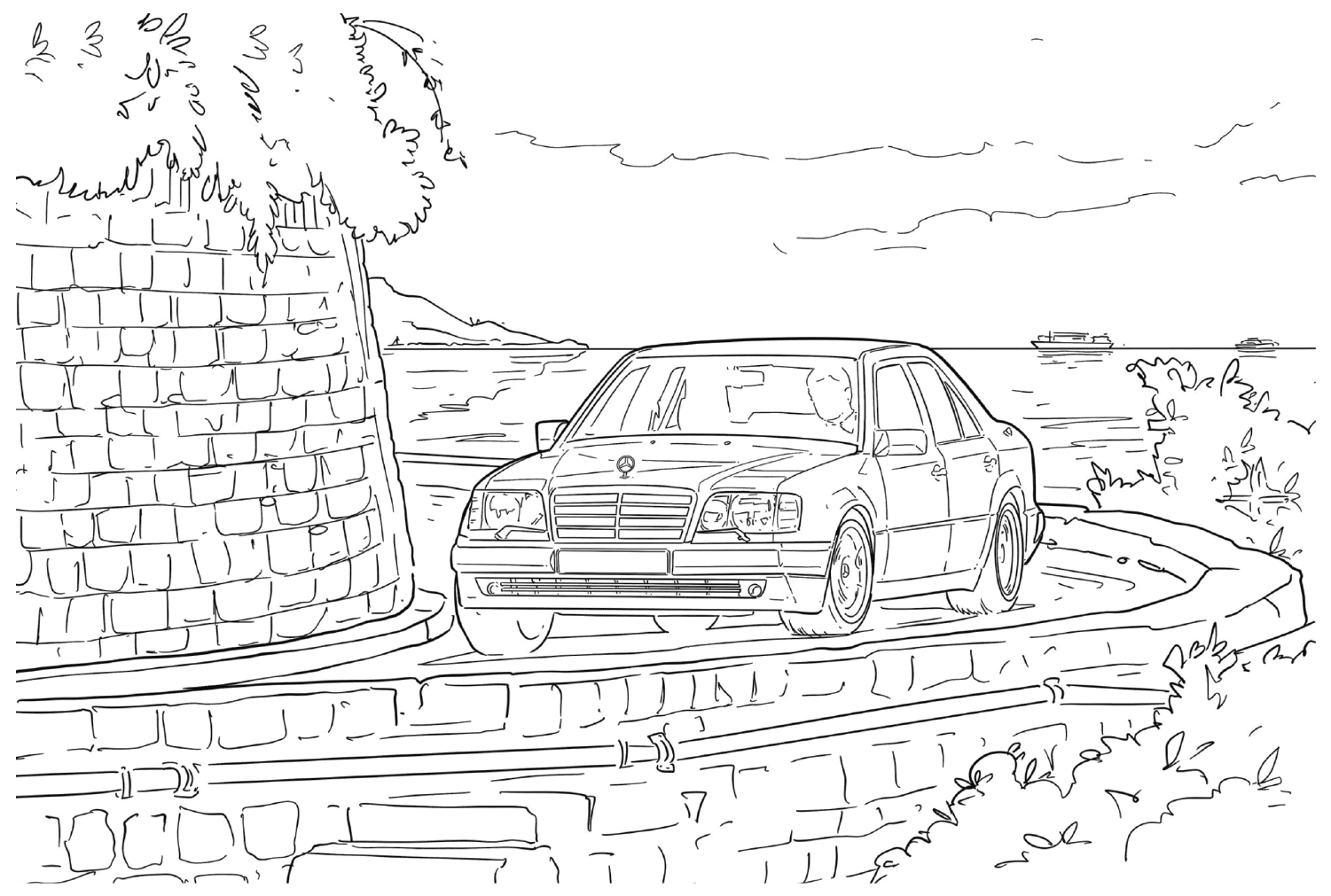
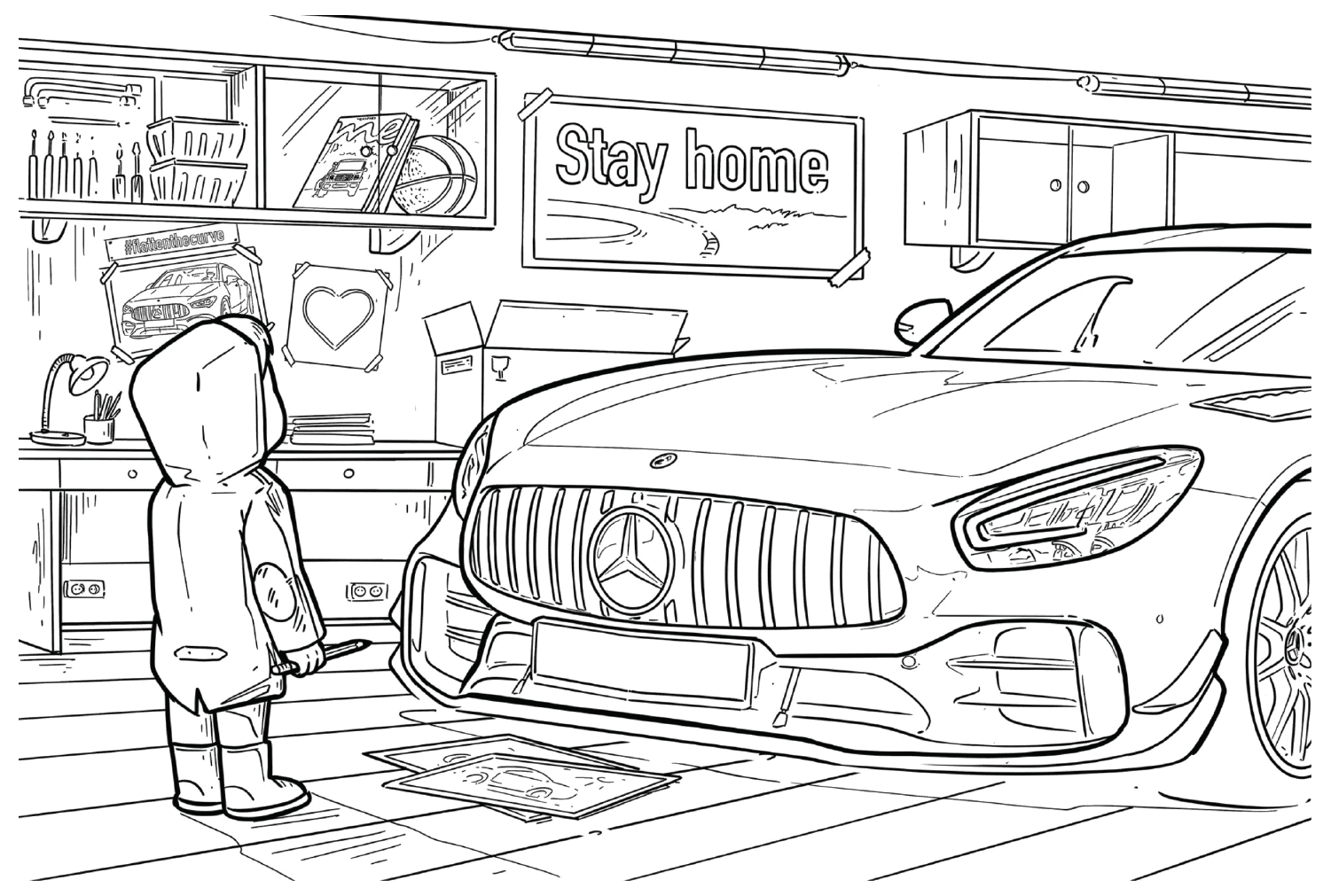
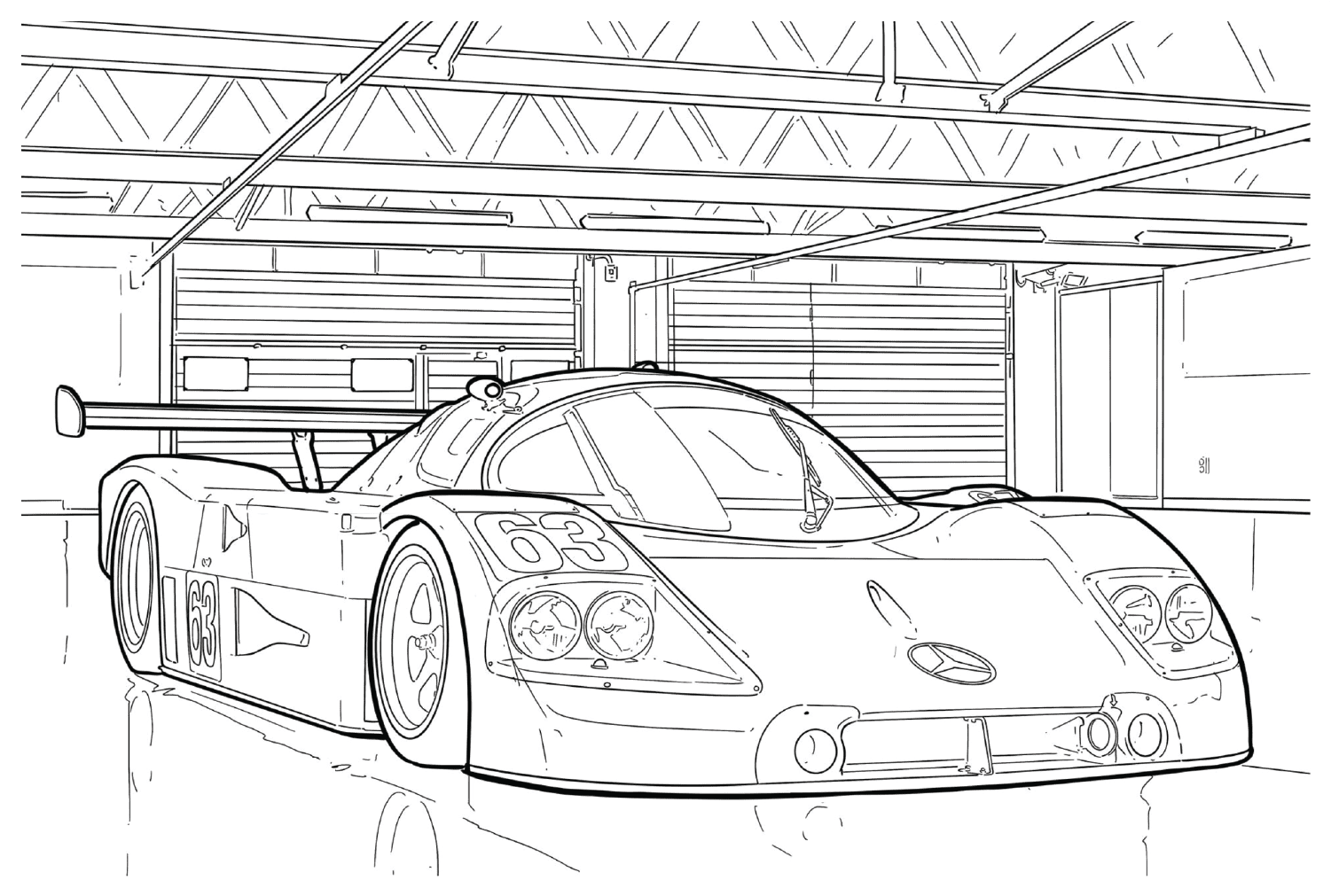
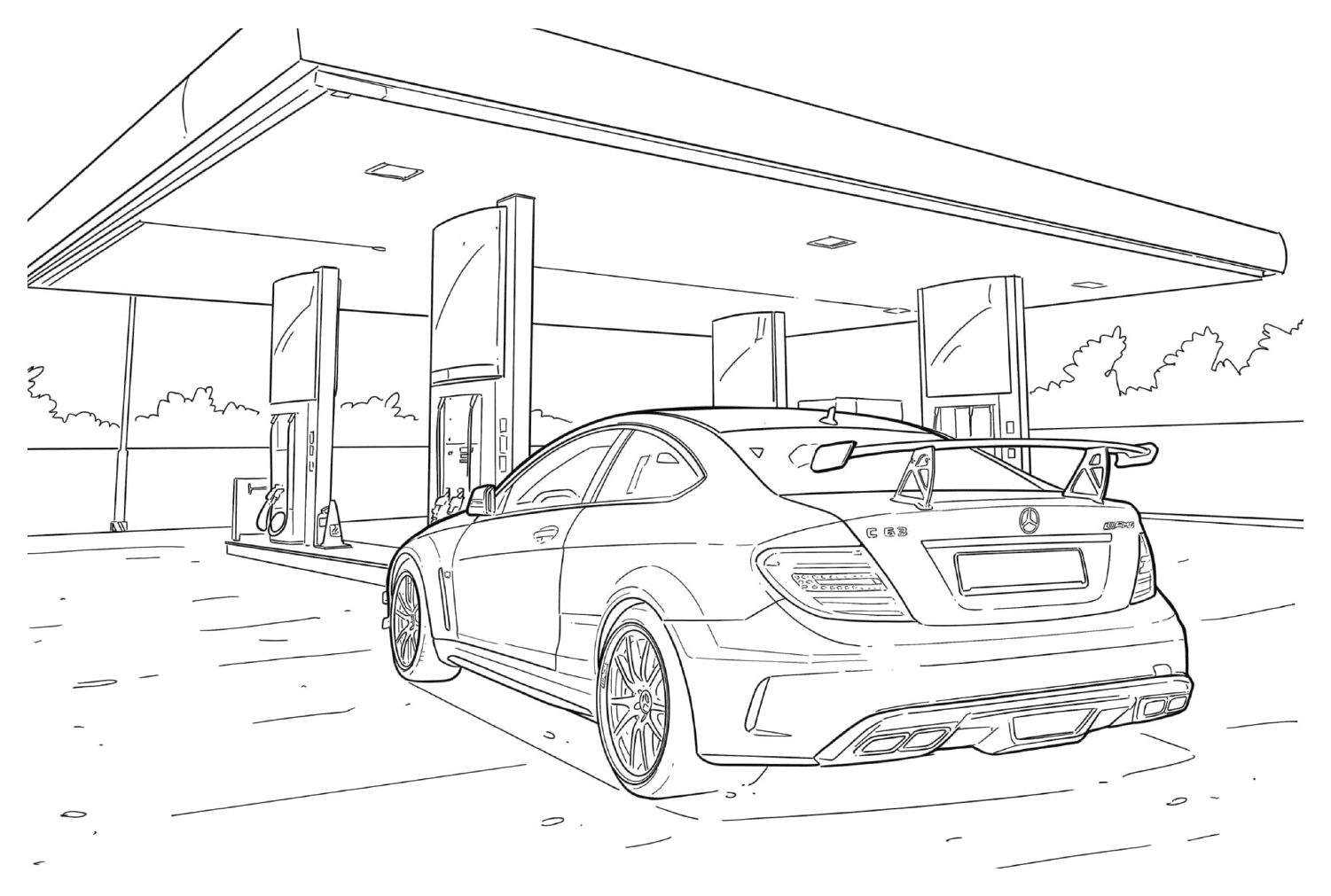
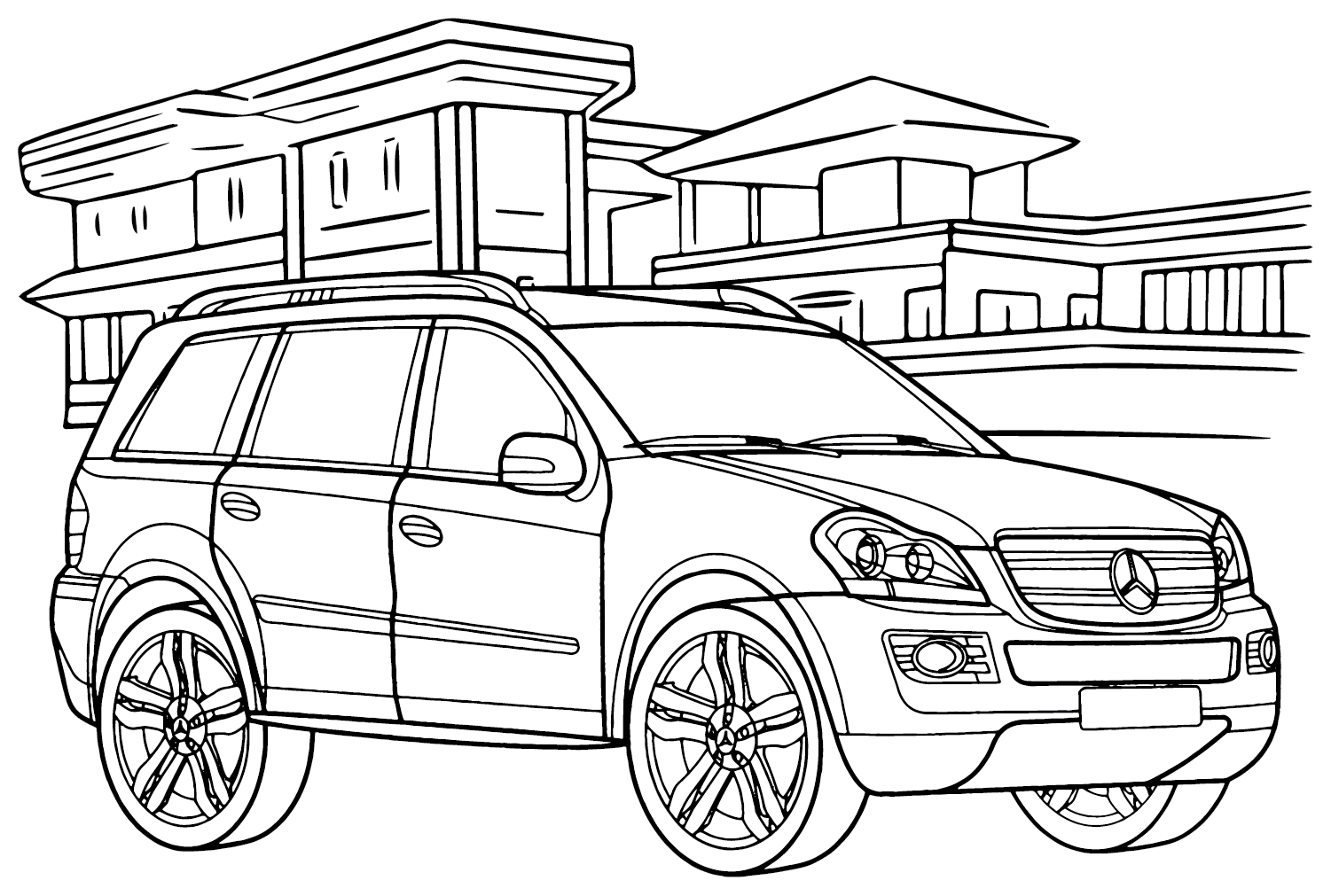
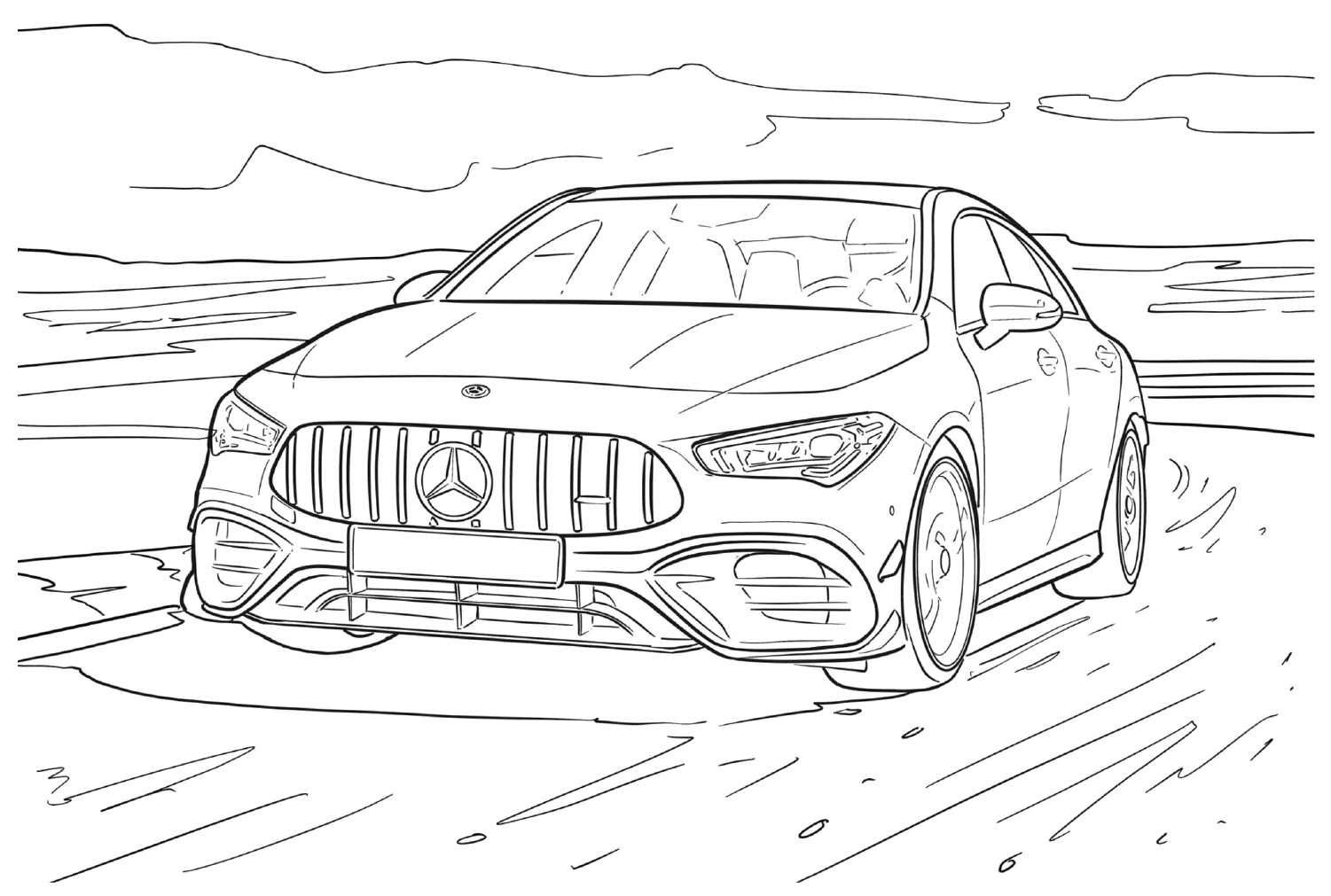
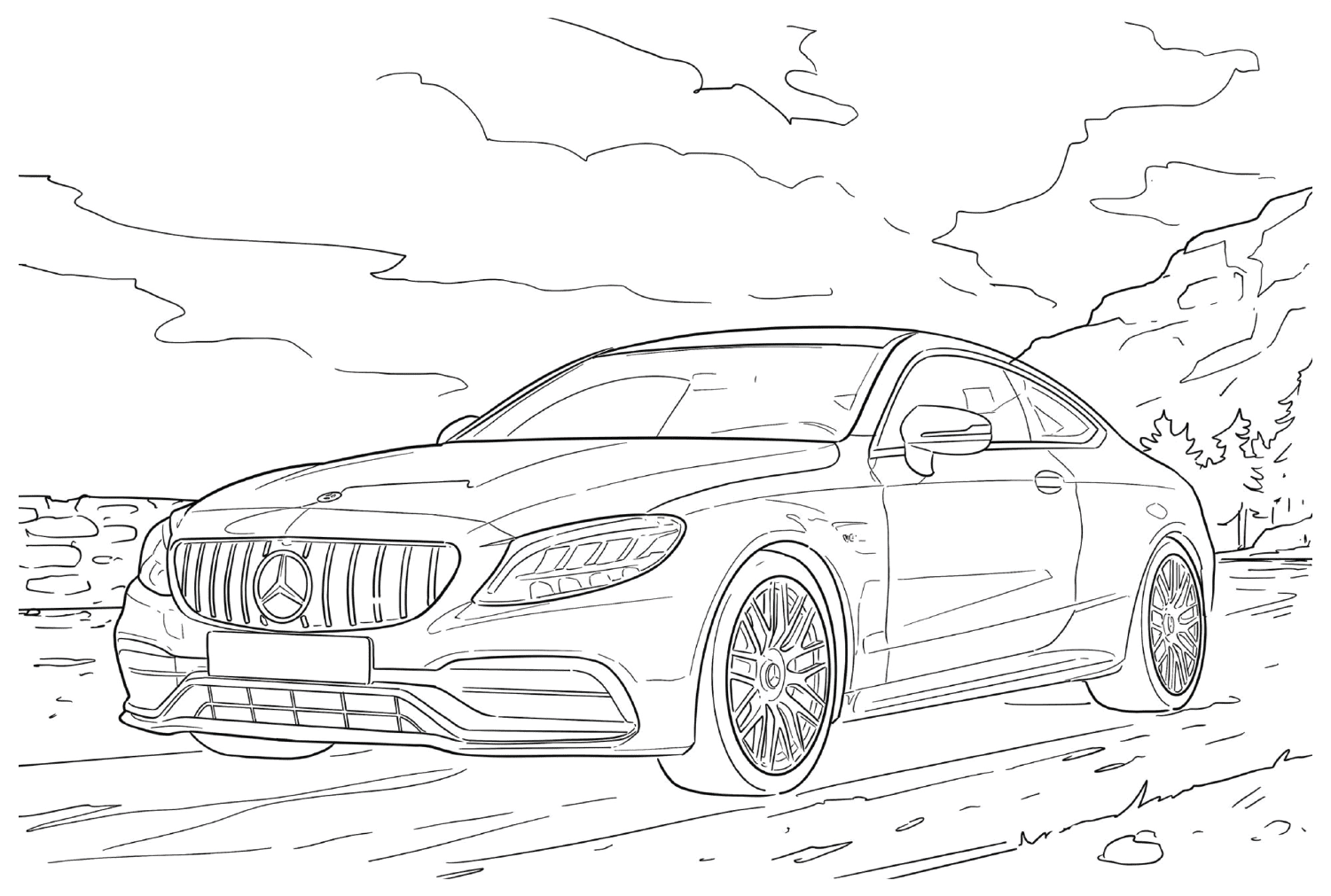
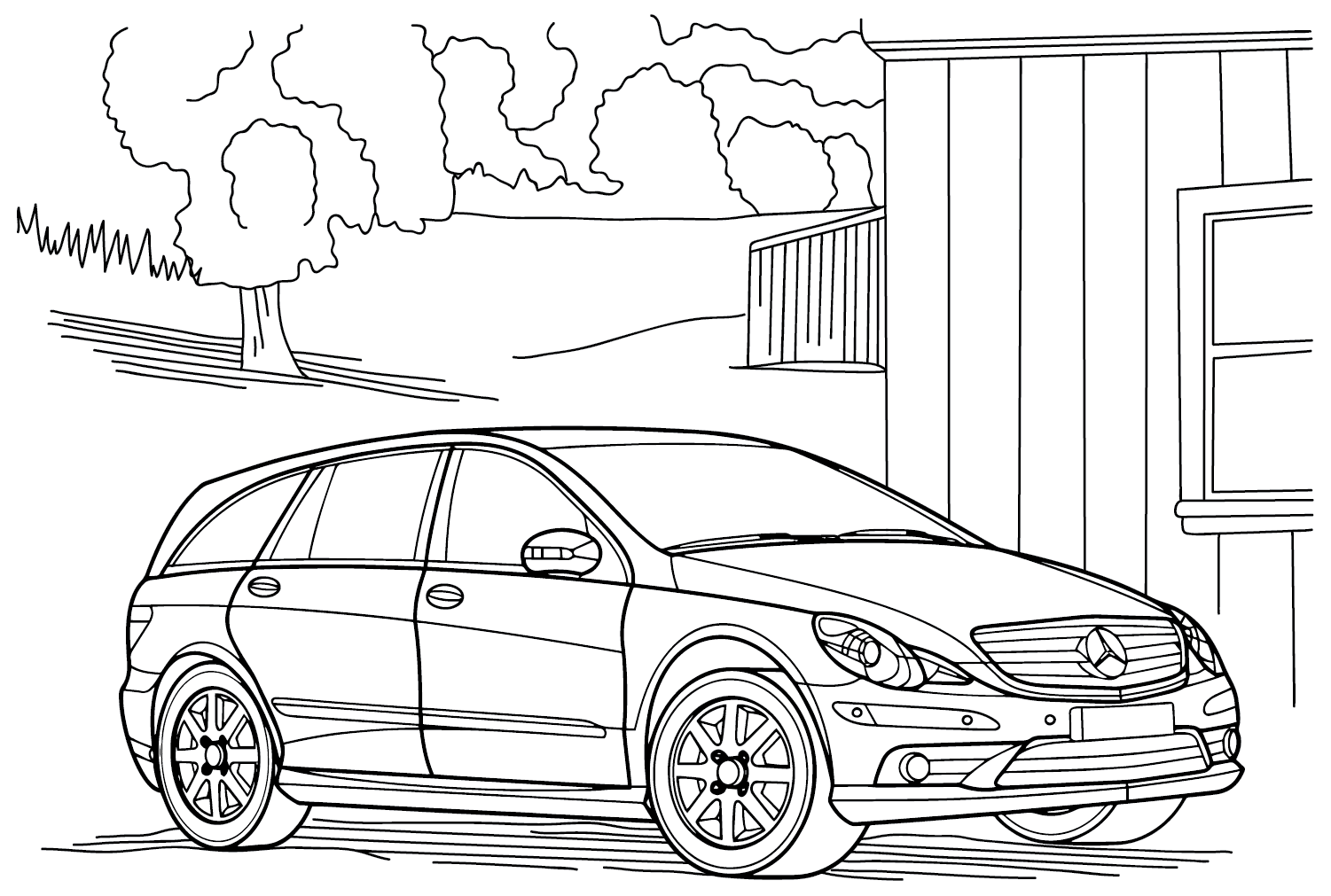
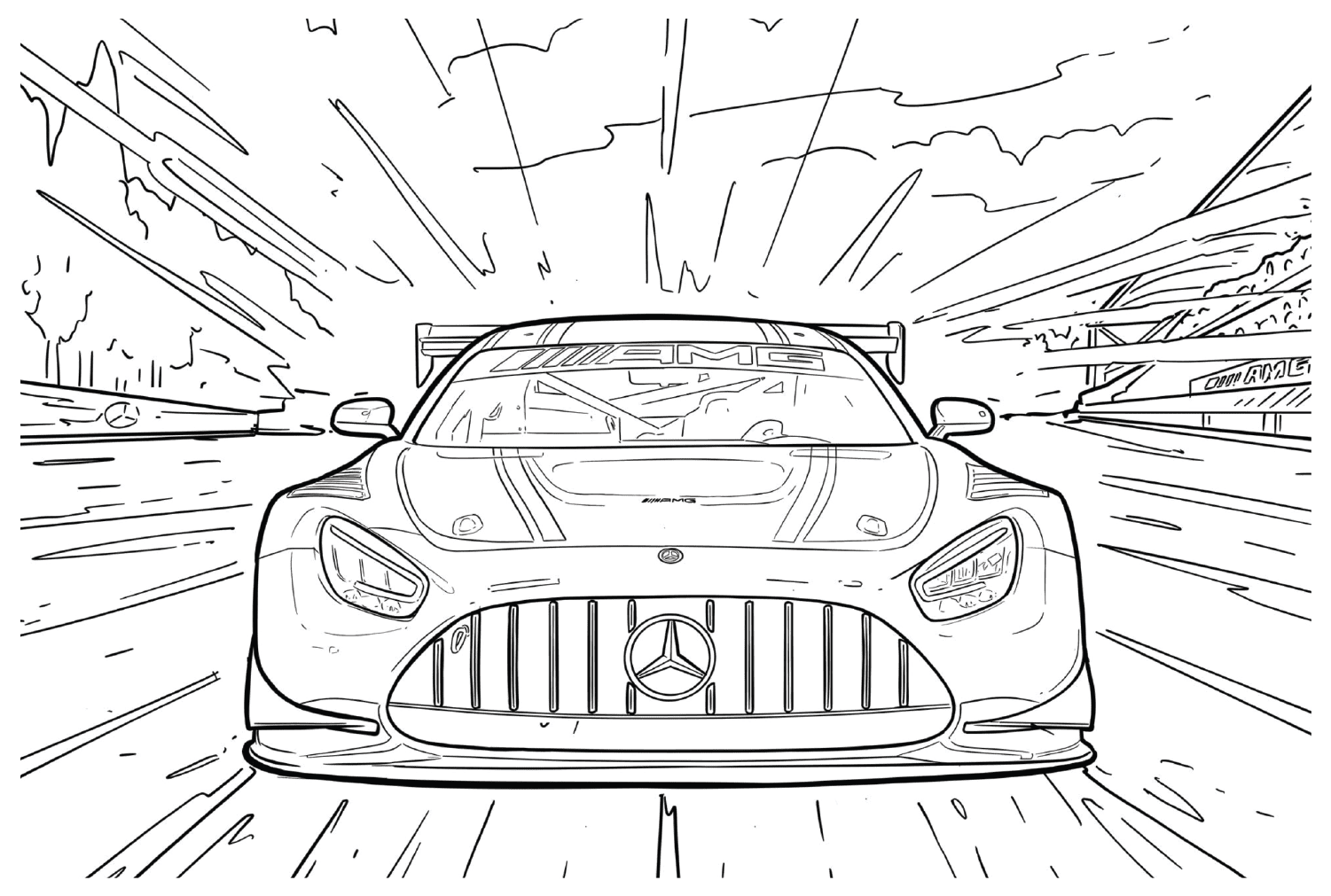
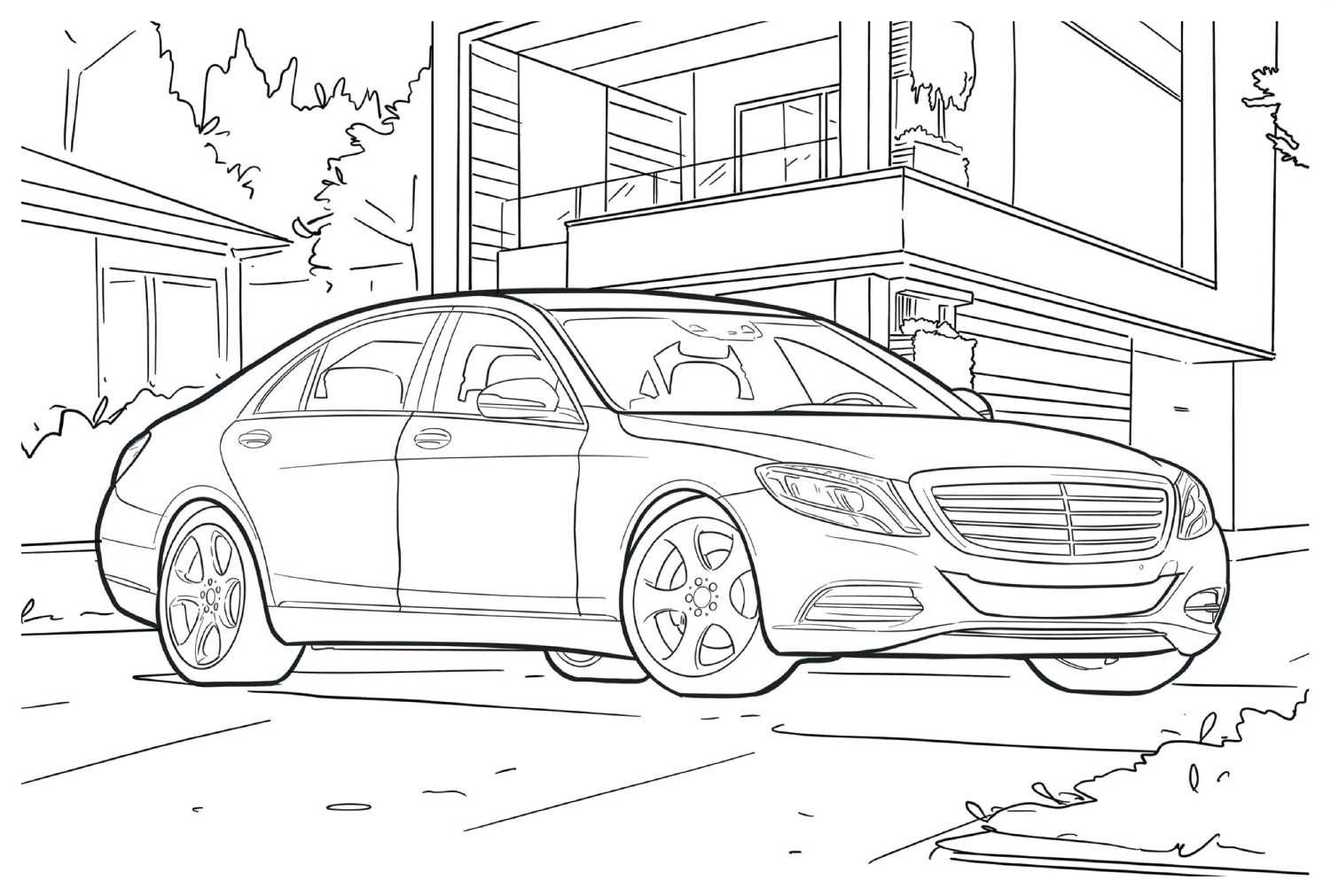
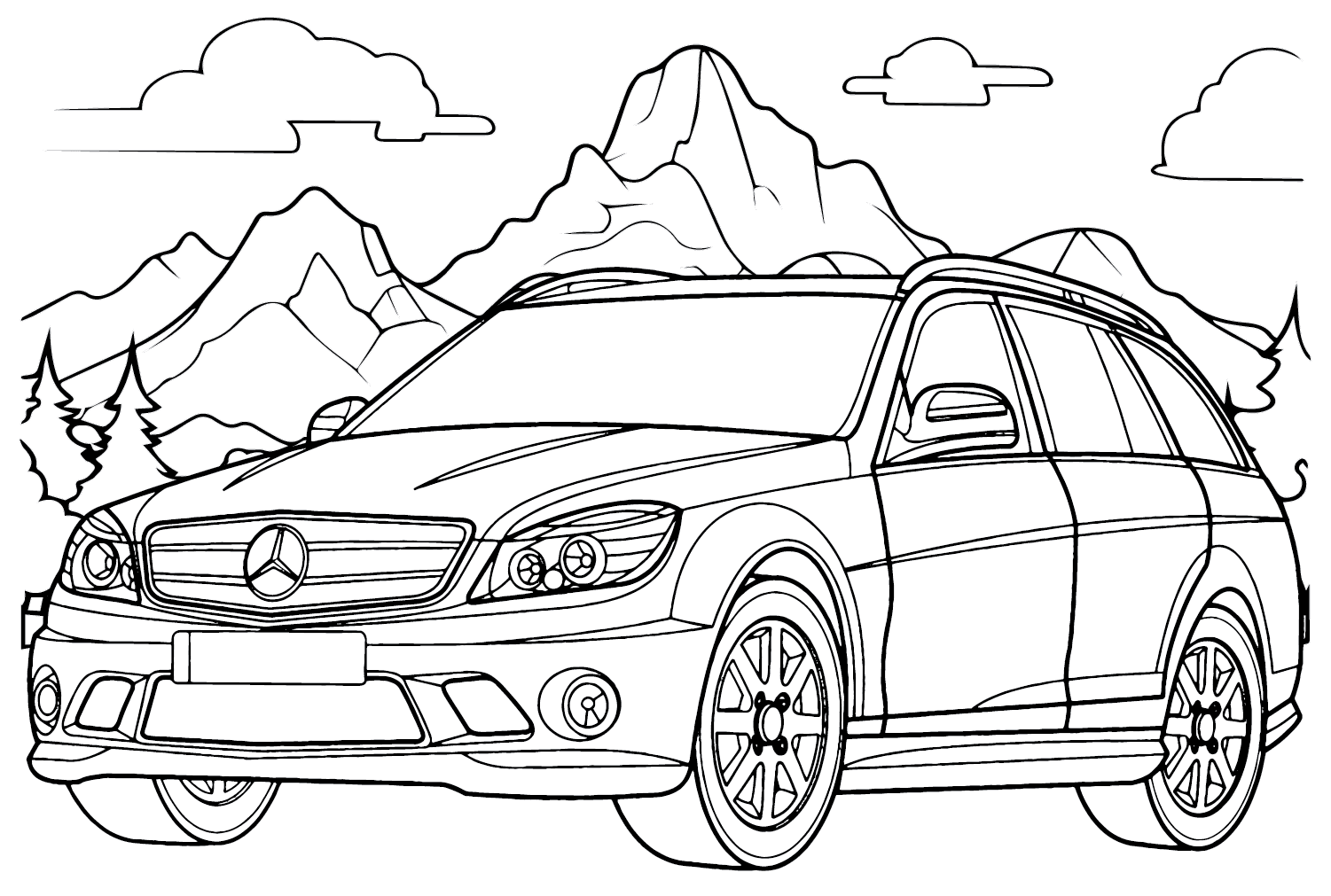
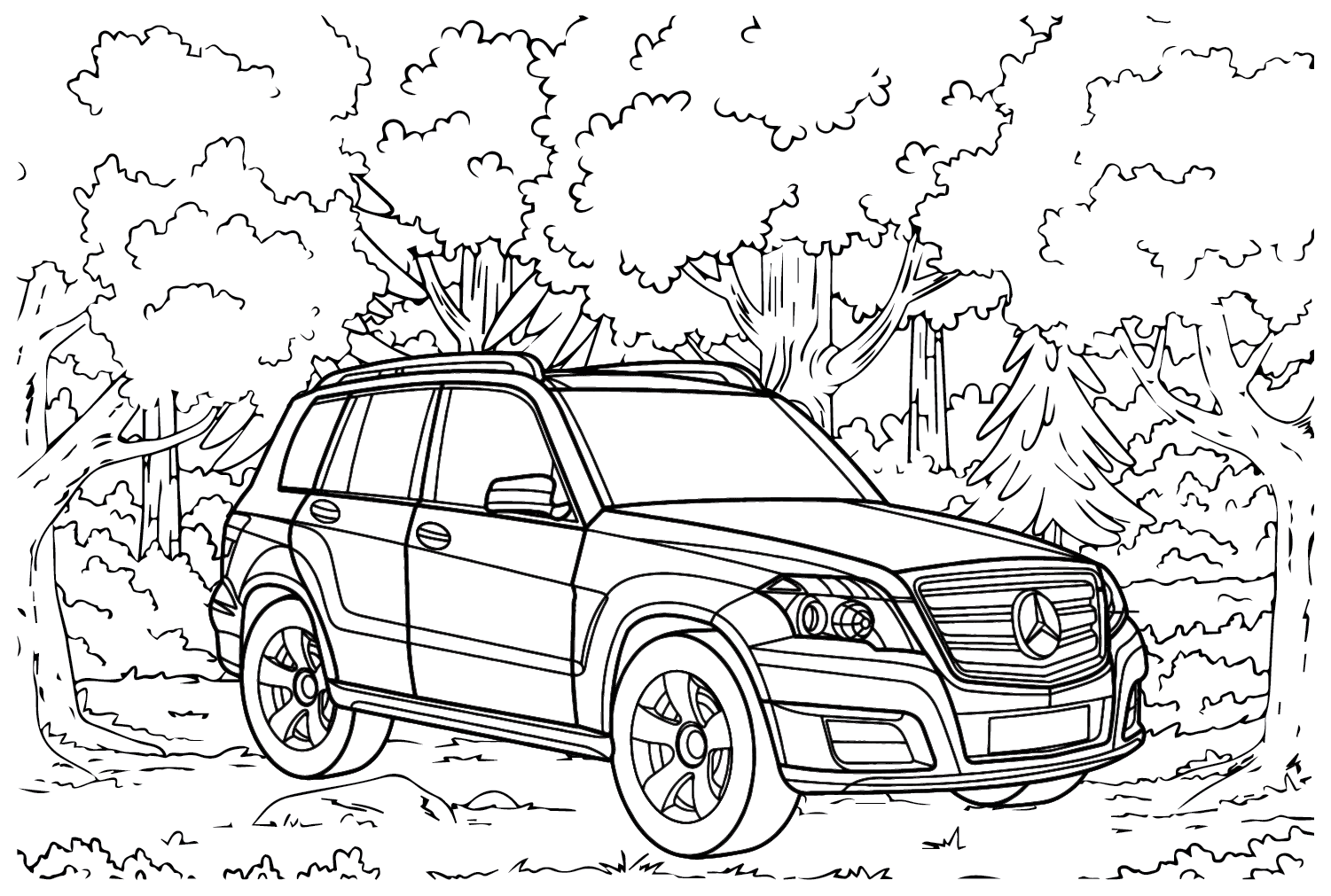
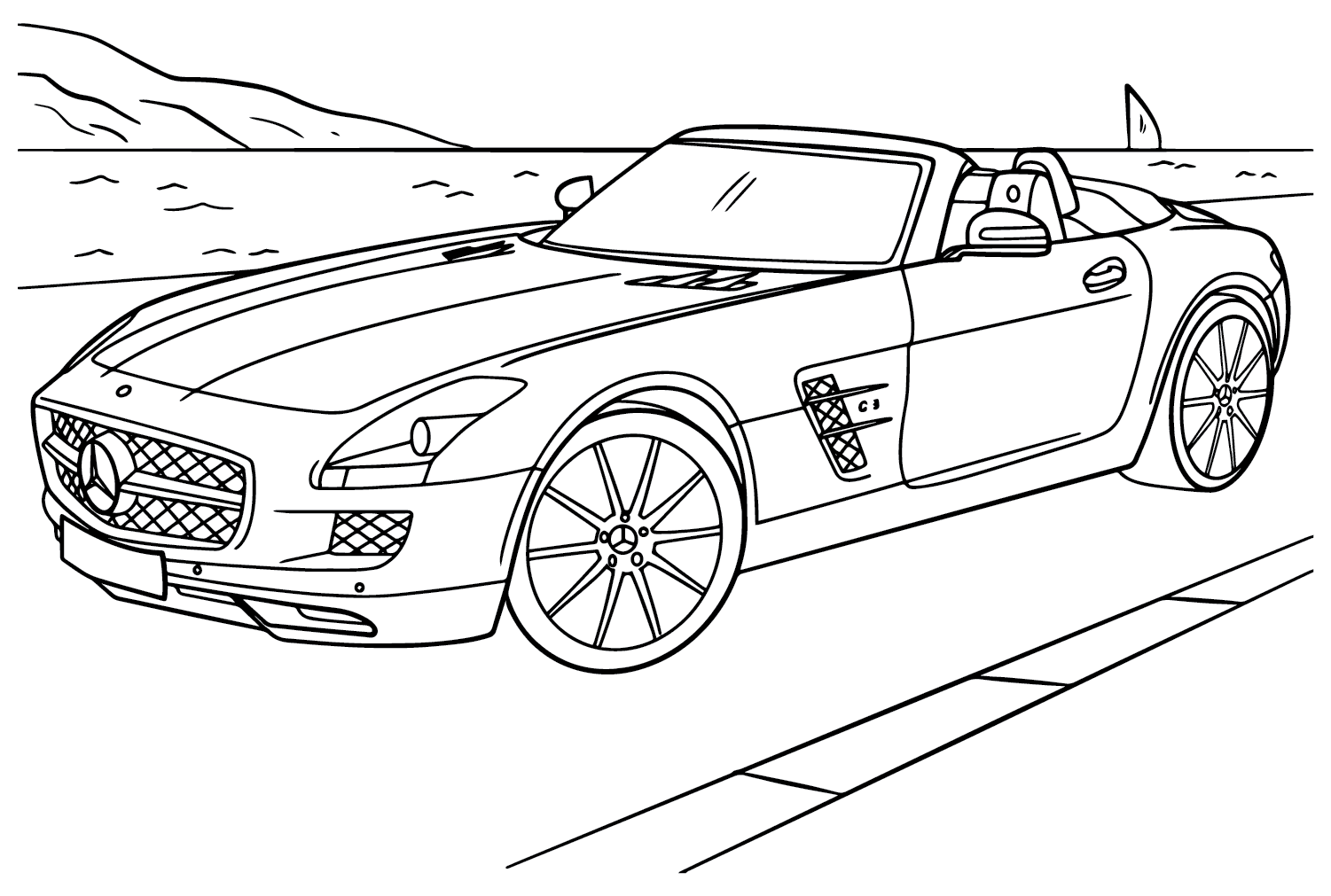
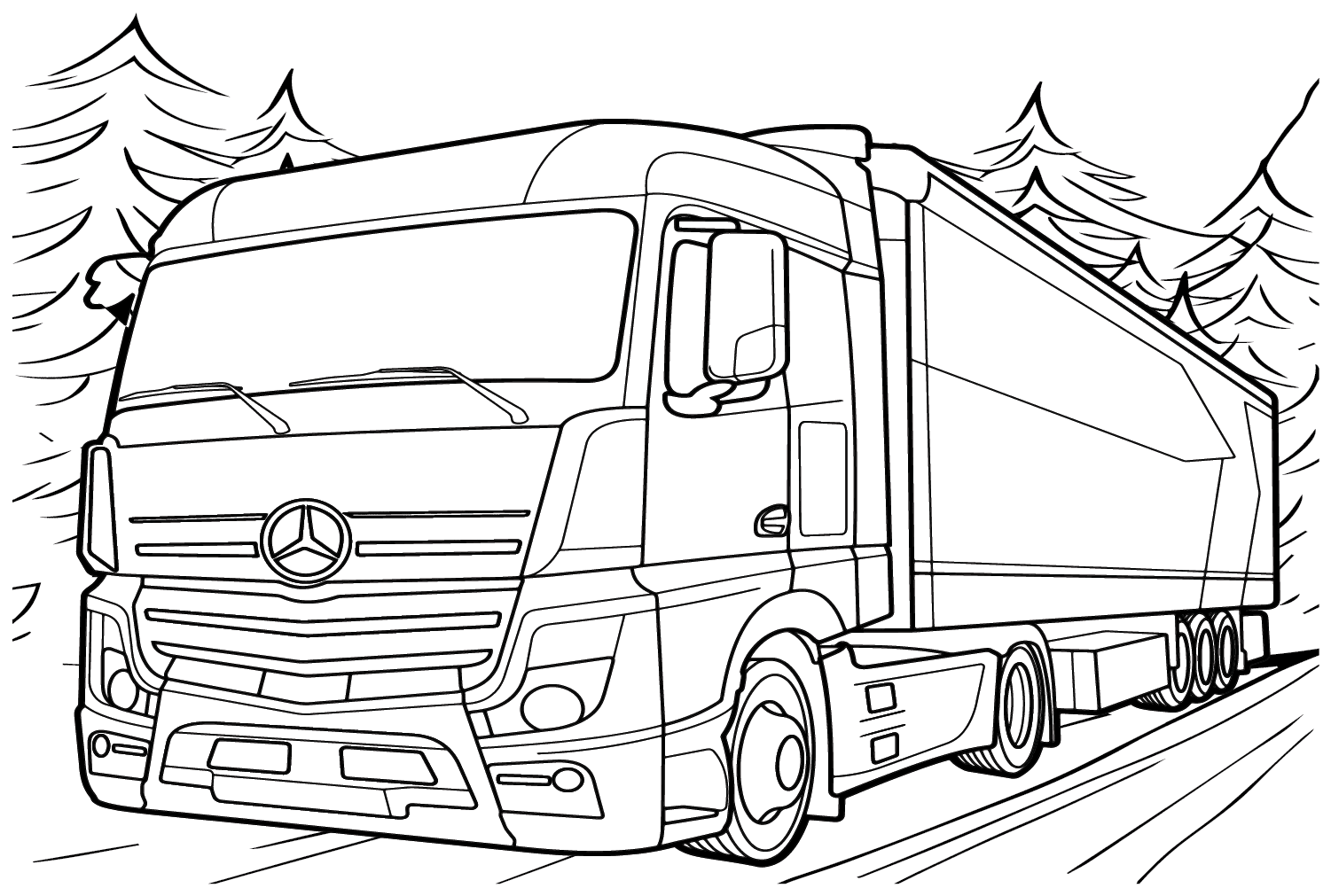
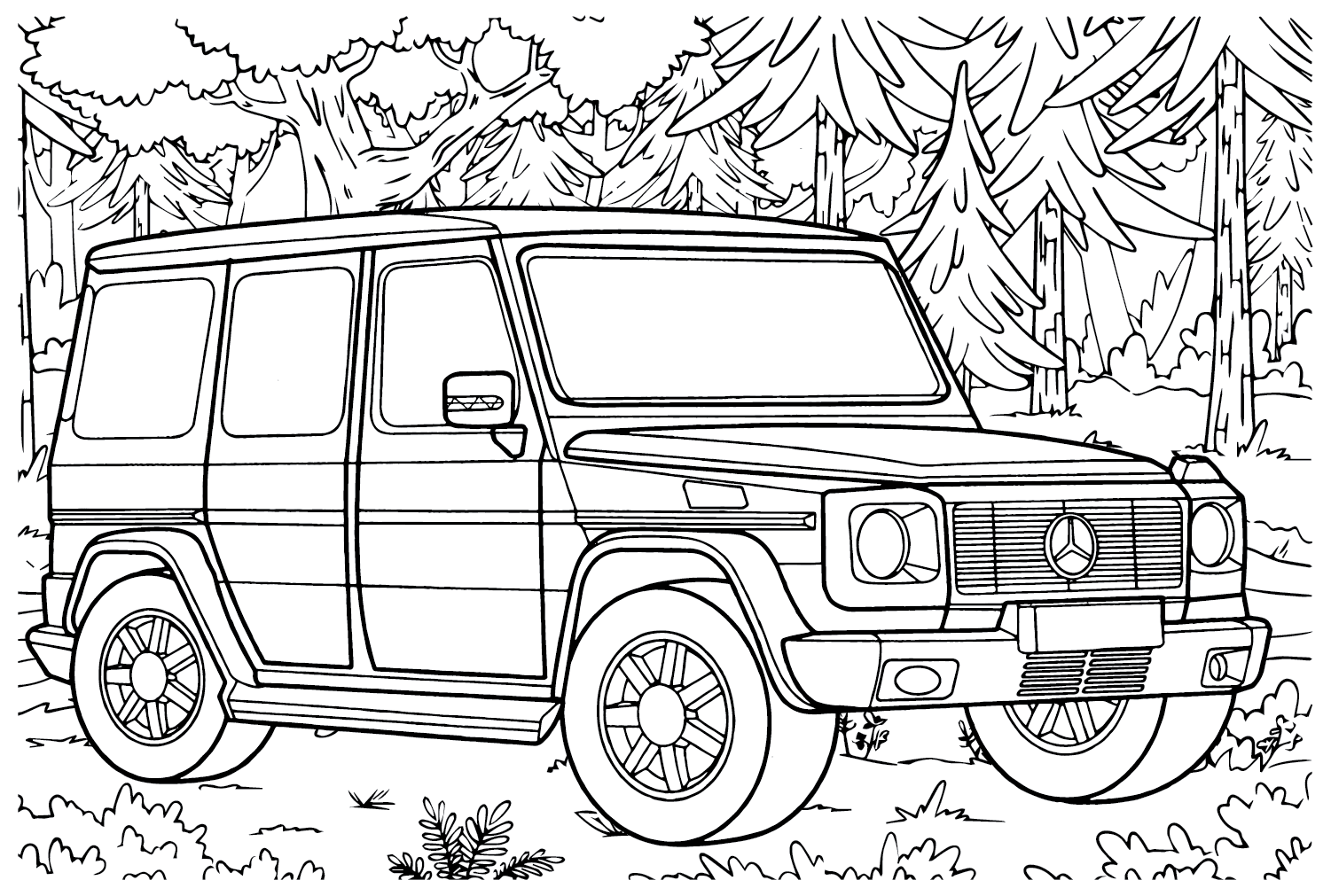
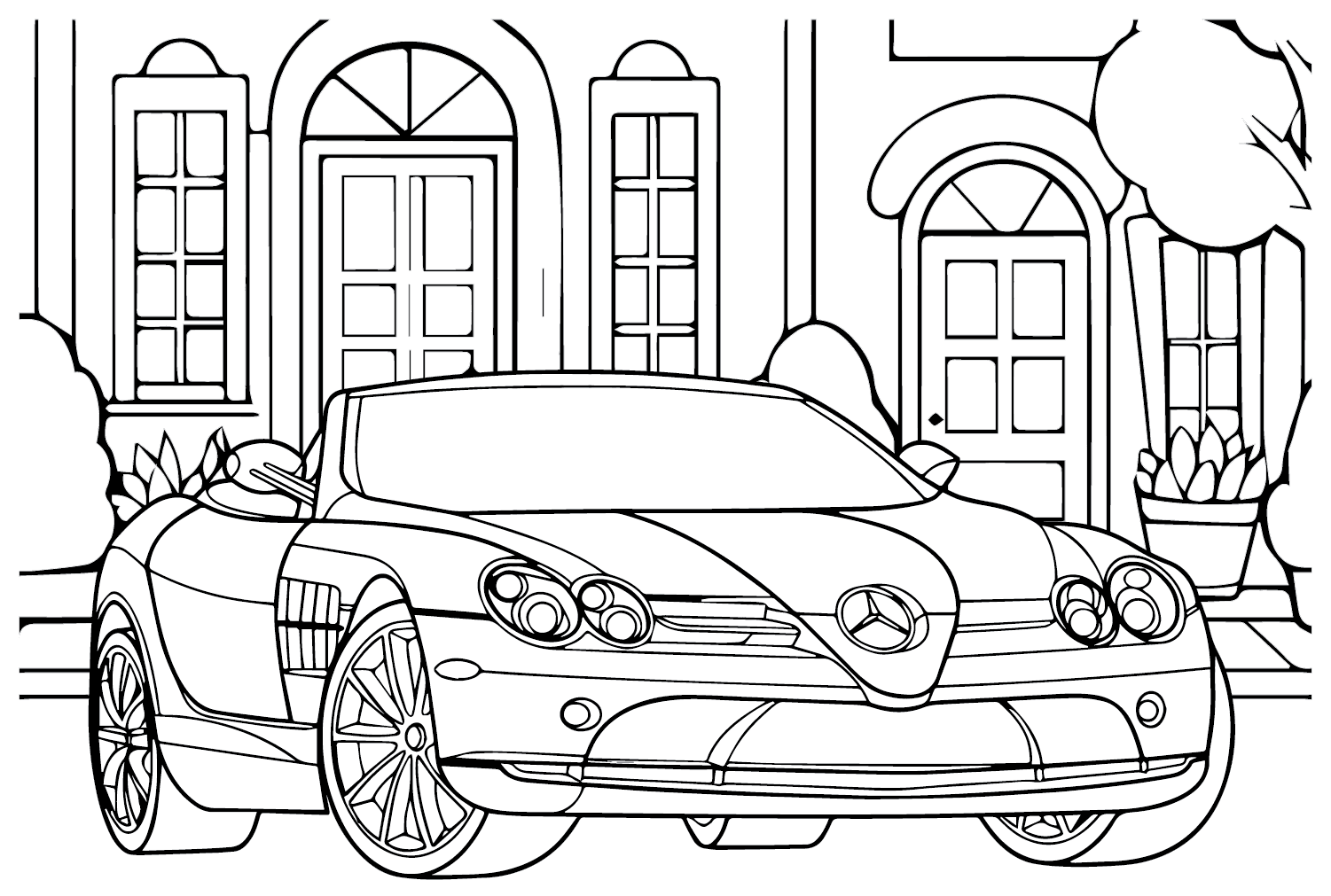
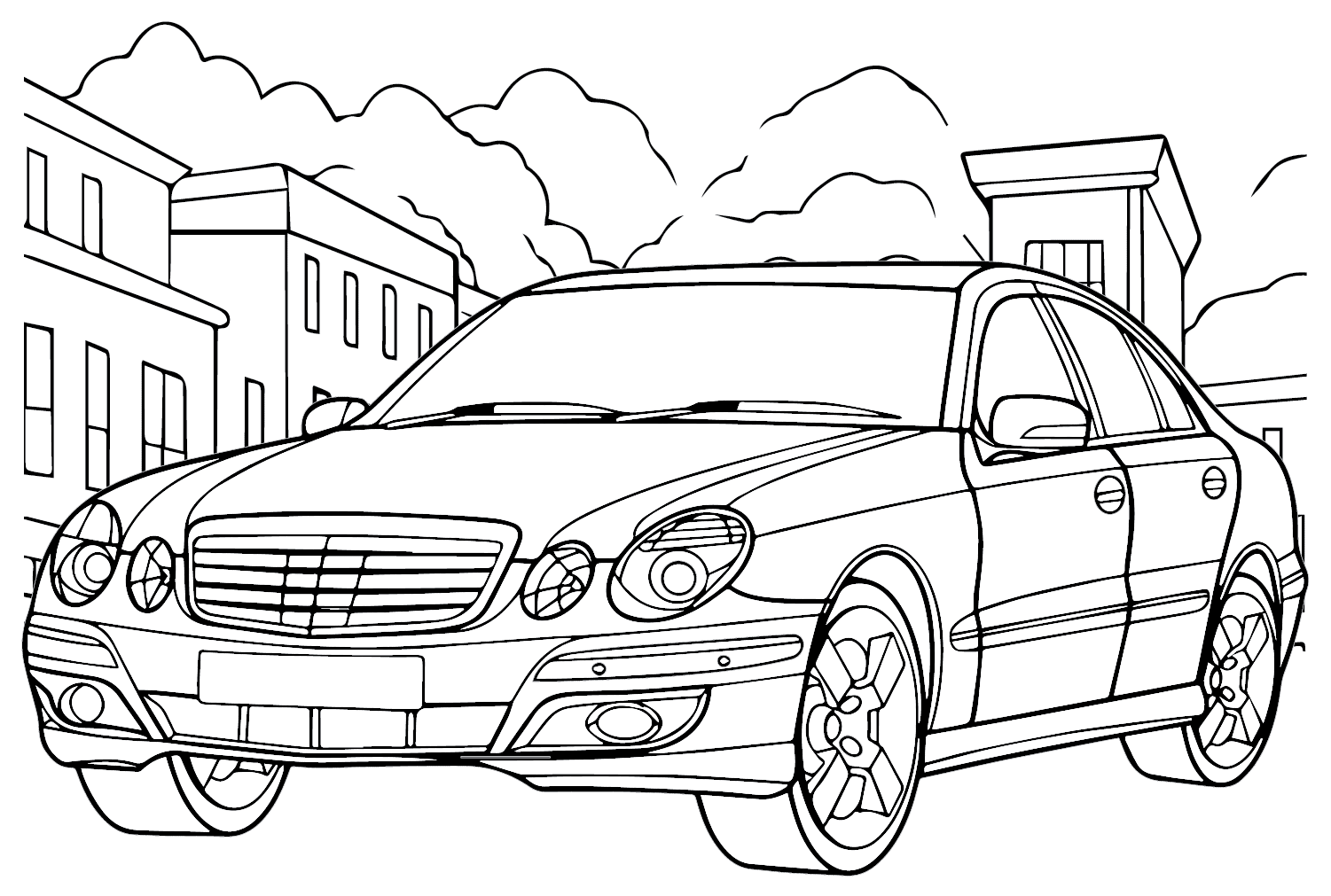
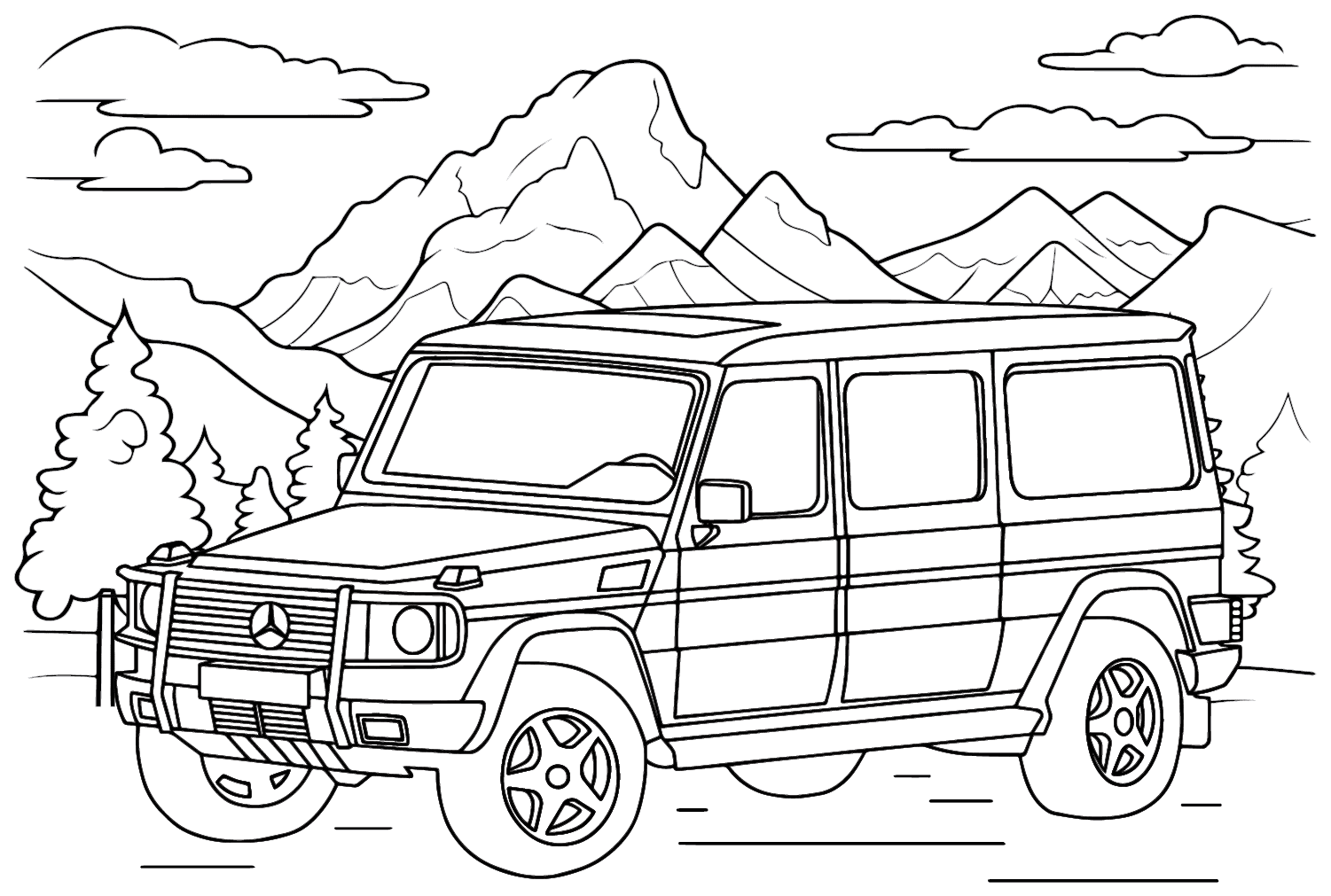
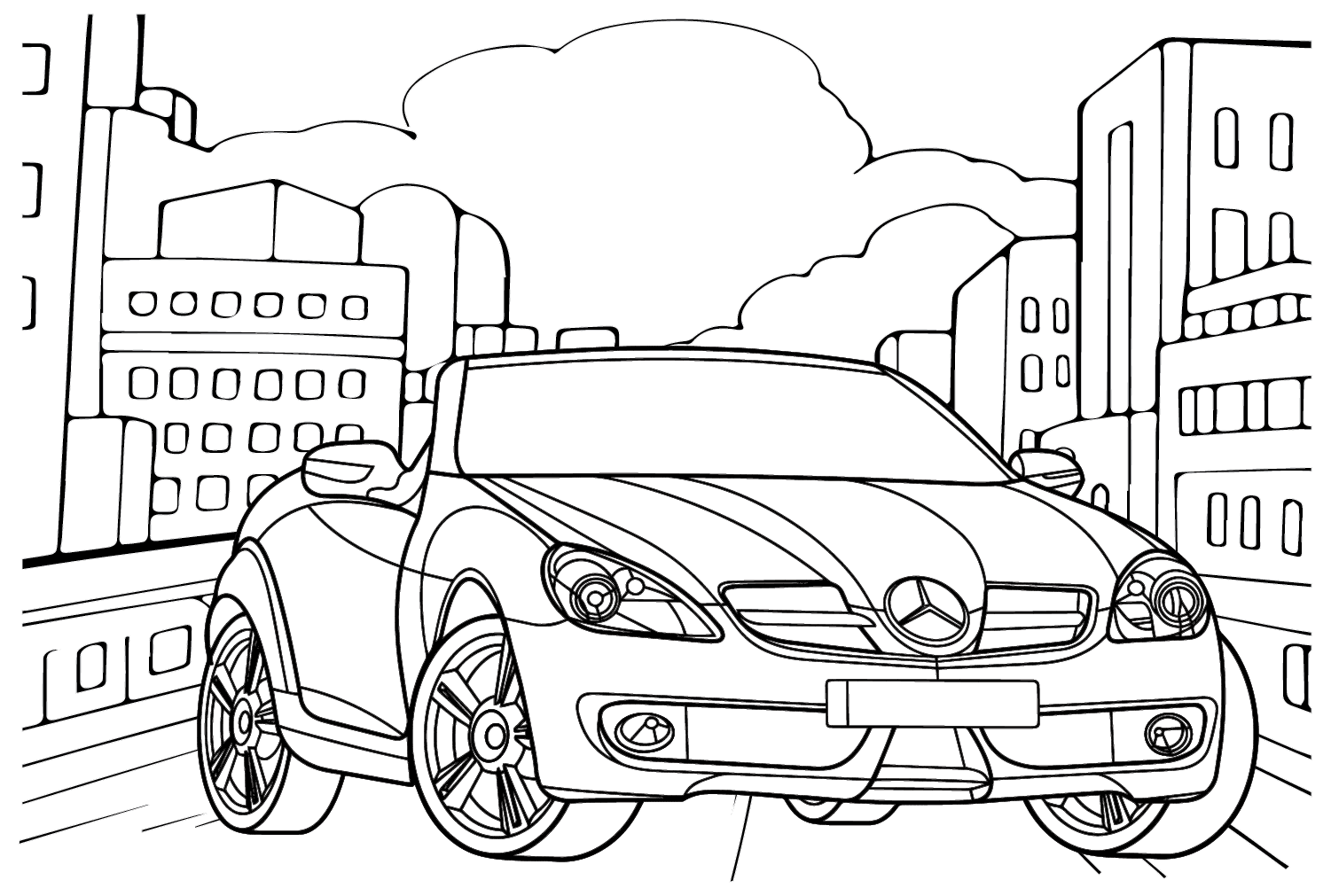
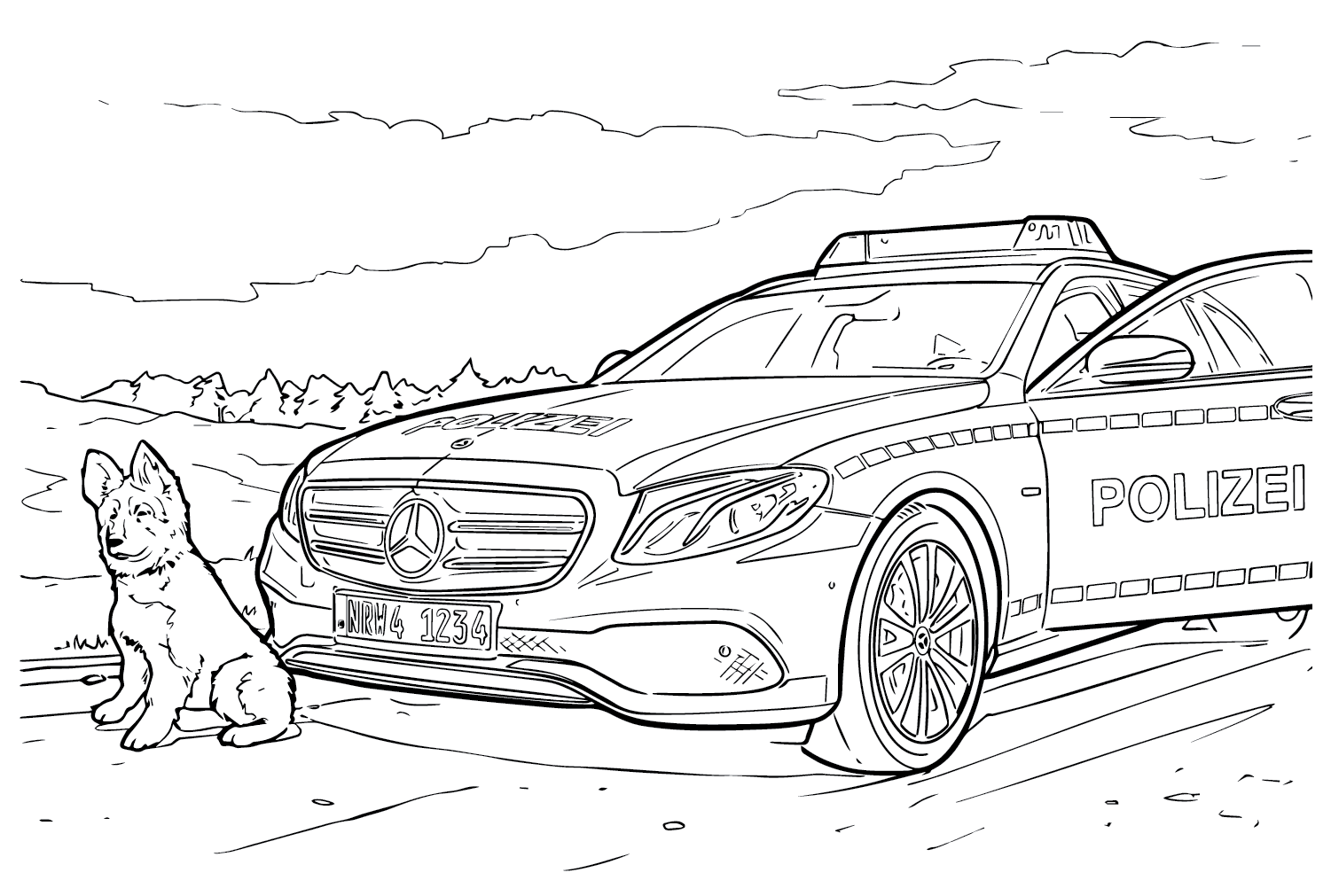
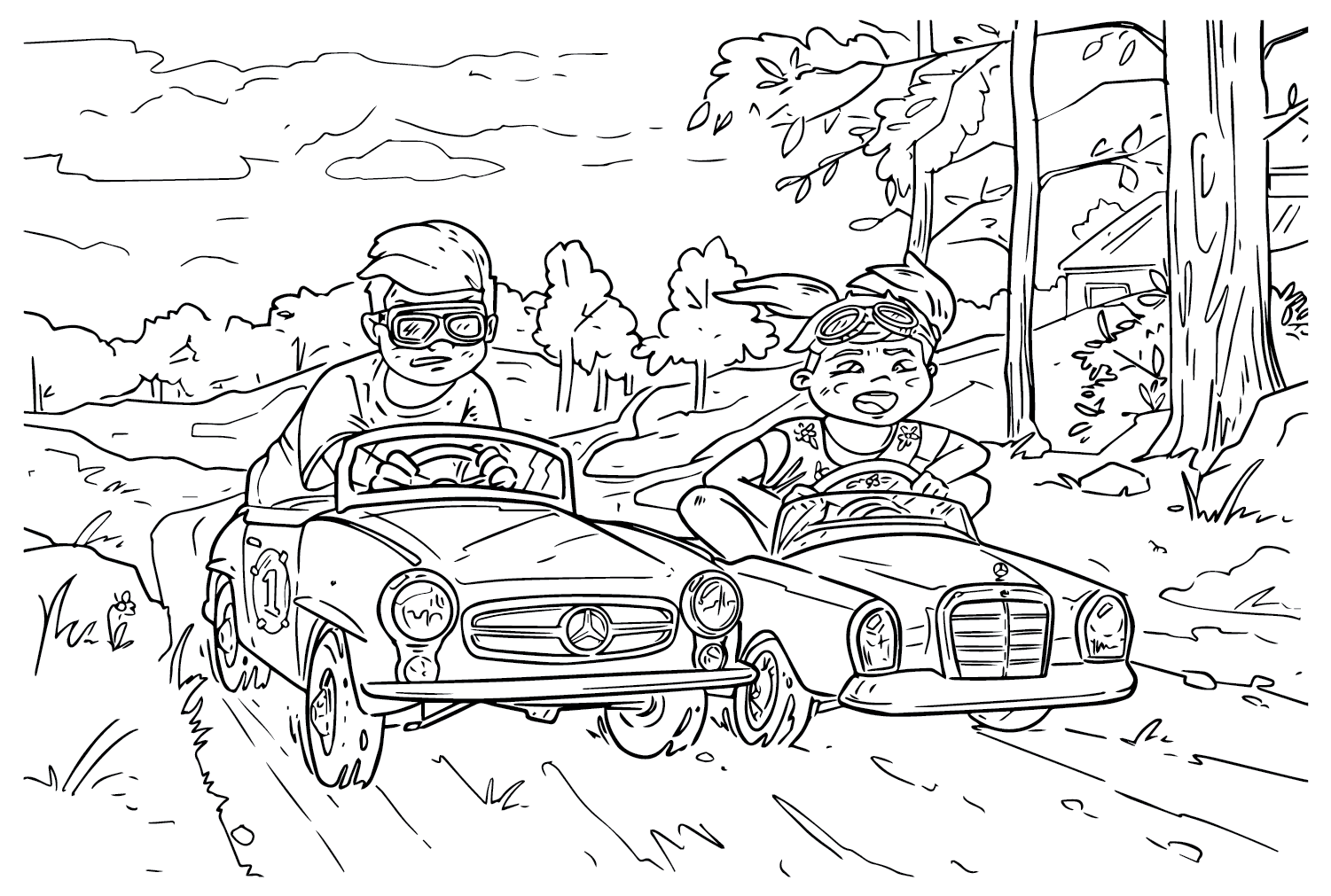
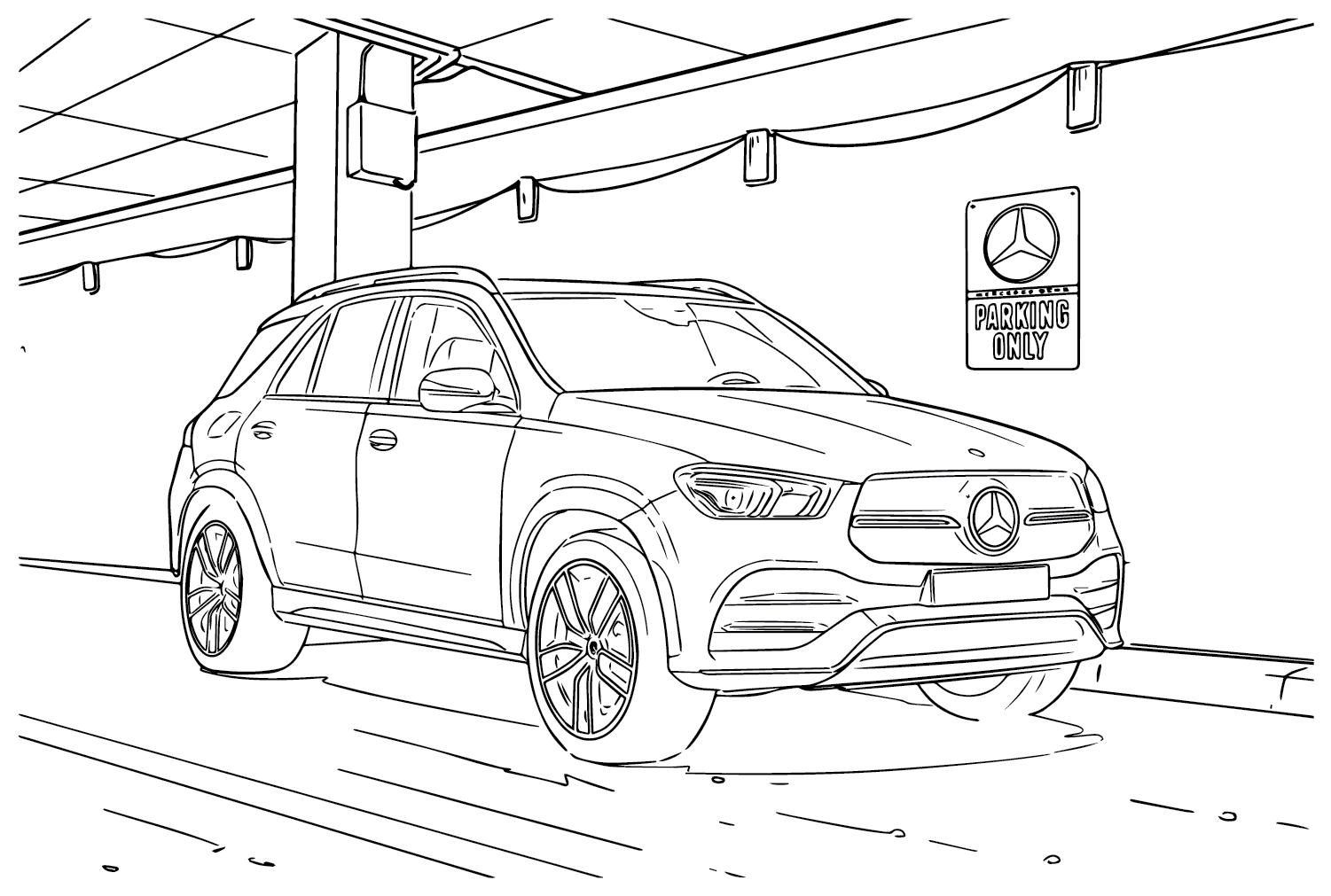
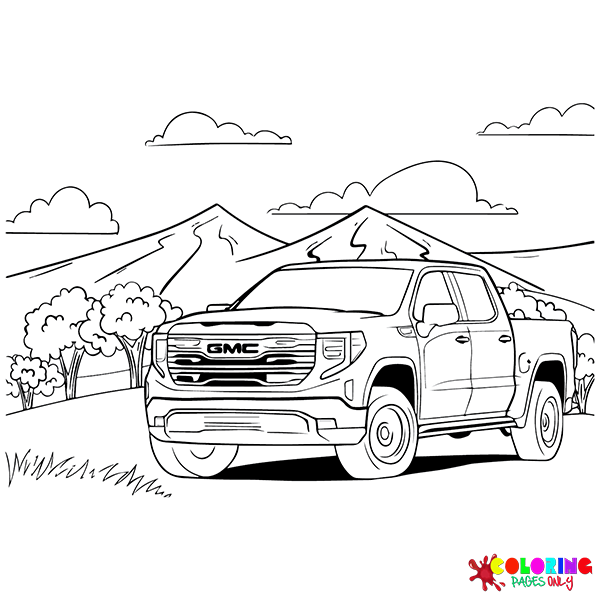
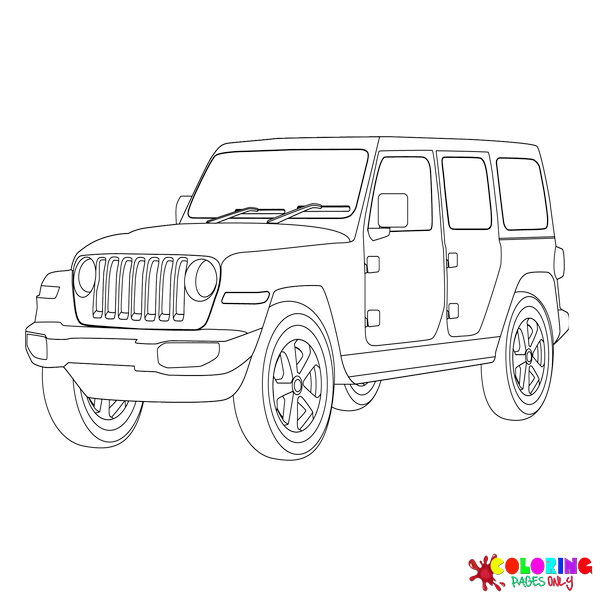
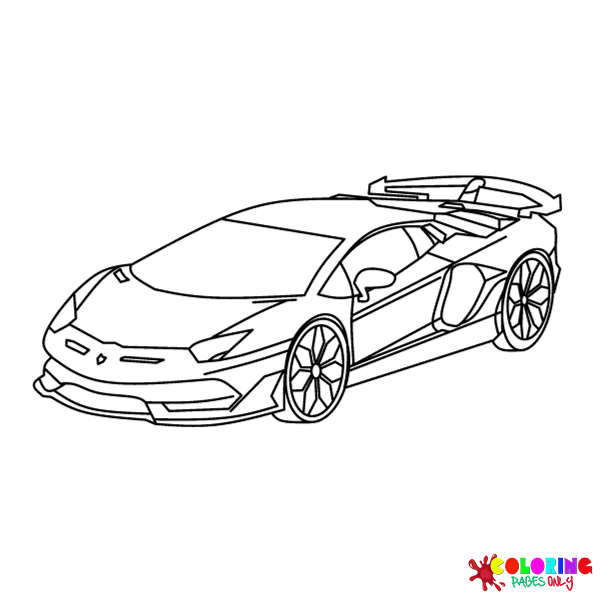
Free Mercedes-Benz coloring pages – 40+ pages featuring the S-Class, C-Class, E-Class, G-Class, AMG GT, the iconic three-pointed star logo, classic models including the 300 SL, EQ electric vehicles, racing Silver Arrows, and the full spectrum of Stuttgart’s most recognized automotive production – free printable PDF and online coloring for car enthusiasts of all ages.
On January 29, 1886, Karl Benz filed German Reichspatent 37435 for a “vehicle powered by a gas engine” – a three-wheeled vehicle driven by a single-cylinder four-stroke engine producing 0.75 horsepower. That document is the birth certificate of the automobile. The date is now observed globally as the birthday of the motorcar. Benz’s Motorwagen did not merely start a company – it started an industry, and the company it started, through a century of mergers, acquisitions, and renamings, became Mercedes-Benz.
Gottlieb Daimler and his partner Wilhelm Maybach independently developed a four-wheeled gasoline-powered vehicle the same year, working not far from Benz in southern Germany. The two companies – Benz & Cie. and Daimler Motoren Gesellschaft – competed for decades before merging in 1926 to form Daimler-Benz AG. The name “Mercedes” had entered the picture in 1901, when Emil Jellinek – an Austrian businessman and racing enthusiast who was one of Daimler’s largest customers – commissioned a new car that would be named after his daughter Mercedes Jellinek. The 1901 Mercedes 35hp is considered the first modern automobile. The three-pointed star, originally Gottlieb Daimler’s symbol for his ambition to motorize land, sea, and air transport, was registered as a trademark in 1909.
These 40+ free pages at ColoringPagesOnly.com span the full breadth of Mercedes-Benz history. All free, PDF or PNG, print or color online.
What’s Inside
S-Class – The Flagship
The S-Class is Mercedes-Benz’s definitive statement – the vehicle the company has used, across every generation since the name was formally applied in 1972, to demonstrate the highest level of automotive achievement currently within its capability. Its role within the Mercedes lineup is established by the company’s own slogan: “Das Beste oder nichts” – the best or nothing. The S-Class is intended to be the best car in the world in the year it is produced.
Its significance in automotive history extends beyond luxury: the S-Class has been the platform on which safety technologies were first deployed at a production scale before becoming an industry standard. The first series-production anti-lock braking system (ABS) appeared on a Mercedes in 1978. The first driver’s airbag in a production car appeared in a Mercedes in 1981. The Electronic Stability Program (ESP), now mandatory on all new vehicles in most markets, was introduced by Mercedes in 1995. These were not niche technical exercises – they were safety innovations first given to the public through the S-Class, which then filtered to every other car on the road.
Coloring the S-Class: The S-Class’s design language is the most restrained in the entire Mercedes portfolio – it communicates luxury through proportion and surface quality rather than through dramatic styling. The current generation’s body panels are notably clean: long, gently curved surfaces with minimal character lines, presenting the three-zone metallic technique as a gentle gradient rather than the sharp zone-change technique that works on more aggressively styled vehicles. Obsidian Black Metallic and Iridium Silver Metallic are the two colors most associated with the S-Class in its role as chauffeur-driven executive transport – deep black rendering the car as almost a silhouette, metallic silver giving its surfaces the quality of carefully polished steel.
C-Class – The Volume Leader
The C-Class is the commercial foundation of Mercedes-Benz – the compact executive car that has been the brand’s best-selling model globally across most of its production run, the vehicle through which most buyers first encounter the three-pointed star. It began in 1982 as the 190E – a smaller, more accessible Mercedes that demonstrated the brand’s willingness to reach a wider market without compromising its standards – and has been named C-Class since 1993.
The current generation W206 C-Class is the most design-sophisticated of the model’s history – it inherits the interior philosophy of the EQS electric flagship (the “hyperscreen” dashboard concept, the horizontal trim architecture) at a significantly lower price point. The exterior is a miniaturized version of the S-Class’s clean, proportional elegance.
Coloring the C-Class: The C-Class’s most expressive current feature is its front fascia – the wide, low grille with the three-pointed star at its center, flanked by narrow LED headlight units that cut horizontally across the front corners. The grille should be rendered in a dark grey or near-black with the star itself in bright chrome-silver – this contrast between dark grille and bright star is the front-facing identity element that makes the car immediately recognizable. The body’s compact but well-proportioned form rewards careful light-direction work: the shoulder line that runs the length of the car is the primary feature line, and its highlight and shadow should be rendered consistently from front to rear.
G-Class – The Enduring Icon
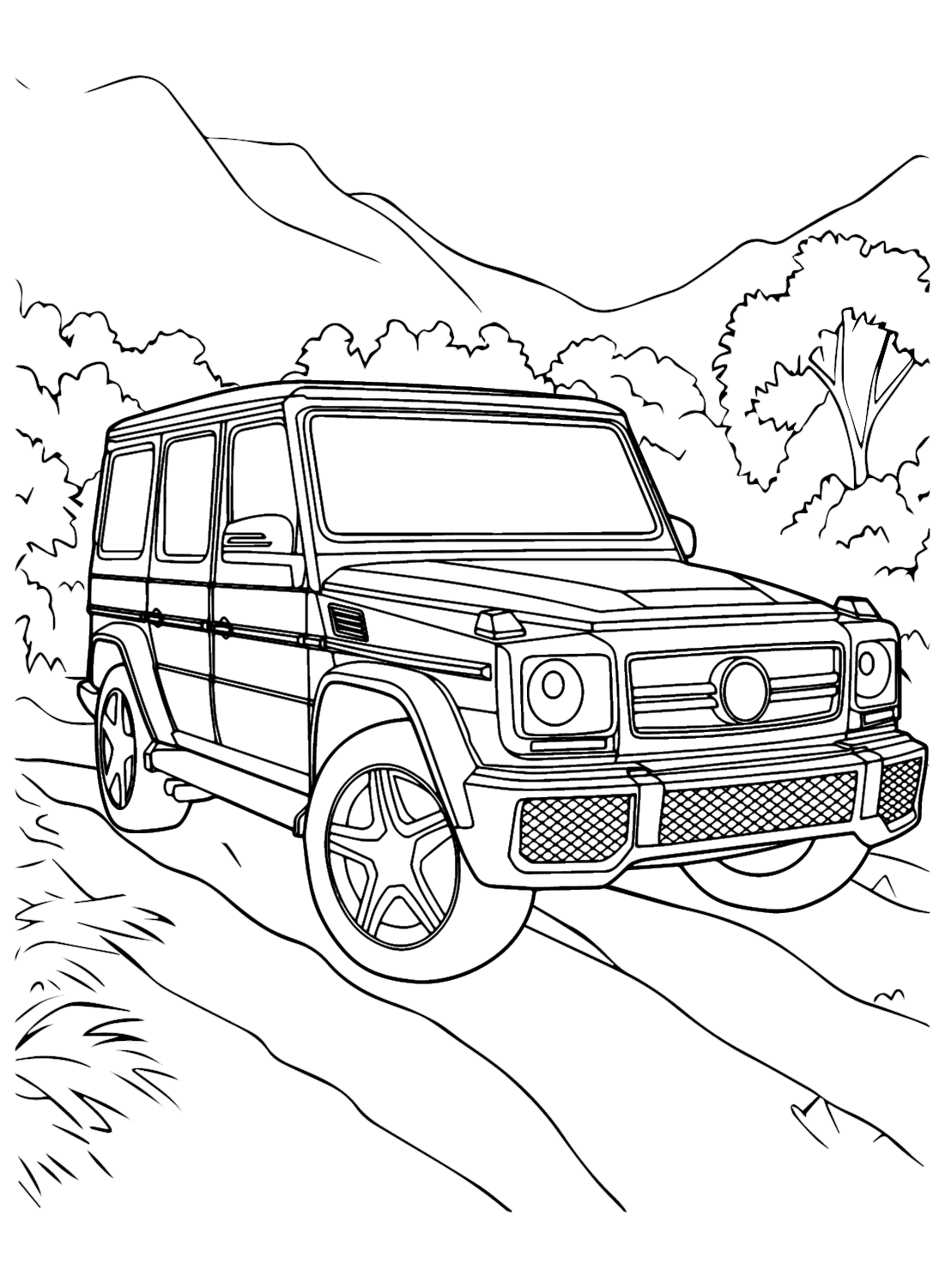
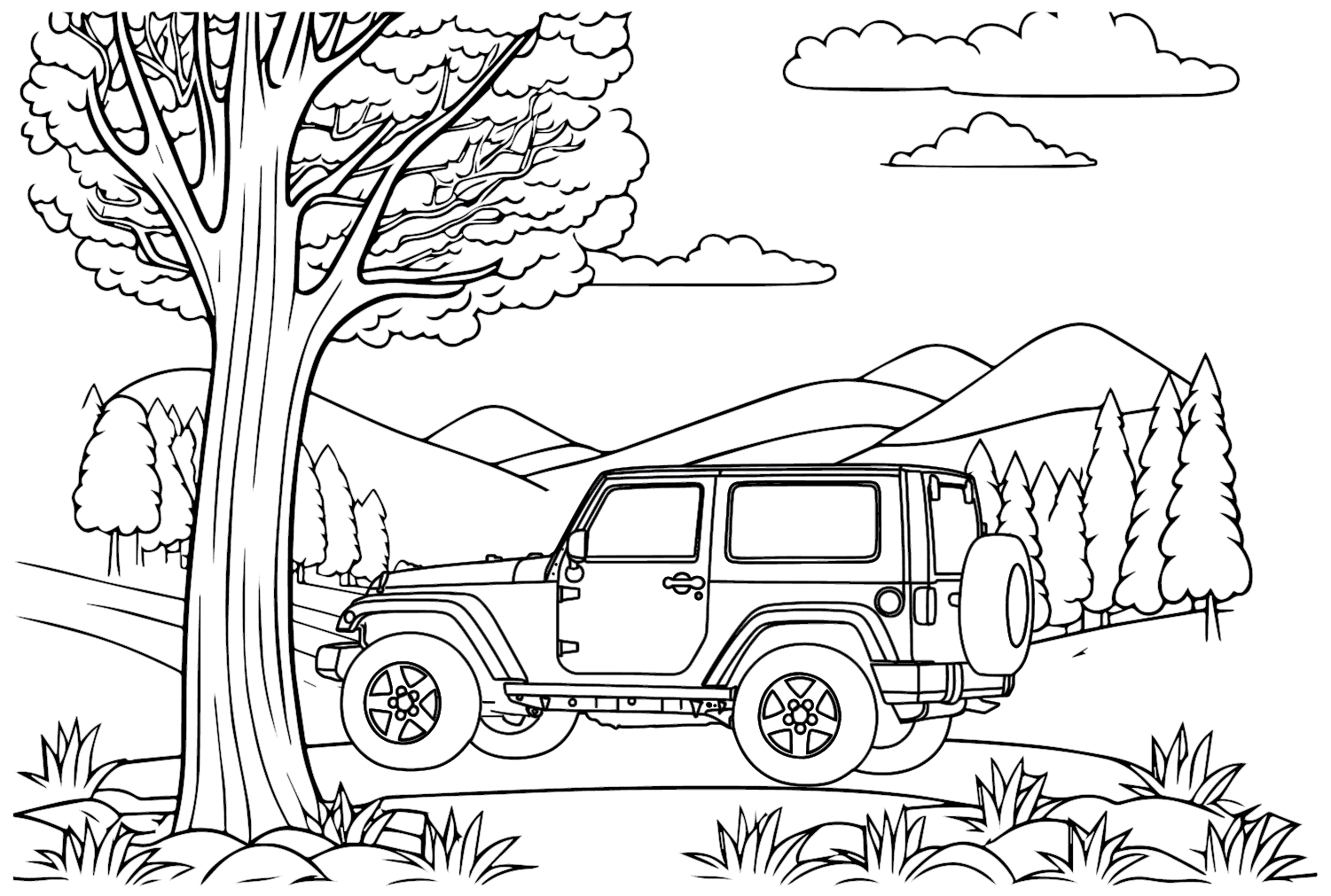
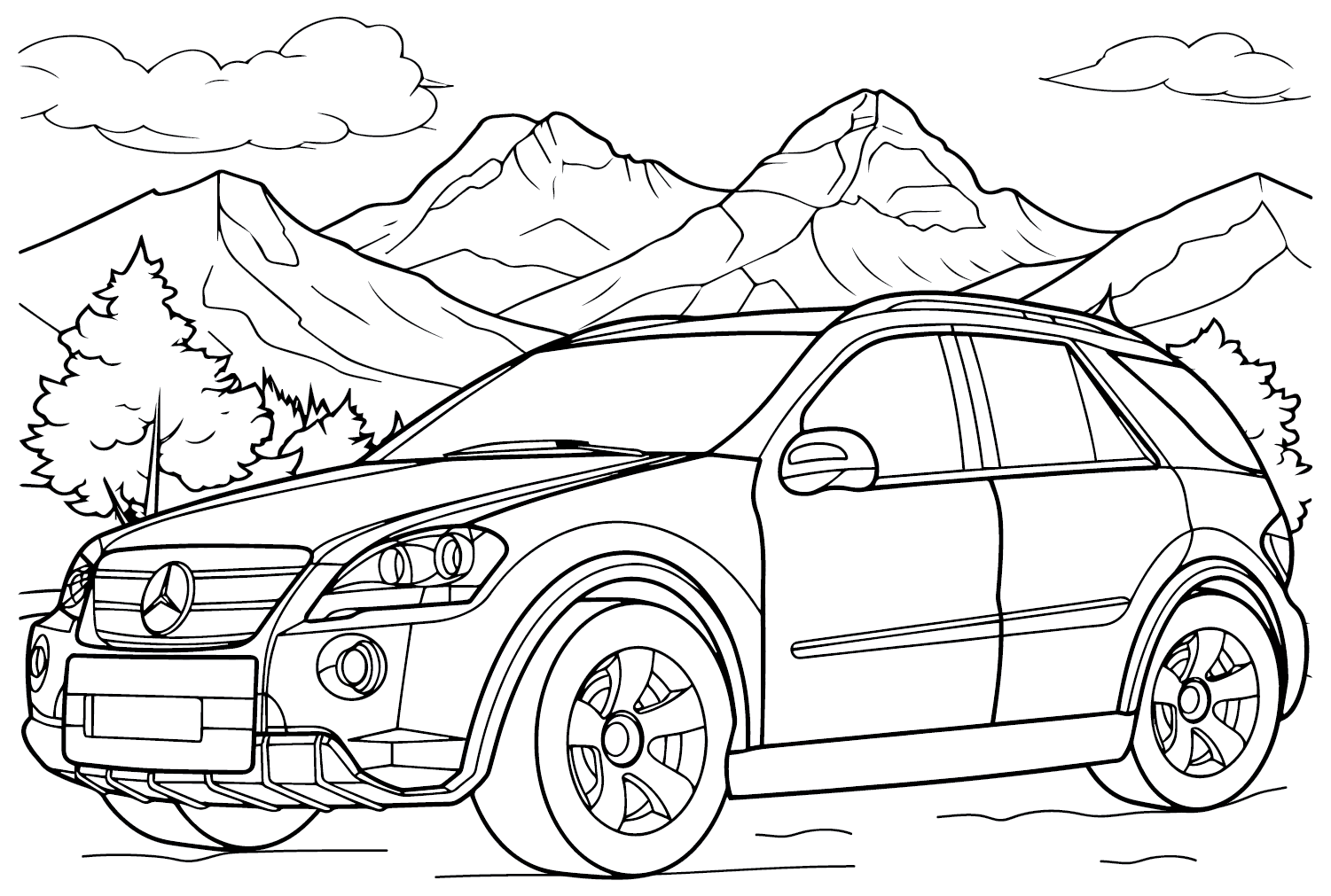
The G-Class – G-Wagen, from the German Geländewagen (terrain vehicle) – entered production in 1979 and continues in production as of 2025, making it one of the longest-running automotive production runs in history. Its origins are genuinely military: the design was commissioned in the late 1970s to replace Jeeps in the service of various armed forces, developed in collaboration with the Shah of Iran’s government as a co-investor. The resulting vehicle was designed for capability rather than comfort – flat surfaces, boxy body, ladder frame – and that design has been maintained, with updates, across four and a half decades.
What happened to the G-Class over those decades is one of the more unusual transformations in automotive history: a military-derived utility vehicle became one of the world’s most desirable luxury SUVs. The boxy shape that was a functional consequence of manufacturing constraints became an aesthetic statement – a design that looked tough because it was tough, at a moment when many luxury SUVs looked tough despite being built on car platforms. Mercedes invested in refining what was already there – better engines, better interior, better equipment – while preserving the exterior lines that had made the G-Class recognizable.
Coloring the G-Class: The G-Class is the collection’s most graphically straightforward subject – its flat, upright surfaces are large, clean, and geometrically simple. The boxy proportions mean the three-zone technique applies to genuinely flat planes: the light hits the roof as a clean single tone, the sides as a slightly darker uniform tone, and the lower elements beneath the door line in the deepest shadow. Black is the color most associated with the G-Class’s contemporary luxury identity – rendered not as flat black but as the deep, cool near-black of a very dark metallic finish, with subtle blue-grey highlights along the roof edges and door tops.
AMG GT – The Performance Statement
Mercedes-AMG began in 1967 when two former Daimler engineers – Hans Werner Aufrecht and Erhard Melcher – founded an independent tuning company whose name was abbreviated to AMG from Aufrecht, Melcher, and Großaspach (the town of Aufrecht’s birth). The company became a Daimler subsidiary in 1999 after decades of collaboration, and is now the performance division that produces high-output versions of virtually every Mercedes model.
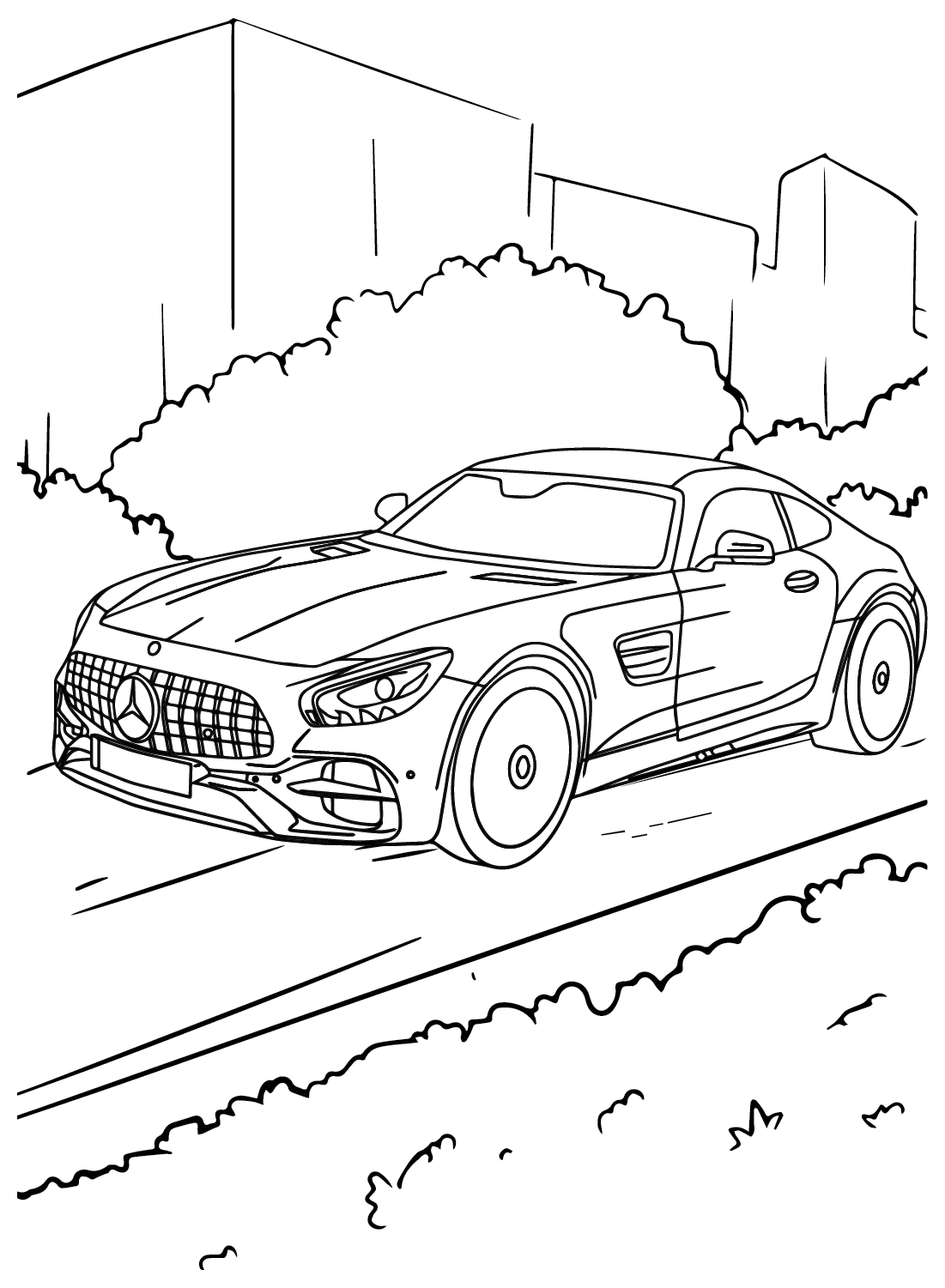
The AMG GT – introduced as an entirely AMG-designed sports car rather than a performance version of an existing model – represents the division’s most independent design statement. Low, wide, with a long hood housing a hand-built AMG V8 biturbo engine, it is a direct sports car in the tradition of the 300 SL rather than a refined version of something else.
Coloring the AMG GT: The AMG GT’s proportions are the most dramatic in the collection – the hood accounts for a significant percentage of the car’s total length, producing the “cab-rearward” silhouette of a genuine front-engine sports car. The AMG Solarbeam Yellow and AMG GREEN HELL Magno (the matte green named after Nürburgring’s nickname) are the most visually distinctive colors in the GT range. The matte green – if used – requires a completely flat application with no highlights: matte finishes absorb rather than reflect light, and any highlight application will look incorrect.
The 300 SL – The Gullwing
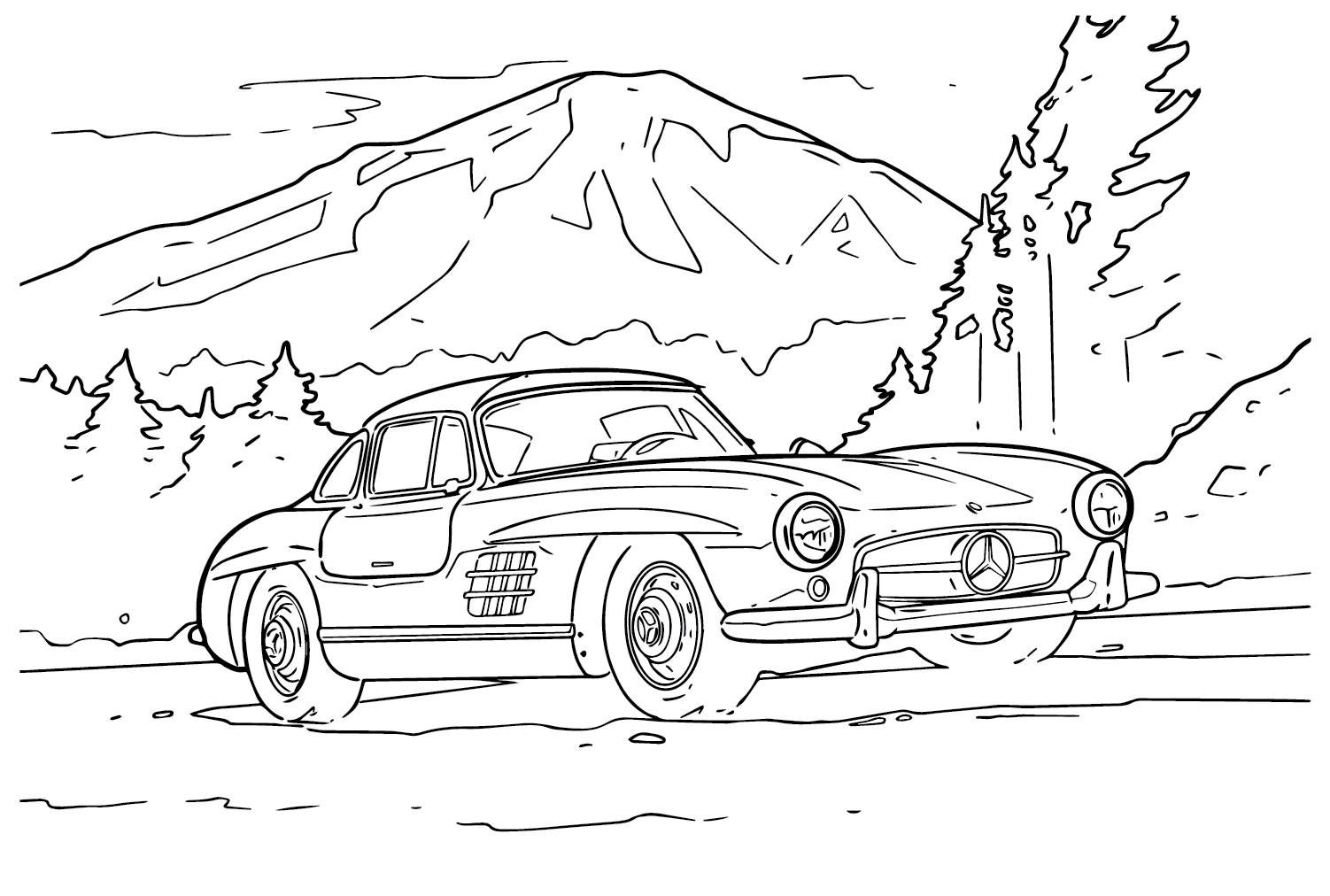
The 1954 Mercedes-Benz 300 SL is the car that many automotive historians, designers, and engineers cite when asked to name the most beautiful car ever built. Its gull-wing doors – which open upward rather than outward, a consequence of the high door sills required by the space-frame chassis – gave it a visual identity unlike any other production car before or since. Its 3.0-liter fuel-injected inline-six engine produced 215 horsepower, making it the fastest production car in the world at its introduction, capable of approximately 260 km/h (161 mph).
The 300 SL roadster version followed in 1957, replacing the gull-wing doors with conventional ones at the request of the American importer Max Hoffman, who found the gull-wing design impractical for American customers. Both versions are considered icons, but the gull-wing coupe’s visual drama makes it the pages’ most distinctive classic subject.
Coloring the 300 SL: Silver is the canonical 300 SL color – the Silver Arrow heritage, the bare aluminum racing cars, the relationship between the Mercedes brand and silver as an automotive color. A cool, bright silver-grey across the clean, curved body surfaces, with careful attention to the gull-wing doors’ dramatic upward angle. The doors’ hinge line is the most important structural element to render correctly – the highlight at the top of each door, catching overhead light, should be the brightest point on the entire car.
EQ Electric Vehicles
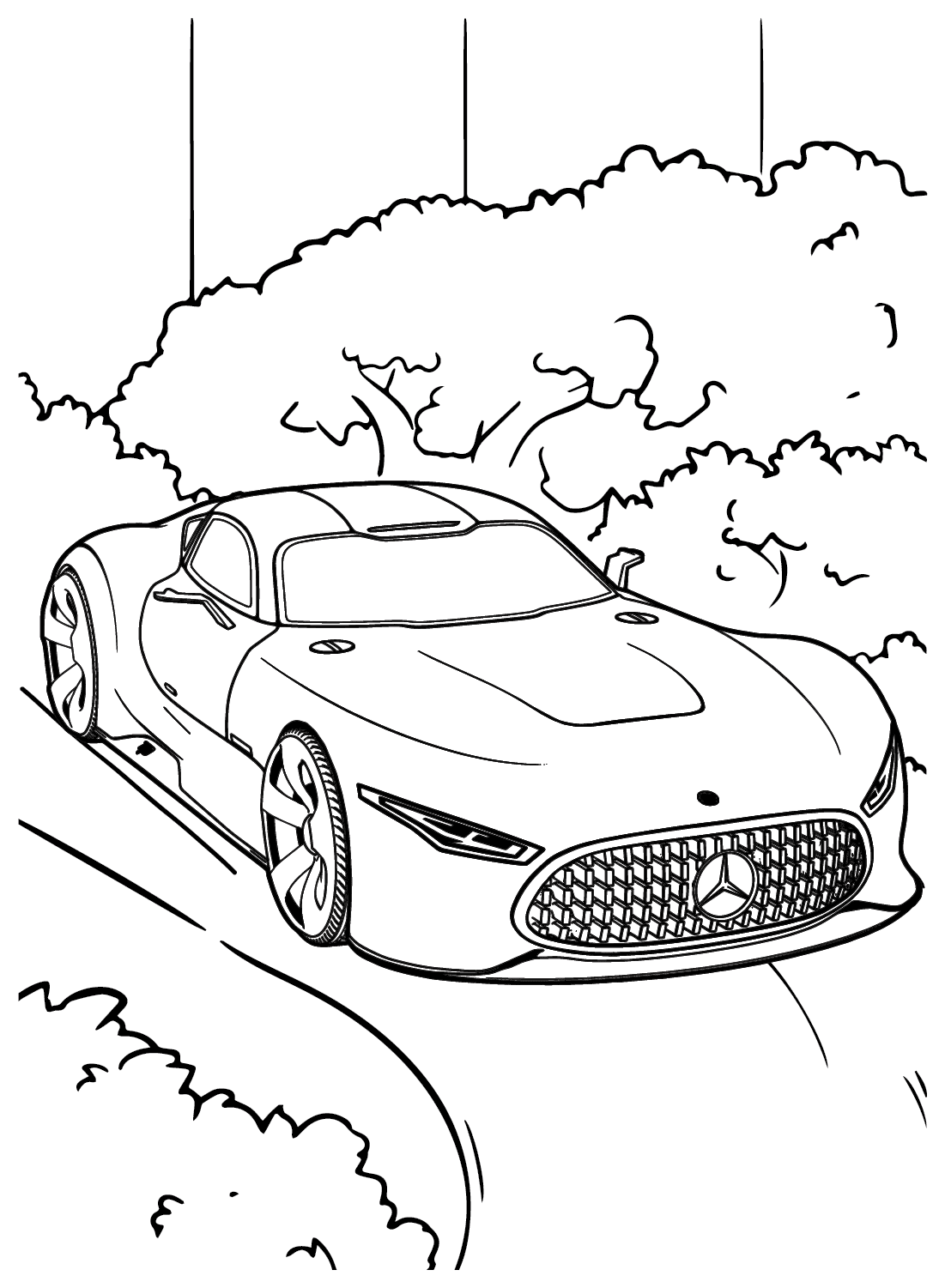
The EQ sub-brand – Mercedes-Benz’s battery-electric vehicle lineup – includes the EQS (the flagship electric S-Class equivalent), the EQE (electric E-Class equivalent), and the EQA, EQB, EQC, and EQV across smaller and commercial segments. The EQS is the collection’s most technologically forward vehicle – its one-bow exterior design, with an extremely low drag coefficient of 0.20 Cd (among the lowest of any production car), produces a silhouette that feels more like a sculpture than a conventional three-box sedan.
Coloring EQ vehicles: The EQ design language uses specific visual cues that distinguish it from conventional combustion-engine Mercedes: a black panel grille (closed, not functional – there is minimal cooling requirement for an electric drivetrain), illuminated star-pattern elements in the black panel, and a continuous light bar across the front and rear. Render the closed grille panel in near-black with the illuminated stars in very pale white-blue – the effect of LED light sources embedded in a dark surface.
The Three-Pointed Star Logo Pages
The three-pointed star is one of the ten most recognized logos in the world. Its three points represent Gottlieb Daimler’s original ambition – to motorize land (automotive), sea (marine), and air (aviation) transport. The circle was added later to the trademark registration. It appears at the center of the grille on every Mercedes vehicle and on the hood of certain models as a freestanding ornament.
What These Pages Do
Mercedes-Benz’s history is automotive history. January 29, 1886, is not only the company’s founding date – it is the date the automobile was invented. Coloring through the Mercedes-Benz collection is engaging with the full arc of personal transportation from its first moment to its electric present.
The S-Class’s role as a safety technology laboratory is the most documented innovation story in the automotive industry. ABS, airbags, and ESP – technologies that have saved millions of lives globally – were first deployed in the S-Class before becoming universal requirements. Coloring the S-Class while knowing this context is coloring a vehicle whose function in history extended far beyond transportation.
The G-Class’s design continuity is a lesson in what endures. A vehicle designed in the 1970s for military utility is still in production in 2025 because its design was defined by function rather than fashion – and function does not go out of style. The collection’s G-Class pages demonstrate this: a 1979 G-Wagen and a 2024 G 63 AMG occupy fundamentally the same visual space.
Fine motor development. The American Academy of Pediatrics identifies fine motor skill development as a key childhood milestone throughout early childhood. The S-Class’s subtle surface curves, the 300 SL’s distinctive gull-wing door angles, the G-Class’s flat geometric planes – each requires different technical application, providing graduated fine motor challenge across the full collection. The 2005 Art Therapy Journal study on structured coloring and anxiety reduction applies throughout.
How to Color These Pages Well
Silver is the canonical Mercedes color and requires the most technical precision. The Silver Arrows, the 300 SL, the S-Class in Iridium Silver – silver is the color most associated with Mercedes-Benz across its history. Automotive silver is not a single tone but a range: very pale silver-white on the most directly lit surfaces (the roof, the hood center, the shoulder line’s peak), a medium cool grey across the main body surfaces, and a darker, slightly blue-shifted grey in shadow areas (under the bumper overhangs, beneath the door sills, in wheel arch recesses). Crucially, each transition should be gradual rather than abrupt – silver metal curves, and the color should curve with it.
The three-pointed star’s chrome finish needs precise highlight placement. The star appears on every Mercedes model page and is the most repeated single detail in the collection. Chrome renders as a sequence of very light and very dark values in proximity – the highlight at the top of each star point is near-white; the shadow in the recesses between the points is near-black; the main chrome surfaces between those extremes are a medium warm grey. The circular surround receives the same treatment: a bright highlight arc at the top, darkening around the bottom. The transition from highlight to shadow in chrome is sharper than in painted surfaces – use distinct tonal zones rather than gradual gradients.
Matte finishes need flat application without highlights. The AMG range includes several matte paint options – the Magno finishes in matte white, green, grey, and black. Matte paint does not reflect light in a directed way; it scatters it. When coloring a matte-finish vehicle, apply your chosen color at consistent pressure across the entire surface without adding highlight zones. The only variation should come from slightly deeper shadow in the very darkest recesses. Any highlight application will make a matte finish look incorrectly glossy.
The G-Class’s flat planes simplify the light-direction problem. Because the G-Class has genuinely flat body sides, the three-zone technique resolves to a simpler version: the top flat plane (roof) is the lightest; the vertical flat planes (door sides, fenders) are the mid-tone; the lower recesses are the darkest. The transitions between these zones occur at the sharp corners where the flat planes meet – apply the tone changes there precisely. The flat-sided geometry of the G-Class reads as three-dimensional immediately.
Window glass is the most underestimated detail. Every car page includes windows, and windows rendered as flat, uncolored paper areas read as incomplete. Window glass reflects the sky – pale blue-grey at the top of the glass, darkening slightly toward the bottom. The windshield’s reflection arc (a pale diagonal highlight across the upper left) indicates the glass’s curved surface. The side windows should be rendered slightly darker and more opaque than the windshield, suggesting a different glass angle. These are small details – but their absence is the most immediately visible incompleteness in a finished car page.
5 Creative Craft Ideas
The Automobile’s Birthday Card
Print the most classic, historically resonant Mercedes page in the collection – the 300 SL, if available, or the S-Class. Color it in silver – the canonical color of the brand’s racing and luxury heritage.
Mount on cardstock folded to greeting card dimensions. On the front, add hand-lettered text: “January 29, 1886.” Inside: “On this day, Karl Benz filed Patent 37435 for a vehicle powered by a gas engine. Every car on the road today descends from that document. Happy Birthday to the automobile.”
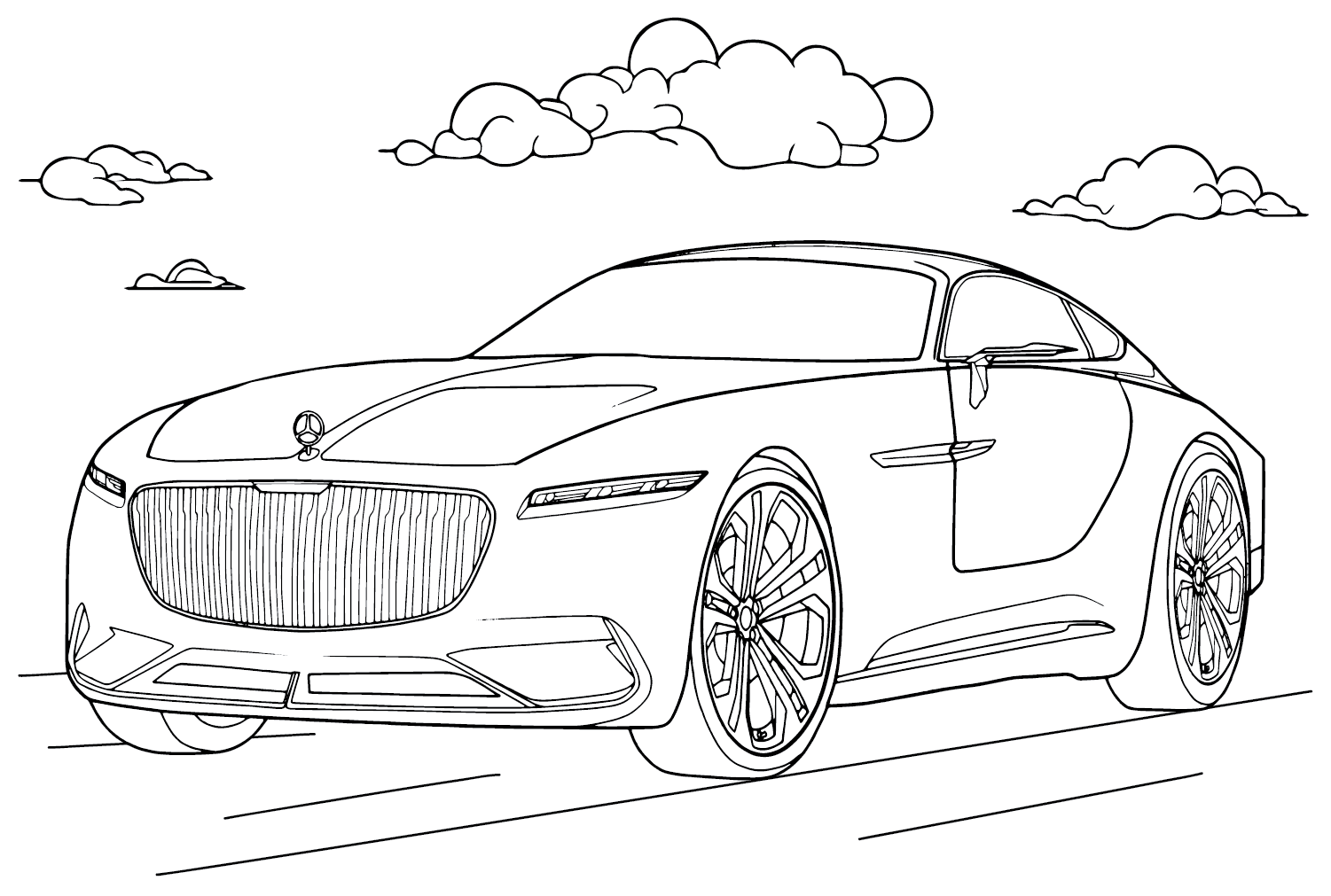
The finished card is a piece of automotive history documentation in greeting card form – appropriate for any car enthusiast’s birthday, for a classroom history activity, or as a reference artifact.
Silver Arrows Racing Heritage Display
The “Silver Arrows” nickname – applied to Mercedes racing cars since a famous 1934 weight-reduction maneuver stripped white paint from a racing car to reveal bare aluminum – is the brand’s most mythologized racing identity. Print the most dramatic Mercedes racing or sports car page. Color it in the bare aluminum silver of the original Silver Arrows – cool, slightly blue-shifted, with strong highlights at the body’s peak lines and deep shadows in the wheel arches.
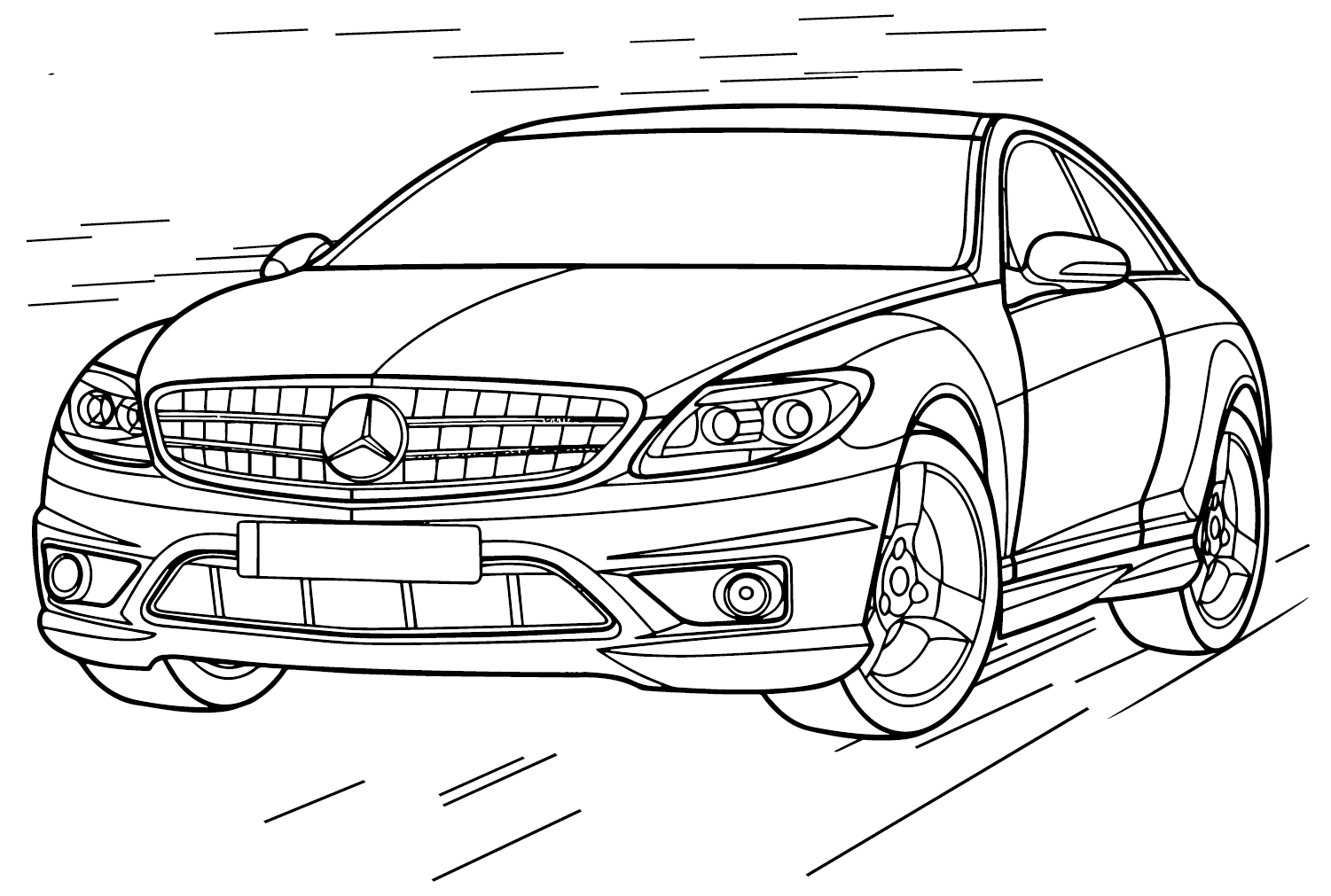
Mount on a dark backing sheet. Add a hand-lettered title: “The Silver Arrows – Stuttgart, 1934.” Below: “The white paint was stripped to make weight. What remained was silver. The name stayed for ninety years.”
Das Beste: Three Generations of the S-Class
Print three pages representing different generations of the S-Class – an older, squarer generation (W116 or W126 if available), a mid-era aerodynamic generation (W140 or W220), and the current generation. Color all three in silver, keeping the color consistent across generations to allow the design evolution to be the variable.
Mount all three in chronological order. Add below each: the W-number designation and the approximate year range. The display shows what fifty years of “the best” looks like when applied to the same car – how the definition of best changes while the commitment to it remains.
G-Class Then and Now
Print the most classic G-Class page available (the original 1979-style square body) and the most current G-Class page (the current generation with its subtle updates). Color the classic in a military olive drab – its original color in service use. Color the current generation in Obsidian Black Metallic – the color most associated with the luxury version the G-Class became.
Mount side by side: “1979 – Built for terrain” on the left, “2024 – Built for everything” on the right. The visual gap between olive drab military utility and polished black luxury is the entire story of what happened to the G-Class in forty-five years.
EQ vs. Classic: Electric Future, Combustion Past
Print an EQ series electric Mercedes page (EQS or EQE) and a classic model page (300 SL or early S-Class). Color the EQ in the cool, contemporary palette of electric vehicle design – a pale silver or Selenite Grey with the blue-illuminated black panel grille. Color the classic in warm silver or cream – the warmer palette of the analog era.
Mount both facing each other on a neutral backing sheet, a gap between them. In the gap, add hand-lettered text: “January 29, 1886 to January 29, 2025: 139 years of the best or nothing.” The display frames the brand’s entire arc – from invention to reinvention – in two images and one date.
Frequently Asked Questions
Who invented the automobile, and what is Mercedes-Benz’s connection? The automobile is generally credited to Karl Benz, who filed German Reichspatent 37435 on January 29, 1886, for a “vehicle powered by a gas engine” – the Benz Patent-Motorwagen. This three-wheeled vehicle is recognized as the world’s first true automobile. Benz’s company, Benz & Cie., founded in Mannheim, later merged with Gottlieb Daimler’s Daimler Motoren Gesellschaft in 1926 to form Daimler-Benz AG – the company that produces Mercedes-Benz vehicles. Both Benz and Daimler independently developed gasoline-powered vehicles in 1886, working in the same general region of southwestern Germany without knowledge of each other’s work.
Where does the name “Mercedes” come from? The name Mercedes comes from Mercedes Jellinek, the daughter of Emil Jellinek, an Austrian automobile enthusiast, businessman, and racing driver who was one of Daimler Motoren Gesellschaft’s most important customers and dealers in the early 1900s. Jellinek raced Daimler cars under the pseudonym “Mercedes” – his daughter’s name – and in 1900 commissioned a new, faster car from the company, insisting it be named after his daughter. The resulting 1901 Mercedes 35hp was a revolutionary vehicle, widely considered the first modern automobile, and its success made the name permanent. Daimler registered “Mercedes” as a trademark in 1902.
What does the three-pointed star symbolize? The three-pointed star was originally a symbol used by Gottlieb Daimler in a postcard to his wife, in which he drew a star over their home to mark the location of the house. When his sons later searched through his papers for a suitable trademark, they found the star and adopted it, assigning to its three points the meaning that had become associated with Daimler’s engineering ambition: the motorization of land, sea, and air transport. The star was registered as a trademark in 1909. The circular frame that surrounds the star in the current logo was added later. The three-pointed star is consistently ranked among the ten most recognized logos in the world.
What safety technologies did Mercedes-Benz introduce to the automotive industry? Mercedes-Benz has a documented history of introducing active and passive safety technologies in its vehicles before those technologies became industry standards or legal requirements. The first series-production anti-lock braking system (ABS) appeared on a Mercedes S-Class in 1978. The first driver’s side airbag in a production car appeared in a Mercedes in 1981. The Electronic Stability Program (ESP) – which detects and corrects vehicle oversteer and understeer, now proven to reduce fatal accident rates by approximately 25% – was introduced by Mercedes-Benz in 1995 and is now mandatory on all new vehicles in most markets. Pre-Safe, a system that prepares the vehicle and its occupants for an imminent collision, was introduced in 2002.
What is Mercedes-AMG, and how is it related to Mercedes-Benz? Mercedes-AMG GmbH is the performance division of Mercedes-Benz, headquartered in Affalterbach, Germany. It was founded in 1967 by Hans Werner Aufrecht and Erhard Melcher, two former Daimler engineers who established an independent company – the name AMG derives from Aufrecht, Melcher, and Großaspach (Aufrecht’s birth town). The company developed high-performance engines and tuned Mercedes vehicles independently before entering a formal partnership with Daimler in the 1990s. AMG became a wholly owned Daimler subsidiary in 1999. The division now produces performance variants of all Mercedes model lines, as well as standalone performance vehicles, including the AMG GT sports car. AMG engines are assembled by hand – each engine receives a plaque bearing the name of the engineer who built it.
What is the G-Class, and how long has it been in production? The Mercedes-Benz G-Class – originally called the G-Wagen, from the German Geländewagen (terrain vehicle) – entered production in 1979 and continues in production in 2025, making it one of the longest continuous production runs in automotive history. It was originally designed as a military utility vehicle, developed with financial participation from the Shah of Iran’s government, and intended to replace Jeep-type vehicles in military service. Its flat-panel, boxy body design was driven by manufacturing efficiency and structural durability requirements rather than aesthetic considerations. Over four and a half decades, it transitioned from military and agricultural use to commercial fleet use to, eventually, one of the world’s most sought-after luxury SUVs – a transformation driven by the cultural cachet of its rugged heritage and the brand’s investment in premium interior appointments while preserving the distinctive exterior design.
Browse the full collection at ColoringPagesOnly.com. All 40+ pages free, no sign-up, PDF or PNG, print or color online.
Karl Benz filed his patent on January 29, 1886. The vehicle described ran on a single-cylinder engine producing three-quarters of a horsepower and traveled at walking pace. The company that grew from that patent now produces the S-Class, which introduces safety technologies that other manufacturers adopt ten years later; the G-Class, which has been in production for forty-six years without anyone finding a reason to change its fundamental shape; and the 300 SL, which many people who have never driven a car still recognize as one of the most beautiful objects ever made.
Das Beste oder nichts. The best or nothing. It is a claim that a company has to make with every vehicle it releases.
Pick up your silver. The roof is the brightest point. The shadow falls beneath the door sills. The star is chrome, always.
Share your work on Facebook and Pinterest and tag #Coloringpagesonly. We especially want to see the Silver Arrows heritage displays and the EQ vs. Classic comparison projects.
Color the star. Honor the patent. January 29, 1886 – every car began here.