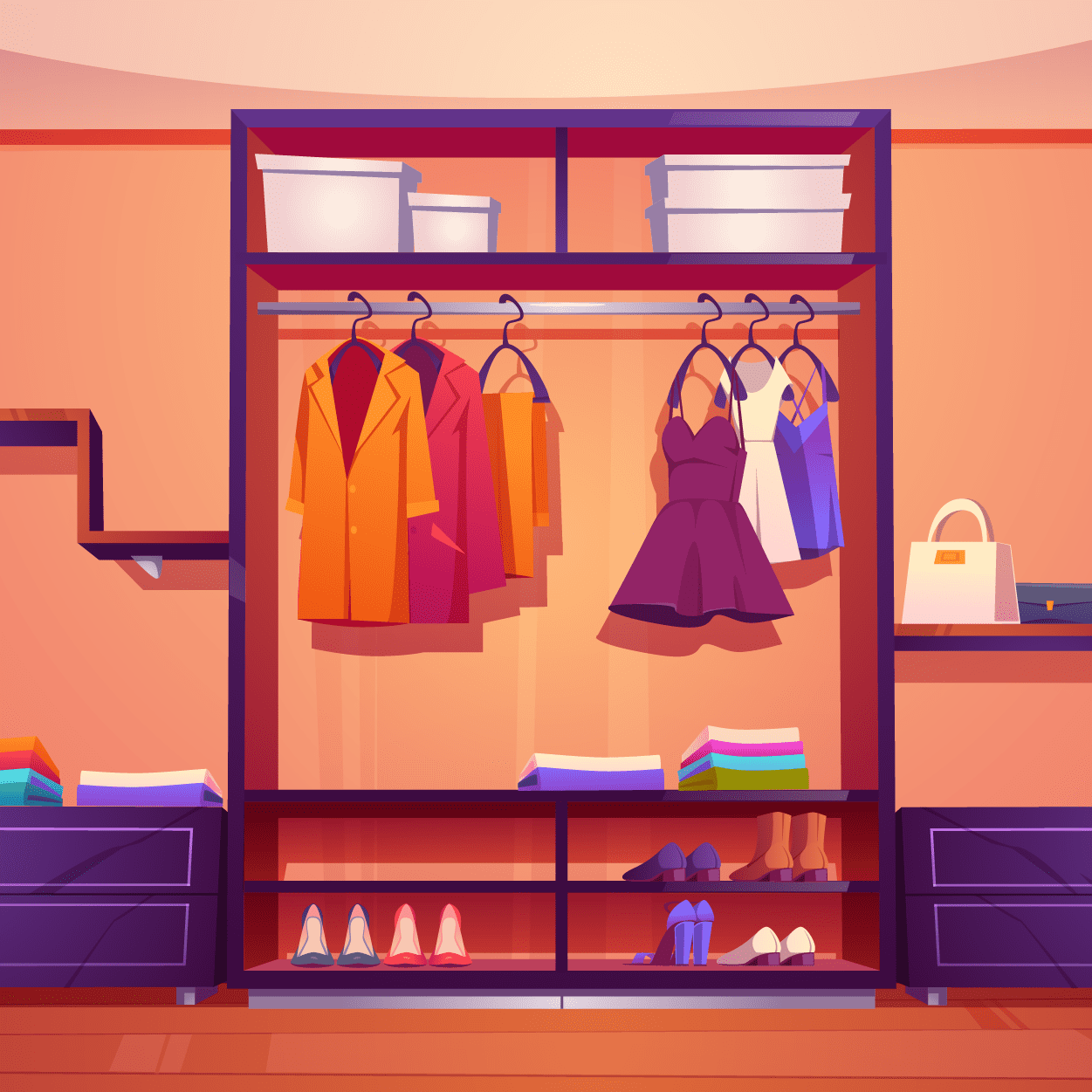
Home and Housework Coloring Pages at ColoringPagesOnly.com covers over 510 pages across 10 sub-categories organized around the spaces of domestic life and the activities, objects, and feelings that make a house a home. This is one of the most experientially immediate categories on the entire site: unlike the historical civilizations or the animated characters or the Olympic athletes, every subject depicted here is something a child sees, touches, and lives with every day. The bedroom they sleep in, the living room they share with their family, the bathroom they use each morning, the household chores they are asked to help with – these are the most familiar objects in any child’s world, and coloring pages that depict them carry a different kind of recognition and comfort than any other category. For parents and educators, this collection is also one of the most naturally educational in a practical sense: coloring a page showing someone sweeping, washing dishes, or making a bed is a gentle and engaging way to introduce the concept that homes require care and that caring for a home is meaningful work.
Every page in this collection is completely free to download as a PDF and print, or to color online directly in your browser.

Room by Room: The Spaces of Home
The largest cluster of sub-categories in the Home and Housework collection organizes the domestic world by room – the distinct spaces of a home, each with its own furniture, its own function, and its own visual atmosphere.
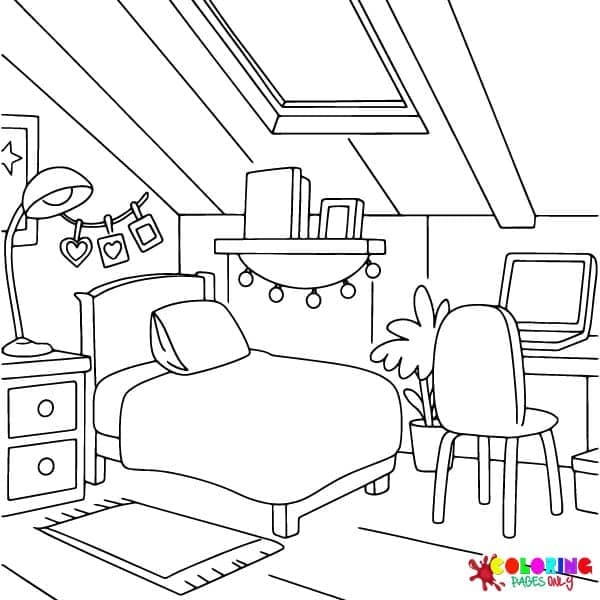
Bedroom covers the most personal space in any home – the sleeping room and private sanctuary where a day begins and ends. Bedroom coloring pages depict the full range of bedroom environments: children’s bedrooms with their specific furniture (bed with headboard, small nightstand, bookshelf with stuffed animals and books, dresser), adult bedrooms with their more restrained compositions, and the cozy, lamp-lit atmosphere that defines the bedroom as a place of rest. Within the children’s bedroom pages specifically, the coloring choices are naturally self-referential for a young colorist – the child coloring a bedroom page may well be coloring something that closely resembles their own space, which creates a different kind of engagement than coloring a dinosaur or a cartoon character.
The palette of bedroom pages varies significantly depending on the style depicted, but the most consistent element across all bedroom coloring pages is the bed itself – typically the largest and most color-defining piece of furniture in the composition. A child choosing whether to color the bedspread red or blue or patterned is, without being aware of it, making design decisions about a domestic space, which is a foundational aspect of spatial and aesthetic thinking.
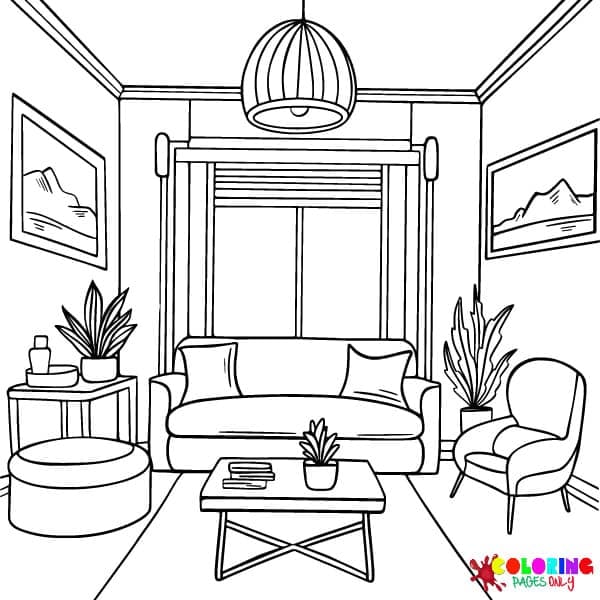
Living Room covers the shared social space of the home – the room designed for gathering, conversation, relaxation, and family life together. Living room pages are among the most compositionally complex in the home collection because the living room typically contains more furniture variety than any other room: sofas, armchairs, coffee tables, bookshelves, rugs, lamps, televisions, cushions, plants, and the accumulated personal objects that give a living room its character. The visual challenge of a living room page – deciding how to color each piece of furniture in relation to the others, choosing whether the sofa should be blue or gray, whether the rug should be warm-toned or cool – is an exercise in the same kind of spatial color reasoning that interior designers and homeowners engage with when furnishing actual rooms.
Living room pages also frequently include windows showing an outside view, which introduces the sky color as an element that affects the mood of the entire room composition. A bright daylight coming through the living room window suggests a warm midday atmosphere; a lamp-lit living room with dark windows suggests evening and rest.
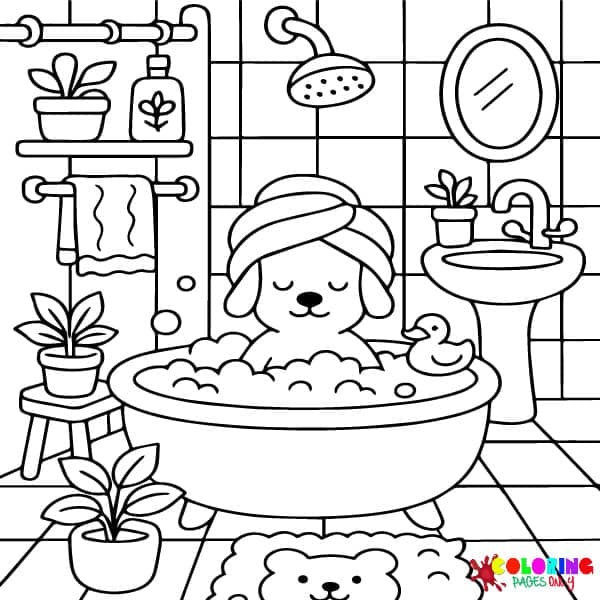
Bathroom covers the hygiene and bathing space of the home – a room defined visually by its tiled surfaces, reflective mirrors, porcelain fixtures, and the specific atmosphere of a space dedicated to daily care and cleanliness. Bathroom coloring pages range from simple pages showing a bathtub with bubble bath and toys for young children (a recognizably playful space) to more detailed pages showing the complete bathroom with sink, toilet, mirror, towel rack, and the geometric pattern of floor and wall tiles.
The tile pattern element makes bathroom pages particularly interesting from a coloring perspective: the repeating geometric grid of bathroom tiles invites systematic, pattern-based coloring where each tile can be given its own color in rotation, creating a finished page that feels more like a designed space than a simple illustration. The mirror surface in bathroom pages also presents a specific rendering opportunity – the mirror reflection should logically show a reversed version of whatever is in front of it, which more ambitious colorists can attempt to render accurately.
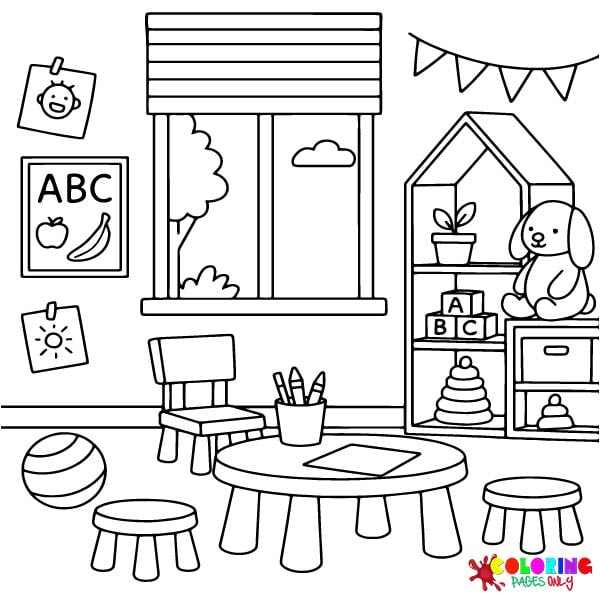
Kids’ Playroom covers the dedicated children’s play space – a room designed specifically for play, creativity, and the organized chaos of childhood. Playroom pages are visually the most colorful and object-dense in the entire home collection: building blocks in primary colors, stuffed animals and dolls, art supplies and craft tables, toy shelves, play tents, and the specific joy of a room where mess and imagination are both welcome. For young children coloring these pages, there is often an element of wish fulfillment – the page may depict a more elaborate or better-organized playroom than the one they have, which makes coloring it an aspirational and imaginative activity.
The playroom palette is naturally the most vivid in the home collection: the primary red, blue, and yellow of classic building blocks, the bright colors of art supplies, the varied animal colors of stuffed toys, and the often-rainbow palette of children’s furniture and storage designed to be cheerful and stimulating. These pages reward bold color choices more than any other room page in the collection.
The Home as Concept and Object
Beyond the individual rooms, several sub-categories in the Home and Housework collection cover the home at larger scales – as architecture, as an emotional concept, and as a collection of the objects that furnish and define it.
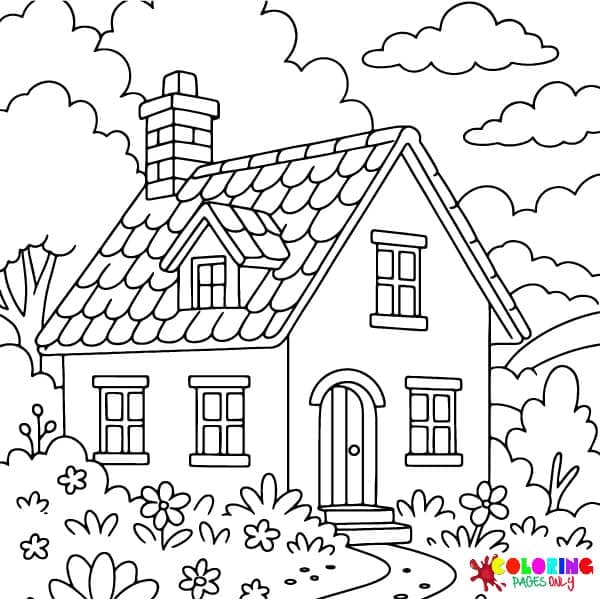
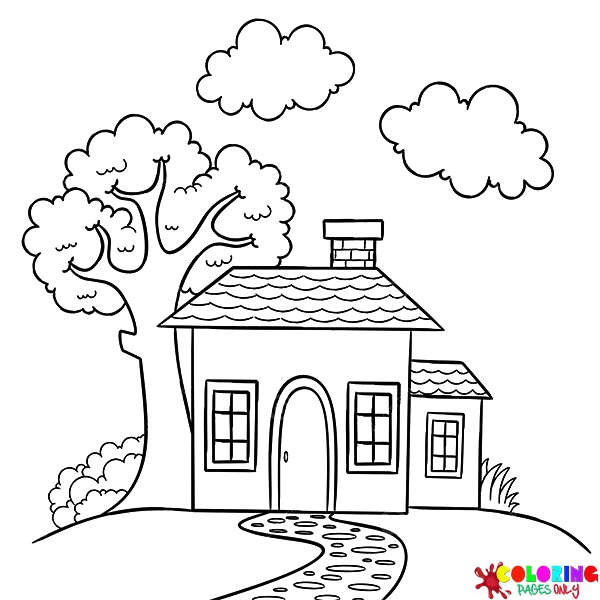
House covers the exterior architecture of homes – the building itself as seen from the outside, rather than the interior spaces within it. House coloring pages span an enormous range of architectural styles and scales: the simple iconic house form (pitched roof, door, two windows, chimney) that appears in children’s drawings worldwide, the elaborately detailed Victorian house with its porch, gingerbread trim, and multiple stories, the cottage with its thatched roof and cottage garden, the modern house with its clean geometric lines, and the grand manor or castle that blurs the line between house and dream. Each architectural style has its own canonical palette and visual vocabulary.
The simple iconic house form – the universal house shape that appears in the drawings of children regardless of culture – is one of the most psychologically resonant images in coloring pages. It represents shelter, safety, family, and home at the most basic symbolic level, which is why it appears so consistently across children’s art and education. Coloring pages that depict this form give young children the satisfying experience of coloring something that feels fundamentally familiar and meaningful.
More detailed house exterior pages – particularly Victorian or cottage styles – offer the coloring challenge of exterior materials: the warm tan or red brick of a brick house, the painted clapboard of a wood-sided house, the gray or blue-gray of natural slate roofing, the white of painted trim, and the green of a garden or lawn surrounding the structure. These pages reward careful attention to material texture and the way exterior materials catch and reflect outdoor light differently from interior surfaces.
Home Sweet Home covers the emotional and decorative concept of home – the warmth, safety, and belonging that a home represents beyond its physical structure. These pages include the classic “Home Sweet Home” as decorative lettering and signage (the kind that appears in needlepoint, on wooden signs, and in home décor across many cultures and generations), cozy interior vignettes that capture the feeling of domestic comfort – a reading corner with an armchair and lamp, a kitchen table with a vase of flowers, a hearth with a fire – and the overall aesthetic of a home that feels lived-in and loved.
Home Sweet Home pages invite a warm, soft color palette: the cream and warm whites of comfortable interiors, the wood tones of furniture and floors, the accent colors of cushions and flowers and decorative objects, and the golden quality of indoor lamplight. These are among the most emotionally resonant pages in the entire home collection – they are coloring pages that function as meditations on domestic comfort and the specific pleasures of being home.
Furniture covers individual furniture items as standalone coloring subjects – chairs, tables, sofas, beds, dressers, bookshelves, lamps, and the broader range of objects that equip a home’s interior. Furniture pages offer a different coloring experience from room pages: instead of organizing furniture within a larger spatial composition, these pages isolate individual pieces and present them as objects in their own right. This gives colorists the opportunity to focus on the material quality of each piece – the grain of wood, the texture of upholstery, the reflective surface of lacquered finishes – without the compositional complexity of a full room.
For children, furniture pages also function as vocabulary pages: naming and coloring each piece reinforces the words for domestic objects in whatever language they are learning, making these pages useful for language learning contexts as well as purely creative activities.
Household Tasks and Outdoor Home Elements
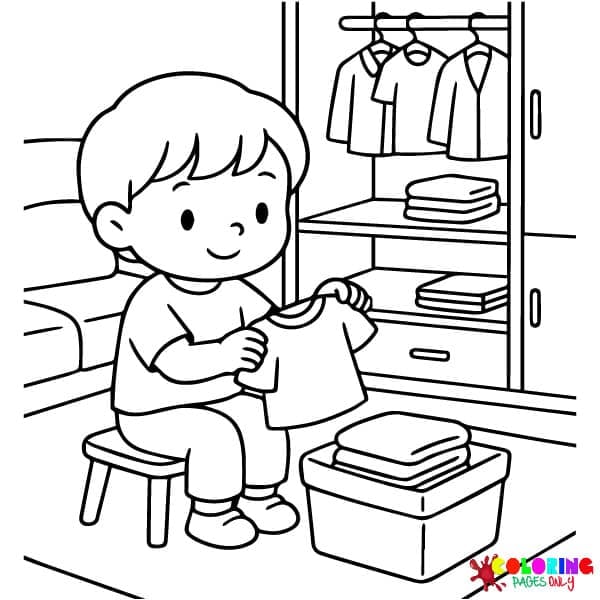
Household Chores is among the most quietly educational sub-categories in the entire site – coloring pages that depict the daily and weekly work of home maintenance as their primary subject. These pages show characters sweeping floors, mopping, washing dishes, doing laundry (sorting, loading the washing machine, hanging clothes to dry), vacuuming, dusting shelves, making beds, watering plants, tidying toys, and the full range of domestic tasks that keep a living space functional and comfortable.
What makes Household Chores pages particularly valuable in an educational context is that they normalize domestic labor as a visible, depicted, valued activity – something worth drawing and coloring, which implicitly communicates that it is something worth doing and noticing. For children who are beginning to participate in home maintenance, coloring a page that shows someone performing exactly the task they have been asked to do can be a point of recognition and pride. For children who have not yet been introduced to these tasks, these pages serve as gentle, non-didactic illustrations of what home maintenance looks like and how it is done.
The visual palette of household chores pages is naturally varied because different chores involve different settings and tools: the kitchen setting of dishwashing (warm tones, the yellow and orange of dish soap bottles, the blue or green of cleaning cloths), the outdoor setting of hanging laundry (bright daylight, the vivid mixed colors of clothes on a line against a blue sky), the living room setting of vacuuming (the varied tones of carpets and furniture), and the bathroom setting of cleaning (the white and tile-gray of bathroom surfaces).
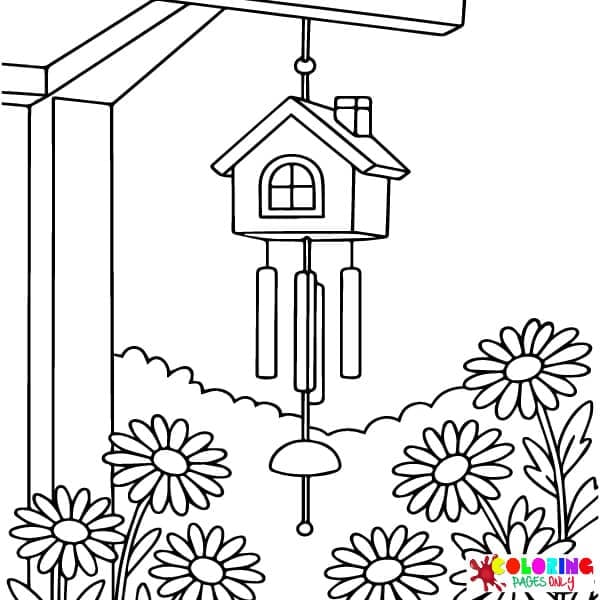
Wind Chime covers the decorative hanging instrument found on porches, in doorways, and in garden spaces – the suspended tubes, shells, beads, or metal pieces that move and sound in the breeze. Wind chime pages occupy a unique position in the home collection: they are neither fully interior (they hang outside or in transitional spaces like covered porches) nor fully landscape (they are a human-made decorative object), but rather a threshold object that represents the domestic space extending outward into the natural world.
Wind chime pages are among the most compositionally elegant in the collection – the suspended hanging form, the various pendant elements, and the gentle visual suggestion of movement create compositions that are both simple and graceful. The coloring palette for wind chimes depends on the material depicted: bamboo wind chimes suggest warm, natural tones (golden bamboo, brown string); metal wind chimes suggest silver and cool gray metallic tones; shell wind chimes suggest the creamy white and pink of natural shells; ceramic wind chimes suggest the rich, glazed colors of pottery. Each material type produces a fundamentally different finished page.
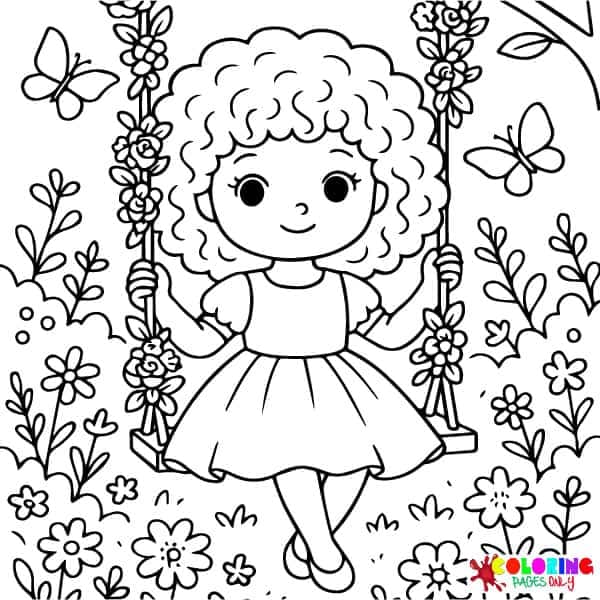
Swing covers the outdoor and indoor swing in its many domestic forms – the classic garden swing (a simple board seat suspended by two ropes from a tree branch or wooden frame), the porch swing (a wider slatted bench hung from ceiling chains on a covered porch), the hammock swing, and the indoor children’s swing or swing chair. The swing sits at the boundary between home and outdoor play: it is a domestic object (attached to the home’s tree, porch, or garden), but its use is inherently active and free, associated with childhood, movement, and summer afternoons.
Swing pages are among the most seasonally evocative in the home collection. The classic garden swing under a shady tree suggests summer in a way that few other domestic objects do as immediately – the green of leaves, the warm wood of the seat, the rope or chain, the dappled light through branches, and the sky visible beyond the tree all combine to produce a specifically summery atmosphere. Porch swing pages carry a different but equally specific mood: the slower, more contemplative quality of sitting rather than swinging, on a porch that frames the outdoor world from the safety and comfort of home.