Mindful coloring means coloring while you pay attention, on purpose and without judging yourself, to what is happening right now: the color, the feel of the pencil, your hand, and your breath. It is an informal mindfulness practice that needs a printed page, a few pencils, and about 20 minutes. This guide gives a step by step routine, prompts for when your mind wanders, and a plain summary of what research says.
The National Center for Complementary and Integrative Health (NCCIH) describes mindfulness as keeping your attention on the present moment without judging it. The practice steps are adapted from activities published by the Eluna Resource Center and Smiling Mind. The research summary draws on a 2019 study by Holt and colleagues and on the evidence guide to coloring for adults. A label of editorial marks advice that comes from ColoringPagesOnly itself, not from the cited organizations. The sources were last read in October 2026.
Does Coloring Count as Mindfulness?
It can. Mindfulness is a way of paying attention, so what matters is how you color more than which page you pick. This point is editorial. Smiling Mind describes mindful colouring as an informal mindfulness practice, unlike meditation that focuses on the breath, and Eluna uses coloring as an activity for grounding and refocusing on the present moment.
Coloring while watching television or scrolling a phone is relaxing for some people, but it is a different practice. This is editorial.
A Step by Step Practice
- Set up. Print a page and gather pencils, crayons, or markers. Sit in a calm spot with the page on a firm surface, as Eluna suggests, and put your phone out of reach (the phone tip is editorial).
- Breathe. Take three slow, deep breaths (Eluna).
- Notice. Scan your body or look over the page for a moment, and ask yourself what you notice (Eluna).
- Pick one color and look at it. Pay attention to the shade, the weight of the pencil in your hand, and how the stroke feels (Smiling Mind).
- Color slowly, one small area at a time. Keep your attention on the stroke itself. This step is editorial.
- Come back when your mind drifts. When thoughts jump to the past or the future, notice that and return to the page (Eluna). A short phrase such as “right now I am coloring” can help, and Smiling Mind suggests writing prompts like this to revisit.
- Let judgments pass. If you think “this looks bad” or “I went outside the lines,” notice the thought, do not act on it, and keep coloring (Smiling Mind). There is no right or wrong way to color.
- End with a pause. Put the pencil down, take a breath, and notice how you feel. This step is editorial.
How long? The mandala coloring trial in older adults covered in the evidence guide used 20 minutes. If 20 feels long, start with 10. The shorter start is editorial.
What to Color
These suggestions are editorial.
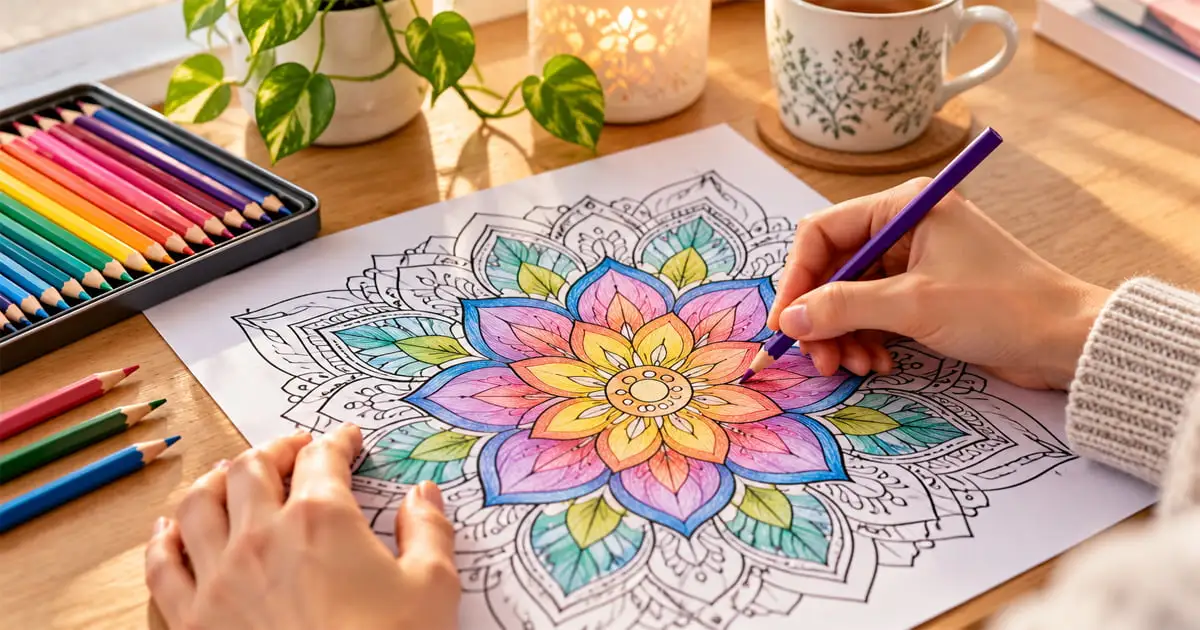
- Pick a page with moderate detail and no deadline. Mandala pages are the pattern many coloring studies used, but the evidence guide rates the idea that mandalas work better than other coloring as mixed, so choose what you enjoy.
- Browse Mindfulness Coloring Pages or the Adult Coloring Pages collection.
- On a restless day, choose a page with large, simple shapes so the strokes stay easy.
- Keep the tools simple. Sharp pencils and a few colors leave less to decide. The coloring tips guide explains tools and techniques.
Prompts for a Wandering Mind
These prompts are editorial. Pick one and return to it whenever you notice your attention has left the page.
- What color am I using, and how does it look next to the color beside it?
- What does the pencil feel like against the paper?
- Where is my breath right now?
- What do I notice in my hands and shoulders?
- Can I let this stroke be imperfect?
What the Research Says
- Coloring and mindfulness. Holt, Furbert, and Sweetingham ran two experiments with undergraduates (47 and 52 students) in which each student colored and also took part in a control condition. In both experiments coloring significantly reduced anxiety and increased mindfulness compared with the control condition and with baseline scores. This is early evidence from student samples, and the abstract does not report how long the effects last.
- Coloring and anxiety. A handful of randomized trials, plus two meta-analyses published in 2026, point the same way, but the reviewers rate the certainty of that evidence as low or very low. The evidence guide sorts each claim by how strong the research is.
- Mindfulness in general. NCCIH notes that much of the research on mindfulness practices is preliminary or not rigorous, and that results may have been interpreted too optimistically.
Mindful Coloring With Children
Eluna’s activity is written for groups from children aged 8 and under through teens, and it uses the same opening question, what do you notice. With younger children, keep sessions short and let them lead. This advice is editorial. For ideas by age, see the age by age guide, or browse the coloring pages for kids hub.
When to Be Careful
NCCIH says mindfulness practices usually are considered to have few risks, but few studies have looked for harmful effects. A 2020 review it cites found that about 8 percent of participants had a negative effect, most commonly anxiety and depression, a rate similar to psychological therapies. Those figures describe mindfulness practices in general, not coloring.
NCCIH also advises against using meditation in place of conventional care or to delay seeing a health care provider. If paying attention to your thoughts makes you feel worse, stop and color just for fun, or talk to a health care provider. This last suggestion is editorial. The evidence guide has a section on when coloring is not enough.
Frequently Asked Questions
What is mindfulness coloring?
Mindfulness coloring, also called mindful coloring, is coloring with your attention on the present moment. You notice the colors, the movement of the pencil, and your breath, and you gently return to the page when your mind wanders. NCCIH describes mindfulness as keeping attention on the present moment without judging it.
Does coloring count as mindfulness?
Yes, when you do it with attention. Smiling Mind calls mindful colouring an informal mindfulness practice, and Eluna uses coloring to help people ground themselves and refocus on the present moment. Coloring while distracted is relaxing for some people, but it is a different practice, which is an editorial view.
What are some examples of mindfulness coloring activities?
Eluna’s activity starts with three deep breaths and a scan of your body or the page, then coloring while you notice what comes up and return to the page when your mind wanders. Smiling Mind suggests noticing the weight of the pencil and the shades you choose, and using a short phrase to bring your attention back. Eluna also lists group coloring with projected images as a variation.
What colors are most effective for mindfulness?
None of the sources reviewed for this guide links a specific color to a mindfulness effect, so choose colors you enjoy. This answer reflects the sources reviewed in October 2026, not a full literature search.
Who should not practice mindfulness?
NCCIH does not name specific groups. It says mindfulness practices usually have few risks, that a 2020 review found about 8 percent of participants had a negative effect, most commonly anxiety and depression, and that meditation should not replace conventional care or delay seeing a health care provider. If quiet attention makes you feel worse, stop and talk to a health care provider, which is an editorial suggestion.
How long should a mindful coloring session last?
The sources reviewed give no required length. The mandala coloring trial in older adults covered in the evidence guide used 20 minutes, and starting with 10 minutes if that feels long is an editorial suggestion.
Sources
- National Center for Complementary and Integrative Health (NCCIH), “Meditation and Mindfulness: What You Need to Know” (last updated June 2022): https://www.nccih.nih.gov/health/meditation-and-mindfulness-what-you-need-to-know
- Holt, N. J., Furbert, L., Sweetingham, E., “Cognitive and Affective Benefits of Coloring: Two Randomized Controlled Crossover Studies,” Art Therapy, 2019;36(4):200-208: https://doi.org/10.1080/07421656.2019.1645498
- Eluna Resource Center, “Activity: Mindful Coloring”: https://elunanetwork.org/resources/activity-mindful-coloring/
- Smiling Mind (Georgie Vinson), “What is mindful colouring” (October 24, 2019): https://blog.smilingmind.com.au/what-is-mindful-colouring