Benefits of Coloring for Adults at ColoringPagesOnly.com addresses a question that many adults ask – sometimes apologetically – when they discover adult coloring pages: “Is this actually good for me, or is it just a way to pass time?” The answer, supported by a growing body of research in psychology, neuroscience, and occupational therapy, is that coloring is genuinely beneficial for adults in specific, measurable ways that have nothing to do with nostalgia or novelty.
This guide covers seven evidence-based benefits of adult coloring, explains the neuroscience behind why they work, and provides practical guidance on getting started – including which types of pages produce which benefits.
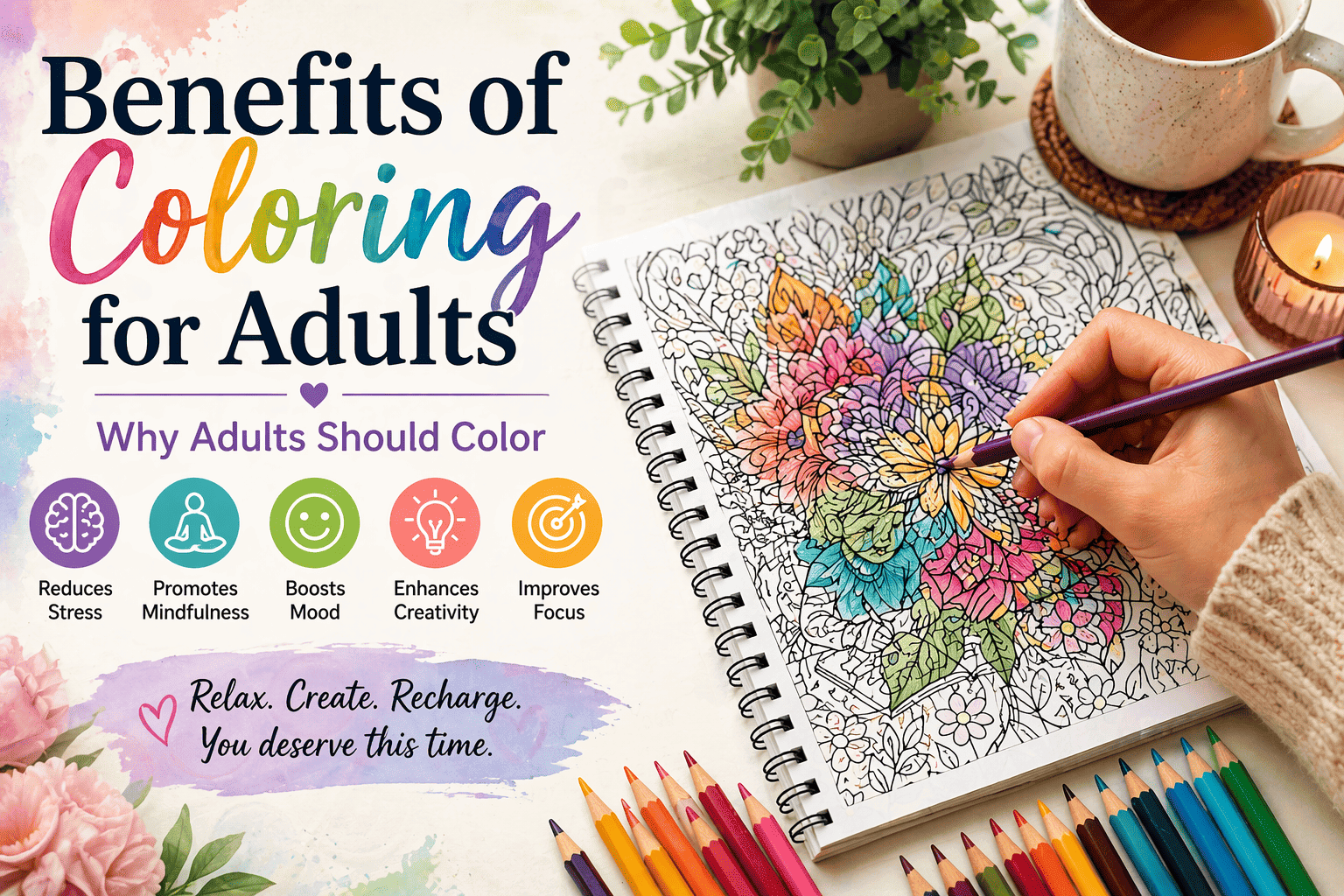
Why Adult Coloring Became a Global Phenomenon
The adult coloring trend that swept through bookstores beginning around 2013–2015 was not a marketing invention. It emerged from a genuine, largely spontaneous discovery by millions of people that picking up colored pencils after a stressful workday produced something that neither watching television nor scrolling through social media could match: a specific quality of mental quiet, combined with a concrete, visible result.
By 2016, adult coloring books occupied five of the top ten spots on Amazon’s bestseller list for multiple consecutive weeks – a publishing anomaly that journalists struggled to explain at the time but that psychologists and occupational therapists found entirely predictable. What adults had rediscovered was an activity that combines the neurological benefits of focused attention, repetitive fine motor movement, and creative decision-making in a format accessible to anyone, regardless of artistic ability.
The research that followed confirmed what millions of colorists had discovered empirically.
1. Stress and Anxiety Reduction
The most consistently documented benefit of adult coloring is its measurable effect on psychological stress and anxiety. Multiple peer-reviewed studies have examined this relationship directly.
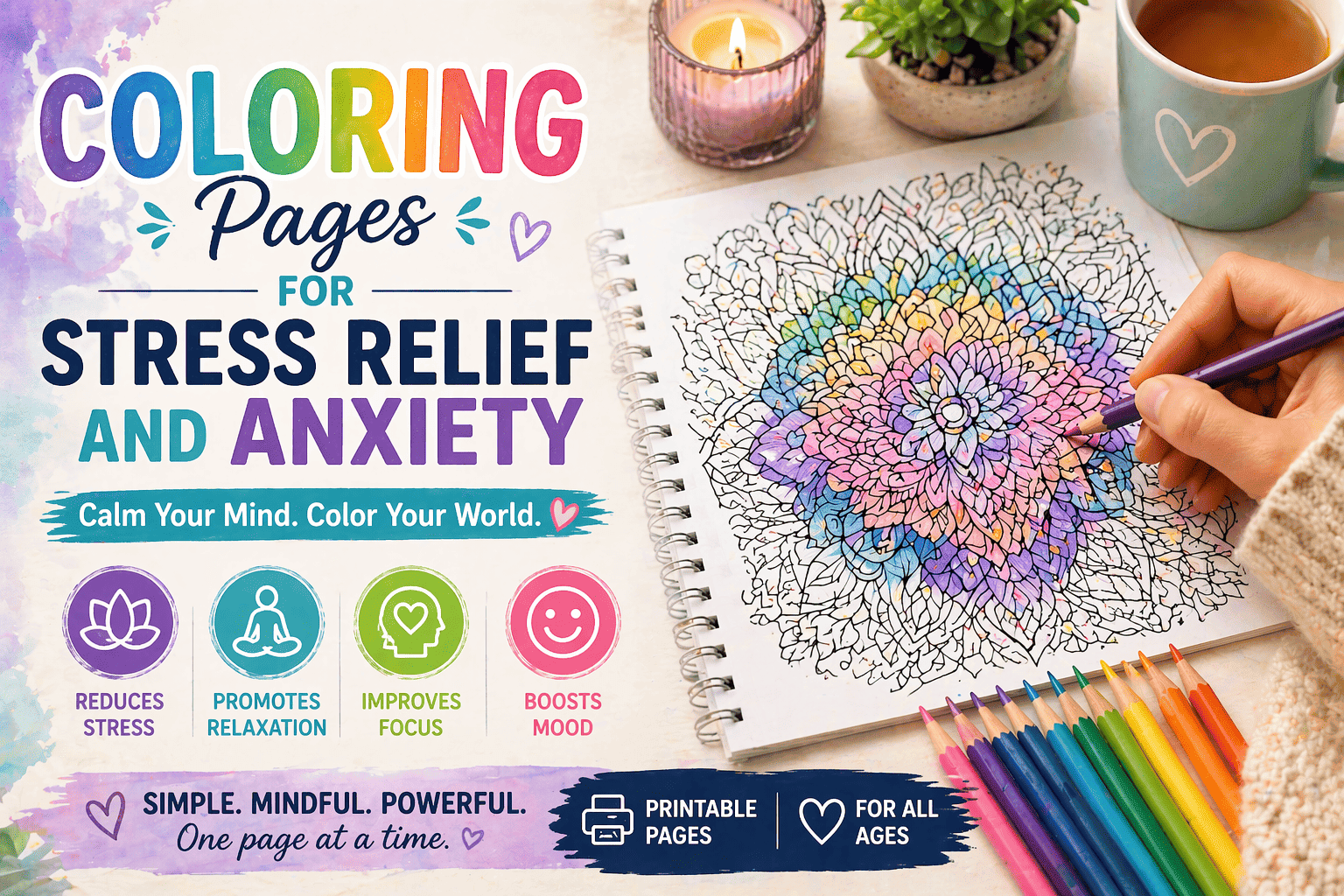
A 2005 study by researchers Nancy Curry and Tim Kasser at Knox College, published in Art Therapy: Journal of the American Art Therapy Association, compared the anxiety-reducing effects of coloring a complex geometric mandala pattern, coloring a plaid pattern, and free-form drawing on a blank page. Participants who colored the mandala – with its structured, symmetrical complexity – showed significantly greater reductions in anxiety than either of the other two groups, as measured by standardized anxiety scales before and after the activity. The researchers concluded that the specific structure of the mandala pattern – its organized complexity that requires focused attention without demanding creative invention – was the active ingredient.
A 2018 study published in Empirical Studies of the Arts by researcher Sara Bolt examined adult coloring specifically in the context of everyday anxiety management. Participants who colored for 20 minutes reported significantly lower state anxiety scores afterward compared to a control group who spent the same time reading. The effect was comparable in magnitude to established anxiety-reduction interventions, including brief progressive muscle relaxation.
The neurological mechanism is well understood: focused coloring activity engages the prefrontal cortex – the brain’s center for concentration and complex thought – while simultaneously reducing activity in the amygdala, the brain structure responsible for the stress response. When you are focused on choosing which color goes next to which, the neural resources that would otherwise sustain anxious rumination are redirected. Anxiety requires cognitive fuel. Coloring consumes it productively.
Which pages work best for anxiety: Mandala patterns and geometric designs with structured repetition produce the strongest anxiety-reduction effects because they provide sufficient complexity to demand focus without the blank-canvas pressure of open-ended creative work. Nature patterns – leaves, flowers, fine botanical illustration – are the second most effective category.
2. Mindfulness Without the Difficulty of Meditation
Mindfulness – the practice of deliberately directing attention to present-moment experience without judgment – has one of the strongest evidence bases in clinical psychology for reducing stress, improving emotional regulation, and increasing subjective well-being. The problem is that formal mindfulness meditation is genuinely difficult for many people. Sitting still, following the breath, and redirecting attention when it wanders requires training and patience that many adults, particularly in high-stress periods, cannot easily access.
Coloring produces functional mindfulness without requiring any of this training. The activity naturally anchors attention in the present: the specific decision of which color to pick up, the sensation of the pencil or marker on paper, the visible progress of color filling an area, and the next decision immediately presenting itself. There is no past or future in a coloring page – there is only the zone currently in hand.
Research by Elena Forkosh and Jonathan Lichtenberg at the Hebrew University of Jerusalem found that adult coloring produced measurable increases in mindful attention and present-moment awareness comparable to those produced by brief guided mindfulness meditation sessions of the same duration. Crucially, participants who described themselves as having difficulty with formal meditation did not show reduced benefit from coloring – the activity does not require prior mindfulness training to produce mindfulness outcomes.
This makes adult coloring particularly valuable for people who genuinely want the benefits of mindfulness practice but have found formal meditation frustrating or inaccessible – which, surveys suggest, describes the majority of adults who have attempted and abandoned meditation.
Practical note: To maximize the mindfulness benefit, color in a quiet environment without background television or podcasts for at least the first 10 minutes. The auditory channel is the primary competitor for the attentional focus that produces the benefit.
3. Flow State and Deep Focus
Flow – the psychological state of complete absorption in a challenging but manageable task, first systematically described by psychologist Mihaly Csikszentmihalyi – is associated with the highest levels of subjective well-being in adult life. People in flow states report the greatest life satisfaction, the least self-consciousness, and the most complete disengagement from intrusive or anxious thoughts.
Flow requires a specific balance: the task must be challenging enough to demand real attention but not so difficult as to be frustrating. The skill-to-challenge match is everything. Adult coloring pages – particularly detailed, complex designs – meet this condition almost automatically, because the colorist can always adjust difficulty by choosing more or less complex pages, more or less demanding tools, or by choosing to add shading, blending, and detail beyond what the outline requires.
Adult colorists who describe their coloring sessions frequently use language that precisely matches the research definition of flow: “time disappeared,” “I stopped thinking about everything else,” “I was completely in it,” “I didn’t notice how long I’d been sitting there.” These are not metaphors – they are accurate descriptions of the attentional absorption that characterizes flow states.
Csikszentmihalyi’s research found that adults experience flow most consistently during activities that combine skilled action with clear goals and immediate feedback. Coloring provides all three: the skilled action of applying color precisely and blendingly, the clear goal of completing the image, and the immediate visual feedback of watching color transform a page.
4. Sleep Quality Improvement
One of the most practically significant benefits of adult coloring – and one of the least discussed – is its effect on sleep. The mechanism connects directly to the stress and screen exposure patterns of modern adult life.
Most sleep difficulties in otherwise healthy adults trace to one of two causes: elevated cortisol (stress hormone) at bedtime, or blue-light exposure from screens that suppresses melatonin production and delays sleep onset. Coloring addresses both simultaneously. A 30-minute coloring session in the hour before bed produces measurable cortisol reduction through the anxiety-reduction mechanism described above and, crucially, involves no screen exposure, allowing the natural melatonin rise that drives sleep onset to proceed undisturbed.
The American Academy of Sleep Medicine has for years recommended replacing screen time in the pre-sleep hour with activities that are mentally engaging but not stimulating. Adult coloring is close to ideal for this purpose: it is engaging enough to reduce rumination (a primary cause of sleep-onset insomnia) but not stimulating enough to activate the arousal response that keeps people awake. The physical act of coloring – the gentle repetitive hand movement, the visual focus on a static, non-backlit surface – is neurologically compatible with the transition toward sleep in a way that screens are not.
Adult colorists who adopt evening coloring as a pre-sleep routine frequently report falling asleep more quickly and experiencing fewer episodes of lying awake with active, anxious thoughts.
5. Cognitive Maintenance and Brain Health
Coloring engages multiple cognitive systems simultaneously: visual-spatial processing, decision-making, fine motor control, pattern recognition, and creative judgment. This multi-system engagement is precisely what neuroscience research on cognitive maintenance in adults recommends.
Research in cognitive reserve – the brain’s ability to maintain function despite age-related or injury-related changes – has consistently found that activities engaging multiple cognitive domains simultaneously are more protective than activities engaging a single domain. Reading engages language processing but minimal motor and spatial systems. Walking engages motor and spatial systems but requires minimal language or decision-making. Coloring engages visual-spatial processing, fine motor control, decision-making, and aesthetic judgment simultaneously, making it genuinely cognitively complex despite its apparent simplicity.
For older adults specifically, fine motor engagement in coloring with pencils or markers maintains hand dexterity and the hand-eye coordination circuits, which are among the first to decline with age. The visual discrimination required to choose colors and evaluate compositions maintains the visual processing pathways that support broader perceptual acuity.
A 2015 study examining leisure activities in older adults found that engagement in visual art activities – including coloring – was associated with significantly reduced rates of cognitive decline over a four-year follow-up period, even after controlling for baseline cognitive function, education level, and physical health.
6. Emotional Processing and Self-Expression
Adults, like children, have emotional inner lives that frequently outpace their ability to process them verbally. The difference is that adults have the linguistic sophistication to construct elaborate rationalizations for not examining difficult feelings – and the social context (workplace, family, public) that makes emotional expression genuinely inadvisable in most moments of the day.
Coloring creates a protected, private channel for emotional processing that requires no language and carries no social risk. The color choices, the pressure applied, the areas of a page attended to most carefully, and the response to a finished piece all carry emotional content that the colorist may or may not consciously register – but that exerts a genuine processing function regardless.
Art therapy practitioners who work with adults – including those dealing with grief, trauma, burnout, and chronic illness – consistently report that coloring activities serve as a transition object for emotional processing: a way of entering a reflective state that is less threatening than direct verbal examination of difficult experiences, but that serves some of the same integrative psychological functions.
For adults who are not experiencing acute emotional difficulty, coloring provides what psychologists call restorative experience – a qualitatively different mental state from both work-mode concentration and passive rest, which allows the default mode network of the brain (associated with self-reflection, memory consolidation, and creative connection-making) to operate in a low-pressure context.
7. Social Connection and Community
This is perhaps the most surprising benefit in the list, given that coloring is typically understood as a solitary activity. The adult coloring community – on platforms including Pinterest, Reddit, Facebook groups, and YouTube – is genuinely large and genuinely active, with millions of participants sharing finished pages, color palette choices, technique tips, and moral support.
For adults whose primary social interactions occur in professional contexts dominated by performance and competence display, the adult coloring community offers something qualitatively different: a low-stakes creative context where the primary currency is enthusiasm and color choice, where effort is celebrated regardless of technical outcome, and where the shared language is specific and rich enough to create genuine connection.
Coloring circles – in-person groups where adults color together, often in cafés, libraries, or community centers – have grown significantly since the mid-2010s. Research on the psychology of parallel activity (two or more people doing the same thing in the same space without necessarily conversing) finds that it produces bonding and social comfort comparable to active conversation for many personality types, particularly introverts who find sustained conversation taxing but enjoy shared presence.
For adults managing loneliness or social anxiety, coloring communities – both online and in-person – provide structured social engagement with a focus point that reduces the performance pressure of unstructured socializing.
Choosing the Right Pages for Your Goals
Different types of adult coloring pages produce different benefit profiles. Knowing this allows you to choose intentionally rather than by aesthetics alone:
For anxiety and stress relief: Mandala patterns and geometric designs with structured repetition. The bilateral symmetry and organized complexity of mandalas specifically engage the anxiety-reduction mechanism most effectively. Pages with very fine detail are less effective for this purpose – they produce frustration rather than focus.
For mindfulness and flow: Nature illustration pages – botanical prints, animal portraits, landscape details – with moderate complexity. Enough detail to require real attention, clear enough outlines to maintain momentum without frustration.
For cognitive engagement: Highly detailed pages with many color zones, including architectural illustration, intricate pattern work, and complex character scenes. These maximize multisystem cognitive engagement, which supports cognitive maintenance.
For pre-sleep winding down: Pages with softer, more flowing designs – watercolor-style outlines, simple nature scenes, flowing abstract patterns. High-detail pages requiring intense focus are counterproductive for pre-sleep use.
For emotional processing: Pages whose subject matter holds personal resonance – a landscape that recalls a meaningful place, animals with emotional associations, seasonal subjects connected to memories. Subject matter matters more for emotional processing than technical complexity.
Getting Started: Practical Guidance
Choose your tools carefully. For adults coloring with pencils, a set of 24–36 quality colored pencils outperforms a 72-pencil set of lower quality because color consistency and blendability matter more than range. The three tool categories each suit different coloring styles: colored pencils for subtle blending and long sessions; alcohol-based markers (Copic or equivalent) for vivid flat color and speed; watercolor pencils for a softer, more atmospheric result.
Paper quality matters more than most beginners expect. Standard printer paper is too thin for markers and too smooth for colored pencils to grip properly. For dedicated adult coloring sessions, pages printed on 120gsm paper with colored pencils, or 160gsm with markers, produce significantly better results and a more satisfying physical experience.
Start with 15-20 minutes. Adults who set out to complete a full page in one session frequently experience the frustration of an unfinished piece. Starting with shorter sessions focused on a single section maintains the completion satisfaction that reinforces the habit.
Color in a designated space. The ritual of coloring – setting up materials, choosing a page, settling in – contributes to the benefit. Adults who color at a specific, consistently used spot report stronger habit formation and greater reported benefit than those who color opportunistically wherever space is available.
FAQs
Is adult coloring actually beneficial or just a trend? The trend aspect – publishing industry cycles, social media visibility – has passed. What remains is a stable, evidence-supported recreational practice with documented benefits for anxiety reduction, mindfulness, and cognitive engagement. Multiple peer-reviewed studies since 2005 support specific benefit claims. It is not merely a trend.
How long do I need to color to get the benefit? The anxiety-reduction studies showing significant effects used 20-minute sessions. Flow states typically emerge after 10–15 minutes of sustained engagement. For sleep benefit, 30 minutes before bed is the researched duration. Brief sessions (5–10 minutes) produce a smaller but real benefit. Longer sessions are not meaningfully more beneficial per hour than 30-minute sessions.
Do I need artistic ability? No. The benefits of adult coloring – anxiety reduction, mindfulness, focus – are not related to the aesthetic quality of the finished page. Studies showing anxiety reduction used participants with no art background. The activity’s benefits come from the process, not the product.
Should I color alone or with others? Both produce benefits. Solo coloring produces stronger mindfulness and flow outcomes. Group coloring produces stronger social and emotional outcomes. If both options are available, alternating between them captures the full range of benefits.
Which is better – digital or physical coloring? For stress reduction and sleep benefits, physical coloring is superior because it avoids screen exposure and provides the tactile sensation of a pencil or marker on paper. For accessibility and convenience, digital coloring (on tablet apps) retains the cognitive and mindfulness benefits. For adults specifically concerned with sleep quality, physical coloring in the pre-sleep hour is strongly preferable.
I tried coloring and didn’t find it relaxing – what went wrong? The most common reasons adults do not immediately find coloring relaxing are: a page that is too complex for a first session (frustration overrides relaxation), a noisy environment, or a too goal-oriented approach (focusing on finishing the page rather than the process). Try a less detailed page, a quiet space, and framing the session as 15 minutes of process rather than a project to complete.
Explore our full adult coloring collection at ColoringPagesOnly.com. Every page is free to download as a PDF or view online in color – no account required. For mandala and relaxation-focused designs, see our Mandala Coloring Pages collection.