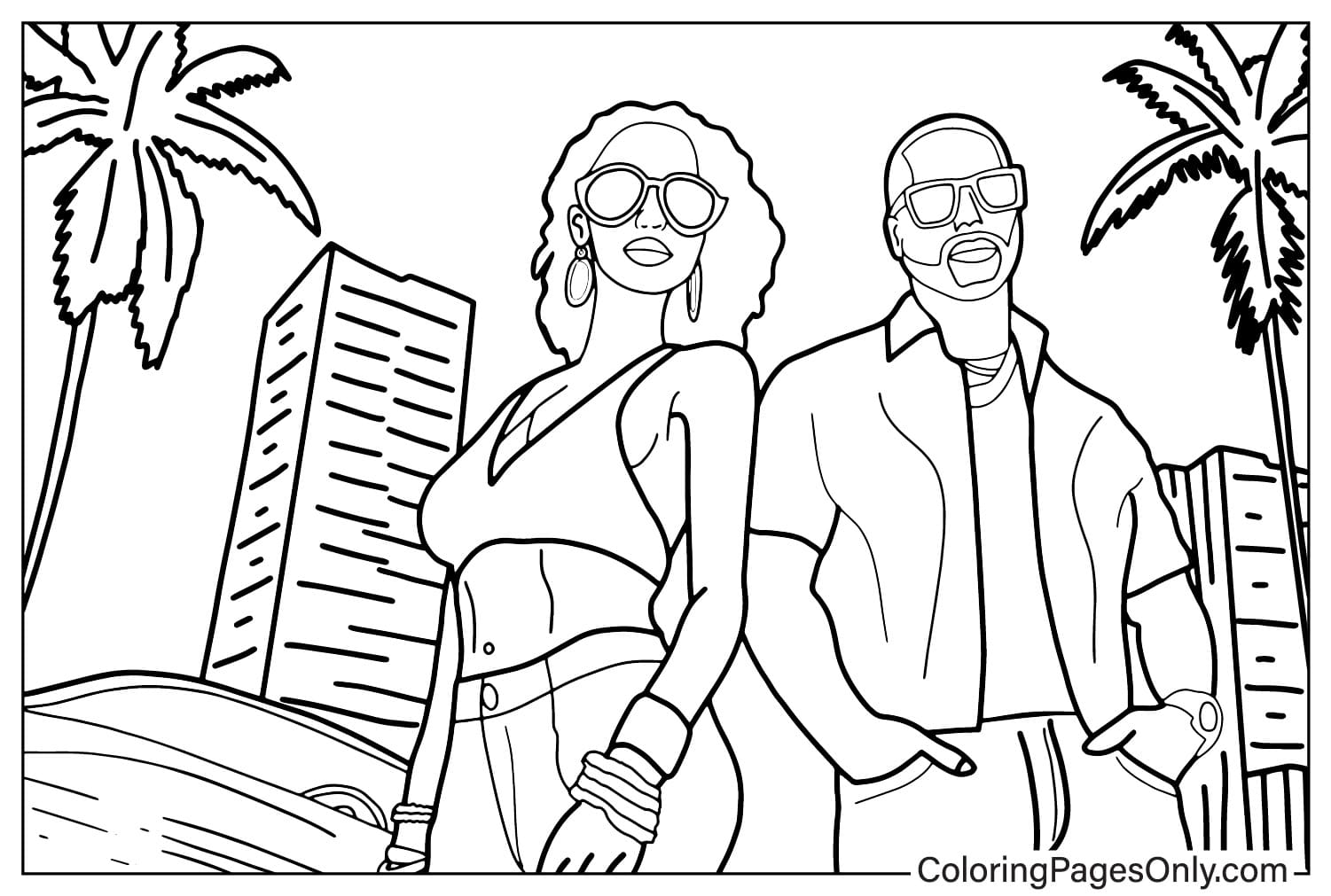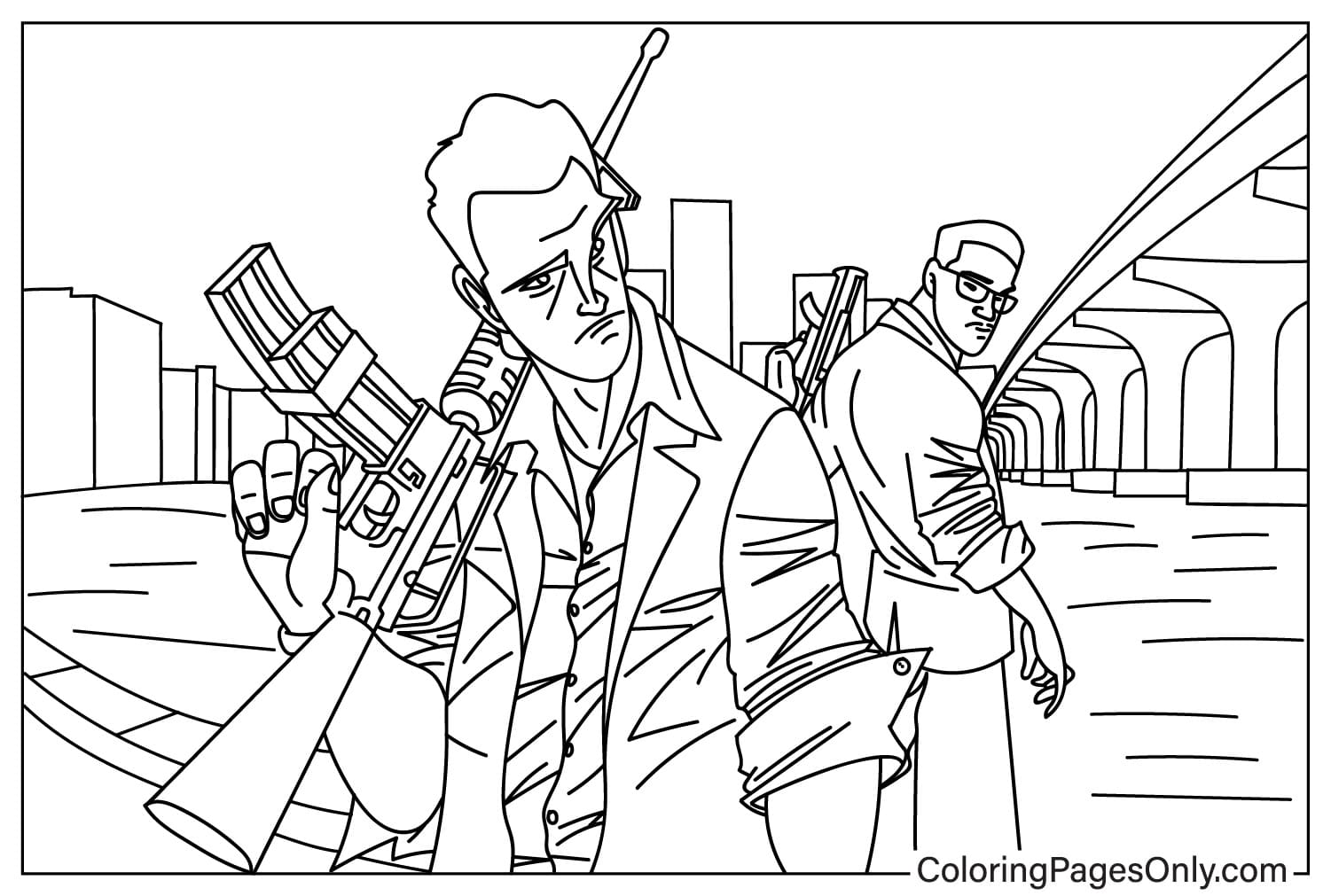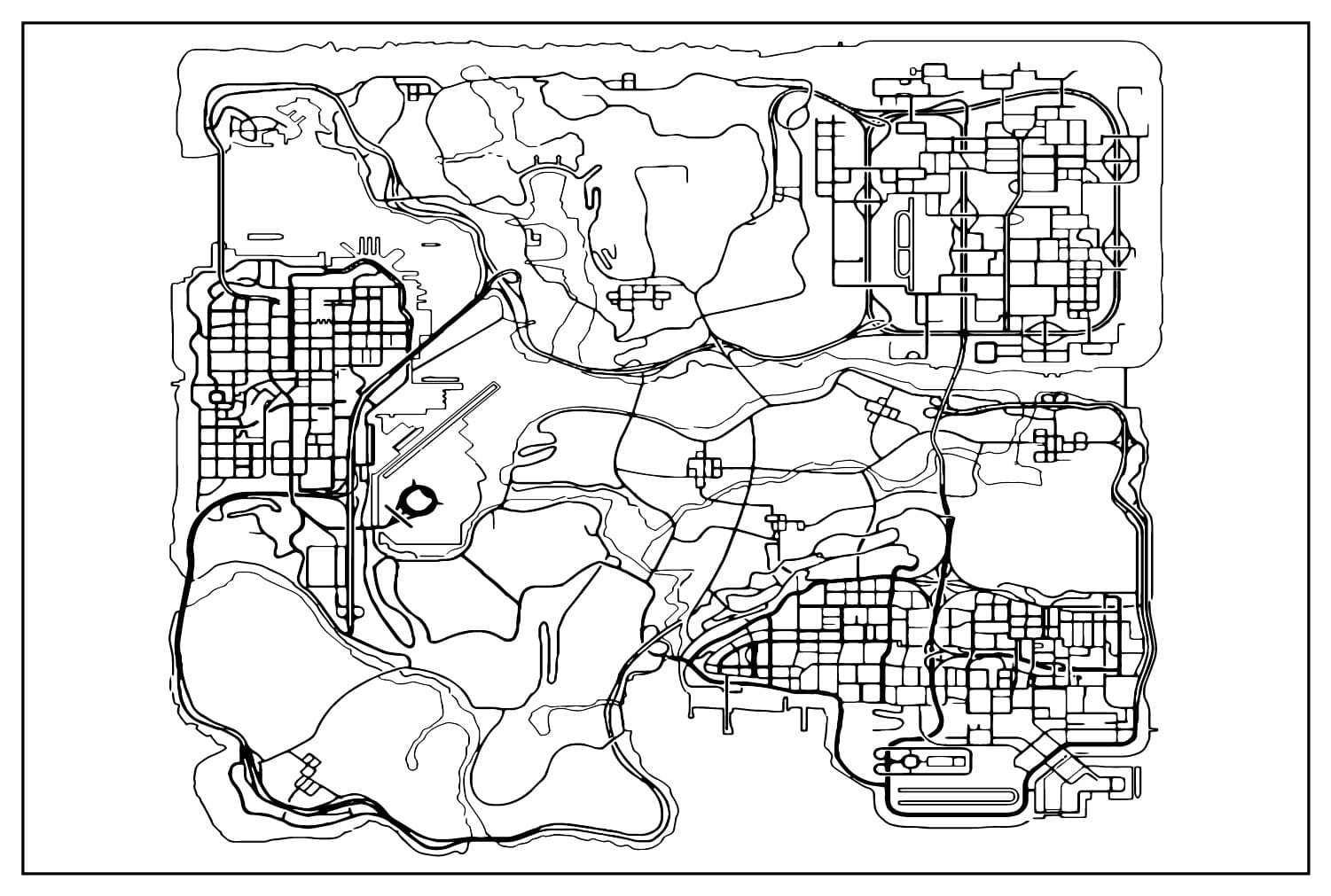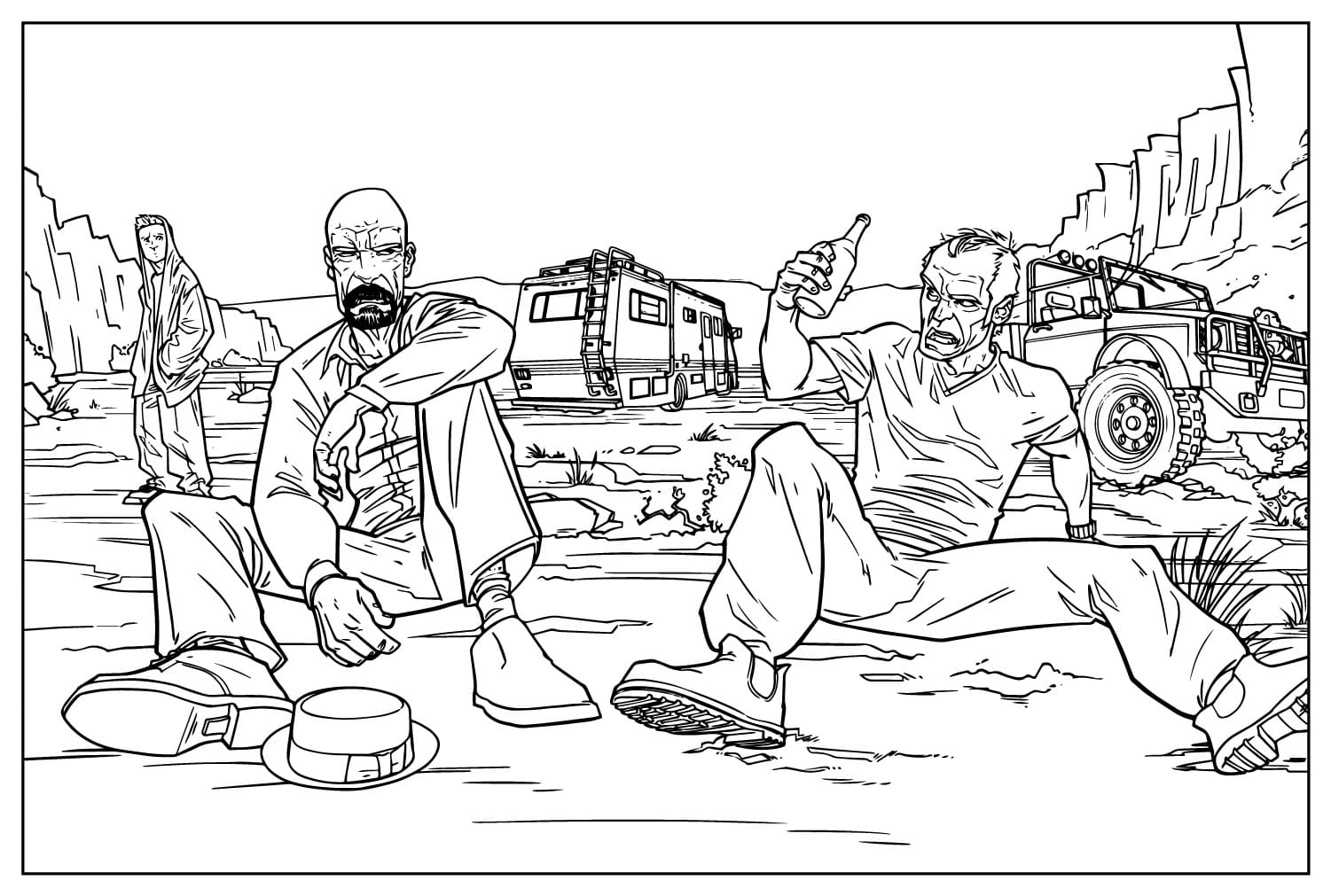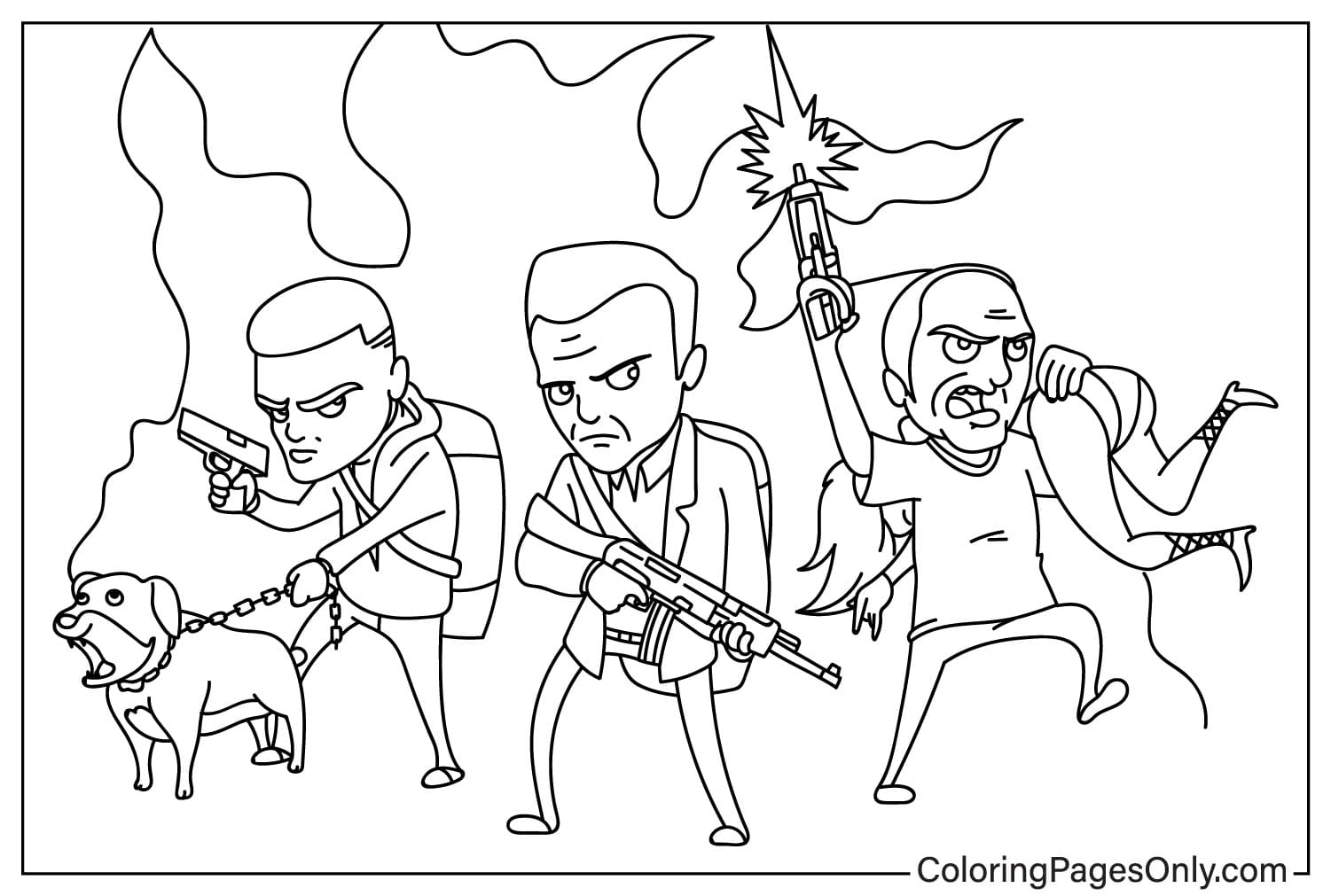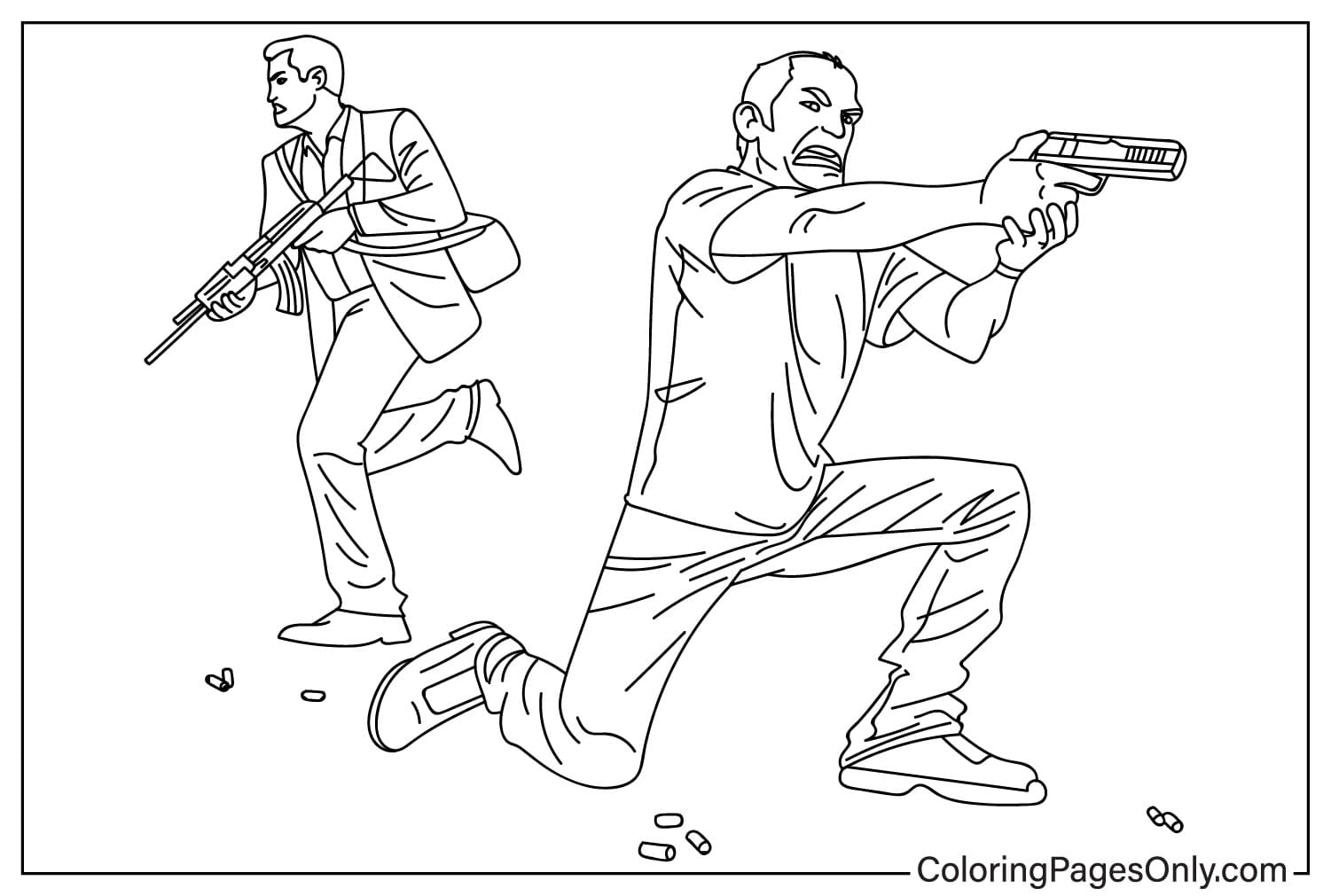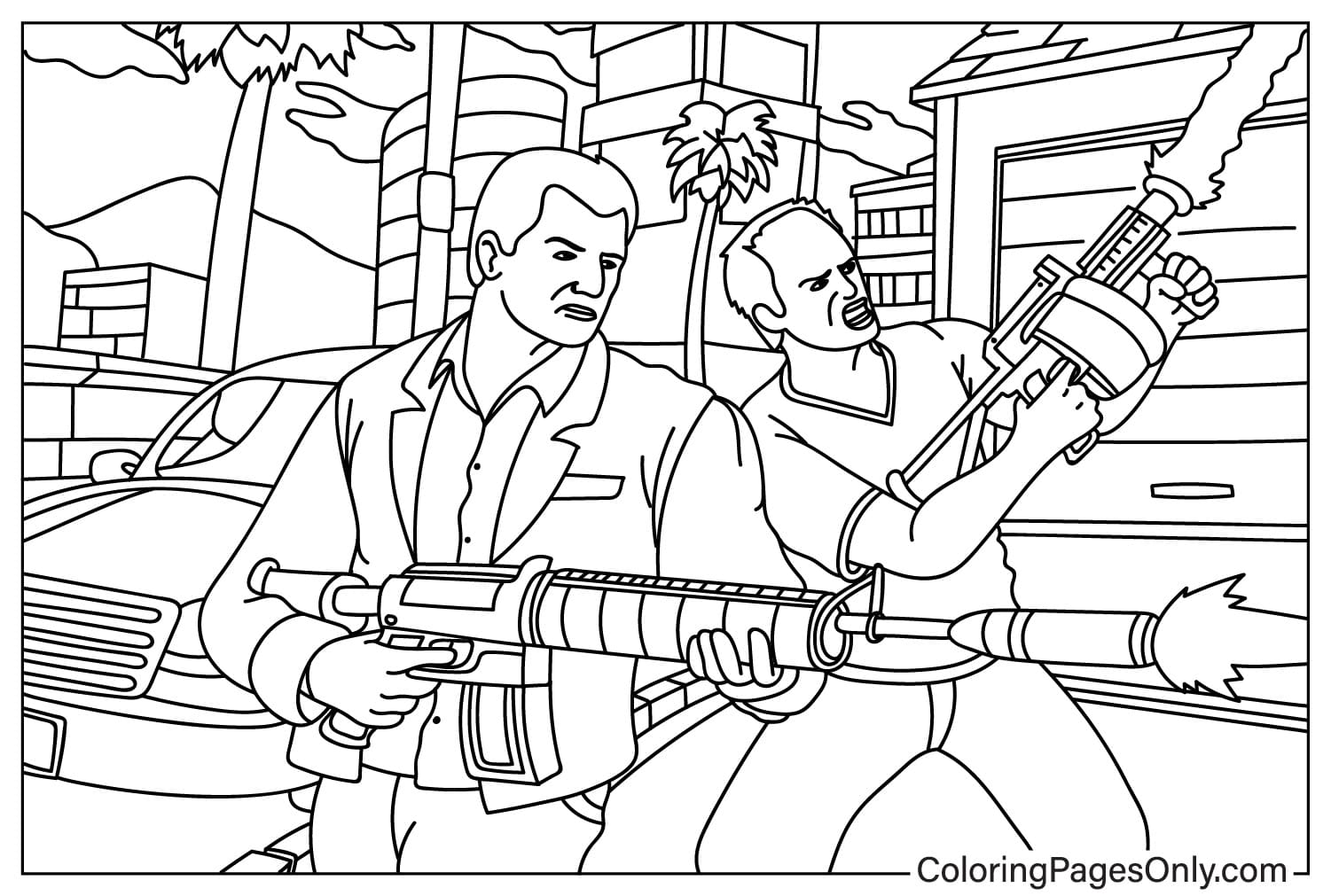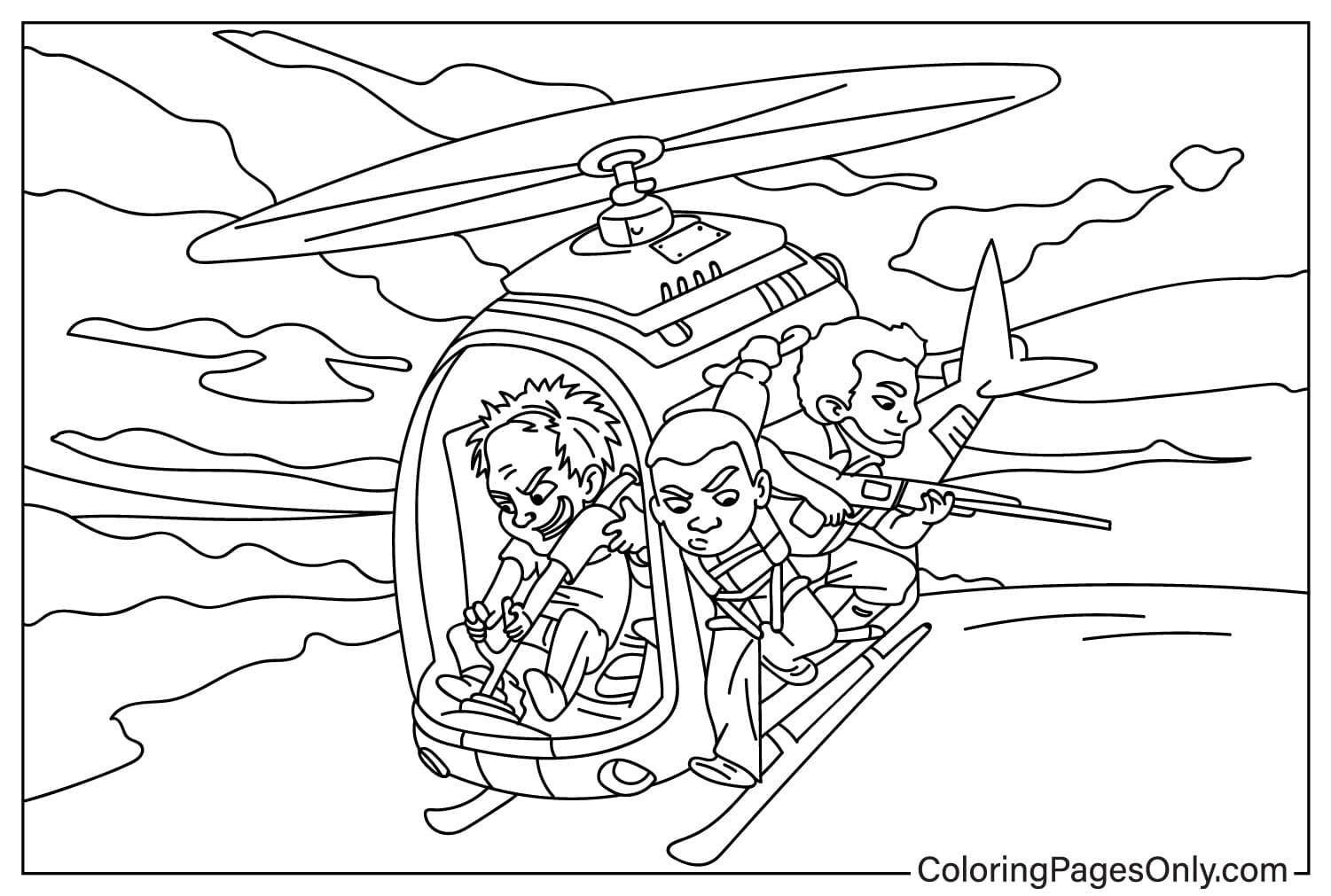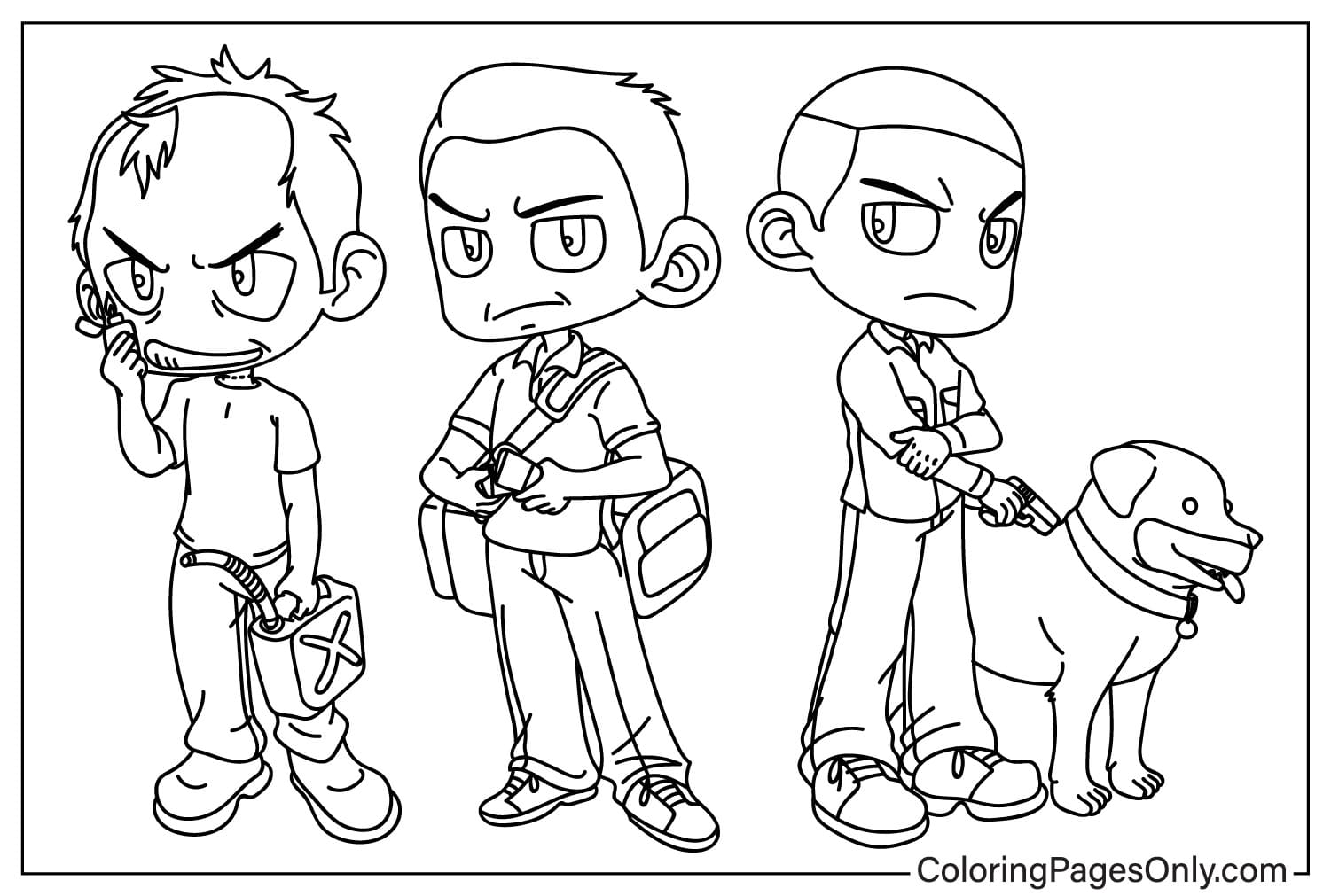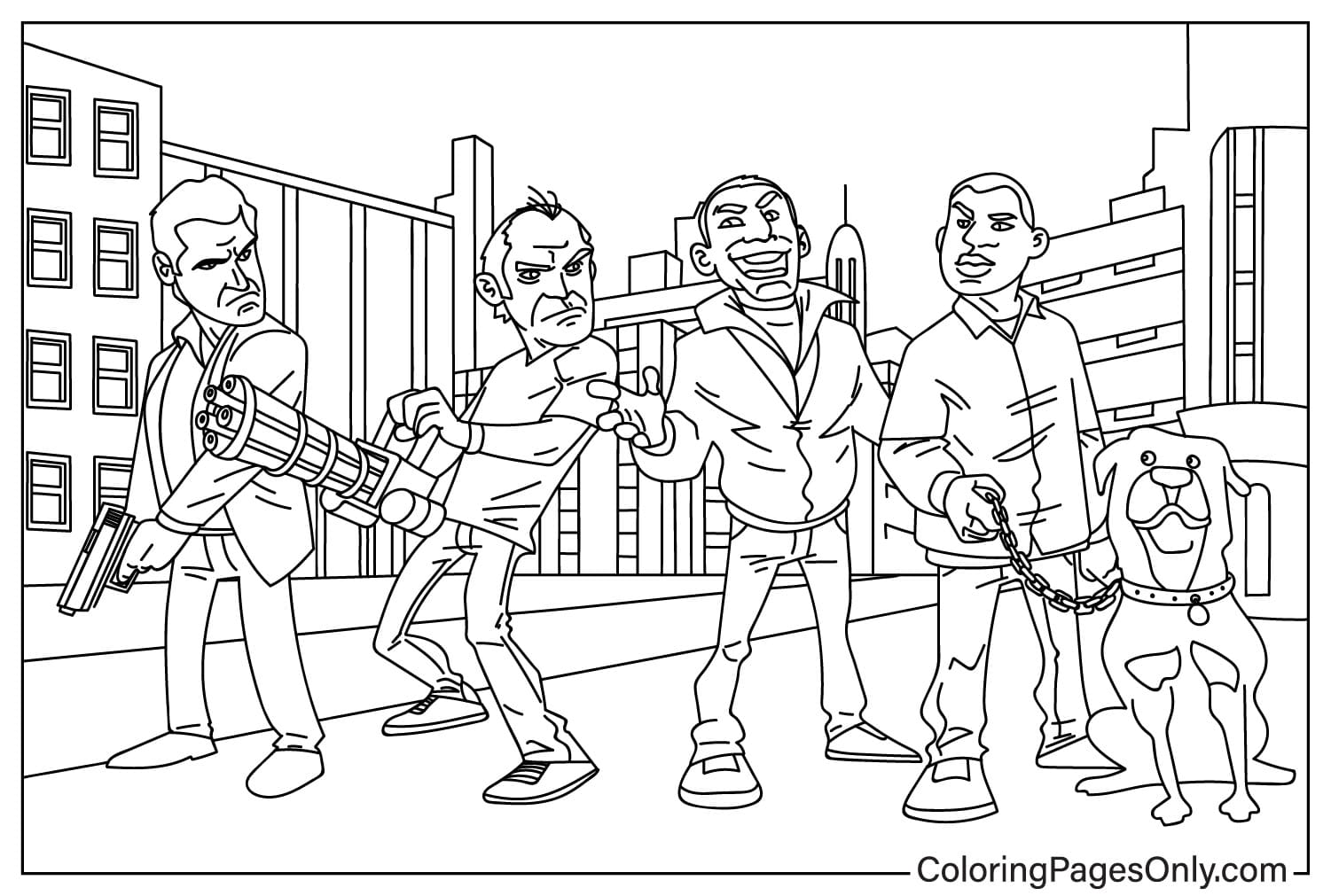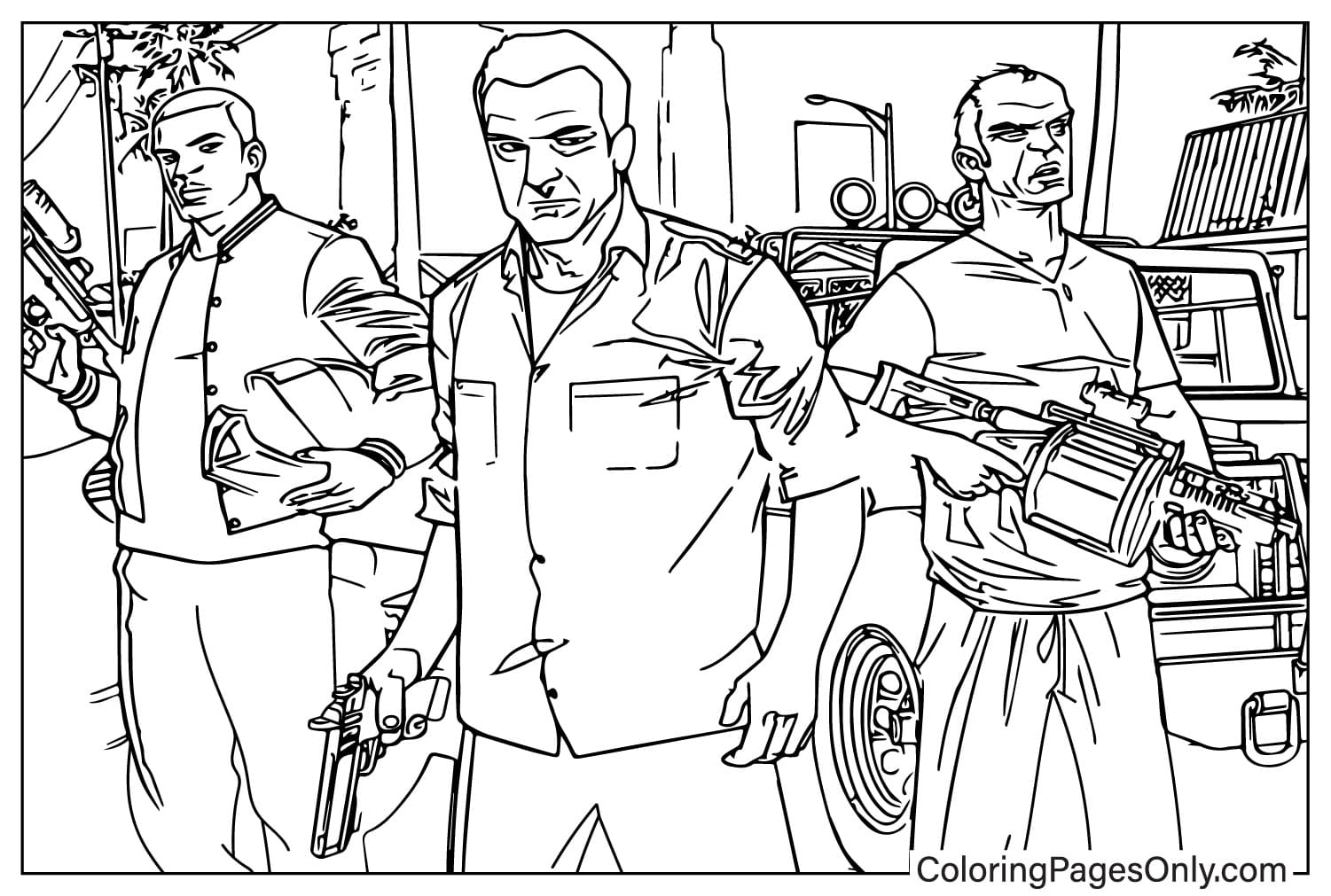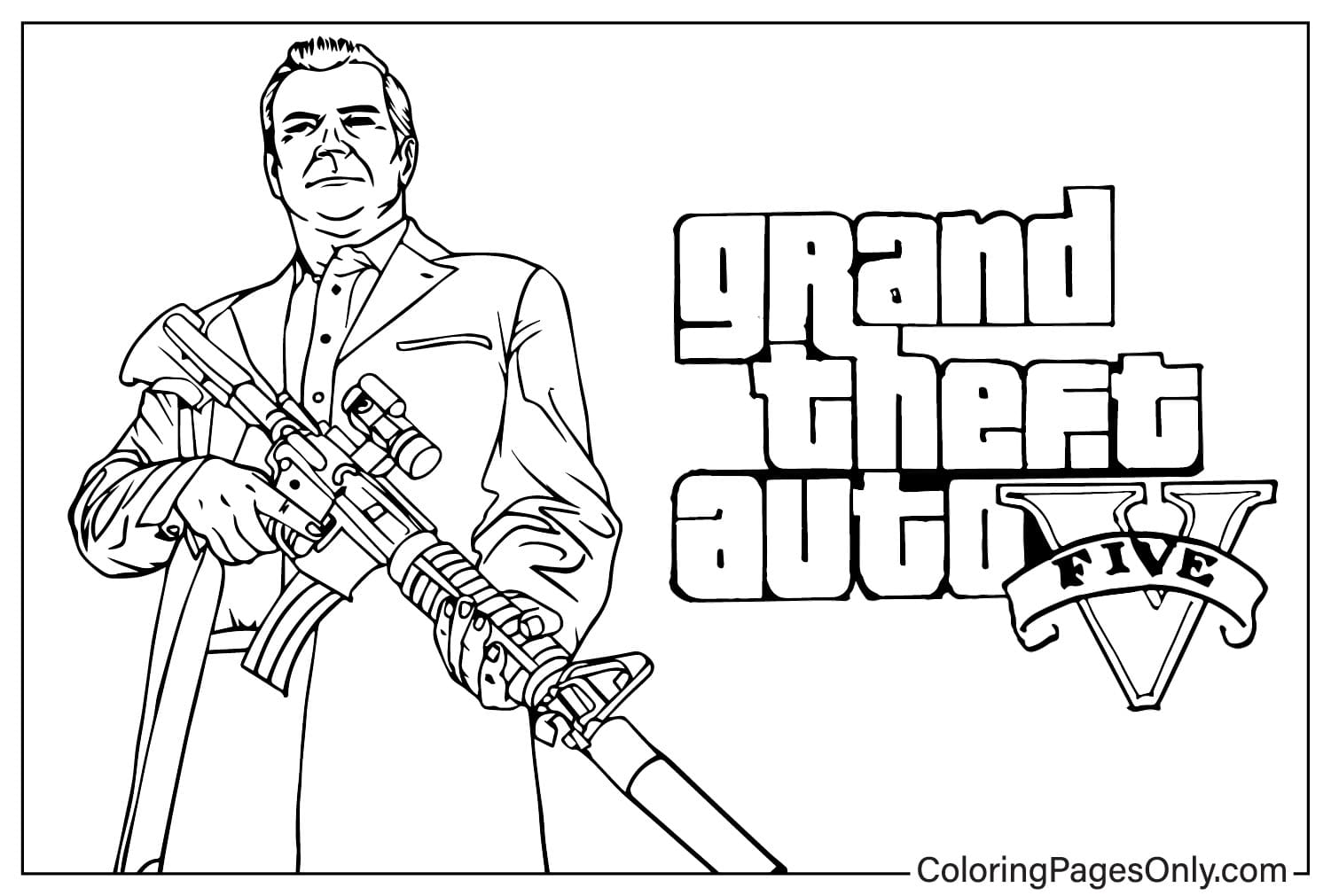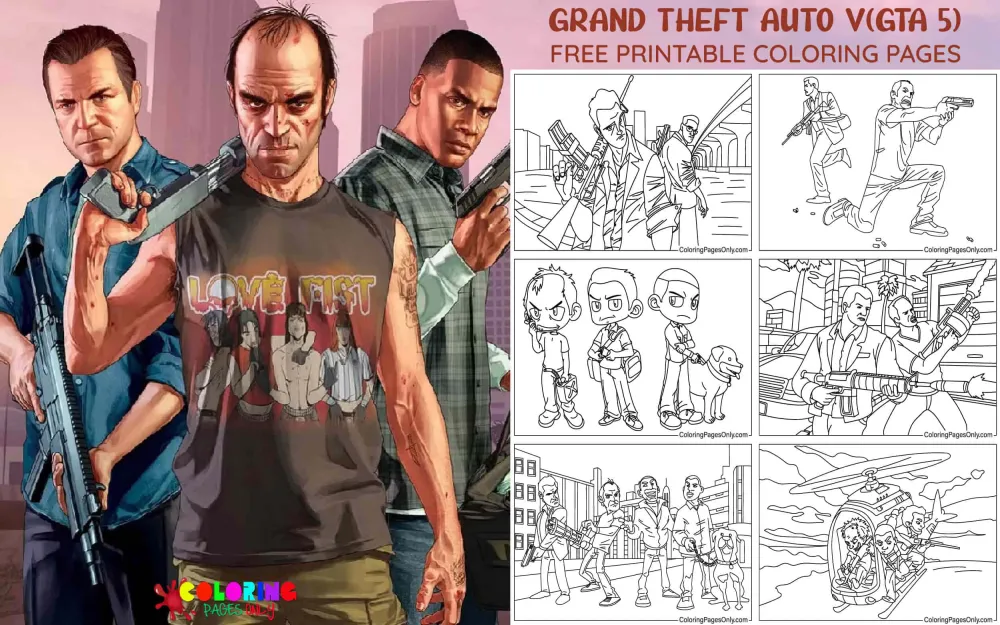
Free Grand Theft Auto V coloring pages – 14 pages featuring Michael De Santa, Trevor Philips, Franklin Clinton, Los Santos environments, vehicles, heist scenes, and character compositions from Rockstar Games’ record-breaking open-world action game – free printable PDF and online coloring for adult fans of the franchise.
Grand Theft Auto V was developed by Rockstar North and published by Rockstar Games, released on September 17, 2013, for PlayStation 3 and Xbox 360. Subsequent versions followed for PlayStation 4 and Xbox One (November 18, 2014), PC (April 14, 2015), and PlayStation 5 and Xbox Series X/S (March 15, 2022). The game has sold over 195 million copies across its twelve-year production span, making it one of the five best-selling video games ever produced. It generated $1 billion in revenue within its first three days of release – faster than any entertainment product in history at that point – a record verified by Guinness World Records.
The game’s structural innovation is its three-protagonist system: Michael De Santa, Trevor Philips, and Franklin Clinton are three separate playable characters whose stories intersect, who can be switched between in real time during open-world play and at designated mission points. The decision to develop three distinct protagonists with three distinct perspectives on the same city – one from the perspective of a retired criminal trying to maintain a comfortable life, one from the perspective of a person who has never been able to leave, and one from the perspective of someone trying to find a way in – gave GTA V a narrative complexity that most open-world games of its generation did not attempt.
The setting is Los Santos, a version of Los Angeles constructed at a scale and level of detail that had not previously been achieved in open-world game design. The game’s satirical portrait of contemporary American culture – its media, its celebrity obsession, its class dynamics, its financial institutions – remains the most widely discussed aspect of its design outside of its commercial records.
These 14 free pages at ColoringPagesOnly.com capture the game’s core visual identity. All free, PDF or PNG, print or color online.
What’s Inside
Michael De Santa – The Retired Criminal
Michael is the oldest of the three protagonists – forty-five years old at the game’s start, living in a mansion in Rockford Hills (the game’s Beverly Hills analog) on money accumulated from a career in robbery. He entered witness protection after a botched job in Ludendorff, North Yankton, under an arrangement managed by FIB agent Dave Norton. The comfortable life he is supposed to be enjoying does not actually make him comfortable. He sees a therapist – Dr. Isidore Friedlander – weekly, in sessions that function as the game’s most direct character exposition.
His design communicates his specific situation immediately: middle-aged, slightly overweight, well-dressed in a way that suggests someone who has money and is not entirely sure what to do with it. He typically wears a blazer or casual suit, with the specific quality of someone who has permanently retired from the work that made him who he is and has not found anything adequate to replace it.
Ned Luke voices him. The motion capture and voice performance give Michael a specific quality of simmering frustration under maintained composure that the coloring pages capture in his expression and posture.
Coloring Michael: Warm-toned skin – the specific complexion of a middle-aged man who spent years outdoors and now lives inside his comfort zone. His hair is dark with grey at the temples – apply near-black as the base, then add very subtle warm grey at the sides and above the ears. His clothing tends toward the smart-casual register – blazer or jacket in a neutral (navy, black, grey), with a lighter shirt beneath. His expression in most pages carries a specific quality of guarded assessment – not open, not hostile, but watchful.
Trevor Philips – The Uncontrollable
Trevor is the game’s most discussed character across a decade of critical and fan writing – a character whose design refuses every conventional expectation of what a video game protagonist should be, and who has been analyzed in academic papers, cultural criticism, and fan communities with equal intensity. He is violent, erratic, capable of extreme tenderness toward the people he loves, completely unable to modulate his behavior to social expectations, and the funniest character in the game.
He lives in Sandy Shores, the trailer park in the desert analog of San Bernardino County, where he runs Trevor Philips Industries – a vague but comprehensively criminal operation. He served in the Canadian Air Force, which is one of the game’s most specific character background details, and his flying skill is exceptional. His childhood is referenced obliquely and unpleasantly throughout the narrative.
His design is the game’s most visually distinctive: thin, gaunt, often partially clothed in whatever was available – a stained undershirt, shorts, mismatched everything. He frequently has dirt, blood, or unidentified substances on him. The hair is dark, slightly wild. The face carries the specific quality of someone who has never successfully hidden what he is thinking.
He is voiced and motion-captured by Steven Ogg, whose physical performance gave Trevor a kinetic quality – the specific way he moves through space – that made him recognizable in seconds of footage.
Coloring Trevor: Pale, somewhat weathered skin – the complexion of someone who lives in a desert but rarely deliberately sunbathes. His clothing, when he wears it, is in the warm neutral or dirty-white range – the undershirt that started as white and has become something else through use. His hair is dark, slightly disheveled. His expression is the collection’s most challenging portrait subject: the specific quality of Trevor’s face – the barely-contained intensity – requires careful attention to the specific set of the brows and the particular shape of his expression.
Franklin Clinton – The Ambitious
Franklin is the youngest of the three – twenty-five years old, from the Strawberry neighborhood in South Los Santos, the game’s South Central analog. He grew up adjacent to gang life, maintained connections to it, and is looking for a way out toward something larger without entirely knowing what that larger thing is. Michael becomes his mentor by accident, and the mentorship produces the game’s most interesting dynamic: the experienced retired criminal and the ambitious young man working out together what criminal expertise is actually worth.
His design is clean and athletic – the physical condition of someone who has maintained himself carefully without the resources of Michael’s mansion or the carelessness of Trevor’s desert existence. He typically wears casual urban clothing – dark jeans, fitted shirts, and hoodies. He is the most conventionally competent driver of the three; his special ability slows time during vehicle control.
He has a dog named Chop – a Rottweiler – whose presence in some pages of the collection is one of the game’s warmest visual elements: the loyal dog and the young criminal navigating South Los Santos together.
He is voiced by Shawn Fonteno, known professionally as Young Maylay.
Coloring Franklin: His skin tone is a warm medium-dark – rendered with warm undertones throughout the light and shadow zones. His clothing is typically in the dark casual range – fitted dark jeans, a fitted shirt or hoodie in neutral or cool tones. His athletic build means the clothing sits close to the body’s form rather than falling loosely. Chop, in pages that include him, is black with warm tan markings at the eyebrows and muzzle – the standard Rottweiler coloration.
Los Santos – The City
Los Santos as a visual subject is the collection’s most compositionally ambitious content – the specific skyline, the Vinewood hills and sign, the beachfront at Vespucci, the sprawling highway system, the downtown towers. The city is simultaneously a recognizable portrait of Los Angeles and a specific satirical rendering of what Los Angeles represents in American culture: the place where the entertainment industry lives, where enormous wealth and concentrated poverty exist in proximity, where the weather is always good, and the social condition is always complicated.
The Vinewood sign – Rockstar’s version of the Hollywood sign, “Vinewood” in white block letters against the hills – appears in promotional art and environment pages as the collection’s most immediately recognizable environmental detail.
Coloring Los Santos environments: The city’s color palette is California’s – warm and bright in the natural elements (pale sandy beige in the hills, vivid blue in the Pacific Ocean, palm tree greens), cool and steel-grey in the built environment (glass towers, concrete highways, grey asphalt). The light is characteristically California warm – a slight warm yellow shift in the ambient light that makes everything slightly warmer than it would be in a northern climate.
Vehicles and Heist Pages
GTA V’s vehicle design is among the game’s most celebrated technical achievements – a car roster that covers supercars, muscle cars, motorcycles, helicopters, and dozens of other vehicle types, each modeled with the specific care that Rockstar brought to every element of the game world. The vehicle pages in the collection show cars in the specific angle and presentation that the game itself uses – the wide three-quarter view that gives the most visual information about the car’s form.
The heist pages capture the game’s most narratively significant activity – the planned, coordinated criminal operations that structure the main story. The specific imagery of the heist setup – characters in coordination, vehicles staged, the preparation for something large – is the collection’s most cinematically composed content.
What These Pages Do
GTA V’s commercial performance is the most documented in entertainment history. No film, album, book, or television series has matched the speed of GTA V’s initial revenue generation – $1 billion in three days. The game has been in continuous active play for twelve years as of 2025 through GTA Online, making it simultaneously a 2013 release and a current platform. Coloring pages from a game with this cultural footprint are engaging with one of the most commercially significant entertainment products of the twenty-first century.
The three-protagonist structure is the game’s most discussed design innovation. The decision to give each of three protagonists a distinct perspective on the same city – and to allow the player to switch between them in real time – required building a game world that was coherent from three separate viewing positions simultaneously. The coloring pages that show Michael, Trevor, and Franklin individually are illustrations of three distinct perspectives on the same Los Santos.
The game’s satire of contemporary American culture remains among the most sustained in video game history. Every in-game media element – the fake news channels, the social media platform, the self-help industry, the celebrity culture – functions as a commentary on its real-world equivalent. This satirical architecture gives the game’s world a layer of cultural reference that rewards the player who reads the in-game internet, watches the in-game television, and listens to the in-game radio.
Fine motor development. The American Academy of Pediatrics identifies fine motor skill development as a key childhood milestone throughout early childhood – though this specific collection is for adult fans of the franchise, not young children. The character portrait work, the vehicle detail, and the Los Santos environment pages provide the sustained, focused fine motor engagement that the 2005 Art Therapy Journal study on structured coloring and anxiety reduction identifies as most beneficial.
How to Color These Pages Well
The three protagonists need distinct skin tone and clothing palettes. Michael, Trevor, and Franklin have clearly differentiated skin tones and clothing aesthetics. In any page showing more than one character, establish each character’s skin tone first – warm medium for Franklin, the warm but more weathered pale of Trevor, the warm olive of Michael – and commit to it consistently. Then apply each character’s clothing in their respective palette. Color contamination between adjacent characters reads as incorrect.
Trevor’s specific quality is in his thinness and his expression. The most common error on Trevor’s pages is treating him as a generic male figure. His thinness relative to Michael and Franklin is an important design element – the clothing sits more loosely, the facial features are more angular, and the overall silhouette is different from the other two. Render his face with careful attention to the specific expression that has made him iconic: the specific set of his features in whatever emotional state the page captures.
Los Santos environment pages want California light. Apply a very subtle warm yellow shift to the ambient light on all non-shaded surfaces. This warm California sunlight characterizes Los Angeles’s visual quality in almost every rendering of the city. Cool elements (glass buildings, shadows, the Pacific Ocean) should sit as cool zones against this warm ambient baseline. The contrast between warm ambient and specific cool zones is what makes a Los Santos page read as Los Angeles.
Vehicle pages need the three-zone metallic technique applied to complex forms. GTA V’s cars are among the most photographed and referenced video game vehicles. Apply the base body color at the mid-tone across all main body surfaces. Add the lightest version at the shoulder line and roof ridge (the highest points). Add the shadow tone at the sills, the wheel arch interiors, and beneath any overhanging body element. The chrome details – grille elements, door handles, exhaust tips – receive the metallic chrome treatment: light grey to near-white highlight, medium grey base, dark grey shadow.
Night pages use artificial light rather than sunlight. Los Santos by night – a frequent visual in the game – uses artificial light sources: street lamps (warm yellow-orange pools on pavement), neon signs (vivid saturated color in specific directions), car headlights (warm white beams), and the distant glow of city illumination in the sky above. Night pages should be rendered with dark backgrounds (dark blue-grey or near-black sky, dark pavement) against which these specific artificial light sources read as vivid and present.
5 Creative Craft Ideas
The Three Protagonists Side by Side
Print one page each for Michael, Trevor, and Franklin. Color each in their canonical design – Michael in his smart-casual clothing and middle-aged presentation, Trevor in his disheveled, minimal clothing, and Franklin in his fitted casual urban wear.
Mount all three side by side on a backing sheet. Below each: the character name, their age, their background in one line, and their special ability. “Michael De Santa – 45. Retired. Witness protection. Perfect aim.” “Trevor Philips – 39. Former military. Sandy Shores. Rage mode.” Franklin Clinton – 25. South LS. Vinewood Hills. Driving focus.”
The finished display presents the three-protagonist structure as a visual character reference.
Heist Planning Board
Print the most action-oriented page in the collection – the page that best suggests preparation or mission. Color it in the cool, focused palette of mission planning – grey and dark tones for the characters, a map or planning surface in warm tan behind them.
On a separate backing sheet, create a hand-drawn heist planning board: a simple map outline, arrows showing approach and escape routes, hand-lettered character roles (“Driver: Franklin. Gunman: Trevor. Planner: Lester.”), and at the bottom: “The Big Score. Union Depository. Gold bullion. $201,600,000.”
Mount the colored page alongside the planning board. The finished display recreates the heist planning aesthetic that is the game’s most cinematically distinctive visual register.
Los Santos vs. Los Angeles – The Comparison
Print any Los Santos environment page – skyline, beachfront, or urban scene. Color it in the warm California palette of the game’s environmental design.
On a separate backing sheet beside the colored page, draw a simplified Los Angeles skyline or reference the real geography: downtown LA towers, the Hollywood hills, the Pacific Coast. Label corresponding elements: “Vinewood Hills → Hollywood Hills. Vespucci Beach → Venice Beach. Rockford Hills → Bel Air. Downtown LS → Downtown LA.”
The finished display makes the game’s geographic satire explicit as a coloring-page-based urban comparison.
Character Color Mood Study
The game uses a specific color palette for each protagonist’s segments in the trailer and promotional art: Michael’s scenes trend toward cool blue, Trevor’s toward warm orange-yellow, and Franklin’s toward green. Print one page per protagonist. Color each in the character’s associated mood palette – Michael in cool blue-grey tones with warm skin, Trevor in warm amber and ochre tones, Franklin in cool green-tinged tones.
Mount all three. Add: “Michael – Blue. Regret in comfort.” “Trevor – Orange. Chaos in the desert.” Franklin – Green. Ambition in the city.” The display renders the game’s deliberate color-coding of character perspective as a coloring exercise.
The Twelve-Year Game – A Timeline
Print the most complete GTA V logo or game environment page available. Color it in the game’s iconic visual style – the warm California palette, vivid and slightly oversaturated in the manner of the game’s promotional art.
Mount on backing cardstock. Add a hand-lettered timeline: “September 17, 2013 – GTA V releases on PS3 and Xbox 360.” “First 3 days – $1 billion in revenue. Fastest ever.” “April 14, 2015 – PC release.” “March 15, 2022 – PS5 and Xbox Series X/S release.” “2025 – Still one of the most-played games in the world.” “185+ million copies sold.”
The finished card is a commercial history of the most commercially successful entertainment product of the twenty-first century.
Frequently Asked Questions
What is Grand Theft Auto V, and when was it released? Grand Theft Auto V (GTA 5) is an open-world action-adventure game developed by Rockstar North and published by Rockstar Games. It was released on September 17, 2013, for PlayStation 3 and Xbox 360, with subsequent releases on PlayStation 4 and Xbox One (November 2014), PC (April 2015), and PlayStation 5 and Xbox Series X/S (March 2022). The game is set in the fictional city of Los Santos – a detailed recreation of Los Angeles and surrounding Southern California – and follows three protagonists: Michael De Santa, Trevor Philips, and Franklin Clinton. It has sold over 195 million copies and generated over $8 billion in revenue, making it one of the most commercially successful entertainment products ever created.
Who are the three playable protagonists? GTA V features three playable protagonists – the first time a mainline GTA game offered multiple playable characters. Michael De Santa is a forty-five-year-old retired bank robber living in Rockford Hills under witness protection, voiced by Ned Luke. Trevor Philips is a forty-year-old former military pilot and criminal entrepreneur living in the desert community of Sandy Shores, voiced by Steven Ogg. Franklin Clinton is a twenty-five-year-old from South Los Santos trying to escape his circumstances and build something larger, voiced by Shawn Fonteno. Players can switch between all three characters during open-world exploration and at designated points during missions.
What is Los Santos? Los Santos is the fictional city in which GTA V is set – a detailed open-world recreation of Los Angeles, California, and surrounding Southern California geography. The city includes fictional analogs for Los Angeles’s most recognizable districts: Vinewood for Hollywood (with the Vinewood sign mirroring the Hollywood sign), Rockford Hills for Beverly Hills, Vespucci Beach for Venice Beach, and South Los Santos for South Central Los Angeles. The surrounding rural region, Blaine County, is based on San Bernardino County and the Mojave Desert. The city’s level of detail – its traffic patterns, pedestrian behavior, radio stations, in-game internet, and television channels – was unprecedented in open-world game design at the time of release.
What are the heists in GTA V? The heist missions are the structural centerpieces of GTA V’s main story – elaborately planned criminal operations in which the three protagonists coordinate with support characters to carry out large-scale robberies and other criminal enterprises. Major heists include the Jewel Store Job (an early tutorial heist), the Merryweather Heist (attempting to steal military hardware), the Paleto Score (a small-town bank robbery), the Bureau Raid (infiltrating the FIB headquarters), and the Big Score (the Union Depository heist, which serves as the game’s climactic mission and can be executed through two different approaches). Each heist requires selecting a crew, gathering equipment, and choosing an approach – decisions that affect the mission’s difficulty and payout.
What is GTA Online? GTA Online is the multiplayer component of GTA V, released two weeks after the main game on October 1, 2013. It allows players to participate in a shared version of Los Santos with other players worldwide, completing missions, engaging in competitive activities, building criminal enterprises, and experiencing periodic content updates. GTA Online has been continuously active since its launch in 2013 and remains one of the most-played online games globally as of 2025. Rockstar has released dozens of major content updates, adding new missions, locations, vehicles, and activities over twelve years of operation. The financial success of GTA Online has substantially exceeded the main game’s already substantial revenues.
When is GTA 6 coming out? Rockstar Games officially announced Grand Theft Auto VI on December 5, 2023, with a trailer that accumulated over 93 million views in its first 24 hours – breaking records for gaming content on YouTube. The game is set in Leonida, a fictional version of Florida, centered on Vice City – a fictional version of Miami that was previously used in Grand Theft Auto: Vice City (2002). GTA 6 will feature a female playable protagonist named Lucia, the first in the mainline series. It is planned for release on PlayStation 5 and Xbox Series X/S with a PC version to follow. As of early 2025, the release window has been stated as 2025 for console versions.
What age group is GTA V appropriate for? Grand Theft Auto V is rated M for Mature (17+) by the Entertainment Software Rating Board (ESRB) in the United States and PEGI 18 in Europe – the most restrictive rating these systems apply. The game contains strong violence, explicit language, drug and alcohol content, nudity, and mature thematic content. The coloring pages in this collection present the game’s characters, vehicles, and Los Santos environments without the game’s explicit content, making them more accessible as coloring subjects than the game itself – but they are still drawn from and reference an adult-rated franchise. These pages are intended for the game’s adult and older teen fan base, and parents should be aware that the source material is specifically not appropriate for children.
Browse the full collection at ColoringPagesOnly.com. All 14 pages free, no sign-up, PDF or PNG, print or color online.
Rockstar North released Grand Theft Auto V on September 17, 2013, and it made $1 billion in three days. Twelve years later,r it is still being played by millions of people weekly, still being updated through GTA Online, and still one of the most commercially significant entertainment products ever created.
Three characters. One city. A portrait of Los Angeles as a place where enormous ambition and fundamental impossibility coexist in the same afternoon.
Michael’s specific frustration. Trevor’s specific freedom. Franklin’s specific determination.
Pick up your warm grey for Michael’s jacket. Dirty white for Trevor’s undershirt. Dark fitted clothing for Franklin.
Los Santos is waiting.
Share your work on Facebook and Pinterest and tag #Coloringpagesonly. We especially want to see the three protagonists’ displays and the character color mood studies.
Color the three. Hold Los Santos in mind. The city takes what it takes.