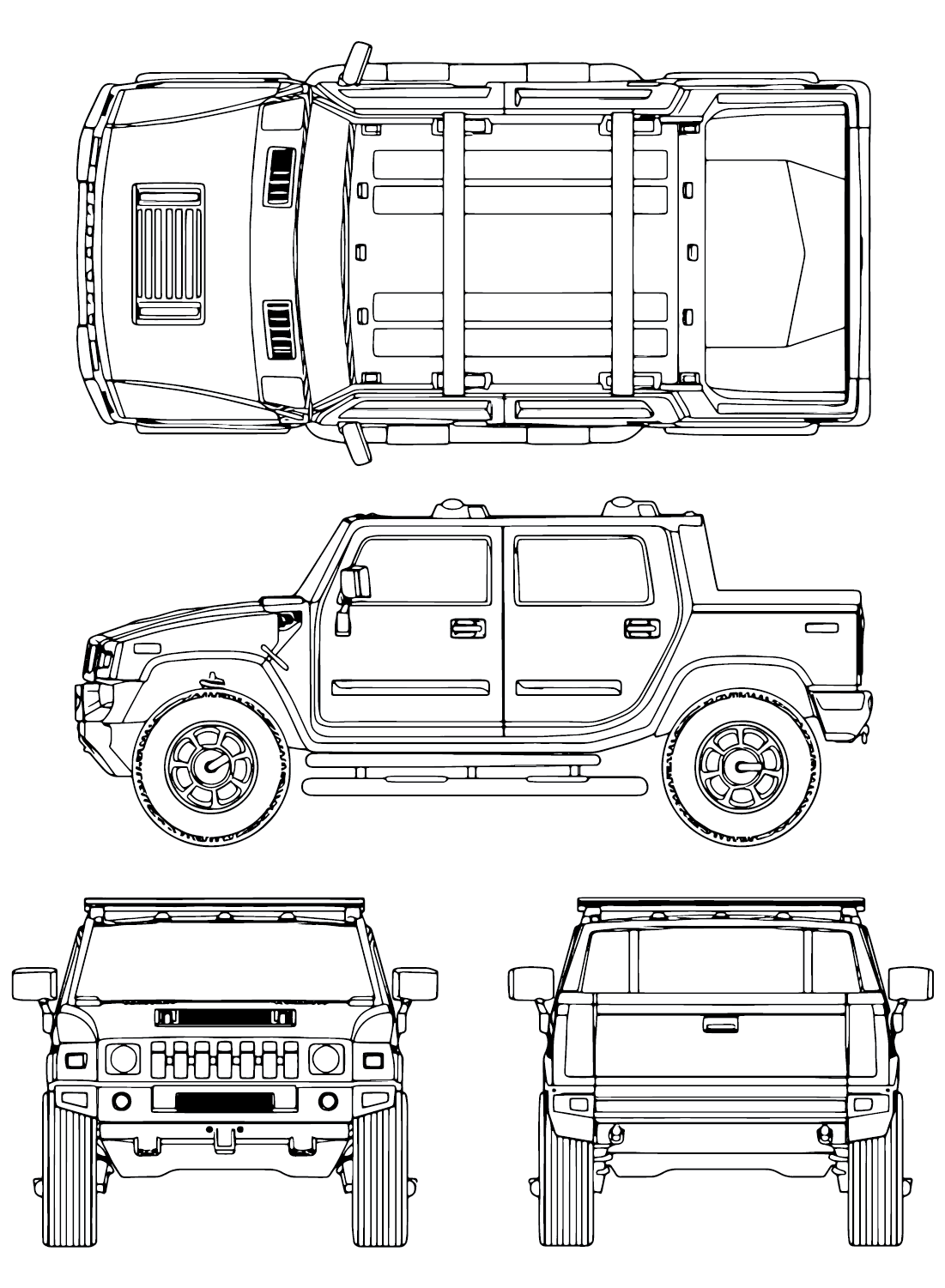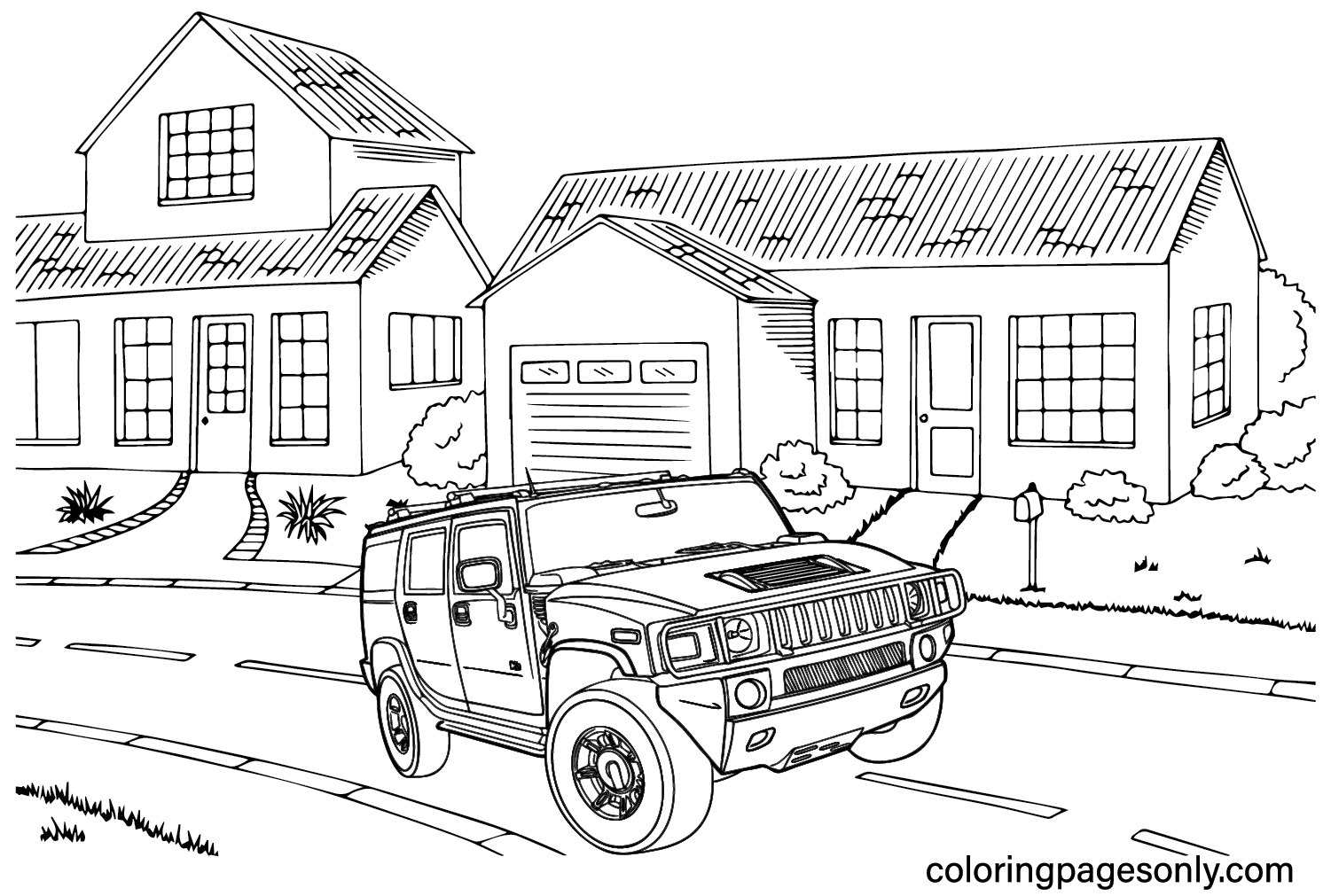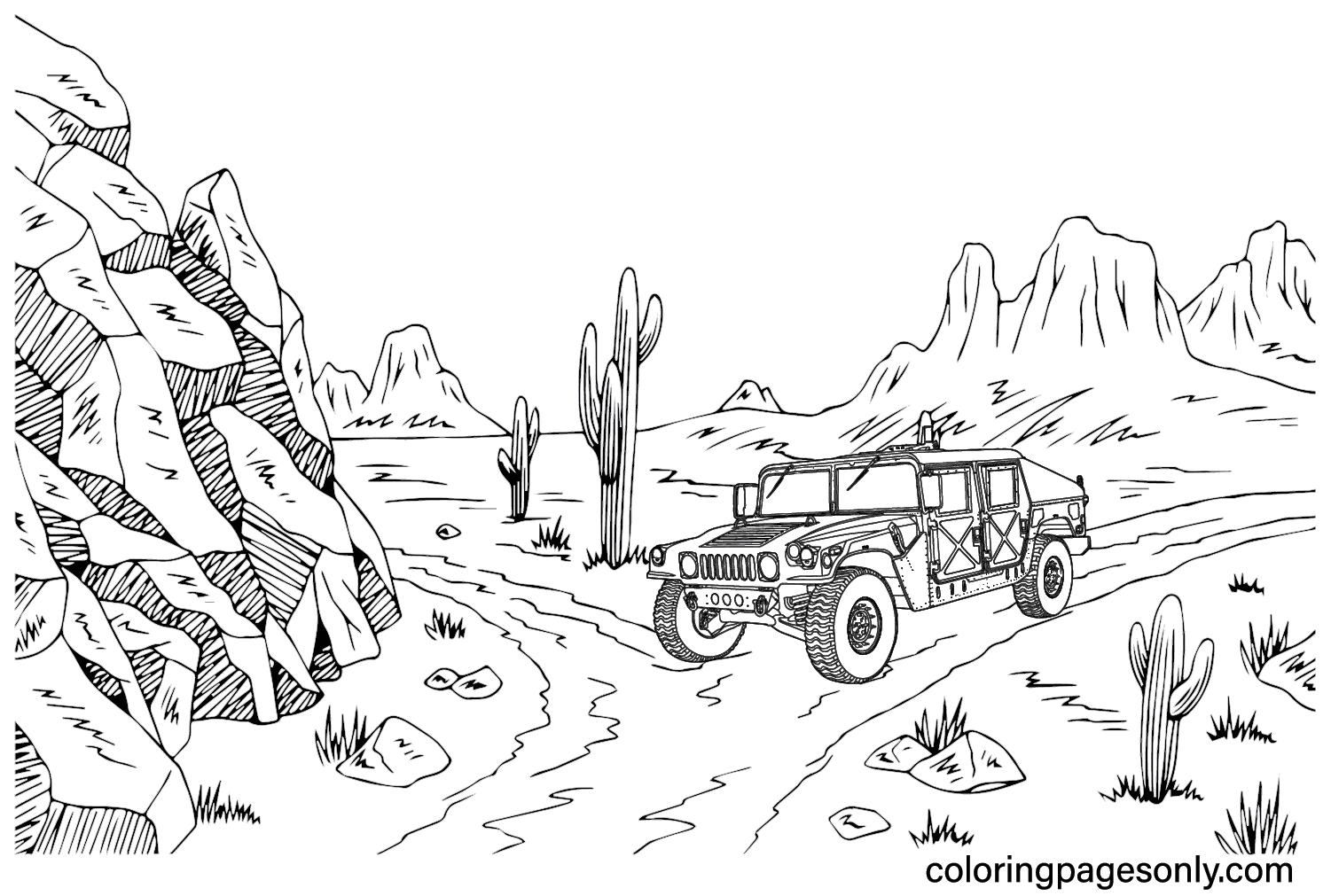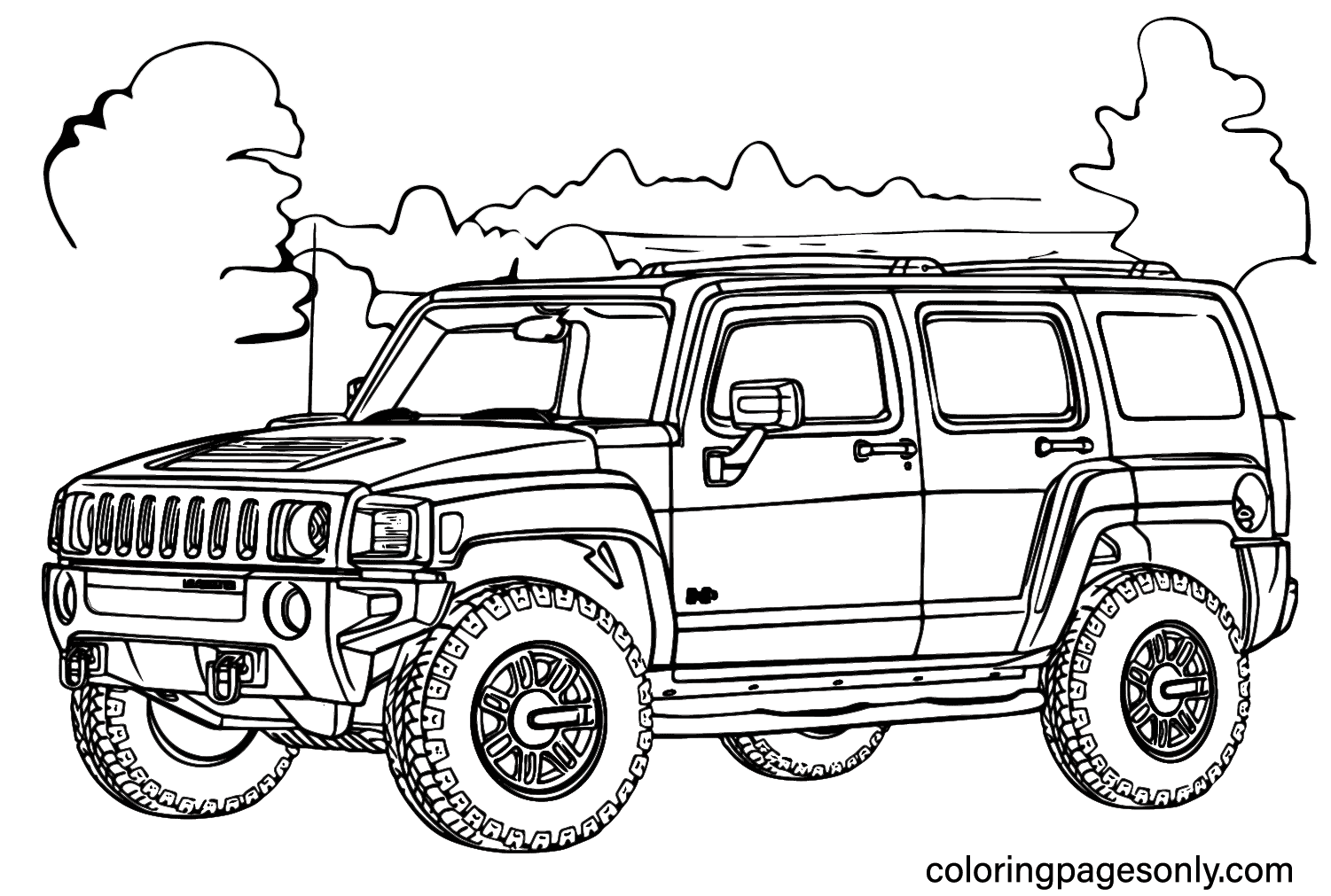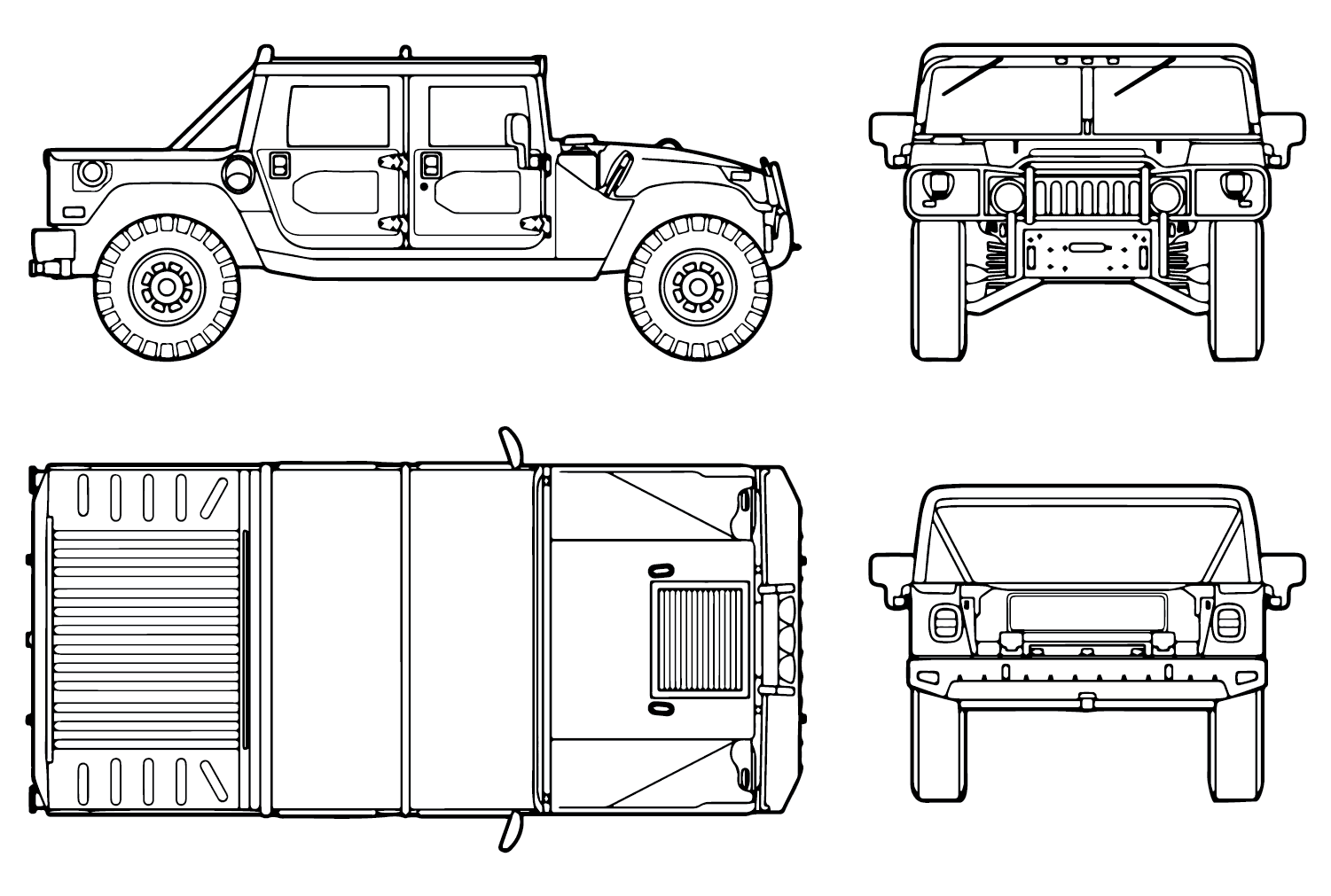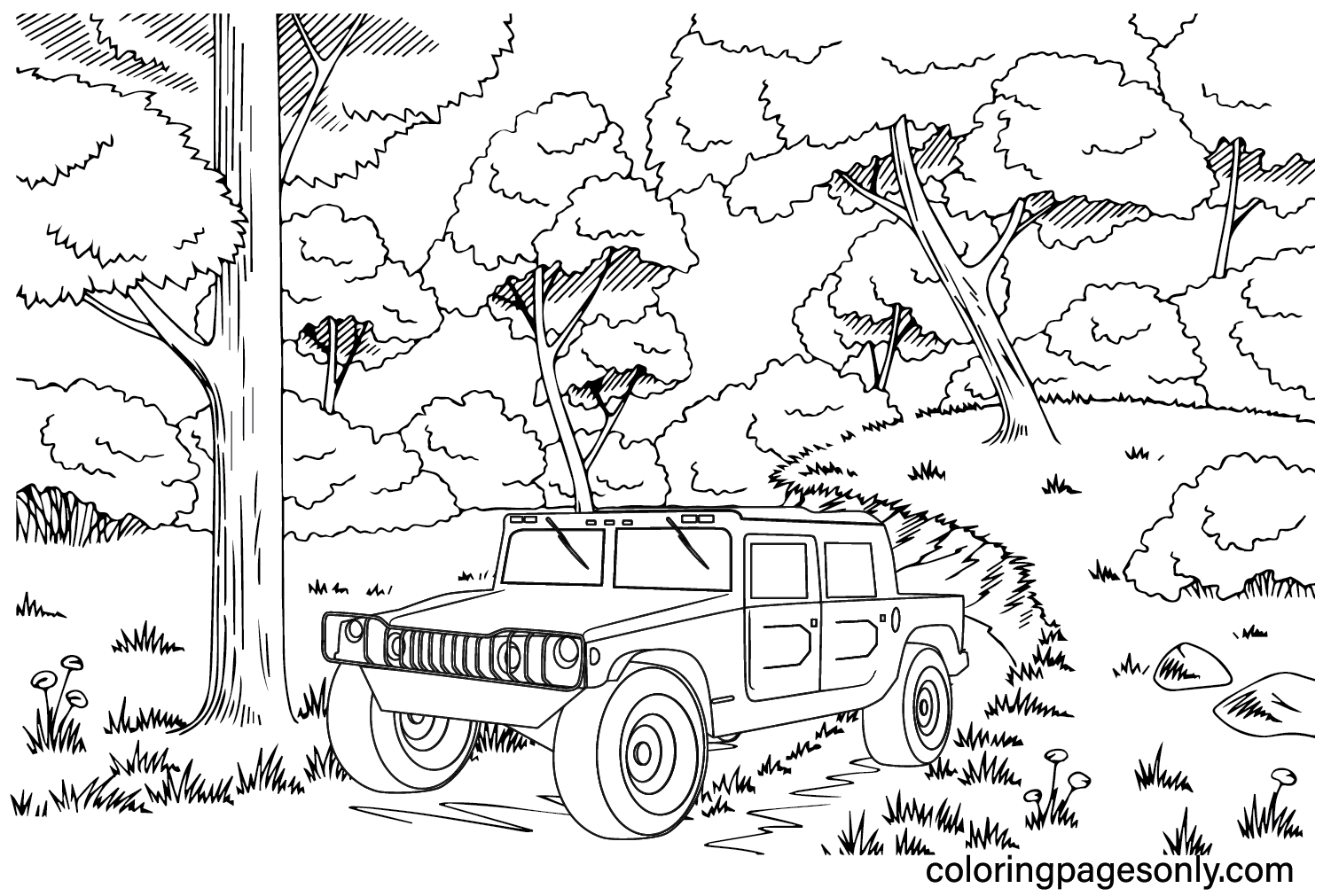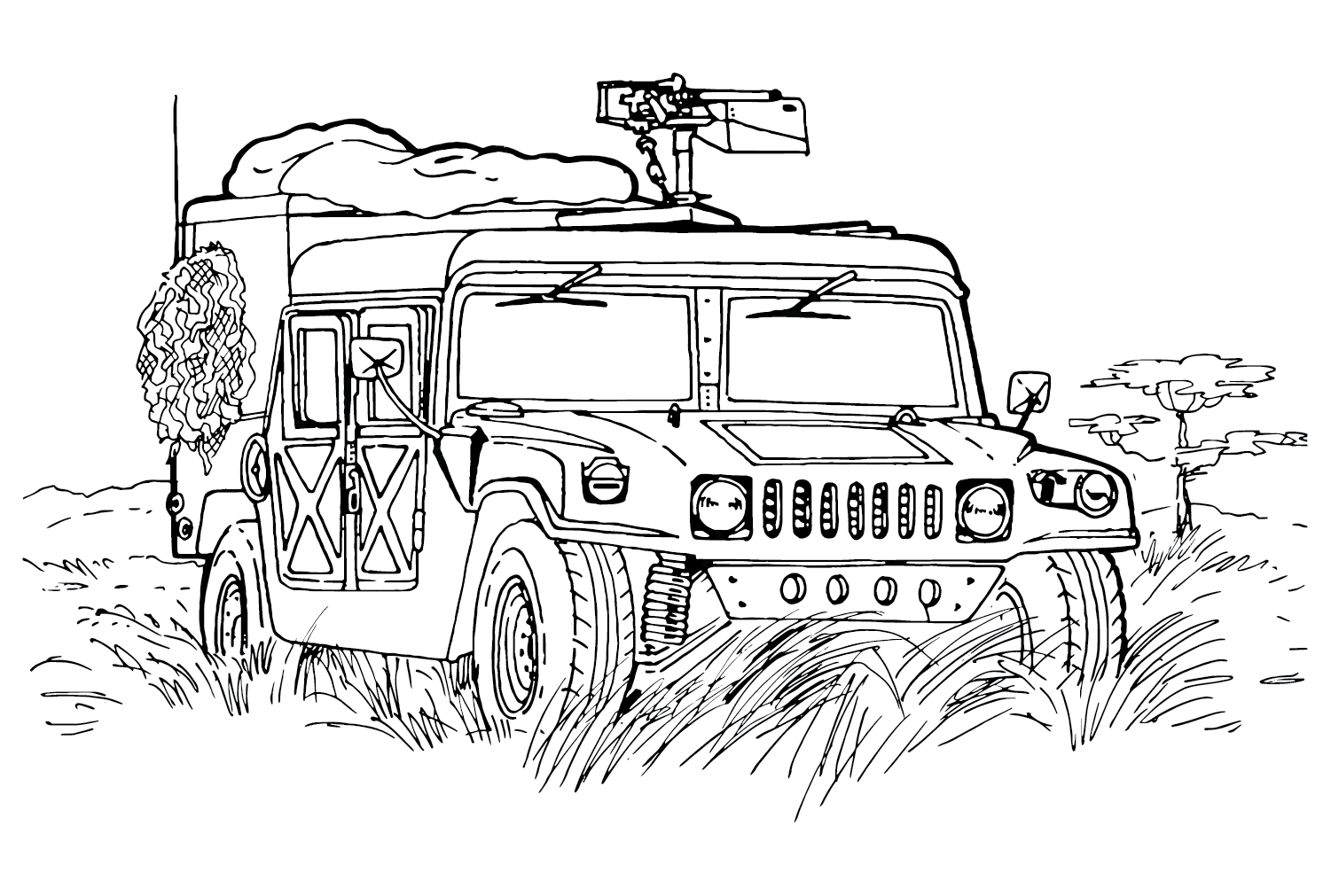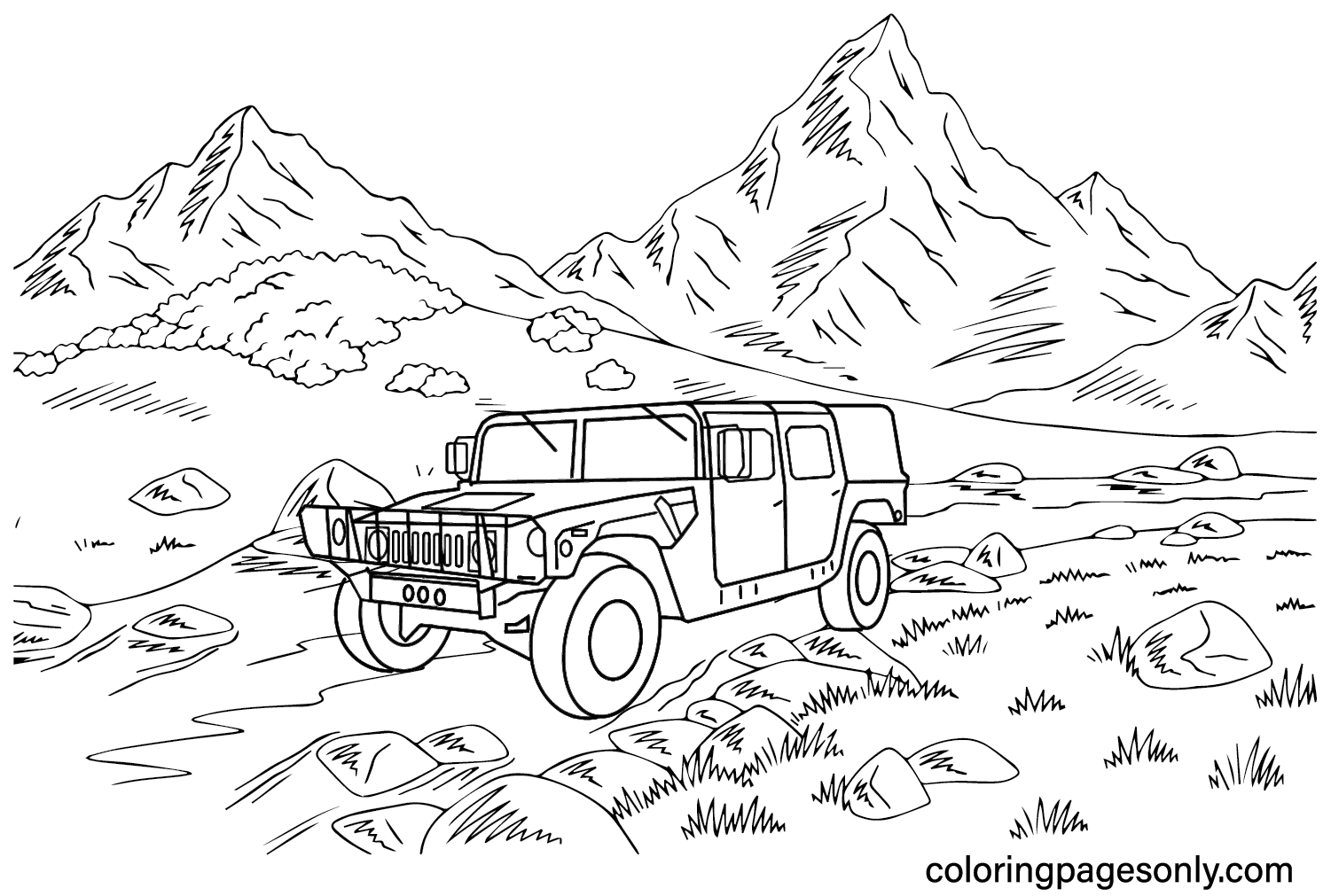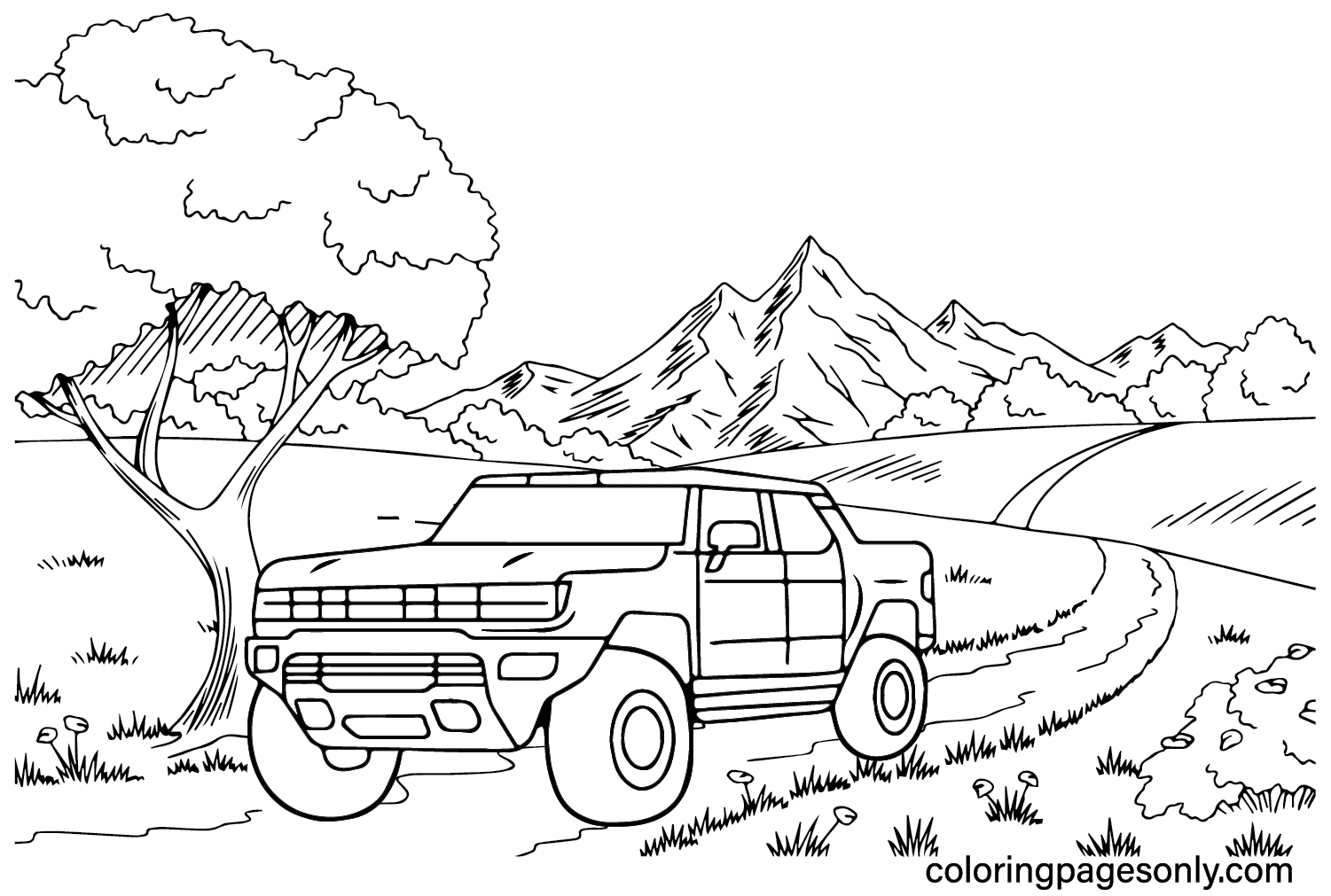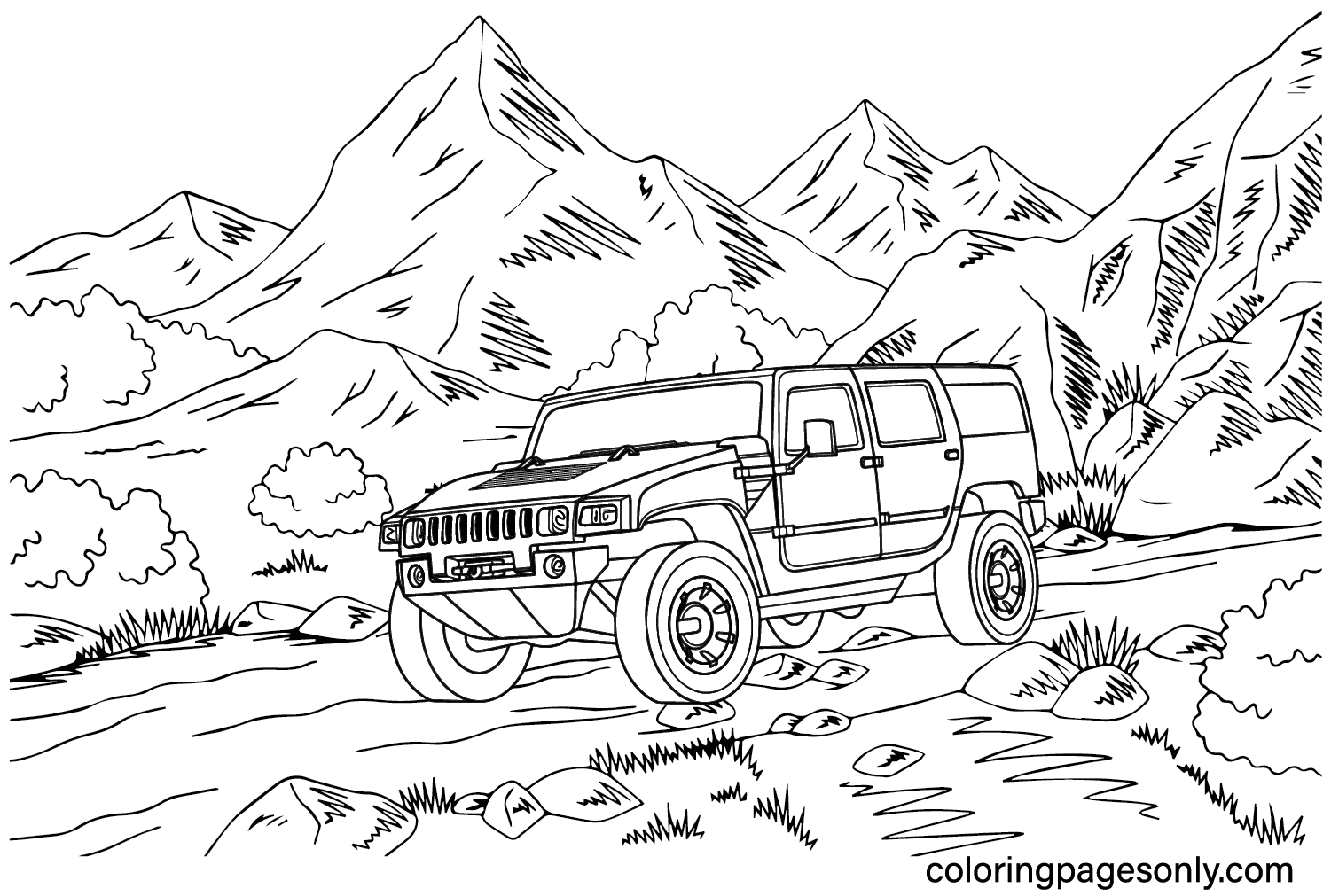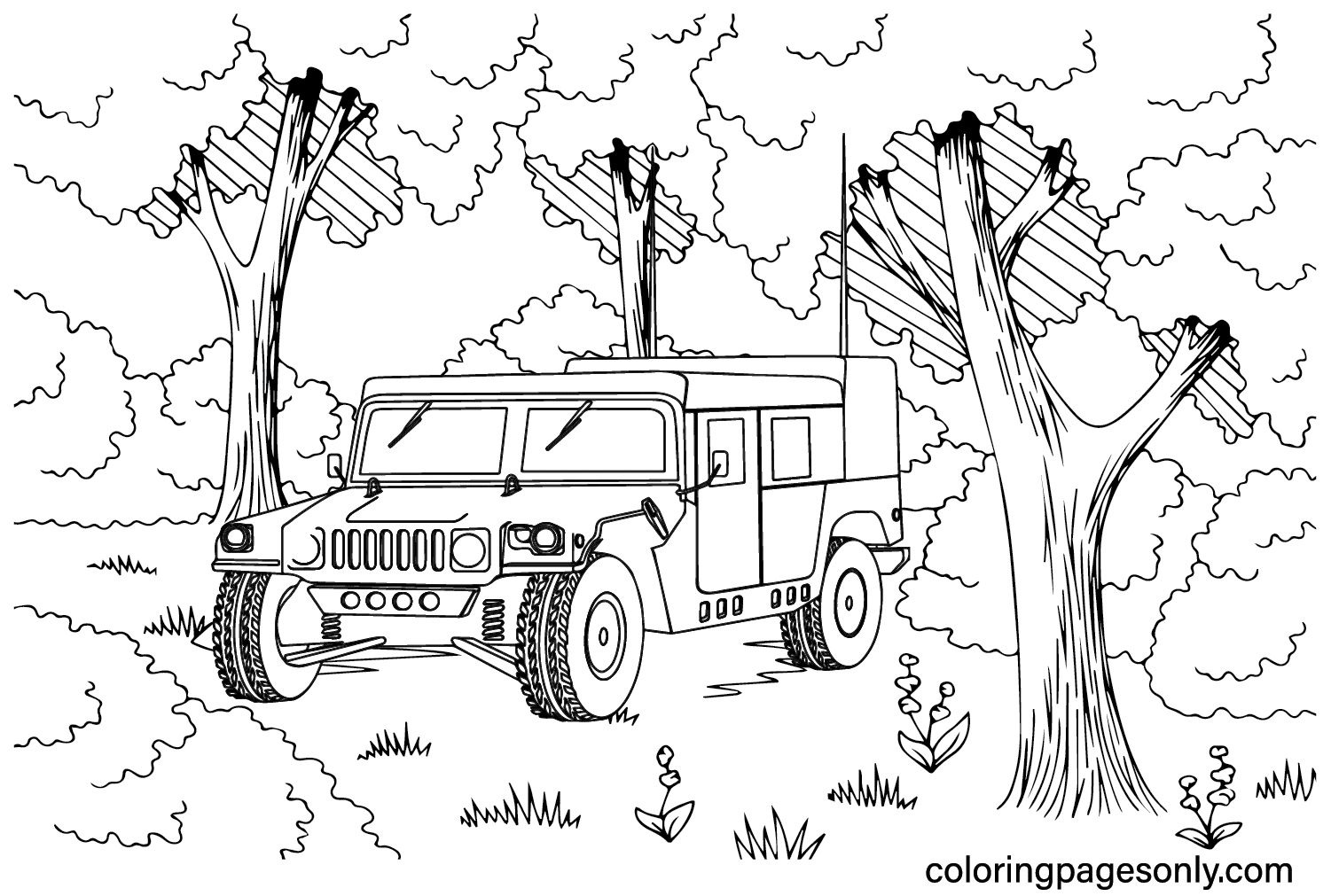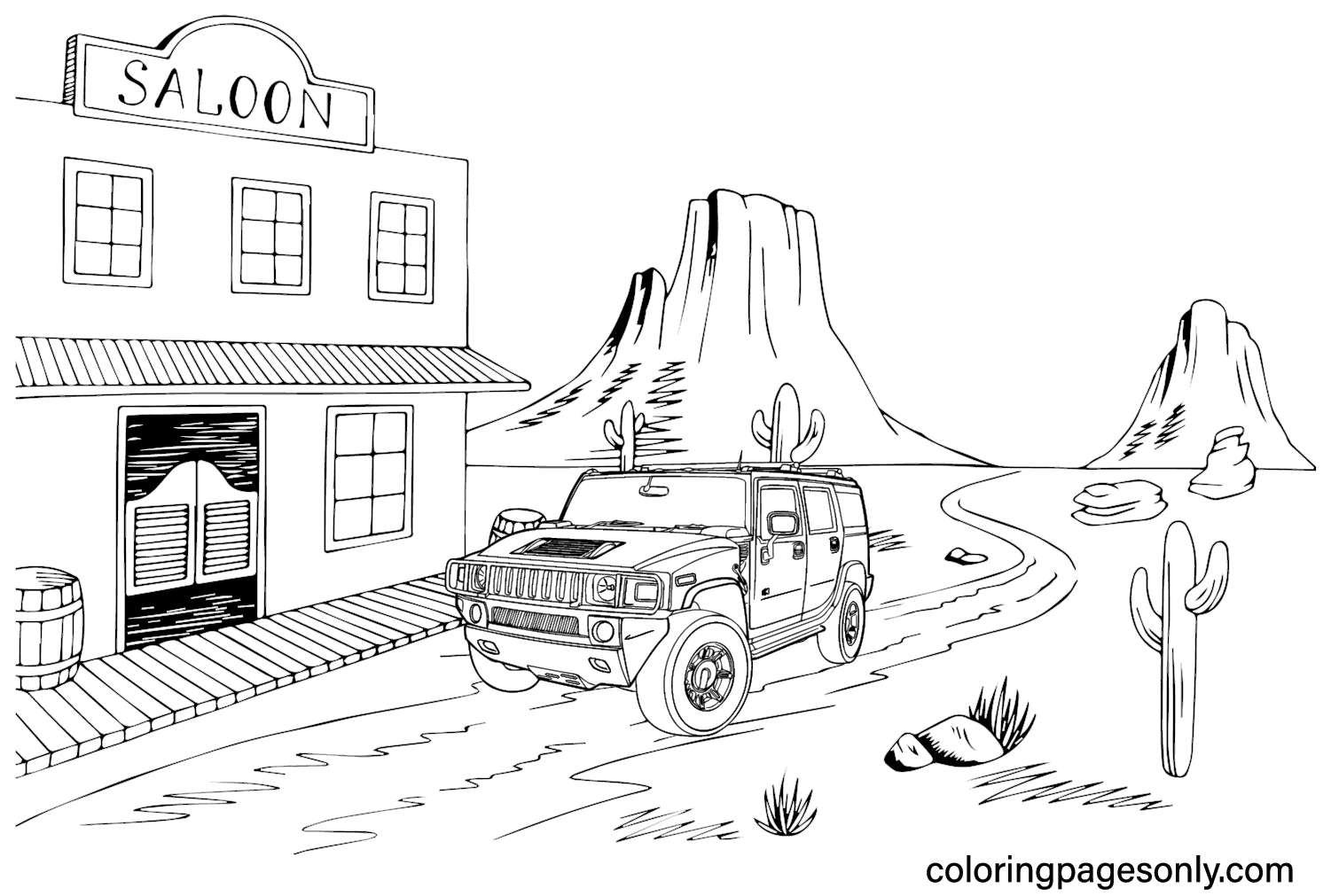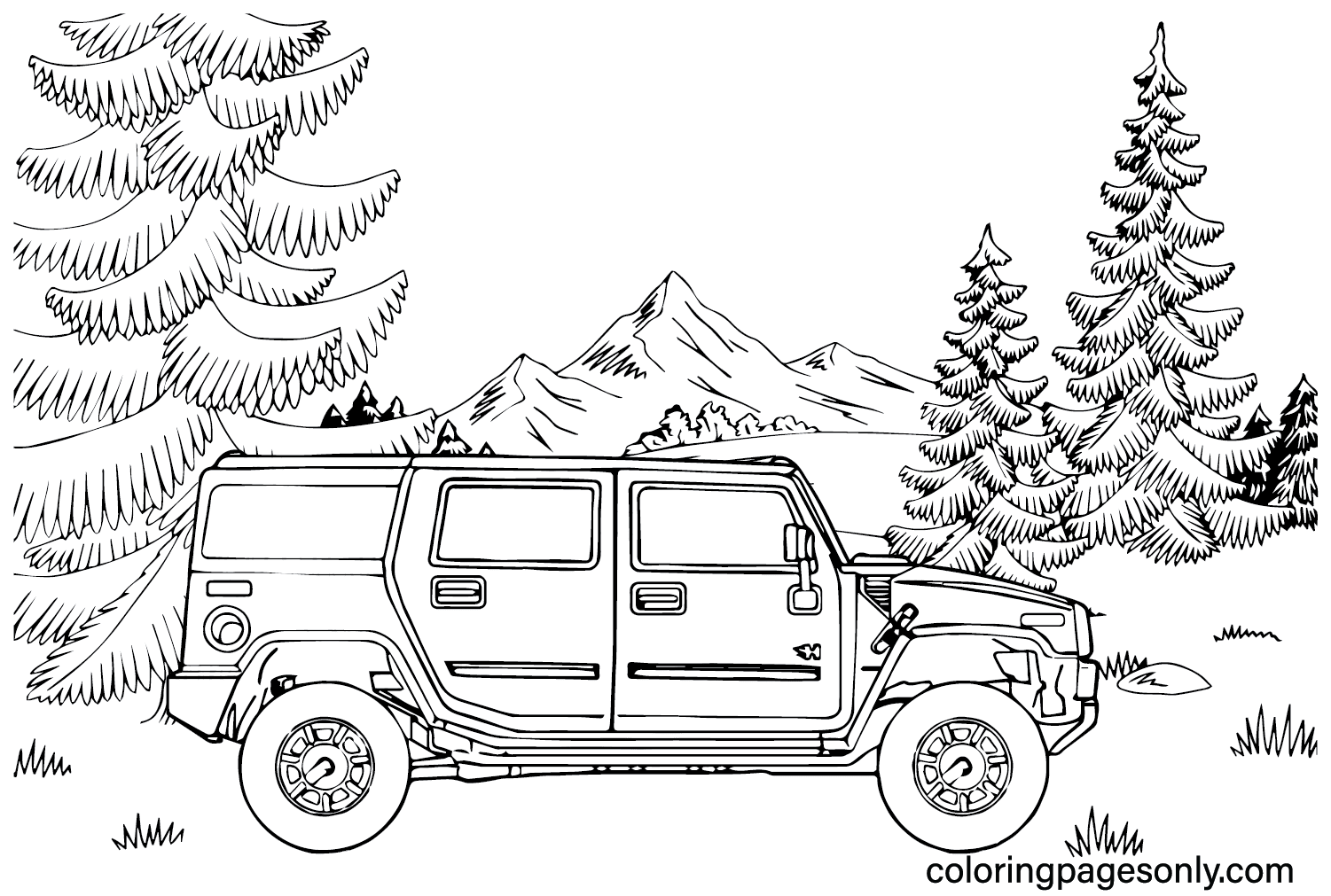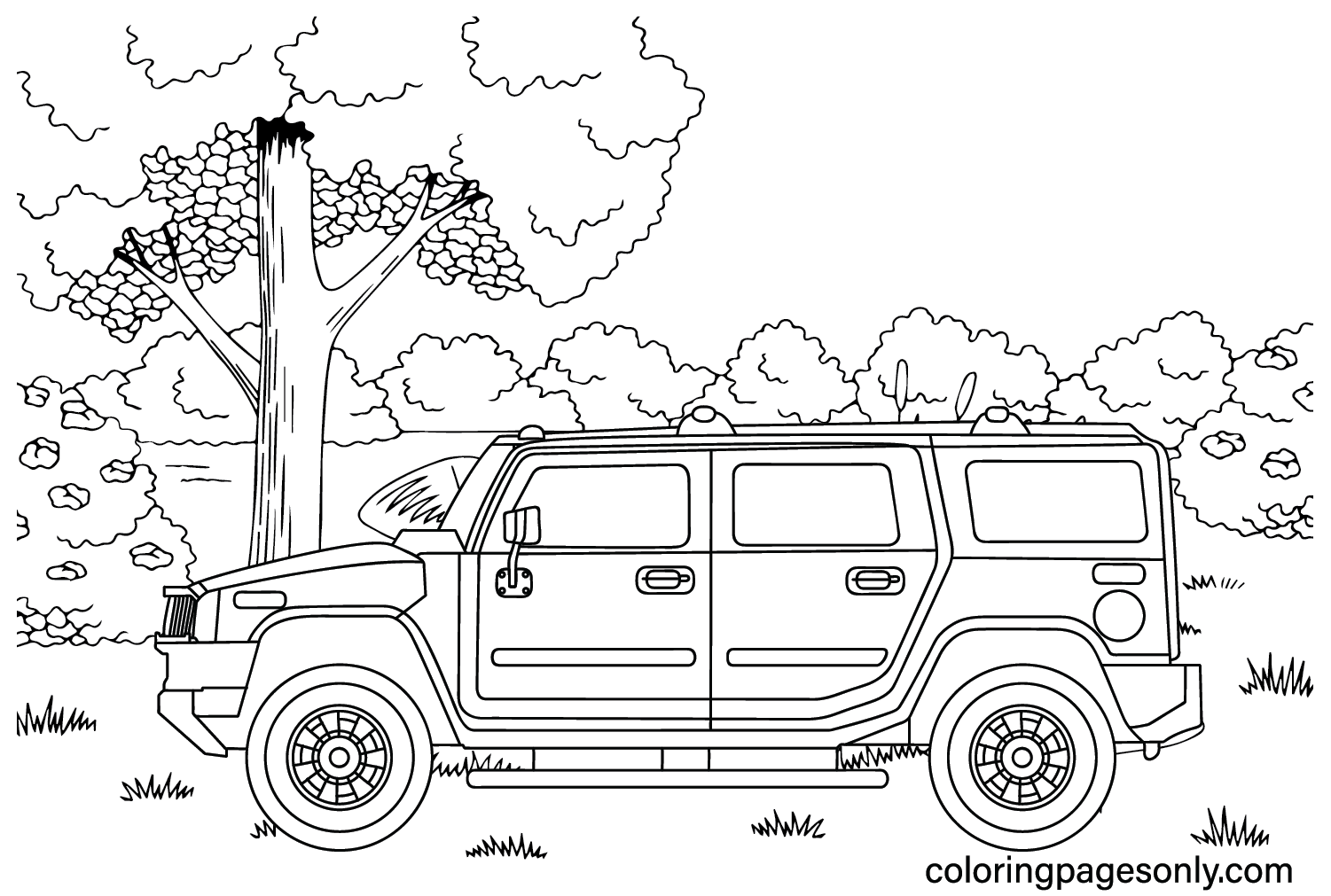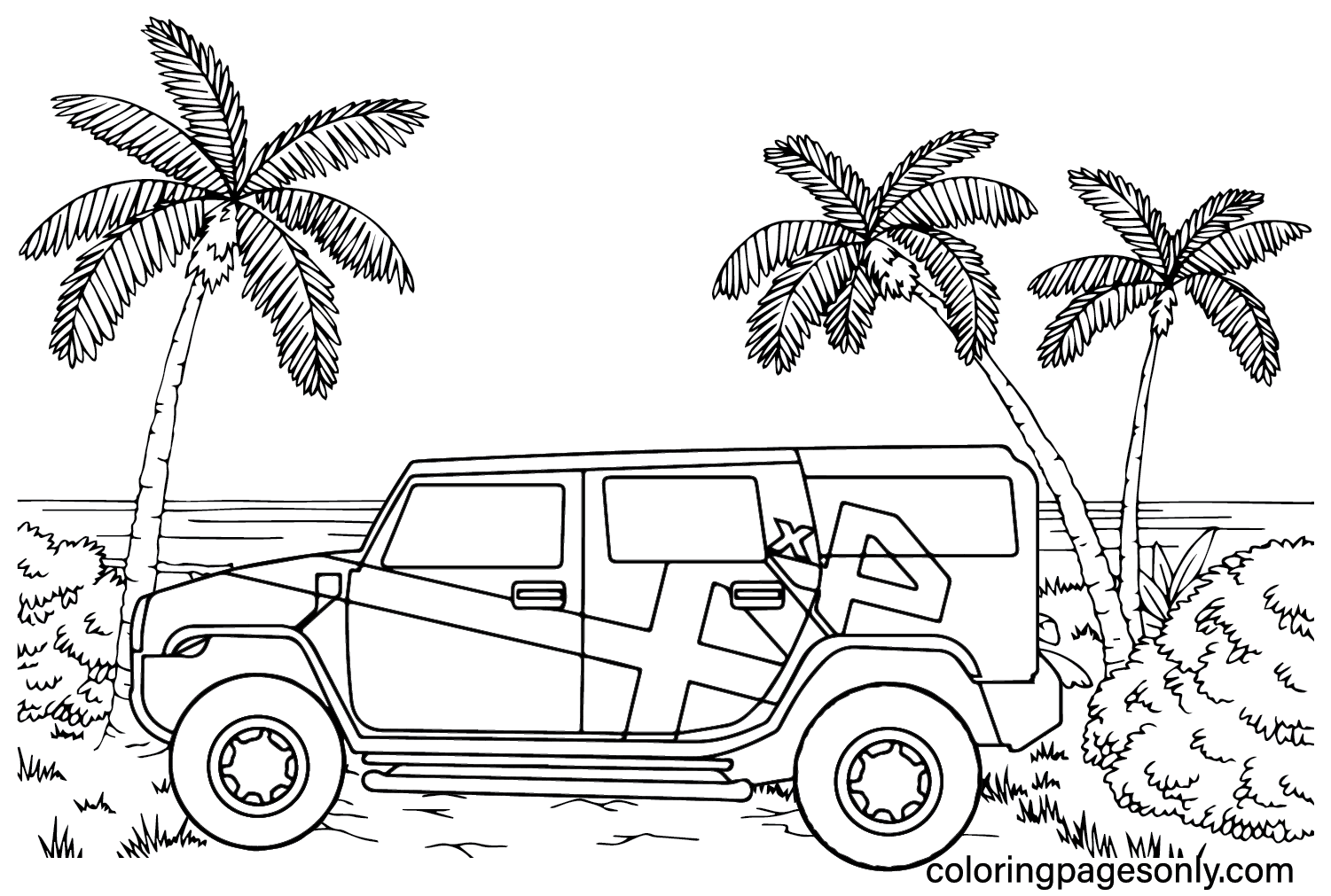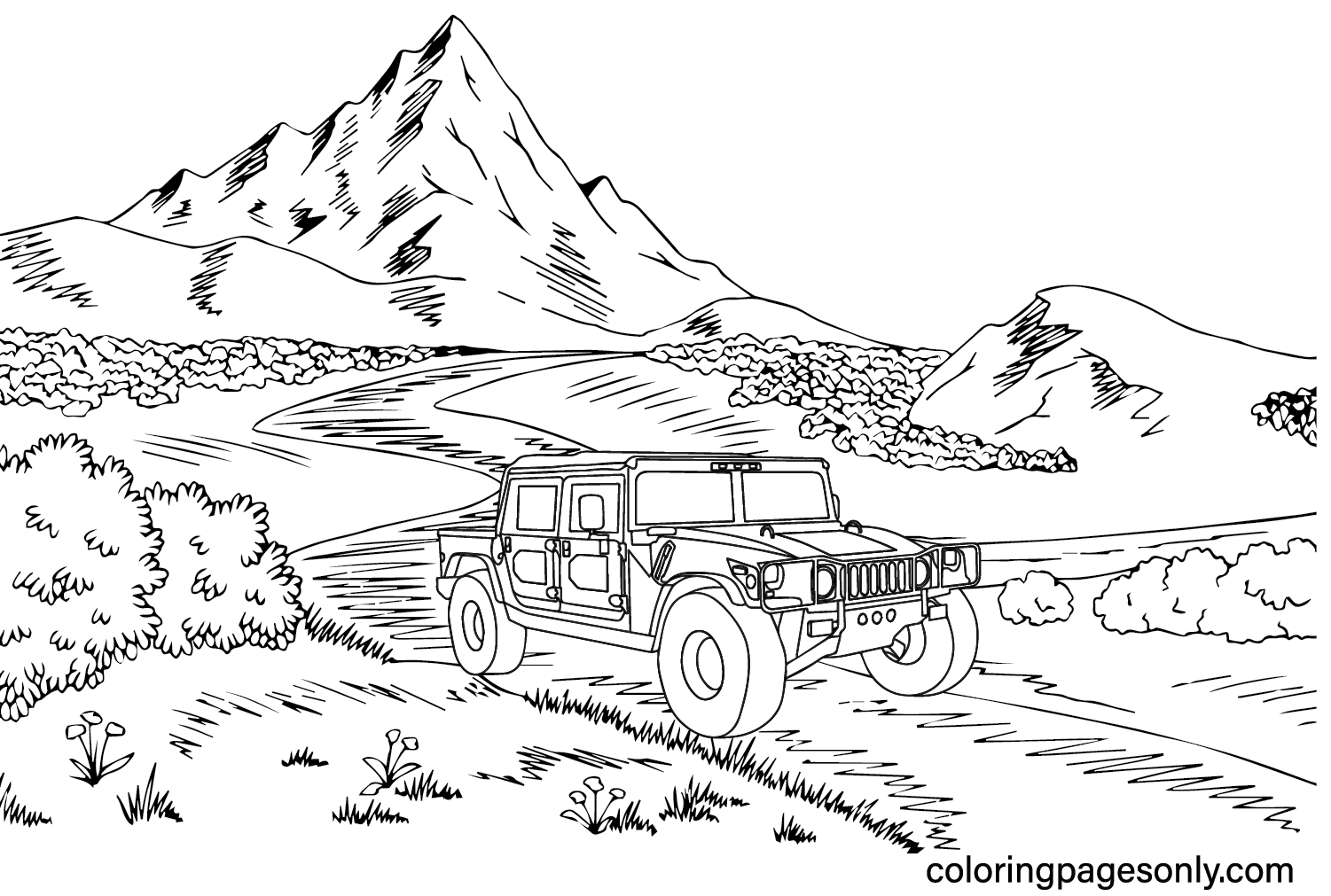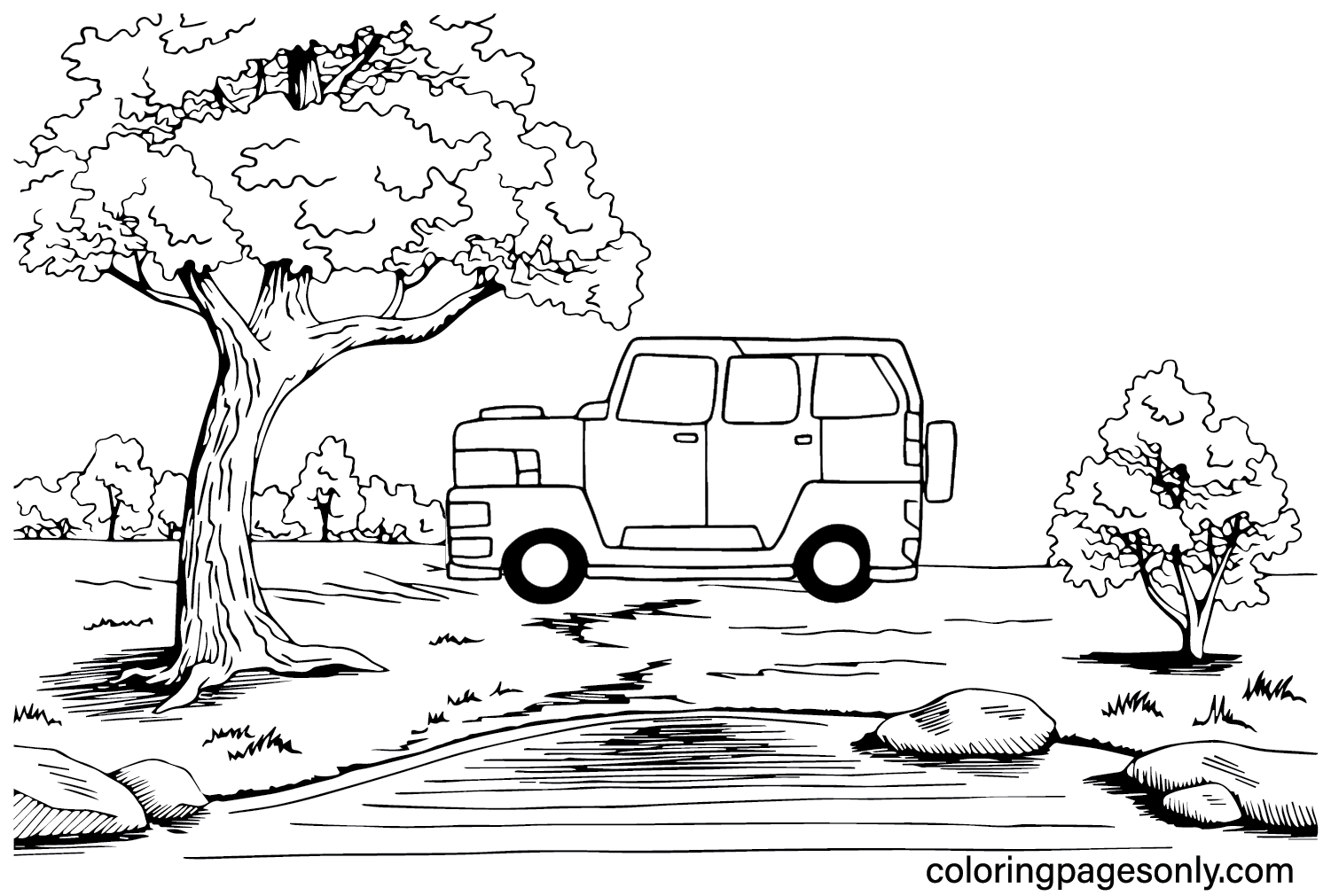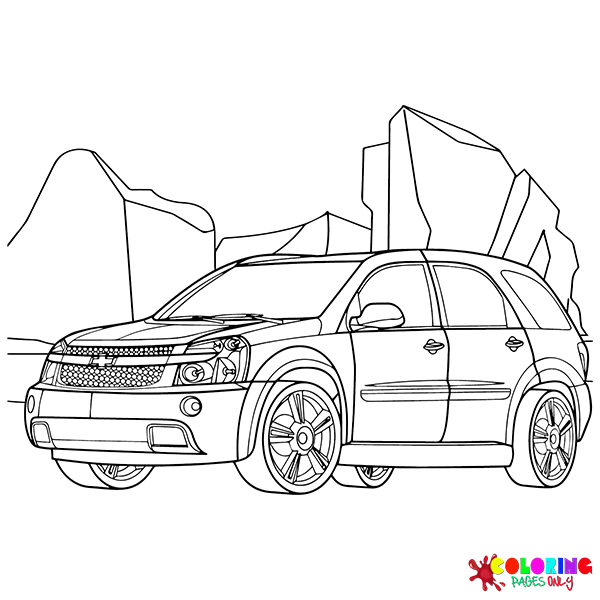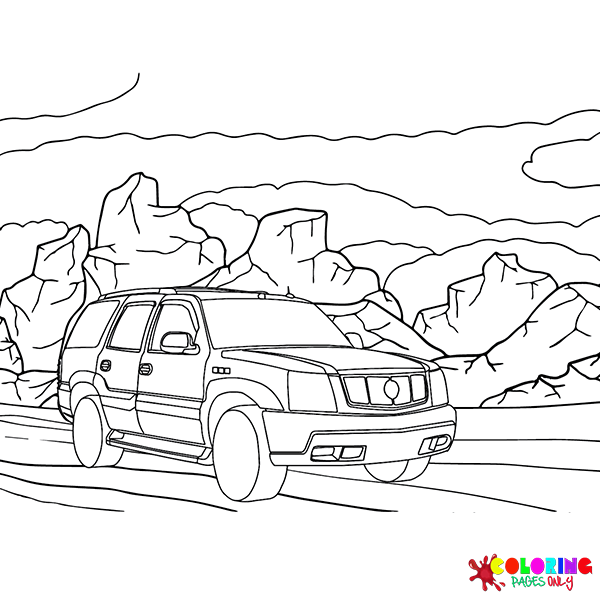
Free Hummer coloring pages – 20+ pages featuring the H1, H2, H3, the military Humvee, and the GMC Hummer EV – line drawings of the most recognizable wide-body trucks in American automotive history, free printable PDF and online coloring for car enthusiasts of all ages.

The story of the Hummer begins not in a showroom but on a military proving ground. AM General Corporation developed the High Mobility Multipurpose Wheeled Vehicle – HMMWV, universally abbreviated to Humvee – for the United States Army in 1984, replacing the aging Jeep series with a vehicle designed to perform across extreme terrain in combat conditions. The HMMWV first saw major operational use in Operation Just Cause in Panama in 1989, and became globally famous during Operation Desert Storm in 1991, when television footage of the Gulf War brought images of the distinctive wide-bodied vehicle into living rooms worldwide.

The civilian Hummer exists because of Arnold Schwarzenegger. During the filming of Kindergarten Cop in 1990, Schwarzenegger watched a convoy of military HMMWVs and approached AM General about selling a street version. AM General agreed. The first civilian Hummer H1 went on sale in 1992. General Motors acquired the brand in 1999, developed the H2 and H3 to expand the lineup, then discontinued all three when GM restructured in 2010. The Hummer returned in 2021 as the GMC Hummer EV – fully electric, capable of 0–60 mph in approximately 3.5 seconds, and equipped with a “Crab Walk” mode that allows diagonal movement using four-wheel steering.

These 20+ free pages at ColoringPagesOnly.com cover the full range of Hummer’s history. All free, PDF or PNG, print or color online.

What’s Inside

The Hummer H1 – The Original

The H1 is the civilian version of the military Humvee with minimal modifications for road use, which is to say it is extraordinarily capable off-road, extraordinarily large on-road, and entirely indifferent to the opinions of people who think a vehicle should fit neatly in a parking space. It is 86.5 inches wide – wider than most pickup trucks are long – and sits on a wheelbase of 130 inches. Its ground clearance of 16 inches allows it to cross obstacles that would stop virtually any other civilian vehicle.

The H1’s design is not styled in the conventional automotive sense – it is engineered, with the body shape driven by capability requirements rather than aesthetic preferences. The result is a vehicle that looks unlike anything else on the road: a near-vertical windshield, a flat hood with a distinct center hump (housing the engine), round headlights recessed into the broad front fascia, and doors that open to reveal an interior built around the central tunnel created by the independent front and rear suspension portals.

Coloring the H1: The H1’s original military aesthetic translated directly into civilian production – it was available in Desert Sand, Black, and a range of greens that referenced its military origin. A tan or desert sand body with dark olive accents is the most historically resonant choice. The flat horizontal surfaces of the hood and roof are the largest coloring zones and should receive the most attention to light direction – lighter on the top facing the sky, darker on the vertical sides. The round headlights should have a clear glass lens highlight (white or very pale blue at the upper portion) against the darker recess.

The Hummer H2 – The Icon

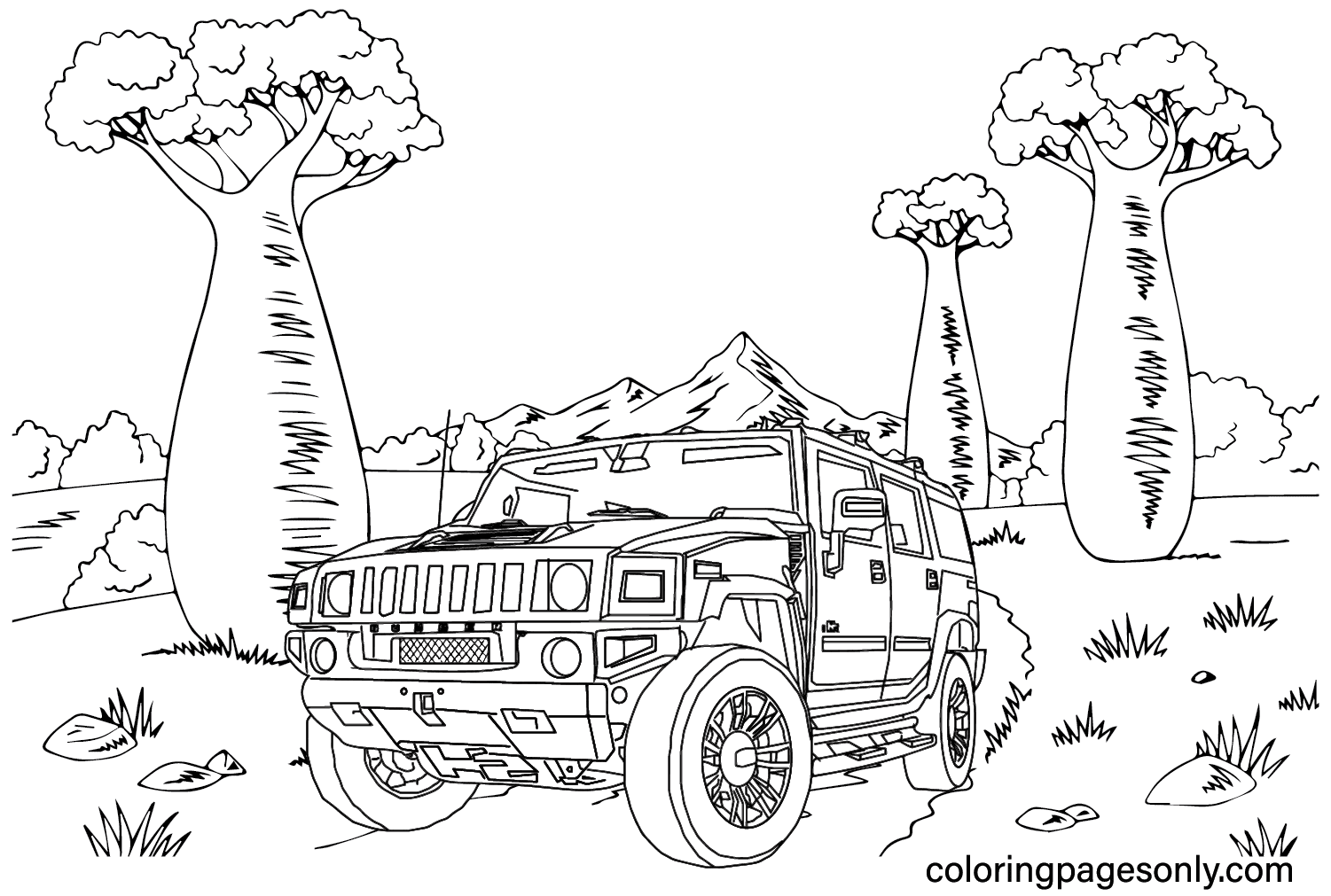
The H2 is the Hummer that most people picture when they hear the name. It was produced from 2002 to 2009 on a platform shared with the Chevrolet Tahoe and GMC Yukon, which gave it car-like interior comfort and electronics alongside a visual presence that was, depending on one’s perspective, either magnificently imposing or aggressively excessive. It was narrower than the H1 (81.2 inches, still wider than most vehicles on the road), lower, and more refined inside.

The H2’s design is a softened version of the H1’s military aesthetic – the same wide, boxy proportions, the same high roofline, but with smoother surfaces, cleaner lines, and a silhouette that was readable as an SUV rather than a repurposed military vehicle. The round headlights were replaced with rectangular units, the body received visible character lines, and the front fascia was designed to communicate aggression rather than utility. It is the Hummer in its most commercially successful form – the version that appeared in music videos, films, and the driveways of people who wanted the statement the vehicle made.

Coloring the H2: The H2 was available in a wider range of colors than the H1 – Yellow, Red, Black, White, Silver, and various others – which makes it the most open to personal color interpretation in the collection. The black version is the most dramatically effective for demonstrating the vehicle’s proportions – the large body surfaces read as shadow-rich in black, showing off the character lines. Yellow is the most visually immediate. The H2’s broader surface areas and more distinct character lines make the three-zone metallic technique (highlight, mid-tone, shadow) particularly effective on its body panels.

The Hummer H3 – The Accessible Entry

The H3 was produced from 2005 to 2010 on the GMT355 platform shared with the Chevrolet Colorado and GMC Canyon midsize pickup trucks – a significantly smaller architecture than the full-size platform underlying the H2. The result was a Hummer that fit in a standard garage, returned fuel economy that was merely poor rather than extraordinary, and carried a price point that put it within reach of buyers who could not afford the H2.

The H3’s design maintained the Hummer visual identity – the boxy proportions, the round headlights, the wide stance – in a package that was approximately one size class smaller than its sibling. It was the most driver-friendly of the three original Hummers and the most suited to daily urban use, which made it simultaneously the most practical and the least expressive of the Hummer character.

The Military Humvee

The pages depicting the military HMMWV give the Hummer its origin context – these are the vehicles that operated in Gulf War conditions, in Afghanistan, in Iraq, in dozens of operational environments for which they were specifically engineered. The military Humvee differs from the civilian H1 in specific operational details: the addition of armored variants, weapons mounts, radio equipment, and the matte olive drab paint scheme that is its most iconic appearance.

The military pages in the collection are the collection’s most historically specific and offer a different coloring context from the commercial models – less about personal color expression and more about accurate historical rendering.

Coloring the military Humvee: Olive drab – the standard U.S. military vehicle color from World War II through the Gulf War era – is a specific brownish-green that reads as neither brown nor green in isolation but as both simultaneously. It is a warm, muted, low-saturation color. In shadow areas, it shifts slightly warmer; in highlight areas, it becomes slightly yellower. Desert tan (officially CARC Tan 686A) is the alternative palette for Gulf War era vehicles – a warm, pale, slightly yellow-brown that reads as dusty rather than sandy.

The GMC Hummer EV – The Return

The GMC Hummer EV, launched in 2021, is the most technically remarkable vehicle in the collection and the most significant departure from the original Hummer’s philosophy – it achieves comparable capability through entirely different means. Its 212.7 kWh battery pack (one of the largest in any production vehicle) powers three electric motors producing approximately 1,000 horsepower and 11,500 lb-ft of wheel torque. Its 0–60 mph time of approximately 3.5 seconds puts it in sports car territory.

Its most discussed features are operational: “Crab Walk” allows all four wheels to steer simultaneously in the same direction, enabling diagonal movement – a feature primarily useful for extracting from off-road situations where conventional forward-reverse recovery would require more space than available. “Extract Mode” raises the air suspension by 6 inches for maximum clearance on technical terrain.

The exterior design references the original H2 proportions – the wide boxy body, the pronounced fender flares, the tall roofline – while updating the details with current EV-era design language: a dark grille with no functional air intake (electric motors require minimal cooling compared to combustion engines), illuminated badge elements, and a more refined surface finish than the original models.

What These Pages Do

The Hummer’s history spans military utility, civilian excess, and electric reinvention. Coloring these pages across the model generations – military Humvee, H1, H2, H3, EV – traces a specific thread in American automotive and cultural history: what happens when military technology meets consumer culture, and what happens when that consumer culture encounters the requirement to change.

The H2 is one of the most culturally loaded vehicles in automotive history. At its 2002 peak, the H2 was simultaneously the most desired status symbol in American popular culture and the most criticized vehicle for its fuel consumption – it returned approximately 9 mpg in city driving. Coloring these pages while knowing this context is engaging with a specific moment in the history of what Americans have wanted from their vehicles and why.

Automotive surface design as a technical coloring challenge. The Hummer’s boxy, angular body surfaces – particularly the H1 and H2 – present a specific challenge that rounded, aerodynamic cars do not: the corners are hard, and the planes change abruptly. This makes the three-zone metallic technique more precise to apply and more clearly correct when executed well. The American Academy of Pediatrics identifies fine motor development as a key childhood milestone, and the motivated practice that a vehicle enthusiast brings to getting a Hummer’s proportions right is exactly what that development requires.

The 2005 Art Therapy Journal study applies. Structured coloring reduces anxiety. The specific quality of rendering a recognizable vehicle – working toward something that looks like the vehicle you’re trying to represent – produces the focused, absorbed attention the research identifies as most effective.

How to Color These Pages Well

The H1 and H2 want the three-zone body surface treatment. The Hummer’s large, flat body panels are the most rewarding automotive surfaces to apply this technique to. Establish your light source (upper left is standard). Everything facing the upper-left receives the lightest tone of your body color. The main vertical surfaces receive the mid-tone. The undersides and recessed areas receive the shadow tone. The abrupt transitions between planes on a boxy vehicle like the Hummer make these zones clearly defined – there is no gradual curve to blend across, just a corner.

The chrome and metallic elements need warm highlights. The Hummer’s bumpers, grille elements, and running boards are typically chrome or brushed aluminum. Chrome reflects everything around it – it is the most complex metallic surface to render. Simplify it to three zones: a near-white highlight along the upper edge, a warm light grey across the main surface, and a deeper cool grey in the shadow areas. Add a thin dark line along the very bottom edge of each chrome element – this is the ground reflection that chrome always shows.

Tire rendering makes or breaks a truck page. The Hummer’s large off-road tires are as visually important as any body panel. Apply a dark grey (not black – tires are dark grey rubber, not pure black) across the tire surface. The tread pattern, where visible, should be rendered in a slightly darker tone – the tread depth creates shadows. The wheel (rim) inside the tire should be rendered separately in silver or the wheel’s specific finish.

Off-road scene pages want earthy, desaturated backgrounds. If the page includes terrain – dirt, rocks, mud – keep those elements in muted, warm earth tones that do not compete with the vehicle’s body color. A brightly colored Hummer against a muted tan-brown dirt background reads with maximum visual impact.

The EV’s dark grille is a design statement, not a mistake. The GMC Hummer EV’s front fascia has a dark, closed grille – no air intake, because the electric drivetrain doesn’t need one. Color this panel in a very dark grey or near-black rather than attempting to render it as chrome or body color. It is a deliberately dark element in the design.

5 Creative Craft Ideas

Hummer Generation Timeline

Print one page each representing the military HMMWV, the H1, the H2, the H3, and the GMC Hummer EV. Color each in its most historically resonant color: military olive drab for the Humvee, desert tan for the H1, yellow for the H2 (the most iconic H2 color), silver for the H3, and dark graphite for the EV.

Mount all five in chronological order on a long horizontal backing sheet, with the year range below each vehicle: HMMWV (1984–present), H1 (1992–2006), H2 (2002–2009), H3 (2005–2010), EV (2021–present). The finished timeline shows the brand’s evolution from military utility through consumer excess to electric reinvention in a single display.

Military vs. Civilian Comparison

Print the military Humvee page and the H1 page. Color the Humvee in authentic military olive drab with appropriate matte finish – no chrome, no gloss, functional color throughout. Color the H1 in any civilian color – black is the most dramatic contrast with the military palette.

Mount both side by side on a dark backing sheet with a thin white dividing line and labels: “HMMWV – Military” on the left, “H1 – Civilian” on the right. The comparison shows what changes when a military vehicle becomes a commercial product – and what stays the same.

Off-Road Challenge Scene

Print the most dynamic off-road Hummer page in the collection – whichever shows the vehicle at an angle, on terrain, or in a clearly active-use context. Color the Hummer in a vivid body color. Color the terrain in muted earth tones – tan, brown, grey rock.

Add hand-drawn environmental details beyond the printed lines: a dust cloud behind the rear wheels (light tan, feathered at the edges), water droplets if the terrain suggests water crossing, and shadows beneath the vehicle proportional to its ground clearance. The finished page reads as a complete automotive illustration rather than a simple coloring page.

Custom Hummer Design

Use the most neutral Hummer outline page – the version with the cleanest, most unadorned body – as a starting point for a personal design exercise. Choose a body color that has never appeared in Hummer’s production history. Add a custom graphic using colored pencil or fine-tip marker – a racing stripe, a pattern, an accent color on the bumpers or running boards.

Name your custom Hummer design using the naming convention the brand uses: an H designation with a number. Write the name below the finished vehicle. This is the exercise automotive design studios use with production vehicles – starting from the existing platform and exploring what color and graphics can do to its identity.

American Truck Heritage Poster

This project pairs the Hummer pages with pages from other American truck collections on this site – the Ford F-150, the Chevrolet Silverado, or the Jeep Wrangler, if available. Color all vehicles in their most iconic colors. Arrange the Hummer at the center (its proportions make it the natural visual anchor), with the other vehicles flanking.

Mount on a deep red or dark navy backing sheet – the colors of American automotive tradition. Hand-letter a title: “Built American – Built for Everything.” The finished poster celebrates the specific tradition of the American truck as a vehicle category, with the Hummer as its most extreme expression.

Frequently Asked Questions

What is the difference between a Humvee and a Hummer? The Humvee is the military vehicle – officially the HMMWV (High Mobility Multipurpose Wheeled Vehicle) – developed by AM General for the United States Army and fielded in 1984. The Hummer is the civilian brand created from that vehicle. AM General began selling a civilian version of the HMMWV in 1992 under the “Hummer” name following pressure from Arnold Schwarzenegger. General Motors acquired the Hummer brand from AM General in 1999 and developed the H2 and H3 models, which were built on commercial truck platforms rather than the military HMMWV architecture. The H1 was the only Hummer model directly related to the military vehicle; the H2 and H3 were civilian trucks styled to look like Hummers.

Why was the Hummer discontinued in 2010? General Motors discontinued the Hummer brand in 2010 as part of its restructuring following its 2009 bankruptcy and government bailout. GM was required to divest non-core brands as a condition of the bailout, and Hummer – facing declining sales driven by rising fuel prices, environmental criticism, and a vehicle lineup that had become culturally associated with excess – was identified as a brand that did not fit the company’s restructured focus. A sale to the Chinese company Sichuan Tengzhong Heavy Industrial Machines was announced but ultimately rejected by Chinese government regulators, and the brand was wound down.

What is “Crab Walk” on the GMC Hummer EV? Crab Walk is a four-wheel steering feature available on the GMC Hummer EV that allows all four wheels to steer in the same direction simultaneously. The result is that the vehicle moves diagonally – forward and to the side at the same time – rather than only forward or backward. The feature is most useful in off-road situations where conventional forward-reverse recovery would require more space than available, or for maneuvering in tight off-road terrain. The name references the diagonal movement of a crab walking sideways.

How wide is the original Hummer H1? The Hummer H1 is 86.5 inches wide (approximately 7 feet, 2 inches) – making it wider than the lane markings on most standard U.S. roads, which are 12 feet wide. Its extreme width was a direct inheritance from the military HMMWV, which required that width for its independent portal axle suspension to provide the ground clearance needed for combat operations. The H2, built on a civilian truck platform, reduced this to 81.2 inches – still wider than most consumer vehicles but significantly more manageable in urban environments.

What fuel economy did the Hummer H2 achieve? The Hummer H2 was rated at approximately 10 mpg city and 13 mpg highway – among the lowest fuel economy figures for any light-duty vehicle in production during the 2000s. This figure, combined with the H2’s cultural association with conspicuous consumption, made it one of the most criticized vehicles of the decade in environmental discussions and one of the most prominent symbols in debates about American automotive priorities. The GMC Hummer EV, by contrast, uses electricity and has no mpg rating, though it has an EPA-estimated range of approximately 329 miles per charge.

What is the ground clearance of the Hummer H1? The H1 has 16 inches of ground clearance in standard configuration, achieved through its portal axle design, which places the axle center above the wheel center, effectively raising the vehicle’s undercarriage relative to the wheel. This is one of the highest ground clearance figures for any production vehicle and is the specification that most directly translates the military HMMWV’s capability into the civilian version. The GMC Hummer EV’s “Extract Mode” raises its air suspension by 6 inches for additional clearance on technical terrain.

Browse the full collection at ColoringPagesOnly.com. All 20+ pages free, no sign-up, PDF or PNG, print at home or color online.

AM General built the HMMWV for the Army in 1984. Arnold Schwarzenegger saw a convoy in 1990 and wanted one. The first civilian H1 went on sale in 1992. GM bought the brand in 1999, expanded it, then discontinued it when the company went bankrupt in 2010. Eleven years later, the name returned on a fully electric truck that reaches 60 miles per hour in 3.5 seconds and drives sideways.

The Hummer is one of the few vehicle lines in automotive history whose second chapter is genuinely more technically ambitious than its first. The original was a military vehicle made available to civilians. The EV is a civilian vehicle engineered beyond what the original could do.

Pick up your olive drab. Or your yellow. Or your graphite grey. Color whatever era of this story matters most to you.

Share your work on Facebook and Pinterest and tag #Coloringpagesonly. We especially want to see the generation timelines and the custom design projects.

Color the widest truck on the road. It earned the space it takes.

More from our automotive collections:

Sophia Williams – Writer and Social Network

Hi everyone! I’m Sophia Williams, a social media specialist at Coloringpagesonly.com. My goal is to spread the love of color and creativity to everyone. Join me online as we share inspiration, connect through art, and fill the world with vibrant, joyful colors!