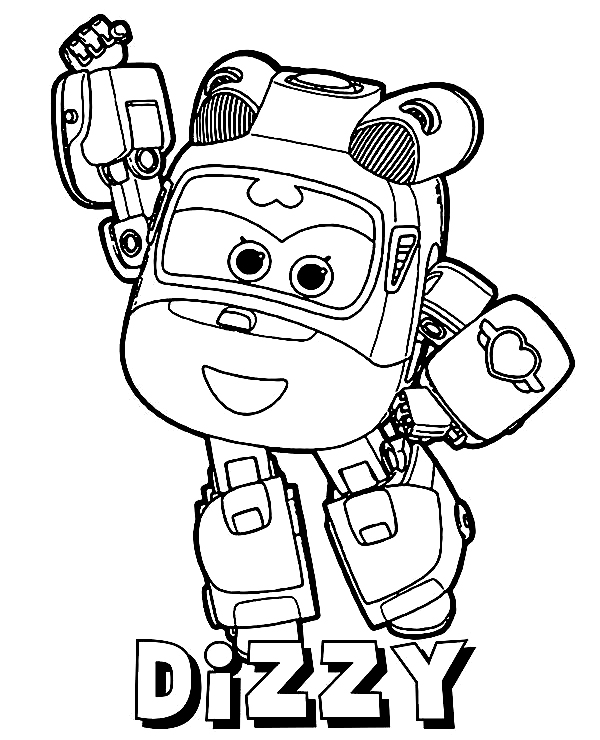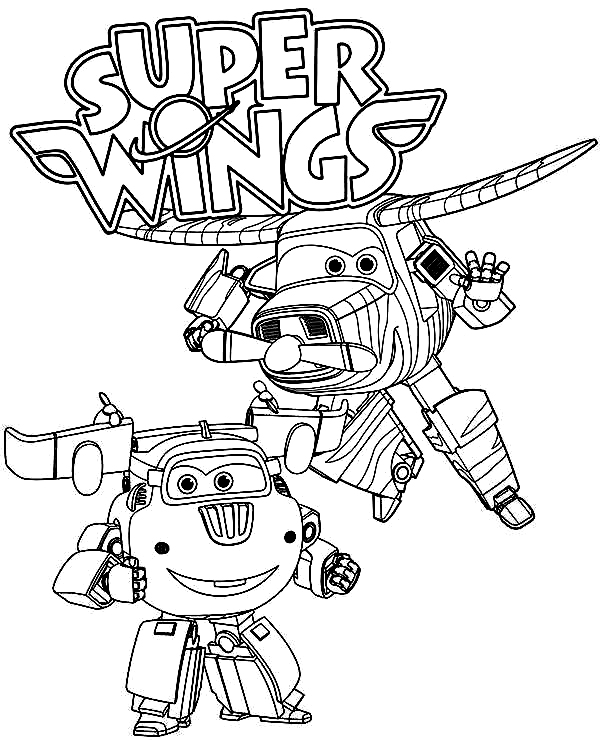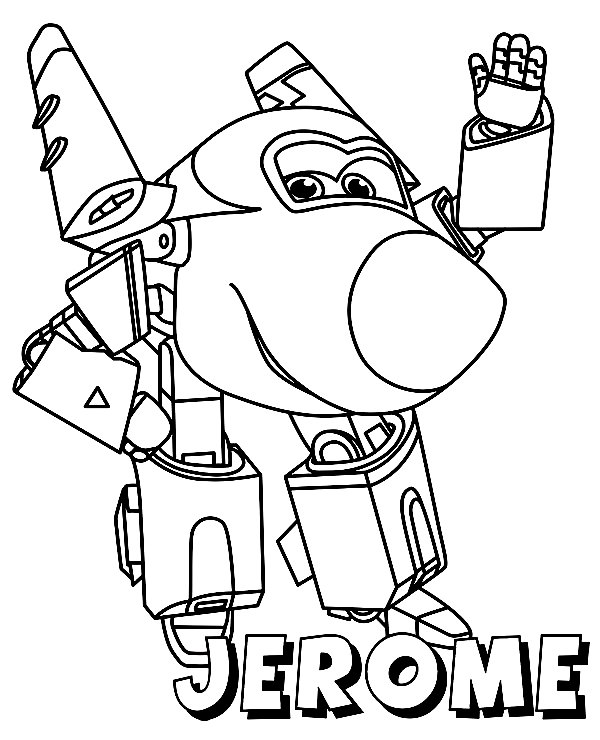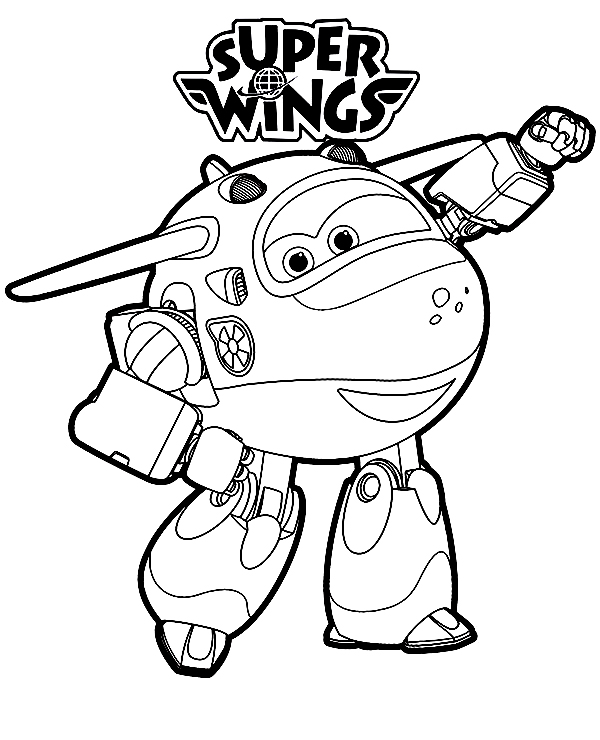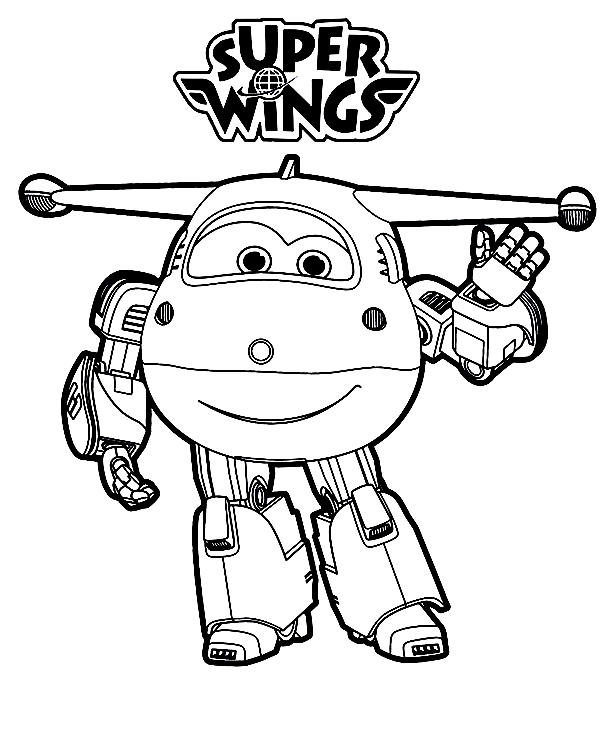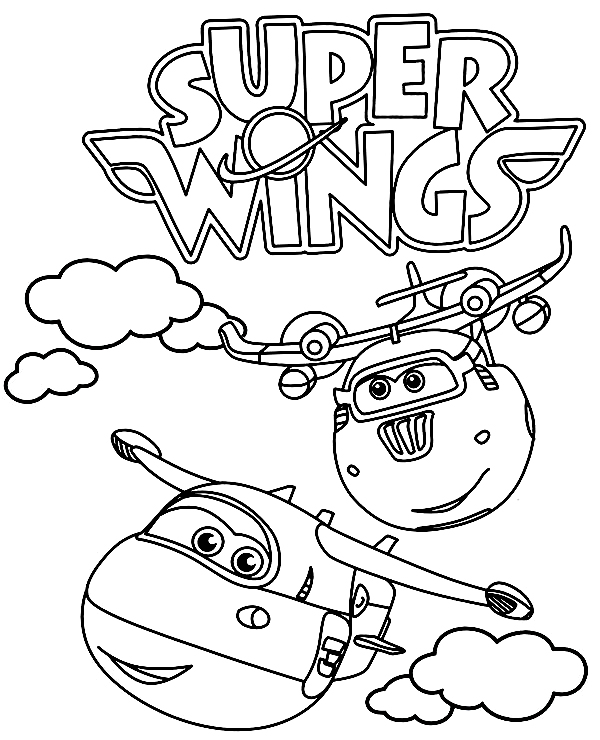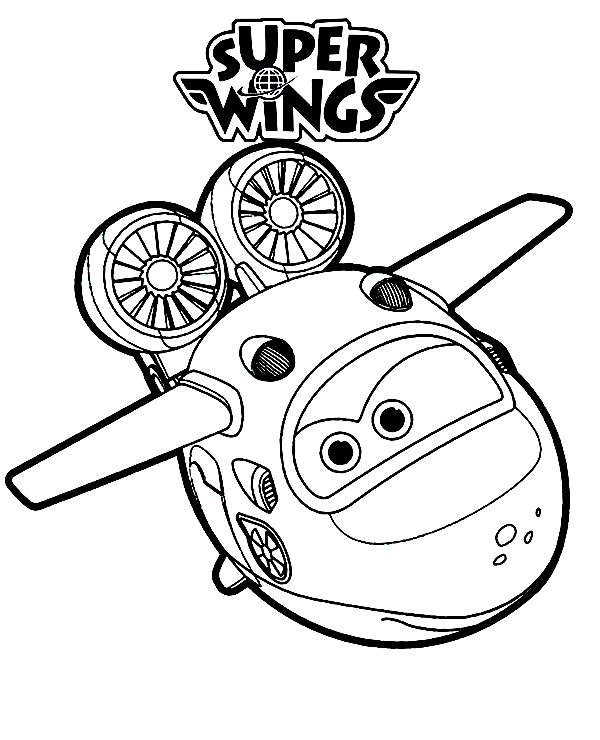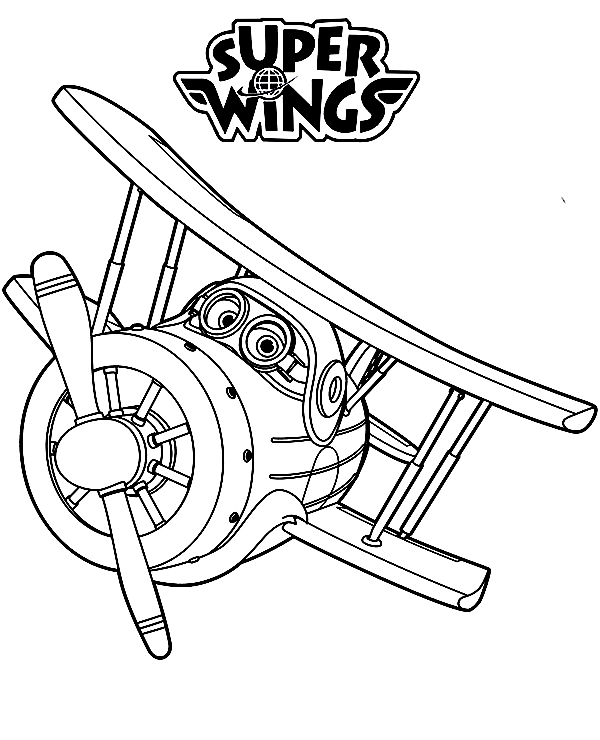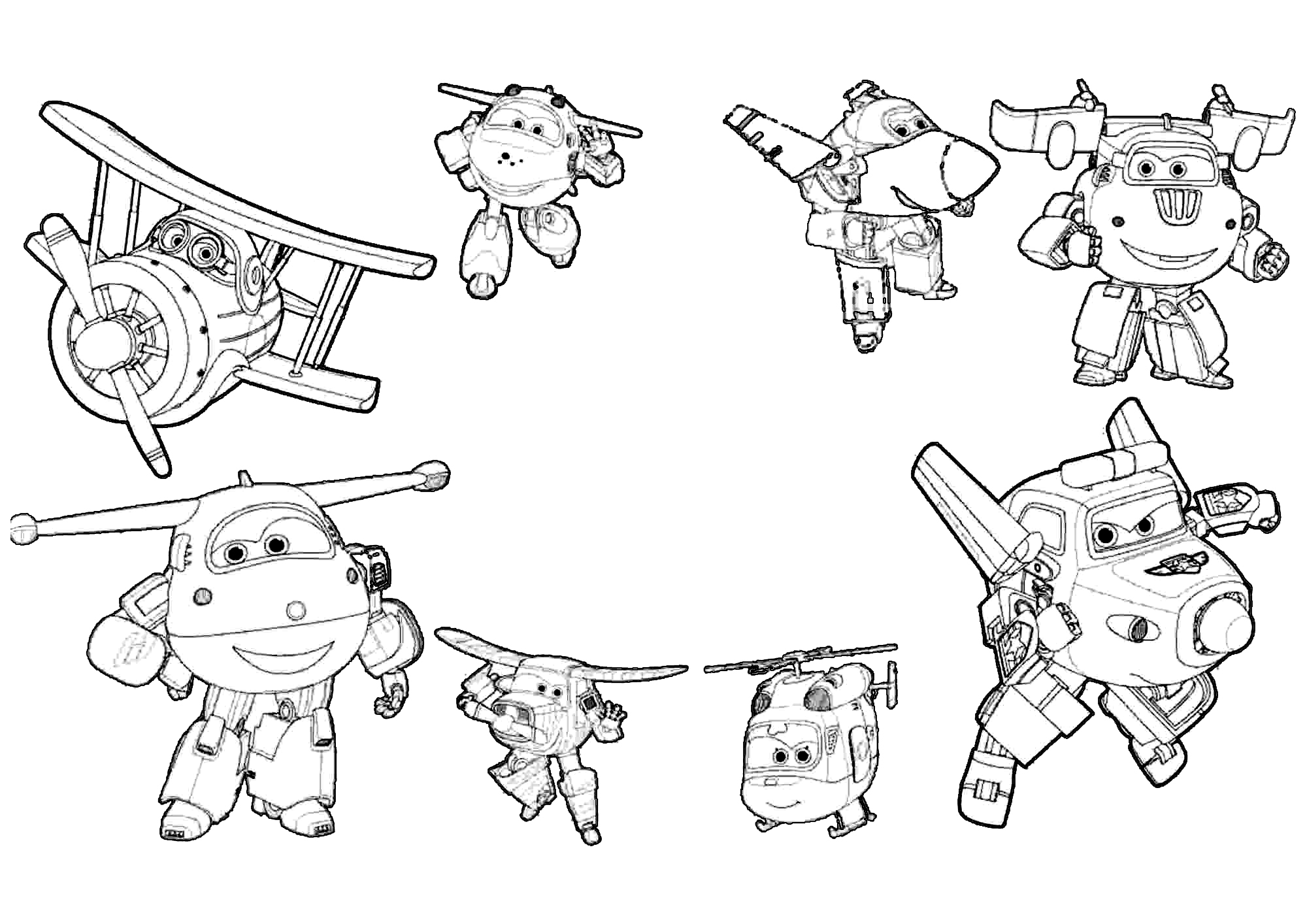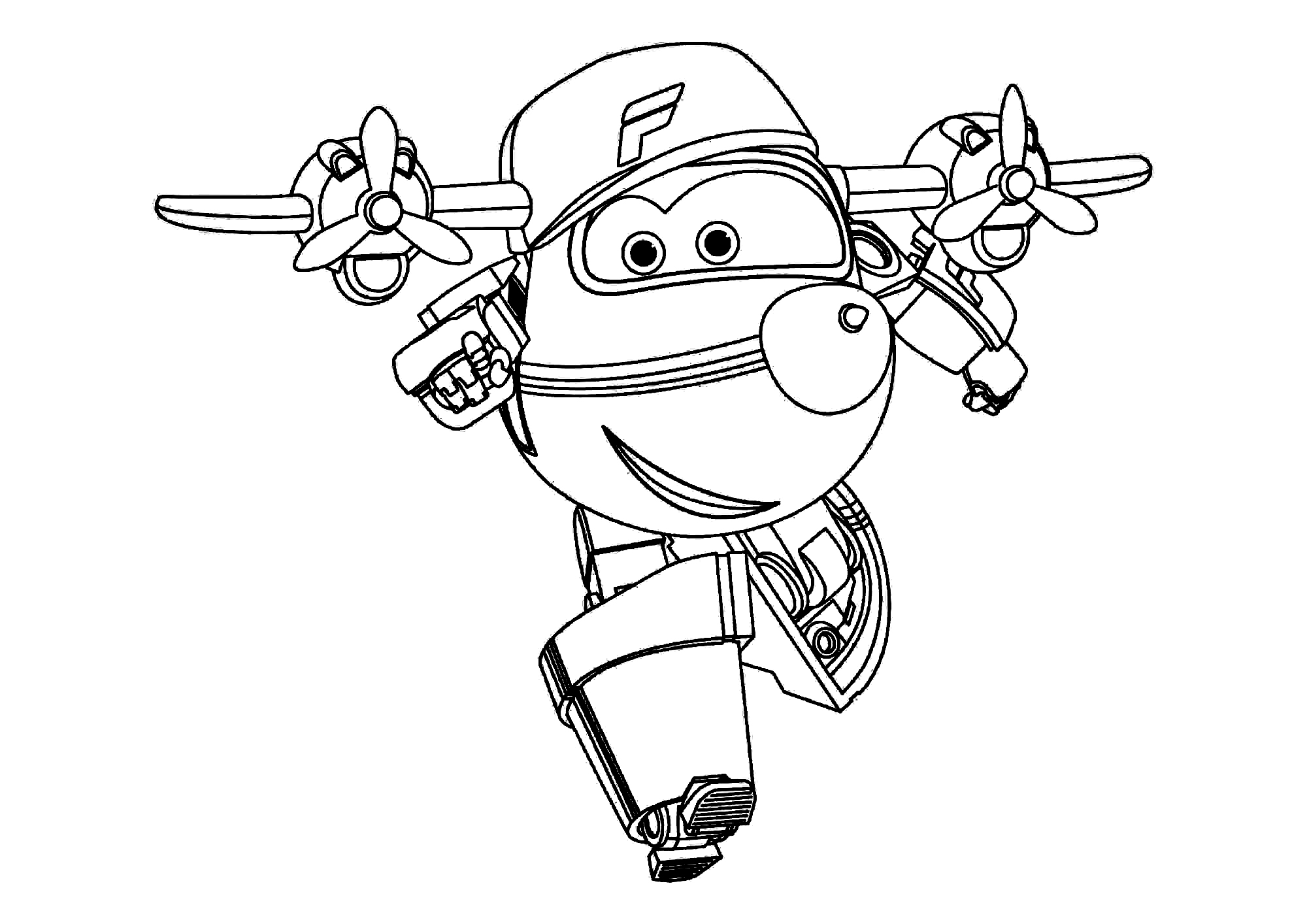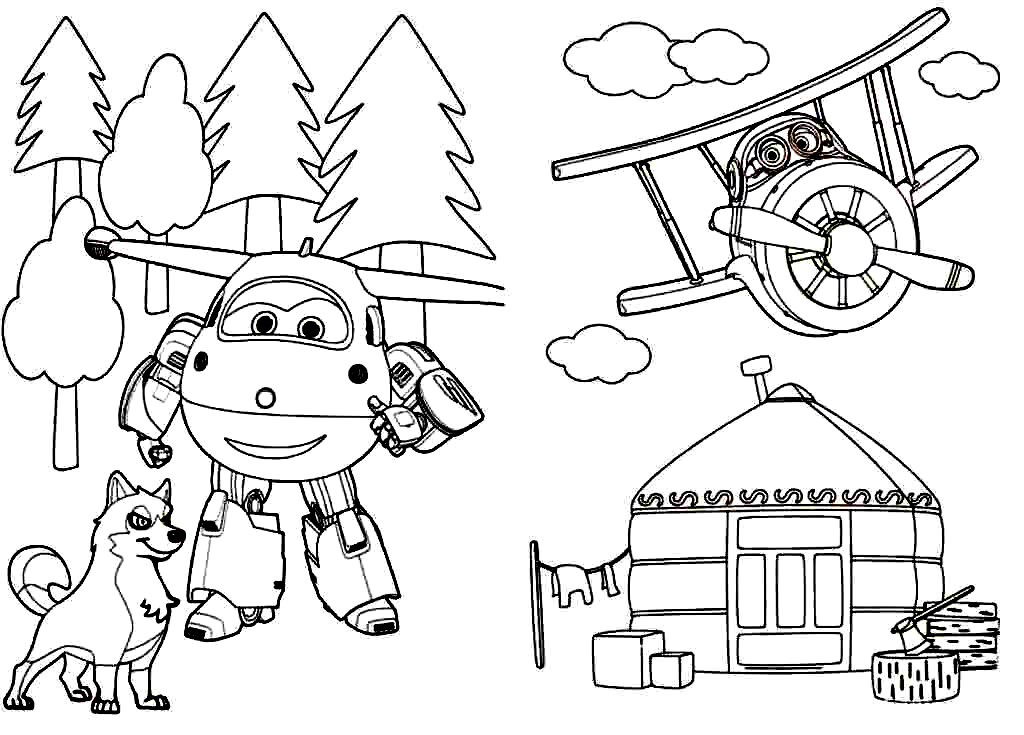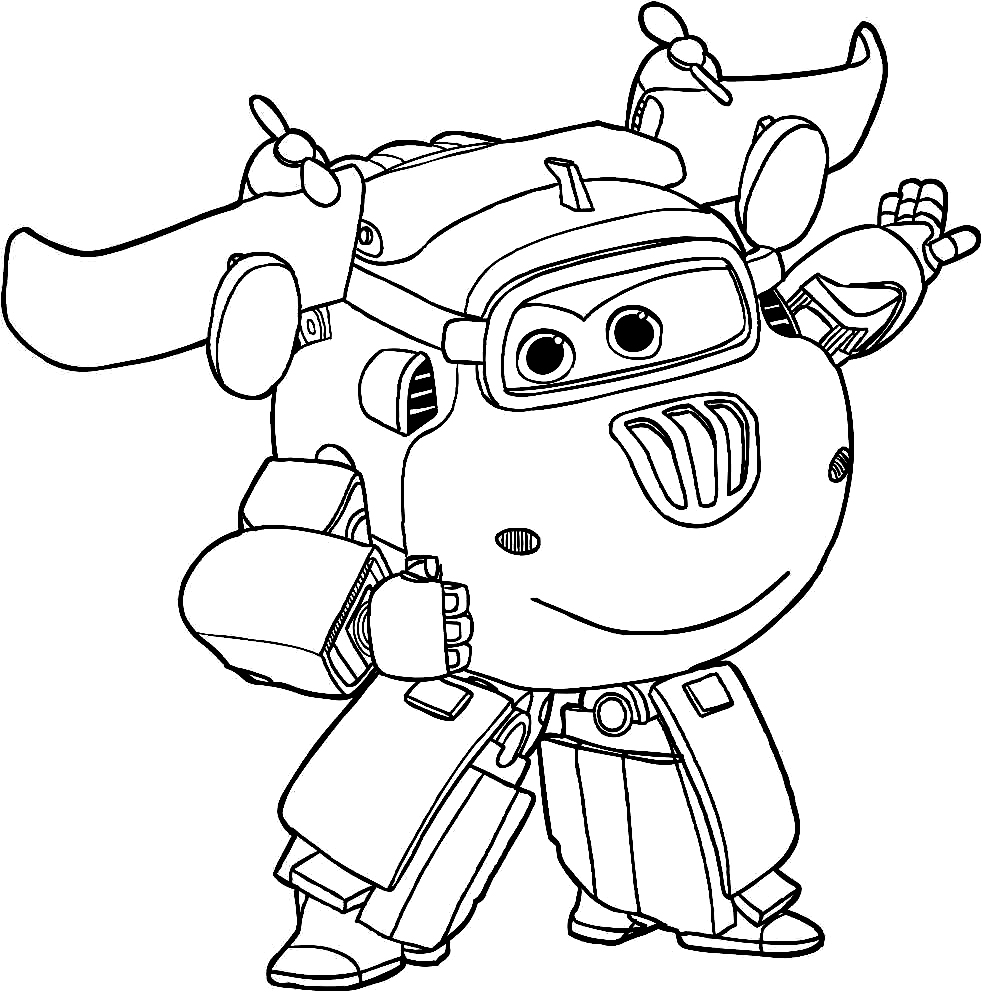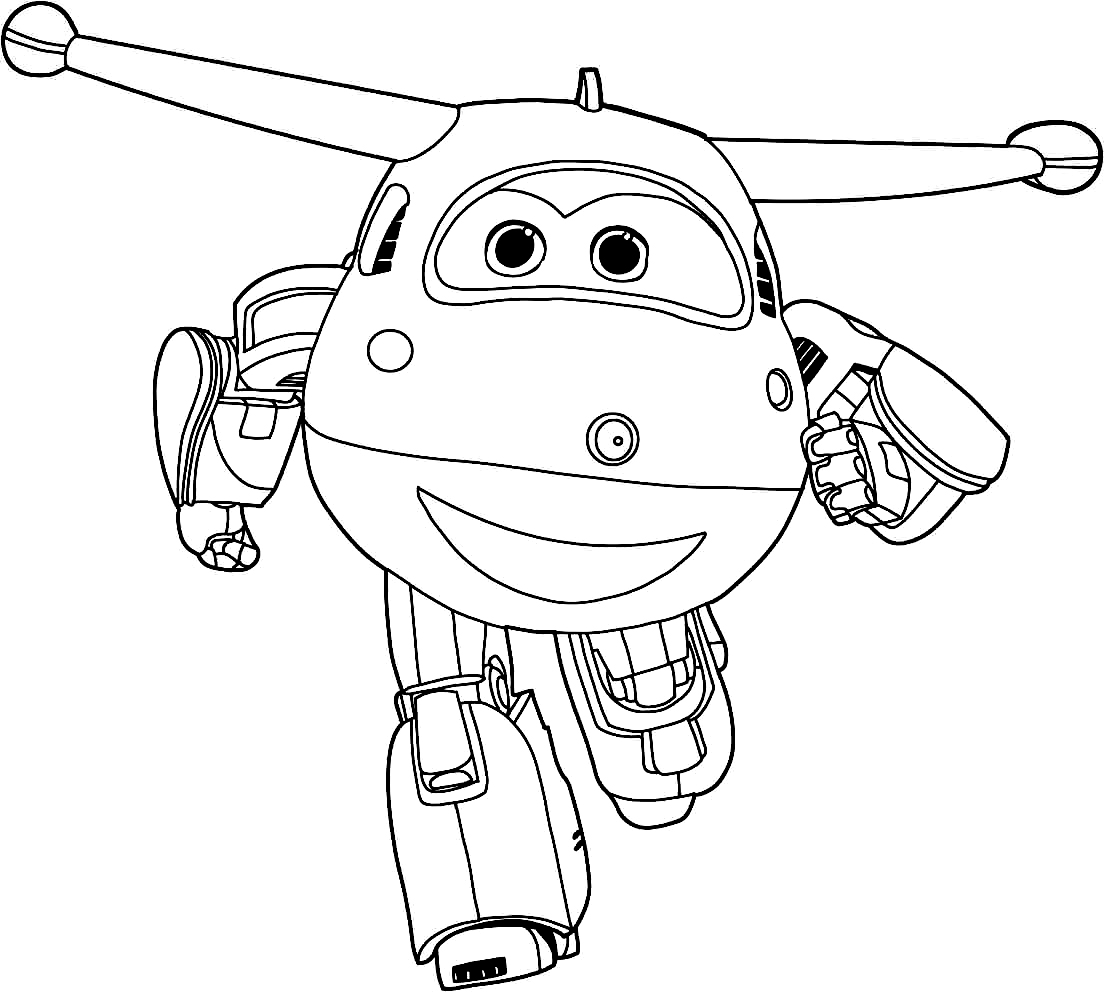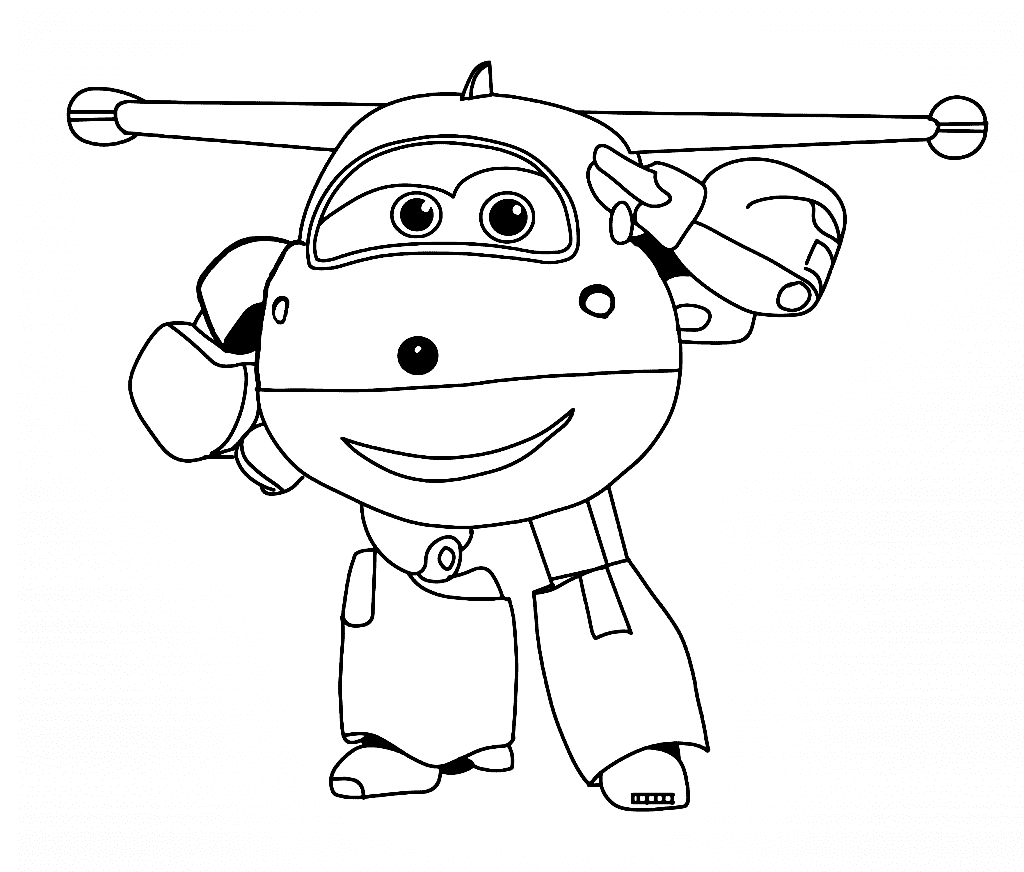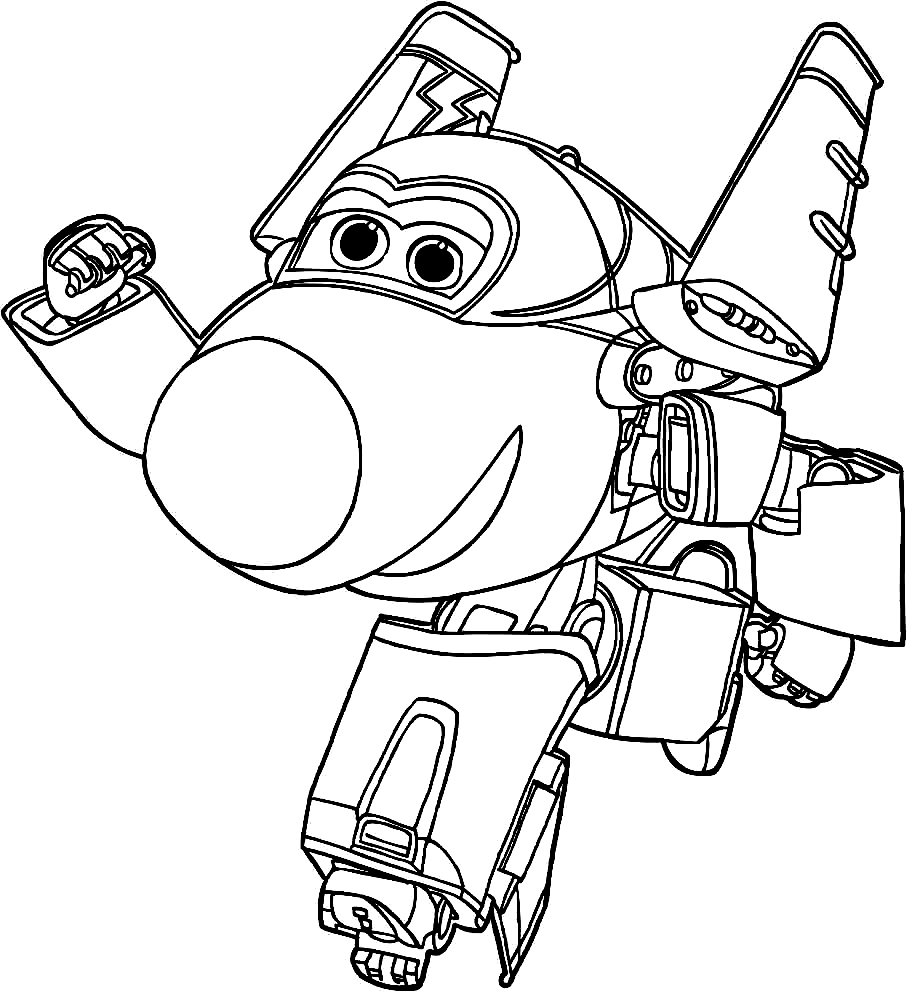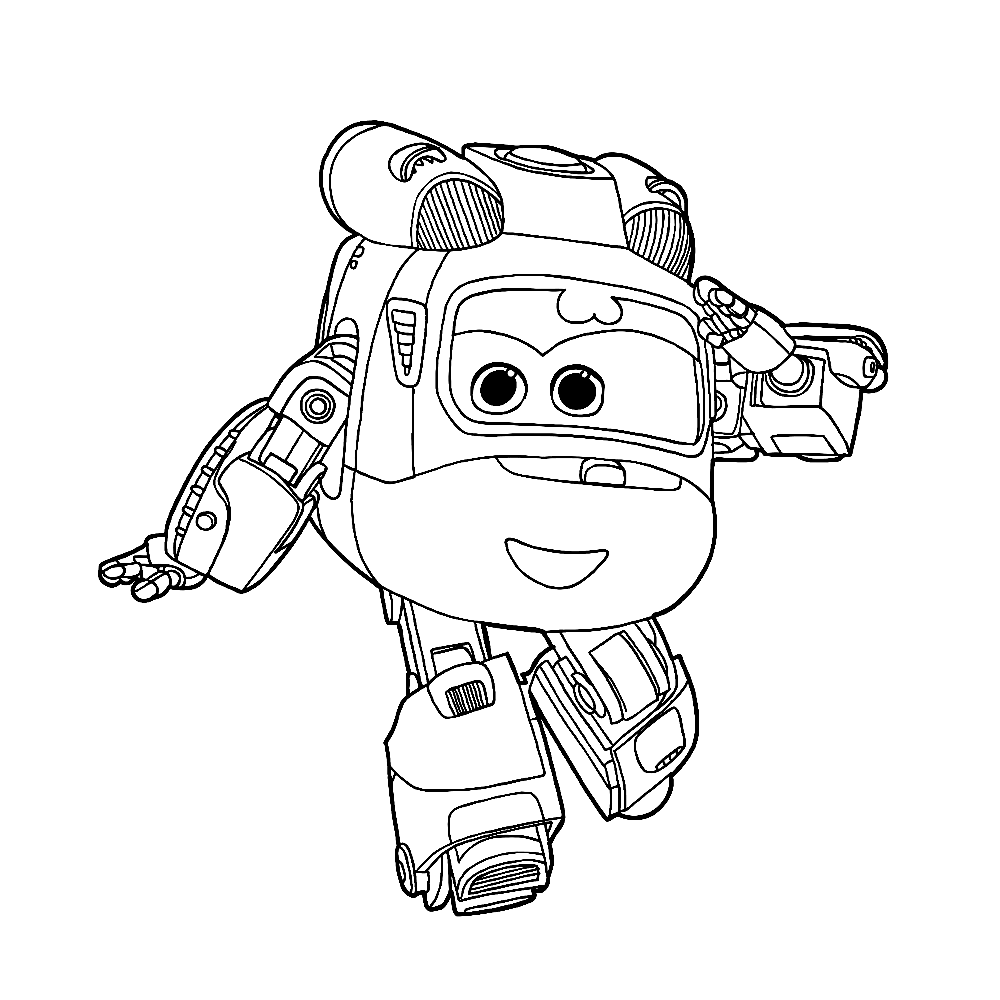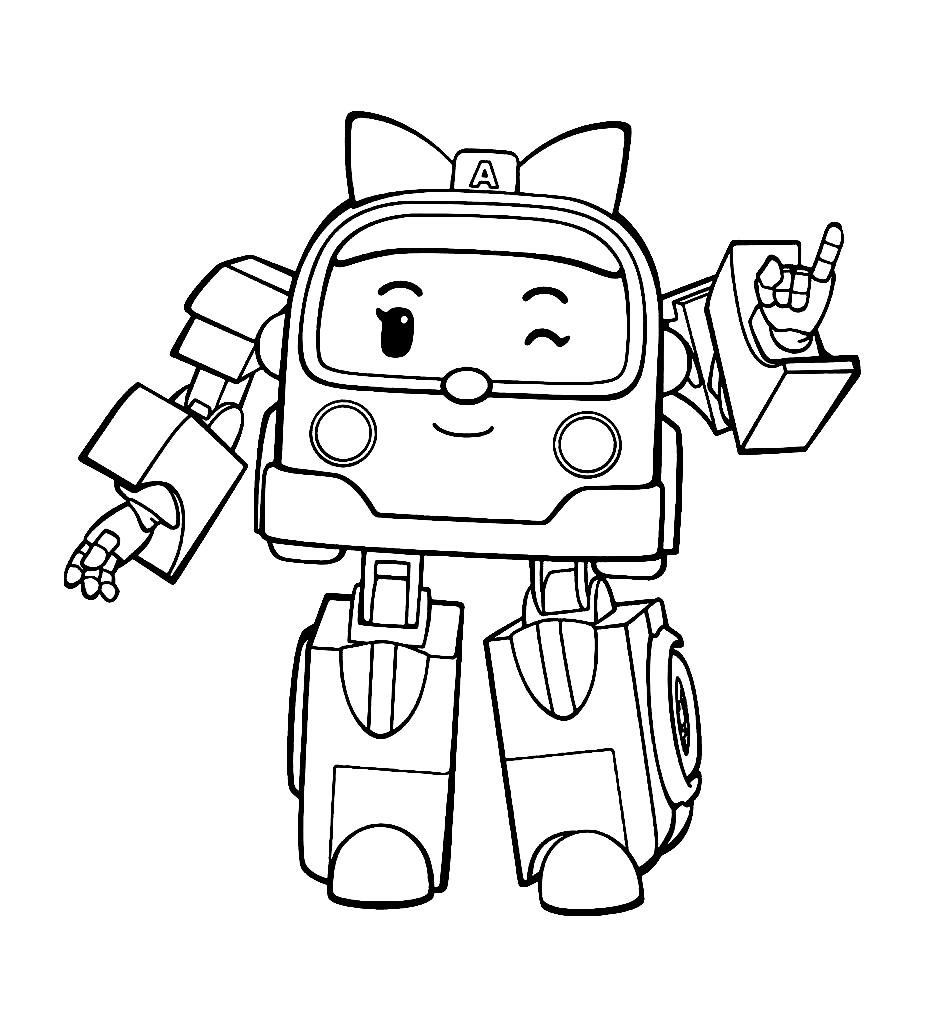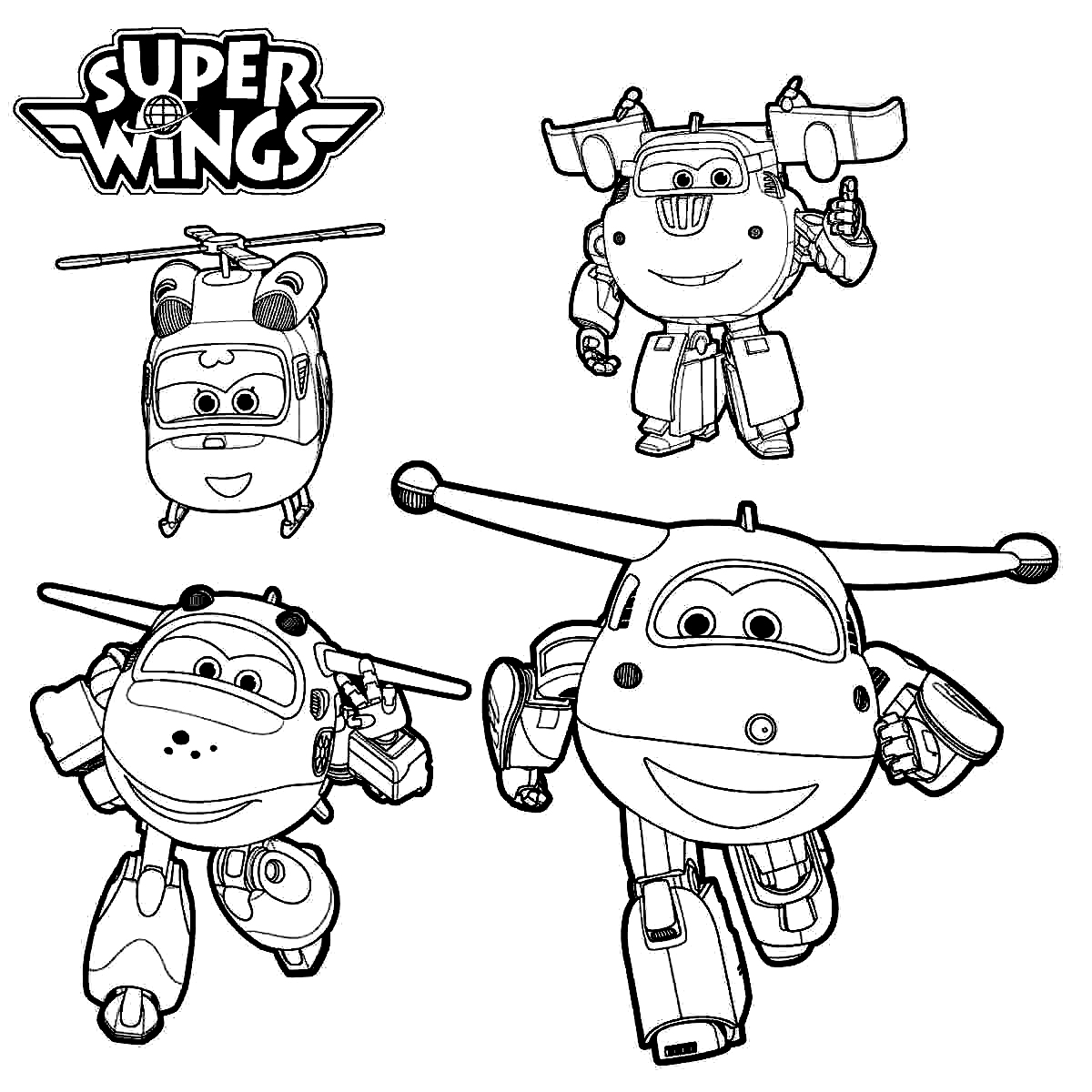
Free Super Wings coloring pages – 40+ pages featuring Jett, Dizzy, Donnie, Paul, Remi, Bello, Astra, and the full Super Wings team in their vehicle and robot forms, flight and action scenes, world destination backgrounds, group compositions, and character portraits – free printable PDF and online coloring for the youngest fans of the global animated adventure series.

Super Wings (超级飞侠) is an animated television series produced as a co-production between Chinese and South Korean studios – originally developed by Alpha Group in China and produced in partnership with FunnyFlux and EBS (Educational Broadcasting System of South Korea). The series first aired in 2015 and has since been broadcast in over 100 countries across multiple languages and for more than seven seasons.

The premise is both simple and specifically constructed for educational purposes: Jett is a small white airplane that works as a delivery plane for the World Airport, delivering packages to children in different countries around the world in each episode. When Jett’s delivery run encounters a problem – a local challenge, an environmental obstacle, a cultural event that requires specific knowledge – he calls his Super Wings teammates for backup. His teammates transform from specialized vehicles (a helicopter, a submarine, a bulldozer, a snowplow) into humanoid robot-like heroes, each suited to a specific type of problem. Together,r they solve the challenge, complete the delivery, and leave the child a little better served than they arrived.

The educational framework is geography and cultural awareness: each episode introduces a different country, a different child recipient by name, and specific elements of that country’s culture, geography, or daily life. The Super Wings format is one of the most structured educational geography vehicles in children’s animation, and the 40+ coloring pages in this collection bring the full team to life across their most recognizable designs.

These 40+ free pages at ColoringPagesOnly.com cover the complete Super Wings roster. All free, PDF or PNG, print or color online.

What’s Inside

Jett – The Mail Plane

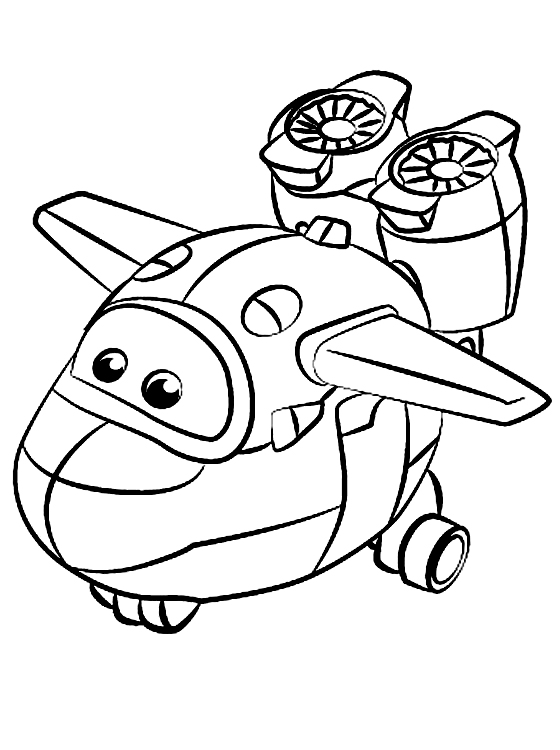
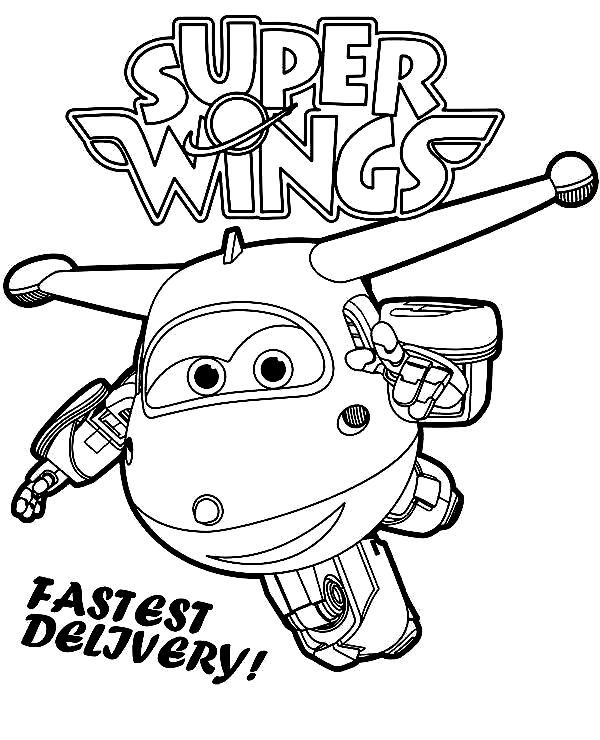
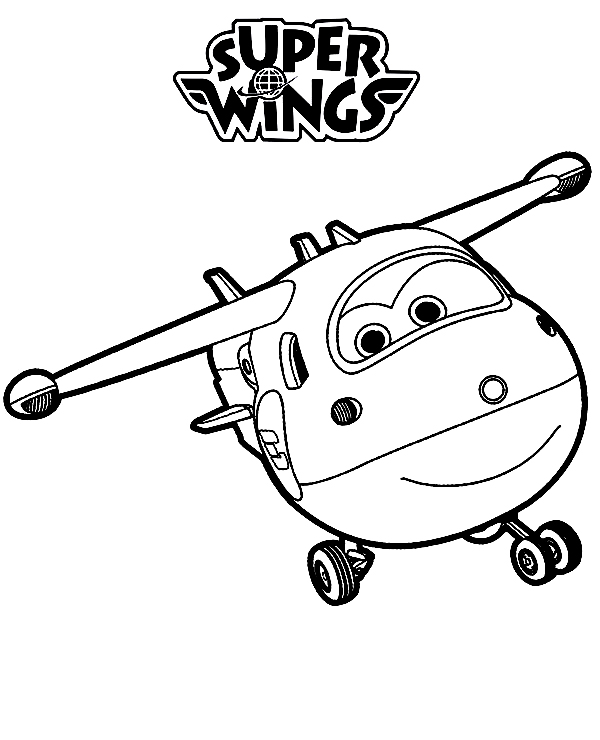
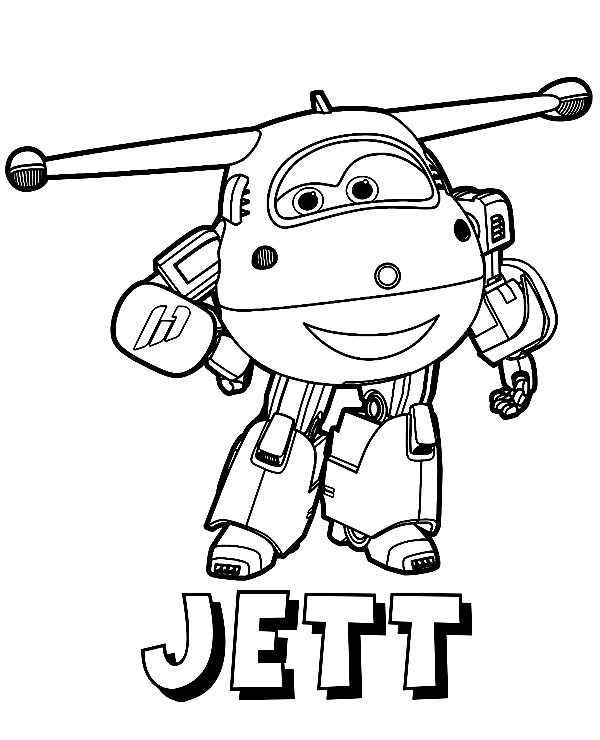
Jett is the show’s protagonist – a small white jet airplane with the energy of someone who genuinely loves every part of his job and the competence of someone who has earned that enthusiasm through consistent performance. He delivers packages to children around the world with the specific joy of someone who understands that what he is delivering matters not just as an object but as a connection – between the sender and the receiver, between Jett’s airport world and the child’s local world.

His design is built for immediate recognition by the youngest viewers: primarily white with vivid red, blue, and yellow accents, large expressive eyes on the airplane body, and the specific rounded-but-aerodynamic proportions of a cartoon aircraft designed to be loved rather than feared. In his robot form – the transformation that occurs when he responds to a problem – he becomes a humanoid figure with the same white, red, and blue color scheme, standing upright and capable of the kind of direct interaction with people and environments that a plane cannot manage.

His transformation is the show’s central visual excitement – the sequence in which the airplane folds and reconfigures into a standing robot figure – and pages showing both his vehicle and robot forms are the collection’s most structurally varied Jett pages.

Coloring Jett: White is his dominant body color – apply it cleanly across all primary surfaces, both in vehicle and robot form. The red accents appear at his wing markings, his robot form’s chest detail, and various trim elements. The blue appears at cockpit windows and specific design accents. The yellow appears on additional trim and logo elements. The key color priority: the white base first at full coverage, then the red accents at full saturation, then the blue, then the yellow. His eyes – large, round, expressive – are the face’s most important element, rendered with dark irises against the white face.

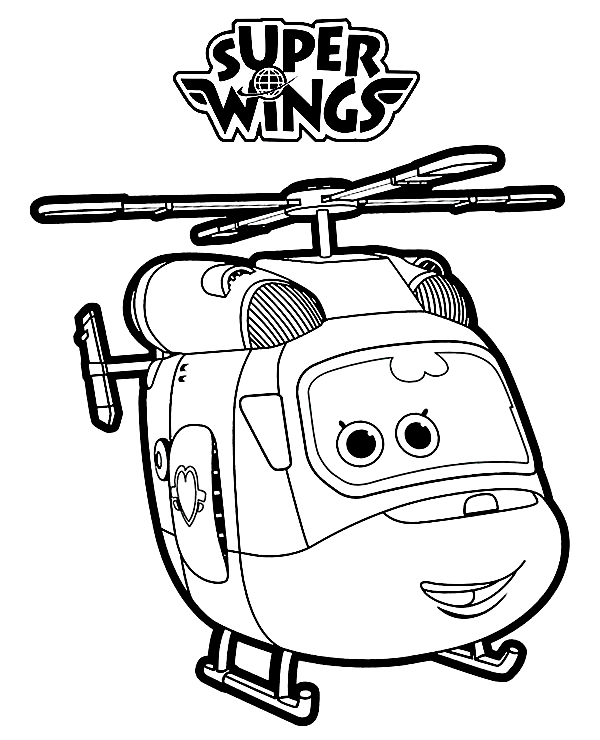
Dizzy – The Helicopter

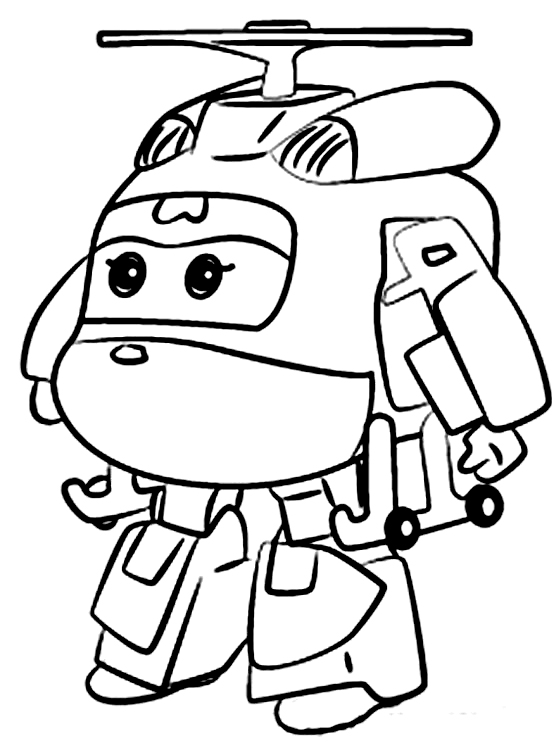
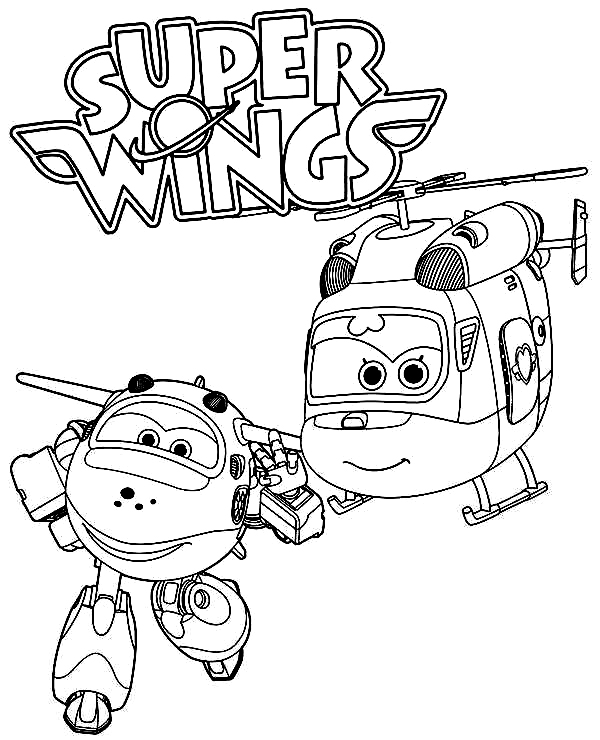
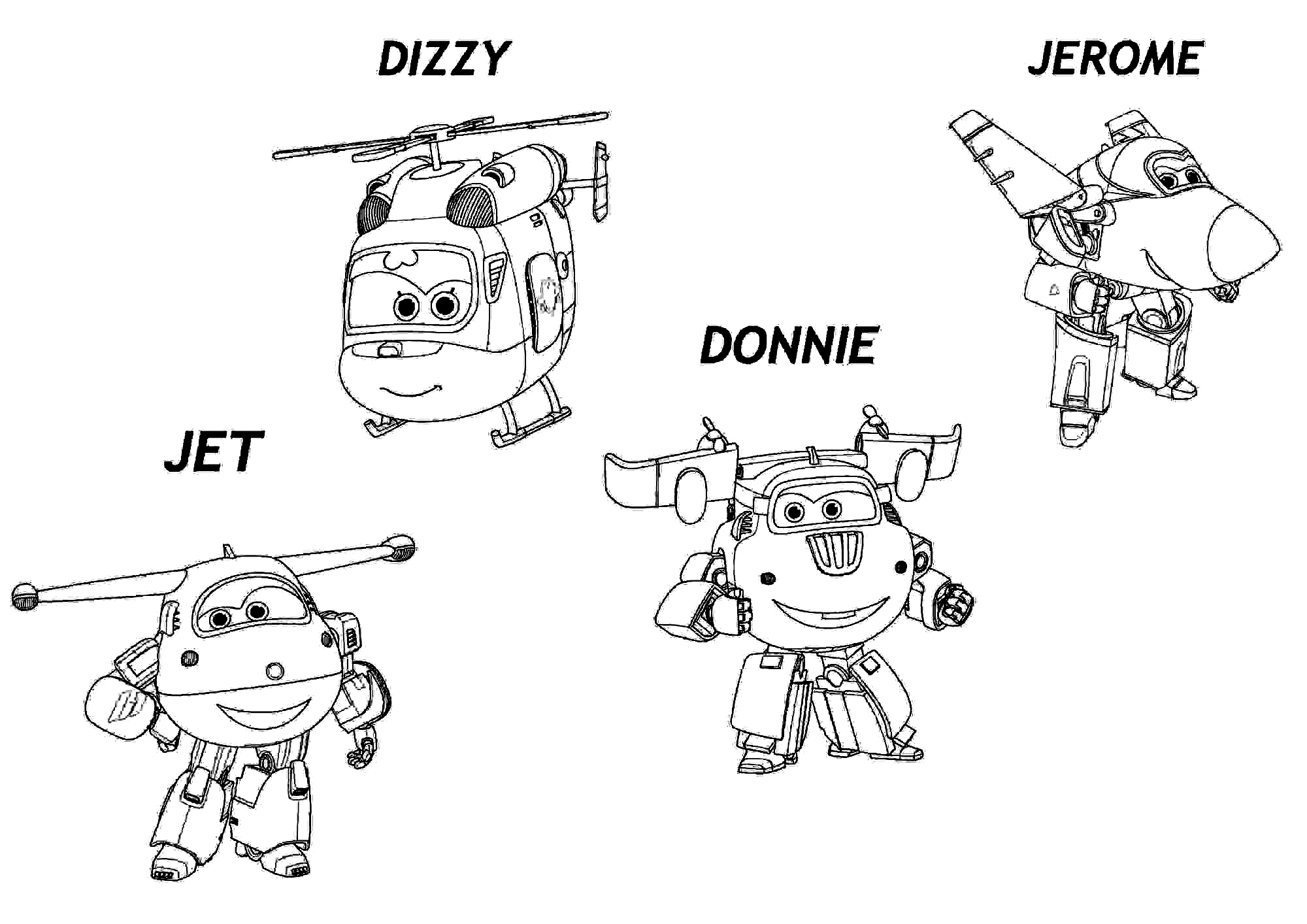
Dizzy is the team’s helicopter character and its primary female presence – enthusiastic, helpful, and visually differentiated from Jett’s white-primary design through her pink color scheme. The pink helicopter is one of the most immediately color-identified characters in the show – even very young viewers recognize “the pink one” before they can reliably recall the character’s name.

In vehicle form, she is a helicopter with the specific proportions of a cartoon helicopter – the main rotor above, the tail rotor at the back, the rounded fuselage that gives her the compact, friendly silhouette appropriate for a character defined by her helpfulness and warmth. Her robot form maintains the pink color scheme and the rotor elements, which become wing-like features of her humanoid configuration.

Coloring Dizzy: Pink is her primary body color across both vehicle and robot forms – a vivid, warm pink that reads as energetic and friendly rather than pale or pastel. Her trim accents are typically in lighter pink, white, and occasionally other accent colors specific to her design era. The rotor blades in vehicle form should be rendered in a slightly lighter or more neutral tone than the fuselage – they are mechanical and functional, which gives them a different material reading from the more character-expressive fuselage.
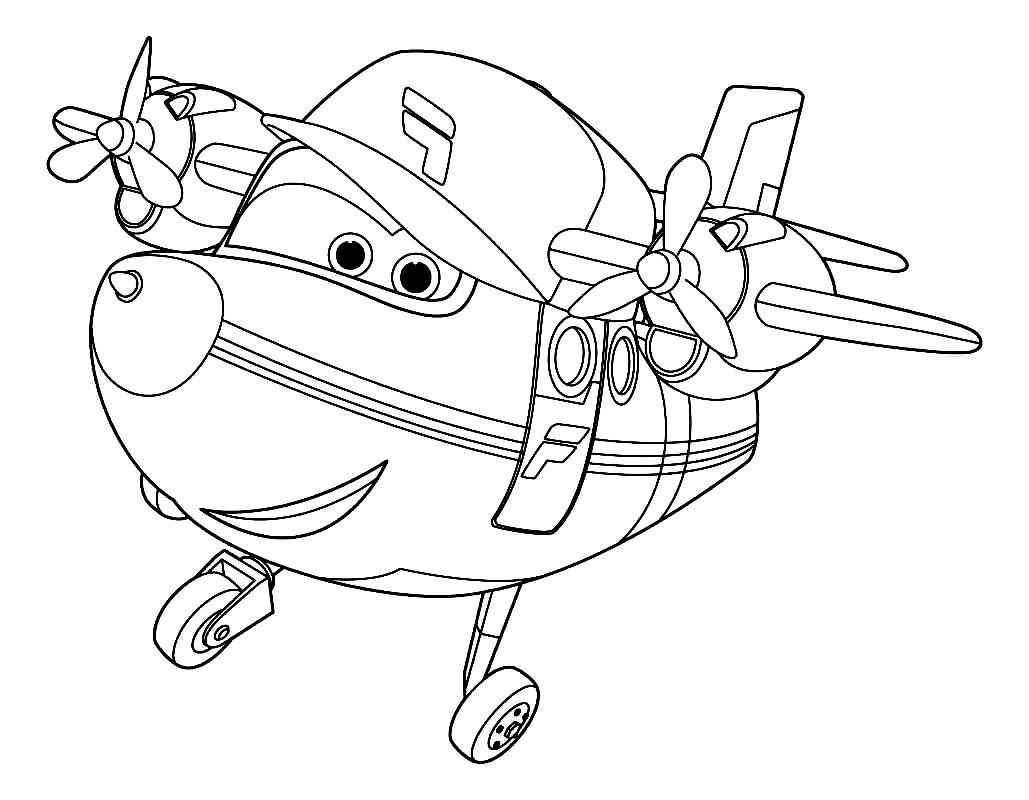
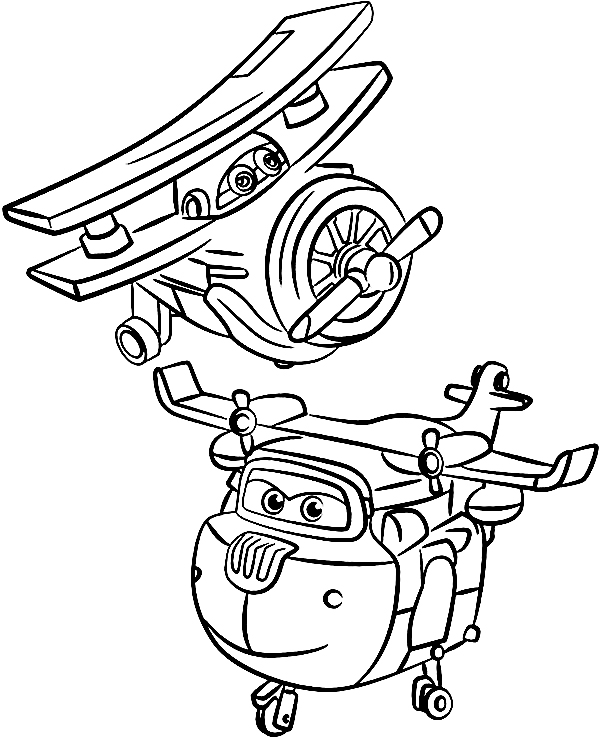
Donnie – The Construction Vehicle

Donnie is the team’s construction specialist – the character called upon when the problem involves building, excavating, lifting, or otherwise engaging with physical construction challenges. His vehicle form is a construction-type vehicle – yellow, large, built for heavy work – and his robot form reflects this, with the sturdy, broad proportions of a character designed to look capable of the tasks he is assigned.

Yellow is his defining color – the specific construction-equipment yellow that is both canonical to his design and practically associated with construction globally (the color of heavy equipment worldwide for visibility and safety reasons). His design connects the show’s fictional character color to a real-world visual convention, which is itself a small piece of educational content for the youngest viewers learning to associate colors with functions.

Coloring Donnie: Construction yellow – the warm, vivid yellow of heavy equipment, applied at full saturation across all primary body surfaces in both vehicle and robot form. The construction vehicle’s details – treads, mechanical arms, functional elements – should receive slightly darker yellow or warm grey-brown in the shadow recesses to give the heavy machinery its dimensional quality. His robot form’s eyes are large and expressive against the yellow face.

Paul – The Submarine

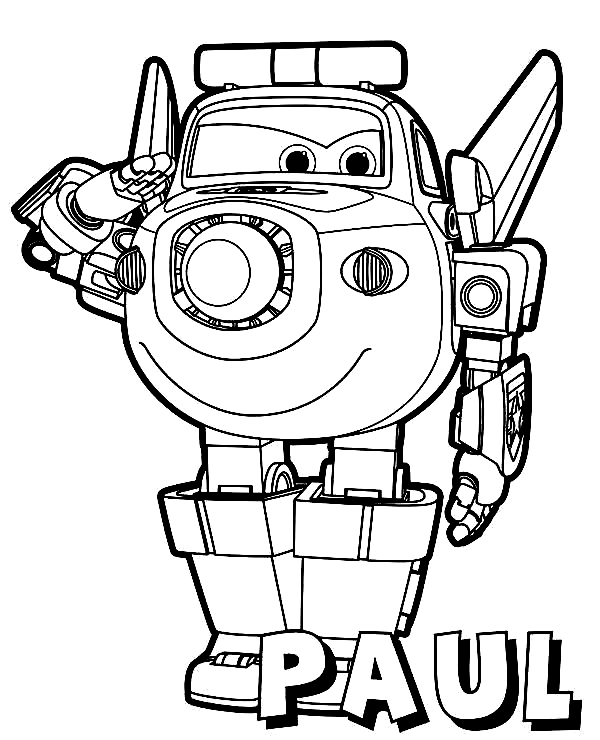
Paul is the team’s underwater specialist – called upon for aquatic challenges, ocean-related problems, and any situation that requires operating beneath the water’s surface. His vehicle form is a submarine – the specific compact, rounded shape of a cartoon submarine, with propeller and periscope elements. In robot form, he has the same dark blue or purple-blue color scheme.

His color – a deep blue or blue-purple – differentiates him visually from both the warm (Donnie’s yellow) and light (Jett’s white) characters and places him in the cool, oceanic palette appropriate for an underwater specialist.

Coloring Paul: Deep blue or blue-purple across his primary surfaces – a cool, medium-dark blue that reads as oceanic and watery. His robot form’s eyes are typically lighter, reading against the darker face with the contrast that makes them immediately visible to young viewers. Any propeller or mechanical elements in his submarine form should receive slightly darker blue in their recesses.

Bello and the Arctic Specialist

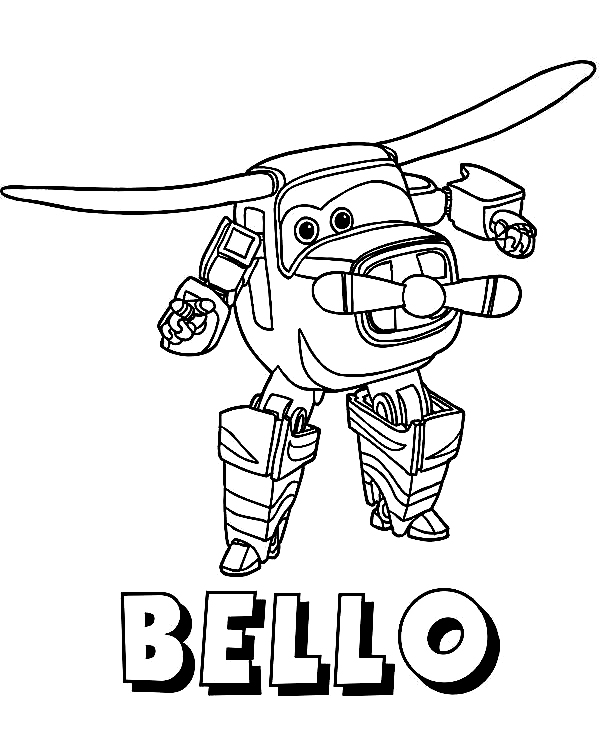
Bello is the team’s cold-weather specialist – designed for Arctic conditions, snowbound environments, and any challenge involving ice, cold, or winter terrain. His vehicle form suggests snow management equipment – the blue and white palette that places him visually in the cold, pale register of winter environments. His robot form maintains this palette.

The blue-and-white design is the most directly representational in the team – his colors immediately suggest ice and snow before any story context is available, which serves the show’s educational framework by making character function visible in color.

Coloring Bello: Blue and white in roughly equal measure – the cool, medium blue of a winter sky against the clean white of snow. These two colors should read as clearly distinct from each other across all surfaces where they appear together. His eyes carry the warmth in the composition – the face’s expressiveness against the cool,l pale palette.

Astra and the Newer Characters

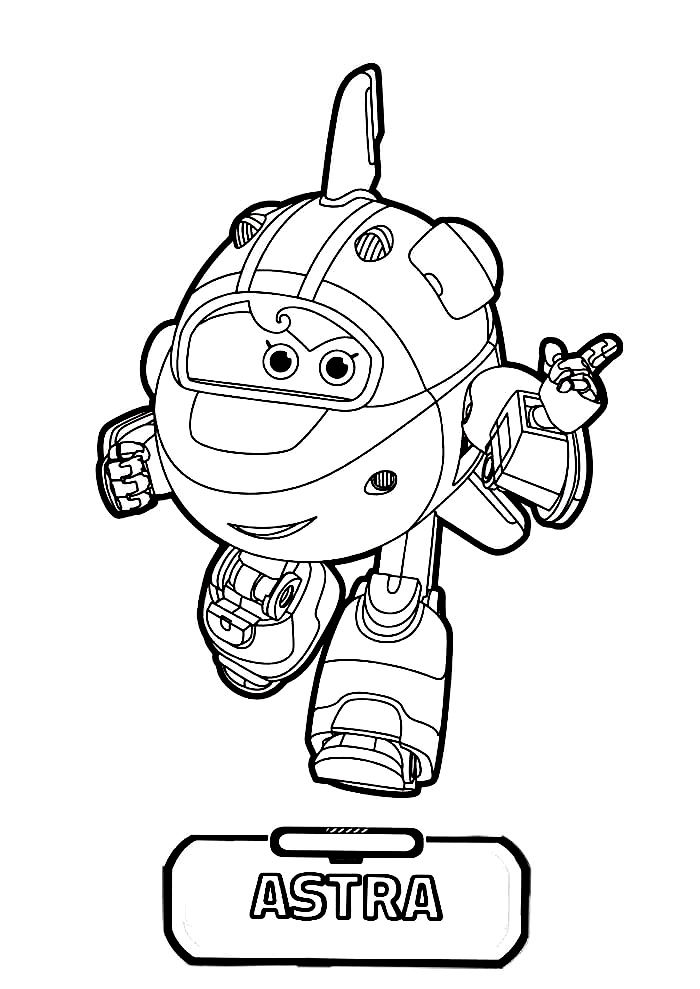
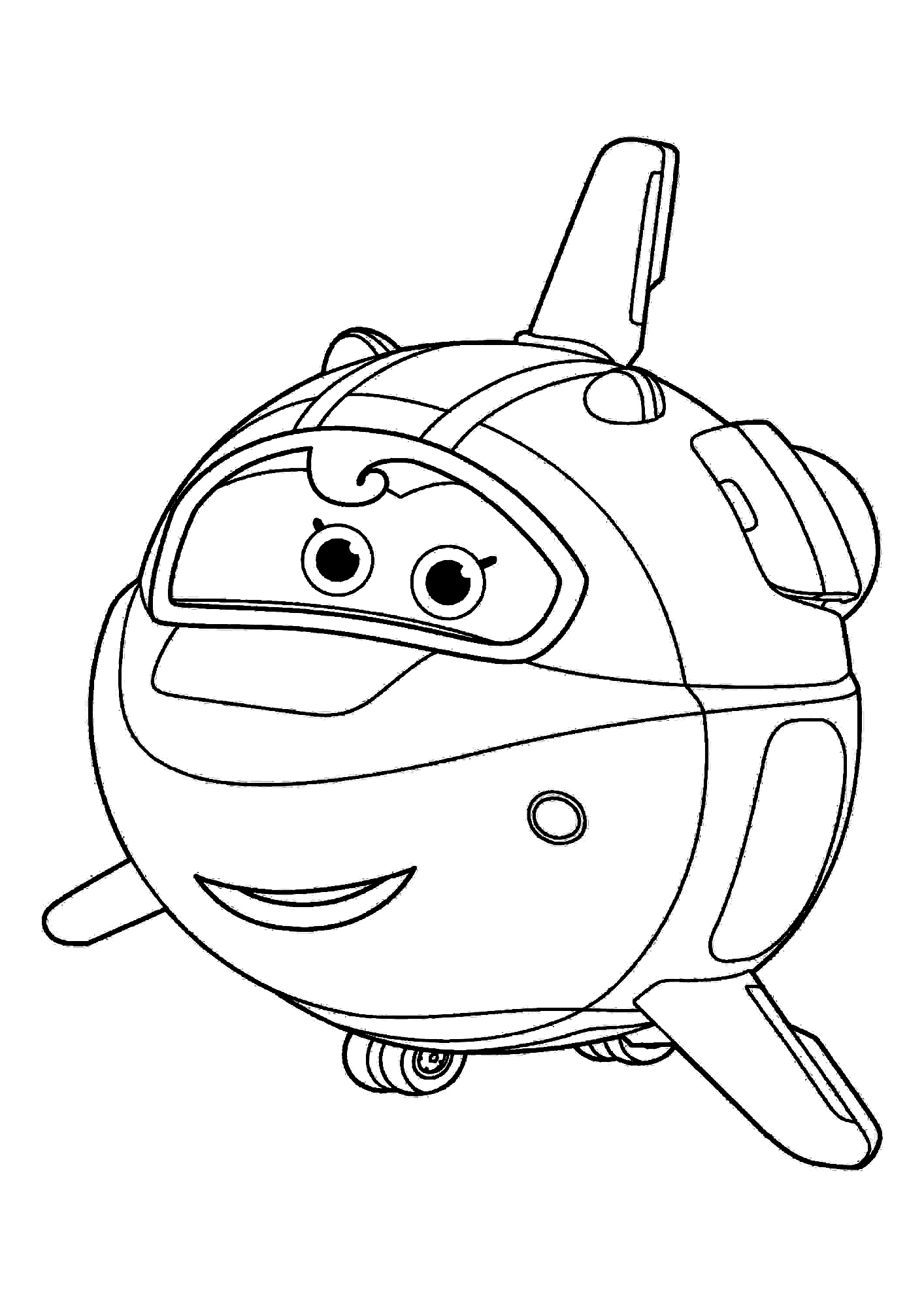
The newer seasons of Super Wings introduce additional team members, including Astra – a space-themed character associated with rocket ships and outer space challenges. Astra’s design reflects the space theme through a green and silver/white color scheme and the specific visual language of rocket science applied to a cartoon character’s proportions.

The newer character pages in the collection show how the show’s roster has expanded while maintaining the consistent format of each character corresponding to a specific operational environment (sky, underwater, construction, cold weather, space).

Coloring Astra: Green is Astra’s primary differentiating color – a vivid medium green applied across the primary surfaces, with silver or white accents at the mechanical elements that suggest space technology. The star or space-themed decorative elements, when present, should receive bright gold or silver treatment.

Group and Action Pages

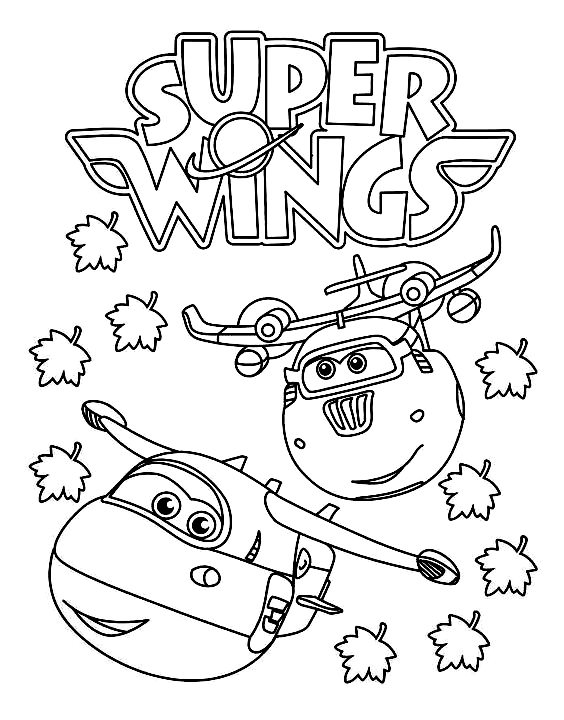
The group pages – multiple Super Wings characters in the same composition – are the collection’s most color-diverse and most compositionally complex. They require managing the full team’s distinct color identities simultaneously: Jett’s white, Dizzy’s pink, Donnie’s yellow, Paul’s deep blue, Bello’s light blue and white, and Astra’s green. Each character must read as clearly distinct from every adjacent character.

The action pages show the team in flight, mid-transformation, or in the specific poses of a problem-solving sequence – the dynamic body language of cartoon characters engaged in helping.

What These Pages Do

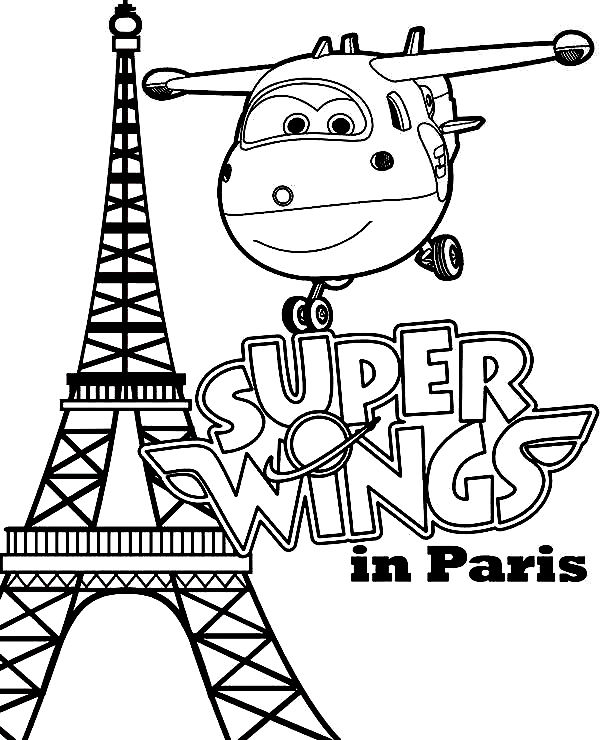
Super Wings is one of the most structured geography education tools in children’s animated television. Each episode names the country, names the child recipient, and presents specific cultural and geographic information through the story’s problem and solution. Viewing the show builds a child’s mental map of the world episode by episode. The coloring pages extend that engagement: coloring Jett is coloring the character who has visited France, Japan, Brazil, Egypt, Australia, India, and dozens of other countries, each visit connecting the character to a specific place.

The transformation mechanic teaches the relationship between form and function. Each Super Wings character has a vehicle form designed for a specific environment and a robot form capable of direct interaction. The concept that the same character can be both things – a helicopter and a helper, a submarine and a problem-solver – is a concrete illustration of the idea that different situations call for different approaches. This is the show’s most direct educational argument beyond geography, and it is visible in the coloring pages through the design difference between each character’s vehicle and robot poses.

Fine motor development. The American Academy of Pediatrics identifies fine motor skill development as a key childhood milestone throughout early childhood. The mechanical details of vehicle pages, the character eye and feature work in robot form, and the wing and rotor structures all provide motivated, sustained fine motor practice calibrated for the collection’s primary audience of two-to-six-year-olds. The 2005 Art Therapy Journal study on structured coloring and anxiety reduction applies throughout – structured coloring activity provides significant emotional regulation benefit for the very young audience Super Wings primarily serves.

The color-coded team design teaches character identification through color. Each Super Wings character’s color is the primary identifier – white (Jett), pink (Dizzy), yellow (Donnie), deep blue (Paul), blue-and-white (Bello), green (Astra). Young children who cannot yet reliably read character names identify characters through their colors. Coloring the characters in their canonical colors develops color-as-identity recognition, a fundamental visual literacy skill at the age level the show serves.

How to Color These Pages Well

White vehicles need clear shadow to read as vehicles rather than paper. Jett is white, and white on white paper disappears without shadow. Before applying any color, plan which surfaces face the light source (roof, top of wings) and which fall into shadow (undersides, recesses). Apply the lightest warm cream or very pale grey in the shadow zones only – the sill areas, the undersides of wings, the deep recesses at mechanical joints. Keep all other surfaces as white as possible. The small shadow zones are what make the white vehicle read as a three-dimensional object.

For the youngest colorists, single color per character is the goal. Two-to-four-year-old colorists are developing the fundamental skill of assigning a color to a character and applying it with consistent commitment. The Super Wings characters are perfectly calibrated for this: Jett is white, Dizzy is pink, Donnie is yellow. For the youngest fans, completing one character in their one color – the whole page in that color, regardless of shading or detail – is a developmental success. Do not require shading or detail work from the youngest colorists—the color choice and its consistent application are the entire achievement at this age.

Pink helicopter pages need warm pink at full saturation. Dizzy’s pink should be applied as a warm, vivid pink rather than a pale pastel – the pink of a cartoon character who is energetic and present, not the pale pink of a background element. Apply it at full pressure across the fuselage and robot body primary surfaces. The rotor blades can receive a slightly lighter pink or white to distinguish them as mechanical elements.

Construction yellow should be applied in a single confident pass. Donnie’s construction yellow – the specific warm, vivid yellow of heavy equipment – should be applied at full pressure in one confident pass across all primary surfaces. The single-layer application is both developmentally appropriate for young colorists and visually accurate for a character whose design is built around clear, bold visibility (as real construction equipment is). Add darker yellow or warm grey only in the deepest mechanical recesses.

Eyes carry all the character and personality. In both vehicle and robot forms, the Super Wings characters’ eyes are the most expressive element – the large, rounded eyes of a preschool-targeted animation design that communicates warmth and personality through simplified facial features. Apply the dark iris color with full coverage, centered in the white eye area. Add a white highlight dot at the upper portion of each iris. This two-step eye rendering – dark iris, white highlight – produces the alive, warm quality that makes cartoon characters feel friendly.

5 Creative Craft Ideas

Jett’s World Delivery Map

This craft extends the show’s geography education directly into the coloring activity. Draw or print a simple world map outline on a large sheet of paper – continent shapes without country borders, accessible to the youngest children. Print and color Jett in his airplane form, cut him out, and attach a small paper tab to his base.

Choose five countries that appear in Super Wings episodes – France, Japan, Brazil, Egypt, and Australia. Draw a small star at each country’s location on the map. Draw a dotted delivery path connecting the World Airport to each star. Place the Jett cutout anywhere on the path.

As you trace the dotted path with a finger, name each country and one fact about it from the show’s episodes. The finished craft is both a coloring product and a geography reference.

Team Color Matching Game

Print individual portrait pages for Jett, Dizzy, Donnie, Paul, and Bello. Color each in canonical colors – Jett white, Dizzy pink, Donnie yellow, Paul deep blue, Bello light blue. Cut each into a card.

Separately, create small color swatches on index cards using the same colors: white, pink, yellow, deep blue, and light blue. Lay both sets face up. Ask the child to match each character card to its color swatch.

The game uses the completed coloring pages as game pieces while reinforcing the color-as-identity recognition that the show’s character design is built around.

My Package Delivery Card

In every Super Wings episode, Jett delivers a package to a child in a specific country. Print a Jett vehicle page. Color it in white with red and blue accents. Cut it out.

On a blank index card, draw a simple package outline with a bow. On the package, write: “From: World Airport.” “To: [Child’s name], [Country].” Ask the child to fill in a friend’s name and choose a country. Mount the colored Jett beside the package card.

The finished card recreates the show’s core concept – Jett delivering something to someone specific, somewhere in the world – as a personalized craft object.

The Transformation Before and After

Print two Jett pages – one in vehicle form (airplane) and one in robot form (humanoid). Color both in identical color schemes: the same white, the same red accents, the same blue.

Mount both side by side with a large arrow between them pointing from the vehicle form to the robot form. Add: “Vehicle mode → Robot mode. Same Jett. Different form.”

The display explains the show’s core transformation concept in two images – the same character, the same colors, two completely different shapes. This is both a craft product and an early introduction to the concept of transformation and multiple functions.

World Airport Control Tower

Draw a simple control tower building on cardstock – a tall structure with windows and a communication antenna at the top. Color it in the clean, bright colors of the World Airport’s aesthetic. Cut it out.

Print and color one or two Super Wings characters. Cut them out as well. Mount the control tower at the center of a large backing sheet.

Arrange the colored characters around the tower – some in flight positions (held up with tabs or tape), some on the ground. Add small paper runway strips extending from the base. The finished display is a three-dimensional World Airport scene constructed from the coloring pages as its elements.

Frequently Asked Questions

What is Super Wings, and where is it from? Super Wings (超级飞侠) is an animated television series produced as a co-production between Chinese and South Korean studios, originally developed by Alpha Group in China in collaboration with FunnyFlux and EBS (Educational Broadcasting System) of South Korea. The series first aired in 2015 and has been broadcast in over 100 countries across more than seven seasons. The show follows Jett, a small white airplane who delivers packages to children around the world, with his Super Wings teammates assisting in solving local challenges along the way. Each episode is set in a different country, introducing young viewers to world geography and cultural diversity through adventure storytelling.

Who is Jett, and what does he do? Jett is the protagonist of Super Wings, a small white jet airplane who works as a delivery plane for the World Airport, delivering packages to children in different countries around the world in each episode. When he encounters a problem during his delivery – a challenge that requires specialized equipment or knowledge – he calls his Super Wings teammates for backup. Jett can transform from his airplane form into a humanoid robot form, allowing him to interact more directly with people and environments. He is characterized by his enthusiasm, kindness, and genuine joy in his delivery work. His color scheme is primarily white with red, blue, and yellow accents.

Who are the other Super Wings team members? The Super Wings team includes several specialists alongside Jett: Dizzy, a pink helicopter who assists with aerial challenges; Donnie, a yellow construction-type vehicle who specializes in building and engineering problems; Paul, a deep blue submarine character for underwater situations; Bello, a blue and white cold-weather specialist for Arctic and snow environments; Remi, an emergency/rescue-oriented character; and Astra, a space-themed character introduced in later seasons. Each character’s color scheme reflects their operational specialty – construction yellow, underwater blue, cold-weather blue, and white – making character identification and function immediately legible to the youngest viewers.

What is the educational purpose of Super Wings? Super Wings is specifically designed to introduce young children to world geography and cultural diversity through entertainment. Each episode is set in a different country, names the child recipient of Jett’s package, and incorporates specific cultural, geographic, or environmental information relevant to that country into the episode’s problem and solution. Children who watch the series regularly encounter dozens of different countries, cultural practices, and geographic environments across the show’s seven-plus seasons. The transformation mechanic – each character switching between vehicle and robot form – additionally introduces the concept of functional adaptation to different environments, extending the educational framework beyond pure geography.

What age group is Super Wings designed for? Super Wings is designed primarily for preschool and early elementary audiences – approximately ages two to seven, with the core sweet spot at ages three to five. The simple vocabulary, clear character identification through color, problem-and-solution episode structure, and the specific pacing of the animation are all calibrated for this developmental range. The coloring pages in this collection are appropriate for ages two and up, with the simplest portrait pages accessible from the earliest developmental stages and the more detailed group or action pages most rewarding from ages four onward.

How many seasons of Super Wings are there? Super Wings has produced more than seven seasons as of 2025, beginning with its first season in 2015. The show has expanded its character roster across seasons, introducing new team members and new operational specialties to address a wider range of problem types in more diverse international settings. The core format – Jett delivering to a child in a new country, the team arriving to solve a local challenge – has been maintained across all seasons. The show’s longevity reflects both its commercial success in the global children’s television market and the sustained appeal of its geography-education format with its primary audience.

Browse the full collection at ColoringPagesOnly.com. All 40+ pages free, no sign-up, PDF or PNG, print or color online.

Alpha Group and EBS built a show about a small white airplane that delivers packages to children in every country on earth. Each episode is set somewhere specific: France, Egypt, Japan, or Brazil. Each episode names the child who receives the package. Each episode has Jett and his teammates solving something local before they leave.

After enough episodes, a child who has been watching has been to dozens of countries – not literally, but in the specific way that stories about specific places make places real. The show is very clear about what it is doing. It is delivering the world, one package at a time.

Pick up your white. Make Jett’s plane clean and clear. The eyes are the most important part – large, round, warm.

Time to deliver.

Share your work on Facebook and Pinterest and tag #Coloringpagesonly. We especially want to see the world delivery maps and the World Airport control tower projects.

Color the airplane. Mark the country. The package is always on its way.

These related coloring collections will help you explore the wonderful world of colors. Let’s choose, be creative, and show us your great pictures!


Jennifer Thoa – Content Editor & Designer

Jennifer Thoa is Content Editor and Designer at ColoringPagesOnly.com. Degree in Journalism and Creative Writing, University of Kansas. She writes and edits long-form educational articles on anime, film, animals, world cultures, and automotive history - verified against named primary sources before publication.