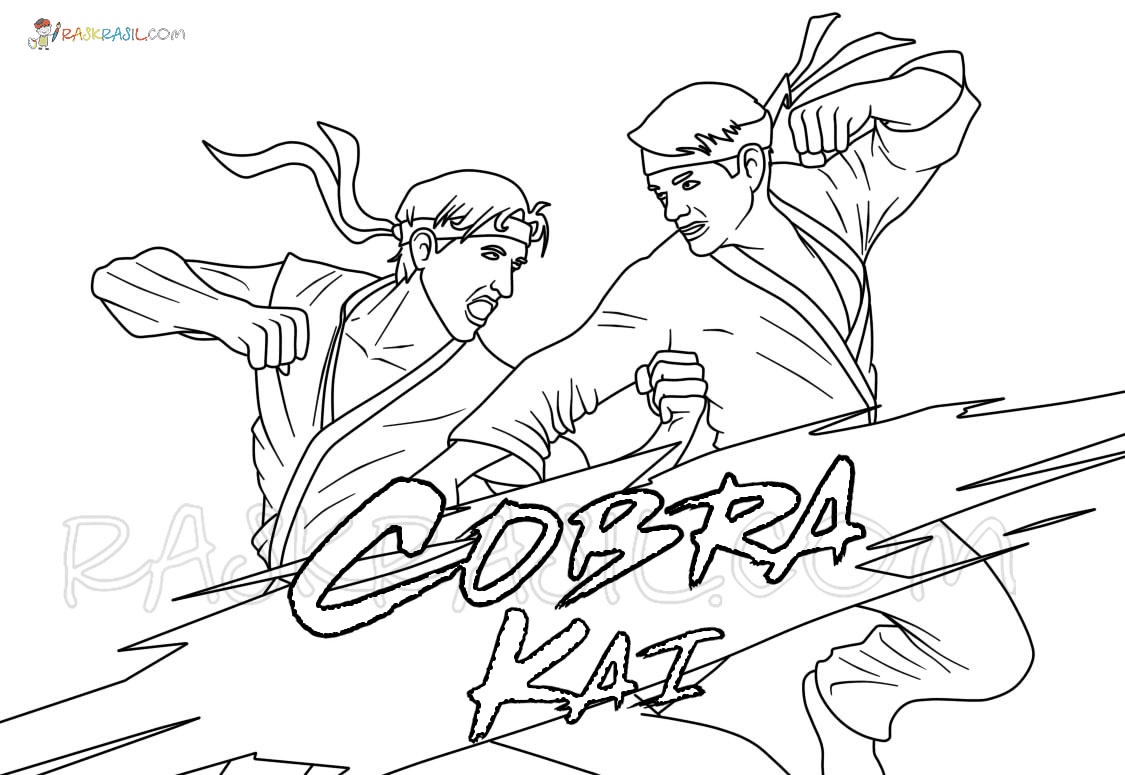
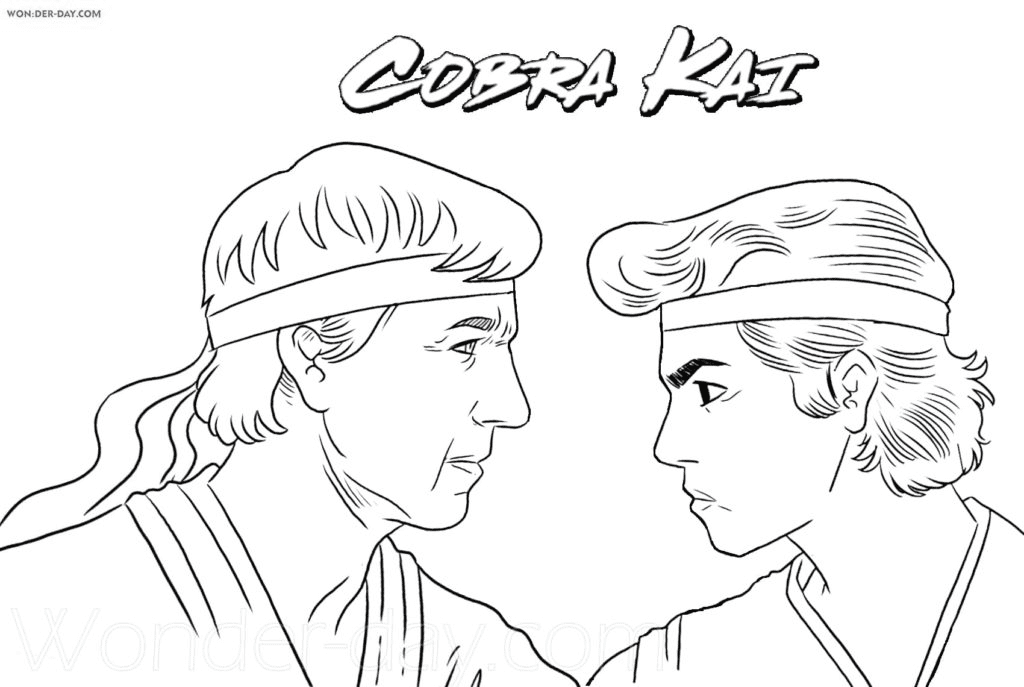
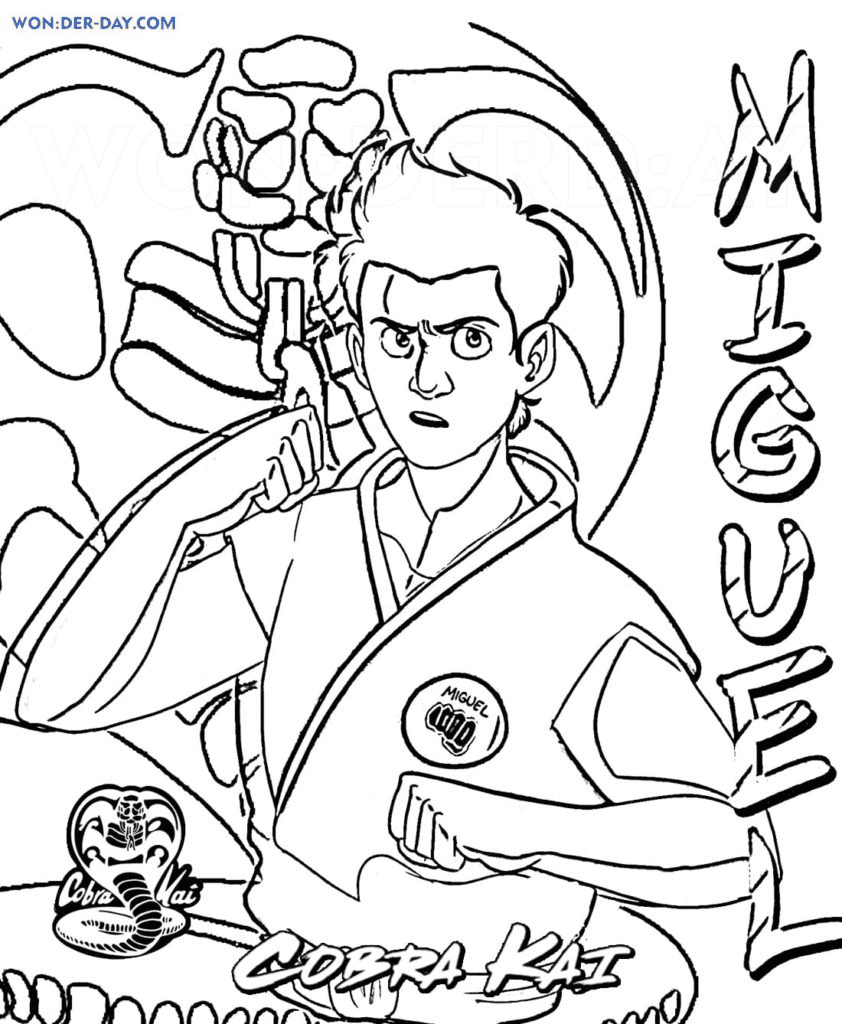
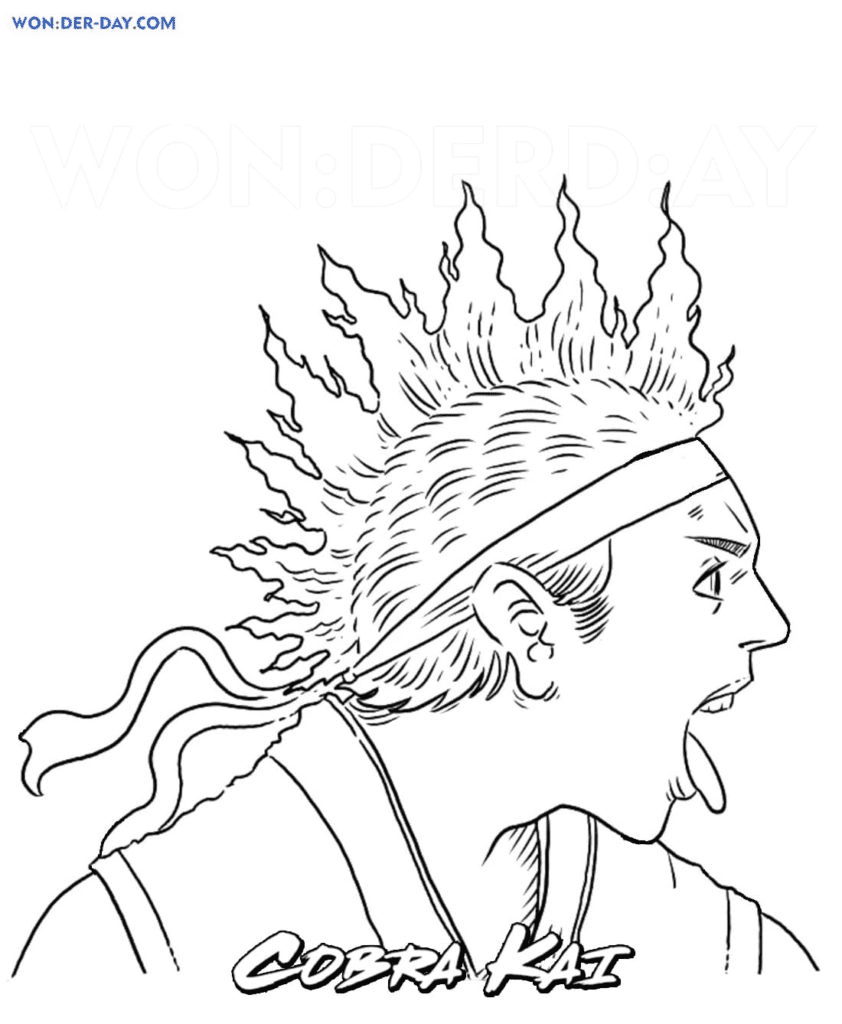
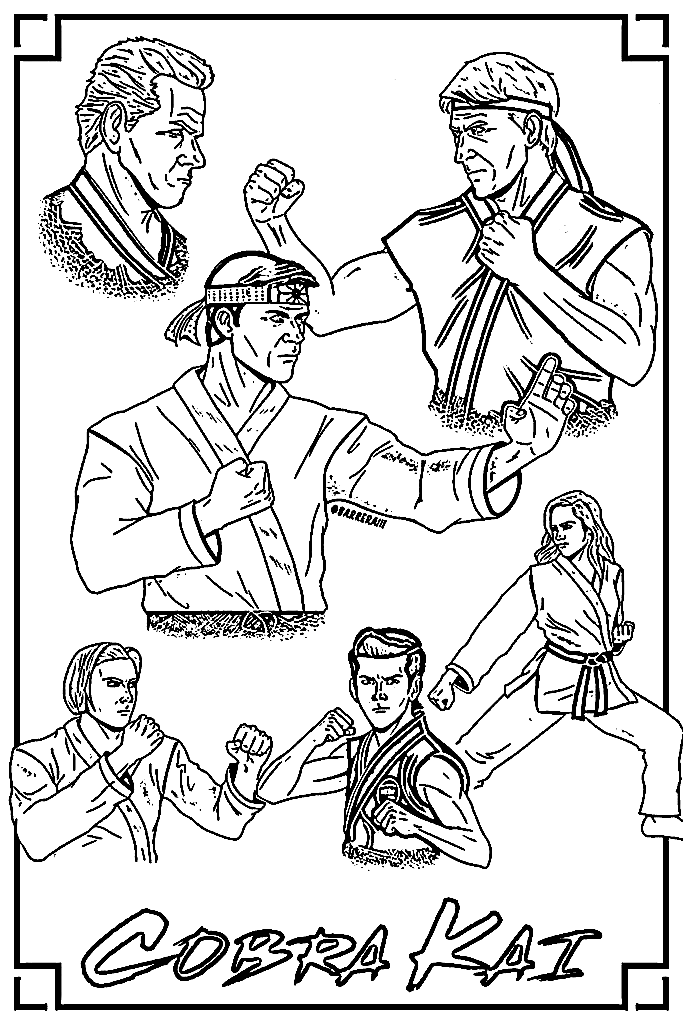
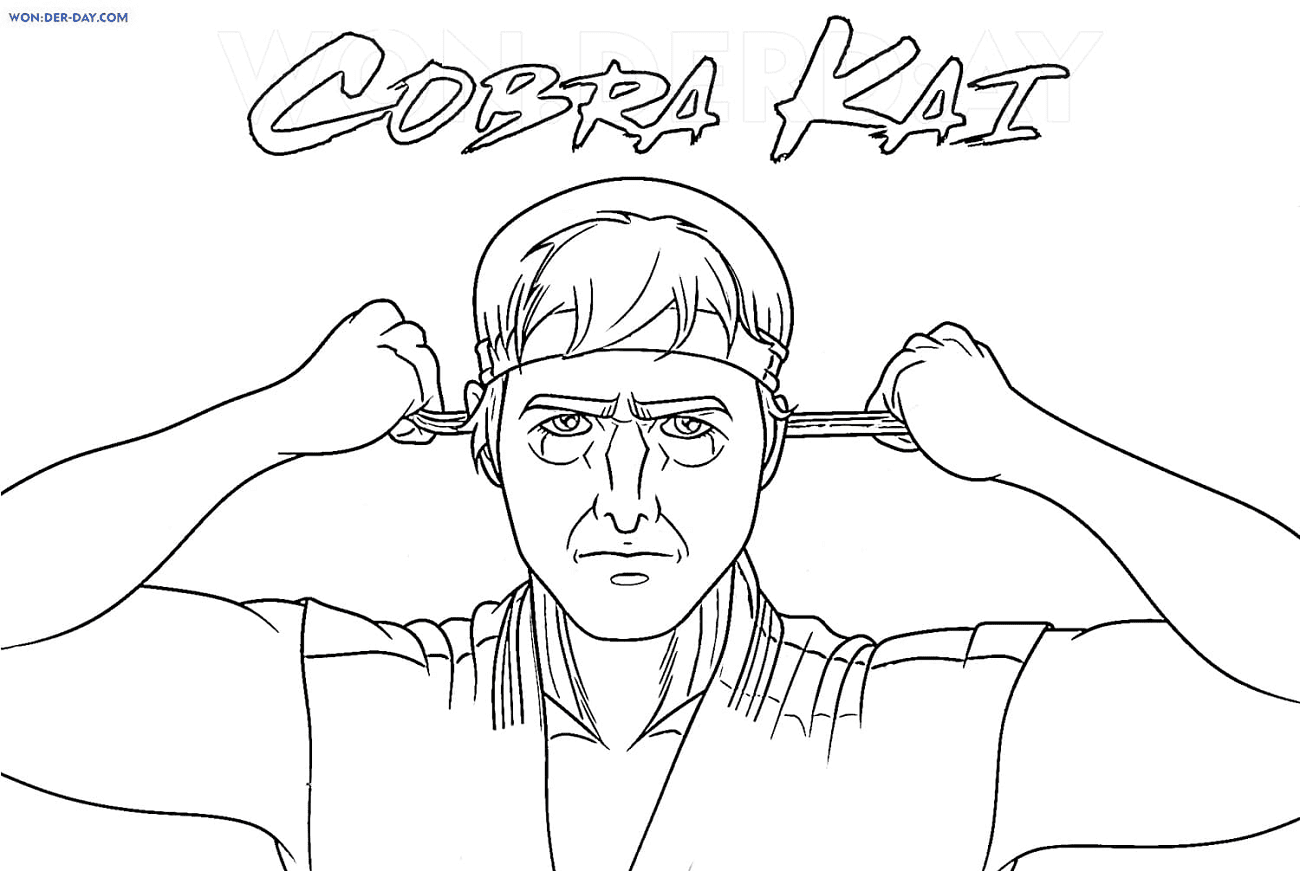
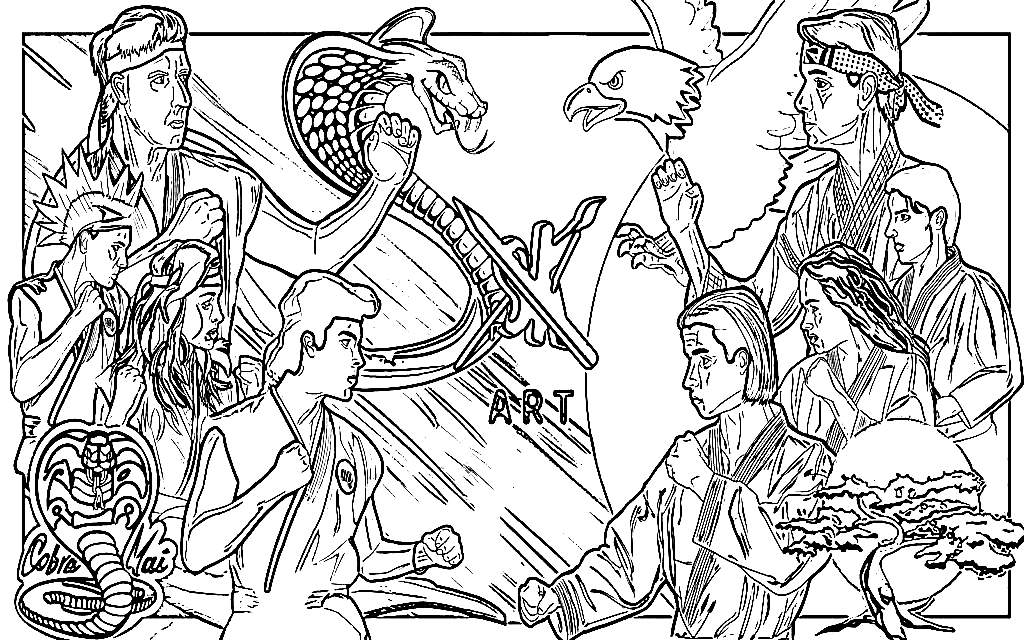
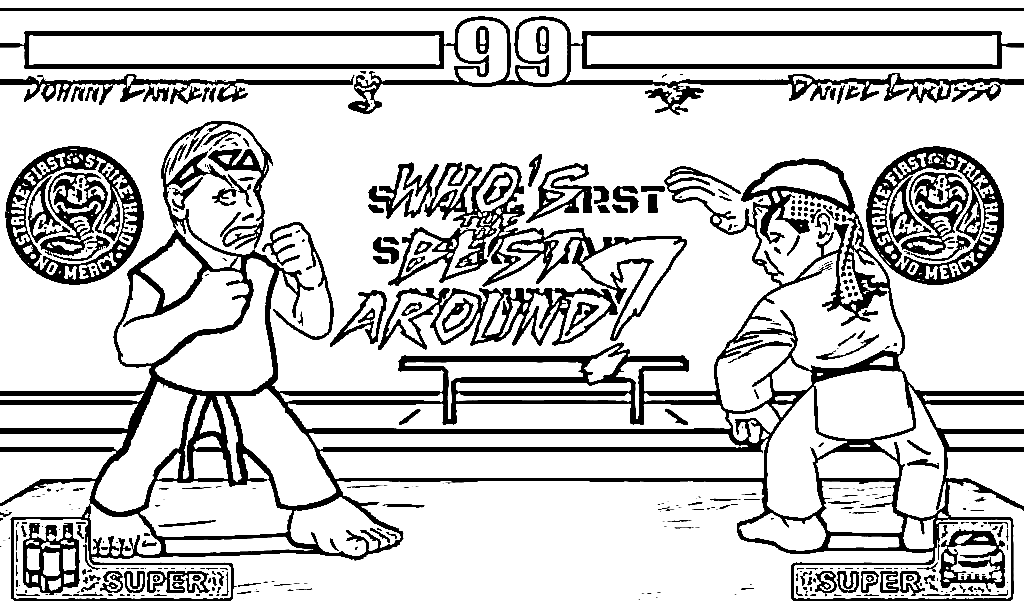
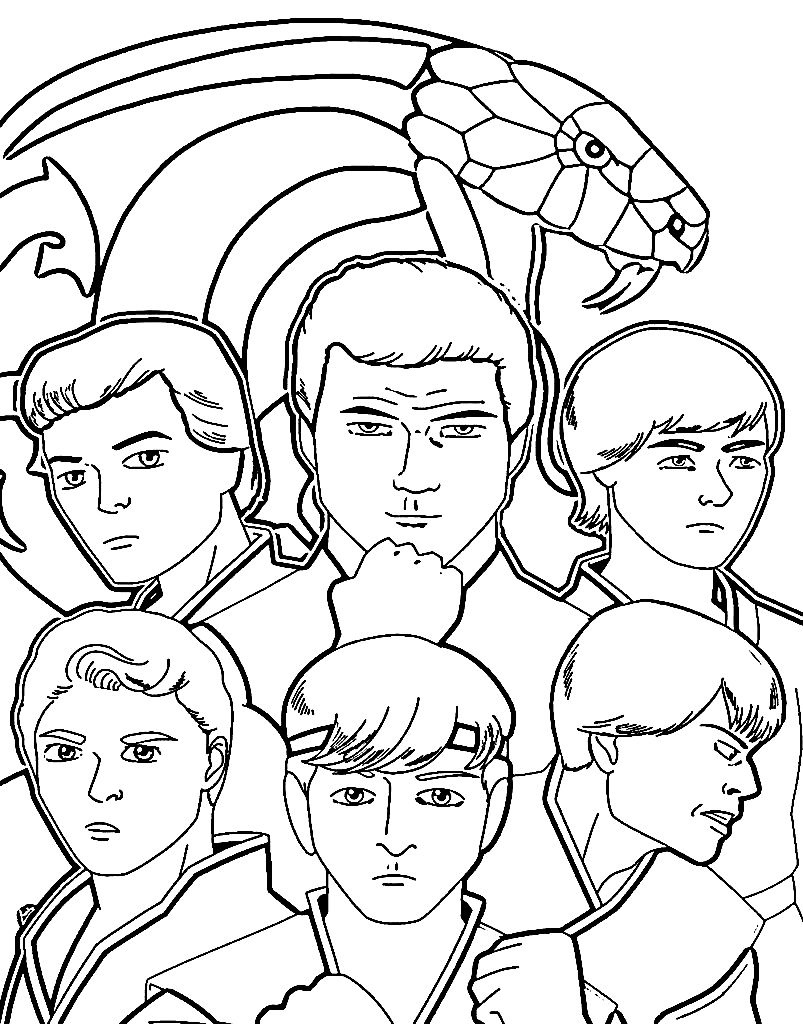
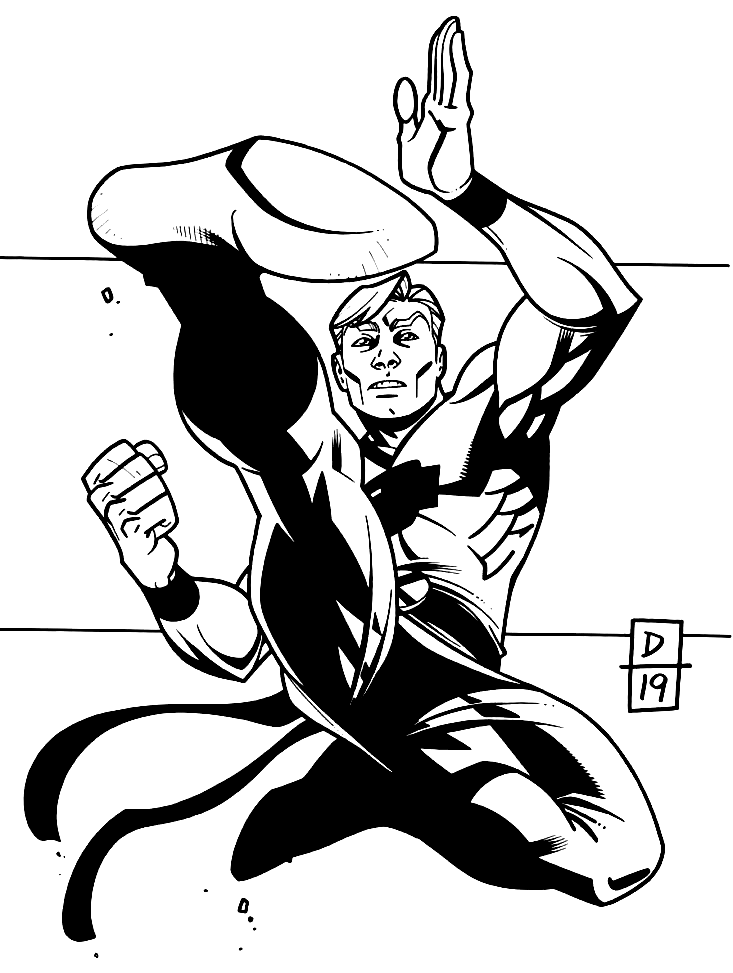
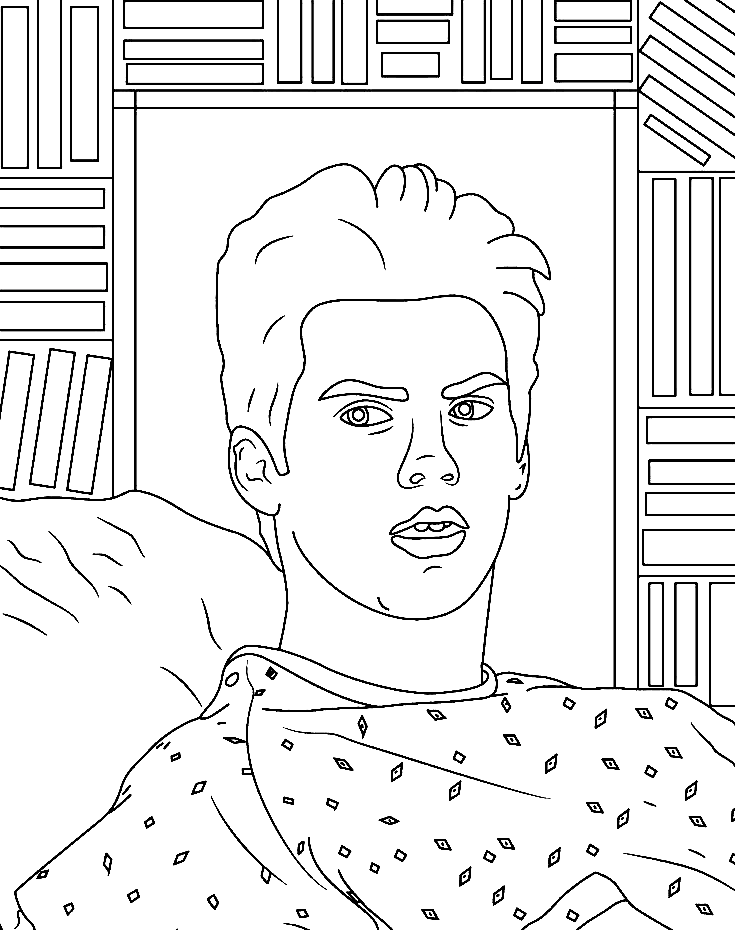
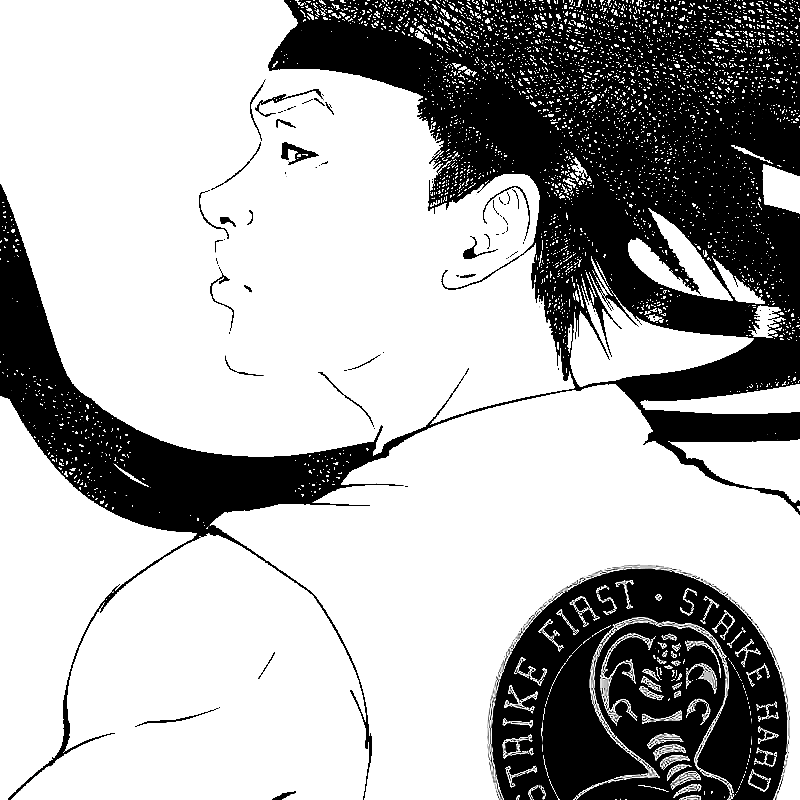
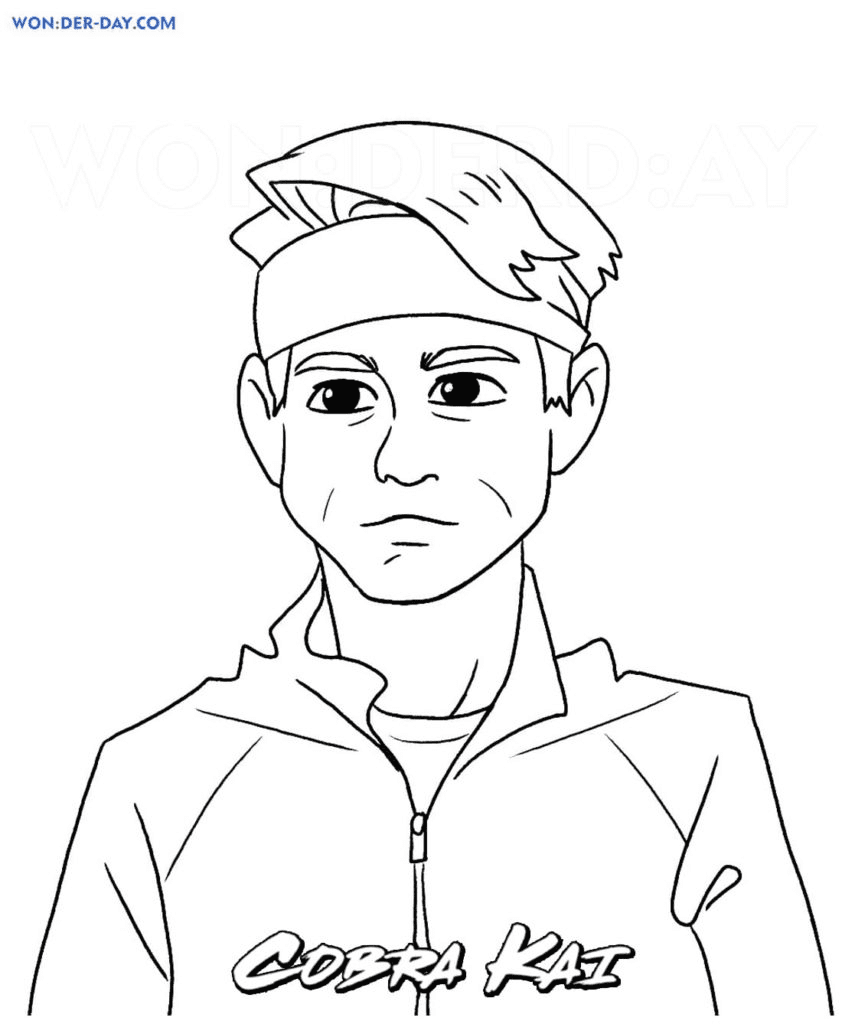
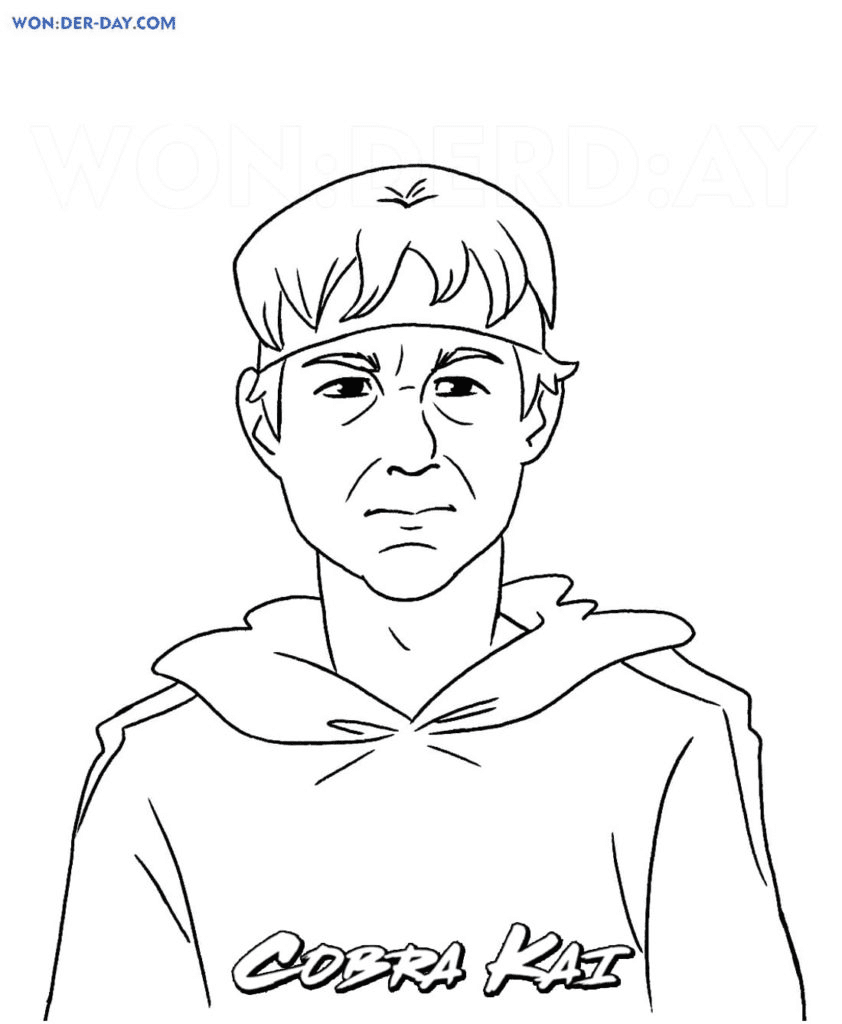
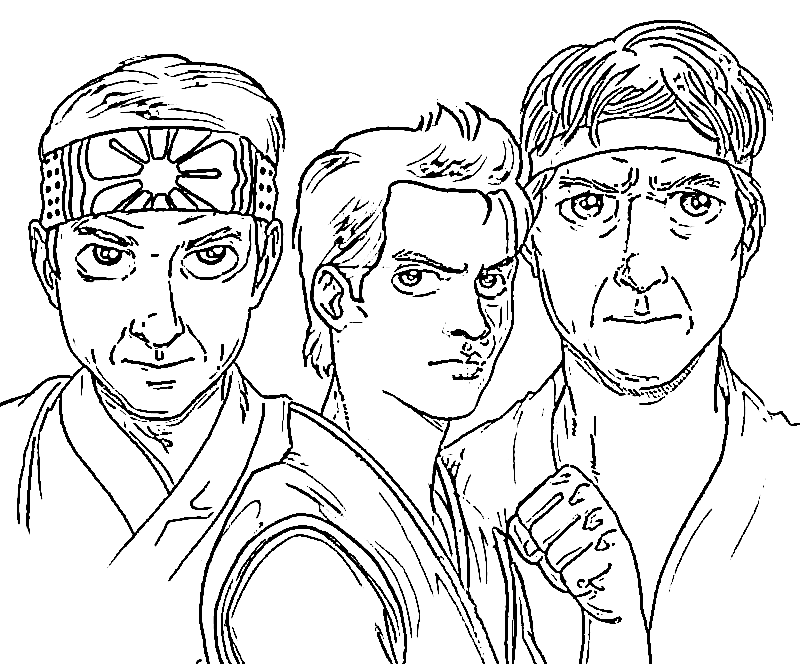
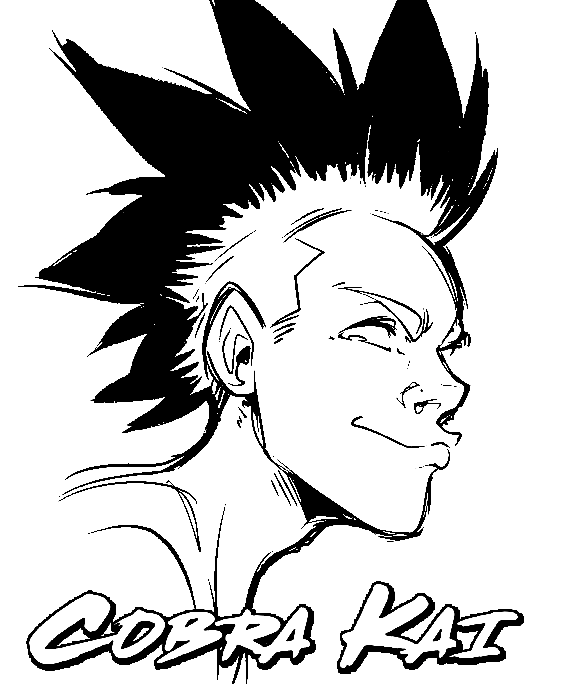
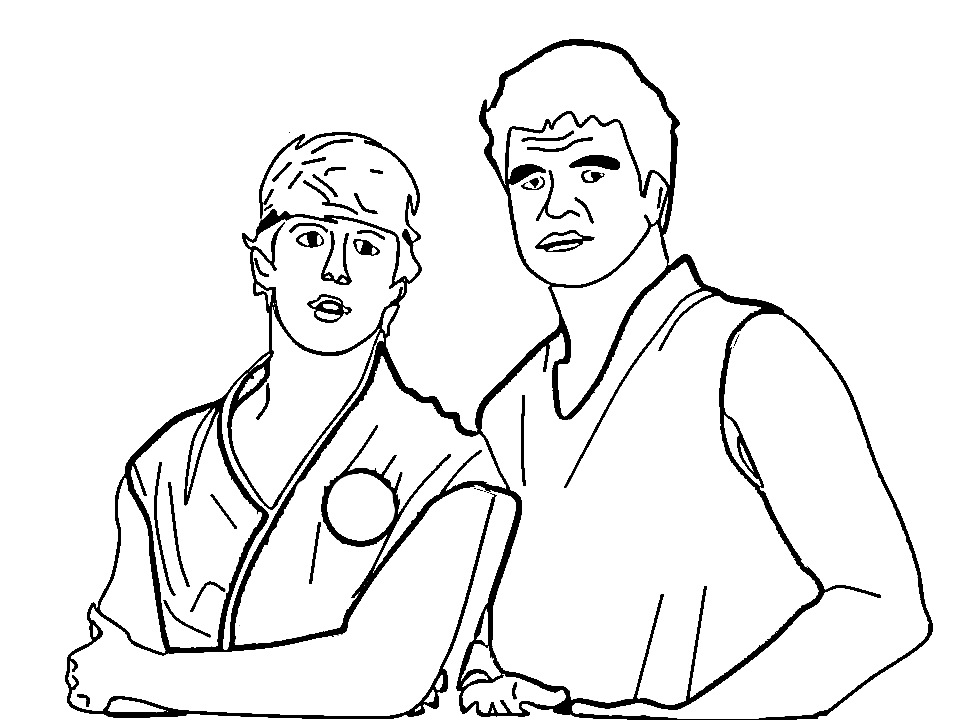
Free Cobra Kai coloring pages – 20+ pages featuring Johnny Lawrence, Daniel LaRusso, Miguel Diaz, Sam LaRusso, Hawk, Robby Keene, John Kreese, dojo logos, karate stances, tournament scenes, and the iconic cobra – free printable PDF and online coloring for fans of the Netflix series and the original Karate Kid films.

Cobra Kai premiered on YouTube Premium on May 2, 2018 – thirty-four years after the events of The Karate Kid (1984). It was created by Josh Heald, Jon Hurwitz, and Hayden Schlossberg with a premise that was, on its surface, a simple reversal: the film’s antagonist, Johnny Lawrence, would now be the protagonist, and the audience would spend time inside his perspective rather than Daniel LaRusso’s. In practice, it became something more interesting – a series genuinely willing to complicate both characters, to find the moments where Daniel was wrong, and Johnny was right, and to take seriously the idea that the person you defeated thirty-four years ago might have a legitimate version of the story you have been carrying as your own.

The series moved to Netflix beginning with Season 3 in December 2020, where it reached a significantly larger audience. It ran for six seasons, concluding in 2024. At its center was the question that the original film had not needed to ask – what does it mean to have won, and what does it mean to have lost, when the person on the other side of that outcome has been living with their version of it for three decades.

These 20+ free pages at ColoringPagesOnly.com cover the full cast across the series. All free, PDF or PNG, print or color online.

What’s Inside

The Cobra Kai Logo and Snake

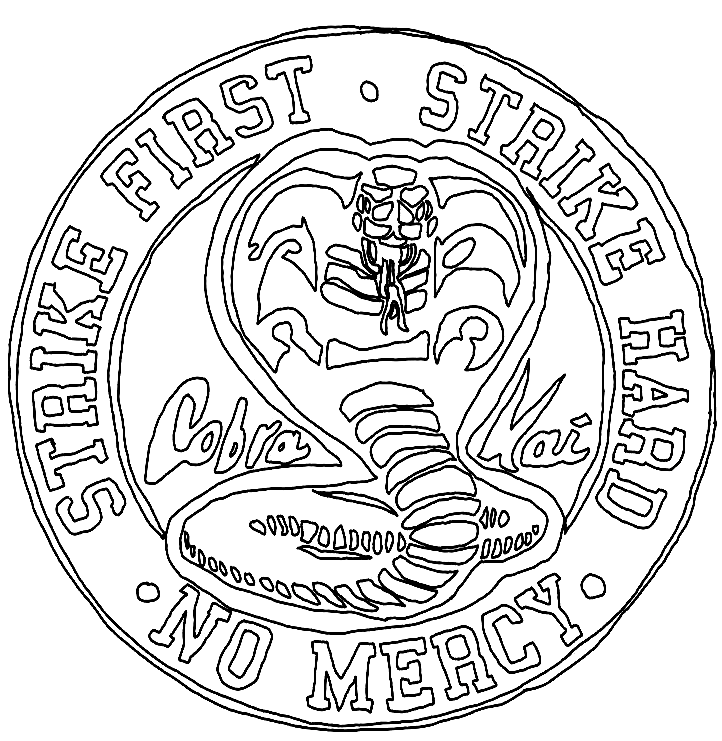
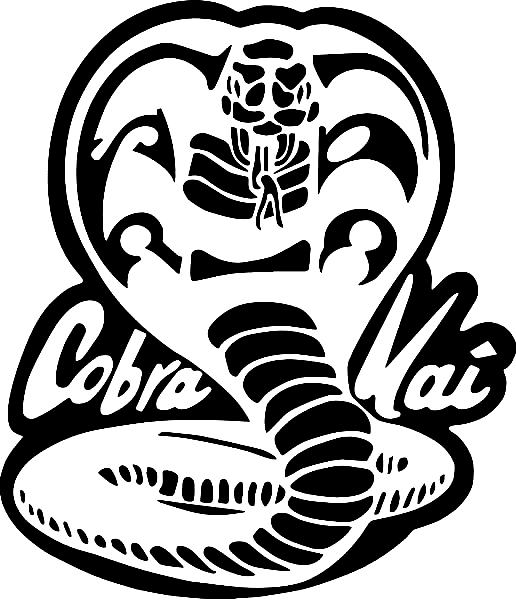
The Cobra Kai logo – a coiled cobra rendered in black and yellow – is the series’ most immediately recognizable visual element and the one that appears most broadly across the collection. The cobra has been the dojo’s symbol since the original 1984 film: an aggressive, threat-displaying snake chosen deliberately for what it communicates – a creature that strikes first, that gives no warning, that shows no mercy.

The logo pages are the collection’s most graphical – clean, bold, with strong black linework and large areas of flat color. They reward decisive, confident color application rather than careful blending. The cobra itself is most effectively rendered in yellow against black, or black against yellow, maintaining the dojo’s canonical color scheme.

Coloring the Cobra Kai logo: The dojo’s colors are black and yellow – not gold, not amber, but a specific vivid yellow that reads as aggressive rather than warm. Apply yellow first across the cobra’s body, then add the black accent scales and patterns on top. The coil’s shadow areas can receive a very deep yellow-brown rather than black to give the snake a dimensional form while maintaining the overall yellow reading.

Johnny Lawrence

Johnny Lawrence is the series’s most complicated character and the one it most clearly rehabilitates without excusing. The film’s villain – the Cobra Kai student who landed an illegal kick to Daniel’s face in the 1984 All Valley Tournament, who bullied Daniel throughout their school year – is introduced in the series as a middle-aged man living in a crumbling apartment, estranged from his son, working as a handyman, drinking too much. Karate was the last thing he was genuinely good at, and he lost the tournament to a boy he had been told was nothing.

What the series does with him is not a simple redemption arc. It acknowledges that Johnny’s worldview is real – that his training in “strike first, strike hard, no mercy” gave him something genuine, that his directness produces results, that his toughness is not cruelty without content. It also holds him accountable for the damage his worldview has caused to his students and to himself. He is, across six seasons, one of the most carefully written characters in the series.

His appearance: tall, blond, wearing the Cobra Kai black and yellow gi in his dojo scenes and more casual civilian clothing outside them. His posture is the posture of someone who was once very physically capable and still carries it in his body even when everything else has declined.

Coloring Johnny: His Cobra Kai gi is black with yellow trim – the trim appears at the collar, sleeve ends, and belt. His blond hair in the series is a lighter, slightly disheveled blond that has aged from the 1984 film’s sharper style. His skin is fair with the weathered quality of someone who has spent time in physical work. The gi’s black should be rendered with cool blue-grey shadows – black fabric in light picks up blue undertones – rather than warm or neutral grey.

Daniel LaRusso

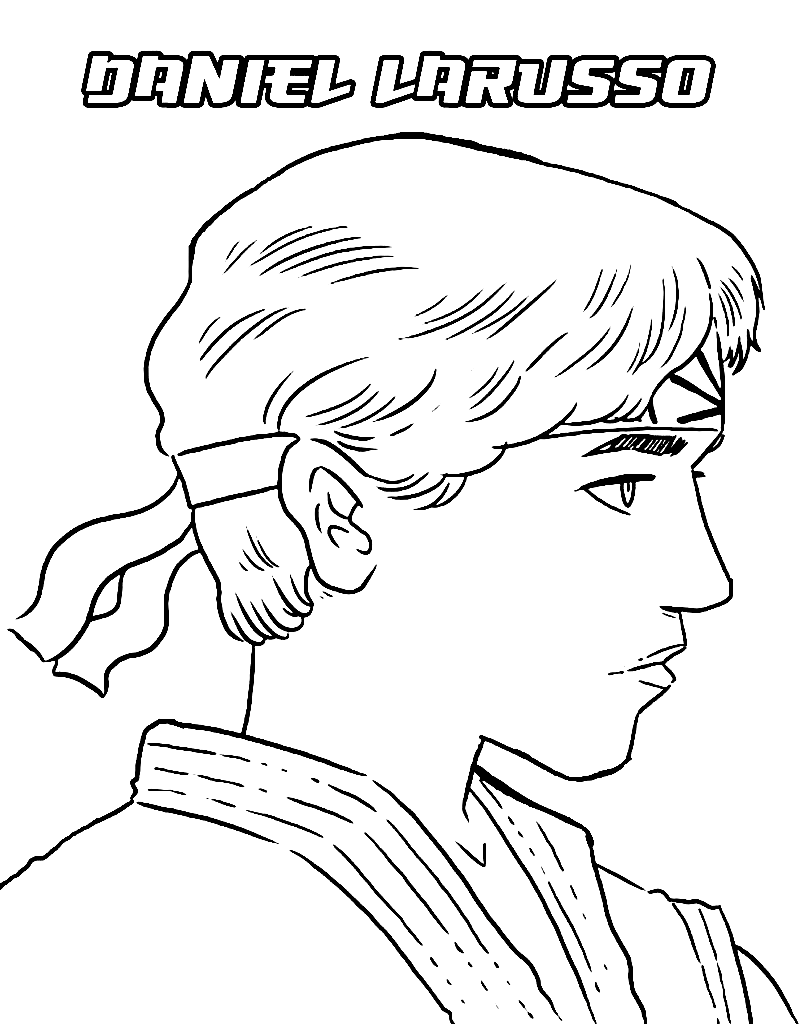
Daniel LaRusso is the series’ other lead – the man who won in 1984 and has been winning since, by most visible measures. He owns a successful car dealership. He has a good family. He has held onto Mr. Miyagi’s teachings and his memory with the specific grip of someone for whom that relationship was the most important of their life.

What the series finds in him is more uncomfortable: Daniel’s virtue is real, his karate philosophy is genuine, but his certainty about his own rightness is sometimes indistinguishable from self-righteousness. He has been the hero of his own story for thirty-four years and has not often asked whether anyone else’s version of events might be as valid as his. The series is honest about this without dismissing what is genuinely good in him.

His appearance: shorter than Johnny, with dark hair with grey at the temples in the series, typically wearing the white Miyagi-Do gi with green accents in dojo scenes. His posture is the posture of someone who has done this his whole life and knows it in his body.

Coloring Daniel: His Miyagi-Do gi is white with teal-green accents and trim. The white should be rendered with warm shadows – cream or very light warm grey in the deepest folds – to give the fabric form. The teal accents are a specific blue-green, neither pure blue nor pure green. His dark hair has taken on grey at the temples and sides in the series – a detail that rewards attention in portrait pages.

Miguel Diaz

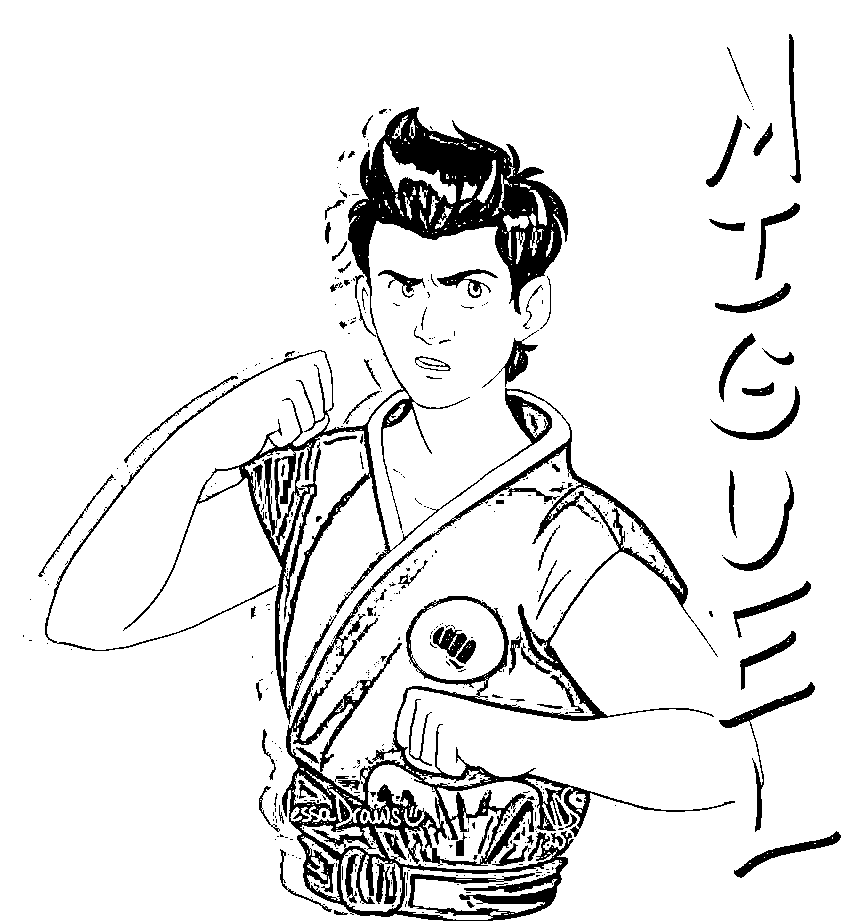
Miguel is the character through whom the series most directly continues the Karate Kid film’s emotional structure – the new student who finds himself in Johnny Lawrence’s dojo, who learns to fight, who becomes the center of a tournament story, and whose arc across six seasons is the clearest continuation of the original film’s coming-of-age framework.

He is a first-generation American with Ecuadorian heritage, living with his mother and grandmother in the same apartment complex where Johnny lives. Johnny first teaches him to fight to defend himself from bullies and then trains him seriously, and their relationship becomes the series’s most straightforwardly affectionate – the closest thing Johnny has to a family during the early seasons.

His Cobra Kai gi pages show him in the black and yellow – he is the first Cobra Kai student in the series to win the All Valley Tournament.

Sam LaRusso

Sam is Daniel’s daughter – the character who most clearly inherits her father’s karate while also needing to develop her own relationship to what it means. She trains in Miyagi-Do and represents the series’ next generation in that philosophical line. Her arc across the series involves confronting anxiety and PTSD from a school fight, developing her own leadership, and navigating the complicated social and romantic entanglements that the dojo rivalry creates among their peer group.

Her appearance in training pages shows the white Miyagi-Do gi. Her portrait pages capture the specific quality of a character who is both shaped by her father’s example and working to define herself independently of it.

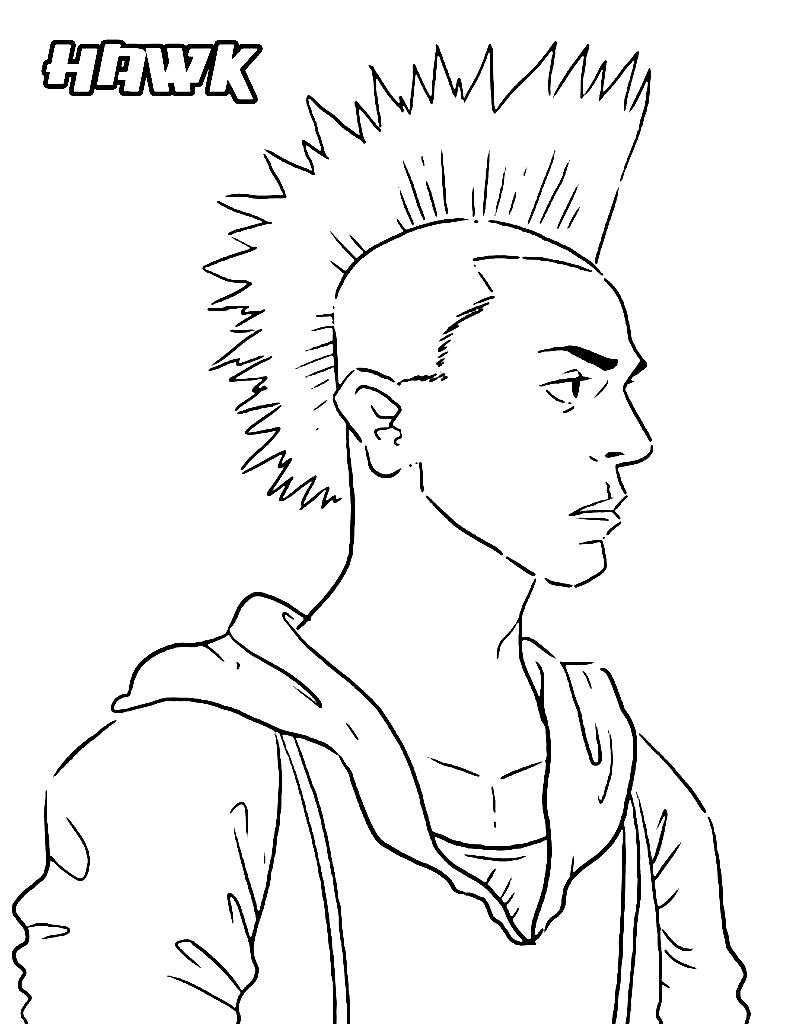
Hawk (Eli Moskowitz)

Hawk is one of the series’s most satisfying character arcs across its early seasons – a bullied, cleft-palate-scarred teenager who joins Cobra Kai, adopts the aggressive philosophy fully and visibly (including a mohawk haircut and tattoos), becomes someone his former bully cannot touch, and then has to reckon with who he has become in the process.

His pages show both identities: the Hawk persona in full Cobra Kai black and yellow with the distinctive mohawk, and the Eli who emerges when he returns to his better self. The Mohawk is his most visually distinctive feature – a fan of blue hair raised above his head – and makes him immediately recognizable among the student characters.

Coloring Hawk: The mohawk is dyed blue – a vivid, electric blue that reads as deliberate and statement-making. The sides of his head are shaved. His Cobra Kai gi is black and yellow. His tattoo (a cobra on his back/shoulder) is detailed in pages that show it clearly.

Robby Keene

Robby is Johnny’s estranged son, who ends up training with Daniel rather than his father, creating one of the series’ central ironies. The LaRusso-Lawrence dynamic that the show examines at the adult level is mirrored in the next generation by their children and students, and Robby and Miguel’s rivalry is a direct parallel to their fathers’ history.

His arc moves across all three dojos during the series, as his loyalties, his anger at his father, and his search for guidance take him through Miyagi-Do, then Cobra Kai under Kreese. His coloring pages show him in different gi colors across his different dojo affiliations.

John Kreese

Kreese is the original Cobra Kai sensei from the 1984 film – the adult villain, the man who trained Johnny Lawrence in the philosophy that made him what he was, and the man who told his students that mercy was weakness. The series brings him back as the series’s most consistent antagonist: a Vietnam veteran whose experience of violence and betrayal has calcified into a philosophy that views the world as predators and prey and accepts no other categories.

He is portrayed in the series as genuinely dangerous – not as a cartoonish villain but as someone whose worldview has an internal logic that has been tested under extreme conditions, and who uses that internal consistency to be convincing to young people looking for certainty. His pages show him in the Cobra Kai gi with the specific authority of someone who has worn that uniform for decades.

The Dojo Logos and Symbols

Beyond the character pages, the collection includes pages focused on the dojos’ visual identities:

Cobra Kai – Black and yellow, the cobra, “Strike First. Strike Hard. No Mercy.” The dojo’s visual language is aggressive, high-contrast, and built around the cobra as a symbol of readiness to attack.

Miyagi-Do – White and teal, the bonsai tree, the philosophy of balance and defense. Mr. Miyagi’s dojo in the original film was never formally named, but its symbol – the ideogram for “Miyagi” – and its bonsai tree association carry through into the series.

Eagle Fang – Johnny’s second dojo, founded after losing Cobra Kai to Kreese. Blue gi, eagle logo, a philosophy that attempts to integrate what was good about Cobra Kai’s directness with the things Johnny is slowly learning from Daniel about balance.

What These Pages Do

Cobra Kai is one of the most serious examinations of how people hold onto the stories they tell about themselves. Johnny Lawrence believed for thirty-four years that he was robbed – that the tournament was taken from him unfairly. Daniel LaRusso believed for thirty-four years that he was the underdog who deserved his win. Both are right about some things. Neither is entirely right about everything. The series earns the coloring pages’ interest because it earned that complexity over six seasons.

The black-and-yellow vs. white-and-teal contrast is a genuine color lesson. The two dojo color schemes are not accidental – they communicate philosophy through palette. Black and yellow is aggressive, high-contrast, and visually confrontational. White and teal are balanced, clear, and cooler. Coloring pages from both dojos while paying attention to this opposition teaches how color communicates character before any other information is available.

The karate stance pages teach body language through careful rendering. A martial arts stance is a highly specific body position – weight distributed precisely, limbs in exact relationship to each other, the whole structure conveying readiness. Coloring these pages carefully enough to render the position correctly requires looking at the body position carefully enough to understand it. This is a genuine observation practice delivered through a coloring activity.

Fine motor development. The American Academy of Pediatrics identifies fine motor development as a key childhood milestone. The gi pages – with their fold lines, belt knots, collar details, and trim elements – provide exactly the kind of motivated, sustained practice that is most developmentally effective. The 2005 Art Therapy Journal study on structured coloring and anxiety reduction applies throughout.

How to Color These Pages Well

Cobra Kai black requires warm treatment to avoid flatness. Pure black on a white page reads as a hole rather than a fabric surface. Apply dark navy blue as an undercoat across the Cobra Kai gi, then layer black on top with slightly lighter pressure. The result is a black that has visible depth – the fabric reads as a dark surface reflecting minimal light rather than as an absence of color.

The gi fabric folds are the most important detail. Karate gi fabric is heavyweight cotton with distinct folds – particularly at the elbows, knees, and where the lapel crosses. These folds are usually indicated in the line drawing. Render them with a shadow tone in the fold’s depth and a lighter tone on the fold’s raised edge. Consistent fold treatment makes the fabric read as three-dimensional cloth rather than flat paper.

Johnny and Daniel’s skin tones differ significantly. Johnny has a fair, weathered complexion – slightly pink undertone, with the kind of outdoor exposure that comes from handyman work. Daniel has a warmer Mediterranean-influenced complexion – slightly olive undertone, warmer and darker than Johnny’s. Getting these different from each other in pages that show both characters side by side is the key to making the figures readable as distinct individuals.

The cobra logo wants high contrast. The cobra’s effectiveness as a visual symbol depends on the contrast between its color and its background being as strong as possible. When coloring the logo pages, push the yellow toward its most vivid and the black toward its darkest. Avoid muting either.

Tournament scenes want arena lighting. The All Valley Karate Tournament takes place under artificial lighting in a gymnasium or arena – cooler overhead light, moderate shadows. When coloring tournament scene pages, use slightly cooler shadow tones than you would for outdoor scenes, and keep the overall palette slightly less saturated to suggest the fluorescent quality of indoor arena lighting.

5 Creative Craft Ideas

Dojo Colors Side-by-Side

Print one character page showing a Cobra Kai student and one showing a Miyagi-Do student. Color the Cobra Kai page in its canonical black and yellow – full contrast, aggressive palette. Color the Miyagi-Do page in its canonical white and teal – balanced, clean, cooler.

Mount both side by side on a neutral grey backing sheet with a thin line separating them. On the Cobra Kai side, hand-letter “Strike First. Strike Hard. No Mercy.” On the Miyagi-Do side, hand-letter “Defense, Not Offense.”

The finished display makes the series’s philosophical conflict visible as a color conflict, which is exactly how the show’s visual design communicates it.

Johnny and Daniel Then/Now

Cobra Kai’s premise depends on the gap between 1984 and the present. Print the most direct portrait pages for Johnny and Daniel. Color Johnny in Cobra Kai black and yellow – but reference the coloring choices to suggest age: slightly more grey in the hair, the weathered quality of his complexion. Color Daniel in Miyagi-Do white and teal with the more settled, middle-aged version of his appearance.

Add a hand-lettered title above each: the year of the original film (1984) on the left, the year the series began (2018) on the right. The temporal gap between those dates is the entire premise of the show.

Hawk’s Transformation

If the collection includes Eli and Hawk as separate or distinguishable pages, print both. Color the Eli page in muted civilian colors – no mohawk, or the mohawk drawn down before the shave. Color the Hawk page in full Cobra Kai black and yellow with the blue mohawk at maximum saturation.

Mount both in sequence with an arrow between them: “Eli” on the left, “Hawk” on the right. Below the arrow, write: “Cobra Kai changed him. Then he changed himself back.”

All Valley Tournament Bracket

On a large piece of paper, create a hand-drawn tournament bracket – the structure of an elimination tournament, eight positions narrowing to one. In each position, mount a small colored character figure from the collection. The bracket doesn’t need to be accurate to the show’s actual tournament results – it can be your own version, with the winner you choose at the top.

Add “All Valley Under-18 Karate Tournament” at the top. Color each figure in their dojo’s colors so the bracket reads as a color-coded competition. The finished bracket is a piece of sports-themed fan art that combines the coloring activity with sports bracket literacy.

Dojo Rules Poster

Print the Cobra Kai logo page. Color it in full black and yellow. Mount it on a black backing sheet. Around it, hand-letter the Cobra Kai rules as they are stated in the series: “Strike First. Strike Hard. No Mercy.” Add the dojo name at the top.

For a Miyagi-Do version: print whatever Miyagi-Do symbol page is available, color it in white and teal, mount it on a white or cream backing, and add Mr. Miyagi’s teaching: “Karate is not about fighting. It is about life.”

The finished posters capture the series’ two philosophies as visual objects – the kind of wall display that characters in the show would actually have in their dojos.

Frequently Asked Questions

What is Cobra Kai, and how does it relate to The Karate Kid? Cobra Kai is a direct sequel television series to The Karate Kid (1984), created by Josh Heald, Jon Hurwitz, and Hayden Schlossberg. It picks up thirty-four years after the events of the original film, following both Johnny Lawrence and Daniel LaRusso in adult life, with the central conflict being the reopening of the Cobra Kai dojo by Johnny and Daniel’s eventual response. The series premiered on YouTube Premium on May 2, 2018, and moved to Netflix beginning with Season 3 in December 2020, where it reached a much larger audience. It ran for six seasons, concluding in 2024.

Who are Johnny Lawrence and Daniel LaRusso in the series? In the original 1984 film, Johnny Lawrence was the antagonist – the Cobra Kai student who bullied Daniel LaRusso throughout their school year and lost to him in the All Valley Karate Tournament after attempting an illegal kick. In Cobra Kai, the series begins from Johnny’s perspective: now middle-aged, living in a rundown apartment, working as a handyman, he reopens the Cobra Kai dojo in a strip mall and begins training a new generation of students. Daniel, meanwhile, runs a successful car dealership and has built the life the original film implied. The series deliberately complicates both characters – showing where Daniel’s certainty shades into self-righteousness and where Johnny’s directness has genuine value alongside its obvious damage.

What is the difference between Cobra Kai and Miyagi-Do? Cobra Kai and Miyagi-Do represent opposing karate philosophies expressed through opposing visual identities. Cobra Kai’s philosophy – “Strike first, strike hard, no mercy” – is built on aggression, relentlessness, and the belief that showing mercy is weakness. Its colors are black and yellow, and its symbol is a cobra. Miyagi-Do’s philosophy, inherited from the late Mr. Miyagi and continued by Daniel LaRusso, emphasizes defense, balance, patience, and the idea that karate is a life practice rather than a fighting system. Its colors are white and teal. The series uses the contrast between these philosophies as the engine of its central conflict across all six seasons.

Who is Mr. Miyagi, and why is he important to the series? Mr. Miyagi – played by the late Pat Morita (1932–2005) in the original film series – was Daniel LaRusso’s karate sensei and surrogate father figure in The Karate Kid and its sequels. He died between the events of the original films and the series. His absence is one of Cobra Kai’s most consistent emotional presences – Daniel’s dojo, his philosophy, his home, and his memory are all organized around what Mr. Miyagi taught him and what he meant to him. The series treats his death as a genuine loss rather than a convenient backstory element, and several of the series’s most effective moments involve Daniel confronting specific aspects of Mr. Miyagi’s life and teaching.

What happened to the Cobra Kai dojo during the series? The Cobra Kai dojo undergoes significant changes across six seasons. Johnny Lawrence reopens it in Season 1 with a reformed approach to the original philosophy, training Miguel and other students. John Kreese – the original Cobra Kai sensei from the 1984 film – returns and gradually takes control of the dojo from Johnny in Season 2, forcing Johnny out. Johnny subsequently founded Eagle Fang Karate. In later seasons, Terry Silver – the villain of The Karate Kid Part III (1989) – returns to partner with Kreese and expand Cobra Kai into a chain of dojos across the region, representing the dojo’s transformation from a single neighborhood dojo into something significantly more threatening.

Is Cobra Kai appropriate for younger viewers? Cobra Kai is rated TV-14 in the United States – intended for audiences fourteen and older. The series contains significant violence (extended fight sequences, characters sustaining serious injuries), some language, and mature thematic content, including discussions of bullying, substance abuse, PTSD, and the long-term consequences of childhood trauma. The coloring pages in this collection are appropriate for all ages – they present the series’ visual elements (characters, logos, karate poses) without the mature content of the series itself. Parents of younger fans should be aware that the series carries a TV-14 rating if they are considering whether to watch it with their children.

Browse the full collection at ColoringPagesOnly.com. All 20+ pages free, no sign-up, PDF or PNG, print at home or color online.

Johnny Lawrence reopened the Cobra Kai dojo because karate was the last thing he was genuinely good at, and he had lost even that. Daniel LaRusso eventually reopened Miyagi-Do because the memory of Mr. Miyagi is the best part of his history, and he had been holding it privately when it was meant to be passed on.

Six seasons. Two men with thirty-four years of unresolved history. The same question underneath all of it: were they the person they thought they were in 1984, and who are they now?

Pick up your black. Make the yellow vivid. Or pick up your white and your teal.

Either way – strike first, or find your balance. The dojo is open.

Share your work on Facebook and Pinterest and tag #Coloringpagesonly. We especially want to see the dojo side-by-side displays and the All Valley Tournament brackets.

Color the cobra. Find your dojo. No mercy – on the white space.

More from our TV show and film collections:

Emma Wilson – Illustrator

Hey there, young artists! I’m Emma Wilson, a freelance illustrator who loves children and the magic of art. I dream of building a vibrant community where we can all come together to draw, color, and bring unique creations to life with every brush or pencil stroke. Let’s unleash our imagination in ColoringPagesOnly.Com!