Chucky Coloring Pages
 By:
Jennifer Thoa - Content Editor & Designer
Updated:
By:
Jennifer Thoa - Content Editor & Designer
Updated:
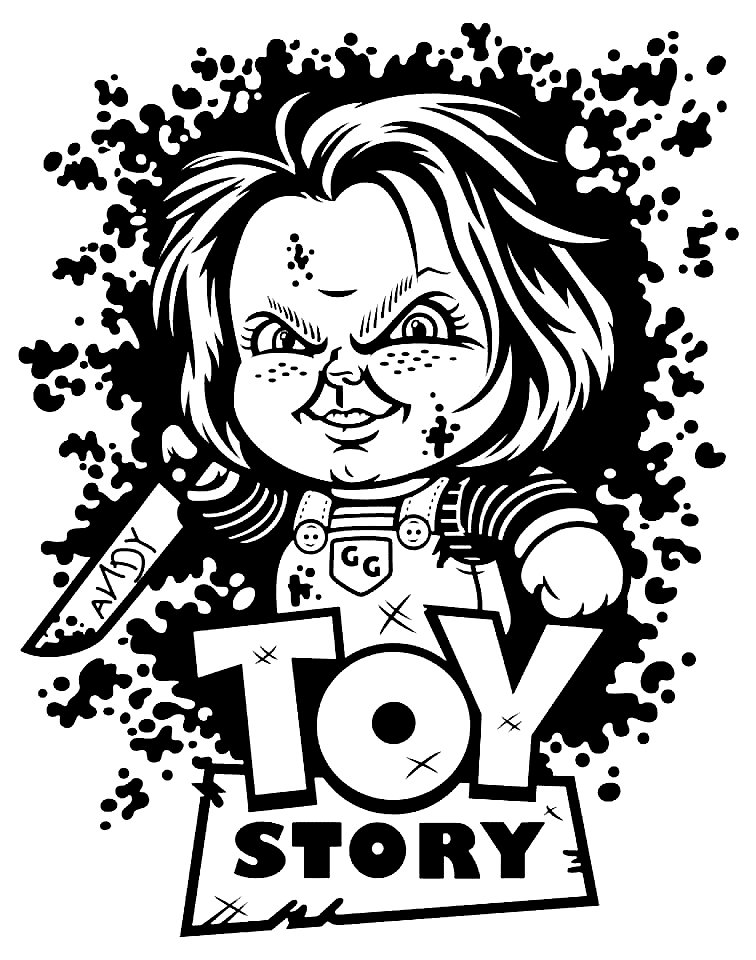
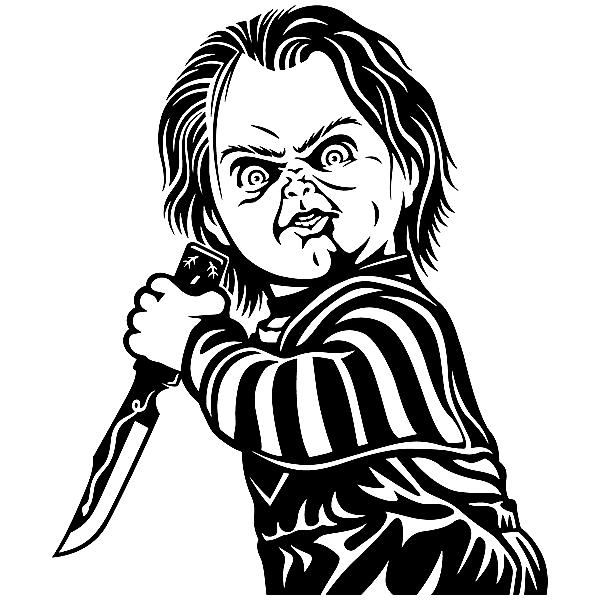
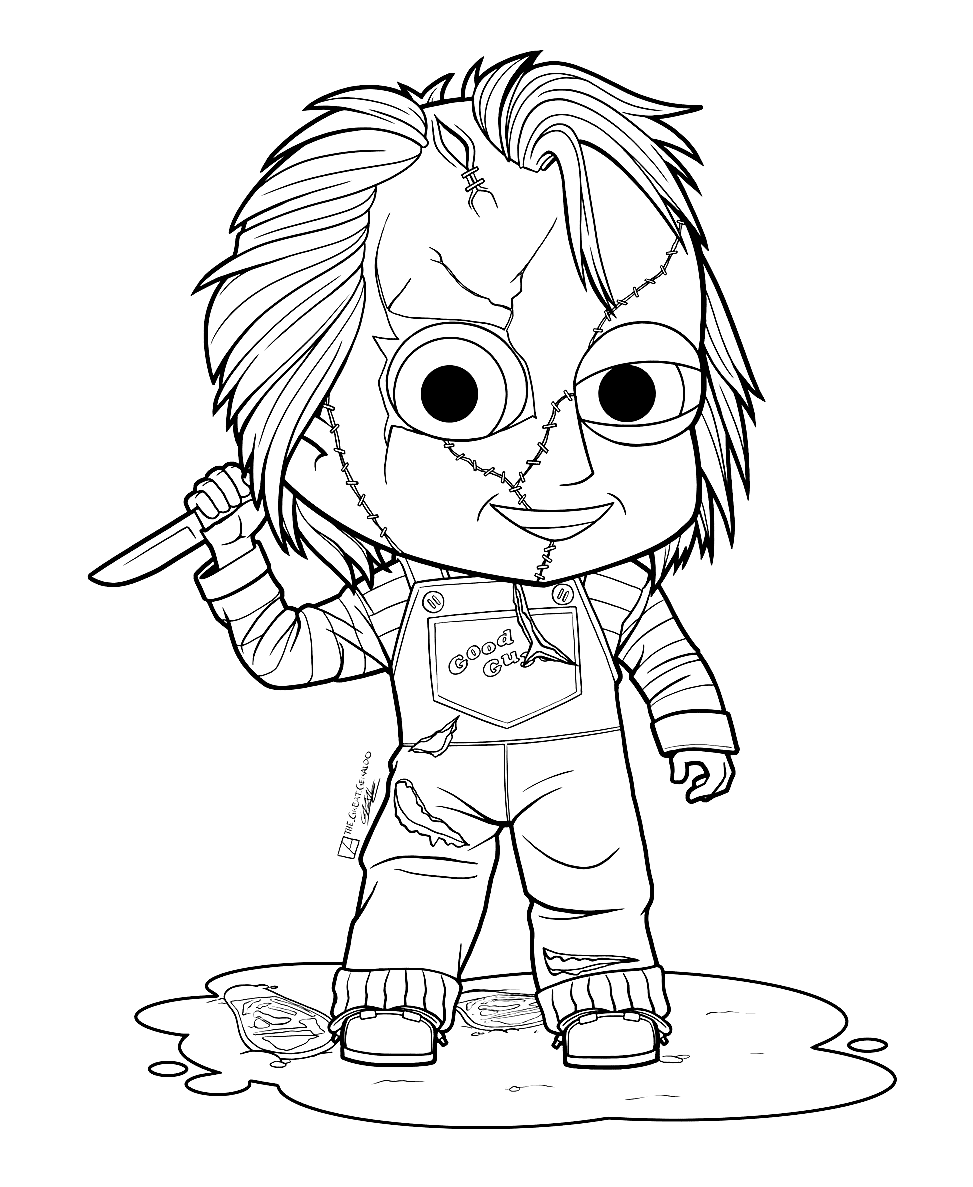
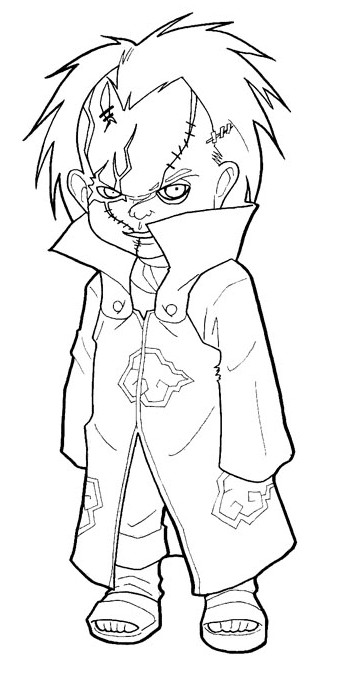
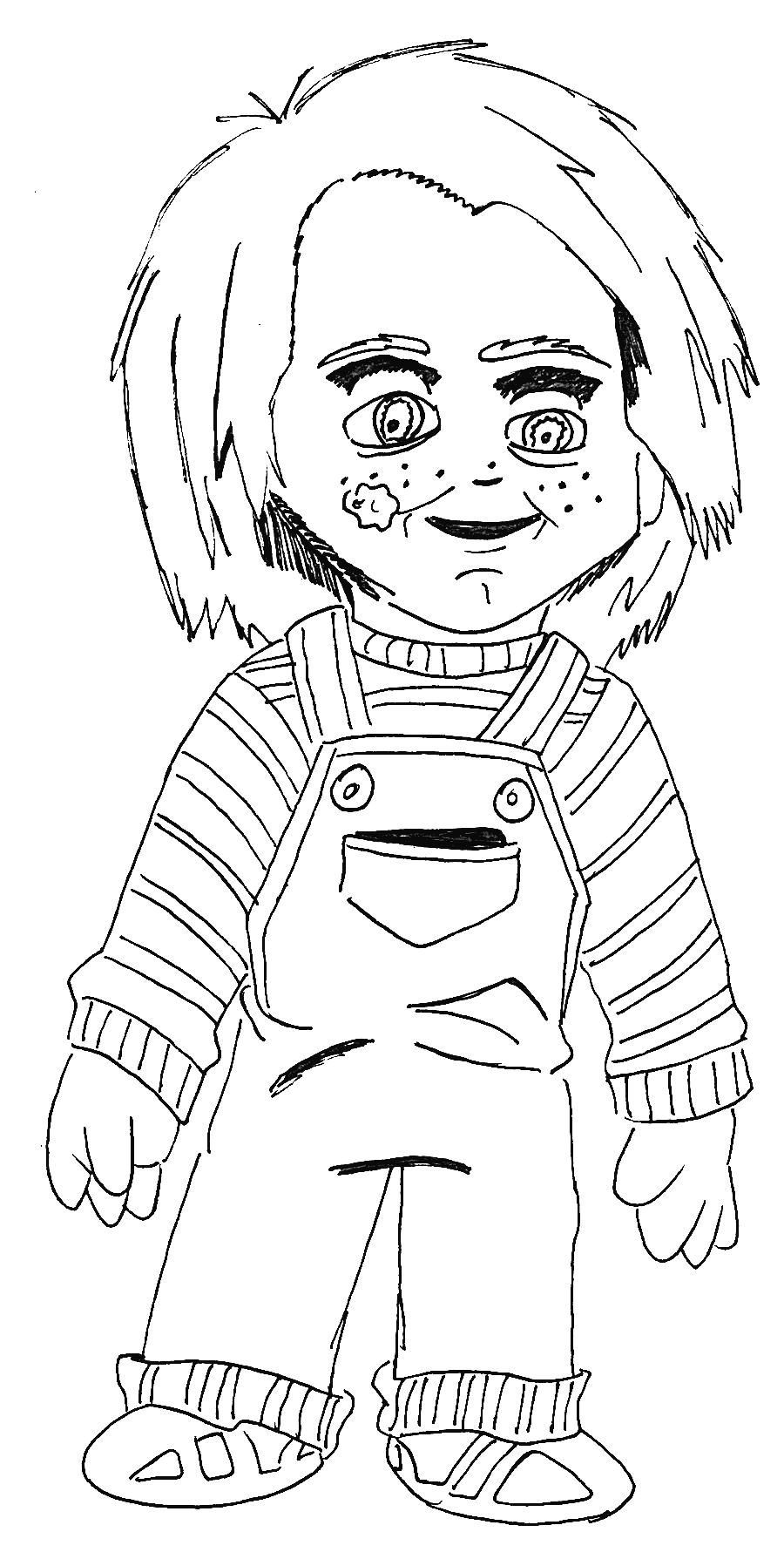
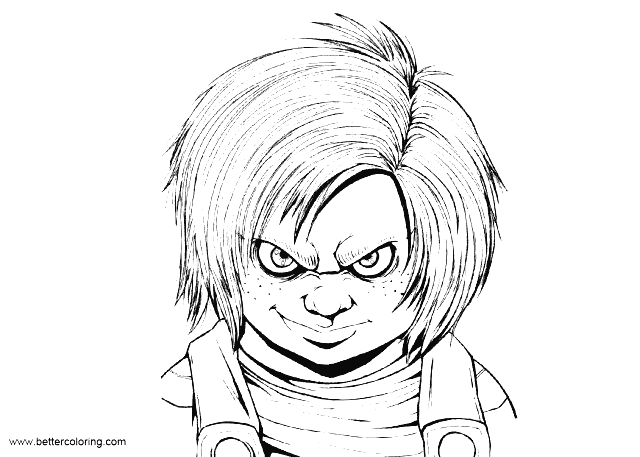
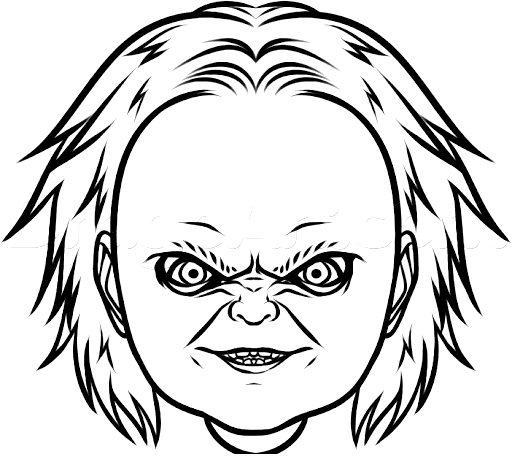
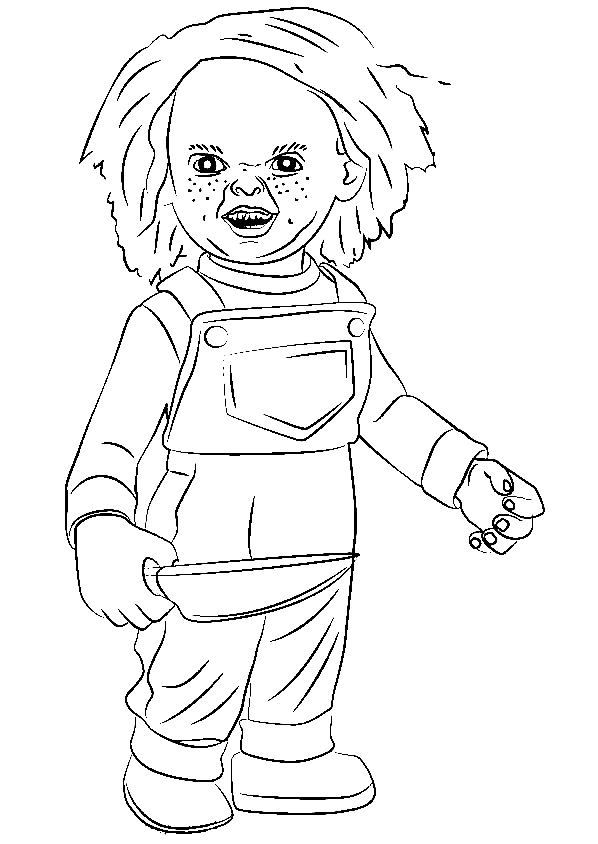
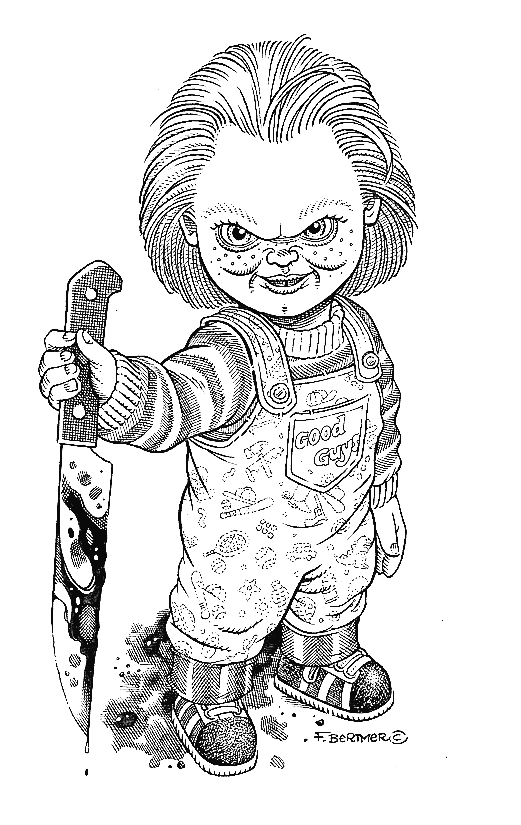
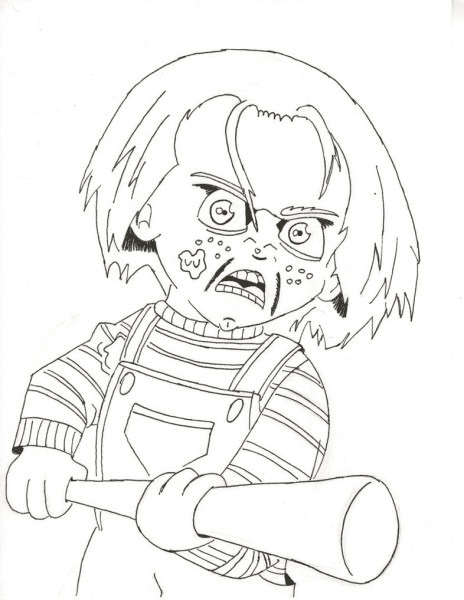
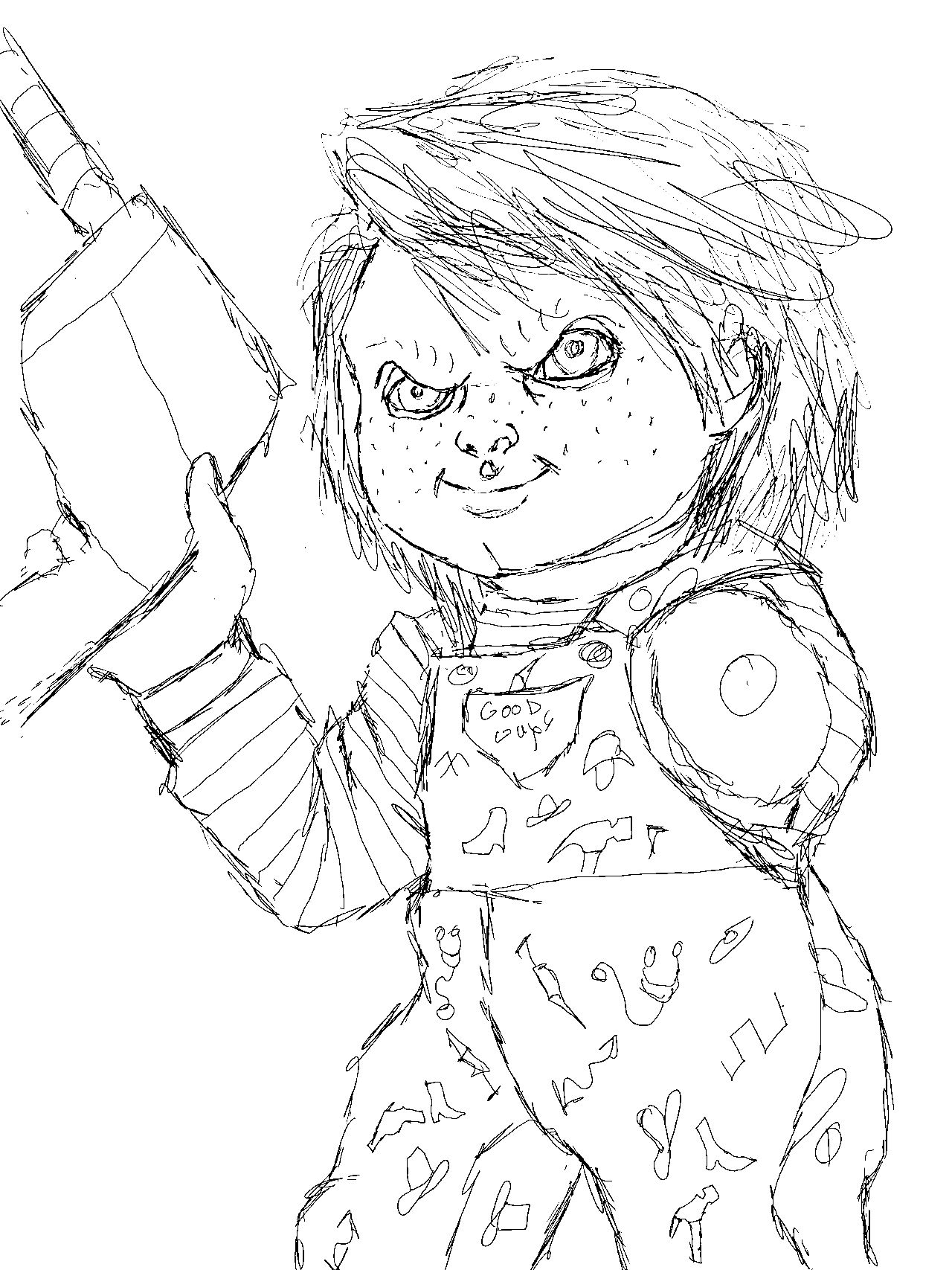
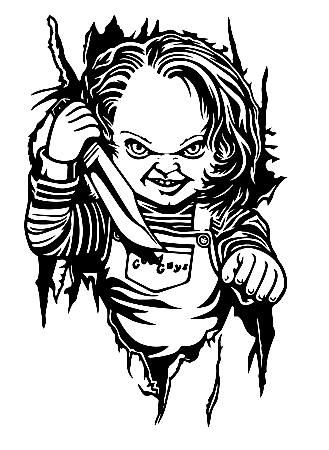
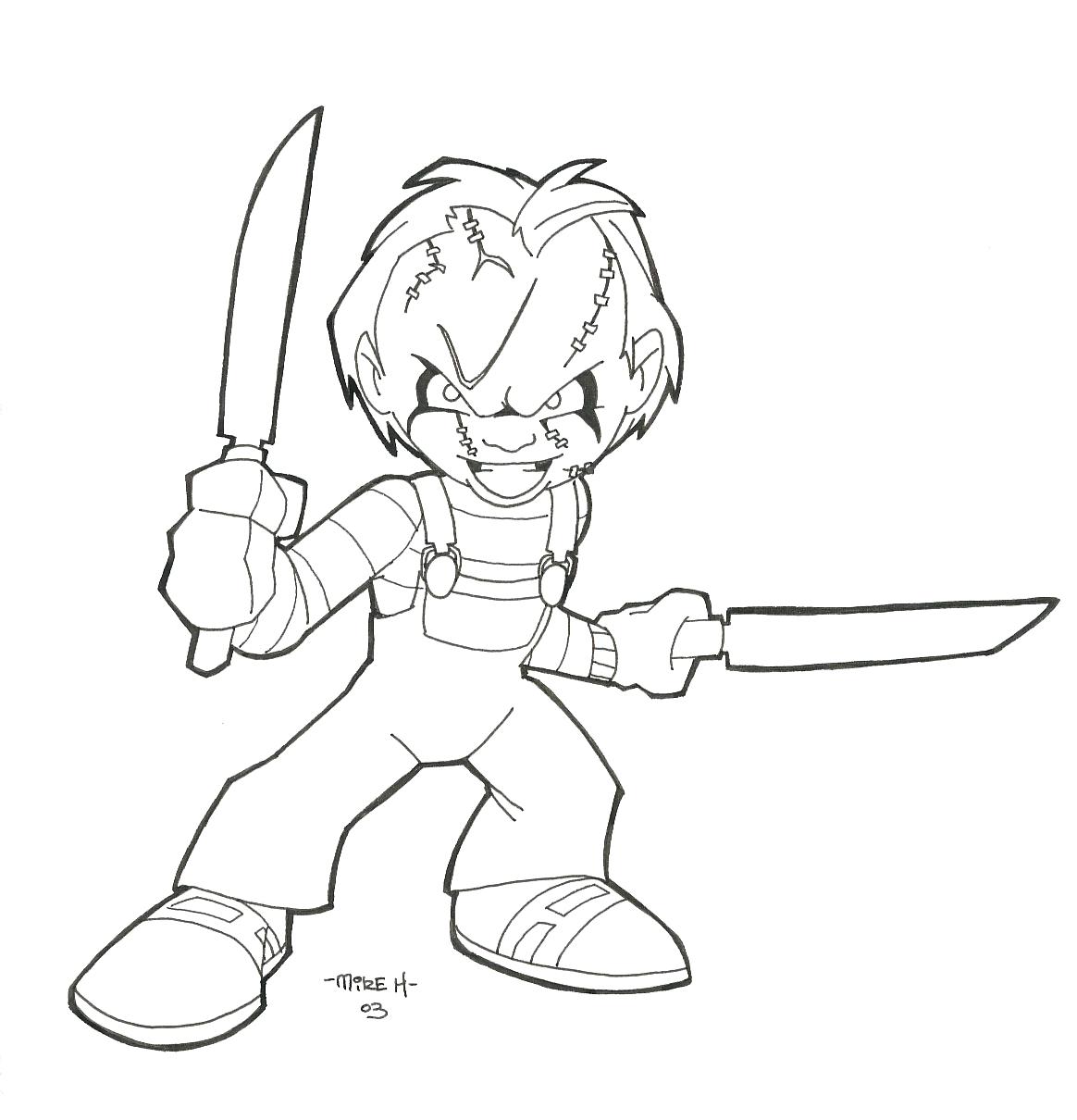
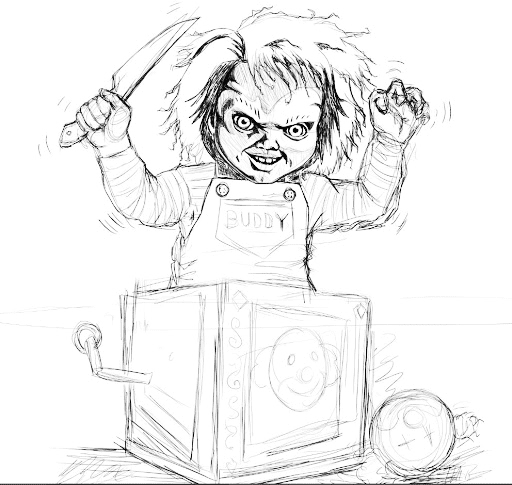
Free Chucky coloring pages: 30+ pages featuring the infamous Good Guy doll in portrait close-ups with his iconic orange-red hair and blue eyes, full-body standing poses in his denim overalls and striped shirt, increasingly scarred and stitched face designs from the later franchise entries, Tiffany in her gothic doll form, Halloween-atmosphere compositions, the “Wanna play?” pose pages, and the full visual vocabulary of one of horror cinema’s most consistently documented and longest-running franchise characters across more than thirty-five years of films and television. All free, printable PDFs and online coloring for fans of the horror genre.
Child’s Play was released on November 9, 1988, directed by Tom Holland (not the actor), with the character of Chucky created by Don Mancini, who wrote the original screenplay and has remained the primary creative force behind the franchise across every subsequent entry. The film was produced by David Kirschner and distributed by MGM’s United Artists. Its budget was approximately $9 million; its worldwide box office was approximately $44 million.
Chucky’s real identity within the fiction is Charles Lee Ray, a serial killer known as “The Lakeshore Strangler,” who used a voodoo ritual to transfer his soul into a “Good Guy” brand children’s doll after being fatally shot. The ritual he used, invoking the Haitian Vodou loa Damballa (the serpent deity associated with creation in Haitian Vodou practice), transferred his consciousness into the doll and trapped it there as he attempted to find a human host. The character has been voiced in every film and television episode by Brad Dourif, who also played the human Charles Lee Ray in the 1988 original.
The franchise has produced eight theatrical or streaming films in the original continuity, plus a 2019 reboot made without Don Mancini’s involvement, and a television series that premiered on October 12, 2021, on Syfy/USA Network and has run for three seasons.
These 30+ free pages at ColoringPagesOnly.com cover the franchise’s full visual history. All free, PDF or PNG, print or color online.


What’s Inside
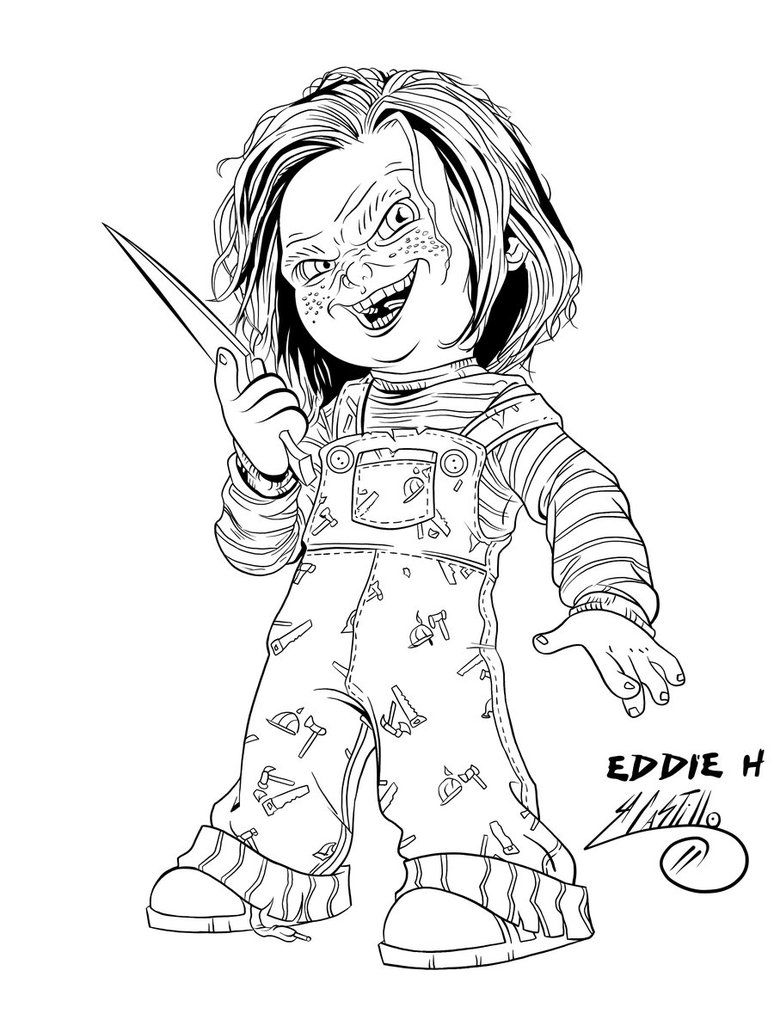
Chucky’s Classic Good Guy Doll Design
Chucky’s original unscathed appearance in the 1988 film is specifically modeled on the “Good Guy” doll, a fictional children’s toy brand within the movie’s world that was itself designed as a parody of the actually popular Hasbro “My Buddy” dolls of the mid-1980s. The “Good Guy” doll design was created by special effects artist Kevin Yagher, who also worked on the Freddy Krueger makeup for the A Nightmare on Elm Street franchise.
The design’s horror effectiveness derives from a well-documented psychological principle: the “uncanny valley” effect, first described by robotics professor Masahiro Mori in a 1970 paper in the journal Energy, identifies the specific discomfort humans experience when an artificial figure appears almost but not quite human. A child-sized doll with proportions, hair, and eyes designed to seem friendly produces the maximum uncanny valley effect when animated to move and speak with adult anger and violence: the cognitive dissonance between the visual register (friendly child’s toy) and the behavioral register (dangerous killer) is the foundation of the franchise’s horror.
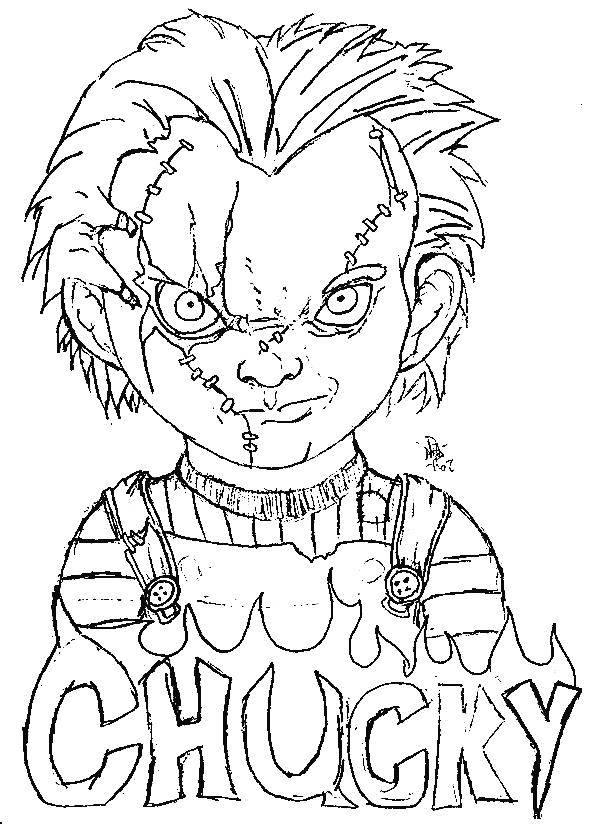
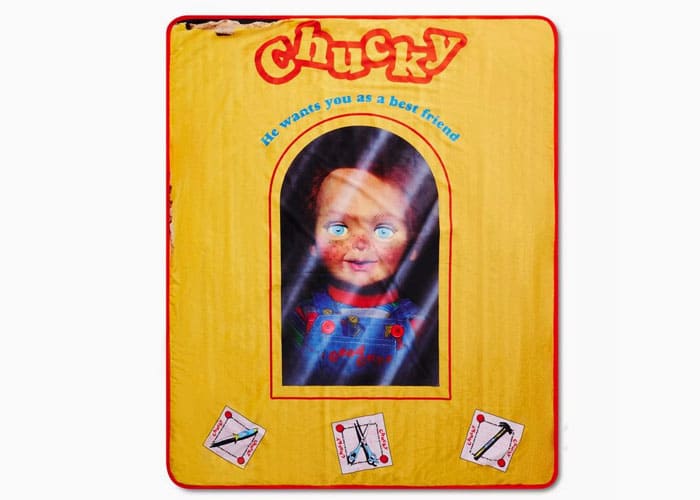
The specific elements of the classic Good Guy/Chucky design: The hair is vivid orange-red, styled in the specific unruly way of a child’s doll hair, neither neatly combed nor wildly chaotic, but somewhere between. The eyes are vivid blue, round, and large in the proportional way of dolls designed to seem appealing. The face is freckled, round, and soft-featured. The outfit is blue denim overalls over a red-and-yellow horizontally striped shirt. The shoes are simple red canvas shoes with white laces.
Coloring the classic Good Guy design: The hair is vivid warm orange-red, not a dark auburn and not a bright fire-red, but the specific warm orange that reads as a child’s doll hair color. Apply at full saturation across the full hair mass. The eyes are the design’s most important coloring element: vivid medium blue, large and round, with a white highlight dot at the upper corner. The overalls are medium blue denim, applied at full coverage with slightly darker blue at the seam lines. The striped shirt uses vivid red and vivid yellow horizontal stripes of approximately equal width.
Chucky’s Scarred and Stitched Face
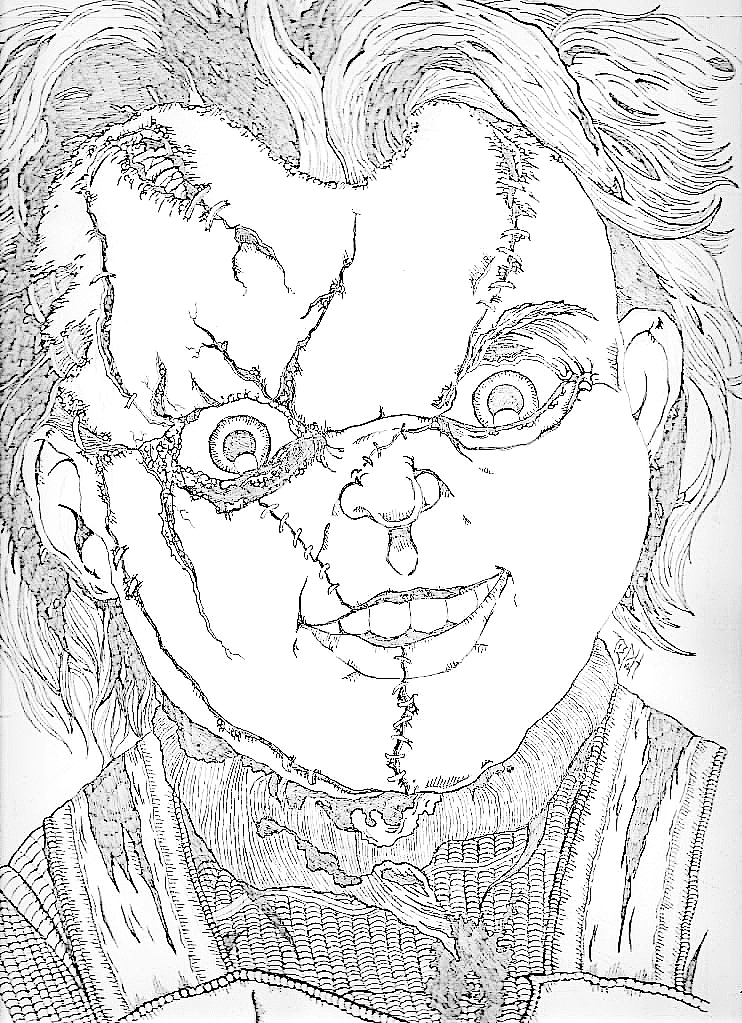
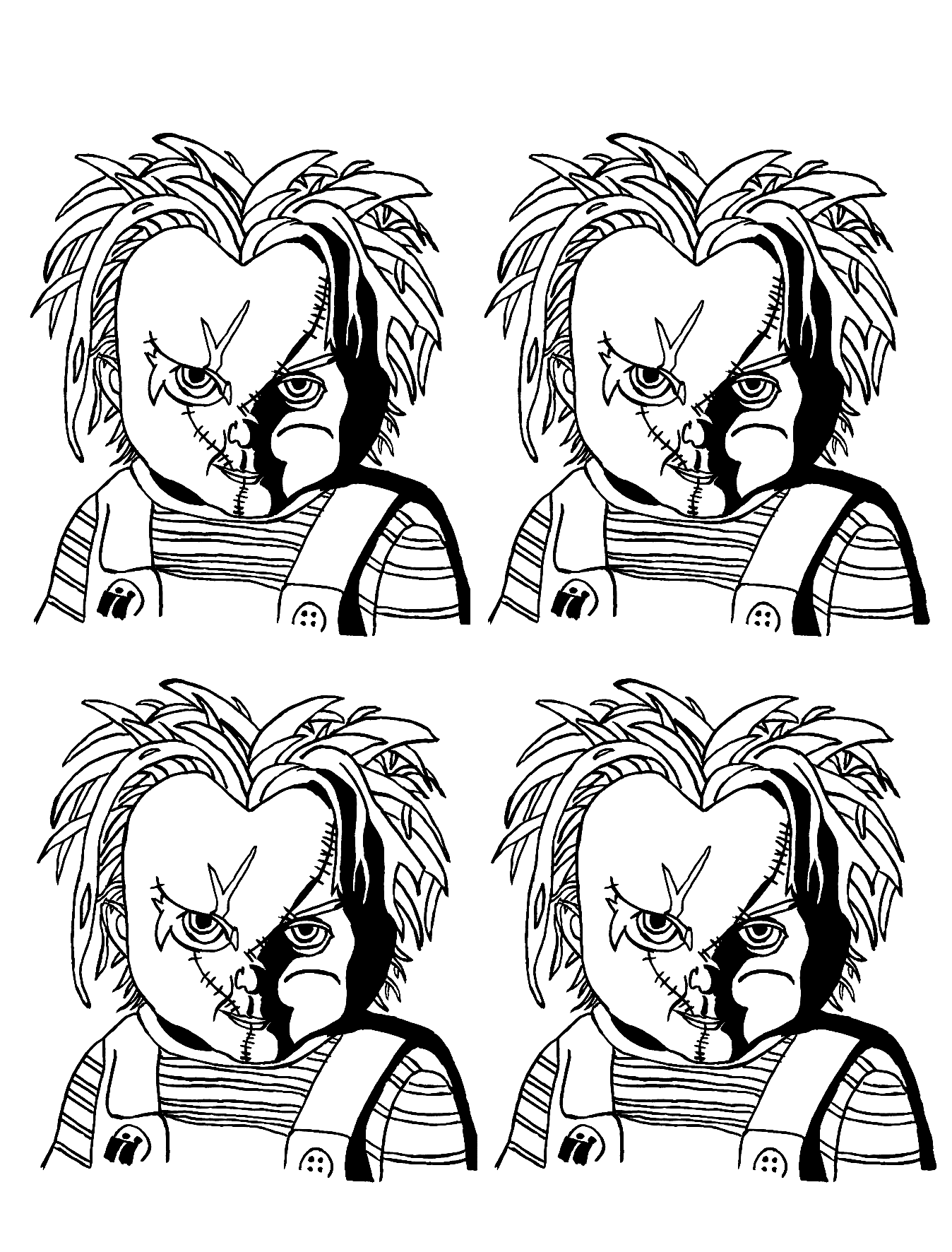
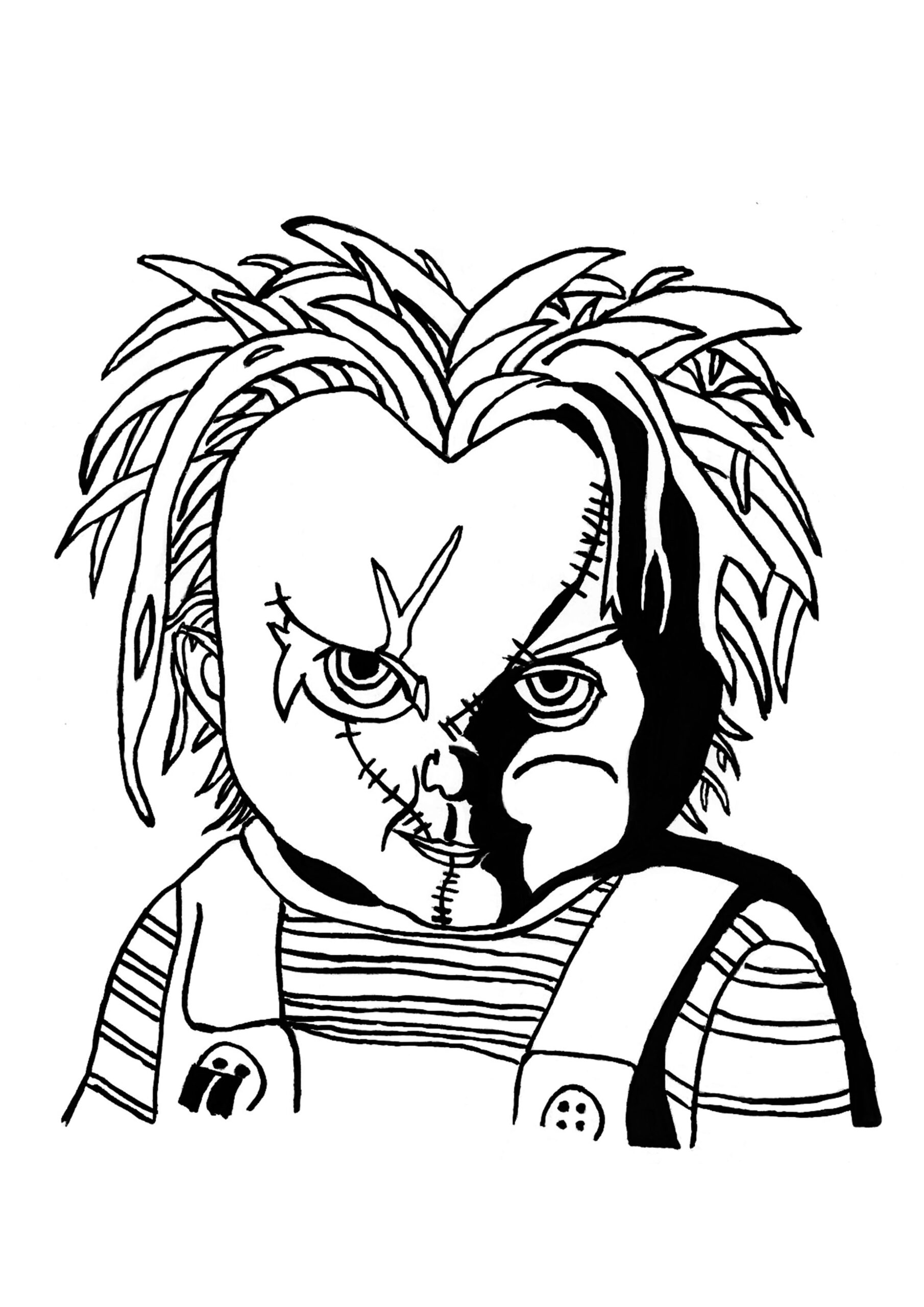
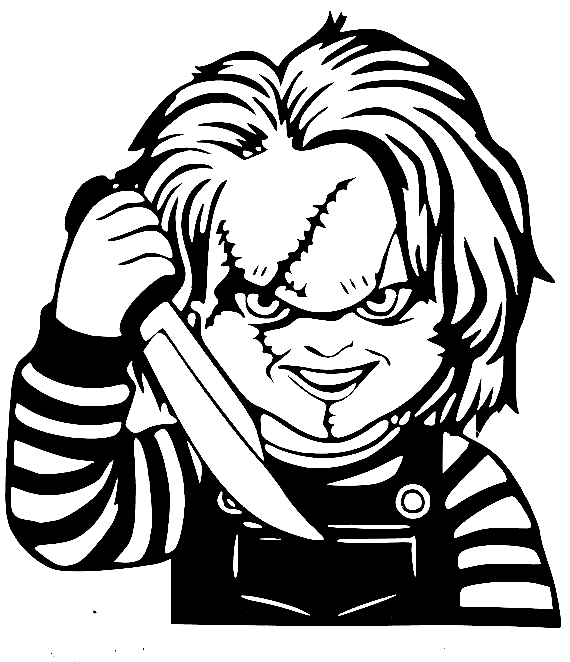
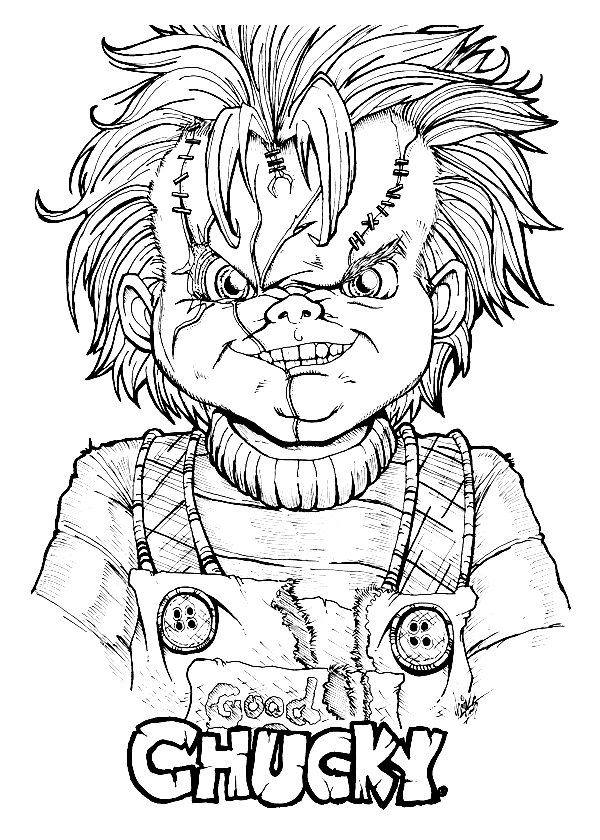
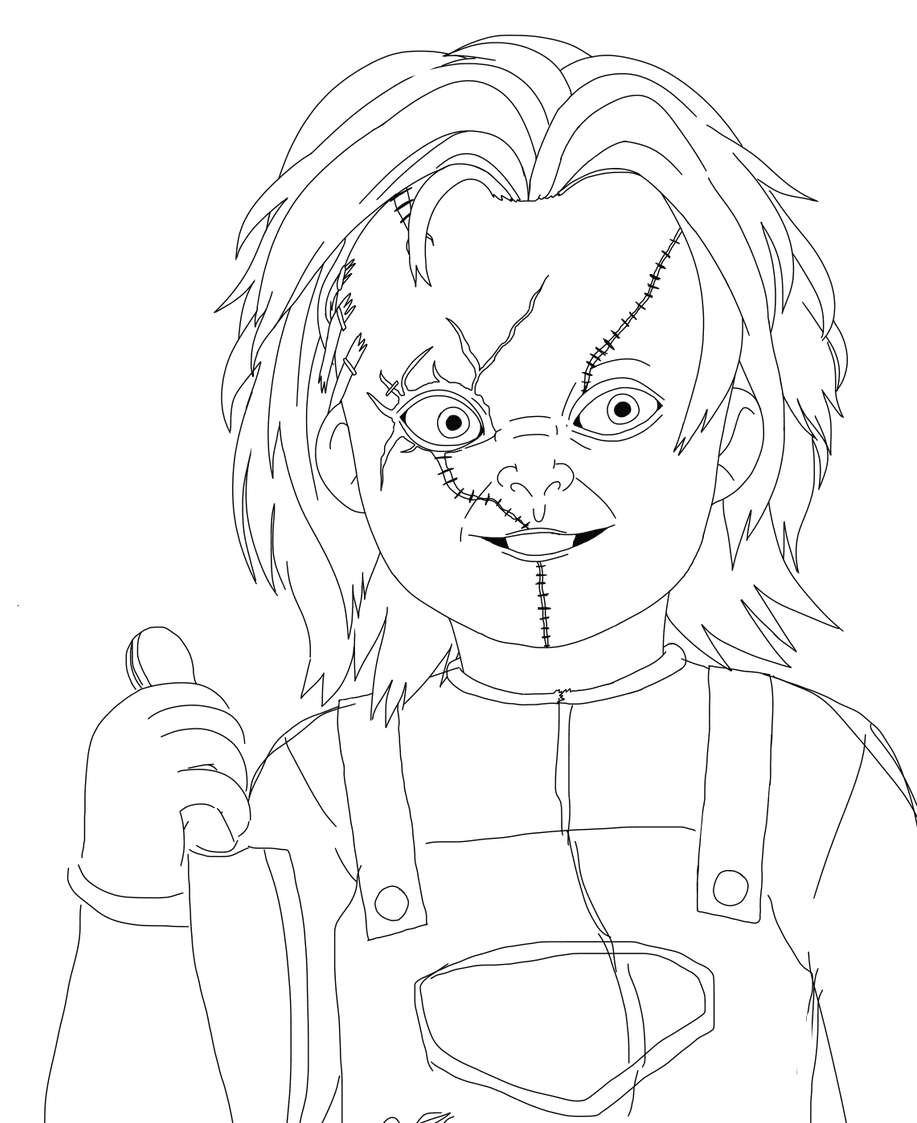
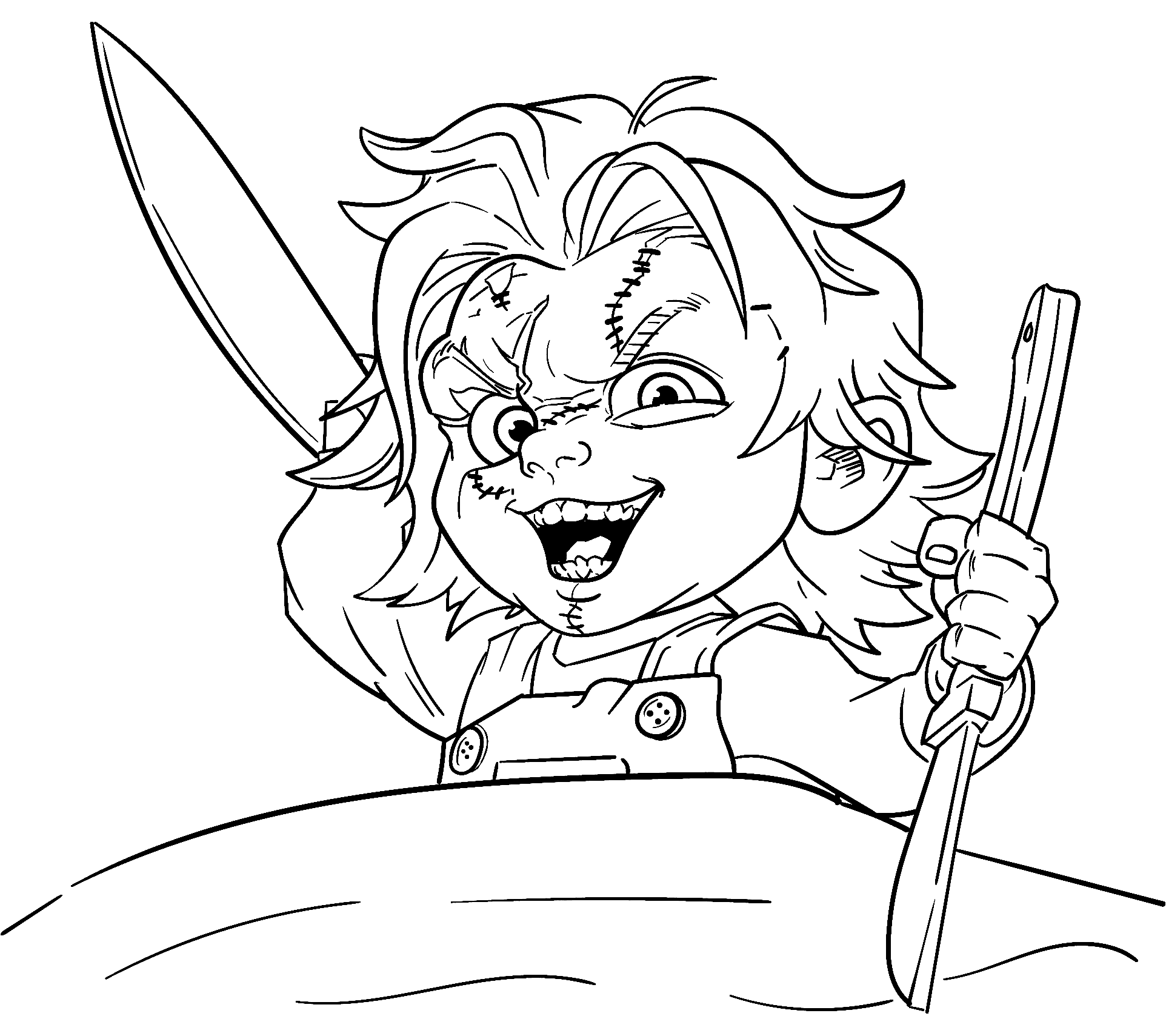
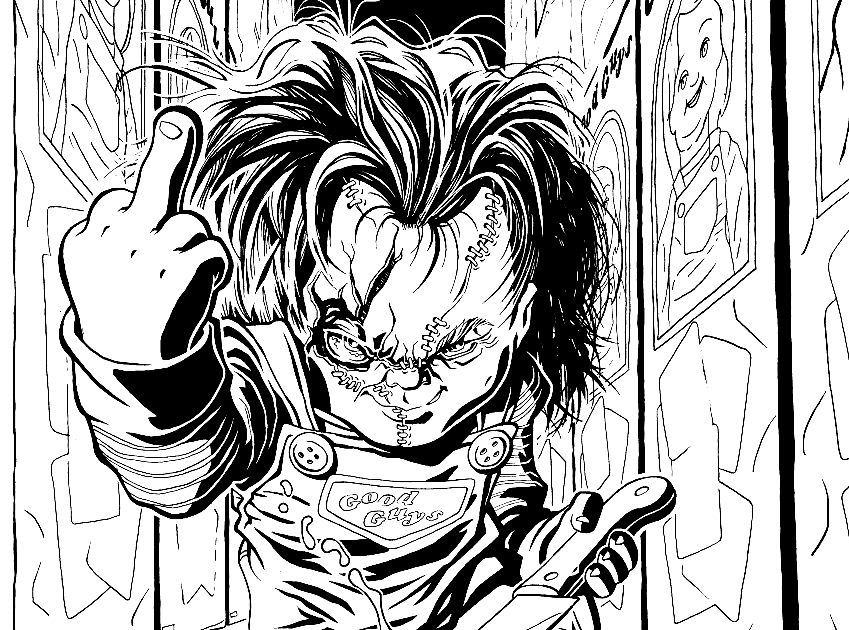
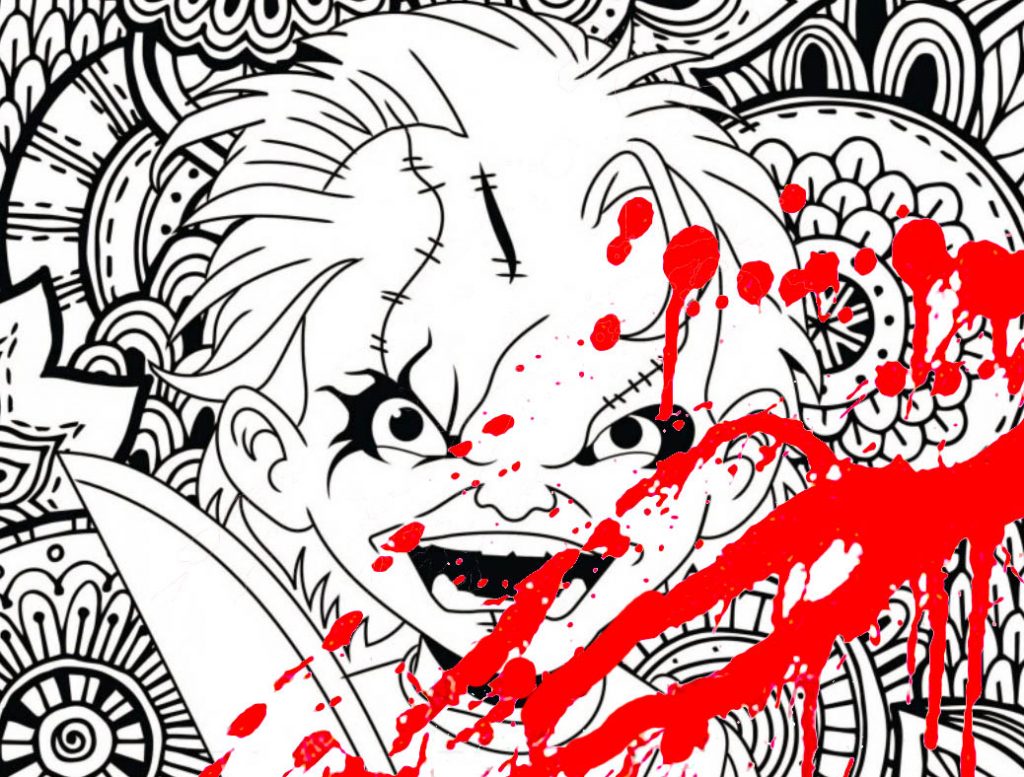
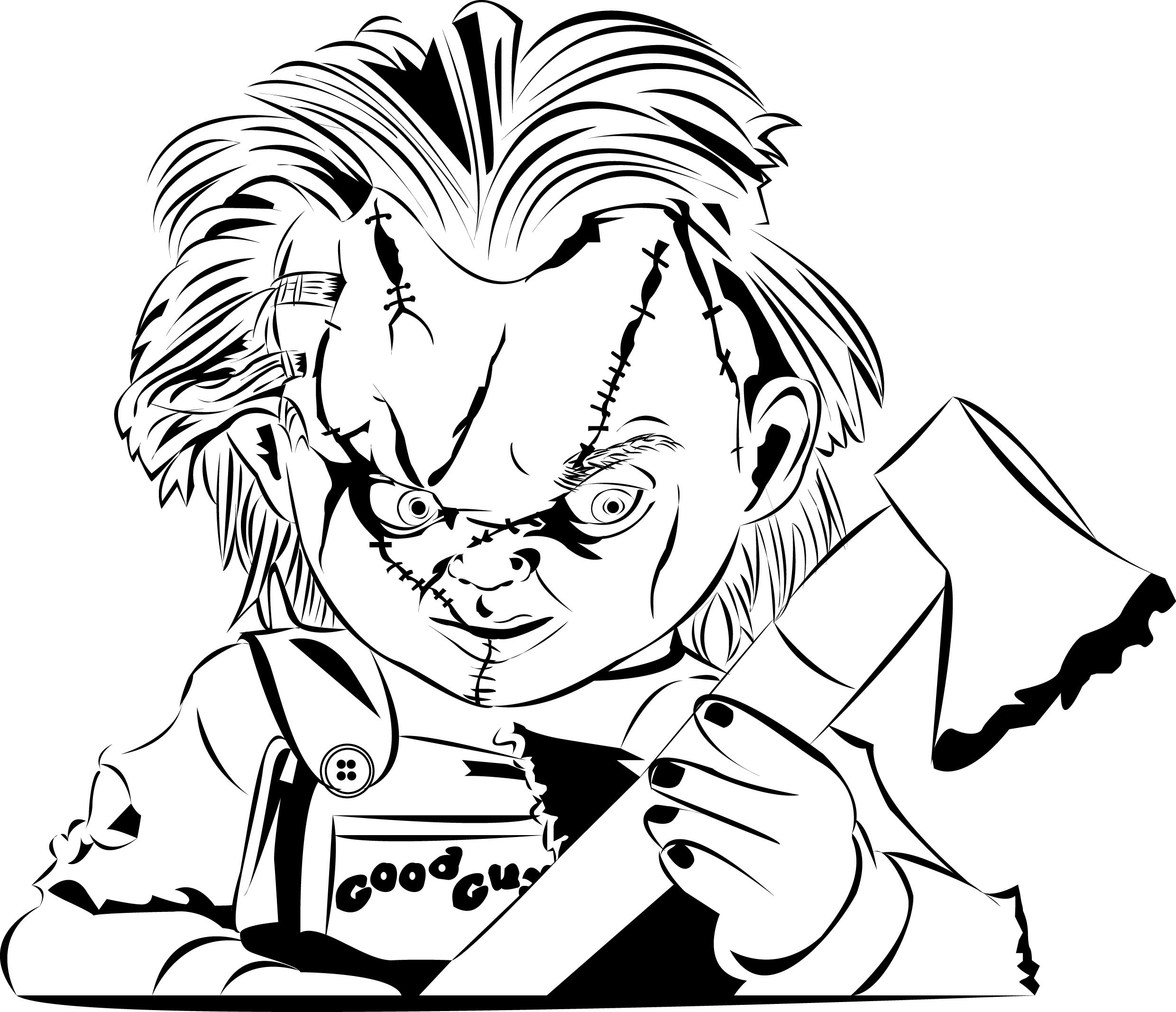
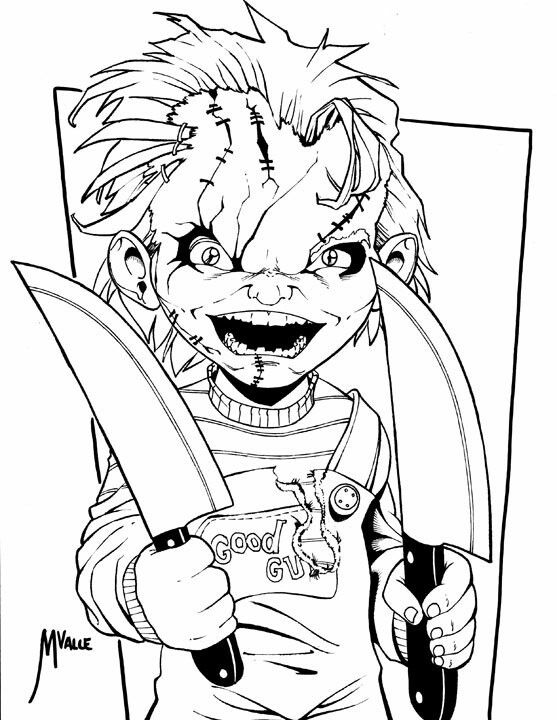
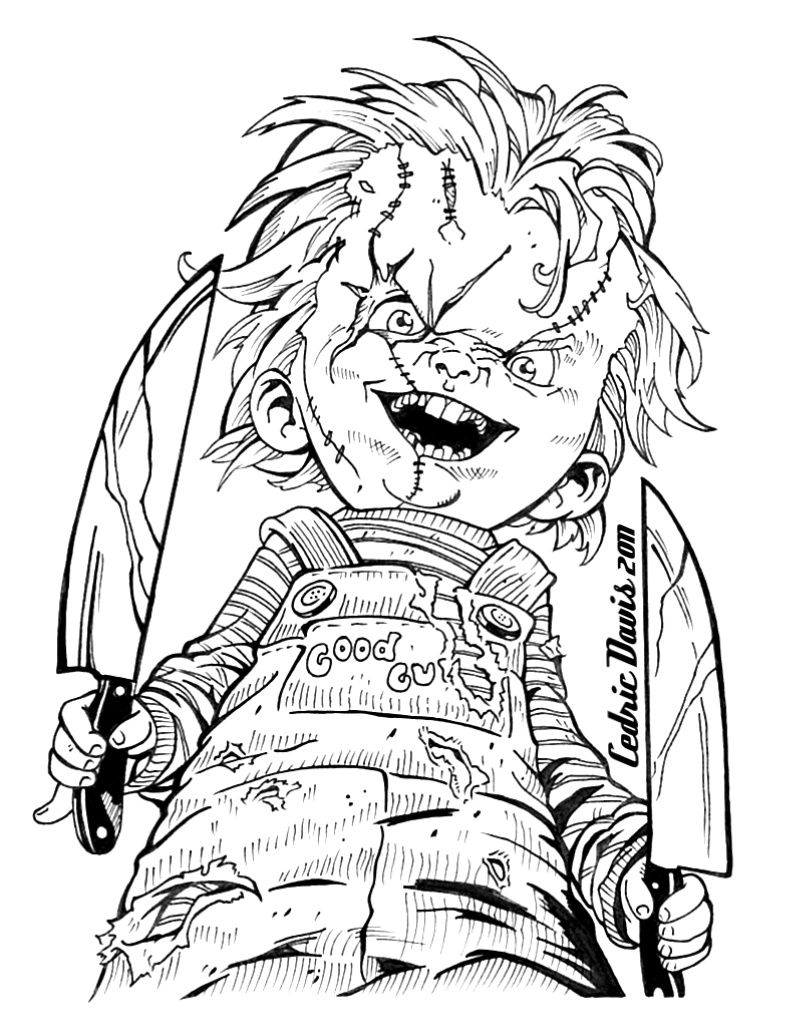
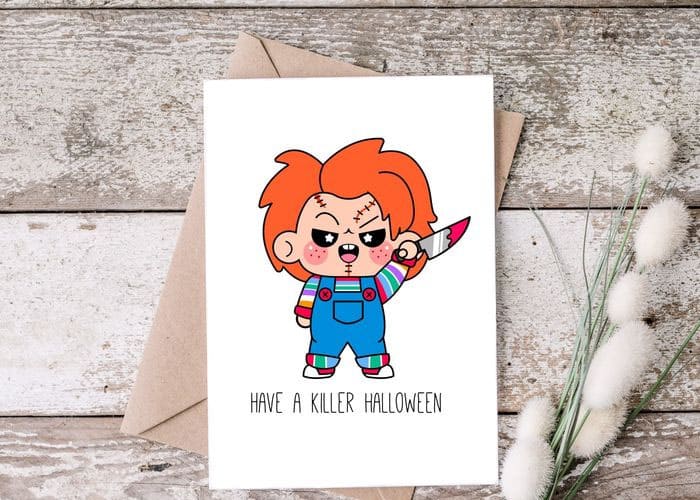
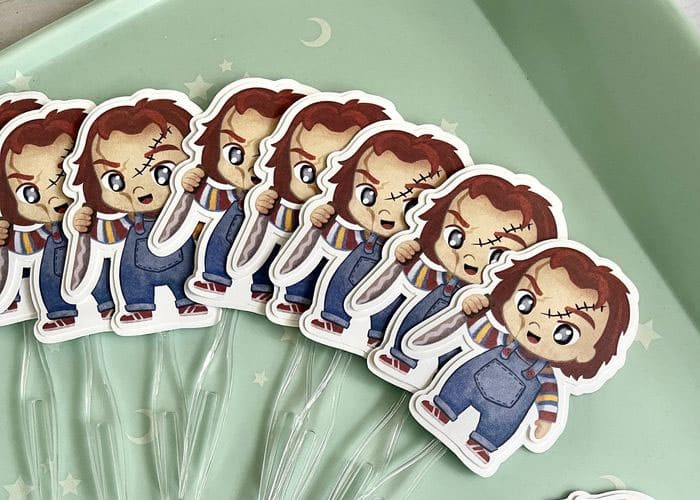
As the franchise has progressed across eight films from 1988 through 2017 (in the original continuity), Chucky has accumulated significant battle damage: cuts, burns, and stitched-together repairs that have given the later versions of his face a dramatically more threatening appearance than the relatively clean original design. The scarred Chucky, with irregular stitches crossing his face, one eye sometimes partially closed, and the specific asymmetry of battle-damaged features, is the design most associated with the franchise’s later entries and most commonly depicted in horror merchandise.
The scarring follows the logic of the films: in Bride of Chucky (1998), specifically, Chucky is destroyed at the end of the third film and then sewn back together by Tiffany, explaining the heavily stitched appearance that becomes his standard look from that point forward. The stitches are large, irregular, and rendered in dark thread against pale doll plastic skin.
The design tension in the scarred face is between the underlying “Good Guy” doll softness still visible in the round features, the blue eyes, and the orange hair, and the superimposed violence of the damage markings. The original innocence of the toy design is still visible beneath the violence, which is what makes the scarred version more disturbing than a design that had simply abandoned the doll aesthetic entirely.
Coloring the scarred face: The base skin is pale, slightly cool-toned plastic-skin off-white: not a warm human skin tone but the specific cool pale quality of molded plastic doll skin. The stitches are dark brown-black thread, rendered as a series of crossing short parallel lines at each stitch position. Any cuts or wounds visible between stitches use a deep red-brown at the wound opening, slightly darker than the surrounding pale skin. Any burn damage uses very dark brown to near-black. The eyes maintain their vivid blue regardless of surrounding damage.
Tiffany Valentine: The Bride of Chucky
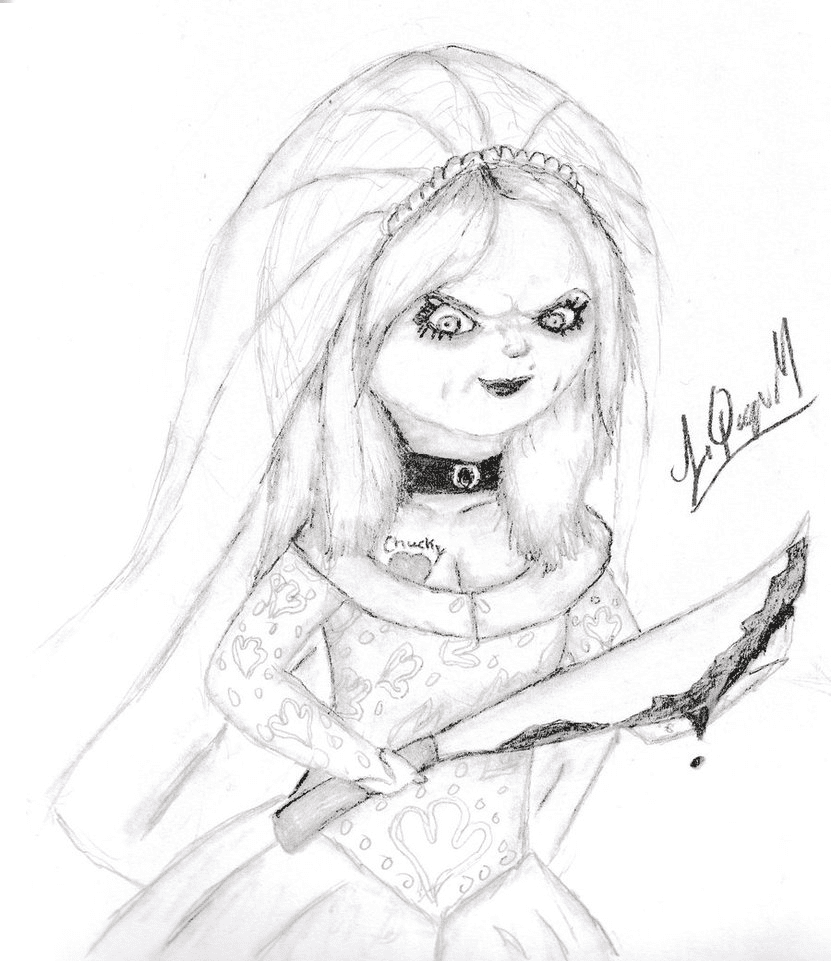
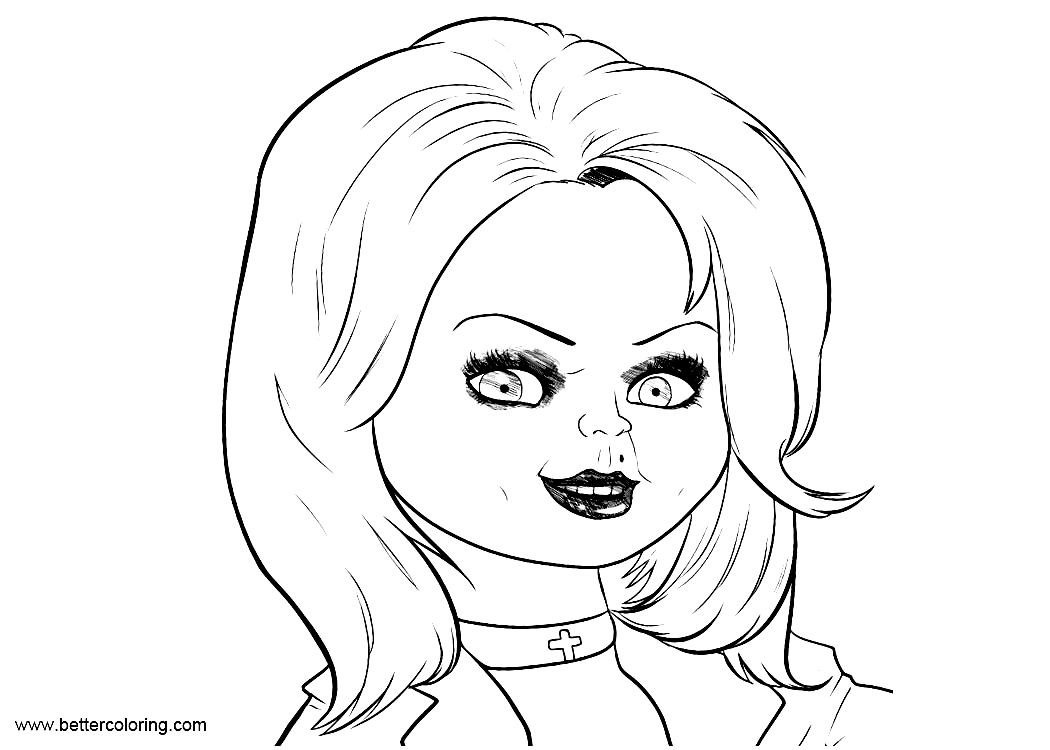
Tiffany Valentine, introduced in Bride of Chucky (1998), directed by Ronny Yu, is Charles Lee Ray’s former girlfriend who becomes his doll-form partner when her soul is also transferred into a female doll. She is voiced and given her appearance by Jennifer Tilly, who has continued the role across subsequent films and the television series. Tiffany has become the franchise’s second most iconic character and one of horror cinema’s more developed female villain designs.
Her doll form’s aesthetic is specifically designed to contrast with Chucky’s Good Guy doll origin: where Chucky draws from wholesome 1980s toy design, Tiffany’s doll form references gothic and punk femininity. Her doll has black hair styled with streaks and a dramatic cut, dark makeup (black eyeshadow, dark lipstick), and costumes that range from a wedding dress to punk and gothic outfits across the franchise’s various entries. The contrast between the delicacy of doll proportions and the specific adult confidence of her character is the foundation of her visual design.
Coloring Tiffany pages: Her hair is near-black with the specific gothic blue-black quality of very dark hair under light. Her makeup is dark: black eyeshadow applied heavily, dark lipstick in deep red or near-black. Her most iconic costume, the wedding dress, is bright white with ornate decorative elements. The contrast between the white dress and the dark hair and makeup is the design’s primary visual tension. Her eyes are often shown with a heavy, dark outline.
Horror Atmosphere and Composition Pages
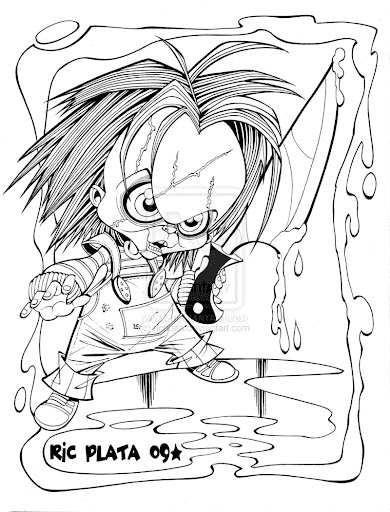
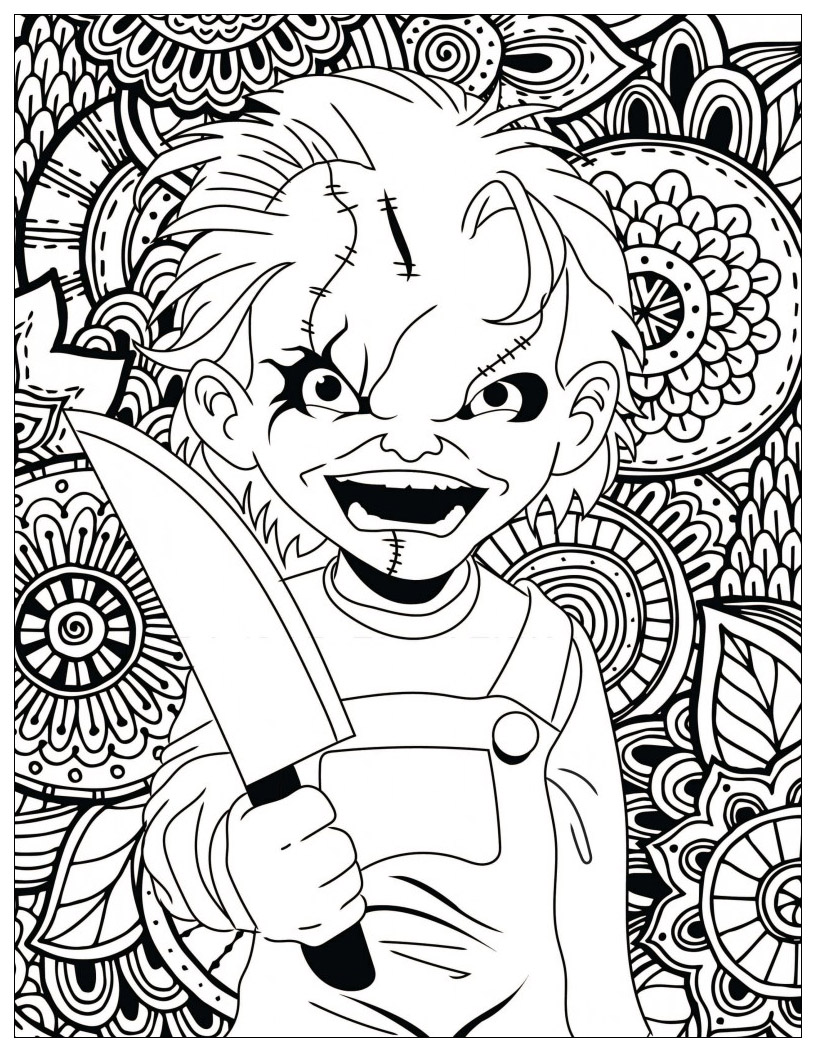
Several pages in the collection place Chucky within broader horror atmosphere compositions: dark environments suggesting the film’s settings (a child’s bedroom at night, a warehouse, a factory, a stairway), Halloween-appropriate decorative elements (bats, shadows, full moon backgrounds), and the specific visual register of horror genre illustration that has developed around the franchise’s merchandise and promotional materials.
These pages are the collection’s most artistically variable: they range from straightforward character placements against horror-suggesting backgrounds to more elaborate compositional arrangements that reference specific scenes or settings from the films.
Coloring horror atmosphere pages: Dark backgrounds use very deep navy or near-black for nighttime interiors. The Chucky figure should maintain full canonical color intensity (vivid orange-red hair, vivid blue eyes, vivid denim blue overalls) against the dark surrounding atmosphere: the contrast between the bright, apparently innocent doll colors and the dark horror atmosphere surrounding them is the specific visual tension these compositions are designed to create.
“Wanna Play?” Pose Pages
The phrase “Hi, I’m Chucky, and I’m your friend ’til the end! Wanna play?” is Chucky’s primary catchphrase, the “Good Guy” doll’s preprogrammed greeting that Chucky uses before dropping the pretense of being a normal toy. The phrase and the specific pose associated with it (the doll appearing to offer friendship, arms slightly out, head slightly tilted) have become the most reproduced elements of the franchise in horror merchandise, Halloween costumes, and fan art.
The “Wanna play?” pose shows Chucky in the position of apparent invitation: a friendly doll extending itself to a new child companion. The horror register of the franchise transforms this standard toy-greeting posture into something threatening.
Coloring “Wanna play?” pose pages: These pages typically show Chucky in a neutral or slightly forward-leaning posture with one or both hands extended. The facial expression should be colored with careful attention to the eye direction and mouth position: the eyes can be colored either in the full-innocent blue of the doll’s programmed appearance or in a slightly more intense blue, suggesting the awareness beneath. The mouth position, whether smiling or slightly open, determines whether the expression reads as friendly or threatening.
What These Pages Do
Don Mancini’s creation of Chucky in 1988 has been analyzed in horror scholarship as one of the more theoretically rich concepts in the genre: a killer doll whose horror derives not from supernatural shapeshifting or impossible speed but from the specific cognitive dissonance of a toy that behaves like an adult. The choice to anchor the character’s horror in a recognizable consumer product (a popular branded doll) gave the 1988 film a specific cultural commentary that subsequent horror scholars have noted: the “Good Guy” doll, with its advertising tagline “Your friend ’til the end,” is a parody of the commercial relationship between toy manufacturers and children, suggesting that the objects marketed specifically as children’s companions might harbor something other than their marketed intentions.
The franchise’s longevity, from the original 1988 film through the 2021 television series and its three seasons, is documented in horror film scholarship as exceptional: few horror franchise characters have maintained creative consistency across more than three decades, and the specific creative continuity provided by Don Mancini’s consistent authorship, Brad Dourif’s consistent voice performance, and the ongoing expansion of the franchise’s emotional and narrative range (from straightforward slasher in 1988 through horror-comedy in the late 1990s and back to genuine horror in the 2013 entry) distinguishes Chucky from most horror franchise characters.
The American Academy of Pediatrics identifies fine motor skill development as a key childhood milestone throughout early childhood. The franchise’s coloring pages, however, are categorically not appropriate for young children: all films in the Child’s Play franchise are rated R, and the television series carries a TV-MA rating. These pages are specifically for adults and older teens who are fans of the horror genre. The 2005 Art Therapy Journal study on structured coloring and anxiety reduction applies, particularly in the context of horror genre engagement, where the safe, controlled context of a coloring activity can be one way adults process genre content they find compelling.
How to Color These Pages Well
Chucky’s orange-red hair is the design’s most immediately recognizable element and must be vivid and warm. The hair color is the primary identification marker of the Good Guy doll in any context: it is a vivid, warm red-orange that reads as toy doll hair color rather than as natural human hair. Apply the most vivid warm red-orange available at full pressure across the full hair mass. If the result reads as too much toward red or too much toward orange, adjust in the correct direction by layering a small amount of the corrective color. The hair should look immediately recognizable as Chucky before any other design element is applied.
The denim blue overalls must be clearly a different blue from the eye blue. The eyes are a vivid, slightly lighter medium blue, while the denim overalls are a slightly darker, slightly more desaturated blue with the specific quality of washed denim. Apply the eye blue first (vivid, clear, saturated) and use it as the reference point against which the overall blue is slightly darkened and slightly desaturated. If both blues read the same, the design loses the visual distinction between fabric and eyes that is essential for the character to read as a recognizable doll.
Stitches on scarred face pages require precise, deliberate mark-making rather than continuous lines. Each stitch is a series of three or four short parallel marks crossing the wound line, not a continuous thread running along it. Apply each stitch grouping as distinct marks: two or three parallel lines crossing the wound, with a small space between each stitch grouping along the wound’s length. The thread color is very dark brown or near-black, applied with the finest available tool. The wound opening between stitches uses a slightly darker reddish-brown to suggest the tissue beneath.
The pale plastic skin tone is cooler than human skin and should not be warm. Chucky’s doll skin is the specific cool, slightly grey-white of molded plastic rather than the warm peachy tone of human skin. Apply a pale, slightly cool-toned off-white across all face and hand surfaces. If the available skin tone pencil reads as too warm or too orange-pink, add a very light layer of pale cool grey over it to shift it toward the correct plastic quality.
Dark backgrounds require completion before the foreground character. On horror atmosphere pages with dark backgrounds, apply the background dark tones (near-black for nighttime interiors, deep blue-black for night sky) at full coverage before working on the Chucky figure. The contrast between the fully dark background and the vivid character colors (orange-red hair, blue eyes, blue overalls) creates the specific visual impact these compositions require. Applying the character first and then trying to darken around it risks contaminating the character’s vivid colors with the background tone.
5 Creative Craft Ideas
The “Good Guy” Design Analysis
The Good Guy doll’s design was specifically created by Kevin Yagher to parody the popular Hasbro “My Buddy” dolls of the mid-1980s: child-sized, designed with exaggerated friendly features (large eyes, round face, vivid hair) specifically to seem appealing to children. The “uncanny valley” effect (described by robotics professor Masahiro Mori in 1970) identifies the specific discomfort produced when something appears almost but not quite human.
Print the cleanest, most undamaged Chucky portrait page in the collection. Color it in full canonical design: vivid orange-red hair, bright blue eyes, freckled, round face, denim overalls.
On the backing card: “‘Good Guy’ doll design. Created by Kevin Yagher. 1988. The uncanny valley effect (Masahiro Mori, 1970): human figures that are almost-but-not-quite human produce specific discomfort in observers. The Good Guy doll: designed to seem friendly. Chucky: the soul of a serial killer inside the friendly design. The design works as horror because the innocence is real. The innocence is still there. The soul inside is not.”
The Don Mancini Continuity Study
Don Mancini created Chucky in 1988 and has written every film in the original continuity and created the television series. No other horror franchise creator has maintained this level of creative ownership across a comparable time span. The franchise has run continuously under his authorship from 1988 through at least 2024: 36 years of consistent creative control over a single horror property.
Print a full-body Chucky page. Color it in the scarred, later-film design version: pale plastic skin with dark stitching, vivid orange-red hair, the distinctive weathered look of the franchise’s more recent visual style.
On the backing card: “Don Mancini. Creator of Chucky. Writer, Child’s Play (1988). Writer, Child’s Play 2 (1990). Writer, Child’s Play 3 (1991). Writer/Director, Bride of Chucky (1998). Writer/Director, Seed of Chucky (2004). Writer/Director, Curse of Chucky (2013). Writer/Director, Cult of Chucky (2017). Creator/Writer, Chucky TV series (2021-present). 36 years. One character. One creator. This is unusual in horror.”
The Bride and Groom Page
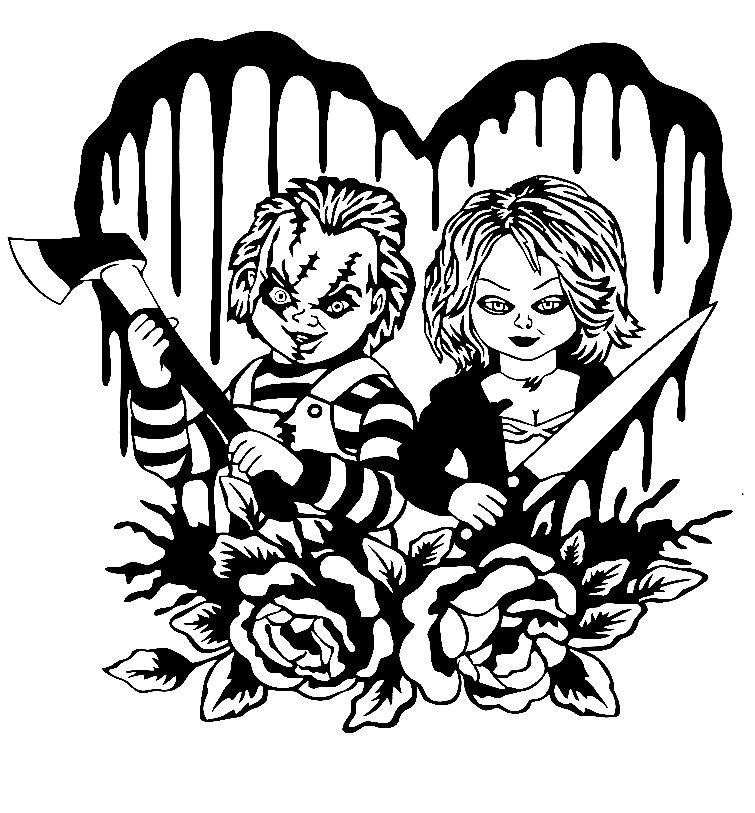
Chucky and Tiffany, introduced as a couple in Bride of Chucky (1998), are the horror genre’s most enduring doll-villain couple and one of horror’s most distinctly characterized pairs of antagonists. The film shifted the franchise significantly: from straightforward slasher horror toward horror-comedy, from a single antagonist toward a dual antagonist couple, and from a serious threat toward a self-aware parody of romantic relationship tropes.
Print one Chucky portrait page and one Tiffany portrait page. Color Chucky in the heavily stitched, scarred version of his face and his canonical overalls. Color Tiffany in her gothic doll design: near-black hair, dark makeup, white wedding dress.
Mount both side by side: “Chucky (Charles Lee Ray): soul of The Lakeshore Strangler, inside a Good Guy doll. Voiced by Brad Dourif. First appearance: Child’s Play, 1988. Tiffany Valentine: the soul of Chucky’s girlfriend, inside a female doll. Voiced and performed by Jennifer Tilly. First appearance: Bride of Chucky, 1998. The couple: horror cinema’s most consistently present doll-villain pair. Director Ronny Yu shifted the franchise from slasher to horror-comedy. Don Mancini continued the relationship across every subsequent entry.”
The Damballa Voodoo Connection
The voodoo ritual that Charles Lee Ray uses to transfer his soul into the Good Guy doll invokes Damballa, a real loa in Haitian Vodou religious tradition. Damballa (also spelled Damballah) is the serpent loa associated with creation, purity, and the cosmos in Haitian Vodou. He is typically invoked with specific rituals, foods, and prayers and is one of the most respected loa in the Vodou pantheon. His appearance in a Hollywood horror film as the facilitating deity of a serial killer’s soul transfer has been discussed in contexts examining Hollywood’s use of non-Western religious traditions.
Print the most dramatically posed Chucky page in the collection. Color it in the vivid, high-contrast version of the character: the brightest orange-red hair, the most vivid blue eyes, the darkest denim.
On the backing card: “Damballa (Damballah). Haitian Vodou serpent loa. Associated with creation, purity, and the sky serpent. The Heart of Damballa: the voodoo spell used by Charles Lee Ray in Child’s Play (1988) to transfer his soul. Haitian Vodou: a syncretic religion developed by enslaved Africans in Haiti, combining West African religious traditions with elements of French Catholicism. The franchise’s use of Damballa as a plot mechanism: widely noted in discussions of Hollywood’s use of non-Western religious traditions as horror shorthand.”
The Franchise Timeline: 36 Years
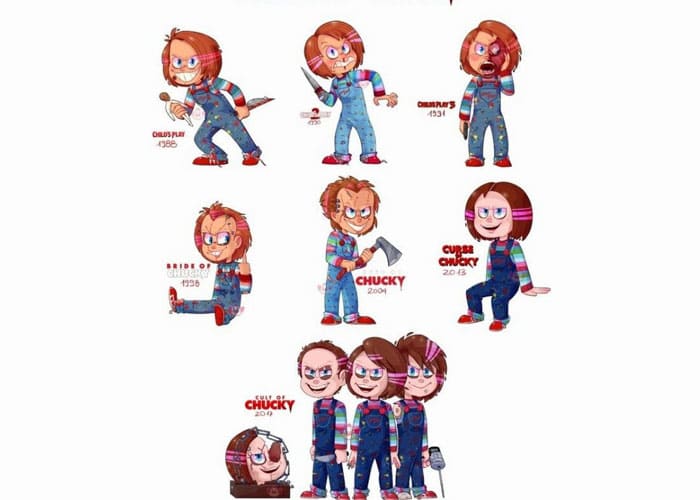
The Child’s Play franchise has produced films continuously from 1988 through 2017 in the original continuity, plus a 2019 reboot, plus a television series beginning in 2021. The timeline spans more than 36 years from the first film to the current television series.
Print one Chucky page representing each major franchise era: the clean 1988 original design, the scarred 1998 design (from Bride of Chucky onward), and the television series-era version.
Color each in the design appropriately to its era. Mount in chronological order: “Child’s Play (1988): the original. Budget: $9 million. Box office: $44 million. Child’s Play 2 (1990). Child’s Play 3 (1991). Bride of Chucky (1998): horror-comedy shift. Seed of Chucky (2004). Curse of Chucky (2013): return to serious horror. Cult of Chucky (2017). Child’s Play (2019): reboot, not Don Mancini’s. Chucky TV series (2021-present). 36 years. One voice (Brad Dourif). One creator (Don Mancini, except the 2019 reboot). The doll keeps coming back.”
Guessing Game with Chucky
Frequently Asked Questions
Who is Chucky, and what is his origin? Chucky is the horror character from the Child’s Play franchise, created by Don Mancini and first appearing in Child’s Play, released November 9, 1988. His real identity within the fiction is Charles Lee Ray, a serial killer known as “The Lakeshore Strangler,” who was shot and fatally wounded by a detective. Dying in a toy store, he used a voodoo ritual invoking the Haitian Vodou serpent loa Damballa to transfer his soul into a “Good Guy” brand children’s doll. The doll subsequently functions as Chucky’s physical form throughout the franchise as he attempts to transfer his soul into a human host. He has been voiced in every film and television episode by Brad Dourif, who also played the human Charles Lee Ray in the original film.
What does Chucky look like, and how has the design changed? Chucky’s basic design is that of a “Good Guy” brand children’s doll: approximately two and a half feet tall, with vivid orange-red hair, large blue eyes, a round, freckled face, denim overalls, and a red-and-yellow striped shirt. This design was created by special effects artist Kevin Yagher and modeled partly on Hasbro’s “My Buddy” dolls that were popular with children in the mid-1980s. The design remained relatively clean and undamaged in the first three films. Beginning with Bride of Chucky (1998), after Chucky is destroyed and sewn back together by Tiffany, his face shows extensive battle damage: large, irregular stitches crossing his face, cuts, burns, and asymmetrical repairs that have given later entries in the franchise their more visually threatening version of the character. The scarred and stitched face is the most commonly depicted version in horror merchandise.
Who is Tiffany, and how does she fit into the franchise? Tiffany Valentine is Charles Lee Ray’s former girlfriend, introduced in Bride of Chucky (1998), directed by Ronny Yu. In the film, she obtains and reassembles Chucky’s remains and is subsequently killed and has her soul transferred into a female doll by Chucky. She has been voiced and given her appearance by Jennifer Tilly in every subsequent franchise entry and in the television series. Tiffany’s doll form is distinctly designed: gothic/punk aesthetic with near-black hair, heavy dark makeup, and outfits ranging from a wedding dress to punk styling. Her relationship with Chucky shifted the franchise toward horror-comedy while also making the franchise’s villain pairing one of horror cinema’s more developed dysfunctional relationships. The Chucky television series has continued to develop both characters.
Who created the Child’s Play franchise, and what is their role in it? Don Mancini created Chucky and the Child’s Play franchise in 1988. He wrote the original screenplay and has written every film in the original continuity since, also directing Seed of Chucky (2004), Curse of Chucky (2013), and Cult of Chucky (2017). He created and runs the Chucky television series, which premiered on October 12, 2021. His consistent creative involvement across more than 36 years is unusual in horror franchise history and is credited with the franchise’s maintained character consistency and tonal evolution across multiple distinct phases (straightforward slasher in 1988-1991, horror-comedy from 1998-2004, serious horror return in 2013-2017, and expanded television format from 2021 onward). The 2019 Child’s Play remake was produced without Mancini’s involvement and is not considered part of the original continuity.
What is the significance of the “uncanny valley” to Chucky’s horror design? The “uncanny valley” is a concept first described by robotics professor Masahiro Mori in a 1970 paper, identifying the specific psychological discomfort humans experience when an artificial figure (robot, puppet, doll, or CGI character) appears almost but not quite human. The effect produces discomfort rather than the sympathy produced by clearly robotic or clearly human appearances. Chucky’s horror effectiveness is directly connected to this principle: a child-sized doll designed with exaggerated friendly features (large eyes, round face, vivid hair) specifically intended to seem appealing to children becomes disturbing when animated to express adult anger, violence, and menace. The design’s horror arises not from the doll looking frightening but from the specific mismatch between the appearance (innocent toy) and the behavior (dangerous killer).
Is the 2019 Child’s Play remake part of the same franchise? The 2019 Child’s Play remake, directed by Lars Klevberg and released June 21, 2019, is a separate reimagining of the concept that was made without Don Mancini’s involvement or consent. In this version, the doll (called “Buddi”) is possessed not by a serial killer’s soul through voodoo but by a malfunctioning AI system. Mark Hamill voices the AI. Mancini and the original franchise’s rights holders were simultaneously producing content in the original continuity (the Chucky television series premiered in 2021), and Mancini publicly objected to the remake’s production. The 2019 remake is not considered canonical to the original franchise.
What age group are these pages best suited for? Chucky coloring pages are exclusively appropriate for adults and older teenagers who are fans of the horror genre. Every film in the Child’s Play franchise is rated R (Restricted) by the MPAA, indicating content not appropriate for those under 17 without parental guidance. The Chucky television series carries a TV-MA rating. The character, designs, and franchise context depicted in these pages derive from horror films specifically rated for mature audiences. The pages themselves do not contain graphic violent content, but depict a character from horror films whose franchise context is exclusively adult. These pages are not appropriate for children.
Browse the full collection at ColoringPagesOnly.com. All 30+ pages free, no sign-up, PDF or PNG, print or color online.
Tom Holland directed a film in 1988 about a Good Guy doll that turned out to contain the soul of a serial killer. The budget was $9 million. The box office was $44 million. Don Mancini had written the character.
Mancini has been writing Chucky ever since. That is 36 years. Brad Dourif has been voicing Chucky ever since. In Bride of Chucky (1998), Jennifer Tilly joined the franchise and has not left.
The doll has accumulated scar tissue and stitches over the years. The orange-red hair and the blue eyes have not changed. The overalls are still denim. The phrase “Wanna play?” still works.
Pick up your most vivid warm red-orange for the hair. Apply at full pressure. The eyes are vivid blue with a white highlight dot. The overalls are medium denim blue. The stitches, if the scarred design, go last in near-black with the finest available tool.
Share your work on Facebook and Pinterest and tag #Coloringpagesonly. The franchise timeline displays, and the Bride and Groom pages are particularly worth sharing.
Color the hair orange-red. Apply the eye blue vivid. The doll’s been around since 1988. The stitches are new. The soul is the same.