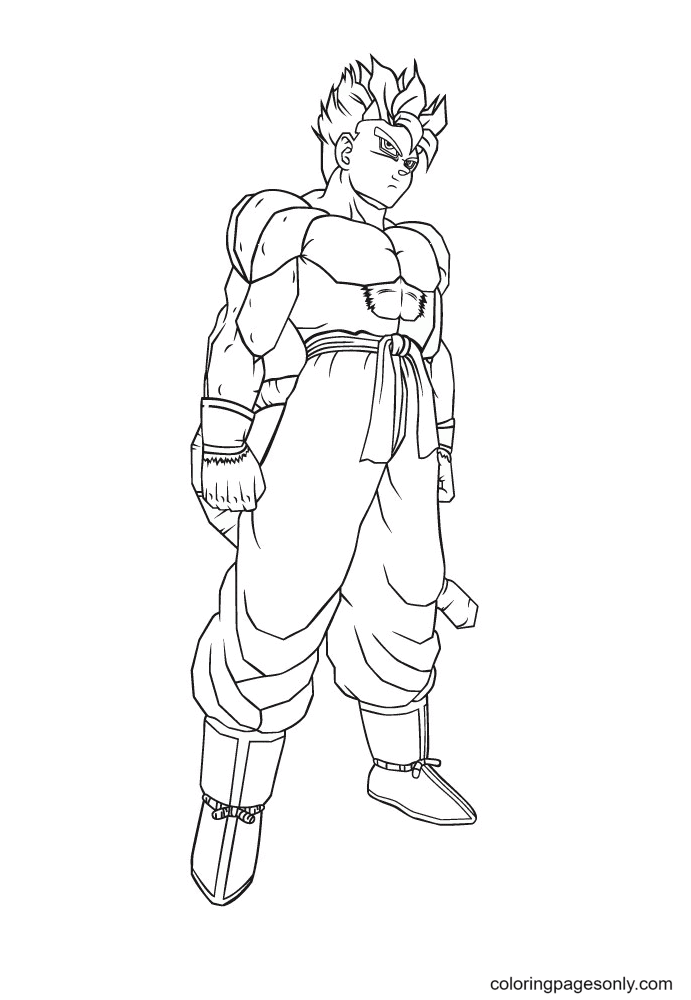
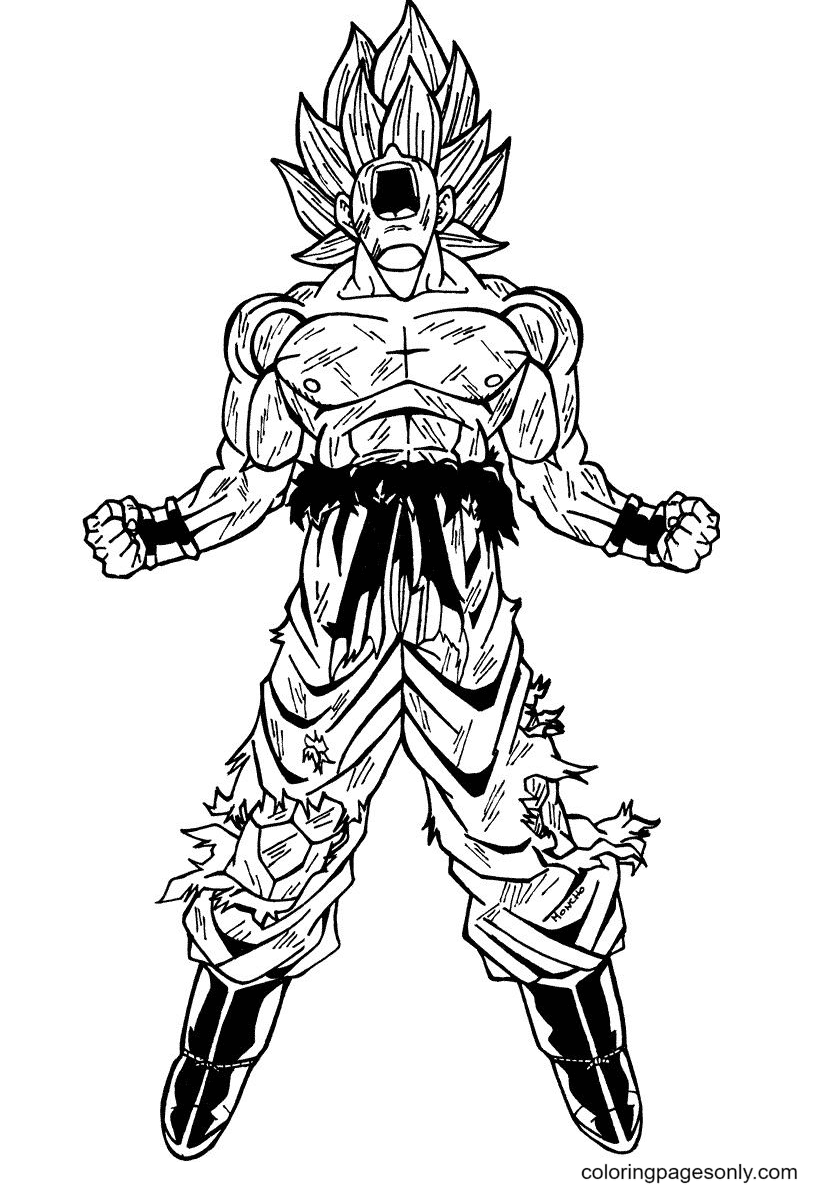
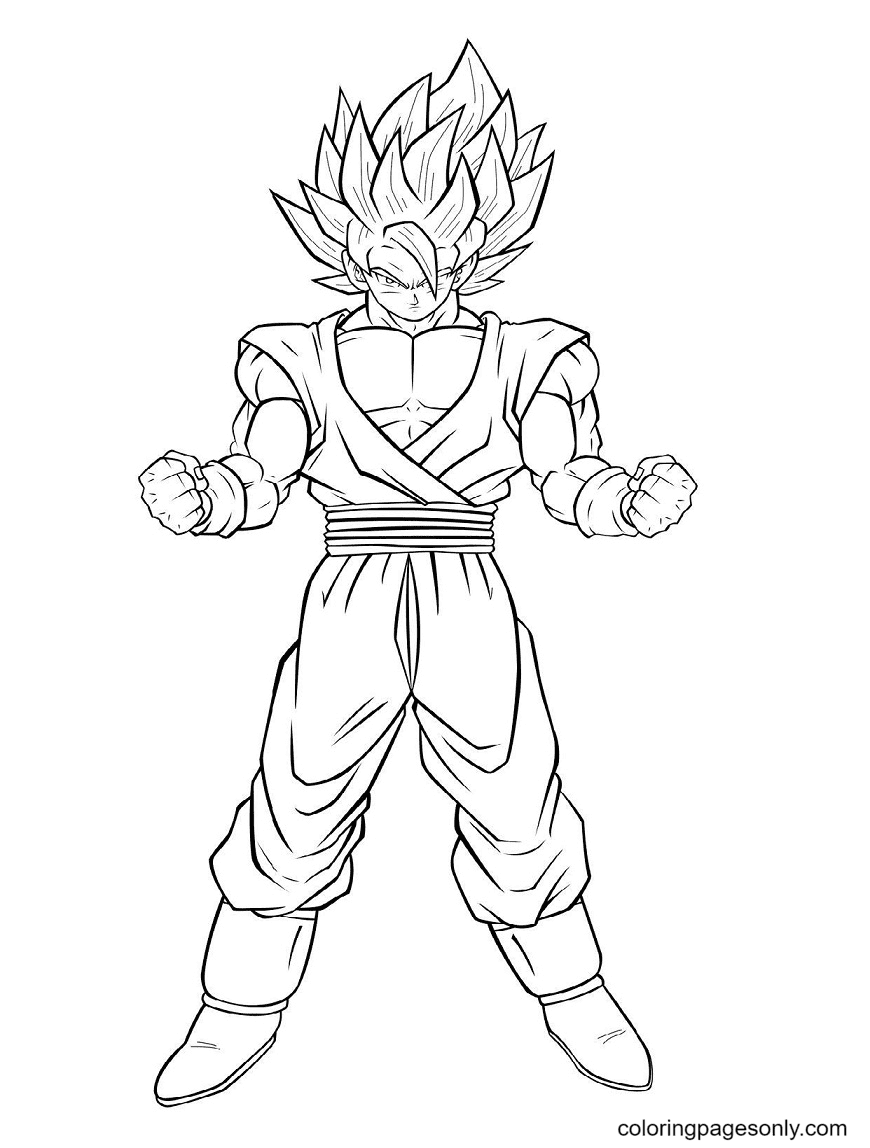
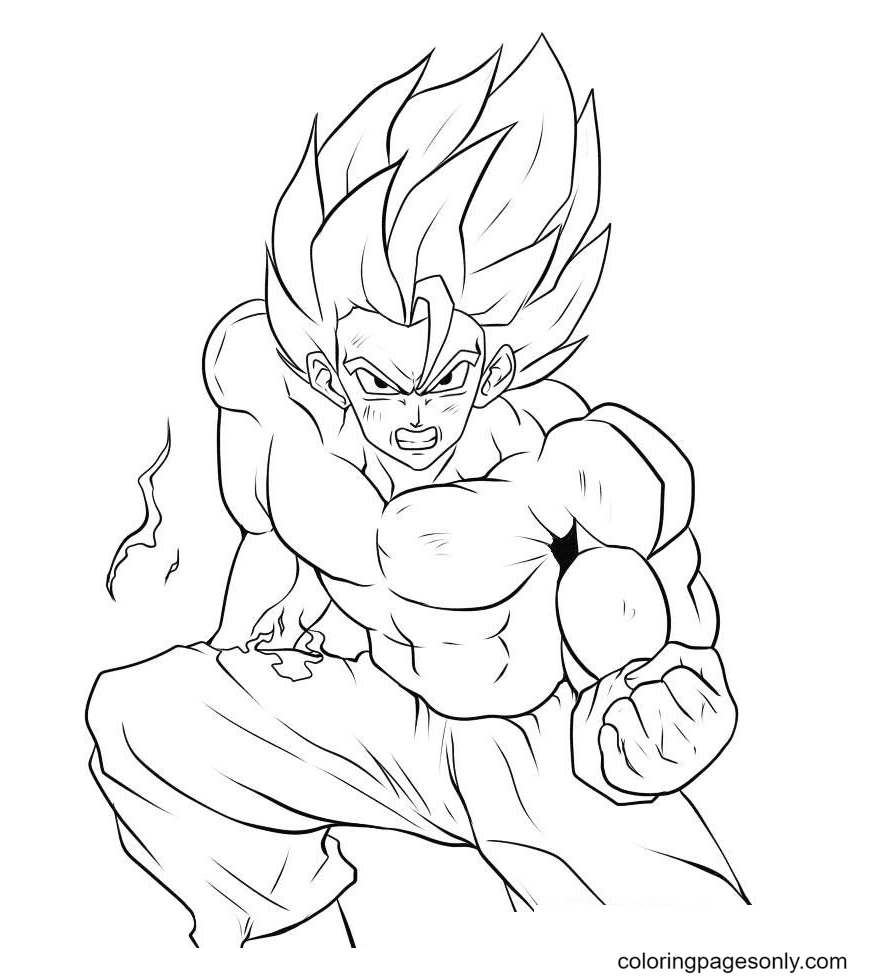
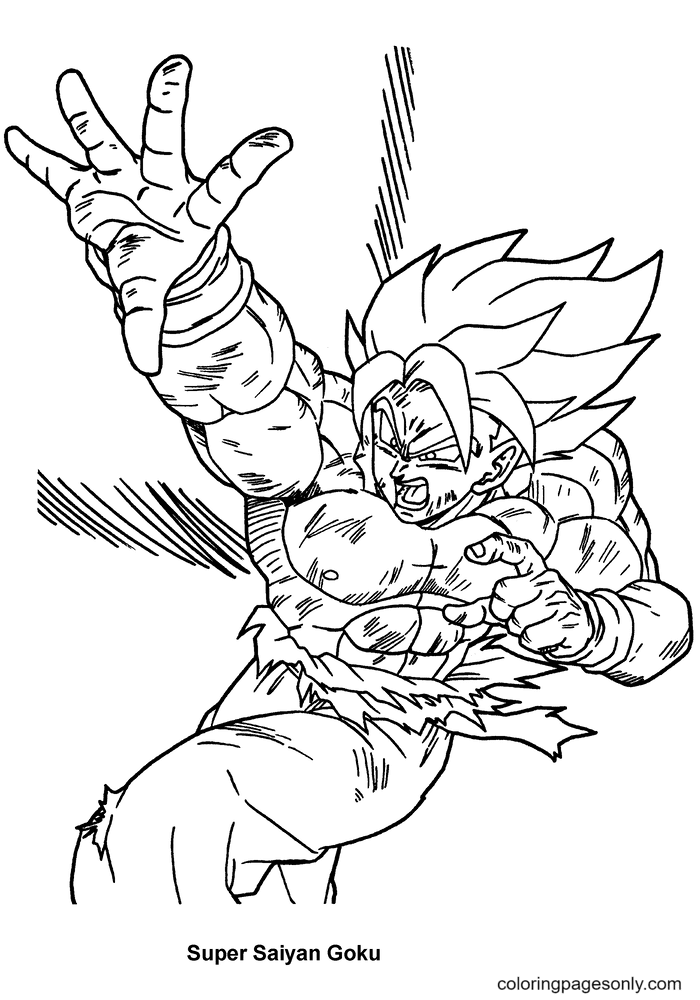
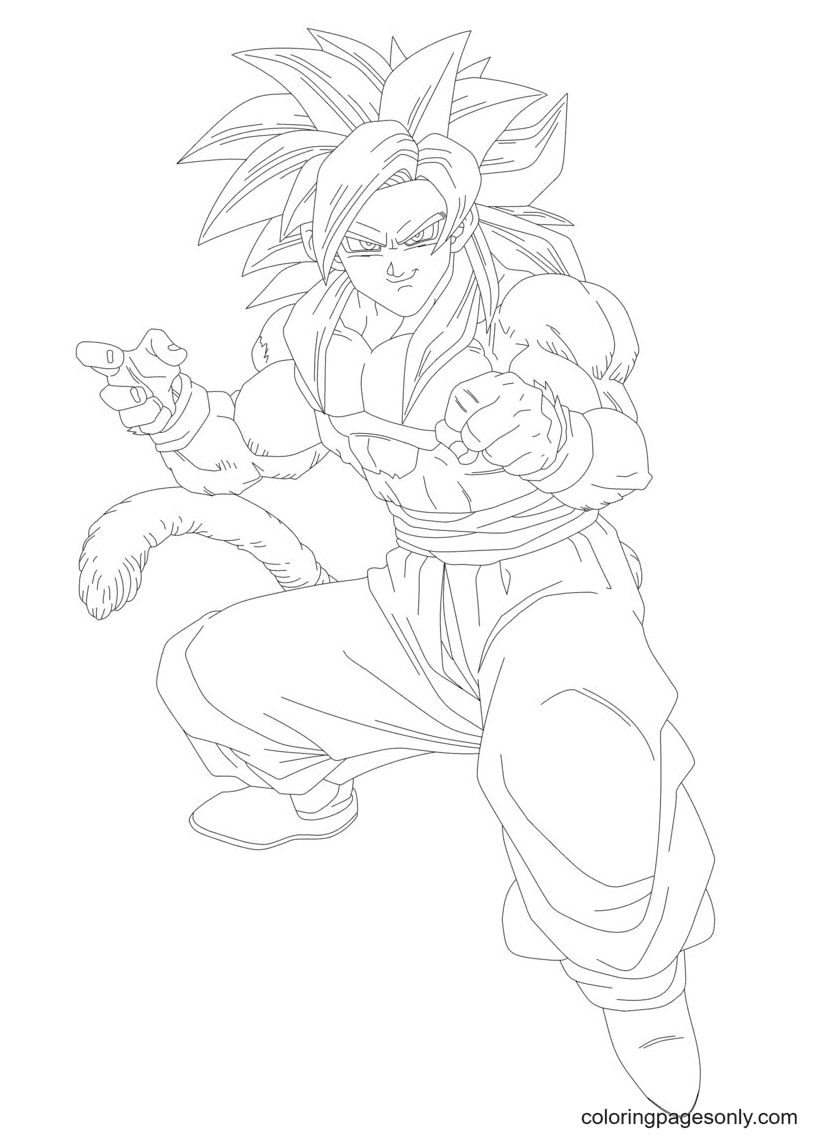
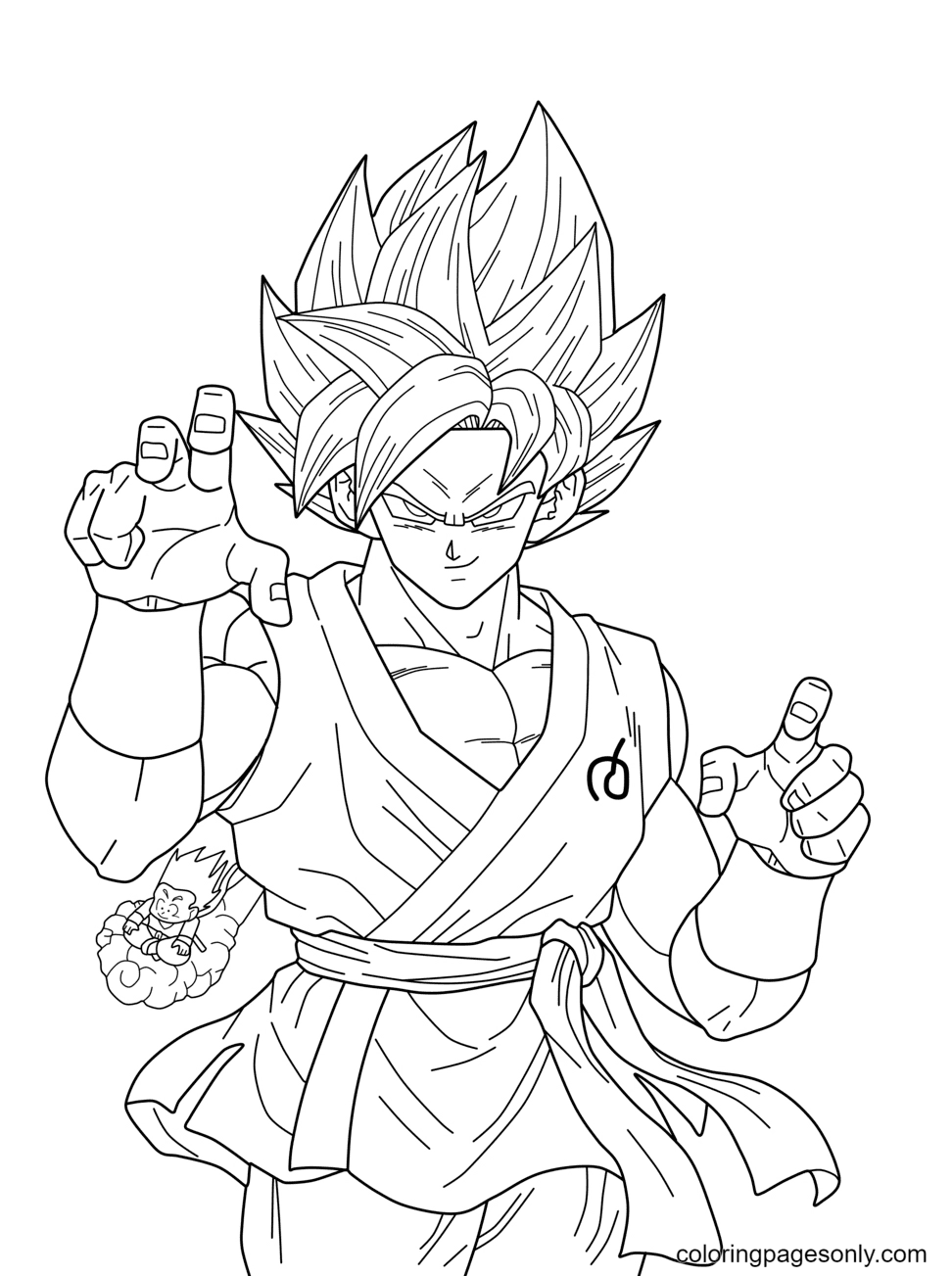
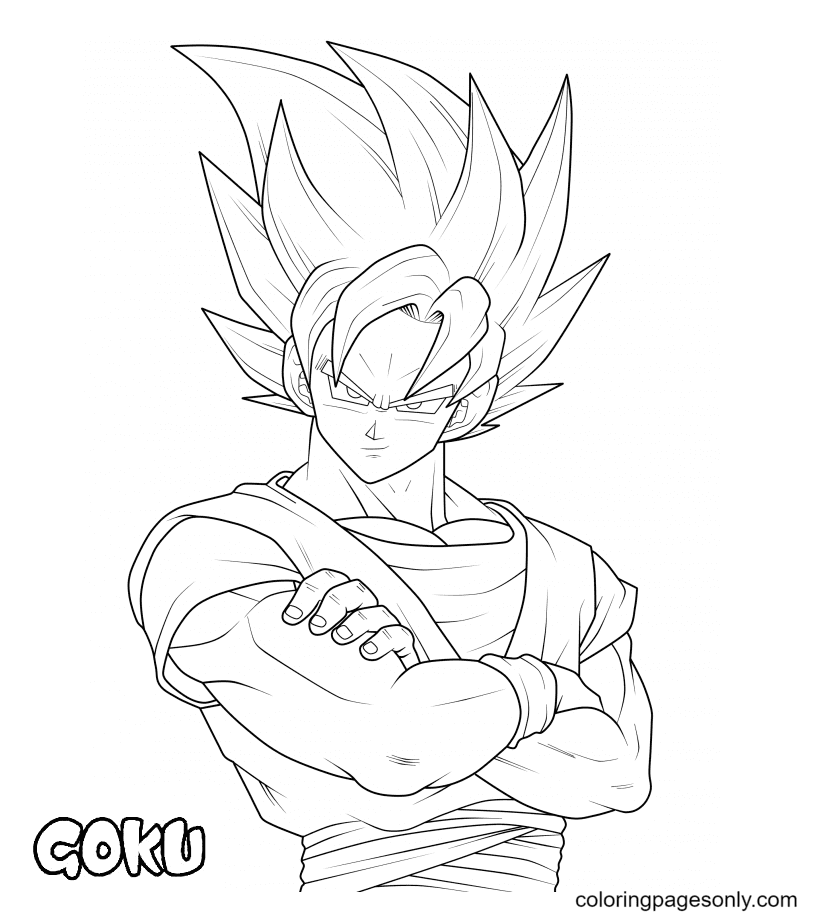
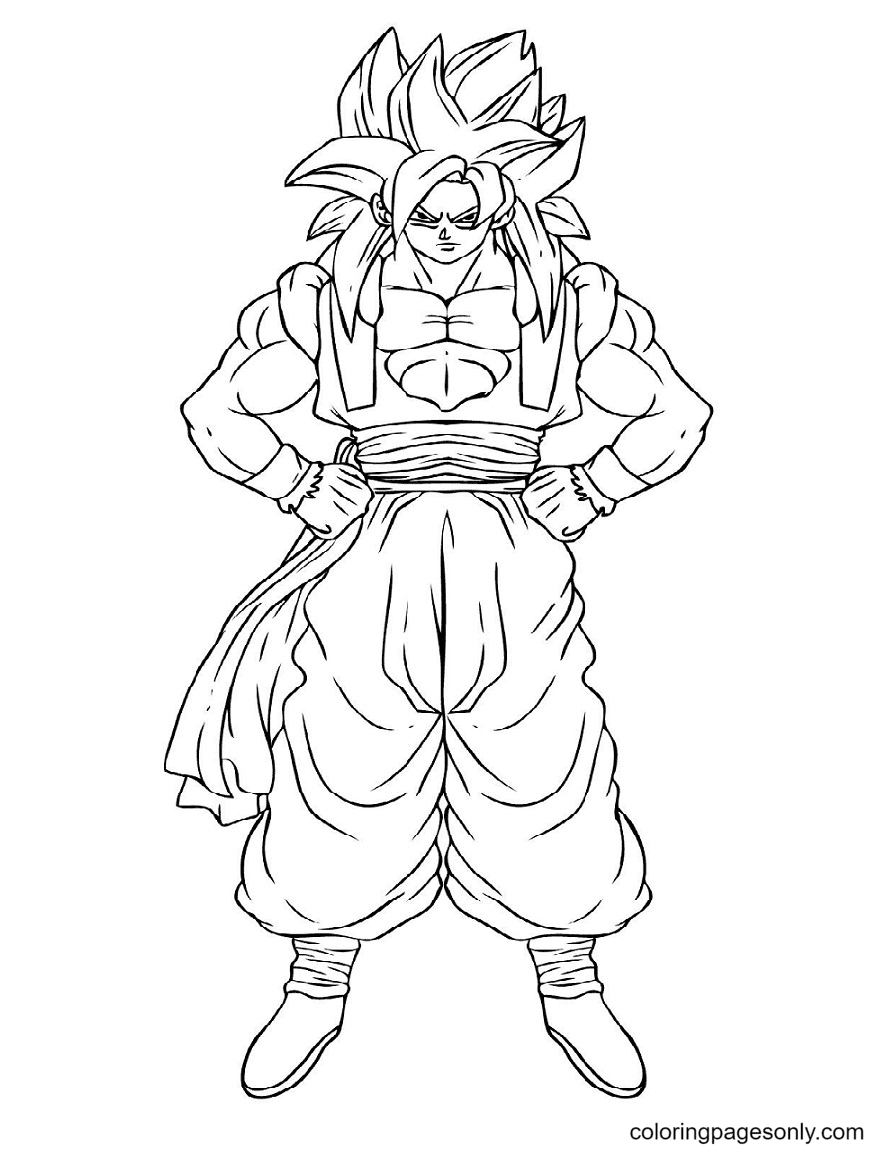
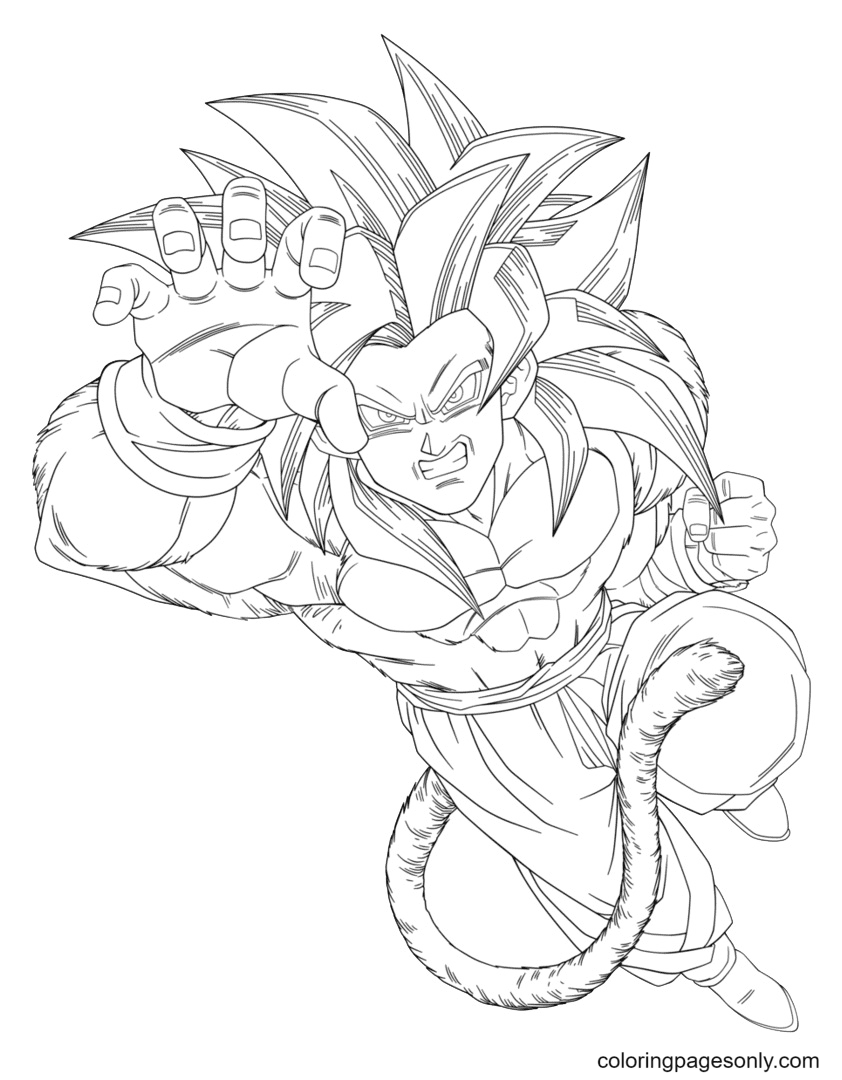
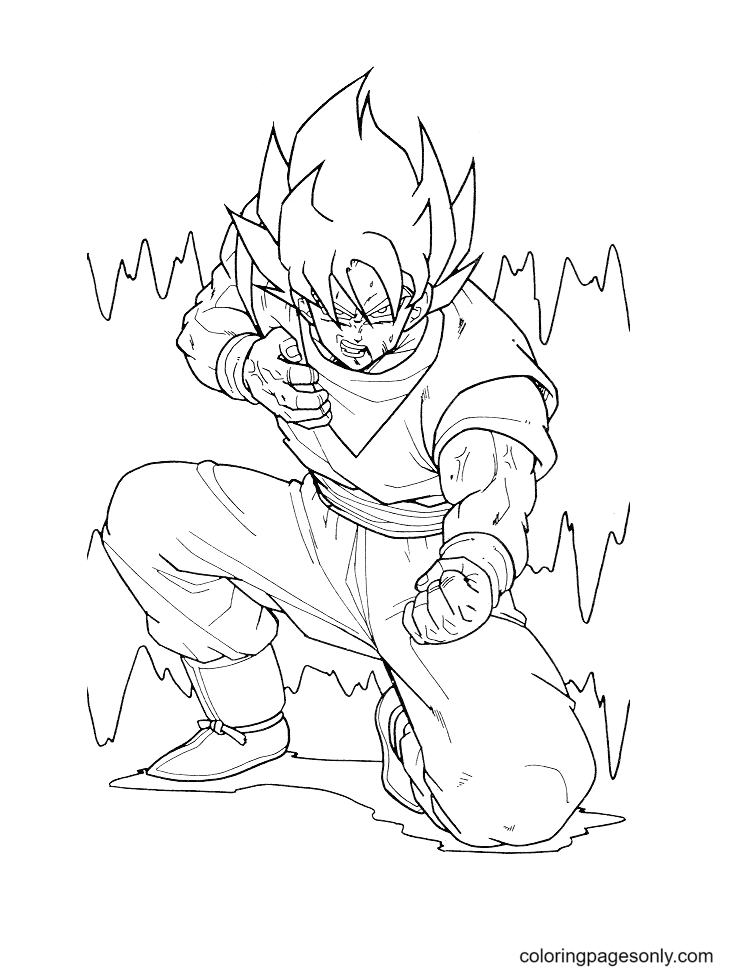
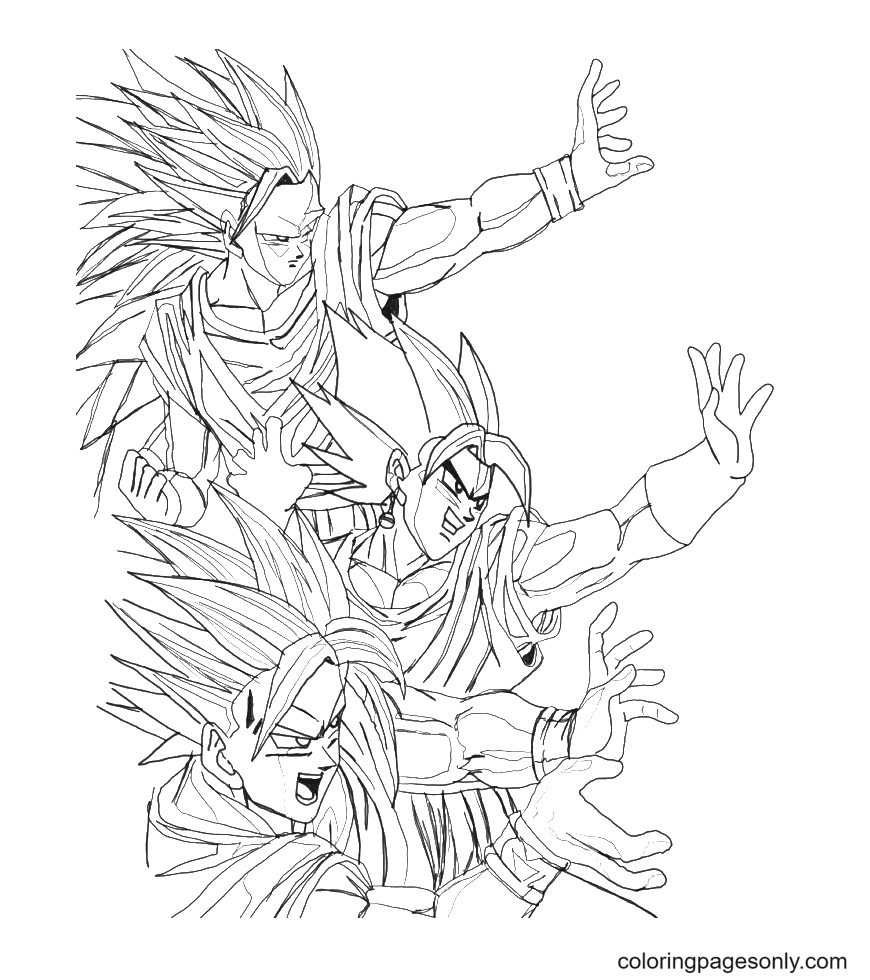
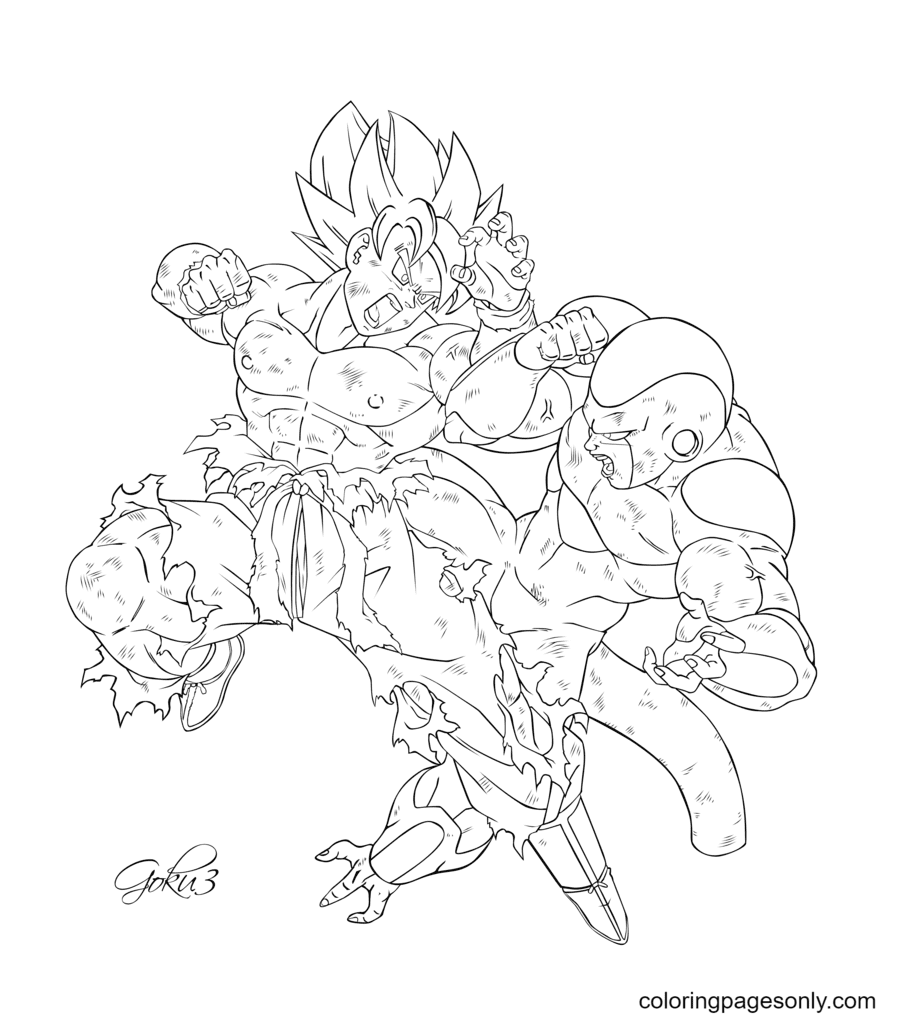
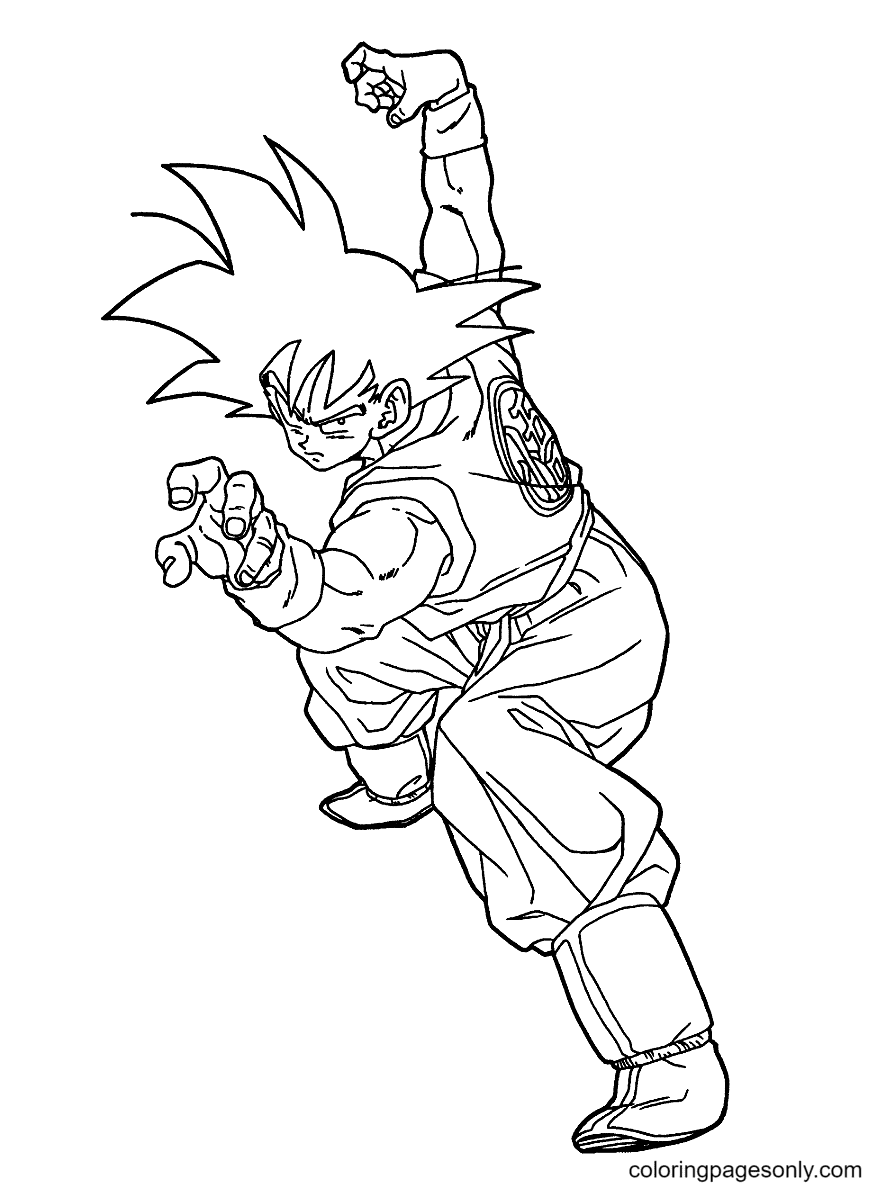
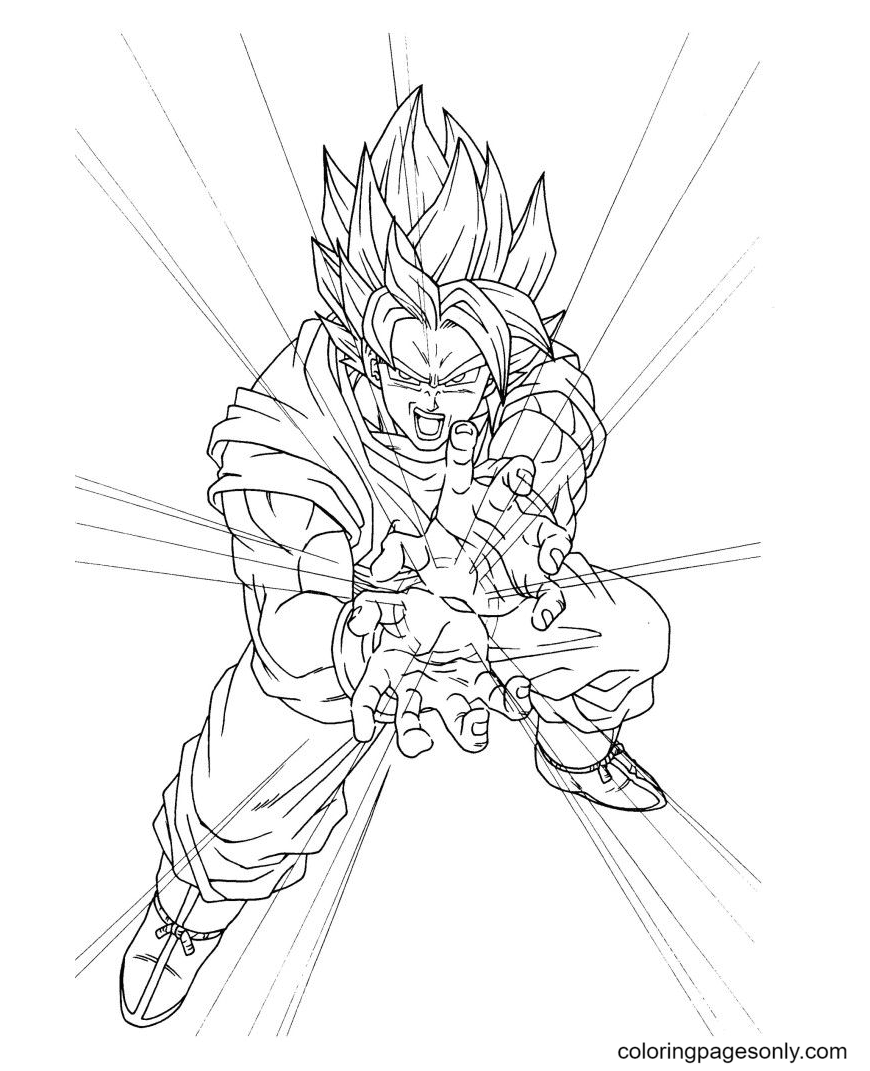
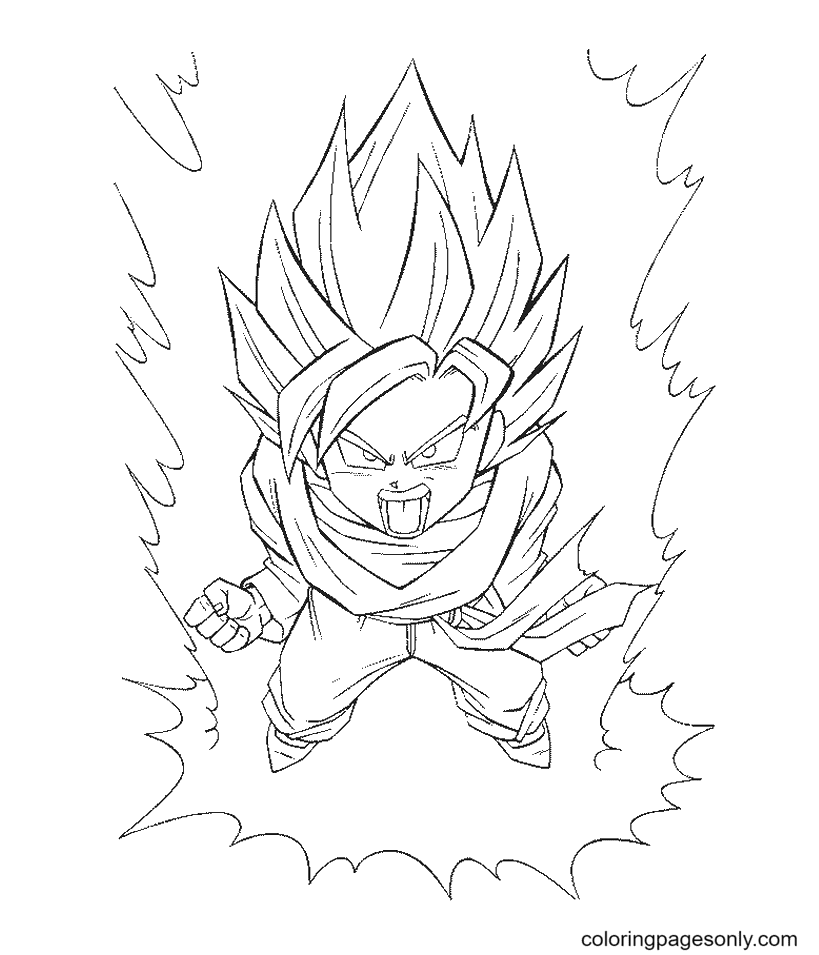
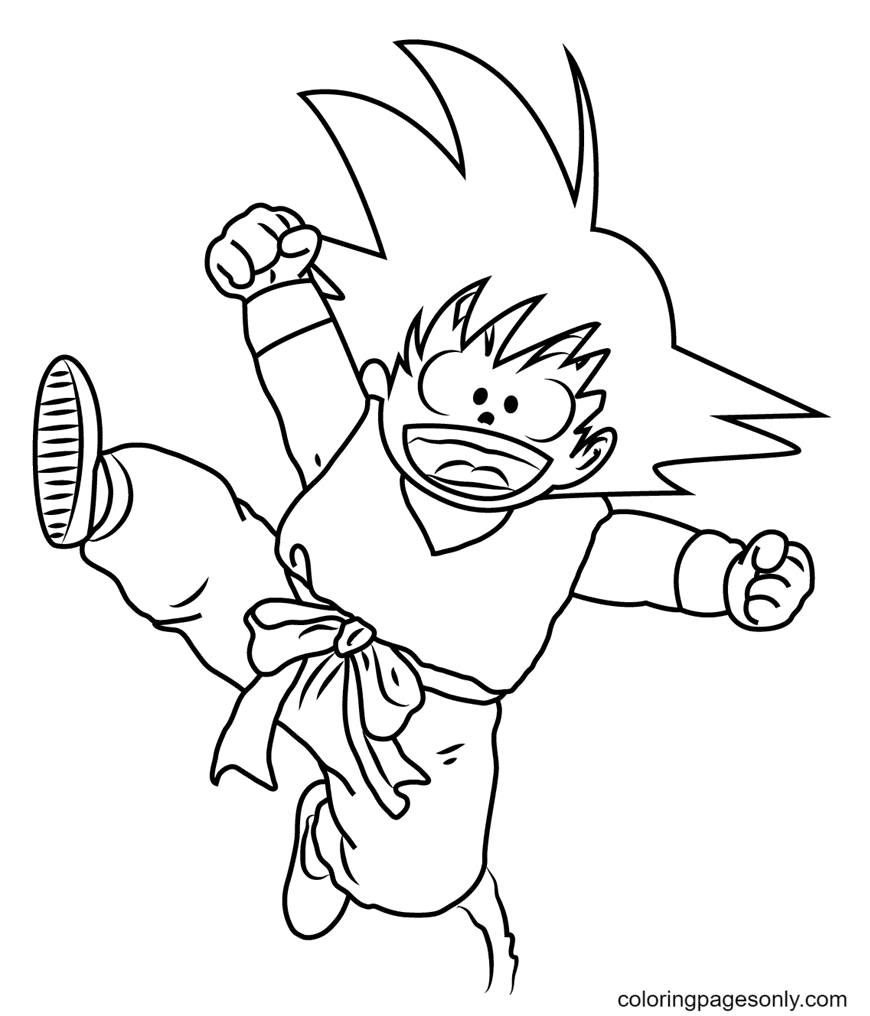
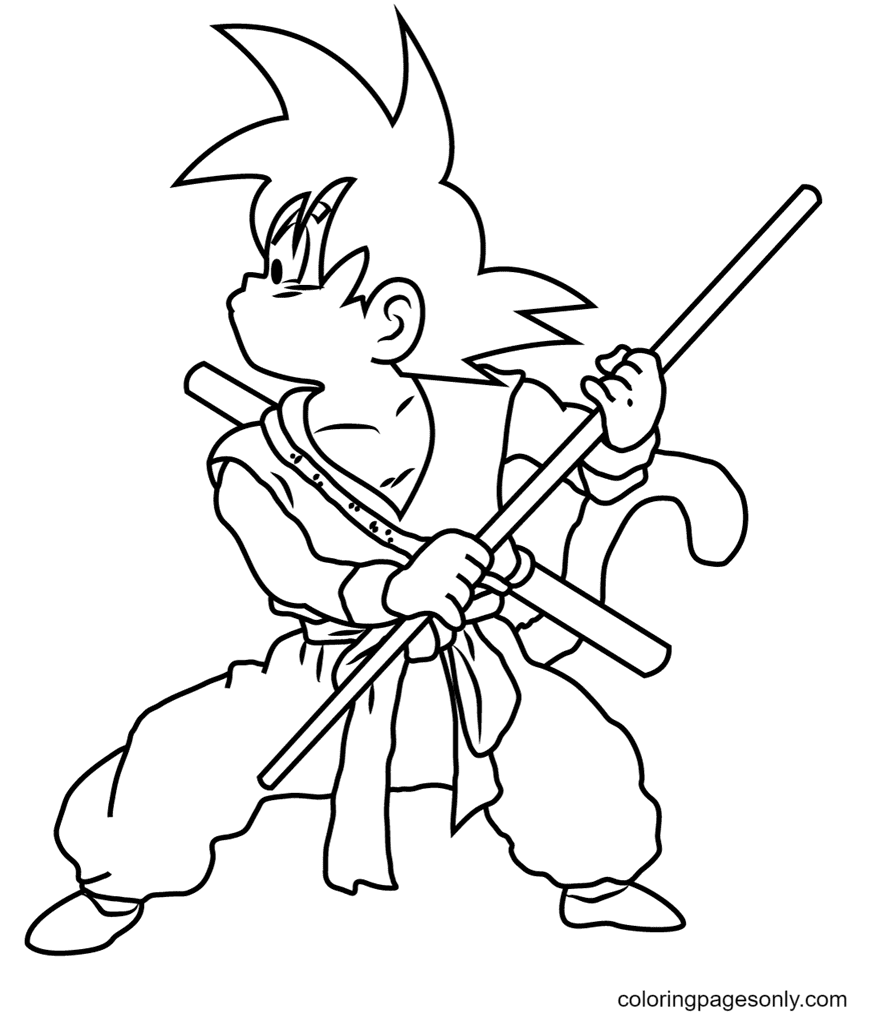
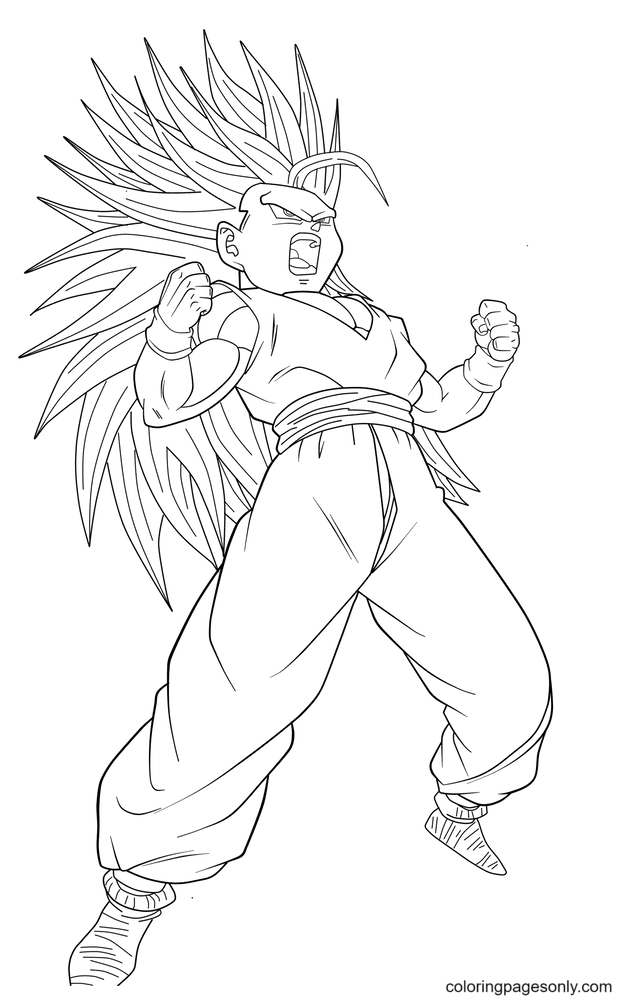
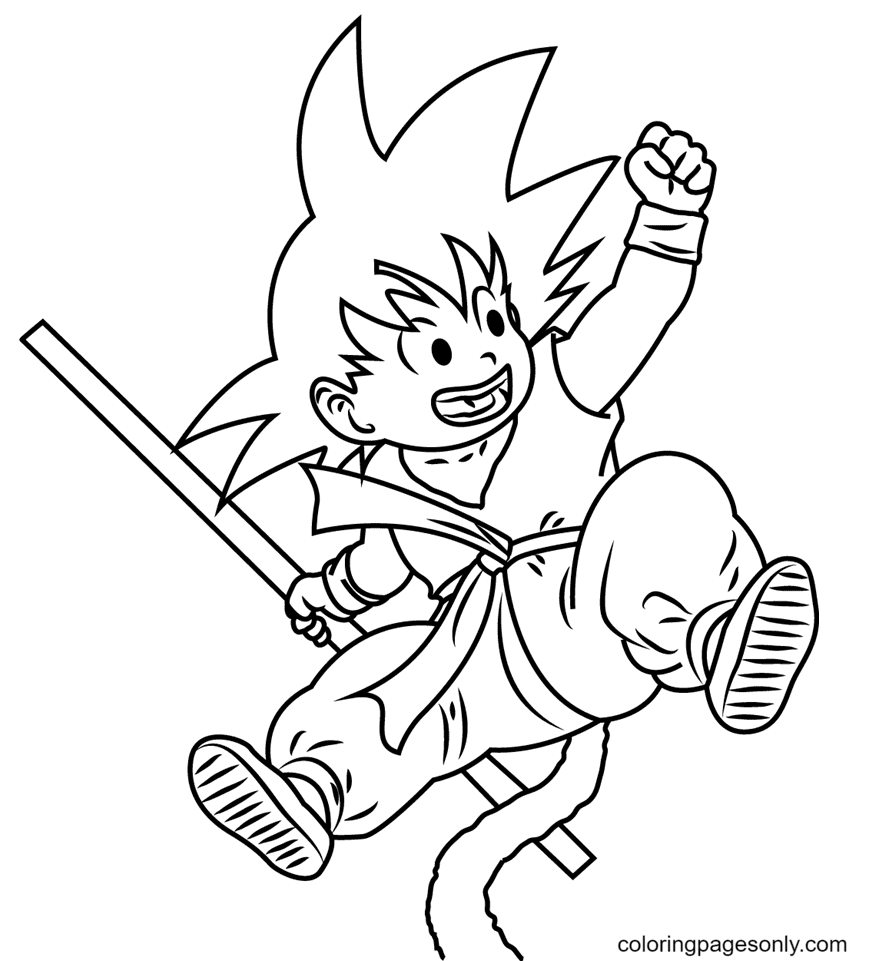
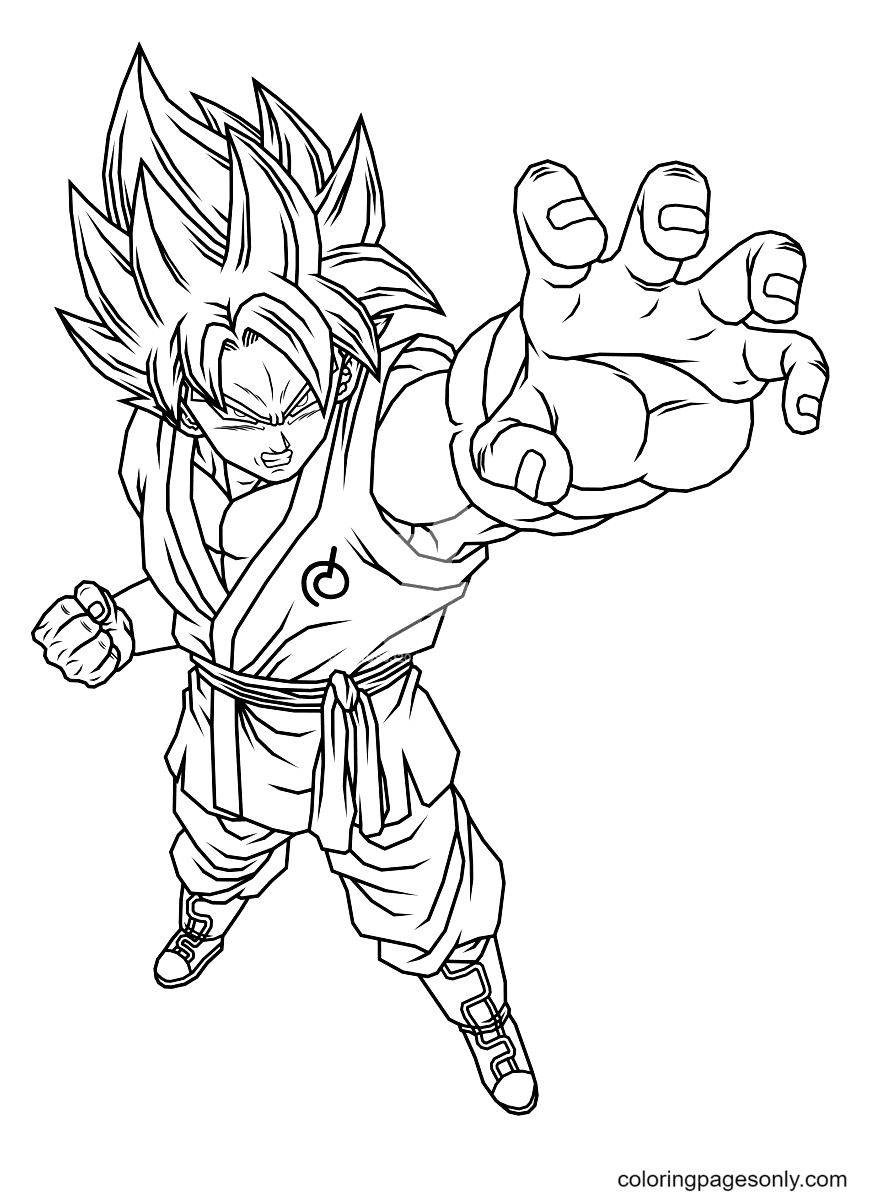
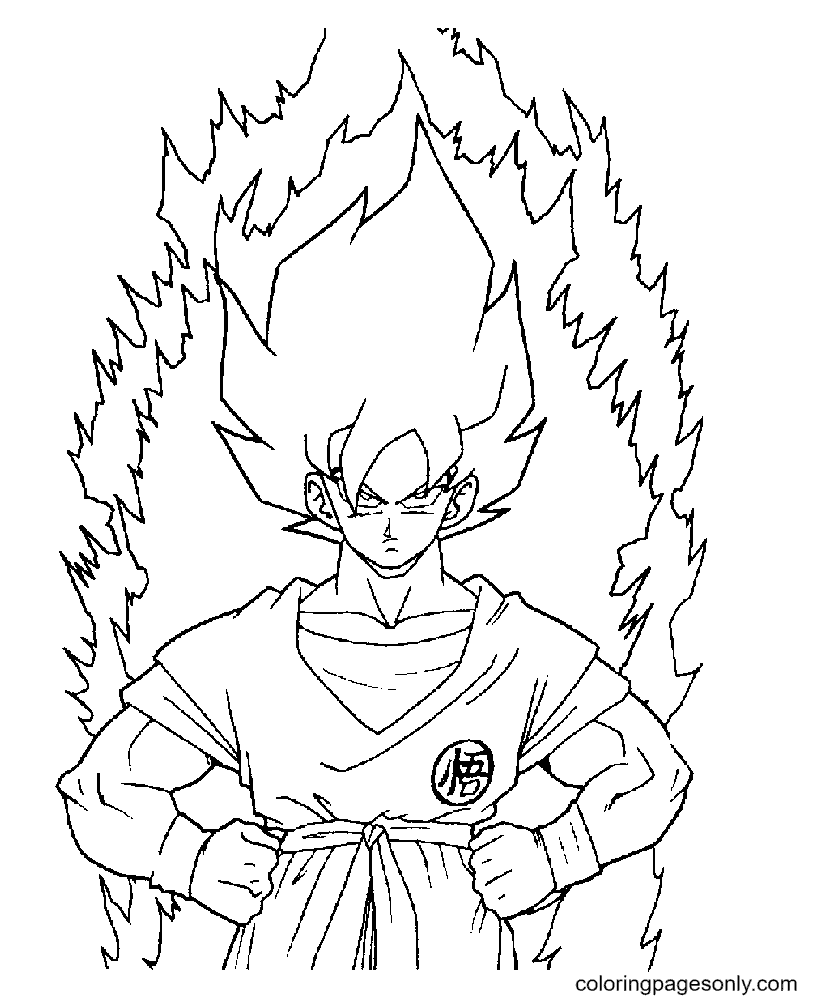
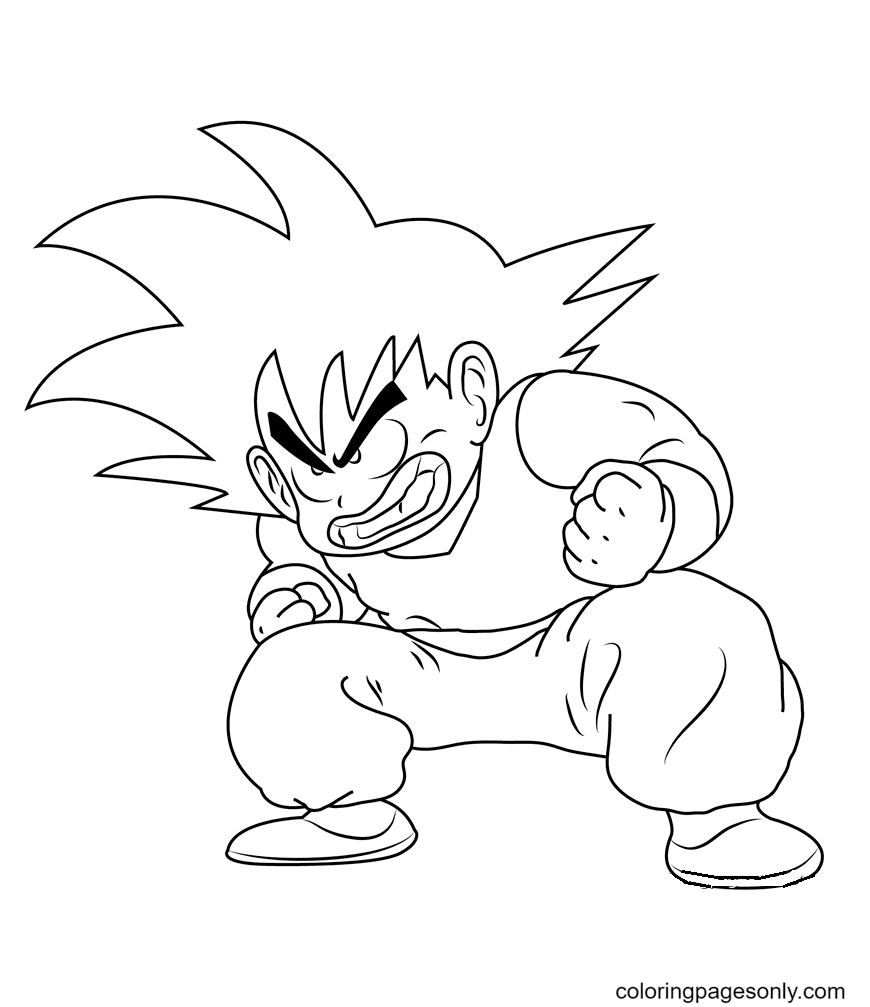
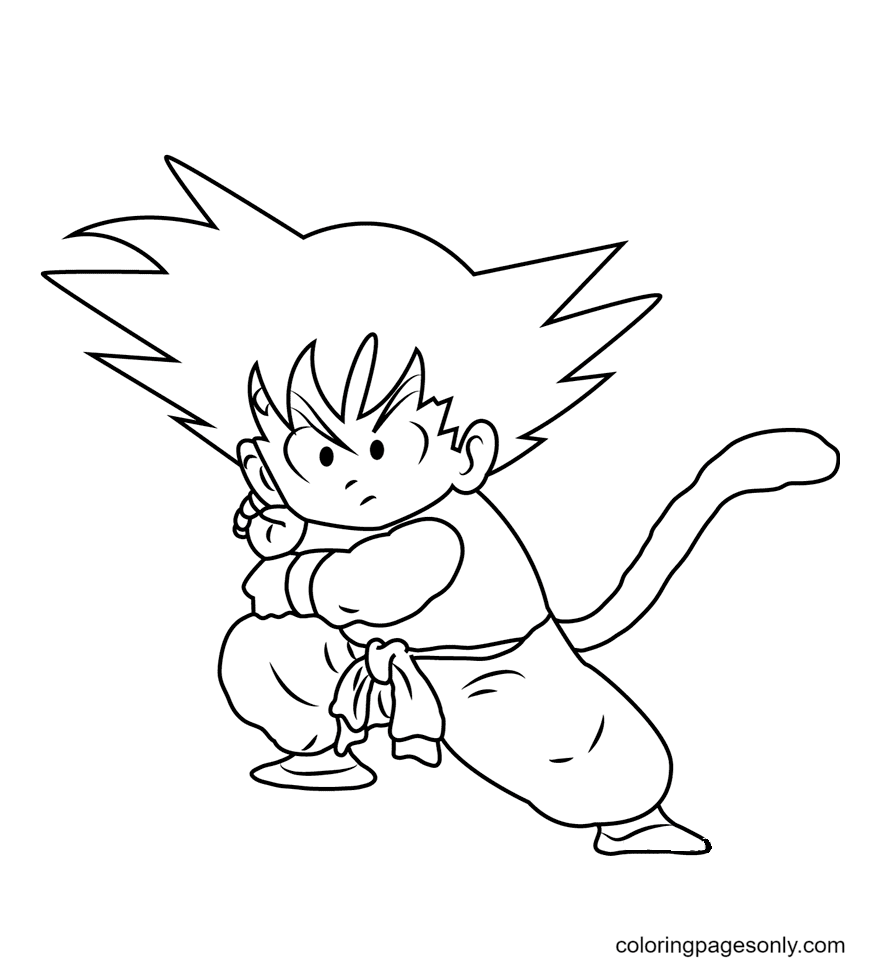
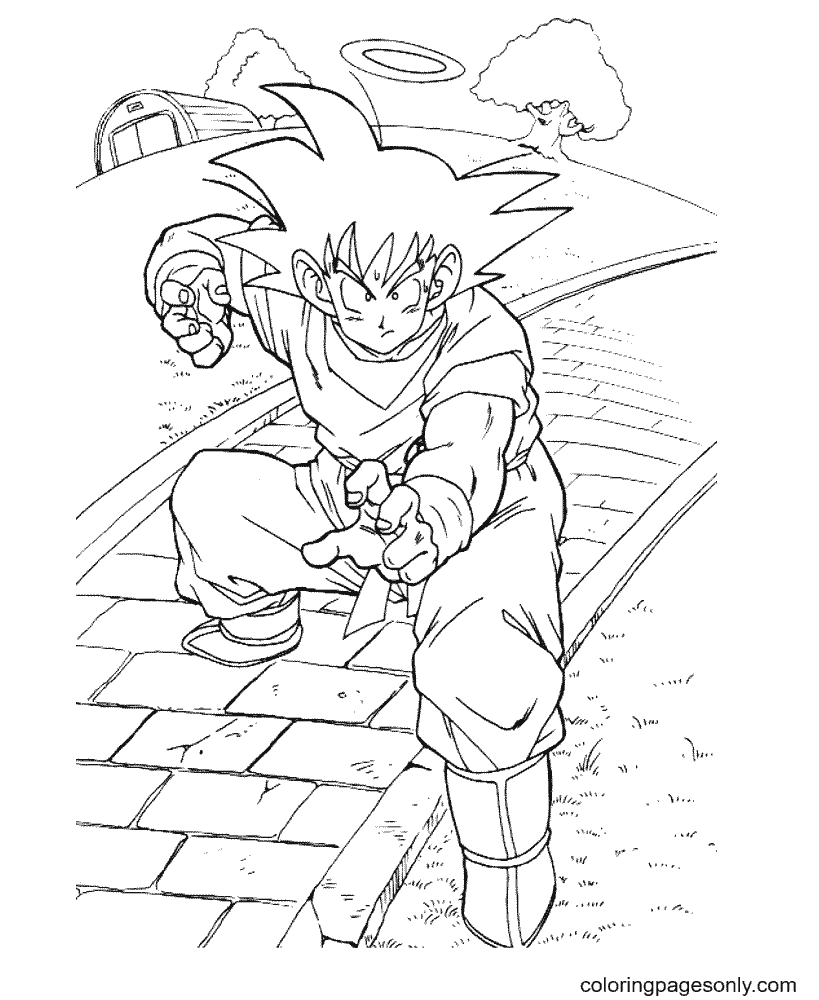
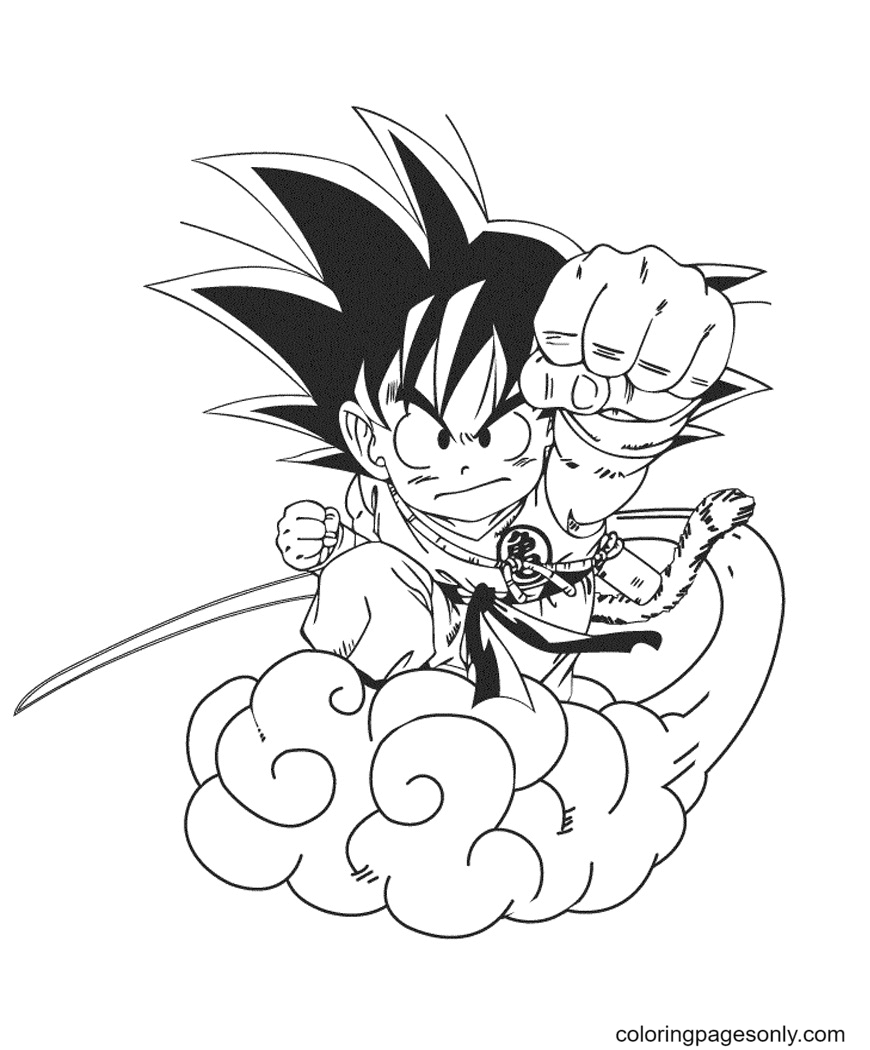
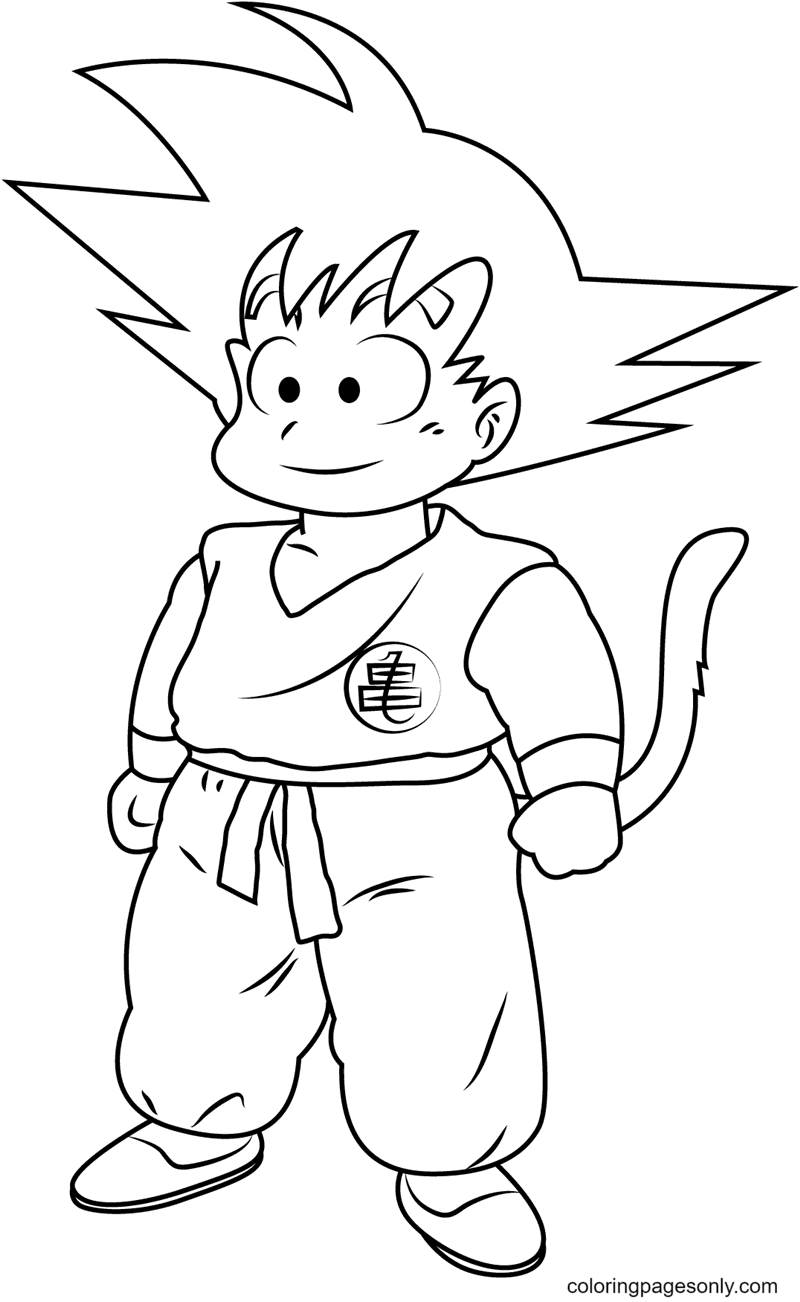
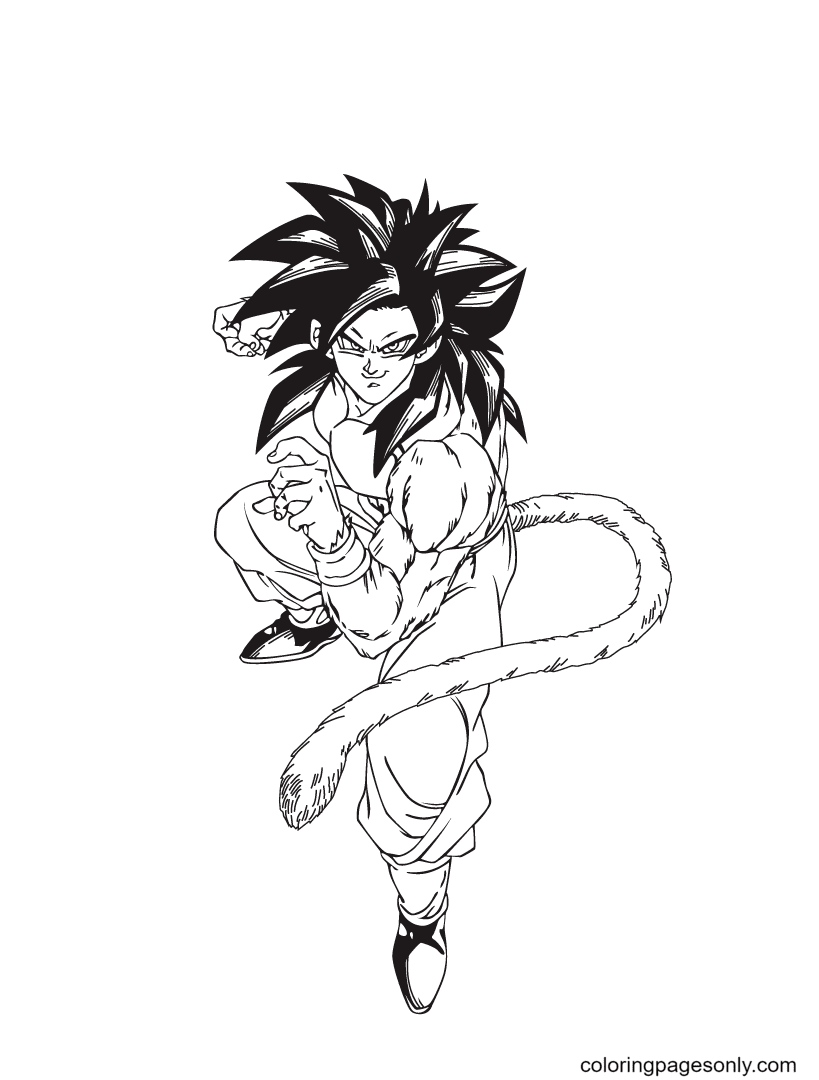
Free Goku coloring pages: 70+ pages featuring Son Goku across his full transformation spectrum: base form in the iconic orange gi, Super Saiyan with vivid golden hair, Super Saiyan 2 with lightning aura, Super Saiyan 3 with waist-length hair and no eyebrows, Super Saiyan God with red hair, Super Saiyan Blue, and the silver-white Ultra Instinct form introduced in Dragon Ball Super. The collection also includes Kamehameha charging sequences, Spirit Bomb poses, battle scenes against major opponents, young Goku from the original Dragon Ball series riding the Flying Nimbus, chibi portraits, and the full visual vocabulary of one of manga and anime’s most documented characters across his forty-year history. All free, printable PDFs and online coloring for Dragon Ball fans of all generations.

Son Goku was created by Akira Toriyama, born April 5, 1955, in Nagoya, Aichi Prefecture, Japan, who died on March 1, 2024, at age 68. His manga Dragon Ball (ドラゴンボール) was serialized in Shueisha’s Weekly Shōnen Jump from July 19, 1984, to May 23, 1995, producing 519 chapters collected into 42 volumes. The franchise has since sold over 260 million manga volumes worldwide, making it one of the best-selling manga series in history.

The story draws its origin from the 16th-century Chinese novel Journey to the West (西遊記, Xī Yóu Jì) by Wu Cheng’en, which follows the monk Xuanzang and his companions, including the Monkey King Sun Wukong, on a pilgrimage to obtain Buddhist scriptures. Goku’s name in Japanese, Son Goku (孫悟空), is the Japanese reading of Sun Wukong’s name. His spiky black hair, his staff (the Power Pole, Nyoi-bō, which is the same magical staff Sun Wukong wields), and his Flying Nimbus (Kintoun) all trace directly to the source material.

These 70+ free pages at ColoringPagesOnly.com cover Goku across every major form and era. All free, PDF or PNG, print or color online.

What’s Inside

Base Form Goku: The Orange Gi

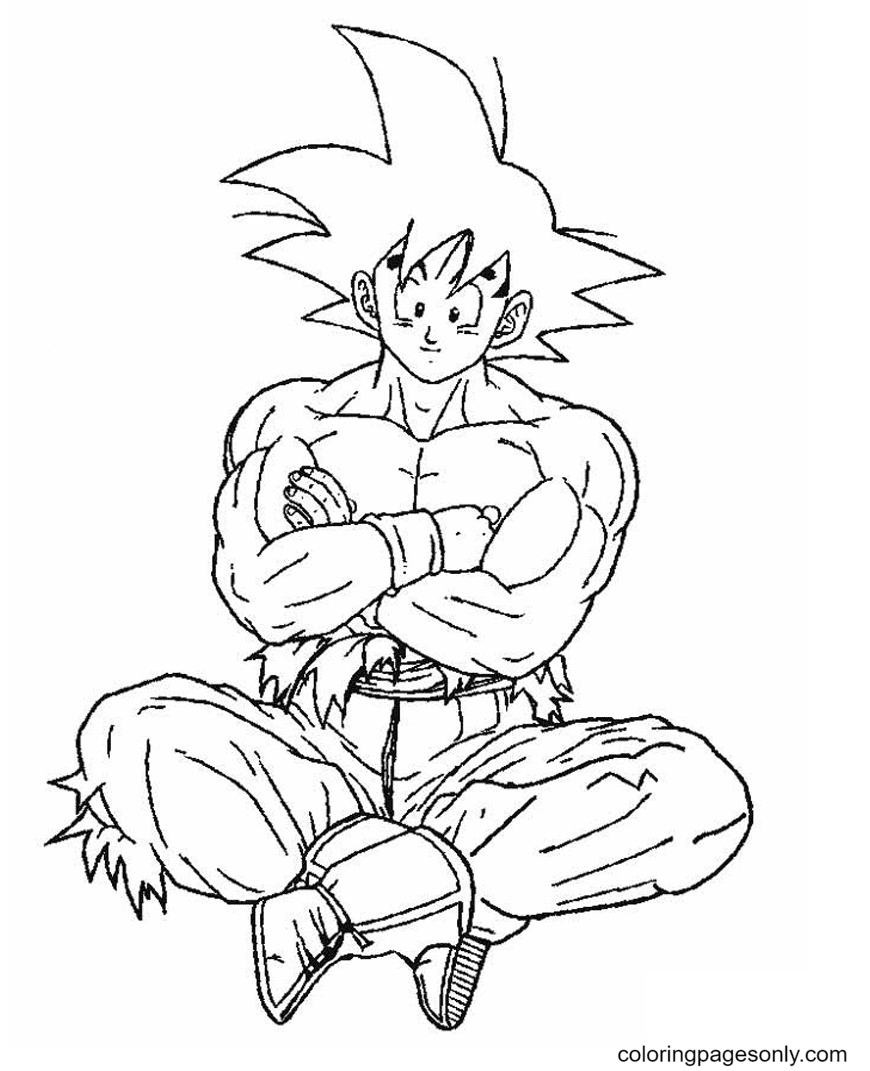
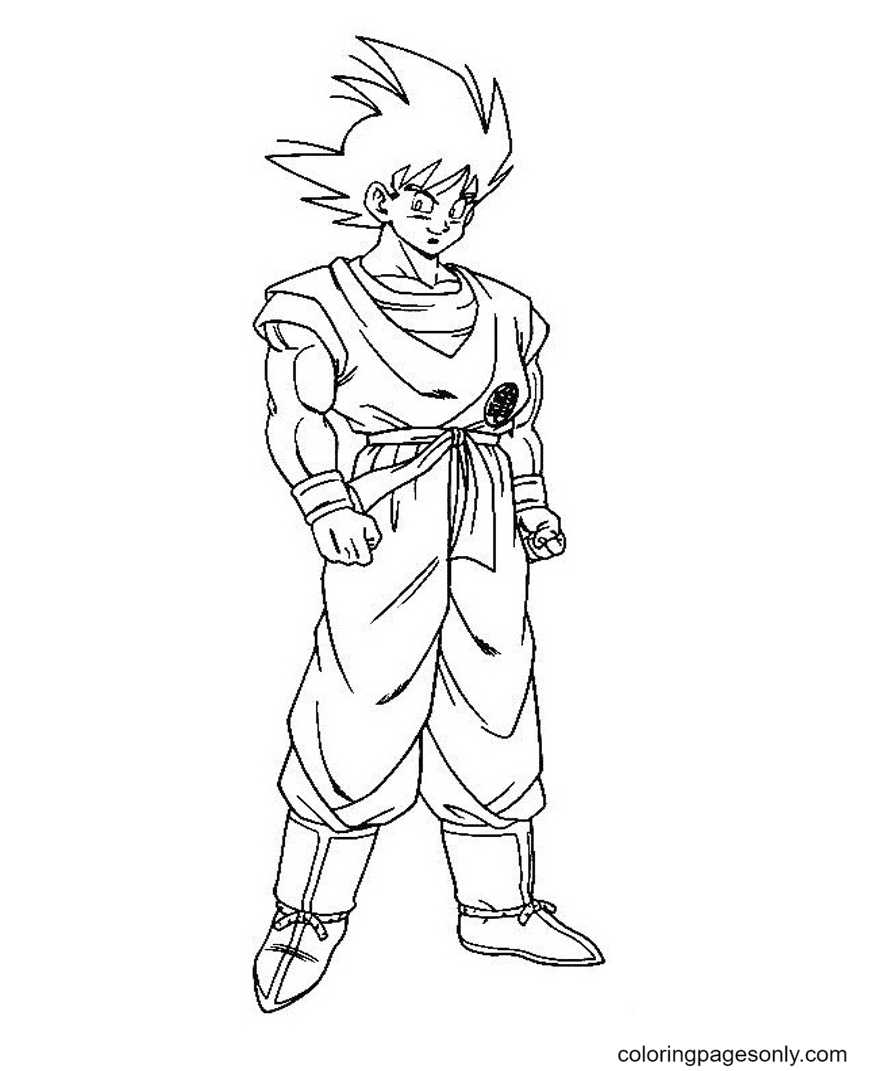
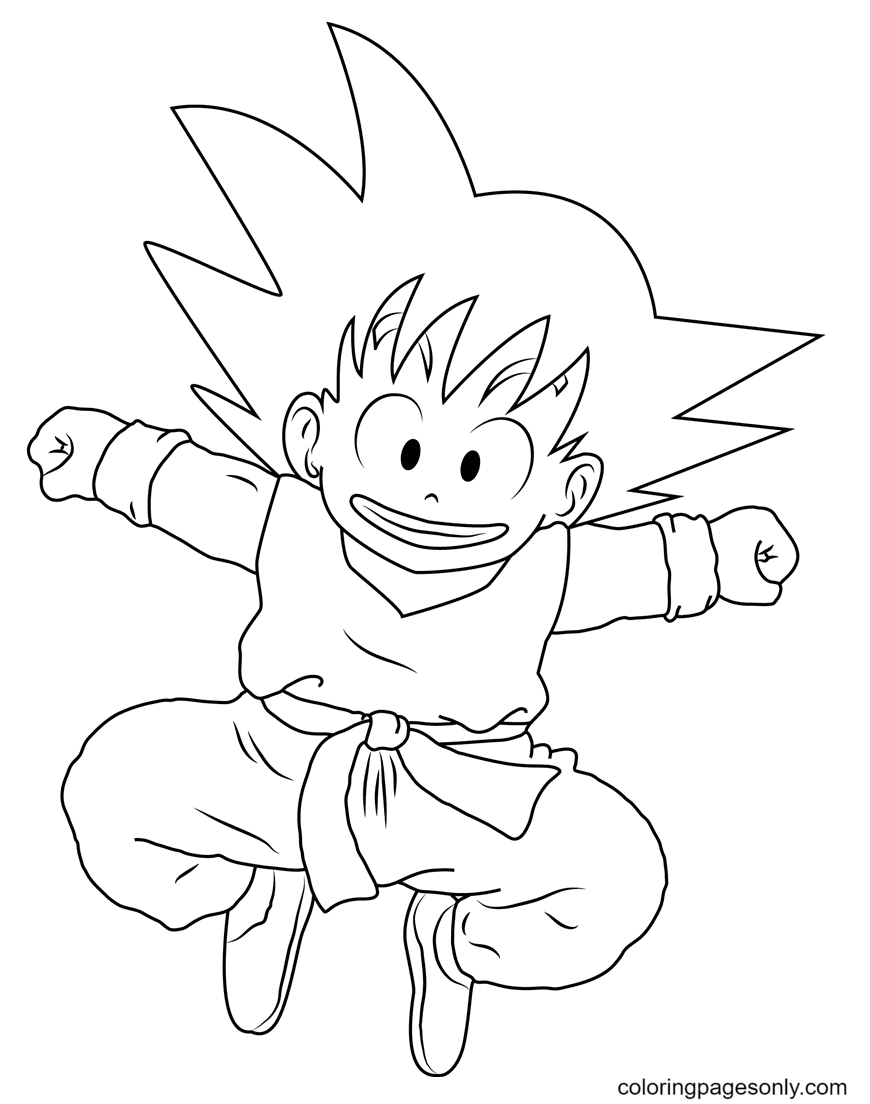
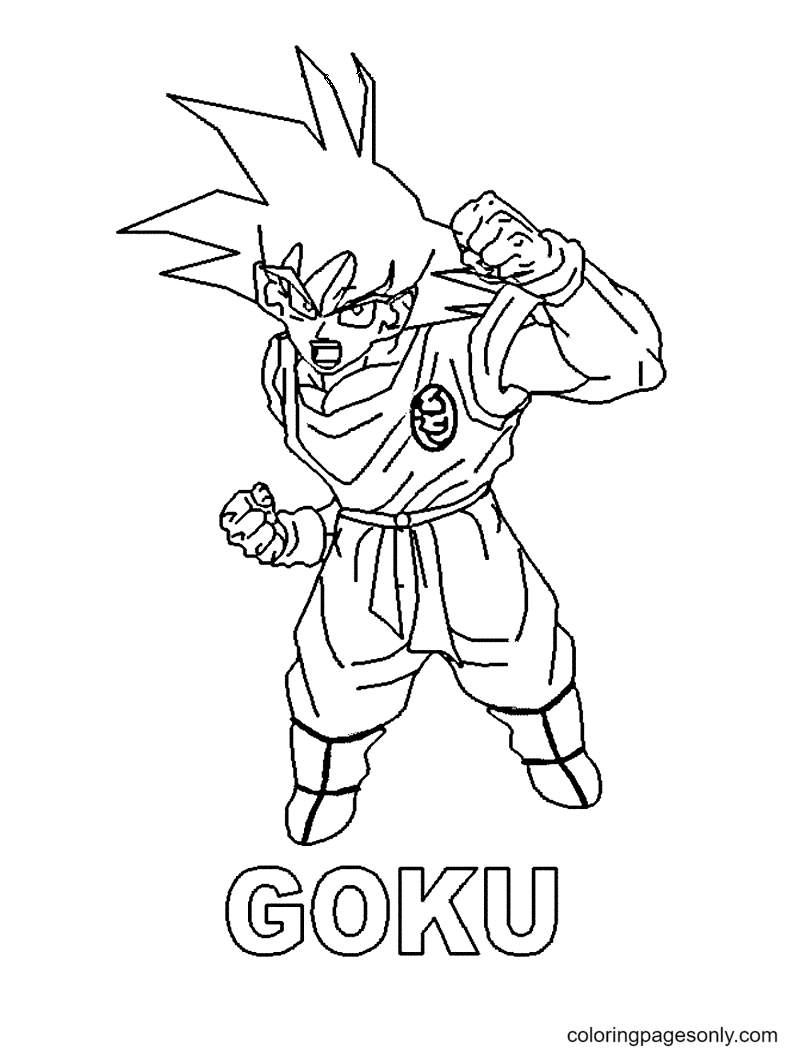
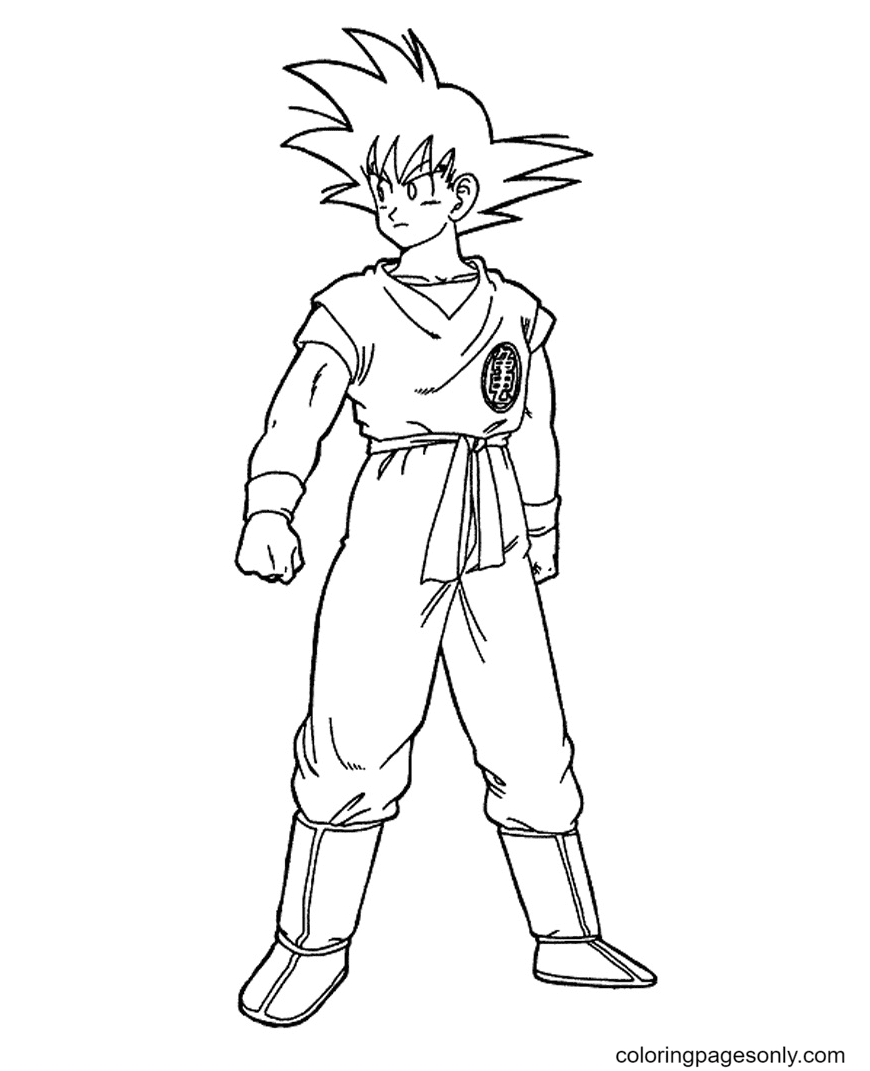
Goku’s base form appearance is the collection’s most immediately recognizable image and the design that has defined his visual identity since 1984: black spiky hair, orange gi (training uniform), and dark blue undershirt and boots. The gi’s specific orange is a warm, vivid orange-gold, not a red-orange or a yellow-orange, but the specific medium warm orange that Toriyama established in early color illustrations of the character.

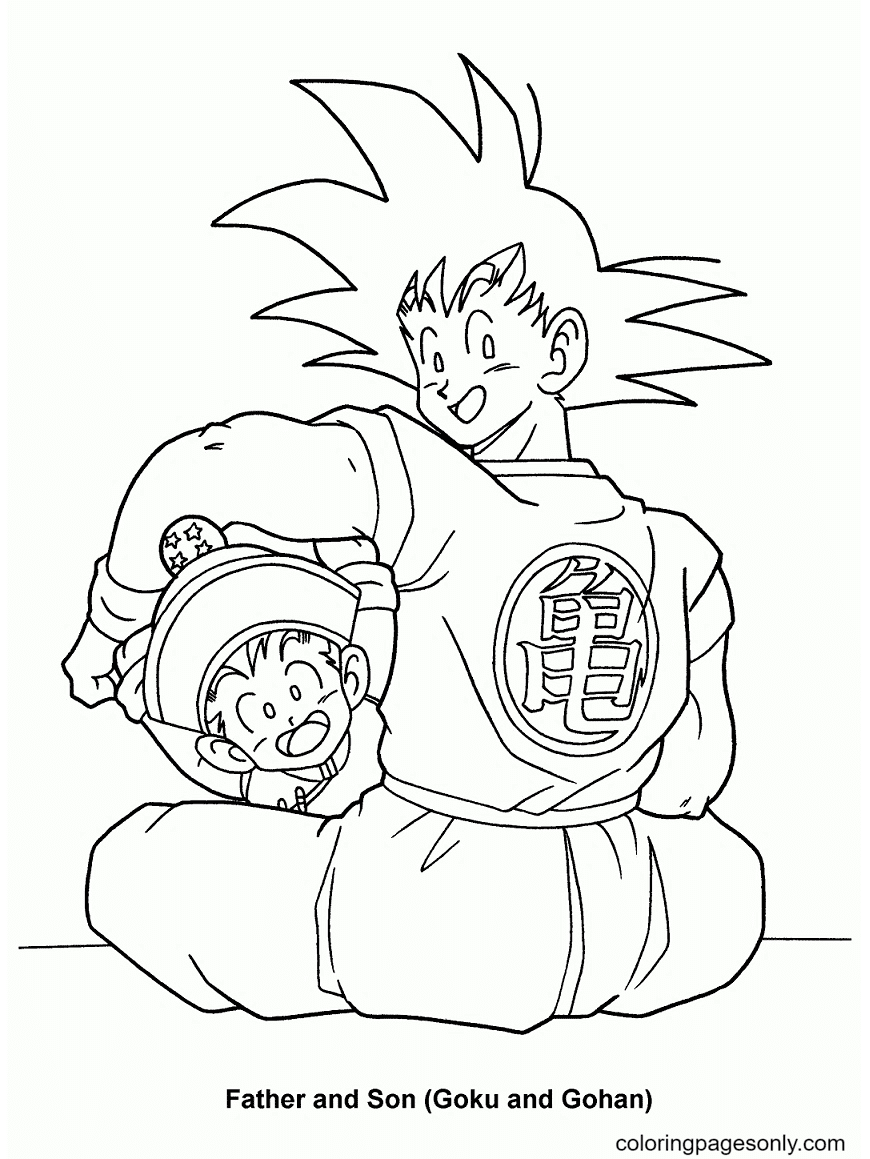
The kanji on his gi has changed across the series. During his training under Master Roshi, it shows 亀 (kame, “turtle”), the symbol of Master Roshi’s Turtle School. After training under King Kai during the Saiyan and Namek sagas, it shows 界王 (Kaiō, “World King”), referencing King Kai. In later Dragon Ball Z depictions, the symbol 悟 (go, the first character of “Goku”) appears on the back.
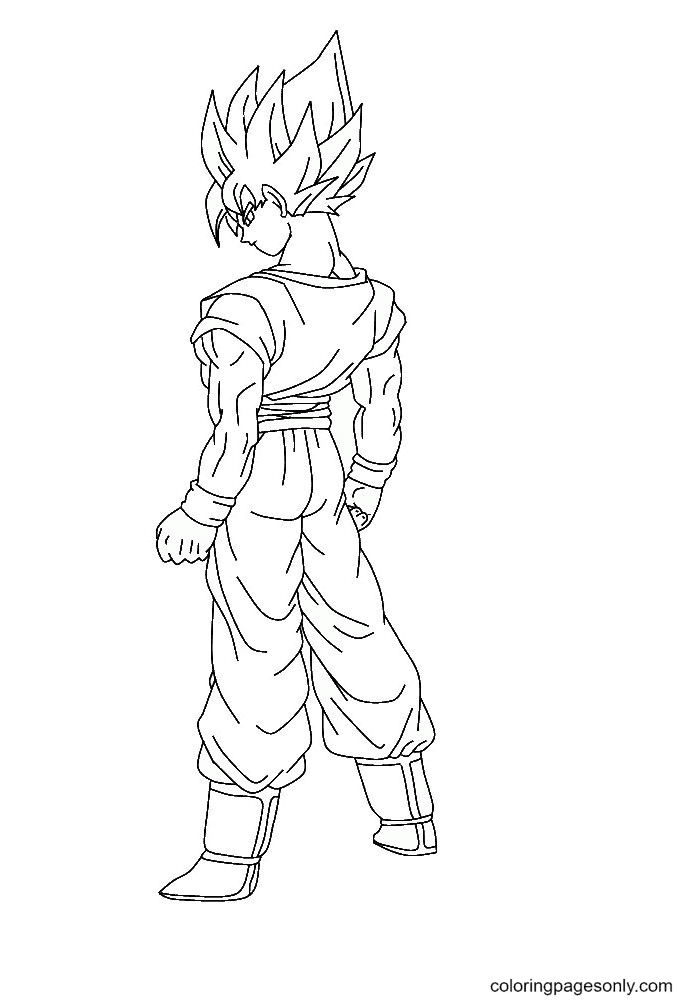
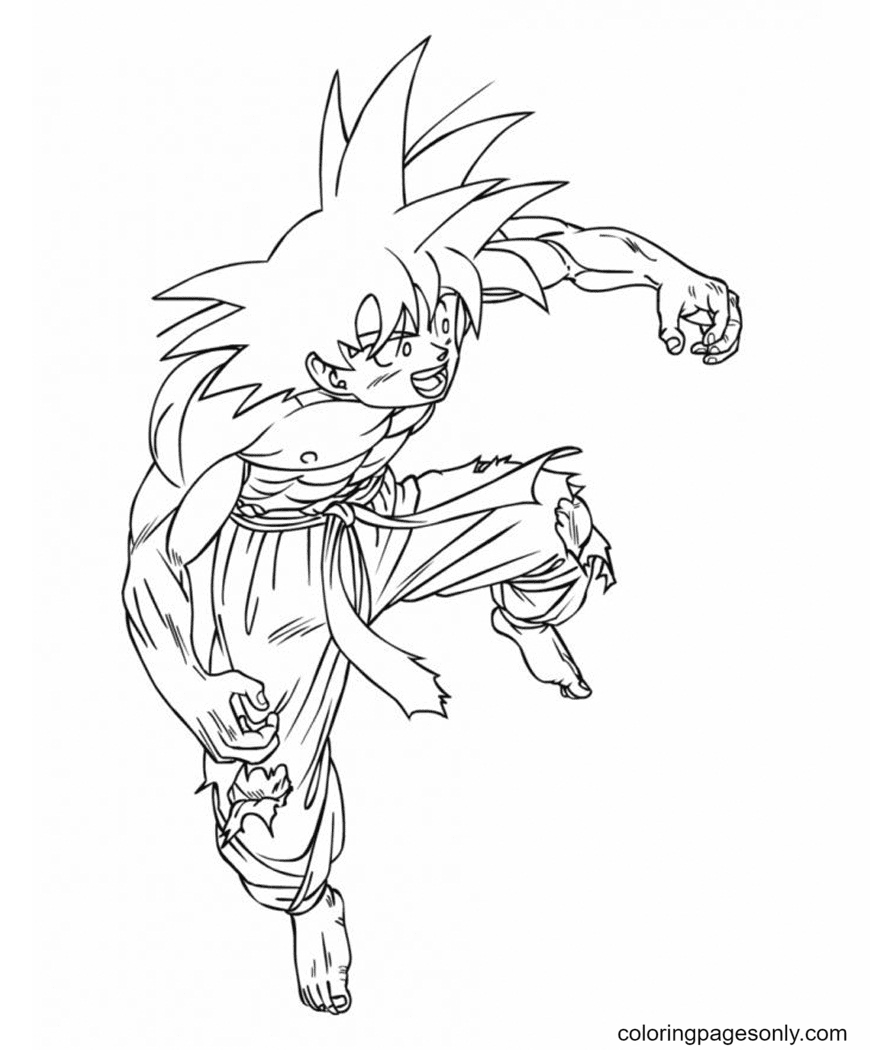
His base form hair is the critical design element for page accuracy: the specific spike pattern of Goku’s black hair has been rendered consistently by Toriyama across forty years and is immediately distinguishable from the hair of every other character in the franchise. The spikes follow a consistent arrangement with larger spikes at the outer edges and smaller interior spikes, all rising upward and slightly forward.

Coloring base form pages: The gi uses warm, vivid orange at full saturation, applied across the full jacket and pants surface. The undershirt, wrist bands, boots, and belt are dark navy blue. The skin is a warm medium tan rather than pale skin or deep brown, consistent with Toriyama’s character design for Goku across all series. The hair is near-black or the darkest available black-brown, with no highlights in the base form.

Super Saiyan: The Golden Transformation

The Super Saiyan transformation is the franchise’s most documented and most culturally significant visual event. Goku achieved the Super Saiyan form for the first time on the planet Namek during his battle against Frieza, after witnessing the death of his best friend, Krillin. The transformation had been described in Saiyan legend as achievable only once every thousand years by a warrior of pure heart and extraordinary power.

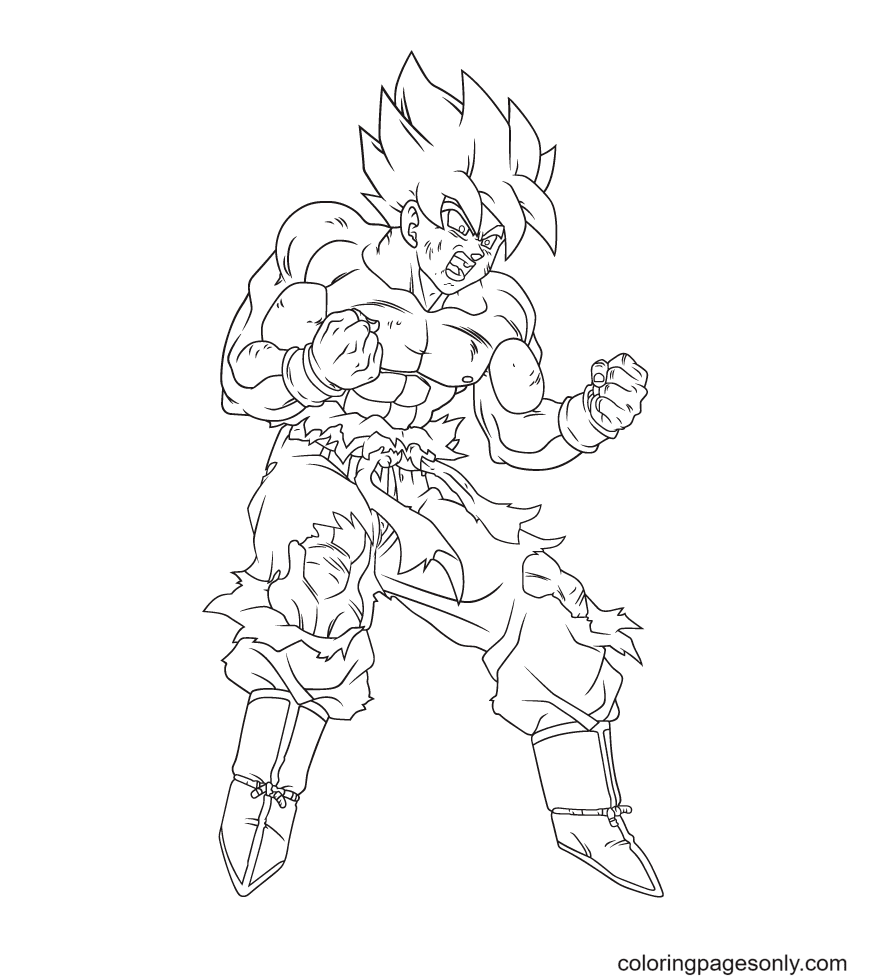
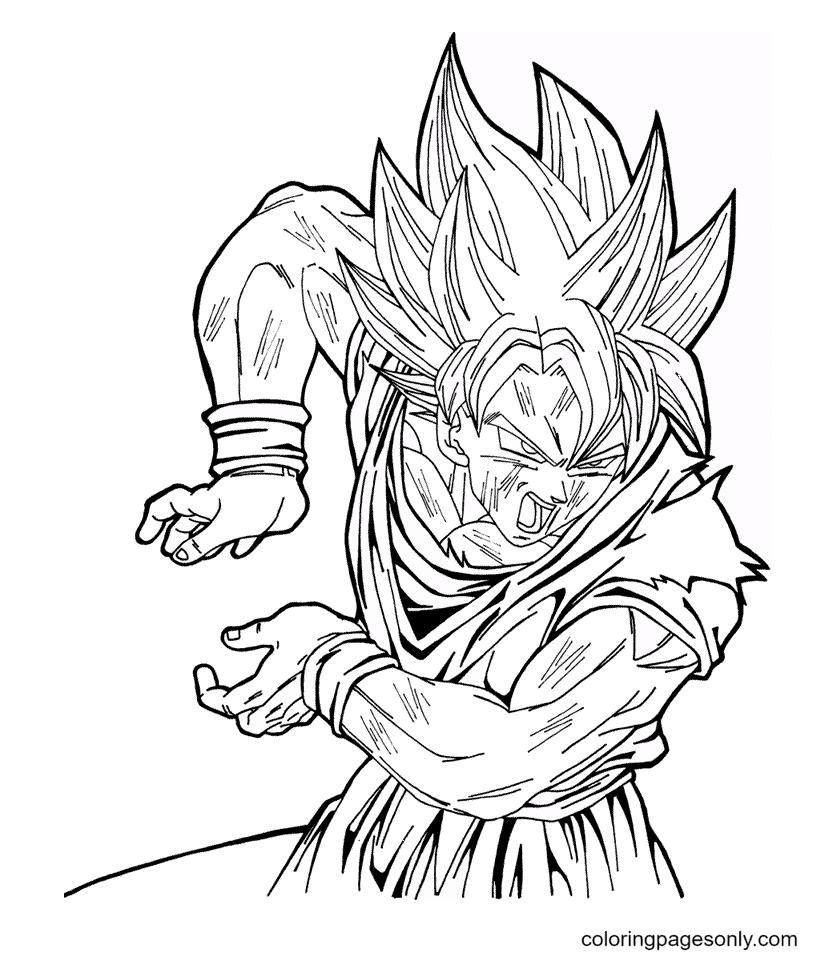
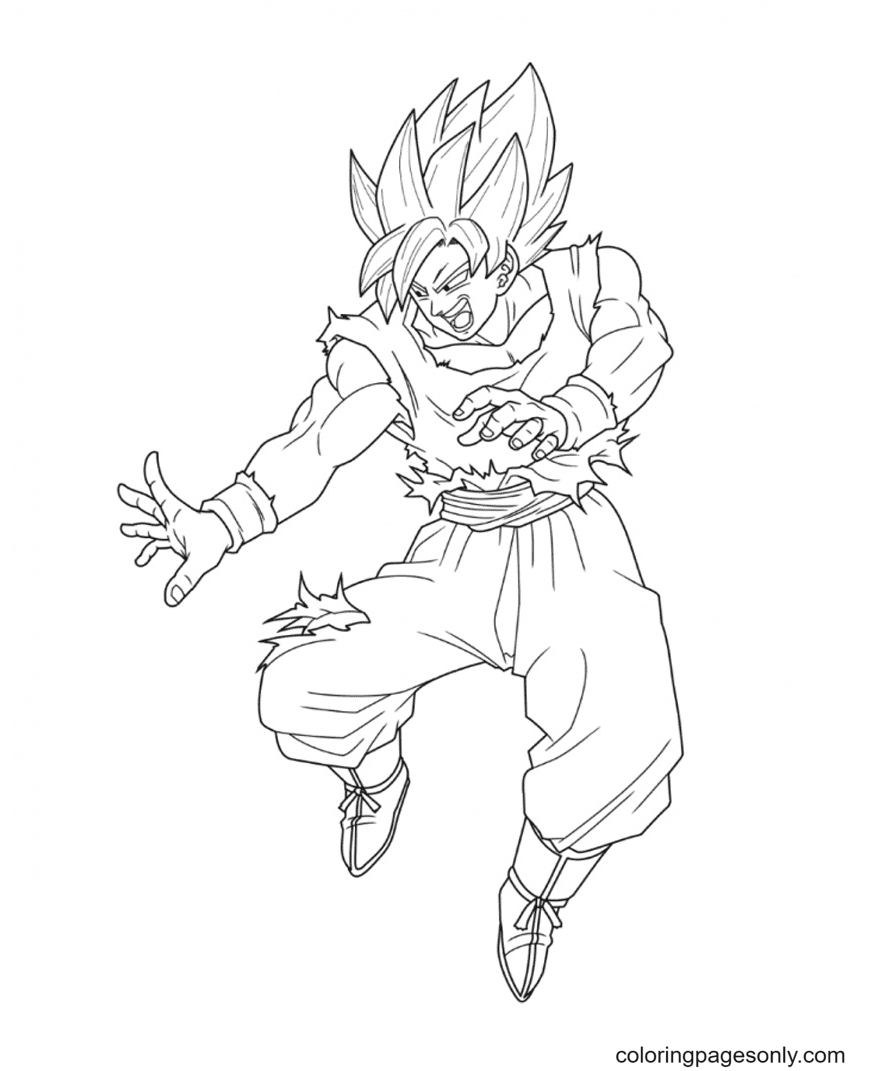
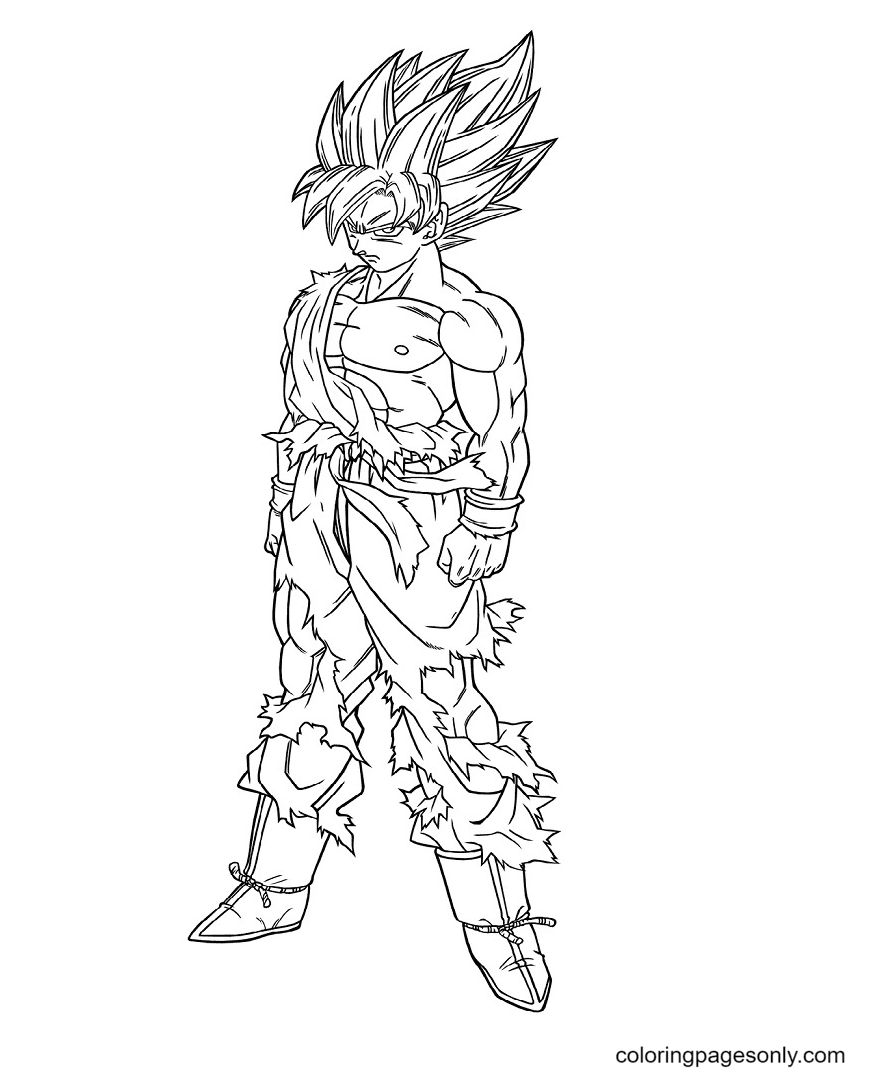
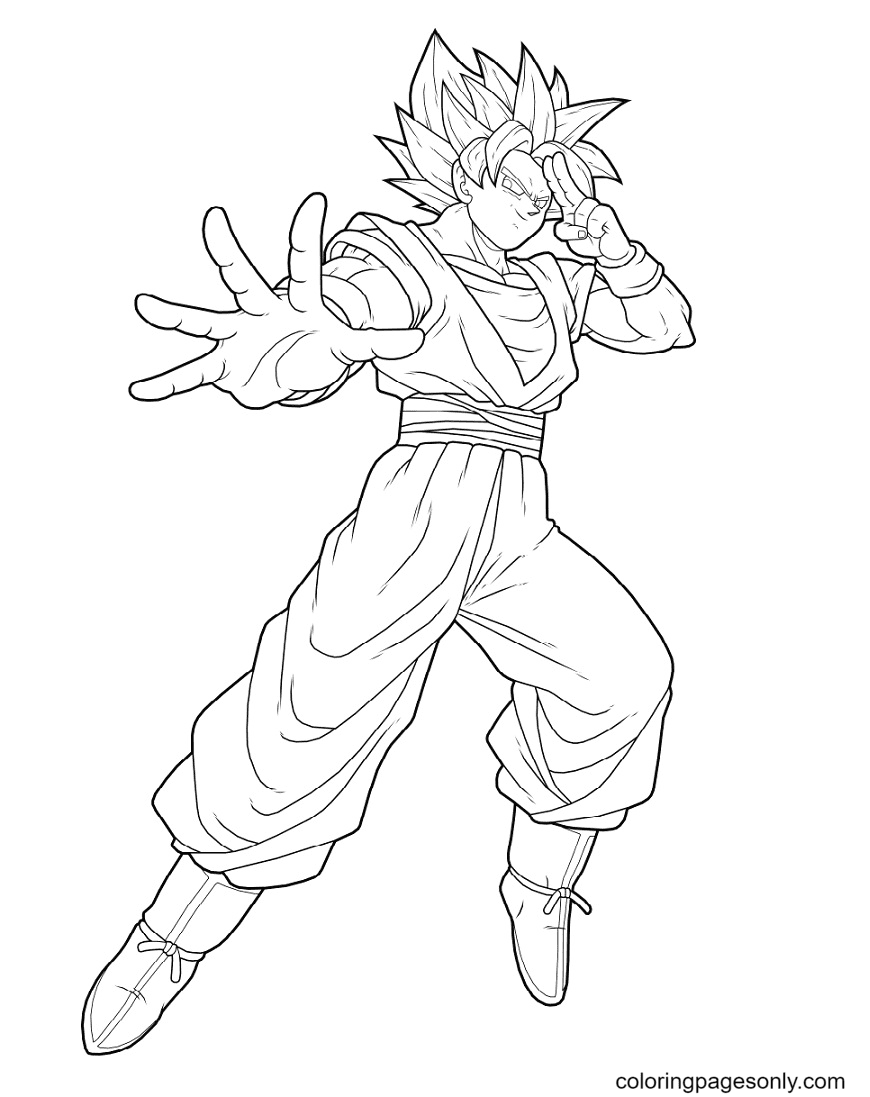
In visual terms, the Super Saiyan transformation produces: hair that turns vivid golden-yellow and rises upward, with spikes that stiffen and become more pronounced; eyes that shift from black to vivid teal-green; a golden aura that surrounds the body; and the complete disappearance of the eyebrows, replaced by the golden hair that extends forward. The eyebrow disappearance is one of the transformation’s most specific visual details and one of the most commonly missed in fan coloring.

The transformation sequence in Dragon Ball Z episode 95, “Transformed at Last!! Son Goku, the Legendary Super Saiyan” (originally aired May 15, 1991, in Japan), is among the most frequently cited moments in anime history, and the visual of Goku’s golden hair emerging from his black base hair as his power rises is one of anime’s most recognized images.

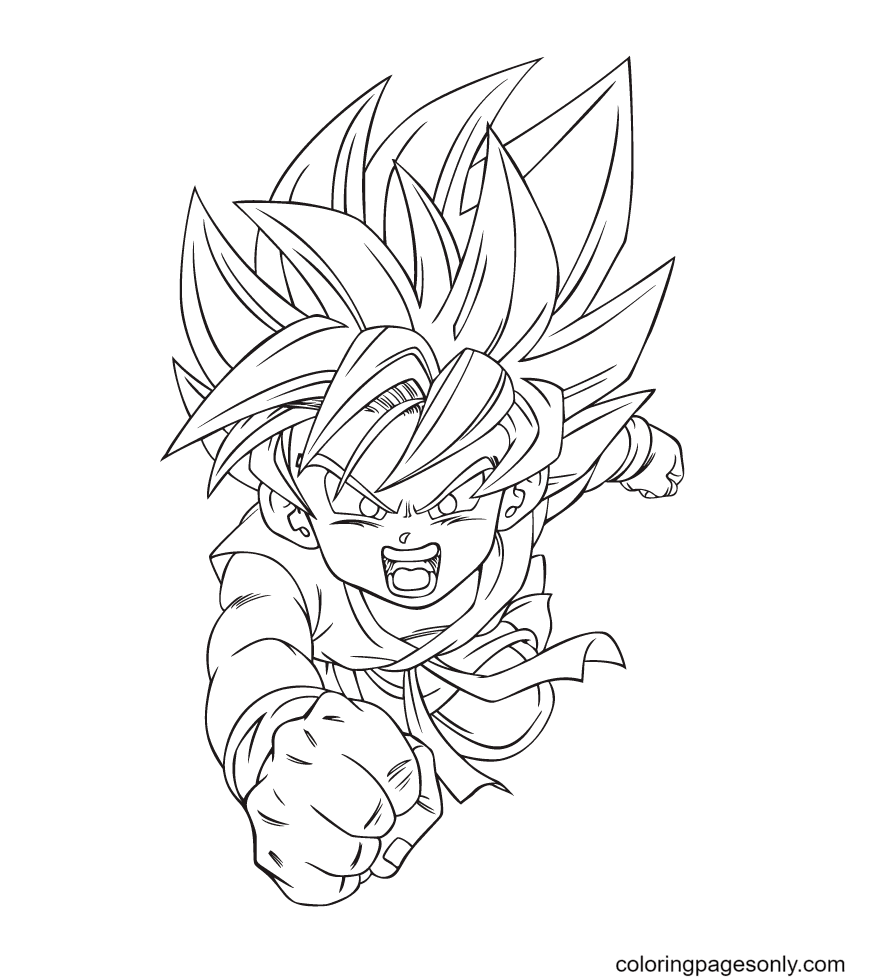
Coloring Super Saiyan pages: The hair transitions from the near-black of the base form to the vivid golden-yellow of the Super Saiyan. The yellow should be warm and fully saturated, leaning slightly toward gold rather than pure yellow. The eyes are vivid teal-green: not blue-green and not yellow-green, but the specific cool-warm teal that Toriyama uses for Super Saiyan eyes. The aura, if present, is vivid golden-yellow at its inner core, fading to pale yellow at the outer edge. The gi remains in the same orange but may appear slightly more vivid in the aura’s reflected light.

Super Saiyan 2: Lightning in the Aura

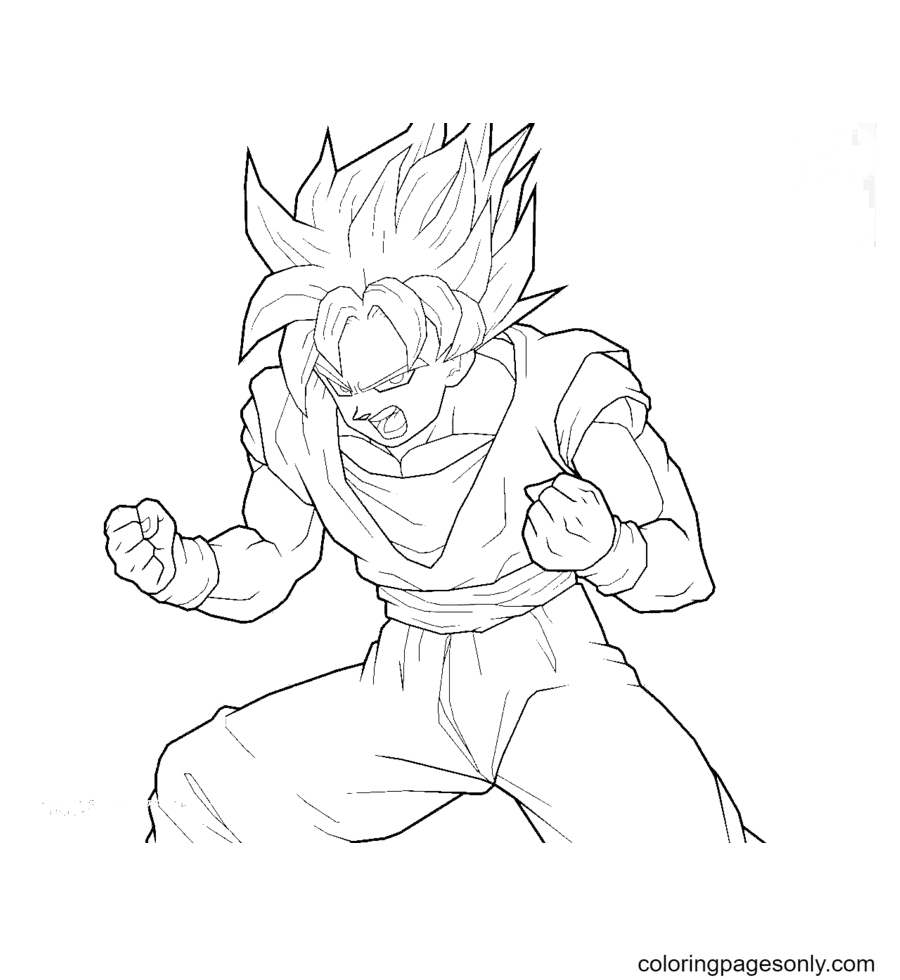
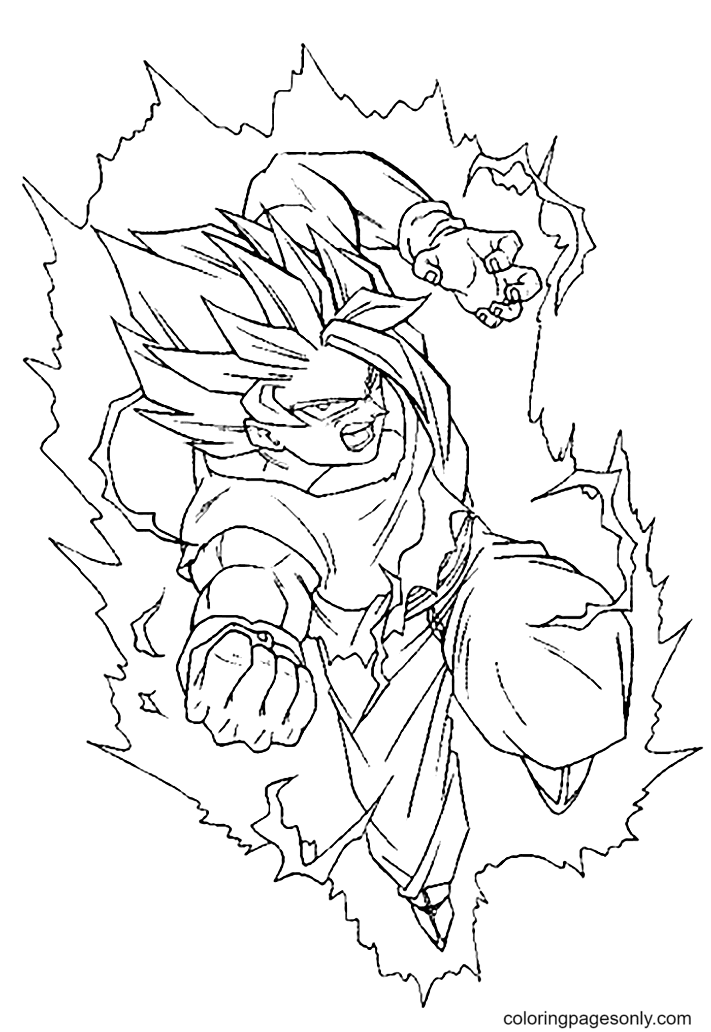
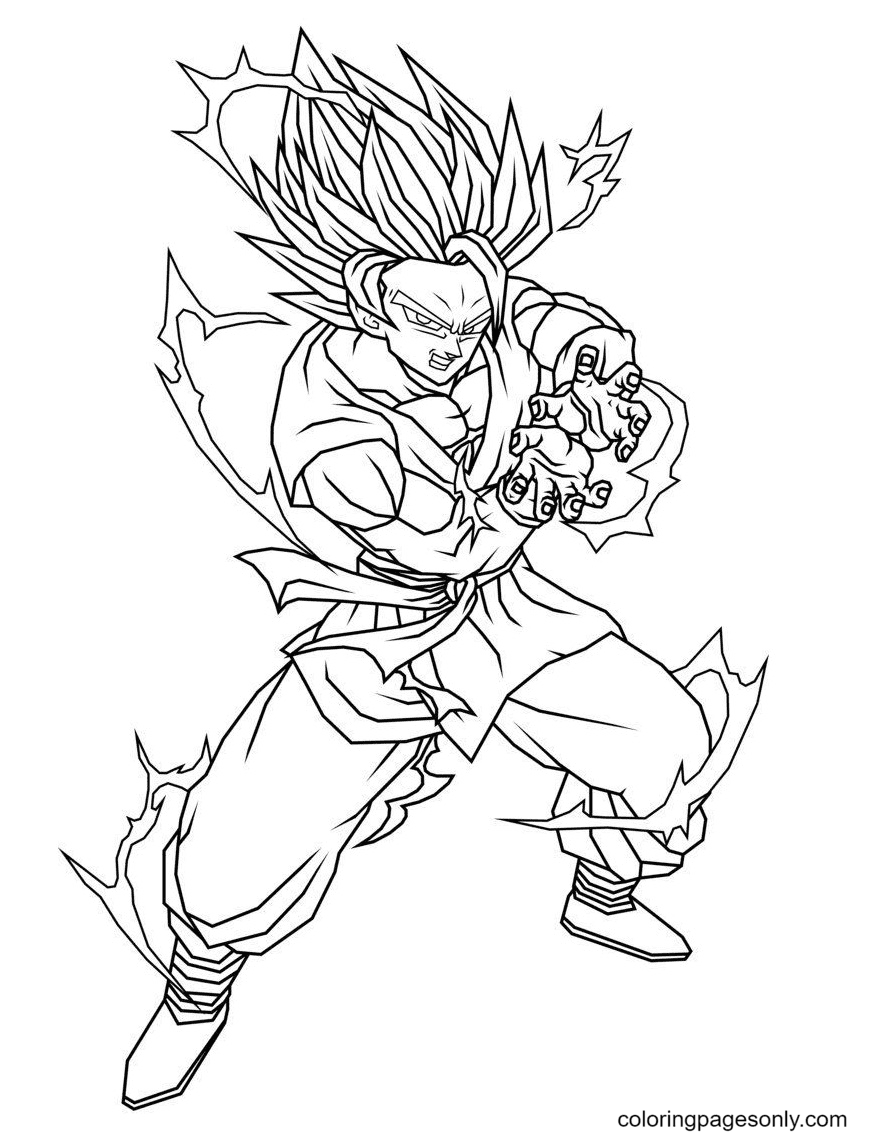
Super Saiyan 2 is visually similar to Super Saiyan 1 but with two distinguishing features: the hair stands more upright with sharper, more defined individual spikes, and lightning crackles throughout the golden aura. The hair is slightly shorter and more angular in its spike configuration than Super Saiyan 1’s flowing version.

Goku first showed Super Saiyan 2 during the Buu saga (though Gohan was the first character to reach this form during the Cell Games). The lightning effect in the aura is the transformation’s most important visual differentiator and the element that most distinguishes a Super Saiyan 2 page from a Super Saiyan 1 page.

Coloring Super Saiyan 2 pages: The base golden-yellow of the hair and aura is the same as Super Saiyan 1. The lightning bolts crackling through the aura should be rendered in pure white or very pale blue-white, brighter than the surrounding golden aura. Each lightning bolt is a thin, jagged line extending from somewhere within the aura outward, with the brightest point at its center and slightly darker at the edges. Three to five visible lightning bolts at different positions in the aura create the signature SSJ2 effect.

Super Saiyan 3: The Long-Haired Form

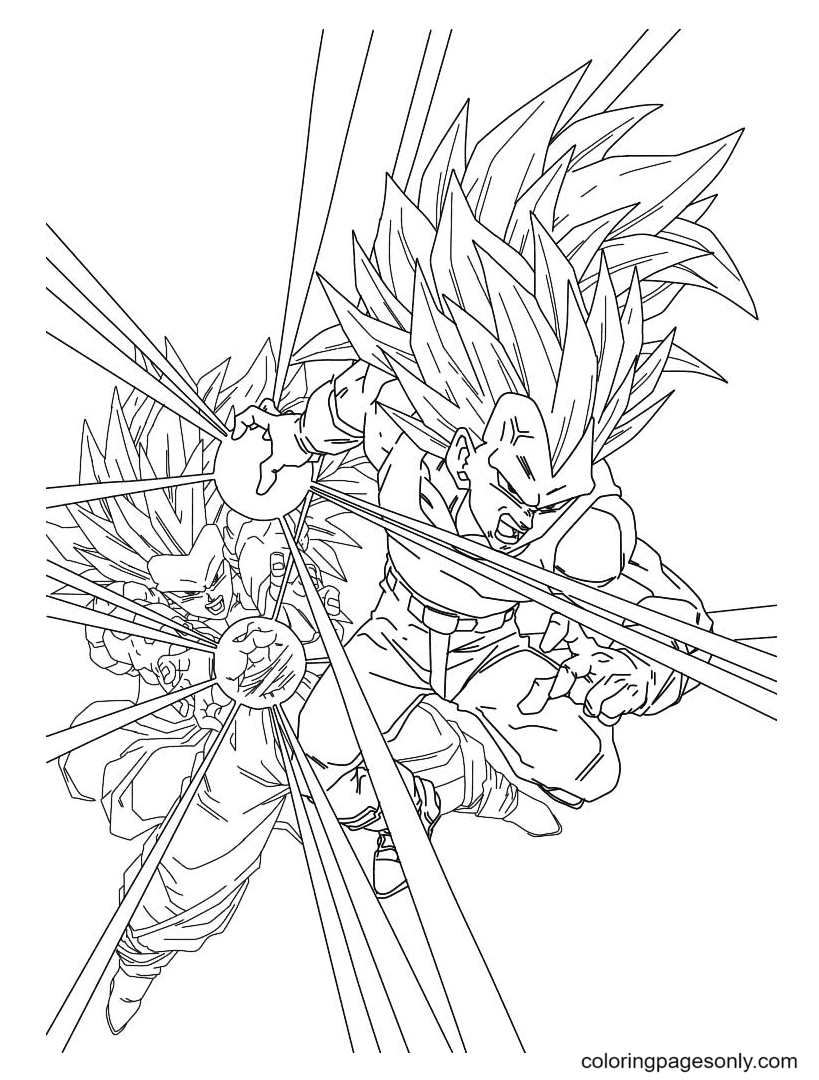
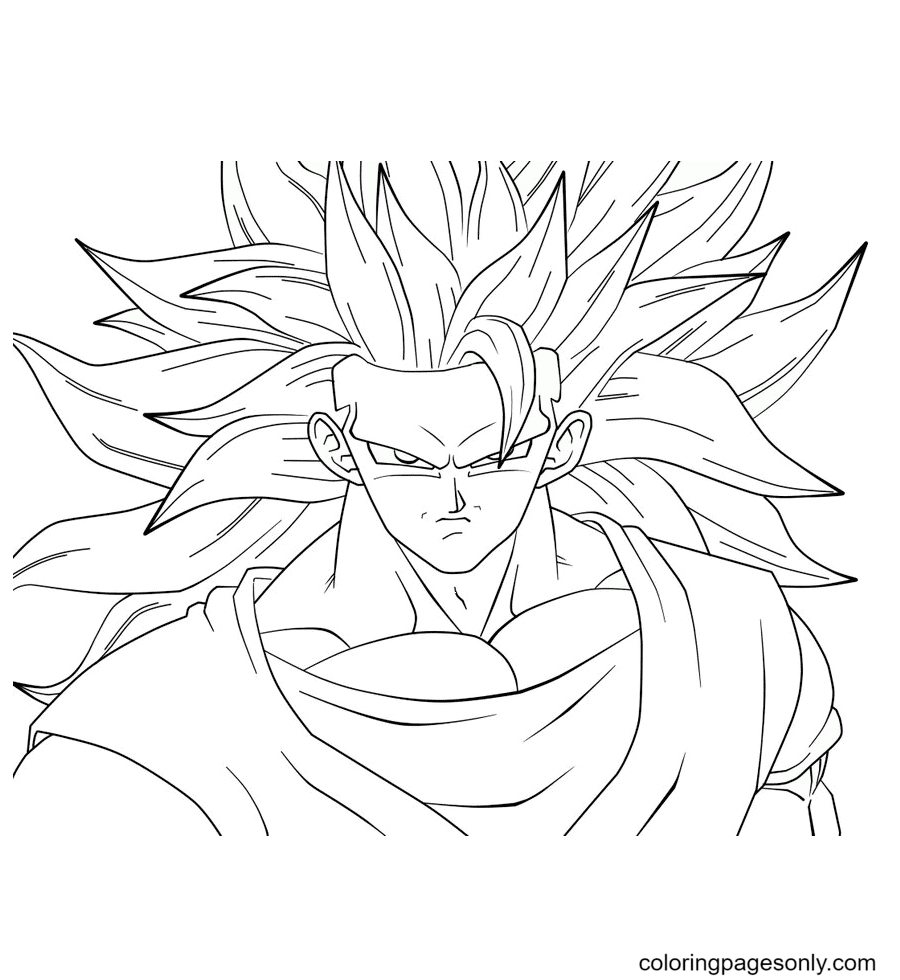
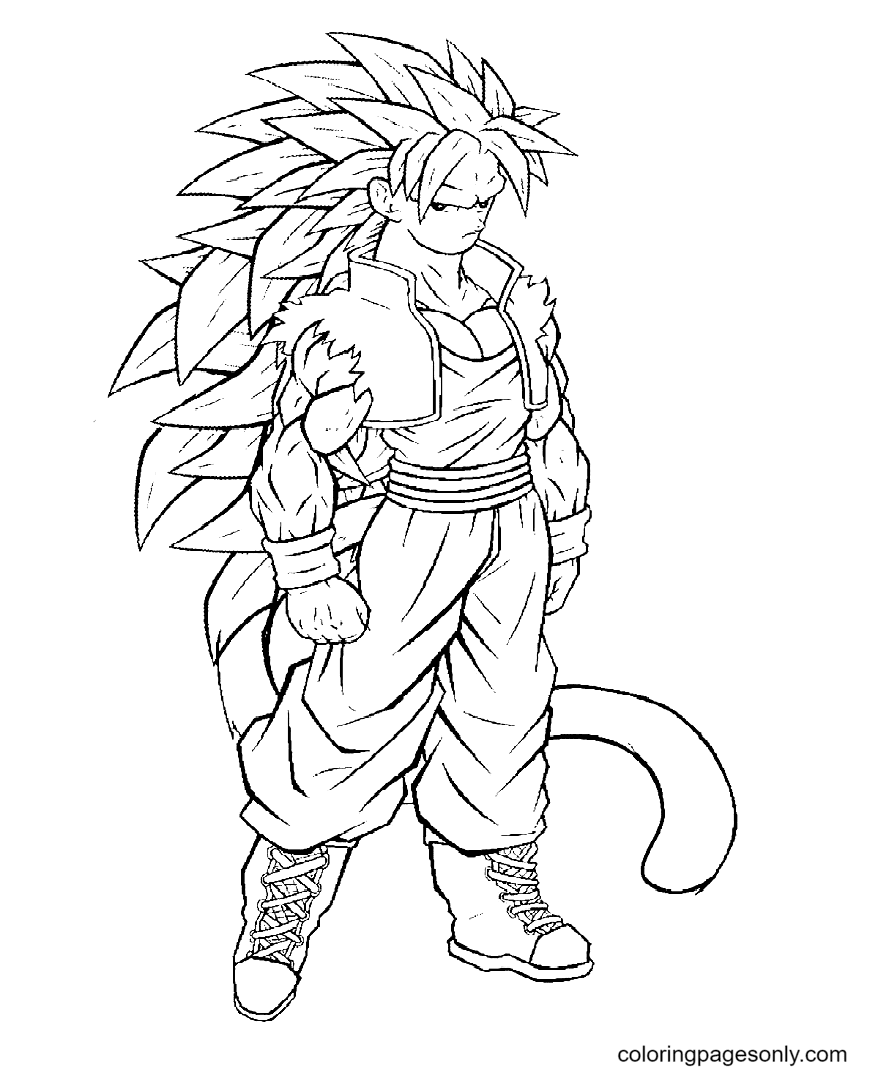
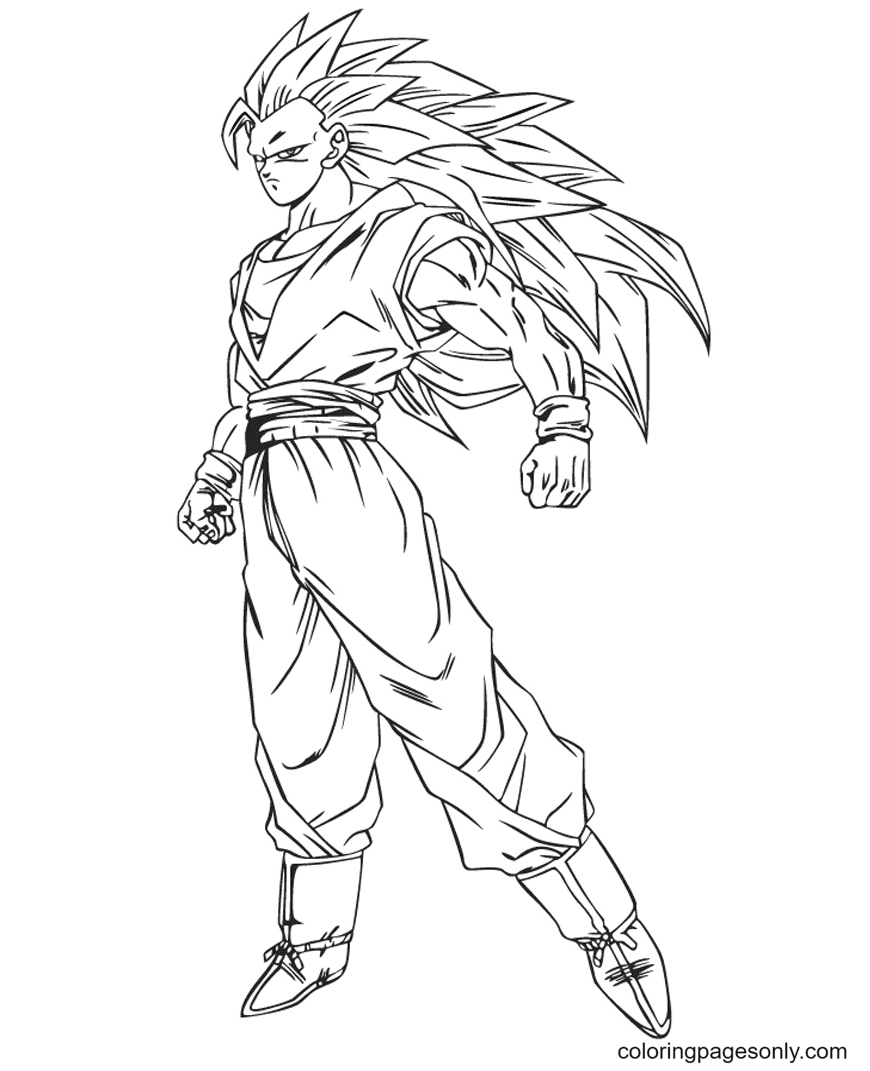
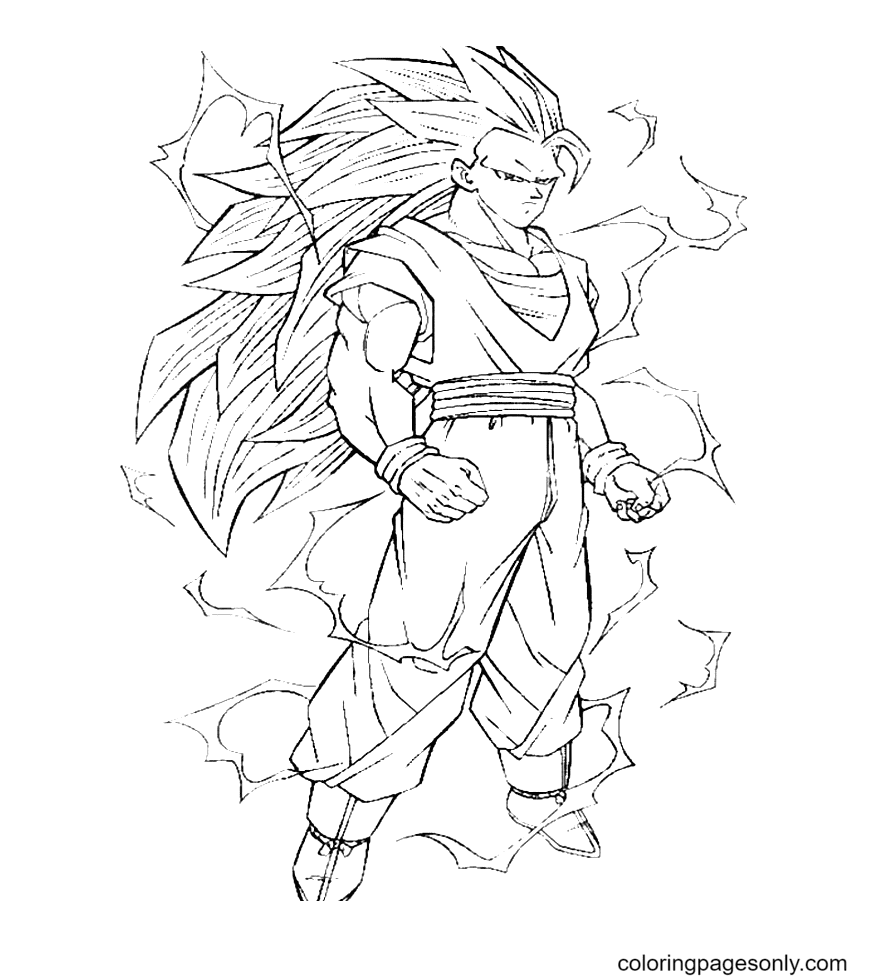
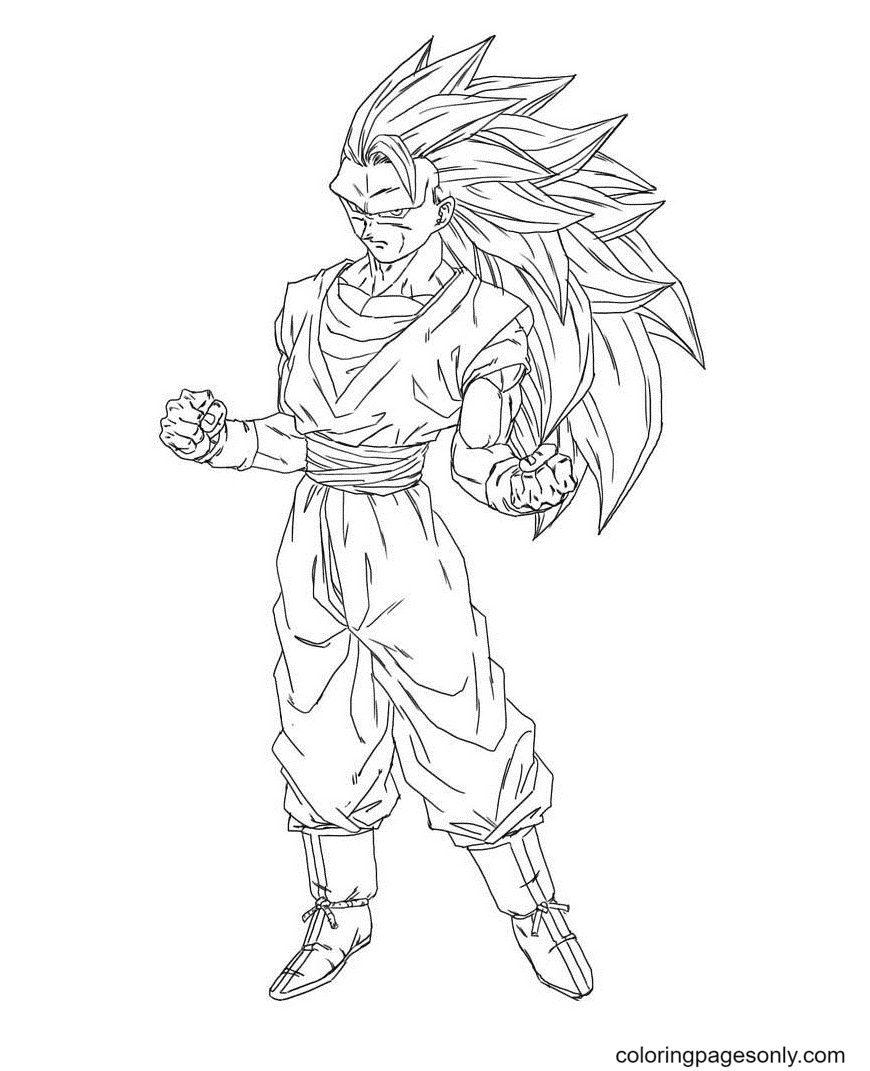
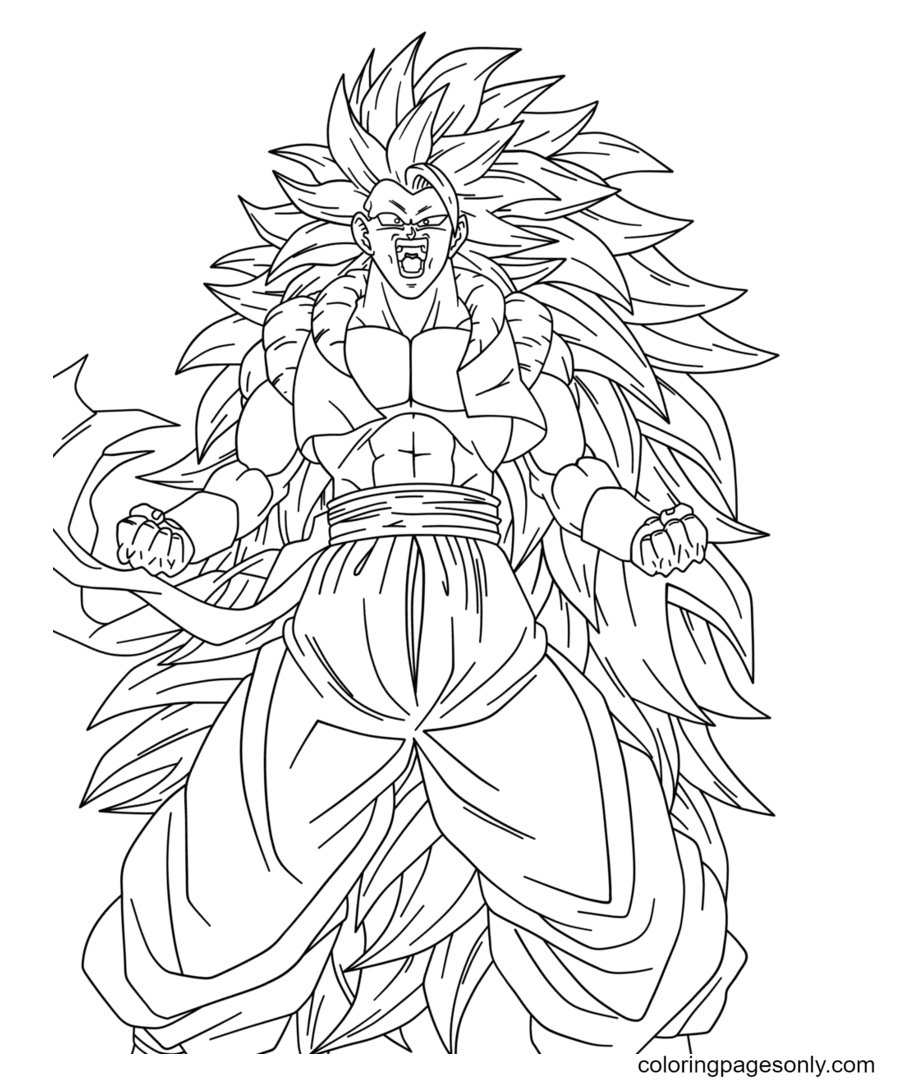
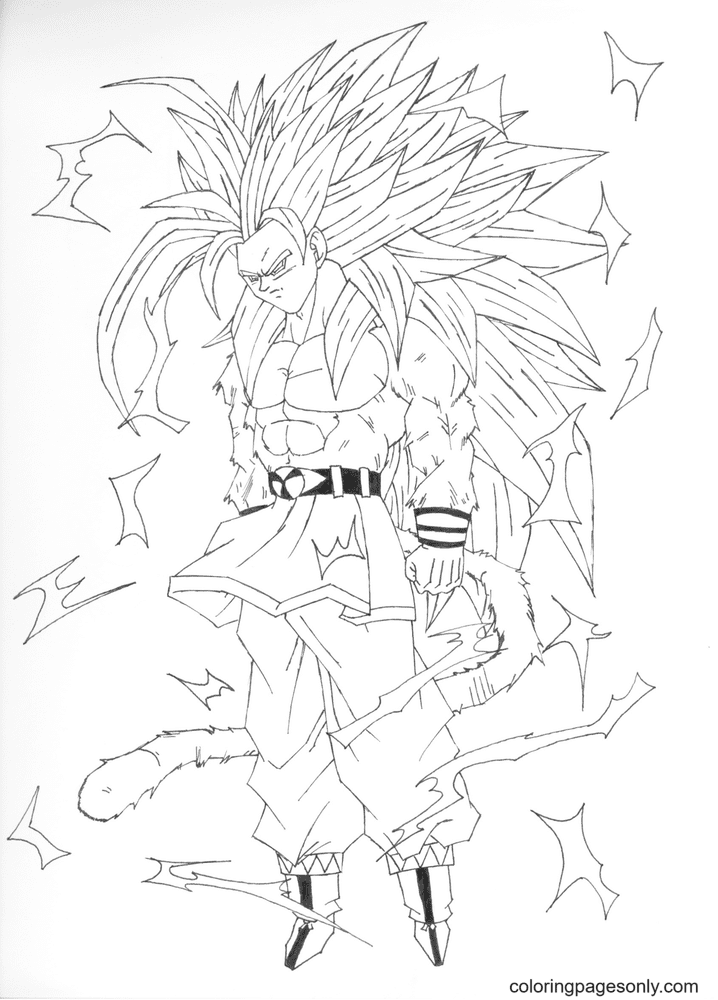
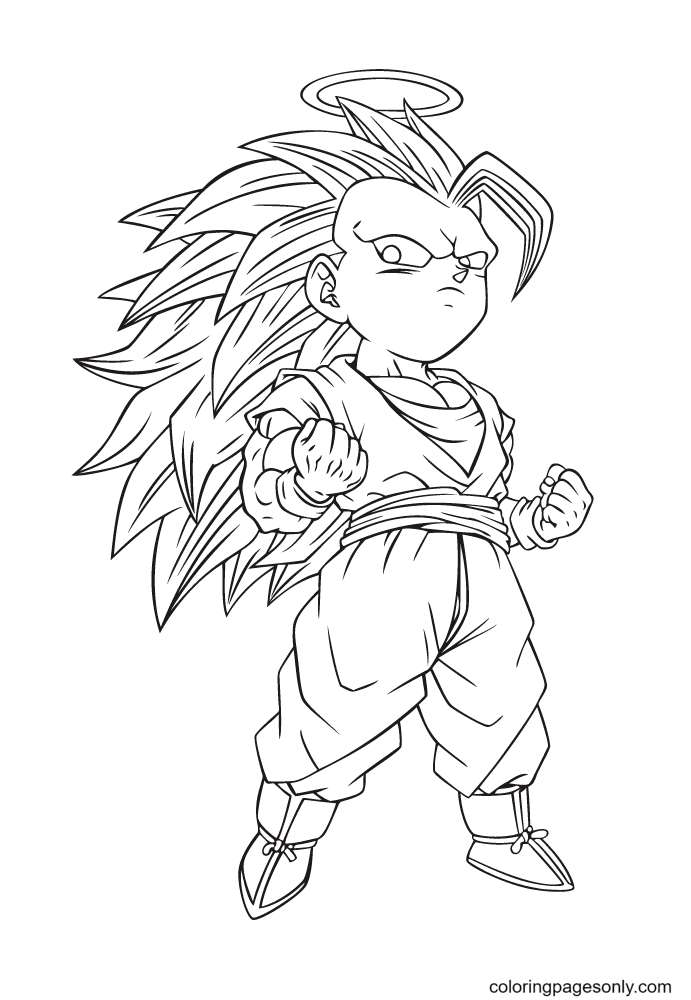
Super Saiyan 3 is the most visually dramatic of the numbered Super Saiyan forms and the one that most clearly departs from the base design. Three specific visual changes define it: the hair grows extremely long (reaching the waist or below the waist, dramatically longer than any previous form), the eyebrows completely disappear (no eyebrow line of any kind, not even a golden eyebrow), and the brow ridge becomes more pronounced and more heavily shadowed.

The extremely long hair is the form’s most immediately impactful visual change and the one that makes Super Saiyan 3 pages the most compositionally unusual in the collection. In action pages, this long hair sweeps dramatically outward and downward, occupying a significant portion of the composition.

Goku first transformed into Super Saiyan 3 when fighting Majin Buu, and the form was introduced in Dragon Ball Z episode 245, which aired July 21, 1993, in Japan.

Coloring Super Saiyan 3 pages: The hair is vivid golden-yellow, as in previous Super Saiyan forms, but the long-hair configuration requires a different coloring approach: apply the golden base across the full extent of the hair mass, then add slightly darker gold-amber along the hair’s natural separation lines to indicate the individual large strands within the overall hair mass. The complete absence of eyebrows must be maintained: if the page suggests any eyebrow line, it should be colored over with the skin color of the brow area. The brow ridge shadow is the only strong dark value in the forehead area.

Super Saiyan God: The Red Form

Super Saiyan God was introduced in the 2013 theatrical film Dragon Ball Z: Battle of Gods and later incorporated into Dragon Ball Super as a core power level. It requires a ritual involving five righteous Saiyans transferring their energy into a sixth, and produces a dramatically different visual aesthetic from the golden Super Saiyan forms.
In Super Saiyan God form, Goku’s hair turns vivid red (a warm, vivid red-pink that reads as red rather than pink or magenta), his eyes turn red, and his physique becomes leaner and more streamlined compared to the thicker, more muscle-forward Super Saiyan forms. The aura is red and flame-like. This form emphasizes calm power rather than aggressive energy.

Coloring Super Saiyan God pages: The hair is vivid,d warm red, slightly red-pink,nk but primarily reading as red. Apply it at full saturation across all hair surfaces. The eyes match: the same vivid warm red, applied within the eye outline with a small white highlight dot. The aura, if present, uses red at the core, fading to warm orange-red at the outer edges, with occasional pale yellow-white at the very tips of the aura’s flame-like extensions.

Super Saiyan Blue: The Blue Form

Super Saiyan Blue (officially Super Saiyan God Super Saiyan, abbreviated SSGSS) is achieved by combining the Super Saiyan God ki with the Super Saiyan transformation. Introduced in Dragon Ball Super, it is one of the franchise’s most visually striking forms and one of the collection’s most popular pages.

The hair turns vivid blue (a deep, slightly blue-teal rather than a bright royal blue), the eyes turn vivid blue, and the aura is blue. The specific blue of Super Saiyan Blue is one of anime character design’s most documented specific colors: it leans slightly toward teal or cyan rather than the richer blue of common pigment, and it should be applied at full saturation to achieve the correct read.

Coloring Super Saiyan Blue pages: The hair is deep,p vivid blue with a slight teal-cyan quality. Apply the blue at maximum pressure across the full hair surface. Shadow areas within the hair use a slightly darker, slightly more purple-shifted blue. The eyes match the hair blue precisely. The aura, if present, is vivid blue at its inner core, transitioning through lighter blue to pale blue-white at the outer edge.

Ultra Instinct: The Silver Form

Ultra Instinct, introduced during the Tournament of Power arc in Dragon Ball Super, represents a state of fighting beyond conscious thought: the body reacts and defends automatically without the mind needing to direct it. Goku first achieved the incomplete “Ultra Instinct Sign” form in episode 110, aired October 8, 2017, in Japan.

The visual is the most dramatically different from Goku’s previous forms: the hair turns silver-white (with individual strands showing subtle silver-grey variation), the eyes become silver-grey, and the aura combines silver-white with occasional blue energy. The “Sign” or incomplete form shows some dark hair strands remaining. The complete Mastered Ultra Instinct form achieved in episode 129 shows fully silver-white hair.

Coloring Ultra Instinct pages: The hair uses the lightest available grey or silver, nearly white. Apply a clean, very pale grey across the hair surface, then add slightly darker grey lines along the major hair separation points to give the individual spike forms definition without losing the overall silver-white quality. The eyes are cool grey-silver. The aura is primarily white or very pale blue-white, with blue energy effects at the points of most intense energy concentration.

Kamehameha and Spirit Bomb Pages

The Kamehameha (かめはめ波) is Goku’s most frequently used energy attack, learned from Master Roshi and used in virtually every major battle across the franchise. The charging pose is one of the most recognized positions in anime: both palms cupped together at the body’s side, then thrust forward as the energy releases in a vivid blue beam.

The Spirit Bomb (Genki Dama, 元気玉) is Goku’s most powerful gathered energy technique: he raises both arms above his head to gather energy from all living things, forming a large blue sphere of concentrated life energy above his hands.

Coloring Kamehameha pages: The energy beam is vivid blue-white, brightest at the center of the beam, where energy density is highest,t and fading to a paler blue at the edges. The hands cupped at the side show blue energy gathering in the palm. The beam extends from the palms to the target with the same central-bright-to-edge-fade gradient applied along its full length. Coloring Spirit Bomb pages: The sphere above Goku’s raised hands is a large,e vivid blue circle, lighter at its center and deepening toward its edge.

Young Goku on the Flying Nimbus

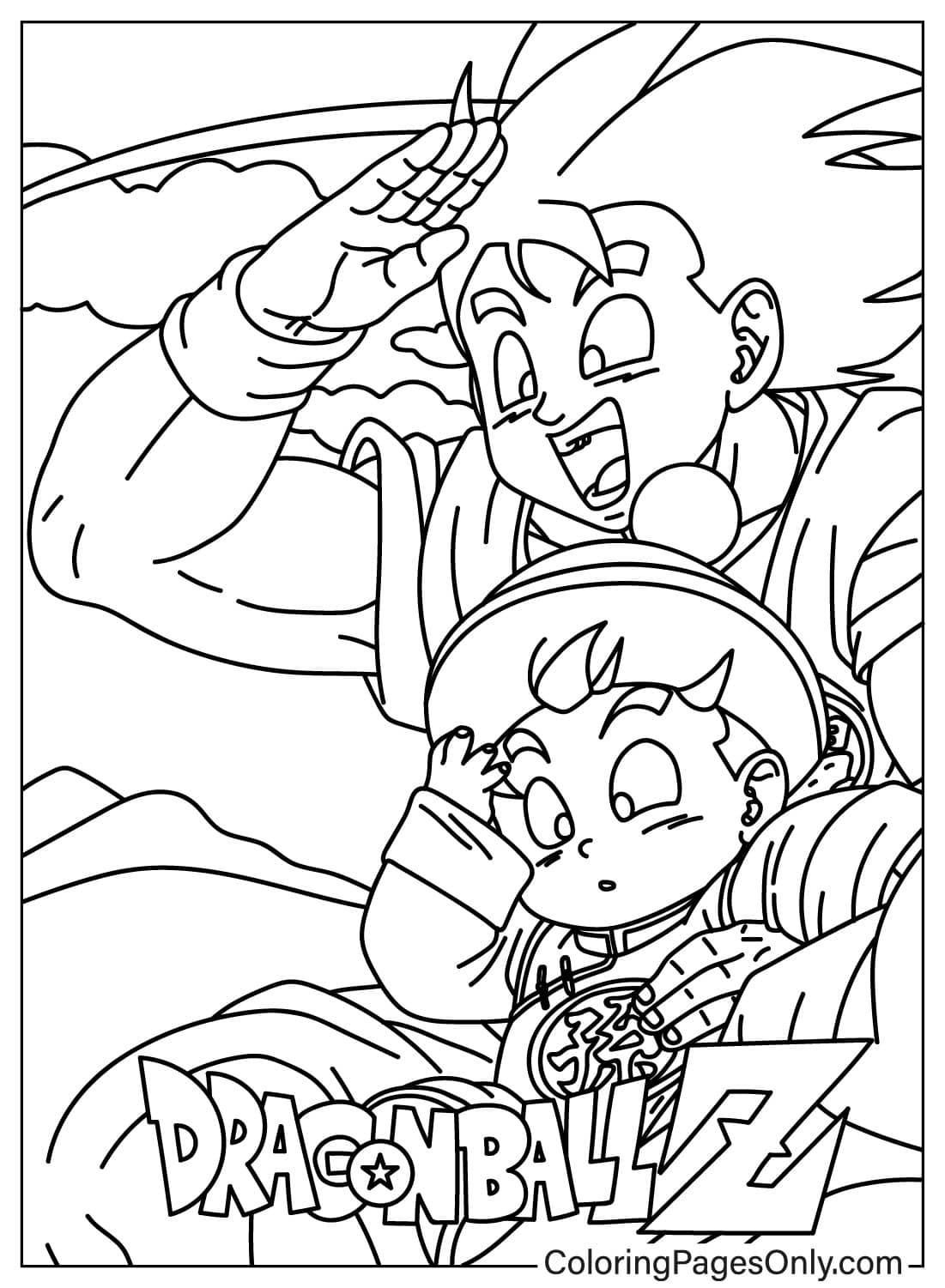
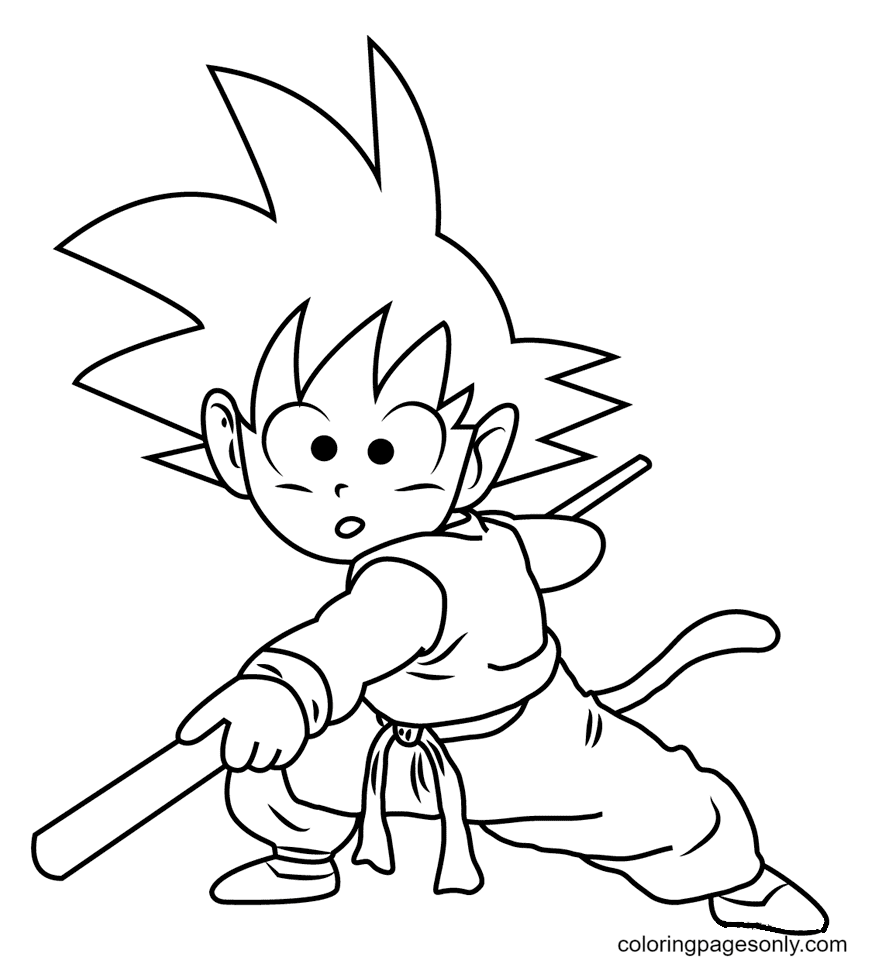
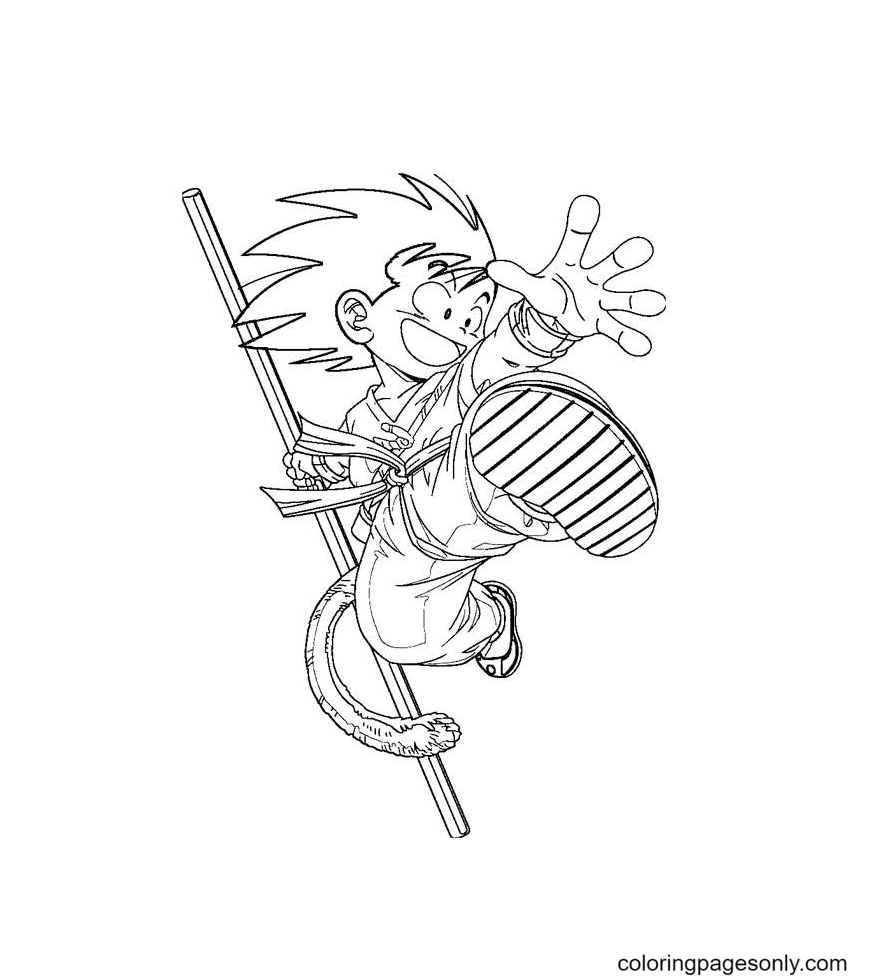
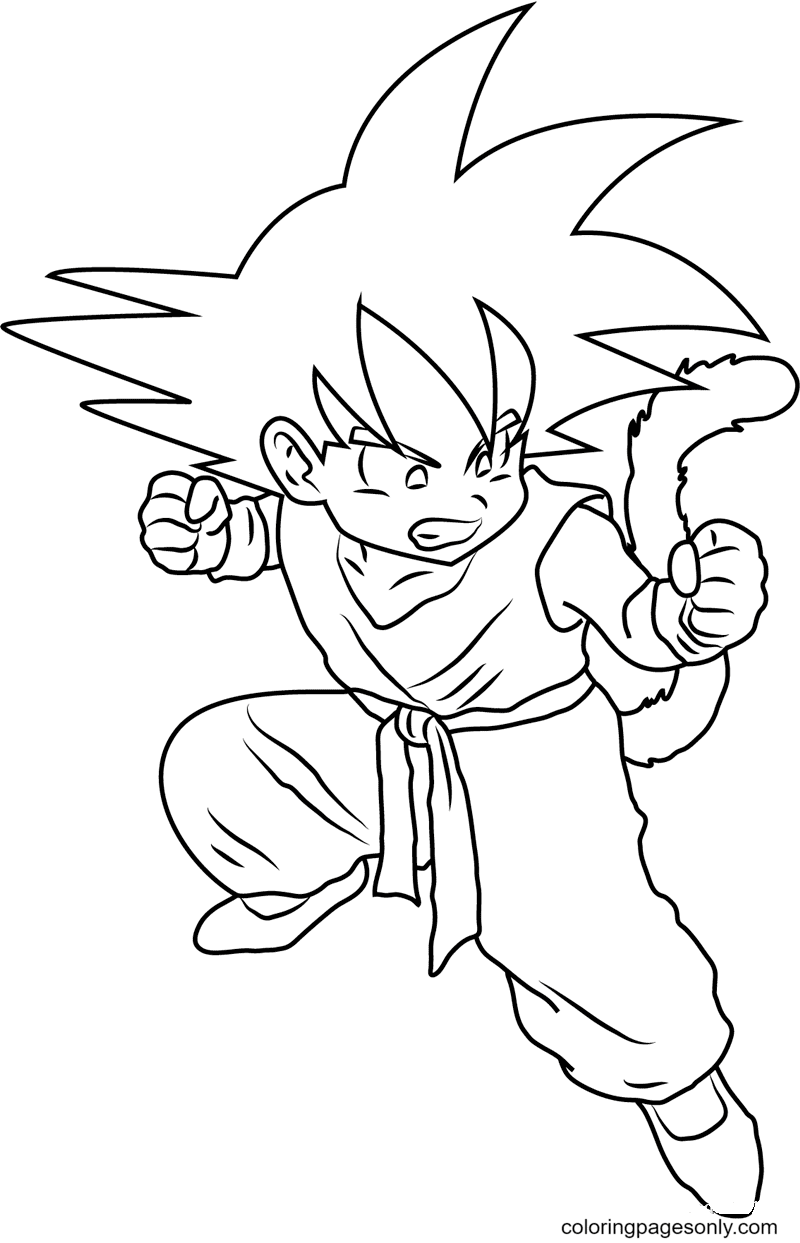
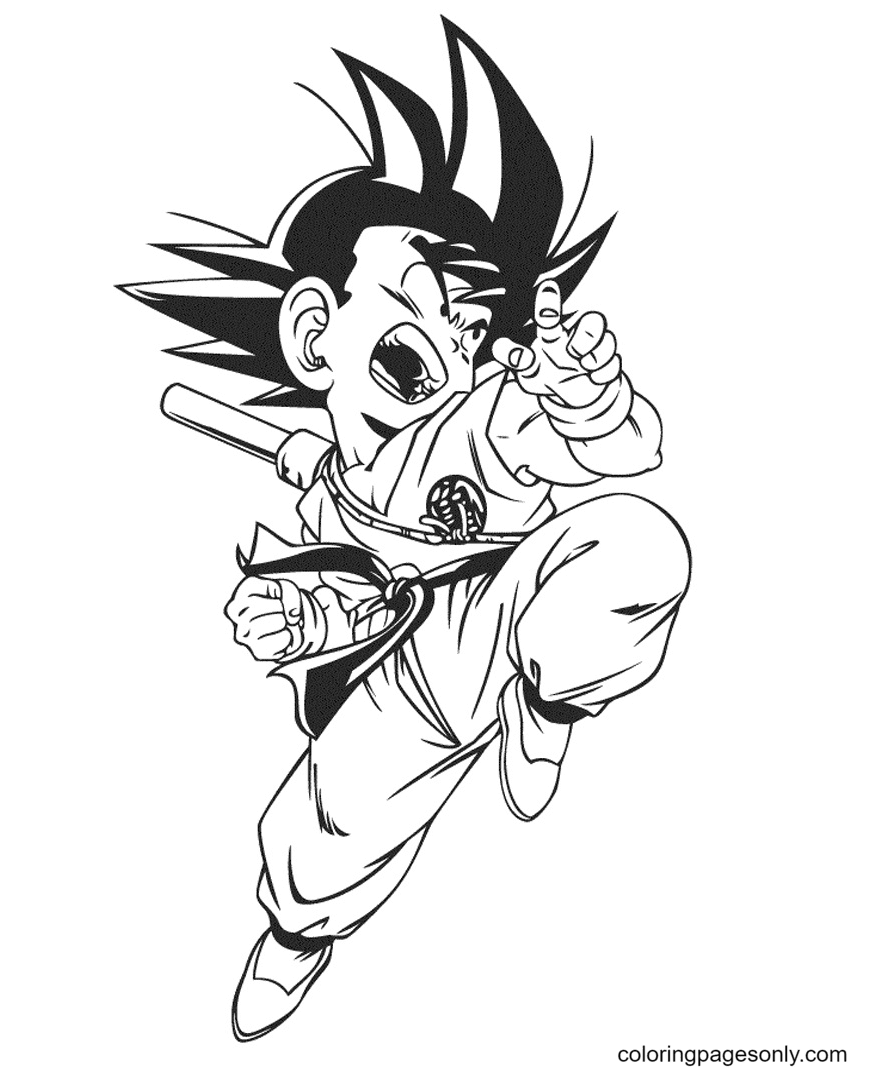
The original Dragon Ball series (1984 manga, 1986 anime) depicted Goku as a young child, visually shorter and with rounder proportions than the adult Goku of Dragon Ball Z and Super. Child Goku still wore the orange gi and had the same black spiky hair, but on a smaller scale. He rode the Kintoun (Flying Nimbus), a golden cloud that could only be ridden by those with a pure heart, and carried the Nyoi-bō (Power Pole), an extending staff.

These pages are the collection’s most accessible for the youngest colorists, and their visual register of adventurous childhood energy differs significantly from the intense battle imagery of the Z and Super era pages.

Coloring young Goku pages: The same orange gi and dark blue boots as adult Goku, but at smaller proportions. The Flying Nimbus is vivid, warm golden-yellow, distinctly lighter and more golden than the orange of the gi. The cloud form has soft, rounded edges rendered in the warm yellow rather than the harder edge of a solid object.

What These Pages Do

Akira Toriyama created Dragon Ball’s original premise by adapting the Monkey King narrative of Journey to the West, a 16th-century Chinese novel that is one of the Four Great Classical Novels of Chinese literature. Sun Wukong, the Monkey King, is the source of Son Goku’s name, staff weapon, and magical cloud transport. This literary lineage connects Dragon Ball to a text that has been continuously in print since its publication and gives the franchise a cultural foundation that extends far beyond the entertainment medium in which it appears.

The Super Saiyan transformation, which Goku first achieved in a 1991 episode of Dragon Ball Z, is one of the most studied single moments in anime history from both narrative and visual design perspectives. The specific visual decisions Toriyama made, including the disappearing eyebrows, the teal-green eyes, and the golden aura, have been analyzed extensively in discussions of anime visual communication: how a transformation communicates power, emotion, and narrative shift simultaneously through changes in character design rather than through dialogue.

The American Academy of Pediatrics identifies fine motor skill development as a key childhood milestone throughout early childhood. The spike-by-spike hair rendering of each of Goku’s forms, the aura gradient technique, the Kamehameha beam rendering, and the complex costume detail of the gi’s kanji and trim all provide sustained fine motor challenge calibrated to the collection’s wide age range. The 2005 Art Therapy Journal study on structured coloring and anxiety reduction applies throughout.

Dragon Ball Z was one of the primary anime series through which Western audiences were introduced to the medium in the 1990s, when Funimation’s English dub aired on Cartoon Network’s Toonami programming block beginning in 1998. For many adult fans who color these pages today, Goku represents the specific nostalgic connection to the moment they first understood what anime was.

How to Color These Pages Well

Each transformation form requires a completely distinct hair color, applied at maximum saturation. The visual grammar of Dragon Ball’s transformation system depends entirely on the viewer immediately registering the change in hair color as a change in power level. Base: near-black. Super Saiyan 1, 2, and 3: vivid golden-yellow. Super Saiyan God: vivid warm red. Super Saiyan Blue: deep vivid blue-teal. Ultra Instinct: near-white silver-grey. Each of these colors must be at maximum saturation to read correctly. A muted or desaturated Super Saiyan yellow is the single most common error on Goku pages.

The orange gi has a specific warm quality that cannot be achieved with red-orange or yellow-orange. Goku’s gi orange is the specific medium-warm orange between red-orange and yellow-orange: it reads unambiguously as orange. If the available orange pencil reads too red, layer a small amount of yellow over it; if it reads as too yellow, layer a small amount of red-orange. The specific gi orange is warm, vivid, and immediately identifiable. The dark blue of the undershirt provides maximum contrast with the orange: apply both at full saturation.

The aurarendering technique is the same across all forms,s but with different colors. In every transformation form, the aura has the same internal structure: the most vivid, most saturated version of the form’s aura color at the innermost position closest to the body, transitioning through lighter and lighter values outward until the aura fades to near-transparency at its outermost edge. For Super Saiyan aura: vivid golden-yellow at the core, pale yellow at the edges. For SSB: vivid blue at the core, pale blue-white at the edges. For Ultra Instinct: white at the core, pale silver at the edges.

The kanji on the gi are small but important for accuracy. The symbol on Goku’s gi chest (and back in many depictions) is a specific Chinese/Japanese character depending on the era. For the Namek and early Z era: 界王 (two characters). For other eras: 亀 (one character) or 悟 (one character). These characters are small and can be rendered in a dark navy or black stroke over the orange gi surface. They do not need to be perfectly calligraphic; they need to be consistently dark and clearly positioned at the center of the gi chest.

The Kamehameha beam gradient determines whether the attack reads as energy or as paint. The blue beam of the Kamehameha should have its brightest, lightest point at the exact center axis of the beam, where energy density is highest. Apply blue at full saturation at the center. Then apply a slightly lighter blue-white directly over the center axis. Apply a slightly darker blue at the beam’s outer edges. The result of this three-zone approach is a beam that appears to emit light from within rather than a flat blue rectangle.

5 Creative Craft Ideas

The Transformation Timeline

Goku’s power progression across Dragon Ball, Dragon Ball Z, and Dragon Ball Super is one of manga’s most extensively documented character development arcs. Print one page for each of the major forms: base form, Super Saiyan, Super Saiyan 3, Super Saiyan God, Super Saiyan Blue, and Ultra Instinct.

Color all six in their canonical form-specific colors. Mount in chronological order on a long backing sheet. Add dates below each: “Super Saiyan: Planet Namek, 1991 (manga). Super Saiyan God: 2013, Battle of Gods. Super Saiyan Blue: 2015, Dragon Ball Super. Ultra Instinct: 2017, Tournament of Power. Ultra Instinct Mastered: 2018.”

The display is a forty-year power timeline in color.

The Kamehameha Pose Study

The Kamehameha charging pose is among anime’s most recognized sequences of movement: hands cup at the body’s side, energy gathers in the palms (blue glow visible), the fighter calls the attack’s name, and the energy releases forward in a blue beam. Print three pages showing the charge (hands at side), the thrust (hands extending forward), and the full beam (energy release).

Color all three in canonical base-form gi orange with blue energy effects. Mount all three in the three-stage sequence with brief captions: “Stage 1: Ki gathered. Stage 2: Attack initiated. Stage 3: Kamehameha. Named for Kamehameha I, founder of the Kingdom of Hawaii. Created by Master Roshi. First used in Dragon Ball chapter 3, July 1984.”

The Toriyama Tribute Page

Akira Toriyama died on March 1, 2024, at age 68, from an acute subdural hematoma. He had been the primary creative force behind Dragon Ball for forty years, from the first chapter published July 19, 1984, to the Dragon Ball Super: Super Hero theatrical film in 2022 and the Dragon Ball Daima series that began airing in October 2024. His death was mourned globally by the manga and anime community.

Print the most iconic Goku portrait in the collection. Color it with full canonical accuracy: orange gi, dark blue details, black hair for base form.

On the backing card: “Akira Toriyama. April 5, 195,5 to March 1, 2024. Age 68. Creator of Son Goku. Dragon Ball manga: July 19, 19,84 to May 23, 1995. 519 chapters. 42 volumes. 260 million copies sold worldwide. Dragon Ball Z, Dragon Ball Super, Dragon Ball Daima. Also: character designer for the Dragon Quest video game series. One of the most influential manga artists in history.”

Journey to the West: The Origin Story

Goku’s entire character traces to Sun Wukong, the Monkey King of Wu Cheng’en’s 16th-century Chinese novel Journey to the West. Sun Wukong carries a magical extending staff (Ruyi Jingu Bang), rides a cloud (Jindou Yun), and accompanies a monk on a journey. Toriyama’s Goku carries the Power Pole (Nyoi-bō, the Japanese reading of the same staff name), rides the Flying Nimbus (Kintoun, another Japanese reading from the novel), and his name is the Japanese reading of Sun Wukong’s name.

Print a young Goku page from the original Dragon Ball era, ideally showing him with the Power Pole or Flying Nimbus. Color it in the original Dragon Ball palette.

On the backing card: “Son Goku (孫悟空): Japanese reading of Sun Wukong (孫悟空). Journey to the West (西遊記): written by Wu Cheng’en, published approximately 1592. One of the Four Great Classical Novels of Chinese literature. Power Pole (Nyoi-bō): the same magical extending staff. Flying Nimbus (Kintoun): the same golden cloud. Dragon Ball began on July 19, 1984. The source: four centuries earlier.”

The Trunami Generation Page

Dragon Ball Z reached Western audiences through Funimation’s English dub, which aired on Cartoon Network’s Toonami programming block beginning in August 1998. For an entire generation of Western viewers, Toonami was the context in which they first understood what anime was: Dragon Ball Z, Sailor Moon, Gundam Wing, and other series airing on the same programming block introduced the medium to millions of viewers who had not previously encountered it.

Print a Super Saiyan Goku page, with golden-yellow hair at full power. Color with maximum accuracy and saturation.

On the backing card: “Dragon Ball Z. Funimation English dub. Cartoon Network Toonami block. Beginning August 1998. The programming block that introduced millions of Western viewers to anime. Many people who color this page today first watched Goku transform into Super Saiyan on a tube television in 1998 or 1999. He looked exactly like this.”

Frequently Asked Questions

Who is Goku, and where does the character come from? Son Goku (孫悟空) is the main protagonist of the Dragon Ball manga series created by Akira Toriyama, serialized in Weekly Shōnen Jump from July 19, 1984, to May 23, 1995. He was born on Planet Vegeta as Kakarot, a member of the Saiyan warrior race, and was sent to Earth as an infant. A head injury as a baby erased his aggressive Saiyan programming, and he was raised by the elderly martial artist Son Gohan. His character is directly inspired by Sun Wukong, the Monkey King of Wu Cheng’en’s 16th-century Chinese novel Journey to the West: his Japanese name (Son Goku) is the Japanese reading of Sun Wukong’s Chinese name, and his iconic staff weapon and magical cloud transport both trace directly to the source novel.

What are all of Goku’s transformation forms? Goku’s documented major transformation forms, in chronological order of their in-series introduction, include: Great Ape (Oozaru), achieved by transforming under a full moon before losing his tail; Super Saiyan, first achieved against Frieza on Planet Namek in the Dragon Ball Z manga chapter published in 1991; Super Saiyan 2, with added lightning in the aura; Super Saiyan 3, with greatly extended golden hair and no eyebrows; Super Saiyan God, with red hair and lean physique, introduced in the 2013 film Battle of Gods; Super Saiyan Blue (Super Saiyan God Super Saiyan), with blue hair, introduced in Dragon Ball Super in 2015; and Ultra Instinct, with silver-white hair and silver eyes, introduced in Dragon Ball Super episode 110, aired October 8, 2017. Each form corresponds to a distinct hair color and aura type.

Who created Dragon Ball, and when was it first published? Dragon Ball was created by Akira Toriyama, born April 5, 1955, in Nagoya, Aichi Prefecture, Japan. Toriyama died on March 1, 2024, at age 68, from an acute subdural hematoma. The manga was first published in Weekly Shōnen Jump magazine on July 19, 1984, and ran until May 23, 1995, producing 519 chapters across 42 tankōbon volumes. The series has sold over 260 million copies worldwide, making it one of the best-selling manga series in history. Toriyama was also the primary character designer for the Dragon Quest video game series, another of his major contributions to Japanese popular culture.

What is the Kamehameha, and what does the name mean? The Kamehameha (かめはめ波) is Goku’s most frequently used energy attack, a focused beam of ki energy that he charges by cupping both palms together at his body’s side and then thrusting forward as the energy releases. It was created by Master Roshi (Muten Roshi) and learned by Goku early in the original Dragon Ball series. The name Kamehameha refers to Kamehameha I (approximately 1758 to May 8, 1819), the founder and first ruler of the unified Kingdom of Hawaii. Toriyama has stated that he named the attack after seeing a sign mentioning Kamehameha while working on the chapter and chose the name because of its rhythmic, repeatable quality.

What Dragon Ball anime series exist, and which are canonical? Toei Animation has produced five anime series based on the Dragon Ball franchise. Dragon Ball aired from February 26, 1986, to April 19, 1989 (153 episodes), covering the original manga’s events. Dragon Ball Z aired from April 26, 1989, to January 31, 1996 (291 episodes), covering the Saiyan, Namek, Cell, and Buu sagas and considered the most culturally significant entry in the franchise globally. Dragon Ball GT aired from February 7, 1996, to November 19, 1997 (64 episodes) and is generally considered non-canonical as it was produced without Toriyama’s direct involvement. Dragon Ball Super aired from July 5, 2015, to March 25, 2018 (131 episodes) and is canonical. Dragon Ball Daima began airing on October 11, 2024, and was partially developed with Toriyama’s involvement before his death.

How did Dragon Ball Z reach Western audiences? Dragon Ball Z reached Western audiences primarily through Funimation Entertainment’s English-language dub, which began production in 1996. The Funimation dub was first broadcast on Cartoon Network’s Toonami programming block in the United States beginning in 1998, where it became one of the block’s defining series alongside titles like Sailor Moon and Gundam Wing. The Toonami airing introduced anime to a generation of Western viewers who had not previously encountered the medium in significant numbers. The series remained in regular rotation on the block through the early 2000s and is widely credited as one of the primary factors in the growth of Western anime fandom in the late 1990s and early 2000s.

What age group are these pages best suited for? Goku coloring pages serve an exceptionally wide age range. Simple base-form portraits with large, clearly defined areas in orange and black are accessible from ages four and five, where the character’s familiar silhouette and bold colors provide immediately achievable coloring targets. The transformation from pages, with their aura gradient techniques, specific hair color management, and lightning bolt effects for Super Saiyan 2, is most rewarding from ages six to twelve, where developing fine motor control and color management ability allows for increasingly accurate rendering. The complete transformation timeline displays, and the technically demanding Ultra Instinct silver-hair rendering is most engaging for older teenagers and adult fans who bring knowledge of the franchise’s forty-year narrative to the coloring activity. The Dragon Ball original series pages are most accessible for the youngest colorists; the Dragon Ball Super era pages require the most technical color precision.

Browse the full collection at ColoringPagesOnly.com. All 70+ pages free, no sign-up, PDF or PNG, print or color online.

Akira Toriyama took a 16th-century Chinese novel about a Monkey King with an extending staff who rides a golden cloud. On July 19, 1984, the first chapter of a manga about a spiky-haired boy with an extending staff who rides a golden cloud. He named his character Son Goku: the Japanese reading of Sun Wukong.

Eleven years and 519 chapters later, the manga ended. By then, Goku had turned his hair golden for the first time on the planet Namek, facing a warlord named Frieza, after watching his best friend die. The episode aired in Japan on May 15, 1991. People who were children then are adults now. Many of them are still watching.

Toriyama died on March 1, 2024. The series he created is still being published.

Pick up your darkest black for the base form hair. Pick up your most vivid orange for the gi. Pick up your most saturated golden-yellow for Super Saiyan. Each of these colors needs to be at maximum strength. The design requires it.

Share your work on Facebook and Pinterest and tag #Coloringpagesonly. The transformation timeline displays, and the Toriyama tribute pages are particularly worth sharing.

Color the gi orange. Turn the hair gold. He transformed for the first time in 1991 and has not stopped since.

These related coloring collections will help you explore the wonderful world of colors. Let’s choose, be creative, and show us your great pictures!

Mantasstonys Allen – Designer

Hello! I'm Mantasstonys Allen, a web designer at Coloringpagesonly.com. My passion is bringing creativity to life through beautiful and user-friendly designs. I'm here to make your experience on our site smooth, fun, and inspiring—so you can focus on what matters most: coloring and unleashing your imagination!