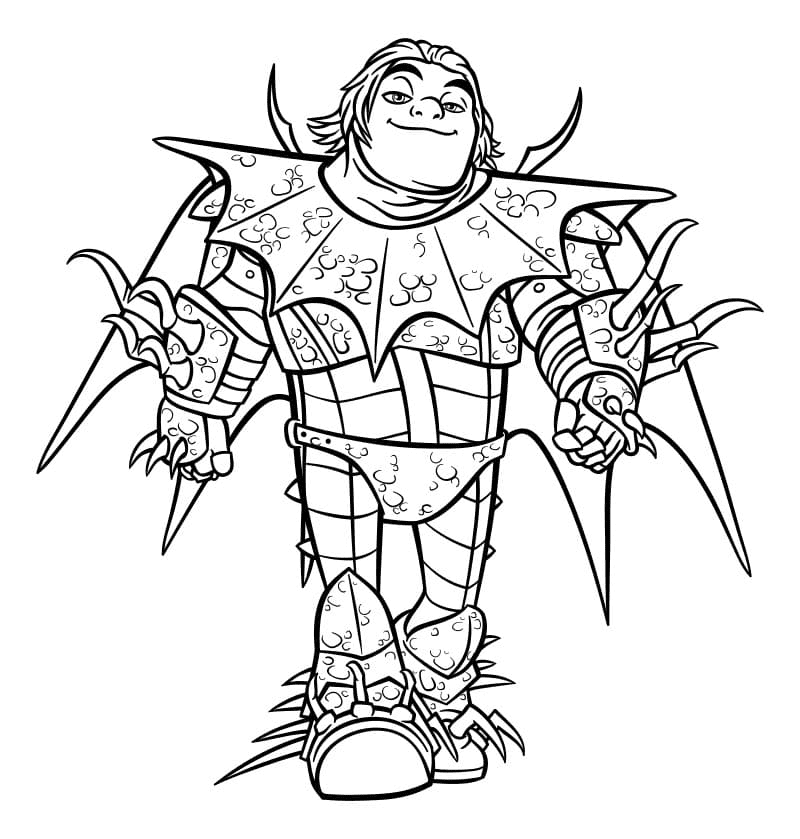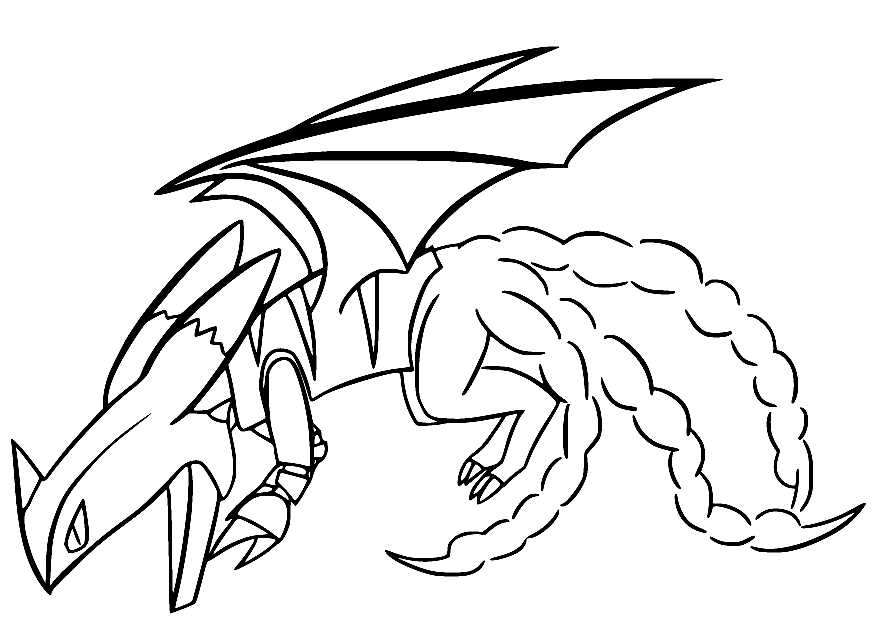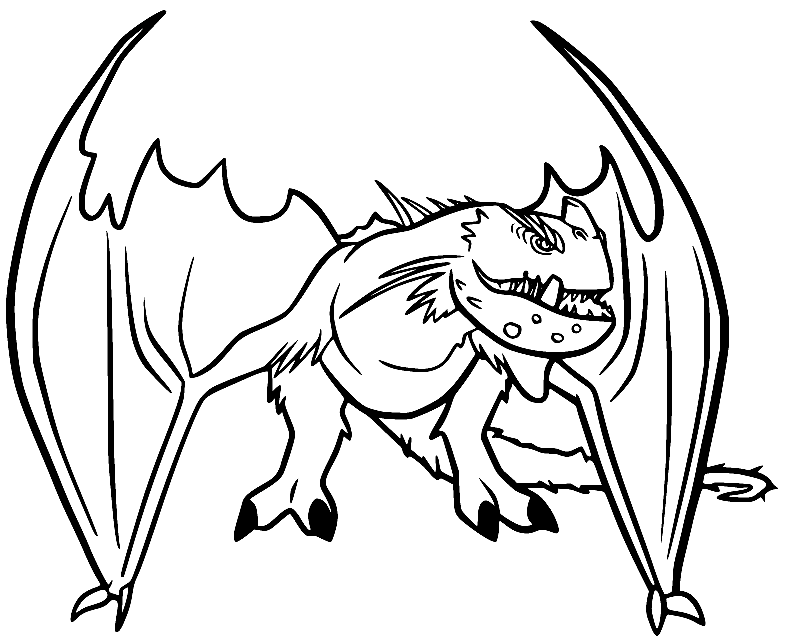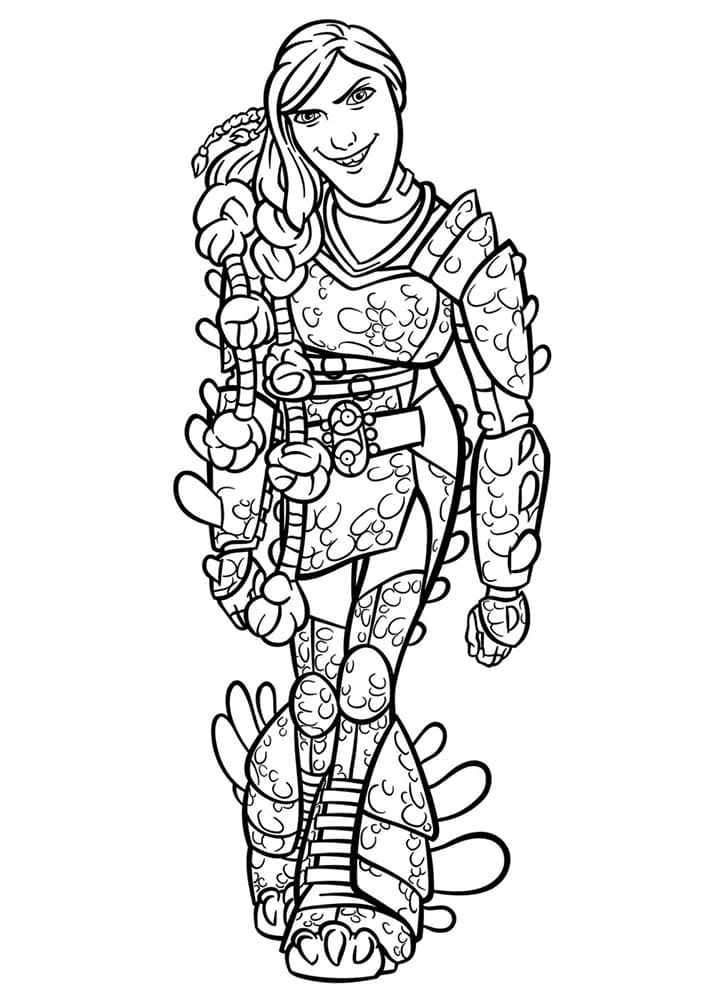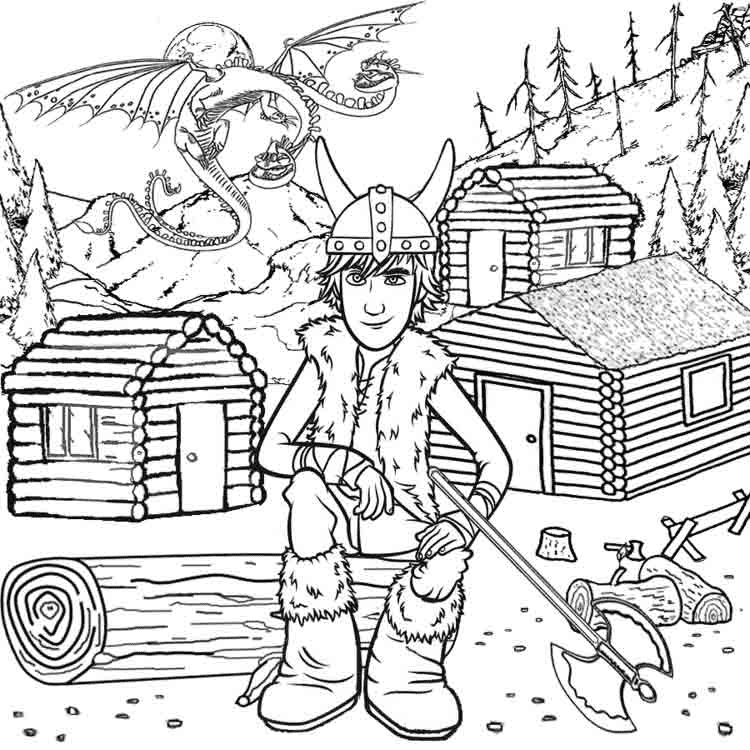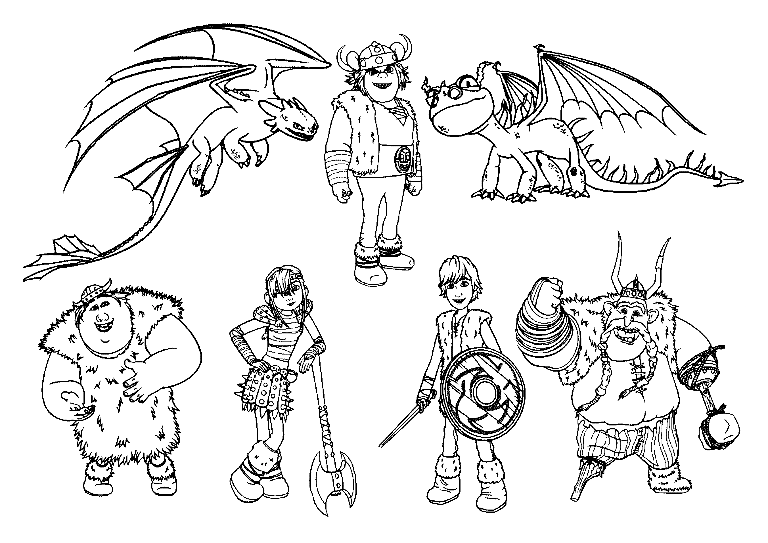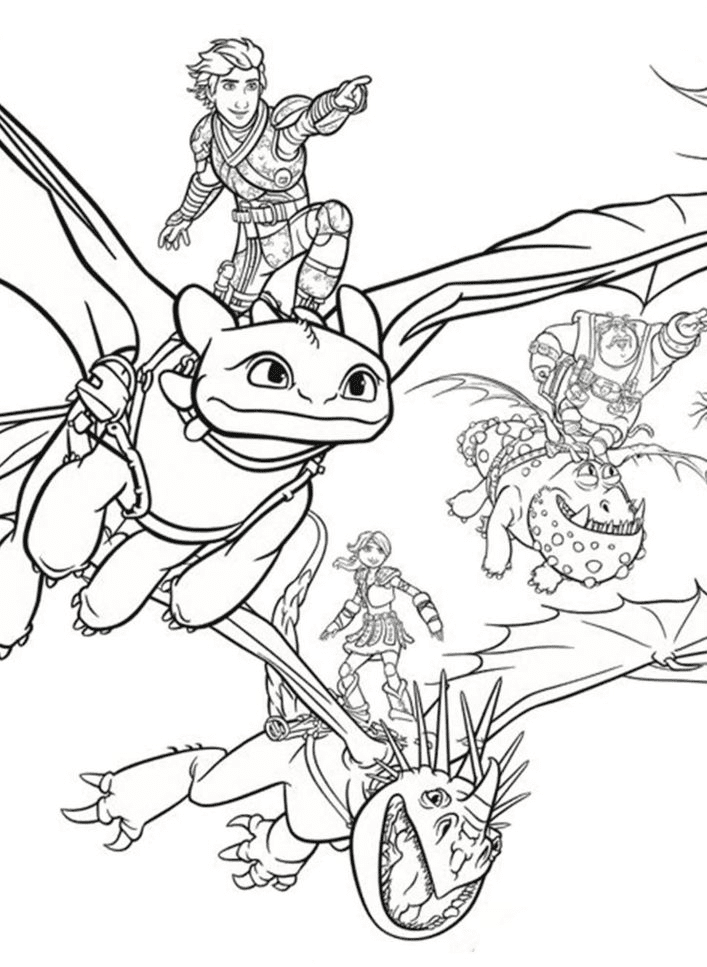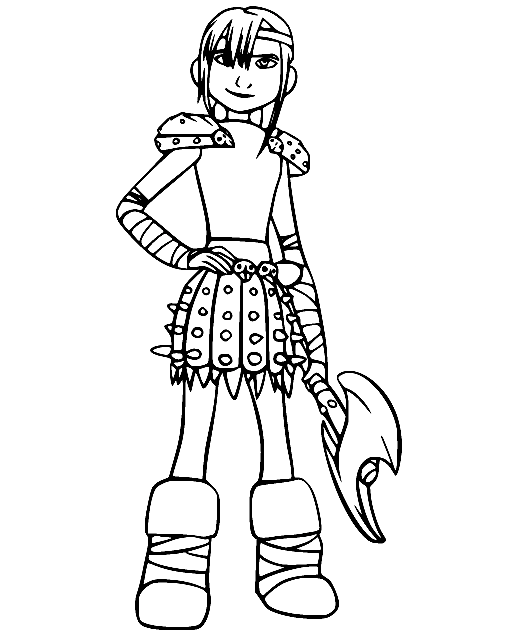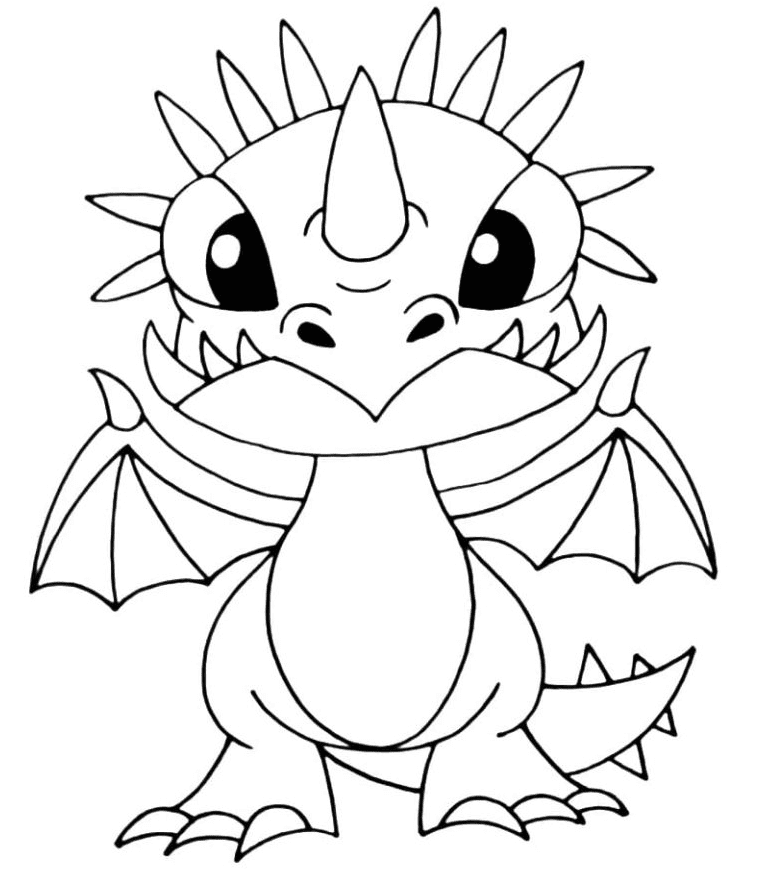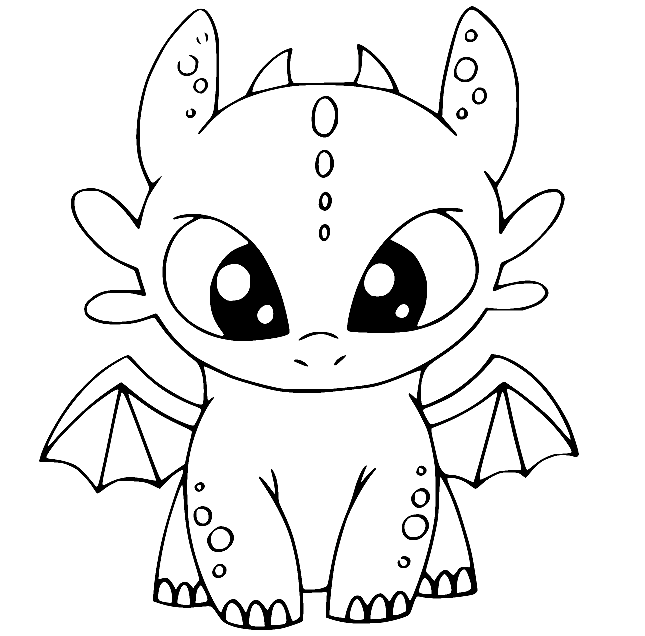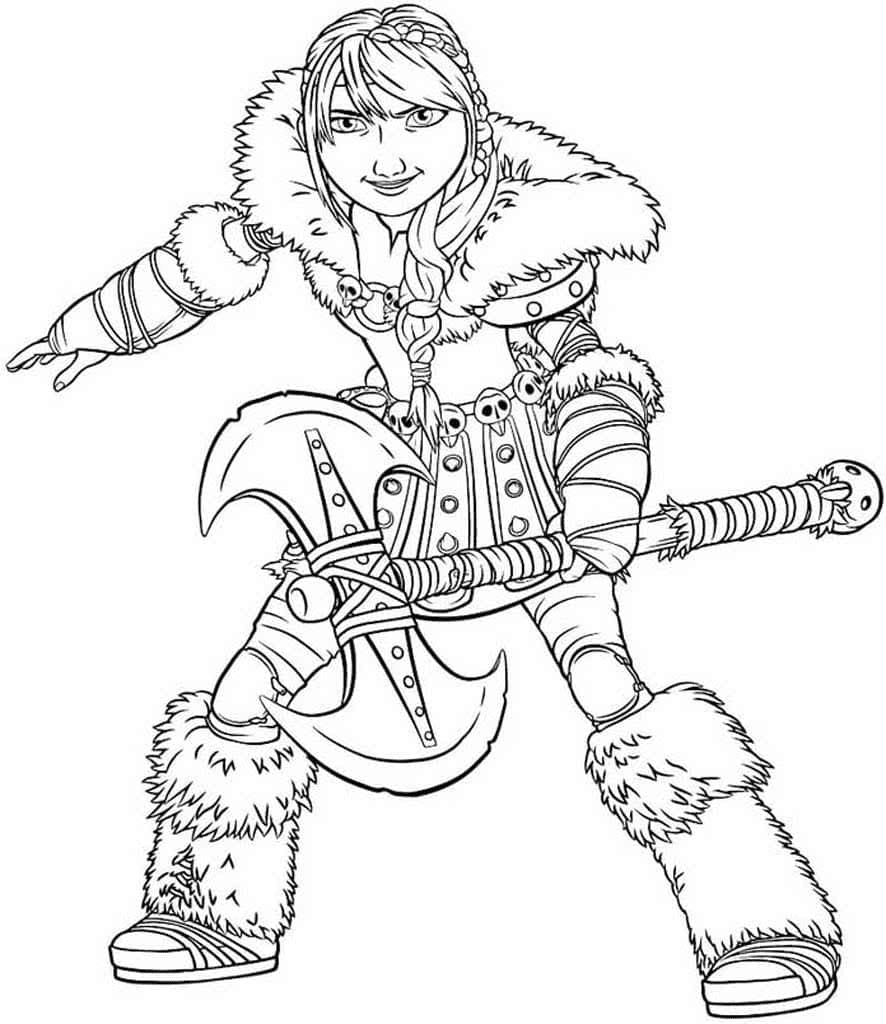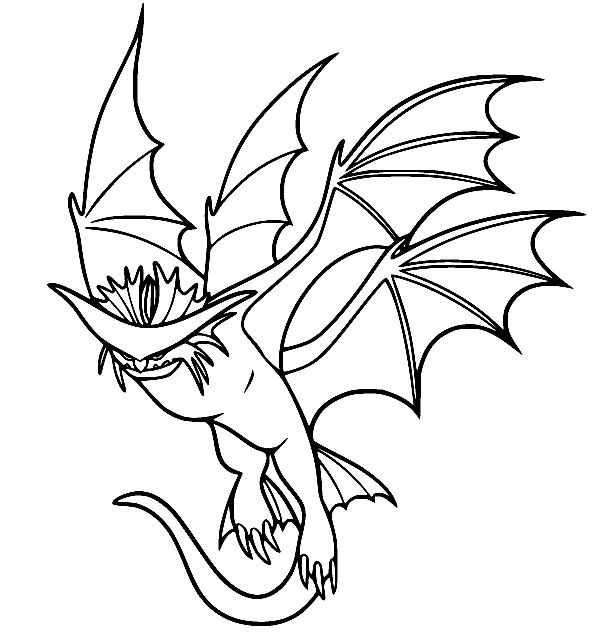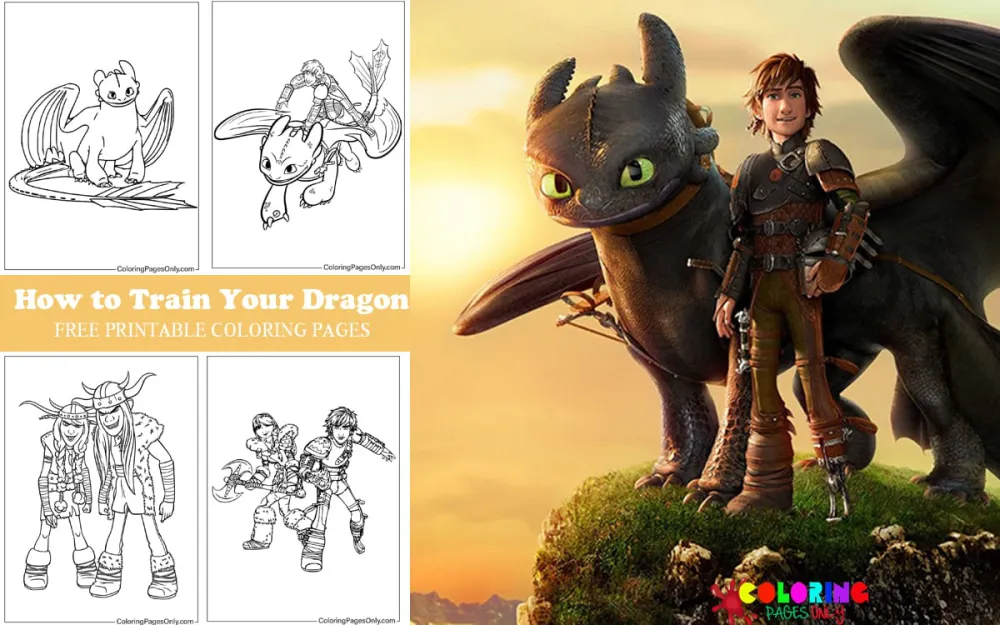
Free How to Train Your Dragon coloring pages – 60+ pages featuring Toothless, Hiccup, Astrid, Stormfly, Stoick the Vast, Gobber, the Light Fury, Cloudjumper, dragon species from across the trilogy, flight scenes, portrait pages, and designs from all three DreamWorks animated films and the 2025 live-action adaptation – free printable PDF and online coloring for fans of the franchise.

How to Train Your Dragon is a media franchise originating with the children’s book series by British author Cressida Cowell, the first volume of which was published in 2003. DreamWorks Animation adapted the books into a trilogy of animated films directed by Chris Sanders and Dean DeBlois (the first film) and Dean DeBlois alone (the second and third): How to Train Your Dragon (2010), How to Train Your Dragon 2 (2014), and How to Train Your Dragon: The Hidden World (2019). The first film was nominated for the Academy Award for Best Animated Feature and won the Annie Award for Best Animated Feature. The second won the Golden Globe for Best Animated Feature Film. All three films collectively grossed over $1.6 billion worldwide.

The franchise returned in theaters on June 13, 2025, with a live-action adaptation directed by Dean DeBlois – the same director who guided the animated trilogy’s second and third films – with a cast including Mason Thames as Hiccup and Gerard Butler reprising his animated role as Stoick the Vast. The live-action film generated renewed global interest in the franchise and is the most immediate context for this collection’s May 2025 update.

These 60+ free pages at ColoringPagesOnly.com span the full franchise. All free, PDF or PNG, print or color online.

What’s Inside

Toothless – The Night Fury

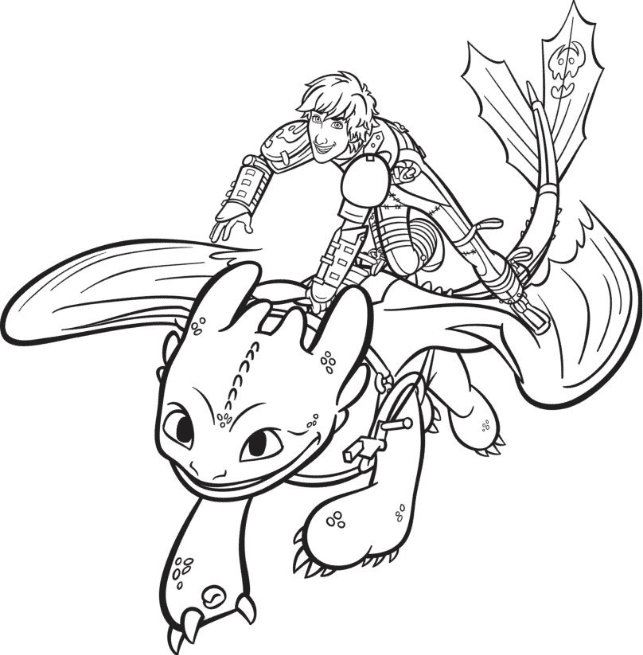
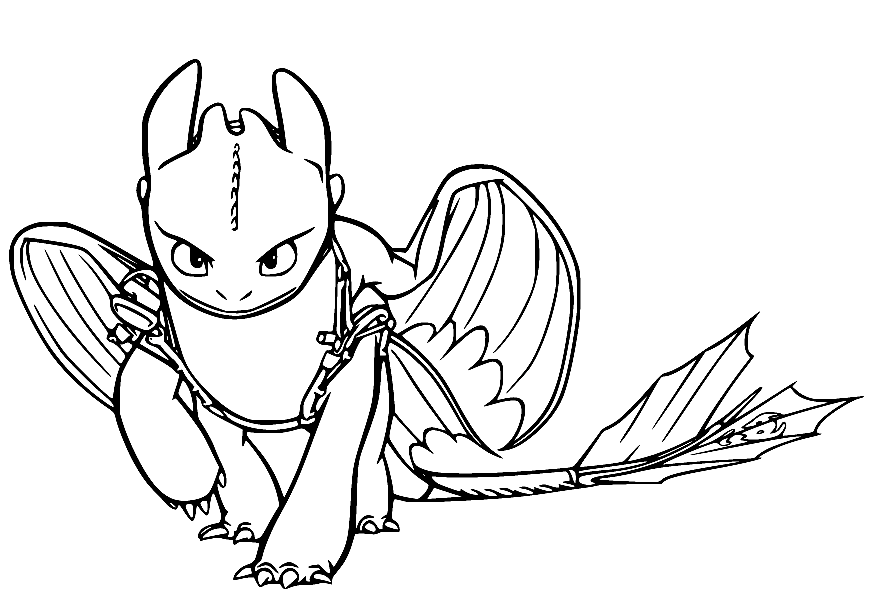
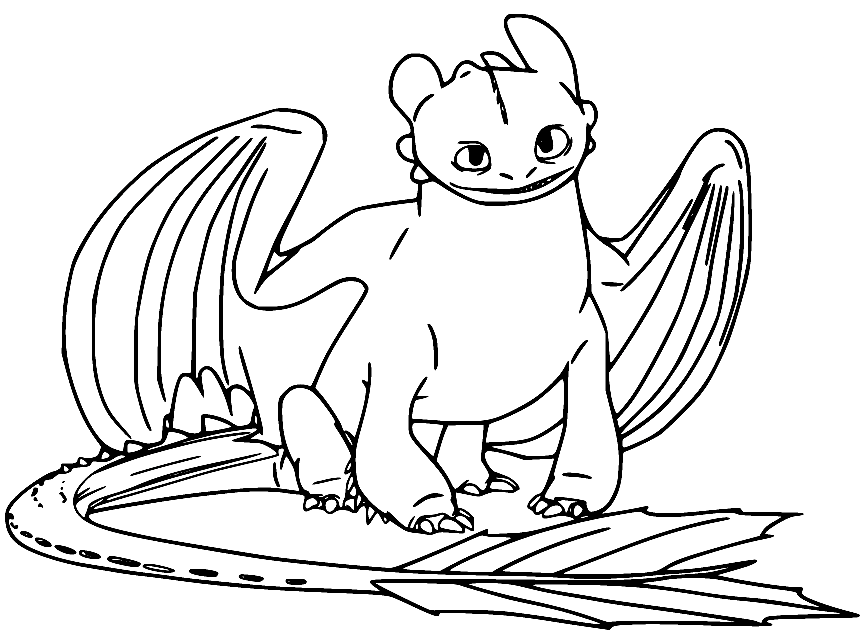
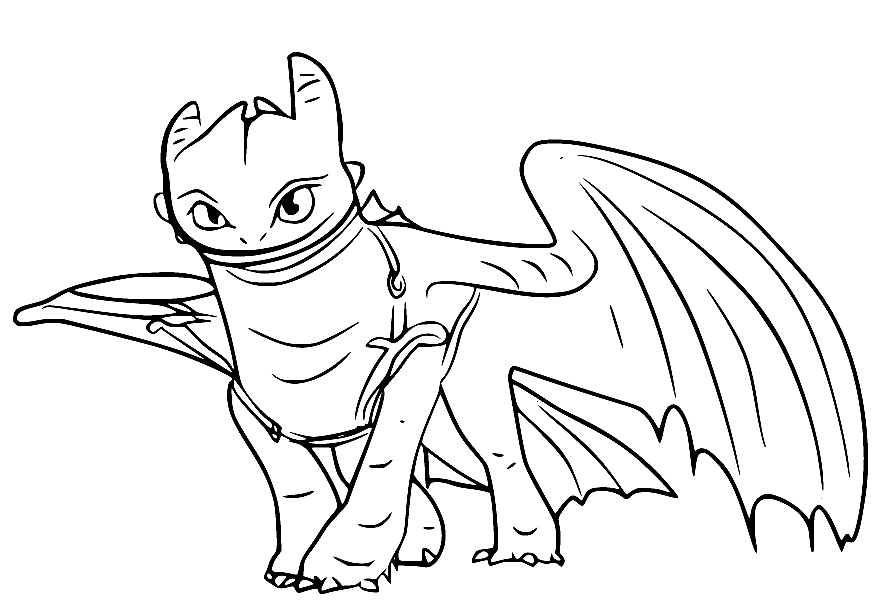
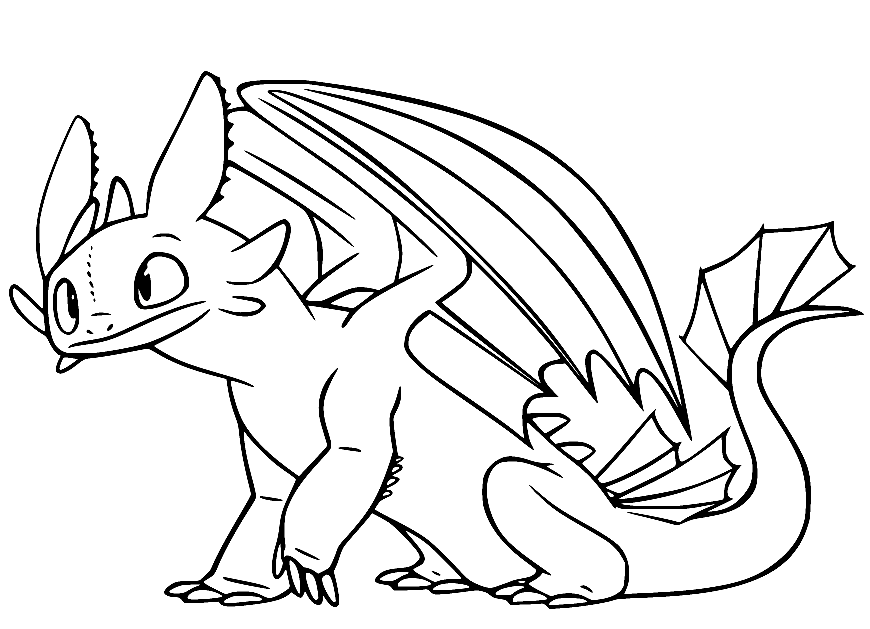
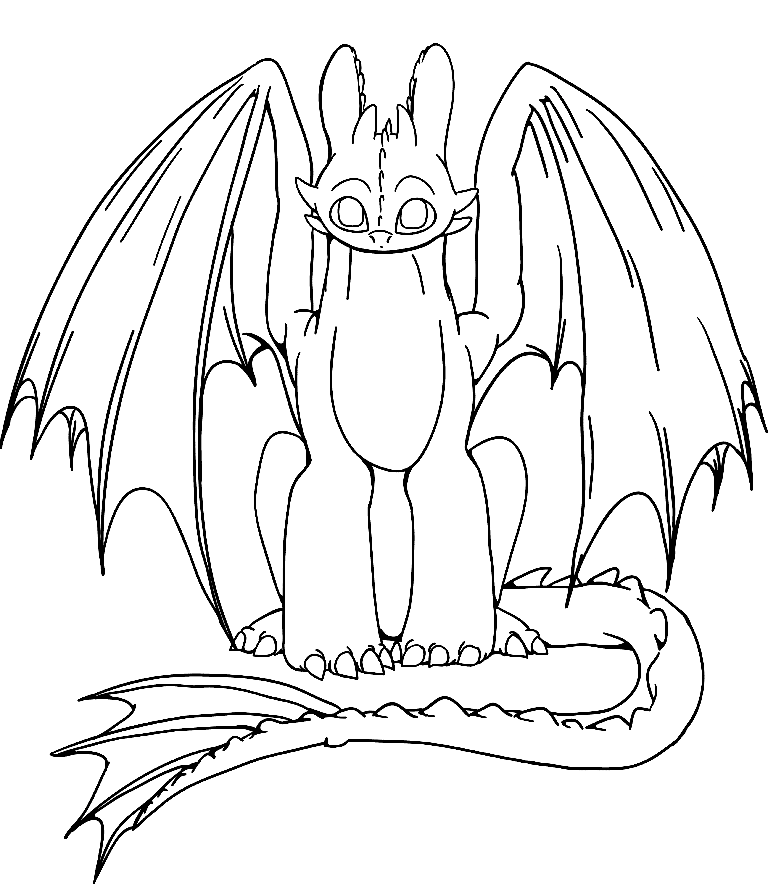
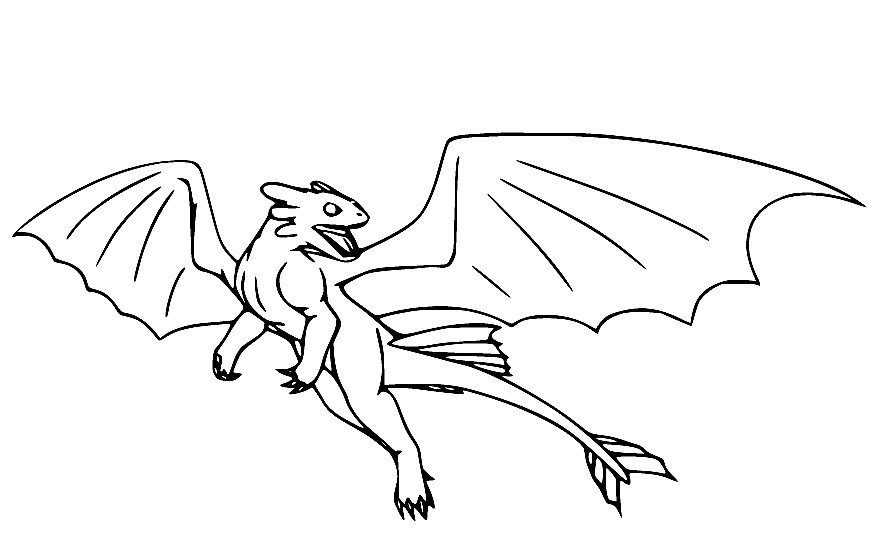
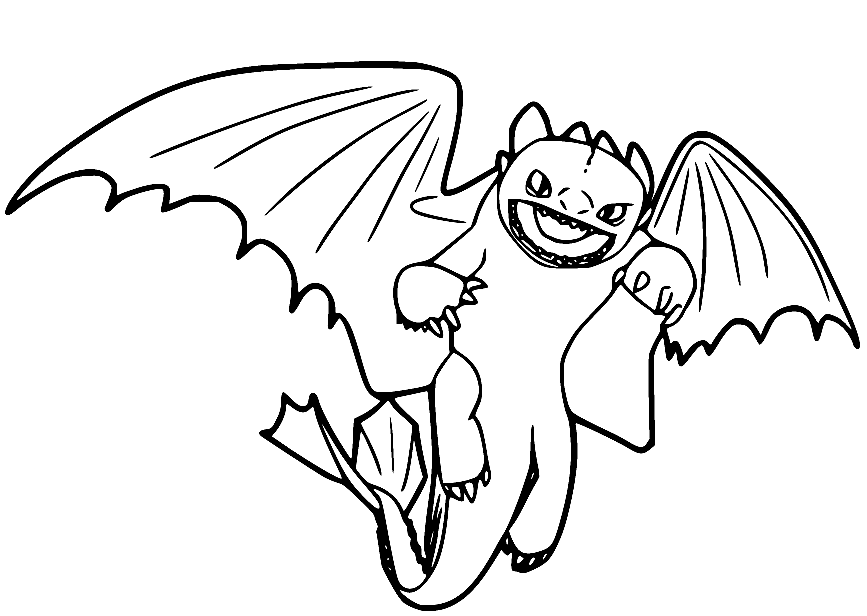
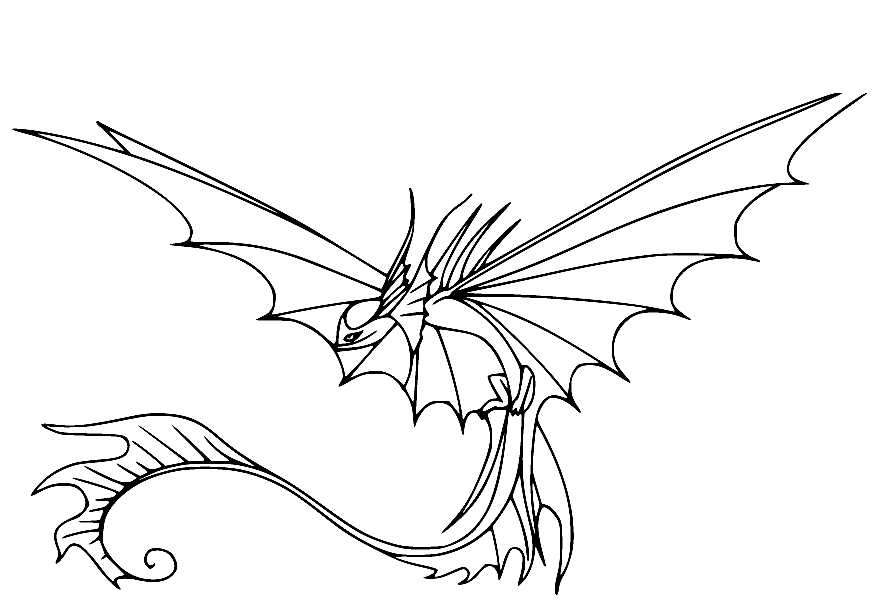
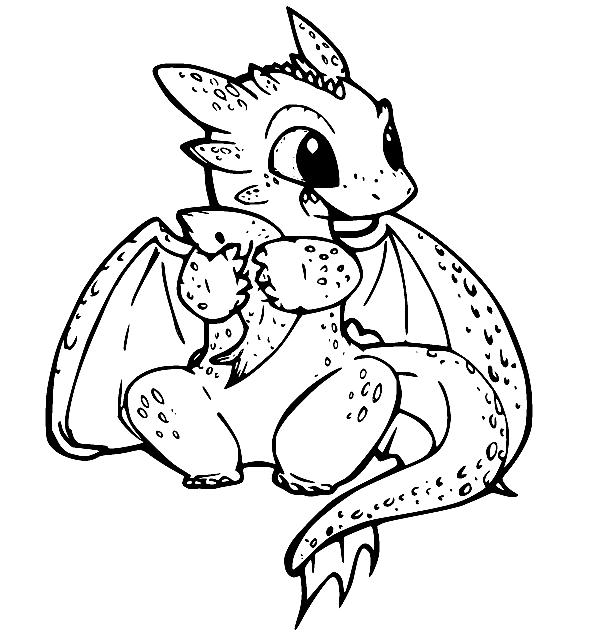
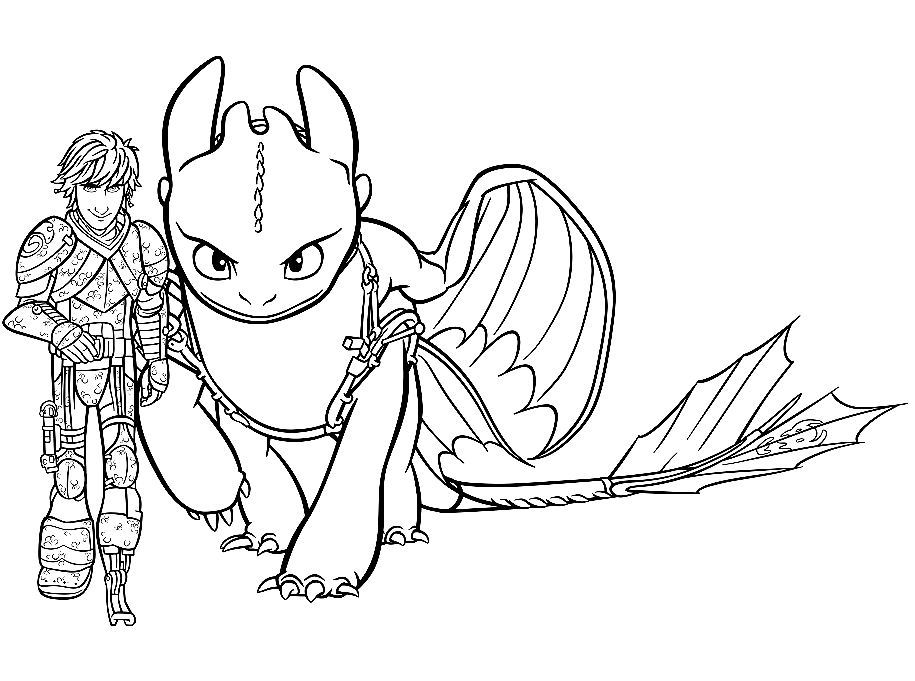
Toothless is the franchise’s most beloved design – a Night Fury dragon whose visual language combines the aerodynamic sleekness of a jet aircraft with the specific emotional expressiveness of a cat or dog. He is black, entirely black, with a surface that reads as the absence of light rather than as a painted surface – the Night Fury’s camouflage in darkness is the in-story explanation for the near-invisibility that gives the species its name. His eyes are large: cat-slit pupils when alert or threatened, wide, round pupils when content or playful, the single most expressive element in his design, and the primary way the films communicate his emotional state without dialogue.

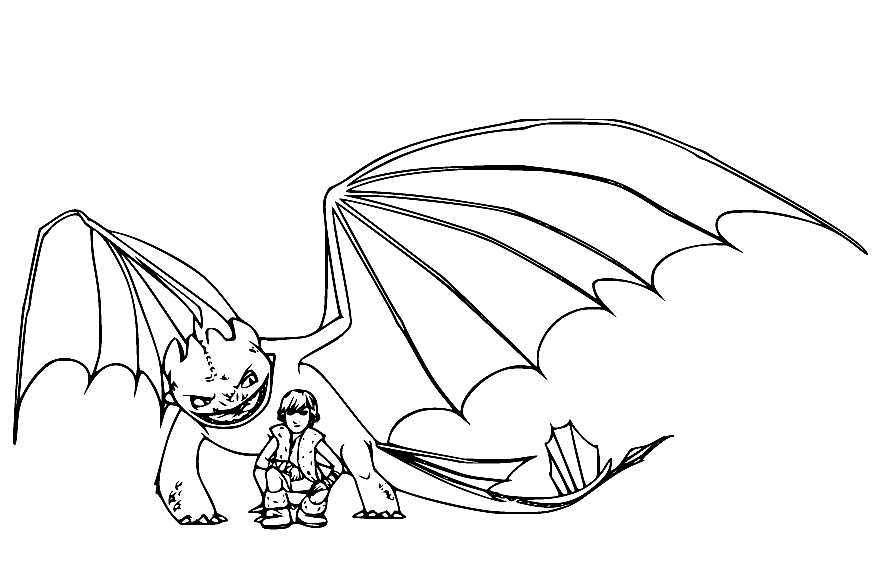
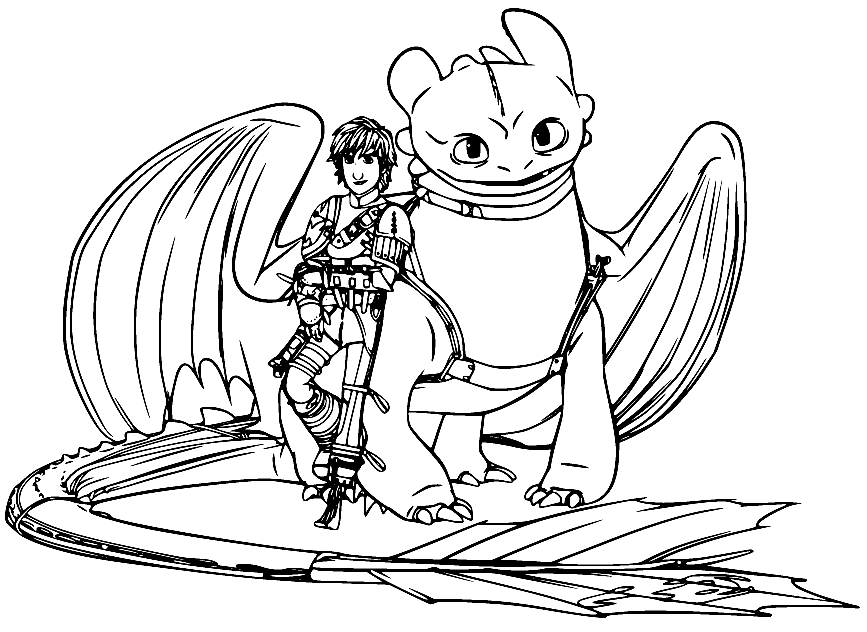
He is missing his left tail fin – Hiccup’s bola device shot it off during their first encounter – and wears the prosthetic fin that Hiccup designed, which can only be controlled in flight by Hiccup’s left foot mechanism. This prosthetic is the most important single design element in the entire franchise because it makes the Hiccup-Toothless relationship visible in the design itself: the dragon cannot fly fully without the boy, and the boy cannot fly at all without the dragon. Their interdependence is not only narrative – it is structural and visible.

Coloring Toothless: His body is near-black – the deepest available dark tone with a very subtle blue-grey shift to give his surface a dimensional quality rather than a flat silhouette. Apply the near-black across the entire body at maximum pressure. Add subtle dark blue-grey highlights only at the highest points of his body forms – the dorsal ridge peak, the outer edge of each wing membrane, the top of his head. His eyes are the most important coloring decision: vivid, vivid green – the brightest, most saturated green in the composition – with round black pupils centered in each iris and a white or very pale highlight dot at the upper portion. The eye color should be the only vivid non-black element on his body.

Hiccup Horrendous Haddock III

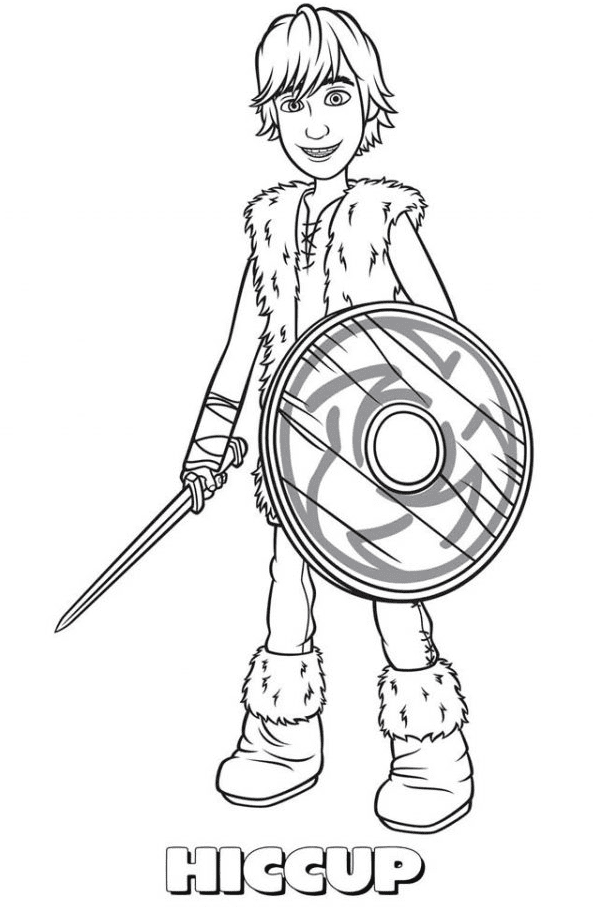
Hiccup is the protagonist across the trilogy and the 2025 live-action film – the son of Stoick the Vast, chief of the Viking island of Berk, who is physically the smallest and least warrior-like person in a society that values physical power above all else. His arc in the first film – from the Viking who cannot fight to the Viking who changes what fighting means on Berk – is one of the most precisely executed character development sequences in animated film.

The specific visual fact that communicates Hiccup’s character most clearly is his prosthetic left foot, acquired after the first film’s climax. In the second and third films, Hiccup wears this prosthetic throughout – a mechanical foot that operates in conjunction with Toothless’s prosthetic tail fin, making the two characters’ physical interdependence visible in Hiccup’s own body as well as in the dragon’s.

His design evolves significantly across the trilogy: the first film’s Hiccup is a teenage boy, thin and red-haired, in Viking clothing. The second film’s Hiccup is several years older, with a flight suit and the confidence of someone who has already changed his world once. The third film’s Hiccup is a young adult, the chief of Berk, preparing for a farewell he knows is necessary.

Coloring Hiccup: His hair is auburn-red – a warm, medium-dark red-brown that reads immediately as the specific Viking red of his father’s beard. His skin is pale – the cool-light complexion of a Norse-inspired character. His flight suit (the second and third films’ most prominent costume) is dark brown leather with mechanical elements in a warm dark grey and copper-bronze. The prosthetic foot, where visible, is dark metal grey with copper joint elements.

Astrid Hofferson and Stormfly

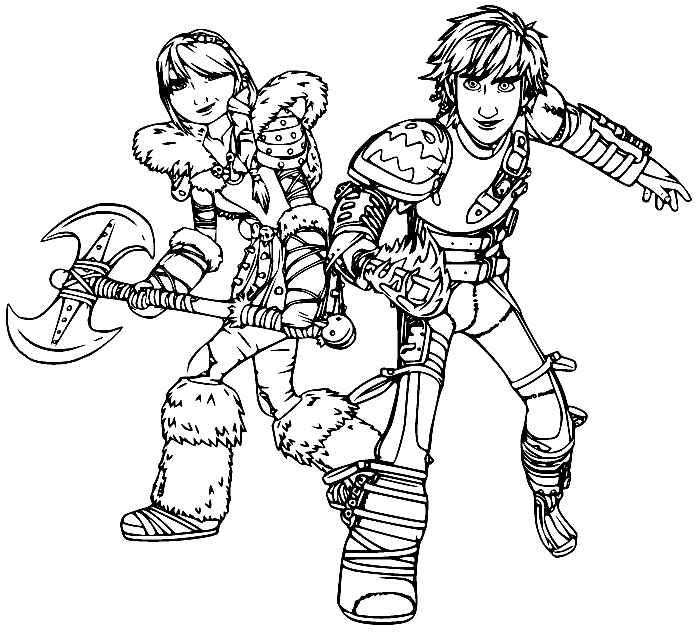
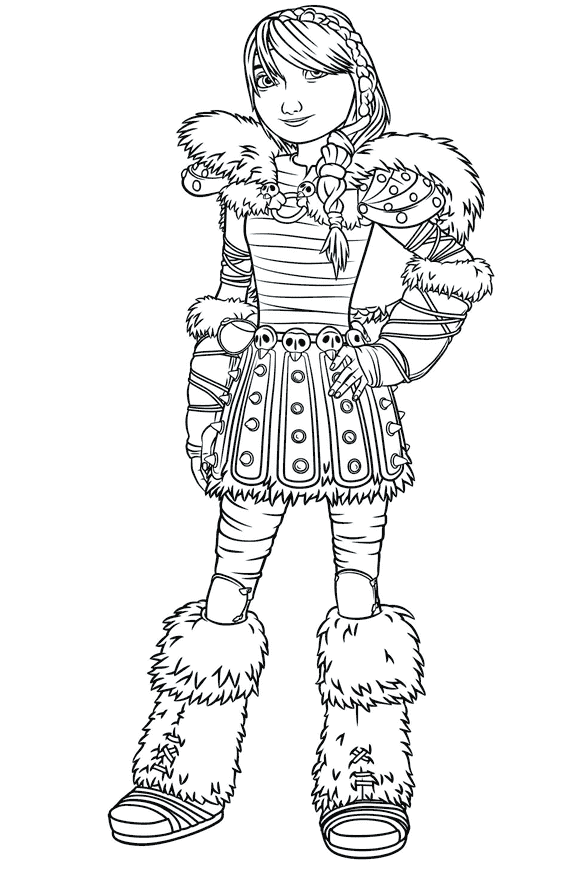
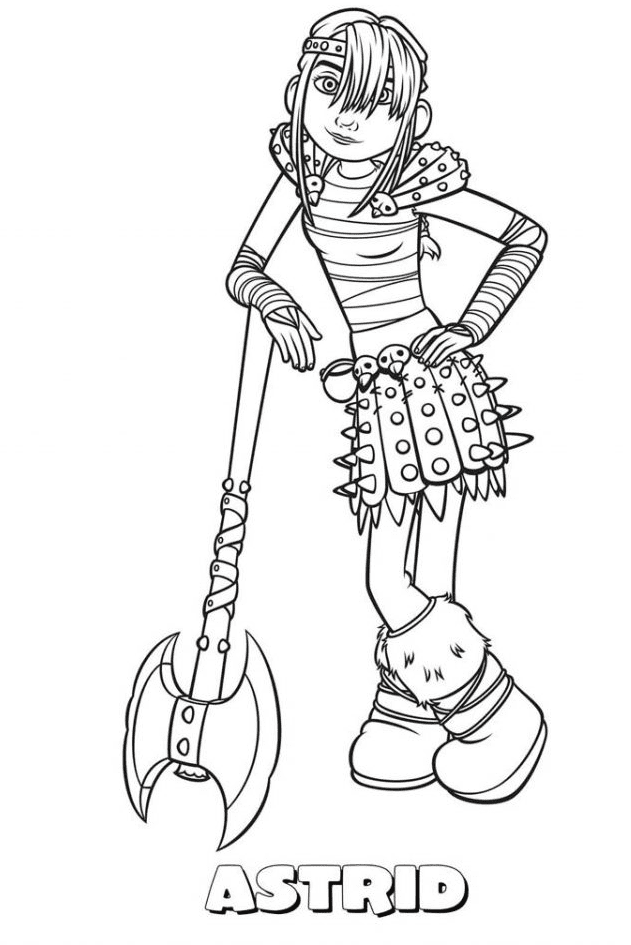
Astrid is Berk’s most capable warrior among the young Vikings – blonde, determined, and initially dismissive of Hiccup before his competence becomes undeniable. She becomes his partner, eventually his wife, and one of the franchise’s most consistently capable characters across the entire narrative arc.

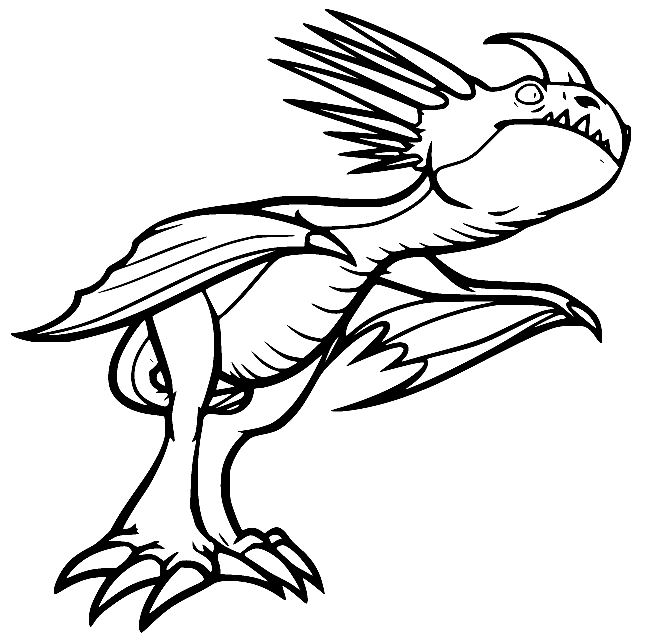
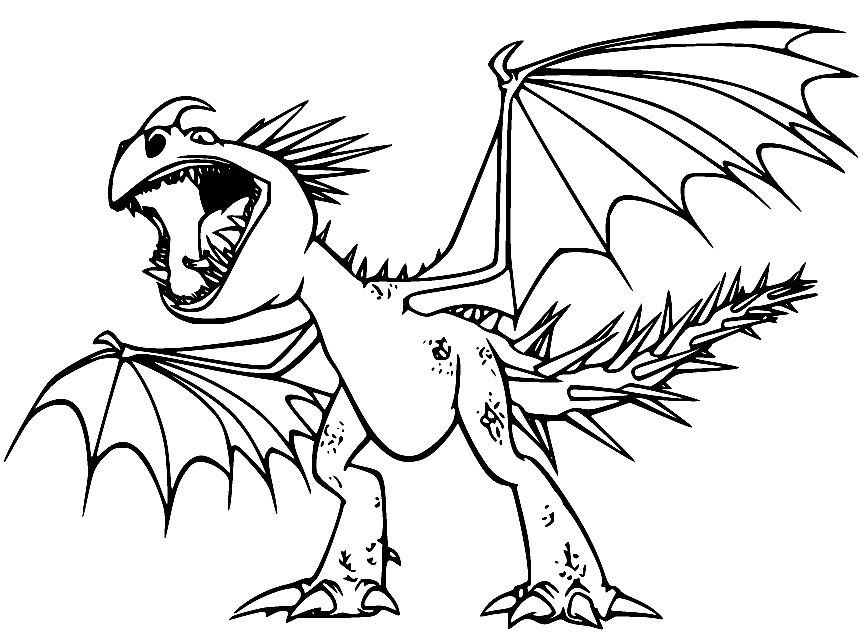
Stormfly is her Deadly Nadder dragon – a species that is part bird, part dinosaur, with a distinctive long neck, forward-pointing horns, and the ability to shoot poison spines from her tail. Her coloring is one of the franchise’s most vivid: a blue body with a yellow-orange spine ridge, yellow-orange wings, and the specific alert quality of a dragon who matches Astrid’s own focused energy.
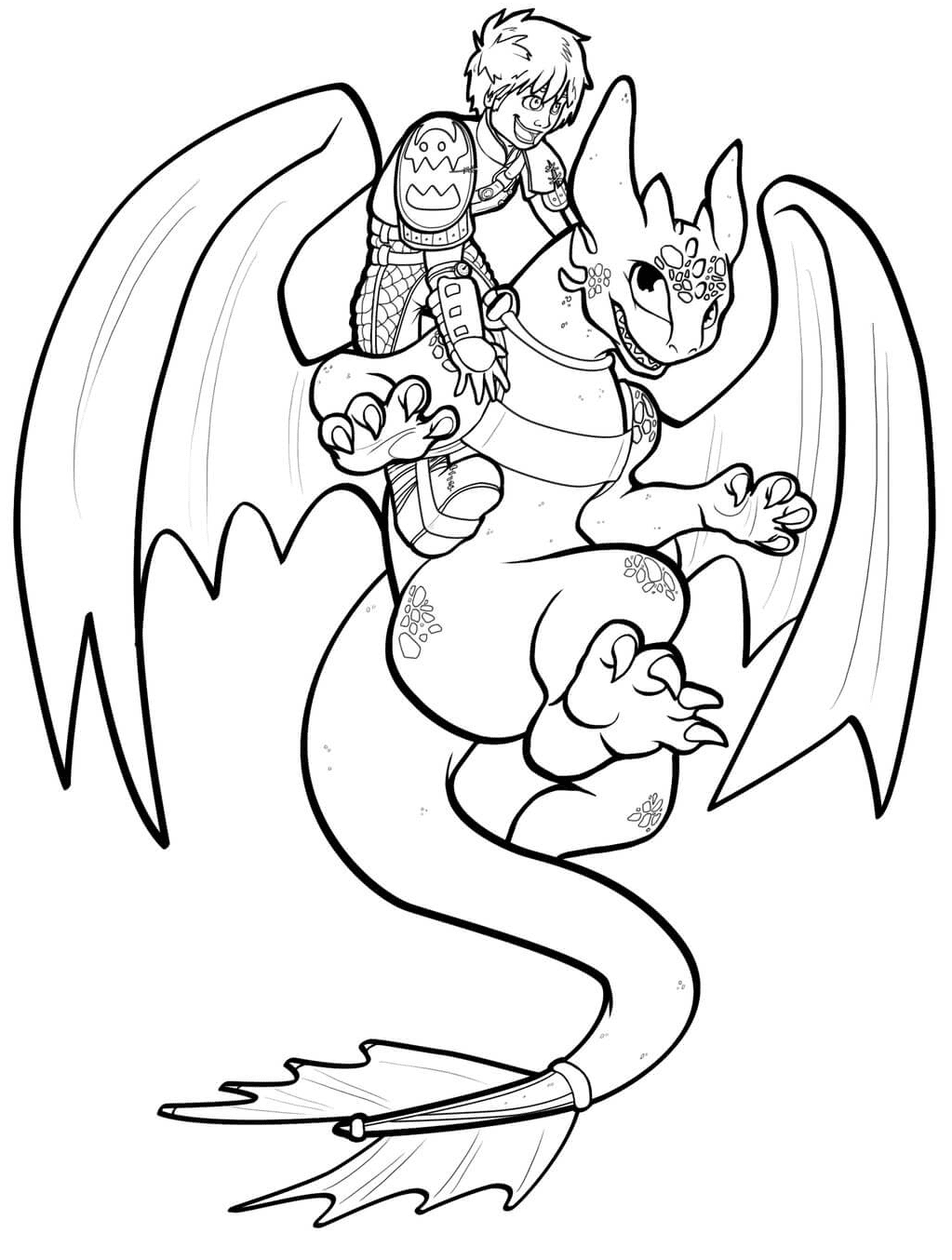
Coloring Stormfly: The Deadly Nadder’s color scheme is the franchise’s most immediately colorful – a vivid sky blue for the body, warm yellow-orange for the spine ridge, wing edges, and tail spines. These two colors sit near the complementary relationship on the color wheel (blue and orange), which is why the Deadly Nadder reads as so visually striking – the contrast is nearly maximum. Apply the blue first across the body; add the yellow-orange second at the spine, wing leading edges, and tail. The contrast between these two fully saturated colors is the design’s entire visual energy.
Stoick the Vast

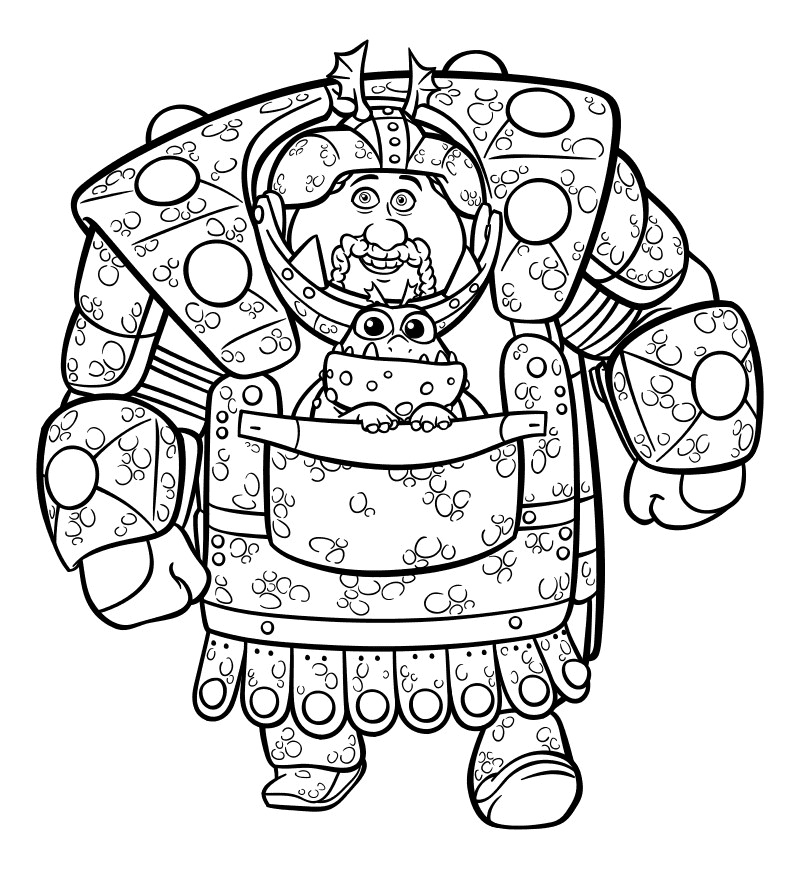
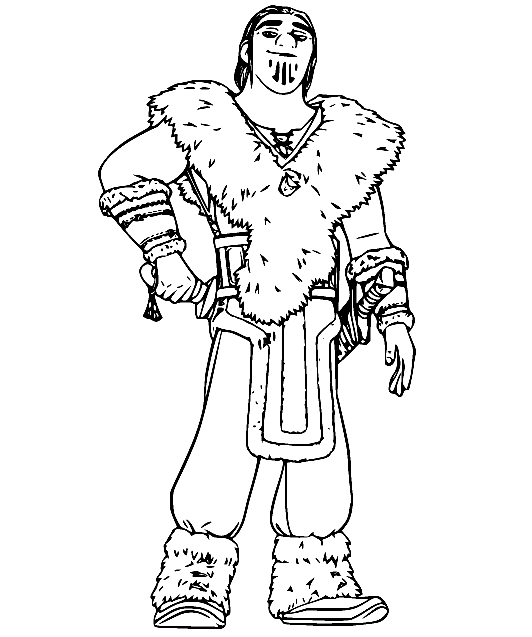
Stoick is Berk’s chief and Hiccup’s father – a giant of a man whose visual design is built around mass and warmth simultaneously. He is large, red-bearded, physically imposing, and genuinely loving in the specific way of someone who shows love through protection and provision rather than through demonstrative expression. His relationship with Hiccup is the first film’s emotional backbone – the gap between what Stoick wishes his son were and what Hiccup actually is, and the journey toward the moment when Stoick understands that what Hiccup actually is was always more valuable than the warrior he wished for.

Stoick does not appear in the third film in the same way – his death in the second film at Toothless’s hands (while mind-controlled by Drago Bludvist) is one of the trilogy’s most emotionally significant moments, and the emotional weight of that death extends through everything that follows.

Coloring Stoick: His red beard and red hair are the warmest colors on a character whose overall palette is warm earth tones – warm brown fur-lined clothing, dark leather armor. The beard should be a rich, vivid red-brown – warmer than Hiccup’s auburn, more saturated and fire-adjacent. His skin is the warm pale of someone who has spent a life outdoors in Nordic weather. The bear fur elements of his costume are warm tan-brown, rendered with directional strokes to suggest fur texture.

The Light Fury

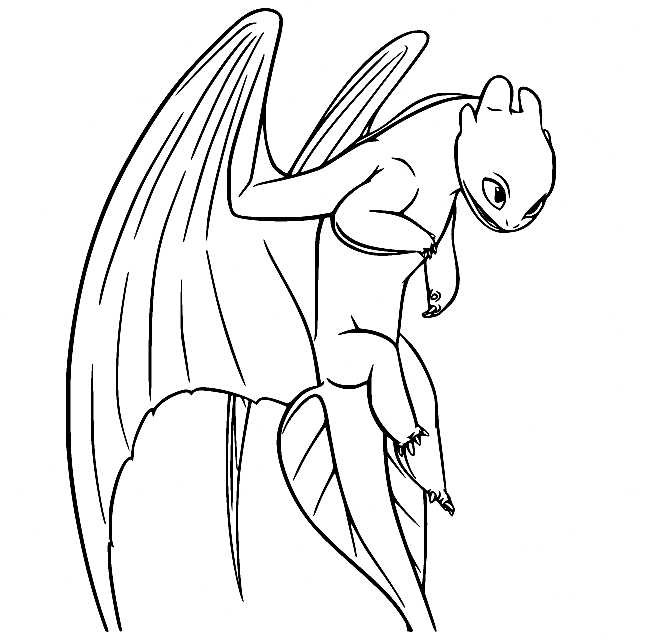
The Light Fury, introduced in The Hidden World, is the white counterpart to Toothless’s Night Fury – the same species (or a closely related female variant), but white where Toothless is black, with the ability to turn invisible when her scales heat up. She becomes Toothless’s mate and is the reason he eventually chooses to lead the dragons to the Hidden World.

Her design is Toothless’s visual inverse: the same basic body form, the same aerodynamic sleekness, but rendered in white and pearl rather than near-black. The color opposition is not accidental – white and black, the maximum chromatic contrast available, communicate the “two halves of a whole” relationship between the two dragons.

Coloring the Light Fury: White as the primary body color – but not flat white. The Light Fury’s surface has a pearlescent quality: very subtle warm pink-white highlights on the highest body surfaces, very subtle cool blue-grey in the shadow areas. The overall reading should be white, but a white that has depth. Her eyes are blue – specifically a pale, clear blue that contrasts with her white body without competing with it. The invisible-mode effect, if the page includes it, uses a heat-shimmer visual: very light teal or blue-white translucent overlays.

Dragon Species Pages

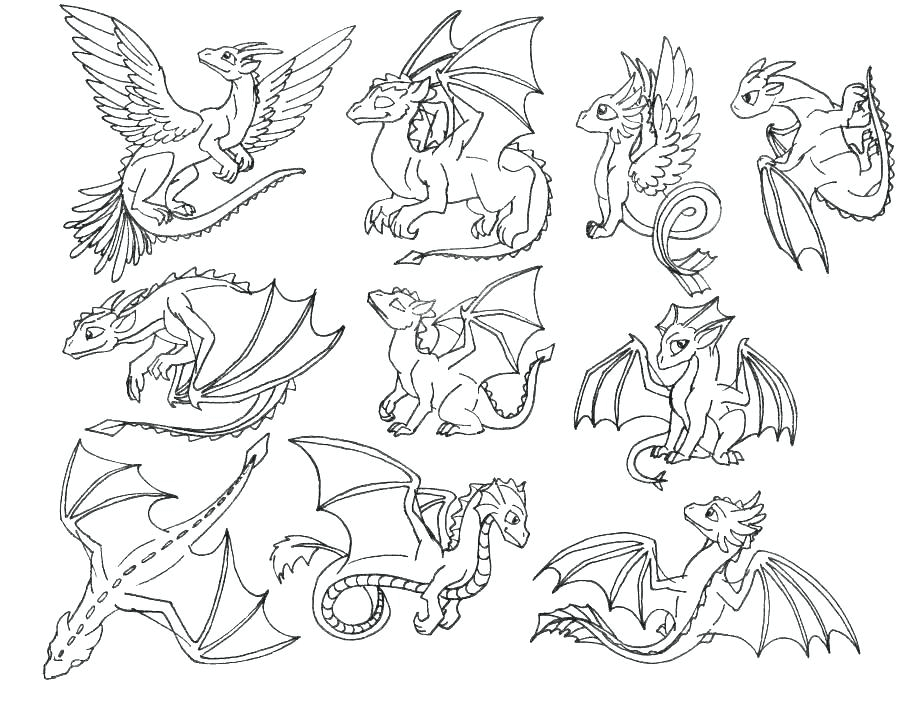
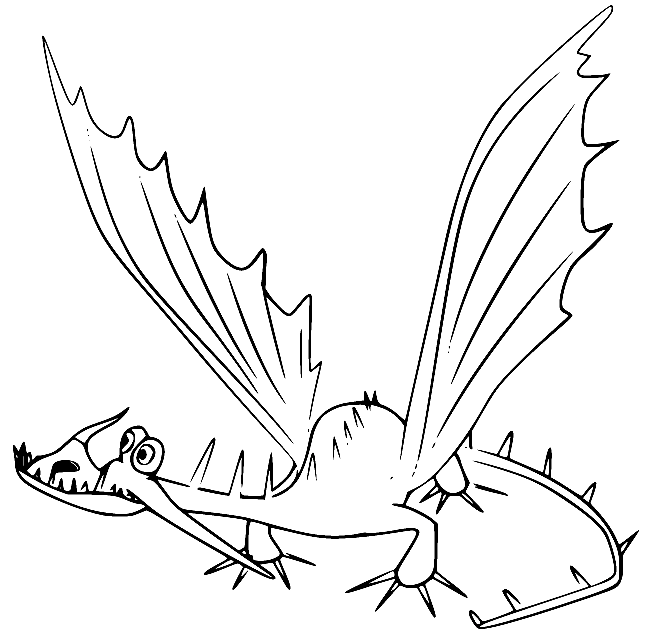
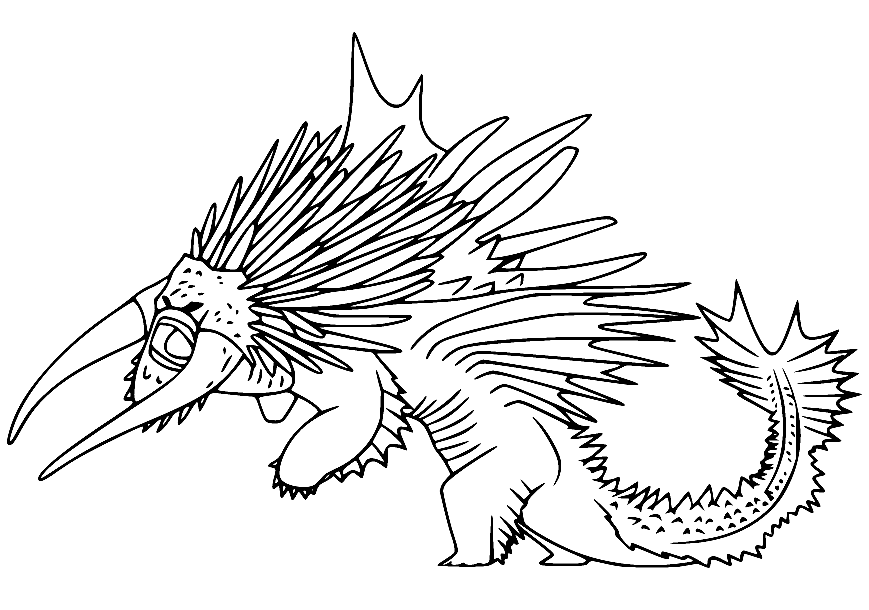
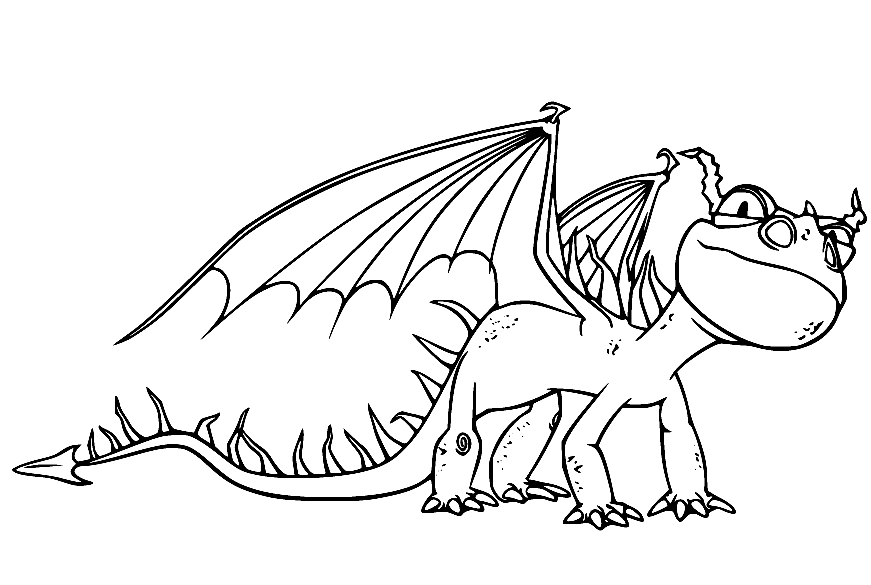
Beyond Toothless and Stormfly, the franchise includes dozens of specifically designed dragon species, each with distinct visual characteristics:

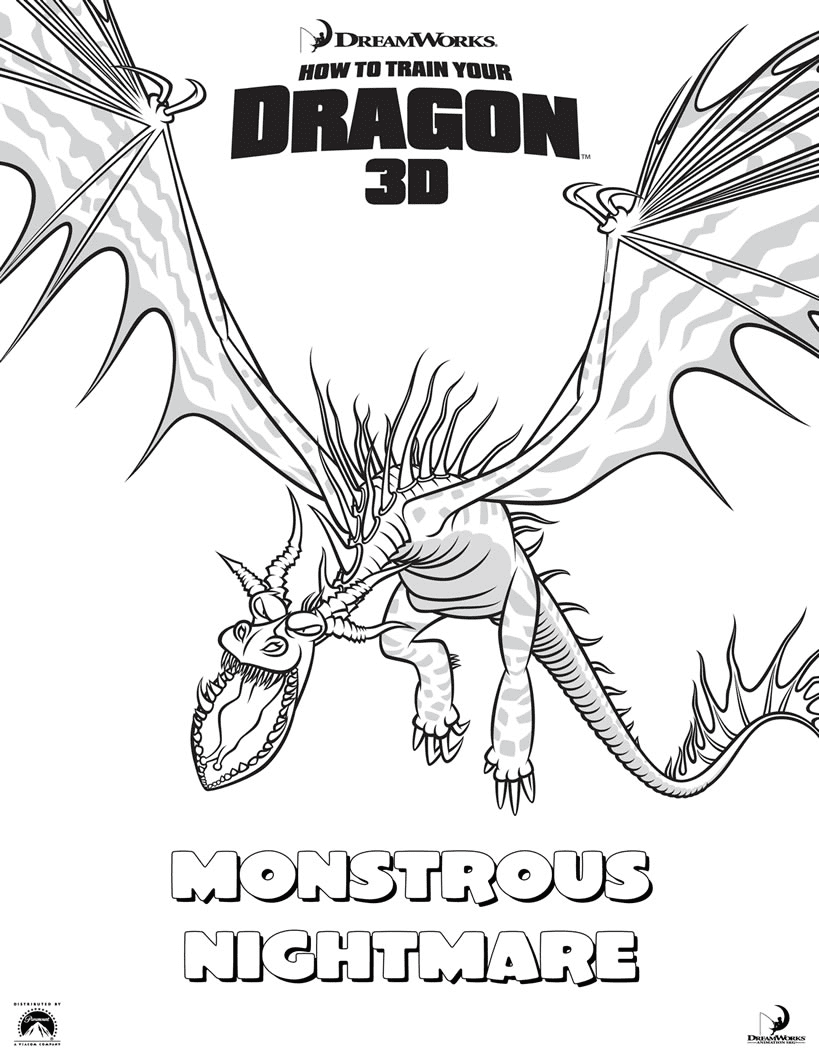
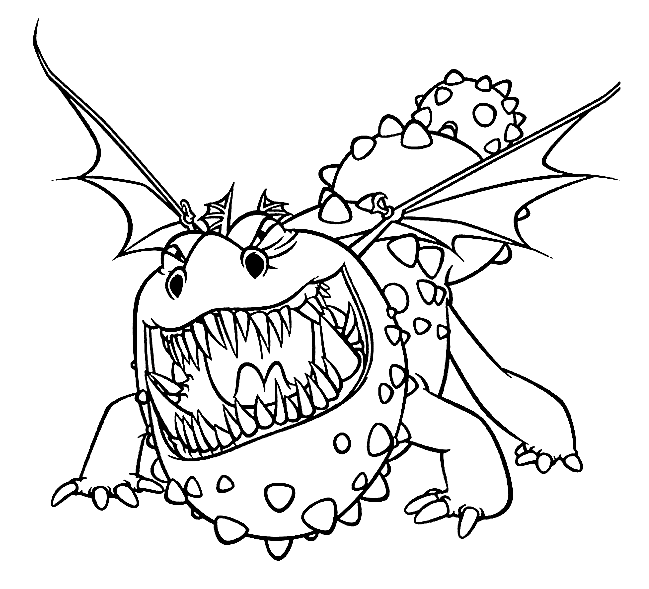
Monstrous Nightmare (Hookfang, Snotlout’s dragon): A large, red-scaled dragon that can set its entire body on fire. Red primary color, yellow-orange flame effects, and aggressive silhouette.

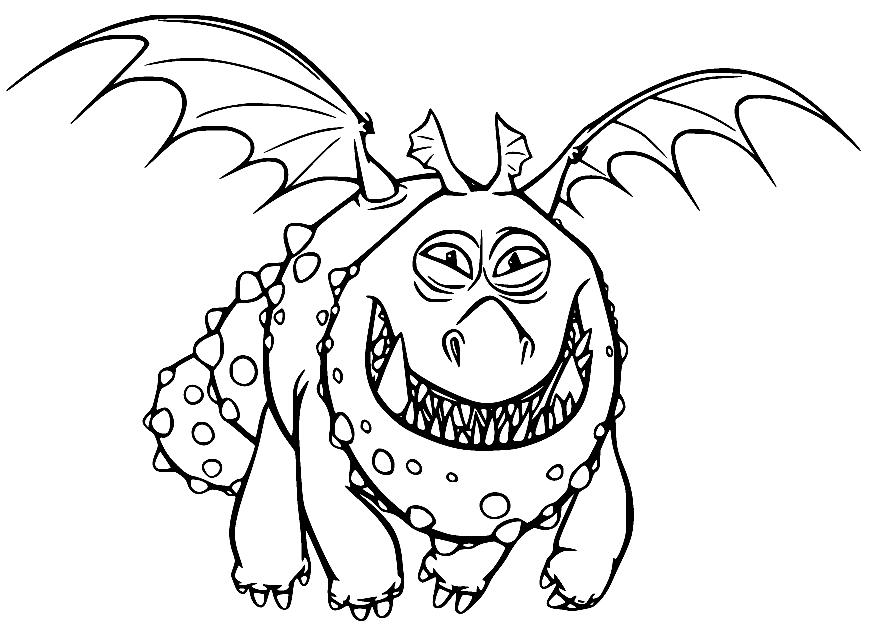
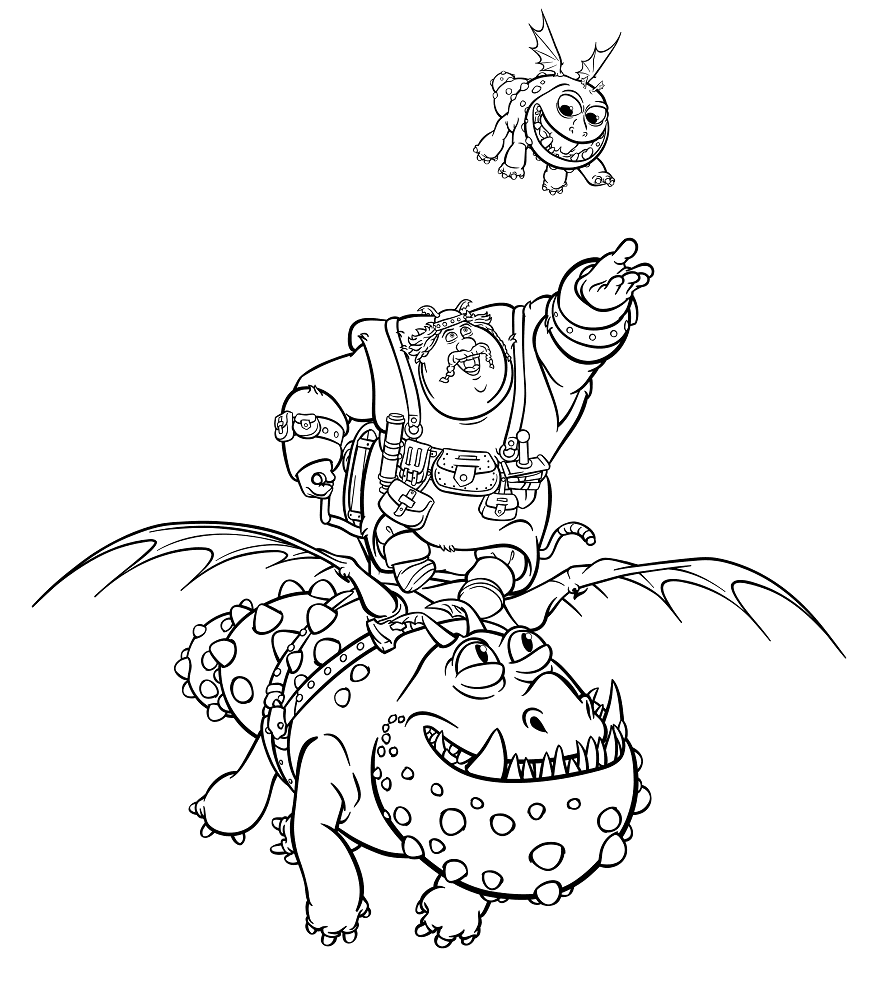
Gronckle (Meatlug, Fishlegs’s dragon): Round, boulder-like, grey-brown, the franchise’s most immediately charming non-Night-Fury dragon through sheer contrast with its size.

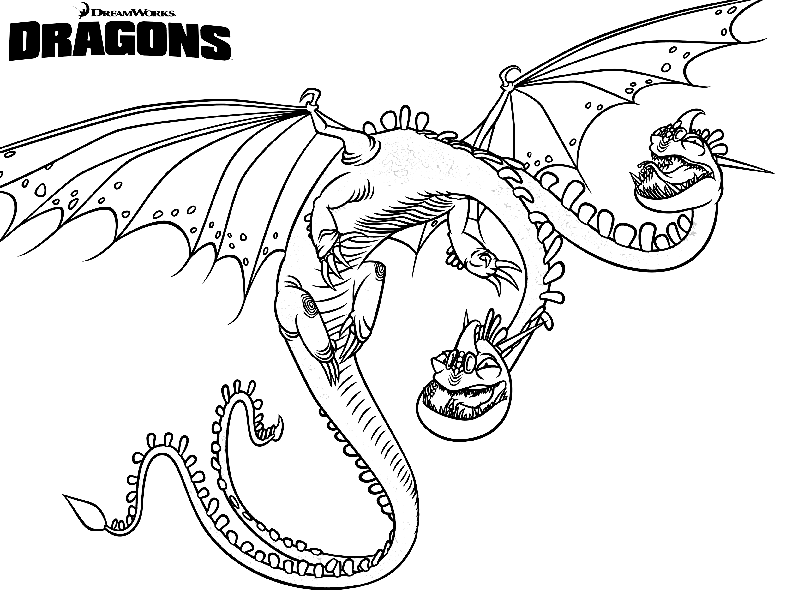
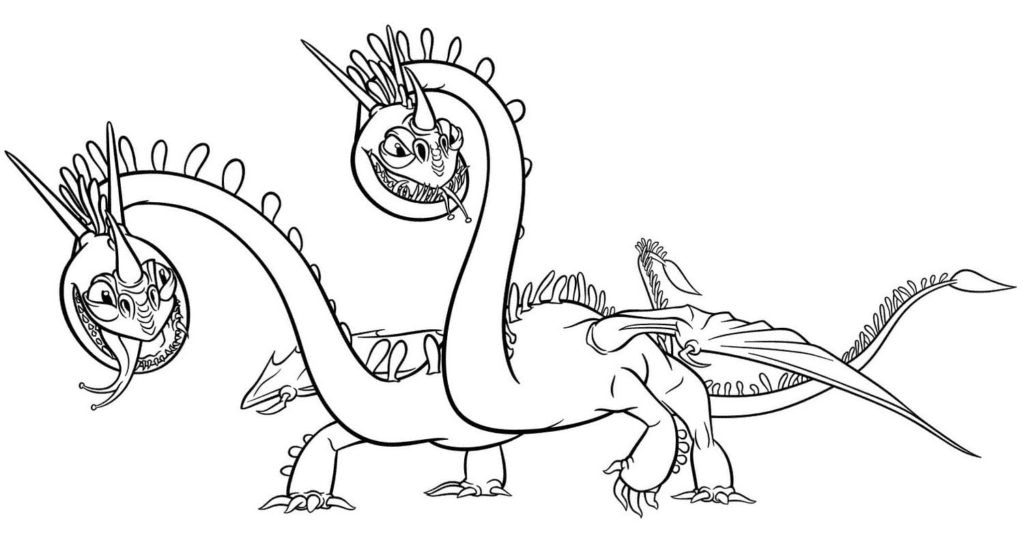
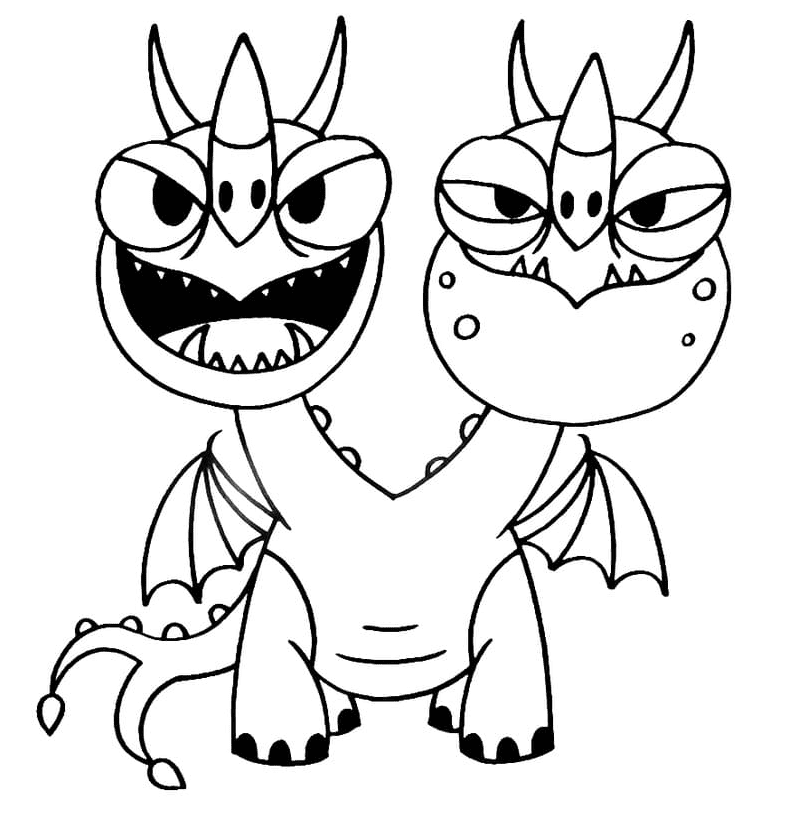
Hideous Zippleback (Barf and Belch, the twins’ dragon): A two-headed dragon on a single body, one head producing gas and the other producing the spark to ignite it.

Bewilderbeast: The giant Alpha dragon of the second film – enormous, whale-like, with massive ice breath and the ability to control other dragons. Blue-white in coloring.

Stormcutter (Cloudjumper, Valka’s dragon): Four wings, owl-like face, warm brown-orange coloring.

Coloring dragon species pages: Each species’ color palette is specific and consistent within the franchise. The key technique for any dragon page is rendering the scale texture appropriately for the species: the Night Fury has the smoothest, least textured surface (sleek, aerodynamic); the Gronckle has the most stone-like, rough texture; the Deadly Nadder has plate-like scales that catch light at each edge.

What These Pages Do

The first film’s visual achievement – making a dragon emotionally legible – was a specific animation challenge that had not been solved at this scale before. Toothless communicates through facial expression with no dialogue, using pupils, ear-like fins, body posture, and the specific physical language of a cat and dog combined in a creature that has never existed. Coloring the Toothless pages while understanding this achievement is engaging with one of animated film’s most studied character design decisions.

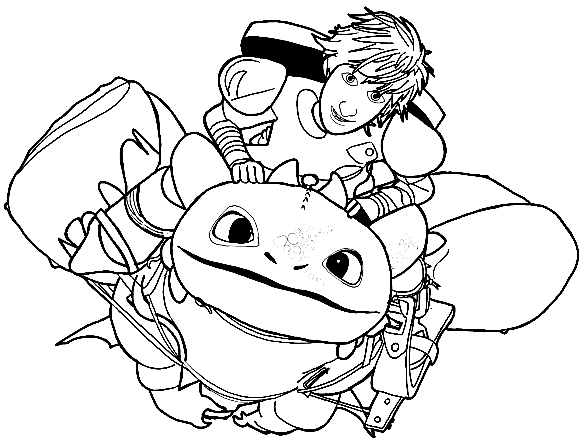
The prosthetic tail fin is the most visually honest expression of a relationship in animated film. It is visible on Toothless in every flight scene. It makes the dependency mutual and literal – the boy needs the dragon to fly, and the dragon needs the boy to steer. The coloring pages that show Toothless in flight with the prosthetic fin are illustrations of that mutual dependency made physical.

The dragon species design demonstrates how color and silhouette communicate character independently of behavior. The Gronckle looks gentle before it does anything gentle. The Monstrous Nightmare looks aggressive before it demonstrates aggression. The Night Fury looks powerful and unknowable before a single action confirms it. These are design decisions that coloring the pages makes directly legible – the colorist who matches each dragon to its correct colors is engaging with the franchise’s most careful design work.

Fine motor development. The American Academy of Pediatrics identifies fine motor skill development as a key childhood milestone throughout early childhood. The scale texture of dragon species pages, the mechanical detail of Hiccup’s flight suit and prosthetic, the wing membrane gradients of the franchise’s many dragon designs – all provide motivated, sustained fine motor practice. The 2005 Art Therapy Journal study on structured coloring and anxiety reduction applies throughout this collection.

How to Color These Pages Well

Toothless’s black is the most technically demanding single color in the collection. The instinct is to apply flat black across his entire body and consider it done. The result will look wrong – a black silhouette rather than a dimensional black dragon. The correct approach: apply your darkest available grey-black across the entire body first. Then add a very subtle dark blue-grey layer along the highest body ridges and the outer edges of the wings – not much lighter, but just enough to indicate that light exists and is hitting a surface. The eye green should be as vivid as possible; it is the only vivid color in the composition and should be committed to completely.

Wing membranes need gradients. Dragon wings – for Toothless, for the Light Fury, for Stormfly – have a different surface quality from the body scales. They are thinner, more translucent, and should read as such. Apply the wing membrane color more lightly than the body color, and add a very slight deepening at the leading edge (the bone structure of the wing) where the membrane attaches. The lightest point should be at the center of the wing where light passes through most directly.

The Deadly Nadder’s blue-orange contrast needs equal commitment in both colors. The most common mistake on Stormfly pages is applying the vivid blue correctly but using a pale, uncommitted yellow for the orange-yellow spine and wing accents. Both colors must be at equal saturation for the complementary contrast to work. Apply each at full pressure, full saturation. The contrast between two equally vivid colors reads as visually dynamic; the same contrast with one color weakened reads as one vivid color on a pale background.

Scale texture on reptilian dragons (Monstrous Nightmare, Gronckle) needs the dark-recess technique. Apply the base scale color across the entire surface. Then apply a darker version of the same color in a regular pattern of small curved shadow areas – the shadow beneath each scale overlaps with the scale below it. Each scale catches light on its upper surface and falls into shadow at its lower edge. This repeating shadow-on-base-color pattern produces the scale texture without requiring precise individual scale drawing.

The Hidden World environment pages want bioluminescent treatment. Pages showing the Hidden World – the glowing underground realm where dragons ultimately live – feature luminous environmental elements: glowing crystal formations, bioluminescent water. For these background elements, apply deep dark blue-black to the cave structure, then add vivid teal, blue, and purple for the glowing elements at maximum saturation. The glow effect needs a dark background to read as luminous; glowing teal on white paper just looks teal.

5 Creative Craft Ideas

The Prosthetic Connection Display

The franchise’s most important visual detail is the prosthetic relationship: Toothless’s missing left tail fin replaced by Hiccup’s mechanical design, and Hiccup’s prosthetic left foot that operates the fin’s mechanism. Print a full-body Toothless page and a full-body Hiccup page.

Color Toothless with the prosthetic tail fin in warm copper-bronze metal against his black body – the most visually prominent detail on an otherwise uniformly dark figure. Color Hiccup with his prosthetic foot visible, also in warm metal tones.

Mount both on a dark backing sheet with a thin line connecting the tail fin to the prosthetic foot. Add: “His tail fin. His foot. Neither can fly without the other.” The display makes the franchise’s central visual metaphor explicit as a single connected image.

(Image placeholder: Prosthetic Connection Display)

Dragon Species Field Guide

Print one page for each of the major dragon species the collection includes: Toothless (Night Fury), Stormfly (Deadly Nadder), Meatlug (Gronckle), Hookfang (Monstrous Nightmare), and the Light Fury. Color each in its canonical species palette.

Mount all on a backing sheet in the format of a naturalist’s field guide – each dragon with a hand-lettered species name, class, and notable ability: “Night Fury – Strike Class – Plasma blast, near-silent flight.” The finished guide is a visual taxonomy of the franchise’s dragon world, made accurate through canonical color application.

The Trilogy’s Final Frame

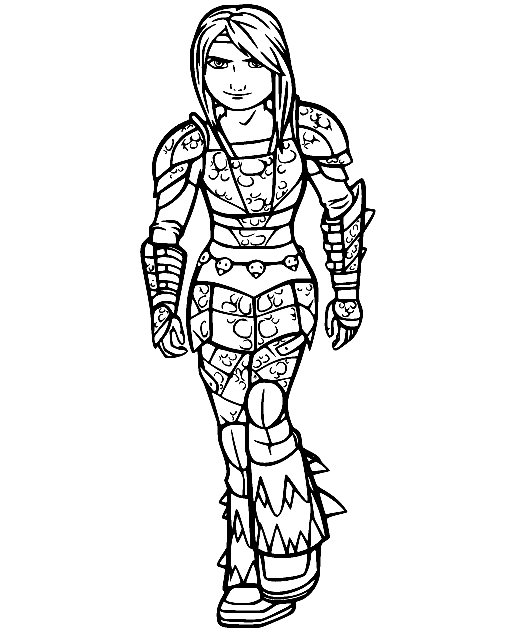
The third film’s final scene – Hiccup and Astrid, older, watching their children encounter Toothless and the Light Fury returning from the Hidden World briefly – is the franchise’s most emotionally conclusive image. Print the most adult-looking Hiccup and Astrid pages, and one Toothless page.

Color all in post-third-film palettes: Hiccup and Astrid older, Toothless fully black. Mount with the humans on the left watching, Toothless on the right approaching, the composition suggesting distance between them. Add: “Some truths have a cost. He knew. He paid it. They came back.”

Night vs. Light Comparison

Print a Toothless page and a Light Fury page. Color Toothless in near-black with vivid green eyes. Color the Light Fury in pearlescent white with pale blue eyes.

Mount both facing each other from opposite sides of a dark backing sheet – black on the left, white on the right, meeting at the center. Add no text. The visual contrast makes the “two halves of a whole” design argument without requiring explanation.

The 2025 Comparison – Animated vs. Live-Action

This craft acknowledges the franchise’s 2025 moment. Print the most distinctive animated Hiccup page – the version that a generation of fans grew up with. Color it carefully.

Beside it on the backing sheet, sketch or print a reference to the live-action film’s visual register – the same character, human actor, same story. Add the dates: “2010 – Animated. 2025 – Live-action. Same story. Same dragon. Fifteen years.”

The finished display marks the specific moment the franchise crossed from animation to live-action – a transition that the 60+ pages in this collection now span across their publication history.

Frequently Asked Questions

What is How to Train Your Dragon based on? How to Train Your Dragon is based on the children’s book series of the same name by British author Cressida Cowell, the first volume of which was published in 2003. The series ran to twelve books, concluding in 2015. DreamWorks Animation adapted the franchise into a trilogy of animated films – directed by Chris Sanders and Dean DeBlois (the first film) and Dean DeBlois alone (the second and third) – released in 2010, 2014, and 2019. The books and films differ significantly in plot, character design, and tone: in the books, Toothless is a small Common or Garden dragon rather than a large, sleek Night Fury. Dean DeBlois also directed the 2025 live-action adaptation.

Who is Toothless, and what kind of dragon is he? Toothless is a Night Fury – described within the franchise as the rarest and fastest dragon species, capable of firing plasma blasts at speeds that make him nearly impossible to track. He is the last known Night Fury, or so it was believed until the Light Fury appeared in the third film. His name comes from his ability to retract his teeth, making his mouth appear toothless. He is missing his left tail fin – lost when Hiccup accidentally shot him down – and wears a prosthetic fin designed and built by Hiccup. This prosthetic requires active control from Hiccup during flight, making the two permanently interdependent as a flying partnership.

What happened at the end of the trilogy? The Hidden World (2019) concludes the animated trilogy with Hiccup, now chief of Berk, leading his people and their dragons to a confrontation with a villain named Grimmel, who hunts Night Furies. Toothless discovers the Hidden World – a vast underground realm where dragons have lived unseen. Toothless also finds the Light Fury, a white female Night Fury who becomes his mate. The film ends with Hiccup deciding to free the dragons to live in the Hidden World – both to protect them from humanity and to allow them to be what they are. He and Toothless say farewell, and the dragons leave Berk. A brief epilogue shows Hiccup and Astrid’s children encountering Toothless and the Light Fury years later, confirming the relationship was not severed permanently.

What is the 2025 live-action How to Train Your Dragon film? The 2025 How to Train Your Dragon is a live-action adaptation of the first animated film, released in theaters on June 13, 2025, directed by Dean DeBlois – the same director who guided the animated trilogy’s second and third installments. The film stars Mason Thames as Hiccup, Nico Parker as Astrid, Nick Frost as Gobber, and Julian Dennison as Fishlegs. Gerard Butler, who voiced Stoick the Vast in all three animated films, reprises the role in the live-action version. The dragons are rendered through CGI against live-action environments and human actors, maintaining the visual relationships established in the animated trilogy.

What dragon does Astrid ride? Astrid rides Stormfly, a Deadly Nadder – a dragon species that resembles a large, bipedal, vaguely bird-like reptile with a long neck, forward-pointing horns, and the ability to fire poisonous spines from her tail. Deadly Nadders are blue and yellow-orange in coloration, giving Stormfly a vivid complementary color scheme. Stormfly is one of the franchise’s most visually distinctive characters for her color palette and her bird-like movement quality. She and Astrid have a close bond that mirrors the Hiccup-Toothless relationship. However, their dynamic is different – Stormfly is affectionate, whereas Toothless is reserved, matching Astrid’s own more outwardly warm personality.
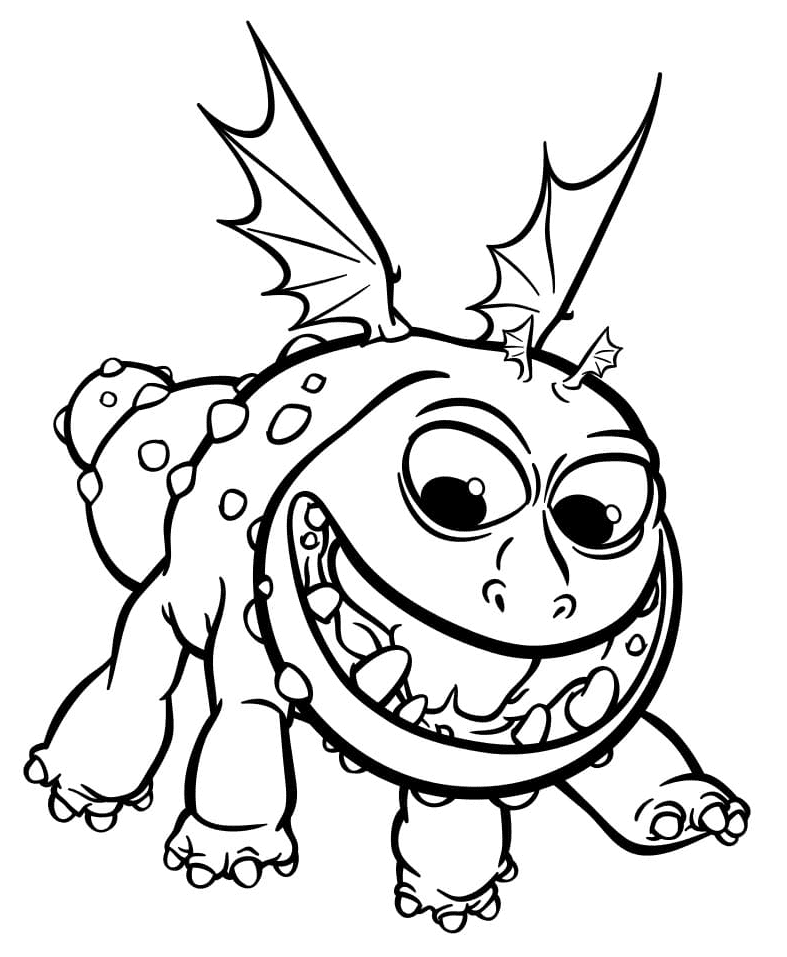
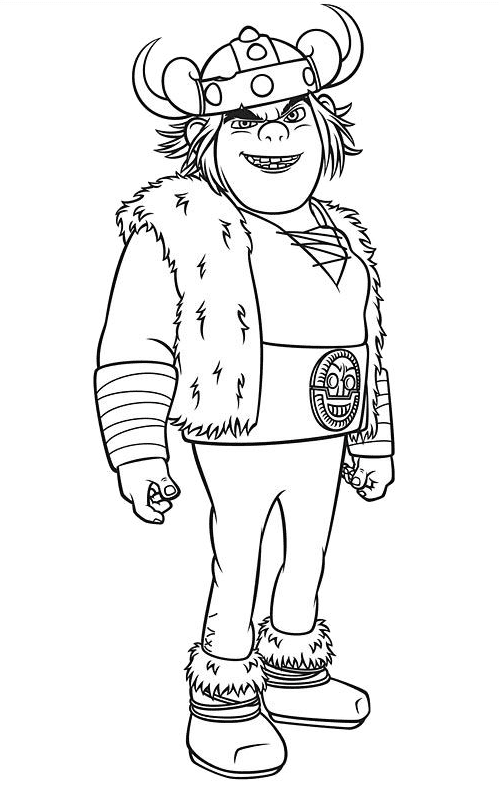
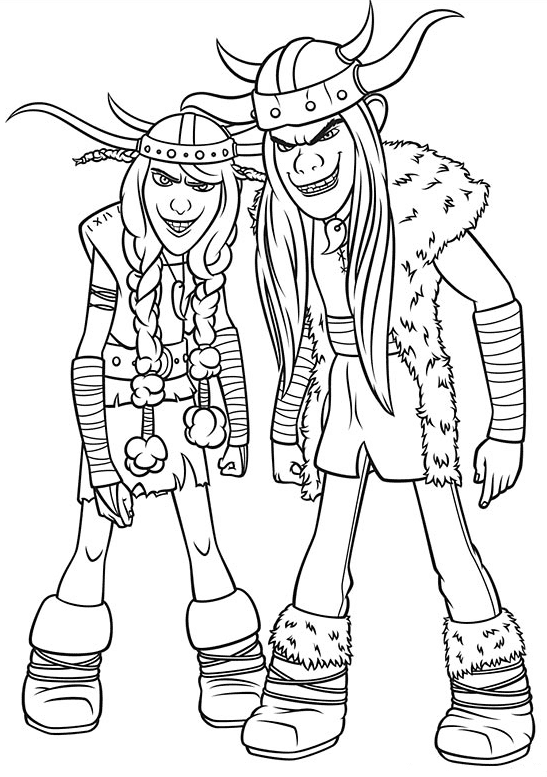
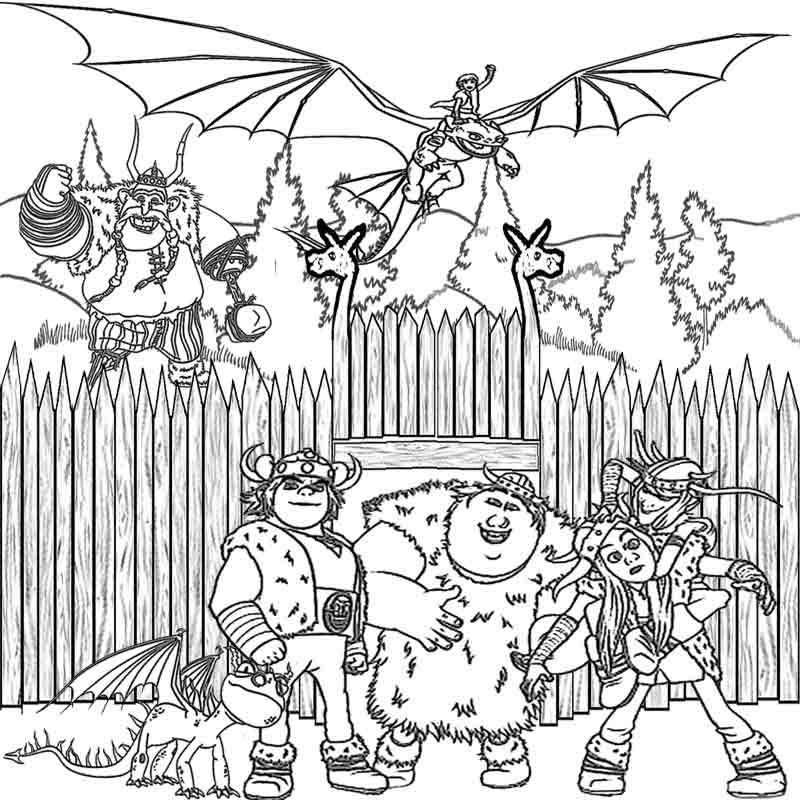
Who are the other young Vikings and what are their dragons? The young Viking group that trains alongside Hiccup includes Snotlout Jorgenson, who rides a Monstrous Nightmare named Hookfang – a large red dragon that can set its body on fire. Fishlegs Ingerman rides a Gronckle named Meatlug – a round, boulder-like dragon that can eat rock and fire lava balls. Twins Ruffnut and Tuffnut Thorston share a Hideous Zippleback named Barf and Belch – a two-headed dragon, one head producing explosive gas while the other sparks to ignite it. Each dragon’s species is visually specific and communicates the rider’s personality through design: Hookfang’s aggression reflects Snotlout’s; Meatlug’s roundness and affection reflect Fishlegs’s; Barf and Belch’s two-headed absurdity reflects the twins’.

What age group are these pages best suited for? The simpler character portrait pages – Toothless in a standing or lying pose, Hiccup in a simple standing position – work well from ages four to six for fans who love the characters and want to color them without complex composition challenges. The dragon flight pages and scenes with multiple characters are most engaging for ages six to nine. The complex species pages with scale texture work, the group compositions with multiple dragons and Vikings, and the pages requiring careful gradient work on wing membranes are most rewarding for ages eight and up and for adult fans of the franchise. The franchise’s primary audience across its fifteen-year span covers the full range from four-year-olds who love Toothless’s cat-like personality to adults who grew up with the 2010 film.

Browse the full collection at ColoringPagesOnly.com. All 60+ pages free, no sign-up, PDF or PNG, print or color online.

Dean DeBlois and Chris Sanders adapted Cressida Cowell’s books into a film in 2010 and made a dragon who could not speak more emotionally legible than most human characters. The design decision was specific: Toothless’s pupils contract to cat-slits in threat and expand to dog-rounds in affection, and the audience learned to read this language within ten minutes of the film’s first act.

Fifteen years later, Dean DeBlois returned to direct a live-action version of the same story. The dragon is still black. The eyes are still green. The tail fin is still prosthetic. The boy still cannot fly without him.

Some designs are correct the first time.

Pick up your near-black. Leave nothing out of that tone. Make the eyes as green as you can get them.

Share your work on Facebook and Pinterest and tag #Coloringpagesonly. We especially want to see the prosthetic connection displays and the dragon species field guides.

Color the Night Fury. His black is the night. His eyes are what watch you back from it.

These related coloring collections will help you explore the wonderful world of colors. Let’s choose, be creative, and show us your great pictures!

Jennifer Thoa – Content Editor & Designer

Jennifer Thoa is Content Editor and Designer at ColoringPagesOnly.com. Degree in Journalism and Creative Writing, University of Kansas. She writes and edits long-form educational articles on anime, film, animals, world cultures, and automotive history - verified against named primary sources before publication.