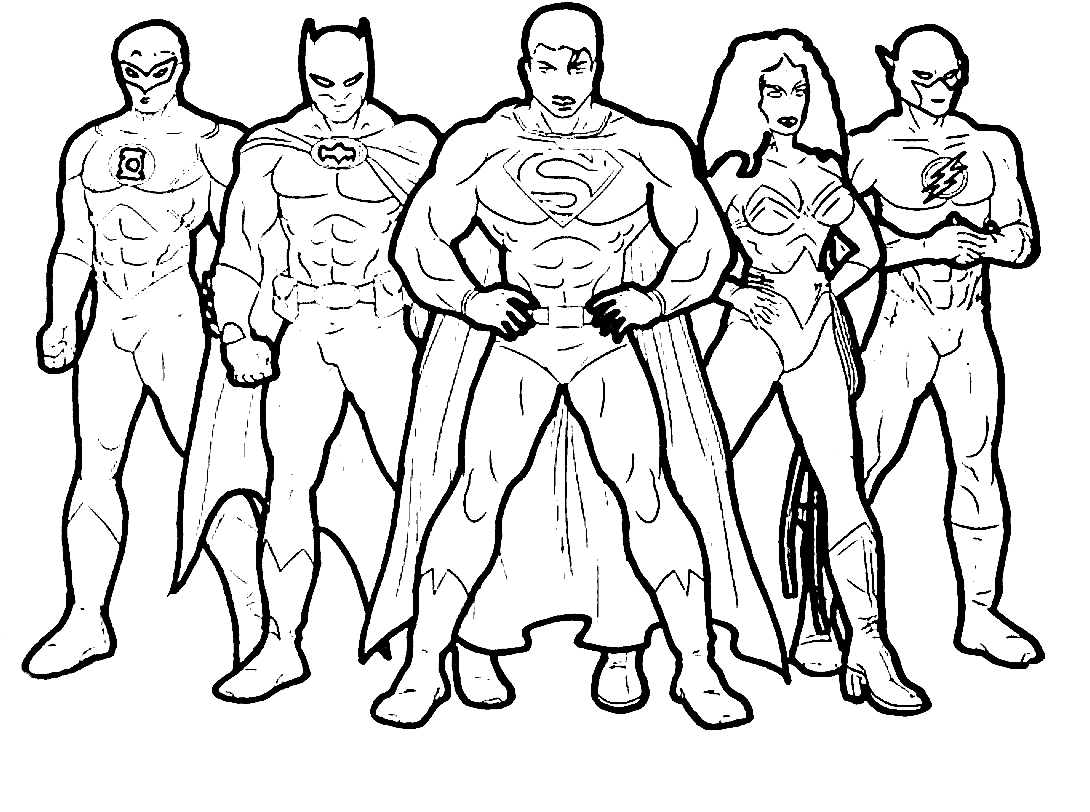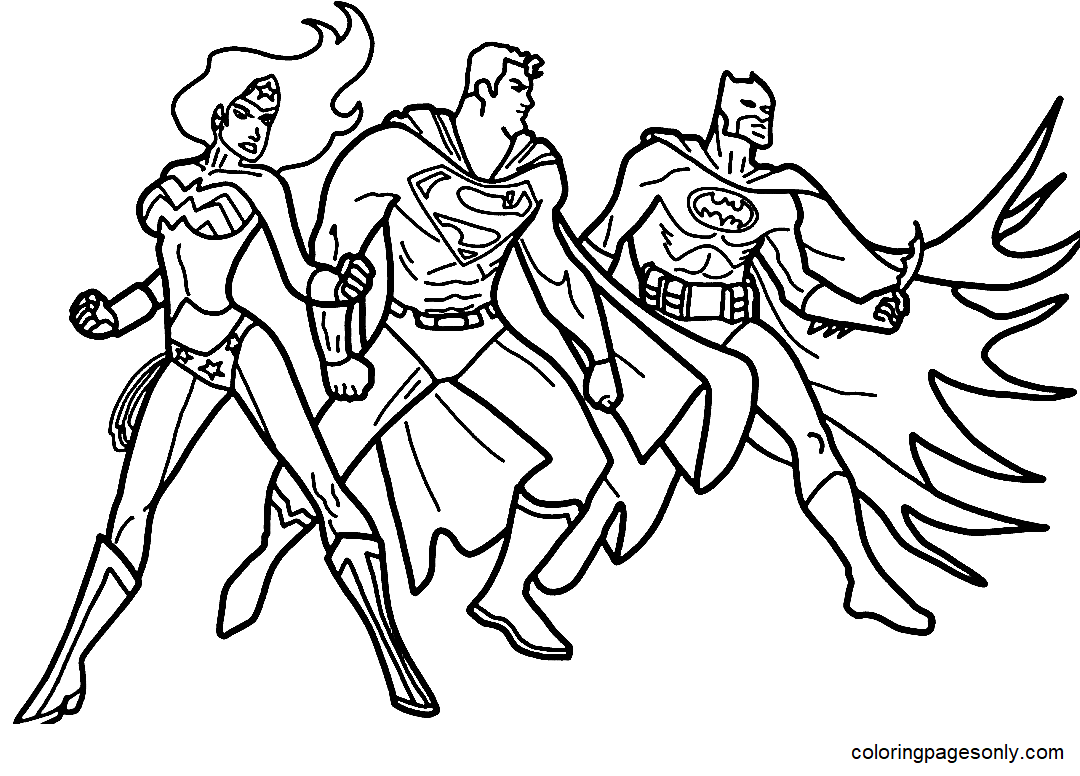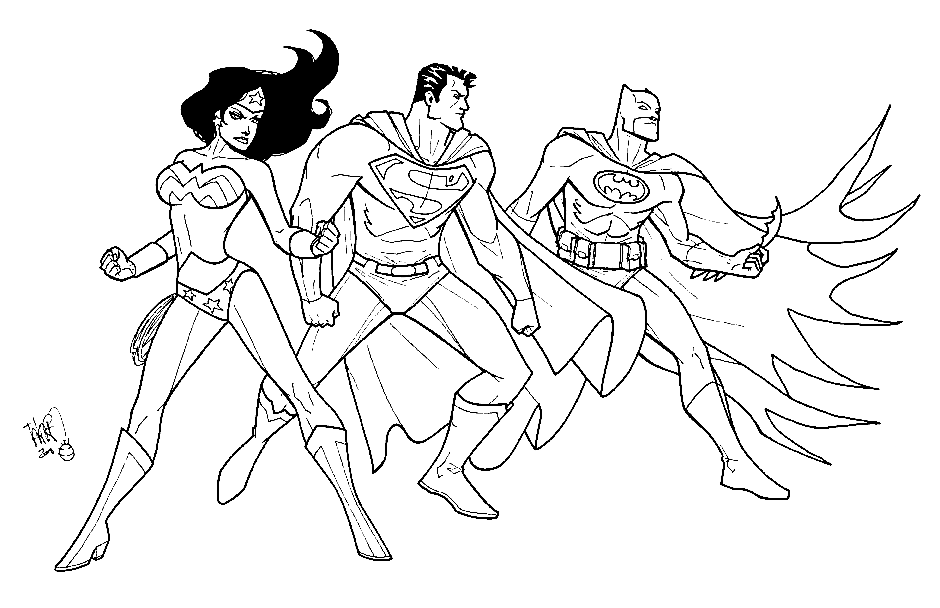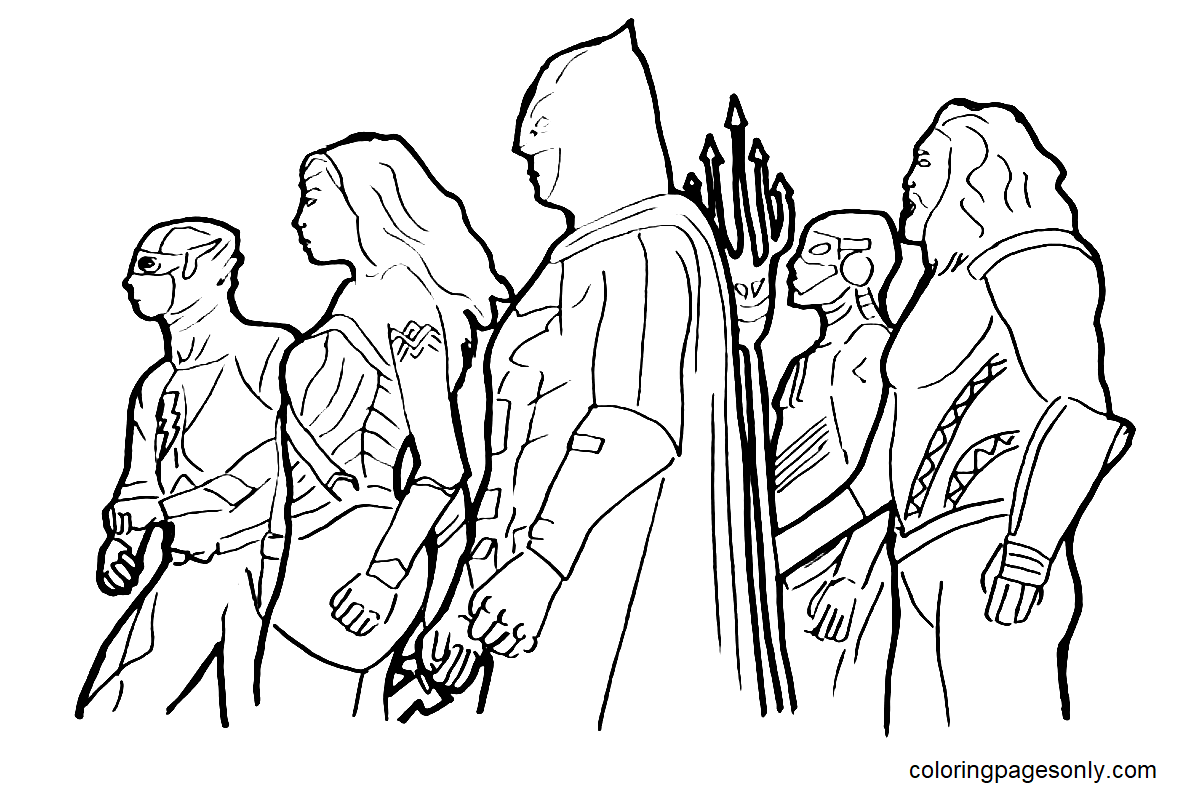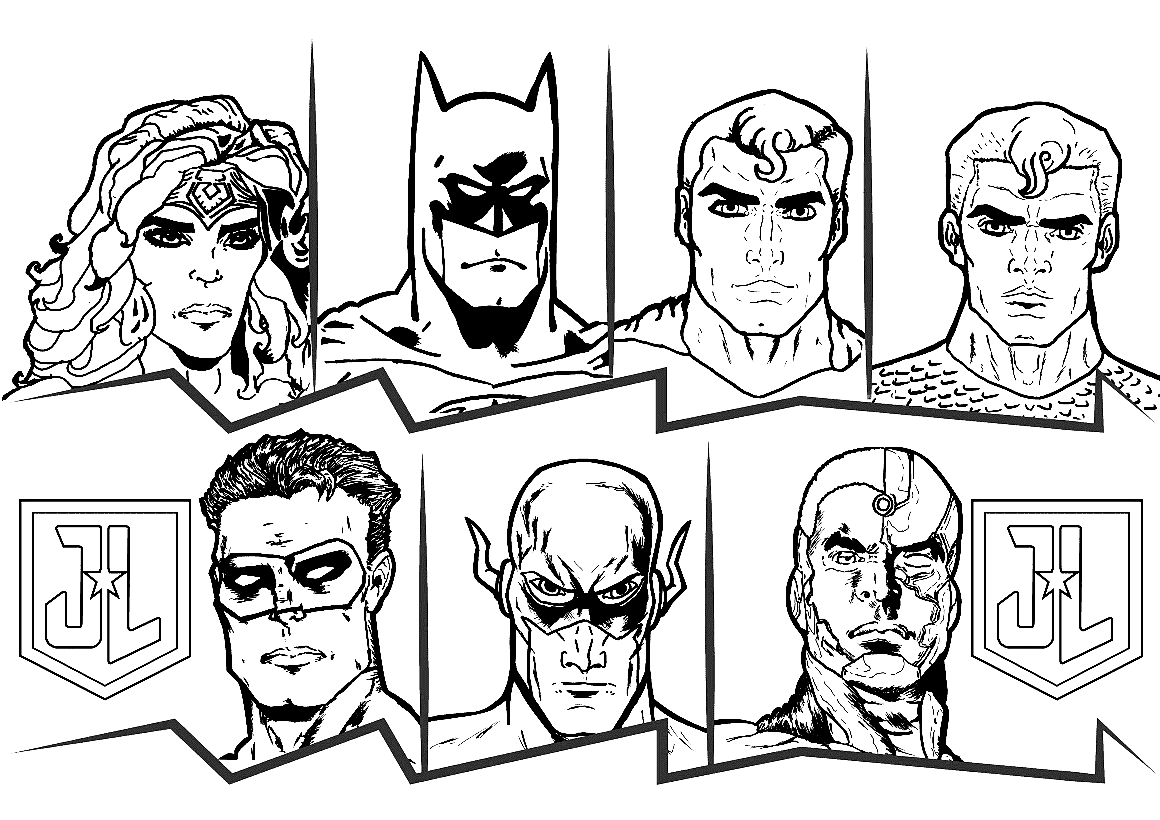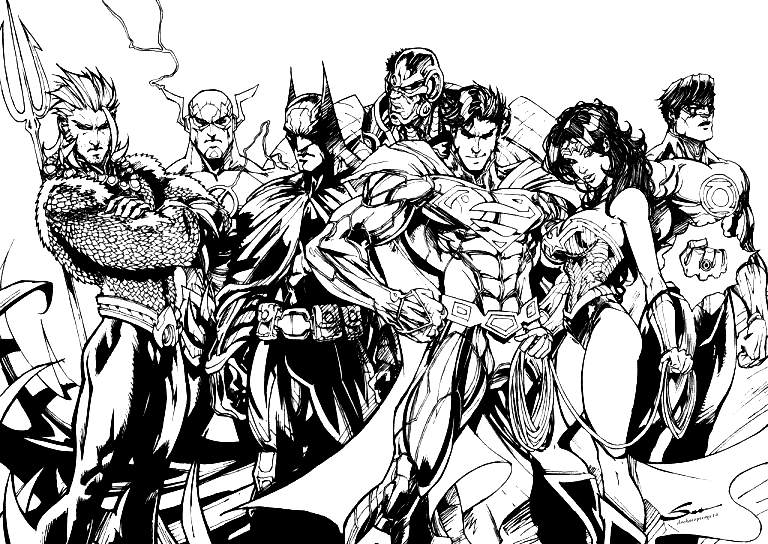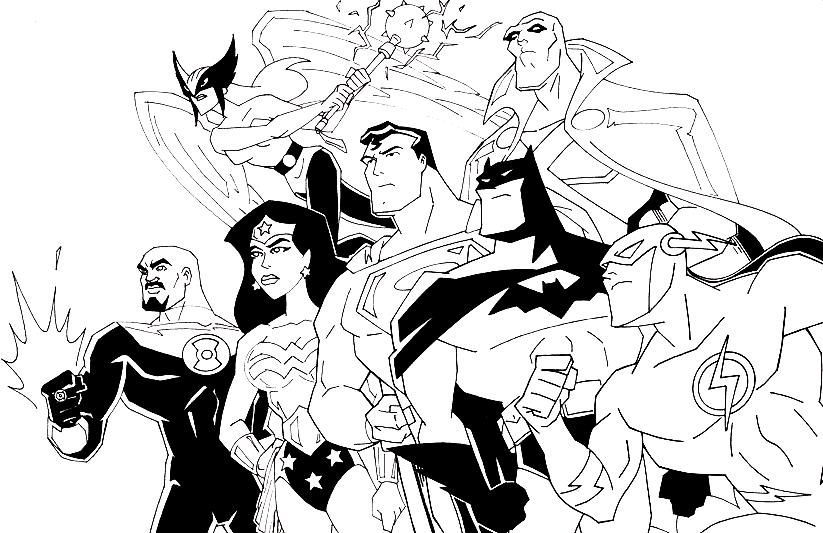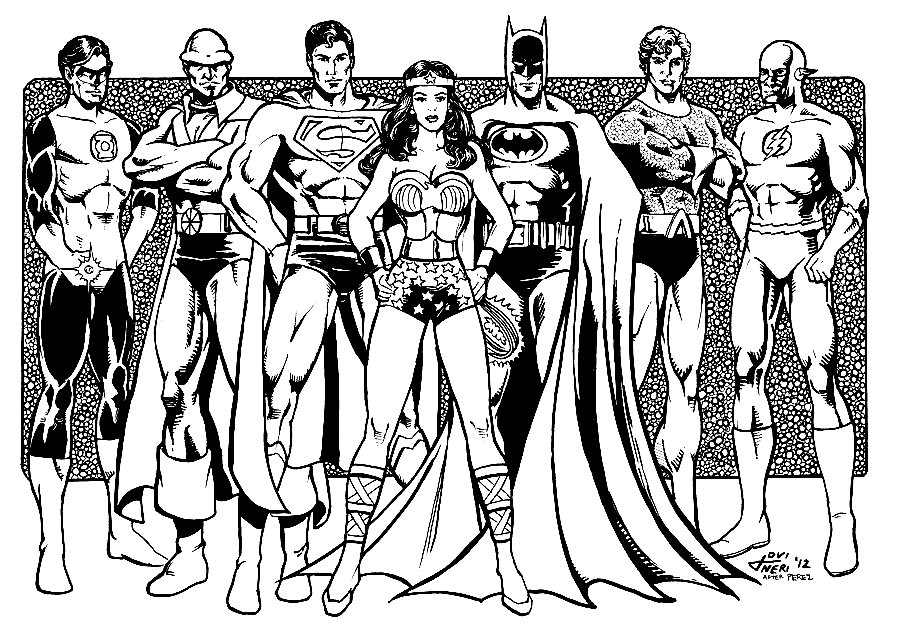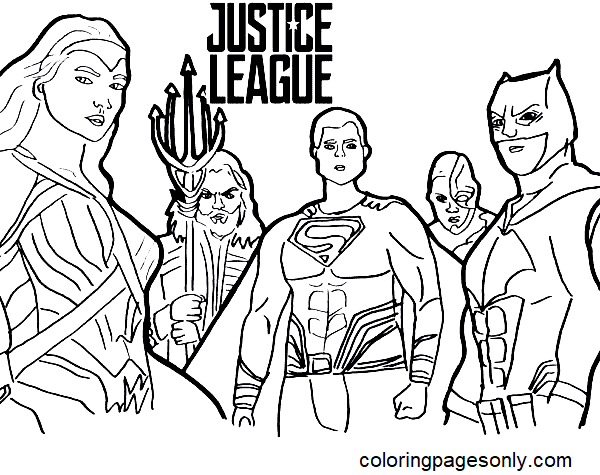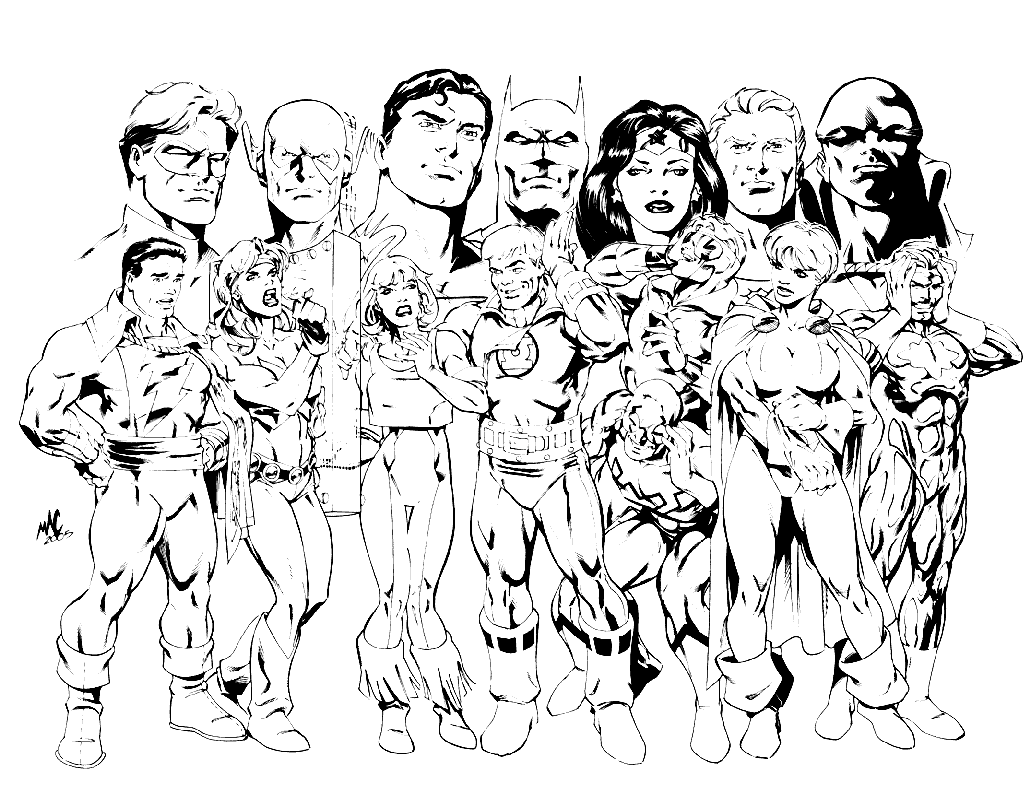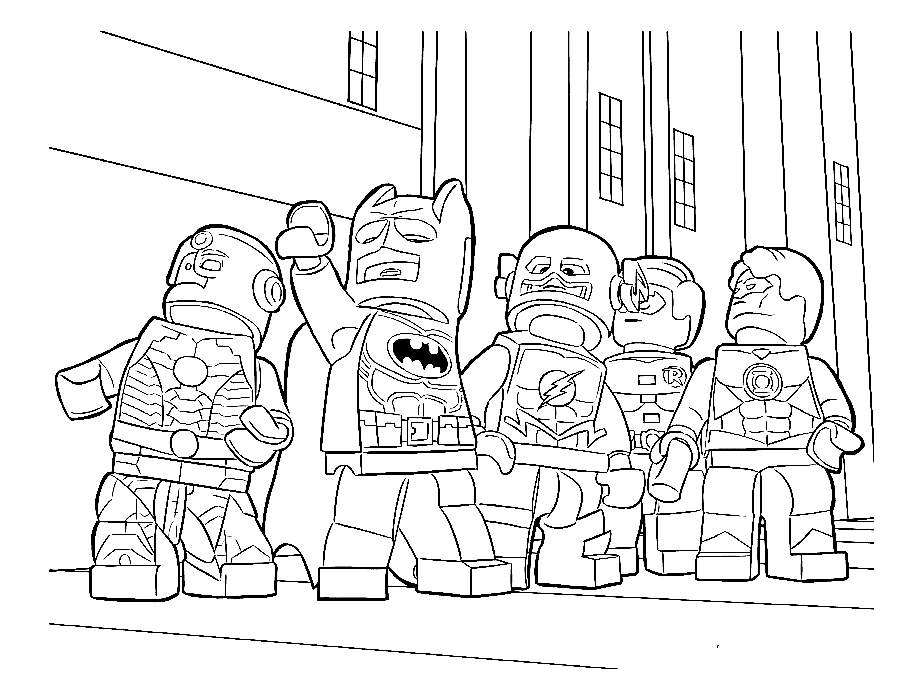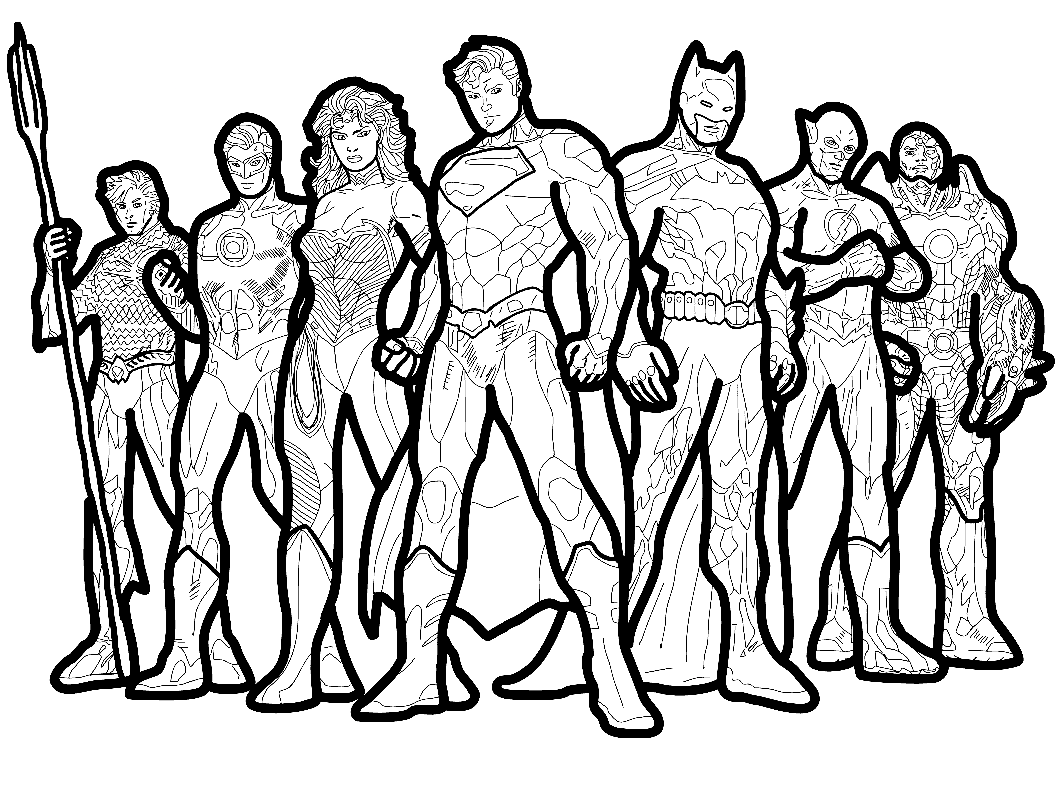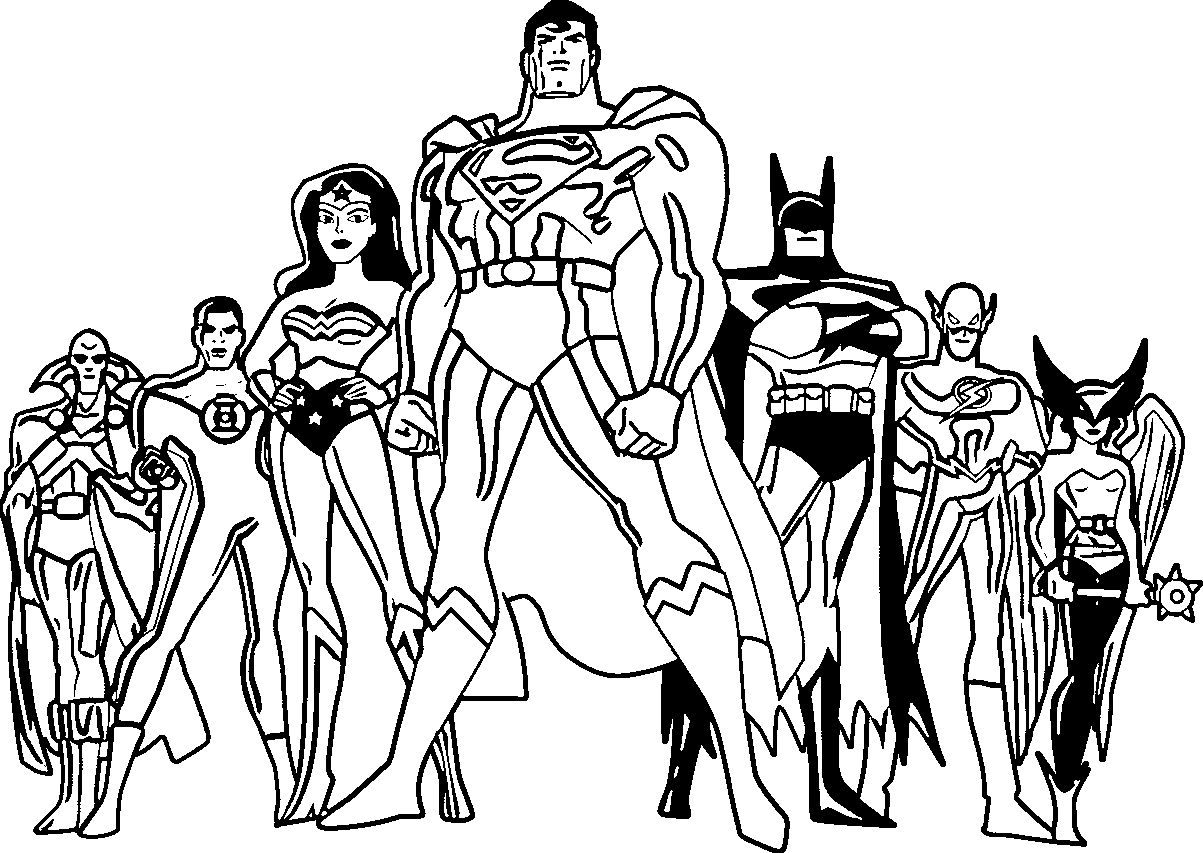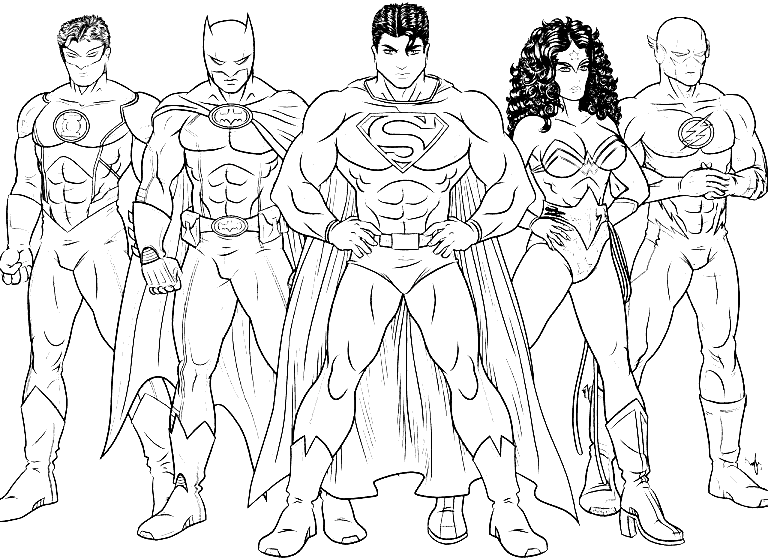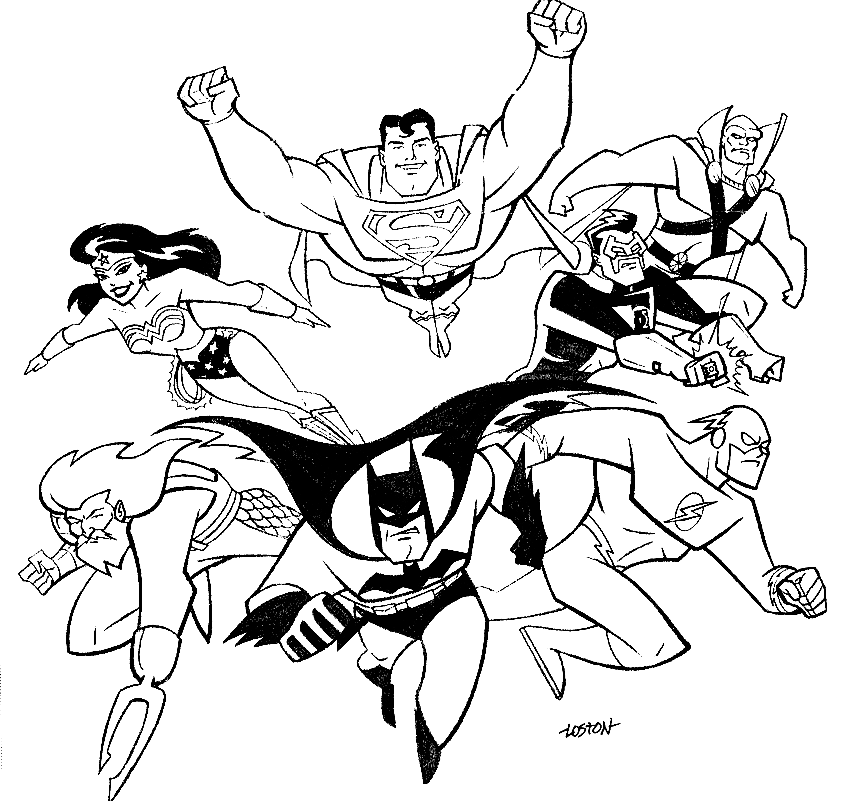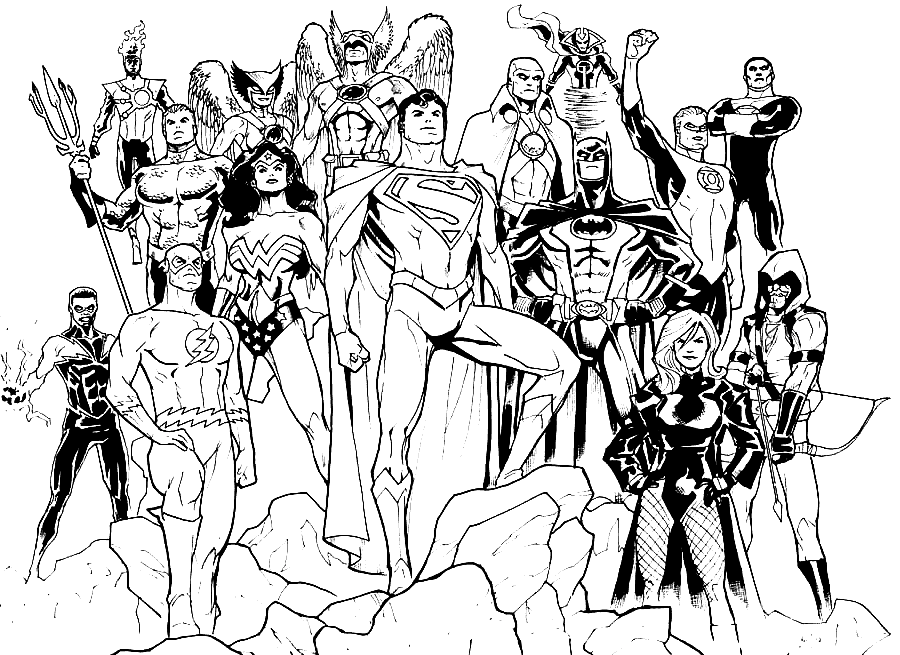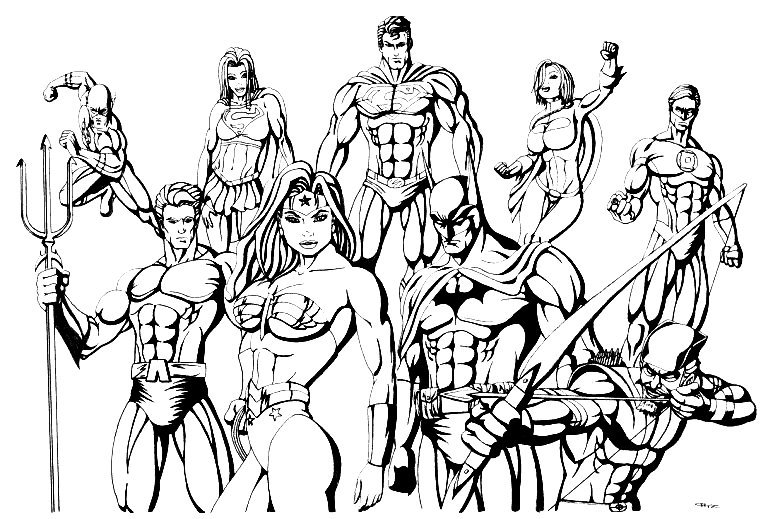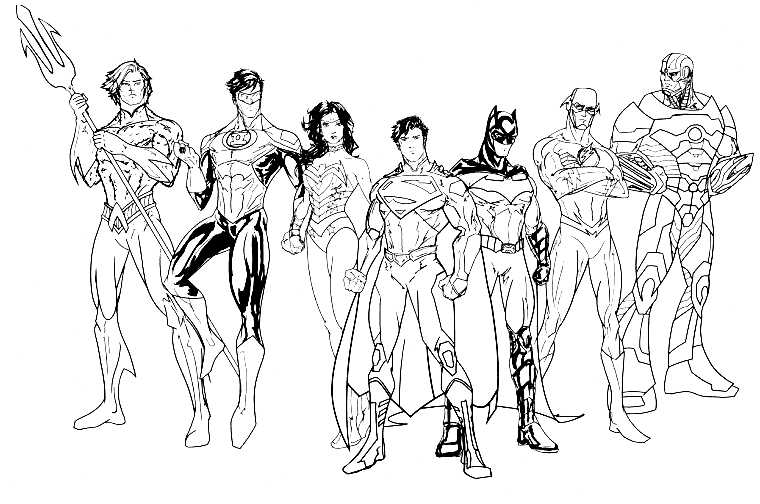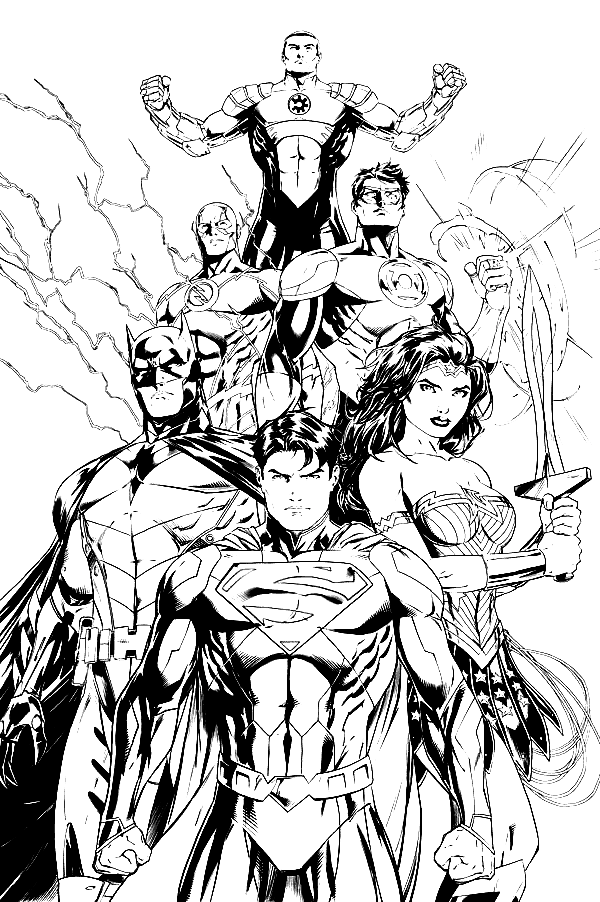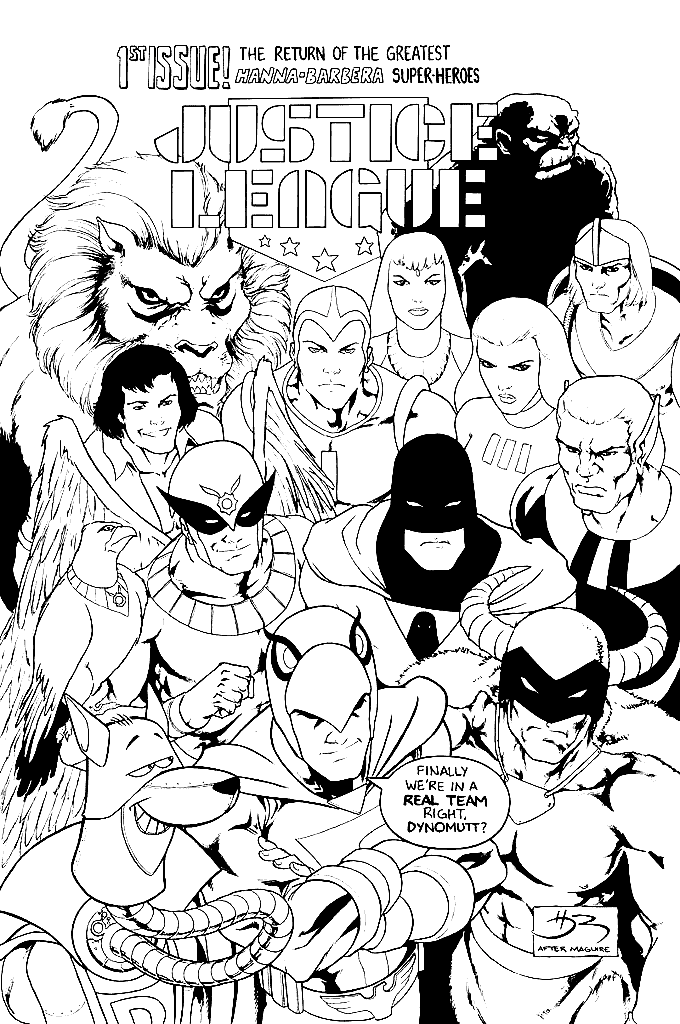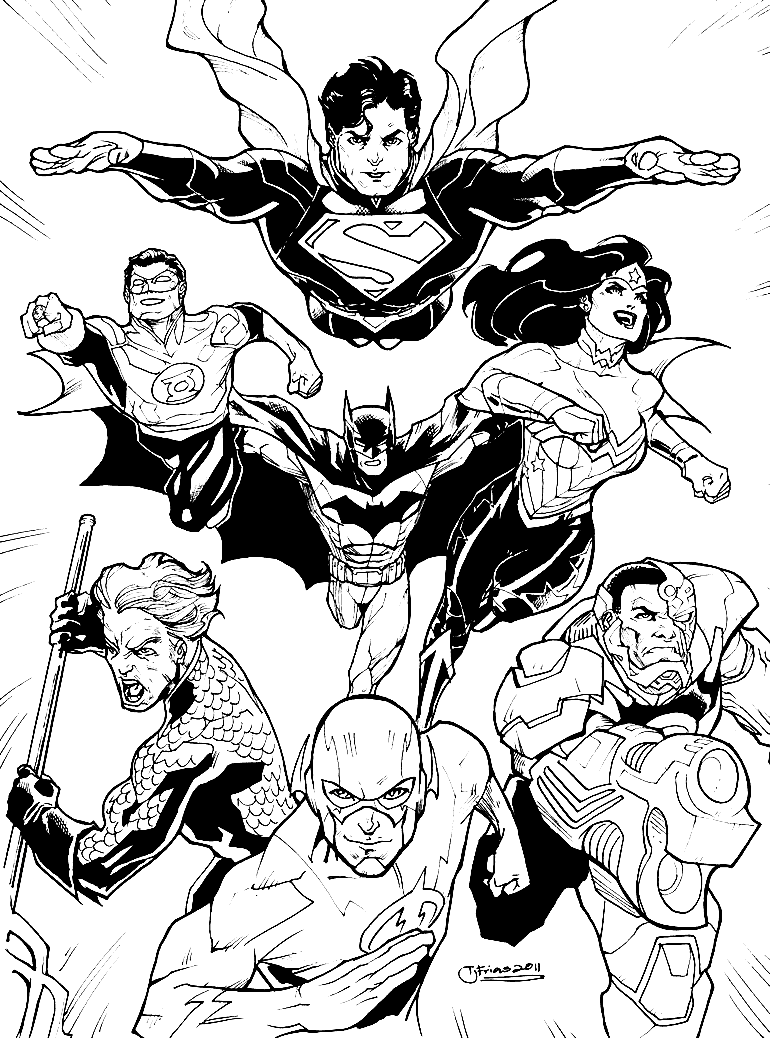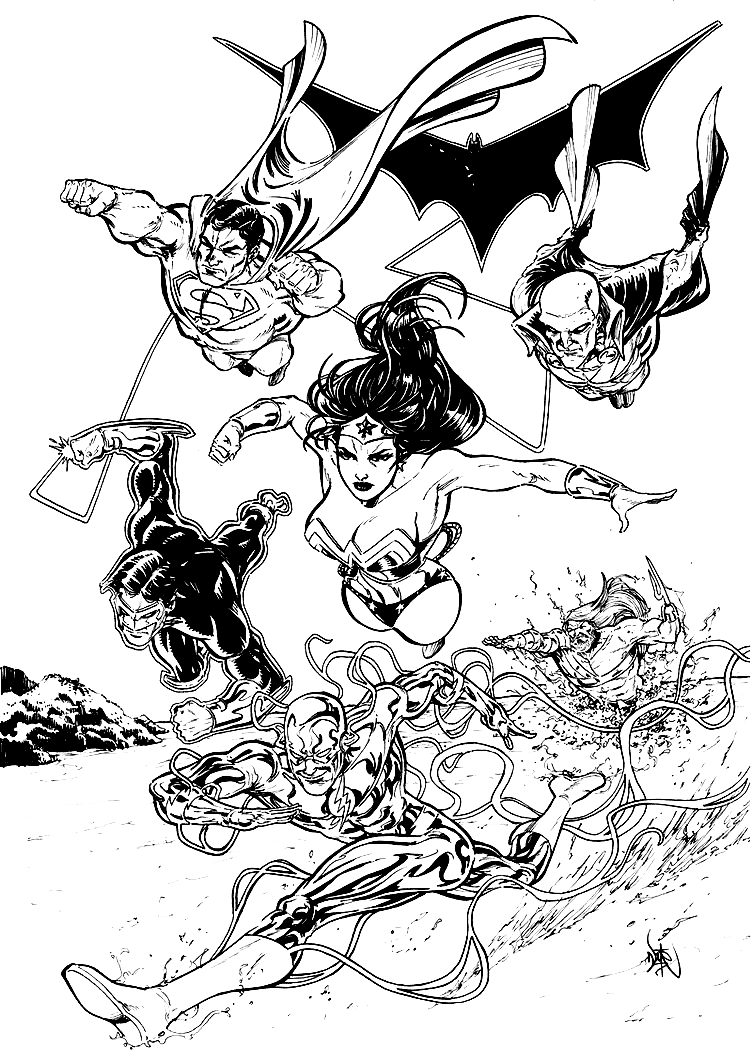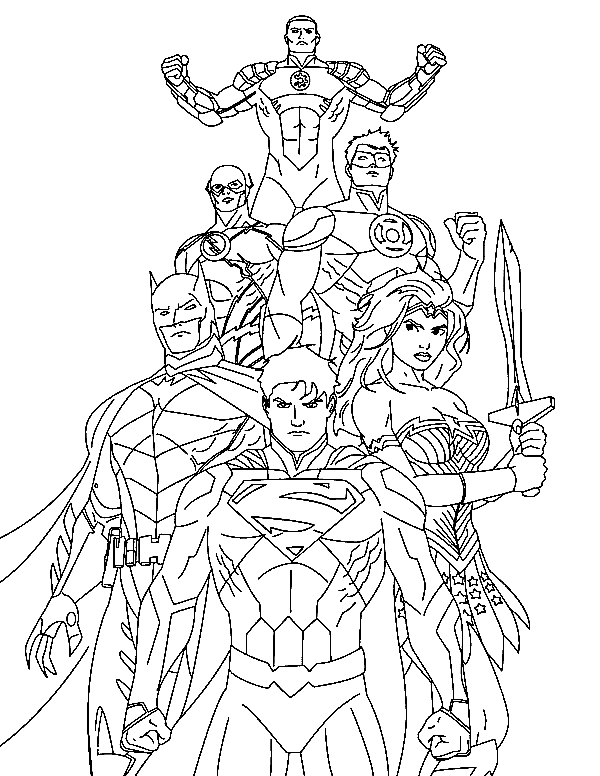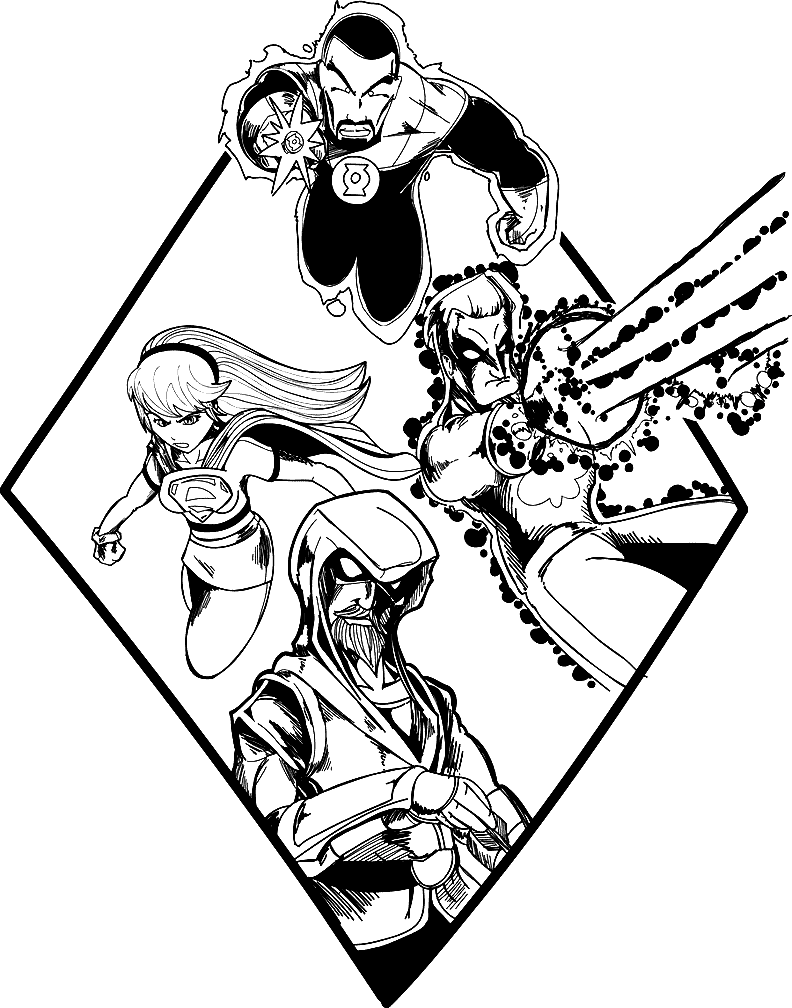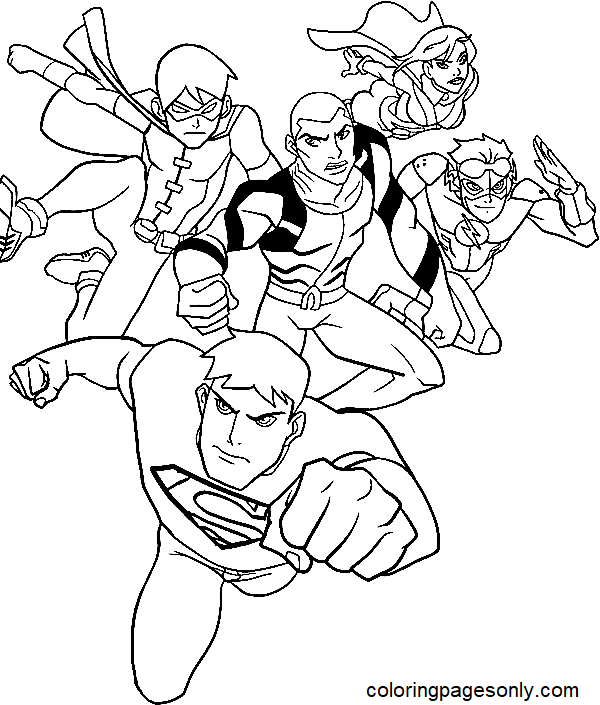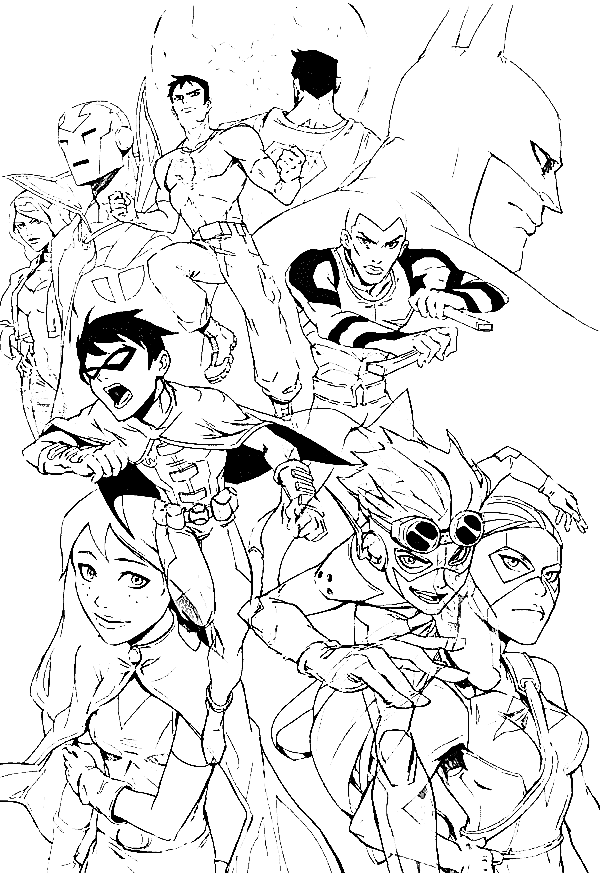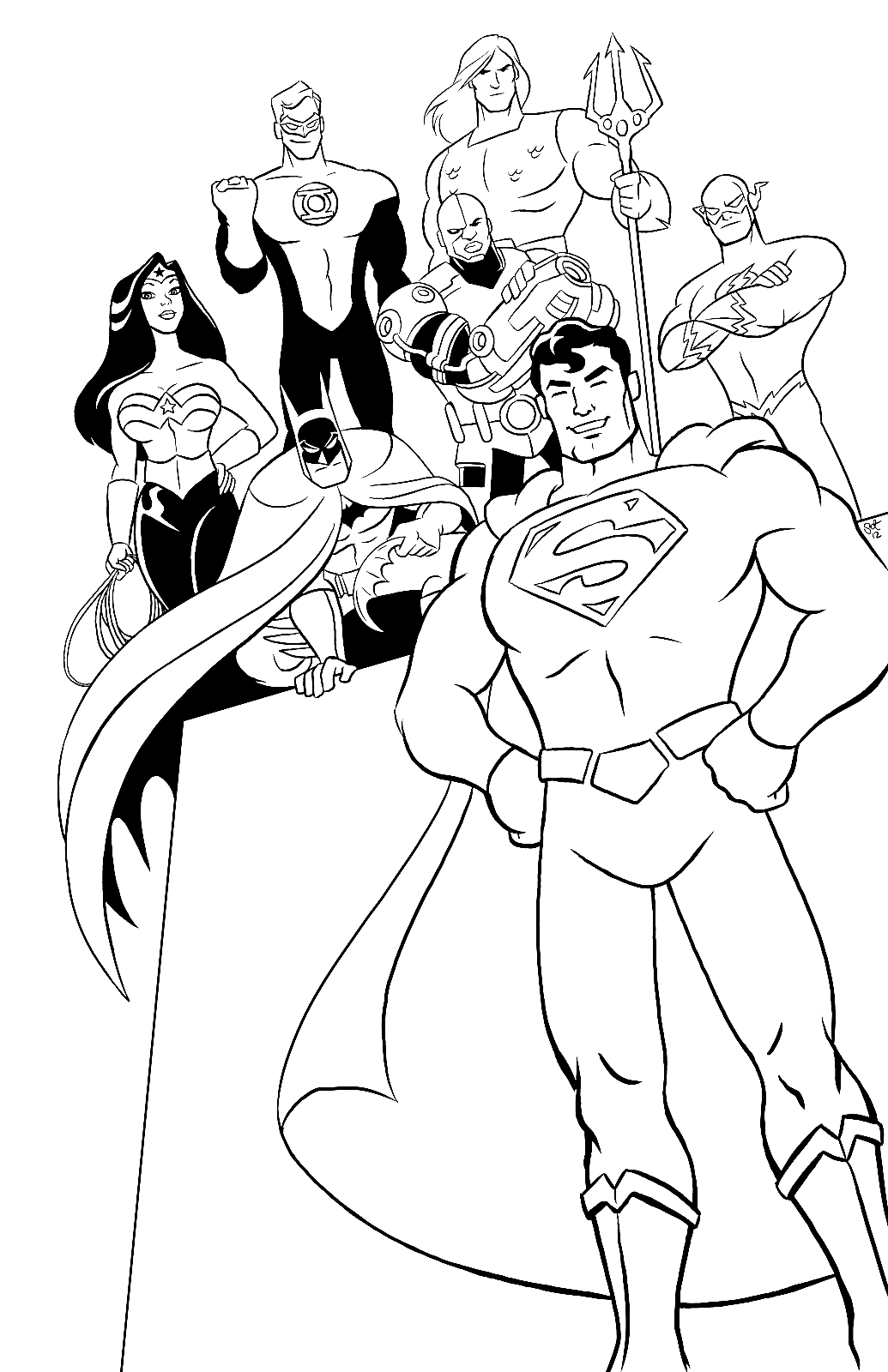
Free Justice League coloring pages: 30+ pages featuring Superman, Batman, Wonder Woman, The Flash, Green Lantern, Aquaman, and Martian Manhunter in individual hero portrait poses and group team compositions, the Justice League logo and insignia pages, action battle scenes, the Hall of Justice and Watchtower headquarters, villain confrontation pages including Darkseid and Lex Luthor, Young Justice team pages featuring Dick Grayson’s Robin, Superboy, Kid Flash, and the wider roster of junior heroes, and the full visual vocabulary of DC Comics’ premier superhero team across sixty-five years of comics, animation, and theatrical film. All free, printable PDF and online coloring for DC fans of every generation.

The Justice League of America first appeared in The Brave and the Bold #28, published in February 1960 with a March 1960 cover date, created by writer Gardner Fox and editor Julius Schwartz. The concept was a revival of the Golden Age Justice Society of America (JSA), which had been DC Comics’ superhero team concept in the 1940s. The original Justice League lineup consisted of Superman, Batman, Wonder Woman, The Flash (Barry Allen), Green Lantern (Hal Jordan), Aquaman, and Martian Manhunter (J’onn J’onzz). The Justice League received its own standalone series in October 1960 with Justice League of America #1.

The team’s premise is the most straightforward possible statement of the superhero team concept: the world’s most powerful heroes joining forces to face threats that none of them could address alone. Unlike Marvel’s Avengers, who were established as a team from their first appearance, the individual DC heroes who form the Justice League had each been established as solo characters before the team concept was introduced, making the Justice League a gathering of already-iconic figures rather than a team defined by its members’ collective introduction.

These 30+ free pages at ColoringPagesOnly.com cover the full Justice League roster. All free, PDF or PNG, print or color online.

What’s Inside

Superman: The Team’s Moral Center

Superman’s role in the Justice League is the one that his sixty-five-year history in DC Comics has consistently given him: the team’s moral reference point, the member whose fundamental belief in the good of all people sets the ethical standard against which every other hero’s choices are measured. He is the most powerful member in raw physical terms, and the one most likely to take the most direct, most hopeful approach to any situation.

His visual design in Justice League contexts maintains all of the elements described across his history: royal blue suit, vivid warm red cape, S-shield on the chest, and the specific combination of colors that makes him the most recognizable superhero in the world. In the Justice League animated series (2001-2004, Cartoon Network), his design was updated from the classical comics version to a cleaner, slightly more angular animation style that became the reference for that generation’s visual understanding of the character. Tim Daly voiced Superman across the animated DCAU (DC Animated Universe) productions.

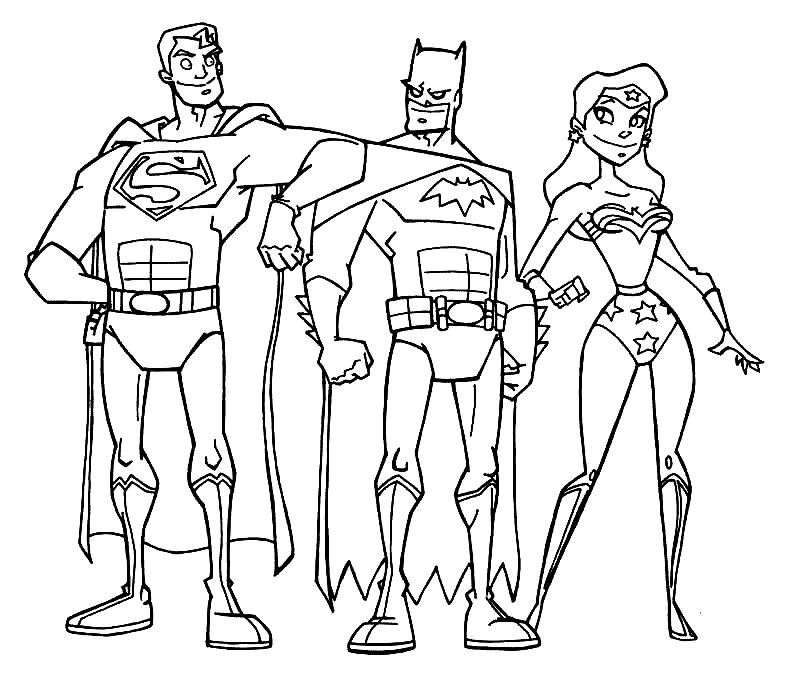
Coloring Superman in Justice League pages: The same canonical vivid royal blue and warm vivid red apply here as in standalone Superman pages. In group compositions, Superman’s blue often reads as the composition’s primary cool color, while The Flash’s red and Wonder Woman’s warm palette provide the warm accents. His S-Shield should maintain the yellow background and red S at full precision, even at the smaller scales group pages require.

Batman: The Team’s Strategist

Batman’s presence in the Justice League creates the team’s most specific internal dynamic: a hero with no superpowers among heroes of near-limitless capability. Batman’s value to the team is not physical but intellectual: he is the world’s greatest detective and the team’s most sophisticated strategist, capable of devising plans that address threats that Superman’s heat vision or Wonder Woman’s combat mastery alone cannot resolve.

This dynamic has been explored extensively in DC Comics: Batman maintains files on each Justice League member’s vulnerabilities in case a member is compromised, a fact that became a major storyline in the 2004 Identity Crisis event. The tension between Batman’s preparedness and his teammates’ trust defines much of the team’s most interesting internal drama.

His visual in Justice League contexts uses the dark blue and grey of the classic costume or the all-black of more recent interpretations, with the bat symbol on the chest, the pointed ears of the cowl, and the flowing cape that distinguishes him from every other team member’s comparatively conventional costume design. Kevin Conroy voiced Batman across the DCAU, a performance so definitive that he remained the voice actor most associated with the character until his death on November 9, 2022.

Coloring Batman in group pages: Batman’s dark palette (near-black or very dark navy) creates maximum contrast with the vividly colored heroes around him. This contrast is not incidental: his visual darkness against the team’s generally bright palette communicates his role as the team’s most secretive, most morally complex member. Apply the darkest available near-black or dark navy to his suit and let the darkness stand against the surrounding color.

Wonder Woman: Power and Precision

Wonder Woman, Princess Diana of Themyscira (the Amazon island nation), brings the Justice League its most specifically skilled combatant: she was trained from childhood in all forms of combat, her physical strength rivals Superman’s, and her weapons (the Lasso of Truth, her indestructible bracelets, her tiara) give her a fighting capability grounded in martial tradition rather than alien physics or technological power.

Her visual design in Justice League contexts uses the classic American-flag-inspired costume: red bodice with golden eagle or star design, blue shorts or skirt with white stars, golden tiara and wristbands, and the red-and-gold color scheme that gives her the warmest, most golden palette in the team ensemble. In the Justice League animated series, her design was simplified to clean animation lines while maintaining the iconic color arrangement.

Wonder Woman was created by William Moulton Marston and first appeared in All-Star Comics #8 in December 1941, making her older than both the Justice Society (1940) and the Justice League (1960). She is the first female superhero to achieve lasting cultural recognition and the one whose seventy-year history gives her the deepest roots in superhero publishing.

Coloring Wonder Woman in group pages: Her warm palette (vivid red and warm gold) provides the team composition’s warmest color accent alongside The Flash’s red. Apply vivid red to the bodice and any red accents. Apply vivid warm gold to the tiara, wristbands, and any gold trim elements. The blue stars and blue elements on her costume use the same deep blue as the American flag’s canton.

The Flash: Speed Personified

The Flash (Barry Allen in the classic comics and in many contemporary continuities; Wally West, Barry’s nephew by marriage, in the longest-running period of Flash comics from the 1980s through the early 2000s) is the Justice League’s fastest member and one of its most essential: the ability to move at speeds approaching the speed of light gives him a specific tactical advantage that brute strength cannot replicate.

In the Justice League animated series, The Flash is portrayed as Wally West with a personality calibrated toward humor and approachability: the team member who is most likely to make a joke in a tense situation, whose lightness provides a necessary counterpoint to Batman’s gravity and Superman’s earnestness. Michael Rosenbaum voiced the Flash in the animated series to significant acclaim.

The Flash’s visual is among the collection’s most specifically demanding: the full-body vivid red suit, the yellow lightning bolt emblem on the chest, and the specific yellow lightning details at the costume’s trim positions (ears of the cowl, boot tops) create a demanding color management challenge. The yellow trim against the vivid red body requires precise boundary management to prevent the two colors from appearing muddy at their interface.

Coloring The Flash in group pages: Vivid warm red at full saturation across the full suit body. Vivid warm yellow at the chest lightning bolt symbol and all trim positions. The red and yellow must both be at full saturation, and the boundary between them must be clean. In group compositions, The Flash’s vivid red creates a visual connection to Wonder Woman’s red and Superman’s cape, linking the warm colors across the composition.

Green Lantern: The Ring’s Power

The Green Lantern character is the DC Universe’s most philosophically interesting power concept: a ring that can create anything the wearer can imagine, limited only by the wearer’s willpower and concentration. The ring is powered by the green energy of will, and Green Lanterns are chosen for their ability to overcome fear and their strength of willpower.

Multiple characters have held the Green Lantern identity in DC Comics. Hal Jordan (first appeared in 1959 as a test pilot) is the classic comics GL. John Stewart (first appeared 1972, an architect and former Marine) is the most familiar to animated series audiences: the Justice League animated series featured John Stewart as the primary Green Lantern, making him the version that many viewers who encountered DC heroes primarily through animation associate most strongly with the role. John Stewart was one of DC Comics’ first prominent Black superheroes, and his prominence in the animated series made him specifically important to a generation of young viewers who saw him as one of the team’s central figures.

Coloring Green Lantern in group pages: The suit uses medium-vivid green for the dominant color, with near-black for the secondary sections (typically the torso center, gloves, and other black elements of the costume). The circular GL insignia on the chest is green within a green circle outline. The ring on the right hand should show the same vivid green as the costume. The energy constructs created by the ring use the same vivid green at varying levels of translucency depending on the page design.

Aquaman: King of Atlantis

Aquaman (Arthur Curry) rules Atlantis and commands the seas: two-thirds of the Earth’s surface is his domain, a fact that makes him significantly more powerful in practical terms than the decades of “Aquaman is useless” jokes suggested. His ability to communicate with and command sea life, his physical strength that matches or approaches Superman’s at his peak, and his status as the world’s most powerful ruler give him a political and physical authority within the team that is specific and non-trivial.

The orange-and-green color scheme of his scales-like costume is the collection’s most compositionally unusual: the specific warm orange of his golden scales against the green of his pants and trident handle creates a color combination found nowhere else in the Justice League’s visual ensemble. It is also the combination most directly referencing his ocean domain: the warm tones of sunlit water and the green of marine vegetation.

Coloring Aquaman in group pages: The orange scales suit uses vivid warm orange applied consistently across all orange-designated surface areas. The green elements use medium vivid green. The trident, his primary weapon, uses metallic silver-gold for the trident head with the handle in green, matching the costume’s secondary color.

Martian Manhunter: The Team’s Heart

J’onn J’onzz, the Martian Manhunter, is the Justice League’s most consistently underappreciated member in terms of public recognition and one of its most powerful in terms of actual capability. He is the last survivor of a Martian civilization, stranded on Earth after his family and people were destroyed. His powers include shape-shifting, flight, super strength, telepathy, intangibility, invisibility, and heat vision: a combination that makes him arguably the most versatile member of the team.

His visual, a green-skinned being in a dark blue and red costume with a flowing red cape, distinguishes him immediately from every other human-shaped team member through his specific alien physiology: the green skin, the red eyes, the exaggerated forehead structure, and the overall physical presence of a being who is genuinely not human despite appearing approximately human in proportion.

Coloring Martian Manhunter in group pages: His skin is vivid medium green, different from The Flash’s suit green (more vivid and warmer) and from Green Lantern’s suit green (similar but in a different visual position). His eyes are red. The dark blue of his costume uses the same deep navy as Batman’s suit (creating a visual kinship between the two). The red cape matches Wonder Woman’s and Superman’s red elements, linking him to the team’s warm-color members.

Cyborg and the Young Justice Team

Cyborg (Victor Stone), half human and half machine after a catastrophic accident, was elevated to Justice League founding member status in DC’s New 52 relaunch of 2011, joining Superman, Batman, Wonder Woman, The Flash, Green Lantern, and Aquaman as the new founding seven. His technological capabilities, his connection to Mother Box alien technology, and his role as a bridge between the human and technological are specific contributions that the team’s other members cannot replicate.

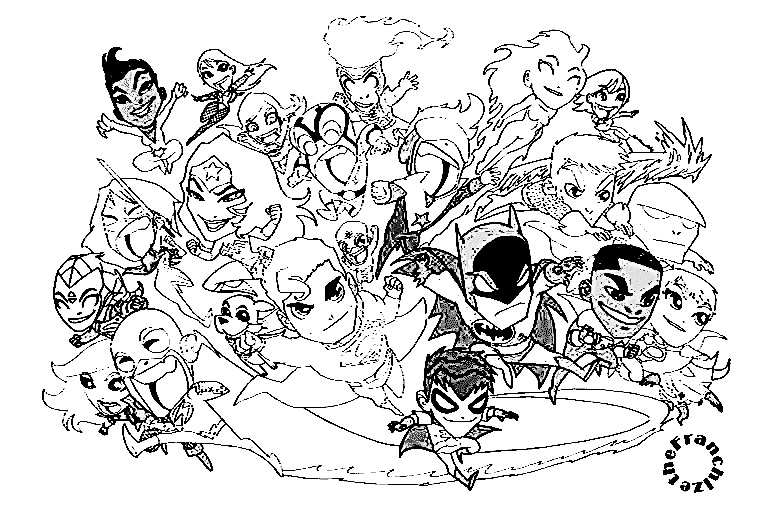
The Young Justice roster, depicted in both the comics and the critically acclaimed animated series, includes the next generation of DC heroes: Dick Grayson’s Robin (who later becomes Nightwing), Superboy (Conner Kent, a clone of Superman and Lex Luthor), Kid Flash (Wally West in the original continuity), Aqualad (Jackson Hyde/Kaldur’ahm in the animated series), Miss Martian (M’gann M’orzz, niece of Martian Manhunter), and Artemis.

The Young Justice animated series premiered on Cartoon Network in 2010 and ran for four seasons through 2022 on various platforms, achieving critical recognition as one of the most sophisticated DC animated productions.

What These Pages Do

The Justice League, as a concept, established one of superhero fiction’s most enduring structural premises: a team assembled not because its members share the same origin or the same powers, but because their different capabilities collectively address a wider range of threats than any individual member could alone. This “complementary abilities” team structure has been the dominant model for superhero teams across DC Comics, Marvel Comics, and the broader popular culture since 1960.

The specific characters who form the Justice League’s core were each established before the team existed, making them established archetypes rather than characters introduced alongside the team. Superman was first published in 1938. Batman in 1939. Wonder Woman in 1941. The Flash (Jay Garrick) in 1940 and Barry Allen in 1956. Green Lantern (Alan Scott) in 1940 and Hal Jordan in 1959. Aquaman in 1941. Martian Manhunter in 1955. The Justice League’s 1960 introduction gathered these established archetypes and asked what they accomplish together that none of them can accomplish alone: the question that has driven superhero team fiction ever since.

The Justice League animated series (2001-2004) and Justice League Unlimited (2004-2006) are widely considered among the finest superhero animated productions ever made, achieving a level of character writing, thematic complexity, and visual storytelling that influenced both subsequent DC animated work and the broader superhero genre in animation.

The American Academy of Pediatrics identifies fine motor skill development as a key childhood milestone throughout early childhood. The complex color management required in group Justice League compositions (managing six to seven distinct character color palettes simultaneously), the emblem precision of each hero’s chest symbol, the energy construct rendering for Green Lantern pages, and the action scene dynamic compositions all provide sustained fine motor challenge across the collection’s age range. The 2005 Art Therapy Journal study on structured coloring and anxiety reduction applies throughout.

How to Color These Pages Well

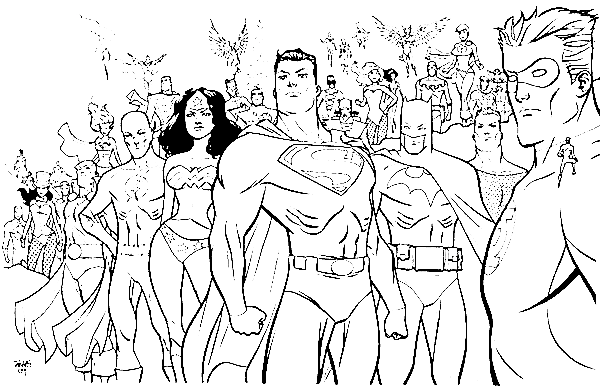
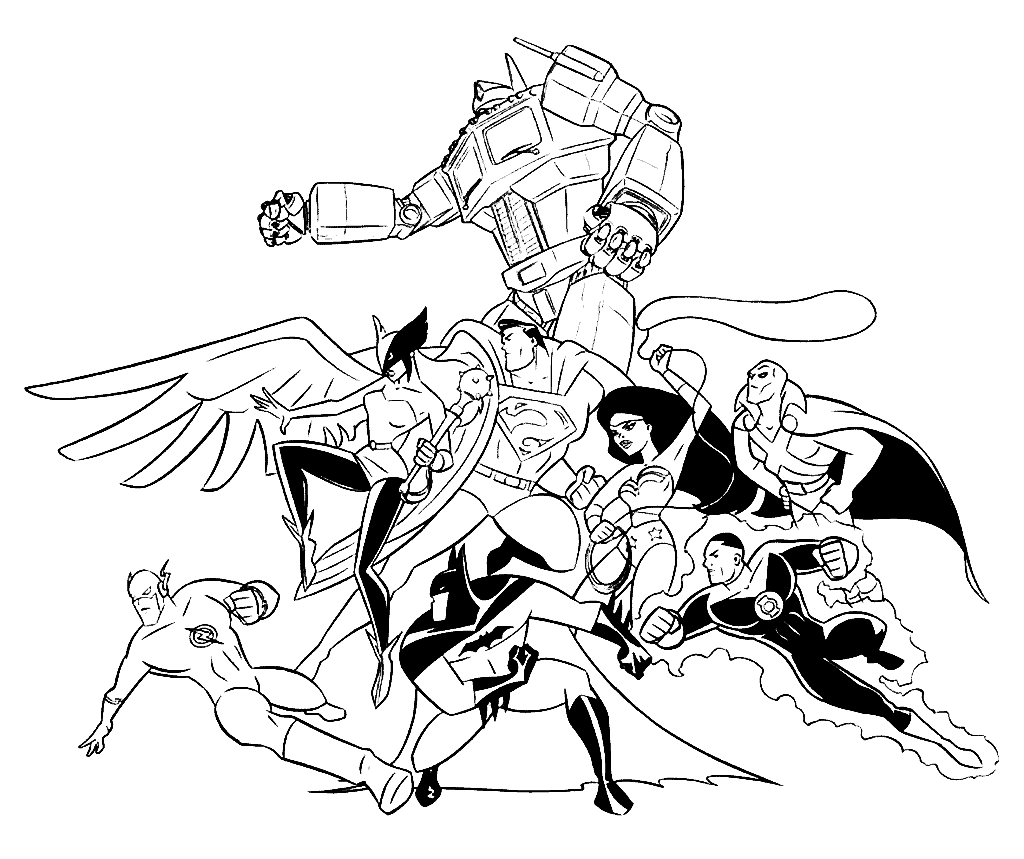
Group compositions require pre-planning all character color assignments before applying any color. The Justice League’s six to seven core members each have distinct color palettes that must all coexist in the same composition without any two adjacent characters appearing to share the same dominant color. Before applying any color to a group page, identify each character’s position in the composition and assign their canonical colors. Check that no two adjacent characters have the same dominant color. Adjust character selection or composition orientation if conflicts exist.

Each hero’s chest emblem is the most important precision detail on any character page. The S-Shield (Superman), Bat symbol (Batman), star and eagle motif (Wonder Woman), lightning bolt (The Flash), GL ring symbol (Green Lantern), and Manhunter emblem (Martian Manhunter) are the primary character identification markers and must be applied with the most precise, careful work in the composition. In group pages where the emblems are smaller, use the finest available tool and apply the emblem colors after all surrounding large-area body colors are complete.

Green Lantern’s energy constructs require vivid green applied at translucent-quality pressure over a dark background. When a Green Lantern page shows an energy construct (a glowing green structure created by the ring), the construct should appear semi-translucent: vivid green at full saturation but applied at slightly lower than maximum pressure, allowing the dark background to show very subtly through. The outline of the construct (where the green energy defines the shape against the surrounding air) should be applied at maximum pressure, with slightly lower pressure in the interior.

Batman’s near-black suit creates the composition’s darkest element and should be applied last in group pages. In any group composition, Batman’s very dark navy or near-black suit creates the deepest shadow value in the composition. Apply all other characters’ colors first, then apply Batman’s dark tones, working inward from the composition’s other characters. The contrast between Batman’s darkness and the vivid colors of his teammates is the most visually important relationship in any Justice League group page.

The Flash’s vivid red suit must maintain clean boundaries against all adjacent elements. The Flash’s full-body red suit is the most uniformly single-colored suit in the team ensemble: it is almost entirely red except for the yellow trim accents. Any group page where The Flash appears adjacent to Superman’s blue or Batman’s dark suit requires careful boundary management at the interface between the red and the adjacent color. Apply The Flash’s red first across the full suit area, then work the adjacent character’s color up to but not into the red boundary.

5 Creative Craft Ideas

The Founding Seven Display

The Justice League’s original founding members, as established in The Brave and the Bold #28 (February 1960), were Superman, Batman, Wonder Woman, Flash (Barry Allen), Green Lantern (Hal Jordan), Aquaman, and Martian Manhunter. Seven characters from a decade of individual DC Comics publication, brought together for the first time.

Print one portrait page for each of the seven founding members. Color all seven in canonical colors.

Mount all seven in a circle on a large backing sheet: “The Justice League of America. First appearance: The Brave and the Bold #28, February 1960. Writers: Gardner Fox. Editor: Julius Schwartz. Publisher: DC Comics. Superman (1938). Batman (1939). Wonder Woman (1941). Aquaman (1941). Martian Manhunter (1955). Flash/Barry Allen (1956). Green Lantern/Hal Jordan (1959). Each was established individually. The team was formed in 1960. The concept: what seven heroes can do together that none of them can do alone.”

The No-Powers Strategy

Batman is the only original Justice League member without superpowers: no alien physiology giving strength and flight, no ring, no magical lasso, no connection to the speed force. He compensates with intelligence, preparation, martial arts training, and technology. He maintains contingency plans for defeating every other member if any of them is compromised. He is the team’s greatest strategic asset.

Print a Batman portrait page and a full team group page. Color Batman in his near-black suit. Color the team page with all members in full canonical colors.

On the backing card: “Batman. Justice League member. Powers: none. Compensating factors: the world’s finest detective, peak human physical condition, comprehensive martial arts training, the most sophisticated personal technology available, contingency plans for neutralizing every other team member, and a preparedness orientation that treats every situation as one he has already analyzed. Quote from various DC comics: ‘I’m not a superhero. I’m a detective.’ The team keeps him. He keeps them. Neither side will admit how much they need the other.”

The Animated Series Legacy Page

The Justice League animated series (2001-2004) and Justice League Unlimited (2004-2006), both produced by Bruce Timm’s DCAU team for Cartoon Network, are considered among the finest superhero animated productions in the medium’s history. The series introduced John Stewart as the primary Green Lantern to a generation of viewers, maintained complex moral and political storylines across its episode count, and treated its audience as capable of handling genuine narrative complexity.

Print a group team page. Color the characters using the animated series’ specific design variations: slightly more simplified than comics designs, with cleaner color blocking.

On the backing card: “Justice League (animated). Network: Cartoon Network. Air dates: 2001-2004 (Justice League), 2004-2006 (Justice League Unlimited). Created by: Bruce Timm. Voice cast: Tim Daly (Superman), Kevin Conroy (Batman), Susan Eisenberg (Wonder Woman), Michael Rosenbaum (Flash), Phil LaMarr (John Stewart/Green Lantern), Maria Canals Barrera (Hawkgirl), Carl Lumbly (Martian Manhunter). Kevin Conroy died on November 9, 2022. He voiced Batman for 30 years. The animated series is still considered among the best superhero animations ever produced.”

The John Stewart Green Lantern Page

John Stewart, an African-American architect and former Marine, first appeared in Green Lantern/Green Arrow #87 (December 1971/January 1972), created by Dennis O’Neil and Neal Adams. He became the primary Green Lantern in the Justice League animated series, making him the version most familiar to the generation who encountered the team primarily through animation rather than through comics.

Print any Green Lantern page. Color in John Stewart’s canonical design if the page’s character design matches, or note the adaptation.

On the backing card: “John Stewart. Green Lantern. First appearance: Green Lantern/Green Arrow #87, December 1971/January 1972. Created by Dennis O’Neil and Neal Adams. Occupation: architect, former Marine. One of DC Comics’ first prominent Black superheroes. Primary Green Lantern in Justice League animated series (2001-2004), voiced by Phil LaMarr. For the generation that encountered the Justice League primarily through animation: John Stewart is Green Lantern. The ring: powered by willpower. The construct: anything the wearer can imagine, limited only by will and concentration.”

The Young Justice Generation Study

Young Justice, the animated series (2010-2022), follows the next generation of DC heroes: teenagers and young adults who operate as the Justice League’s covert operations team rather than as a fully public superhero squad. The series is notable for its character development depth and its willingness to address the real consequences of superhero action.

Print any Young Justice team page or a composition of young heroes. Color the junior heroes in their canonical designs: Robin/Dick Grayson in black and red, Superboy in jeans and a black t-shirt, Kid Flash in his Flash-inspired yellow suit, Miss Martian in her white costume, Aqualad in his blue-and-black suit.

On the backing card: “Young Justice (animated series). Network: Cartoon Network (2010-2013), DC Universe (2019), HBO Max (2021-2022). Seasons: 4. Years: 2010-2022. Core team: Robin (Dick Grayson), Superboy (Conner Kent), Kid Flash (Wally West), Aqualad (Kaldur’ahm), Miss Martian (M’gann M’orzz), Artemis. The premise: the junior members learn what the senior members already know while doing things the senior members cannot. The fan campaign that brought it back for Seasons 3 and 4: documented as one of the more successful audience-driven streaming renewals.”

Frequently Asked Questions

What is the Justice League, and when was it created? The Justice League of America is DC Comics’ premier superhero team, first appearing in The Brave and the Bold #28, published in February 1960 with a March 1960 cover date. The team was created by writer Gardner Fox and editor Julius Schwartz as a revival of the Golden Age Justice Society of America. The original lineup consisted of Superman, Batman, Wonder Woman, The Flash (Barry Allen), Green Lantern (Hal Jordan), Aquaman, and Martian Manhunter. The team’s premise is the most fundamental possible expression of the superhero team concept: the world’s most powerful heroes joining forces to address threats that none of them could handle alone. The Justice League received its own ongoing series in October 1960 with Justice League of America #1.

Who are the core members of the Justice League? The Justice League’s core roster across most of its history consists of seven primary members. Superman (Clark Kent/Kal-El) brings the team’s greatest raw physical power and serves as its moral center. Batman (Bruce Wayne) contributes intelligence, strategy, and preparation without any superpowers. Wonder Woman (Diana Prince) adds elite combat training, near-Superman-level strength, and the magical properties of her weapons. The Flash (Barry Allen or Wally West) provides super speed approaching the speed of light. Green Lantern (various, most classically Hal Jordan in comics and John Stewart in animation) contributes the power of the ring, which can construct anything the wearer imagines. Aquaman (Arthur Curry) rules the seas as King of Atlantis. Martian Manhunter (J’onn J’onzz) provides the team’s most versatile combined power set, including telepathy, shape-shifting, and flight. Cyborg (Victor Stone) was added as a founding member in DC’s 2011 New 52 relaunch.

What is the Justice League animated series, and why is it significant? The Justice League animated series aired on Cartoon Network from 2001 to 2004 and was followed by Justice League Unlimited from 2004 to 2006. Both were produced by Bruce Timm’s DCAU (DC Animated Universe) team, which had previously produced Batman: The Animated Series (1992) and Superman: The Animated Series (1996). The series is considered among the finest superhero animated productions ever made, achieving sophisticated character development, genuine moral and political complexity in its storylines, and animation and voice acting quality that remains a reference for subsequent DC productions. Kevin Conroy voiced Batman in the series until his death on November 9, 2022. The series is specifically significant for featuring John Stewart as the primary Green Lantern, introducing a generation of viewers to the African-American Green Lantern who had first appeared in comics in 1971.

What is Young Justice, and how does it relate to the Justice League? Young Justice is a DC animated series focusing on the younger generation of DC heroes operating as a covert action team under the Justice League’s oversight. The series premiered on Cartoon Network in 2010 and ran for four seasons through 2022 on various platforms. Its core team includes Dick Grayson’s Robin (later Nightwing), Superboy (Conner Kent, a Superman/Lex Luthor clone), Kid Flash (Wally West), Aqualad (Kaldur’ahm/Jackson Hyde in the animated continuity), Miss Martian (M’gann M’orzz), and Artemis. The show is noted for its character development depth, its willingness to show real consequences of superhero action, and its complex serialized storytelling. Fan campaigns successfully brought the show back for a third season (2019) and a fourth season (2021-2022) after its initial cancellation.

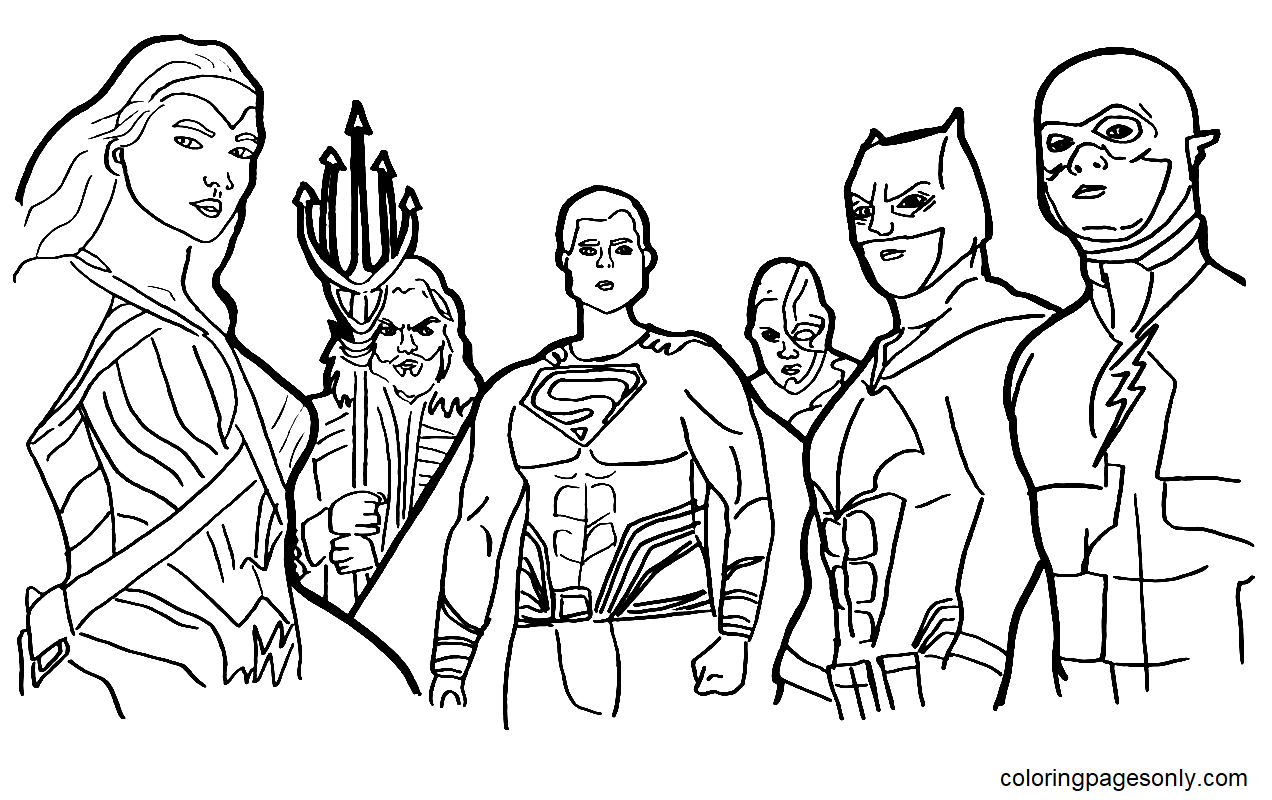
How does the Justice League differ between comics, animated series, and films? The Justice League’s composition, visual design, and tone vary significantly across its different media. The original comics established the founding seven-member lineup. The animated series (2001-2004) replaced Green Lantern Hal Jordan with John Stewart and added Hawkgirl while removing Aquaman from the founding lineup. The DC Extended Universe films (2017 Justice League and 2021 Zack Snyder’s Justice League) featured Henry Cavill’s Superman, Ben Affleck’s Batman, Gal Gadot’s Wonder Woman, Ezra Miller’s Flash, Jason Momoa’s Aquaman, and Ray Fisher’s Cyborg. The 2021 Snyder Cut (Zack Snyder’s Justice League, released on HBO Max on March 18, 2021) was four hours and two minutes long and received significantly more positive reception than the 2017 theatrical version. The DC Universe reboot, beginning with James Gunn’s Superman (2025), introduces new actors across the DC roster.

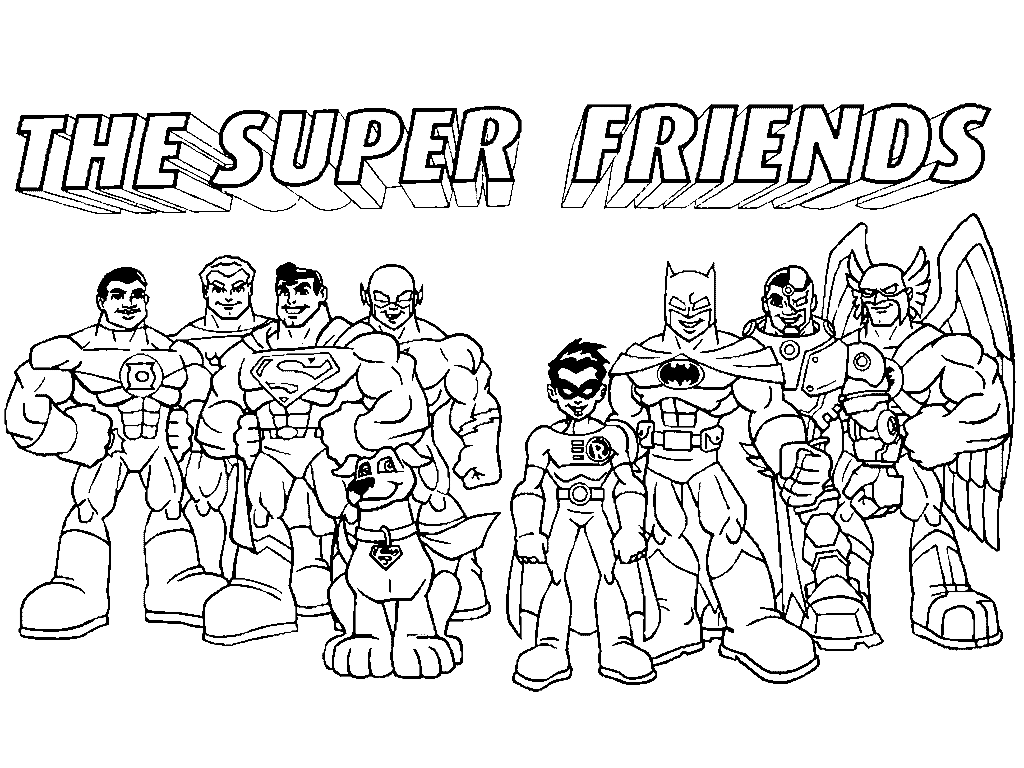
What is the Hall of Justice? The Hall of Justice is the Justice League’s most publicly recognized headquarters in popular culture, primarily because of its prominent feature in the Super Friends Saturday morning animated series (1973-1986) produced by Hanna-Barbera for ABC. The Hall of Justice was a distinctive semicircular domed building that served as the team’s base. The Super Friends adapted the Justice League concept for a child audience, featuring Superman, Batman, and Robin, Wonder Woman, Aquaman, and various original characters, and later incorporating the Wonder Twins (Zan and Jayna) and their space monkey Gleek. The building design became the most recognizable Justice League headquarters for the generation who grew up with Saturday morning animation in the 1970s and 1980s. In the comics, the team’s headquarters has been called the Watchtower (usually a satellite orbiting Earth) in most contemporary continuities.

What age group are these pages best suited for? Justice League coloring pages serve DC Comics fans across a very wide age range. The simplest individual hero portrait pages with large, clearly defined color areas (Superman’s blue and red, Wonder Woman’s red and gold, The Flash’s vivid red) are accessible from ages four and five, where character recognition and the bold primary color palette provide immediately achievable coloring targets. The more detailed pages with emblem precision work (the S-Shield, the Bat symbol, the GL ring symbol) are most rewarding for ages six to ten. The group composition pages requiring management of six or seven simultaneous character palettes are most engaging from ages eight and up, where advance planning and color management can be applied. Adult fans of the animated series and comics find the most detailed pages and the character history context most meaningful.

Browse the full collection at ColoringPagesOnly.com. All 30+ pages free, no sign-up, PDF or PNG, print or color online.

Gardner Fox and Julius Schwartz assembled seven DC Comics characters in February 1960 and called them the Justice League of America. Each of the seven had been published individually for at least a year, most for much longer. The question Fox was asking: what can seven heroes do together that none of them can do alone?

Bruce Timm’s team made an animated series in 2001. Kevin Conroy voiced Batman. He died on November 9, 2022. Phil LaMarr voiced John Stewart’s Green Lantern. The series treated its audience as capable of handling genuine moral and political complexity. Many critics consider it the finest superhero animated series ever made.

Batman has no powers. He is in the room with Superman, Wonder Woman, and the Martian Manhunter. He belongs. The team has not asked him to leave. He has files on how to stop all of them if necessary.

Pick up your royal blue for Superman. Pick up your near-black for Batman. Pick up your vivid red for Wonder Woman and The Flash. Pick up your vivid green for Green Lantern and Martian Manhunter. In the group composition, plan the position of each color before applying any.

Share your work on Facebook and Pinterest and tag #Coloringpagesonly. The founding seven display and the animated series legacy pages are particularly worth sharing.

Color each hero in their canonical colors. Apply Batman’s dark last. The darkness makes the team’s other colors brighter. He has always known this.

These related coloring collections will help you explore the wonderful world of colors. Let’s choose, be creative, and show us your great pictures!

Sophia Williams – Content Specialist & Social Media Manager

Sophia Williams manages all social media at ColoringPagesOnly.com - Pinterest (29,200+), Facebook (38,000+), Instagram, TikTok, and X. BA in ommunication & Marketing, University of Illinois Chicago. Former collaborator with WGN News, Chicago.