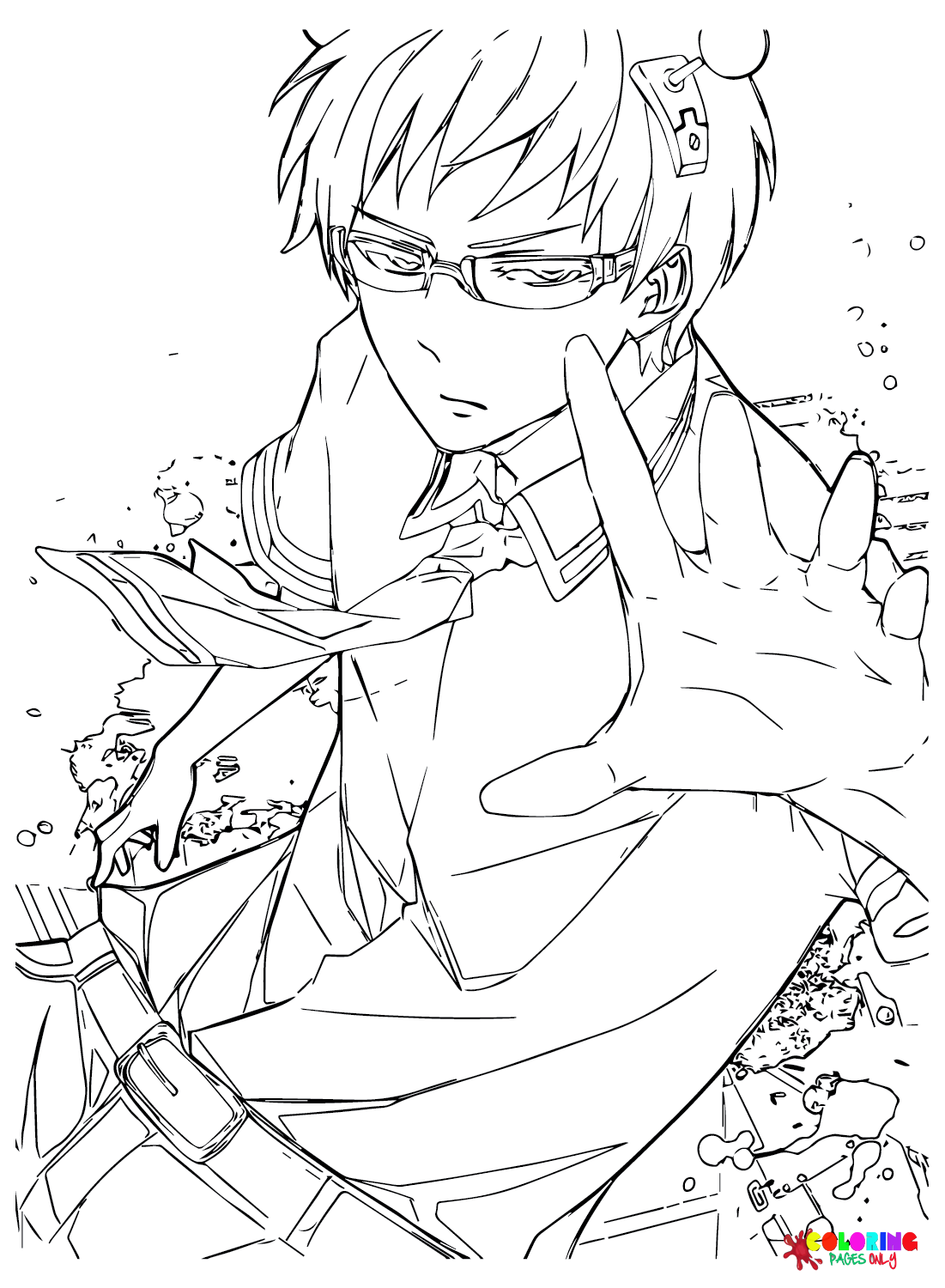
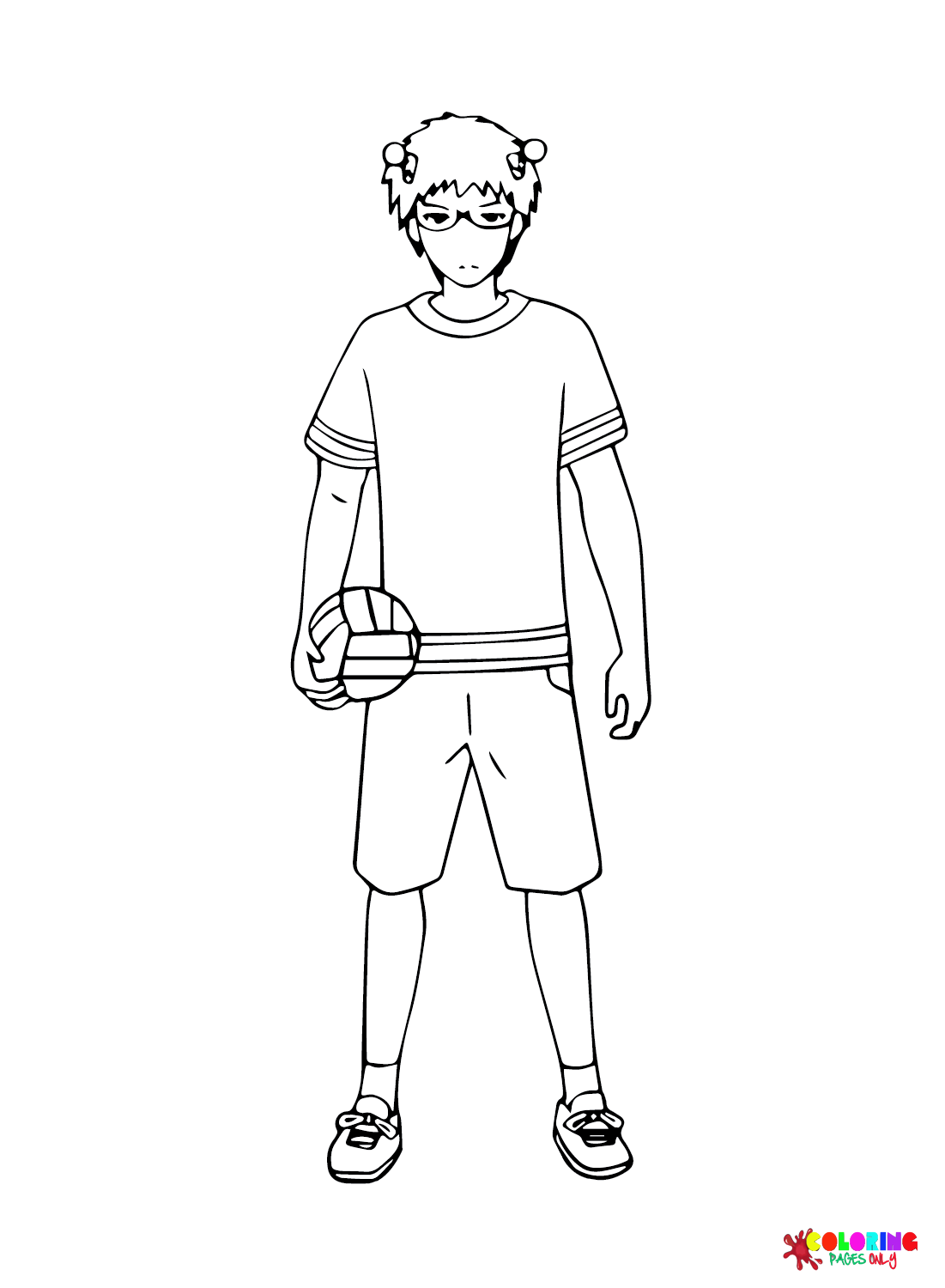
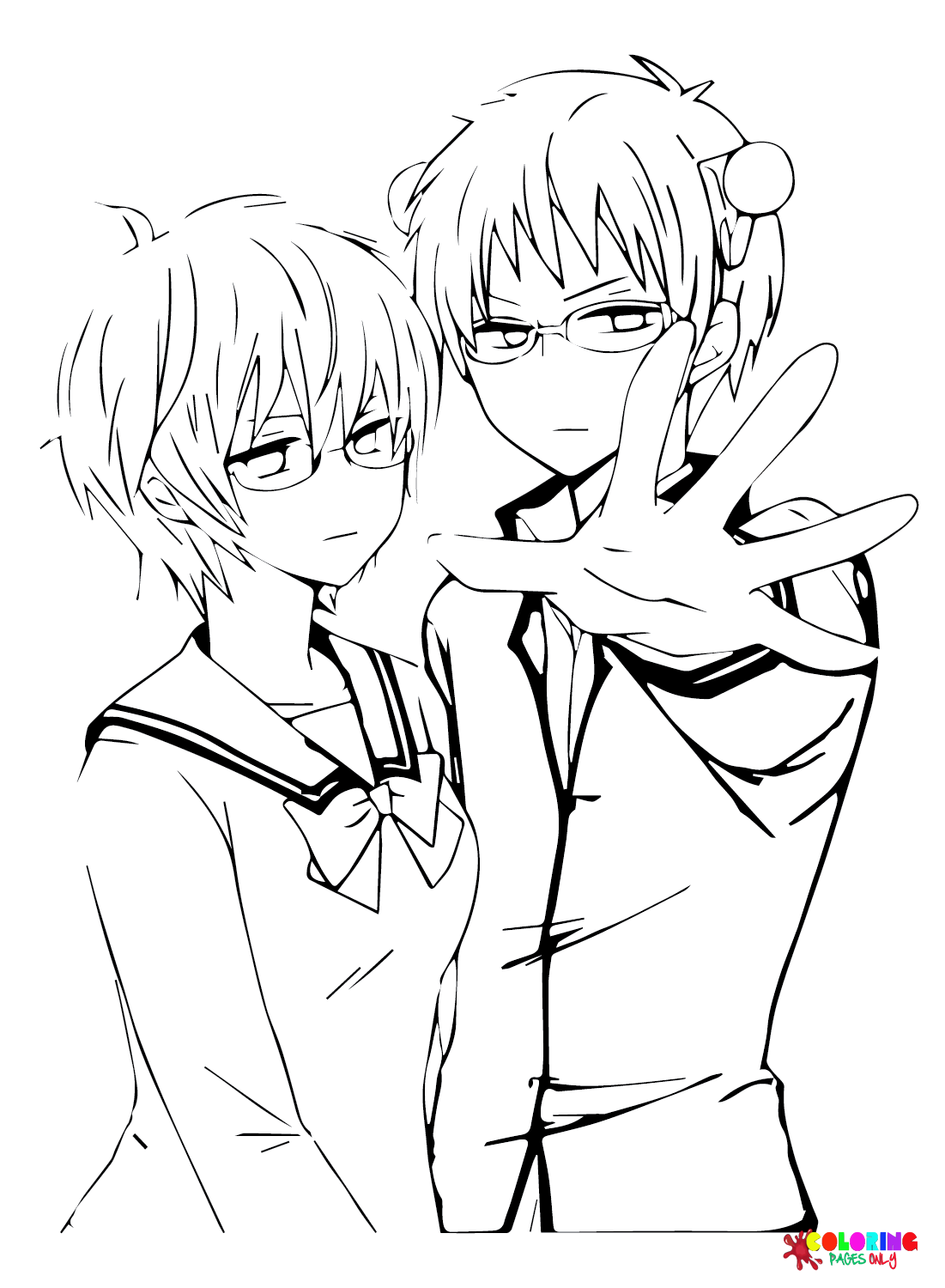
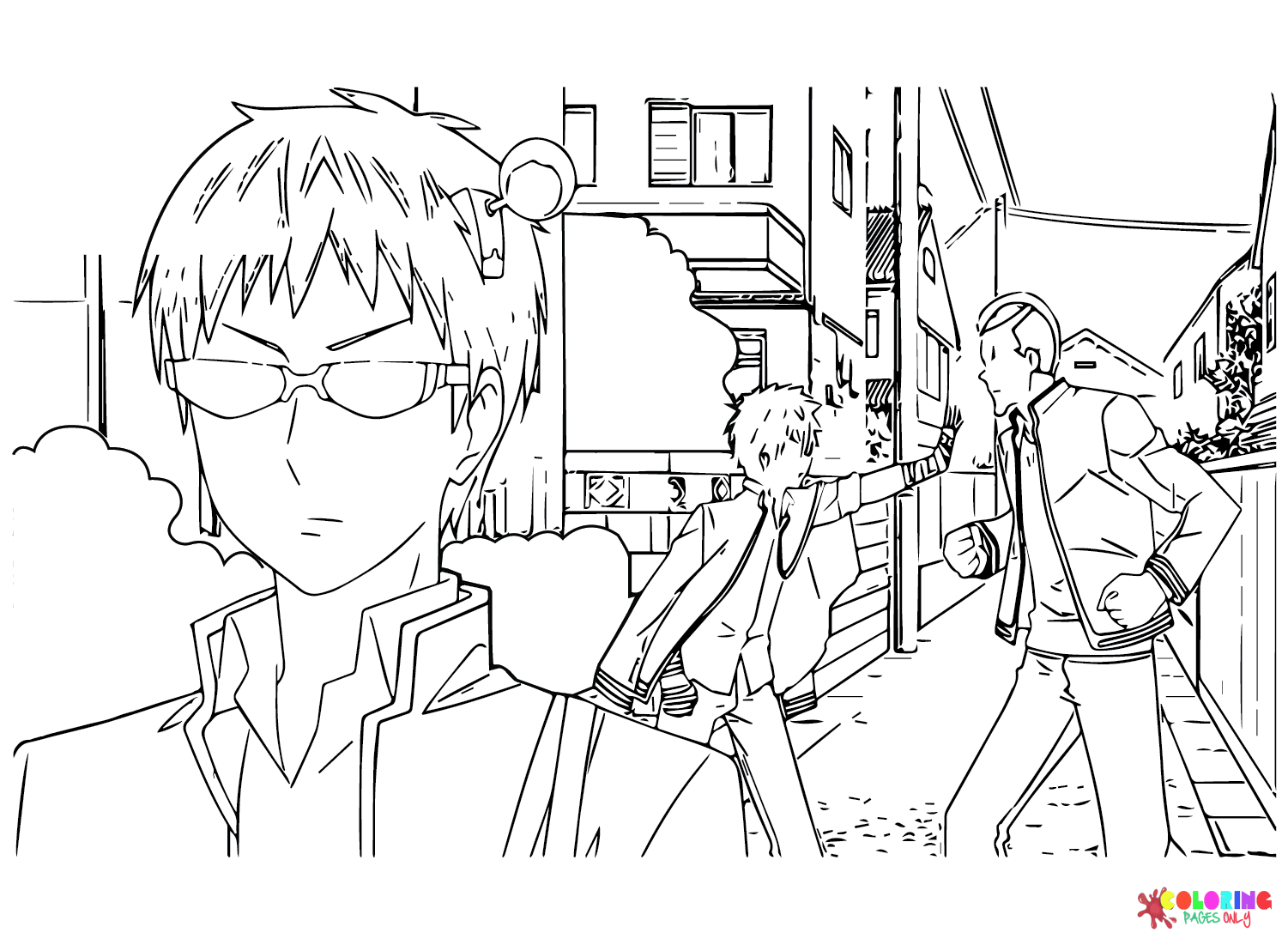
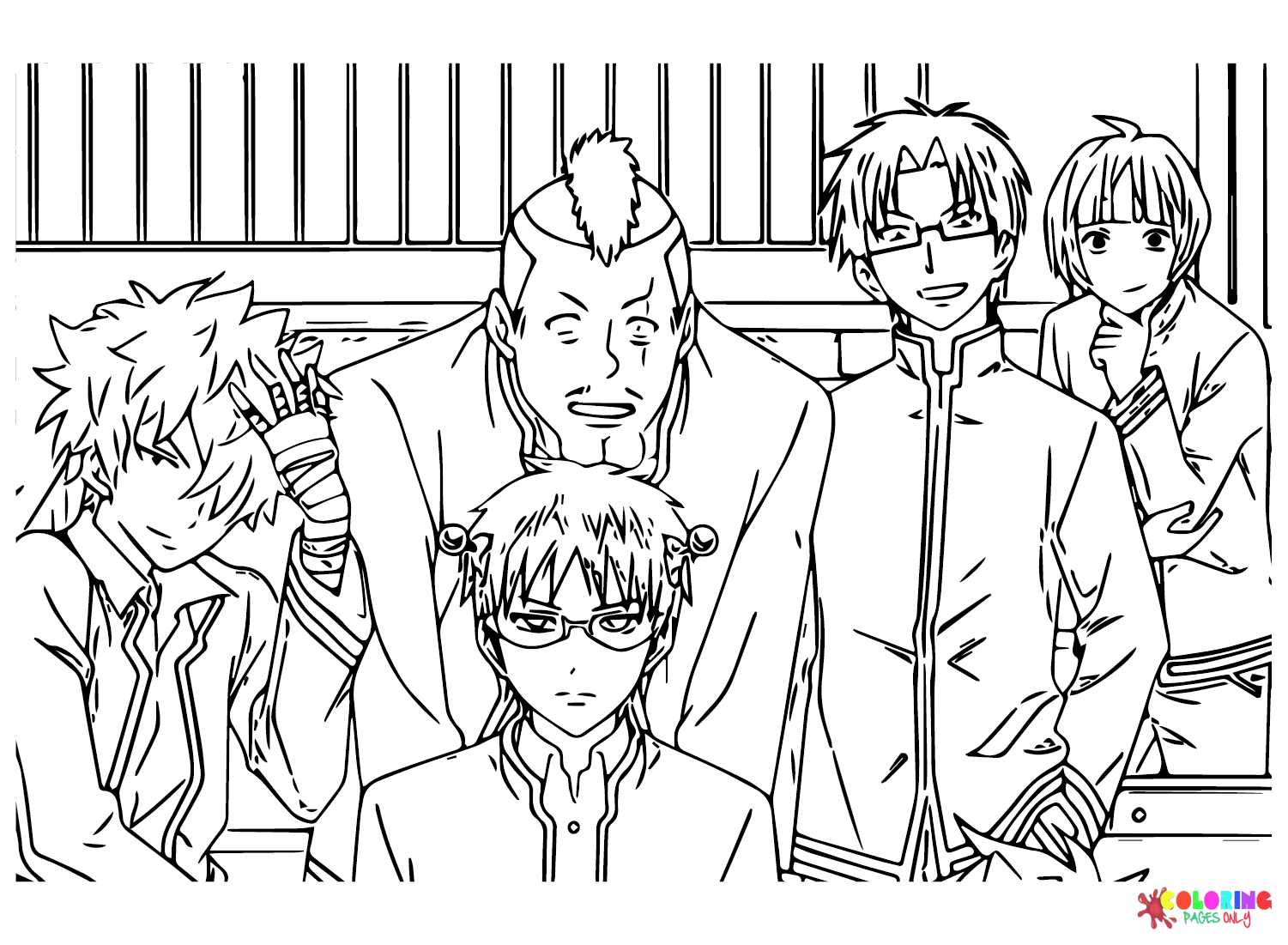
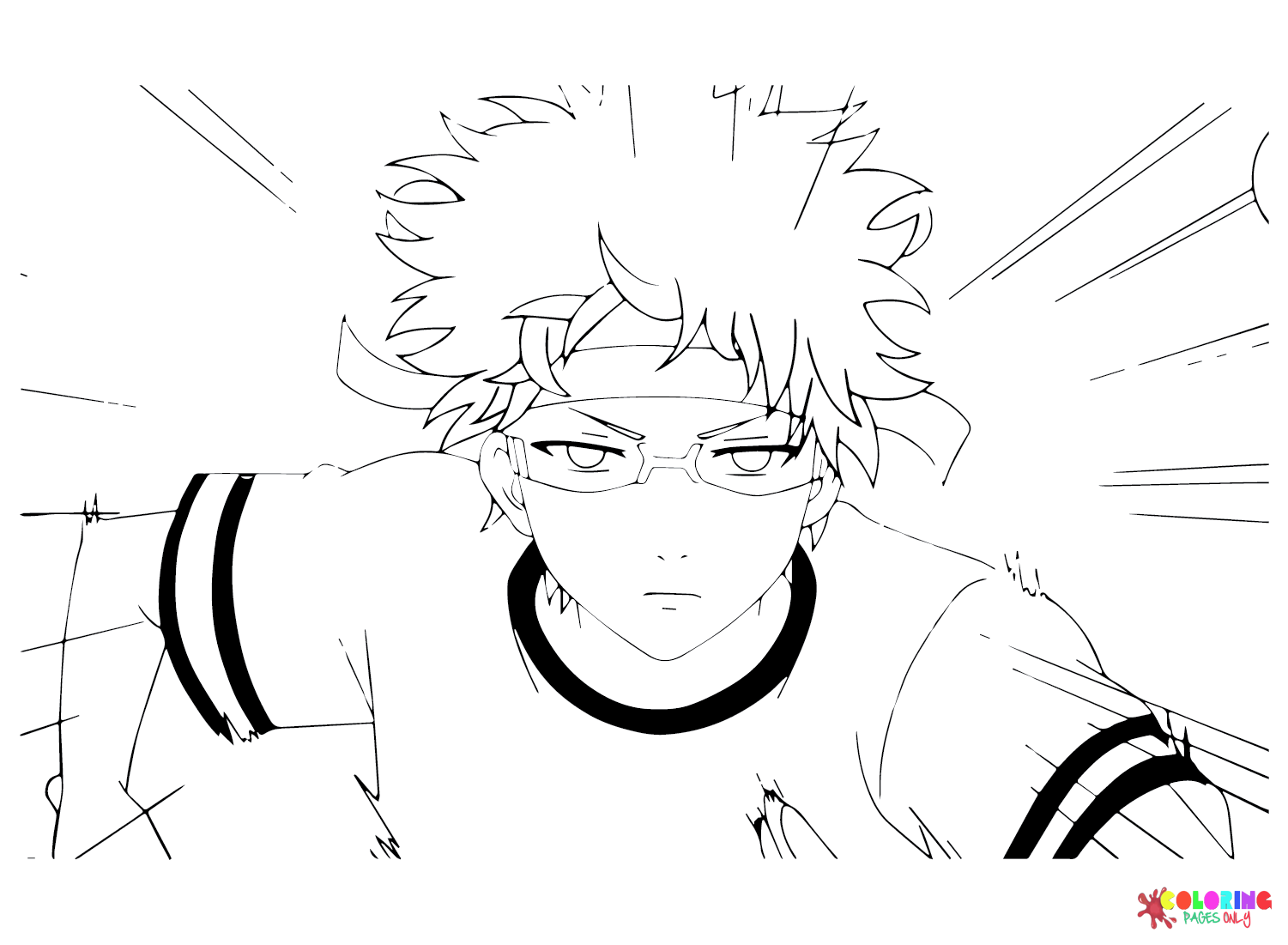
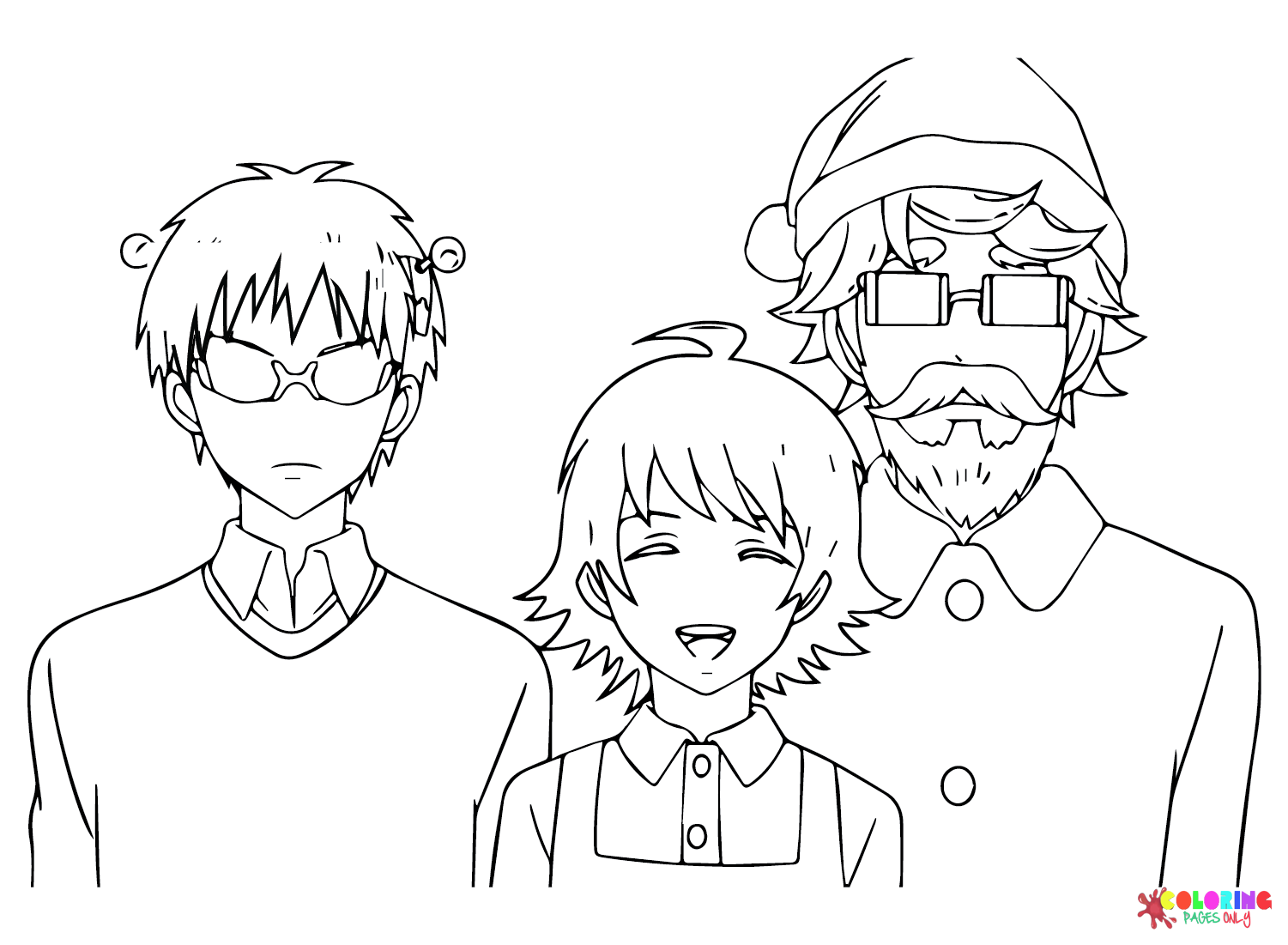
Free Saiki K coloring pages: 20+ pages featuring Kusuo Saiki in portrait and full-body poses with his instantly recognizable pink hair, green antenna limiters, and circular green glasses, deadpan expression studies showing the character’s famously flat emotional register, Riki Nendou in his rough-looking but good-natured default stance, Shun Kaidou in his chuunibyou dramatic poses, Kokomi Teruhashi in her perfect-beauty presentation, group cast compositions of the full PK Academy ensemble, Saiki with his beloved coffee jelly, psychic power effect scenes, school uniform detail pages, and the full visual vocabulary of one of anime’s most beloved absurdist comedies. All free, printable PDFs and online coloring for fans of the series.
The Disastrous Life of Saiki K. (斉木楠雄のΨ難, Saiki Kusuo no Psi-nan) is a manga series written and illustrated by Shuichi Aso, serialized in Shueisha’s Weekly Shōnen Jump from March 22, 2012, to February 26, 2018, producing 26 volumes. The title contains a deliberate pun: the Greek letter Ψ (Psi) represents psychic abilities, and “Psi-nan” (Ψ難) sounds identical to the Japanese word “sainan” (災難), meaning disaster or trouble. The title, therefore, simultaneously reads as “Saiki Kusuo’s Psychic Troubles” and “Saiki Kusuo’s Disasters,” with both meanings being equally accurate descriptions of the series’ premise.
The premise is the specific inversion of the shōnen manga power fantasy: Kusuo Saiki is a sixteen-year-old Japanese high school student who has possessed every conceivable psychic ability since birth (telepathy, telekinesis, teleportation, X-ray vision, time manipulation, memory erasure, and essentially every other psychic power in the genre vocabulary), and he uses this omnipotence in service of a single goal that has nothing to do with saving the world: he wants to live as a completely ordinary, completely unremarkable high school student and not attract any attention whatsoever.
The anime adaptation directed by Hiroaki Sakurai aired from July 4, 2016, through 2019, originally in short four-to-five-minute episode segments and later in compiled longer episodes. Netflix’s international release of the series significantly expanded its global audience.
These 20+ free pages at ColoringPagesOnly.com cover the full cast of Saiki K. All free, PDF or PNG, print or color online.
What’s Inside
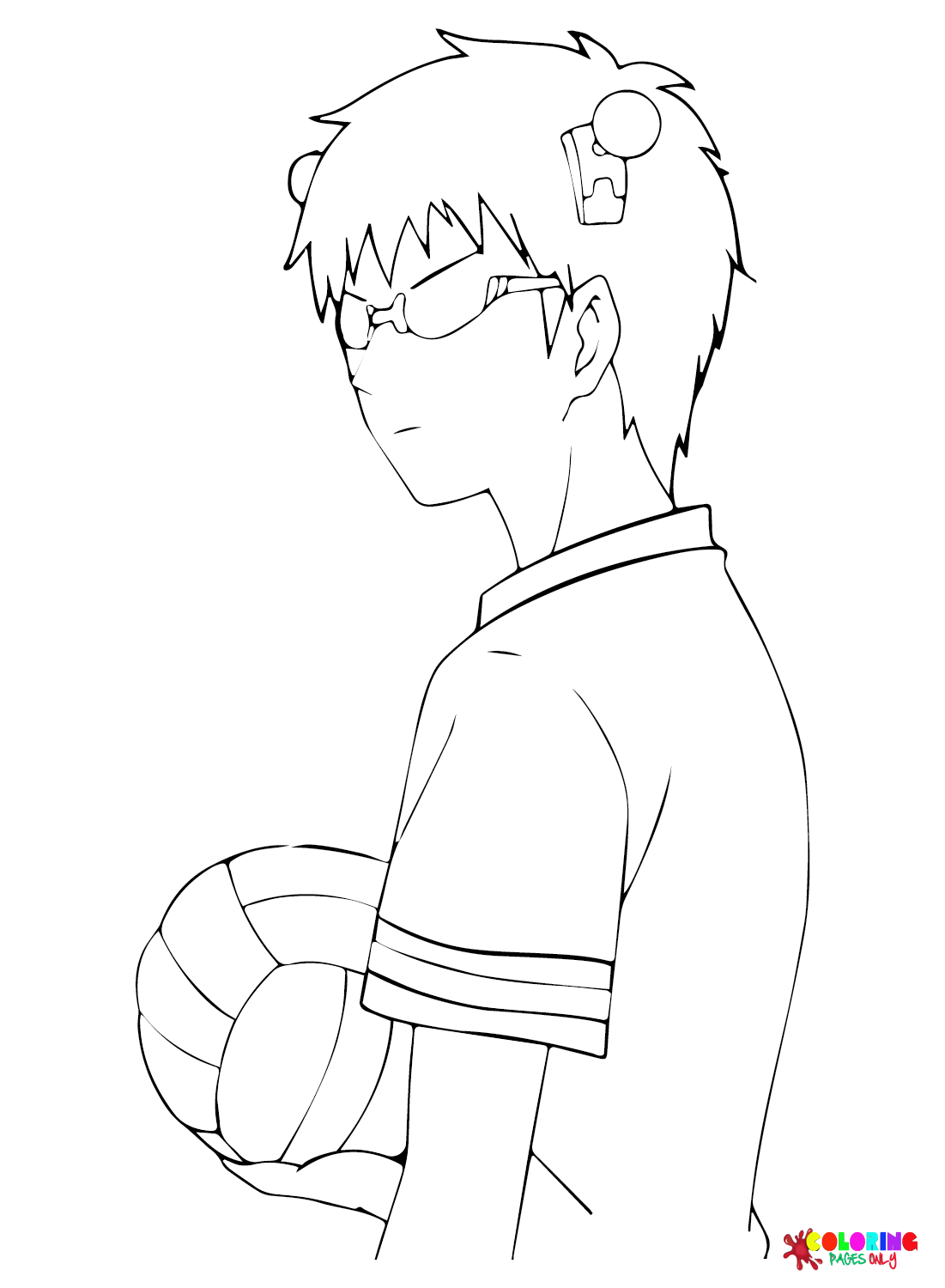
Saiki Kusuo: Portrait and Expression Pages
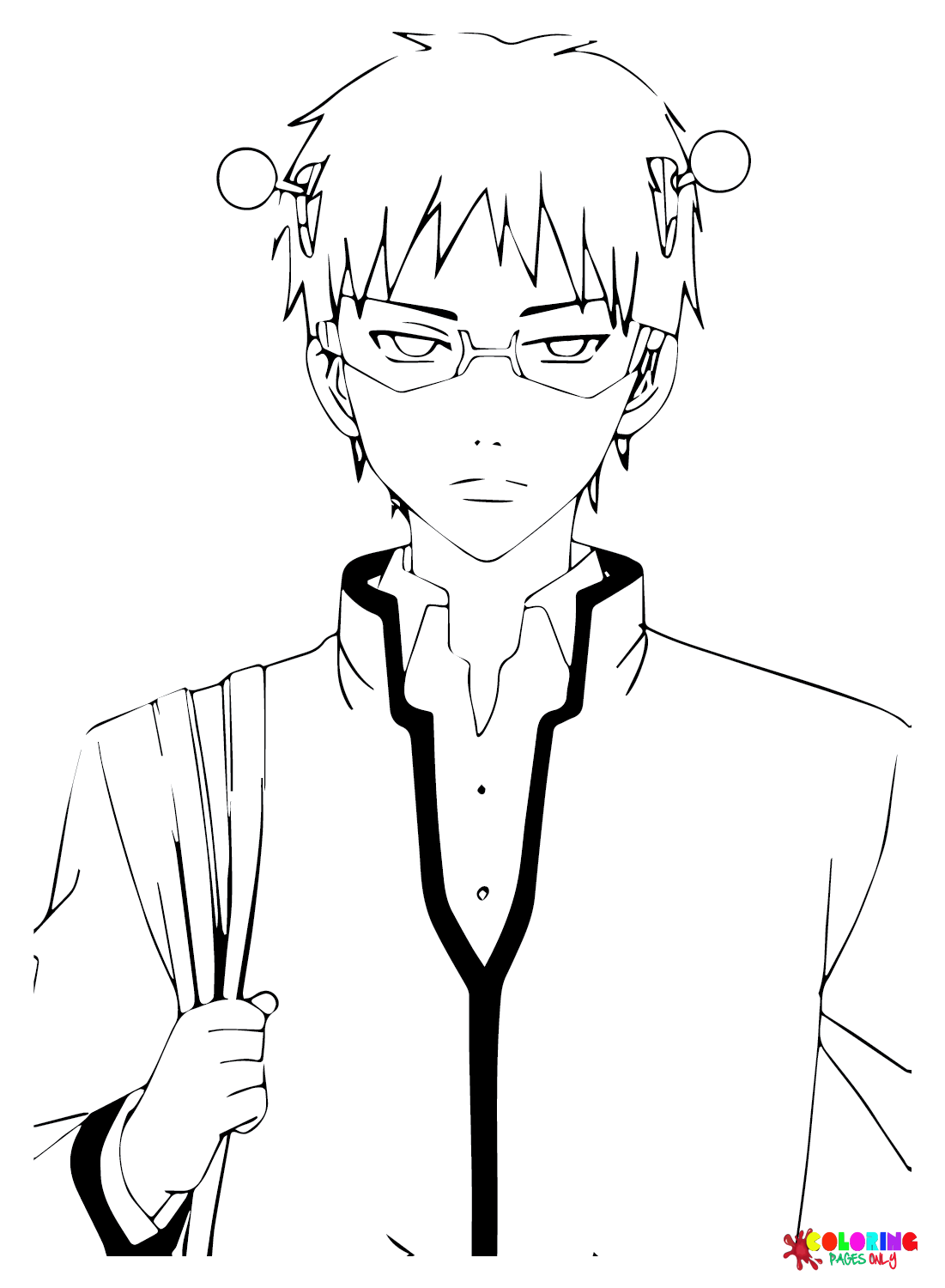
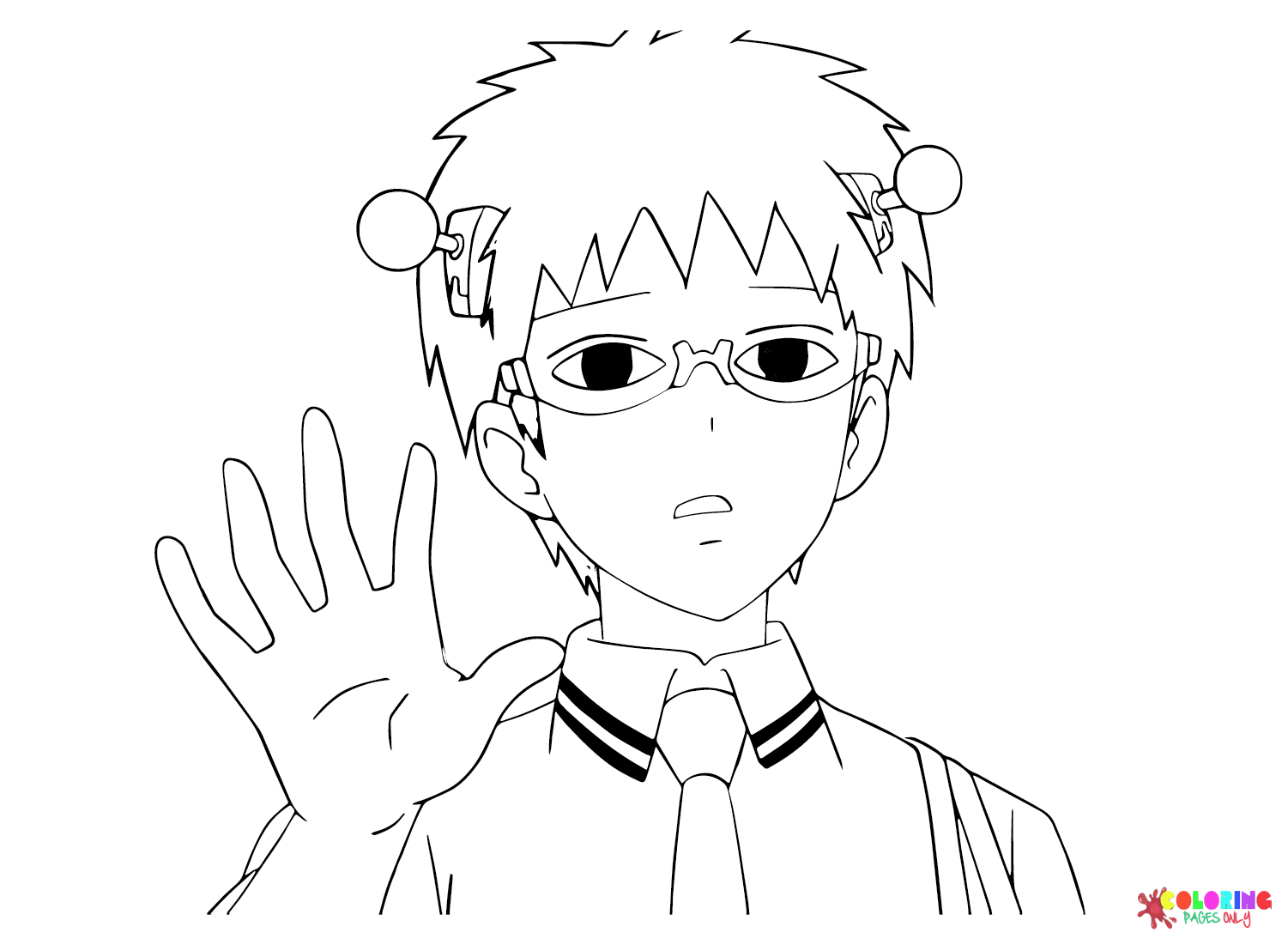
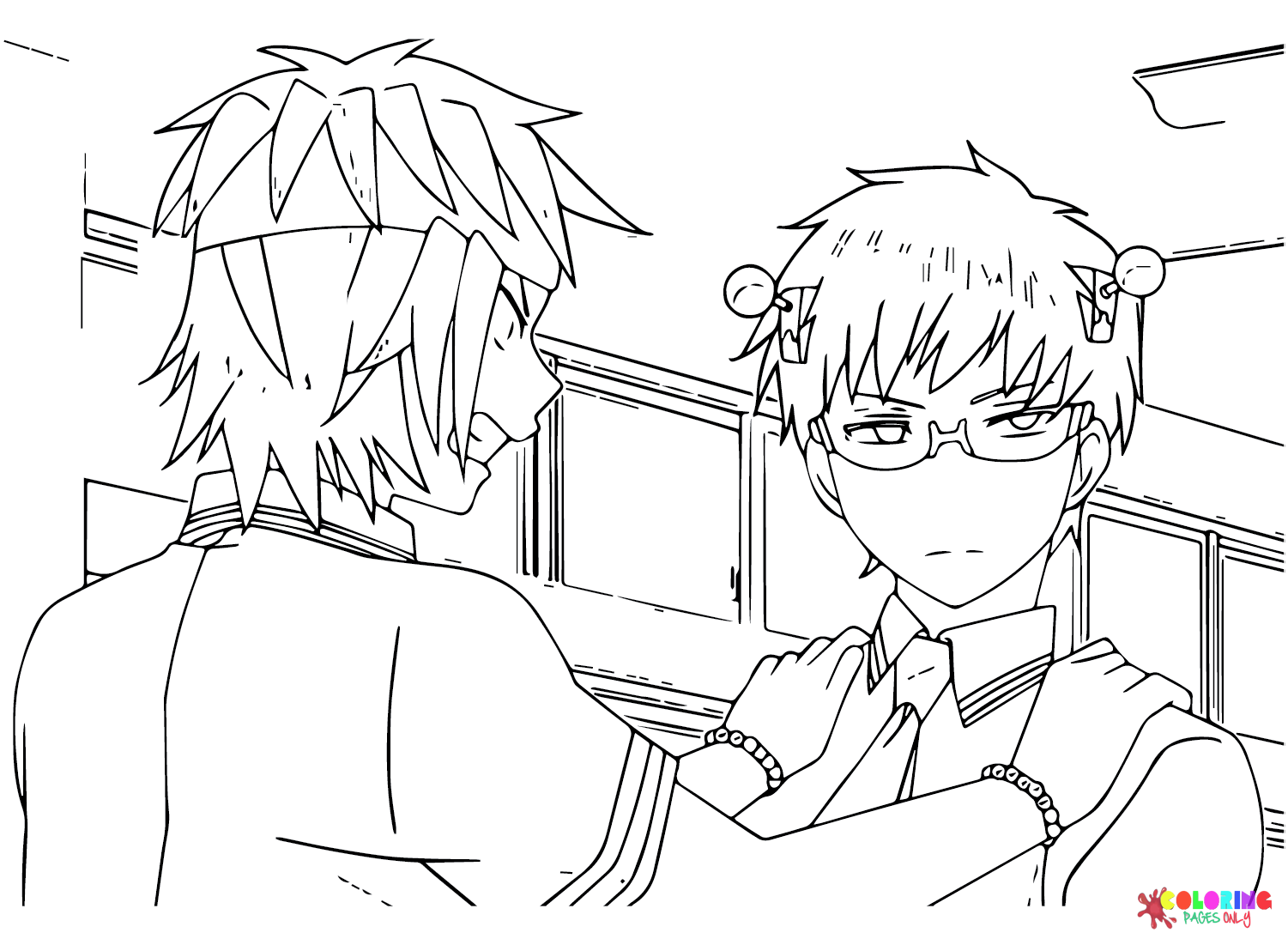
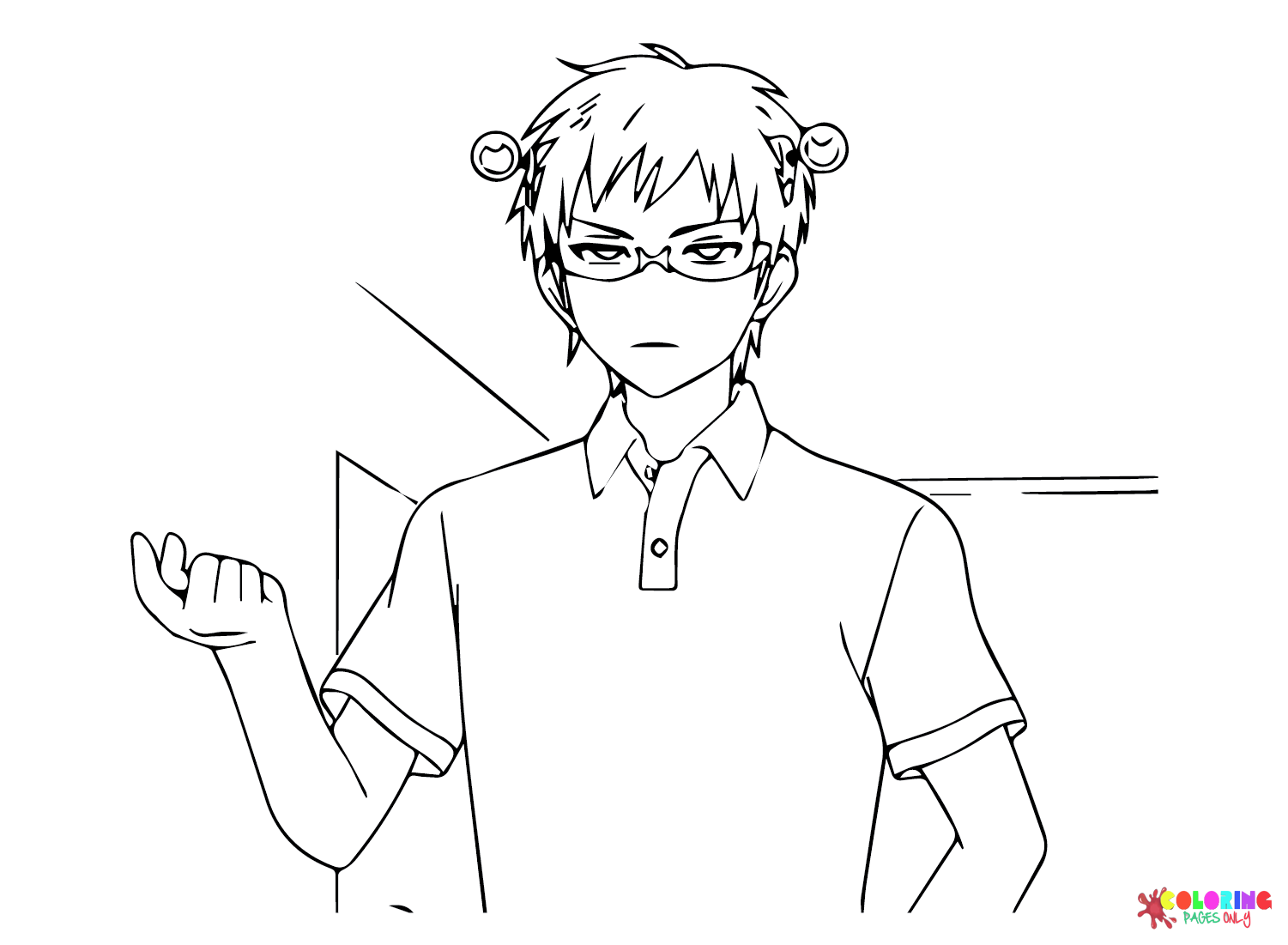
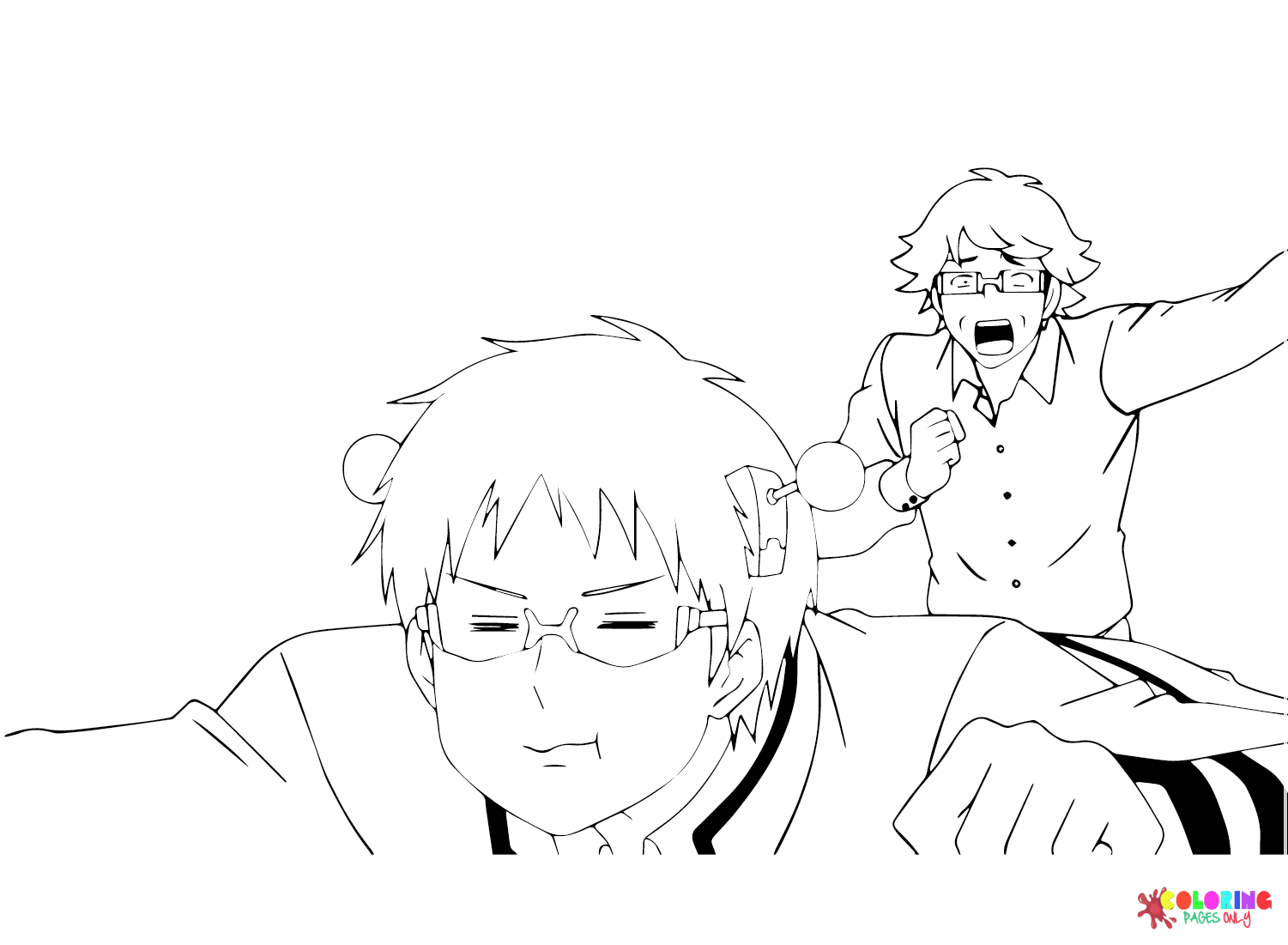
Saiki Kusuo’s design is the collection’s most immediately specific and most demanding coloring challenge: three distinct, unusual elements must all be correctly rendered for the character to read as himself rather than as a generic anime character.
The first element is his hair: pale pink, the color associated in the series’ internal logic with psychic ability. It is not vivid rose-pink or hot pink, but the specific soft, slightly warm pale pink of a character who was born with this hair color as a marker of his supernatural nature. His hair sits in a relatively natural, understated style, which contrasts with the accessories atop it.
The second element is the green antenna-like devices attached to his head by clips or hairpins. These are limiters: devices installed by his father (with engineering assistance from various parties) to prevent Saiki’s unconstrained psychic powers from destroying the surrounding world. They appear as two small antenna-like green protrusions rising from the top of his head and are among the most immediately recognizable character accessories in recent anime. Their function within the story is entirely serious (without them, Saiki’s passive aura would petrify everything around him), and their visual appearance is deliberately absurd (they look exactly like the kind of thing a child might draw on a cartoon psychic character).
The third element is his circular green glasses: another limiter device, specifically preventing his involuntary X-ray vision from stripping away all matter between him and everything he looks at. The glasses are a specific shade of green, circular rather than the more common rectangular or oval frames, and give Saiki a permanently studious-looking expression that contrasts with his completely flat emotional affect.
His expression is the fourth defining element, though it requires no special color: Saiki’s face in almost every panel and scene shows the same calm, slightly tired, slightly resigned deadpan. He is not unhappy, he is not bored, he is not angry. He simply appears to be existing in a state of perpetual patient endurance of everything the world puts in front of him.
Coloring Saiki portrait pages: The hair is soft, pale pink: warm-tinted, not cool or muted, but light enough to read as pale rather than vivid. Apply at medium pressure across the hair mass. The antenna devices are medium green or teal-green, vivid enough to be immediately visible against the pale hair. The glasses are the same green family as the antennas. The school uniform uses near-black or very dark navy for the gakuran jacket. His skin is warm, with a light, pale tone.
Riki Nendou: The Unpredictable Friend
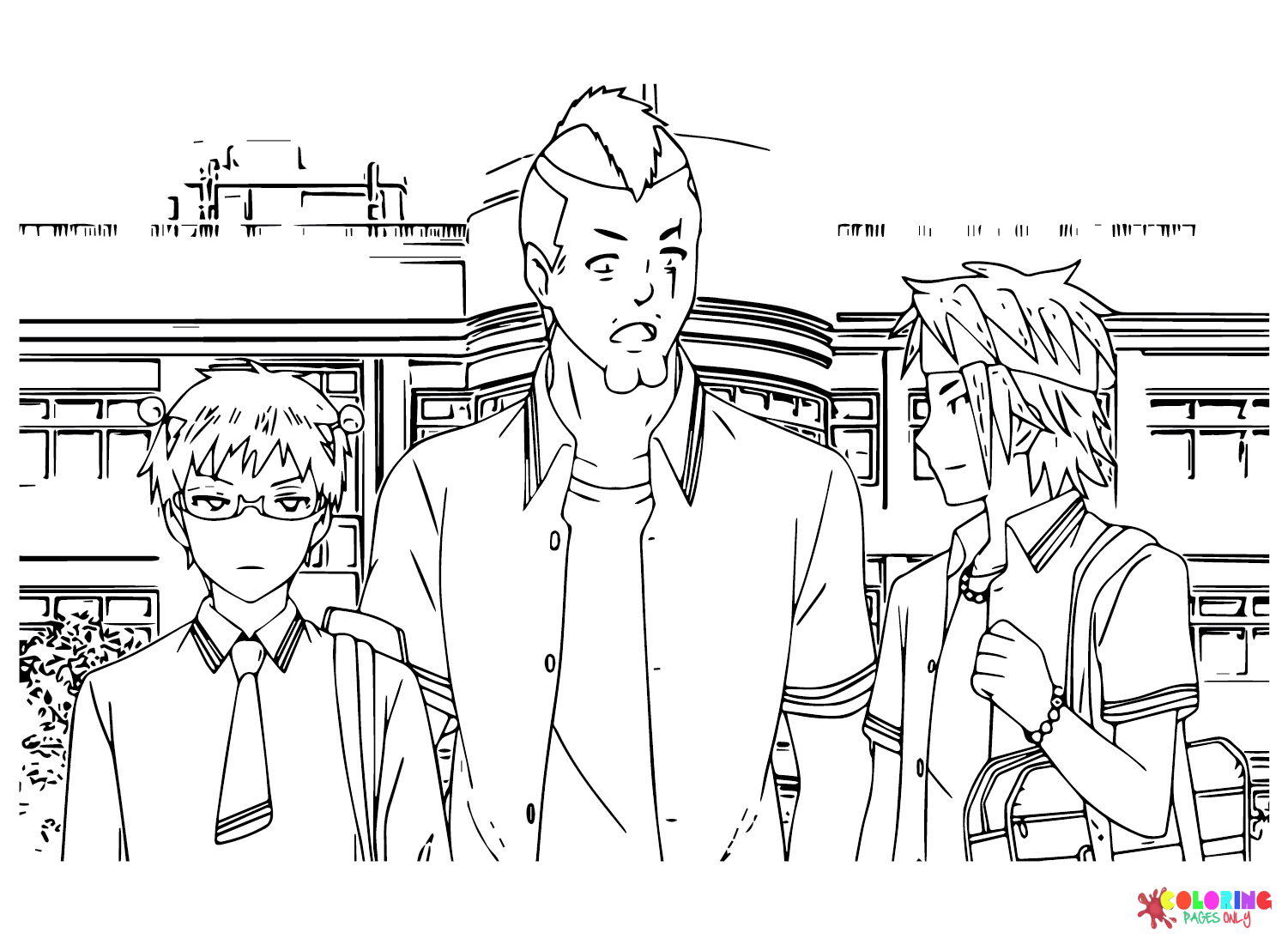
Nendou Riki is the series’s first and most persistently confounding source of comedy: a very large, rough-looking, apparently frightening student who by all visual indicators should be a dangerous delinquent and by every measure of actual behavior turns out to be straightforwardly kind, honest, and occasionally stupid to a degree that is genuinely unreadable as strategy.
His specific comedic function in the series is its most structurally interesting element: Nendou has no detectable thoughts. Saiki’s telepathy reads the constant internal monologue that everyone else around him broadcasts involuntarily, which gives him complete advance knowledge of everyone’s intentions, feelings, and plans at all times. Nendou produces no detectable telepathic signal. Not because he is blocking Saiki, but because there is simply nothing to read. He moves through the world entirely in the present, without rumination, second-guessing, or visible interior life, and as a result, he is the only character in the series who can genuinely surprise Saiki.
This makes Nendou simultaneously the character Saiki finds most tiresome (he cannot be managed through telepathic advanced intelligence) and arguably the one who most specifically represents the “ordinary human experience” that Saiki claims to want. His visual reflects the character’s apparent danger and actual harmlessness: large, scarred, physically imposing, and wearing an expression that consistently communicates openness and mild good cheer.
Coloring Nendou pages: His large frame and rougher features are the primary visual notes. His hair is dark, typically depicted in a darker brown or black. His most distinctive feature is the scar on his face, which should be rendered as a slightly darker or slightly reddened line. His school uniform is the standard dark navy or near-black gakuran. His expression in most pages is open, slightly vacant, and friendly.
Shun Kaidou: The Chuunibyou
Kaidou Shun is the series’ chuunibyou character: someone who acts as though they have supernatural powers, secret knowledge of a greater reality, and a dark heroic destiny, usually because they are deeply invested in the idea that they are special. Kaidou believes he possesses the “Jet Black Wings” power, that he is engaged in a secret struggle against an evil organization called “Dark Reunion,” and that his dramatic postures and proclamations are appropriate responses to a world of genuine hidden conflict.
The comedy of Kaidou’s scenes operates on two levels. On the surface, his chuunibyou behavior is the recognizable comedy of a teenager whose self-dramatization is entirely disconnected from reality. But Kaidou exists in a series where the protagonist is actually omnipotent and where supernatural phenomena regularly occur around him as casual facts: Kaidou’s imaginary dark destiny exists within a story where real supernatural events happen constantly, and his complete failure to notice or be affected by any of the actual supernatural events around him while dramatizing fictional ones is a specific comedic irony the series deploys deliberately.
His visual design emphasizes the chuunibyou aesthetic: a character who wants to look dangerous and special, whose actual appearance is that of a regular-sized teenage boy with a bandanna or headband and an expression of constant dramatic intensity.
Coloring Kaidou pages: His hair is brown, typically depicted in a lighter warm brown rather than dark. He often wears a dark colored headband or bandanna as part of his self-dramatizing aesthetic. His school uniform is the standard gakuran. His expression is the opposite of Saiki’s deadpan: whatever emotion he is performing, he is performing it at full intensity.
Kokomi Teruhashi: The Perfect Beauty
Teruhashi Kokomi is the series’ deconstruction of the “school idol” character: a female student who is conventionally, unambiguously, and apparently unquestionably beautiful, and who has organized her entire experience of the world around the expectation of that beauty’s effect on others.
In any other anime, Teruhashi would be a supporting romantic interest, her beauty mentioned and acknowledged as a fact of the world. In Saiki K., she is a comedy subject: her expectation that everyone will react to her with “Ohh!” (the specific exclamation she expects from all observers upon first seeing her) is a character beat repeated throughout the series, and Saiki’s complete indifference to her appearance (he can see the accurate measure of every person’s biological statistics through his various perceptions and finds conventional beauty metrics entirely uninteresting) is the specific thing that has made him, to her bewilderment, the only person who treats her as ordinary.
Her design is the most conventionally beautiful in the cast: long light-colored hair, large eyes in blue or purple, and the overall visual presentation of a character designed to look like what the series is describing.
Coloring Teruhashi pages: Her hair is typically depicted as a very light golden-blonde or pale warm blonde, long and carefully styled. Her eyes use vivid blue or purple, depending on the specific adaptation or illustration. Her overall color palette is the most conventionally pleasant in the ensemble: warm and soft rather than the unusual (Saiki’s pink) or the rough (Nendou’s scar).
Group Cast and Power Effect Pages
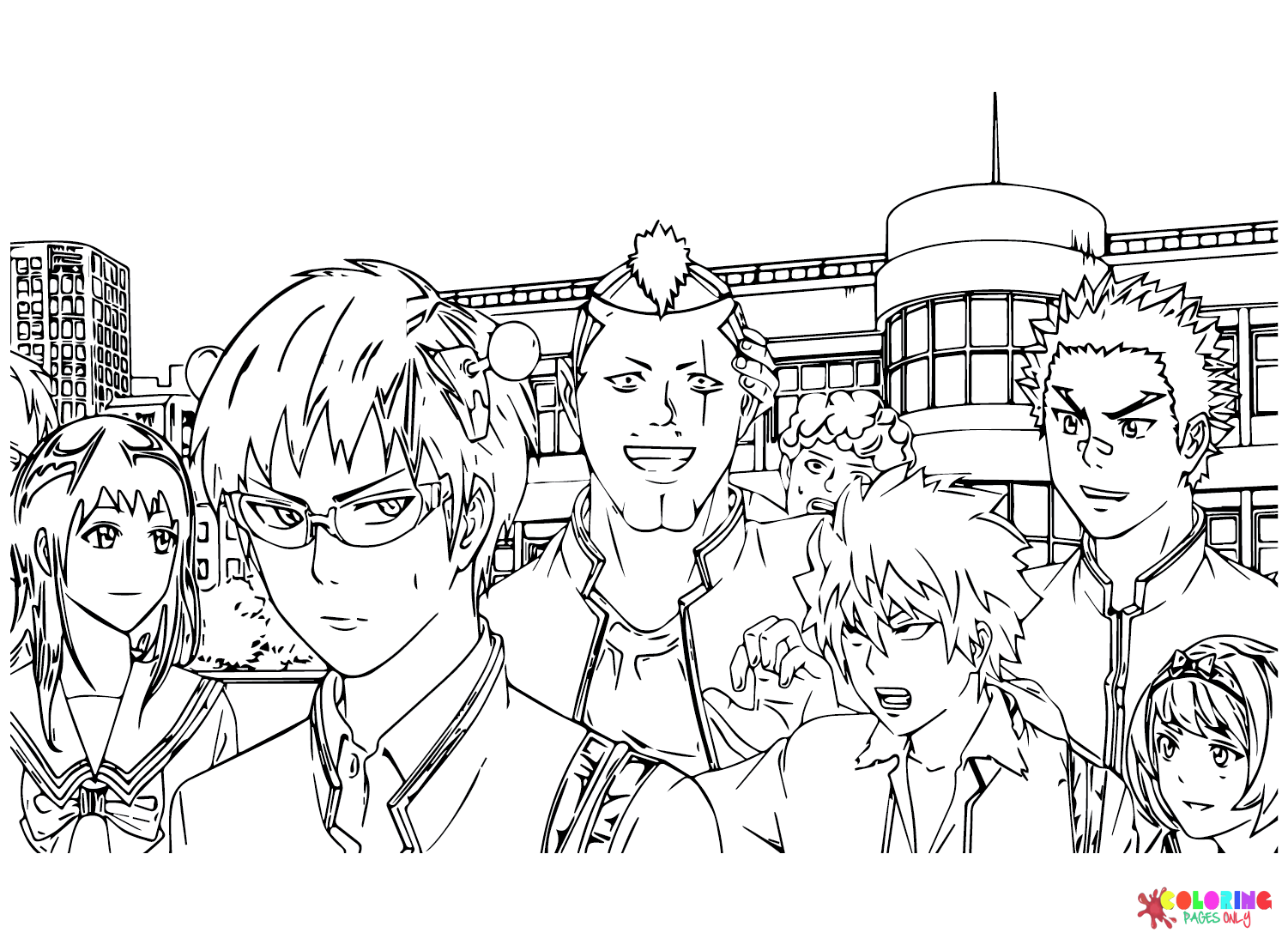
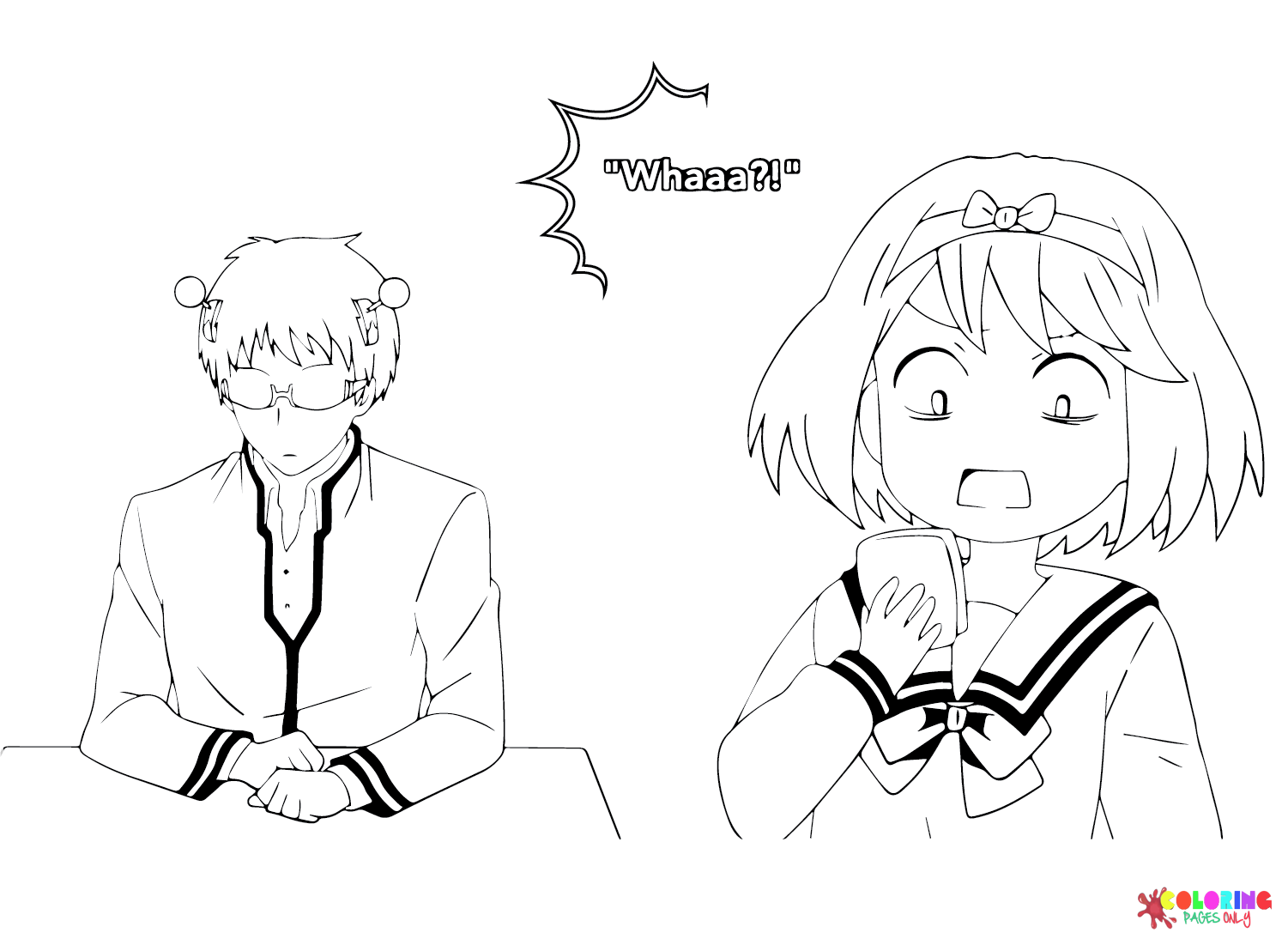
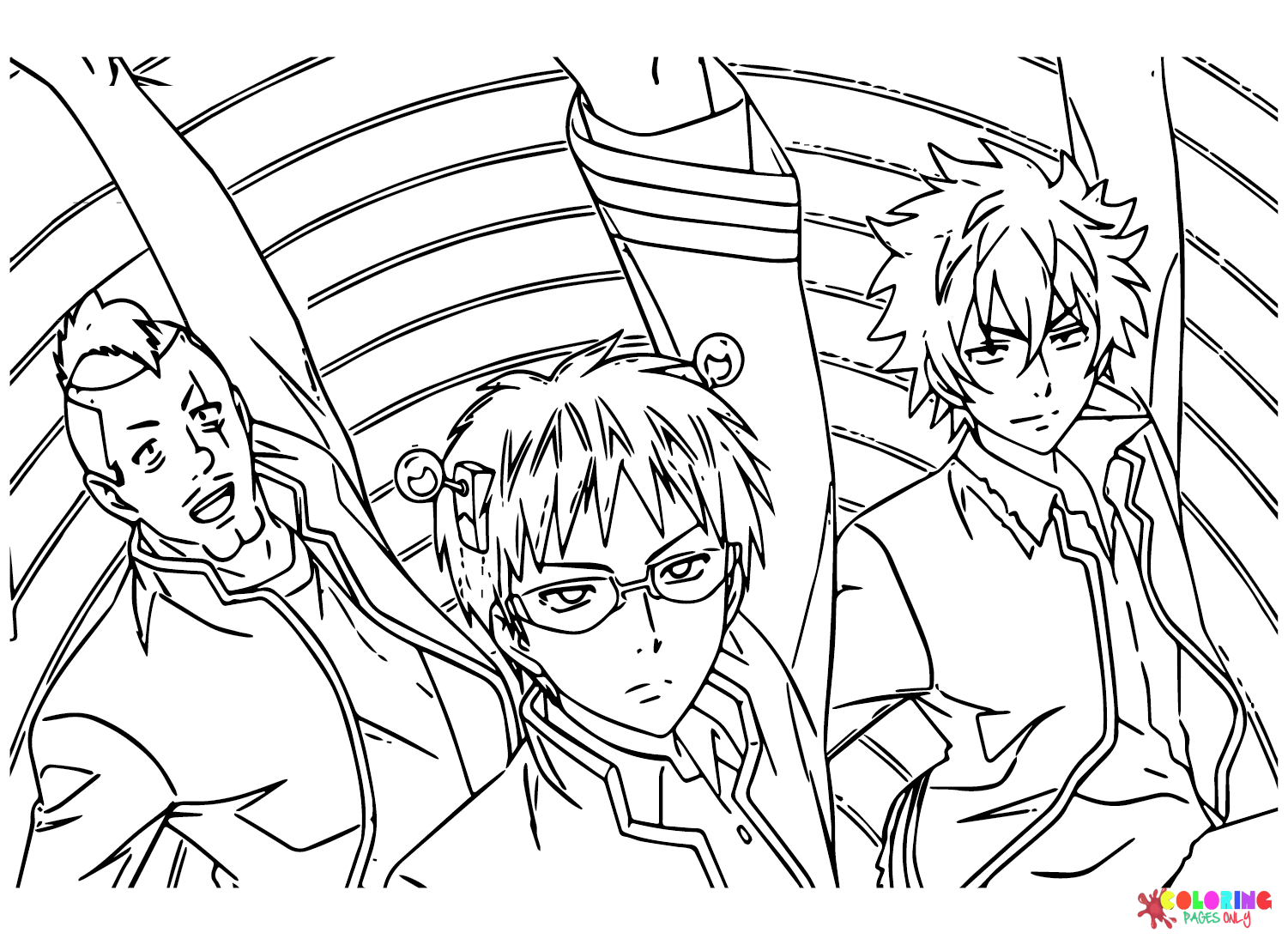
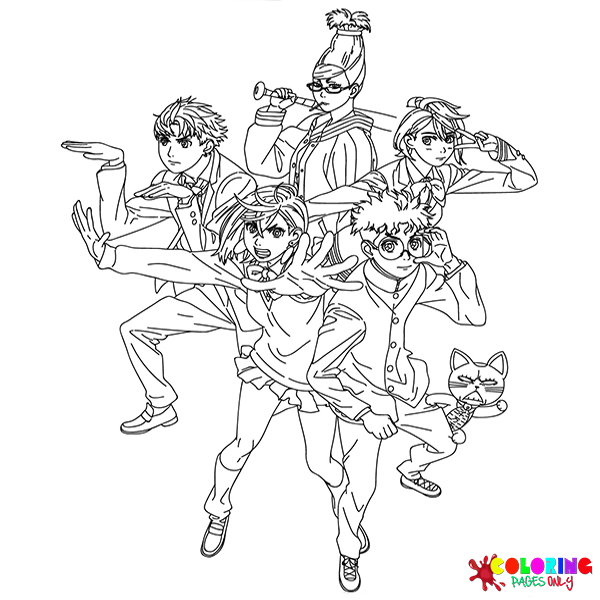
Group pages showing the full cast assembled together provide the collection’s most color-diverse compositions: Saiki’s pink hair and green accessories, Nendou’s dark, rough appearance, Kaidou’s brown-and-intense presentation, and Teruhashi’s soft blonde warmth create a deliberately contrasting ensemble that visually communicates the characters’ wildly different personalities before any expression or pose is considered.
Power effect pages show Saiki using his abilities: the visual language for psychic effects in the manga and anime uses aura effects, energy lines, and the specific distortion effects associated with telekinesis or teleportation. These are the collection’s most atmospherically dramatic pages, showing the contrast between Saiki’s deadpan expression and the significant visual energy of his active abilities.
The coffee jelly pages are the collection’s most specifically character-communicating: coffee jelly (コーヒーゼリー, a Japanese dessert made from coffee and gelatin that sets into a firm, dark jelly typically served with cream) is Saiki’s one genuine source of emotional expression in the series. He loves it with a straightforward sincerity that he applies to essentially nothing else.
Coloring power effect pages: Psychic energy effects typically use cool blue-purple or blue-white aura colors applied radiating from Saiki outward. The contrast between the cool psychic energy color and the warm pink of his hair gives these pages their most visually dynamic element. Coloring coffee jelly pages: The coffee jelly itself is dark warm brown (the color of strong black coffee in solid form), typically shown in a glass dish with a pour of white cream or white whipped cream on top.
What These Pages Do
The Disastrous Life of Saiki K. is a specific and extensively studied example of a comedy manga that uses the conventions of its genre (the shōnen power fantasy) as the material of its jokes rather than as the framework for sincere storytelling. Shōnen manga in the tradition of Dragon Ball, Naruto, and My Hero Academia typically presents a protagonist who discovers or develops extraordinary power and uses it in the service of increasingly significant goals, with the character’s growth in power tracking their growth in maturity and purpose. Saiki K. takes the “extraordinary power from birth” premise of this genre and asks what that experience would actually be like for the person who has it: the answer, in Aso Shuichi’s reading, is exhausted, patient, and primarily concerned with getting through the day without anything interesting happening.
The series’s specific contribution to anime comedy is its comedic register: Saiki’s deadpan first-person narration, which the audience hears as direct address while the other characters experience it as thought-projection, establishes a particular kind of intimacy between reader/viewer and protagonist that is unusual in shōnen manga. We know exactly what Saiki thinks of everything. He thinks most things are tiresome, most people are strange, and coffee jelly is very good. His investment in any situation is determined entirely by whether it interferes with his preferred state of ordinary invisibility.
The American Academy of Pediatrics identifies fine motor skill development as a key childhood milestone throughout early childhood. The specific multi-element detail of Saiki’s accessories (the antenna shapes, the circular glasses, the hair color precision), the expression contrast work between Saiki’s deadpan and Kaidou’s dramatic intensity, the aura effect gradient work in power pages, and the group composition color management across the cast’s diverse palettes all provide sustained fine motor challenge across the collection’s age range. The 2005 Art Therapy Journal study on structured coloring and anxiety reduction applies throughout.
How to Color These Pages Well
Saiki’s pale pink hair is the collection’s most precisely specified color and the most important to get right. The hair is not vivid pink (too intense), not baby pink (too cool and pastel), and not hot pink or magenta (too saturated and warm). It is a specific soft, slightly warm pale pink: the color of a pink flower in soft light, or of the inside of a pink quartz stone. Apply at light to medium pressure rather than maximum pressure, which would produce too vivid a result. If the result reads as too vivid, add a very light layer of white over the pink to soften it.
The green antenna and glasses must be the same green and must read as clearly green against the pale pink hair. The color contrast between the pale pink hair and the medium green accessories is the most important color relationship in Saiki’s design. The green should be medium, slightly teal-shifted (not vivid grass-green and not dark forest green), and at full saturation to read clearly against the pale pink. Apply both the antennas and the glasses in the same green to establish them as the same type of device.
Nendou’s roughness is communicated by expression and scar, not by color. The temptation on Nendou’s pages is to make his dark uniform and rough features appear threatening through dark, heavy coloring. His actual character is not threatening, and the coloring should not make him appear so. Apply his uniform colors evenly and his face colors warmly (a warm, open skin tone), letting his expression and scar communicate his roughness while the warm coloring communicates his approachability.
Kaidou’s dramatic poses require color to support the intensity of his expression. Kaidou’s expressions are at full dramatic intensity at all times. Support his face’s intensity by applying his accessories (headband, any dramatic effect elements in poses) at full vivid saturation. The contrast between his intense expression and the school uniform’s mundane dark navy creates the character’s specific comedy.
Power effect auras require the center-to-edge gradient applied in cool tones around a warm pink center. On pages showing Saiki using psychic abilities, the energy aura uses cool blue-purple or blue-white at full saturation. Apply the most intense, most vivid portion of the aura closest to Saiki’s body, graduating to lighter, more diffuse blue-purple at the aura’s outer edge. The contrast between Saiki’s warm pink hair at the center and the cool blue-purple aura surrounding it creates the specific visual tension of the omnipotent character in reluctant action.
5 Creative Craft Ideas
The Limiter Explanation Page
Saiki’s antennas and glasses are not fashion accessories: they are technology. Without the antennas (which limit the passive radius of his psychic power emission), his unconscious aura would affect everything around him. Without the glasses (which limit his involuntary X-ray vision), he would see through all matter at all times. He is required to wear both at all times while in proximity to other people.
Print a clear Saiki portrait page. Color the pink hair, green antennas, and green glasses with precision.
On the backing card: “Saiki Kusuo. Born with every psychic ability. The antenna limiters: prevent his passive psychic aura from affecting everything within range. Without them, objects in proximity move involuntarily, minds are read without consent, and matter is affected by his unconscious power. The green glasses: prevent his constant involuntary X-ray vision from seeing through all matter. Without them, he sees everything, including things he would prefer not to. He wears both at all times in public. He would prefer not to wear either. He would prefer not to be psychic. He would prefer to eat coffee jelly.”
The Telepathy Problem Study
Saiki’s telepathy gives him constant, involuntary access to the inner thoughts of every person within his range. This sounds like an advantage. In practice, within the comedy of the series, it means he knows every secret, every embarrassing thought, every petty resentment, and every piece of trivial internal monologue of every person within approximately 200 meters of him, at all times, without the ability to turn it off (except at extreme personal cost).
Print a group page showing Saiki surrounded by other characters. Color each character with their typical expression. Add thought bubbles around each character showing simple internal monologue content that Saiki would be involuntarily receiving.
On the backing card: “Kusuo Saiki. Telepathy range: approximately 200 meters (without limiting). Broadcast sources within a typical urban environment: hundreds. Content of those broadcasts: all of it, all the time, unfiltered. The experience described in the series’ narration is exhausting. The exception: Riki Nendou, who projects nothing detectable. Nendou’s reason for this: he does not think enough to produce a readable telepathic signal. The result: Nendou is the only person who consistently surprises Saiki. The most powerful psychic in the world is most vulnerable to the person who thinks the least.”
The Coffee Jelly Page
Coffee jelly (コーヒーゼリー) is a Japanese dessert consisting of strongly brewed coffee set into a firm gelatin, typically served cold in a glass with sugar syrup and cream or milk poured over. It is one of Japan’s most popular packaged desserts, available at convenience stores throughout the country. It is Kusuo Saiki’s only documented genuine source of happiness in the series.
Print a Saiki portrait page, preferably one showing him eating or holding coffee jelly or simply looking pleased (a rare expression for him). Color the hair pale pink, the accessories green.
Alongside the page, draw a simple coffee jelly diagram: a dark brown gelatin block in a glass dish with white cream poured over, labeled “コーヒーゼリー (Koohii Zerii) / Coffee Jelly.”
On the backing card: “Coffee jelly. Saiki Kusuo’s favorite food. His relationship with it is the only consistent source of visible positive emotional response in the series. When coffee jelly is threatened, removed, or denied, Saiki’s deadpan breaks. When coffee jelly is obtained, the character is closest to happiness. The series’s central joke: the most powerful being on Earth is most moved by a $1.50 gelatin dessert. Available at Japanese convenience stores. Saiki would find this less funny.”
The Shōnen Inversion Study
The Disastrous Life of Saiki K. is a sustained parody of shōnen manga conventions. The protagonist is the most powerful character from the beginning (rather than growing in power). The story’s central goal is deliberate obscurity (rather than heroic achievement). The friends who attach themselves to the protagonist are valuable precisely because they cannot be managed through the protagonist’s powers (rather than being allies who help the protagonist grow stronger). Every conventional shōnen element appears in the series in its inverted form.
Print a Saiki action or power effect page. Color with full attention to the visual language of power (aura effects, psychic energy) while ensuring Saiki’s expression remains deadpan.
On the backing card: “Shōnen manga conventions and their inversions in Saiki K. Conventional: protagonist starts with no power, gains power through training. Inverted: protagonist starts with all power, has always had all power, finds power tiresome. Conventional: protagonist desires to become stronger. Inverted: protagonist desires to become invisible. Conventional: protagonist’s friends help him access new strength. Inverted: the protagonist’s friends are sources of problems he cannot solve with strength. The inversion is complete. The comedy is in the completeness.”
The Deadpan Study
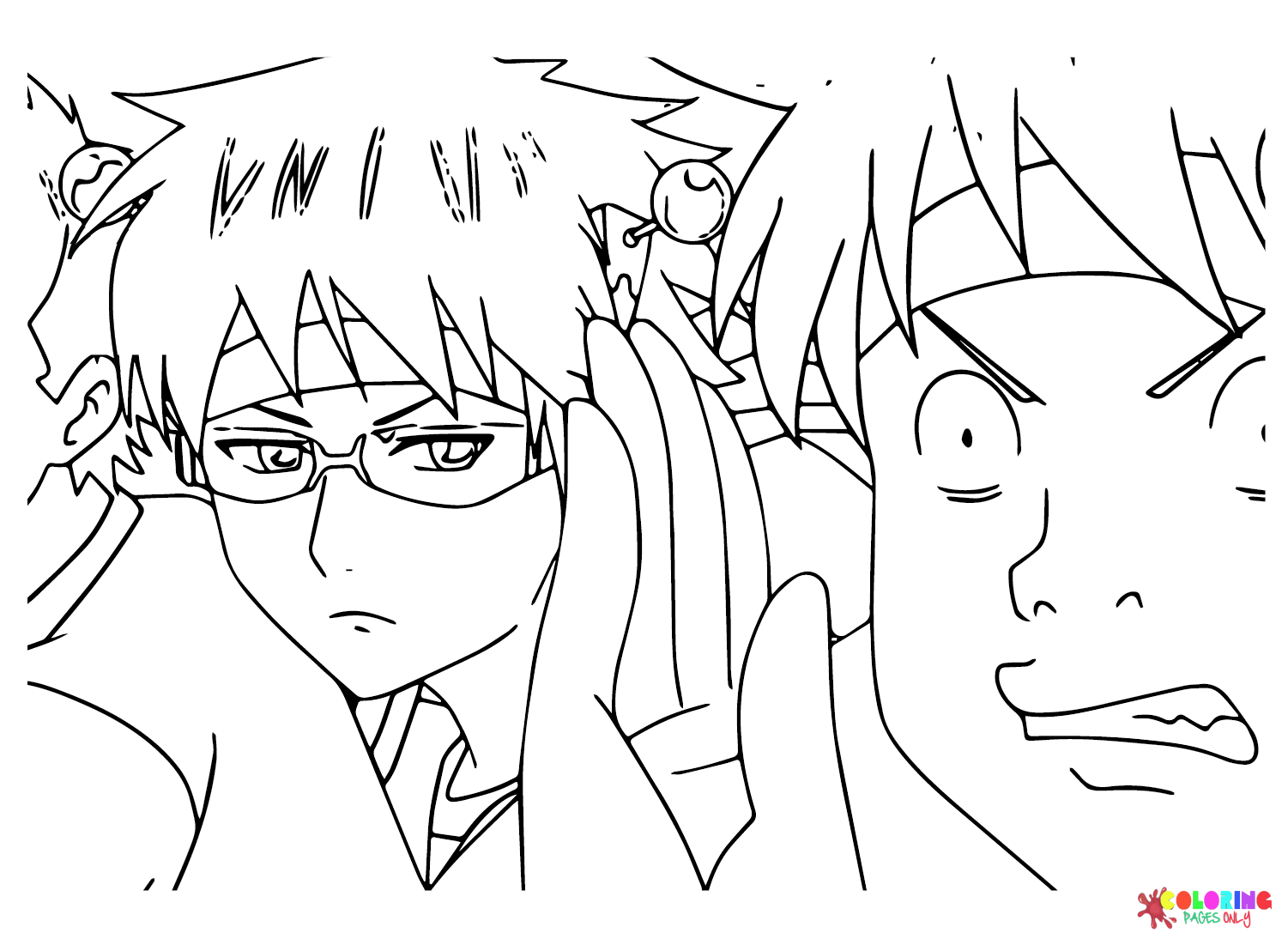
Saiki Kusuo’s expression in the vast majority of panels is the same: calm, slightly tired, patient. The series uses this against the expressiveness of the characters around him for comedy. When Nendou says something genuinely baffling, Saiki’s expression does not change. When Kaidou performs a dramatic monologue, Saiki’s expression does not change. When Teruhashi does something she considers impressive, Saiki’s expression does not change.
Print four Saiki pages showing different scenarios, or four copies of the same Saiki portrait page. Color all four identically.
Mount all four in a row with caption cards below each: “Saiki encountering Nendou.” / “Saiki realizes someone needs to be stopped from causing a disaster.” / “Saiki eating coffee jelly.” / “Saiki learning that everything he did today has failed and tomorrow will be worse.” The four captions describe different emotional states. The four colored pages are identical.
Frequently Asked Questions
What is The Disastrous Life of Saiki K., and what is the title’s meaning? The Disastrous Life of Saiki K. (斉木楠雄のΨ難, Saiki Kusuo no Psi-nan) is a manga series written and illustrated by Shuichi Aso, serialized in Shueisha’s Weekly Shōnen Jump from March 22, 2012, to February 26, 2018, producing 26 volumes. The title contains a deliberate pun: the Greek letter Ψ (Psi) represents psychic abilities in the series’ context, and “Ψ難” (Psi-nan) sounds identical to “災難” (sainan), the Japanese word meaning disaster or trouble. The title, therefore, simultaneously reads as “Saiki Kusuo’s Psychic Troubles” and “Saiki Kusuo’s Disasters.” The premise is the specific inversion of the shōnen power fantasy: Kusuo Saiki possesses every conceivable psychic ability but uses this omnipotence in service of a single goal that has nothing to do with heroism: he wants to live as a completely ordinary, completely unremarkable high school student.
Who is Kusuo Saiki, and what are his powers? Kusuo Saiki is the sixteen-year-old protagonist of the series, born with every psychic ability imaginable: telepathy (involuntary access to the thoughts of everyone within range), telekinesis (moving objects with thought), teleportation, X-ray vision (constant and involuntary unless limited by his glasses), clairvoyance, time manipulation, memory erasure, transformation, hypnosis, and essentially any other psychic power in the genre vocabulary. His powers have been present since before birth. He wears green antenna-like limiter devices on his head to prevent his passive psychic aura from affecting everything around him, and circular green glasses to prevent his involuntary X-ray vision from penetrating all matter. His hair is naturally pale pink, a marker of his psychic nature. His goal is to be left alone, to attract no attention, and to eat coffee jelly.
What are the green antenna devices on Saiki’s head? The green antenna-like protrusions on Saiki’s head are limiter devices installed to prevent his unconstrained psychic powers from affecting everything around him. Without them, Saiki’s passive psychic aura would involuntarily move objects, read minds without any effort or control, and generally affect the surrounding environment in ways that would make normal life impossible. The devices limit the radius and intensity of his involuntary power emissions, allowing him to function in a school environment without immediately revealing his abilities to everyone around him. His circular green glasses serve a similar function, specifically for his X-ray vision, which is involuntary and constant without the glasses. Both devices are described within the series as necessary technology, and Saiki’s father was involved in their development with assistance from various parties.
Who are the main characters in Saiki K.? The main cast includes Kusuo Saiki (the protagonist, omnipotent psychic seeking ordinary life), Riki Nendou (a large, rough-looking, kindhearted student whose lack of detectable thoughts makes him the one person who can surprise Saiki), Shun Kaidou (a chuunibyou student who believes he has secret psychic powers and a dark heroic destiny), Kokomi Teruhashi (a conventionally beautiful student who expects everyone to be captivated by her and finds Saiki’s indifference inexplicable and increasingly obsessive), Reita Toritsuka (who can see ghosts), Chiyo Yumehara (who falls in love frequently and with great enthusiasm), and various other students at PK Academy whose specific qualities contribute to the comedy in different ways.
What makes the humor of Saiki K. distinctive? The humor of Saiki K. comes from several specific sources. First, Saiki’s first-person deadpan narration, delivered to the reader as direct thought-projection while other characters experience it as an internal voice, creates an unusually intimate and consistently funny narrative perspective. Second, the series inverts every conventional shōnen manga expectation: the most powerful character wants no power, his goal is obscurity rather than achievement, and his “allies” are sources of problems rather than sources of strength. Third, the comedy operates through the specific irony of Saiki’s omniscience failing him: he can read everyone’s thoughts but cannot prevent them from doing things, giving him perfect knowledge and no useful control. Fourth, the genuineness of his one real preference (coffee jelly) against the exhaustion of everything else creates a character whose comedy and relatability come from the same source.
What is the anime adaptation of Saiki K., and where can it be watched? The anime adaptation was directed by Hiroaki Sakurai and produced by J.C. Staff and EGG FIRM, airing from July 4, 2016, through 2019 in two seasons plus a Netflix special. The original broadcast format used short episodes of approximately four to five minutes that were later compiled into standard-length episodes for home video and streaming release. A Netflix special titled The Disastrous Life of Saiki K.: Reawakening was released on January 11, 2019, continuing the story. Netflix’s international release of the series significantly expanded its global audience beyond Japan, making it one of the anime series through which many international viewers first encountered the character. A live-action Japanese drama adaptation also aired in 2017.
What age group are these pages best suited for? Saiki K. coloring pages are most appropriate for fans of the series, who skew toward teenagers and young adults. The manga is serialized in Weekly Shōnen Jump (nominally aimed at young males but read across ages and genders), and the series’ specific comedy, which relies on familiarity with shōnen manga conventions and Japanese school setting tropes, is most fully appreciated by viewers who have enough anime literacy to understand what is being inverted. The simpler portrait pages with Saiki’s distinctive accessories are accessible to younger fans who enjoy the character’s visual from ages eight and up. The expression comparison pages, the group composition pages, and the thematic craft projects are most engaging for the series’ primary audience of teenagers and adults who have watched the anime or read the manga and understand the comedy.
Browse the full collection at ColoringPagesOnly.com. All 20+ pages free, no sign-up, PDF or PNG, print or color online.
Shuichi Aso began serializing a manga in Weekly Shōnen Jump in March 2012 about a boy who has every psychic power and wants none of them. He serialized it for six years and 26 volumes. The boy’s goal throughout was to eat coffee jelly without anything interesting happening.
The anime adapts this. Saiki’s deadpan narration delivers the comedy directly to the viewer while the other characters experience it as something they cannot quite hear. He knows what everyone thinks. He cannot prevent anyone from doing anything. His omniscience is useless against the specific chaos of other people.
Nendou does not think enough to produce readable thoughts. He is therefore the only person who can surprise Saiki. The most powerful psychic in the series is most vulnerable to the person who thinks the least. Aso Shuichi understood the irony and sustained it for six years.
Pick up your soft, pale pink for the hair. Apply at medium pressure, not maximum. Pick up your medium teal-green for the antennas and the circular glasses. Apply the green at full saturation so it reads clearly against the pale pink. The deadpan expression goes last. It never changes. That is the point.
Share your work on Facebook and Pinterest and tag #Coloringpagesonly. The coffee jelly page and the deadpan study displays are particularly worth sharing.
Color the hair pale pink. Apply the green antennas precisely. The expression does not change regardless of circumstances. This is also the point.