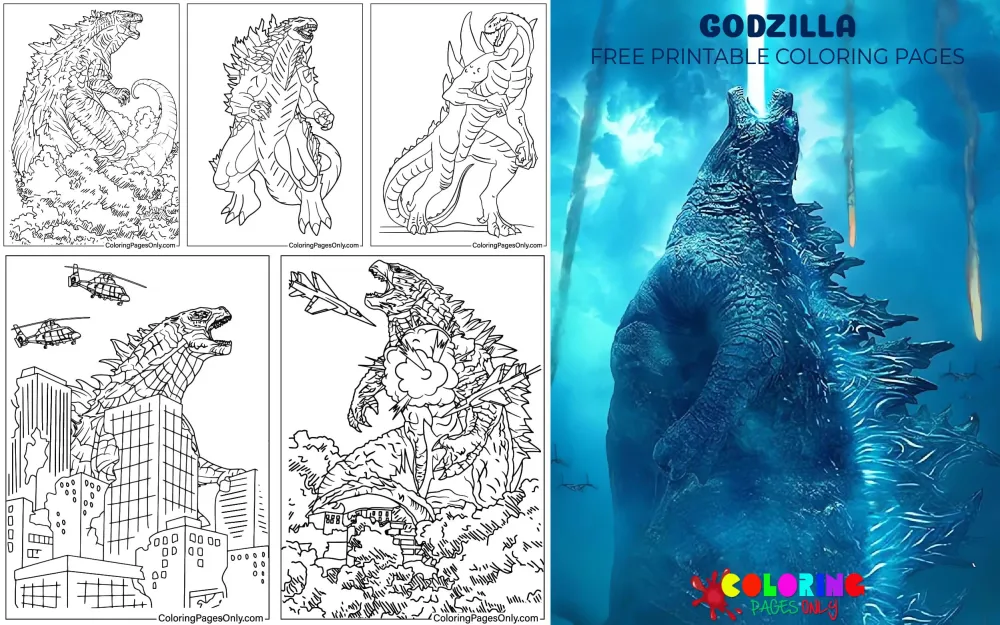
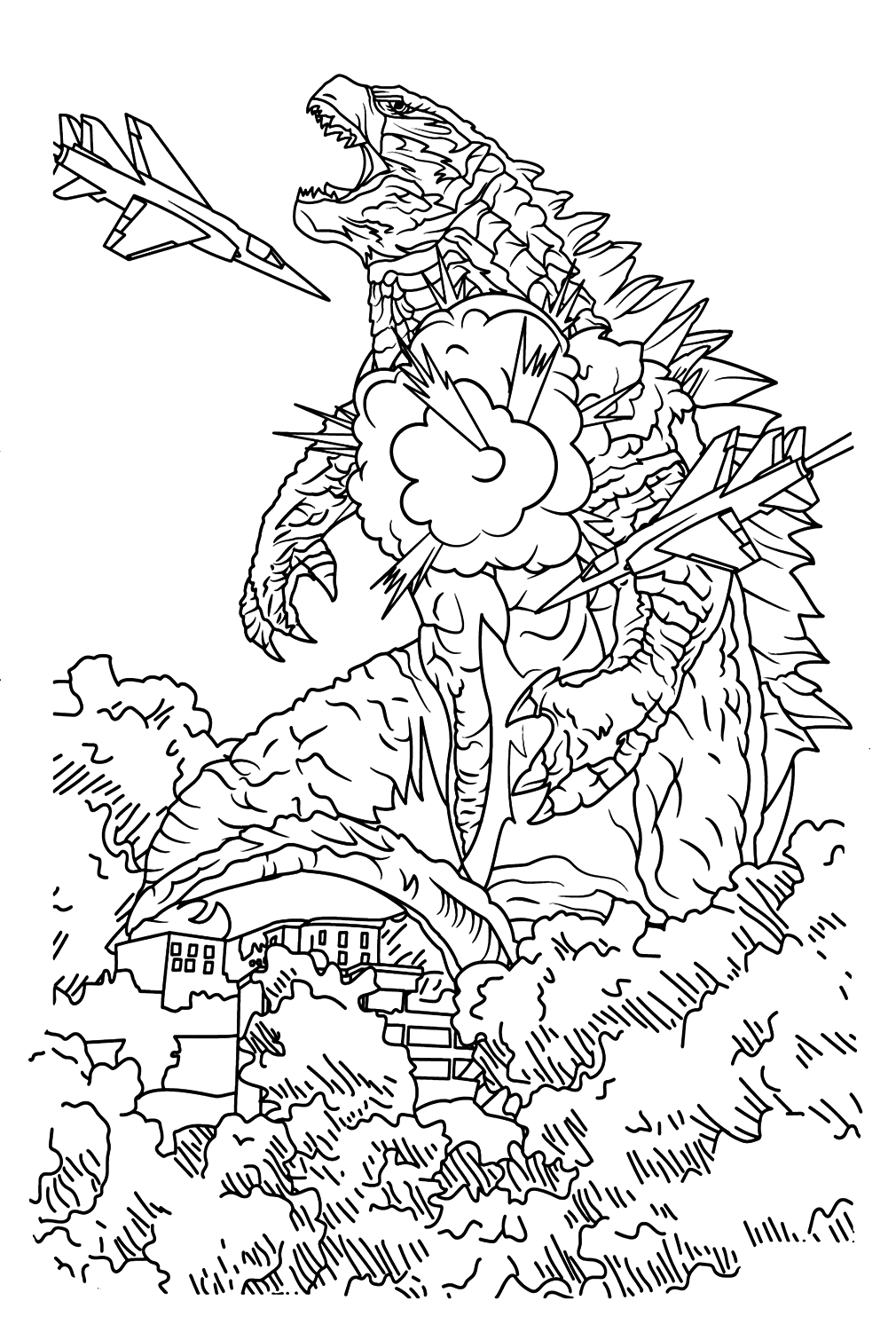
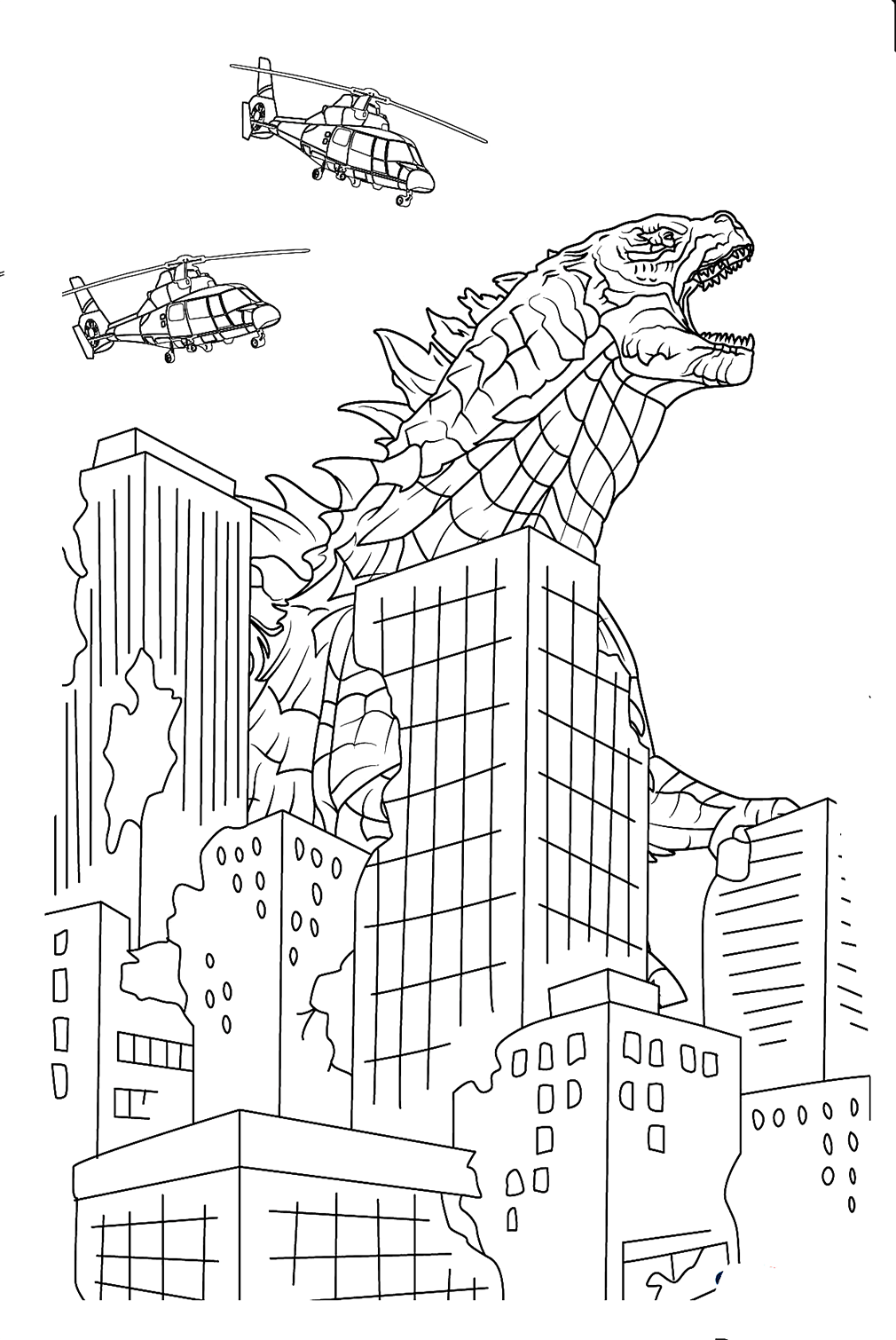
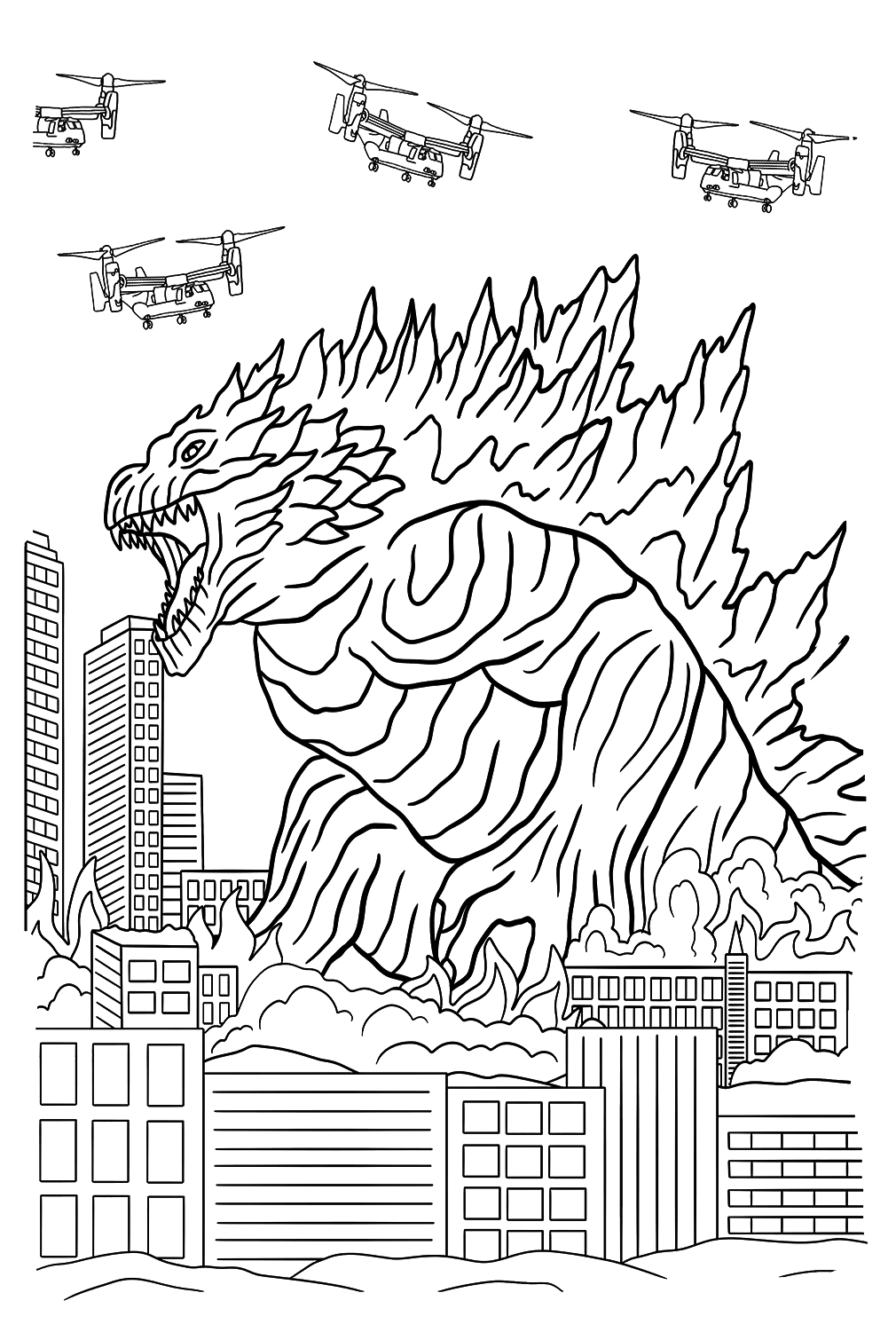
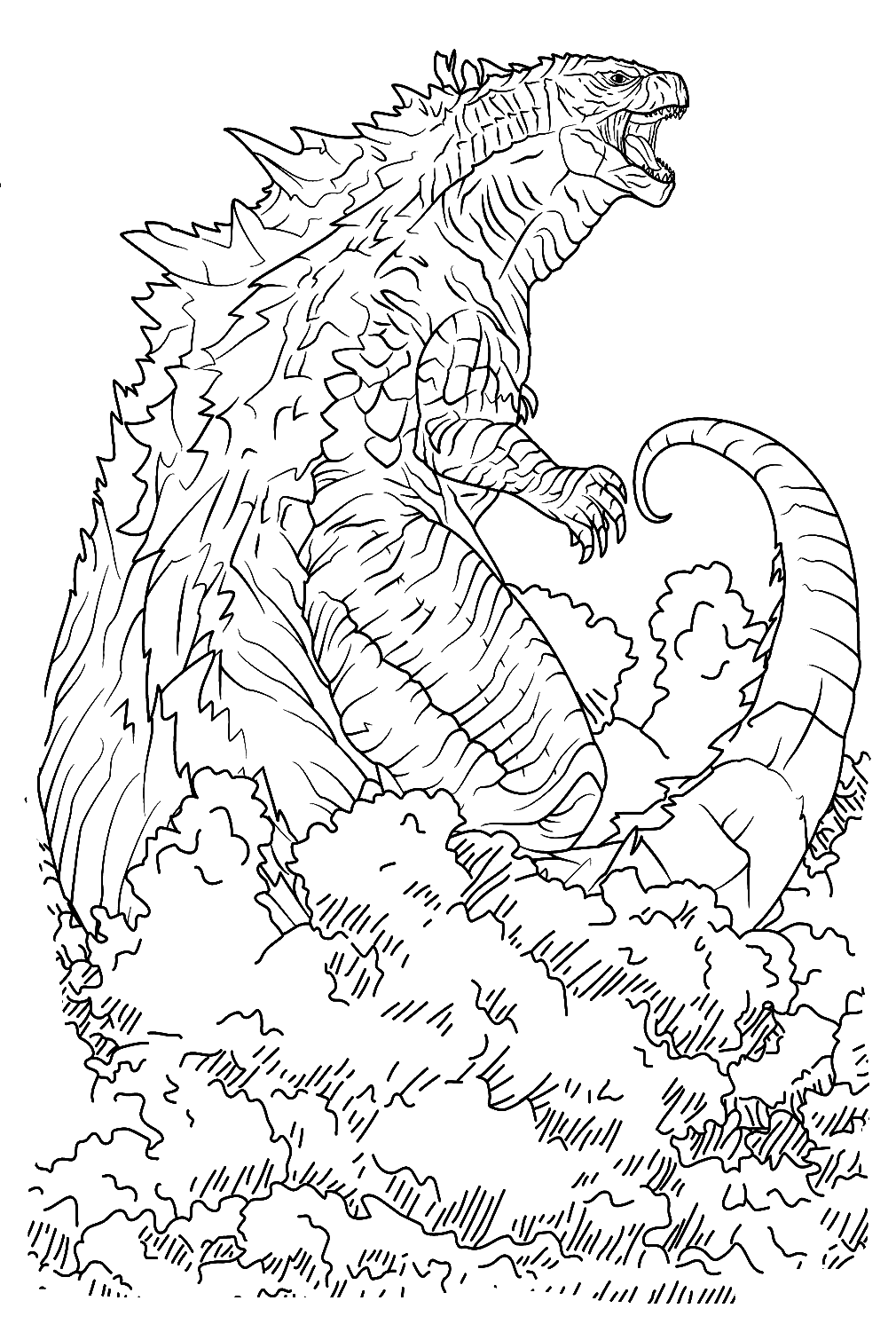
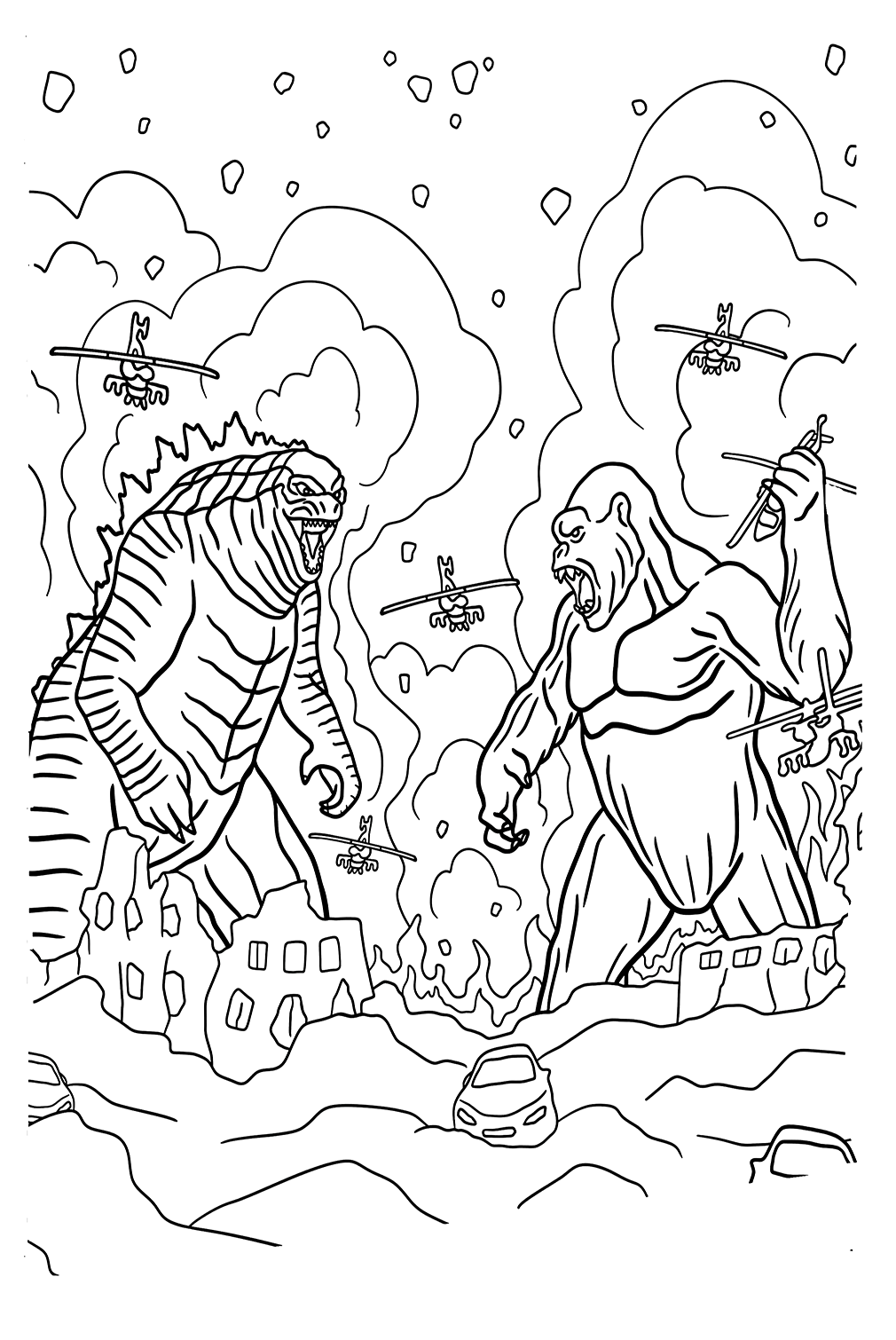
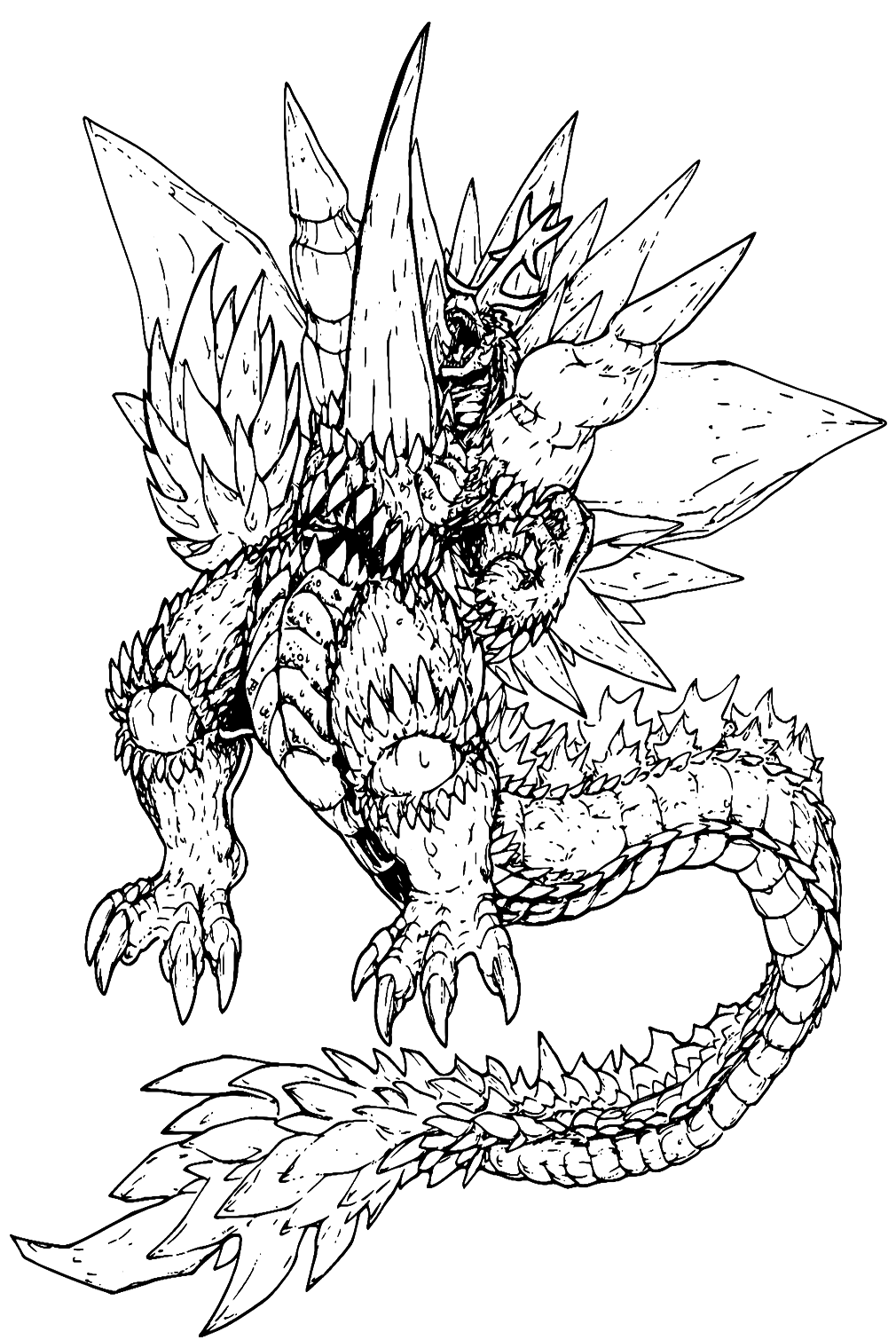
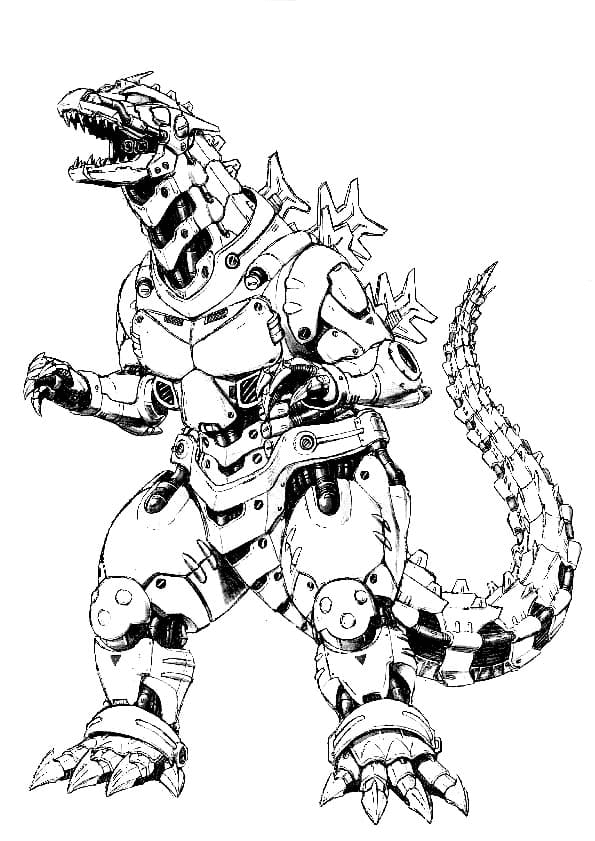
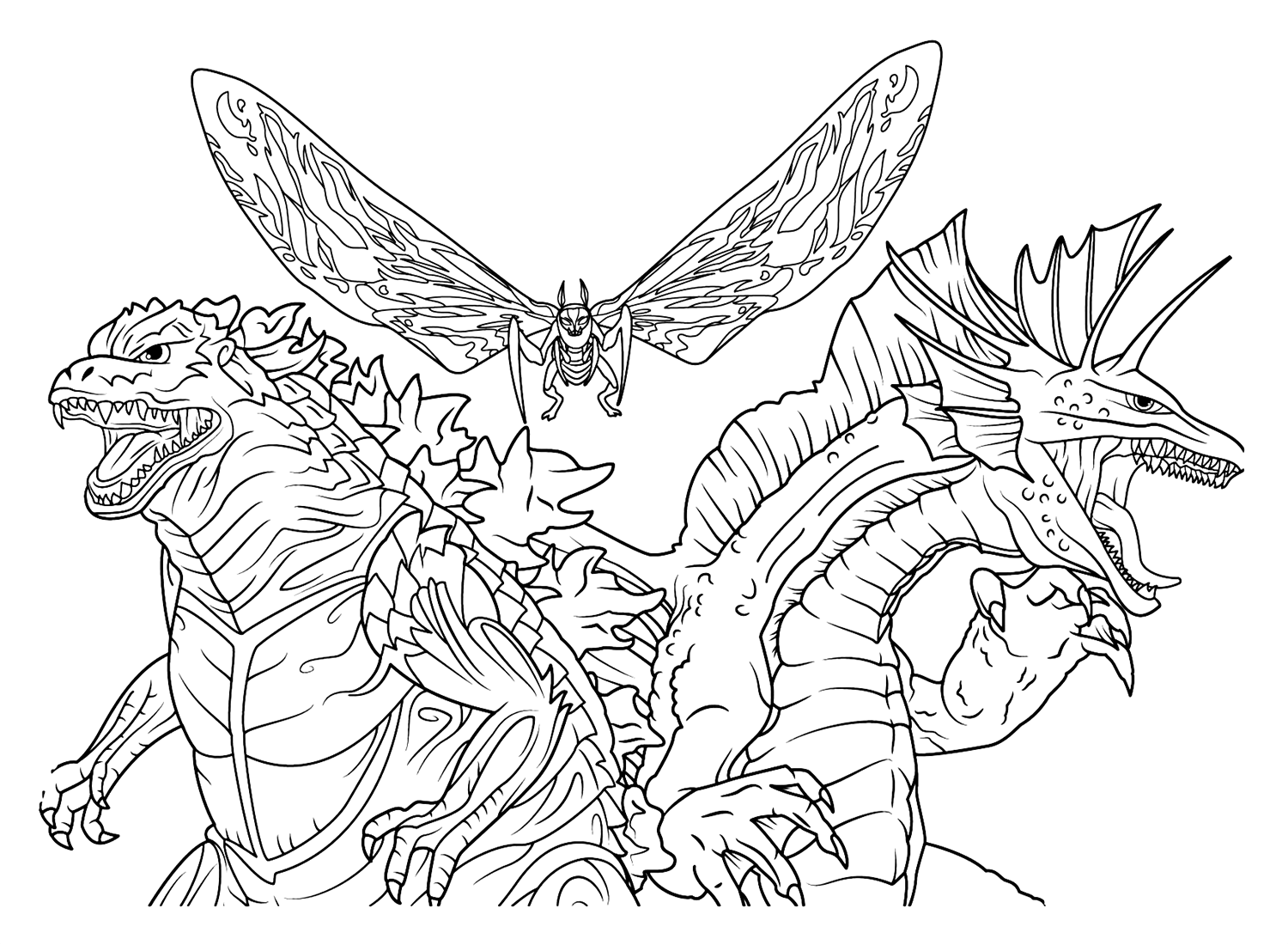
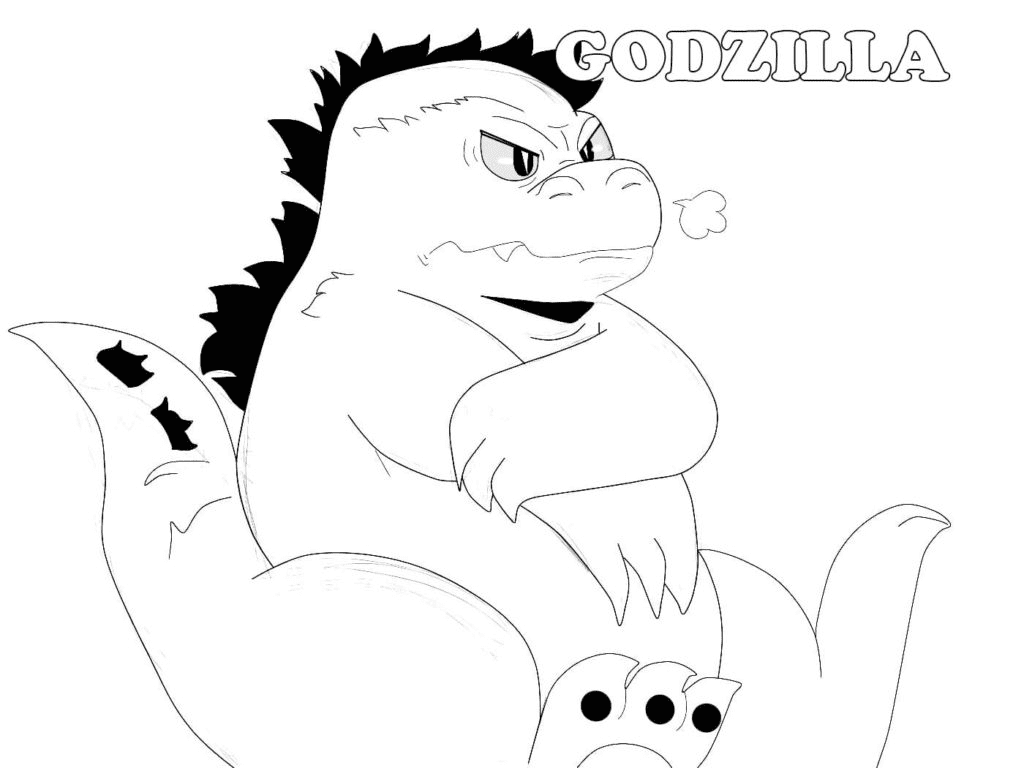
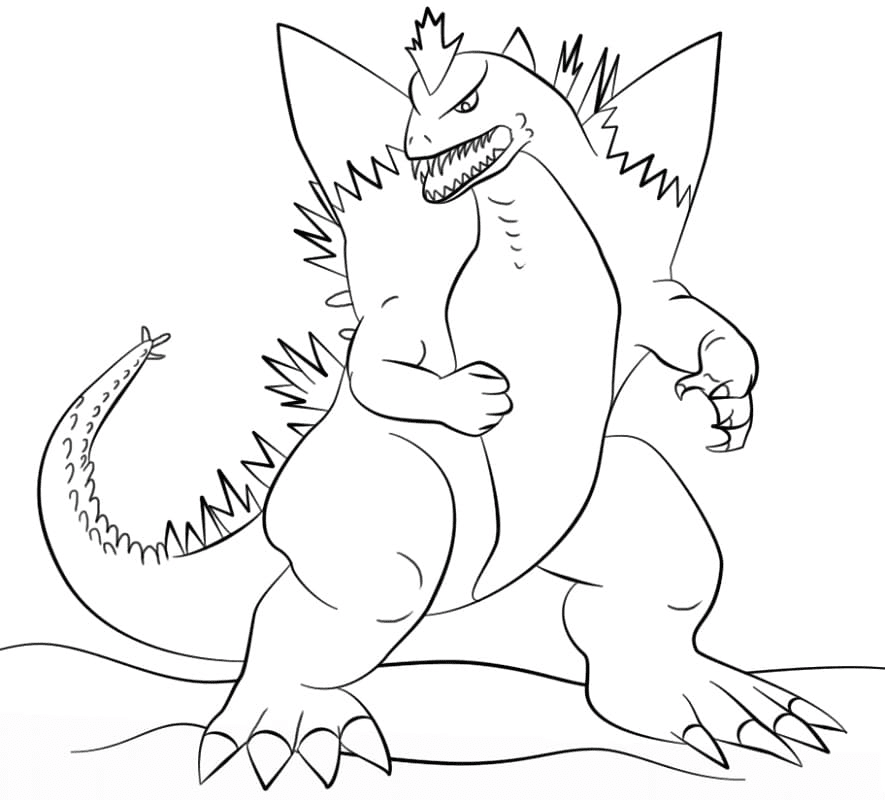
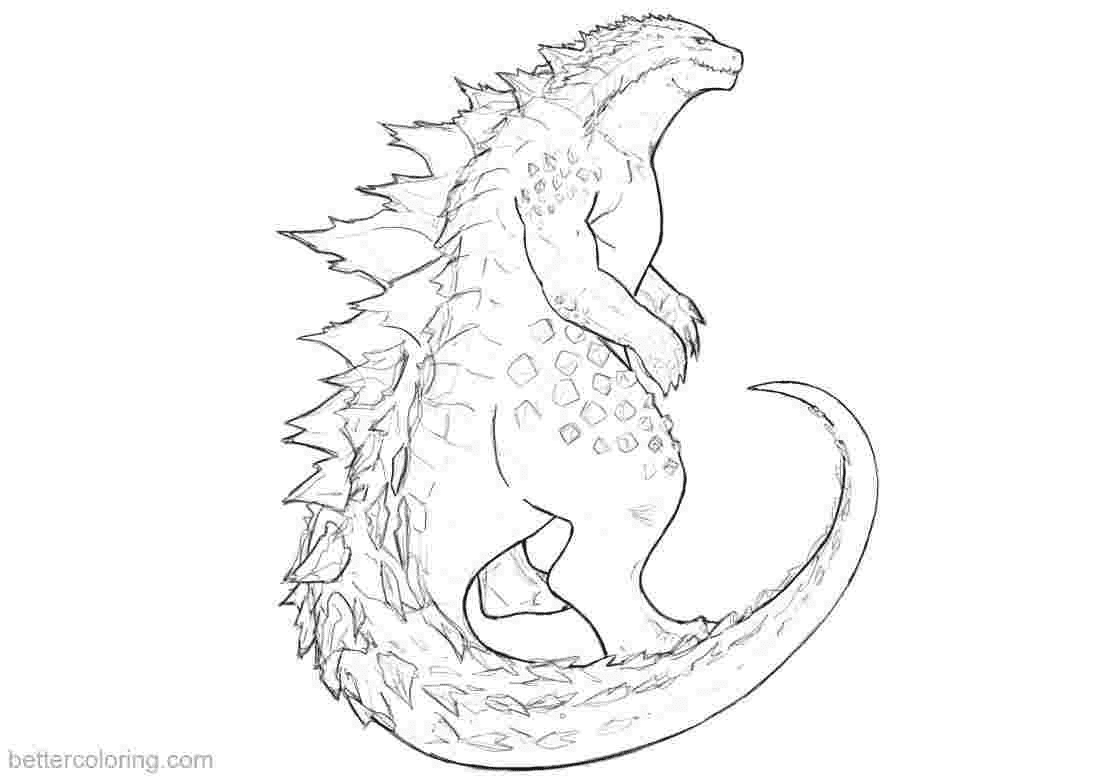
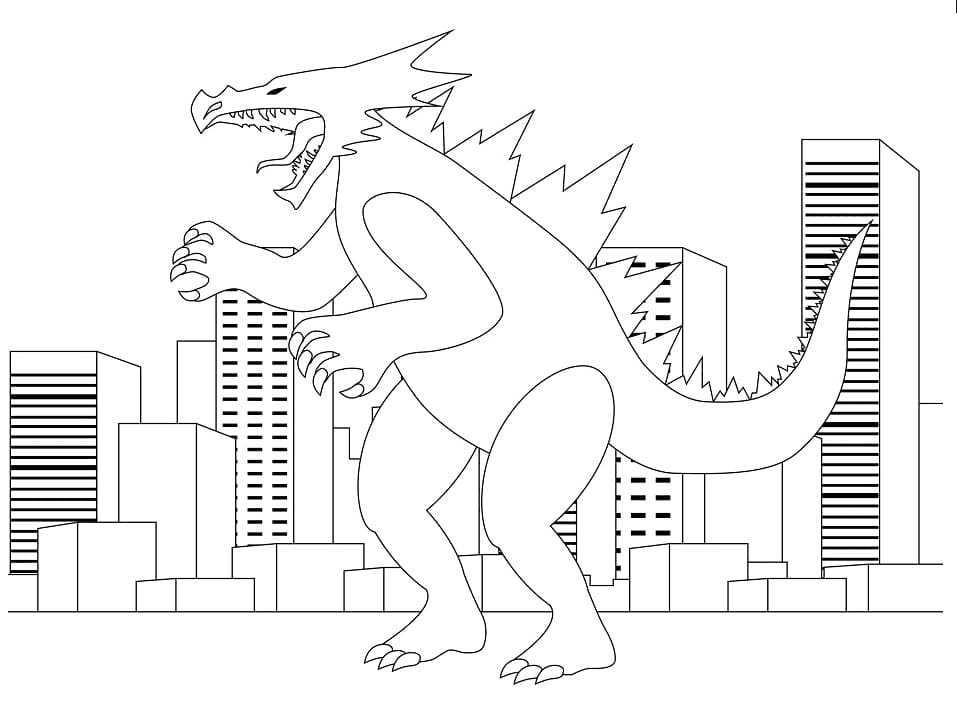
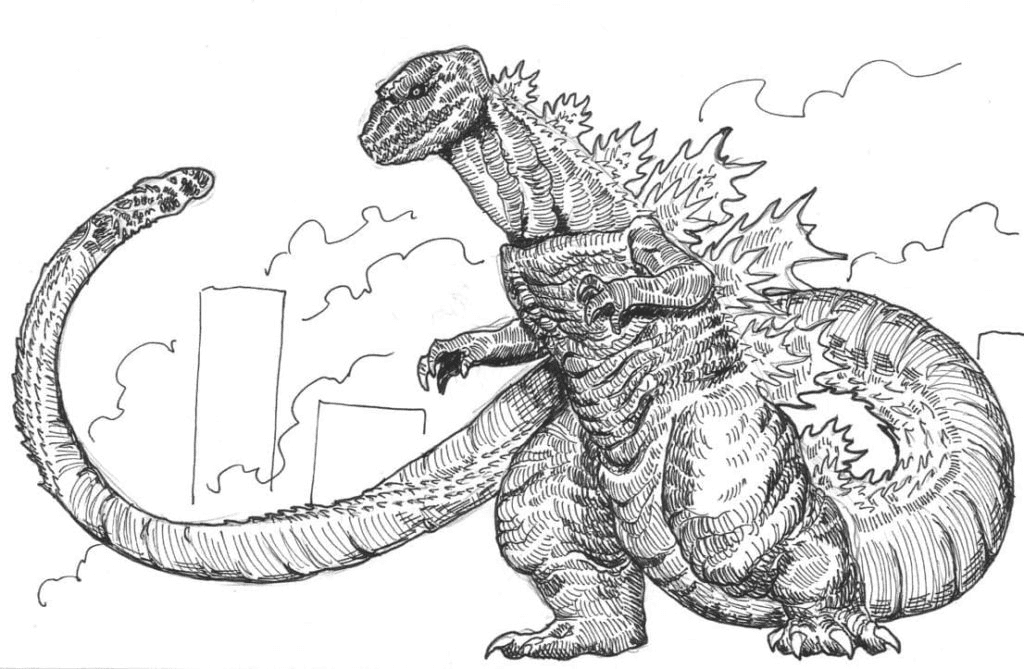
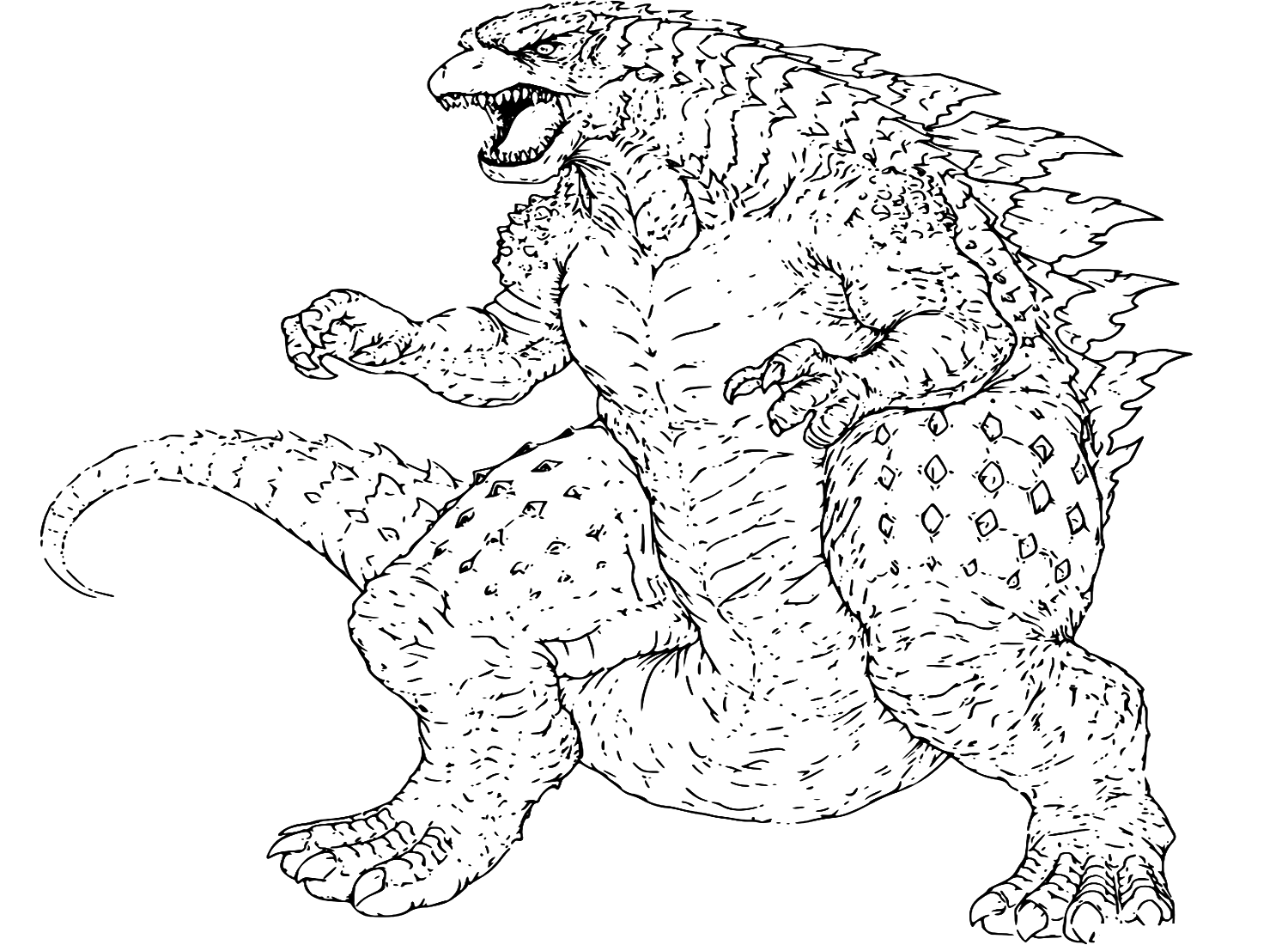
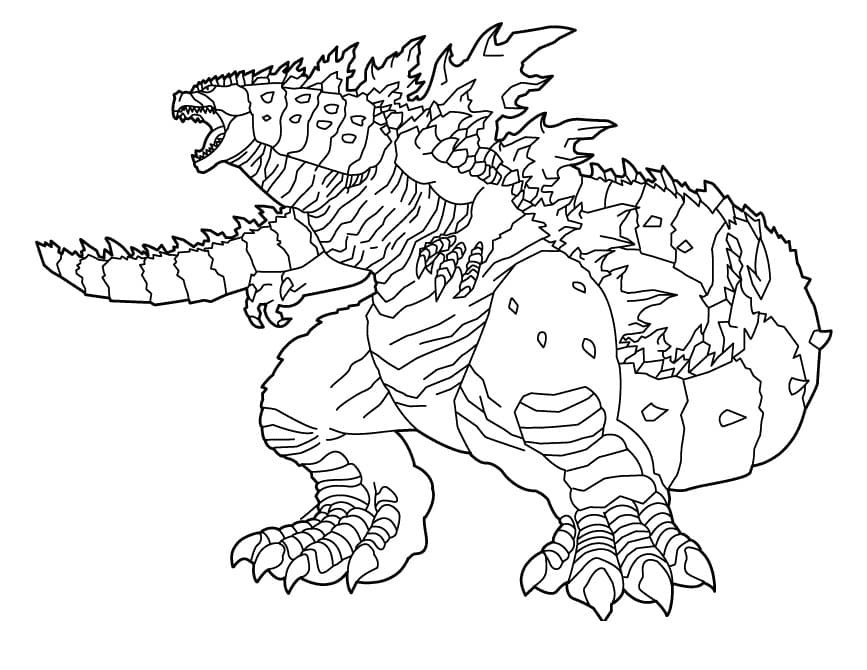
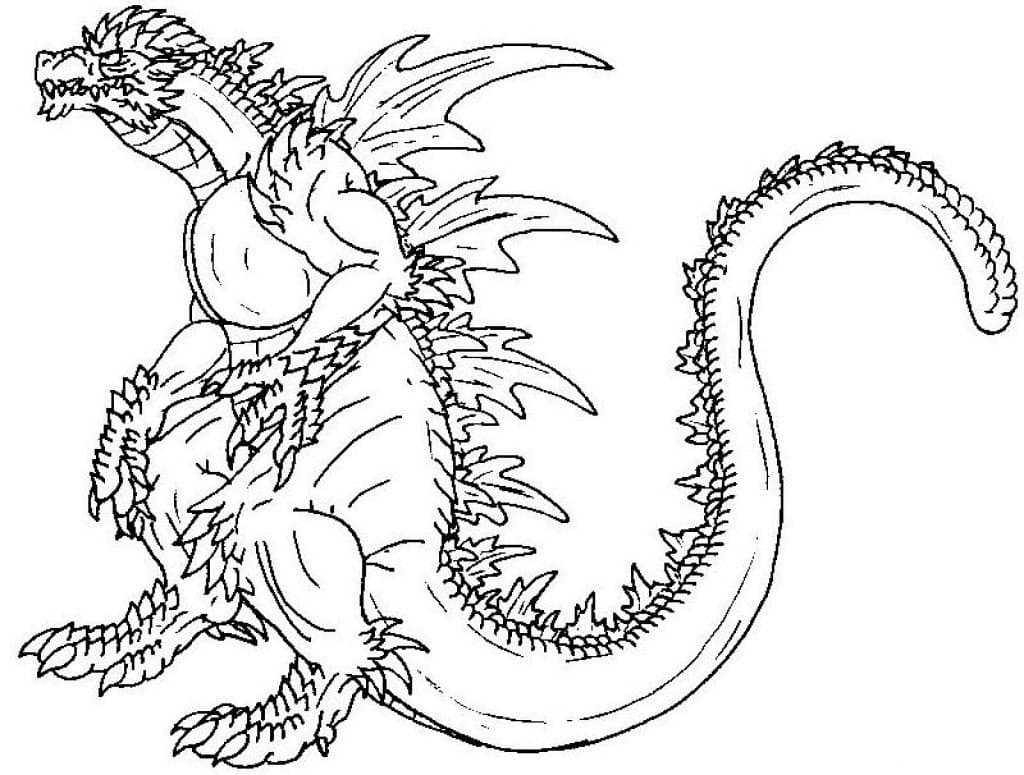
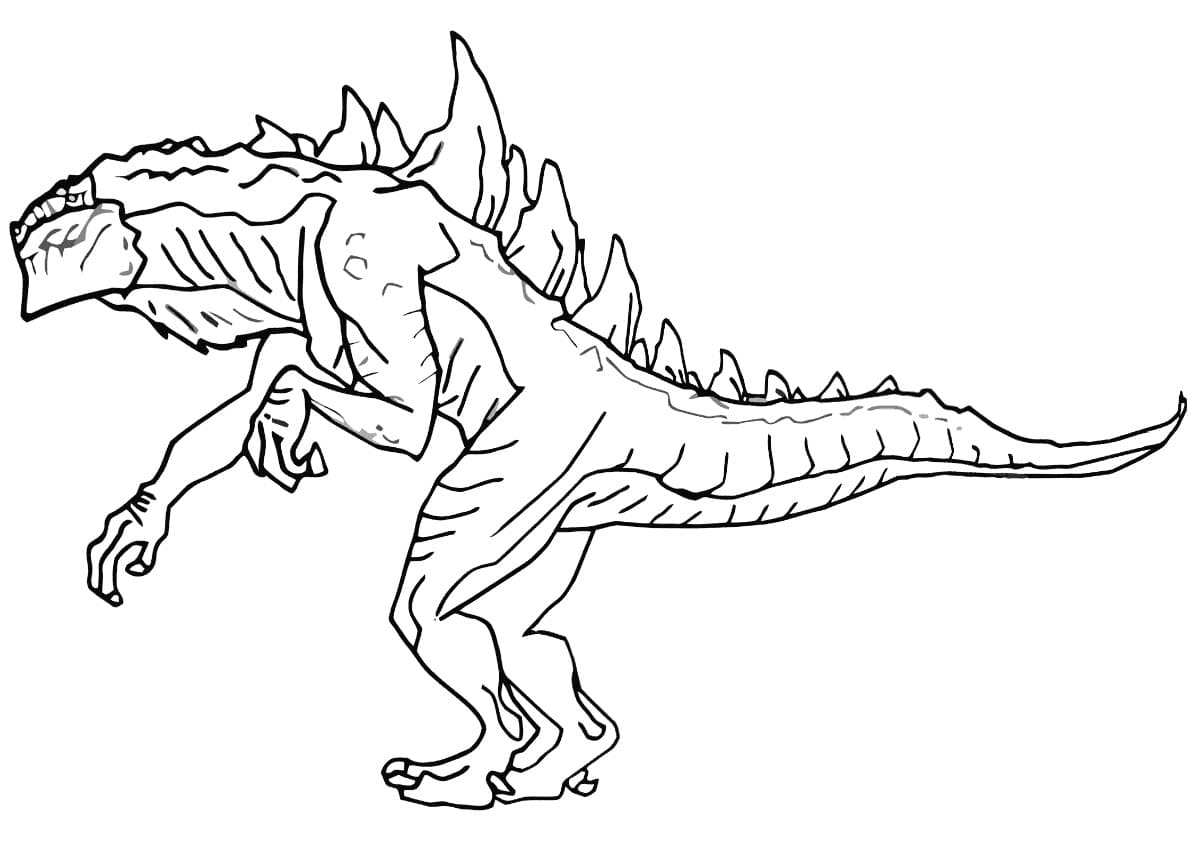
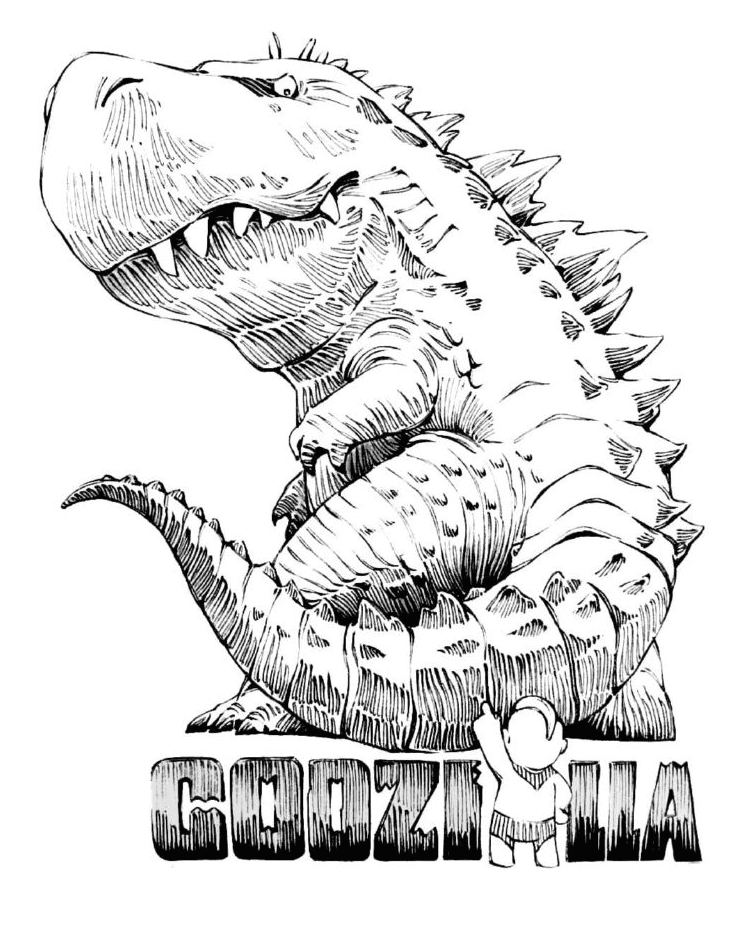
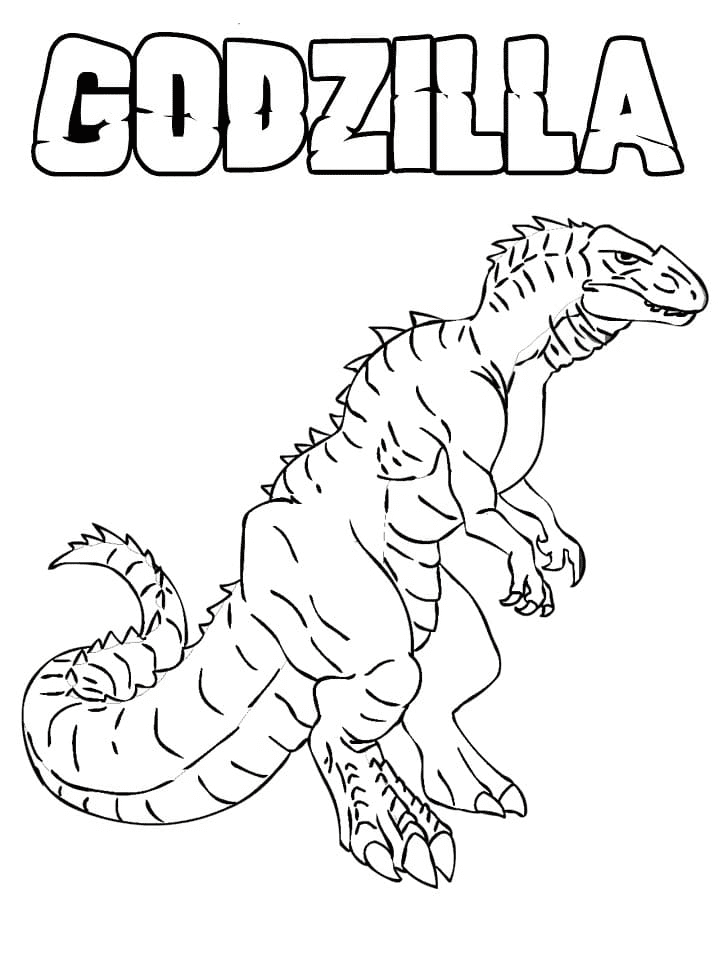
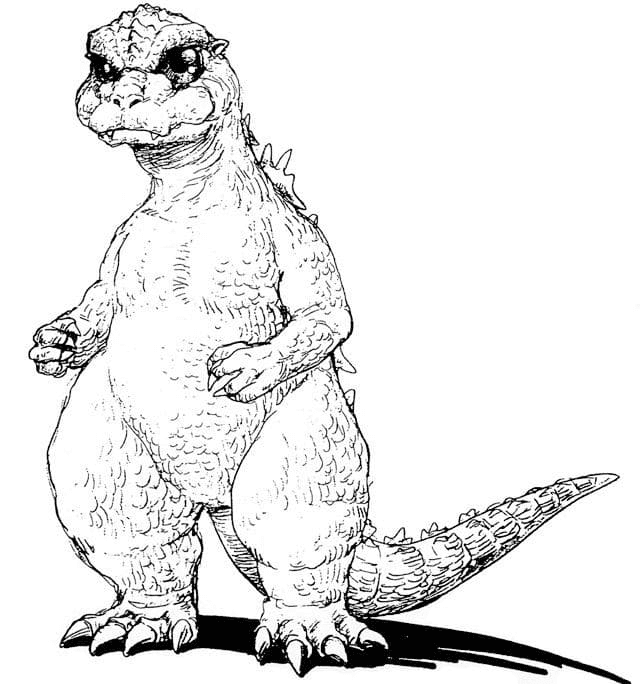
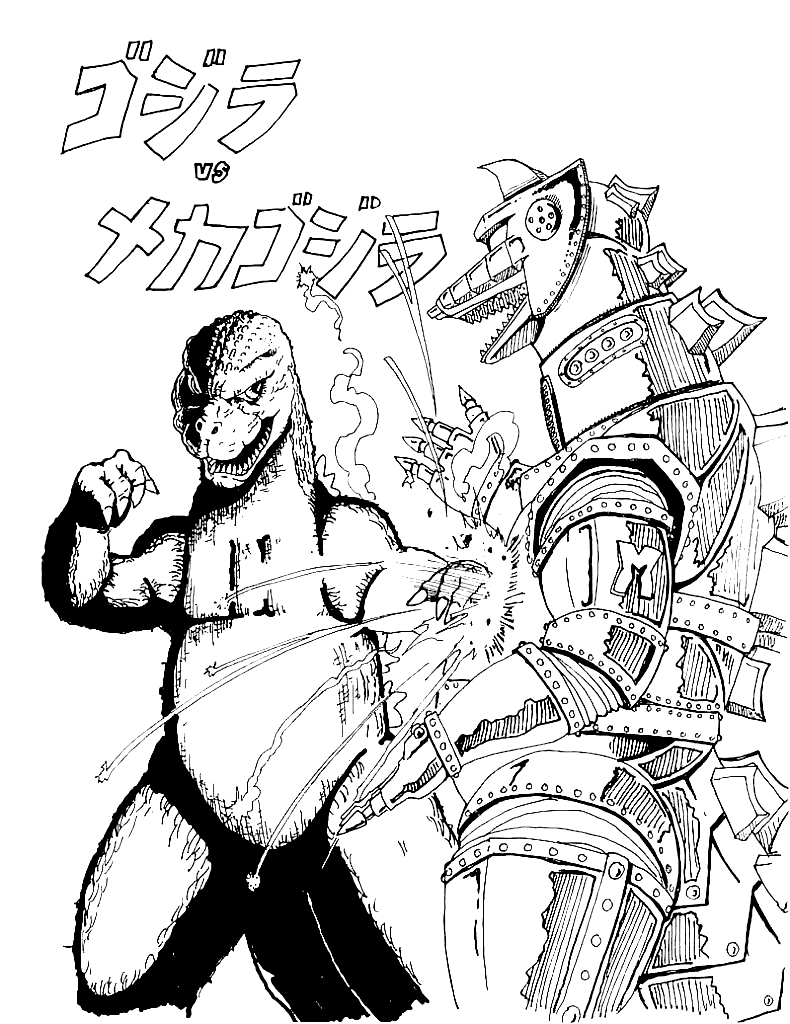
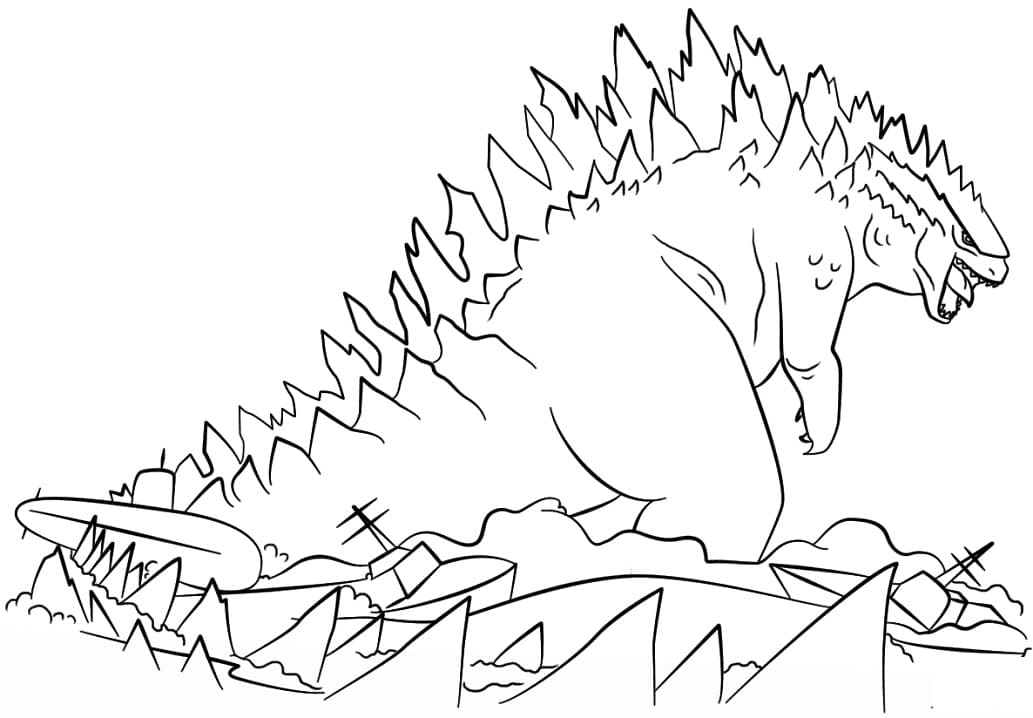
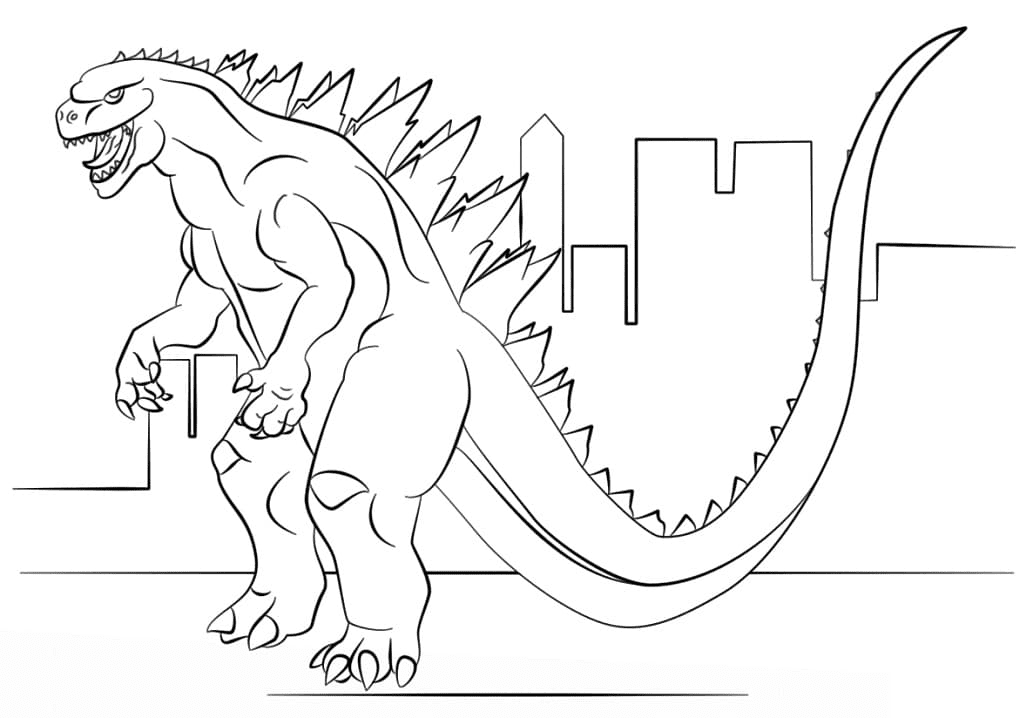
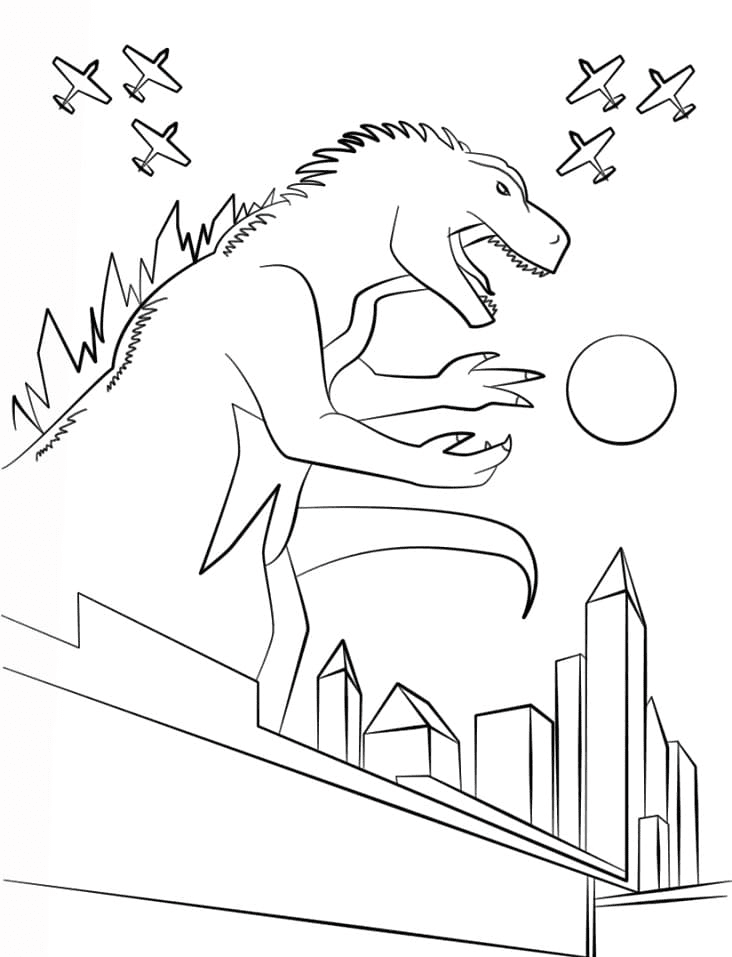
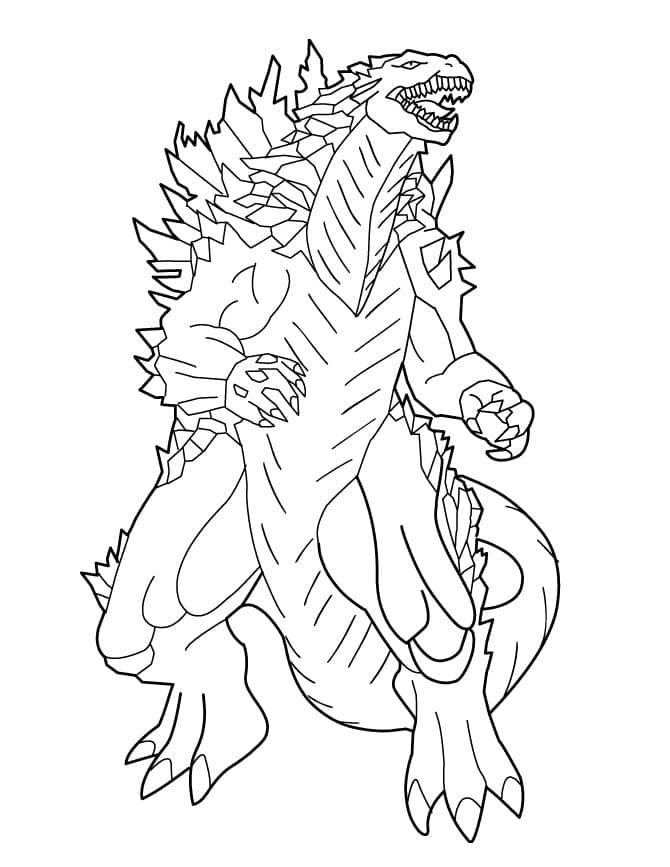
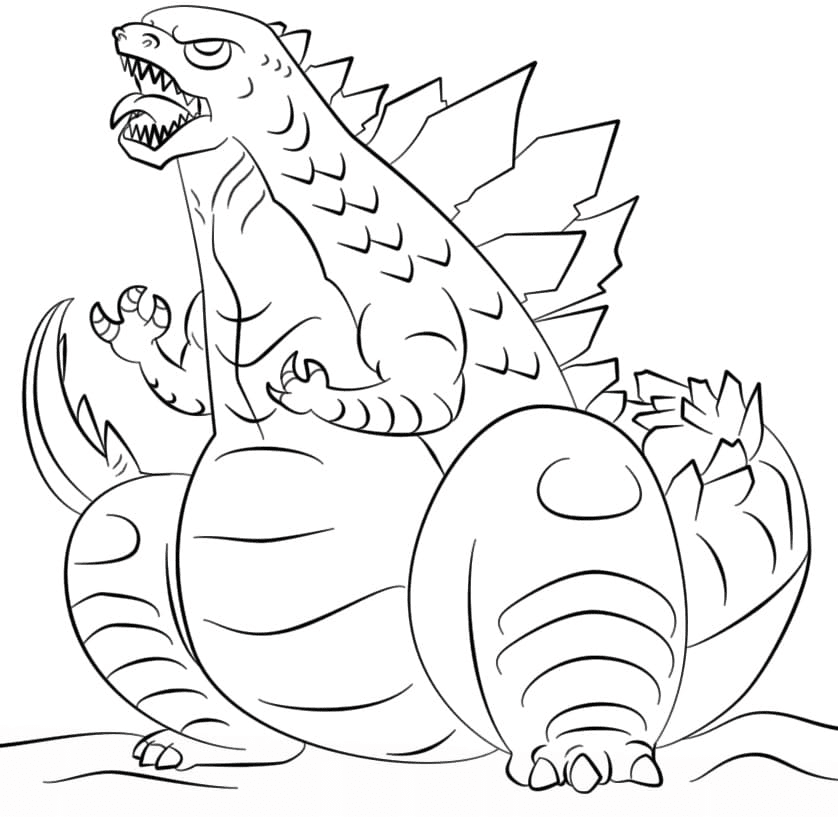
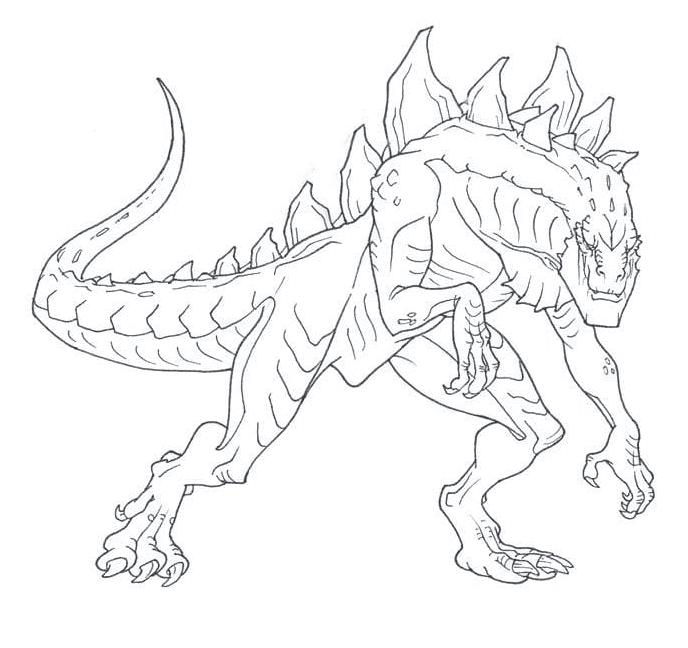
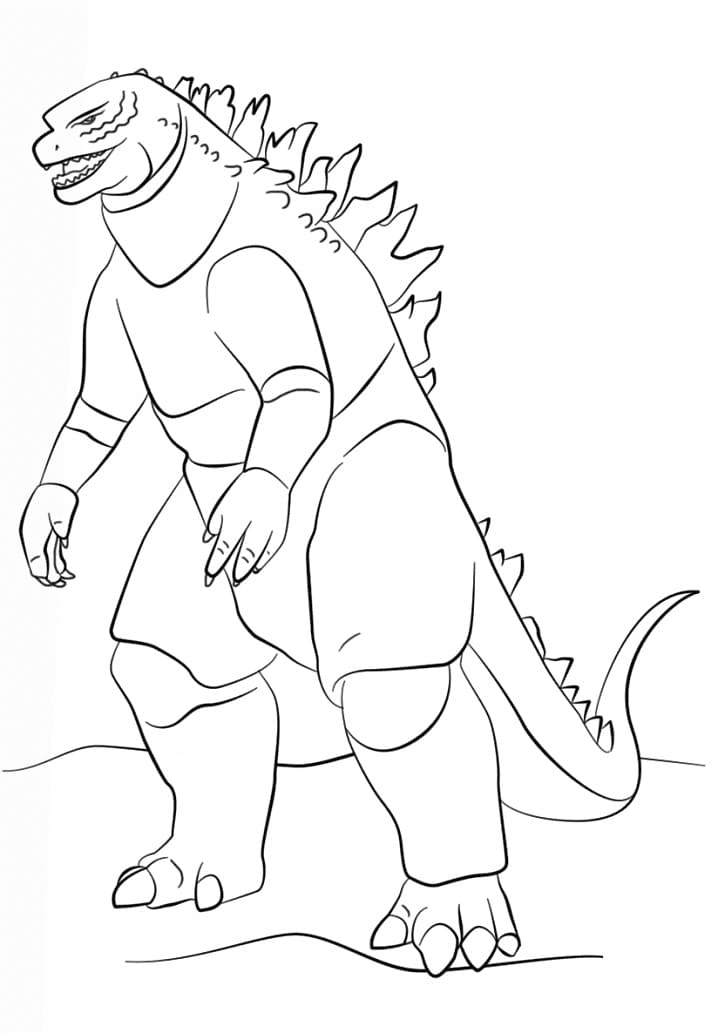
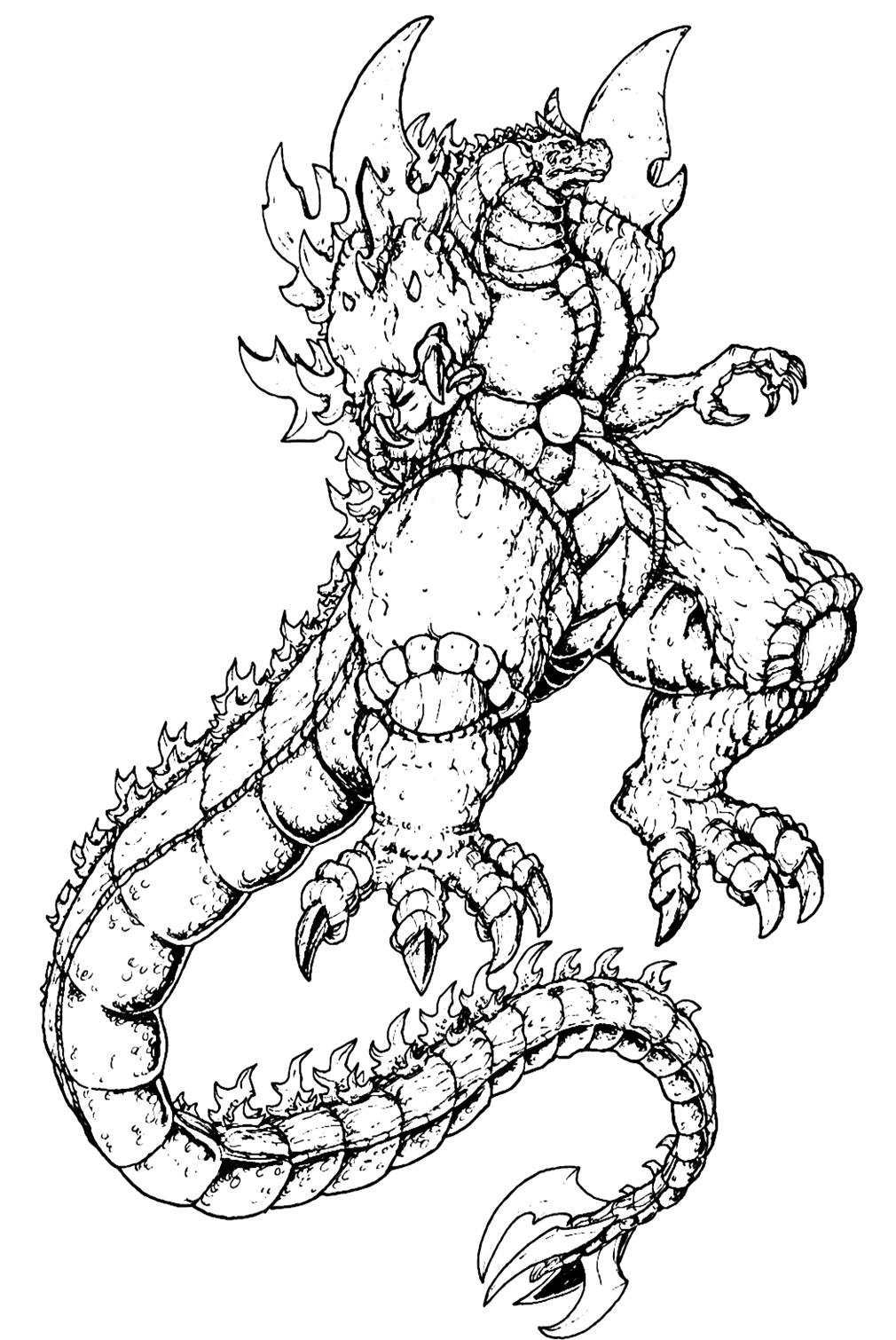
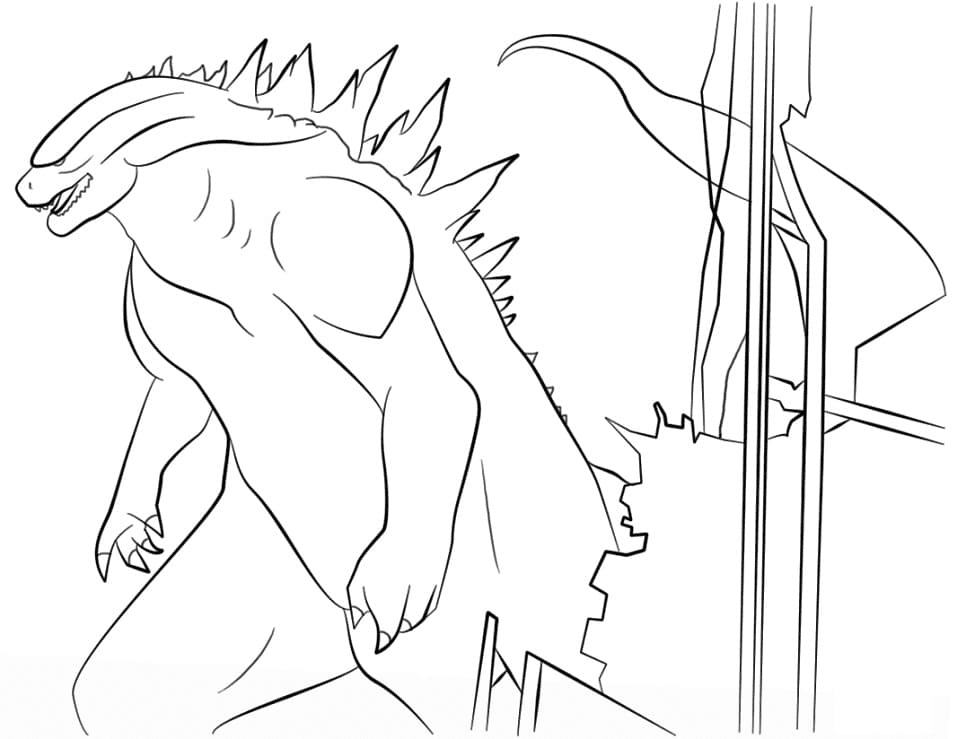
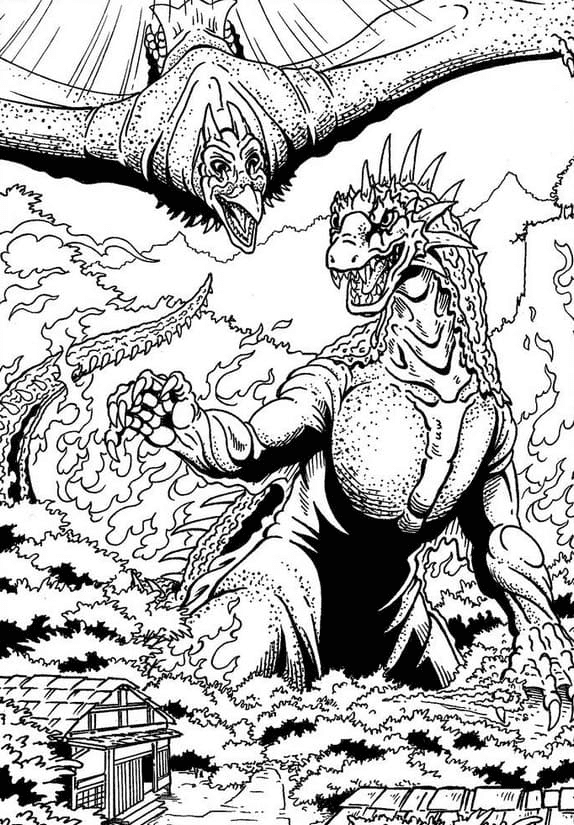
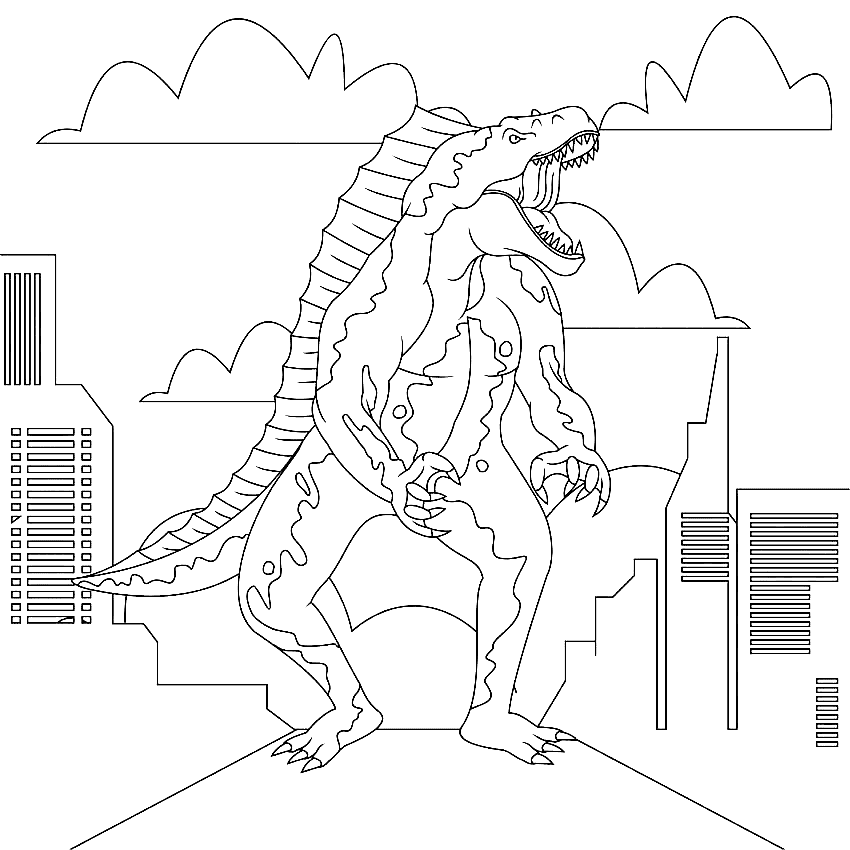
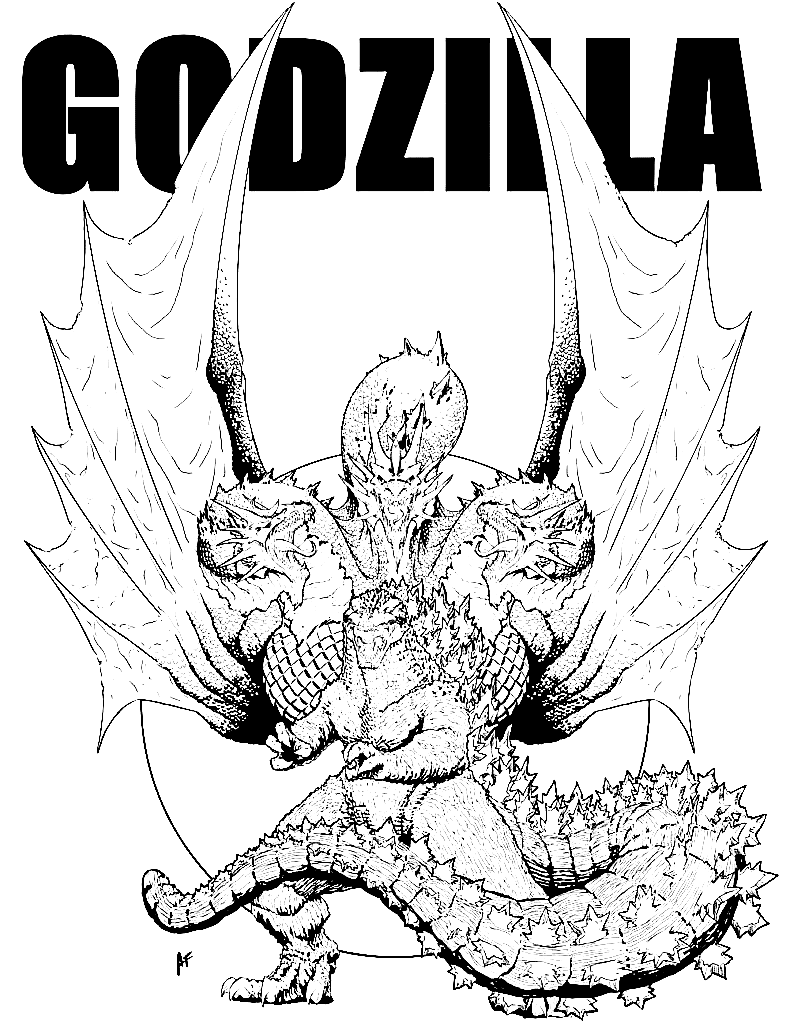
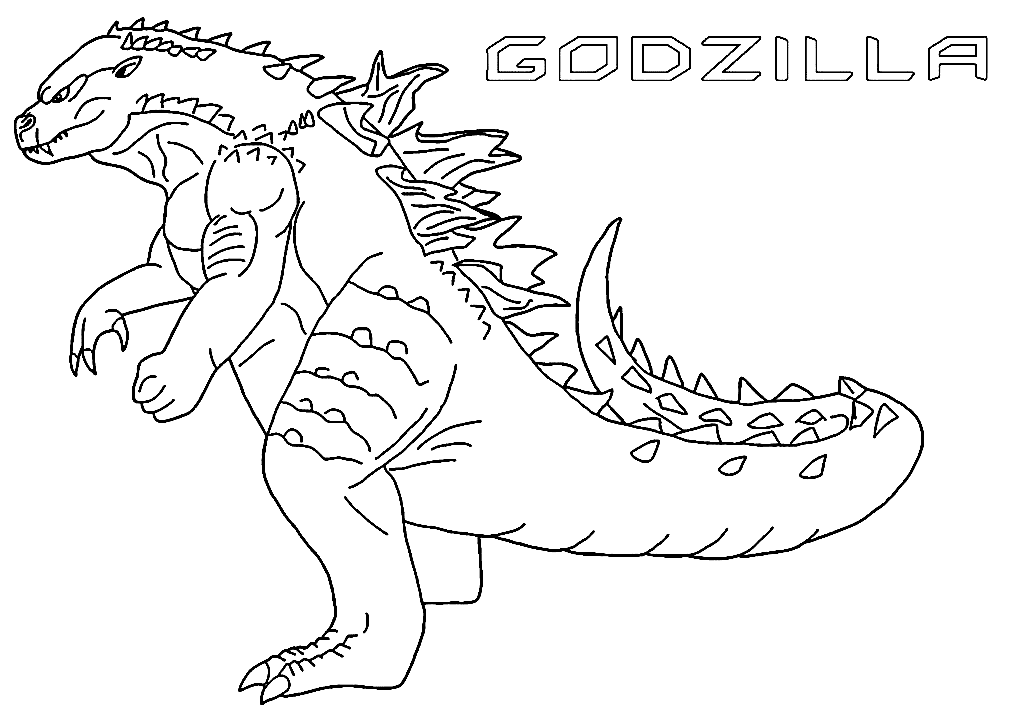
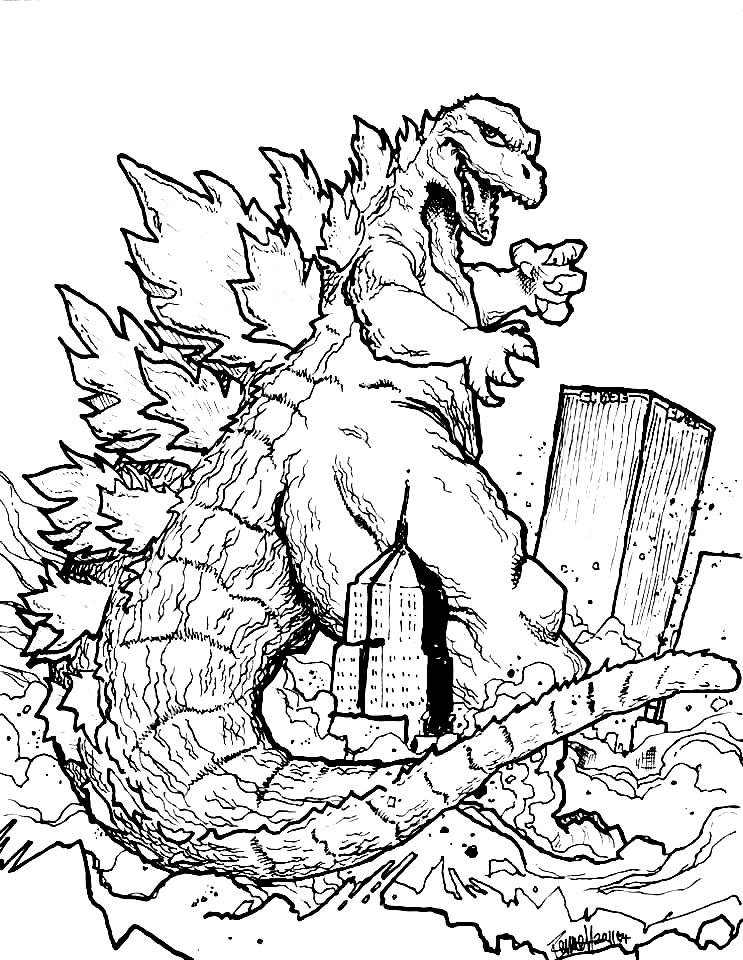
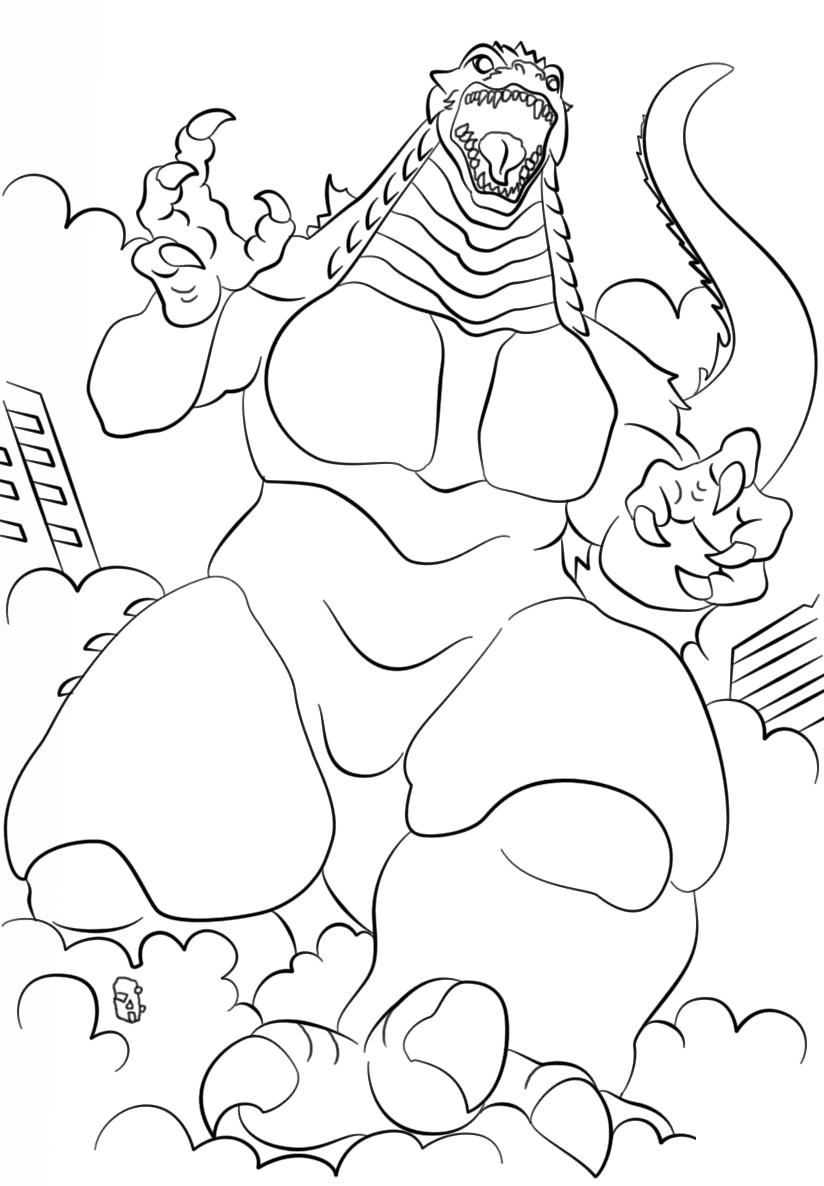
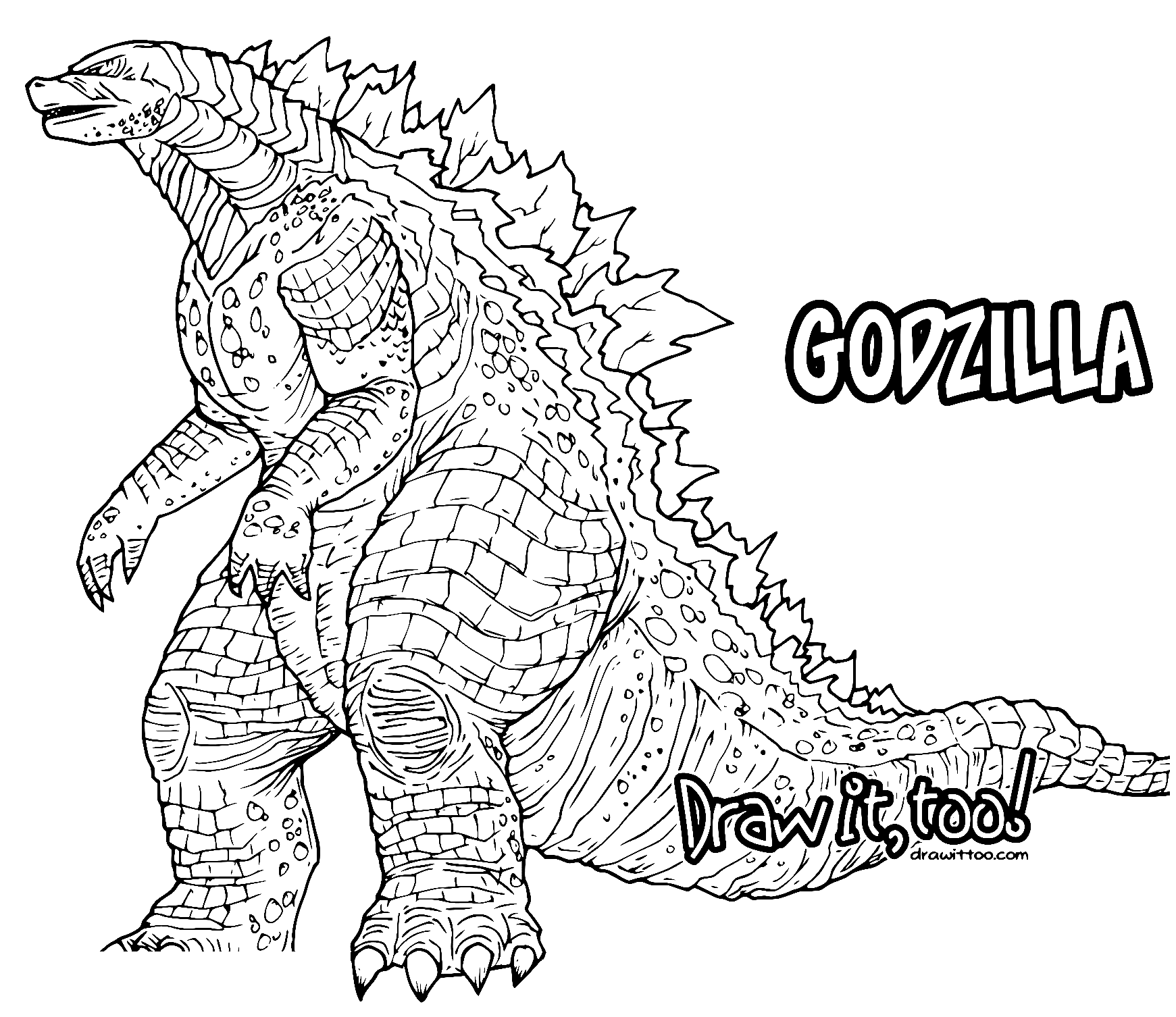
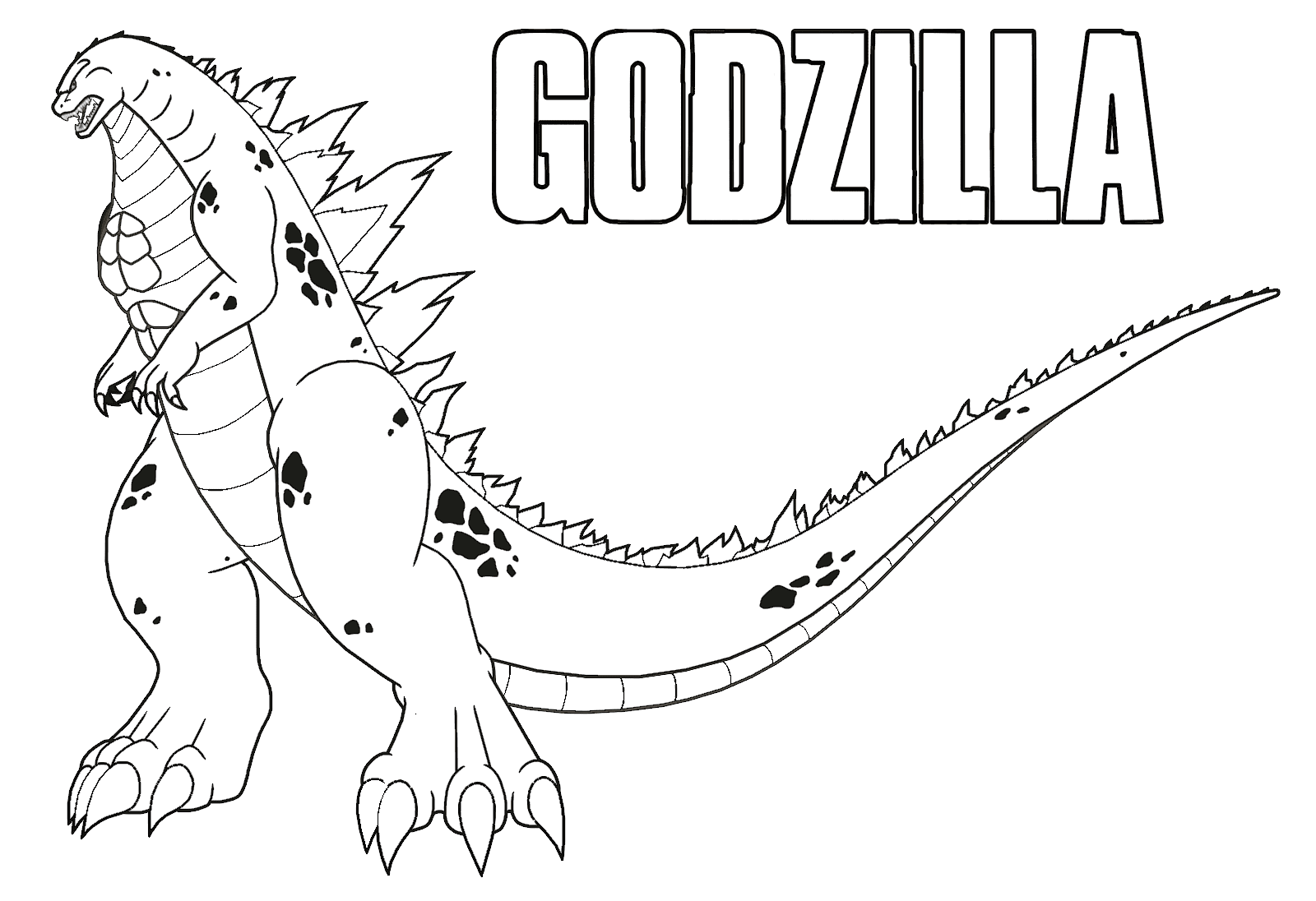
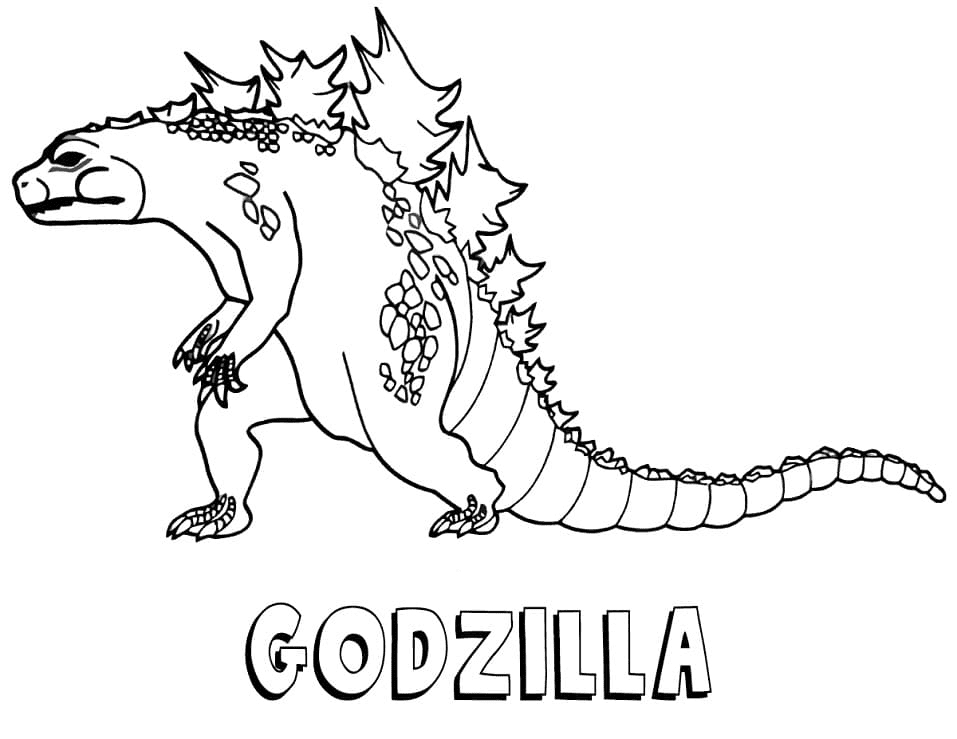
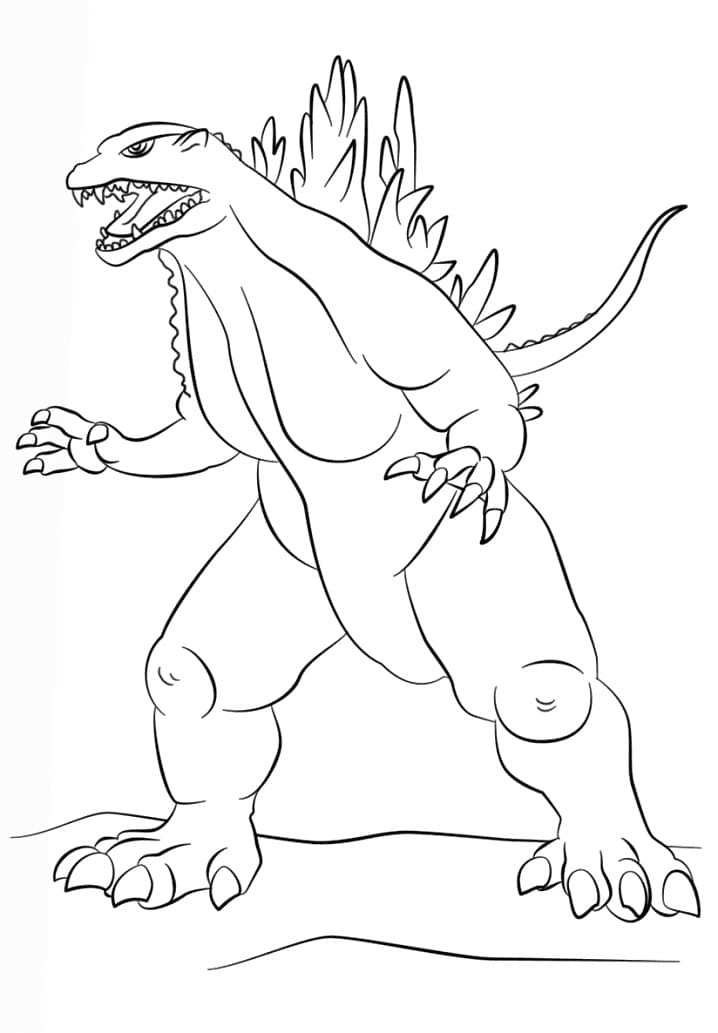
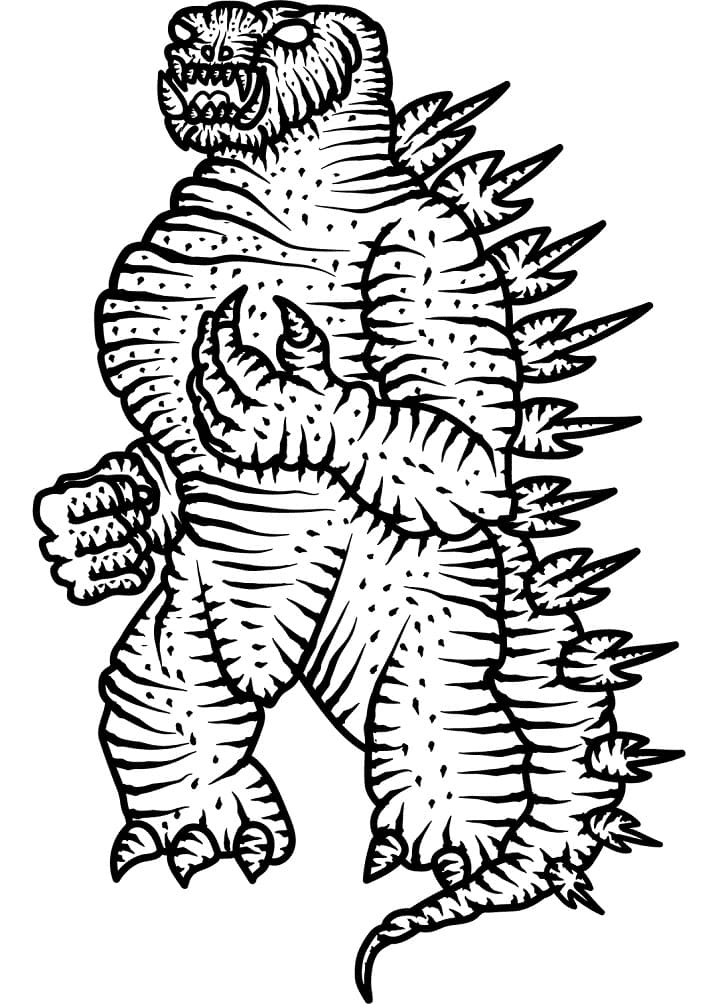
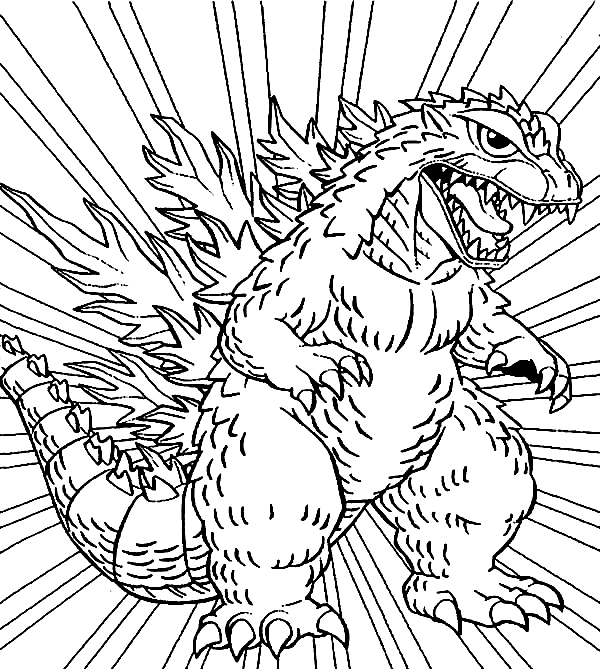
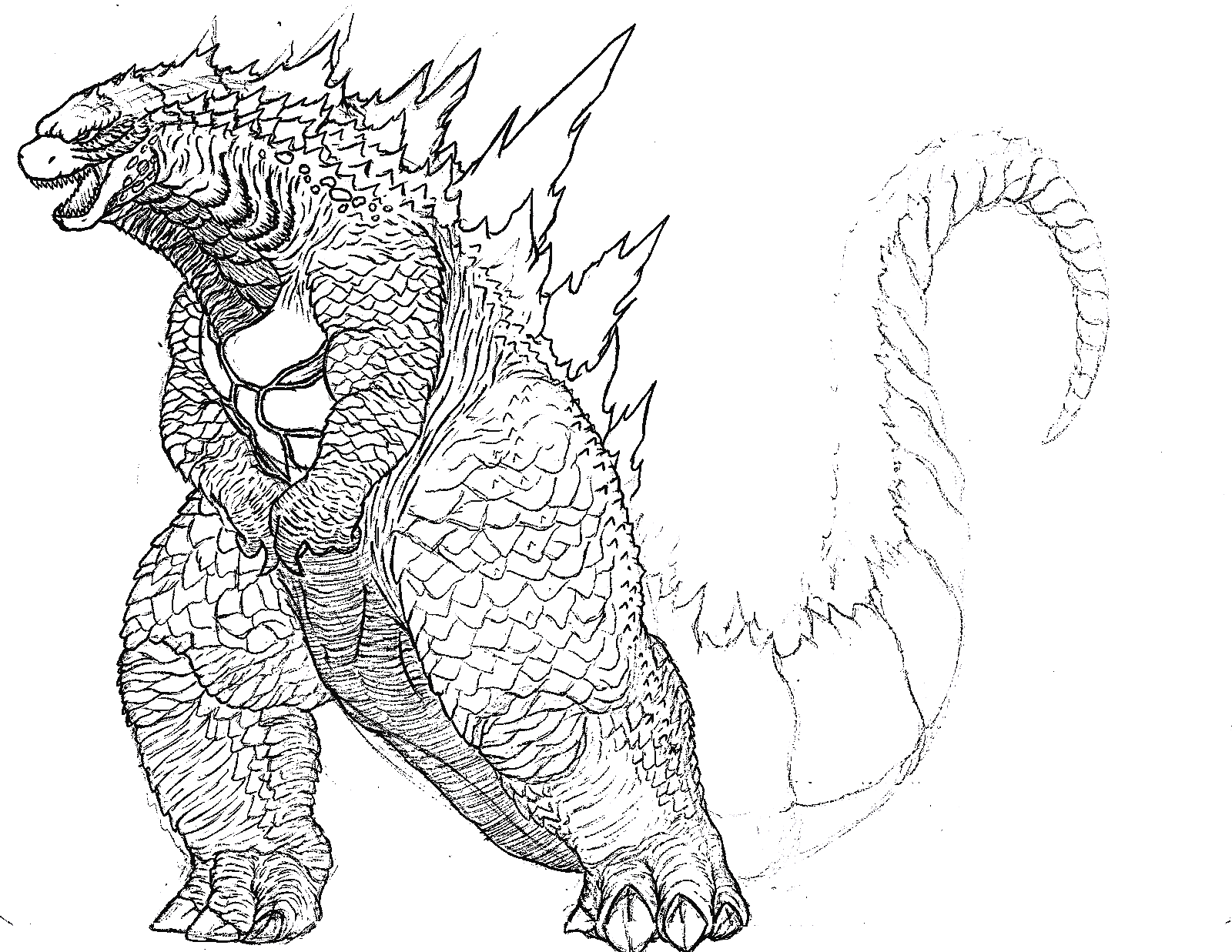
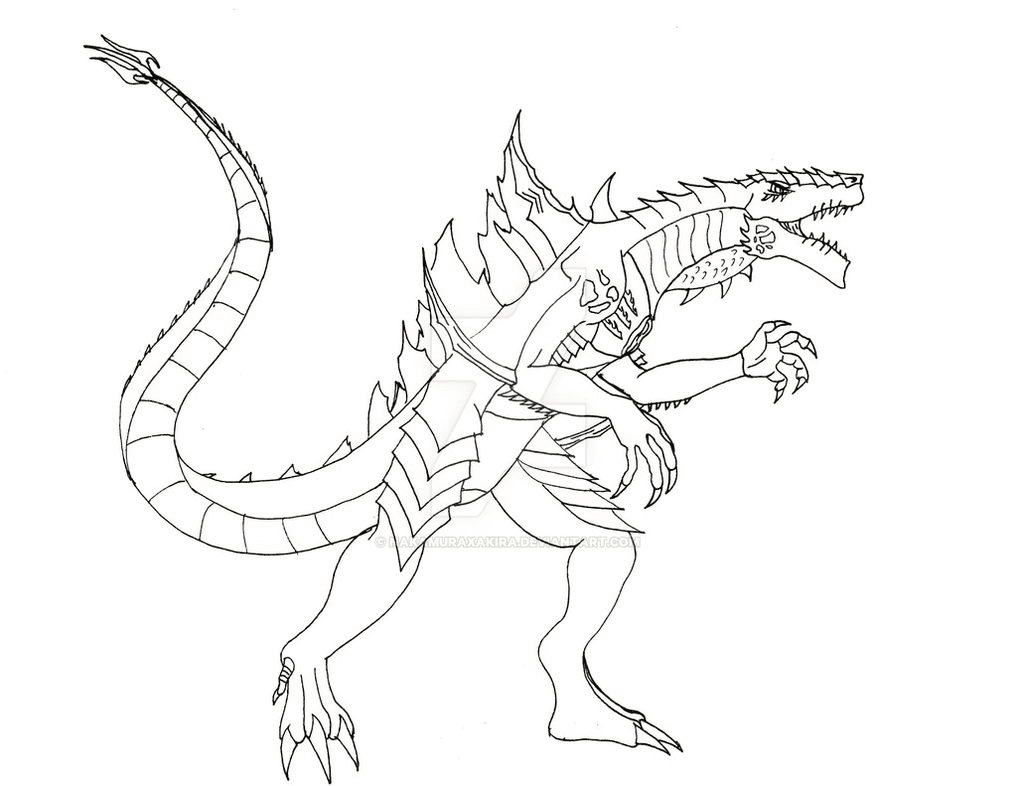
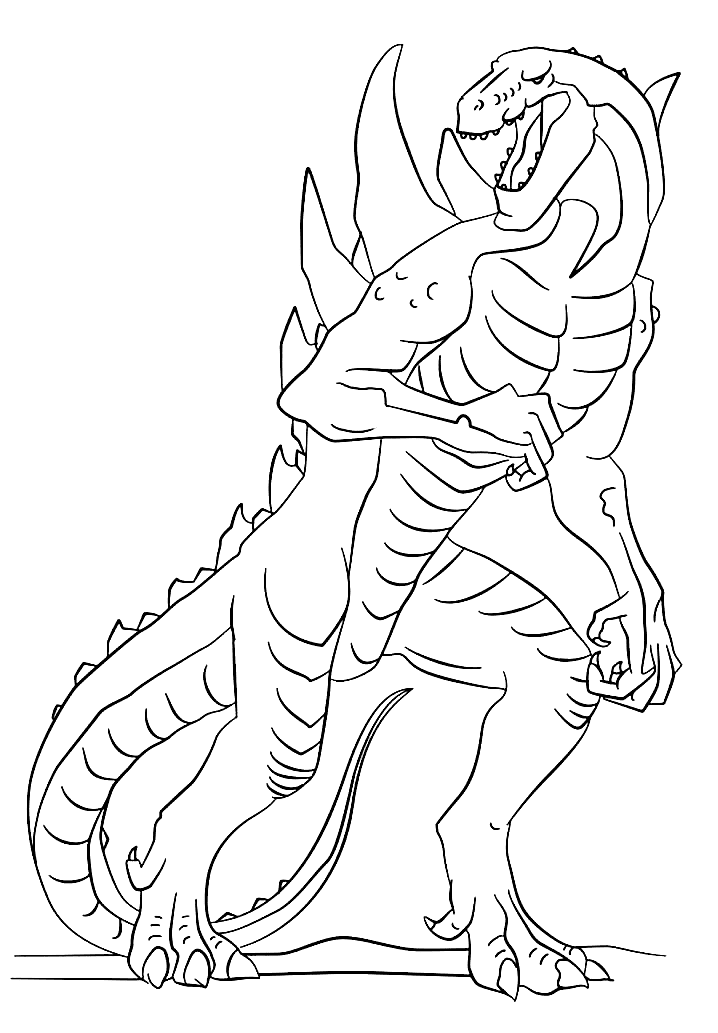
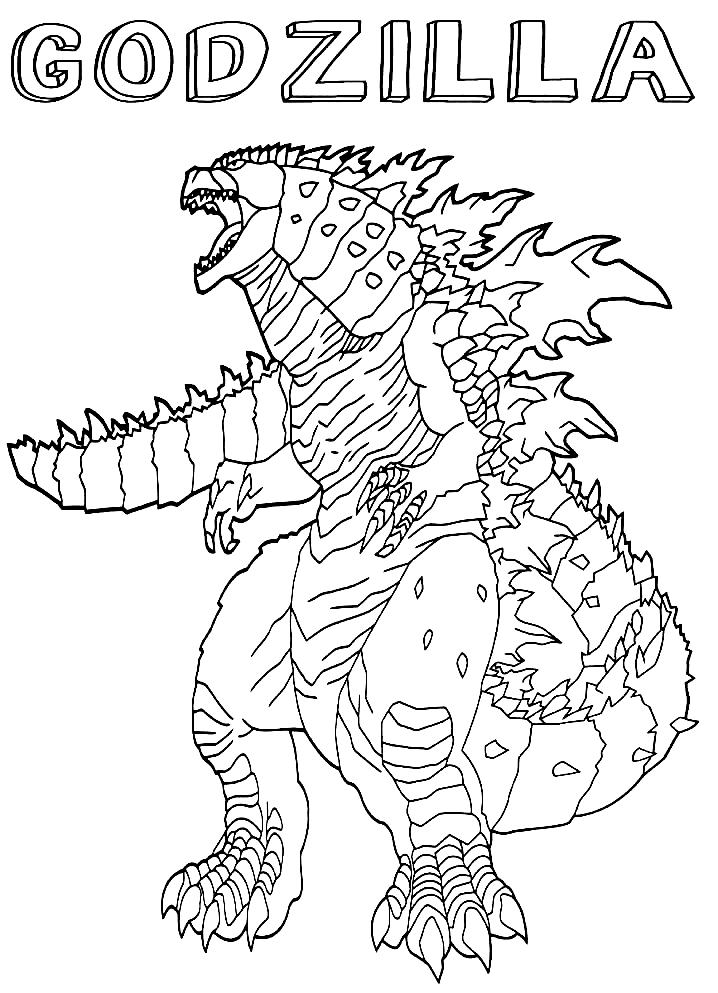
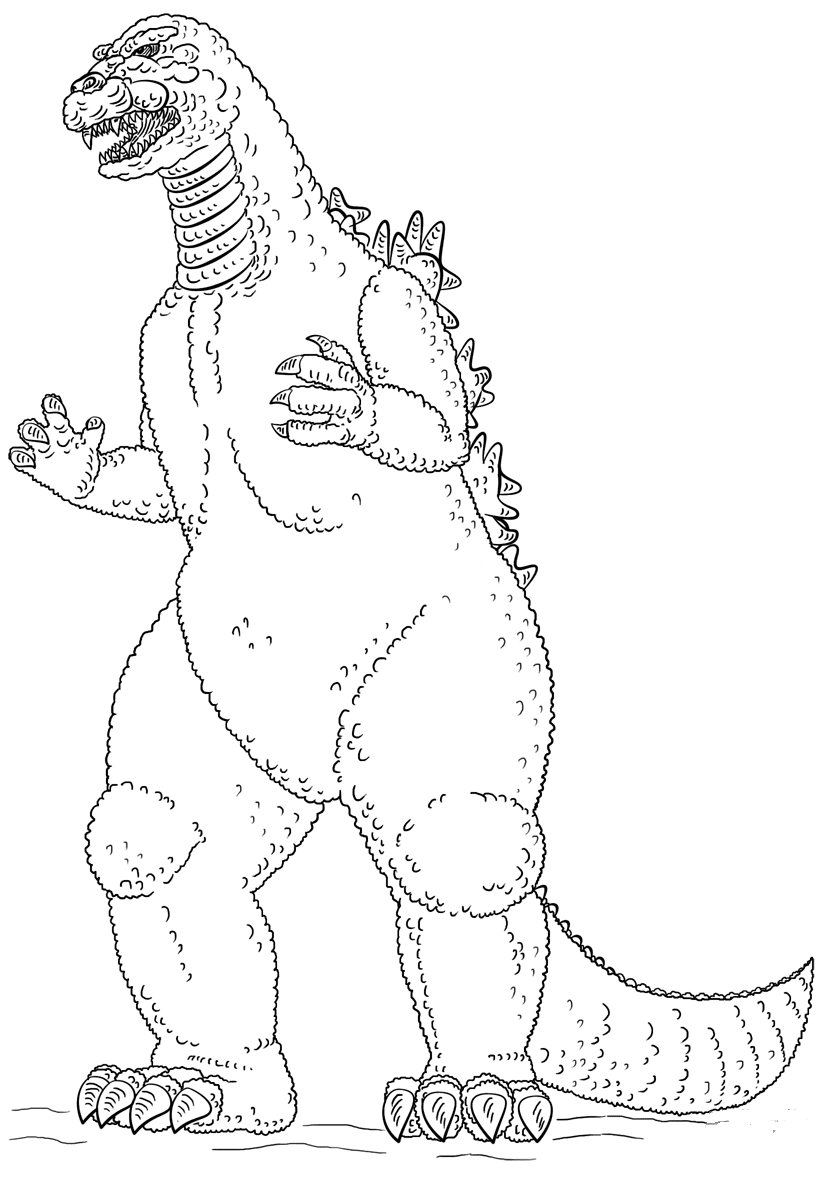
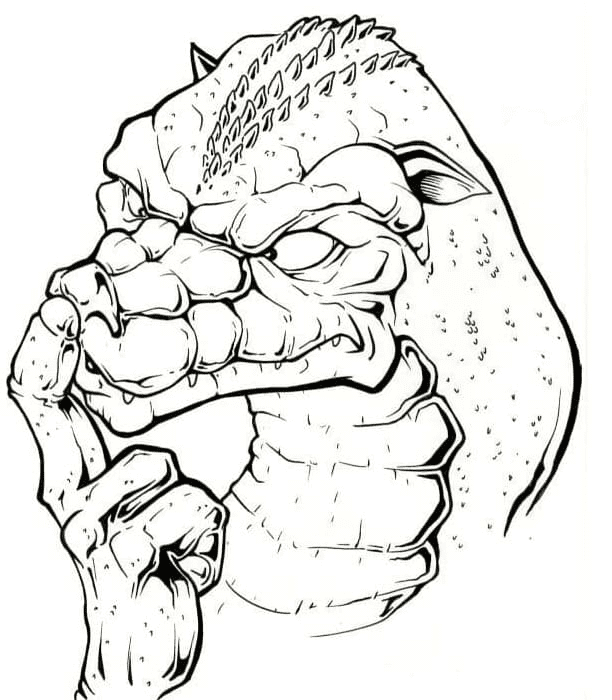
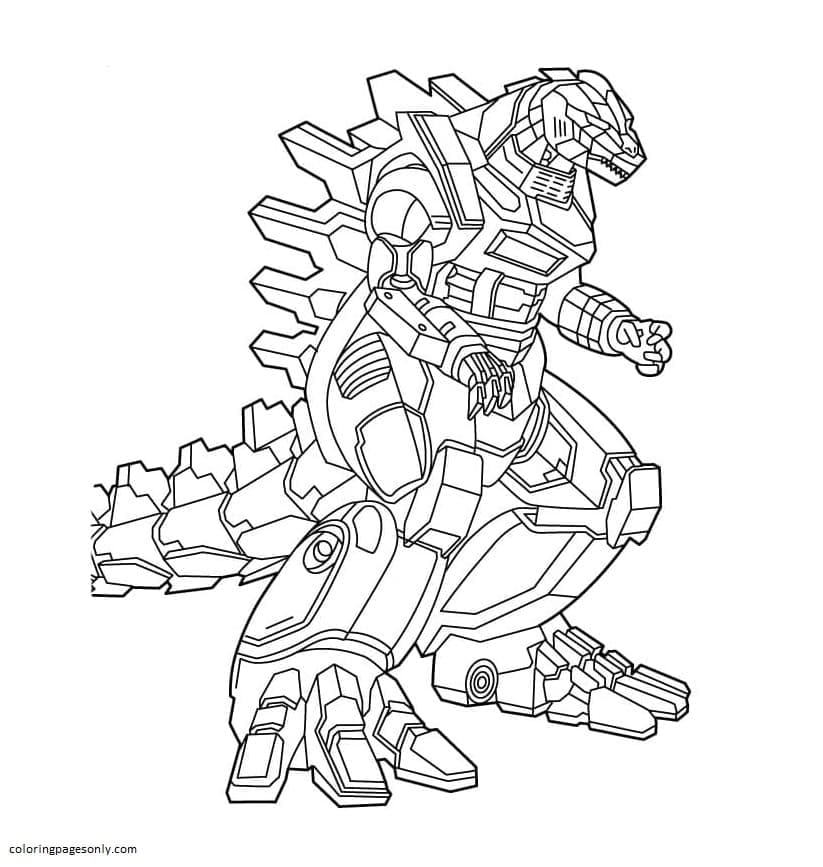
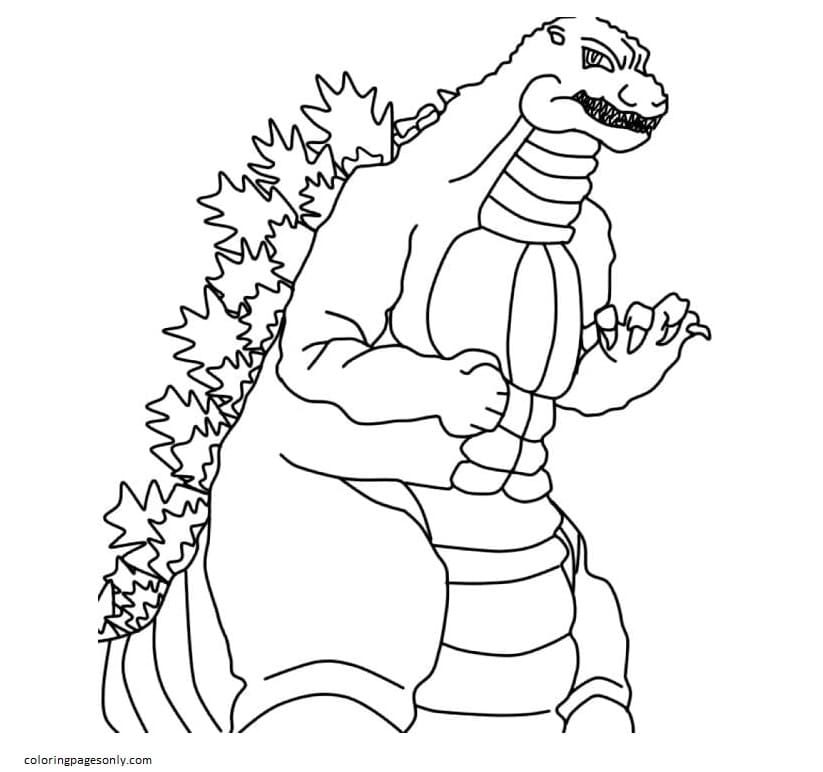
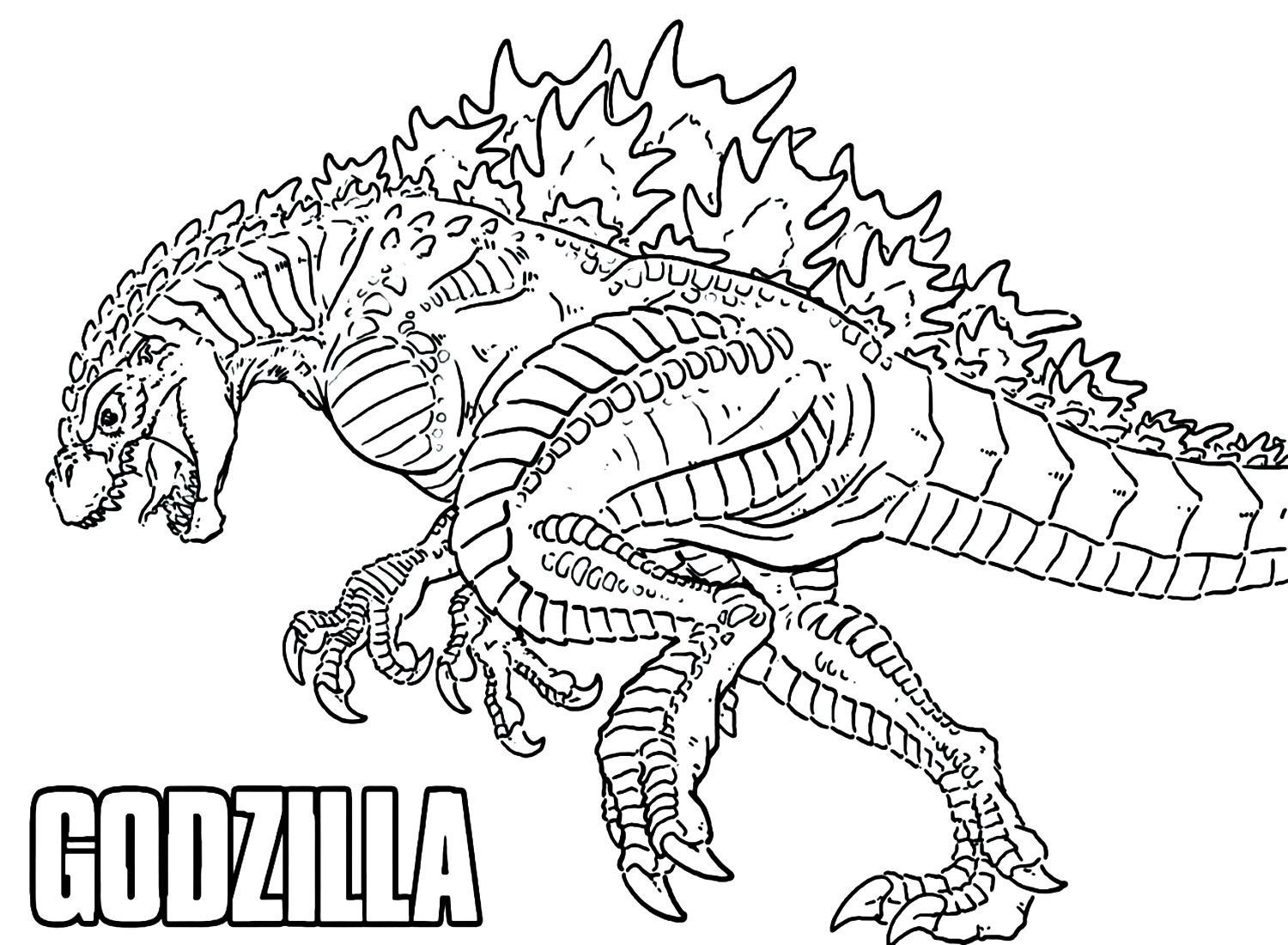
Free Godzilla coloring pages: 60+ pages featuring the King of the Monsters in towering roar poses with dorsal plates glowing, atomic breath firing sequences with vivid beam effects, Godzilla versus King Ghidorah battle compositions, Godzilla versus Kong confrontation scenes, Mothra and Rodan pages, Mechagodzilla robotic design pages, Shin Godzilla’s distinctly unsettling form, the Godzilla Minus One terrifying post-war design, MonsterVerse action scenes, and the full visual vocabulary of the kaiju franchise that has produced approximately 38 films across seventy-one years. All free, printable PDFs and online coloring for fans of the franchise across all generations.

Godzilla (ゴジラ, Gojira) first appeared in the Japanese film of the same name, directed by Ishirō Honda, with special effects by Eiji Tsuburaya and produced by Tomoyuki Tanaka for Toho Co., Ltd. The film was released in Japan on November 3, 1954. The name “Gojira” combines the Japanese words for gorilla (ゴリラ, gorira) and whale (クジラ, kujira). In English-speaking markets, the American re-edit titled Godzilla, King of the Monsters! was released in 1956 with the anglicized spelling that became the character’s global name.
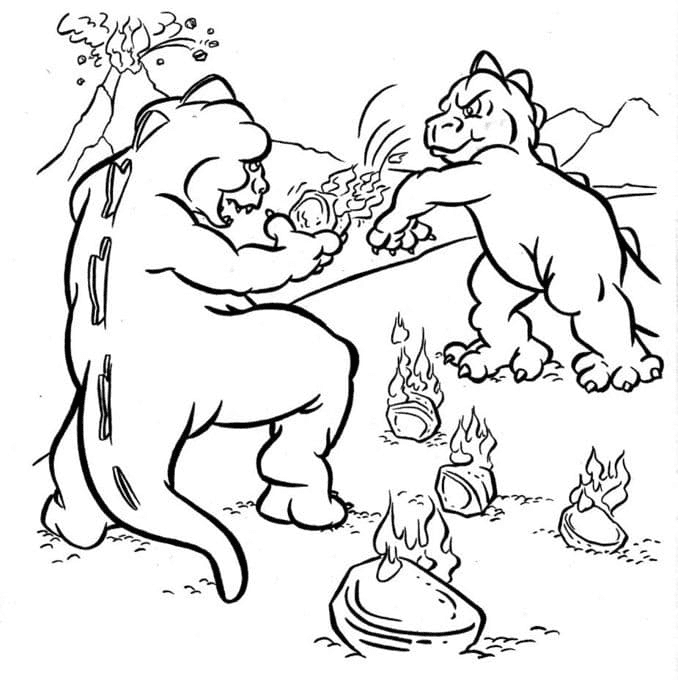
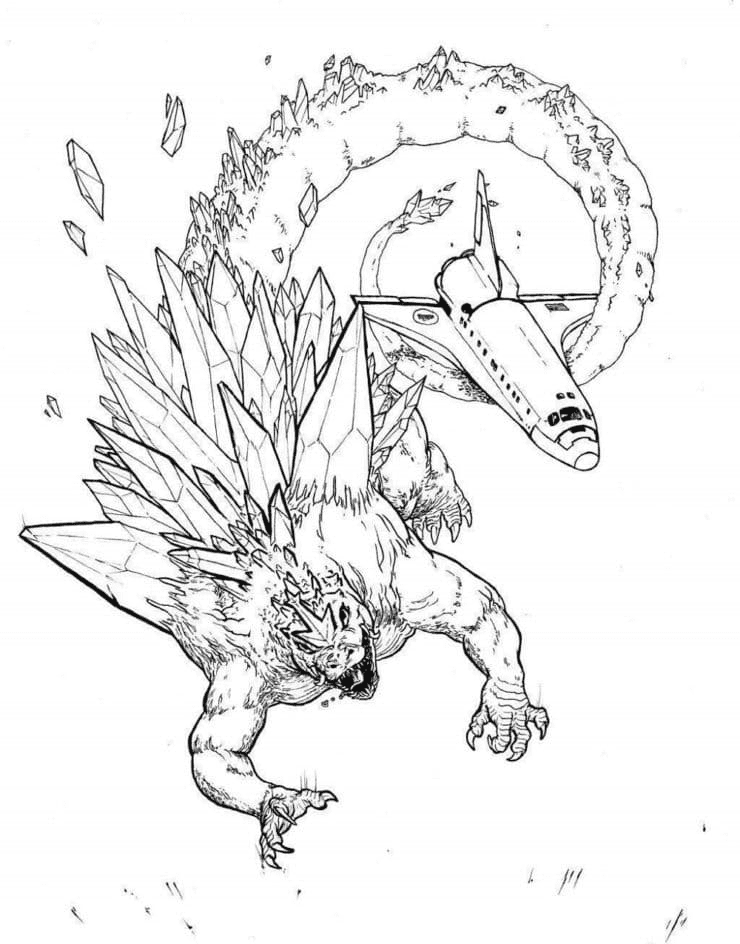
The 1954 film was released nine years after the atomic bombings of Hiroshima (August 6, 1945) and Nagasaki (August 9, 1945), and three months after the Castle Bravo nuclear test at Bikini Atoll (March 1, 1954) irradiated the Japanese fishing vessel Daigo Fukuryu Maru and its 23 crew members, killing Aikichi Kuboyama. These direct historical contexts are embedded in the film’s premise: Godzilla is a prehistoric creature awakened and transformed by nuclear radiation from atomic bomb testing in the Pacific. The creature’s skin texture was designed to evoke the keloid scars of atomic bomb survivors. In 2024, the 1954 film was selected for preservation in the United States National Film Registry by the Library of Congress.

Godzilla Minus One (ゴジラ-1.0), directed by Takashi Yamazaki and released November 3, 2023, in Japan, became the first Japanese film to win the Academy Award for Best Visual Effects, receiving the award at the 96th Academy Awards on March 10, 2024. Its budget of approximately $15 million produced visual effects that competed with productions budgeted at fifteen to twenty times that amount.

These 60+ free pages at ColoringPagesOnly.com span the franchise’s full visual history. All free, PDF or PNG, print or color online.

What’s Inside

Classic Godzilla: Portrait and Standing Pages

The original 1954 Godzilla’s design was created by Teizo Tochimura and Eiji Tsuburaya with deliberate reference to the visual and emotional impact of the atomic bombings. The skin texture, rough and irregularly bumpy, was designed to evoke the specific appearance of keloid scar tissue from radiation burns on Hiroshima and Nagasaki survivors. The dorsal plates, irregular and jagged along the spine, have been described by film scholars as resembling the shape of the atomic bomb mushroom cloud when viewed from above.

The character was portrayed by Haruo Nakajima in the original film and in subsequent Toho productions through 1972, performing inside the rubber suit in a model-cityscape environment. Nakajima’s physical performance, developed through his study of bears and other large animals at the zoo, gave the character a specific weight and deliberate movement quality that distinguished it from generic monster-movie creatures and contributed to the film’s emotional impact.

The original Godzilla design is dark charcoal grey, nearly black, with rough surface texture throughout. Subsequent eras produced progressively different designs, but the basic silhouette has remained consistent: bipedal, massive, with the distinctive dorsal plate arrangement as the most immediately recognizable design element.

Coloring classic Godzilla pages: The body uses very dark charcoal grey or near-black as the base color applied at full coverage. The surface texture, if indicated by linework in the page design, is the most important coloring decision: apply slightly darker tones in the recessed areas of the texture (the valleys between the bumpy skin nodes) and leave the raised surfaces at the base dark grey. The dorsal plates are slightly lighter grey or a very dark charcoal with slightly lighter edges where they taper to points.

Godzilla’s Atomic Breath

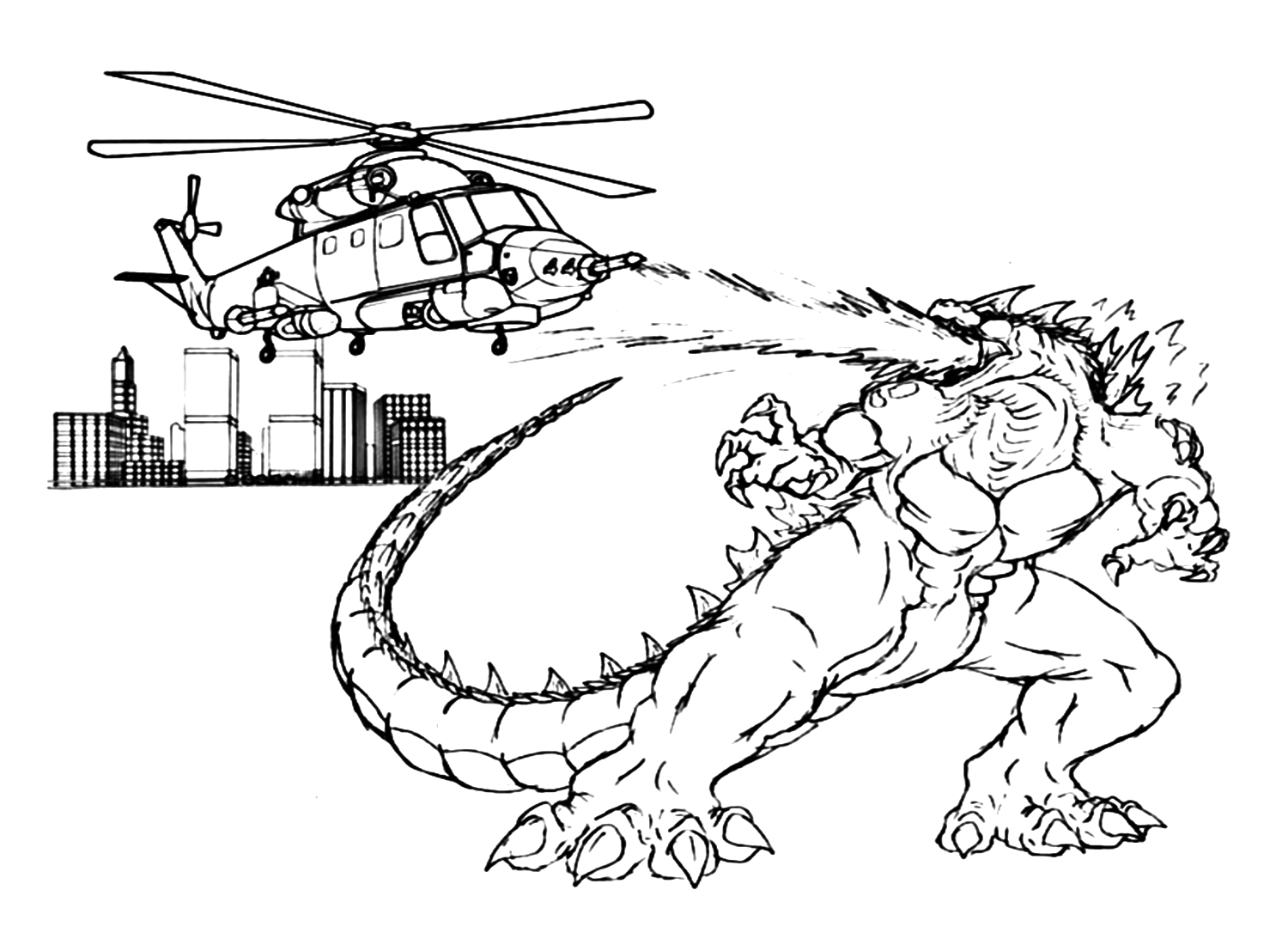
The atomic breath is Godzilla’s most powerful attack and the franchise’s most visually iconic single action: a concentrated beam of radioactive atomic energy fired from the creature’s open mouth, preceded by the dorsal plates illuminating in sequence from tail to head as the energy charges. The visual of the dorsal plates lighting up in order along the spine is one of the most effective build-up sequences in monster film history: each illuminated plate represents a step toward the devastating release that follows.

The specific color of the atomic breath has changed across eras. In the original 1954 film, it was rendered as a white heat ray through practical special effects. In later Showa-era films, it was shown in various ways. In the MonsterVerse productions, it is a vivid electric blue or blue-purple beam. In Godzilla Minus One (2023), the breath has a distinctive build-up sequence showing heat distortion before the beam releases.

The dorsal plates in MonsterVerse Godzilla specifically glow with vivid blue-purple energy before and during the atomic breath release, giving the attack its most visually dramatic build-up sequence in the franchise’s history.

Coloring atomic breath pages: The dorsal plates, when charging, use vivid electric blue-purple at the plate surfaces, graduated from the base (most vivid, most concentrated) to the tip of each plate (slightly lighter and more diffuse). The atomic breath beam itself uses the center-to-edge gradient technique: near-white or pale blue-white at the absolute center of the beam (highest energy concentration), graduating through vivid electric blue to deep blue-purple at the outer edges. Any impact effects at the target use vivid orange-yellow at the impact center, suggesting heat from the radiation.

Shin Godzilla Pages

Shin Godzilla (シン・ゴジラ), directed by Hideaki Anno and Shinji Higuchi and released July 29, 2016, reimagined Godzilla as a genuine biological terror in the tradition of the 1954 original: not a fun monster-movie creature but something profoundly disturbing, biologically grotesque, and narratively used to critique the dysfunction of Japanese government bureaucracy in responding to existential threats. The film won seven Japan Academy Film Prizes, including Picture of the Year for 2016.

The Shin Godzilla design, created by Mahiro Maeda, is deliberately unsettling in ways that the franchise had not previously attempted. The creature evolves through four distinct forms during the film, each more developed than the last. The fourth and final form, the most recognizable for coloring purposes, features: very small, unusually positioned eyes; a frozen-open jaw showing rows of teeth; irregular, asymmetrical skin texture suggesting ongoing cellular mutation; dorsal plates that spray purple-black fire in addition to the standard atomic breath; and a tail that splits into multiple branches, each capable of firing atomic energy independently.

The design’s specific horror is its quality of incompleteness: it looks like a creature in the middle of an evolutionary process, not a finished form, which makes it more disturbing than a conventional monster design.

Coloring Shin Godzilla pages: The skin is a deep, slightly red-shifted dark grey, suggesting the specific charcoal-to-deep-charcoal of the original design but with warm undertones suggesting the creature’s active cellular processes. The small eyes glow: apply vivid red or vivid orange in the small eye positions, providing the only warm vivid accent in an otherwise near-monochromatic composition. The dorsal plates use a slightly warmer, slightly lighter grey than the body. Any atomic breath shown from Shin Godzilla uses the standard blue for the primary beam, but may include dark purple-black at the edges, referencing the film’s specifically dark visual treatment of the creature’s biological processes.

Godzilla Minus One Pages

Godzilla Minus One (ゴジラ-1.0), set in post-World War II Japan in the years 1945 to 1947, presents Godzilla as an immediate, comprehensible terror experienced at human scale rather than the distant city-destroying force of many franchise entries. Director Takashi Yamazaki specifically designed this film’s Godzilla to recreate the specific existential horror of the original 1954 film: a Japan already devastated by the war, now confronted with a new catastrophe that feels like the world refusing to allow the country to recover.

The Godzilla Minus One design is lean and predatory compared to the bulkier MonsterVerse version: longer neck, more angular features, prominent and asymmetrical dorsal plates, and a mouth that opens to reveal the specific biological horror of something built by mutation rather than by normal evolutionary processes. The film’s visual effects team, who created work that won the Academy Award for Best Visual Effects on a budget a fraction of Hollywood productions, rendered the creature with particular attention to its scale relationship to individual humans.

Coloring Godzilla Minus One pages: The design uses a very dark charcoal, close to near-black, with a slight warm undertone suggesting biological activity. The dorsal plates are larger and more irregular than the classic design; they are slightly lighter grey at their upper edges, where light catches the pointed tips. Any scenes showing the atomic breath from this design use a particularly intense, almost too-bright blue-white for the beam, suggesting the biological power of a creature whose radiation level significantly exceeds normal physical parameters.

MonsterVerse Godzilla: Legendary Era Pages

The MonsterVerse Godzilla, introduced in Gareth Edwards’ 2014 film and designed by Legendary Entertainment, takes a significantly different design approach from the Toho originals: larger, with a more rounded, bear-like facial structure, deep-set cat-like eyes, and a body that reads as a massive apex predator rather than as a radiation-formed biological anomaly.

This Godzilla is depicted across multiple films as the “alpha apex predator” of the Titans: the dominant creature in a world that contains many giant monsters, whose natural role is maintaining balance among them. The MonsterVerse films have progressively shifted his narrative role from mysterious threat in 2014 to something more complex: a creature with something like purpose, whose conflicts with other Titans (particularly in Godzilla vs. Kong, 2021, and Godzilla x Kong: The New Empire, 2024) are narrativized as territorial and ecological rather than as pure destruction.

His dorsal plates in the MonsterVerse design glow vivid electric blue when charging the atomic breath, making him one of the few kaiju whose power-up sequence is as visually dramatic as the attack itself.

Coloring MonsterVerse Godzilla pages: The body uses dark charcoal grey with a slightly cooler (blue-shifted) tone compared to the original’s warmer grey. The surface texture is less rough and more scaled, with the regular pattern of large, overlapping scales visible across the skin. The dorsal plates in charging sequence glow vivid electric blue: apply the blue at maximum saturation within the plate, slightly lighter blue at the center of the glow, and deeper blue at the plate’s edges.

King Ghidorah, Mothra, and Other Kaiju

King Ghidorah (キングギドラ) is the franchise’s most visually dramatic adversarial kaiju: a three-headed golden space dragon with two tails and massive wings. His first appearance was in Ghidorah, the Three-Headed Monster (1964), where his arrival from space escalated the threat level beyond what any single monster, including Godzilla, could address. The three necks and heads, each capable of firing golden lightning bolts, make him the most compositionally complex kaiju in the collection’s pages.

Mothra (モスラ) is the franchise’s most benevolent kaiju: a giant moth whose role is protective rather than destructive, associated in the classic Toho films with the Shobijin (tiny twin priestesses who communicate on her behalf) and whose relationship with Godzilla has shifted from adversarial to alliance depending on the specific film.

Coloring King Ghidorah pages: His body is vivid golden-yellow at full saturation, applied across the full body, neck, and wings. The lightning bolt attacks fired from his three heads are pale yellow-white in core with vivid golden-yellow outer edges. Coloring Mothra pages: Her wings use the full spectrum of warm colors in intricate patterns: deep warm orange-brown at the wing bases, graduating through orange and yellow-orange to pale cream-yellow at the wing tips. Her body is warm brown with fur texture.

What These Pages Do

The 1954 Godzilla film’s specific historical context, its creation in the years immediately following the atomic bombings of Hiroshima and Nagasaki and months after the Daigo Fukuryu Maru incident, gives the franchise a documented connection to real historical trauma that separates it from most monster films. Film scholars, including Susan Napier, Chon Noriega, and others, have written extensively on the film’s function as a processing mechanism for nuclear anxiety in a society that had experienced the world’s first uses of nuclear weapons against a civilian population. The creature’s keloid-scar skin texture and mushroom-cloud dorsal plate design are documented design choices with specific historical reference points.

The Academy Award for Best Visual Effects won by Godzilla Minus One at the 96th Academy Awards (March 10, 2024) is the most significant recent milestone in the franchise’s international reception history: the first Japanese film to win in that category, produced on a budget of approximately $15 million in competition with productions budgeted at $150 million to $300 million. Director Takashi Yamazaki and his team created the winning visual effects work using a smaller team and more efficient production methodology than Hollywood productions, an achievement specifically noted in industry coverage of the win.

The American Academy of Pediatrics identifies fine motor skill development as a key childhood milestone throughout early childhood. The dorsal plate pattern’s repeated geometric forms, the atomic breath gradient technique, the complex surface texture of the creature’s skin, and the three-head compositional challenge of King Ghidorah all provide sustained fine motor practice across the collection’s age range. The 2005 Art Therapy Journal study on structured coloring and anxiety reduction applies throughout.

How to Color These Pages Well

Godzilla’s grey is not neutral grey but a warm or cool charcoal, depending on the era being depicted. The original 1954 Toho Godzilla uses a slightly warm dark charcoal (the warmth suggests the biological reality of the creature’s radiation-formed body). The Heisei and Millennium era designs use a cooler, slightly blue-shifted charcoal. The MonsterVerse uses a similarly cool dark grey. The Shin Godzilla uses warm undertones to suggest active cellular mutation. Before applying any grey to a Godzilla page, identify which design era the page references and apply the appropriate warm or cool shift to the base dark grey.

The surface texture is the single most time-consuming and most rewarding element on any Godzilla page. Godzilla’s skin is not smooth: it is covered with irregular, bumpy nodes, rough scales, or the specific, grotesque texture of whatever era’s design is depicted. For textured surface work, apply the base dark grey at full coverage first. Then apply slightly darker grey in all the recessed areas between the texture nodes, using short directed strokes that follow the texture’s irregular pattern. The raised surfaces of each texture node remain at the base grey. This two-tone approach gives the skin its three-dimensional surface quality.

Dorsal plates require a consistent progression of size and shape from tail to head. Godzilla’s dorsal plates begin smaller near the tail and increase in size toward the mid-back before tapering again toward the head. Apply the plates in this size sequence: if the plate sizes in the coloring page are inconsistent with this progression, apply the darkest and most fully saturated color to the largest, most central plates, and apply slightly lighter and less saturated versions to the smaller plates at the extremities. This value progression reinforces the size hierarchy and makes the central plates the visual focal point.

King Ghidorah’s golden color requires the warmest, most vivid gold available. His three-headed design is immediately undercut if his golden color reads as pale yellow or as dull metallic. Apply the most vivid warm golden-yellow available at full saturation across every surface of all three necks and heads, the wings, and the body. The metallic quality of the gold can be suggested by applying slightly deeper amber-gold in the deepest shadow areas of each neck’s underside. The lightning bolt attacks from the three heads use the lightest available yellow-white.

Atomic breath pages are most effective when the background is darkened around the beam. The atomic breath’s vivid electric blue reads at maximum intensity against a dark background. On any page showing Godzilla firing atomic breath, apply a dark background tone (near-black or very dark grey for night scenes, dark blue-black for sky) before applying the atomic breath colors. The contrast between the dark surrounding environment and the vivid blue beam gives the attack its visual power.

5 Creative Craft Ideas

The 1954 Historical Context Page

The 1954 Godzilla film was released nine years after the atomic bombings of Japan and three months after the Castle Bravo nuclear test irradiated the Daigo Fukuryu Maru fishing vessel. Aikichi Kuboyama, the ship’s radio operator, died from radiation poisoning on September 23, 1954, six weeks before the film’s release. In 2024, the Library of Congress selected the 1954 film for preservation in the United States National Film Registry.

Print the most classically styled Godzilla portrait page in the collection. Color in dark charcoal grey with rough skin texture, referencing the 1954 original design.

On the backing card: “Godzilla. Directed by Ishirō Honda. Released November 3, 1954. The creature: a prehistoric life form awakened and transformed by nuclear radiation from Pacific bomb testing. The skin texture is designed to evoke the keloid scars of atomic bomb survivors. The Castle Bravo nuclear test: March 1, 1954. Daigo Fukuryu Maru: irradiated, March 1954. Aikichi Kuboyama: died September 23, 1954. The film was released on November 3, 1954. In 2024: selected for the United States National Film Registry.”

The Academy Award Page

Godzilla Minus One (2023), directed by Takashi Yamazaki and released November 3, 2023, in Japan, won the Academy Award for Best Visual Effects at the 96th Academy Awards ceremony held March 10, 2024. It was the first Japanese film to win in this category. The film was produced on a budget of approximately $15 million, competing with productions budgeted at $150 million to $300 million.

Print the most dynamic Godzilla action page in the collection. Color in the lean, terrifying design of the Minus One era: very dark charcoal with aggressive, forward-leaning posture suggesting the creature as an existential, immediate threat rather than a distant city-destroying force.

On the backing card: “Godzilla Minus One. Director: Takashi Yamazaki. Release: November 3, 2023 (Japan). Budget: approximately $15 million. Academy Award for Best Visual Effects, 96th Academy Awards, March 10, 2024. First Japanese film to win Best Visual Effects. The visual effects team: smaller than Hollywood productions. The result: this. Rotten Tomatoes: 98%.”

The Evolutionary Forms of Shin Godzilla

Shin Godzilla (2016) is the only Godzilla film in which the creature visibly evolves through multiple distinct physical forms during the events of the film. The first form, in which the creature appears as a partially evolved tadpole-like creature walking on two legs, is dramatically different from the fourth and final form, which is the most recognizable and most disturbing design in the franchise’s history.

If the collection contains multiple Shin Godzilla pages showing different forms or design details, print them in order. Color the earlier forms in lighter, less saturated grey tones, suggesting incompleteness. Color the final fourth form in the deepest, most saturated dark charcoal with the warm undertone suggesting active biological mutation, and with vivid red applied to the small, strangely positioned eyes.

Mount in evolutionary sequence: “Shin Godzilla. Directors: Hideaki Anno and Shinji Higuchi. Released July 29, 2016. Japan Academy Prize Picture of the Year. The creature: an evolving biological mutation, not a finished form. Four forms visible in the film. The fourth form: the design that most directly references nuclear horror in the franchise’s history. The eyes are small. The mouth is frozen open. The tail splits into multiple independent weapons. The evolution is not complete.”

The Scale Study

Godzilla’s height has increased dramatically across the franchise’s history as special effects capabilities improved and as the narrative context shifted from Japan’s postwar cities to a global scale.

Original 1954 film: approximately 50 meters (164 feet). Heisei era (1984-1995): approximately 80-100 meters (262-328 feet). MonsterVerse Godzilla (2014-present): approximately 108-120 meters (354-394 feet) Shin Godzilla (2016): approximately 118 meters (387 feet)

Print four copies of the same Godzilla page or four different Godzilla pages representing the eras. Color all four in their respective era designs. Mount them in order of increasing size.

Beside each, draw a simple human silhouette to scale with the Godzilla figure of that era, making the scale increase visually concrete: “1954: 50 meters. The human is this small relative to this Godzilla. 2014 MonsterVerse: 108 meters. The human is this much smaller relative to this Godzilla. The building that housed the Empire State Building would reach approximately his knee.”

The Three Heads of King Ghidorah

King Ghidorah’s three heads have been given distinct personalities in the MonsterVerse interpretation: they occasionally act independently of each other, with one head more aggressive, another more cautious, and the third somewhere between. This characterization of the three heads as separate entities within one body creates a kaiju with a more complex interior life than most in the franchise.

Print the most detailed King Ghidorah page available. Plan the three-head coloring before beginning: apply golden-yellow at maximum saturation across all surfaces. Distinguish the three necks through subtle value variation: slightly lighter golden-yellow on the central neck (catching more direct light), slightly deeper amber-gold on the outer necks where they angle away from the light source. Apply the lightning bolt attacks in pale golden-white from each head independently.

On the backing card: “King Ghidorah. First appearance: Ghidorah, the Three-Headed Monster, 1964. A three-headed space dragon. Three heads: each capable of firing golden lightning bolts. The MonsterVerse interpretation: the three heads have distinct behaviors, occasionally acting independently. One creature. Three minds. The natural predator of Godzilla.”

Frequently Asked Questions

What is Godzilla, and when did the character first appear? Godzilla (ゴジラ, Gojira) is a giant monster (kaiju) created by Toho Co., Ltd. of Japan, first appearing in the film Godzilla (Gojira), directed by Ishirō Honda with special effects by Eiji Tsuburaya, released in Japan on November 3, 1954. The name combines the Japanese words for gorilla and whale. The character was conceived by producer Tomoyuki Tanaka and was designed as a prehistoric creature transformed by nuclear radiation from atomic bomb testing in the Pacific. The 1954 film was released nine years after the atomic bombings of Hiroshima and Nagasaki and three months after the Castle Bravo nuclear test irradiated a Japanese fishing vessel, giving the film a direct connection to nuclear anxiety in postwar Japan. The character has since appeared in approximately 38 films over seventy-one years.

What is the significance of Godzilla’s design in the 1954 original film? The original Godzilla’s physical design contained specific references to nuclear bombing. The skin texture, deliberately rough and irregularly bumpy, was designed to evoke the appearance of keloid scar tissue from radiation burns on atomic bomb survivors in Hiroshima and Nagasaki. The dorsal plates along the creature’s spine have been described by film scholars as resembling the shape of the atomic bomb mushroom cloud when viewed from above. The creature was conceptualized as a prehistoric life form awakened and physically transformed by nuclear radiation from Pacific Ocean bomb testing. The 1954 film has been extensively analyzed in academic film scholarship as a metaphor for nuclear destruction and specifically for the atomic bombing experience of Japan. In 2024, the Library of Congress selected the 1954 film for preservation in the United States National Film Registry.

What is Godzilla Minus One, and why is it historically significant? Godzilla Minus One (ゴジラ-1.0) is a 2023 Japanese Godzilla film directed by Takashi Yamazaki, released November 3, 2023, in Japan, with a wide international release following. The film is set in post-World War II Japan in the years 1945 to 1947. It was produced on a budget of approximately $15 million, far less than typical Hollywood productions of comparable scale. At the 96th Academy Awards ceremony held March 10, 2024, Godzilla Minus One won the Academy Award for Best Visual Effects, becoming the first Japanese film ever to win in that category. The film was specifically noted by the Academy and industry observers for achieving visual effects competitive with productions budgeted at ten to twenty times its cost. Its Rotten Tomatoes score was approximately 98%.

What is the MonsterVerse and what films does it include? The MonsterVerse is a shared cinematic universe created by Legendary Entertainment featuring classic Toho kaiju characters in new productions. The films include Godzilla (2014, directed by Gareth Edwards), Kong: Skull Island (2017, directed by Jordan Vogt-Roberts), Godzilla: King of the Monsters (2019, directed by Michael Dougherty), Godzilla vs. Kong (2021, directed by Adam Wingard), and Godzilla x Kong: The New Empire (2024, directed by Adam Wingard). The accompanying television series Monarch: Legacy of Monsters aired on Apple TV+ beginning in 2023. The MonsterVerse Godzilla design is notably different from the Toho versions: larger, with a bear-like face and cat-like eyes, presented as an apex predator whose role in the ecosystem involves maintaining balance among giant monsters called Titans.

Who are Godzilla’s most famous adversaries and allies? The franchise has established a rich kaiju ecosystem. King Ghidorah, a three-headed golden space dragon first appearing in Ghidorah, the Three-Headed Monster (1964), is Godzilla’s most formidable and most frequently recurring adversary. Mothra, a giant moth that first appeared in her own film in 1961 and crossed over with Godzilla thereafter, is typically portrayed as benevolent and has been both adversary and ally across different films. Rodan, a giant pteranodon-like creature from the 1956 film of the same name, frequently serves as Godzilla’s ally. Mechagodzilla, a robotic version of Godzilla that first appeared in 1974 and was redesigned across multiple eras, is one of the franchise’s most popular mechanically themed adversaries. In the MonsterVerse, King Kong shares the franchise as both rival and ally.

What is Shin Godzilla, and what makes its design distinctive? Shin Godzilla (シン・ゴジラ), co-directed by Hideaki Anno and Shinji Higuchi and released July 29, 2016, is a Toho production that reimagined Godzilla as a biological mutation undergoing active evolution during the events of the film. The design, created by Mahiro Maeda, is deliberately disturbing in ways the franchise had not previously attempted: the creature has very small, unusually positioned eyes, a frozen-open jaw, asymmetrical and grotesquely textured skin suggesting ongoing cellular mutation, and a tail that splits into multiple branches, each capable of firing atomic energy independently. The creature evolves through four distinct forms during the film, each more developed than the last. The film won seven Japan Academy Film Prizes, including Picture of the Year for 2016. Anno used the film to critique what he described as the dysfunction of Japanese government bureaucracy in responding to existential crises.

What age group are these pages best suited for? Godzilla coloring pages serve a wide age range. The simplest Godzilla portrait pages with large, clearly defined body areas and minimal surface texture detail are accessible from ages four and five, where the character’s dramatic scale and powerful silhouette provide clear and engaging coloring targets. The more detailed pages with surface texture rendering, atomic breath gradient work, and multi-kaiju battle compositions are most rewarding for ages seven to twelve. The historically and critically contextual pages, including the 1954 historical context, the Shin Godzilla evolutionary forms, and the Academy Award context for Godzilla Minus One, are most engaging for older teenagers and adults who can appreciate the franchise’s seventy-one-year history and its documented cultural significance.

Browse the full collection at ColoringPagesOnly.com. All 60+ pages free, no sign-up, PDF or PNG, print or color online.

Tomoyuki Tanaka, Ishirō Honda, and Eiji Tsuburaya made a film in 1954. The creature they created had skin that looked like radiation burn scars and spine plates that looked like mushroom clouds. It was a prehistoric animal transformed by nuclear weapons. Japan had been bombed nine years before.

The film has been selected for the United States National Film Registry.

In 2023, Takashi Yamazaki made a Godzilla film for $15 million. In March 2024, it won the Academy Award for Best Visual Effects. The first Japanese film to do so.

Haruo Nakajima wore the suit in 1954 and studied bears at the zoo to learn how a creature this large might move. The weight of the creature was in every step.

Pick up your darkest charcoal. The body goes first at full coverage. The texture recesses go slightly darker. The dorsal plates go slightly lighter at their tips. The atomic breath goes last: white-blue at the center, vivid electric blue for the main beam, deep blue-purple at the outer edges.

Share your work on Facebook and Pinterest and tag #Coloringpagesonly. The historical context pages and the Academy Award displays are particularly worth sharing.

Color the charcoal grey. Apply the texture dark in the recesses. The plates illuminate in sequence before the breath fires. The King of the Monsters has been here since 1954.

These related coloring collections will help you explore the wonderful world of colors. Let’s choose, be creative, and show us your great pictures!

Sophia Williams – Content Specialist & Social Media Manager

Sophia Williams manages all social media at ColoringPagesOnly.com - Pinterest (29,200+), Facebook (38,000+), Instagram, TikTok, and X. BA in ommunication & Marketing, University of Illinois Chicago. Former collaborator with WGN News, Chicago.