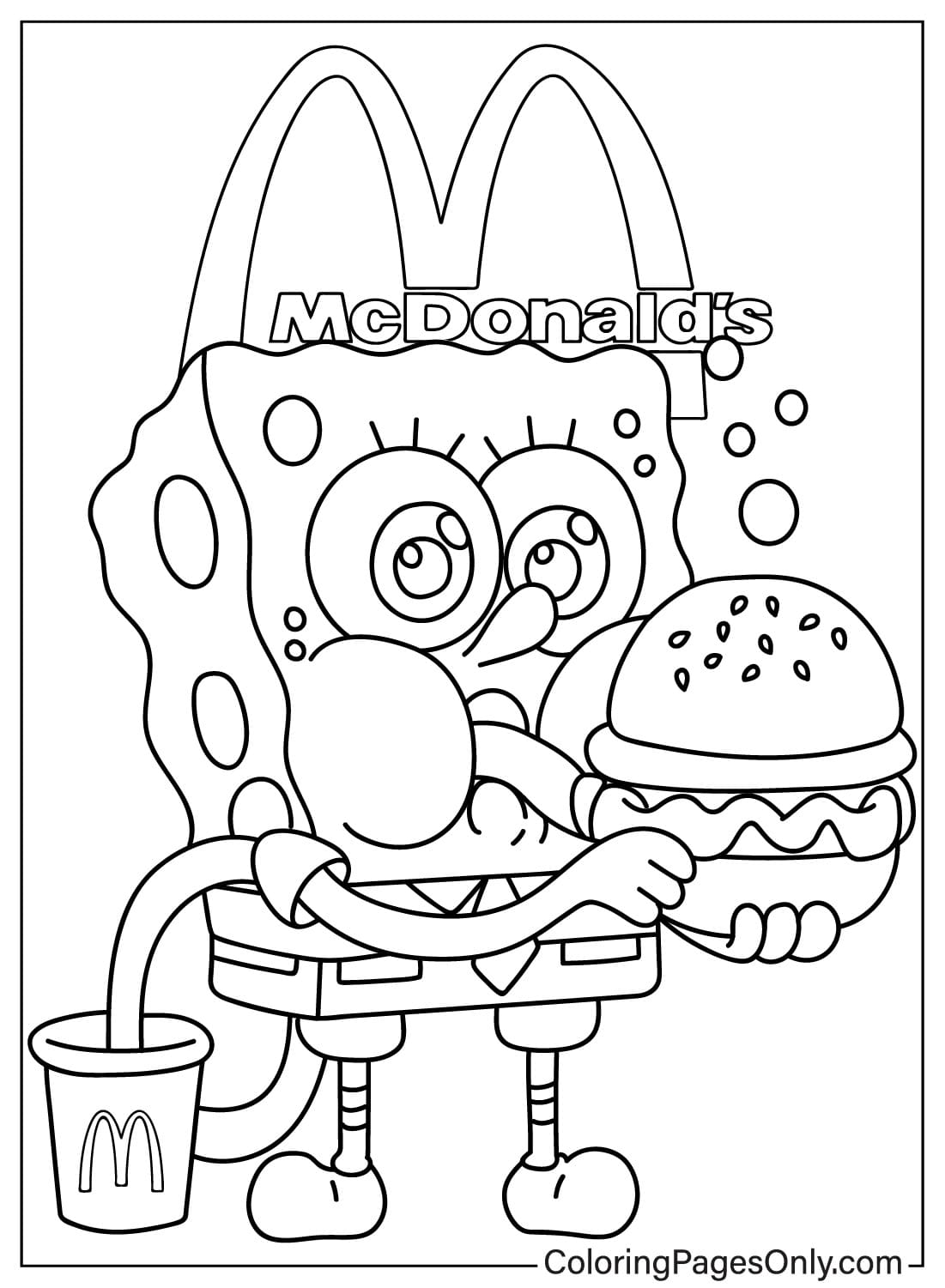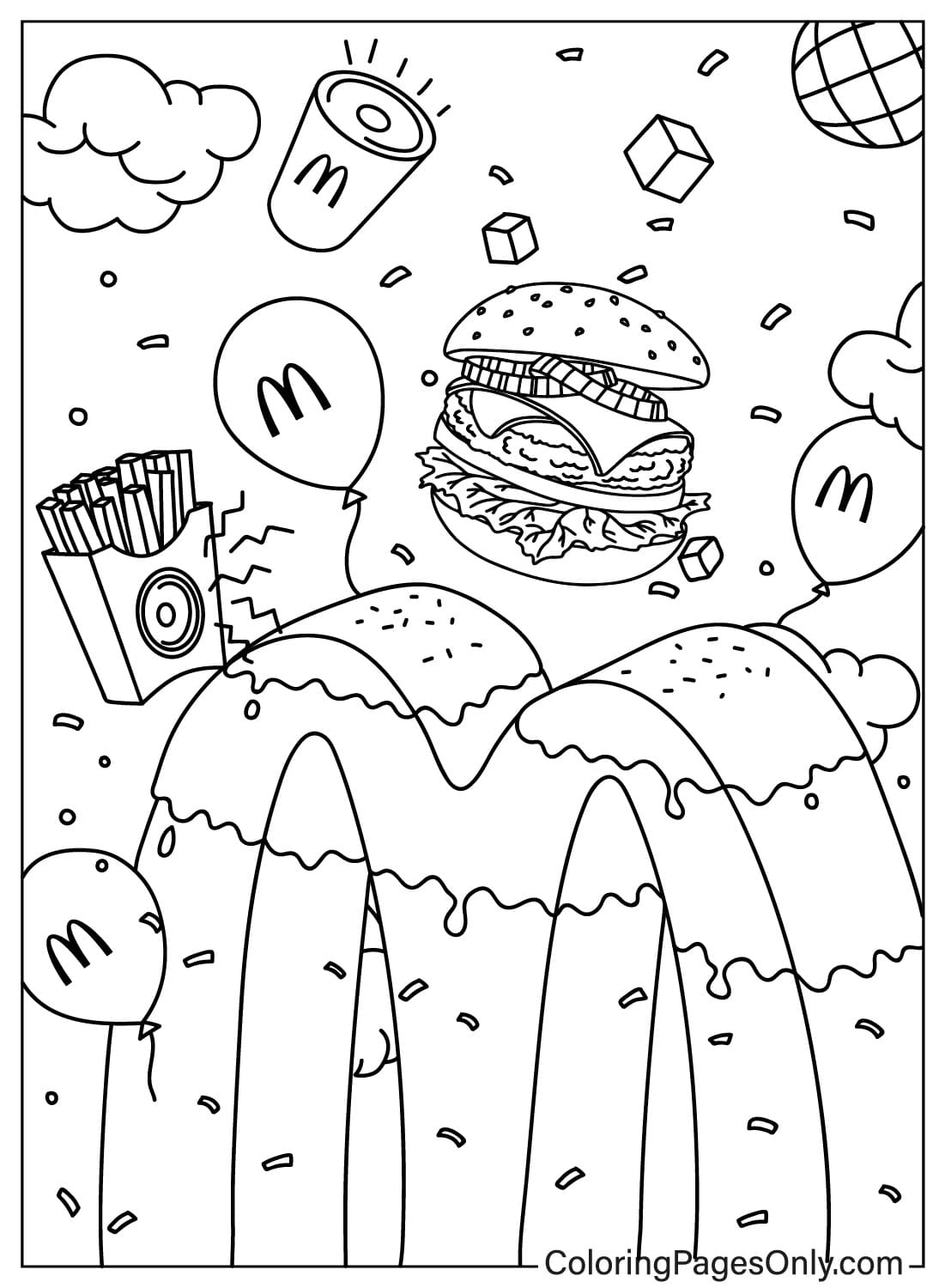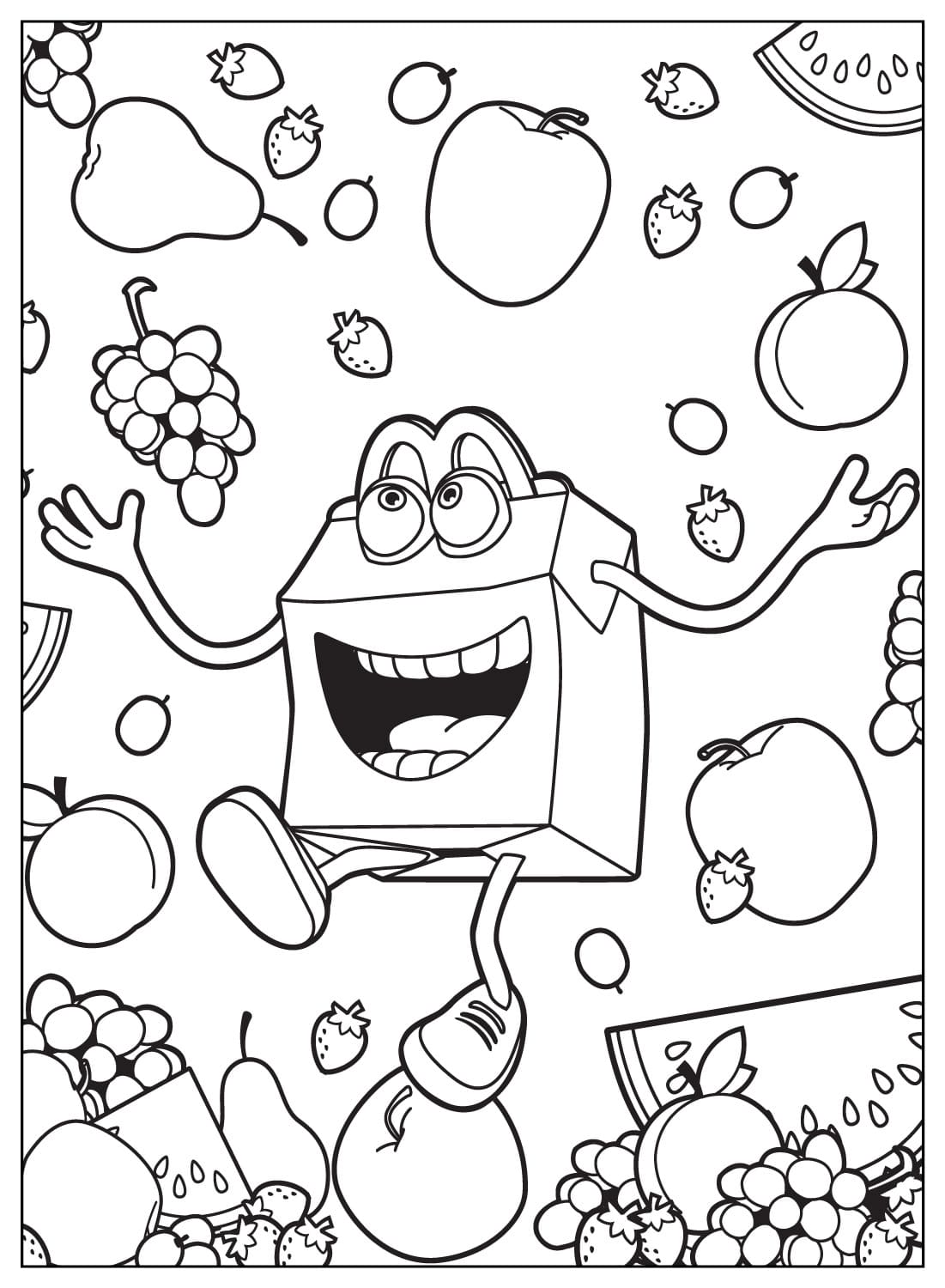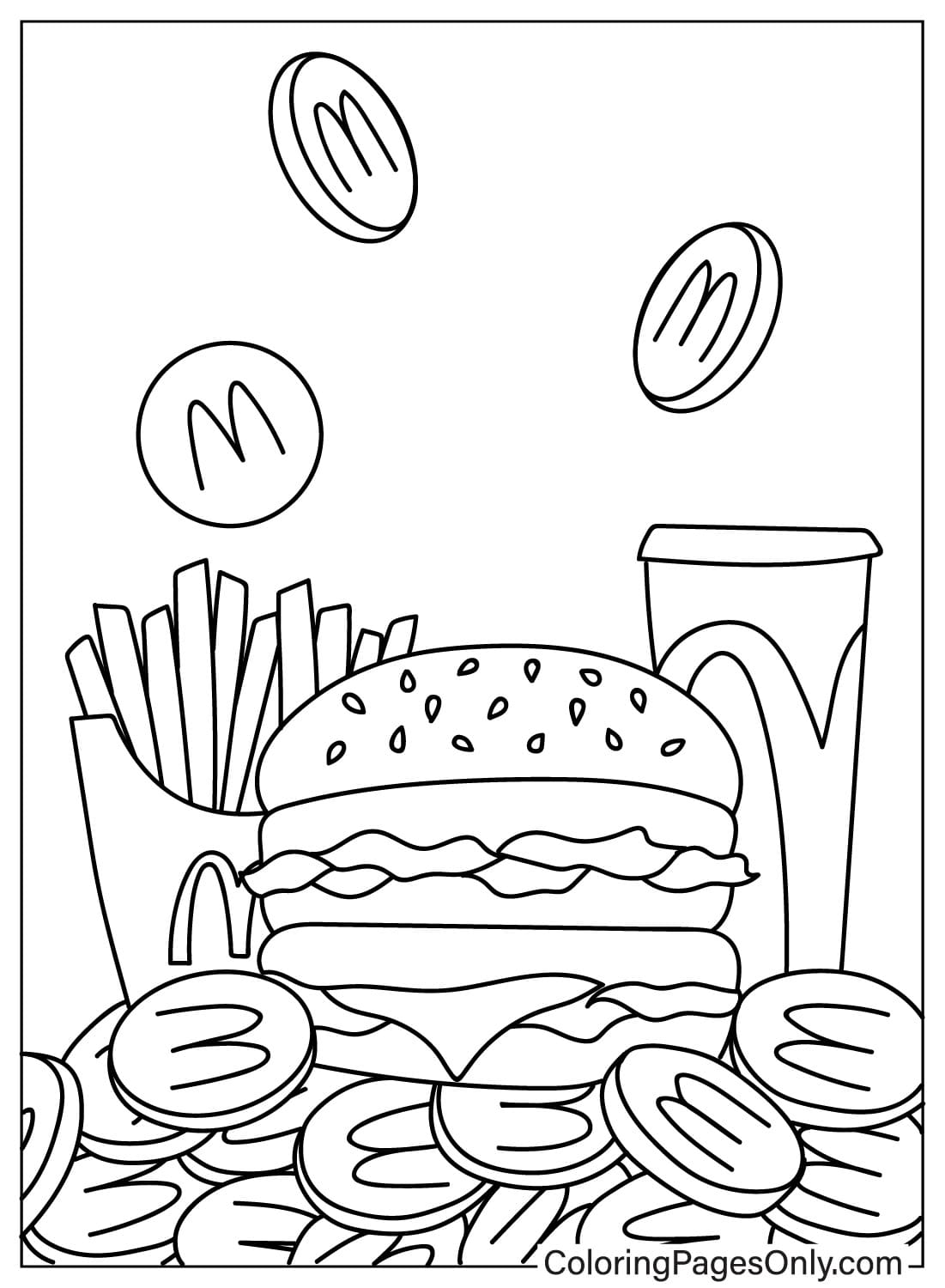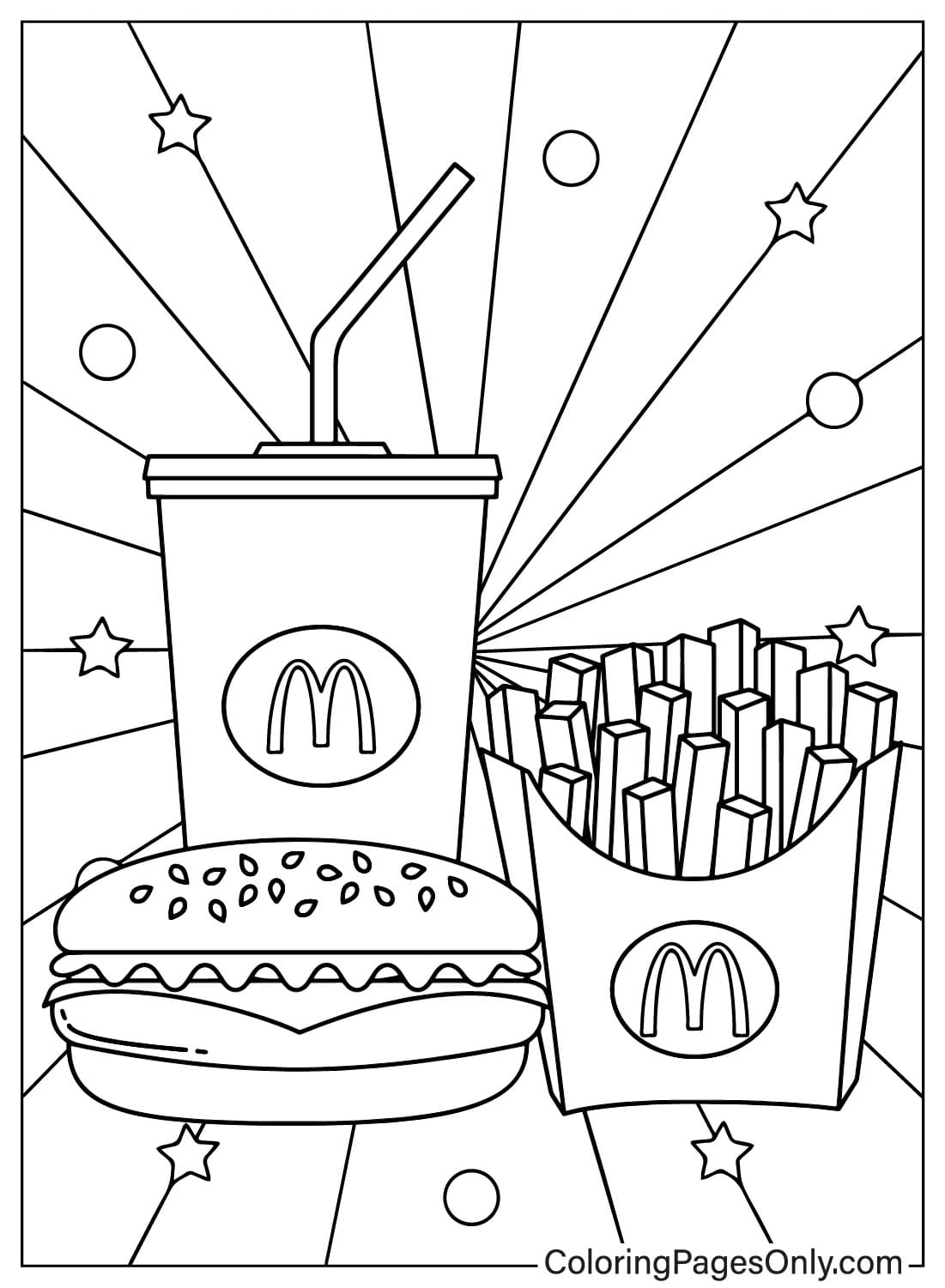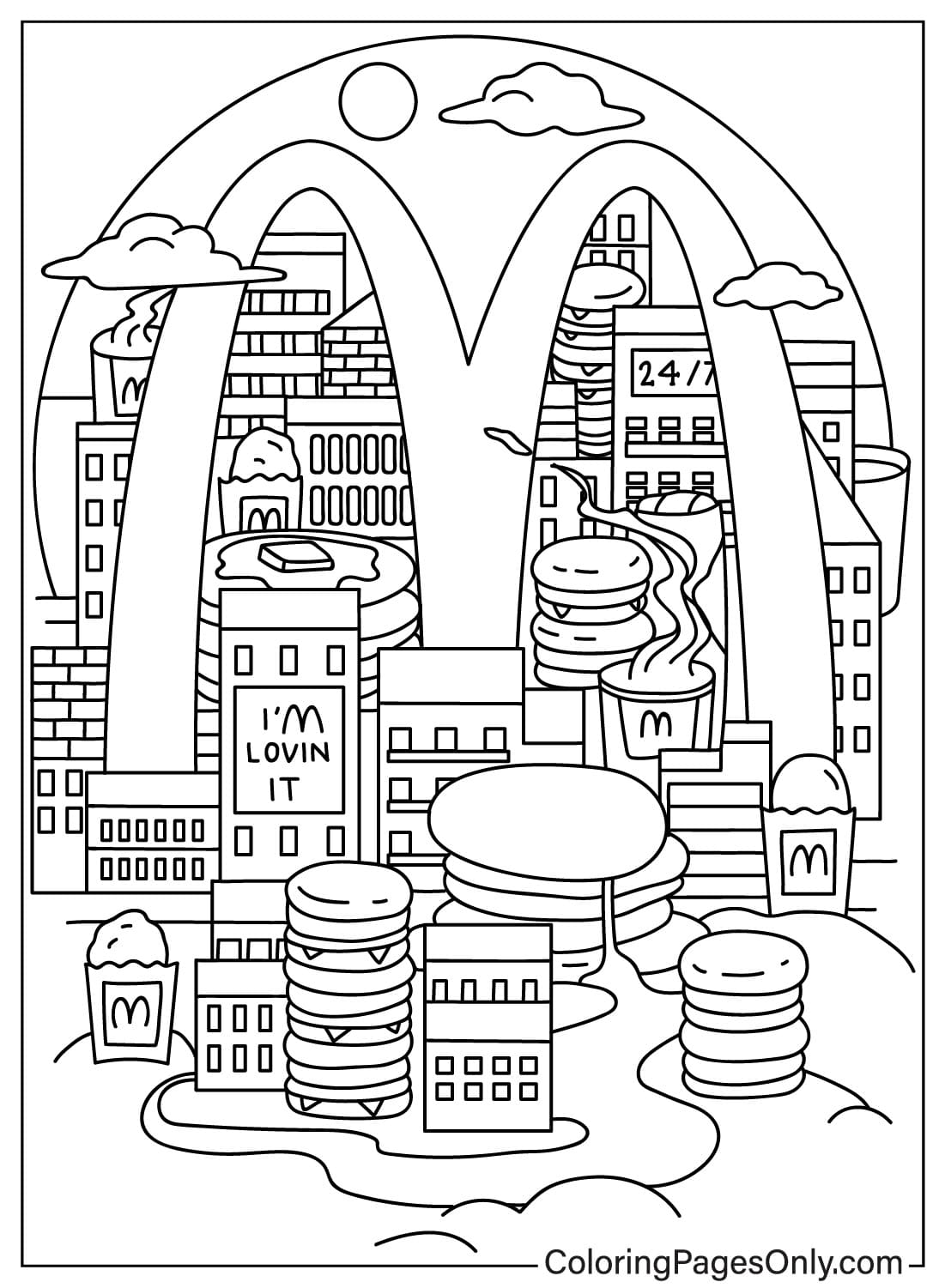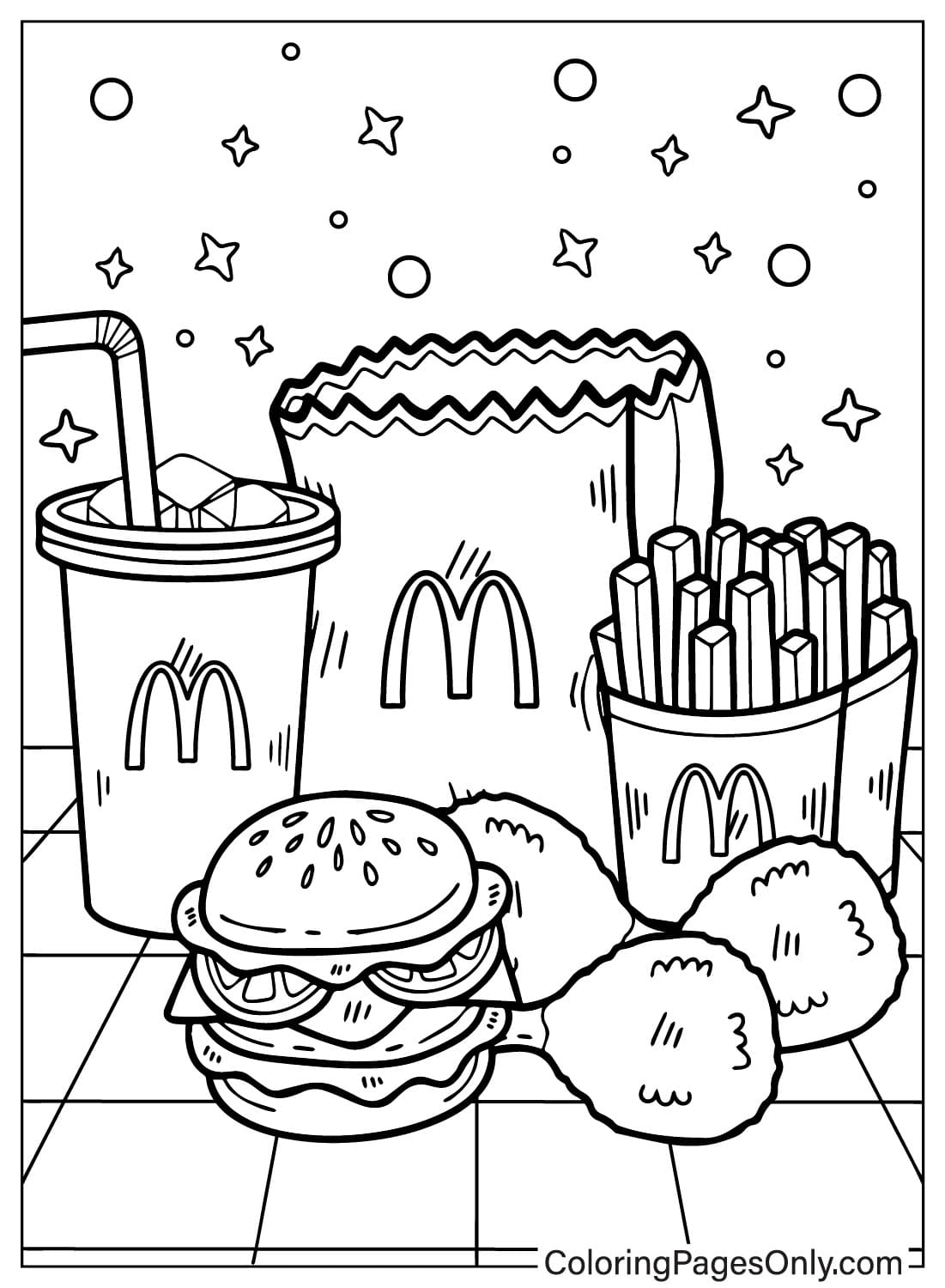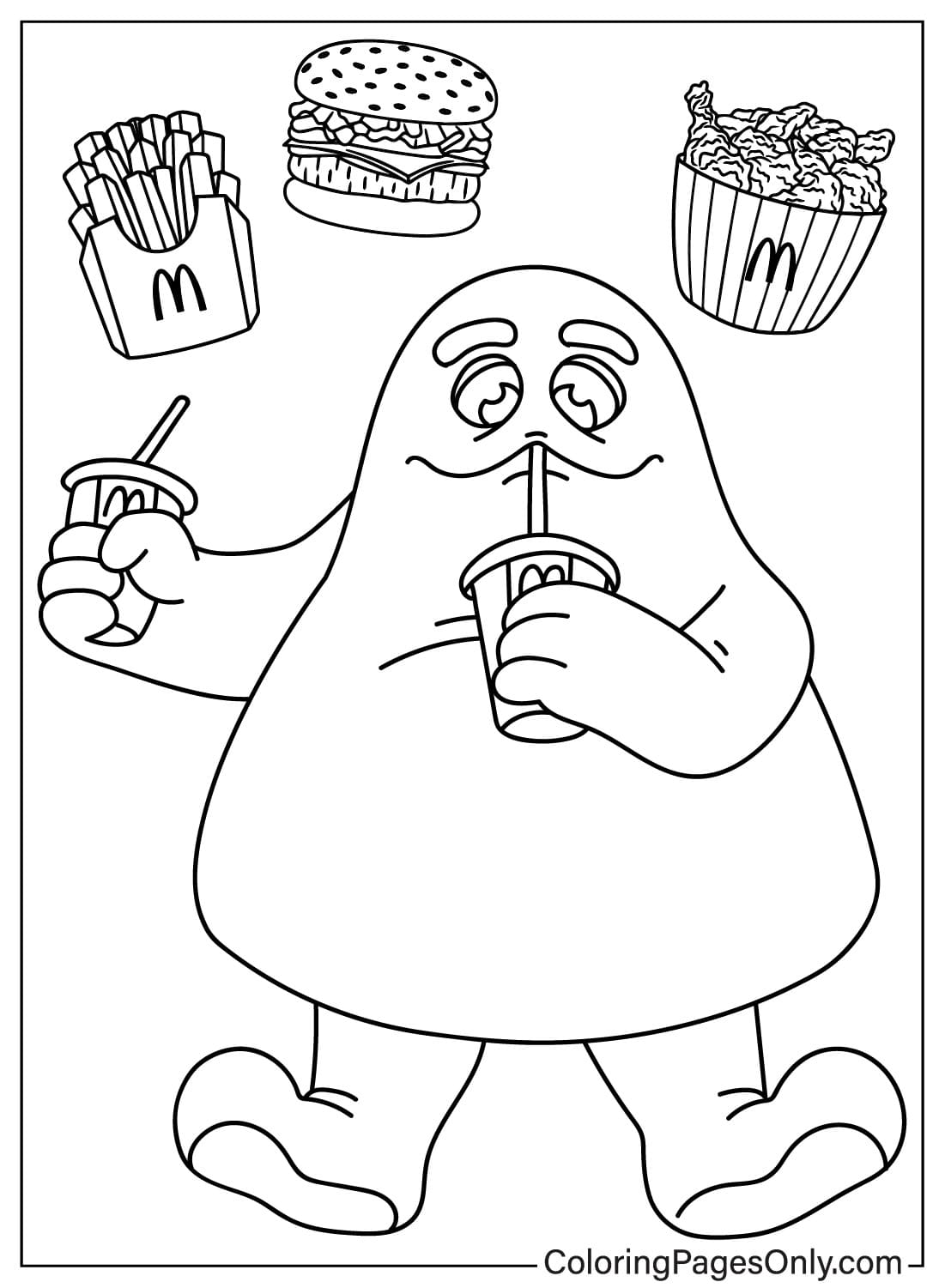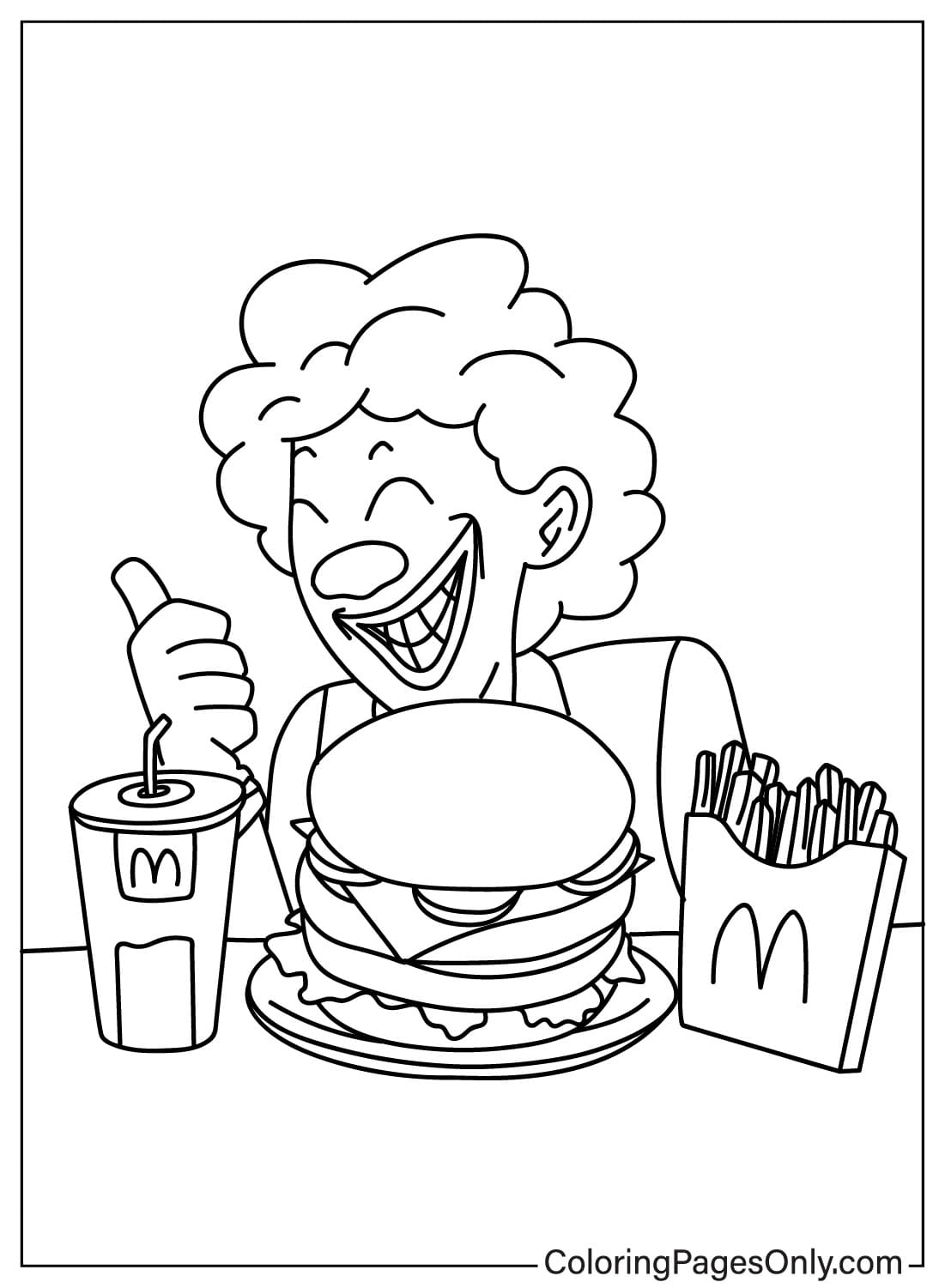
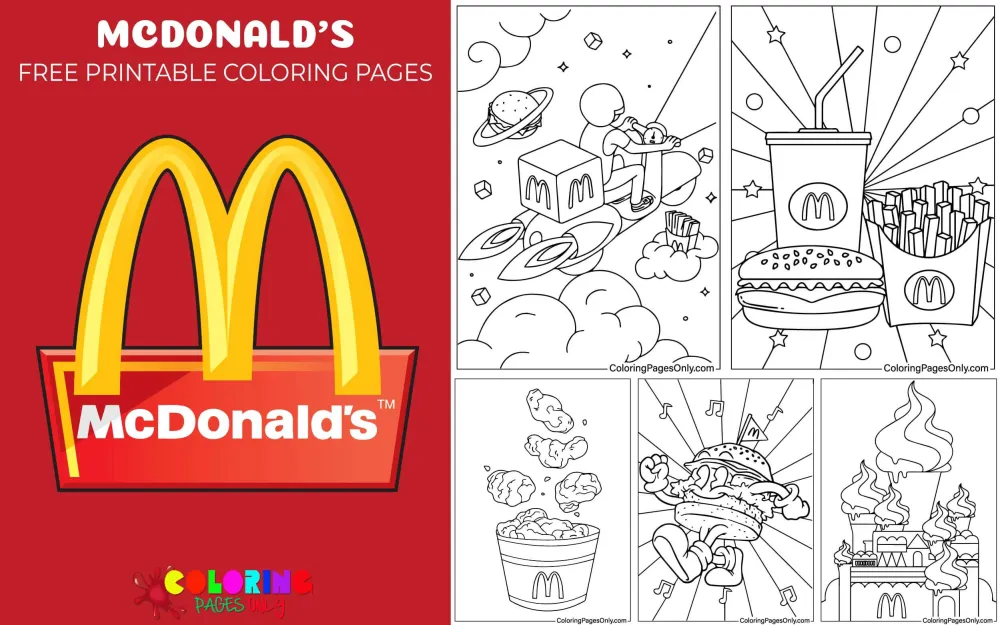
Free McDonald’s coloring pages – 20+ pages featuring the Golden Arches, Ronald McDonald, the Happy Meal box, fries, burgers, ice cream, chicken, and the full visual world of the world’s largest fast food brand – free printable PDF and online coloring for kids of all ages.
McDonald’s opened its first restaurant on April 15, 1955, in Des Plaines, Illinois, when Ray Kroc, a milkshake machine salesman, franchised a burger stand that brothers Richard and Maurice McDonald had been running in San Bernardino, California, since 1940. What Kroc understood that the McDonald brothers had not fully acted on was the system: the Speedee Service System, the brothers had developed – a kitchen assembly line approach to fast food that reduced preparation time and cost – was franchisable at scale. By 1958, McDonald’s had sold its 100 millionth hamburger. Today, McDonald’s operates over 40,000 locations in more than 100 countries and serves approximately 69 million customers daily. The Golden Arches are recognized by more people worldwide than the Christian cross, according to a survey cited in Eric Schlosser’s Fast Food Nation (2001).
These 20+ free pages at ColoringPagesOnly.com cover the full McDonald’s visual world – food, characters, the logo, and the iconic imagery that has been part of childhood for three generations of families. All free, PDF or PNG, print or color online.
What’s Inside
The Golden Arches and Brand Pages
The McDonald’s logo – the Golden Arches forming the letter M – is one of the most studied examples of corporate identity design in the world. The arches themselves originated as the architectural feature of the earliest McDonald’s restaurants, designed by architect Stanley Clark Meston in 1953: two golden parabolic arches attached to the sides of the building that, when viewed from an angle, formed a shape resembling the letter M. Designer Jim Schindler incorporated them into the formal logo in 1962. The current version – the simple yellow M on a red background – has been refined over subsequent decades but maintains the essential geometry of Meston’s original arches.
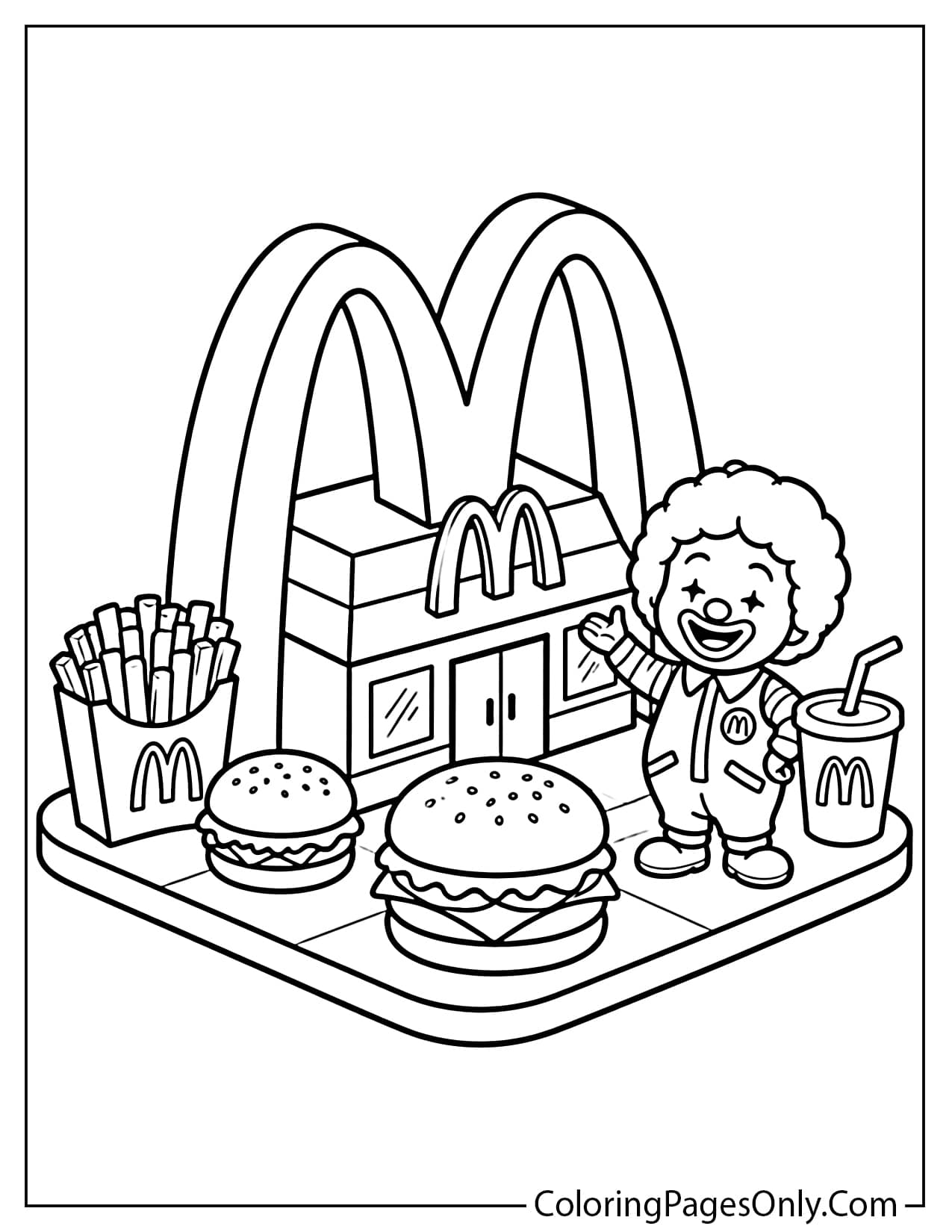
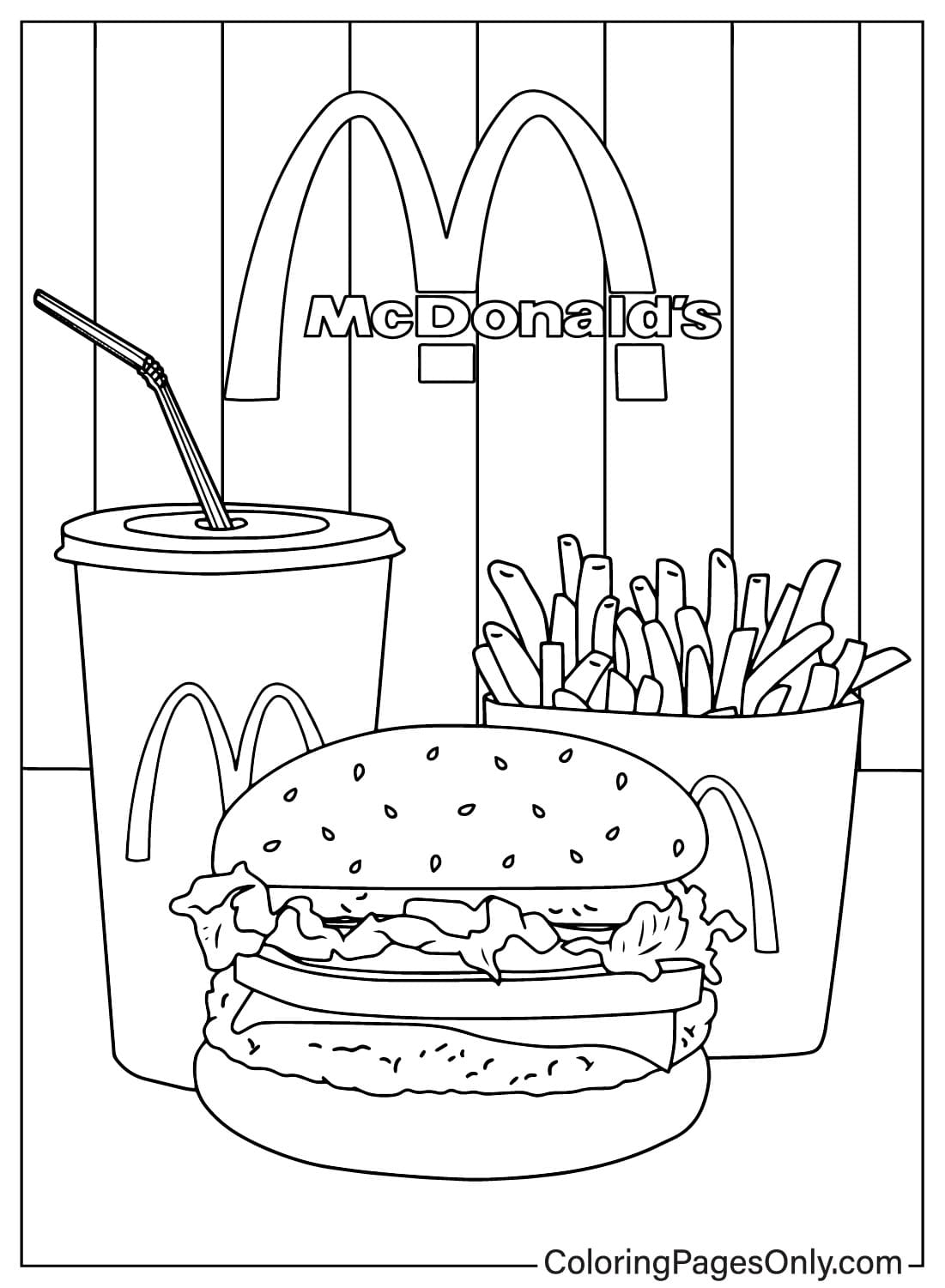
The McDonald’s Coloring Page, Coloring Page McDonalds, Free McDonalds Coloring Page, McDonalds Free Coloring Page, McDonalds Coloring Page Free, and the general logo pages give the arches in various compositions – as a standalone logo element, incorporated into restaurant signage, and combined with other brand elements. The arches are among the most recognizable geometric shapes in the world, and coloring them in the canonical McDonald’s yellow – a specific warm, vivid, saturated yellow – is one of the most straightforward and satisfying exercises in brand color accuracy this collection offers.
The McDonald’s color palette has remained essentially stable for decades: the specific red (a warm, slightly orange-tinted red) and the specific yellow (vivid, warm, bright) have become so culturally embedded that studies in color psychology regularly use them as examples of how color associations are formed through repeated exposure rather than innate response.
Ronald McDonald and Character Pages
Ronald McDonald – the red-haired, yellow-suit-wearing clown who became McDonald’s primary mascot from 1963 onward – is one of the most recognized fictional characters in the world. He was first portrayed by Willard Scott (later the weatherman on NBC’s Today show) in Washington, D.C., in television advertisements in 1963. The character was developed nationally from 1966 onward and became the anchor of McDonald’s children’s marketing through the 1970s, 1980s, and 1990s, a period when McDonald’s Happy Meal promotions and Ronald McDonald Houses became foundational parts of many children’s experience of the brand.
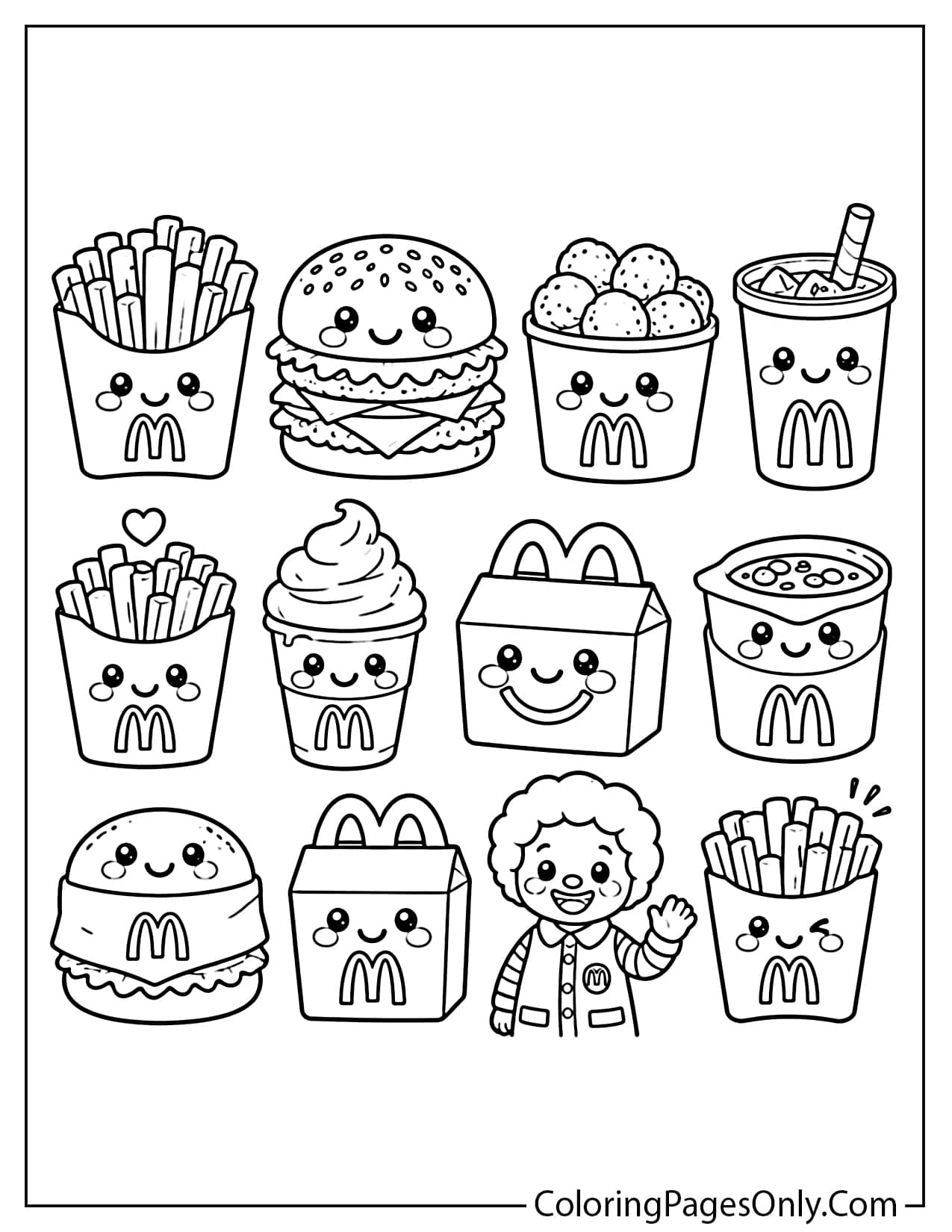
The Cute McDonald’s Coloring Page and character-focused pages in the collection depict Ronald and the McDonald’s cast in the simplified, child-accessible illustration style that makes these pages most effective for younger colorists – ages 3–7 who respond to expressive facial features and clear, defined color zones.
Ronald’s canonical colors: bright red hair, white face paint, red nose, yellow jumpsuit, red-and-white striped socks, oversized red shoes. The yellow jumpsuit is the same golden yellow as the arches – a deliberate brand color consistency that makes Ronald instantly recognizable to the logo even when the arches aren’t present.
Food Pages – The Menu in Line Art
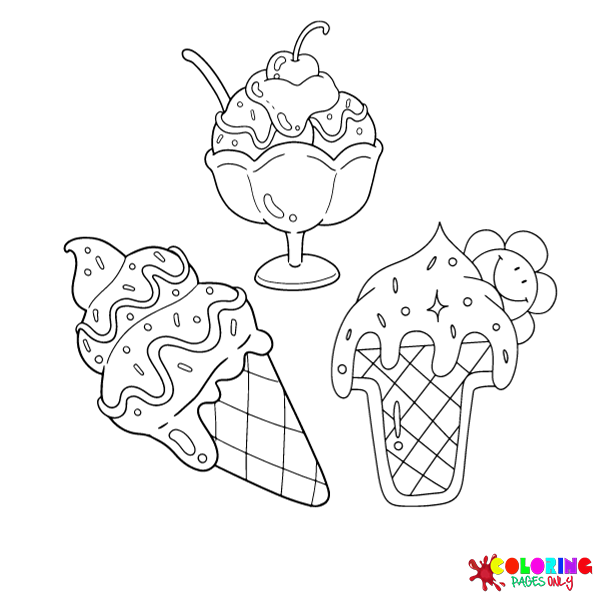
Ice Cream McDonald’s Coloring Page, Chicken McDonald’s Coloring Page, and the various food-scene pages capture McDonald’s most iconic menu items in coloring form.
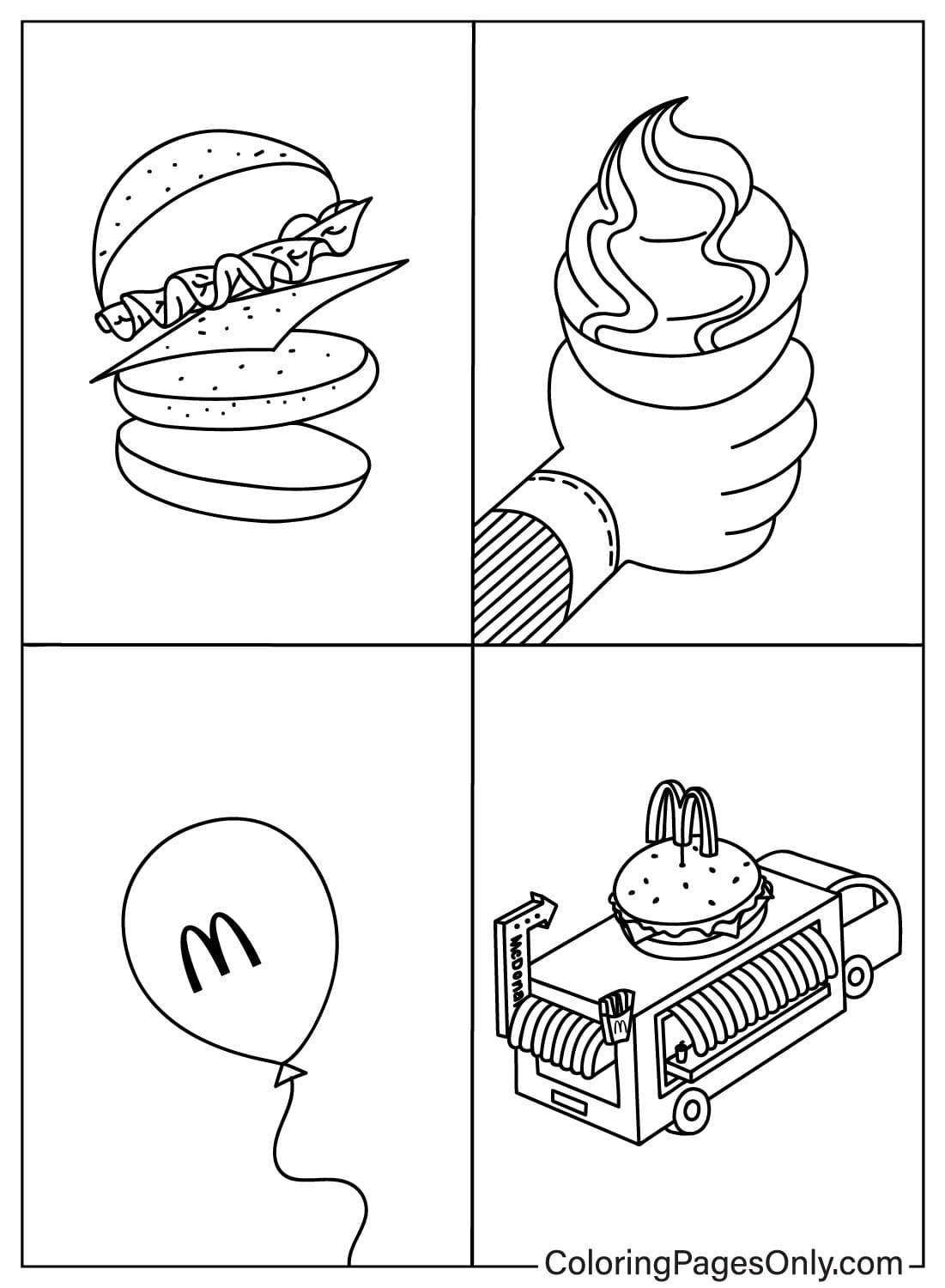
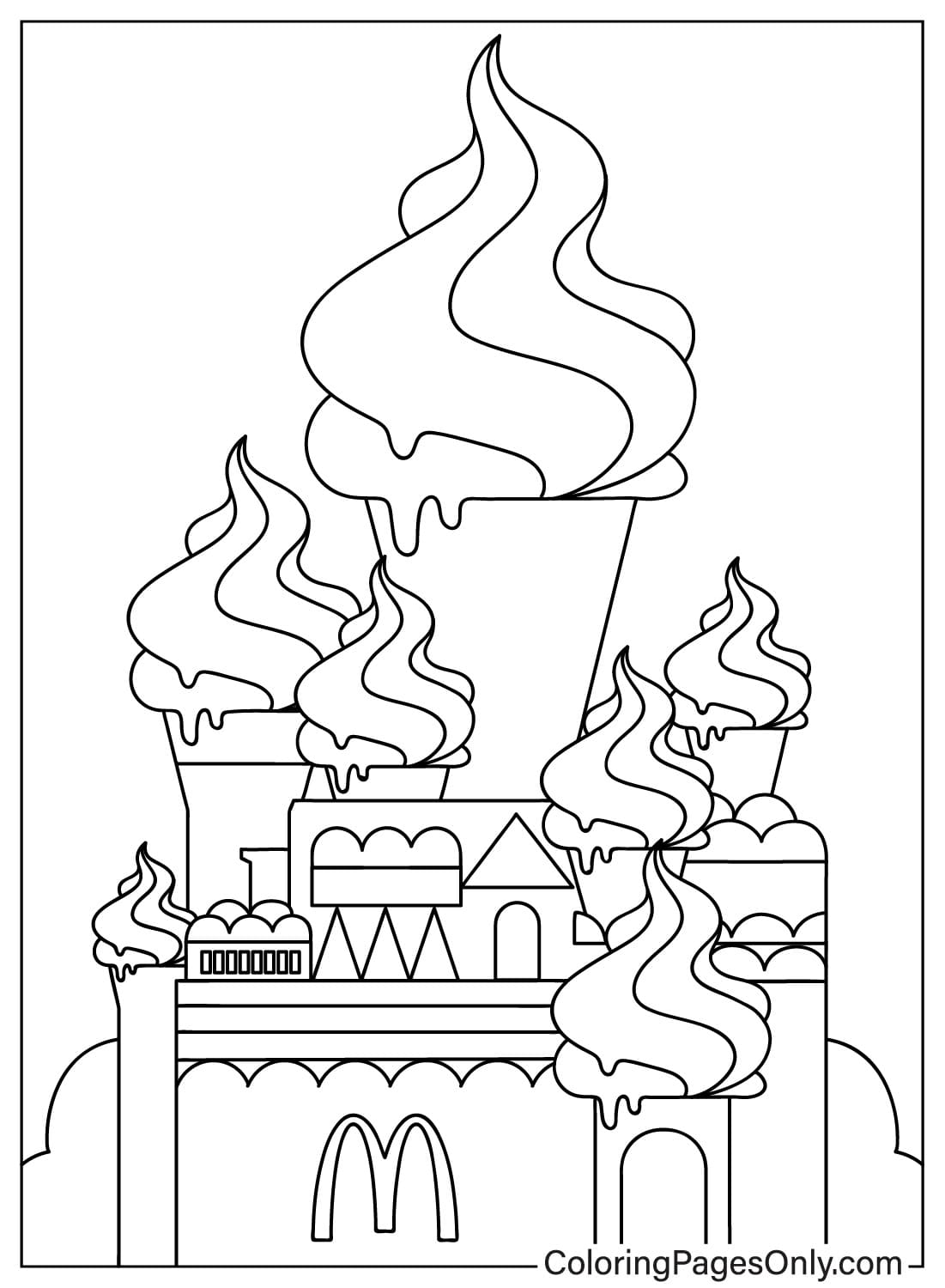
The McDonald’s soft-serve ice cream cone is one of the most recognizable food items in global fast food – the specific spiral of soft vanilla ice cream on a sugar cone has been a McDonald’s staple since the 1960s. The Ice Cream McDonald’s Coloring Page captures this form, and it rewards careful attention to the spiral’s three-dimensional coiled quality: rather than coloring the entire cone a flat white or cream, suggest the spiral’s depth by making the left edge of each coil slightly cooler and darker (shadow), leaving the right-facing edge of each coil slightly lighter and warmer (highlight).
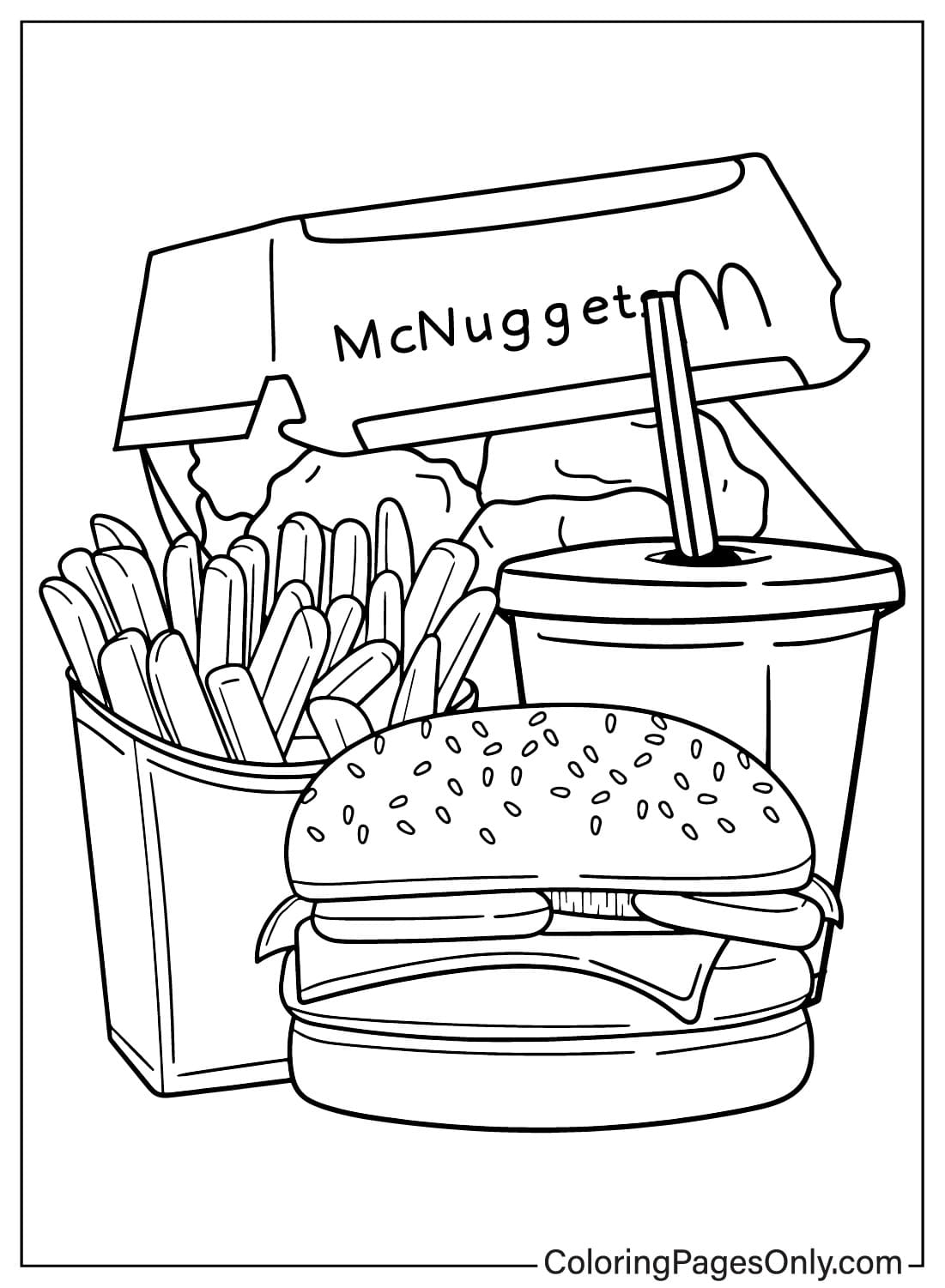
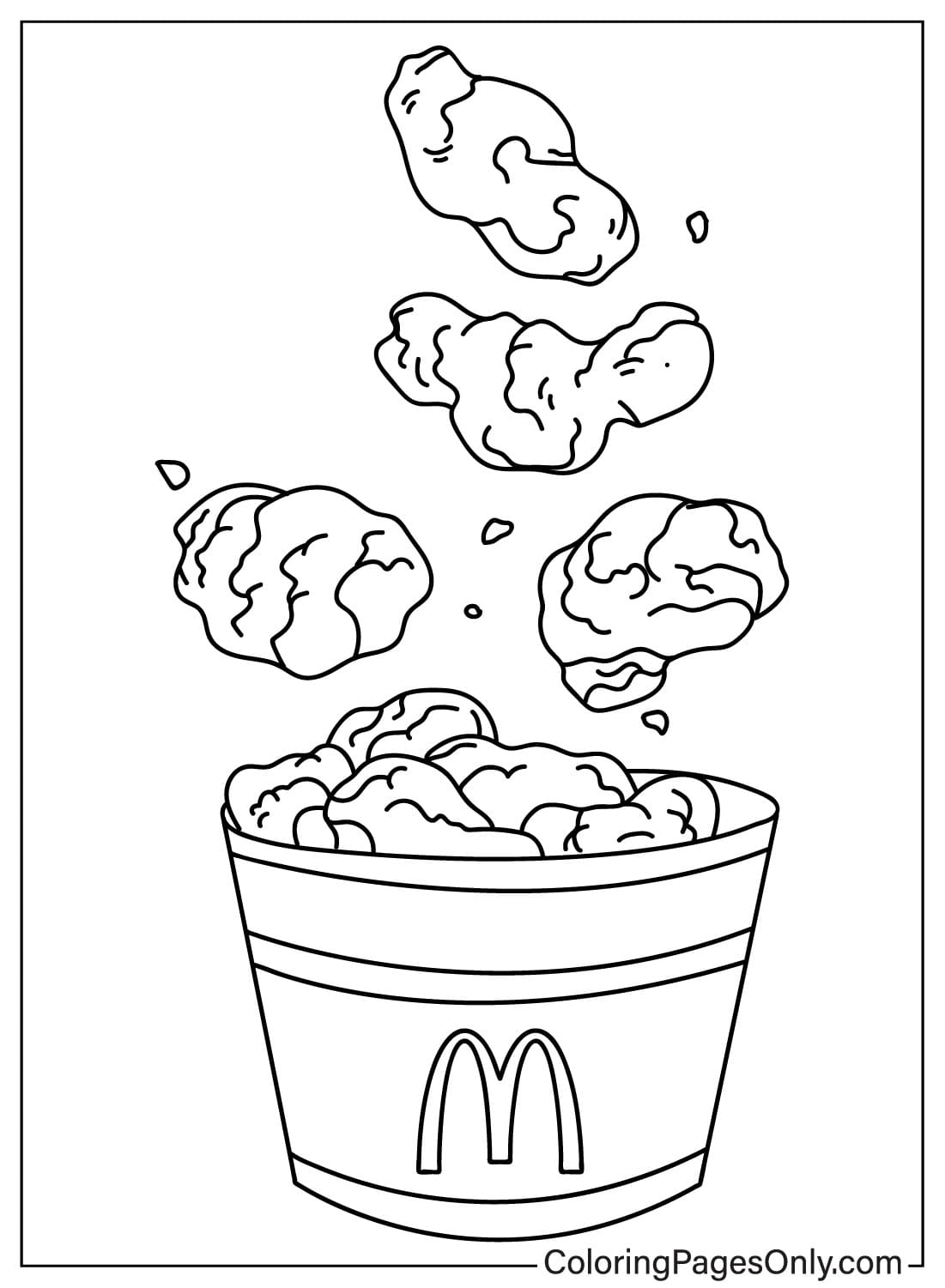
The Chicken McDonald’s Coloring Page depicts one of McDonald’s most significant menu items: the Chicken McNugget, introduced in 1983 by the company’s chief food scientist, Rene Arend. It has become one of the best-selling fast food items in history. McDonald’s serves approximately 9 million pounds of Chicken McNuggets daily worldwide. The four canonical McNugget shapes – bell, boot, ball, and bone – are distinctive enough that McDonald’s has been issued legal protections for their shape in some markets. Coloring a McNugget accurately means working in the specific warm golden-brown of deep-fried breading, with slightly darker brown at the crevices and a lighter, almost yellow-gold on the most prominent flat surfaces.
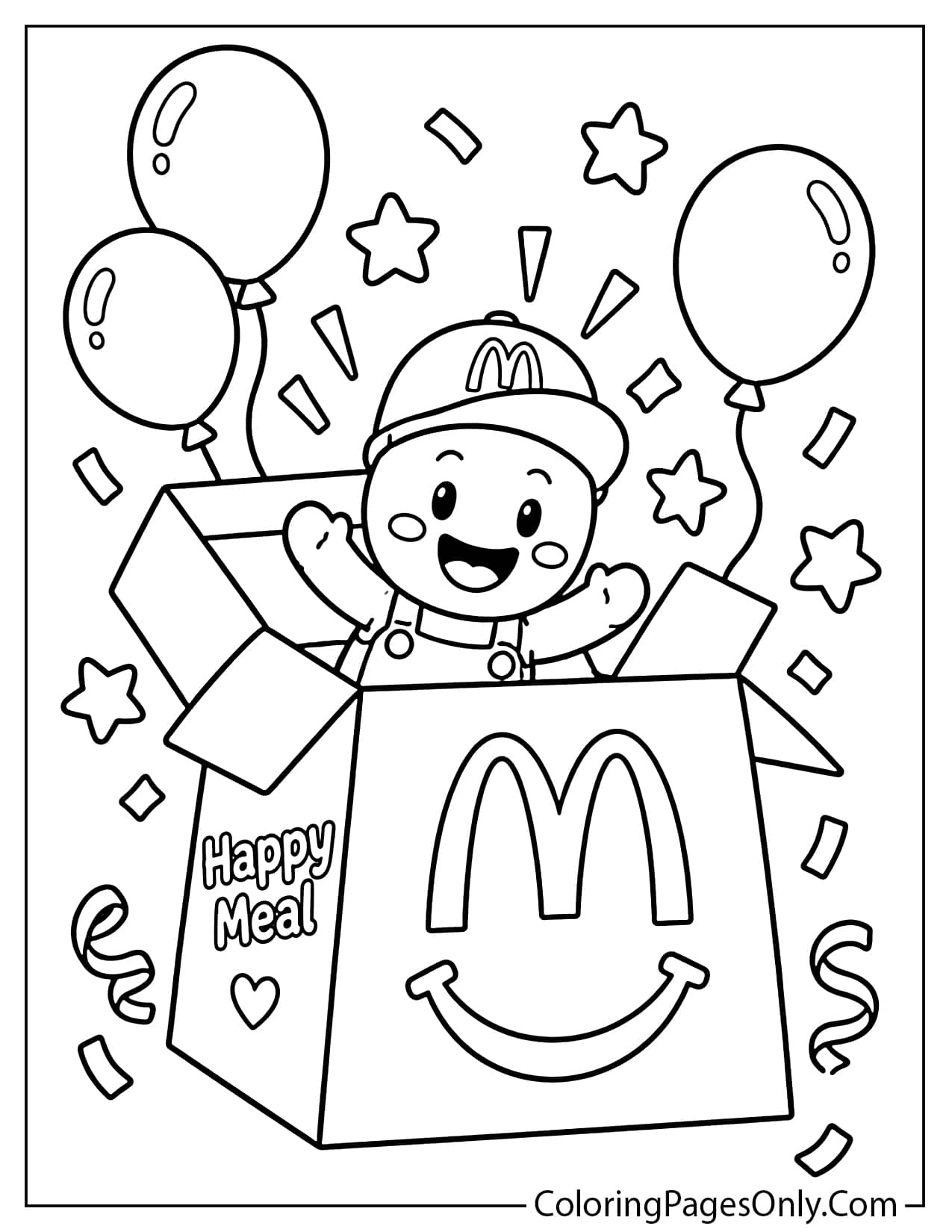
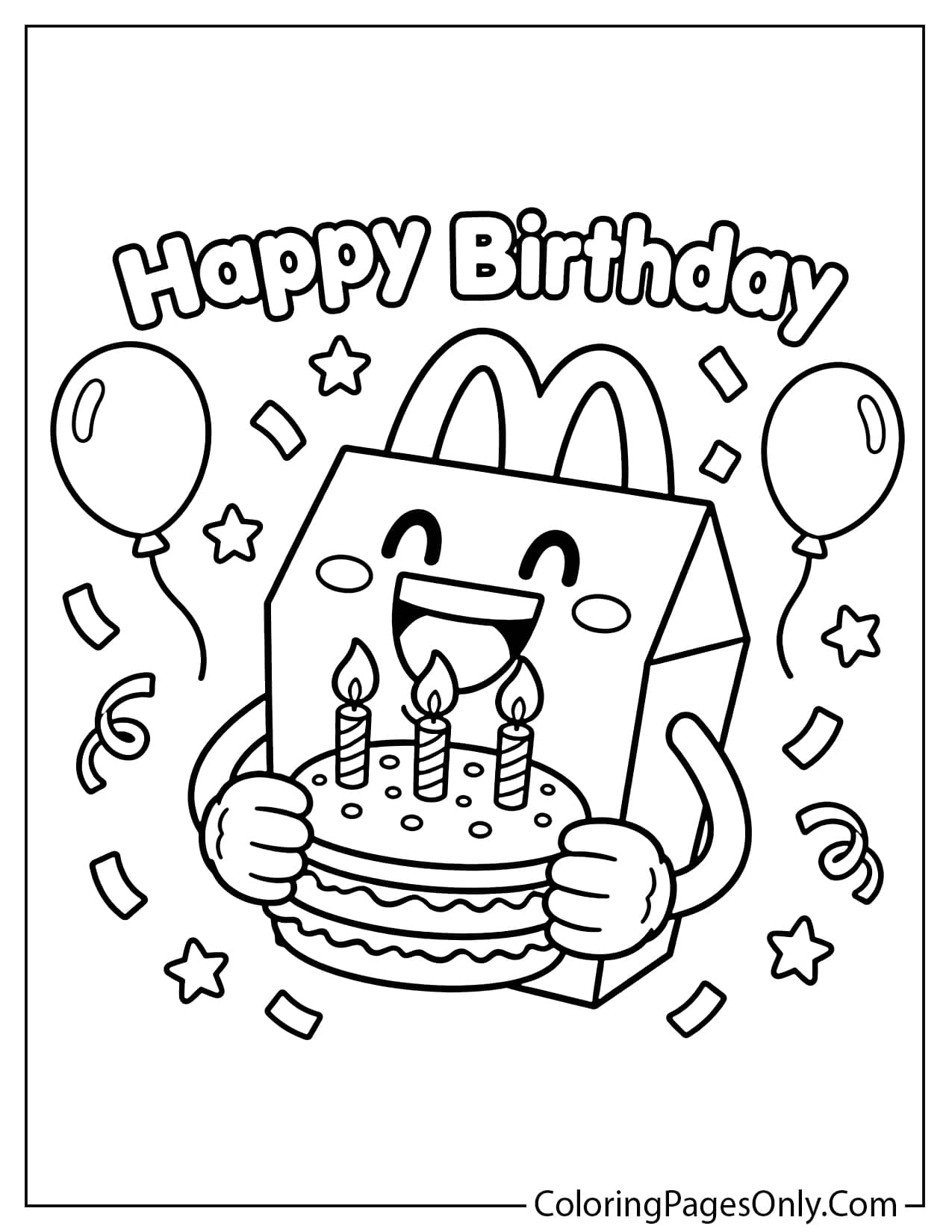
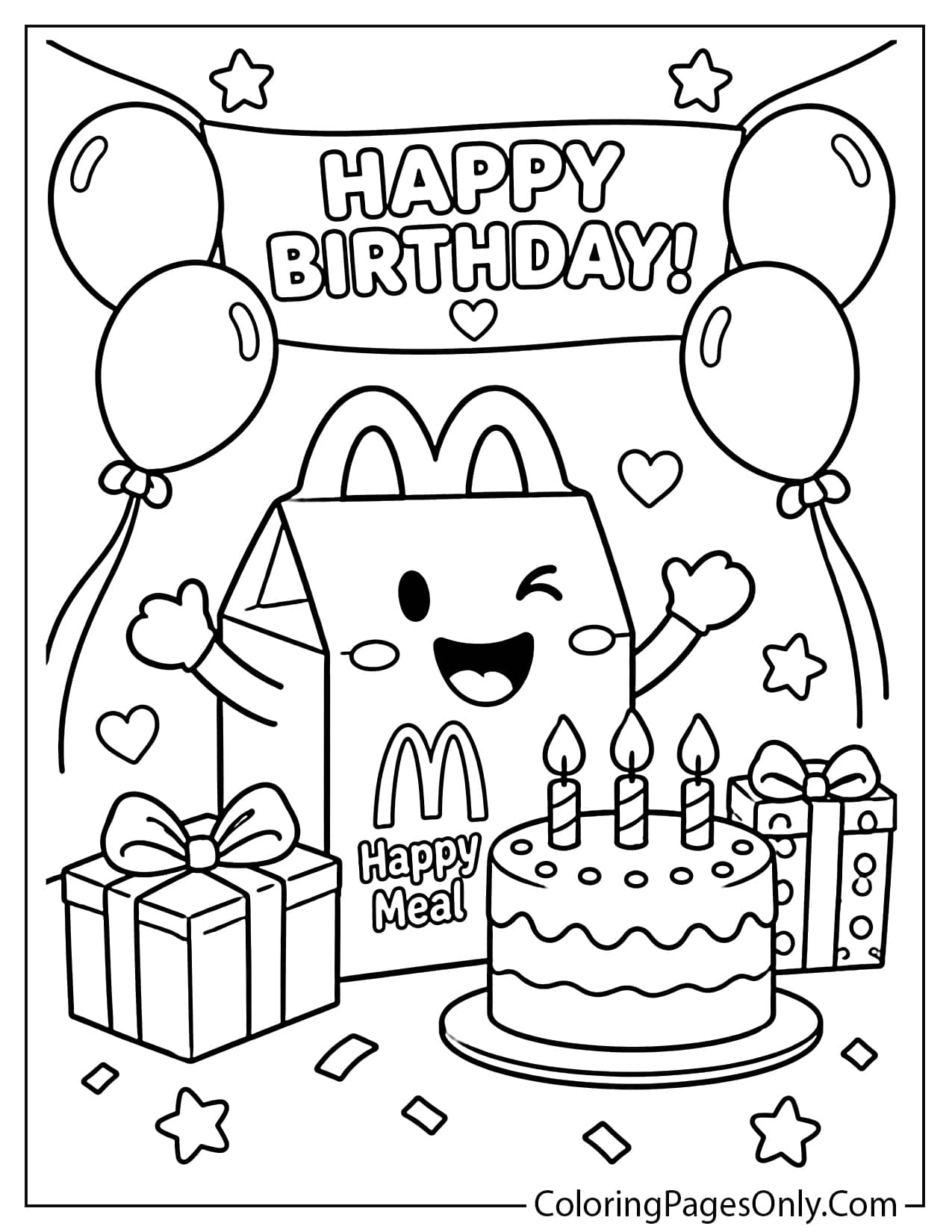
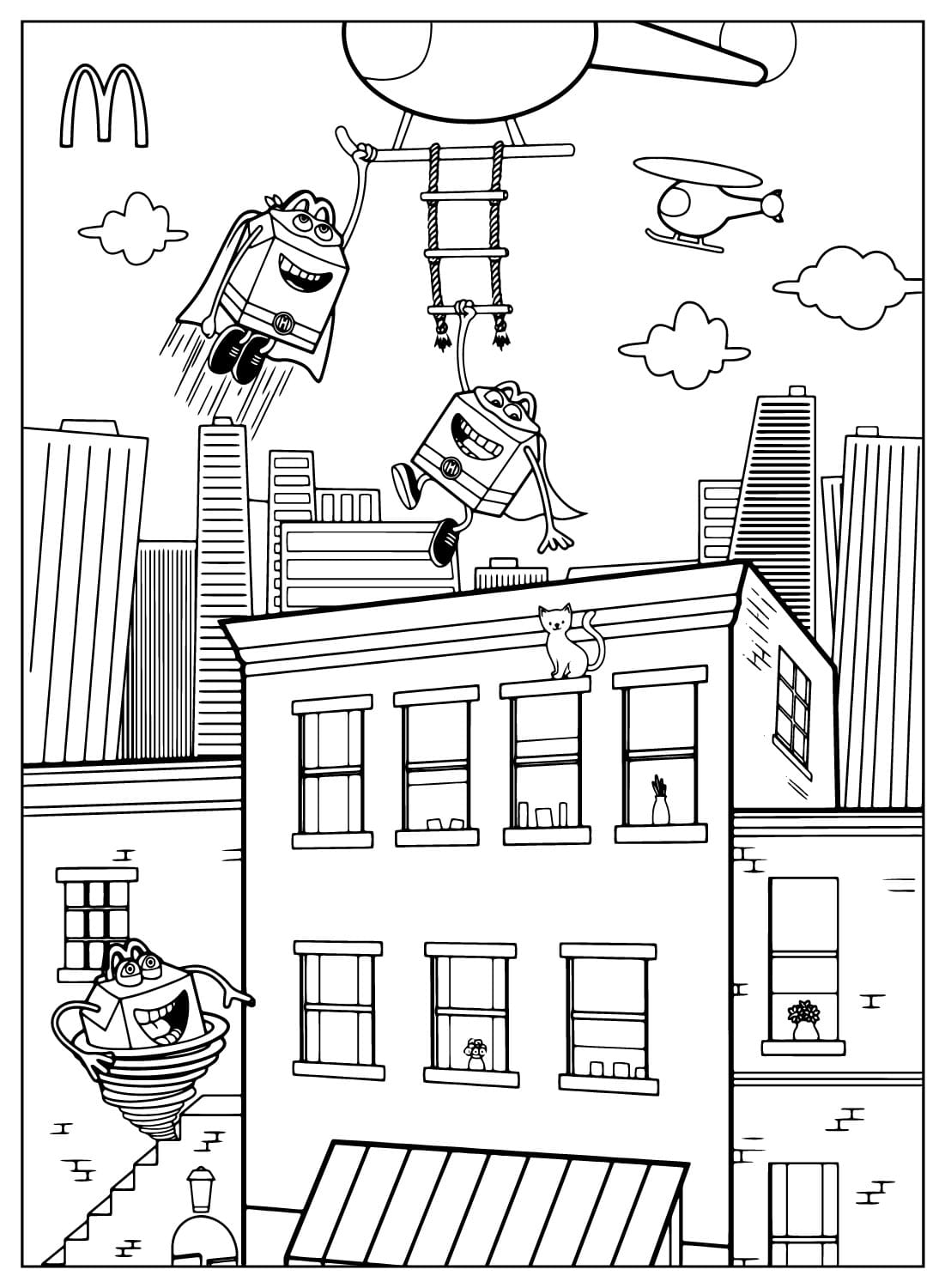
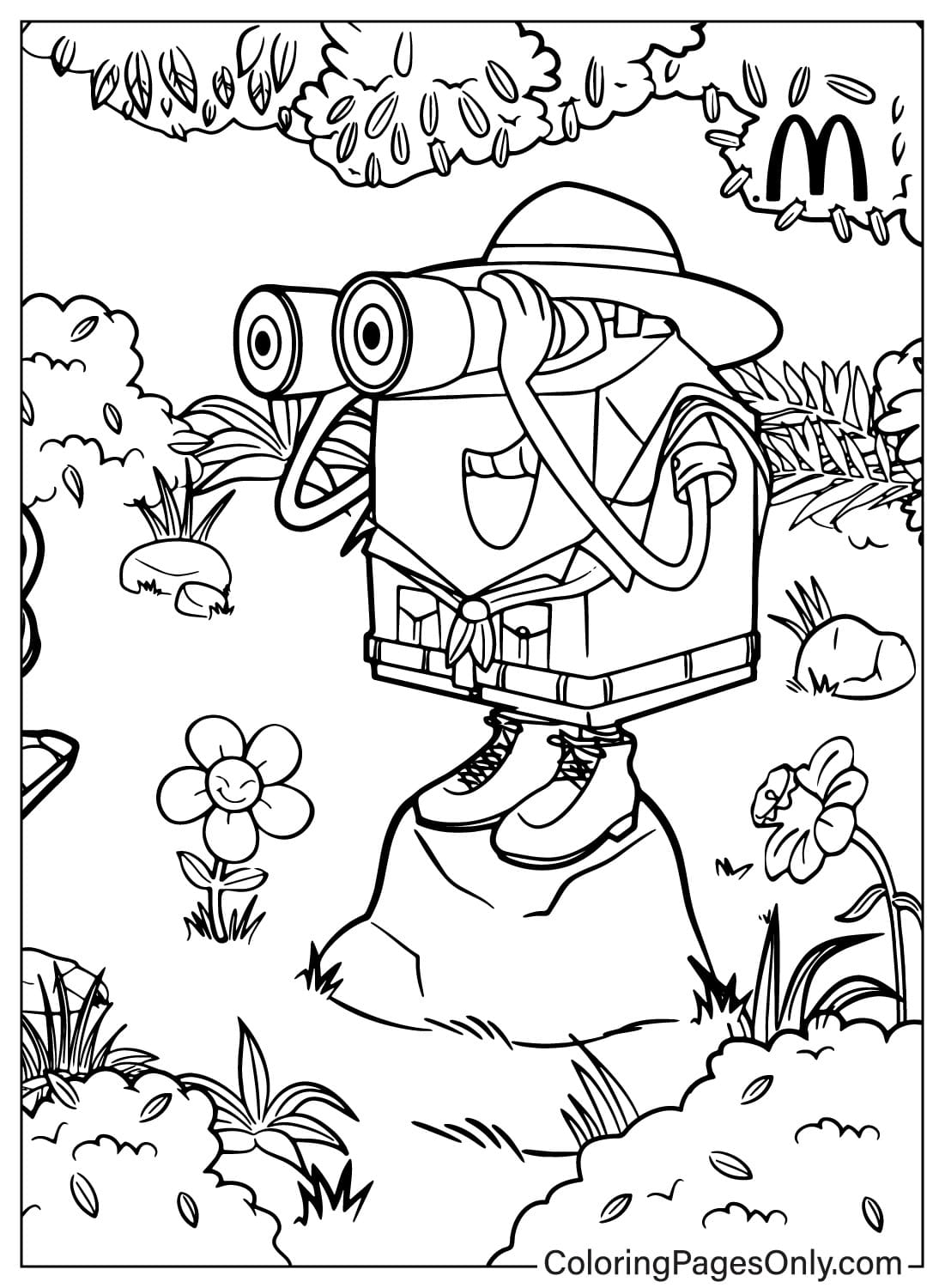
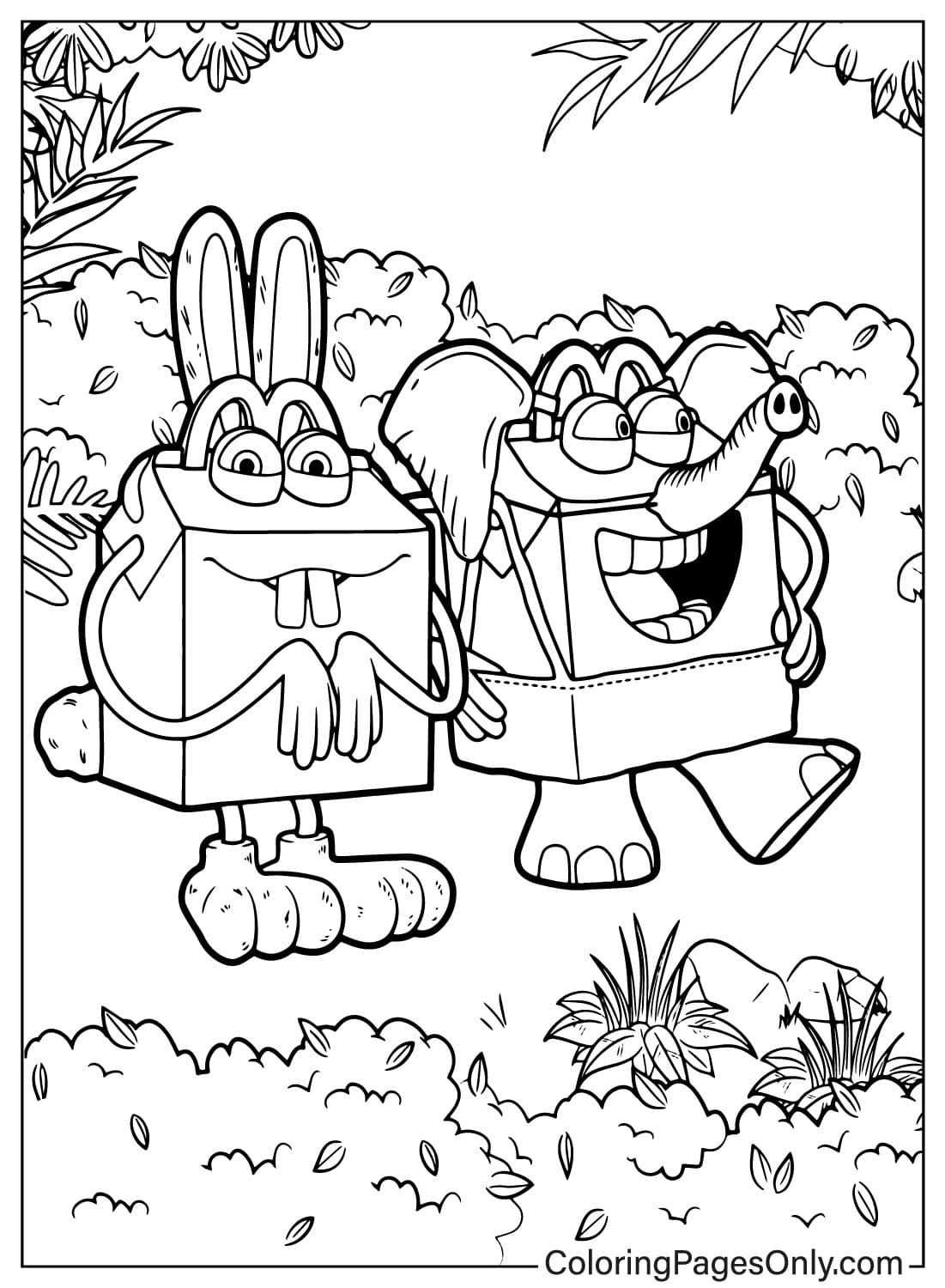
The Happy Meal box – introduced in 1979 in the United States – appears across several pages and is one of the collection’s most charming subjects. The red box with the Golden Arches and the smiling face is one of the few pieces of food packaging in history that functions as a toy as well as a container. Coloring it in the canonical red and yellow, with the handle detail and the face drawn on the side, takes about 10 minutes and produces something that immediately reads as McDonald’s to any child who has ever sat in the bright plastic booth of a restaurant.
Scene and General Pages
McDonalds Coloring Sheet for Kids, McDonalds Images to Color, McDonalds Picture to Color, McDonalds Images Coloring Page, Pictures McDonalds Coloring Page, McDonalds Drawing Coloring Page, Drawing McDonalds Coloring Page, Printable McDonalds Coloring Page, McDonalds Coloring Page to Printable, McDonalds Coloring Page Free Printable, and Images McDonalds Coloring Page provide the full range of scene and character compositions across different coloring approaches – some focusing on individual items, others on full restaurant scenes, others on character-and-food combinations that capture the brand’s cheerful visual energy.
What These Pages Actually Do
Brand recognition is a real form of cultural literacy. McDonald’s is one of the most globally present brands in human history. Children who encounter its imagery – the arches, the color palette, Ronald McDonald, the Happy Meal box – are engaging with one of the most sophisticated pieces of visual communication in the commercial world. Coloring these pages while thinking about what the colors mean, why they were chosen, and what makes the arches so recognizable turns a simple creative activity into a genuine lesson in visual design and brand psychology.
Food-themed coloring opens conversations about nutrition and choice. A child who colors a McDonald’s burger and fries while a parent talks naturally about what food is made of, what makes something a treat versus an everyday food, and how advertising shapes what we want is developing exactly the kind of critical consumer literacy that researchers identify as a protective factor against unhealthy dietary patterns in adolescence. The coloring activity creates the context; the conversation does the work. Research published in Appetite (2016) found that children who were taught to recognize and analyze food advertising showed significantly better ability to make critical assessments of food marketing claims than children who received standard nutrition education alone.
The 2005 Art Therapy Journal study applies here, too. Structured coloring reduces anxiety. For children waiting in a McDonald’s restaurant, at a birthday party, or at home during a fussy afternoon, these pages provide exactly the calm, focused, creative activity that the research supports – familiar imagery, clear outlines, manageable complexity, immediate positive results.
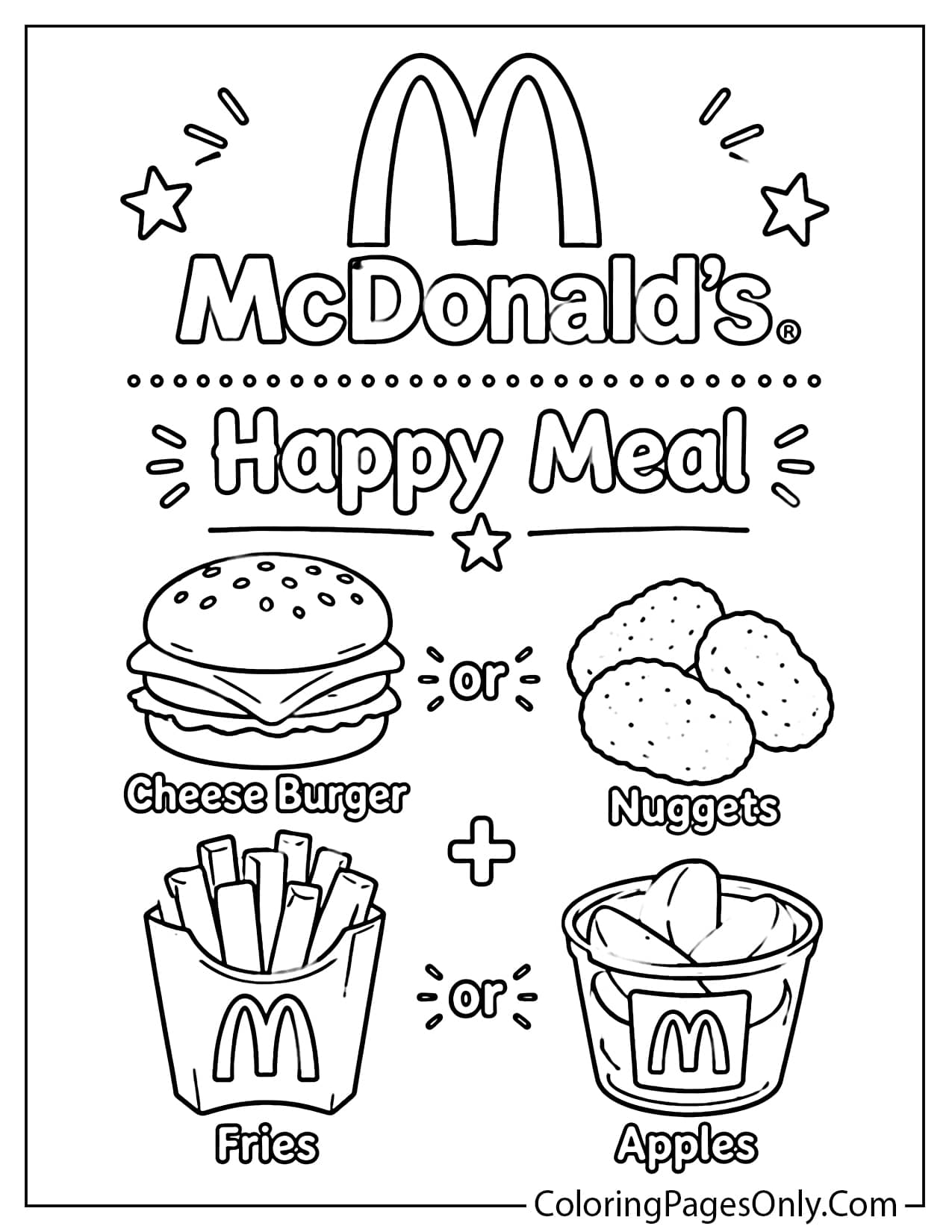
Fine motor development through food form. The food pages in this collection present specific fine motor challenges: the McNugget’s irregular organic form, the ice cream cone’s spiral coil, the layered stacking of a burger’s components (bun, sesame seeds, patty, cheese, lettuce, tomato), and the regular grid of a French fry container’s rectangular forms. Each of these requires a different quality of hand control, and the American Academy of Pediatrics consistently identifies this variety of fine motor challenge as more developmentally valuable than repetitive identical tasks.
How to Color These Pages Well
McDonald’s yellow is very specific. It is a warm, saturated, vivid yellow – not pale lemon, not orange-yellow, but the specific golden-warm yellow that McDonald’s has used consistently across its entire visual identity for decades. Pantone 123 C is the closest official reference. When selecting a colored pencil or marker for the arches, you want something that reads as immediately, unmistakably “McDonald’s yellow” – bright enough to be vivid, warm enough to be golden, not so orange it crosses into orange territory. This single color decision is the most important one in the entire collection.
McDonald’s red is warm. The brand’s red is a specific warm red, leaning slightly orange rather than cool. Pantone 485 C is the approximate reference. It should read as cheerful and energetic rather than authoritative or alarming. Applied to the Happy Meal box and the logo background, it creates the warm-warm complementary contrast with the yellow that makes the McDonald’s palette so visually energetic.
The Golden Arches have geometry. The M shape is composed of two identical curved forms meeting at the center – perfectly symmetrical. When coloring the logo pages, work from the center of the M outward, ensuring both arches receive identical color coverage. Any variation in saturation between the two arches will read as visually off, even to people who can’t articulate why. The arches should be the brightest, most vivid yellow on the entire page.
The ice cream cone rewards three-tone treatment. For the soft-serve spiral: a warm cream or very pale yellow as the base across the entire cone, a slightly deeper, warmer cream on the shadow side of each spiral ring, and a near-white on the highlight edge of each ring. The sugar cone below should be a warm tan, slightly darker at the bottom where it narrows. The visual illusion of a real soft-serve spiral is achievable with five minutes of attention to which direction the coil turns.
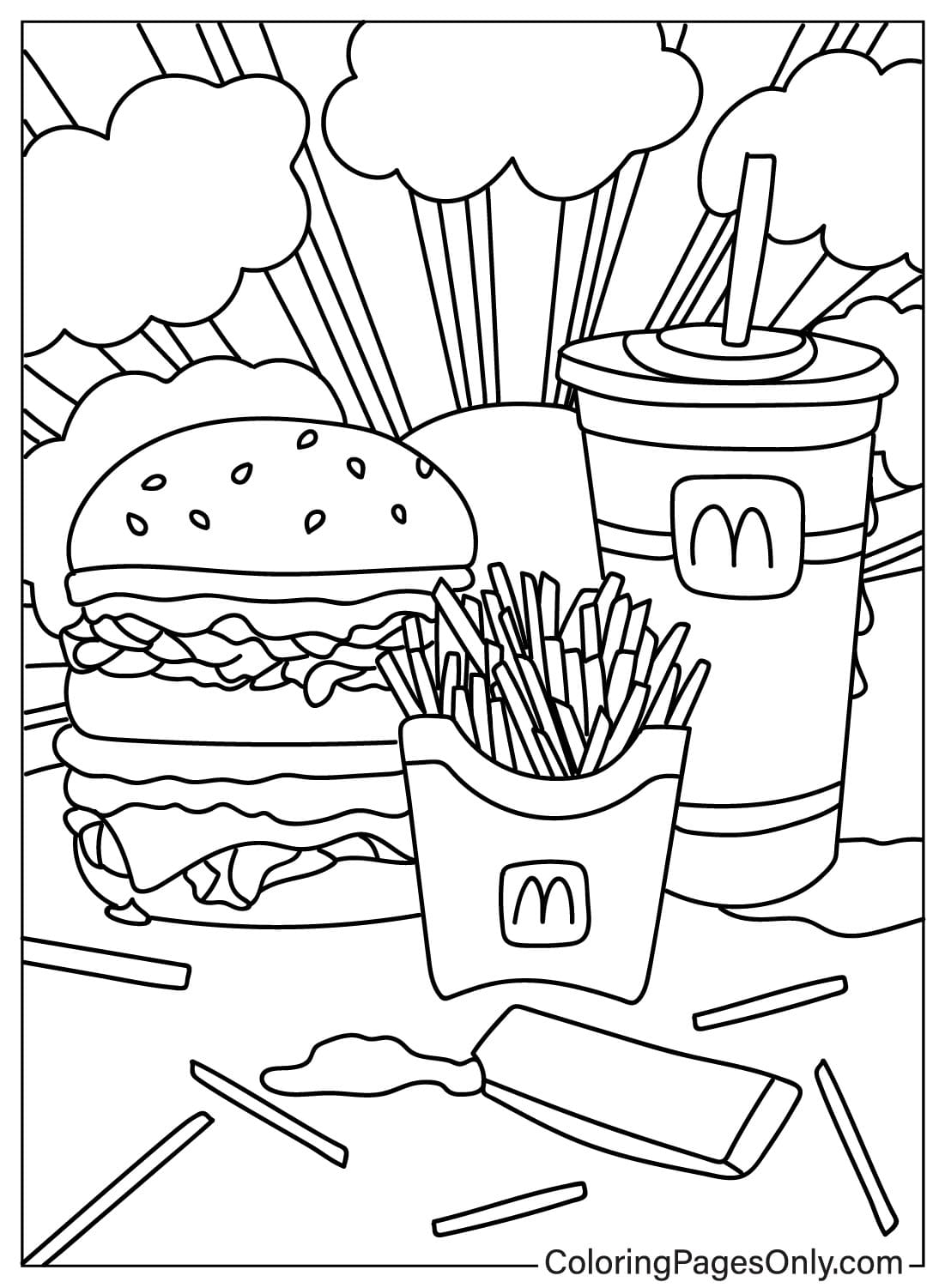
For burger pages, work from the bun down. Establish the golden-brown of the top bun first – a warm medium tan with slightly darker edges where the crust has more color. Then the sesame seeds (very small, slightly off-white with a warm tan edge). Then the red of the sauce, the green of the lettuce, the yellow of the cheese (the same yellow family as the arches but slightly more muted), the brown of the patty (a darker warm brown with slight charring suggestions at the edges), and finally the bottom bun. The layered sandwich, colored from top to bottom in sequence, produces the most organized and visually satisfying result.
5 Creative Activity Ideas
DIY McDonald’s Restaurant Menu
Print five to eight food pages – burger, fries, chicken nuggets, ice cream, and anything else from the collection. Color each one carefully in accurate food colors: the specific golden brown of fries, the warm red of the burger’s sauce, the deep golden brown of the McNuggets, and the white and cream of the ice cream.
Once colored, cut each food item out along its outline. On a large sheet of cardstock, create a menu layout: organize the cut-out images into categories (Burgers, Sides, Desserts) and glue them in place. Add hand-lettered prices and item names below each image. Laminate with clear contact paper for durability.
The finished menu becomes the centerpiece of a restaurant role-play game – children take orders from family members, “prepare” pretend food, and serve with the menu as a reference. This is the activity from the original page, now with more specific guidance on how to make the finished menu look genuinely menu-like rather than a random collection of colored cutouts.
Happy Meal Box Craft
The Happy Meal box page, if printed on cardstock and folded correctly, can be assembled into an actual three-dimensional box – a miniature Happy Meal container that a child designs and colors themselves.
Print the box template page on cardstock (heavier paper is essential – standard printer paper collapses). Color the exterior faces of the box template first, before cutting: the red sides, the yellow arches on the front panel, the smiling face detail, and the handle at the top. Apply all colors while the template is flat.
Score the fold lines gently with the back of a butter knife before folding – this produces clean, sharp creases. Fold along all scored lines, apply a thin bead of craft glue or PVA to each tab, and press each tab against the adjacent panel for 30 seconds. Leave the box open at the top to insert a folded piece of yellow paper (representing fries) or a small drawing of a toy.
The finished box is both a craft and a functional container for small items – keeping crayons, small toys, or treats. It is also, for the child who made it, considerably more meaningful than a box they received from a restaurant.
McDonald’s Birthday Party Decorations
Print multiple pages at three scales: full size for wall posters, 50% for table centerpieces, and 25% for cupcake toppers. Color all of them in the canonical red and yellow palette – every element on every page in McDonald’s colors, applied consistently.
Full-size pages mounted on red or yellow poster board become instant party wall decorations. Medium-sized food pages, cut out and propped against small cardstock stands, create a table centerpiece that reads as a McDonald ‘s-themed display. Small food and logo cutouts attached to toothpicks with a drop of hot glue become cupcake toppers – inserted into red or yellow frosted cupcakes, they turn a standard birthday cake into a McDonald’s theme party dessert display.
The consistency of the red-and-yellow palette across all three scales is what makes this decoration work as a coherent theme rather than a random collection of colored paper. Every element speaks the same two-color language.
Food Art Gallery
This craft uses the coloring pages as starting points for a more elaborate artistic project: a “food art gallery” display inspired by the Pop Art tradition that Andy Warhol established with his Campbell’s Soup Cans series in 1962. Warhol repeatedly used the visual language of commercial food packaging – repetition, flat color, graphic simplicity – as fine art subject matter. McDonald’s imagery, with its bold colors and strong graphic forms, is natural Pop Art material.
Print four identical copies of the same page – the Golden Arches logo, the burger, or the fries. Color each copy identically, but in a different color scheme: one in the canonical red and yellow, one in blue and orange, one in green and pink, one in purple and gold. Mount all four in a grid on a single large backing sheet, evenly spaced with equal borders.
The finished four-panel grid references the Pop Art approach of repeated consumer imagery in different color treatments – it is genuinely interesting as a visual art object, not merely a children’s craft. Explain the Warhol connection while making it. Art history, delivered via McDonald’s coloring pages, is more memorable than most art history curricula.
McDonald’s Bingo
Print enough food and logo pages to create a full bingo set – at least 25 different images for a 5×5 bingo card, printed small enough to cut into individual squares. Color every image. Cut all images out and separate into two identical sets: one set for the bingo cards, one for the calling bag.
Create bingo cards by pasting a different image in each square of a 5×5 grid on cardstock – each card should have a different random arrangement of images. Laminate with clear contact paper for reuse. Put the second image set in a bag.
To play: draw a random image from the bag and hold it up. Players who have that image on their bingo card mark it with a small coin or chip. First to complete a line or a full card wins. For a food-themed prize, the winner chooses their favorite coloring page from the collection to color first next time.
The original bingo idea from this page’s current content is kept and improved: the laminated, reusable card format, the calling bag structure, and the food-themed prize round make it a more functional game.
Frequently Asked Questions
When was McDonald’s founded, and who started it? Brothers Richard and Maurice McDonald opened their first burger stand in San Bernardino, California, in 1940. They developed the “Speedee Service System” – a kitchen assembly line approach that reduced preparation time and cost significantly – in 1948. Ray Kroc, a milkshake machine salesman who supplied equipment to the brothers, became so impressed with their operation that he secured the rights to franchise the concept and opened the first franchise location in Des Plaines, Illinois, on April 15, 1955. Kroc eventually purchased the McDonald’s corporation from the brothers outright in 1961 for approximately $2.7 million. Today, McDonald’s operates over 40,000 locations in more than 100 countries.
What is the story behind the Golden Arches logo? The arches originated as an architectural feature of early McDonald’s restaurants, designed by architect Stanley Clark Meston in 1953, with two golden parabolic arches attached to the sides of the building. When viewed from an angle, they formed a shape resembling the letter M. Designer Jim Schindler formalized them into a logo in 1962. The current simplified M shape has been refined over subsequent decades but maintains the essential geometry of the original arches. The Golden Arches are among the most recognized commercial symbols in the world, with recognition rates in some surveys exceeding those of most national flags and religious symbols.
Who is Ronald McDonald, and when was the character created? Ronald McDonald was created in 1963 for Washington, D.C. television advertisements, initially portrayed by Willard Scott, who later became famous as the weatherman on NBC’s Today show. The character was developed for national use from 1966 onward, when McDonald’s began a major push to establish itself as a family-friendly restaurant. Ronald became the centerpiece of McDonald’s children’s marketing through the 1970s, 1980s, and 1990s, appearing in commercials, promotional events, and through the Ronald McDonald House Charities, a nonprofit organization that provides lodging for families of seriously ill children receiving hospital treatment, founded in 1974 in Philadelphia.
When was the Happy Meal introduced? The Happy Meal was introduced in the United States in 1979, initially offered in a box designed to look like a circus wagon or train car. The toy-plus-food combination was conceived as a way to make McDonald’s visits more memorable for children and to give parents a reason to choose McDonald’s specifically for family meals. The Happy Meal box’s smiling face design and the inclusion of a toy, which has ranged from Hot Wheels cars to Disney film tie-in figures to McDonald’s own character toys, have made it one of the most recognizable pieces of food packaging in the world.
When were Chicken McNuggets introduced? Chicken McNuggets were introduced nationally in the United States in 1983, developed by McDonald’s chief food scientist, Rene Arend, and executive chef René Arend, following a request from then-CEO Fred Turner to develop a chicken item. They were first tested in Knoxville, Tennessee, in 1981. The four canonical McNugget shapes – bell, boot, ball, and bone – were designed to ensure consistent cooking times despite the different shapes; each shape cooks in the same time because the surface area-to-volume ratio is maintained across all four forms. McDonald’s serves approximately 9 million pounds of Chicken McNuggets daily worldwide.
What are McDonald’s canonical colors, and what do they mean? McDonald’s uses two primary brand colors: a specific warm yellow (approximately Pantone 123 C) and a specific warm red (approximately Pantone 485 C). These colors were established early in the brand’s development and have remained consistent. Color psychology research on the McDonald’s palette generally notes that the warm red is associated with appetite stimulation, urgency, and energy, while the golden yellow is associated with warmth, happiness, and optimism. The combination – warm-warm, complementary in temperature – creates a high-energy, cheerful visual environment designed to be welcoming and memorable. The stability of these colors across 70 years of brand development is one of the most striking examples of consistent color identity management in commercial history.
What age group are these pages best suited for? The simplest pages – the Golden Arches logo and the basic food items in clean outline – work well for ages 3–5 who respond to familiar imagery and bold, simple shapes. The character pages with Ronald McDonald and the Happy Meal box work well for ages 4–8. The more detailed scene pages and food combination pages reward the fine motor control that develops from around age 6–7. Adults who enjoy the Pop Art connection or who are working on brand color accuracy exercises will find the logo and food pages satisfying as technical coloring subjects, regardless of their age.
Browse the full collection at ColoringPagesOnly.com. All pages free, no sign-up, PDF or PNG, print at home or color online.
Ray Kroc’s original insight – that the McDonald brothers had invented a system, not just a restaurant – turned out to be one of the most consequential observations in the history of commercial food. The Golden Arches that followed from that insight are now on every continent, in over 100 countries, recognizable to more people than almost any other human-made symbol. Three generations of children have eaten Happy Meals and colored the red-and-yellow imagery that comes with them. These pages are part of that continuity.
Pick up your yellow. Get it right. Color something from the world’s most recognized kitchen.
Share your work on Facebook and Pinterest and tag #Coloringpagesonly. We especially want to see the Pop Art four-panel grids and the Happy Meal box builds.
Color the arches. Get the yellow right. I’m lovin’ it.