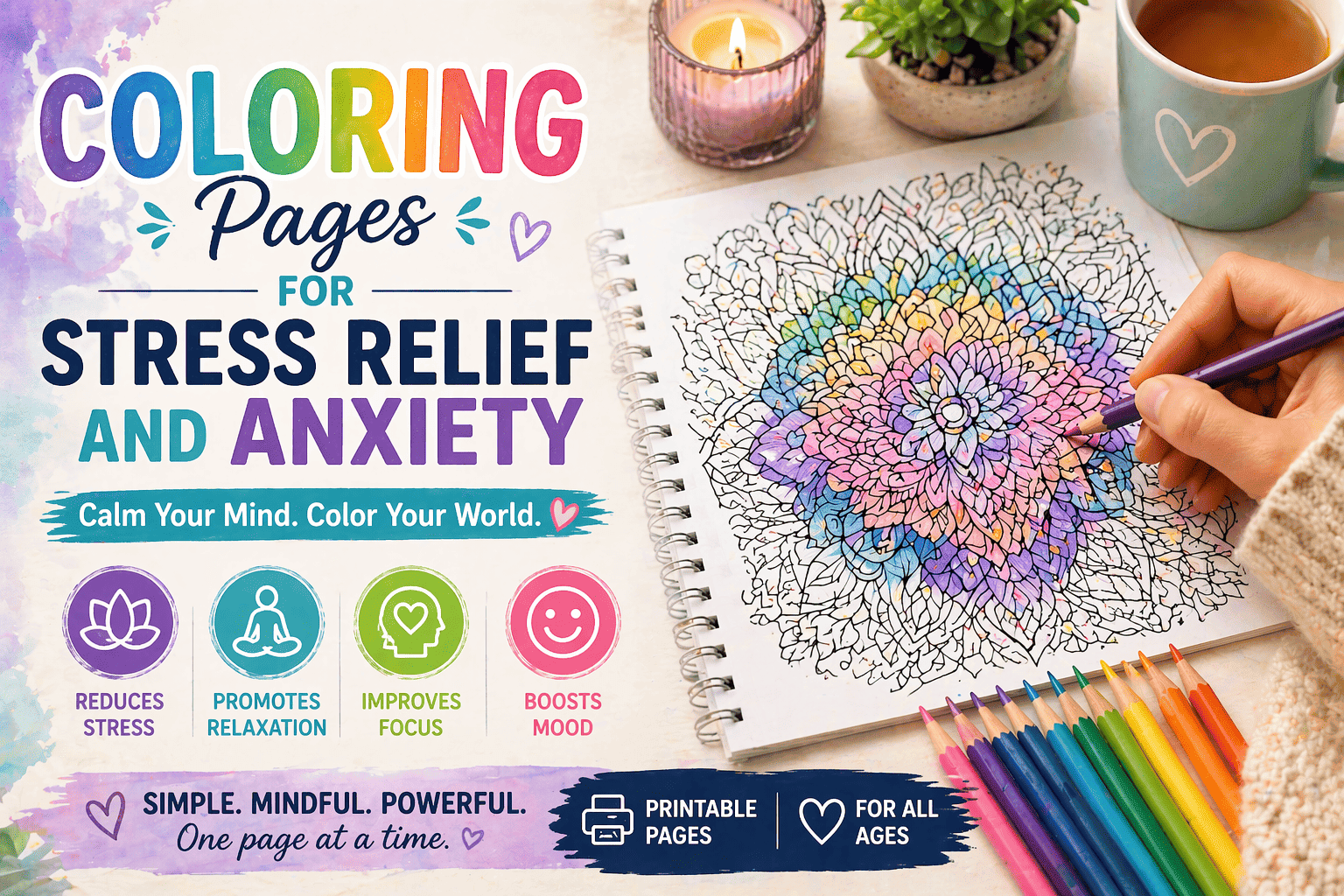
Coloring Pages for Stress Relief and Anxiety explores what psychological research, clinical art therapy, and neuroscience have established about why coloring works as a stress management tool – not as a vague wellness claim, but as a specific, measurable intervention with documented mechanisms and real outcomes.
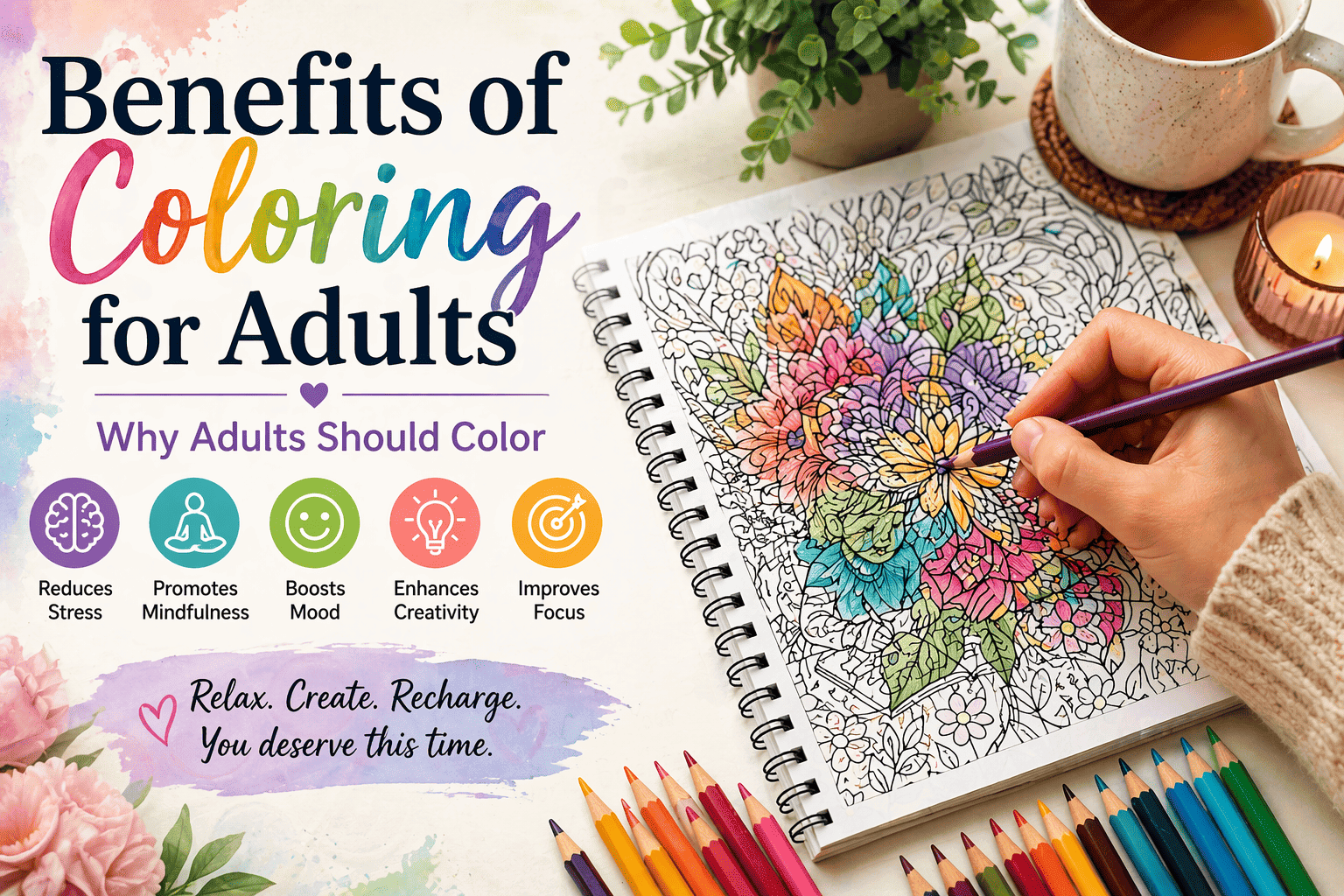
If you have ever picked up colored pencils after a difficult day and noticed that something shifted – that the mental noise quieted, that time passed differently, that you felt calmer at the end than at the beginning – you were experiencing something real. This guide explains what that something is, why it works, and how to use coloring pages most effectively to relieve stress and anxiety.
What Research Actually Says
The scientific literature on coloring as a stress and anxiety intervention is more substantial than most people realize. It is not a single study. It is a converging body of research across psychology, occupational therapy, and neuroscience that has been building since the early 2000s and has accelerated significantly since 2015.
The foundational study on coloring and anxiety was conducted in 2005 by researchers Nancy Curry and Tim Kasser at Knox College and published in Art Therapy: Journal of the American Art Therapy Association. Their experiment compared three groups: participants who colored a complex mandala pattern, participants who colored a simple plaid grid pattern, and participants who drew freely on a blank page. Using the State-Trait Anxiety Inventory – a standardized, clinically validated measure of anxiety – they found that coloring the mandala pattern produced significantly greater anxiety reduction than either alternative. The mandala’s structured complexity was the critical variable.
A 2018 study by Sara Bolt, published in Empirical Studies of the Arts, examined coloring specifically as an everyday anxiety management tool rather than a laboratory intervention. Adults who colored for 20 minutes reported significantly lower state anxiety scores than a matched control group who spent the same 20 minutes reading. The effect size was comparable to brief progressive muscle relaxation – an established clinical anxiety intervention.
A 2016 study by Carrie Collier and colleagues at the University of Otago examined adult coloring in a workplace stress context. Participants who engaged in 10–15 minutes of coloring during work breaks reported lower end-of-day stress and greater emotional recovery than those who took unstructured breaks of the same duration.
Research on mindfulness-based art therapy – reviewed in a 2016 meta-analysis in the Journal of the American Art Therapy Association – found that structured creative activities, including coloring, produced anxiety reductions comparable to guided mindfulness meditation in multiple comparison studies, with the additional advantage that coloring does not require prior practice or instruction to produce benefit.
These studies converge on the same finding: coloring reduces anxiety and stress, the effect is real and measurable, and the type of page matters.
The Neuroscience: What Happens in Your Brain While You Color
Understanding why coloring reduces stress requires a brief look at the brain systems involved.
The Amygdala – Your Brain’s Stress Alarm
The amygdala is the brain structure responsible for detecting threat and triggering the stress response. When you perceive stress – a difficult conversation, a looming deadline, an argument, a news story – the amygdala activates and initiates a cascade of physiological changes: elevated heart rate, increased cortisol, heightened muscle tension, accelerated breathing. This response is appropriate when the threat is real and immediate. It becomes problematic when it remains activated in the absence of an immediate threat – the state most adults in high-stress environments experience as chronic background anxiety.
The amygdala’s activation is reduced by focused, non-threatening attention demands. When the prefrontal cortex (the brain’s executive center, responsible for focused attention) is engaged with a concrete task, it exerts inhibitory influence over the amygdala. In simple terms: when your attention is genuinely occupied, the stress alarm turns down.
Coloring provides exactly this kind of focused, non-threatening attention demand. The decisions involved – which color next, where precisely to apply it, how to handle adjacent zones – engage the prefrontal cortex sufficiently to reduce amygdala activity, without the performance pressure or social evaluation that would activate a different kind of stress.
The Default Mode Network – Where Worry Lives
The default mode network (DMN) is a set of interconnected brain regions that activate when the mind is not engaged with an external task – during mind-wandering, self-referential thinking, and planning. Research has consistently linked high DMN activity to rumination, worry, and the kind of repetitive negative thinking that characterizes anxiety disorders.
When you engage in a focused external task, including coloring, DMN activity decreases. Your mind is not free to wander into anxious territory because it is occupied with the present-moment task. This is the neural basis of the mindfulness effect in coloring: not a mystical experience but a measurable reduction in the default mode activity that sustains anxious thought loops.
Bilateral Stimulation and the Coloring Motion
There is a third neurological mechanism specific to the physical act of coloring that is less frequently discussed. The repetitive bilateral hand movements involved in coloring – particularly the back-and-forth strokes used to fill color zones – produce a mild form of bilateral stimulation that research in trauma therapy (particularly EMDR – Eye Movement Desensitization and Reprocessing) has associated with reduced emotional arousal and faster emotional processing. While coloring is not EMDR and makes no clinical claim as a trauma intervention, the calming effect of repetitive, rhythmic bilateral hand movement is physiologically real and contributes to overall stress reduction.
Why Coloring Pages Work Better Than Other Distractions
A reasonable question: why not simply watch television, scroll through social media, or take a walk? All of these also shift attention away from stressors. What makes coloring specifically effective?
Television and social media are passive and, critically, algorithmically designed to sustain engagement through intermittent emotional stimulation (novelty, outrage, social comparison). Research on television and social media as stress-management tools consistently finds that they reduce momentary boredom without reducing underlying physiological stress markers. Cortisol levels do not consistently drop during television viewing the way they do during coloring. The emotional stimulation that keeps people watching and scrolling maintains the arousal that sustains stress.
Walking and physical exercise are genuinely effective stress interventions – often more effective than coloring over longer time horizons. However, exercise requires physical capacity, an appropriate environment, time allocation, and appropriate clothing, which create access barriers. Coloring is available at any location, at any time, for any duration, with no physical prerequisites.
Passive rest (sitting quietly, doing nothing) is less effective than coloring for reducing anxiety in research studies. The mind left without an engagement point tends to return to anxious rumination – the default mode network activates, and worry resumes. Coloring provides just enough engagement to prevent this return to ruminative thinking while remaining calm enough not to generate new stress.
Coloring occupies a specific and unusual cognitive niche: sufficiently engaging to prevent rumination, not so demanding as to generate performance stress, inherently completion-oriented to provide satisfaction, and entirely within the colorist’s control. This combination is what makes it specifically effective rather than merely pleasant.
The Best Types of Coloring Pages for Stress and Anxiety
Not all coloring pages are equally effective for stress relief. The 2005 Curry and Kasser study, which established the mandala advantage, provides the initial framework, but subsequent research and clinical experience have refined the picture.
Mandala Patterns – Most Effective for Acute Anxiety
Mandalas – circular, symmetrically organized geometric designs – consistently produce the strongest anxiety-reduction effects in research settings. The bilateral symmetry and structured repetition of mandala patterns engage focused attention without requiring creative decision-making about composition. The colorist’s attention is directed entirely toward color choice and application quality – no creative pressure, complete structural guidance.
The circular structure of mandalas also carries a secondary benefit for anxious minds: there is always a clear next step. The pattern itself tells you which color to use next. For people whose anxiety includes decision fatigue or decision paralysis, this structure removes a potential friction point and allows immediate engagement.
Browse our mandala coloring pages collection for a wide range of complexity levels – from simple, large-zone designs ideal for acute anxiety to highly detailed, intricate patterns for extended stress-relief sessions.
Nature and Botanical Patterns – Best for Sustained Calm
Botanical illustration pages – detailed flowers, leaf arrangements, garden scenes, forest compositions – produce a qualitatively different experience from mandalas. Where mandalas produce acute anxiety reduction through structured focus, nature-based coloring produces a more sustained, gentle calming effect that researchers associate with attention restoration theory.
Attention restoration theory, developed by Rachel and Stephen Kaplan at the University of Michigan, proposes that natural environments (and representations of natural environments) restore directed attention capacity by engaging involuntary attention – the effortless, pleasurable attention that nature scenes naturally attract – rather than the effortful, depleting directed attention used in work and problem-solving.
Nature coloring pages engage this restorative attentional mode. The organic forms, the absence of geometric precision demands, and the association with natural environments combine to produce what many colorists describe as a distinctively peaceful coloring experience. For people experiencing chronic stress and attentional fatigue rather than acute anxiety, botanical coloring pages are often more effective than mandalas.
Our flower and garden coloring page collections offer extensive botanical options across varying levels of complexity.
Animal and Character Pages – Best for Gentle Engagement
For people who find geometric patterns either boring or anxiety-provoking (some anxious individuals experience structured patterns as visually oppressive rather than calming), animal portraits and character-based pages offer effective alternative engagement. The key is choosing pages with moderate detail and clear, organized zones rather than very high complexity.
Animal pages featuring single subjects with expressive features – a cat portrait, an owl in a tree, a dog in a relaxed pose – provide the attentional engagement of coloring without the visual density that can feel overwhelming during high-anxiety periods.
For children experiencing anxiety, familiar and beloved characters can add a comfort dimension to the stress-relief benefit. Our animal coloring pages collection covers a wide range of subjects and complexity levels.
What to Avoid During High-Anxiety Periods
Very high complexity pages – those with hundreds of tiny, intricate zones – can increase rather than decrease anxiety for some people. The mismatch between the detailed page and the colorist’s current precision creates frustration that counteracts the calming effect. During high-anxiety periods, choose pages with larger color zones and simpler compositions.
Pages with a strong deadline or completion pressure. The stress-relief effect of coloring depends on its being low-stakes. If you are coloring with a performance orientation – trying to finish the page, trying to make it look right, comparing your result to a reference image – you are introducing exactly the kind of evaluative pressure that produces stress. For stress-relief coloring specifically, the process is the point, not the completed page.
Coloring as a Clinical and Therapeutic Tool
Beyond recreational use, coloring is used as a formal therapeutic tool in several clinical contexts.
Art Therapy
Art therapy is a clinical mental health discipline practiced by licensed therapists who use art-making – including structured activities like coloring – as part of therapeutic treatment. Art therapy is distinct from recreational coloring: it involves a therapeutic relationship, clinical assessment, and treatment goals. However, the structured coloring activities used in art therapy share the same neurological and psychological mechanisms as recreational coloring.
Dr. Cathy Malchiodi, a leading researcher and practitioner in art therapy whose work includes The Art Therapy Sourcebook and Handbook of Art Therapy, has documented that structured coloring activities provide a non-verbal processing channel that is particularly valuable for clients who find verbal expression of difficult emotions difficult or threatening. The coloring activity creates a contained, predictable experience that provides psychological safety during emotionally activating content.
Anxiety Disorders and Clinical Populations
Research specifically examining coloring in clinical anxiety populations – not merely in stressed but non-clinical adults – has found consistent benefit, though with important caveats.
A 2019 study in Arts in Psychotherapy examining adult participants with diagnosed generalized anxiety disorder found that regular coloring (three 20-minute sessions per week over six weeks) produced significant reductions in trait anxiety scores compared to a control group. The effect was meaningful but smaller than that produced by cognitive behavioral therapy, the first-line treatment for anxiety disorders. The researchers concluded that coloring is a useful adjunctive tool (used alongside therapy) rather than a standalone treatment for clinical anxiety.
This distinction is important: coloring pages are a genuinely evidence-supported stress and anxiety management tool for the general population. For people with diagnosed anxiety disorders – generalized anxiety disorder, panic disorder, social anxiety disorder, OCD, PTSD – coloring can be a valuable complementary activity, but is not a replacement for professional mental health treatment.
Coloring in Medical Settings
Coloring is used in pediatric hospitals and adult oncology settings as an anxiety management tool for patients undergoing stressful medical procedures. Research in pediatric settings has found that structured art activities, including coloring, reduce pre-procedure anxiety in children as effectively as pharmacological anxiolytics in some contexts, with obvious advantages for safety and side-effect profile.
For adult cancer patients undergoing chemotherapy, coloring has been incorporated into supportive care programs at several major cancer centers, with patients reporting reduced anxiety, improved mood, and a greater sense of agency during treatment.
Building a Coloring Practice for Stress Management
The stress-relief benefit of coloring is most reliable when practiced consistently rather than only in crisis moments. Like physical exercise, coloring produces stronger cumulative benefits when practiced regularly than when used as an occasional intervention.
Establishing a Routine
Choose a consistent time. The two most effective windows for stress-relief coloring are the pre-sleep hour (30 minutes before bed, replacing screen time) and the post-work transition (15–20 minutes immediately after finishing work, before shifting into family or social time). Both windows address specific stress accumulation points in the typical adult day.
Set a time rather than a completion goal. Committing to 20 minutes of coloring rather than “finishing this page” removes the performance pressure that undermines the stress-relief benefit. The session ends when the time runs out, not when the page is finished.
Create a dedicated space. A coloring space – even just a corner of a table kept set up with materials accessible – reduces the friction of starting. The ritual of sitting down in a designated coloring space becomes a behavioral cue that initiates the calming response, just as a regular meditation cushion cues the meditation state.
Tools for Stress-Relief Coloring
Colored pencils are generally preferable to markers for stress-relief coloring because their slower, more deliberate application pace is neurologically compatible with the calming effect. The gentle friction of pencil on paper, the gradual building of color, and the quieter sensory experience suit the purpose better than the quick, definitive strokes of markers.
A limited palette is better for stress relief than a large one. Having 72 colors to choose from introduces decision fatigue – exactly the cognitive burden that stress-relief coloring should remove. For dedicated stress-relief sessions, select 8–12 colors before starting and work only with those. The constraint is a feature, not a limitation.
Avoid pencil-sharpening interruptions. Keep several pencils sharp before starting a session. The interruption of stopping to sharpen breaks the attentional flow that produces the benefit.
Environment
Quiet over background noise. Research comparing coloring in quiet environments versus coloring with background television found significantly stronger anxiety reduction in the quiet condition. If complete silence feels uncomfortable, soft instrumental music or nature sounds are compatible with the coloring attention state; lyrics require the language-processing centers, which should be resting.
Soft, warm lighting. Overhead fluorescent or cool-white LED lighting is associated with alertness and arousal – the opposite of the calming state you are cultivating. A warm-toned lamp or natural evening light creates an environment neurologically compatible with the winding-down effect.
Physical comfort. Tension in the body competes with the calming effect. Sit comfortably with your feet flat on the floor, your coloring surface at a height that does not require hunching, and your shoulders relaxed before you begin.
Coloring for Children’s Anxiety
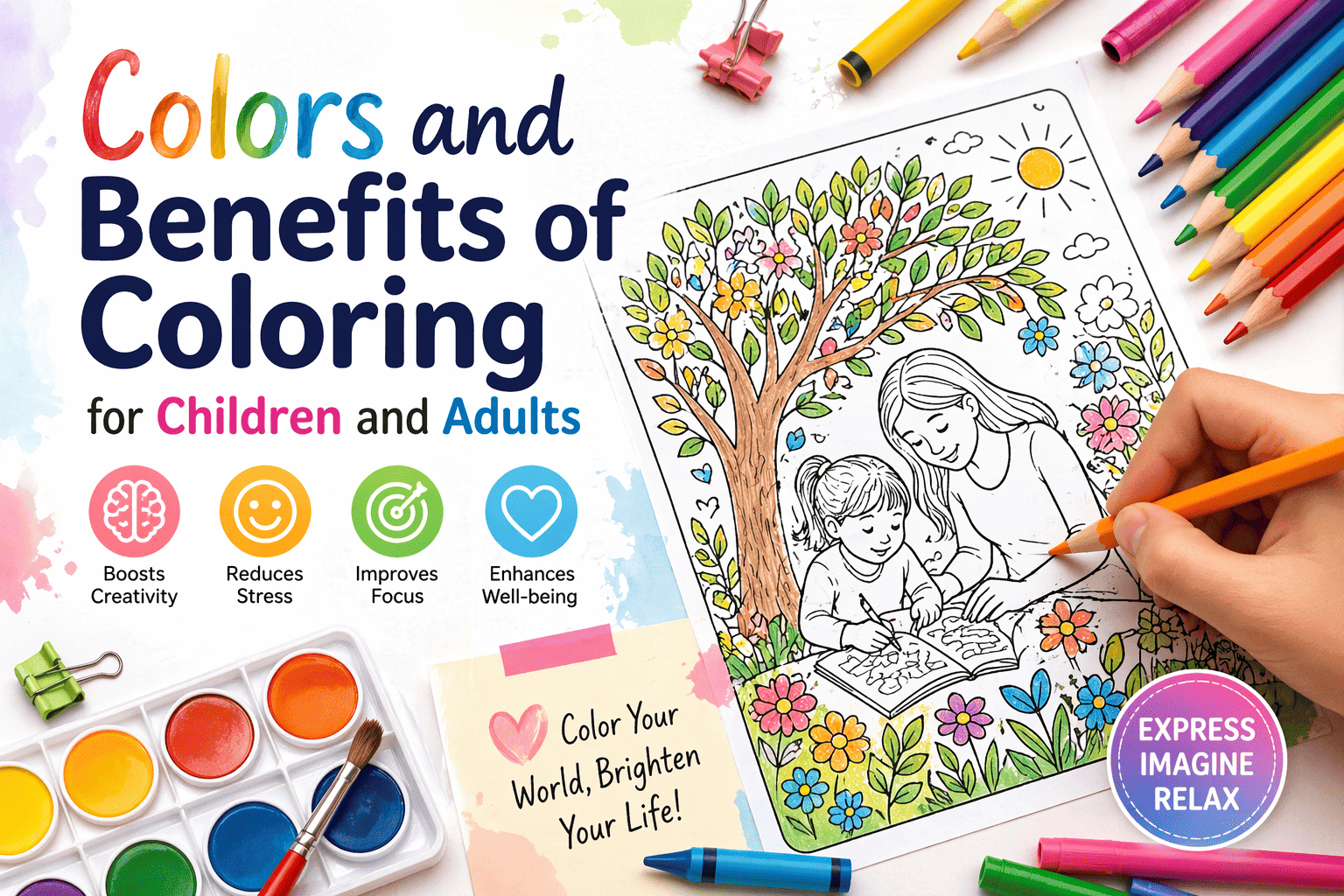
Children experience anxiety differently from adults – with less verbal capacity to identify and communicate it and fewer established coping mechanisms to draw on. Coloring is particularly well-suited to anxiety management in children for precisely the reasons that make it effective for adults, with the additional benefit of being a familiar, non-threatening activity that does not require the child to acknowledge or discuss what they are feeling.
For children experiencing situational anxiety (before the first day of school, before a medical procedure, during a family transition), coloring pages featuring familiar, comforting subjects – beloved characters, pets, nature scenes – provide a calming engagement that does not require verbal emotional processing.
For children with chronic anxiety, regular coloring as part of a daily routine – before school, during the after-school transition, at bedtime – provides a predictable, controllable activity that contributes to the stability and routine that anxious children particularly benefit from.
Parents and caregivers can amplify the benefit by coloring alongside anxious children – parallel coloring (each person coloring their own page, side by side) provides companionship and implicit co-regulation without the conversation pressure that anxious children may find difficult.
Our educational coloring pages include many designs specifically created for classroom use that teachers use to provide calming transitions between activities for anxious students.
For age-appropriate page selection, our coloring pages by age guide covers developmental considerations from ages 1 through 12. For the full, research-backed case for coloring’s benefits for children, see our guide to the benefits of coloring for children.
When Coloring Is Not Enough
Coloring is a genuine, evidence-supported stress and anxiety management tool. It is not a treatment for anxiety disorders, and it is important to be clear about this distinction.
If anxiety is significantly interfering with daily functioning – with work, relationships, sleep, or physical health – the appropriate first step is consultation with a mental health professional. Cognitive behavioral therapy (CBT) has the strongest evidence base of any psychological intervention for anxiety disorders. Medication is appropriate and effective for many people. These are not alternatives to coloring – they address different levels of the anxiety spectrum.
Coloring is most appropriately understood as a daily maintenance tool for the stress and low-to-moderate anxiety that is part of typical adult life, not as a treatment for clinical conditions. Used in this way, it is genuinely valuable: a low-cost, accessible, evidence-based activity that makes the difference between a day that feels manageable and one that does not.
If you are experiencing symptoms of an anxiety disorder – persistent, difficult-to-control worry; panic attacks; avoidance of situations due to fear; significant interference with daily life – please speak with a healthcare provider or mental health professional. Resources, including the Anxiety and Depression Association of America (adaa.org), provide guidance on finding appropriate support.
FAQs
How long do I need to color to feel less stressed? Research showing significant anxiety reduction used 20-minute sessions. Meaningful benefit is observable after 10–15 minutes of sustained coloring. For pre-sleep use, 20–30 minutes is the most studied and most consistently effective duration.
Do I need to be good at coloring for it to reduce stress? No. The stress-reduction benefit comes from the process of focused coloring, not from the aesthetic quality of the result. Research participants with no artistic background showed the same anxiety-reduction effects as those with art experience. The product is irrelevant – the process is everything.
Why do mandalas work better than other types of pages? The 2005 Curry and Kasser research found that the specific structured complexity of mandalas – organized patterns that demand focused attention without requiring creative invention – is what produces the anxiety-reduction effect. Free drawing did not produce the same benefit. The structure guides attention in a way that prevents the mind from wandering into anxious territory, while the complexity keeps the prefrontal cortex sufficiently engaged to reduce amygdala activity.
Can coloring help with panic attacks? During a panic attack, coloring can serve as a grounding activity – something concrete and present-focused that anchors attention away from the escalating physical sensations of panic. The focused-attention demands of coloring are compatible with grounding techniques (e.g., focusing on the present sensory experience, counting colors, describing what you see) used in panic management. However, if you experience frequent panic attacks, professional treatment is strongly recommended alongside any self-management tools.
Is there a difference between coloring for stress and coloring for anxiety? Stress and anxiety are related but distinct states. Stress is typically a response to an external pressure (a deadline, a conflict, an overloaded schedule). Anxiety involves worry and fear responses that persist beyond or in the absence of immediate external stressors. Coloring addresses both through the same mechanisms: reduced amygdala activation, reduced default mode network activity, and increased prefrontal engagement. The same techniques and page types apply to both.
Can I color on a tablet for stress relief? Tablet coloring apps retain the cognitive and attentional benefits of physical coloring but not the tactile sensory benefits – the feel of pencil on paper, the physical presence of the materials. For pre-sleep stress relief specifically, tablet use is counterproductive because screen blue light suppresses melatonin. At other times of day, tablet coloring provides meaningful benefits, though physical coloring is generally preferable for maximum stress relief.
My child seems anxious but won’t talk about it. Can coloring help? Yes – and this is one of coloring’s specific advantages with anxious children. Coloring does not require verbal acknowledgment of anxiety, which makes it accessible to children who cannot or will not discuss their feelings. Simply making coloring available and coloring alongside the child without requiring conversation provides calming benefits and implicit co-regulation through shared calm activity.
Browse our free coloring collections at ColoringPagesOnly.com. For stress relief specifically, we recommend starting with our mandala coloring pages for structured anxiety reduction, our flower coloring pages for gentle, restorative coloring, and our adult coloring pages for a full range of designs suited to adult stress management practice. Every page is free to download as a PDF – no account required.
For the broader science behind adult coloring benefits, see our complete benefits of coloring for adults guide.