Benefits of Coloring for Children at ColoringPagesOnly.com explores what child development research, occupational therapists, and early childhood educators have consistently found: coloring is not a filler activity. It is one of the most developmentally efficient things a young child can do with 15 minutes and a box of crayons.
This guide covers seven specific, research-supported benefits – what is actually happening in a child’s brain and body during a coloring session, why those changes matter for long-term development, and how parents and teachers can maximize the benefits at each age stage.
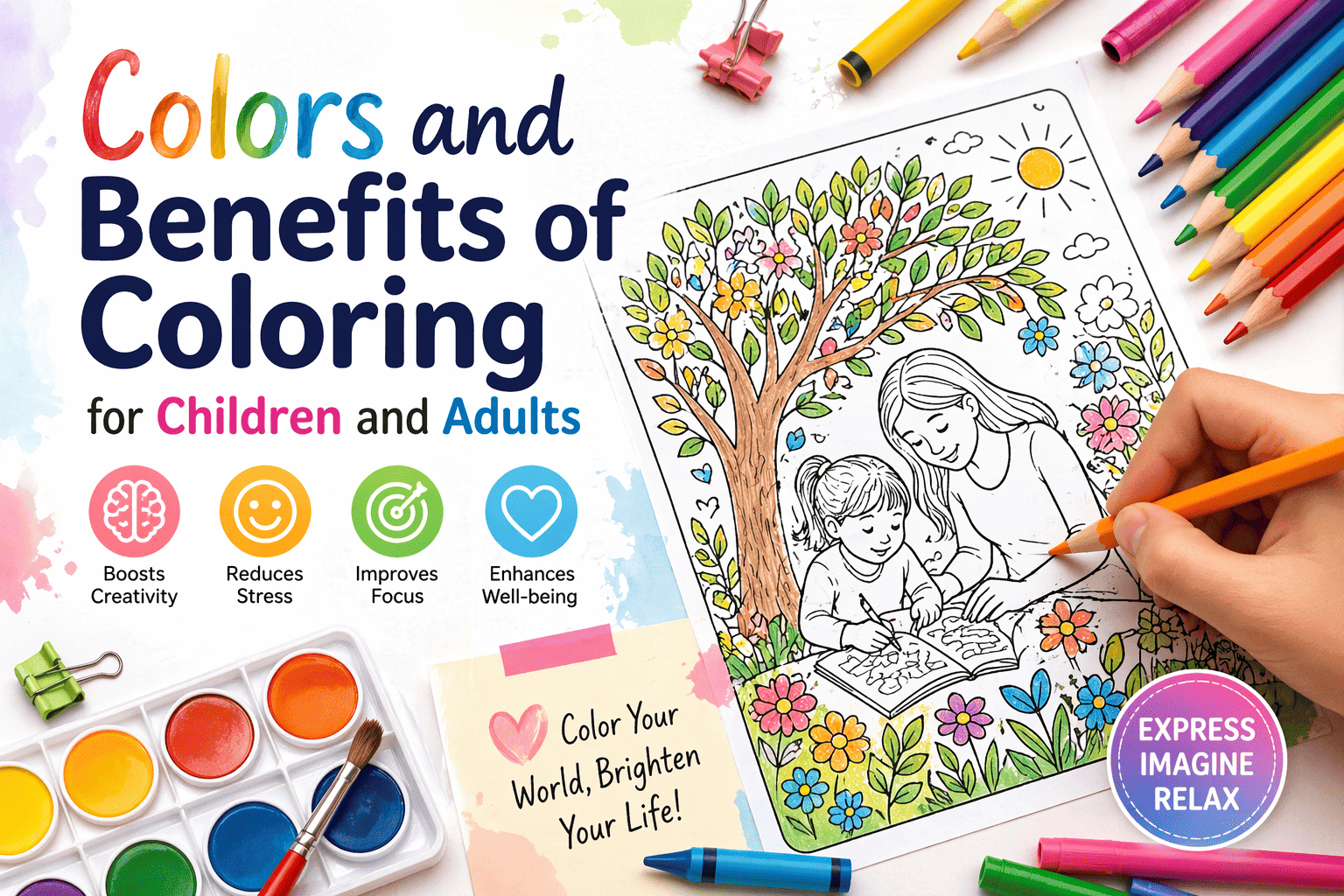
1. Fine Motor Skill Development
Fine motor skills – the precise, coordinated movements of the small muscles in the hands, fingers, and wrists – are among the most important physical developments of early childhood. They underlie handwriting, self-care tasks (buttoning, zipping, using utensils), and eventually keyboard use and most forms of skilled manual work.
Coloring is one of the most effective fine motor activities available to young children precisely because it combines grip development, pressure control, and directional movement in a single engaging task. When a child holds a crayon, applies it to paper with enough pressure to produce a visible mark, and attempts to guide that mark within or near an outline, they are simultaneously training three distinct aspects of fine motor control.
The Beery-Buktenica Developmental Test of Visual-Motor Integration (Beery VMI) – the standard occupational therapy assessment for fine motor development used in clinical practice across the United States – shows that visual-motor integration (the ability to use what the eye sees to guide what the hand does) develops dramatically between ages 3 and 7, with the most significant gains occurring precisely during the years when coloring is most age-appropriate as an activity. Children who engage in regular coloring practice during this window typically develop the hand strength and directional control necessary for within-the-line accuracy earlier and more consistently than those who do not.
A 2006 study published in the American Journal of Occupational Therapy examining fine motor interventions in preschool-aged children found that craft and drawing activities – including structured coloring – produced measurable improvements in grip strength and pencil control over an eight-week period. The researchers noted that the motivational quality of the activity (children’s willingness to sustain engagement) was a significant predictor of outcome – children who enjoyed what they were coloring showed greater improvement than those who were less engaged, which is one argument for allowing children to choose their own coloring subjects.
What this means practically: For preschool children (ages 3–5), coloring pages with bold, thick outlines and large open color zones provide the appropriate fine motor challenge – enough structure to guide the hand without requiring precision that the child cannot yet achieve. For ages 6–8, pages with more detailed interior zones, curves, and smaller areas push fine motor development further.
2. Sustained Attention and Focus
The ability to maintain focused attention on a single task for an extended period – what developmental psychologists call sustained attention – is one of the strongest predictors of academic success and is foundational to reading, mathematics, and all structured learning.
Research from the National Institute of Child Health and Human Development has consistently linked attention capacity in early childhood to later academic outcomes. A 2018 study in the Early Childhood Education Journal found that structured art activities, including coloring, were among the most effective classroom interventions for increasing sustained attention in children ages 4–7, more effective than free play and comparable to structured games with rules.
The mechanism is not mysterious: coloring requires a child to maintain focus on a specific goal (completing the image), make sequential decisions (which area to color next, which color to choose), and self-regulate impulsive behavior (the urge to scribble outside the lines or abandon the page). Each coloring session is, in essence, an attention training exercise disguised as creative play.
Typical sustained attention spans by age during engaging activities:
| Age | Expected sustained attention |
| 2–3 years | 4–6 minutes |
| 3–4 years | 8–10 minutes |
| 4–5 years | 10–15 minutes |
| 5–7 years | 15–20 minutes |
| 7–10 years | 20–30 minutes |
Coloring pages that are appropriately matched to the child’s age and interest level – not too simple (boring) and not too complex (frustrating) – reliably produce coloring sessions at the upper end of these attention windows, providing consistent, low-pressure attention practice across development.
3. Color Recognition and Visual Vocabulary
Color recognition is one of the foundational early learning milestones – children are typically expected to identify and name basic colors by age 4, and more complex colors (mixing, shades, tints) through ages 5–7. Color knowledge is not merely aesthetic; it is a language skill, a scientific concept (light, wavelength, mixing), and a mathematical concept (sorting, categorizing, sequencing).
Coloring pages provide one of the most natural contexts for color learning because they connect abstract color names to concrete decision-making: the child must choose a color, name it (internally or out loud), apply it, and evaluate the result. This active engagement with color – rather than passive exposure – drives deeper learning.
Research by Dr. Rhoda Kellogg, who cataloged children’s drawings and color choices across thousands of examples in her foundational 1969 work Analyzing Children’s Art, found that children’s color choices in drawing and coloring activities reflect developing aesthetic sophistication, color vocabulary, and spatial reasoning – all developing simultaneously as children engage with coloring materials across the preschool and early elementary years.
Parents and teachers can amplify this benefit through simple conversation during coloring sessions: asking “What color did you choose for the sky?” or “What happens if we mix that blue with white?” connects the hands-on activity to verbal language development, building the color vocabulary that is assessed in kindergarten readiness evaluations.
4. Emotional Expression and Regulation
Young children have complex emotional inner lives and extremely limited verbal capacity to express them. Before a child has the language to say “I feel overwhelmed” or “I’m worried about tomorrow,” they may express the same state through behavior – tantrums, withdrawal, hyperactivity. Art activities, including coloring, provide an alternative channel for emotional expression that does not require language.
Dr. Cathy Malchiodi, a licensed art therapist and one of the leading researchers in the therapeutic applications of art with children, has documented across multiple publications – including The Art Therapy Sourcebook and Handbook of Art Therapy – that drawing and coloring activities give children a sense of control over their environment at a time when most of their world is controlled by adults. The choice of color, the decision of what to color, and the physical act of making a mark that changes the page are all expressions of agency that carry genuine emotional weight for young children.
Color choice itself carries an emotional signal: children under stress often use darker colors more frequently; children in a positive emotional state tend toward brighter, more varied palettes. This is not a diagnostic tool, but it is a meaningful observation for caregivers who pay attention to patterns over time.
The completion of a coloring page also provides a specific emotional experience that is relatively rare in early childhood: a clear, achievable success. Unlike most areas of a young child’s life – where they are smaller, less capable, and more dependent than the adults around them – finishing a coloring page is a task fully within their ability. The satisfaction of completion, and the pride of displaying a finished piece builds the emotional resilience that comes from experiencing oneself as competent.
5. Pre-Writing Skill Development
Handwriting is not taught in a vacuum. Before a child can form letters, they need:
- Grip strength – to hold a pencil for extended periods
- Directional control – to move a writing tool in specific directions (left-to-right, top-to-bottom, curve, diagonal)
- Pressure regulation – to apply consistent force without tearing paper or making lines too faint to read
- Visual-spatial awareness – to understand where marks go on a page relative to boundaries (lines, margins)
Coloring develops all four prerequisites directly. A child who colors regularly through preschool and kindergarten arrives at formal handwriting instruction with hands that are already trained for the physical demands of writing. A 2014 study in the Journal of Occupational Therapy, Schools, & Early Intervention found that children with stronger fine motor skills at kindergarten entry – measured in part through drawing and coloring tasks – had significantly better handwriting legibility by the end of first grade compared to children with weaker fine motor baselines, even after controlling for overall intelligence and verbal ability.
The relationship between coloring and writing is direct enough that occupational therapists frequently recommend structured coloring activities as a pre-writing intervention for children identified as at-risk for handwriting difficulties in early elementary school.
6. Cognitive Development: Planning, Decision-Making, and Pattern Recognition
Coloring requires cognitive work that is easy to underestimate because the output looks simple. Before a child colors a single area of a page, they engage in:
- Planning – deciding which area to color first, which colors to use, and how to handle adjacent zones
- Decision-making – choosing between options with no single “correct” answer
- Problem-solving – managing situations where chosen colors are running out, where two similar colors need to be distinguished, and where an area is smaller than the available tool
- Pattern recognition – identifying repeating elements, matching colors across a composition, recognizing when something “looks right.”
These are foundational executive function skills – the set of cognitive capacities that govern goal-directed behavior and that predict academic and professional success more reliably than IQ alone. Research by Dr. Adele Diamond at the University of British Columbia, one of the world’s leading researchers on executive function development in children, has identified ages 3–7 as the critical window for executive function development, noting that activities requiring planning, sustained focus, and sequential decision-making are most beneficial during this period.
A well-chosen coloring page – appropriately complex for the child’s age, featuring a subject the child is engaged with – provides all of these cognitive demands in a low-stakes, pleasant context that children voluntarily sustain for significant periods.
7. Confidence and a Sense of Accomplishment
This benefit is the simplest and in some ways the most important. Young children live in a world designed for adults – furniture, doorknobs, and staircases are all sized for people larger than they are. Most of what adults ask children to do (be patient, share, sit still, use words) is genuinely difficult and frequently results in failure or correction.
Completing a coloring page is different. It is a task scaled to the child’s capacity, with a visible beginning and a visible end, producing a tangible artifact – a finished piece of art – that can be displayed, shared, and praised. The child who finishes a coloring page has made something. That experience of making something – of starting with a blank page and ending with a colored image through their own sustained effort – builds the specific type of confidence that psychologists call self-efficacy: the belief that one’s actions produce real results in the world.
Research by Albert Bandura at Stanford University identified self-efficacy as one of the strongest predictors of children’s willingness to attempt challenging tasks and persist through difficulty. Children with high self-efficacy in early childhood are more likely to approach new academic challenges with effort rather than avoidance – a difference that compounds significantly across school years.
Parents and teachers who respond to completed coloring pages with specific praise – not just “good job” but “I noticed you chose purple for the sky – that’s a creative choice” or “You stayed inside the lines on this part, that’s hard to do” – reinforce the connection between the child’s specific effort and the successful outcome, maximizing the self-efficacy benefit.
How to Maximize These Benefits by Age
Ages 2–3: Focus on the experience rather than the outcome. Provide chunky crayons, large paper, and simple, bold outlines. The goal is exposure to the physical experience of mark-making and color. Do not correct coloring that goes outside the lines – this is developmentally normal and expected.
Ages 3–5: Introduce simple coloring pages with bold outlines and 3–6 color zones. Talk about colors during the session. Display finished work prominently. Let the child choose which pages to color – engagement with the subject dramatically increases the attention benefit.
Ages 5–7: Move toward pages with more detail and variety. Introduce basic color concepts: warm and cool colors, what happens when you press harder or lighter with a colored pencil, and how two colors look next to each other. Connect to school learning – color the alphabet, number pages, and educational subjects.
Ages 7–10: More complex pages with 15–30 color zones are appropriate. Introduce colored pencils as a primary tool (they require more hand strength and control than crayons). Begin discussing color choices deliberately: “What mood does this color give the picture?” Connect to subjects the child is passionate about – characters from books, games, or shows they love.
FAQs
At what age should children start coloring? Children can begin with chunky crayons and large paper as early as 12–18 months, though structured coloring pages with outlines become developmentally appropriate around age 2–3 when intentional mark-making emerges. There is no minimum age for exposure to coloring materials in a supervised setting.
How long should a coloring session be? Match session length to the child’s developmental attention span: 5–10 minutes for ages 2–3, 10–15 minutes for ages 3–4, 15–20 minutes for ages 4–6, and open-ended for older children if engagement is high. End sessions while the child is still interested to build positive associations with the activity.
Should I correct my child’s color choices? No. Color choice is one of the primary creative decisions coloring provides, and correcting it reduces creativity and intrinsic motivation. The only situation where guidance is appropriate is when a child explicitly asks for help – and even then, offering options rather than a single answer (“the grass is usually green, but it could also be any color you want – what sounds interesting?”) maintains creative agency.
Why won’t my child stay within the lines? Staying reliably within outlines requires visual-motor integration that most children do not fully develop until ages 5–6. A 4-year-old coloring near but not within the lines is developmentally normal. Praise the effort and color choices rather than precision – accuracy will develop naturally with time and practice.
Does digital coloring have the same benefits as physical coloring? Physical coloring with crayons, colored pencils, or markers develops fine motor skills and grip strength in ways that digital coloring (on tablets) cannot replicate, because physical tools require actual pressure application and hand-movement control. Digital coloring retains the cognitive and emotional benefits but not the motor development benefits. For children under 7, physical coloring is strongly preferable for fine motor development.
How do I choose the right coloring page for my child’s age? The key variables are outline boldness (thicker for younger children), number of color zones (fewer for younger, more for older), and subject matter (choose topics the child is already interested in for maximum engagement). A complete age-by-age guide with specific recommendations is available in our Coloring Pages by Age Guide.
Explore our free coloring page collections for every age and interest at ColoringPagesOnly.com. Every page is free to download as a PDF or color online – no sign-up required.