Fruit Of The Spirit Coloring Pages
 By:
Jennifer Thoa - Content Editor & Designer
Updated:
By:
Jennifer Thoa - Content Editor & Designer
Updated:
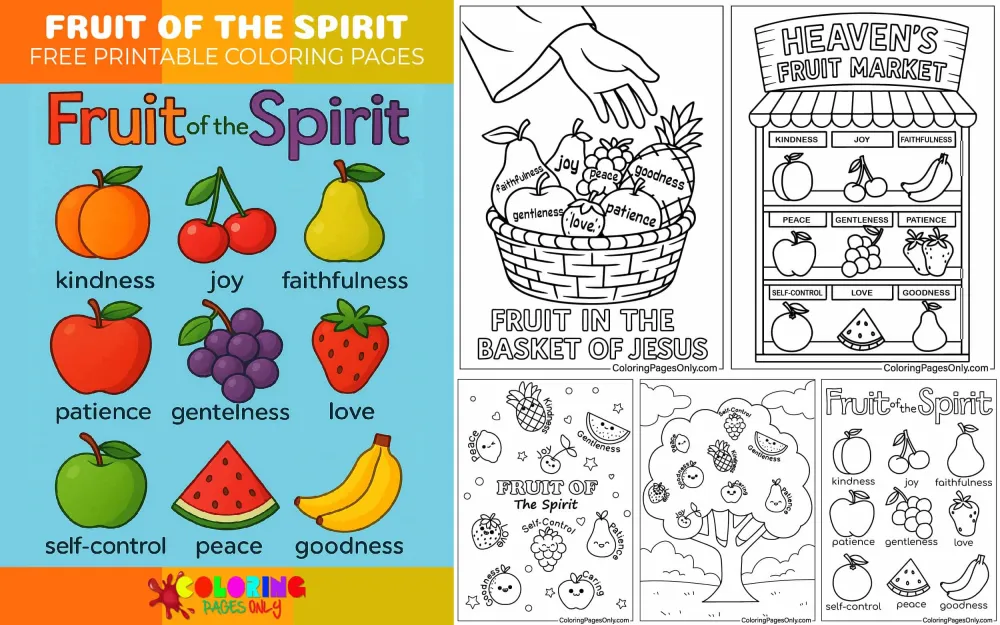
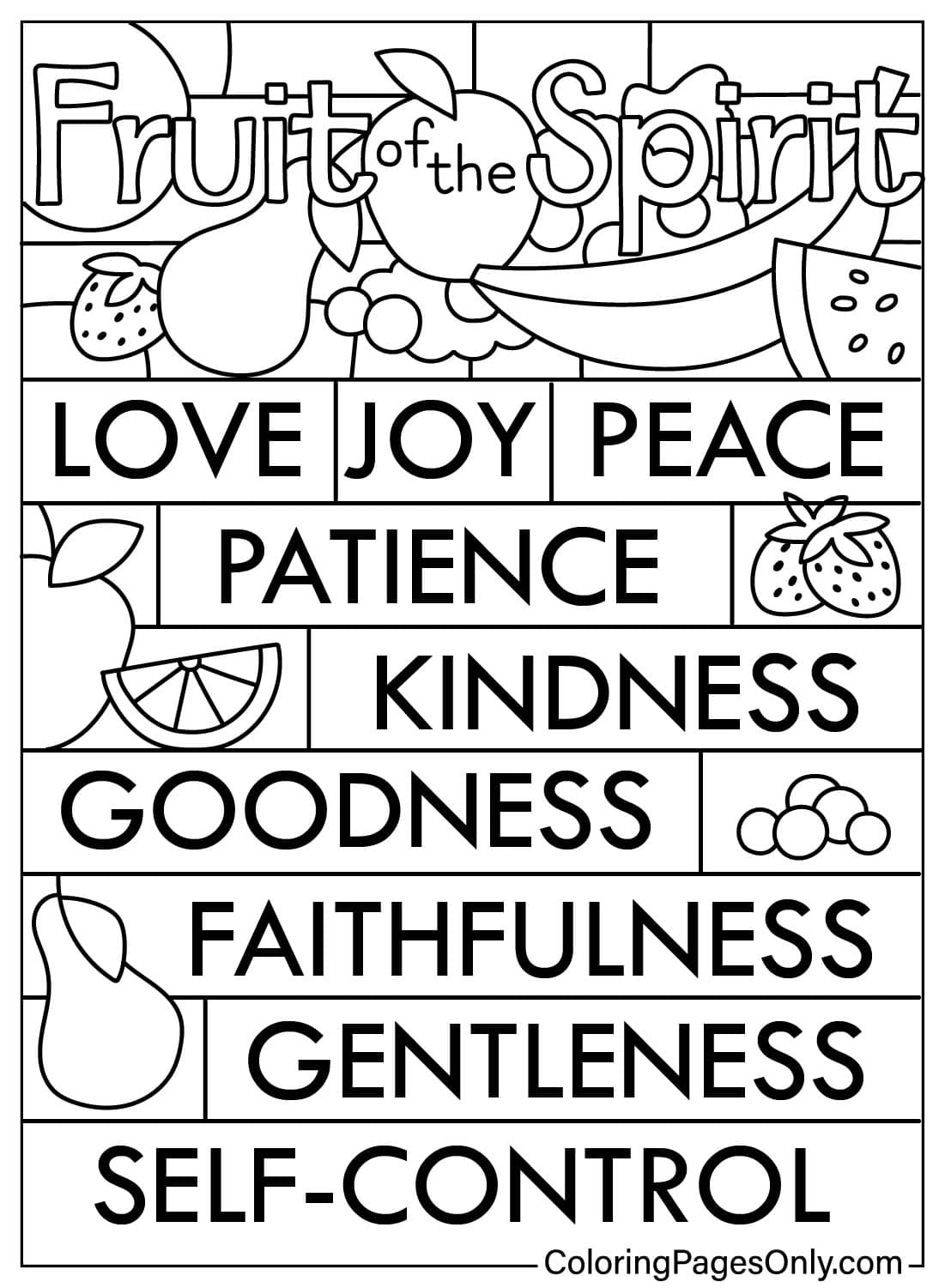
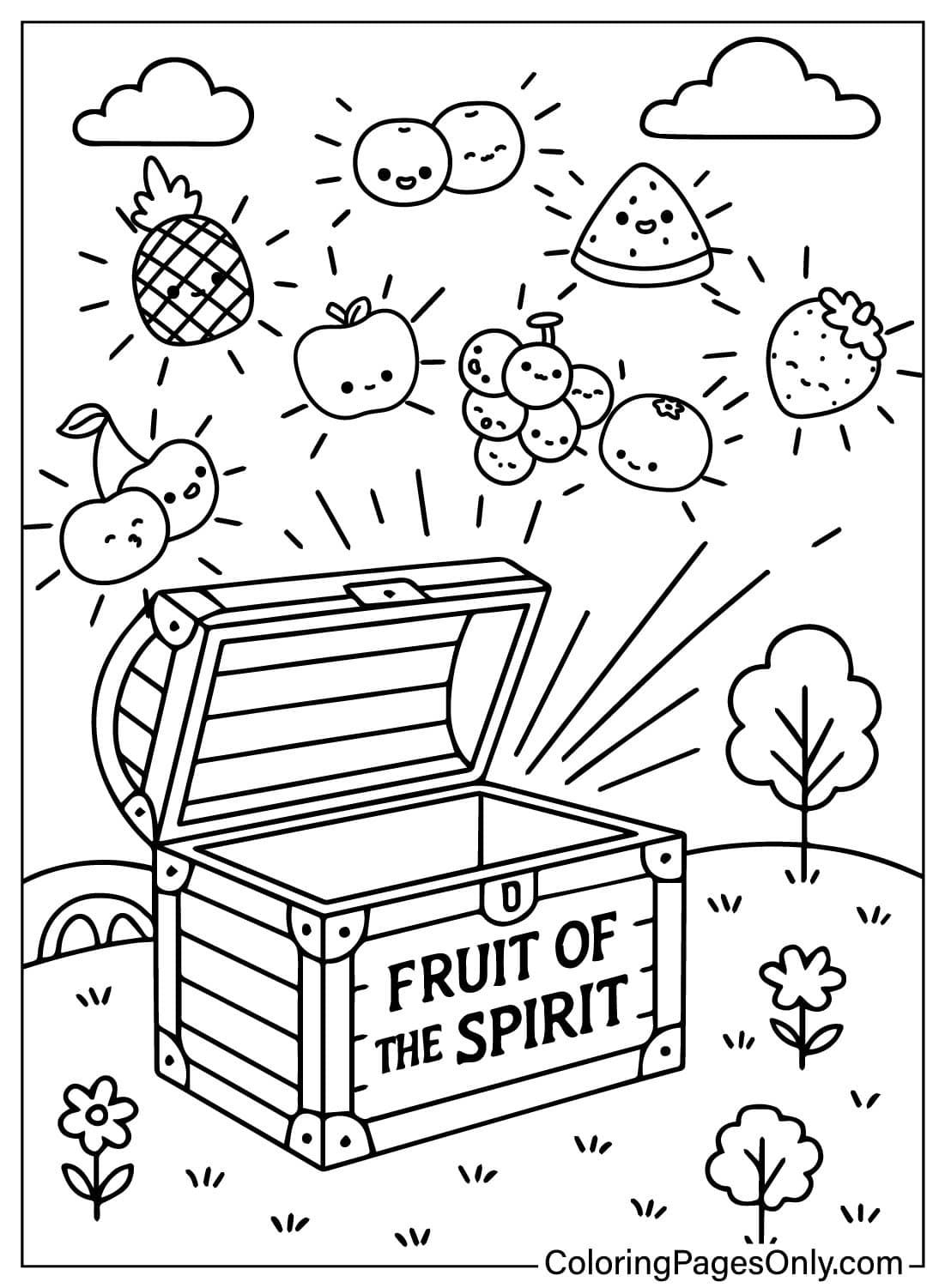
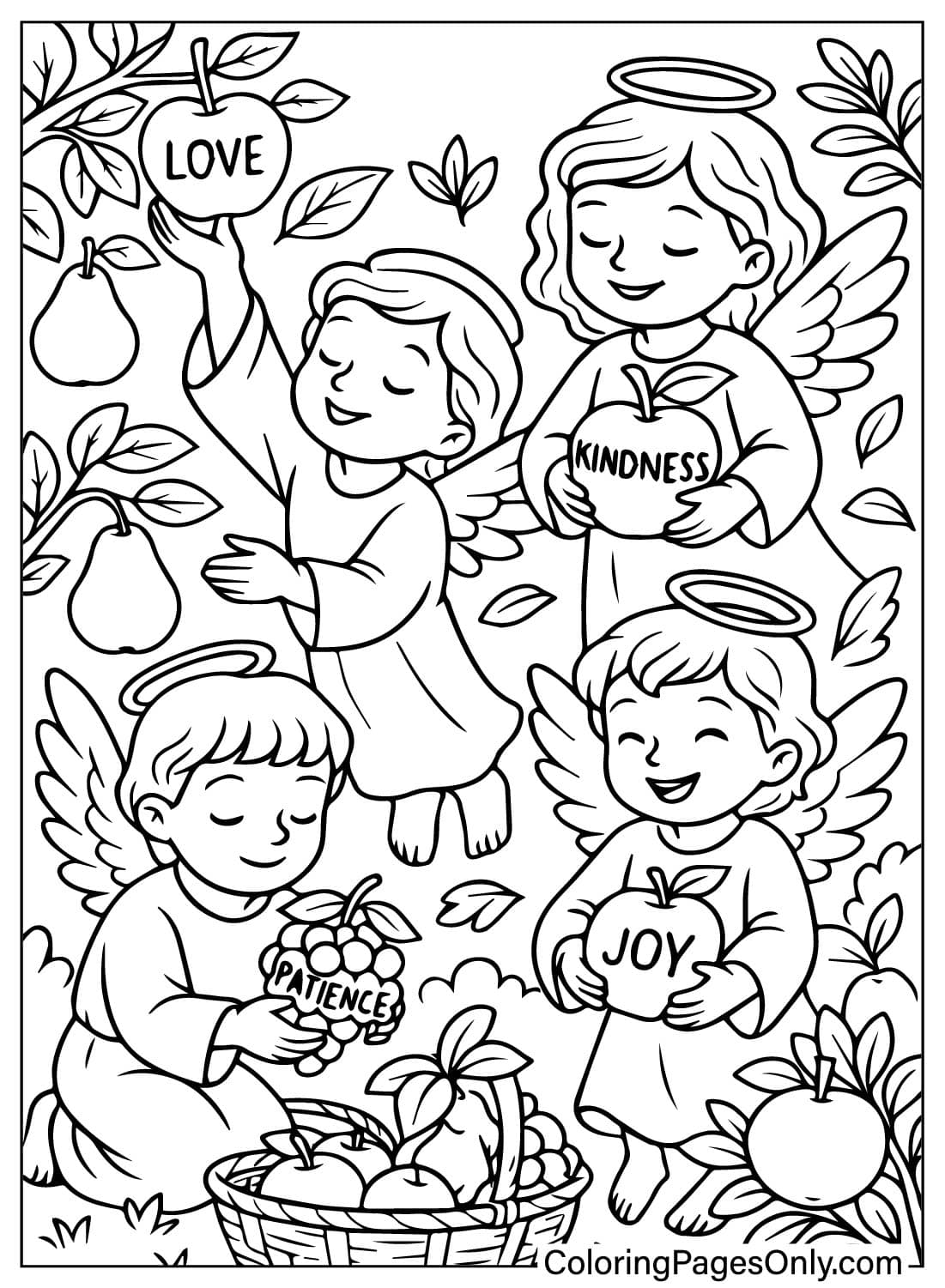
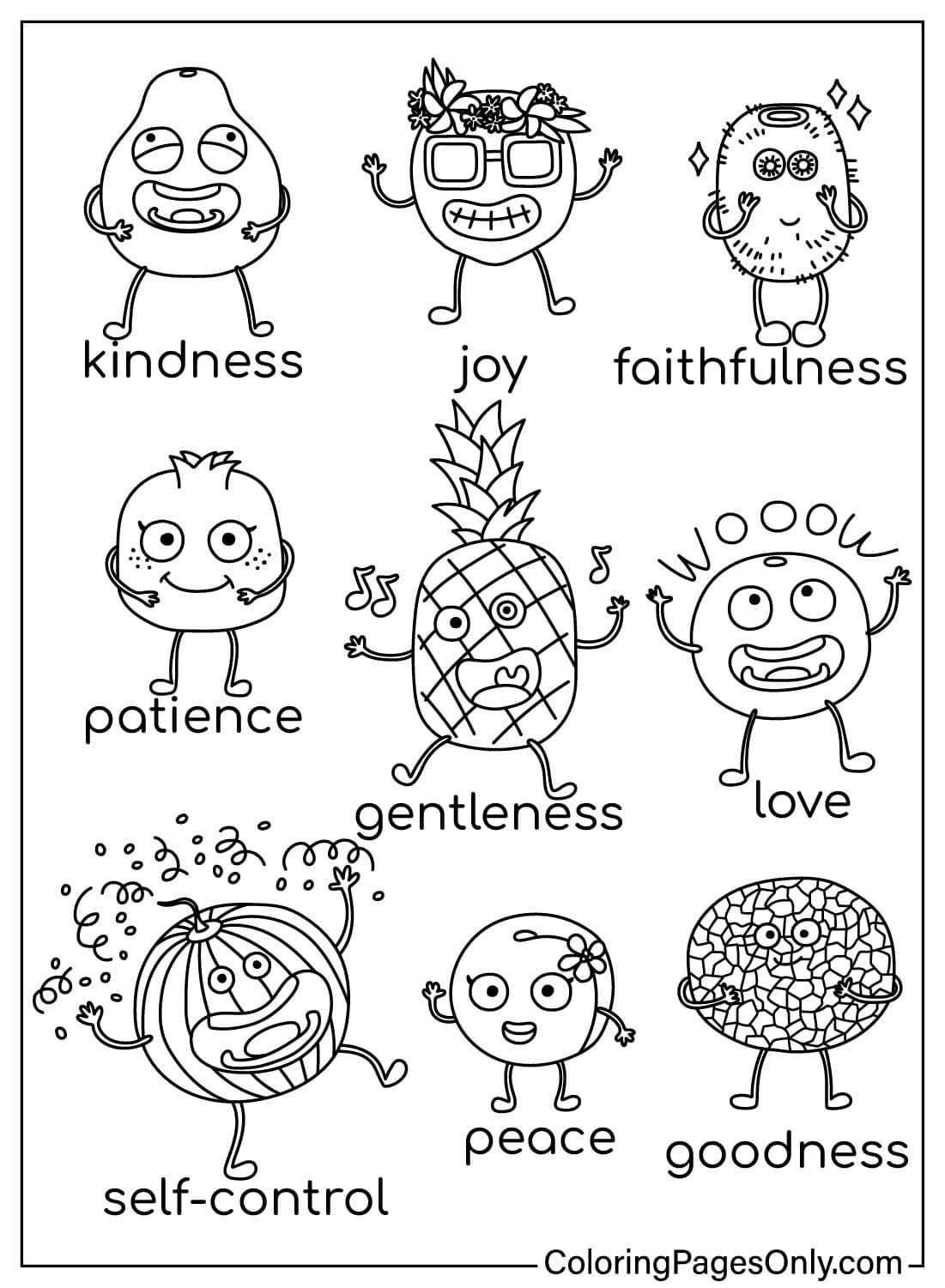
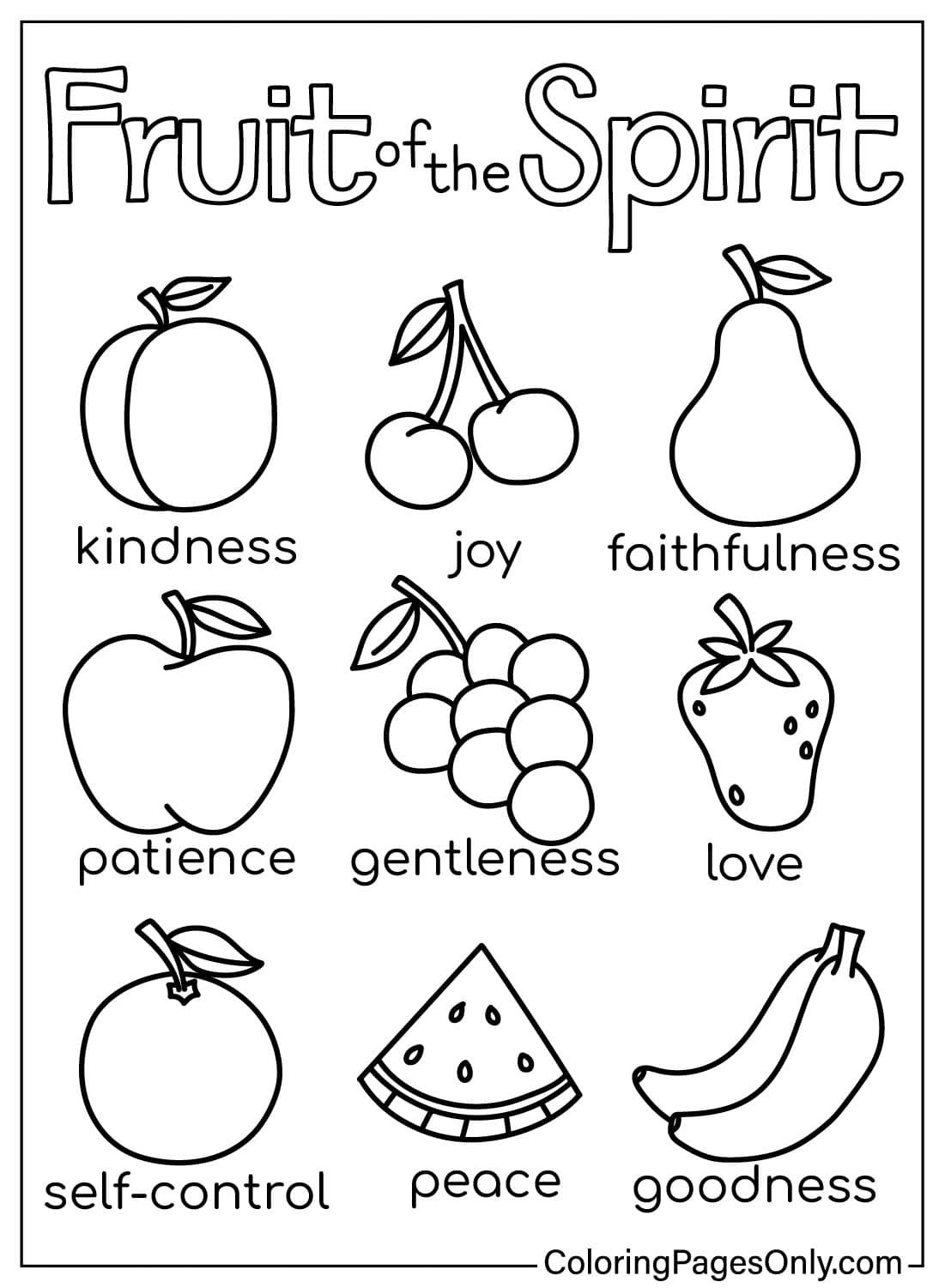
Free Fruit of the Spirit coloring pages – 20+ pages featuring all nine virtues from Galatians 5:22-23 – love, joy, peace, patience, kindness, goodness, faithfulness, gentleness, and self-control – presented through individual fruit illustrations with virtue names, full tree and basket compositions, scripture banner pages, and designs created for Sunday School, Vacation Bible School, Christian homeschool, and family Bible study – free printable PDF and online coloring.
The Fruit of the Spirit is one of the most taught passages in children’s Christian education. It appears in the New Testament book of Galatians, written by the Apostle Paul to the churches of Galatia – a region of what is now central Turkey – approximately between 48 and 55 AD. The passage, Galatians 5:22-23, reads in the New International Version: “But the fruit of the Spirit is love, joy, peace, forbearance, kindness, goodness, faithfulness, gentleness and self-control. Against such things there is no law.”
The passage uses the singular “fruit” – karpos (καρπός) in the original Greek – rather than the plural “fruits.” This grammatical choice carries theological meaning: Paul presents these nine qualities not as separate achievements to be checked off individually but as a unified character that grows in a person through the Holy Spirit’s work, the way a healthy tree produces fruit naturally as a consequence of its health rather than as a separate effort. The nine qualities belong together, and the singular fruit emphasizes their unity.
The fruit metaphor connects to multiple threads in the biblical text: Jesus’s statement in Matthew 7:16-20 that “you will know them by their fruits,” the vine-and-branches passage in John 15 where Jesus describes himself as the vine and his followers as branches who can only produce fruit by remaining connected, and the broader agricultural imagery that runs through both Testaments as a language for spiritual growth and health.
These 20+ free pages at ColoringPagesOnly.com bring all nine virtues to the coloring page format. All free, PDF or PNG, print or color online – perfect for Sunday School, VBS, homeschool Bible study, and family devotion.

What’s Inside
Love – The First and Greatest
Love is the first virtue listed in the Galatians passage and the one the New Testament most consistently presents as central to Christian character. The Greek word Paul uses is agapē (ἀγάπη) – one of four Greek words for love, specifically the word for selfless, unconditional love that seeks the good of another regardless of personal cost or reciprocal benefit. It is distinct from eros (romantic love), philia (friendship love), and storge (familial affection). Paul’s first letter to the Corinthians, Chapter 13, is the most extended biblical definition of this agapē love: it is patient, kind, not envious, not boastful, not proud, not self-seeking.
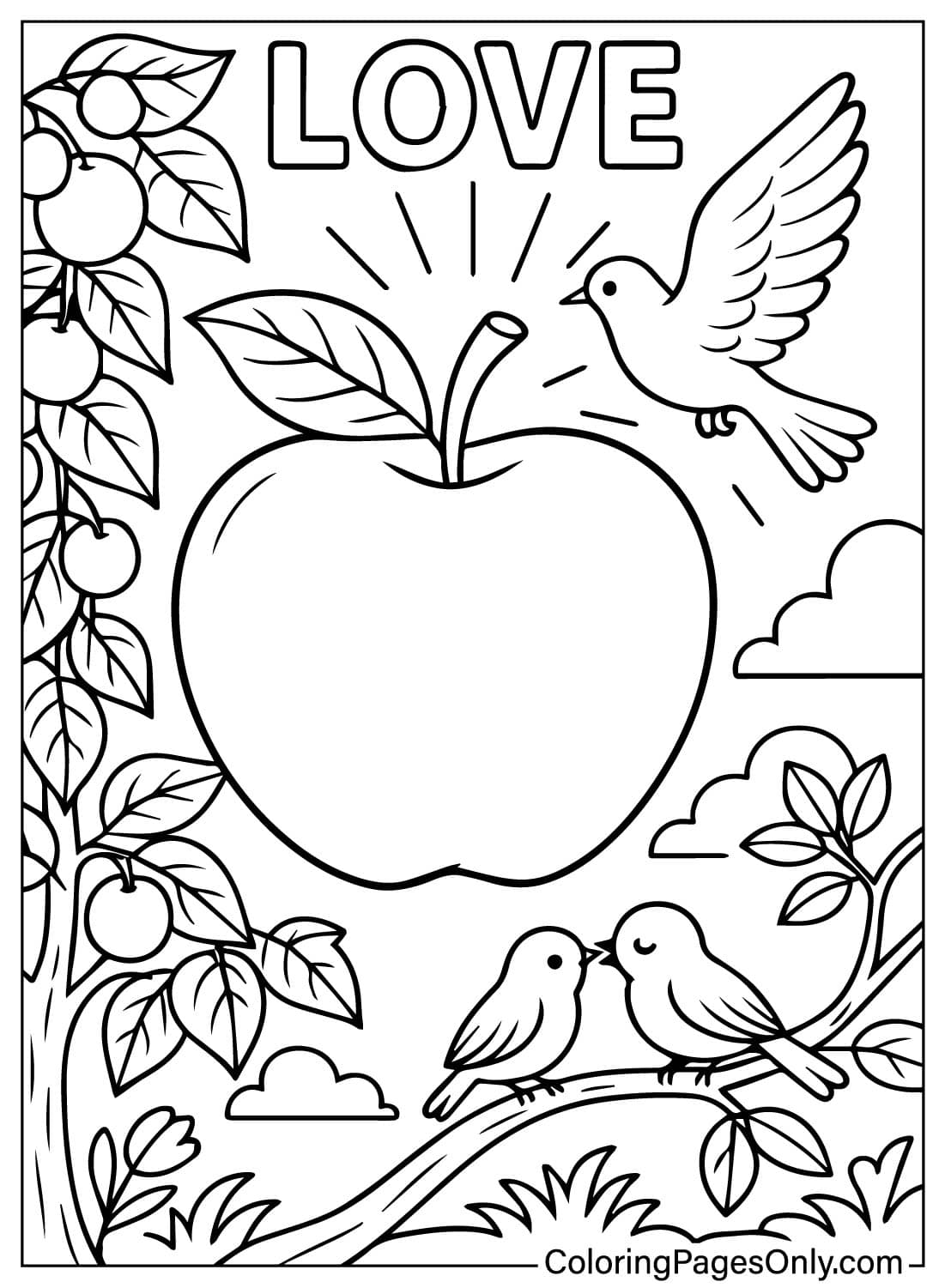
The love coloring pages typically pair the word “Love” with a fruit illustration – often a strawberry (for its heart-like shape and its red color, which has come to be associated with love in popular visual culture), or an apple, or grapes.
Coloring Love pages: The strawberry, if used, is a vivid warm red with small seed indentations and a green leafy cap. The heart shape of a strawberry is best rendered with a slightly lighter pink-red at the very peak of the heart, where it catches the most light. If the page shows the word “Love” decorated with hearts or flowers, apply warm, vivid tones – reds, pinks, warm yellows – to maintain the warmth of the virtue’s visual language.
Joy – Deep and Durable
Joy in the biblical context is understood as distinct from happiness – happiness being a response to favorable circumstances, while joy is a more durable quality of inner gladness that persists through difficulty. The Greek word is chara (χαρά), connected to the same root as charis (grace). The New Testament presents joy as something the Spirit produces in a person independently of their external circumstances – Paul writes of experiencing joy while in prison (Philippians 4:4: “Rejoice in the Lord always”).
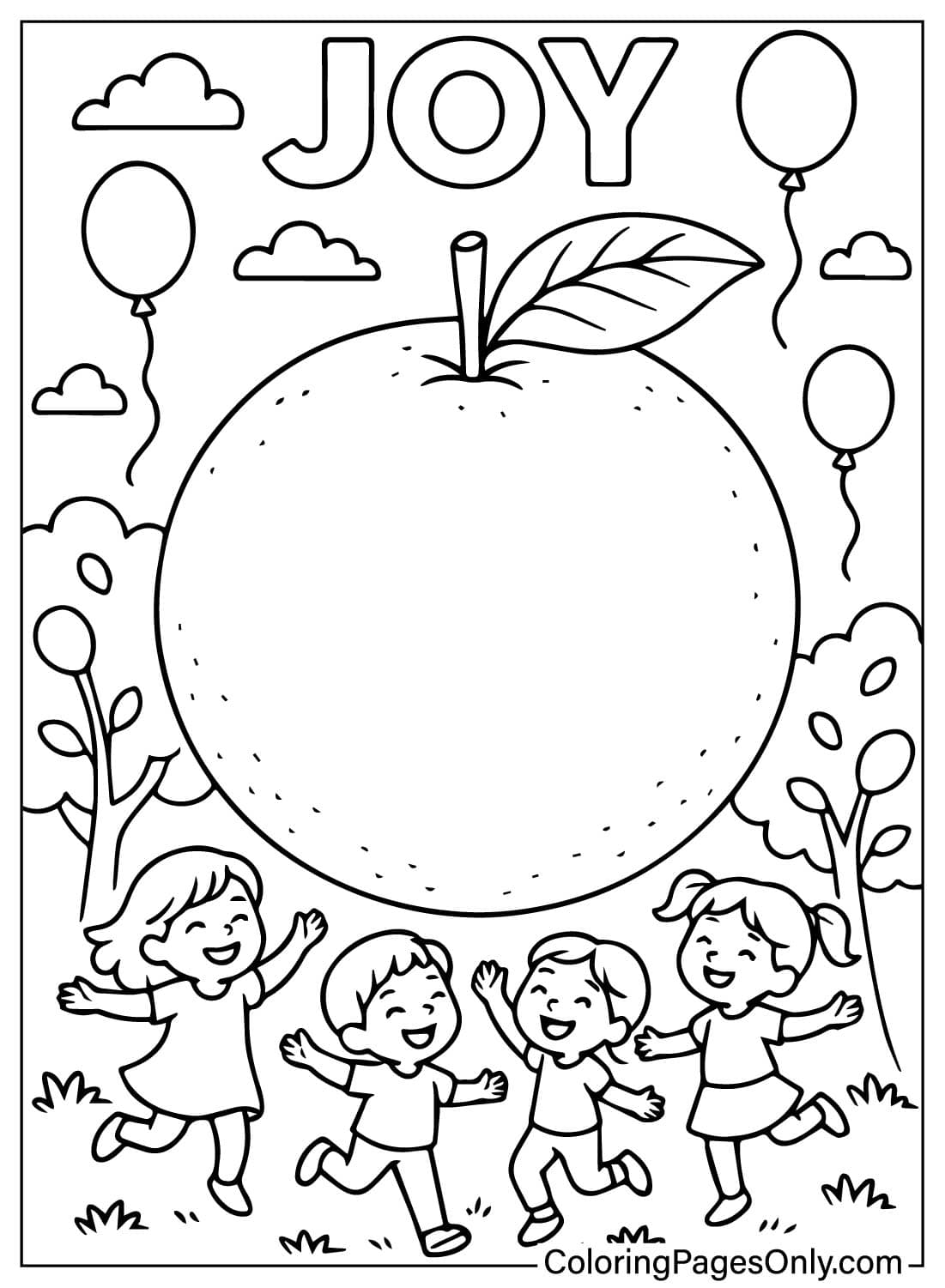
Joy pages often pair the virtue with bright, vivid fruit imagery – oranges, lemons, or sunflowers (not a fruit but sometimes used as a joy symbol).
Coloring Joy pages: The orange is the most vivid warm color in the natural fruit palette – a fully saturated warm orange applied at maximum pressure. The specific quality of an orange’s peel surface – the subtle texture of the dimpled skin – can be suggested by applying the orange base color first and then adding very subtle, darker orange dots in a regular pattern across the peel surface.
Peace – Wholeness and Harmony
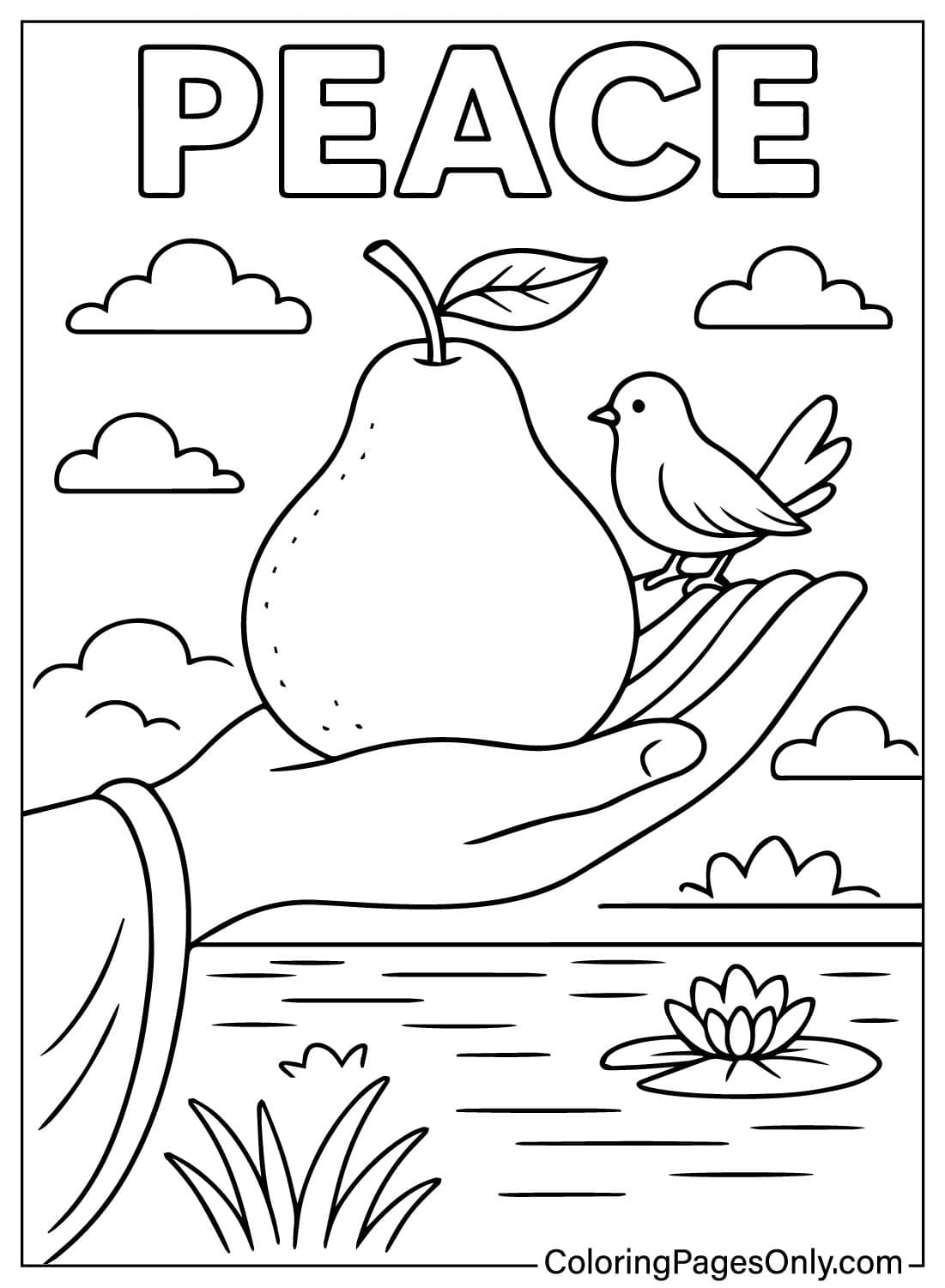
The word translated “peace” in Galatians 5:22 is eirēnē (εἰρήνη) – the Greek equivalent of the Hebrew shalom, a word that in its Hebrew context means far more than the absence of conflict. Shalom encompasses wholeness, well-being, right relationship with God, with other people, and with creation. It is the quality of a life ordered as it is meant to be ordered.
The peace coloring pages often feature the virtue with grapes, which carry the specific biblical associations of peace and prosperity – the vine-and-fig-tree image in the Old Testament (Micah 4:4, “each man shall sit under his own vine and fig tree, and no one will make them afraid”) was the specific picture of peace in the Hebrew prophetic tradition.
Coloring Peace pages: Grapes are the most visually structured fruit – a cluster of individual spheres, each one a distinct circle requiring individual attention. Apply the grape’s primary color (purple-blue for Concord grapes, red-purple for red grapes, pale yellow-green for green grapes) as a base across each individual grape sphere. Then add a lighter highlight at the upper portion of each sphere and a slightly darker tone at the lower, shadowed portion. The effect of individually rounded grapes in a cluster emerges from this sphere-by-sphere treatment.
Patience – Long-Suffering
The King James Version translates this virtue as “longsuffering” – a more literal rendering of the Greek makrothymia (μακροθυμία), which combines makros (long) and thumos (anger, passion, spirit). Long-suffering in this sense means the capacity to endure hardship or provocation over an extended time without giving way to frustration or abandonment. It is patience not merely in the sense of waiting without complaint but in the deeper sense of sustained faithfulness through trial.
Coloring Patience pages: Watermelon, when used as the patience fruit, presents the collection’s most graphically interesting interior: the vivid green rind with a lighter inner rind, then the vivid pink-red of the flesh, then the white area near the seeds, then the black seeds themselves. Apply each zone separately: green rind (dark green outer, lighter yellow-green inner), then the flesh (a vivid warm pink-red), then the seed positions in near-black.
Kindness – Active Goodness
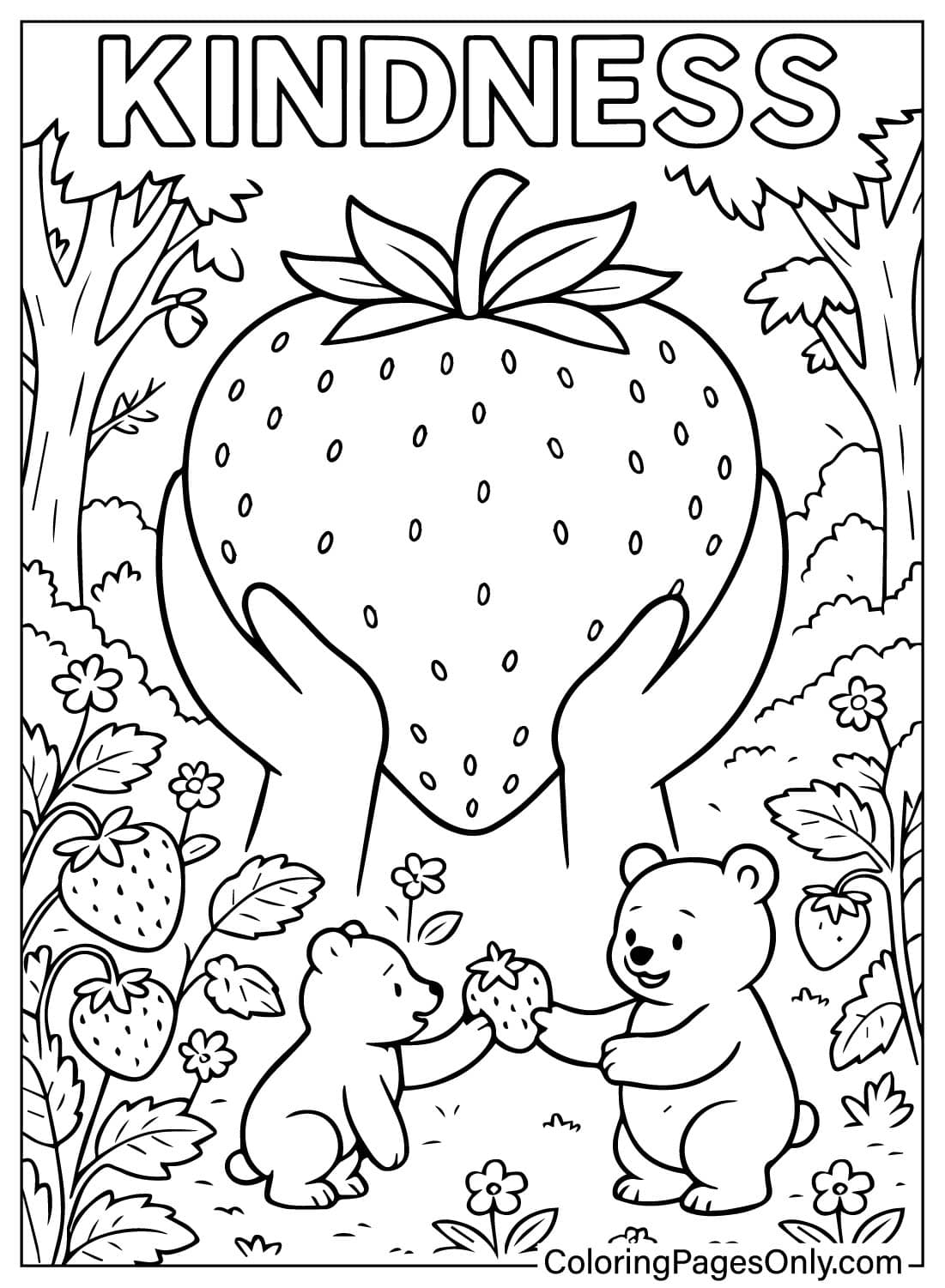
Chrēstotēs (χρηστότης) – the Greek word translated “kindness” – refers to a moral quality of goodness that expresses itself in action toward others. It is not simply niceness or pleasantness but a genuine orientation toward others’ well-being that produces concrete helpful behavior. Paul uses it in Romans 2:4 to describe God’s kindness toward humanity as something intended to “lead you toward repentance.”
Coloring Kindness pages: The peach, when used as the kindness fruit, has a distinctive two-tone coloring – a warm peachy-orange on the sun-facing side and a warm yellow-green on the shadow side, with a visible indentation running from stem to base. Apply warm peach-orange as the base across the fruit, then add the slightly cooler, yellower tone on the shadow-facing side as a gradual blend from the orange base.
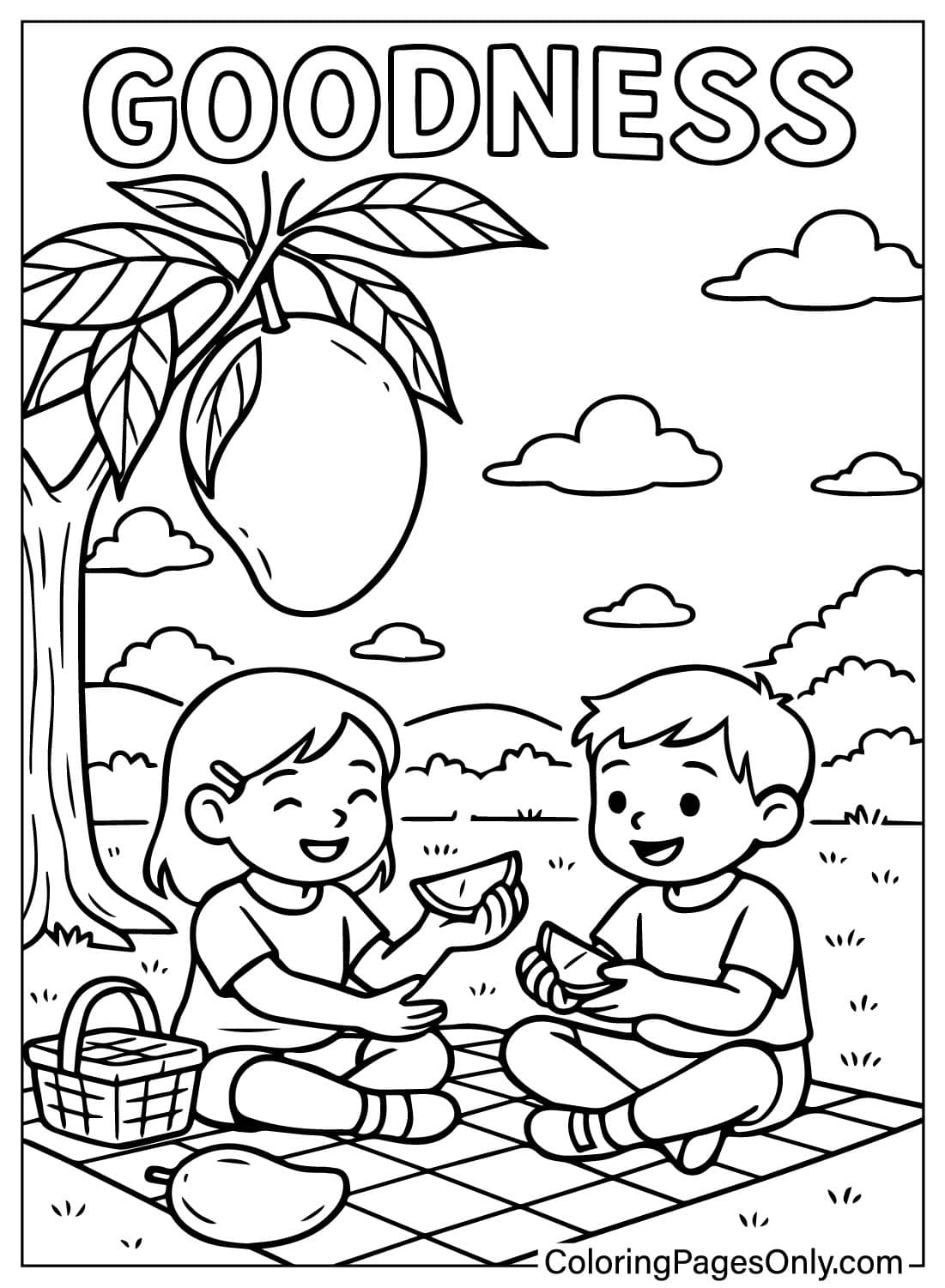
Goodness – Virtue in Action
Agathōsynē (ἀγαθωσύνη) – goodness – is one of only three places this specific Greek word appears in the New Testament (Galatians 5:22 and two other passages). It refers to moral excellence, uprightness of character, and specifically a generosity of spirit that actively does good rather than merely refraining from doing harm. It is the quality of someone whose character is fundamentally oriented toward what is right and good.
Coloring Goodness pages: The apple – when used as the goodness fruit – is the most immediately recognizable fruit shape in the Western visual tradition, with its round body, leaf, and stem at the top, and the subtle indentation at both the stem and the base. Apply vivid red for a red apple (the most classic), with lighter red-pink highlights at the most directly lit surfaces and darker red in the shadow areas. The leaf should be vivid green, the stem warm brown.
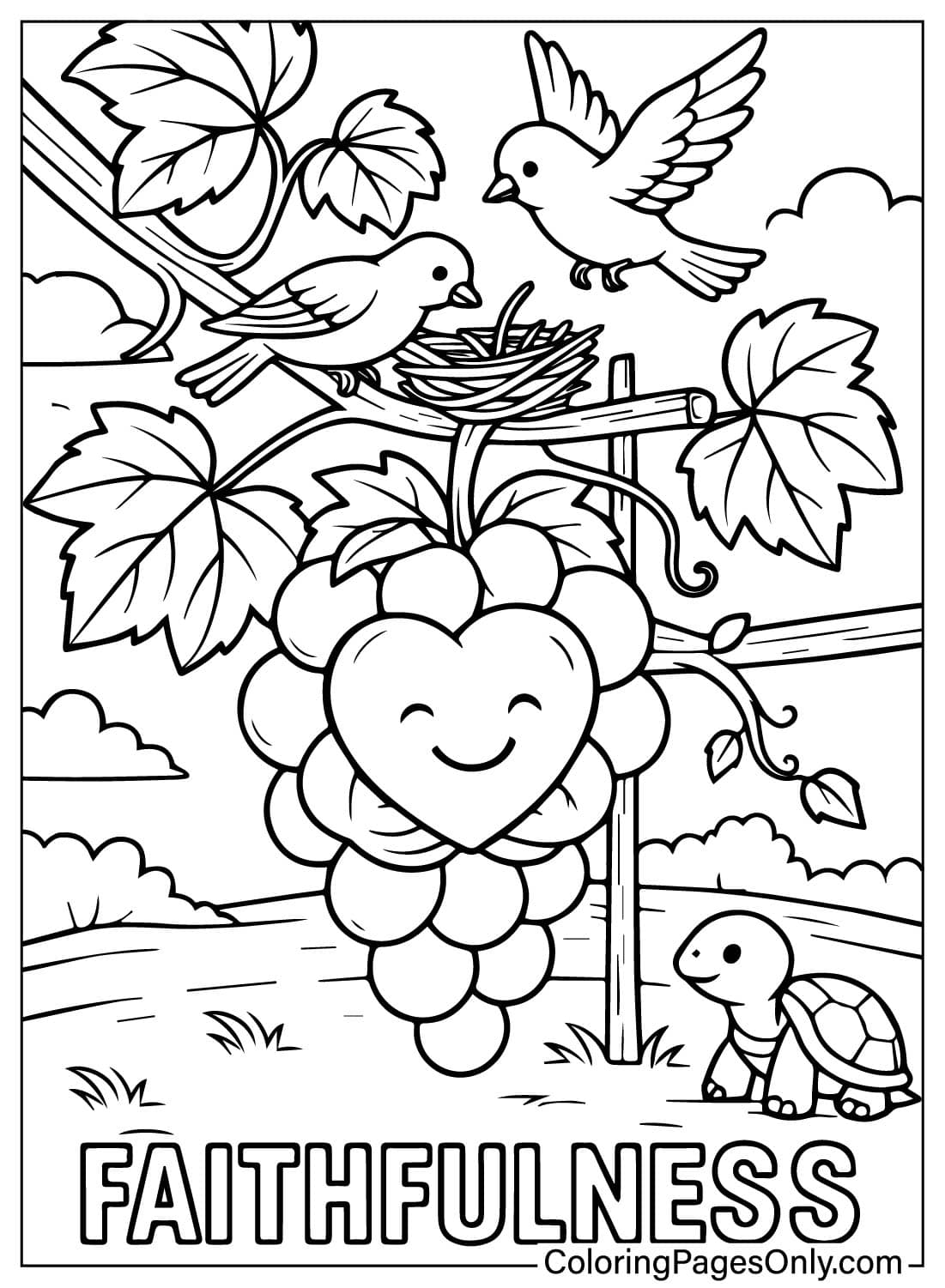
Faithfulness – Reliable and True
Pistis (πίστις) – the same Greek word used for “faith” throughout the New Testament – when it appears as the Fruit of the Spirit, refers specifically to the quality of faithfulness: reliability, trustworthiness, fidelity to commitments. A faithful person is one whose word can be depended upon, who follows through on what they have promised, and who remains constant.
Coloring Faithfulness pages: Pomegranate, when used as the faithfulness fruit, has distinctive visual characteristics: a deep red outer skin with a crowned top (the persistent calyx), and an interior packed with individual ruby-red seed-covered arils. The pomegranate exterior is a deep, warm red-pink – slightly cooler and darker than an apple red.
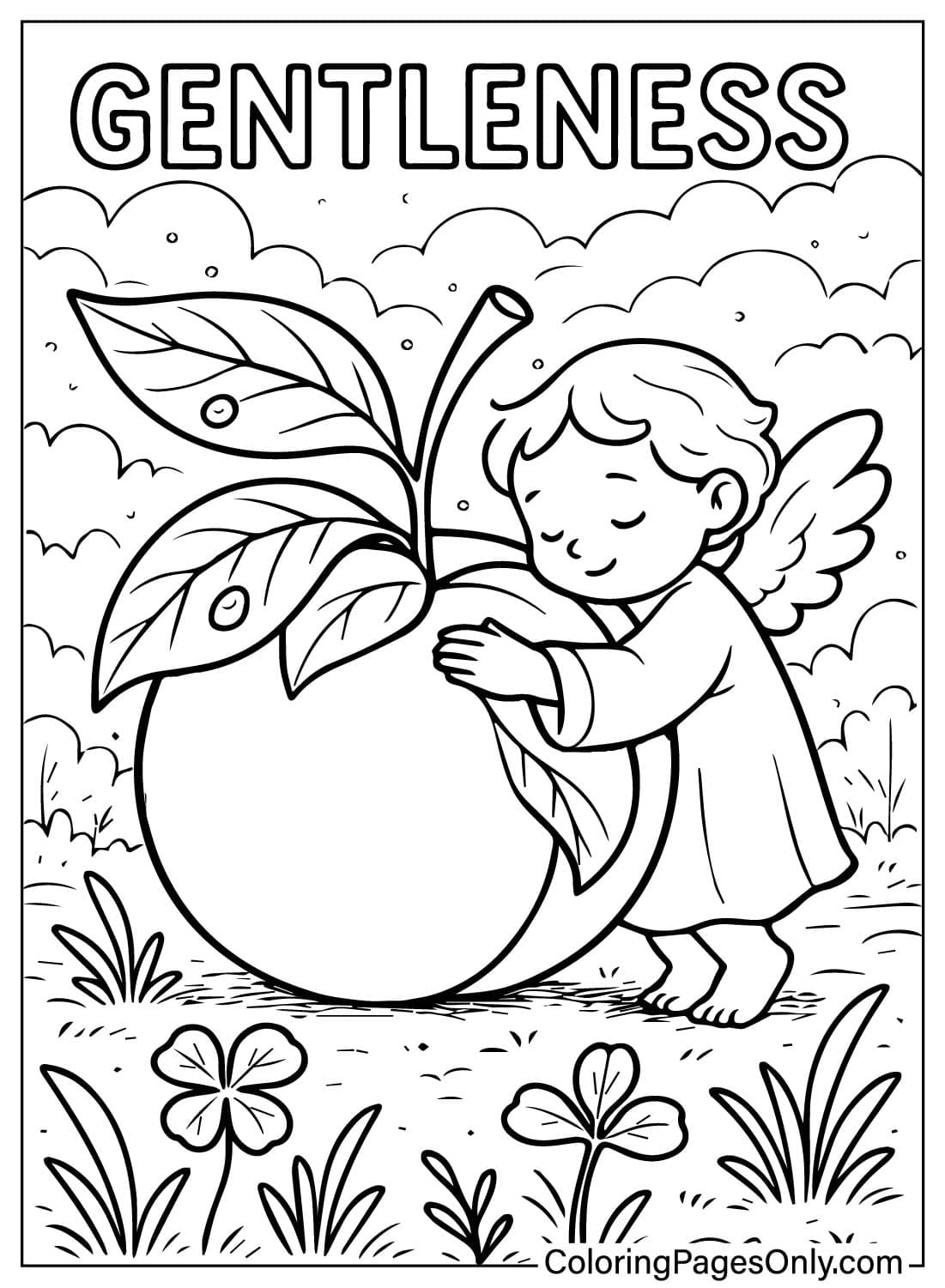
Gentleness – Strength Under Control
The Greek word praÿtēs (πραΰτης) – translated “gentleness” or “meekness” in different versions – does not mean weakness. In its Greek context, it described the quality of a powerful thing under control: a trained horse was praÿs, a controlled and directed strength. The biblical “gentleness” is not the absence of power but its appropriate and considered application – the quality of someone who has the capacity to act forcefully but chooses patience, care, and consideration.
Coloring Gentleness pages: The pear, when used as the gentleness fruit, has a soft, organic form – a more irregular, gentle shape than the apple’s roundness. Apply a warm yellow-green as the base for a green pear, with a slight warm yellow at the areas of greatest sun exposure and a slightly cooler, more muted green in the shadow areas.
Self-Control – The Governing Virtue
Enkrateia (ἐγκράτεια) – self-control or temperance – is the mastery of one’s own impulses, desires, and passions. It appears at the end of Paul’s list in Galatians 5:22-23, followed immediately by the statement “against such things there is no law” – suggesting that the Spirit-produced qualities cannot be regulated by law because they already exceed what law requires. Self-control in the biblical context refers not to repression but to the kind of inner ordering that allows a person’s best intentions to govern their actions.
Coloring Self-Control pages: Blueberries or blackberries, when used as the self-control fruit, have the specific visual quality of small, dark, round berries in clusters – a blue-black or dark purple-blue applied as small circles across the fruit mass, each with a pale dusty highlight at the top of the sphere, suggesting the fruit’s natural bloom coating.
Full Tree and Complete Collection Pages
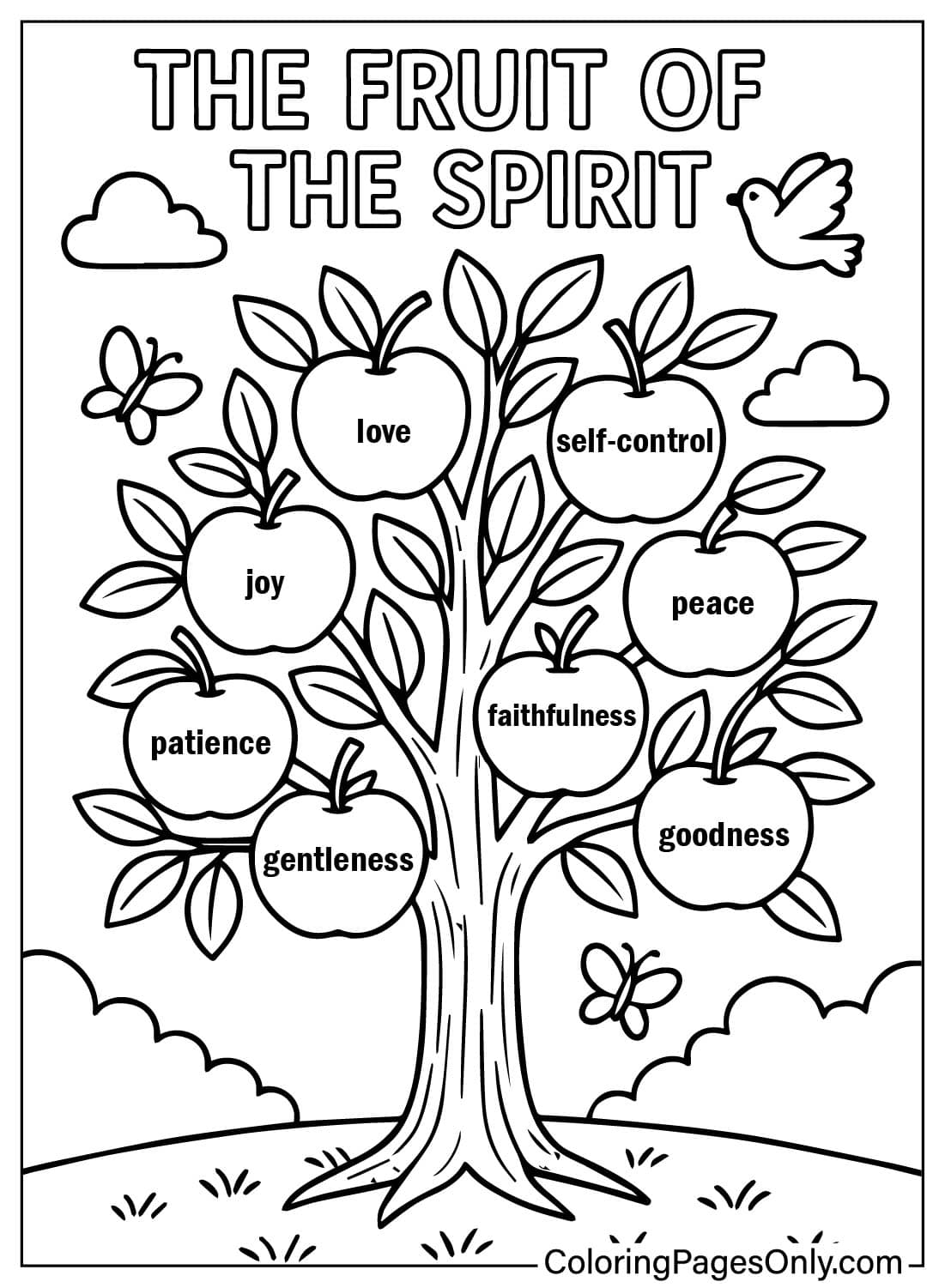
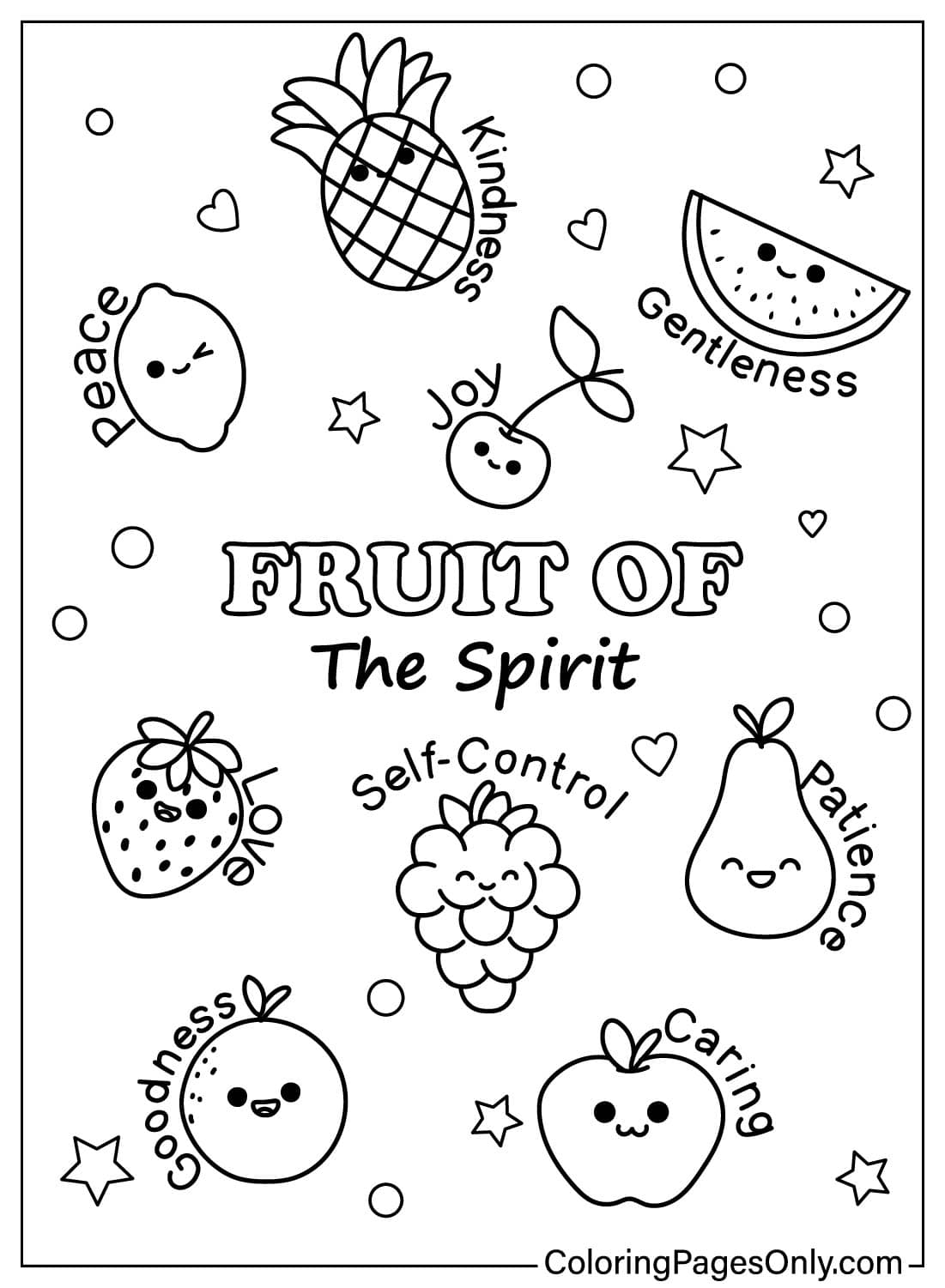
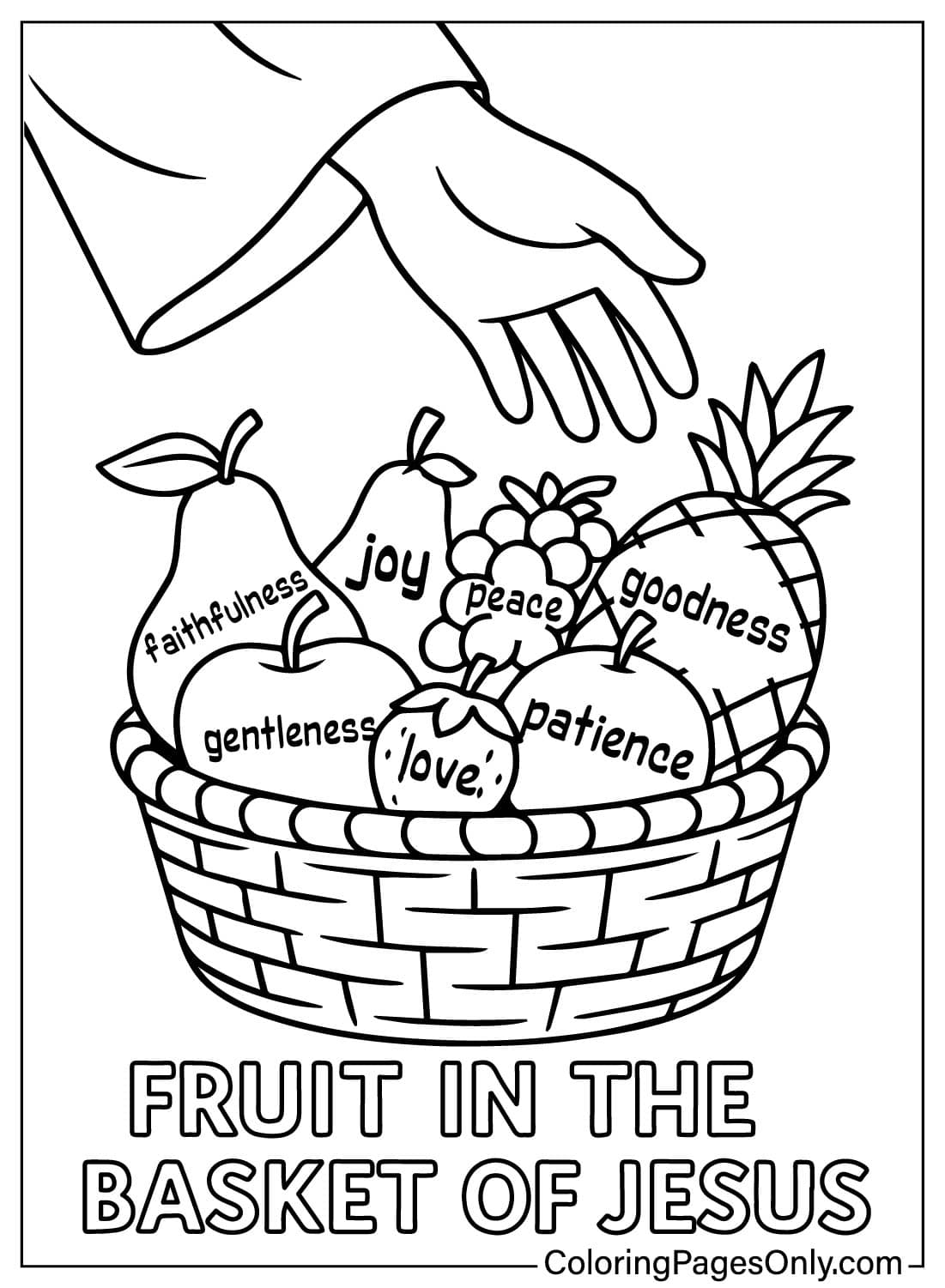
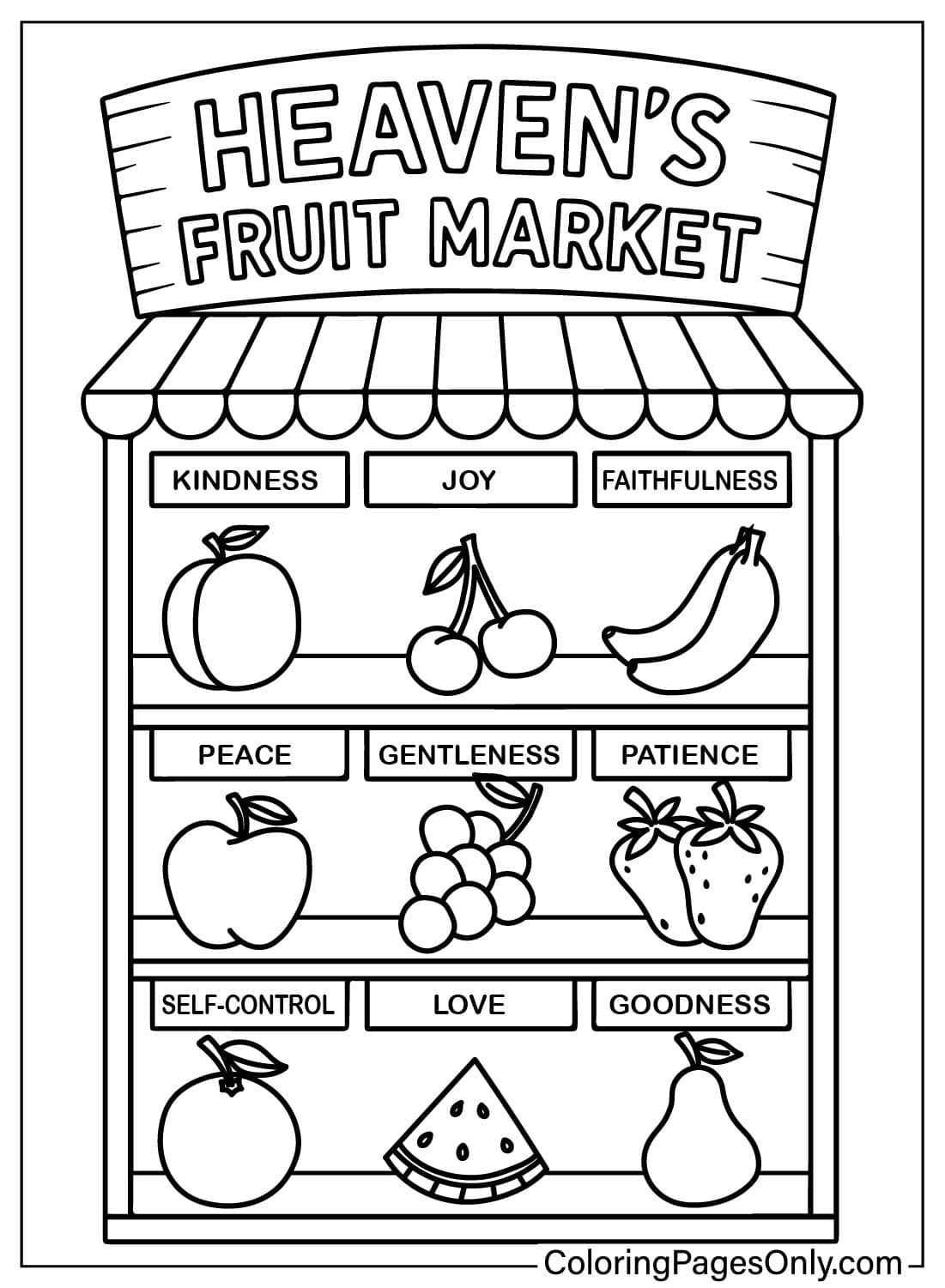
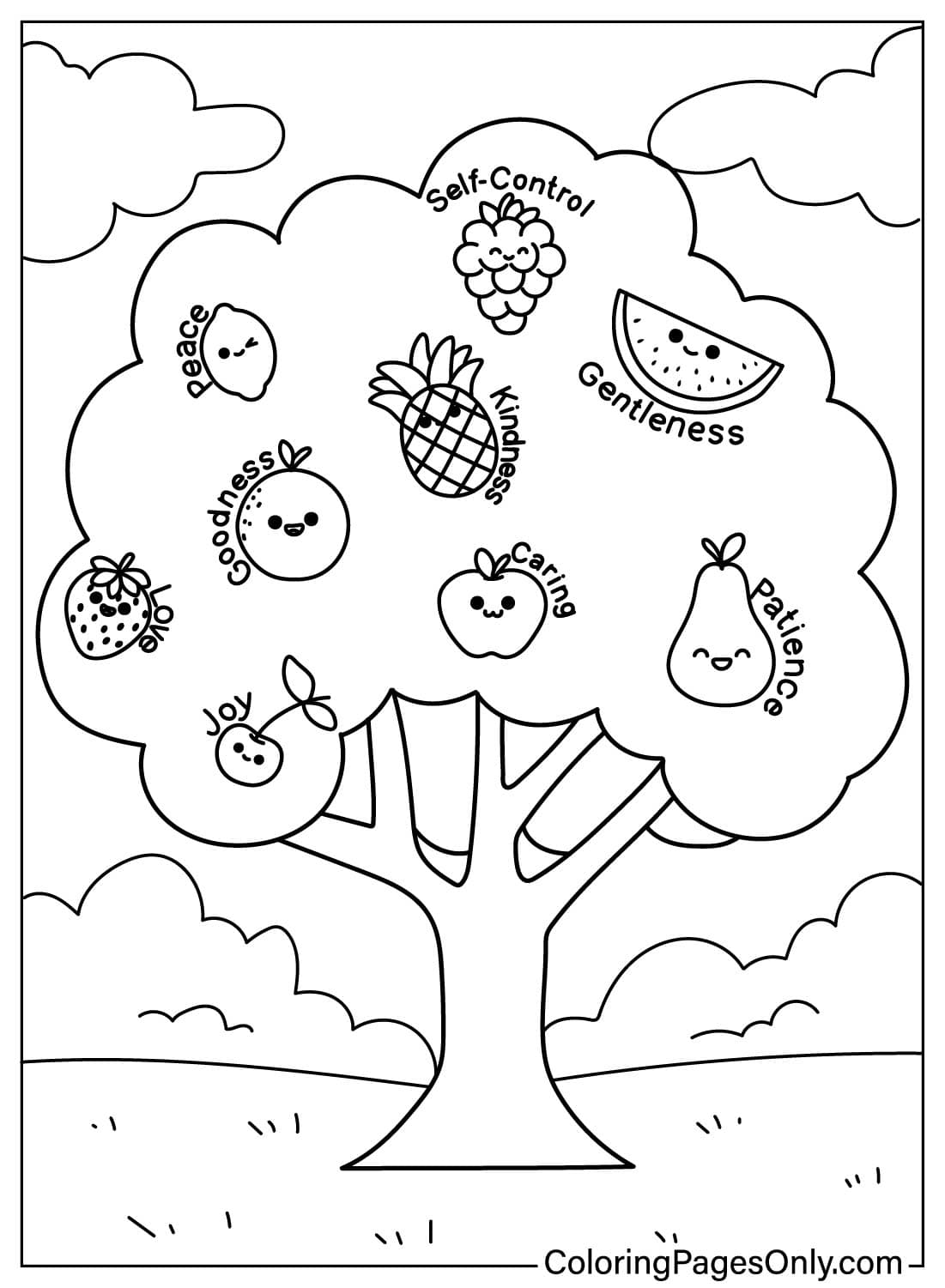
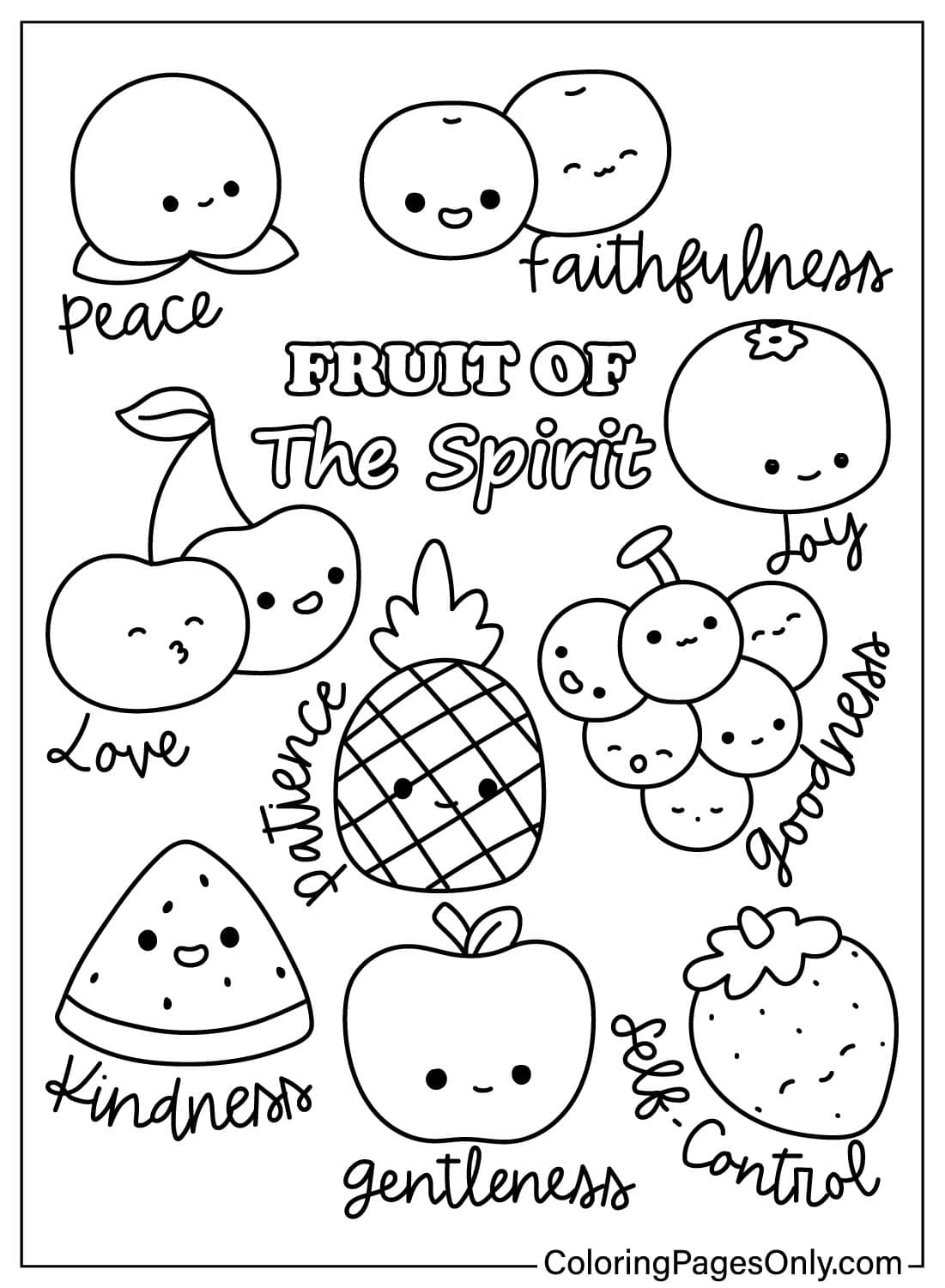
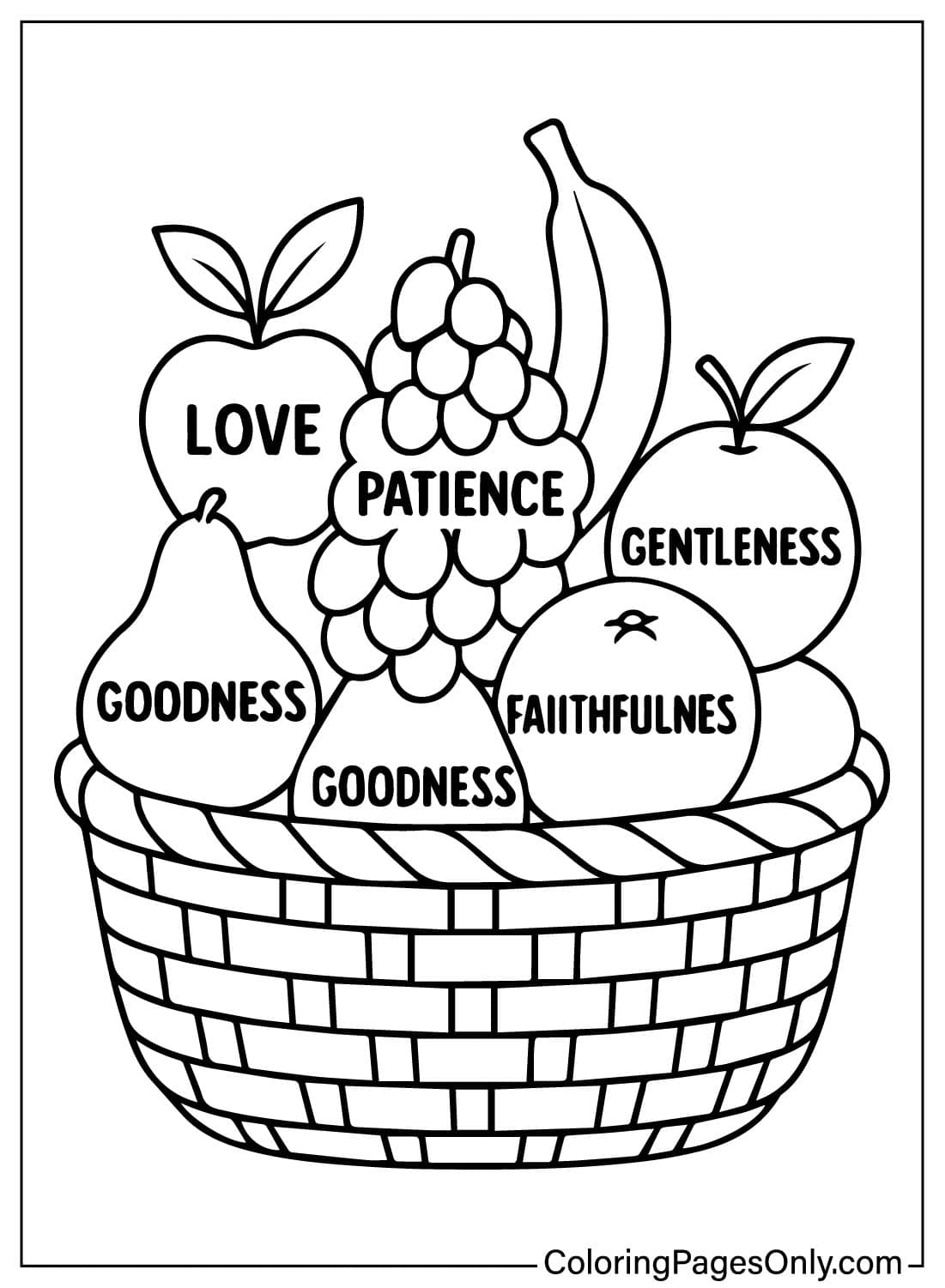
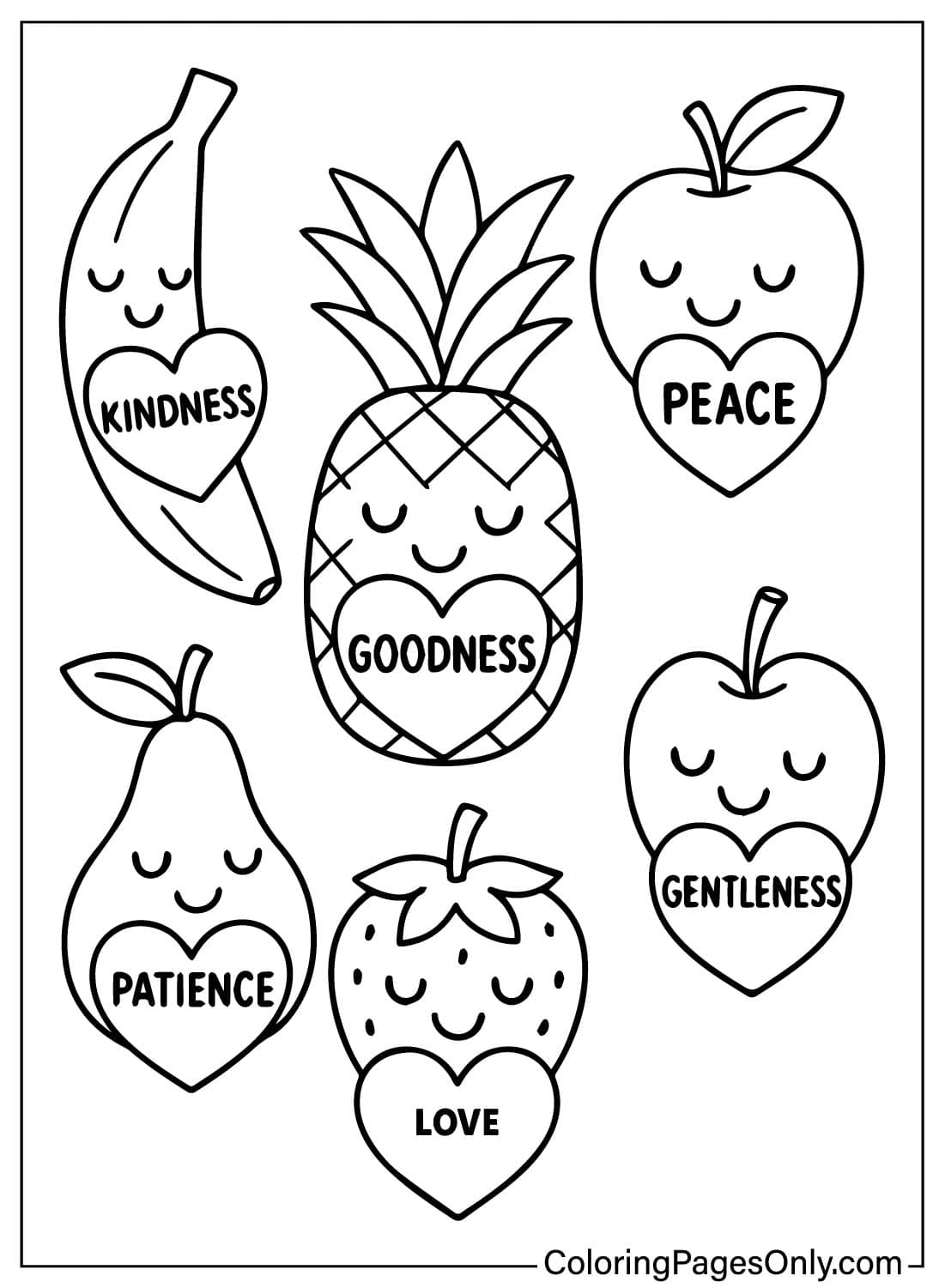
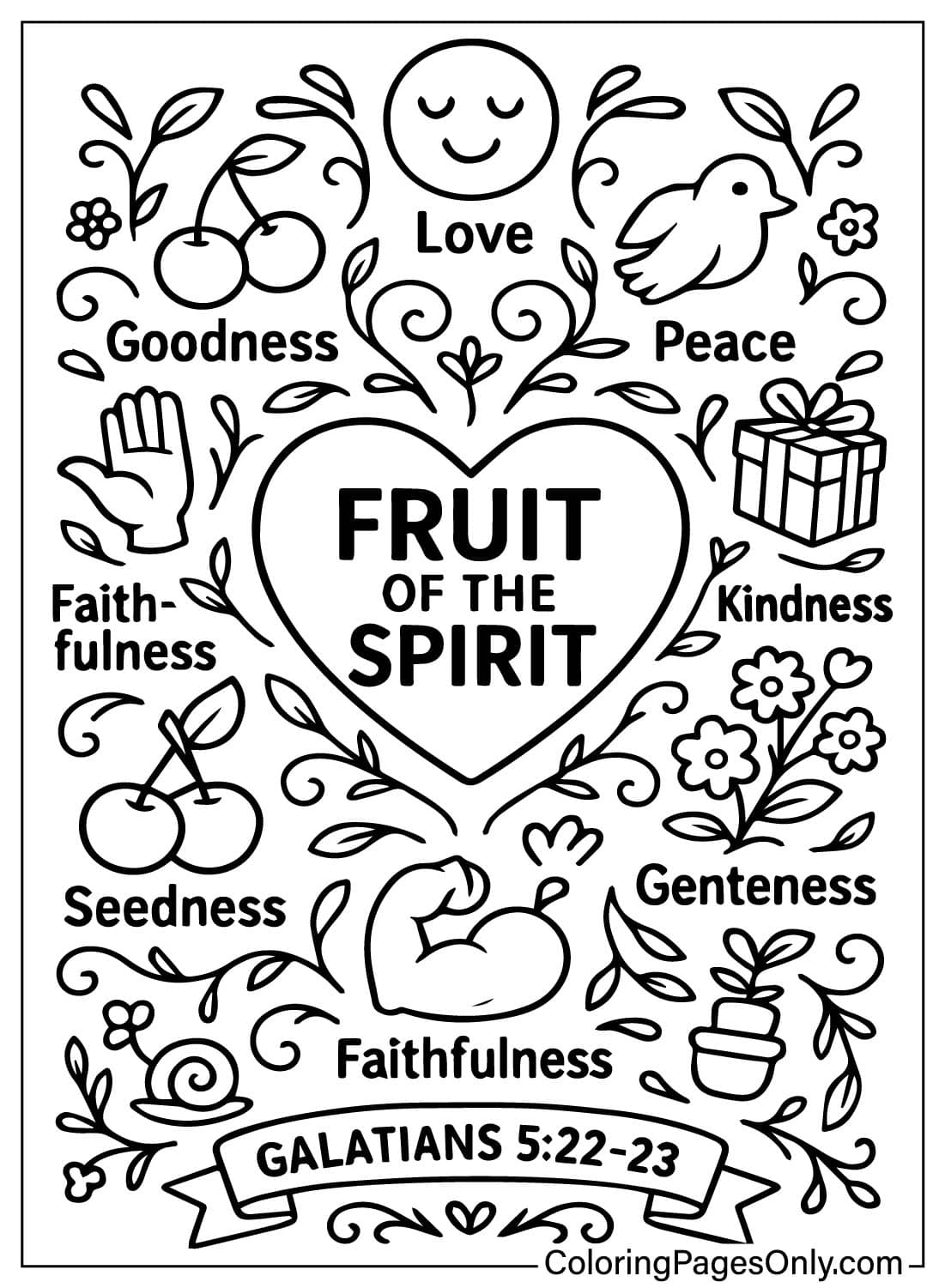
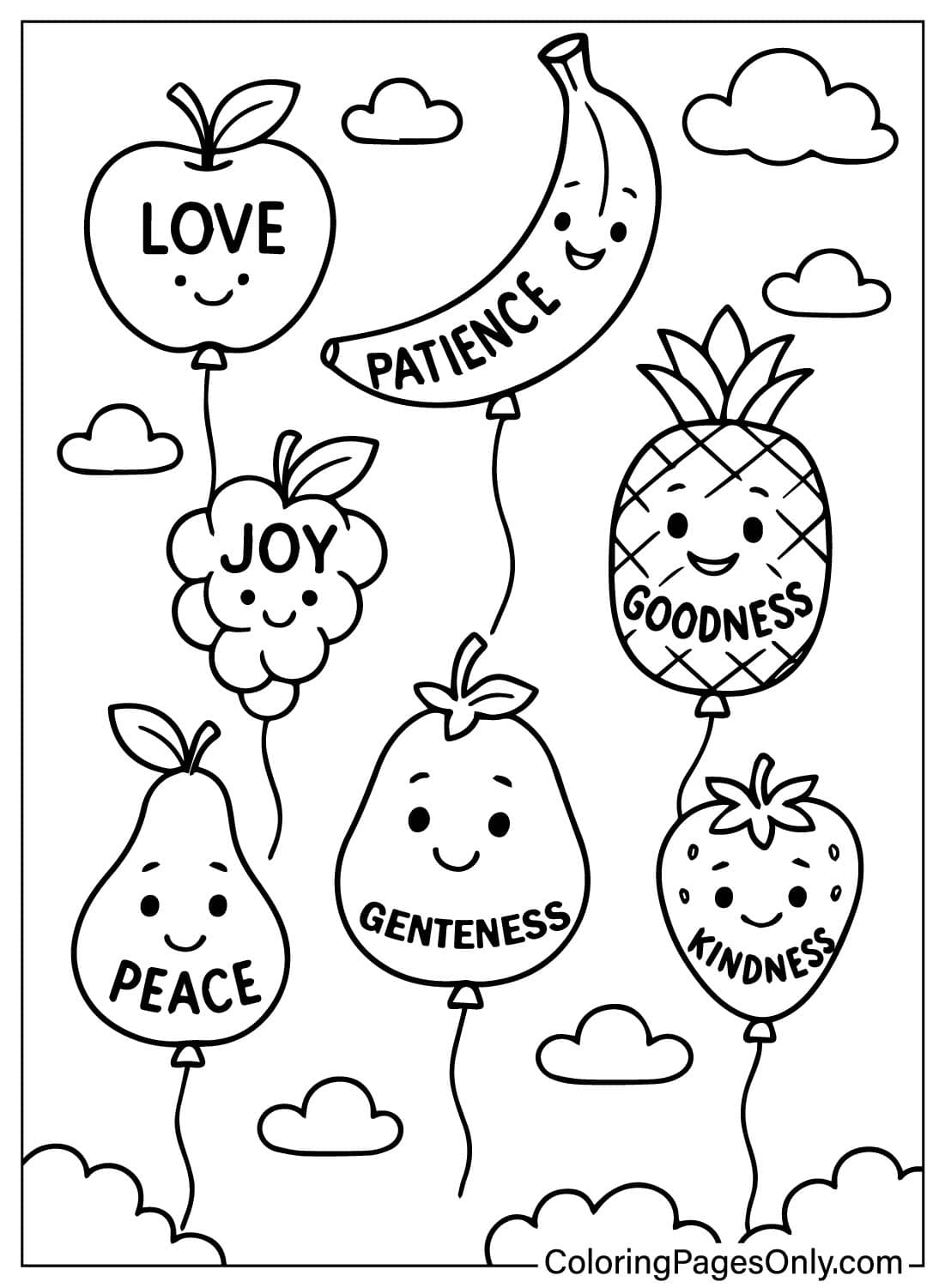
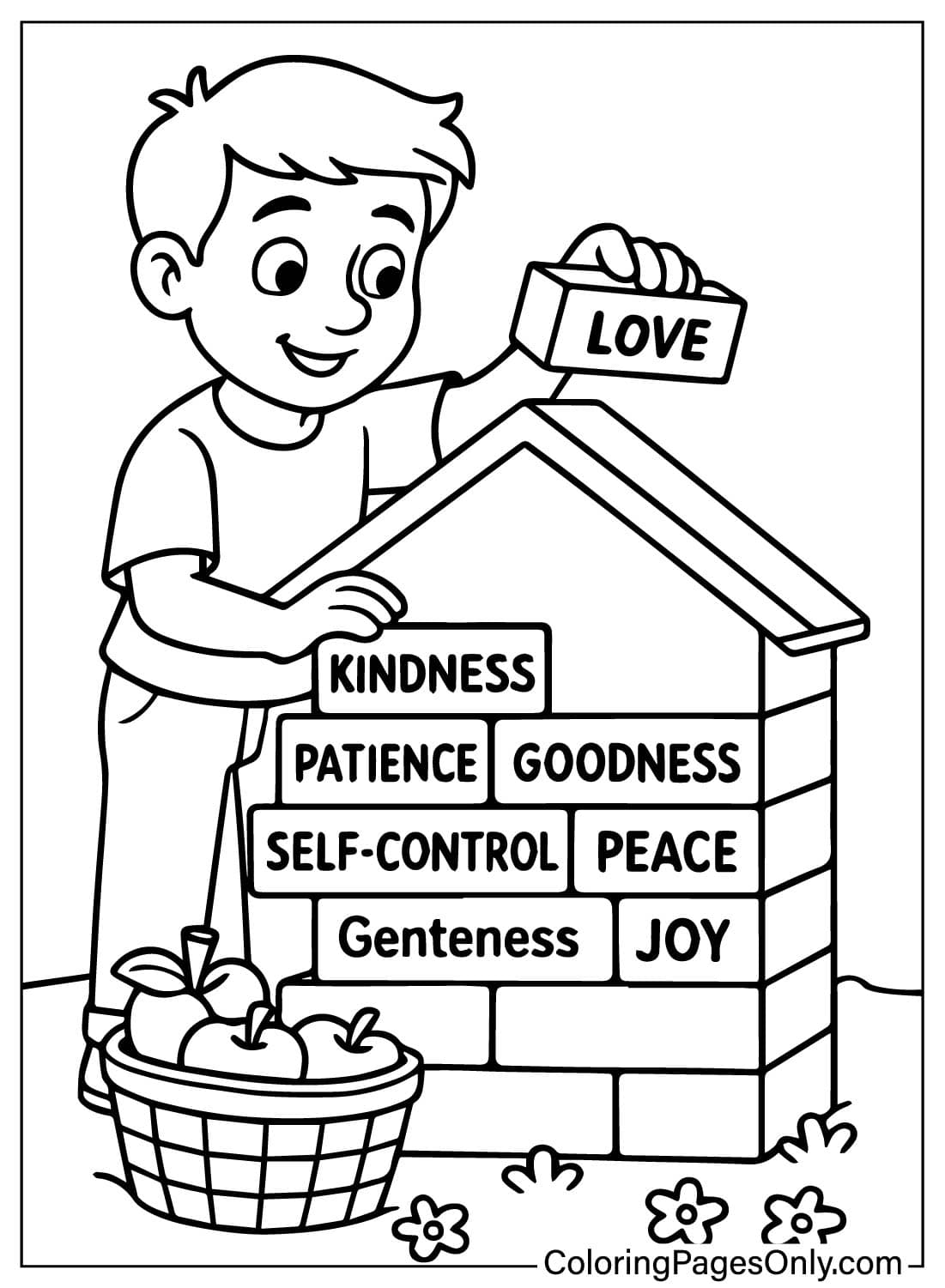
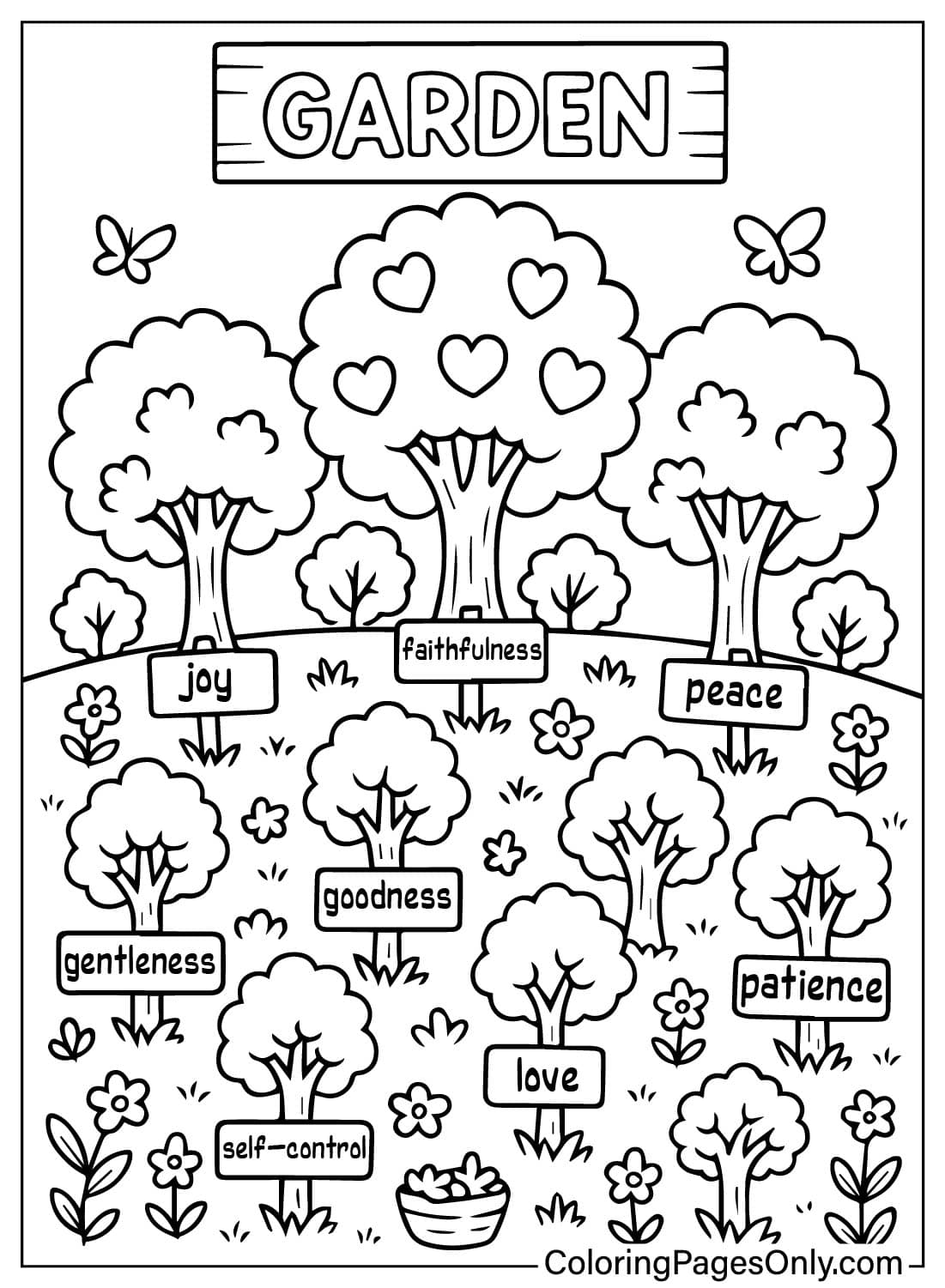
The most compositionally ambitious pages in the collection show all nine Fruit of the Spirit together – a tree bearing nine labeled fruits, a basket containing all nine, or a vine with labeled fruit clusters. These pages require coordinating the nine distinct fruit colors in a single composition while maintaining each fruit’s individual character.
What These Pages Do
The Fruit of the Spirit is among the most memorized passages in children’s Christian education. Sunday School programs, VBS curricula, AWANA clubs, and Christian homeschool resources consistently include Galatians 5:22-23 as one of the core memory passages for children across all age levels. The coloring pages give the memorization process a visual and tactile anchor – the child who has colored a page showing “Joy” with an orange has a specific, personally created memory object attached to that virtue.
The fruit metaphor is pedagogically effective for the specific reason that Paul chose it. A tree does not produce fruit through effort – it produces fruit by being what it is, by being healthy, rooted, and connected to water and nutrients. The metaphor communicates that these virtues are not produced by willpower alone but grow as a natural consequence of spiritual health and connection. This distinction – growth rather than achievement – is the theological point that the visual metaphor carries efficiently for even young children.
The nine virtues are genuinely useful ethical categories for children’s character education beyond their specific religious context. Love, joy, peace, patience, kindness, goodness, faithfulness, gentleness, and self-control are qualities that any framework of character formation would endorse. The Galatians passage is their most concise and memorable formulation in the Christian tradition, and its use in Sunday School reaches children at the developmental stage when character formation is most effectively shaped.
Fine motor development. The American Academy of Pediatrics identifies fine motor skill development as a key childhood milestone throughout early childhood. The individual grape spheres, the strawberry seed detail, the apple stem and leaf, the watermelon rind zones, and the word-lettering on virtue name pages all provide motivated, sustained fine motor practice. The 2005 Art Therapy Journal study on structured coloring and anxiety reduction applies throughout this collection, with particular relevance for the Sunday School and family devotion settings where structured, purposeful activity alongside reflection is the intended context.
How to Color These Pages Well
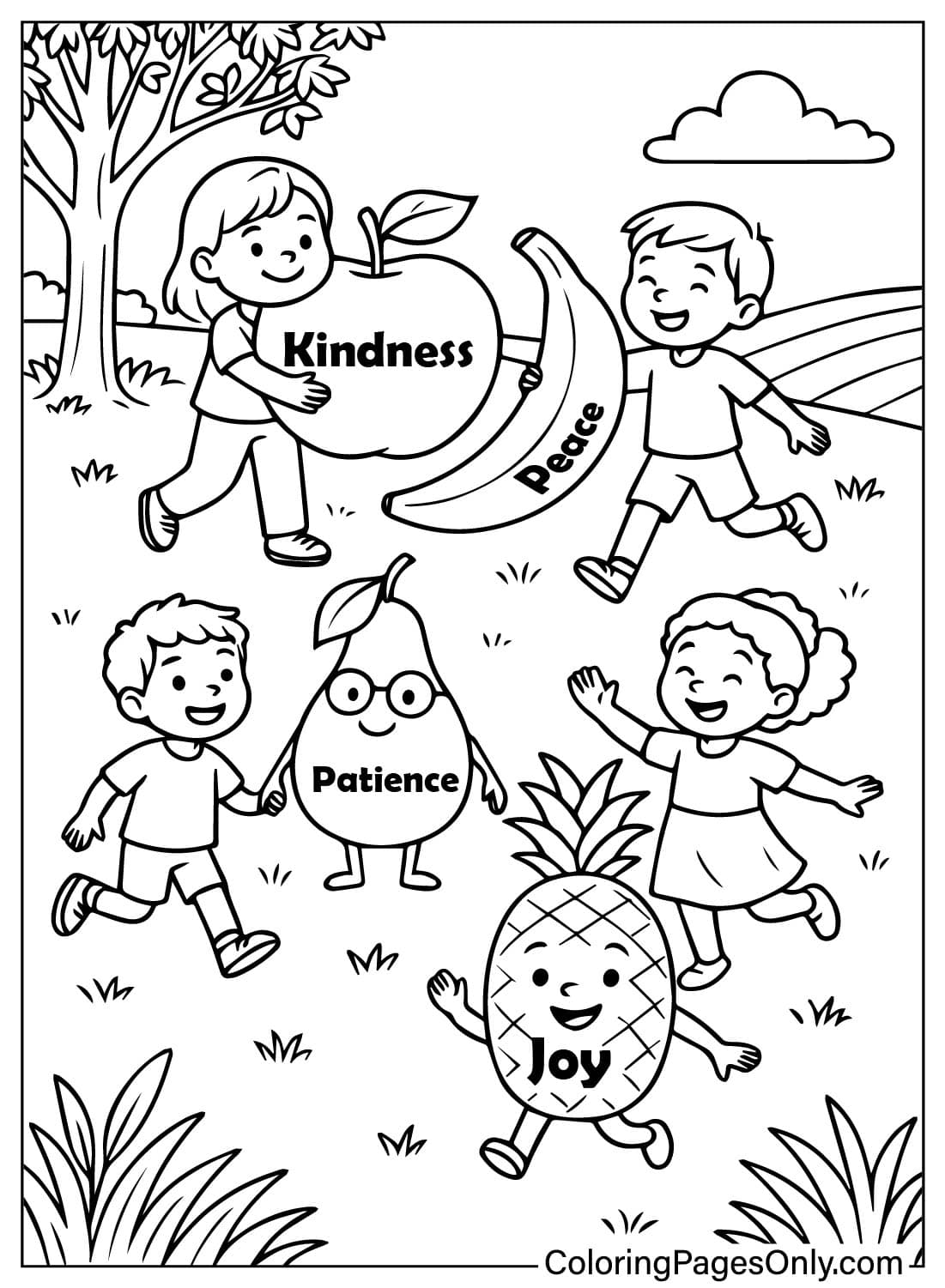
Each fruit’s color is the page’s most important educational accuracy. When a page pairs a virtue with a specific fruit, the fruit’s canonical color communicates the virtue to anyone who sees the finished page – red apple for goodness, orange for joy, grape cluster for peace. Apply each fruit at full saturation: an undersaturated orange does not read as joyful, an undersaturated red does not read as love’s warmth. The vivid color is not mere decoration – it is the visual language of the virtue.
Virtue names on pages require color contrast against the background. Most pages show the virtue’s name written on or beside the fruit illustration. The text should be colored in a tone that contrasts clearly with the surrounding fruit color: white or yellow text on a red strawberry, dark brown or white text on an orange, dark blue or white text on green grapes. Before coloring the text, decide which contrast will be clearest at the coloring page’s scale.
The full-tree pages need a color plan for all nine before beginning. On any page showing all nine fruits together, plan the complete fruit-color arrangement before applying any color. Ensure that no two adjacent fruits in the composition share the same color family – a red apple next to a purple plum reads better than a red apple next to a pink strawberry. The full-tree or full-basket pages have the most visual impact when the nine fruit colors create a full-spectrum composition.
Leaf and stem details anchor the fruit as a real thing. The green leaf and brown stem that appear on most fruit illustrations are the details that prevent the fruit from reading as a colored circle or shape – they establish the fruit as an actual growing thing, which is precisely the metaphor the passage uses. Apply the leaf’s green at full saturation with a slightly darker green along the leaf’s central vein. The stem should be a warm medium brown – not dark grey, not black, but the specific warm brown of a wooden stem.
For younger colorists, one fruit per session, complete it fully. The natural approach for the youngest colorists is to work one fruit page per Sunday School session or devotional time, completing that fruit fully and discussing the virtue it represents before the coloring ends. This pacing aligns the coloring activity with the educational intention – one virtue, fully colored, one conversation about what that virtue means in the child’s life.
5 Creative Craft Ideas
The Fruit of the Spirit Tree
On a large sheet of brown paper or poster board, draw a simple tree trunk and spreading branches. Print one page for each of the nine fruits, color each in its canonical fruit color with the virtue name visible, and cut each fruit image out carefully.
Arrange the nine cut-out fruits on the tree branches and attach them. Add roots at the bottom of the tree labeled with the scripture reference: “Galatians 5:22-23.” Add a title card: “The Fruit of the Spirit.”
The finished display is a Sunday School bulletin board centerpiece, a homeschool wall display, or a family devotion object – the full passage made visible as a single tree bearing all nine fruits.
My Fruit Bookmark
Print the simplest fruit page for each virtue – ideally, pages that are portrait-oriented and narrow enough to work as a bookmark format. Color each fruit in its canonical color with the virtue name clearly visible. Cut each page to bookmark dimensions (approximately 5cm × 20cm).
Laminate each bookmark or cover with clear contact paper for durability. Hole-punch the top and add a ribbon or string. The finished set is nine bookmarks – one for each fruit of the Spirit – usable in a Bible, a devotional book, or given as gifts to Sunday School classmates.
Virtue Journal
Print all nine individual fruit pages. Color each carefully. Bind them together into a small booklet – stapled along the left edge or hole-punched and tied with yarn.
Leave space below each fruit image (or use the page’s back) for writing: “What does [virtue] look like in my life this week?” For younger children, draw a simple picture answer rather than writing. For older children and adults, write a brief reflection.
The finished booklet is a personal virtue journal – a coloring project that becomes a devotional tool, used alongside the nine coloring pages as a record of reflection on each Spirit-produced quality.
Scripture Memory Card Set
Print one page for each virtue. Color all nine in their canonical fruit colors. Cut each to index card dimensions – 10cm × 15cm. On the back of each card, write the relevant portion of Galatians 5:22-23 that includes that virtue. On the last card, write the full passage.
The finished set is a scripture memory card collection built from personally colored pages. Each card’s front shows the fruit and virtue name in color; each card’s back shows the scripture. The personal act of coloring makes the card more memorable than a purchased flashcard.
Family Fruit of the Spirit Challenge
Print the full-tree or full-basket page showing all nine fruits. Color it together as a family activity – each family member colors two or three of the fruits, coordinating with each other to ensure the full spectrum of fruit colors is covered.
When the page is complete, discuss each virtue as a family: “Which of these has been the easiest for our family this week? Which has been the hardest?” Write the family’s name and the date on the page. Mount it somewhere visible.
Return to it the following week – same discussion, same page. The single coloring page becomes a recurring devotional anchor – a completed craft that serves a continuing conversation.
Frequently Asked Questions
What is the Fruit of the Spirit? The Fruit of the Spirit is a list of nine virtues from the New Testament book of Galatians, written by the Apostle Paul. The passage, Galatians 5:22-23 (NIV), reads: “But the fruit of the Spirit is love, joy, peace, forbearance, kindness, goodness, faithfulness, gentleness and self-control. Against such things there is no law.” In Christian theology, these nine qualities are understood as the natural results of the Holy Spirit’s work in a believer’s life – produced not through personal effort alone but through the Spirit’s active presence, the way a healthy tree produces fruit as a natural consequence of its health.
Why does the Bible say “fruit” (singular) instead of “fruits” (plural)? The Greek word Paul uses in Galatians 5:22 is karpos (καρπός) – singular fruit, not plural. Most New Testament scholars understand this as a deliberate theological choice: the nine qualities are presented as a unified character produced by the Spirit, not as nine separate items to be achieved independently. Just as a tree produces one kind of fruit (its nature) rather than a checklist of separate achievements, the Spirit produces a single unified character in a person that includes all nine qualities together. The popular teaching presentation of “fruits” (plural) uses the plural for pedagogical convenience – to discuss and teach each quality individually – but the singular “fruit” in the original text carries the theological meaning of unity.
Who wrote the book of Galatians and when? The book of Galatians was written by the Apostle Paul – also known as Saul of Tarsus before his conversion – and addressed to the churches of Galatia, a region of what is now central Turkey. Most New Testament scholars date the letter to approximately 48-55 AD, making it one of the earliest existing Christian writings. Paul wrote it to address theological controversies in the Galatian churches regarding the relationship between Jewish law and Christian faith. Galatians 5:22-23 appears in the section where Paul describes the life produced by the Holy Spirit in contrast to what he calls the “works of the flesh” in the preceding verses.
How is the Fruit of the Spirit used in Sunday School and children’s ministry? The Fruit of the Spirit is one of the most commonly taught passages in children’s Christian education across denominations. It appears regularly in Sunday School curricula, Vacation Bible School (VBS) programs, AWANA memorization ministry, Christian homeschool resources, and church children’s ministry materials. Common teaching approaches include memorization of the nine virtues, craft activities pairing each virtue with a fruit, songs that list the nine qualities (multiple popular memorization songs exist), bulletin board displays, and discussion exercises asking children to identify examples of each virtue in their daily lives.
What fruit is associated with each virtue? There is no biblical assignment of specific fruits to the nine virtues – the Galatians passage does not name specific fruits. The fruit-to-virtue pairings that appear in Sunday School materials (strawberry for love, orange for joy, grapes for peace, etc.) are modern educational conventions developed for teaching purposes, not scriptural assignments. Different curriculum publishers and teachers use different fruit assignments. The important biblical image is that spiritual character produces visible results – as a tree produces fruit – rather than any specific matching of individual fruits to individual virtues.
What age group are these pages best suited for? The Fruit of the Spirit coloring pages serve a wide range of ages within Christian education contexts. The simplest single-fruit pages – one fruit with one virtue name – are accessible and appropriate from ages three and four, particularly in Sunday School settings where the coloring activity accompanies a lesson on the passage. The more detailed pages – multiple fruits in one composition, decorative lettering of the full passage, tree or basket arrangements – are most engaging from ages six through twelve, where developing fine motor control allows the more careful detail work these pages reward. Adult members of Bible study groups and family devotion participants also find these pages a meaningful, meditative activity for personal reflection on each virtue.
Browse the full collection at ColoringPagesOnly.com. All 20+ pages free, no sign-up, PDF or PNG, print or color online.
Paul wrote to the churches of Galatia approximately two thousand years ago, addressing theological arguments whose specifics are no longer urgent, using an agricultural image whose meaning is still immediately clear: a healthy tree produces fruit naturally. You know the tree by what it grows. The virtues he listed – love, joy, peace, patience, kindness, goodness, faithfulness, gentleness, self-control – are the fruit of spiritual health, not the fruit of effort alone.
The singular karpos. One fruit. Nine qualities, together.
The coloring pages give each quality a color and a shape. The red of love. The orange of joy. The grape cluster of peace. The specific act of coloring slowly through each one is its own kind of meditation – a sustained, focused attention on one virtue at a time that the structured nature of coloring makes possible.
Pick up your red. Love first. The rest follow.
Share your work on Facebook and Pinterest and tag #Coloringpagesonly. We especially want to see the family Fruit of the Spirit trees and the scripture memory card sets.
Color each fruit. Name each virtue. The tree is healthy when all nine grow together.