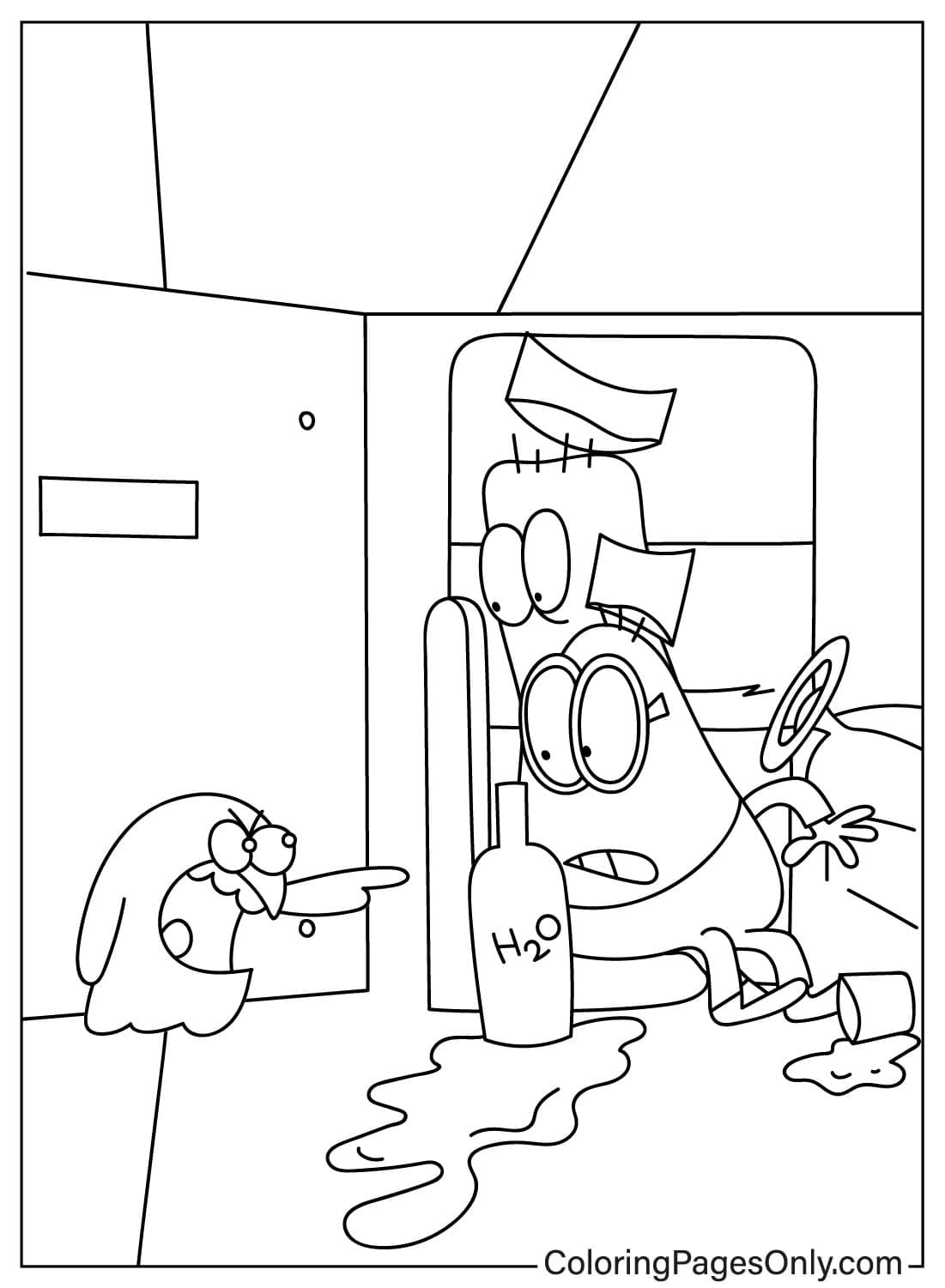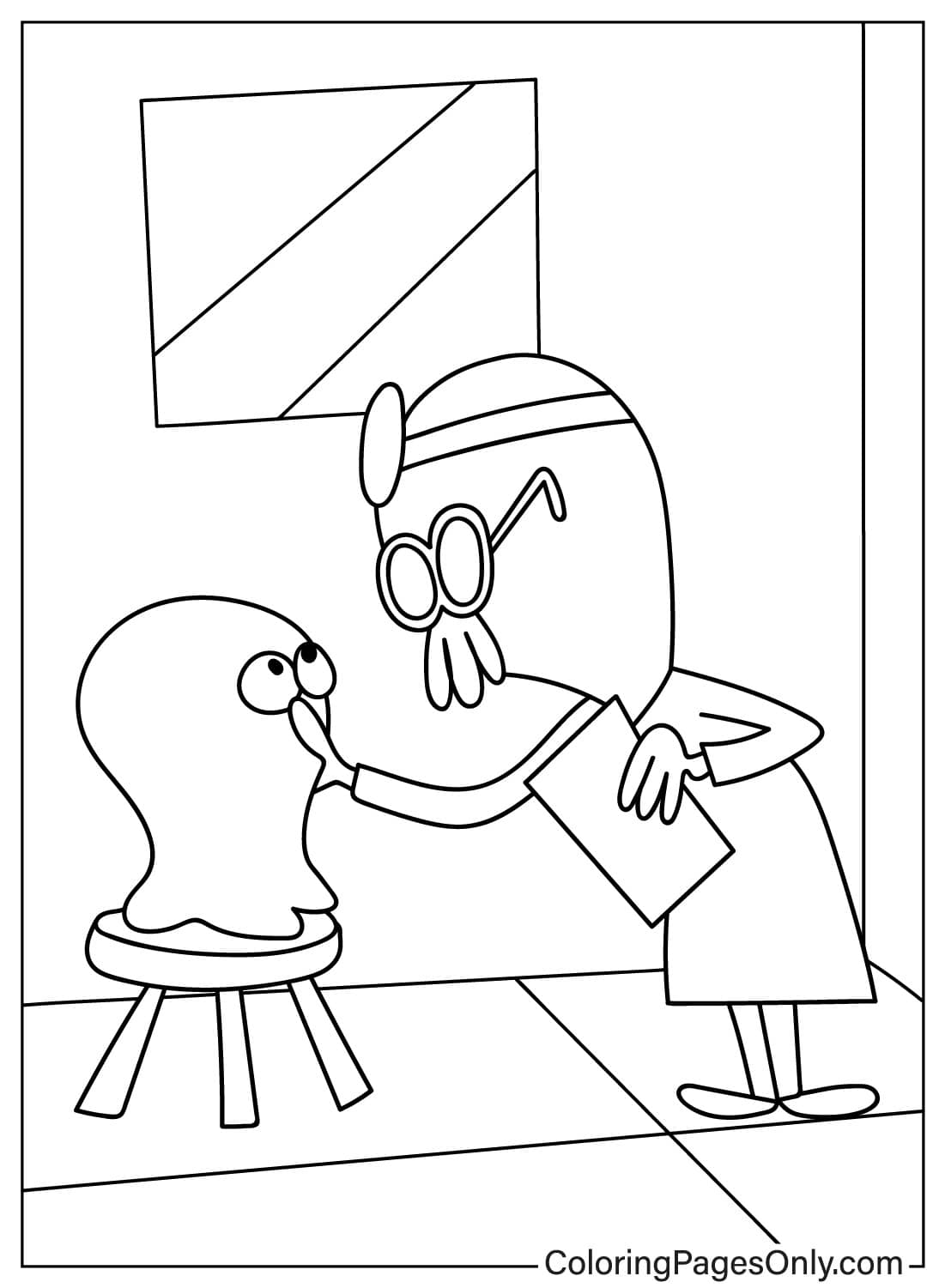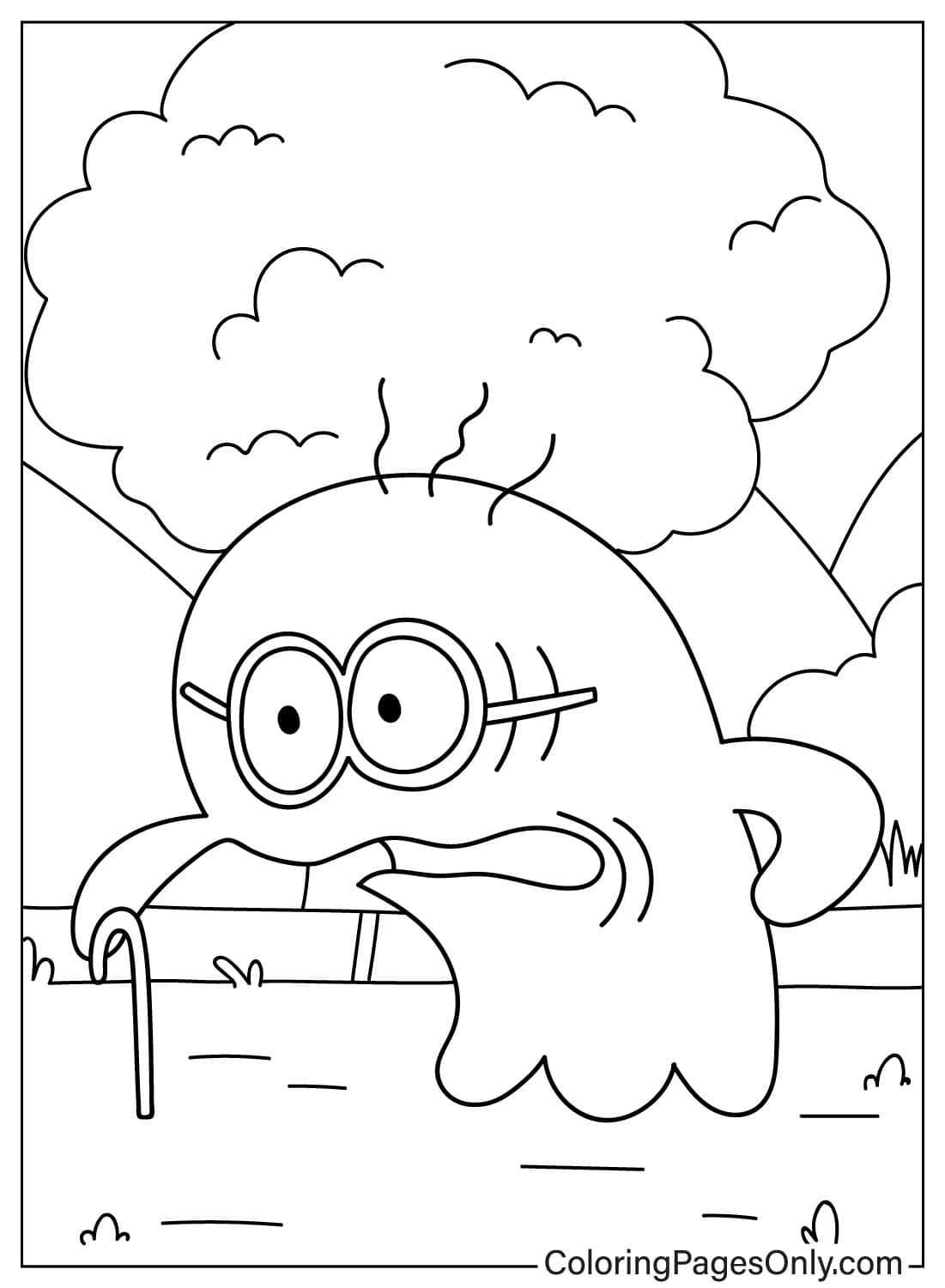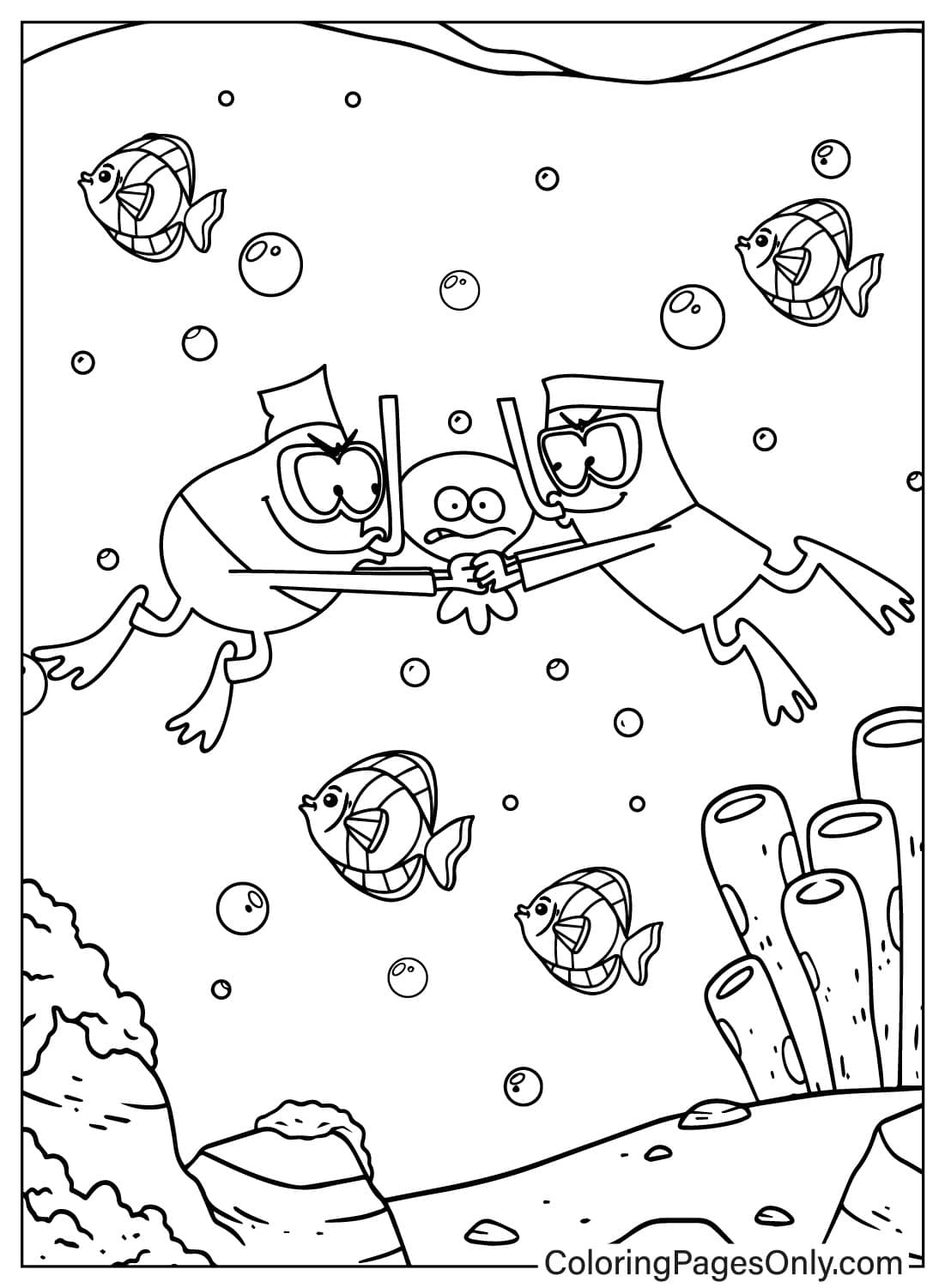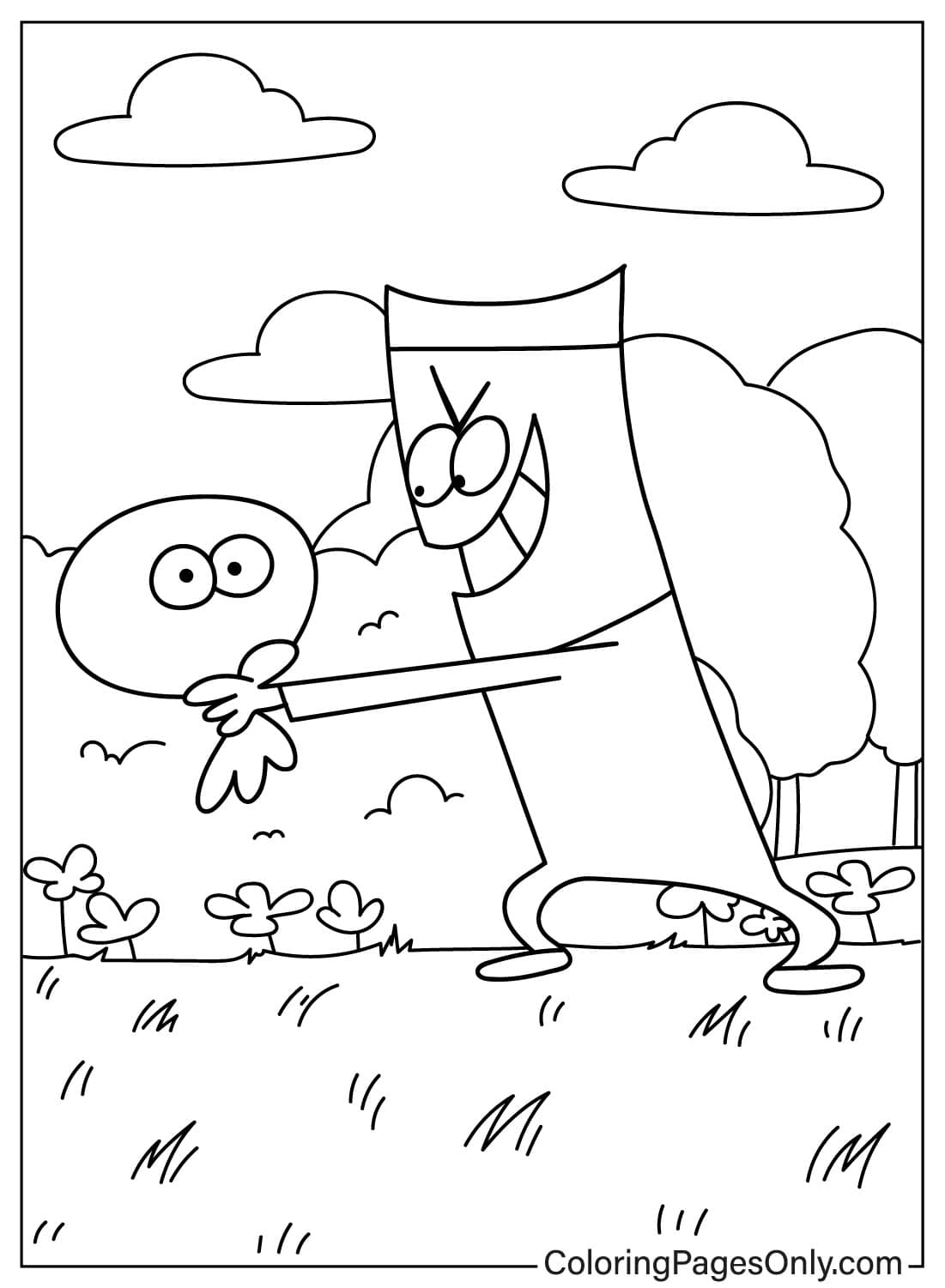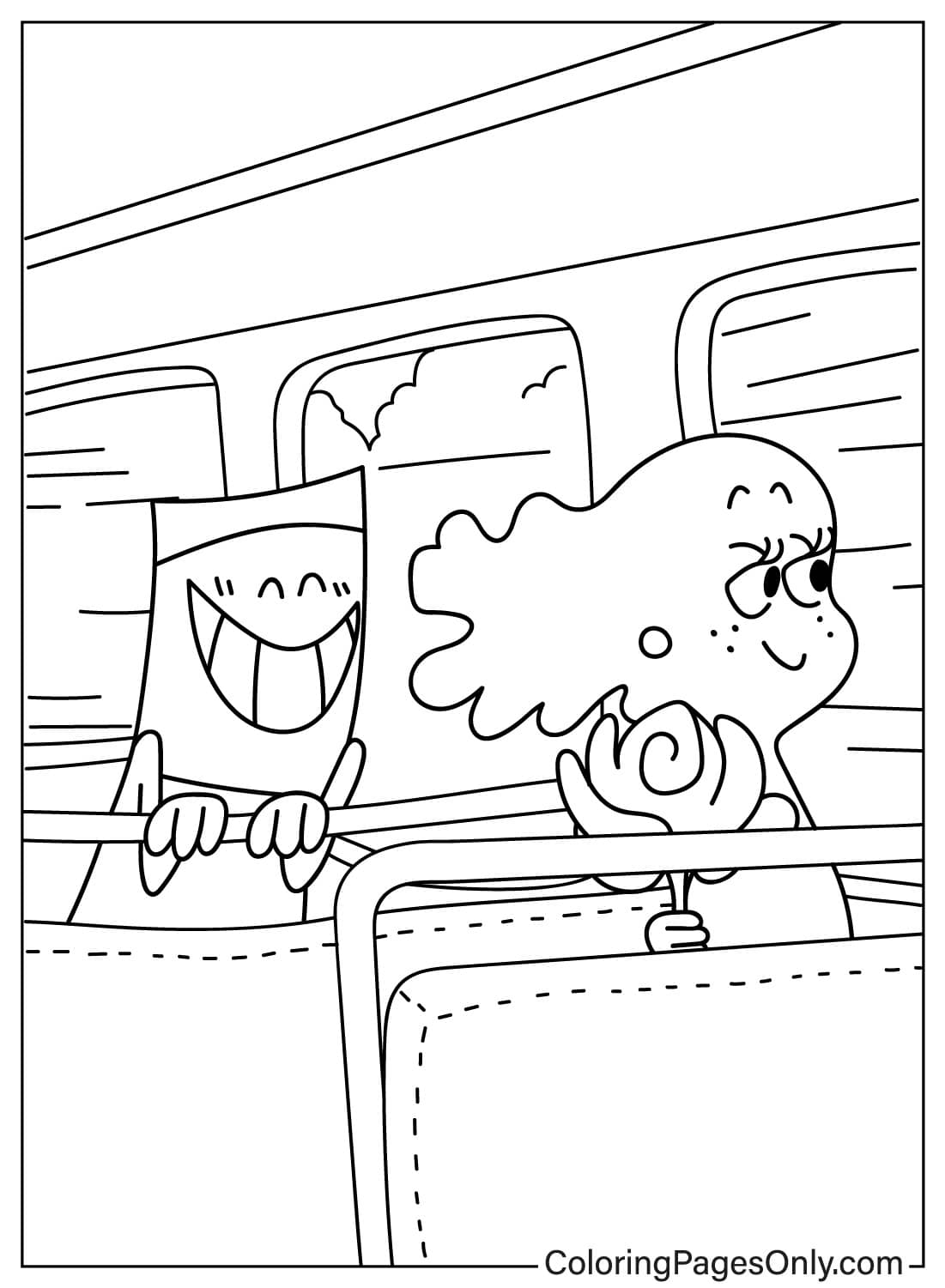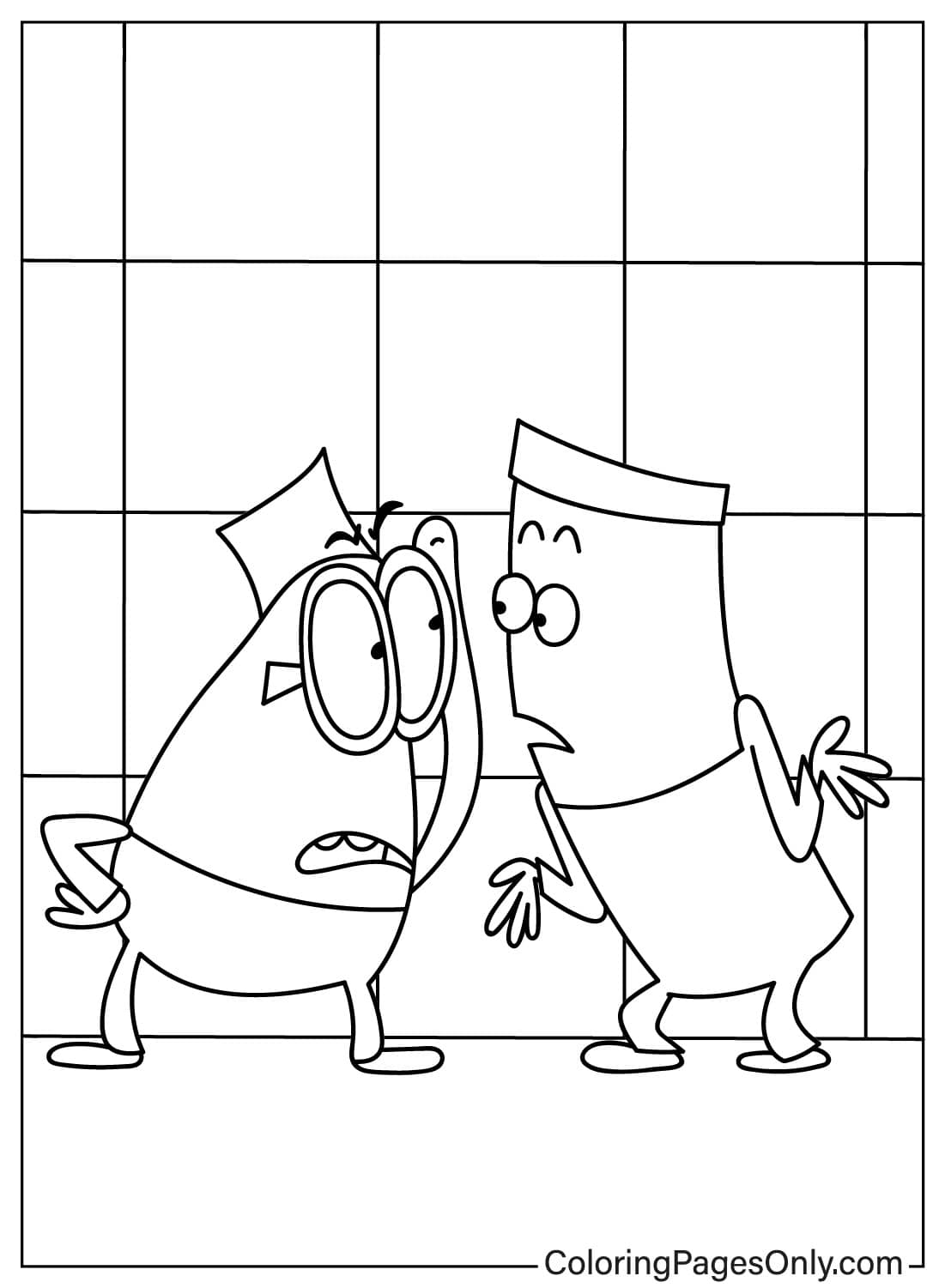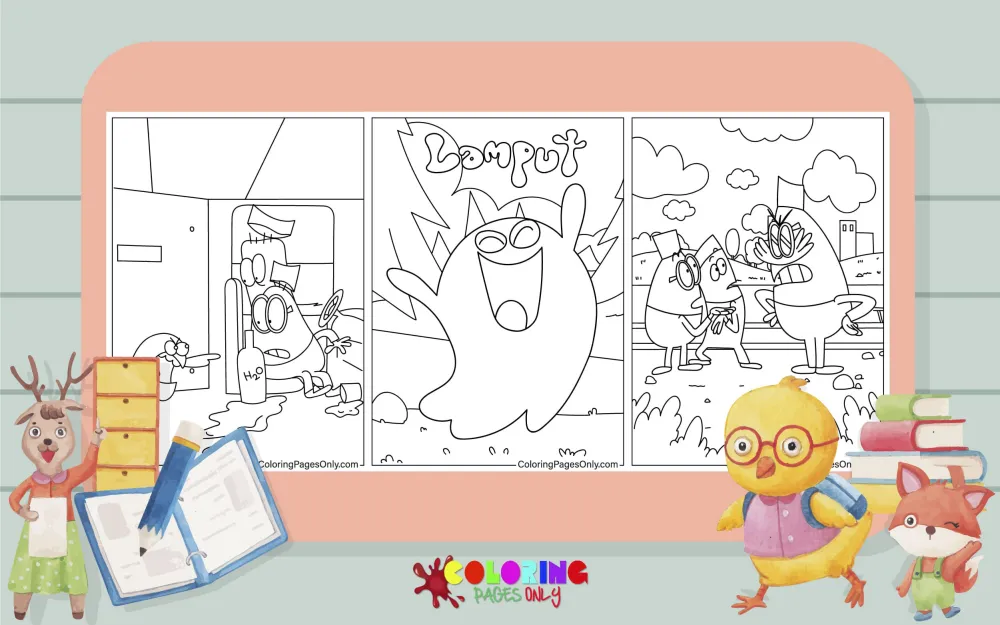
Free Lamput coloring pages – 20+ pages featuring Lamput the shape-shifting orange blob, the two scientists Specs and Skinny, chase scenes, transformation moments, disguise pages, and character expressions – free printable PDF and online coloring for fans of the wordless Indian animated comedy series.

Lamput is a short-form animated cartoon created by Vaibhav Kumaresh at Vaibhav Studios and originally broadcast on Cartoon Network India beginning in 2016. Its format is minimal and deliberate: each episode runs between one and three minutes, contains no dialogue whatsoever, and depends entirely on visual comedy, sound effects, and the expressiveness of three characters whose entire relationship is defined by a single repeated dynamic – the orange blob escapes, the scientists pursue, the scientists fail.

The absence of dialogue is not a limitation but a design choice that has made the series genuinely international. A child watching Lamput in India watches exactly what a child in Vietnam, Indonesia, or Brazil watches – the comedy requires no translation because it is built from situations, timing, and the specific physical language of a creature made entirely of orange goo whose only advantage over trained scientists is that it can become anything it needs to be at any given moment.

The series has accumulated billions of views across its official YouTube channel and has become one of Cartoon Network India’s most successful original productions – a short-form comedy that travels because it was built, from the beginning, without the language walls that contain most animation.

These 20+ free pages at ColoringPagesOnly.com cover the full Lamput cast and their best moments. All free, PDF or PNG, print or color online.

What’s Inside

Lamput – The Orange Shape-Shifter

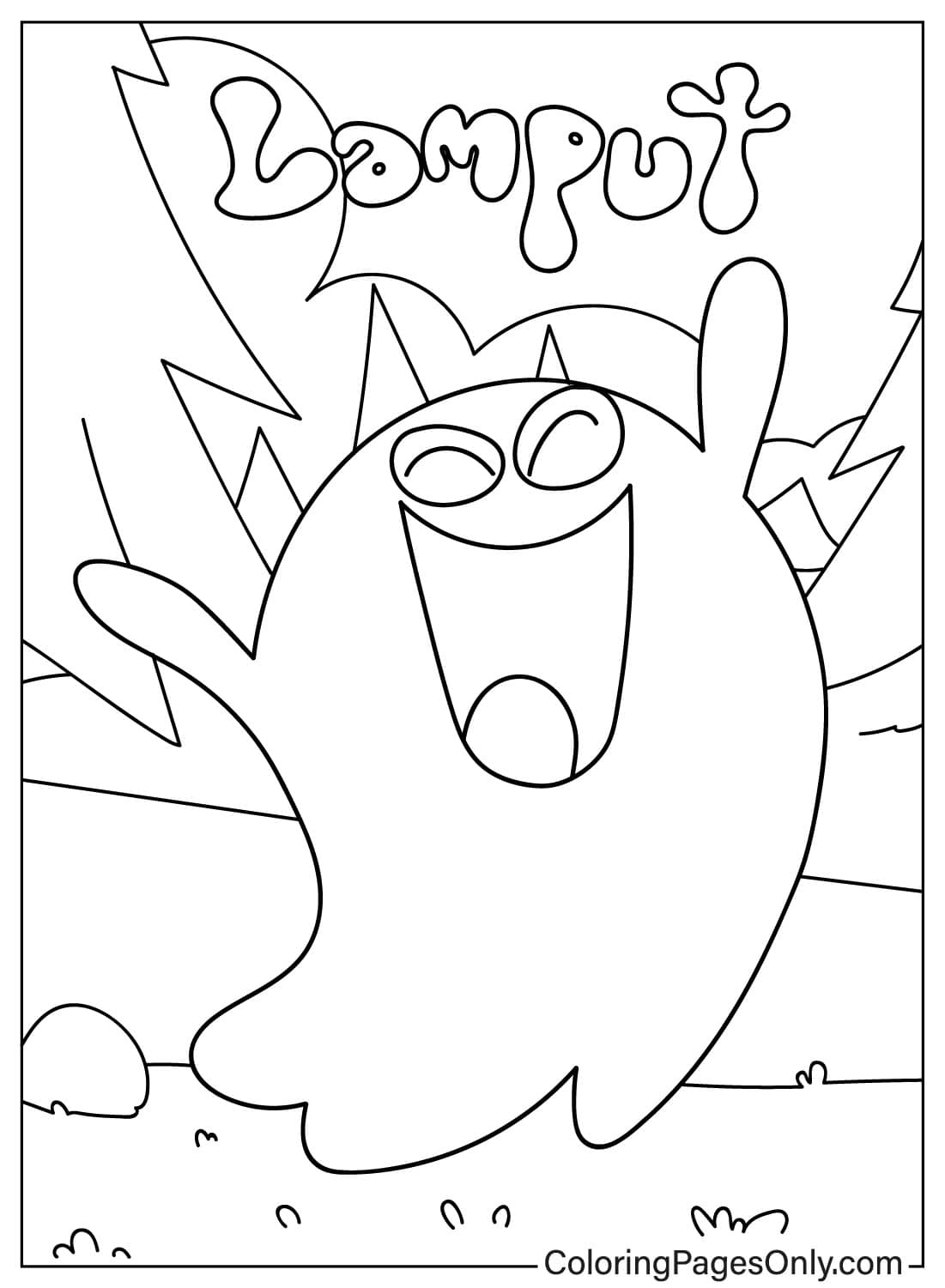
Lamput is a small, bright orange blob creature who escaped from a scientific laboratory and has been avoiding recapture ever since. His design is as simple as it is effective: an amorphous orange shape with two large, expressive eyes and no fixed body form. He has no mouth in most depictions – his expression is carried entirely through the eyes and the overall shape his body takes in a given moment.

The absence of a fixed body shape is the character’s defining feature and the source of virtually all the comedy in the series. Lamput can flatten himself under a door, stretch into a rope to swing across a gap, mold himself into a recognizable object to hide in plain sight, or split into smaller pieces to pass through a grate. His shape-shifting is the series’ central visual language – each episode is essentially a demonstration of new configurations that the orange blob can adopt faster than two scientists can track.

The Lamput pages in the collection reflect this variety. Some show his resting form – a simple oval blob with eyes, the character in his most recognizable state. Others show him mid-transformation – stretched, flattened, formed into an object or animal shape. The transformation pages are the collection’s most visually inventive, showing the specific quality of a character who is made of something between a liquid and a solid.

Coloring Lamput: His color is the most important decision in the collection – a vivid, warm, fully saturated orange that should not be muted. Lamput’s orange is not a pastel orange, not a muted amber, not a burnt orange – it is the bright, clean orange of a traffic cone at maximum visibility, applied across his entire body without shading zones unless the page specifically indicates shadow. His eyes are typically white with large dark pupils and a small white highlight dot. The simplicity of his design is its strength – do not add complexity that is not there. Clean orange body, white and dark eyes.

Specs – The Plump Scientist

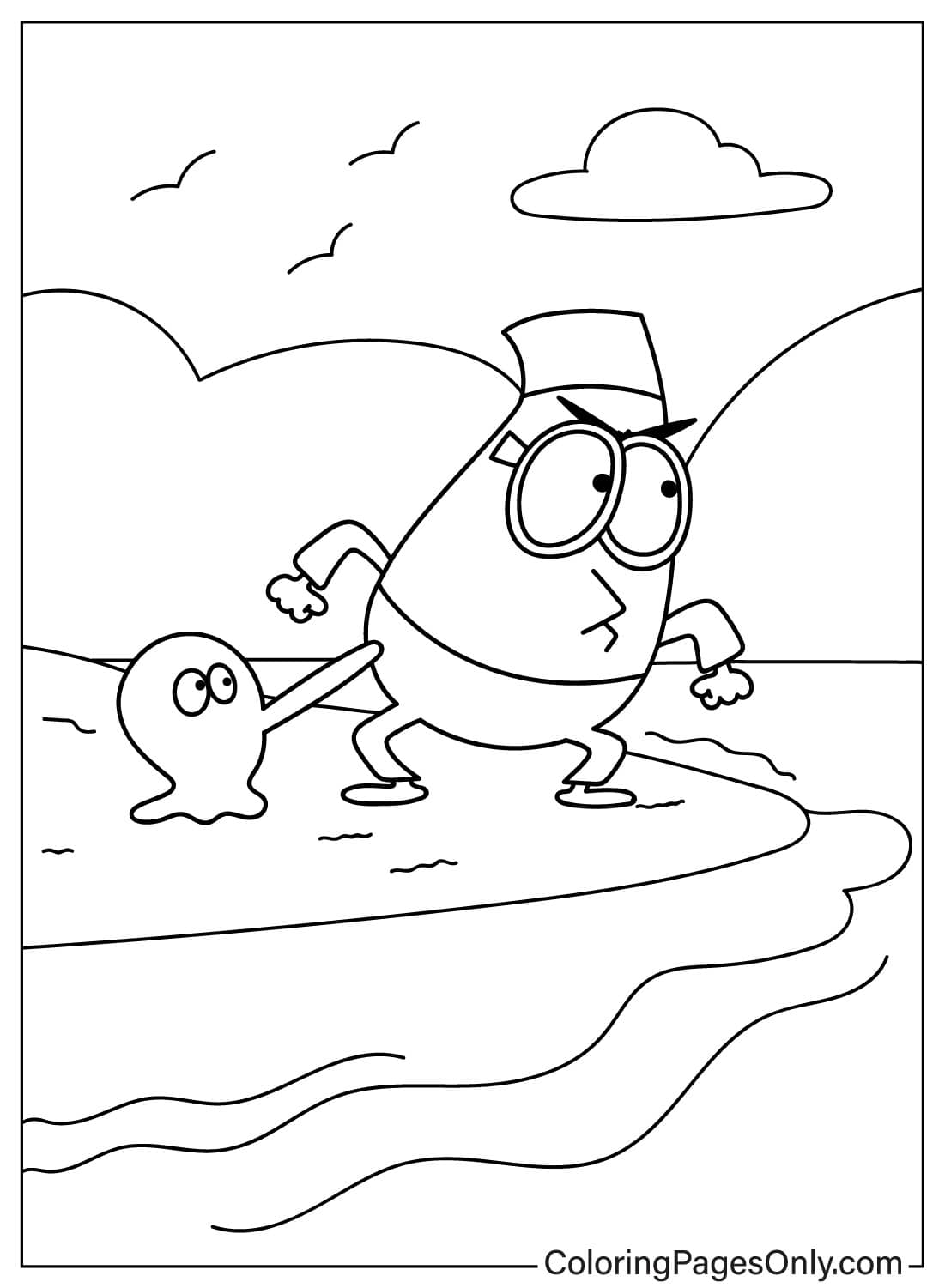
Specs is the larger of the two scientists chasing Lamput – a plump, round-bodied figure with a bald head, round glasses (the source of his name), and a white lab coat that represents both his professional role and his consistent failure to fulfill it. He is impulsive, easily frustrated, and inclined toward direct action when a more considered approach might serve him better.

His design reads as a contrast to Skinny in every physical dimension: where Skinny is vertical and angular, Specs is round and wide. The visual vocabulary of the two scientists is built on this contrast – they are physically opposite, which makes their repeated failure to catch the same small orange blob all the funnier.

The lab coat is his defining costume element and should be rendered crisply white. His glasses – circular lenses in a simple frame – sit prominently on his round face. His skin tone is warm, slightly tan – a South Asian depiction consistent with the show’s Indian production context.

Coloring Specs: White lab coat with very subtle warm shadow in the deepest fold areas. Warm medium-brown skin tone throughout. His glasses are the most important detail – round circular lenses that must be rendered clearly. His bald head has no hair to shade – give it a very slight warm mid-tone at the crown to suggest the roundness of his head.

Skinny – The Thin Scientist

Skinny is tall and narrow, while Specs is short and round – a thin, elongated figure with a correspondingly long face, wearing the same white lab coat. His approach to catching Lamput tends toward planning rather than direct force, which works no better than Specs’s impulsiveness – their combined strategies fail consistently and in increasingly elaborate ways across hundreds of episodes.

The comedy of both scientists is built on the gap between their credentials and their performance. They are scientists – trained professionals in white coats with laboratory equipment and presumably significant intellectual capability. The small orange blob they cannot catch has no academic qualifications, no equipment, and no plan beyond the next two seconds. The series never explains this gap; it simply presents it, again and again, in endlessly varied configurations.

Coloring Skinny: The same white lab coat as Specs, distinguished primarily by the body shape it hangs on – Skinny’s coat is vertical, where Specs’s is wide. His warm skin tone is consistent with Specs’s, but on a significantly different body proportion. The elongated face should be given enough shadow depth in the cheek areas to read as thin rather than as a flattened oval. His hair – if the page shows him with visible hair – is typically dark.

Chase Scene Pages

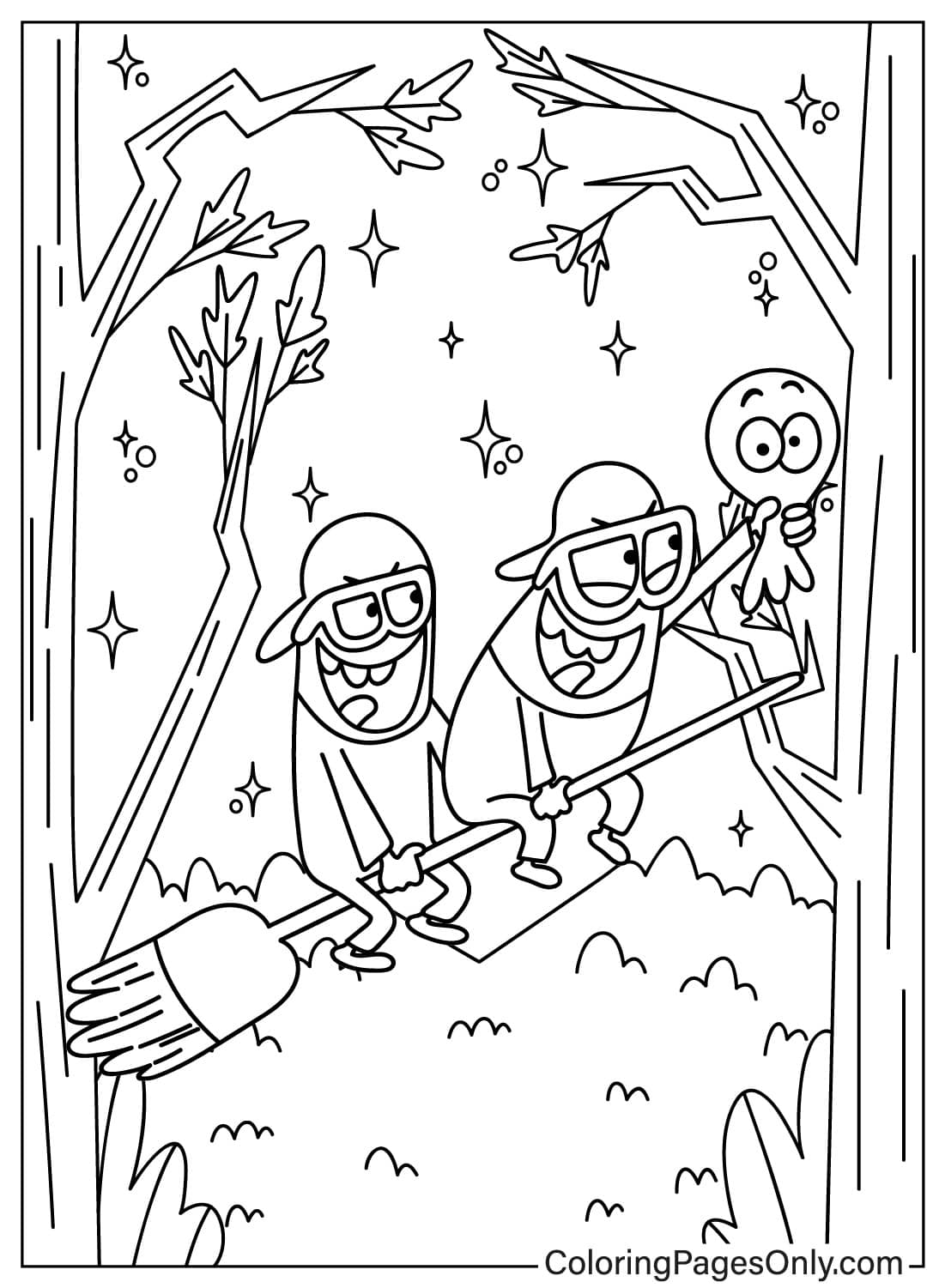
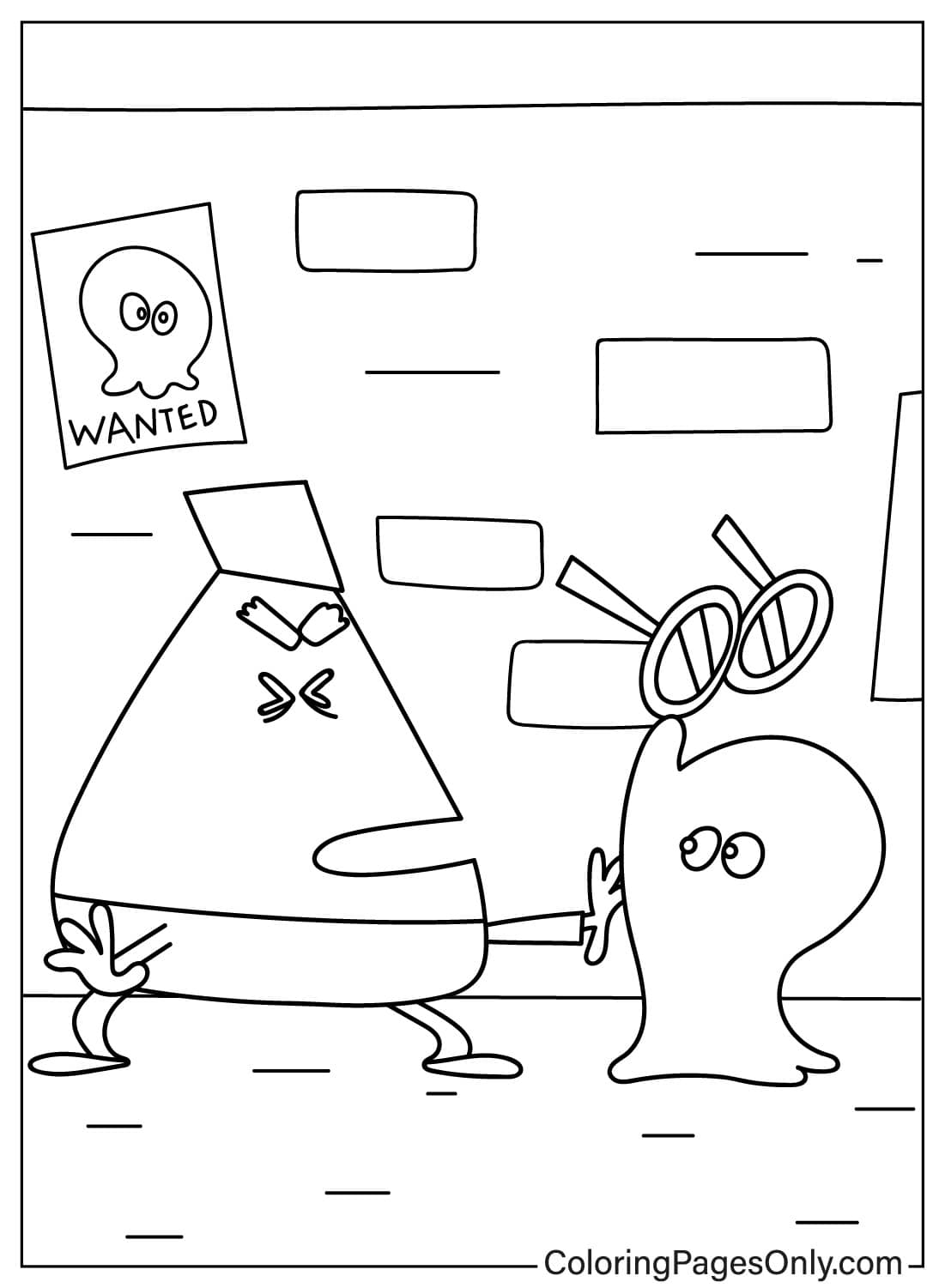
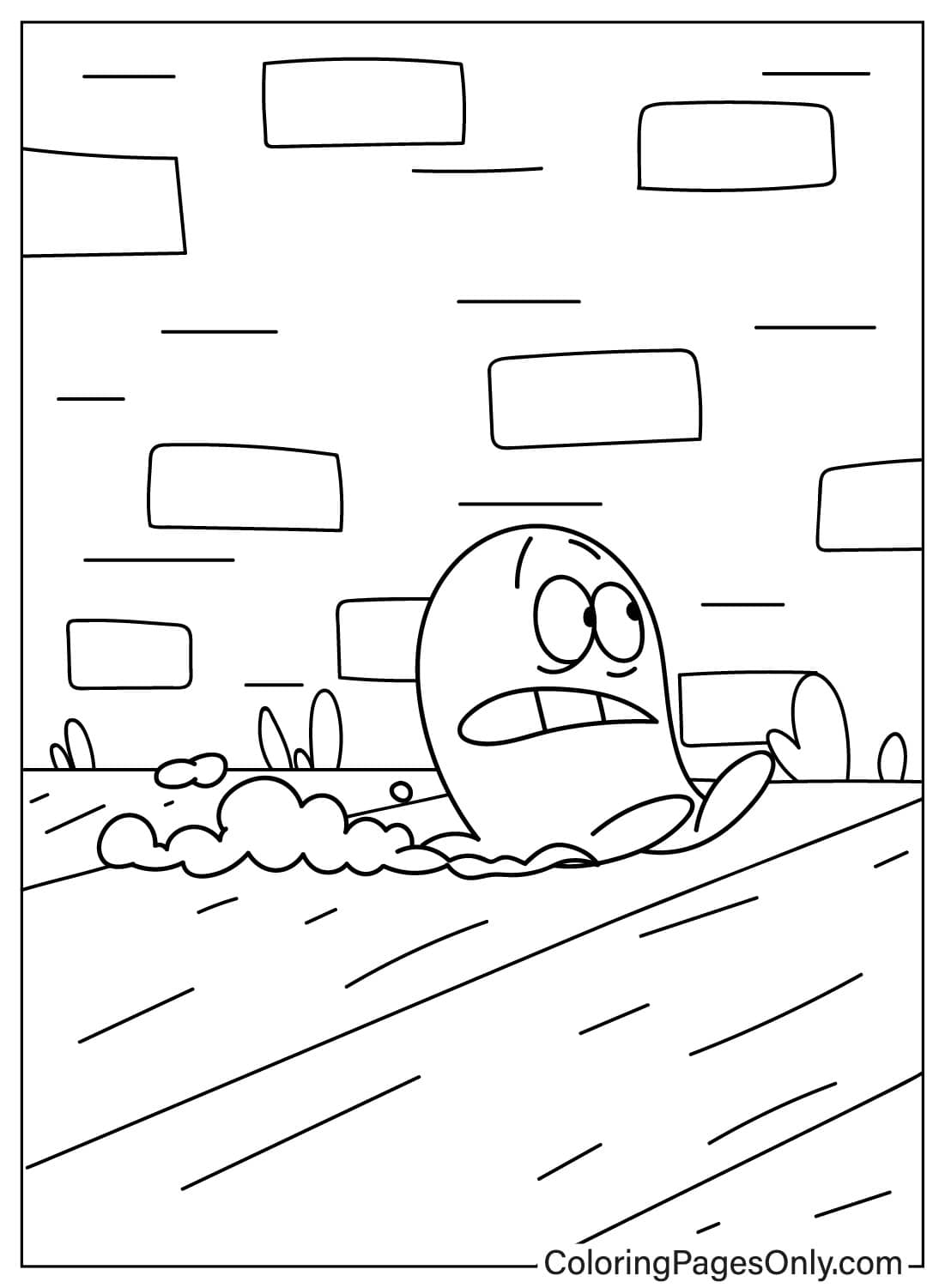
The chase scenes – Lamput running, rolling, or morphing away from Specs and Skinny in pursuit – are the collection’s most compositionally dynamic. These pages capture the series’ essential visual energy: the orange shape moving away from two white-coated figures whose postures communicate frustration, determination, or disbelief in various combinations.

Chase pages require attention to directional energy – Lamput’s form should visually imply movement toward the edge of the page while the scientists’ postures imply movement toward Lamput. Color choices can support this: vivid orange for Lamput (keeping him visually immediate), slightly cooler or more muted treatment for the background elements, and the scientists in their white coats rendered with enough shadow detail to give them weight and presence.

Transformation and Disguise Pages

The transformation pages show Lamput in the act of becoming something else – mid-morph between his blob form and whatever shape he has decided to adopt. These pages capture the visual quality of animation that live action cannot replicate: a body that is simultaneously one thing and another, caught at the transition point.

The disguise pages show Lamput successfully hidden as something else – a vase, a fruit, a piece of furniture, a common object – with the comedy of his hidden presence visible to the viewer but not (yet) to the scientists. These pages have the most complex compositional relationship between the three characters: Lamput concealed in plain sight, Specs, and Skinny present but oblivious.

What These Pages Do

Lamput’s wordless format makes it one of the most culturally accessible shows in contemporary animation. The series travels across language barriers the way physical comedy always has – Buster Keaton and Charlie Chaplin built the grammar of this format a century ago, and it remains valid precisely because human bodies doing physical things in pursuit of other bodies doing physical things requires no words to be immediately intelligible.

The shape-shifting concept teaches children about transformation and possibility. Lamput can be anything he needs to be, in the moment he needs to be it. The imagination required to generate new shapes and disguises in every situation is the show’s core creative engine – and children who watch it are implicitly learning that problems can have unexpected solutions, that constraints can be worked around rather than fought directly, and that flexibility often beats force.

Simple character design teaches the fundamentals of color-as-identity. Lamput’s orange is his identity – it is the only fixed thing about him in a design where everything else changes. Specs’s round shape and Skinny’s narrow shape are instantly readable. The collection teaches, through direct engagement, that character identity can be established through color and silhouette alone.

Fine motor development. The American Academy of Pediatrics identifies fine motor development as a key childhood milestone throughout early childhood. The Lamput pages are calibrated for the full developmental range – the simple blob outline with minimal internal detail for the youngest fans building foundational control, the chase scene compositions and character portraits with more detail for fans developing more precise coloring ability. The 2005 Art Therapy Journal study on structured coloring and anxiety reduction applies throughout.

How to Color These Pages Well

Lamput’s orange is the entire palette decision. Unlike characters with complex multi-color designs, Lamput’s coloring is almost entirely decided by one choice: how vivid is the orange? The answer is: as vivid as possible. Apply warm, bright orange at full pressure across his entire body. His eyes are the only other color decision – white with dark pupils. Everything else follows from the orange.

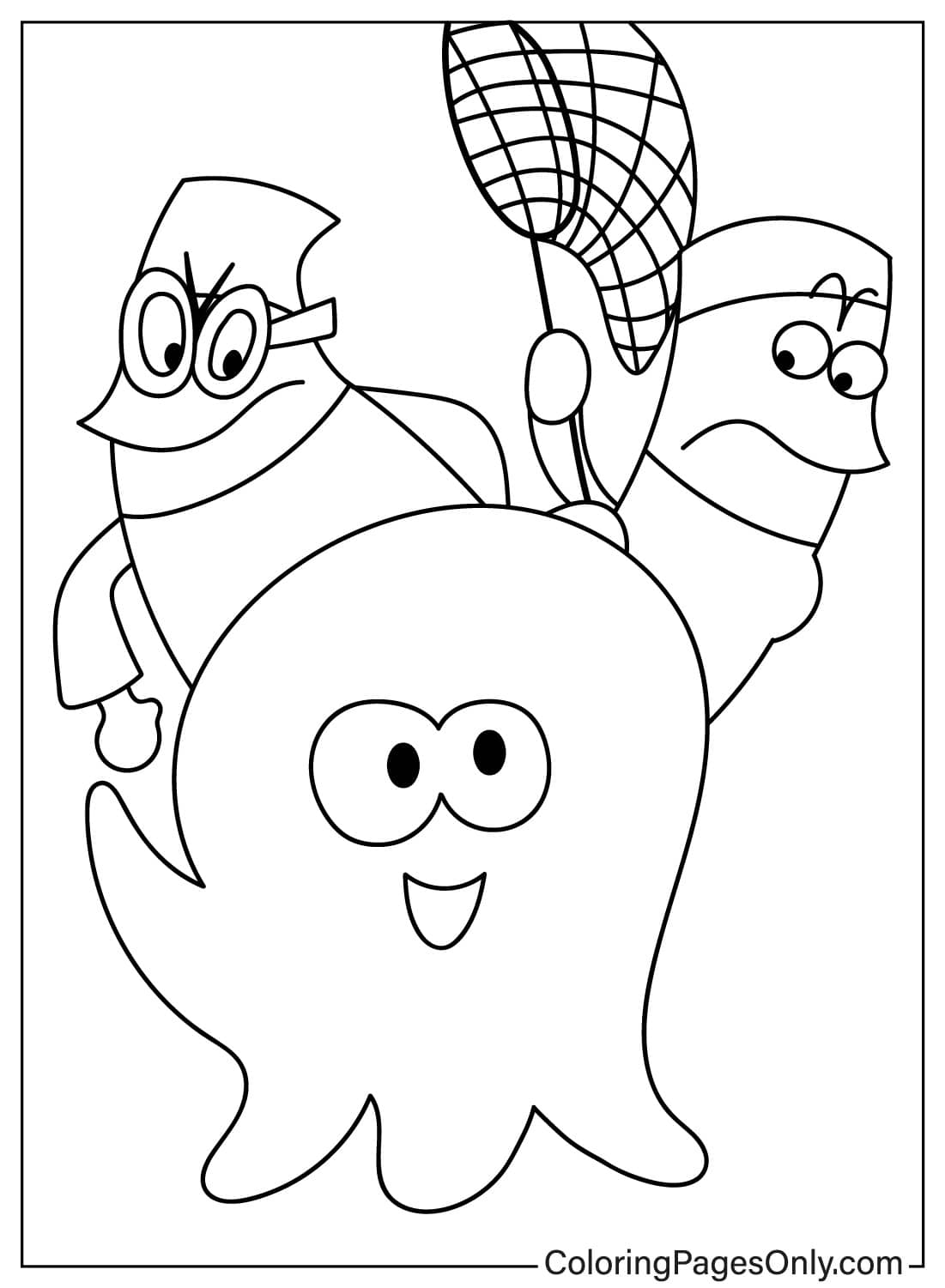
The three-character contrast is the page’s visual logic. In any page showing all three characters, the visual hierarchy is: Lamput (orange, most vivid) in the center of attention, scientists (white coats, skin tone, relatively neutral) in pursuit. The page’s color contrast should naturally place Lamput first in the viewer’s eye. Do not mute Lamput’s orange to blend with the background – the gap between his vivid orange and the scientists’ white coats is the visual shorthand for their relationship.

Transformation pages need implied motion. When Lamput is mid-transformation – partially blob, partially something else – the coloring should support the sense of movement. The areas closest to his resting blob form should be rendered in the full vivid orange; the areas that have stretched or morphed should use the same orange, but can be applied with slightly less pressure at the stretched extremities to suggest the body is in motion. This is not blending; it is pressure variation that communicates extension.

White lab coats need a subtle shadow to read as three-dimensional. A lab coat rendered as flat white reads as an uncolored area. Apply the lightest possible warm grey or cool grey in the fold areas – sleeve creases, lapel edges, and the shadow beneath the coat’s hem. Keep the highlight areas pure white. The coat should read as white fabric, not as paper.

Lamput’s eyes carry all his expression. In a character with no fixed mouth and no fixed body shape, the eyes do everything. Render them carefully: white sclera (the white of the eye), dark iris/pupil taking up most of the eye area, and a small white highlight dot at the upper portion of the iris. The highlight dot is what makes the eyes read as alive and expressive rather than as dark, flat ovals.

5 Creative Craft Ideas

Shape-Shifting Transformation Strip

Print four or five Lamput pages that show him in different shapes – his basic blob form, a stretched form, a flattened form, and at least one disguise form. Color all pages using the same vivid orange – the consistency of color across all shapes is the point.

Mount all in a horizontal row on a backing sheet. Below each shape, add a hand-lettered label describing what Lamput has become: “Normal Form,” “Stretched,” “Flat,” “Disguised as [object].” Add a title at the top: “Lamput: One Orange, Every Shape.” The finished strip demonstrates the character’s core ability – one color, infinite forms.

Chase Sequence Storyboard

Print three chase pages in sequence – Lamput in hiding, Lamput discovered and running, scientists falling or failing. Color all three with consistent palettes: Lamput in vivid orange throughout, scientists in white coats with consistent skin tones.

Arrange in left-to-right sequence on a backing sheet with a speech-bubble-style caption below each panel. Since the show has no dialogue, the captions should be in sound-effect style: “SPLAT!” “ZOOM!” “CRASH!” The finished storyboard reads as a page from a silent-comedy comic – the visual grammar of the show translated into a hand-colored sequential narrative.

Creating Personalized Keychains xh-group en made-in-china com

Resource: xh-group.en.made-in-china com

Disguise Matching Game

Print multiple Lamput disguise pages – pages showing Lamput hidden as different objects. Color each disguise page carefully, then cut out small Lamput blob figures from separate printed portrait pages. On a large backing sheet, mount the disguise scenes in a grid. Attach the cut-out Lamput blobs to separate cards.

The game: match each Lamput card to the disguise scene where he is hidden. The exercise develops visual attention and reading comprehension – the same skills that make the show’s comedy work for viewers who need to find Lamput hiding in a scene.

Creating Creative Handprint Art etsy com
Resource: etsy.com

Scientists’ Failure Log

Print the most comedic “scientists failing to catch Lamput” pages available. Color all in consistent palettes. Mount each on a backing sheet in a column, with a hand-lettered failure report below each image – written in mock scientific language: “Attempt #37: Subject evaded capture by morphing into a vase. Analysis: Inconclusive. Next attempt pending.” The format parodies academic documentation applied to the fundamental indignity of being consistently outwitted by a small orange blob.

Creating Active Play Toys best-alzheimers-products com
Resource: best-alzheimers-products.com

My Lamput Disguise Design

Print the simplest Lamput blob portrait page. Color it in canonical orange. Then, on a separate blank piece of paper, draw the object Lamput would disguise himself as in YOUR house – the specific chair, lamp, or fruit bowl that would be most useful. Color your designed disguise in the same vivid orange.

Mount both side by side: “Lamput” on the left, “Lamput disguised as [your object]” on the right. The craft extends the coloring activity into imaginative problem-solving – using the character’s established ability as the starting point for a personal creative decision.

Creating Creative Storytelling

Frequently Asked Questions

What is Lamput and where is it from? Lamput is an Indian animated short-form comedy series created by Vaibhav Kumaresh at Vaibhav Studios. The series originally aired on Cartoon Network India beginning in 2016 and has since been broadcast on Cartoon Network internationally and made available on Disney+ Hotstar and YouTube, where it has accumulated billions of views. The show features no dialogue – all comedy is visual and sound-based – making it accessible to audiences worldwide regardless of language. It follows a small orange shape-shifting blob creature named Lamput as he repeatedly escapes capture by two laboratory scientists called Specs and Skinny.

Who are the three main characters in Lamput? The three main characters are Lamput, Specs, and Skinny. Lamput is a small, bright orange amorphous blob creature who was created in a laboratory and escaped, using his shape-shifting ability to avoid recapture in every episode. Specs is the plump, bald scientist with round glasses who is one of the two pursuing Lamput – impulsive, easily frustrated, and identifiable by his round body and circular spectacles. Skinny is the other scientist – thin, tall, and with a long face – who is more calculating but equally unsuccessful. All three characters wear or occupy their canonical designs across every episode, making the show’s cast immediately recognizable by shape and color alone.

What is Lamput’s special ability? Lamput is a shape-shifter – an amorphous creature with no fixed body form who can stretch, flatten, split, mold, and transform himself into virtually any shape, size, or recognizable object. This ability is the foundation of the series’ comedy: every episode generates a new situation in which Lamput must use creative transformations to evade the scientists, who rely on conventional methods to catch a creature that defies conventional categories. The range of his transformations across the series is essentially unlimited – he has disguised himself as furniture, food, animals, tools, vehicles, and many other forms.

Why does Lamput have no dialogue? The absence of dialogue in Lamput is a deliberate creative decision by series creator Vaibhav Kumaresh that serves both artistic and commercial purposes. Artistically, wordless physical comedy is a valid and historically rich tradition – the same format that defined the work of Buster Keaton and Charlie Chaplin -, and it forces the show’s storytelling to be entirely visual, which is a meaningful creative constraint. Commercially, a wordless show requires no dubbing or subtitling for international distribution – the same episode file plays for any audience in any language without modification. This has allowed Lamput to reach audiences in countries and languages far beyond what an Indian animation production would typically reach with dialogue-dependent content.

How long is each Lamput episode? Lamput episodes are very short – typically between one and three minutes each. The short format is consistent with the show’s premise and structure: each episode is a single chase scenario, developed and resolved quickly, without the multi-act structure that longer animated formats require. The short length is also well-suited to YouTube and streaming distribution, where shorter content performs well with the show’s primary young audience. The brevity is a feature rather than a limitation – each episode is a complete, self-contained comedy idea expressed as efficiently as possible.

What age group is Lamput suitable for? Lamput is designed primarily for young children – approximately ages four through ten – though its wordless format and physical comedy have made it popular with adults as well. The show’s content is entirely family-friendly: the comedy is pure physical chase comedy with no violence beyond cartoonish pratfalls, no language issues (there being no language), and no content unsuitable for any age. The coloring pages in this collection are appropriate for all ages, with the simpler blob-form pages most accessible for the youngest fans and the more detailed chase and character pages most engaging for older fans who want more coloring complexity.

Browse the full collection at ColoringPagesOnly.com. All 20+ pages free, no sign-up, PDF or PNG, print at home or color online.

Vaibhav Kumaresh built Lamput without words because he understood that a small orange blob trying to avoid two scientists does not need words. The situation is the story. The shapes are the sentences. The orange is the identity – the one fixed thing in a character defined by unfixedness.

The show has been watched billions of times by children who share nothing except access to a screen and the ability to recognize that a plump man in a lab coat walking into a wall he did not see coming is funny in any language, at any age, on any continent.

The pages in this collection are the outline of that story, rendered in outline, ready to be made vivid again.

Pick up your orange. Make it bright. The scientists are already running behind.

Share your work on Facebook and Pinterest and tag #Coloringpagesonly. We especially want to see the shape-shifting transformation strips and the disguise matching games.

Color the blob. The scientists will never catch it. They never do.

These related coloring collections will help you explore the wonderful world of colors. Let’s choose, be creative, and show us your great pictures!


Emma Wilson – Illustrator

Hey there, young artists! I’m Emma Wilson, a freelance illustrator who loves children and the magic of art. I dream of building a vibrant community where we can all come together to draw, color, and bring unique creations to life with every brush or pencil stroke. Let’s unleash our imagination in ColoringPagesOnly.Com!