
Free My Little Pony coloring pages – 740+ pages featuring Twilight Sparkle, Rainbow Dash, Pinkie Pie, Rarity, Applejack, Fluttershy, Princess Celestia, Princess Luna, Spike, the Cutie Mark Crusaders, Discord, Queen Chrysalis, the G5 cast, Equestria Girls, scenes from Ponyville and Canterlot, and much more – free printable PDF and online coloring for fans of all generations.
My Little Pony is a Hasbro franchise that began in 1982 with a toy line designed by Bonnie Zacherle – colorful, small horse figures with unique symbols on their flanks (later formalized as “cutie marks”) and mane and tail colors distinct from any realistic equine palette. The franchise has passed through five distinct generations over four decades, each with its own character designs, animated properties, and cultural moments.
The generation with the deepest cultural impact is the fourth – My Little Pony: Friendship is Magic, created by animator Lauren Faust and broadcast on The Hub (later Discovery Family) from October 10, 2010, to October 12, 2019. Nine seasons and 221 episodes built one of the most dedicated fandoms in the history of children’s television, crossing demographic lines in ways that surprised Hasbro and produced an entire cultural phenomenon – the Brony community – around a show designed for young girls. The fifth generation began with a Netflix film in September 2021 and continues with new characters and an expanded Equestrian setting. Both generations, and the earlier ones, are represented in this collection.
These 740+ free pages at ColoringPagesOnly.com span the entire franchise’s visual history. All free, PDF or PNG, print or color online.
What’s Inside
The Mane Six – Friendship is Magic
The six central characters of Friendship is Magic are the collection’s most extensively represented – each appearing across dozens of pages in different poses, expressions, scenes, and visual styles.
Twilight Sparkle
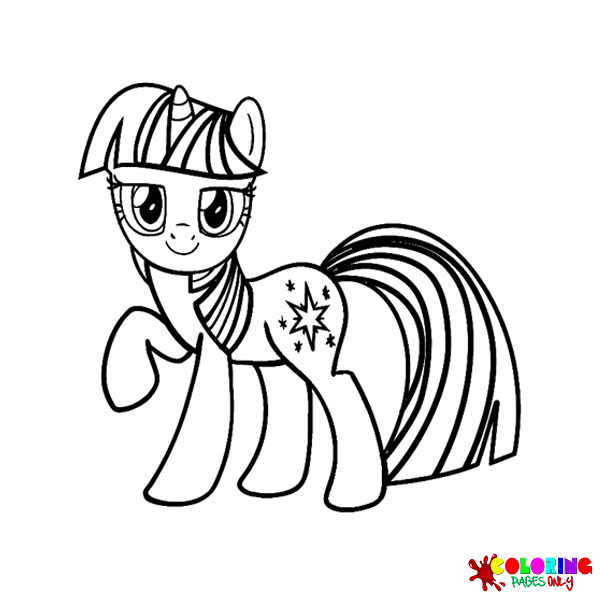
Twilight Sparkle begins the series as a studious, socially awkward unicorn who would rather read about friendship than practice it, and ends it as the Princess of Equestria – a character arc that the show earns across nine seasons of genuine growth. She is Celestia’s personal student, Spike’s caretaker, and the pony whose development the series most directly centers.
Her design: a lavender-purple body, a dark blue mane and tail with purple and pink streaks, and – after her transformation into an Alicorn in Season 3 – the wings that mark her princesshood added to her original unicorn horn. Her cutie mark is a six-pointed pink star surrounded by five smaller white stars.
Coloring Twilight Sparkle: The lavender body should be a medium-value purple with a slight blue shift – not pink-purple and not blue-purple, but precisely at the warm-cool midpoint. Her mane has three distinct zones: the main dark blue (her darkest element), a purple stripe that lightens slightly from the blue, and a hot pink/magenta streak that should be the mane’s most vivid color. The pink streak is easy to understate – make it as vivid as possible. Her cutie mark star should be the same pink-magenta as the mane streak.
Rainbow Dash
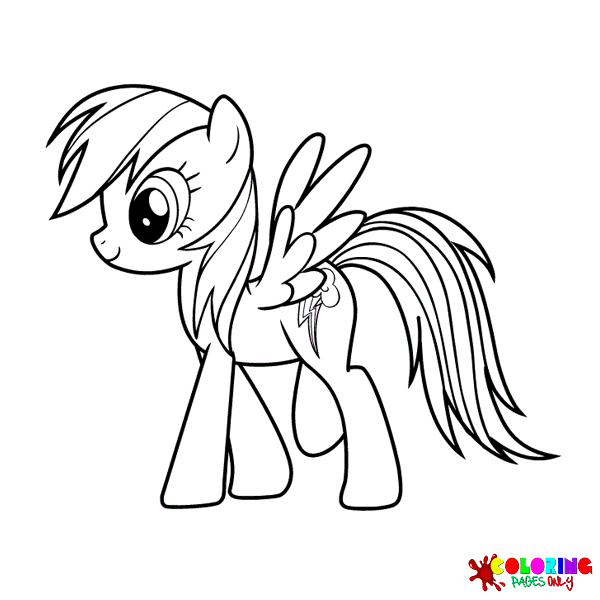
Rainbow Dash is the fastest flyer in Equestria – a distinction she advertises at every opportunity and that she has the ability to back up. She is fiercely loyal, competitive in the best and worst ways, and genuinely brave in situations that would reasonably produce fear. Her dream of joining the Wonderbolts – the elite flying performance team – is the personal goal that structures her development across the series.
Her design is the collection’s most visually complex in terms of mane and tail treatment: a cyan body (a specific blue-green that is neither blue nor green but evenly between them), and a mane and tail that contain all six visible spectrum colors in bands – red, orange, yellow, green, blue, violet – in that order from top to bottom. Her cutie mark is a cloud with a three-stripe rainbow lightning bolt.
Coloring Rainbow Dash: Her body cyan is a specific color – not the cool blue of water, not the warm green of leaves, but the exact midpoint. Her rainbow mane is the collection’s most technically demanding hair coloring challenge: six distinct colored bands that must be recognizable as a rainbow when viewed together. Apply them in order from the outermost curve: red at the top, violet at the bottom (for a pony mane curving downward), keeping each band the same width. The lightning bolt on her cutie mark mirrors the mane color arrangement – three stripes: red, yellow, blue.
Pinkie Pie
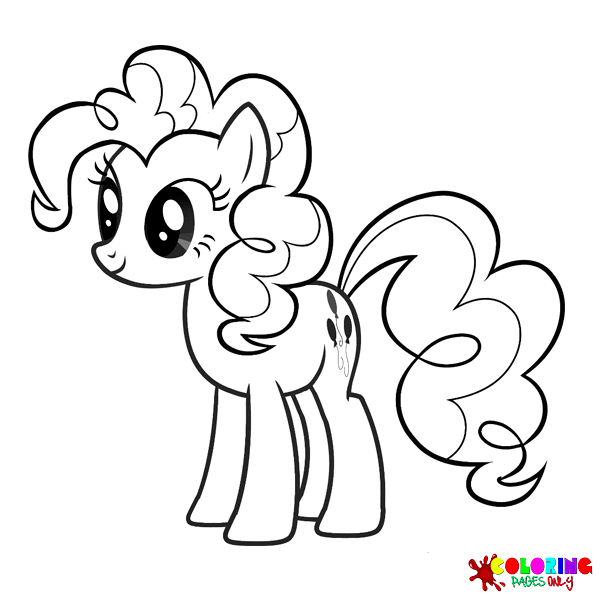
Pinkie Pie operates by different rules than the other characters – she breaks the fourth wall, produces items from impossible locations, and moves at speeds that suggest her relationship to physics is advisory rather than binding. She is the series’ comic engine, the pony whose presence reliably produces joy in those around her, and whose sadness, in the rare episodes where it appears, reads as genuinely wrong in a way that the show leverages carefully.
Her design: a pink body (bright, warm, medium-value pink, the pinkest pink), a mane and tail that are curly, and a slightly darker, more vivid pink than her body. Her cutie mark is three balloons – two blue and one yellow – tied together.
Coloring Pinkie Pie: She is the most monochromatic of the Mane Six – nearly her entire design is in the pink family, with the balloon cutie mark providing the main color contrast. Her body pink and mane pink should be distinguishable from each other: the mane slightly more saturated or slightly warmer than the body. The balloon cutie mark – two blue and one yellow – should be vivid and contrast clearly against her pink flank.
Rarity
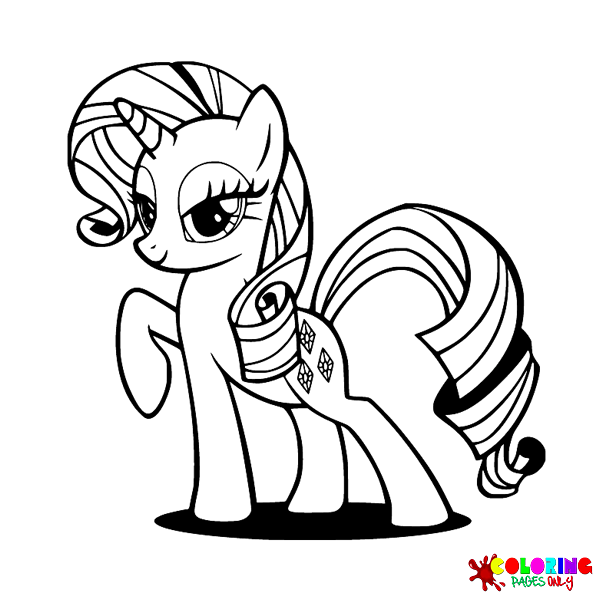
Rarity runs the Carousel Boutique in Ponyville – a fashion design studio where she makes clothing for Equestrian clients and, occasionally, for the other Mane Six. She is the series’s most theatrical character: prone to dramatic expressions of distress and joy, deeply invested in beauty and presentation, and generous to a degree that the show makes the point about repeatedly – her dramatic exterior contains a genuinely warm, giving character.
Her design: a white body (the cleanest, most neutral white of any Mane Six member), a deep purple mane and tail with elegant curls, and brilliant blue-green eyes. Her cutie mark is three blue diamonds.
Coloring Rarity: Her white body presents the standard challenge – a white surface needs shadow to have form. Use the subtlest possible warm cream or cool light grey in her shadow areas, keeping the reading firmly white with just enough dimensional shading to prevent the body from reading as flat paper. Her purple mane curls should be layered: lighter purple on the outer surfaces of each curl, darker purple in the recesses where the curl wraps. Her diamond cutie marks are a vivid blue-violet – more blue than purple.
Applejack
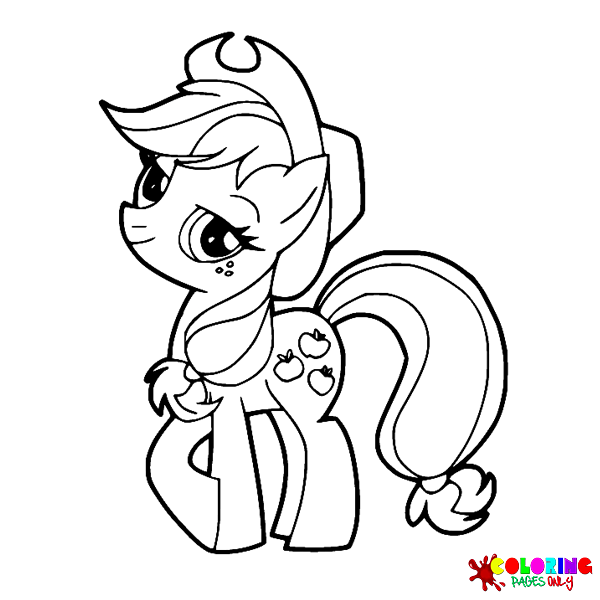
Applejack works on Sweet Apple Acres – the family farm she tends with her grandmother, Granny Smith, her older brother, Big Macintosh, and her younger sister, Apple Bloom. She is the most straightforwardly honest character in the series and the one whose values are most consistently expressed through physical action rather than emotional statement. She works. She helps. She tells the truth, even when it would be easier not to.
Her design: an orange body (warm, bright orange), a golden yellow mane and tail tied in a ponytail with a red ribbon, and a tan cowboy hat that she almost never removes. Her cutie mark is three red apples.
Coloring Applejack: Her orange body should be warm and vivid – the orange of a ripe orange, not the muted orange-brown of autumn leaves. Her golden mane is distinctly yellow-gold, noticeably different from her orange body – use a warm yellow with slight amber shift rather than a bright lemon yellow. Her hat is a warm tan, darker than her mane but in the same warm family. Her apple cutie marks are a vivid red – the red of an apple, saturated and clear.
Fluttershy
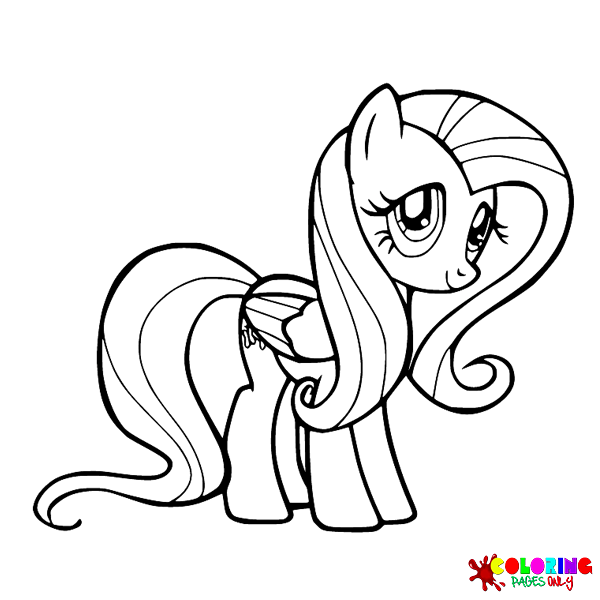
Fluttershy lives in a cottage near the Everfree Forest with a menagerie of animal companions – birds, a bear named Harry, a rabbit named Angel, and many others she cares for with the specific attentiveness of someone who finds animals easier to understand than ponies. She is the series’s most gentle character – her voice is a near-whisper in most scenes, her strength of character is expressed in small, careful gestures rather than declarations – and the episodes that push her toward overcoming her fear without losing what makes her gentle are the show’s most careful character work.
Her design: a pale yellow body (very light, almost cream yellow), a long, flowing pink mane and tail that covers one of her eyes, and large, soft teal eyes. Her cutie mark is three pink butterflies.
Coloring Fluttershy: Her pale yellow body is the lightest of the Mane Six – keep it near-white-with-just-a-touch-of-yellow rather than a full saturated yellow. Her mane and tail pink is medium-light, slightly warm – it should read as soft rather than vivid. Her eyes are the most vivid element of her design: a clear teal that reads clearly against her pale body. Her butterfly cutie marks are the same pink as her mane, giving her design a unified, soft palette throughout.
Princess Characters
Princess Celestia is the white Alicorn co-ruler of Equestria who raises the sun daily – a detail the show presents not as mythology but as her literal daily task. She has been ruling for over a thousand years. Her mane and tail are unique in the show: they flow continuously, animated with a shimmer effect, in a four-color blend of pale blue, pale pink, pale green, and pale purple. Her cutie mark is a stylized sun.
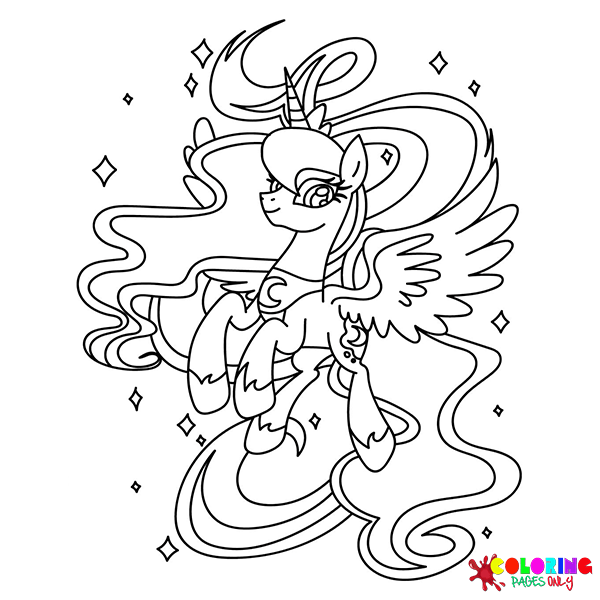
Princess Luna is Celestia’s younger sister, who raises the moon and guards the dreams of sleeping Equestrians. She spent a thousand years banished to the moon in her corrupted Nightmare Moon form before being freed in the series pilot. Her design is a dark blue body – a deep, slightly purple-shifted navy – with a blue-black mane and tail that share the same flowing, shimmer-animated quality as Celestia’s. Her cutie mark is a crescent moon against a darker circular field.
Princess Cadance is a pink Alicorn who rules the Crystal Empire with Shining Armor. Her body is a light rose-pink, her mane and tail are a three-stripe blend of purple, gold-yellow, and magenta. Her cutie mark is a crystal heart.
Coloring Celestia: Her mane is the most complex coloring challenge in the entire collection – four colors blended together in a flowing, gradient arrangement. The canonical order: blue-green at the leading edge of the mane flow, transitioning through light blue, light pink, and light purple. Keep all four tones in the pale range – fully saturated versions of any of these colors will look wrong. The mane reads correctly only when all four are pale and soft.
Spike
Spike is Twilight Sparkle’s dragon assistant and her closest companion since childhood – hatched from an egg by Twilight’s magic at her entrance exam to Celestia’s School for Gifted Unicorns. He is small, purple-bodied with a green spine and green inner wings, with green eyes and a round, somewhat reptilian but not threatening face. He sends and receives letters via magical fire breath.
His pages present a different coloring challenge from the pony characters – scales rather than coat, a more angular body structure, and the specific combination of purple and green that defines his design.
Cutie Mark Crusaders
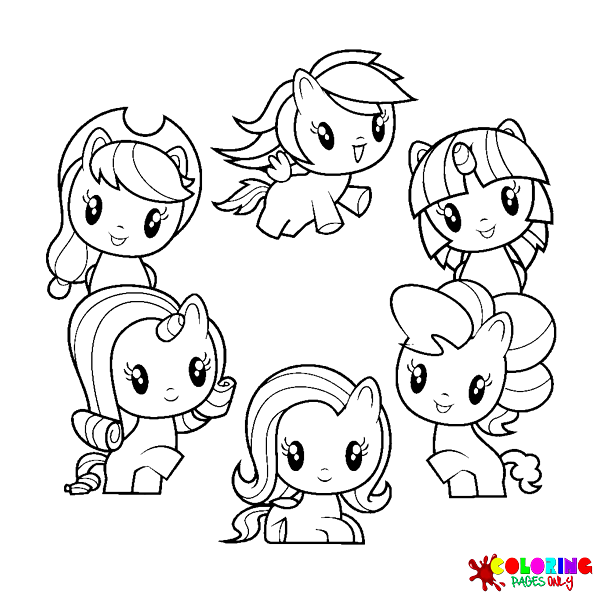
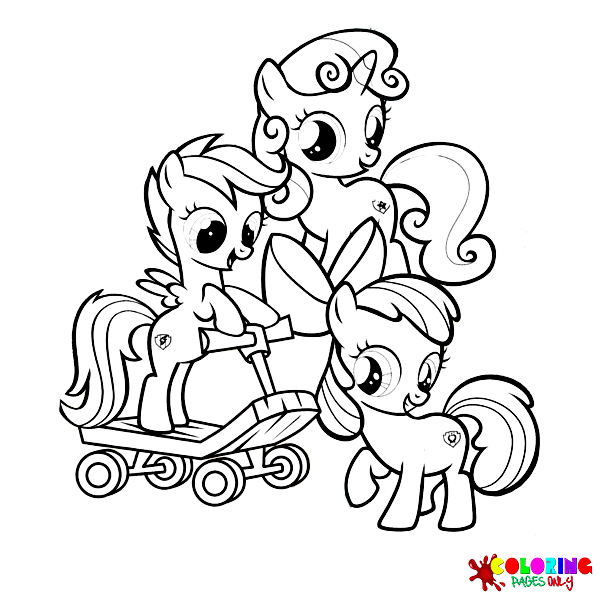
Apple Bloom (Applejack’s younger sister – yellow earth pony, red mane, pink bow), Sweetie Belle (Rarity’s younger sister – white unicorn, pink and purple curly mane), and Scootaloo (orange pegasus, purple mane, friend of Rainbow Dash) form the Cutie Mark Crusaders – a club dedicated to discovering their special talents and earning their cutie marks.
Their pages are some of the collection’s most energetic and accessible for younger fans – simpler designs than the Mane Six, expressive poses, and the specific youthful energy of three children in the middle of enthusiastic schemes.
Discord
Discord is the Spirit of Chaos and Disharmony – a Draconequus, which the show defines as a chimera-assembled creature: the head of a pony, the antlers of a deer, a bat wing and a pegasus wing, a lion’s paw and a dragon’s claw, a horse’s leg and a goat’s leg, a serpent’s tail. He is the show’s most visually complex character and the one whose design most thoroughly refuses to organize around a single body logic.
His pages are the collection’s most unusual in terms of body form – no four matching limbs, no consistent surface material, no symmetry. They reward the most patient, careful approach and are the most dramatically different from the rest of the collection.
Queen Chrysalis and the Changelings
Queen Chrysalis is a black Changeling queen – a creature that feeds on love by taking the form of loved ones. Her design is deliberately unsettling in the context of the show’s usual aesthetic: black body, holes in her legs and horn, matted blue-green mane and tail, sharp fangs, and turquoise compound insect eyes. Her form is a corrupted version of a pony, designed to read as wrong.
Her pages give the collection’s darkest, most desaturated palette – the most technically interesting counterpoint to the vivid, warm palettes of the Mane Six.
G5 Characters – A New Generation
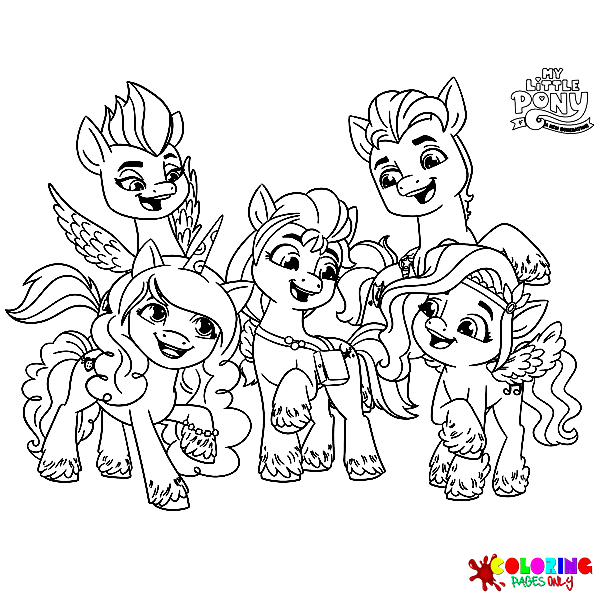
The fifth generation cast introduces five new characters in a Equestria set hundreds of years after the events of Friendship is Magic: Sunny Starscout (orange earth pony with yellow gradient mane, the protagonist), Izzy Moonbow (purple unicorn with flowing blue-purple mane), Hitch Trailblazer (yellow earth pony, male, the local sheriff), Pipp Petals (light pink pegasus, social media star), and Zipp Storm (white and blue pegasus, Pipp’s sister).
Their designs update the aesthetic of Friendship is Magic – similar basic pony structure but with slightly more elongated proportions and updated color relationships. The G5 pages in the collection give fans of the newer series their specific cast alongside the classic characters.
Equestria Girls
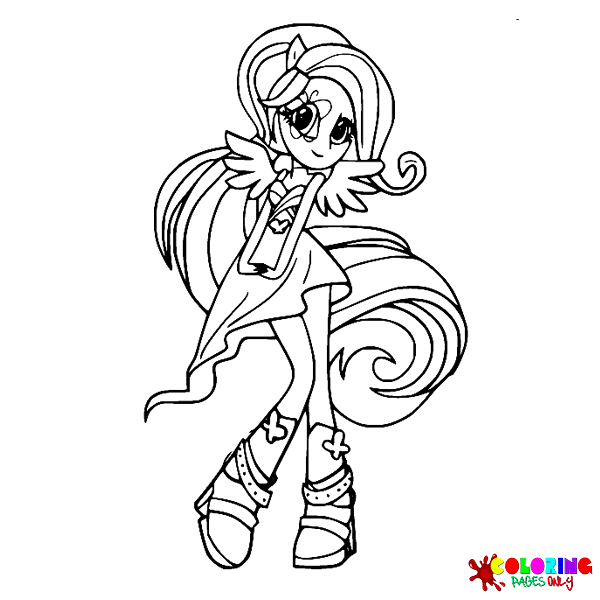
Equestria Girls is a parallel series in which the Mane Six characters are reimagined as human teenagers attending Canterlot High School – humanized versions with the same color palettes (skin tones matching their pony body colors, hair matching their mane and tail colors) and the same personalities in a high school social context.
The Equestria Girls pages are the collection’s most directly comparable to human character coloring pages – same faces as the other characters, human body proportions, school clothes – and give fans of the spin-off series their specific visual register alongside the pony pages.
Scene and Location Pages
Ponyville pages show the town’s distinctive architecture – rounded, soft-edged buildings in warm earth tones, the town center with its market stalls, Carousel Boutique, Sugarcube Corner. Canterlot pages show the capital city’s more formal, tall spired architecture in gold and white. Cloudsdale pages show the pegasus city built on clouds – white and blue, with rainbow waterfalls. The Crystal Empire pages show the crystalline architecture of Cadance’s kingdom – translucent, light-catching, rendered in jewel-toned colors.
What These Pages Do
My Little Pony’s color-coded cast is the largest in this collection. Six Mane Six members, three princess Alicorns, Spike, three Cutie Mark Crusaders, Discord, Chrysalis, and the G5 cast – each with distinct, specific color identities. Coloring through the full cast teaches color identity, color comparison, and the specific skill of maintaining a consistent palette across a character’s many appearances in a collection this large.
The show’s theme of friendship is carried into the coloring pages. The Mane Six are defined by their relationships to each other as much as by their individual designs. Group pages – all six together, or two characters whose friendship the show develops – carry emotional content that individual pages do not. Coloring them is engaging with the relationships as much as with the designs.
Fine motor development at every age. The American Academy of Pediatrics identifies fine motor skill development as a key milestone throughout early childhood. The range of page complexity in this collection – from the very simple single pony outline to the elaborate group scene with multiple characters and background elements – means there is an appropriate fine motor challenge at every developmental level from ages three and up.
Celestia’s mane is the collection’s most advanced single coloring challenge. The four-color blended mane – requiring gradient work across pale blue-green, blue, pink, and purple in sequence – is genuinely difficult and genuinely rewarding when executed well. The 2005 Art Therapy Journal study on structured coloring and anxiety reduction applies particularly to challenges of this kind: the sustained, focused attention required to complete a difficult element produces exactly the calm absorbed state the research identifies.
How to Color These Pages Well
Keep a character reference sheet. With 740+ pages and this many characters, it is easy to use different yellows for Applejack’s mane across pages, or to shift Twilight’s lavender warmer on one page and cooler on another. Before beginning a coloring session, color a small swatch of each character’s colors on scrap paper and keep it visible. Consistency of character palette across many pages produces the most satisfying completed collections.
A coat is different from mane. A pony’s body color and mane color are always distinct from each other – they are never the same color. The relationship between them is usually contrast or complementary. Rarity’s white body and purple mane, Fluttershy’s pale yellow body and pink mane, Rainbow Dash’s cyan body and rainbow mane – in every case, the mane should be immediately visually distinct from the body without needing to look closely. If they are reading as the same color family, adjust one of them.
Cutie marks are the most personal element. The cutie mark is the show’s symbol for a pony’s unique talent and identity – it appears on both flanks and is the design element most specific to each character. Give cutie marks more attention than body proportions suggest they need – they are visually small but semantically central. Apply them at full saturation against the body color so they read clearly.
Alicorn wings are a lighter tone than the body color. The feathers of Pegasus and Alicorn wings reflect more light than the coat does – render them approximately one to two tones lighter than the body color to suggest the light, airy quality of feathers. Celestia’s white wings should have the most subtle possible shadow at their base, almost indistinguishable from the body white, but just present enough to show the wing’s edge.
Princess manes need planning before execution. Celestia’s four-color blended mane and Luna’s dark flowing mane are the two most complex hair treatments in the collection. For Celestia: apply the palest color first across the entire mane, then layer each additional color in bands, keeping all applications light. For Luna: apply a very dark blue-black as the base, then add the dark teal shimmer of her mane in mid-tones – lighter than the base, darker than the stars that often appear in her mane.
Discord wants an imperfect application. His body is a patchwork of incompatible animal parts – the coloring should reflect this. Apply each body section in its own color, not blending across section boundaries but keeping them clearly distinct. The lion paw section uses warm tan. The dragon claw section uses cool grey-green. The snake tail uses warm yellow-green. The lack of unity between sections is the correct reading for Discord’s design.
5 Creative Craft Ideas
Elements of Harmony Display
Print one portrait page for each of the Mane Six members. Color each in her canonical colors. Arrange all six in a circle on a large backing sheet, with each pony positioned at the point of a hexagon – Twilight at the top, then Applejack, Fluttershy, Pinkie Pie, Rarity, Rainbow Dash clockwise.
In the center of the circle, draw or print the Element of Harmony medallion for each character – or hand-letter each character’s Element below her figure: Magic, Honesty, Kindness, Laughter, Generosity, Loyalty. Connect each pony to her Element text with a colored line in her canonical color. The finished display is the show’s central friendship theme made visual.
Cutie Mark Collection
Cutie marks are My Little Pony’s most distinctive design element – each one a small, personal symbol of a pony’s unique talent. On a large sheet of white paper, create a grid of 12 or more cutie mark symbols, drawn by hand or traced from the coloring pages. Color each in its canonical colors: Twilight’s pink star, Rainbow’s rainbow lightning bolt, Pinkie’s three balloons, Rarity’s diamonds, Applejack’s apples, Fluttershy’s butterflies – then continue with secondary characters.
Label each cutie mark with the pony’s name and what talent it represents. The finished sheet is a reference guide and a piece of franchise knowledge made visual through direct engagement with each character’s most personal symbol.
Princess Celestia and Luna Moon-and-Sun Mobile
Print one Celestia page and one Luna page. Color Celestia in her white body and pale shimmer mane, Luna in her dark blue body and dark flowing mane. Cut both out carefully around the body outline. Reinforce the back of each with cardstock if needed.
Cut a large circle from yellow cardstock (the sun) and a large crescent from silver or dark blue cardstock (the moon). Hang the sun at the top of a length of ribbon with Celestia below it, and the moon at the top of another ribbon with Luna below it. Hang both from a dowel or a wire hanger. The finished mobile represents the sisters’ canonical roles – Celestia raising the sun, Luna raising the moon – as a kinetic display.
Rainbow Dash Mane Color Study
The rainbow mane is the most technically demanding single coloring challenge among the Mane Six – six distinct colored bands that must read as a rainbow when viewed together. Print three copies of any Rainbow Dash portrait page.
Color the first mane using the canonical sequence: red, orange, yellow, green, blue, violet from outside edge to inside. Color the second with different colors in the same positions – what if her mane were a different spectrum entirely? Purples, pinks, and reds? Blues, greens, and teals? Color the third using grayscale – six shades of grey from light to dark in the same band positions.
Compare all three. The exercise reveals how much of Rainbow Dash’s visual identity is carried by the rainbow sequence, specifically, and how radically the same stripe pattern reads differently across different palettes.
My Little Pony Friendship Storyboard
Choose a friendship moment from the series – Twilight and Fluttershy’s quiet scenes together, Rarity helping Pinkie Pie with a party, Rainbow Dash practicing with Applejack. Print four to six pages that could represent sequential moments in a scene involving those characters.
Color all pages in consistent character colors. Arrange in sequence on a backing sheet, left to right, with hand-lettered captions below each image describing the story moment it represents. The finished storyboard is a fan-created summary of a friendship narrative told through coloring pages – the show’s core theme expressed as a personal illustrated record.
Frequently Asked Questions
How many generations of My Little Pony are there? The My Little Pony franchise has produced five distinct generations since its debut in 1982. Generation 1 (1982–1992) introduced the original toy line and a 1986 animated film. Generation 2 (1997–2003) produced smaller redesigned toys without a US animated series. Generation 3 (2003–2009) featured several direct-to-video specials. Generation 3.5 (2009–2010) introduced a more simplified art style. Generation 4 (2010–2019), My Little Pony: Friendship is Magic, is the franchise’s most culturally significant entry and the source of most of the characters in this collection. Generation 5 (2021–present) began with a Netflix film and continues with new characters in an updated Equestria.
Who are the Mane Six and what are their Elements of Harmony? The Mane Six are the six central characters of Friendship is Magic: Twilight Sparkle (Magic), Applejack (Honesty), Fluttershy (Kindness), Pinkie Pie (Laughter), Rarity (Generosity), and Rainbow Dash (Loyalty). The Elements of Harmony are the magical artifacts that represent each character’s most fundamental quality – the things they embody so fully that they can channel the corresponding element’s power. The Elements are both character descriptors and plot devices central to the show’s mythology.
What is a cutie mark? A cutie mark is a small symbol that appears on both flanks of an adult pony in My Little Pony – a marking unique to each individual that represents their special talent or core purpose. Cutie marks appear when a pony has a formative experience of discovering what they are uniquely good at or meant to do. Fillies and colts are born without cutie marks and receive them during childhood – a major theme of the Cutie Mark Crusaders’ storyline. The cutie mark functions as both personal identity symbol and social identifier, and the acquisition of each Mane Six member’s cutie mark is shown in flashback or flashback-equivalent episodes throughout the series.
What is the difference between Earth Ponies, Unicorns, Pegasi, and Alicorns? In the My Little Pony world, ponies are divided into distinct types based on their physical characteristics and magical abilities. Earth Ponies (Applejack, Pinkie Pie) have strong connections to the land and exceptional physical strength, with magic expressed through their relationship to nature and plants. Unicorns (Twilight Sparkle, Rarity) have horns that allow them to perform telekinesis and cast spells, with power varying significantly by individual. Pegasi (Rainbow Dash, Fluttershy) have wings allowing flight and the ability to walk on clouds and manipulate weather. Alicorns (Princess Celestia, Princess Luna, Princess Cadance, and eventually Twilight Sparkle) possess all three types of magic – horn, wings, and earth pony connection – and are associated with royalty in the show’s world.
What is Equestria Girls? Equestria Girls is a spin-off series that began in 2013 with a film in which Twilight Sparkle travels through a mirror portal into an alternate world where all the Equestrian characters exist as human teenagers attending Canterlot High School. The characters maintain their color identities – skin tones matching their pony coat colors, hair matching their mane and tail colors – and their core personalities, while navigating high school social scenarios instead of magical adventures. The series produced four films and an ongoing web series before concluding. The Equestria Girls pages in this collection show the humanized character designs alongside the standard pony pages.
Who created My Little Pony: Friendship is Magic? My Little Pony: Friendship is Magic was created by Lauren Faust, an animator and writer whose previous credits included work on The Powerpuff Girls and Foster’s Home for Imaginary Friends. Hasbro approached Faust about developing a new My Little Pony series in 2009. She redesigned the characters, wrote the pilot, and established the world-building and character dynamics that defined the series. Faust served as showrunner for the first season and consulting producer for the second before departing the production. The series continued under subsequent showrunners for nine seasons, concluding in 2019.
What age group are these pages best suited for? The My Little Pony collection spans the widest age range of any collection on this site. The simplest single pony outlines – a single character in a standing pose with minimal background – work from ages three to four, with bold outlines and large single-color areas. The more detailed character pages with expression, full body, and costume elements work from ages five to seven. Complex group scenes, the multi-color mane challenges (Rainbow Dash, Celestia), and intricate background pages reward ages eight and up. The adult fan community – Bronies and adult MLP enthusiasts – will find their most satisfying challenges in the detailed portrait pages, the Discord pages, and the princess mane treatments.
Browse the full collection at ColoringPagesOnly.com. All 740+ pages free, no sign-up, PDF or PNG, print at home or color online.
Lauren Faust was given a franchise that had been running for nearly thirty years and was primarily known as a toy vehicle. She wrote a show about friendship that was not sentimental about what friendship requires – it requires honesty when honesty is hard, generosity when it costs something, loyalty when it is inconvenient. She put those requirements in the mouths of six ponies with distinct colors and distinct personalities and let the show be about what it meant to actually practice each one.
Nine seasons. 221 episodes. A fandom that crossed every demographic line the show was aimed at. A legacy that a fifth generation is still extending.
The 740+ pages in this collection are the visual record of all of it. Six ponies and their colors. A princess who raises the sun. A chaos spirit with mismatched limbs. A rainbow that takes three seconds flat.
Pick up your lavender. Begin with Twilight. The magic is in the friendship.
Share your work on Facebook and Pinterest and tag #Coloringpagesonly. We especially want to see the Elements of Harmony displays and the cutie mark collection sheets.
Color the pony. Learn the element. The magic of friendship is real.