Free One-Punch Man coloring pages – 60+ pages featuring Saitama, Genos, Tatsumaki, Fubuki, Garou, Speed-o’-Sound Sonic, King, Bang, Boros, various monsters and villains, chibi versions, and scenes from the Hero Association – free printable PDF and online coloring for anime fans of all ages.
One-Punch Man began as a webcomic drawn by ONE, a Japanese amateur artist working under that single-word pen name – uploaded to his personal website in 2009. The premise was deliberately absurd: a superhero who has trained so hard he can defeat any enemy with a single punch, and this has made his life completely empty. He cannot feel excitement. He cannot find a worthy opponent. He has achieved the ultimate power, and it has cost him the only thing power was supposed to provide – the experience of a real fight.
The webcomic went viral in Japan. Yusuke Murata – the professional manga artist known for Eyeshield 21 – approached ONE about creating a redraw with professional-grade artwork. The result began serialization in Young Jump (Shueisha) in June 2012 and became one of the bestselling manga series of the decade. The Madhouse anime adaptation premiered in October 2015 and is widely regarded as one of the most visually spectacular animated productions of the 2010s – its action sequences set a benchmark that production studios spent years attempting to match. Season 2 followed in April 2019, animated by J.C.Staff. Season 3 is currently in production.
These 60+ free pages at ColoringPagesOnly.com span the full cast of the Hero Association and its enemies. All free, PDF or PNG, print or color online.
What’s Inside
Saitama – The Caped Baldy
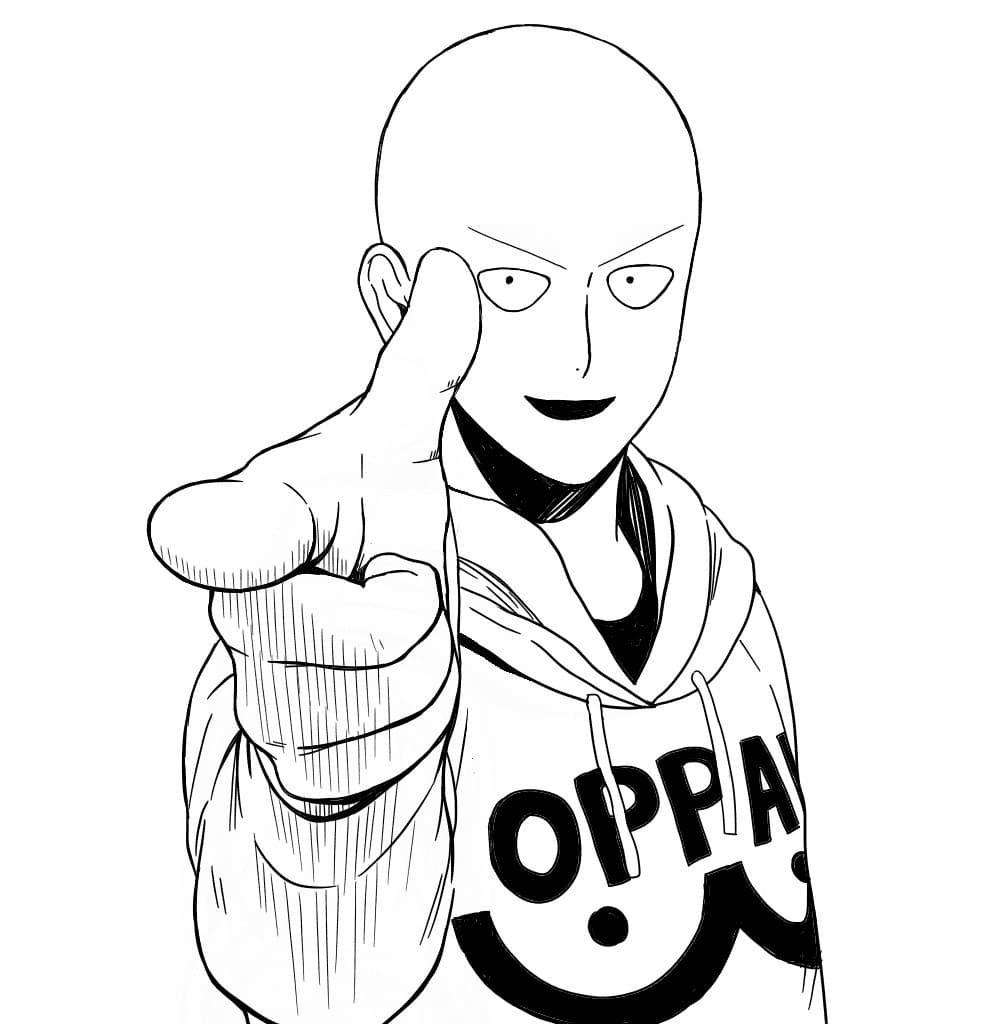
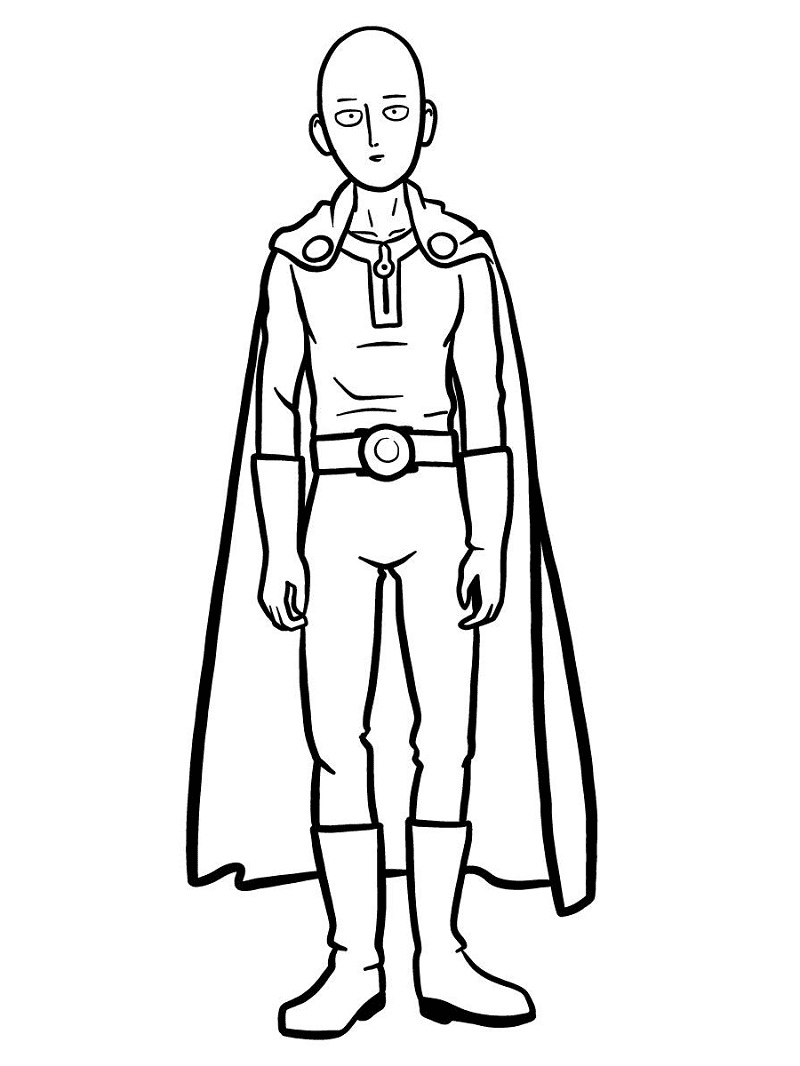
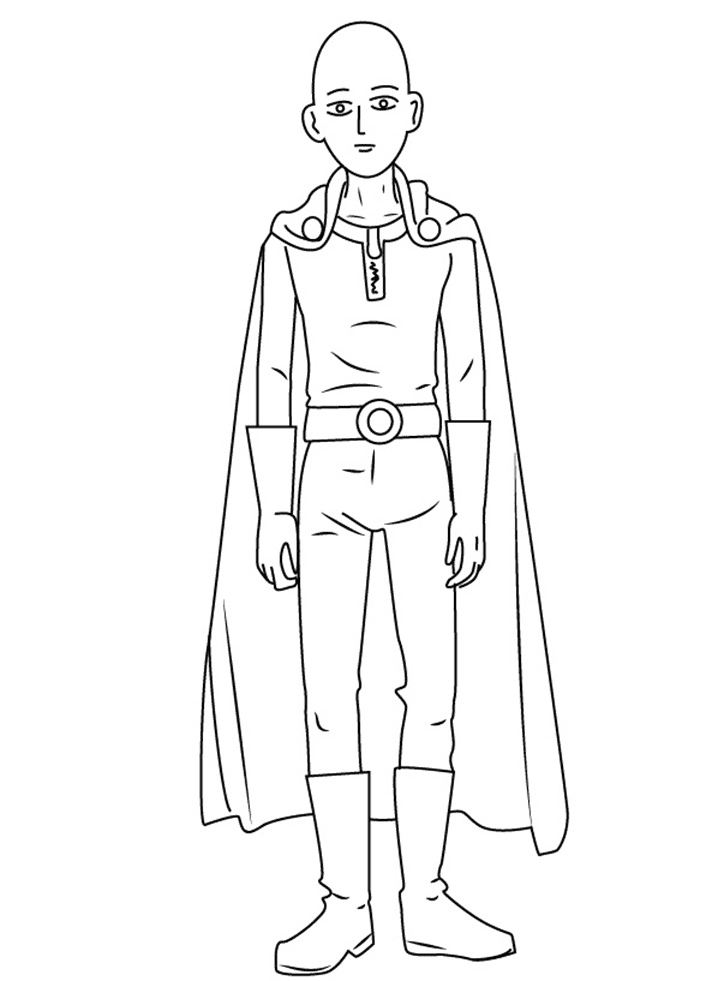
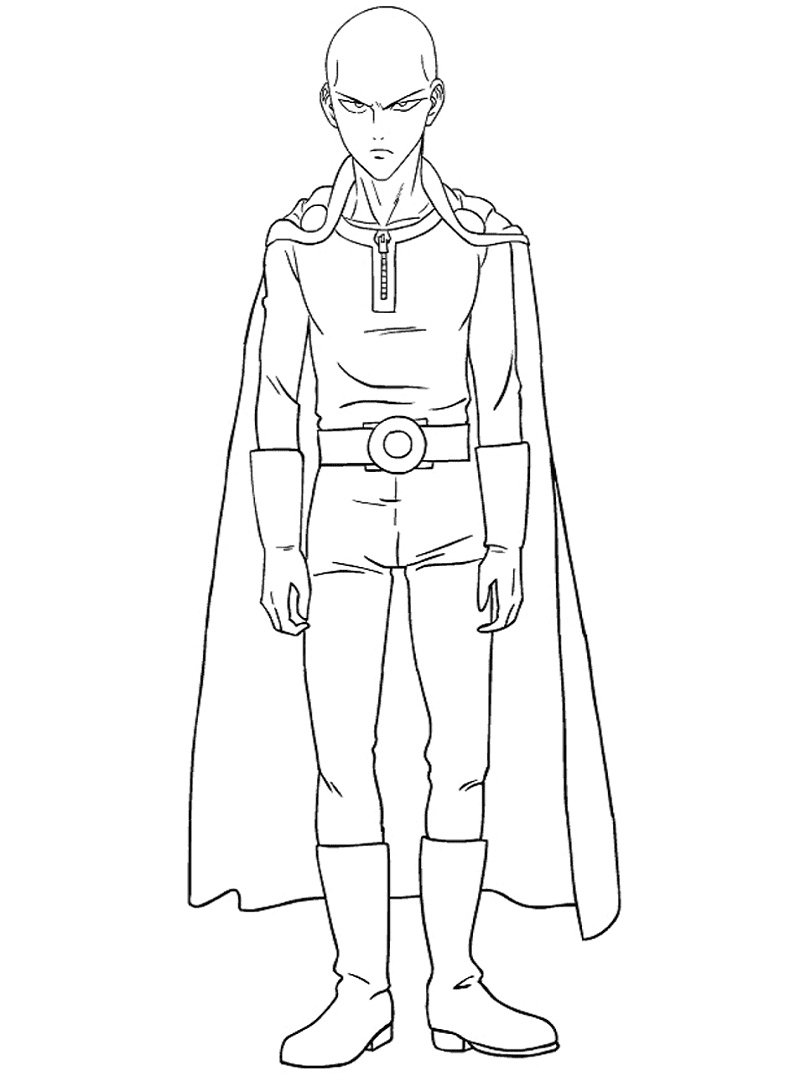
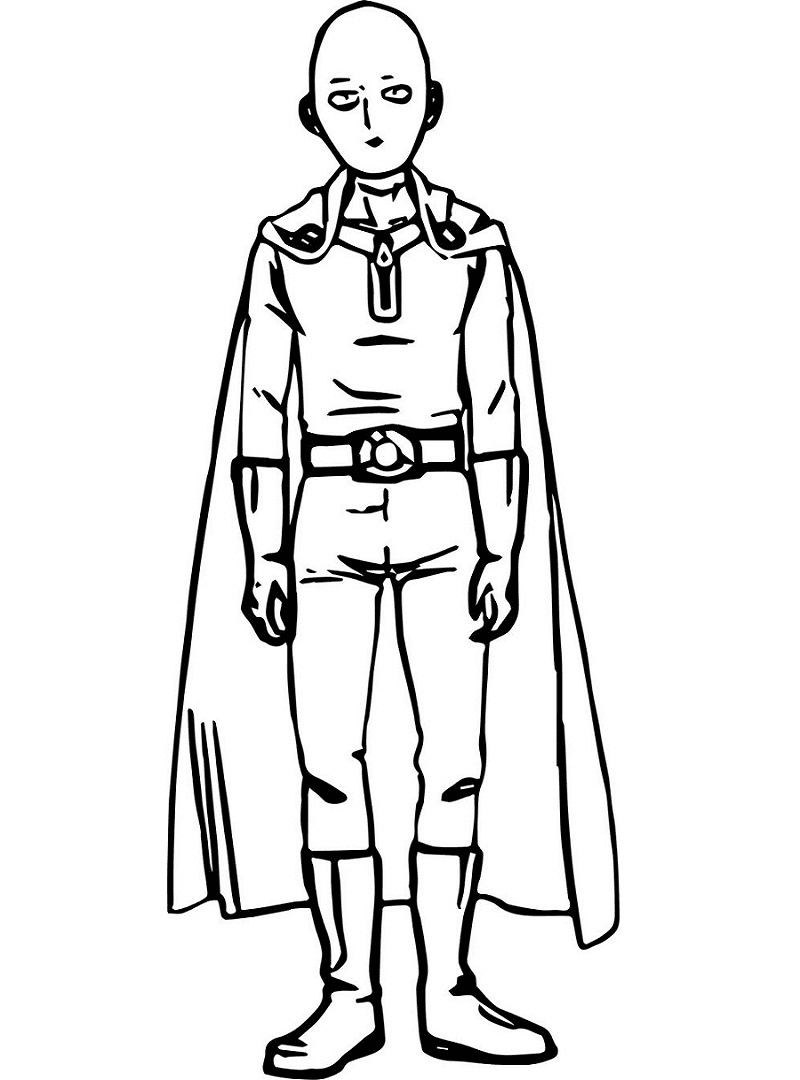
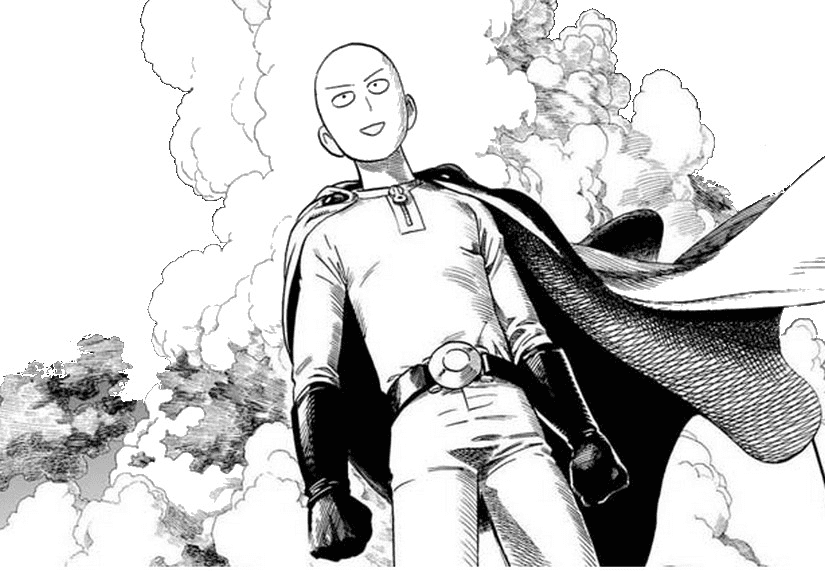
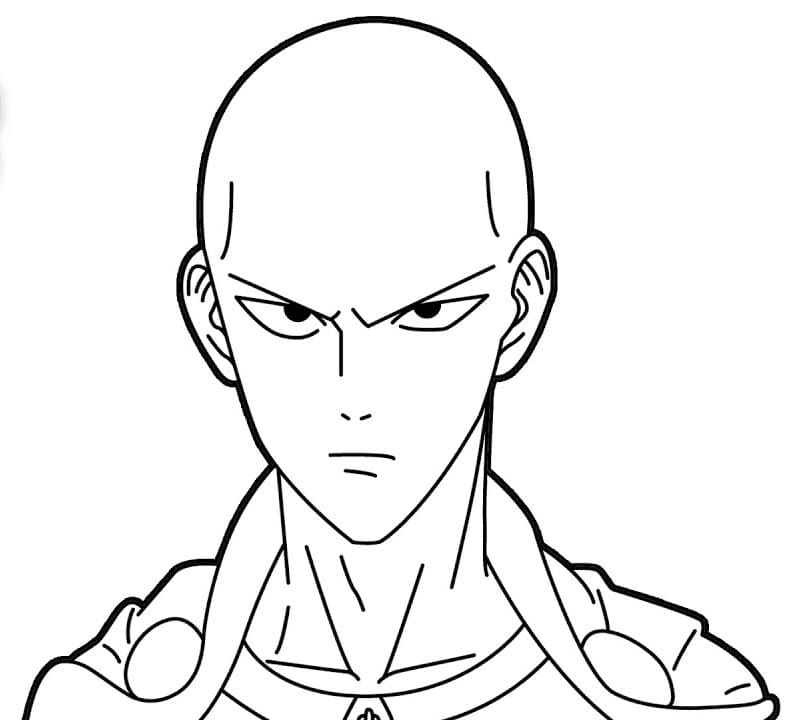
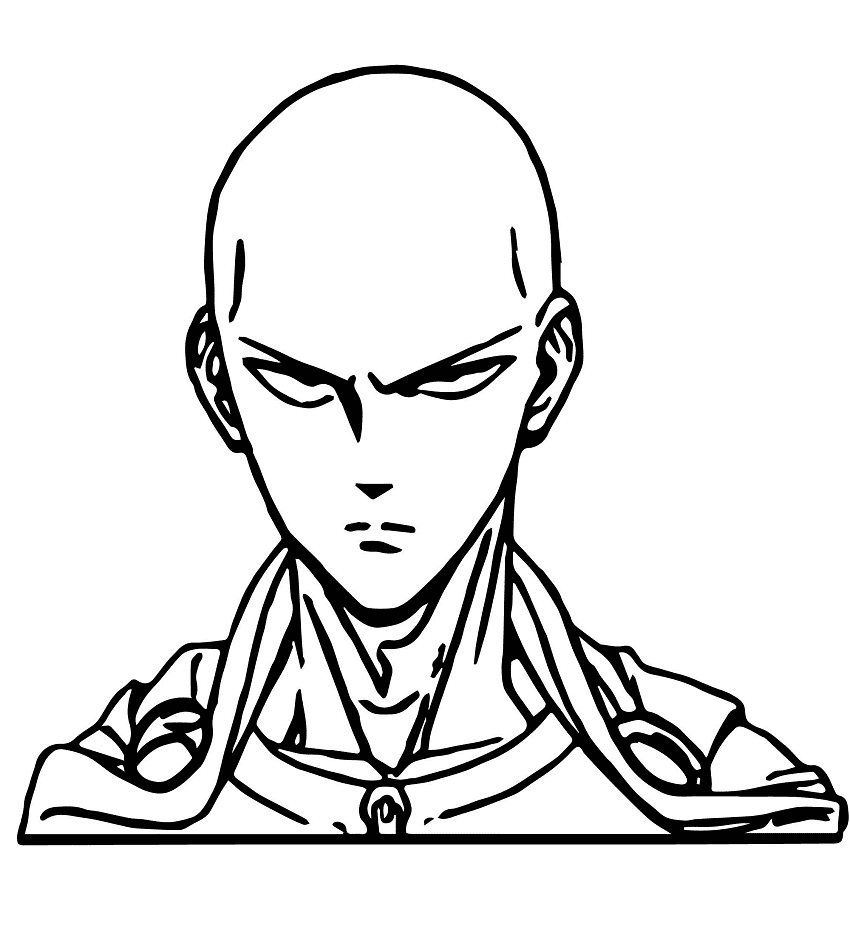
The collection’s largest section belongs to the series’ protagonist, and the most visually distinctive superhero in contemporary anime. Saitama’s design is the series’ central visual joke: he looks completely unimpressive. Completely bald, with large blank eyes that are usually depicted as two simple dots, wearing a yellow jumpsuit and a white cape that are slightly too plain to be taken seriously. He looks like a costume, not a hero. This is intentional.
The contrast between his appearance and his capability – between the blank oval of his face and the absolute devastation he produces with a single movement – is the series’s central visual language. Every fight page uses this contrast: the intimidating, elaborate, visually overwhelming design of the villain on one side; the simple, bored oval of Saitama on the other.
The collection gives Saitama in several registers:
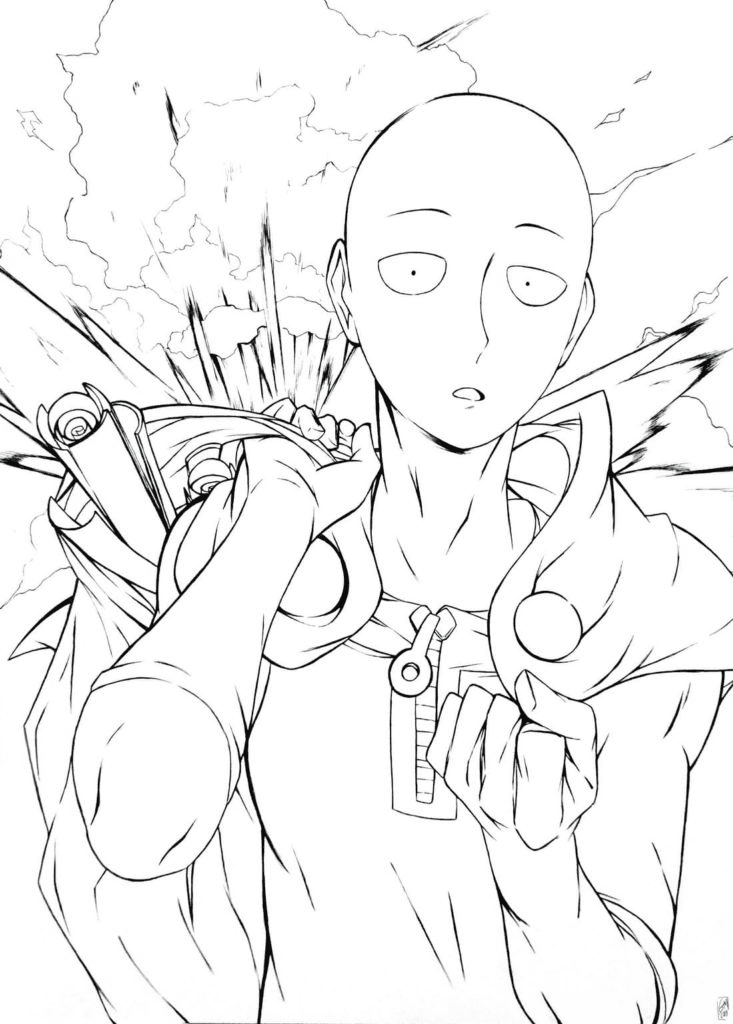
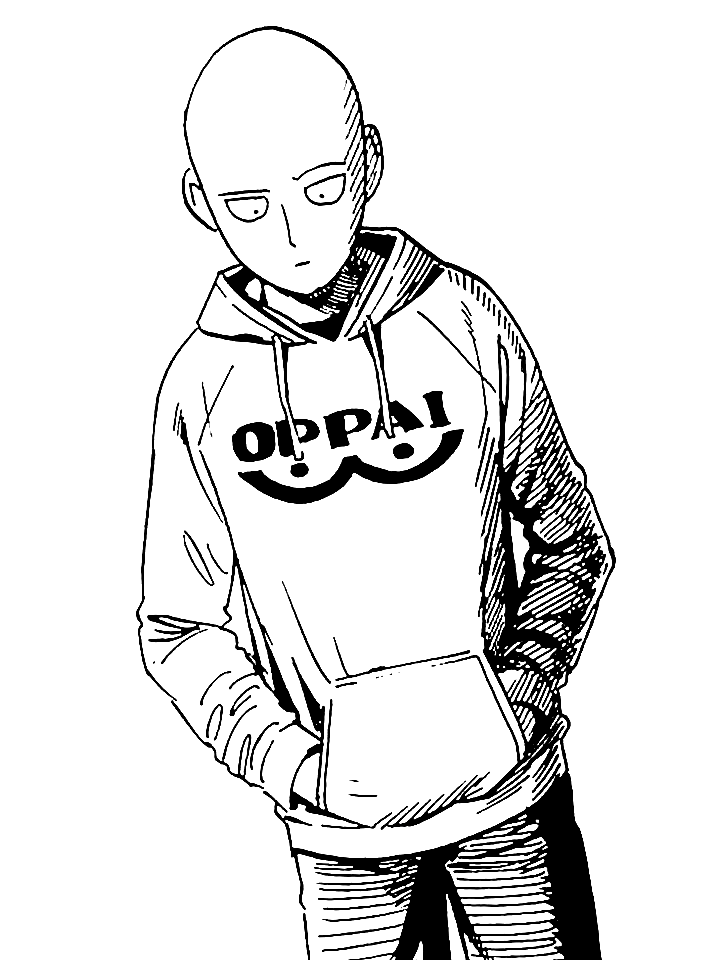
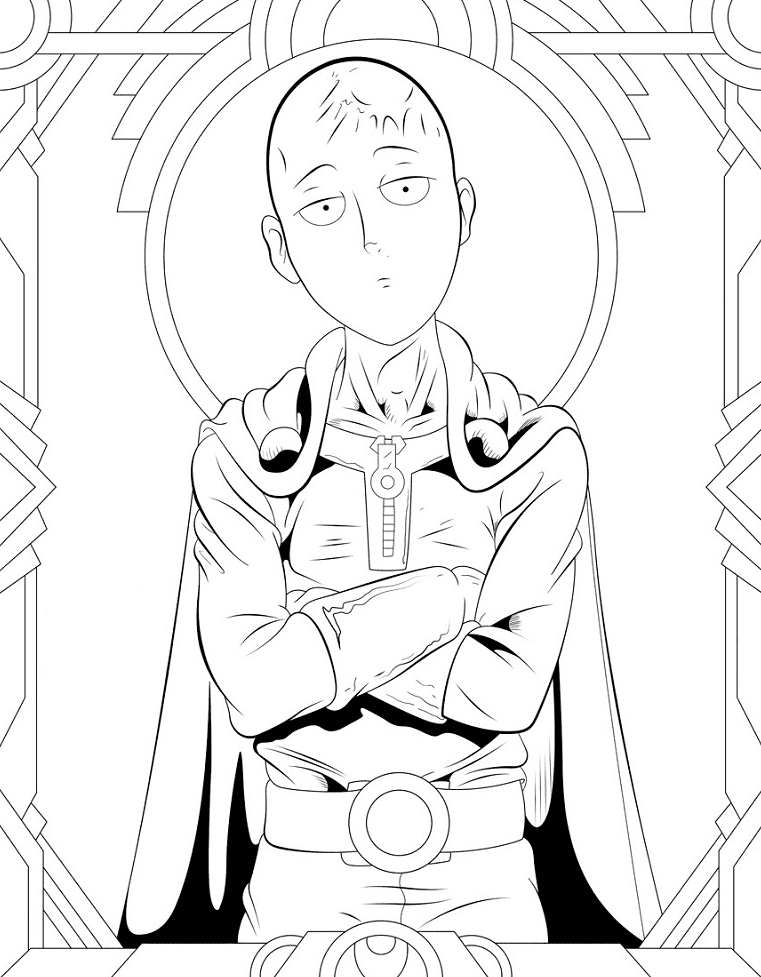
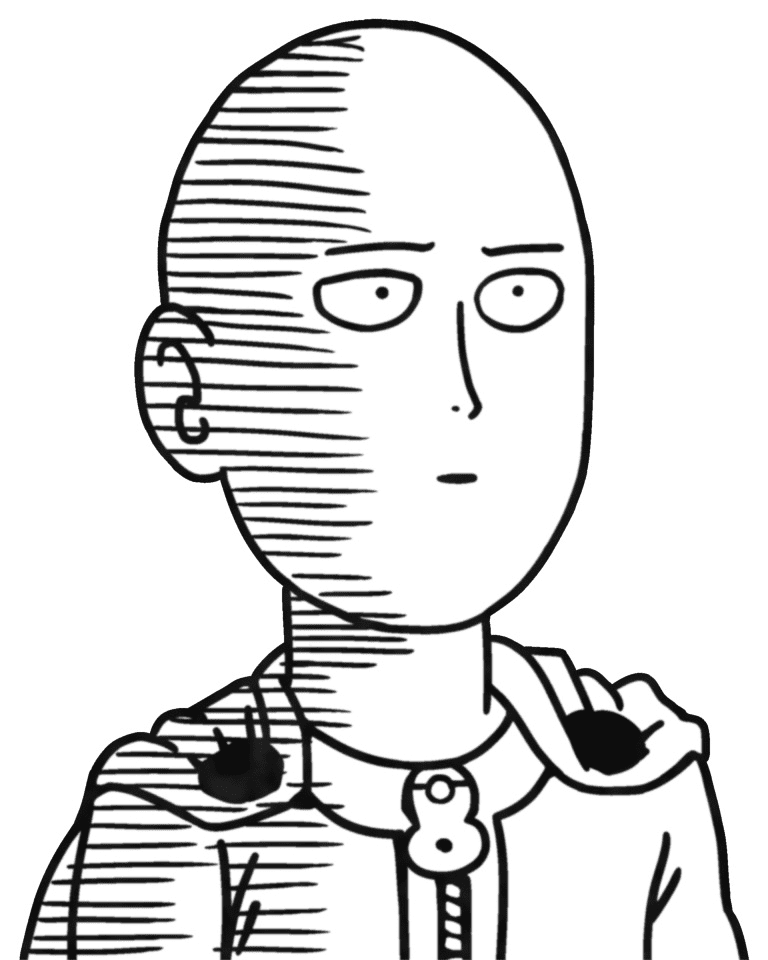
Portrait and character pages show the two versions of his face the series uses – the bored, blank-eyed calm that is his resting state, and the rare moments of genuine emotional expression. His serious face (sharper features, detailed eyes, focused expression) appears when he is genuinely engaged, and the transition between the two modes is one of the series’ running visual jokes.
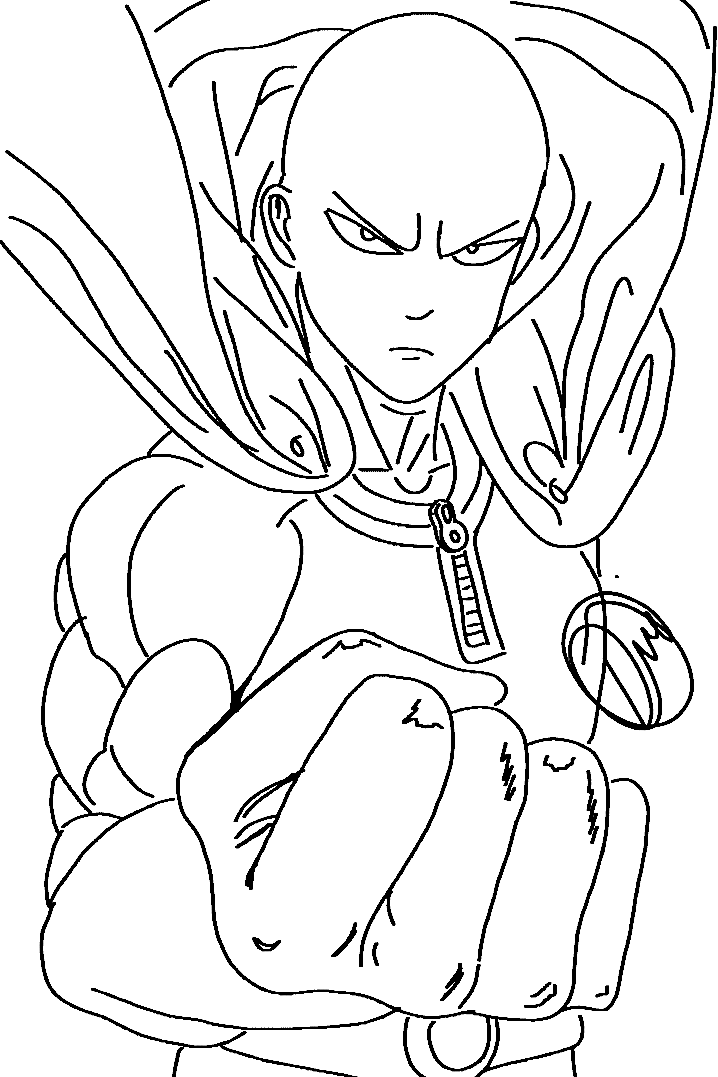
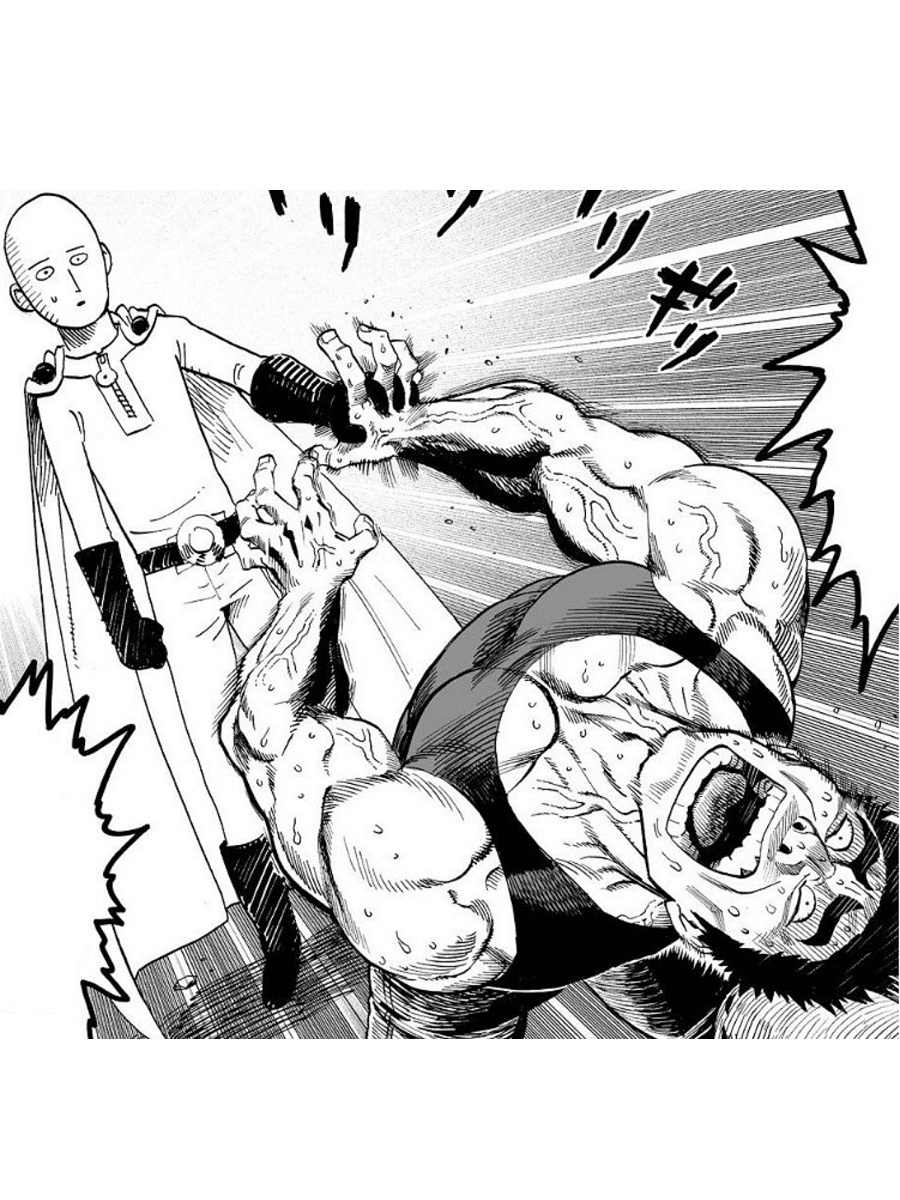
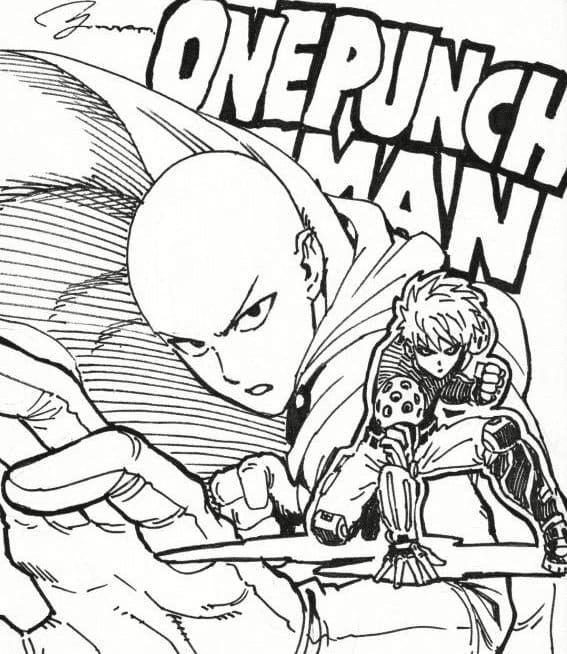
Action pages capture him in combat – the single punch, the approach, the aftermath. His fighting style requires almost no elaborate posing because he never needs more than one movement. The pages that show him in the moment before the punch – body gathered, expression neutral, opponent realizing what is about to happen – are the collection’s most dramatically effective.
Coloring Saitama: His suit is a specific yellow – warm, medium saturation, not the bright primary yellow of a school bus or the pale yellow of a pastel but the vivid, slightly warm yellow of his canonical design. His gloves are white. His boots are red-brown, consistent across all canonical versions. His cape is white with a gold clasp. His skin is very pale. His head – completely smooth, no stubble, no shadow – should be rendered with only the most subtle shading in the deepest shadow areas to suggest form without adding texture that isn’t there.
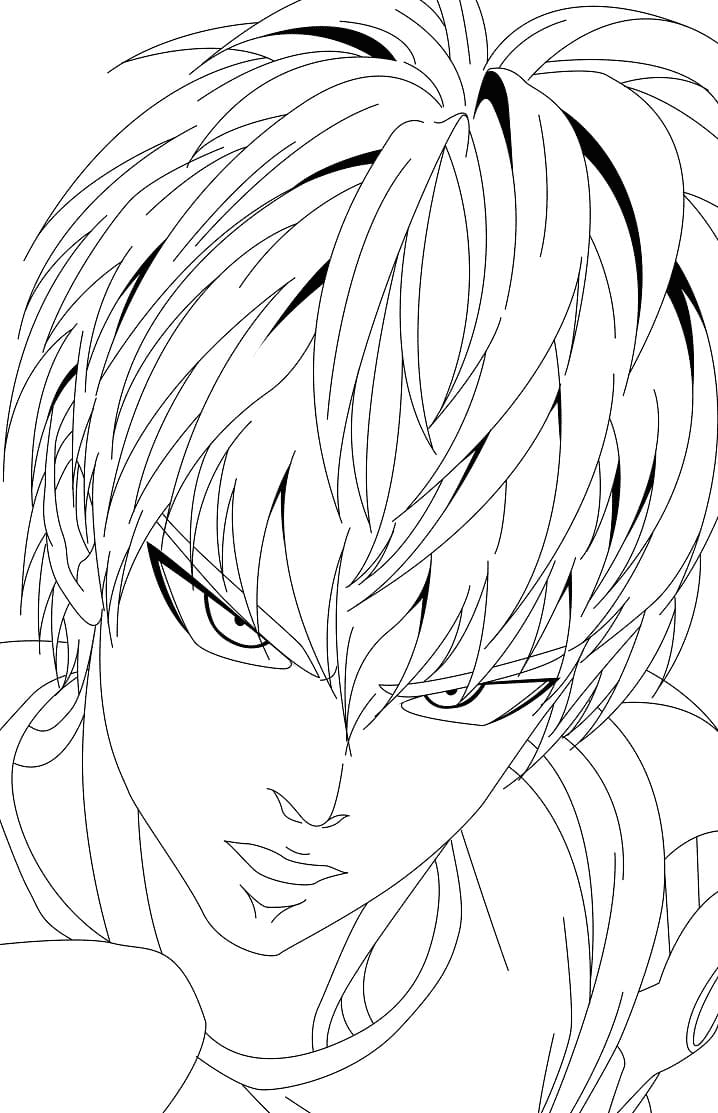
Genos – The Demon Cyborg
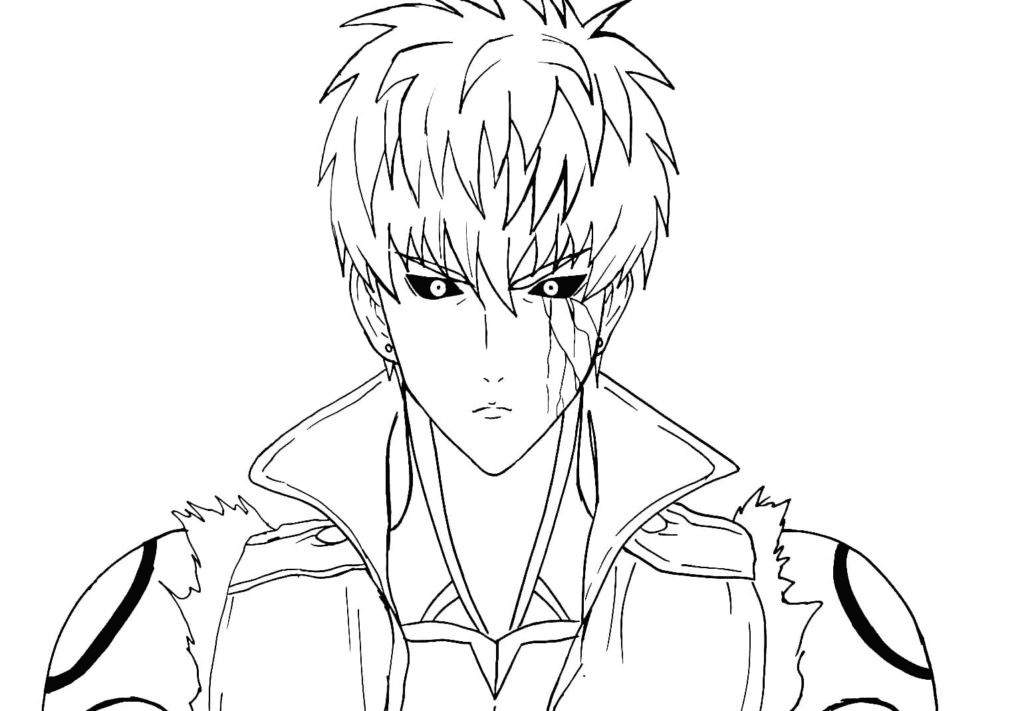
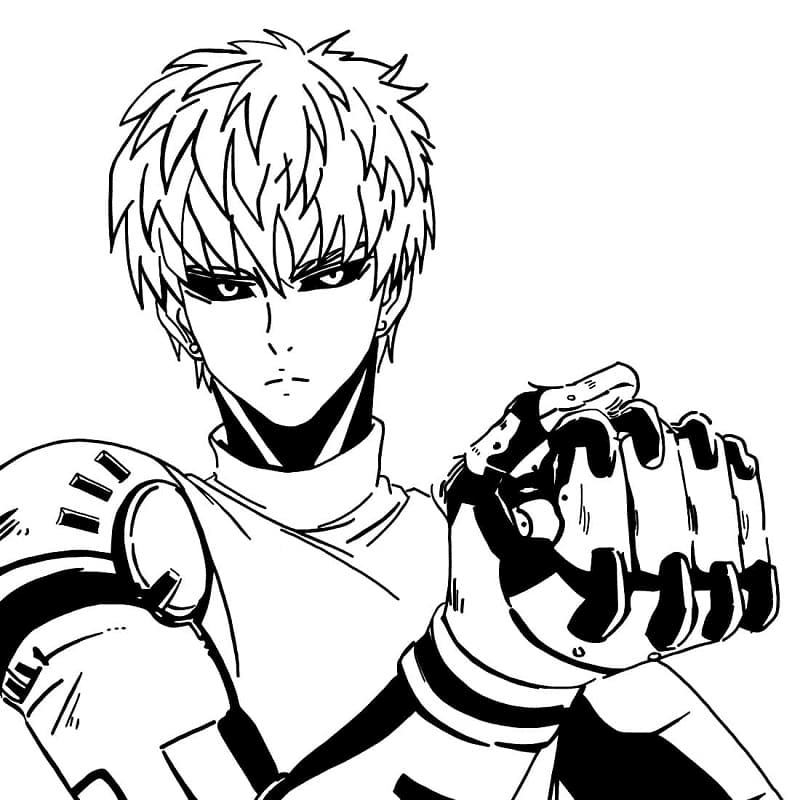
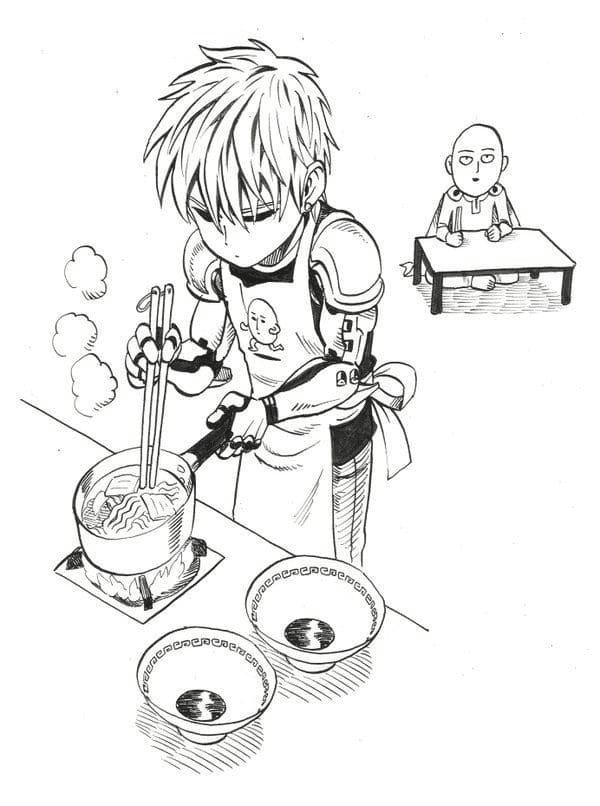
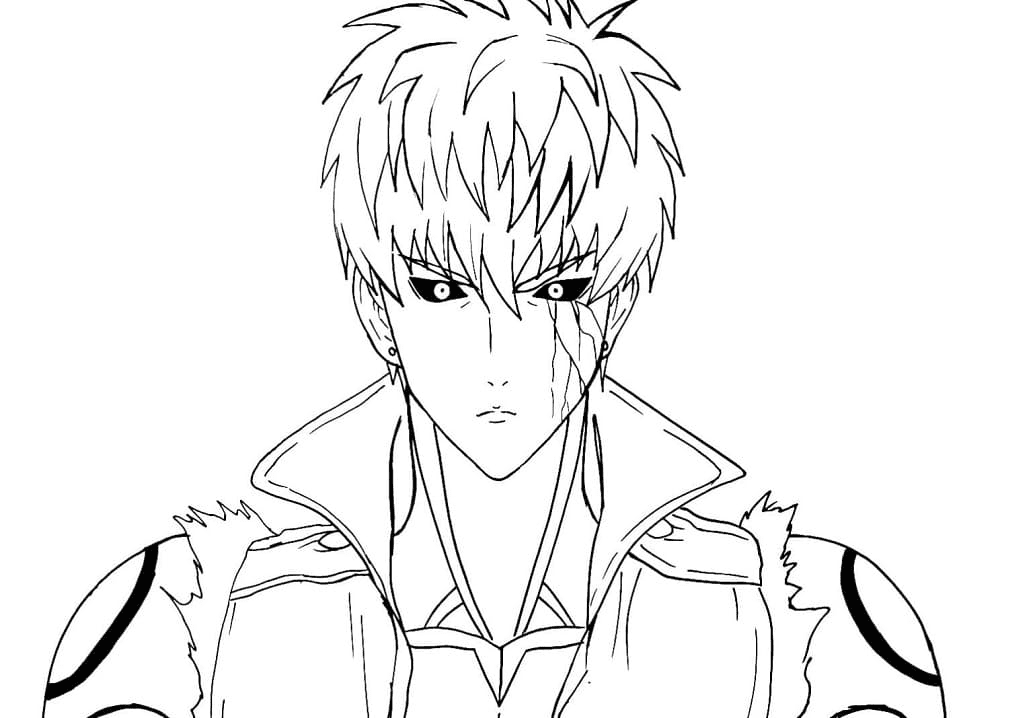
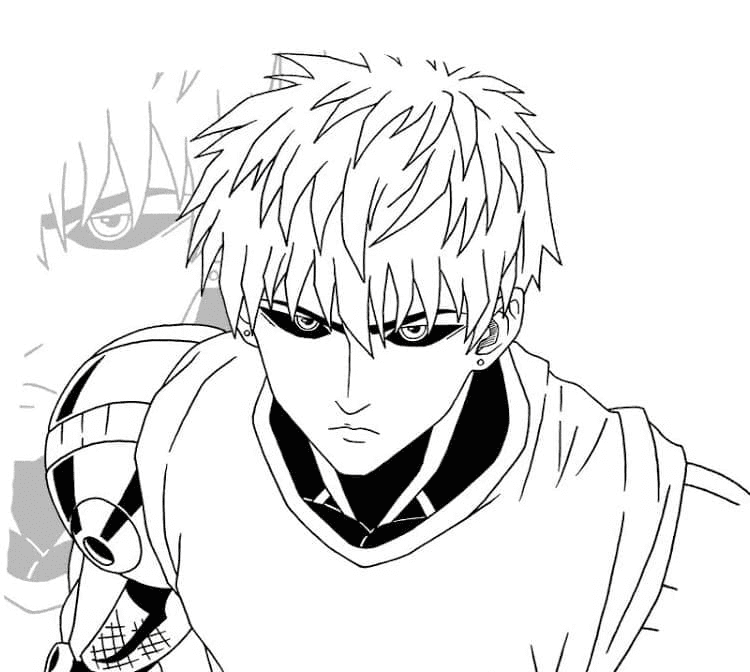
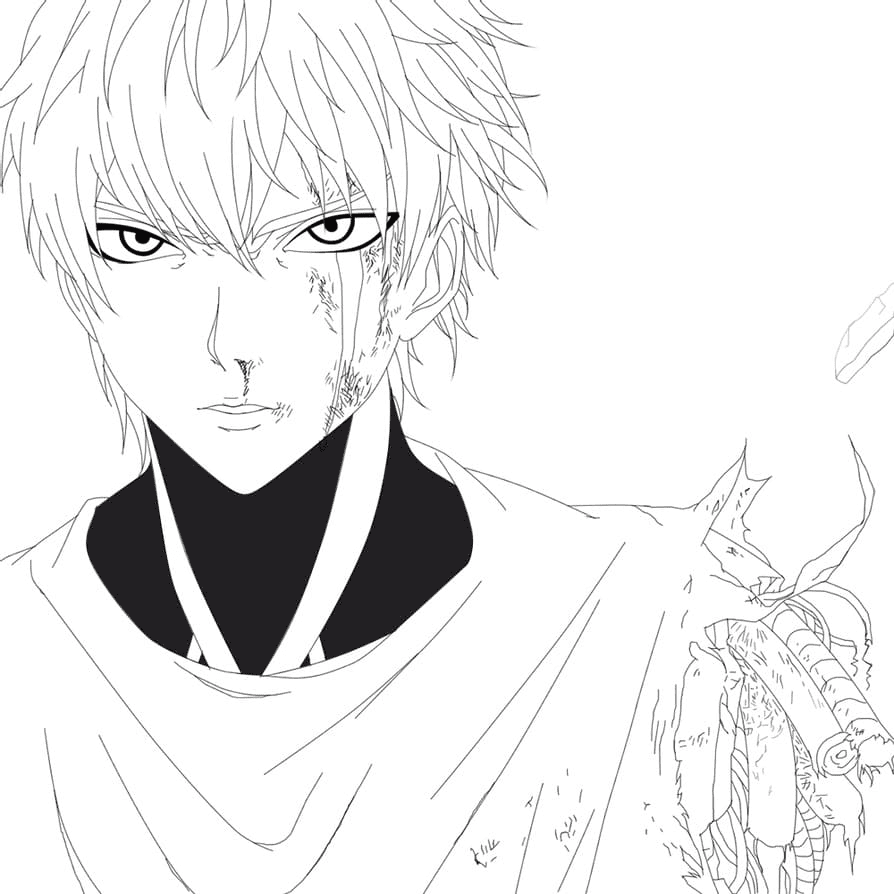
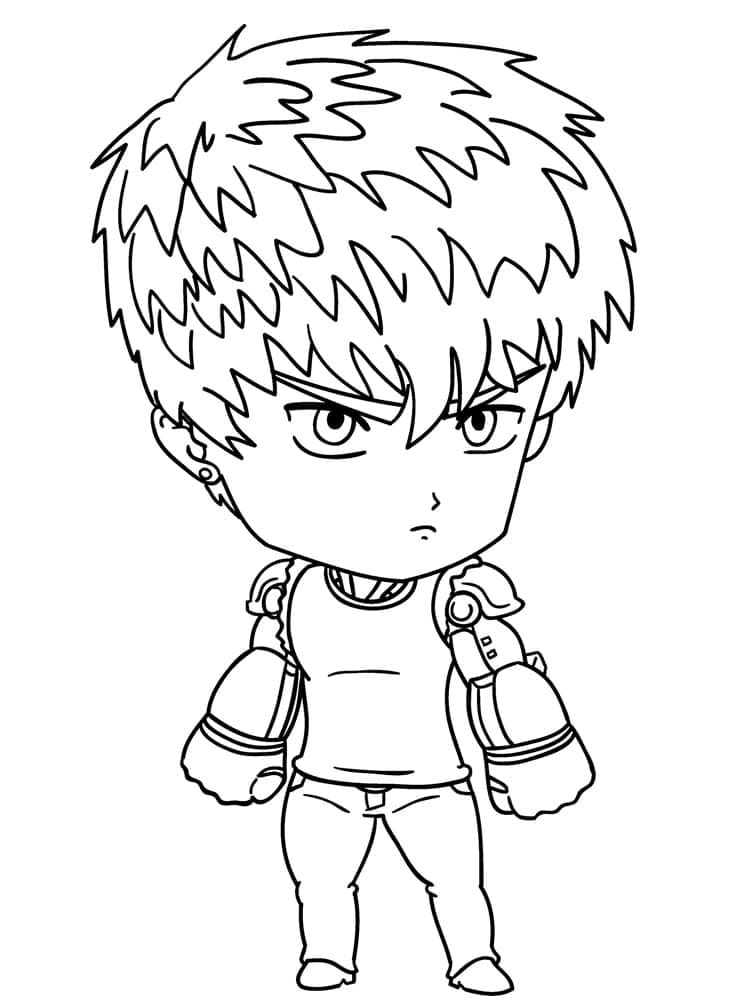
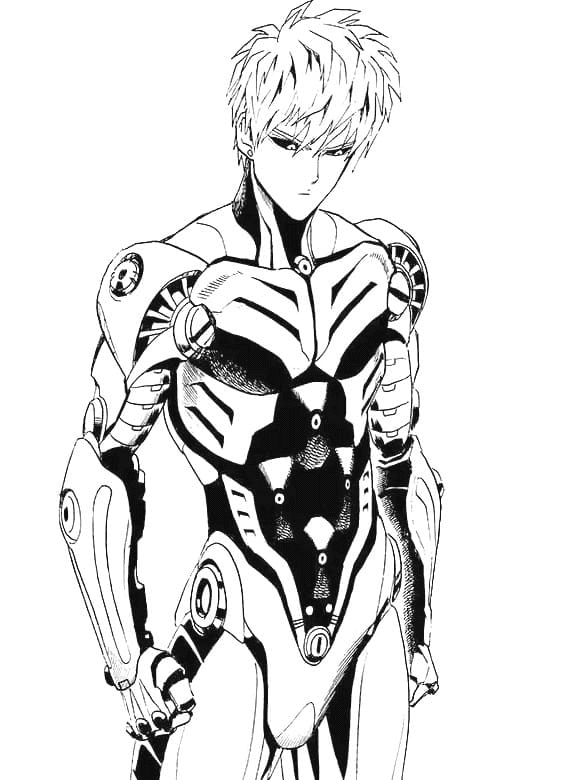
Genos is Saitama’s self-appointed disciple – an S-Class hero (Rank 14) who became a cyborg following the destruction of his village and family by a rogue cyborg, and who has devoted himself to tracking down that cyborg and eliminating it. He met Saitama when Saitama interrupted a fight with a mosquito monster and was so impressed by his power that he immediately demanded to be taken as a disciple.
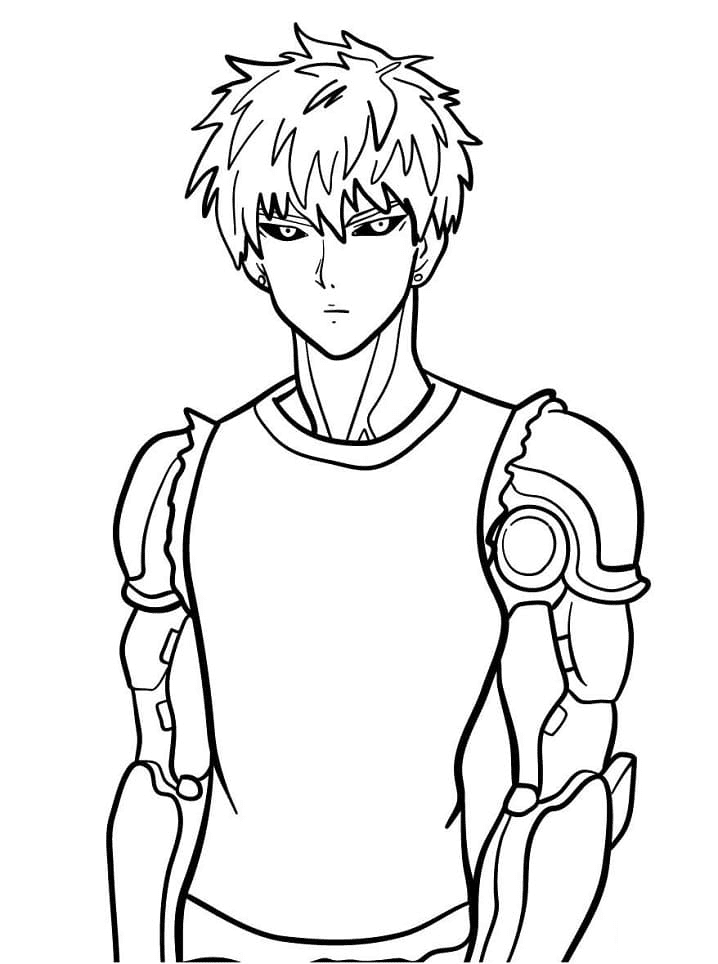
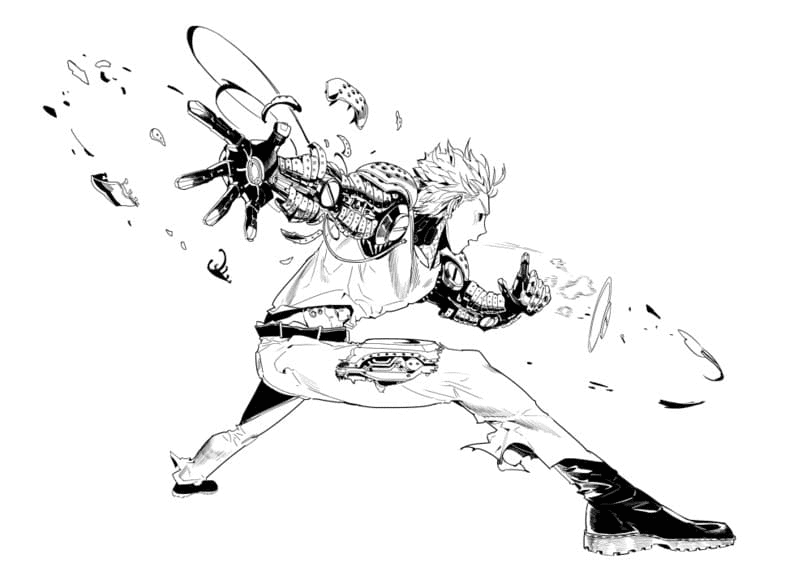
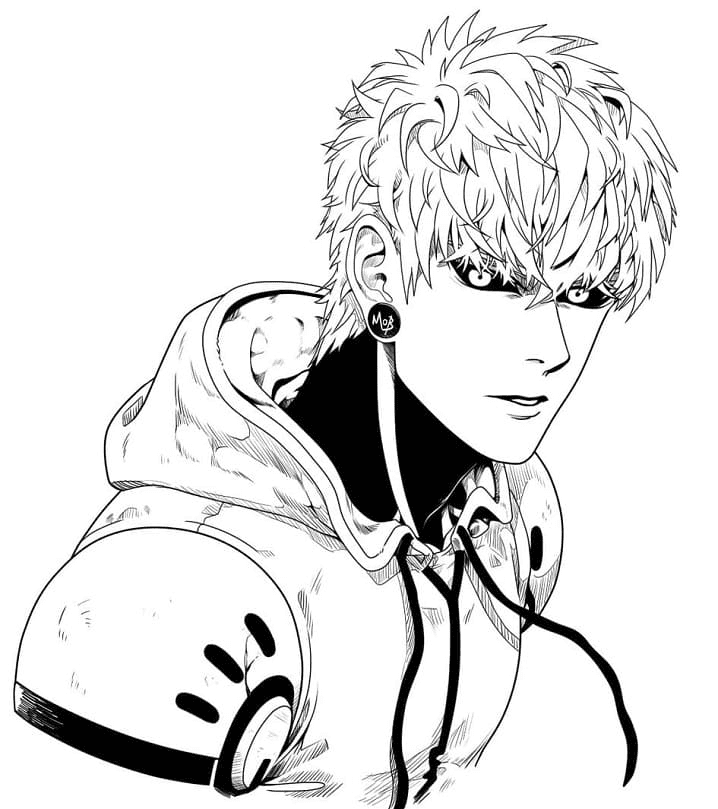
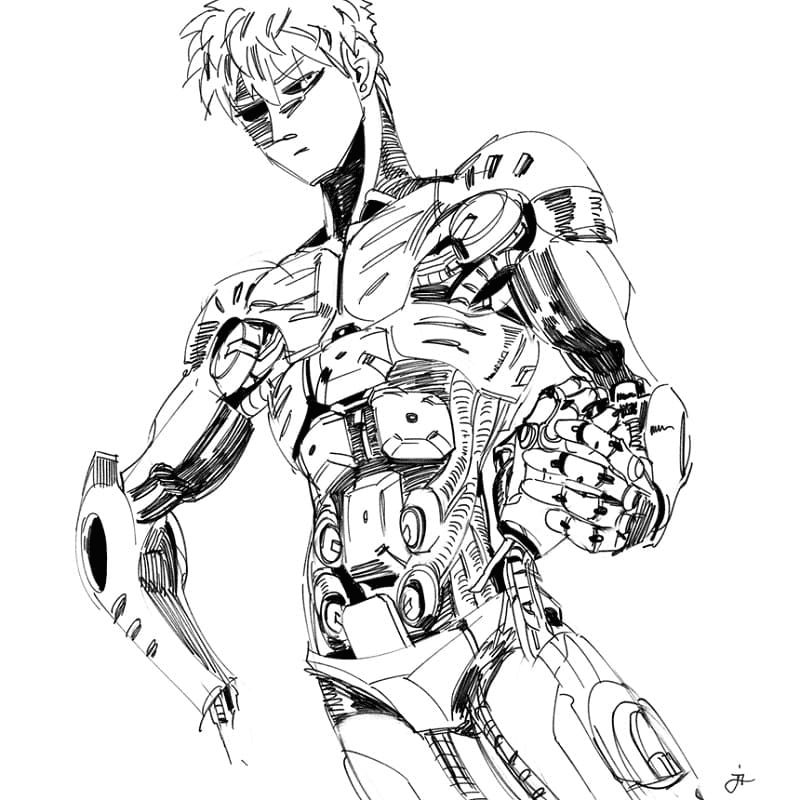
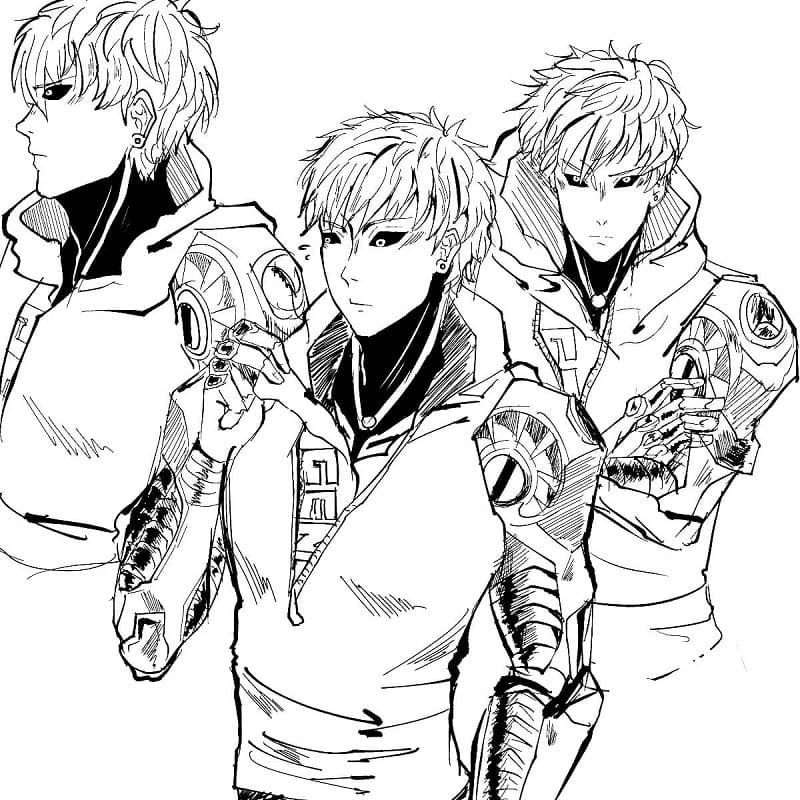
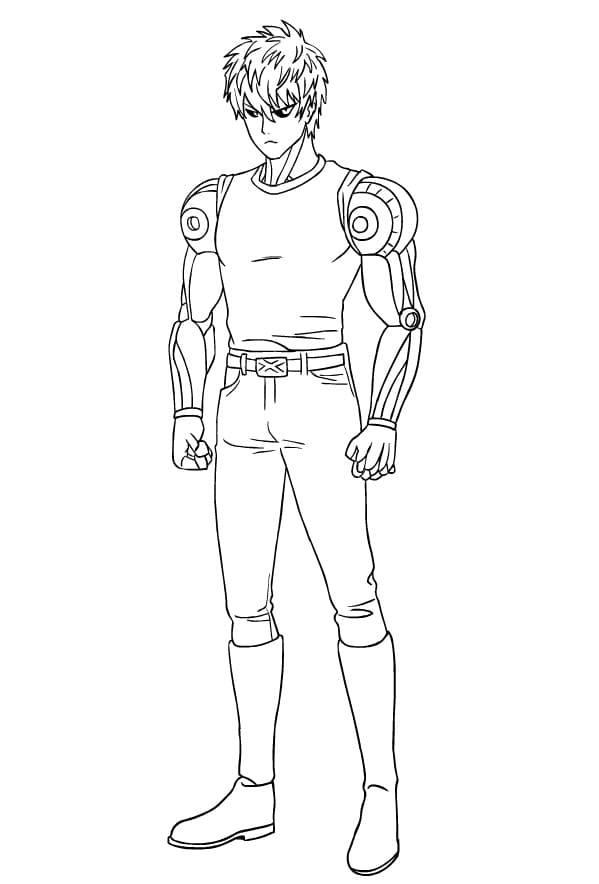
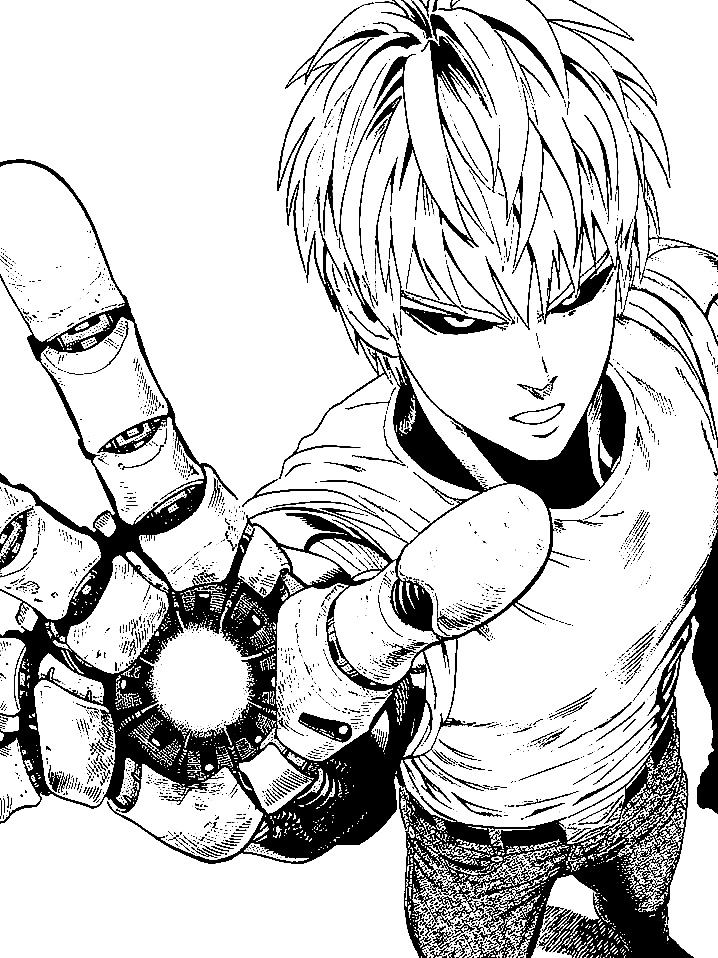
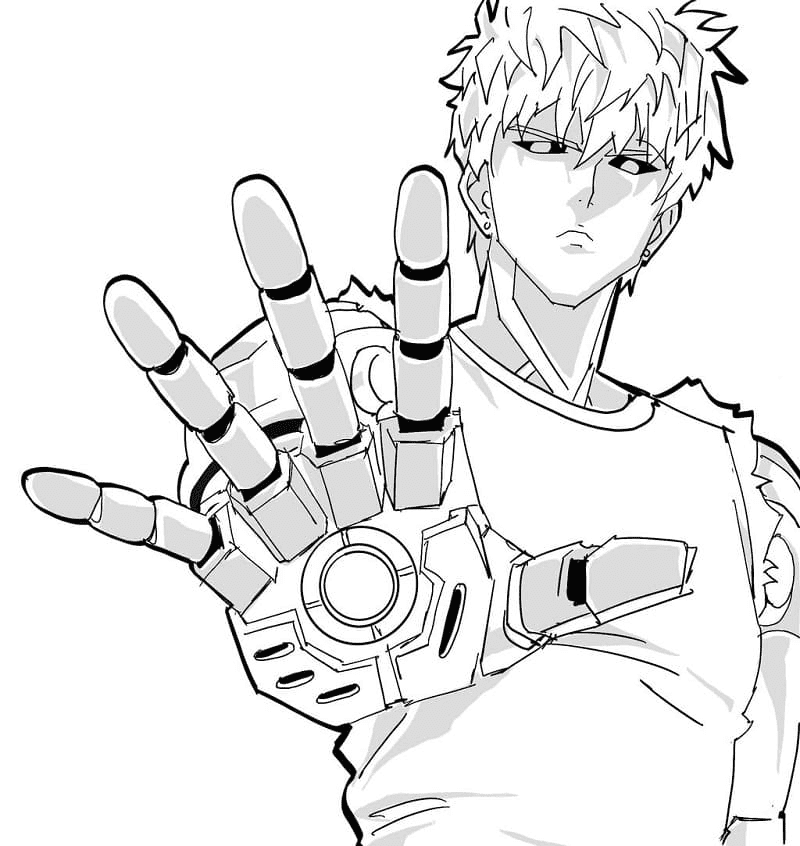
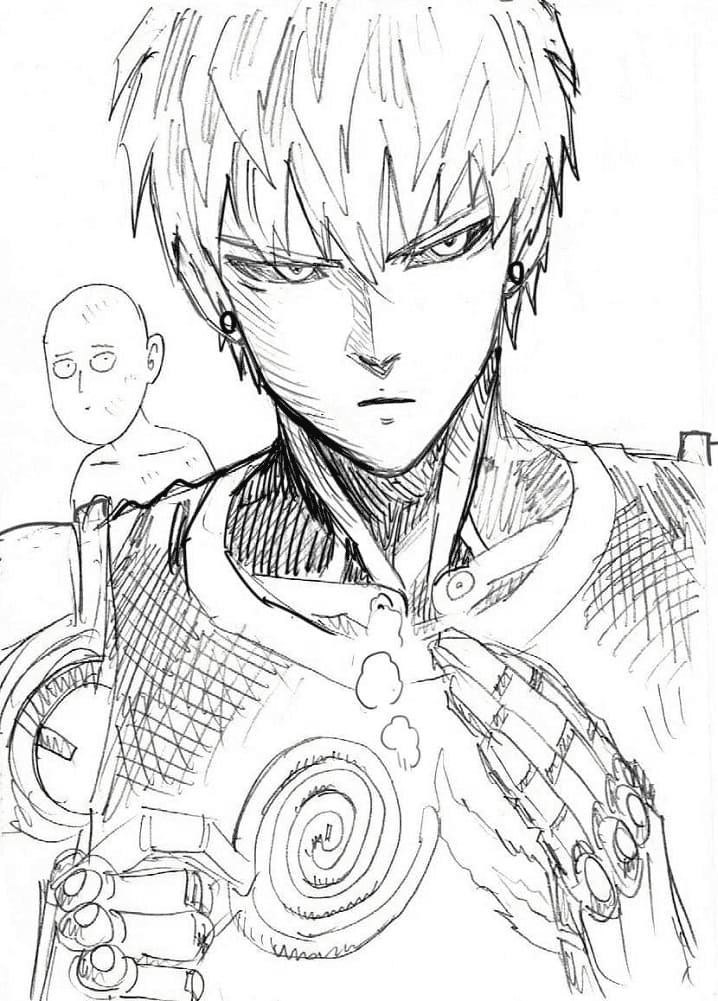
His design is the visual opposite of Saitama: elaborate, detailed, mechanical, and impressive-looking. His body is partially humanoid (blond hair, face with normal features) and partially mechanical – golden-yellow mechanical arms, chest plating, various integrated weapons. He takes meticulous notes on Saitama’s training methods in a notebook he carries specifically for this purpose, despite the methods being absurdly simple.
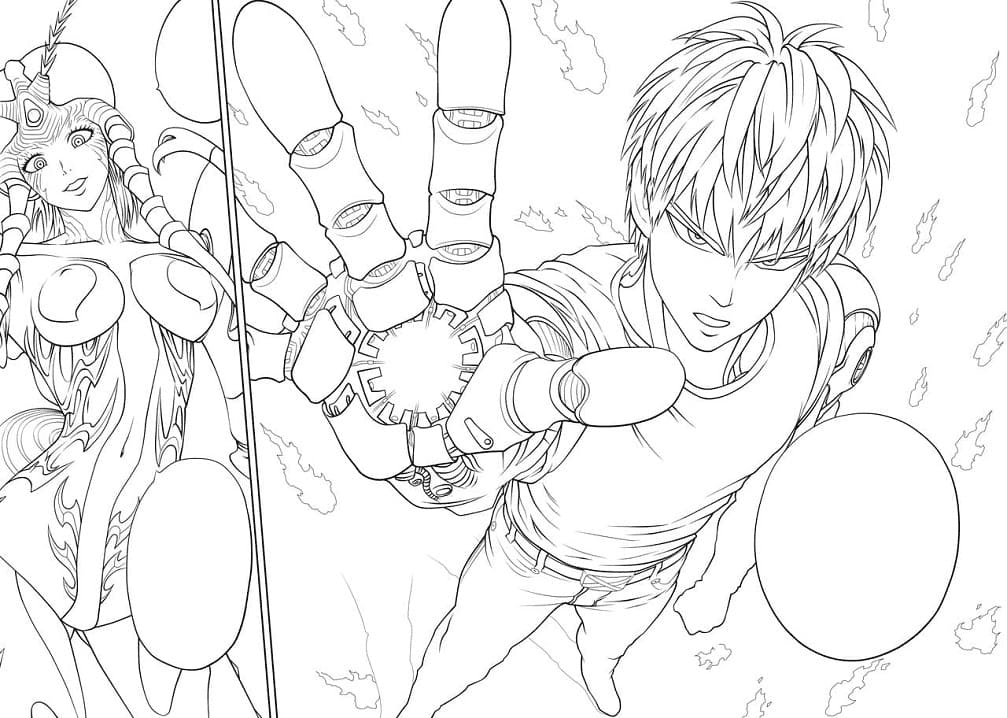
The Genos pages are the collection’s most technically detailed – his mechanical components have complex surface structures that reward careful, systematic coloring. His mechanical arms are a warm gold-yellow, differentiated from Saitama’s suit yellow by their metallic quality. The contrast between the warm gold of his mechanical elements and the skin tone of his human features is the key visual relationship on any Genos page.
Coloring Genos: The mechanical surfaces want three-zone treatment: a highlight tone (very light gold or near-white) on the surfaces facing the light source, a mid-tone (the primary gold-yellow) across the main surfaces, and a shadow tone (deeper amber or bronze) in the recessed areas and undersides. The mechanical joins and panel lines should be the darkest – near-black – to give the machinery its structural definition. His hair is golden-blond, slightly darker than his mechanical elements.
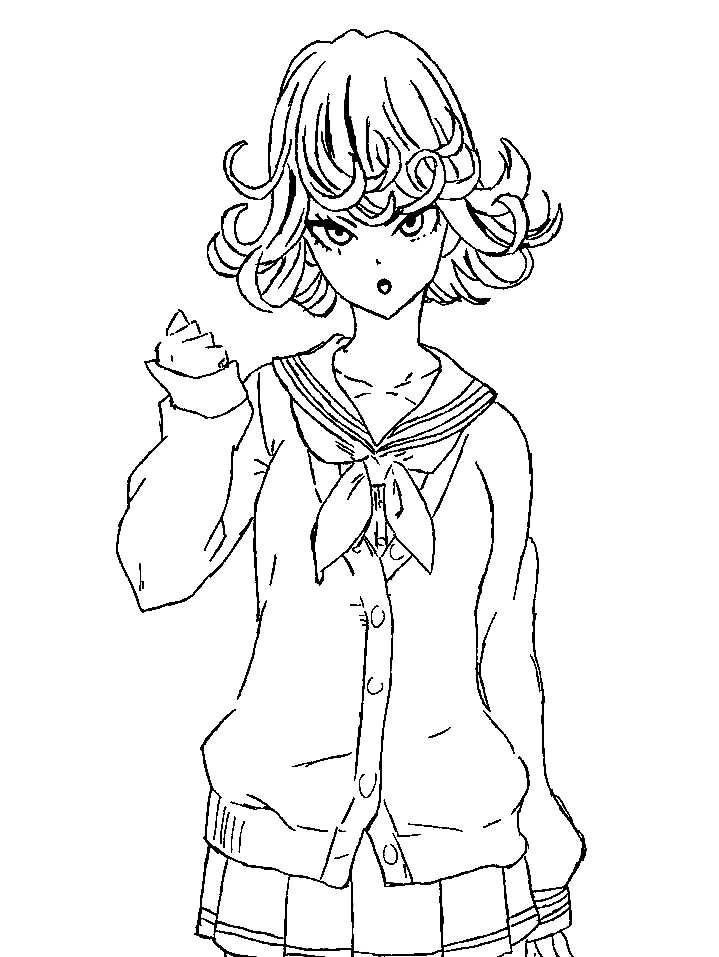
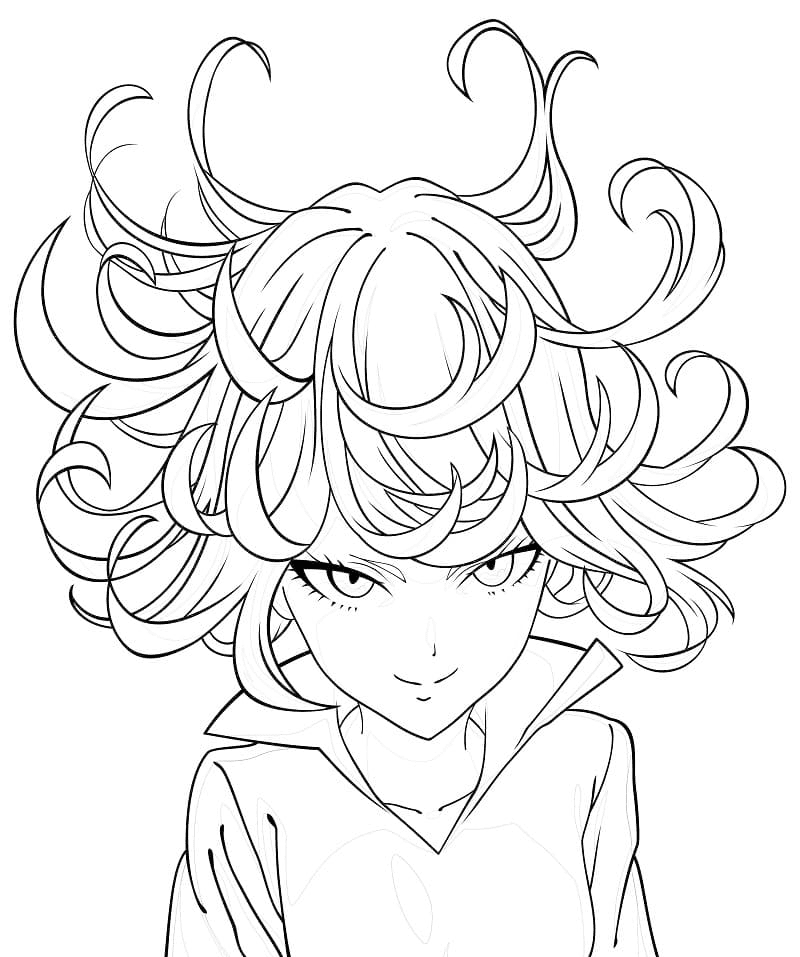
Tatsumaki – Tornado of Terror
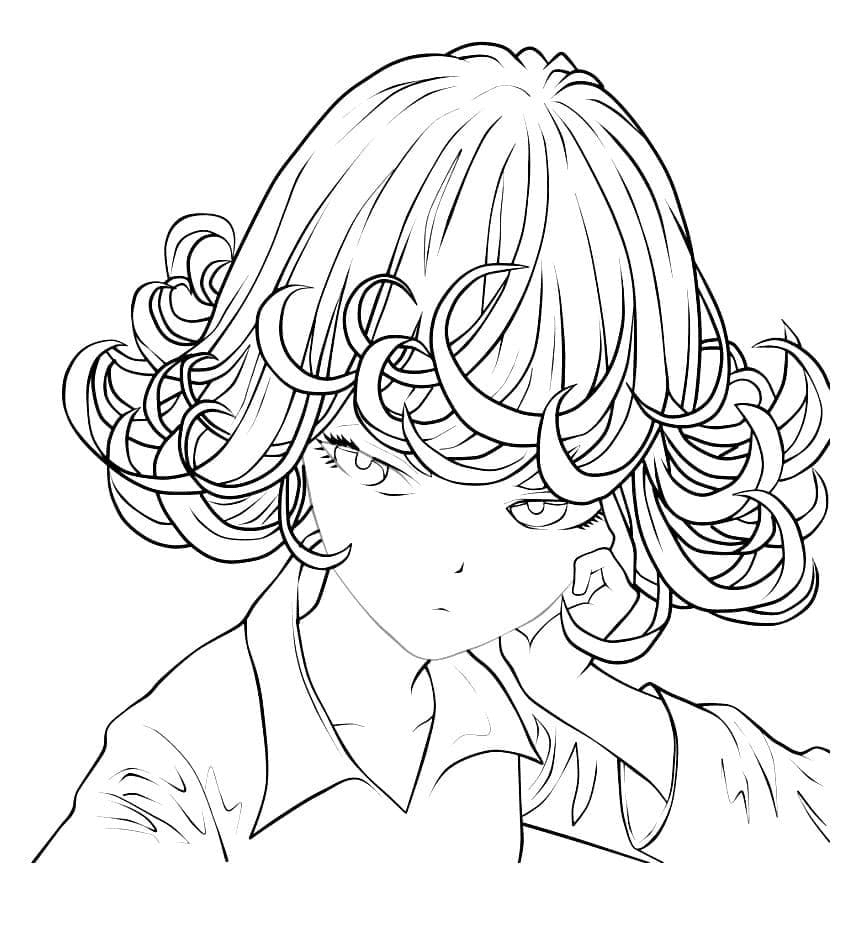
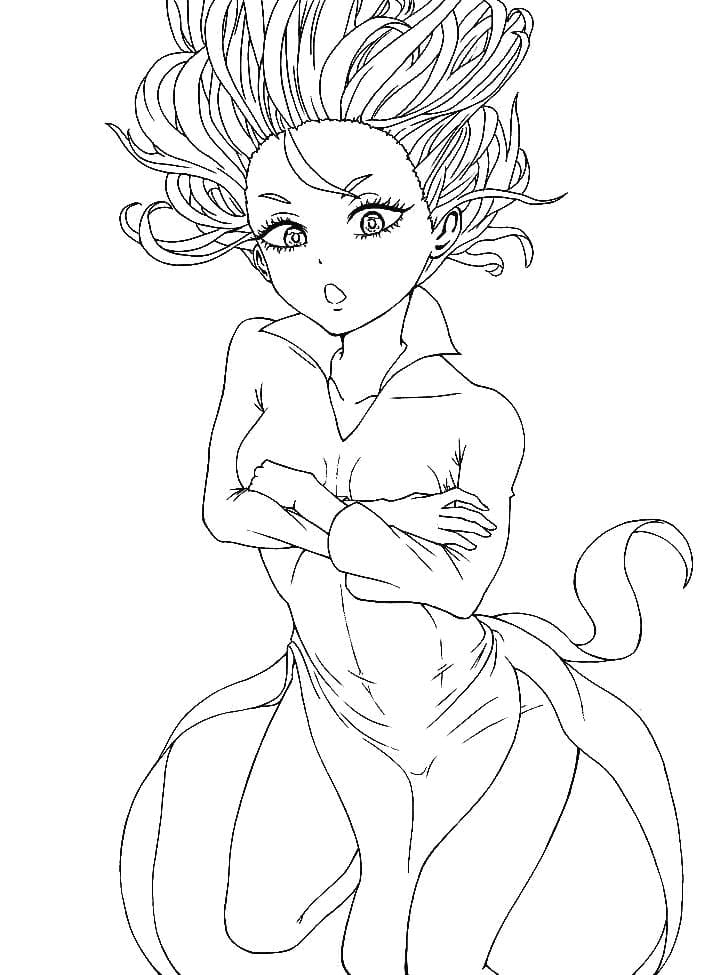
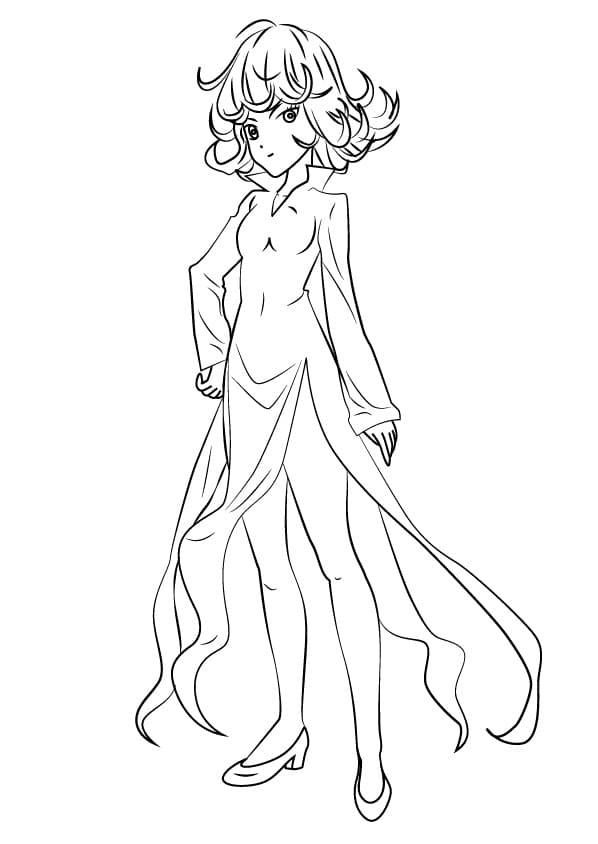
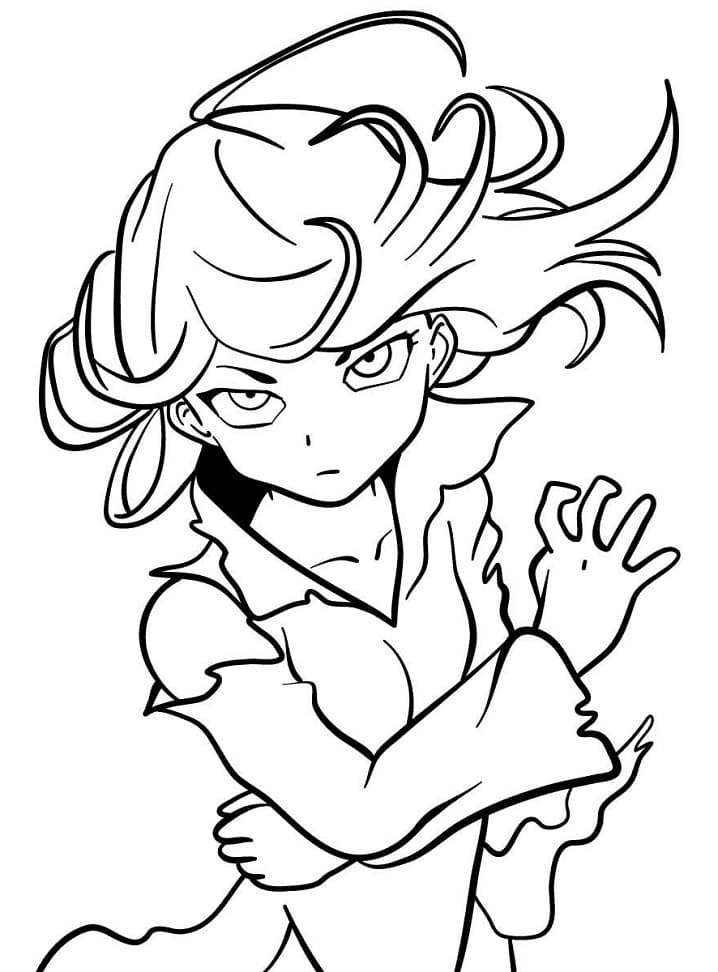
Tatsumaki is the S-Class Rank 2 hero and one of the most powerful espers in the series – capable of telekinesis at a scale that can redirect meteor strikes. She is consistently underestimated by people who see her before they understand what she can do, because she appears to be a small, young girl. She is neither small in significance nor young in capability, and the series uses the gap between her appearance and her power as consistently as it uses the same gap with Saitama.
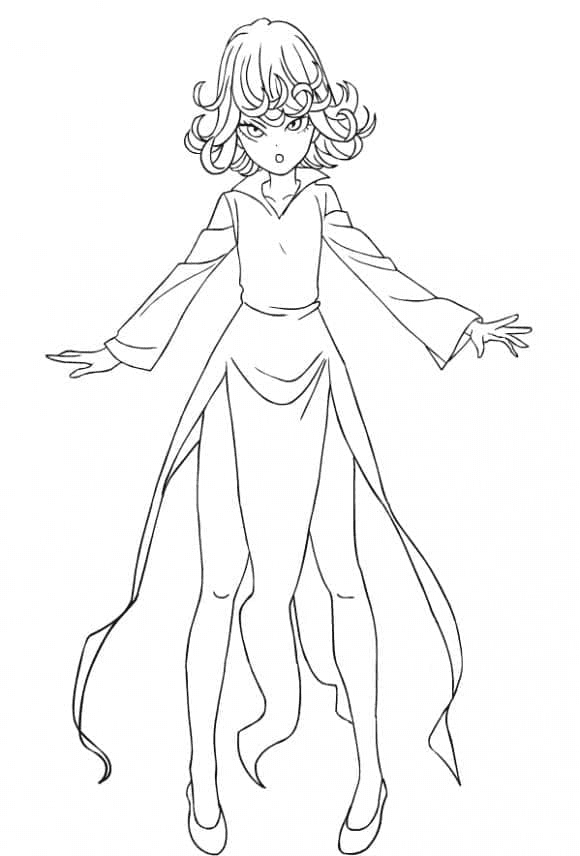
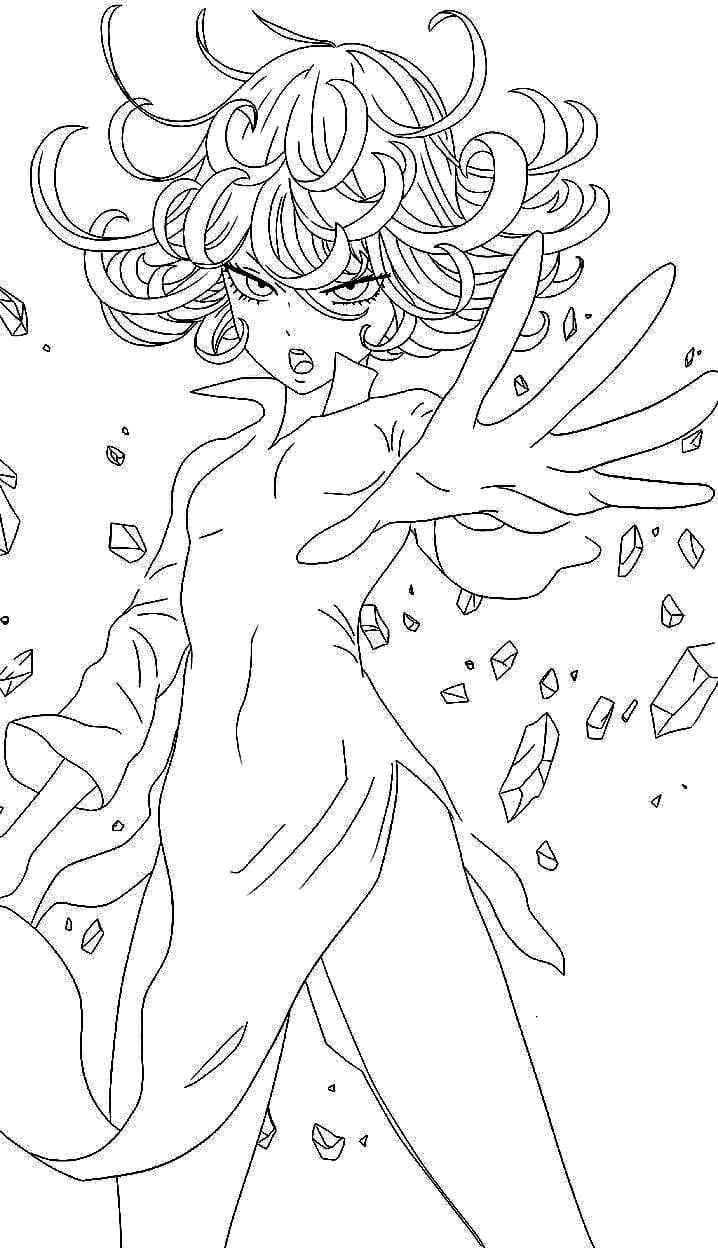
Her design: short, floating (she rarely touches the ground), with wavy green hair and green eyes, wearing a strapless black dress. Her expression defaults to contempt – she has little patience for anyone she considers weak, which is nearly everyone.
The Tatsumaki pages show her in mid-telekinesis – surrounded by the visual representation of psychic force, objects, and debris caught in the field of her ability – and in character portraits that capture the specific quality of her default expression. Her design is simpler than Genos’s but has its own challenge: the flowing green hair and the dynamic rendering of telekinetic force require confident, decisive color application.
Fubuki – Blizzard of Hell
Fubuki is the B-Class Rank 1 hero and Tatsumaki’s younger sister – a fact that defines much of her character arc, since her entire career has been shaped by the shadow of her sister’s extraordinary power. She is an esper as well, but at a significantly lower level than Tatsumaki. She leads the Blizzard Group, a gang of B-Class heroes who operate under her direction.
Her design: tall (much taller than Tatsumaki), with long dark green hair, green eyes, and a white fur-lined coat. Her aesthetic is glamorous rather than combat-functional, which is a deliberate choice the series uses to contrast with her fighting capability. She is more strategically intelligent than her sister and significantly more socially capable.
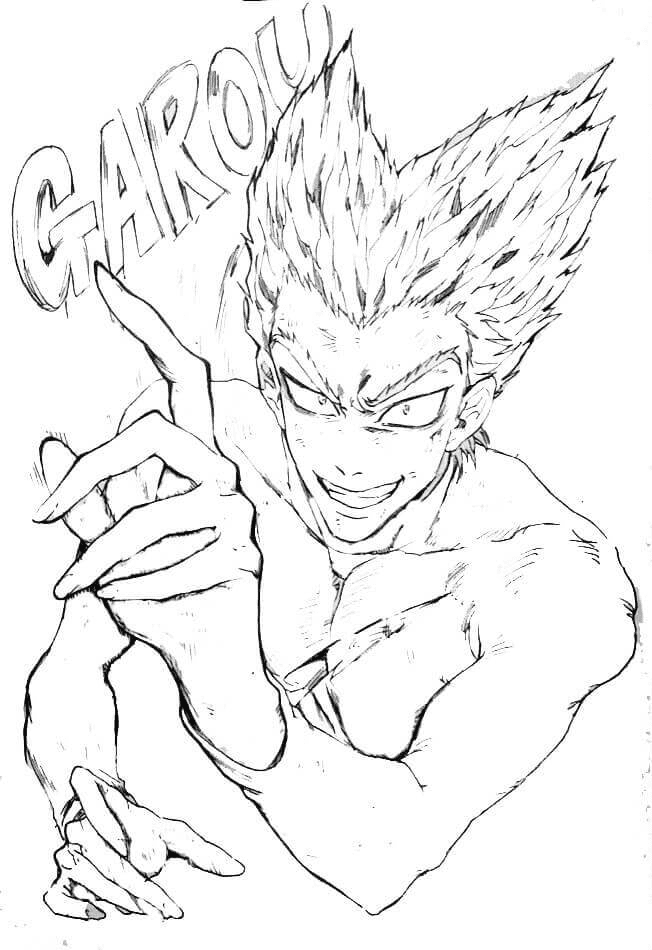
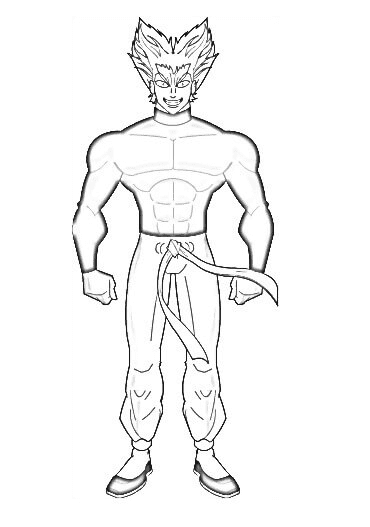
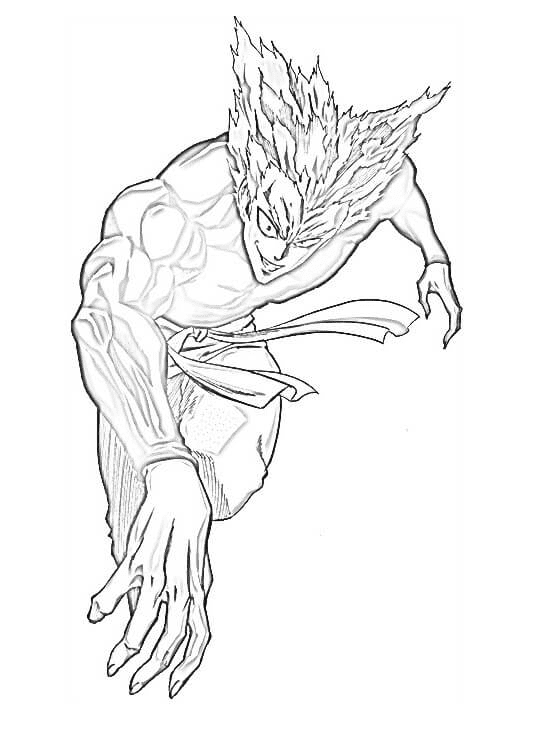
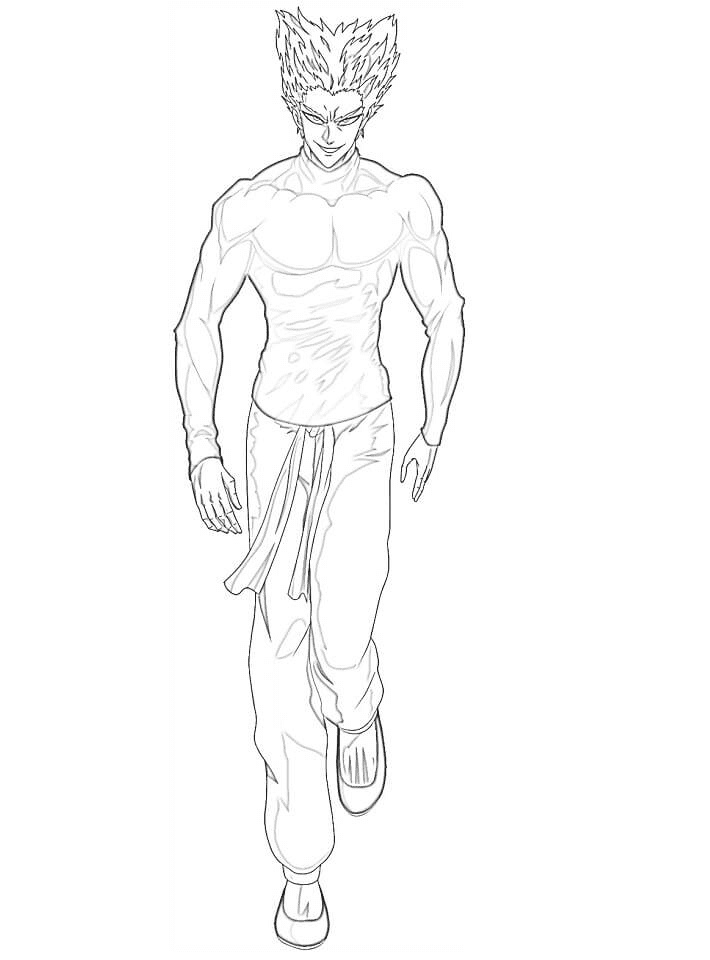
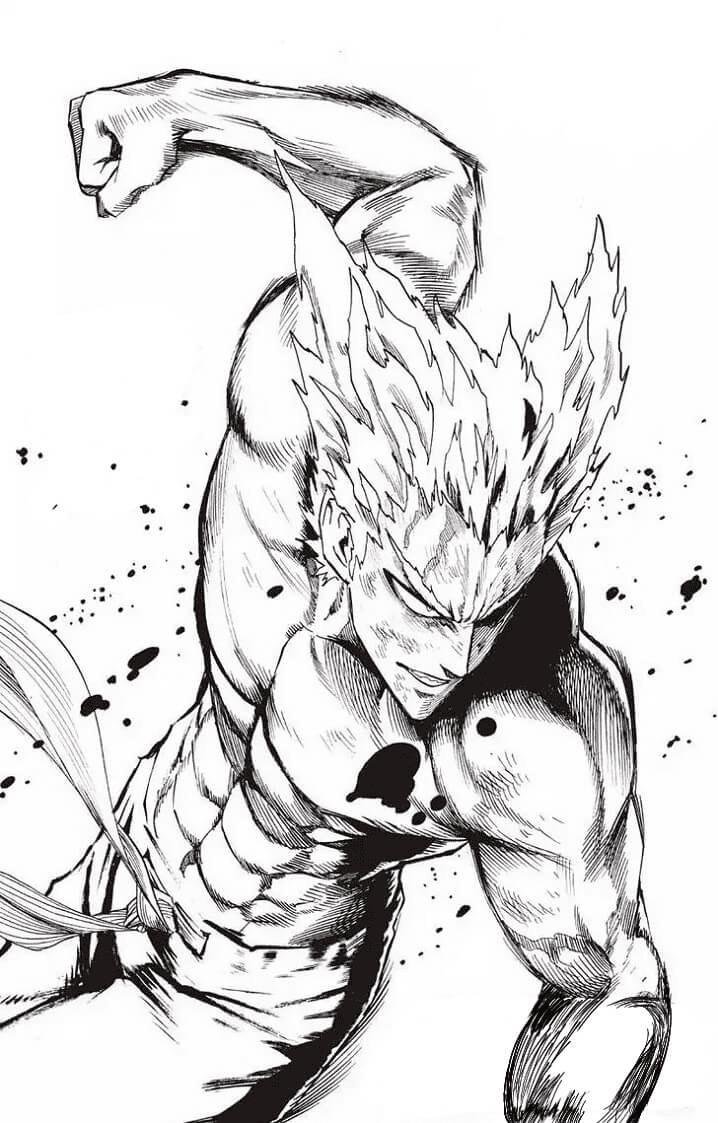
Garou – The Human Monster
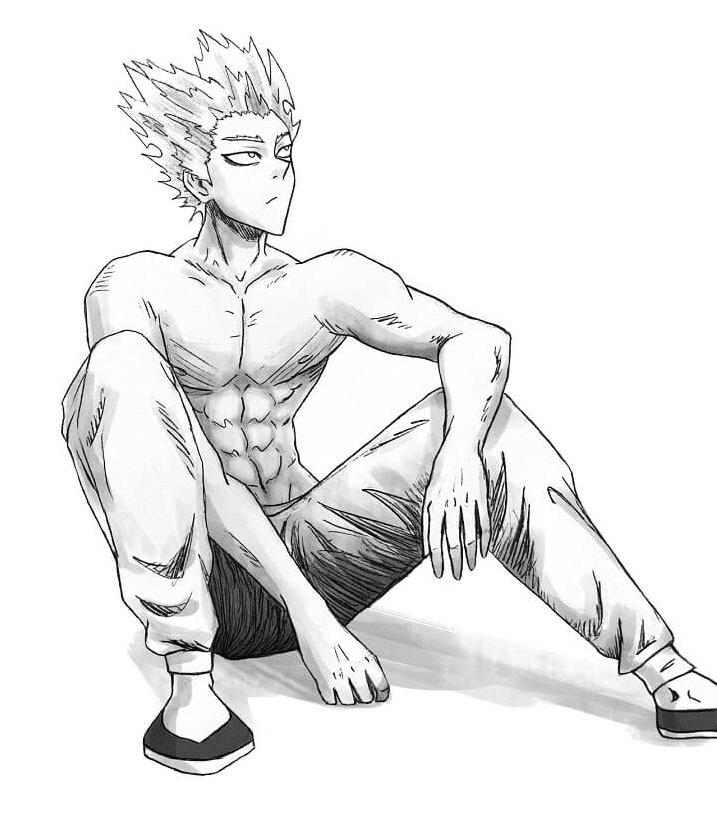
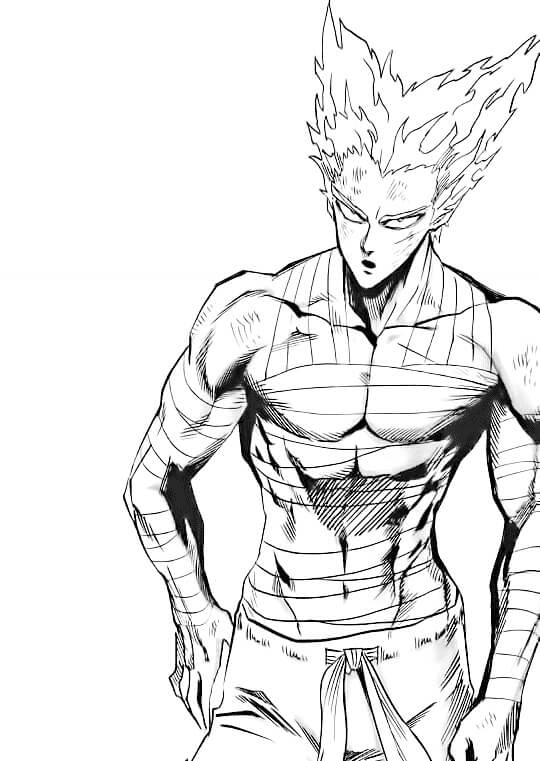
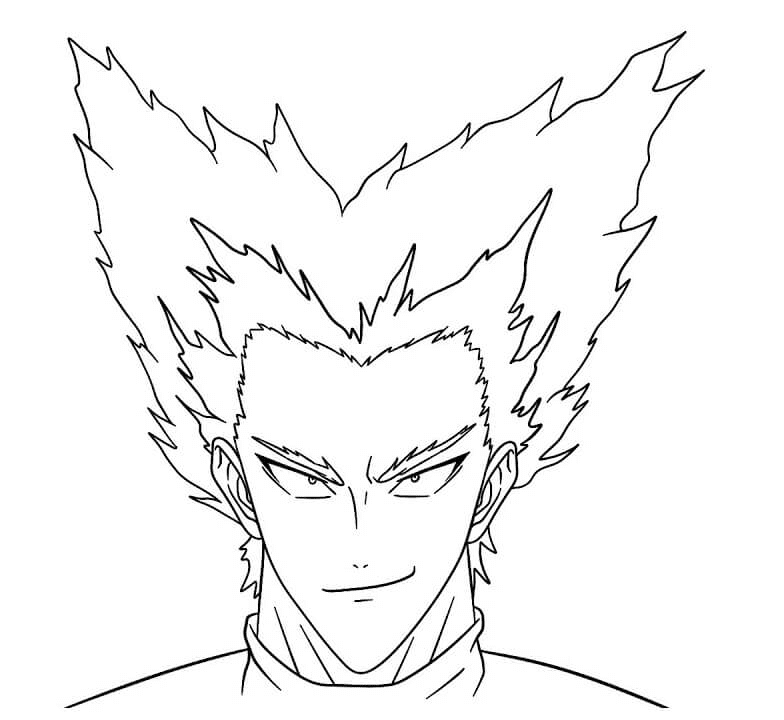
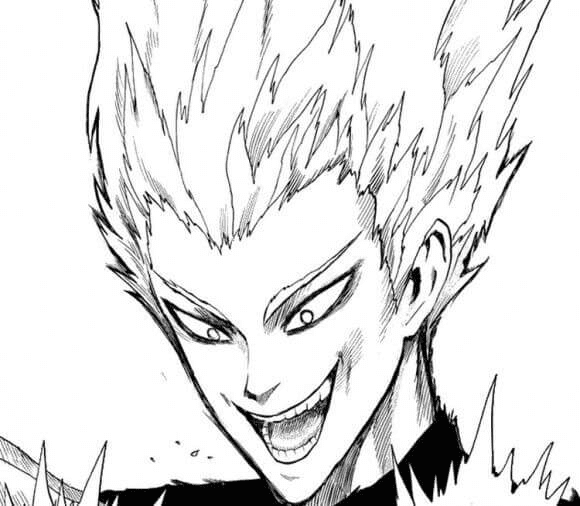
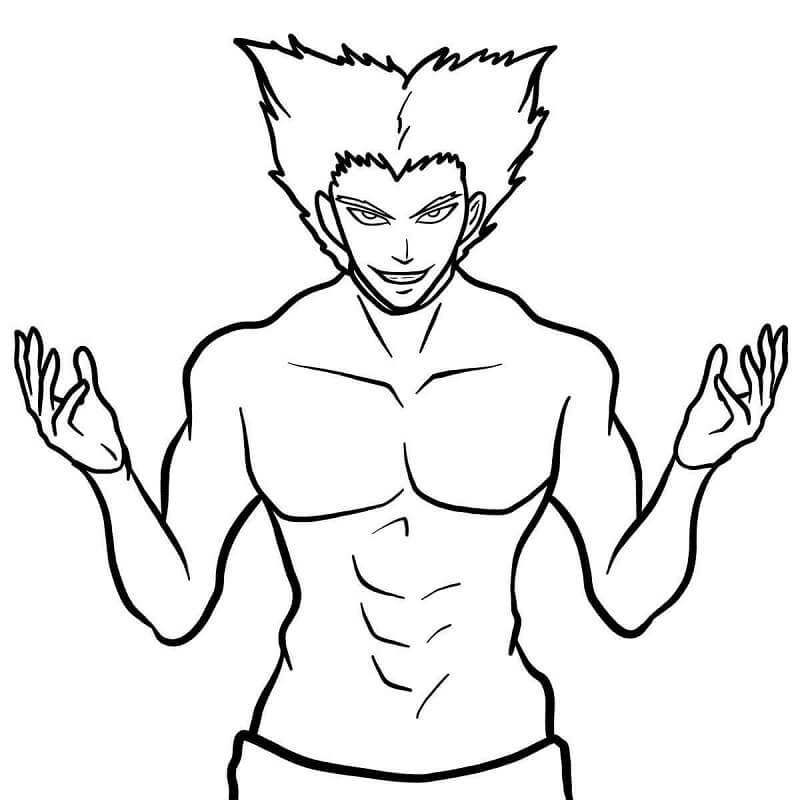
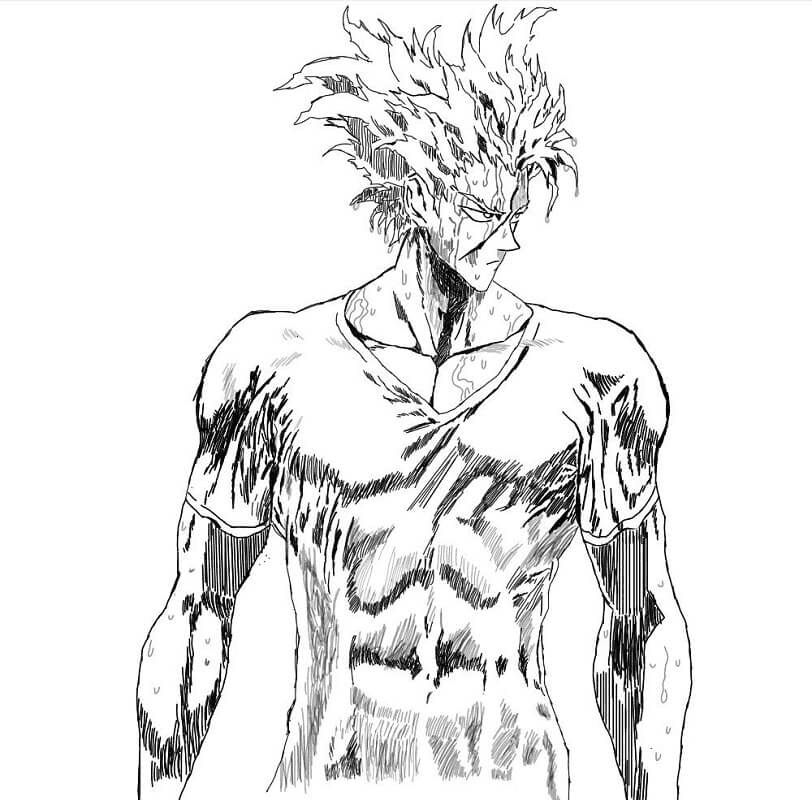
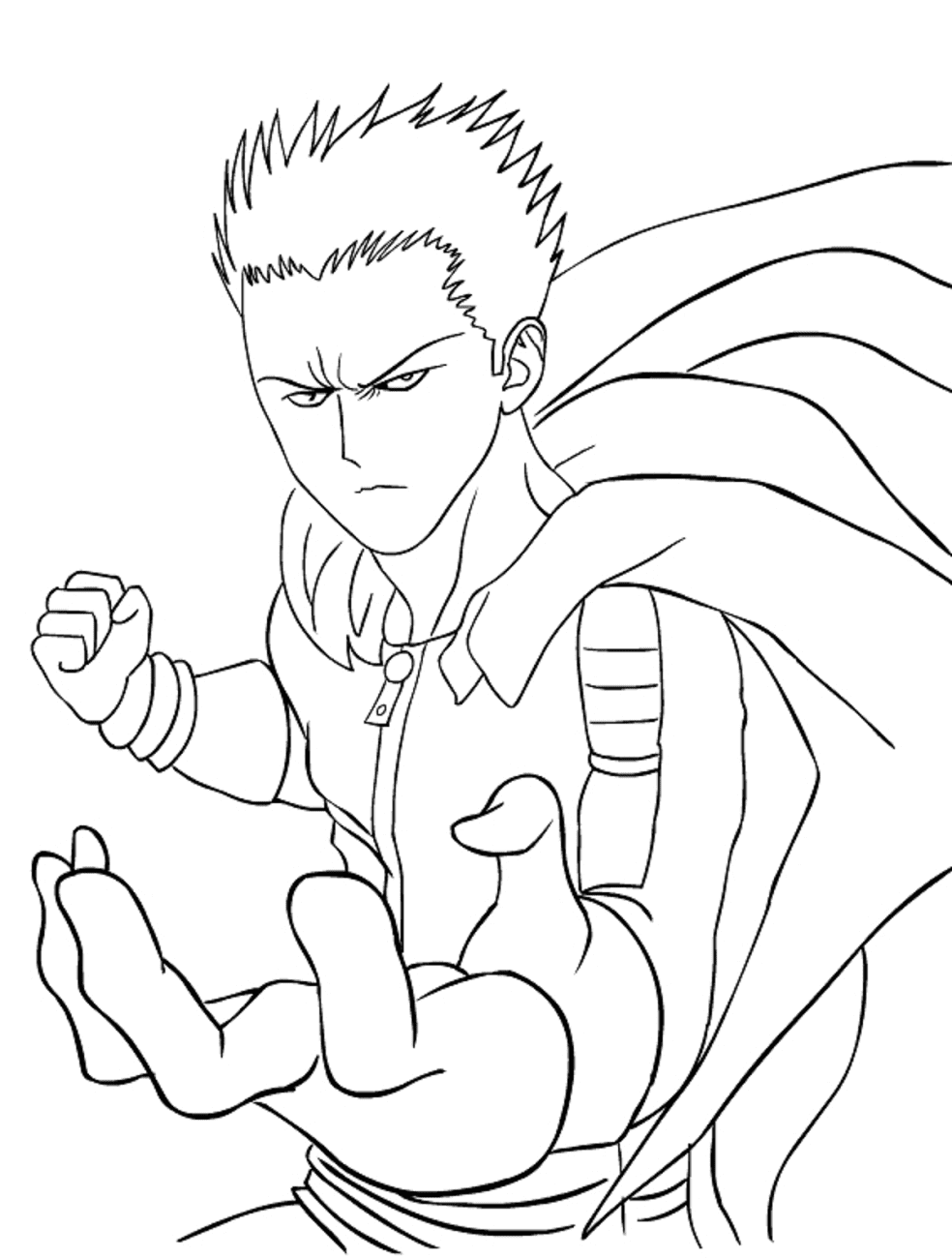
Garou is the primary antagonist of the manga’s second major arc – the Monster Association arc – and the character whose story the series uses to examine the logic of heroism from the outside. He was Bang’s most talented disciple before he was expelled, and his philosophy is the opposite of the Hero Association’s: he believes that heroes and monsters are arbitrary categories, that society designates heroes to protect itself and monsters to fear, and that the designated monster will always be more honest about power than the designated hero.
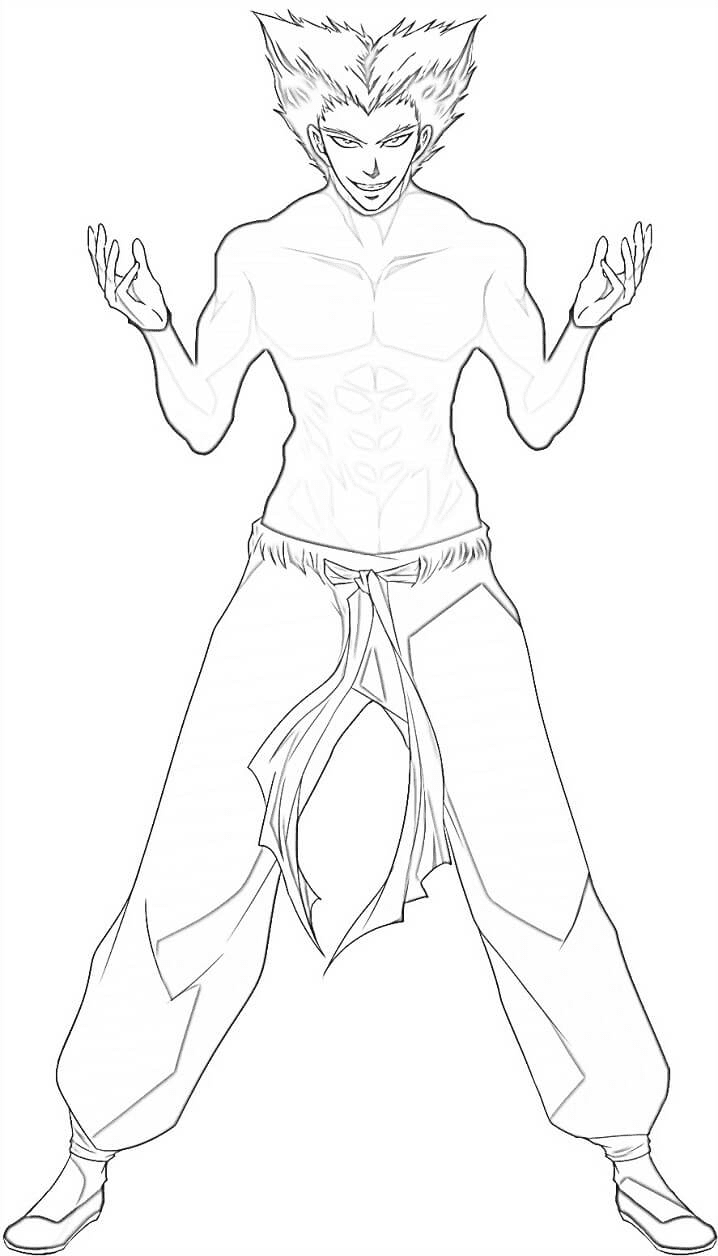
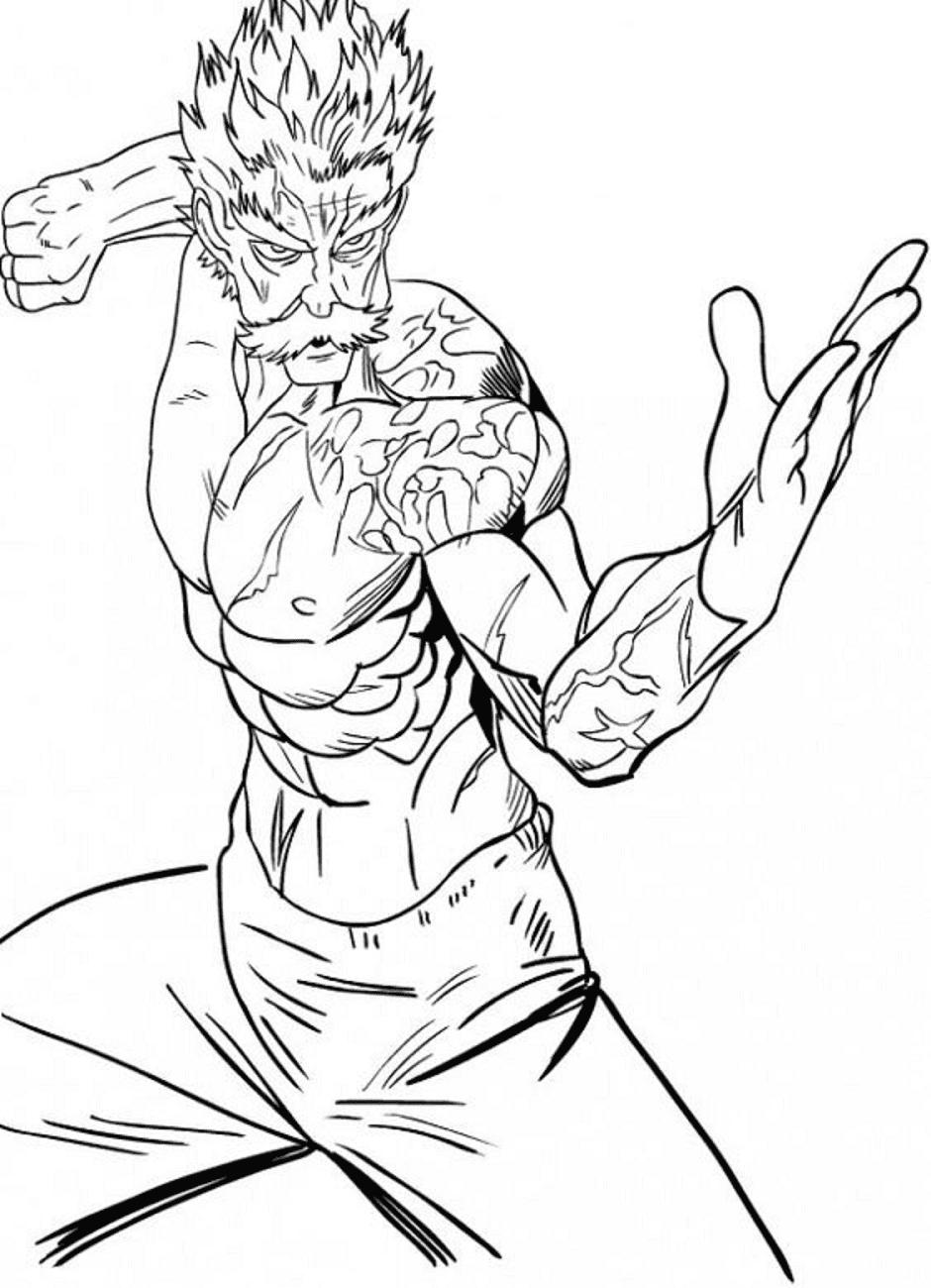
He calls himself a hero hunter – his project is to defeat heroes as a statement about what heroism actually means. He has silver hair (disheveled), a scar across his face, and a fighting style that incorporates and adapts to every technique he encounters. The Garou pages are some of the collection’s most dynamic – his combat style produces dramatic action page compositions.
Speed-o’-Sound Sonic
Sonic is a recurring character across the series – a professional ninja who becomes obsessed with defeating Saitama after Saitama’s first encounter with him ends in the specific manner that their first encounters always do (instantly and without apparent effort on Saitama’s part). He is neither a hero nor a villain – he operates independently, with his own goals, and the series uses him for comedy as often as for action.
His design is deliberately cool-looking: dark clothing, long dark hair, the visual language of a competent and dangerous ninja. The gap between how seriously he takes himself and how little threat he represents to Saitama is the source of most of his comedy.
Boros – The Dominator of the Universe
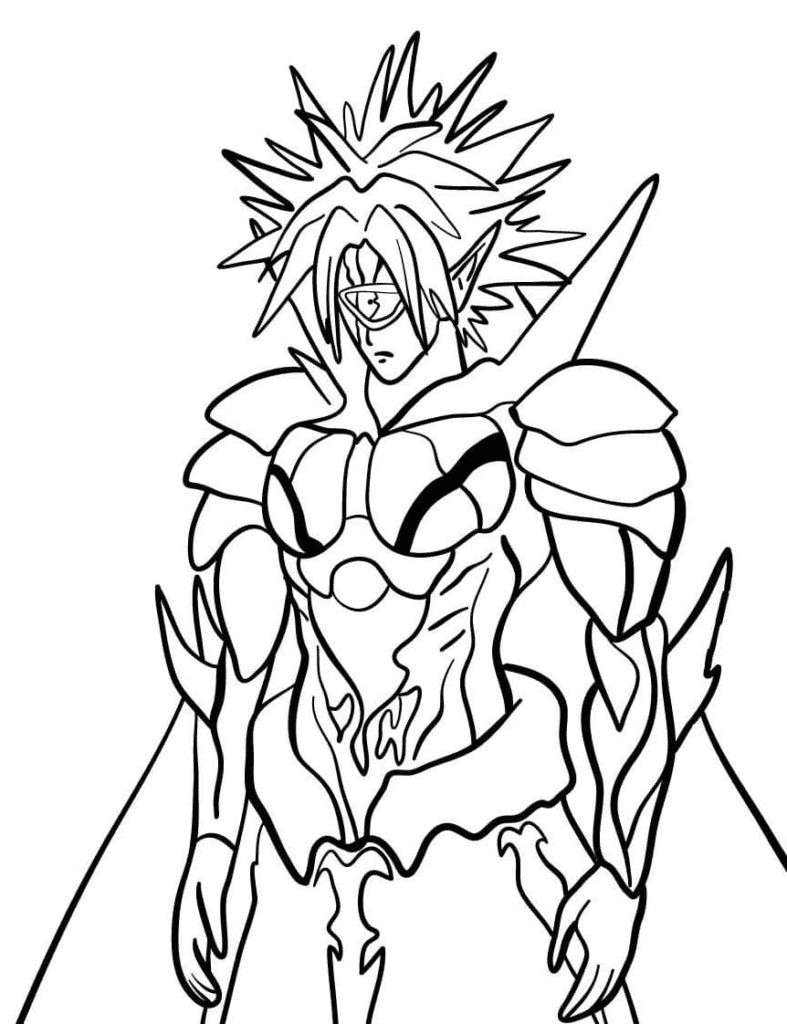
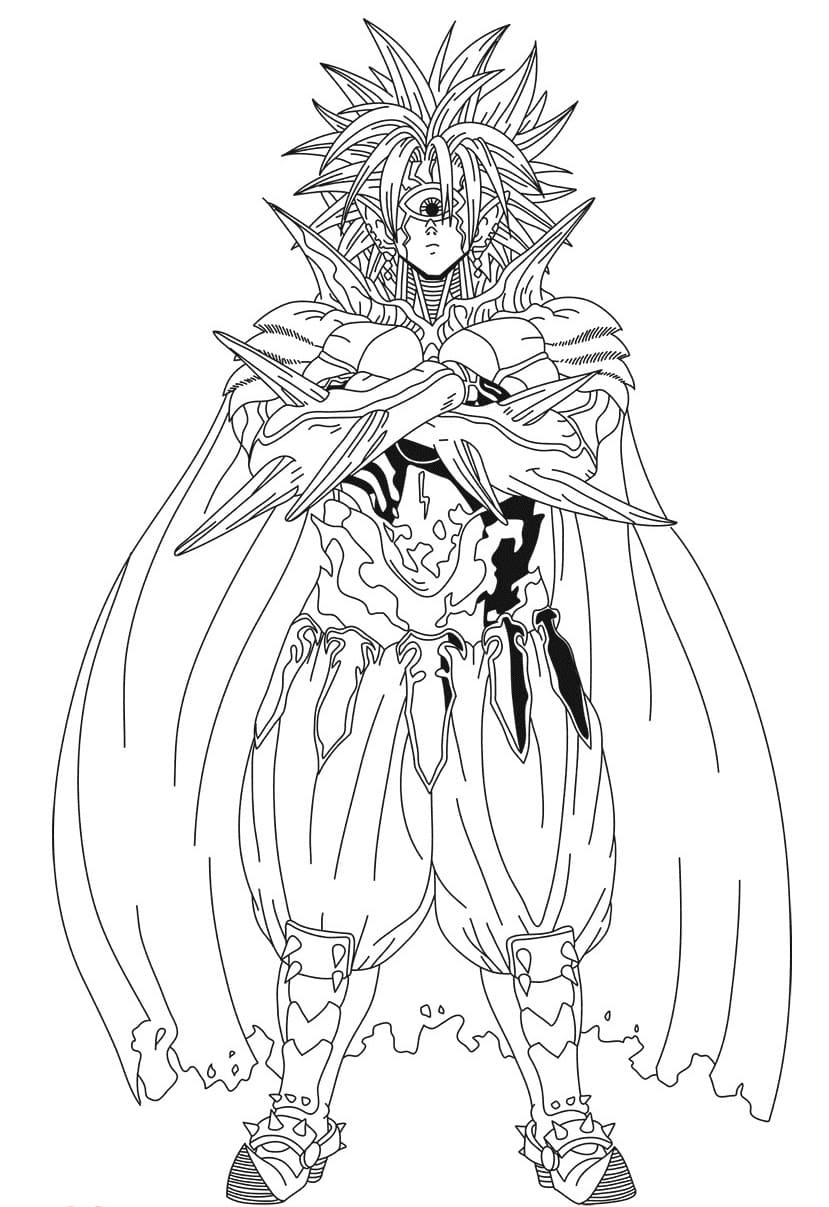
Boros is the primary villain of Season 1 and the only opponent in the series who has, to any degree, made Saitama exert himself. He traveled across the galaxy seeking a worthy opponent after a prophecy told him one existed on Earth. He is a cyclops – one large eye, purple skin, long white hair, a powerful armored form – and his fight with Saitama at the end of Season 1 is the sequence that established what the Madhouse animation team was capable of.
The Boros pages are the collection’s most visually alien – his design departs from humanoid proportions in specific ways that make him distinctive on the page and a different coloring challenge from the human-based characters.
King – The Strongest Man on Earth
King is officially S-Class Rank 7 and known to the public as “The Strongest Man on Earth.” He is, in practice, a fraud – every fight he has been credited with was actually conducted by Saitama, who happened to be nearby. He is a gamer. He is terrified of actual combat. He has maintained his reputation entirely through a series of coincidences and through the intimidating sound of his heartbeat – the “King Engine” – which opponents misinterpret as the calm of absolute confidence rather than the sound of extreme fear.
Saitama knows the truth and simply plays video games with him. Their relationship is the series’ warmest – two people who understand each other without needing to perform.
King’s design: Large build, long scar across the left side of his face (from an early encounter with a monster that Saitama actually killed), serious expression, military-style outfit. He looks exactly like the strongest man on Earth. This is entirely the problem.
Chibi and Comedy Pages
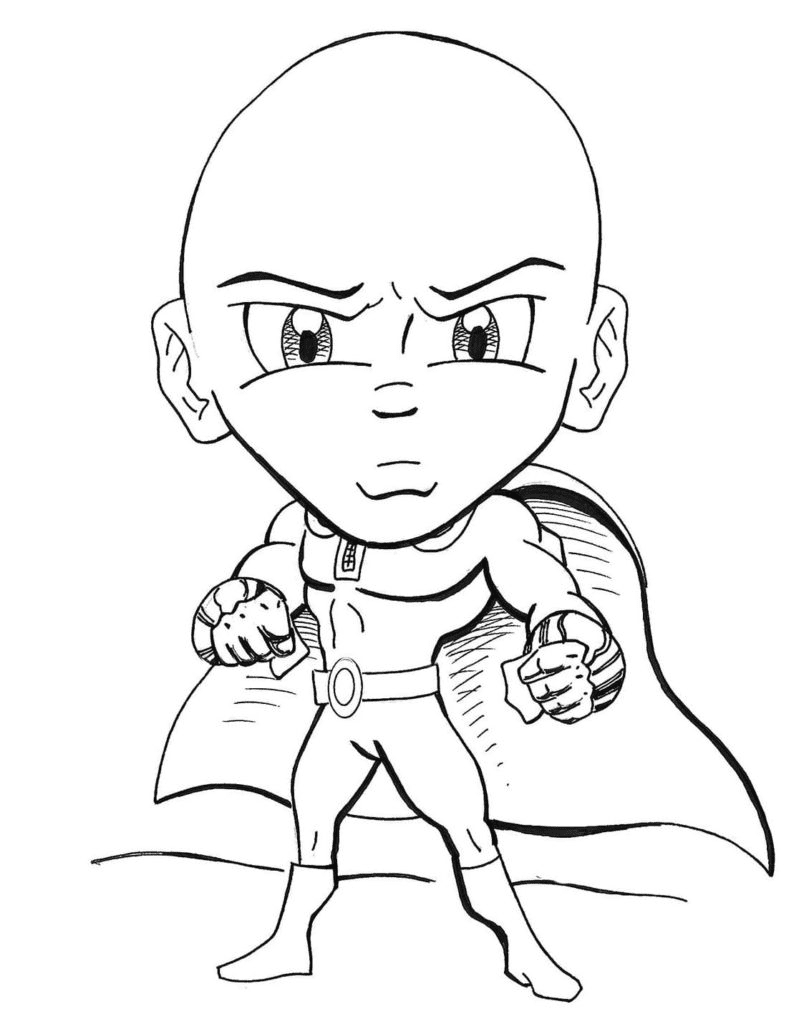
The collection includes chibi-style pages that render the characters in the large-head, small-body proportions of kawaii illustration, which works particularly well with One-Punch Man’s cast because the show’s comedy depends on characters being more or less than they appear. Chibi Saitama, with his blank dots for eyes and his oversized yellow costume, captures the absurdist quality of the character’s design in a format that is accessible to younger fans and that rewards bold, flat color application.
What These Pages Do
One-Punch Man is one of the most thoughtful deconstructions of the superhero genre in any medium. The series asks what happens after the power fantasy is complete – what the winner actually wins, and whether winning was the goal or the experience of pursuing it. Coloring the characters while knowing their stories is an engagement with these questions in the most accessible form possible.
The visual design contrasts are a lesson in illustration. The series’ aesthetic depends entirely on contrast – Saitama’s simplicity against every villain’s elaborate design, the blank expression against the dramatic action, the ordinary appearance against the extraordinary capability. These contrasts are visible in every coloring page and draw attention from anyone interested in visual storytelling.
Fine motor development. The American Academy of Pediatrics identifies fine motor skill development as a key milestone throughout early childhood. The Genos pages – with their mechanical surface detail – and the Tatsumaki pages – with their dynamic force effects – provide exactly the kind of motivated, sustained fine motor practice that is most developmentally effective. The 2005 Art Therapy Journal study on structured coloring and anxiety reduction applies throughout.
How to Color These Pages Well
Saitama’s yellow requires warmth, not brightness. The common mistake is choosing a yellow that is too bright or too cool. His suit’s yellow is a vivid but warm yellow – test it by comparing it to a warm gold: it should be lighter than gold but in the same warm family. Cool yellows or lemon yellows read incorrectly.
Genos’s mechanical surfaces need consistent light direction. Before applying any color to a Genos page, decide where the light is coming from. Every mechanical surface should have its highlight on the same side and its shadow on the opposite side. Inconsistent light direction produces mechanical surfaces that read as flat rather than three-dimensional.
Tatsumaki’s green hair has violet undertones. Her hair is not a pure green – it has a subtle blue-violet quality in the shadow areas that gives it depth. Apply the base green first, then add a touch of blue-purple in the deepest shadows. The difference is subtle but makes the hair read as rich rather than flat.
Garou’s hair is silver-white, not pure white. His distinctive silver hair reads best with a cool light grey as the mid-tone and near-white only on the direct highlight. Pure white across the entire hair reads as uncolored paper – a subtle cool grey gives it form and makes the white highlights more effective.
Monster pages want high saturation and dramatic shadow. The villains and monsters in One-Punch Man’s visual vocabulary are elaborate and should be colored with more saturation and more dramatic contrast than the hero pages. These characters are designed to be visually overwhelming – the coloring should match that intention.
Boros’s purple skin needs cool shadows. His purple skin tone is a warm medium purple in direct light, shifting to a deeper, cooler purple-violet in shadow. Do not use brown or grey in his shadow areas – keep the shadows within the purple-violet family throughout.
5 Creative Craft Ideas
Hero Association Rank Chart
Print one page for each of the following S-Class heroes the collection includes: Tatsumaki (Rank 2), King (Rank 7), Genos (Rank 14). Color all three in their canonical colors. Arrange them in descending rank order on a backing sheet.
Add the Hero Association logo at the top (hand-drawn or printed), the rank number below each figure, and their hero name. Between Tatsumaki and King, leave a gap labeled “Ranks 3-6” – the characters not in this collection. The finished chart is a Hero Association reference guide made visible through careful coloring.
Before and After: Saitama’s Training Arc
The series establishes that Saitama once had hair – he lost it through his training. Print two copies of the Saitama portrait page. On the first, carefully draw and color a head of dark hair over the bald head using the portrait as a base – this is “before training Saitama.” Color the second in his canonical bald, blank-eyed form – “after training Saitama.”
Mount both side by side: “Before: 3 years ago” on the left, “After: S-Class-level power, C-Class ranking, no worthy opponents” on the right. The diptych tells the series’s entire premise.
Hero vs. Villain Match-Up Display
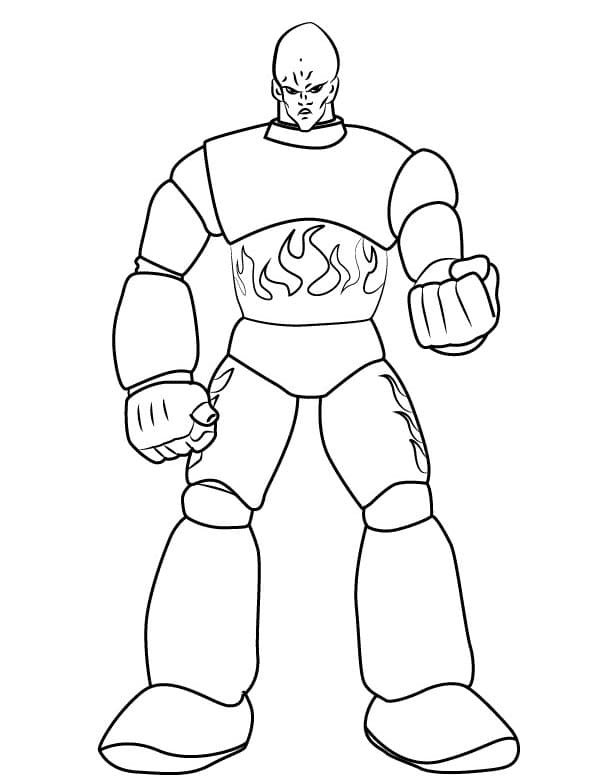
One-Punch Man’s visual design is built on pairing an elaborate villain with the simple Saitama. Print the most dynamic villain page available in the collection (Boros, Garou) and the most dramatic Saitama action page. Color both: the villain with maximum saturation, elaborate detail, dramatic shadow; Saitama in his simple yellow with his characteristic blank expression.
Mount them facing each other on a black backing sheet – villain on the left advancing, Saitama on the right in his pre-punch posture. The visual contrast between the two designs on the same page makes the series’ central joke visible as a design fact.
Genos Upgrade Log
The series shows Genos receiving mechanical upgrades from Dr. Kuseno across multiple arcs – each time he returns from a difficult fight, his body is rebuilt with improvements. Print multiple Genos pages. Color each one with slightly different metallic configurations – the first with one arm significantly different from the second, the second with additional plating that the first didn’t have.
Arrange all versions in a row labeled “Upgrade 1,” “Upgrade 2,” and so on. The finished display captures Genos’s character arc – the cyborg who is constantly rebuilt – in a format that makes the concept visual through coloring.
One-Page Manga Tribute
Print 4-6 pages from the collection in the following sequence: a monster page, Genos fighting, Genos losing, Saitama arriving (expression blank), Saitama punching (single punch page), aftermath. Color each page in sequence, with consistent lighting across all pages. Arrange in a 2×3 grid on a large backing sheet.
The finished arrangement reads as a single manga sequence – a self-contained chapter of One-Punch Man told through coloring pages, which captures the series’ storytelling structure: elaborate buildup, overwhelming threat, single resolution.
Frequently Asked Questions
Who created One-Punch Man? One-Punch Man was originally created by ONE, a Japanese artist who publishes under that pen name, as a webcomic launched on his personal website in 2009. The rough-art webcomic went viral in Japan due to its compelling premise and humor. Yusuke Murata, a professional manga artist known for Eyeshield 21, subsequently approached ONE to create a professionally illustrated remake, which began serialization in Weekly Young Jump (Shueisha) in June 2012. The anime adaptation was produced by Madhouse for Season 1 (2015) and J.C.Staff for Season 2 (2019).
What is Saitama’s actual power level, and why is he so strong? Saitama’s power level is undefined and apparently limitless – he has never encountered a situation requiring more than one punch to resolve, so the upper limit of his capability has never been tested. His explanation for his strength is simple: he trained every day for three years without rest, performing 100 push-ups, 100 sit-ups, 100 squats, and a 10-kilometer run daily. The series treats this as both a joke (the training is mundanely physical rather than special or magical) and a genuine explanation (the consistency and intensity of the training pushed him past some undescribed limit of human capability). The side effect was losing all his hair.
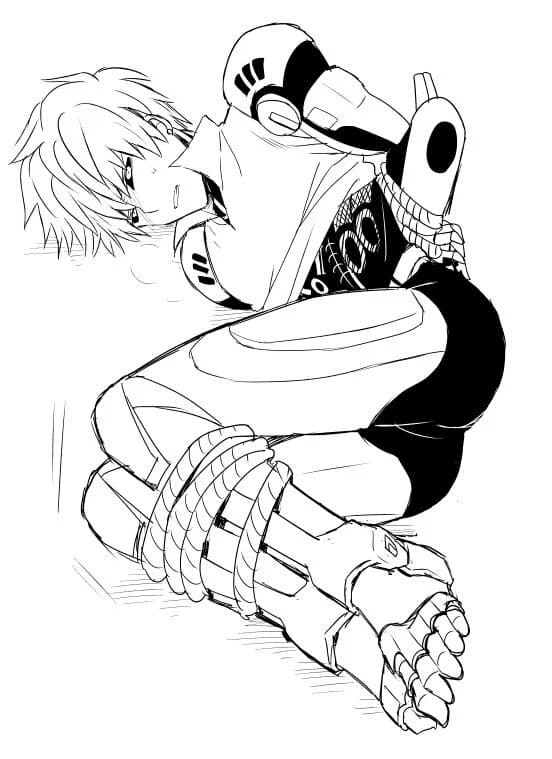
Who is Genos, and why does he follow Saitama? Genos is a 19-year-old cyborg who was converted into a mechanical form by the scientist Dr. Kuseno following the destruction of his hometown by a rogue cyborg, which also killed his family. He has devoted his existence to tracking down that cyborg and eliminating it. He met Saitama when Saitama dispatched a monster Genos was fighting, and was so overwhelmed by Saitama’s power that he demanded to become his disciple on the spot. He is ranked S-Class, Rank 14 in the Hero Association – significantly higher than Saitama’s C-Class designation despite being substantially less powerful.
What is the Hero Association, and how does it rank heroes? The Hero Association is the organization that officially sanctions and ranks superheroes in the One-Punch Man world. Heroes are classified into four classes: C (lowest), B, A, and S (highest, with 20 ranks within S-Class). Rankings within classes are determined by test results and public evaluation scores rather than direct assessment of fighting ability – which is why Saitama, despite being the most powerful individual in the series, entered at C-Class Rank 388 when he first registered, and why King maintains his S-Class 7 ranking despite not having any genuine combat capability.
Who is Garou and what does he want? Garou is a young martial artist who was Bang’s most talented disciple before being expelled for attacking Bang’s other students. He calls himself a “hero hunter” – his stated project is to defeat heroes and become a monster, as a philosophical statement about what he sees as the arbitrary nature of heroism. He believes society designates heroes and monsters based on political convenience rather than moral reality, and that the designated monster is simply the side that the majority is afraid of. His arc in the Monster Association chapters, and his eventual encounter with Saitama, form the emotional and thematic core of the manga’s second major arc.
Is the One-Punch Man webcomic still ongoing? Yes. ONE continues to update the original One-Punch Man webcomic on his website, where it has advanced significantly beyond the manga adaptation in terms of story. The webcomic maintains ONE’s original rough art style and has dedicated followers who consider it the most direct version of his creative vision. The manga by Murata is an adaptation and reimagining of the webcomic with professional artwork and some story differences. Both versions are currently ongoing.
What age group are these pages best suited for? The simpler portrait pages – clean character outlines with minimal background detail – work well from ages 6–8 for fans of the series, developing colored pencil control. The chibi pages are accessible from ages 4–5. The complex action pages – with multiple figures, dynamic effects, and mechanical surface detail like Genos – are most rewarding for ages 10 and up and for adult fans who want a sustained challenge. The monster and villain pages generally have more complexity than the hero portrait pages, and suit older colorists with more patience for detail work.
Browse the full collection at ColoringPagesOnly.com. All 60+ pages free, no sign-up, PDF or PNG, print at home or color online.
ONE drew One-Punch Man by himself in 2009 on a personal website with no professional training and rough artwork. He drew it because he thought the premise was funny and wanted to see where it went. The premise was about a man who had achieved the goal and discovered that achieving it had not produced what he expected. The story became one of the most popular manga series of its decade, animated by one of Japan’s best studios, read by millions of people who recognized the specific feeling of getting what you wanted and finding the wanting was better.
Pick up your yellow. Draw the blank oval of his face. Make the eyes two dots. Color the cape white.
He defeated everyone who ever stood against him. The only enemy he cannot defeat is the boredom of being undefeatable.
Share your work on Facebook and Pinterest and tag #Coloringpagesonly. We especially want to see the hero vs. villain match-up displays and the manga tribute grids.
Color the caped baldy. One punch was enough. It always is.
More from our anime collections: