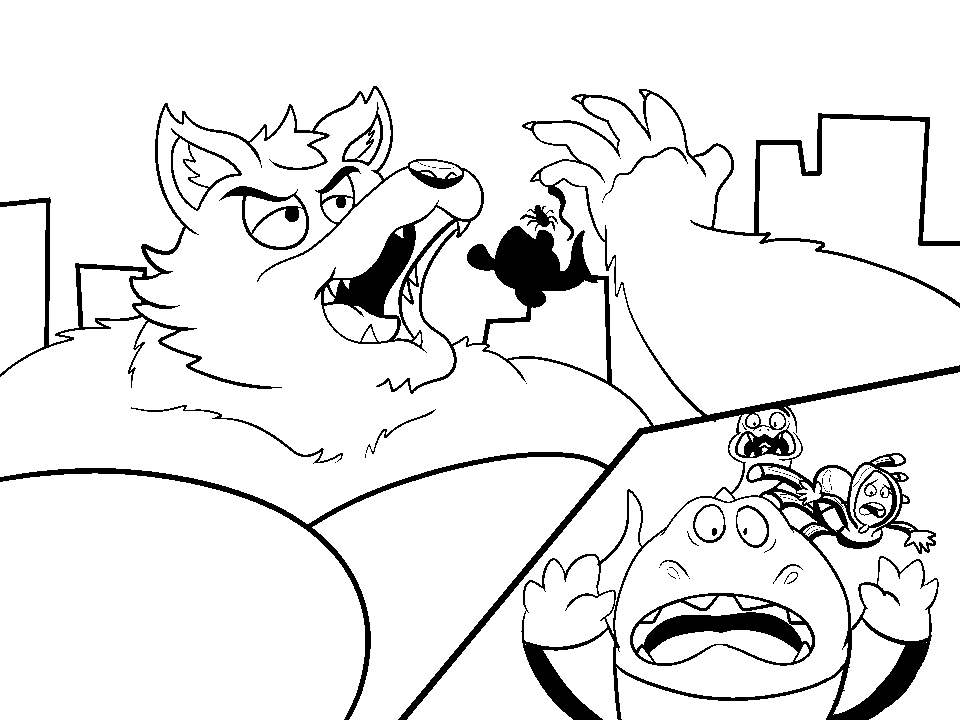
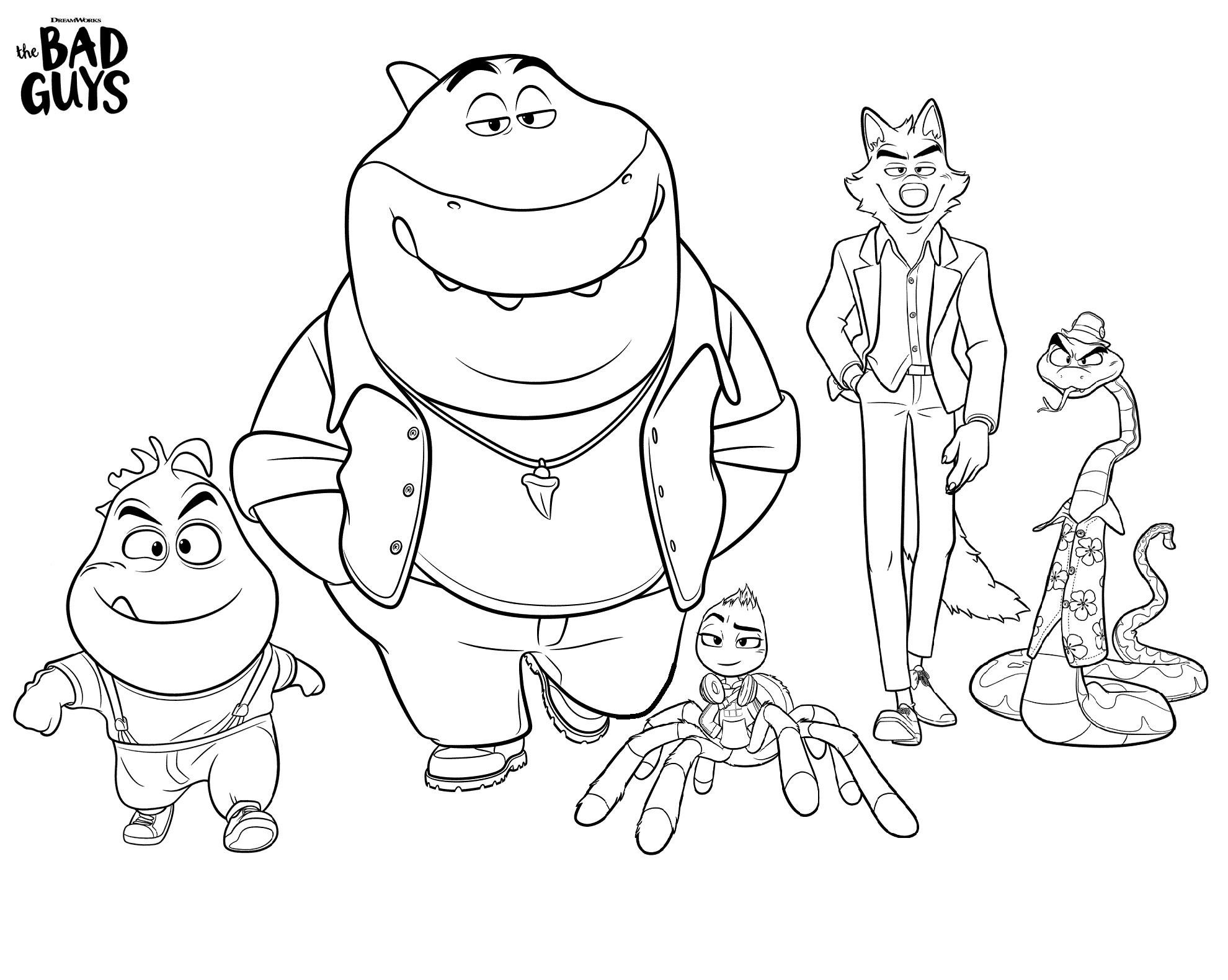
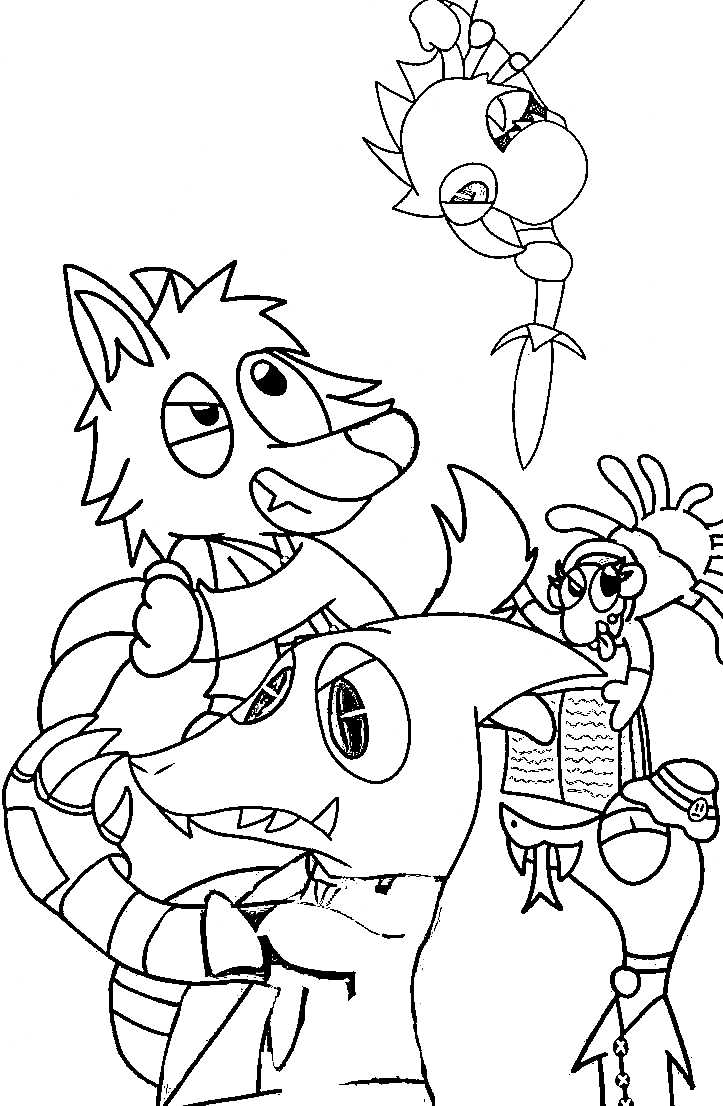
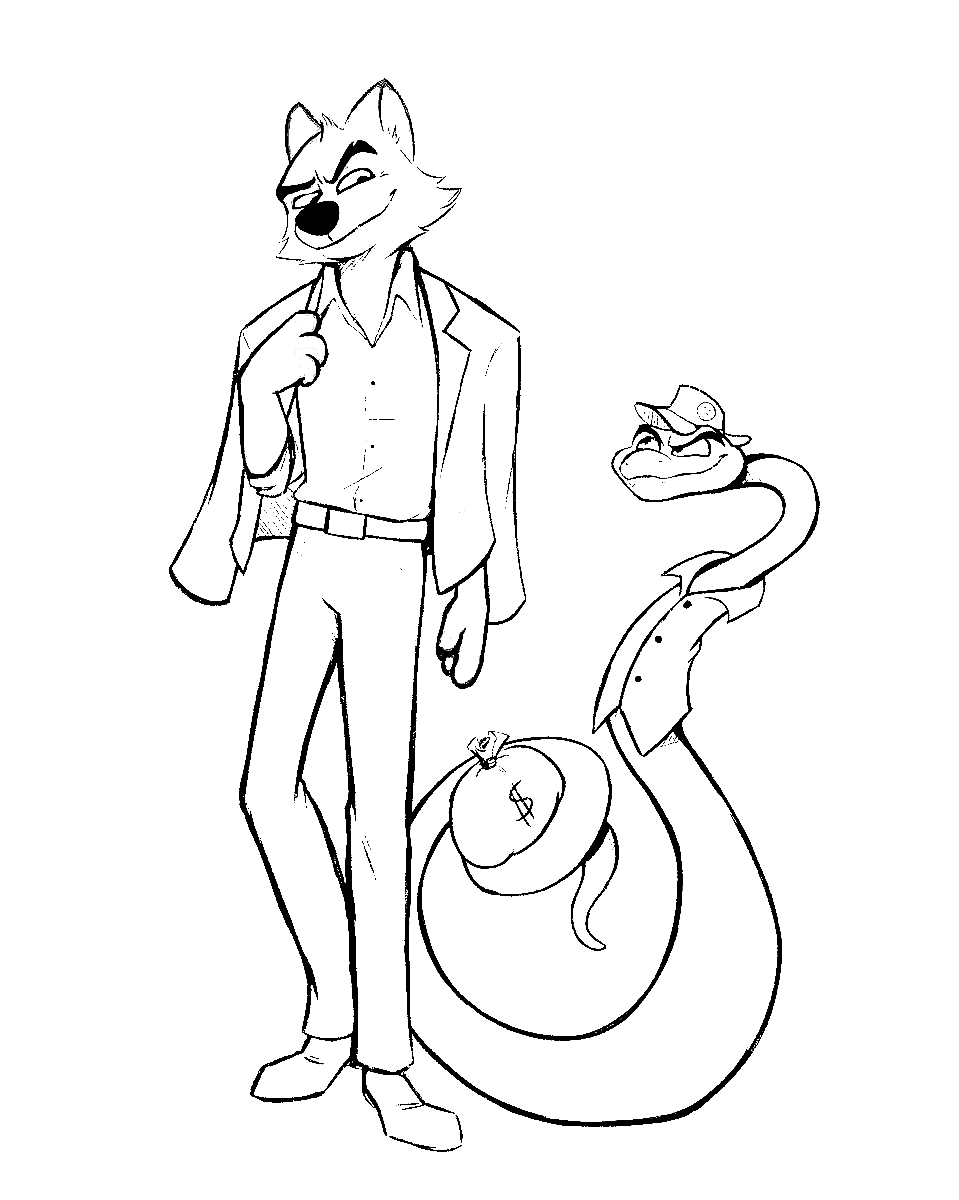
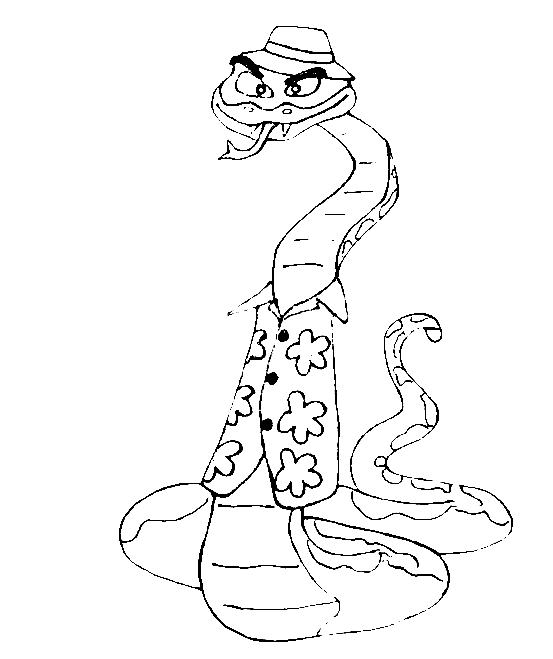
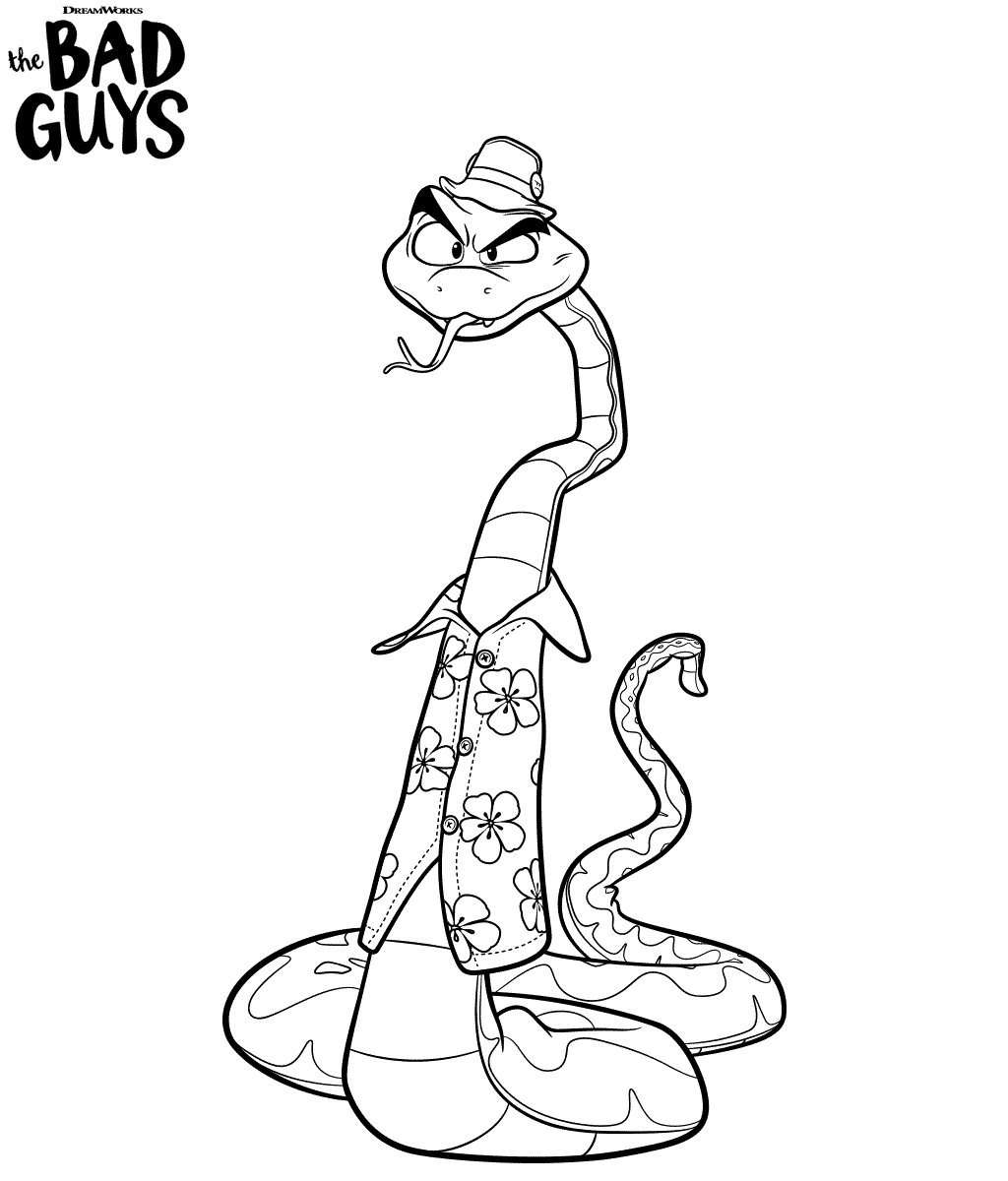
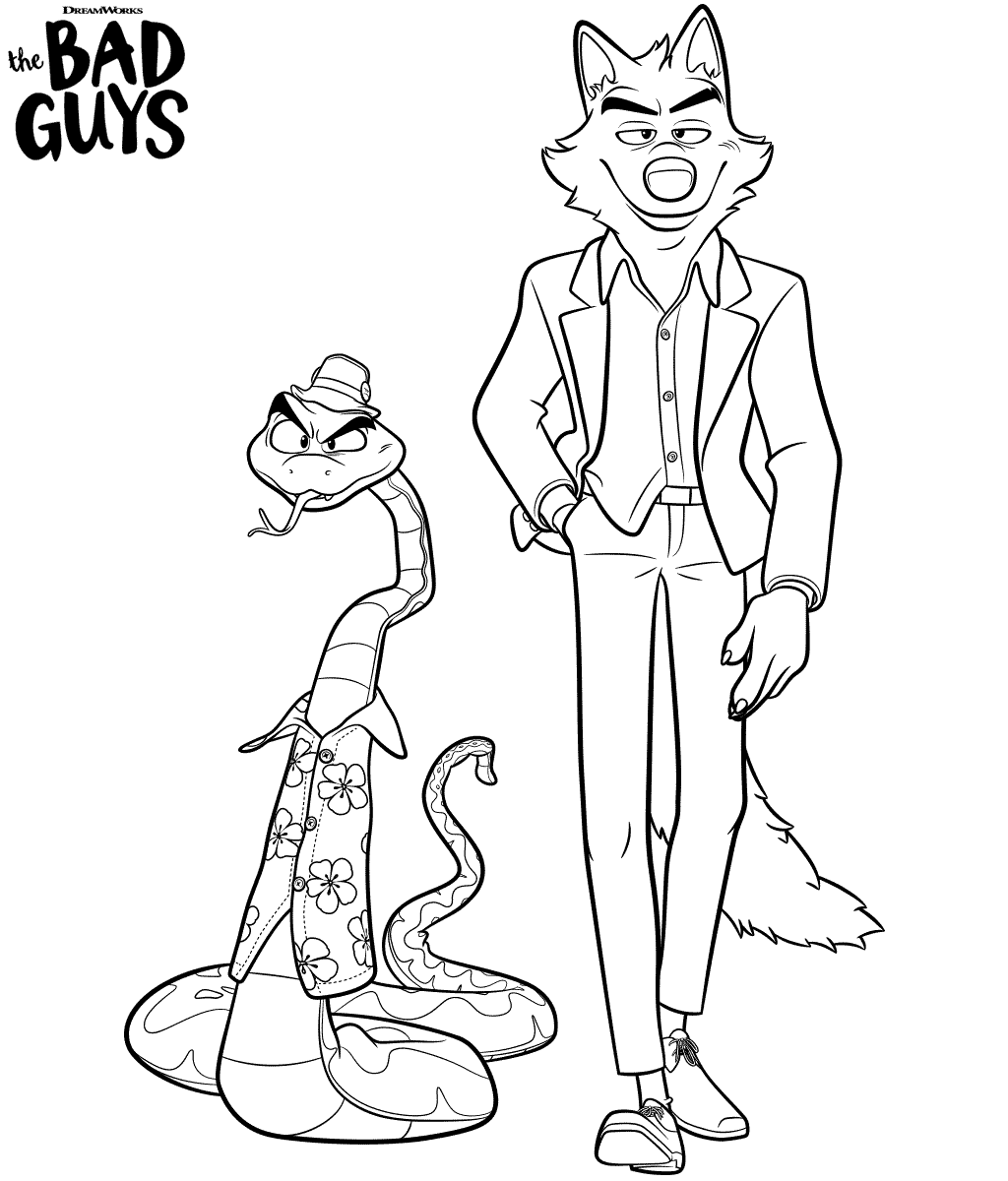
Free The Bad Guys coloring pages – 20+ pages featuring Mr. Wolf, Mr. Snake, Ms. Tarantula, Mr. Shark, Mr. Piranha, Professor Marmalade, Governor Foxington, heist scenes, disguise pages, group shots, and character portraits – free printable PDF and online coloring for fans of the DreamWorks film and Aaron Blabey’s book series.
The Bad Guys is a DreamWorks Animation film released on April 22, 2022, directed by Pierre Perifel and based on the graphic novel series of the same name by Australian author Aaron Blabey, published by Scholastic beginning in 2015. The film blends computer animation with techniques drawn from 2D anime and 1960s-era graphic design to produce a visual style unlike any previous DreamWorks production – stylized, fast, and built around the specific visual language of heist films rather than the naturalistic rendering that characterizes most studio animation.
The premise addresses directly what the series takes as its central question: whether five animals who are feared because of what they are – a wolf, a snake, a tarantula, a shark, a piranha – can become something genuinely different from what the world has always assumed they would be. The film gives the question a twist: the cute, trusted, philanthropic guinea pig is the actual villain. The gang of predators who look dangerous turns out to be, slowly and reluctantly, capable of goodness. The film uses its animal-based character design to make a straightforward point about appearance, assumption, and the gap between what something looks like and what it actually is.
These 20+ free pages at ColoringPagesOnly.com cover the full cast from the film. All free, PDF or PNG, print or color online.
What’s Inside
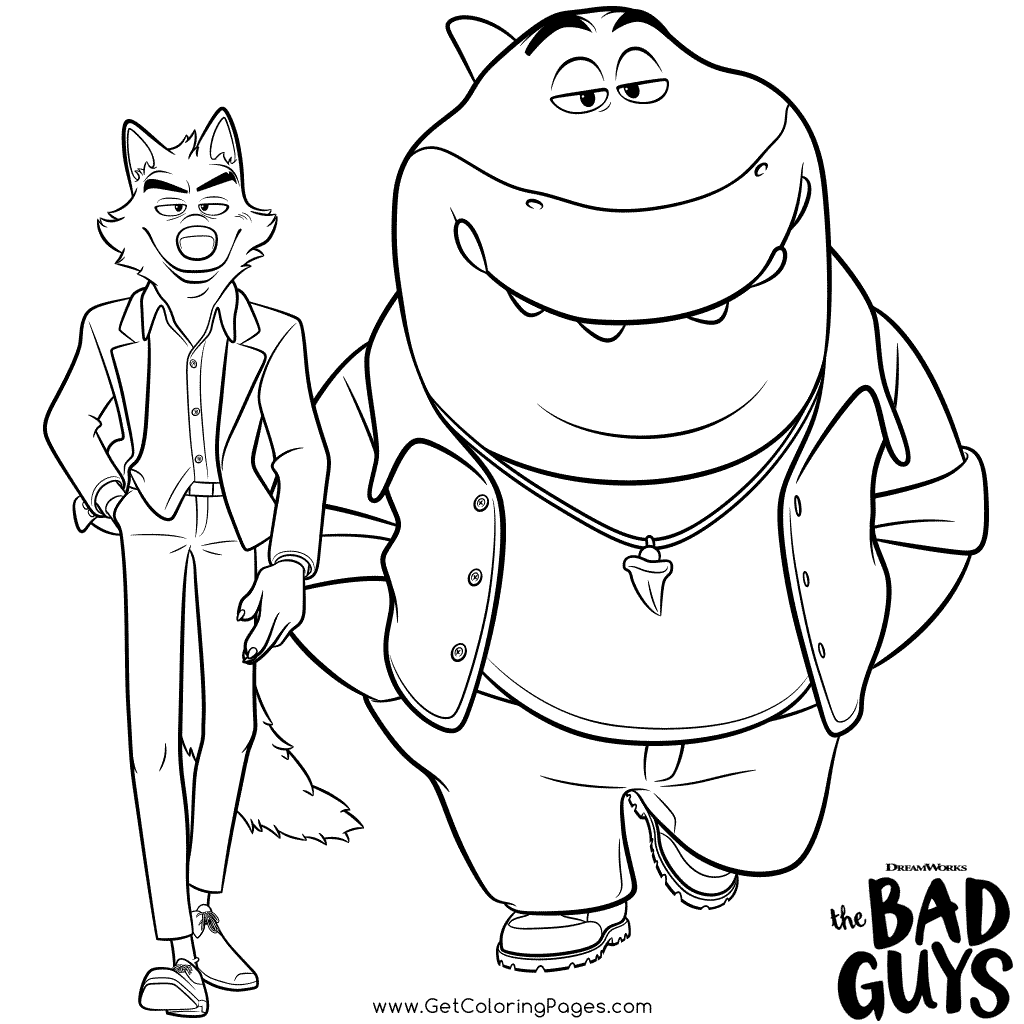
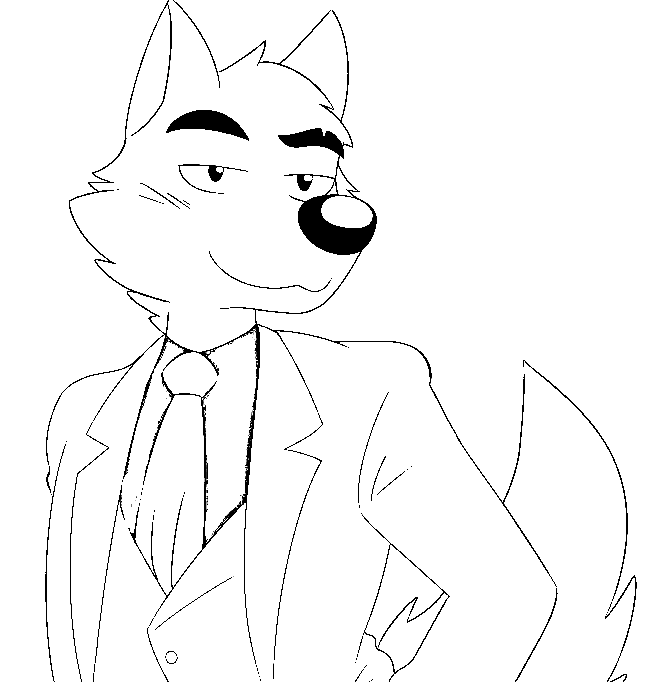
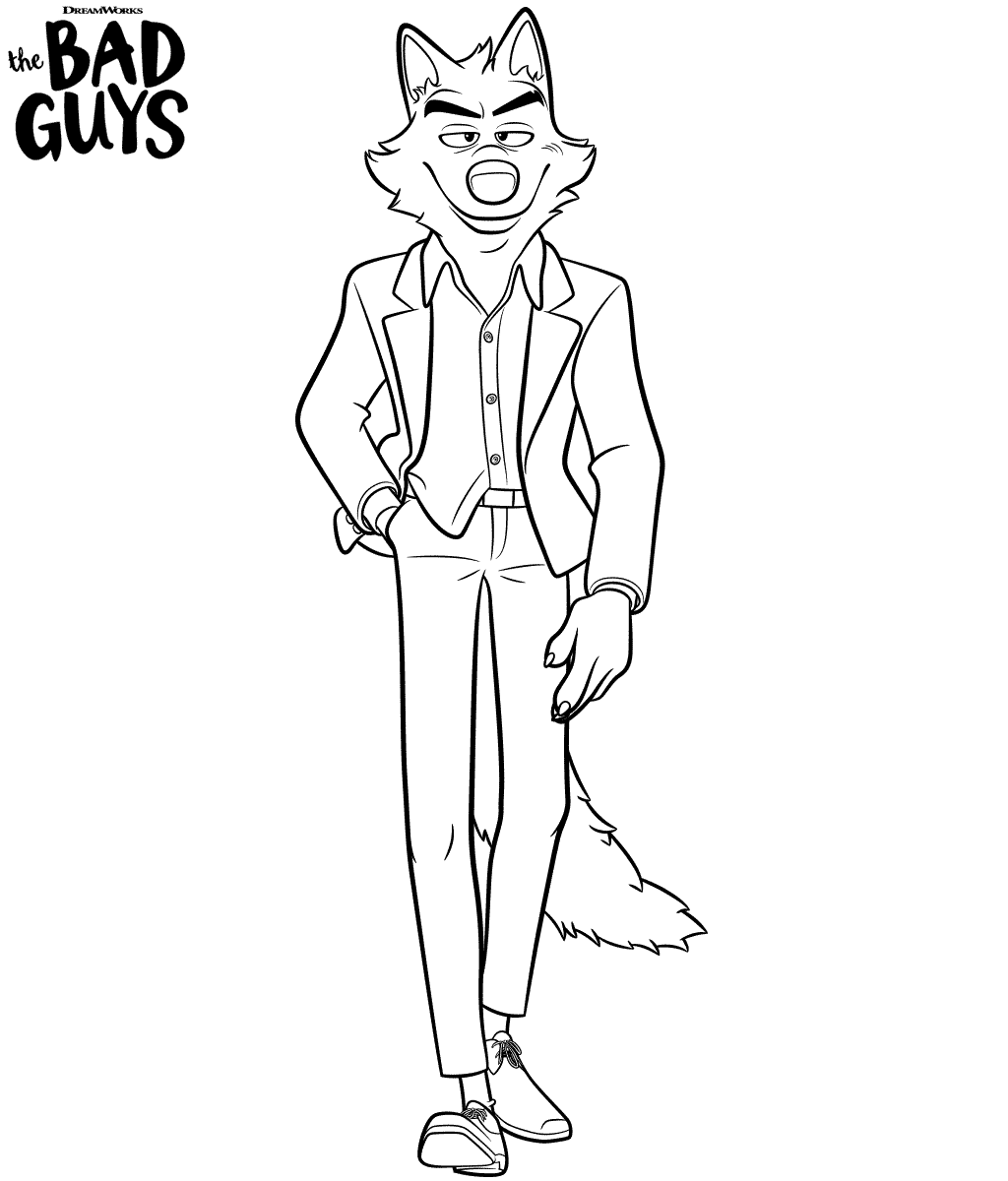
Mr. Wolf – The Leader
Mr. Wolf is the Bad Guys’ founder and leader – the pony who holds them together, who plans the heists, who speaks for the group in public, and who is the first of them to notice that doing good things feels genuinely different from what he expected. He is suave and charming in the specific way of someone who has spent their entire life performing confidence – the suit, the sunglasses, the practiced swagger of a criminal mastermind who knows exactly how much of the world’s perception of him is theater.
His character arc is the film’s central journey: the discovery that his tail wags when he does something good – an involuntary, animal response he cannot control – becomes the evidence that there is something in him that actually wants to be good, beneath the persona. The wagging tail is the film’s most effective piece of character writing – it externalizes the internal change in a way that is simultaneously funny and genuinely moving.
His appearance: a grey wolf in a black suit and white dress shirt, always well-dressed in the specific way of classic film criminals, with yellow-green eyes that communicate constant calculation.
Coloring Mr. Wolf: His fur is a medium grey – not warm and not cool but precisely neutral, with very slight warm undertones in the face and paws where the fur is thinnest. His suit is near-black – dark enough to read as black in most lighting but rendered with cool blue-grey highlights on the shoulders and lapels to show the fabric’s surface. His shirt is clean white, contrasting with the suit. His eyes are the most vivid element of his design: a yellow-green that should be rendered at full saturation against his grey face.
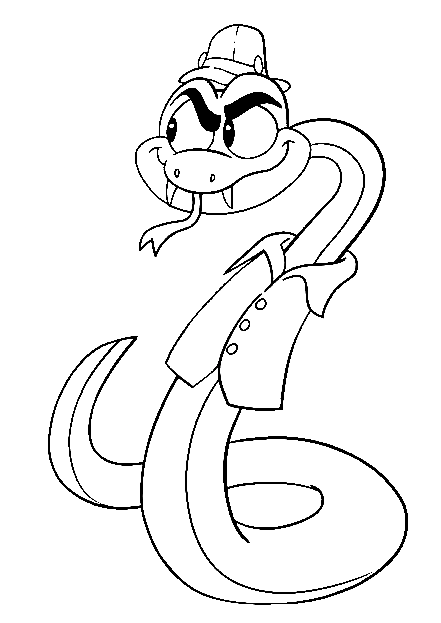
Mr. Snake – The Safecracker
Mr. Snake is Mr. Wolf’s oldest friend and the member of the gang who is most resistant to the idea that any of them can actually change. He is curmudgeonly, pessimistic, and vocal about the fact that he does things only for himself – a claim that the film systematically disproves across its running time by showing that his loyalty to Mr. Wolf is the most consistent thing about him.
He is also secretly obsessed with birthday cake. The scene in which this fact emerges – a children’s birthday party that Snake cannot help ruining, then cannot help feeling terrible about – is the film’s clearest statement that character is revealed through the things we cannot pretend not to feel.
His appearance: a large, long dark olive/green serpentine body, small arms (vestigial, more suggestion than function), a broad flat head with narrow golden eyes, and the specific body language of a snake who has decided that leaning back on his coils is the most intimidating resting position available to him.
Coloring Mr. Snake: His body is a dark, desaturated olive green – not a bright, vivid green but the muted, slightly yellow-shifted green of dark undergrowth. The scales along his back should be slightly darker than the scales along his sides, with the lightest tone on his underbelly. His golden eyes are warm amber-yellow – the most vivid element of his design and the contrast point against his dark body.
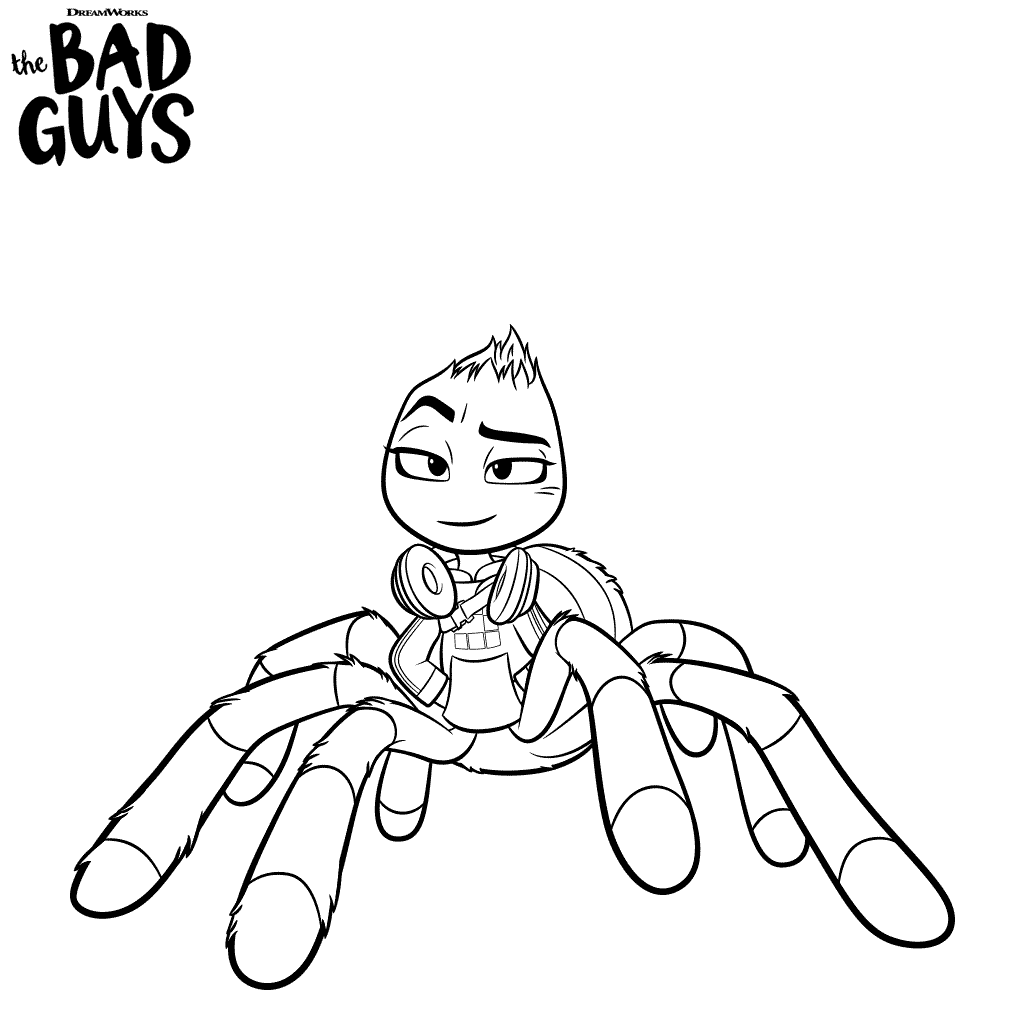
Ms. Tarantula – “Webs” – The Hacker
Ms. Tarantula is the gang’s technology specialist – a black tarantula who can hack any system, crack any network, and interface with any digital security in the time it takes the others to have a disagreement about the plan. She is small relative to the others, direct rather than dramatic, and consistently the most technically competent person in any room she inhabits.
Her design is the film’s most visually distinctive departure from conventional animated character design – a large, many-legged spider as a protagonist requires the audience to accept a body type that popular culture has conditioned them to find alarming. The film earns this acceptance quickly by giving her the most competent, driest characterization in the ensemble.
Her appearance: entirely black, with eight legs, multiple eyes arranged across a broad, flat face, and the specific compact weight of a large tarantula rendered at character-animation scale. She often operates a miniature laptop and appears in action poses that use multiple legs simultaneously.
Coloring Ms. Tarantula: Her primary color is near-black – not pure black but the very dark brown-black of actual tarantula coloration, with very subtle warm highlights along the leading edge of each leg segment and across the top of her abdomen. Her multiple eyes are white or very pale – small points of light in a dark face. The contrast between the near-black body and the pale eyes is the key visual element of her face design.
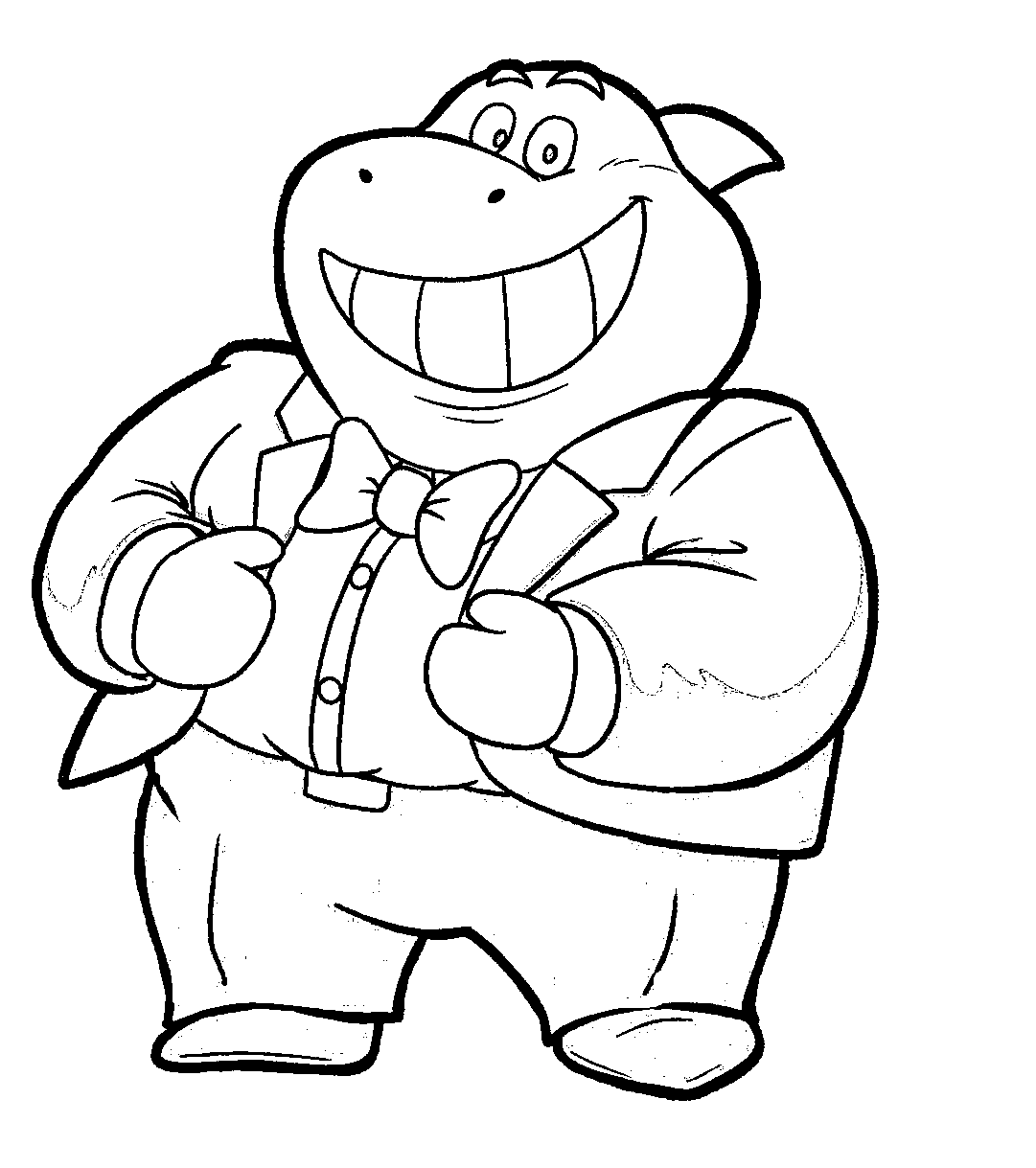
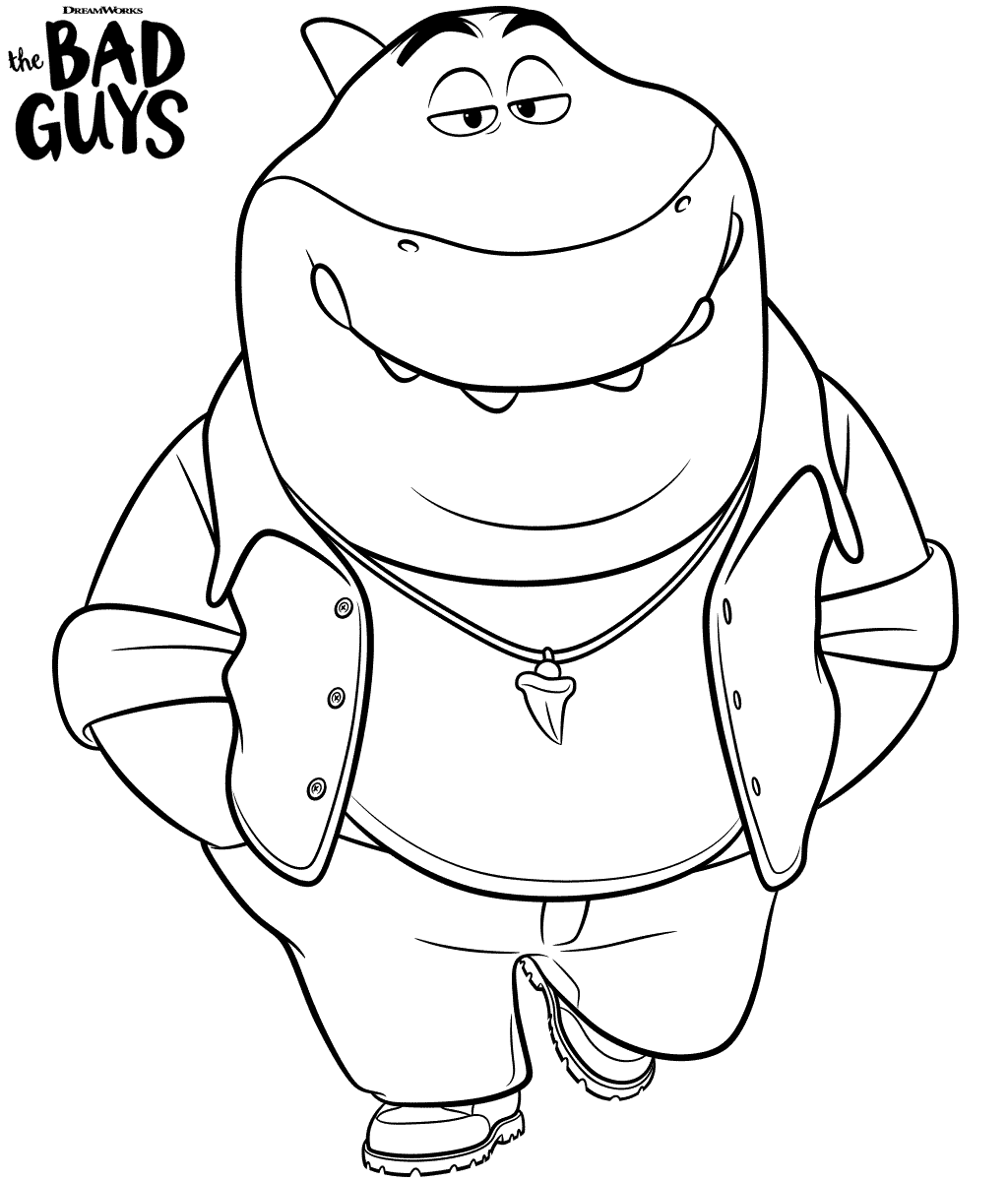
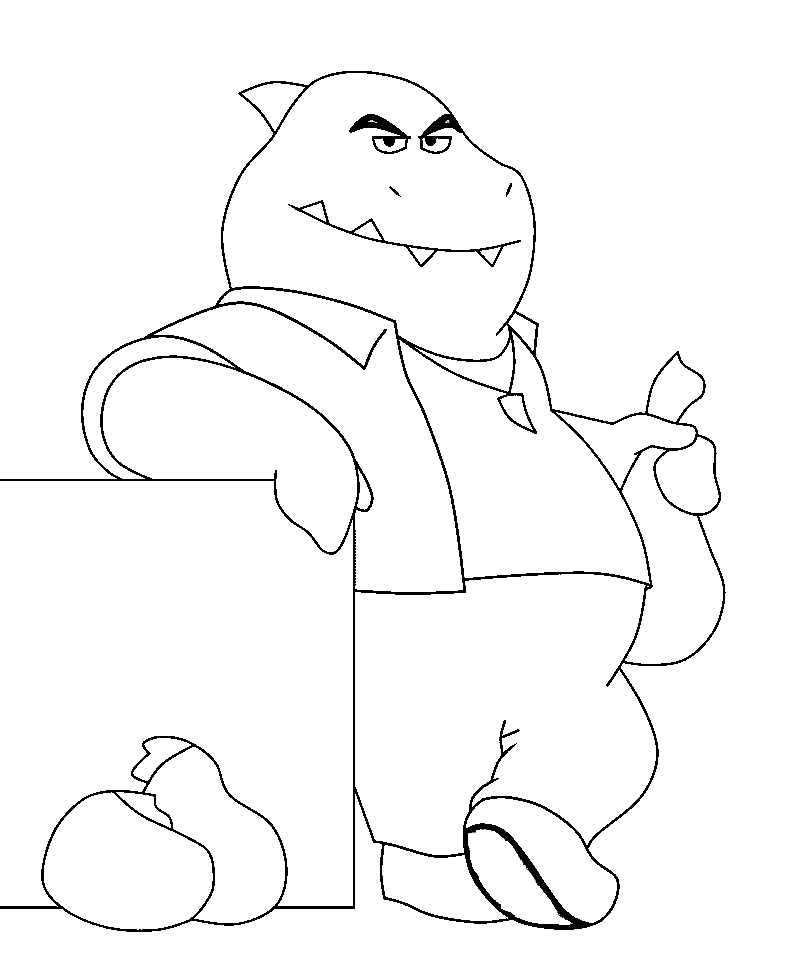
Mr. Shark – The Master of Disguise
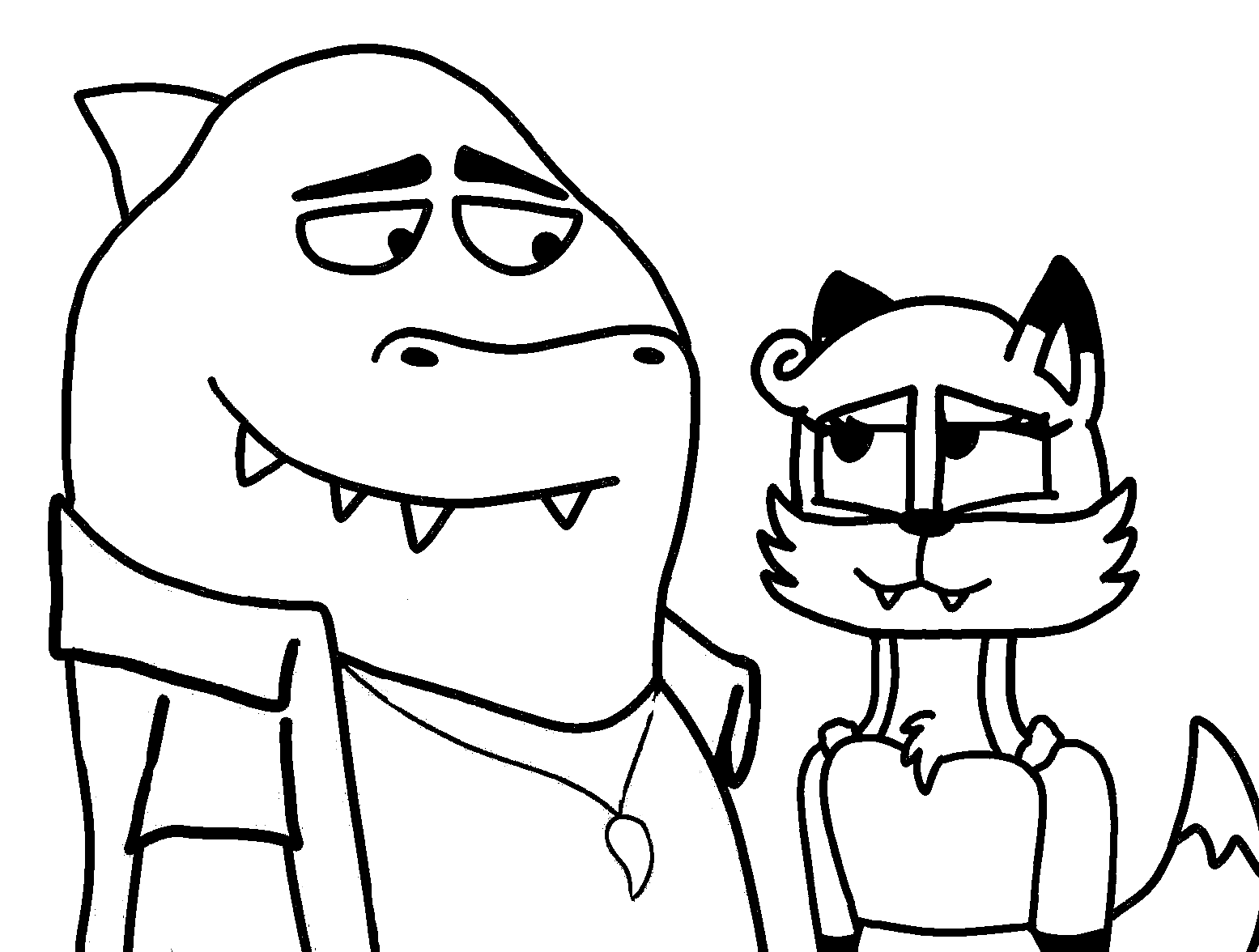
Mr. Shark is the gang’s disguise specialist – a large great white shark who, by the film’s logic, can disguise himself convincingly as any person or animal, including elderly women, police officers, and at one point, a flamingo. The comedy of this is compounded by the fact that the disguises are obviously insufficient – a shark in a dress is still recognizably a shark – but work anyway, because other characters are operating on the film’s internal logic that effort and commitment can overcome physical evidence.
He is the gentlest member of the gang – large, destructive by accident rather than intent, enthusiastic about his craft in the way of an artist who has found their medium.
His appearance: blue-grey (the blue-grey of open ocean water), very large, with a white underbelly, a prominent dorsal fin, and the wide, tooth-filled mouth that the film frequently uses for comedy by giving it expressions that contradict what a shark’s mouth is designed for.
Coloring Mr. Shark: His body is a cool blue-grey – the specific shade of a great white, which is a muted, slightly blue-shifted grey rather than a vivid blue. The back is darker, the sides lighter, the underbelly white – this three-zone gradient is standard for shark coloration and makes the body read as correctly oceanic. His eyes are small and dark against the grey face. When coloring disguise pages, his costume elements should contrast strongly with his unmistakably shark body – the comedy depends on that contrast being visible.
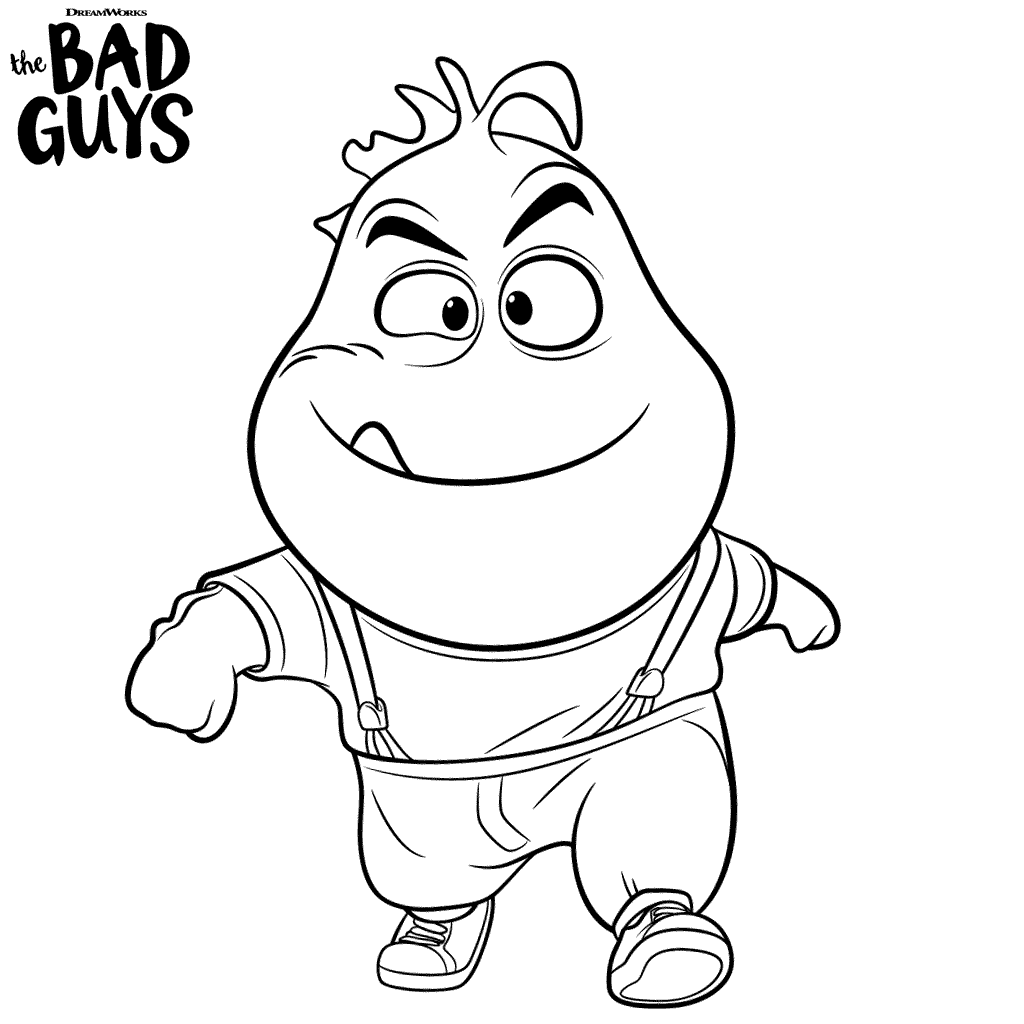
Mr. Piranha – The Muscle
Mr. Piranha is the gang’s enforcer – extremely strong, extremely impulsive, and extremely sensitive about remarks concerning his size. He is the shortest member of the group and the one most likely to resolve any situation by hitting it. He is also the one most likely to accidentally flatten a situation that was progressing well through impulsive action, then be deeply ashamed about it.
His flatulence – a running gag deployed at several crucial moments – is the film’s commitment to putting one piece of broad physical comedy in the hands of the smallest, most aggressive character.
His appearance: orange-yellow with the distinctive wide-jawed, tooth-prominent head of a piranha, small but physically dense in the specific way of a character who is all muscle, and frequently shown in poses that communicate maximum energy in a minimum frame.
Coloring Mr. Piranha: His body is a warm orange-yellow – vivid, slightly warm, in the range between orange and yellow without settling fully on either. His belly may be slightly lighter. His teeth are the most important detail – large, jagged, vivid white – and the most effective way to make him recognizable as a piranha in portrait pages. His eyes are small and intense.
Professor Marmalade – The Villain Who Doesn’t Look Like One
Professor Marmalade is an elderly guinea pig – small, white-furred, large-eyed, soft-voiced, the physical embodiment of harmlessness. He is a philanthropist who receives the Governor’s Award for Outstanding Goodness. He is the least threatening-looking person in any scene he appears in.
He is also the film’s villain: the orchestrator of a plan to steal the Golden Dolphin and frame the Bad Guys for it, using their reputation as predators to make them the obvious suspects while he operates behind his appearance of innocence.
The character is the film’s most direct statement of its theme – the assumption that what something looks like determines what it is, applied to a genuinely corrupt entity who exploits that assumption expertly.
Coloring Professor Marmalade: He is white or very light cream – the palest character in the film, consistent with the visual language of harmlessness. His large eyes should be the warmest, most friendly-looking element of his face – the film’s visual irony is that he looks exactly like what we expect a trustworthy character to look like. His clothing is typically formal and warm-toned – golds, warm creams – reinforcing the impression of respectability.
Governor Diane Foxington
Governor Foxington is the elected official who gives the gang their chance at reform – and who turns out to be the legendary criminal “The Crimson Paw,” a thief of remarkable skill who went legitimate and now runs the city. She is a fox – orange-red fur, white muzzle, dark-tipped ears and tail – and her design plays the same visual game as the rest of the film: a fox as law enforcement, suggesting trustworthiness through her official role while the film reveals a more complicated history beneath it.
Her relationship with Mr. Wolf develops through mutual recognition – two individuals who have constructed public identities over complicated personal histories, discovering that the other sees through the performance.
What These Pages Do
The Bad Guys uses animal design as a visual argument. The film places its five predator protagonists in a world that assumes their characters from their appearances, then shows that those assumptions are wrong. Coloring these characters – giving careful attention to the grey wolf in his black suit, the dark snake in his competent stillness, the enormous shark doing his best with a flamingo costume – is engaging with that argument visually. The pages carry the film’s theme in the design choices themselves.
The contrast between Professor Marmalade and the Bad Guys is a design lesson. The film’s visual irony – cute, small, pale, round versus large, predatory, dark – is immediately legible in the coloring pages. A child who colors both Marmalade and Mr. Wolf and sees how different the design languages are has encountered the film’s central point through direct visual experience before any words describe it.
Fine motor development through design detail. The American Academy of Pediatrics identifies fine motor development as a key childhood milestone. The suit details on Mr. Wolf, the scale pattern on Mr. Snake, the leg articulations of Ms. Tarantula, and the disguise elements on Mr. Shark – all provide the motivated, sustained fine motor practice that is most developmentally effective.
The 2005 Art Therapy Journal study applies. Structured coloring reduces anxiety through focused, sustained attention. The specific pleasure of rendering a character you recognize and enjoy – building Mr. Wolf’s grey fur and black suit, Snake’s dark olive body – produces the calm, absorbed state the research identifies as most effective.
How to Color These Pages Well
The suit is Mr. Wolf’s defining visual element – render it carefully. His black suit is what separates him from a simple grey wolf drawing and makes him read as a character with a specific social performance in progress. The suit should be visibly darker than his fur – if his grey fur is a medium grey, his suit should be near-black. Apply cool blue-grey highlights along the lapel edges and shoulder creases to give the fabric dimensional form. The white shirt provides the essential light contrast between the dark suit and the fur.
Mr. Snake’s body needs scale texture to read as a snake. The coloring pages that show his body in close-up or at length benefit enormously from some indication of scale pattern. Use the base olive-green across the entire body, then apply a slightly darker tone in a repeating pattern of overlapping curved rows – each scale catches shadow at its upper edge and lighter tone at its lower curve. The pattern doesn’t need to be precise; consistent rhythm creates the impression of scales without requiring individual accuracy.
Ms. Tarantula’s legs are the most spatially complex element. Tarantula legs have multiple segments that bend at specific joints – the femur, the patella, the tibia, and the tarsus. Each segment’s orientation determines where highlights and shadows fall. Before coloring any Webs page with detailed leg rendering, identify which segment faces upward (lighter) and which faces downward or sideways (darker). Consistent light direction across all eight legs is more important than precise anatomical accuracy.
Mr. Shark’s disguise pages are comedy pages – color the contrast. The comedy of any Shark disguise scene depends on the visual gap between his obviously shark body and the costume he has applied to it. Make both elements as clear as possible: the blue-grey of his body at full distinction from whatever warm, human-palette costume he is wearing. The funnier the color contrast between the shark and the disguise, the more effectively the page delivers the joke.
Professor Marmalade’s whiteness should feel deliberate. His pale design is the film’s visual trap – he looks harmless because he is pale, small, and round. Color him with that in mind: keep him as pale as possible, use only the warmest and most harmless-seeming color choices for his clothing, and make his eyes as large and soft as the page allows. The contrast with the visually darker, larger predator characters in the same scene is the point.
5 Creative Craft Ideas
The Big Heist Planning Board
Print individual portrait pages for each of the five Bad Guys. Color each in their canonical colors – Mr. Wolf in grey and black, Mr. Snake in dark olive, Webs in near-black, Mr. Shark in blue-grey, Mr. Piranha in orange-yellow. Cut each out as a portrait photo and mount them on a dark backing sheet arranged as if pinned to a corkboard.
Add hand-drawn strings connecting the characters to elements of a fictional heist plan written in the middle: “Target: The Golden Dolphin Award” with connecting strings, “Getaway: Mr. Snake,” “Hack the security: Webs,” “Distraction: Mr. Shark (disguise),” “Security: Mr. Piranha,” “Lead: Mr. Wolf.” Add the words “THE BAD GUYS” at the top in block letters.
The finished display looks like a detective board or a heist planning map – the visual language of the genre the film is working within.
Appearance vs. Reality Cards
Print two portrait pages each for Professor Marmalade and Mr. Wolf. Color the first Marmalade in his pale, harmless-looking canonical palette. Color the first Mr. Wolf in his default dark-suited criminal appearance. These represent “what they appear to be.”
For the second set: color Marmalade with darker, more menacing palette choices – shadows around the eyes, deeper tones suggesting malice beneath the surface. Color Mr. Wolf in warmer, more open tones – softer grey, a gentler expression, a tail mid-wag. These represent “what they actually are.”
Mount the four images in a 2×2 grid: “Appears To Be” across the top, “Actually Is” below. The finished display makes the film’s visual argument explicit.
Mr. Shark Disguise Hall of Fame
Print multiple Mr. Shark pages – specifically any that show him in different disguises. Color each one carefully, emphasizing the contrast between his unmistakably shark body and whatever costume he has applied. Mount all on a large backing sheet arranged as portrait photos in a gallery.
Give each disguise a title card below the image – “Elderly Woman,” “Flamingo Keeper,” “Police Officer” – and a score card rating the disguise’s believability from 1 to 10. Add a title: “Mr. Shark’s Disguise Hall of Fame: Ranked by Believability.”
Good Deed Tracker
Mr. Wolf’s character arc is measured by good deeds – each one producing the involuntary tail wag that tells him he is changing. Create a “Good Deed Tracker” craft using the coloring pages.
Print one large Mr. Wolf page – the most expressive portrait available. Color it carefully. Mount it on a backing sheet. Below the mounted image, create a tracker using hand-drawn tail silhouettes in a row – each tail representing one good deed the gang performs during the film. Color in each tail silhouette as you watch the film or remember the scenes: tail 1 for rescuing the cat, tail 2 for helping at the old people’s home, and so on.
The finished tracker is an interactive display – a record of the wolf’s arc through the film kept in coloring-page form.
The Team Introduction Card
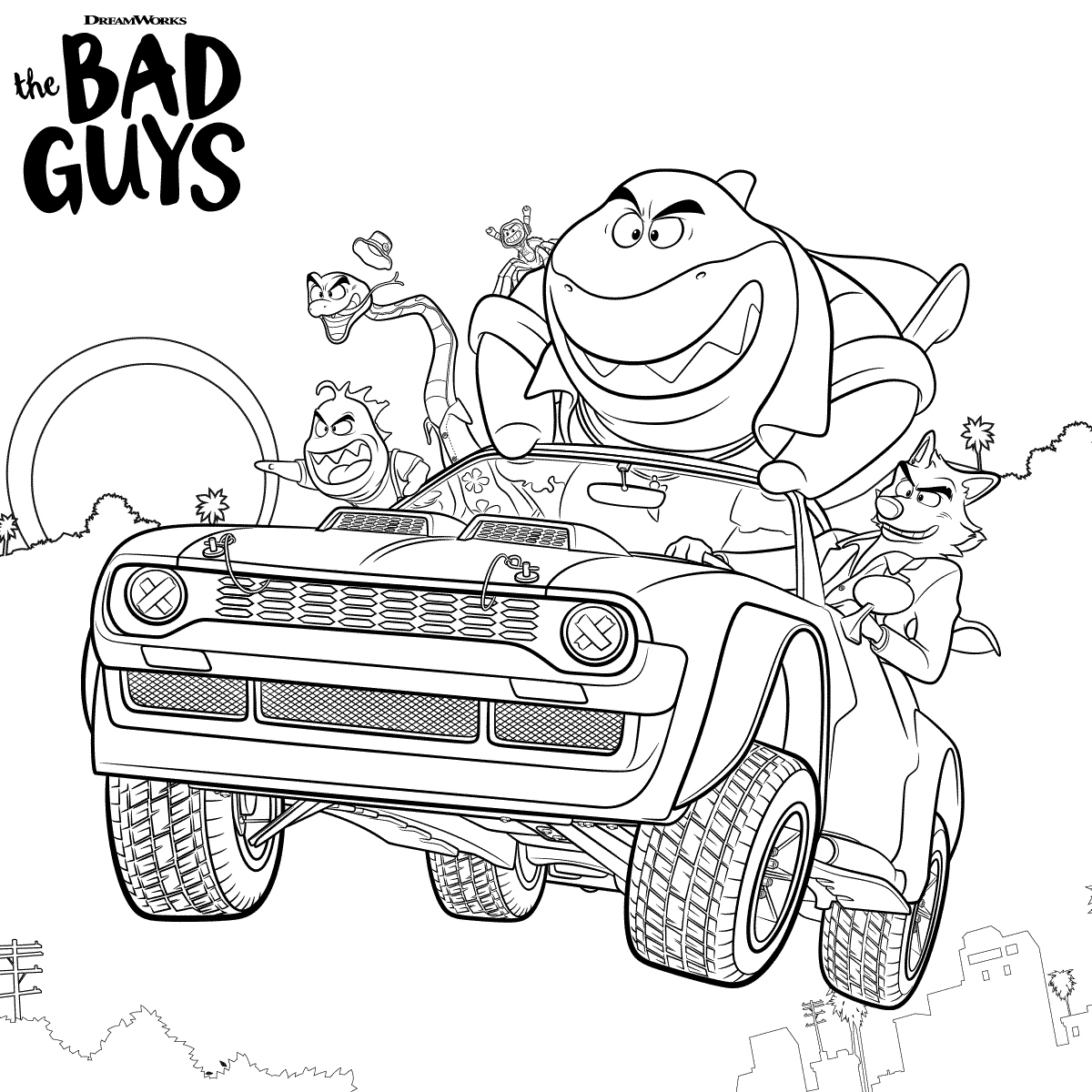
Print the full group shot page if available, or arrange the five individual portraits together. Color all five in their canonical colors – the palette should read as a coordinated team despite the very different colors involved: the greys and blacks anchoring the center (Wolf and Snake), the dark Webs, the cool blue of Shark, the warm orange of Piranha.
Mount on a black backing sheet. Add each character’s name and their role in the team: “Mr. Wolf – Leader,” “Mr. Snake – Safecracker,” “Ms. Tarantula (Webs) – Hacker,” “Mr. Shark – Disguise,” “Mr. Piranha – Muscle.”
At the top of the sheet, add “THE BAD GUYS” in block letters. At the bottom: “Occasionally Good.” The finished card is a team introduction display in the style of heist film character reveals.
Frequently Asked Questions
What is The Bad Guys film and who made it? The Bad Guys is a DreamWorks Animation film released on April 22, 2022, directed by Pierre Perifel in his feature directorial debut. The film is based on the graphic novel series The Bad Guys by Australian author Aaron Blabey, published by Scholastic beginning in 2015. The film was produced by Damon Ross and Rebecca Huntley. It stars the voice cast of Sam Rockwell (Mr. Wolf), Marc Maron (Mr. Snake), Awkwafina (Ms. Tarantula), Craig Robinson (Mr. Shark), Anthony Ramos (Mr. Piranha), Richard Ayoade (Professor Marmalade), and Zazie Beetz (Governor Foxington). The film grossed over $250 million worldwide.
Who are the five Bad Guys, and what is each one’s role in the gang? The five Bad Guys are Mr. Wolf, the leader and strategist; Mr. Snake, the safecracker and oldest member; Ms. Tarantula (known as “Webs”), the technology hacker and electronics specialist; Mr. Shark, the master of disguise; and Mr. Piranha, the enforcer and muscle. Each character’s criminal specialty corresponds to a conventional heist film role – the leader, the tech specialist, the disguise artist, the safe-cracker, the muscle – and each is a predator animal whose species gives the world around them reason to fear them, regardless of their actual behavior.
Is The Bad Guys based on a book series? Yes. The Bad Guys is based on the graphic novel series of the same name by Aaron Blabey, an Australian author and illustrator. The series is published by Scholastic and began in 2015, eventually comprising 18 books. The books are aimed at early-to-middle grade readers and are particularly popular with reluctant readers due to their combination of humor, action, and accessible format. The film’s story departs significantly from the books, which are more episodic and comedic, while maintaining the core gang and their dynamic. The books have sold millions of copies internationally.
Who is Professor Marmalade, and why is he the villain? Professor Marmalade is an elderly guinea pig who presents himself as a philanthropist and is awarded the Governor’s Award for Outstanding Goodness. He appears to be the safest, most trustworthy character in the film – his design deliberately deploys every visual cue associated with harmlessness: small, pale, round, soft-spoken. He is the actual villain: his plan is to steal the Golden Dolphin award and frame the Bad Guys, exploiting their reputation as dangerous predators to make them the obvious suspects while he operates behind his spotless public image. The character is the film’s most direct statement of its central theme – that appearance and reality are not the same thing.
What is the visual style of The Bad Guys film? The film uses a distinctive animation approach that blends computer-generated 3D animation with visual techniques drawn from 2D anime and graphic design traditions. Director Pierre Perifel was influenced by 1960s-70s heist films, anime action sequences, and the specific visual energy of graphic novels. The result is a film with a significantly different visual texture from most DreamWorks productions – faster, more graphically stylized, with strong black and white contrast in the character designs. The characters’ color palettes are deliberately restrained compared to typical animated character design: Mr. Wolf’s grey and black, Snake’s dark olive, Webs’s near-black – colors that read as cool, stylish, and heist-appropriate rather than child-cartoon vivid.
What is the main theme of The Bad Guys? The film’s central theme is the relationship between appearance and character – the question of whether what something looks like determines what it is. The five Bad Guys are feared because they are predators, assumed to be dangerous and criminal by default, regardless of their individual choices. The film follows their gradual, reluctant discovery that they can make different choices, while simultaneously revealing that the most trusted, least threatening-looking character in the film is actually the most corrupt. The film uses its animal-based character design to make accessible a point about assumptions, prejudice, and the possibility of genuine change.
What age group are these pages best suited for? The simpler character portrait pages work well from ages four to five for fans of the film who want to color their favorite characters. The more detailed pages – action scenes, group compositions, pages with background elements – are most rewarding from ages six to eight. The film itself is rated PG and is appropriate for most ages five and up, with the humor and character dynamics most appreciated from ages six through twelve. The coloring pages are appropriate for all ages in the collection’s target range. Adult fans of the film who enjoy the visual style will find the suit detail and scale-rendering challenges on the Wolf and Snake pages particularly satisfying.
Browse the full collection at ColoringPagesOnly.com. All 20+ pages free, no sign-up, PDF or PNG, print at home or color online.
Aaron Blabey started the book series in 2015 with five animal criminals who were feared because of what they looked like, and the question of whether that was the whole story. DreamWorks made it into a film in 2022 with a visual style that matched the graphic energy of the books and added a twist: the cute guinea pig was the actual villain.
The Bad Guys work because they take a premise children can understand immediately – judging someone by how scary they look – and spend a film demonstrating that this is not enough information. Mr. Wolf’s tail wags. He can’t help it. That’s the whole movie.
Pick up your grey. Build the suit from dark to darker. Let the tail wag when it’s ready.
Share your work on Facebook and Pinterest and tag #Coloringpagesonly. We especially want to see the heist planning boards and the appearance vs. reality card projects.
Color the gang. Question the guinea pig. Good guys and bad guys are more complicated than they look.
More from our animated film collections: