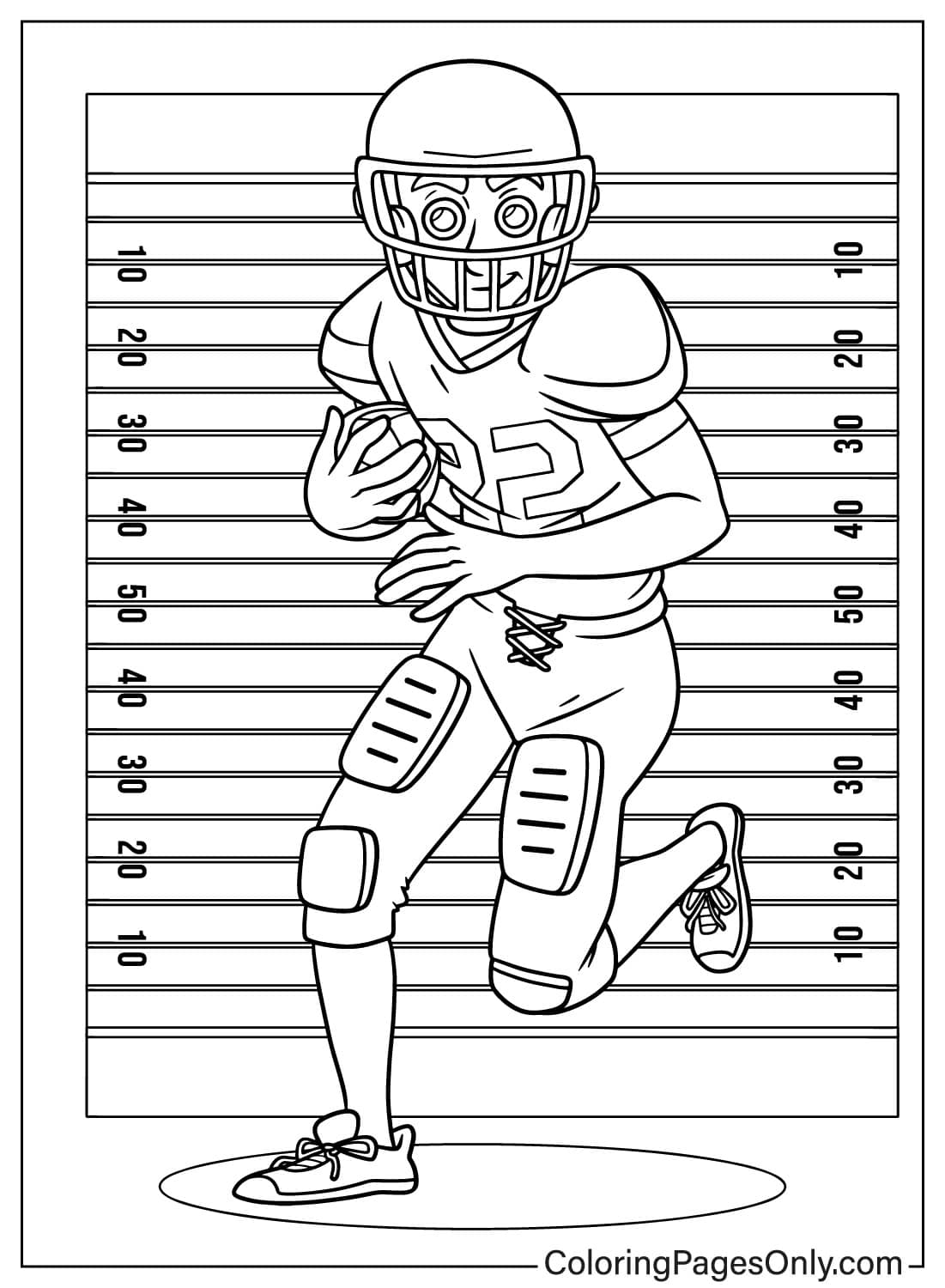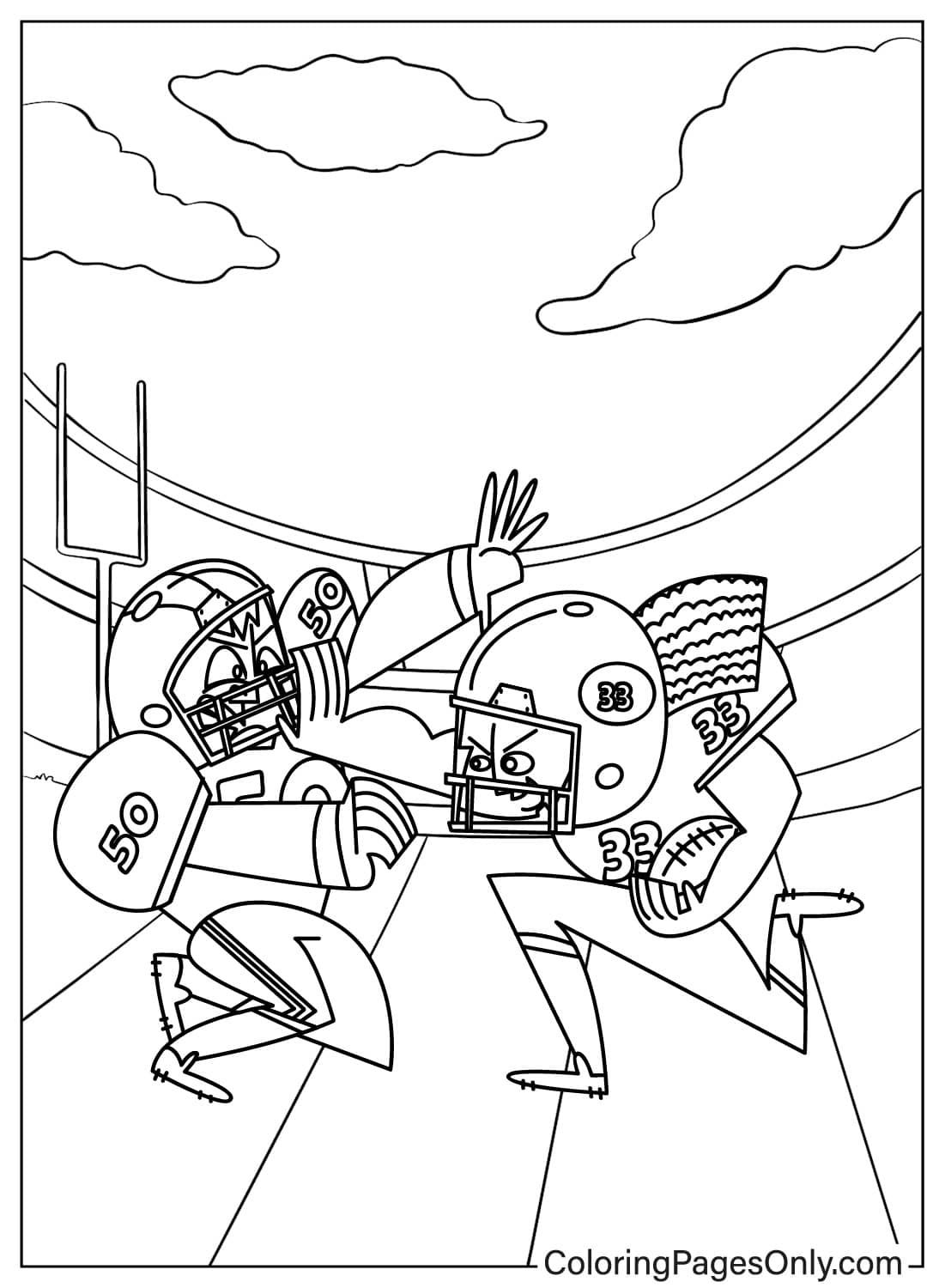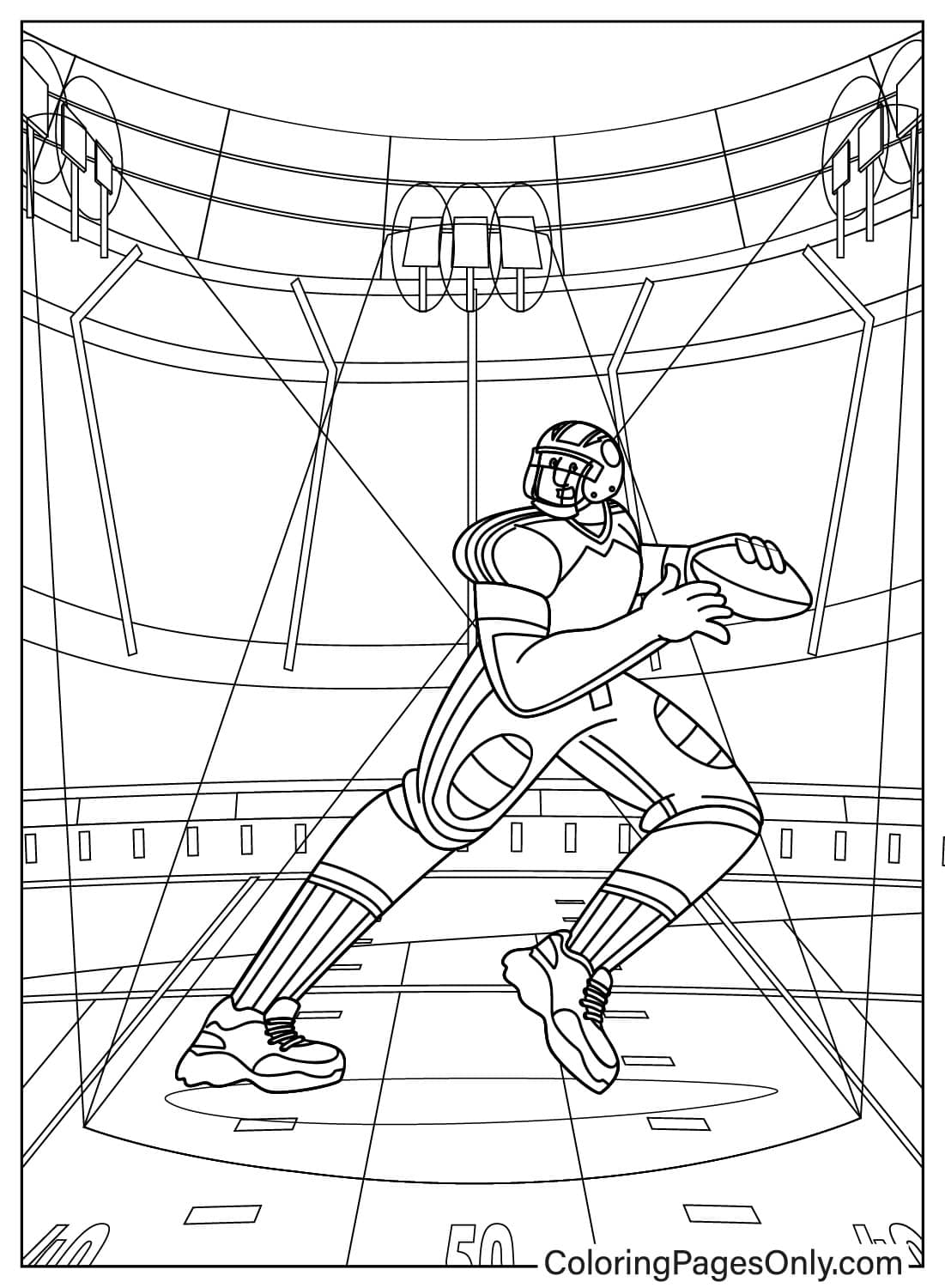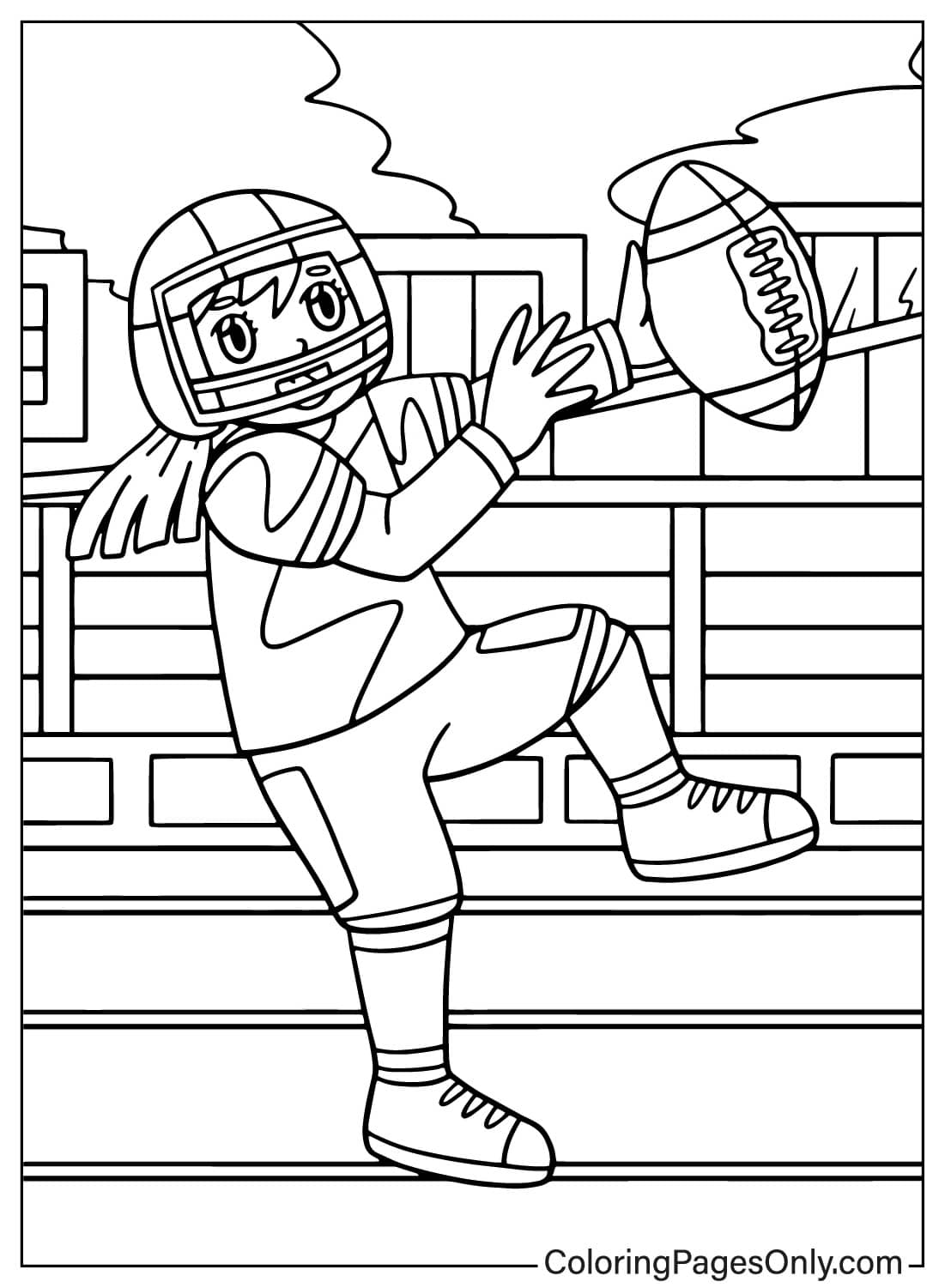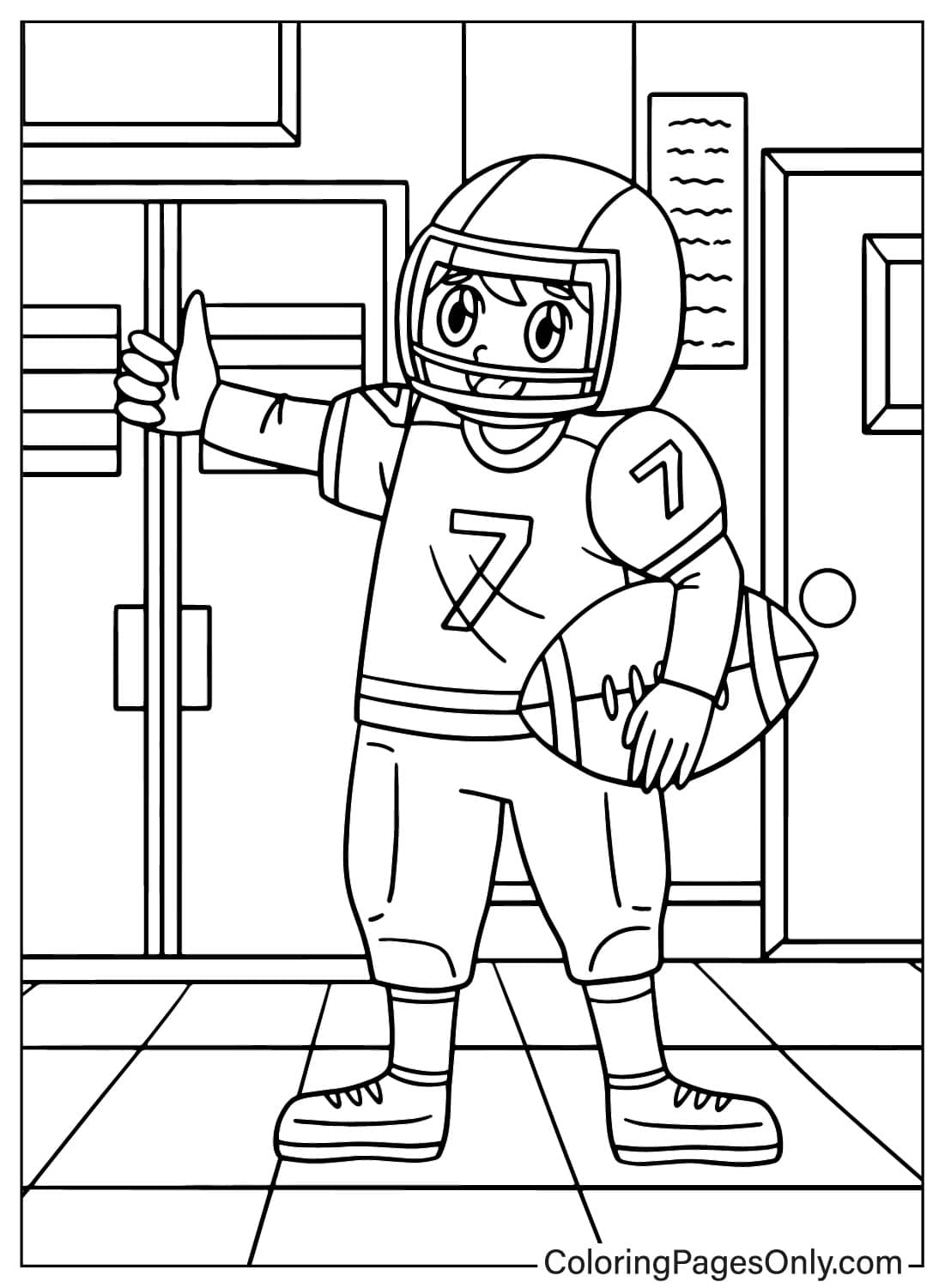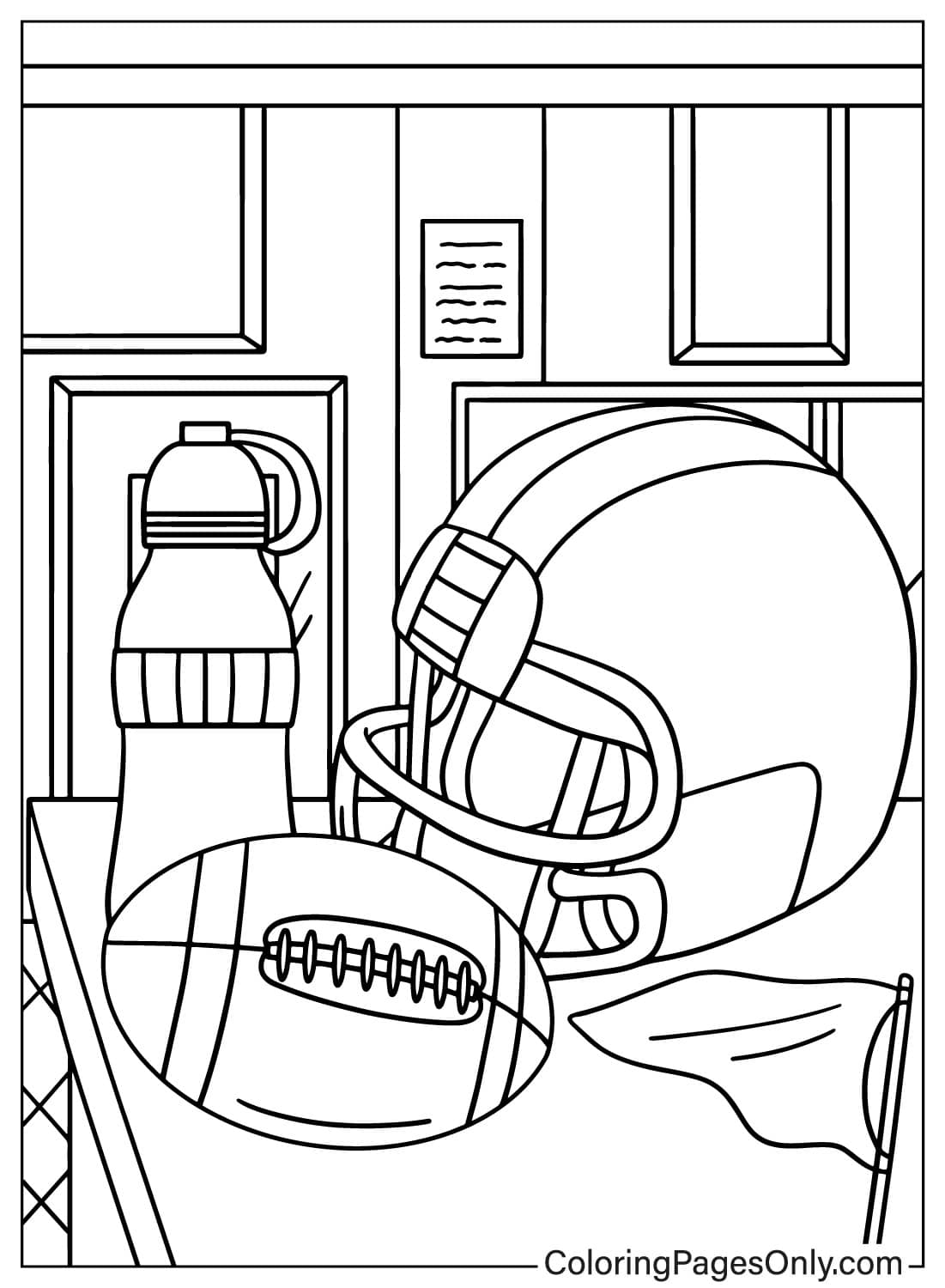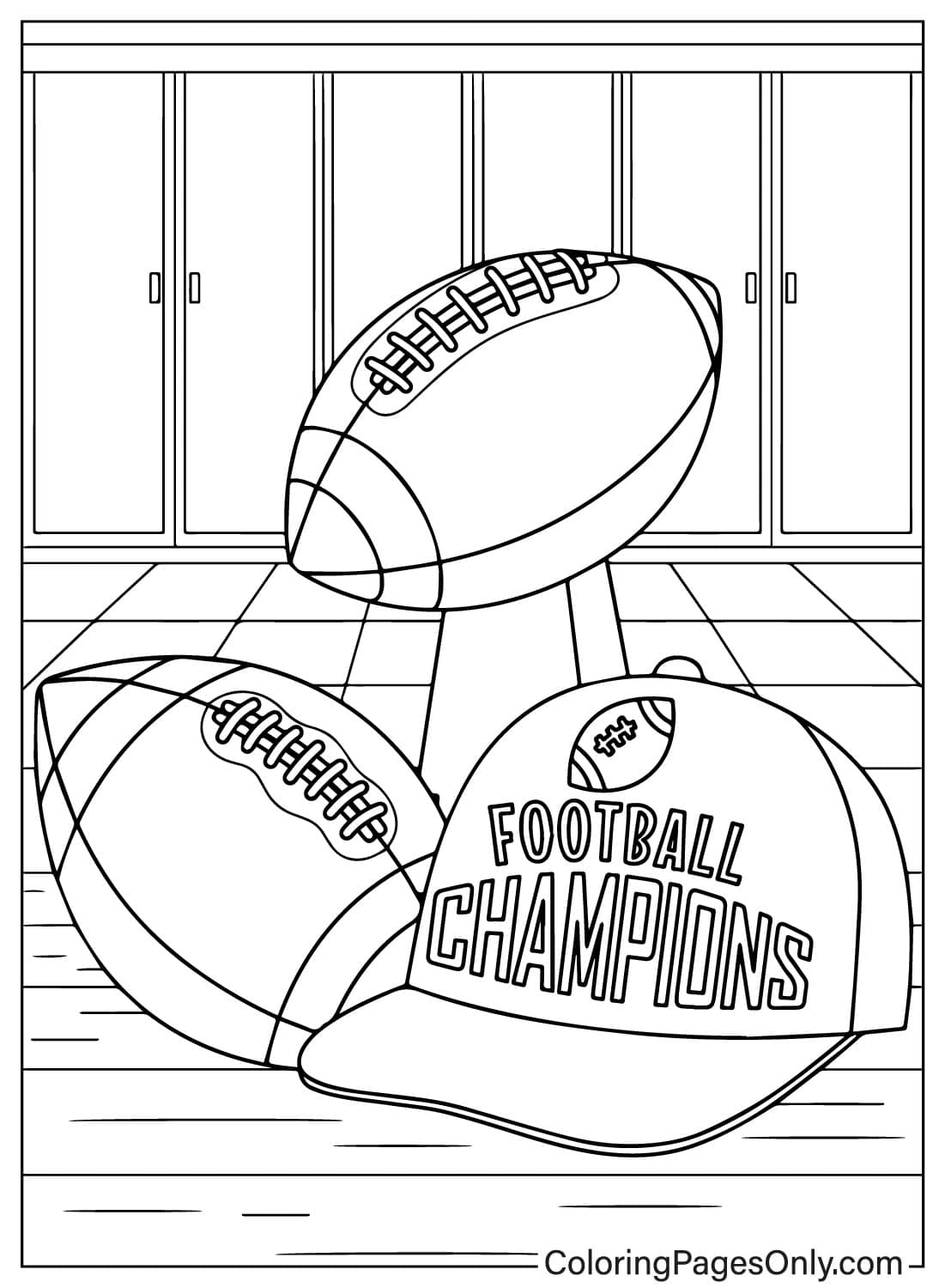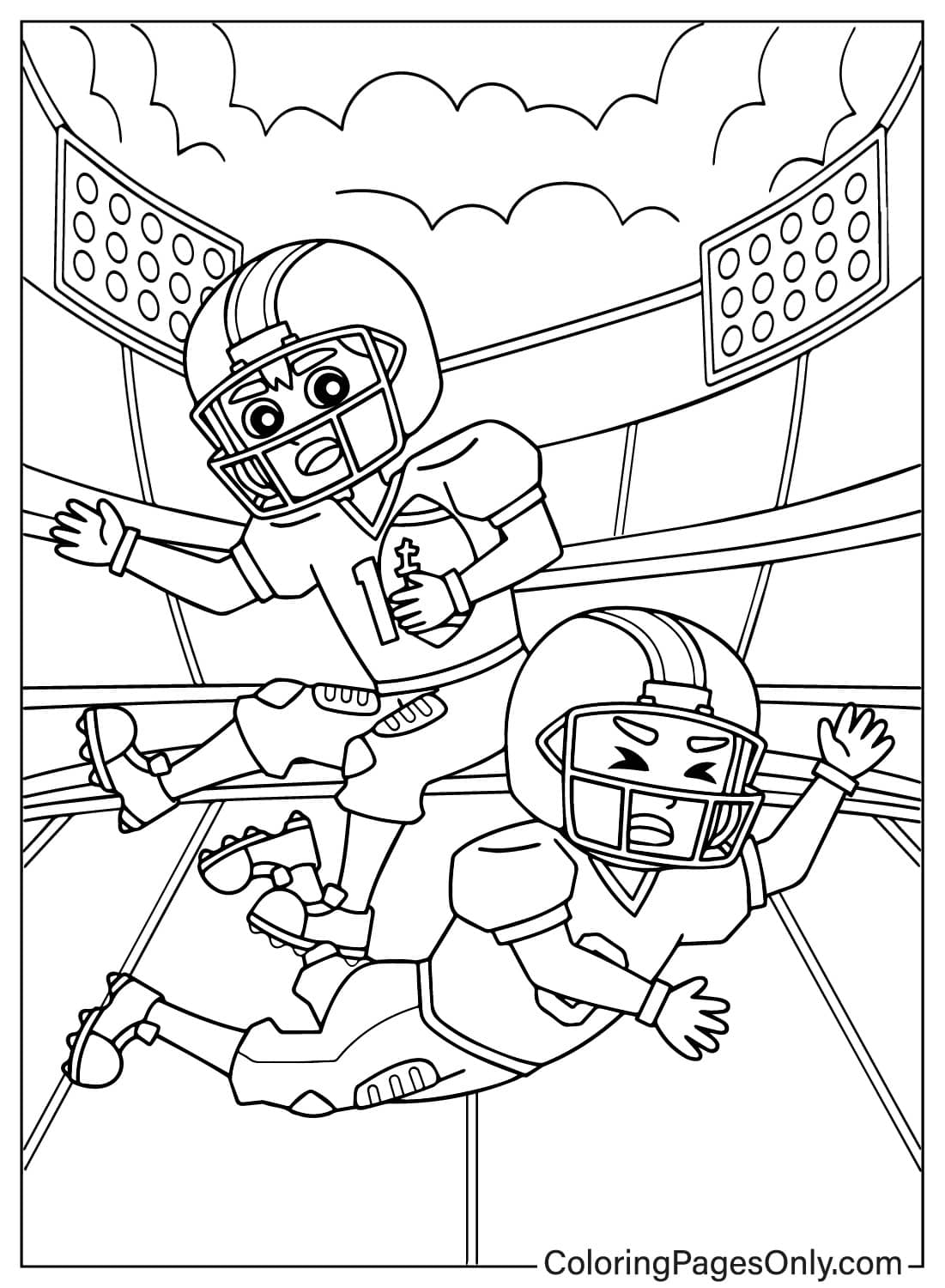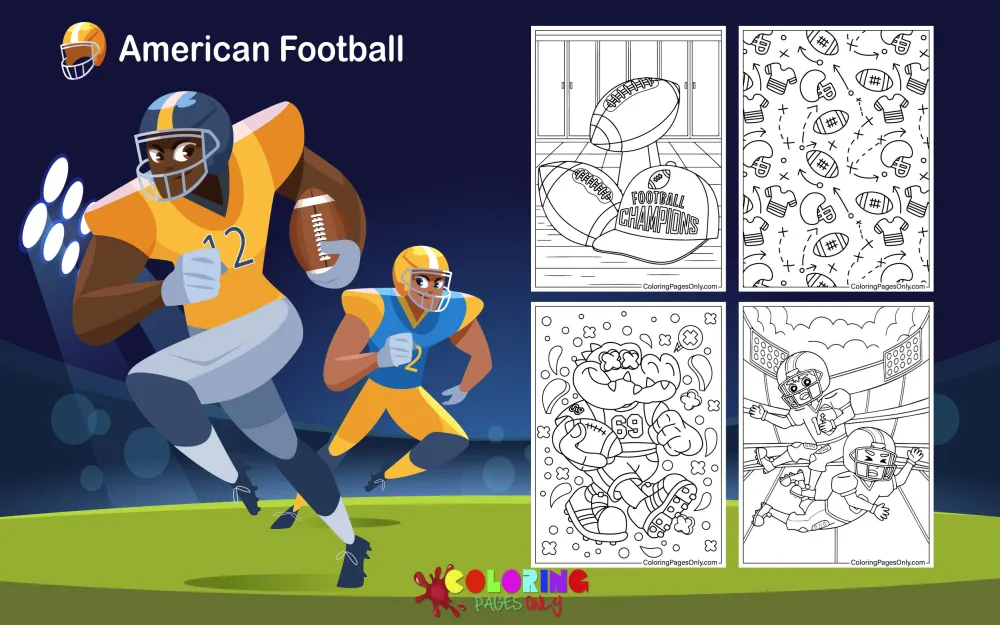
Explore 24 free football coloring pages featuring players in action, Patrick Mahomes, Travis Kelce, kids playing, equipment, cartoon characters, and creative templates – free printable PDF and online coloring for all ages.

November 6, 1869. Rutgers vs. Princeton. New Brunswick, New Jersey. That afternoon was officially the first intercollegiate football game in history, though anyone watching would have recognized it more as soccer than anything resembling what ends up on Sunday television today. The sport we know now came later, mostly from one man: Walter Camp, a Yale coach who in the 1880s invented the line of scrimmage, the snap from center, downs and distance, and the 11-player team. Everything modern football is built on, he figured out.

That origin story matters here because there’s something satisfying about coloring a sport with that kind of history behind it. These 24 free pages at ColoringPagesOnly.com cover the whole world of American football – action, equipment, NFL stars, kids playing, and cartoon characters in pads. All free, all printable as PDF, JPG, or PNG, all available online. Come on in.

What’s Inside Our Football Coloring Pages Collection?

The Action Pages – What Actually Happens on a Football Field

The best pages in this collection aren’t the standalone ball illustrations. They’re the ones that capture what football actually looks like in motion – and why it’s so hard to stop watching.

A player preparing to throw a football gets the moment right before the release. The weight back, the ball cocked above the shoulder, the eyes already somewhere downfield that we can’t see. The quarterback reads the defense faster than most people can process a sentence. That’s what this page is actually about – the compressed decision-making of the most analyzed position in American sport.

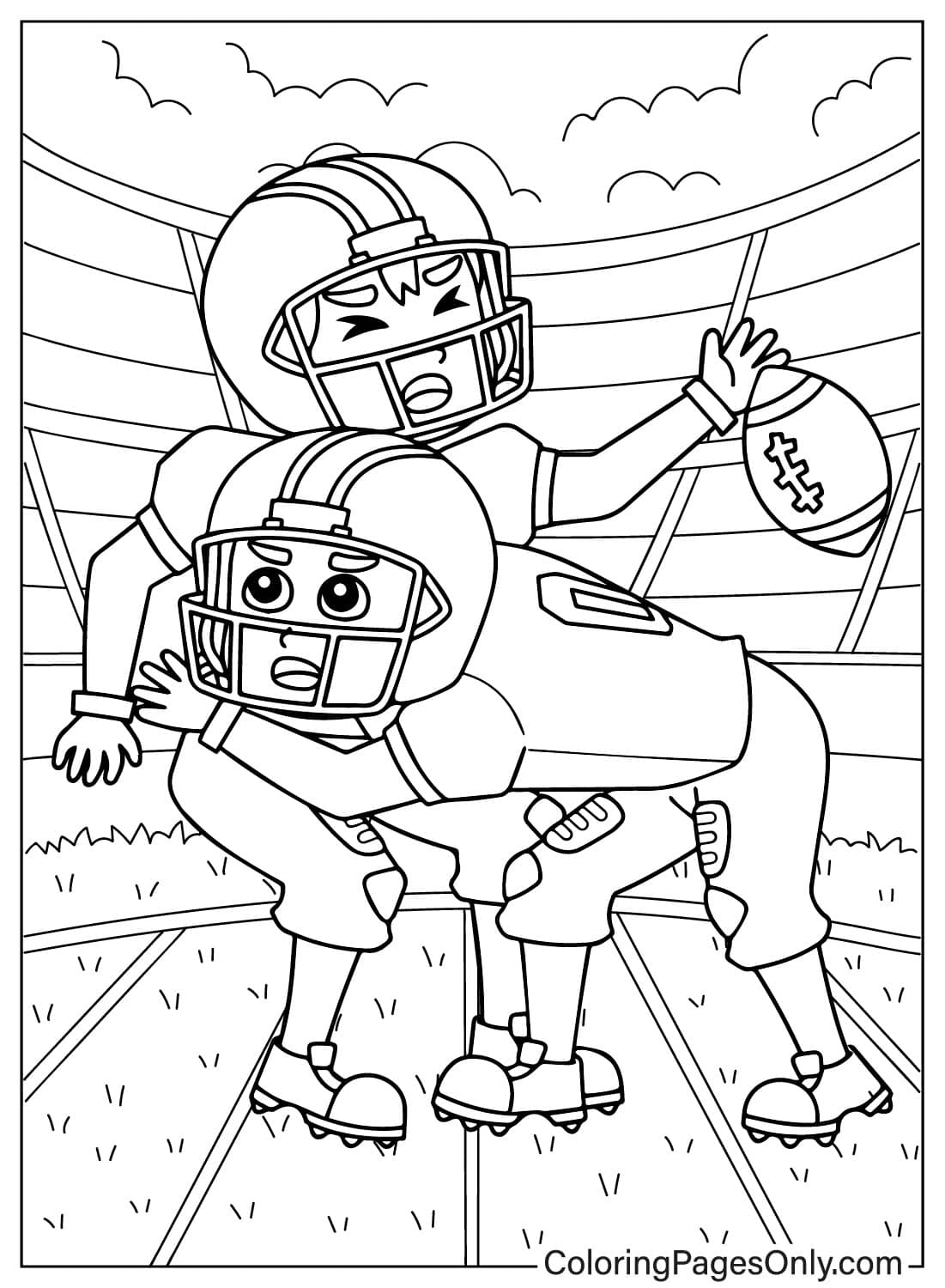
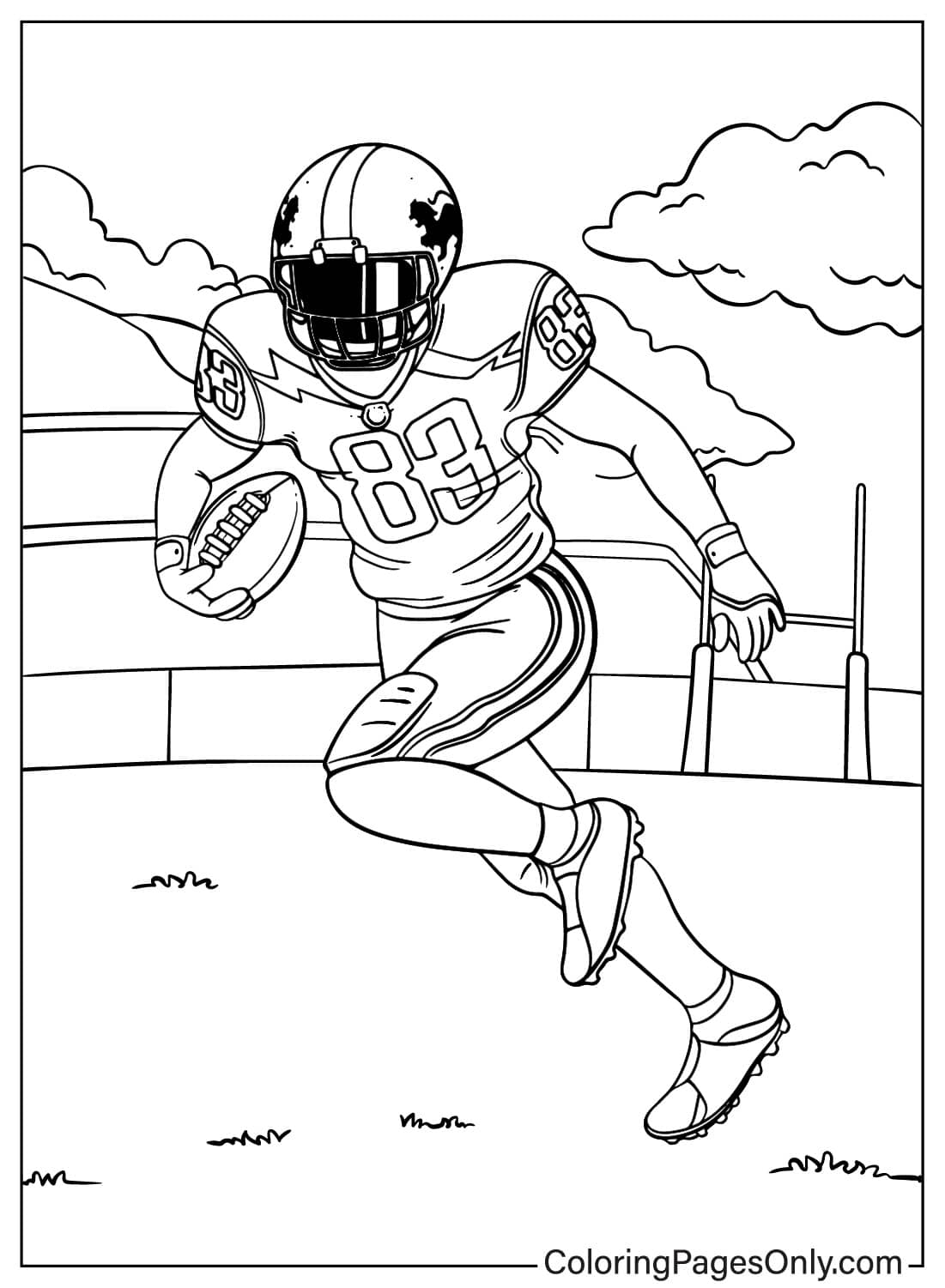
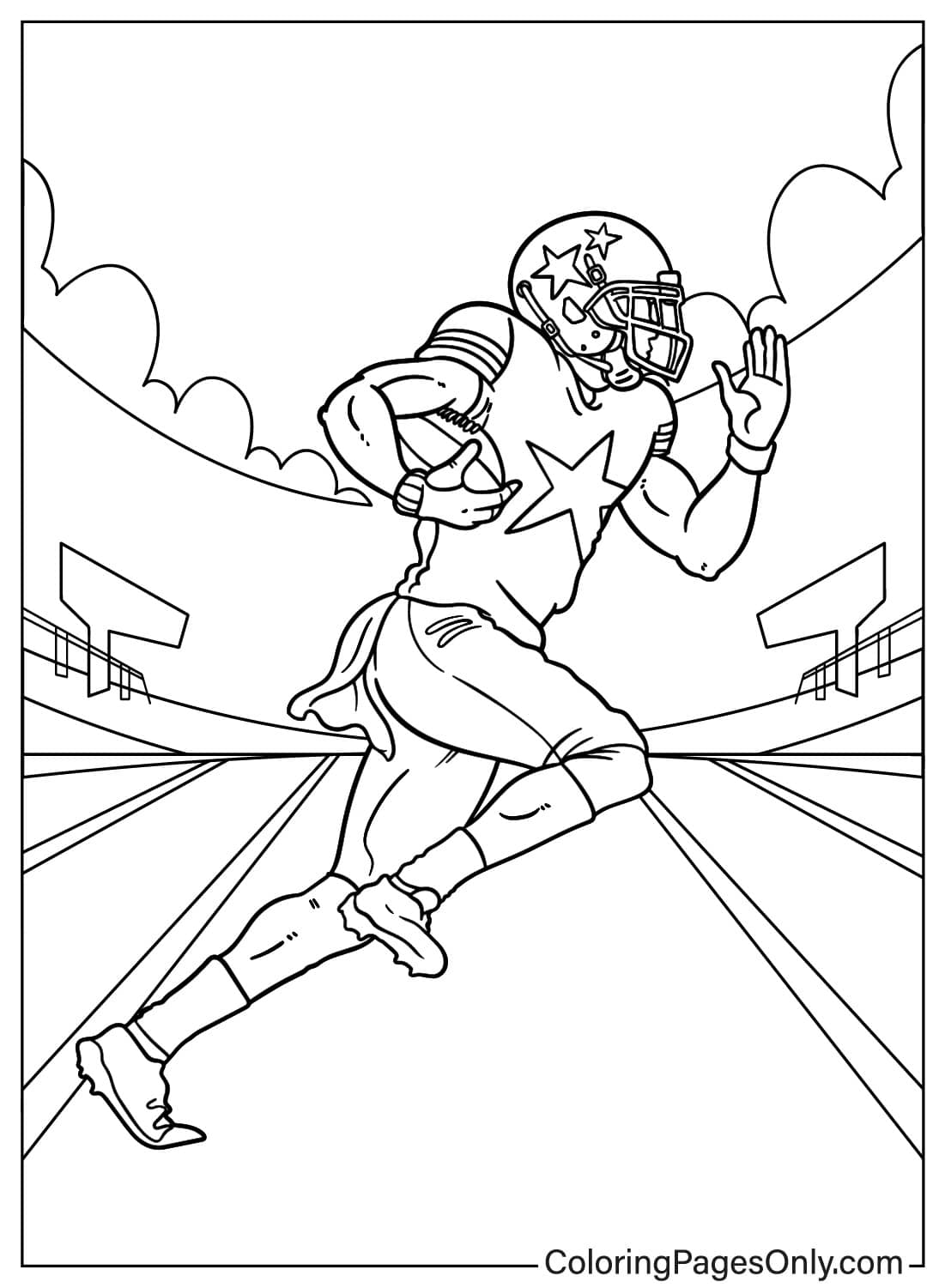
Player Catching A Football and Player Blocking Opponent’s Football show the two sides of every passing play: the receiver tracking a ball through the air while a cornerback runs stride for stride beside him, and the offensive lineman doing the work that nobody talks about – creating the three seconds of time that makes a completion possible. American Football Player Running and Football Players Competing On The Field and Players Playing On The Grass Field fill out the action section with the physical contact and open-field running that make football impossible to look away from.

Patrick Mahomes and Travis Kelce

Two pages here are genuinely different from the rest, and they deserve separate attention.

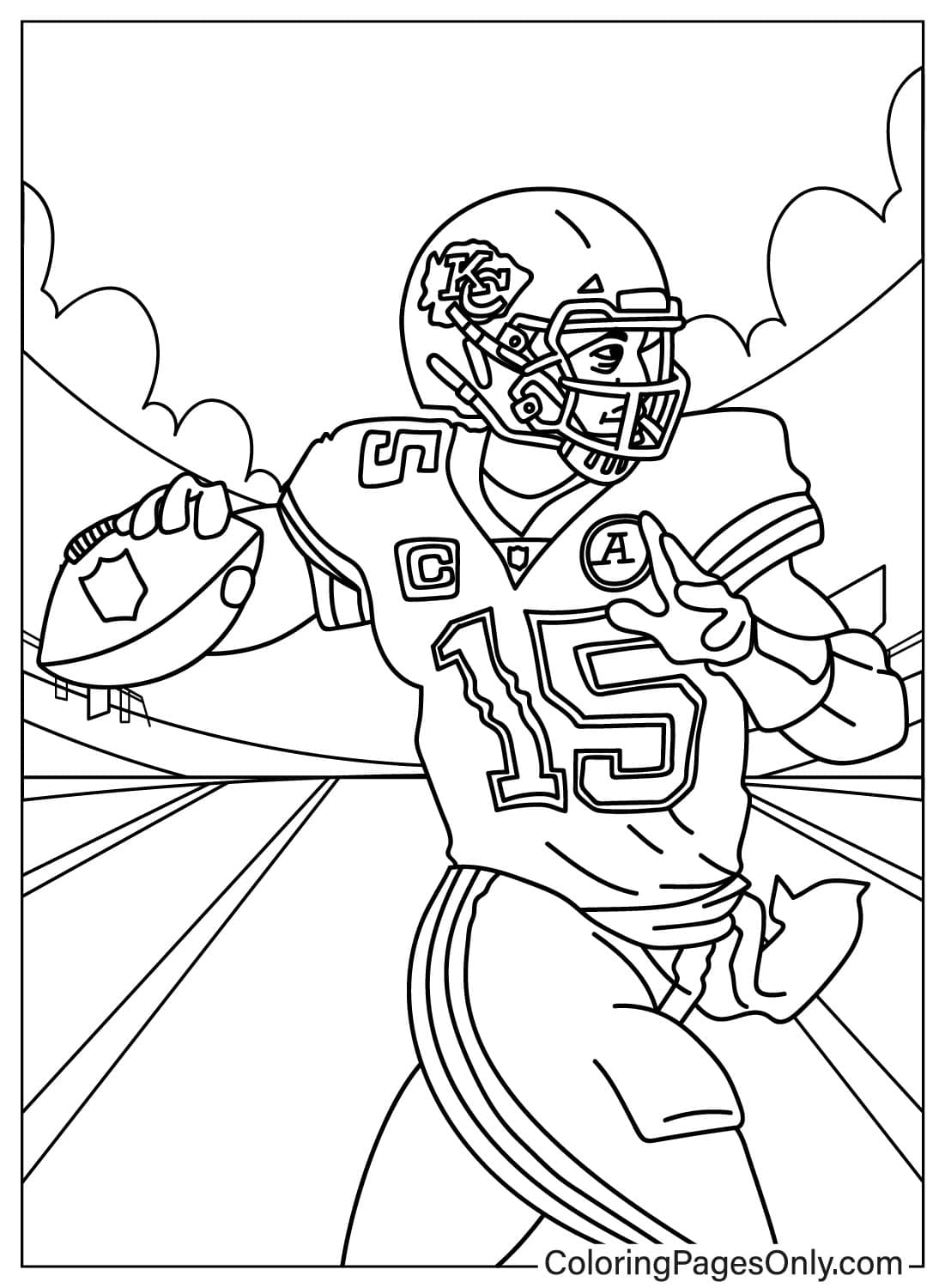
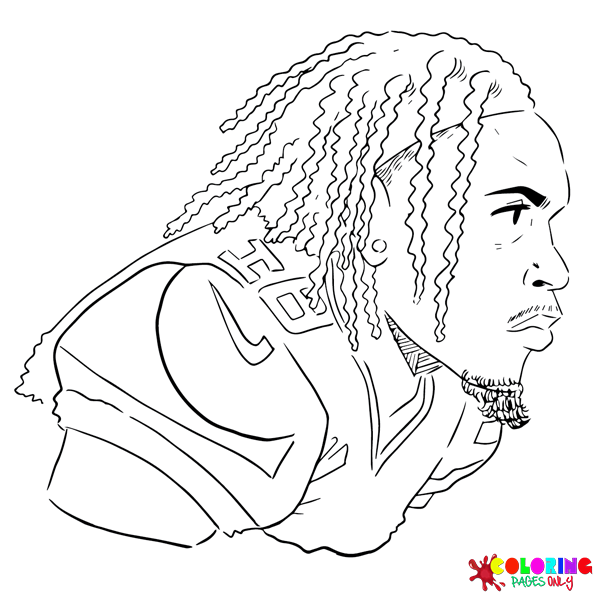
Patrick Mahomes Throwing A Football – Mahomes won his first Super Bowl at 24. He’s since added more, and the argument people are already making – that he’s the greatest quarterback in NFL history – gets easier to dismiss each year that passes without it being disproved. What makes him worth coloring, specifically, is the throwing motion: his ability to deliver an accurate ball from angles and arm positions that look physically wrong is the most distinctive thing about him visually, and any illustration of him throwing should capture that slight unconventionality.

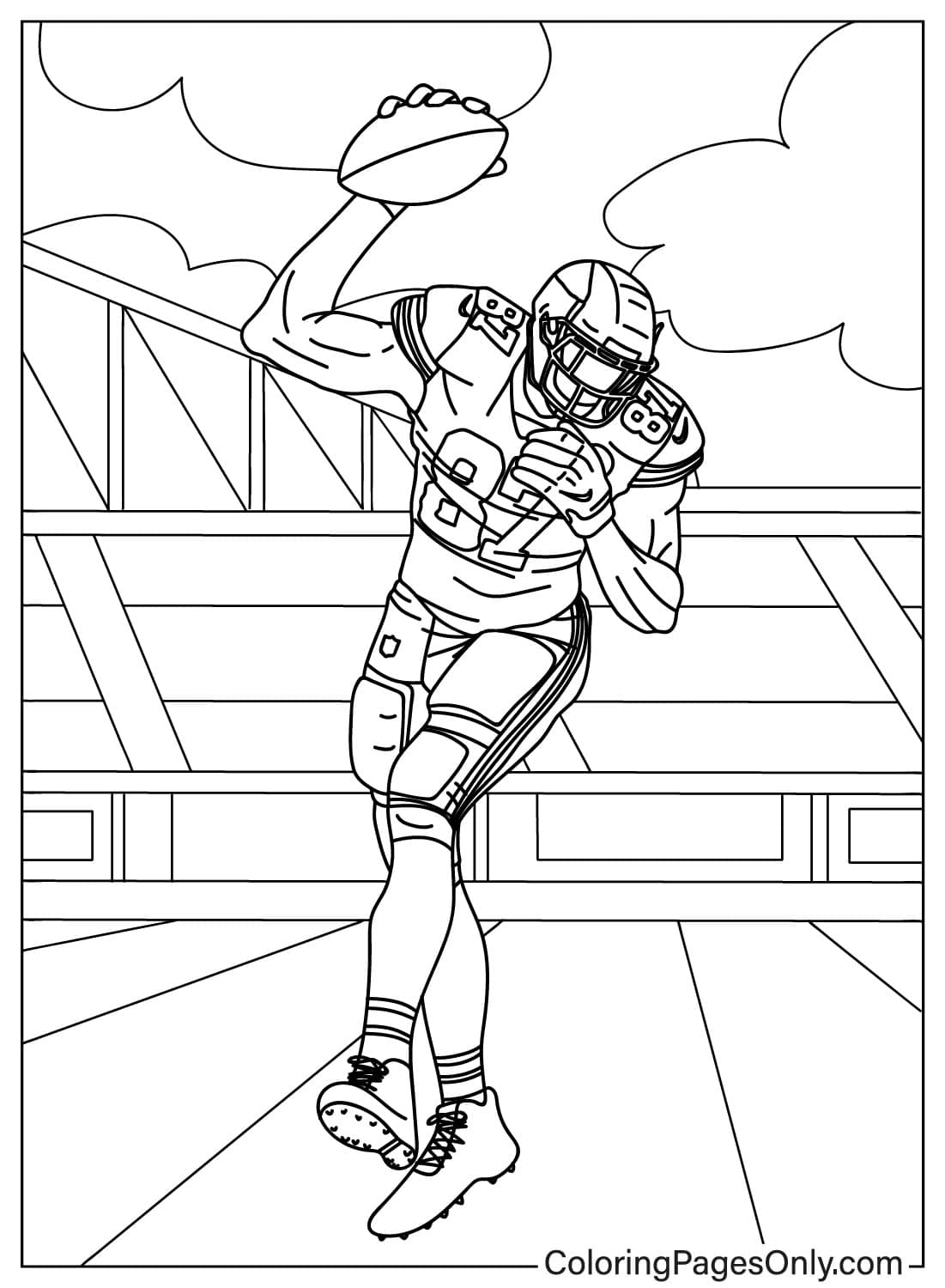
Travis Kelce Running – The record for consecutive 1,000-yard receiving seasons by a tight end. Multiple Super Bowl rings. The best quarterback-to-tight-end connection the league has seen in a generation. Kelce earns his page.

Color both in Kansas City red. A very specific, warm, slightly orange red – not fire engine, not brick. Get that right, and the pages look like they belong together.

Kids Playing Football

Little Girl Playing American Football, Little Boy Playing American Football, and Children Playing American Football are the pages that most directly connect to real life for the families who will use this collection. USA Football reports that youth flag football participation grew more than 35% between 2019 and 2024. Girls’ flag football is now a varsity high school sport in multiple states.

The Little Girl Playing Football page isn’t a statement. It’s just accurate.

Equipment – More Interesting Than It Looks

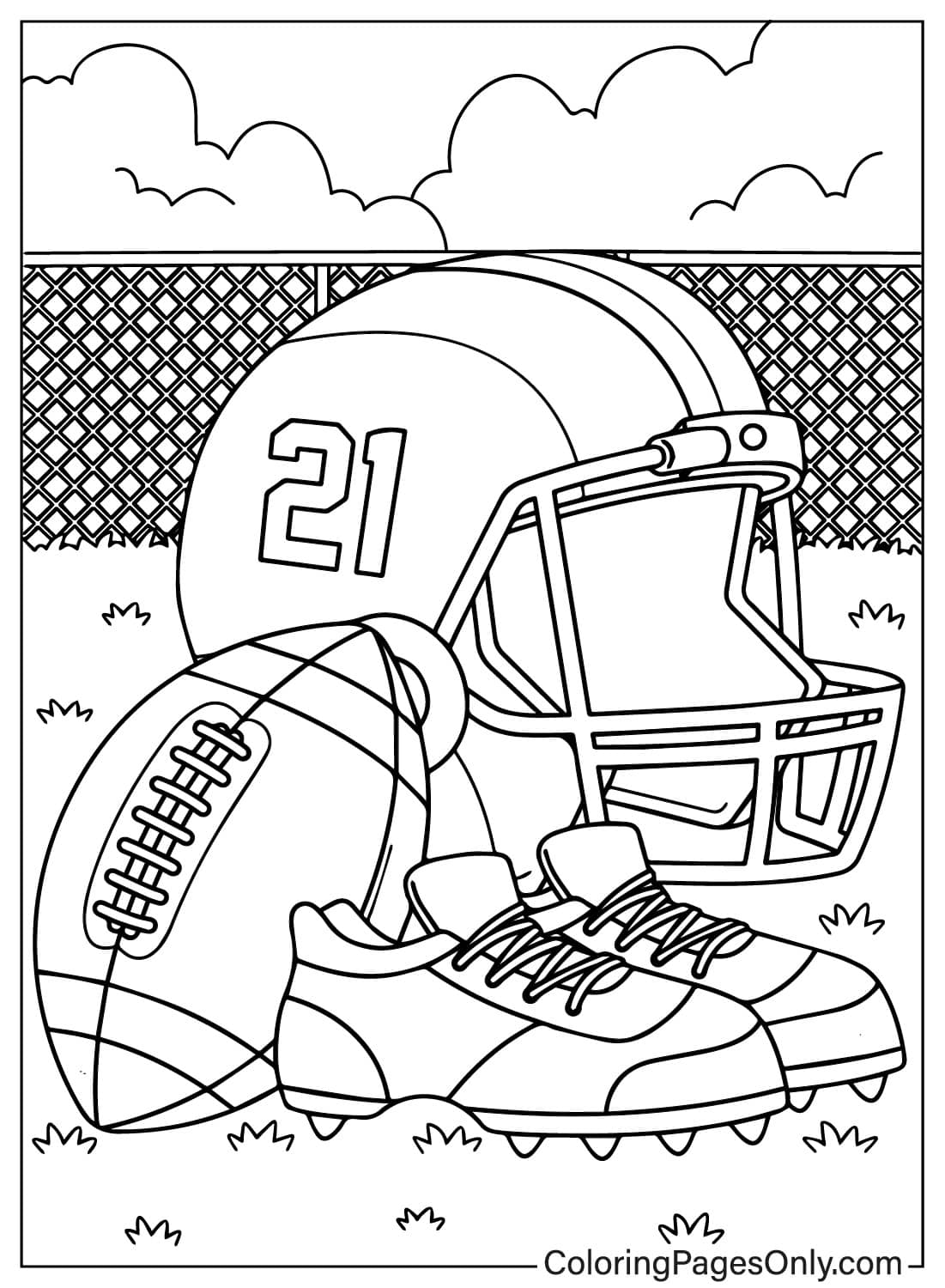
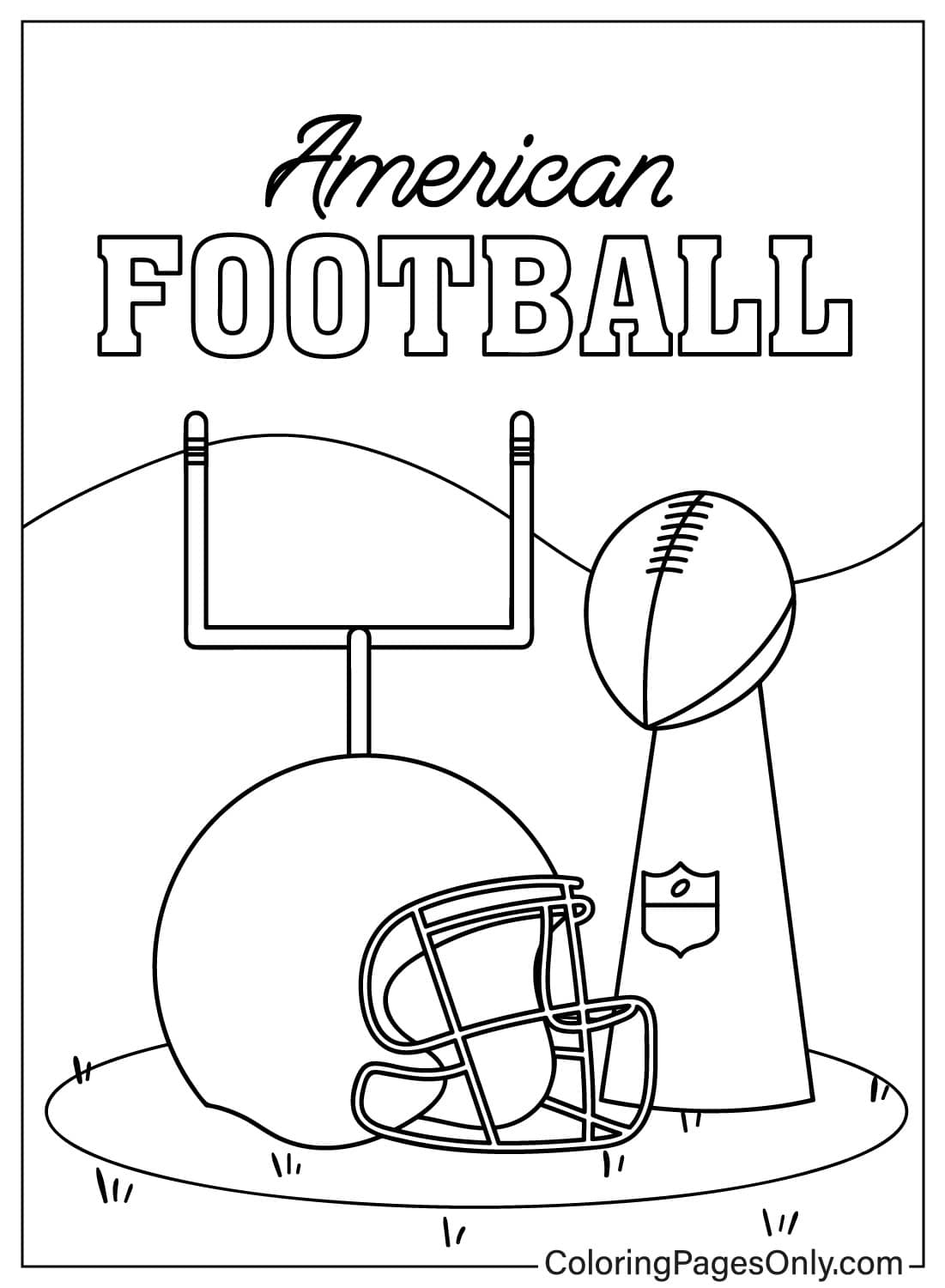
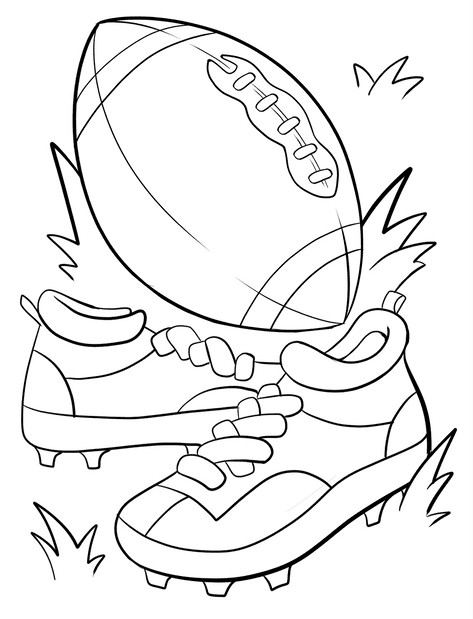
American Football Equipment, Helmet, and American Football for Players, and Football Ball and Shoes give you the gear in detail.

The ball: under NFL rules, 11 to 11.25 inches long, 28 to 28.5 inches around the middle, inflated to 12.5 to 13.5 PSI. Every number regulated, measured, and – after Deflategate in 2015 – taken more seriously by more people than you’d expect. The helmet: the most engineered piece of equipment in the collection, decades of materials science compressed into polycarbonate and multi-layer foam, still being improved every season.

Hats And Footballs For The Championship Team captures the specific image every football player sees in their head when the season starts – the commemorative hat appearing on the sideline in the final seconds of a game that just went their way.

Fun Pages – The Alligator, SpongeBob, and a Mascot

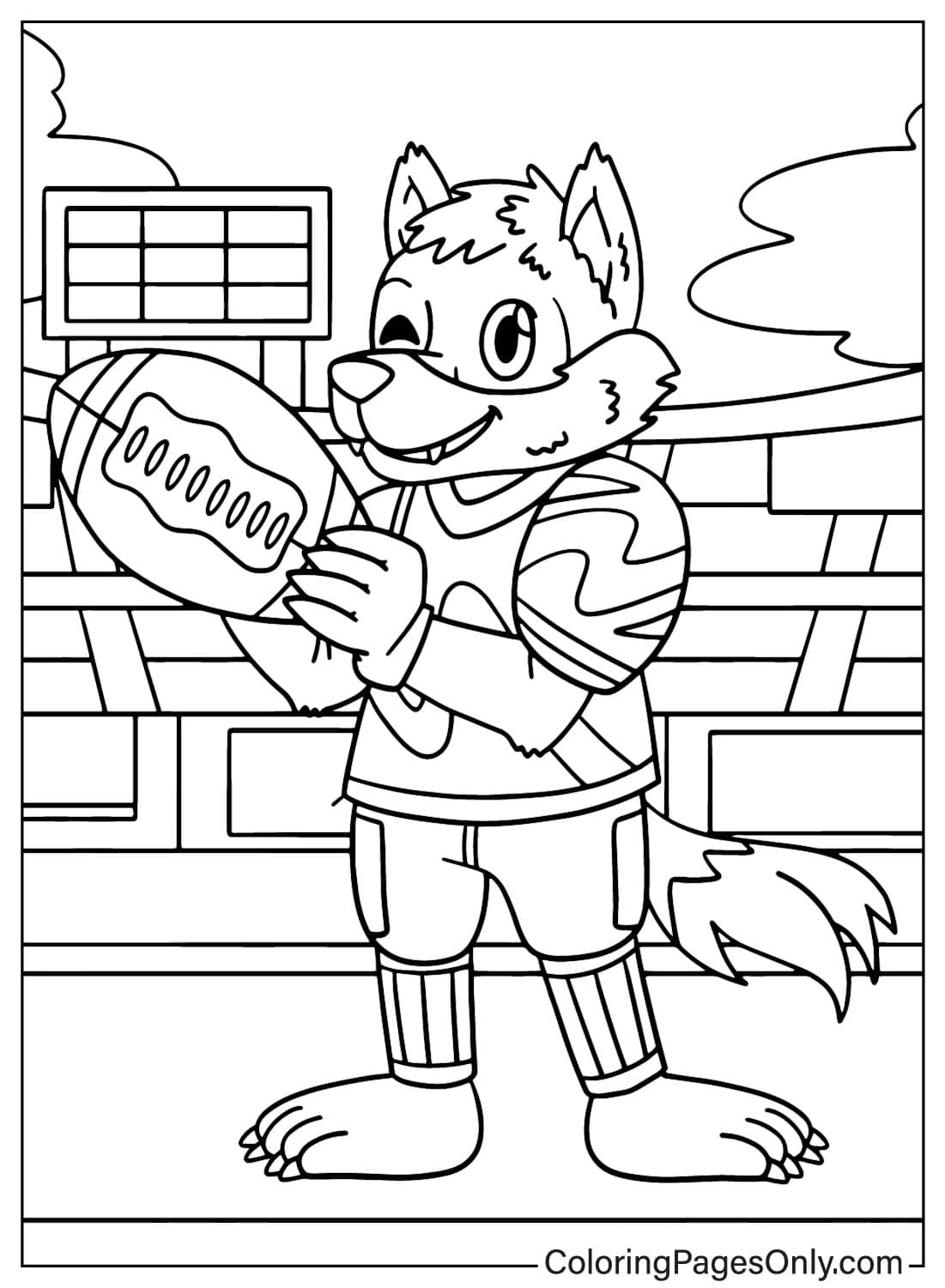
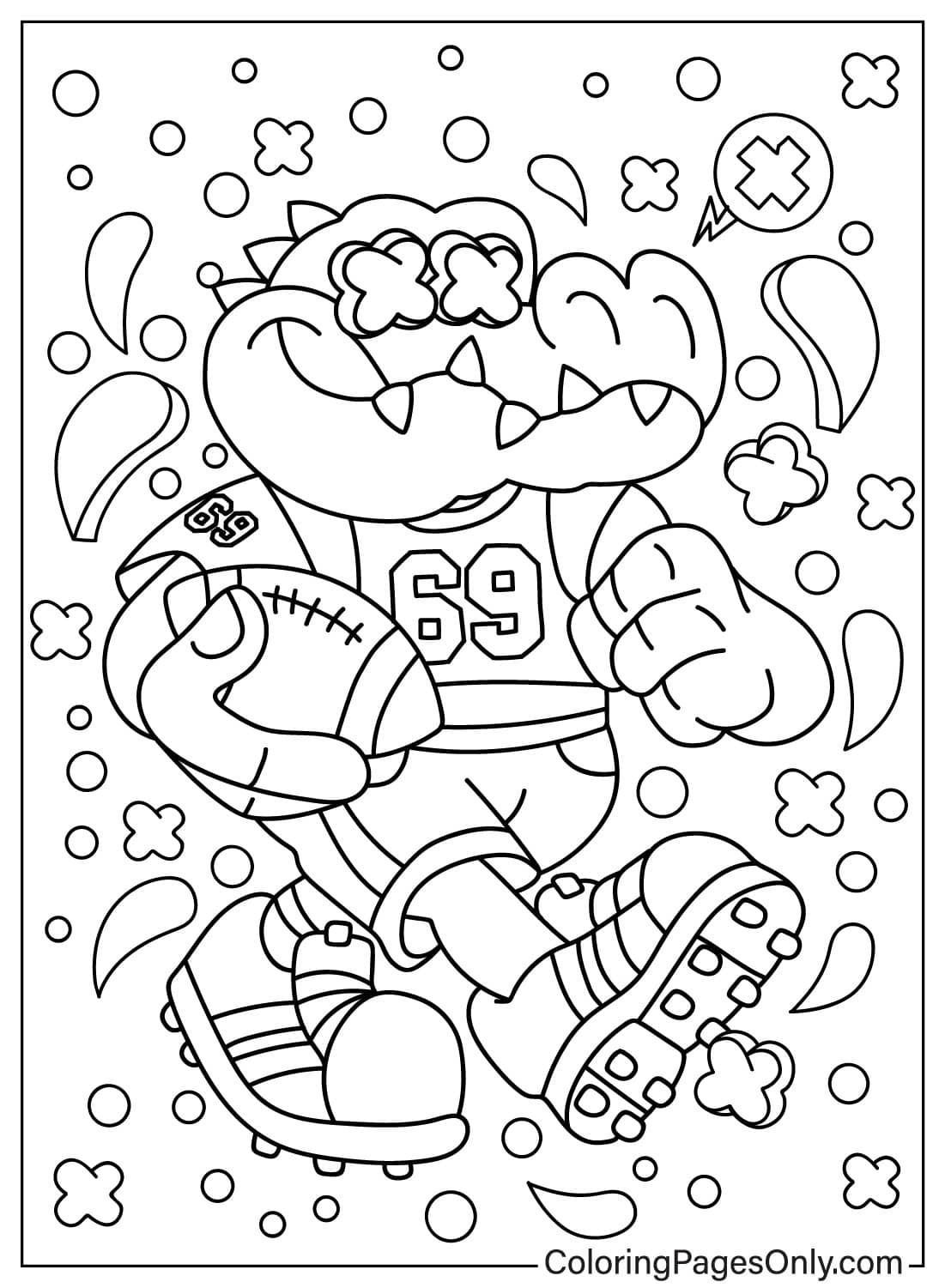
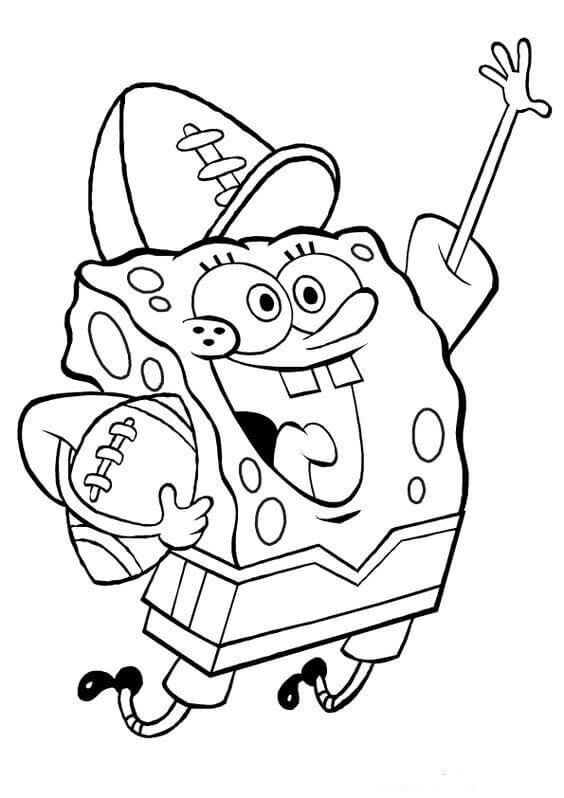
SpongeBob Football Player in full uniform. Alligator Wearing American Football Uniform – committed, padded up, apparently serious about this. American Football Team Mascot for anyone building a coloring session around a theme.

These three pages are the ones a six-year-old grabs first. Let them.

Template Pages

3D American Football Ball Template, American Football Gift Wrapping Paper Template, and American Football Card Template are designed to become something else – a craft project, a wrapped gift, a birthday card. The craft section below covers all three in detail.

Why These Pages Work

Free, always. Every page downloads as PDF, JPG, or PNG – no account, no payment, no steps between you and the file. PDF gives the sharpest print for home use. PNG works for digital coloring apps and transparent-background projects.

Color online too. The built-in tool works in any browser. Good for tablets, good for classroom devices, good for the moments when printing isn’t an option.

The NFL star pages are worth naming specifically because they’re the ones that reward genuine fan knowledge. If you know what Mahomes looks like in motion, what jersey number Kelce wears, what Kansas City red actually is – those pages mean more to you than they do to a casual viewer. That specificity is the point.

What Coloring These Pages Actually Does

It Builds Real Football Understanding

A child who has colored a blocking page – who has thought about the body position, the leverage, the fact that this player’s entire job is to make space for someone else – watches a running play differently. A child who has colored a quarterback mid-throw understands something real about the mechanics and the pressure of the position.

Sports psychology research is consistent on this: visual familiarity with a sport’s vocabulary and physical language accelerates genuine game comprehension. Coloring pages are, among other things, a slow, close-attention version of film study.

It’s How Families Talk About What They Love

For millions of households, football isn’t just a sport – it’s the rhythm of September through February, the reason for specific meals on specific days, the thing that connects a grandparent’s memory to a child’s first season of watching. Coloring a Patrick Mahomes page while explaining what makes him different is a transfer of knowledge that feels like conversation, not instruction. Research from the Aspen Institute’s Project Play consistently shows that shared sports experience within families – not just watching, but talking, engaging, caring together – is one of the strongest predictors of children’s lifelong relationship with physical activity.

It Develops Fine Motor Skills Through Genuinely Demanding Detail

Football equipment is complex. The facemask grille requires consistent parallel strokes inside a precise grid. The ball’s leather panel structure, lacing system, and painted stripes need careful differentiation. The helmet’s three-dimensional dome requires an understanding of light and shadow to read correctly. None of this is simple – and that difficulty is exactly why it’s valuable. The American Academy of Pediatrics identifies fine motor development as a key childhood milestone, and motivated, sustained coloring practice is one of the most accessible ways to build it.

It Helps After a Tough Loss

This one doesn’t get said enough. A 2005 study published in Art Therapy: Journal of the American Art Therapy Association found that structured coloring significantly reduced anxiety in adult participants. For children emotionally invested in a team – and some children are very emotionally invested in a team – a coloring session after a difficult loss gives the feelings somewhere to go. It’s not therapy. It’s just a quiet thing to do with your hands while you process.

How to Color These Pages Well

The ball wants layering, not flatness. Start with a warm medium tan – more orange than you think you need. Add a darker reddish-brown along the lower shadow half. Keep the white end stripes and lace strip clean and bright. The three finger holes go dark grey, nearly black, with a thin lighter rim to show depth. A football colored this way looks three-dimensional. A football colored as a flat tan oval doesn’t.

Team colors are worth looking up before you start. Kansas City red is warm and slightly orange – not fire engine, not dark red. Dallas silver leans almost to white in some applications. Philadelphia midnight green is darker and cooler than a typical forest green. Philadelphia Eagles fans notice when you get it wrong. Get it right, and the pages reward you.

Helmets have a dome that catches light. Apply the base team color across the whole shell, then add a lighter near-white highlight near the top center where the curve faces directly upward. Add a slightly darker shadow tone along the lower sides. The facemask bars are cylindrical – each one gets a light top edge and a darker bottom edge. None of this requires advanced technique, just the decision to think about the light source before you pick up the first colored pencil.

The action pages want directional strokes. A running back in stride doesn’t want flat, random coloring. Apply color strokes that follow the direction of movement on the limbs – forward on the leading leg, back on the trailing arm. It takes an extra minute, and it changes everything about how the figure reads on the page.

For the kids’ pages, go bright. Children playing football don’t need realistic team colors. They need yellow and orange and vivid blue and whatever combination makes the page feel like Saturday morning. Use the most energetic colors you have and don’t overthink it.

3 Craft Ideas That Go Beyond the Page

Football Gift Wrapping Paper

The American Football Gift Wrapping Paper Template page was designed for this exact purpose, and it works. Print it on standard paper, color it in your recipient’s team colors – vivid, saturated, not tentative – and use it to wrap a gift directly. For larger presents, scan the colored sheet and tile-print multiple copies.

A ribbon in the team’s secondary color, a handwritten tag, and you have gift wrap that nobody else has. Football fans notice the details. This is a detail.

Decorating American Football Gift Wrapping Paper
Decorating American Football Gift Wrapping Paper (Resource: esty.com)

3D Football Ball

The 3D American Football Ball Template is genuinely impressive when assembled correctly – more impressive than the process suggests it should be.

Print on the heaviest cardstock your printer handles. Color before cutting: tan base, dark shadow half, white stripes, detailed lacing. Score the fold lines with the back of a butter knife before folding – the crease will be clean instead of torn. Assemble with craft glue, one tab at a time, holding each connection for thirty seconds. Leave one panel open until everything else is set, then close it last.

Put it on a shelf during the season. It holds up.

Turning Into A 3D American Football

Football Birthday Card

Choose three or four pages: the quarterback throwing, a running player, the helmet and ball equipment page, and the card template. Color everything in the recipient’s team colors so the finished card reads as intentional rather than random.

Cut out the colored figures and layer them on the card front – overlapping creates depth. The quarterback can emerge from one edge, the helmet floats above the ball, and the running player is mid-stride across the lower half. Write the birthday message inside in a bold marker in the team’s primary color.

Spend twenty minutes on this card, and it goes on the wall. That’s the metric.

Creating A Birthday Card
Creating A Birthday Card (Resource: ewe-niquecards.com)

Frequently Asked Questions

When was the first American football game played? November 6, 1869, between Rutgers and Princeton at New Brunswick, New Jersey. The game resembled soccer more than modern football – no forward pass, no line of scrimmage, no downs. Those came in the 1880s, mostly through the work of Walter Camp, the Yale coach who is recognized as the Father of American Football.

When was the NFL founded, and when was the first Super Bowl? The NFL was founded on August 20, 1920, in Canton, Ohio, initially called the American Professional Football Association, renamed the NFL in 1922. The first Super Bowl was played on January 15, 1967: the Green Bay Packers defeated the Kansas City Chiefs 35–10. The Vince Lombardi Trophy has been awarded to the Super Bowl champion ever since. Today, the game consistently draws over 100 million viewers and is the most-watched annual television event in the United States.

Who is Patrick Mahomes? The quarterback of the Kansas City Chiefs. He won his first Super Bowl at 24, has since won more, and has set records for performance under pressure that have led many observers to build a case – an increasingly serious one – that he is the greatest quarterback in NFL history. His throwing mechanics are distinctive: accurate from arm angles that look physically wrong, which is part of why he’s so difficult to defend and so interesting to watch.

Who is Travis Kelce, and why does he have his own coloring page? Travis Kelce is the tight end for the Kansas City Chiefs and holds the NFL record for the most consecutive 1,000-yard receiving seasons by a tight end. Multiple Super Bowl titles. A partnership with Patrick Mahomes that may be the best quarterback-tight end combination the league has ever seen. He earned the page.

What are the exact specifications of an NFL football? Under NFL rules: 11 to 11.25 inches long, 28 to 28.5 inches in short circumference, 21 to 21.25 inches in long circumference, 14 to 15 ounces, inflated to 12.5 to 13.5 PSI. The Deflategate controversy of 2015 – involving the New England Patriots and ball inflation – made these numbers suddenly famous to people who had never thought about them before.

How does scoring work in American football? Touchdown: 6 points. Point-after-touchdown kick: 1 point. Two-point conversion: 2 points. Field goal: 3 points. Safety: 2 points for the defending team. A standard NFL game is played on a field 100 yards long with two 10-yard end zones, 53.3 yards wide.

What age group works best for these pages? The cartoon pages – SpongeBob, the alligator, the standalone ball – work well from age 3 up. The children playing football pages suit ages 4–8. The equipment and action pages reward the patience that comes around age 7 or 8. The Mahomes and Kelce pages mean the most to children who actually follow the NFL – the older the fan, the more those pages matter. The template pages are craft projects more than coloring pages, and they work best for ages 7 and up or for adults making gifts.

Can I use these at a Super Bowl party? Yes, and it works better than you’d expect. A coloring table during pre-game or halftime gives children something focused to do, keeps the space organized, and produces finished art that can go on the wall or come home as a party favor. Print ten to fifteen different pages, put out markers and colored pencils in the two teams’ colors, and let people choose. The template pages – gift wrap and the card – work especially well as activities with a functional output.

Browse the full collection at ColoringPagesOnly.com. Download in your preferred format, print at home or color online, all free, no sign-up required.

American football has been played in organized form for over 150 years. It has its own history, its own language, its own calendar, its own rituals – and for a lot of families, it’s one of the real threads connecting the generations. Coloring these pages is a small, quiet way to spend time inside that world with someone you love.

Pick up your colors. Choose your team. Show them.

Share your work on Facebook and Pinterest and tag #Coloringpagesonly. We’d genuinely like to see what you make.

Color the play. Show your colors.

These related coloring collections will help you explore the wonderful world of colors. Let’s choose, be creative, and show us your great pictures!


Charlotte Taylor – Writer

I'm Charlotte Taylor, a former preschool teacher turned content creator at Coloringpagesonly.com. Fueled by my love for children and a deep passion for exploring the world through colors, I’m dedicated to inspiring creativity and spreading a vibrant, positive artistic spirit to all.