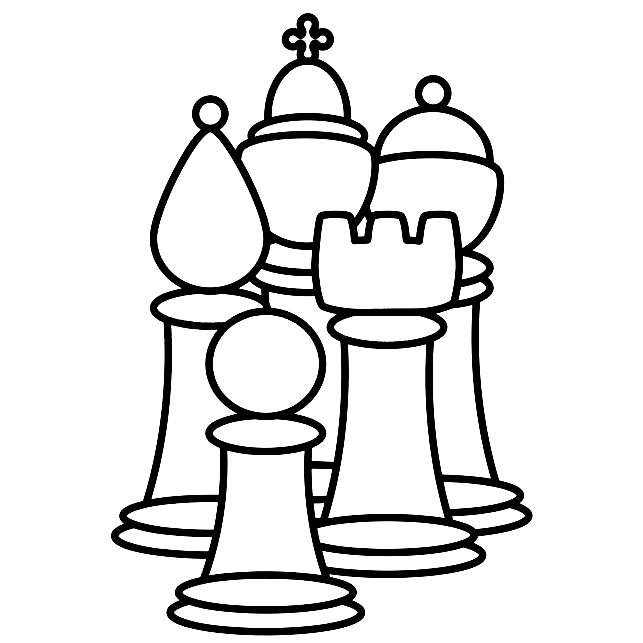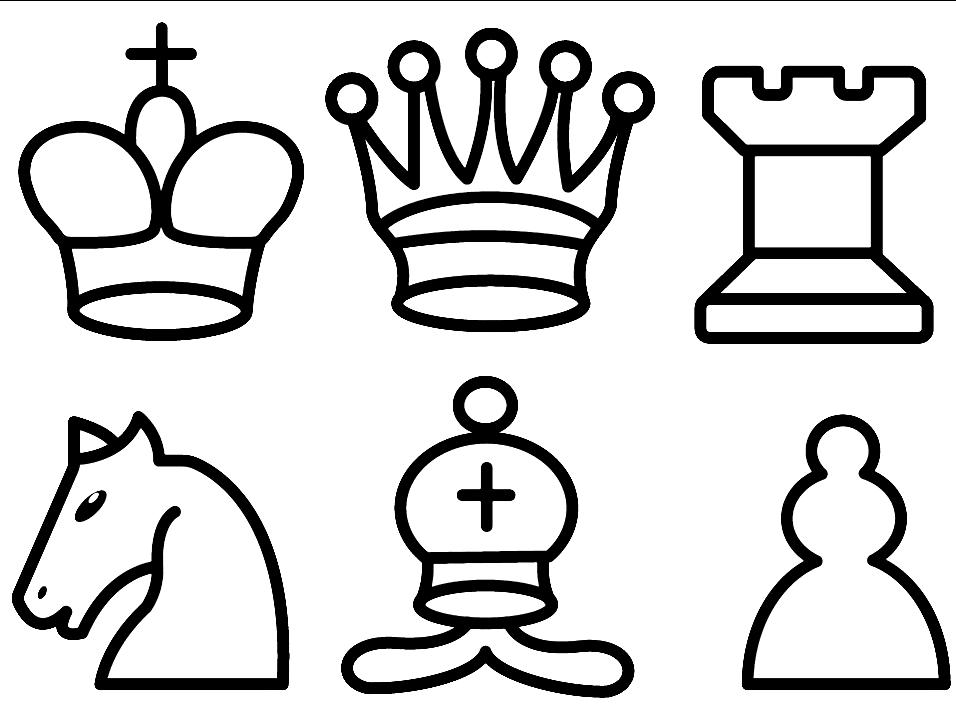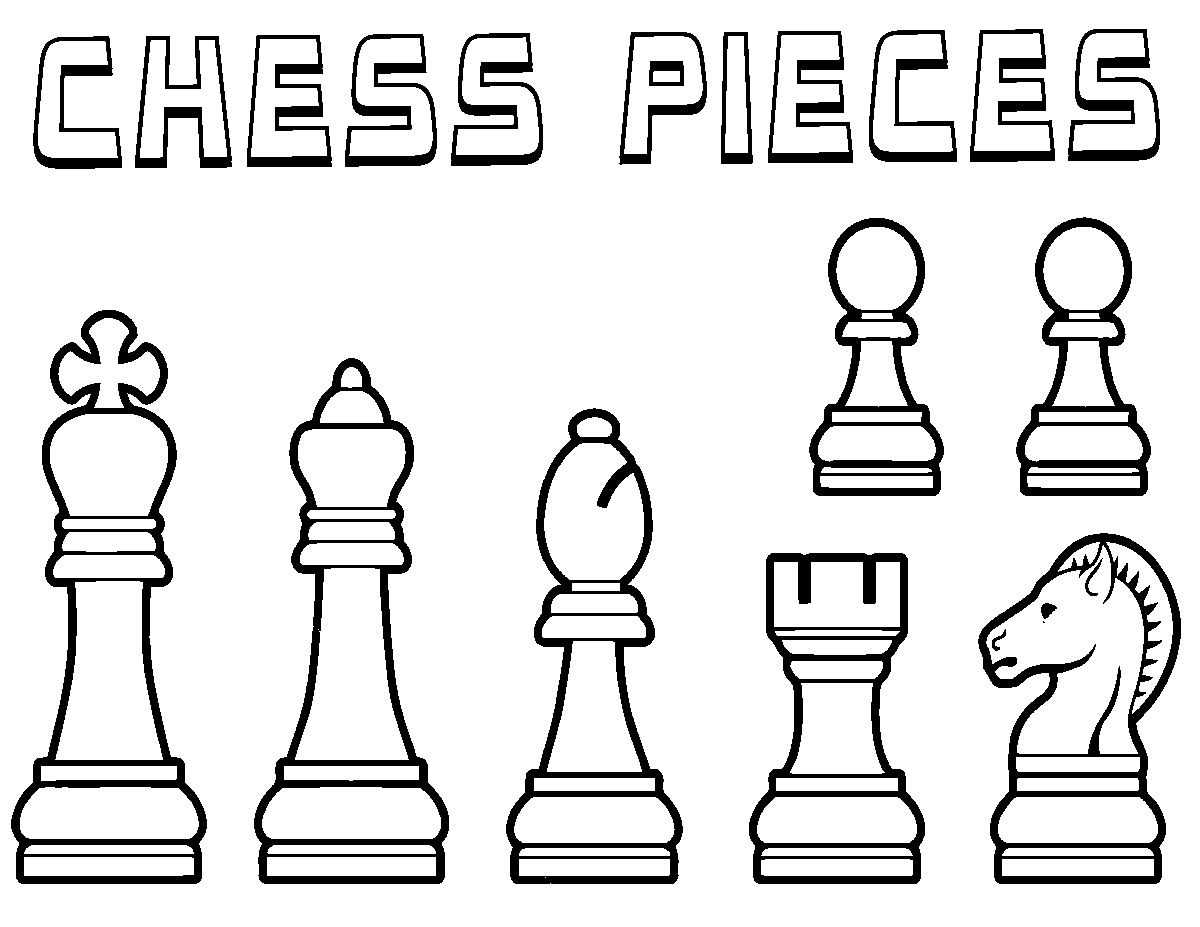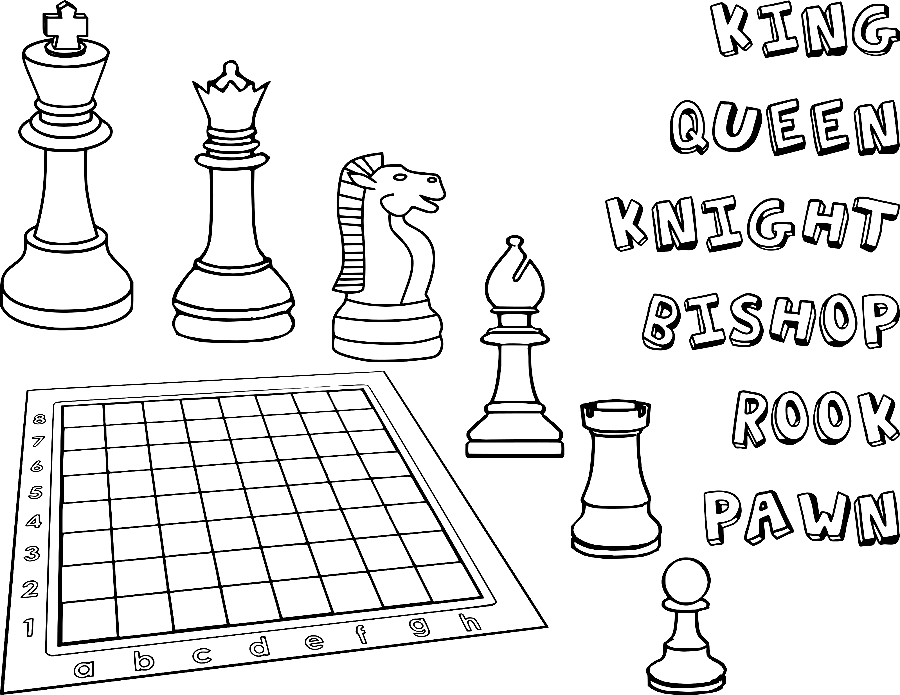
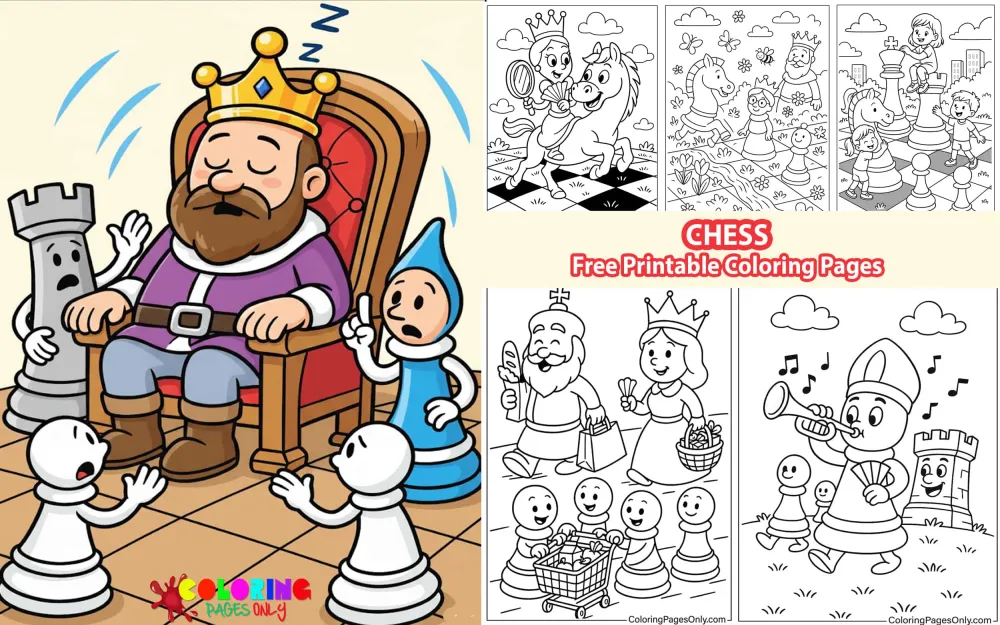
Chess Coloring Pages at ColoringPagesOnly.com brings together 70+ free printable pages exploring the world’s most celebrated strategy game through two distinct creative lenses: a traditional collection covering the six chess pieces in standard and cute character styles, chessboard layouts, and scenes of players – children, animals, fantasy figures – engaged in the game; and a 2025 creative series transforming chess pieces into fully animated characters living out playful, funny, and imaginative scenarios far beyond the board. The full Sports collection is available through our Sports Coloring Pages hub.

Every page is completely free – download as PDF to print or color online in your browser. No sign-up, no cost.

About Chess

Chess is a two-player strategy board game played on an 8×8 grid of 64 alternating light and dark squares – the chessboard. Each player begins with 16 pieces: one King, one Queen, two Rooks, two Knights, two Bishops, and eight Pawns. Players alternate turns, moving pieces according to each piece’s specific movement rules, with the objective of placing the opponent’s King in checkmate – a position from which the King cannot escape capture.

Chess is one of the oldest continuously practiced games in recorded human history. Its origins trace to Chaturanga, a strategy game developed in the Gupta Empire of India around the 6th century CE, which spread westward through Persia as Shatranj before reaching Europe by the 9th century. The game’s modern rules – including the Queen’s expanded movement, the en passant pawn capture, and castling – were standardized in Europe during the 15th century, producing the chess we recognize today.

Chess has no element of chance – there are no dice, no random draws, no hidden information. Every position on the board is fully visible to both players, and outcomes depend entirely on the quality of each player’s thinking. This characteristic has made chess a uniquely respected test of intellectual capability across cultures for more than a thousand years. The total number of possible chess games exceeds the number of atoms in the observable universe – a statistic that captures why the game has sustained serious study across fifteen centuries without exhausting its strategic depth.

Modern chess is organized internationally by FIDE (Fédération Internationale des Échecs), the world chess federation founded in 1924. FIDE oversees the World Chess Championship, assigns international ratings (the Elo rating system, also adopted by many other competitive activities), and governs the official rules of play. The current World Chess Champion is Magnus Carlsen of Norway, who has held the title since 2013 and remains the highest-rated player in history. Other legendary champions include Garry Kasparov, Anatoly Karpov, Bobby Fischer, and Mikhail Botvinnik.

Chess enjoyed an extraordinary surge in global popularity following the release of The Queen’s Gambit on Netflix in 2020 – a miniseries depicting the life of a fictional female prodigy that drove record online chess participation, surging sales of chess sets, and a significant increase in children taking up the game. Online platforms such as Chess.com and Lichess have made the game accessible to hundreds of millions of casual and serious players worldwide.

The Six Chess Pieces – A Guide for Colorists

Understanding the identity and character of each chess piece gives coloring pages greater meaning and helps colorists make intentional decisions about how to represent each piece visually.

The King

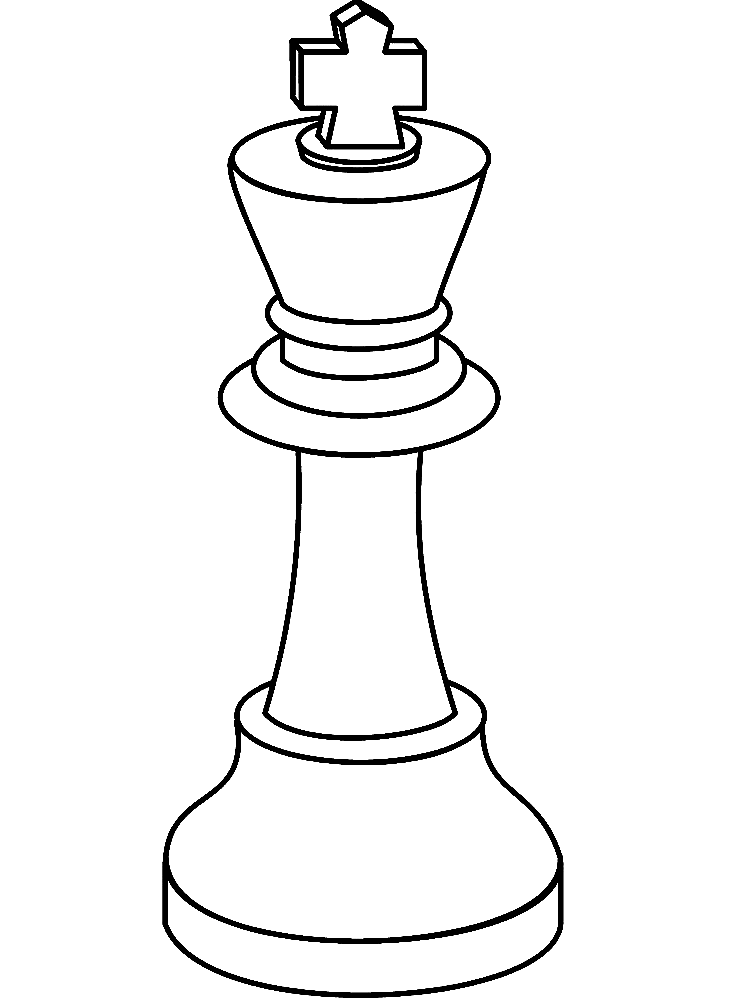
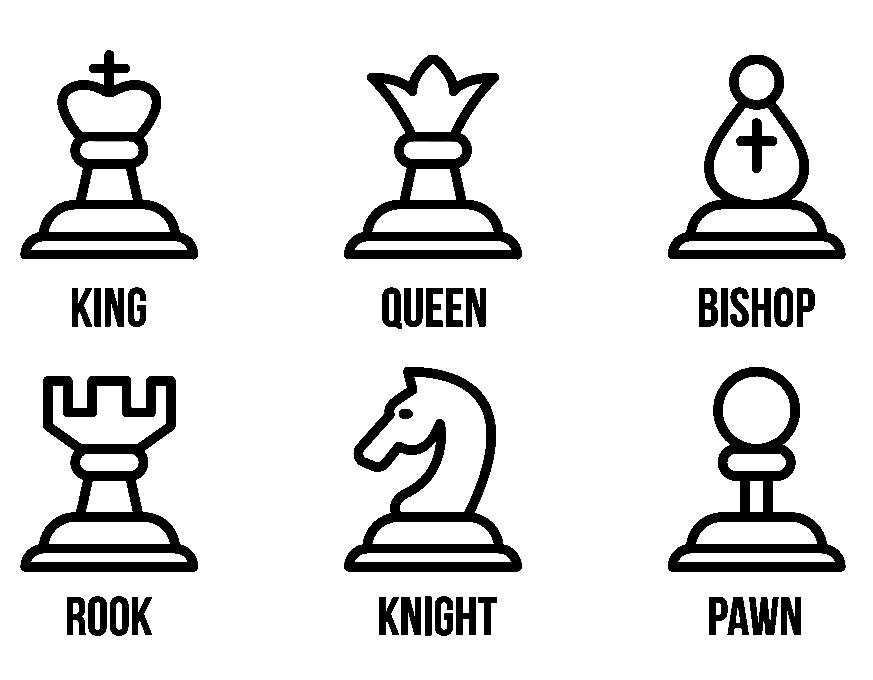
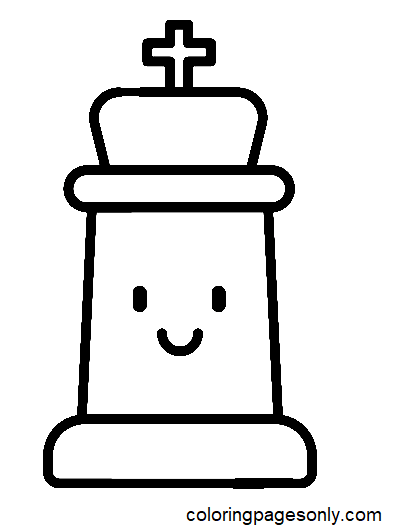
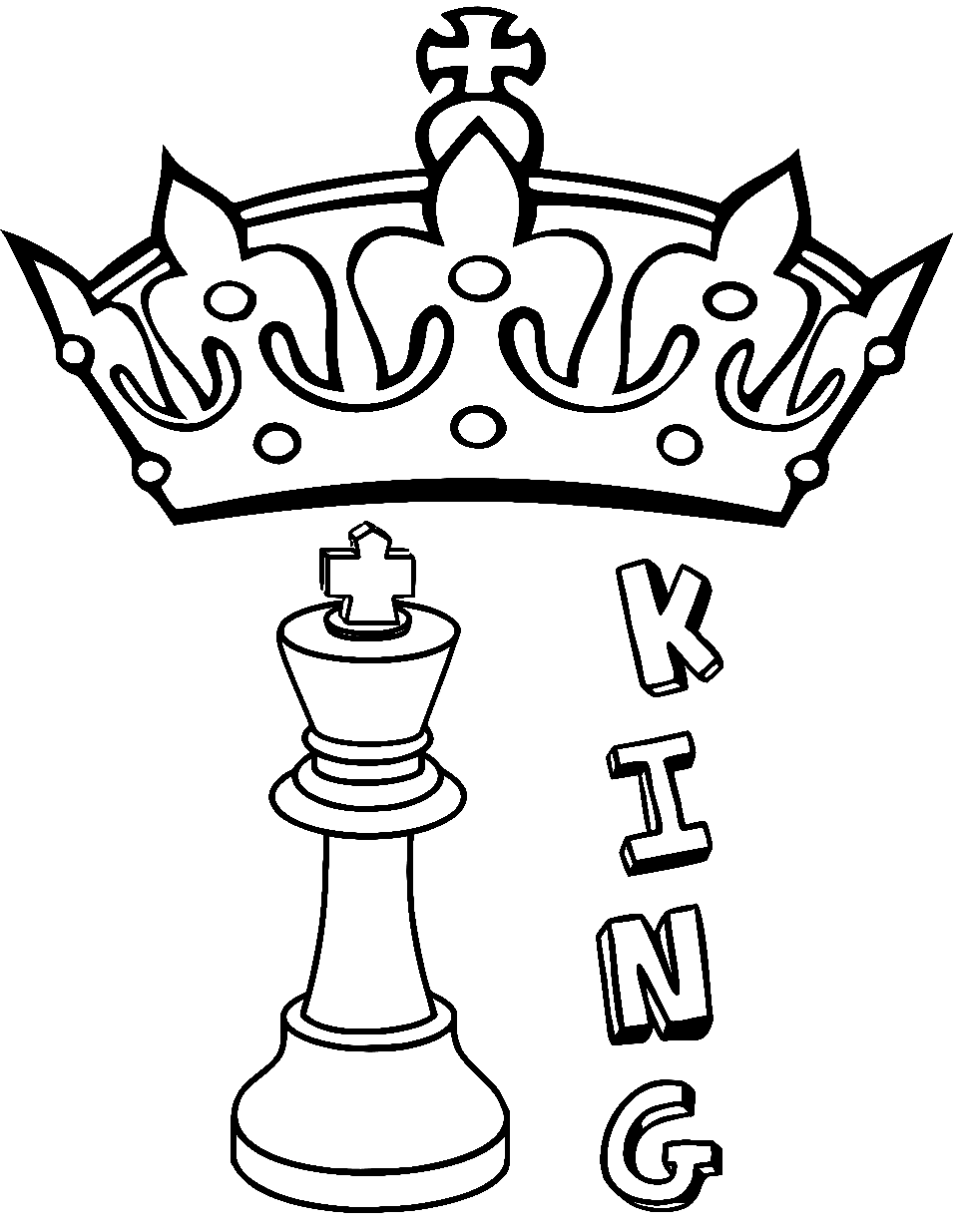
The King is the most important piece in chess – not the most powerful, but the one whose safety the entire game revolves around. When the King is checkmated, the game ends. The King moves only one square in any direction, which gives him a somewhat helpless quality in tactical combat despite his supreme importance. In the collection, the King appears in solo tiles (Chess King, Printable Chess King, King Chess Piece, King Cute Chess Piece, Cute King Chess Piece), duo tiles with other pieces, and throughout the 2025 creative series, where he is typically depicted as a rotund, jovial, occasionally flustered royal figure.

Coloring the King: In classical chess set design, the King is the tallest piece, topped by a cross. The King tile suits deep, rich colors – royal purple, deep red, or dark navy for the body if the piece is given royal character; black or dark gray for a more traditional tournament-set rendering. The crown cross at the top is often depicted in contrasting gold or silver.

The Queen

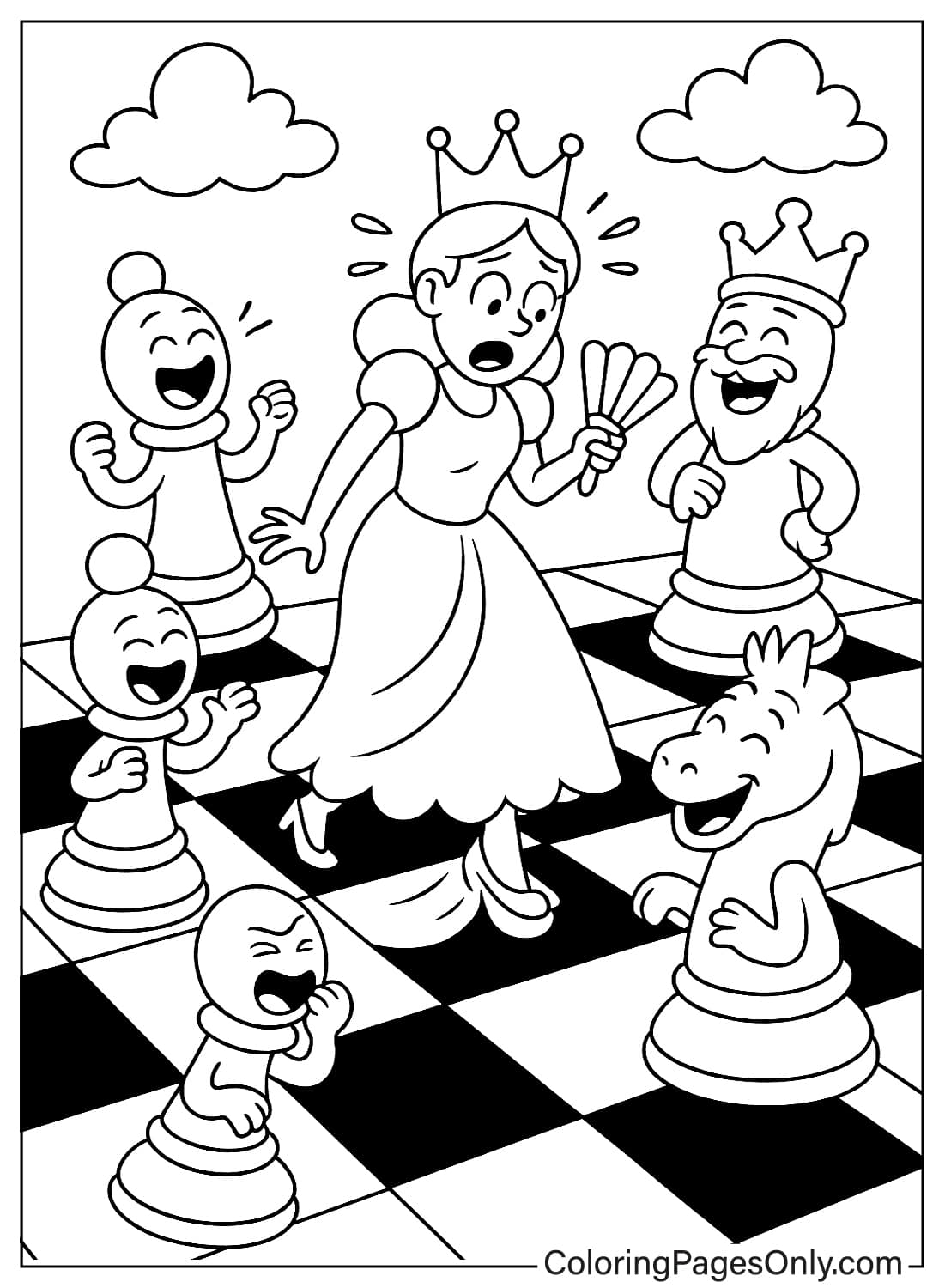
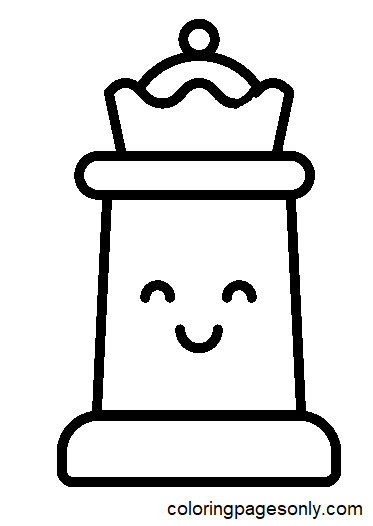
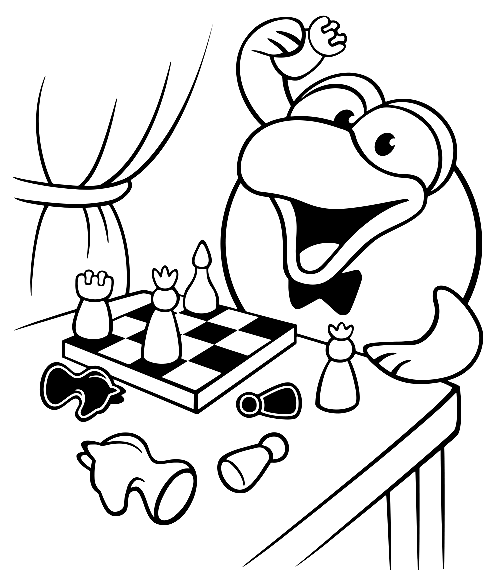
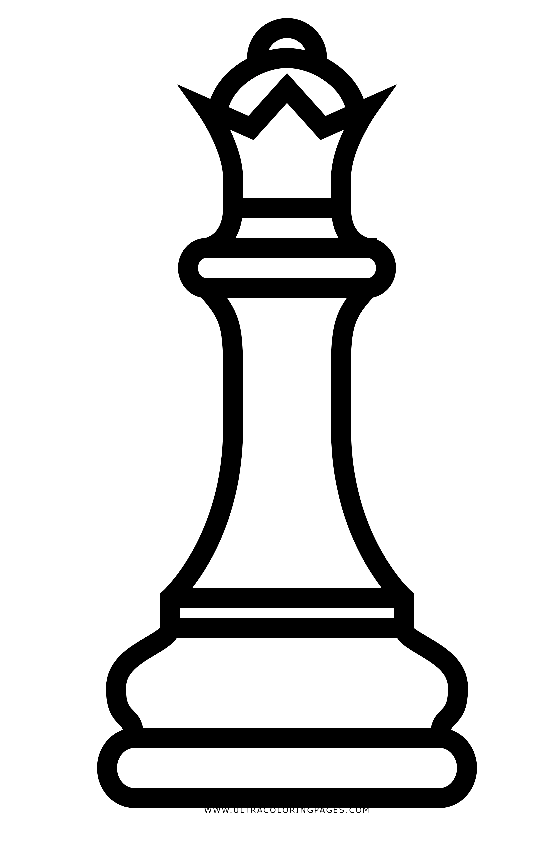
The Queen is chess’s most powerful piece – she can move any number of squares in any direction (horizontally, vertically, or diagonally), making her far more mobile and threatening than any other piece on the board. Losing the Queen is almost always decisive. In visual design, the Queen is the second tallest piece, typically topped by a rounded crown with multiple points. In the 2025 creative series, the Queen is depicted as confident, expressive, and occasionally exasperated – particularly in the Embarrassed Queen Chess Piece tile, where she is surrounded by laughing pieces.

Coloring the Queen: The Queen suits the most vivid and richly decorative treatment in the collection – gold, deep magenta, purple, or royal blue. In the cute and cartoon styles of the 2022 cluster, her crown shape provides the main decorative element.

The Rook

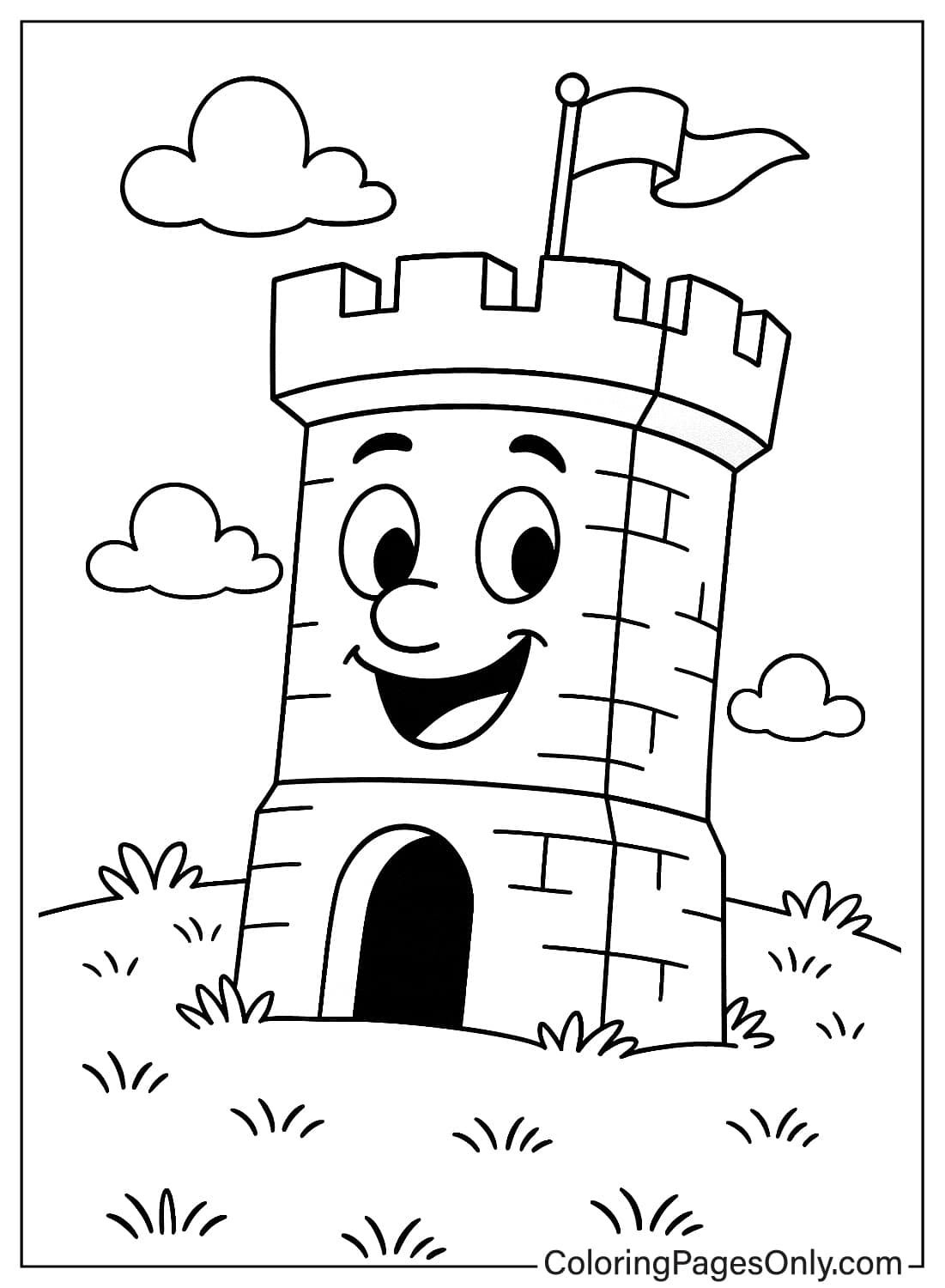
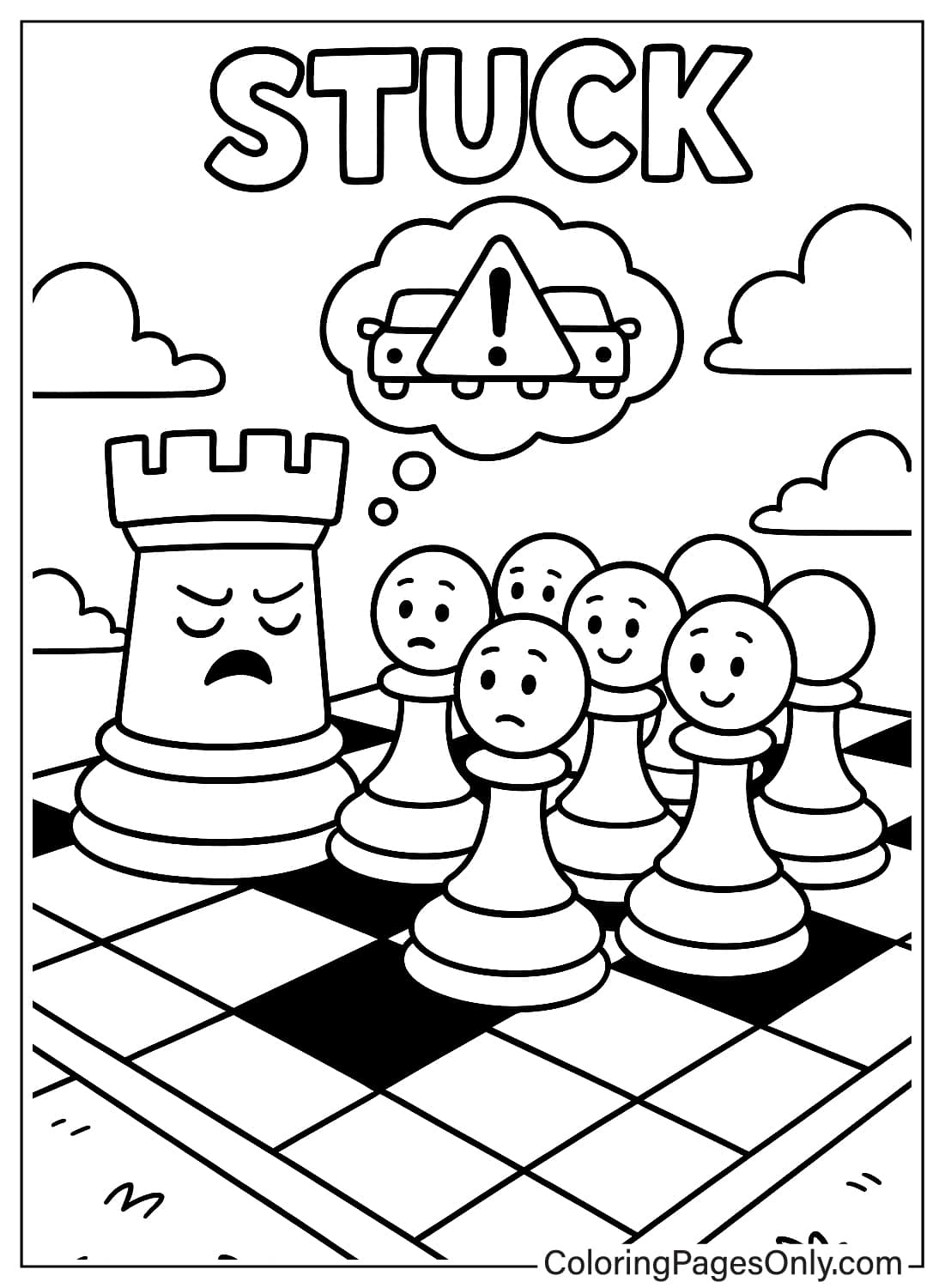
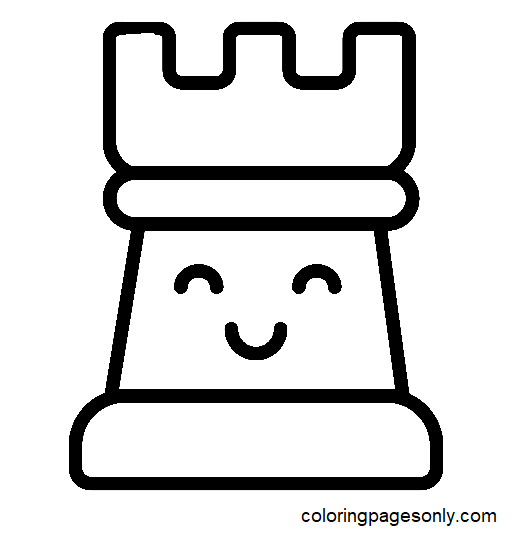
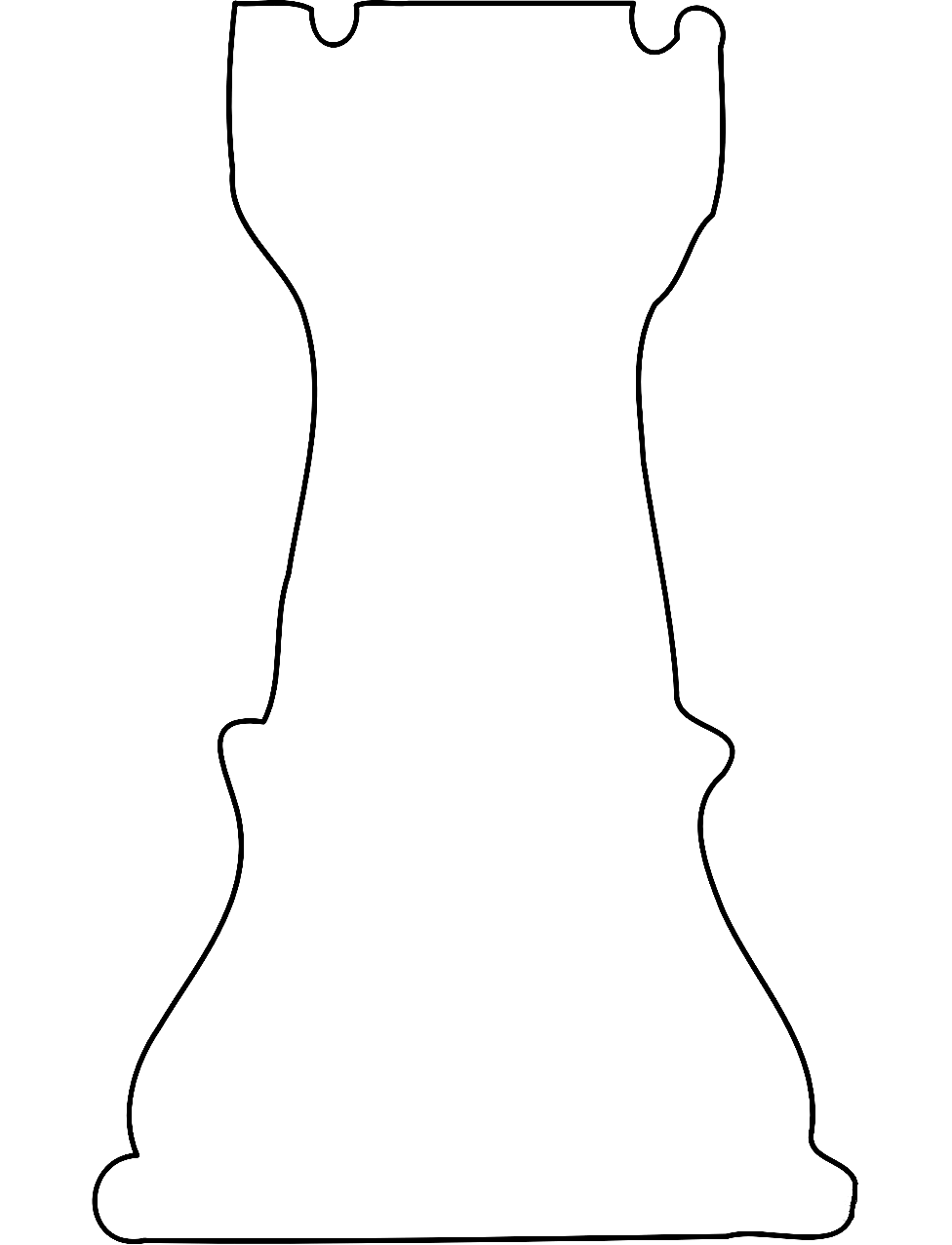
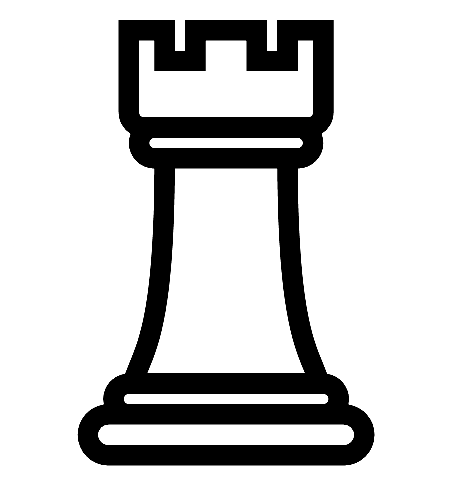
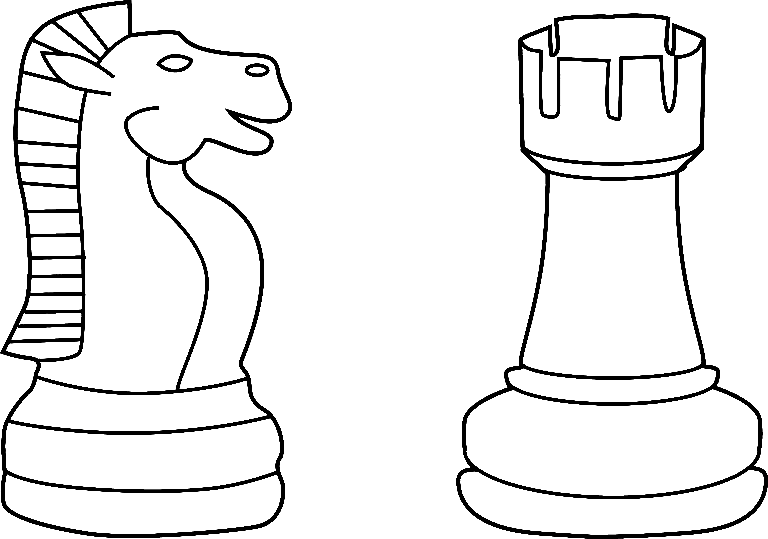
The Rook (also called the Castle) is the rectangular tower-shaped piece that moves any number of squares horizontally or vertically. Two Rooks working in tandem are among chess’s most powerful endgame tools. Visually, the Rook’s battlements (the crenellations along the top) make it the most immediately recognizable piece by silhouette. In the 2025 creative series, the Rook appears as a solid, dependable but sometimes exasperated character – notably in the Rook Stuck Pawns Traffic Jam tile and the Happy Chess Rook Tower tile.

Coloring the Rook: The Rook’s castle-tower silhouette suits strong, solid colors – dark stone gray, navy, or deep green for a fortification feel; or bright primary colors in the cute/cartoon tiles where character rather than realism is the goal.
The Knight

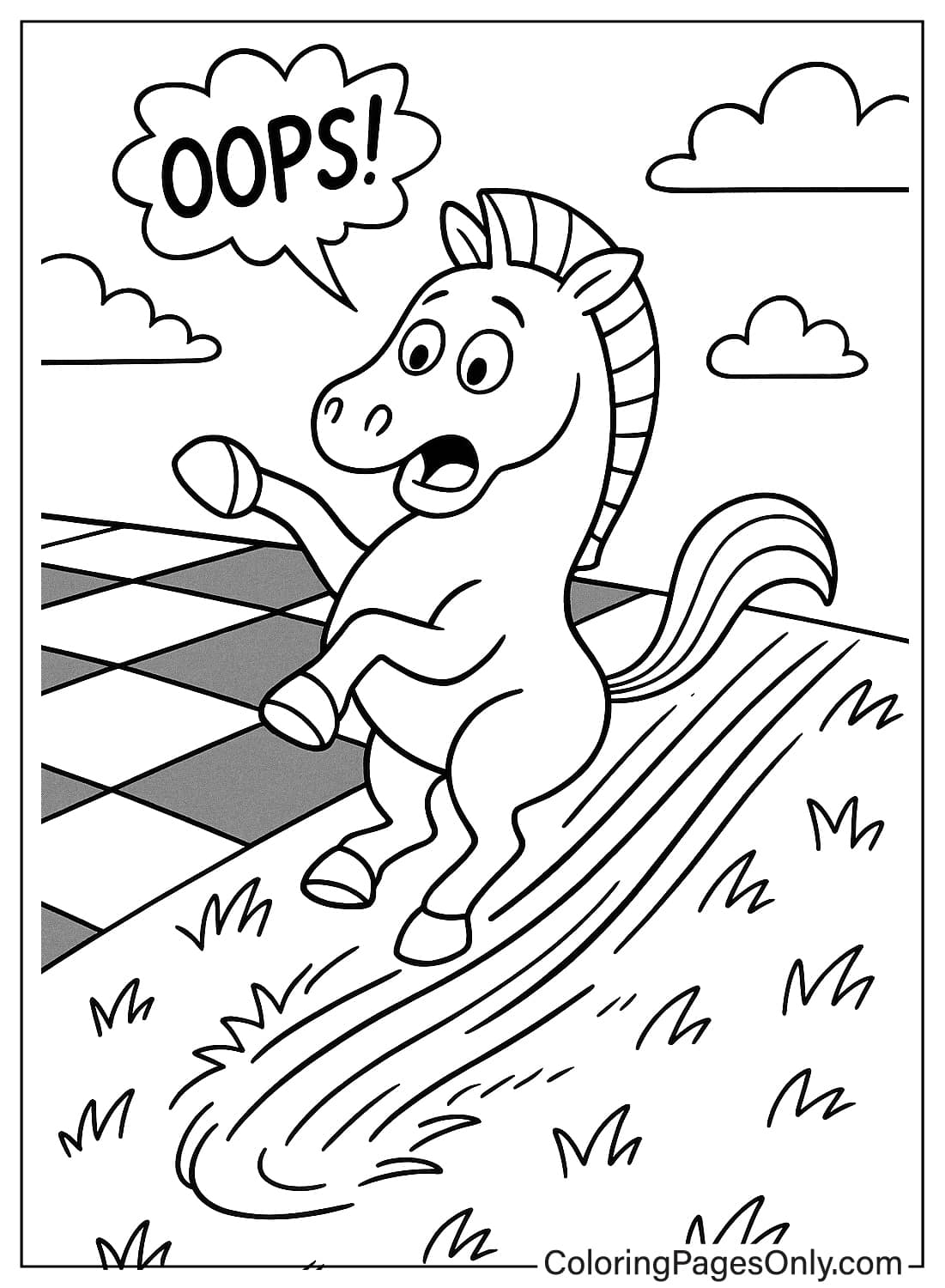
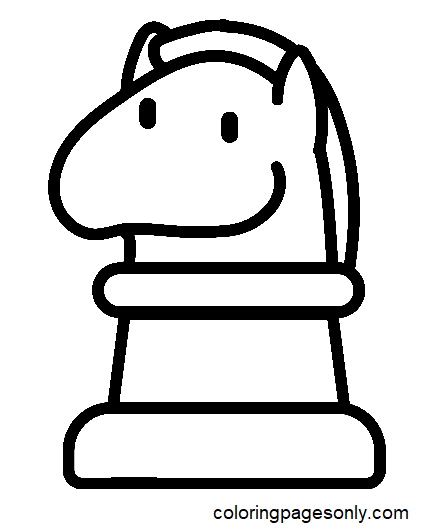
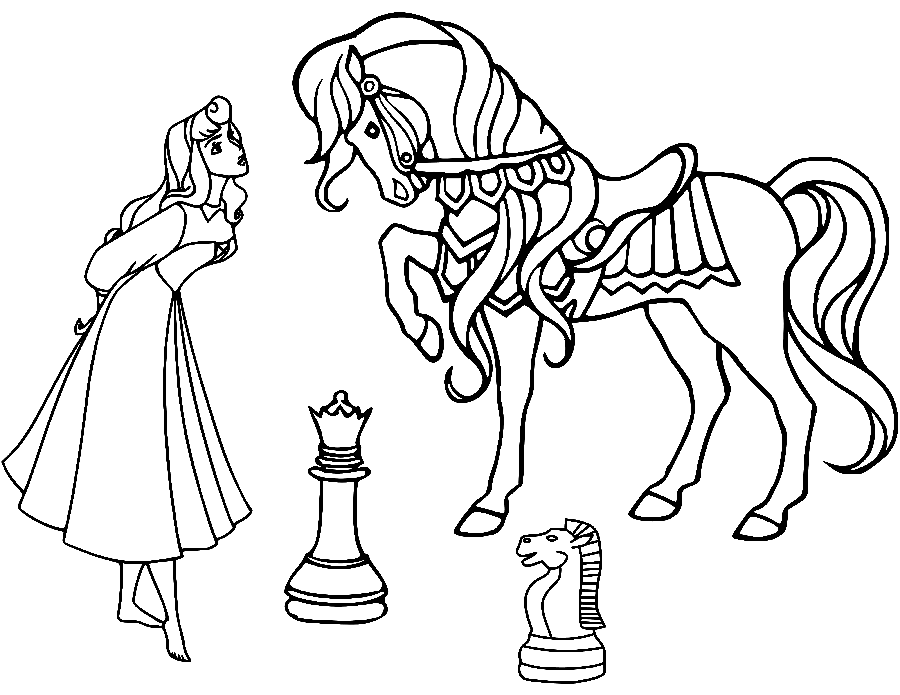
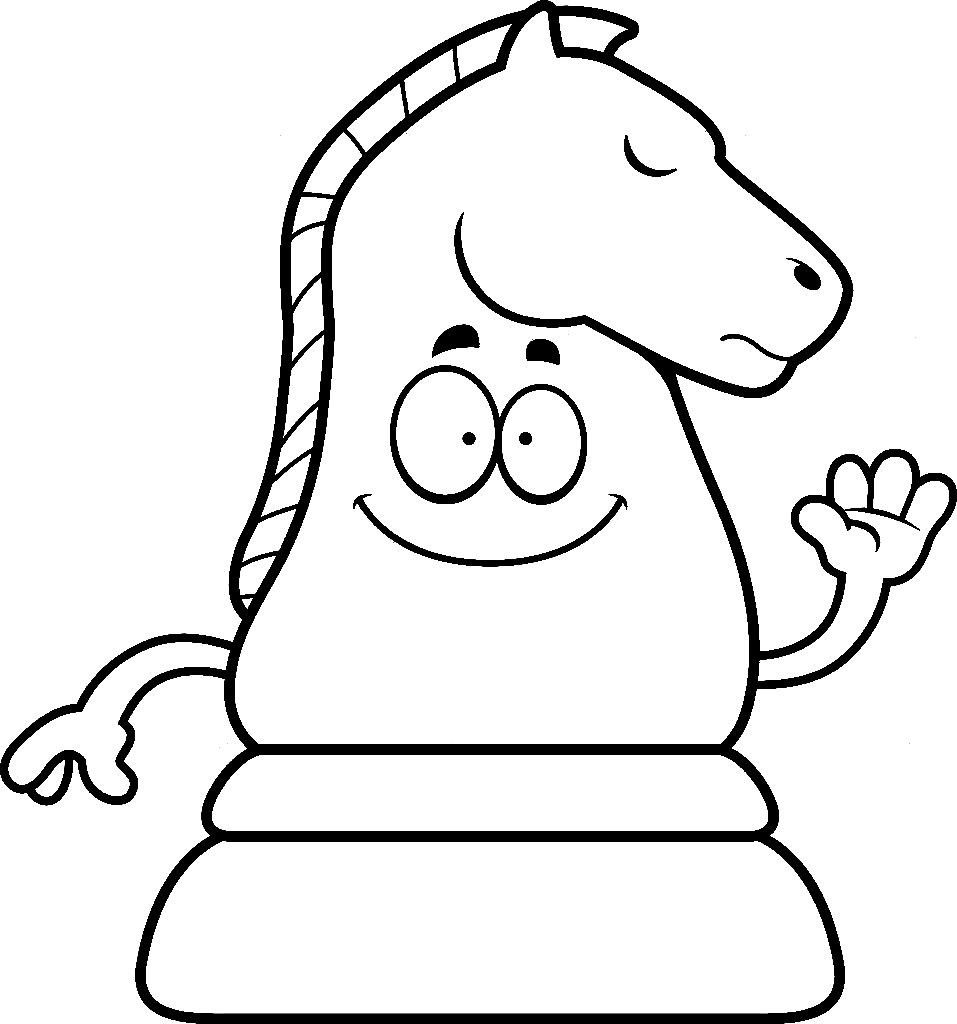
The Knight is chess’s most unusual piece – it moves in an L-shape (two squares in one direction, then one square perpendicular), jumping over any pieces in between. It is the only piece that can jump over others, giving it a unique tactical flexibility. The Knight is represented as a horse’s head, making it the most visually organic and recognizable piece in the set. In the 2025 creative series, the Knight is depicted with an expressive personality: the Chess Knight Running Away tile shows him galloping off the board, saying “Oops” with characteristically horse-like panic.
Coloring the Knight: The horse head shape is the most detailed and technically interesting piece to color in the realistic style. A naturalistic horse palette – warm brown, black, gray, or white – grounds the piece in its animal identity while contrasting elegantly with the flat geometry of other pieces on the same tile.

The Bishop

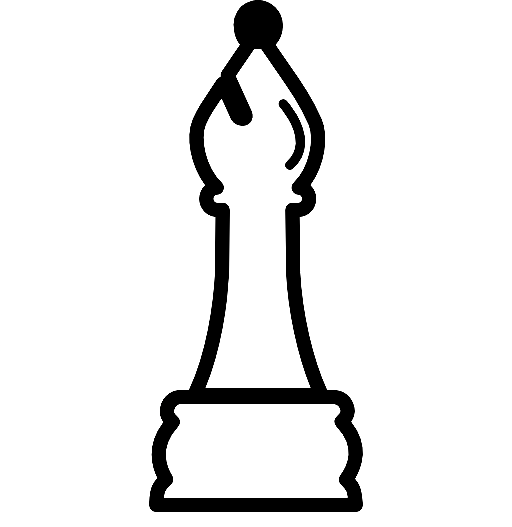
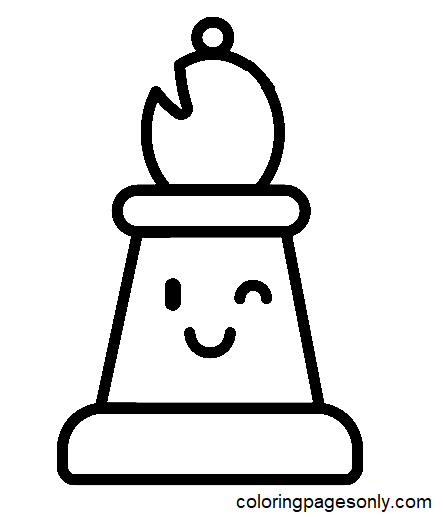
The Bishop moves diagonally any number of squares, remaining on the same color square for the entire game – meaning each player has one Bishop that travels only light squares and one that travels only dark squares. The Bishop is recognizable by its tall, tapered form with a notch cut at the top (representing a bishop’s miter – the pointed liturgical hat worn by Catholic bishops). In the 2025 creative series, the Bishop appears as a musical character in the Chess Bishop Playing Trumpet tile.

Coloring the Bishop: The Bishop’s tapered, churchlike silhouette suits ecclesiastical color associations – deep purple, red, or gold – or simply contrasting dark and light treatments in the realistic tiles.

The Pawn

The Pawn is the game’s most numerous piece and the one with the most complex relationship between apparent weakness and actual strategic importance. Pawns move only forward (one square at a time, two squares from their starting position), capture only diagonally, and are individually the weakest pieces on the board. Yet they form the game’s structural backbone – pawn structure determines the character of a position – and a pawn that reaches the opposite end of the board promotes, transforming into any piece the player chooses (almost always a Queen). The Pawn’s journey from disposable foot-soldier to potential Queen is one of chess’s most compelling conceptual narratives.

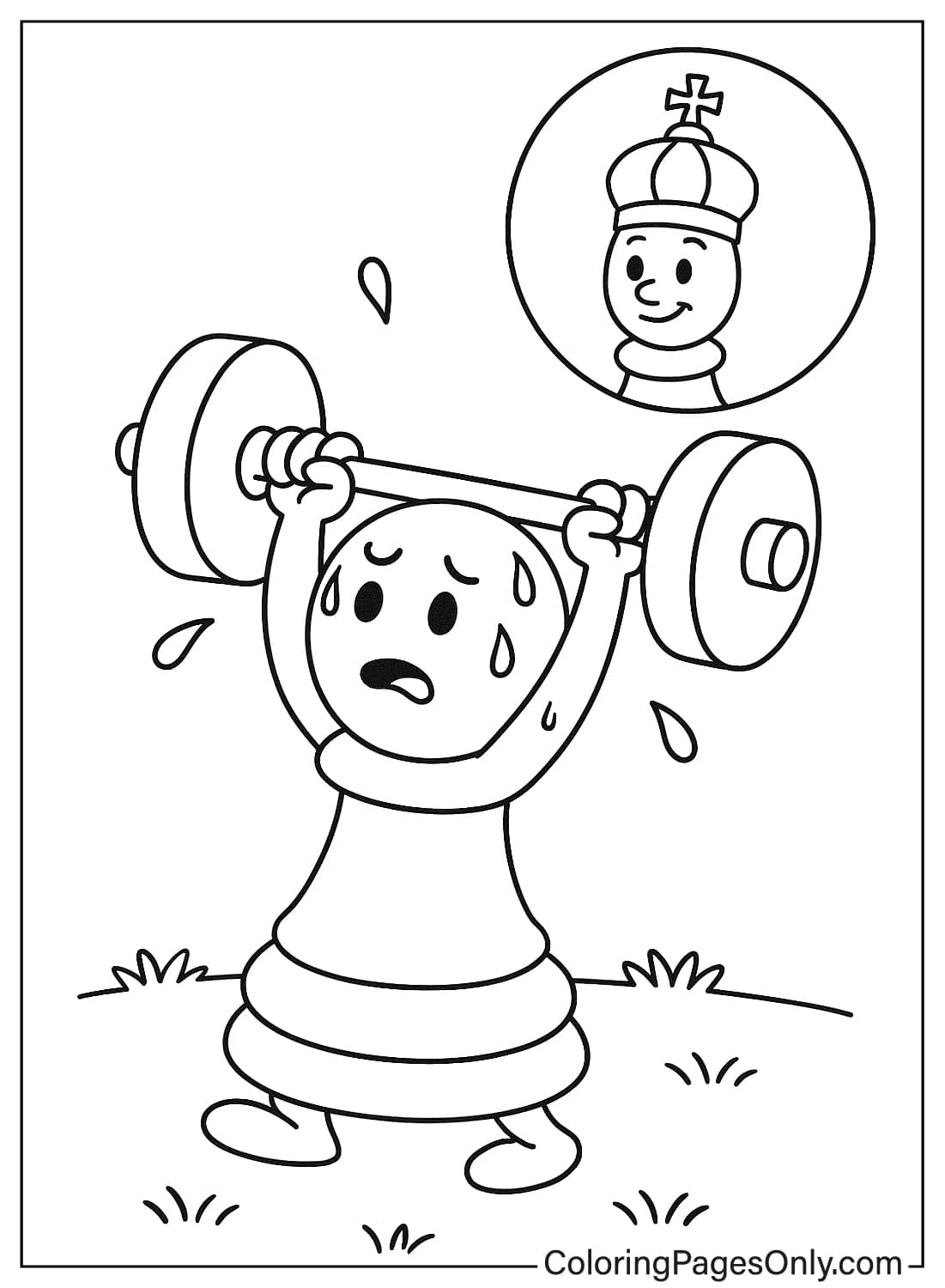
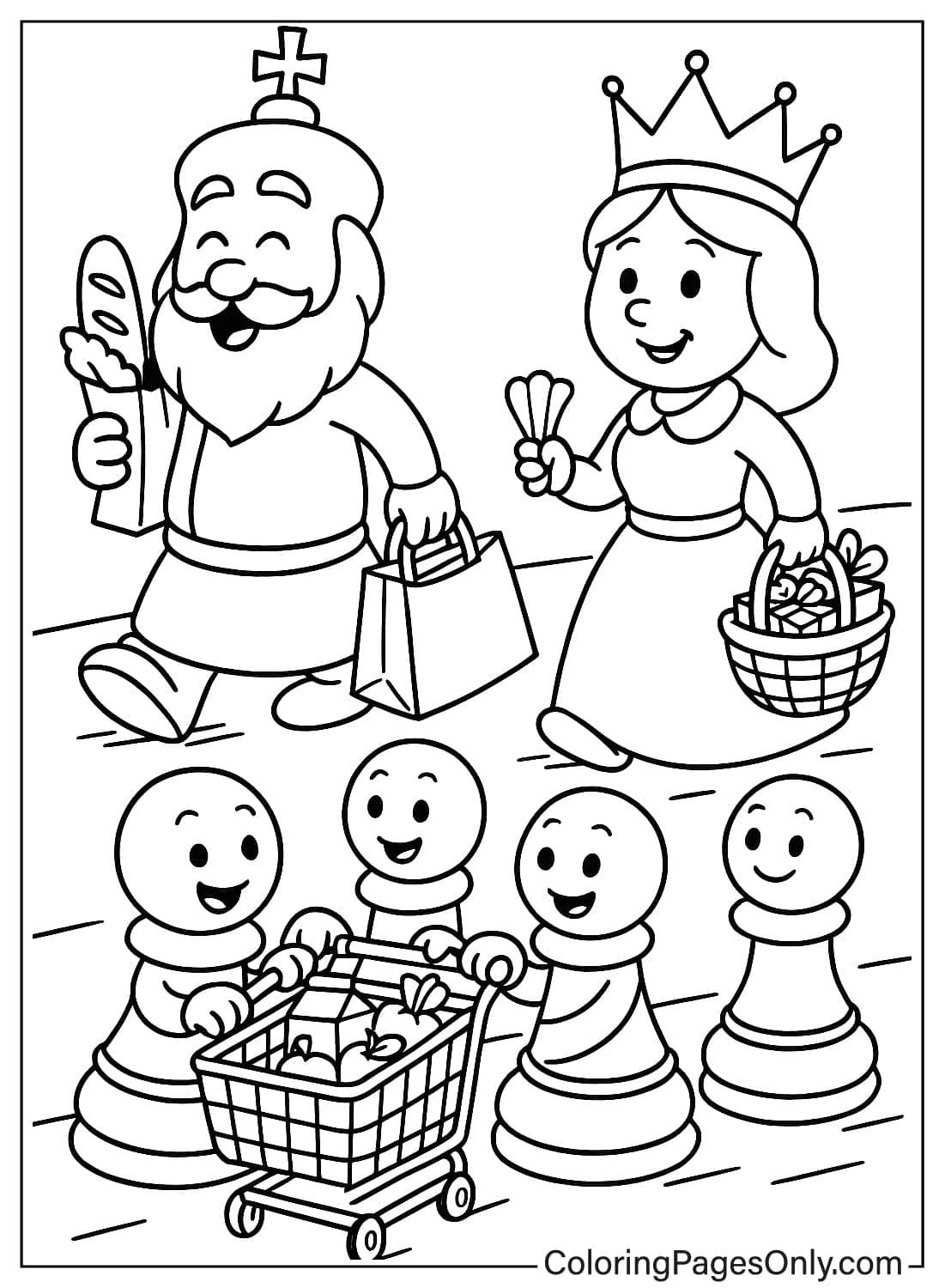
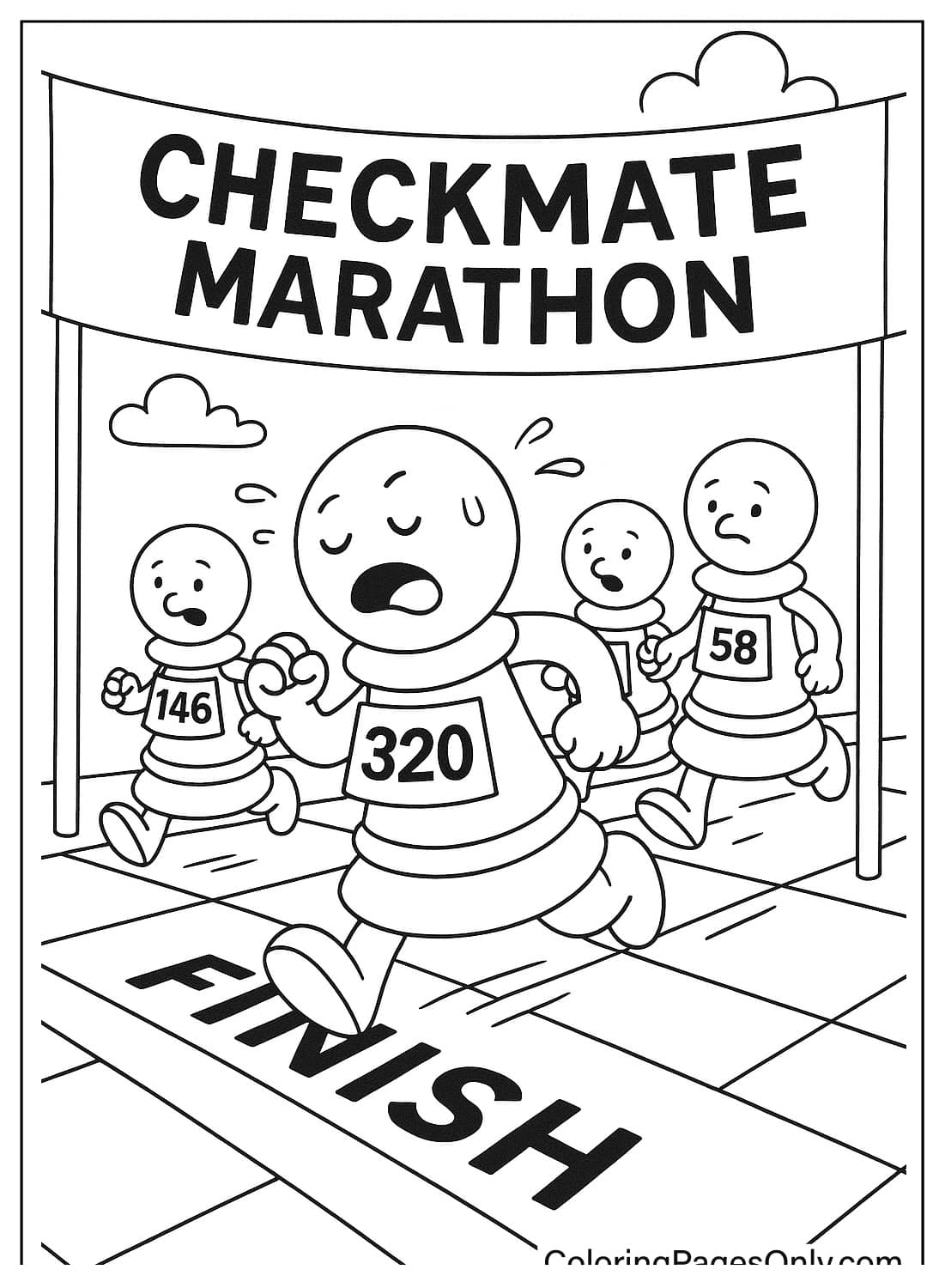
In the 2025 creative series, the Pawns are the collection’s most sympathetic characters – perpetually working, cheerful despite hardship, given the most physically demanding tasks: they push the grocery cart (King Queen and Pawns Grocery Shopping), run the marathon (Chess Pawns Checkmate Marathon), and do the weightlifting (Pawn Doing Weightlifting) while the King and Queen watch. This characterization directly echoes the Pawn’s role in the actual game.

Coloring the Pawn: The Pawn’s simple, rounded form – like a stylized person – suits a wide range of color treatments. In group Pawn tiles, consider giving each Pawn a slightly different color to distinguish them as individuals – this reads as both visually interesting and thematically appropriate for characters who are supposedly identical but each unique.

What’s in This Collection

Traditional Piece Tiles – Individual Characters

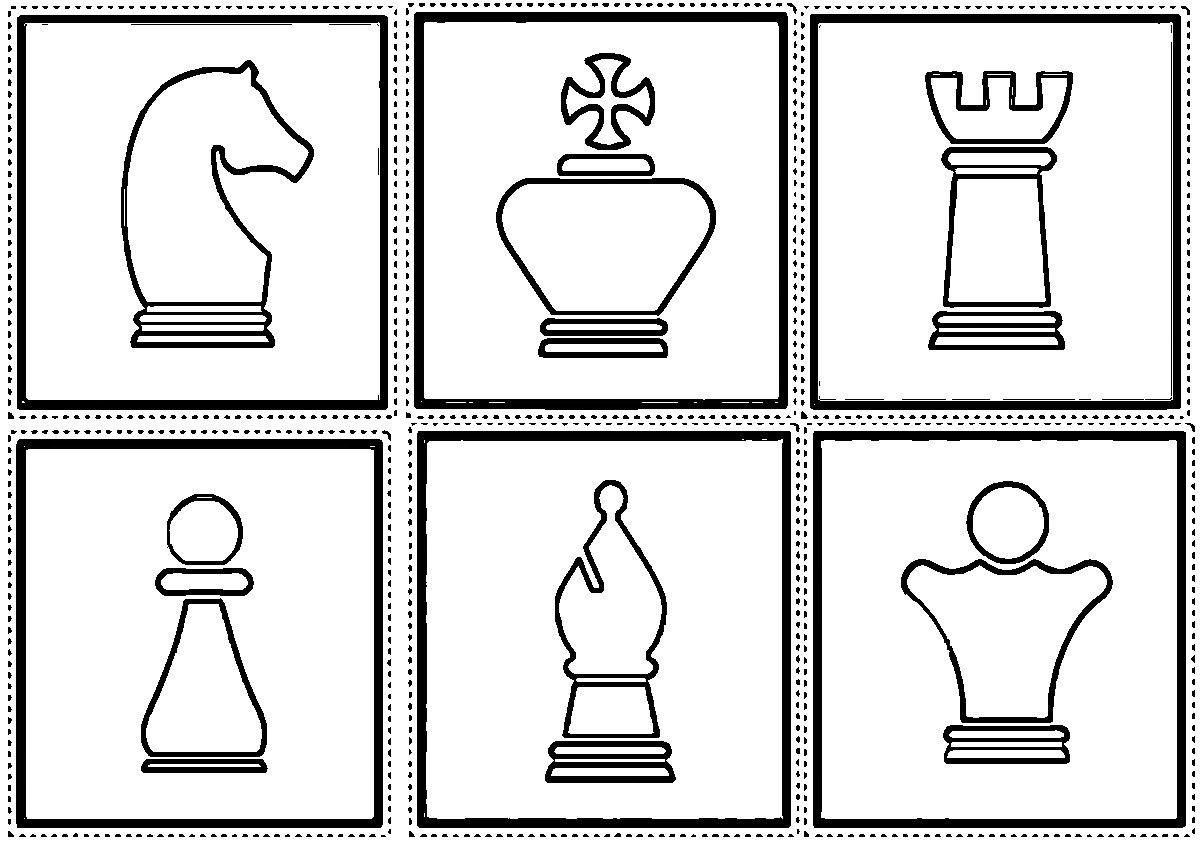
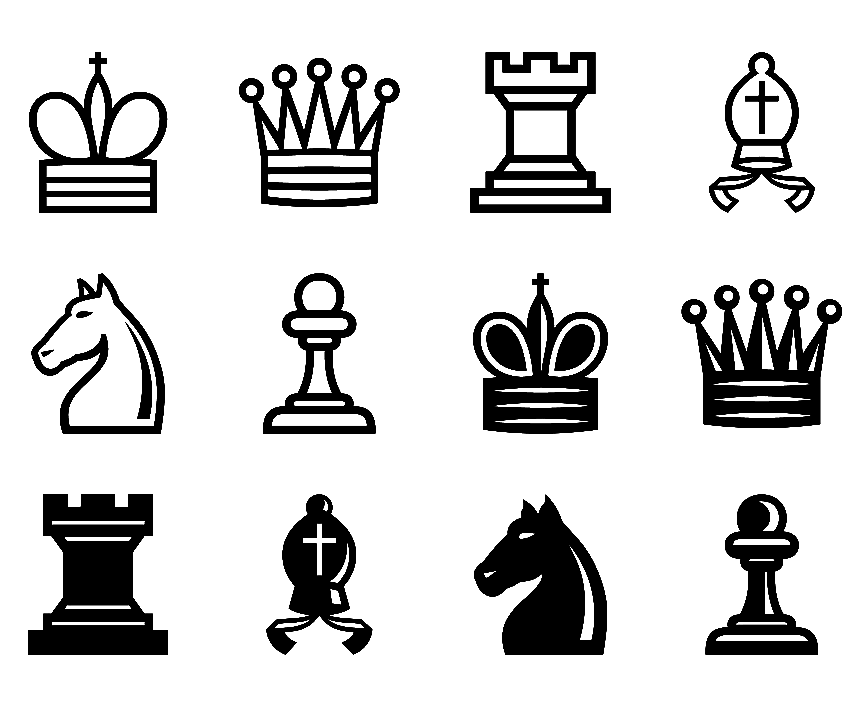
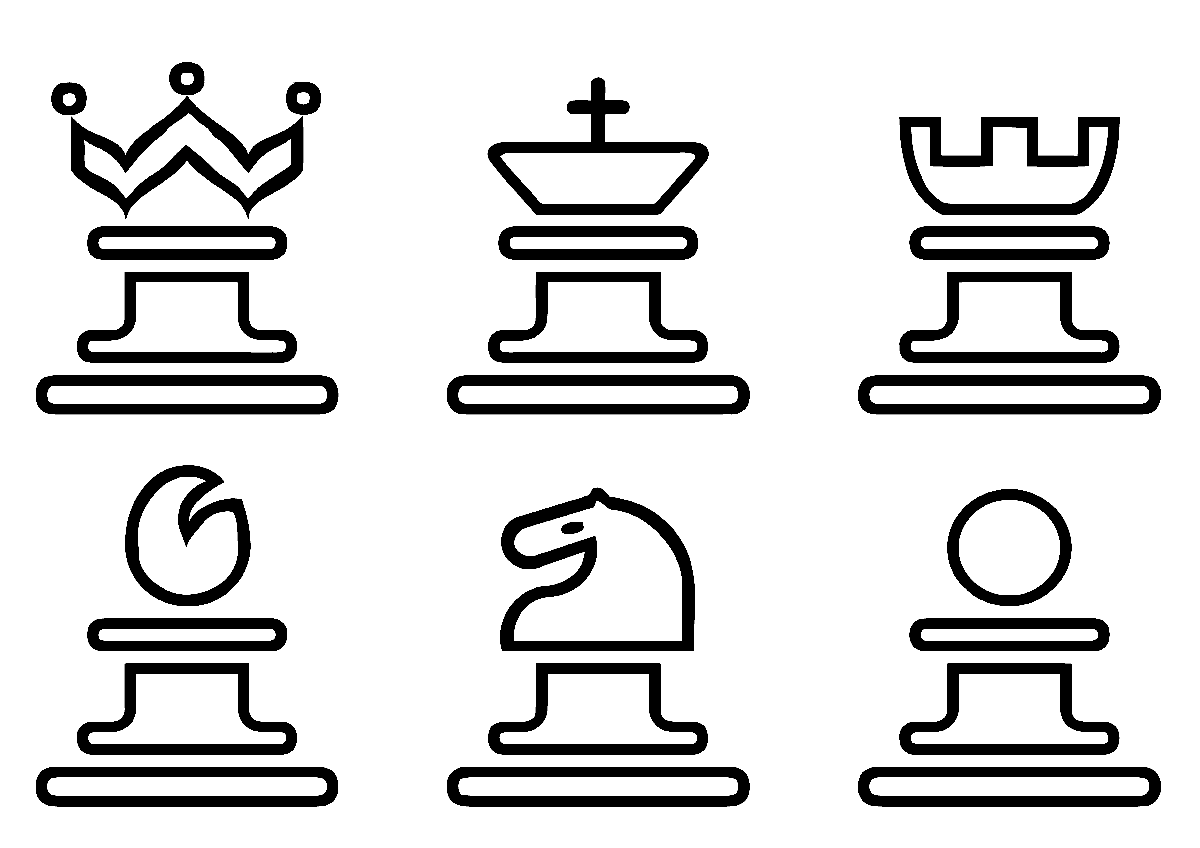
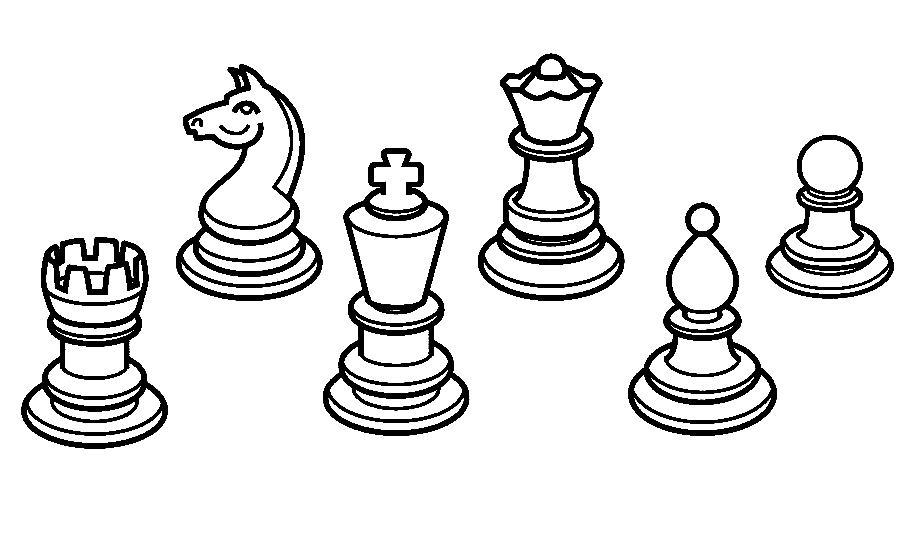
The 2022 cluster provides each piece in multiple style treatments. Each of the six pieces appears in at least one of three style registers: standard silhouette (Chess King, Chess Queen, Chess Rook, Chess Bishop, Chess Knight, Chess Pawn – clean outlines of the actual piece form), cute character style (King Cute Chess Piece, Queen Cute Chess Piece, Rook Cute Chess Piece, Knight Cute Chess Piece, Bishop Cute Chess Piece, Pawn Cute Chess Piece – the same pieces with expressive eyes and anthropomorphized personality), and printable/free variants (Printable Chess King, Printable Chess Queen, etc. – slightly different linework treatments of the same subjects).

Chessboard Tiles – The Game in Context

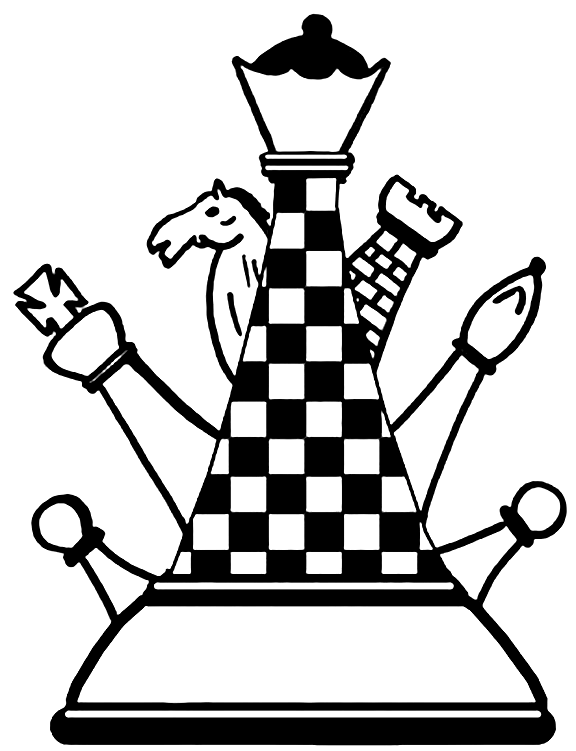
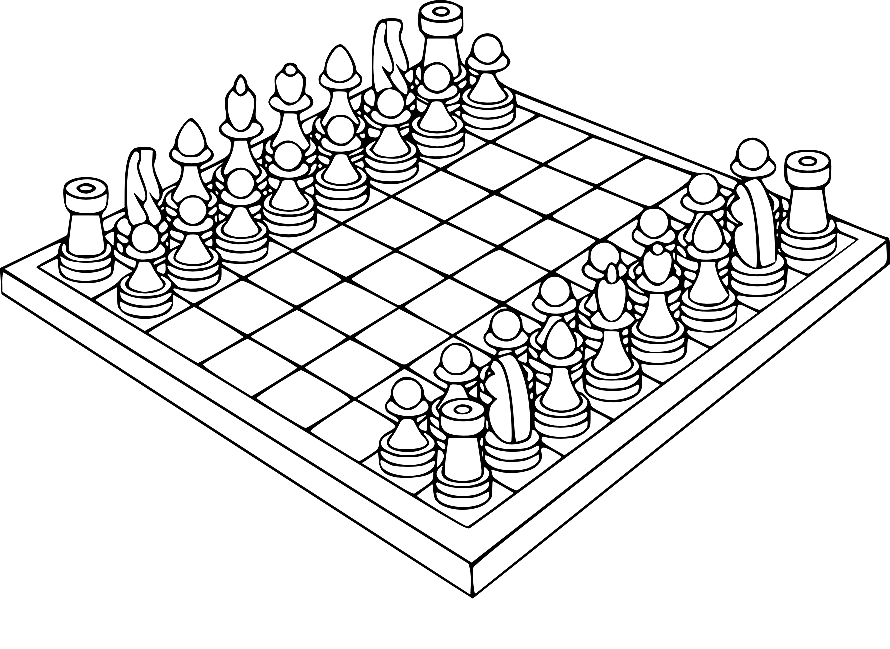
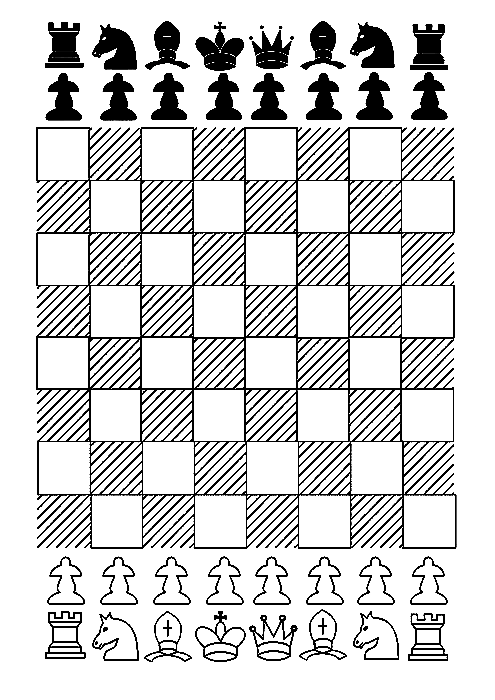
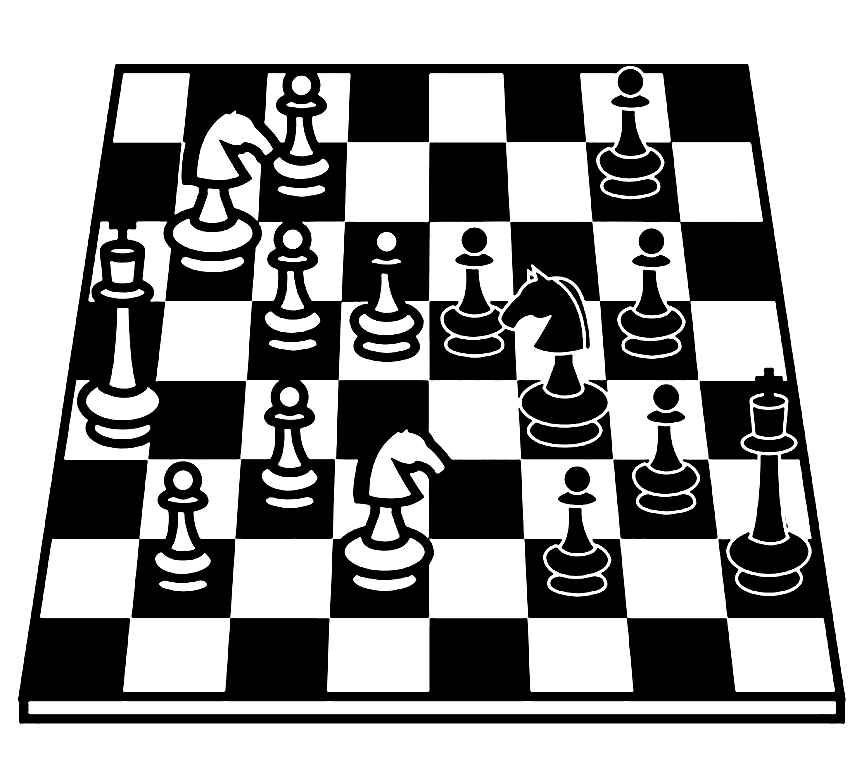
The Chess Board, Chess Board with Chess Pieces, and Chess Board for Kids tiles depict the board itself – the 8×8 grid of alternating light and dark squares that is one of the most recognizable geometric patterns in all of games and sports. The Chess Board for Kids tile uses simplified, bolder outlines suited to younger colorists. For anyone learning chess, the board tiles function as both coloring pages and visual reference material for understanding the game’s spatial structure.

Players at the Board – Human and Animal Scenes

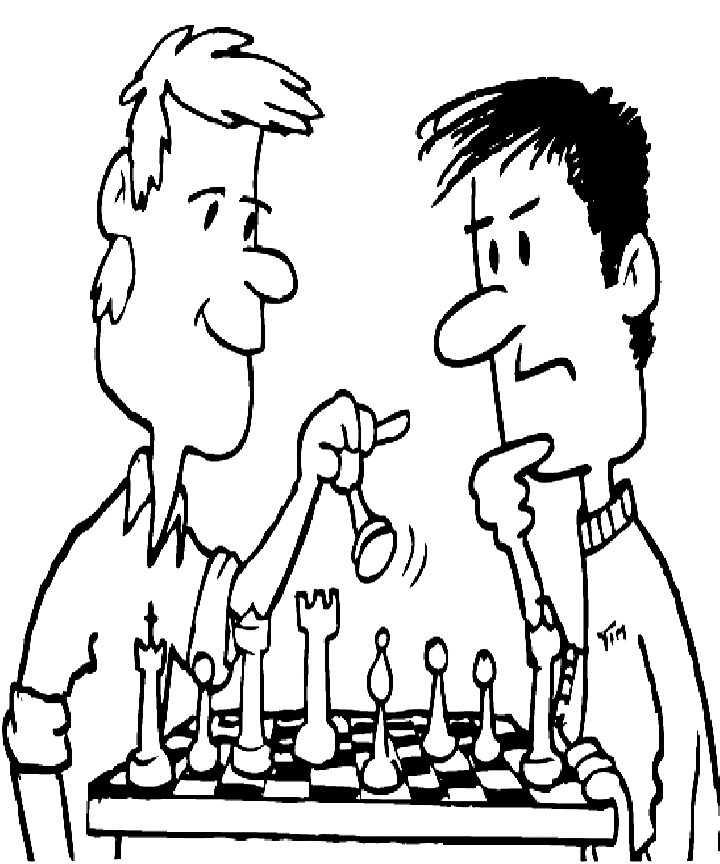
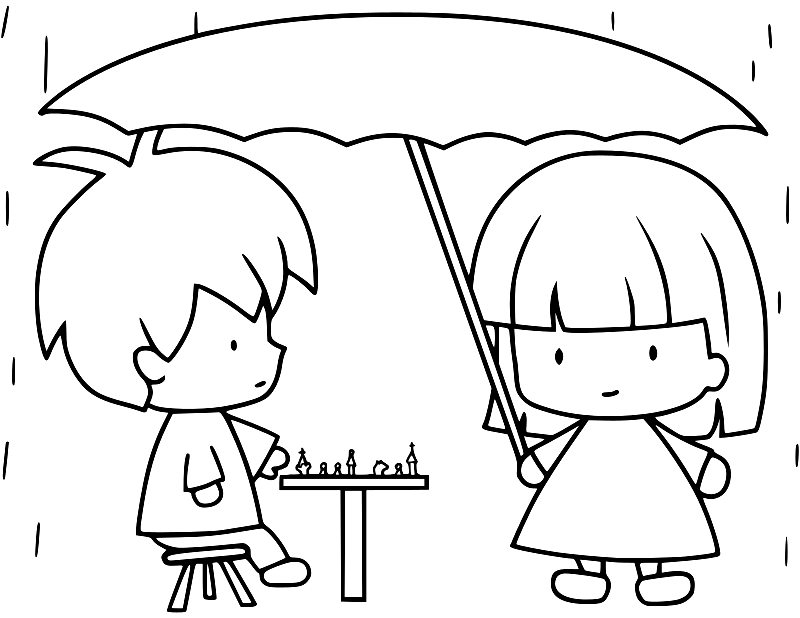
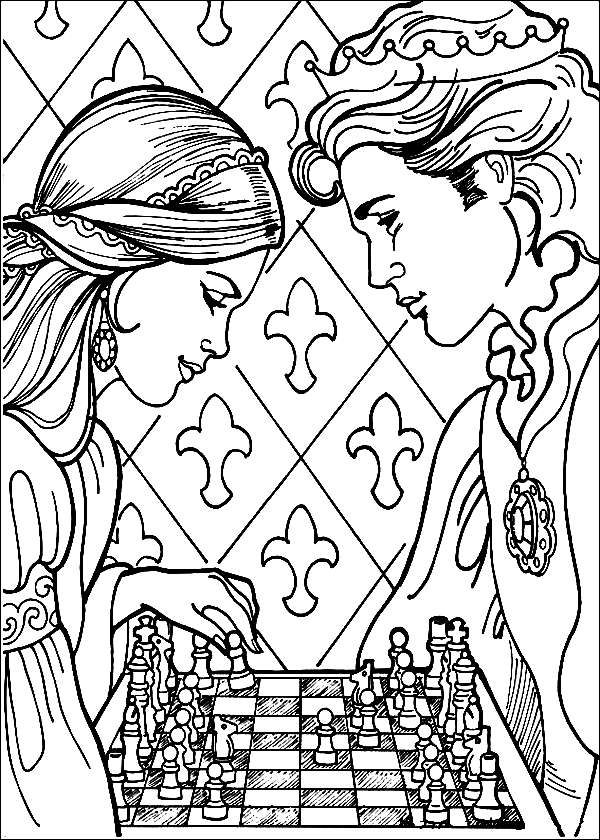
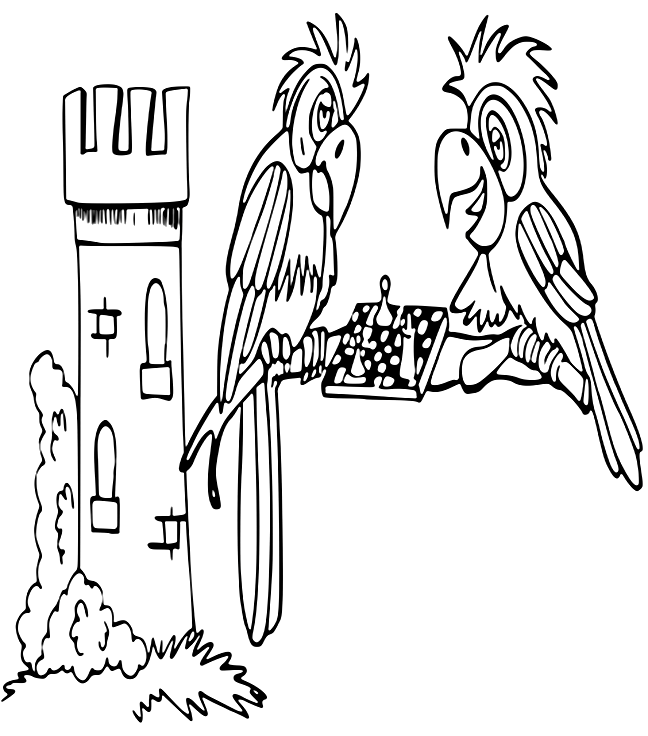
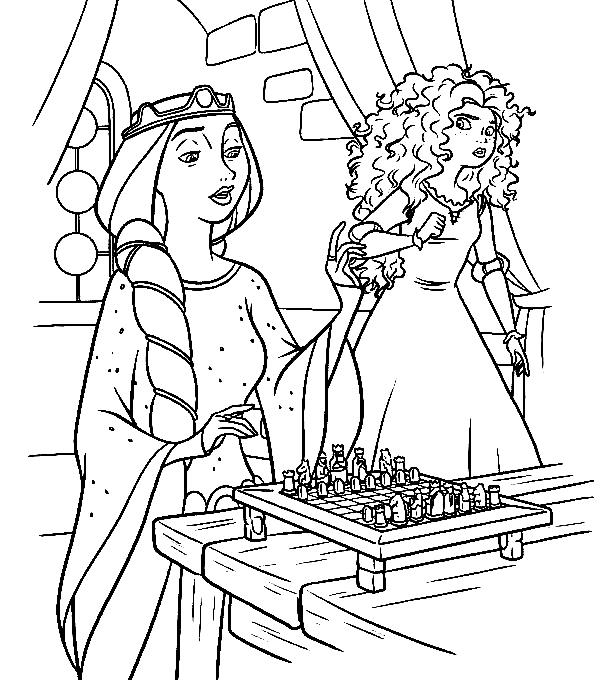
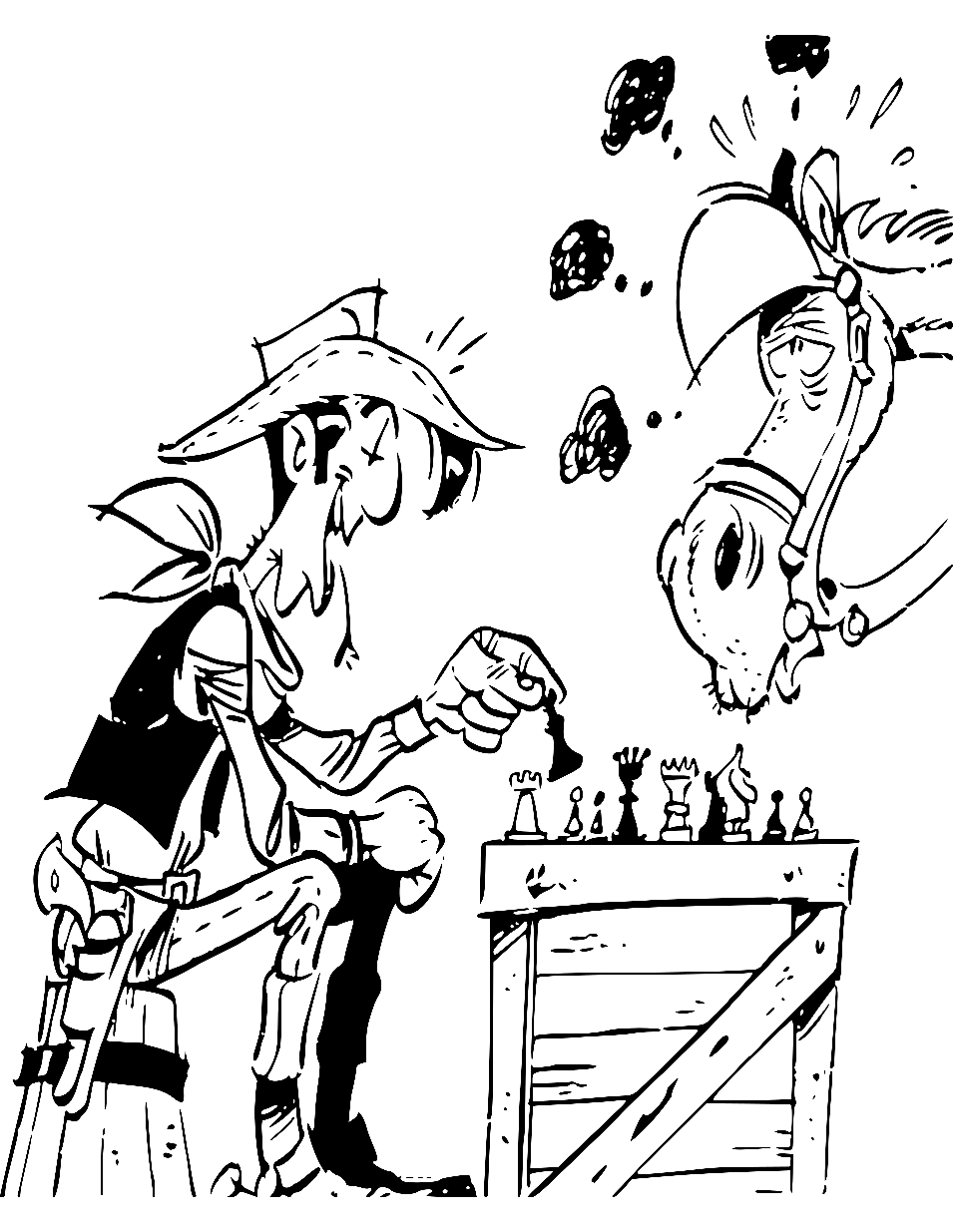
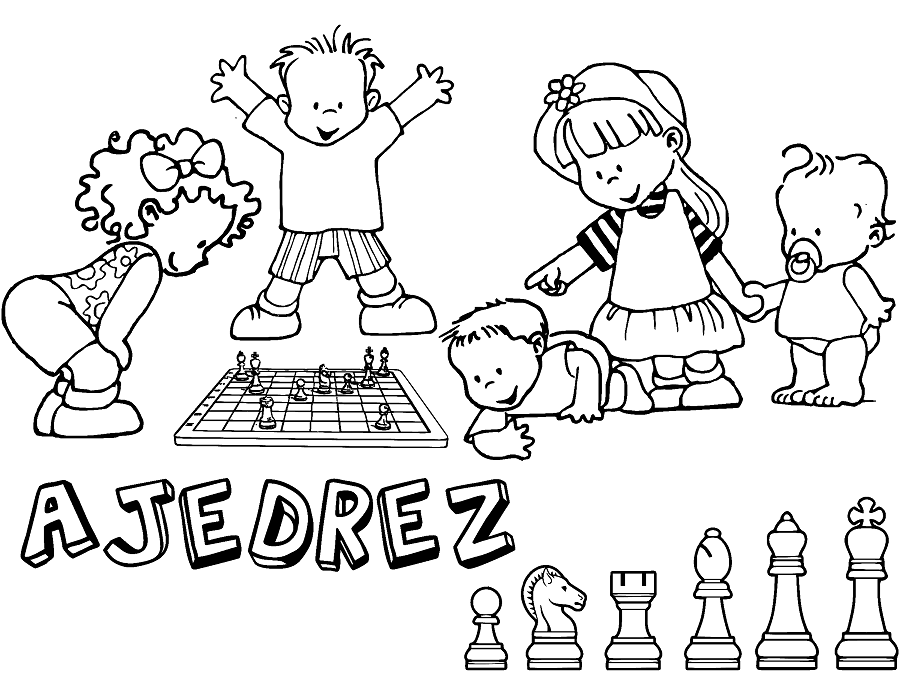
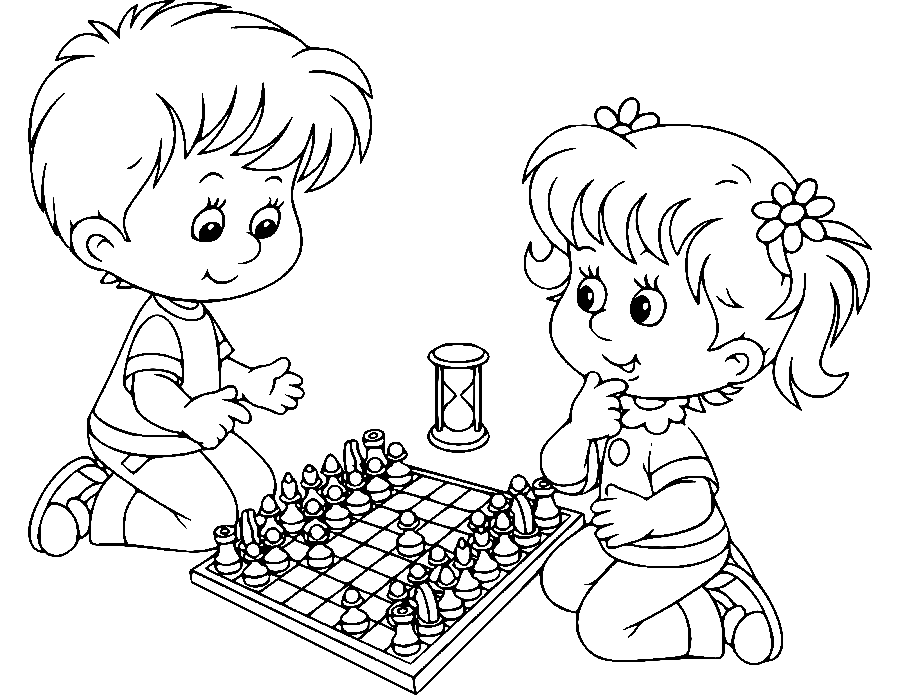
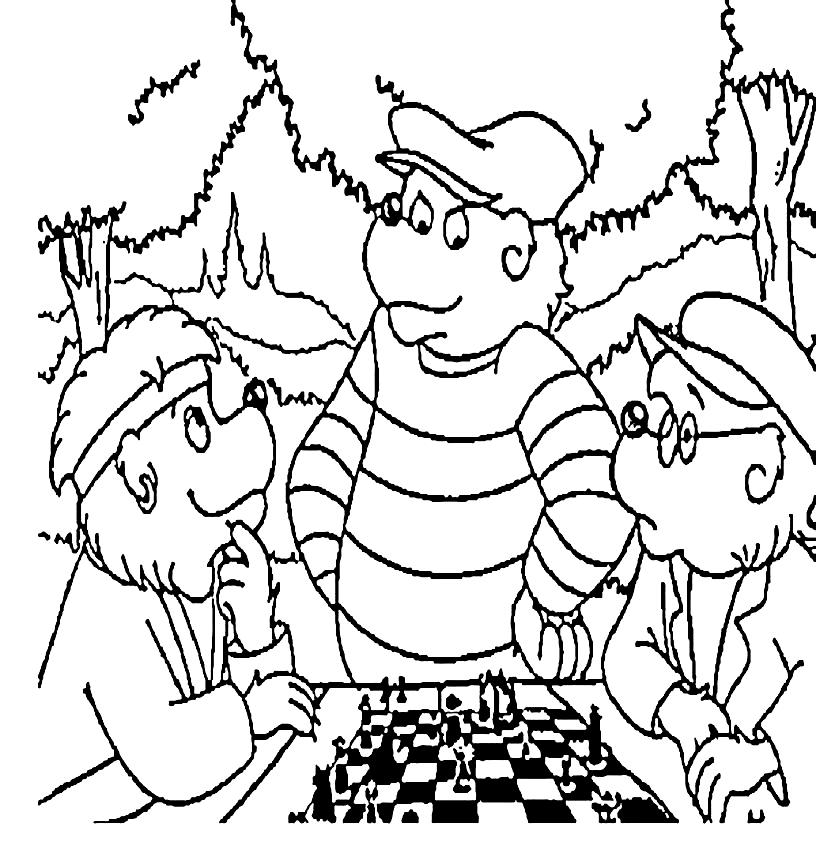
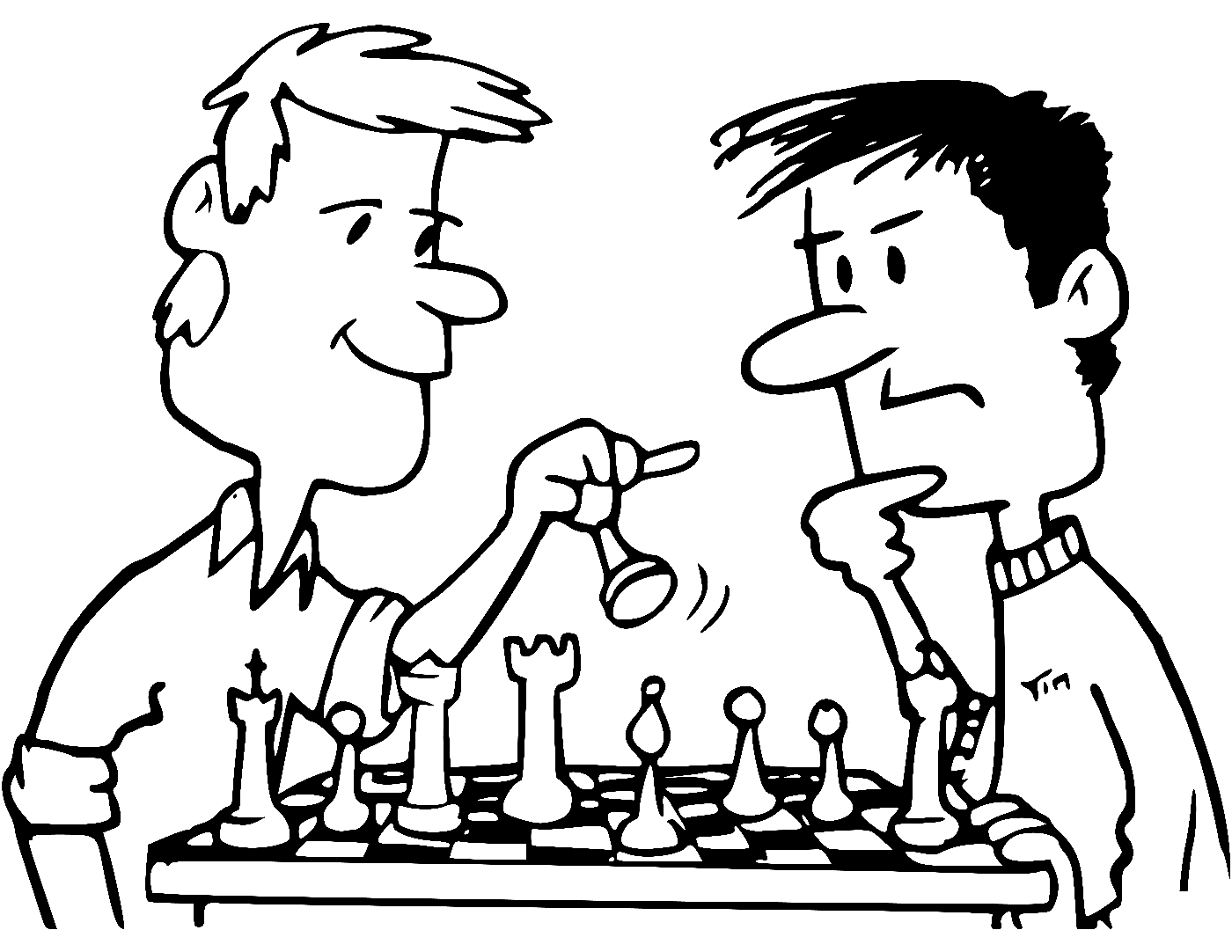
A substantial cluster shows different players engaged in the game: Two People Playing Chess, Two Kids Playing Chess, Boy and Girl Playing Chess, Children Playing Chess, Friends Playing Chess, Princess and Prince Playing Chess, Parrots Playing Chess, Bears Playing Chess, Cowboy and Horse Playing Chess, Meridas Mother Playing Chess, and Kar Karych playing Chess. These tiles situate chess in the social and relational context that is as important to the game’s appeal as the strategy itself – chess is played between two people facing each other across a board, and that face-to-face dynamic gives the game a human warmth that purely abstract strategy cannot replicate.

The animal player tiles – Bears Playing Chess, Parrots Playing Chess, Cowboy and Horse Playing Chess – use the absurdist chess-playing-animal convention that has been a beloved subject of illustrators and painters (most famously in the poker-dogs paintings tradition) and gives these tiles a gentle comedy that makes them particularly appealing for younger children.

Creative Character Scenarios – 2025 Series

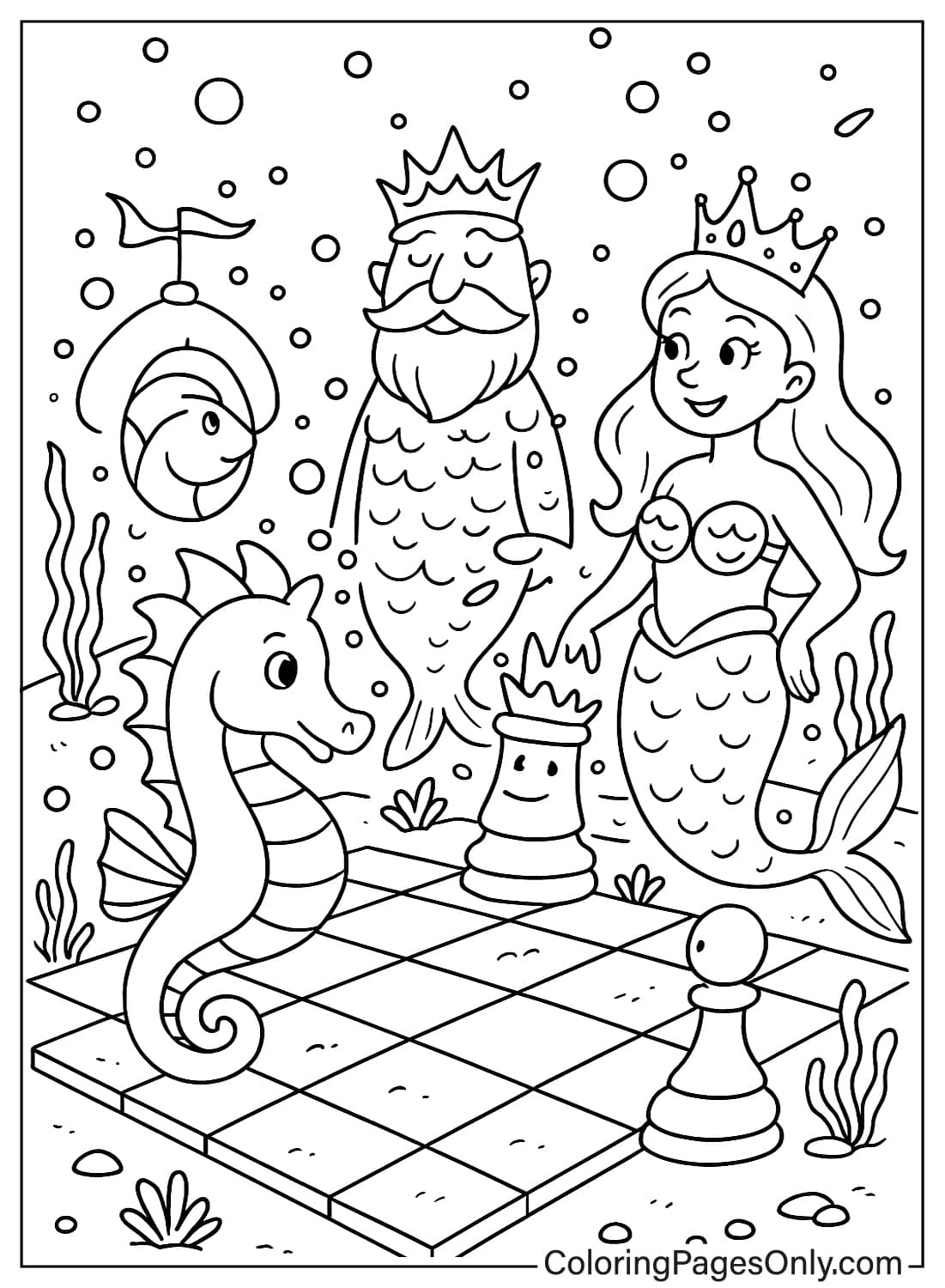
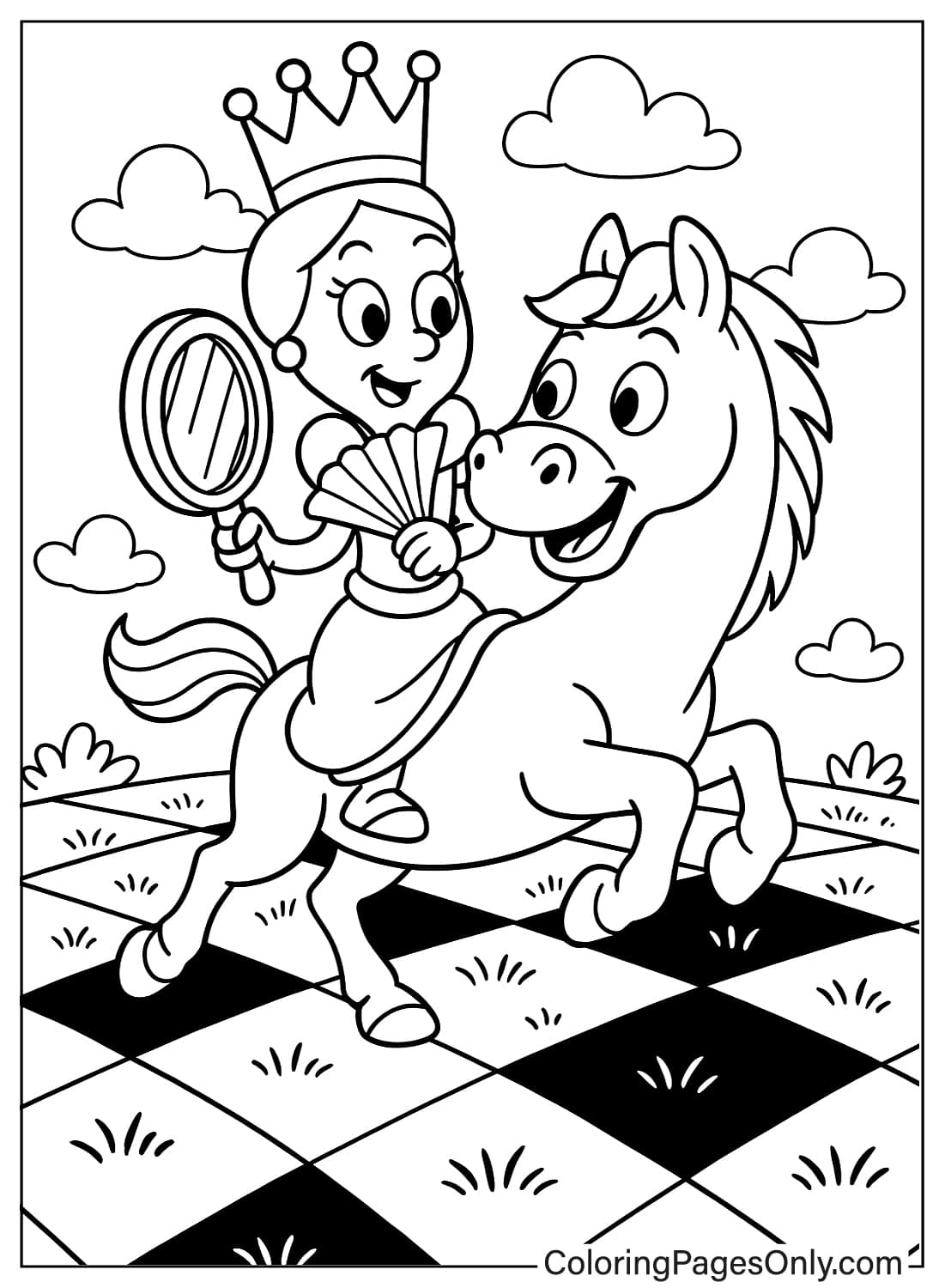
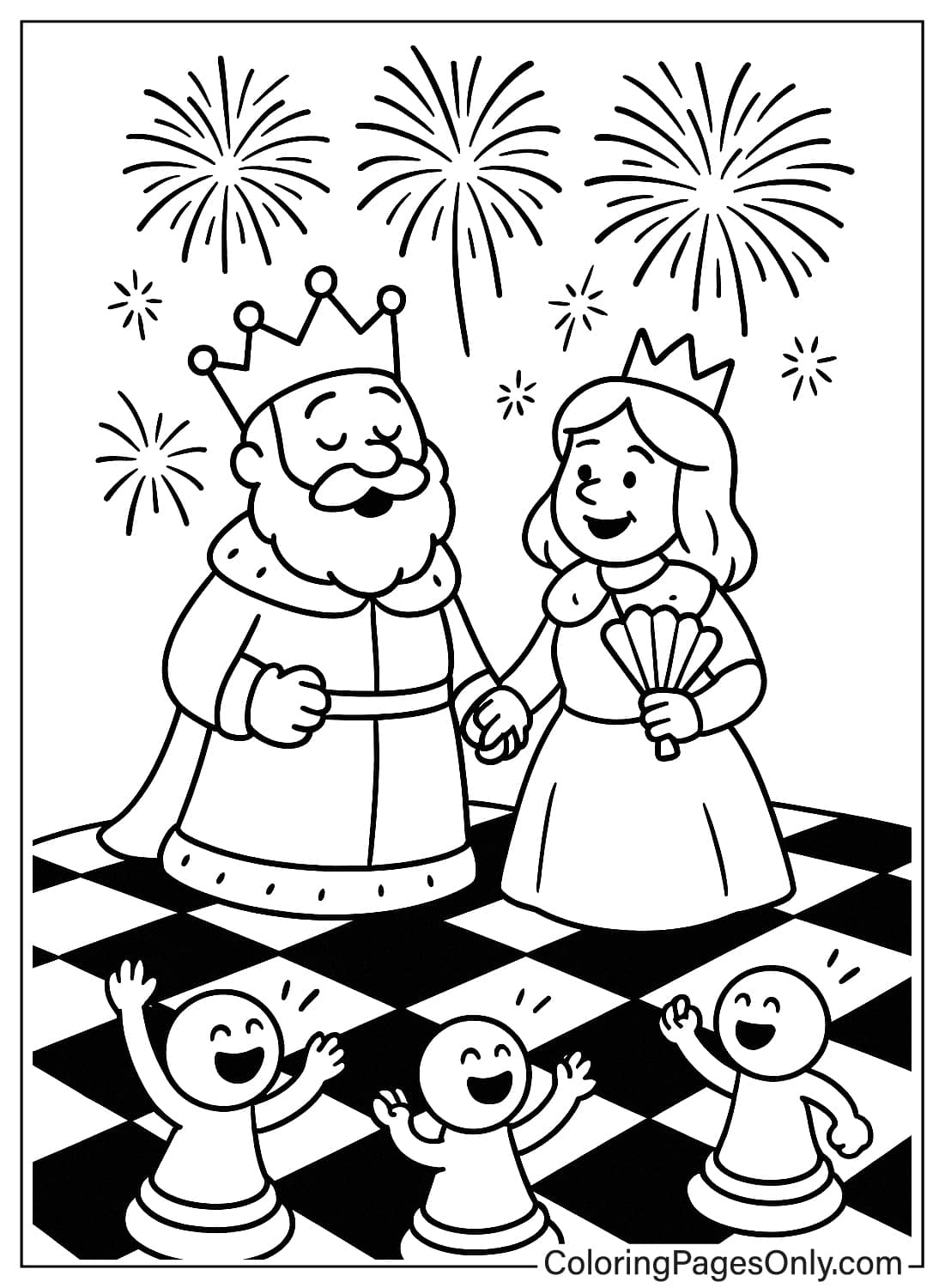
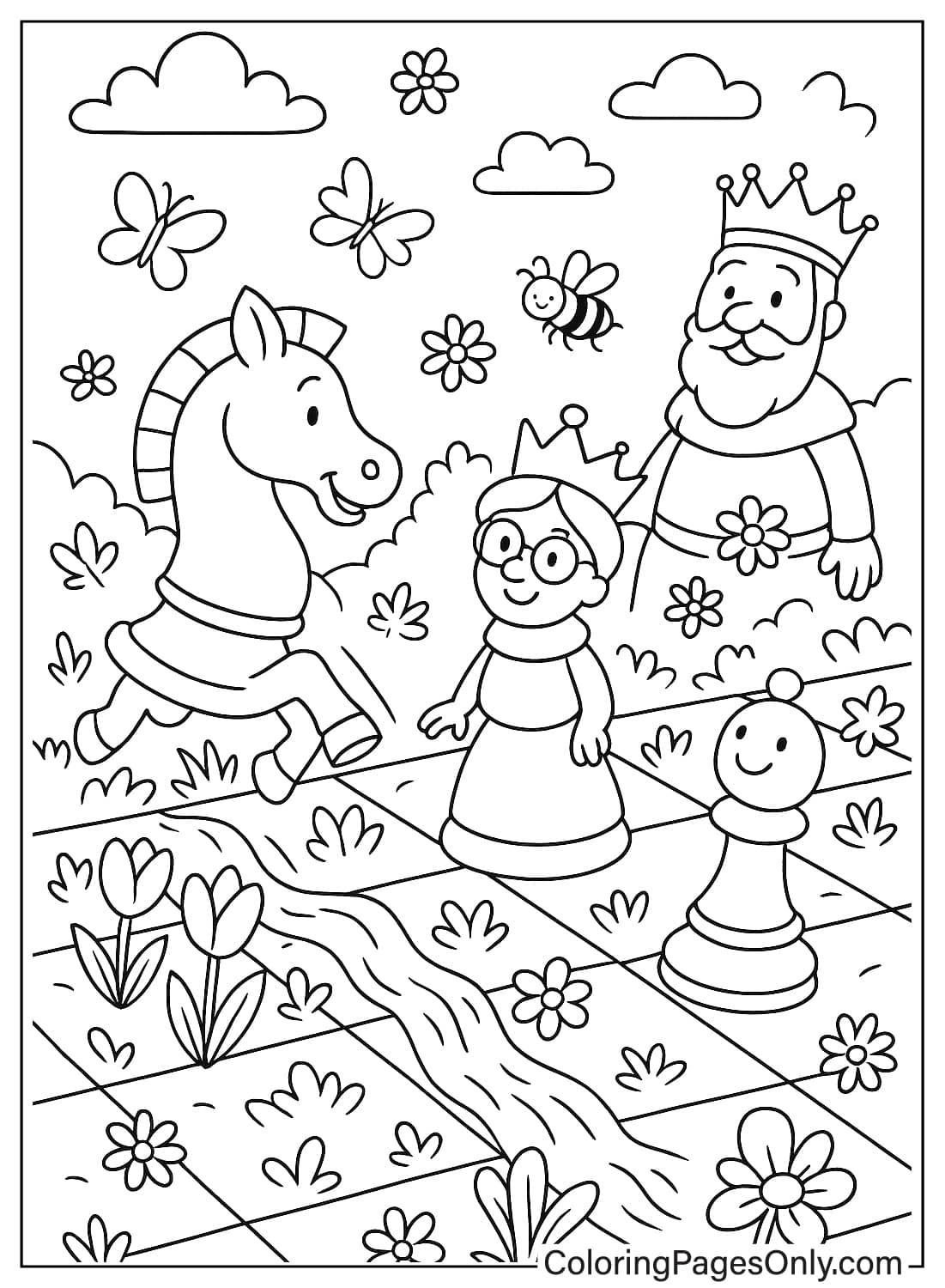
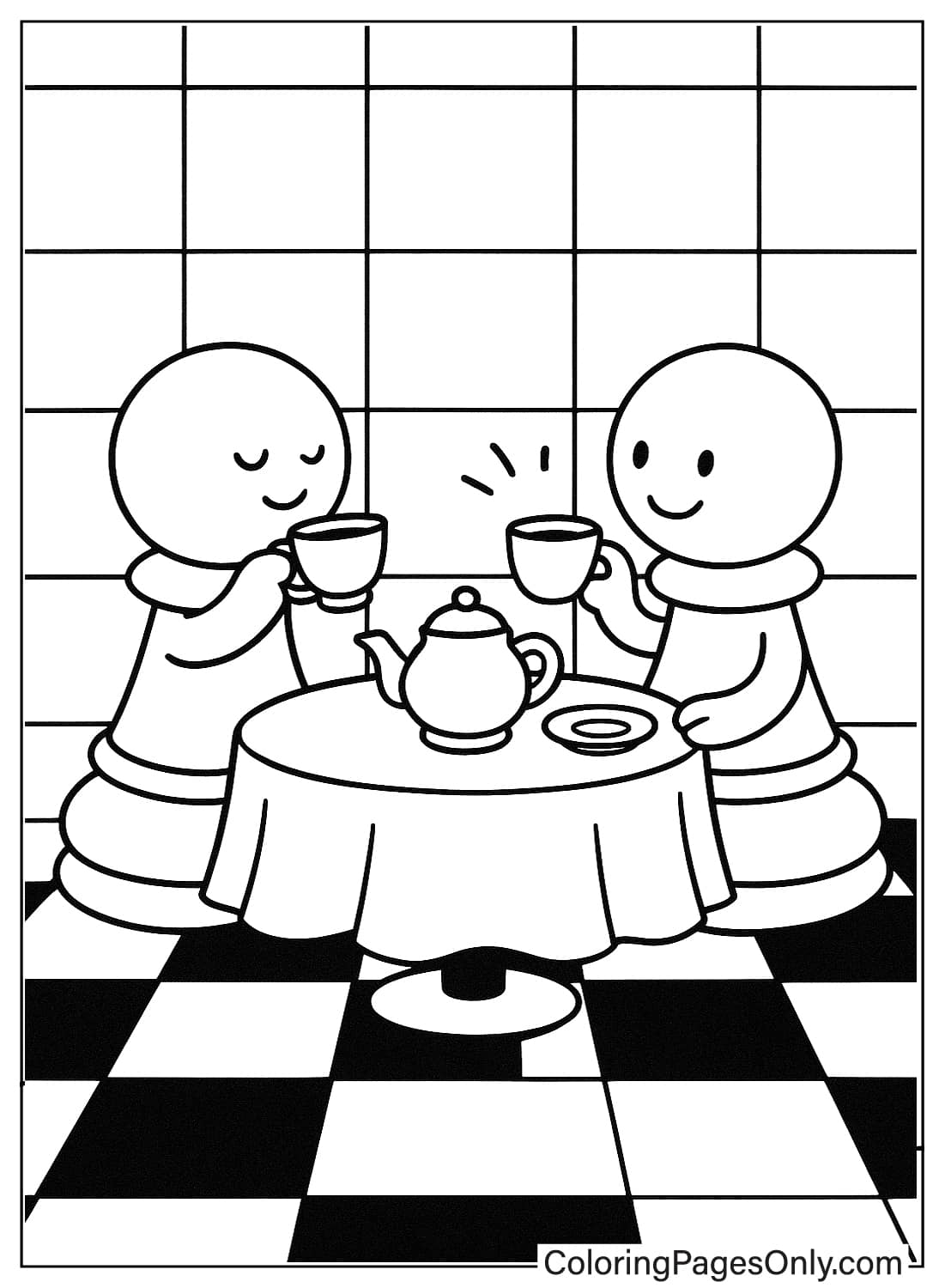
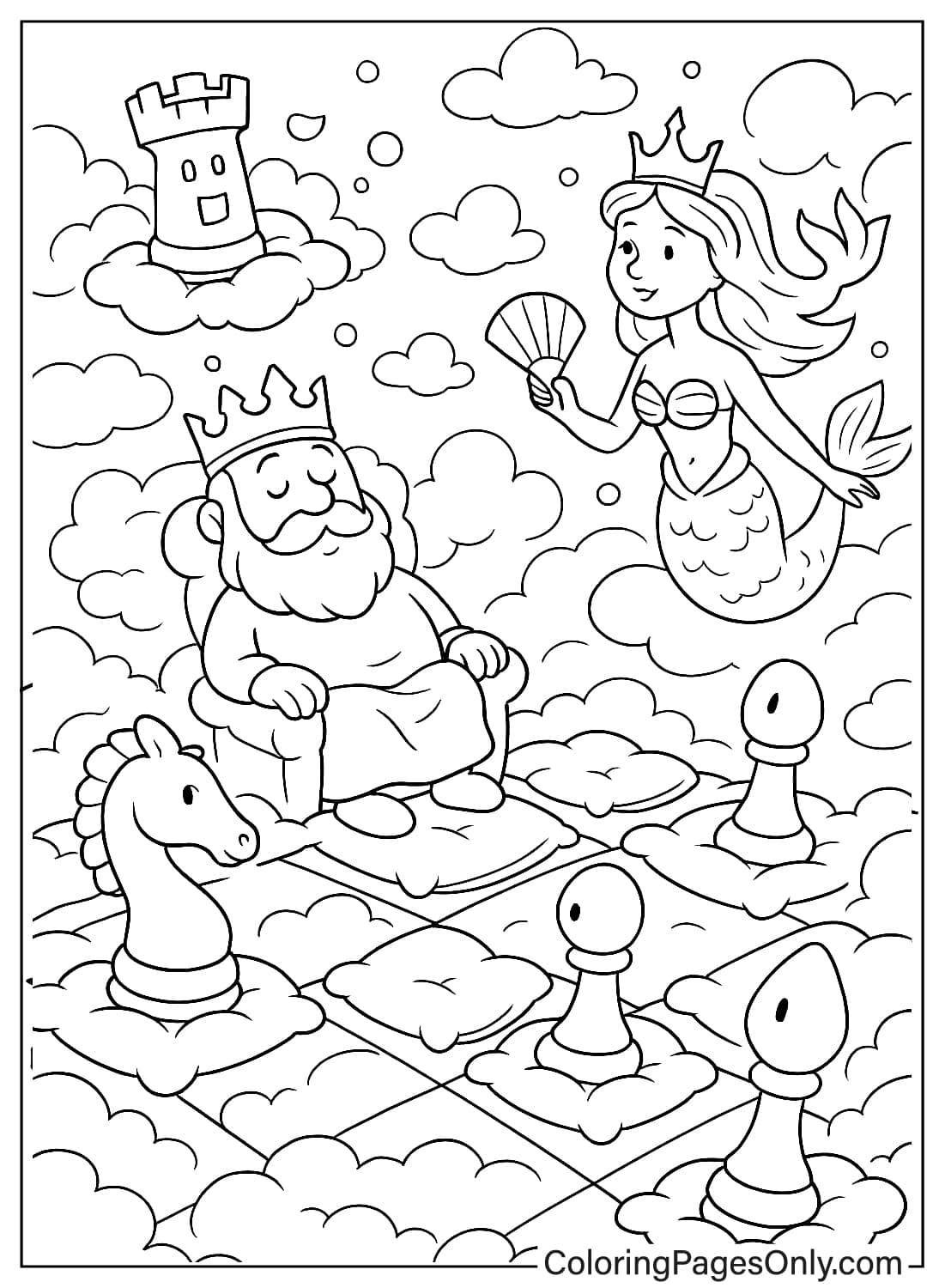
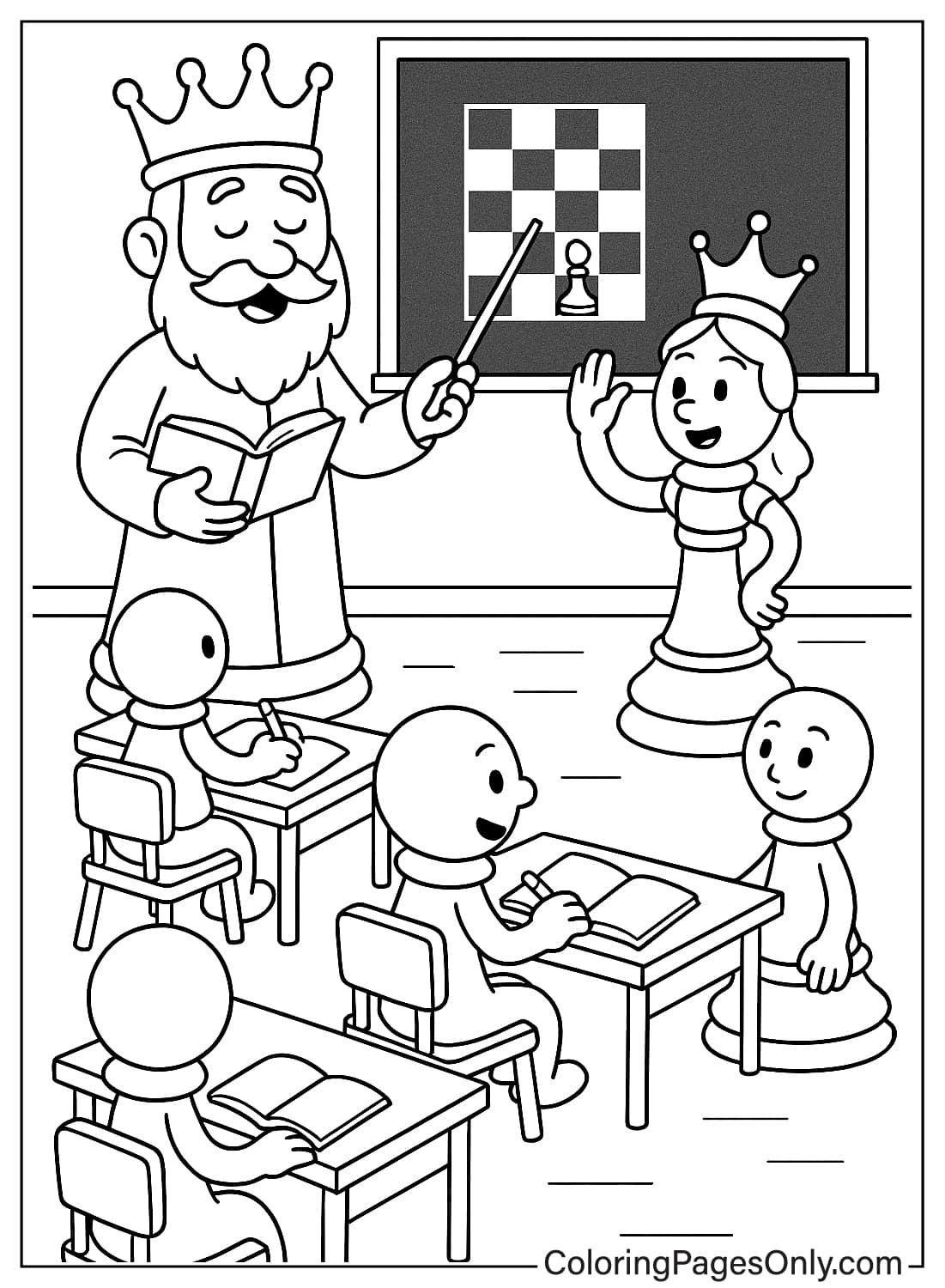
The 21 creative tiles added in 2025 are the collection’s most imaginative pages, treating chess pieces as fully realized characters with daily lives, emotions, and adventures entirely separate from the game of chess. The full list covers scenarios across multiple themes: everyday life (King Queen and Pawns Grocery Shopping, King and Queen Chess Picnic, Chess Pawns Drinking Tea, Chess King Teaching Class), physical activity (Pawn Doing Weightlifting, Chess Pawns Checkmate Marathon), emotional moments (Sleeping Chess King, Embarrassed Queen Chess Piece), adventure and fantasy (Outer Space Robot Chess, Underwater Mermaid Chess, Chess Kingdom in the Clouds, Chess Queen Riding a Horse, Chess Knight Running Away), seasonal and holiday themes (Halloween Chess, King and Queen with Fireworks, Chess Pieces in a Spring Garden), and comedic situations (Rook Stuck Pawns Traffic Jam, Angry Chess Kings Candy Fight, Kids Playing with Giant Chess Pieces, Chess Bishop Playing Trumpet, Happy Chess Rook Tower).

Special Tiles

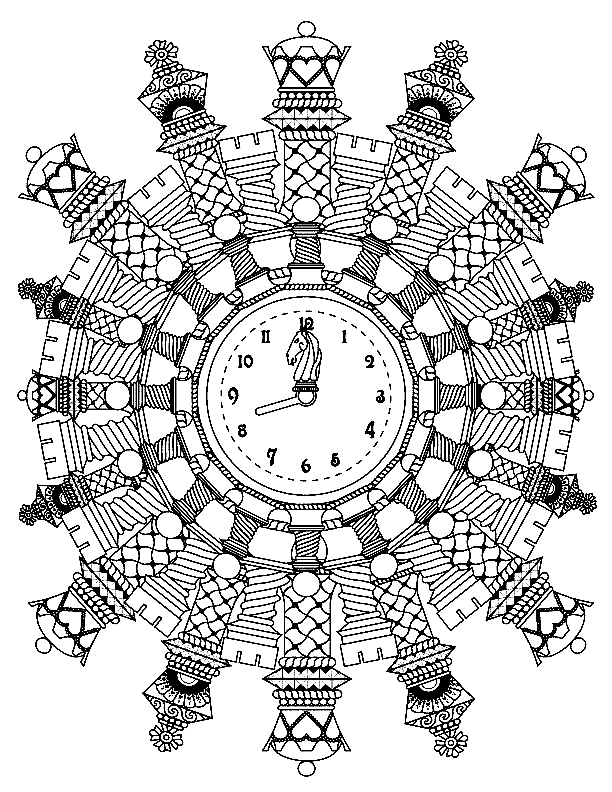
Chess Mandala is the collection’s most meditative page – a symmetrical mandala design incorporating chess imagery in intricate geometric patterning. This is the collection’s most complex and time-intensive page, suited to adults and older children interested in the stress-relief coloring tradition. For more on coloring as a relaxation tool, see our coloring pages for stress relief and anxiety guide.

Cinderella Chess Piece depicts a chess piece styled after the Cinderella character – a crossover between fairy tale and chess aesthetics. Merida’s Mother Playing Chess references the Brave (2012) character, depicting Elinor (Merida’s mother) at a chessboard.

Coloring Guide: The Chess Color System

The Traditional Two-Color System

Standard wooden chess sets use two colors to distinguish the two opposing sides – traditionally described as “White” and “Black”, though real sets use a wide range of color combinations: white and black, cream and brown, cream and red, natural wood and ebony, ivory and rosewood. For coloring pages depicting a full set or opposing pieces, the most visually clear approach uses the maximum available contrast between the two sides.

The most effective color pairings for distinguishing the two sides: white or cream versus black or very dark brown; pale gold versus dark navy; light gray versus deep burgundy. The contrast between the two sides is the most important coloring decision on any board or multi-piece tile – if the contrast is insufficient, the spatial organization of the board becomes unclear.

The Chessboard

The chessboard’s alternating light and dark squares are the collection’s most geometric and pattern-based coloring subject. Standard tournament boards use cream or pale ivory for light squares and medium brown or dark tan for dark squares – not white and black, which creates too much visual harshness for long play sessions. For more expressive creative choices: pale blue and deep navy for a winter/space aesthetic; pale gold and deep green for a classic European look; pale lavender and deep purple for a fantasy treatment.

The squares must be precisely alternating – every light square surrounded by dark squares on all four sides, every dark square surrounded by light squares. Starting at one corner and working row by row is the most reliable approach. Eight rows of eight squares, alternating throughout.

The 2025 Creative Series – Color Approach

The creative character tiles use a different coloring logic than the traditional piece tiles. Because the pieces are depicted as characters with expressions, environments, and narrative context, color choices should reinforce the emotional and situational content of each page.

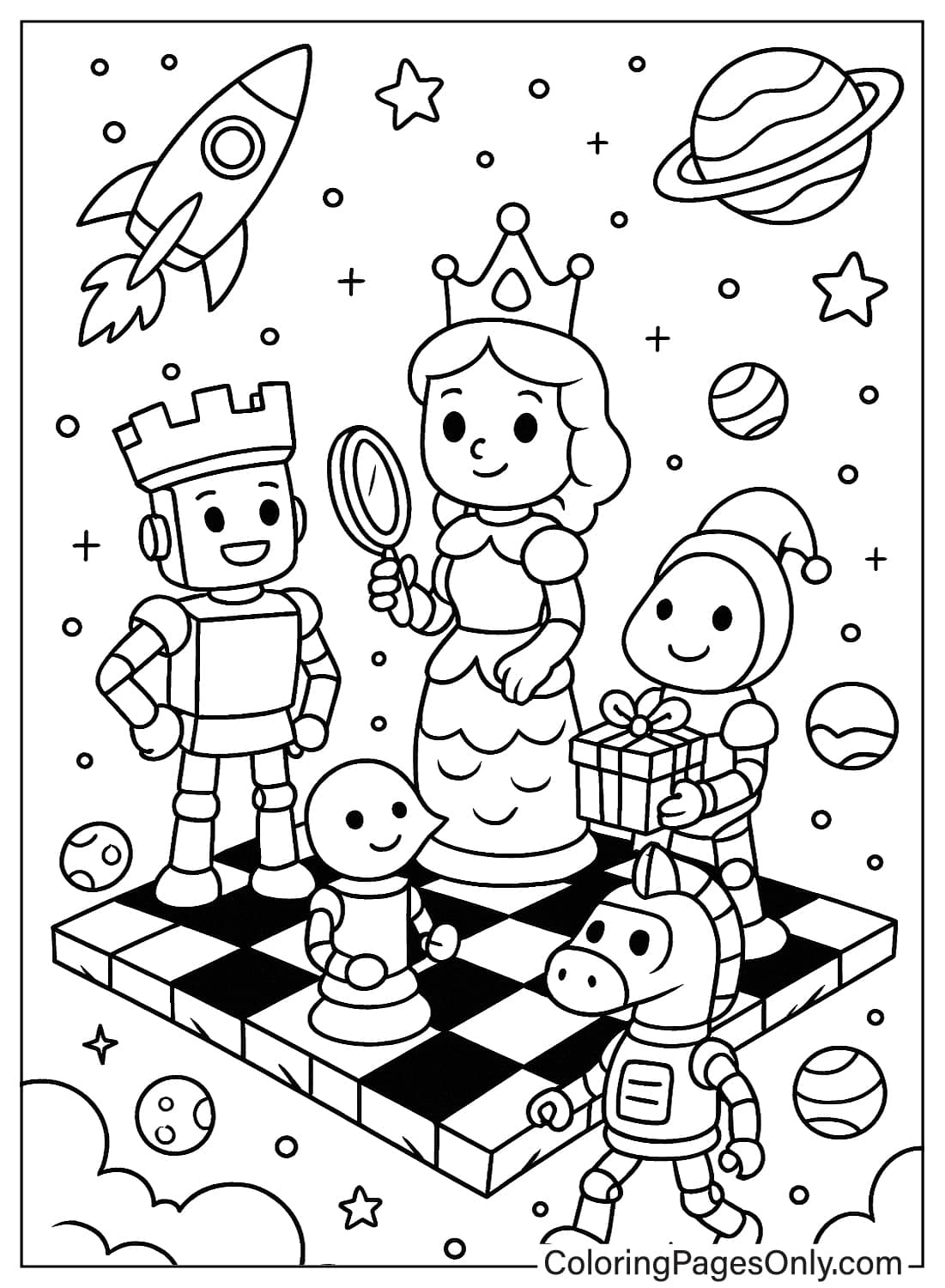
The Outer Space Robot Chess tile suits metallic silvers and deep space blues and purples for the chess piece characters, with a dark navy-black background and pinprick star details. The Underwater Mermaid Chess tile suits the full range of ocean blues and teals for the environment, with vivid coral and violet accents for the mermaid characters. The Halloween Chess tile uses the canonical Halloween palette – orange, black, purple, green – with the Jack-o’-lantern chess piece as the compositional center. The Chess Pieces in a Spring Garden tile uses the warmest, most vivid spring palette in the collection – pink blossom, bright green foliage, cheerful yellow, and pale blue sky.

For the King and Queen across all creative tiles, maintaining a consistent color identity helps the characters read coherently across multiple pages – if you color multiple tiles, decide on the King and Queen’s colors once (say, King in royal purple, Queen in deep gold) and use those same colors consistently across all tiles you complete.

Chess and Children: Educational Value

Chess is one of the most extensively studied games in educational research. Multiple studies have found associations between regular chess instruction and improved mathematical reasoning, reading comprehension, spatial visualization, and concentration in elementary and middle school children. Several national chess-in-schools programs operate across the United States, the United Kingdom, France, Germany, and India on the basis of this research.

The connection between chess and coloring pages is more than thematic convenience. Both activities share important cognitive characteristics: both require sustained attention, both reward patience and deliberate decision-making over impulsiveness, and both produce a completed artifact – a position that satisfies aesthetically, a colored page – that provides concrete positive reinforcement for the effort invested. Children who engage with both chess coloring pages and actual chess playing have an additional bridge: coloring the pieces individually creates familiarity with each piece’s name, form, and character before the rules of movement are introduced, which lowers the cognitive load of learning the game itself.

For parents and teachers introducing chess to children, the Printable Chess King, Printable Chess Queen, Printable Chess Rook, Printable Chess Bishop, Printable Chess Knight, and Printable Chess Pawn tiles serve as a practical learning aid – color each piece while learning its name and movement, creating a personal reference set. The Chess Board for Kids tile can be colored and laminated as a play surface. For developmental guidance on coloring activities appropriate to different age groups, see our coloring pages by age guide.

FAQs

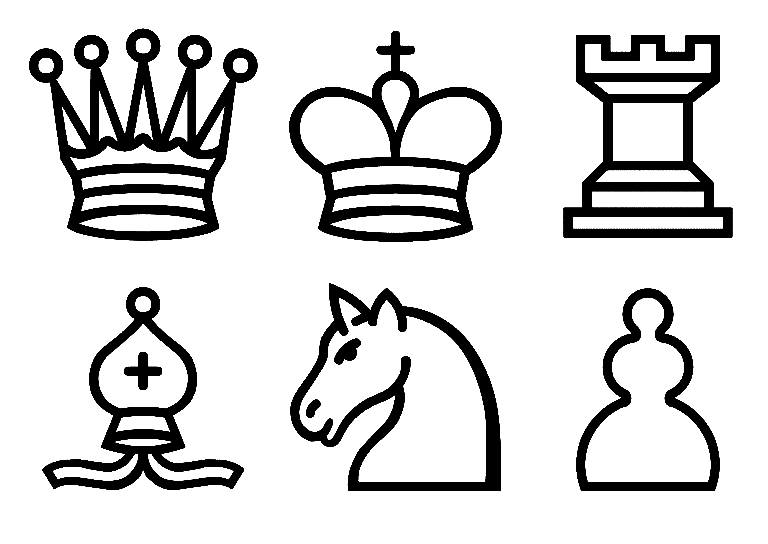
What are the six chess pieces? The six chess pieces are the King (most important, slowest mover), Queen (most powerful, moves any direction any distance), Rook (moves horizontally and vertically), Bishop (moves diagonally), Knight (moves in an L-shape and can jump over pieces), and Pawn (moves forward, captures diagonally, can promote to any piece upon reaching the opposite end of the board).

What does checkmate mean? Checkmate is the game-ending position in which a player’s King is in check (threatened by capture) and has no legal move to escape the threat. When checkmate is achieved, the game ends, and the player who delivered checkmate wins. The word comes from the Persian phrase Shah Mat – “the king is helpless.”

What is the most powerful chess piece? The Queen is by far the most powerful piece in chess, able to move any number of squares in any direction – horizontally, vertically, or diagonally. Losing the Queen is almost always a decisive disadvantage.

What does Pawn promotion mean? When a Pawn reaches the far end of the board (the opponent’s back rank), it immediately transforms into any other piece the player chooses – in almost all cases, a Queen, since the Queen is the most powerful piece. This promotion rule is one of chess’s most exciting possibilities and gives even the most apparently insignificant piece a potential path to becoming the most powerful.

How old is chess? Chess in its recognizable modern form is approximately 500 years old, with the current rules stabilizing in 15th-century Europe. Its predecessor games date back to 6th-century India. The game has been played in some form for approximately 1,500 years.

Is chess good for children’s brain development? Multiple educational studies have associated regular chess instruction with improvements in mathematical reasoning, concentration, pattern recognition, and spatial visualization. Several national chess-in-schools programs operate on this research basis. Chess is also associated with improved reading comprehension in some studies, likely through the concentration and pattern-matching skills the game develops.

At what age can children learn chess? Most children can learn the basic movements of chess pieces at ages 5–6, and can play simple full games by ages 6–7. Competitive tournament chess is commonly introduced at ages 7–10. The cute and character-style tiles in this collection are appropriate for introducing chess terminology and piece identity to children as young as 4–5 through coloring before formal instruction begins.

Who is the greatest chess player of all time? This is genuinely debated in the chess world. Magnus Carlsen of Norway, who became World Champion in 2013, holds the highest Elo rating in history and is widely considered the strongest player ever by most modern metrics. Garry Kasparov dominated world chess from 1985 to 2000 and is considered by some analysts to have had the greatest overall competitive record. Bobby Fischer, whose 1972 World Championship match against Boris Spassov during the Cold War made chess a global cultural event, remains the most famous chess player in American popular consciousness.

All 70+ Chess Coloring Pages are free – download as PDF or color online. Share your finished pages on Facebook and Pinterest.

These related coloring collections will help you explore the wonderful world of colors. Let’s choose, be creative, and show us your great pictures!

Jennifer Thoa – Writer and Content Creator

Hi there! I’m Jennifer Thoa, a writer and content creator at Coloringpagesonly.com. With a love for storytelling and a passion for creativity, I’m here to inspire and share exciting ideas that bring color and joy to your world. Let’s dive into a fun and imaginative adventure together!