Activities Coloring Pages at ColoringPagesOnly.com covers over 580 pages across 13 sub-categories organized around what people actually do with their time and bodies outside of work and obligation – the leisure pursuits, physical practices, outdoor experiences, and creative activities that define how people choose to spend their free hours. This is a category organized around the universal human experience of doing things for pleasure: camping under the stars, fishing beside a quiet river, flying a kite on a windy afternoon, dancing, practicing yoga, gathering for a picnic, playing on a playground. These are not competitive sports (those have their own category) and not household tasks (those have their own category) – Activities here mean the recreational and creative pursuits that people undertake because they bring joy, rest, or a particular kind of engaged presence that ordinary life does not always provide. For children, coloring these pages is an act of recognition and anticipation – recognizing activities they already love and imagining ones they have not yet tried. For adults, it is a form of quiet enjoyment that reflects the same impulse as the activities depicted.

Every page in this collection is completely free to download as a PDF and print, or to color online directly in your browser.

Outdoor Activities: Nature, Water, and Open Air

The largest cluster of sub-categories in the Activities collection covers the activities that take people outside – into forests, fields, rivers, and open sky. These pages share the visual atmosphere of outdoor light, natural settings, and the specific colors of the natural world: the green of vegetation, the blue of sky and water, the warm tones of earth and wood.

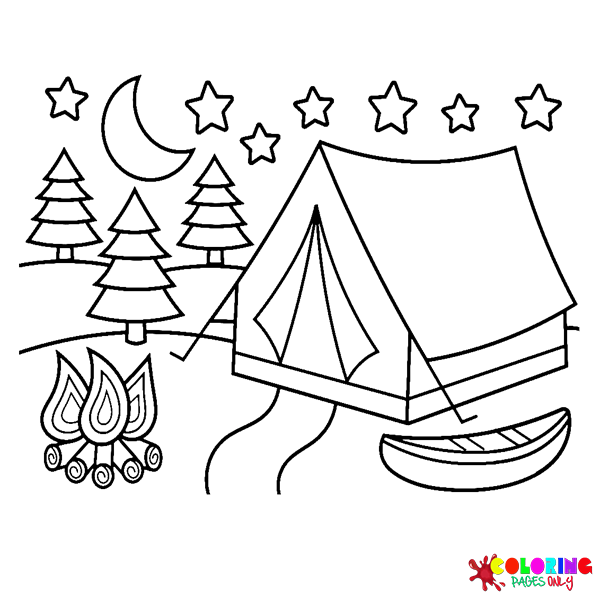
Camping is the largest sub-category in the Activities collection and one of the most visually rich of all the leisure activity pages on the entire site. The camping experience generates a distinctive visual world that is immediately recognizable and emotionally resonant: the tent pitched in a clearing, the campfire with its orange and red flames and rising gray smoke, the night sky overhead with its full spread of stars unobscured by city light, the cooking over an open fire, the marshmallows on a stick, the sleeping bag, the lantern, the canoe pulled up to a lakeside, the boots left at the tent flap.

Camping pages cover this full visual range of the camping experience across many different contexts and levels of comfort – from the simple tent-and-campfire composition that captures the most universal idea of camping, to more elaborate wilderness camp scenes with canoes, fishing gear, and mountain backdrops, to the cozier glamping aesthetic with string lights and comfortable camp furniture. What connects all of them is the specific quality of light and atmosphere that defines outdoor camping: daytime pages with the bright, unfiltered outdoor light of open forest or lakeside settings, and nighttime pages with the intense contrast between the dark blue-black of an unpolluted night sky and the warm orange glow of the campfire that serves as the composition’s central light source.

The campfire is the single most important coloring element in any camping page that includes it. A campfire rendered with careful attention to the gradient of flame color – bright near-white at the hottest inner core, vivid yellow in the main flame body, shifting to orange and then red-orange at the outer flame edges, with wisps of gray-blue smoke rising above – produces a light source that radiates warmth across the entire composition. Logs and embers at the base of the campfire should be rendered in glowing red and orange, suggesting heat even in areas where visible flame has died down to coals. The light cast by the campfire onto surrounding elements – the tent, the faces of people gathered around it, the ground – should be the warm orange-gold of firelight rather than the cool daylight white used for the rest of the scene.

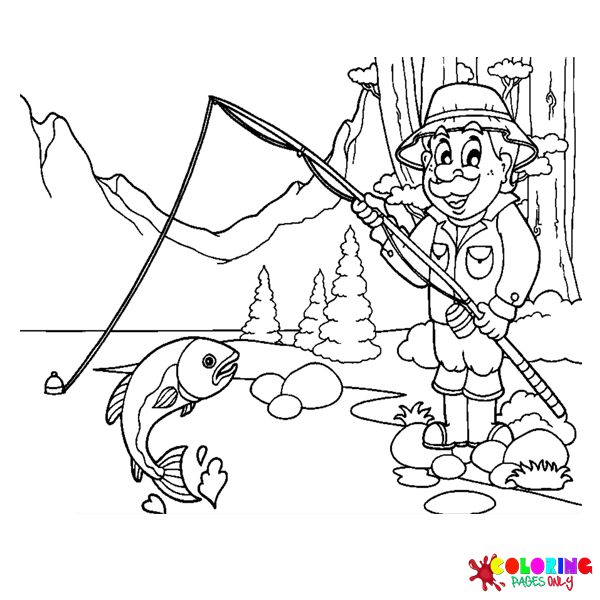
Fishing covers one of the world’s most widely practiced leisure activities – the patient, meditative practice of waiting beside water with a line cast in hope of a catch. Fishing pages capture the specific atmosphere of this activity: the solitary figure (or pair of figures, often across generations – a grandparent and child is one of the most common and touching fishing page compositions) at the water’s edge, the fishing rod arcing out over the water’s surface, the cork or float on the still water showing where the line descends, and the natural setting of riverbank, lake shore, or dock that frames the scene.

The visual palette of fishing pages is dominated by the colors of the water environment: the blue-green or gray-green of the water’s surface (varying with depth, weather, and the type of water body), the warm brown of a wooden dock or riverbank, the green of reeds, cattails, and bank vegetation, and the specific bright colors of the fishing equipment – the red-and-white striped cork float, the vivid orange or yellow of a lure, the silver of a metal hook and sinker. Water surface coloring is one of the most technically interesting challenges in fishing pages: still water should show reflected sky color (blue with cloud shapes), disrupted by the subtle ripples emanating from where the line enters the surface, while moving river water should show directional current lines and the broken light of flowing water.

Kite covers the simple, wind-dependent outdoor activity of kite flying – one of the oldest recreational activities in human history, with documented kite use in China dating back over 2,500 years. Kite pages capture the specific visual joy of kite flying: the brightly colored kite shape ascending against a blue sky, the long string connecting it to the hand of the person on the ground below, the tail ribbon streaming behind in the wind. Kite pages are among the most compositionally vertical in the Activities collection – the kite at the top of the composition, the string descending diagonally, the figure and ground at the bottom – which gives these pages a natural sense of height and movement.

The kite itself offers one of the most open creative coloring opportunities in the entire Activities collection. Unlike most subjects where canonical color guides accuracy, kites exist in every possible color and pattern combination – geometric diamonds, dragons, birds, abstract color-field designs – which means the colorist’s choices are entirely free. A kite colored in vivid red and yellow diamonds against a blue sky, or in a rainbow gradient pattern, or in the design of a butterfly or fish, is equally valid and equally pleasing. The sky background in kite pages also rewards careful coloring: a bright blue sky with scattered white clouds communicates the specific quality of a breezy, ideal kite-flying day, while a more complex sky with cloud layers and dynamic blue gradients produces a more atmospherically rich setting for the kite.

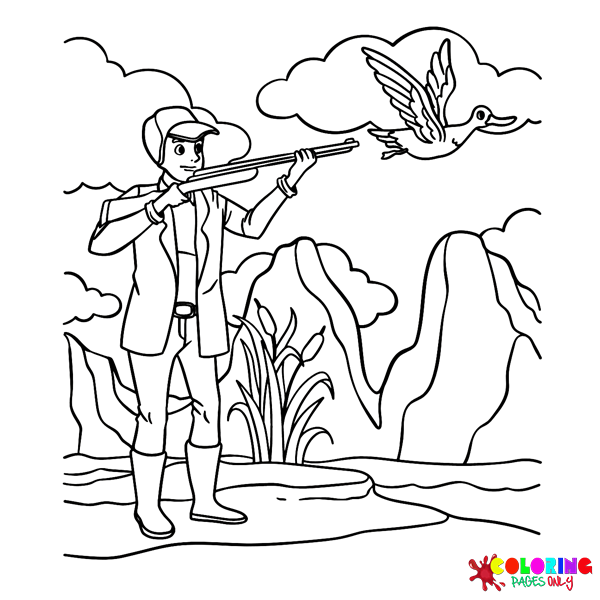
Hunting covers the traditional outdoor practice of hunting – the pursuit of game in natural settings as a leisure activity. Hunting pages depict the outdoor wilderness context of the activity: the hunter in appropriate field clothing (earth tones, camouflage), the natural landscape of forest or open field, and the equipment and tools associated with hunting culture. The color palette of hunting pages is dominated by the earth tones of natural environments and the practical garment colors of hunting – the orange of a safety vest (blaze orange, required in most hunting jurisdictions for safety visibility), the green and brown camouflage of field clothing, and the tan and dark tones of the woodland or grassland setting.

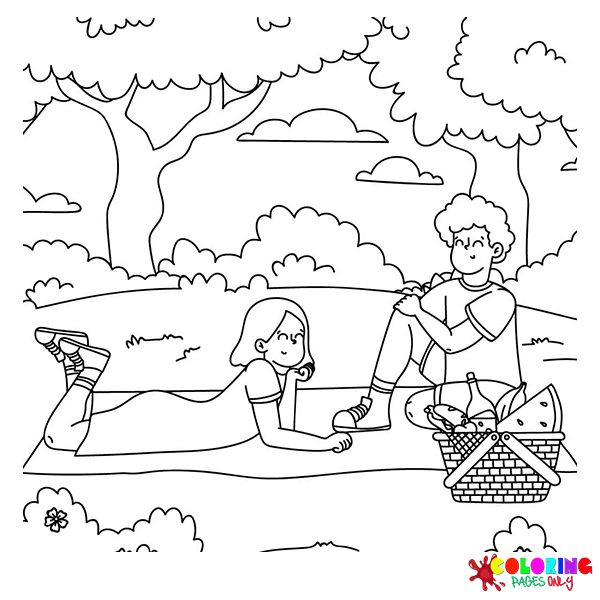
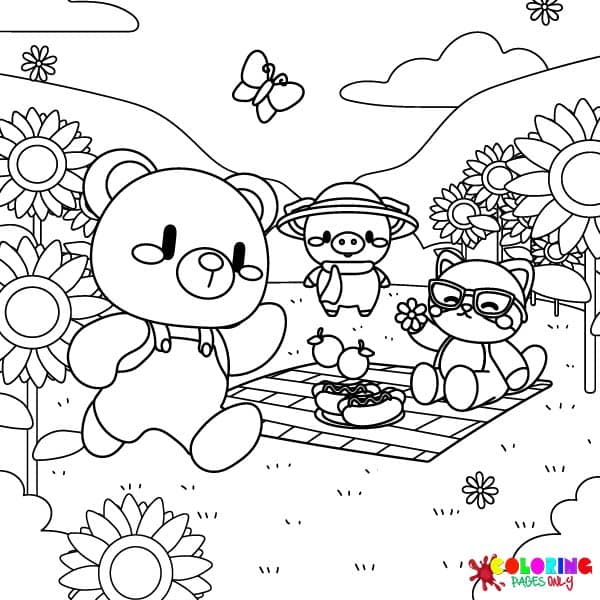
Picnic and Spring Picnic cover the outdoor meal – one of the most purely pleasurable of all leisure activities, combining food, fresh air, natural beauty, and social company in a single experience. Picnic pages capture the visual composition of the outdoor meal: the blanket spread on grass (a rectangle of pattern against the surrounding green), the wicker basket open to reveal its contents, the food arranged attractively (sandwiches, fruit, drinks, sometimes a cake or dessert), the figures gathered around in relaxed outdoor poses, and the natural setting that frames the meal.

The visual palette of picnic pages is among the warmest and most inviting in the entire Activities collection: the green of the grass and surrounding vegetation, the warm tones of the wicker basket, the vivid colors of the food (red strawberries, yellow lemons, golden bread), and the blue sky above combine to create a composition whose color relationships naturally produce warmth and appetite. The Spring Picnic sub-category specifically frames the activity in the seasonal context of spring – adding cherry blossoms or other early flowers to the surrounding landscape, suggesting the specific quality of a spring day that has finally turned warm enough to eat outdoors after winter’s confinement.

Movement and the Body: Dance, Yoga, and Physical Practice

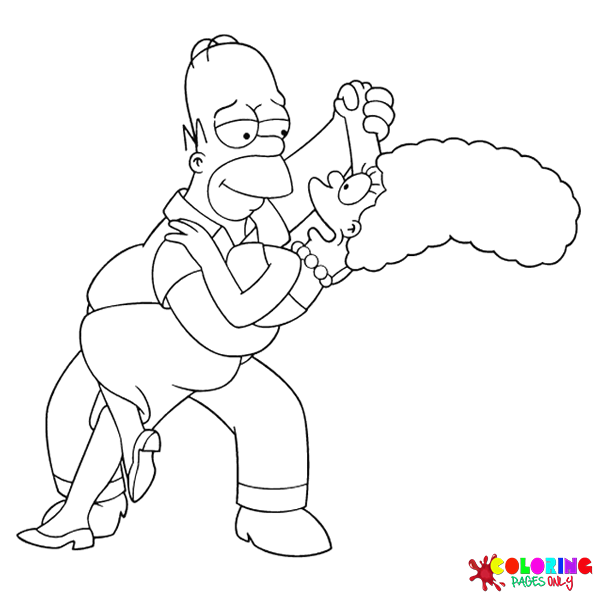
Dancing covers the full range of dance forms – from the formal classical traditions to social dancing to the more casual and spontaneous movement that happens when music inspires physical response. Dance coloring pages capture what photography of dancers captures: the body in motion, the extended limb, the turned-out foot, the arms lifted or spread in an expressive gesture, the face animated by the music, and the physical pleasure of movement. Dance pages are among the most compositionally dynamic in the entire Activities collection because the subject is inherently about movement, and good dance illustration captures the quality of motion in a still image – the way the skirt’s hem suggests recent spinning, the way the lifted arm suggests ongoing ascent.

Dance pages in the Activities collection cover several distinct dance contexts: the formal ballet or contemporary dance studio or stage setting, the social dance setting of a party or dance floor, the folk and traditional dance context with its specific cultural costume and setting, and the informal solo dance that happens in kitchens and bedrooms when a good song comes on. Each context produces a different visual atmosphere and a different costuming requirement – the tutu and pointe shoes of ballet, the sequined or flowing dress of ballroom, the traditional embroidered costume of folk dance – that gives dancing pages significant variety across the sub-category.

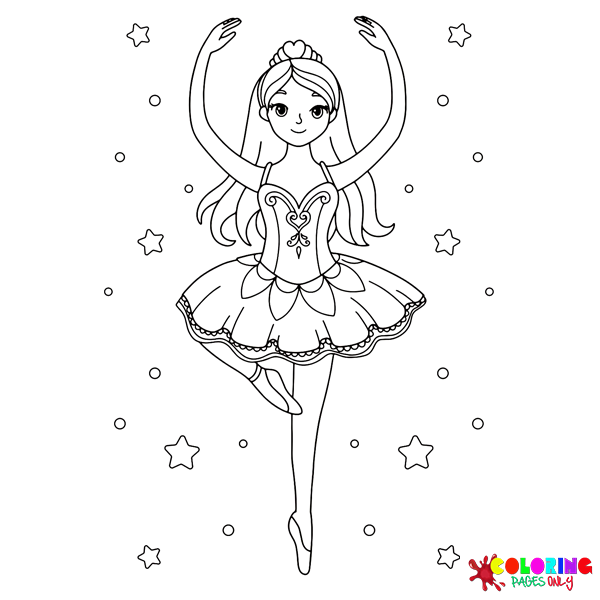
Ballerina is the most specific dance sub-category in the Activities collection, covering the classical ballet dancer as a distinct coloring subject with its own specific visual vocabulary. The ballerina page is one of the most immediately recognizable of all activities coloring pages: the tutu (the layered skirt of stiff net and silk, either the short classical tutu that stands out horizontally or the longer romantic tutu that falls to mid-calf), the pointe shoes (satin-covered hard-toed shoes with ribbons crossed and tied at the ankle), the hair pulled back tightly into a bun, and the extended-limb, turned-out posture that distinguishes classical ballet technique from all other physical activities.

The canonical color of ballerina pages in the classical ballet tradition is pink – from the pale shell-pink of the satin pointe shoe to the soft pink of a practice leotard and the white or ivory of a classical tutu – but stage costumes in actual ballet productions span every possible color, and creative coloring choices (a blue tutu, a red costume) are entirely legitimate for any page that does not depict a specific famous role. The tutu in particular rewards careful coloring: the layered net skirt has a translucent quality that can be suggested by keeping the coloring lighter in the outer layers (where fewer layers overlap) and slightly deeper in the inner layers, where the net is most compressed, creating a sense of the fabric’s depth and airiness.

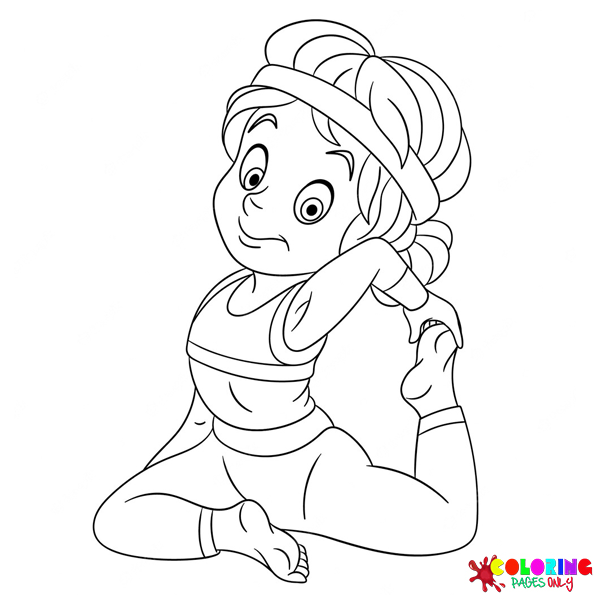
Yoga covers the physical and meditative practice of yoga – one of the fastest-growing leisure activities in the world, practiced by an estimated 300 million people globally and touching virtually every cultural context from its Indian origins to contemporary studio practice worldwide. Yoga coloring pages capture the physical poses (asanas) that define the visual language of yoga illustration: the cross-legged seated meditation position (Sukhasana), the Tree pose (Vrksasana) with one foot raised to the inner thigh and arms overhead, the Warrior poses with their strong, grounded stances and extended arms, the Downward-Facing Dog with its inverted V shape, the Child’s Pose with the body folded forward in rest, the Headstand and Shoulderstand inversions.

Each yoga pose creates a distinct body silhouette that gives yoga poses their immediate recognizability. The coloring challenge of yoga pages is partly about the body in its precise position and partly about the setting: yoga is practiced in settings that have strong visual character – the studio with its clean wooden floor and large windows, the outdoor setting of a deck or garden with natural light and plant life, the beach setting with sand and water – and the background setting significantly affects the mood of the finished page. A yoga pose colored against a sunrise-lit outdoor background (warm orange and gold) reads as an active, energizing morning practice; the same pose against a calm interior background (soft neutral tones, a single candle) reads as meditative and restorative.

Fitness covers general exercise and gym-context physical activity – the broader world of fitness practice beyond specific yoga, dance, or sport disciplines. Fitness pages depict exercise equipment (dumbbells, resistance bands, exercise mats, jump ropes), gym settings, and the body in various exercise positions: the plank, the push-up, the squat, the lunge, the bicep curl, and the sit-up. The fitness palette is dominated by the bright, primary colors of exercise equipment – the red and black of dumbbells, the vivid color of rubber resistance bands, the blue or purple of yoga mats – against the neutral tones of gym flooring and walls.

Aerobic covers the rhythmic, high-energy exercise discipline that combines dance-like movement with cardiovascular training – the fitness practice that emerged in the 1980s and remains widely practiced in group fitness classes worldwide. Aerobic pages capture the extended-limb, high-energy body positions of aerobic exercise: the jumping jack, the step touch, the grapevine, the side kick, and the arms-overhead movements that characterize aerobic choreography. The visual energy of aerobics pages is among the highest in the Activities collection – these are pages with figures in maximum-extension, maximum-energy poses that communicate movement and enthusiasm.

Play, Creativity, and Quieter Pursuits

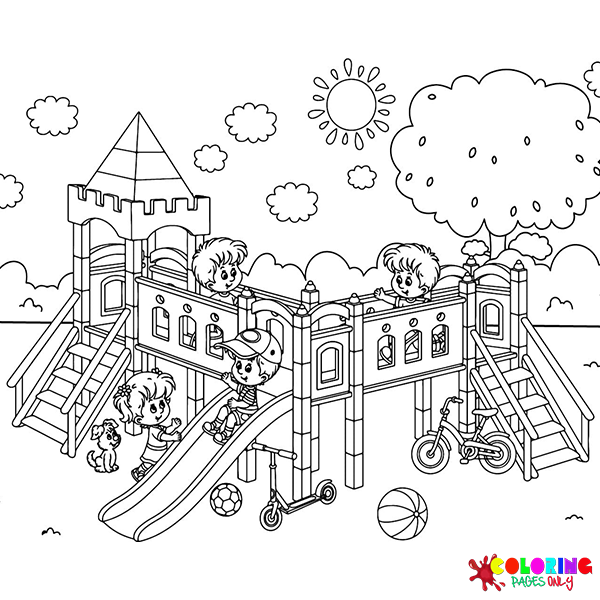
Playground covers the outdoor play environment that defines childhood recreation in public spaces worldwide – the dedicated space equipped with structures designed specifically for children’s physical play. Playground pages capture the full visual world of the playground: swings in various positions (the figure at the apex of a forward swing, fully extended and briefly weightless, is one of the most dynamic and joyful athletic images in children’s illustration), slides with children ascending the ladder and descending the chute, climbing frames and jungle gyms in their various configurations, seesaws, merry-go-rounds, and the social scene of multiple children playing together in the same defined space.

The playground palette is naturally vivid and primary-colored: the traditional playground aesthetic of red, yellow, blue, and green equipment against the green of surrounding grass produces one of the most saturated natural color compositions in the Activities collection. Contemporary playground equipment often features more varied and sophisticated color combinations, but the basic visual logic of bright, contrasting colors against a natural green setting remains consistent across playground pages of all styles. The ground surface material – whether grass, sand, wood chip, or rubber safety surface – provides the composition’s foundational color, against which the equipment and figures are positioned.

Origami is the most conceptually unusual sub-category in the entire Activities collection – the Japanese art of paper folding depicted as a coloring page subject. Origami as a coloring page presents a specific conceptual double: the coloring page is itself a flat sheet of paper that will be colored, while the subject depicted is also made from a flat sheet of paper that has been transformed into three-dimensional form through folding without cutting or gluing. This recursive quality – paper about paper – gives origami pages a particular thoughtfulness.

Origami coloring pages show completed origami forms in their three-dimensional glory: the classic paper crane (tsuru) with its folded wings and pointed head and tail – the most recognized origami form in the world and the subject of the Japanese legend that folding 1,000 cranes (senbazuru) grants a wish – alongside frogs, boats, flowers, modular kusudama spheres, and the full range of traditional and contemporary origami figures. The coloring approach for origami pages should respect the geometric, faceted quality of folded paper: each flat face of an origami form catches light differently, and rendering the lightest faces in the brightest tone of a color, the intermediate faces in the mid-tone, and the most recessed faces in a shade darker produces the three-dimensional illusion of a real origami form.

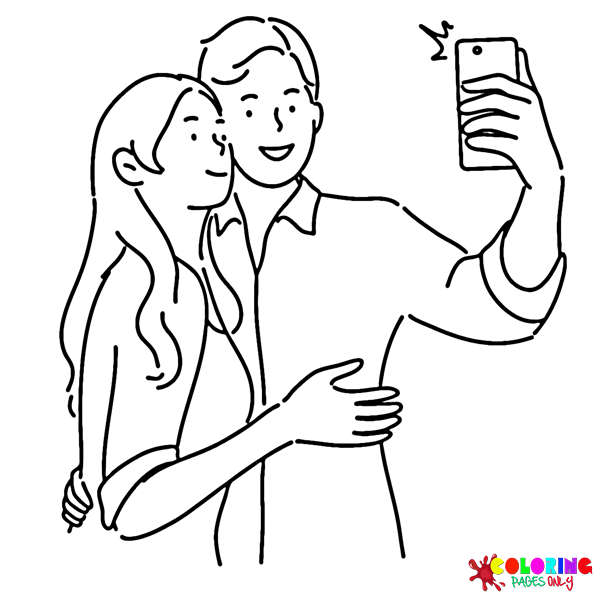
Selfie is the most contemporary sub-category in the Activities collection – covering the self-portrait photography that has become one of the most common daily activities for billions of people worldwide through the ubiquity of smartphone cameras and social media. Selfie coloring pages depict characters in the familiar selfie-taking pose: the extended arm holding the phone or camera toward the face, the expression composed (sometimes carefully, sometimes spontaneously) for the self-directed camera, and often a setting or background that is part of the self-portrait’s meaning – a landmark, an event, a natural setting, a decorated room.

What makes selfie pages particularly interesting for coloring is that the setting visible in the background of the selfie within the page – the landscape or environment visible behind the character – provides a second distinct coloring zone with its own palette, separate from the character and device in the foreground. A selfie taken at a beach has the blue-green ocean and sand behind the figure; a selfie taken at a landmark has the architectural elements of that landmark filling the background. This layered composition (foreground character and device, background setting visible past the character) gives selfie pages more compositional depth than many simpler activity pages.

Mantasstonys Allen – Designer

Hello! I'm Mantasstonys Allen, a web designer at Coloringpagesonly.com. My passion is bringing creativity to life through beautiful and user-friendly designs. I'm here to make your experience on our site smooth, fun, and inspiring—so you can focus on what matters most: coloring and unleashing your imagination!