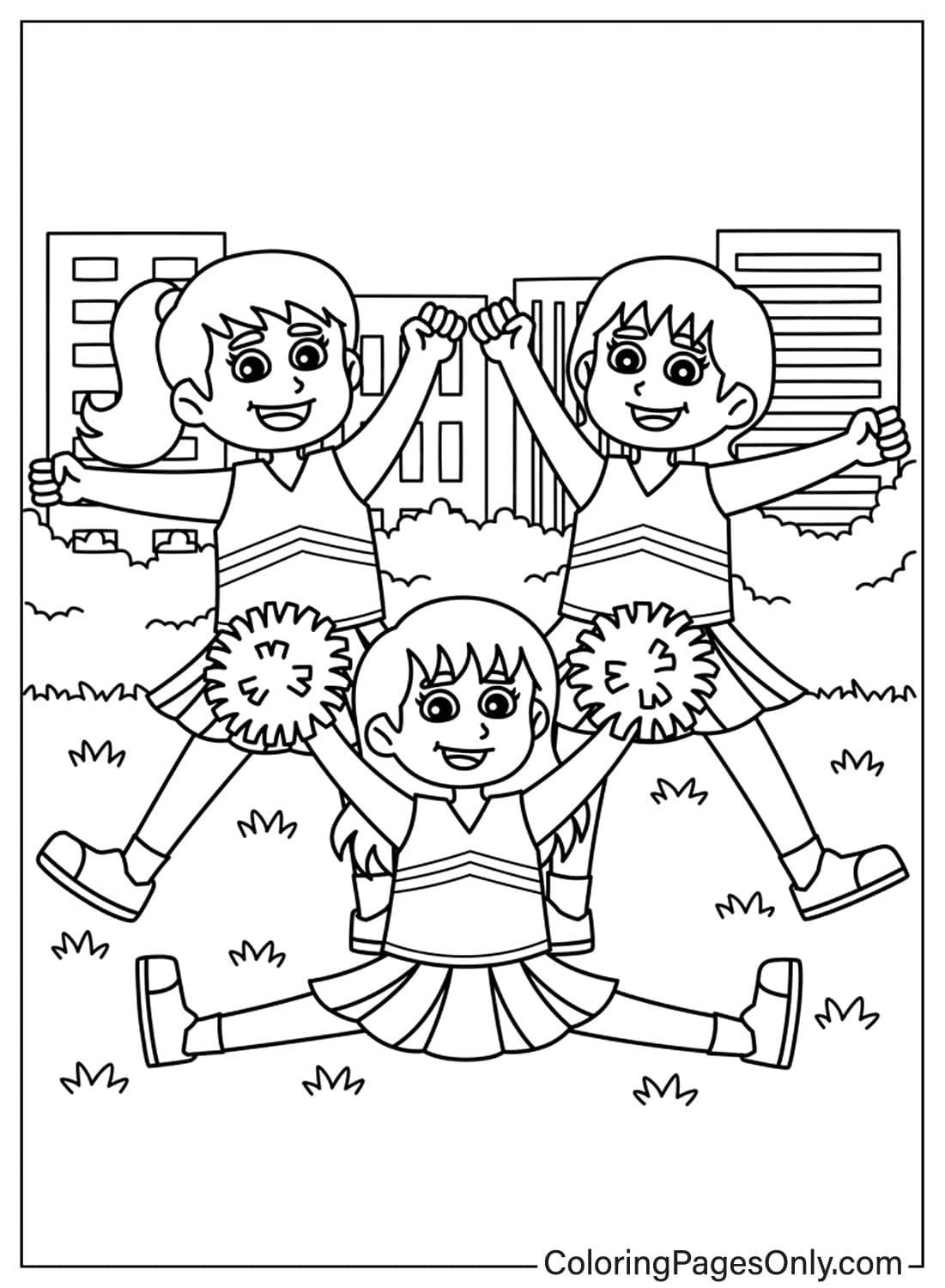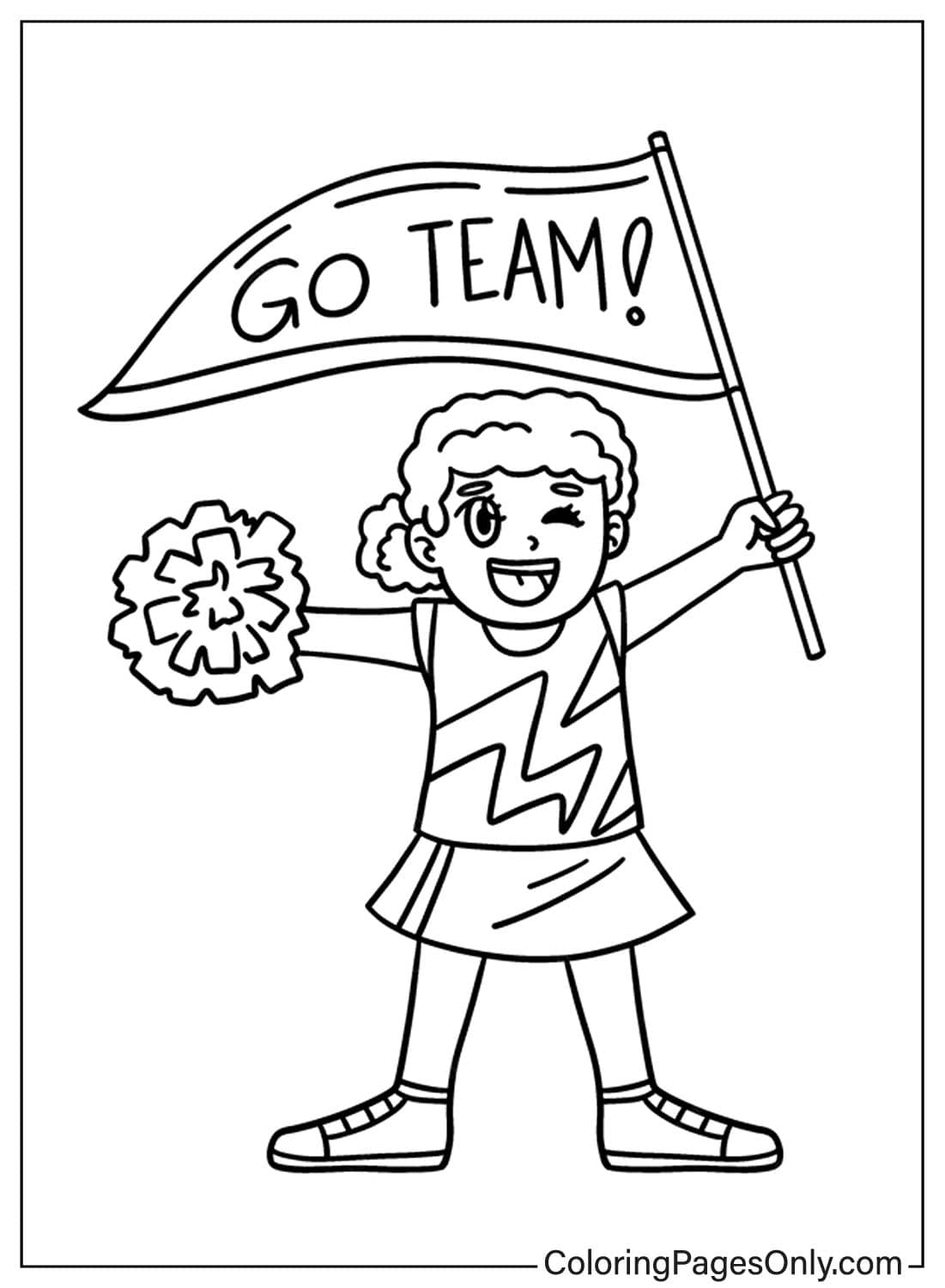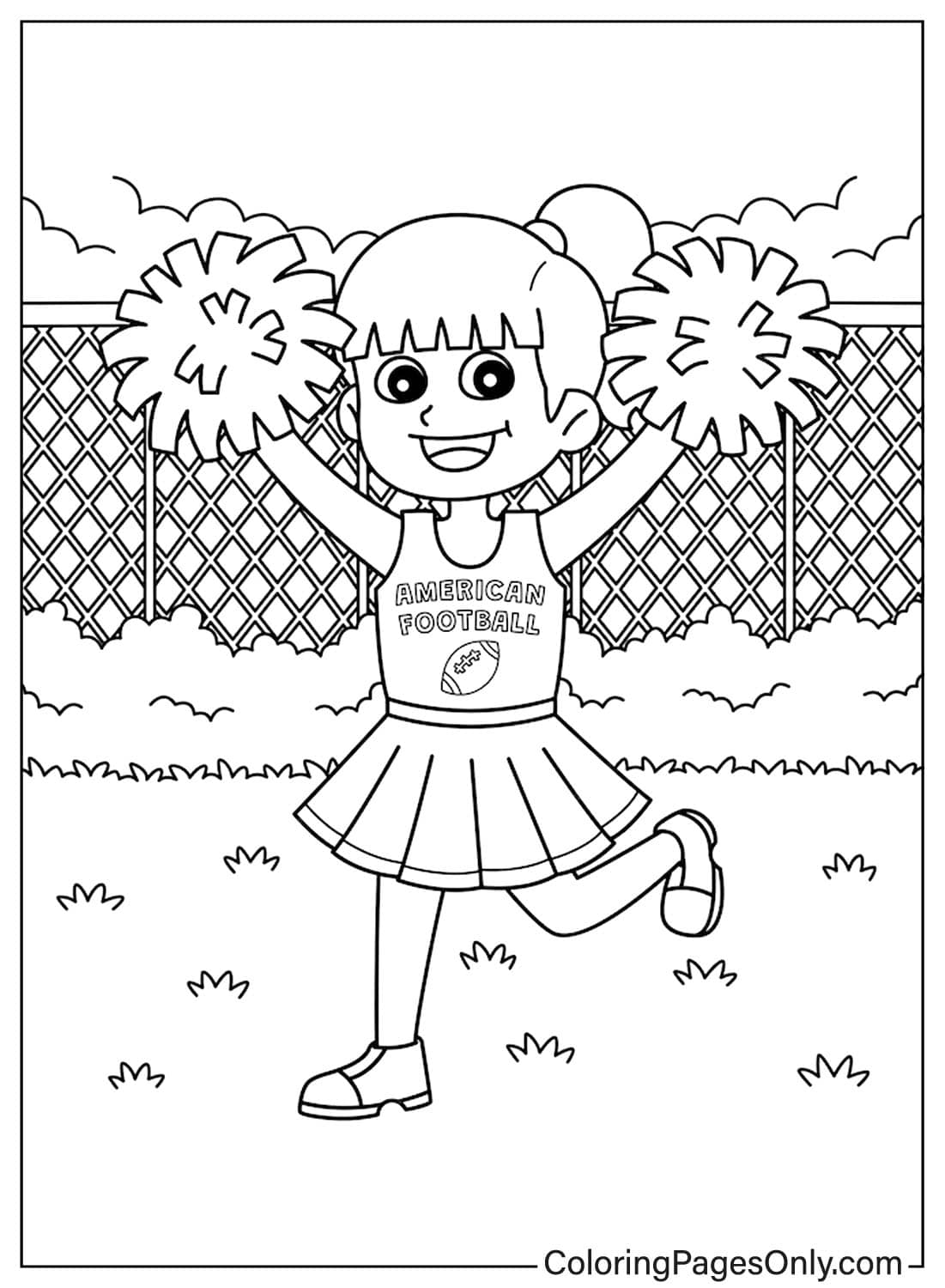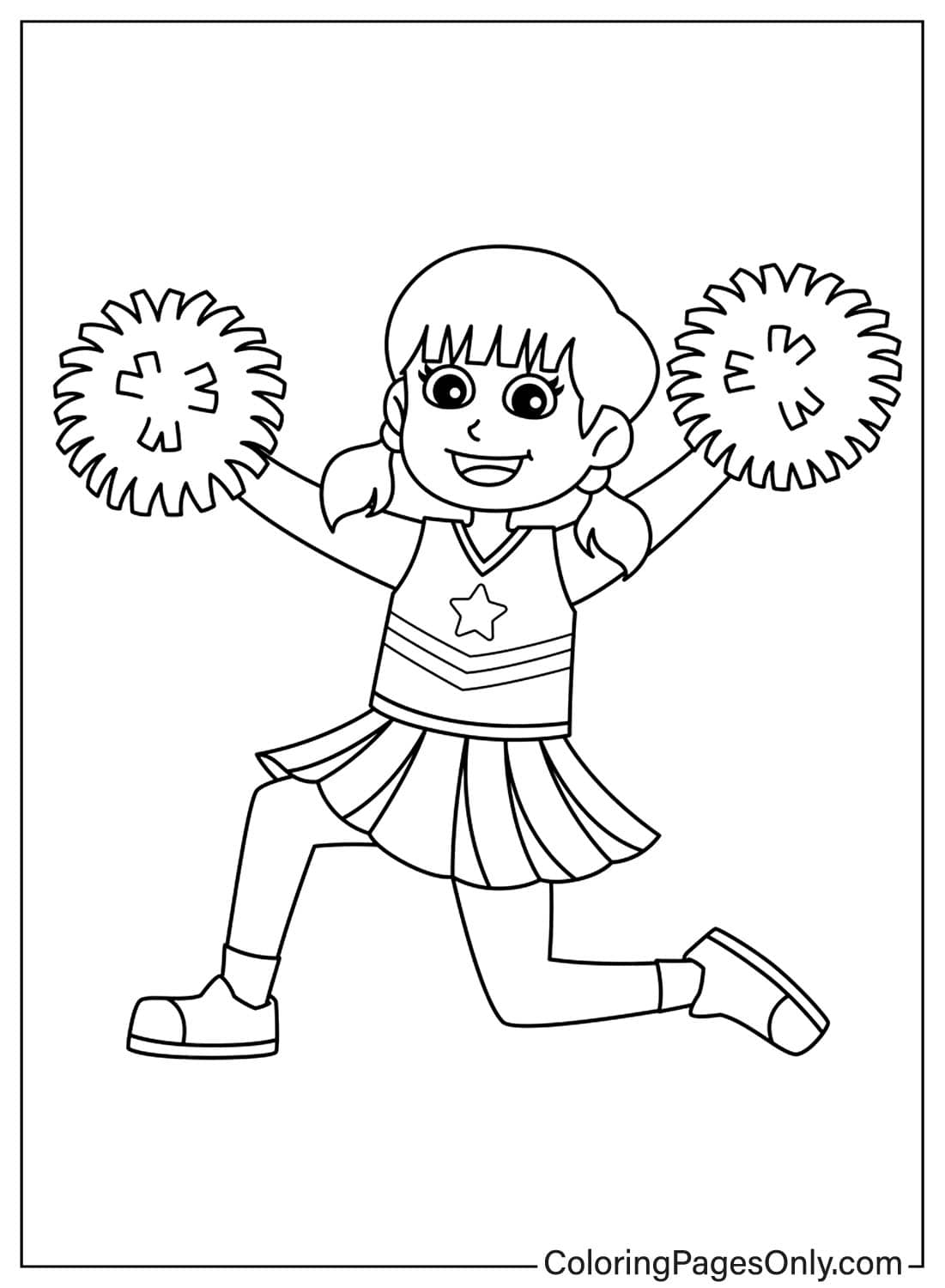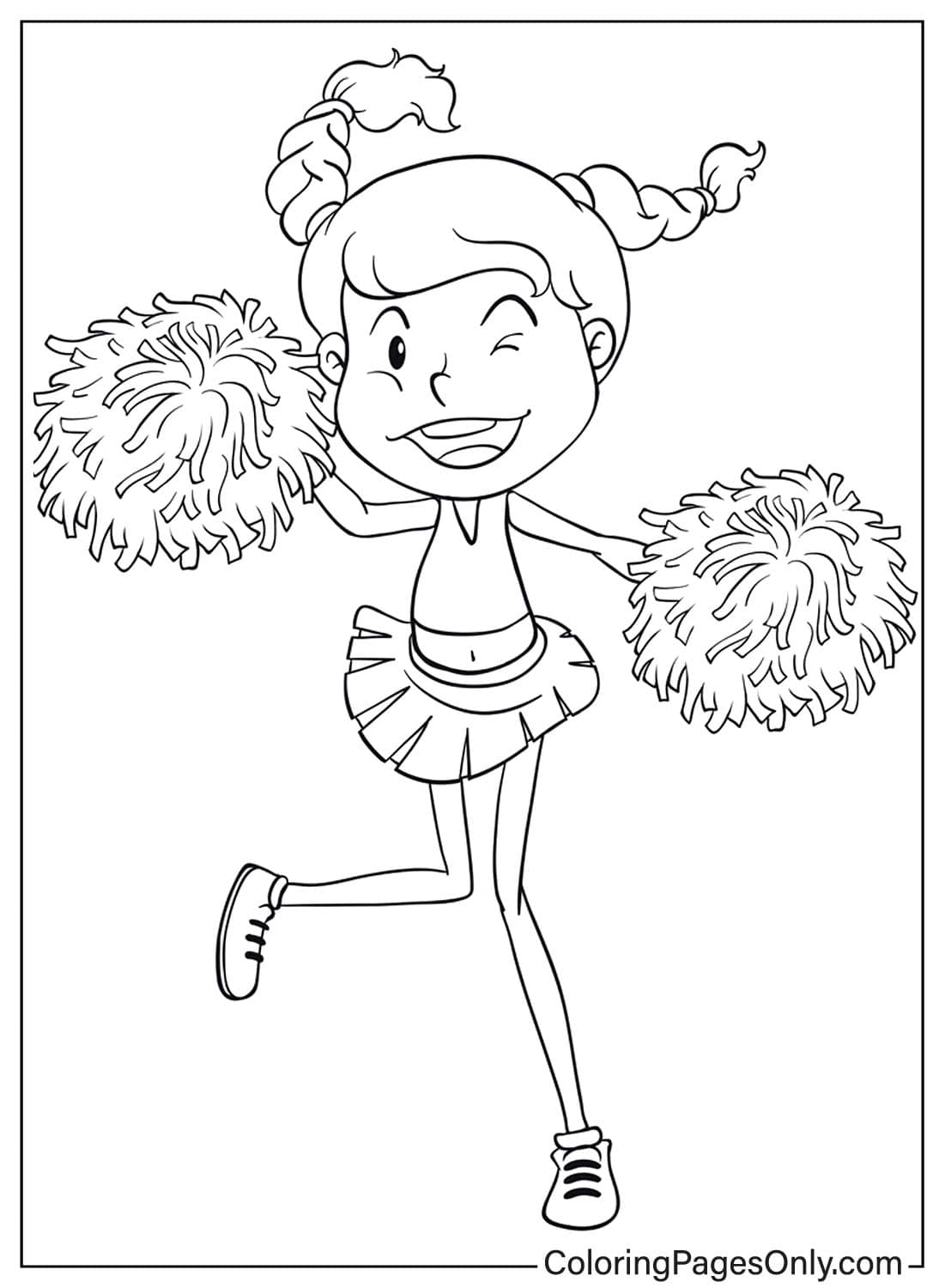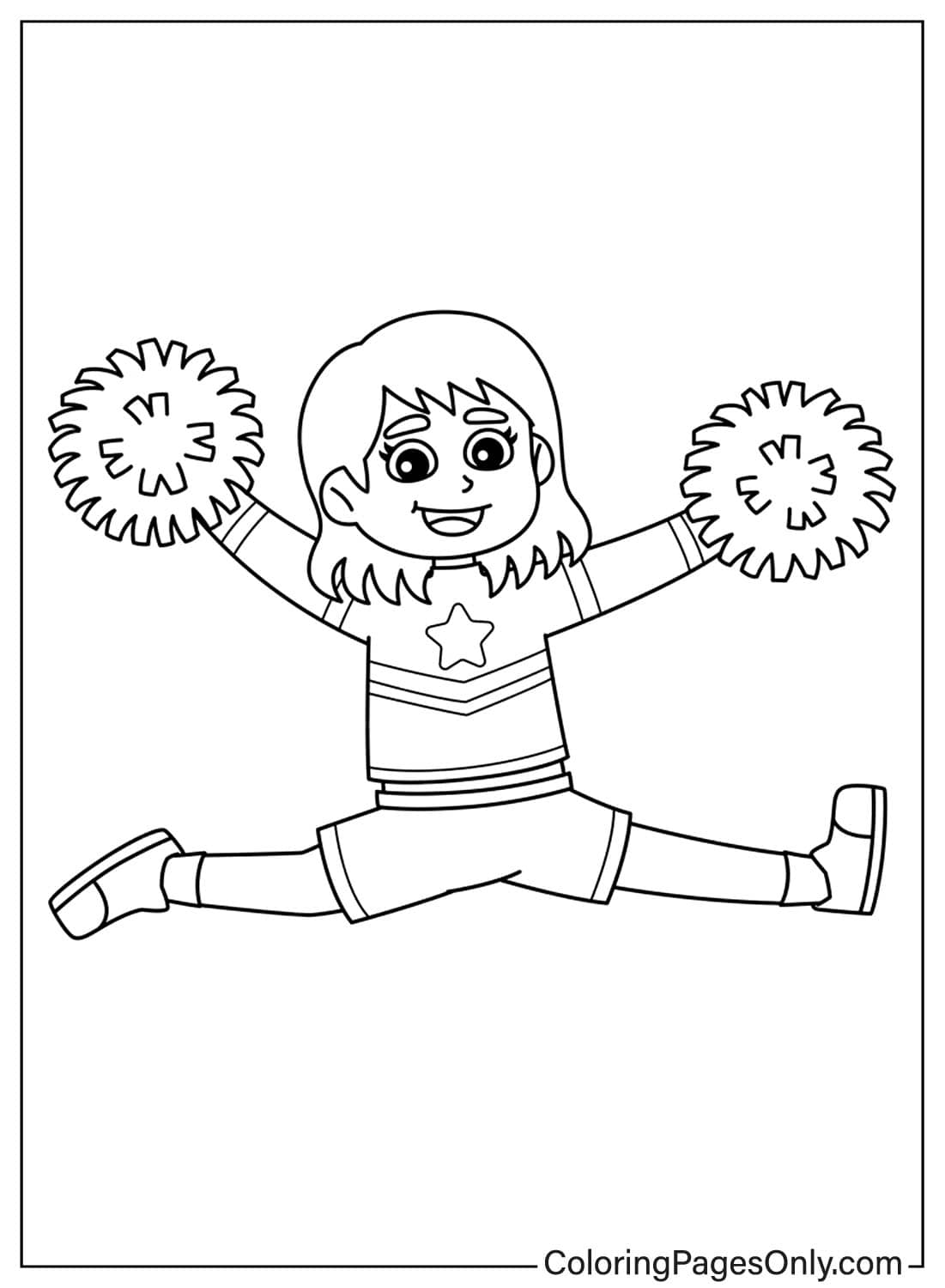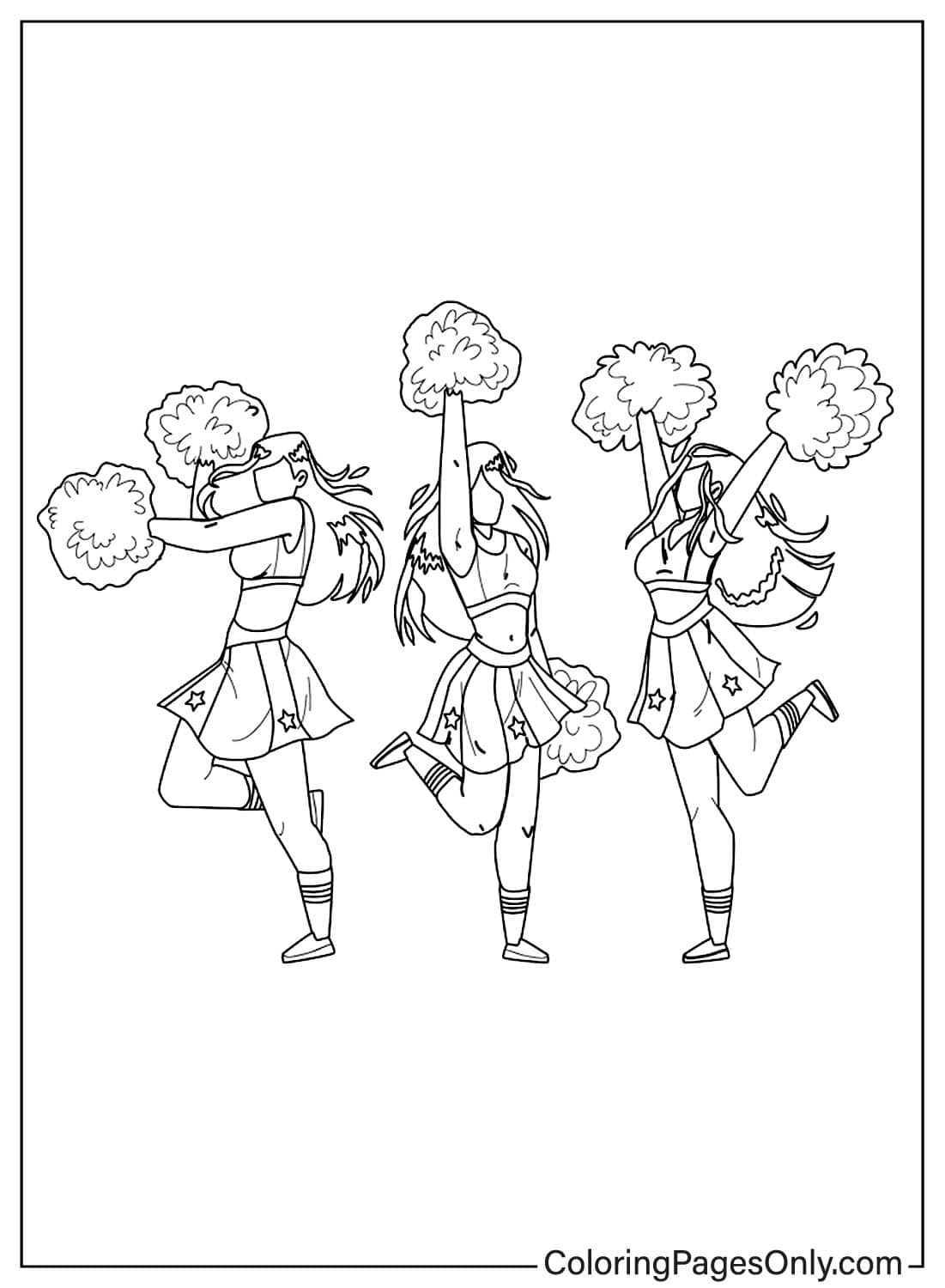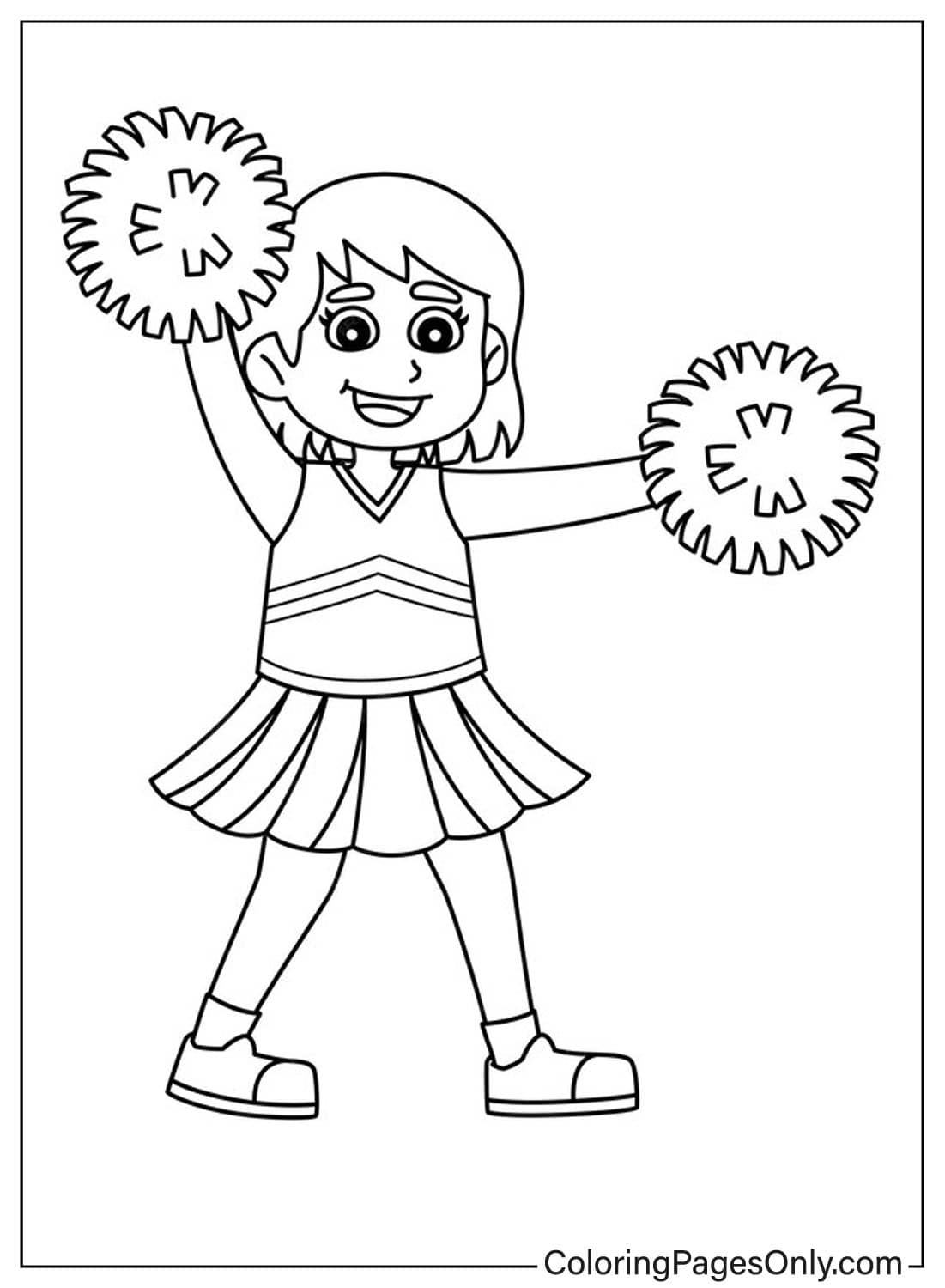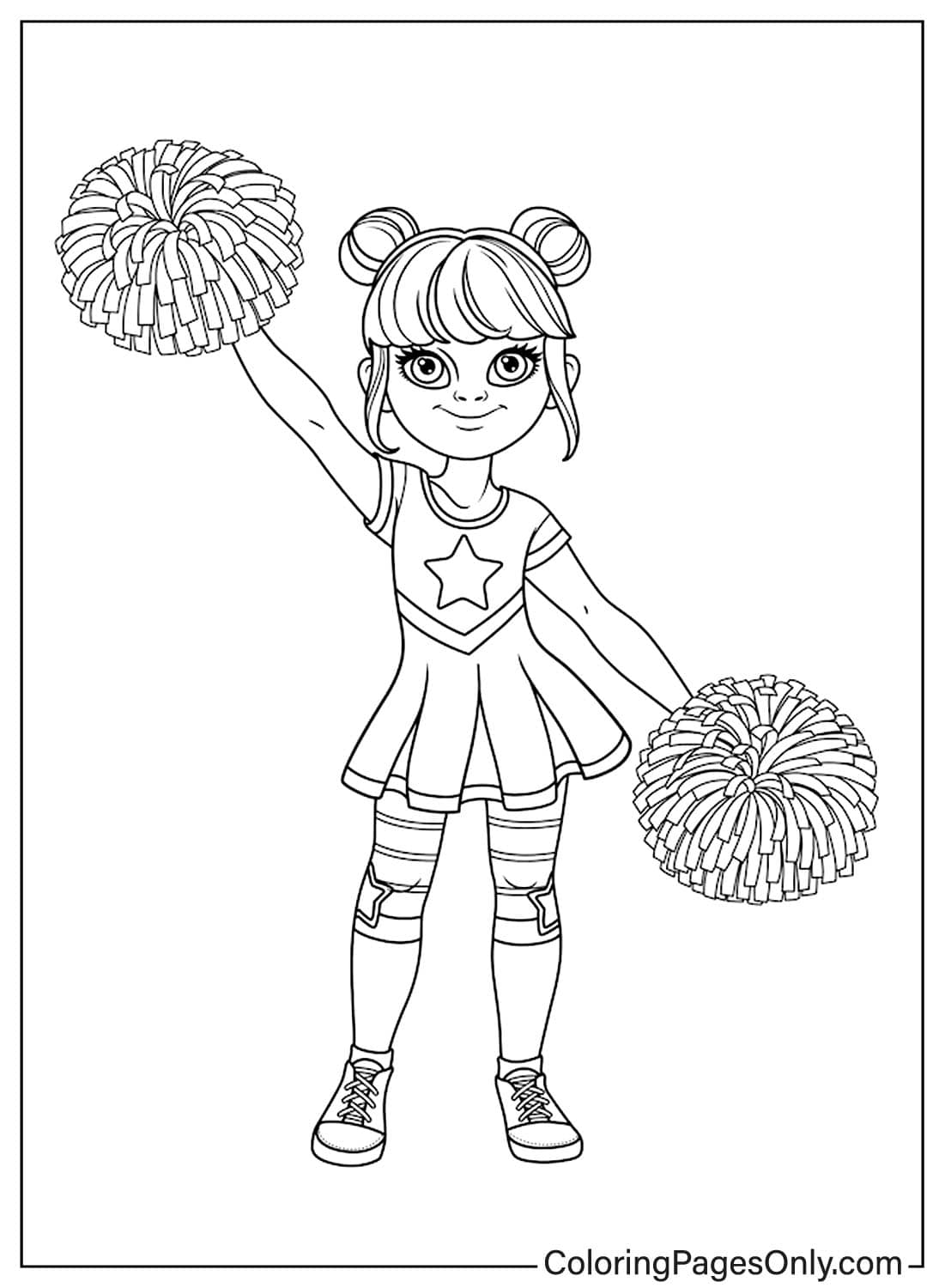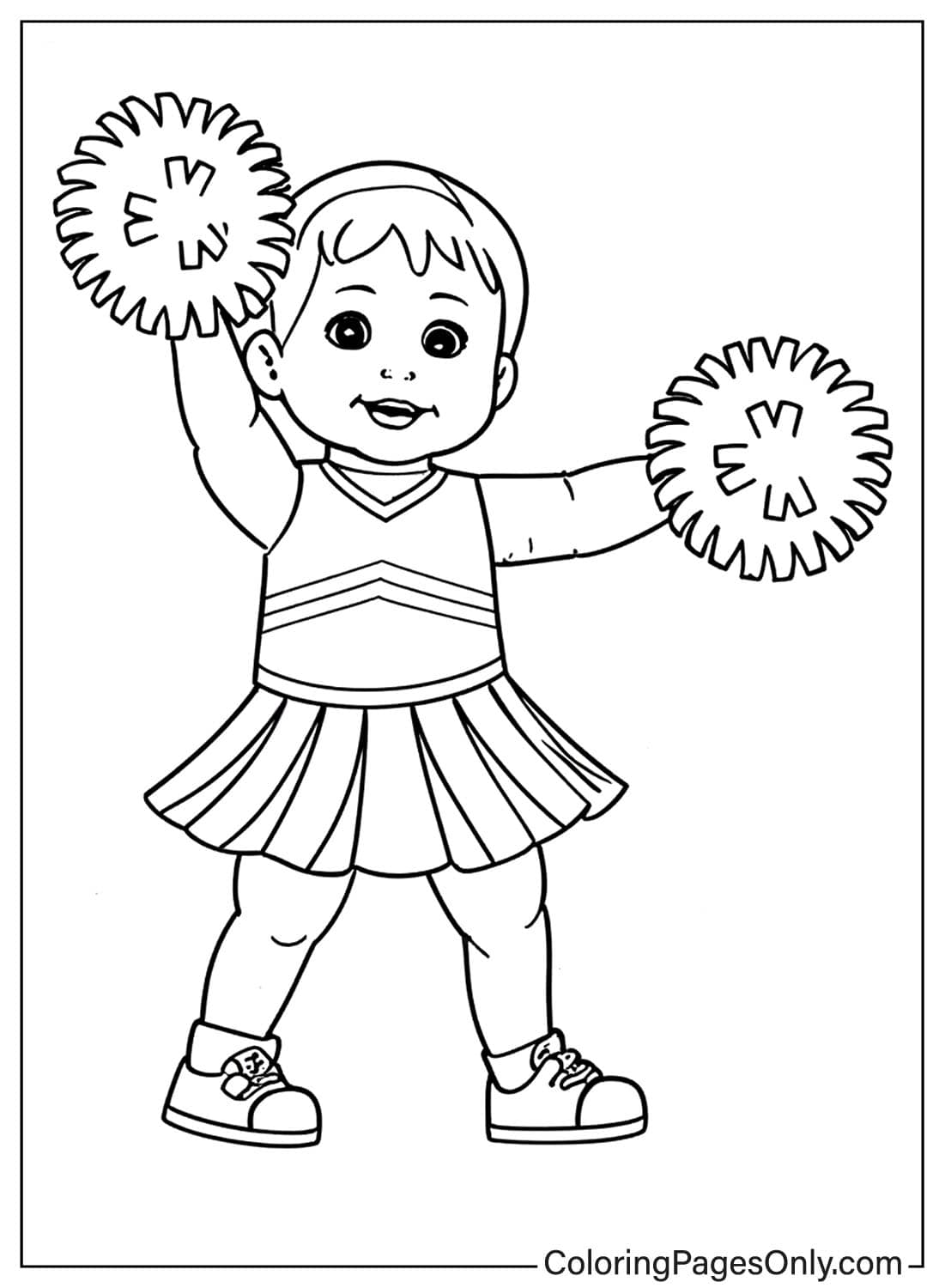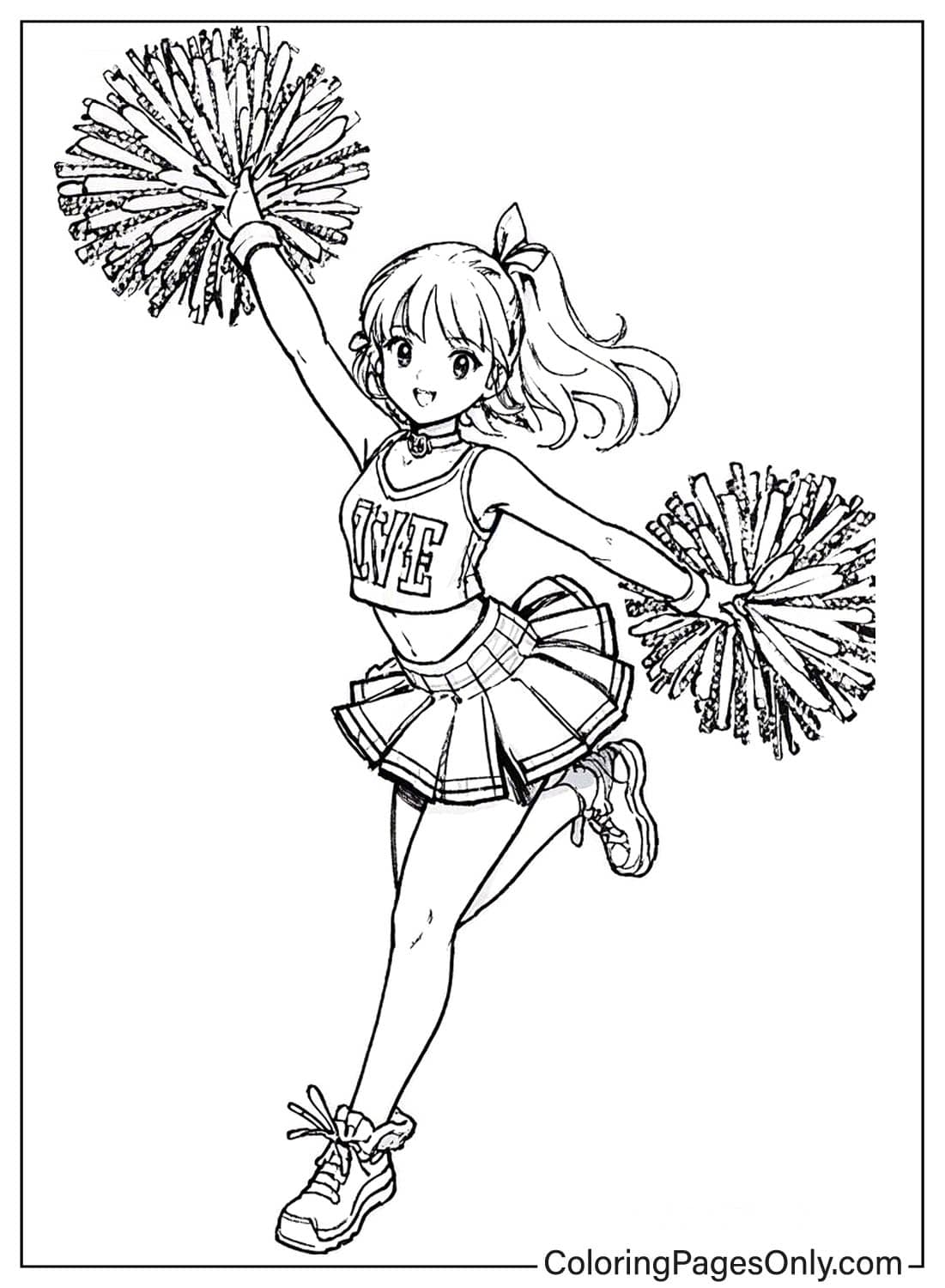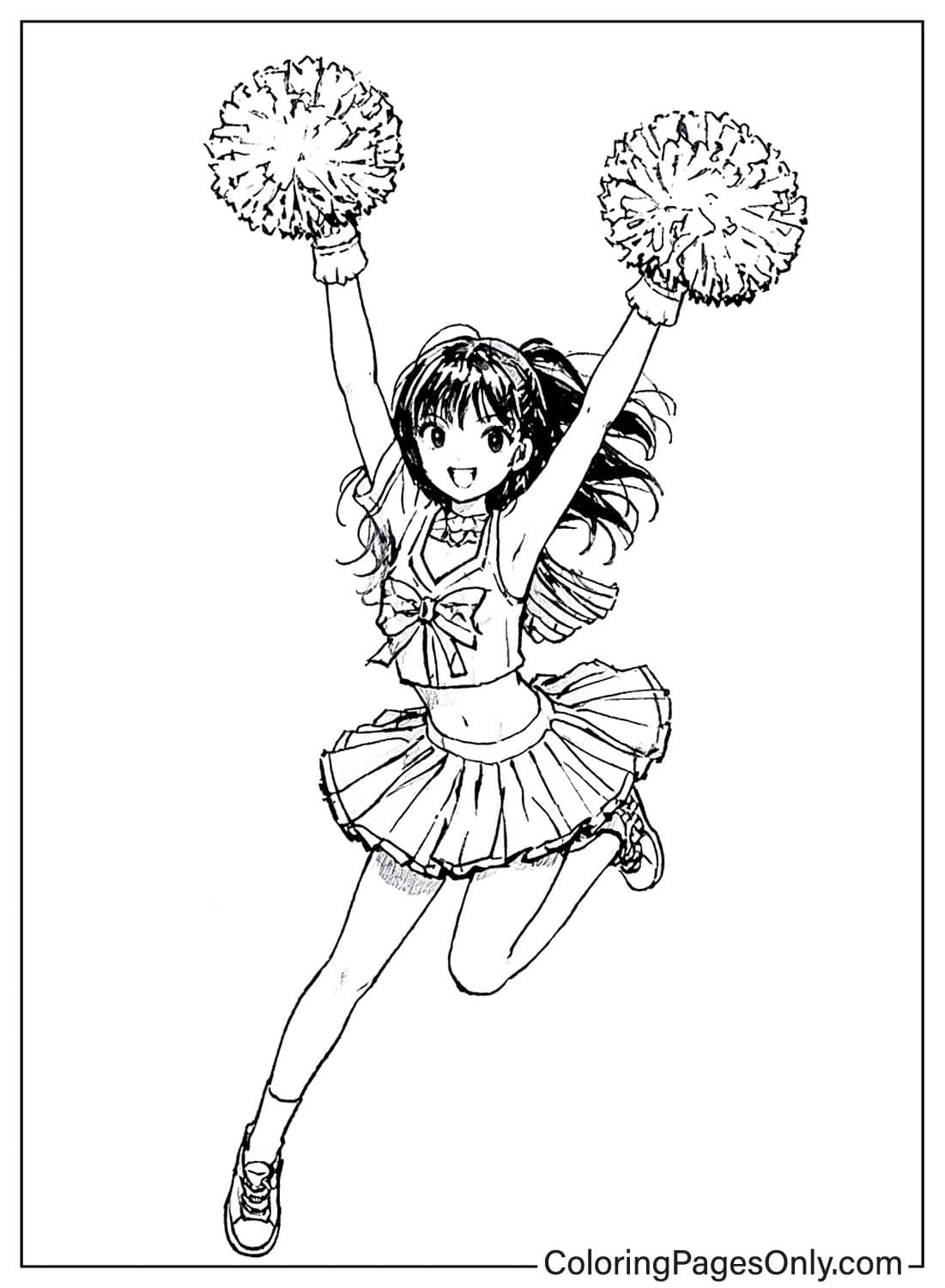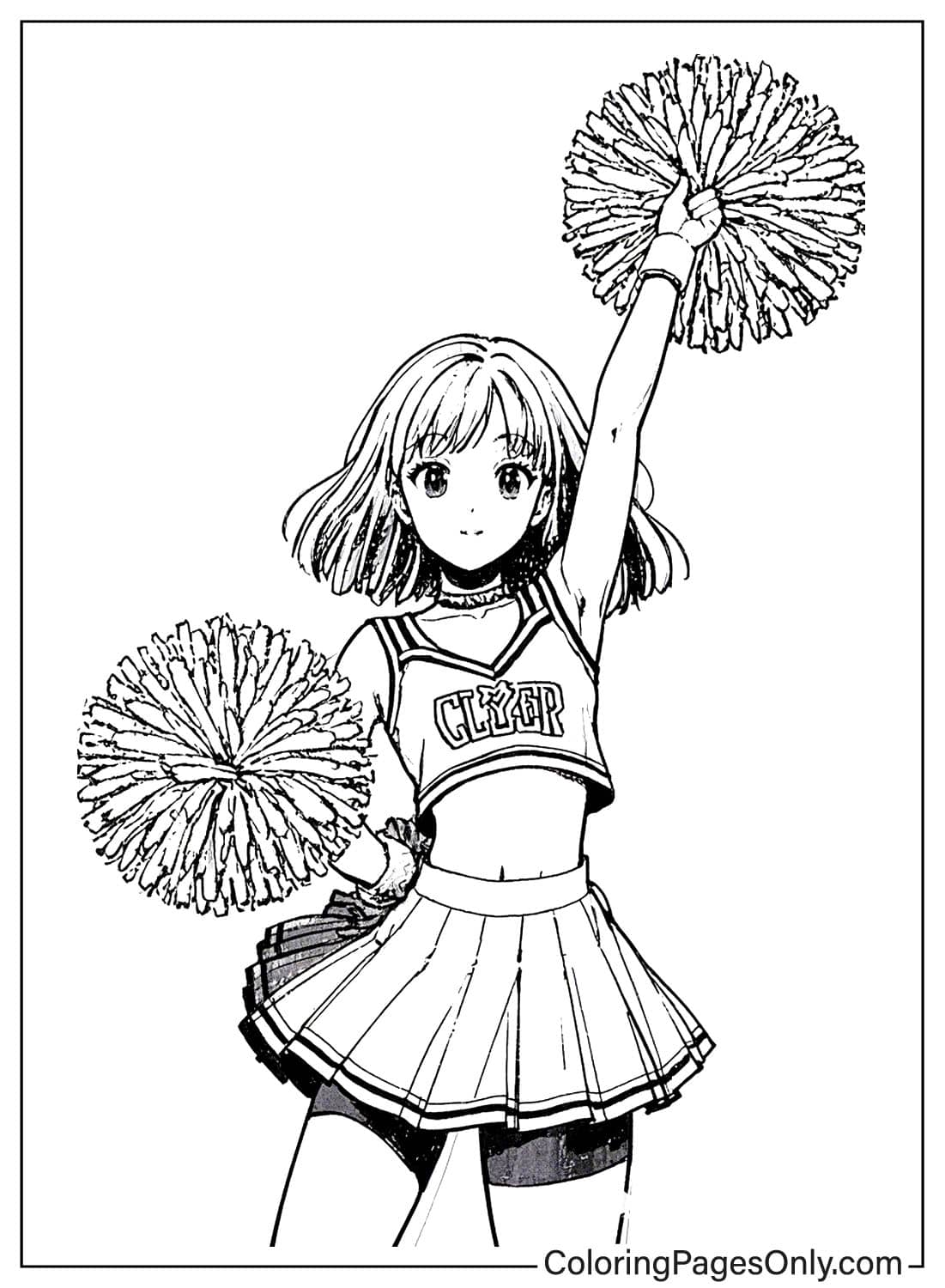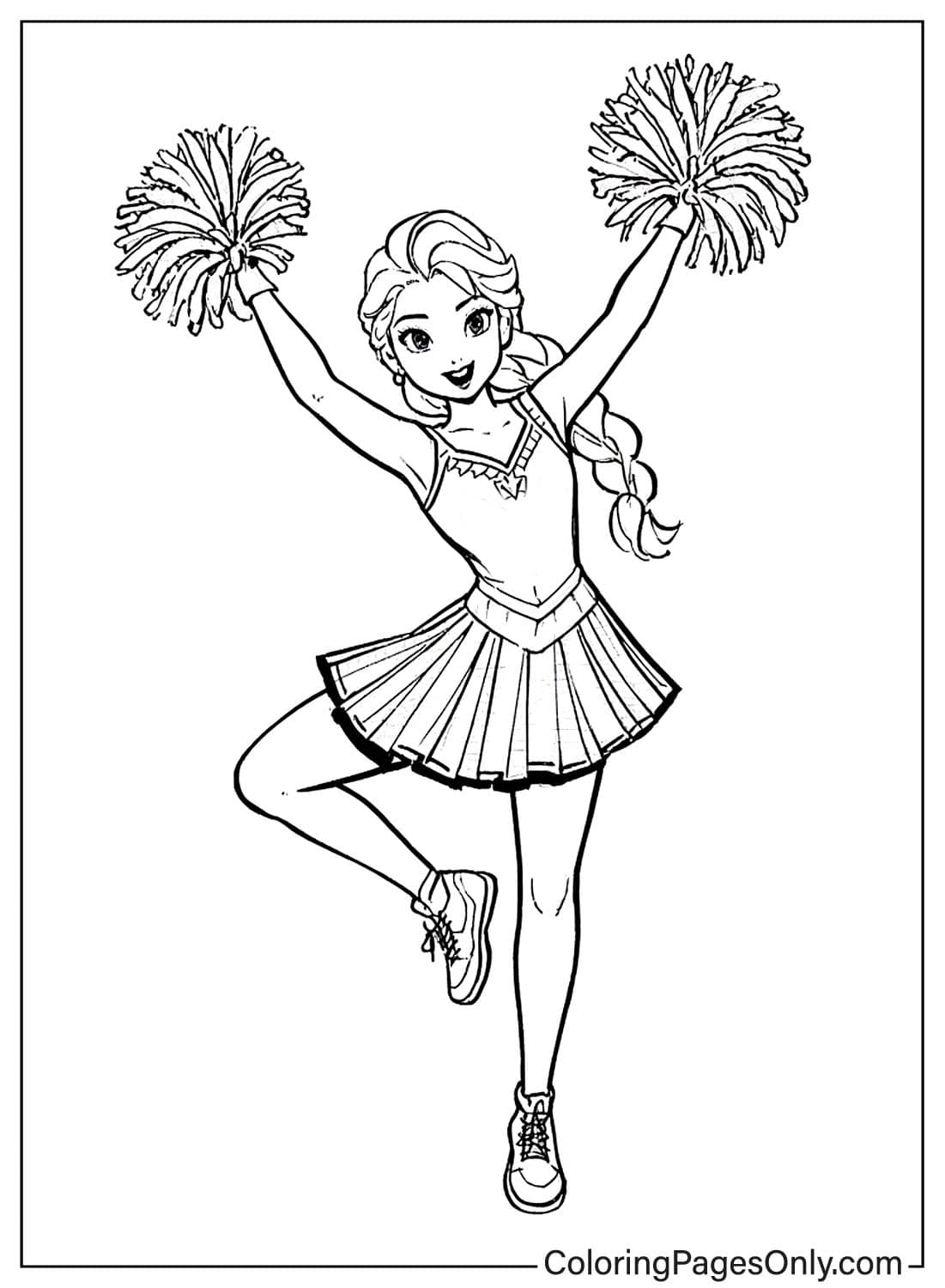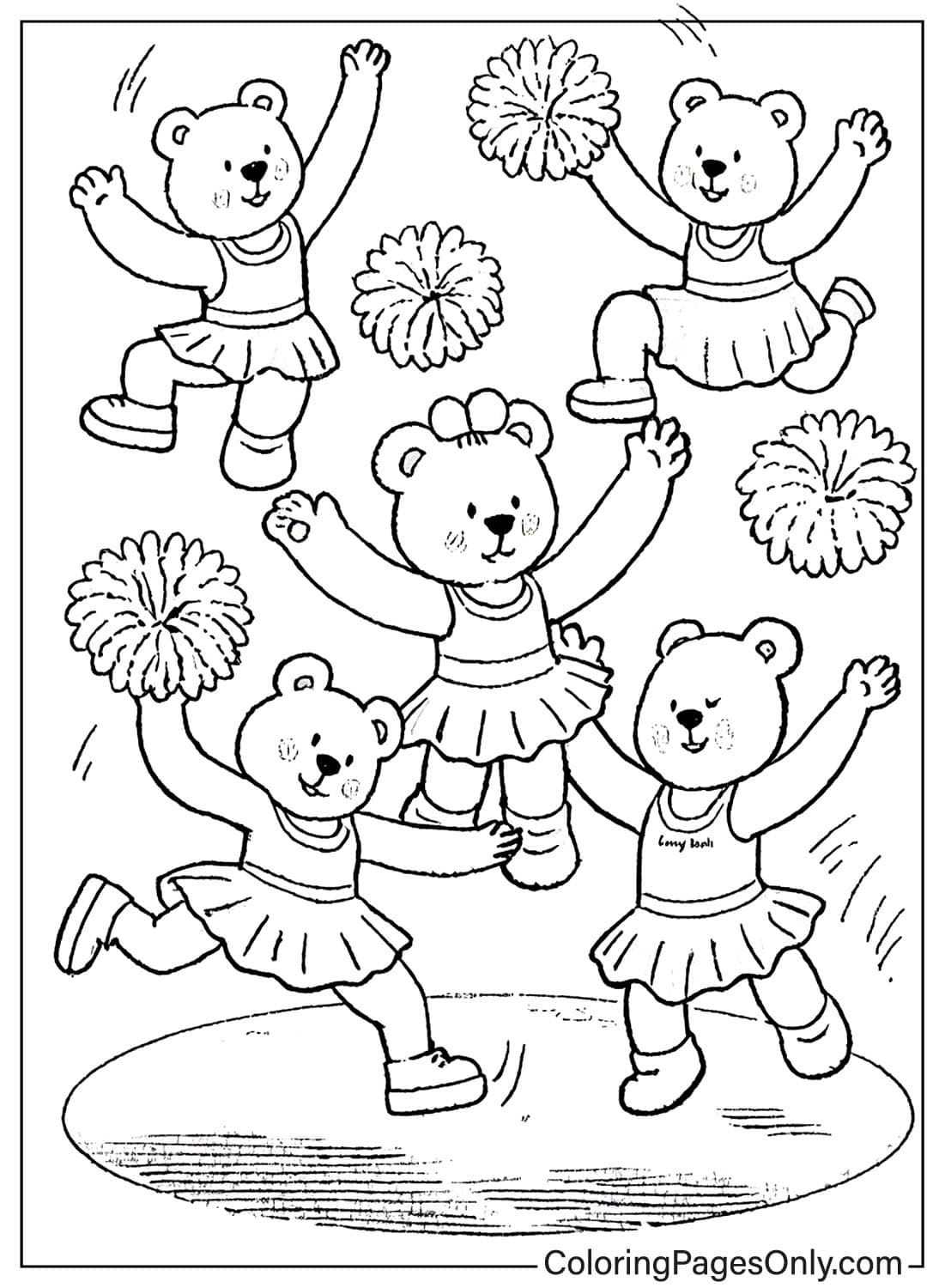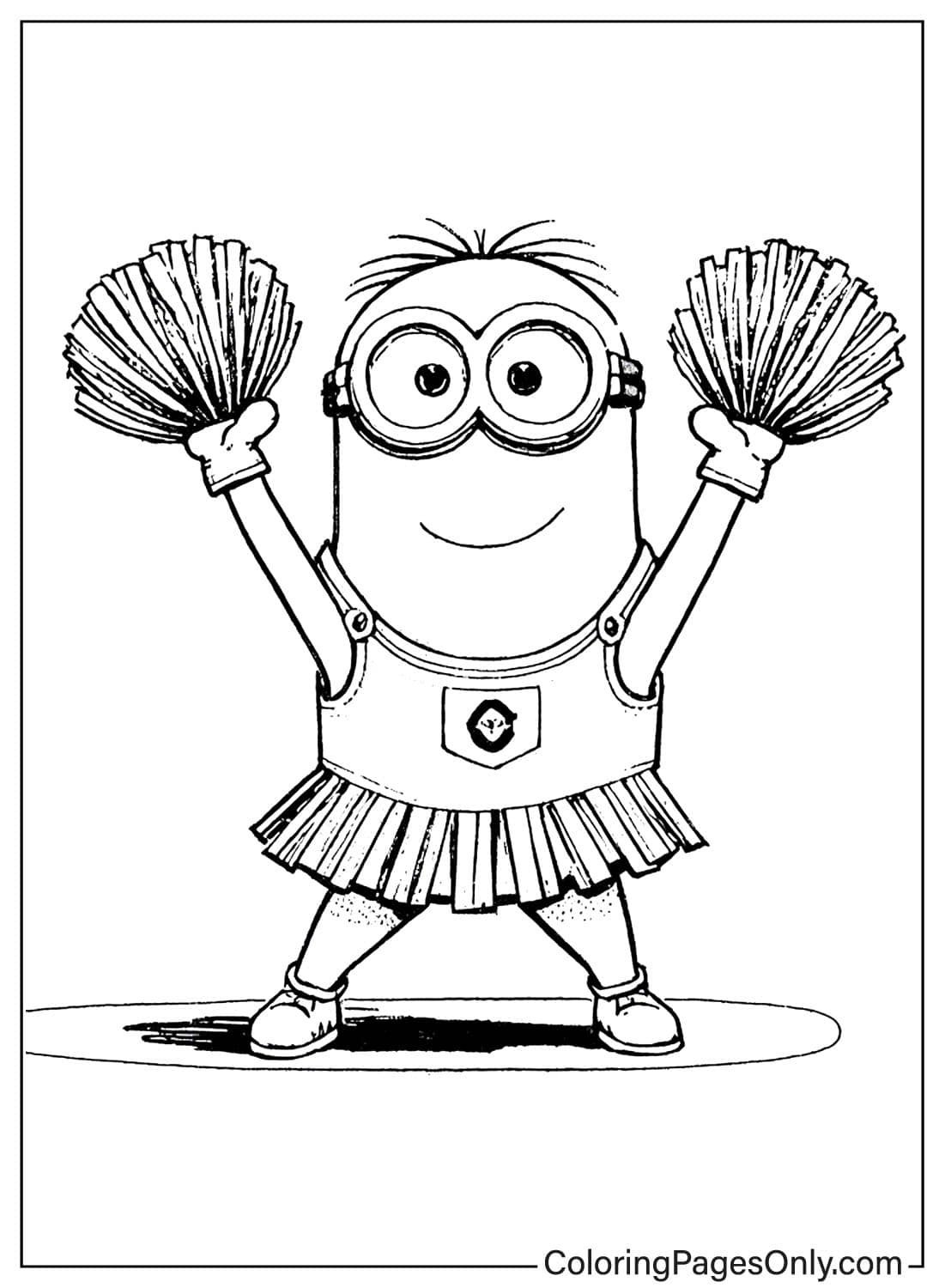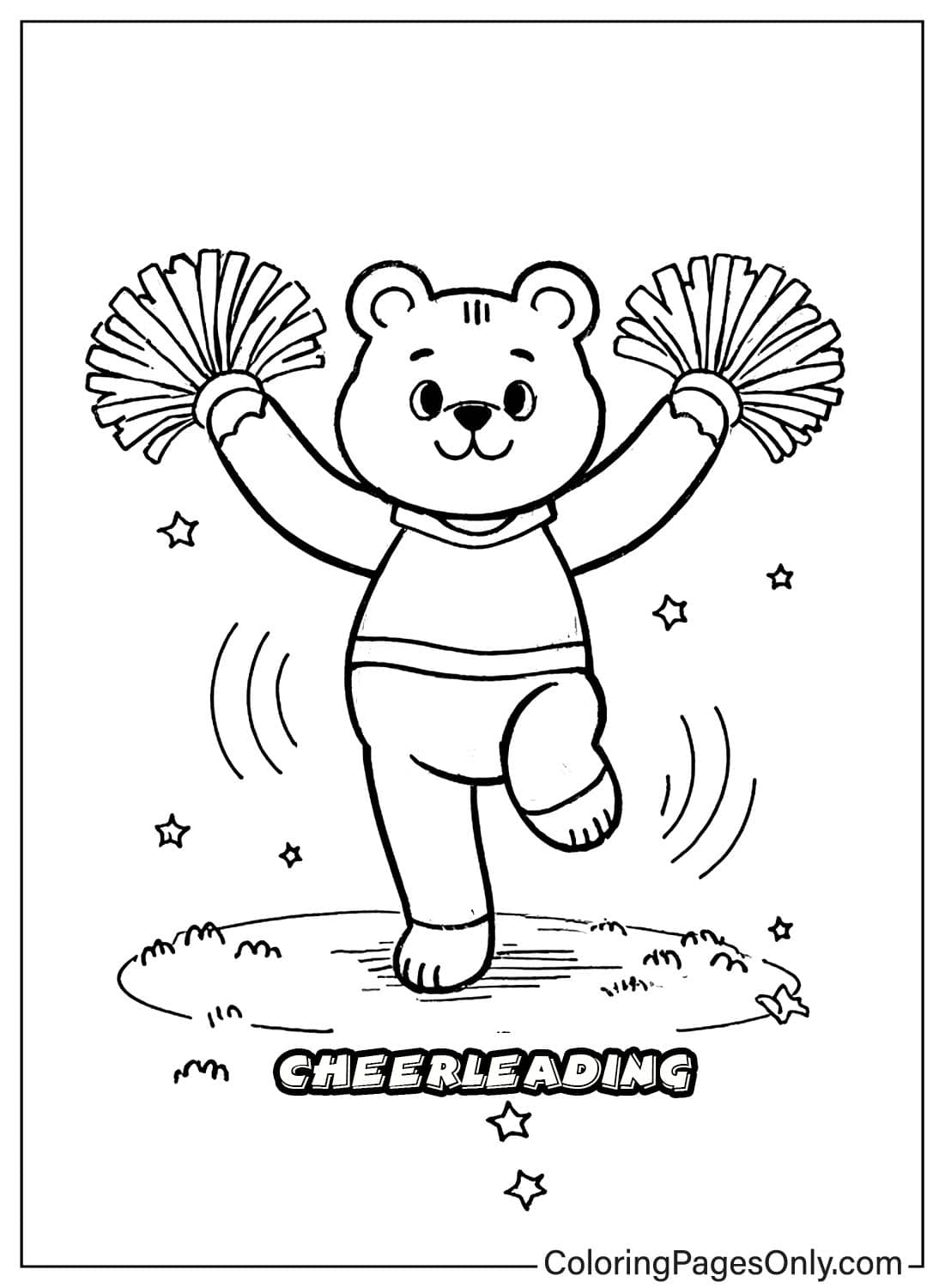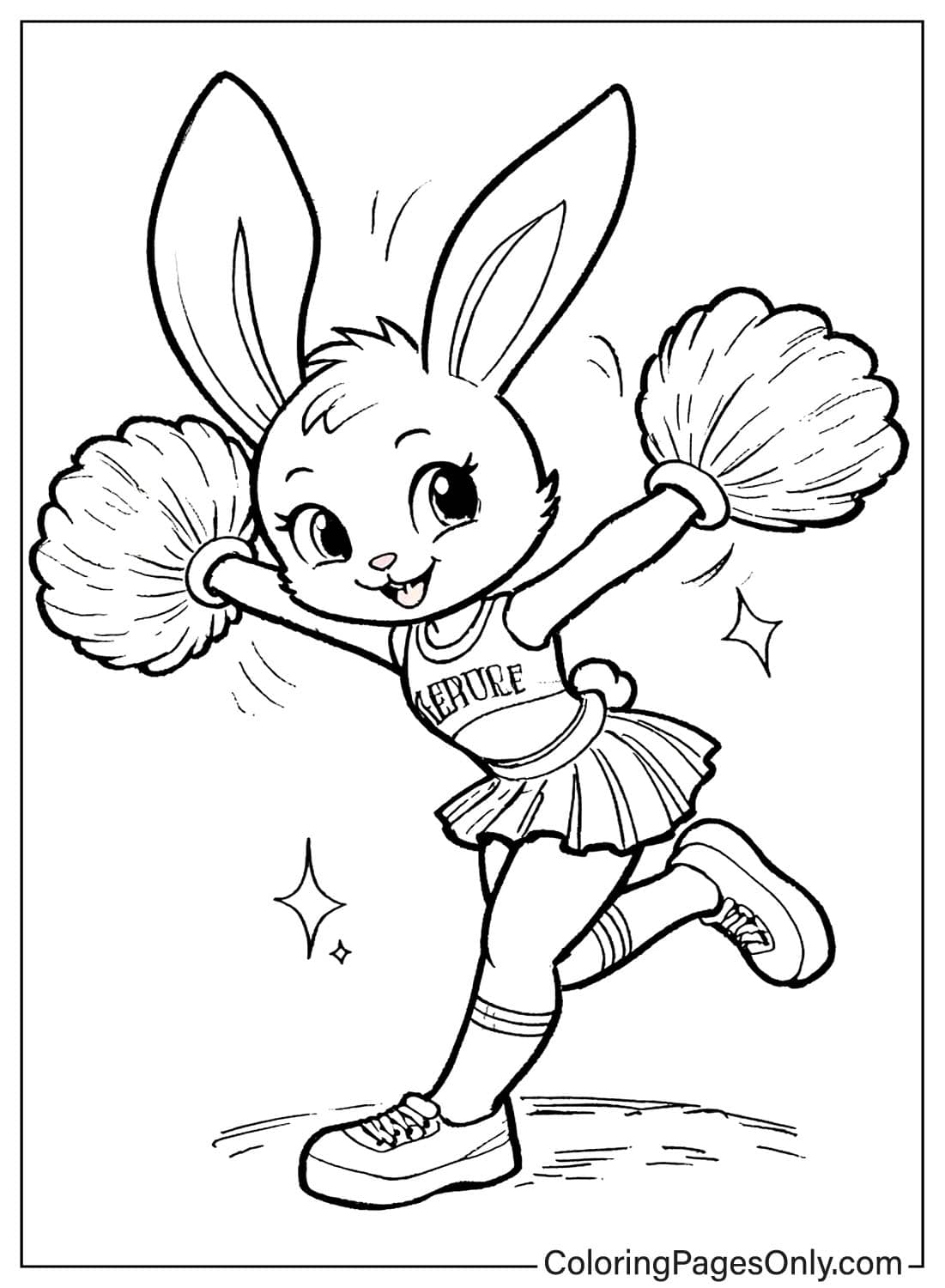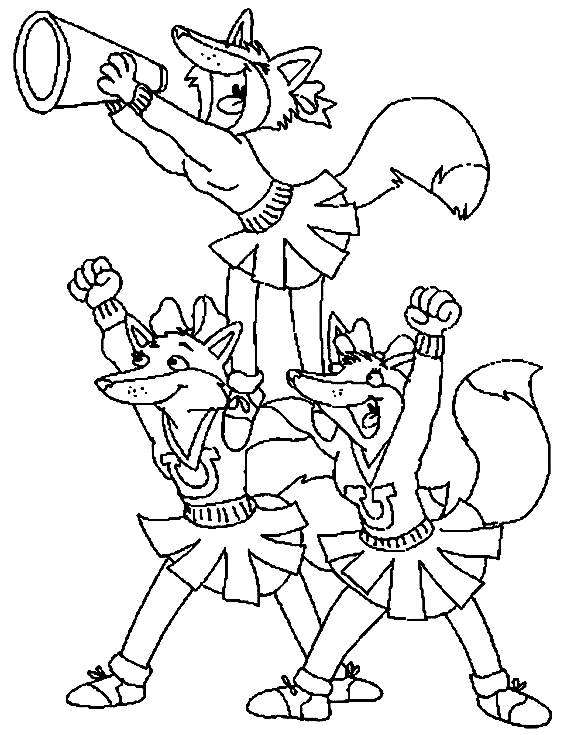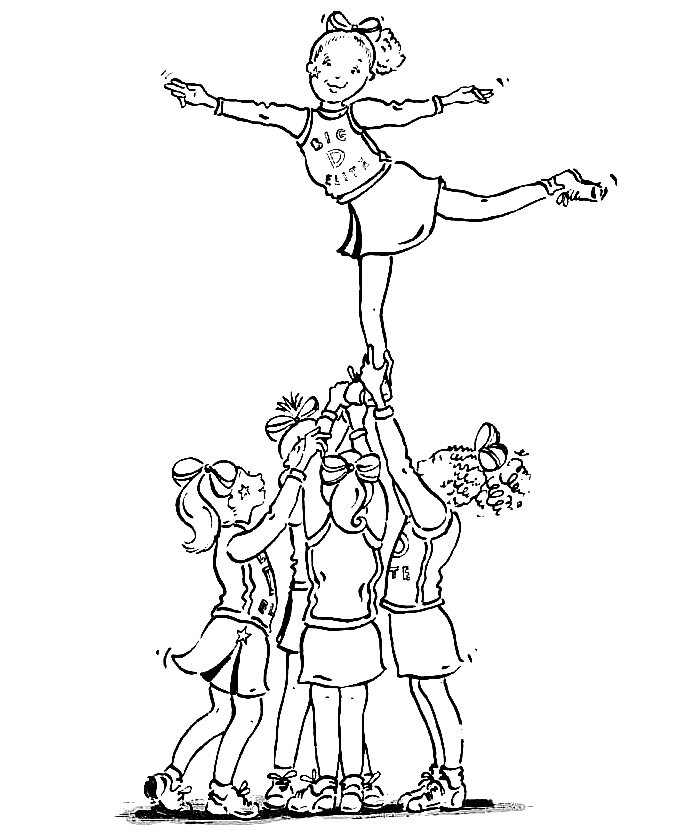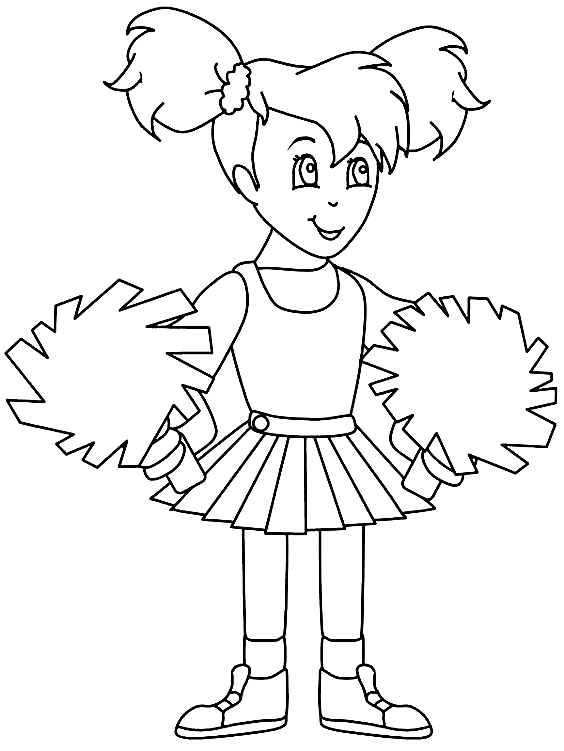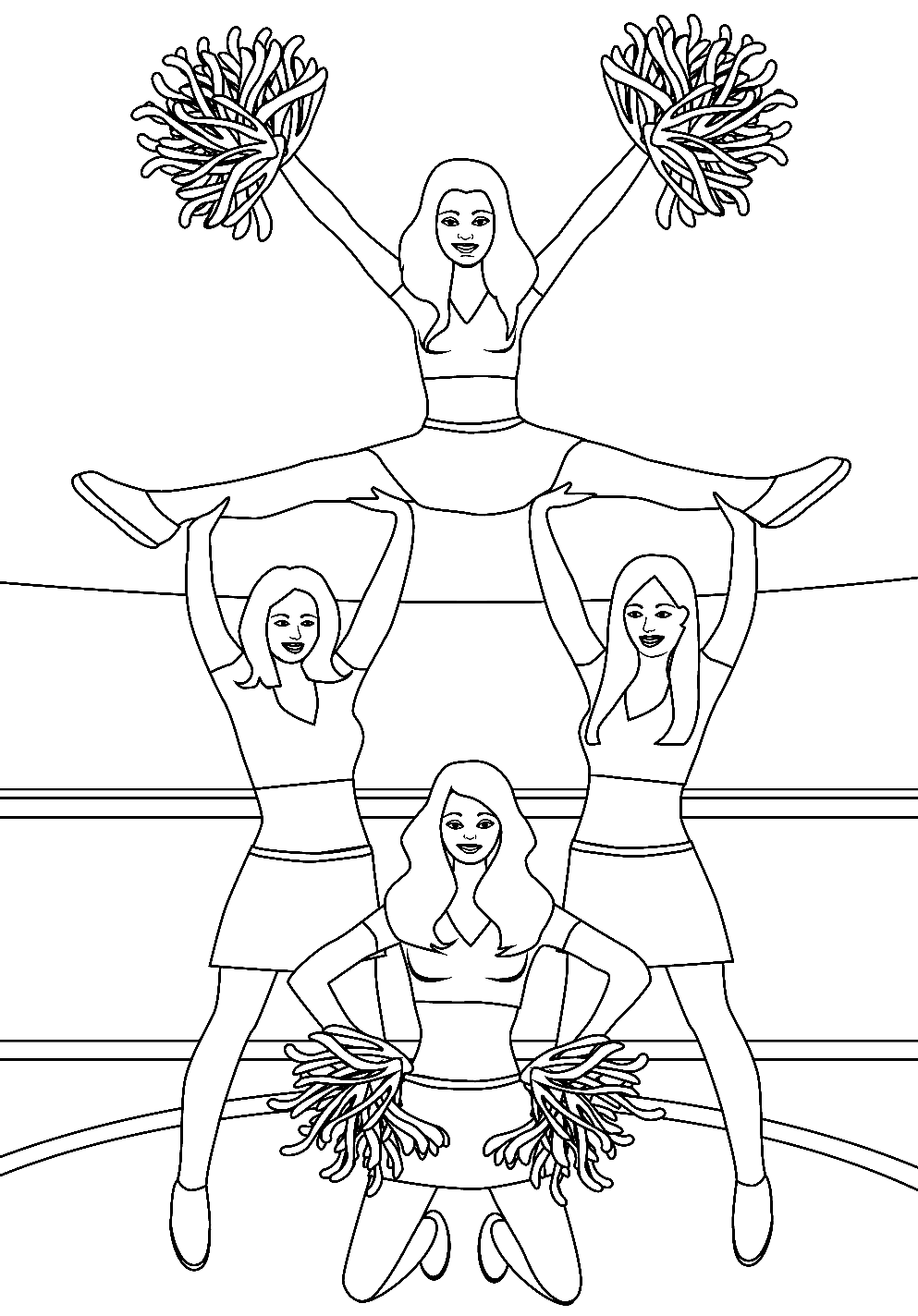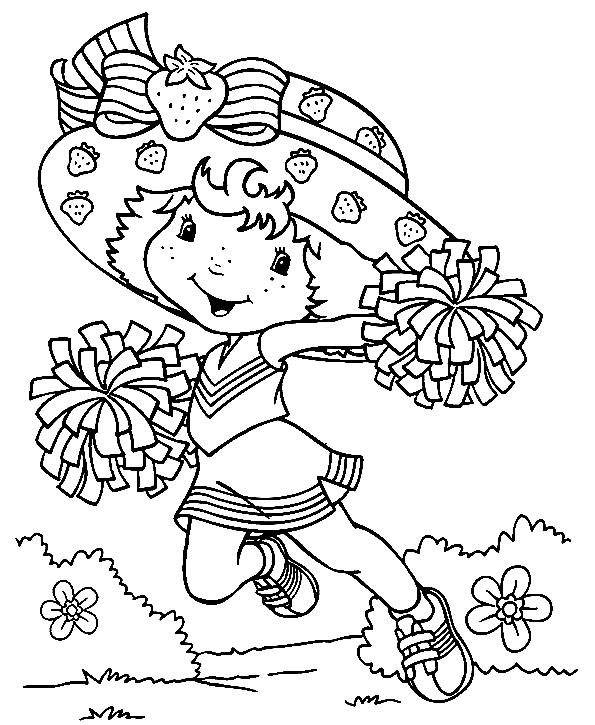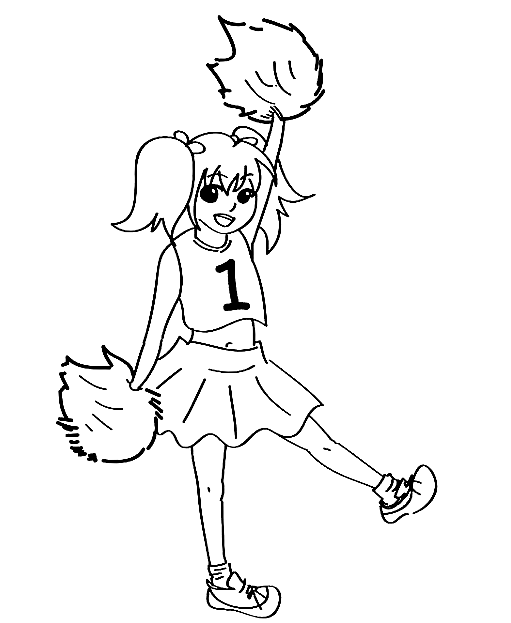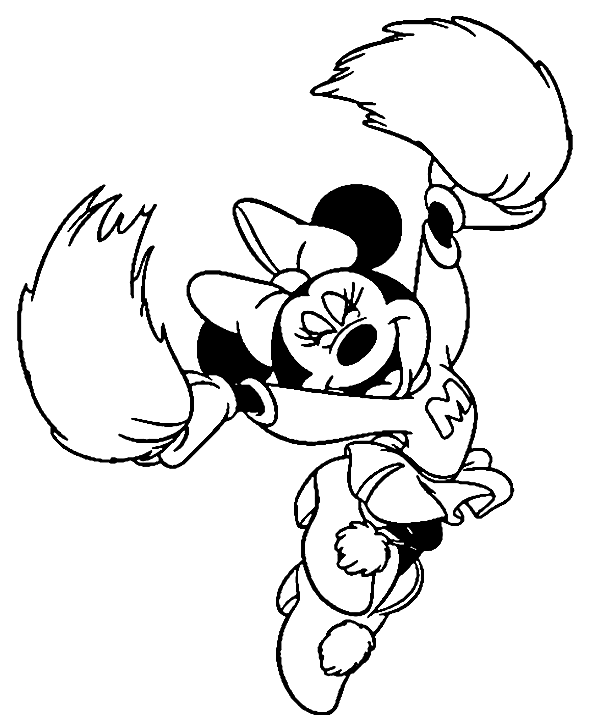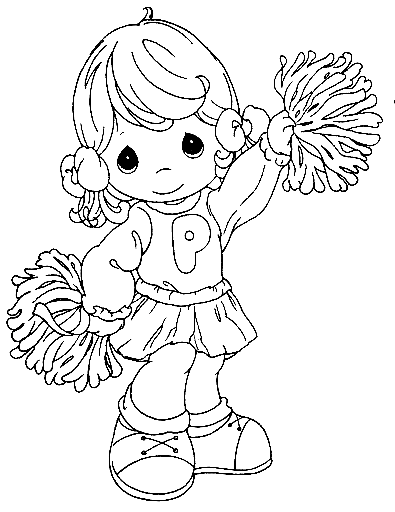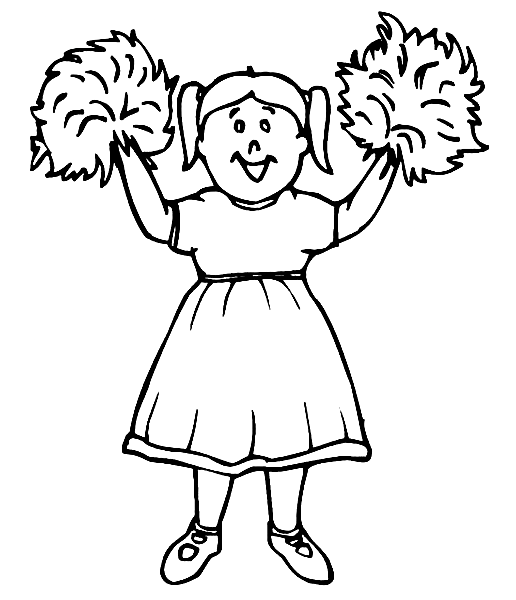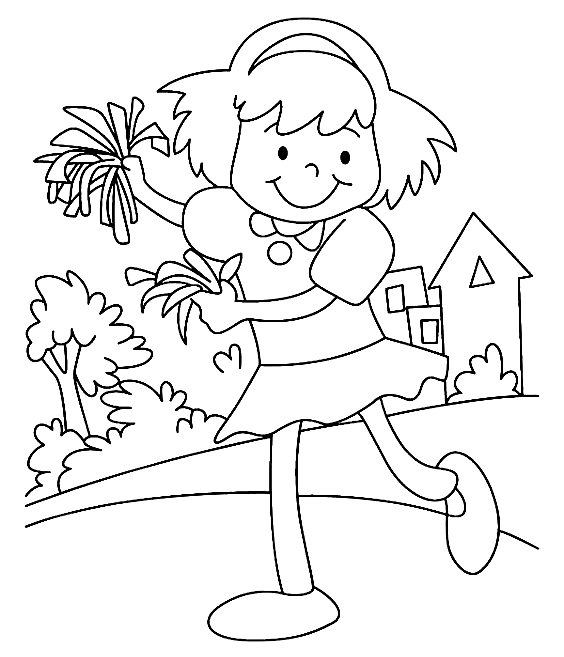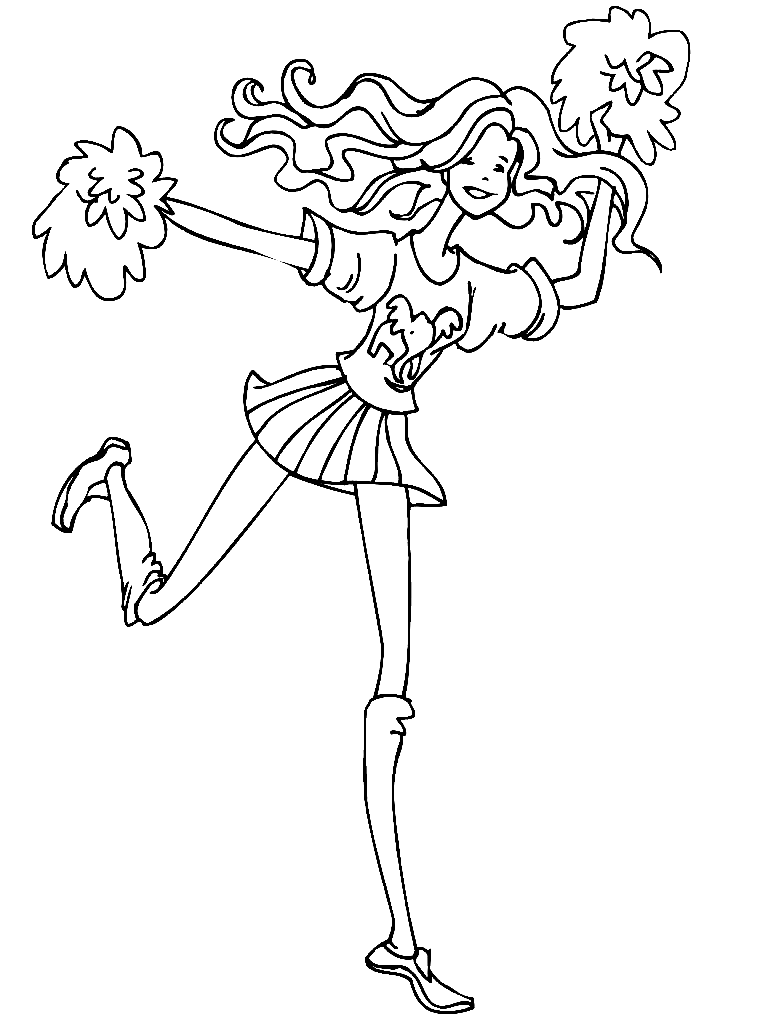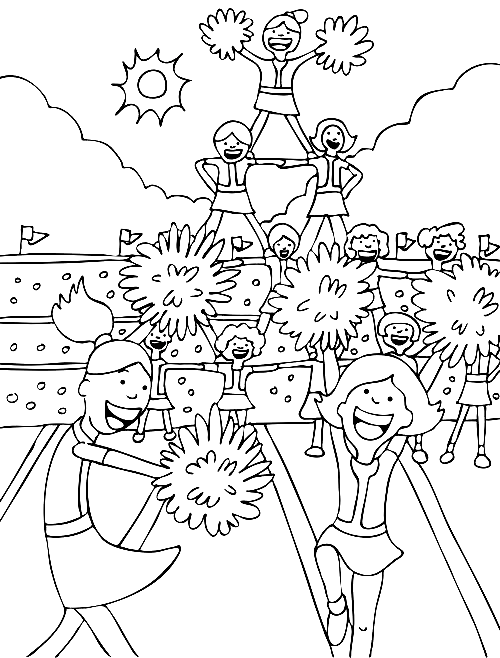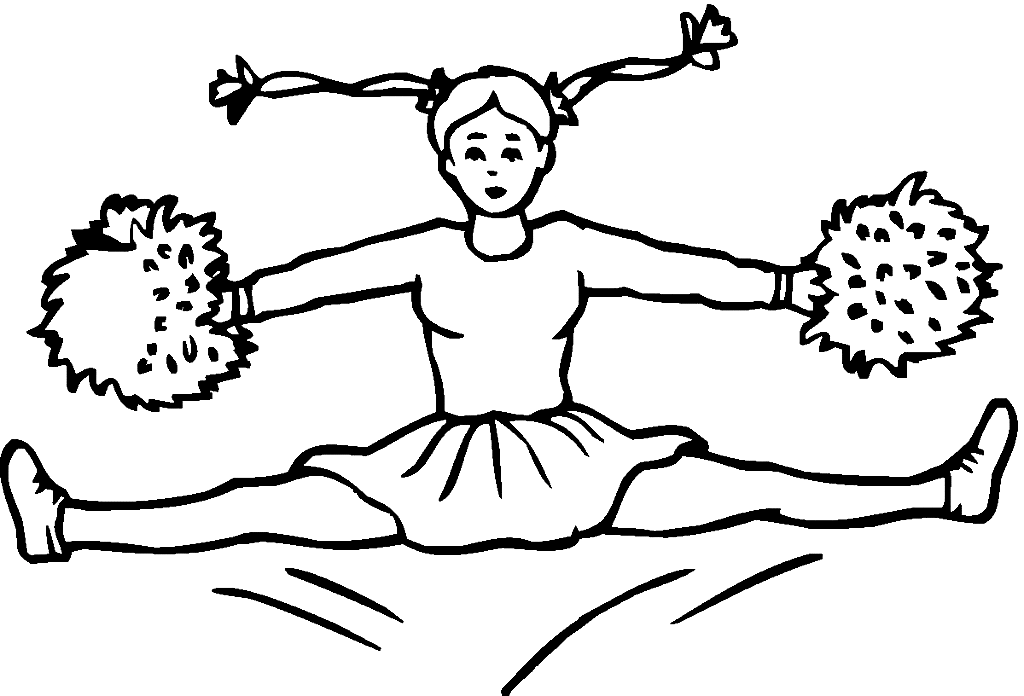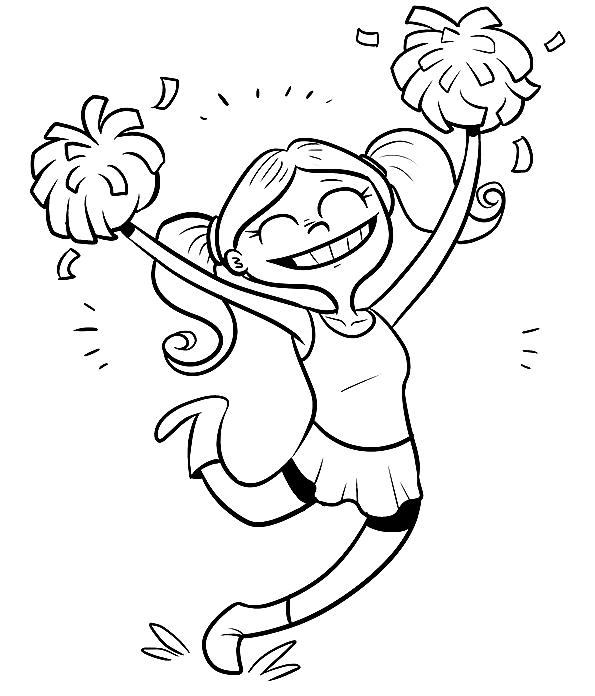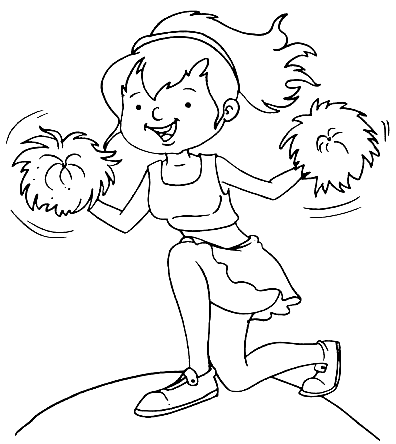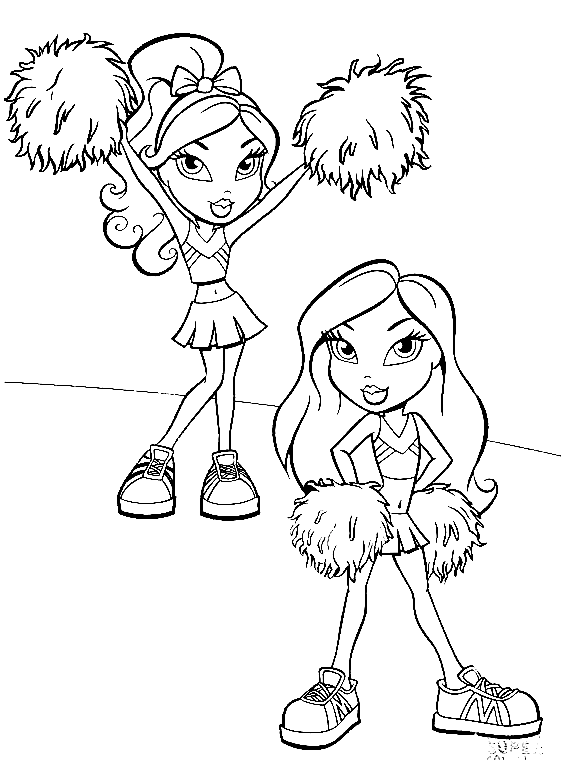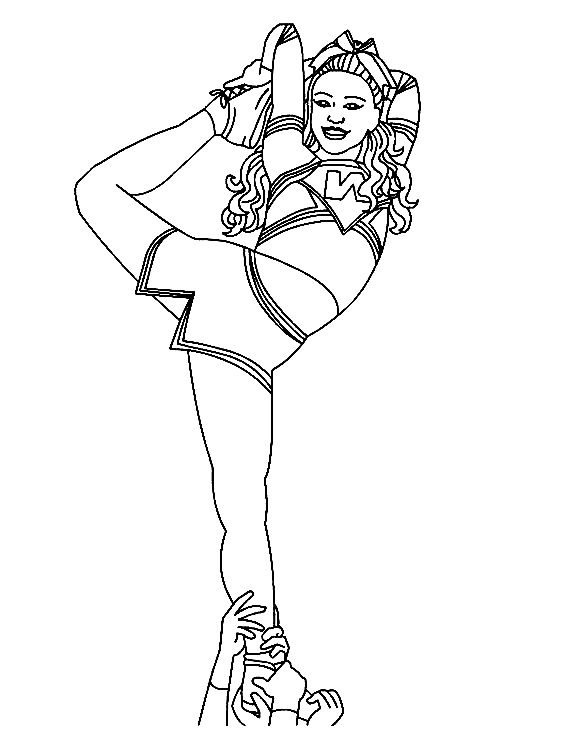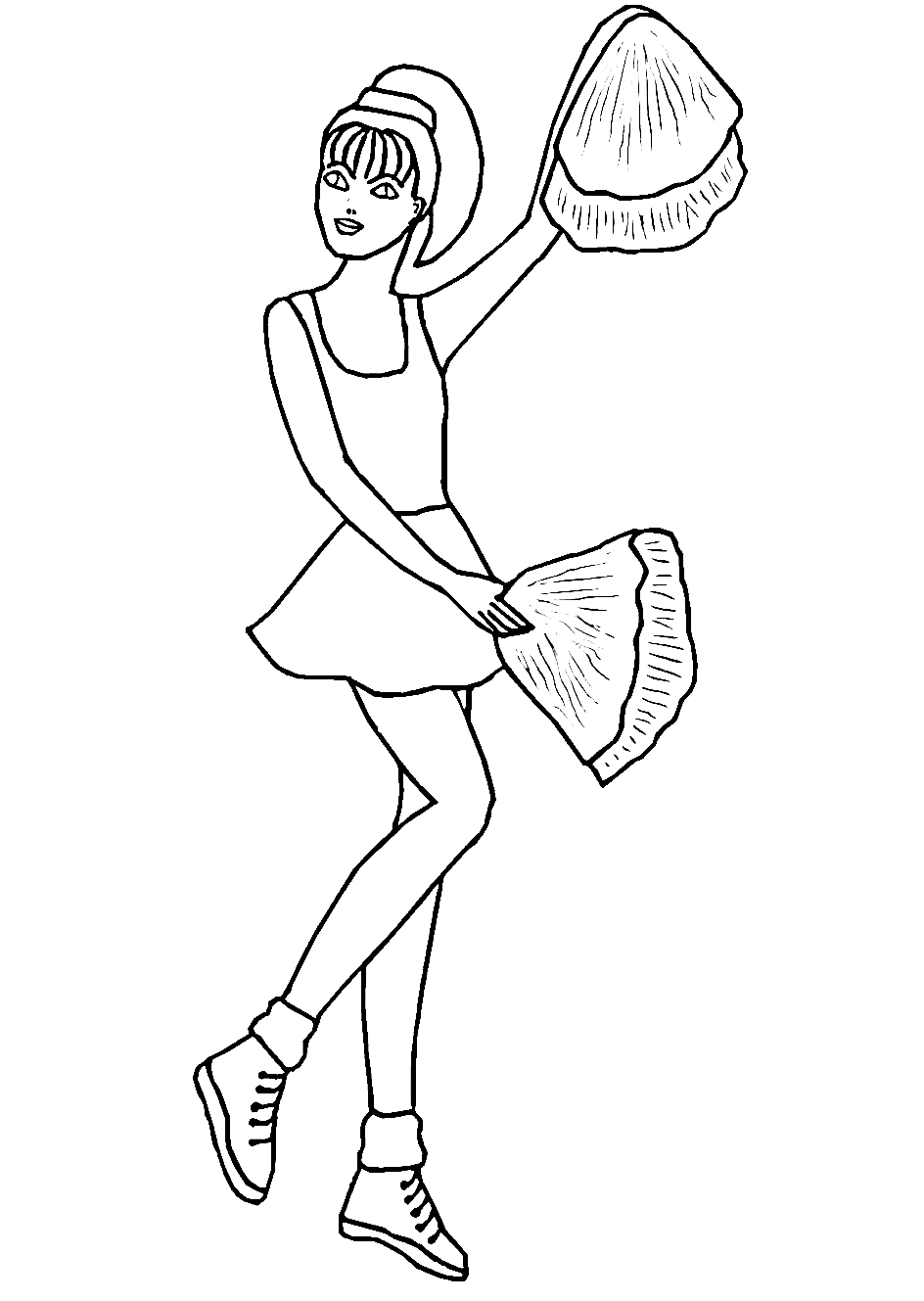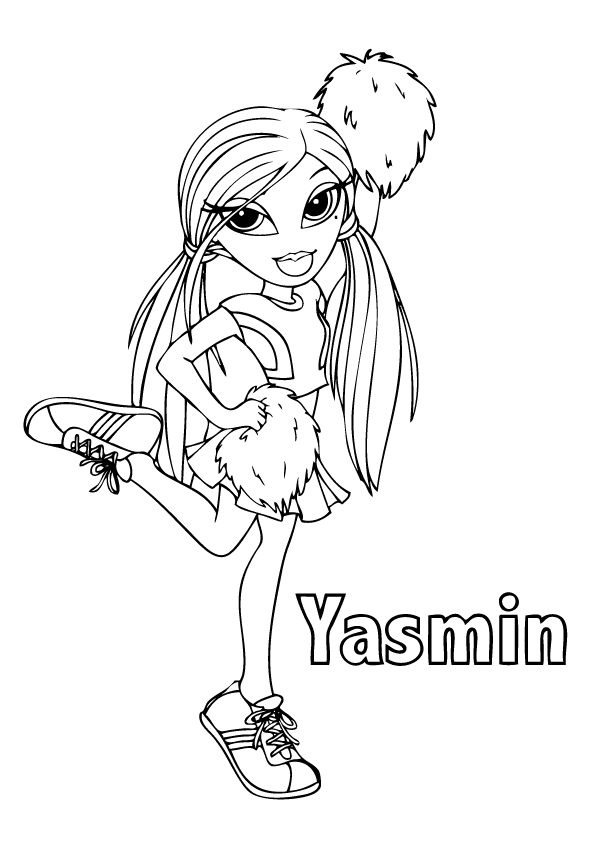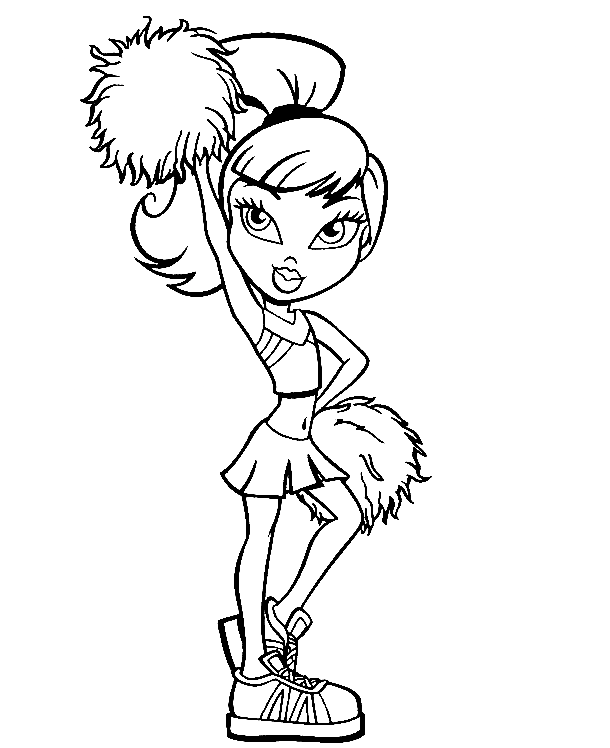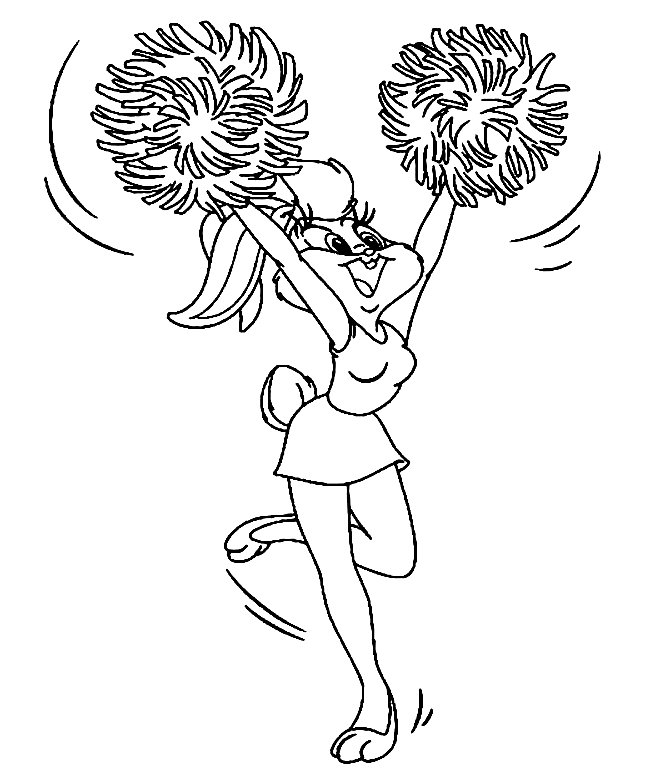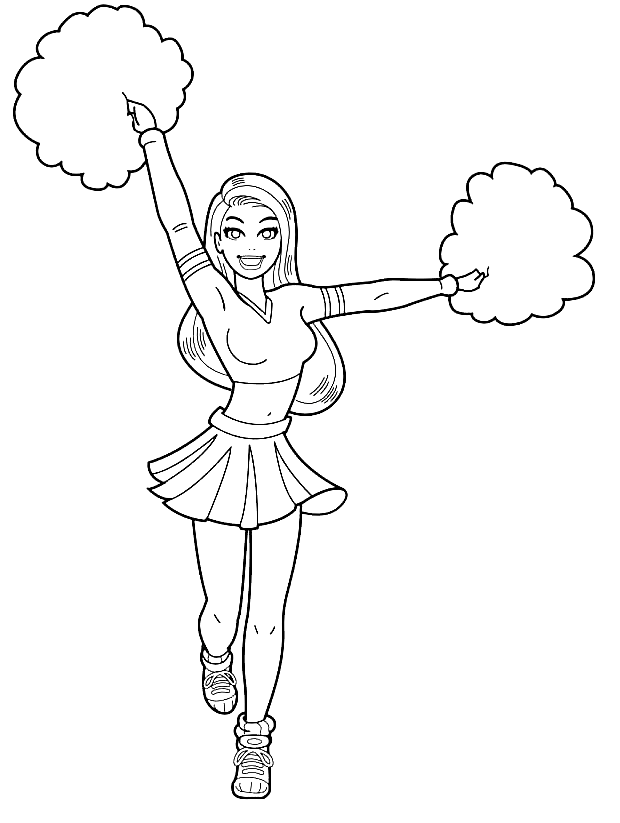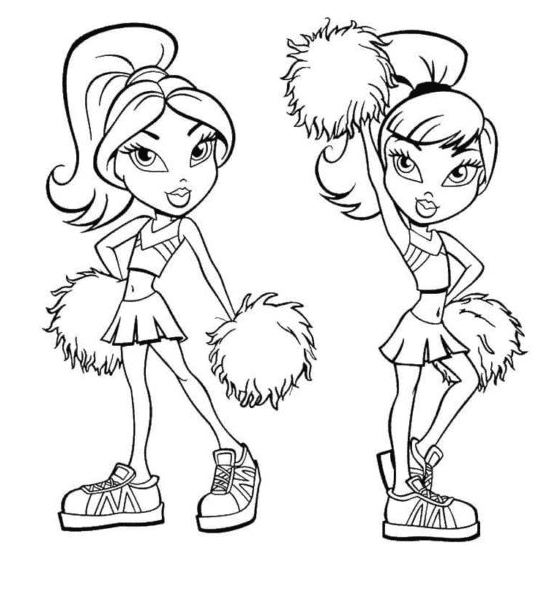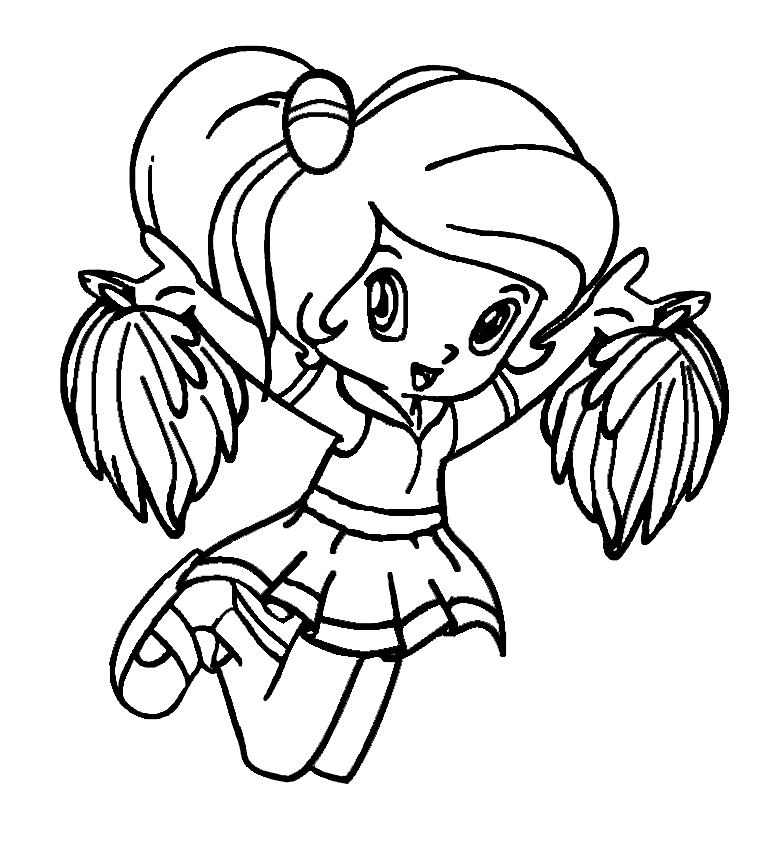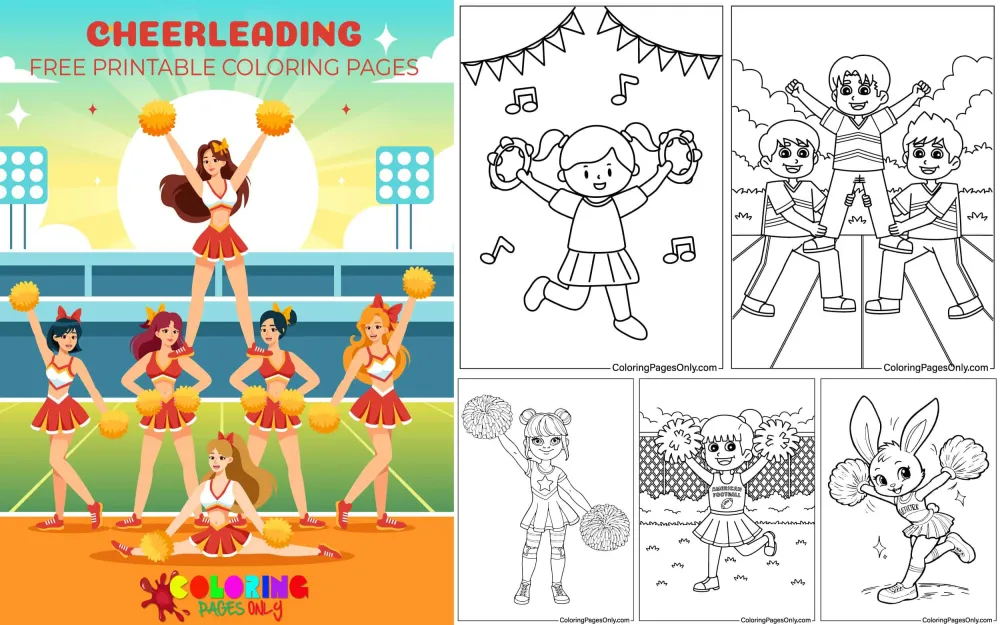
Cheerleading Coloring Pages at ColoringPagesOnly.com brings together 40+ free pages celebrating one of America’s most energetic and athletic traditions – solo cheerleaders in jump and motion poses, team formations and pyramids, kids cheerleading scenes, anime-style cheerleader illustrations, baby and toddler cheerleader pages for the youngest fans, cheerleading team group compositions, and active pom-pom routines. Download any page as a free PDF to print, or color online directly in your browser.
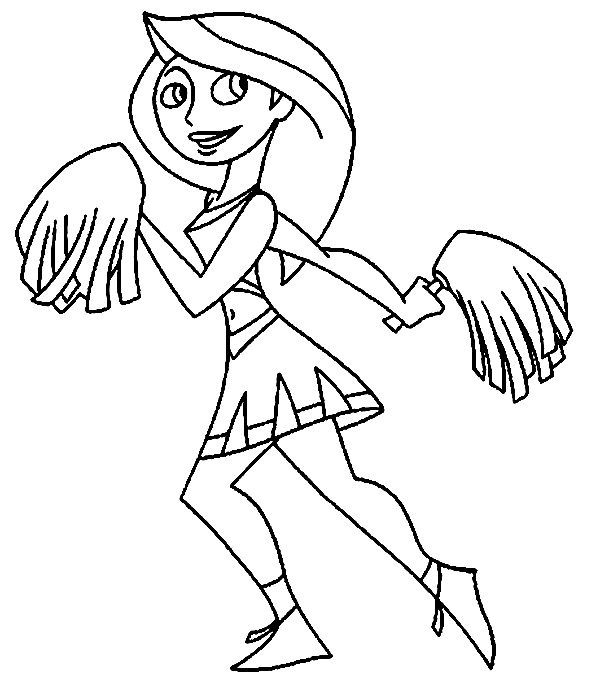
Cheerleading sits within the wider world of sports and activity – explore more at Sports Coloring Pages, Dance Coloring Pages, and Ballet Coloring Pages.
What Is Cheerleading?
Cheerleading is a performance and athletic discipline in which individuals or teams combine organized chanting, precise arm motions, dance, gymnastics, tumbling, and stunting – including pyramids, basket tosses, and partner lifts – to energize crowds at sporting events or compete in dedicated cheerleading competitions. What began as a simple crowd-rallying activity in 1898 has evolved into a globally practiced sport with over 3 million participants in the United States alone across youth recreational, school, All-Star, and collegiate programs, plus hundreds of thousands of participants worldwide.
The official birthday of organized cheerleading is November 2, 1898. On that date, a University of Minnesota medical student named Johnny Campbell leaped over the spectator fence and onto the field during a struggling football season, megaphone in hand, and led the crowd in the first coordinated organized cheer: “Rah, Rah, Rah! Ski-u-mah! Hoo-Rah! Hoo-Rah! Varsity! Varsity! Varsity, Minn-e-So-Tah!” The crowd followed. The cheer caught on. That moment – Campbell’s impulsive decision to step out of the crowd and become a leader – is celebrated every November 2nd as Cheerleading’s birthday.
Cheerleading remained an almost exclusively male activity for its first twenty-five years. Women first joined cheer squads at the University of Minnesota in 1923. By the 1940s, with many men in military service during World War II, women had largely taken over school and college cheerleading programs – a demographic shift that became permanent and defines the majority of participation today. By the 2000s, roughly 97% of cheerleaders at the high school level were female, though collegiate cheerleading had returned to approximately 50/50 gender balance, and All-Star competitive cheerleading integrates co-ed teams at all levels.
In 2021, the International Olympic Committee formally recognized cheerleading as a sport, opening the path toward potential future Olympic inclusion. The International Cheer Union (ICU), founded in 2004, serves as the global governing body.
The People Who Built Modern Cheerleading
Lawrence “Herkie” Herkimer – The Father of Modern Cheer
No individual has shaped modern cheerleading more than Lawrence Herkimer. A former cheerleader at Southern Methodist University, Herkimer held his first cheerleading clinic in 1948 at Sam Houston State Teachers College – 52 girls attended. The following year, 350 attended. By the 1950s and 60s, his National Cheerleaders Association (NCA), founded in 1951, was hosting workshops that trained tens of thousands of high school cheerleaders annually across the country.
Herkimer’s specific contributions to cheerleading’s visual and athletic vocabulary include: the Herkie jump (created by accident when he attempted a split jump – one leg extends straight to the side while the other bends at the knee toward the ground, creating an asymmetrical position named after him that remains a cheerleading standard today), the Spirit Stick (a baton passed to the most spirited team at camp, a tradition that spread worldwide), and the patent for the pom-pom with a hidden handle (1971). His original pom-pom design used crepe paper; in 1965, Fred Gastoff invented the vinyl version that became the modern standard, and in more recent years, mylar has become common for its metallic shimmer.
Jeff Webb and Competitive Cheerleading
In 1974, Jeff Webb – a former University of Oklahoma cheerleader – founded the Universal Cheerleaders Association (UCA), which taught higher-level skills than existing organizations and pioneered the concept of competitive cheerleading as a standalone format. By 1982, Webb had partnered with ESPN to air the National High School Cheerleading Championship – the first time competitive cheerleading received national broadcast television coverage. This single development transformed how cheerleading was perceived and practiced across the country, as squads from every state could suddenly see what elite teams were capable of.
The Four Main Types of Cheerleading
Understanding the different types of cheerleading clarifies why the collection’s pages span such a wide range of styles – from simple and cute to highly athletic and competitive.
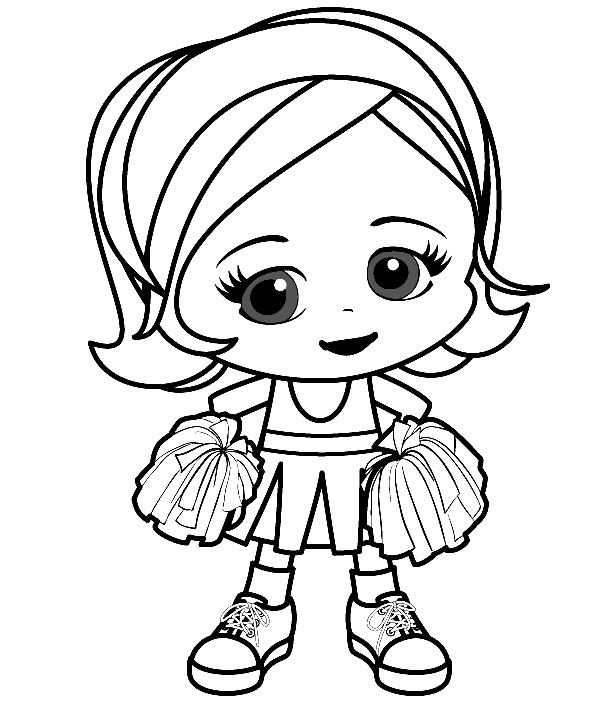
Recreational Cheerleading is entry-level cheerleading for young children, often as young as three or four years old. No tryouts required. The focus is on foundational skills: basic arm motions, simple jumps, beginner cheers, and team coordination. The pages in this collection showing baby and toddler cheerleaders, kids in simple positions, and “Happy Girl and Cheerleading” scenes reflect this accessible, early-participation version of the sport. These pages are ideal for the youngest colorists and young cheerleaders just discovering the activity.
School and Sideline Cheerleading is the most recognizable form – cheerleaders performing at high school and college football and basketball games, leading crowd chants, performing routines during halftime, and representing school spirit at competitions. Teams typically wear the school’s official colors and use matching pom-poms, megaphones, and signs. Tryouts are required. The collection’s team formation pages, cheerleading squad compositions, and uniform-focused illustrations reflect this school-spirit tradition.
All-Star Competitive Cheerleading operates independently of any school, through private gyms and training facilities. Athletes try out, train intensively year-round, and compete as teams in regional and national competitions judged on a two-and-a-half-minute routine that includes tumbling, stunts, pyramids, jumps, and dance elements. All-Star cheerleading represents the most athletically demanding version of the sport. Uniforms in All-Star are typically more elaborate and customized than school uniforms – bright, metallic, form-fitting designs that display the team’s identity and support the demanding physicality of elite routines.
Professional Cheerleading is associated with the NFL, NBA, and other major professional sports teams – the Dallas Cowboys Cheerleaders being the most globally recognized example, founded in their modern form in 1972. Professional cheer emphasizes dance technique, performance quality, and public engagement more than stunting or tumbling. The anime-style cheerleader pages in this collection often reflect the glamorous, performance-focused aesthetic of professional cheerleading.
The Elements of Cheerleading – What You’re Seeing on the Page
Jumps
Cheerleading jumps are airborne positions where both feet leave the ground simultaneously, executed with power from the legs and core. Each recognized jump has a specific body position:
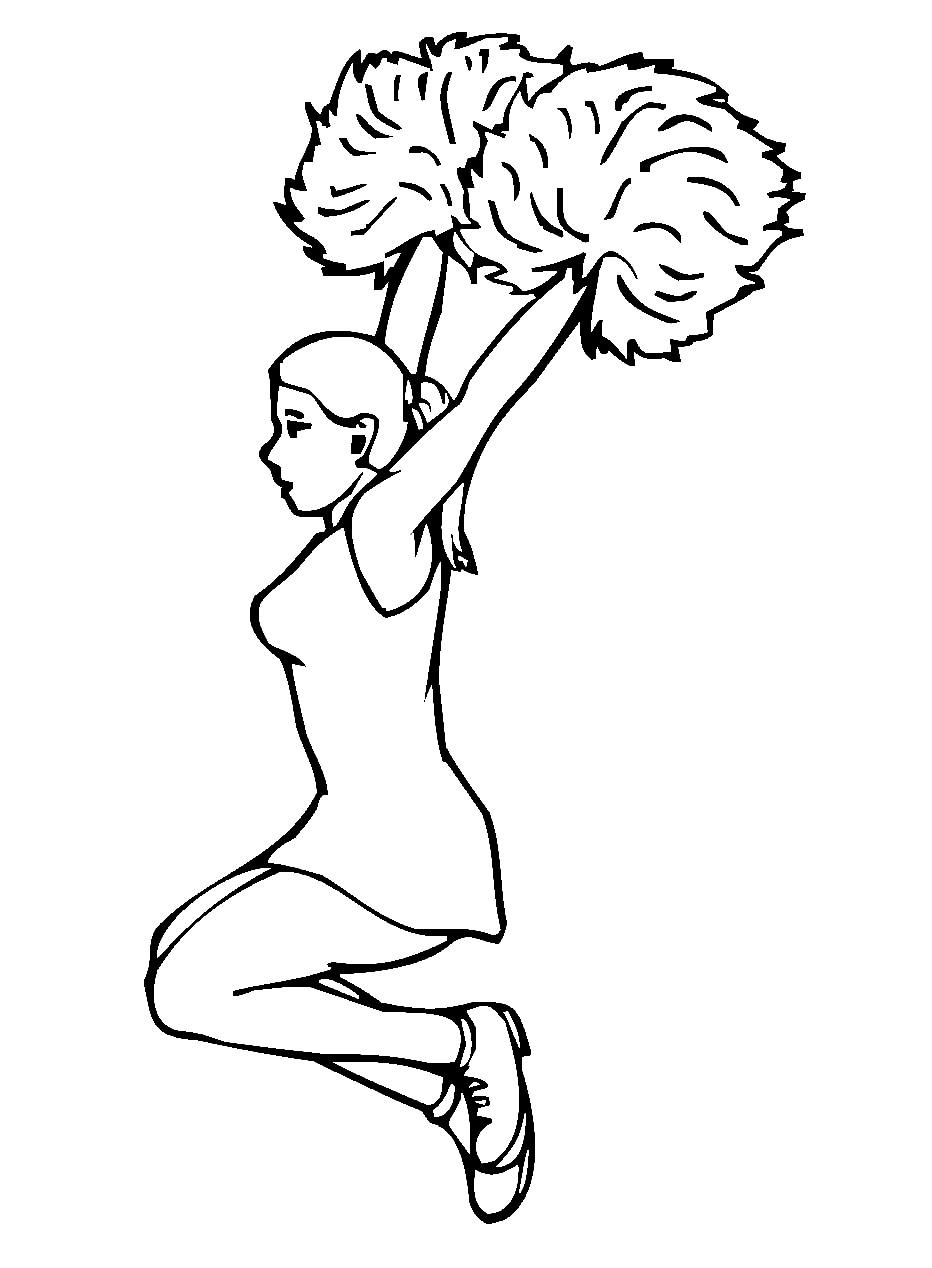
Toe Touch – The most iconic and recognizable cheerleading jump. Both legs extend fully to the sides in a straddle position (like a split in the air) while the arms reach toward the toes. When coloring toe touch pages, the legs should extend horizontally at or near shoulder height, arms reaching outward and slightly forward.
Herkie – Named after Lawrence Herkimer. One leg extends to the side as in a toe touch, while the other bends at the knee, pointing downward, creating an asymmetrical shape. One arm is typically raised in a high V while the other is bent at the side.
Pike – Both legs extend straight forward together, parallel, as the upper body folds toward them – the body making an L or folded shape. Sharp, clean, geometric.
Tuck – Both knees draw up toward the chest in a compact position. Less visual spread than the toe touch, but it demonstrates power.
Spread Eagle / Straight Jump – The simplest jump: both arms out in a V position, body straight or in a slight straddle. Often used as a transitional element between other skills.
Stunts and Pyramids
Stunts involve one or more bases (cheerleaders on the ground who provide support) lifting or tossing a flyer (the cheerleader who is elevated). The most basic stunt is the Thigh Stand, where one base kneels and the flyer stands on their thigh. More advanced stunts include the Liberty (flyer balances on one foot elevated above the base’s head) and the Scorpion (flyer balances on one foot while arching the back to pull the other foot overhead). The most dramatic stunts are basket tosses, where three or four bases toss the flyer high into the air to perform a jump or twist before being caught.
Pyramids connect multiple stunts into a single visual structure – two or more stunt groups linked together at various heights. A classic pyramid has flyers supported at the peak connected by bases at progressively lower levels, creating a geometric shape visible from across a stadium.
Pages in this collection showing multiple cheerleaders in formation, elevated positions, or linked poses depict pyramids and group stunting configurations.
Pom-Poms
The pom-pom – or pom-pon, as Lawrence Herkimer originally patented it – is cheerleading’s most immediately recognizable visual prop. Originally made of crepe paper (used from the 1930s), then vinyl (1965), and now frequently mylar for metallic shimmer, pom-poms are held by their hidden center handle and shaken in synchronized motions to amplify the visual effect of arm movements.
Standard pom-poms are typically six inches in diameter – large enough to be visible at a distance without impeding the cheerleader’s movement. Competition pom-poms may be smaller (four to five inches) for precision use. Colors almost universally match the team’s uniform: if the uniform is navy and gold, the pom-poms are navy and gold; if red and white, the pom-poms are red and white. Solid colors, two-tone splits, and multi-strand combinations all exist.
For coloring purposes, pom-poms are rendered as a burst of straight lines radiating from a central hold point – like a firework or starburst frozen mid-shake. They should have visible texture and density, not appear as a flat ball. The most energetic rendering shows the strands at slightly different angles, suggesting motion.
Megaphones and Signs
The megaphone – a cone-shaped amplification device – was the earliest cheerleading prop, used by Johnny Campbell in 1898. Though primarily replaced by electronic amplification systems at large stadiums, megaphones remain a symbol of cheerleading’s identity and appear frequently in pages where a cheerleader is shown cheering toward the camera or crowd. They are typically decorated in team colors with the school’s name or initials.
Signs are rectangular boards bearing team names, letters, or motivational words (GO! FIGHT! WIN!) and are held up by the squad to direct crowd participation.
Cheerleading Uniforms – Color and Design
Cheerleading uniforms have evolved dramatically from the ankle-length skirts and varsity sweaters of the 1920s to today’s form-fitting, highly engineered athletic wear designed to accommodate the full range of stunting and tumbling movement.
The core uniform consists of a sleeveless or short-sleeved shell top and a skirt or shorts (with briefs, called “spanks,” worn underneath the skirt for modesty during high kicks and jumps). Shell tops typically feature the school’s initials, mascot name, or a decorative design in the secondary color against the primary color background.
School uniform color conventions follow the school’s official athletic colors – the same palette used on jerseys, banners, and spirit merchandise. The most common school color combinations in American cheerleading are: red and white, blue and gold, green and white, maroon and gold, purple and gold, black and gold, navy and red, and orange and blue. Uniform colors are specifically chosen to be visible at a distance and to photograph clearly under stadium lighting.
All-Star uniforms are more elaborately customized – featuring the gym’s specific branding, often with metallic elements (silver, gold, holographic) in the fabric or trim, custom lettering, and competition-regulation designs. These uniforms frequently incorporate two or three colors plus metallic accents.
Shoes are purpose-built white or black athletic shoes with smooth, non-marking soles and structured ankle support. They are almost universally white in school and collegiate cheerleading.
Hair and accessories – Cheerleaders typically wear their hair up and secured with a ribbon bow in the team’s colors. The bow is a significant aesthetic element – a large, structured fabric bow tied at the top of a high ponytail or bun. The bow’s color matches the uniform’s secondary or accent color.
Coloring Tips
Start with the uniform’s primary color and build everything from there. A cheerleading page’s color story starts with the uniform. Before choosing any other colors, select the primary uniform color (the dominant tone of the shell and skirt) and the secondary accent color (used for stripes, lettering, and trim). Everything else – the pom-poms, the bow in the hair, the megaphone if present – should reflect this same palette. A cheerleader in a red-and-white uniform should hold red-and-white pom-poms and wear a red or white bow. This color consistency is what makes the page read as a cohesive team identity rather than a random collection of elements.
Pom-poms need texture, not flat fill. The biggest mistake when coloring pom-pom pages is rendering the pom-poms as a solid filled shape – like a ball or cloud. Real pom-poms are made of loose strands radiating from a central point, and the coloring should reflect this. Apply color with short outward strokes from the center toward the edges rather than filling the whole shape in one motion. Leave the center slightly lighter where the handle gathers the strands, and let the outer edges be slightly varied in direction to suggest movement. If using colored pencils, a circular flicking motion outward from the center works well.
Jump pages need to show air. Any page showing a cheerleader in a jump – especially a toe touch – has one critical accuracy requirement: the feet must read as above the ground. The single most common coloring choice that undermines jump pages is making the background too heavy at the foot level, which can visually ground the cheerleader. Keep the space below and around the jump figure lighter and more open than the upper composition. If adding a ground or floor line, place it well below the cheerleader’s position to preserve the sense of height and airtime.
The Herkie jump’s asymmetry is its beauty. If a page shows the Herkie jump, the two legs are in very different positions – one straight to the side, one bent downward. The coloring approach should honor this asymmetry: don’t try to mirror the two sides of the figure. The bent leg’s foot points toward the ground and often catches shadow beneath the body; the extended leg is bright and horizontal at shoulder height. Treating these two legs with different tonal values (slightly more shadow on the bent leg) reinforces the three-dimensional quality of the position.
Team pages work best with warm color dominance. Pages showing cheerleading teams or squads have multiple figures requiring consistent palette application across the group. Choose your primary color and apply it consistently to every figure’s uniform – no figure should have a different primary color unless the page intentionally shows multiple teams. The warm colors (reds, oranges, golds) read best at a distance and in group compositions; cool colors (blues, purples, greens) provide strong contrast if used as accent tones. Most high-energy cheerleading compositions benefit from warm primaries and cool accents rather than the reverse.
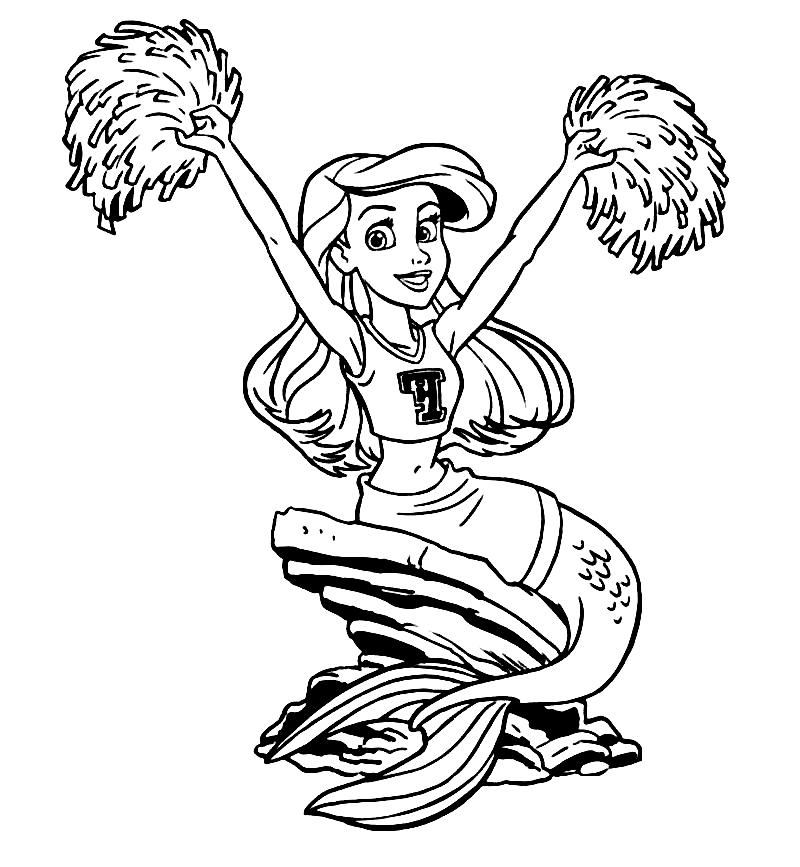
Anime-style cheerleader pages call for high saturation. The anime cheerleader pages in this collection draw on the Japanese aesthetic conventions used in sports anime like Cheer Boys!! and countless high school manga – vivid, expressive, slightly exaggerated proportions with very high color saturation. For these pages, push the colors significantly brighter than you might for realistic-style pages. Vivid cherry red rather than muted red; electric sky blue rather than navy; bright gold rather than ochre. The anime style rewards the most saturated version of any color.
Baby and kids cheerleader pages call for soft warmth. The collection includes toddler and baby cheerleader pages that have different coloring needs from the athletic competition-style pages. For these, softer pastels and warmer tones create the right register – soft pink, pale gold, light mint, baby blue. These pages depict cheerleading as a cute and joyful activity for very young children, and the color approach should reflect that sweetness rather than the bold energy of competitive cheer.
5 Activities
Design your team’s uniform. Before coloring any page, do what every real cheerleading squad does before their season starts: decide on a color palette. Choose a primary color, a secondary color, and an optional metallic accent. Write down your three colors and what each will be used for (primary = uniform body; secondary = trim and lettering; accent = bow and pom-pom highlight). Then color a full team page in your chosen palette, applying it consistently to every figure. After finishing, give your team a name and a school mascot to go with your new color story. This activity replicates one of the most exciting moments of the real cheer season – designing and revealing the team’s identity – and develops intentional color decision-making.
The jump position identification study. Print six cheerleader pages showing different jump positions from the collection. Color each page, then research the name of the jump shown: toe touch (straddle legs extended sideways), Herkie (one leg out, one bent down), pike (both legs forward), tuck (knees to chest), spread eagle (slight straddle with straight body). Label each finished page with the jump’s name. If possible, try the position yourself, standing still (without actually jumping – just mimicking the shape of each body position). This activity builds understanding of how body position creates visual interest in athletic performance – the same principle that makes dance, gymnastics, and figure skating visually compelling as coloring subjects.
The pom-pom color challenge. Print any solo cheerleader page from the collection. Color the cheerleader’s uniform in any palette you choose. Then, design the pom-poms in a completely different but complementary combination – two-tone striped pom-poms, multi-color burst patterns, metallic accents on a solid base. Real competition pom-poms come in hundreds of colors and finish combinations: solid, split, mixed, metallic, and holographic. After completing the page, research what your school’s or favorite college team’s pom-pom colors are, and create a second version of the page using that specific palette. The comparison demonstrates how pom-pom colors function as an extension of team identity.
The cheerleading timeline. Using a long piece of paper, draw a simple timeline from 1898 to the present. Add the following key moments learned from this collection: 1898 – Johnny Campbell leads first organized cheer; 1923 – Women first cheer at University of Minnesota; 1948 – Lawrence Herkimer holds first cheerleading clinic; 1965 – Vinyl pom-pom invented; 1974 – UCA founded; 1982 – Cheerleading first broadcast on ESPN; 1987 – AACCA safety standards established; 2021 – IOC recognizes cheerleading as sport. On the timeline, draw and color a small cheerleader figure for each milestone – using period-appropriate fashion (ankle-length skirt for 1923, modern spandex for 2021). The activity transforms historical facts into a visual narrative and develops both historical understanding and illustration skills.
The squad spirit packet. Print one of each type of page in the collection: a solo jump page, a team formation page, a baby/kids page, and an anime-style page. Color all four in the same team palette – the same primary, secondary, and accent colors throughout. When finished, arrange them together as a set representing different ages and contexts within one cheer team’s universe: the youngest squad members (baby page), the junior team (kids page), the senior team (team formation), and the star athlete portrait (solo jump or anime page). This activity develops consistency across a series – a skill used by professional illustrators when creating character sheets and brand materials – and produces a complete four-page set that can be displayed together.