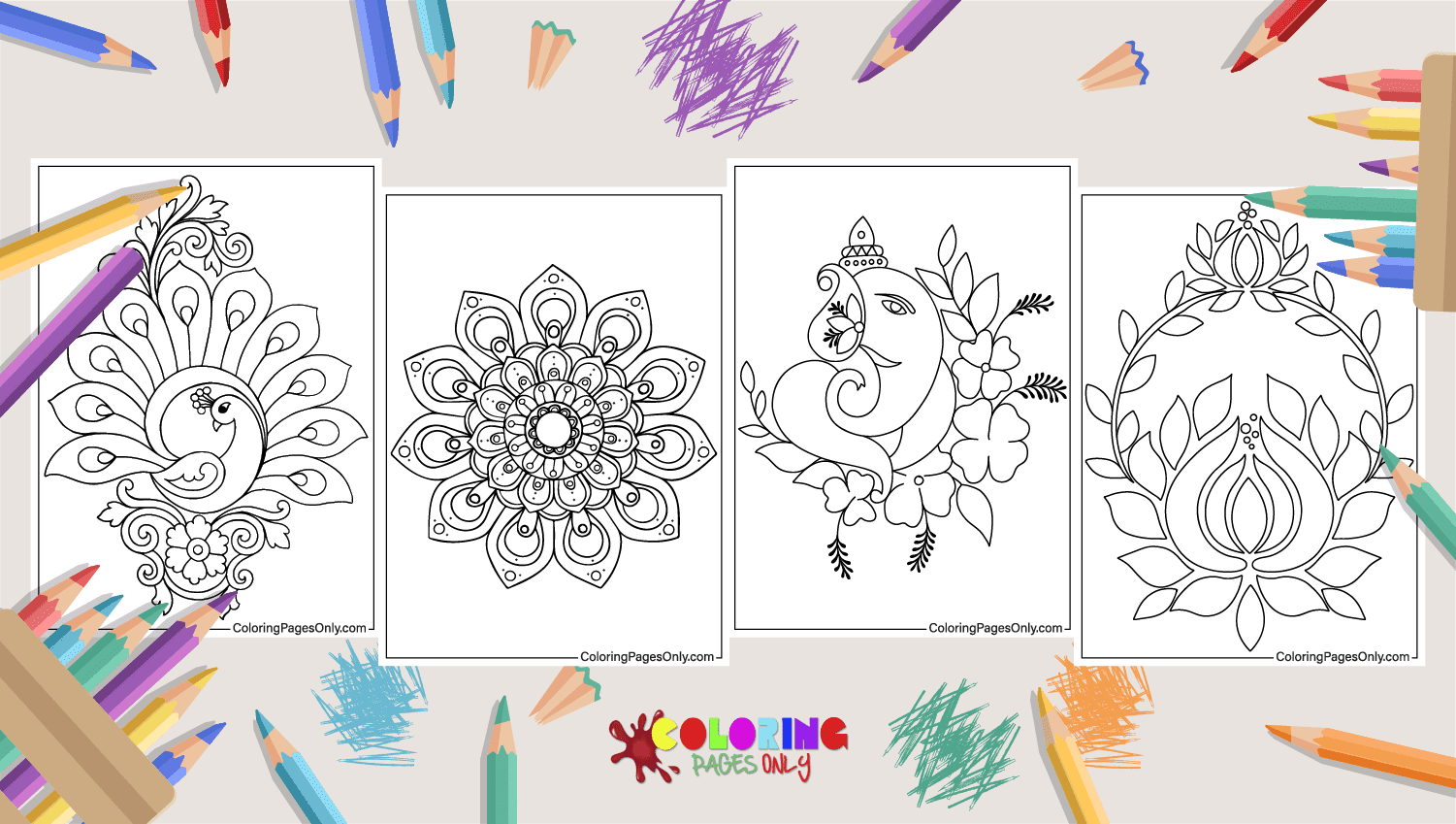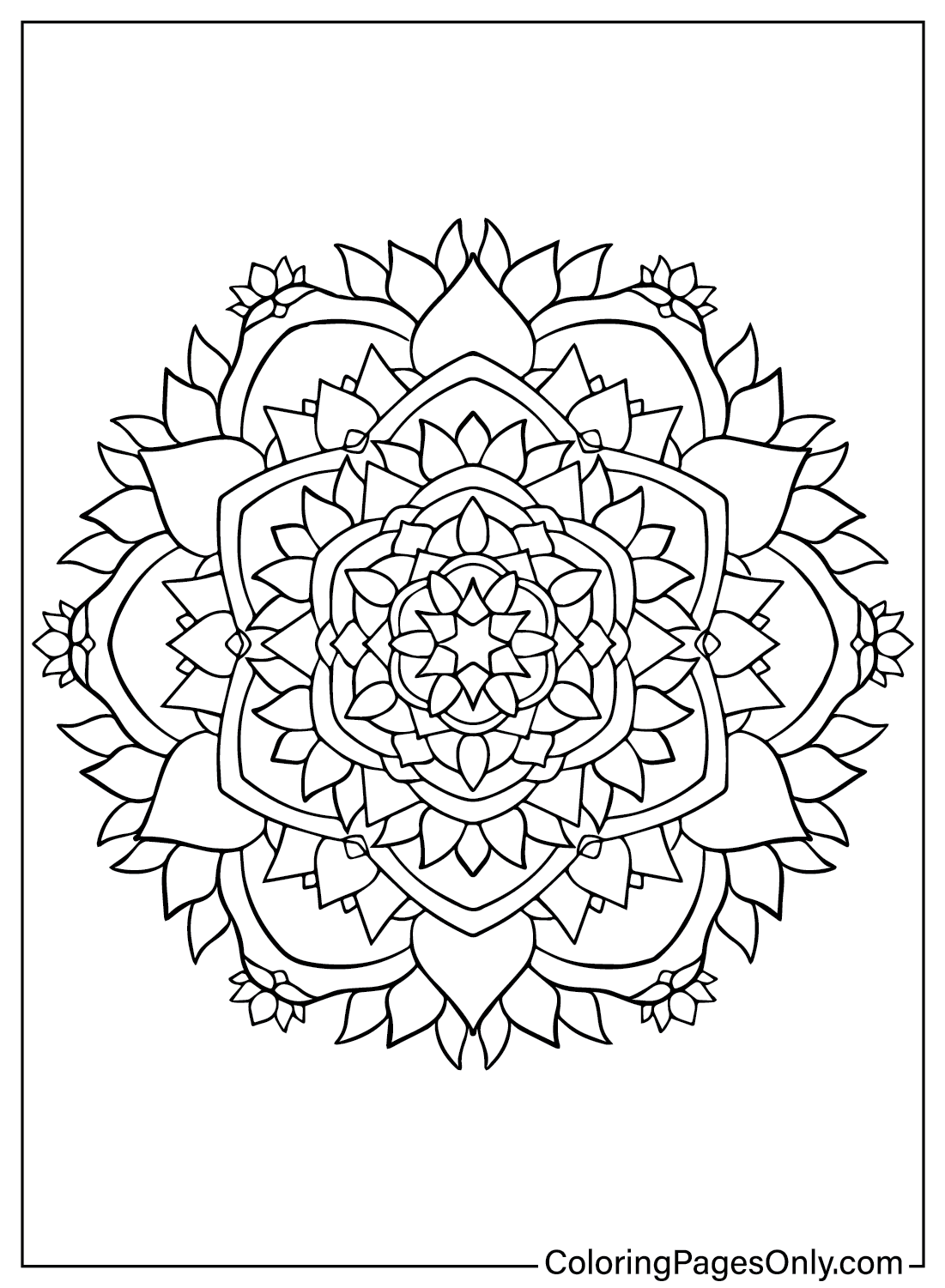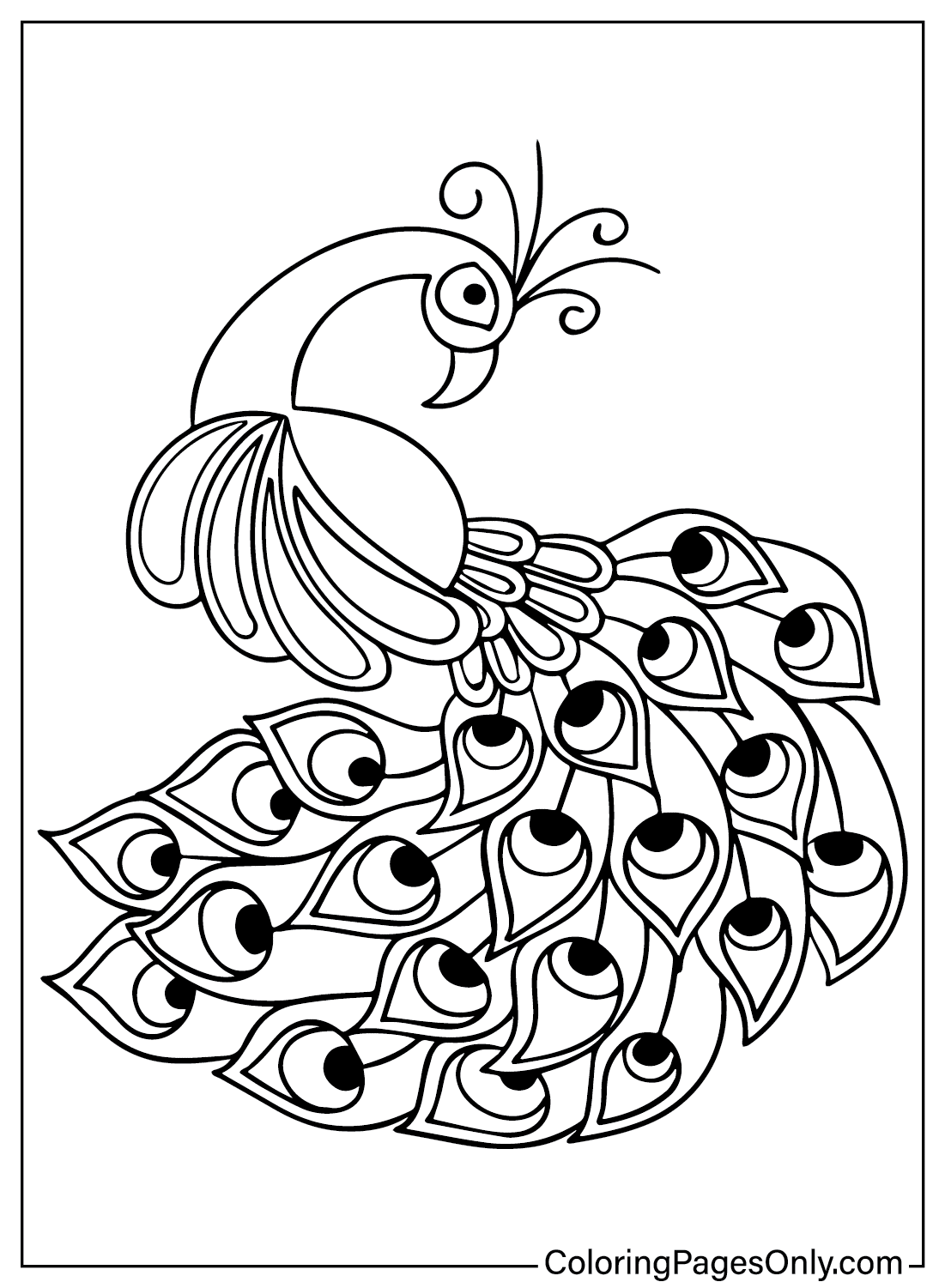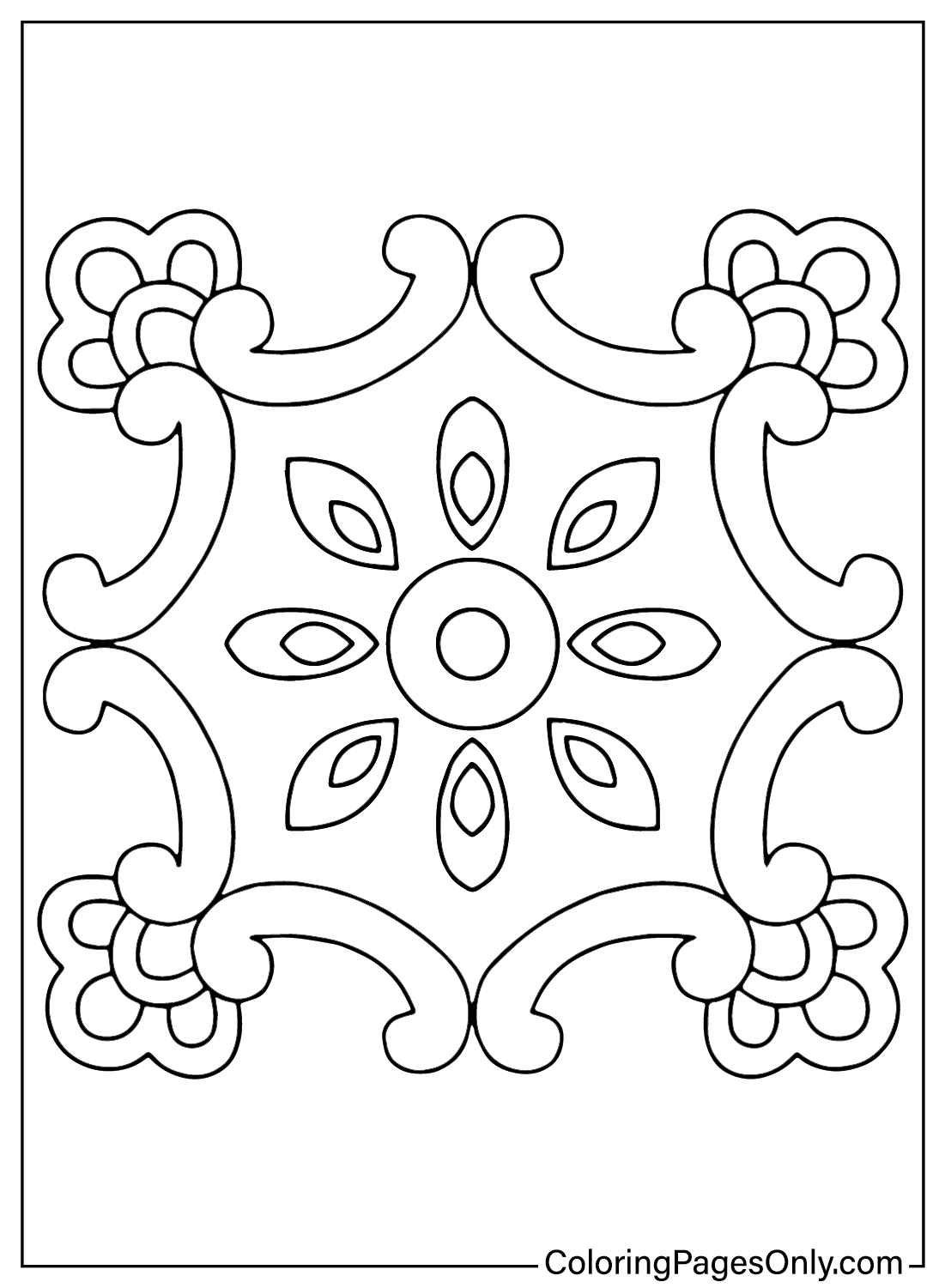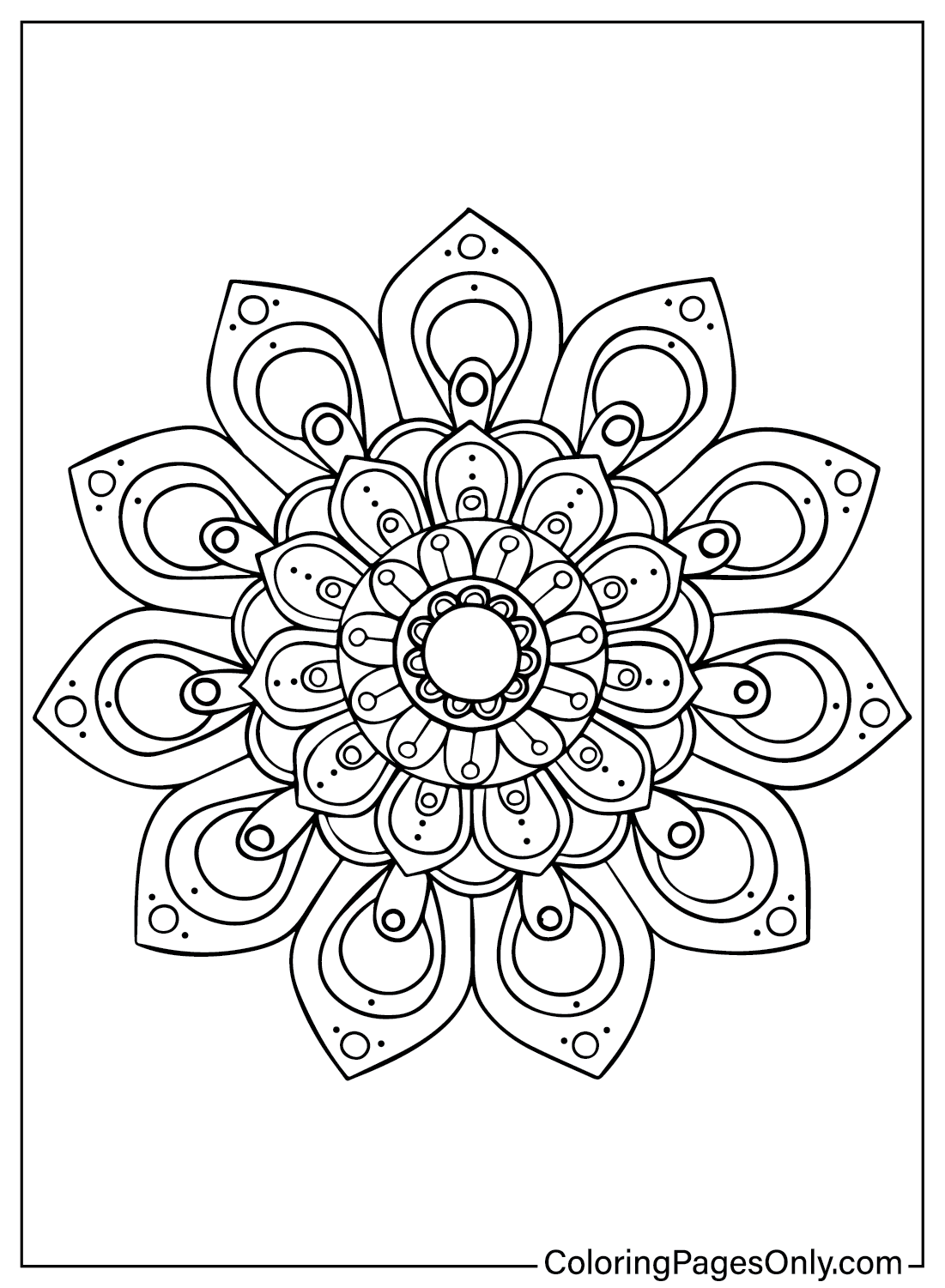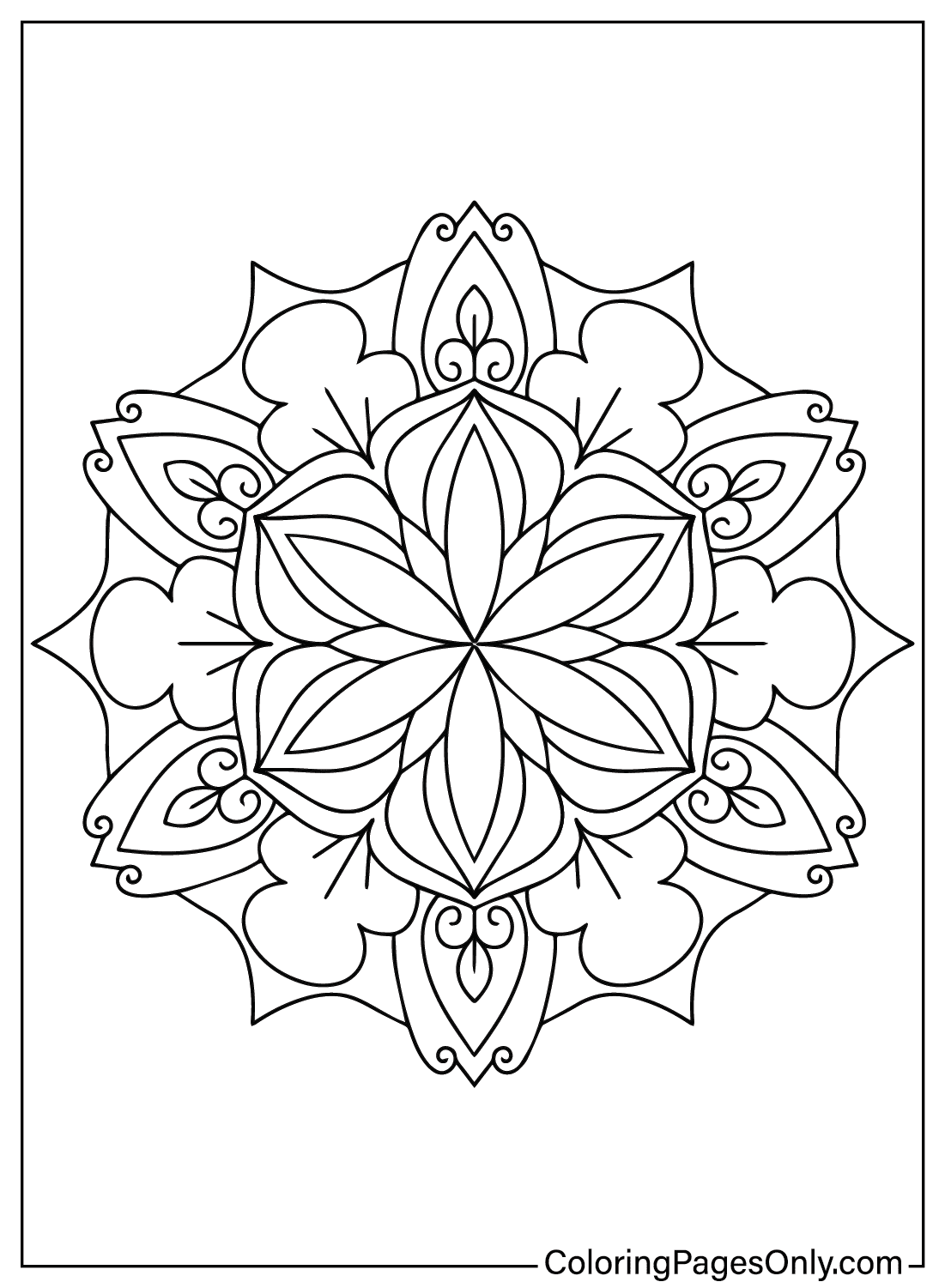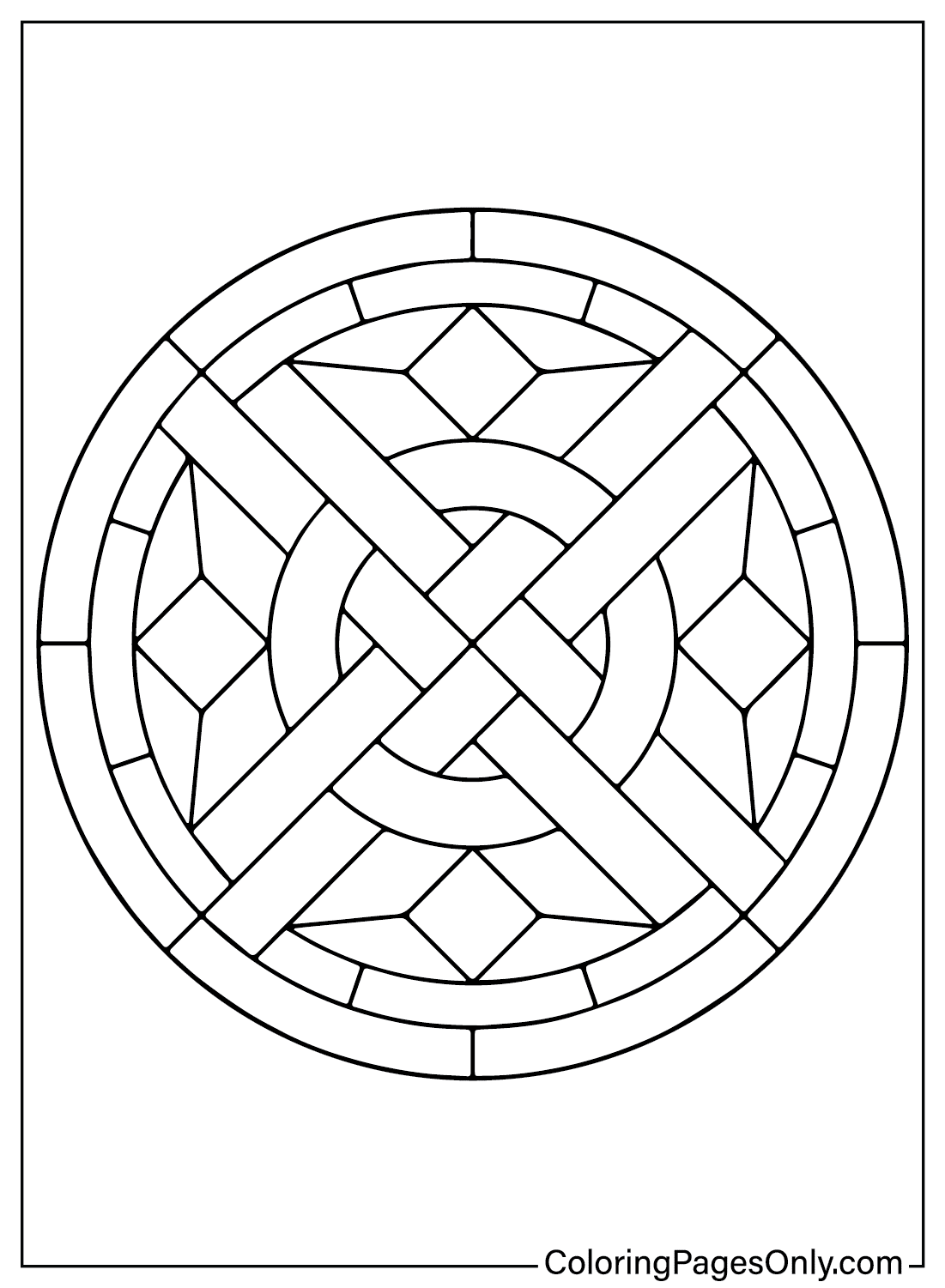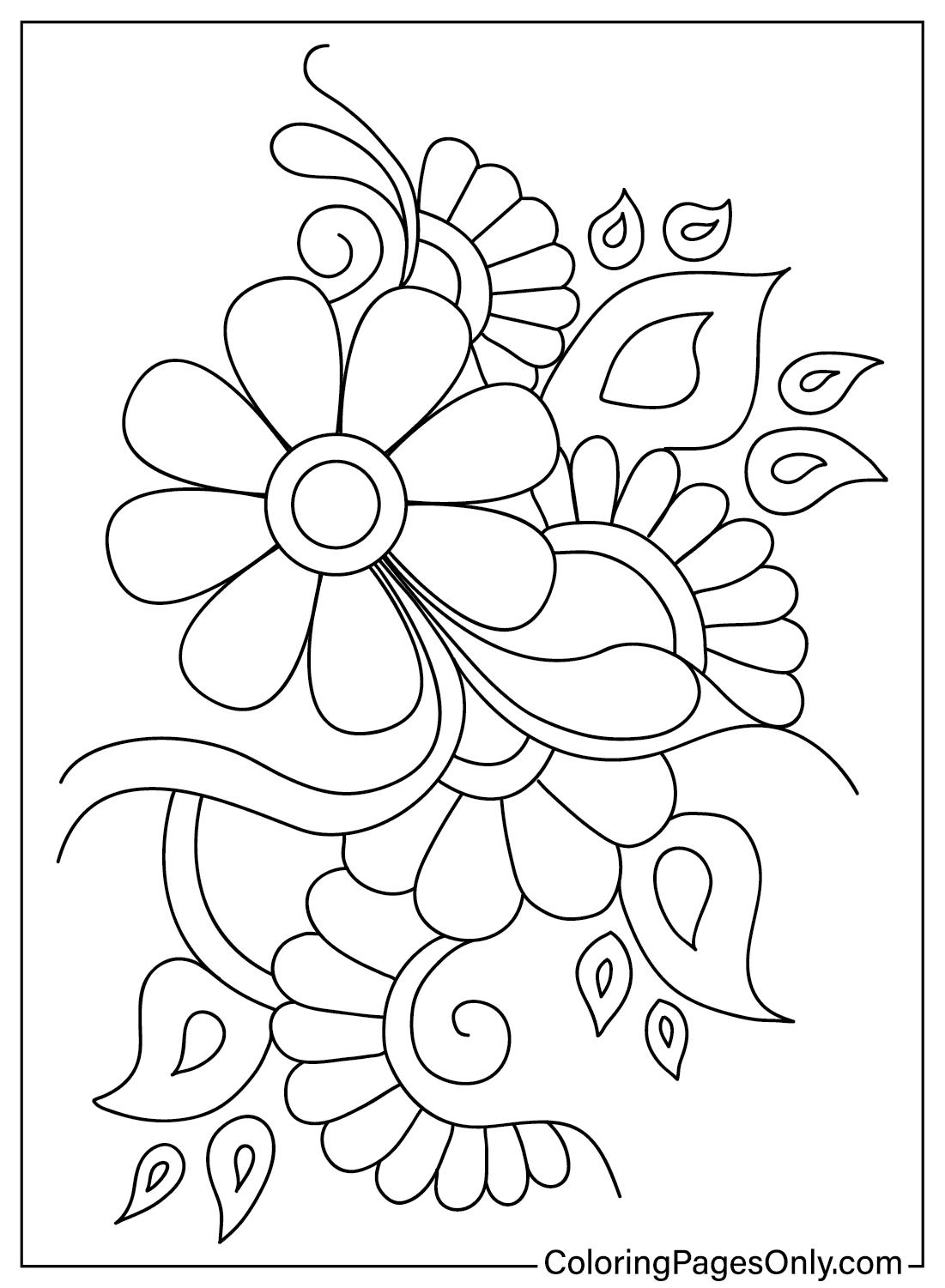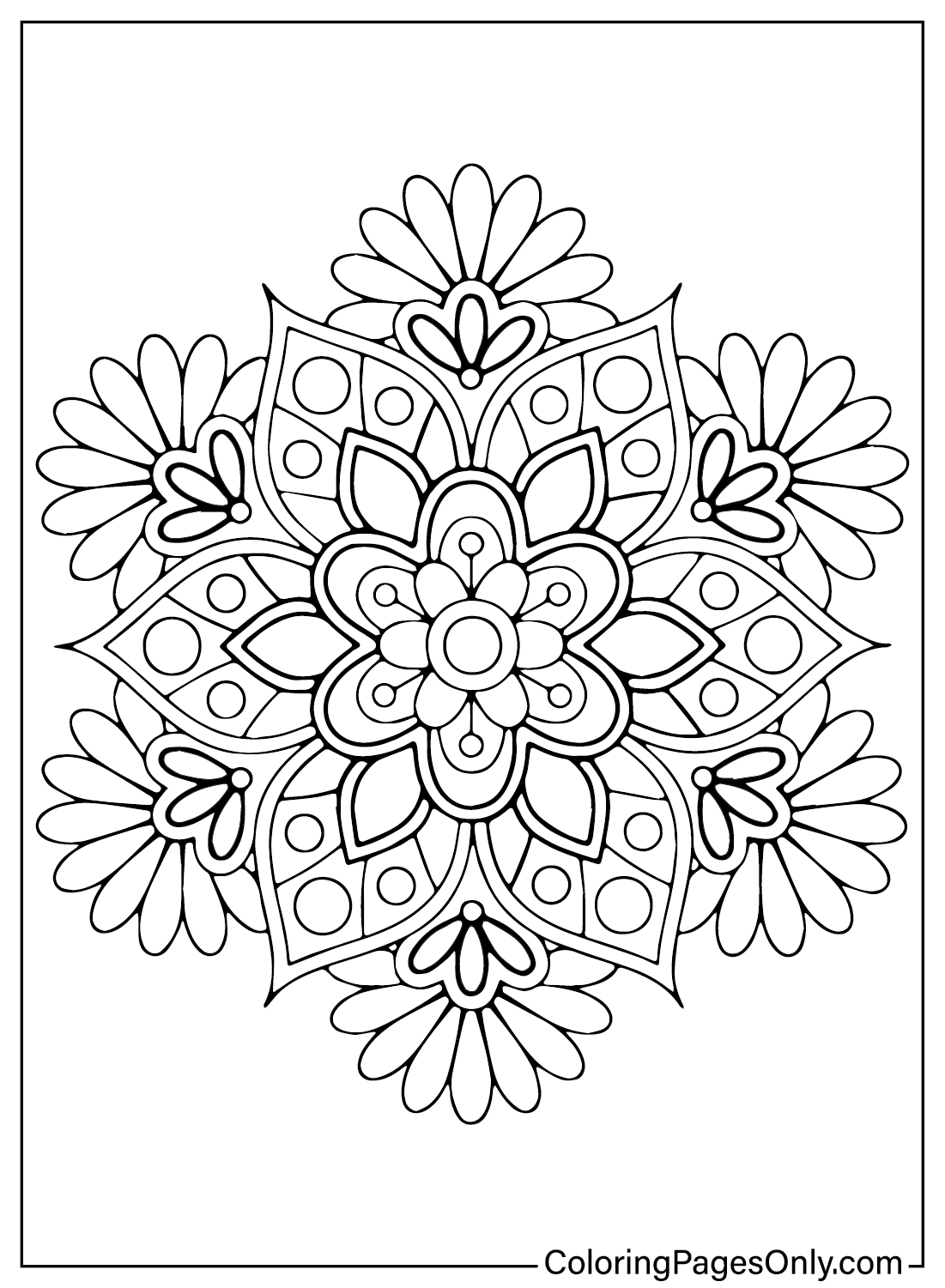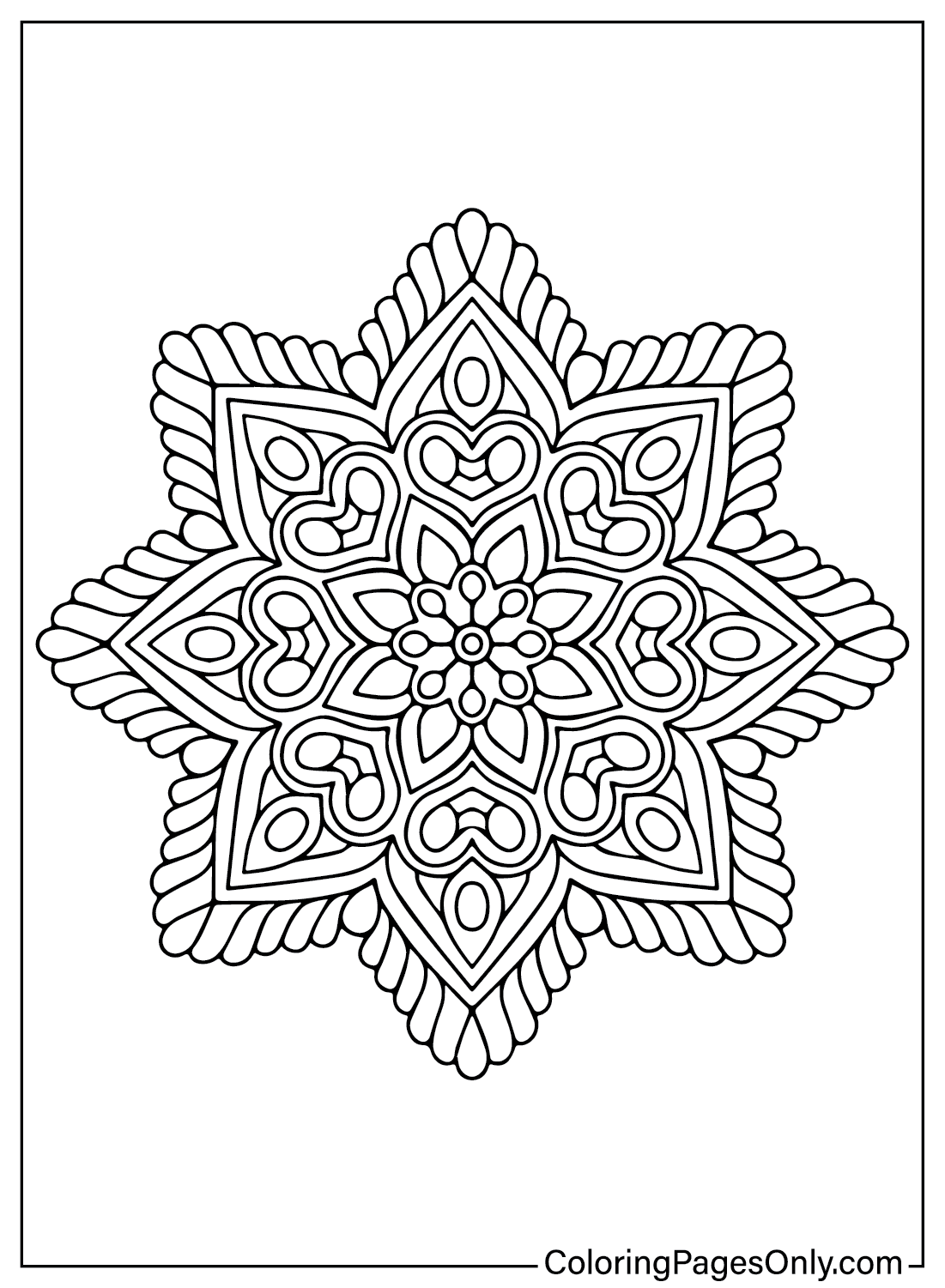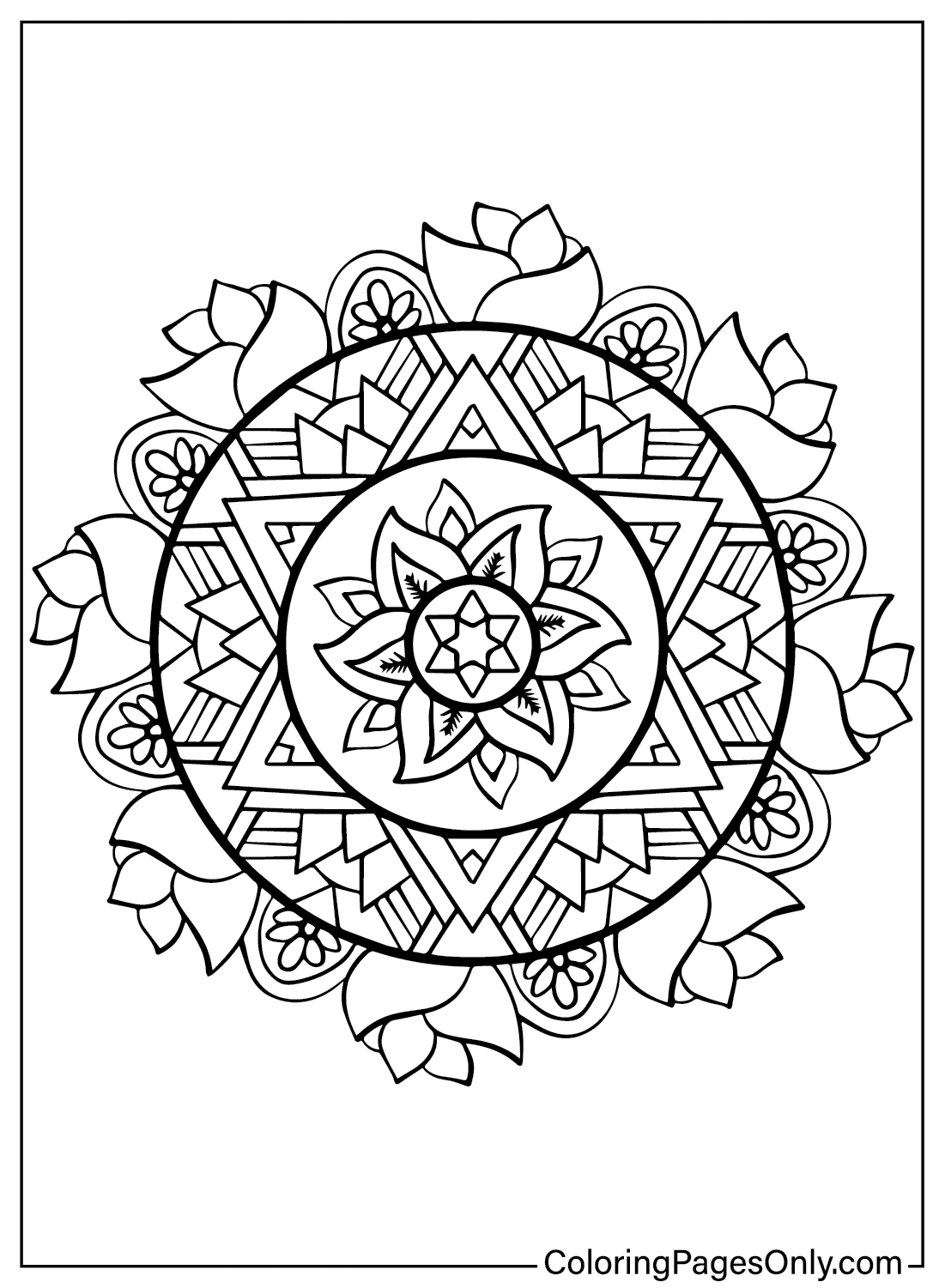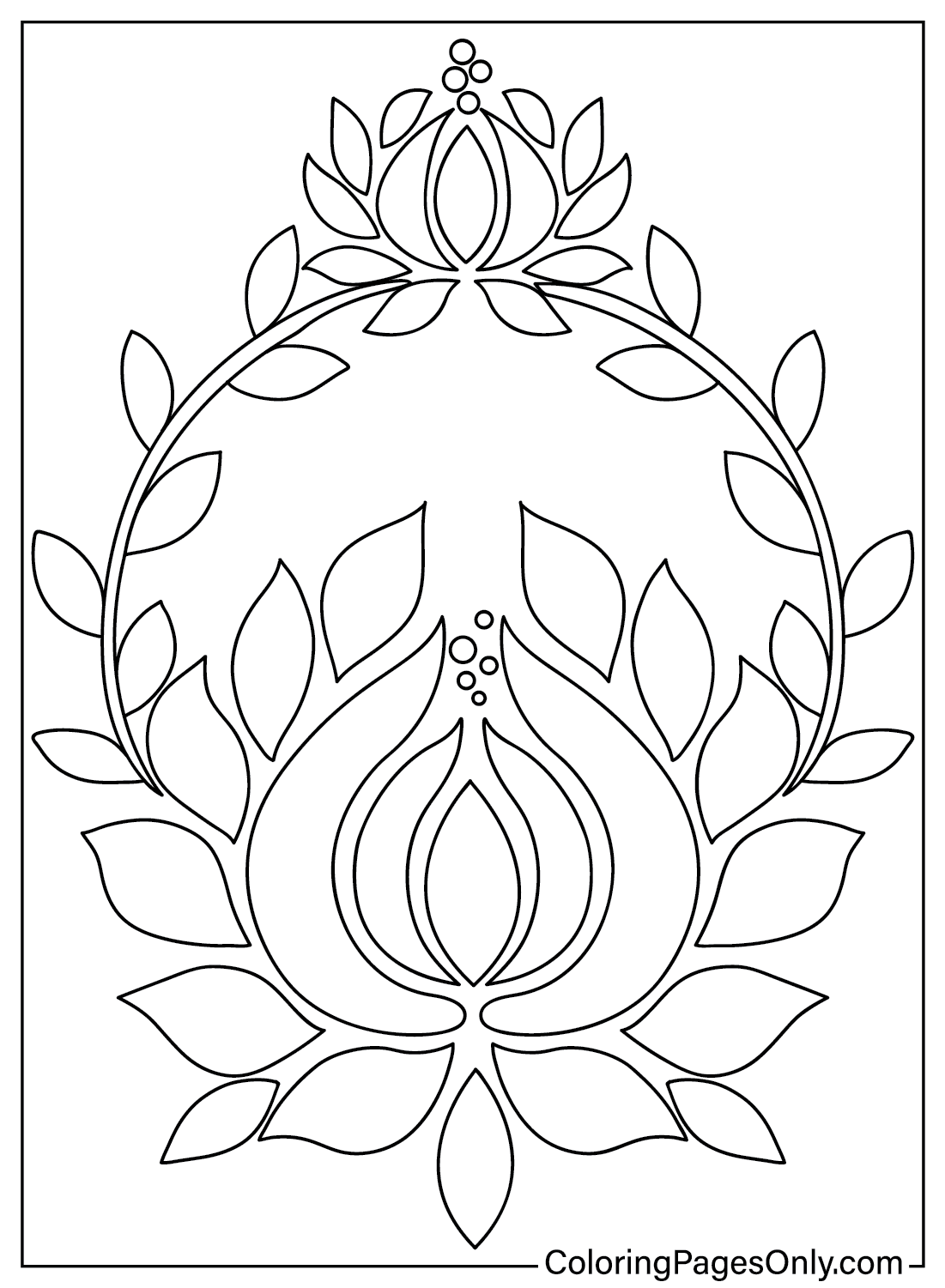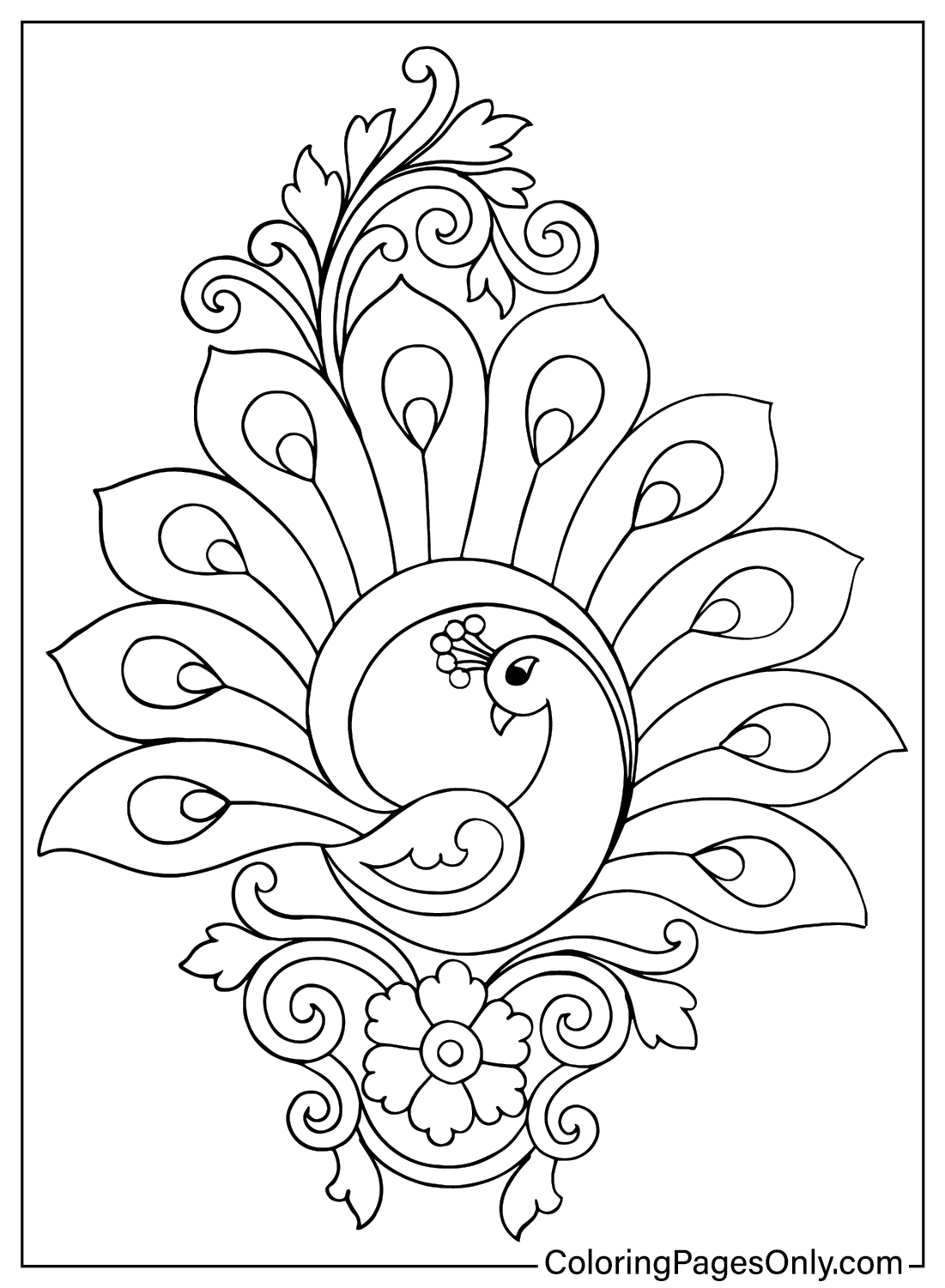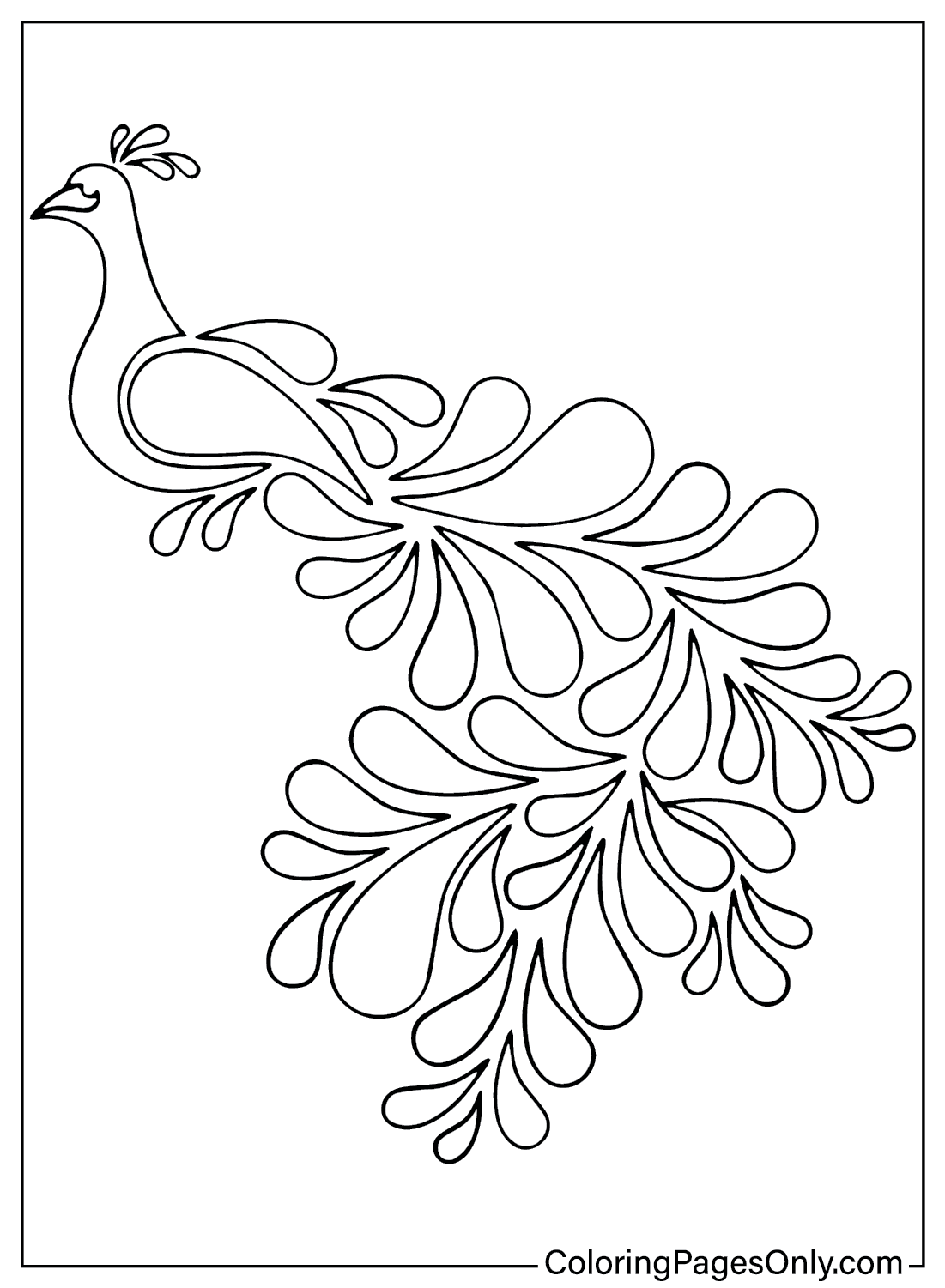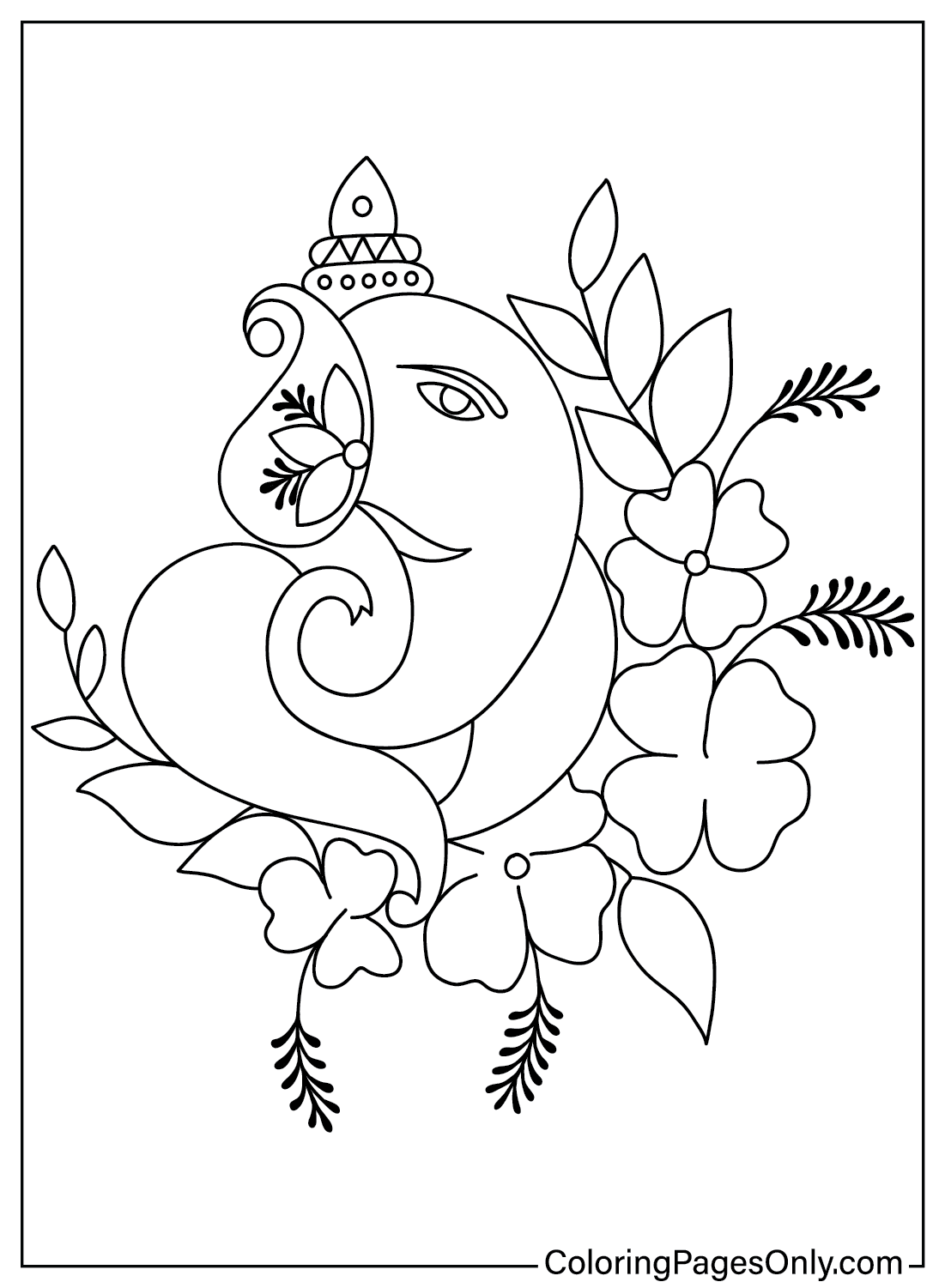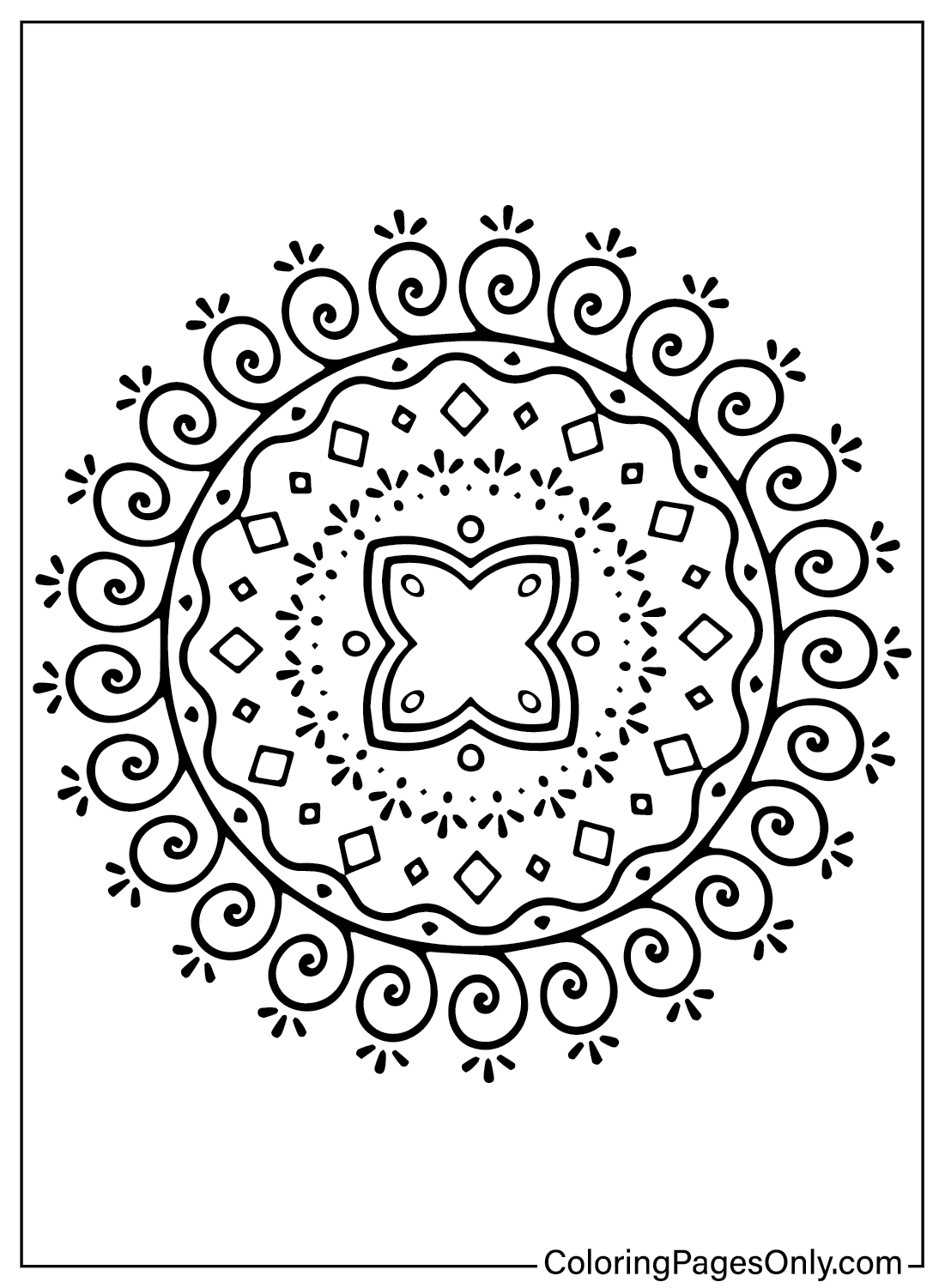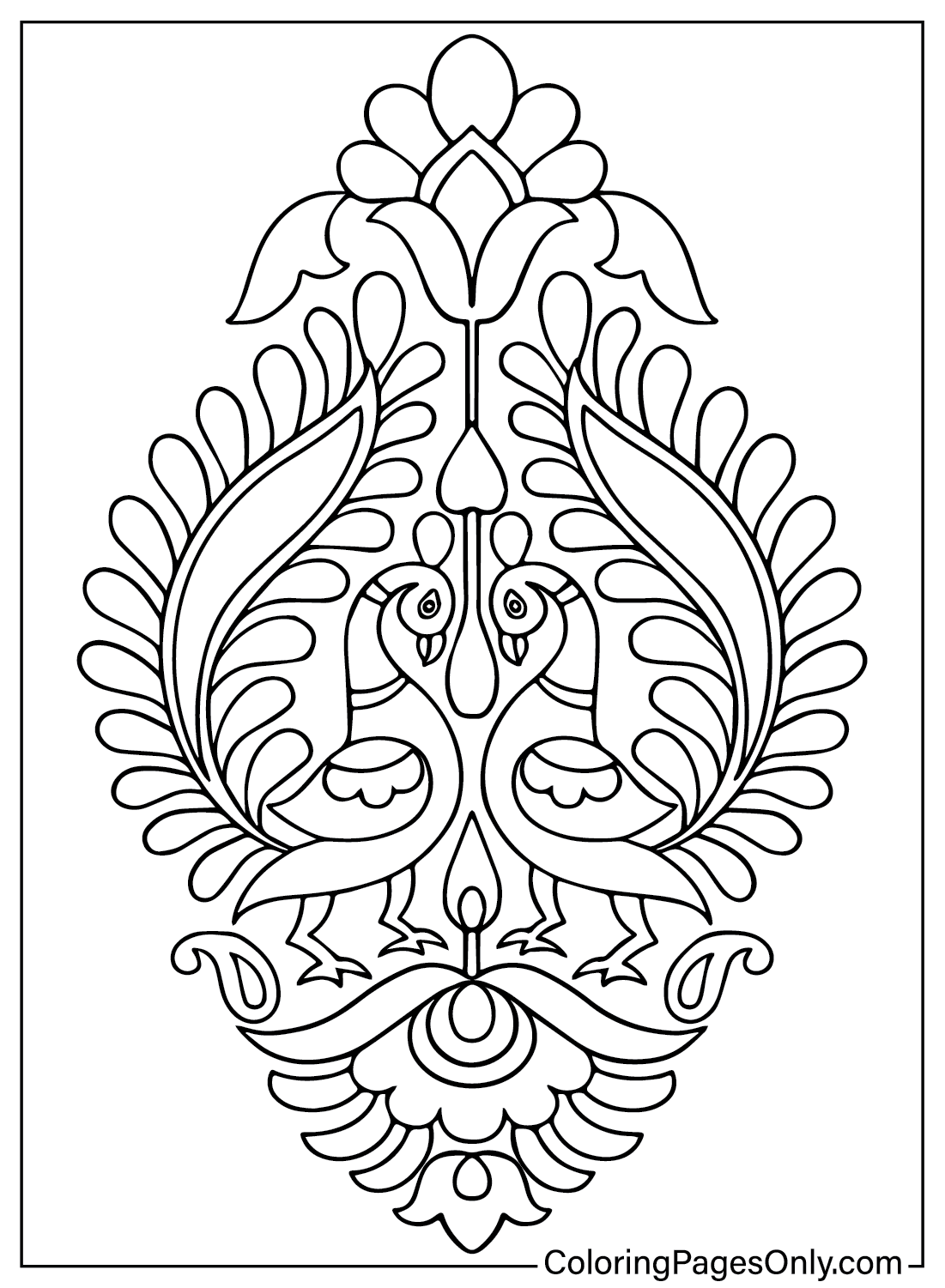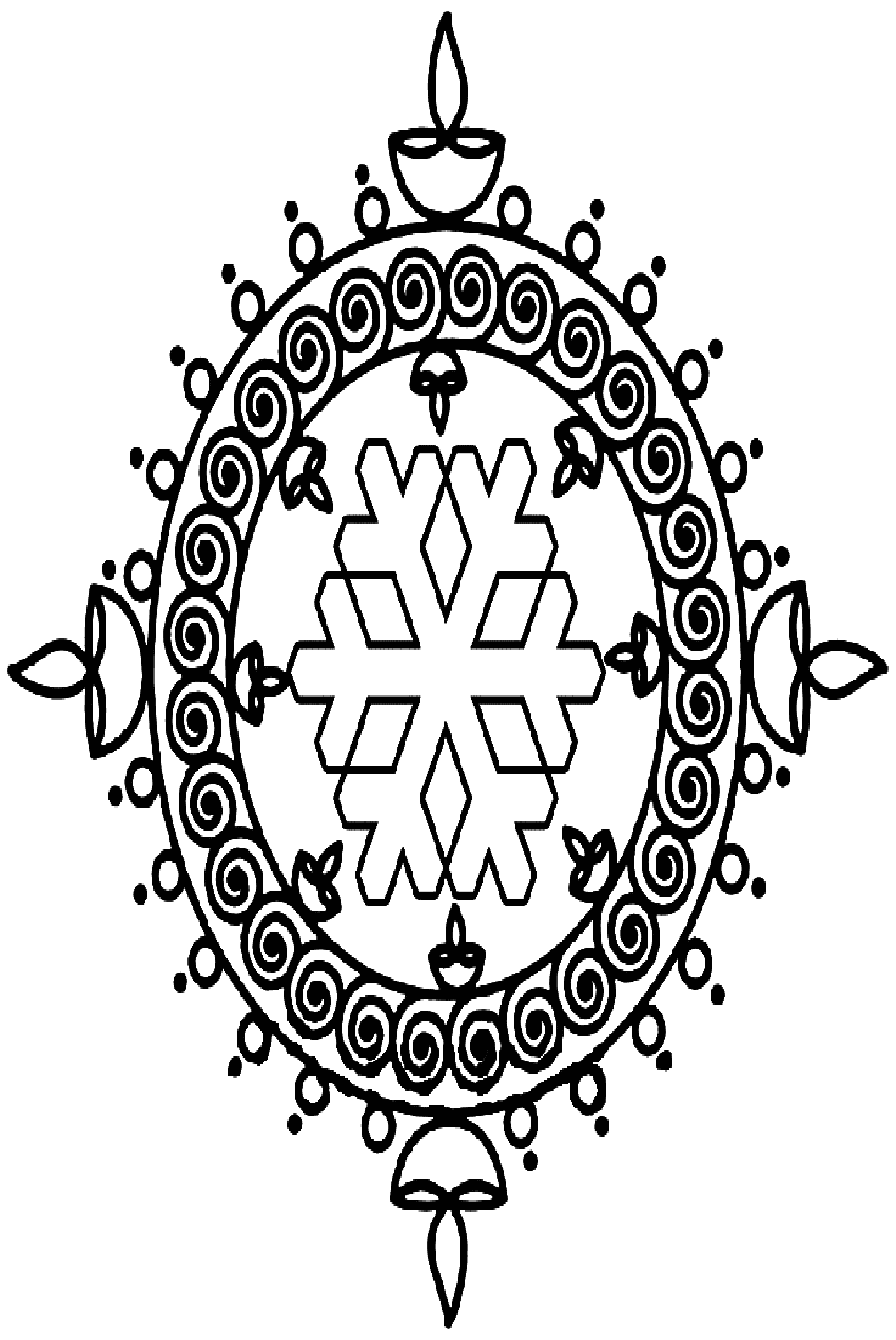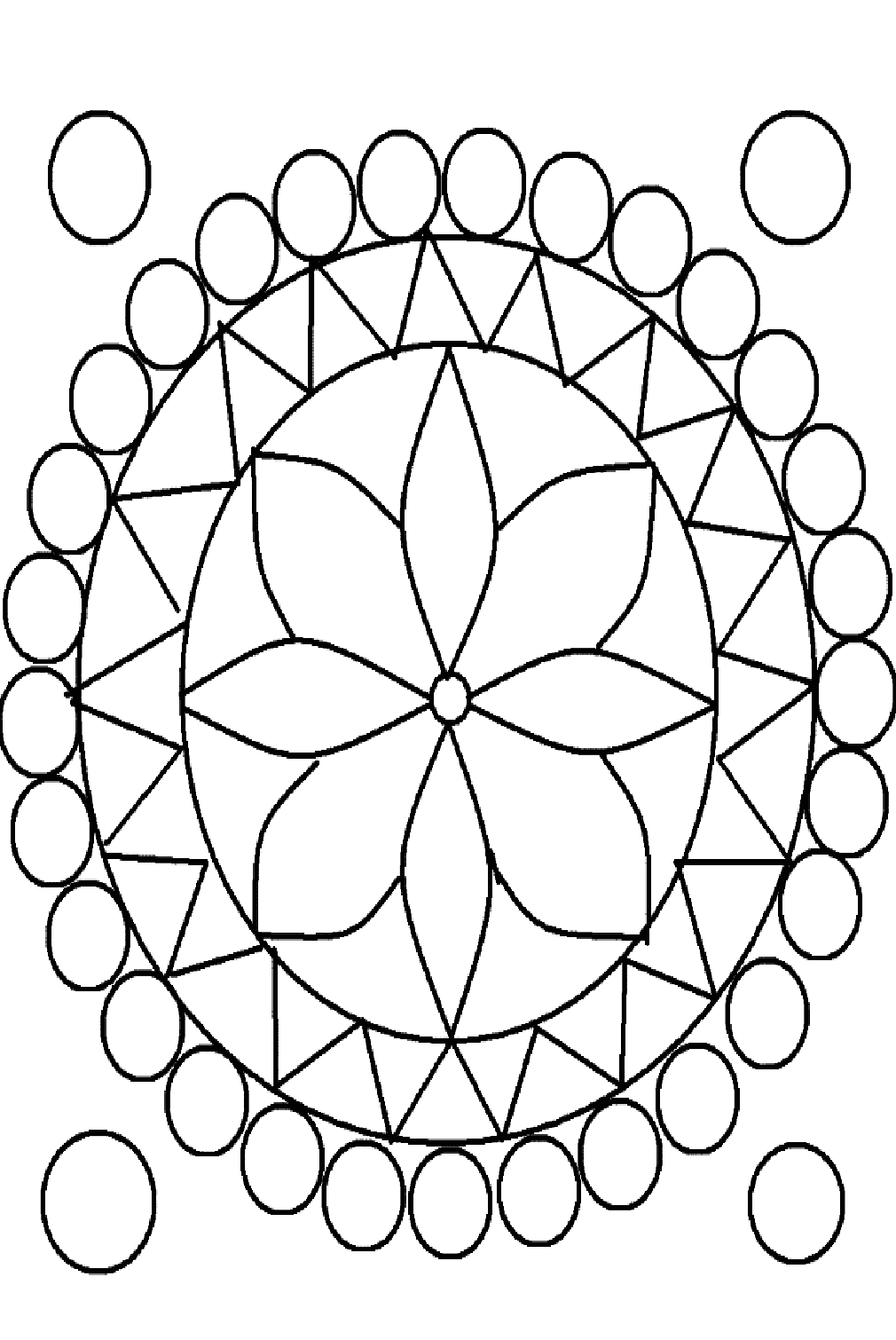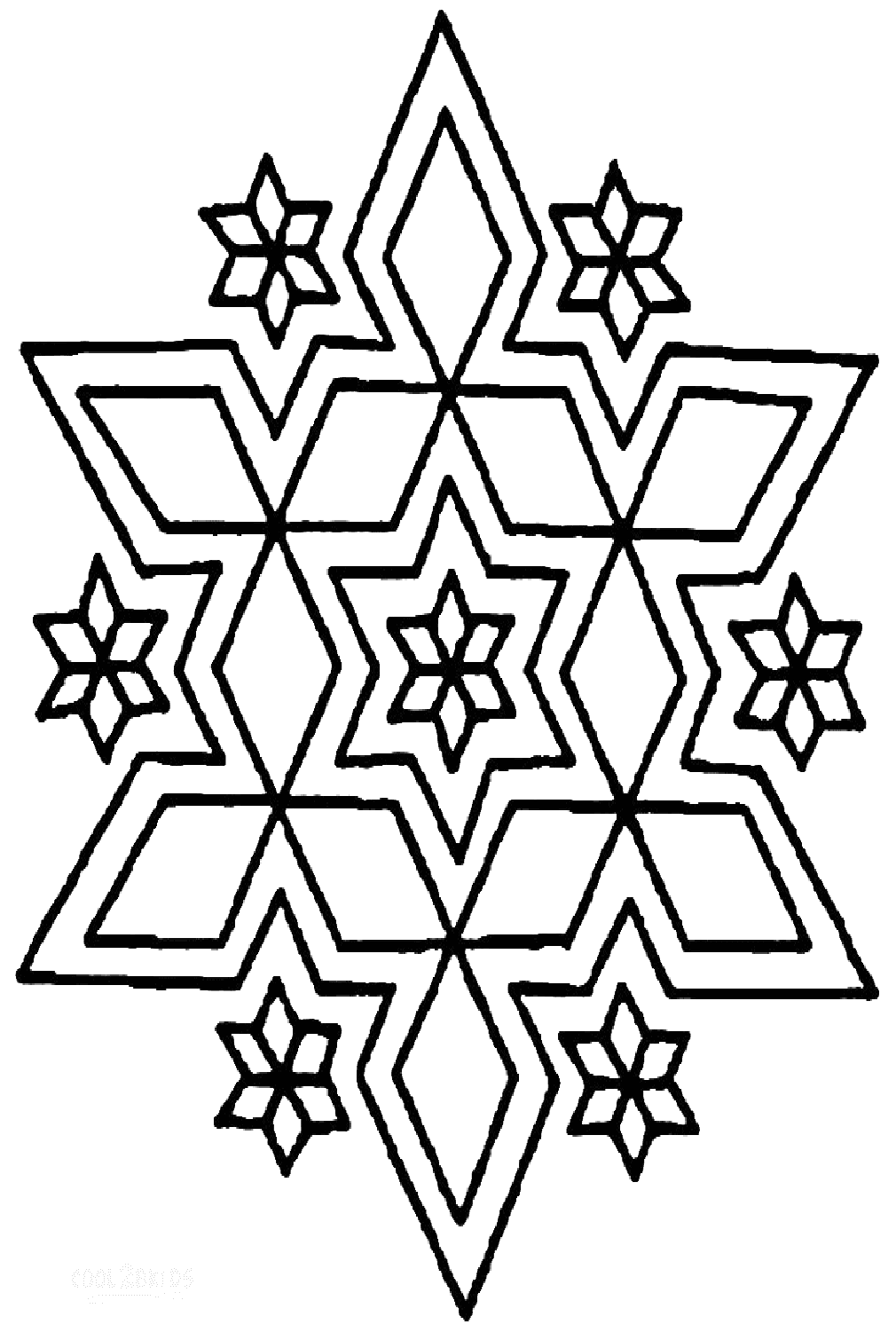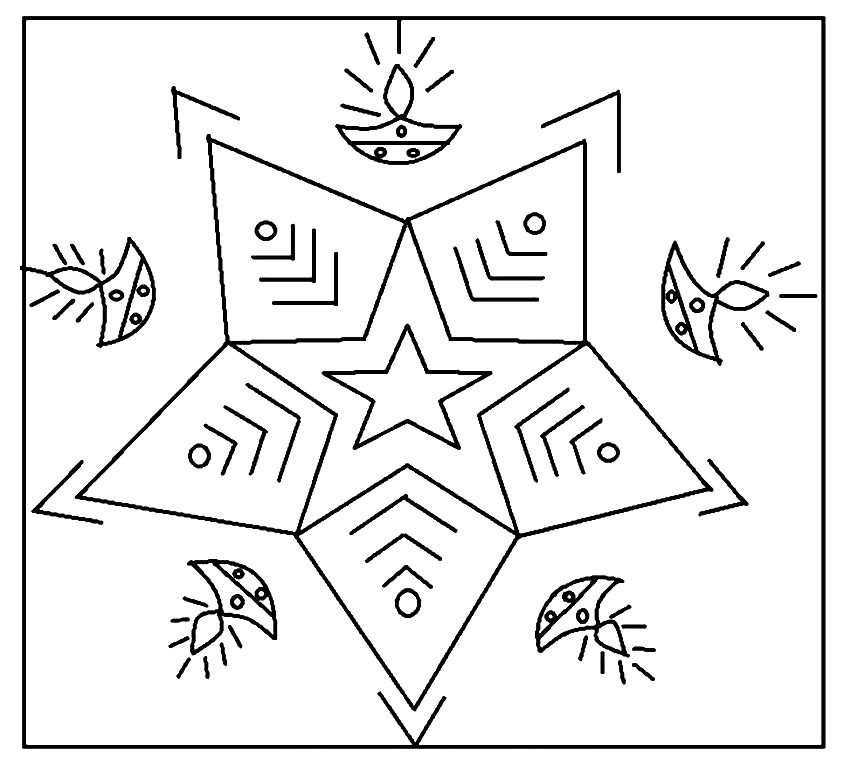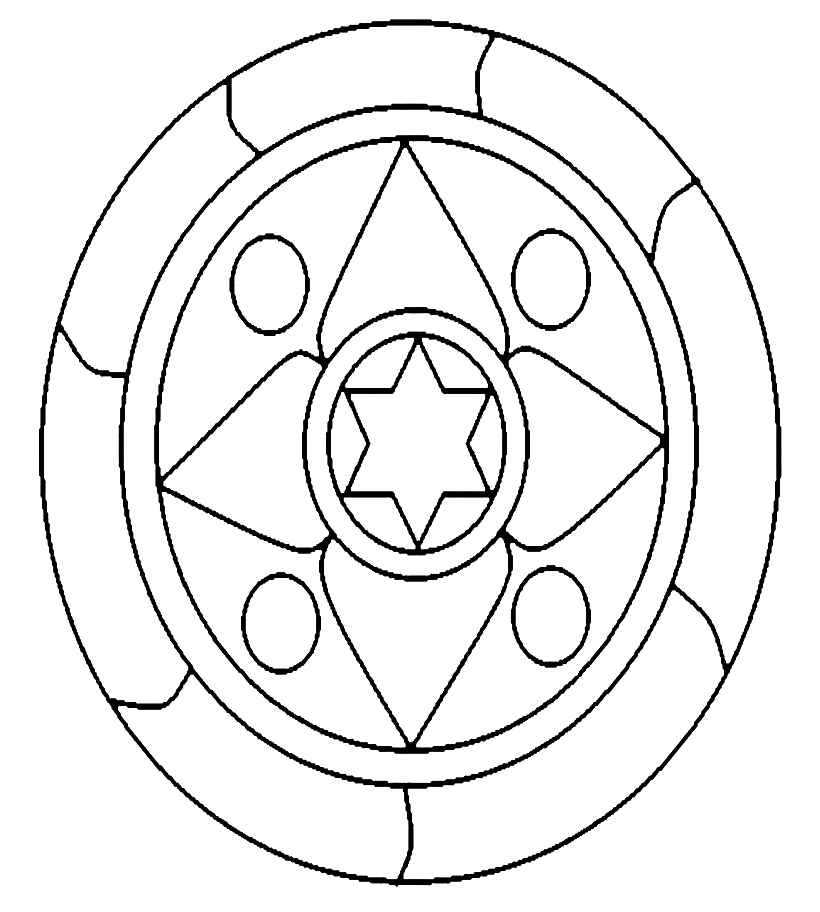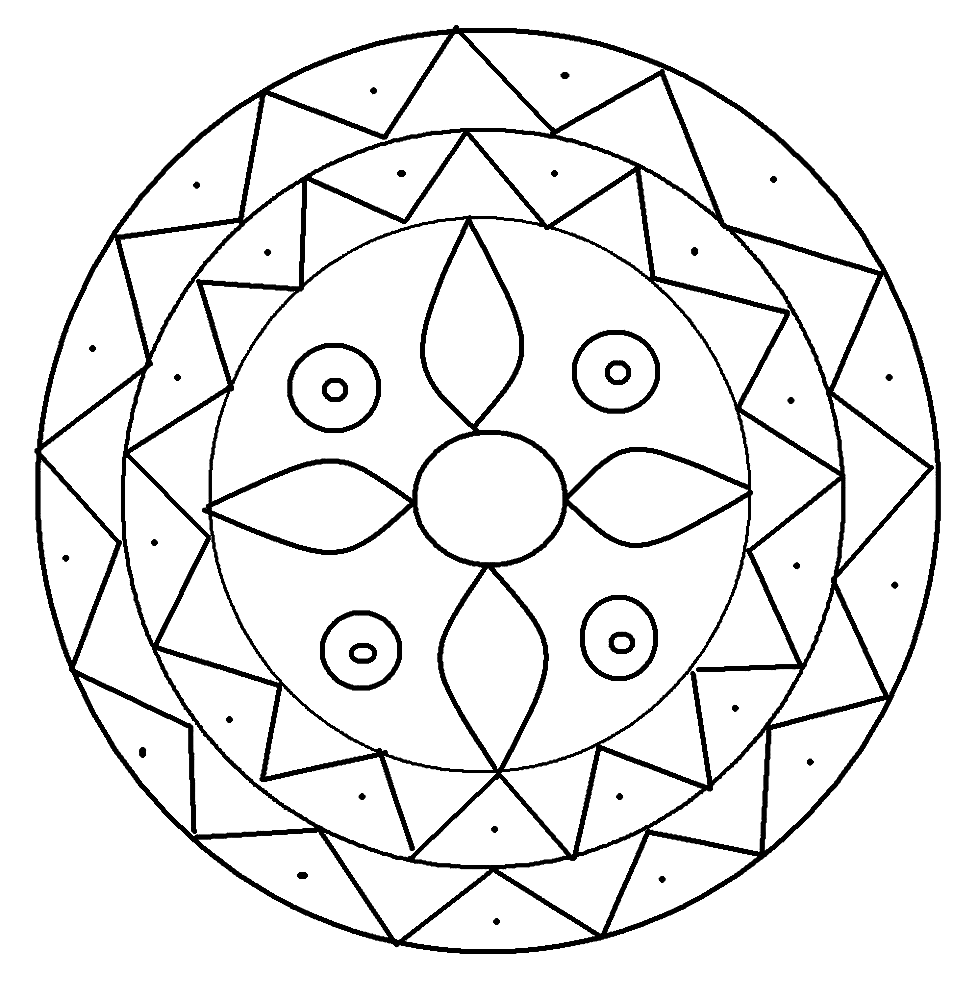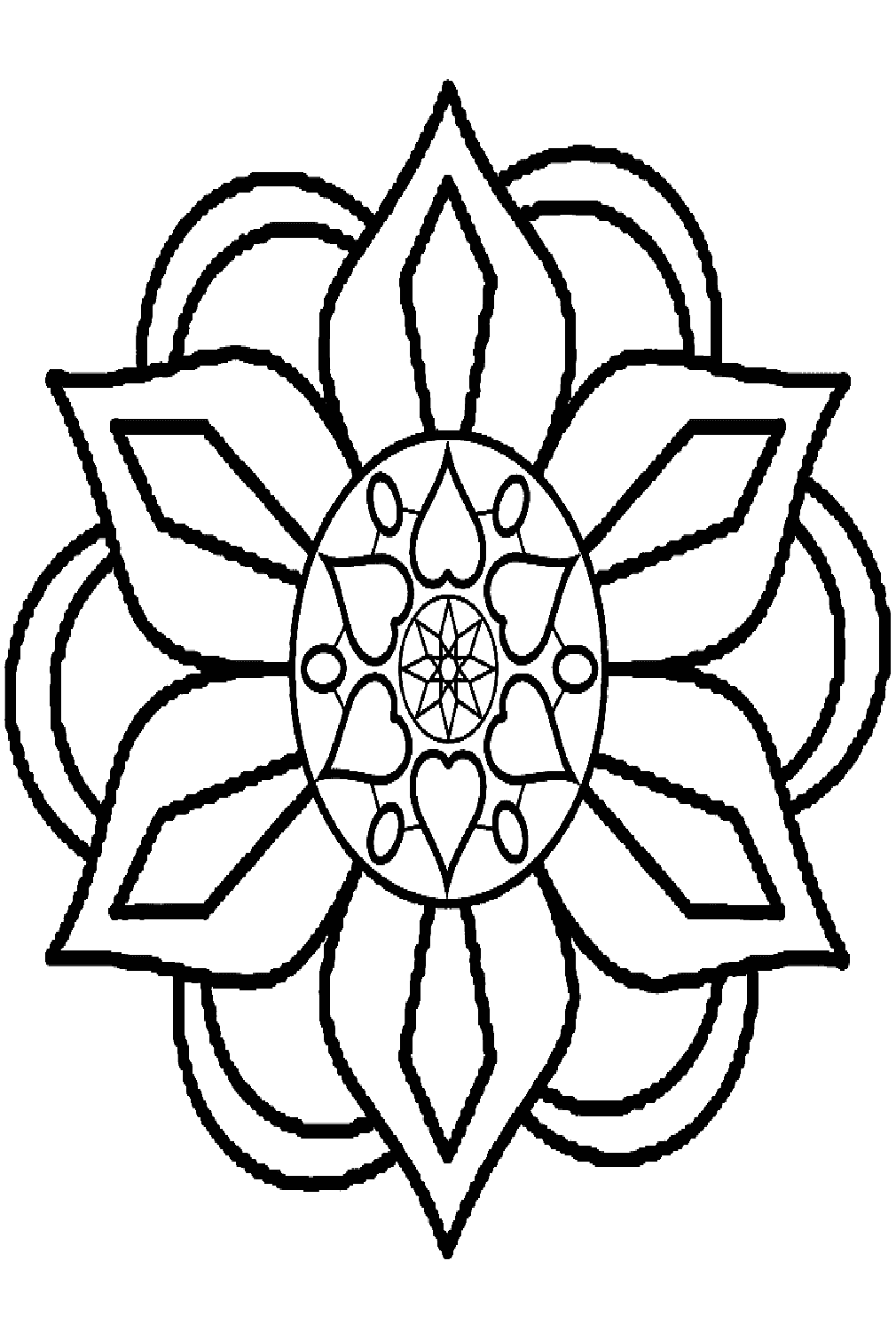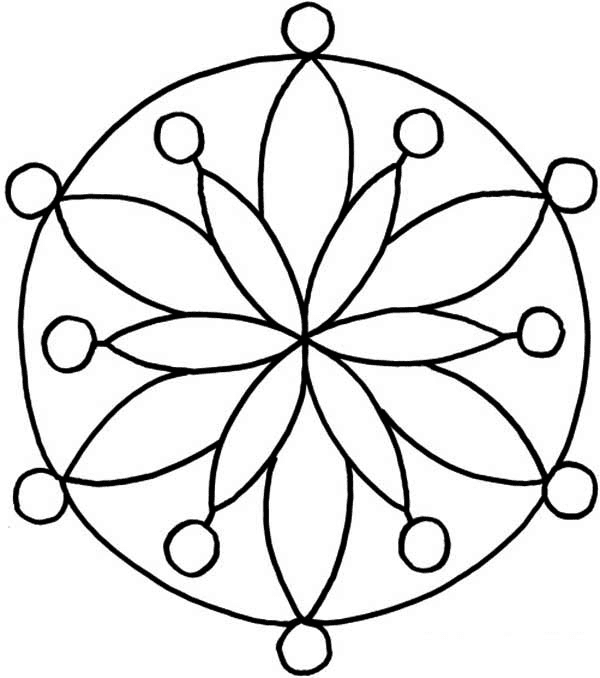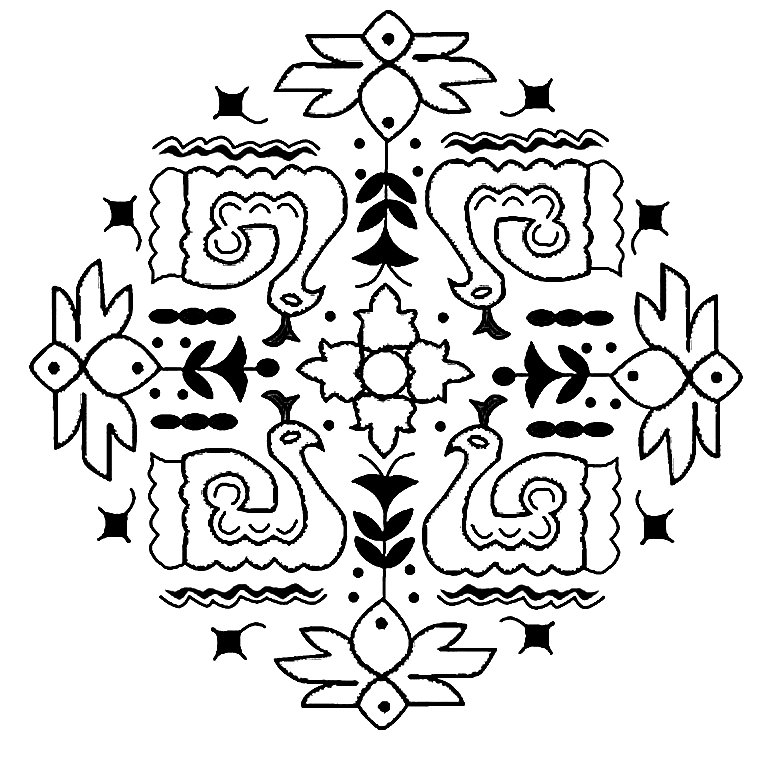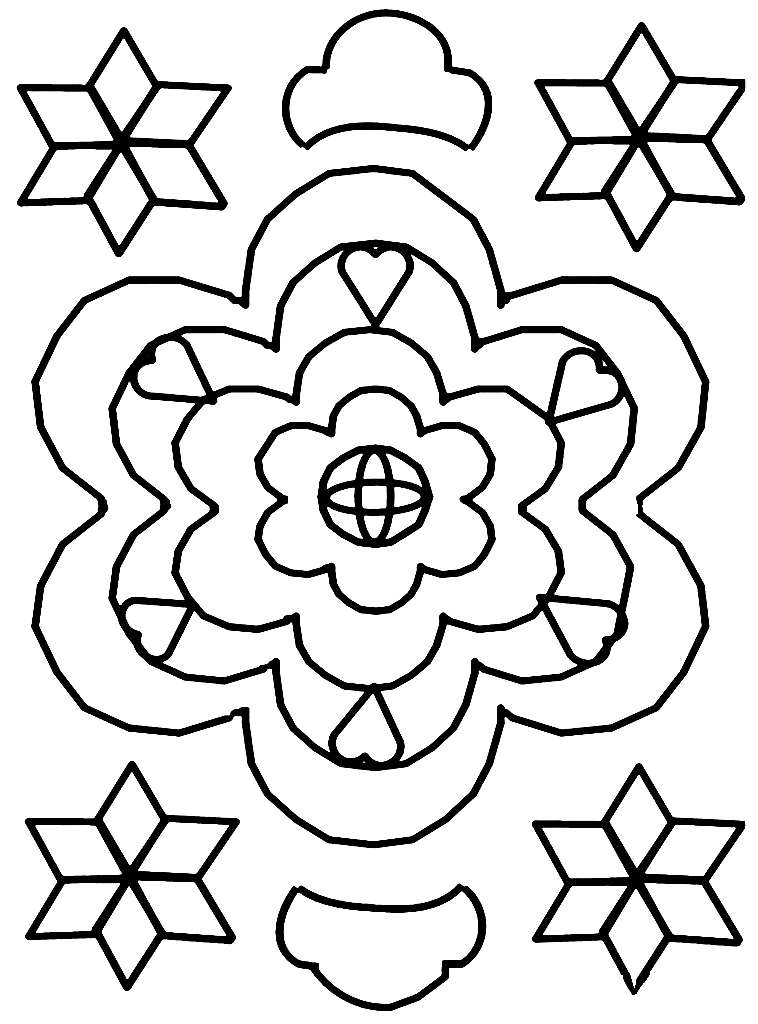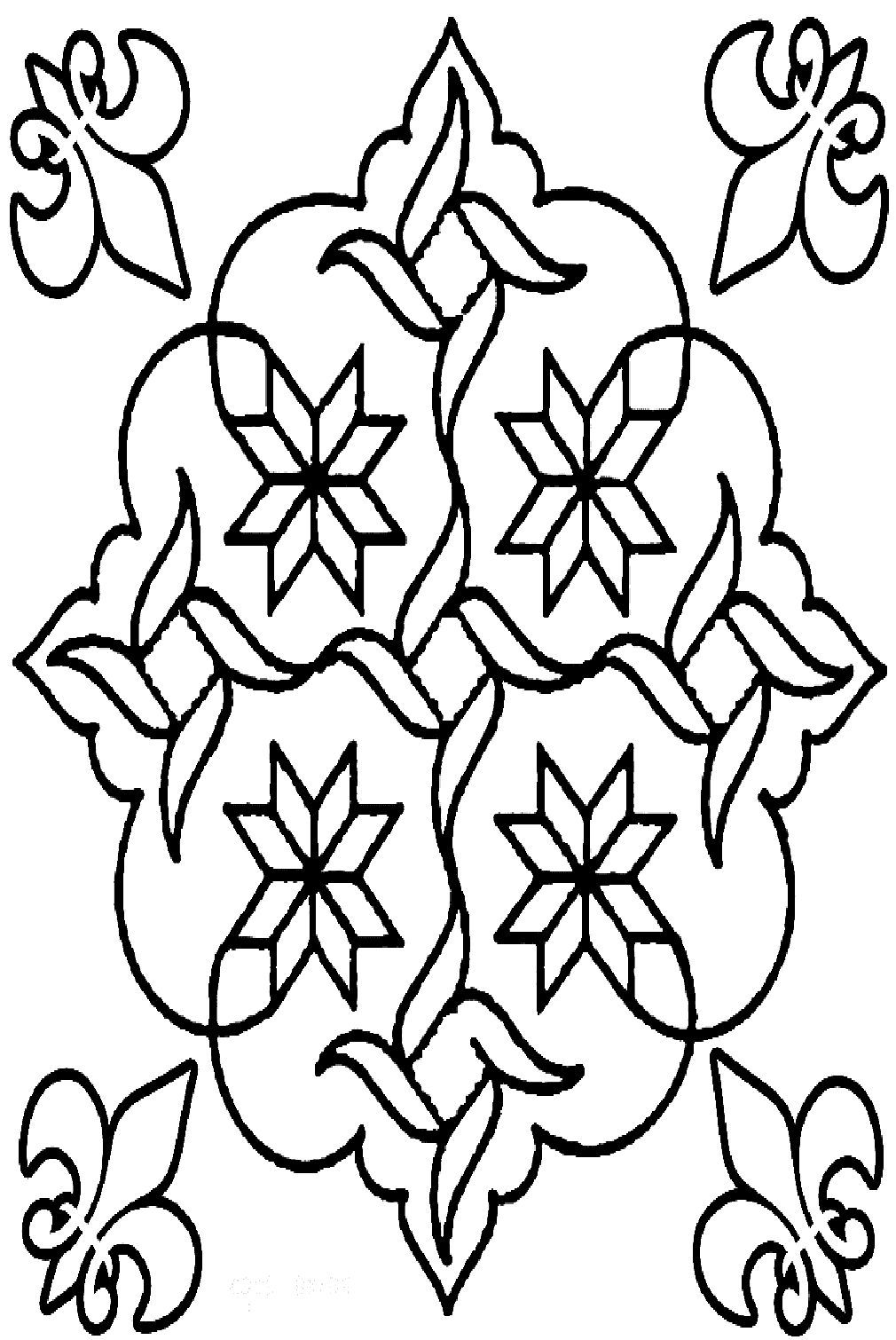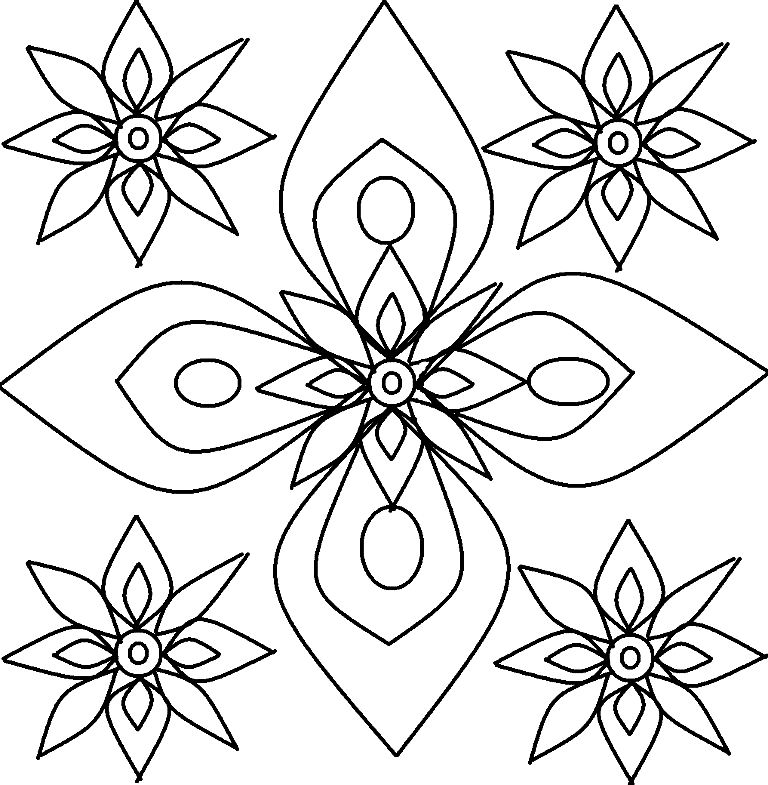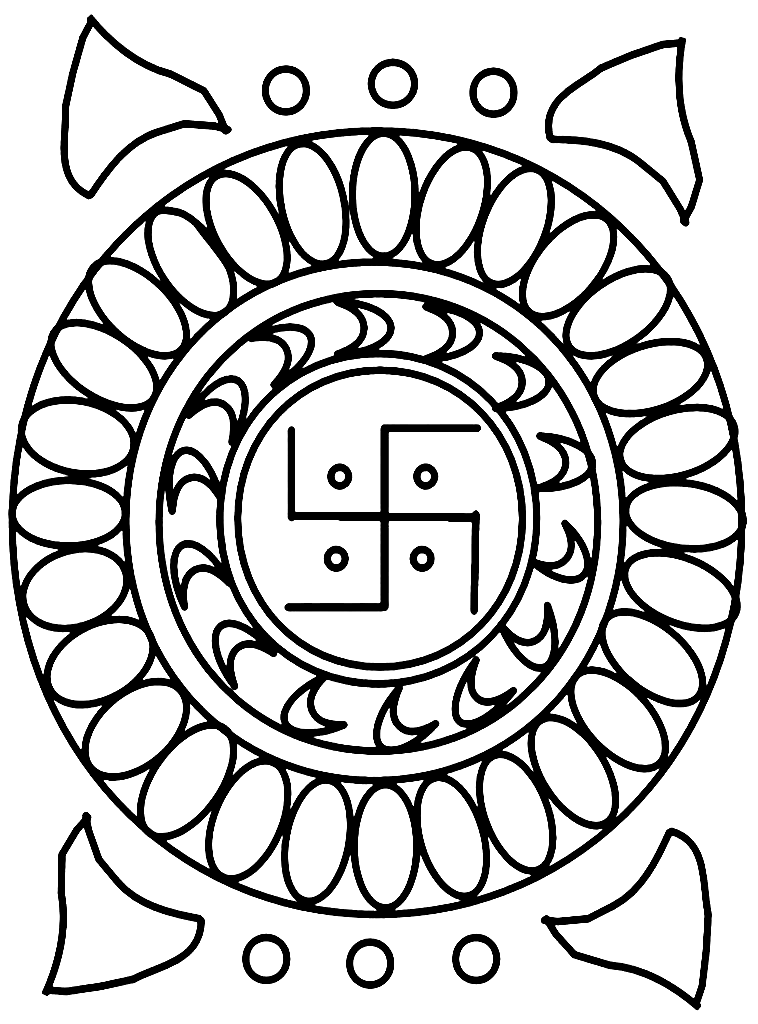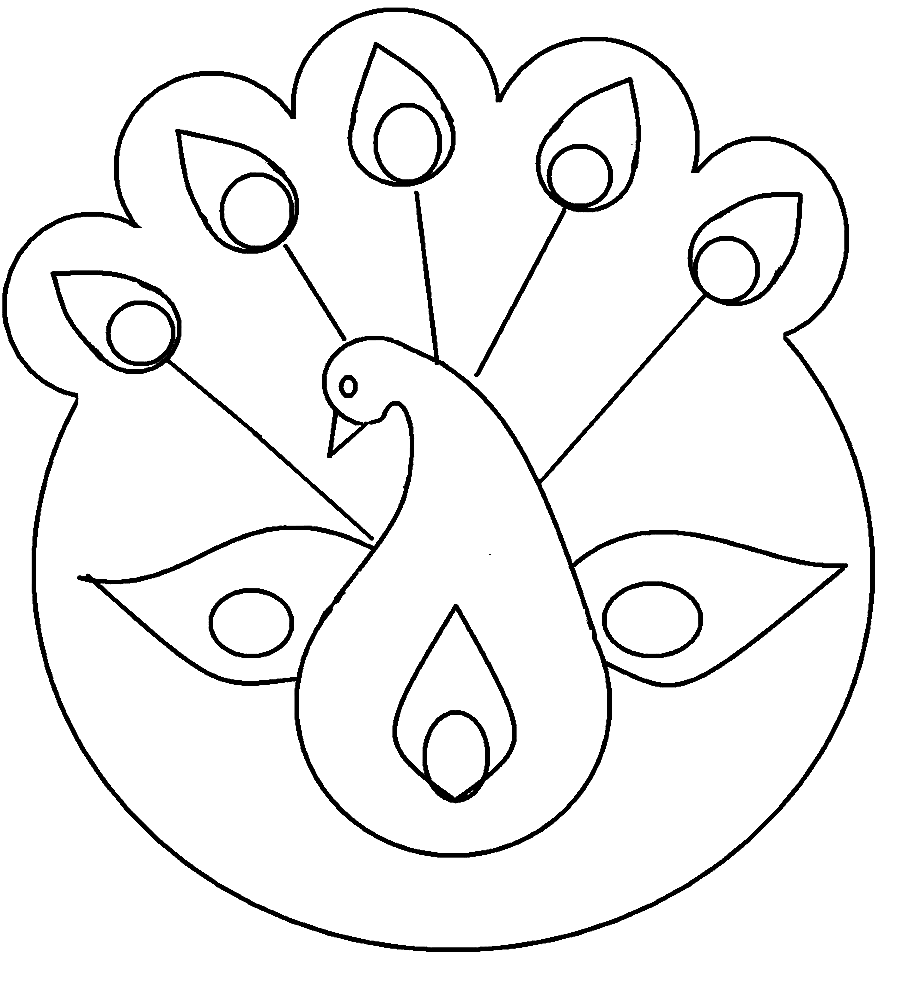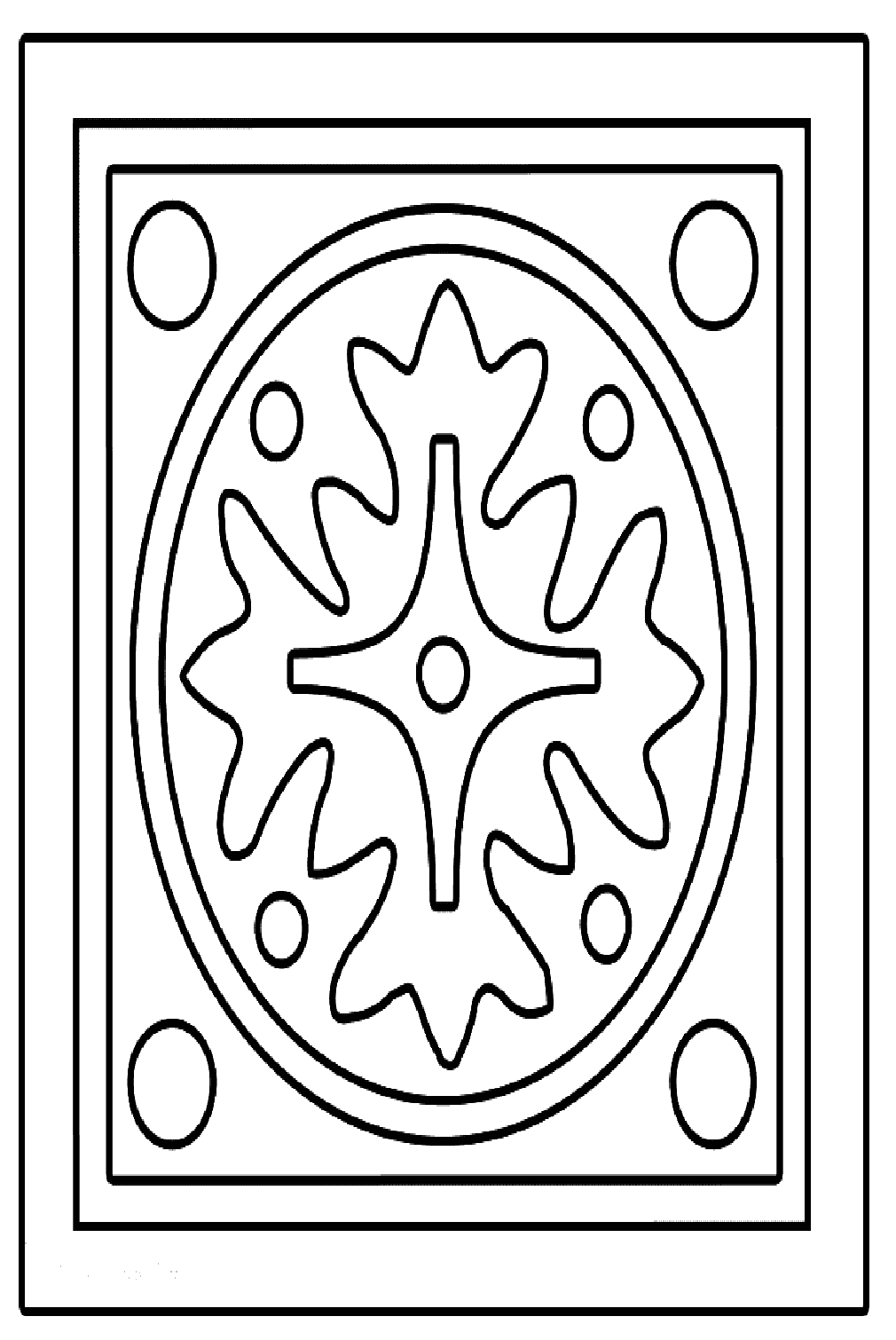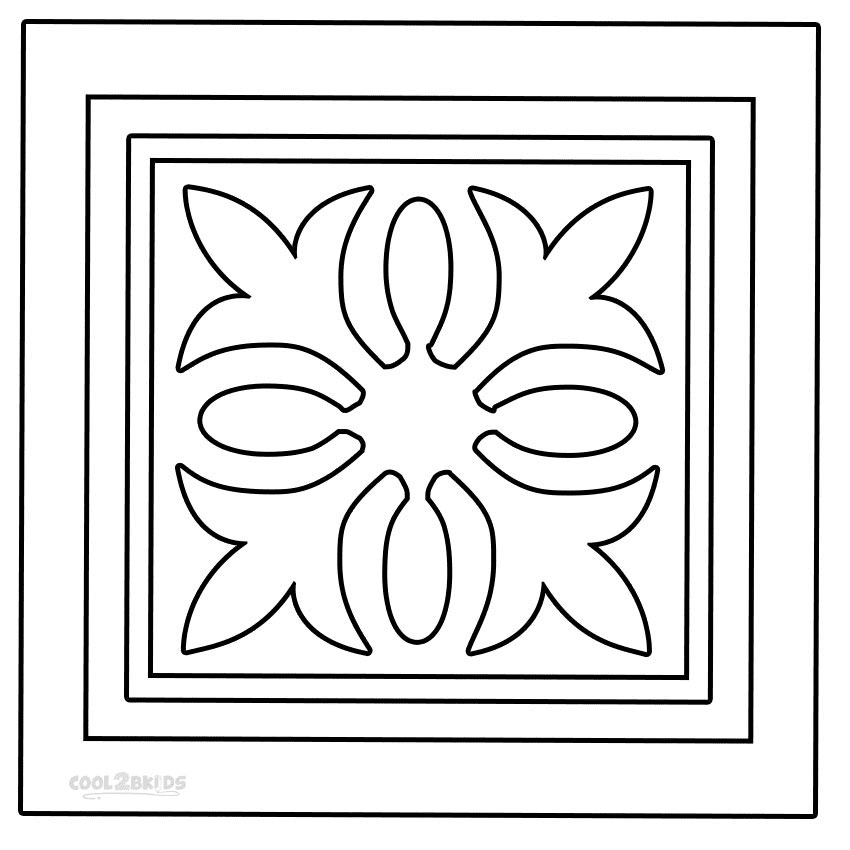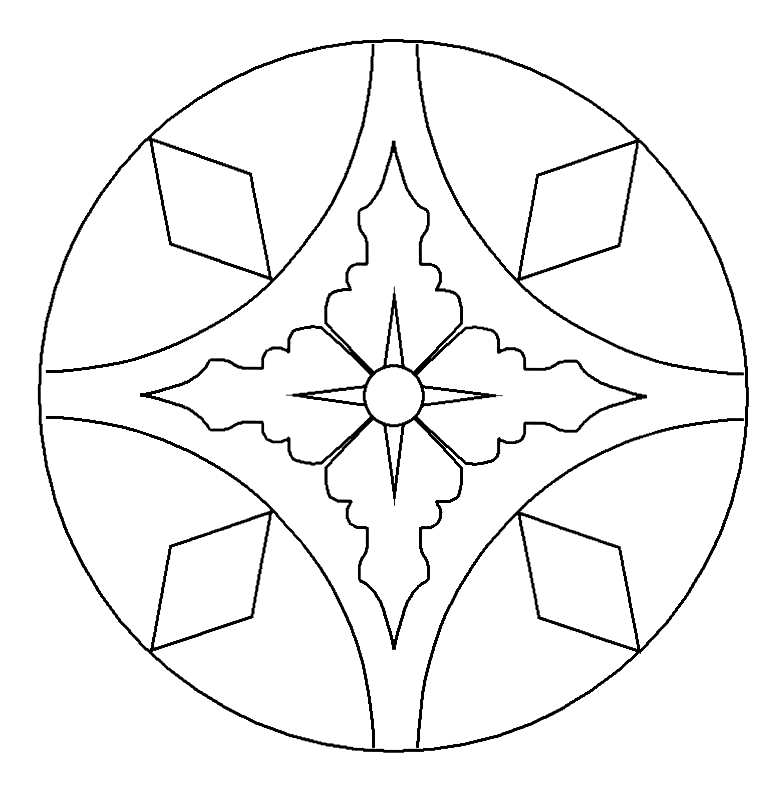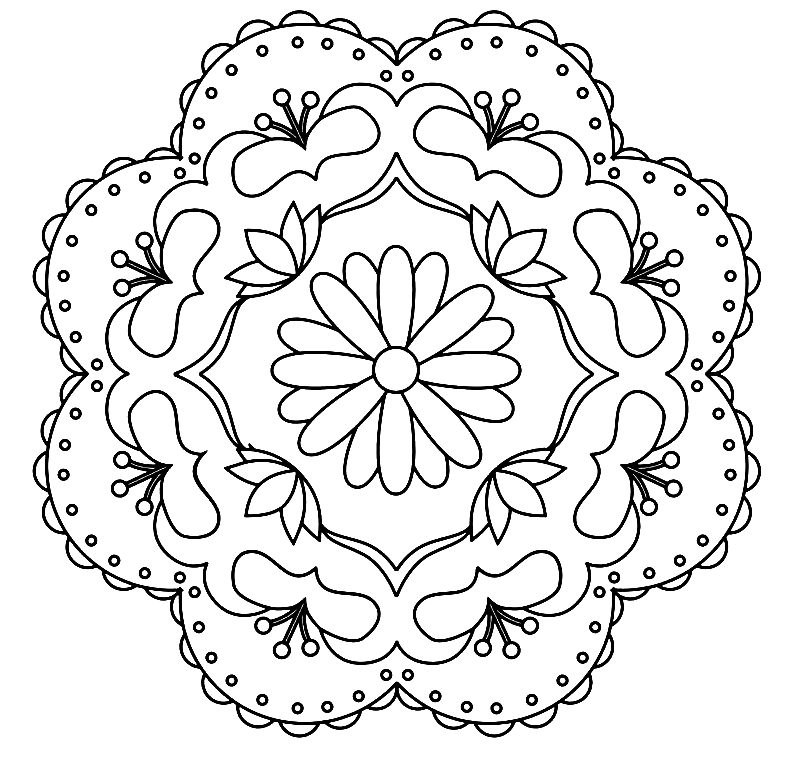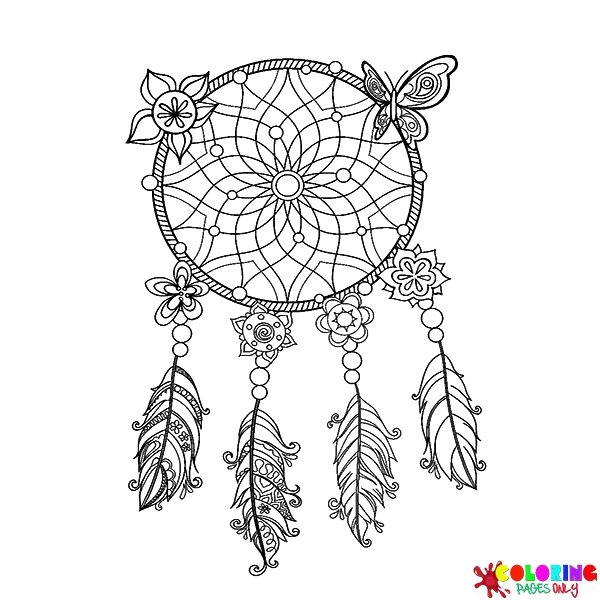
Free Rangoli coloring pages – 60+ pages featuring geometric mandala-style Rangoli designs, floral Rangoli with lotus and peacock motifs, dot-based Kolam patterns from South India, Diwali celebration Rangoli with diya lamp spaces, circular radially symmetric compositions, and traditional motifs including the lotus, mango leaf, fish, and elephant – free printable PDF and online coloring for all ages and for anyone exploring India’s most celebrated traditional floor art.

Rangoli (रंगोली) derives its name from the Sanskrit rang (color) and aavalli (row) – the “row of colors” that has been created on the floors and thresholds of Indian homes for thousands of years. Its practice is documented as far back as the Chitralakshana, a sixth-century text on Indian painting, and referenced in the Puranas, the ancient Hindu scriptures that predate it. In its traditional form, Rangoli is made by women using materials immediately available: colored powders, rice flour, flower petals, turmeric, vermilion, and chalk – impermanent, laid directly on the ground, created as an offering and a welcome rather than as a permanent object.

The practice exists across the entire Indian subcontinent under different names reflecting different regional traditions. Tamil Nadu knows it as Kolam (கோலம்), a mathematically sophisticated dot-based tradition in which lines loop around a reference grid of dots in specific patterns. Andhra Pradesh and Telangana call it Muggu (ముగ్గు). West Bengal practices Alpona (আলপনা). Kerala’s Pookalam is made entirely from flowers, its composition organized around color rather than drawn line. Maharashtra and North India use Rangoli as the standard term. Each regional tradition carries its own specific motifs, its own geometry, its own connection to local festivals and practice.
All of these traditions share the same purpose: to mark a threshold as auspicious, to welcome the divine, to communicate through pattern and color that a home is a place where beauty and reverence coexist.

These 60+ free pages at ColoringPagesOnly.com bring this living tradition to the coloring page format. All free, PDF or PNG, print or color online.

What’s Inside

Geometric and Mandala-Style Rangoli

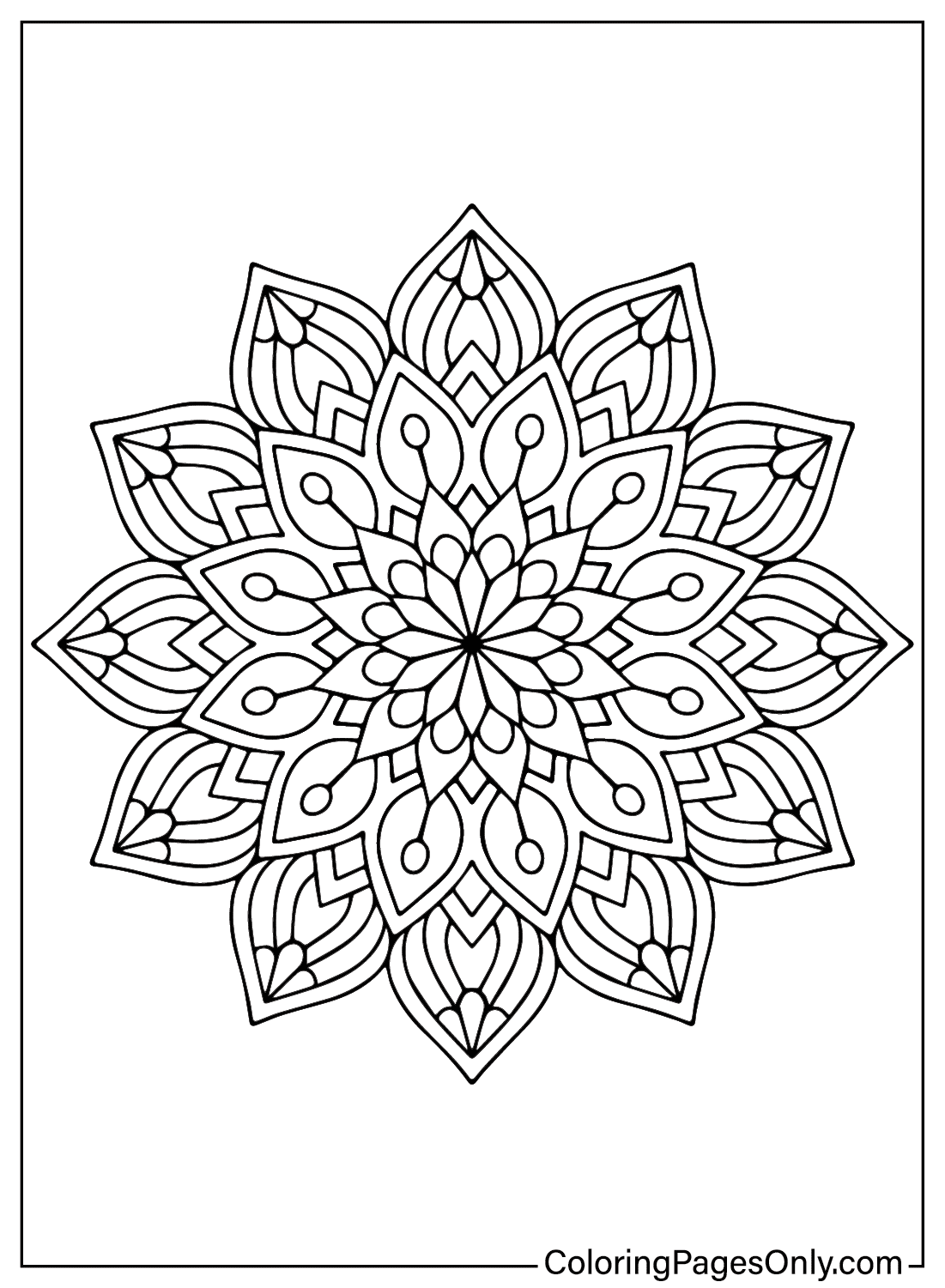
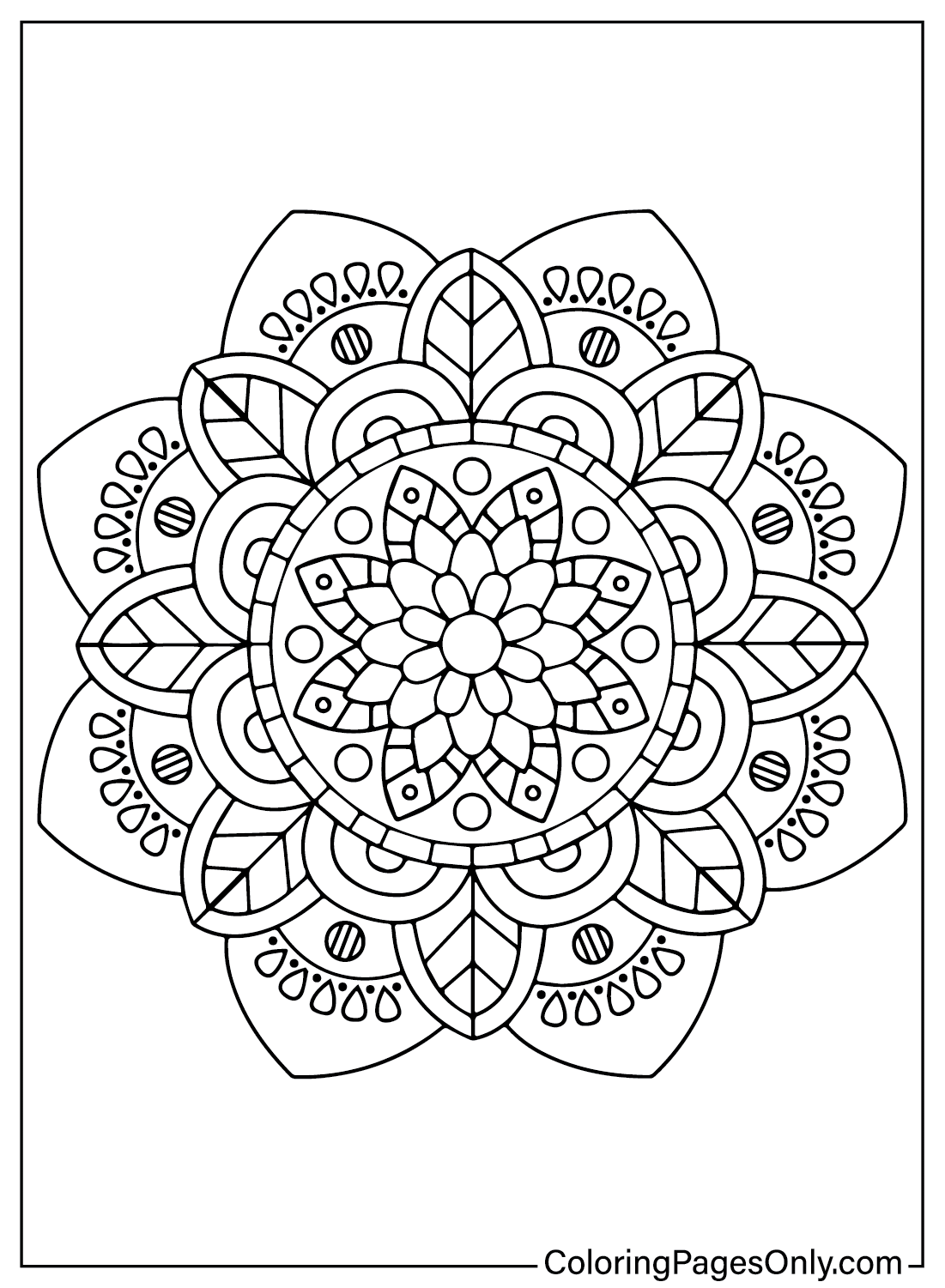
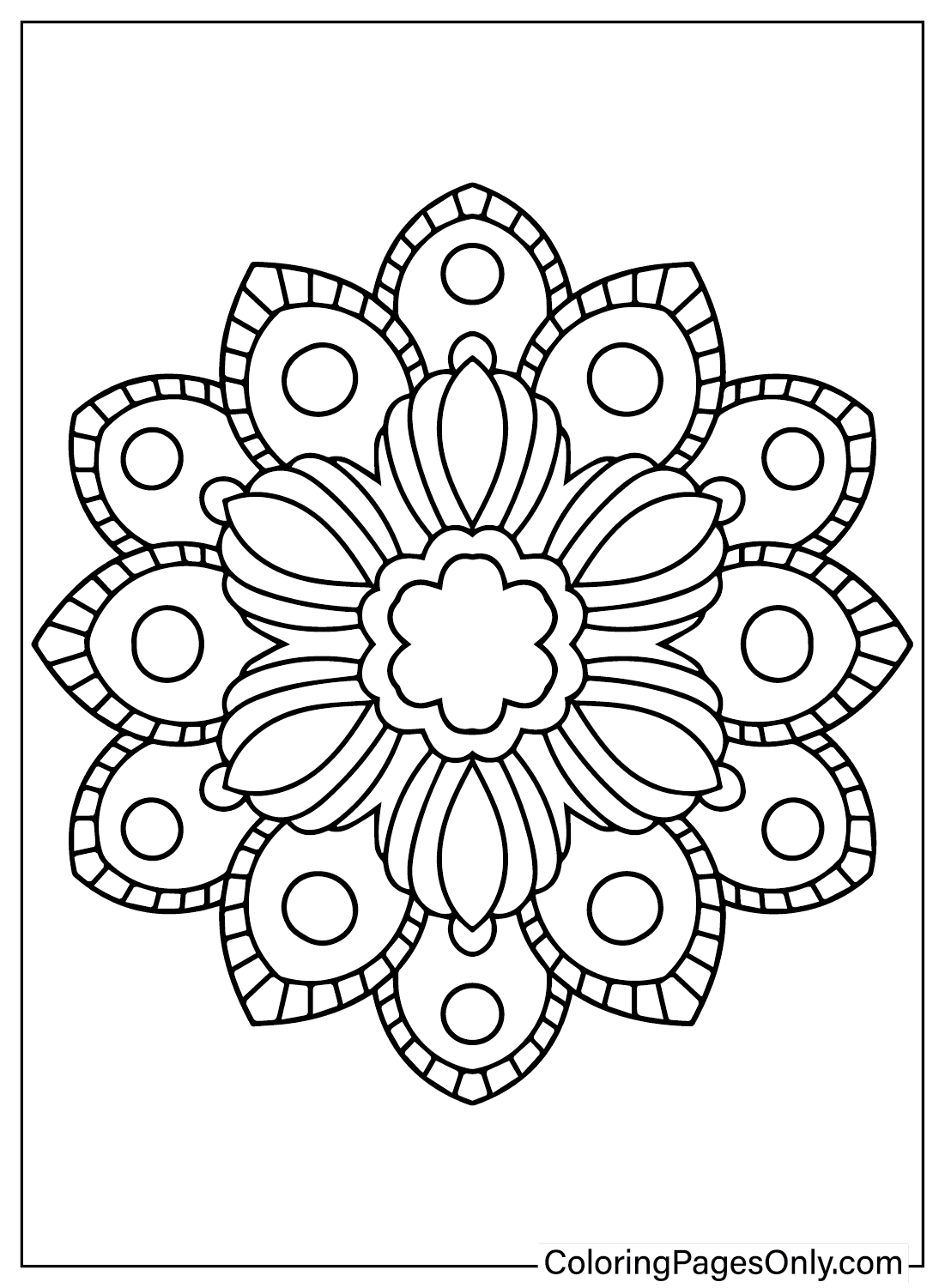
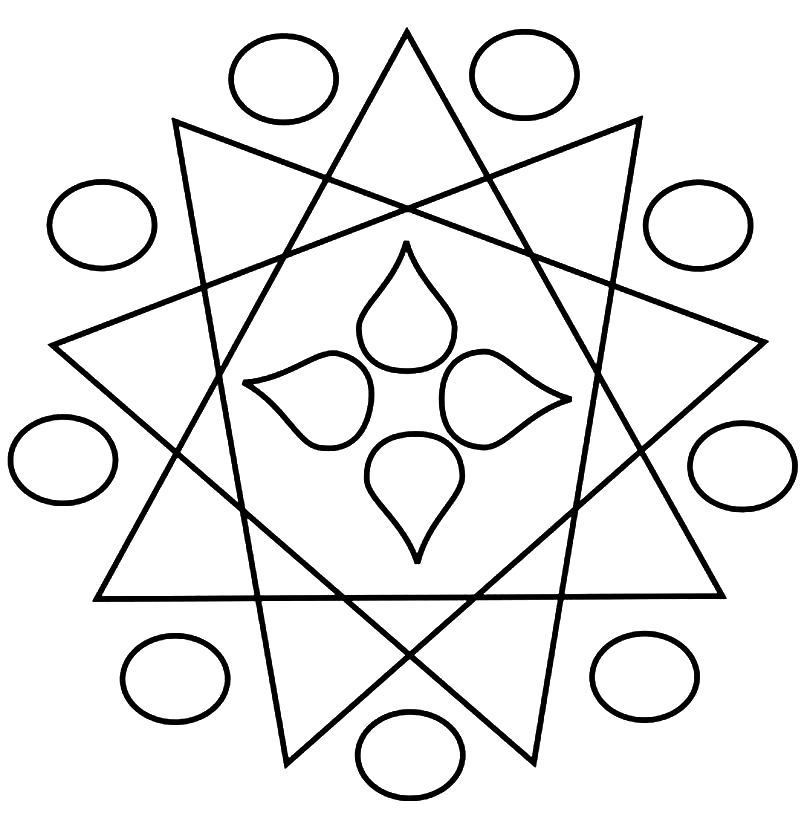
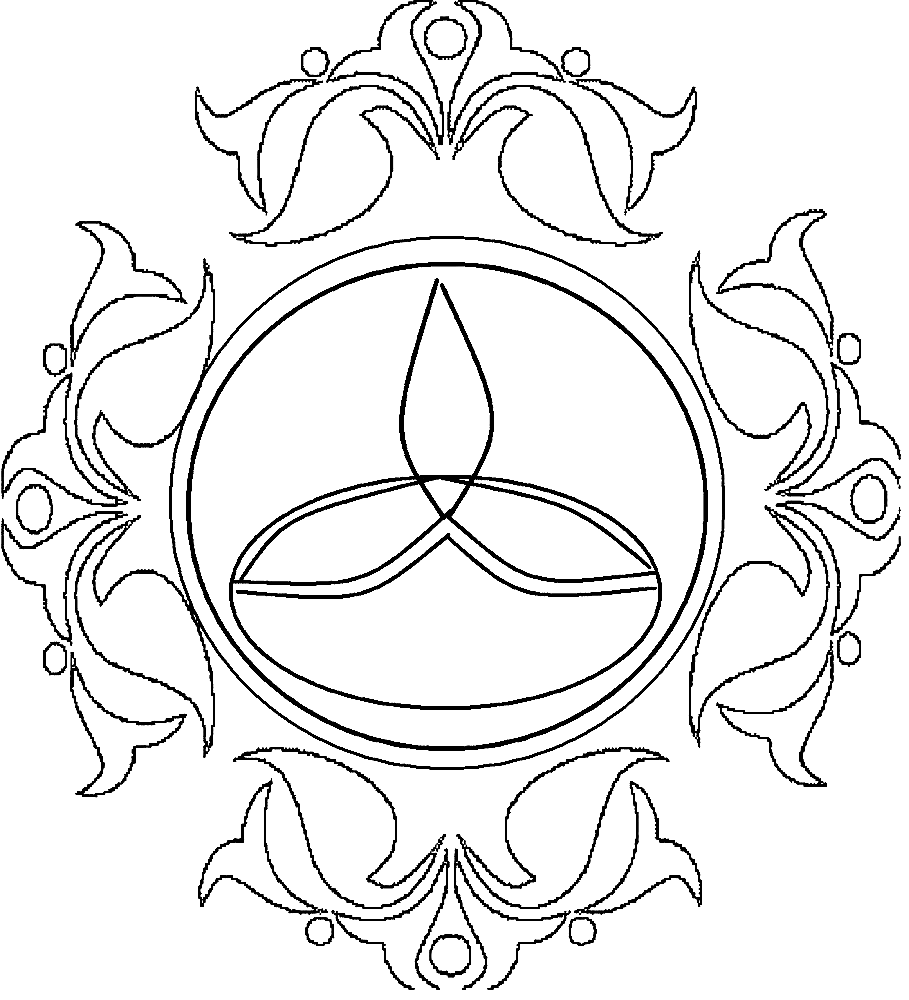
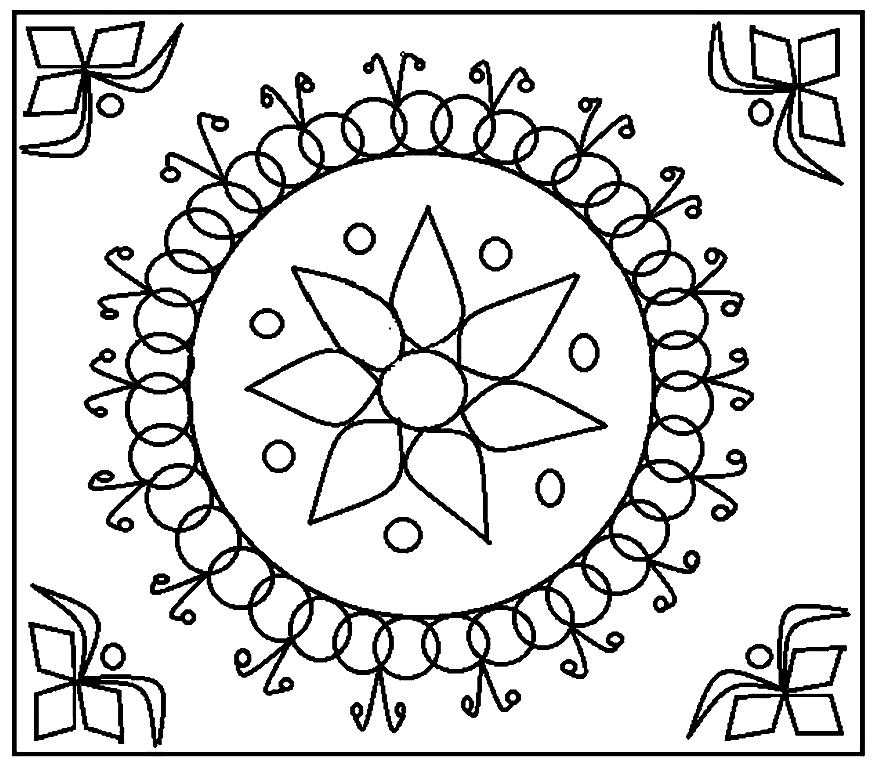
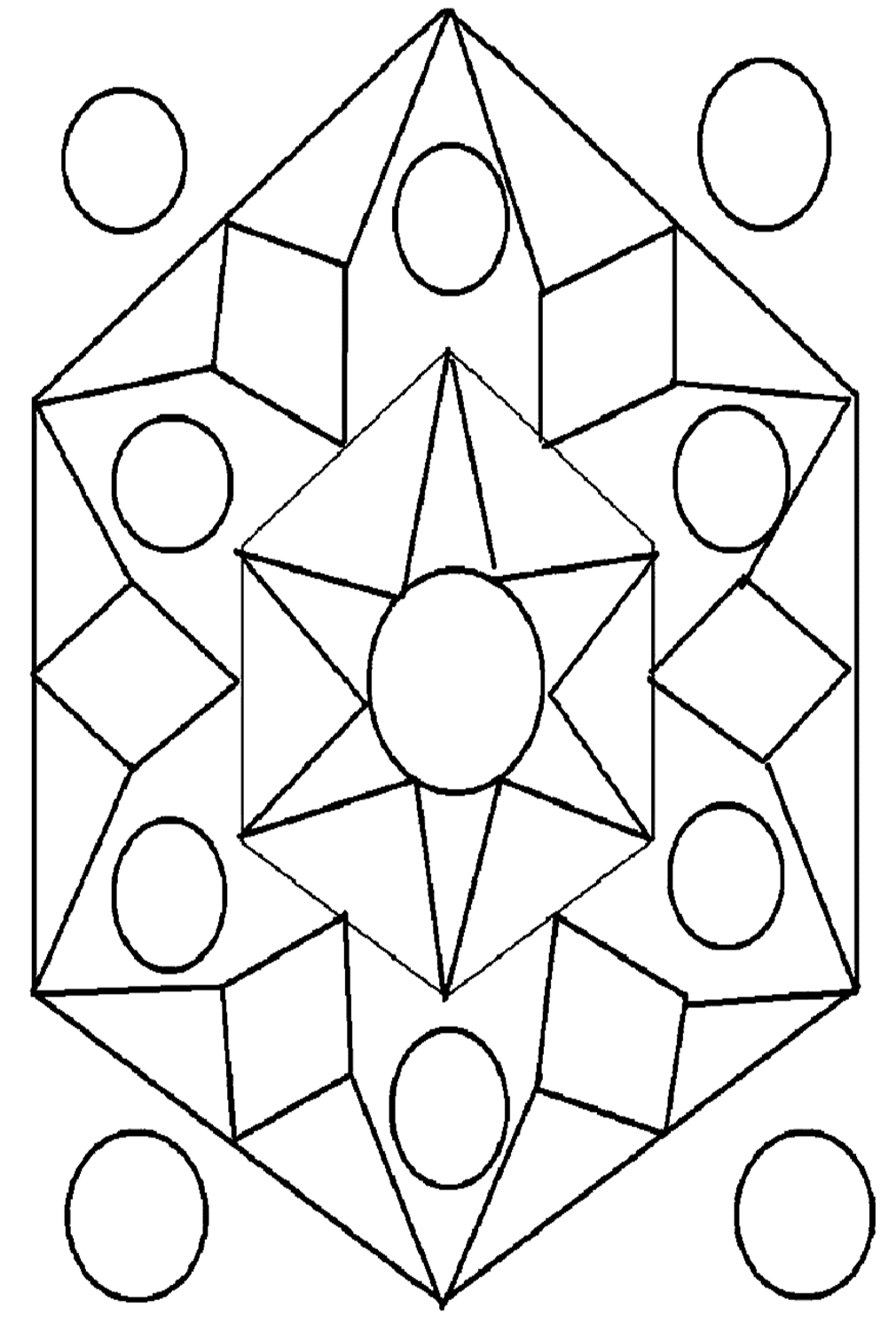
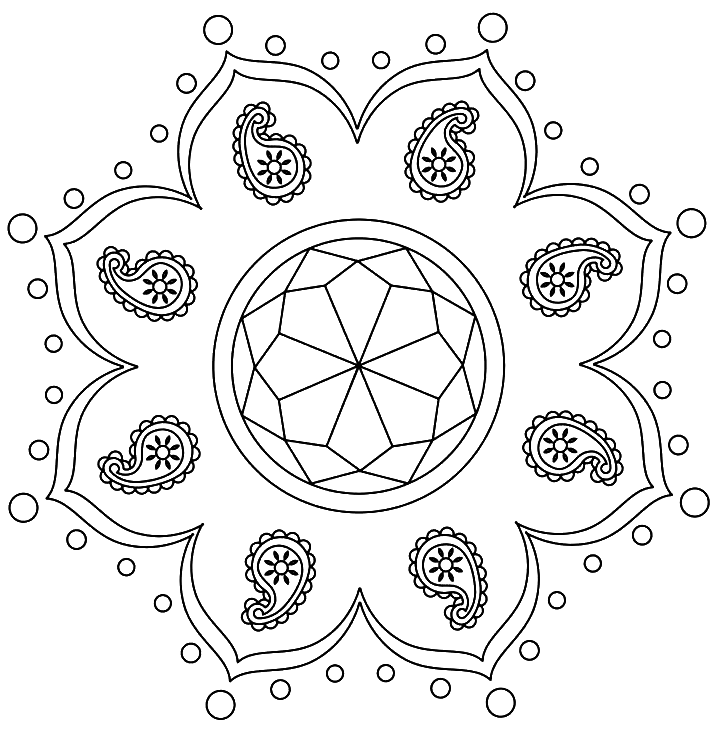
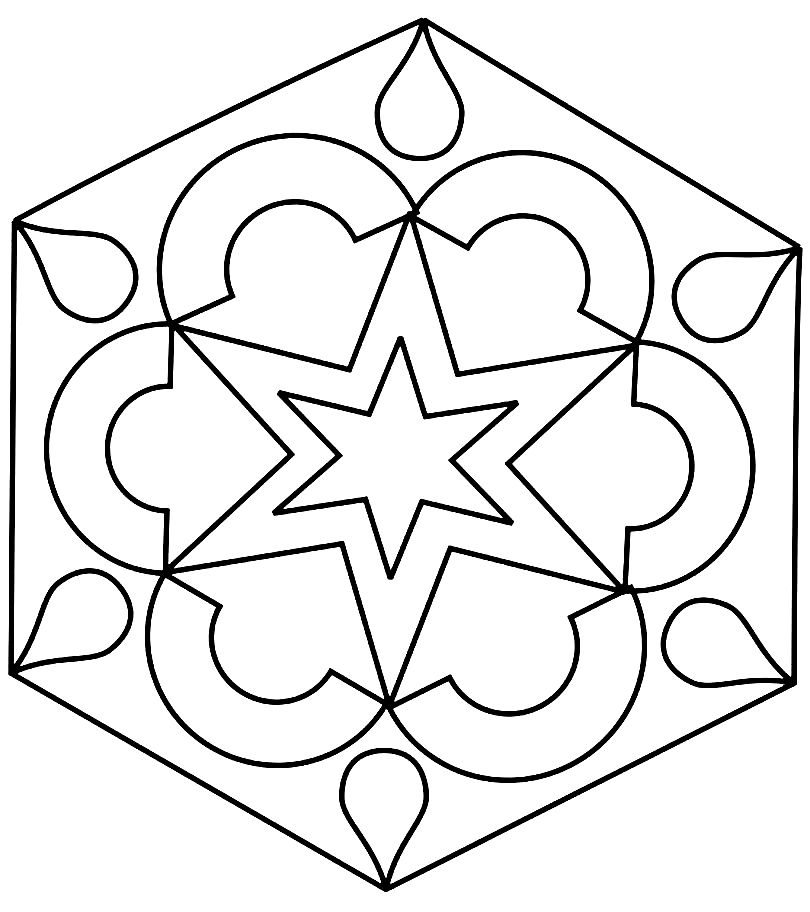
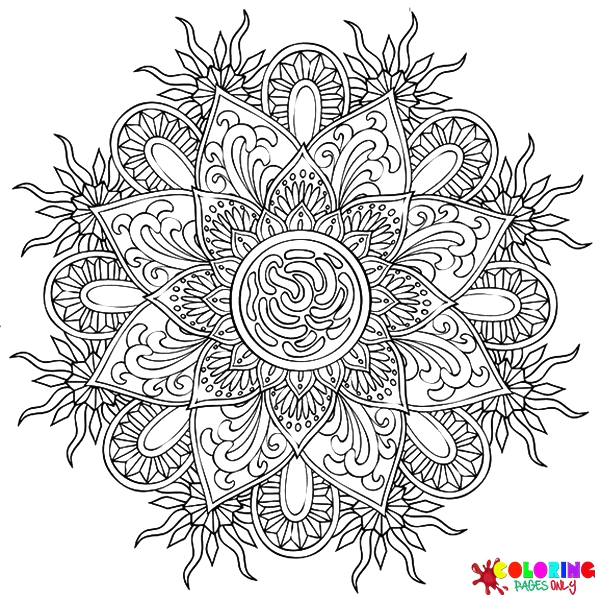
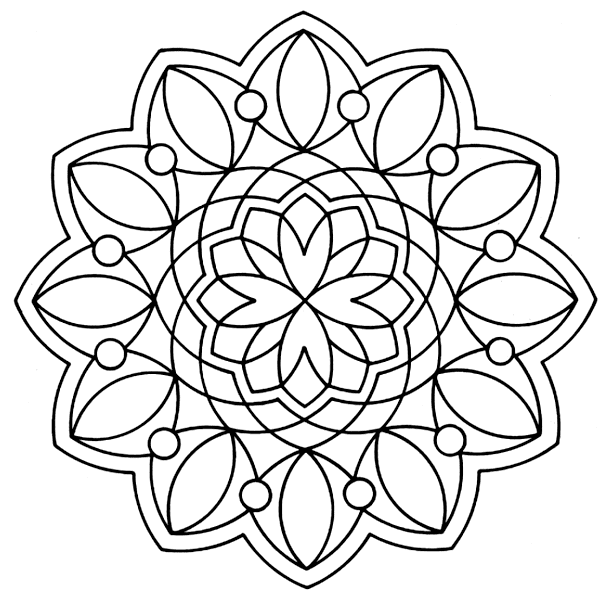
The geometric Rangoli – built on circles, hexagons, squares, triangles, and their combinations in rotationally symmetric arrangements – is the tradition’s most mathematically rich expression. These designs function on the same principle as mandalas: a central point, around which repeating elements are arranged with radial symmetry, expanding outward in concentric rings of increasing complexity and decreasing granularity.

The mathematical sophistication of these designs is genuinely remarkable. Many traditional Rangoli geometric patterns are applications of concepts from geometry that the West would not formalize for centuries after these patterns were already in daily practice: regular polygon tiling, rotational symmetry groups, and fractal-like self-similar expansion from center to edge. The designs work because they are mathematically correct – the symmetry is exact, the proportions are consistent, and the resulting visual is as satisfying as a precisely solved equation.

The collection’s geometric pages span the full range of complexity: simple four-fold symmetric designs accessible to the youngest colorists, and elaborate twelve-fold or sixteen-fold designs that require sustained, careful attention across hundreds of individual cells.

Coloring geometric Rangoli: The most effective technique for geometric designs is planning the color palette before applying any color. Identify the design’s major zones – the center, the first ring, the second ring, and any outer border elements – and assign a color to each zone. The most visually effective Rangoli color choices use warm, vivid colors (orange, red, pink, yellow) against cool,l vivid colors (blue, green, purple) in alternating zones, creating the maximum chromatic contrast. Apply each zone’s color completely before moving to the next. The design’s symmetry should ensure that the same color appears in identical positions throughout the rotation – if the color appears in one petal at the top, the same color must appear in the corresponding petal in every other rotation.

Floral Rangoli – Lotus and Petal Designs

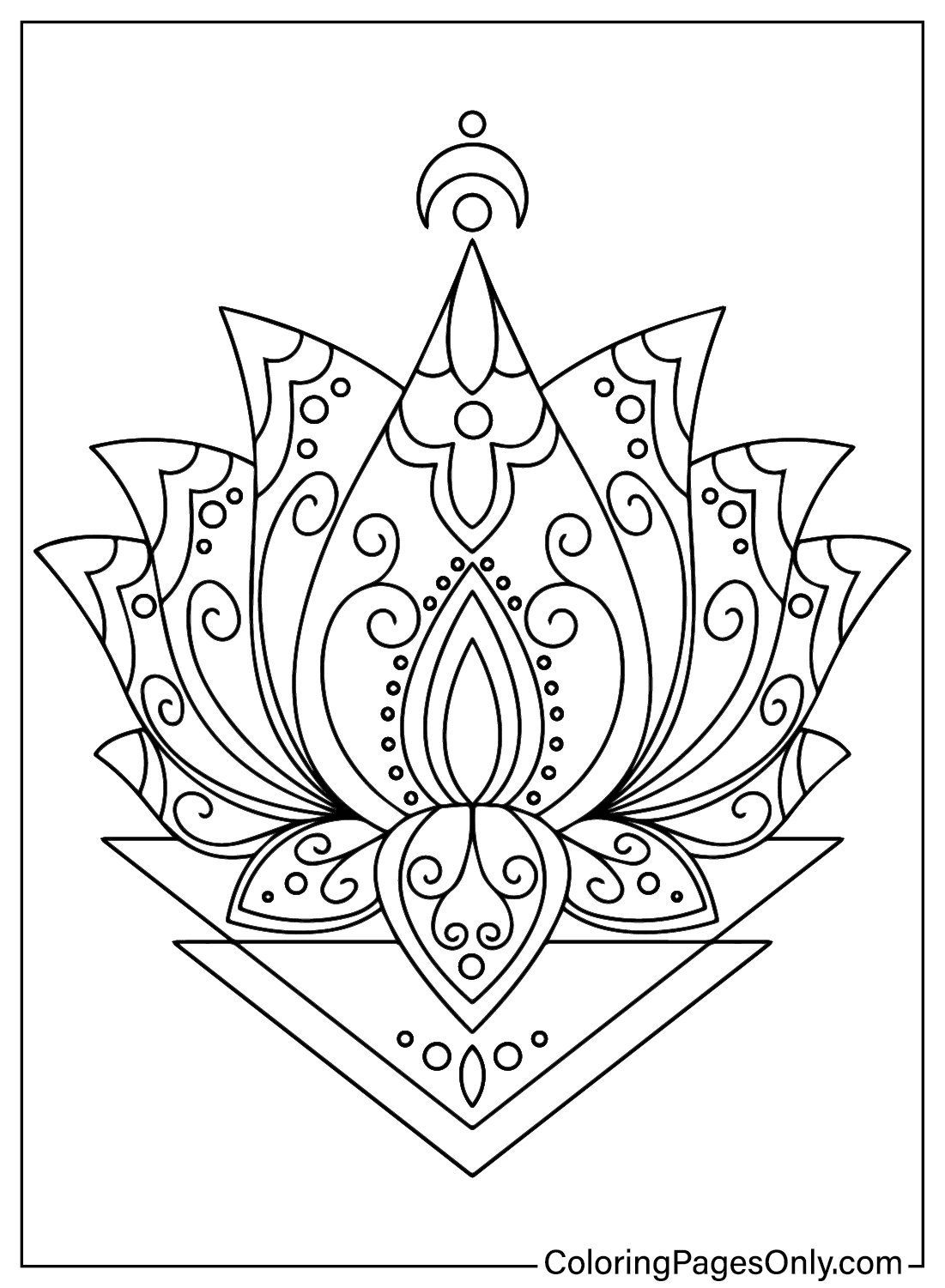
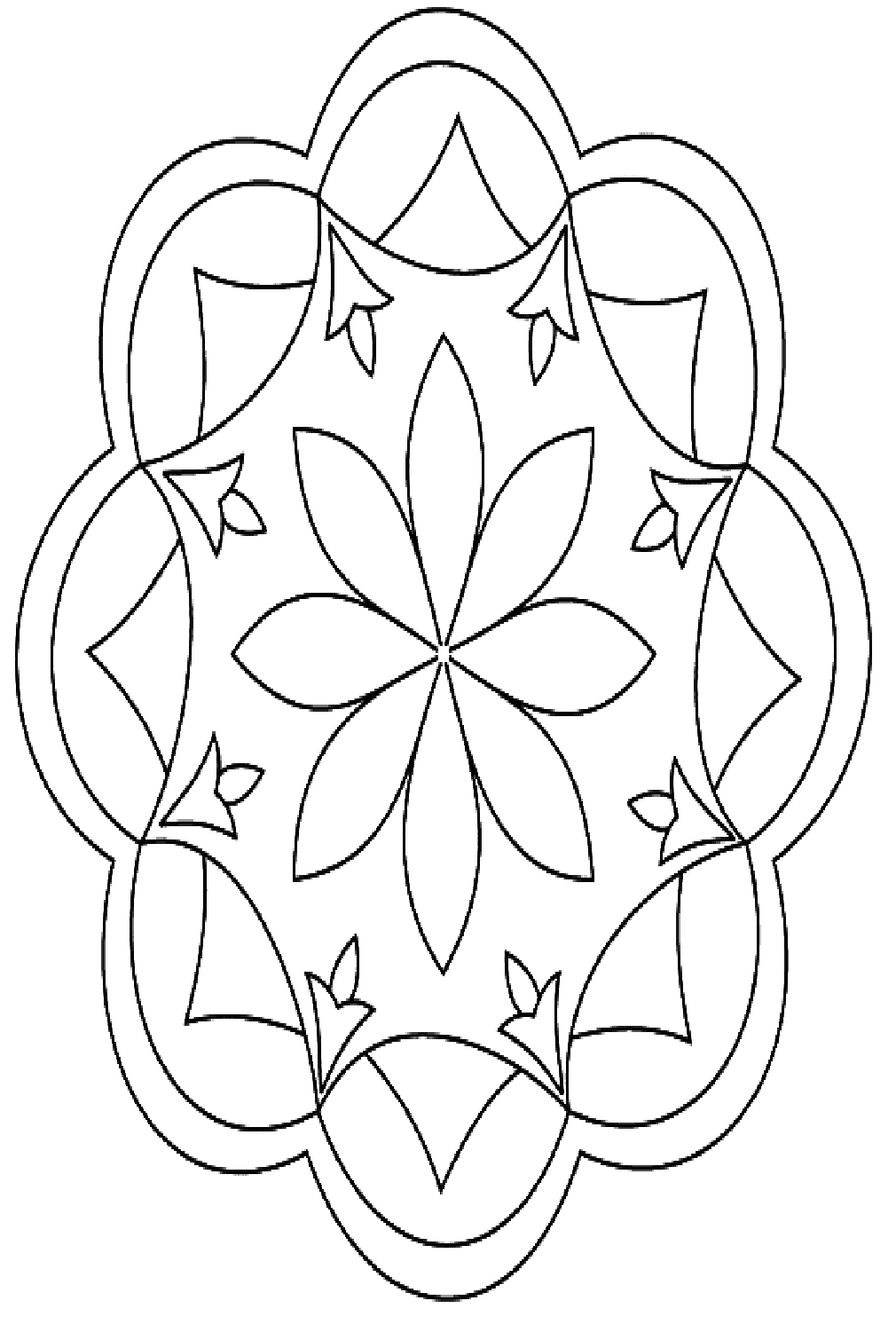
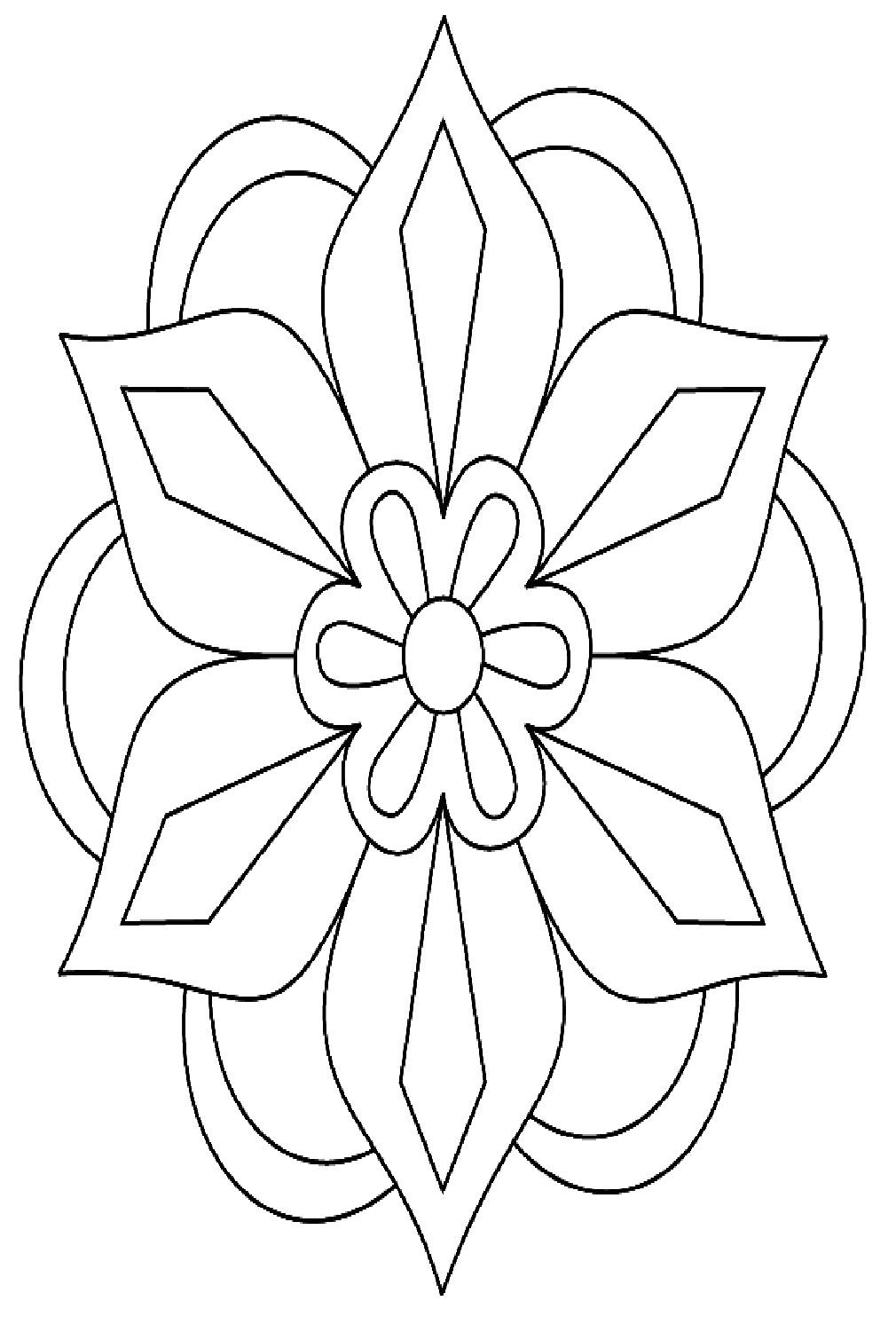
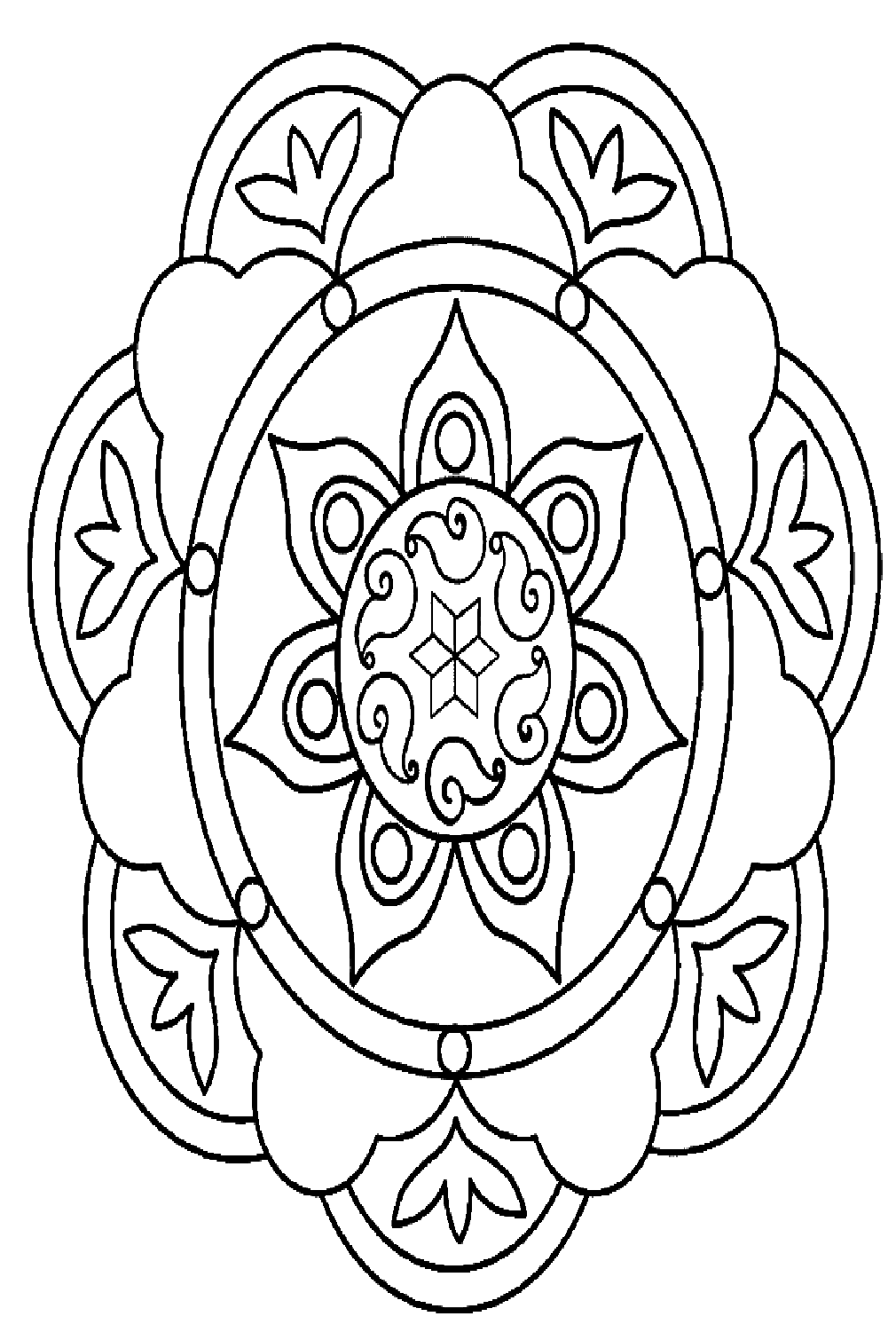
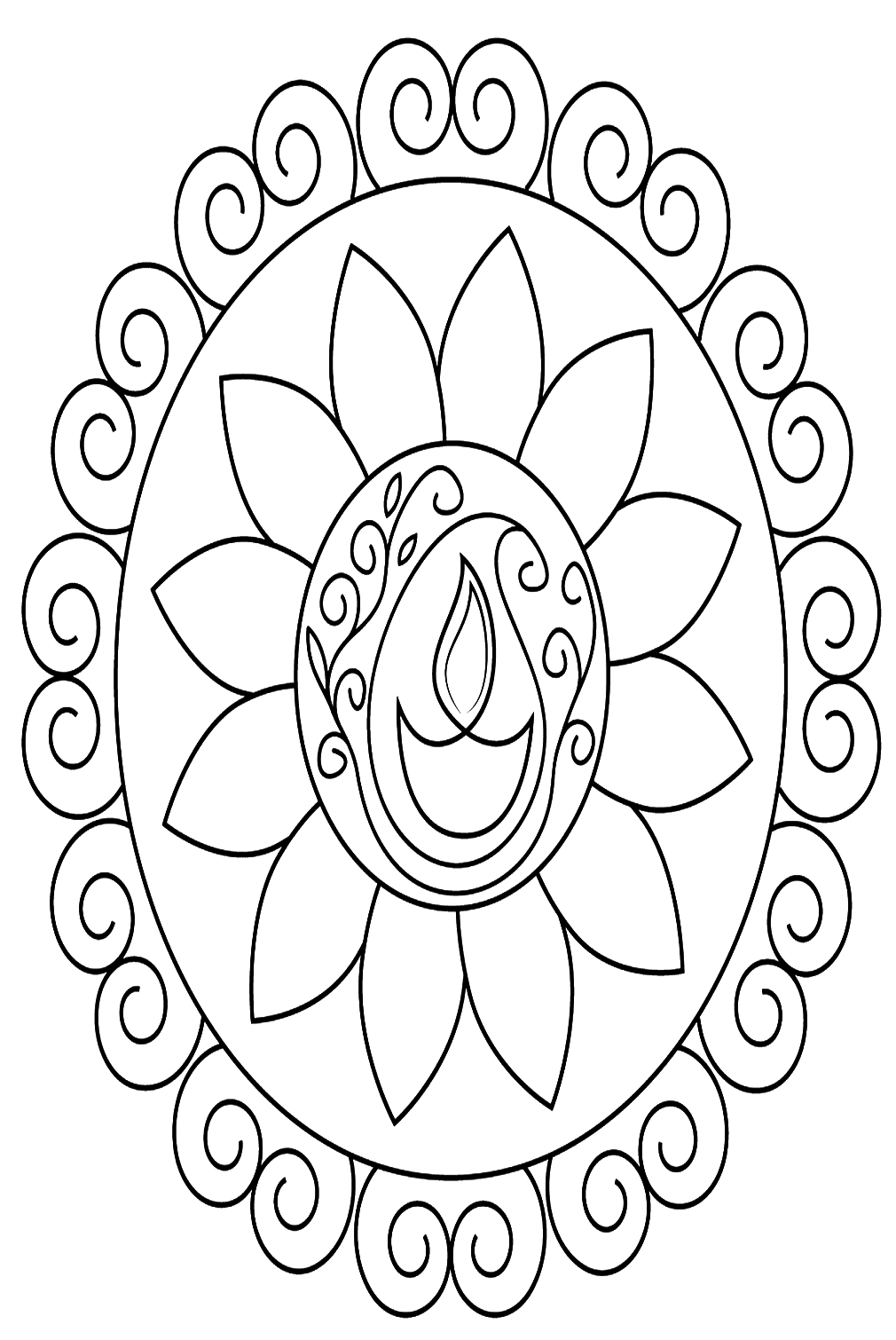
The lotus (kamal, कमल) is the most sacred and most reproduced motif in Indian decorative art – the flower that rises from muddy water to bloom above the surface, the seat of Lakshmi (the goddess of wealth and prosperity) and of Brahma (the creator), the national flower of India. In Rangoli, the lotus appears in countless variations: as a central motif with petals radiating outward, as a border element, as a simplified graphic that retains the flower’s essential visual logic while adapting it to the demands of the floor-art medium.

Floral Rangoli pages show the tradition at its most organic and least geometric – curves instead of angles, the specific shapes of petals and leaves rather than the abstract shapes of triangles and hexagons, and a color palette that references the natural colors of actual flowers rather than the full-spectrum vivid palette of geometric Rangoli.

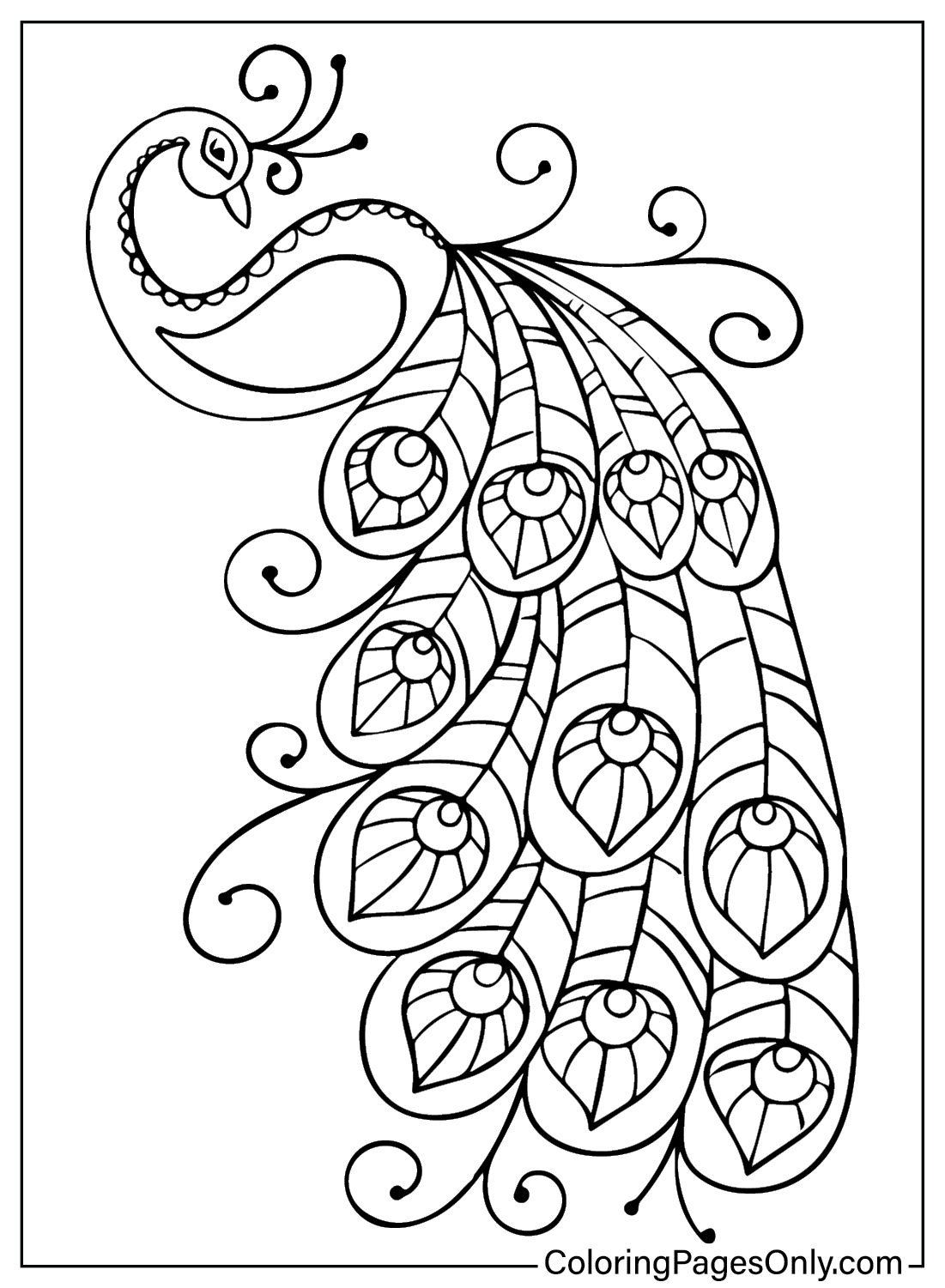
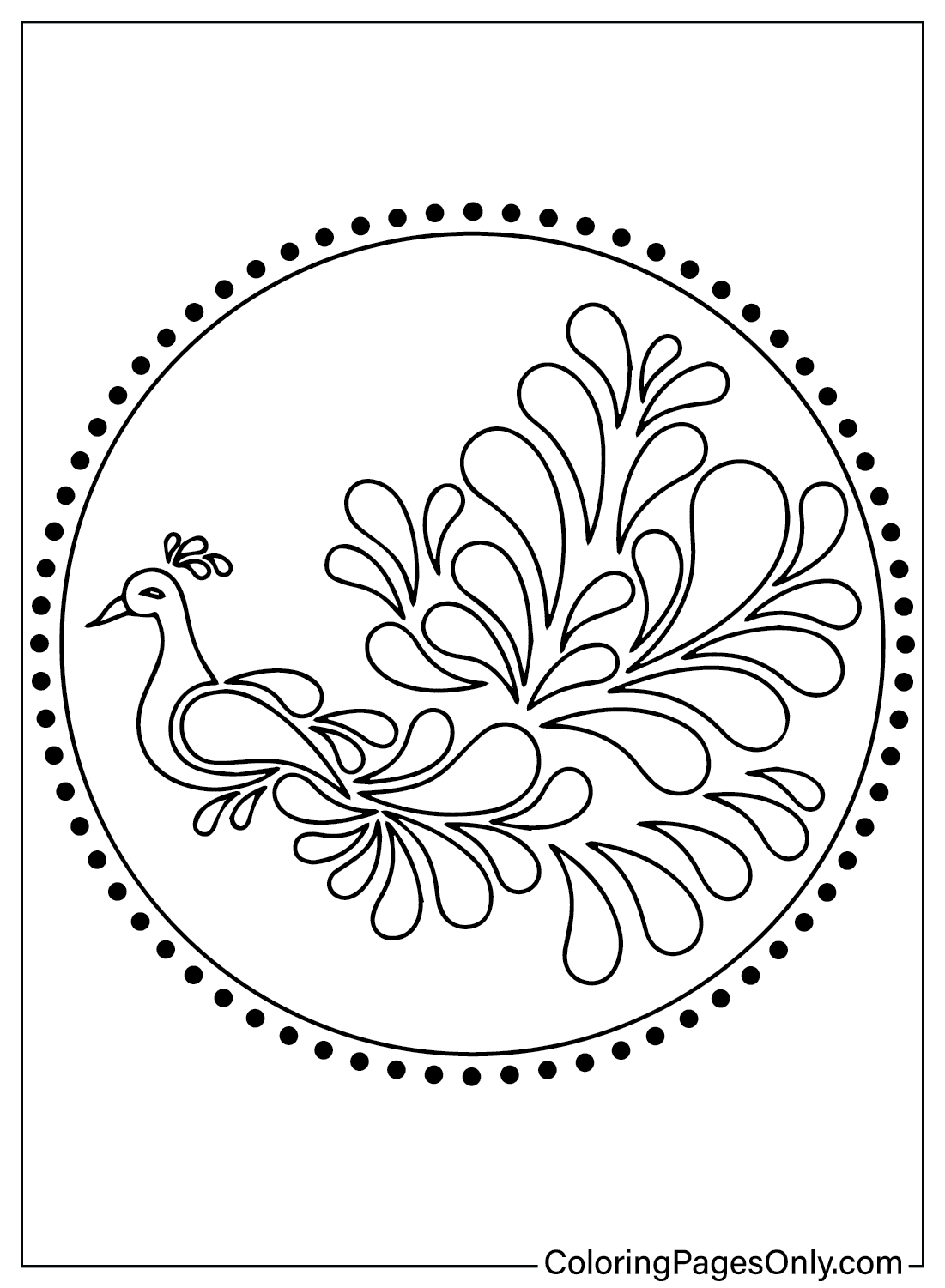
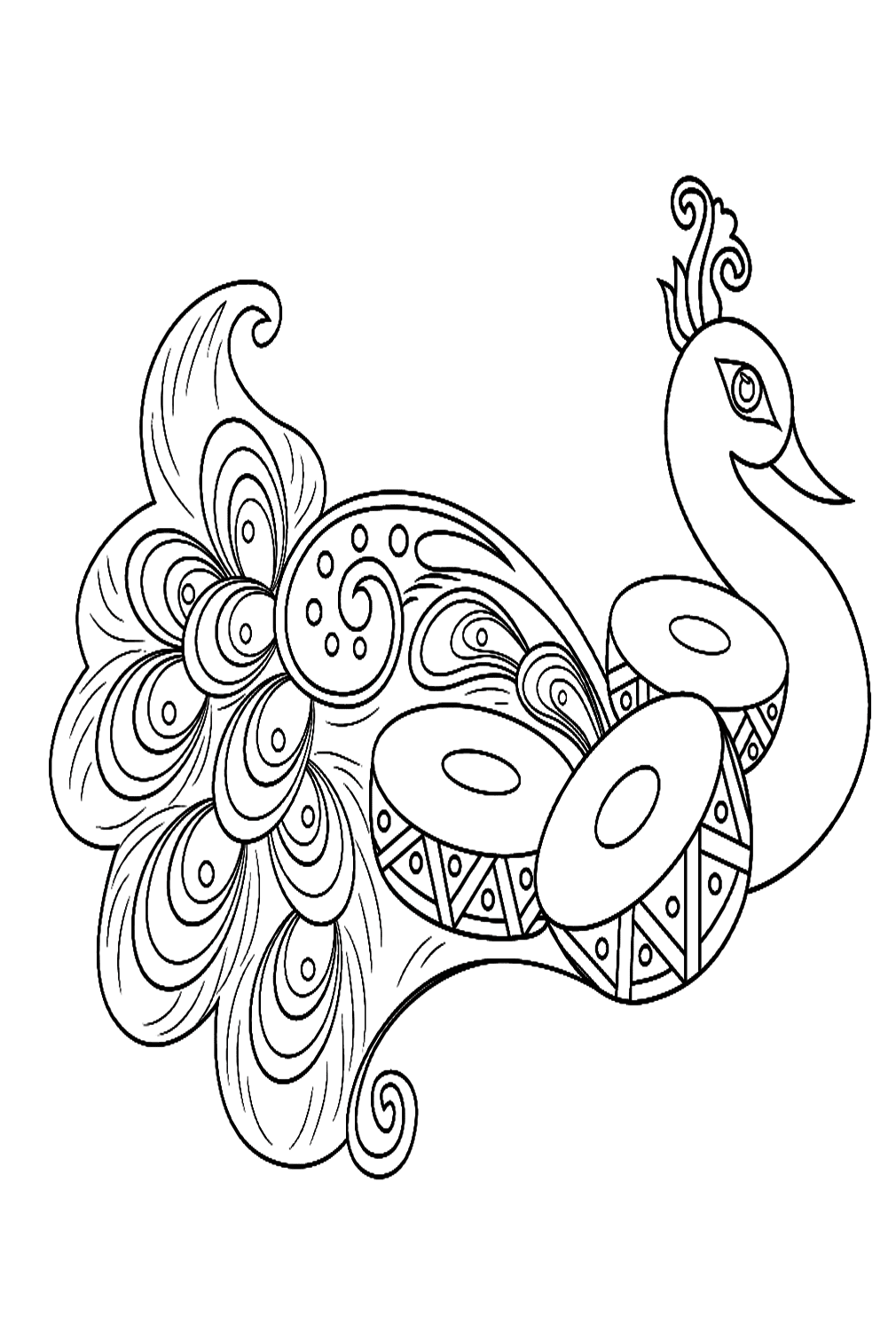
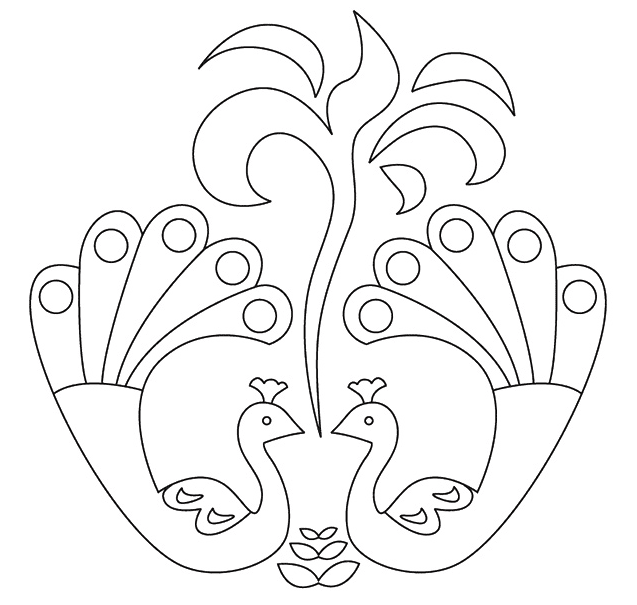
Peacock (mor, मोर) motifs appear frequently in floral Rangoli – the peacock’s fan tail, with its distinctive eye markings, provides a natural mandala-like form when depicted from behind, and the peacock’s status as India’s national bird gives it a cultural resonance across all regions.

Coloring floral Rangoli: For lotus designs, the canonical lotus coloring is pink petals with a yellow center – the colors of the sacred lotus (Nelumbo nucifera) as it actually blooms. Apply the paint to the full petal surfaces, slightly deeper at the petal base where petals overlap each other, and lighter at the petal tips. The center should be warm yellow, with the small seed pod details in a slightly deeper yellow-gold. For peacock motifs: the peacock’s body is vivid blue-green (the specific iridescent blue of an Indian peacock’s neck and breast), the tail feathers are blue-green with the distinctive eye marking in blue and gold.

Kolam – The South Indian Dot Tradition

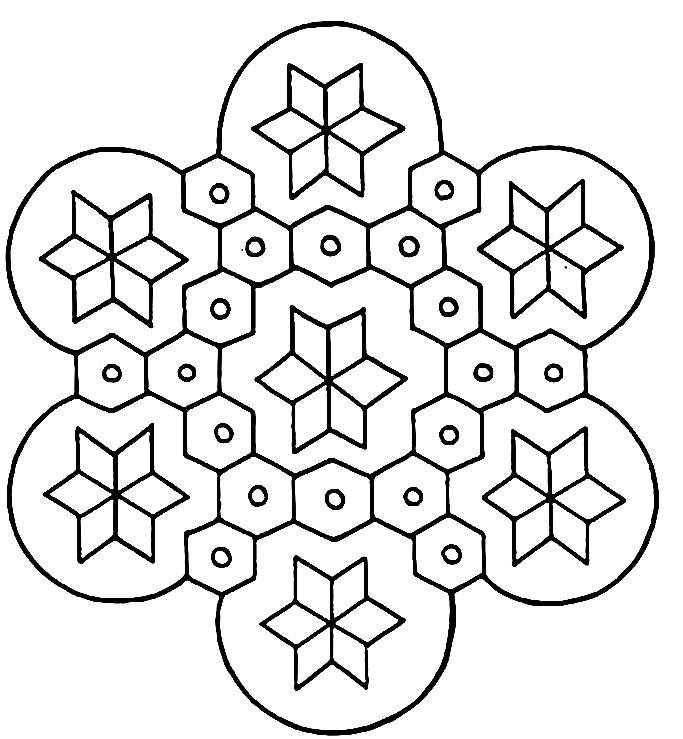
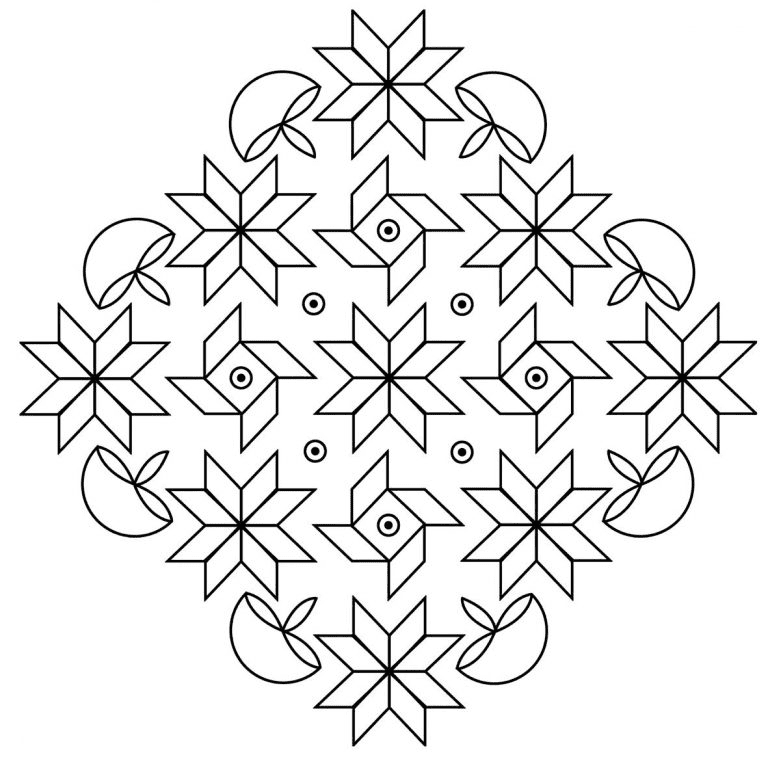
The Kolam tradition of Tamil Nadu, Andhra Pradesh, and Karnataka is a distinct branch of Rangoli practice with its own specific methodology: designs are created by laying down a reference grid of dots, then drawing lines that loop around and between the dots according to specific learned patterns. The dots serve as a framework – they are not part of the final design but the scaffolding within which the continuous flowing line moves.

Kolam is practiced daily in many South Indian households – the woman of the house wakes before sunrise, cleans the threshold, and draws the kolam in white rice flour on the clean surface. The white rice flour serves a dual purpose: it marks the threshold as auspicious and provides food for small creatures (insects, birds) who will consume it throughout the day. The kolam is therefore simultaneously an art form and an act of generosity.

The daily kolam is simple – perhaps a 3×3 or 5×5 dot pattern resolved into a flowing line. Festival kolams, drawn for Pongal, Karthigai Deepam, or weddings, can be enormously complex – filling the entire front yard of a house.

Coloring Kolam pages: Traditional Kolam is white on the ground’s color, which means a Kolam page on white paper presents the specific challenge of a white-on-white design. The creative solution: choose a background color for the space around the kolam’s lines. Apply this background color (a warm terracotta or a cool blue-grey, both of which reference actual floor materials) to all areas outside the kolam’s lines. The kolam’s white lines will then read clearly against the colored background – white-on-color rather than white-on-white.

Diwali Rangoli with Diya Spaces

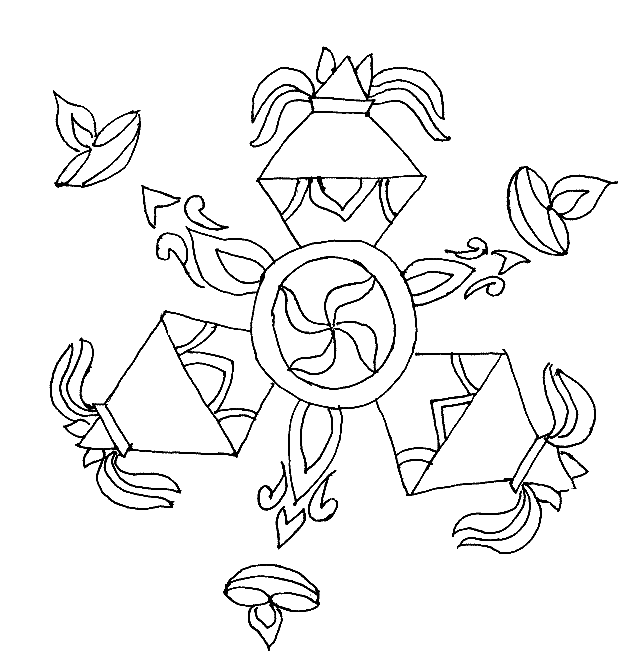
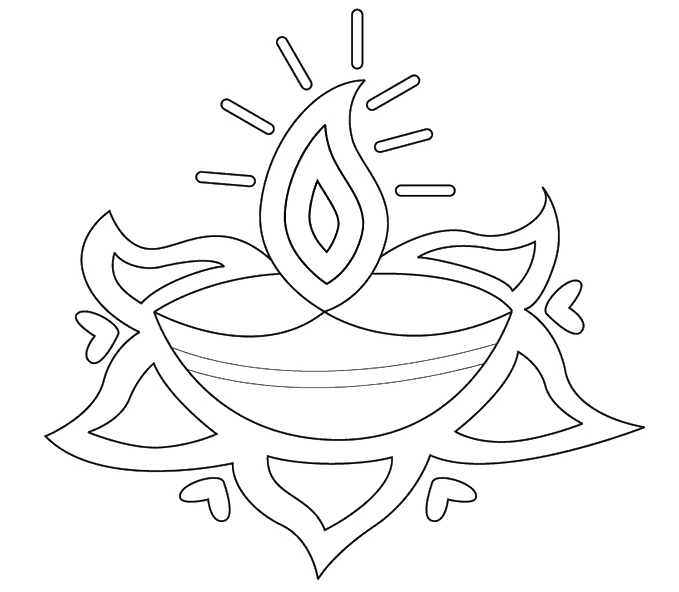
Diwali – the Festival of Lights – is Rangoli’s most important annual occasion. On Diwali night, the most elaborate Rangoli designs of the year are created at the entrance to homes and in courtyards, with spaces within the design specifically sized to hold diyas (small clay oil lamps) whose flames illuminate the pattern from within. The diya-integrated Rangoli is the tradition’s most ceremonially complete form: the design and the light source are a single unified object.

Diwali Rangoli pages include designs with circular spaces – often at the center or at regular intervals through the design – where the diya would sit in the physical version. In the coloring page version, these spaces can be colored in warm yellow-orange to suggest the diya’s light, or left strategically lighter than the surrounding design to simulate the illumination effect.

Coloring Diwali Rangoli: The Diwali palette is the most vivid in the collection – warm reds, oranges, and yellows representing fire and light; vibrant greens and blues for contrast and freshness. The diya spaces within the design should receive the warmest, most yellow-orange treatment available – a vivid warm yellow at the center of the space, graduating to orange-yellow at the edges, suggesting the flame’s warm illumination spreading into the surrounding pattern. The surrounding design colors should be at full saturation to match the light’s warmth.

Traditional Motif Pages – Sacred Symbols and Auspicious Elements

The traditional Rangoli vocabulary includes specific motifs that carry specific meanings:

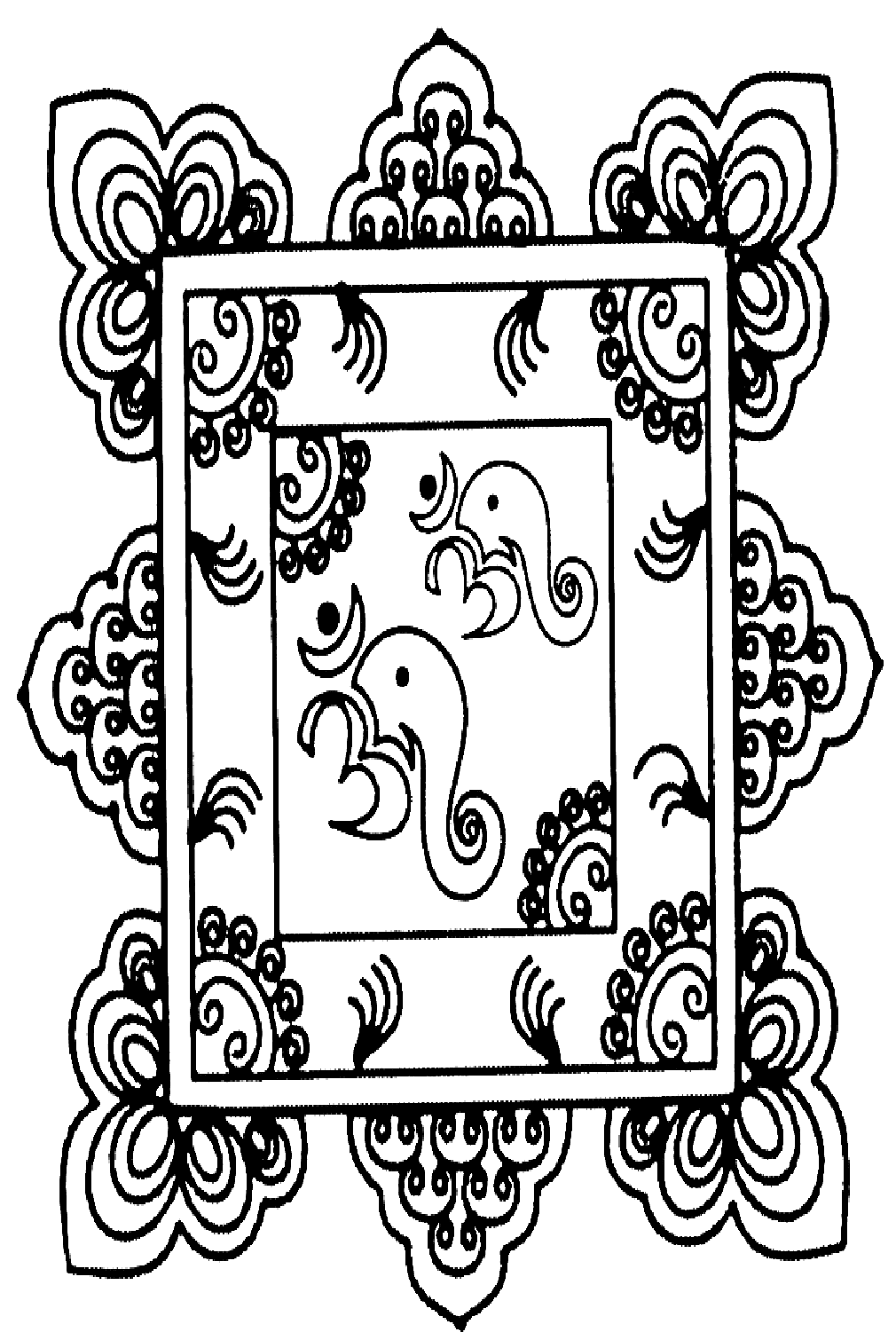
The Om symbol (ॐ) – the sacred sound of Hinduism, written in Devanagari script as a specific curved form. Its presence in Rangoli marks a design as dedicated to the divine.

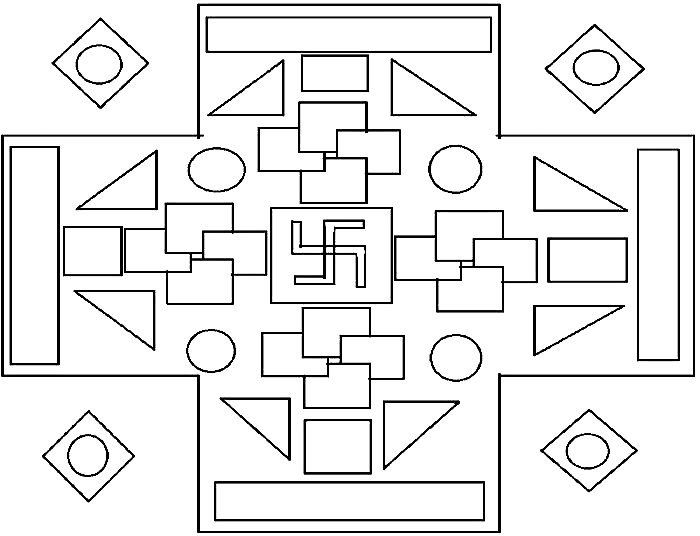
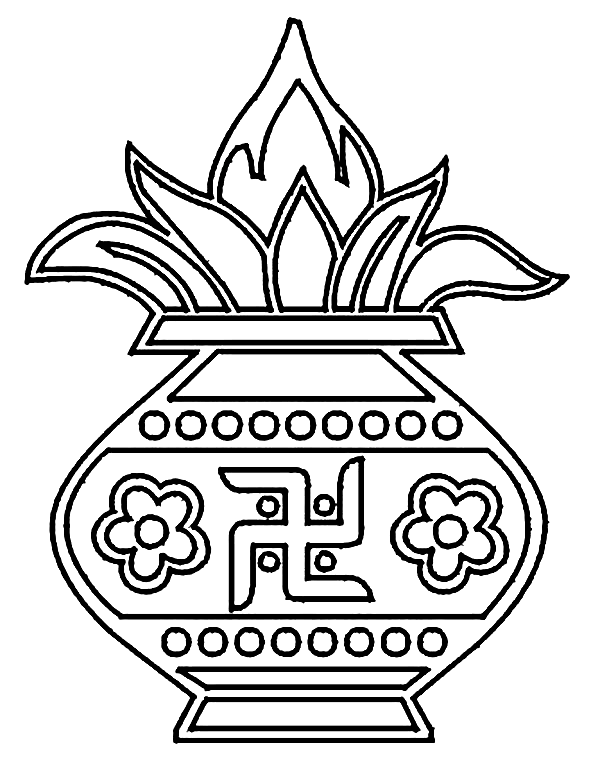
The Swastika (卐) – an ancient Sanskrit and Hindu sacred symbol meaning well-being and good fortune, has been present in Indian religious art for thousands of years. Its use in Rangoli is a direct expression of this original meaning, entirely distinct from the political symbol’s twentieth-century usage in Europe.

Lakshmi’s footprints – small footprint shapes (typically at the entrance of a home during Diwali) representing the goddess walking into the home, bringing prosperity.

The mango leaf (aam patti) – auspicious, used in torans (doorway decorations) and Rangoli borders.

The fish – auspicious in many Indian traditions, particularly in Bengali Alpona.

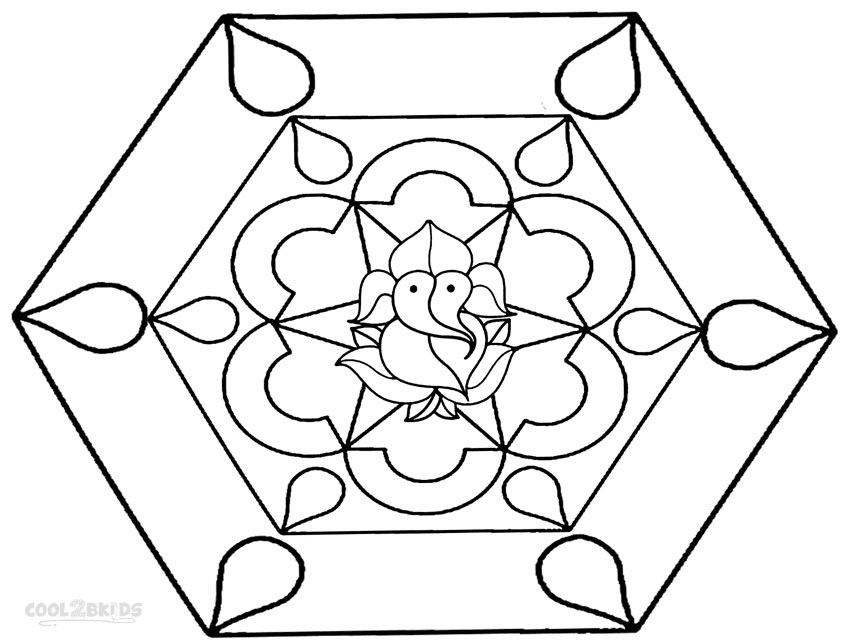
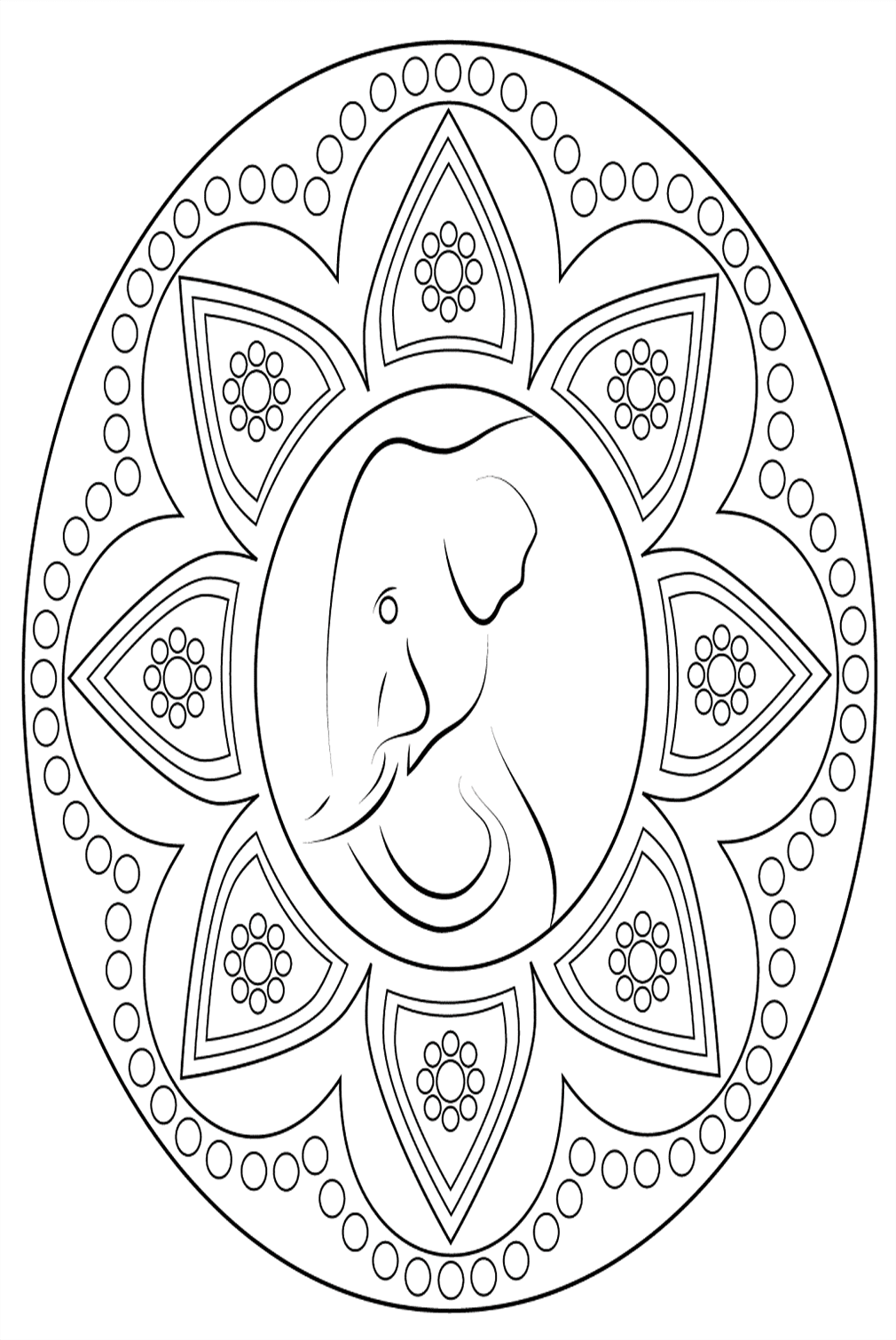
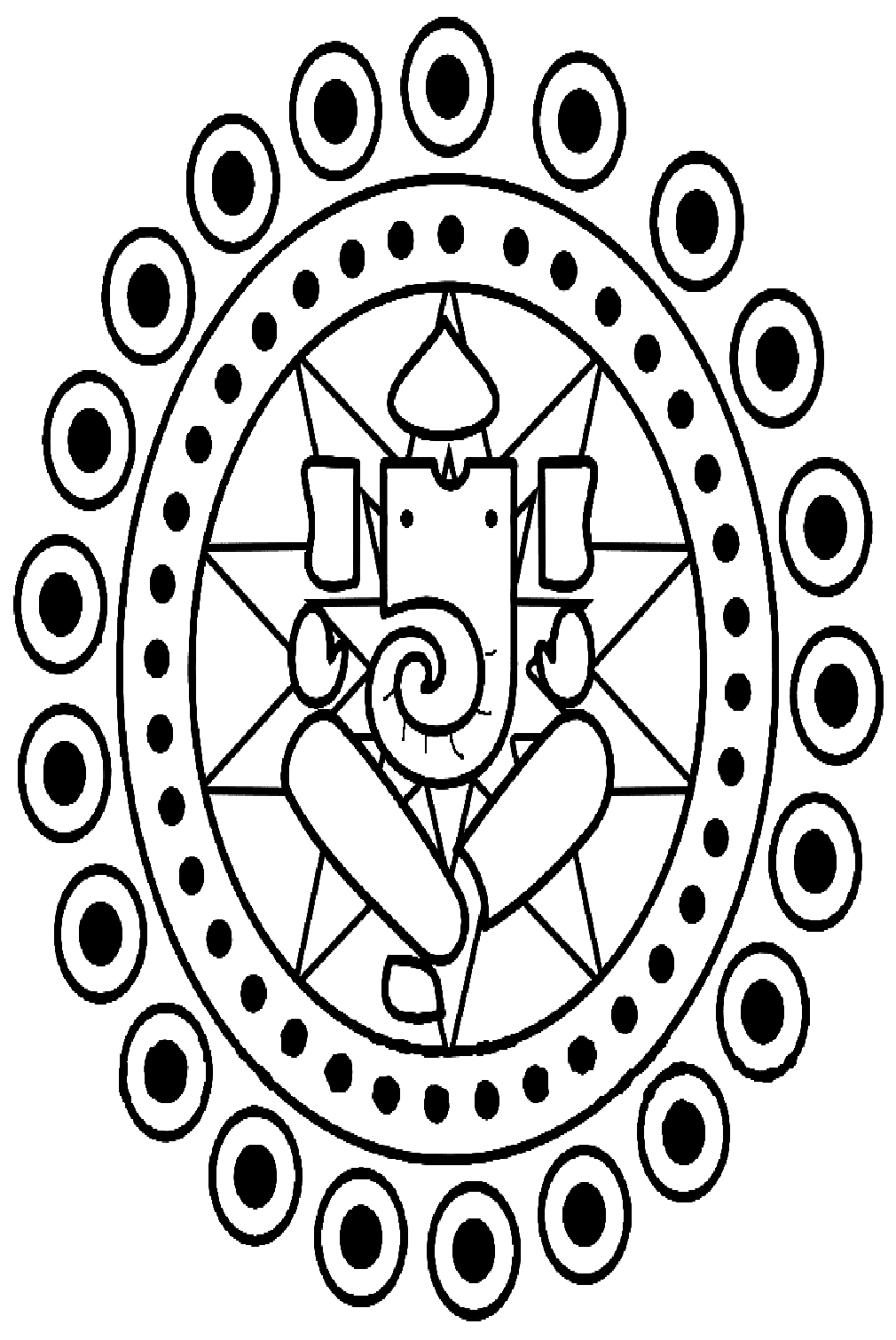
Elephants – associated with Ganesha (the remover of obstacles) and with auspicious beginnings.

Coloring motif pages: Each traditional motif carries a conventional color association that reflects its symbolic meaning – orange-red for auspicious/festive elements, yellow for Lakshmi and prosperity, green for growth and nature, blue for divine/sky/Krishna. Pages showing specific motifs reward the colorist who researches the motif’s symbolic meaning and chooses colors that honor it.

What These Pages Do

Rangoli is one of the world’s oldest continuous artistic traditions – thousands of years of unbroken practice, transmitted from mother to daughter across generations without interruption. The Chitralakshana’s sixth-century documentation is not the tradition’s beginning but its first written record. The designs in this collection are direct descendants of patterns that were already ancient when they were first written about. Coloring a Rangoli page is participating in one of the longest continuous design traditions in human history.

The geometric mathematics underlying Rangoli design is the same mathematics that the Western tradition calls sacred geometry. The radial symmetry of a twelve-fold Rangoli, the proportional expansion from center to edge, the specific relationship between the design’s inner and outer elements – all of these are applications of mathematical principles whose beauty is inseparable from their precision. The 2005 Art Therapy Journal study on structured coloring and anxiety reduction applies with particular directness to geometric Rangoli pages, where the symmetry of the design creates a meditative rhythm of repetitive, careful application that produces the calm, focused absorption the research identifies.

The Kolam tradition’s dual function – art and offering – is the clearest example in any global art tradition of beauty and generosity being the same act. Drawing the kolam in rice flour on a clean threshold creates beauty at the home’s entrance and provides food for small creatures simultaneously. The act cannot be divided into its aesthetic and its ethical dimensions because they are the same action. Coloring Kolam-inspired pages while understanding this dual function is engaging with one of the most integrated art practices in any culture.

Fine motor development. The American Academy of Pediatrics identifies fine motor skill development as a key childhood milestone throughout early childhood. The precise cell-by-cell application required by geometric Rangoli pages, the petal detail of floral Rangoli, and the continuous line work of Kolam patterns all provide motivated, sustained fine motor practice at every developmental level from young children through adults.

How to Color These Pages Well

Plan the complete color palette before applying any color to a geometric Rangoli page. The most common failure mode in geometric Rangoli coloring is applying colors that work individually but clash when the full design becomes visible – because the design’s radial symmetry means that a color choice made for one zone appears in every rotation. Before touching the page, identify all the distinct zones (center, inner ring, outer ring, border), count how many zones there are, and assign a color to each that creates a complete, harmonious palette when all are viewed together. Test the palette on scrap paper first.

Maintain symmetry rigorously throughout. In any design with four-fold, six-fold, or eight-fold symmetry, a given color must appear in exactly the same position in every repetition of the design’s unit. Before completing a zone, verify that the same color appears in the corresponding position in every other rotation of the same zone. Any break in the symmetry reads as incorrect, regardless of how beautiful the individual colors are.

The collection rewards maximum saturation rather than subdued tones. Traditional Rangoli made with colored powders and flower petals operates at maximum chromatic saturation – the powders are vivid, and the petals are vivid. The coloring pages reward the same approach: apply colors at full pressure and full saturation rather than the more tentative, lighter application that suits some other coloring subjects. A rangoli in pale or muted tones loses the festive, vivid quality that is the tradition’s most essential visual characteristic.

Warm and cool alternation creates the most effective Rangoli color scheme. The most visually successful Rangoli color combinations alternate warm colors (orange, red, pink, yellow) and cool colors (blue, green, purple) in adjacent zones. This alternation produces maximum chromatic contrast between neighboring areas – each color makes the adjacent color appear more vivid – and creates the vibrant, energetic visual quality that the tradition aims for. Pure warm-only or pure cool-only palettes are significantly less effective.

For Kolam pages on white paper – color the background, not the lines. The traditional Kolam is white lines on a colored or bare floor surface. On a white coloring page, the lines are white by default. Rather than coloring the white lines, apply the background color to the spaces between the lines – the floor surface that the white lines mark. Choose a warm terracotta, ochre, or deep red for the floor (references the terracotta tile or beaten earth floors of the traditional household), or a cool blue-grey (references painted cement). The flowing white lines will appear automatically against the colored background.

5 Creative Craft Ideas

Diwali Celebration Display

Print three or four Rangoli pages – specifically choosing designs that include circular spaces for diya lamps. Color all in the maximum-saturation Diwali palette: vivid orange, red, yellow, green, and blue at their most vivid. In each diya space within the design, apply warm yellow at the center, graduating to orange at the edges.

Mount all pages on a large dark (deep blue or black) backing sheet, positioned as if they were different sections of a large celebratory Rangoli display. Cut small circles of orange and yellow tissue paper; scrunch them gently and place them at the center of each diya space on the mounted display to suggest the flame’s three-dimensional quality.

Add the title: “दीपावली – Diwali. Festival of Lights.” The finished display is both a coloring craft and a festival decoration.

Regional Rangoli Comparison

Print five pages representing different regional traditions covered in the collection: a geometric Rangoli from the Maharashtra tradition, a lotus-based floral Rangoli, a dot-based Kolam-style design, a peacock motif design, and a simple border design.

Color each in its regional color tradition: the Kolam page with a terracotta background and white lines; the floral page in natural flower colors (pink lotus, green leaves); the geometric page in the most vivid full-spectrum palette. Mount all five on a backing sheet with the regional name below each: “Kolam – Tamil Nadu,” “Lotus Rangoli – Maharashtra,” “Muggu – Andhra Pradesh,” “Peacock Rangoli – Gujarat,” “Alpona-inspired – Bengal.”

The finished display documents the Rangoli tradition’s regional diversity as a visual comparison.

The Symmetry Study

Select the most mathematically complex geometric Rangoli page in the collection. Before coloring it, count the rotational units – how many times the basic design unit repeats around the center. Use this count to determine the symmetry: four units = four-fold symmetry, six = six-fold, eight = eight-fold.

Color just one unit of the design completely. Then use the same colors in the same zone assignments to complete every other unit – making the symmetry explicit in the coloring process itself. The finished page demonstrates the mathematical principle in the most direct way possible: the same pattern, the same colors, rotated around a center point.

Below the finished page, add: “This design has [X]-fold rotational symmetry. Every unit is identical. The repetition is the point.”

Kolam Dot Practice

On a separate piece of paper – not a coloring page, but blank paper – practice the Kolam dot method. Draw a grid of 5×5 dots at equal spacing. Then, following the traditional looping method, draw a continuous curved line that loops around each dot without touching it, connecting the entire grid into a single flowing pattern. (Reference Kolam patterns online for the specific looping methods.)

Color the resulting Kolam in the traditional way: terracotta background applied around the white lines. Mount beside a finished Rangoli coloring page.

The finished display shows the coloring page tradition and the traditional practice alongside each other – two different approaches to the same design tradition.

My Diwali Rangoli Design

Use the simplest geometric Rangoli page in the collection as a color inspiration reference rather than as a coloring page. On blank white paper, draw your own Rangoli design: choose a center motif (a circle, a lotus, a star), add a ring of repeating units around it (petals, triangles, waves), add a second ring, and add a border.

Color your finished design in the full Diwali palette. Below the design, write: “My Rangoli design for [name of occasion or recipient]. [Date].”

The finished page is a personal Rangoli – original in design, in the tradition of the practice. The act of designing and coloring it, rather than simply coloring a given design, is the closest a coloring page can come to the traditional practice of creating Rangoli from original intention.

Frequently Asked Questions

What is Rangoli, and where does it come from? Rangoli (रंगोली) is a traditional Indian floor art form – decorative patterns created on the ground or threshold of a home using colored powders, rice flour, flower petals, chalk, or sand. The name derives from the Sanskrit words rang (color) and aavalli (row) – “row of colors.” The practice is documented in Indian texts as early as the sixth century AD (the Chitralakshana, a text on Indian painting) and is referenced in the Puranas, ancient Hindu scriptures that predate the written record. It is practiced across the Indian subcontinent and among Indian diaspora communities worldwide, with regional variations including Kolam (Tamil Nadu), Muggu (Andhra Pradesh/Telangana), Alpona (West Bengal), Pookalam (Kerala), and Mandana (Rajasthan).

What occasions is Rangoli made for? Rangoli is most extensively made during Diwali – the Hindu Festival of Lights, typically observed in October or November – when elaborate designs are created at home entrances and in courtyards to welcome Lakshmi, the goddess of wealth and prosperity. It is also made during Dussehra, Navratri, Pongal, and Sankranti, Onam (as the flower-based Pookalam in Kerala), weddings, and other auspicious occasions. In the South Indian Kolam tradition, a simple Kolam is drawn daily at the home’s threshold – a regular devotional practice performed every morning before sunrise rather than only on festival occasions.

What materials are traditionally used to make Rangoli? Traditional Rangoli is made from materials immediately available in the household: white rice flour or chalk powder (the base, which also provides food for small creatures that consume it), colored natural powders, flower petals, turmeric (yellow), vermilion (red), and colored sand. Contemporary Rangoli competitions and decorative versions use dry powdered colors, artificial colored sand, flower petals, colored rice, and decorative elements including sequins and mirrors. The traditional version is always impermanent – laid on the ground, where it is gradually disrupted by footfall, wind, and weather.

What is the Kolam tradition,n and how is it different from Rangoli? Kolam (கோலம்) is the South Indian, primarily Tamil Nadu, version of Rangoli practice – distinctive for its specific methodology using a grid of reference dots. A Kolam is created by first placing a grid of dots (the number varies by design complexity and occasion), then drawing lines that loop continuously around the dots according to learned patterns, without lifting the drawing instrument. The traditional Kolam is made s white rice flour on the uncolored floor surface. The practice is performed daily by many South Indian women as a devotional act, with the rice flour also serving as food for small creatures. Festival Kolams can be very large and complex; everyday Kolams are small and simple. The Kolam tradition is increasingly recognized for its mathematical sophistication – its patterns are applications of geometric principles related to Euclidean geometry and graph theory.

What motifs commonly appear in Rangoli designs? The traditional Rangoli vocabulary includes specific motifs carried with auspicious meanings: the lotus flower (most sacred, associated with Lakshmi and purity), the peacock (national bird of India, symbol of beauty and grace), the mango leaf (auspicious, used in festive decoration), the fish (auspicious in many Indian regional traditions, especially Bengali), the elephant (associated with Ganesha, the remover of obstacles), the Om symbol (ॐ, the sacred sound of Hinduism), and Lakshmi’s footprints (small foot-shaped marks at the home’s entrance on Diwali, representing the goddess walking in). Geometric patterns – stars, hexagons, interlocking circles – appear throughout without specific iconographic meaning but with aesthetic and mathematical significance.

What is Diwali, and what role does Rangoli play in it? Diwali (दीवाली), the Festival of Lights, is one of the most important festivals in Hinduism, Jainism, and Sikhism – celebrated over five days in October or November according to the Hindu lunar calendar. The festival commemorates different events across different traditions: in the most widely observed Hindu tradition, it celebrates the return of Lord Rama to Ayodhya after fourteen years of exile. On Diwali night, homes are decorated with diyas (small clay oil lamps), fireworks are set off, and gifts and sweets are exchanged. Rangoli is central to Diwali decoration – elaborate designs are created at home entrances and in courtyards, welcoming Lakshmi into the home. Many designs include circular spaces specifically sized to hold diyas, integrating the light source into the pattern itself.

What age group are these pages best suited for? The simplest Rangoli coloring pages – designs with large, clearly defined zones and four-fold symmetry – are accessible from ages five and six, particularly with adult guidance for maintaining color consistency across the symmetrical zones. The medium-complexity pages – six-fold or eight-fold symmetry with smaller cells – are most engaging from ages seven to ten, as they develop the patience and precision for systematic, zone-by-zone color application. The most complex geometric pages – twelve-fold or sixteen-fold designs with dozens of distinct zones – are most rewarding for adults and teenagers who want a genuinely challenging, meditative coloring project. The floral and motif pages span this full range, with simpler flower designs accessible to young children and complex peacock or multi-motif pages more engaging for older colorists.

Browse the full collection at ColoringPagesOnly.com. All 60+ pages free, no sign-up, PDF or PNG, print or color online.

A woman rises before sunrise and cleans the threshold of her home. She draws a kolam in white rice flour – a pattern she learned from watching her mother, who learned from her grandmother, who learned from hers. The pattern has been in the family longer than anyone can trace. It feeds the ants who cross it during the day. By evening,g it is gone. Tomorrow she will draw another.

This is one of the world’s oldest art traditions: beautiful, impermanent, and generous. The rice flour feeds small creatures. The beauty welcomes the divine. The practice is the prayer.

The coloring pages in this collection give these patterns a more permanent form – paper rather than floor, colored pencil rather than powder. The designs are the same. The symmetry is the same.

Pick up your most vivid orange. Plan the palette before you begin. Let the symmetry guide you.

Share your work on Facebook and Pinterest and tag #Coloringpagesonly. We especially want to see the Diwali celebration displays and the symmetry studies.

Color the pattern. Honor the symmetry. The row of colors has always been here.

These related coloring collections will help you explore the wonderful world of colors. Let’s choose, be creative, and show us your great pictures!

Nam Nguyen – Founder & SEO Lead

Nam Nguyen founded ColoringPagesOnly.com in 2017 and leads all SEO strategy and editorial standards for a free coloring resource serving 700,000–1.2 million monthly visitors across 180+ countries. Background in digital publishing and web development, 10+ years.