History Coloring Pages
History Coloring Pages at ColoringPagesOnly.com covers over 310 pages across 11 sub-categories, organized chronologically from the earliest traces of human presence on earth through the medieval period and the Renaissance – a span of roughly 35,000 years of human history rendered in coloring page form. This is one of the most explicitly educational categories on the entire site, and deliberately so: history as a coloring page subject offers something that history textbooks and documentary films cannot easily provide – the sustained, personal, hands-on engagement of coloring an ancient Egyptian pharaoh’s headdress, or filling in the intricate knotwork of a Viking longship, or choosing the colors for the toga of a Roman senator. These are acts of imaginative inhabitation, moments where the child or adult colorist is not reading about history from the outside but spending time inside it, making decisions about its colors and textures, and in doing so developing a familiarity and fondness for historical subjects that more passive educational approaches rarely achieve.
The collection is deliberately organized by civilization and period rather than by geography, reflecting the way history is most naturally taught and understood: not as a map exercise but as a sequence of human cultures, each with its own visual identity, its own distinctive architecture and art and clothing and technology, and its own contribution to the long story of how humans have organized their lives together. Every sub-category here has that specific, distinctive visual identity – the moment you open a page from the Ancient Egypt sub-category, you know immediately what civilization you are in.
Every page in this collection is completely free to download as a PDF and print, or to color online directly in your browser.
Prehistory: The Deepest Human Past
Prehistory covers human life before written records – the extraordinarily long period from the emergence of anatomically modern Homo sapiens (approximately 300,000 years ago) through the development of the first writing systems in Mesopotamia and Egypt (approximately 3,200 BCE), during which human beings lived, hunted, gathered, built shelters, created tools, buried their dead with ceremony, and – most importantly for the coloring page context – made art. The cave paintings of Lascaux in France (approximately 17,000 years old), the hand stencils of El Castillo in Spain (potentially over 40,000 years old), and the extraordinary animal paintings of Altamira and Chauvet demonstrate that the human impulse to create visual images – to represent the world in pigment on a surface – is among the oldest and most fundamental of all human activities. In this sense, coloring a prehistoric page is not merely learning about prehistory: it is participating in the same basic human act that our earliest ancestors performed.
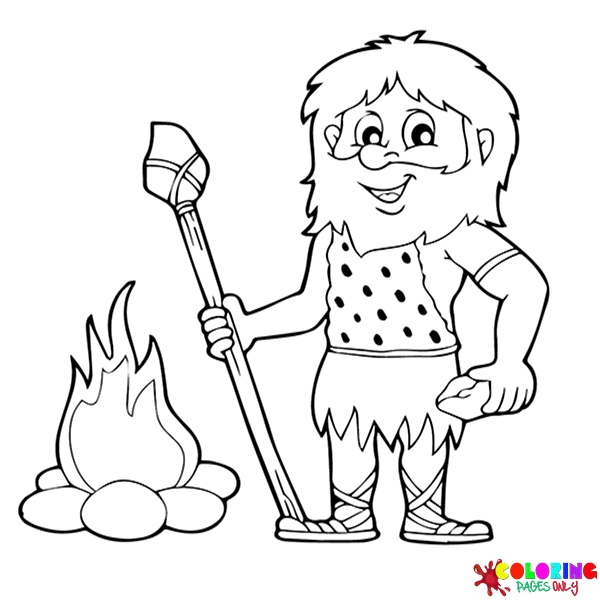
Prehistory coloring pages depict the visual world of early human life across several distinct periods and contexts. Hunter-gatherer life – the period before agriculture when all human groups subsisted by hunting animals and gathering wild plants – is shown through hunting scenes, the making and use of stone tools, fire-making and fire-tending, the construction of shelters from wood, hide, and natural materials, and the gathering of berries, roots, and other wild plant foods. The visual palette of prehistory pages is naturally dominated by earth tones: the warm ochres, burnt siennas, and natural blacks that prehistoric humans used as pigments are the same colors that characterize their physical environment – the brown of animal hides used for clothing and shelter, the tan of sandstone and limestone, the charcoal black of charred wood, and the vivid red of iron oxide (ochre) used both decoratively and in burial practices.
The cave painting context – pages showing the act of creating cave art, or depicting the animal subjects most commonly shown in prehistoric cave paintings (bison, aurochs, horses, woolly mammoths, cave bears, ibex, rhinos) – offers the most immediately distinctive visual experience in the Prehistory sub-category. Cave art animals are depicted in a specific stylistic convention developed by prehistoric artists: strong, confident outline drawings with internal coloring in the natural pigment range of red, black, brown, and occasionally yellow-ochre. The contours of the cave wall are sometimes used deliberately to suggest the three-dimensional roundness of the animal’s body, an artistic sophistication that still surprises and moves observers today. Coloring a prehistoric cave painting page – rendering the bison or mammoth in the warm reddish-brown of ochre pigment against the rough limestone gray of the cave wall – is one of the most historically resonant coloring experiences in the entire collection.
The Neolithic period (the New Stone Age, approximately 10,000–3,000 BCE depending on region) marks the transition from hunter-gatherer life to settled agriculture – one of the most consequential shifts in all of human history. Neolithic coloring pages show the visual world of early farming communities: the cultivation of wheat and barley, the domestication of sheep, cattle, goats, and pigs, the construction of permanent settlements with mud-brick or stone houses, the making of pottery (the characteristic round-bottomed vessels of Neolithic cultures, decorated with incised geometric patterns), and the building of the megalithic monuments – stone circles, dolmens, passage tombs – that remain some of the most mysterious and evocative structures in the entire human landscape. Stonehenge, Avebury, Newgrange, and the alignments of Carnac are among the most depicted Neolithic sites in coloring illustrations.
The Ancient Civilizations of the Near East
Mesopotamia covers the civilization of the Tigris and Euphrates river valleys in what is now Iraq and parts of Syria, Turkey, and Iran – the region that ancient Greeks called “the land between the rivers” and that historians have called the Cradle of Civilization with good reason. Mesopotamia was the location of the world’s first cities (Uruk, Eridu, Ur), the first writing system (Sumerian cuneiform, developed around 3,200 BCE), the first codified law (the Code of Hammurabi, circa 1754 BCE), and some of the first recorded literature (the Epic of Gilgamesh, which tells a story of friendship, loss, and the search for immortality that resonates as powerfully today as it did 4,000 years ago). The civilizations of Mesopotamia – the Sumerians, Akkadians, Babylonians, and Assyrians – succeeded each other over roughly three thousand years, leaving behind a visual legacy of extraordinary distinctiveness.
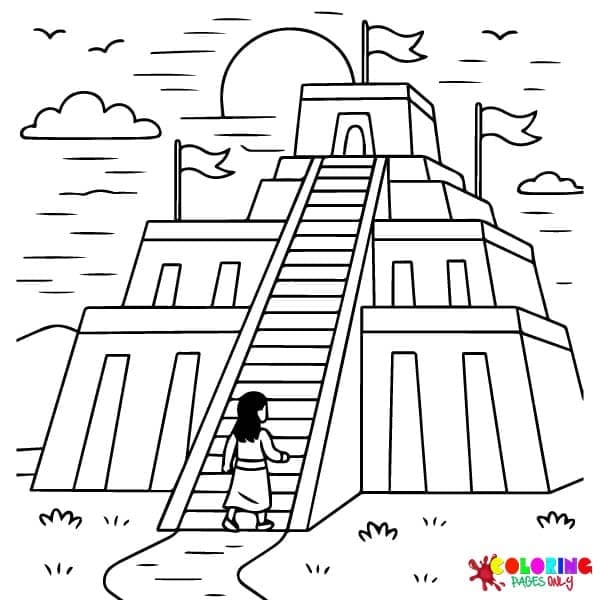
Mesopotamian coloring pages cover the most recognizable elements of this visual legacy. The ziggurat – the massive stepped pyramid-temple that was the architectural centerpiece of every major Mesopotamian city, rising in successive terraced levels to a shrine at the summit dedicated to the city’s patron deity – is among the most structurally distinctive buildings in ancient architectural history. The ziggurats of Ur (reconstructed in the 1980s and still partially visible in southern Iraq) and Babylon (the probable inspiration for the Tower of Babel narrative in the Book of Genesis) represent a building tradition entirely unlike the Egyptian pyramid: where the Egyptian pyramid is a burial monument with smooth, sloping sides and an internal chamber, the Mesopotamian ziggurat is a living religious building with stairways on its exterior faces, gardens and trees on its terraced levels, and a functioning temple at its apex.
Cuneiform writing – the wedge-shaped marks pressed into wet clay tablets using a reed stylus – is the world’s first writing system and one of the most visually distinctive scripts in human history. The angular, wedge-shaped impressions of cuneiform (the name comes from the Latin cuneus, meaning “wedge”) are immediately recognizable and entirely unlike any subsequent writing tradition. Cuneiform tablet coloring pages show this script in its clay tablet context – the impressed marks arranged in neat columns and rows across the surface of a rectangular clay slab. The canonical colors of a cuneiform tablet page are the warm tan-orange of baked or sun-dried clay, with the impressed cuneiform marks reading as slightly darker shadows in the clay surface.
Mesopotamian art is characterized by a specific visual convention that appears across cylinder seals, relief sculptures, and wall paintings: the frontal-facing eye and shoulders combined with the profile-facing head and legs, producing a composite view of the human figure that depicts multiple aspects simultaneously. This is the same artistic convention used in ancient Egyptian art, and its appearance in both cultures (independently, or through cultural exchange) reflects a shared early human tendency to depict what is known rather than what is literally seen from a single viewpoint. Coloring pages showing Mesopotamian figures – the bearded king, the worshipping devotee, the war scene from the Standard of Ur – invite engagement with this distinctive representational tradition.
Ancient Egypt: The Most Visually Rich Civilization
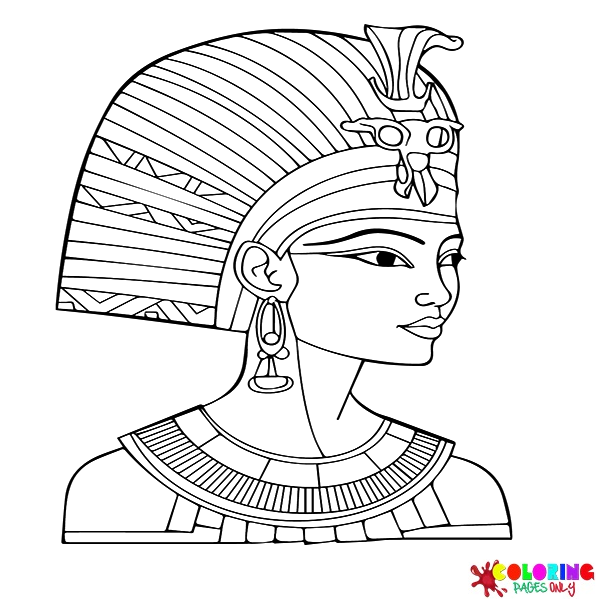
Ancient Egypt is the most visually distinctive and the most extensively covered civilization in the History collection – a civilization whose visual legacy is so powerful and so specific that its images are immediately recognizable to people worldwide, regardless of any formal education in Egyptology. The double crown of the pharaoh, the profile figures with forward-facing eyes and shoulders, the hieroglyphic script, the pyramids, the sphinx, the gods with their animal heads – these images have penetrated global visual culture so deeply that they function as a kind of international visual shorthand for antiquity itself.
Ancient Egyptian civilization flourished along the Nile River in northeastern Africa for approximately three thousand years – from the unification of Upper and Lower Egypt under the first pharaoh (traditionally dated to around 3,100 BCE) through the Ptolemaic period that ended with the death of Cleopatra VII in 30 BCE. This extraordinary continuity – three thousand years of recognizably continuous culture, longer than the time separating ancient Rome from the present day – produced a visual tradition of remarkable consistency and extraordinary sophistication. Egyptian artists and craftspeople developed a comprehensive system of visual representation that remained fundamentally consistent across those three millennia, governed by a precise canon of proportions, a specific set of color conventions, and a consistent approach to combining hieroglyphic text with figured imagery.
The pyramids are the most universally recognized Egyptian structures and among the most recognized human-made objects on earth. The three pyramids of Giza – the Great Pyramid of Khufu (the largest of the three and the only surviving member of the Seven Wonders of the Ancient World), the slightly smaller Pyramid of Khafre (which retains some of its original white limestone casing stones at the apex, giving a ghostly suggestion of how all three pyramids originally appeared), and the smaller Pyramid of Menkaure – were built during the Fourth Dynasty of the Old Kingdom, approximately 2560–2510 BCE. They were built as royal tombs, part of vast funerary complexes that included mortuary temples, causeways, satellite pyramids, boat pits, and the mastaba tombs of officials and family members arranged around the main pyramid.
The canonical coloring of the Giza pyramids requires understanding their current versus original appearance. Today, the pyramids appear in the warm golden-tan of exposed limestone – the Tura limestone of the outer casing has long been stripped away (much of it was removed in the medieval period for use in Cairo’s buildings), leaving the rougher, slightly more reddish-yellow core limestone visible. Originally, however, all three pyramids were covered in highly polished white Tura limestone casing stones that would have reflected the Egyptian sun blindingly – the pyramids would have appeared bright white from a distance, sometimes with gilded capstones (pyramidions) at their apex that caught the first and last rays of sunlight. Coloring pages that show the pyramids can authentically reflect either their current golden-tan appearance or their original brilliant white – both are historically legitimate and produce dramatically different visual results.
The Great Sphinx of Giza – the massive limestone sculpture of a recumbent lion with a human head, carved directly from a natural limestone outcropping during the Old Kingdom (probably the reign of Khafre, circa 2530 BCE) – is the world’s largest monolithic sculpture and one of the most immediately recognizable ancient monuments. The Sphinx’s current color is the warm golden-tan of weathered Egyptian limestone, but evidence suggests it was originally painted in vivid colors: the face red, the headdress striped in red and blue with yellow, and possibly the lion’s body painted as well. Its nose, famously missing since at least the medieval period, was almost certainly present on the original sculpture.
Egyptian hieroglyphics – the pictographic writing system that combines phonetic signs with logograms (symbols representing whole words or concepts) – is one of the most visually elaborate writing systems in human history and one of the most naturally suited to coloring page treatment. A page showing hieroglyphic inscriptions from a temple wall or papyrus document invites the colorist into the Egyptian color conventions for hieroglyphic script: figures of people and animals in the warm skin tones of Egyptian painting, the vivid blue of the sky and of lapis lazuli, the vivid green of vegetation, the red-orange of the sun, the yellow of gold, and the black of outlines. These are the canonical colors of Egyptian art – not naturalistic colors chosen to match reality, but symbolic colors assigned by convention and meaning.
The Egyptian gods with their distinctive animal-headed forms are among the most compositionally striking subjects in ancient art: Horus with his falcon head, Anubis with his jackal head, Thoth with his ibis head, Sekhmet with her lioness head, Sobek with his crocodile head, and the human-bodied, animal-headed deities that populate the Egyptian divine world. These figures appear in Egyptian art in the canonical frontal-shoulders, profile-head convention, typically wearing the elaborate costumes and crowns specific to each deity’s iconographic identity. The visual vocabulary of Egyptian divine imagery is so precisely defined that each deity is immediately identifiable by their specific combination of animal head, crown, and held symbols (the crook and flail of Osiris, the was-scepter of authority, the ankh of life).
Ancient Greece: Democracy, Philosophy, and the Classical Ideal
Ancient Greece covers the civilization that gave Western culture much of its foundational intellectual, political, artistic, and philosophical vocabulary – from democracy and philosophy to the Olympic Games, from the theatrical traditions of tragedy and comedy to the architectural vocabulary of columns, pediments, and friezes that still defines the appearance of banks, courthouses, and government buildings worldwide. Ancient Greek civilization flourished from approximately the 8th century BCE through the death of Alexander the Great in 323 BCE, with its cultural influence extending far beyond these dates through the Hellenistic period that followed and the Roman adoption of Greek cultural forms that carried them into the foundations of Western civilization.
Greek architecture is defined by the three classical orders – Doric (the simplest, with plain capital and no base), Ionic (with the distinctive scroll-shaped volute capitals), and Corinthian (the most elaborate, with capitals decorated with acanthus leaf patterns) – whose proportional systems and visual vocabulary have been the most influential architectural language in the Western tradition. Coloring pages showing Greek temples – the Parthenon on the Acropolis of Athens, the Temple of Hephaestus in the Athenian Agora, the Temple of Poseidon at Cape Sounion, the Temple of Apollo at Delphi – invite the question of authentic ancient versus modern appearance: like the Pyramids, Greek temples have a modern appearance (pale white marble or limestone) that differs significantly from their original painted reality.
Archaeological evidence strongly demonstrates that ancient Greek temples and their sculptural decoration were painted in vivid colors – the pale marble that strikes us as the quintessential Greek aesthetic is an accident of time, the paint having faded and worn away over the millennia. The original Parthenon featured sculptural friezes and figures painted in deep blues, vivid reds, bright greens, and gold, with architectural elements colored in consistent conventional patterns. This revelation – that ancient Greece was colorful rather than monochrome – transforms the coloring of Greek temple pages from an exercise in cream and white into an opportunity for vivid historical reconstruction. Coloring the Parthenon as it actually appeared to ancient Athenians – with its painted sculptural program, its vivid color details – produces a result that is historically more accurate than the monochrome marble version that modern visual culture has normalized.
The Athenian agora (the civic marketplace that was the social, political, and commercial heart of ancient Athens), the Olympic Games (established by tradition in 776 BCE and held every four years at Olympia as a religious festival honoring Zeus, with athletic competitions in running, wrestling, discus, javelin, jumping, chariot racing, and other disciplines), the Greek theater (the semicircular outdoor theater with its orchestra, skene, and tiered stone seating, where the plays of Aeschylus, Sophocles, Euripides, and Aristophanes were first performed), and the symposium (the organized drinking party that was a central institution of Greek intellectual and social life) are all depicted in Greek history coloring pages.
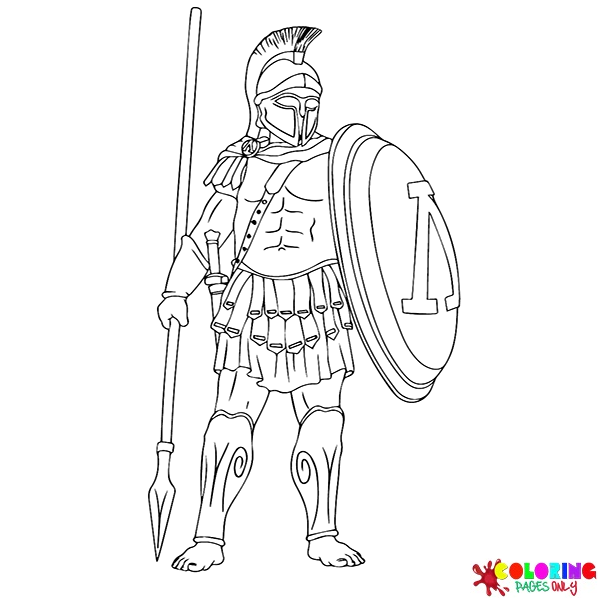
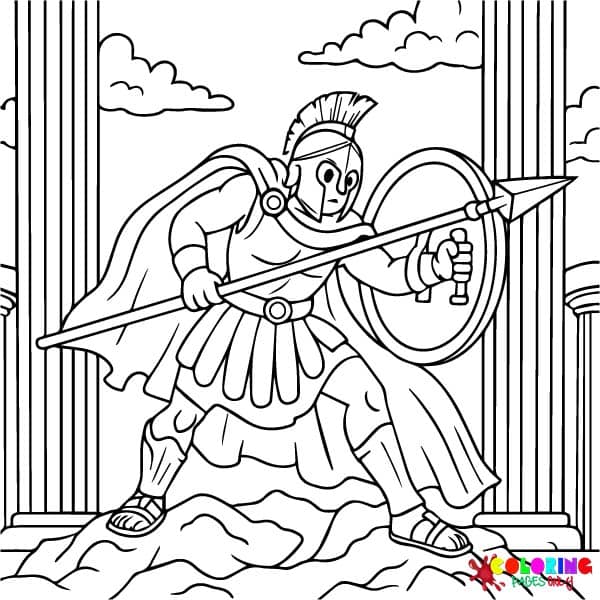
Greek mythology – the stories of the Olympian gods and heroes that formed the shared cultural narrative of the ancient Greek world – provides some of the most compositionally rich coloring subjects in the Ancient Greece sub-category: Zeus with his thunderbolt, Athena in her helmet and aegis, Poseidon with his trident, Hermes with his winged sandals and caduceus, Apollo with his lyre, Artemis with her bow, Aphrodite and the scene of the Judgement of Paris, Heracles (Hercules in the Roman tradition) with his lion skin and club, and the mythological creatures – the Minotaur, the Medusa, the Cyclops – that populate the hero narratives.
Ancient Rome: Empire, Law, and Engineering
Ancient Rome and Roman Empire covers one of the most consequential political entities in human history – the civilization that began as a small city-state on the Tiber River in central Italy in the 8th century BCE, developed into a republic and then an empire that at its height controlled territory from Scotland to Mesopotamia and from the Rhine to North Africa, and that left a cultural, legal, linguistic, and architectural legacy that has shaped Western civilization more profoundly than any other single source.
Roman architecture is the most recognizable ancient architectural tradition after the Greek – and indeed Roman architecture developed in large part as a creative adaptation and elaboration of Greek forms, adding the arch, the vault, and the dome (structural innovations that allowed buildings of far greater scale and spatial complexity than Greek trabeated construction permitted) to the inherited vocabulary of orders, columns, and temple fronts. The Colosseum (the Flavian Amphitheater, completed in 80 CE, the largest amphitheater ever built and the model for every subsequent sports stadium) is the most iconic Roman building and one of the most recognized structures in the world: its elliptical form, its four tiers of arched openings decorated with engaged columns in the three classical orders, and its capacity to hold 50,000 to 80,000 spectators make it an engineering and organizational achievement of the first order. The Pantheon (completed circa 125 CE under the Emperor Hadrian), with its unreinforced concrete dome – still the largest unreinforced concrete dome in the world, 1,900 years after its construction – represents Roman engineering at its most audacious. The Roman aqueducts (the extraordinary engineering infrastructure of channels, tunnels, and arched bridge sections that brought fresh water from distant springs into Roman cities) represent a commitment to urban infrastructure that would not be matched until the 19th century CE.
Roman military culture is one of the most visually distinctive and most depicted subjects in ancient history coloring pages. The Roman legionary soldier – in his lorica segmentata (the articulated plate armor of the Imperial period), with his scutum (the large rectangular curved shield), his pilum (the heavy javelin), his gladius (the short stabbing sword), and his distinctive crested helmet – is among the most immediately recognizable military figures in all of history. The organization of the Roman army into legions, cohorts, and centuries, with its precise tactical formations and its engineering capacity (Roman armies built roads, bridges, and siege works with professional efficiency), made it the most effective military force in the ancient Mediterranean world for several centuries.
Roman civic life as depicted in coloring pages covers the full range of daily life in the Roman world: the Forum Romanum (the civic center of Rome, surrounded by temples, law courts, and public buildings), the Roman baths (the elaborate public bathing complexes that were simultaneously hygienic facilities, social clubs, and cultural centers), the Roman home (the atrium house with its central open courtyard, its tablinum study, its triclinium dining room, and its household shrine to the Lares and Penates), Roman street life, and the specific roles and appearances of different social categories – senators in their togas with the broad purple stripe of senatorial rank, equestrians with their narrower stripe, common citizens in plain white wool togas, slaves in simple tunics.
The Ancient Americas: Maya Civilization
Maya Civilization covers one of the most intellectually and artistically sophisticated civilizations of the pre-Columbian Americas – the Mesoamerican culture that flourished in what is now southern Mexico (the Yucatan Peninsula, Chiapas, Tabasco), Guatemala, Belize, Honduras, and El Salvador from approximately 2000 BCE through the Spanish conquest in the 16th century CE, with the Classic period (250–900 CE) representing the height of Maya cultural and political development.
Maya civilization is remarkable for its independent development of a fully phonetic writing system (the Maya hieroglyphic script, one of only a handful of fully developed writing systems invented independently in human history), an extraordinarily precise astronomical calendar (the Maya Long Count calendar, which tracks time in cycles and whose completion of a major cycle on December 21, 2012 was misinterpreted in popular culture as predicting an apocalypse), and a sophisticated mathematical system that independently developed the concept of zero – a conceptual breakthrough that took Western mathematics until the Middle Ages to achieve.
Maya architecture is defined by its stepped pyramid-temples – structures that superficially resemble Mesopotamian ziggurats but developed entirely independently and serve different functions. The most famous Maya pyramid, the Temple of Kukulkan (El Castillo) at Chichen Itza in the Yucatan, is not a tomb but a temple and a precise astronomical calendar in stone: its four stairways of 91 steps each, plus the single step of the shared upper platform, total 365 – the number of days in the solar year. At the spring and autumn equinoxes, the angle of sunlight on the pyramid creates the visual illusion of a serpent descending the northern stairway – a phenomenon deliberately engineered by Maya architects. Coloring pages depicting Maya pyramids should show the characteristic stepped construction with its dramatic vertical faces, the temple structure at the summit, the steep and narrow stairways on one or more faces, and the surrounding jungle context that still engulfs many Maya sites.
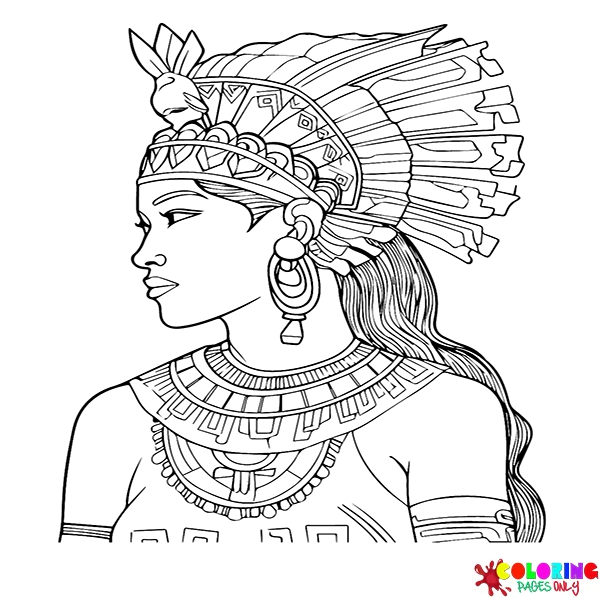
Maya calendar and astronomical knowledge features in pages showing the circular stone calendar faces, the elaborate date glyphs of the Long Count system, and the astronomical observatories (like the Caracol at Chichen Itza) that Maya priests used to track the movements of Venus, Mars, and other celestial bodies with extraordinary precision. Maya ceremonial costume – the elaborate headdresses of jade, quetzal feathers, and precious materials worn by rulers and priests in ritual contexts – is among the most visually spectacular of any ancient culture’s ceremonial dress, and pages depicting Maya rulers in full regalia provide some of the most compositionally elaborate coloring subjects in the entire History collection.
The Medieval World: Knights, Castles, and the Age of Faith
Medieval covers the broad period of European history from roughly the fall of the Western Roman Empire in 476 CE through the beginning of the Renaissance in the 14th–15th centuries – approximately a thousand years that have been both misunderstood as a “Dark Age” (a term historians have largely abandoned as inaccurate) and romanticized as an age of chivalry and adventure. The medieval period was, in reality, a time of extraordinary cultural creativity: the great Gothic cathedrals, the university system, the development of common law, the flowering of troubadour poetry and courtly literature, the preservation of ancient learning in monastery scriptoria, and the extraordinary technical achievement of stained glass manufacture all belong to this era.
The medieval castle is the most immediately recognizable architectural form of the period – the fortified residence of a lord or king, designed simultaneously as a defensive military installation, an administrative center, and a domestic residence. Castle architecture evolved significantly over the medieval period, from the simple motte-and-bailey structures of the Norman period (a wooden tower on a raised earth mound, surrounded by a fenced courtyard) through the stone shell keeps of the 11th and 12th centuries to the elaborate concentric castles of the 13th century (multiple rings of walls with towers, gatehouses, drawbridges, and moats). Coloring pages showing medieval castles cover this full range of castle types, from the simplified iconic castle form (towers with battlements, a drawbridge, a flag) to more architecturally detailed renderings of specific castle types.
The medieval knight – the armored warrior on horseback who was the dominant military force of the High Medieval period – is among the most recognizable figures in any historical coloring page. The evolution of medieval armor from simple chain mail (the hauberk of interlocked iron rings, worn by Norman knights at the Battle of Hastings in 1066) through the transitional armor of the 13th century to the full plate armor of the 15th century (the complete encasing of the body in shaped steel plates, articulated at the joints to allow movement) represents one of the most visually dramatic technological transformations in any area of material culture. The knight on horseback in full plate armor – with the closed visor, the surcoat displaying his heraldic colors, the jousting lance or sword, the caparisoned destrier – is the image of the medieval warrior that has captured cultural imagination most powerfully.
Heraldry – the systematic use of hereditary symbols on shields, surcoats, and banners to identify individuals and families in battle and tournament – is one of the most formally elaborate visual systems developed in any culture, with its precise vocabulary of field colors (Or/gold, Argent/silver, Gules/red, Azure/blue, Sable/black, Vert/green, Purpure/purple), charges (the symbols placed on the field), and rules governing their combination. Heraldry coloring pages invite engagement with this specific visual language: coloring a heraldic shield requires understanding which colors can be combined (the rule of tincture requires that a metal – gold or silver – always contrasts with a color – never metal on metal or color on color), and choosing how to render the specific charges (lions, eagles, crosses, fleur-de-lis, chevrons, bends) that populate the heraldic vocabulary.
Vikings covers the Norse seafarers of Scandinavia who from approximately 793 CE (the raid on the Lindisfarne monastery in northern England, traditionally taken as the beginning of the Viking Age) through approximately 1066 CE (the Norman Conquest of England, itself carried out by the descendants of Viking settlers in northern France) were the most geographically mobile and culturally transformative force in the North Atlantic world. The Vikings were simultaneously traders, settlers, explorers, and raiders – establishing trade routes from Scandinavia to Constantinople and Baghdad, founding settlements in Iceland, Greenland, and briefly in North America (at L’Anse aux Meadows in Newfoundland, approximately 500 years before Columbus), and serving as mercenary soldiers in the Byzantine emperor’s Varangian Guard.
The Viking longship is the defining technological achievement of the Viking Age and one of the most visually dramatic watercraft in all of maritime history – the shallow-drafted, double-ended clinker-built vessel with its single rectangular sail, its rows of oars, and its carved prow (often decorated with a dragon or serpent head, giving the largest class of longship its Old Norse name drakkar, “dragon”). Longship coloring pages show this distinctive vessel in its most evocative form: under sail in open water with the striped sail (typically red-and-white or undyed wool in natural colors) billowing in the wind, the carved prow rising from the bow, and the round shields of the oarsmen ranged along the gunwales. The longship’s design – requiring no harbor facilities, capable of being beached directly on shore, shallow enough to navigate far upriver – was the key to the Vikings’ strategic mobility.
Viking runestones – the carved memorial stones bearing runic inscriptions that were erected across Scandinavia and Viking-settled areas – are among the most visually distinctive documents of the Viking Age. The runic alphabet (the Elder and Younger Futhark) is a writing system adapted to carving in wood and stone, with its angular, straight-lined letterforms that can be cut cleanly across the grain of wood without the curved strokes that tend to split the fiber. Many runestones feature not just inscription but elaborate carved decoration – the serpentine or dragon forms that frame the runic text, the spiral interlace patterns that fill the interior of the stone, and in some cases, figurative scenes from Norse mythology. The Jelling stone in Denmark, the most famous runestone in the world, was erected by Harald Bluetooth (the Viking king whose historical name was borrowed by the Bluetooth wireless protocol) and features both runic inscription and a figure of Christ – a monument to the Christianization of Denmark.
The Renaissance: Art, Humanism, and the Rebirth of Knowledge
Renaissance covers the extraordinary cultural flowering that began in the Italian city-states in the 14th century, spread across Europe through the 15th and 16th centuries, and transformed virtually every domain of human intellectual and artistic life – from painting, sculpture, and architecture to philosophy, science, literature, and political thought. The Renaissance (French for “rebirth”) took its self-understanding from the idea of a return to the values and achievements of classical antiquity after the medieval interlude – a narrative that subsequent historians have complicated and revised, but that captures something genuine about the period’s conscious orientation toward the Greco-Roman past.
Renaissance painting represents one of the most dramatic transformations in the history of art: the development of linear perspective (the geometrically rigorous system for representing three-dimensional space on a two-dimensional surface, traditionally credited to the Florentine architect Filippo Brunelleschi circa 1413–1415), the refinement of oil painting technique (perfected in the Netherlands by Jan van Eyck in the early 15th century and adopted in Italy subsequently), and the integration of classical compositional principles with Christian subject matter produced an art of extraordinary technical sophistication and expressive power. Leonardo da Vinci, Michelangelo, Raphael, Titian, Botticelli, Donatello, Ghiberti, and Brunelleschi – the figures whose names define the Italian Renaissance – produced works of such quality and influence that they have remained the reference points of Western artistic achievement for five centuries.
The human figure as the supreme subject of art is the most fundamental Renaissance artistic principle – the result of a humanistic philosophy that placed humanity at the center of its worldview rather than as a small element in a theologically oriented cosmos. The ideal human body – proportioned according to the Vitruvian canon (the ancient Roman architect Vitruvius had described the perfect human proportions, and Leonardo’s Vitruvian Man drawing of approximately 1490 is the most famous visualization of this concept) – became the touchstone of Renaissance figurative art. Renaissance coloring pages showing human figures invite engagement with this proportional ideal: the carefully observed anatomy, the natural poses that replaced the hierarchical, frontal conventions of medieval art, and the specific Renaissance approach to depicting drapery (the cloth of garments, rendered in the play of light and shadow over its folds) as a subject of artistic attention in its own right.
Florence – the city of the Medici banking family whose patronage funded so much Renaissance art – is the most associated city with the Italian Renaissance, and its urban landscape as it appeared in the 15th century provides some of the most architecturally distinctive Renaissance coloring page settings: Brunelleschi’s dome of the Florence Cathedral (the largest masonry dome ever constructed, a structural engineering feat that had not been attempted since the Pantheon and that required entirely new engineering solutions), the Palazzo della Signoria, the Baptistery of San Giovanni with Ghiberti’s bronze doors (which Michelangelo called the Gates of Paradise), and the Ponte Vecchio with its shops overhanging the Arno River.
The Most Modern Historical Event: Titanic
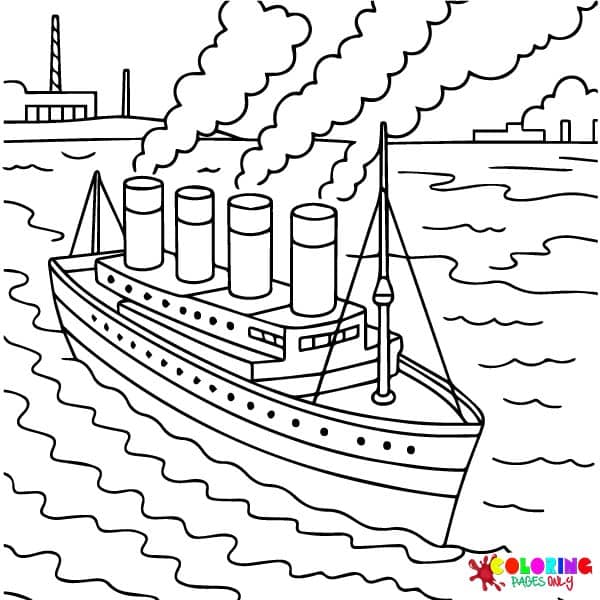
Titanic Ship is the only modern historical event with its own dedicated sub-category in the History collection – a reflection of the RMS Titanic’s extraordinary hold on popular historical imagination in the century since the ship’s sinking. The Titanic – the British ocean liner operated by the White Star Line, on its maiden voyage from Southampton to New York City, struck an iceberg at 11:40 PM on the night of April 14, 1912 and sank at 2:20 AM on April 15 – was the largest ship afloat at the time of its launch and was widely described as “unsinkable” in contemporary promotional material, though this claim was more nuanced in engineering documents than popular memory suggests.
The Titanic’s visual identity is among the most precisely documented of any historical vessel: the four funnels (only three of which actually functioned, the fourth being a ventilation shaft added partly for aesthetic symmetry because four funnels suggested power and modernity to early 20th century passengers), the black hull with its white upper works and the distinctive White Star Line gold stripes between the black and white zones, the red-painted lower hull below the waterline, the two masts, and the sweeping bow that represented the pinnacle of early 20th century shipbuilding aesthetics. The funnels themselves are a specific color: not pure black and not pure buff-yellow, but the distinctive deep reddish-tan of the White Star Line’s funnel color (described as “buff” in contemporary sources), with black tops.
Titanic coloring pages cover the ship in its full pre-sinking glory – the massive vessel photographed in Southampton and Belfast, the elegant interiors of the first-class accommodations (the Grand Staircase with its oak paneling and wrought iron balustrades, the first-class dining saloon, the Turkish bath), the iceberg in the dark North Atlantic night, and the sinking itself as depicted in the visual conventions established by documentary and fictional representations of the event.