
Predator Coloring Pages
 By:
Jennifer Thoa - Content Editor & Designer
Updated:
By:
Jennifer Thoa - Content Editor & Designer
Updated:
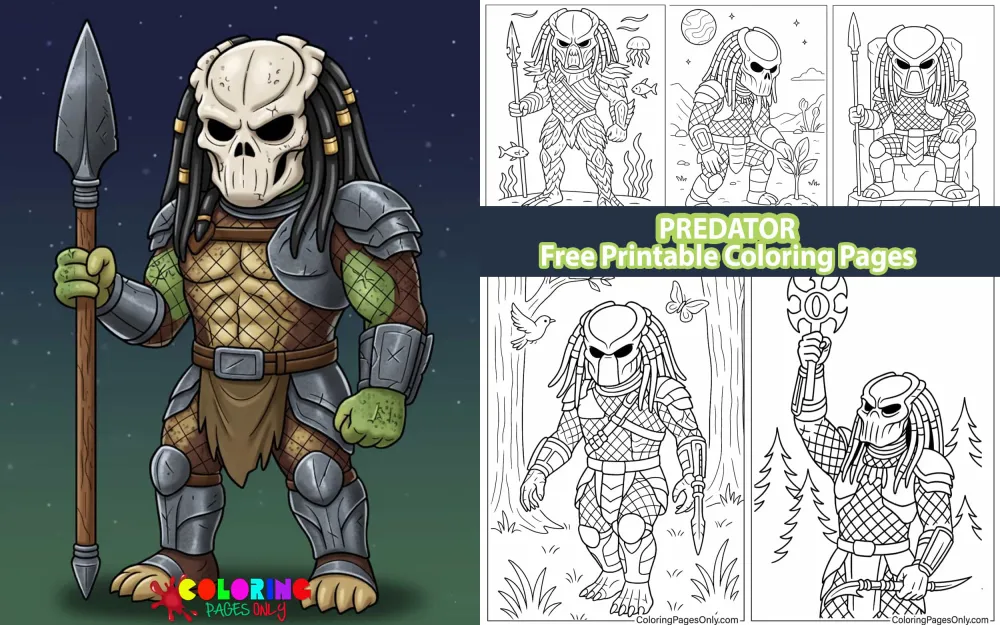
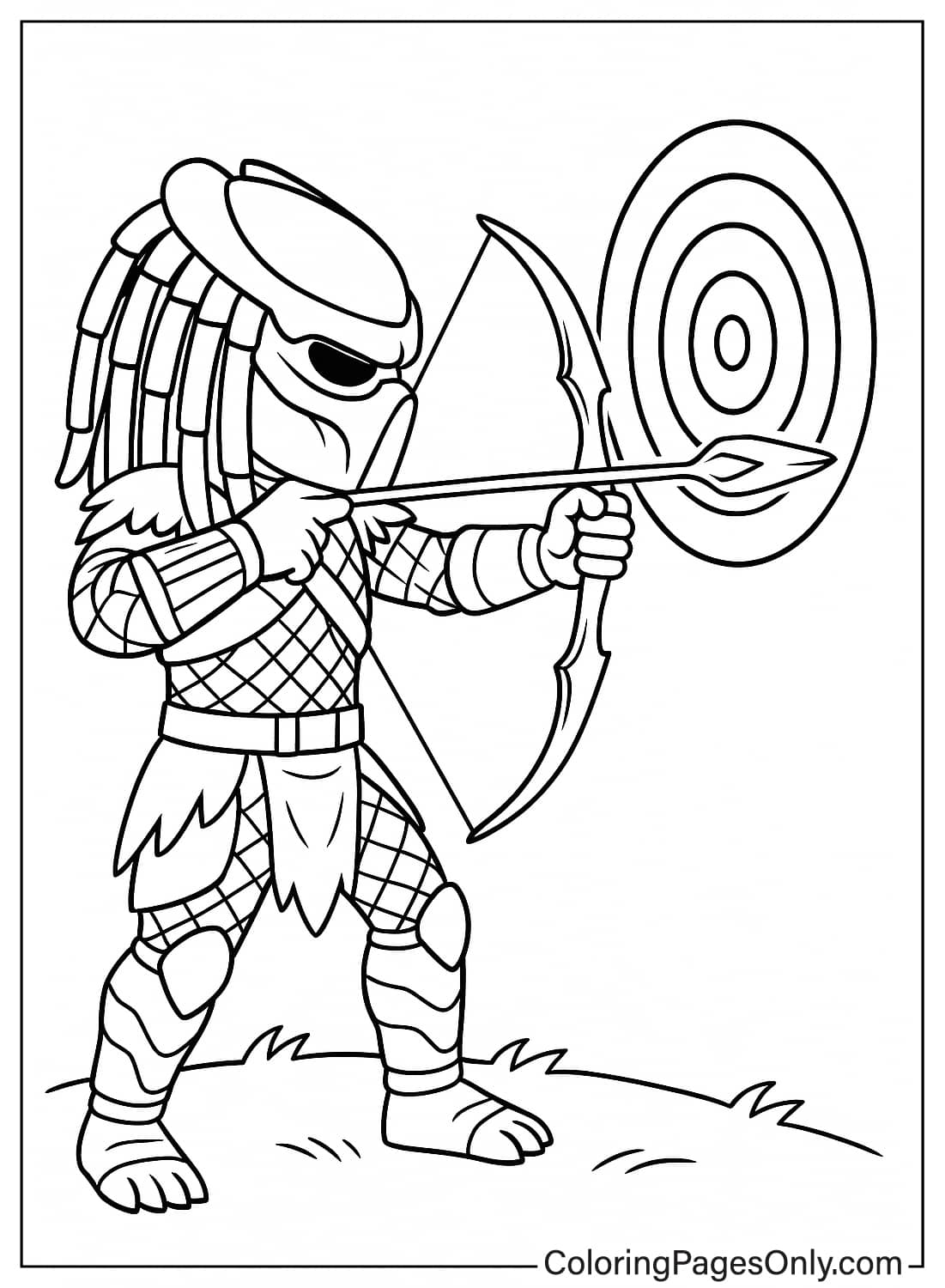
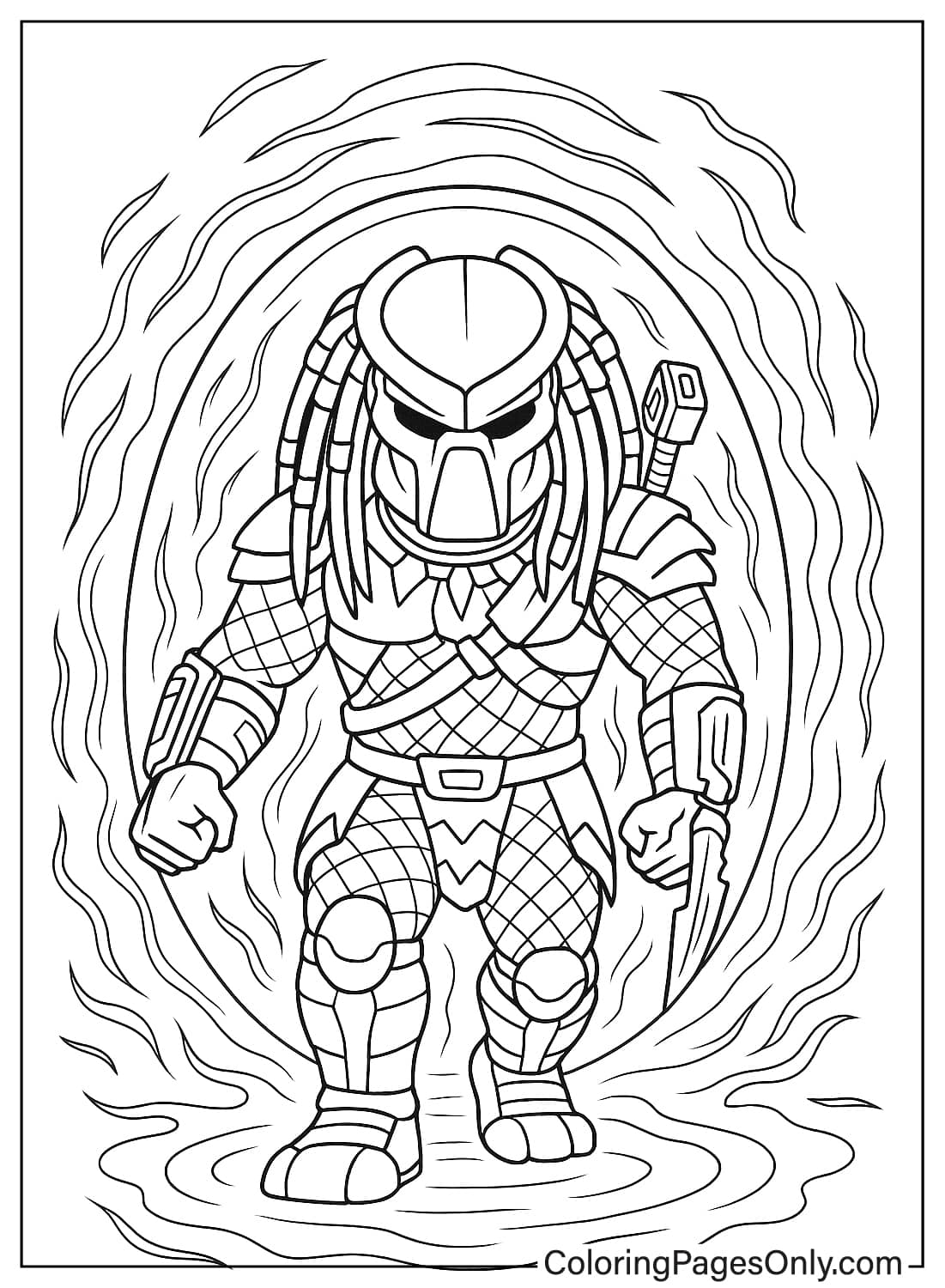
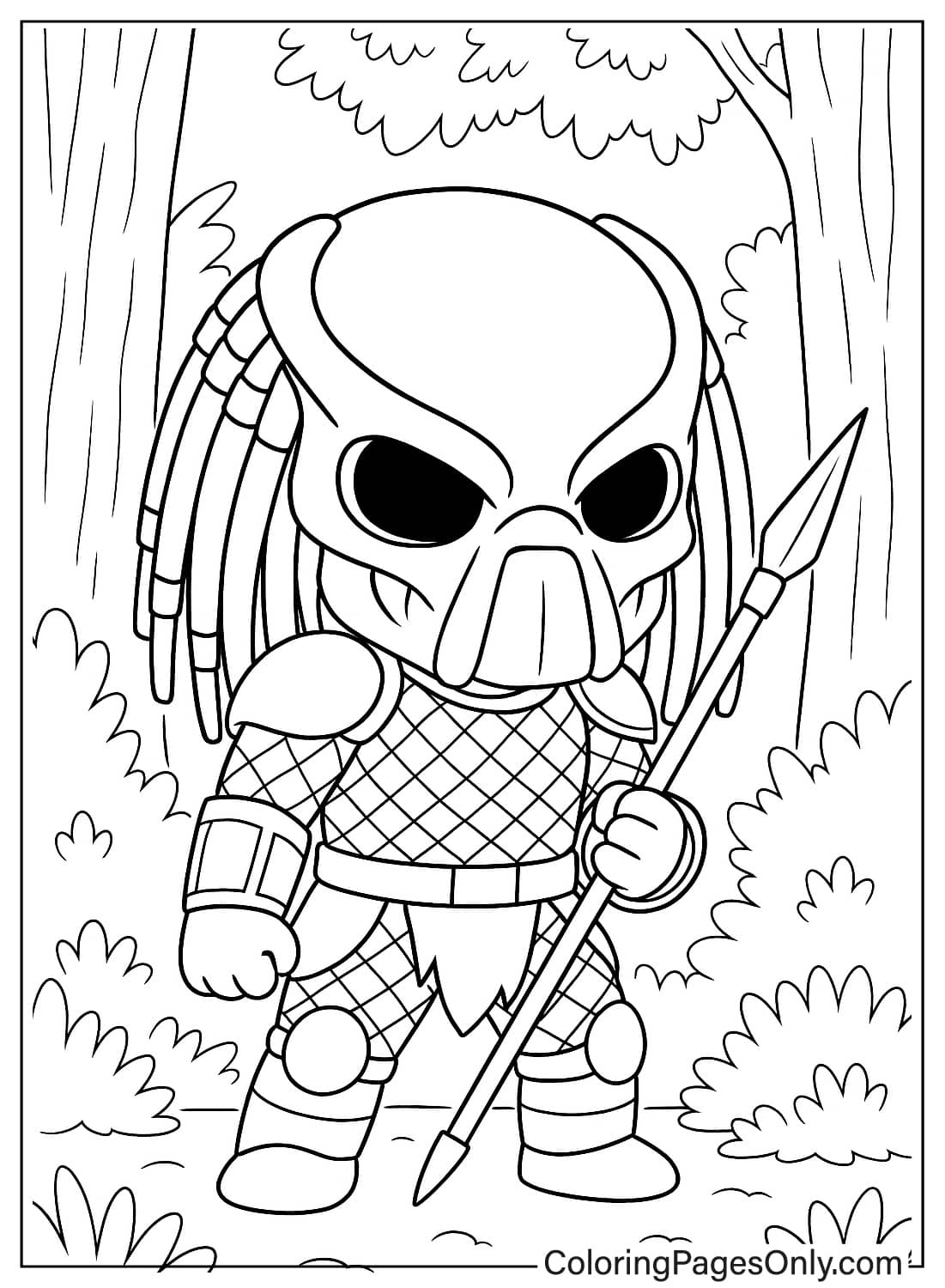
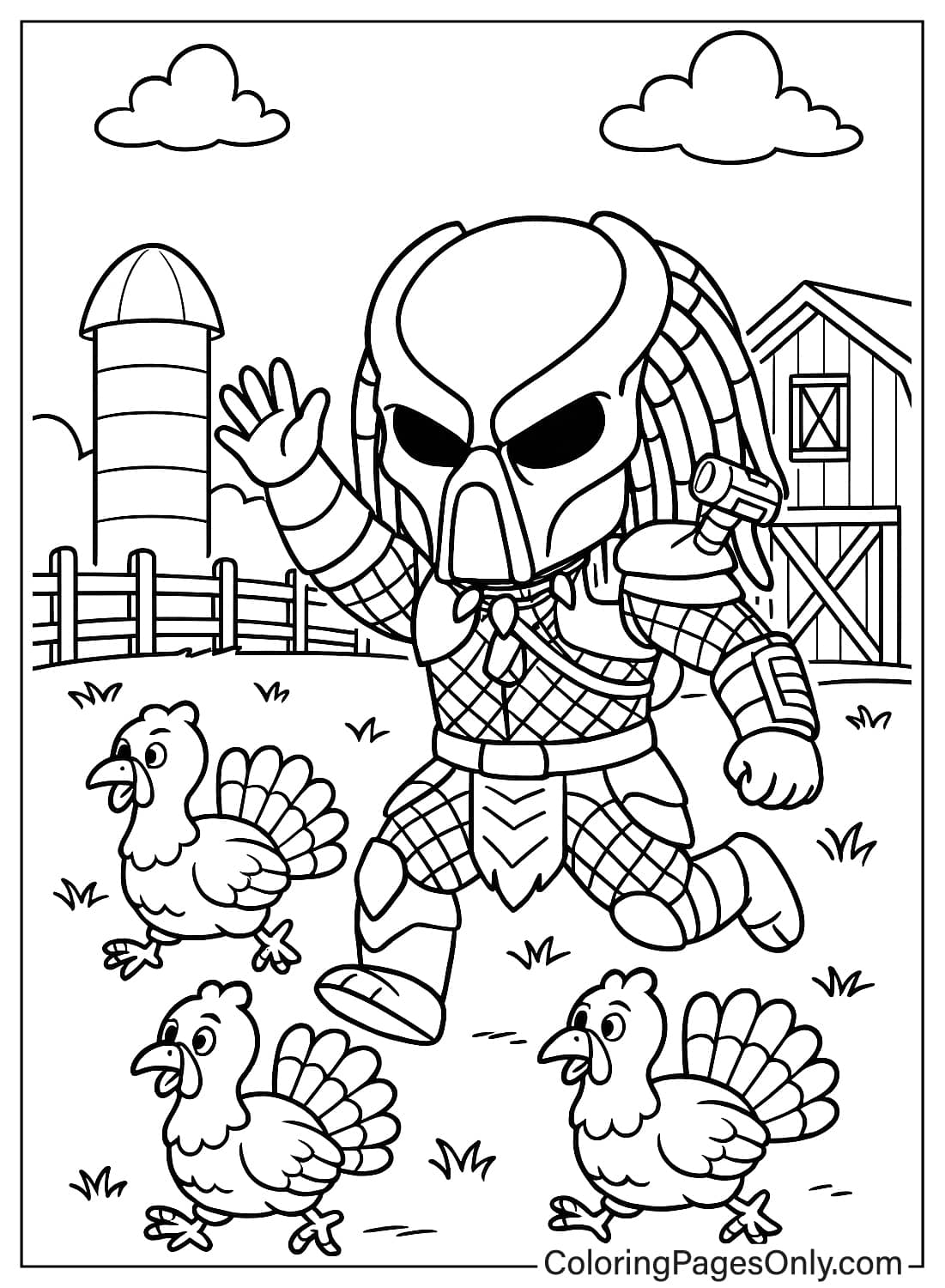
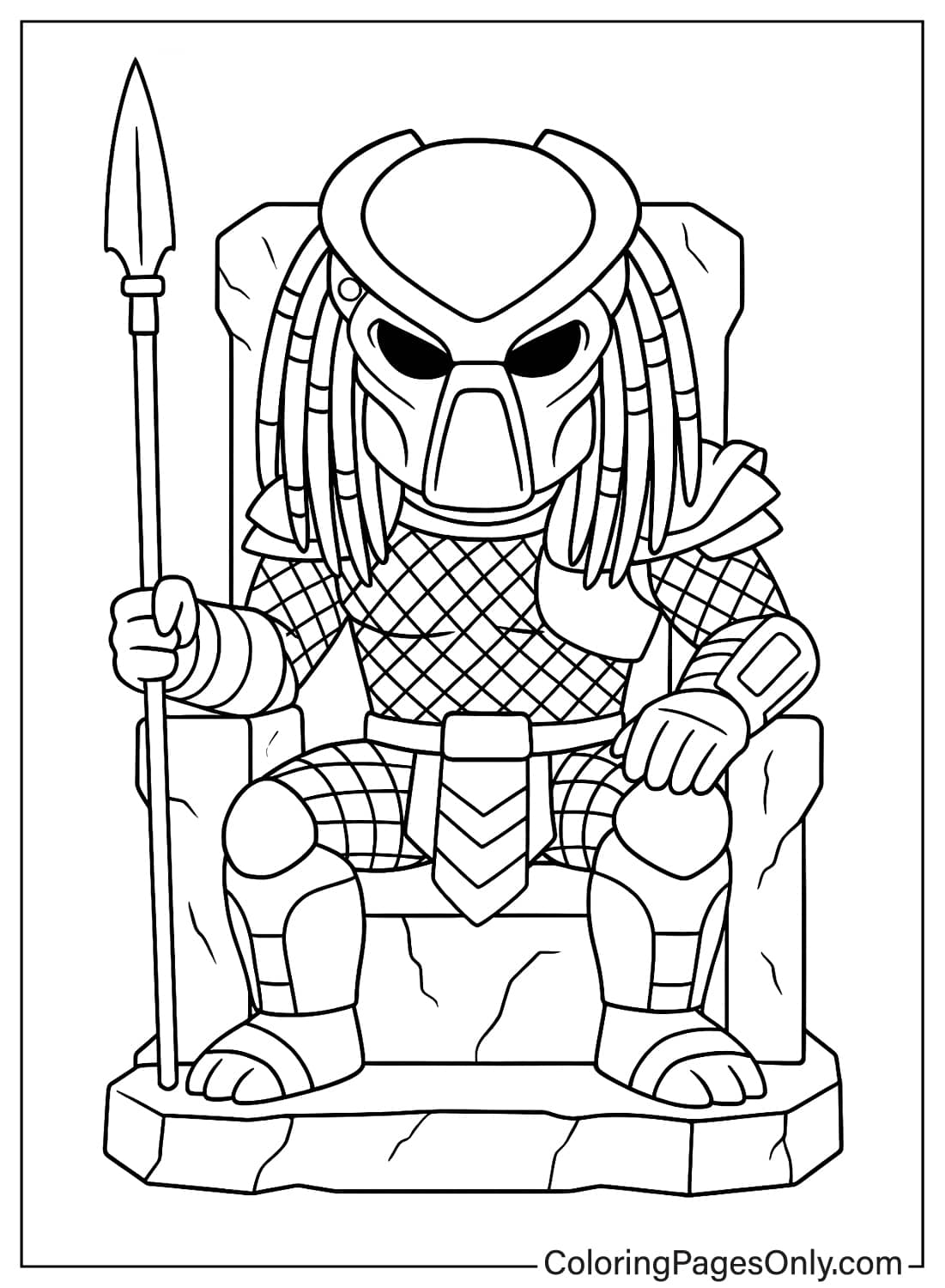
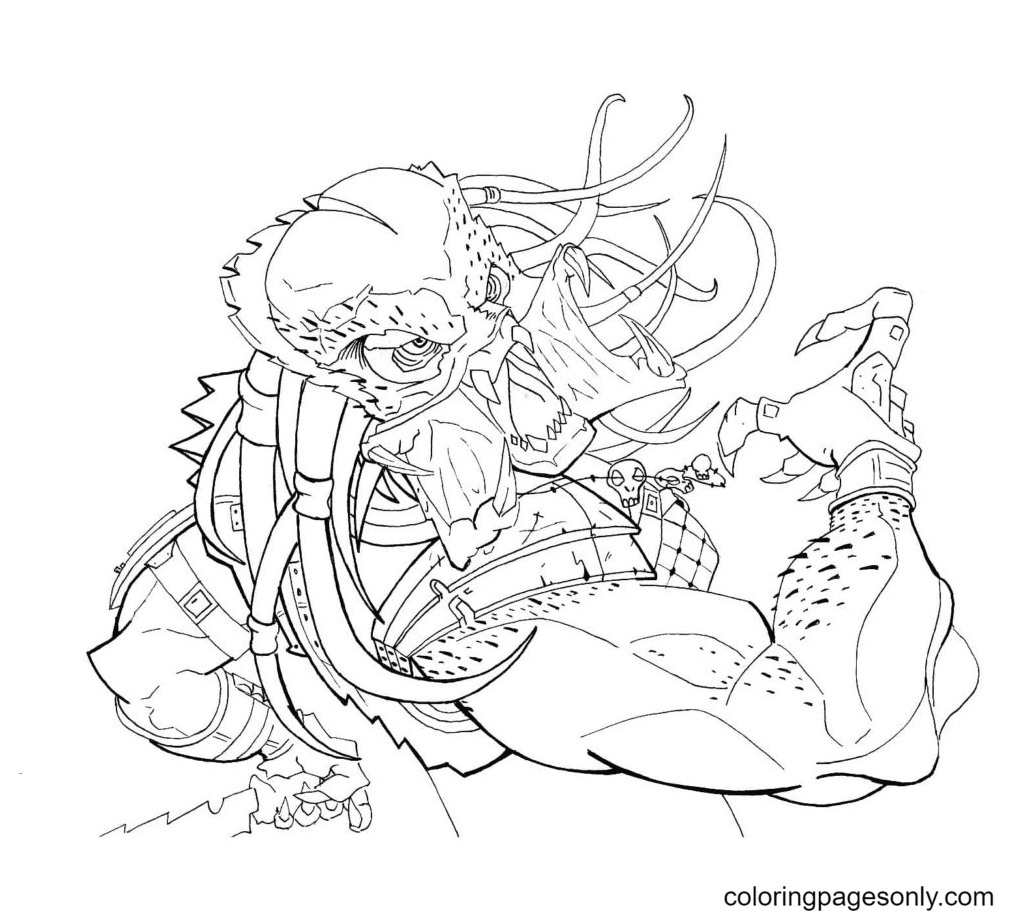
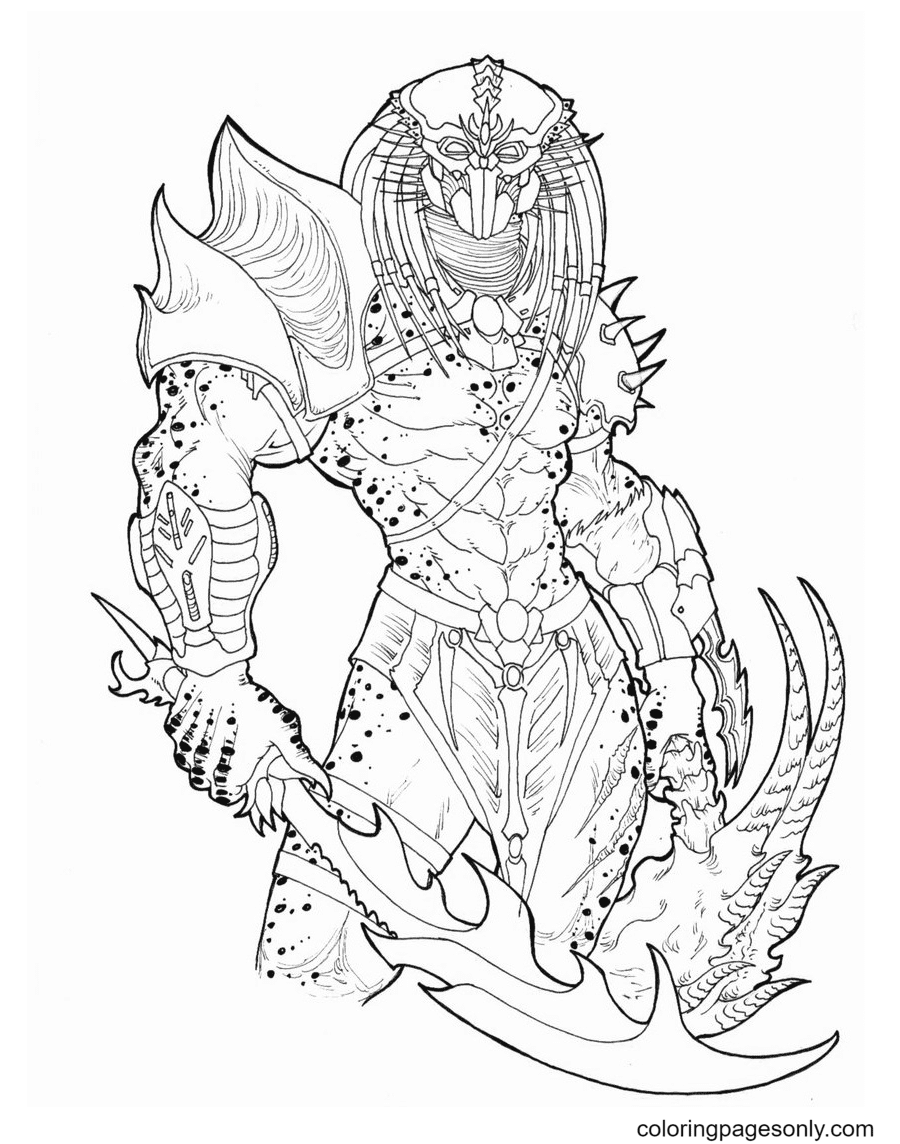
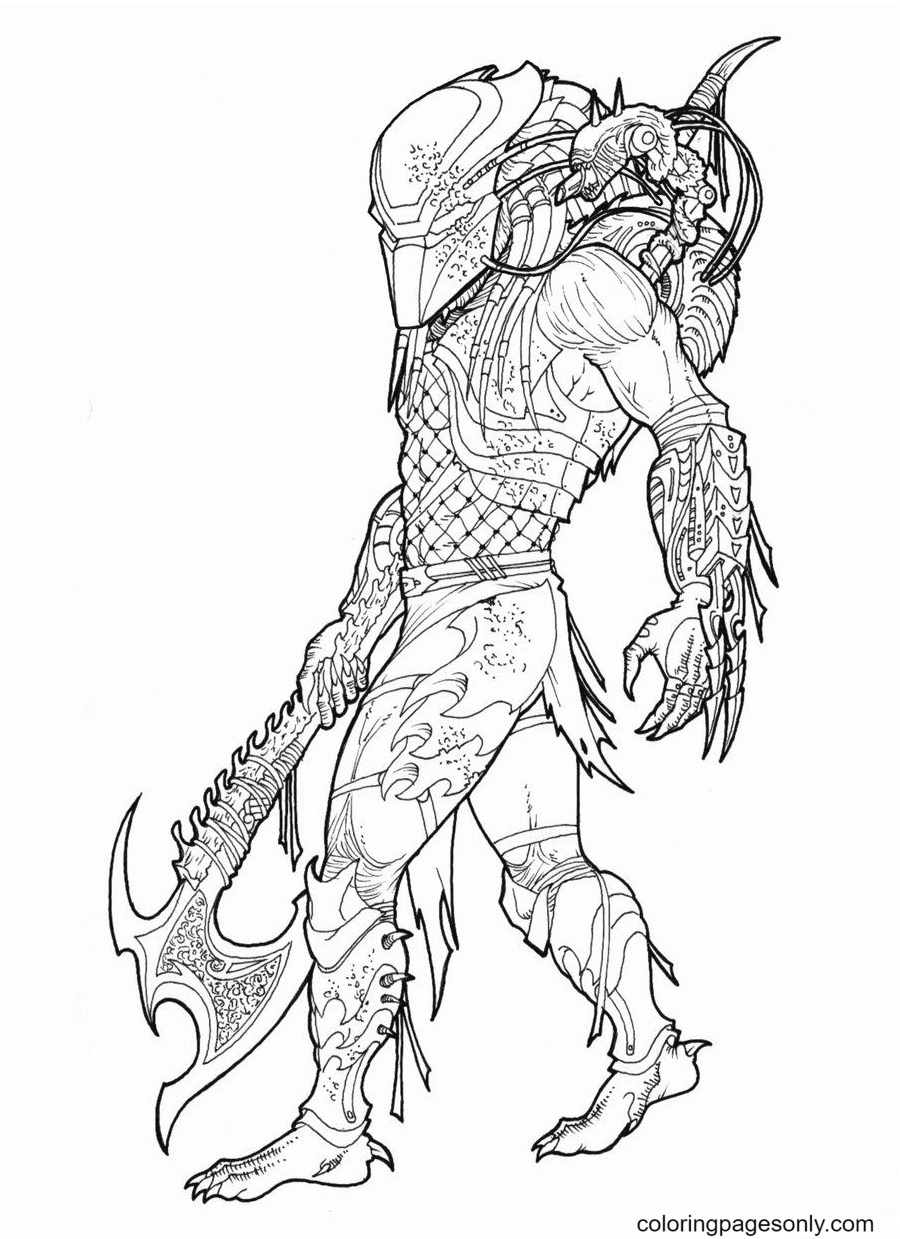
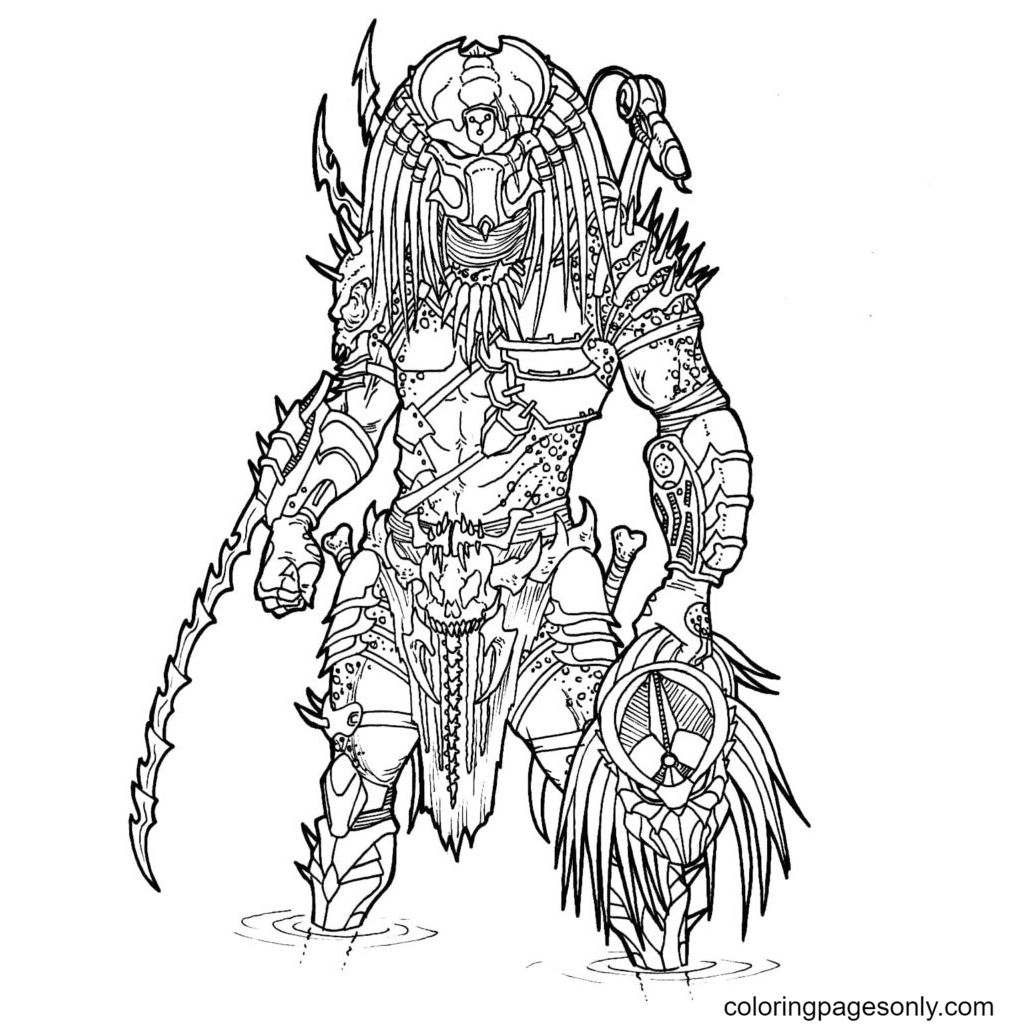
Free Predator coloring pages: 80+ pages featuring the Yautja warrior in full armor and combat poses, close-up portraits of the bio-helmet and mandible face, plasma caster and wrist blade detail pages, jungle environment scenes, the thermal vision register, Feral Predator pages from the 2022 film Prey, Alien vs. Predator crossover compositions, skull trophy imagery, and the full visual vocabulary of science fiction’s most technically detailed alien hunter design. All free, printable PDFs and online coloring for fans of the franchise.
The Predator first appeared on screen on June 12, 1987, in John McTiernan’s film of the same name, produced by Joel Silver and Lawrence Gordon for 20th Century Fox. The alien’s physical design was created by Stan Winston and his studio after an earlier design concept was abandoned during pre-production. The creature was portrayed on set by Kevin Peter Hall, an actor standing 7 feet 2 inches (218 centimeters) tall, whose physical presence gave the character an immediate scale that the design’s visual sophistication required.
The franchise has produced seven theatrical and streaming films across 38 years: Predator (1987), Predator 2 (1990), Predators (2010), The Predator (2018), and Prey (2022, directed by Dan Trachtenberg, released on Hulu on August 5, 2022, and earning 92% on Rotten Tomatoes). Prey is set in 1719 on the Great Plains and follows Comanche warrior Naru, played by Amber Midthunder. It was also released in a full Comanche language version, the first Hollywood film dubbed entirely in that language.
These 80+ free pages at ColoringPagesOnly.com span the franchise’s full visual history. All free, PDF or PNG, print or color online.

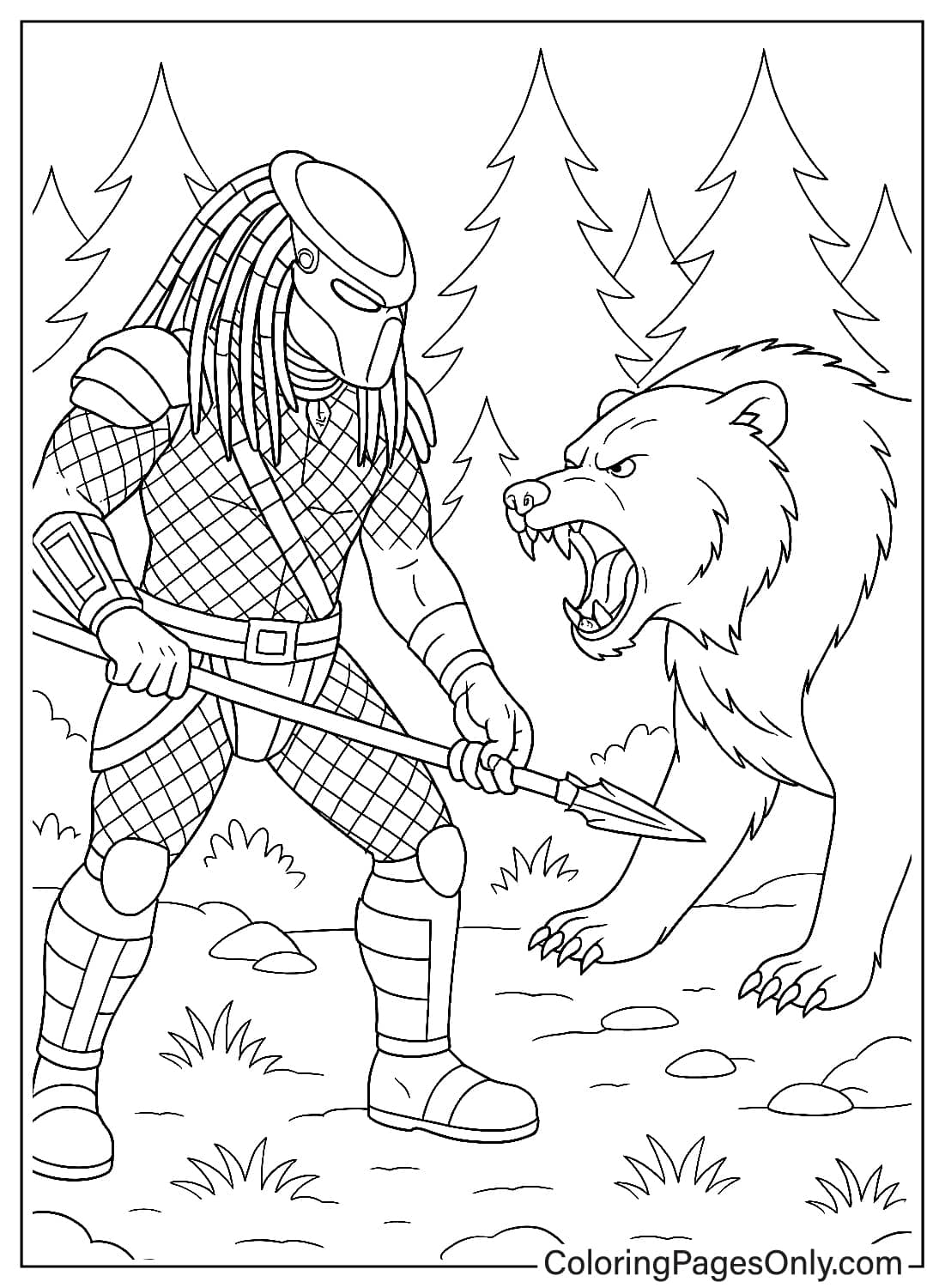
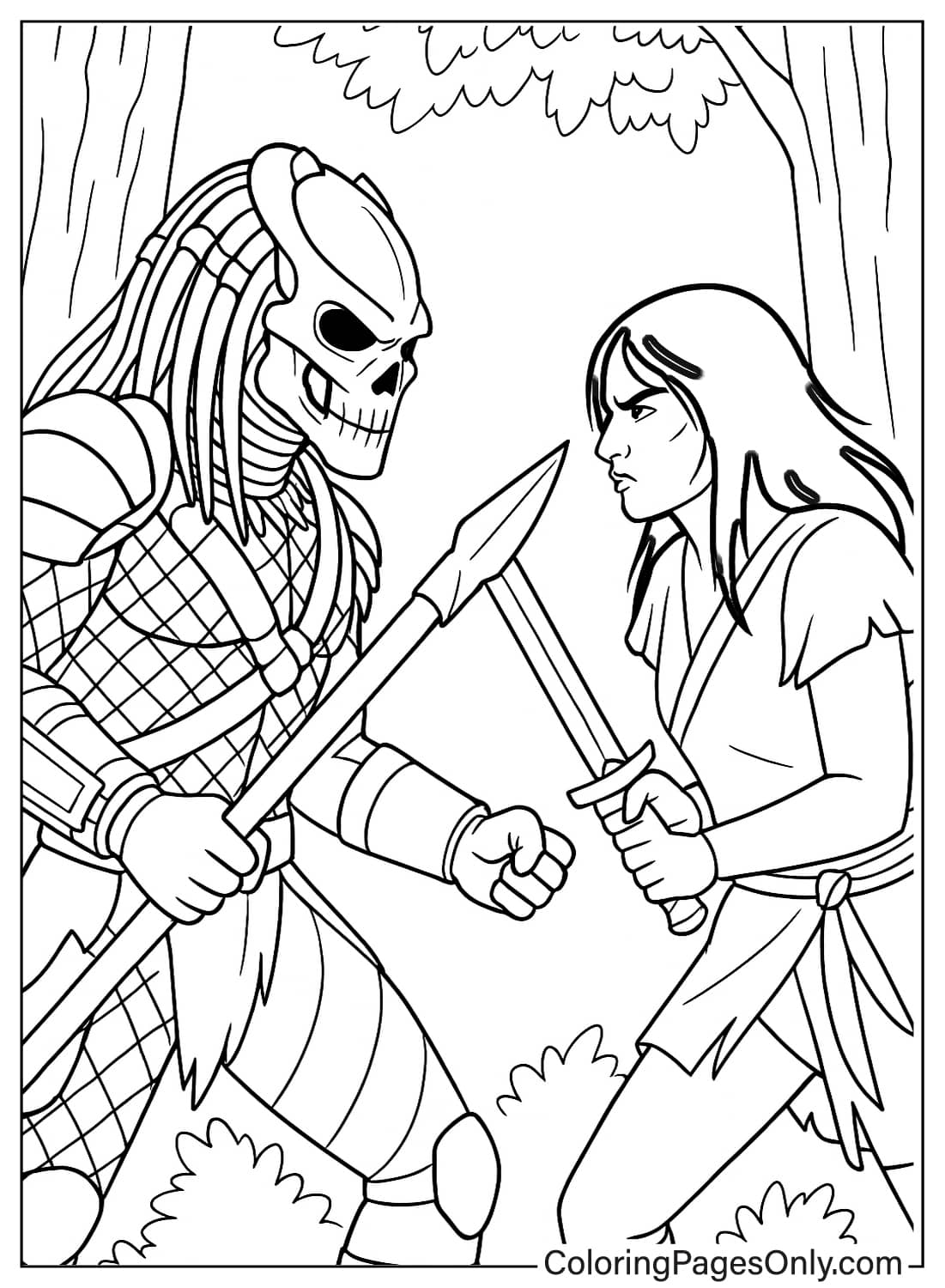

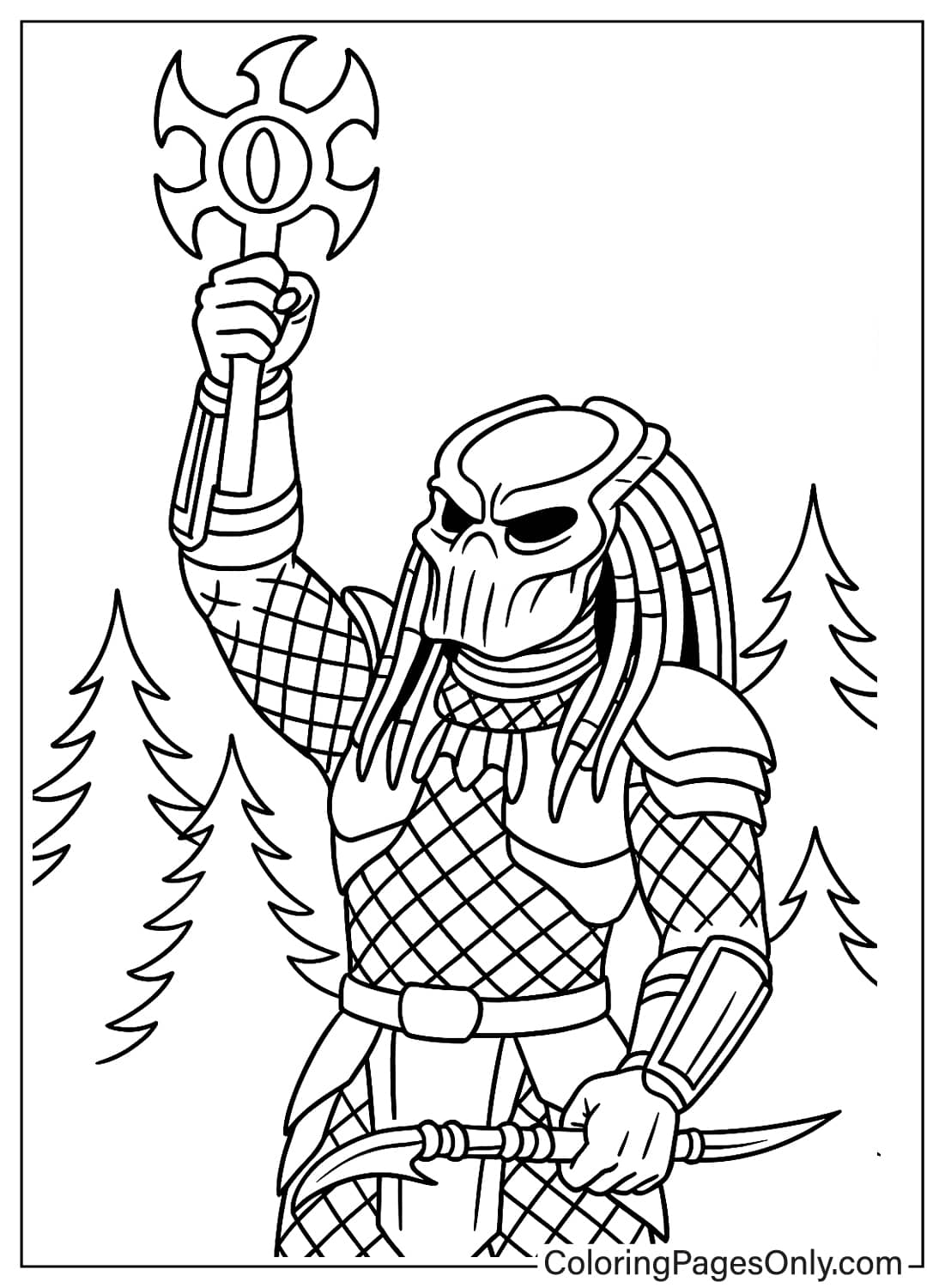
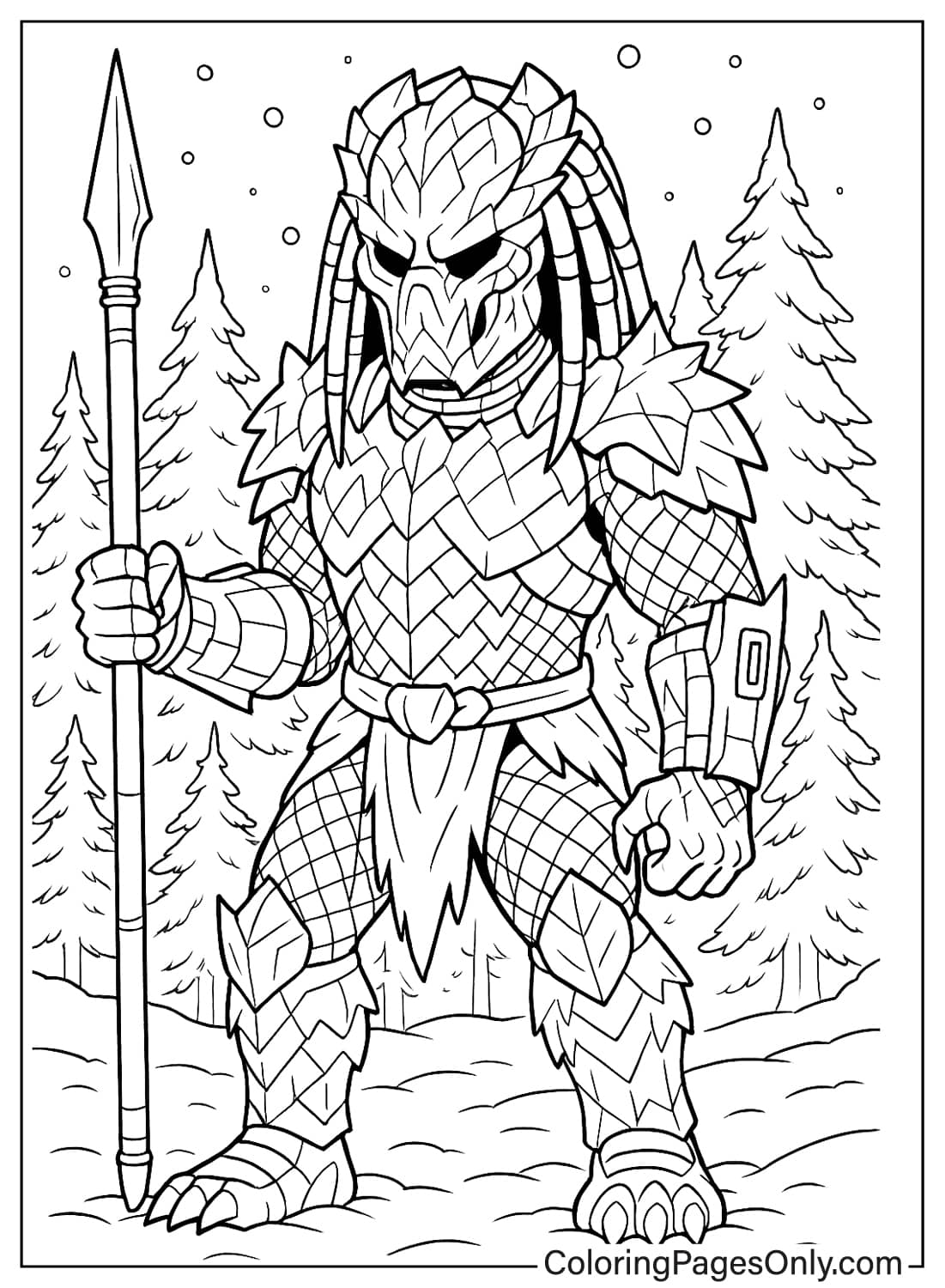
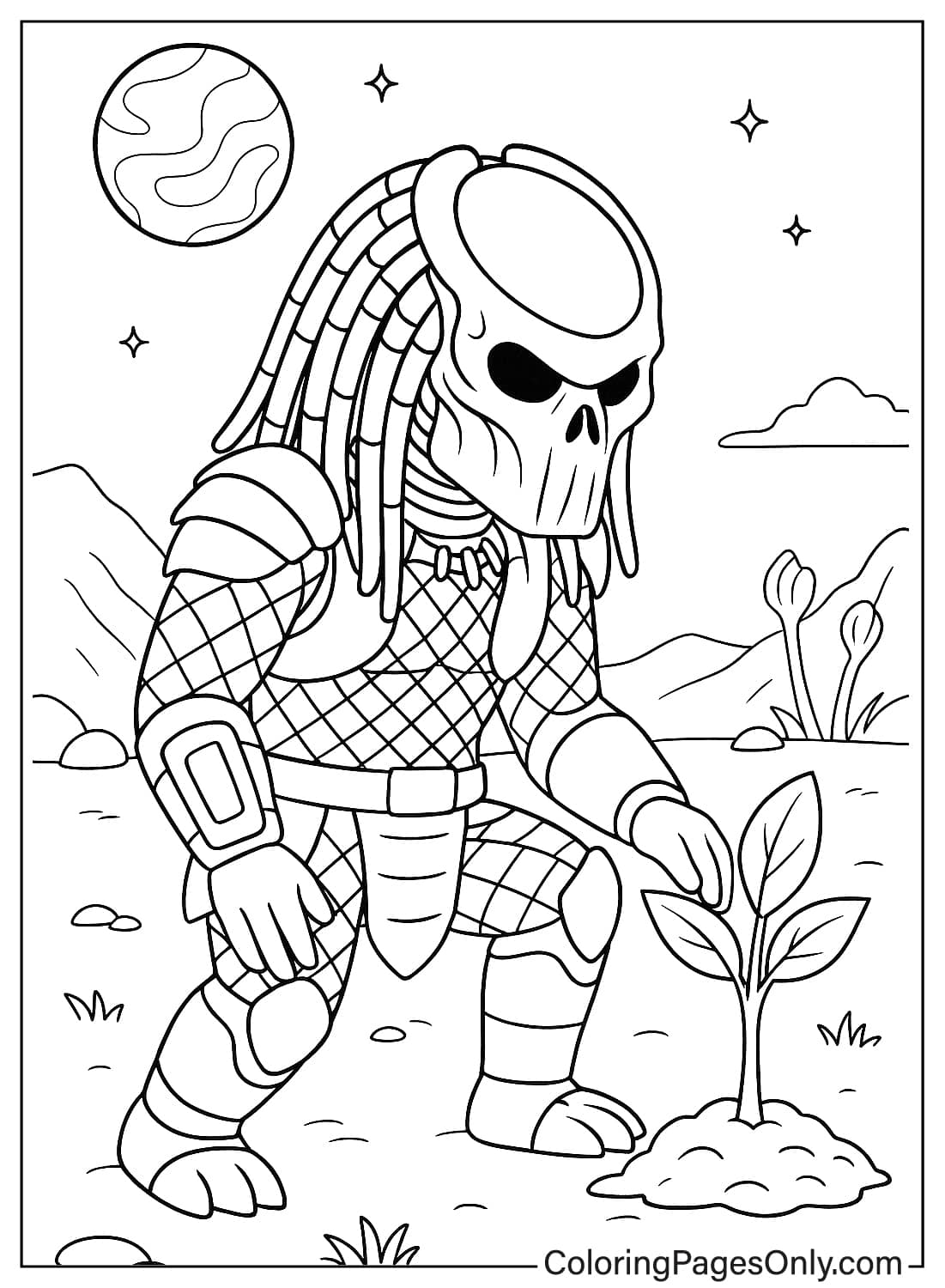
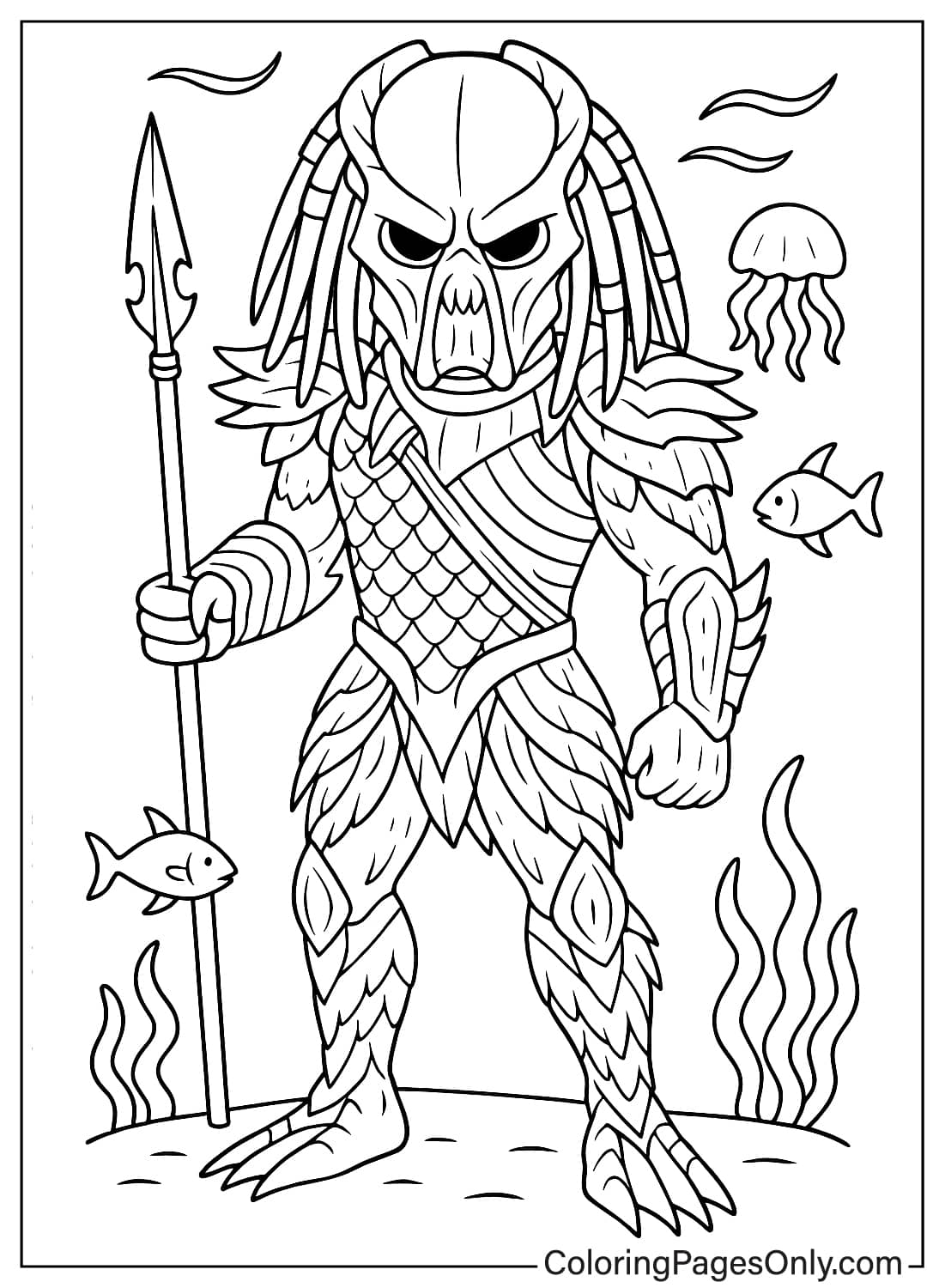
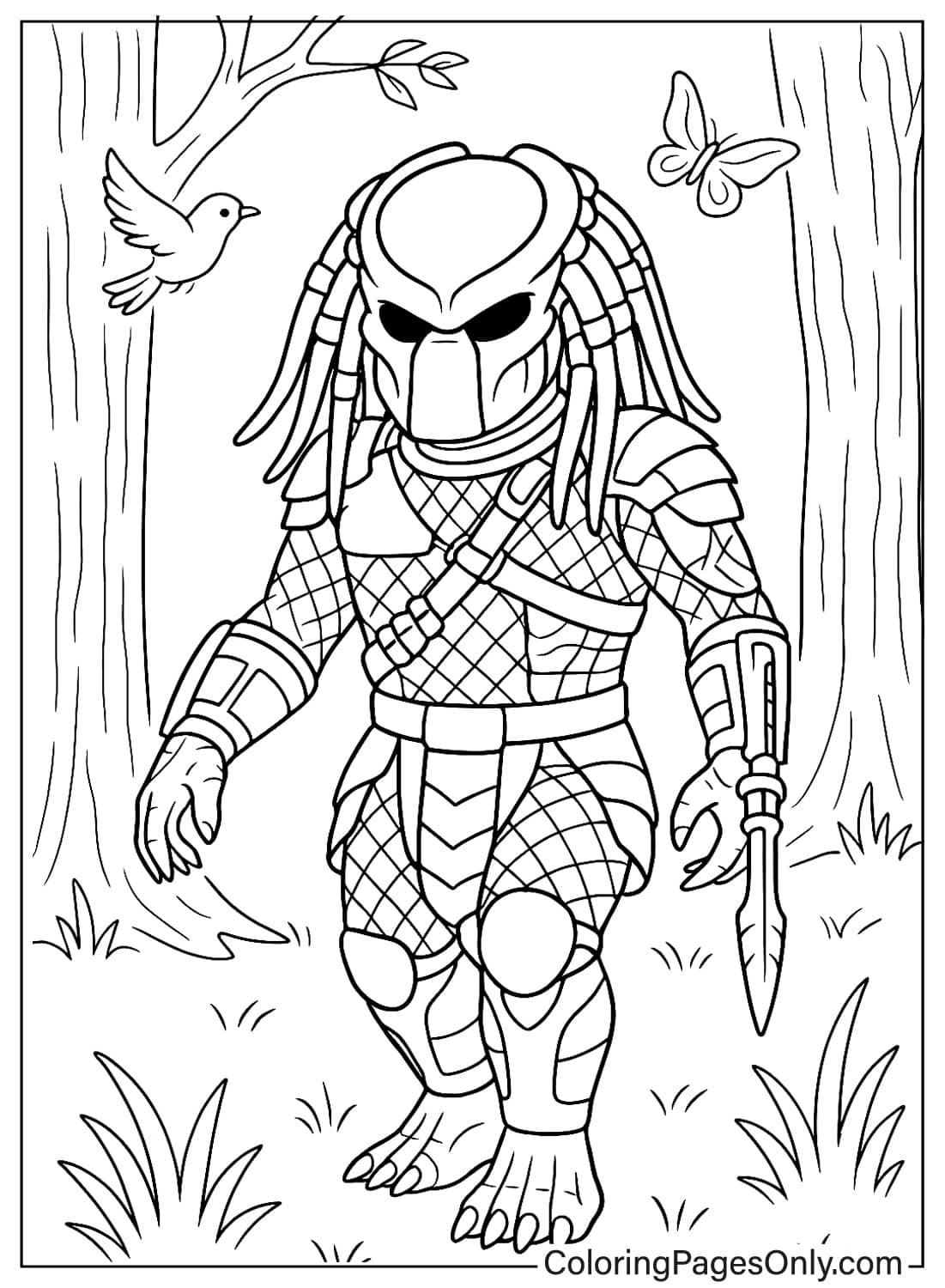
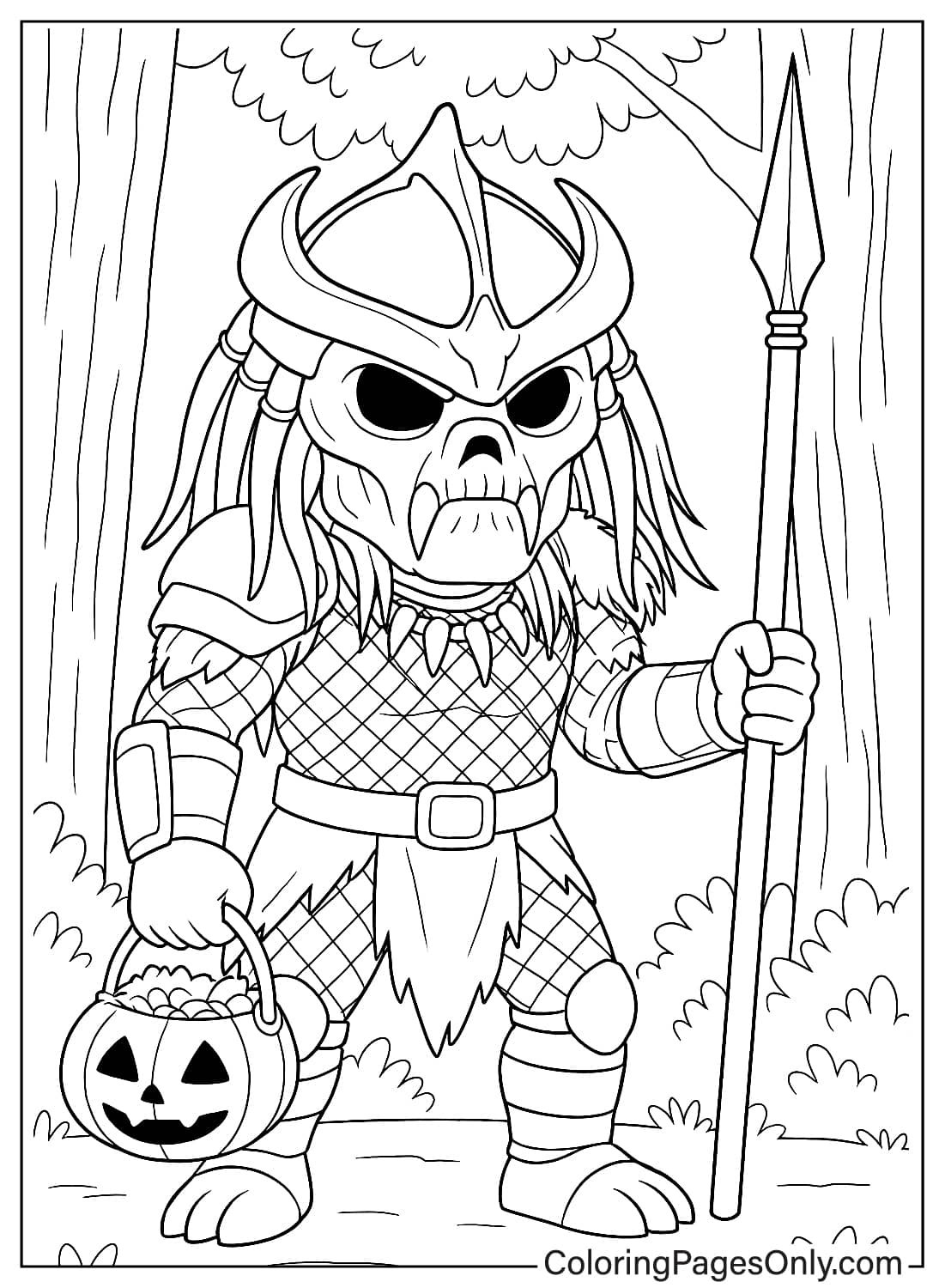
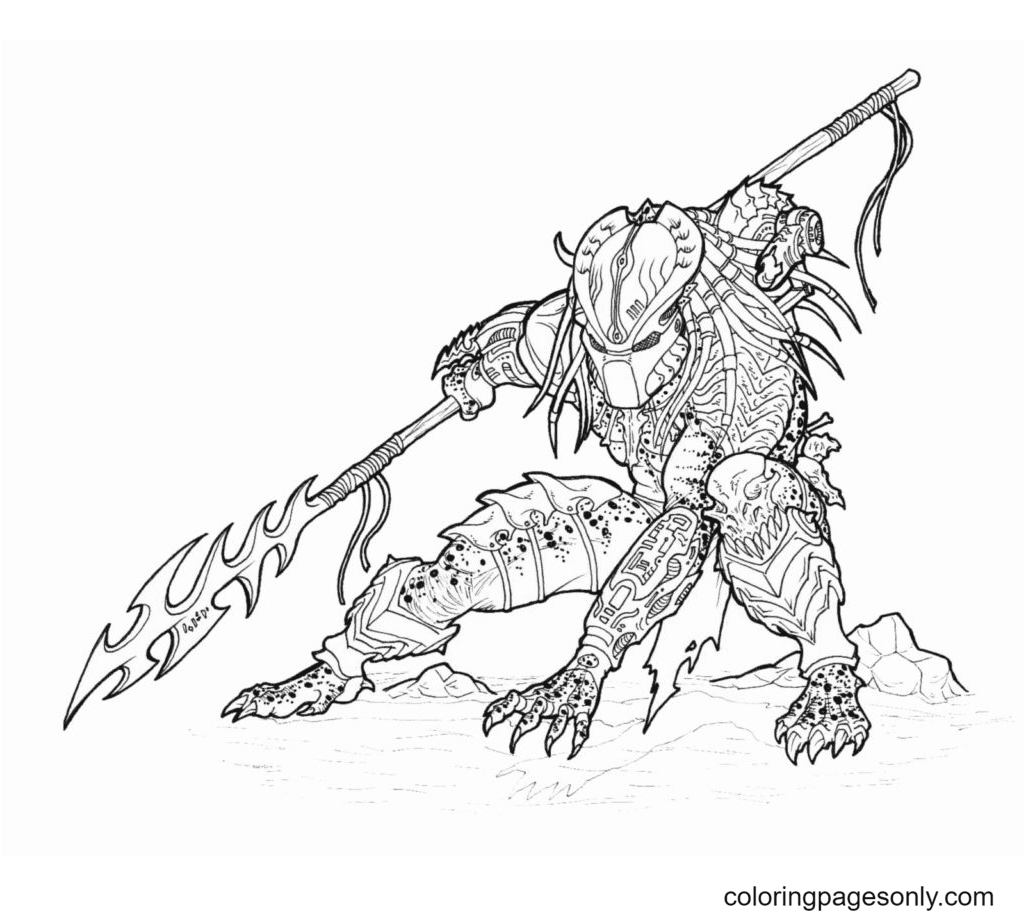
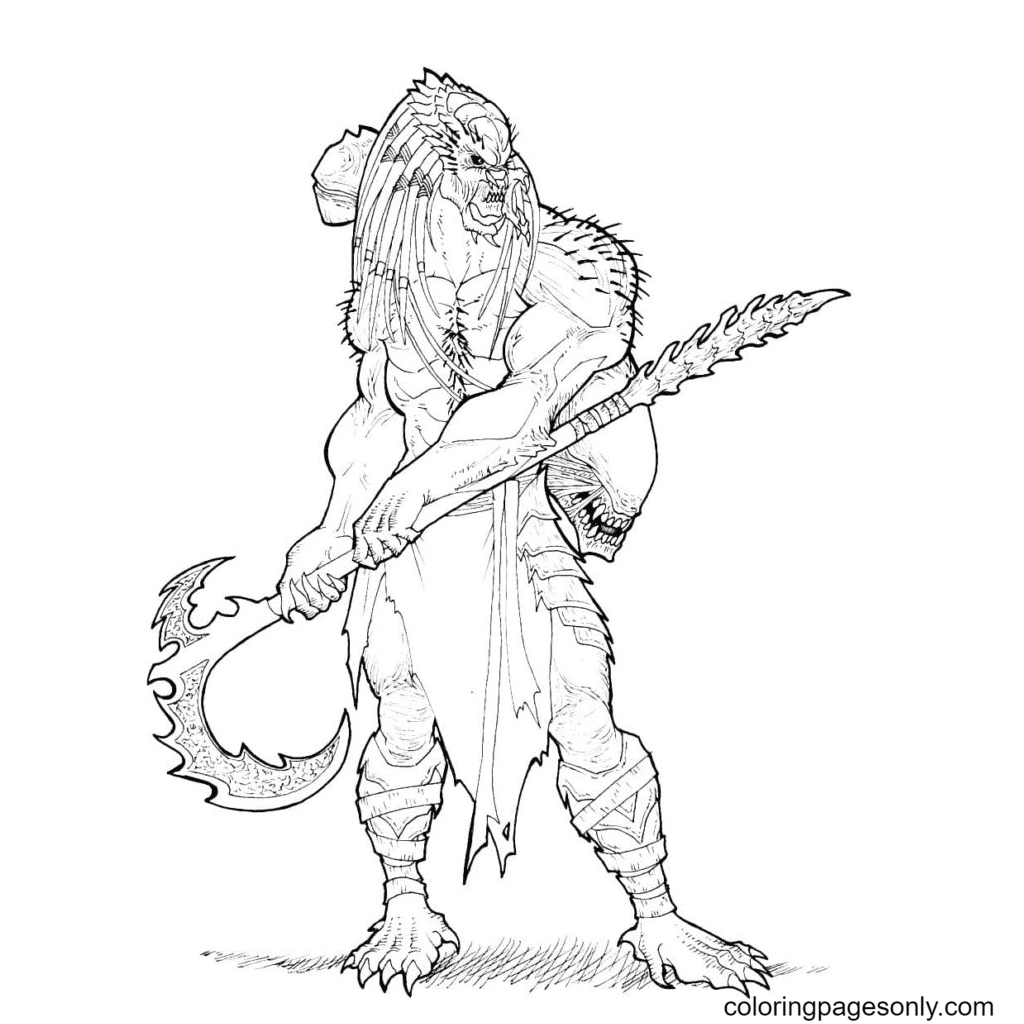
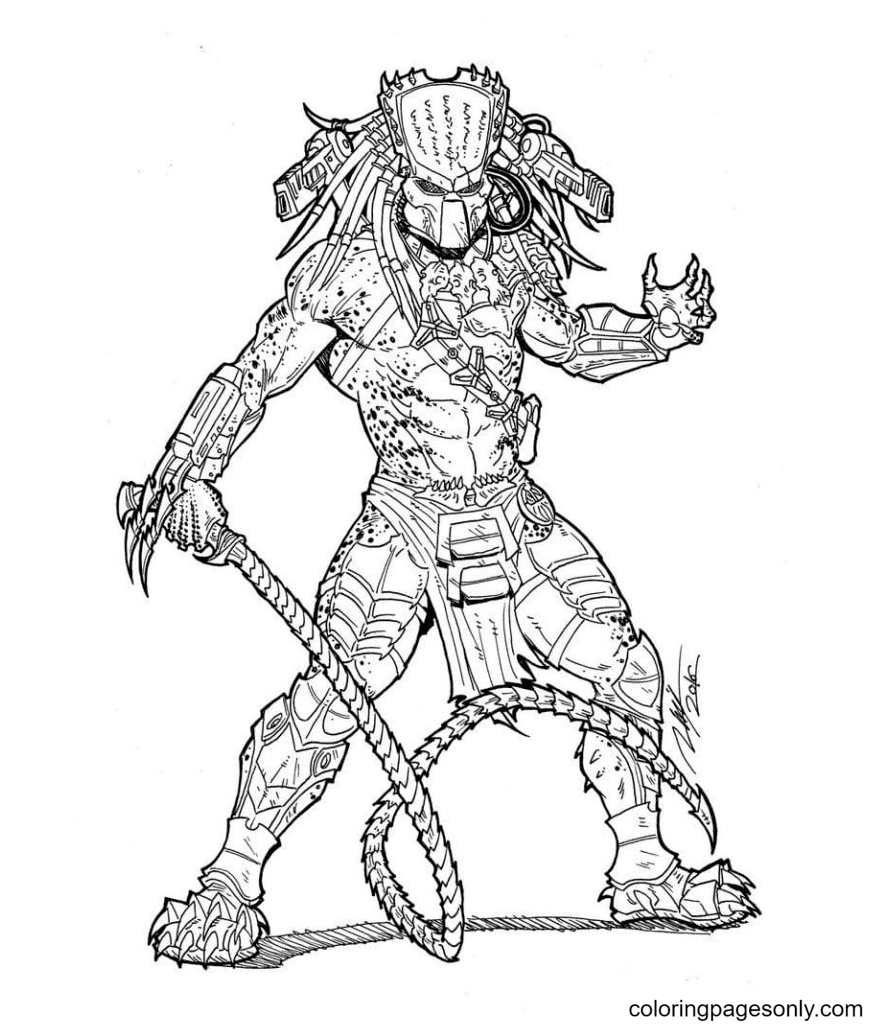

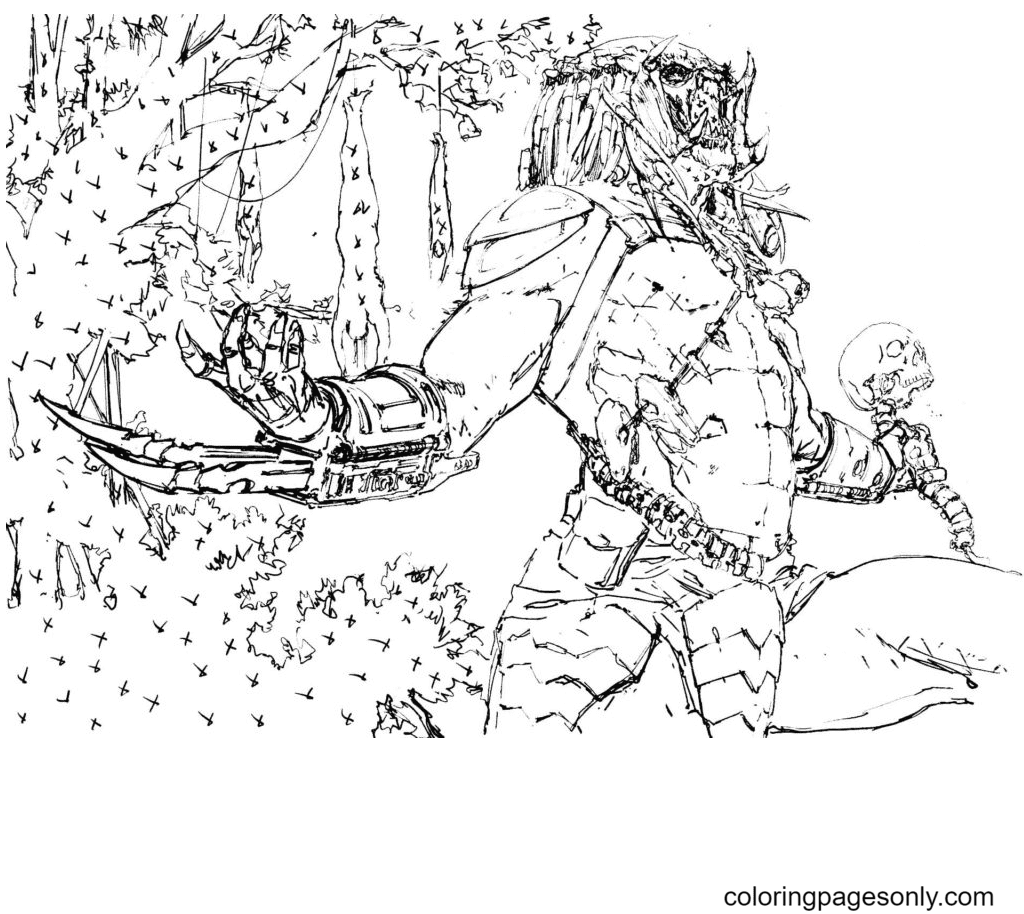






What’s Inside
The Bio-Helmet and Mask Pages
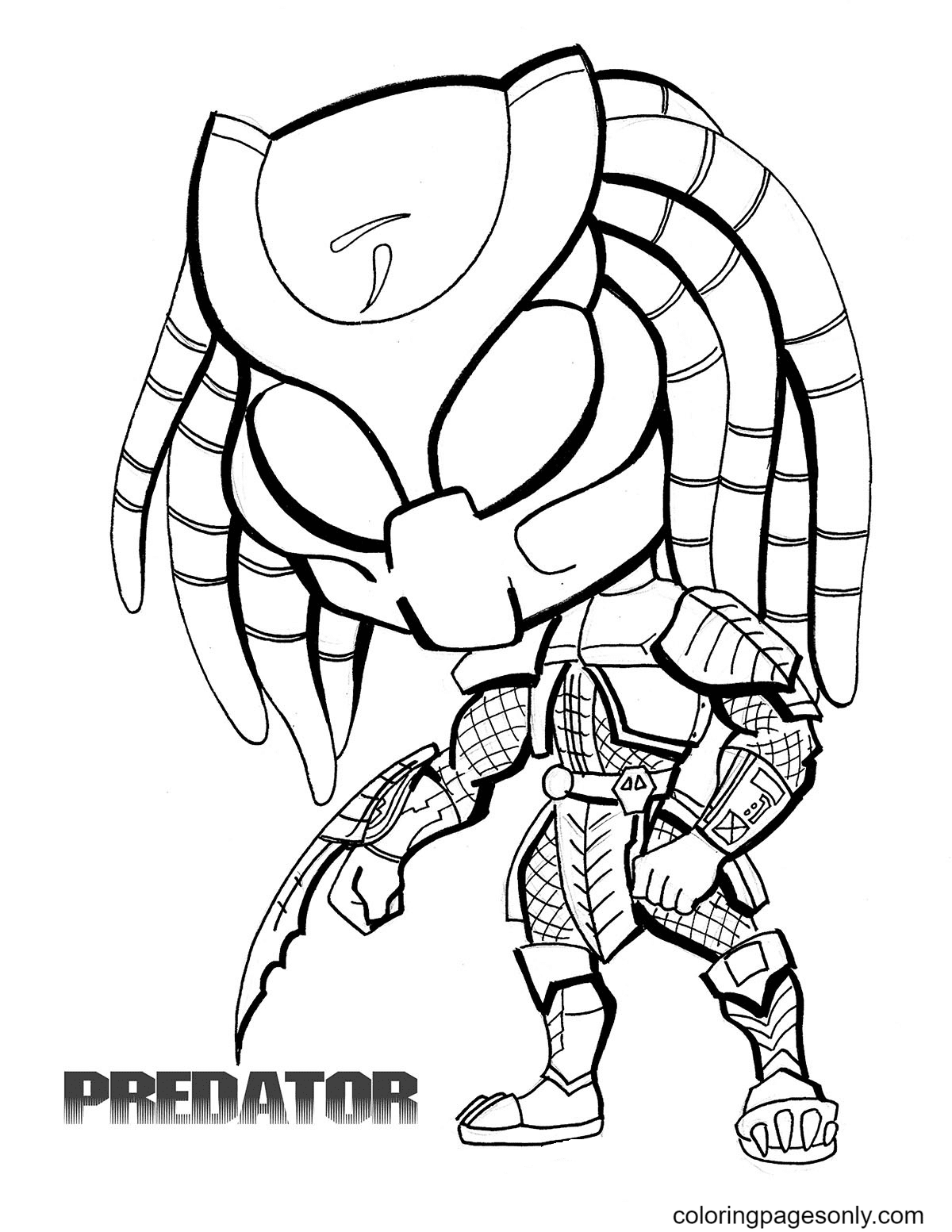
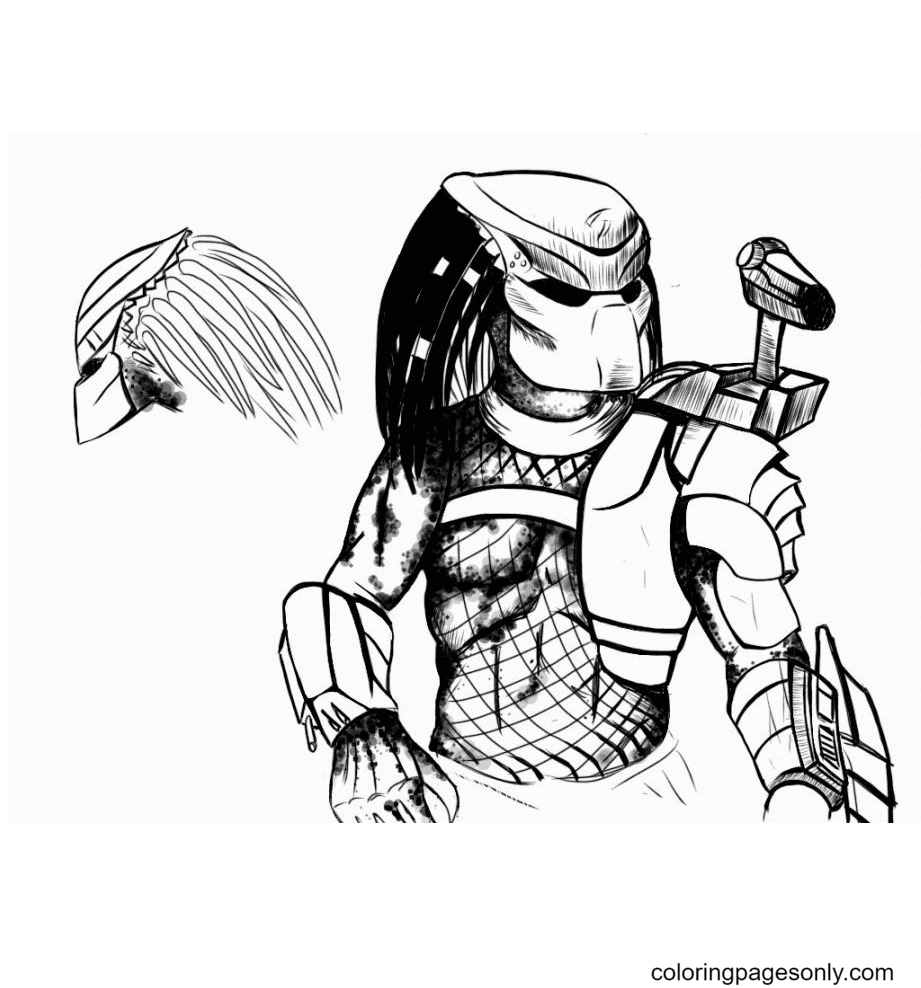
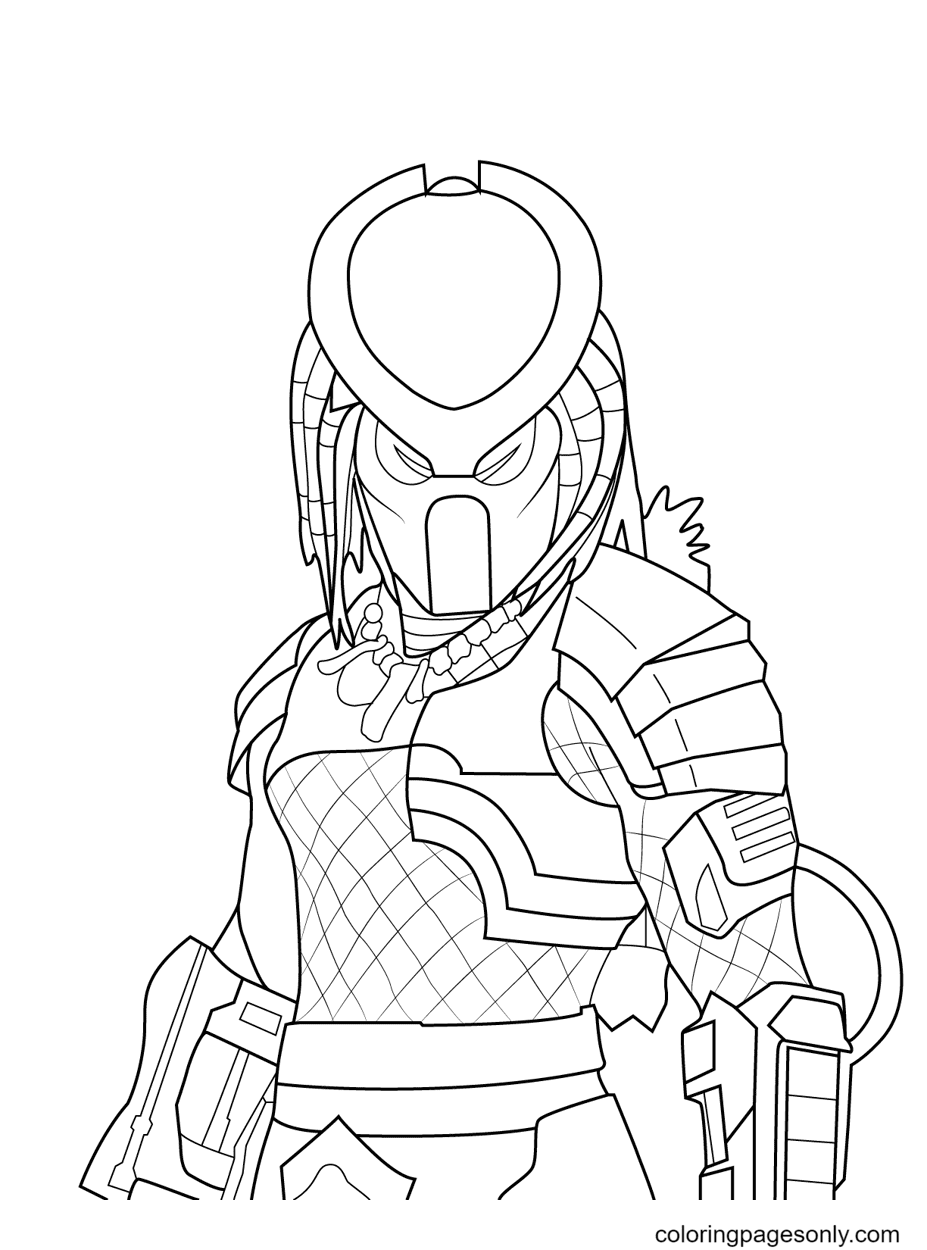
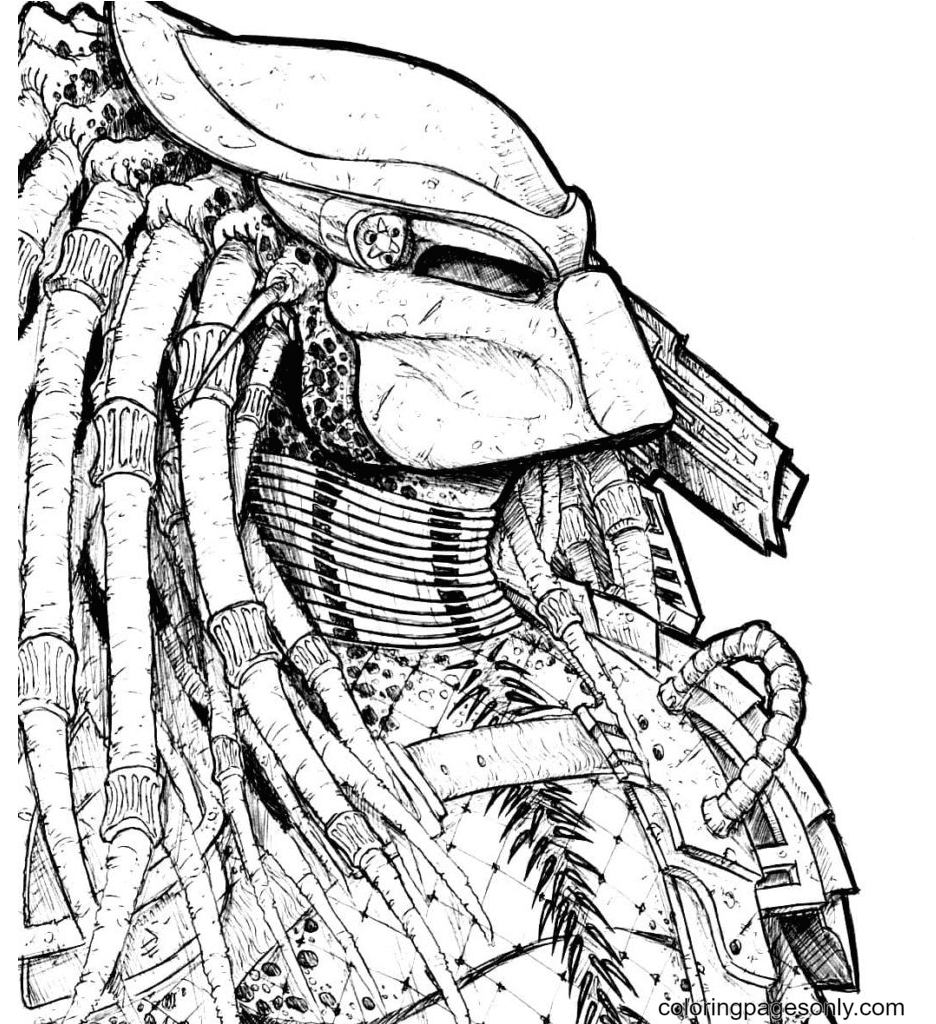
The Predator’s bio-helmet is the franchise’s most technically intricate single design element: a smooth, dome-like exterior with a distinctive grill pattern at the front, twin sensor tubes on either side, and the internal array of vision modes that gives the wearer access to thermal, ultraviolet, and electromagnetic spectrum imaging. Stan Winston’s team designed the helmet to read as both organic and mechanical simultaneously, a quality that comes from the biomechanical aesthetic threading through every piece of Yautja armor.
The thermal vision register the helmet produces is the franchise’s most reproduced visual effect: a heat-map rendering of the environment in orange, yellow, and red gradients against a blue and purple cool-tone background, with text readouts in the Yautja script appearing across the viewer’s field of vision. Pages that reference this thermal vision aesthetic are the collection’s most color-specific and most visually distinctive.
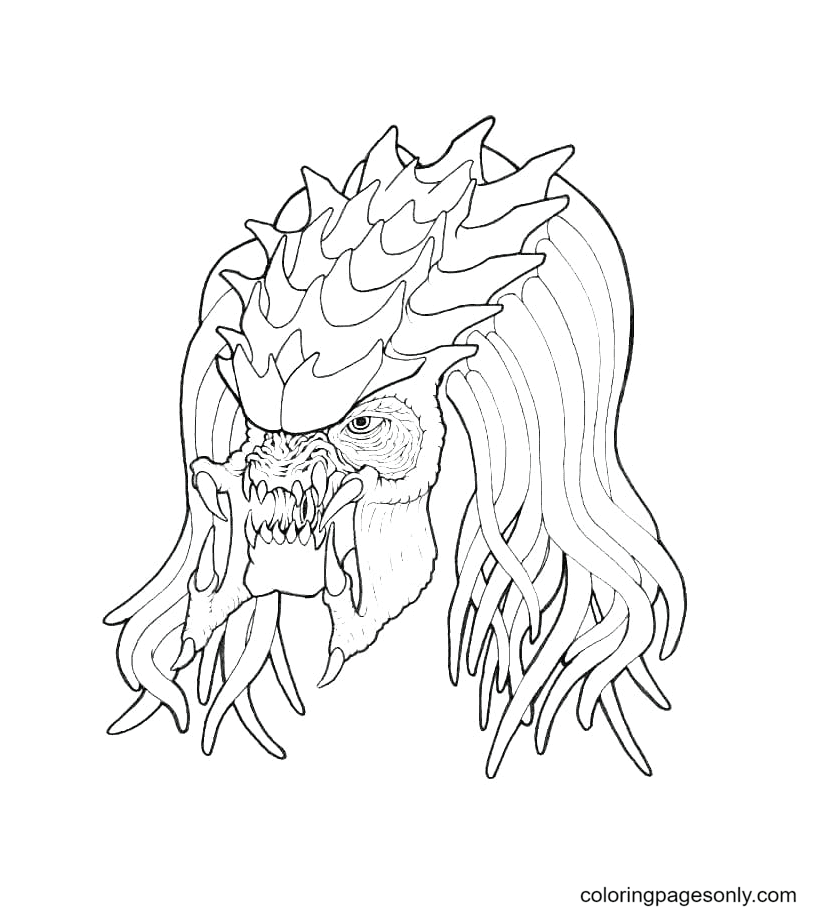
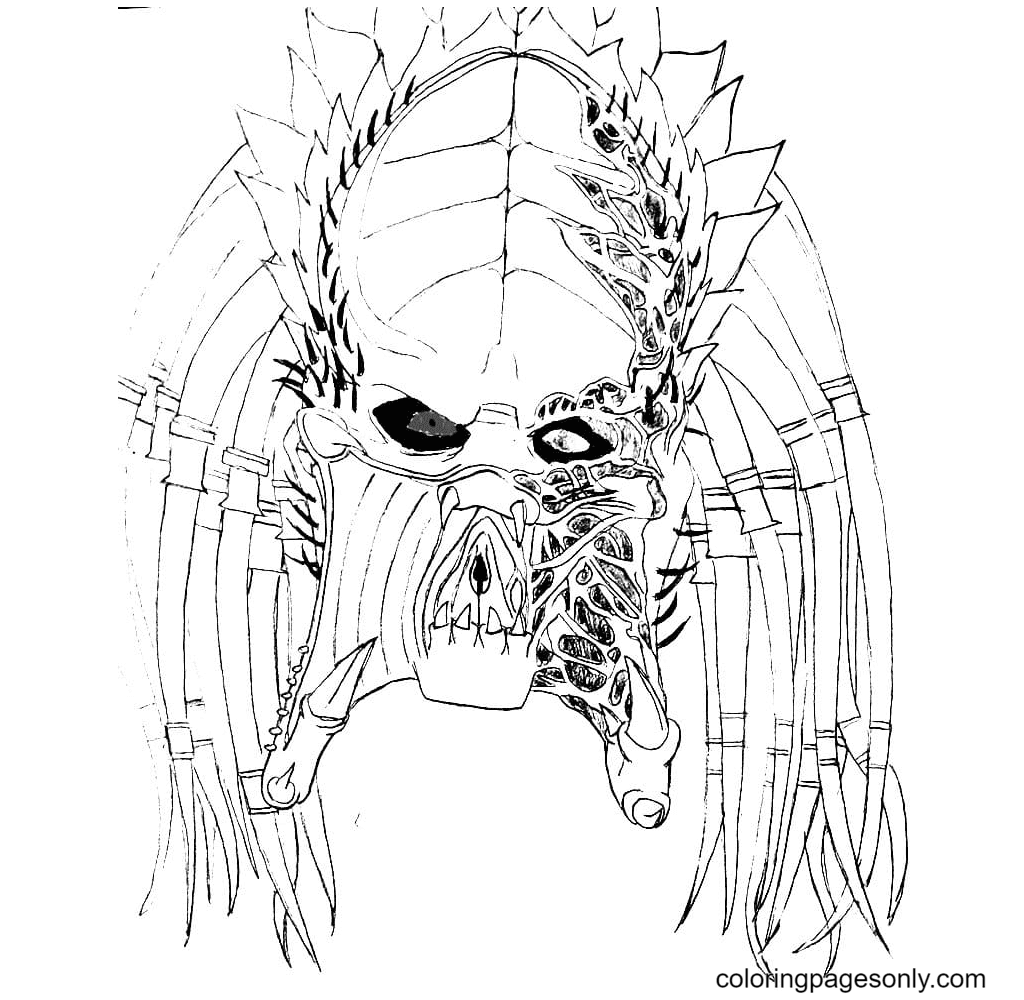
The helmet can be removed, and pages showing the Predator unmasked reveal the full mandible face: four tusk-like projections surrounding the central mouth area, small reptilian eyes, and the deeply ridged facial structure that Winston’s team based partly on crustacean anatomy. The unmasked face is the franchise’s most alien design element and the most challenging to render accurately.
Coloring the bio-helmet: The helmet exterior is a dark, matte metallic material, rendered as very dark grey or black with subtle texture highlights along its raised ridges. The grill section at the front is slightly lighter grey, with the individual grill elements separated by darker spaces. Any illuminated elements on the helmet (sensor lights, display elements) should be rendered in vivid green or amber, providing the only vivid color on an otherwise dark surface.
Coloring the thermal vision effect: Blue-purple as the cool background base across the entire composition. Objects at ambient temperature sit in this cool-blue register. Warm-blooded figures and heat sources shift through teal, yellow, orange, and red-orange at their hottest points. Text readouts in the Yautja script appear in vivid green or amber against the dark background. The gradient from cool to hot should be applied radially from the center of each heat source outward.
Full-Armor Portrait Pages
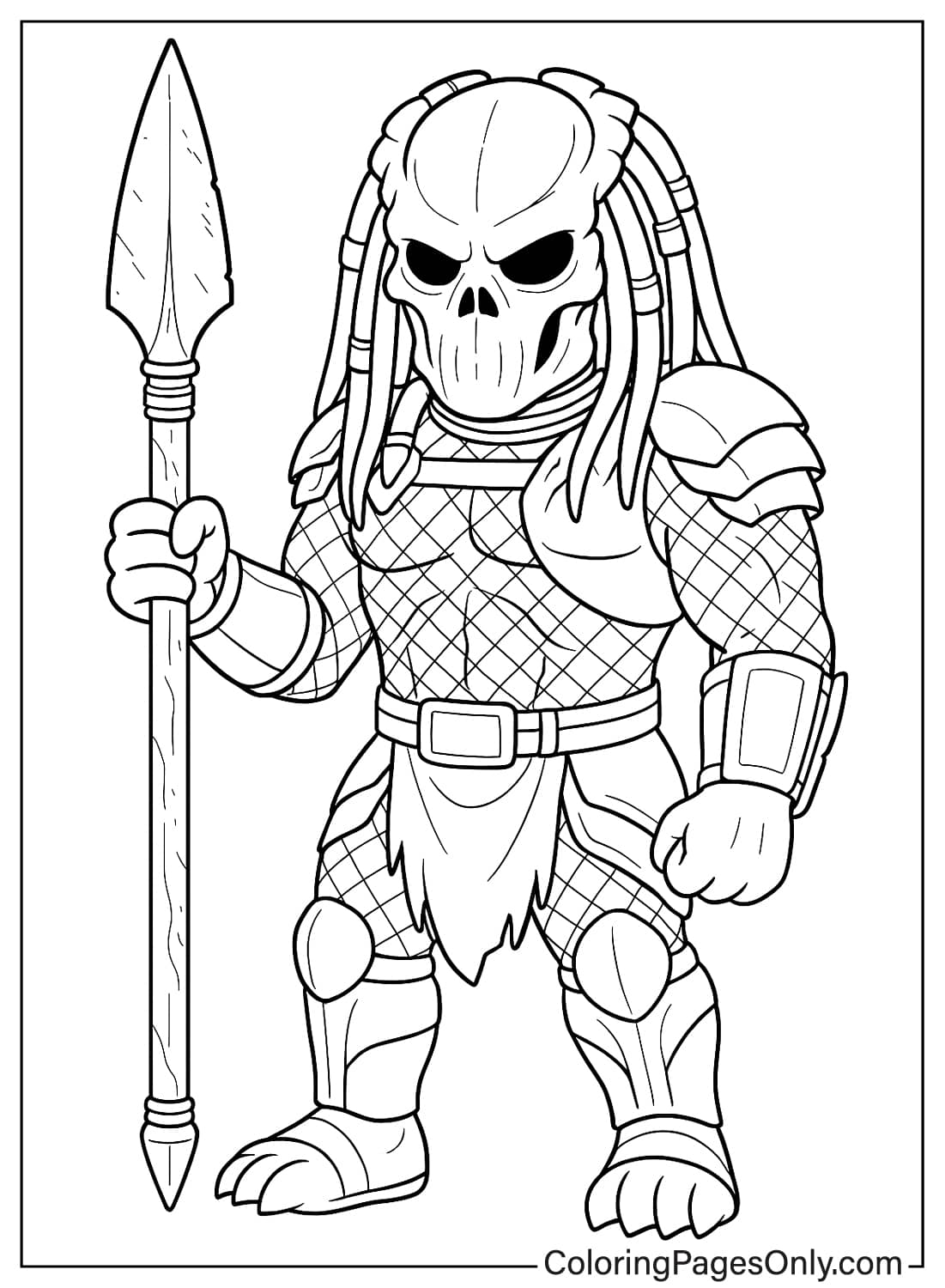
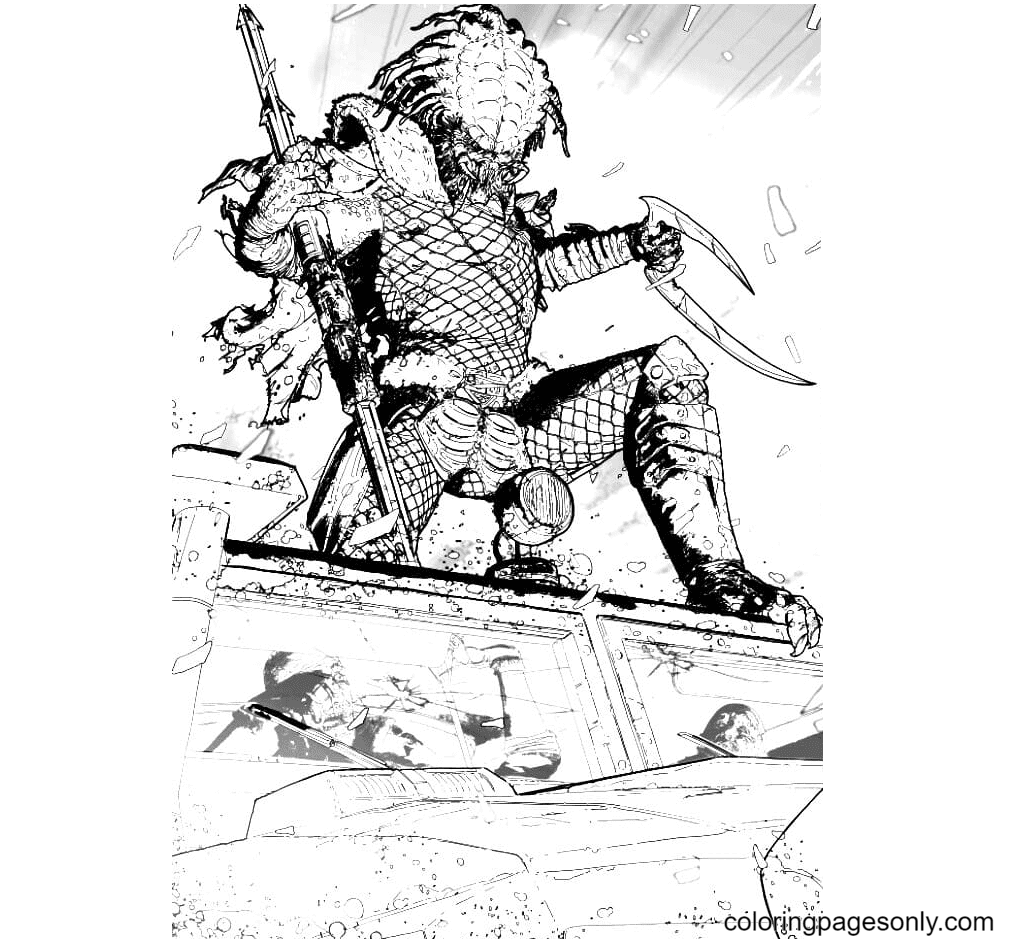
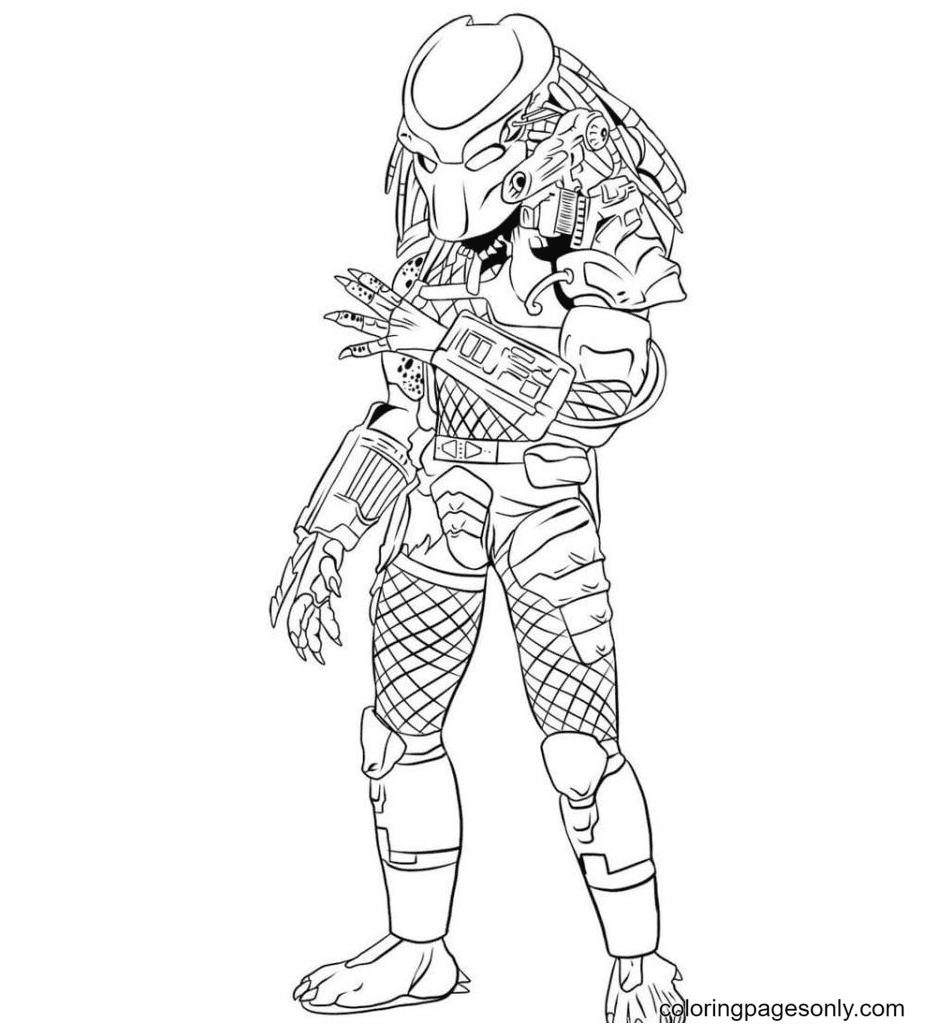
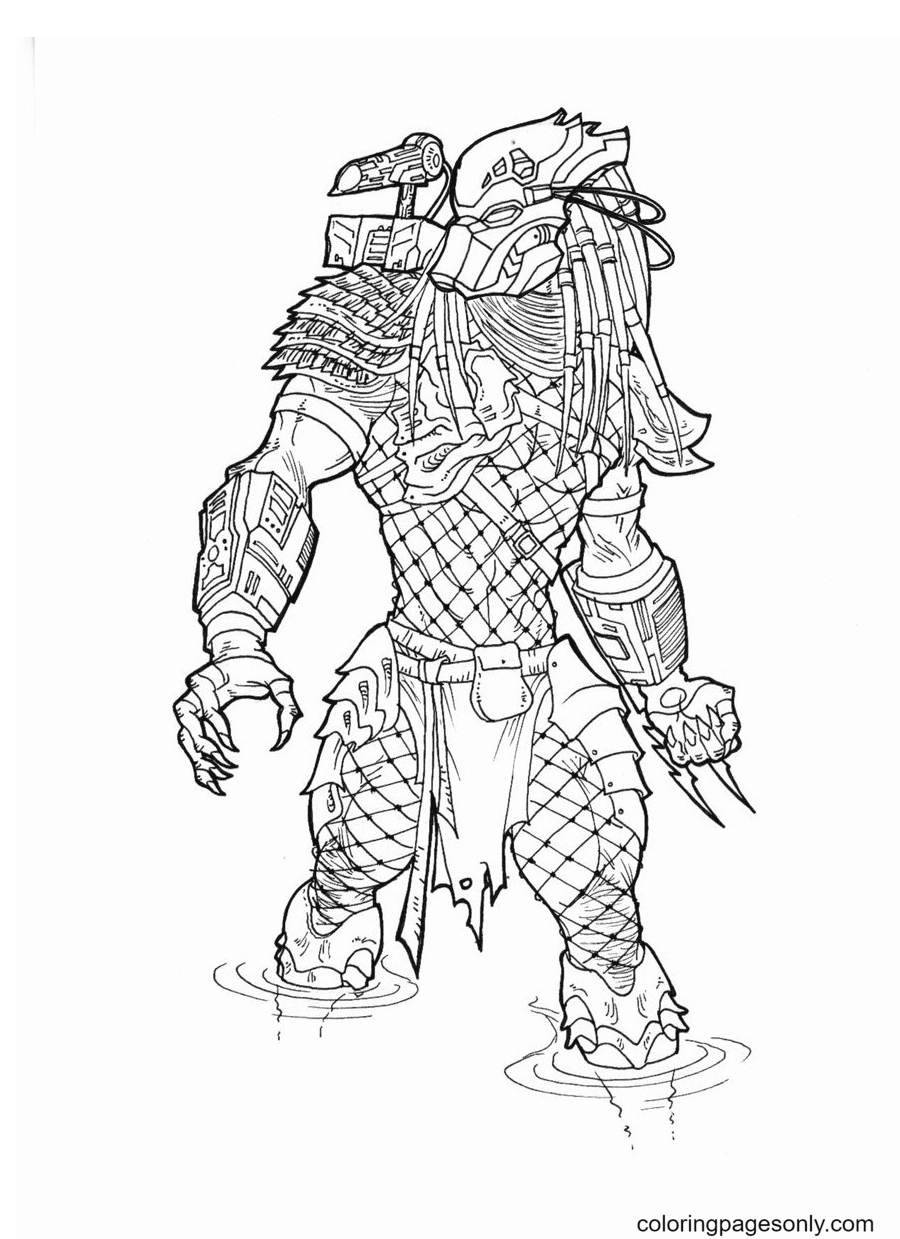
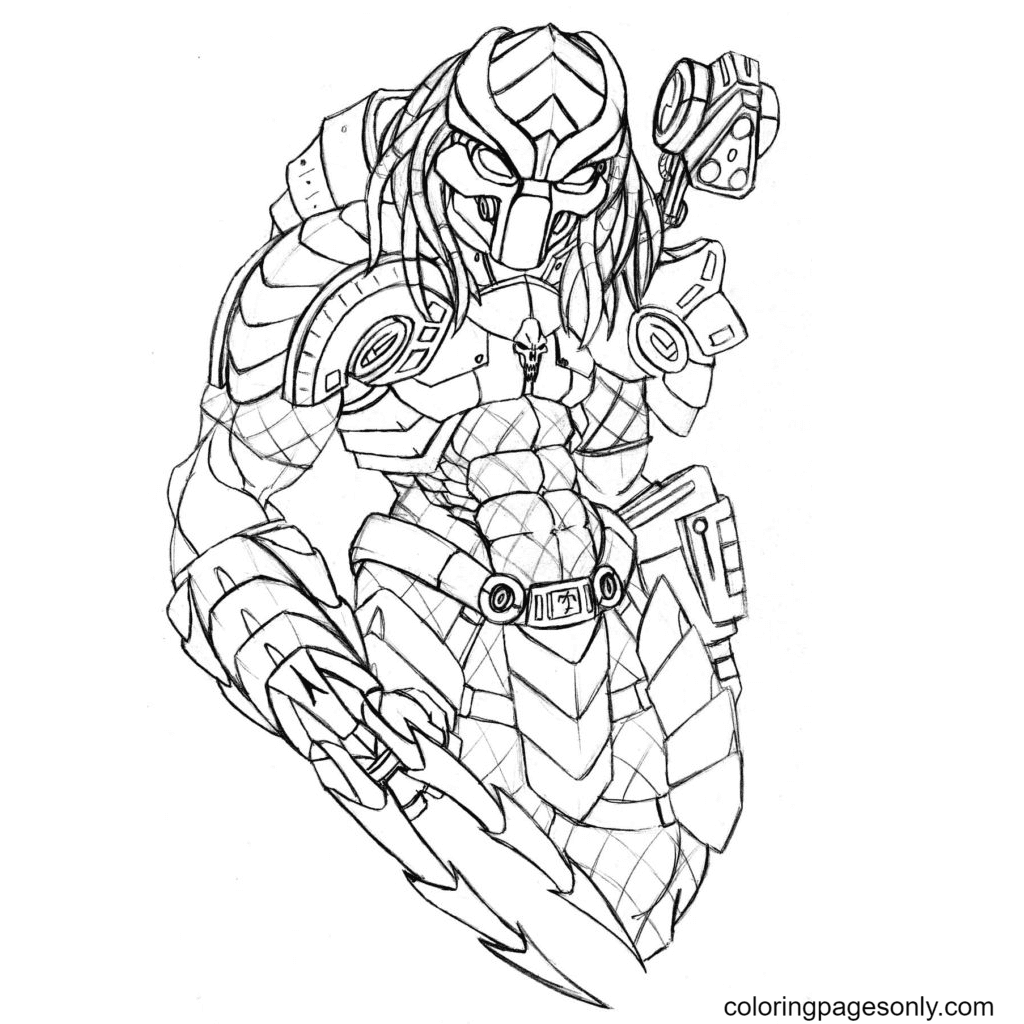
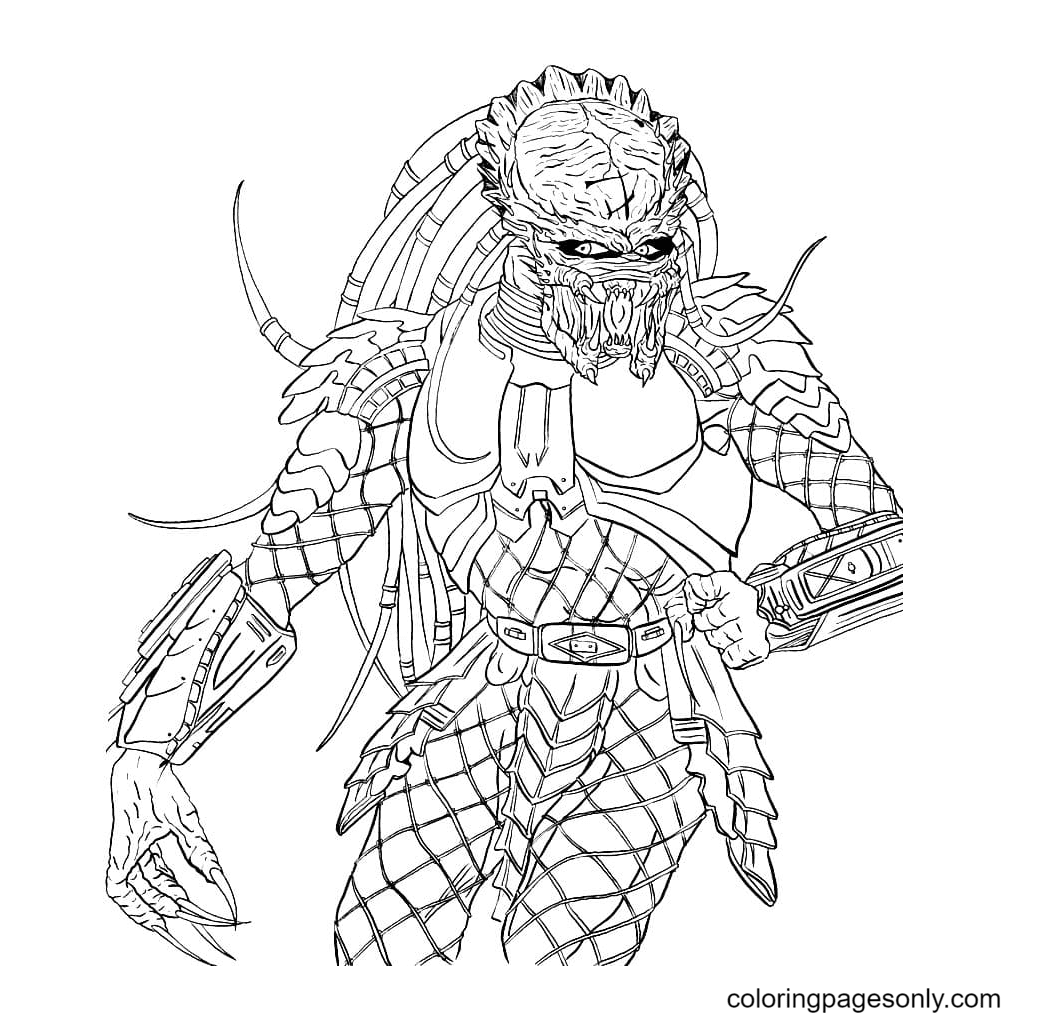
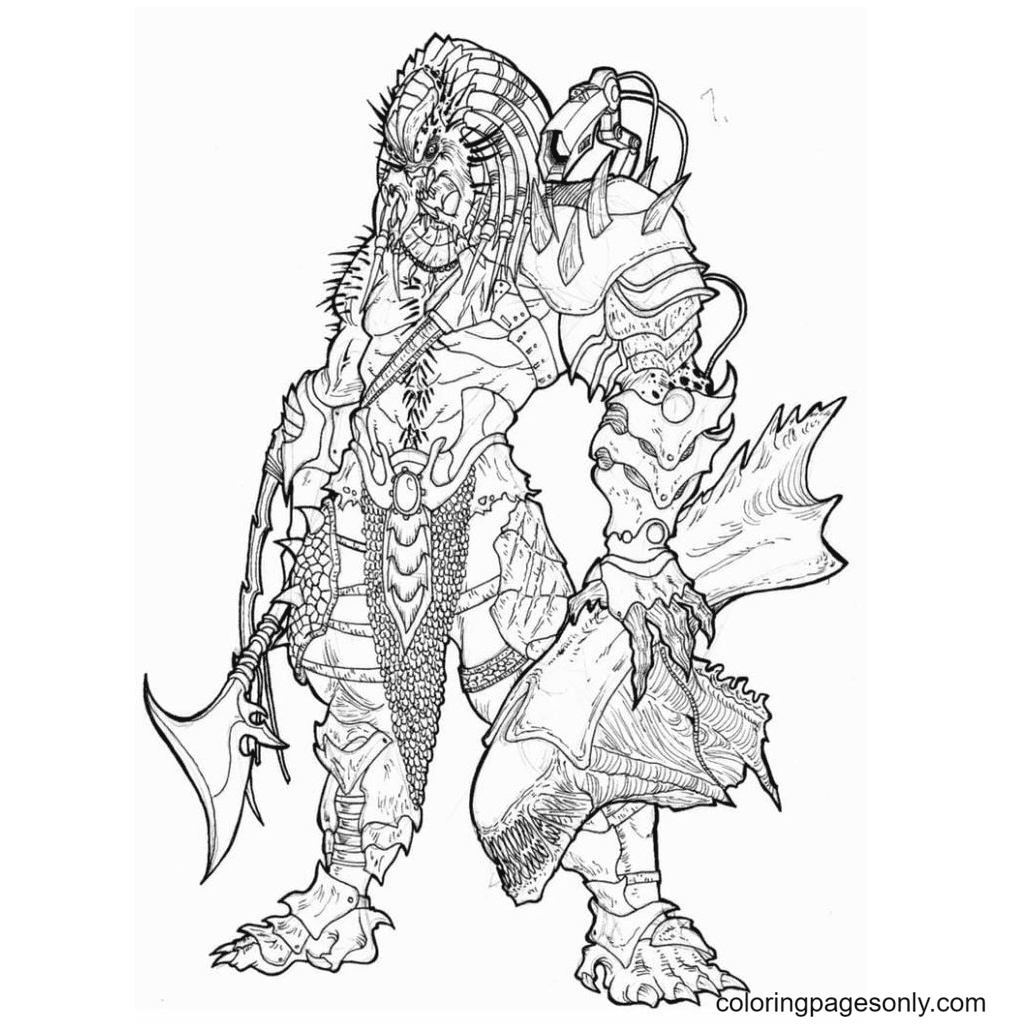
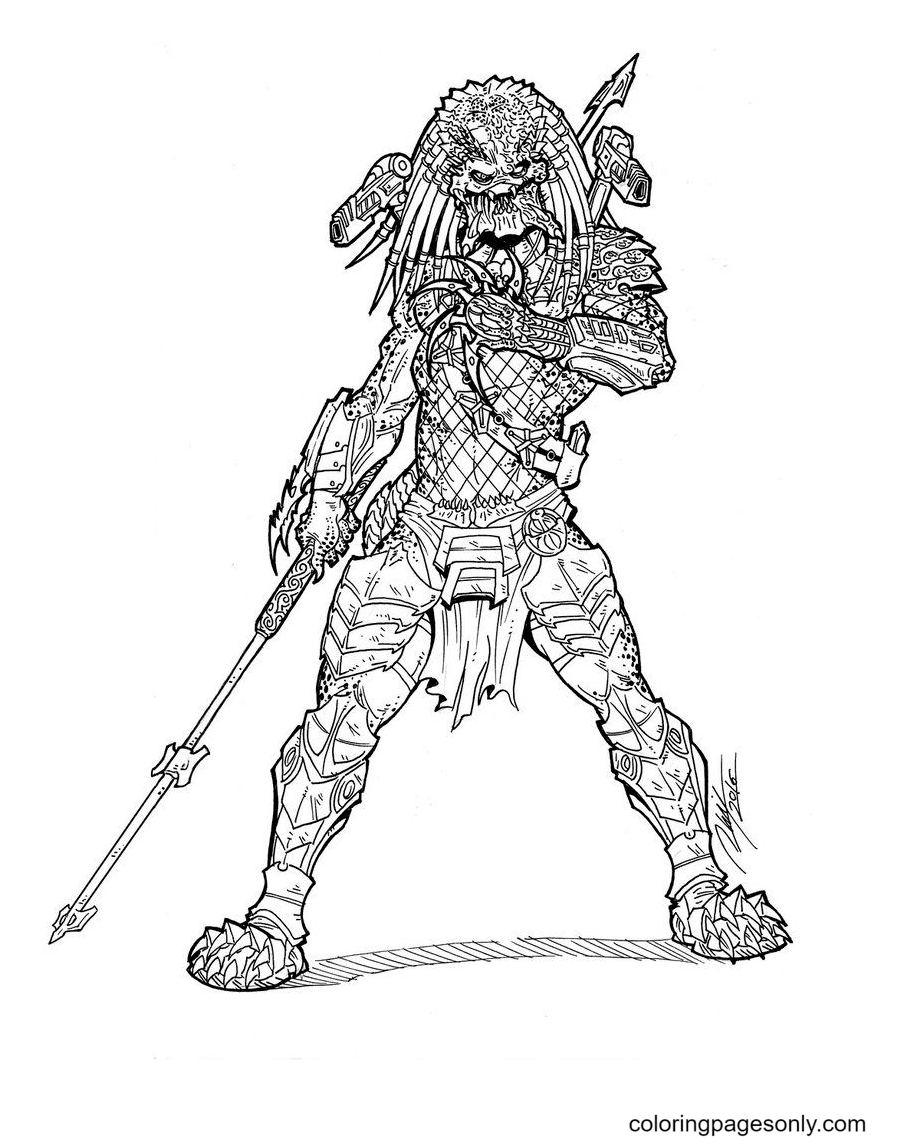
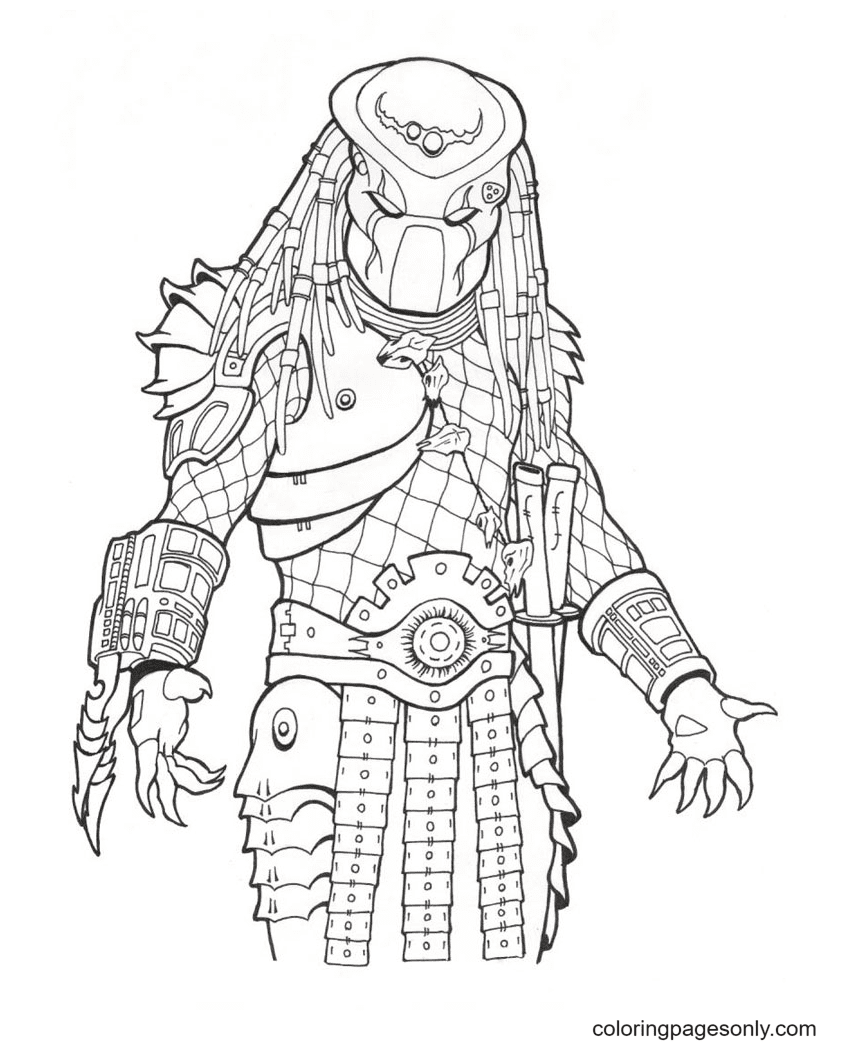
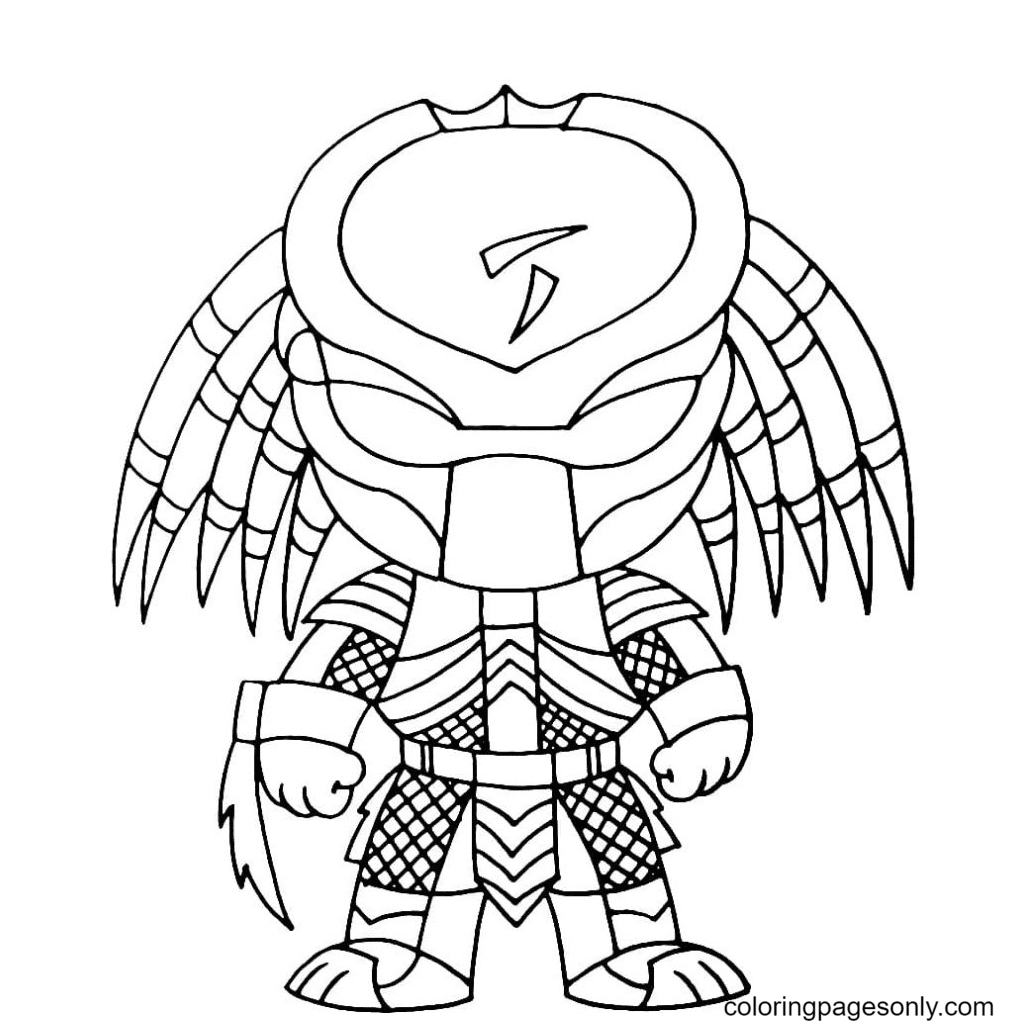
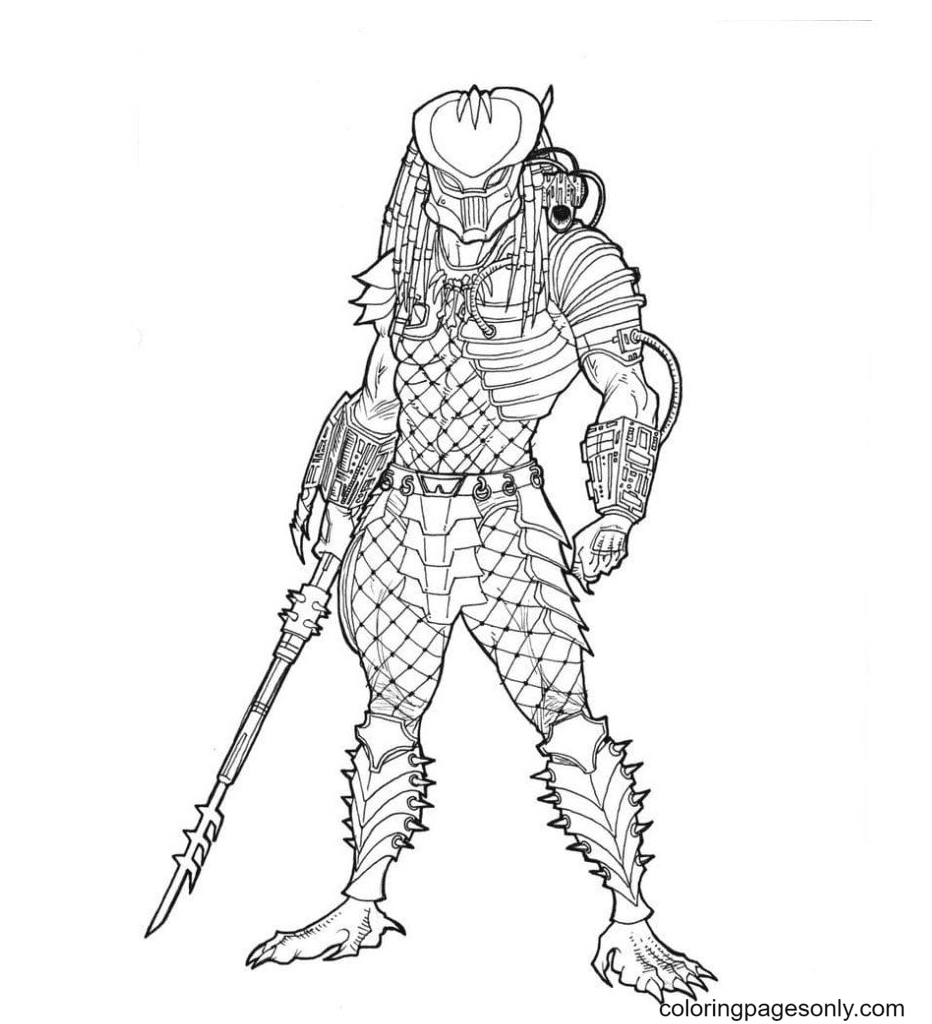
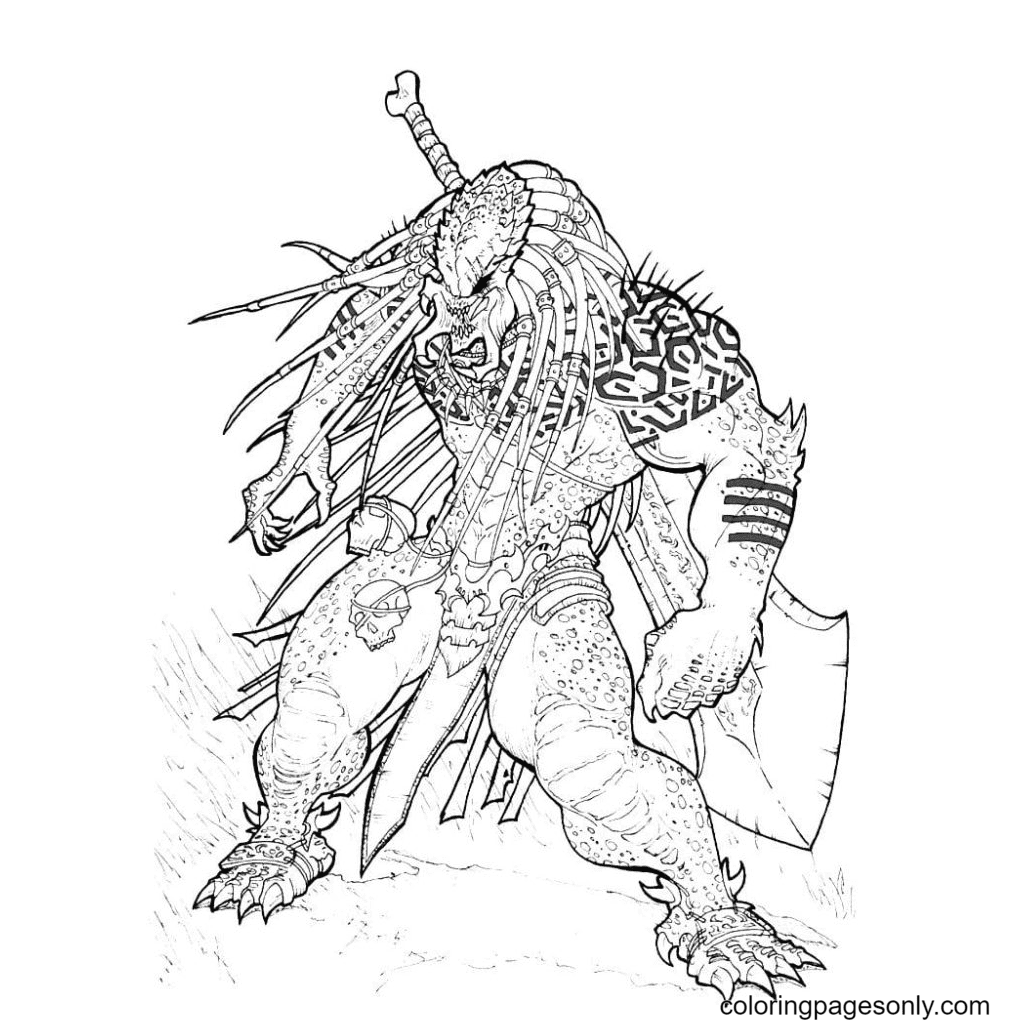
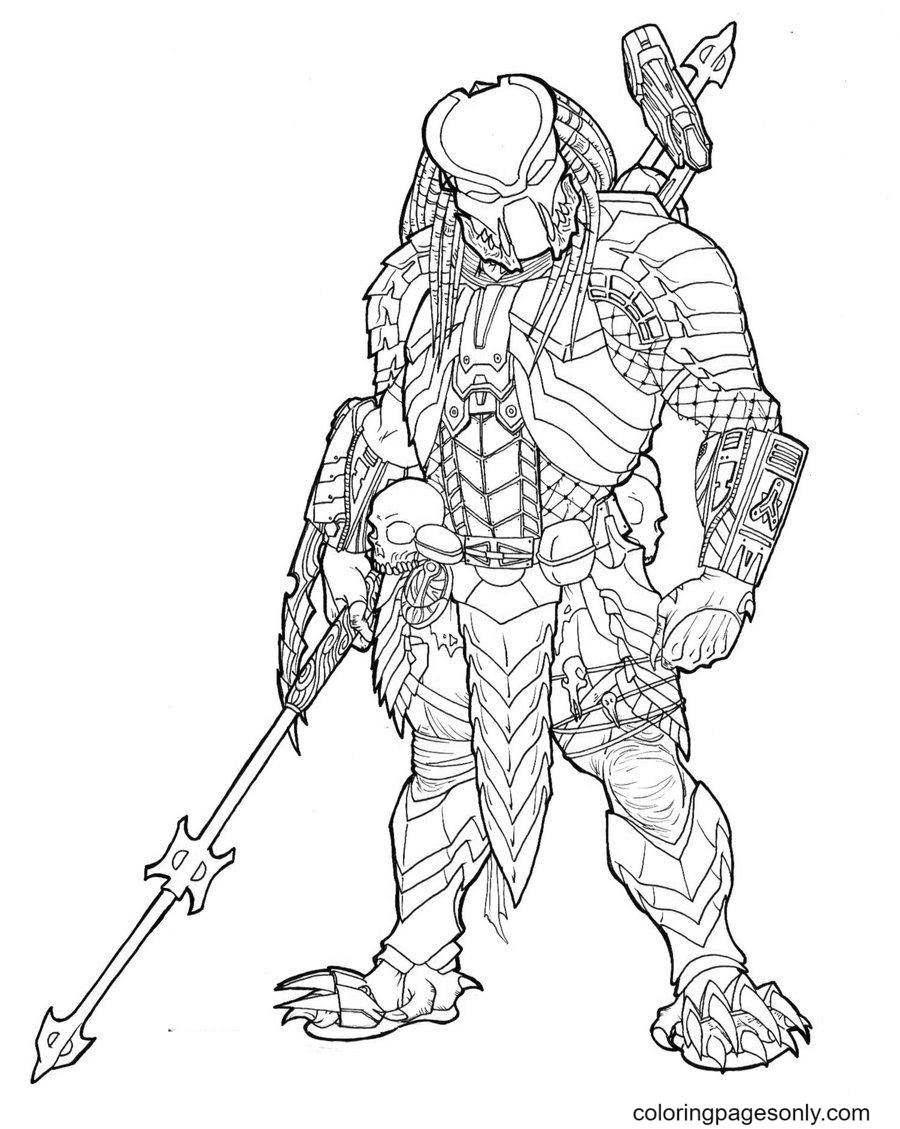
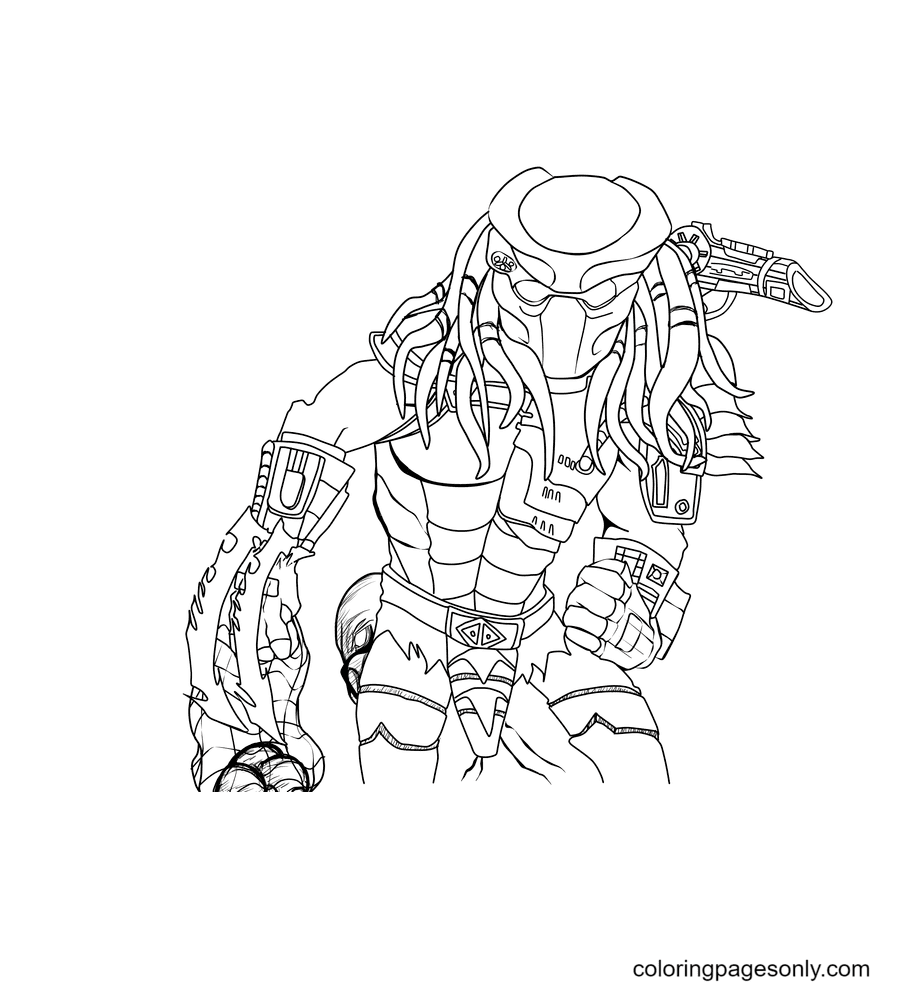
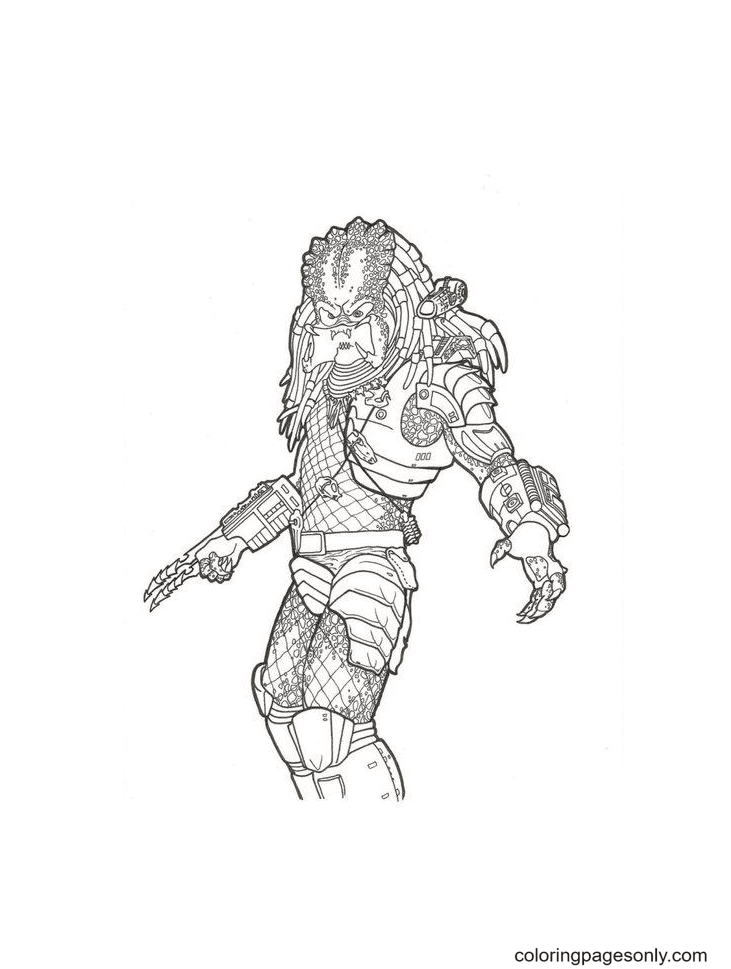
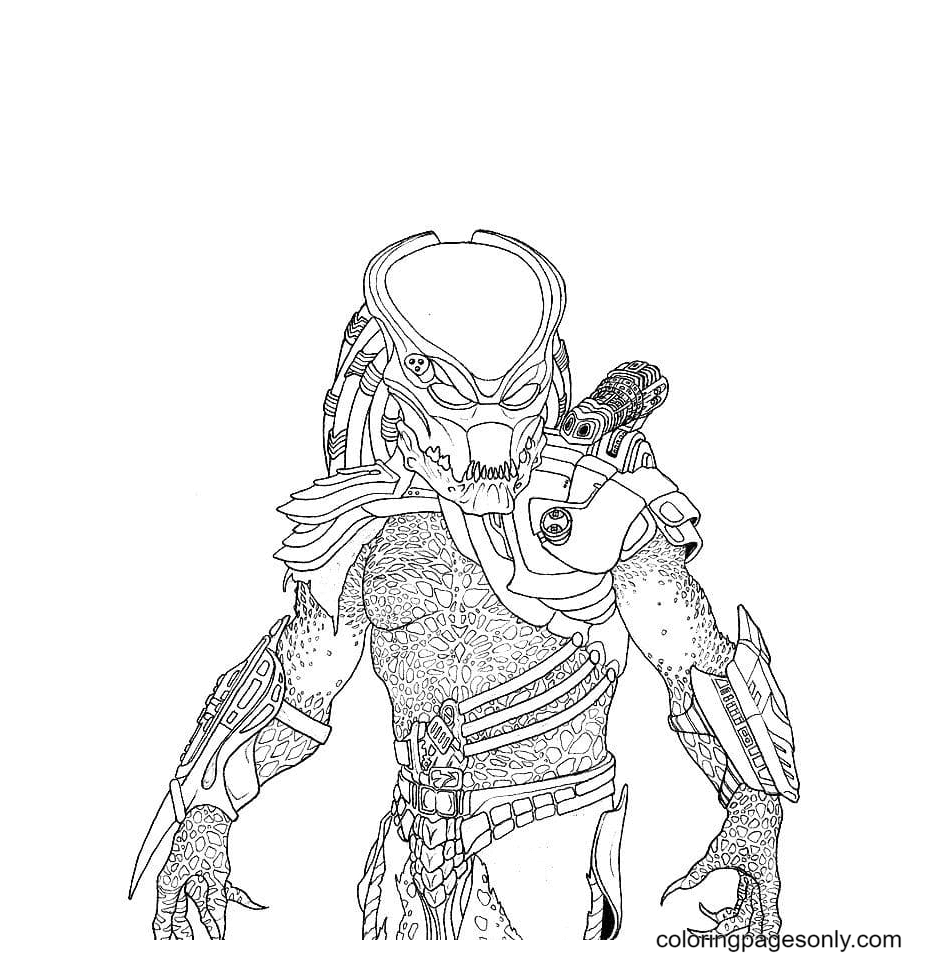
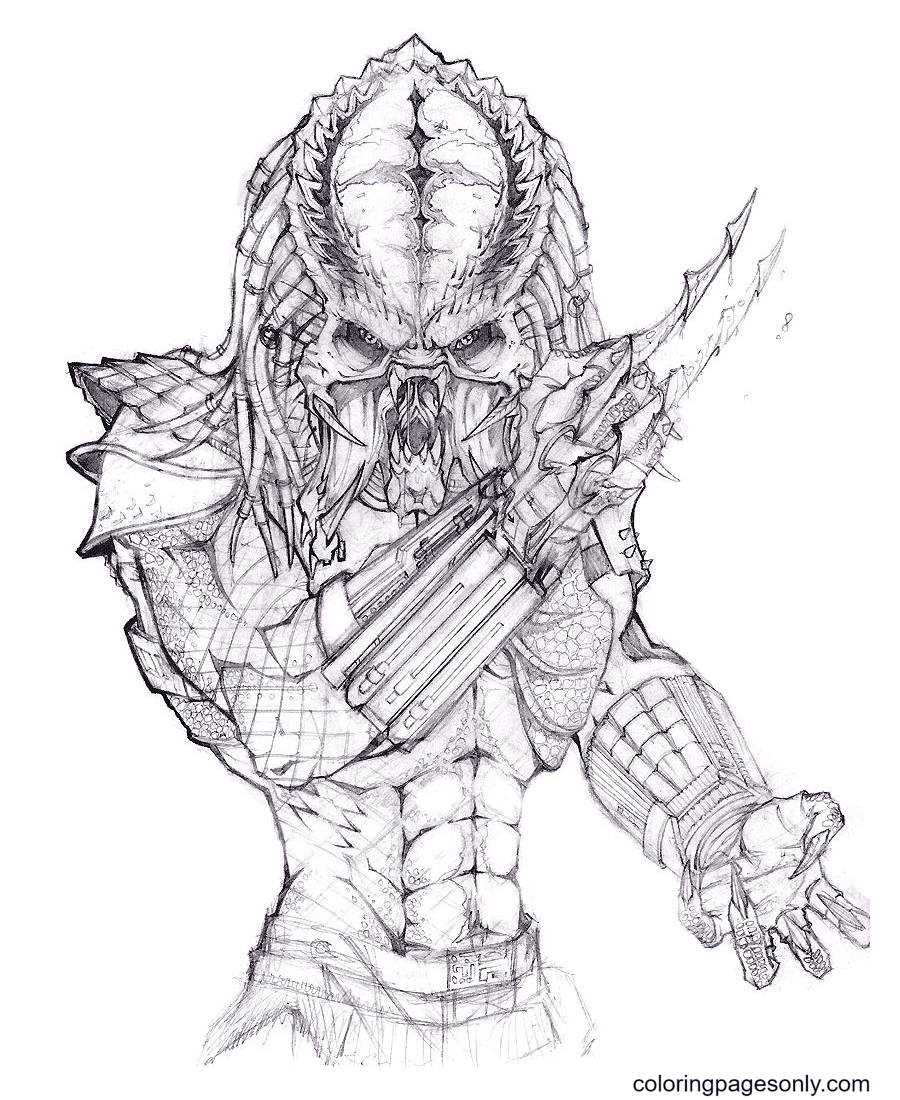
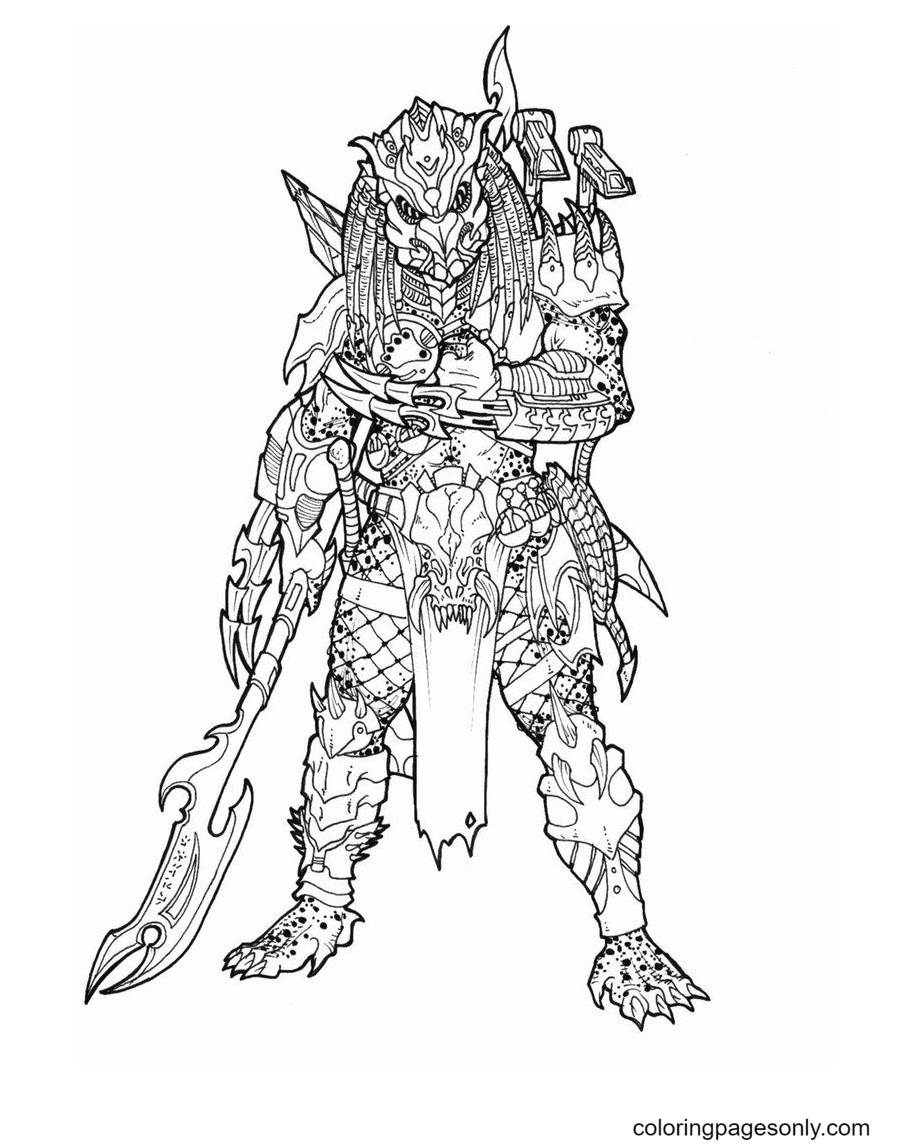
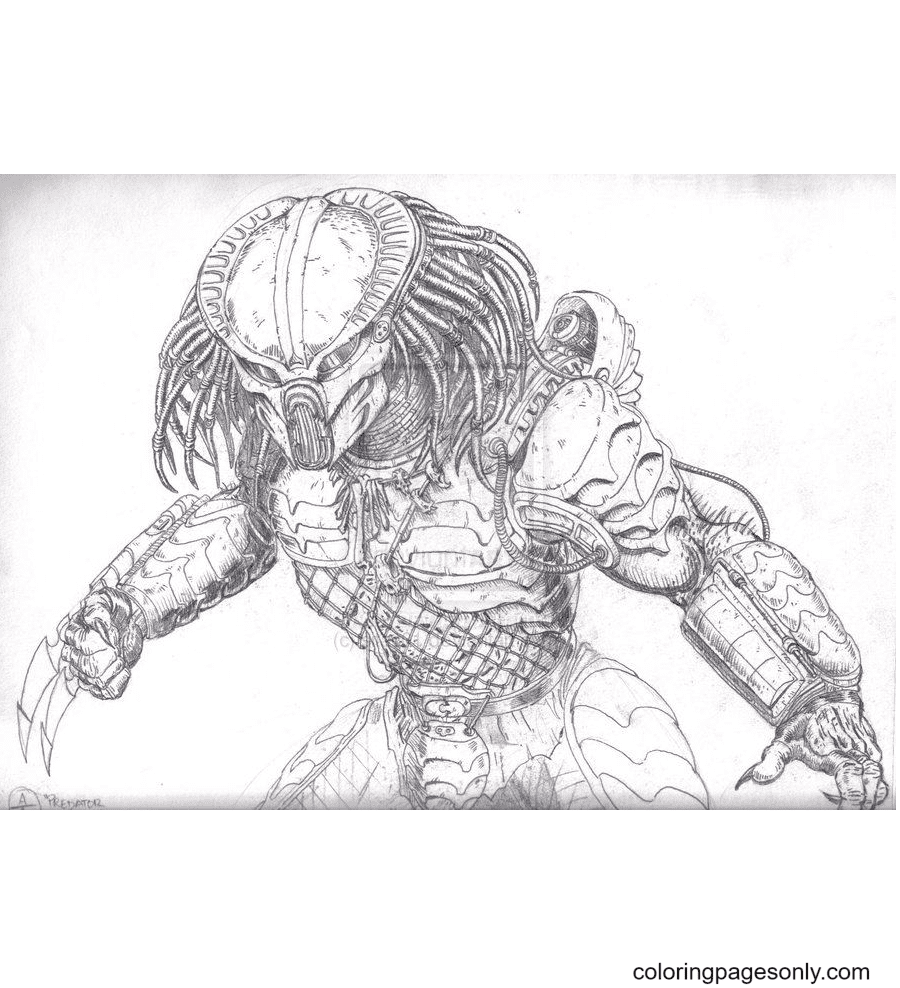
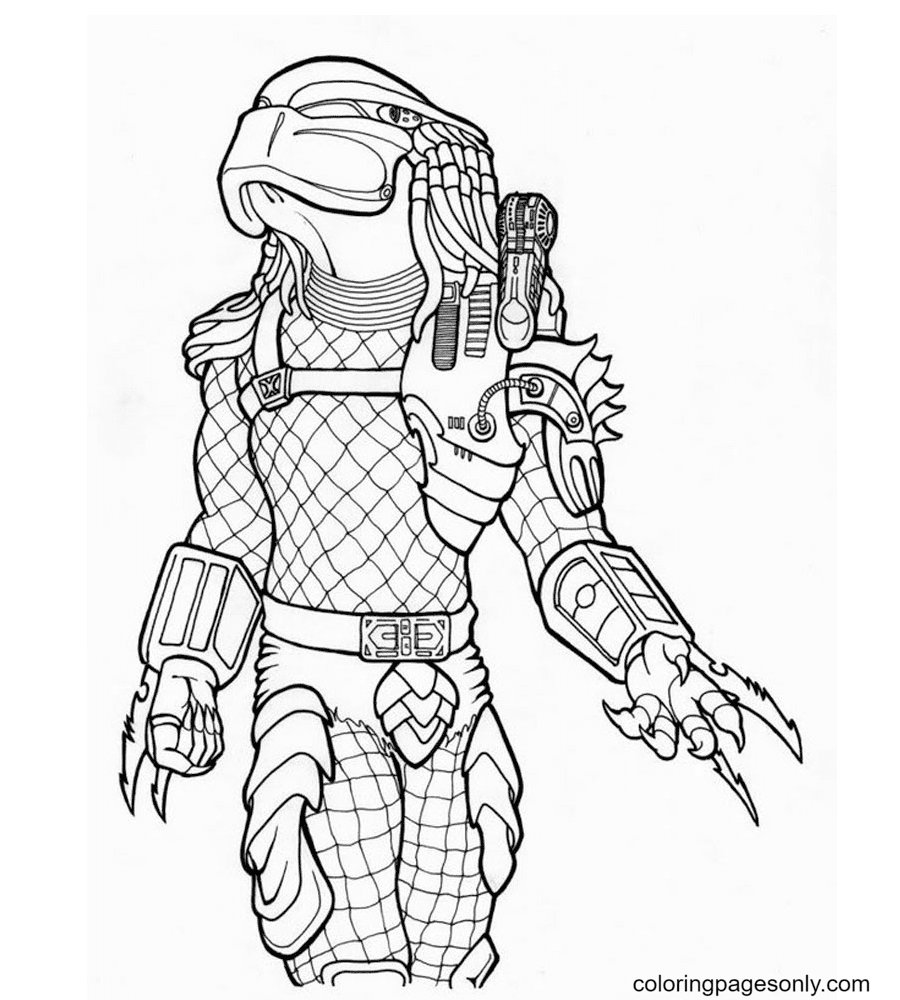
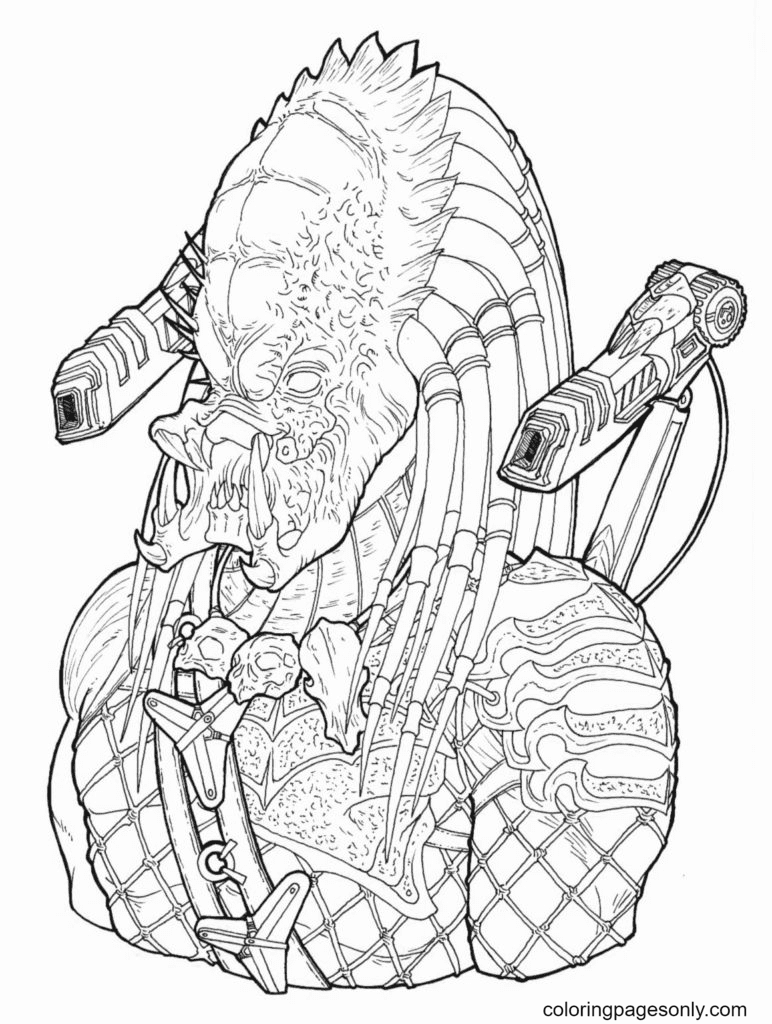
The Predator in full combat armor is the collection’s most structurally complex subject. The armor system includes several distinct components: the bio-helmet, a chest plate of organic-looking segmented panels, gauntlet-mounted wrist blades on one arm, the plasma caster mounted on the opposite shoulder, shin guards and boot armor, and a netting-like mesh garment worn beneath the hard armor components.
The netting is one of the design’s most specific details: a loose mesh worn directly over the skin, covering the torso and upper legs. This netting is visible in nearly every design variant across the franchise and is one of the elements that most clearly distinguishes a carefully rendered Predator from a generic science fiction warrior. The mesh creates a regular diamond pattern of small open squares against the underlying skin color.
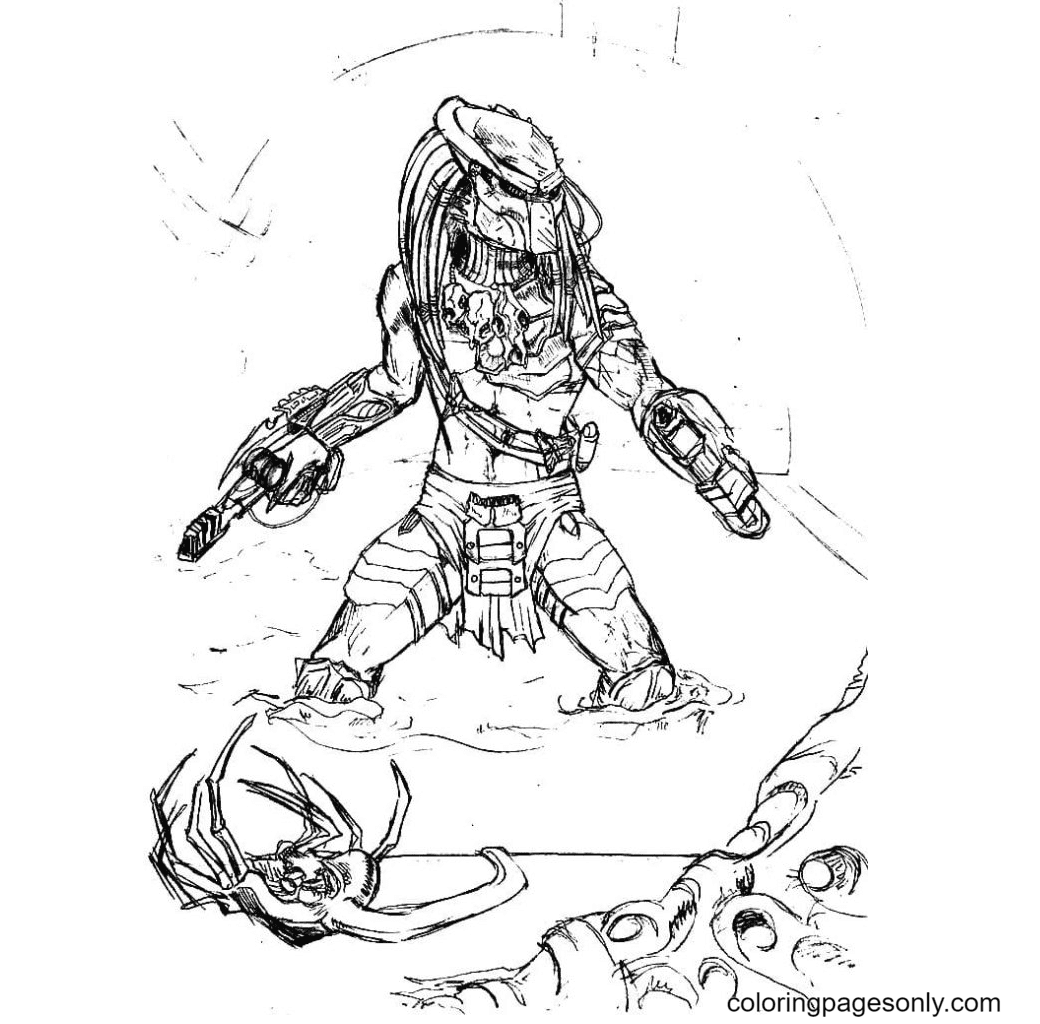
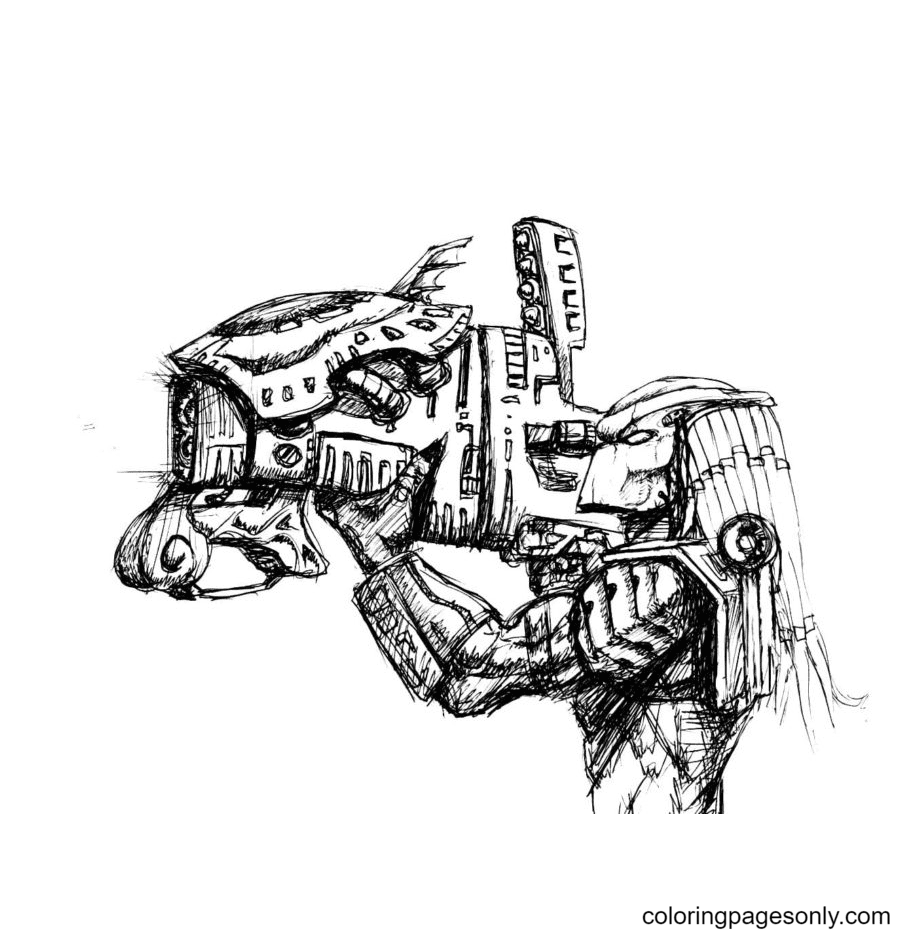
The plasma caster is the shoulder-mounted energy weapon that swivels on a mount attached to the shoulder armor. It has a distinctive tri-laser targeting system that projects three dots of red light to converge on a target before firing. Pages showing the plasma caster aimed or firing are among the collection’s most action-specific.
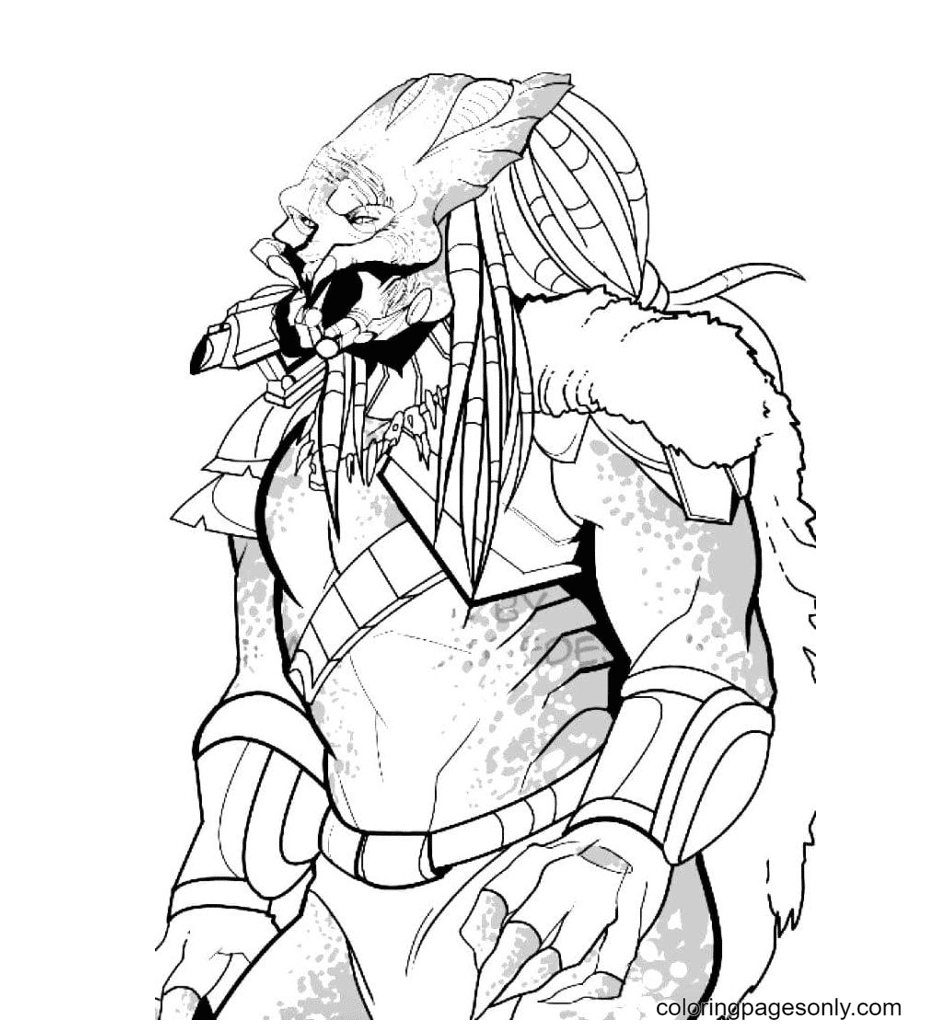
Coloring full-armor portraits: The skin beneath the armor is the first decision: greenish-olive or dark olive grey, with irregular dark spot markings distributed across all visible skin surfaces. The spot pattern is not regular: the spots cluster more densely on the upper back and shoulders, becoming sparser on the limbs. The armor itself is darker than the skin, typically dark brown or near-black with bronze or copper-toned edges at the panel seams. The netting mesh should be rendered in a slightly lighter or slightly yellower tone than the skin, making the diamond pattern visible without competing with the armor’s dominant dark tones.
Wrist Blade and Weapon Detail Pages
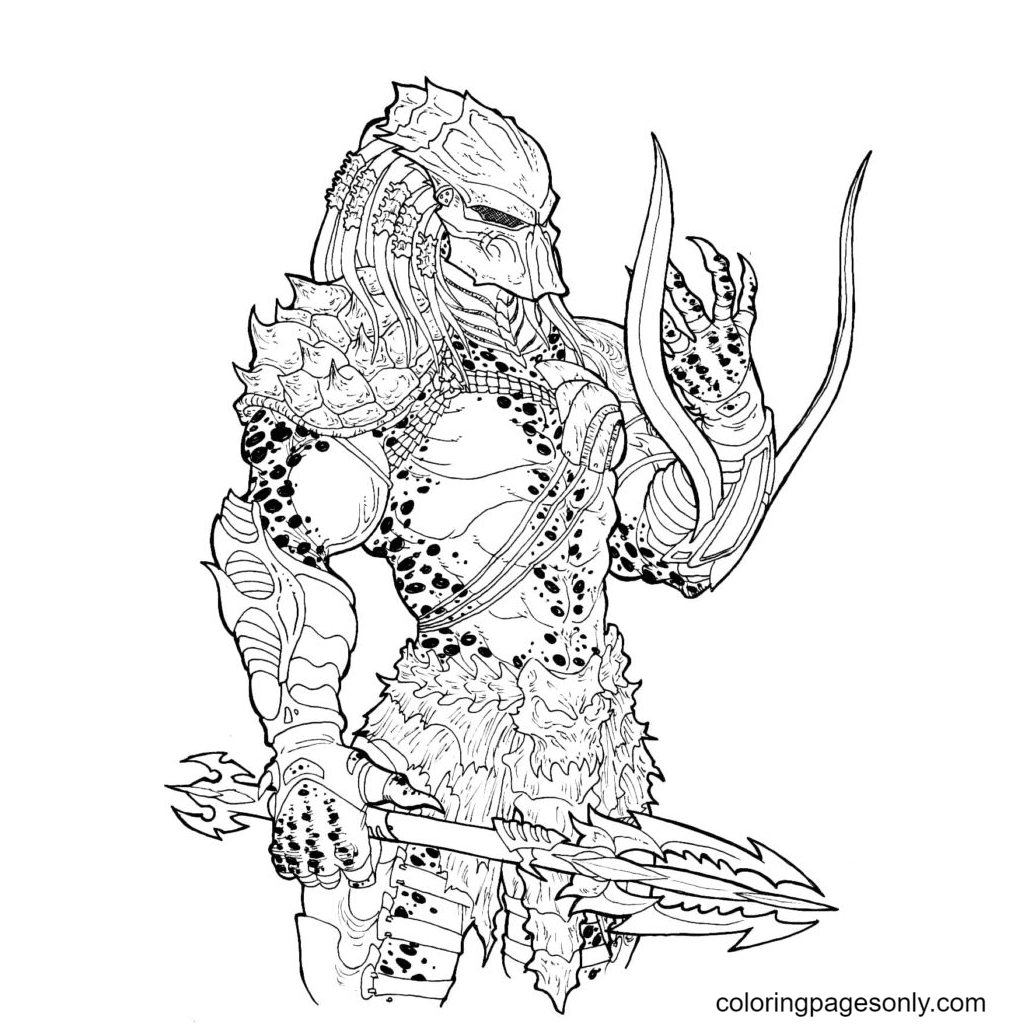
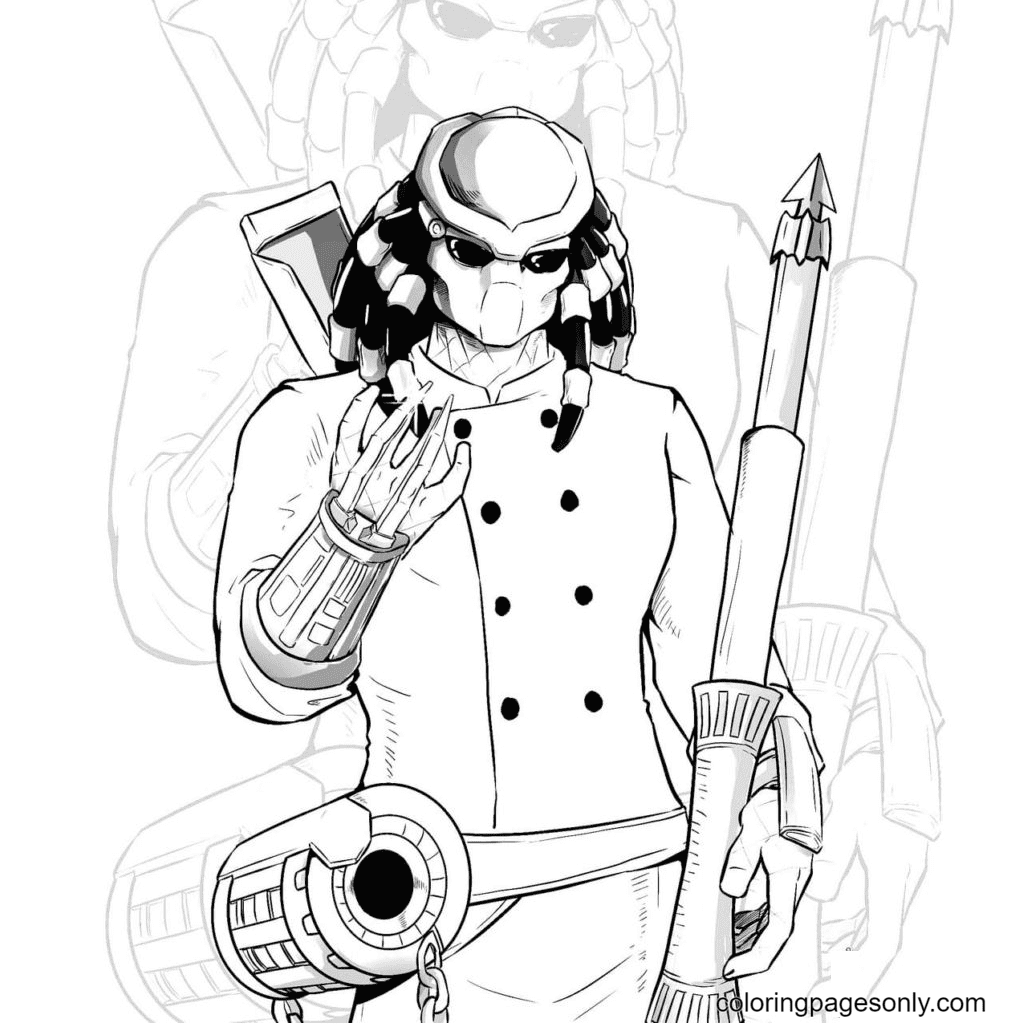
The Predator’s wrist blades are the most frequently used close-combat weapon in the franchise: two or three parallel blades that extend from a gauntlet-mounted housing on the forearm, sharp enough to penetrate most materials. Their retractable design means pages can show them deployed (extending forward from the wrist) or retracted (housed flush against the forearm gauntlet).
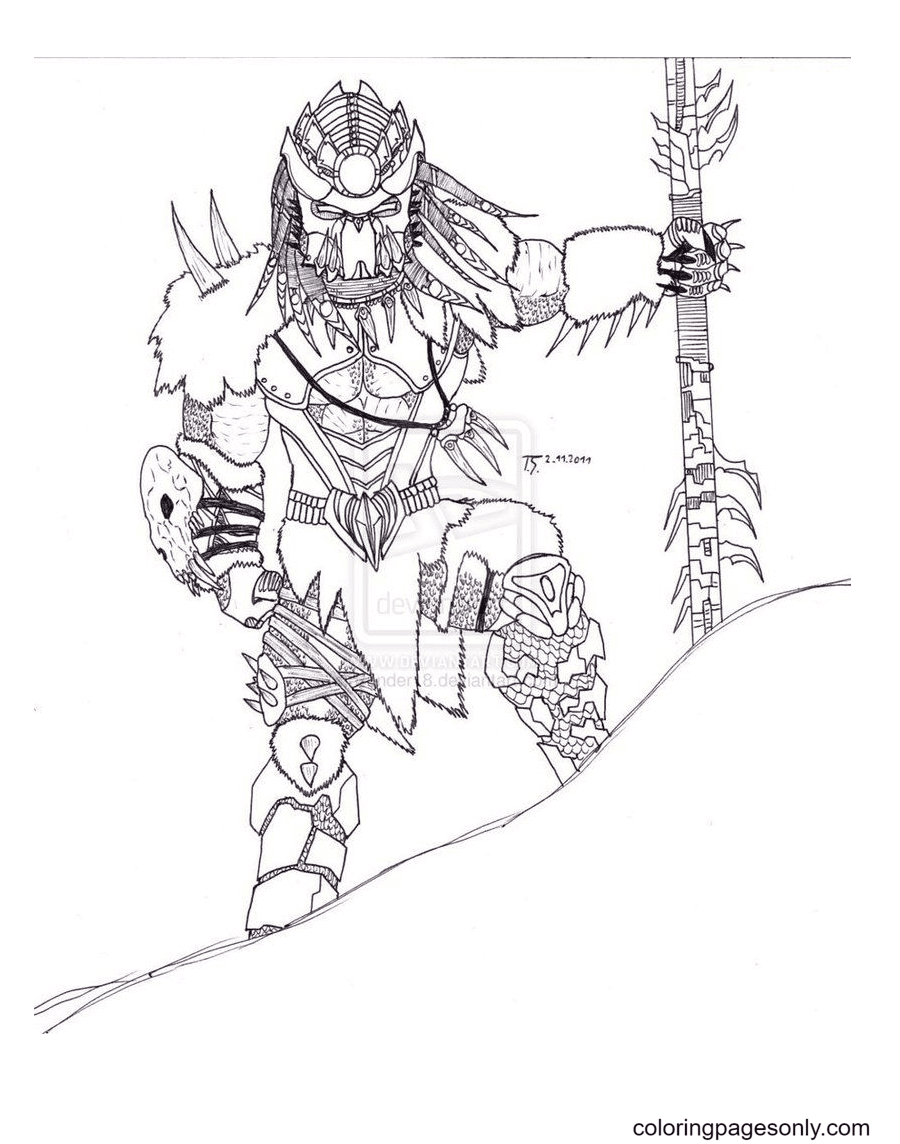
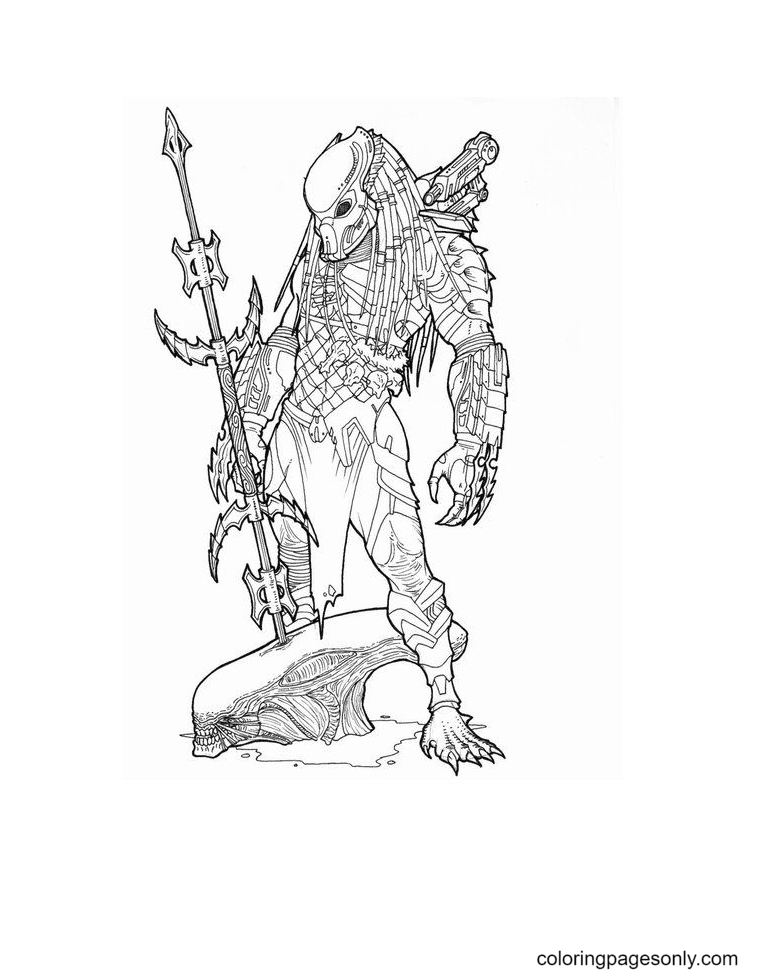
The combistick is an extending spear used in several films: a compact rod that telescopes out to full spear length, with a bladed tip and a weighted opposite end. The smart disc is a circular-bladed weapon used in Predator 2, spinning and self-guiding to a target. Pages showing these weapons in detail reward careful metallic rendering.
Coloring weapon pages: All Yautja weapons are rendered in the same metallic family: very dark grey base with bronze or copper highlights at the edges and working surfaces. The blades are slightly lighter than the housing, with the sharpest edges at the lightest point on the blade (the near-white highlight that indicates a honed edge). The plasma caster’s barrel is darker and more cylindrical, with any energy charge building inside the barrel rendered as vivid teal or green-white.
The Jungle Environment Pages
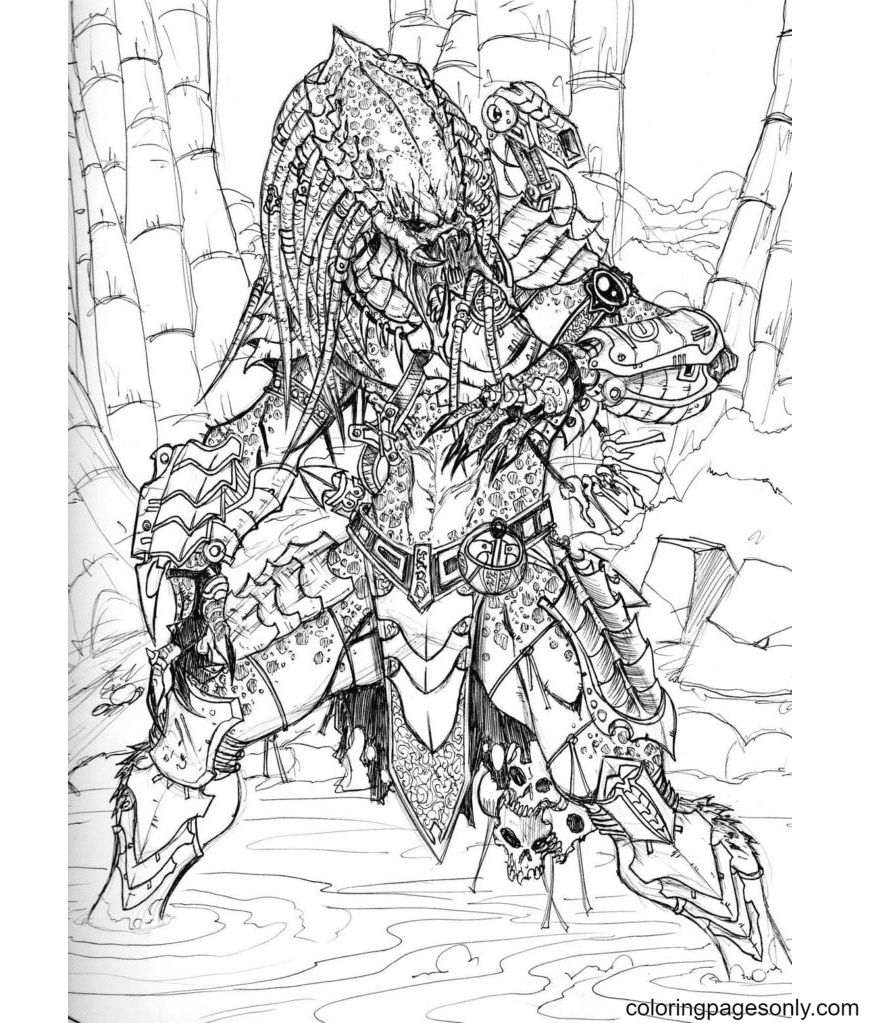
The original 1987 film set the franchise’s defining visual context: dense Central American jungle, high humidity, heavy canopy, the specific quality of light filtering through vegetation that creates a dappled, low-visibility environment. The Predator moves through this environment using its cloaking device, creating the distinctive shimmering heat-distortion effect that was achieved in the original film using an infrared camera, showing an inverted landscape.
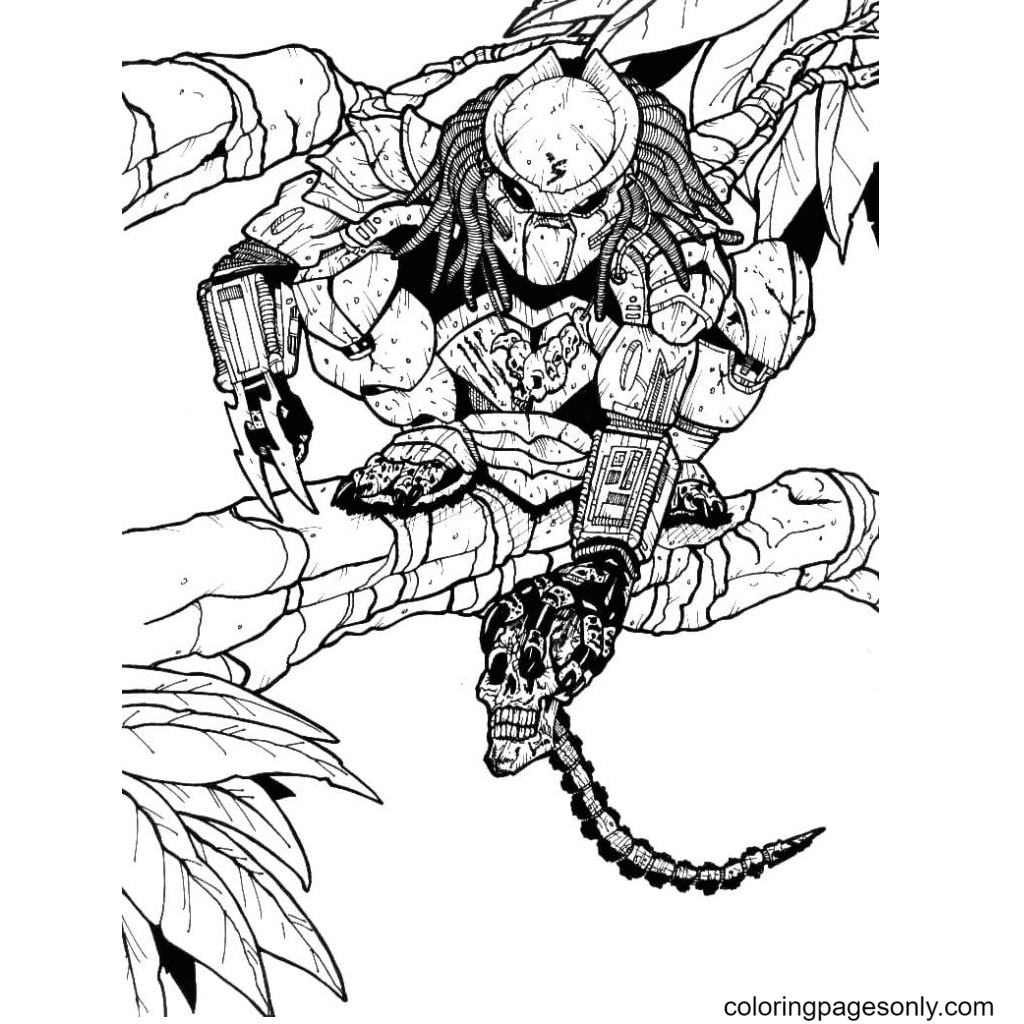
Pages set in jungle environments show the Predator against a background of dense tropical vegetation: large-leaved plants, lianas, high canopy trees, and the specific dark and light contrasts of direct sunlight and deep forest shade.
Coloring jungle environment pages: The vegetation is vivid, varied green: bright yellow-green in the areas of direct light, darker blue-green in the shaded areas, near-black in the deepest shadow zones beneath the canopy. The overall atmosphere is warm and humid, which shifts the shadow tones slightly toward warm brown-green rather than cool grey-green. The Predator itself should be the darkest element in the composition, with the armor providing maximum contrast against the vegetation.
Feral Predator Pages from Prey (2022)
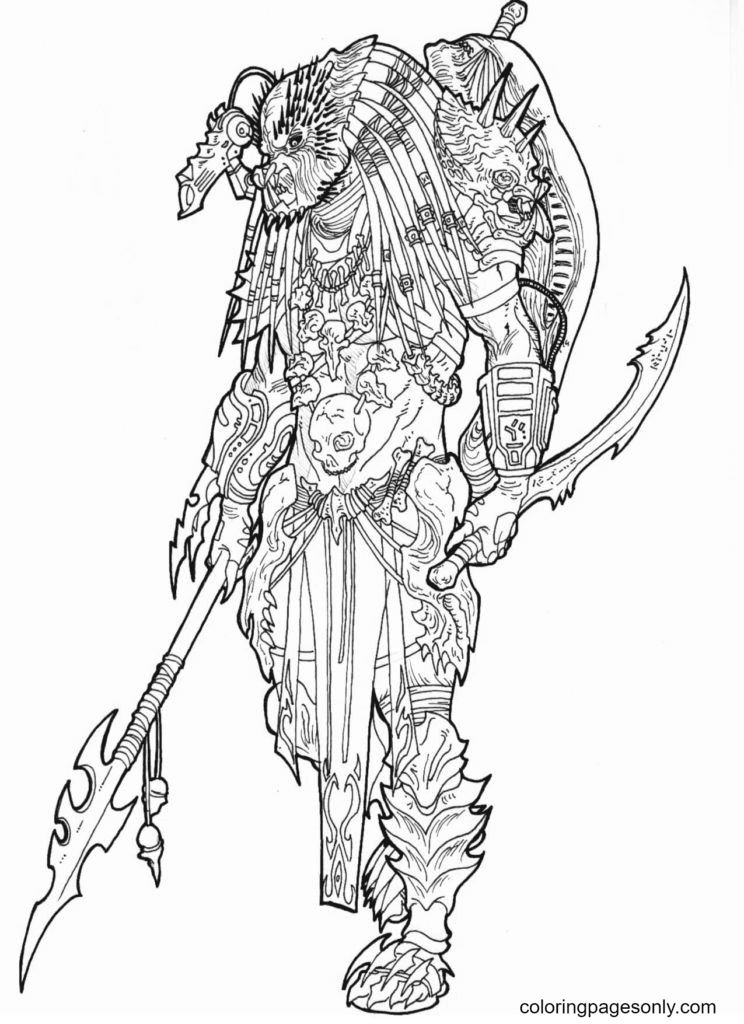
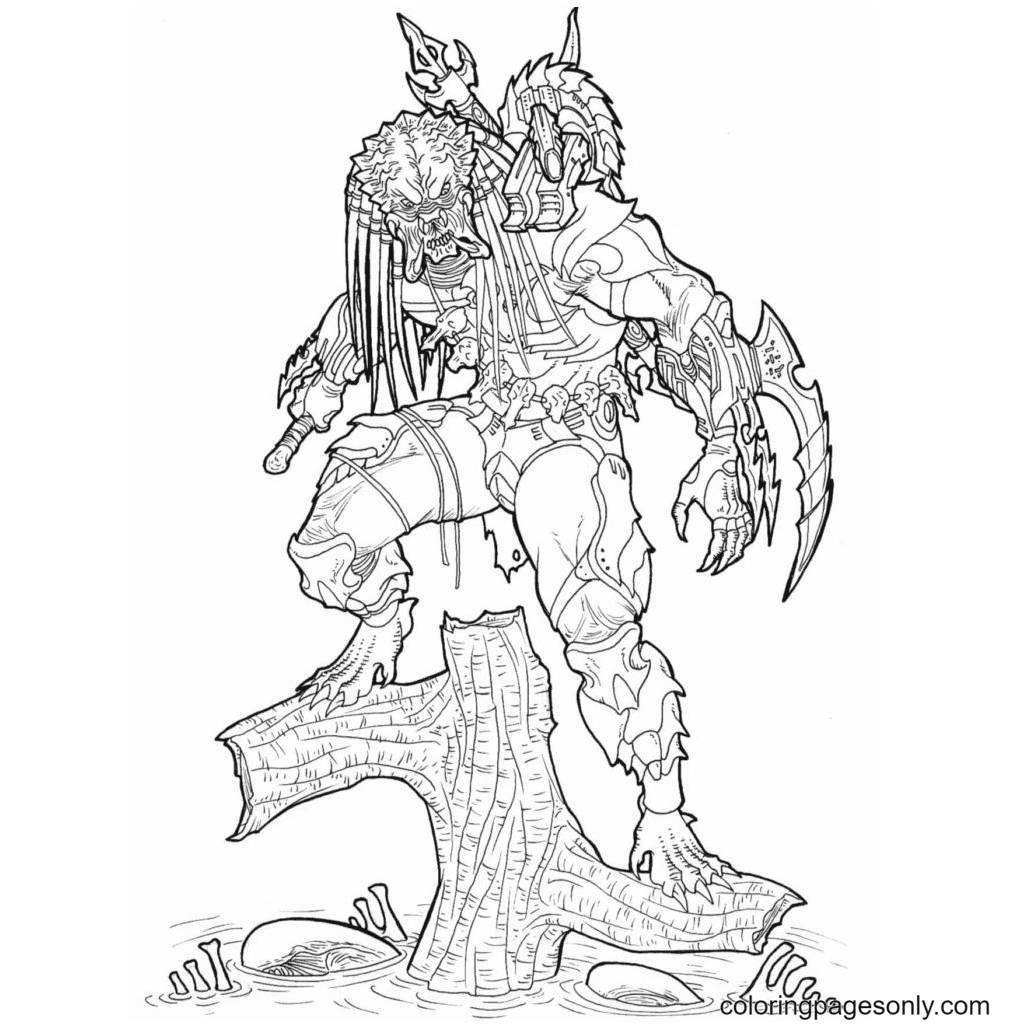
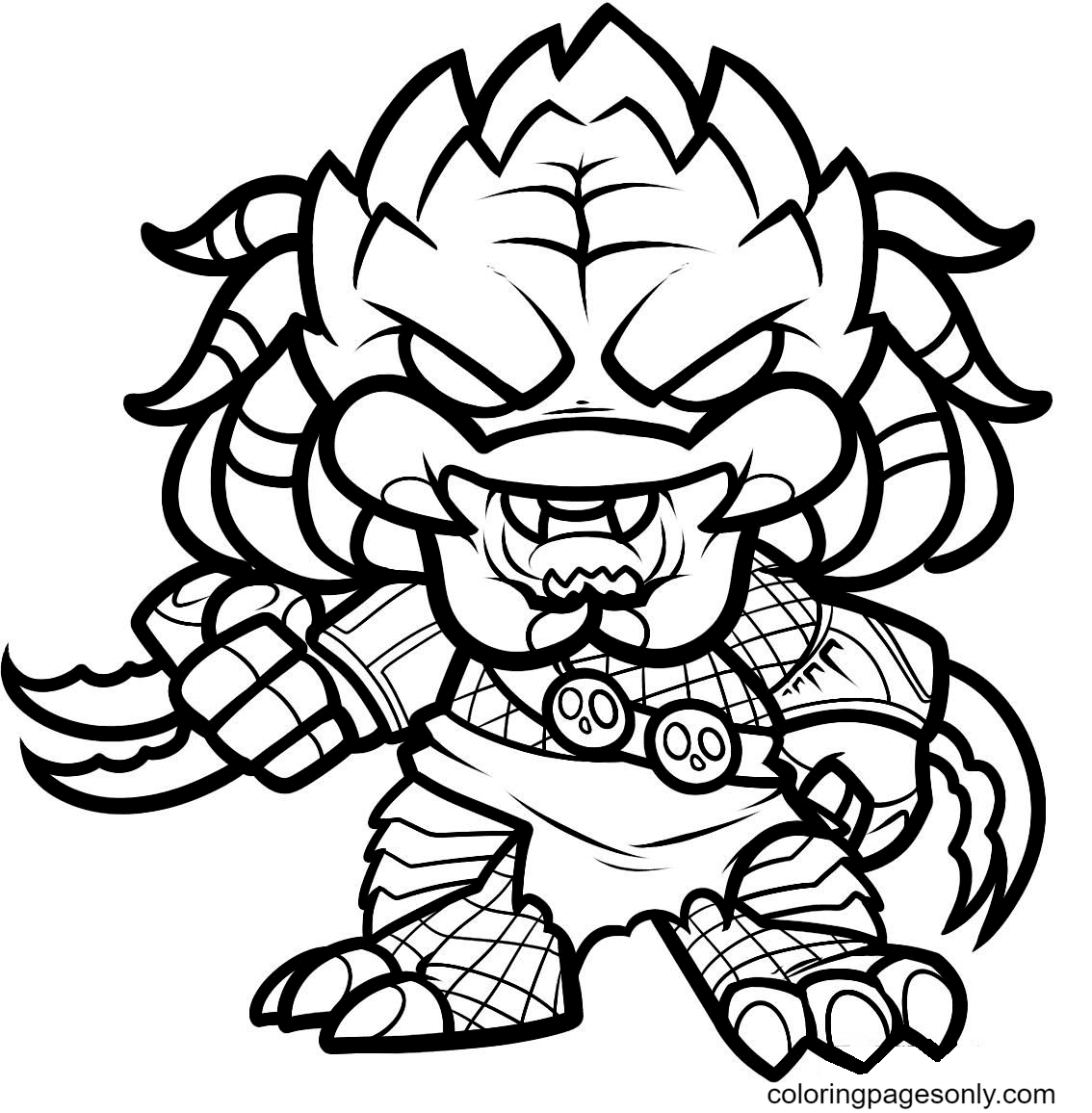
The Predator in Prey (2022) is a younger, less technologically equipped variant referred to in production materials as the Feral Predator. This version has notably less armor than the classic design, a different bio-helmet shape with a more primitive appearance, and a weapon loadout that includes hand-crafted melee weapons alongside the standard Yautja technology. The film’s setting in 1719 places this Predator centuries before the events of the 1987 original.
Amber Midthunder’s performance as Naru earned significant critical recognition, and the film is widely considered the strongest entry in the franchise since the original. The Great Plains setting gives Feral Predator pages a completely different environmental context from the jungle: open prairie, river environments, and period-appropriate Comanche village settings.
Coloring Feral Predator pages: The less-armored design means more skin is visible than in the classic design, requiring careful application of the olive-grey skin with spot markings across a larger surface area. The primitive bio-helmet has a rougher, less polished surface than the classic version: apply the metallic treatment with more variation and a less smooth finish. The Great Plains background uses warm, dry golden-brown for grassland, cooler blue-grey for sky.
Skull Trophy and Icon Pages
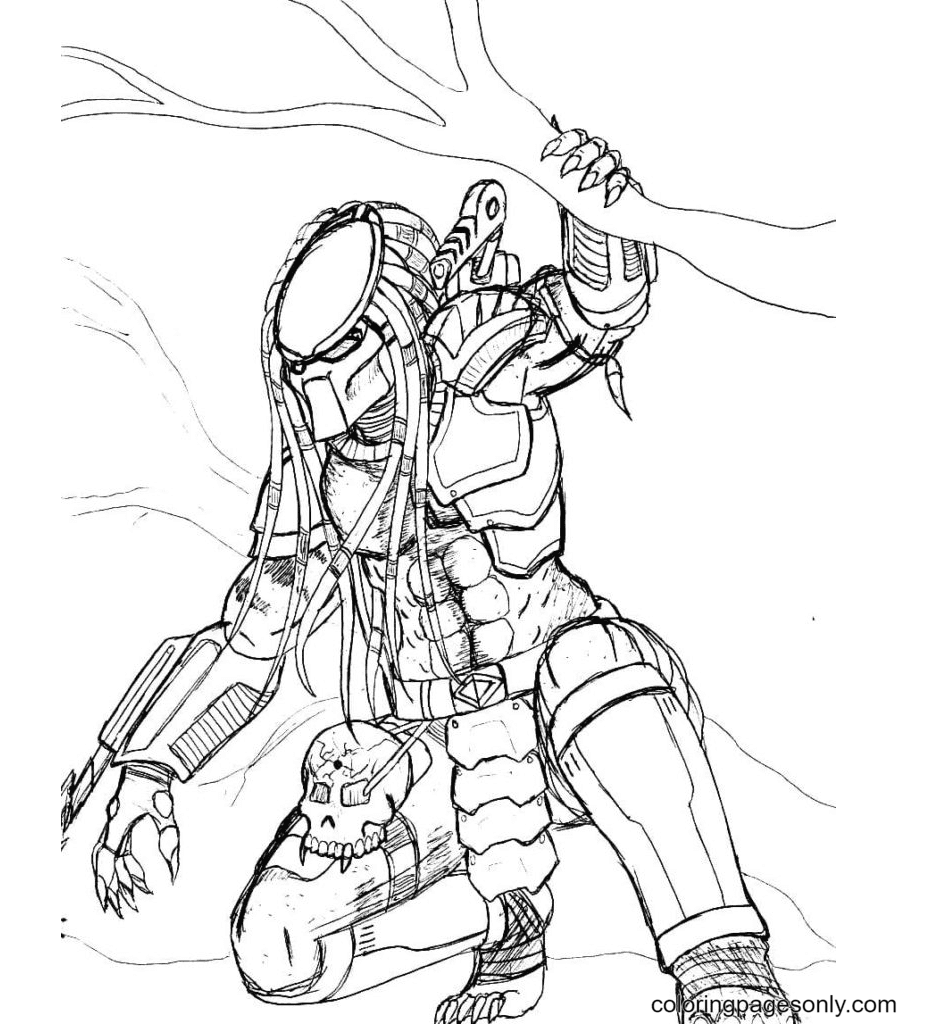
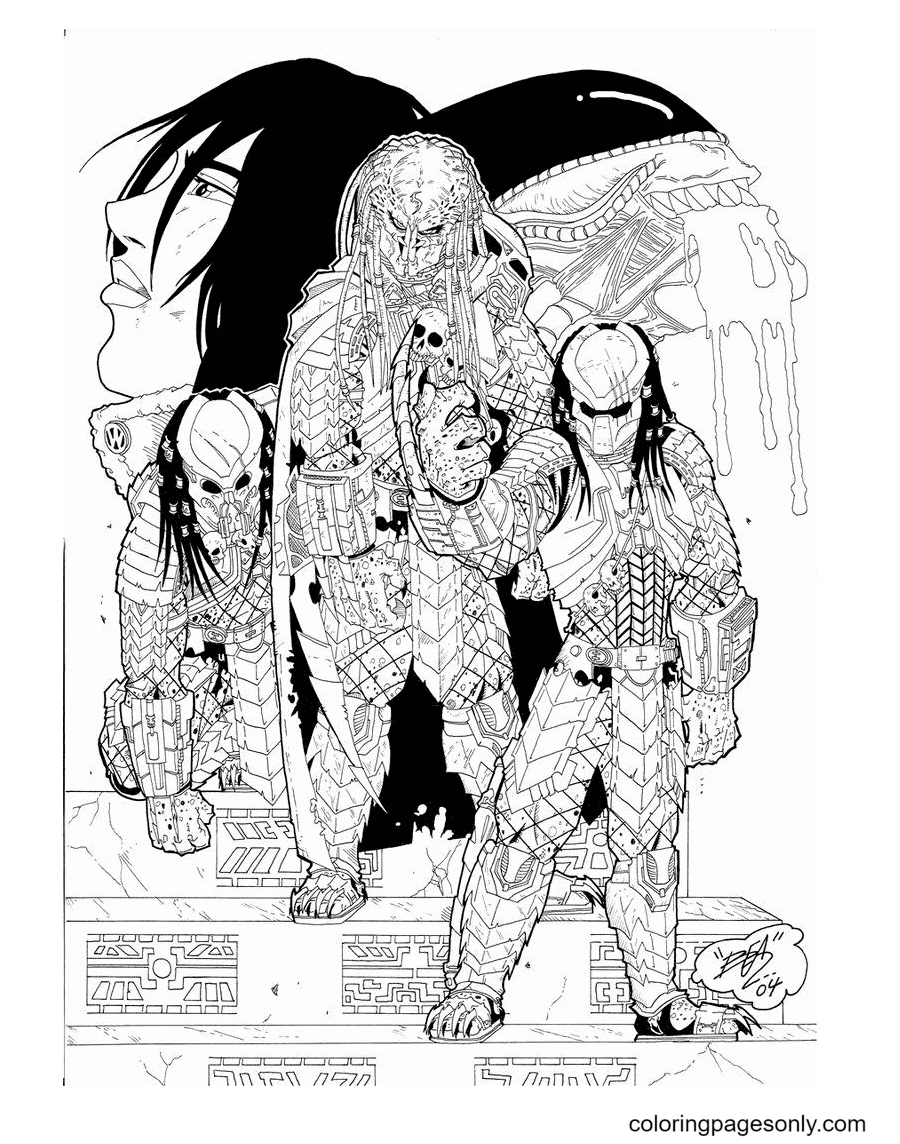
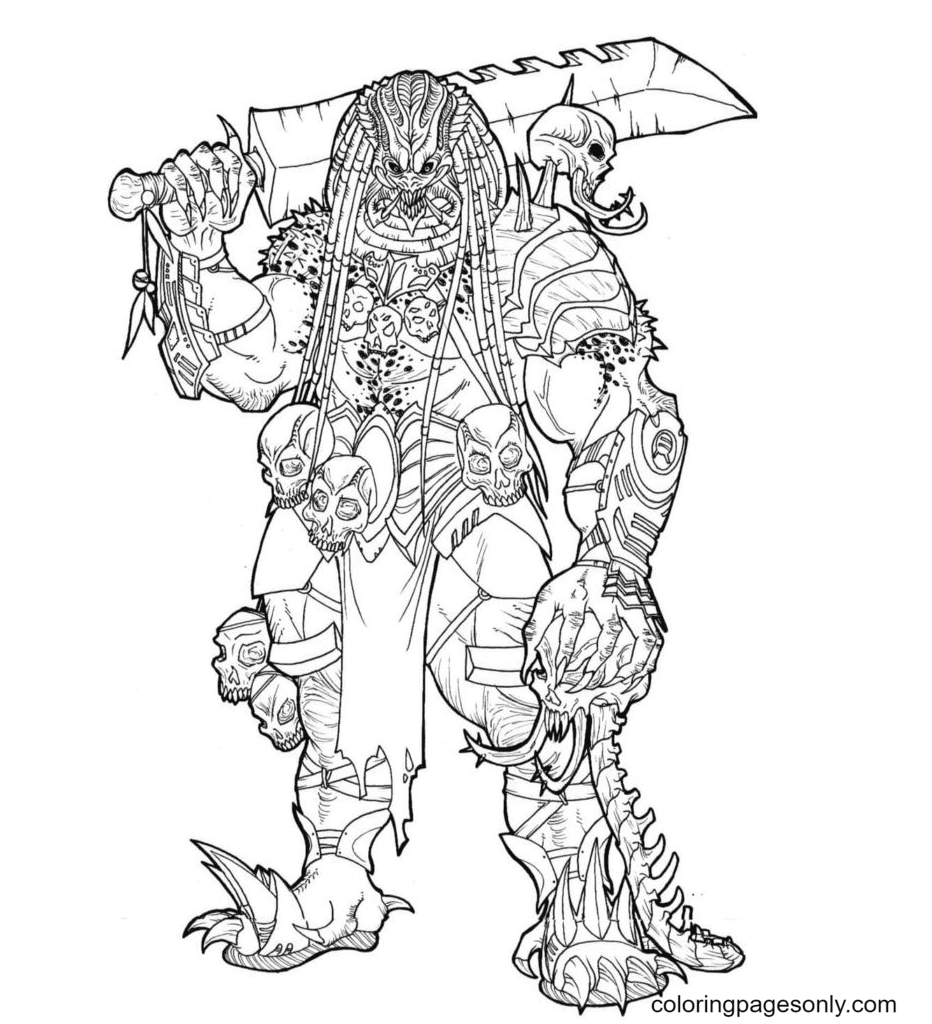
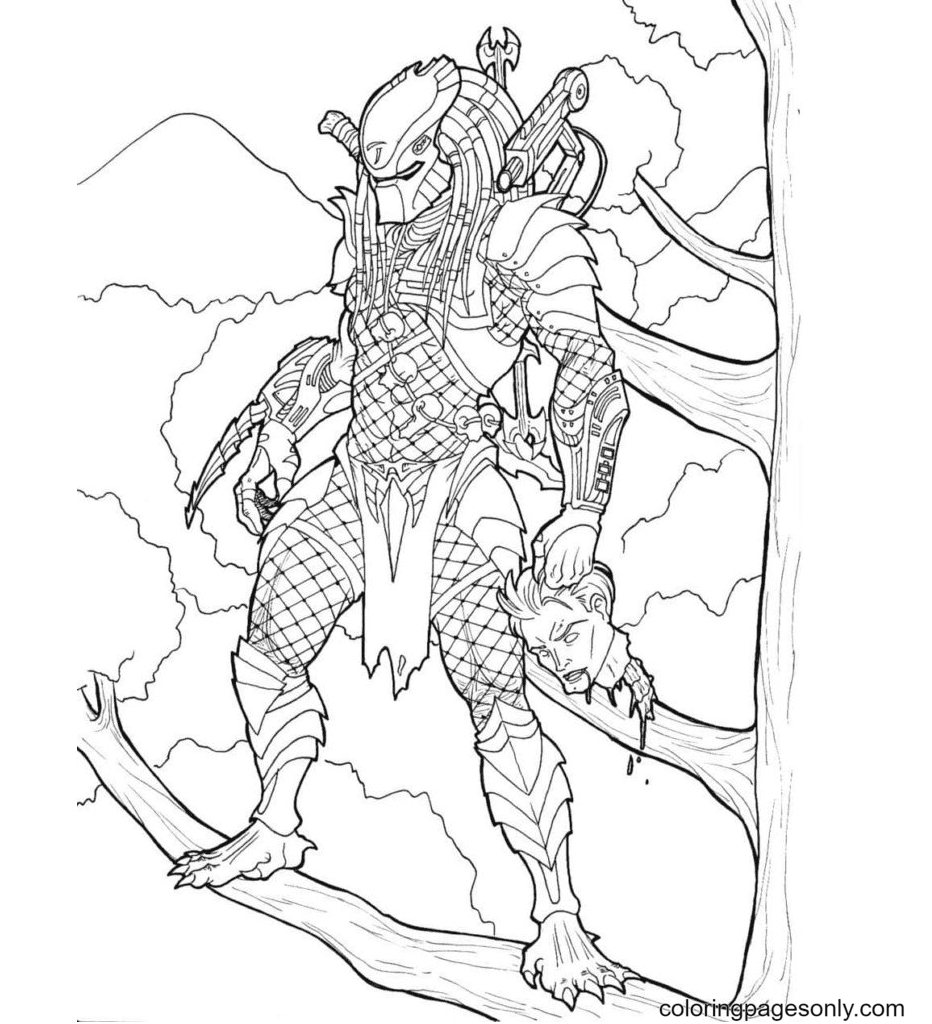
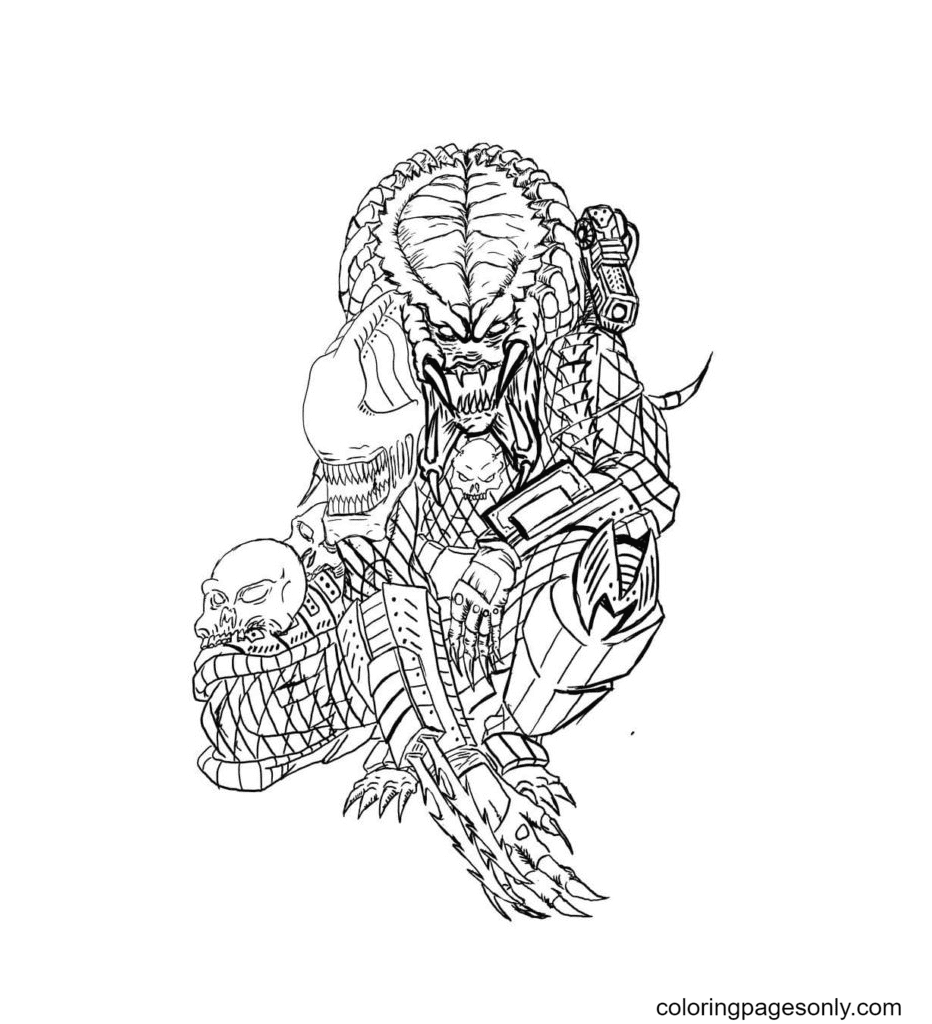
The Predator’s trophy-collecting behavior is one of its most documented cultural practices in the franchise lore: skulls and spinal columns of hunted prey are kept as trophies, with the most honored kills displayed most prominently. The skull imagery from the franchise has become independently iconic, appearing widely in fan art and merchandise.
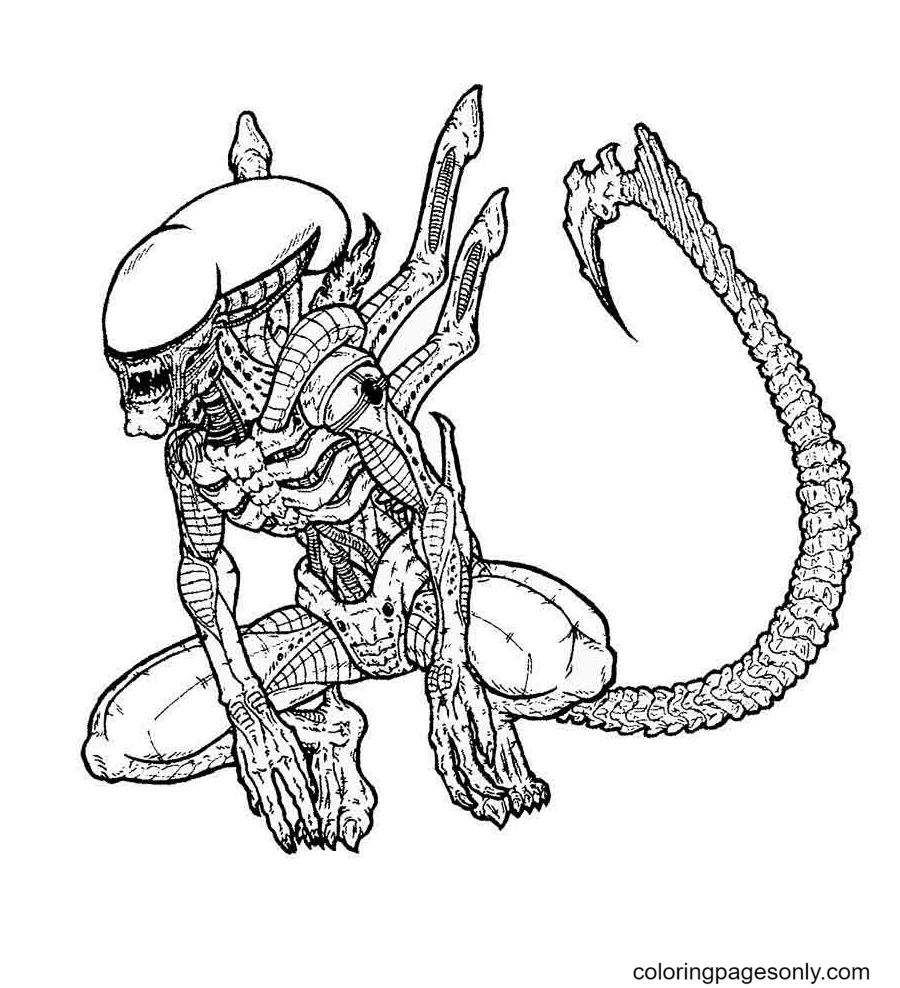
Coloring skull pages: Bone is warm, slightly yellowed off-white: not pure white and not grey, but the specific warm cream of aged bone. Shadow areas in the skull’s recesses are warm tan-brown. Any Xenomorph skull visible in the trophy collection (referencing the Easter egg in Predator 2) should be rendered in the darker, more elongated style of the Alien franchise’s creature design.
What These Pages Do
Stan Winston’s Predator design is one of science fiction cinema’s most studied practical effects achievements. Winston’s studio created a fully articulated costume that could be worn by a 7-foot-2 performer, with mechanically operated mandibles controlled by cables and a level of surface detail that holds up under close-up photography. Coloring pages based on this design engage directly with the specific craft decisions Winston’s team made: the biomechanical armor aesthetic, the netting garment, the mandible geometry, and the thermal vision palette.
The franchise’s production history includes documented creative problem-solving that makes the films interesting beyond their commercial performance. The original Predator (1987) famously had its alien redesigned mid-production after the first design concept failed in early filming. Jean-Claude Van Damme was originally cast to play the alien in a red suit, but the concept was abandoned, and Stan Winston was brought in to create the final design. Prey (2022) reversed the franchise’s declining critical reputation by stripping away accumulated mythology and returning to the original premise with a different cultural context and a female protagonist, a decision that earned a 92% Rotten Tomatoes score.
The American Academy of Pediatrics identifies fine motor skill development as a key childhood milestone throughout early childhood. The intricate surface detail of Predator armor, the mesh netting pattern, the mandible geometry in unmasked face pages, and the thermal vision gradient application all provide sustained fine motor challenge calibrated for the older audience these pages primarily serve. The 2005 Art Therapy Journal study on structured coloring and anxiety reduction applies throughout this collection.
These pages are most appropriate for ages thirteen and older, consistent with the R rating of the primary franchise films.
How to Color These Pages Well
Dark skin with spot pattern is the technical foundation of every Predator page. The skin reads as Yautja only when the olive-grey base is in place, and the irregular spot pattern is correctly distributed. Apply the olive-grey base across all visible skin surfaces for full coverage. Then add the spots as a second layer: irregular oval shapes, darker than the base skin, clustered on the upper body and becoming sparser toward the extremities. The spots are not uniform circles but irregular organic shapes of varying sizes.
The armor requires three distinct tones within the dark brown and black family. The primary armor surfaces are very dark brown or near-black. The edges and raised panel seams catch more light and should be rendered in a dark bronze or dark copper tone, one to two values lighter than the main surface. The deepest recesses between armor panels, where two surfaces meet in shadow, should be the darkest available tone. These three zones give the armor its dimensional, three-dimensional quality on the flat page.
The plasma caster is the composition’s only vivid color accent on a classic Predator page. If the plasma caster is shown with an energy charge, that charge should be the most vivid color on the entire page: a vivid teal or blue-white that provides maximum contrast against the dark armor and skin tones surrounding it. On pages where no energy weapon is shown, the only vivid color accent comes from any illuminated elements on the bio-helmet. Limiting vivid color to one focal element increases its visual impact significantly.
The netting mesh requires a consistent diamond pattern application. The mesh garment covers a large area in most Predator pages. The approach that works best is to apply the base mesh color (slightly lighter or more yellow than the skin) across the entire mesh area first, then use a slightly darker tone to trace the individual mesh cords in the diamond pattern. The cords are thin: apply them with the finest available tool. The open spaces of the mesh should show the skin tone beneath where the mesh is worn over bare skin, or the armor color where the mesh lies over armor.
Thermal vision pages use the opposite color logic from most other pages. In normal pages, warm colors (reds, oranges) go on warm subjects and cool colors (blues, purples) go on cool backgrounds. In thermal vision pages, the warmest, brightest colors (orange-red) go on the hottest objects, and the coolest colors (deep blue-purple) go on the coldest areas. This is the actual logic of infrared imaging. Apply blue-purple to the ambient background first. Then identify heat sources and apply yellow-orange to warm areas, orange-red to the hottest points. The human figure in a thermal vision page should glow orange-red at the chest and head, fading to yellow at the extremities.
5 Creative Craft Ideas
The Trophy Wall
The Predator in Predator 2 (1990) has a trophy room aboard the ship containing skulls of various hunted species, including what appears to be a Xenomorph skull. Print a Predator portrait page showing the character holding or displaying trophy skulls. Color the Predator in canonical armor colors and apply warm bone cream to the skulls.
On a dark backing sheet, mount the colored page. Around the page, position small hand-drawn skull outlines representing different hunted species, each labeled with the film the species belongs to. The finished display is a visual archaeology of the franchise’s mythology.
Thermal Vision Diorama
Print any action scene page from the collection that shows both the Predator and a human figure. Color the entire page using thermal vision logic: deep blue-purple background, warm yellow-orange for living figures, the Predator itself in a slightly different heat signature (cooler at the extremities, warmer at the core).
On a separate small card attached to the page, write: “Predator thermal vision (infrared mode). Warm-blooded targets appear in yellow-orange. Cool-blooded targets and inorganic surfaces appear in blue. ‘If it bleeds, we can kill it.’ (Major Alan Dutch Schaefer, 1987.)”
Classic vs. Feral: Two Eras
Print one page referencing the Classic Predator from 1987 and one page referencing the Feral Predator from Prey (2022). Color both in their respective canonical designs: the Classic with full articulated armor, dark bronze metal, and the complete weapon loadout; the Feral with less armor, more visible skin, and the more primitive equipment of the 1719 setting.
Mount both side by side: “Predator (1987). Central American jungle. Full Yautja armor.” and “Prey (2022). Great Plains. 1719. 92% on Rotten Tomatoes.” The display spans 35 years of franchise design evolution in two images.
Stan Winston Tribute Page
Stan Winston (April 7, 1946 to June 15, 2008) was the special effects artist who created the Predator’s final design. His studio also created the T-800 endoskeleton for The Terminator, the dinosaurs for Jurassic Park, and the Iron Man armor for the first Marvel Studios film. He won four Academy Awards for Visual Effects.
Print the most detailed full-armor Predator page in the collection. Color it with the greatest possible technical accuracy: spot-patterned olive skin, three-tone dark armor, biomechanical surface detail. On the backing sheet below the page, write: “Design by Stan Winston, 1987. Four Academy Awards. The Predator, the T-800, the dinosaurs of Jurassic Park, and the first Iron Man suit. One studio. One lifetime.”
The Comanche Language Page
Prey (2022) was released in a Comanche language version as well as English, making it the first Hollywood film to be fully dubbed in Comanche. The Comanche Nation collaborated with the production to develop the language track, working with linguists and tribal elders to produce dialogue that was accurate to the period setting.
Print the most detailed Feral Predator page from the collection. Color it in the Great Plains setting palette: warm golden prairie grass, open sky, the Feral Predator’s less-armored design.
On the backing sheet, write: “Prey (2022). Director: Dan Trachtenberg. Starring: Amber Midthunder as Naru. First Hollywood film fully dubbed in Comanche. The Comanche Nation collaborated on the language track. Released on Hulu, August 5, 2022.”
Frequently Asked Questions
What is the Predator? The Predator is a fictional extraterrestrial species from the science fiction film franchise of the same name, first appearing in John McTiernan’s Predator on June 12, 1987. Known in expanded universe materials as the Yautja, they are a technologically advanced nomadic warrior culture that travels the galaxy hunting dangerous prey species for sport and cultural honor. They are depicted as bipedal humanoids standing approximately 7 feet (over 2 meters) tall, with olive-grey or greenish spotted skin, four mandibles framing the mouth, dreadlock-like appendages, and a distinctive armor system including a shoulder-mounted plasma caster and wrist blades. Their culture requires hunting only dangerous, armed prey and forbids killing the unarmed or children.
Who created the Predator’s physical design? The Predator’s final physical design was created by Stan Winston and his studio, Stan Winston Studio, during pre-production on the 1987 film after an earlier design concept was abandoned. The original concept, to be played by Jean-Claude Van Damme in a red suit, failed in early filming, and the production brought Winston in to redesign the creature entirely. Winston’s team created the fully articulated costume with mechanically operated mandibles, worn by actor Kevin Peter Hall, who stood 7 feet 2 inches (218 centimeters) tall. Stan Winston later won four Academy Awards for Visual Effects across his career, for work including Aliens (1986), Terminator 2: Judgment Day (1991), Jurassic Park (1993), and Aliens again. He died on June 15, 2008.
How many Predator films have been made? The franchise includes seven theatrical or streaming films as of 2025. Predator was released on June 12, 1987, directed by John McTiernan and starring Arnold Schwarzenegger. Predator 2 followed on November 21, 1990, directed by Stephen Hopkins and set in Los Angeles in 1997. Predators (2010) was directed by Nimrod Antal and produced by Robert Rodriguez. The two Alien vs. Predator crossover films were released in 2004 and 2007. The Predator (2018) was directed by Shane Black. Prey (2022), directed by Dan Trachtenberg and released on Hulu on August 5, 2022, received 92% on Rotten Tomatoes and is widely considered the strongest entry in the franchise since the original.
What weapons does the Predator use? The Predator’s primary weapon loadout includes several distinct technologies. The plasma caster is a shoulder-mounted energy weapon with a tri-laser targeting system that projects three red dots converging on a target before firing. Wrist blades are retractable blades extending from a gauntlet on the forearm, used for close-quarters combat. The combistick is a telescoping spear that extends from a compact rod to full length. The smart disc is a circular blade weapon seen in Predator 2 that homes in on targets. The bio-helmet provides multiple vision modes, including thermal imaging. A self-destruct device, carried as a last resort, generates a nuclear-level explosion. The Predator also carries medical equipment for self-treatment of wounds in the field.
What is the Predator’s thermal vision? The Predator’s bio-helmet includes a thermal imaging mode that displays the environment as a heat map: warm-blooded creatures and heat sources appear in orange, yellow, and red tones against a cool blue-purple background representing ambient temperature. The thermal vision effect was achieved in the 1987 film using an actual infrared camera, producing images that showed an inverted infrared landscape rather than a computer-generated effect. This gave the original film’s Predator-perspective sequences a physically accurate quality that has not been replicated in the same way in subsequent entries. The thermal vision mode is one of several vision options available to a Predator wearing the bio-helmet, alongside ultraviolet and electromagnetic spectrum modes.
What is Prey (2022) and why was it significant? Prey is a 2022 Predator franchise film directed by Dan Trachtenberg and released exclusively on Hulu on August 5, 2022. The film is set in 1719 on the Great Plains and follows Naru, a young Comanche woman and skilled warrior played by Amber Midthunder, who encounters a Predator on its first documented hunt on Earth. The film received 92% on Rotten Tomatoes and was praised for reversing the critical decline of the franchise by returning to the original premise with a new cultural setting and a female protagonist. It was also released in a Comanche language version, developed with the collaboration of the Comanche Nation, making it the first Hollywood film to be fully dubbed in that language. Amber Midthunder’s performance received widespread critical recognition.
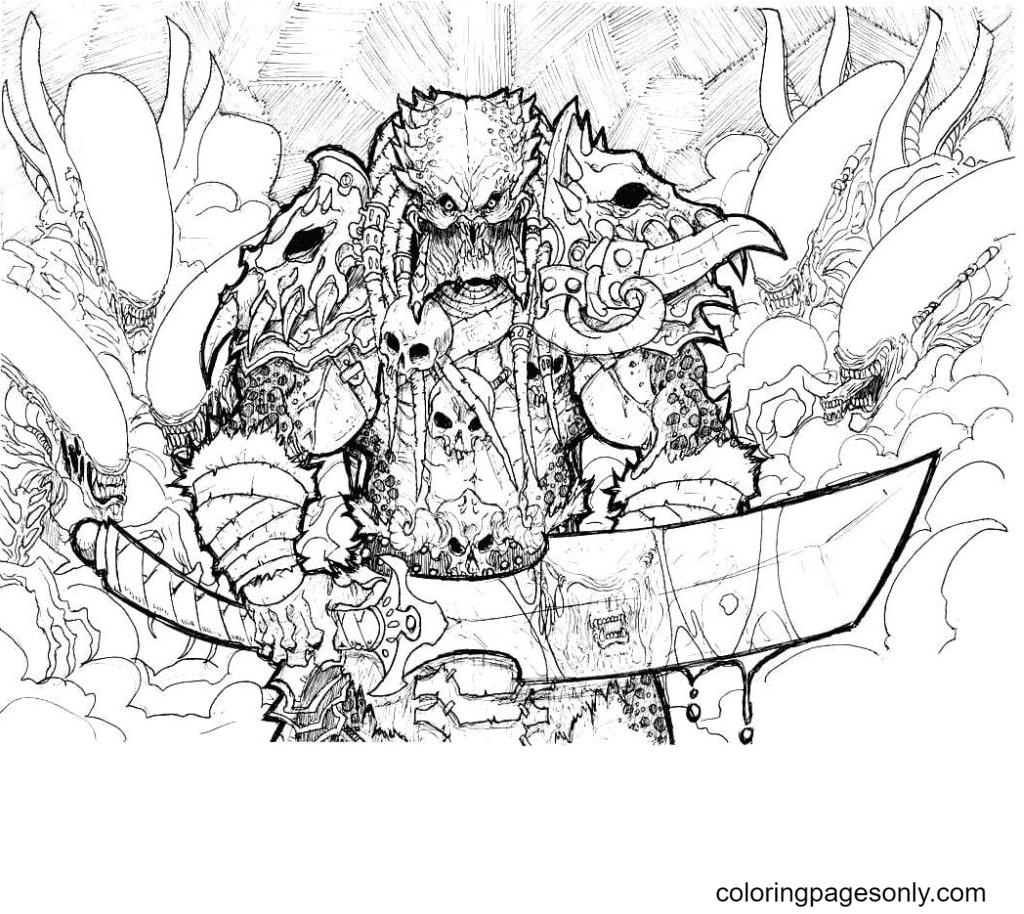
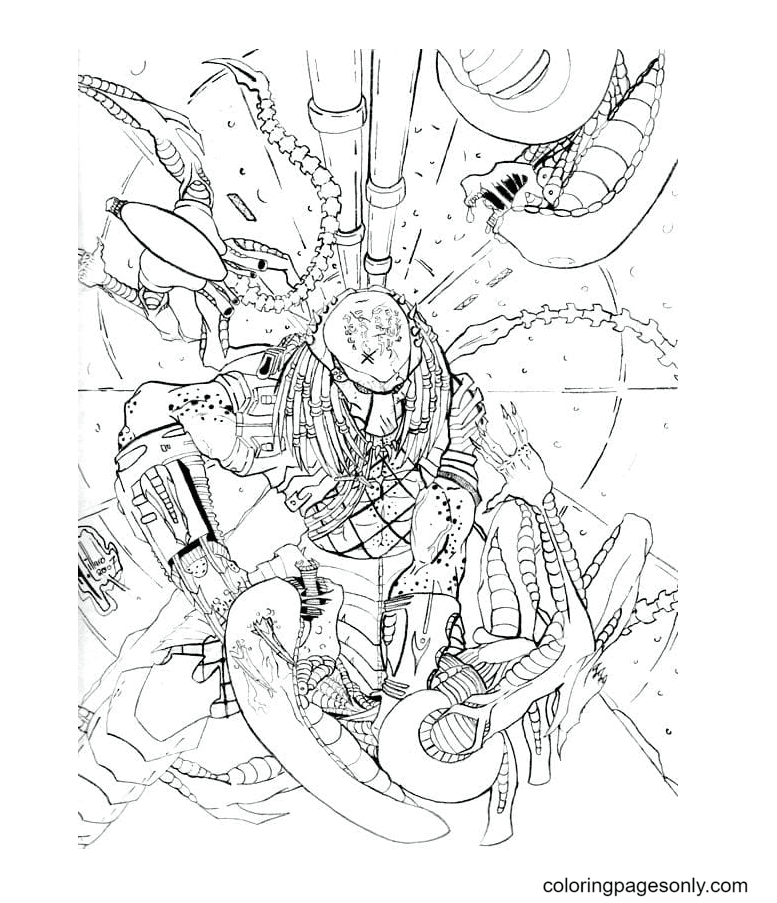
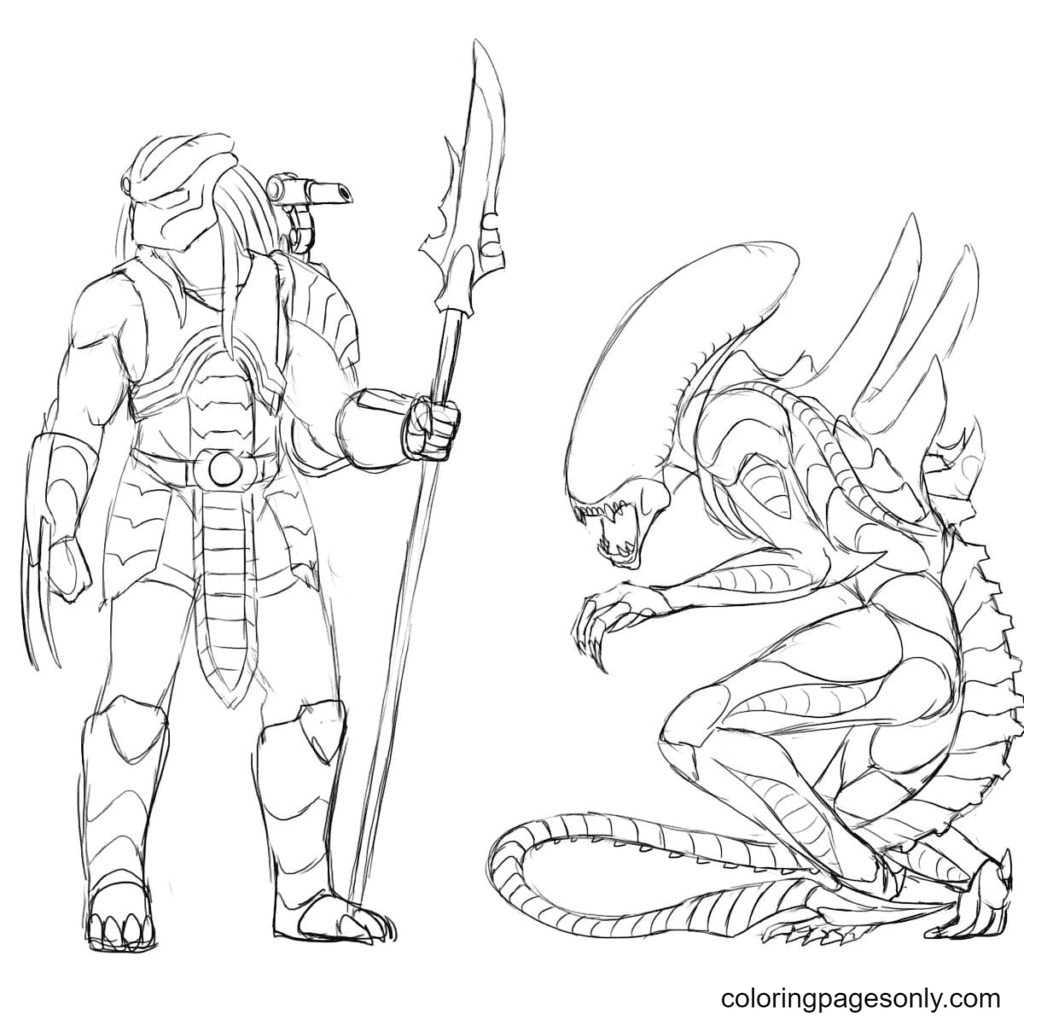
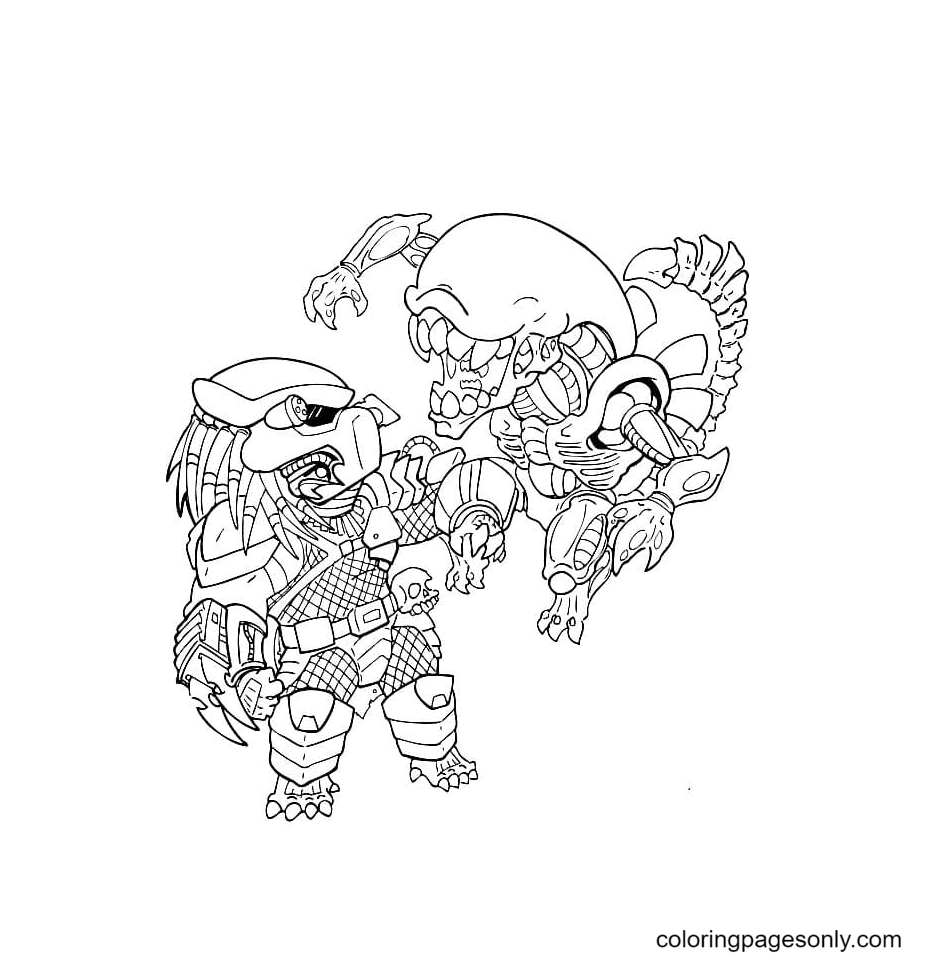
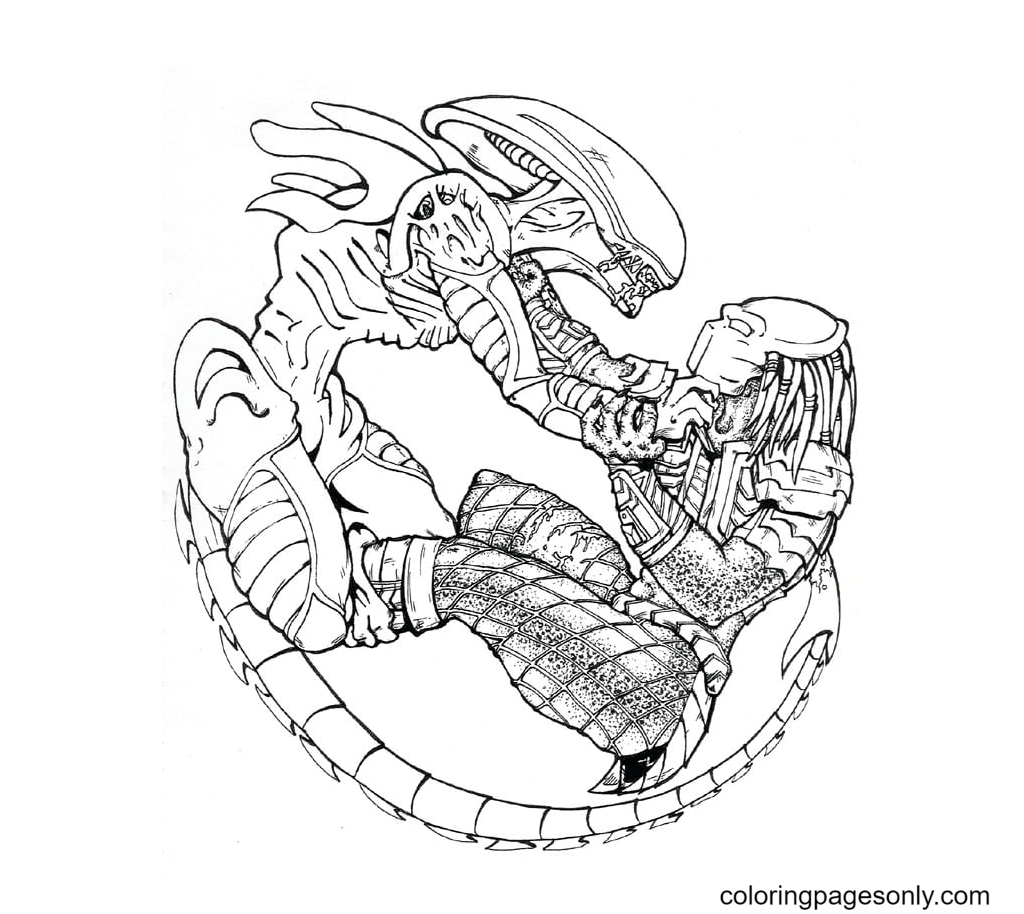
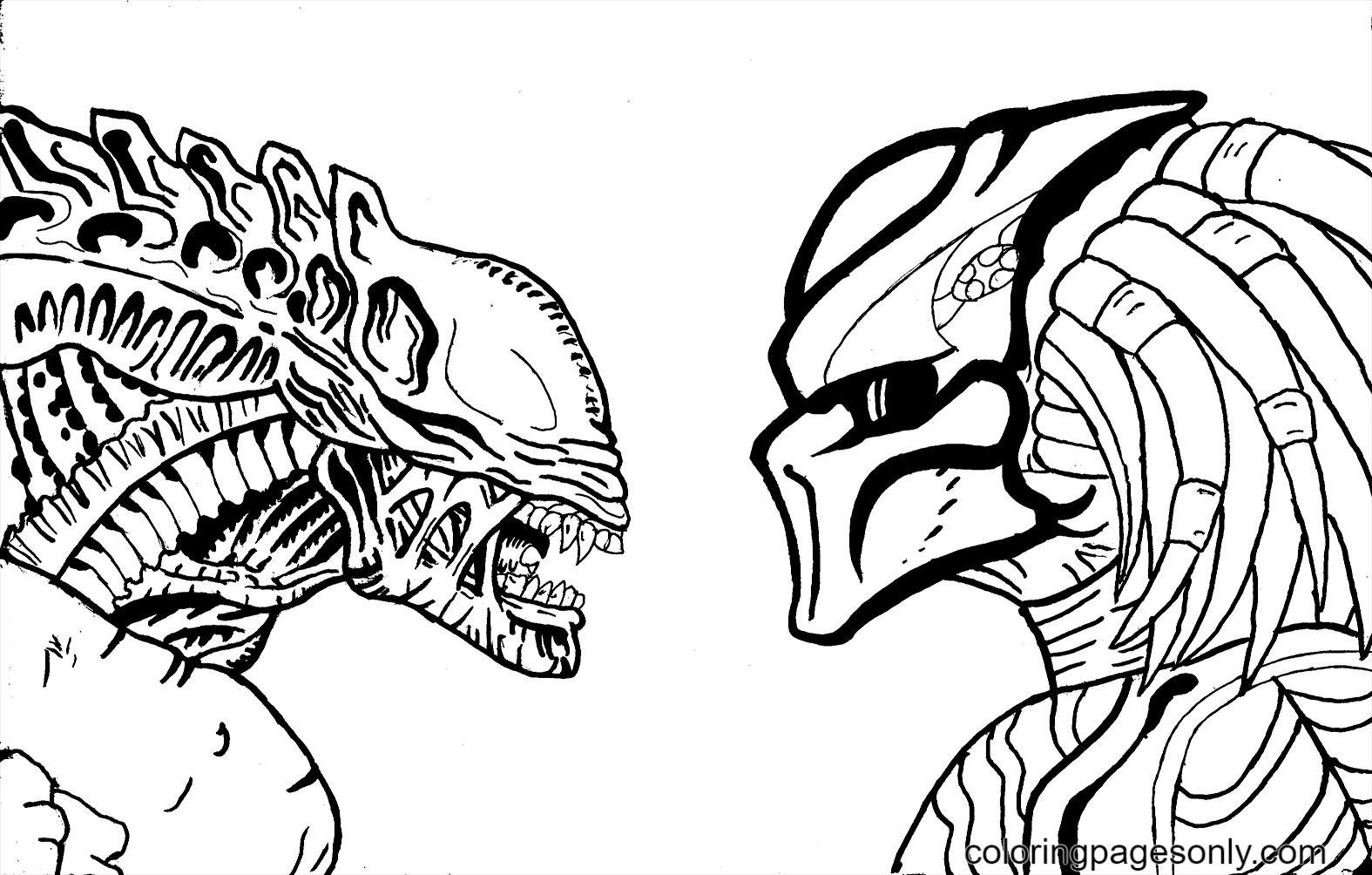
Is the Predator related to the Alien franchise? The two franchises share a canonical crossover introduced by a detail in Predator 2 (1990), in which the Predator trophy room aboard the alien ship contains what appears to be the skull of a Xenomorph (the creature from the Alien franchise). This single visual reference established that Predators hunt Xenomorphs as prey, leading to two theatrical crossover films: Alien vs. Predator (2004, directed by Paul W.S. Anderson) and Aliens vs. Predator: Requiem (2007, directed by the Strause Brothers). The crossover concept originated in a 1989 Dark Horse Comics series. The two mainline franchises (Alien and Predator) are otherwise independent of each other, with different production companies and creative teams managing their respective directions.
What age group are these pages best suited for? Predator coloring pages are most appropriate for ages thirteen and older, consistent with the R rating of the primary franchise films. The character design’s complexity, with its detailed armor surfaces, mandible geometry, and spot-pattern skin, rewards the motor control and sustained attention that develop through middle school and beyond. The thermal vision pages require an understanding of infrared imaging logic that is most accessible from ages twelve and up. The historical and production context of the franchise, including Stan Winston’s design work and the cultural significance of Prey (2022), is most meaningful for older teens and adults who can engage with that context. The pages present the franchise’s visual design without the films’ violent content, but the imagery is drawn from adult-rated source material.
Browse the full collection at ColoringPagesOnly.com. All 80+ pages free, no sign-up, PDF or PNG, print or color online.
John McTiernan directed a film in 1987 about an alien that hunted a military team in a Central American jungle. Stan Winston built the creature in a workshop. Kevin Peter Hall wore it at 7 feet 2 inches. The film earned $98.3 million on a $15 million budget.
Thirty-five years later, Dan Trachtenberg set a Predator loose on the Great Plains in 1719. Amber Midthunder played the Comanche warrior who stopped it. The film earned 92% on Rotten Tomatoes. The Comanche Nation helped translate it.
The design that Winston created is still the thing people recognize. The mandibles. The shoulder cannon. The mesh beneath the armor. The thermal vision that shows the world in orange and blue.
Pick up your olive grey. The skin goes first, then the spot pattern. The armor goes darkest at the deepest recesses.
Share your work on Facebook and Pinterest and tag #Coloringpagesonly. The thermal vision dioramas and the Classic vs. Feral comparison pages are particularly worth sharing.
Color the armor. Apply the spots. The hunt began in 1987 and has not ended.
More from our science fiction and horror collections: