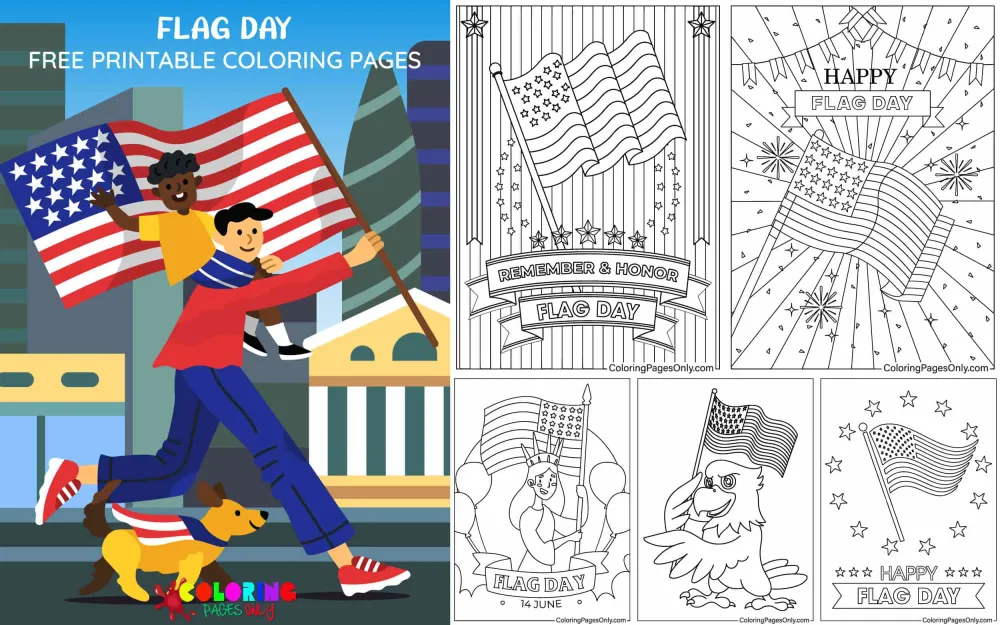
Thirteen stripes, fifty stars – 30+ free Flag Day coloring pages for June 14. American flag, Bald Eagle, Statue of Liberty. Print PDF or color online.
30+ Flag Day Coloring Pages is a collection of engaging and educational coloring pages designed to help children explore and learn more about Flag Day and national flags. Each coloring page is vividly created, depicting images of the American flag and flags from various countries, along with related symbols associated with this commemorative day.
Flag Day in the United States is observed on June 14 each year, commemorating the date the Continental Congress adopted the Stars and Stripes on June 14, 1777. The resolution passed that day read: the flag of the thirteen United States shall be thirteen stripes, alternate red and white, with thirteen stars in a blue field representing a new constellation. The first organized public observance came more than a century later, when Bernard J. Cigrand – a schoolteacher in Waubeka, Wisconsin – held a Flag Day celebration at his school on June 14, 1885. President Woodrow Wilson proclaimed the date a national observance on May 30, 1916, and Congress formally established it through legislation signed by President Harry S. Truman on August 3, 1949.
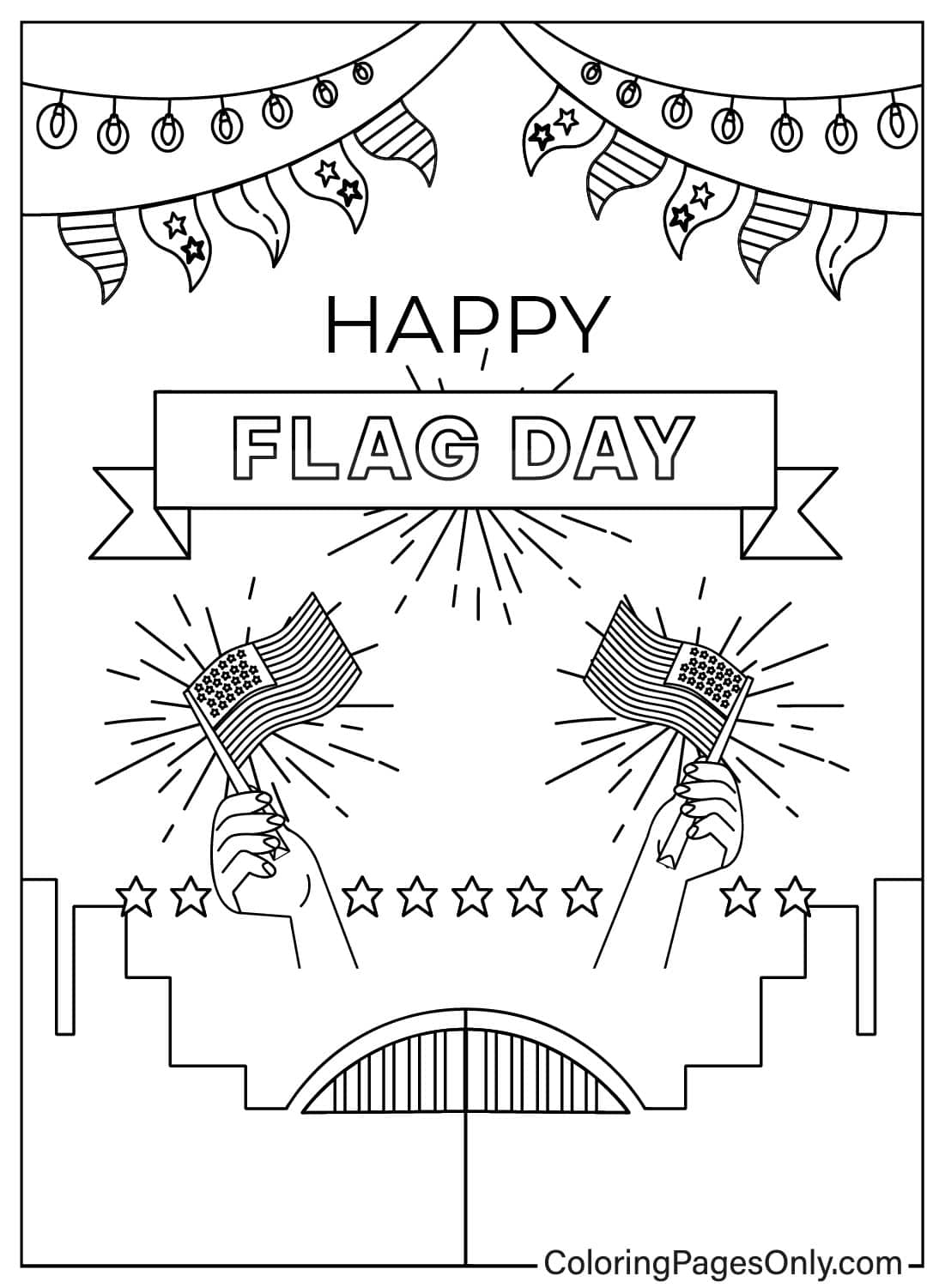
The collection covers 30+ pages across the full range of Flag Day imagery: American flags in various compositions, the Bald Eagle, the Statue of Liberty, fireworks scenes, simple character pages, and text-poster designs for classroom display.
These 30+ free pages at ColoringPagesOnly.com cover the American flag, national symbols, and Flag Day celebration scenes. All free, PDF or PNG, print or color online.
Flag Day is a special celebration in many countries aimed at honoring the national flag and the values it represents. In the United States, Flag Day is observed on June 14th each year. Despite differences in dates and forms of celebration, the common goal of Flag Day is to foster patriotism and unity within the community.
With these free, high-quality coloring pages, kids not only develop their artistic skills but also learn about the history, significance, and values of flags. This collection, available in PDF format and standard sizes, serves as a fantastic tool for parents and teachers to use in educational activities, helping kids cultivate patriotism and national pride through colorful and creative pages. Feel free to select, download, print, and use your favorite coloring pages.

What’s Inside
American Flag – Standalone and Scene Pages
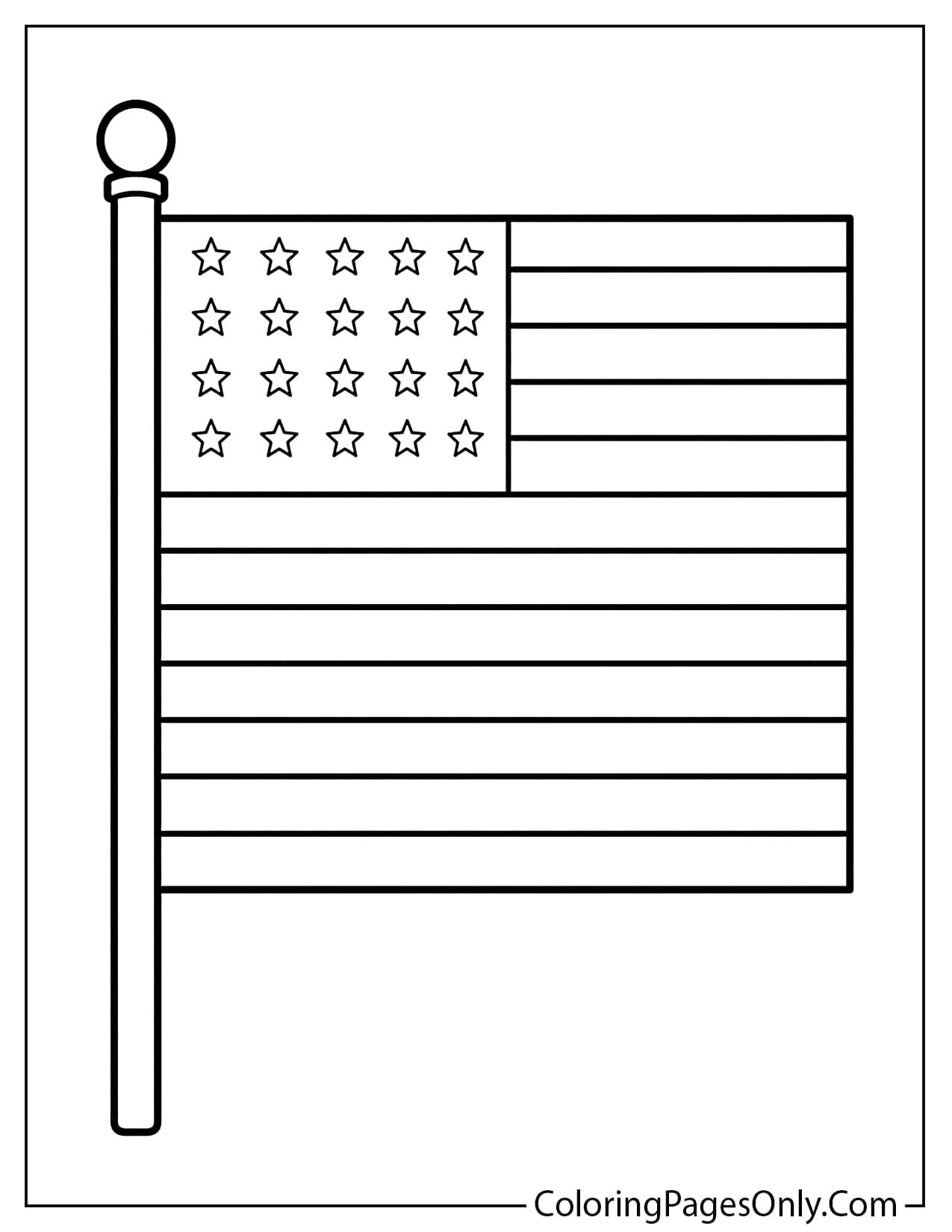
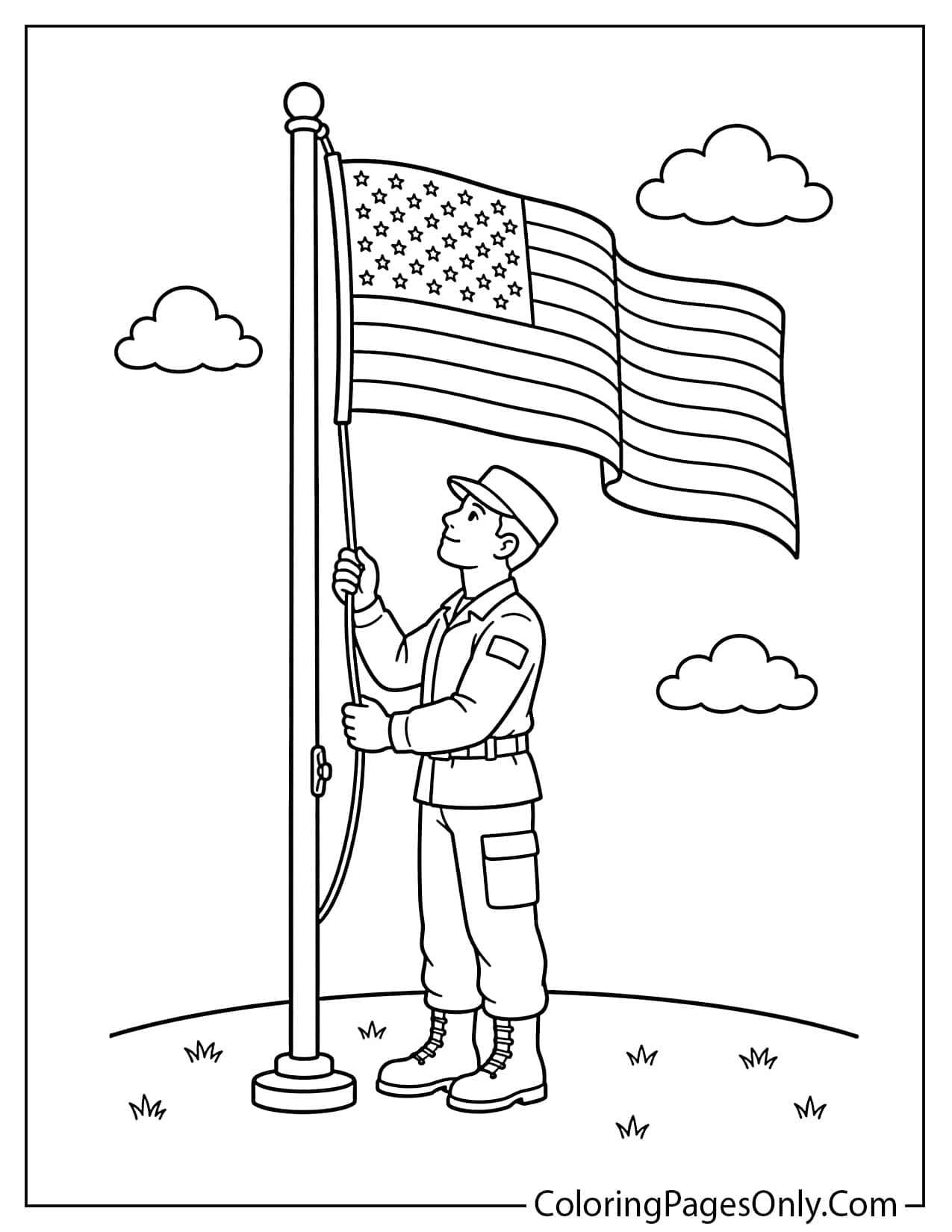
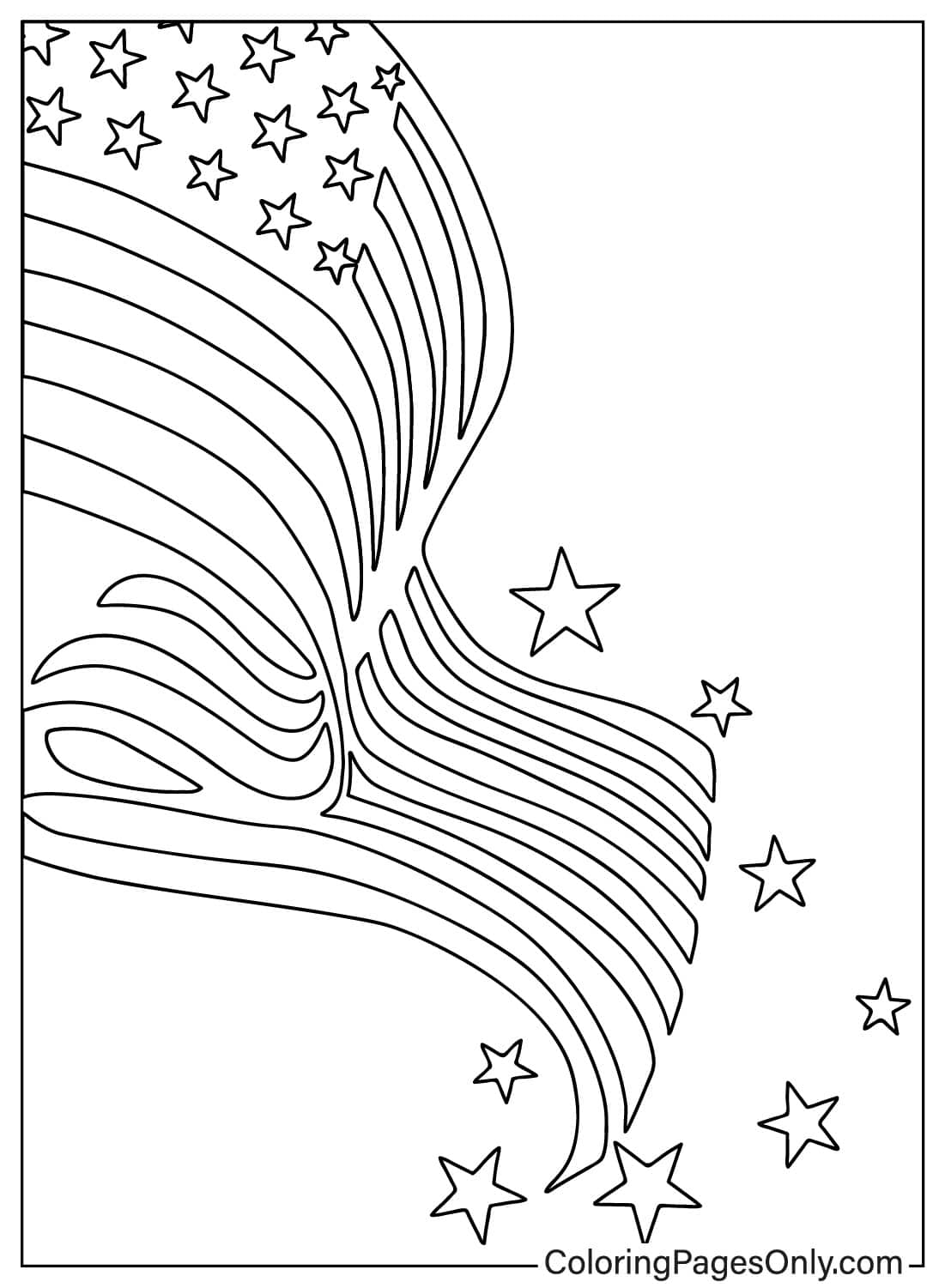
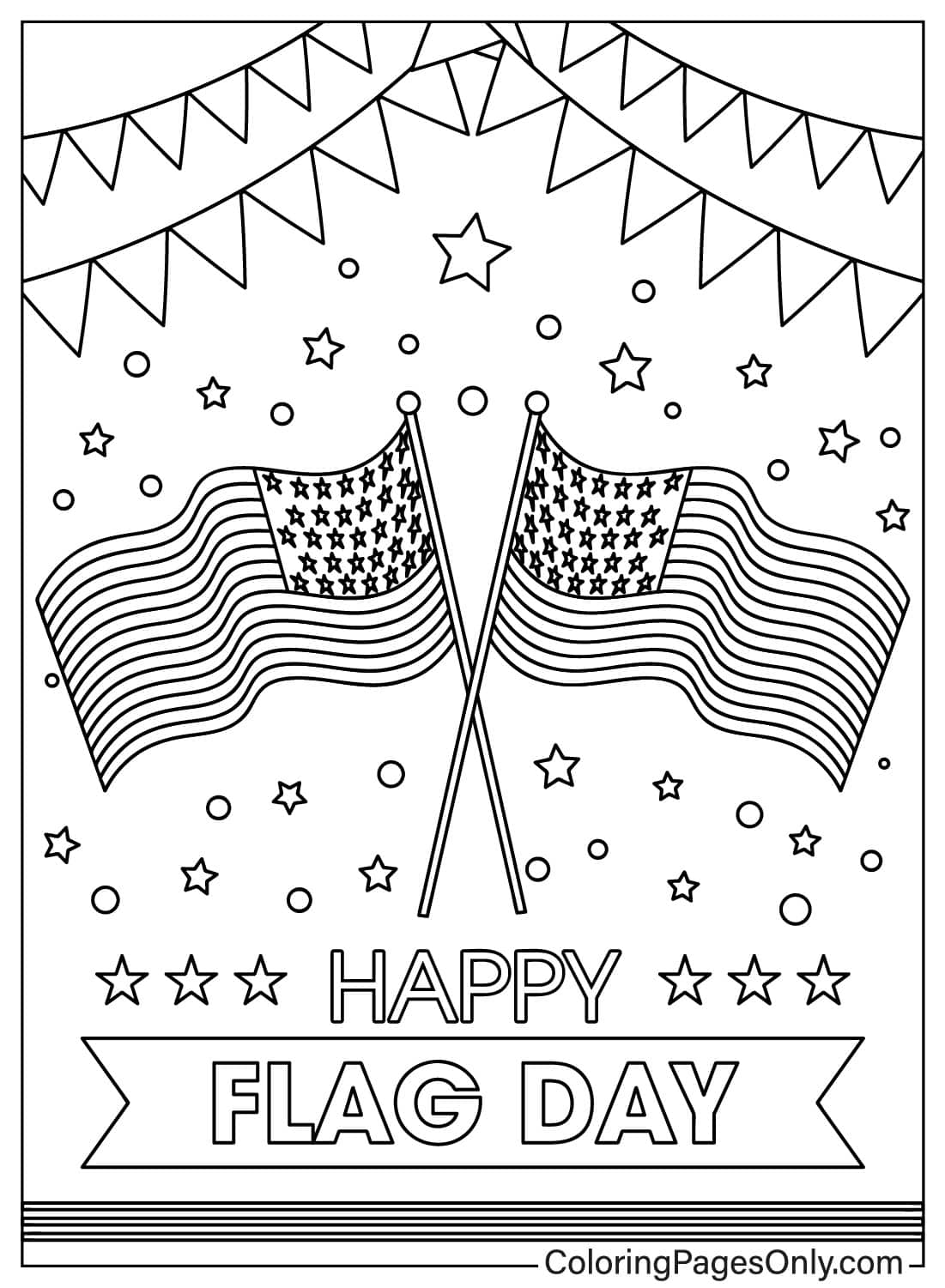
The largest group in the collection. Pages include the flag flying alone against a star field, the flag paired with fireworks over a city skyline, two flags displayed together, and the flag with decorative stars. These pages put the flag’s design at the center – thirteen alternating red and white stripes, fifty white stars on a deep blue canton in the upper left.
Coloring the American flag: The red and blue of the United States flag have officially designated colors. Old Glory Red is a deep, slightly warm red – closer to burgundy than to bright red or orange-red. Old Glory Blue is a deep navy – not sky blue, not royal blue, but the dark, cool blue of deep water. Standard crayons labeled “red” and “blue” are both too bright. If working with colored pencils, layer a second pass to deepen both tones after the first application dries.
Patriotic Symbols – Eagle and Statue of Liberty
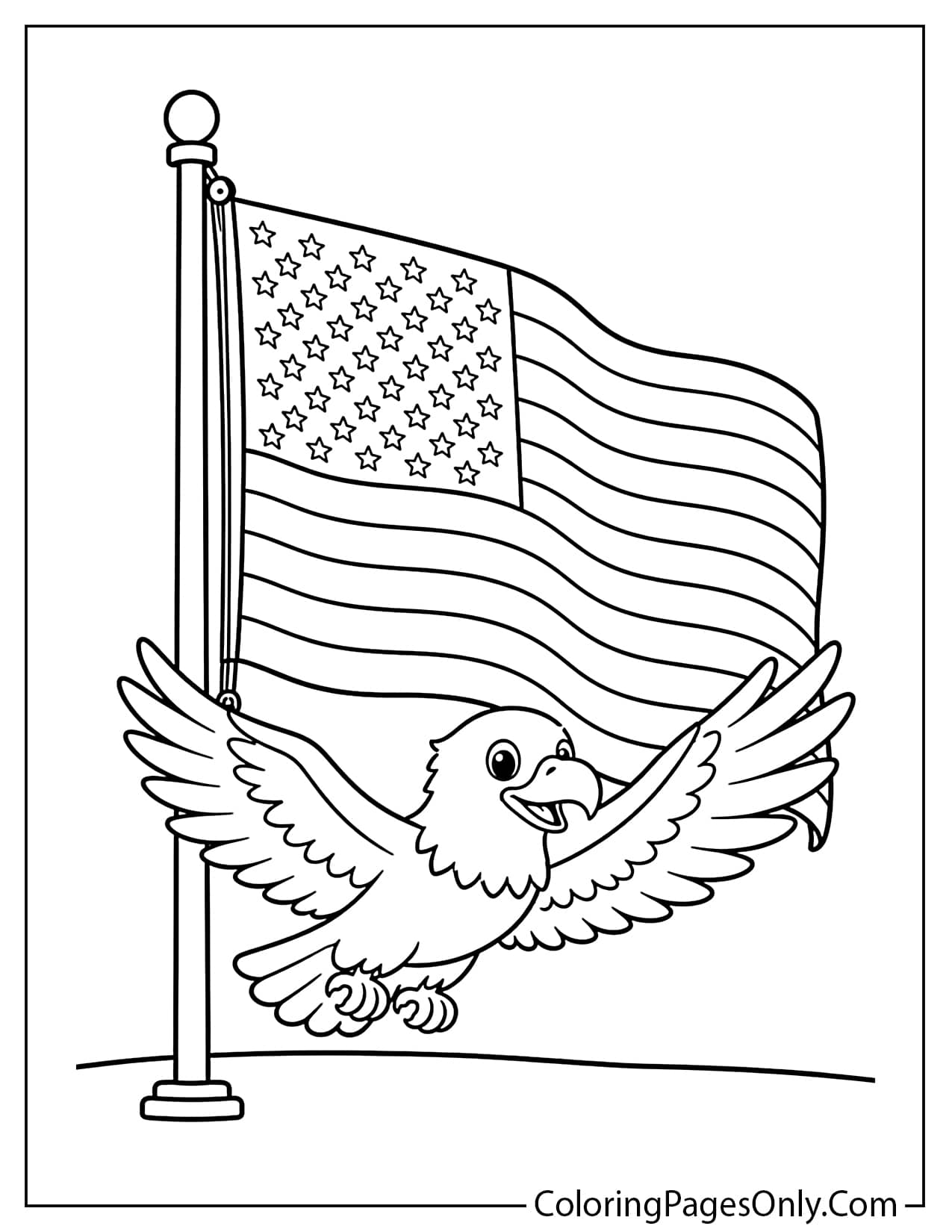
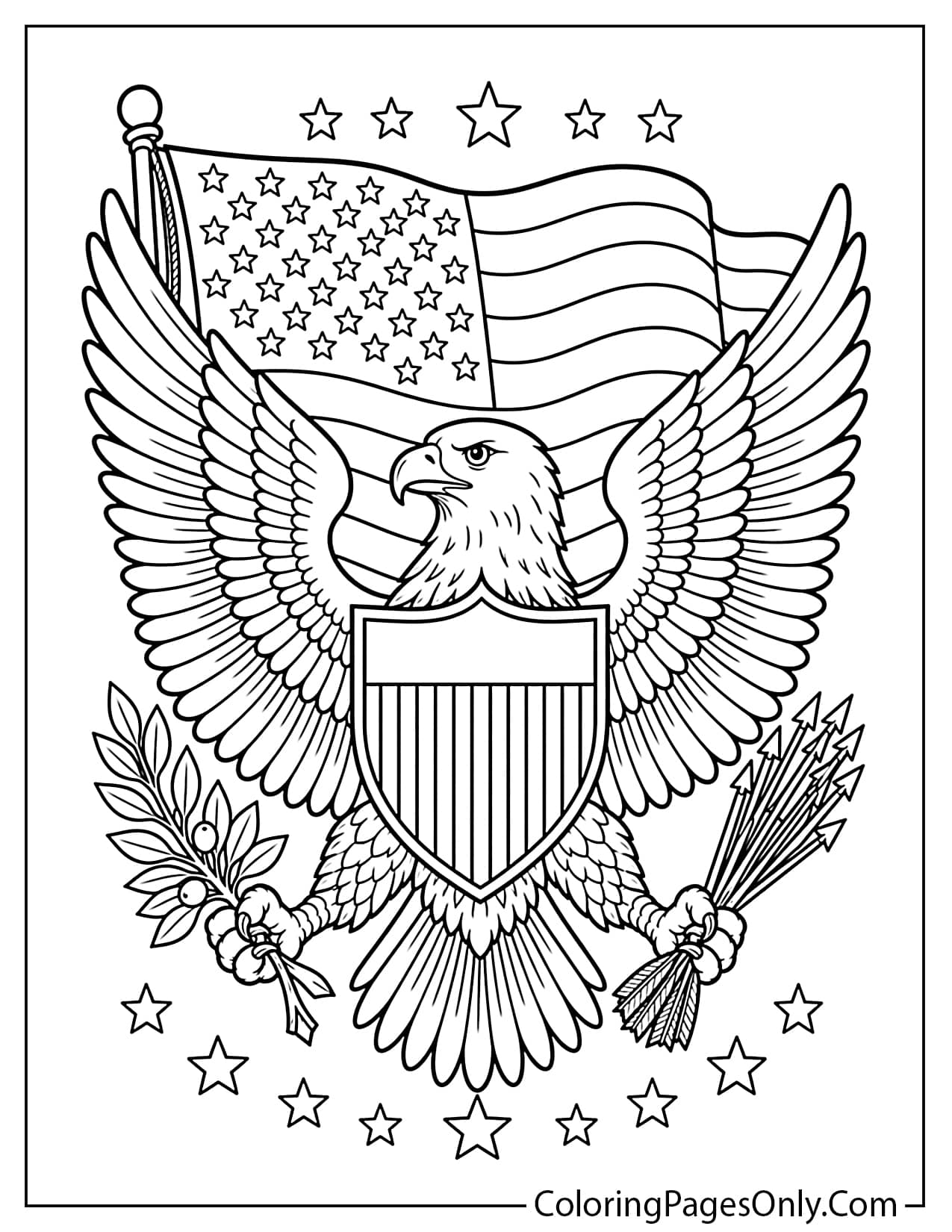
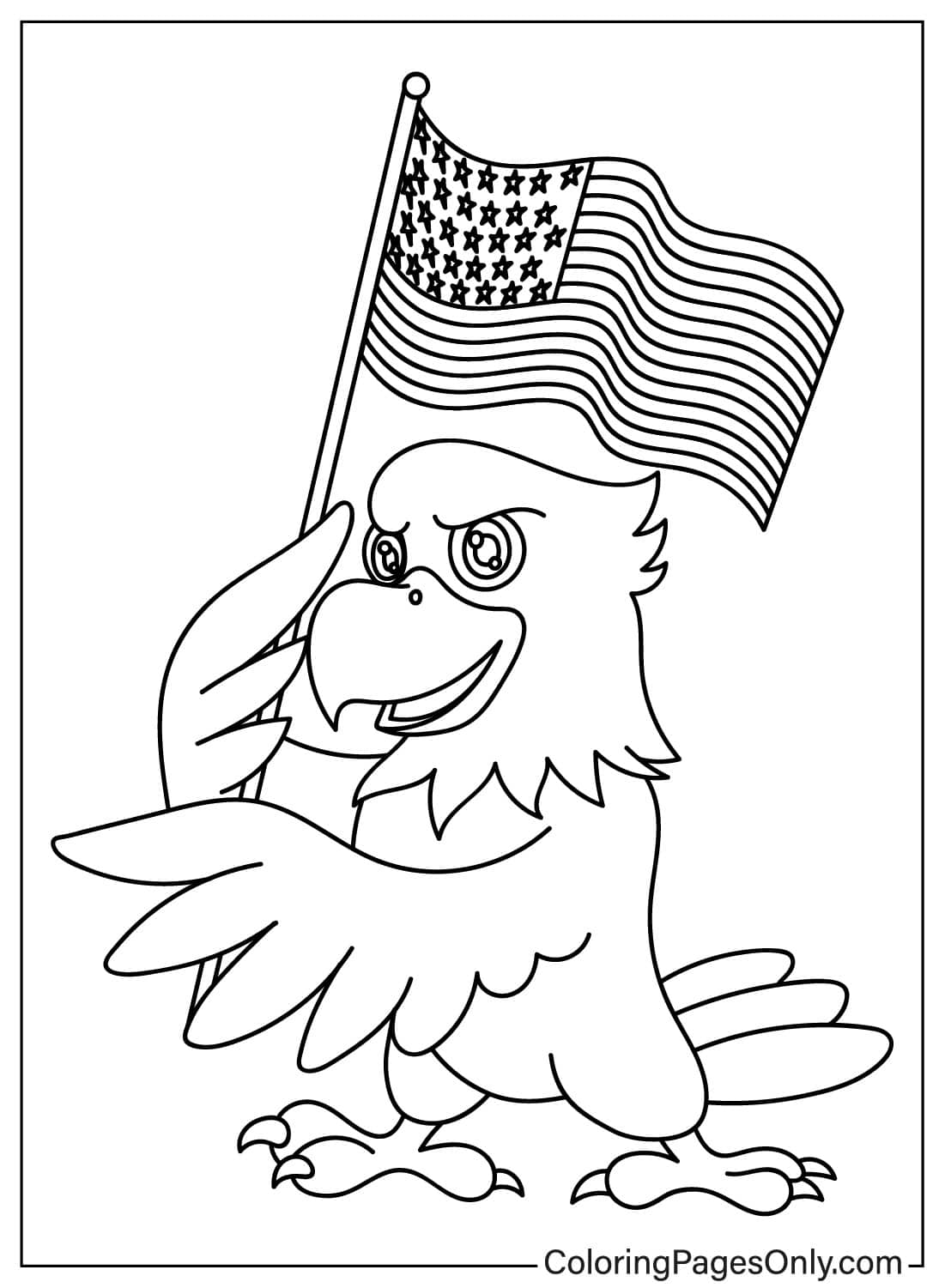
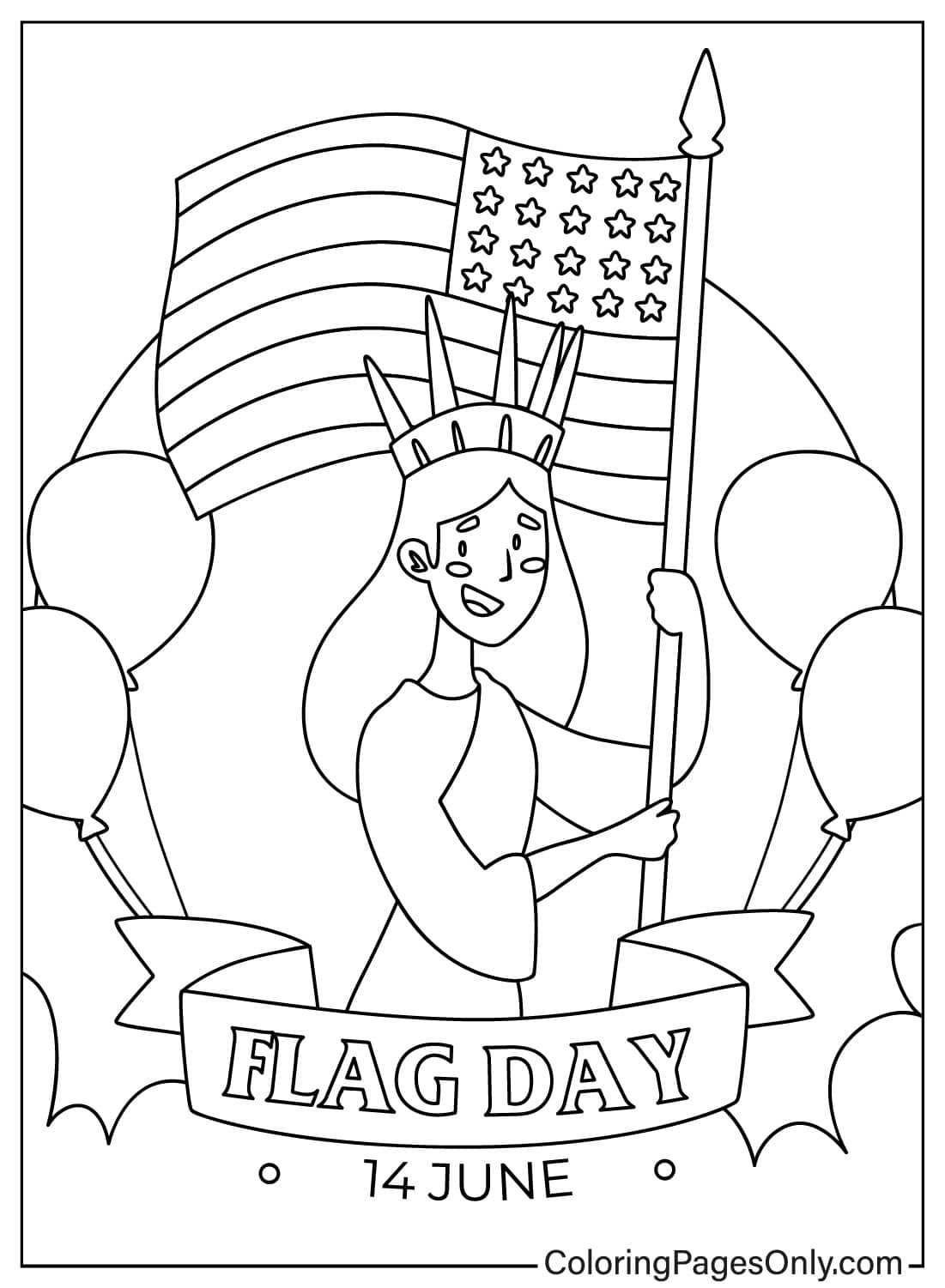
Two of the collection’s most detailed pages. The Bald Eagle page shows the national bird in a formal pose, wings either spread or folded, holding or flanking the flag. The Statue of Liberty page shows Lady Liberty either holding or standing beside the American flag – a combination that appears in several patriotic illustration traditions.
Coloring the Bald Eagle: Adult Bald Eagles have a white head and white tail against a dark brown body and wings – not black, but a warm, very-dark-brown, closer to the color of dark walnut than pure black. The beak and talons are a warm yellow. The white head and tail should be rendered with very light warm grey in shadow areas only; keeping most of the surface white accurately represents the plumage.
Coloring the Statue of Liberty: The statue’s copper surface has oxidized to a distinctive blue-green – called verdigris – over its 140-year history since dedication on October 28, 1886. This is not a bright green and not a grey-blue; it is a muted blue-green, closer to aged copper than to any standard crayon green.
Fireworks and Celebration Pages
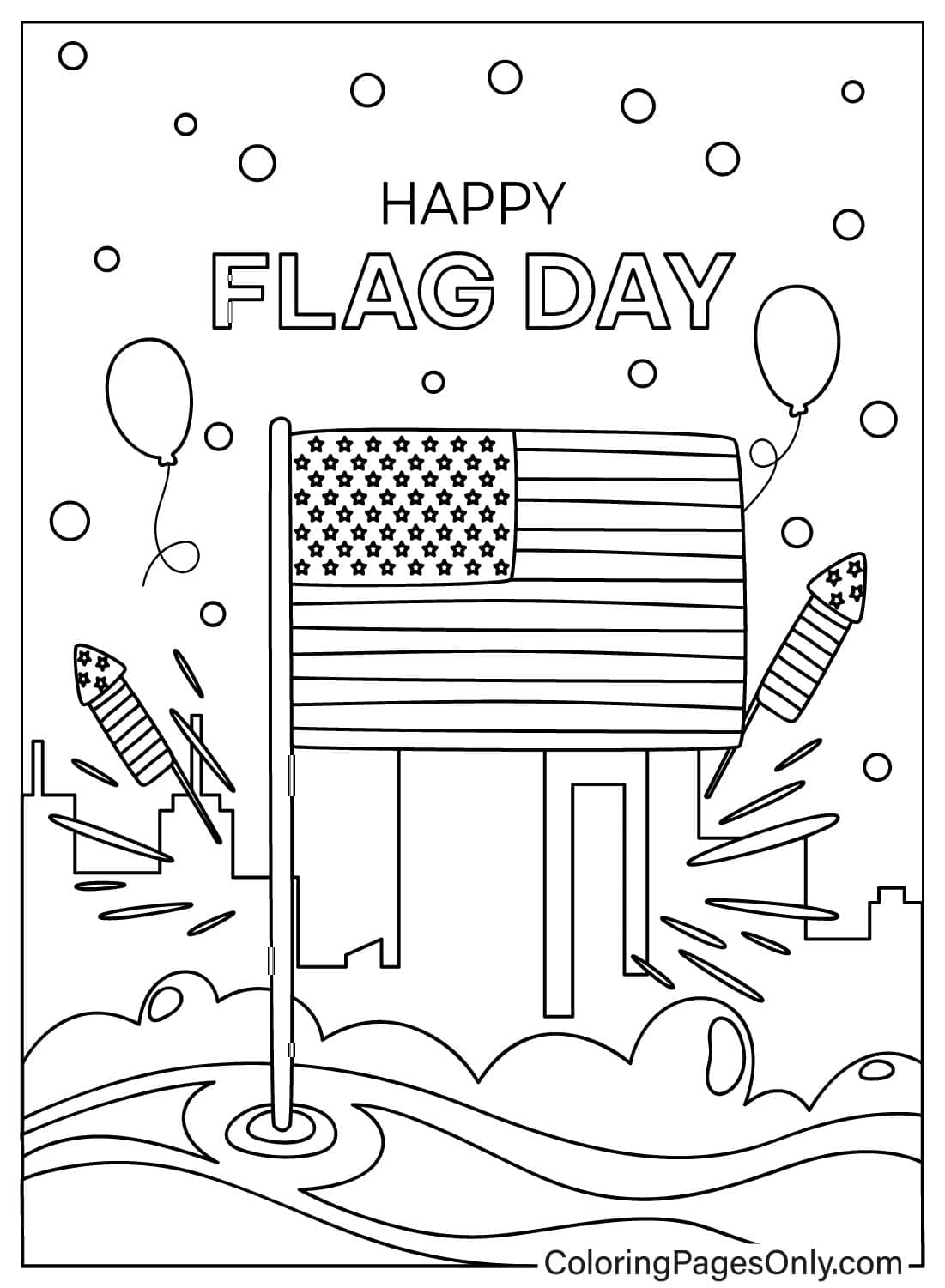
Pages showing the American flag against fireworks displays, cityscape backgrounds, and balloon arrangements. These pages have the collection’s most complex backgrounds – the fireworks bursts and city outlines provide additional coloring opportunities beyond the flag itself.
Coloring fireworks: Fireworks bursts work best as warm-to-cool gradients: deep orange or gold at the burst center, transitioning to bright yellow at the mid-burst, then to white at the outermost sparks. For a patriotic palette, restrict the fireworks to red and white bursts against the deep blue night sky – this keeps the page’s color language consistent with the flag.
Flag Day Poster and Date Pages
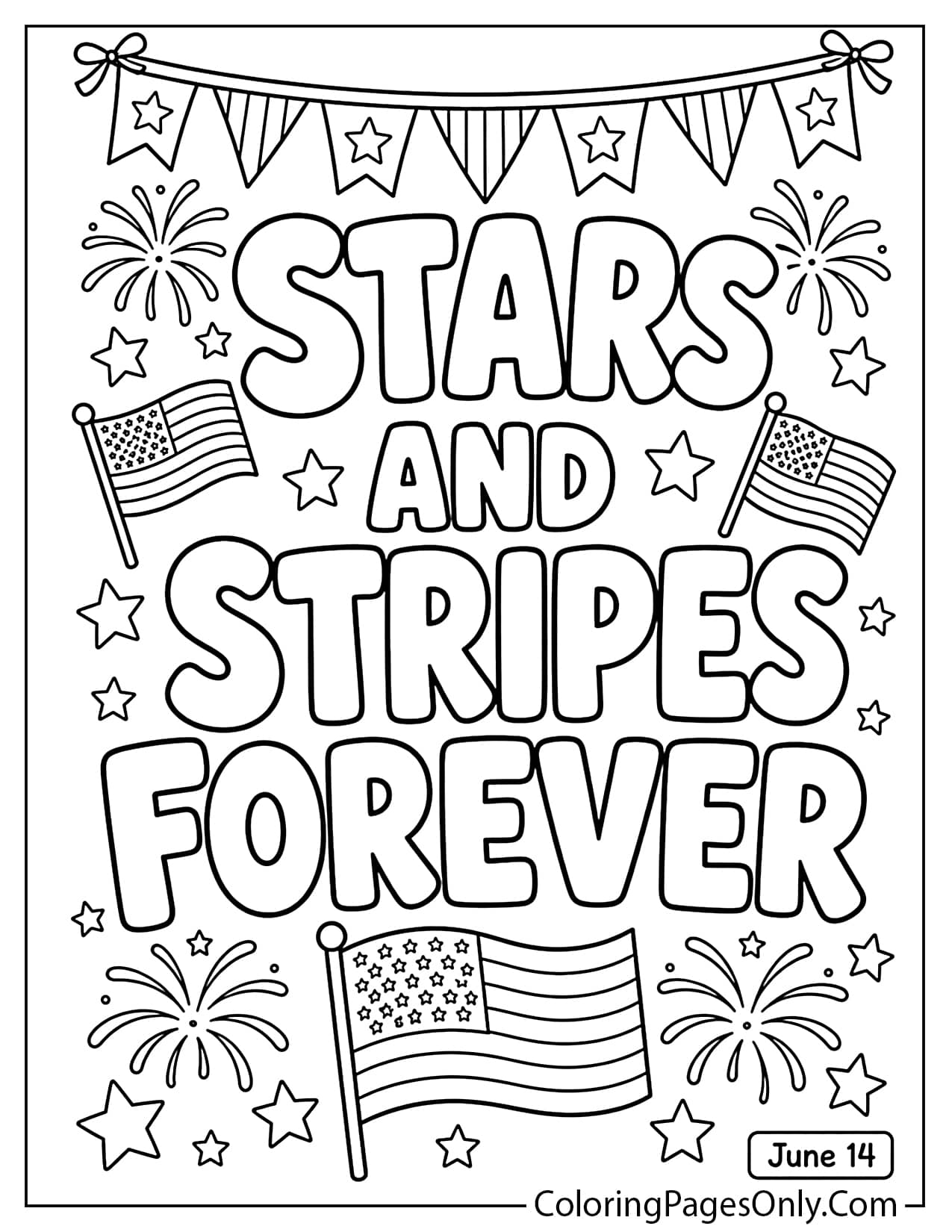
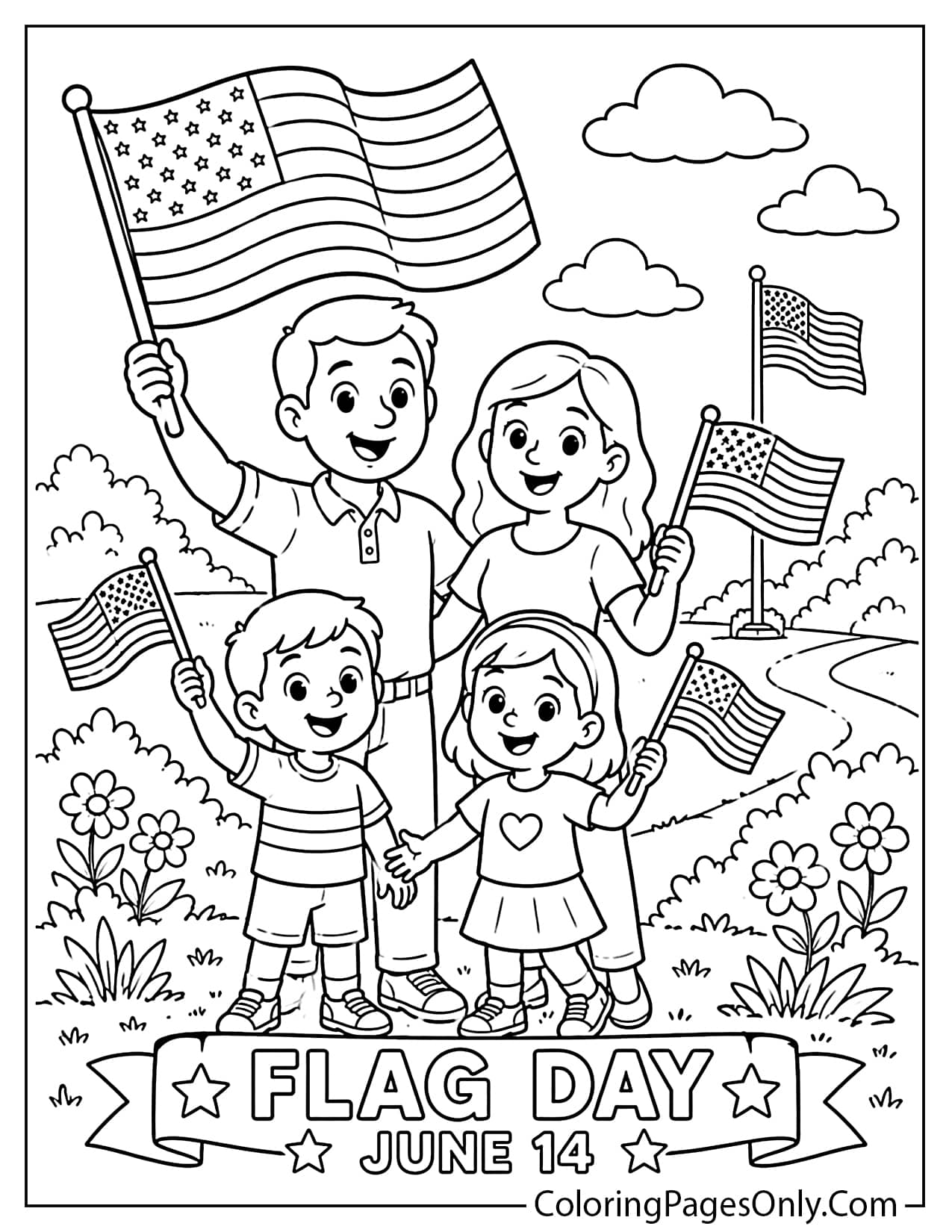
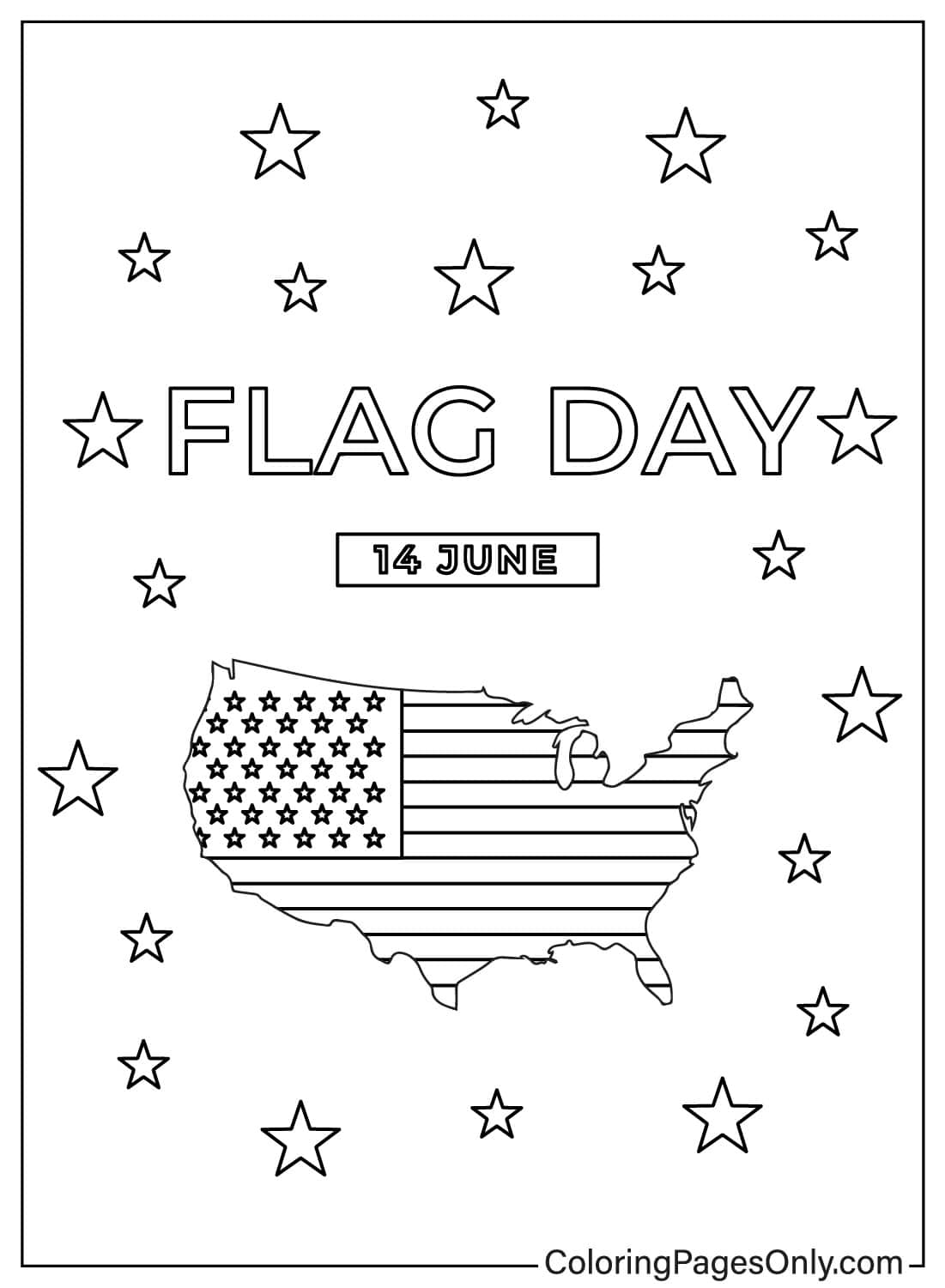
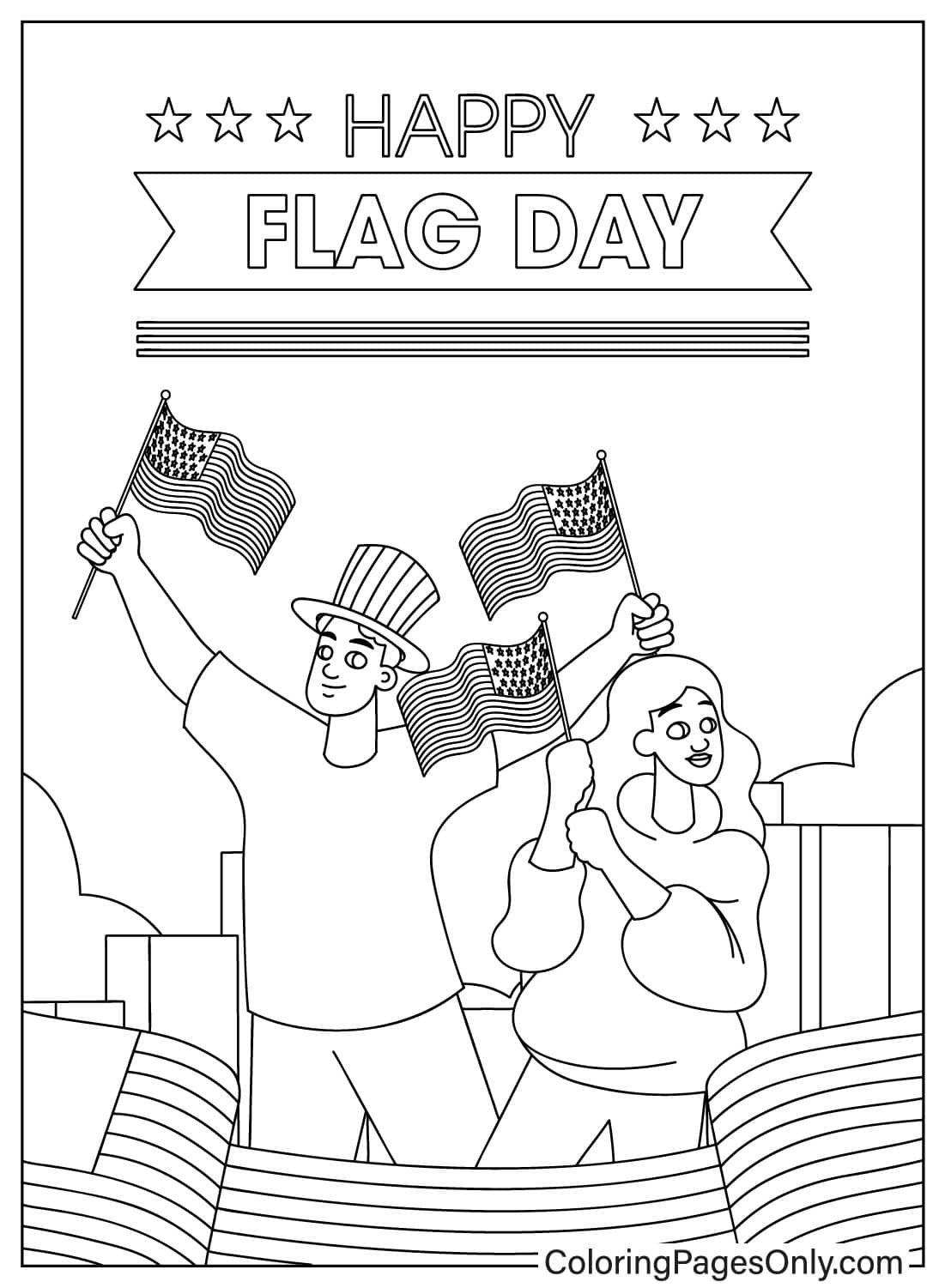
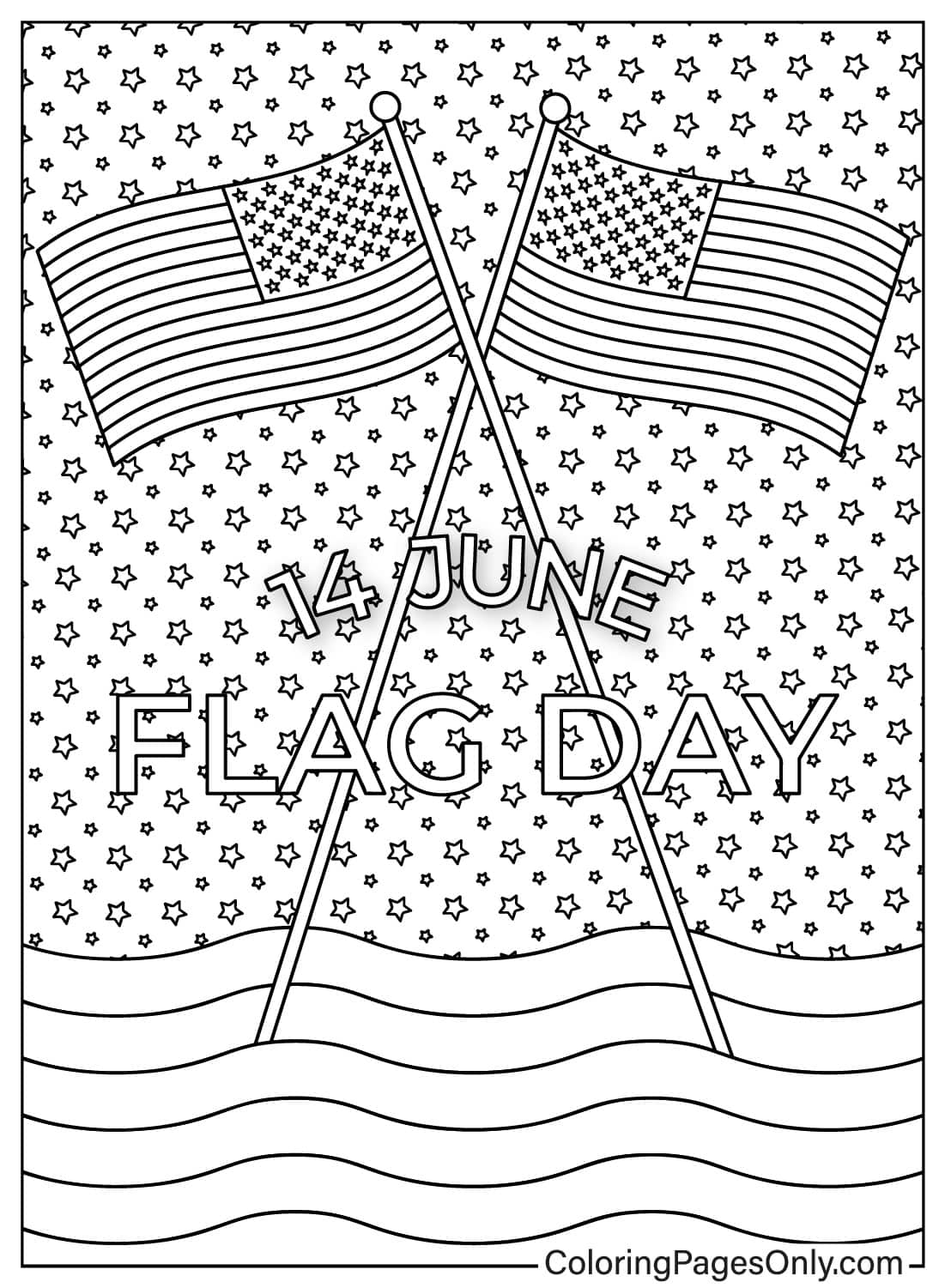
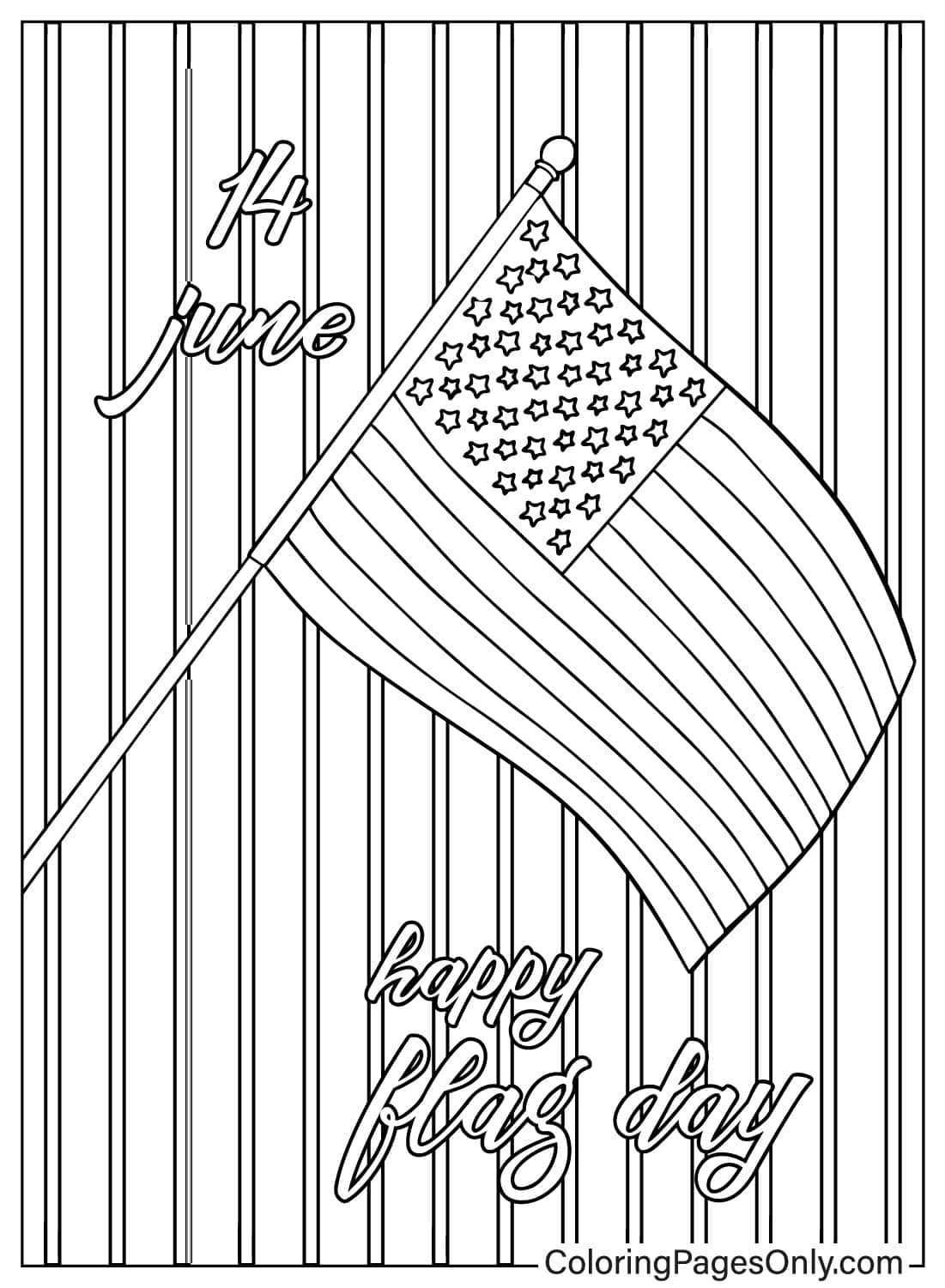
Three pages in the collection function as text-integrated poster designs: “American June 14 Flag Day,” “Flag Day June 14,” and “US Flag Day June 14.” These pages pair the date and the flag in a display-ready composition, suited to classroom bulletin boards or a window display.
Coloring text elements on poster pages: Text and date numerals on poster pages read most clearly when kept in white or very light cream against a colored background, or rendered in the flag’s deep red or navy against a white field. Avoid coloring text in mid-tones – the contrast between text and background carries the page’s readability, and mid-tone text against a mid-tone background loses that contrast.
Simple Character and Scene Pages
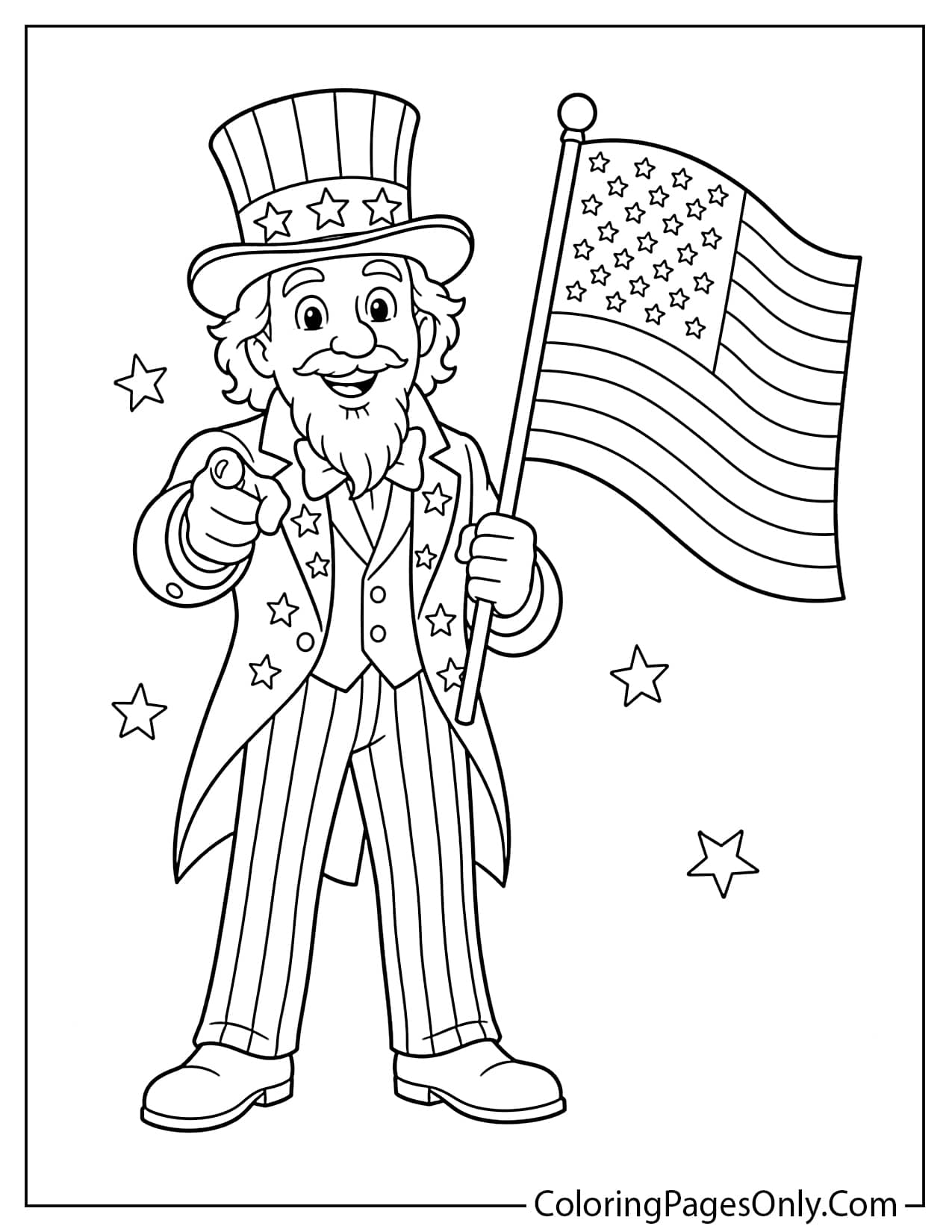
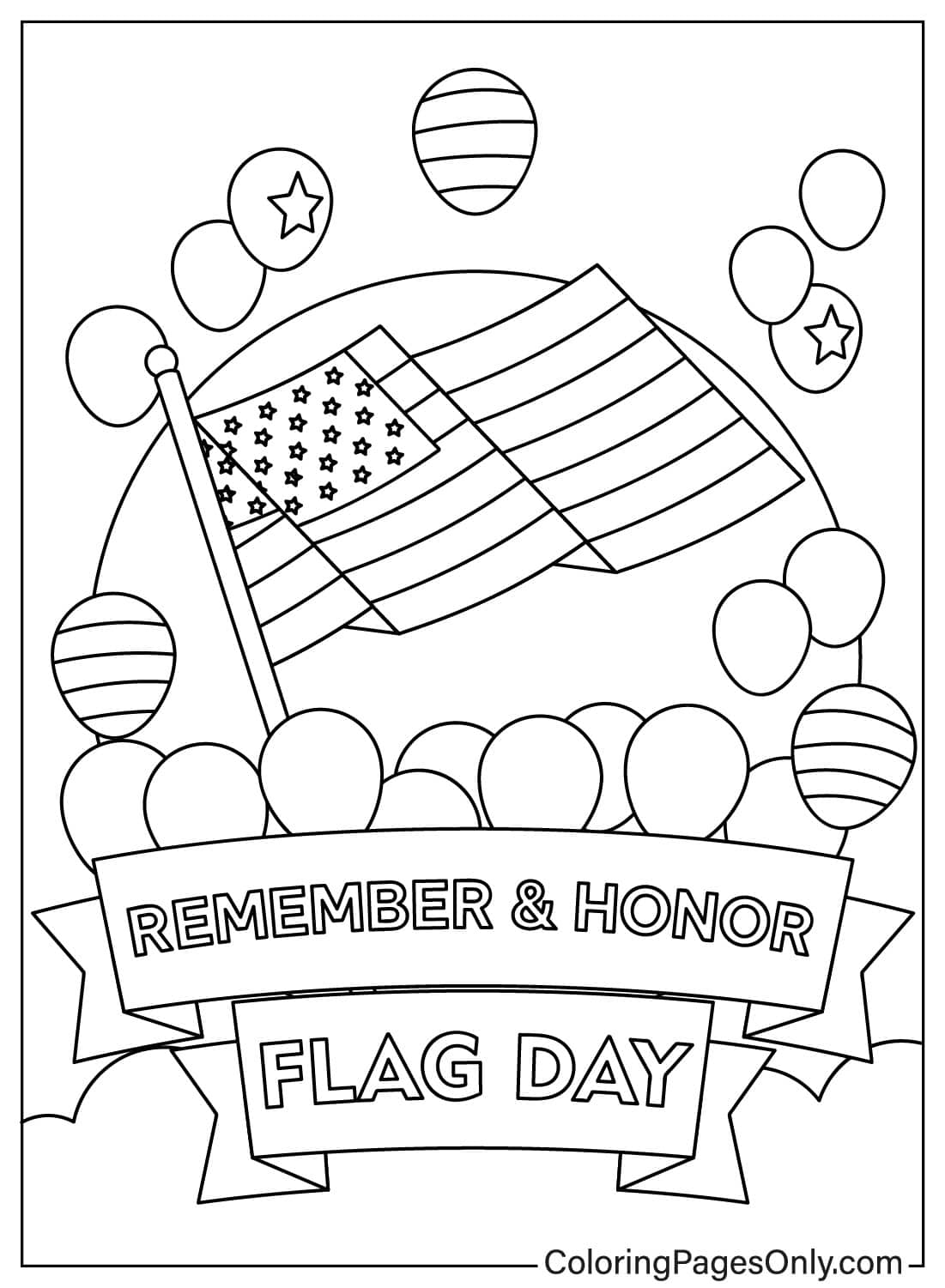
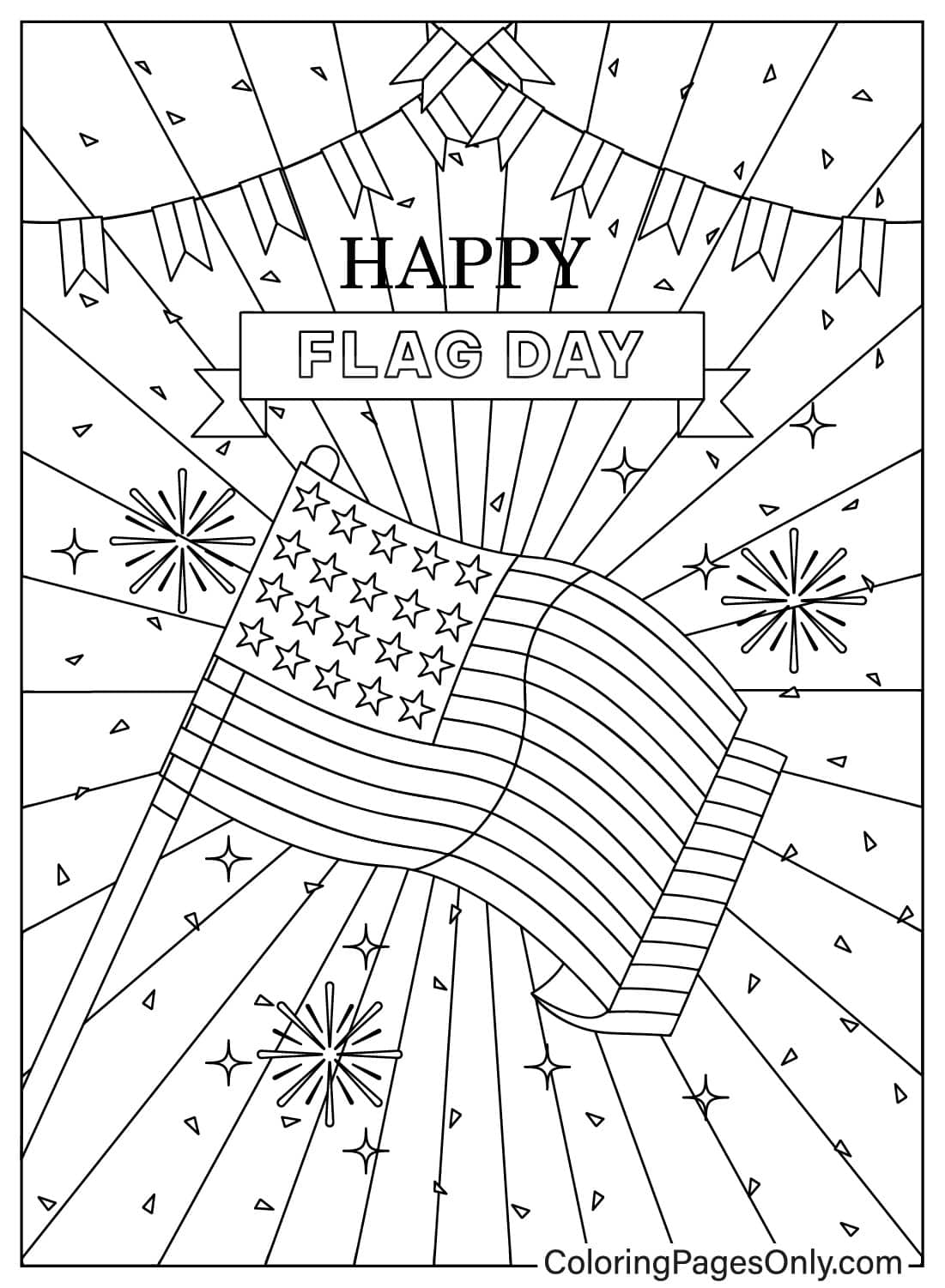
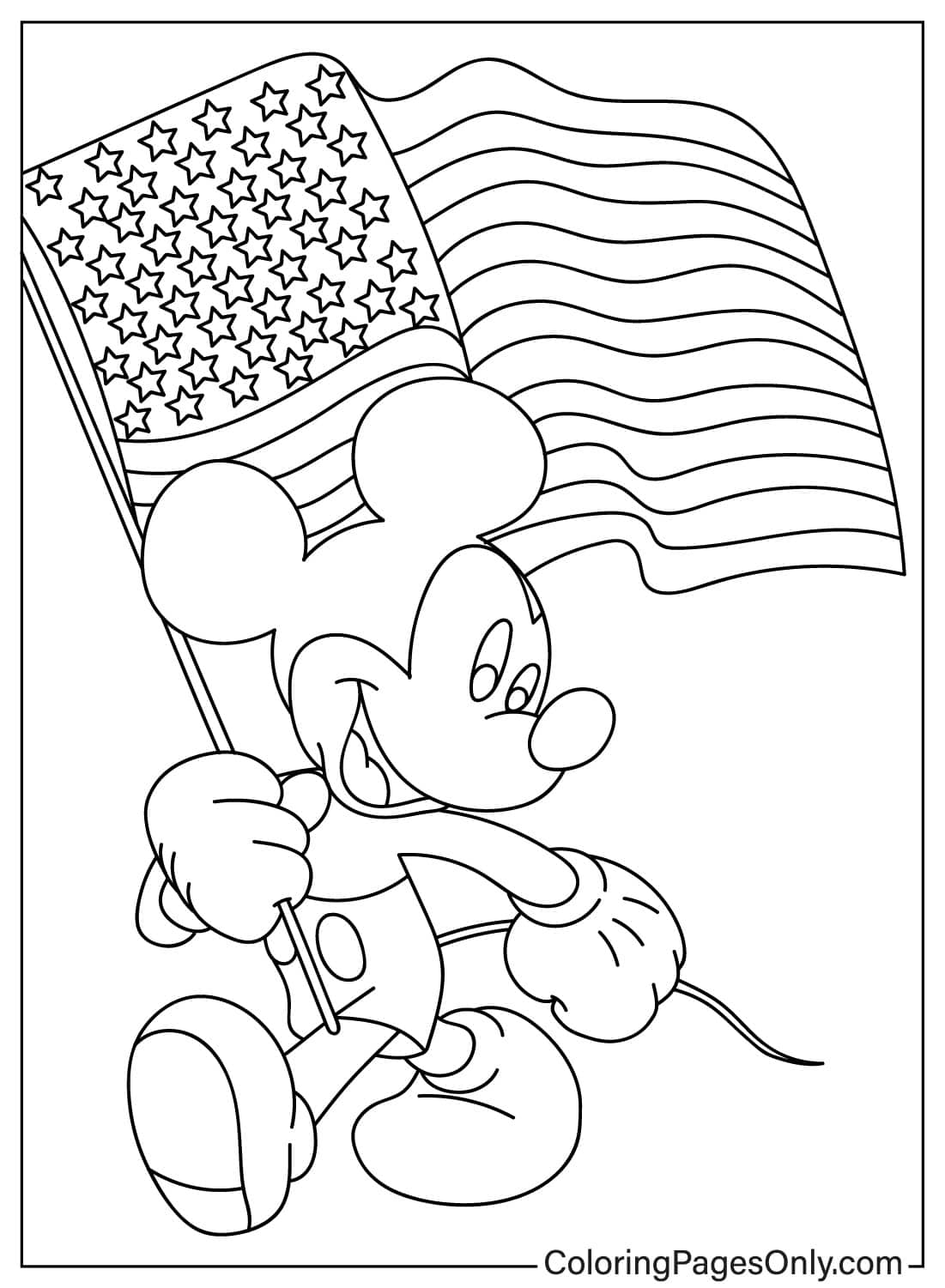
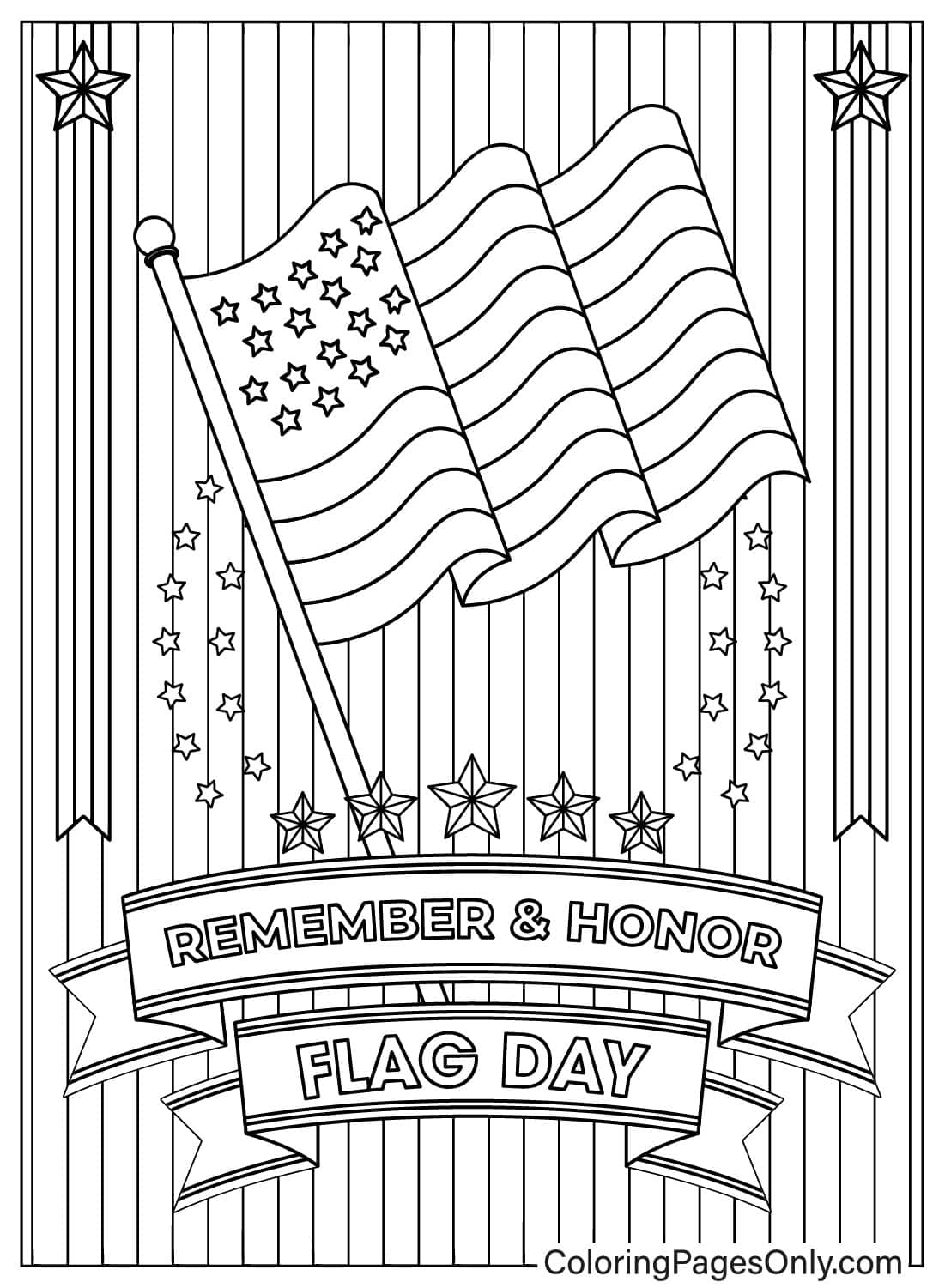
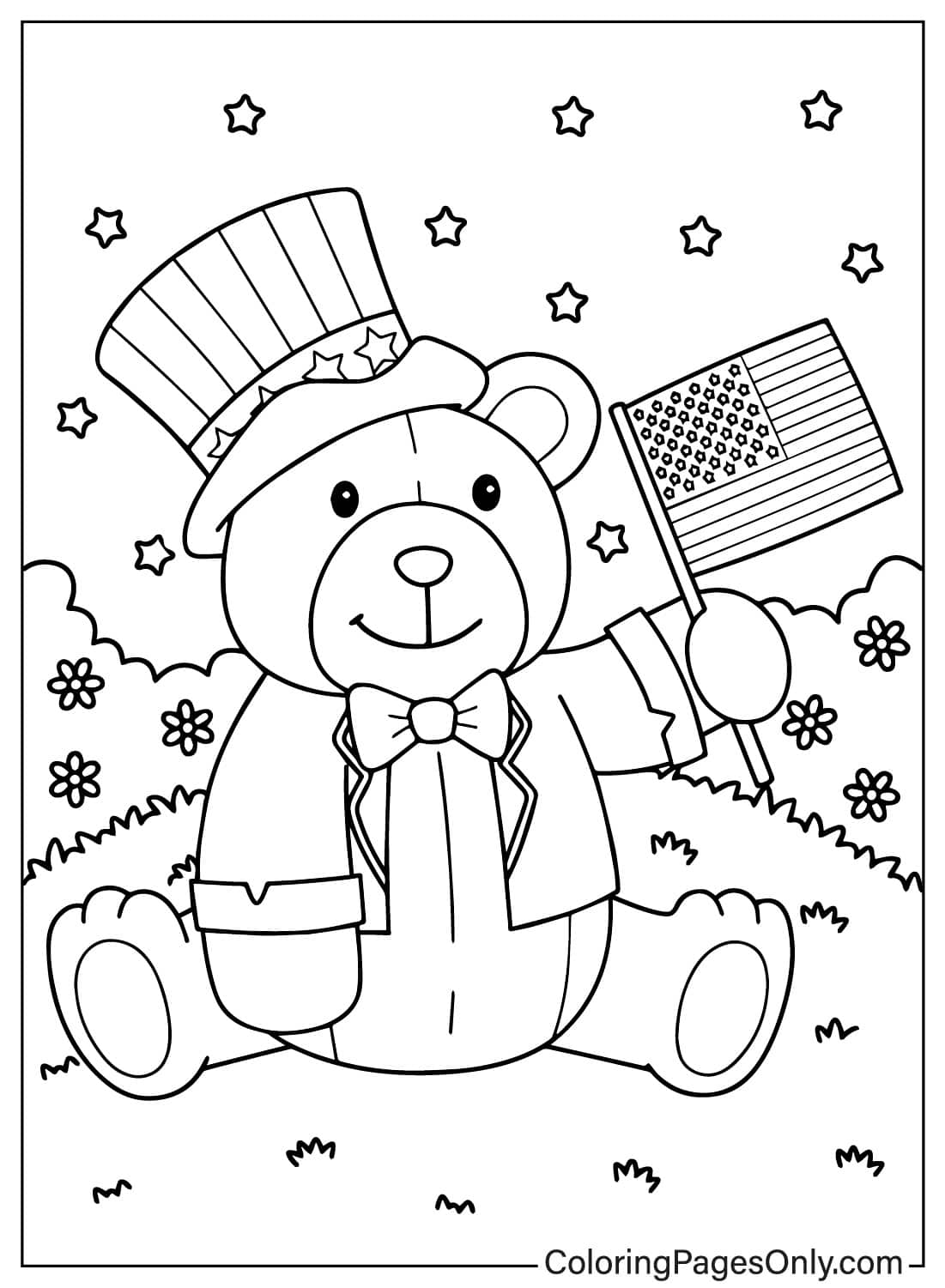
“Teddy Bear with US Flag,” “Happy Flag Day,” “Celebrate Flag Day,” and “Remember and Honor Flag Day” are the collection’s most accessible pages – larger zones, fewer interior lines, suited to ages 4 and up with broad markers or chunky crayons. A character-themed page showing a familiar figure holding the flag rounds out this group with an entry point for very young colorists.
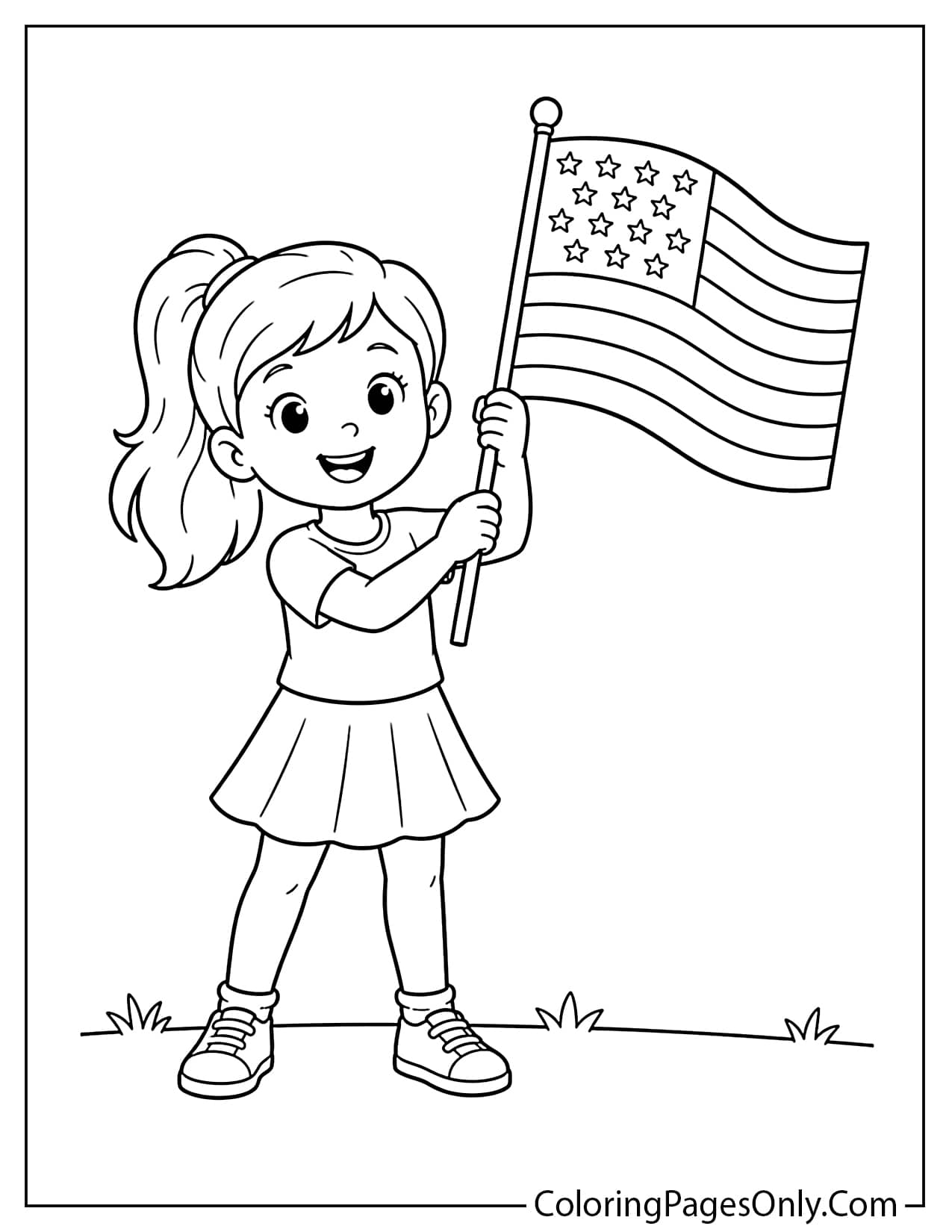
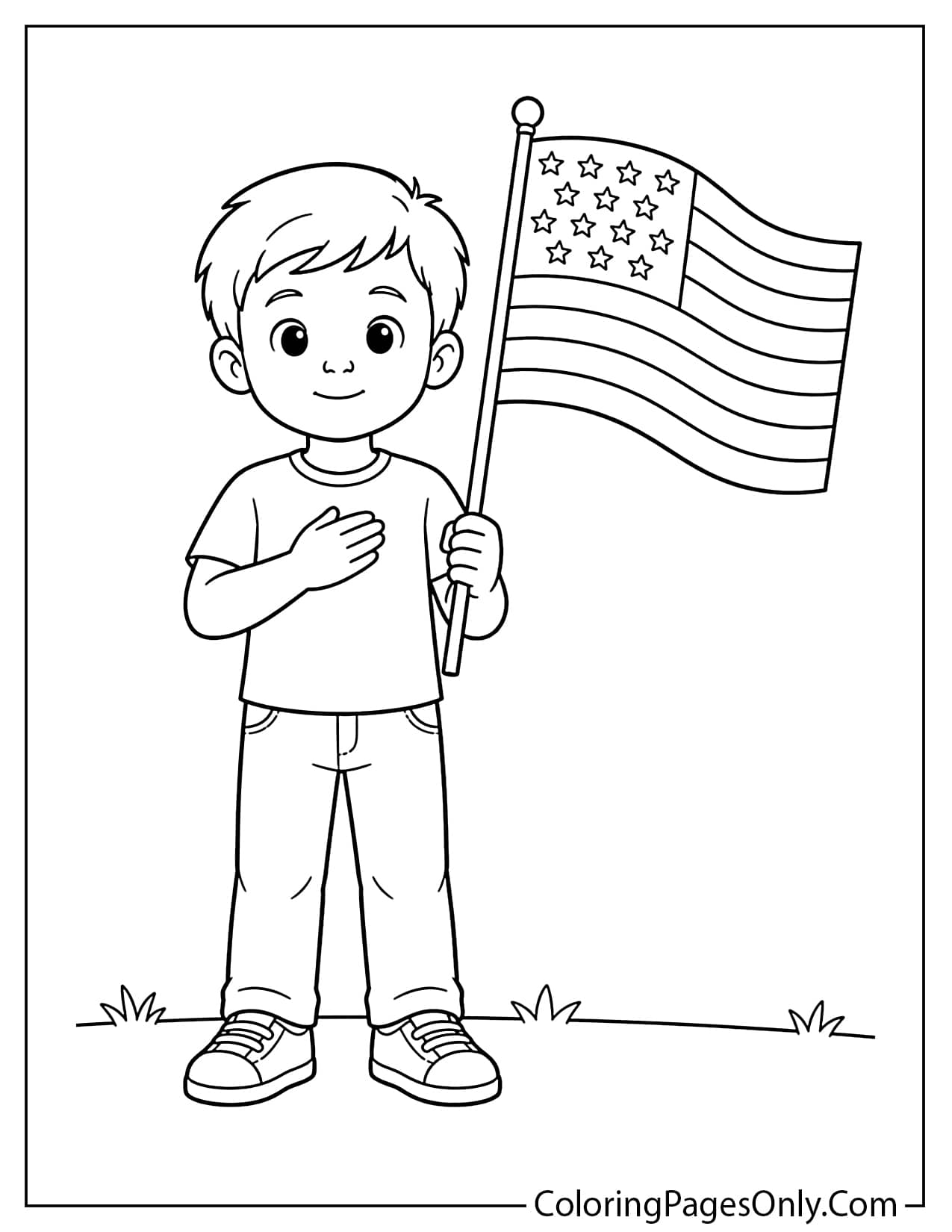
Coloring simple flag pages: On pages where the flag appears smaller – held by a character or shown in the background – the flag’s thirteen stripes and fifty stars are often simplified to suggest the design rather than render it accurately. Color the stripe zones alternating red and white regardless of the simplified line count, and color the canton solid deep navy with a few dots of white for the stars. The suggestion of accurate colors reads as accurate even when the detail cannot be fully rendered at a small scale.
What These Pages Do
Flag Day coloring pages connect the act of coloring to one of the most specific and teachable design systems in American civic life. The American flag’s color and symbol rules are precise and historically documented – thirteen stripes for the thirteen original colonies, fifty stars for the fifty states, red for valor, white for purity, blue for vigilance and justice. Coloring the flag with attention to its actual designated colors is a direct engagement with that civic language, more concrete than reading about it and more memorable than being told.
The flag’s design history spans nearly 250 years of documented changes. The Stars and Stripes has been officially altered twenty-seven times since 1777 – most recently on July 4, 1960, when Hawaii became the fiftieth state and the fiftieth star was added. The flag coloring pages, which show the current fifty-star design, represent the endpoint of that history. For children working alongside a parent or teacher, the question of why there are fifty stars and thirteen stripes has a specific, verifiable answer that opens into American history directly.
Flag pages directly serve fine motor development. The American Academy of Pediatrics identifies fine motor skill development – controlled grip, coordinated hand-eye movement, maintaining direction and pressure within defined spaces – as a key milestone across early childhood. The alternating stripe sections of the flag pages require sustained directional work: moving horizontally across a bounded stripe without crossing into the adjacent white. That constraint is exactly the kind of motivated fine motor practice that produces measurable developmental benefit.
Structured coloring reduces measurable anxiety. Research published in the Art Therapy Journal in 2005 found that working within structured coloring designs – as opposed to free-form drawing – produced a statistically significant reduction in anxiety in participants. Flag pages, with their geometric regularity and clearly bounded sections, provide that structure. The repetition of the stripe sequence is itself calming: a known pattern, a predictable decision, repeated across the page at a child’s own pace.
How to Color These Pages Well
Match the flag’s actual designated colors, not generic crayon red and blue. Old Glory Red is officially designated as Pantone 193 C – a deep, slightly warm red with more burgundy in it than standard crayon red. Old Glory Blue is Pantone 281 C – a deep navy that reads as almost midnight blue at full saturation. Both colors are darker and more desaturated than their generic equivalents. Using standard bright red and royal blue produces a flag that looks cheerful but not accurate. A second layering pass with a slightly darker tone over both colors closes most of the gap.
Render the thirteen stripes in the correct sequence. The American flag begins and ends with a red stripe – red is the outermost stripe at both top and bottom. The sequence from top to bottom is: red, white, red, white, red, white, red (the seven red stripes), then white, red, white, red, white, red (the six white stripes). Marking the top and bottom stripes red first, then filling in the alternating pattern, prevents the common error of losing track mid-stripe and ending with two reds or two whites adjacent.
Keep the canton – the blue rectangle – as a single deep, flat navy. The canton (the blue field containing the stars) should read as the darkest element on the flag. Apply it in a single pass at full pressure. Stars, on pages detailed enough to show them, are rendered as small white shapes against the navy; on simpler pages, leave small dots of white paper within the blue zone. The contrast between the deep navy and the white stars is what carries the canton’s visual meaning.
Treat the Bald Eagle as two distinct zones. The adult Bald Eagle’s white head and white tail are completely separate from the dark brown body – not blended, not gradated, but cleanly divided at the neck and tail base. Apply the dark warm-brown body first across all wing and body surfaces. Apply the white to the head and tail with very light warm grey shadow only at the boundary between white and brown. The hard edge between white and dark brown is accurate to the bird and essential to making it read as a Bald Eagle rather than a generic bird.
For the Statue of Liberty, mix your verdigris carefully. The statue’s blue-green patina is one of the more unusual color decisions in the collection – unusual because most children’s first instinct is to reach for bright green, which reads wrong immediately. The correct tone is a muted, slightly grey blue-green, closer to pale teal than to lime or emerald. If using colored pencils, a light blue layer followed by a light grey-green layer produces a closer result than any single pencil alone. Test on scrap paper first.
Use the night sky on fireworks pages as a contrast anchor. The fireworks pages derive their visual energy from the contrast between the dark sky and the bright bursts. Color the sky first – a deep navy that matches or is slightly darker than the flag’s canton blue – before touching the fireworks or the flag. Establishing the dark background early prevents the common mistake of making the fireworks and flag too dark in an attempt to create contrast after the fact. Light elements always read more brightly when placed against an already-dark background.
Five Creative Craft Ideas
Flag Day Accordion Banner
Print four to six American flag pages from the collection and color each in Old Glory Red, white, and deep navy. Trim each finished page to a consistent width – approximately 10 cm – and accordion-fold each one vertically into six equal sections. Connect the folded pages end-to-end with a small amount of glue on the connecting panels, alternating the direction of each accordion to create a continuous zigzag banner.
Hang the banner across a classroom wall or window on June 14. The finished display works as both decoration and a visual record of the coloring work – each section visible from the front shows a different part of the flag composition. Best suited for ages 6 and up; younger children can color the pages with an adult handling the folding and assembly.
Stars and Stripes Counting Book
Print six to eight pages from the collection – a mix of standalone flag pages, the poster designs, and the simple character pages. Color all pages in the flag’s correct colors. Bind them together with two staples along the left edge to create a small booklet.
On each page’s lower margin (or on a label affixed below the image), write one fact about that page’s imagery: the number of stripes and what they represent, the number of stars and what they represent, the year the current design was adopted (1960), and the meaning of each color. The finished booklet serves as a reference document that doubles as a coloring portfolio – factual content made by the child who will use it. Suited to ages 6 and up for the writing component; younger children can participate in the coloring with an adult writing the facts.
Old Glory Timeline Display
Print four pages representing different flag-related imagery: a simple flag page, the eagle page, the Statue of Liberty page, and one of the “June 14” poster pages. Color all four in their correct palettes.
On a long horizontal strip of paper, create a simple timeline: mark 1777 (flag adopted), 1885 (first organized Flag Day, Bernard J. Cigrand), 1916 (Wilson’s proclamation), 1949 (Congress establishes Flag Day), 1960 (current 50-star design). Mount each colored page near its most relevant date – the flag page near 1777, the Statue of Liberty near its dedication date of 1886, the poster page near 1949. Add brief handwritten notes at each date.
The finished display is a visual history of the flag and Flag Day across nearly 250 years, anchored by pages that the child colored. Best suited for ages 8 and up as a research-plus-coloring activity; younger children can participate in the coloring with an adult managing the timeline structure.
Classroom Window Flags
Print the “American Flag with Stars” page and the “Two American Flags Flying on a Star Background” page. Color both with transparent or light-application media – watercolor pencils, diluted marker, or light-pressure colored pencil – so that some light passes through the page.
Tape the finished pages to a window facing outward. In direct sunlight, the colored stripes and stars cast faint colored light into the room and are visible from outside as a window display. This technique works best with lighter applications – heavy crayon or thick marker blocks light rather than filtering it. Suited to ages 5 and up with adult supervision for the window mounting. The effect is most visible in the morning or afternoon when light comes directly through the window.
Eagle and Flag Portrait Pair
Print the “Eagle Holding American Flag” page and one standalone American flag page. Color both carefully – the eagle with its warm dark-brown body, white head, and warm yellow beak; the flag with Old Glory Red and Old Glory Blue.
Mount both pages side by side on a backing sheet with a hand-lettered caption below: the date the Bald Eagle was officially adopted as the national bird of the United States (June 20, 1782, as part of the Great Seal of the United States). The finished display pairs two national symbols with a historical fact – a combination that works as a classroom display for Flag Day week and as a take-home piece.
Frequently Asked Questions
What is Flag Day, and when is it observed? Flag Day is a national observance in the United States held each year on June 14. It commemorates the date the Continental Congress passed the Flag Resolution on June 14, 1777, adopting the Stars and Stripes as the official flag of the United States. Flag Day is not a federal holiday – government offices and schools remain open – but it is formally recognized by Congress and marked with flag displays and patriotic activities across the country.
How did Flag Day become an official observance? The first formally organized Flag Day celebration took place on June 14, 1885, when Bernard J. Cigrand, a nineteen-year-old schoolteacher in Waubeka, Wisconsin, held a flag birthday observance with his students. Cigrand spent subsequent decades advocating for national recognition of the date. President Woodrow Wilson issued the first presidential Flag Day proclamation on May 30, 1916. Congress did not formally establish the observance until August 3, 1949, when President Harry S. Truman signed Public Law 81-203 officially designating June 14 as Flag Day.
What do the colors of the American flag represent? The Continental Congress did not assign specific meanings to the flag’s colors when it adopted the flag in 1777. Symbolic meanings were associated with the colors later, drawing from the heraldic traditions used in the Great Seal of the United States, adopted in 1782. By that document’s conventions: red represents valor and hardiness, white represents purity and innocence, and blue represents vigilance, perseverance, and justice. These are the meanings most commonly cited today, though they are attributed retroactively rather than established by the original Flag Resolution.
How many stars and stripes does the American flag have, and what do they represent? The current American flag has fifty stars and thirteen stripes. The thirteen stripes – seven red and six white, beginning and ending with red – represent the thirteen original colonies that declared independence in 1776. The fifty stars represent the fifty states of the union. The star count has changed twenty-seven times as new states joined; the most recent change occurred on July 4, 1960, when a fiftieth star was added for Hawaii, which had become a state on August 21, 1959. The blue canton containing the stars is called the union.
Who made the first American flag? Betsy Ross of Philadelphia is the person most commonly credited with sewing the first American flag. The attribution comes from an account given by her grandson William Canby in 1870, nearly a century after the events he described. No contemporary documentation from 1777 confirms the story, and historians consider it an unverified tradition rather than a fact. Francis Hopkinson, a New Jersey delegate to the Continental Congress, submitted a bill to the government in 1780 for designing several items, including the flag, which represents a more contemporaneously documented claim to the design’s origin.
What is “Old Glory” and how did the name originate? Old Glory is a popular nickname for the American flag, originating with Captain William Driver of Salem, Massachusetts. Driver, a sea captain, received a large American flag as a gift from friends and family on his twenty-first birthday on March 17, 1824, and named it Old Glory. He flew the flag on his ships throughout his career. During the Civil War, Driver hid the flag to protect it from Confederate soldiers who occupied his Nashville home. The flag survived the war, and the name Old Glory gradually became widely applied to the American flag in general.
What age group are these Flag Day pages best suited for? The simple character pages – the Teddy Bear with flag, “Happy Flag Day,” and “Celebrate Flag Day” designs – are accessible for children as young as 3 or 4, working with chunky crayons or broad-tip markers. The standalone flag pages with their alternating stripe sections suit ages 5 through 8, providing a structured coloring task with a recognizable and rewarding result. The more detailed pages – the Bald Eagle, the Statue of Liberty, and the fireworks-and-city compositions – are most rewarding for ages 8 and up, where the controlled work required for the eagle’s plumage detail and the cityscape background matches developing hand control. Adult colorists will find the eagle and Statue of Liberty pages the most technically engaging.
Has the American flag design always looked the way it does now? No. The American flag has been officially changed twenty-seven times since the original thirteen-star, thirteen-stripe design was adopted in 1777. Early alterations added stars and stripes as new states joined – the 1795 version had fifteen stars and fifteen stripes for Vermont and Kentucky. In 1818, Congress standardized the flag at thirteen stripes and directed that stars be added for each new state on July 4 following a state’s admission. The flag has had twenty-seven official versions. The twenty-seventh and current version, with fifty stars, has been in use since July 4, 1960 – the longest any version of the flag has remained unchanged.
Browse and Color
The Continental Congress passed the Flag Resolution in less than a day’s session. The document is 43 words long. It specifies colors and arrangement but says nothing about why – the symbolism came afterward, assigned by people trying to make sense of a design that had been chosen quickly and practically.
What stayed was the red and the white and the blue. Bernard Cigrand spent twenty years writing letters and giving speeches before anyone in Washington paid attention. Woodrow Wilson proclaimed in 1916 that most people ignored. Harry Truman signed a law in 1949 that most people still do not know exists. Flag Day is the quietest of the patriotic observances – no fireworks, no day off, just the flag on June 14.
These pages are a way of paying attention to that flag for a few minutes: where the red goes, where the blue goes, how the stripes run from one edge to the other. The Bald Eagle has held the same position on the Great Seal since 1782. The Statue of Liberty has been green since the early 1900s. These are not complicated things. They are just specific ones, and specificity is worth something.
Browse the full collection at ColoringPagesOnly.com. All 30+ pages free, no sign-up, PDF or PNG, print at home or color online.
Share your work on Facebook and Pinterest and tag #Coloringpagesonly. We especially want to see the Old Glory Timeline displays and the Classroom Window Flags pages held up to the light.
Thirteen stripes. Fifty stars. June 14.
More from Our Holidays Collections
More from our Holidays collections: