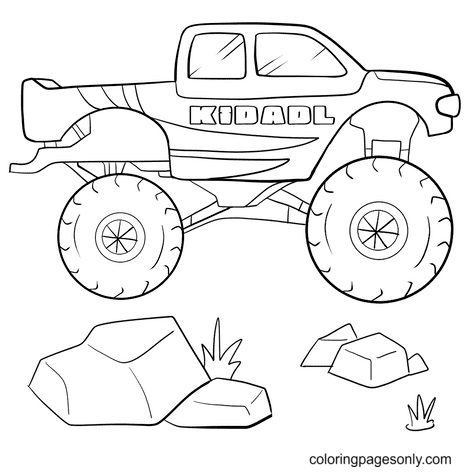
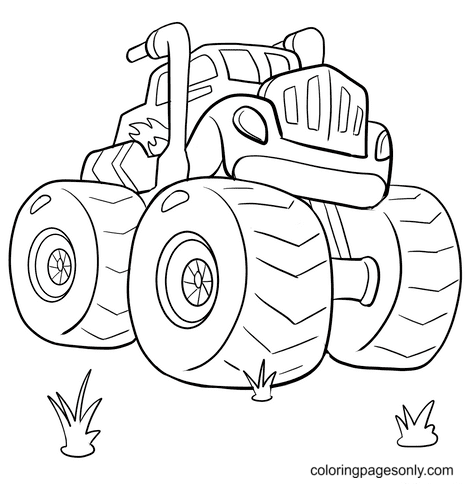
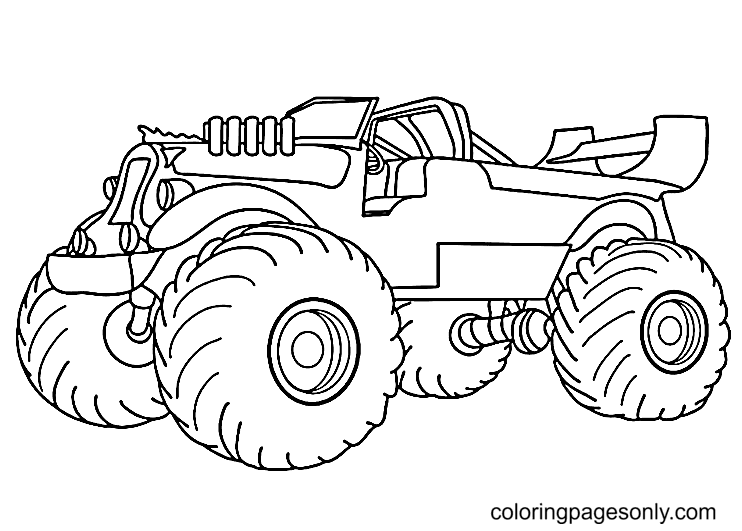
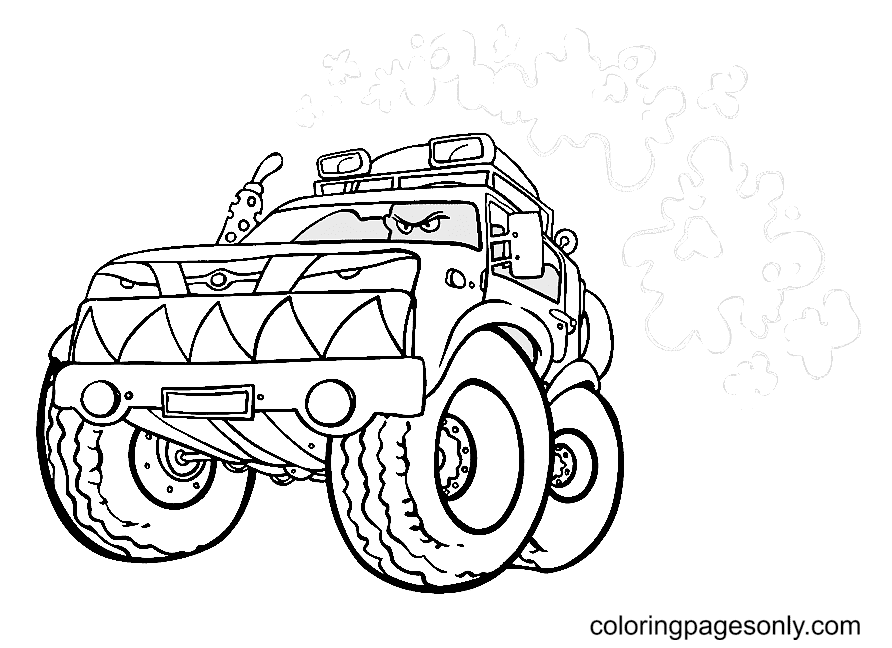
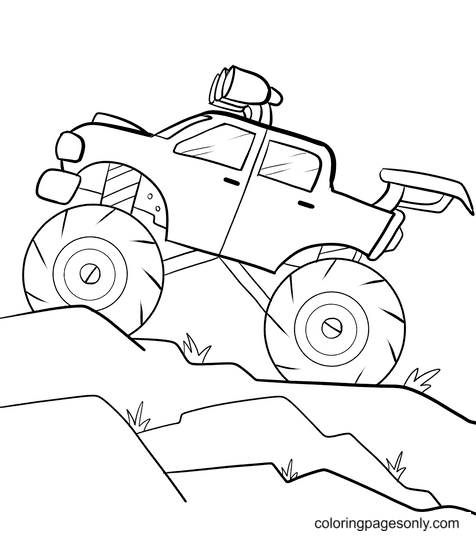
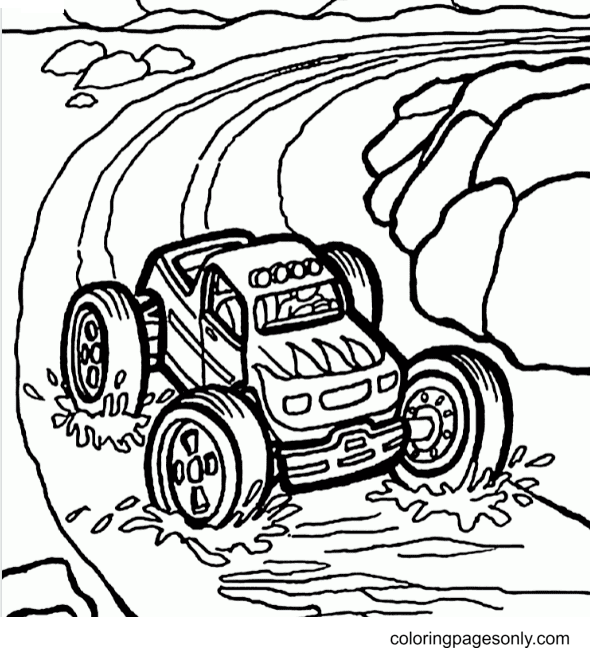
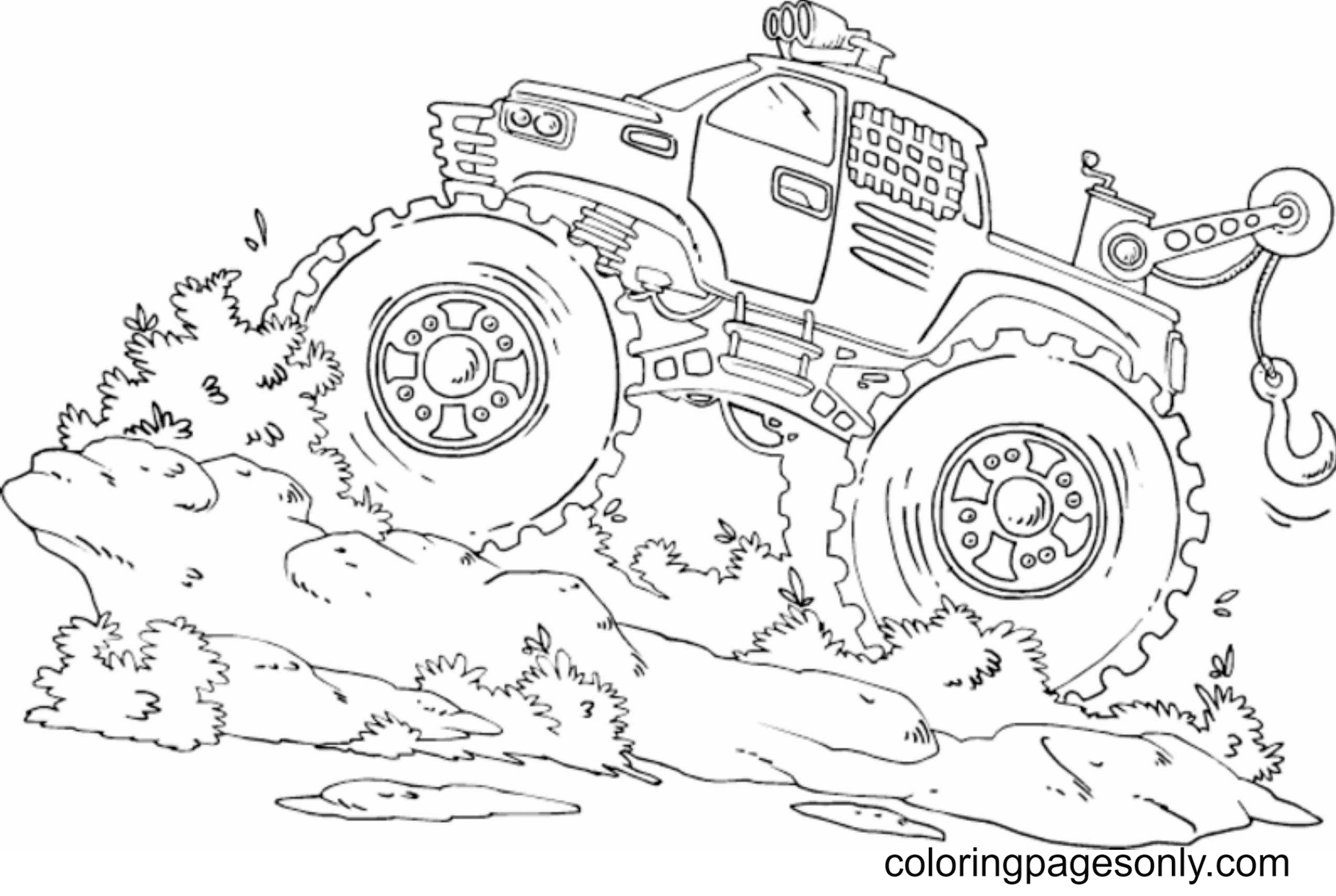
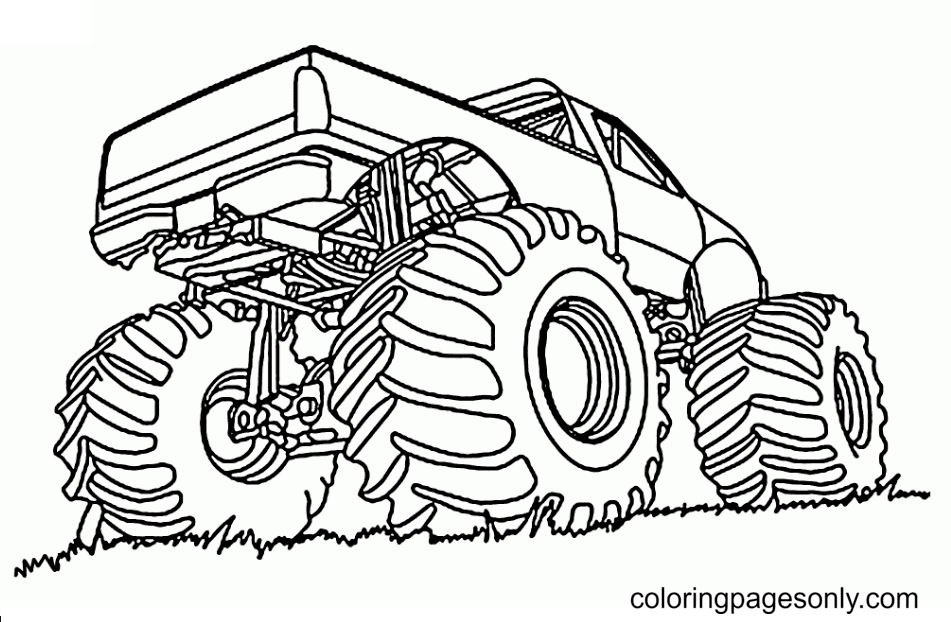
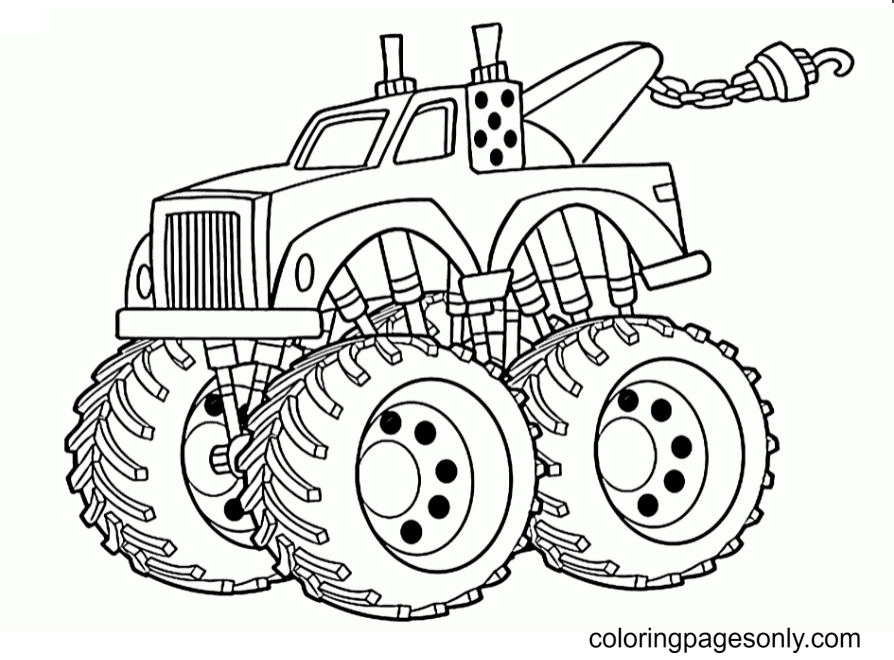
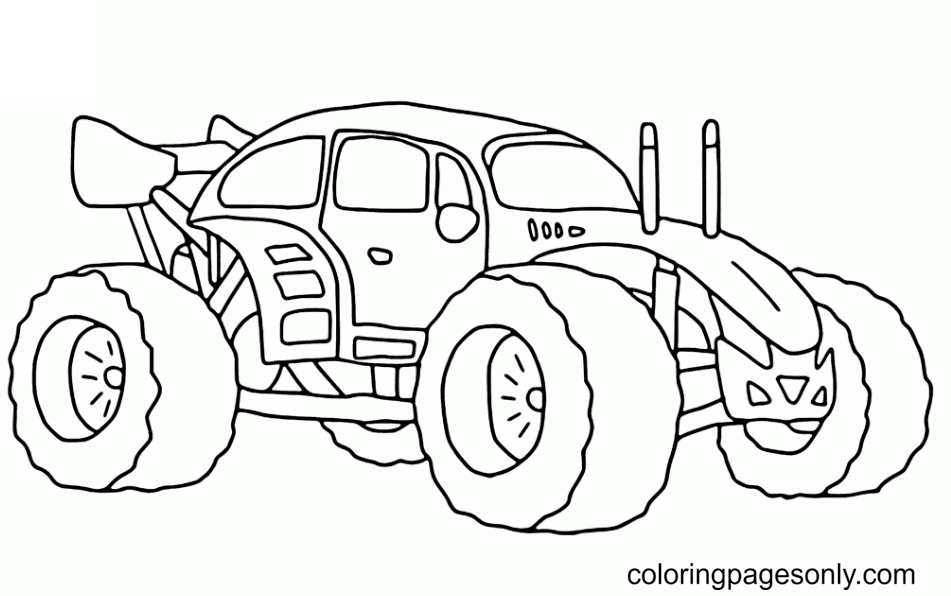
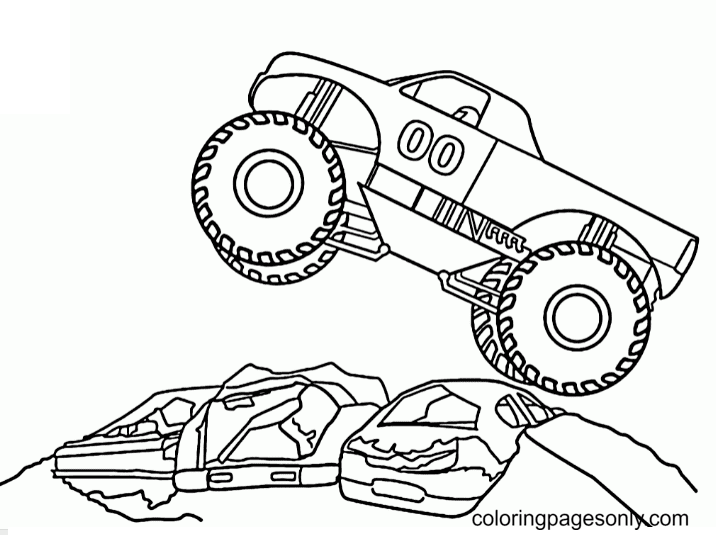
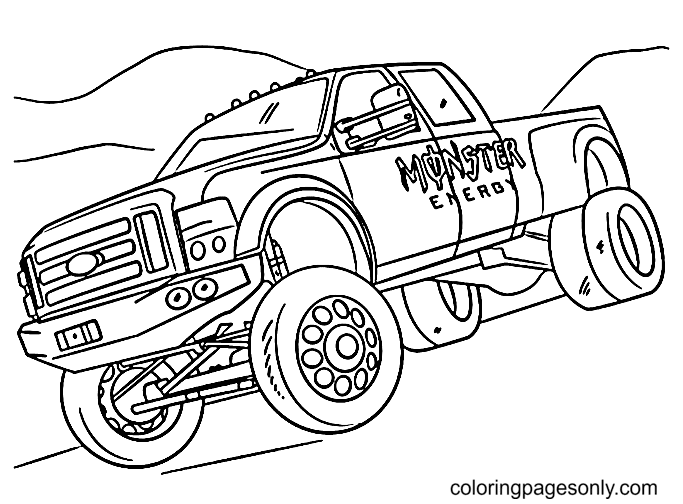
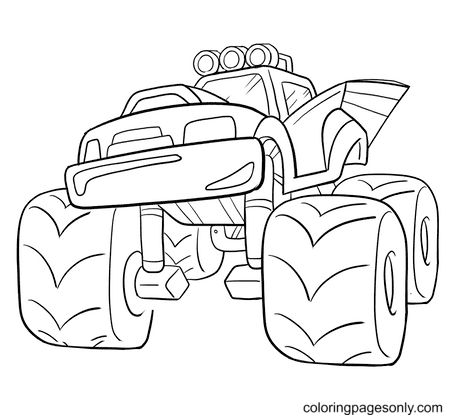
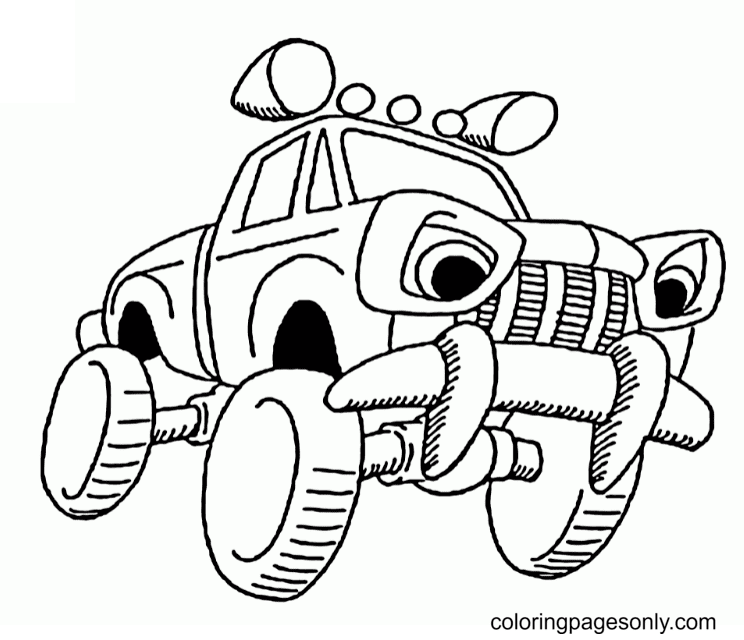
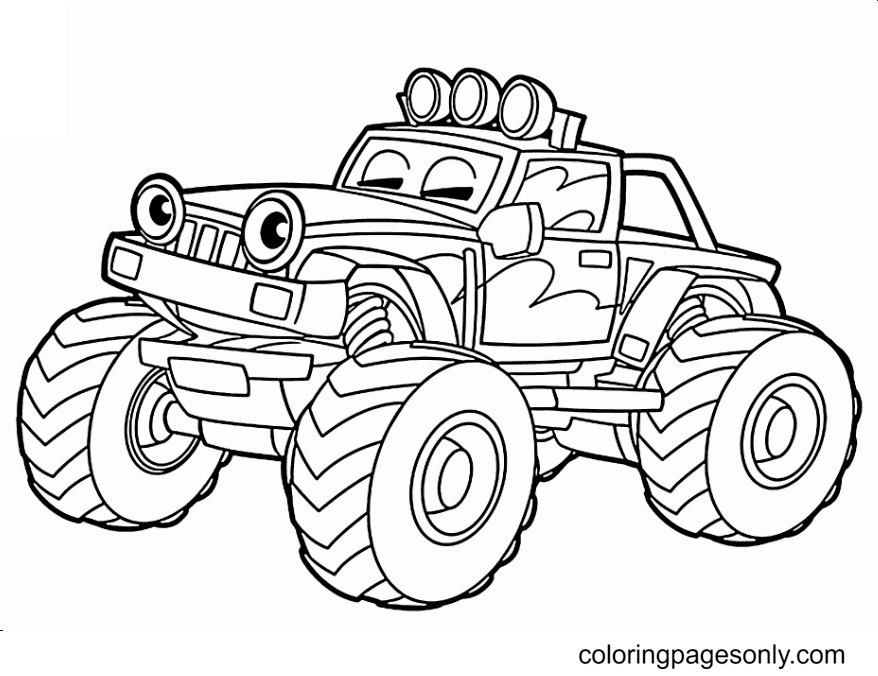
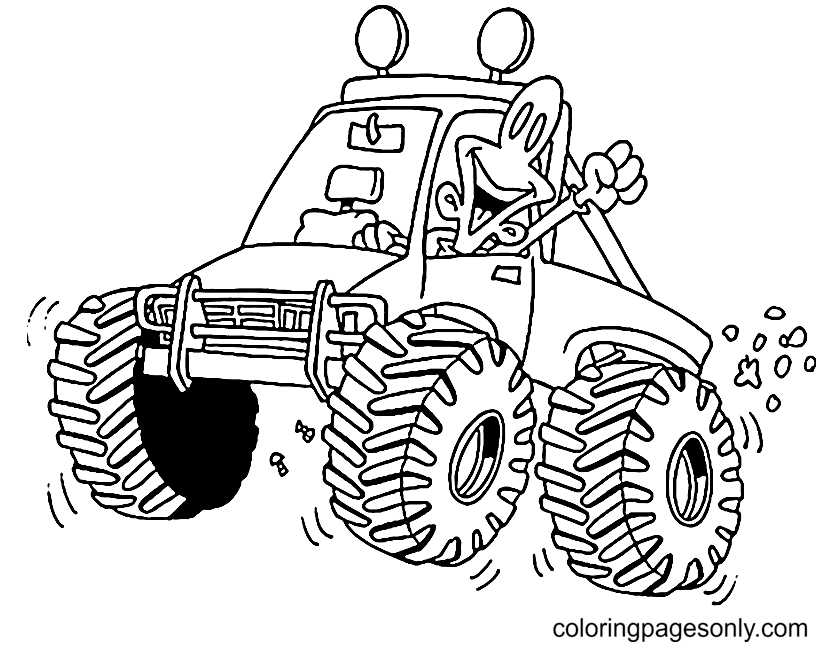
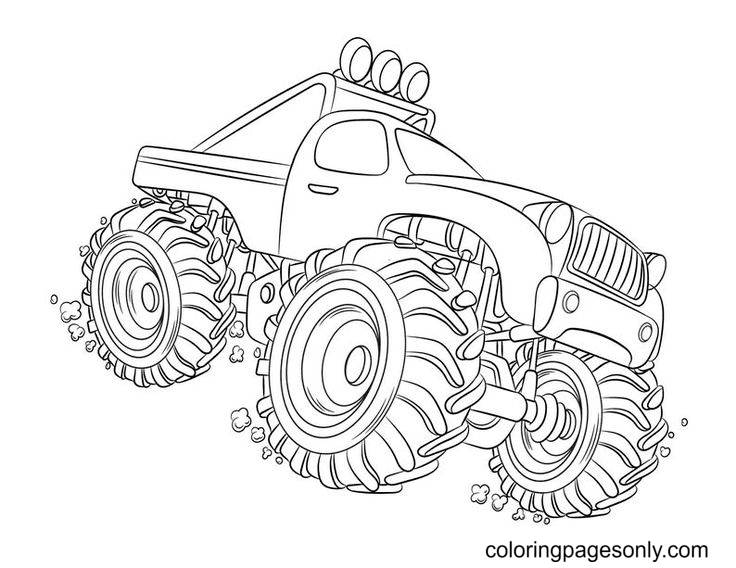
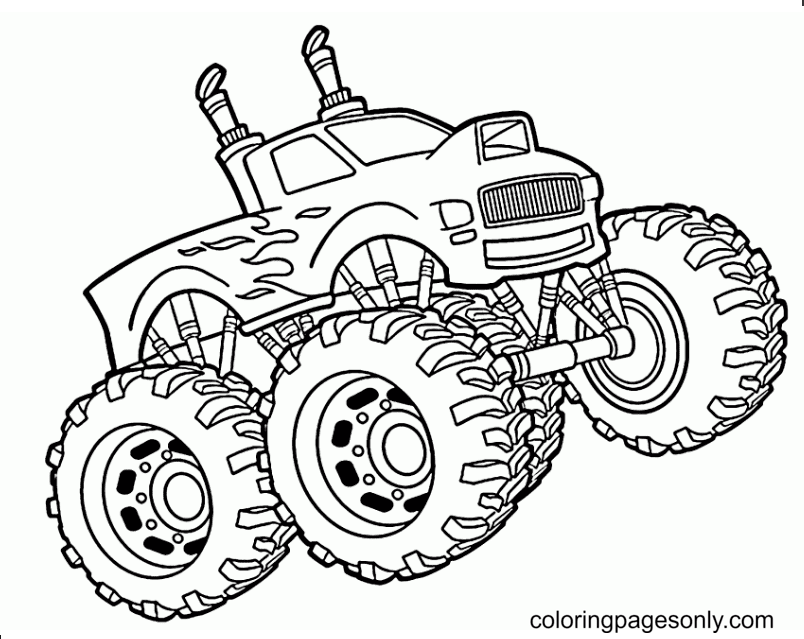
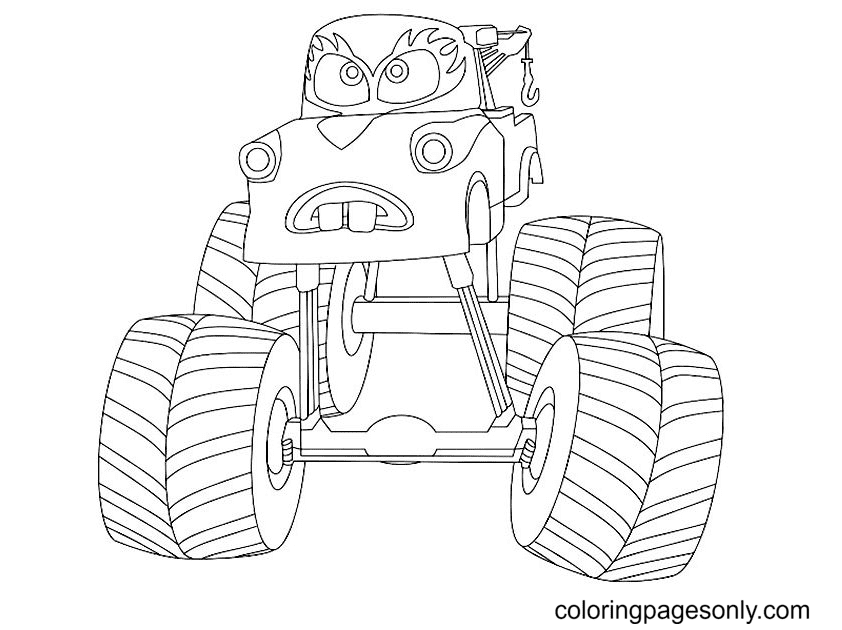
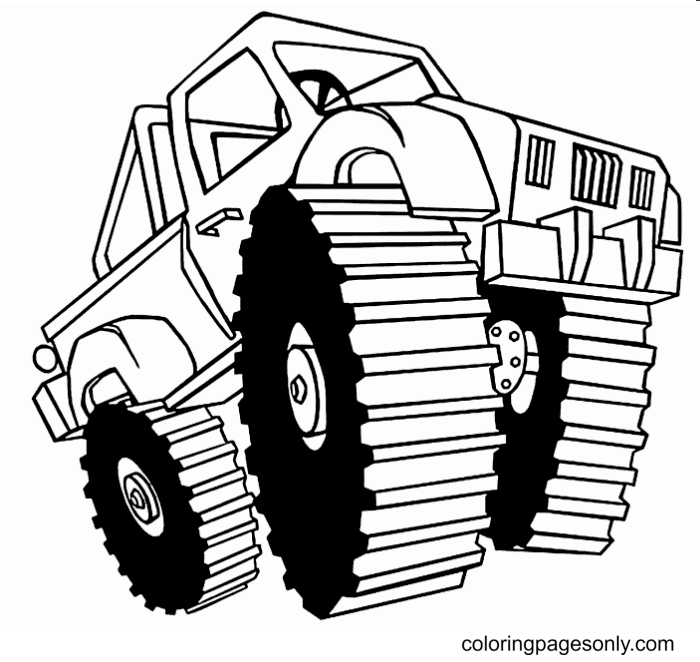
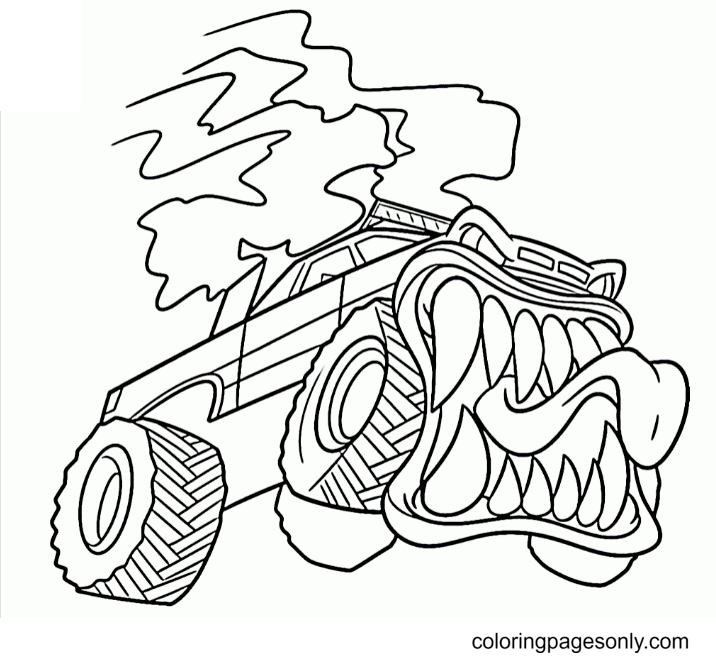
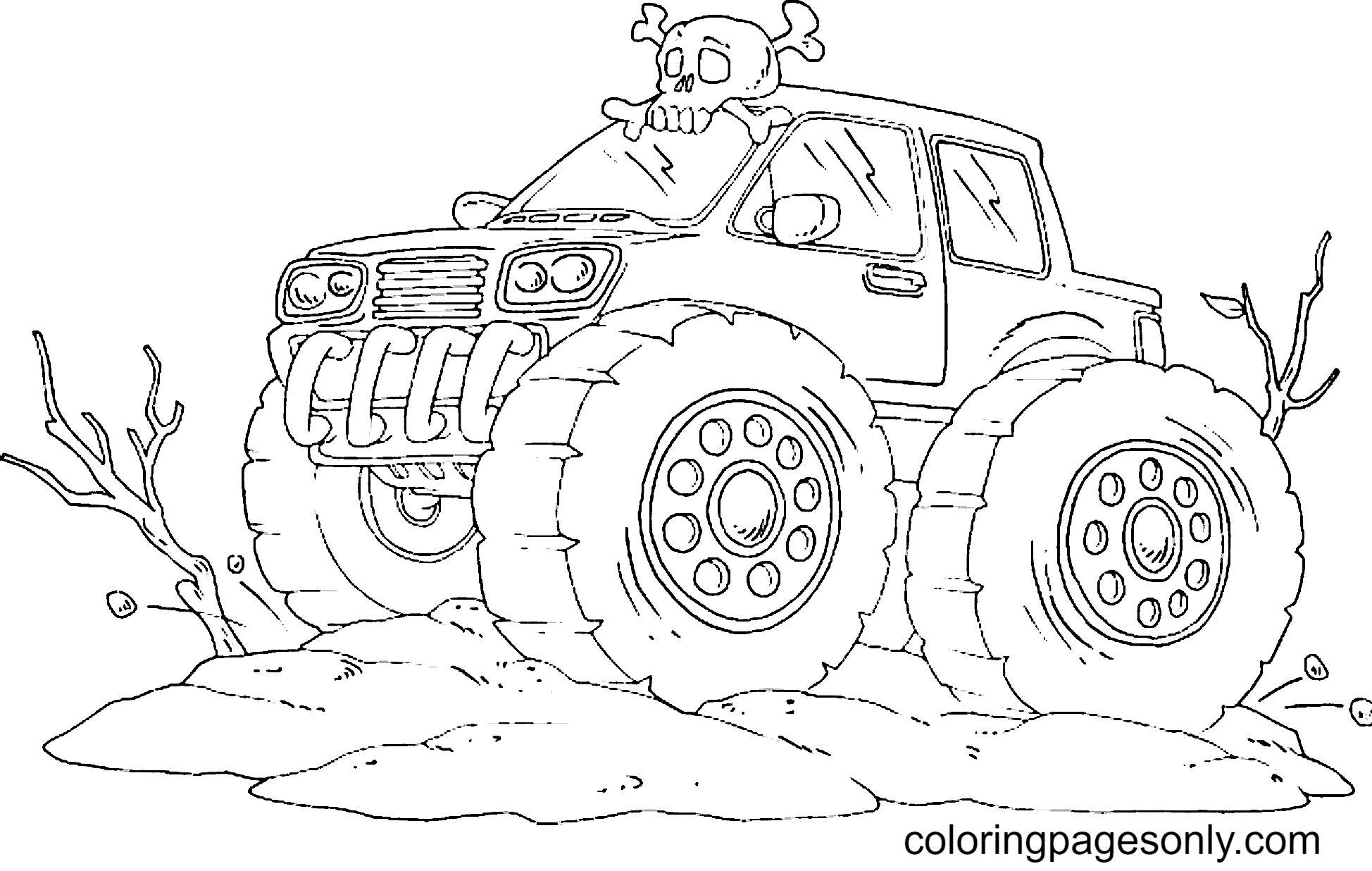
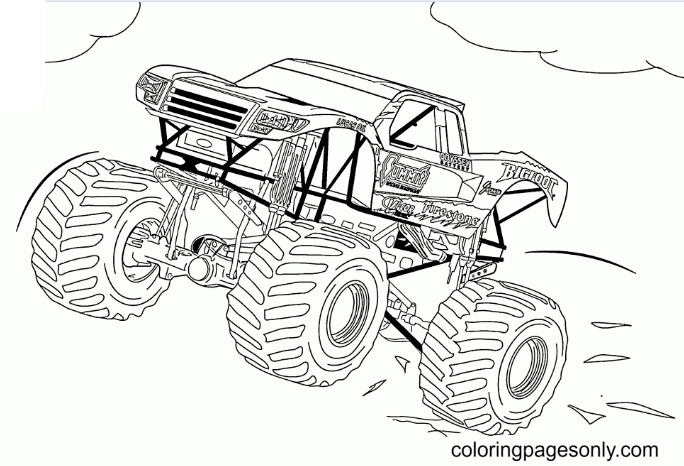
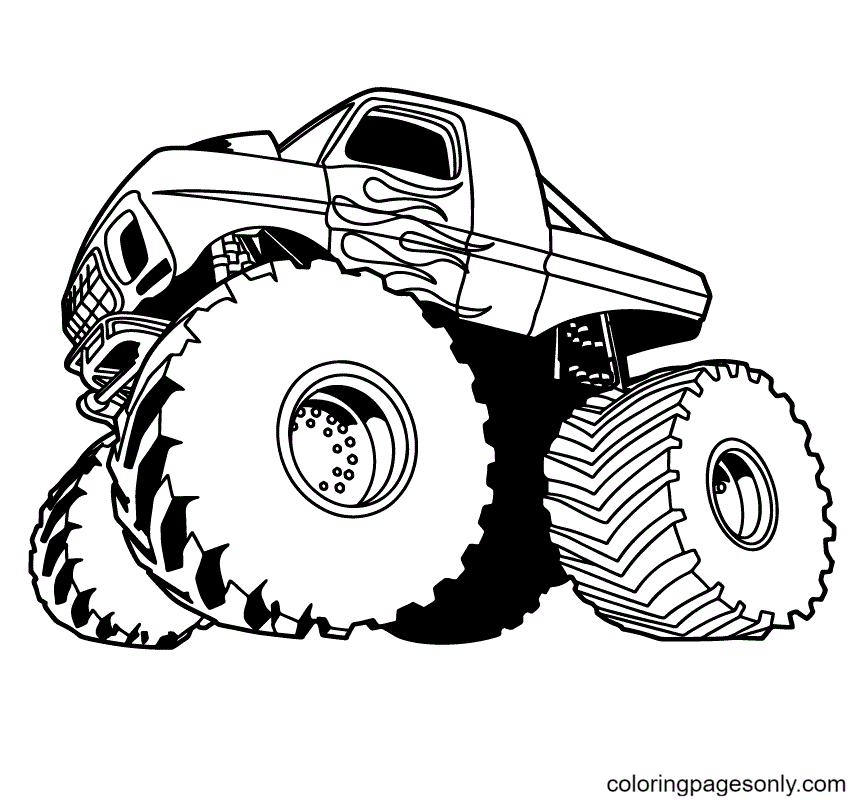
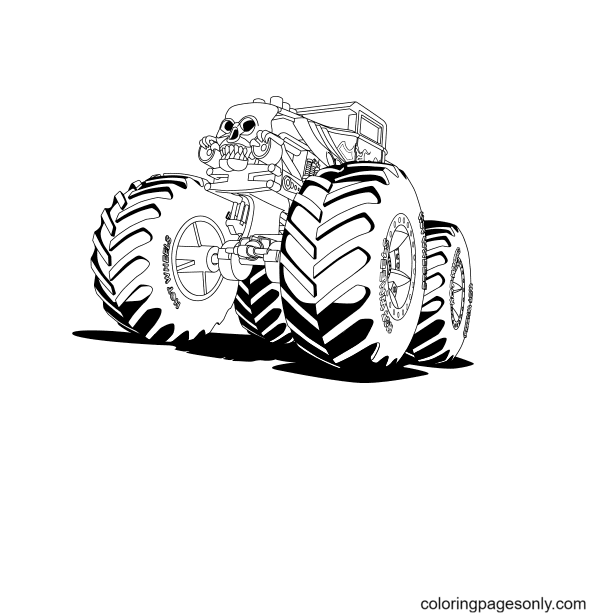
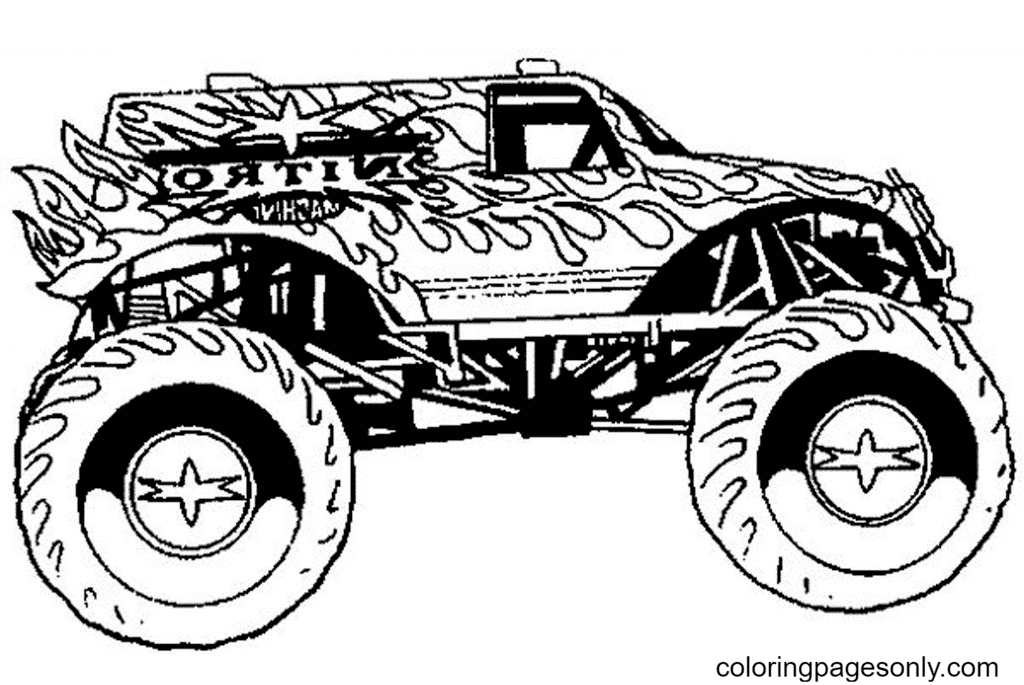
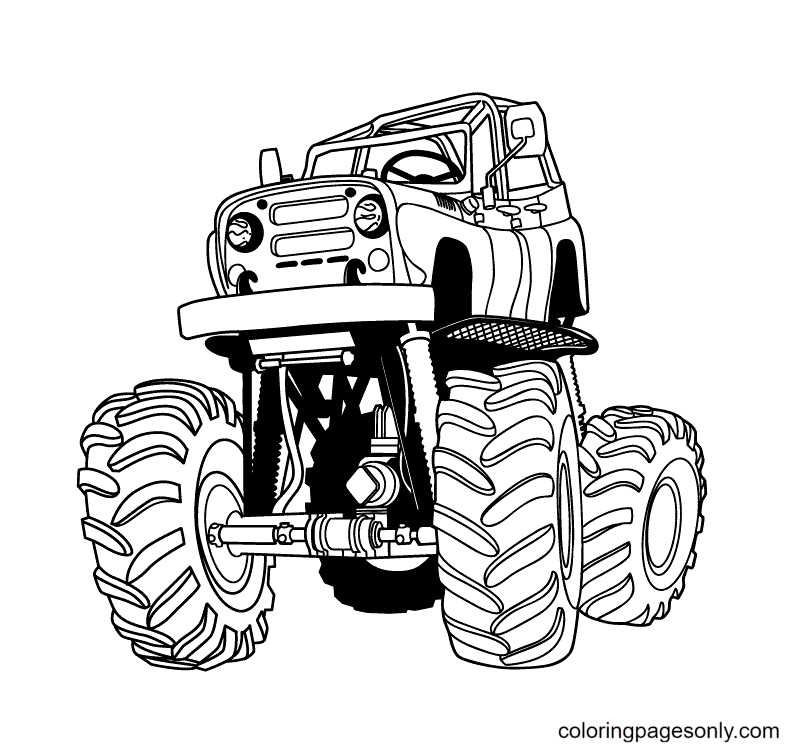
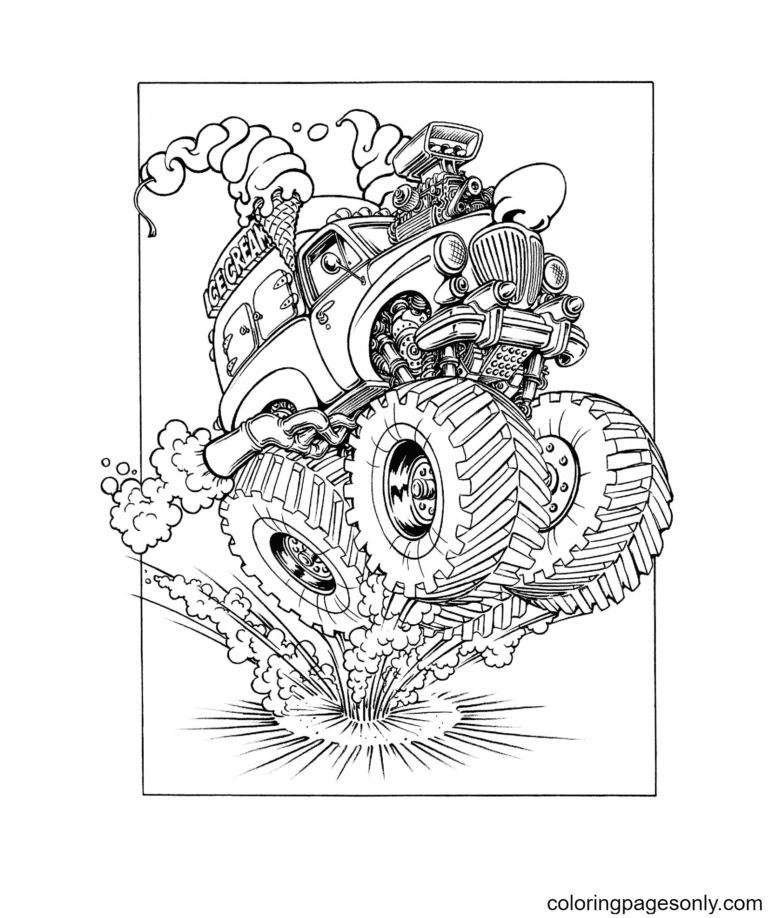
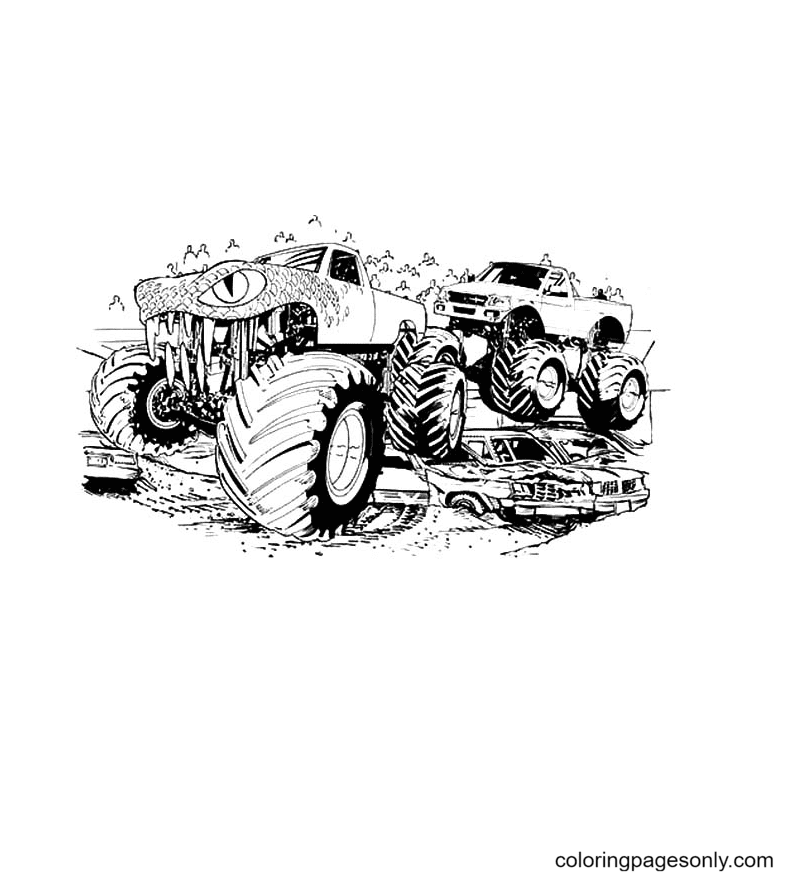
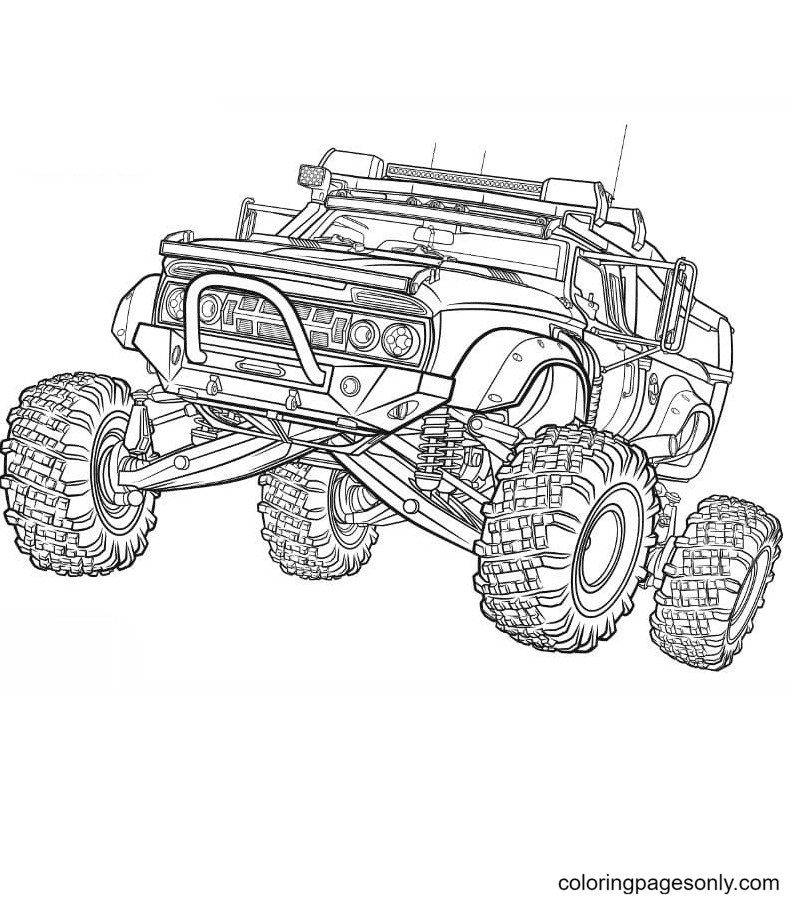
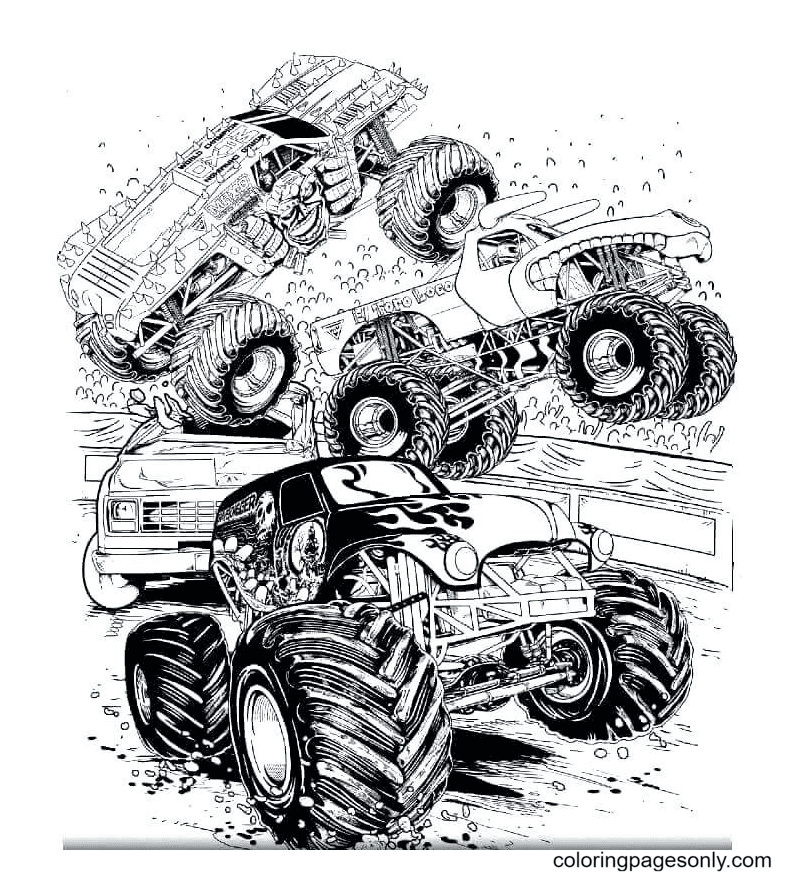
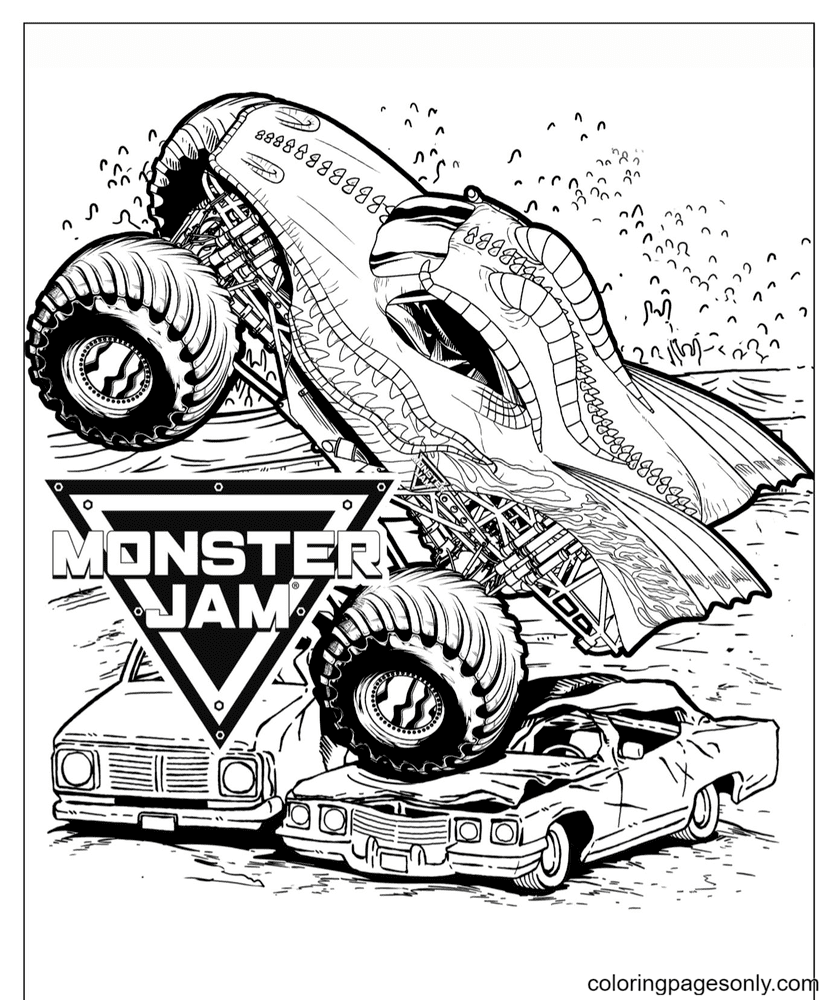
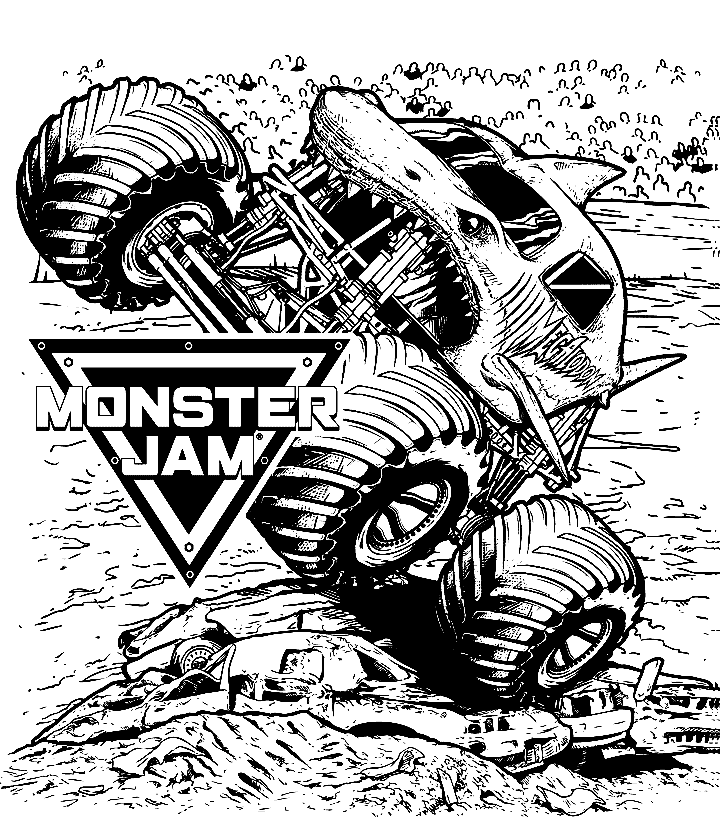
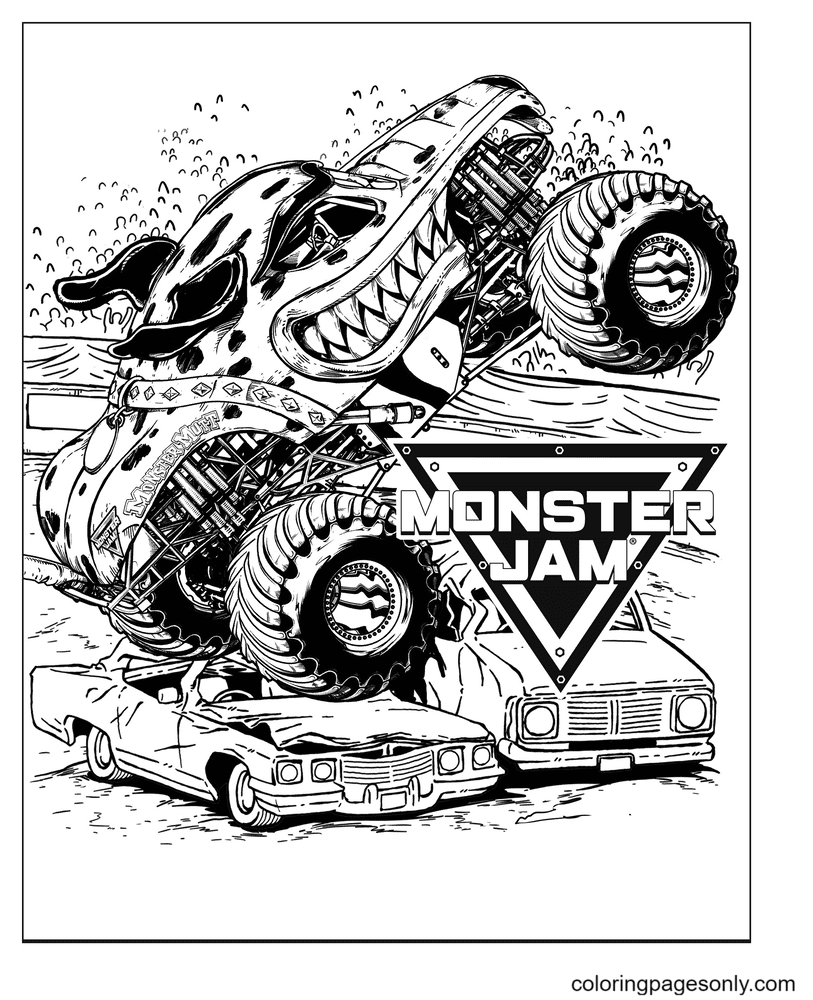
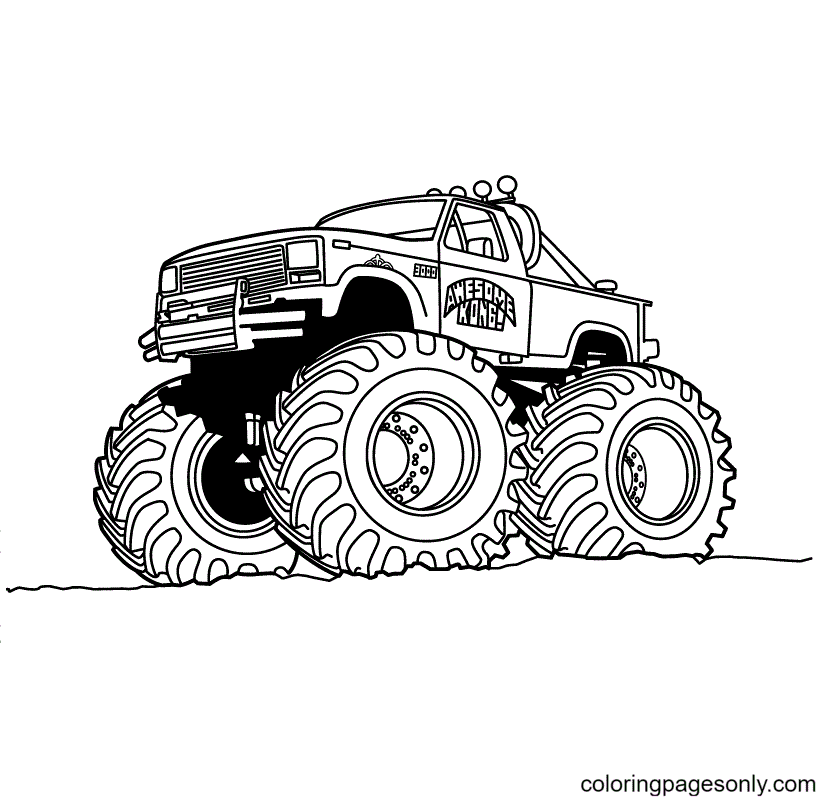
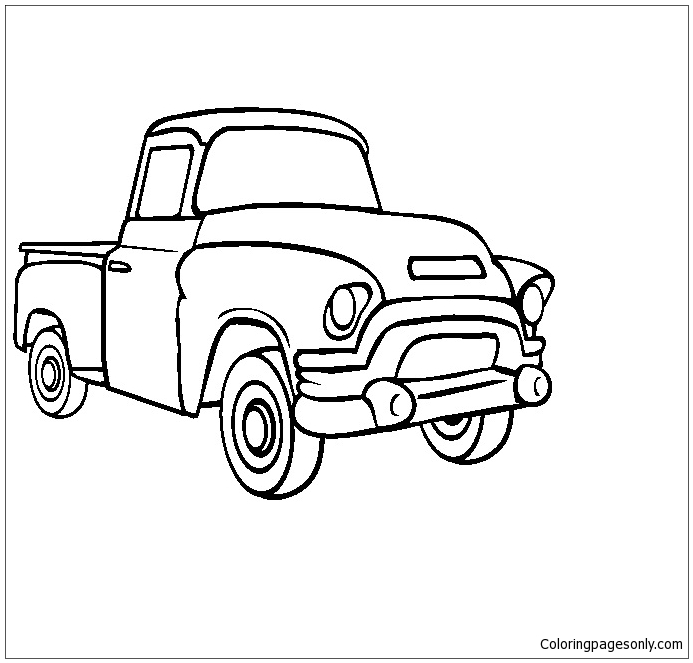
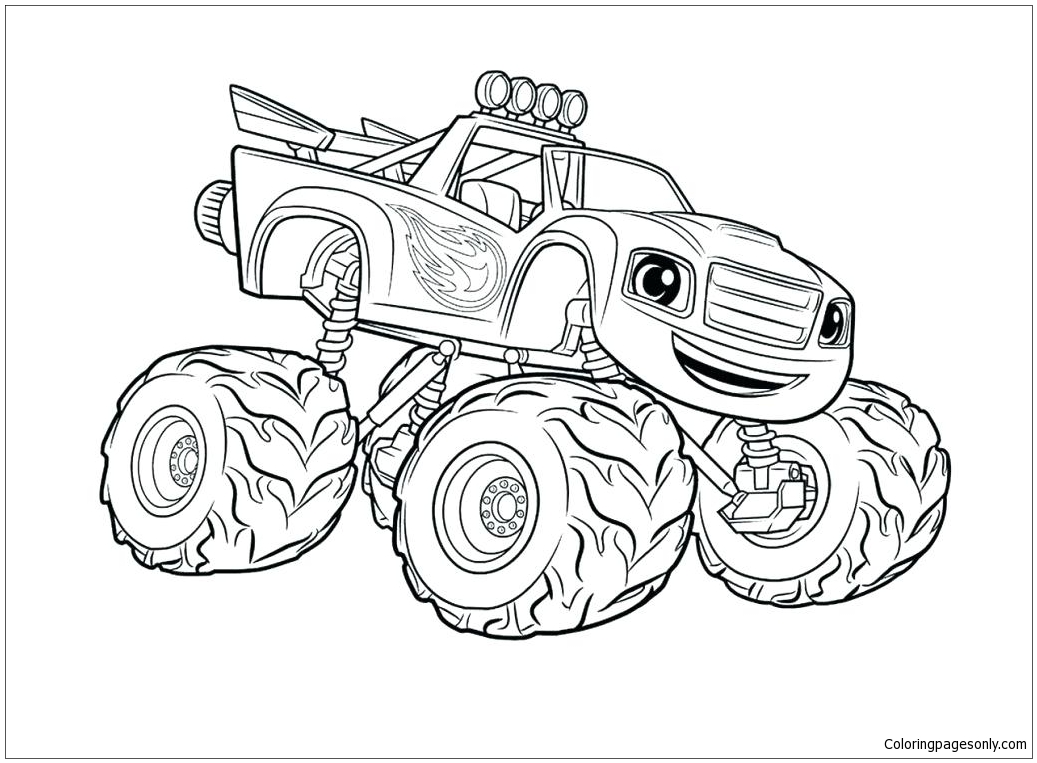
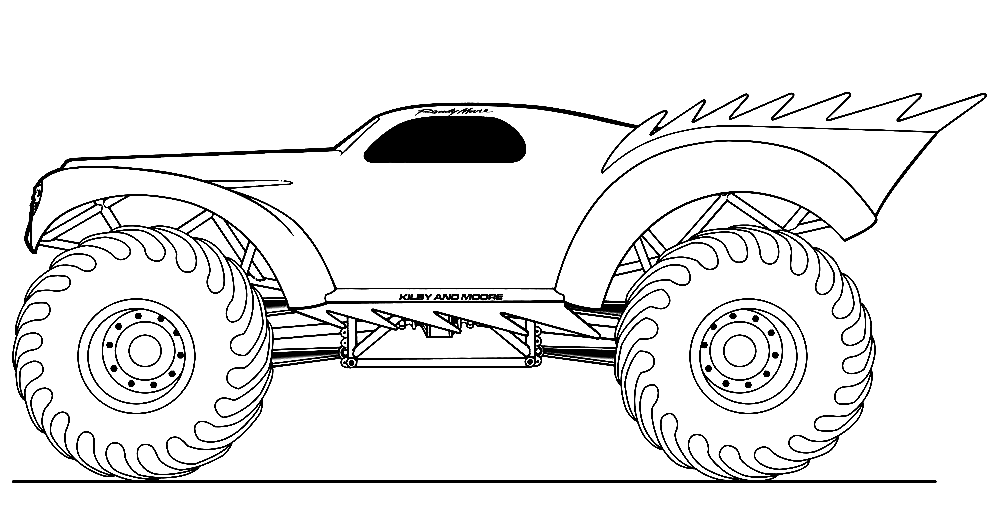
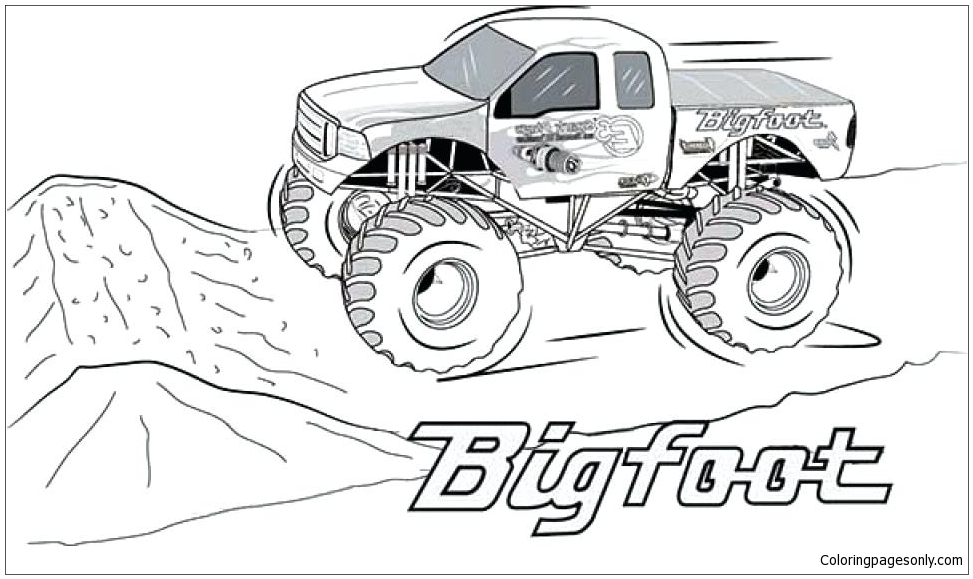
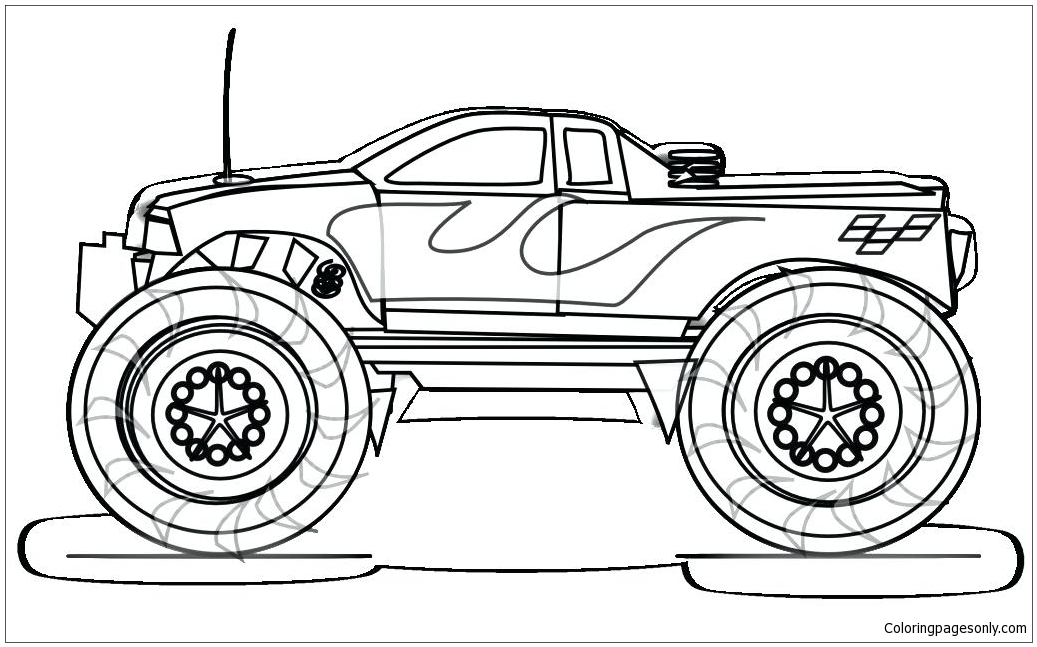
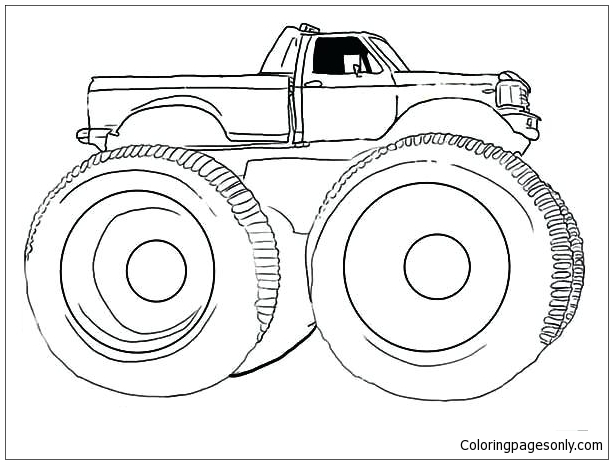
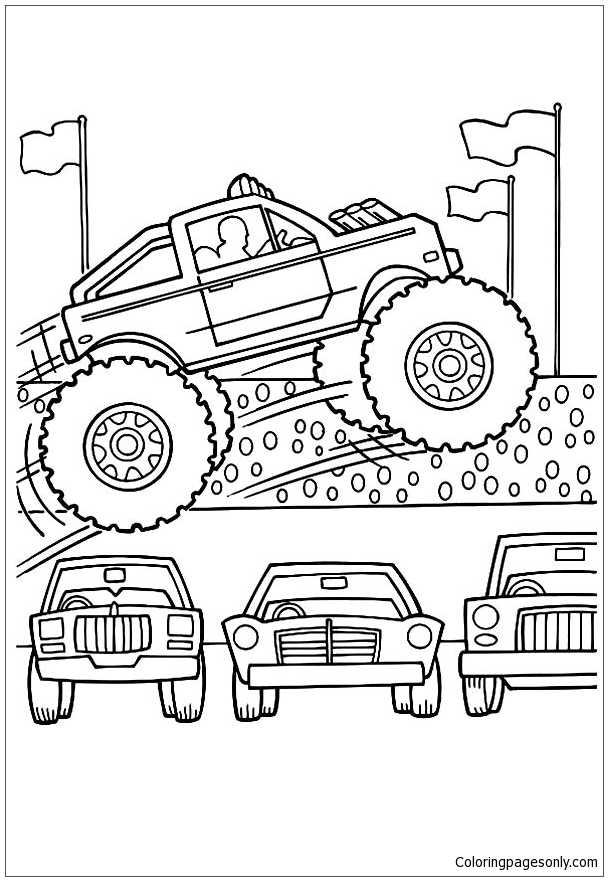
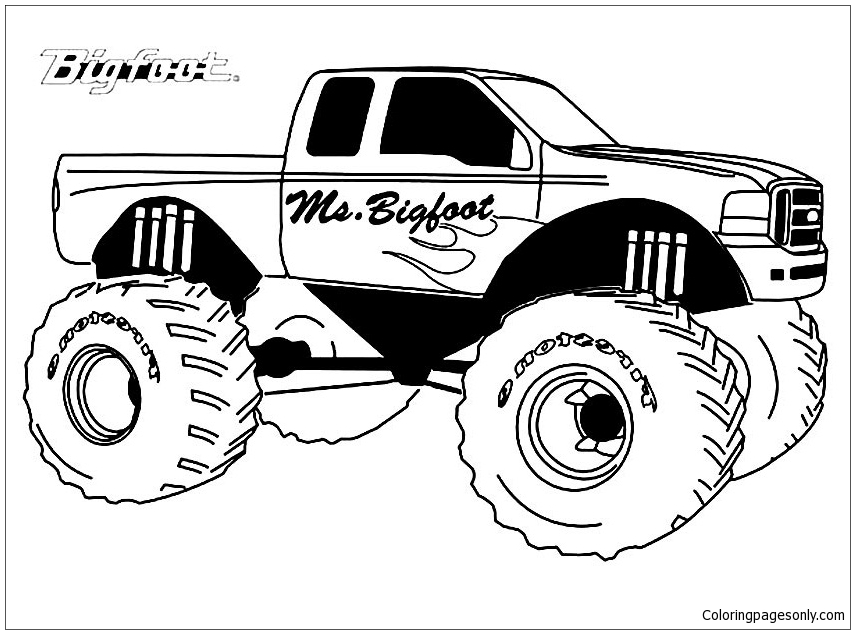
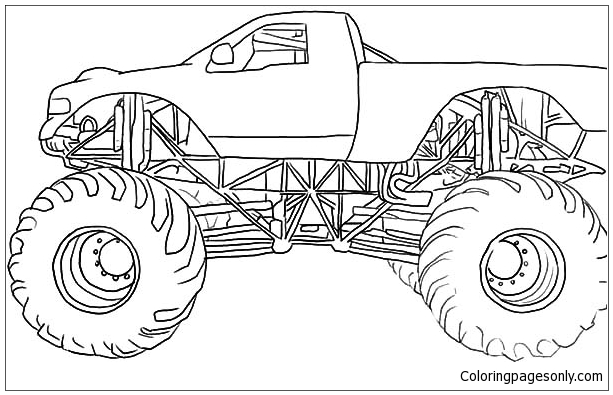
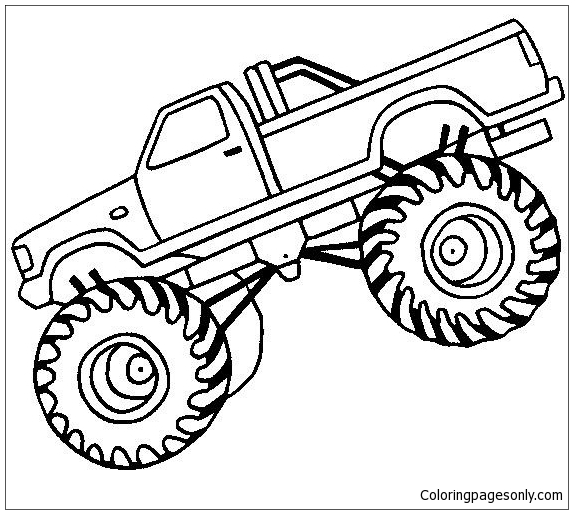
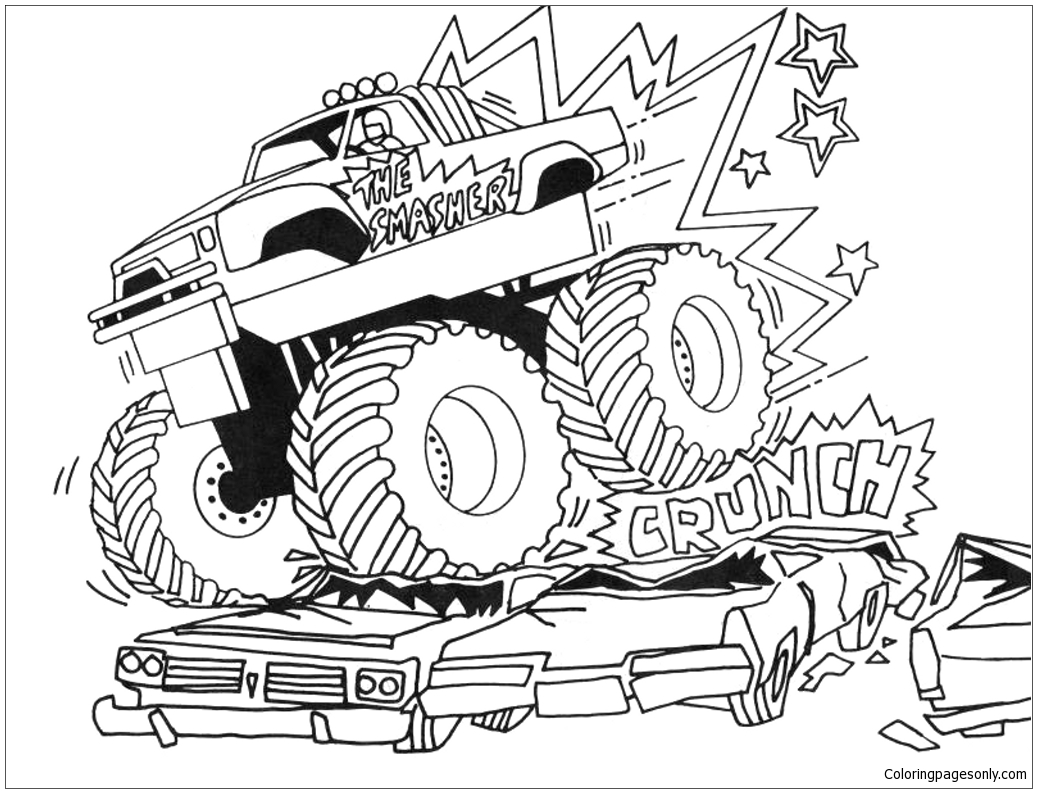
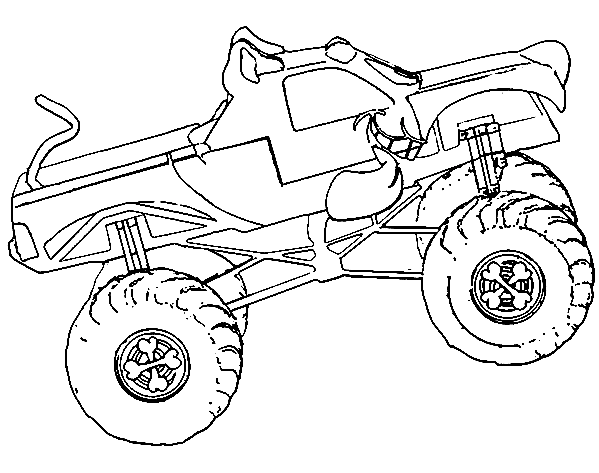
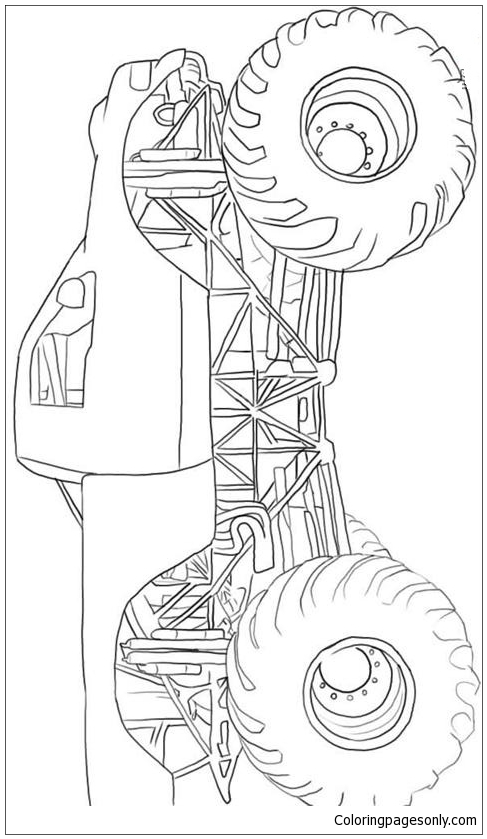
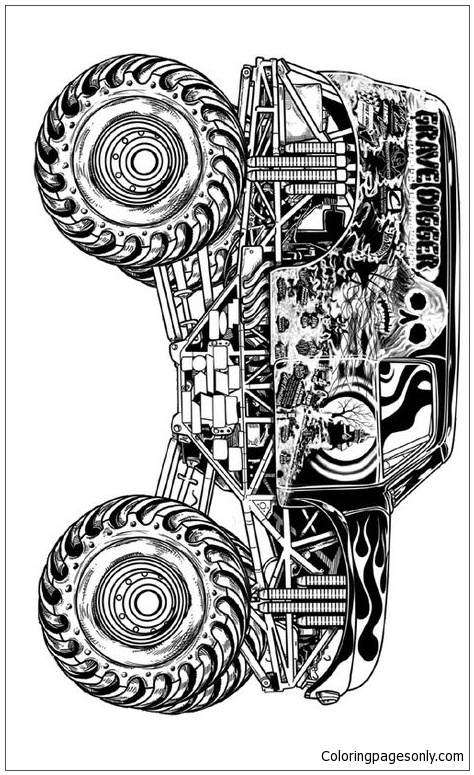
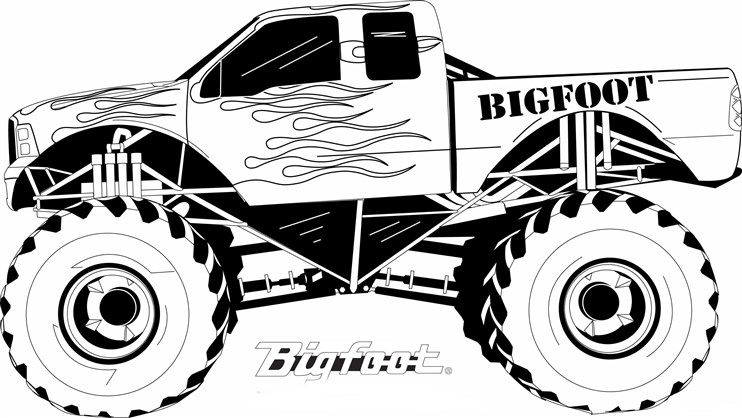
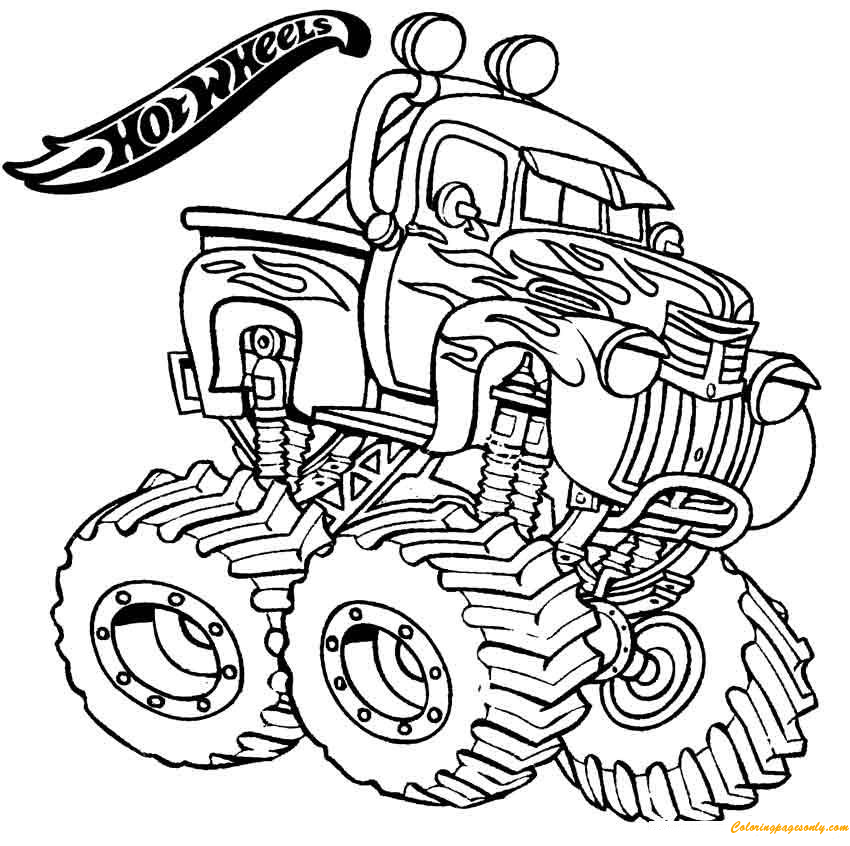
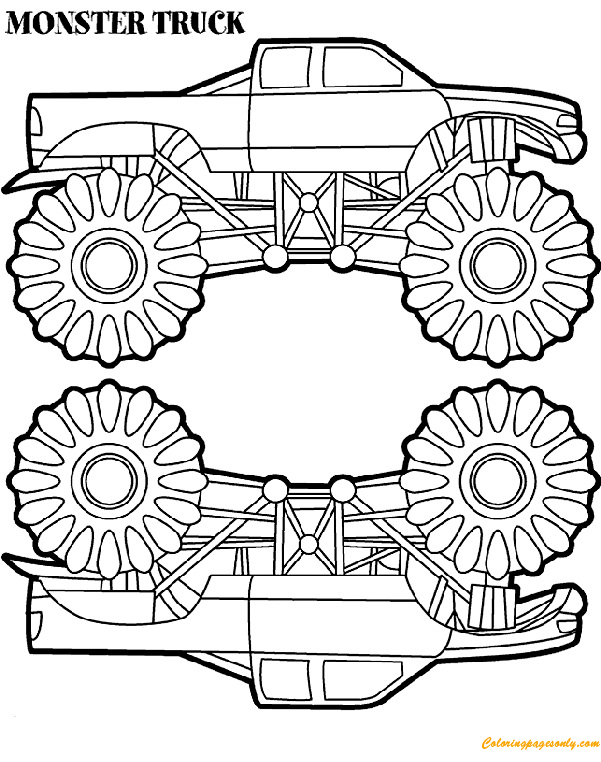
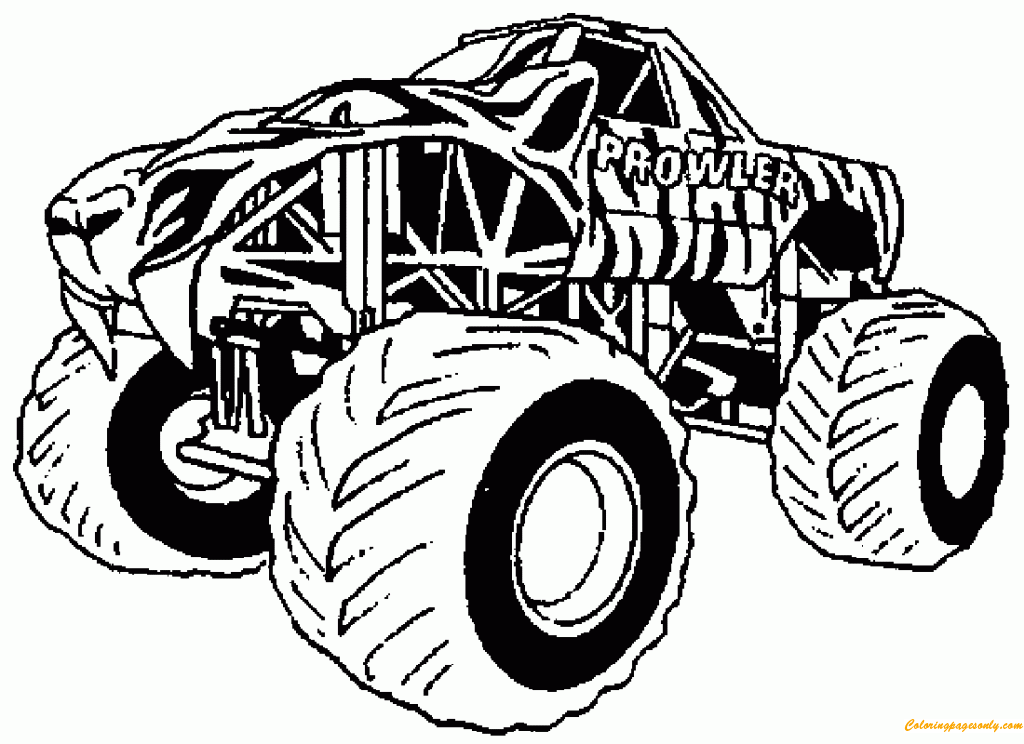
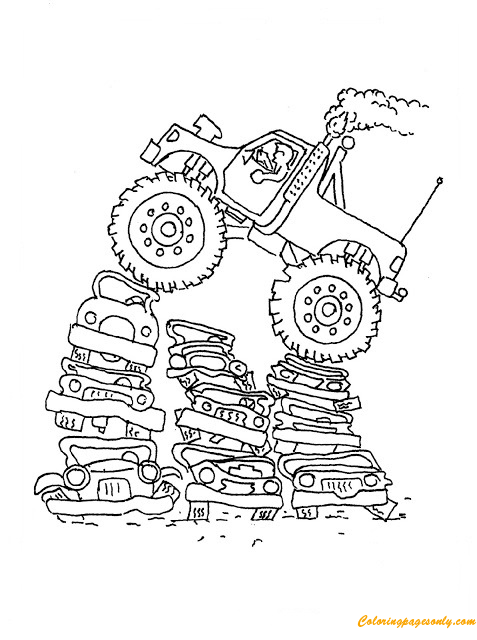
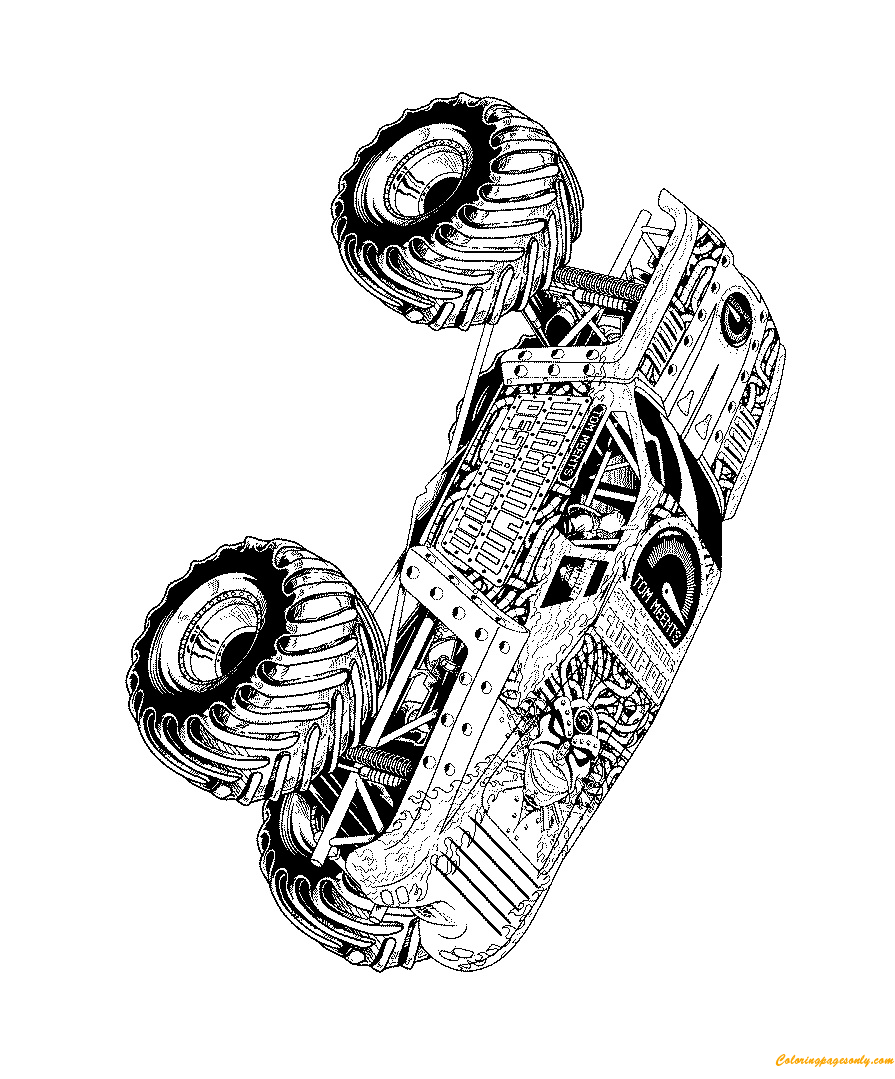
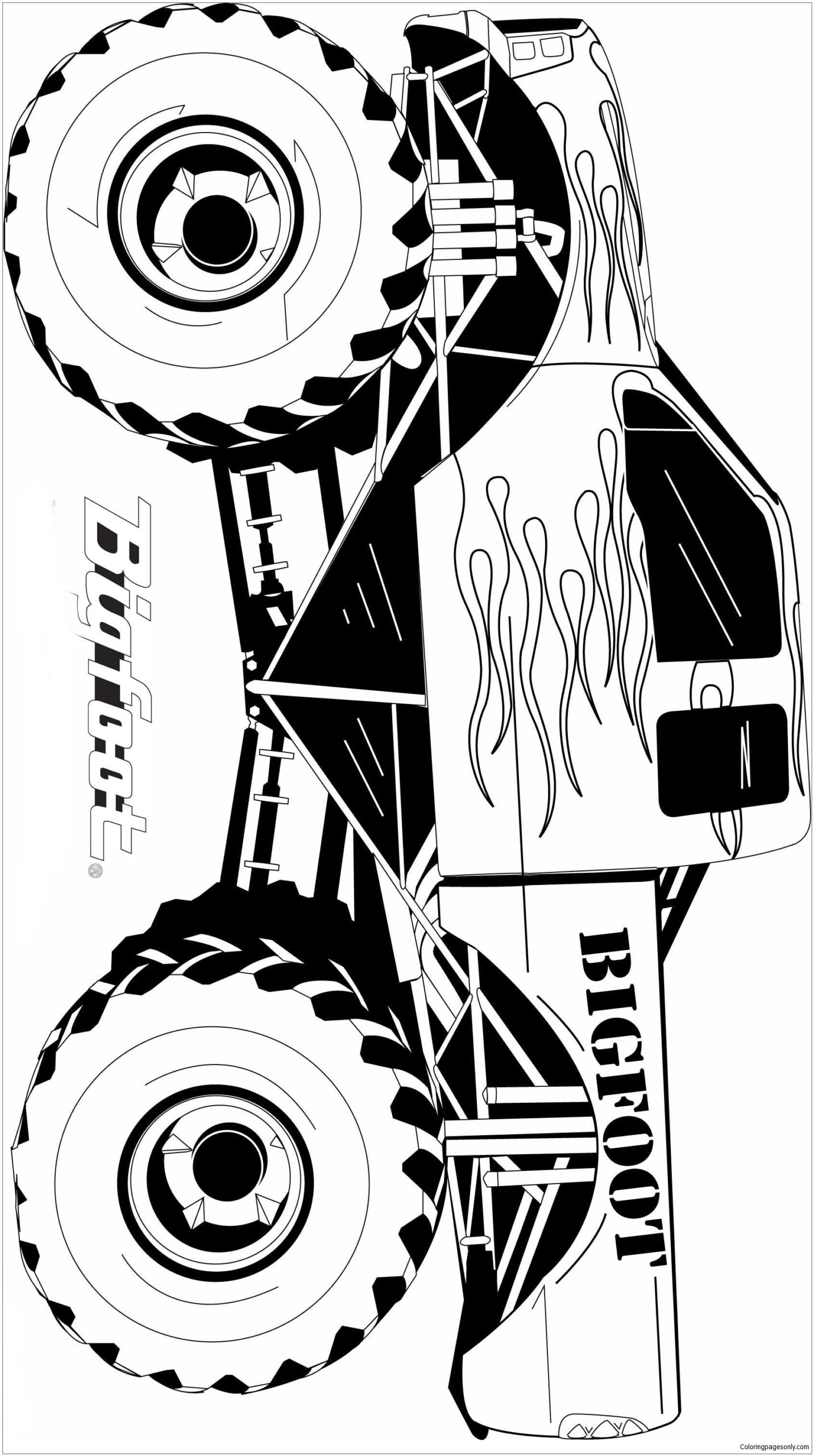
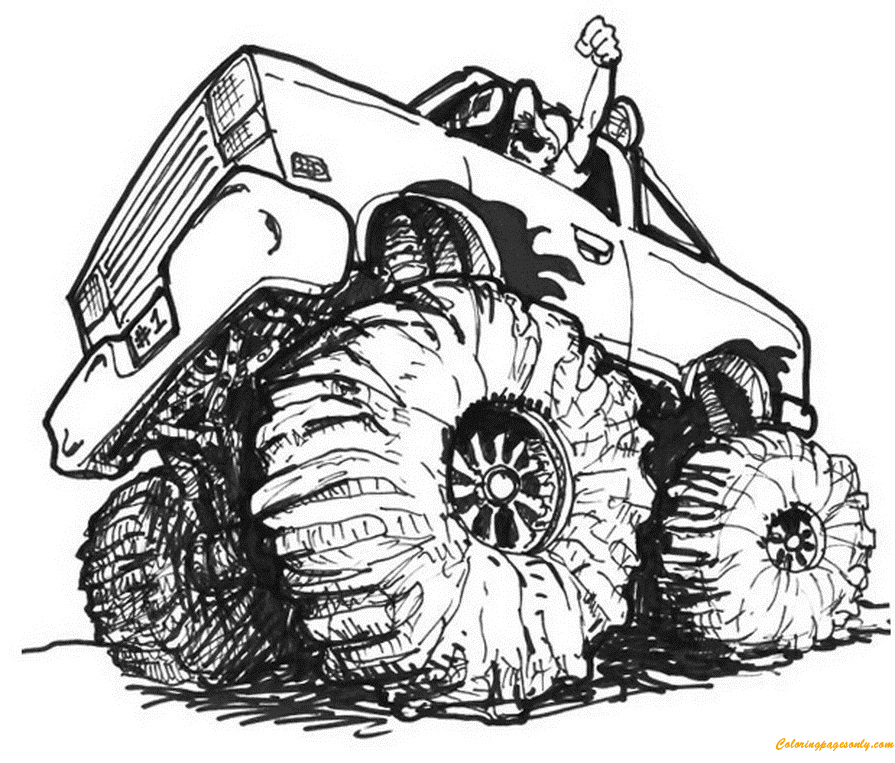
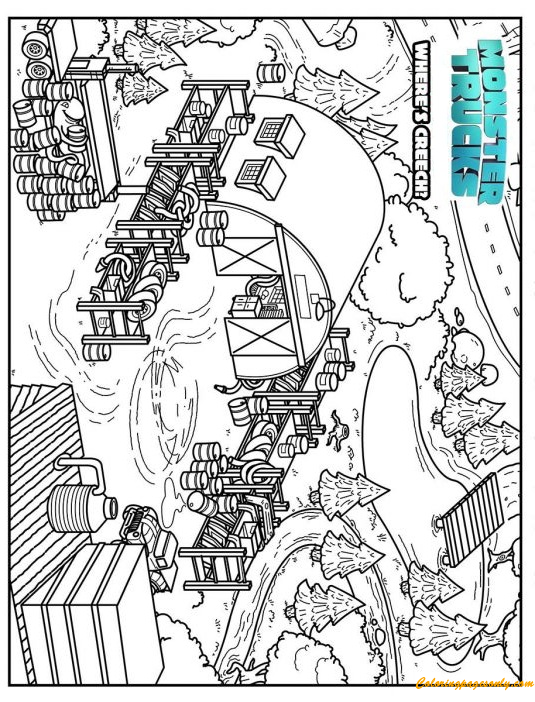
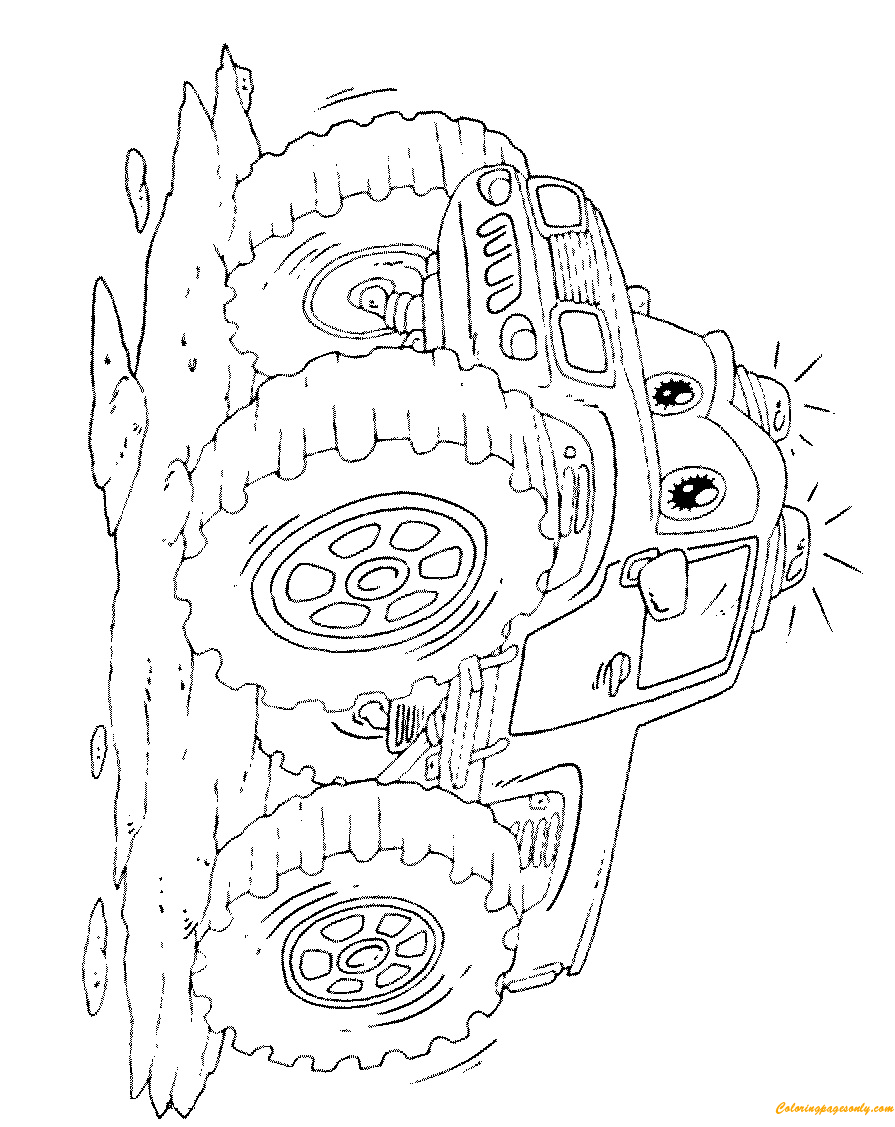
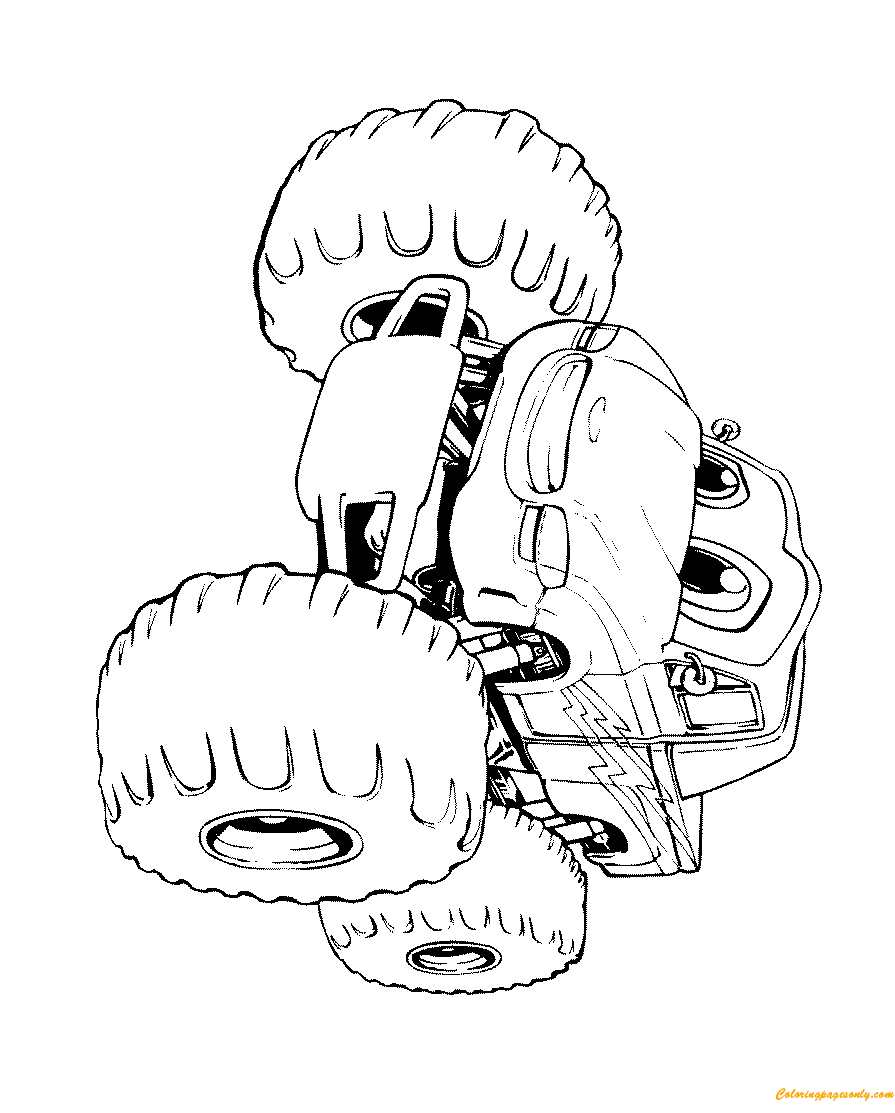
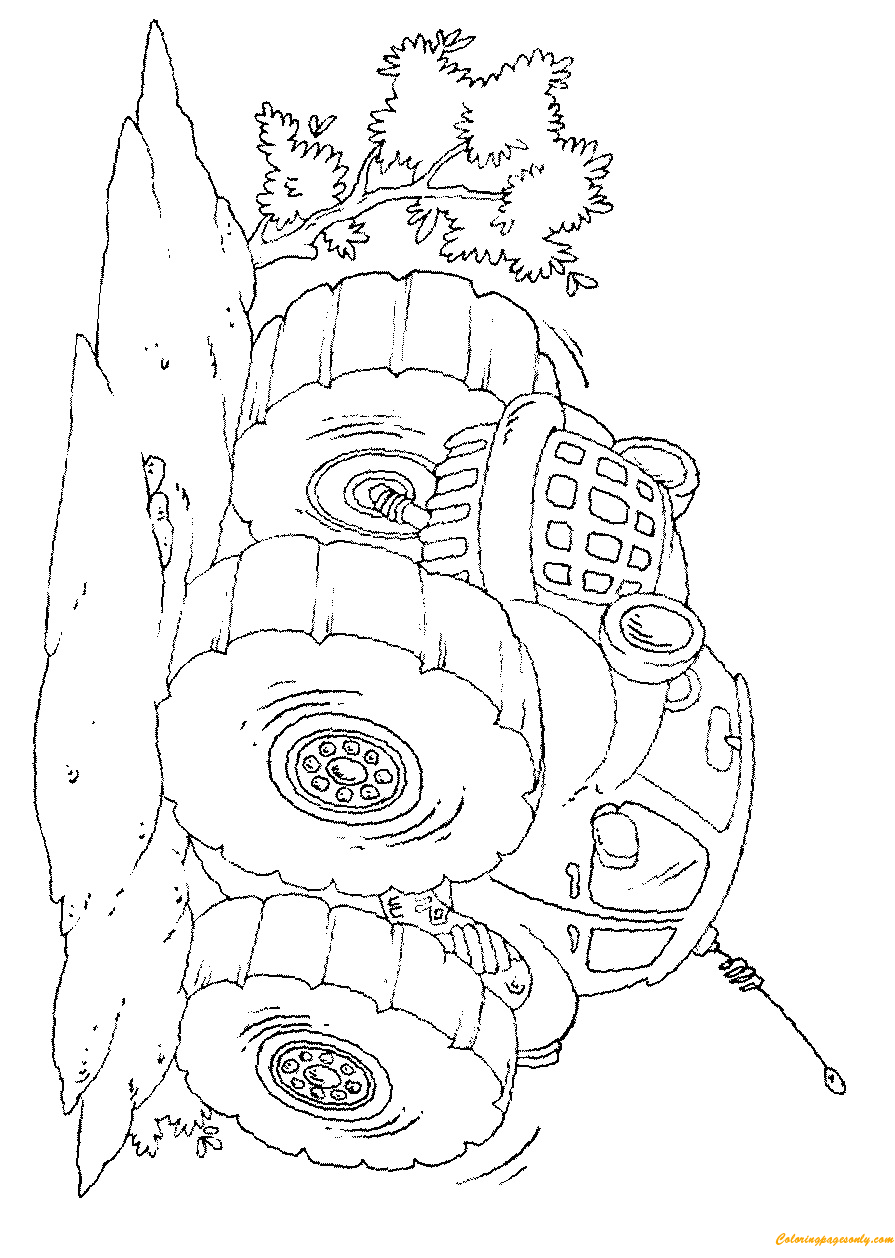
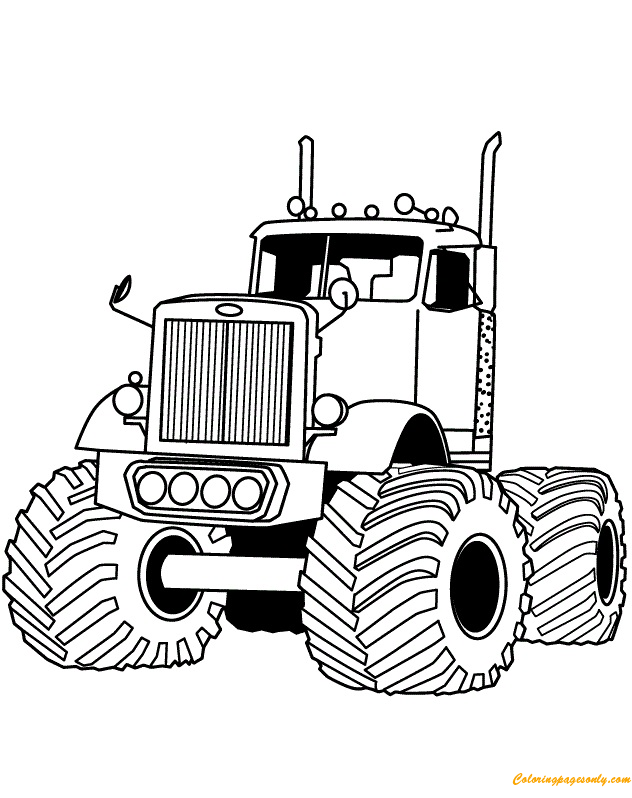
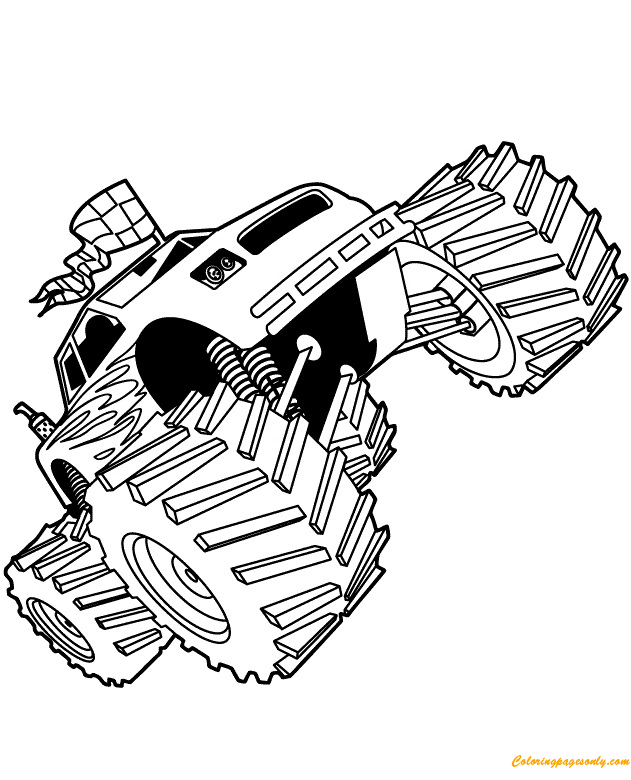
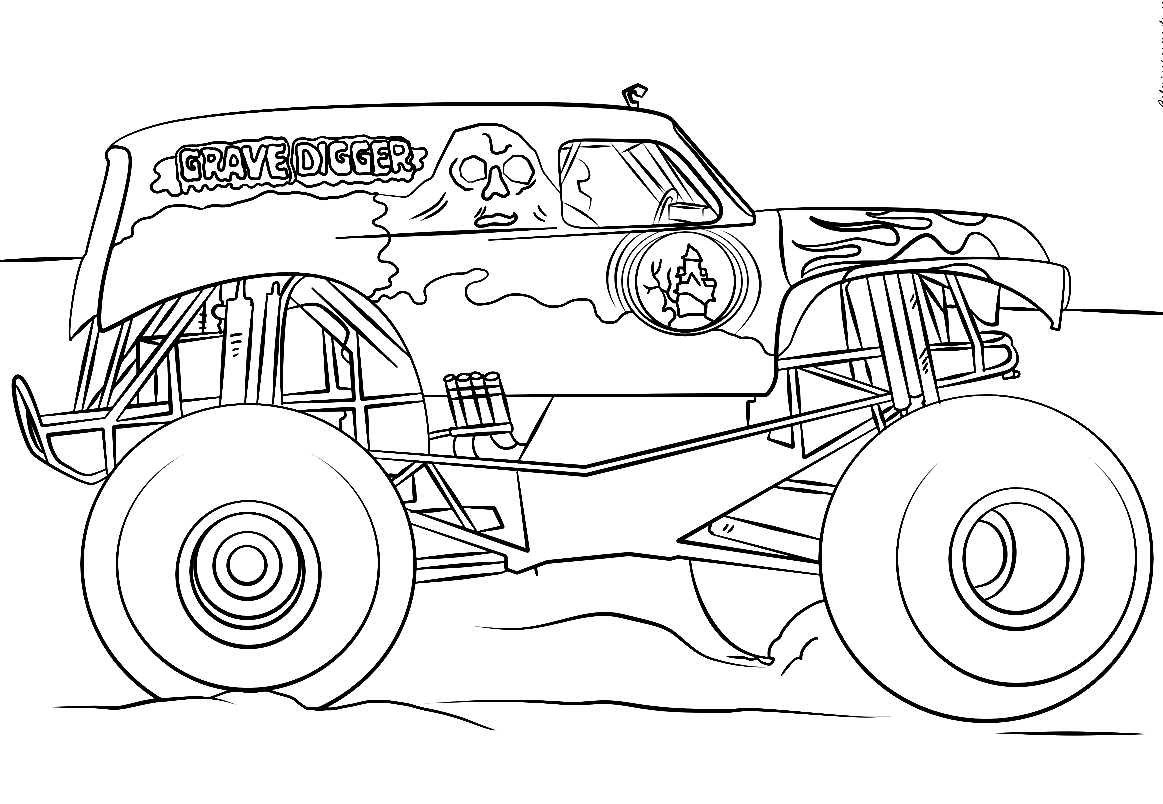
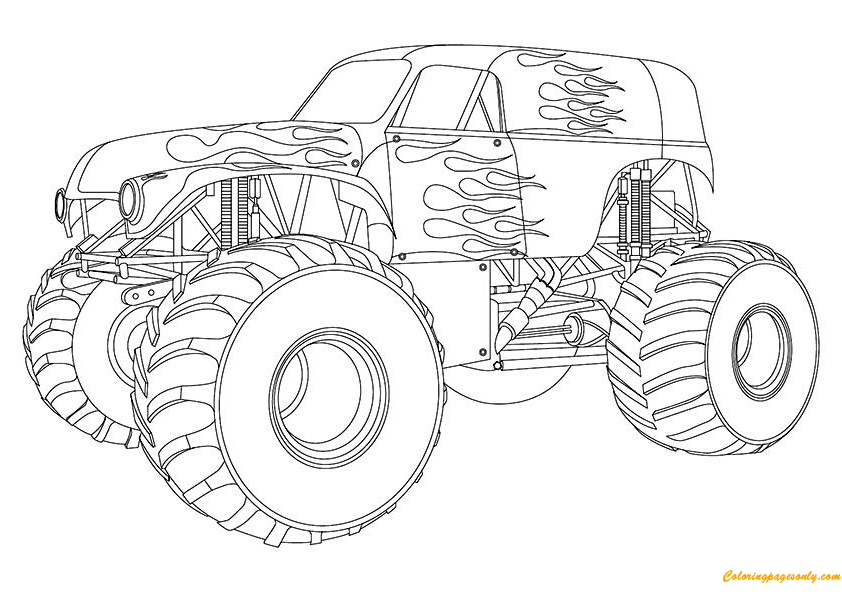
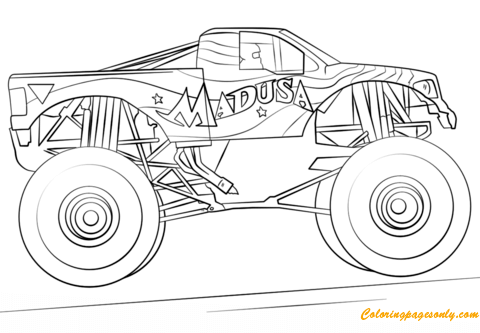
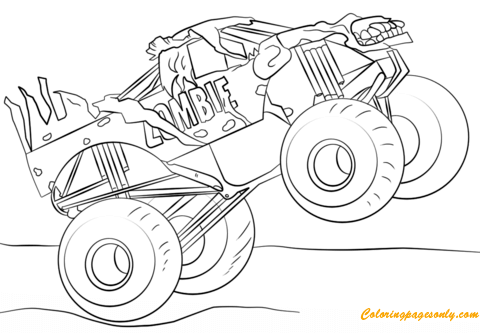
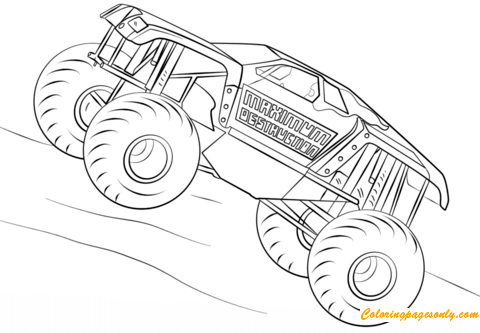
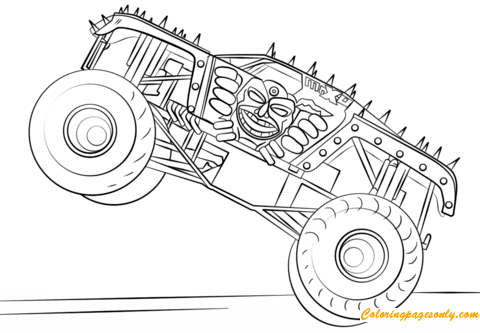
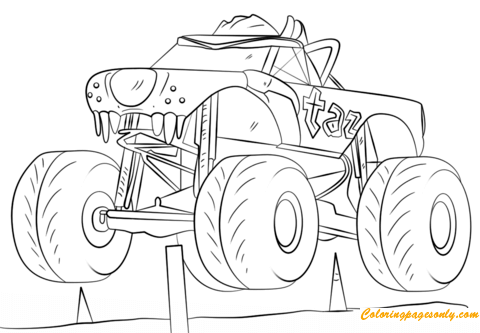
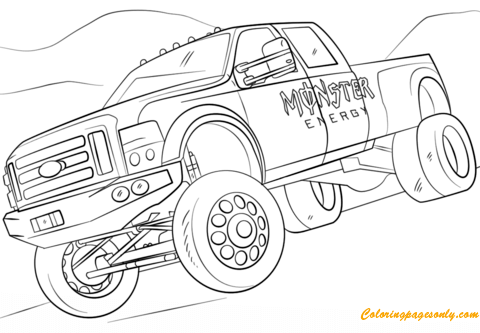
Free monster truck coloring pages – 160+ pages featuring Grave Digger-style trucks, Bigfoot designs, themed monster trucks including shark, bull, dog, and skull motifs, freestyle stunt pages showing wheelies and jumps, car-crushing action scenes, cartoon monster truck characters, detailed side and three-quarter profile views, and the full visual vocabulary of one of American motorsport’s most distinctive spectacles – free printable PDF and online coloring for monster truck fans of all ages.

The monster truck has one of American motorsport’s most specifically documented origin stories. Bob Chandler of St. Louis, Missouri, built “Bigfoot” in 1975 from his own Ford F-250 pickup truck as a hobby project and as a moving advertisement for his Four Wheel Drive shop, Midwest Four Wheel Drive. The truck’s oversized tires – unusual enough at their original 48-inch diameter – drew attention wherever Chandler drove it for promotional purposes.

The first car crush – the definitive monster truck event – occurred in 1981 when Bigfoot drove over two cars in a farmer’s field in rural Missouri. The event was filmed for a promotional video. The first major stadium monster truck event was held at the Pontiac Silverdome near Detroit, Michigan, in January 1982, and drew 68,000 spectators – a crowd size that surprised its organizers and demonstrated an audience for this spectacle that nobody had previously documented. Monster truck events moved into stadiums and arenas nationally from that point forward.

Monster Jam, owned by Feld Entertainment, is now the largest monster truck series in the world, holding events annually in stadiums and arenas across the United States and internationally. Its events feature racing competitions and freestyle competition – a 90-second open-ended performance segment scored by judges for the most spectacular jumps, wheelies, donuts, and stunts.

These 160+ free pages at ColoringPagesOnly.com are the site’s largest single collection. All free, PDF or PNG, print or color online.

What’s Inside

Grave Digger Style – The Most Famous Monster Truck

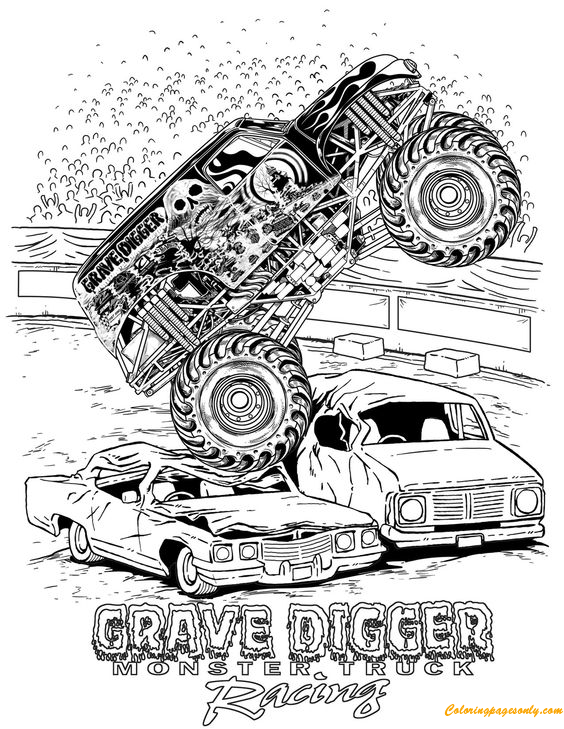
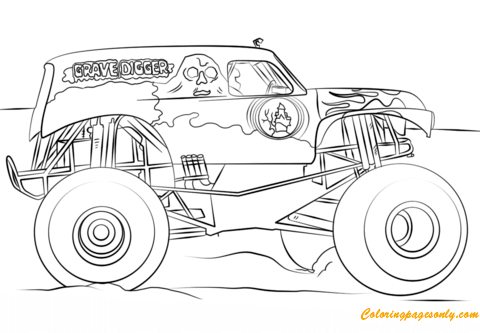
Grave Digger is the most recognized monster truck brand in Monster Jam history. Dennis Anderson created the original Grave Digger in 1982 – initially as a deliberately beat-up, unimpressive-looking truck that he would then use to outperform more polished-looking competitors, playing to the crowd’s appreciation of an underdog. The name came from Anderson’s claim that he would dig his competitors’ graves with his truck.

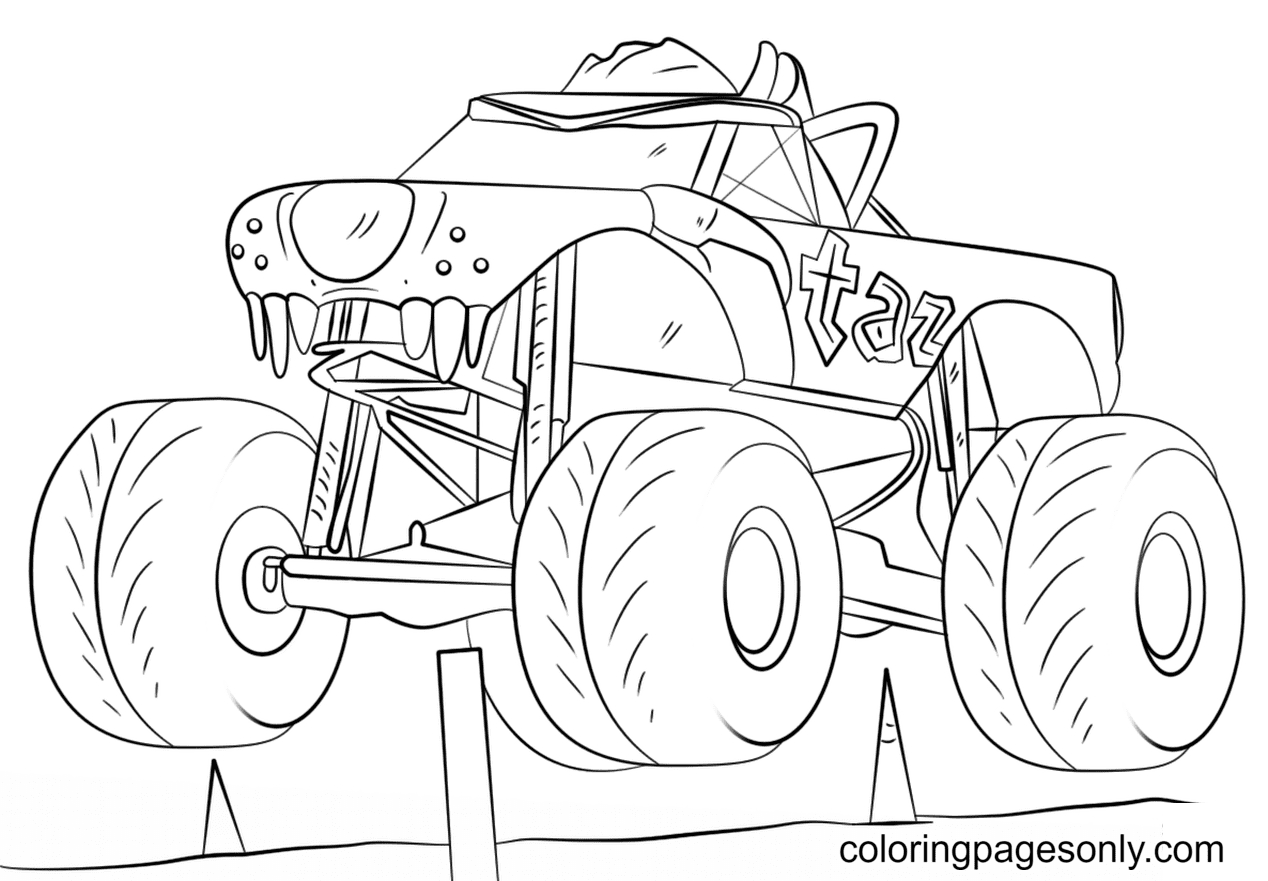
The truck’s visual design became as iconic as any character in American motorsport: a black body with vivid green panels and detailing, skull and graveyard imagery applied across the cab and bed, purple and green accent graphics, and – in live events – fire-shooting capabilities that produce the pyrotechnic effects that have become part of Grave Digger’s performance identity. The specific combination of Halloween-adjacent imagery, the dark color palette broken by the vivid green, and the flames make it one of the most immediately recognizable branded trucks in the collection.

Multiple versions of Grave Digger exist simultaneously in Monster Jam competition – different drivers handling different versions of the truck at different events. Adam Anderson, Dennis’s son, has driven Grave Digger vehicles professionally. Son-uva Digger is a companion truck driven by Ryan Anderson, another of Dennis’s sons, with a similar aesthetic in a different color scheme.

Coloring Grave Digger style trucks: Near-black as the primary body color – deep, dark, maximum contrast with the vivid green. Apply the near-black across all primary body and cab surfaces. The green should be a vivid, electric green – not forest green, not olive, but the specific neon-adjacent vivid green that reads as otherworldly. The skull and graveyard imagery, when present in the design, should be rendered in lighter tones against the dark body. Any flame detail should be vivid orange and yellow at the base, transitioning to yellow-white at the tips.

Bigfoot – The Original

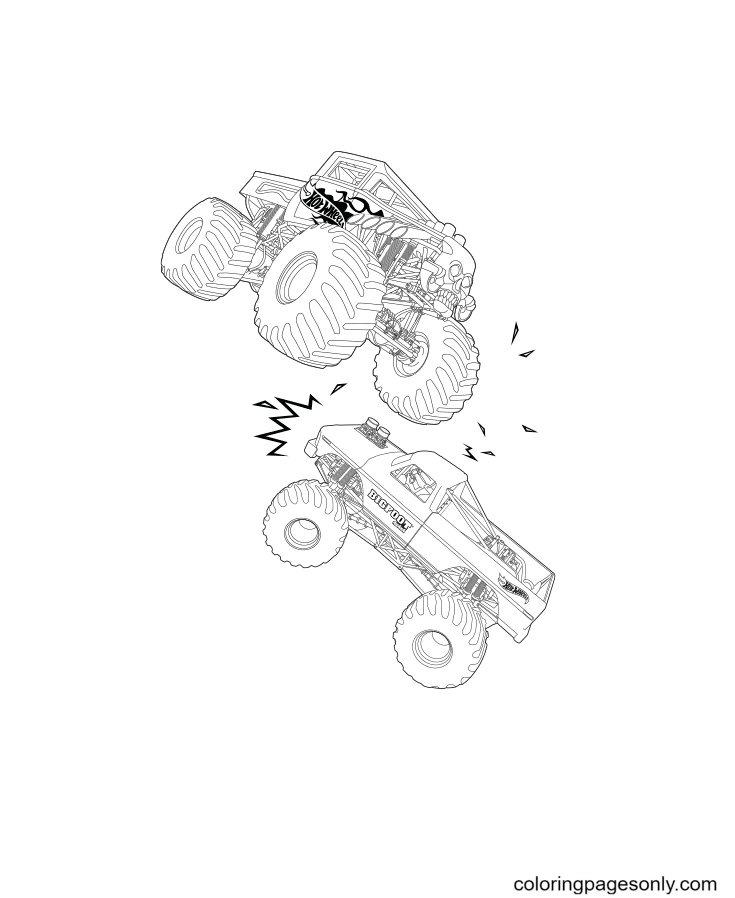
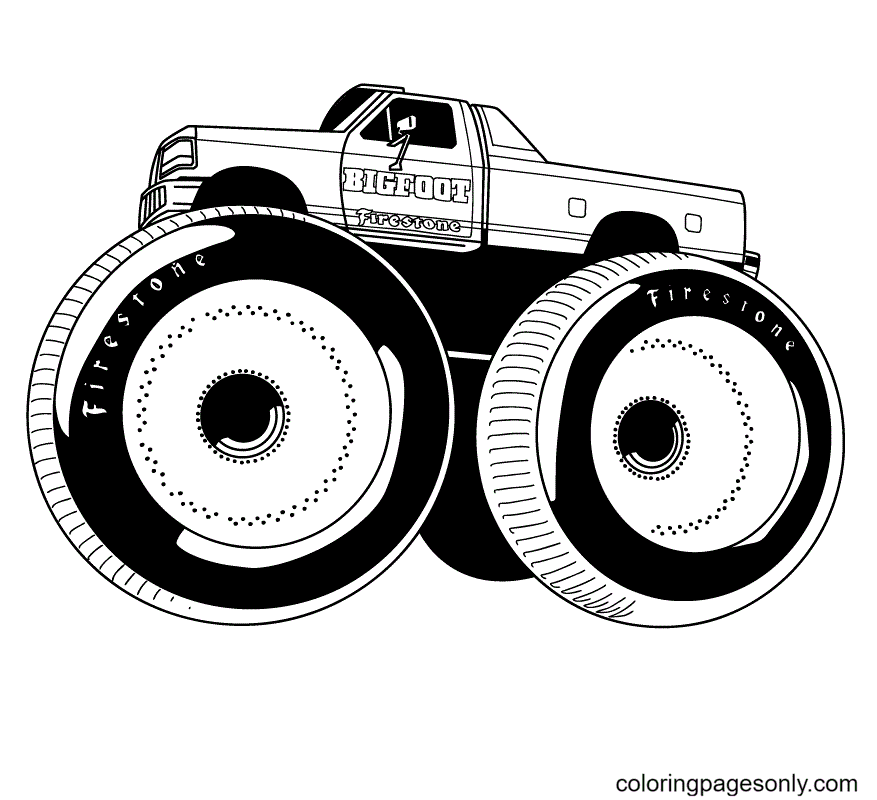
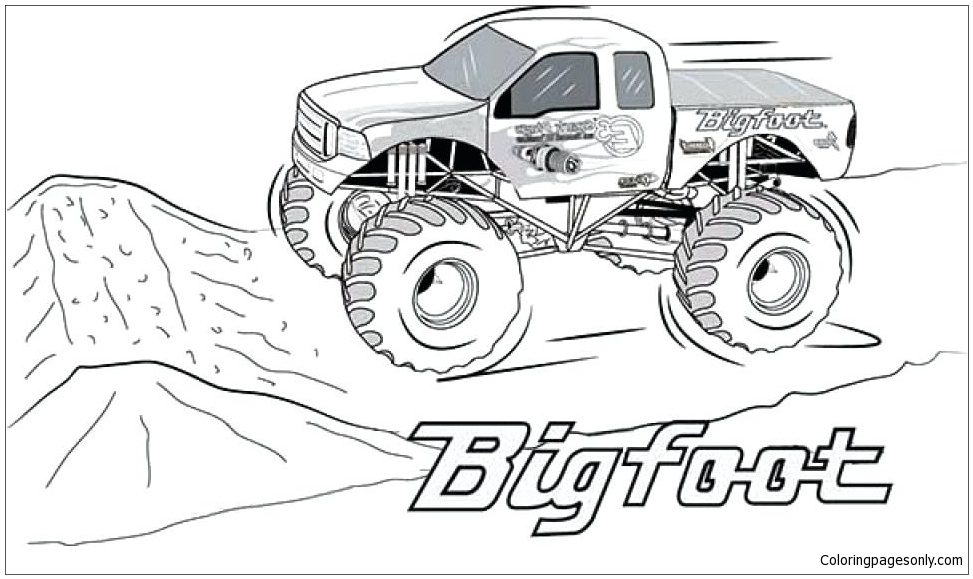
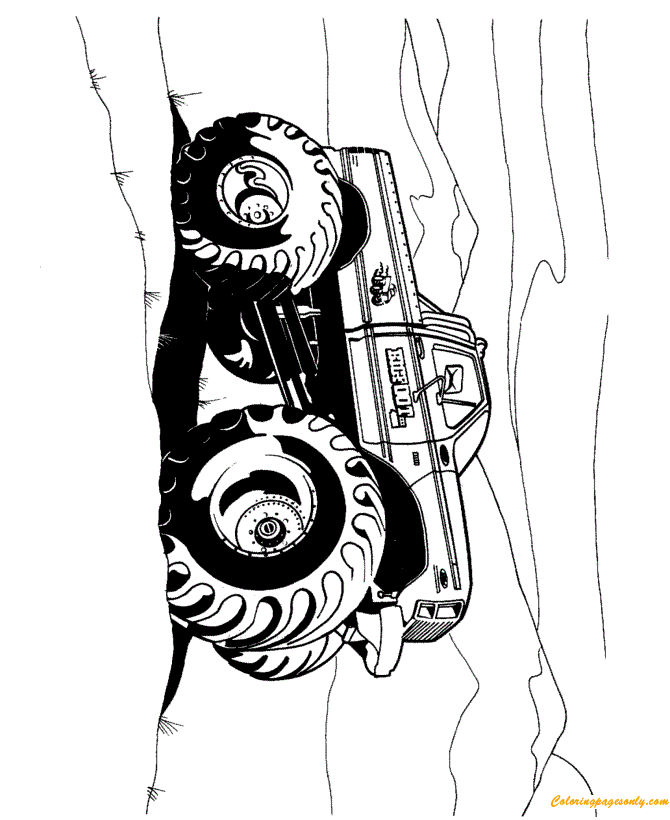
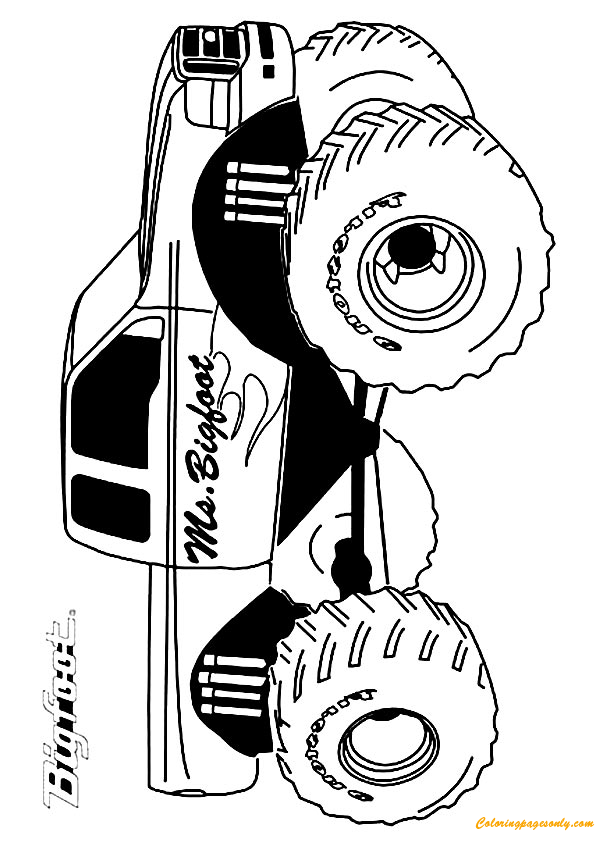
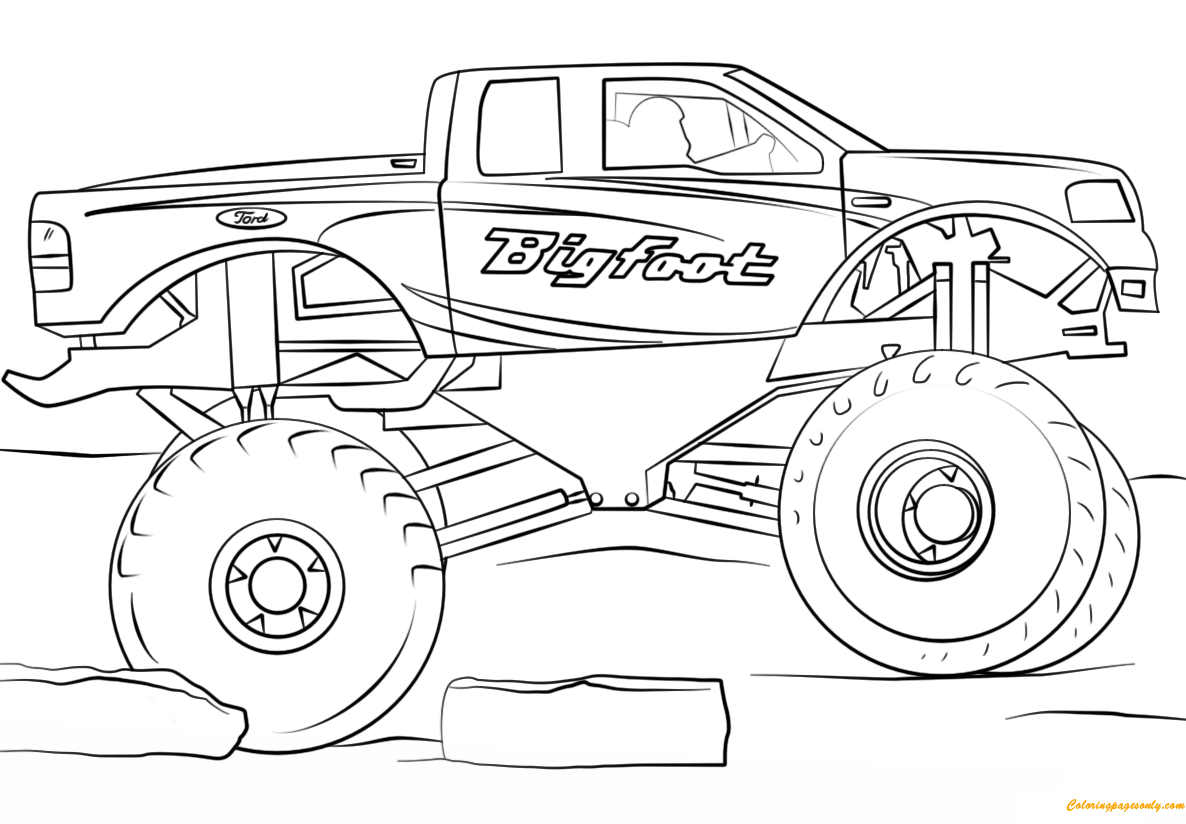
Bigfoot, the truck Bob Chandler built in 1975, is the monster truck from which all others descended conceptually. The current competition versions are based on Ford body styles – the truck’s Ford heritage has been maintained across over twenty versions of Bigfoot built across five decades. Bigfoot 5, constructed in 1986, holds the Guinness World Record for the world’s largest monster truck, fitted with 110-foot-tallFirestone Tundra tires originally used in Alaska’s oil fields.

The Bigfoot brand’s visual identity is blue – a vivid, patriotic blue that distinguishes it from the darker designs of many competition trucks. The Bigfoot logo – a stylized footprint – appears prominently on the body.

Coloring Bigfoot-style trucks: The blue is a vivid, medium-to-dark blue – patriotic in register, fully saturated. Apply it across the primary body surfaces. The Bigfoot name and logo, in white or silver, provide contrast against the blue body. The enormous tires – disproportionately large relative to the body – are dark grey or near-black rubber, with the rim inside each tire in silver-grey.

Themed Monster Trucks – Shark, Bull, Dog, and More

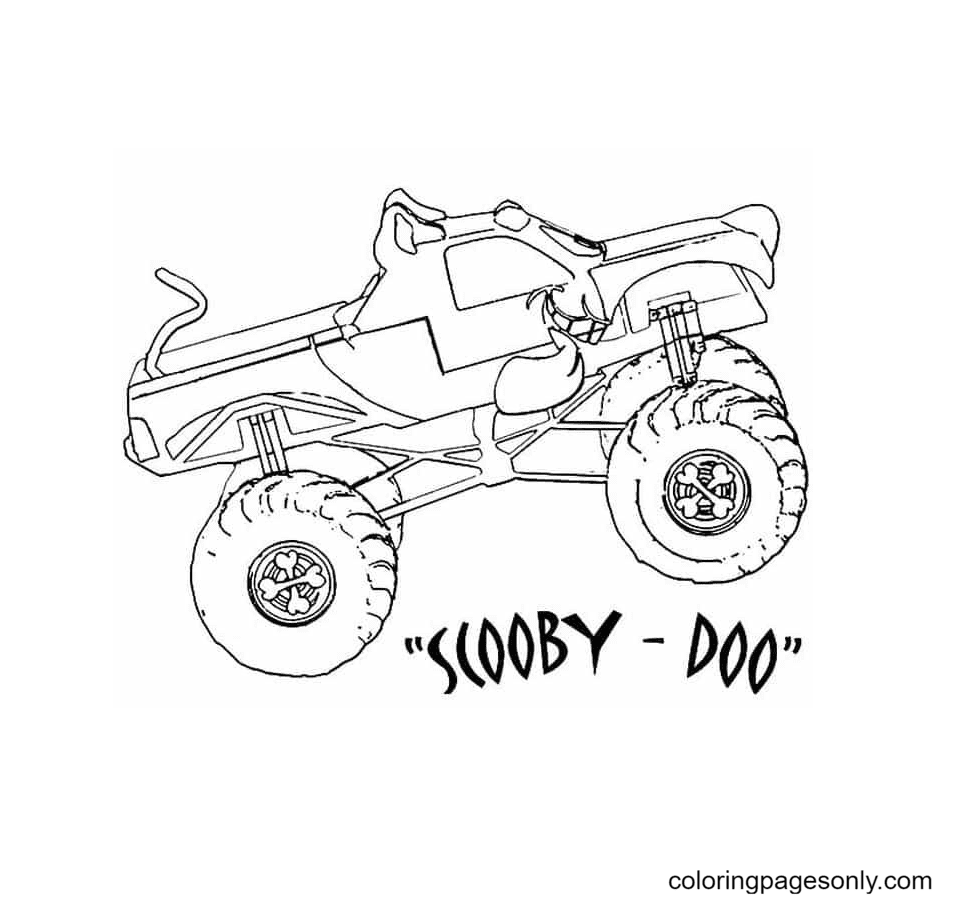
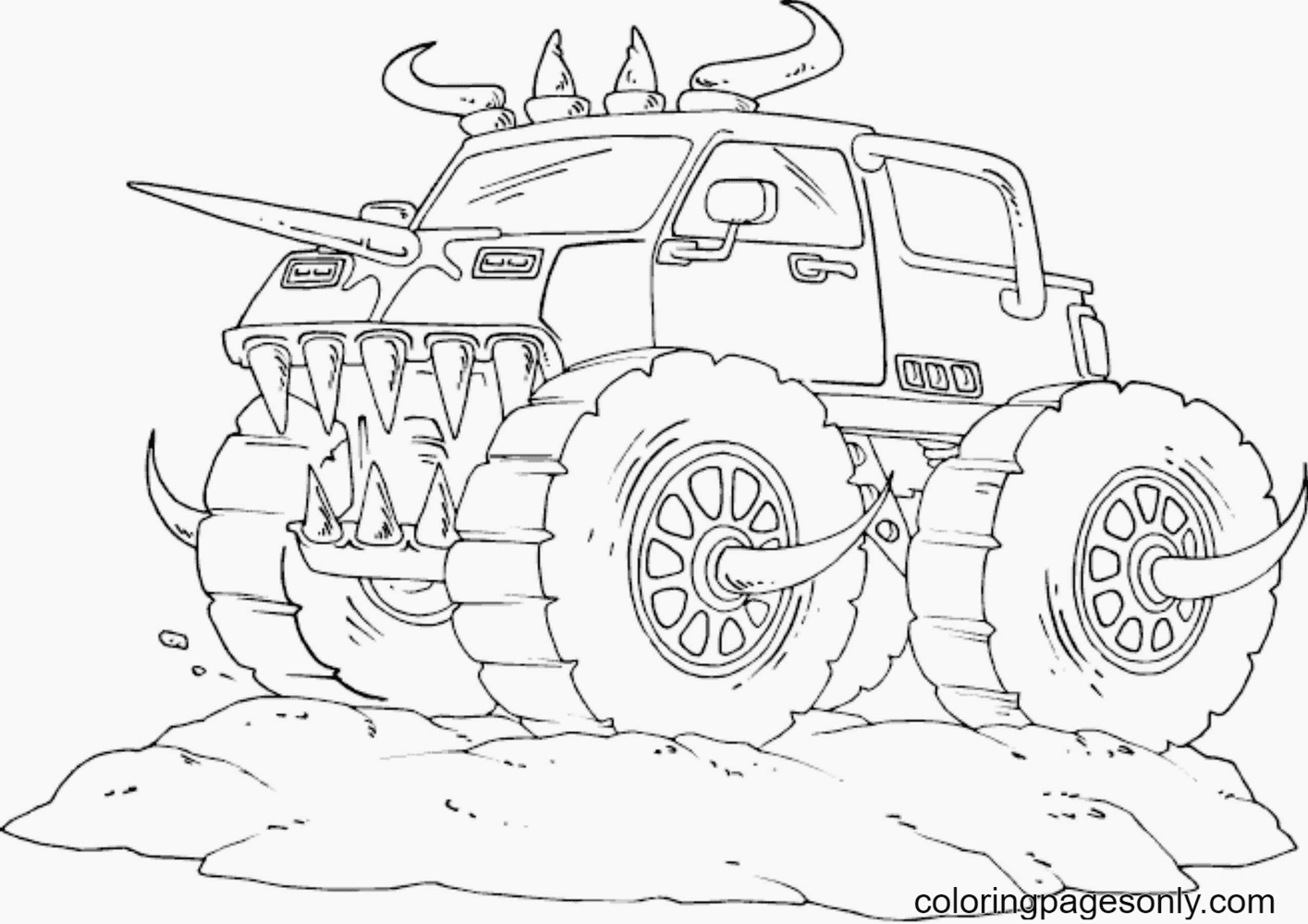
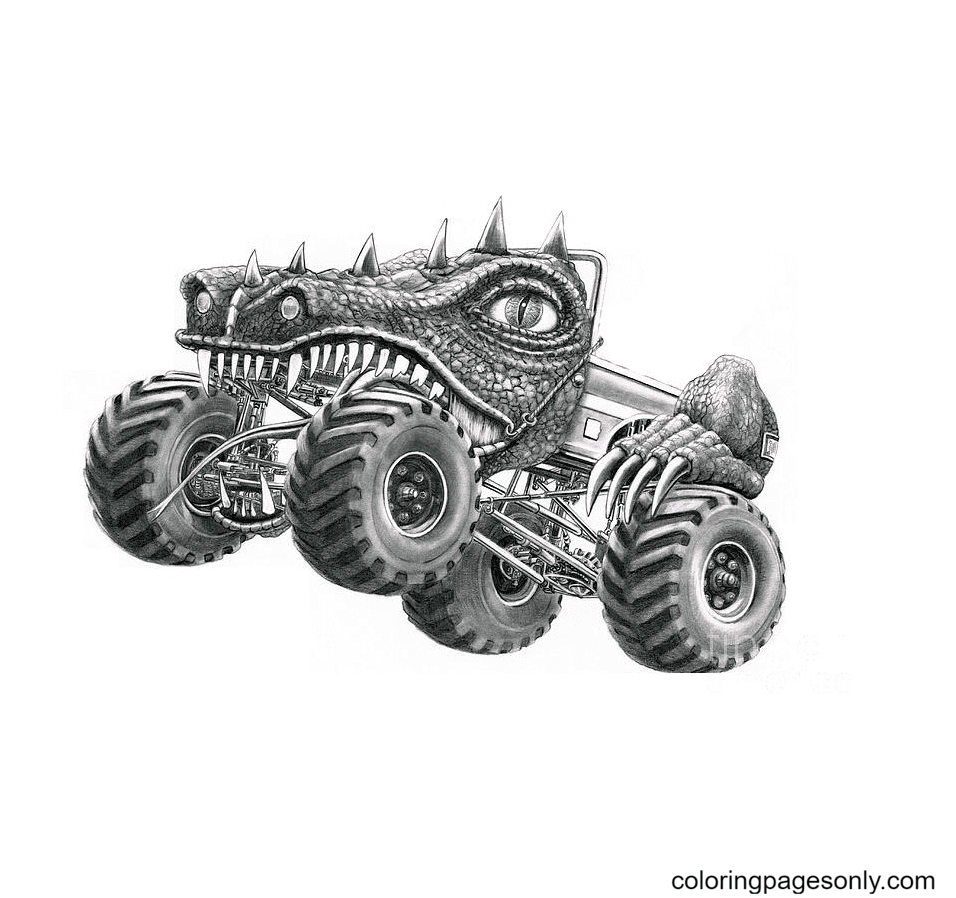
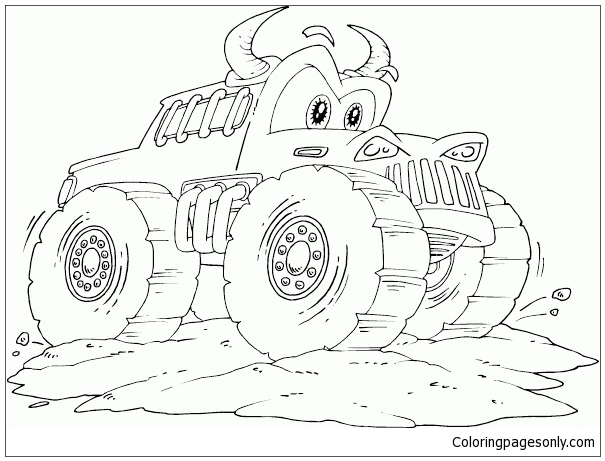
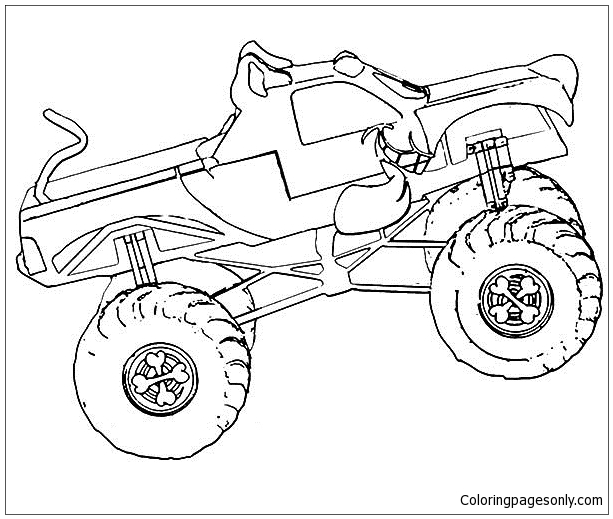
Monster Jam’s most distinctive design category is the themed truck – vehicles whose body art and structural modifications create a character identity rather than merely a paint scheme. These trucks are the collection’s most visually dramatic and most immediately accessible for children who may not yet know specific truck histories but who immediately recognize and respond to a giant truck designed to look like a shark, a bull, or a dog.

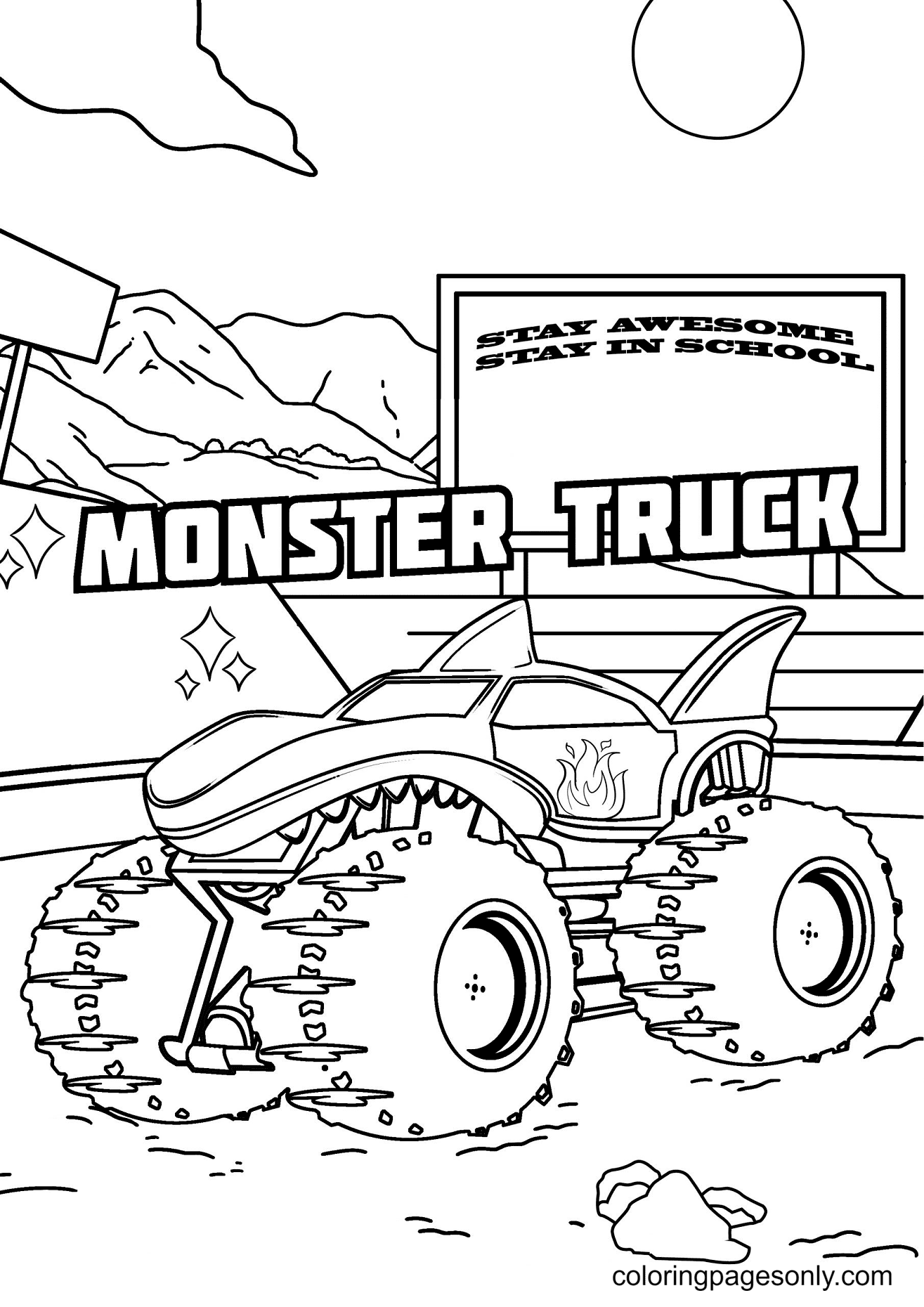
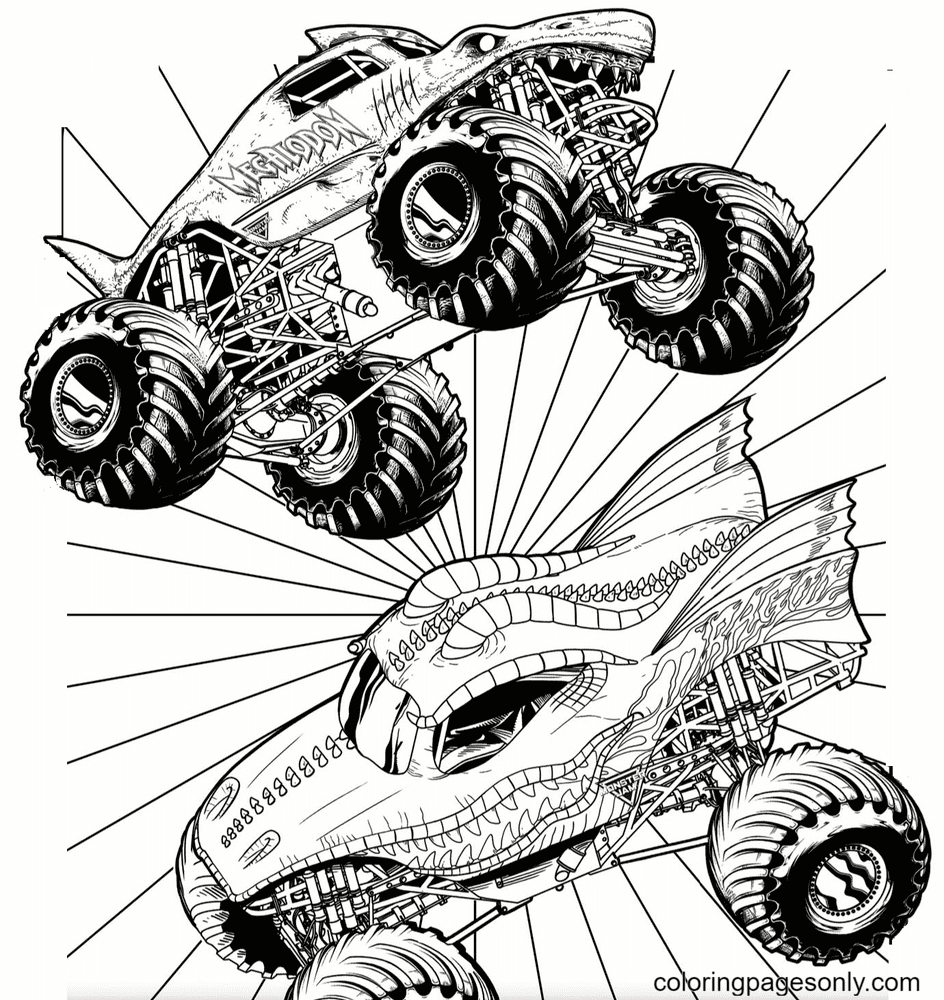
Megalodon – based on the prehistoric shark – has a massive open-mouthed shark face applied to the front of the truck body, with teeth, gills, and the specific blue-grey of the prehistoric shark’s imagined coloring. The body wraps the truck in the shark’s skin texture and color.

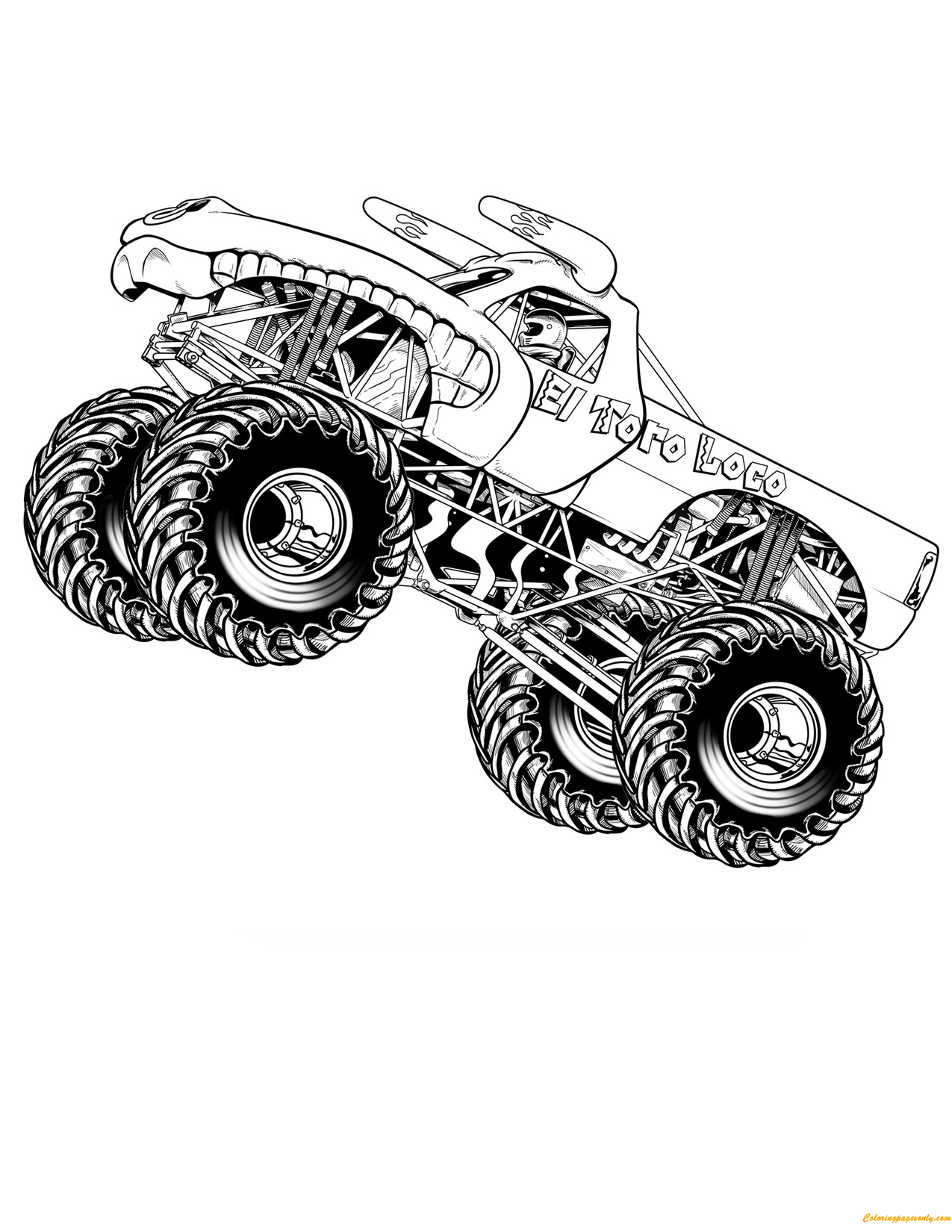
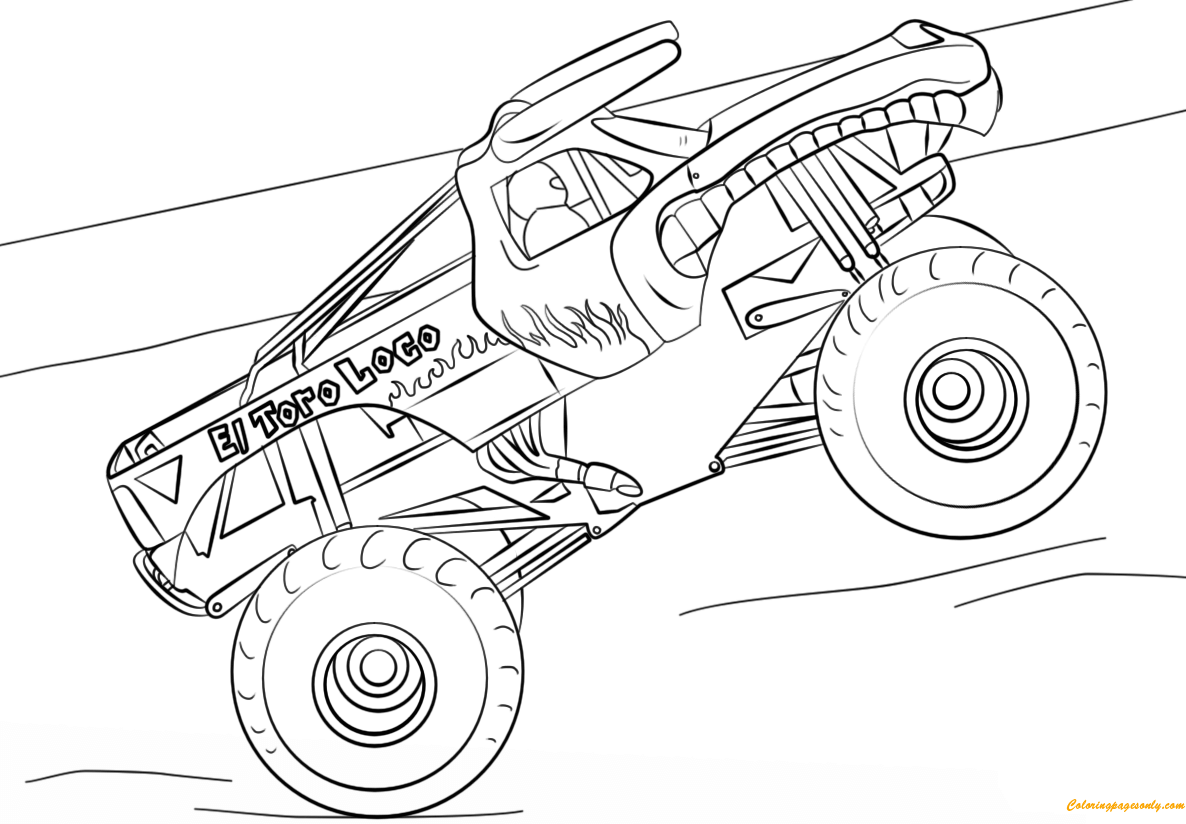
El Toro Loco – Spanish for “The Crazy Bull” – presents a vivid red truck with bull horns mounted to the front, with the bull’s aggressive energy communicated through the red color and the structural horn elements.

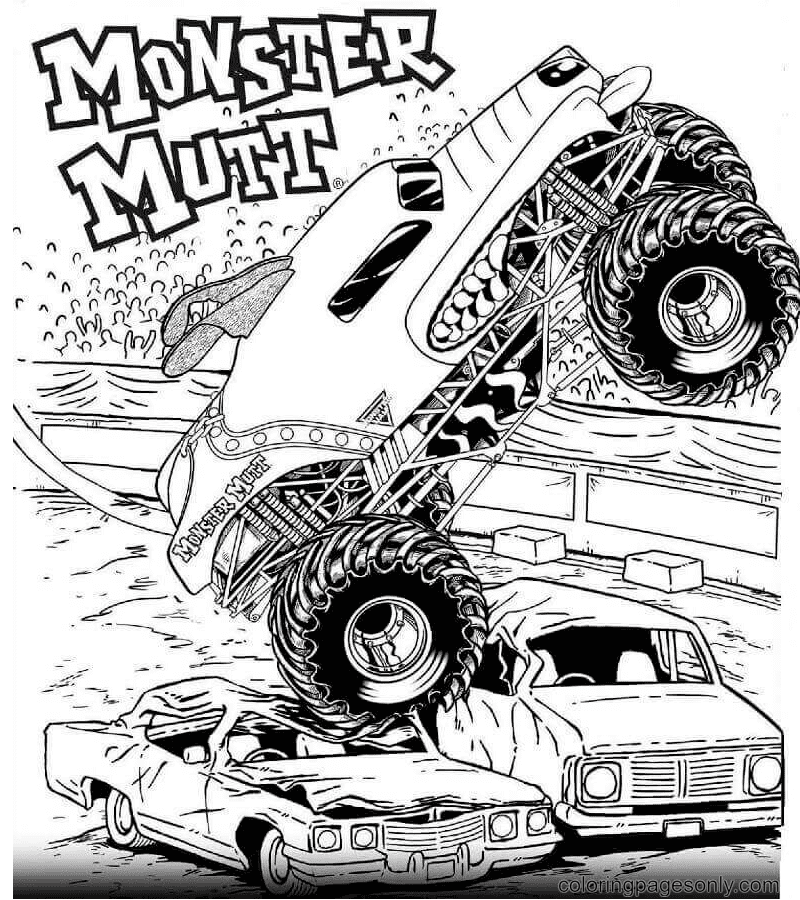
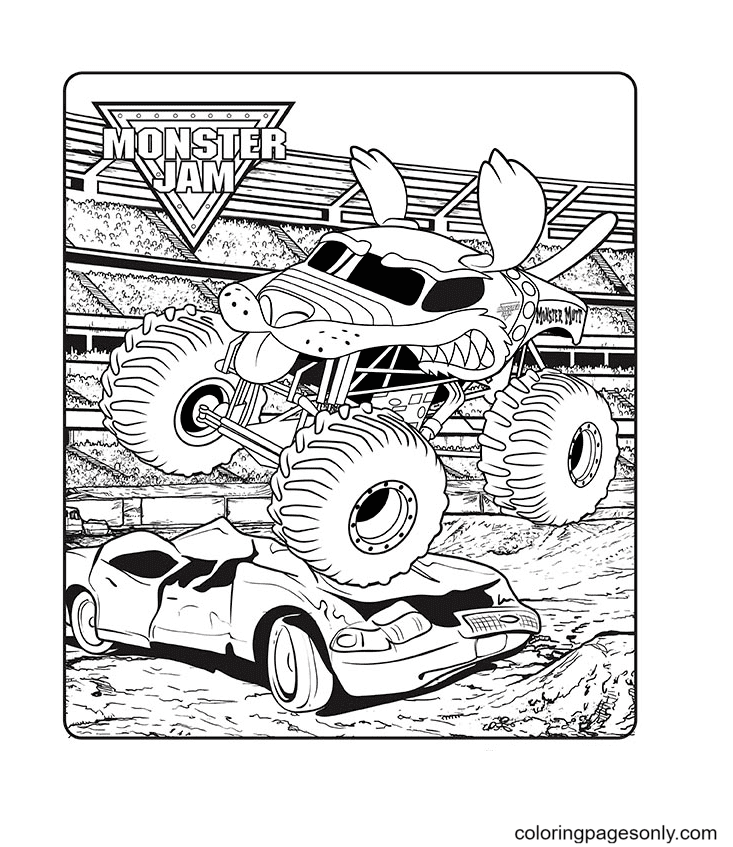
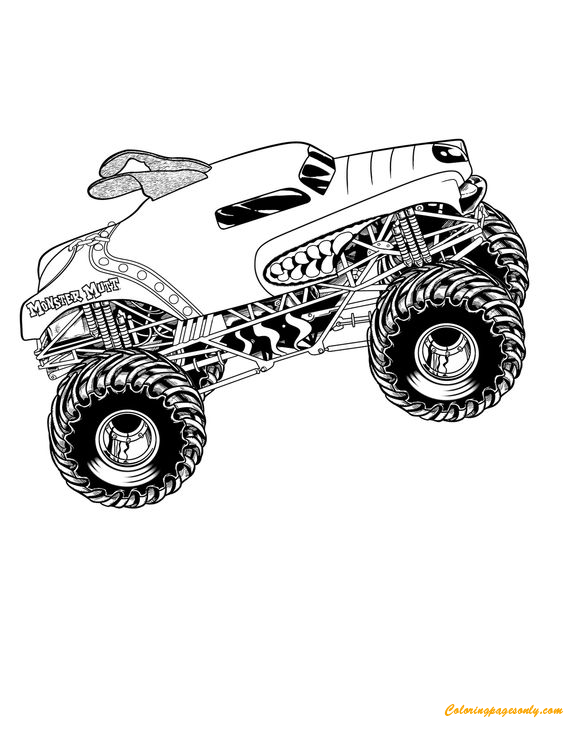
Monster Mutt – a dog-themed truck – features an open dog-mouth front fascia and large floppy dog ears mounted on the cab’s sides, existing in multiple breed variants (Dalmatian with its distinctive black-and-white spotted pattern, Rottweiler, English Bulldog).

Coloring themed trucks: Each themed truck has a canonical color scheme directly derived from its animal or character theme. Megalodon: blue-grey as the primary color, white for the teeth, lighter grey for the underbelly areas. El Toro Loco: vivid red as the primary, yellow-gold for accent elements. Monster Mutt Dalmatian: white base with irregular black spots in the Dalmatian pattern. The theme’s color should be applied confidently – the truck reads as its character only when the color commitment is total.
Stunt and Action Pages

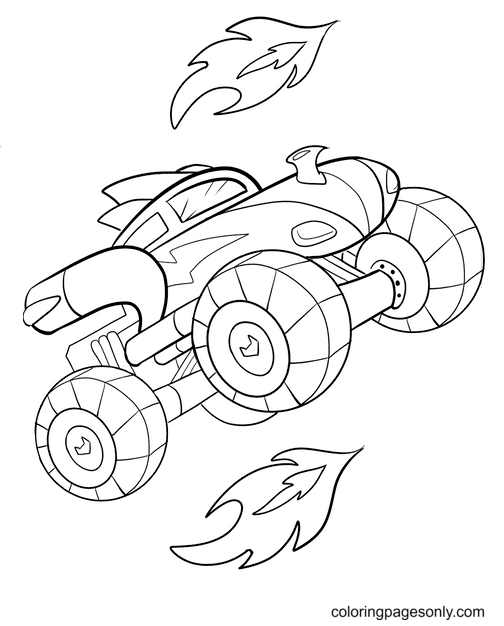
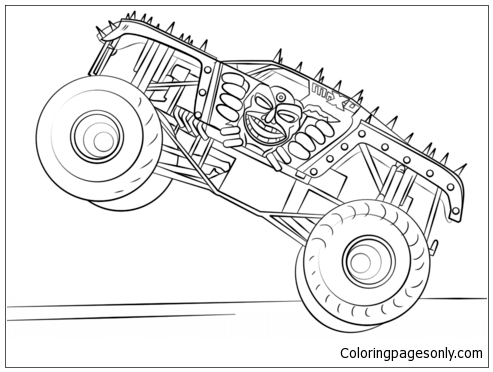
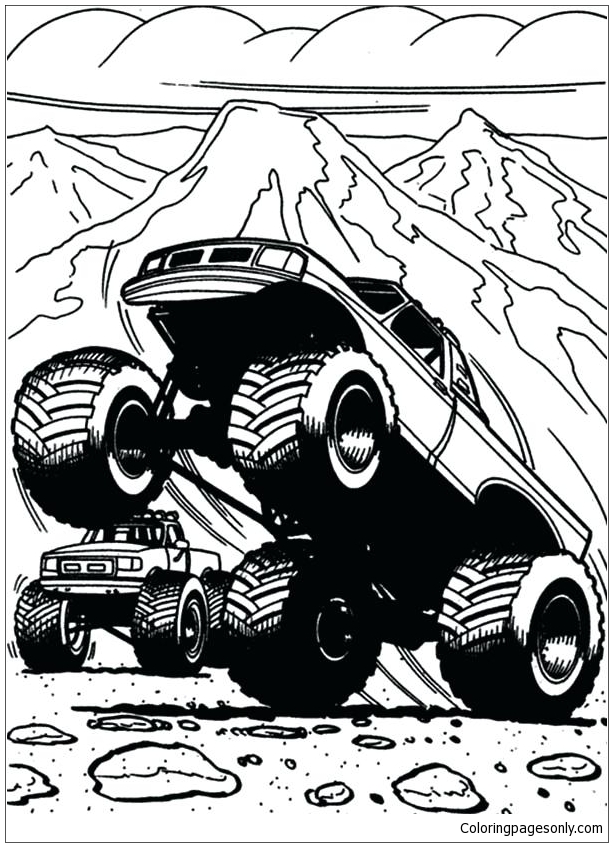
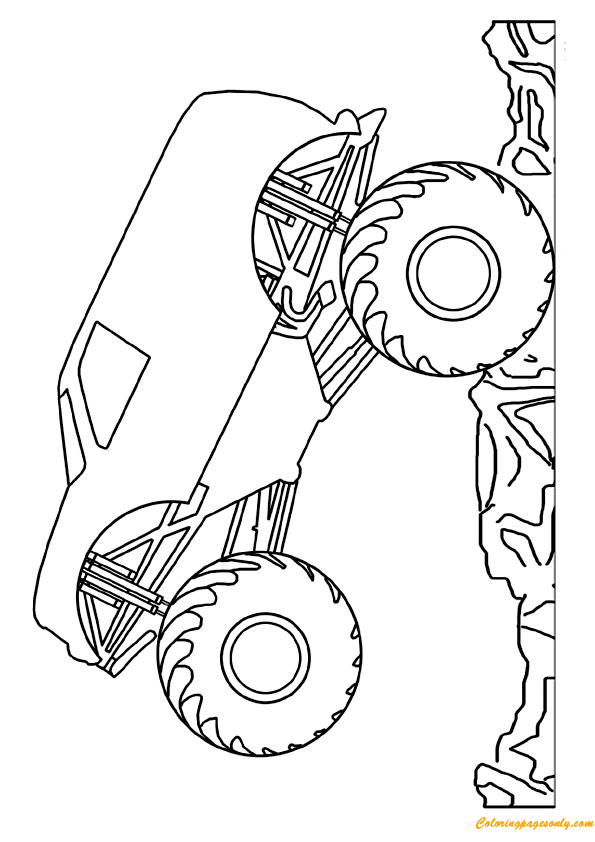
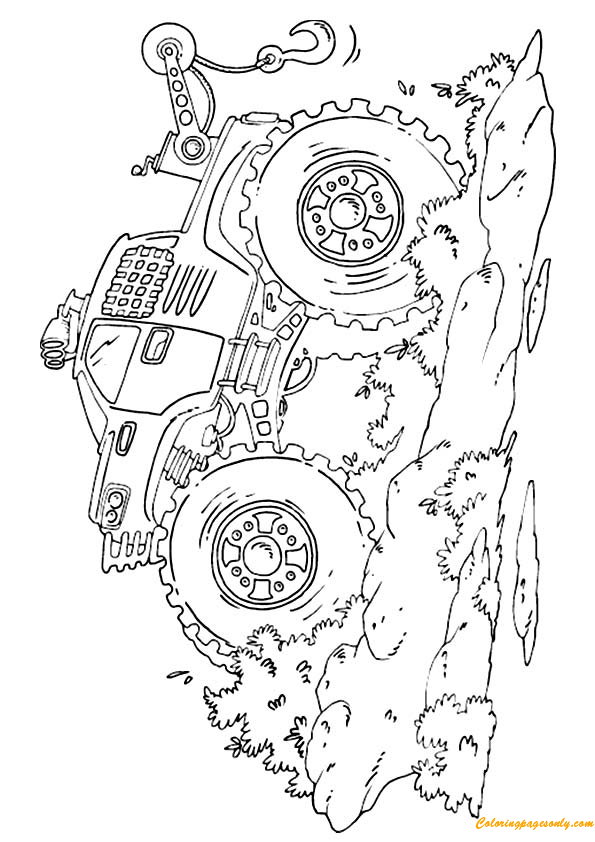
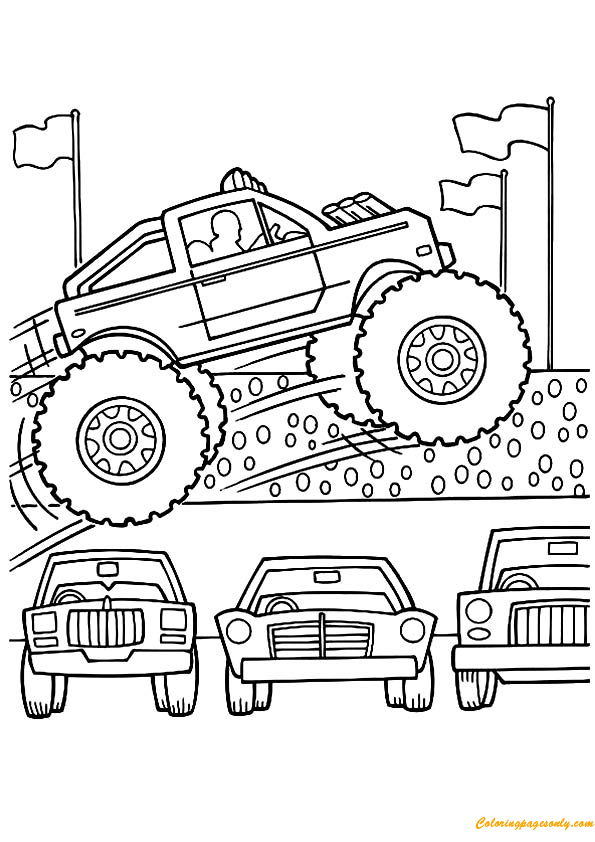
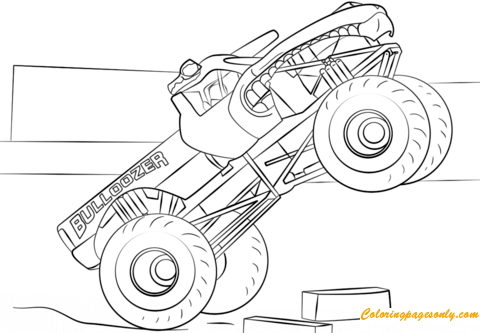
The action pages – monster trucks in mid-jump, performing wheelies, doing donuts, or launching off ramps – are the collection’s most kinetically exciting. These pages capture the specific visual of a 12,000-pound vehicle doing things its weight makes impossible: airborne between two dirt ramps, standing on its rear tires with the front wheels elevated, rotating in place while the tires throw up rooster-tail plumes of dirt.
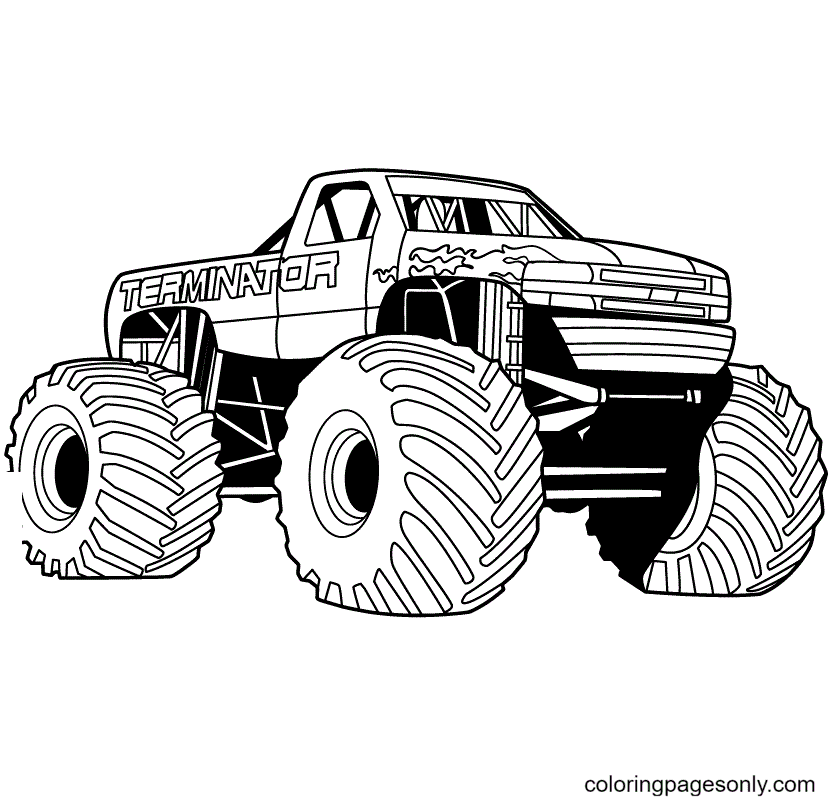
The wheelie page shows the truck’s front end elevated to 45 degrees or more – the cab reaching upward, the rear tires in contact with the ground and spinning. The jump page shows all four tires off the ground, the truck’s body silhouetted against the arena lights or sky. Both poses require specific shadow and lighting treatment to read as action rather than as a static vehicle tilted arbitrarily.

Coloring action pages: The jump shadow on the ground beneath an airborne truck is the most important contextual element – a dark shadow directly below the truck’s position indicates height and confirms that the truck is above the ground rather than simply photographed at a low angle. Apply dark grey or near-black to this ground shadow area. Any dirt or debris thrown up by the tires (visible as irregular dots or streaks in some pages) should be rendered in warm tan-brown.

Car-Crushing Pages

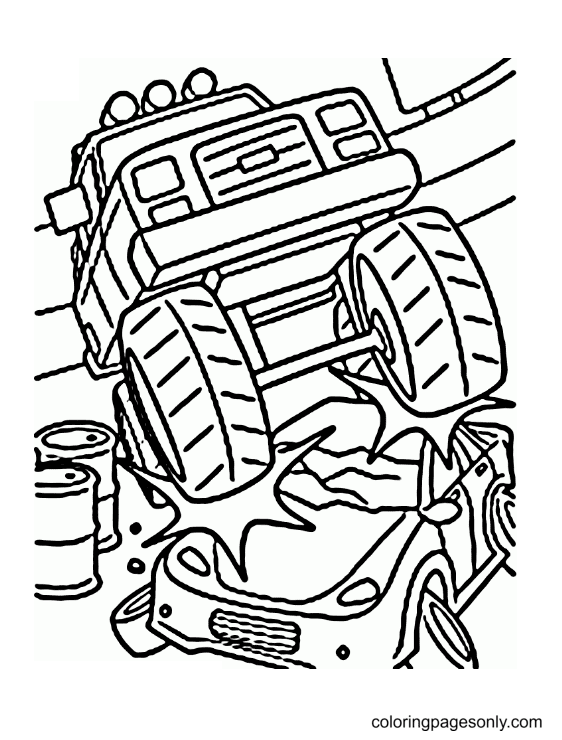
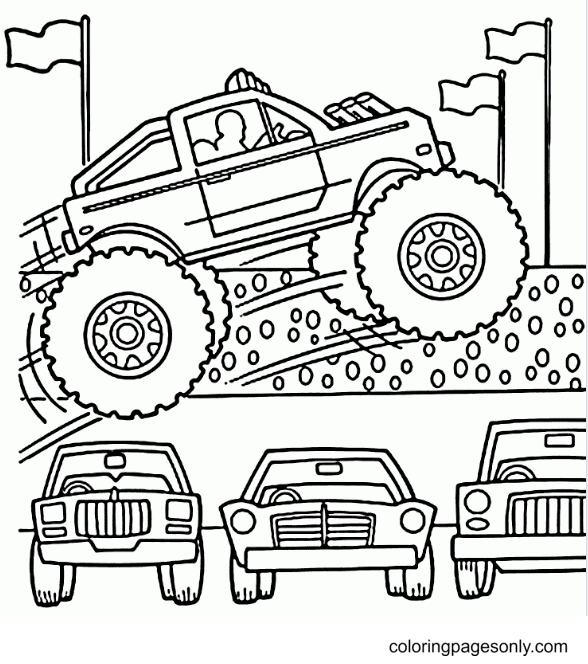
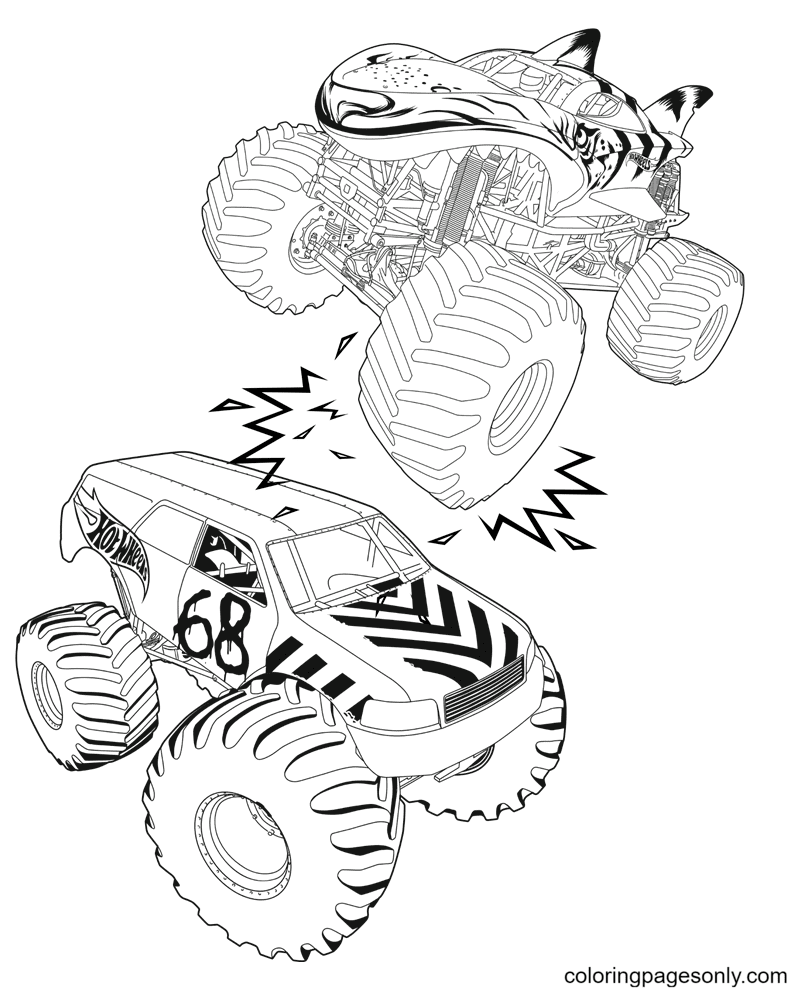
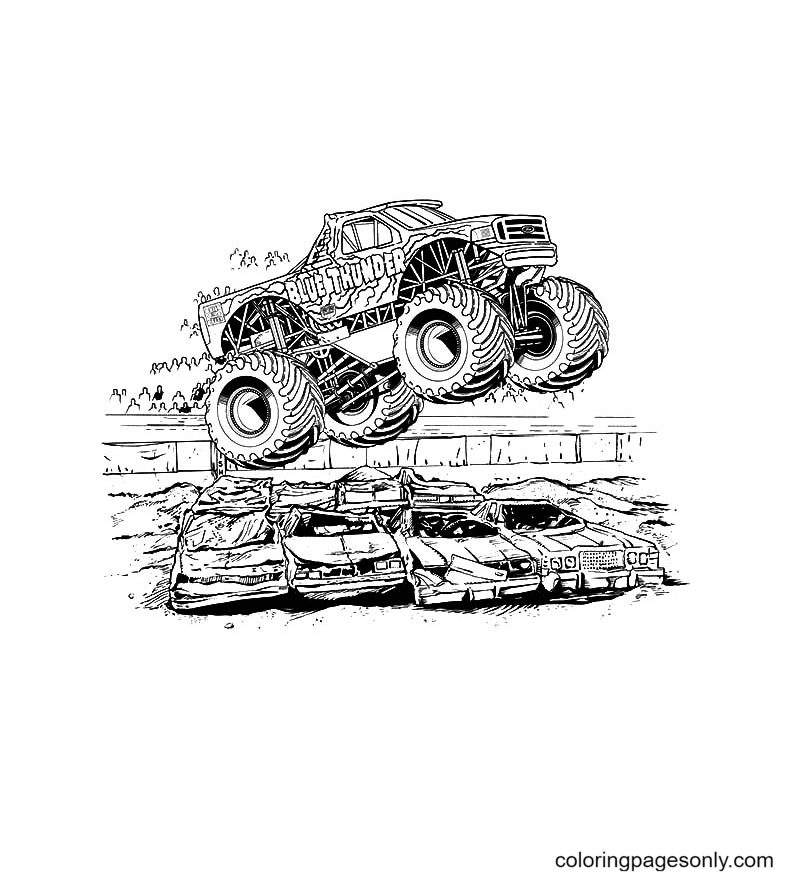
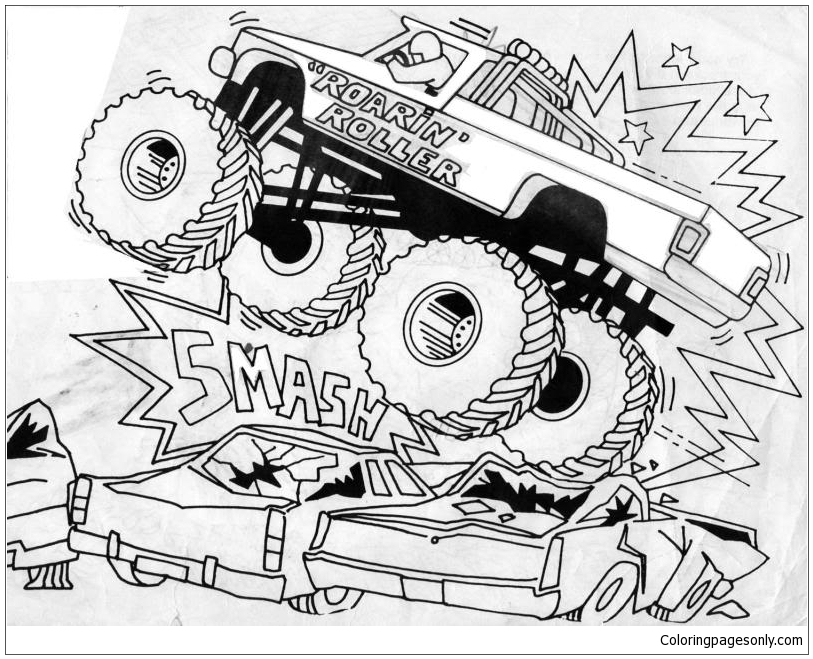
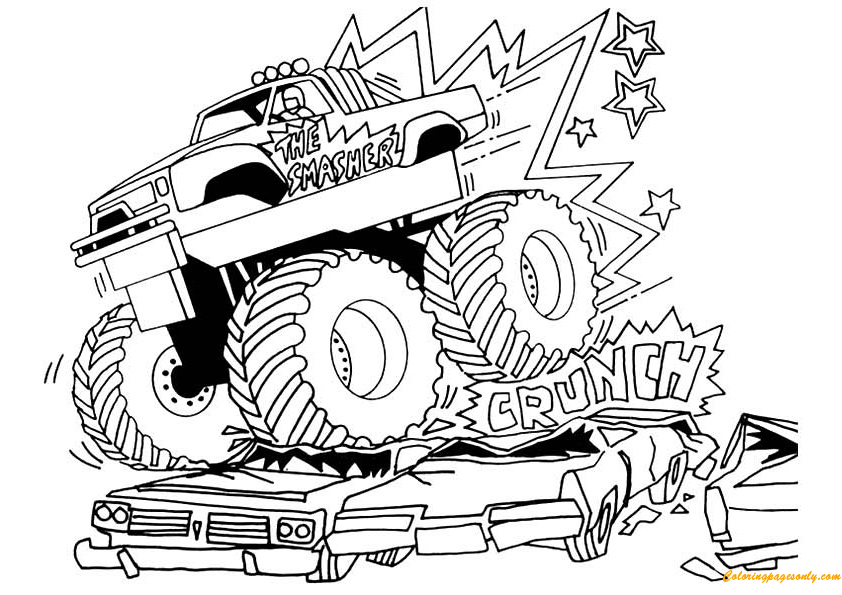
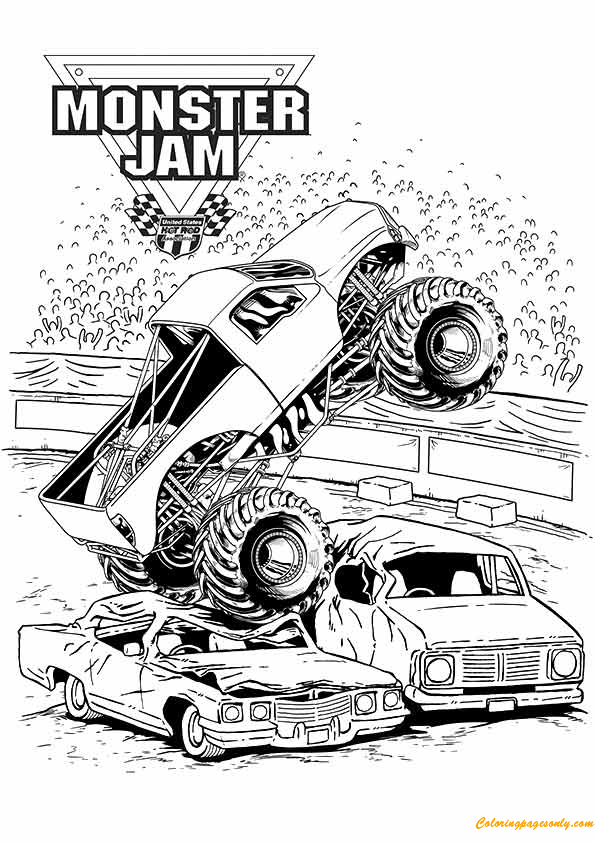
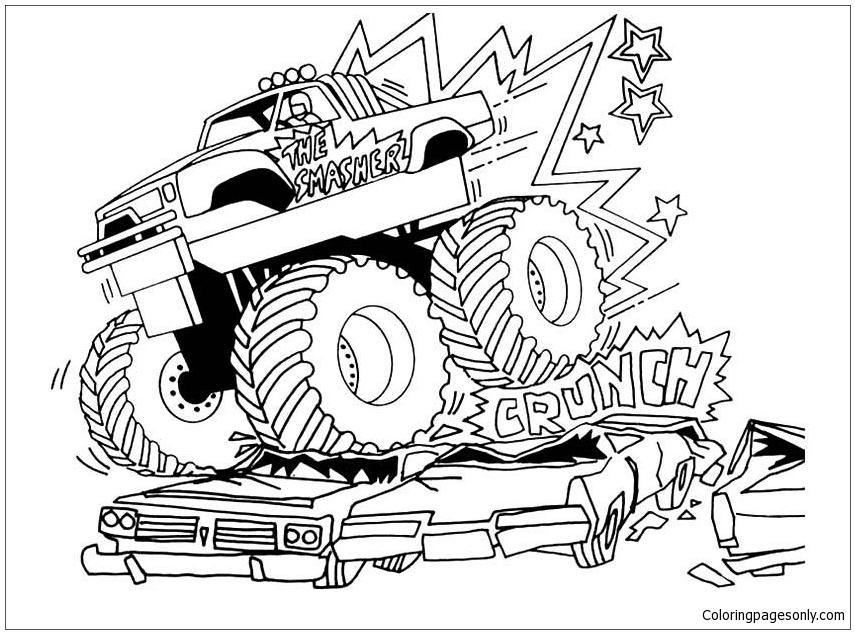
The car crush – monster truck driving over and flattening regular passenger cars – is the event type that launched the phenomenon in 1981. Pages showing monster trucks in the process of car-crushing give the collection its most historically specific content: the original monster truck act, the one that drew 68,000 people to a stadium in 1982, rendered as a coloring page.

The cars being crushed are typically depicted as older, junker vehicles – the crushed cars at real monster truck events are donated or purchased junkers. They are typically painted in the dull tones of aged paint: faded reds, faded blues, rusted panels.

Coloring car-crush pages: The monster truck above should receive full, vivid, canonical coloring – it is the star of the composition. The cars being crushed below should be rendered in faded, somewhat muted tones – older colors, slightly weathered – to communicate their “expendable” status and to ensure they read as background to the truck above them.

Cartoon Monster Trucks

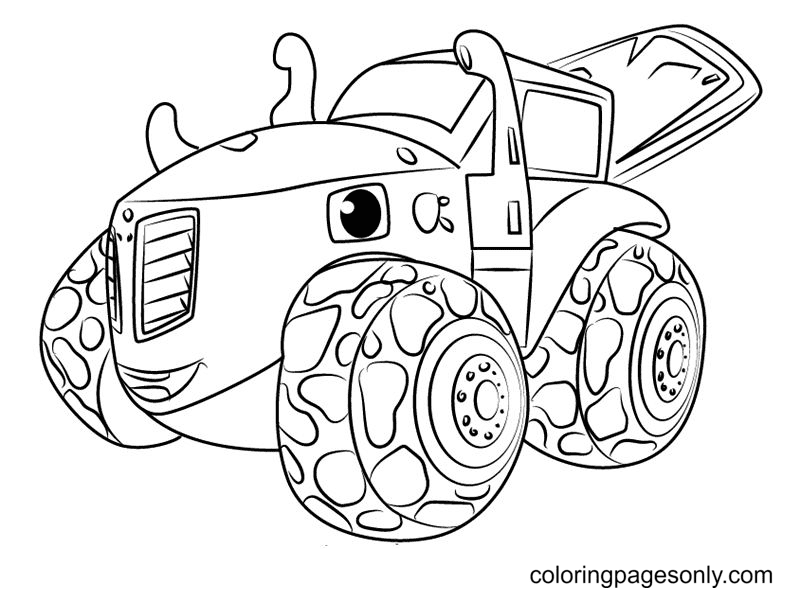
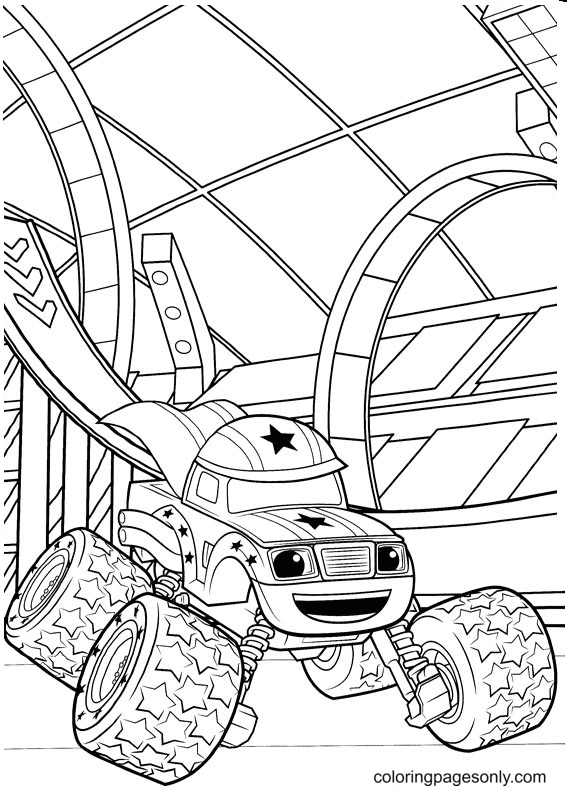
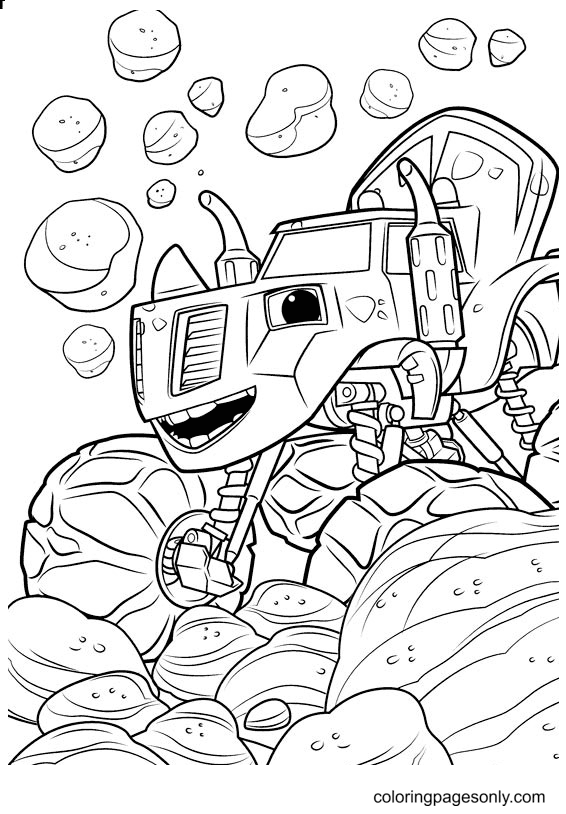
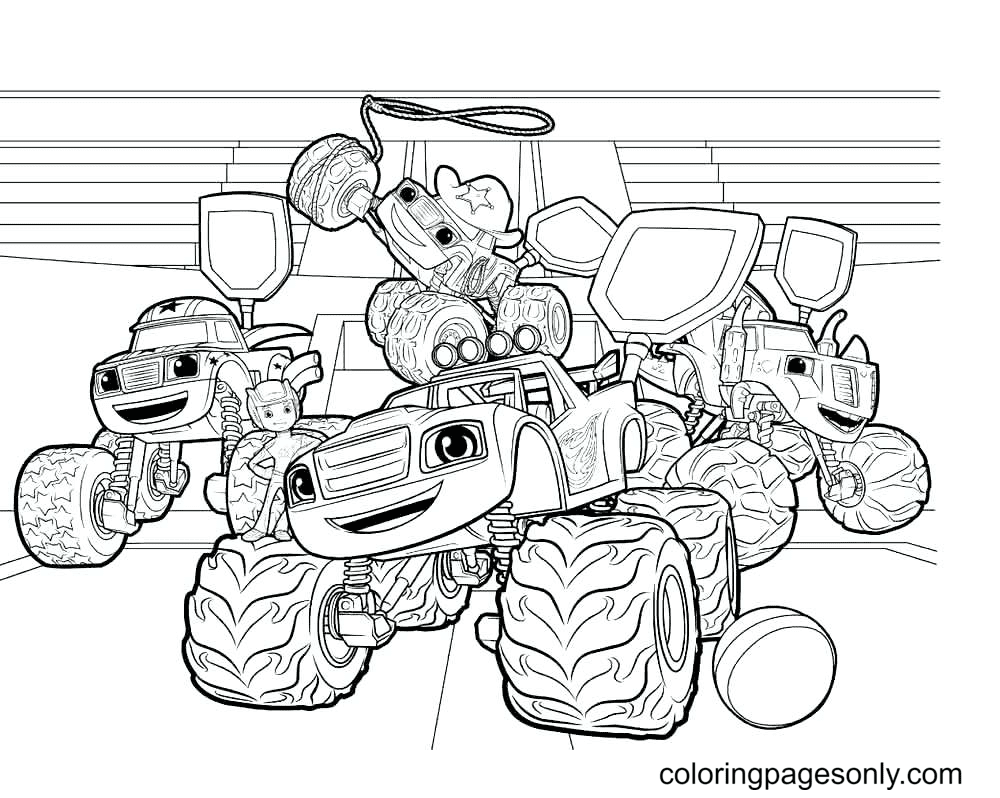
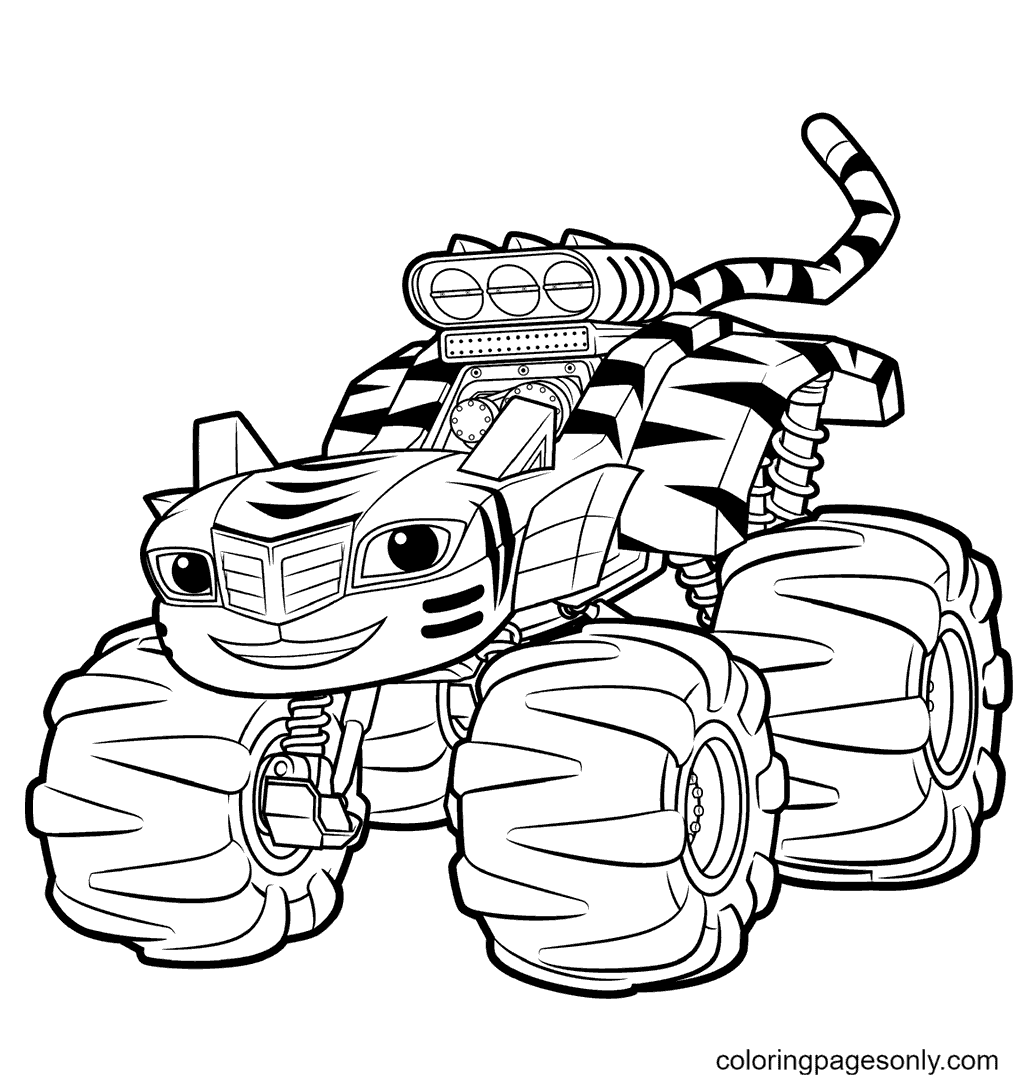
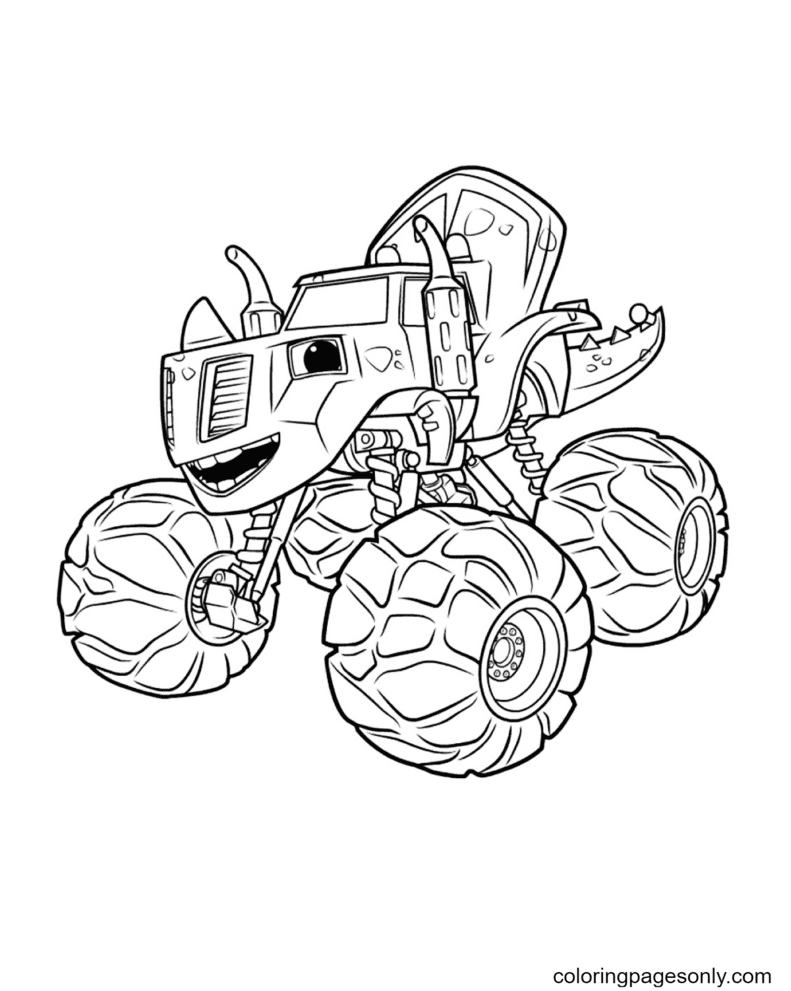
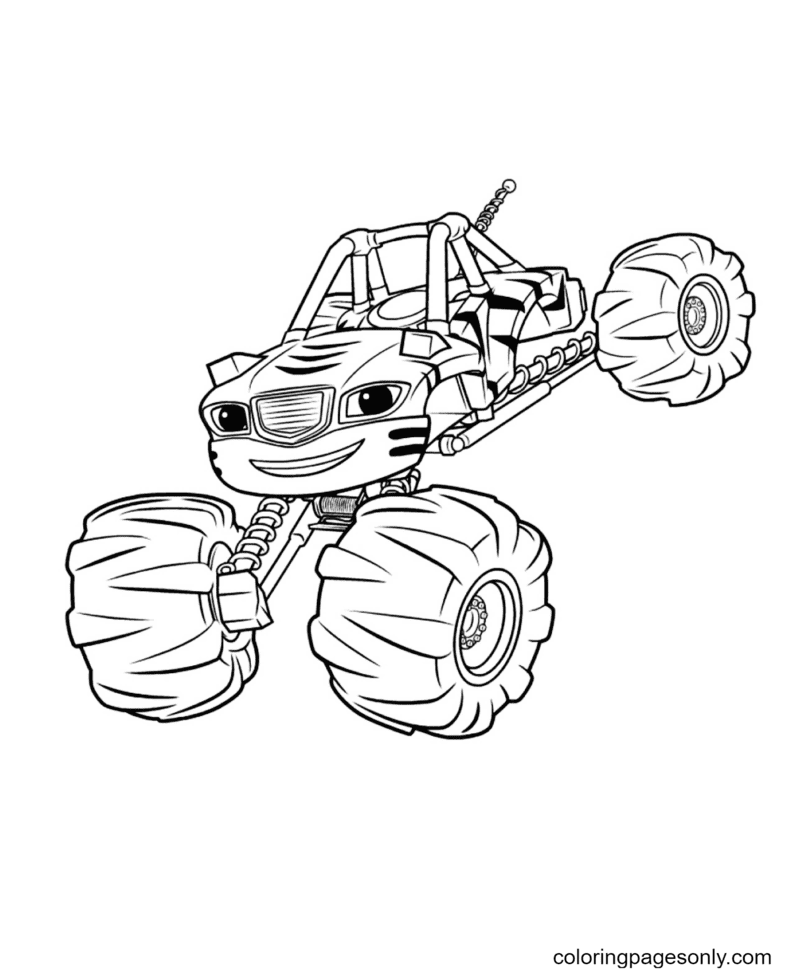
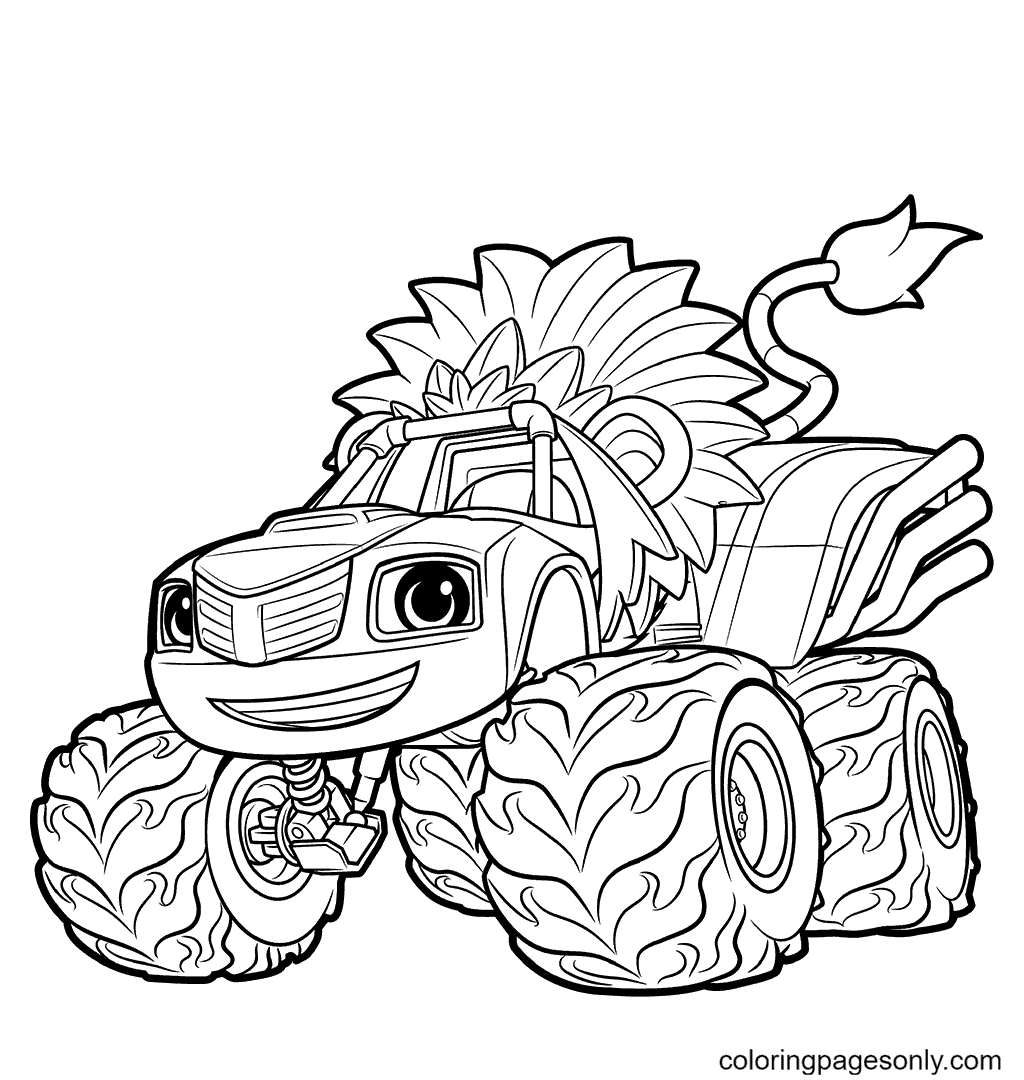
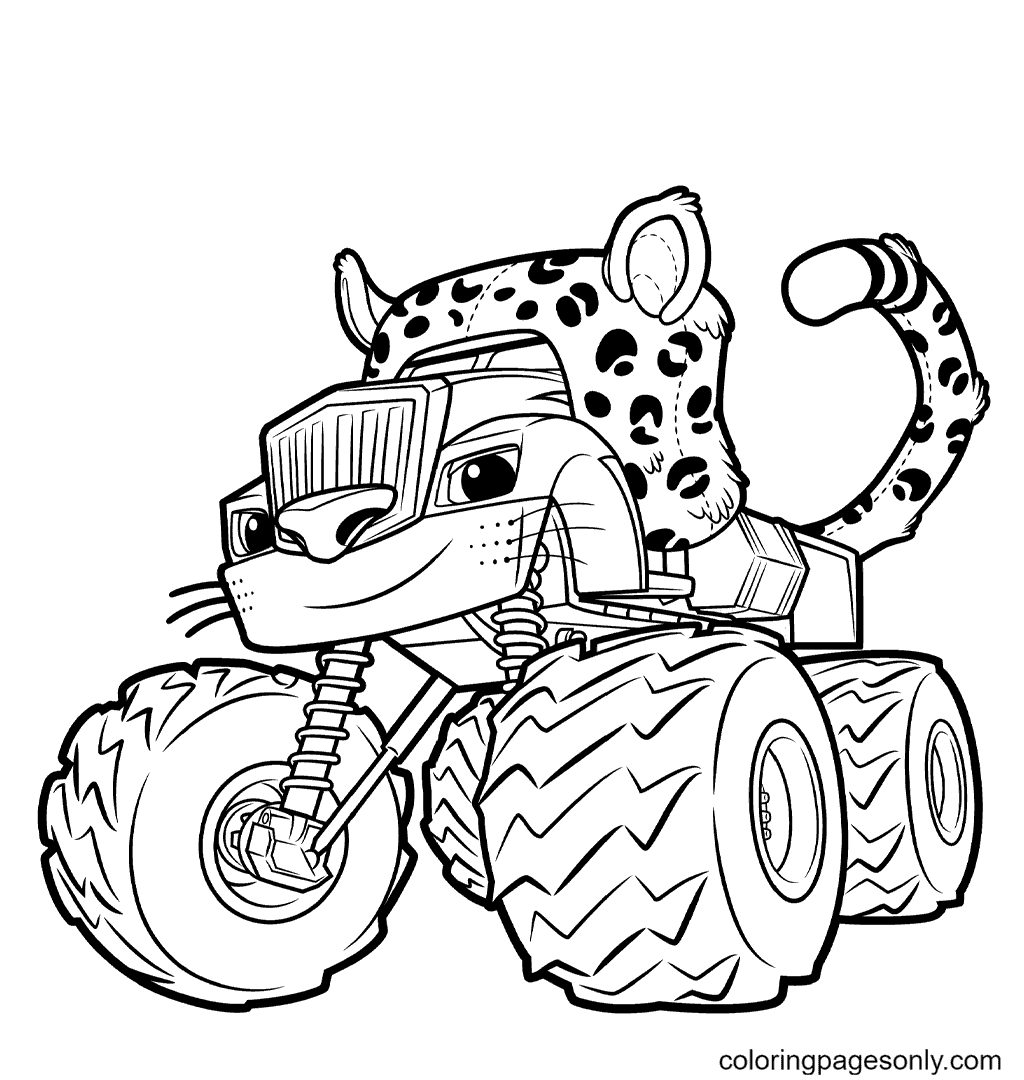
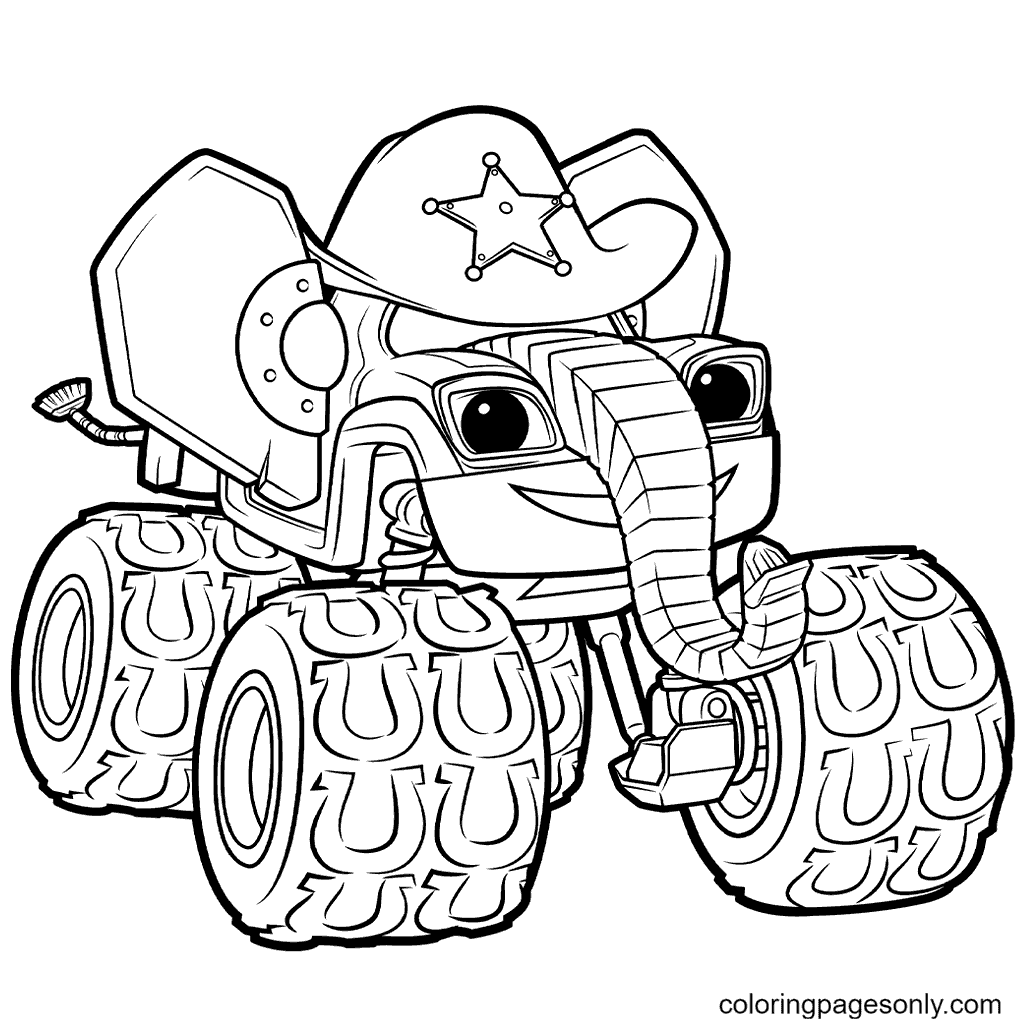
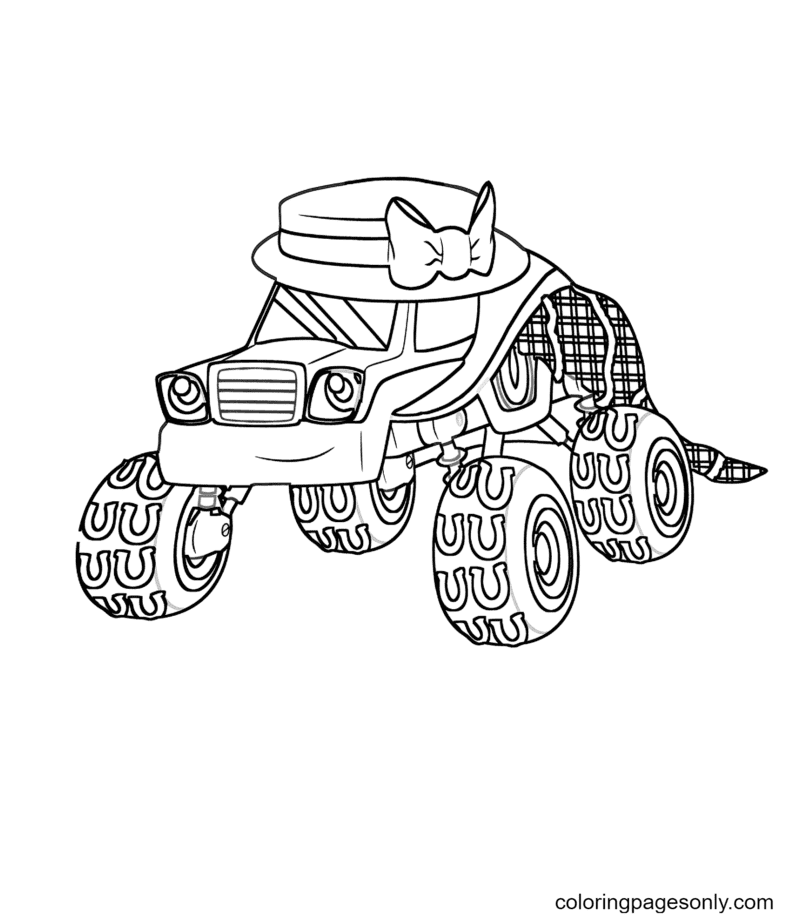
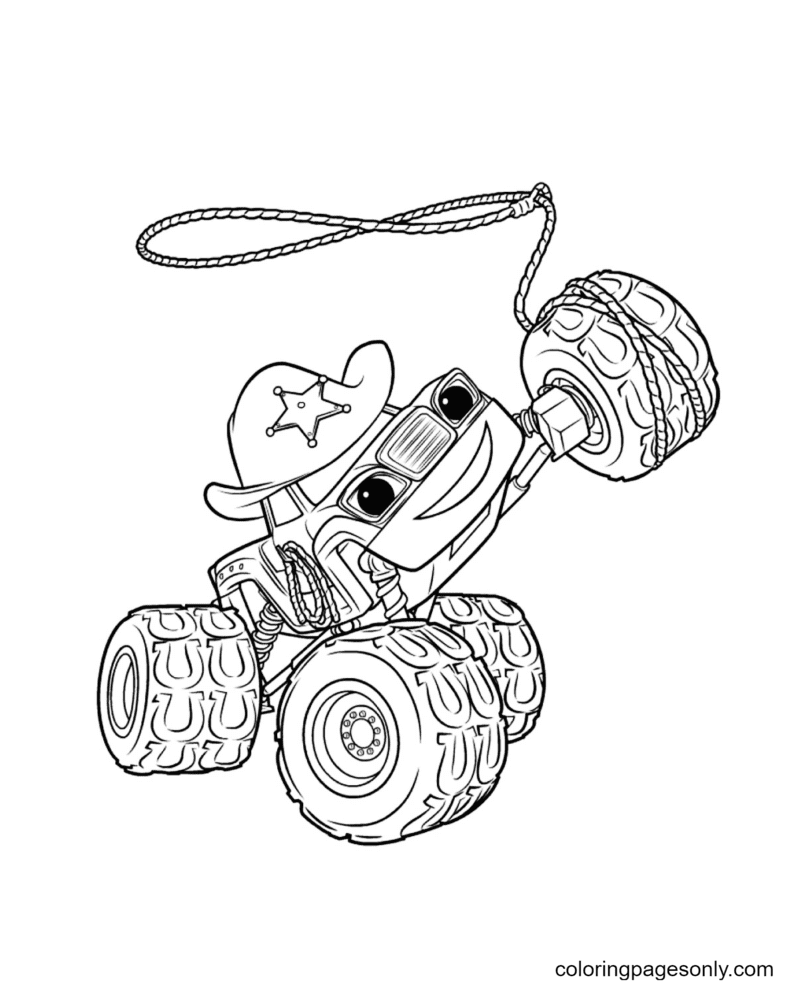
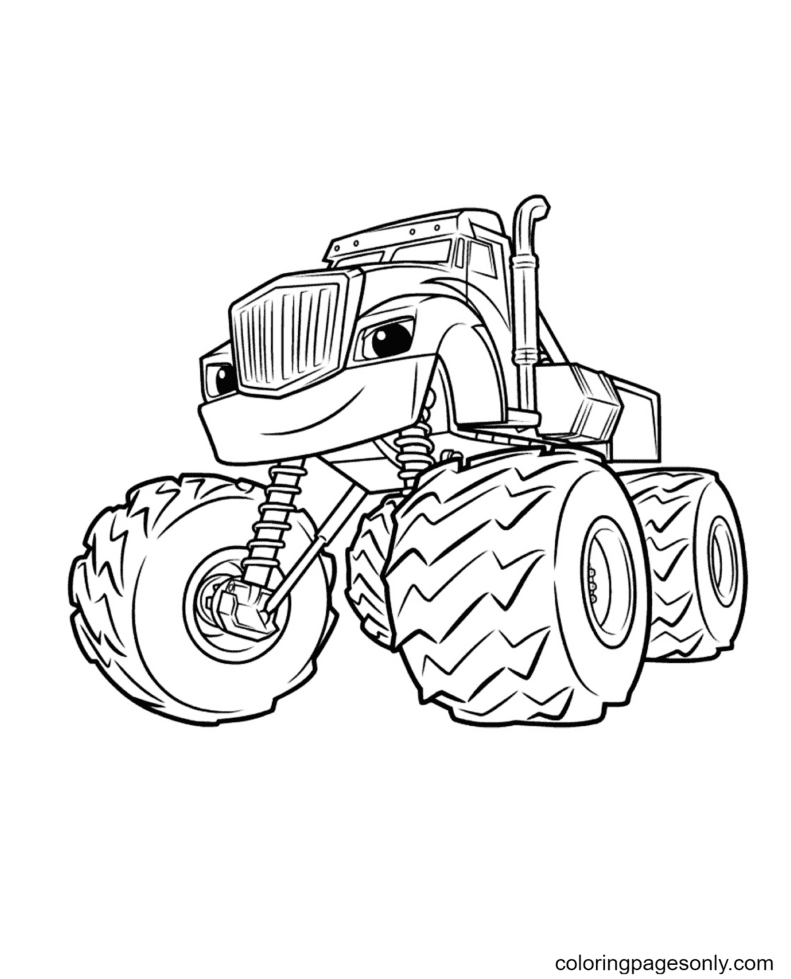
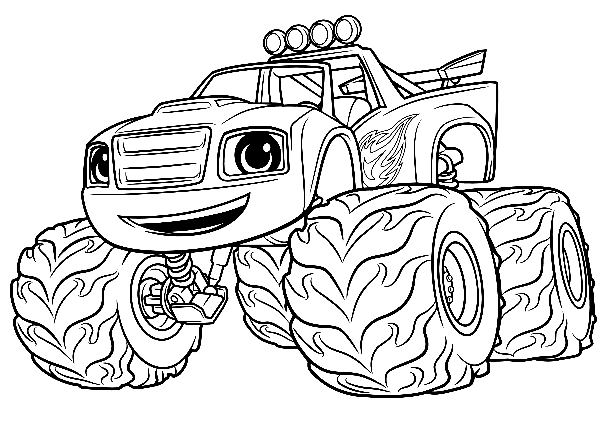
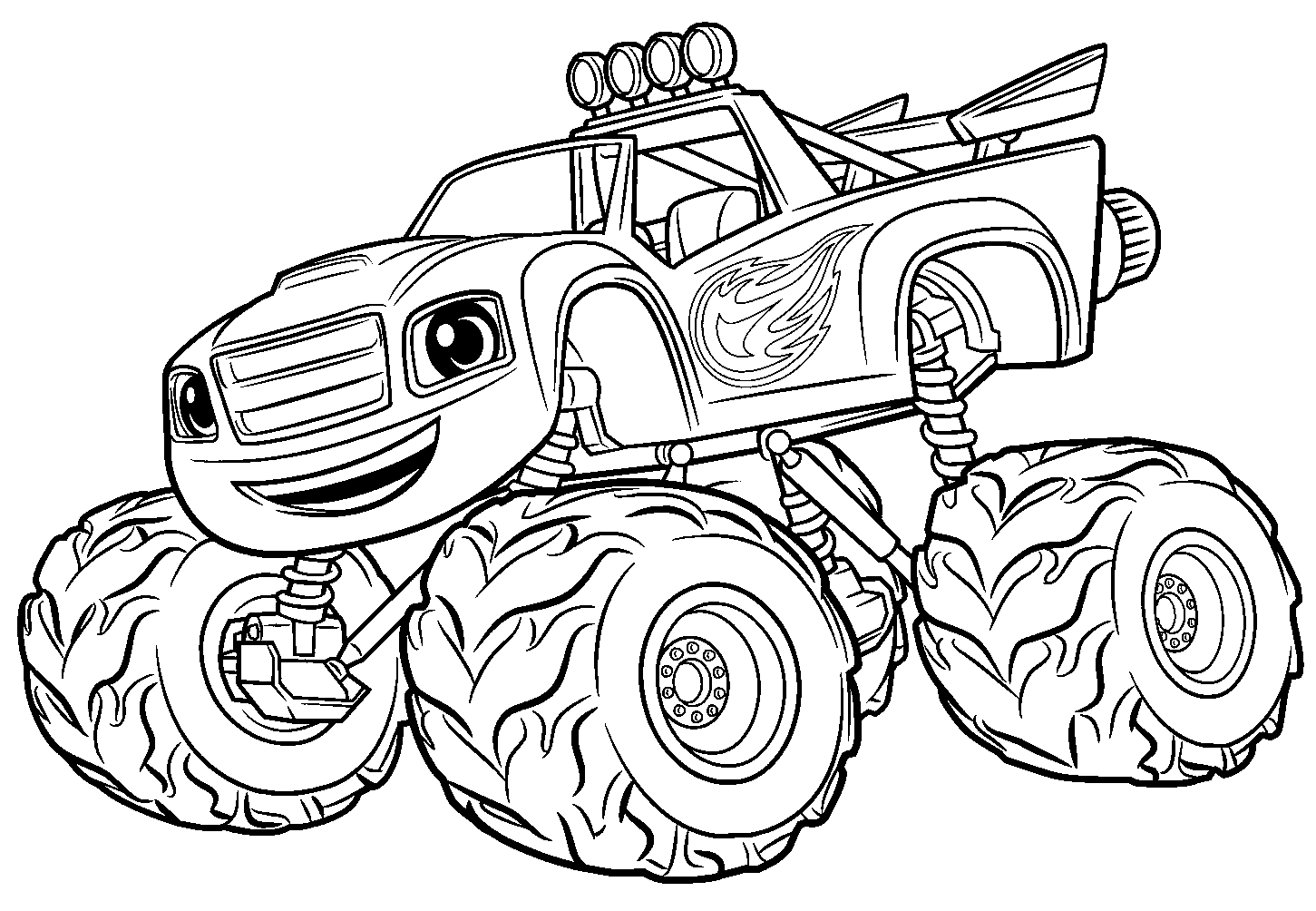
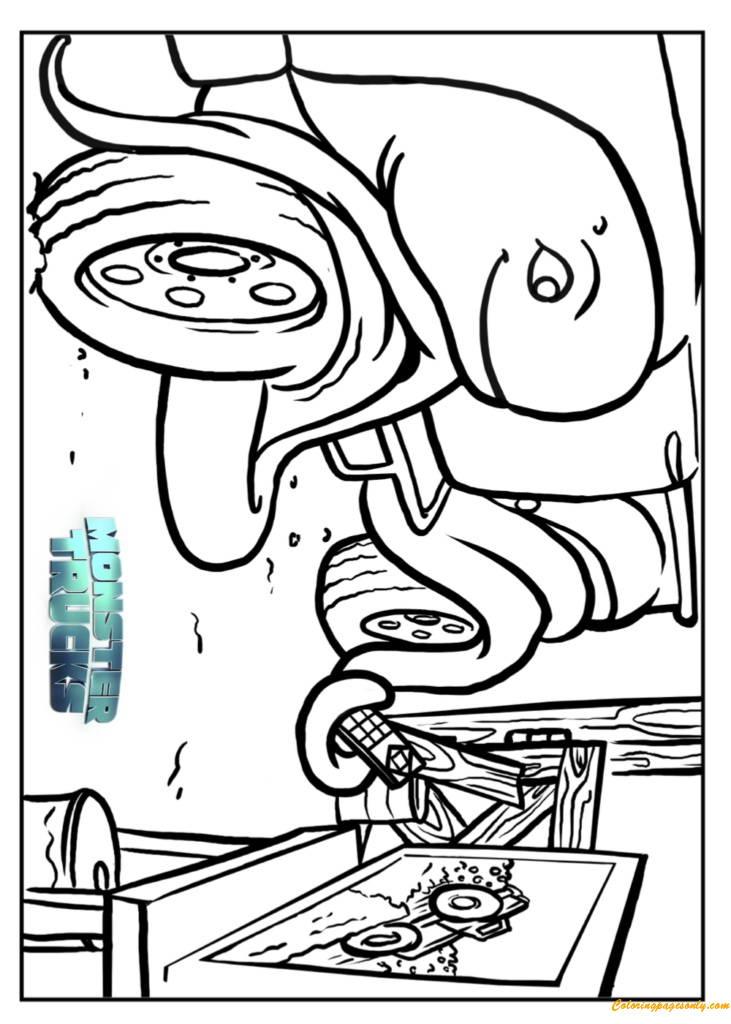
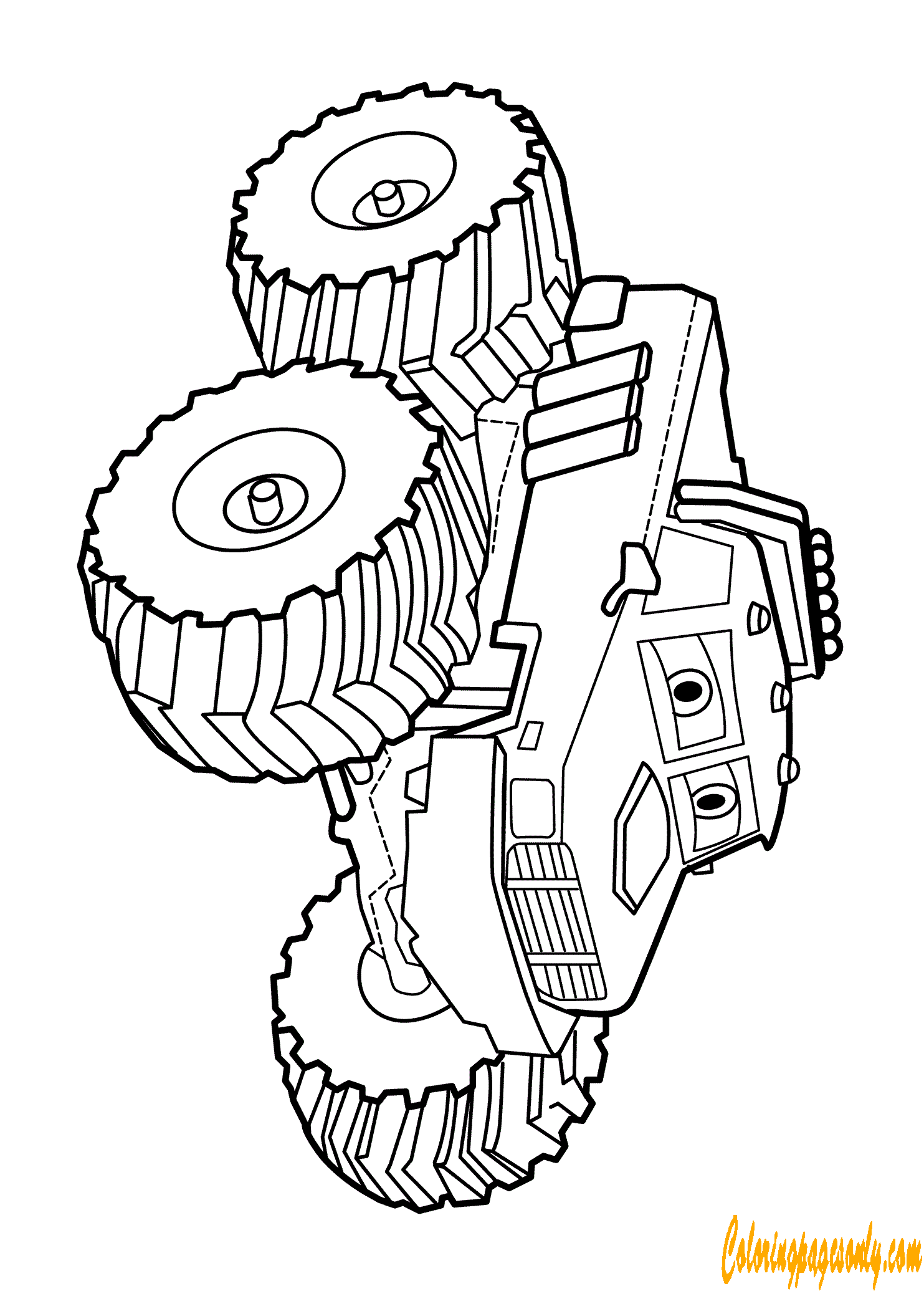
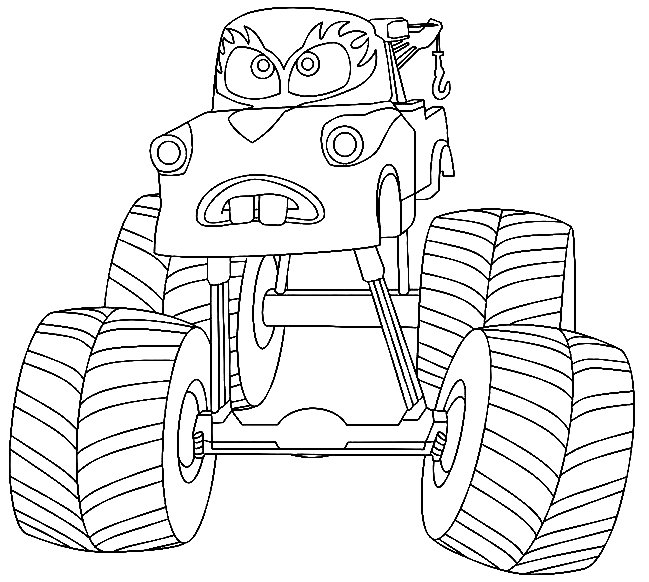
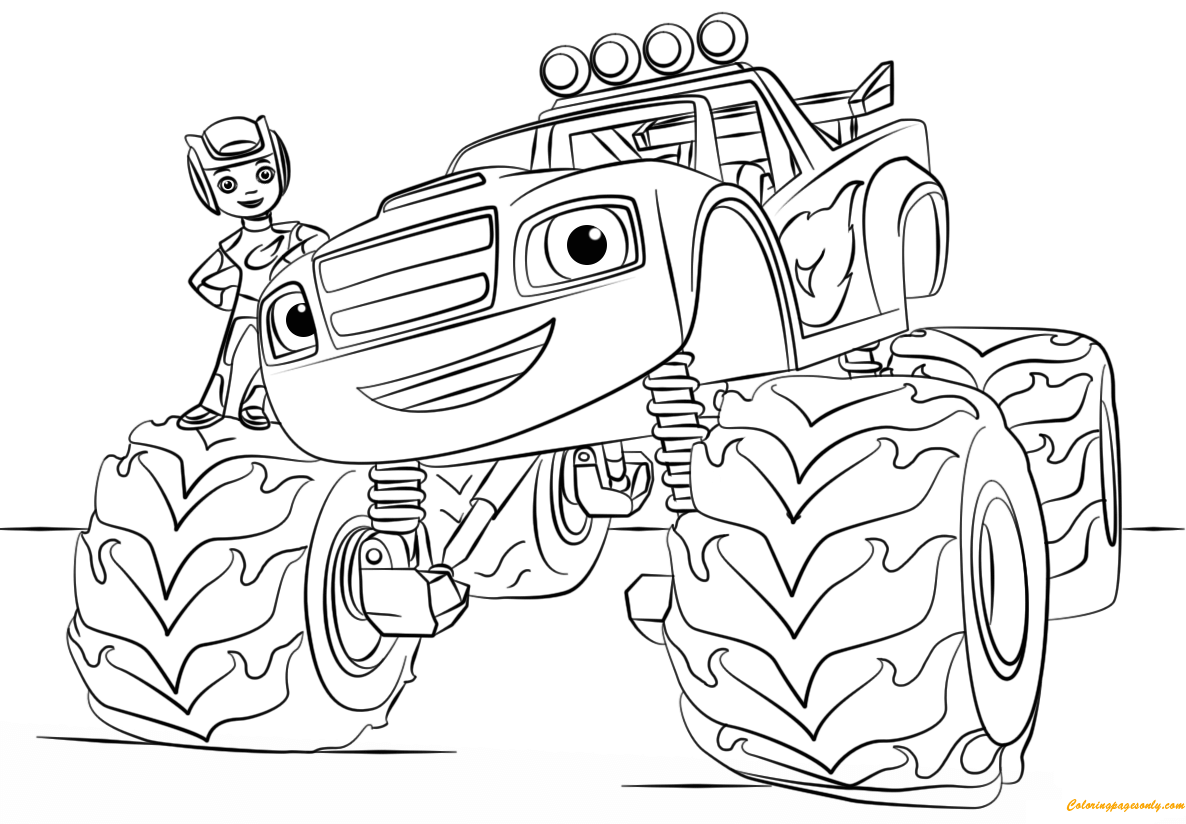
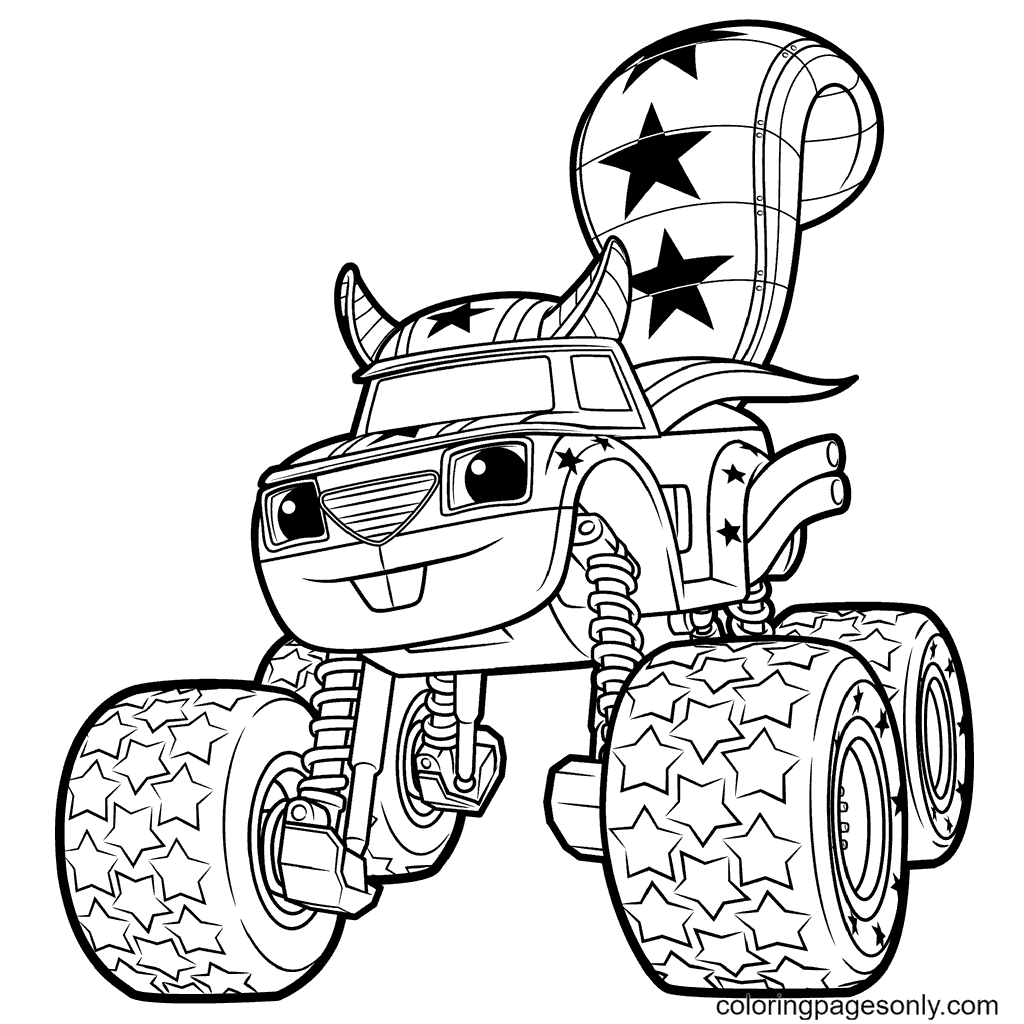
The collection’s most accessible content for the youngest fans shows monster trucks in the cartoon register – rounded proportions, expressive faces on the truck grilles, simplified shapes, and the bright colors of children’s television design. The most prominent cartoon monster truck franchise is Blaze and the Monster Machines, the Nickelodeon animated series that premiered in 2014 and uses monster truck characters to teach STEM (science, technology, engineering, and mathematics) concepts.

Blaze himself is a vivid red monster truck with large, expressive eyes integrated into the windshield area. His driver, AJ, is a young boy. The cast includes competing trucks with distinct personalities: Crusher (blue, the antagonist), Pickle, Starla, Darington, and Zeg.

The cartoon monster truck pages are the collection’s most developmentally accessible – the rounded forms, large color areas, and expressive faces allow the youngest colorists to engage confidently with the monster truck visual without the complexity of realistic vehicle rendering.

Coloring cartoon monster trucks: The vivid, fully saturated primary colors of cartoon monster trucks should be applied at maximum intensity – Blaze’s red is fire-engine red, not muted; the green of other trucks is the brightest available green. The eyes (in the windshield area) are the character’s most important feature and should be rendered with clear, bright irises and dark pupils, with a white highlight dot at the upper portion of each iris.

What These Pages Do

Bob Chandler built Bigfoot as a hobby in 1975 and created a motorsport category. The specific documented sequence – a truck built in a Missouri parking lot, a car crush filmed in a farmer’s field, a stadium crowd of 68,000 – is one of American entertainment’s most direct lines from individual enthusiasm to mass-market phenomenon. Coloring pages from this category are engaging with something that began as a single person’s project.

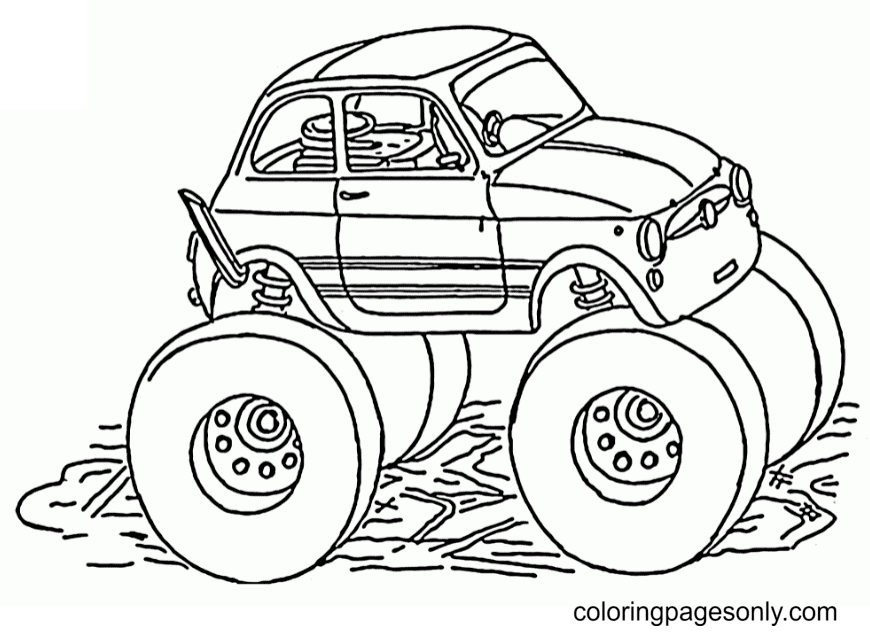
Monster trucks are the most scale-distorted vehicles in motorsport. The specific visual drama of a monster truck comes entirely from proportion: a recognizable truck body – the same pickup truck body that exists in every hardware store parking lot – elevated on tires taller than a person, capable of driving over other full-sized vehicles. The absurdity of the proportion is the entire visual argument, and it reads immediately to children who understand cars and trucks before they understand most other engineering.

The themed truck category teaches character design through vehicle design. Megalodon’s shark-truck fusion, El Toro Loco’s bull identity, Monster Mutt’s dog engineering – each of these requires taking one visual vocabulary (the truck) and systematically integrating it with another (the animal). The design decisions involved in making a truck look like a shark are the same design decisions involved in any character design: what are the most essential identifying features of the animal, and how can those features be applied to the truck’s form without losing either identity?

Fine motor development. The American Academy of Pediatrics identifies fine motor skill development as a key childhood milestone throughout early childhood. The massive tires’ rubber texture, the sponsor graphics detail, the themed truck’s animal feature rendering, and the action page’s stunt dynamic detail all provide motivated, sustained fine motor practice. The 2005 Art Therapy Journal study on structured coloring and anxiety reduction applies throughout – with the collection’s 160+ pages serving the broadest possible developmental range.

How to Color These Pages Well

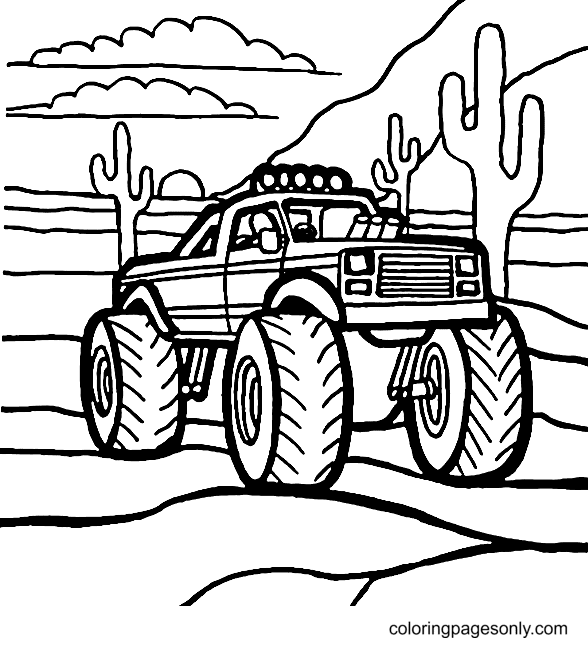
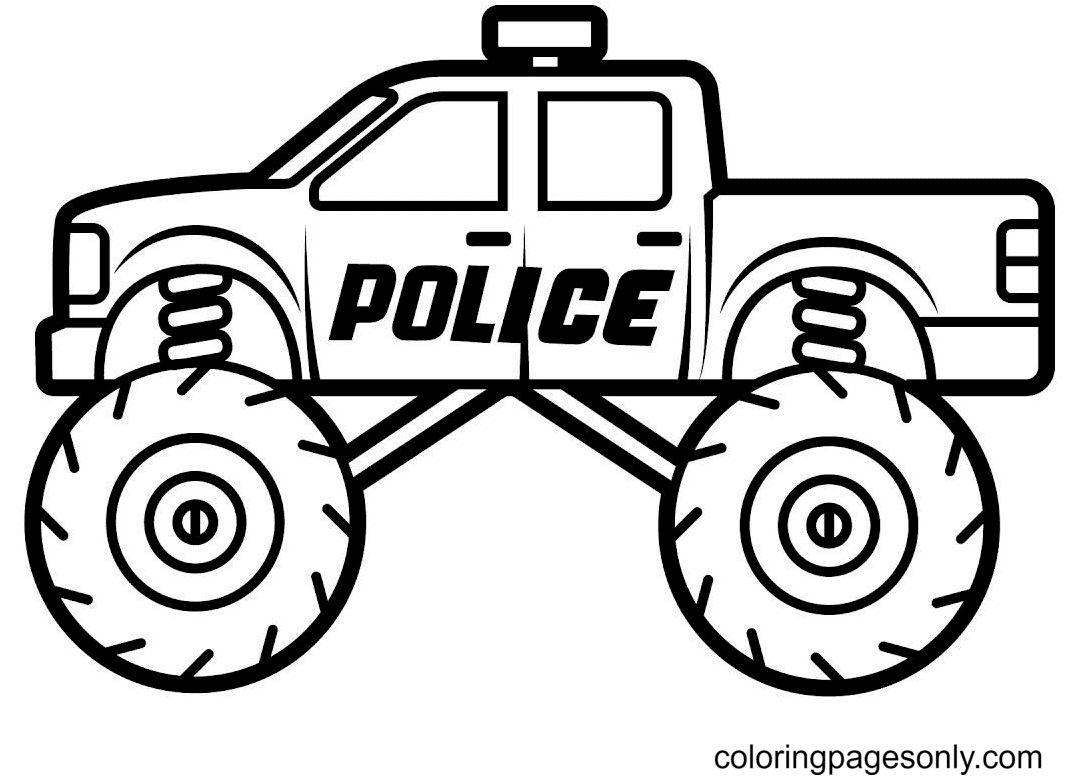
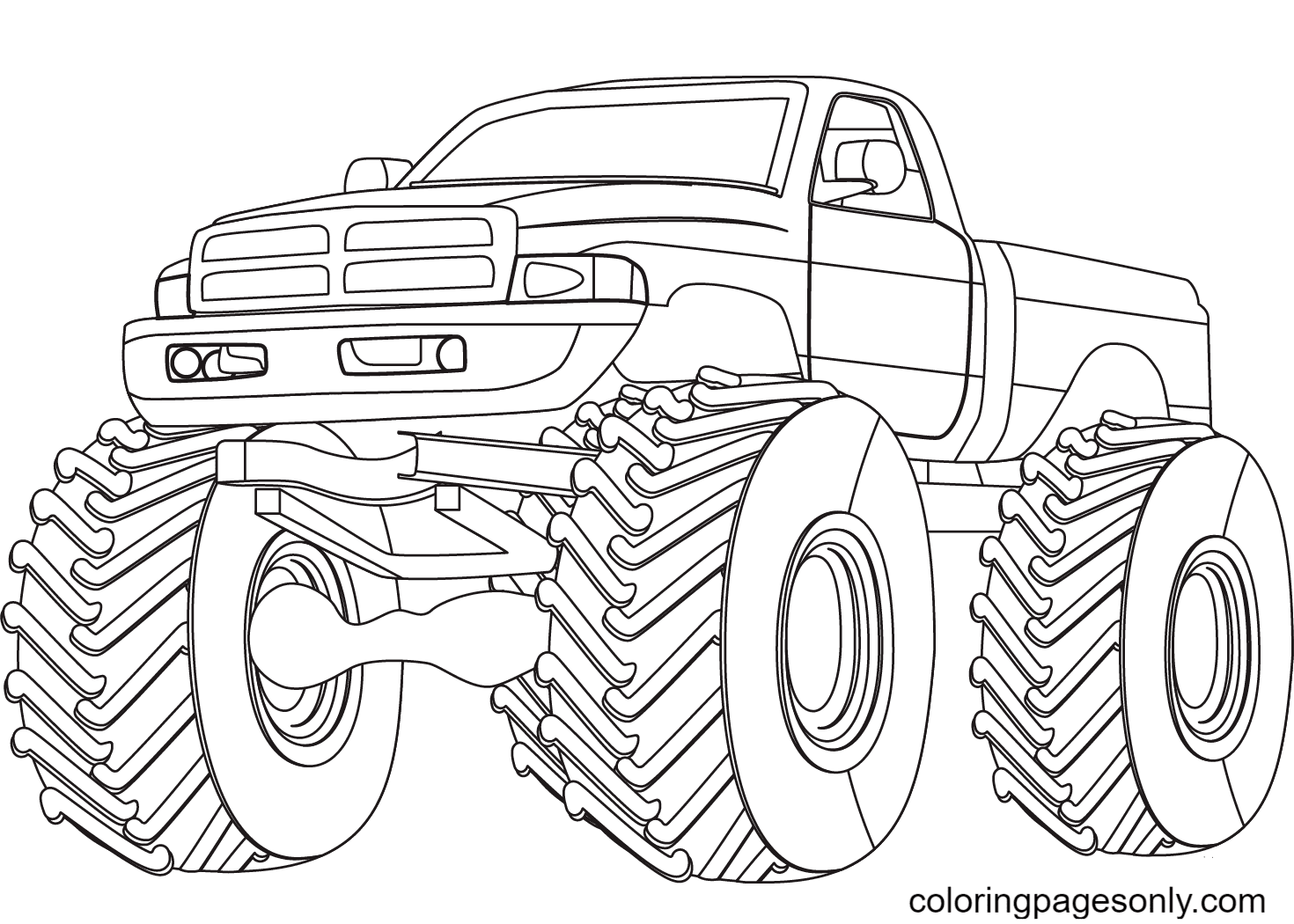
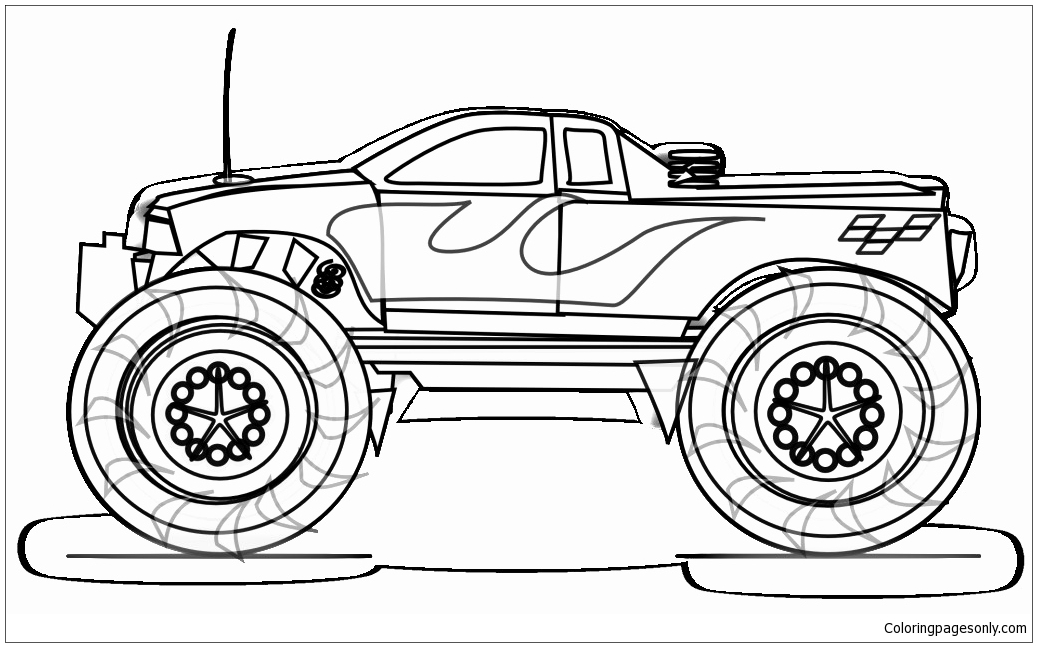
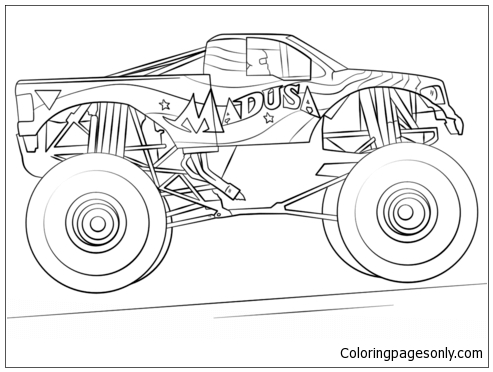
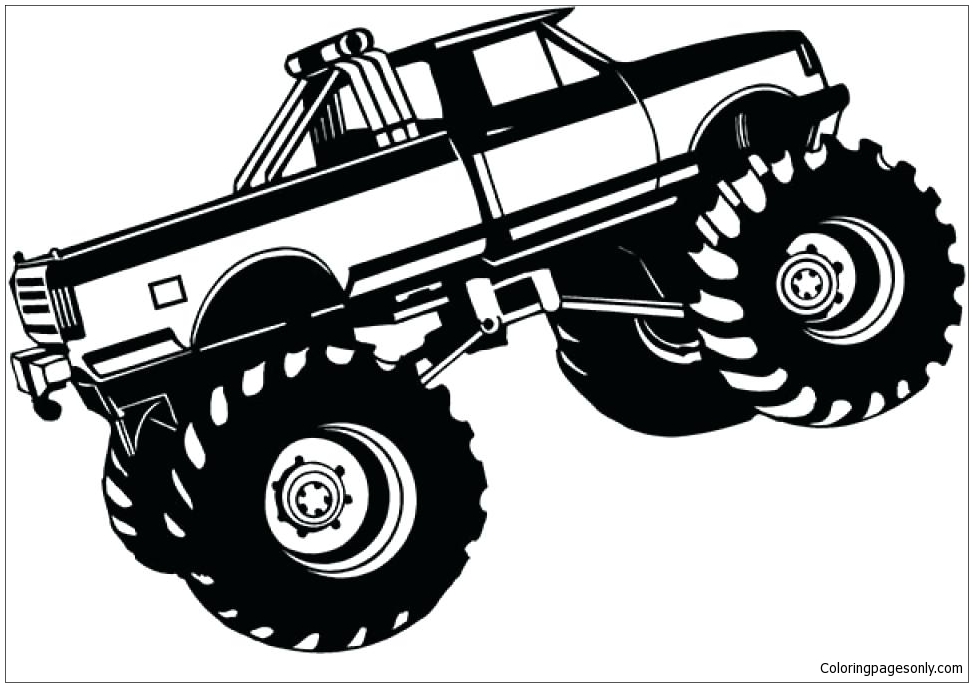
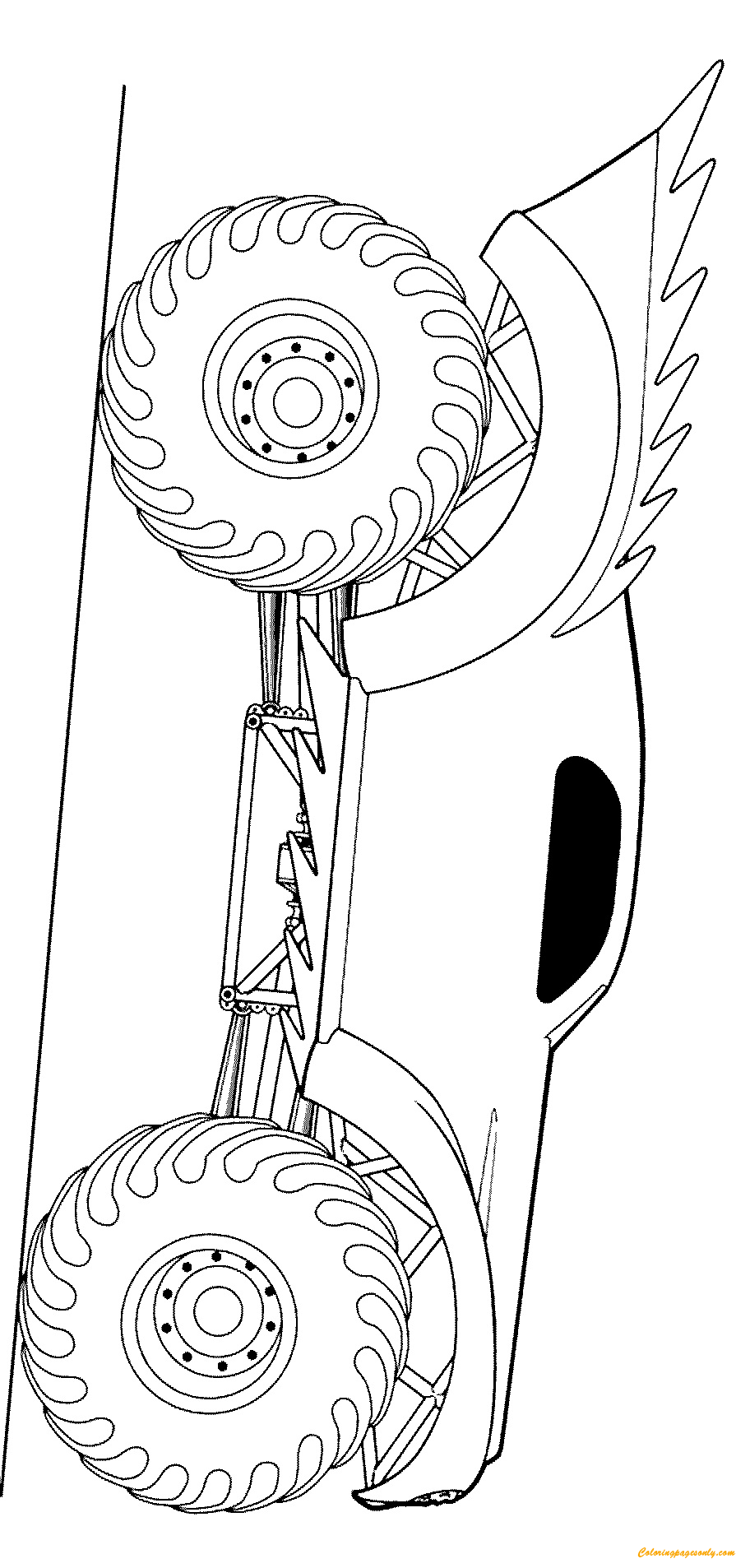
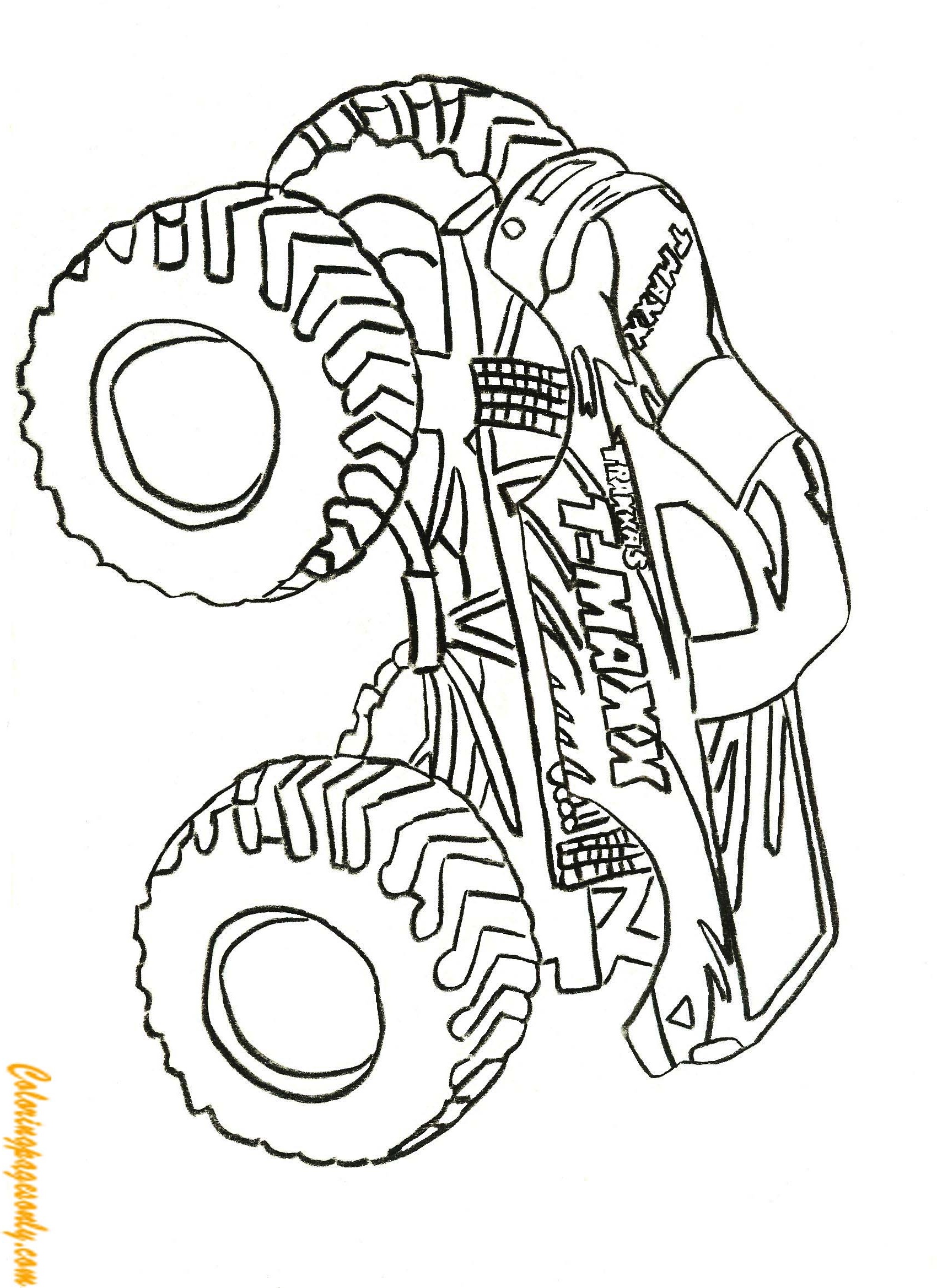
The tires are the collection’s most important single design element – they must read as disproportionately enormous. The monster truck’s visual identity depends entirely on the tires. Each tire is 66 inches tall – taller than most adult humans. In any monster truck page, the tires should be the darkest, most solidly colored elements in the composition. Apply near-black or very dark grey across every tire surface. Add very subtle dark grey-green highlights where the rubber’s surface catches light. The rim inside each tire – visible in most side and three-quarter views – should be metallic silver-grey, rendered with the standard chrome technique: light grey highlight, medium grey main surface, darker grey shadow.

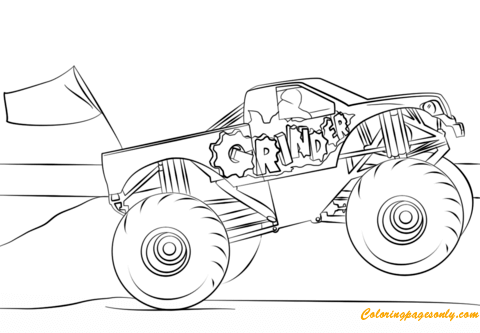
Vertical exaggeration reads as more exciting than accurate scale. Real monster trucks are wide and powerful, but not as vertically exaggerated as their coloring page depictions often suggest. In coloring these pages, lean into the vertical exaggeration – the higher the truck body sits above the tires, the more dramatic the visual. When choosing how to shade the undercarriage area (the suspension and frame visible between the body and the tires), render it in the darkest available dark grey – the deep shadow of the undercarriage is what emphasizes the height and creates the visual of the body floating above massive tires.
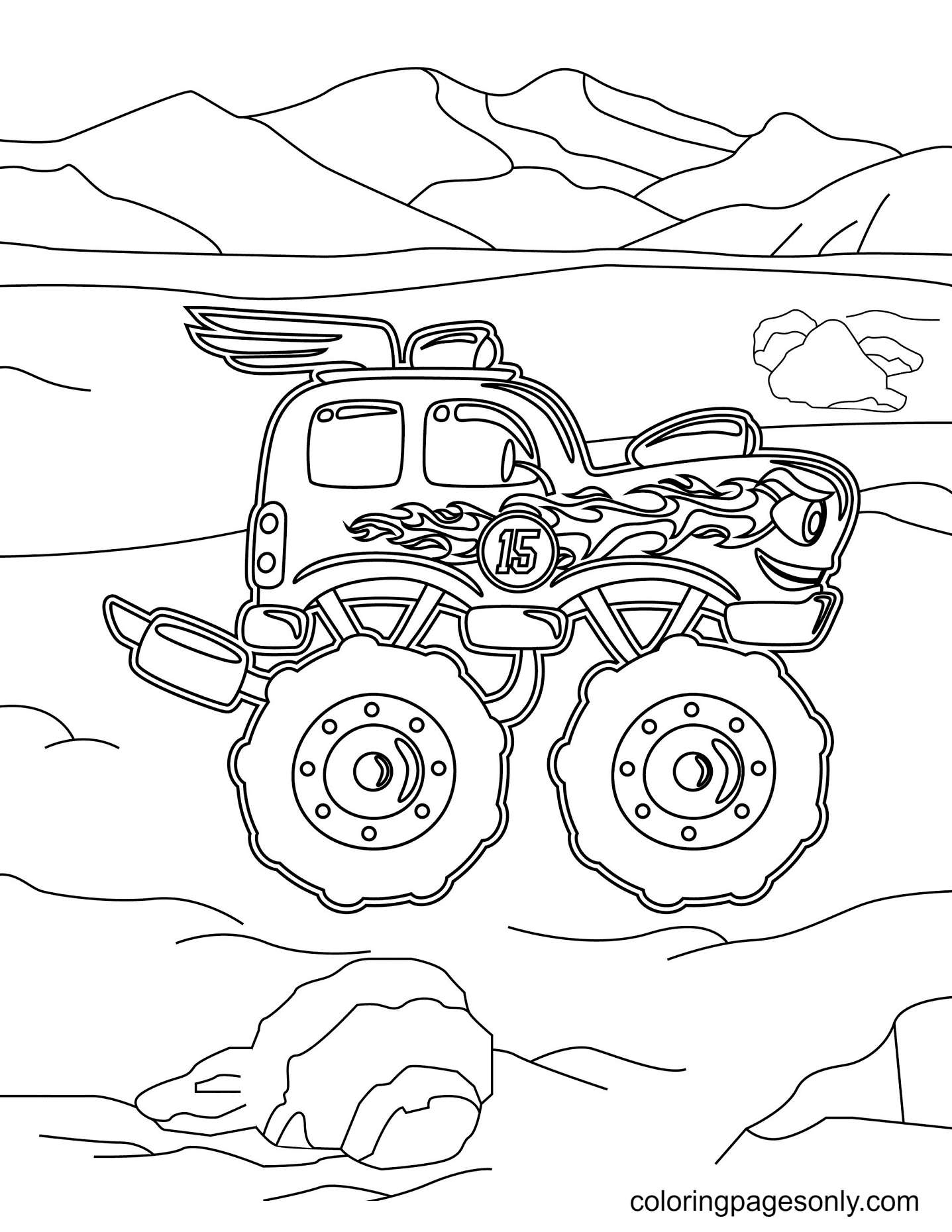
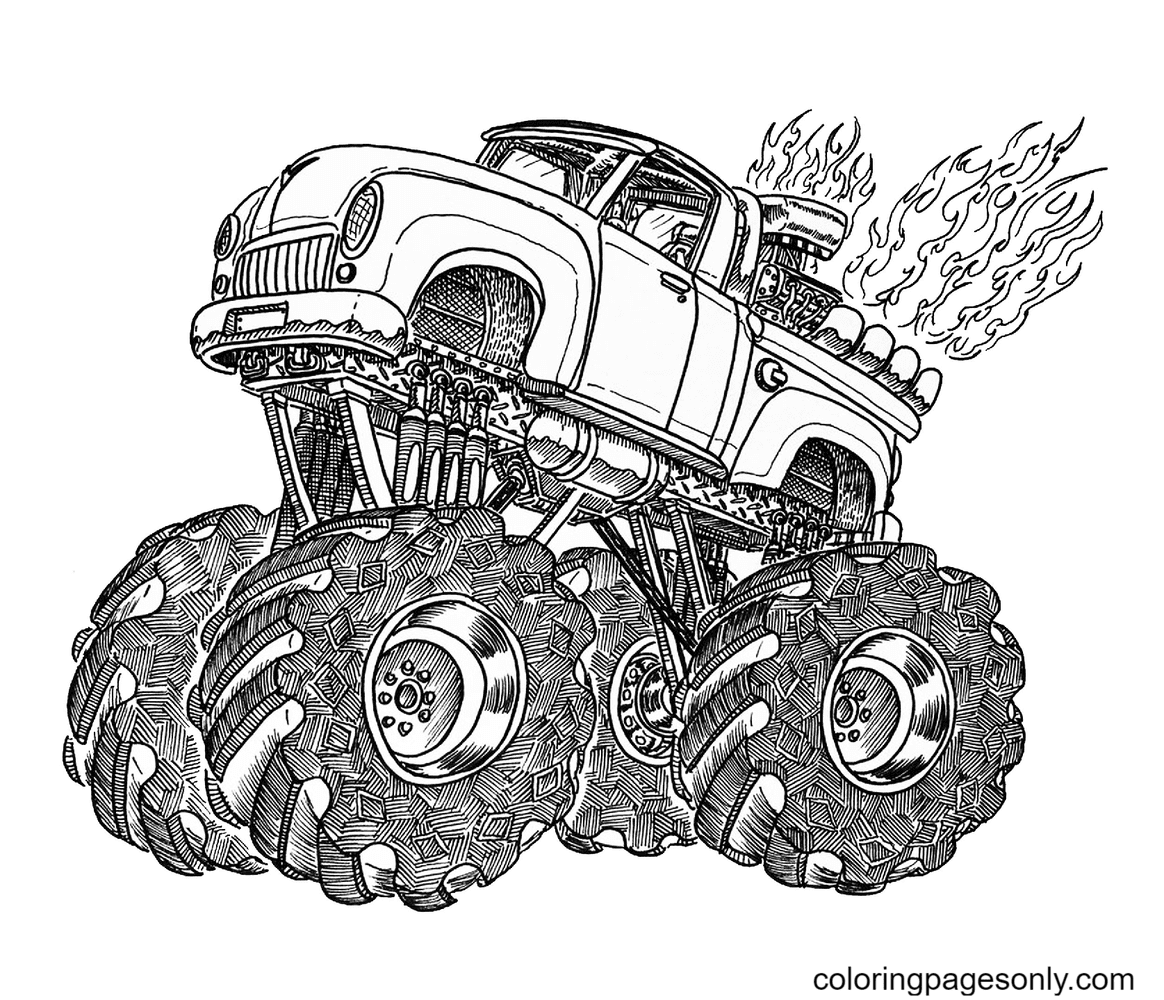
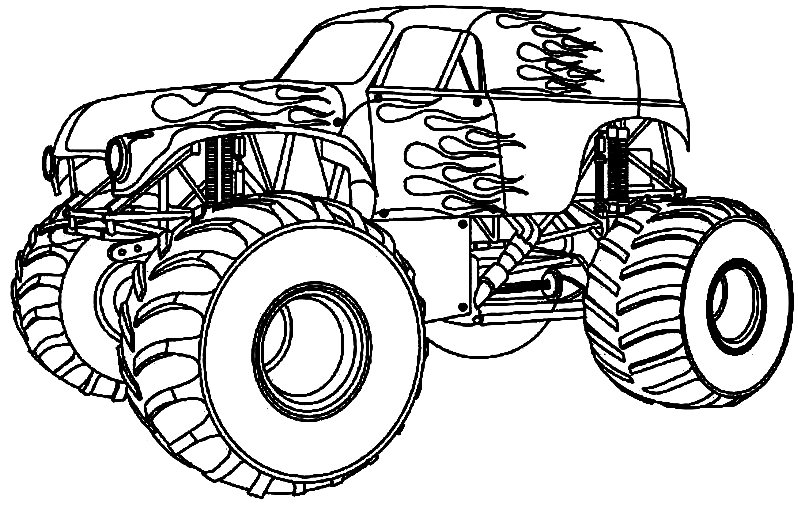
Flame and fire effects on monster trucks use the standard warm-to-white gradient. Many monster trucks carry flame graphics – painted flames or pyrotechnic effects in action pages. Painted flames: apply orange at the flame base, graduating to yellow as the flame rises, with white or very pale yellow-white at the very tips of the flame tongues. The flame should taper to irregular points at its tips. Pyrotechnic flames in action pages: the same gradient but rendered with more irregular, explosive shapes rather than the smooth curves of painted flames.

Ground debris in action pages adds realism without complexity. Dirt, mud, and debris visible at the tires’ contact points or thrown up by spinning tires should be rendered in warm tan-brown – applied as irregular dots and short strokes radiating from the tire positions. This contextual ground detail is the simplest addition that most directly communicates “this truck is in motion on an actual surface.”

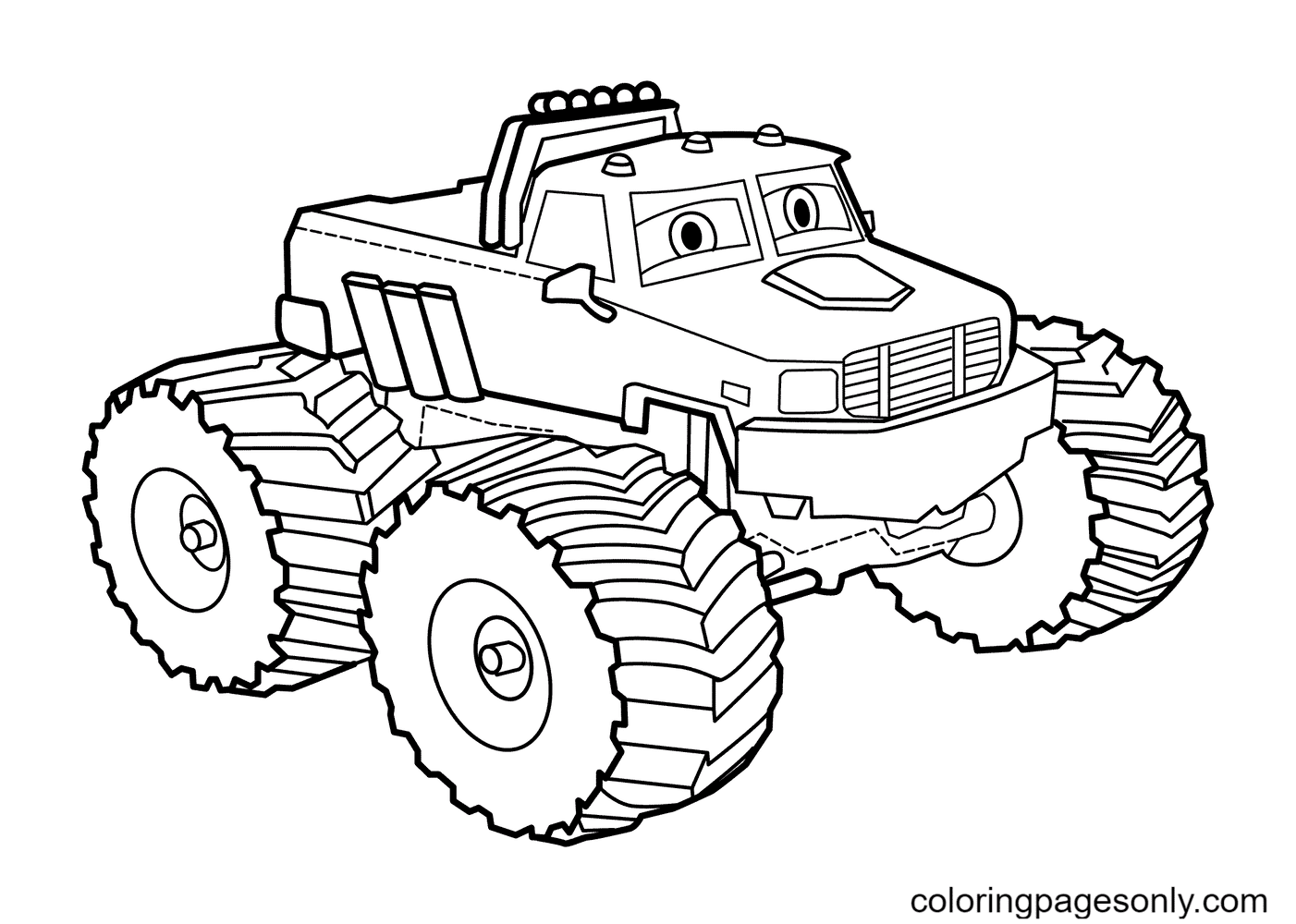
Cartoon trucks’ eyes are characters before they are trucks. On any page showing a cartoon monster truck with expressive eyes on the windshield, the eyes carry the character’s entire emotional register. Render them completely – base eye color (white or off-white), vivid iris color, dark pupil centered within the iris, and a white highlight dot at the upper portion. Without the highlight dot, cartoon eyes read as flat and lifeless. With it, even a simplified cartoon truck reads as having a personality and an expression.

5 Creative Craft Ideas

Design Your Own Monster Truck

Print the most neutral monster truck page in the collection – a truck outline with minimal existing decoration. This is your canvas for a completely original monster truck design.

Choose a name for your truck. Choose a theme (animal, vehicle, food, superhero, concept – any theme is valid within the monster truck universe). Choose a primary color and a secondary color. Apply your theme’s visual vocabulary to the truck: if your truck is “Thunder Hawk,” add eagle wings, talons, and a hawk head motif; if your truck is “Ice Dragon,” add scales, breath, and crystalline blue-white coloring.

Color the finished design at full saturation. Add the truck’s name along the side panel. The finished page is a completely personal monster truck – your design, your theme, your identity.

The Origin Story Display

The monster truck has one of the most specifically documented origin stories in American motorsport. Print the most classic-looking monster truck page – the most Bigfoot-adjacent, Ford-pickup-truck-body page with enormous tires. Color it in Bigfoot blue.

On a backing sheet, mount the colored page and add hand-lettered text: “1975 – Bob Chandler, St. Louis, Missouri. His hobby project. His four-wheel-drive shop.” “1981 – A farmer’s field. Two cars. Bigfoot drove over them. Filmed.” “January 1982 – Pontiac Silverdome, Detroit. 68,000 spectators.” “The monster truck was invented by one person who built a truck he liked.”

Scale Comparison – Human vs. Tire

Print one large monster truck page. Color it in a vivid canonical color scheme – any theme works, applied at full saturation.

On a separate piece of paper, draw a simple human figure – stick figure or basic outline – at the correct scale relative to the truck. The tire alone (66 inches tall / 168 cm) is as tall as an adult human. Mount the human figure cutout beside or in front of the colored truck to show the scale relationship.

Add: “One tire: 66 inches tall. 900 lbs. Wider than you are tall.” The finished display makes the monster truck’s scale physically legible rather than abstractly described.

Themed Truck Family Portrait

Print three themed monster truck pages – one shark truck, one bull truck, one dog truck. Color each in its canonical theme palette: Megalodon in blue-grey with white teeth, El Toro Loco in vivid red with bull horns, Monster Mutt in white with black spots (Dalmatian variant).

Mount all three on a dark backing sheet in a row. Add a title: “Monster Jam’s Theme Trucks – Where Animal Meets Machine.” Below each: the truck name and the animal it is based on. The display shows the themed truck category as a complete family of animal-vehicle fusions.

Freestyle 90 Seconds

Freestyle competition in Monster Jam gives drivers 90 seconds to perform as many stunts as possible. Print four action/stunt pages – a wheelie page, a jump page, a donut/spin page, and a landing page. Color all four in the same color scheme – one consistent truck identity across all four stunt moments.

Mount all four in a two-by-two grid. Add a number below each: “0:00 – Launch.” “0:23 – Wheelie.” “0:45 – Jump.” “0:90 – Freestyle complete.” The display frames the 90-second competition format as a visual sequence – four stunt moments from the same truck’s run.

Frequently Asked Questions

Who invented the monster truck and when? The monster truck is credited to Bob Chandler of St. Louis, Missouri, who built the original Bigfoot in 1975 using his Ford F-250 pickup truck as a base. Chandler modified the truck with oversized tires as a hobby project and used it to promote his Four Wheel Drive shop, Midwest Four Wheel Drive. The first car crush – which established the defining monster truck event format – occurred in 1981 when Bigfoot drove over two cars in a farmer’s field in Missouri, with the event filmed for promotional purposes. The first major stadium monster truck event was held at the Pontiac Silverdome near Detroit, Michigan, in January 1982, drawing 68,000 spectators and demonstrating the mass audience for the spectacle.

What is Grave Digger, and who created it? Grave Digger is the most recognizable branded monster truck in Monster Jam history. Dennis Anderson created the original Grave Digger in 1982, initially as a deliberately beat-up, unassuming truck that would then outperform more polished competitors. The name came from Anderson’s competitive claim that he would “dig his competitors’ graves.” The truck’s visual identity – black body with vivid green panels and detailing, skull and graveyard imagery, purple accents, and flame-shooting capabilities in live performance – became iconic in monster truck culture. Multiple versions of Grave Digger compete simultaneously at Monster Jam events, driven by various drivers, including members of the Anderson family.

How big are monster truck tires, and how much do they weigh? Standard Monster Jam competition tires are 66 inches (168 centimeters) tall – the same height as an average adult – and 43 inches (109 centimeters) wide. Each tire weighs approximately 900 pounds (408 kilograms). The tires are typically Terraa tires, originally designed for agricultural and construction equipment, adapted for monster truck competition. At Bigfoot 5 – the world’s largest monster truck by Guinness World Record, built in 1986 – the tires are 10 feet (305 centimeters) tall, using Firestone Tundra tires originally designed for the Alaska oil pipeline industry.

What is Monster Jam, and how does the competition work? Monster Jam is the largest professional monster truck series in the world, owned and operated by Feld Entertainment. Events are held in stadiums and arenas across the United States and internationally. Monster Jam competitions include two primary formats: racing, in which two trucks compete head-to-head on a dirt course built inside the arena, with the faster truck advancing through elimination brackets; and freestyle, in which each driver has approximately 90 seconds to perform as many jumps, wheelies, donuts, and other stunts as possible, with judges scoring the run on a scale up to 10 points. The combination of the two formats – objective racing competition and judged artistic performance – gives Monster Jam events their specific dual character.

What is Blaze and the Monster Machines? Blaze and the Monster Machines is an animated television series produced by Nickelodeon, premiering in 2014. The series centers on Blaze – a vivid red monster truck – and his young driver, AJ, who use STEM concepts (science, technology, engineering, and mathematics) to solve problems in Axle City. The show is specifically designed as an educational program for preschool audiences, presenting STEM principles through monster truck-themed stories. The cast includes competing trucks with distinct personalities,s including Crusher (the antagonist), Pickle, Starla, Darington, and Zeg. The show has won multiple Daytime Emmy Awards for Outstanding Preschool Children’s Animated Series.

What safety measures do monster trucks have? Monster Jam trucks are required to carry multiple active safety systems. Every truck must have a Remote Ignition Interrupt (RII) device – an electronic system that allows track officials to remotely cut power to the truck’s engine if the driver is incapacitated or if the truck is operating dangerously. Trucks also have a safety kill switch accessible from outside the vehicle. Drivers wear full fire-resistant racing suits, HANS (Head and Neck Support) devices to prevent head and neck injuries in crashes, and multi-point safety harnesses inside the cab. The arena’s dirt course is specifically constructed with safety in mind, including landing zones designed to absorb jumps, barrier systems, and emergency response teams on standby at all events.

What age group are these pages best suited for? Monster truck coloring pages serve an extremely wide age range – one of the widest in this site’s collection. The simplest cartoon monster truck pages (Blaze-style, rounded forms with expressive faces) are accessible and engaging from ages two and three, making this one of the few collections with genuine toddler accessibility. The basic monster truck profile pages work well for ages four to seven. The themed truck pages (shark, bull, dog) with their character design complexity are most engaging for ages five to nine. The detailed, realistic pages – showing Grave Digger-style trucks with full livery, complex action sequences, and car-crush scenes – are most rewarding for ages seven and up and for adult fans of Monster Jam. The 160+ page count reflects this genuinely multigenerational range.

Browse the full collection at ColoringPagesOnly.com. All 160+ pages free, no sign-up, PDF or PNG, print or color online.

Bob Chandler built a truck in a St. Louis parking lot in 1975 because he liked trucks. He drove it over two cars in a farmer’s field in 1981 because it seemed like it might work as a promotional event. 68,000 people showed up at a stadium in Detroit in 1982 to watch it happen in an arena.

Forty years later, Monster Jam events sell out stadiums globally. The Grave Digger brand is one of the most recognized in American motorsports. The tires are 66 inches tall and weigh 900 pounds each.

Bob Chandler built a truck he liked. Everyone else decided they liked it too.

Pick up your near-black for the body. Make the green as vivid as possible. The tires are the darkest elements.

Share your work on Facebook and Pinterest and tag #Coloringpagesonly. We especially want to see the custom monster truck designs and the scale comparison displays.

Color the truck. Name it. Give it 90 seconds. Freestyle begins.

More from our transport and vehicle collections:

Mantasstonys Allen – Designer

Hello! I'm Mantasstonys Allen, a web designer at Coloringpagesonly.com. My passion is bringing creativity to life through beautiful and user-friendly designs. I'm here to make your experience on our site smooth, fun, and inspiring—so you can focus on what matters most: coloring and unleashing your imagination!