
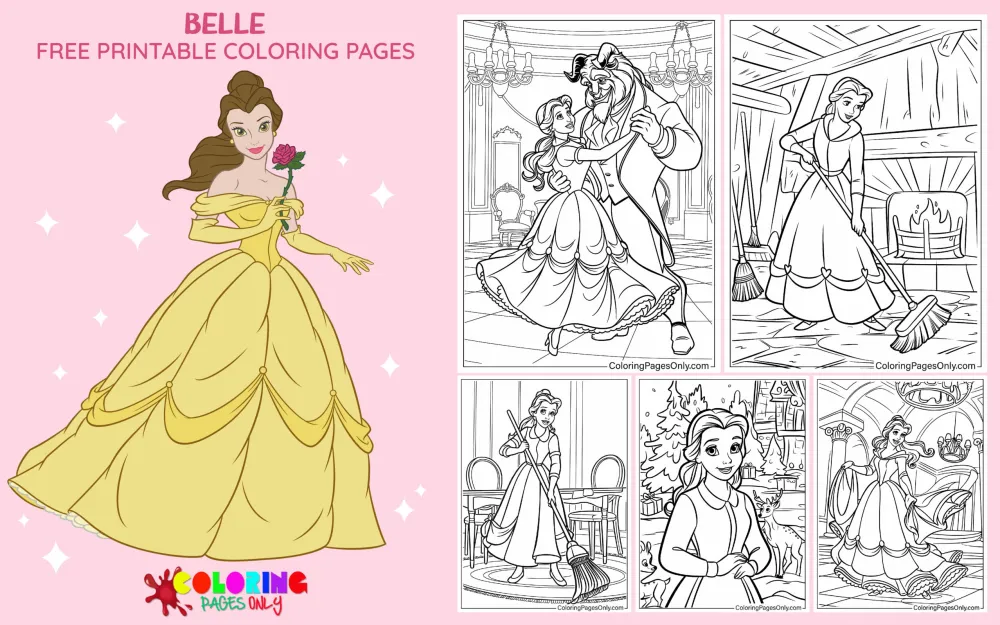
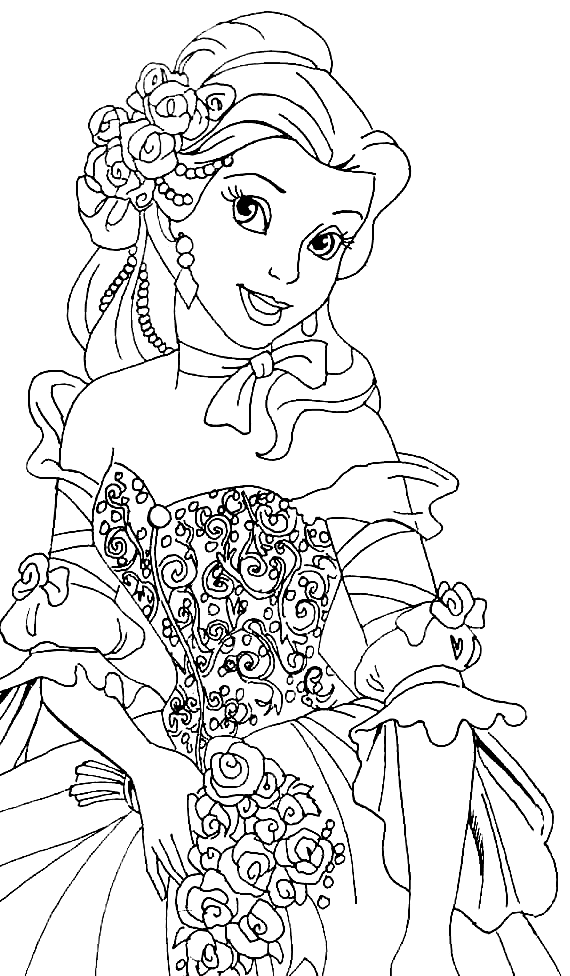
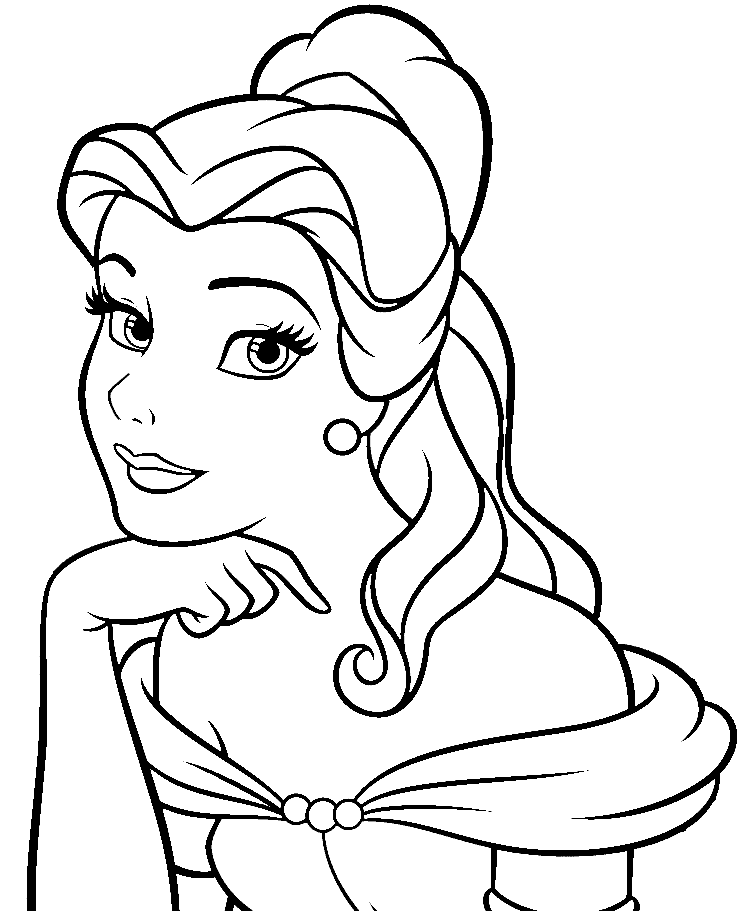
Free Belle coloring pages: 40+ pages featuring Belle in her iconic golden ballgown dancing in the enchanted castle, her everyday blue provincial dress with white apron, reading scenes in the Beast’s magnificent library, portrait close-ups with her signature brown ponytail and ribbon, scenes with the enchanted objects Lumière, Cogsworth, and Mrs. Potts, the enchanted rose under its glass dome, the ballroom dance with the Beast, and the full visual vocabulary of Disney’s most literary princess across both the original 1991 animated film and its 2017 live-action adaptation. All free, printable PDFs and online coloring for Disney fans of all ages.
Beauty and the Beast was produced by Walt Disney Pictures and released in theaters on November 13, 1991, directed by Gary Trousdale and Kirk Wise, and produced by Don Hahn. The film earned $425 million worldwide against a budget of approximately $25 million. It received the Academy Award nominations for Best Original Score and Best Original Song (“Beauty and the Beast,” sung by Angela Lansbury), winning both, and became the first animated film in Academy Awards history to receive a nomination for Best Picture at the 64th Academy Awards in 1992. It also won the Golden Globe Award for Best Motion Picture in the Musical or Comedy category, another historic first for an animated feature.
The film’s literary source is the French fairy tale “La Belle et la Bête,” which exists in two significant 18th-century literary versions: the longer version published by Gabrielle-Suzanne Barbot de Villeneuve in 1740 in “La Jeune Américaine et les contes marins,” and the shorter, more widely known version published by Jeanne-Marie Leprince de Beaumont in 1756 in “Magasin des enfants” (Magazine for Children). Leprince de Beaumont’s version is the one that became the standard literary text and the basis for Disney’s adaptation.
These 40+ free pages at ColoringPagesOnly.com span Belle’s full visual range across both films. All free, PDF or PNG, print or color online.
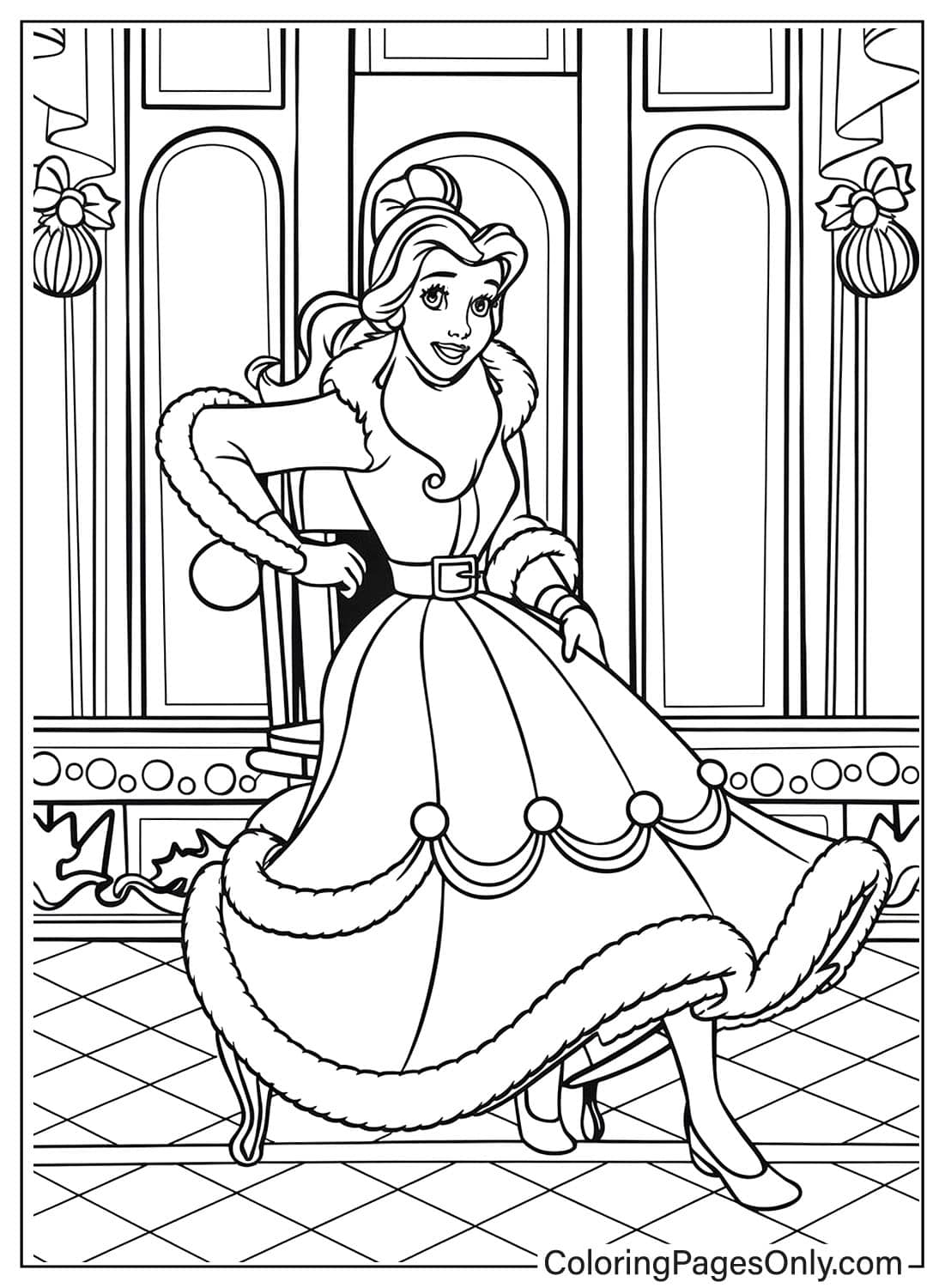
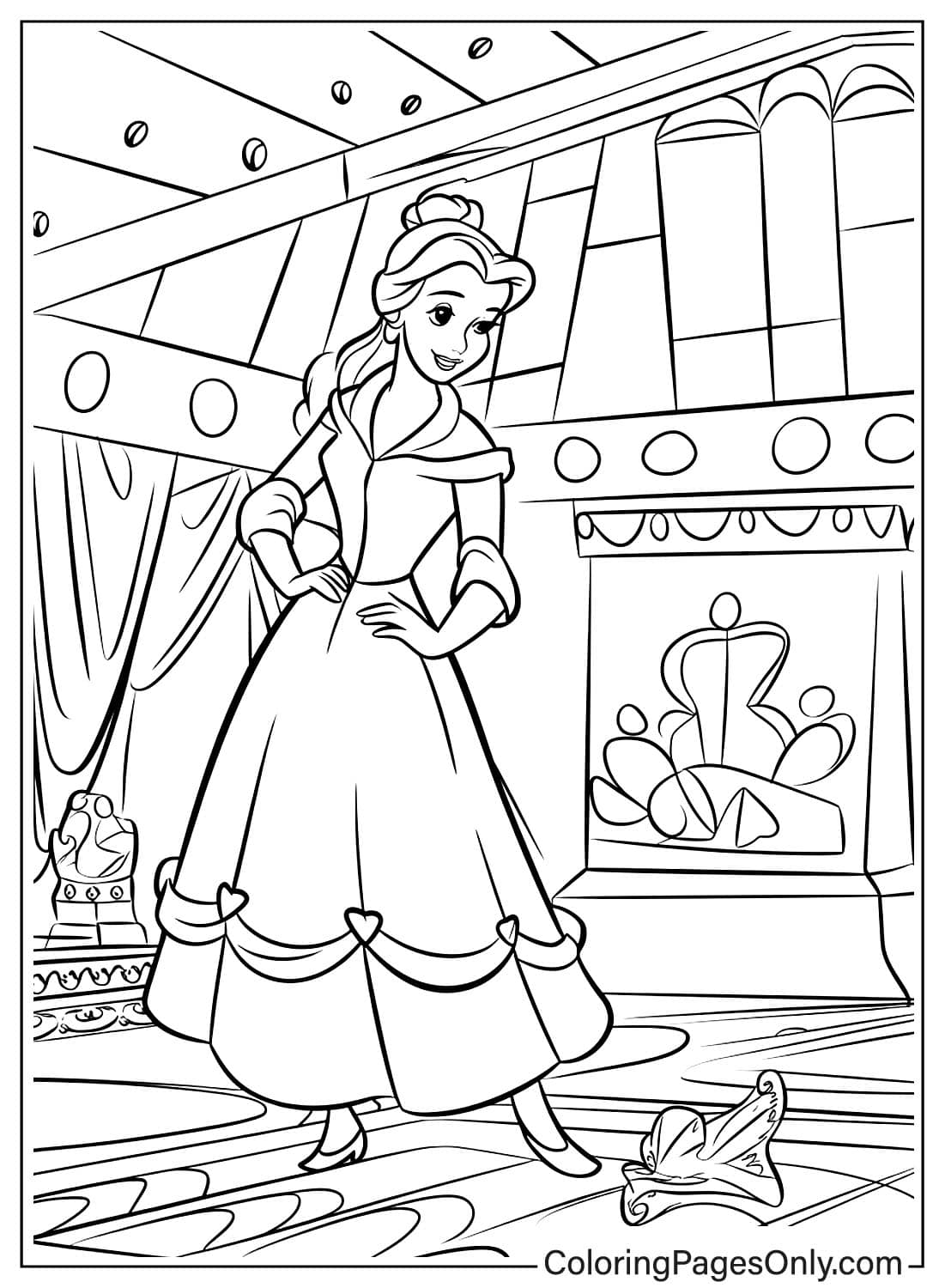
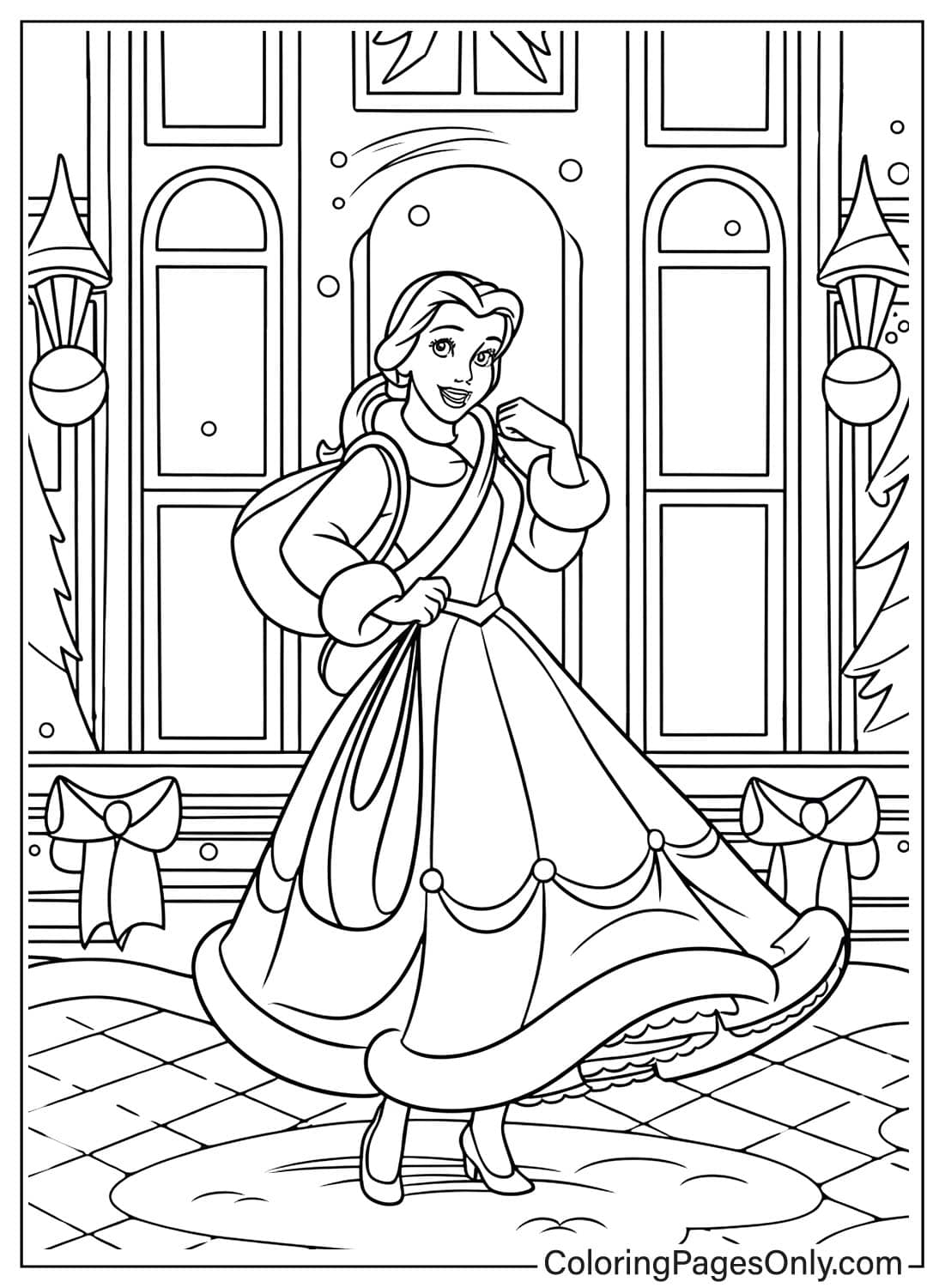

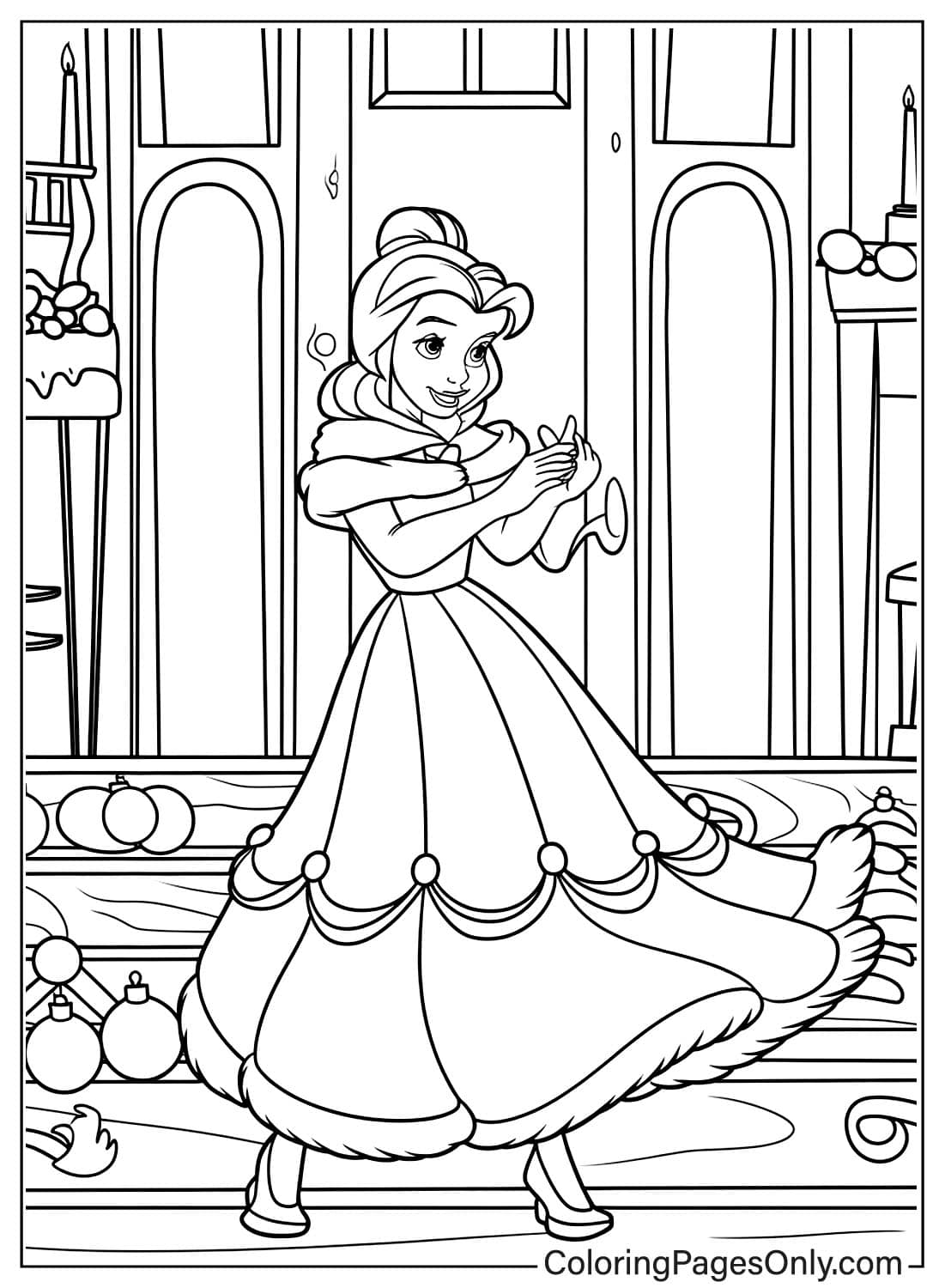
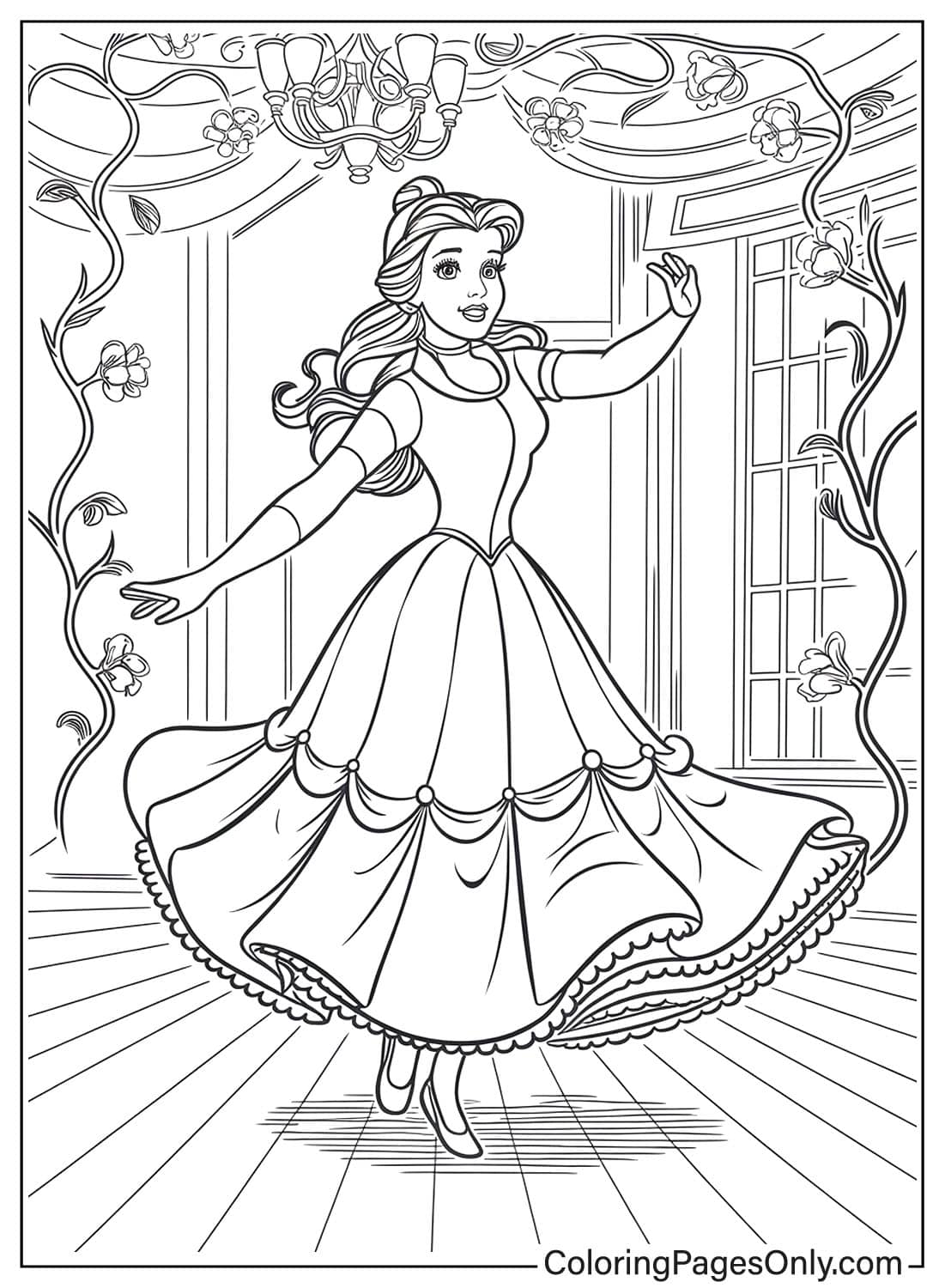
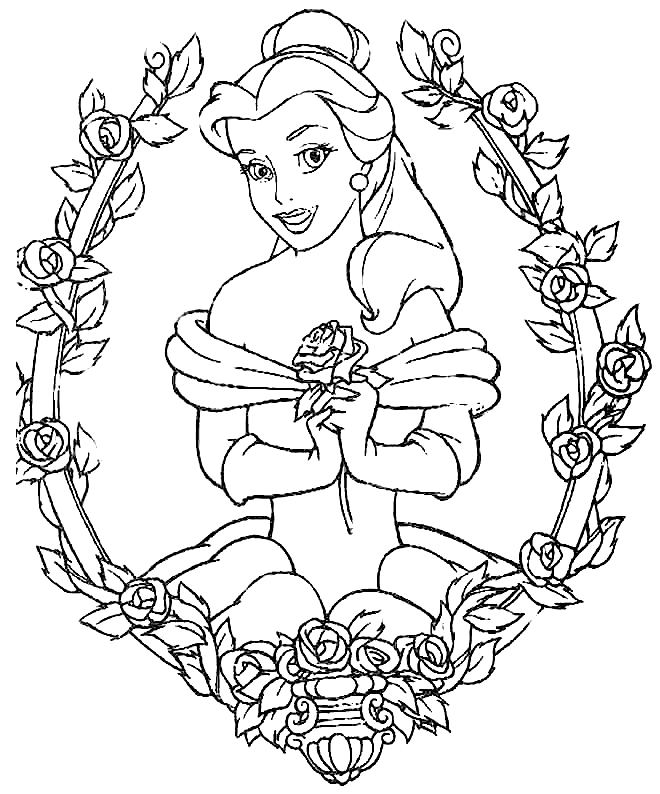

What’s Inside
Belle in Her Blue Village Dress
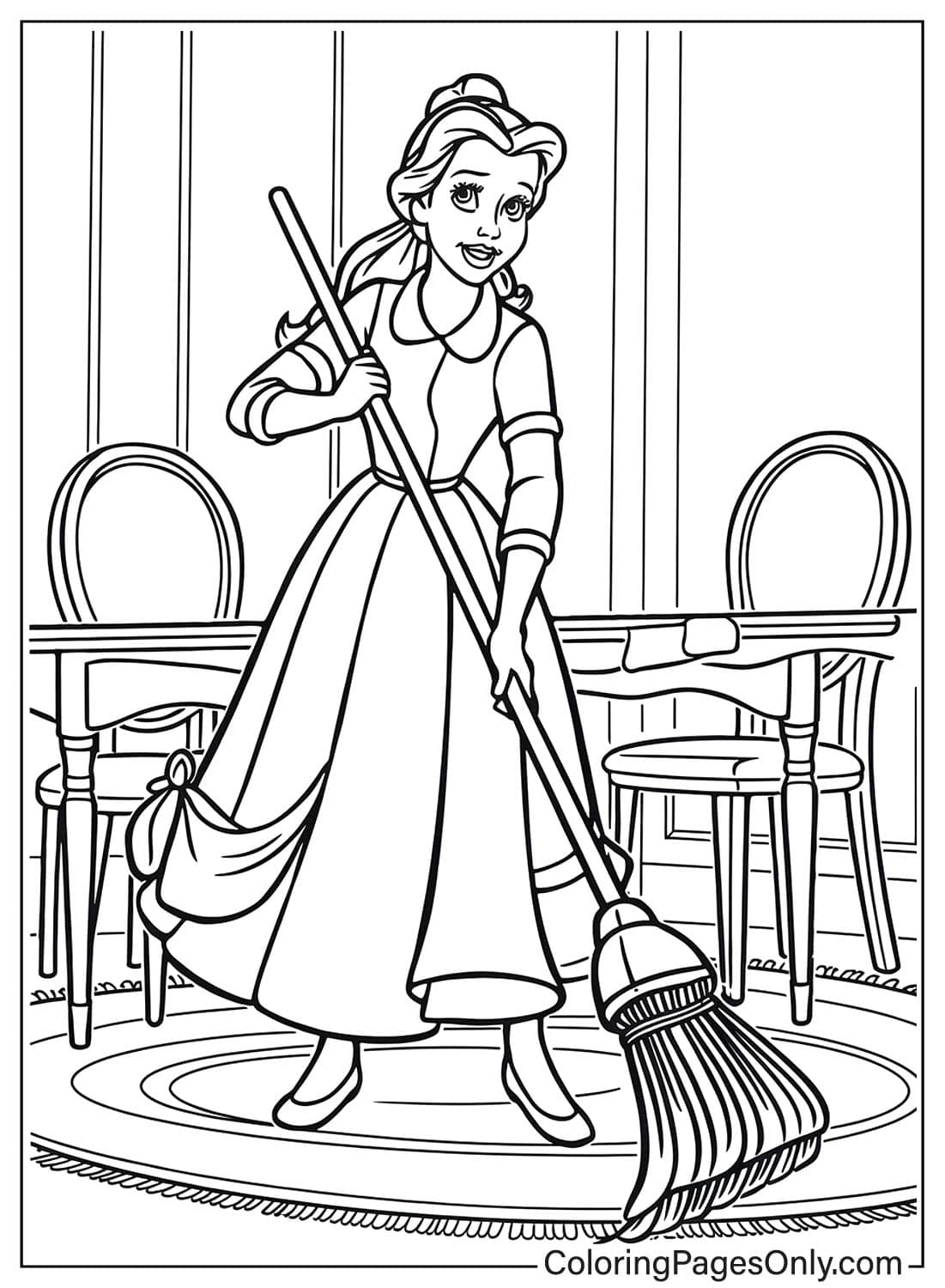
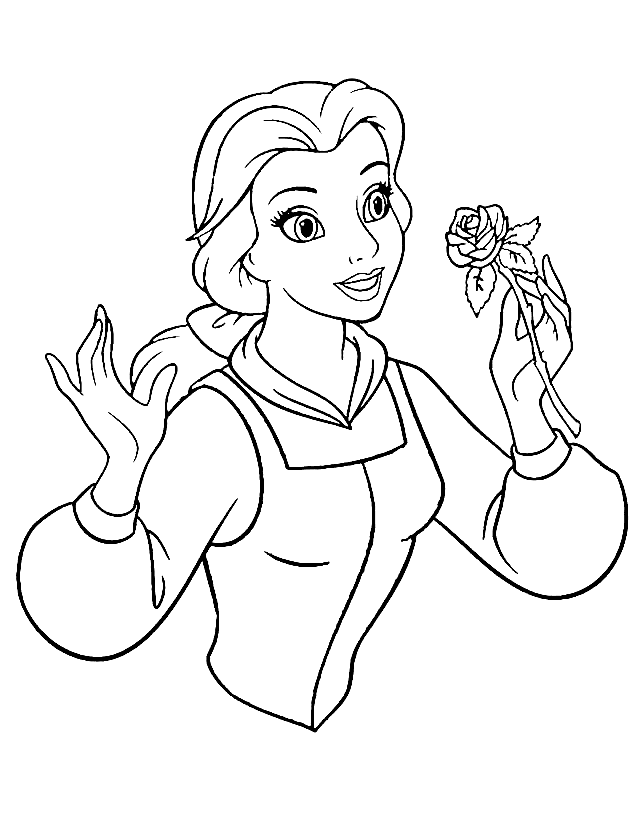
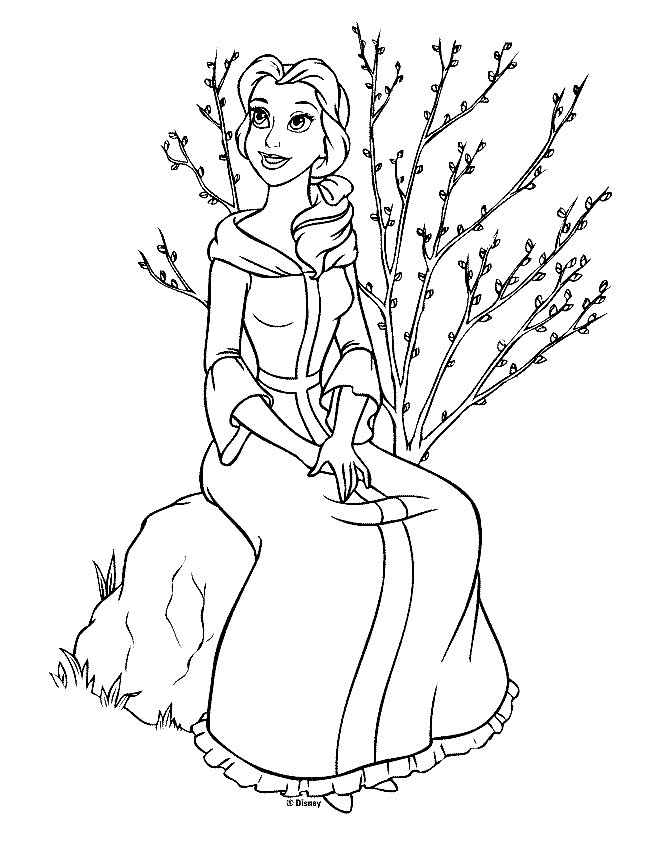
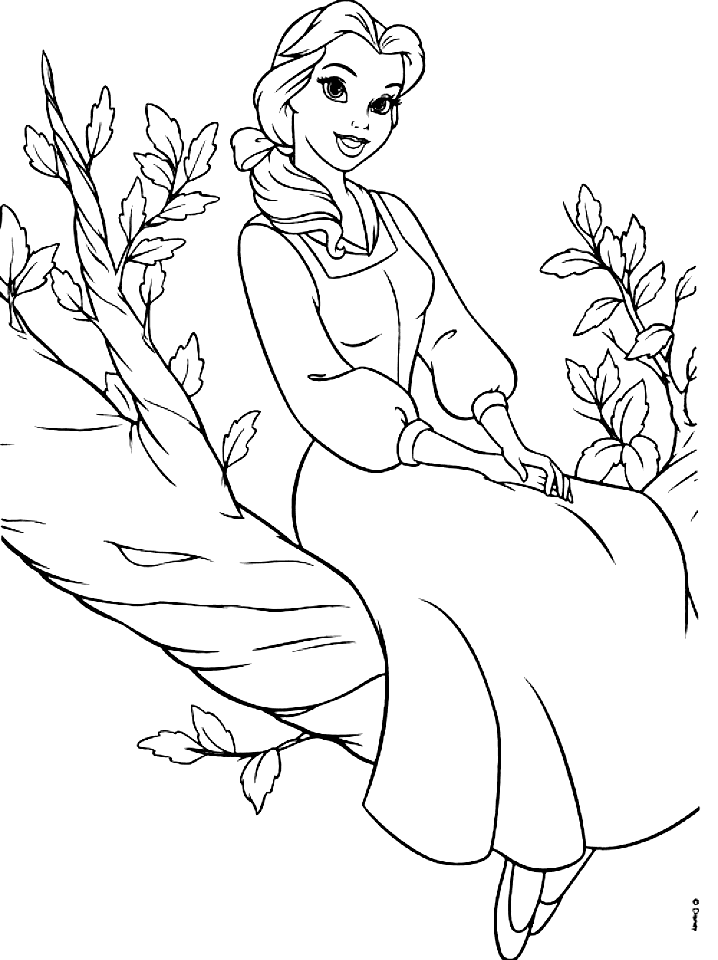
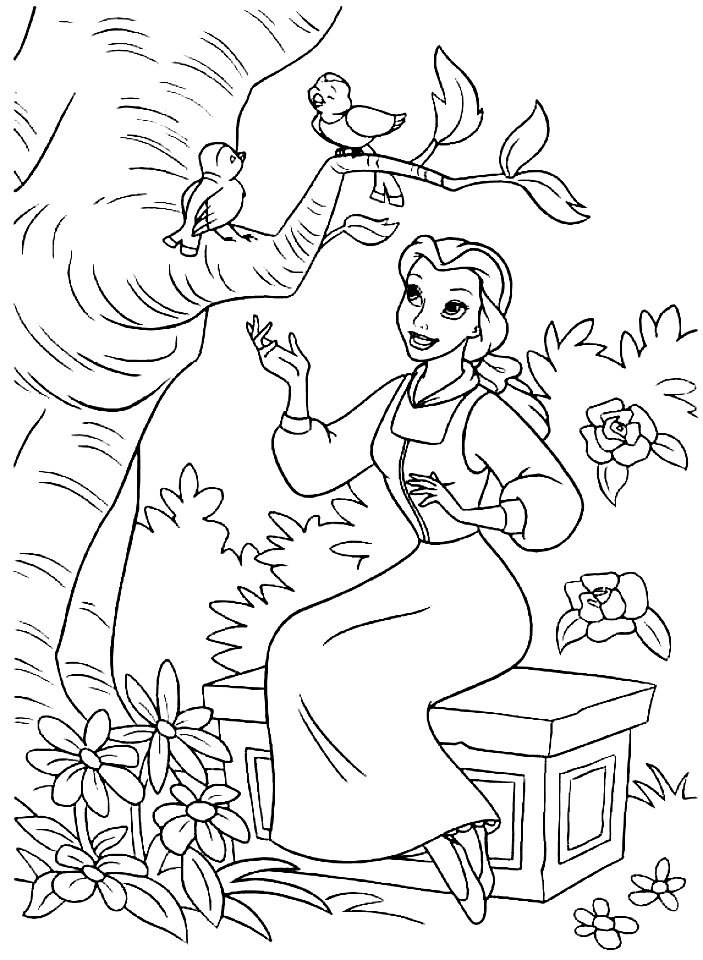
Belle’s opening costume is the visual that introduces her character before she speaks a word: a blue dress with a white apron and white blouse, her brown hair pulled back in a low ponytail secured with a blue ribbon, a book under her arm. This is how the film shows her walking through the village at the start, reading while she walks, exchanging greetings with the townspeople who find her eccentric, reaching the bookshop to return the book she borrowed (“Far off places, daring swordfights, magic spells, a prince in disguise…, and borrowing it again because it is her favorite.
The costume’s color palette communicates the character’s situation within the village: the blue is clean and slightly unusual, setting her apart visually from the warmer, more saturated earth tones of the provincial town, while remaining modest and unpretentious. She is different from the people around her, but not extravagantly so: she is different in the specific way that someone is different when they are consistently paying attention to something that the people around them are not.
The blue of her dress has been one of the more discussed specific color choices in Disney Princess design: it is a medium, cool blue without much grey or purple in it, clean and direct, associated in color psychology with intelligence and calm.
Coloring the village dress: The dress is a clean medium blue, applied at full coverage across the full skirt and bodice. The apron is white or very pale cream, slightly warmer than pure white. The blouse under the dress shows at the collar and sleeves in white. The blue ribbon in her hair matches the dress’s blue exactly. The book she carries, if visible, should be applied in a vivid warm color (she describes it as her favorite, and it appears in warm greens or blues in various depictions).
Belle in Her Iconic Golden Ballgown
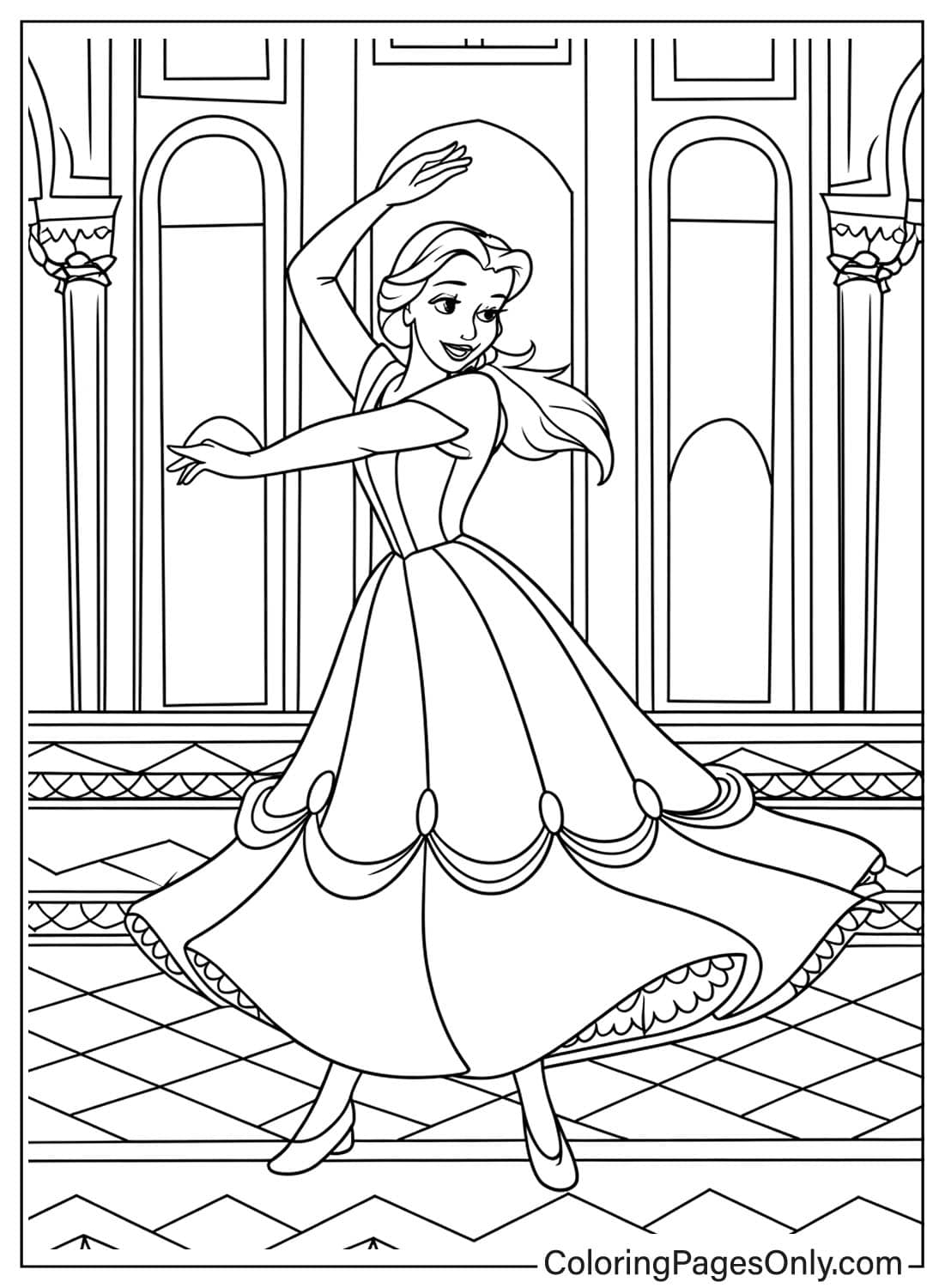
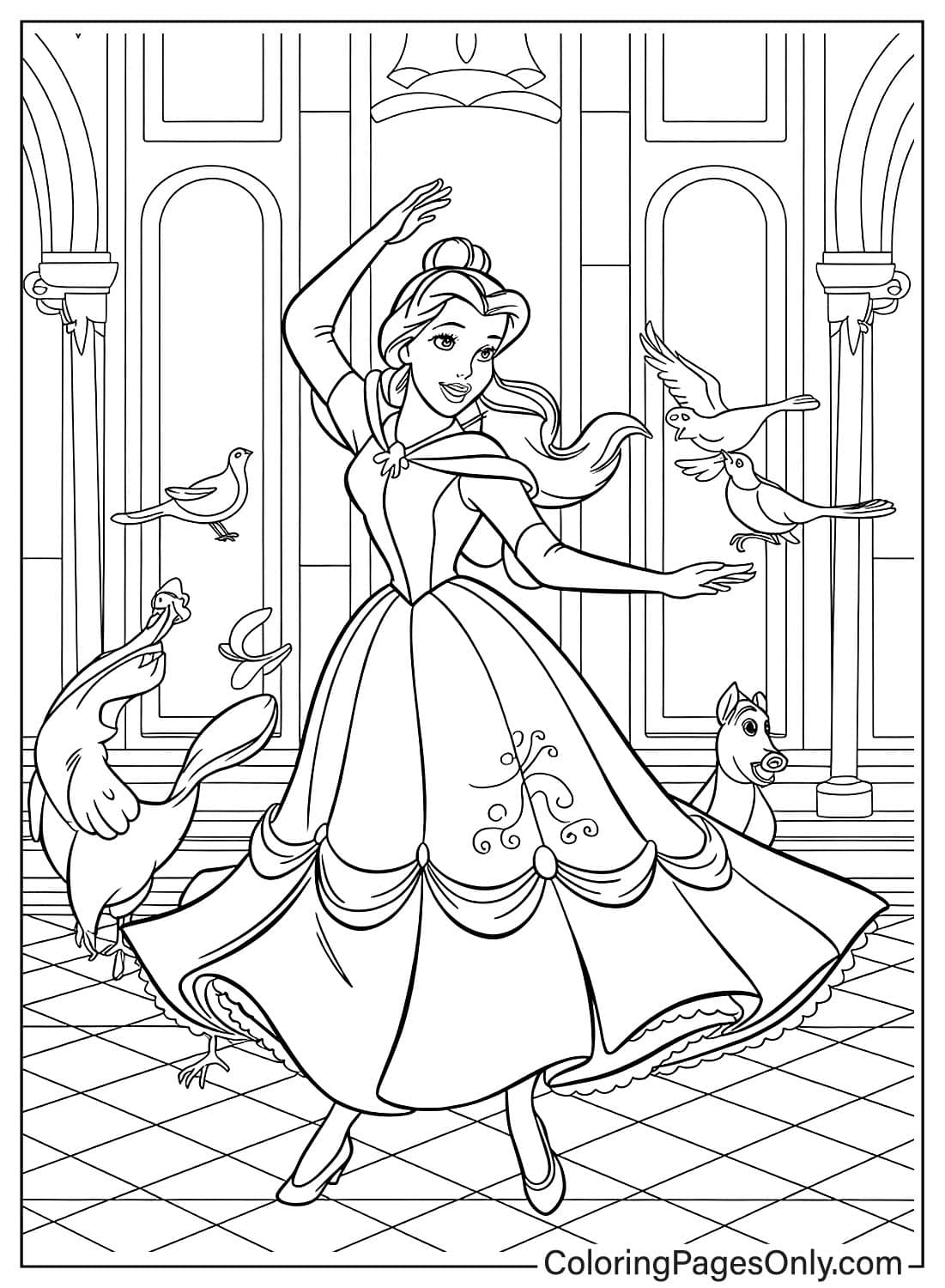
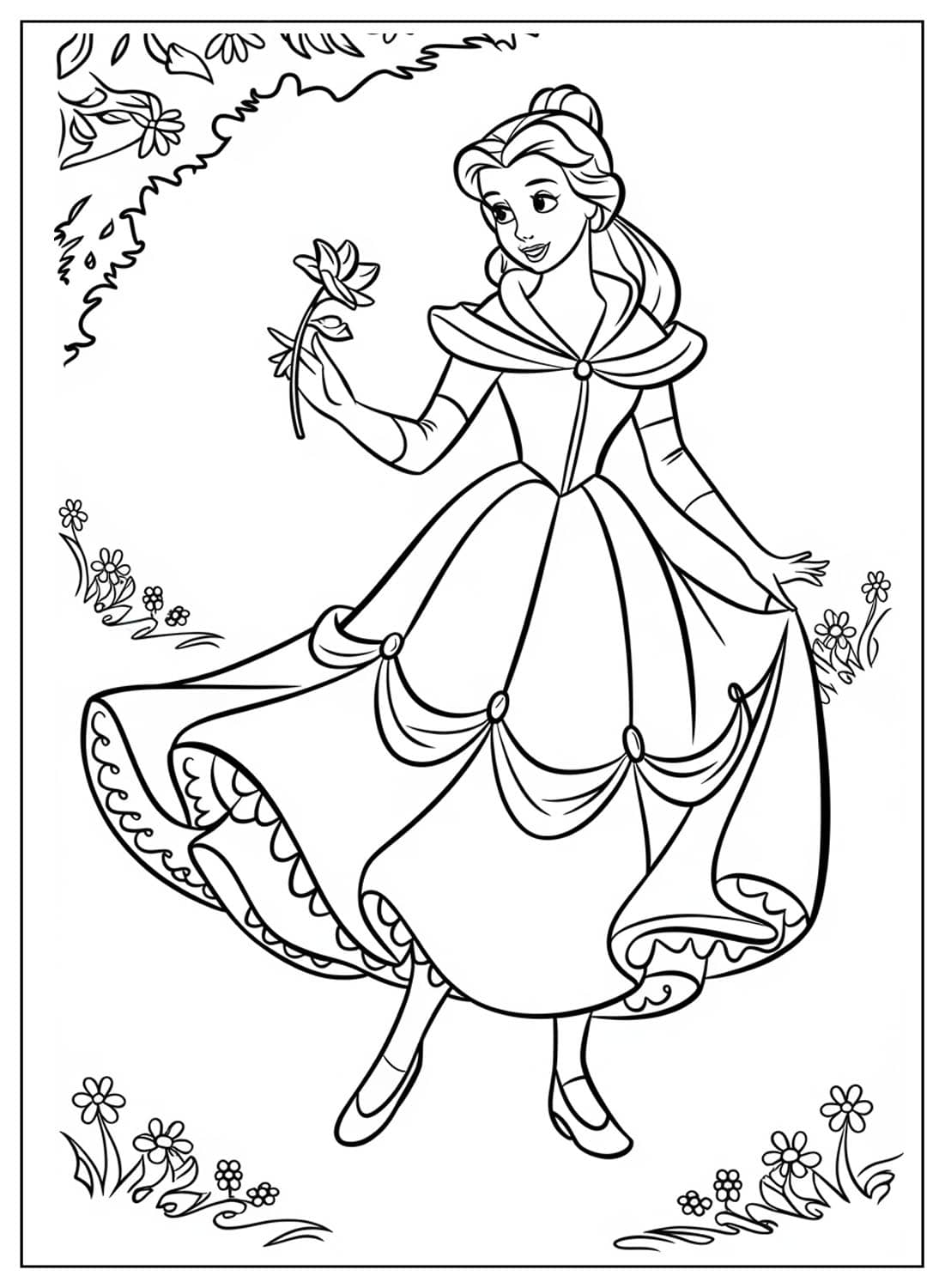
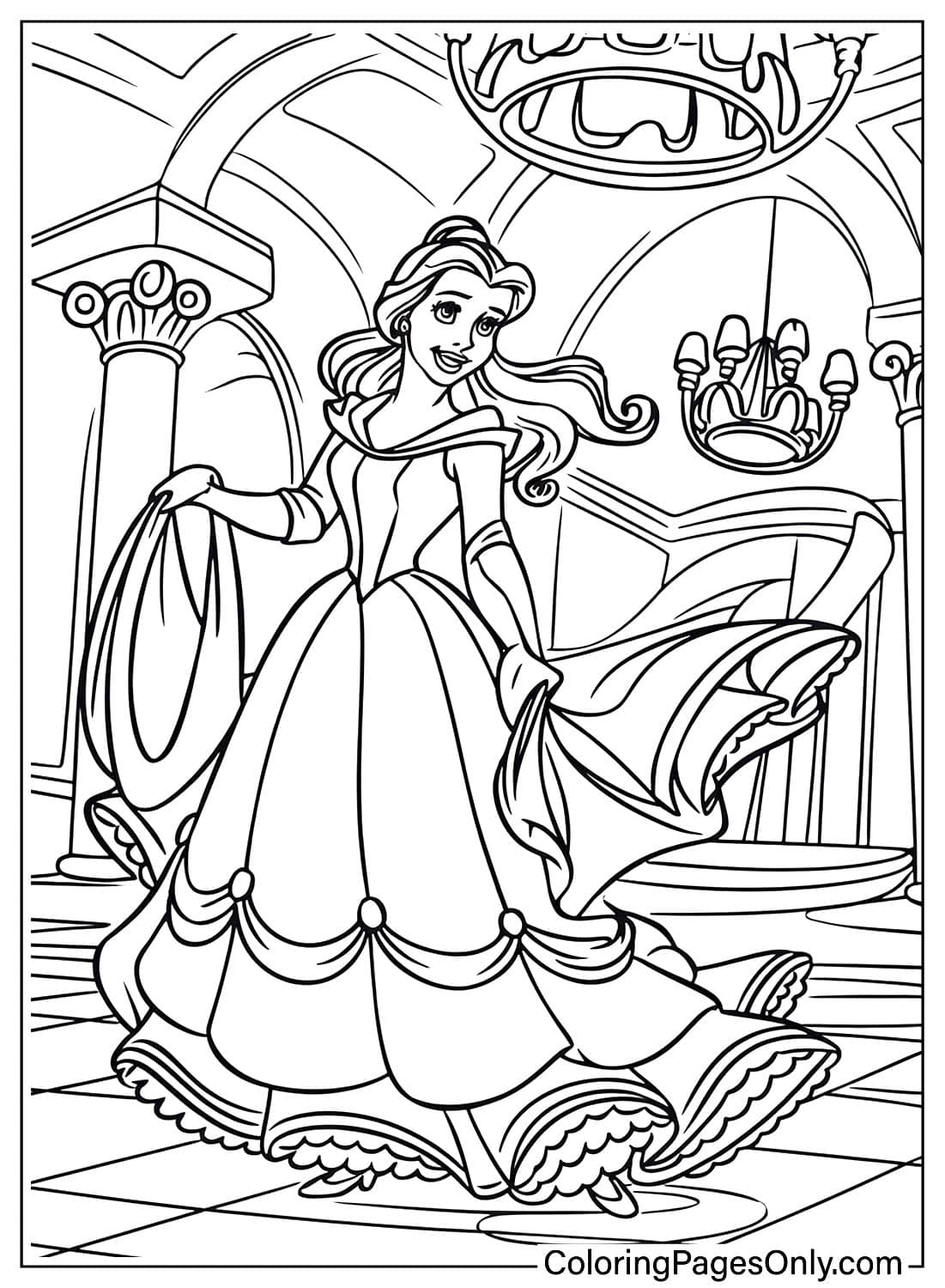
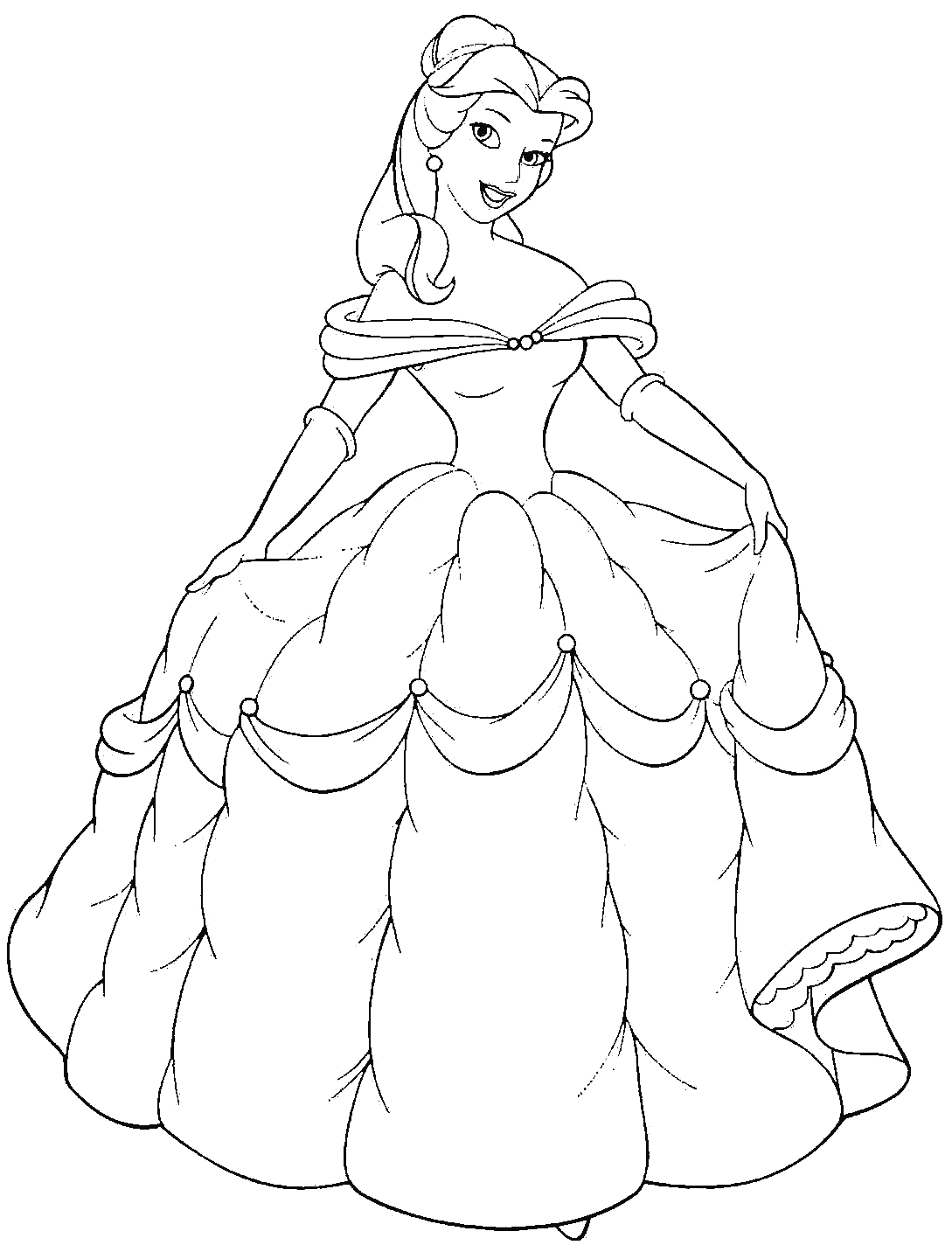
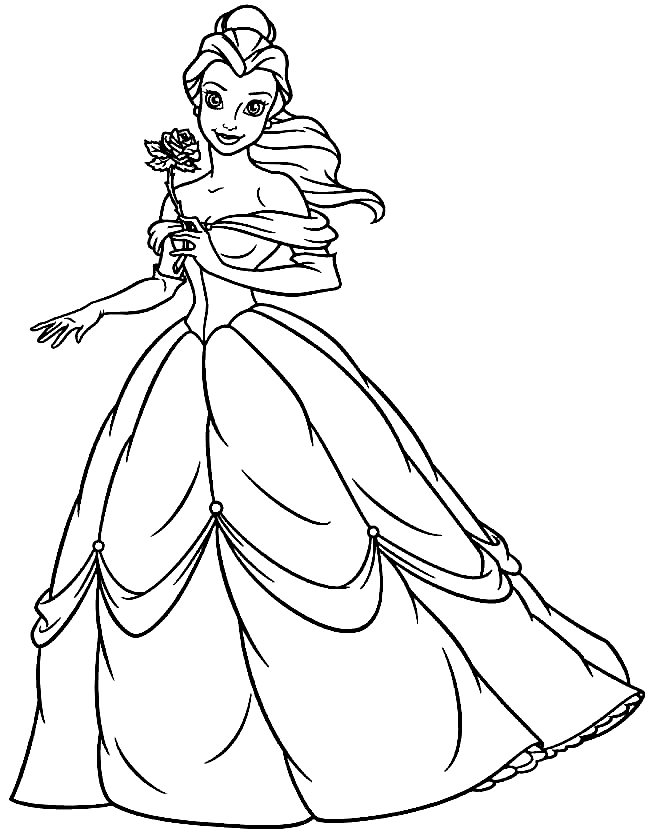
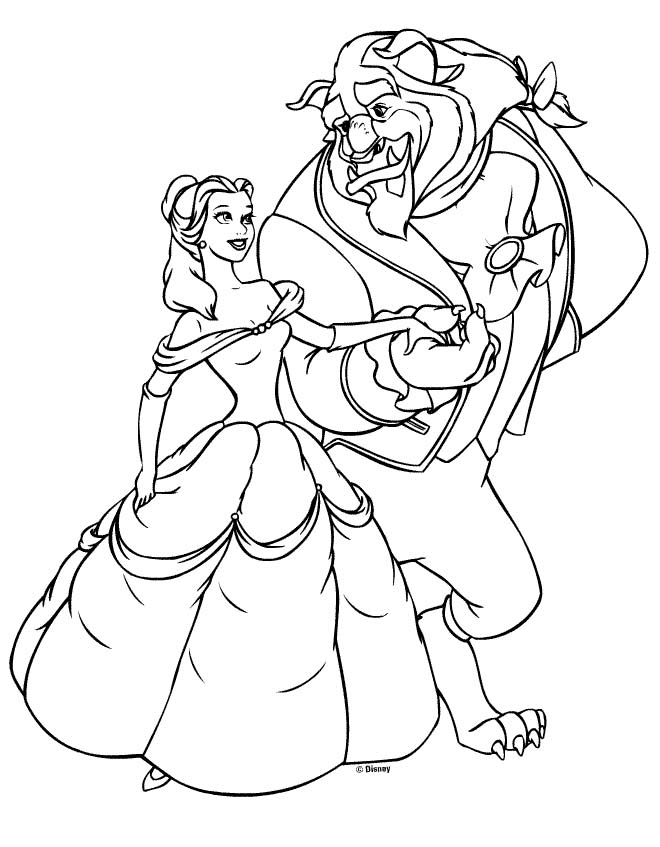
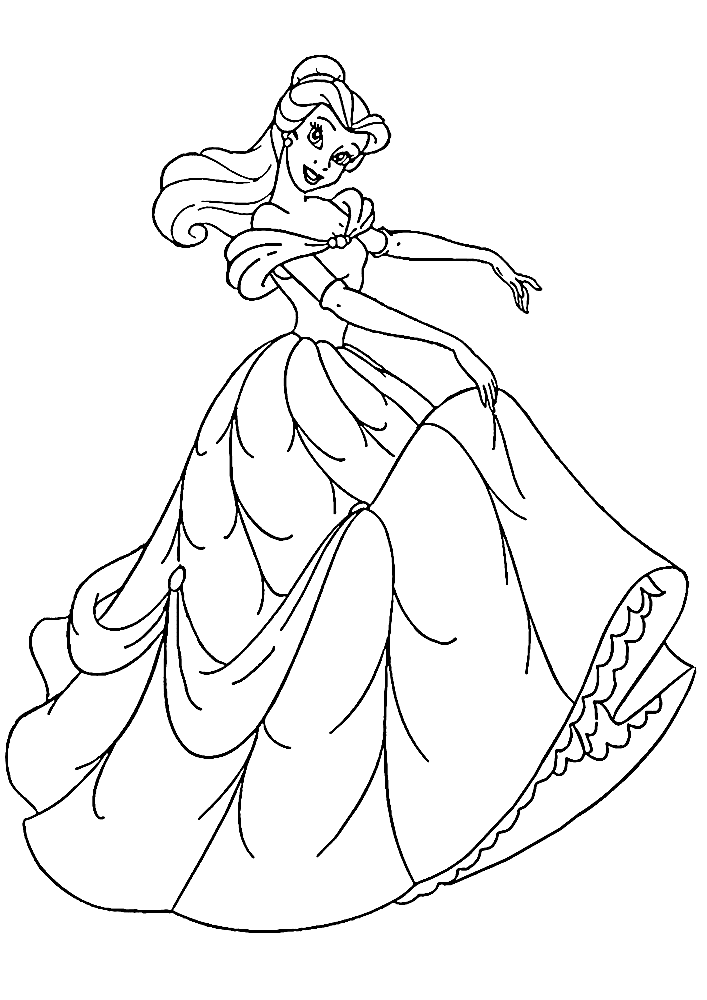
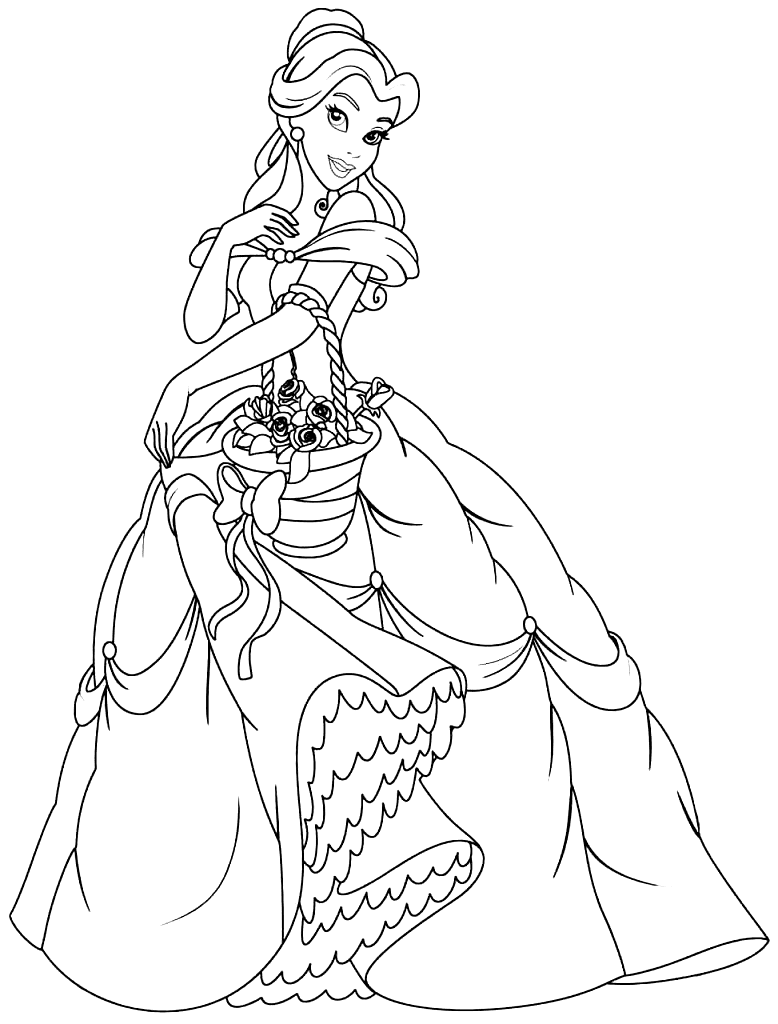
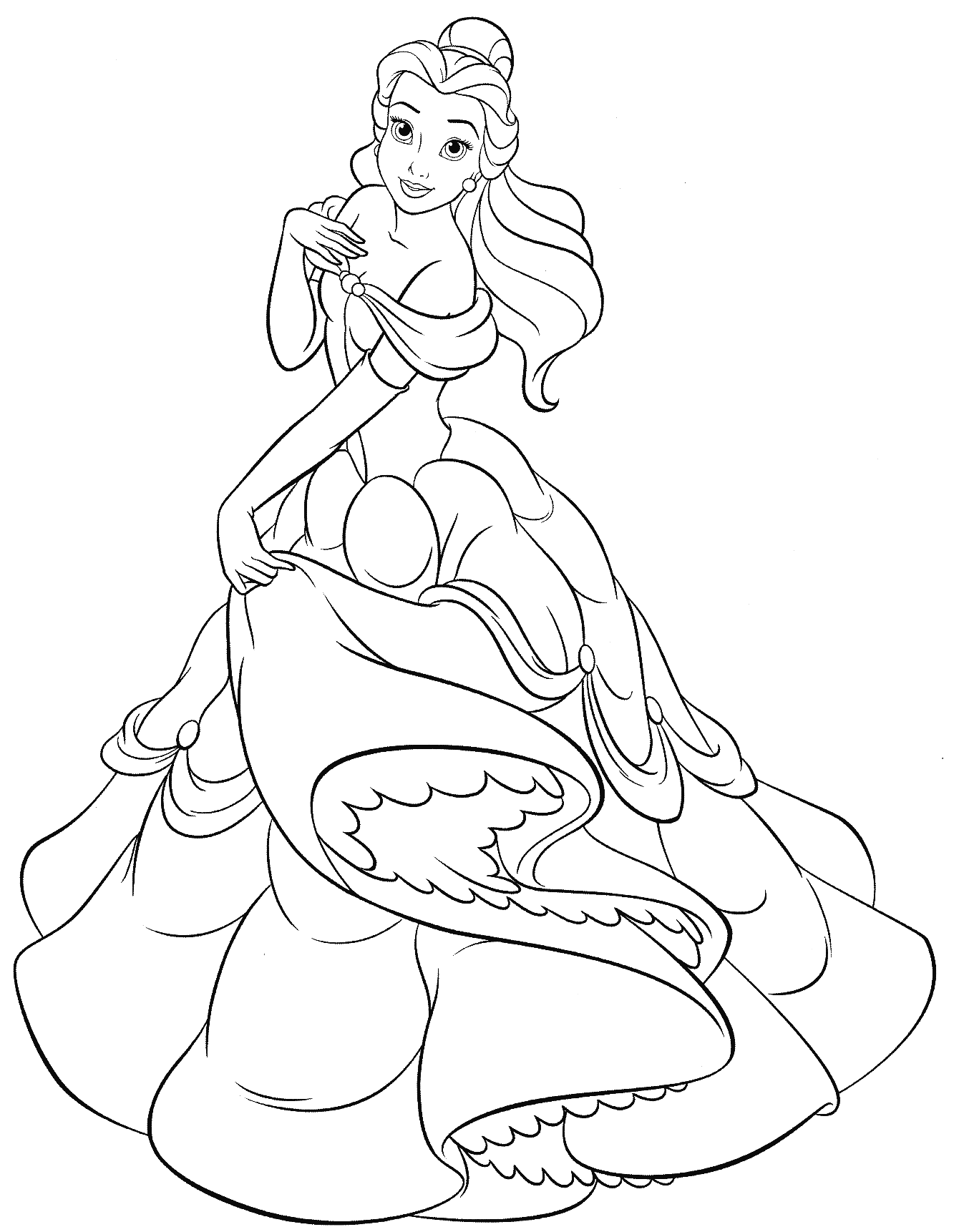
The golden ballgown is Belle’s most iconic costume and the one most associated with her in the Disney Princess franchise’s visual identity. It is a rich amber-gold ball gown with a full skirt, an off-shoulder or wide-shouldered neckline, and white elbow-length gloves. The specific quality of the gold is warm rather than yellow: it reads as golden-amber, the color of spun gold in firelight, not the bright yellow of a sunflower or the pale gold of candlelight.
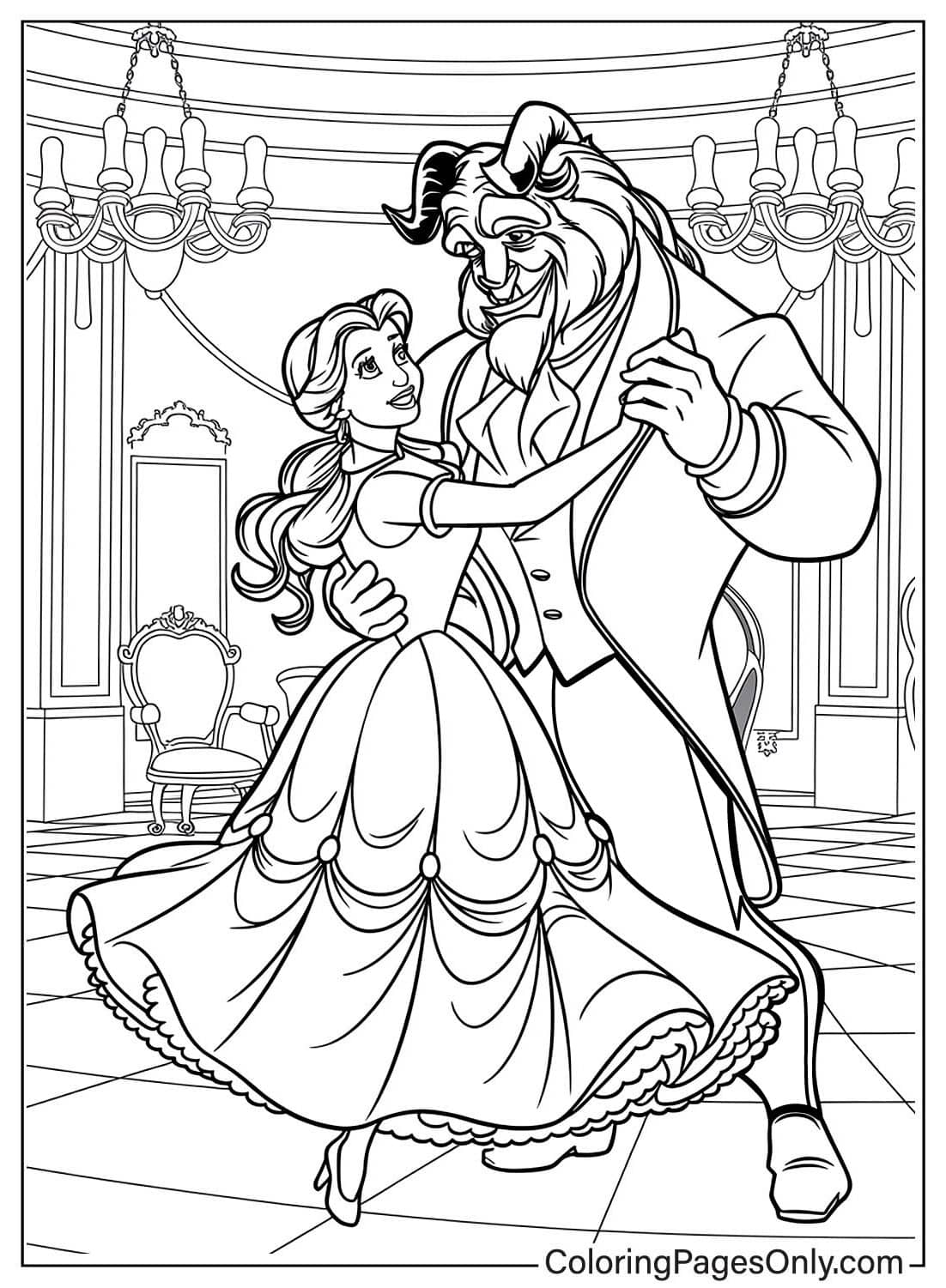
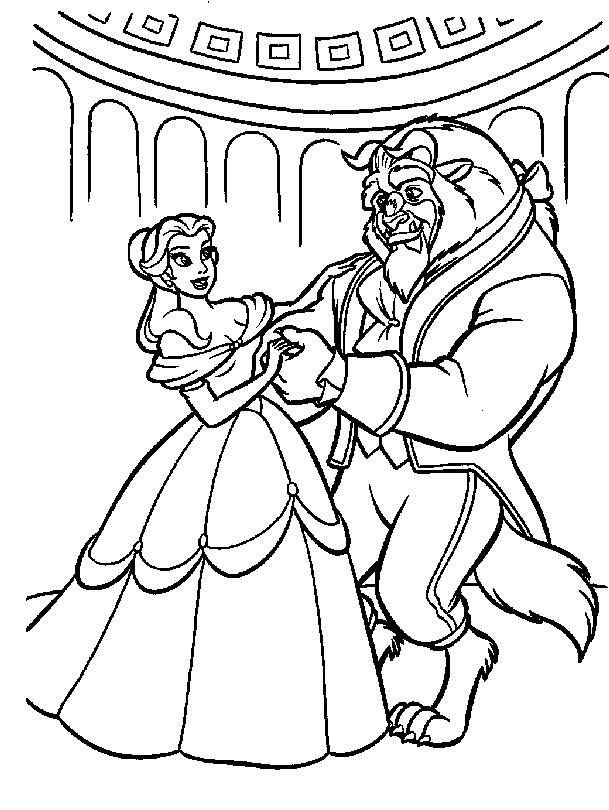
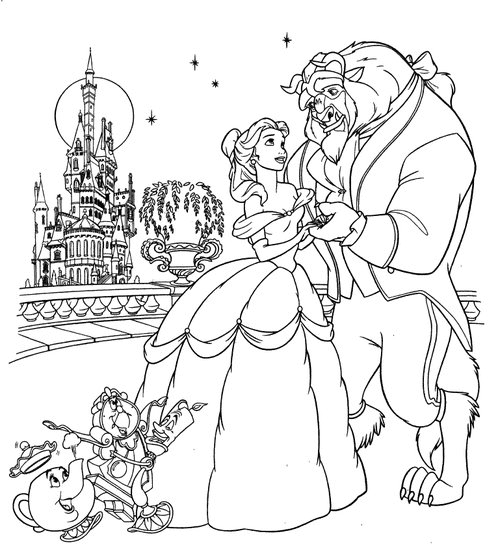
This costume appears in the film’s most celebrated sequence: the ballroom dance between Belle and the Beast, during which Mrs. Potts sings “Beauty and the Beast” from the balcony above the grand dancing floor. The technical achievement behind this scene was significant: Disney’s animation team used early computer-generated imagery to create the ballroom’s rotating floor and grand architectural interior, integrating it with the traditionally hand-drawn characters in what was one of the most significant early uses of CGI in Disney’s animated film production. The contrast between the hand-drawn warmth of the characters and the precisely rendered grandeur of the CGI setting was deliberately used to create the specific visual quality of the sequence.
Belle in her golden ballgown in the ballroom is the most frequently depicted image in the collection and the one that defines how most viewers visualize the character.
Coloring the golden ballgown: The gold is the entire composition’s most important color decision. Apply a warm, amber-gold that reads as clearly gold rather than yellow: a golden color with an orange undertone rather than a green or pure-yellow undertone. The skirt is the largest single color area on the page and should be applied with full, even coverage. The white gloves are clean, warm white. The ballroom environment, if visible in the background, uses cream-gold for the architectural elements and very pale warm grey for the grand stone surfaces.
Belle in the Library
The scene in which the Beast gives Belle access to his enormous library is one of the film’s most emotionally significant moments: it is the first time the Beast does something for Belle specifically rather than transactionally, and it is the scene that most clearly communicates why these two characters might genuinely understand each other. Belle’s response when she sees the library, “Have you read all of these?” and the Beast’s sheepish admission, “Well, some of them,” is one of the film’s most quietly effective character moments.
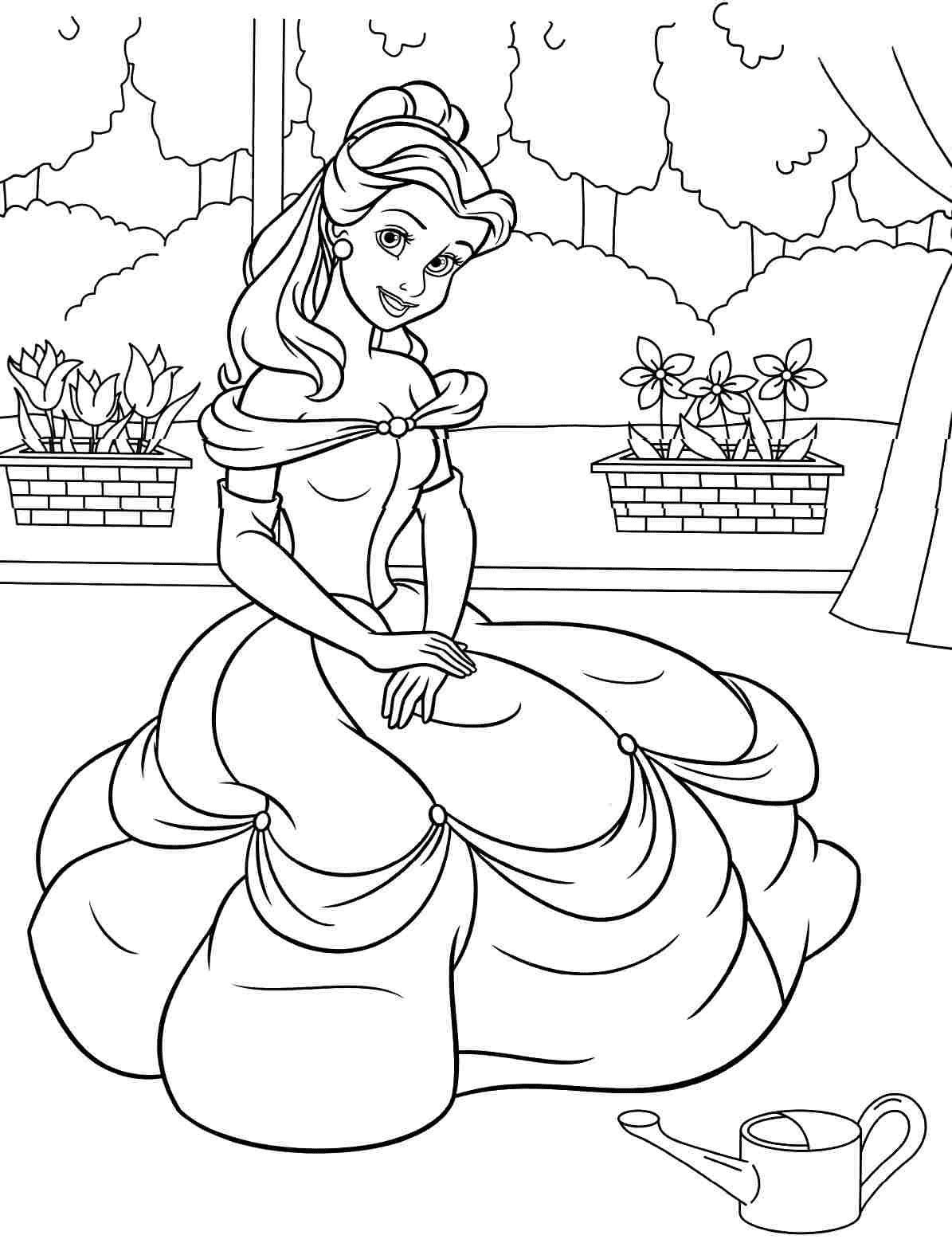
The library is depicted as an enormous two-story room lined floor-to-ceiling with bookshelves, with a rolling library ladder for reaching the upper levels. Belle is typically shown in the library in her pink or rose-colored dress, a shorter, less formal costume than the ballgown, which she wears during her time inside the castle before the ballroom scene.
The pink dress is her second most iconic costume and the one in which she appears in many of the film’s intimate interior scenes.
Coloring library pages: Belle in the pink/rose dress: apply a warm medium rose-pink across the skirt and bodice, slightly more muted and less vivid than a full saturated pink. The library bookshelves behind her use warm dark brown for the wood, with book spines in a variety of colors applied systematically along the shelf rows. The warm amber-gold of candlelight or firelight, if present in the scene, creates warm light across all surfaces closest to the light source.
Belle and the Enchanted Objects
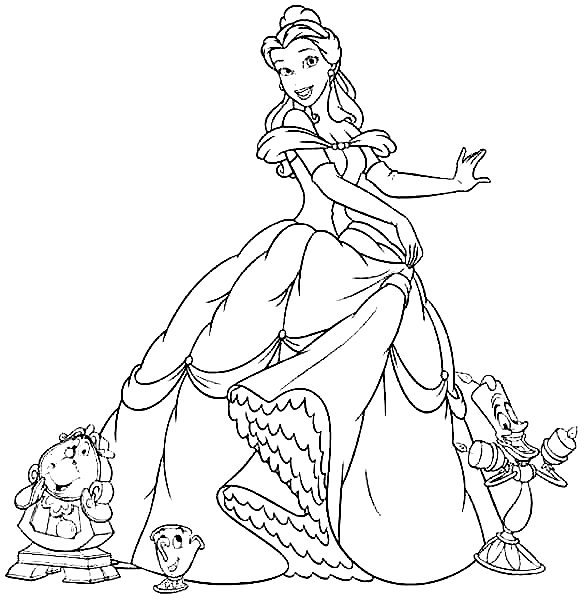
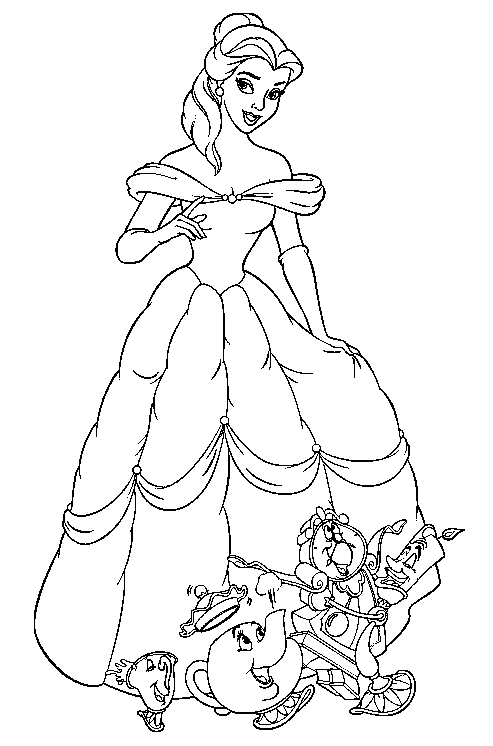
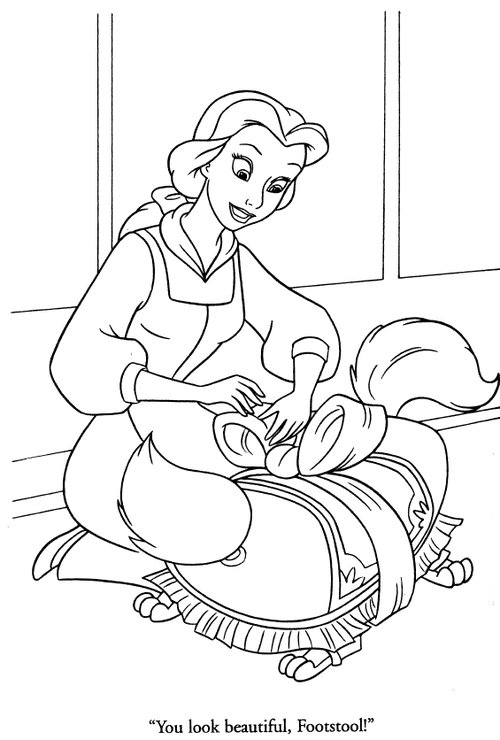
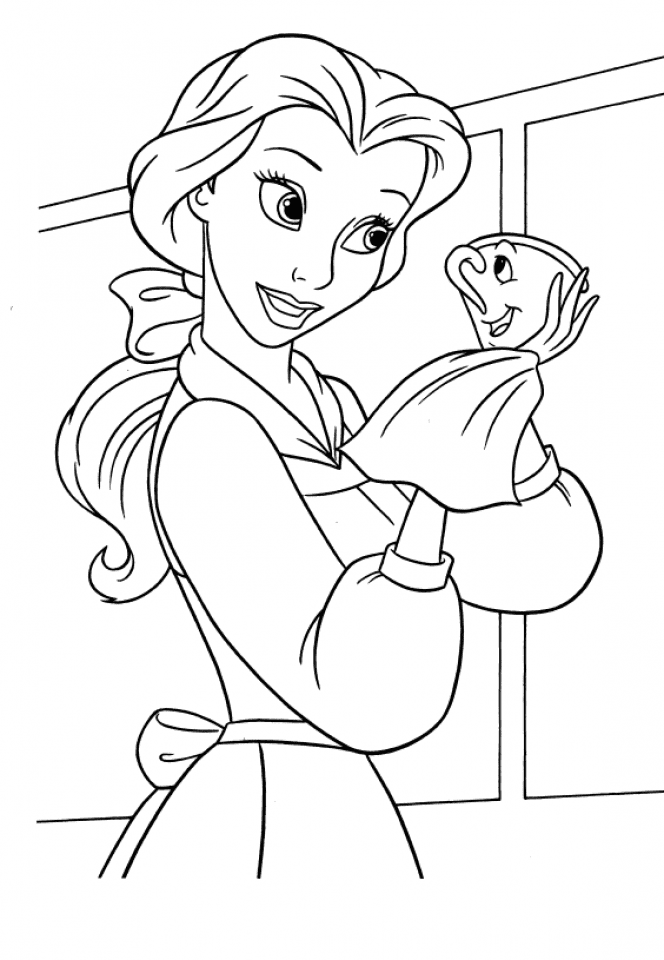
The castle’s enchanted household objects are the film’s most visually diverse character group and the source of its most elaborate production number, “Be Our Guest.” Lumière (a candelabra with a warm French accent and a flair for theatrical presentation), Cogsworth (a mantel clock, precise, rule-following, and perpetually anxious), Mrs. Potts (a teapot, warm and maternal, the voice of reason and comfort in the castle), and Chip (Mrs. Potts’s teacup son) form the ensemble that most directly supports Belle during her time in the castle.
Pages showing Belle with one or more of these characters capture the specific warmth of her integration into the castle’s household: she does not simply endure the enchanted castle. Still, she genuinely connects with its residents, who in turn find in her the first visitor who has treated them as the people they still are rather than as the objects they appear to be.
Coloring enchanted object pages: Lumière is a golden-yellow candelabra with a warm human face: apply vivid warm gold across the candlestick body with pale yellow candle wax on the candle tops and a warm, vivid yellow-orange for any visible flame. Cogsworth is a warm tan-gold mantel clock with a round face showing Roman numerals and a pendulum: apply warm tan-gold with dark brown details for the clock’s carved decorative elements. Mrs. Potts is a white teapot with a warm, round face: clean white with a small pink nose and warm pink cheeks. Chip is a small white teacup with one chip in the rim and large, round eyes.
Belle and the Beast: Relationship Pages
Pages showing Belle and the Beast together range from the early tense standoffs of their first meetings to the warmth of the scenes after they have begun to understand each other genuinely. The Beast’s visual design, created by animator Glen Keane, combines features from multiple animals: a lion’s mane, a bison’s horned head, a gorilla’s brow structure, a bear’s body, and a wolf’s legs and tail. The combination produces a creature that is genuinely formidable-looking but whose face, in the scenes after the relationship develops, becomes increasingly readable as emotional and capable of vulnerability.
The contrast between the Beast’s blue formal attire in the ballroom scene (dark navy blue evening coat with gold epaulets) and Belle’s gold ballgown is the film’s most color-coordinated visual composition and the one most reproduced in Disney Princess merchandise.
Coloring Belle and Beast pages: The Beast’s dark blue ballroom coat is the most important color decision in any ballroom duo page: apply the deepest available navy blue across the coat’s full surface. The gold epaulets and buttons should match the warmth of Belle’s golden gown, creating a color connection between the two characters that reflects their emotional connection. The Beast’s fur, visible on his face, hands, and wherever the coat does not cover, is a warm dark brown-gold.
The Enchanted Rose Pages
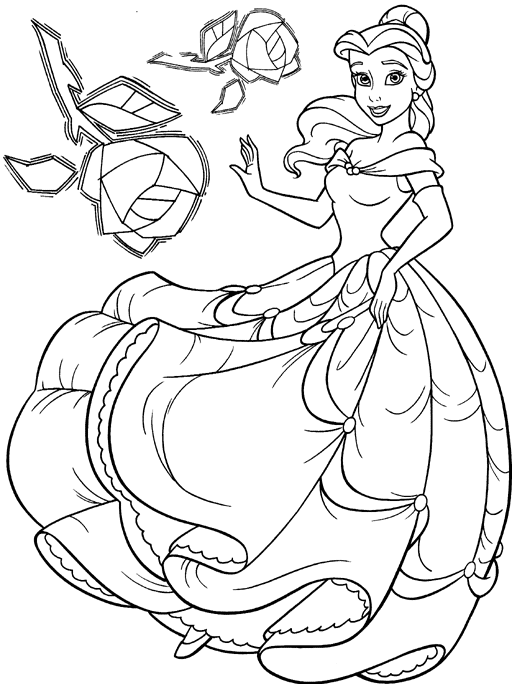
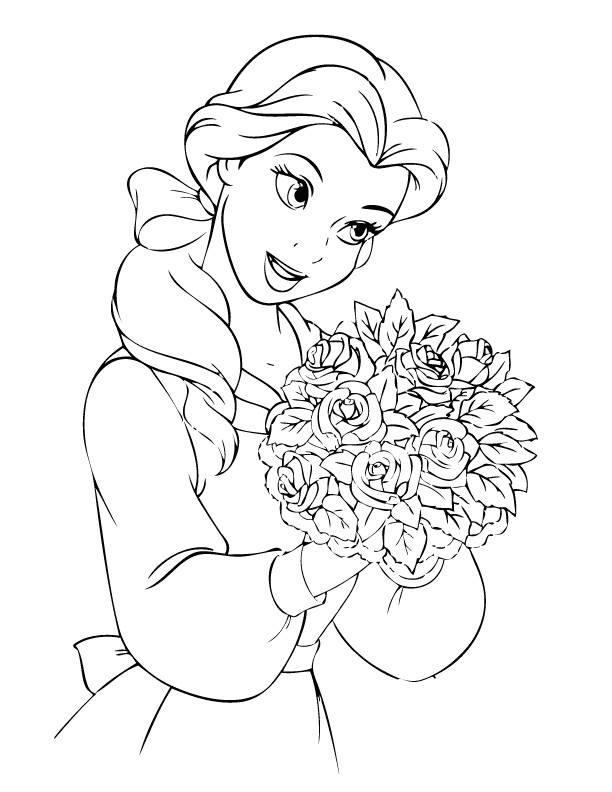
The enchanted rose under its glass dome is the film’s central visual symbol: the mechanism of the curse that transformed the prince and his household, the countdown clock of the story’s stakes, and the object through which the film’s thematic content about love, time, and transformation is made physically visible. The rose is depicted as a red rose that has been enchanted to bloom until the prince’s 21st birthday. Each falling petal marks the passage of time and the narrowing possibility of breaking the curse.
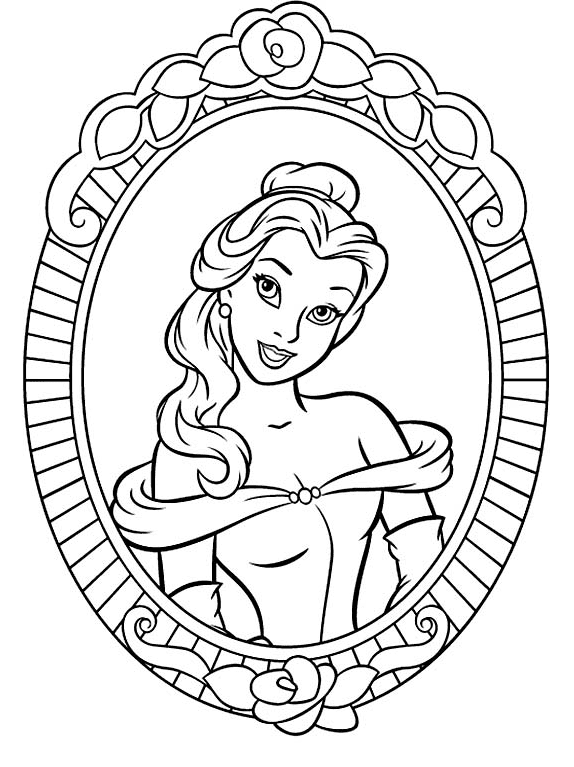
Rose pages may show the rose under its glass dome (the specific image of the glowing enchanted rose in the Beast’s tower), a close-up portrait of the rose itself, or rose imagery as a decorative border element in Belle portrait pages.
Coloring the enchanted rose: The rose itself is the most vivid red in the entire composition. Apply a fully saturated warm red across all petals. The glow effect around the enchanted rose, which makes it appear to emit its own light, is rendered as a very pale warm yellow-gold applied at minimum pressure around the rose’s perimeter, fading quickly to the surrounding air. The glass dome is rendered with a very subtle cool grey highlight along its curved upper edge and a few thin, slightly curved highlight lines suggesting the transparency of the glass surface.
What These Pages Do
The literary source of Beauty and the Beast has a specific and documented publication history that places it within the 18th-century French tradition of the literary fairy tale (conte de fées). Jeanne-Marie Leprince de Beaumont’s 1756 version, published in a magazine intended for the education of young women, was explicitly designed as a pedagogical text: the story of Belle’s virtue, patience, and ability to see past surface appearances was intended to communicate values to a young female readership. The character’s defining quality in the source text is not beauty (which the name suggests and which the village confirms) but interiority: the capacity for genuine feeling, careful observation, and the specific wisdom of someone who reads attentively.
The 1991 Disney adaptation made Belle’s reading a central visual motif: she is introduced with a book, she borrows books from the village bookshop, she is given the Beast’s library, and her love of reading is the quality that most directly enables her connection with the Beast (who, as a prince before the curse, had access to the library she discovers). The film’s opening song establishes her as an outsider in her village precisely because she is always reading. This is a specific and deliberate character design decision by the film’s creative team: Belle’s intellectual life is not incidental to her character but its defining feature.
The American Academy of Pediatrics identifies fine motor skill development as a key childhood milestone throughout early childhood. The detailed ballgown fabric rendering, the enchanted rose’s petal work, the candelabra Lumière’s many-branched form, and the decorative architectural elements of the enchanted castle all provide motivated fine motor practice across the collection’s wide age range. The 2005 Art Therapy Journal study on structured coloring and anxiety reduction applies throughout.
The 2017 live-action remake, with Emma Watson as Belle and an expanded production budget of $160 million, earned $1.263 billion worldwide, making it the highest-grossing film of 2017. Its success confirms the ongoing cultural relevance of the character and the story.
How to Color These Pages Well
The gold ballgown requires the warmest available gold, not yellow. The most common error on Belle’s ballgown pages is using a bright yellow that reads as sunflower or butter rather than the warm amber-gold of the actual costume. The gown’s specific tone has an orange warmth: it is gold as in firelight or spun gold, not gold as in pale sunshine. If the available gold leans too yellow, layer a small amount of warm orange-gold over it. The gown should read as unmistakably gold from across the room, rich and warm.
Belle’s brown hair has a specific warm quality that should not read as dark or cold. Her signature brown ponytail is a warm, medium-light brown with some richness in it: not dark chocolate brown, not cool grey-brown, but a warm chestnut-brown that reads as naturally warm and feminine. Apply a warm medium brown as the base. Shadow areas in the hair, where the ponytail curves and creates depth, use a slightly darker warm brown. The hair ribbon, matching the blue of her village dress or the yellow of the ball gown, depending on which costume is depicted, should be applied after the hair is complete.
The village dress blue must be clean and unambiguous. The medium blue of Belle’s village dress is one of the Disney Princess franchise’s most specifically noted colors. It should read as clearly, straightforwardly blue: not blue-green, not blue-grey, not periwinkle, but clean medium blue. Apply it at full coverage and full saturation across the skirt and bodice. The white apron over it should be the cleanest available white, providing maximum contrast with the blue dress beneath.
The enchanted objects require careful facial detail at a small scale. Lumière, Cogsworth, Mrs. Potts, and Chip all have small human faces embedded in their object forms. These faces are the most character-communicating elements on any page featuring the enchanted objects. Apply the skin tone and facial features carefully at whatever scale the page allows: the eye positioning, the expression, and the specific character-defining features (Cogsworth’s bushy mustache, Mrs. Potts’s rosy cheeks, Chip’s single chipped tooth) are what make these objects recognizable as the specific characters rather than as generic animated objects.
Rose coloring requires the most vivid warm red available at full saturation. The enchanted rose is the page’s emotional anchor and should receive the most vivid warm red in the colorist’s collection, applied at full pressure across all petal surfaces. Shadow areas within each petal use a slightly deeper, slightly more purple-shifted red. The transition from the brighter red at the petal’s upper lit surface to the deeper red in the petal’s shadow should be gradual, suggesting the curved three-dimensional quality of a real rose petal.
5 Creative Craft Ideas
The Three Costumes Triptych
Belle wears three primary costumes across the 1991 film: the blue village dress (her everyday provincial life), the pink/rose casual dress (her life inside the castle), and the iconic golden ballgown (the film’s climactic ball). Print one page for each costume. Color the blue dress in clean medium blue with a white apron. Color the pink dress in warm medium rose-pink. Color the golden ball gown in the richest warm amber-gold available.
Mount all three in sequence on a backing sheet: “Belle: three costumes. Three moments. Blue: the village, the books, the morning of the adventure. Pink: the castle, the library, the friendship that grows. Gold: the ballroom, the dance, the moment the curse begins to break.”
The Literary Fairy Tale Timeline
“Beauty and the Beast” exists in documented literary form across three centuries. Print a Belle-with-book page. Color carefully in the blue village dress or pink castle dress. Mount with the following timeline:
“1740: Gabrielle-Suzanne Barbot de Villeneuve. ‘La Jeune Américaine et les contes marins.’ First published version of Beauty and the Beast. 1756: 1756 : Jeanne-Marie Leprince de Beaumont. ‘Magasin des enfants.’ The shorter, most widely known literary version. Written as an educational text for young women. 1991: Walt Disney Pictures. Directed by Gary Trousdale and Kirk Wise. First animated film nominated for an Academy Award for Best Picture. 2017: Walt Disney Pictures. Live-action. Emma Watson as Belle. $1.263 billion worldwide. 251 years between Villeneuve’s publication and the 1991 film. The story endures.”
The Ballroom Light Study
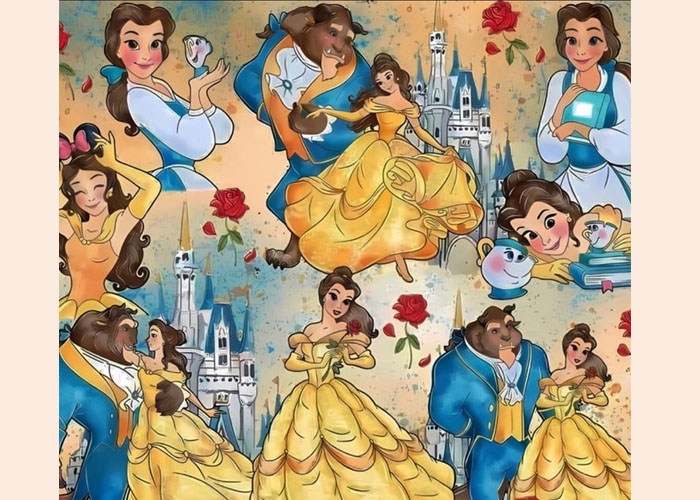
The ballroom scene in Beauty and the Beast (1991) used one of the earliest integrations of CGI into Disney’s traditional animation, specifically to create the rotating ballroom floor and grand architectural space. The hand-drawn characters (Belle in her gold gown, the Beast in his navy coat) move through a CGI architectural environment, producing a visual contrast that was deliberately engineered to give the sequence its particular quality.
Print the ballroom dancing scene page. Color Belle’s gown in rich, warm amber-gold. Color the Beast’s coat in deep navy blue. Color the ballroom’s ceiling and floor in pale warm cream-gold.
On the backing card: “Beauty and the Beast (1991). Ballroom scene. Belle’s golden gown: traditional hand-drawn animation. The Beast’s navy coat: traditional hand-drawn animation. The rotating ballroom floor and architectural interior: computer-generated imagery, one of the first major CGI integrations in Disney’s animated film history. First animated film nominated for an Academy Award for Best Picture. 64th Academy Awards, 1992.”
The Howard Ashman Page
The title song “Beauty and the Beast,” sung by Angela Lansbury, won the Academy Award for Best Original Song at the 64th Academy Awards in 1992. Its lyrics were written by Howard Ashman, who also wrote the lyrics for “Be Our Guest,” “Belle,” and the other songs in the film. Ashman died of AIDS-related complications on March 14, 1991, before the film was released. He had worked on the film from its early stages of development, and his contributions to both Beauty and the Beast and the preceding The Little Mermaid (1989) are considered foundational to the Disney Renaissance.
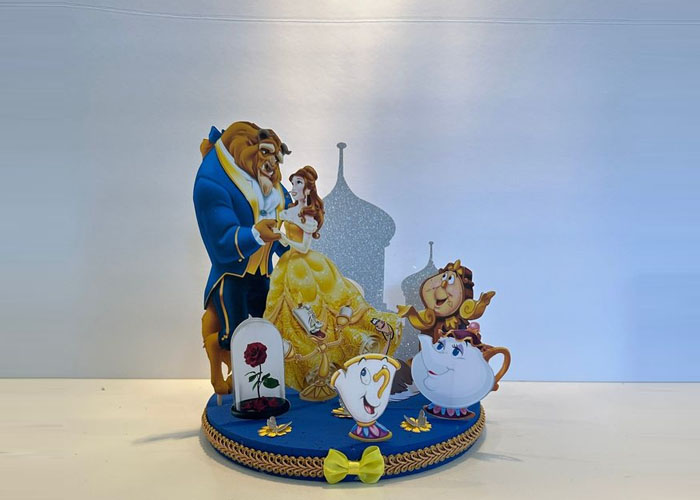
Print a scene page from the ballroom sequence: Color Belle and the Beast dancing in their blue and gold.
On the backing card: “Howard Ashman. Lyricist. ‘Beauty and the Beast.’ ‘Be Our Guest.’ ‘Belle.’ ‘Kiss the Girl.’ ‘Under the Sea.’ Howard Ashman died March 14, 1991. The film was released on November 13, 1991. He did not see it. A dedication at the film’s end: ‘To our friend Howard, who gave a mermaid her voice and a beast his soul, we will be forever grateful.’ Academy Award for Best Original Song, 1992.”
The Village to Castle: Belle’s World
Belle’s story moves between two distinct visual worlds: the warm, slightly claustrophobic provincial village of the film’s opening sequences, and the grand, cold, then increasingly warm, enchanted castle. Print one Bel,le-in-village page and one Belle-in-castle page.
Color the village page in warm earth tones and the modest blue of her village dress: the warmth of the village is the warmth of community and familiarity. Color the castle page in the richer, more elaborate tones of the enchanted interior: the gold of candlelight, the dark stone of the architecture, the rose red of roses.
Mount both: “The village: familiar. Provincial. Everyone knows her name. No one understands her. The castle: strange. Frightening. No one knows her. Eventually: home. The books were there all along.”
Frequently Asked Questions
Who is Belle, and what film does she come from? Belle is the main protagonist of Beauty and the Beast, produced by Walt Disney Pictures and released on November 13, 1991. She is a young woman living in a small provincial French village who is characterized primarily by her love of reading and her unwillingness to accept the conventional expectations placed on her by her community. The film follows her after her father Maurice is imprisoned by the Beast, a prince cursed by an enchantress who transformed him and his entire household into objects until someone could love him for who he is. Belle takes her father’s place as the Beast’s prisoner and gradually comes to know and care for him. The film was directed by Gary Trousdale and Kirk Wise, produced by Don Hahn, and features music by Alan Menken with lyrics by Howard Ashman.
What is the source of the Beauty and the Beast story? The Beauty and the Beast story exists in two significant 18th-century French literary versions. The first was published by Gabrielle-Suzanne Barbot de Villeneuve in 1740 in “La Jeune Américaine et les contes marins,” a long and complex version of the tale. The shorter, more widely known literary version was published by Jeanne-Marie Leprince de Beaumont in 1756 in “Magasin des enfants” (Magazine for Children), a publication designed for the education of young women. Leprince de Beaumont’s version was explicitly didactic: the story of Belle’s virtue, patience, and ability to see past surface appearances was intended to model qualities considered desirable in young women of the period. The Disney 1991 adaptation drew primarily from Leprince de Beaumont’s version while adding original characters, songs, and narrative elements.
What are Belle’s iconic costumes and their colors? Belle wears three primary costumes in the 1991 animated film. Her village dress, worn at the film’s beginning, is a medium blue with a white apron and white blouse, with her brown hair in a low ponytail secured by a blue ribbon. Her castle casual dress, worn during her time inside the enchanted castle, is a warm rose-pink. Her ballgown, worn for the film’s ballroom dance scene, is a rich amber-gold with white elbow-length gloves. The golden ballgown is her most iconic costume and the one most associated with her in the Disney Princess franchise’s merchandise and branding. The 2017 live-action film’s version of the ball gown, designed for Emma Watson, featured a similar silhouette in gold with additional embroidered floral details.
What was significant about Beauty and the Beast’s Academy Awards history? Beauty and the Beast (1991) became the first animated film in the history of the Academy Awards to receive a nomination for Best Picture, achieving this at the 64th Academy Awards in 1992. The nomination was made possible in part because the Academy had not yet established the Best Animated Feature Film category (which was introduced in 2002). The film won the Academy Award for Best Original Score (Alan Menken) and Best Original Song (“Beauty and the Beast,” music by Alan Menken, lyrics by Howard Ashman). It also won the Golden Globe Award for Best Motion Picture in the Musical or Comedy category, another historic first for an animated feature. The title song was performed in the film by Angela Lansbury, who also voiced Mrs. Potts.
Who are the enchanted objects in Beauty and the Beast? The enchanted objects are members of the Beast’s household who were transformed by the enchantress’s curse. The primary enchanted objects in the 1991 film include Lumière (voiced by Jerry Orbach), the French maître d’ transformed into a candelabra, who leads the “Be Our Guest” production number; Cogsworth (voiced by David Ogden Stiers), the head majordomo transformed into a mantel clock; Mrs. Potts (voiced by Angela Lansbury), the head housekeeper transformed into a teapot, who sings the film’s title song; and Chip (voiced by Bradley Michael Pierce), Mrs. Potts’s young son who has become a teacup with a chipped rim. The Wardrobe (voiced by Jo Anne Worley) and Babette the Featherduster (voiced by Kimmy Robertson) are also among the enchanted household.
What is the 2017 live-action Beauty and the Beast, and how did it compare to the original? The 2017 live-action adaptation of Beauty and the Beast, directed by Bill Condon and produced by Walt Disney Pictures, starred Emma Watson as Belle and Dan Stevens as the Beast. The supporting cast included Luke Evans as Gaston, Josh Gad as LeFou, Ian McKellen as Cogsworth, Ewan McGregor as Lumière, Emma Thompson as Mrs. Potts, and Kevin Kline as Maurice. The film was produced on a budget of $160 million and earned $1.263 billion worldwide, making it the highest-grossing film of 2017 globally and one of the highest-grossing live-action musicals in cinema history. In addition to recreating songs from the original, the film added new songs by Alan Menken with lyrics by Tim Rice, including “Evermore” (sung by the Beast), “Days in the Sun” (enchanted objects), and “How Does a Moment Last Forever” (Maurice).
What makes Belle different from other Disney Princesses? Belle is frequently identified by animation scholars and Disney historians as representing a specific shift in Disney’s approach to the Princess character, introduced with the Disney Renaissance of 1989-1999. Where the earlier Disney Princesses (Snow White, Cinderella, Aurora) were primarily defined by physical beauty and passivity in their stories, Belle is explicitly defined by her intellectual curiosity: she is introduced reading, continues reading throughout the film, and her most transformative relationship with the Beast is enabled specifically by their shared love of books and literature. The film’s opening sequence shows her being considered odd by her village precisely because she is always reading rather than pursuing conventional social expectations. The Beast giving Belle his library is the film’s pivotal emotional turning point.
What age group are these pages best suited for? Belle coloring pages serve a very broad age range. The simplest outline portrait pages, showing Belle’s face or a basic standing pose, are accessible from ages three and four, where the Disney Princess recognition and the clear, well-defined areas provide immediately achievable coloring targets. The ballgown pages, with the full skirt’s large gold area and the white gloves, are most rewarding from ages five to eight, where developing fine motor control allows for the even coverage the ballgown’s large surfaces require. The more detailed pages showing the enchanted objects (with their small facial features), the enchanted rose (with its complex petal structure), and the ballroom architecture (with its perspective and decorative elements) are most engaging for ages seven and up. Adult fans of the film find the most detailed pages and the period-accurate French village and castle architectural elements the most satisfying subjects.
Browse the full collection at ColoringPagesOnly.com. All 40+ pages free, no sign-up, PDF or PNG, print or color online.
Jeanne-Marie Leprince de Beaumont published “La Belle et la Bête” in 1756 in a magazine for the education of young women. The story she told was about a girl who read books in a village that found her strange, who was imprisoned in a castle, who found a library there, and who eventually understood that the creature keeping her prisoner was a person who had been made monstrous by circumstances and cruelty rather than by nature.
Gary Trousdale and Kirk Wise made that story into a film in 1991. Howard Ashman wrote the lyrics. He died on March 14, 1991, eight months before the film’s release. The film was the first animated film ever nominated for Best Picture.
The golden ballgown and the navy coat dance under the stars to a song sung by a teapot. This is what the film is. It is entirely sincere about it.
Pick up your warmest amber-gold for the ballgown. Apply it at full coverage, no shadows, deep and warm. Pick up your clean medium blue for the village dress. Pick up your most vivid warm red for the enchanted rose.
Share your work on Facebook and Pinterest and tag #Coloringpagesonly. The three costumes triptych and the literary fairy tale timeline are particularly worth sharing.
Color the gold gown. Apply the blue ribbon. The library was there all along. She was always going to find it.