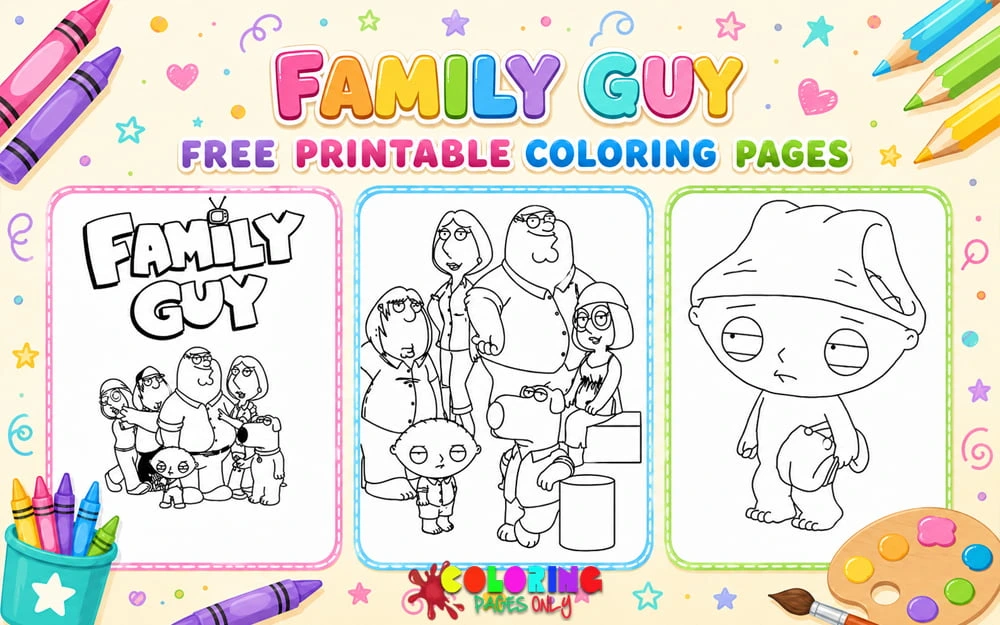
Free Family Guy Coloring Pages: 40+ printable PDF pages featuring Stewie Griffin, Peter Griffin, Brian Griffin, Lois, Meg, Chris, Quagmire, Joe, Cleveland, Bonnie Swanson, Mayor Adam West, and the full Griffin family across solo portraits, expression pages, prop pages, action scenes, and group compositions. All free, download PDF to print, or color online.

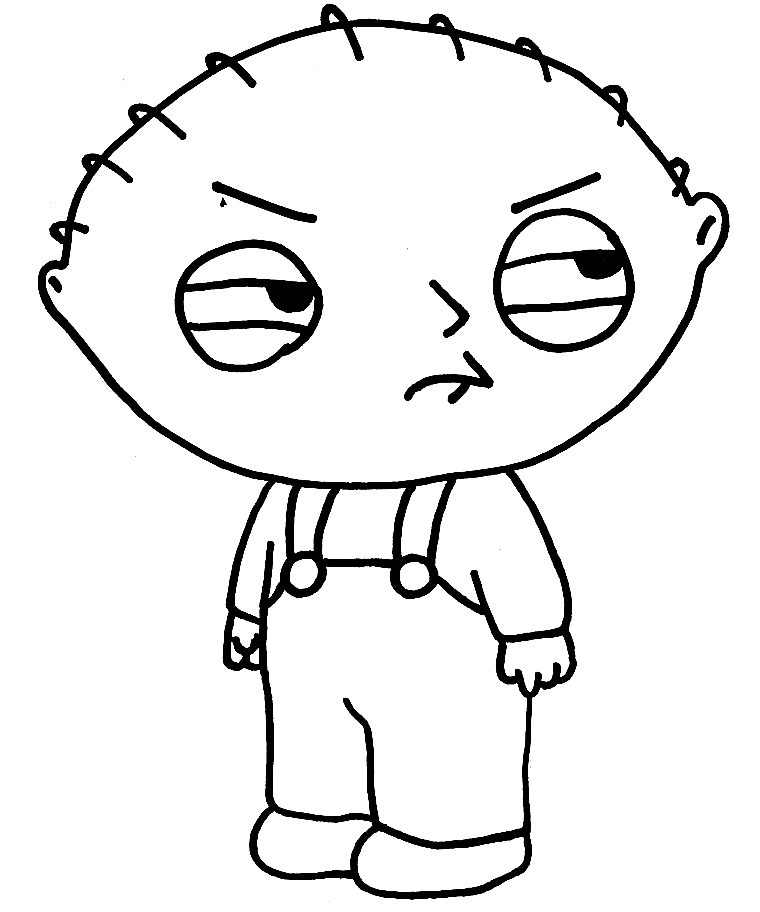
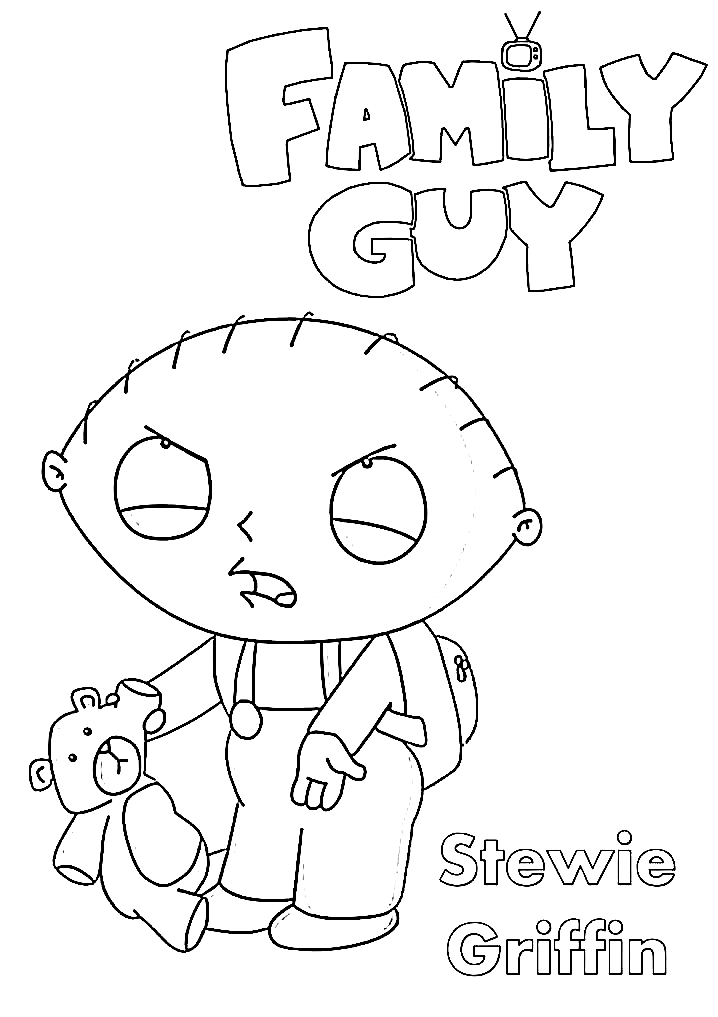
Stewie Griffin has twelve pages in this set, more than any other character, and almost every one is a different version of the same design. The football-shaped head, the round baby body, the red overalls: none of these change. What changes is the prop or expression paired with that design. Stewie with a gun is a different page from Stewie with a guitar, which is a different page from Stewie with a milk bottle. The prop is doing all the narrative work. Getting a Stewie page right means understanding that you are coloring a prop statement, not a character transformation.

The pages are divided into two types. Solo character and expression pages, Stewie across his prop and expression variants, Peter, Brian, Lois, Meg, and Chris, reward careful reading of what each prop or expression communicates. Action and group pages, the chicken fight, the TV family scene, and the full cast page ask for more attention to the dynamics and composition. The for-kids page and simpler portrait pages work for a wider age range; the prop pages and adult humor pages are better suited to older viewers of the show.

These pages work well at home as fan art for viewers of the show. These are fan-made coloring pages and are not official, licensed, or endorsed by Fox, Seth MacFarlane, Fuzzy Door Productions, or any rights holder of Family Guy.

Quick Answer

Family Guy coloring pages are a free set of 40+ printable PDFs and online coloring sheets featuring the Griffin family and Quahog supporting cast. Stewie Griffin dominates the set with twelve pages covering his full range of props and expressions. The visual logic of the set is built on a prop as a character statement: the same Stewie design tells a different story with each new object in his hands.

Best for: Family Guy fans, adult animated comedy fans, and fans who enjoy expressive cartoon characters and prop-driven coloring

Formats: printable PDF and online coloring

Popular pages: Stewie with Gun, Evil Stewie, Peter and Chicken Fighting, Brian Griffin, Griffin Family Watching TV

Creative uses: fan art practice, Stewie prop comparison strip, Peter and Chicken action scene, Brian reading character study, and Griffin family group display

What’s Inside Family Guy Coloring Pages

Stewie Griffin Pages

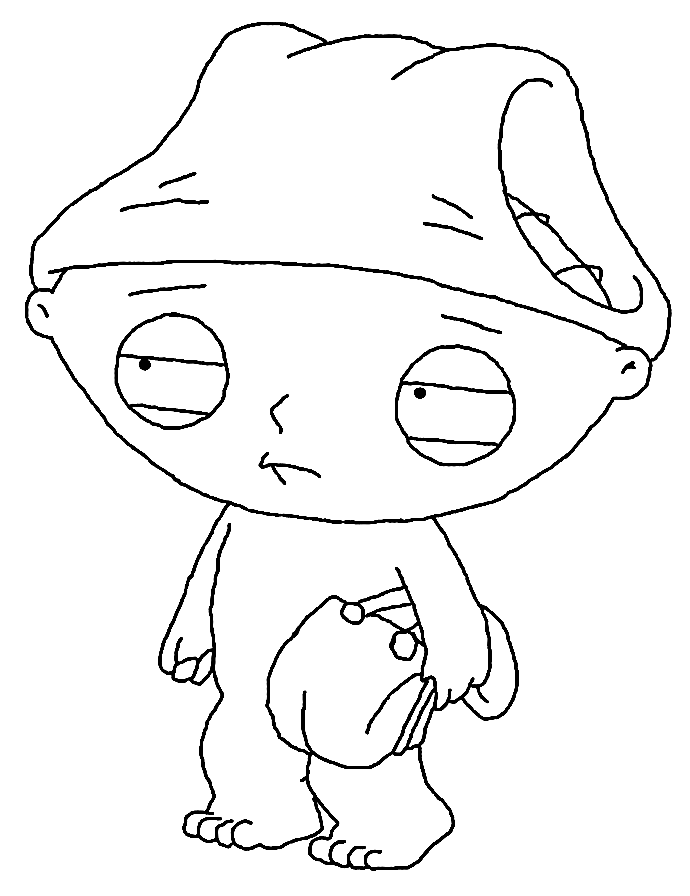
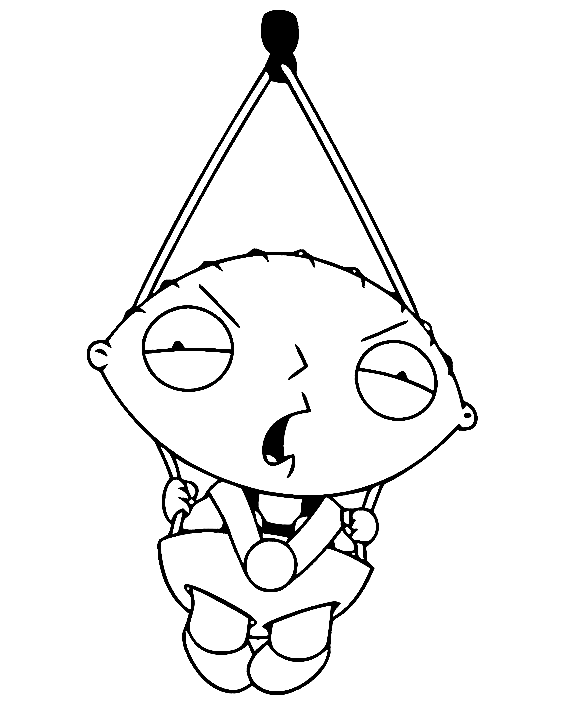
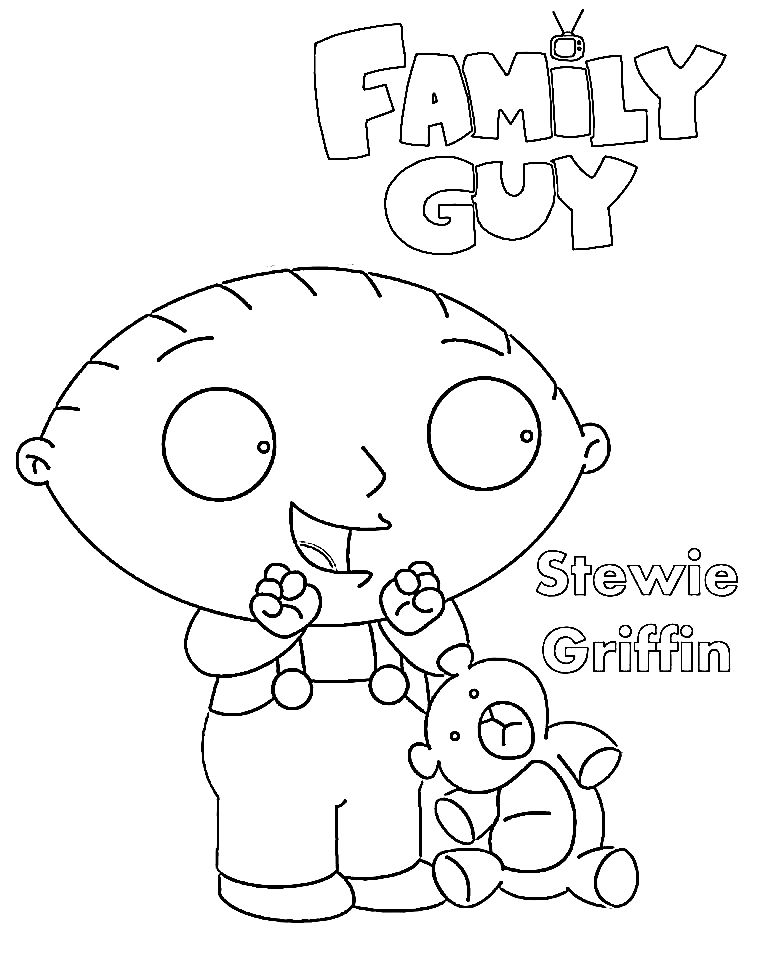
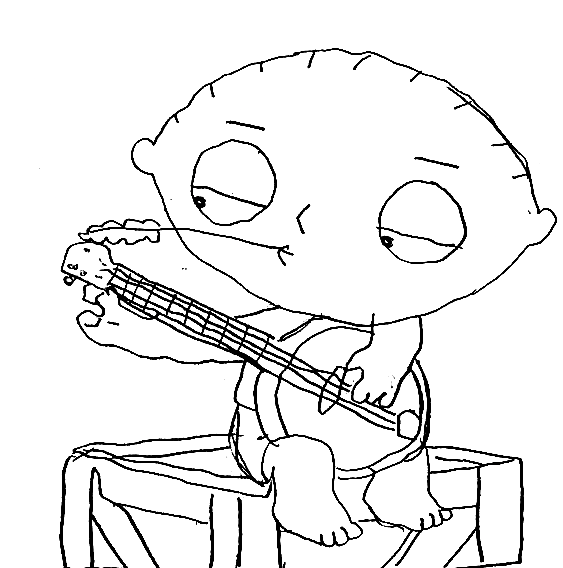
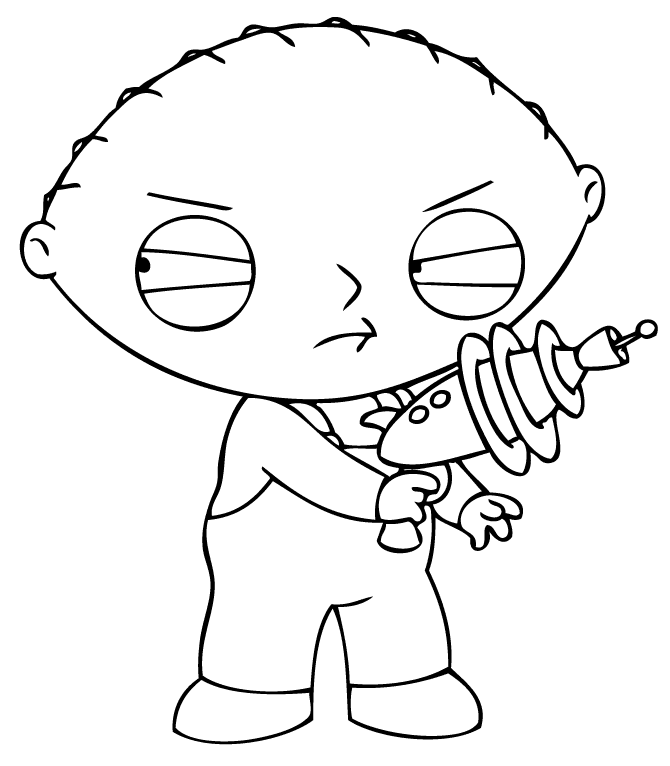
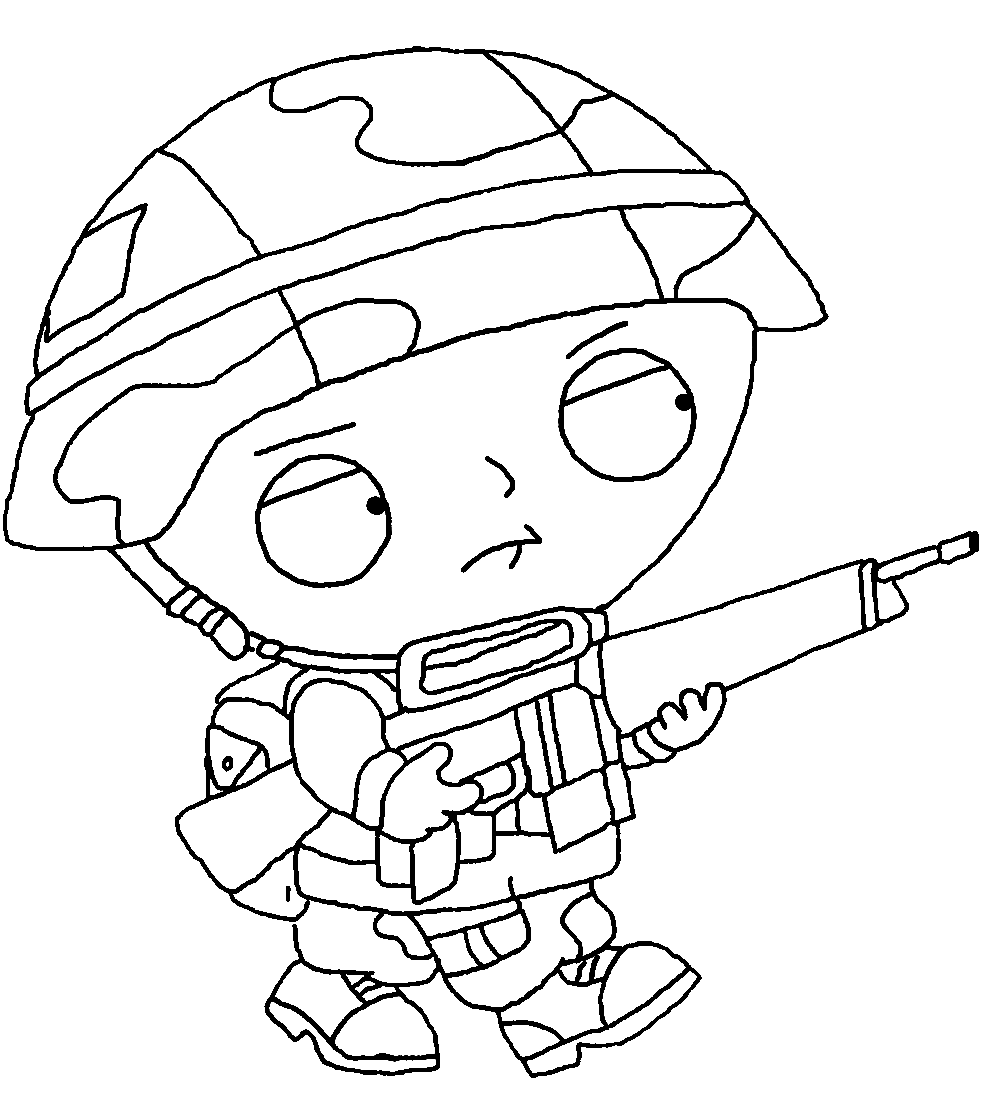
Stewie has the largest share of pages in the set, covering his full expressive and situational range. Prop pages show him with weapons, a guitar, a milk bottle, and underwear on his head. Expression pages cover Evil, Angry, Happy, Sad, and Surprise variants alongside standard portraits.

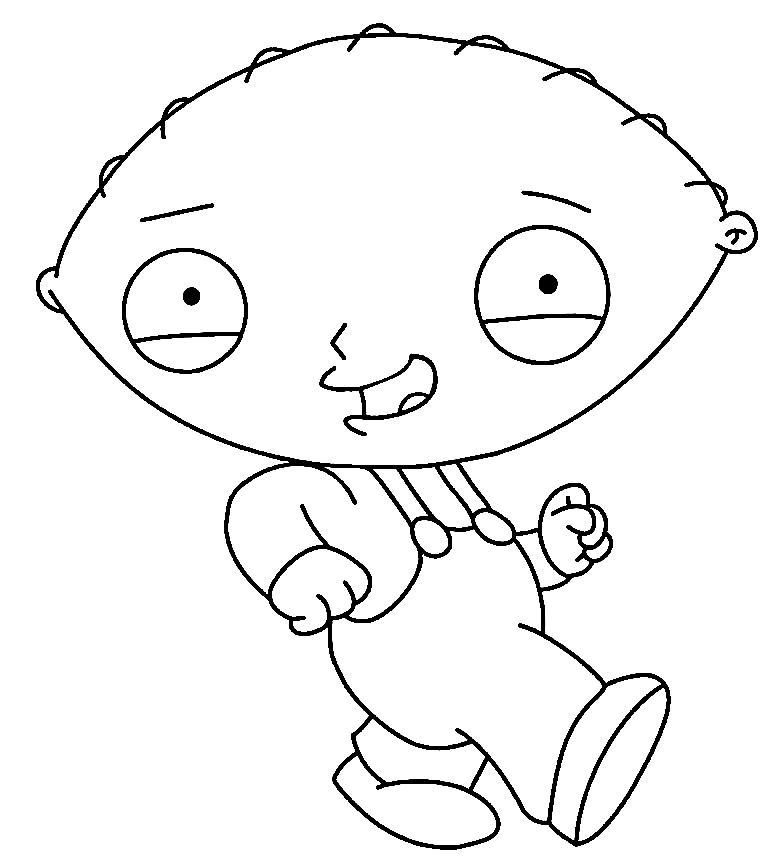
Coloring Stewie: Stewie’s design is almost entirely unchanged across all twelve pages: a football-shaped head, pale skin, brown hair with a small tuft at the front, red overalls over a yellow shirt, and small, round shoes. The design stays fixed, so the prop or expression does all the communicative work. On weapon pages, the gun should read as a specific, real object against the soft baby design: use a cool metallic grey for the gun rather than a warm brown, so it reads as genuinely incongruous with Stewie’s round pastel figure. On the guitar page, warm wood tones suit the instrument. On the milk bottle page, the clear glass and white milk are the palest elements in the composition. Evil Stewie’s palette is the same as standard Stewie; only the expression and eyebrow angle carry the evil register.

Peter Griffin Pages

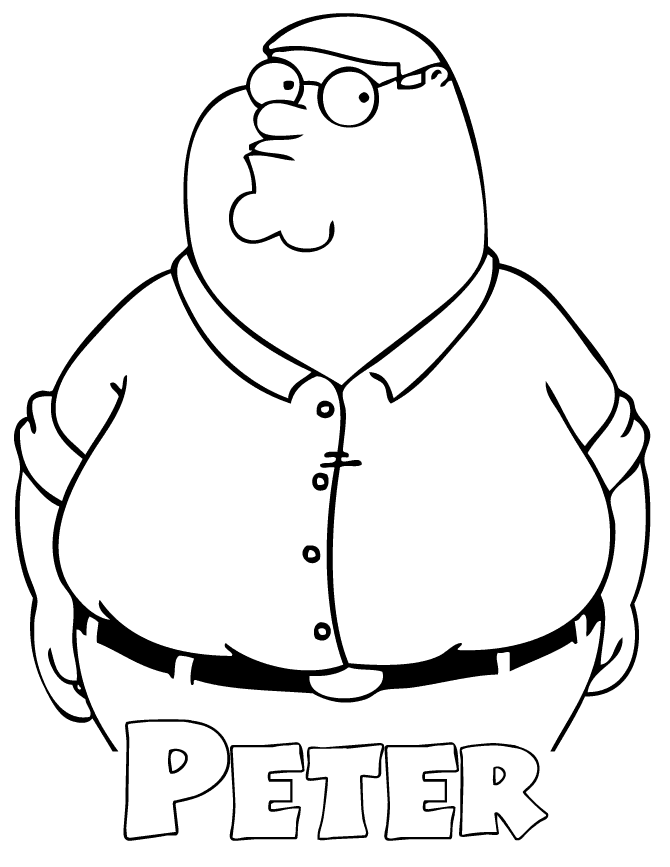
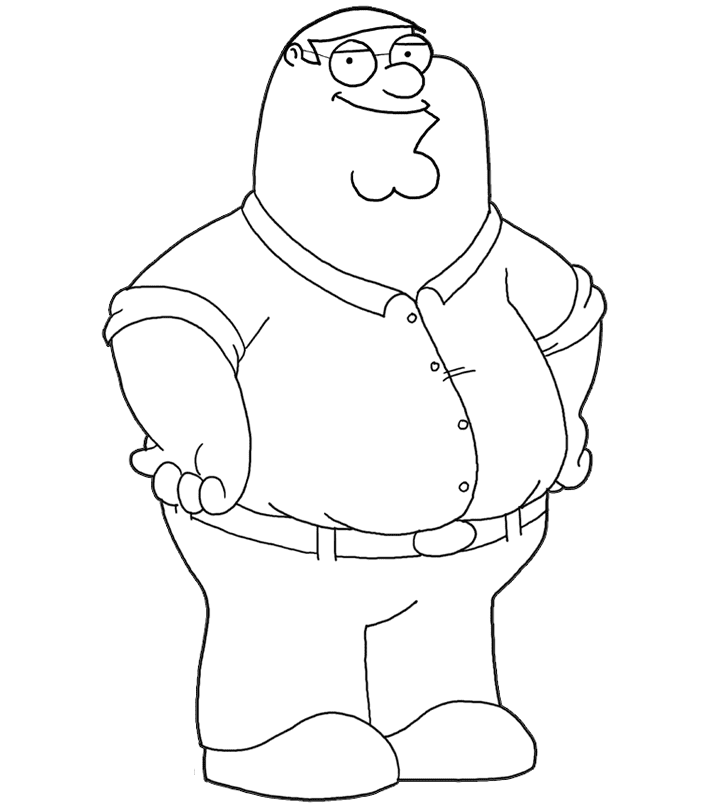
Peter appears across portrait and action pages: Peter Griffin from Family Guy, Peter from Family Guy, Peter using a TV Remote, Funny Peter from Family Guy, Peter with Chicken Fighting, and Peter and Chicken Fighting.

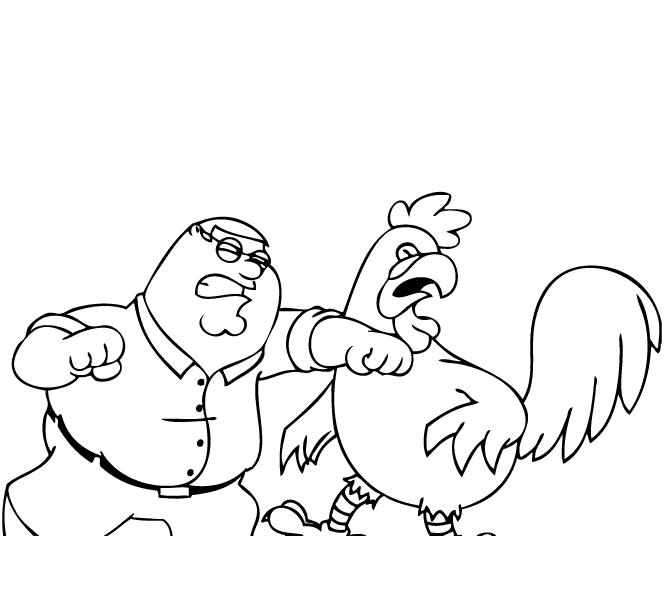
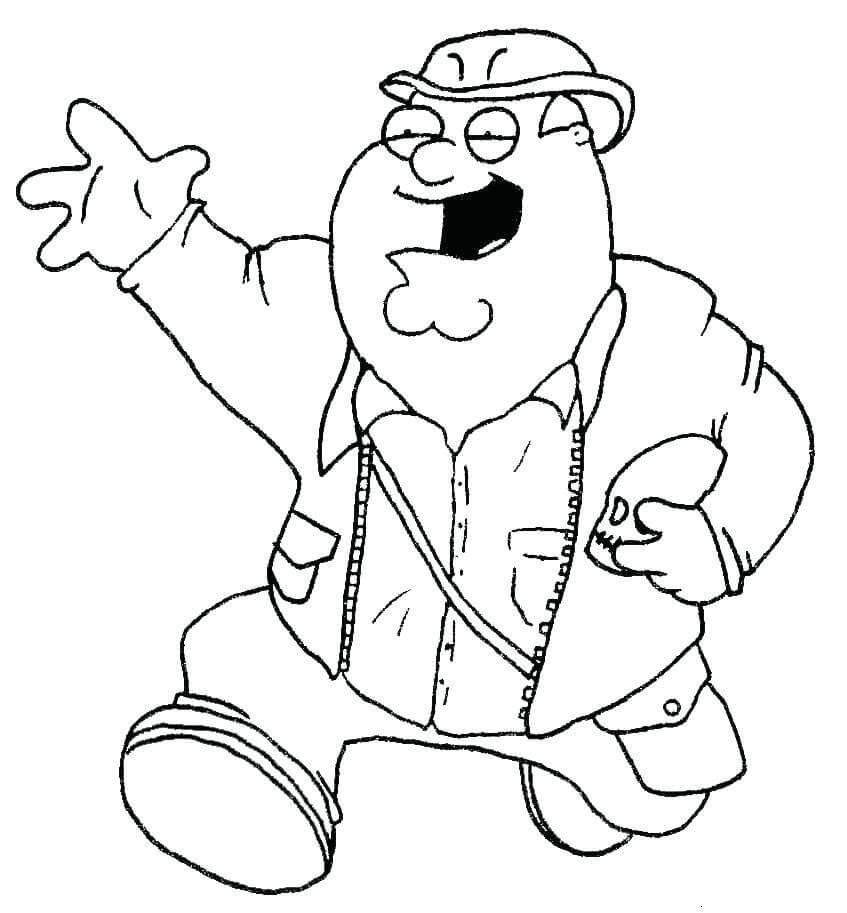
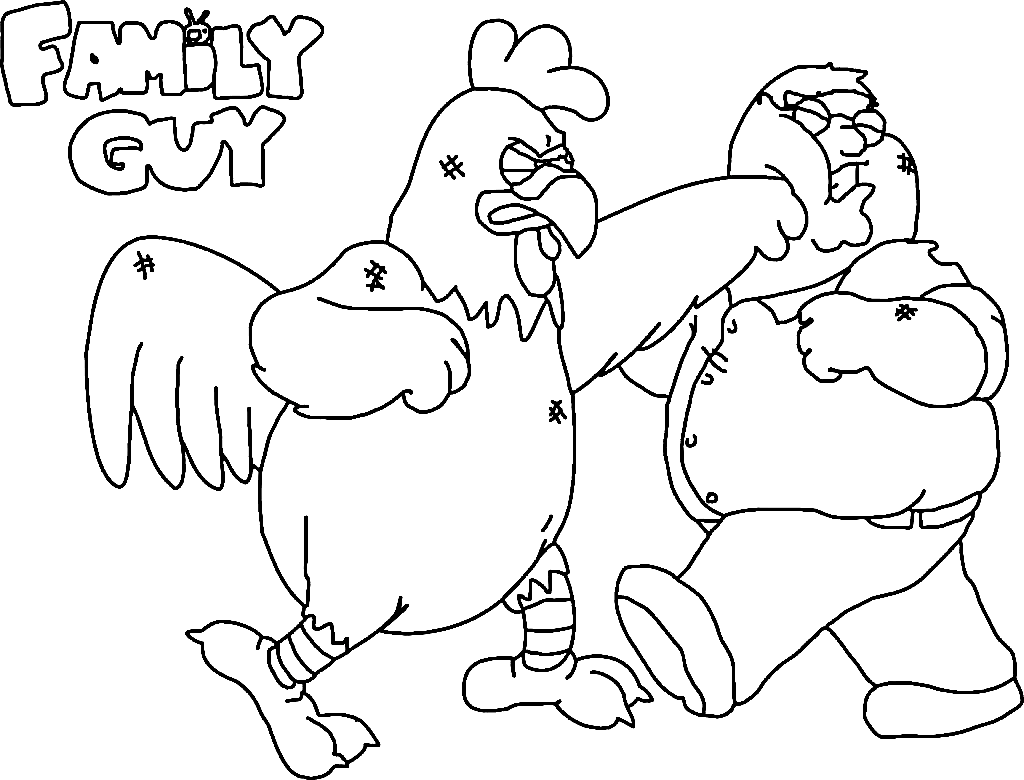
Coloring Peter: Peter has a round body, short brown hair going slightly grey, glasses, a white shirt, and tan or green trousers. His design is built for maximum physical comedy: the round proportions become funnier in contrast with the energy of whatever he is doing. On the TV remote page, Peter’s relaxed sprawl suits a warm, domestic palette with the glow of the television as the light source. On the chicken fight pages, the giant chicken is a brown-red rooster: give it warm earth-red feathers so the fight reads as genuinely intense, even though the whole joke is that Peter’s ordinary suburban design handles extraordinary violence without changing.

Brian Griffin Pages

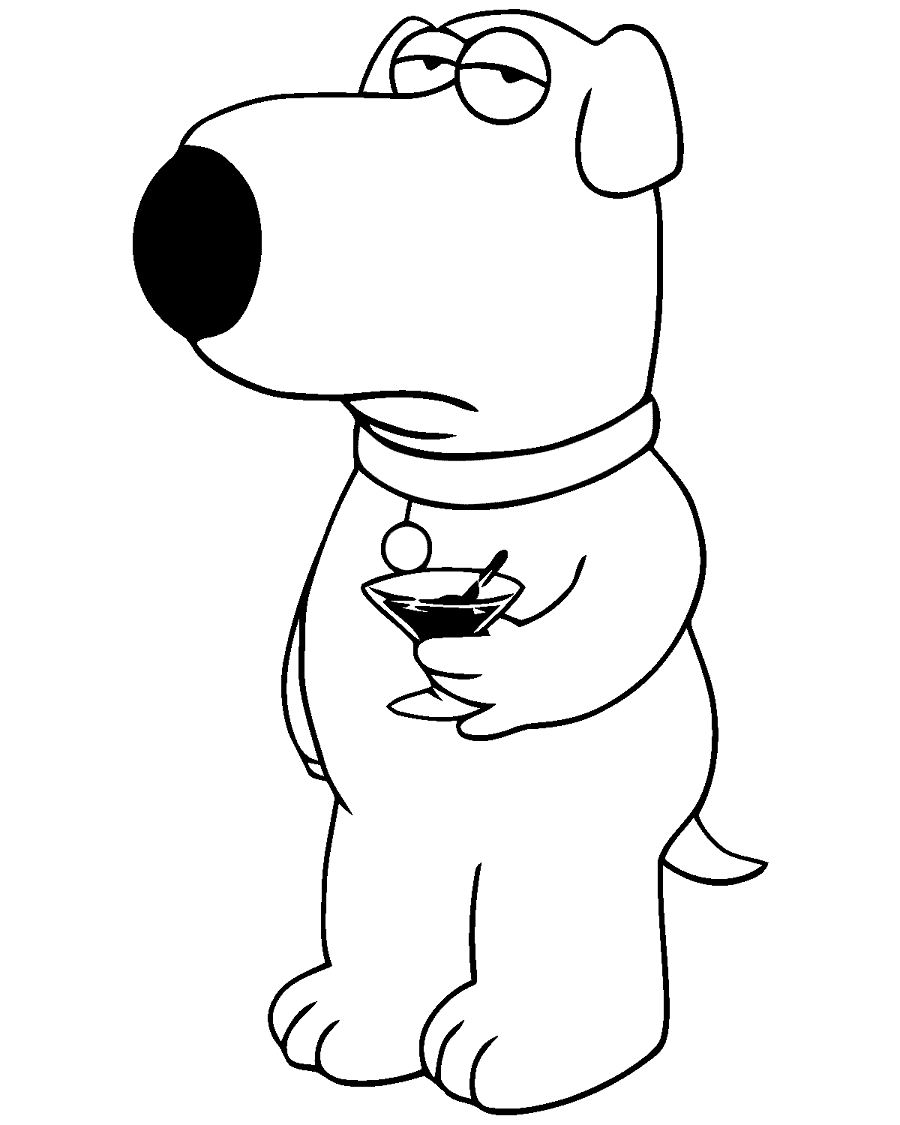
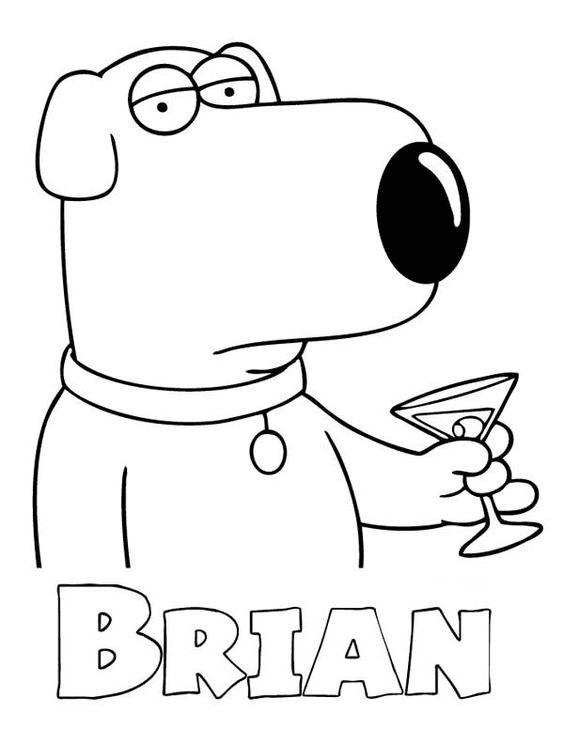
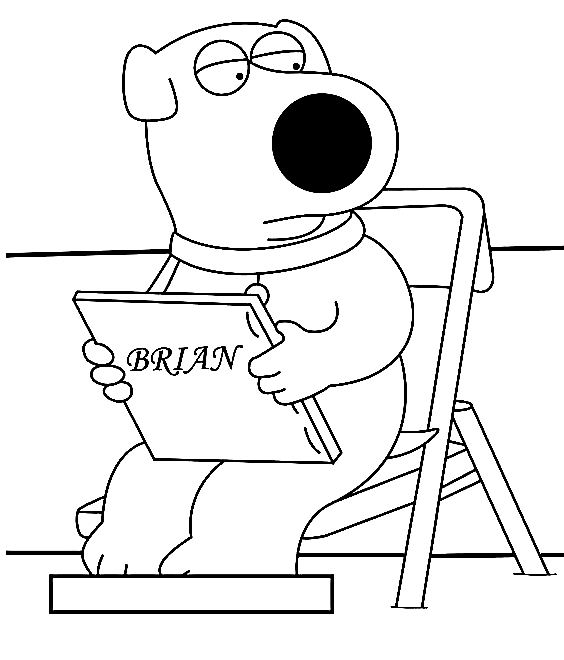
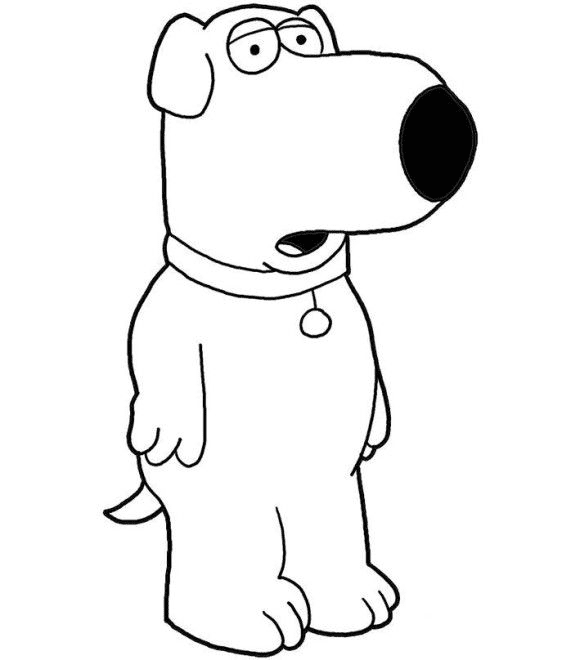
Brian appears in several pages: Brian Griffin, Brian Griffin in Family Guy, Brian Griffin from Family Guy, Brian Reading A Book, and Brian Griffin Drinks in Family Guy.

Coloring Brian: Brian is an anthropomorphic white dog who walks upright, wears no clothes, and carries himself with studied intellectual pretension. His color is simple: clean white with a small black nose. On the reading page, the book’s cover color is whatever you choose; making it something intellectually overambitious suits the character. On the drinking page, the martini glass and amber liquid are the warm accent against Brian’s flat white. The comedy of Brian’s pages comes from the contrast between his unremarkable dog design and the sophisticated affectations he performs with it.

Supporting Cast Pages

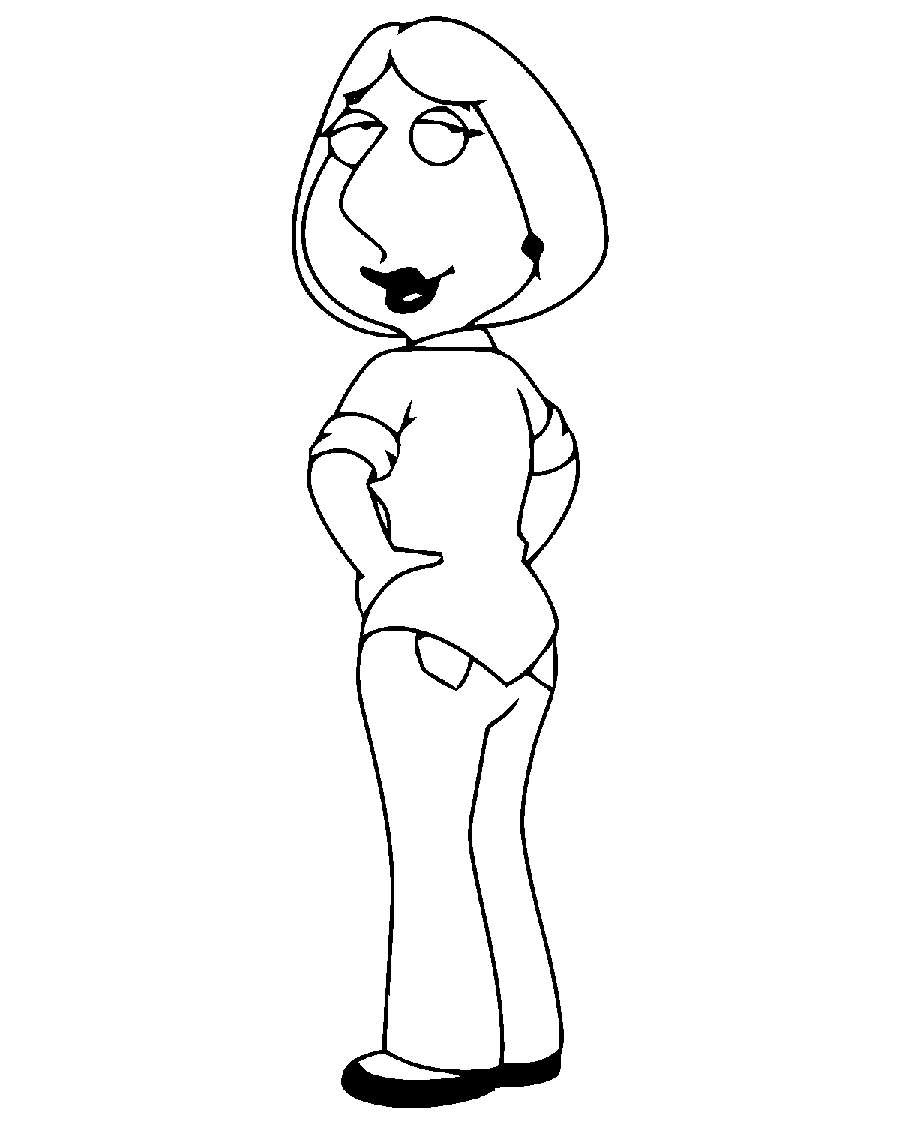
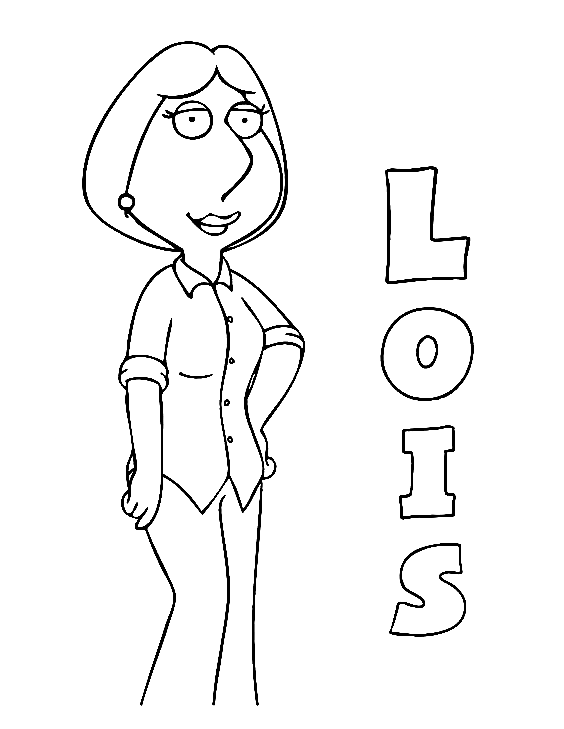
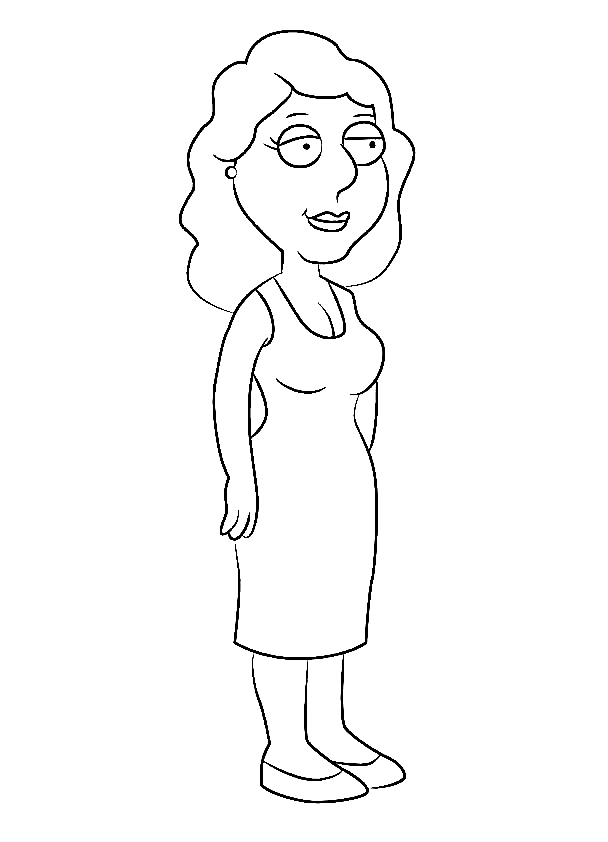
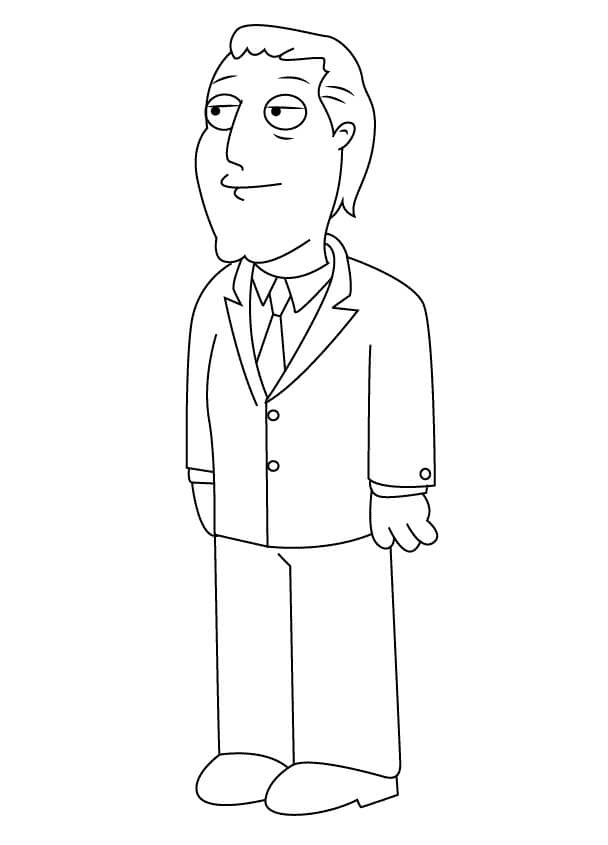
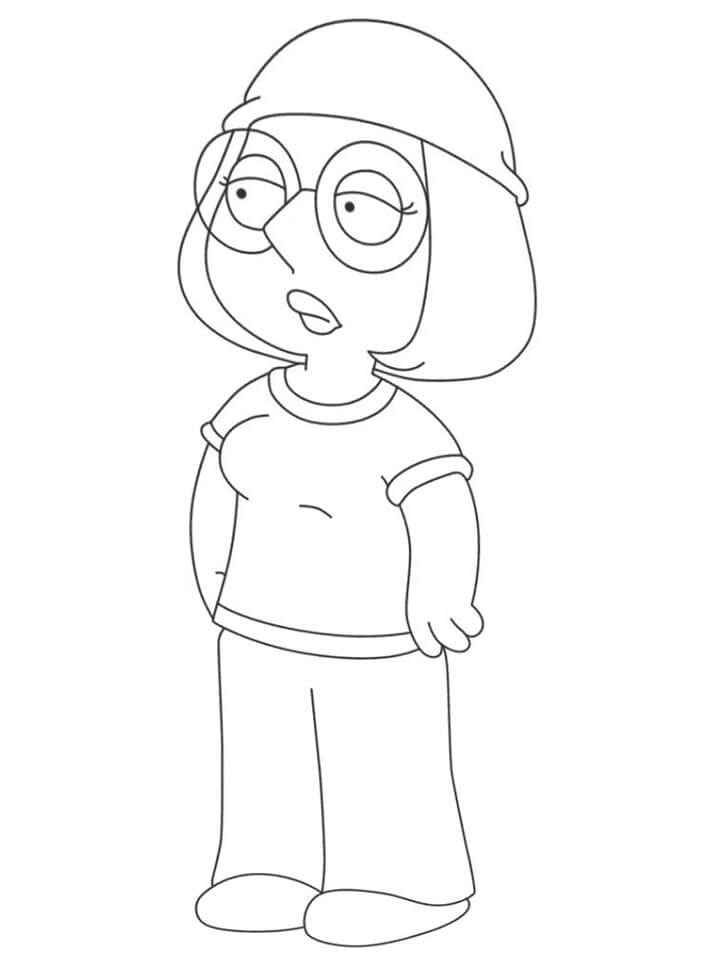
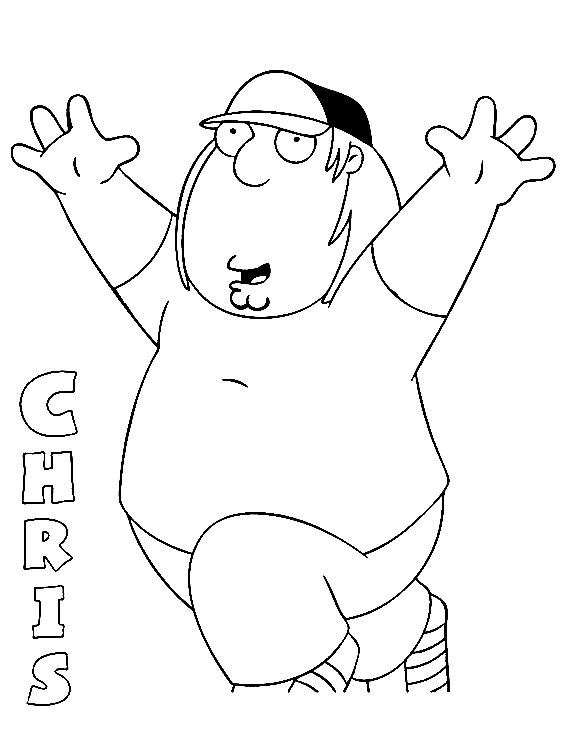
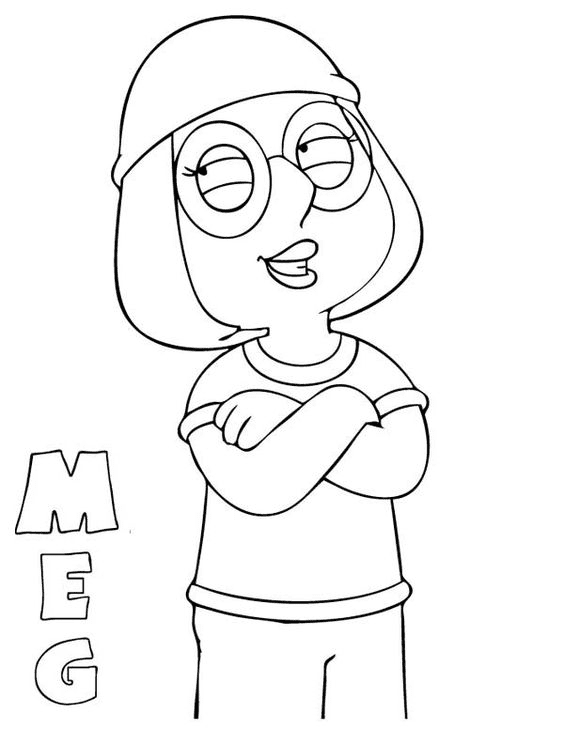
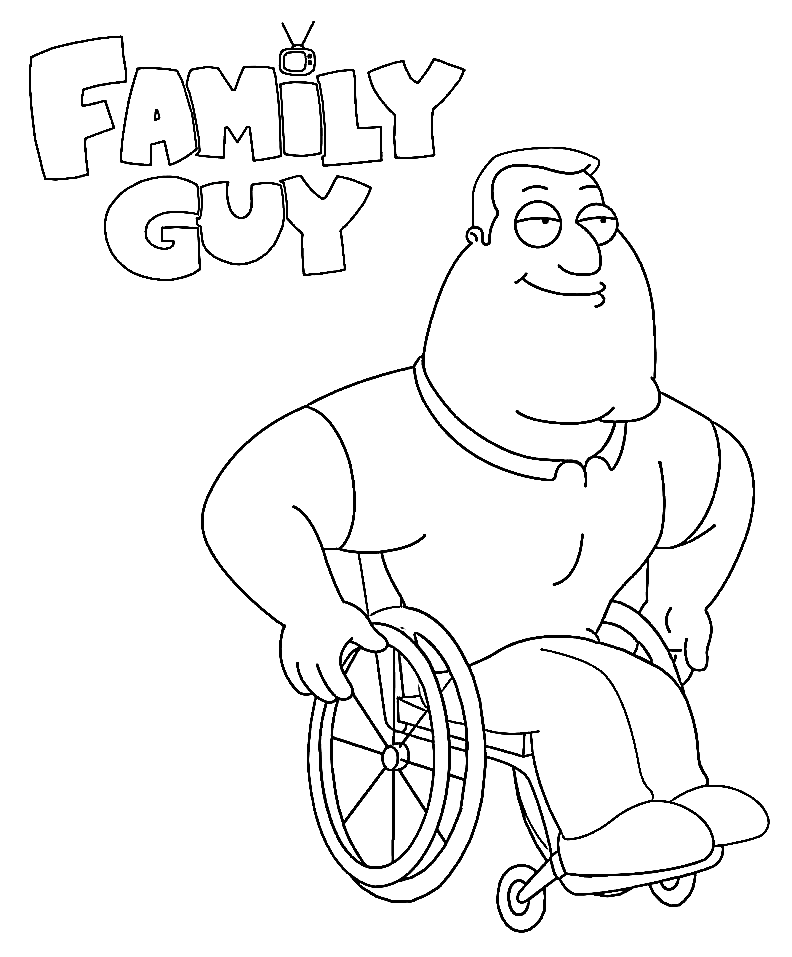
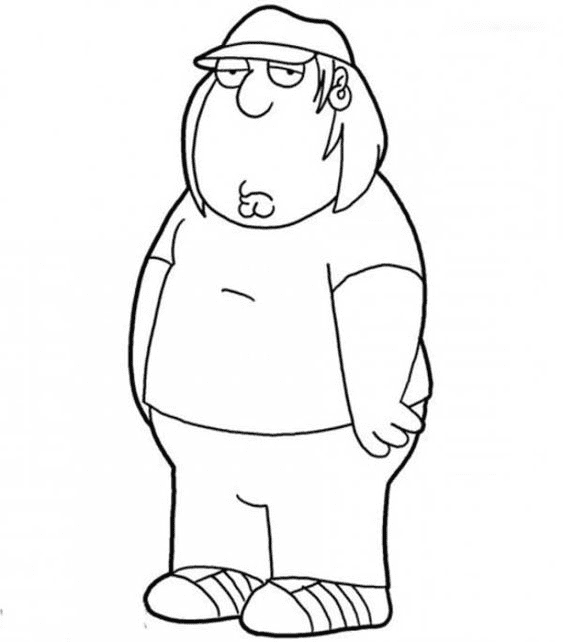
The supporting cast pages cover three Griffin family members, Lois, Meg, and Chris, each in individual pages. Recurring Quahog neighbors also appear: Quagmire, Joe, Cleveland, Bonnie, and Mayor Adam West.

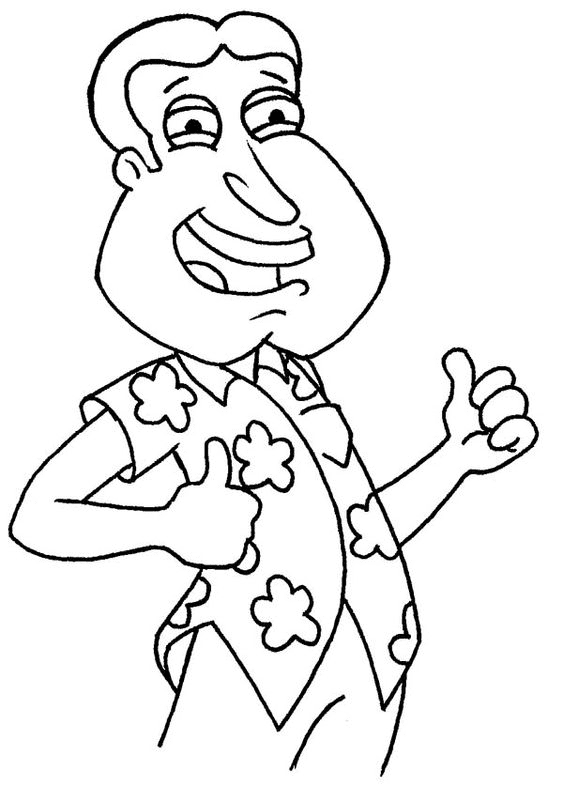
Coloring the supporting cast: each character in Family Guy’s ensemble has a specific signature color that functions as their visual shorthand. Quagmire: beige-tan skin, brown hair, and his distinctive jaw. Joe: police uniform, blue, wheelchair. Cleveland: warm brown skin, mustache, casual clothes. Meg: pink hat, glasses, purple top. Chris: round face like Peter, yellow shirt. Mayor Adam West: grey hair, suit. On the Happy Chris and Boring Chris pages, both use the same base palette: the expression and energy level tell the story without any color change. Boring Chris reads as boring through posture and expression, not through a muted palette.

Group and Scene Pages

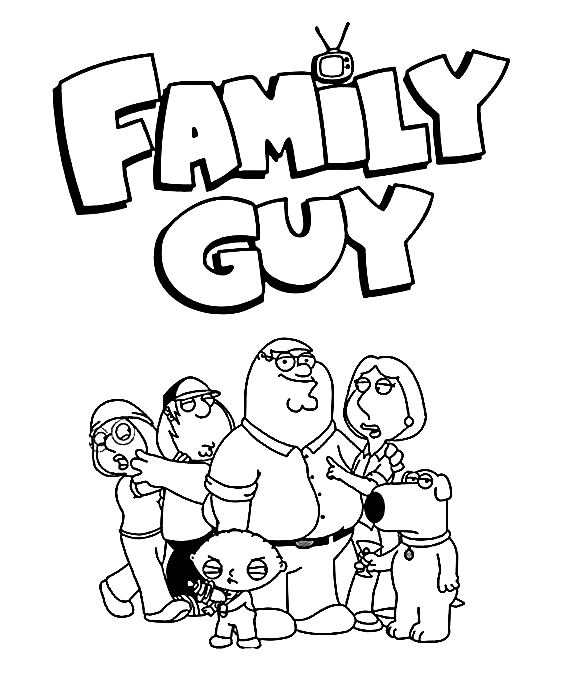
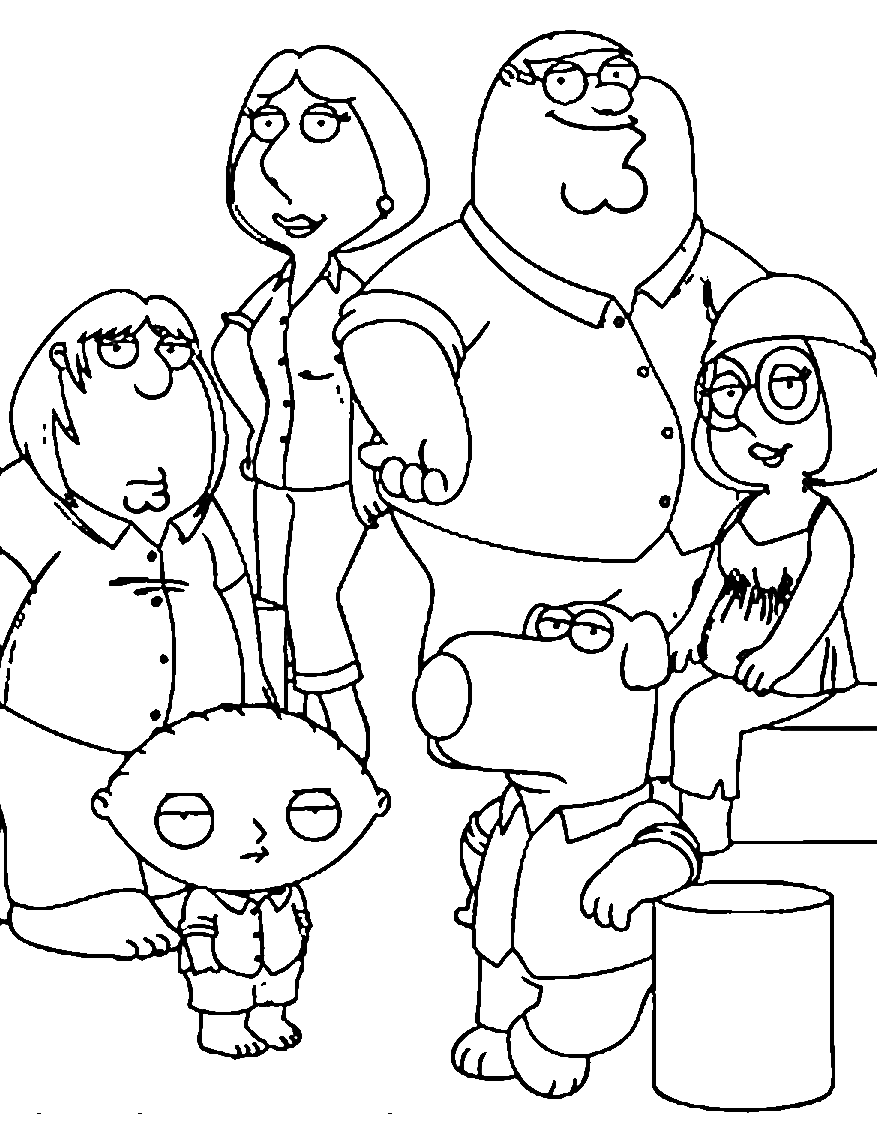
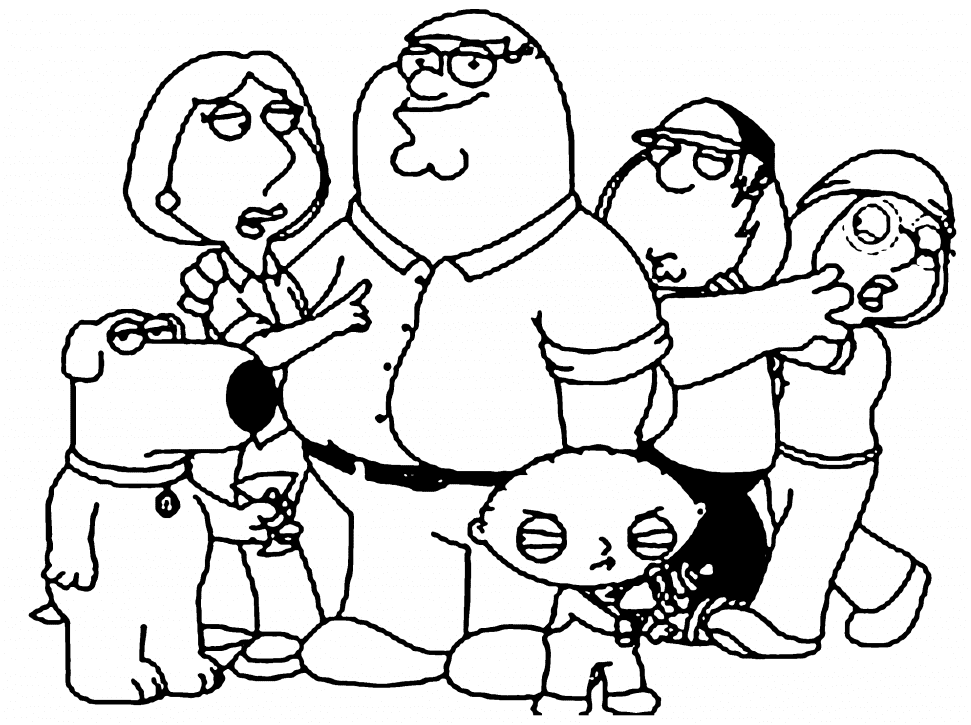
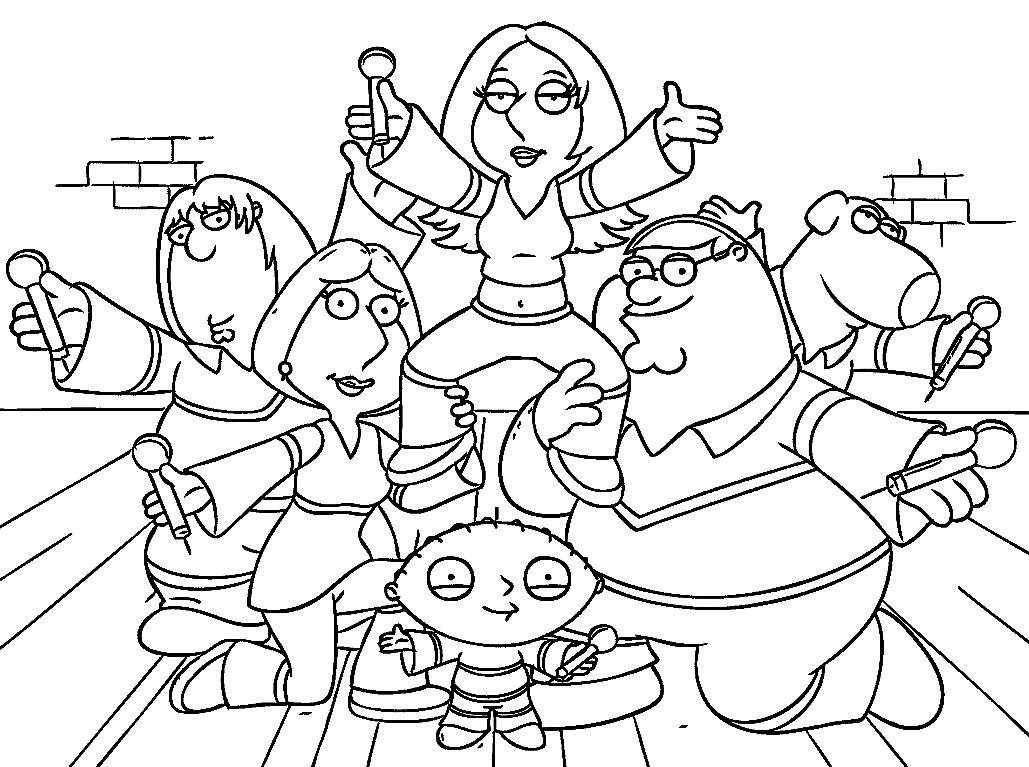
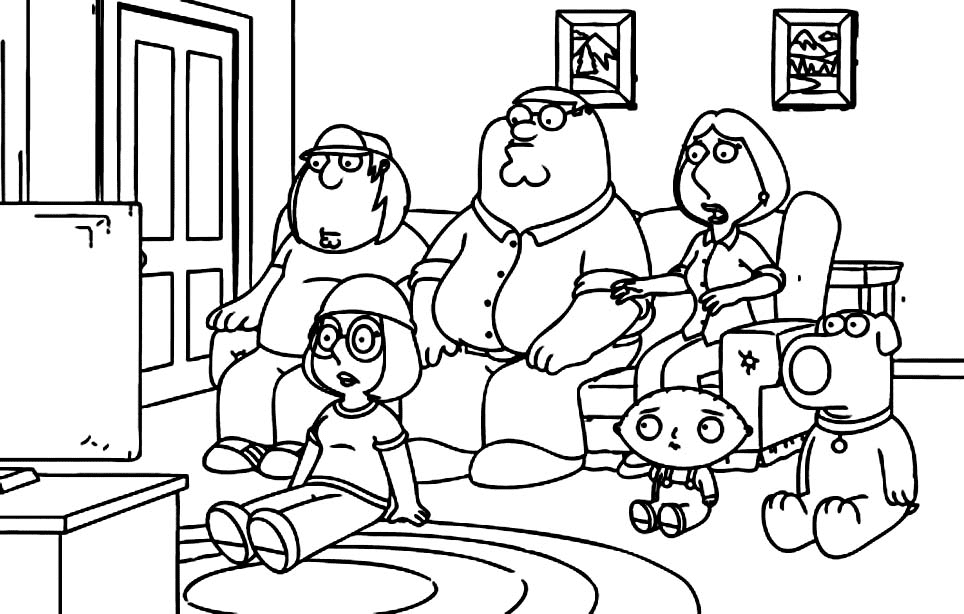
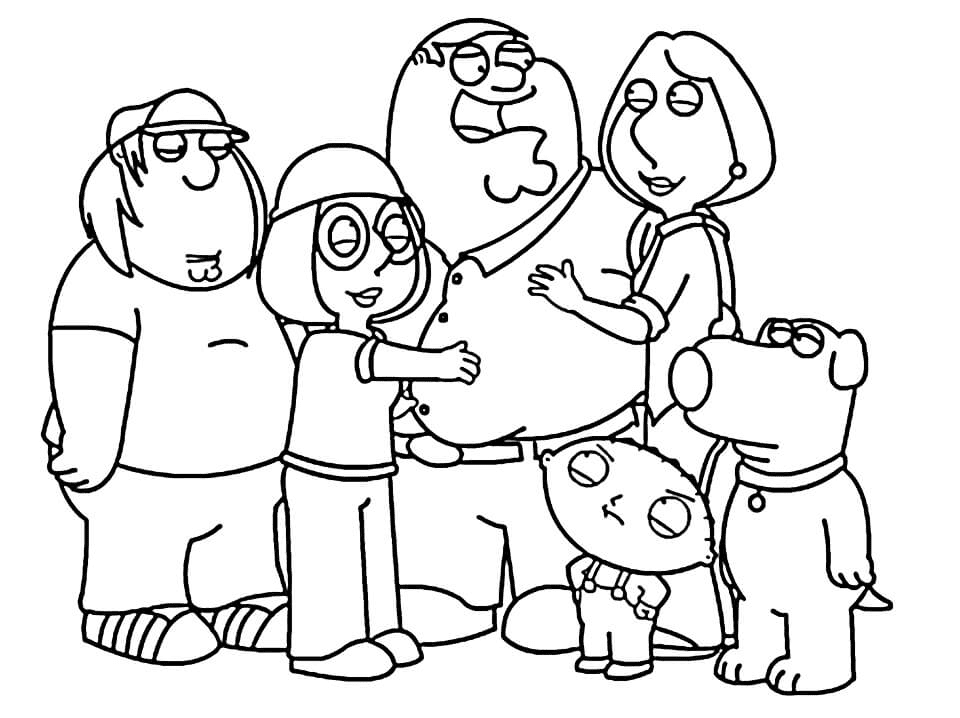
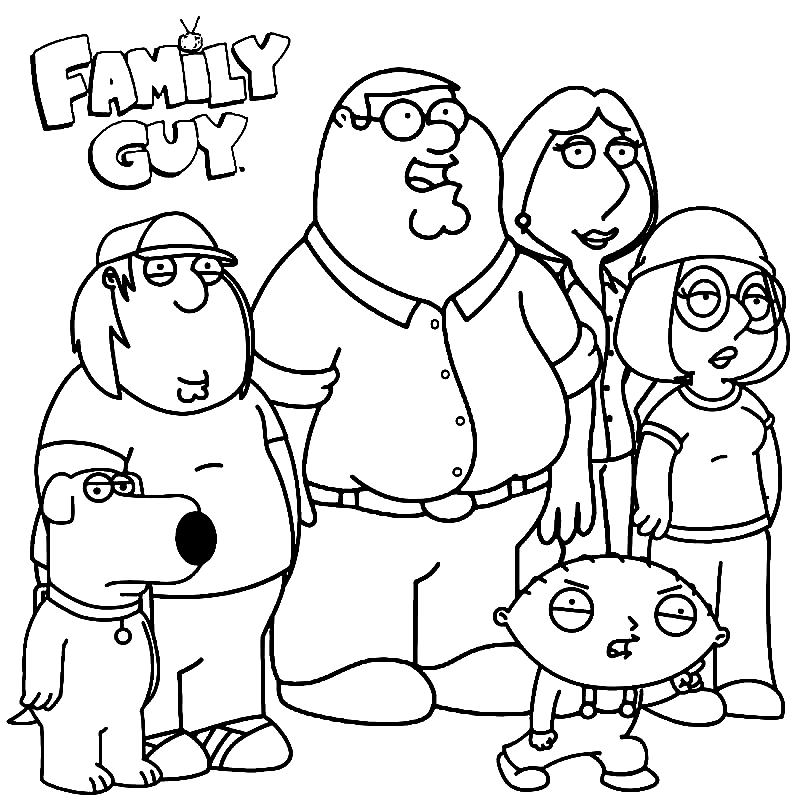
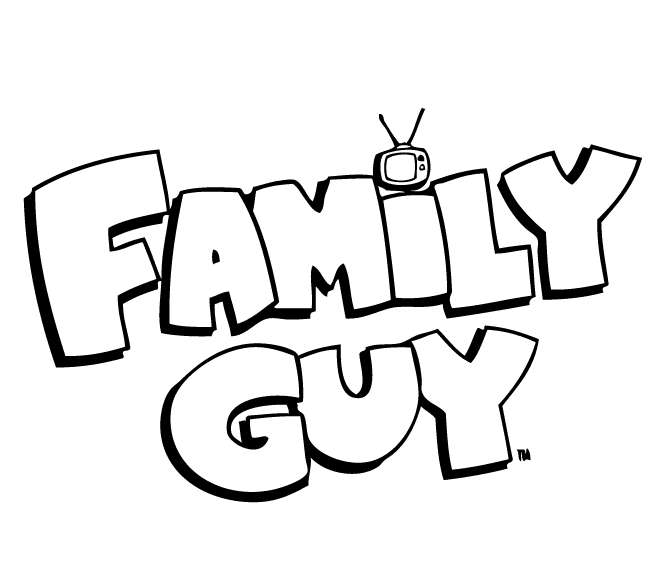
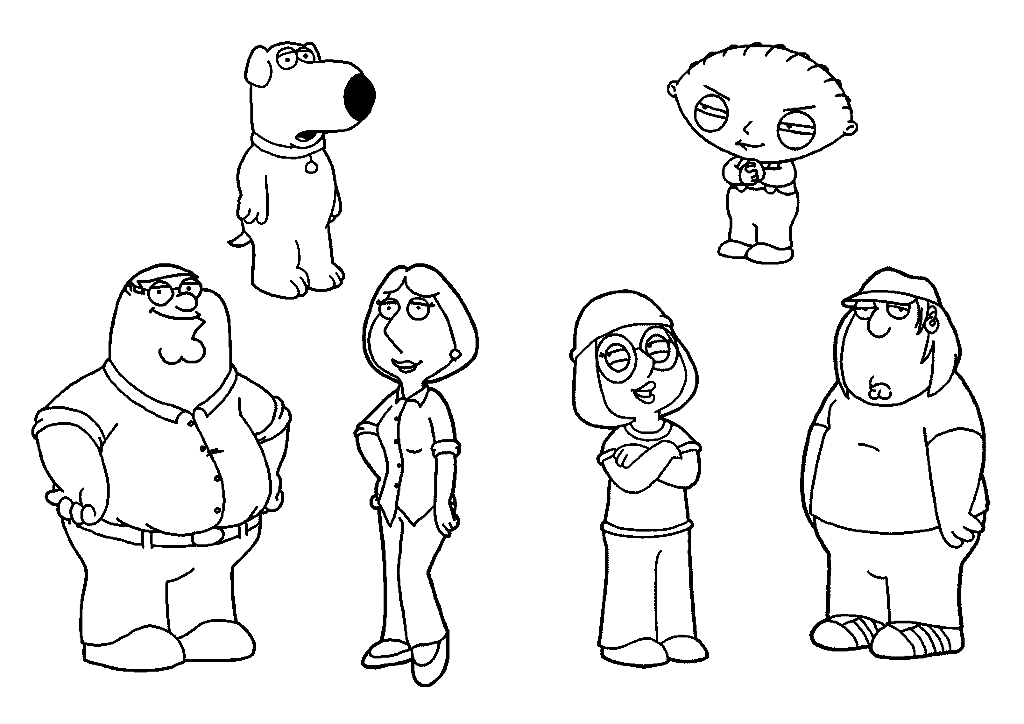
Three pages show multiple characters: Griffin Family Watching TV, Characters from Family Guy, and the Family Guy logo page.

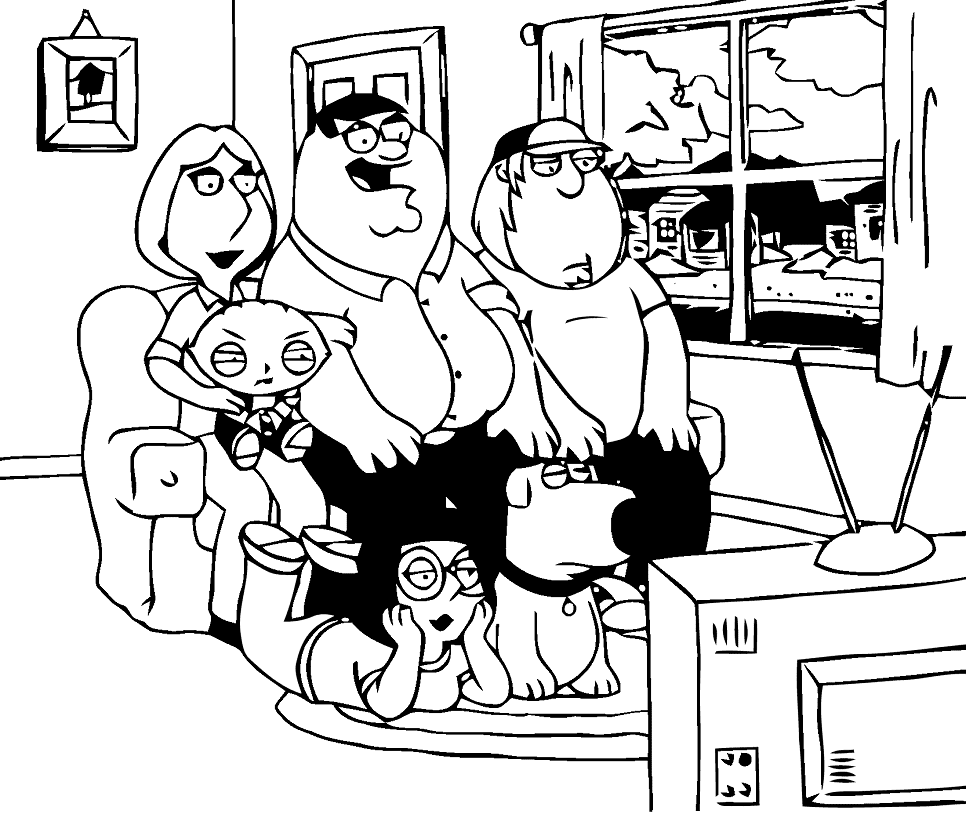
Coloring group pages: on Griffin Family Watching TV, the TV screen is the light source and can be colored a pale blue-white, casting a slight cool glow on the nearest faces. The domestic setting suits warm, slightly worn home tones for the furniture and walls. On the full cast page, assign each character’s signature color before starting: the cast’s palettes are distinct enough to make the group readable once each character’s key tone is in place.

Printable PDF and Online Family Guy Coloring Pages

Every design comes in two ways: a printable PDF for paper, or the same artwork colored on screen.

Using both formats: print the PDF when you want a clean sheet for markers, colored pencils, or felt-tip pens, and use the on-screen version when there is no printer nearby. The PDF holds the show’s thick outline work and prop detail cleanly on standard letter or A4 paper.

What These Pages Do

Family Guy’s visual humor is built on a technique that is almost the opposite of character design complexity: keep the character design absolutely fixed and let the prop or context carry all the meaning. Every Stewie page is a prop study disguised as a character portrait because his design never changes: only what he is holding or doing shifts the meaning. Coloring those pages correctly means reading the prop first and deciding how to color it. Hence, it reads as the right kind of object against the unchanging baby design: a cold metallic gun against soft red overalls communicates differently from a warm wooden guitar. That attention to how an object’s color speaks to a character’s palette transfers to any illustration involving characters and what they carry. From here, cartoon coloring pages are the parent hub, and American Dad coloring pages offer the closest creative parallel as another Seth MacFarlane animated series.

The American Art Therapy Association identifies engagement with absurdist and satirical visual humor as a genuinely distinct creative mode: rendering something inherently incongruous, a football-headed baby with a plasma rifle, a round suburban dad fighting a giant chicken, requires committing to the visual logic of the absurdity without softening it. The humor evaporates if the gun looks like a toy or the chicken looks friendly. Working through Family Guy pages builds the creative discipline of honoring the internal logic of comic exaggeration, which is a more demanding form of accuracy than simple realism.
How to Color Family Guy Coloring Pages

These steps work for any page in the set, from a solo Stewie portrait to the full group scene.

On Stewie pages, read the prop before picking up any color. The prop defines the page. A gun, a guitar, a milk bottle, and underwear on his head each ask for a different coloring approach to the same Stewie design. Decide what the prop is communicating first, then make sure its color reads correctly against the soft baby palette.

For Stewie’s weapons, use cool metallic grey rather than warm tones. The incongruity between a cold metallic gun and warm red overalls is part of the joke. A warm brown or friendly grey for the gun softens that incongruity and loses the comedy. Keep the metal cold, clean, and obviously metallic.
On the Peter and Chicken Fighting pages, give the chicken warm earth-red feathers. The chicken needs to read as a genuine adversary, not a prop. A vivid earth-red rooster against Peter’s beige-and-white creates a color contrast that makes the fight feel real, which makes it funnier.

On Brian’s reading and drinking pages, use the book or glass as a warm accent. Brian’s clean white design leaves room for one warm color note per page. The amber of a martini, or the rich color of a book cover, becomes the visual event against his flat white. Choose a single accent color and commit to it.

On Griffin Family Watching TV, color the screen last and use it as the light source. Fill the furniture and figures first, then add a pale blue-white television glow on the nearest faces. This makes the scene feel spatially coherent and gives the page an atmosphere that a flat background would not.

5 Creative Craft Ideas with Family Guy Coloring Pages

Stewie Prop Comparison Strip

Color three Stewie pages using the same base palette throughout: Stewie with Gun, Stewie and Guitar, and Stewie with Milk Bottle.

Cut all three to the same size and mount in a row on a card with each prop labeled below. The strip shows how the same character design says three completely different things depending on what it is holding. Takes about thirty minutes.

Peter and Chicken Action Display

Color the Peter and Chicken Fighting page, giving the chicken vivid earth-red feathers and keeping Peter in his standard white-shirt beige palette.

Mount on a dark card as a standalone action display. The color contrast between the chicken and Peter is what makes the scene read as a genuine fight. Takes about twenty-five minutes.

Brian Reading Character Study

Color the Brian Reading A Book page, choosing a book cover color that suits Brian’s intellectual pretensions: dark academic green, oxblood red, or navy.

Mount on a light card as a standalone character study that takes about fifteen minutes.

Griffin Family TV Night

Color the Griffin Family Watching TV page using the television screen as the dominant light source: pale blue-white on the screen, slight cool cast on nearby faces, warm domestic tones for the furniture.

Mount on a card as a family scene display that takes about twenty-five minutes.

Evil Stewie and Happy Stewie Contrast

Color Evil Stewie and Happy Stewie Griffin using the same base palette for both: same red overalls, same yellow shirt, same brown hair.

Mount side by side on a card to show how the same design reads as completely different characters through expression and eyebrow angle alone, with no color change. Takes about twenty minutes.

FAQ About Family Guy Coloring Pages

Are these Family Guy coloring pages free, and can I color them online?

Yes. Every page is free, with no account, email, or payment required. Download the PDF to print at home, or color the design on screen in the browser.

Which characters are included?

The set covers Stewie Griffin, Peter Griffin, Brian Griffin, Lois, Meg, Chris, Glenn Quagmire, Joe Swanson, Cleveland Brown, Bonnie Swanson, and Mayor Adam West across solo, group, and scene pages.

What is Family Guy?

Family Guy is an adult animated comedy series created by Seth MacFarlane, broadcast on Fox since 1999. It follows Peter Griffin, a working-class man in the fictional Rhode Island town of Quahog, his family, and his talking dog, Brian. You can read more about Family Guy on Wikipedia.

Why does Stewie have so many pages?

Stewie Griffin has twelve pages in the set because his design works especially well for coloring: the same fixed baby design can carry an enormous range of situations and moods through prop and expression changes alone. Each page is a different prop study in the same character design.

What colors should I use for Stewie Griffin?

Stewie has a football-shaped head, pale skin, brown hair, red overalls, and a yellow shirt. His design stays fixed across all pages. On weapon pages, use cool metallic grey for the gun rather than a warm tone: the cold metal against the soft baby palette is part of the joke.

What is the chicken fight about?

The chicken fights are a recurring joke in Family Guy, where Peter Griffin fights a giant chicken across multiple episodes. The joke is that Peter’s ordinary suburban design handles prolonged, movie-level action sequences without any change to his appearance or demeanor. Giving the chicken vivid earth-red feathers makes the fight read as a genuine contest rather than one-sided.

Are these pages suitable for younger fans?

The Family Guy for Kids page and simpler portrait pages are accessible to younger fans. Pages featuring weapons, drinking, and more adult humor situations are better suited to older viewers of the show.

What colors should I use for Brian Griffin?

Brian is a white dog with a small black nose. His design is simple and flat. Use a clean white for his body and let one warm accent, the amber of his martini or the color of a book cover on the reading page, provide the visual interest against the flat white.

Are these official Family Guy coloring pages?

No. They are fan-made coloring sheets created by fans for personal use. They are not affiliated with, licensed by, or endorsed by Fox, Seth MacFarlane, Fuzzy Door Productions, or any rights holder of Family Guy.

What crafts can I make with these pages?

Popular options include a Stewie prop comparison strip, a Peter and Chicken action display, a Brian reading character study, a Griffin family TV night display, and an Evil Stewie and Happy Stewie contrast.

More Cartoons Coloring Pages

Browse the full set at ColoringPagesOnly.com, then open any design to print it or color it on screen.

These pages are made for fans of the show. They are fan-made coloring designs and are not official products of the Family Guy franchise.

For the final pass: read the prop before picking any color on Stewie pages, keep weapon metals cold and metallic against the warm baby palette, and on the TV scene, color the screen last as the light source. Those three habits cover the most important coloring decisions in the set.

Share your work on Facebook and Pinterest and tag #ColoringPagesOnly. We would love to see your Stewie prop strips, chicken fight scenes, and family TV nights.

These related coloring collections will help you explore the wonderful world of colors. Let’s choose, be creative, and show us your great pictures!

Jennifer Thoa – Content Editor & Designer

Jennifer Thoa is Content Editor and Designer at ColoringPagesOnly.com. Degree in Journalism and Creative Writing, University of Kansas. She writes and edits long-form educational articles on anime, film, animals, world cultures, and automotive history - verified against named primary sources before publication.