
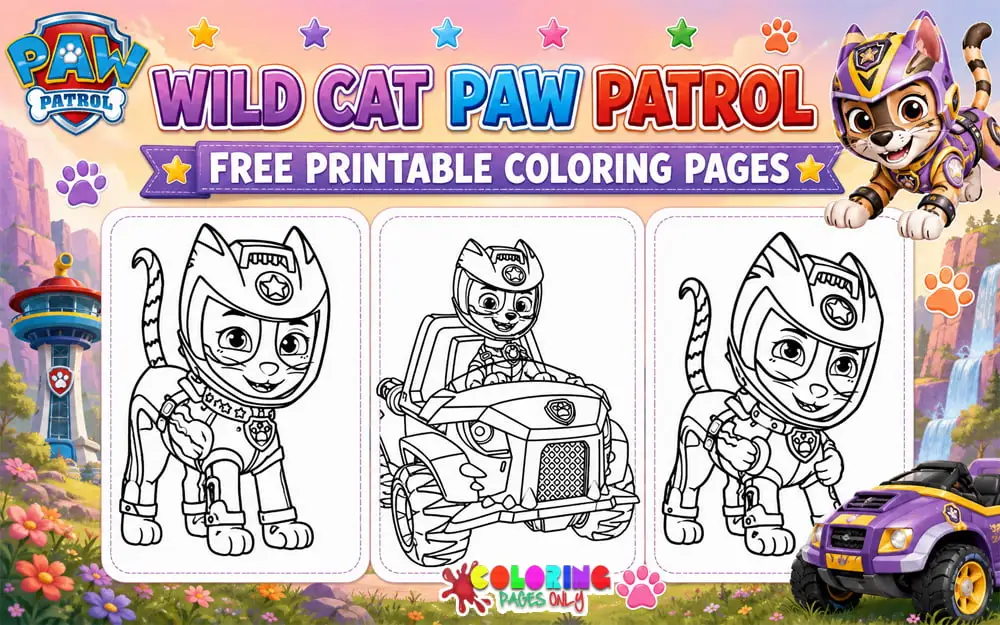
Wild Cat Paw Patrol coloring pages: 6 free printable PDF designs featuring the show’s first feline team member, covering solo portraits, his motorcycle stunt scenes, his cheetah-speed power gear, and pages with the rest of the Cat Pack. Every page here is ready as a print-ready PDF or an on-screen coloring page, no sign-up needed for either.
Wild Cat broke the mold the moment he showed up. Every other member of the PAW Patrol is a dog, and he’s a stunt-cycling ginger tabby who rides in specifically because cats think and move differently than dogs do. He later goes on to lead his own team, the Cat Pack, made up of three other cats, each modeled after a different big cat.
That fresh energy is what makes this set feel different from a typical pup collection. Younger colorists get a simple, expressive cat face and a bold motorcycle to fill in, while older fans get the added challenge of his stunt poses, his power armor, and the rest of the Cat Pack’s distinct designs.
The one detail unique to Wild Cat among the whole franchise: he’s drawn mid-motion far more often than any pup, mid-flip, mid-jump, wheels off the ground. Getting that sense of movement right, rather than coloring him in a static standing pose, is really what makes a page here feel true to who he is.
Quick Answer
Wild Cat Paw Patrol coloring pages are a free set of 6 printable PDFs and browser-based coloring sheets featuring the show’s first cat team member, covering solo portraits, motorcycle stunt scenes, his Cheetah Speed power gear, and pages with the wider Cat Pack.
Best for: kids aged 3 and up, PAW Patrol fans who love motorcycles and action scenes, and anyone building out a full-cast coloring collection
Formats: printable PDF and online coloring
Popular pages: the classic portrait, Wild Cat mid-stunt on his motorcycle, and a Cat Pack group scene
Creative uses: a stunt trick flashcard set, a Cat Pack team poster, and a simple landing-reflex demonstration
What’s Inside Wild Cat Paw Patrol Coloring Pages
The set moves from simple portraits through his stunt work, his power gear, and the wider Cat Pack.
Classic Wild Cat Portraits
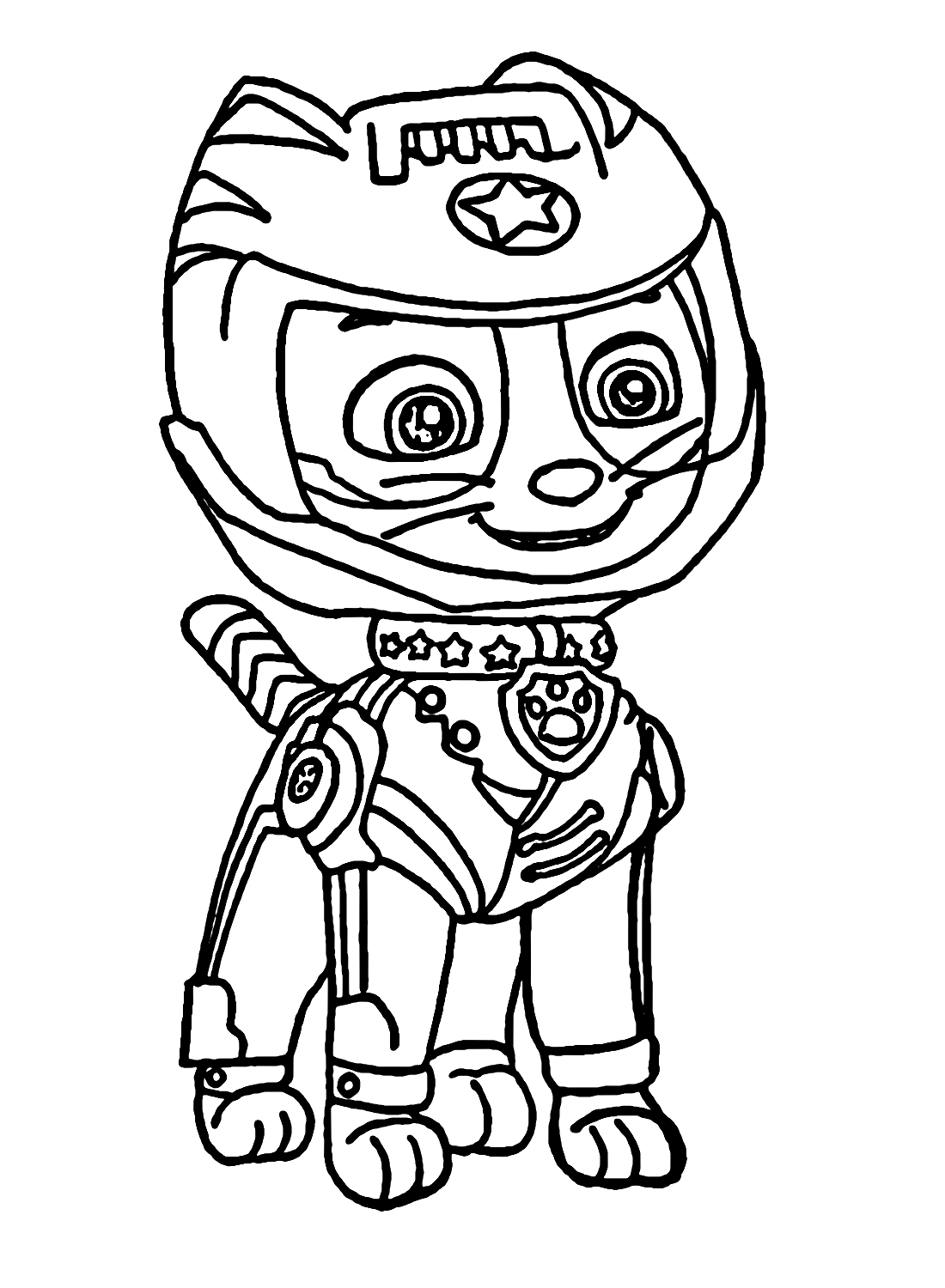
Solo pages showing Wild Cat sitting, standing, or stretching, with his ginger tabby markings and helmet clearly visible.
Coloring classic portraits: his coat is a warm orange with darker tabby stripes, closer to a real ginger cat than a solid color, and keeping those stripes simple and evenly spaced is what sells the pattern without overcomplicating the page.
Motorcycle Stunts and Action
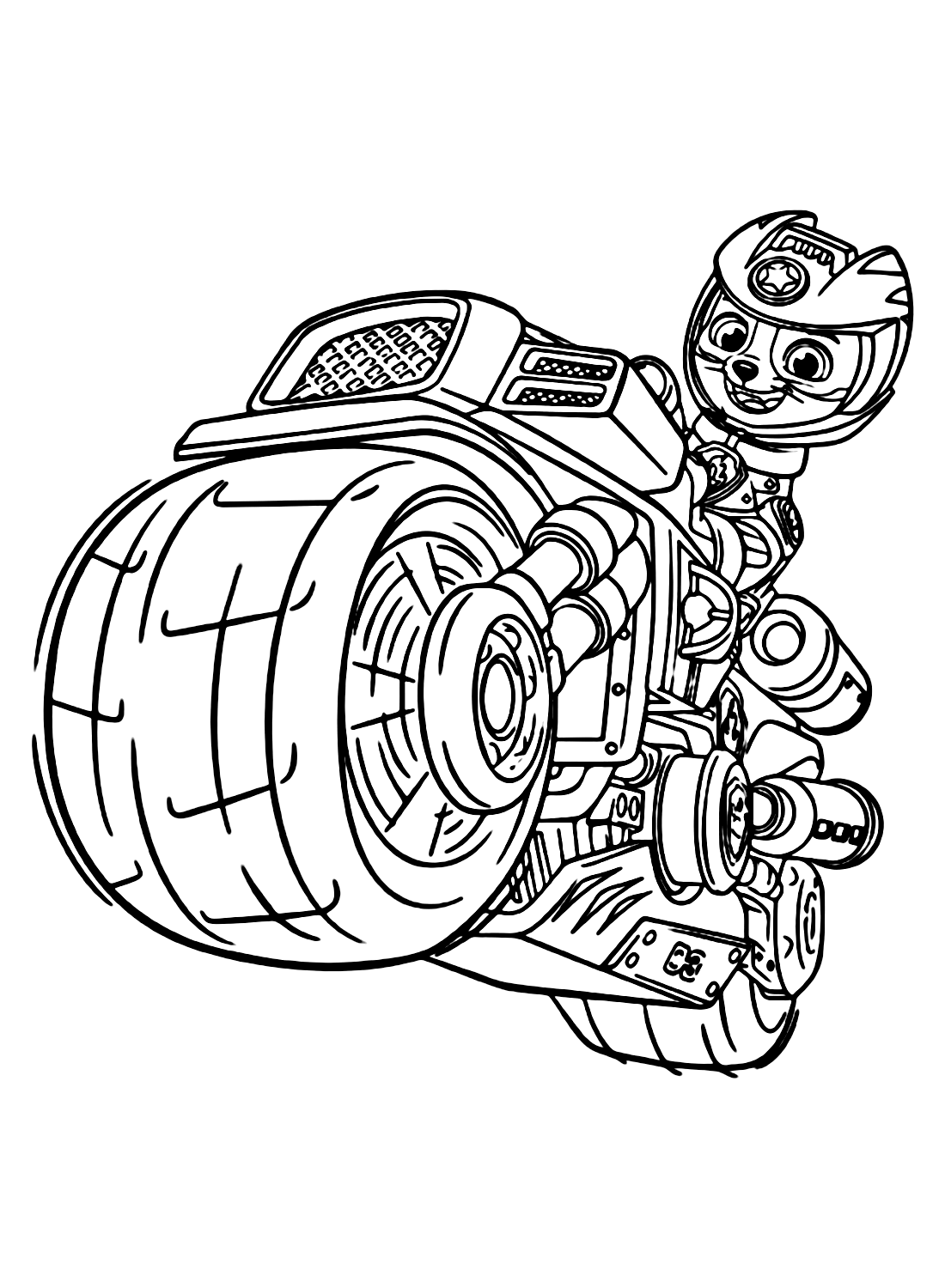
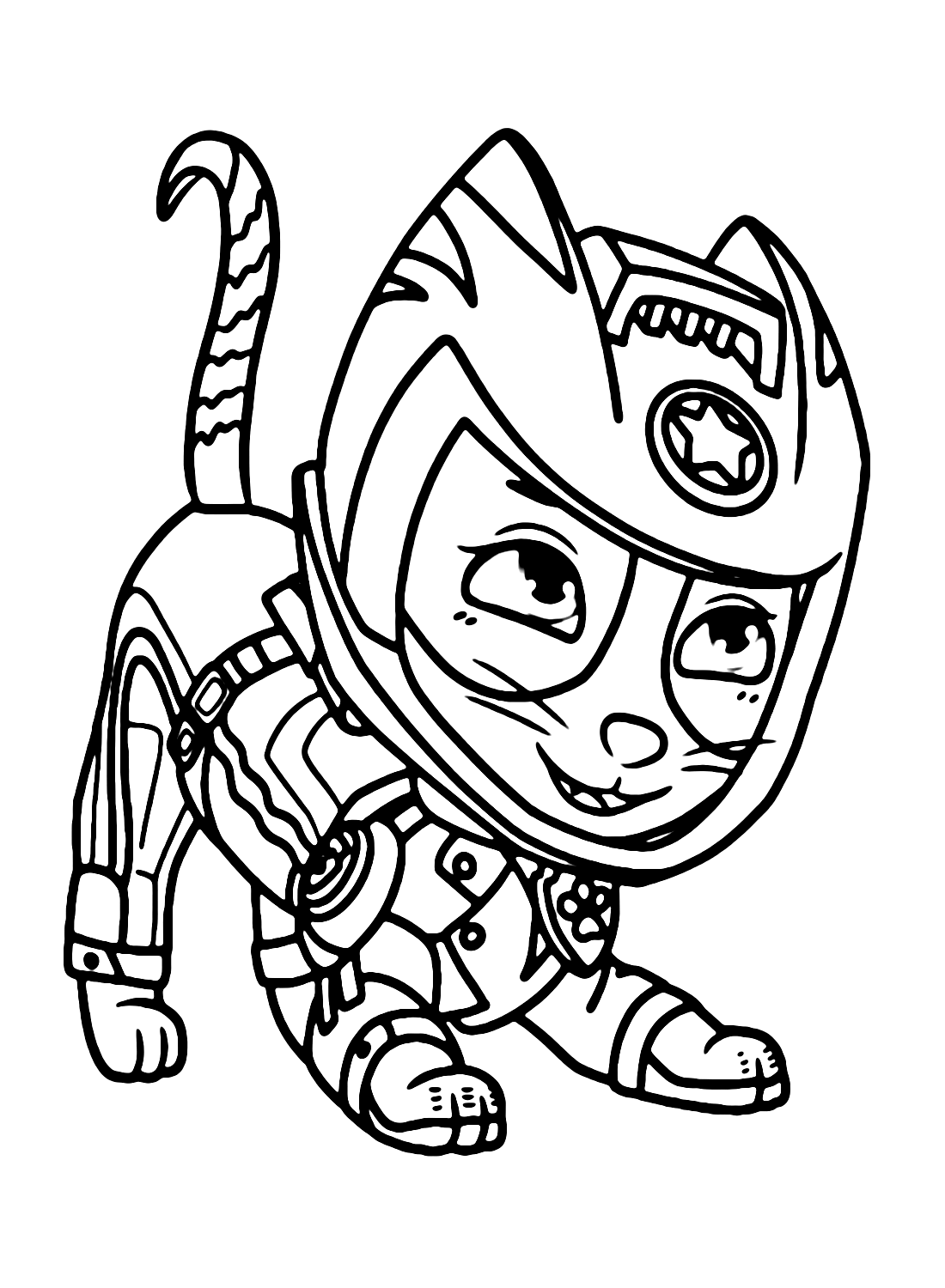
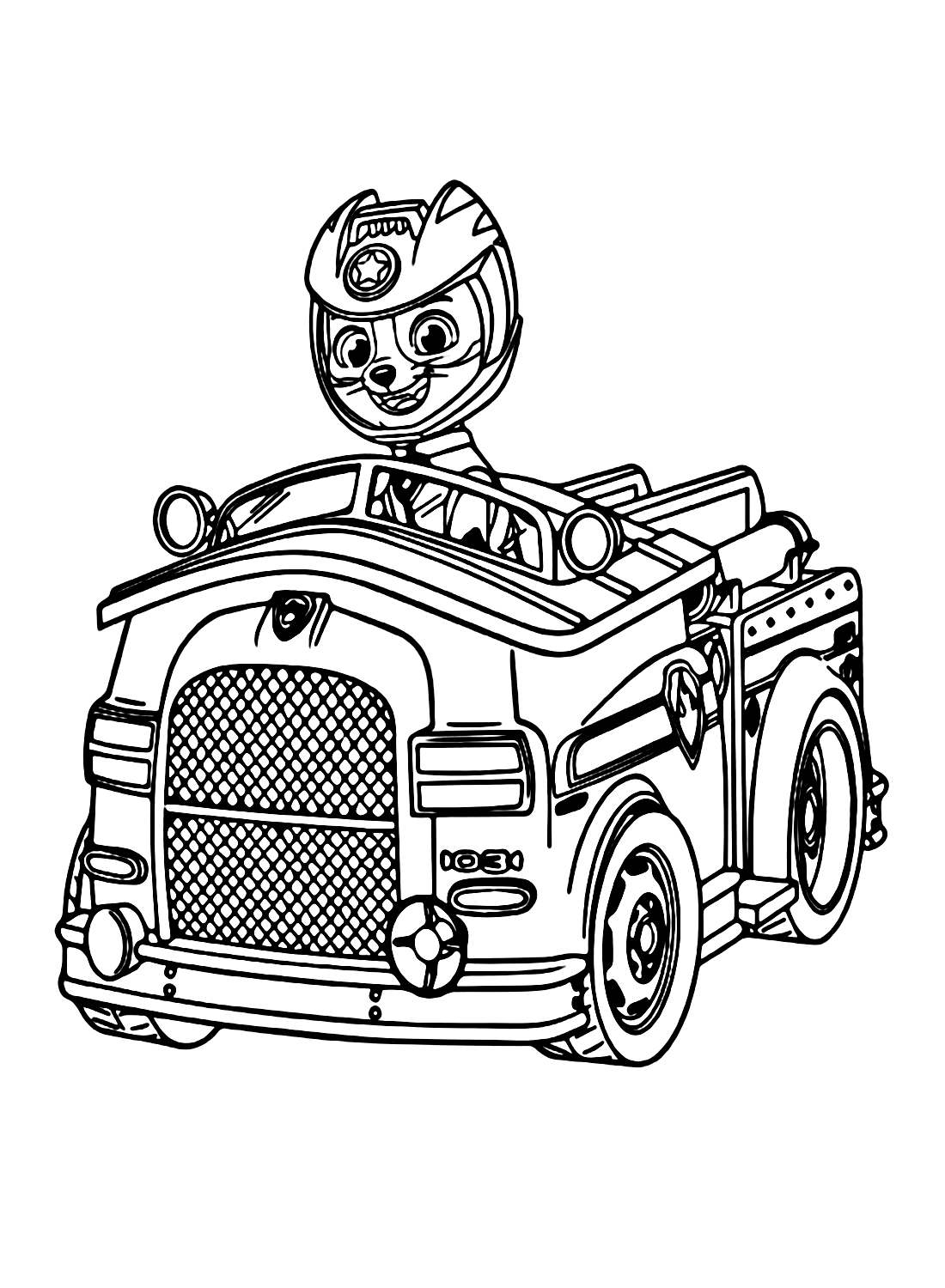
Pages showing Wild Cat mid-trick on his motorcycle: front flips, backflips, and his signature looping jump.
Coloring stunt pages: motion lines around the wheels and body do a lot of the work here, and keeping the motorcycle’s color bold and consistent, black frame, bright accent color, helps it read clearly even in a busy, mid-air pose.
Cheetah Speed Power Gear
A smaller cluster shows Wild Cat in his light-up power suit, which gives him cheetah-level speed during missions.
Coloring power gear pages: these suits usually glow at the edges, so a bright accent color along the seams, fading slightly at the tips, helps sell the idea of light rather than just a solid-colored costume.
Wild Cat and the Cat Pack
A dedicated group of pages shows Wild Cat alongside Leo, Rory, and Shade, the other members of the Cat Pack, each themed after a different big cat.
Coloring Cat Pack pages: since all four wear a similar style of gear, giving each one a distinct accent color, orange for Wild Cat, and different tones for the others, is what keeps a group page easy to read rather than one blur of matching suits.
Wild Cat with the Pups
A handful of pages place Wild Cat alongside Chase, Marshall, or the wider dog team, usually working together on a shared mission.
Coloring team pages: his warm orange and black gear naturally stands apart from most of the pups’ cooler-toned uniforms, which makes him easy to spot first in a crowded scene without needing extra effort.
What These Pages Do
There’s a real reason Wild Cat is described as always landing on his paws, and it’s not just a turn of phrase. Cats have a genuine, well-studied ability called the righting reflex, using a flexible spine and an inner ear that senses which way is up to twist themselves feet-first during a fall. Scientists have been fascinated by exactly how it works since the 1700s, and researchers are still refining the details today. Wild Cat’s stunt-cycling confidence is a cartoon version of something real cats can actually do.
That mix of big, bold shapes and smaller stunt detail is good practice for a young colorist’s hands, too. The American Academy of Pediatrics points to coloring as a genuine step in building fine motor skills, and this set naturally combines large, simple shapes on his motorcycle with more careful, precise work on his stripes, gear seams, and mid-air poses.
There’s something worth pointing out in Wild Cat’s actual role on the team, too. He wasn’t brought in to act like a dog with different-colored fur; he was brought in specifically because he thinks and moves like a cat. Art therapy practitioners have noted that stories where someone’s differences are treated as the exact reason they’re useful, rather than something to smooth over, can be a quietly encouraging idea for kids who sometimes feel like the odd one out in a group.
How to Color Wild Cat Paw Patrol Coloring Pages Well
Keep the tabby stripes simple. A few evenly spaced darker orange stripes over a warm base coat read as a tabby pattern without needing dozens of tiny lines.
Add motion, not just a pose. Short curved lines trailing off the wheels or paws suggest speed and make a stunt page feel active rather than frozen mid-air.
Make the power suit glow. A brighter accent color right at the seams, fading outward, sells the idea of light better than one flat, solid color across the whole suit.
Give every Cat Pack member their own color. Keeping Wild Cat, Leo, Rory, and Shade each in a distinct palette is what makes a full team page easy to read at a glance.
5 Creative Craft Ideas with Wild Cat Paw Patrol Coloring Pages
Stunt Trick Flashcards
Color three or four different stunt poses, glue each to an index card, and label the trick underneath: front flip, backflip, looping jump.
It turns a handful of action pages into a simple set of cards a child can shuffle, sort, or quiz themselves with – about fifteen minutes.
Landing Reflex Demonstration
Color a Wild Cat action page, then gently drop a soft stuffed toy from a low height to watch how it naturally tries to right itself, connecting the page to the real trait it’s based on.
It’s a simple, safe way to make the “always lands on his paws” idea feel like a real, observable thing rather than just a cartoon detail – about ten minutes.
Cat Pack Team Poster
Color all four Cat Pack members on separate pages, then arrange them together on a poster board with each one’s name written underneath.
Building a full team roster turns four individual pages into one connected display – about twenty-five minutes.
Motorcycle Stunt Track Design
Color a stunt page, then draw a simple pretend racetrack on a separate sheet with loops and jumps for Wild Cat to ride through.
It extends the coloring page into an imaginative, story-driven activity without needing any extra materials, for about fifteen minutes.
Yarn Ball Toss Game
Color a portrait page, then set it up as a target for a simple toss-and-catch game using a real ball of yarn, echoing one of Wild Cat’s favorite off-duty pastimes.
It’s a light way to fold some real cat behavior into an active, physical game alongside the coloring itself – about ten minutes.
FAQ About Wild Cat Paw Patrol Coloring Pages
Is this Wild Cat set free, and do I need an account?
Everything here is free, and no account is required. Save the PDF for printing, or color the page directly in the browser instead.
Who is Wild Cat in PAW Patrol?
Wild Cat is the first feline member of the PAW Patrol, a stunt cyclist known for daring motorcycle tricks who later becomes the leader of a group of cats called the Cat Pack.
What breed is Wild Cat?
He’s a ginger tabby, a real and common cat coat pattern, not a specific breed on its own, recognizable by his warm orange fur and darker striped markings.
Why is he sometimes called “Wild” instead of “Wild Cat”?
The show shortened his name to just “Wild” once he became leader of the Cat Pack, likely to match the naming style of the other team members. Many fans and product packaging still use “Wild Cat,” which is technically his nickname.
What is the Cat Pack?
It’s a team of four cats led by Wild Cat, each one themed after a different big cat: cheetah, lion, jaguar, and white tiger, who help the PAW Patrol on missions that call for a more feline approach.
Is it true that cats always land on their feet?
Mostly, though not perfectly every time. Real cats have a genuine ability called the righting reflex, using their flexible spine and inner ear balance system to twist themselves feet-first during a fall, a trait scientists have studied since the 1700s.
What is Wild Cat afraid of?
Mice, somewhat ironically for a cat. It’s one of the show’s small jokes, subverting the usual cats-chase-mice expectation.
What age group are these pages best suited for?
The simple portrait pages work well from age three onward. Stunt, power gear, and Cat Pack scenes suit kids closer to five and up, especially ones who already enjoy motorcycle and action themes.
Start Coloring
Pick a design, save the PDF for printing, or use the online coloring tool right in the browser. When a page is done, use the share buttons at the top of each design to post it straight to Facebook or Pinterest.