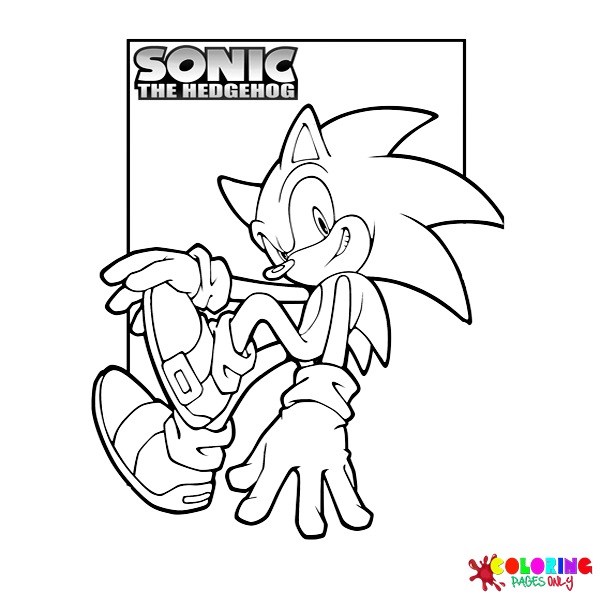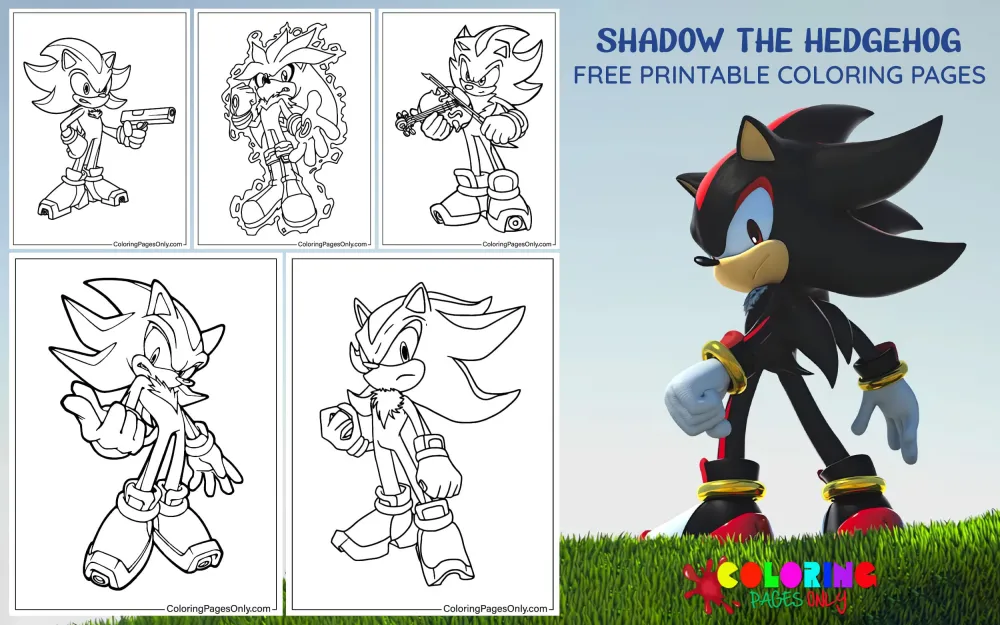
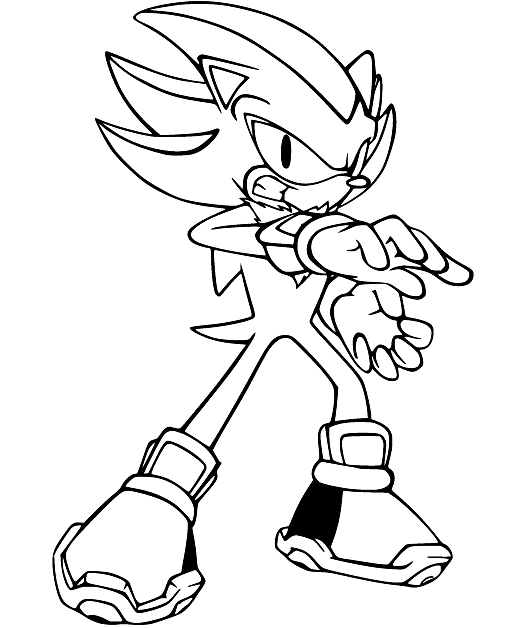
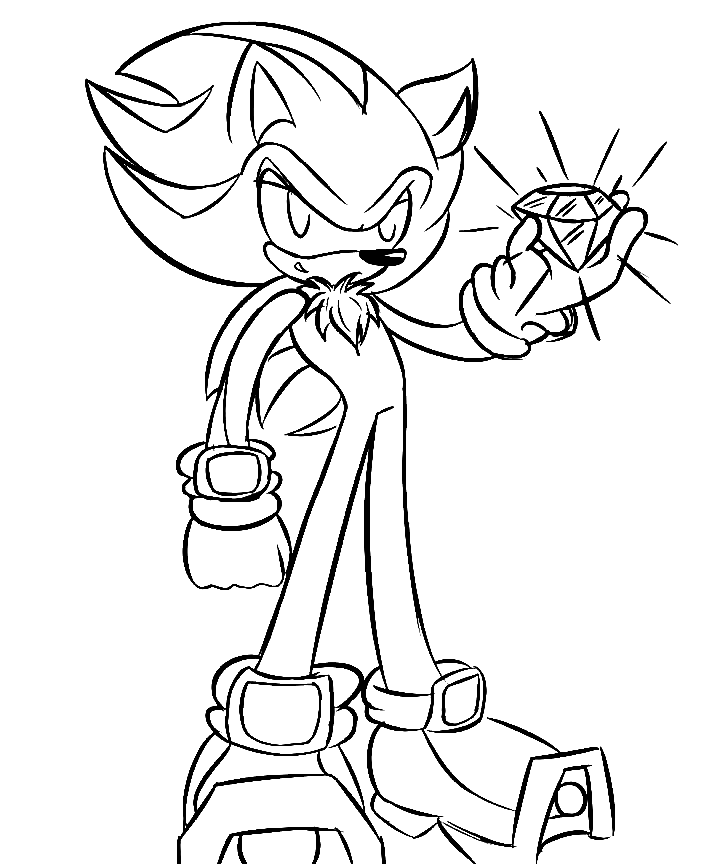
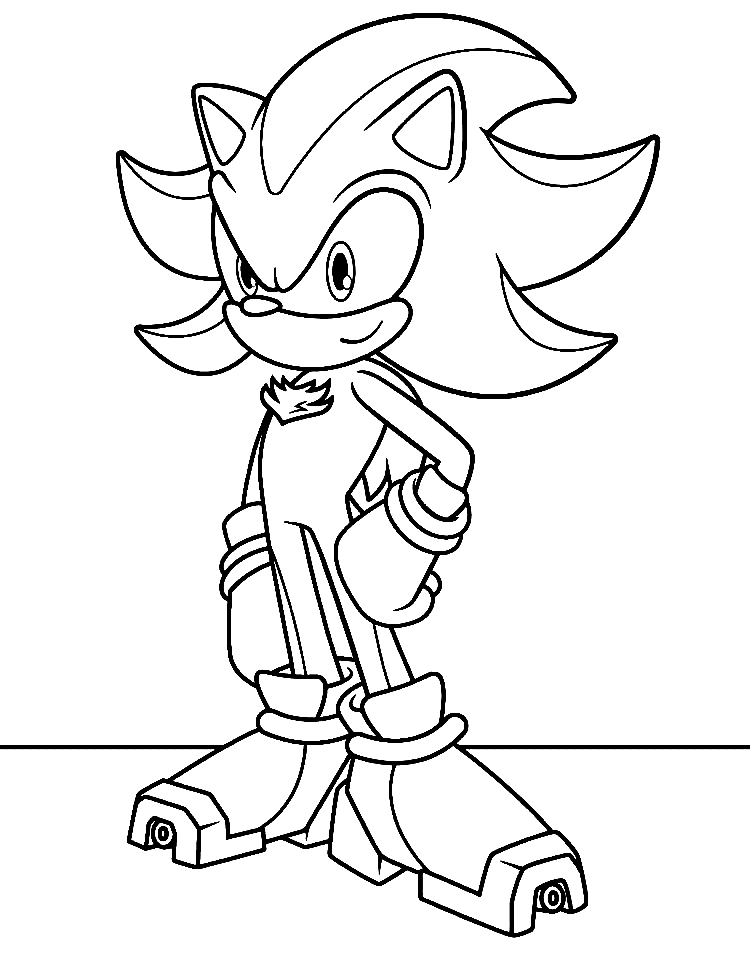
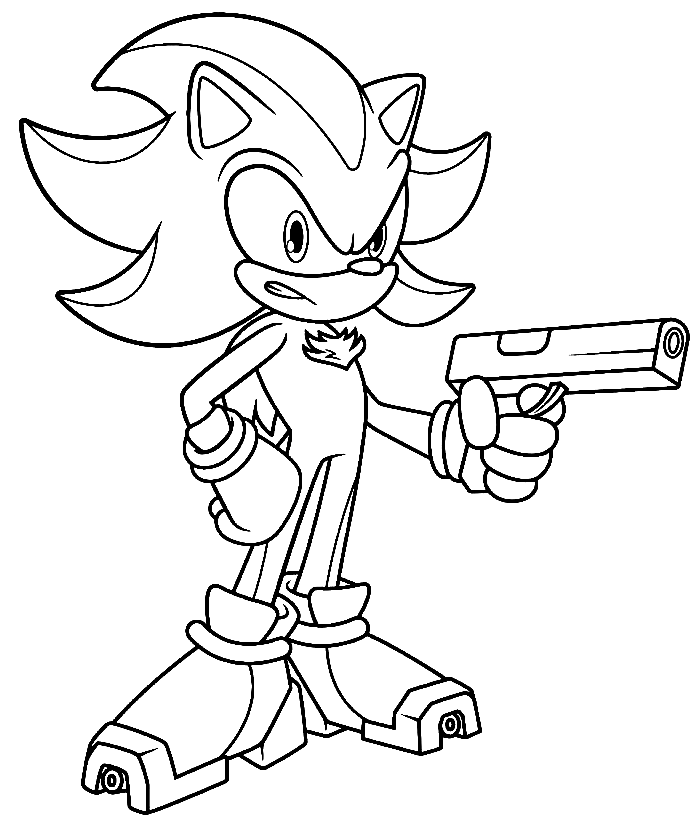
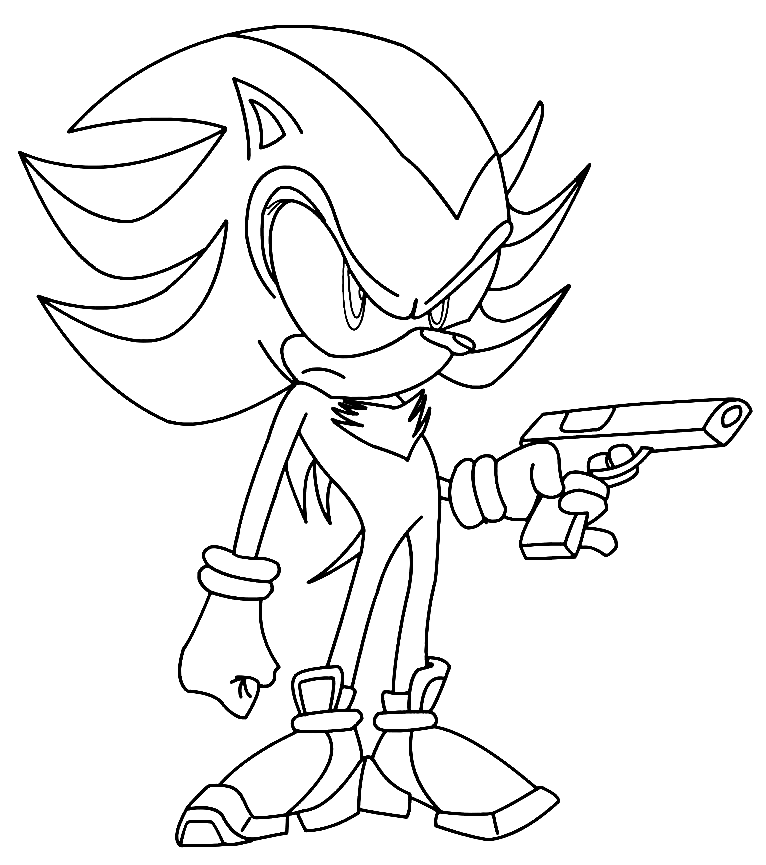
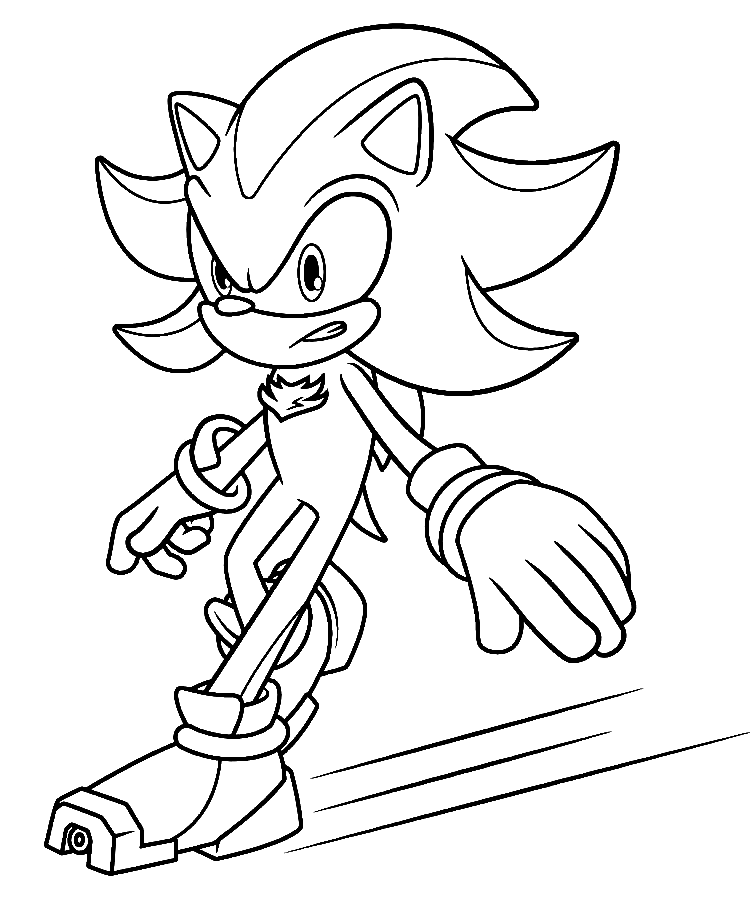
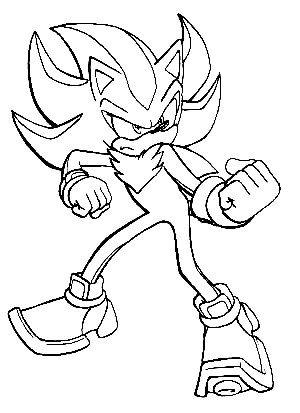
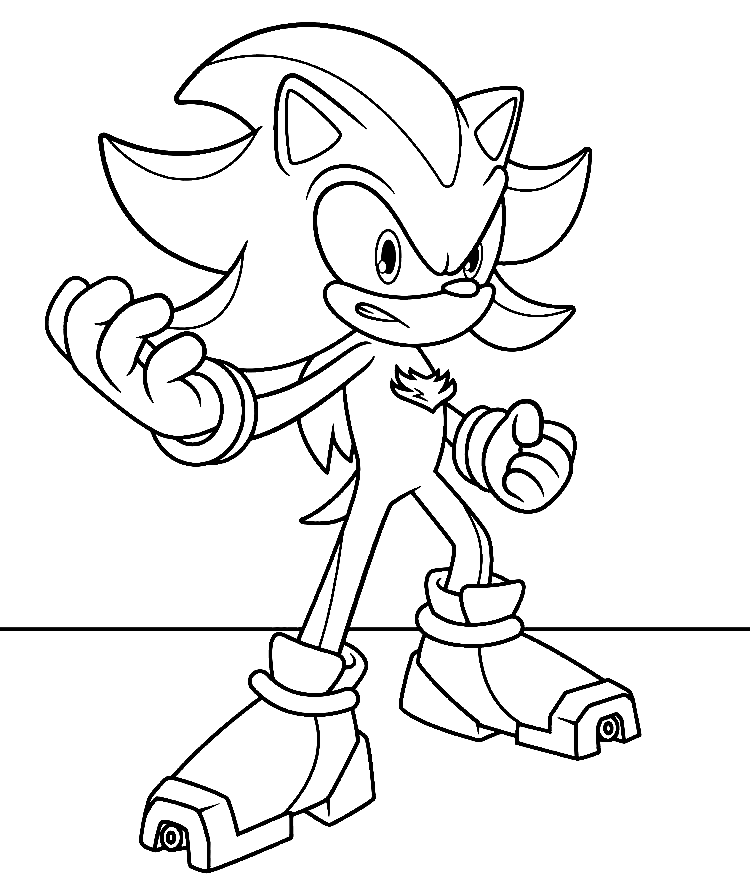
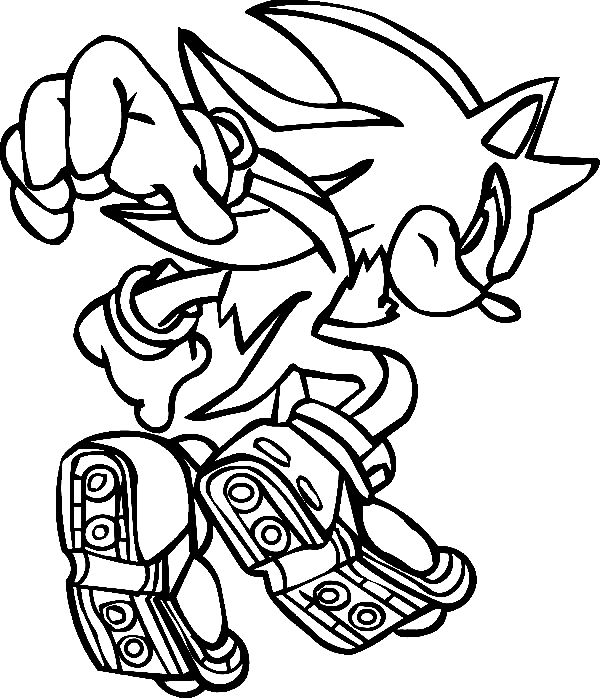
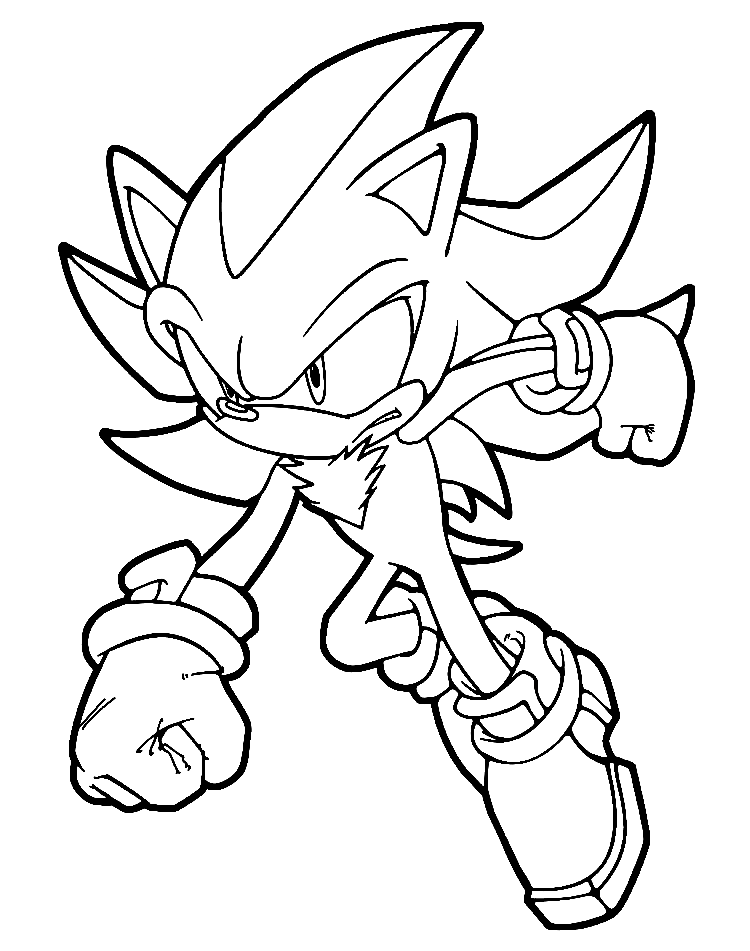
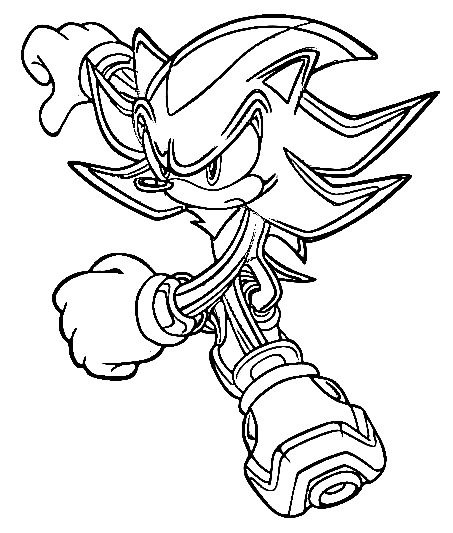
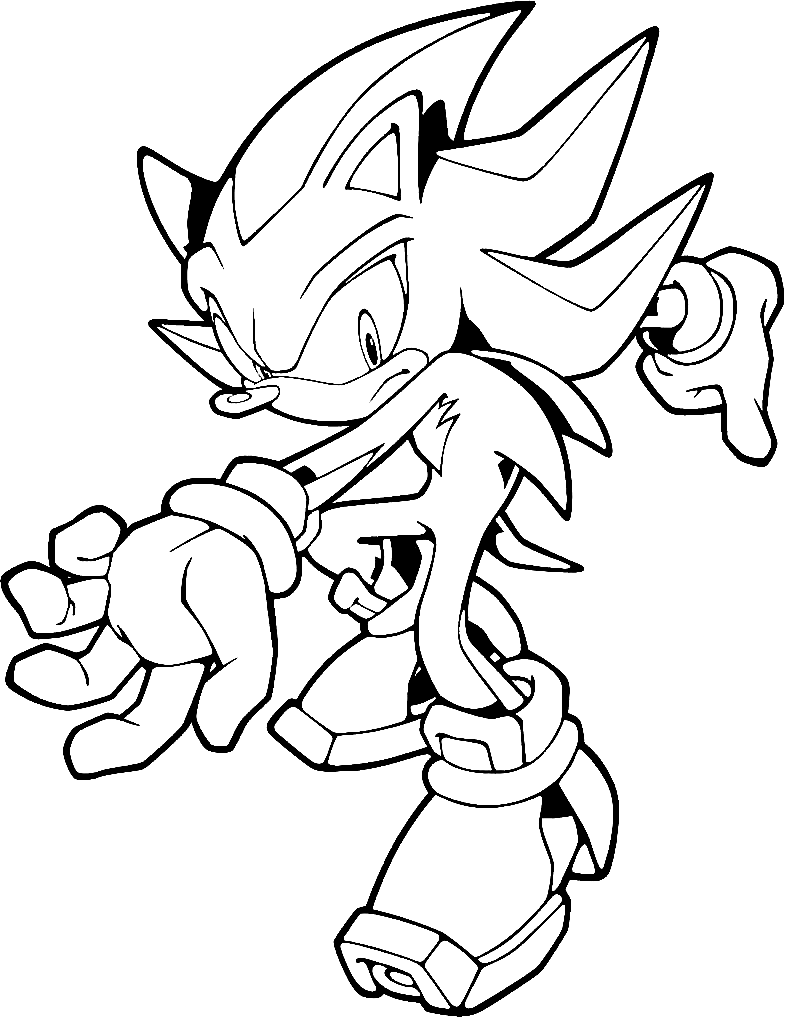
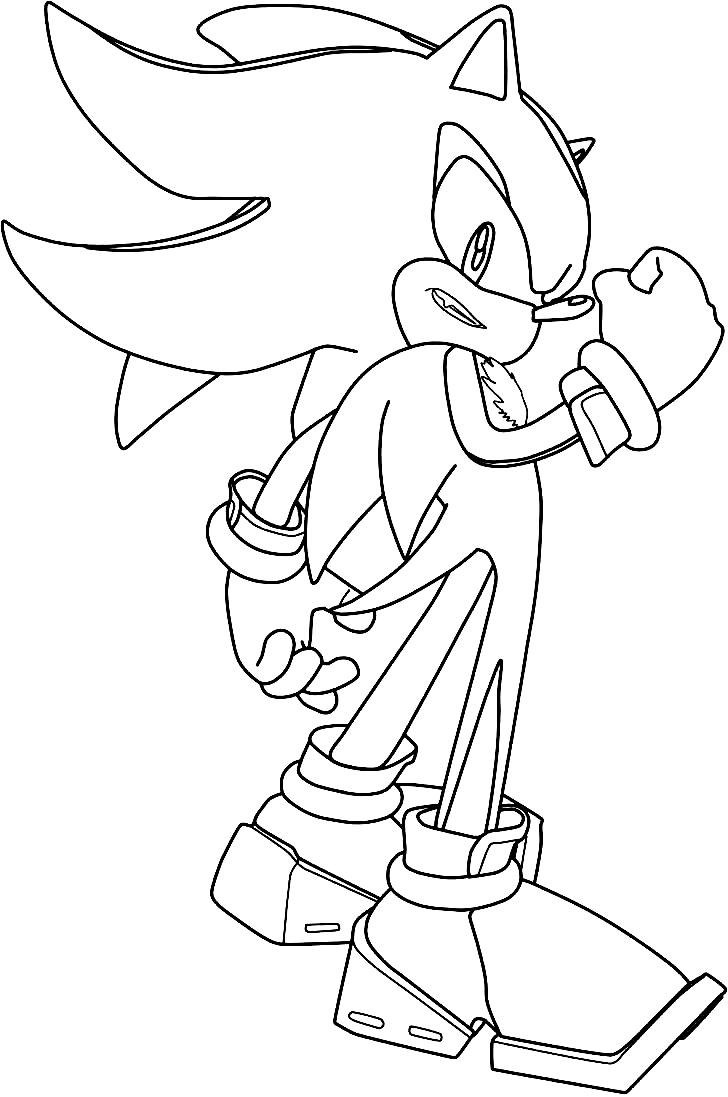
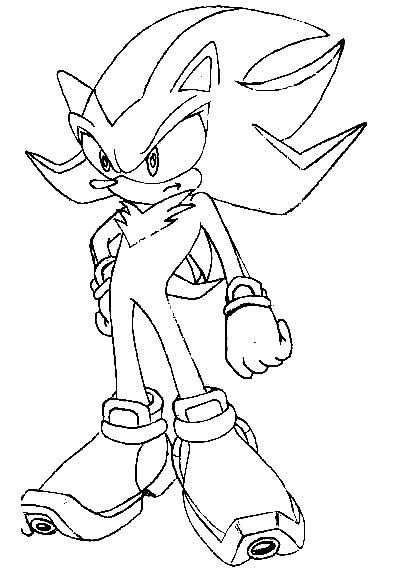
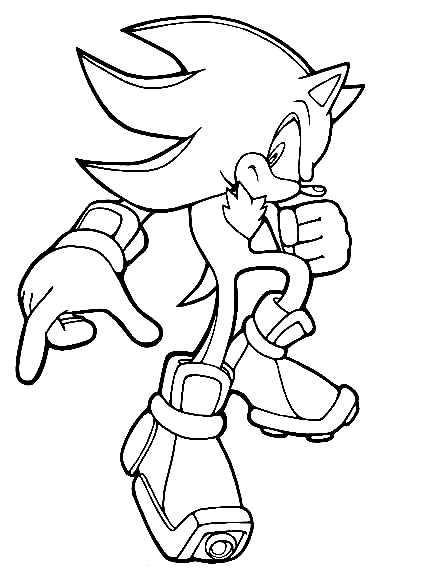
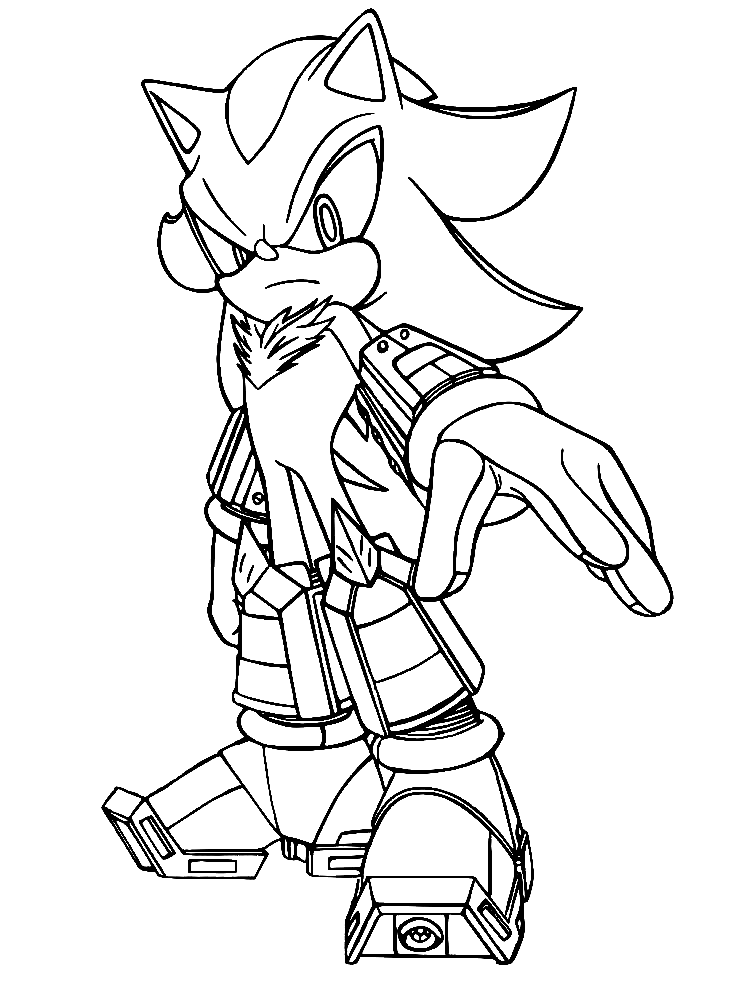
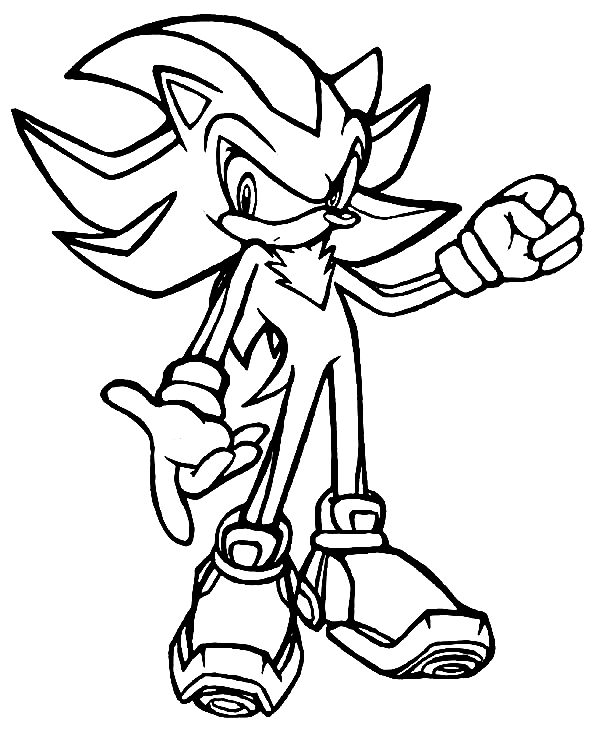
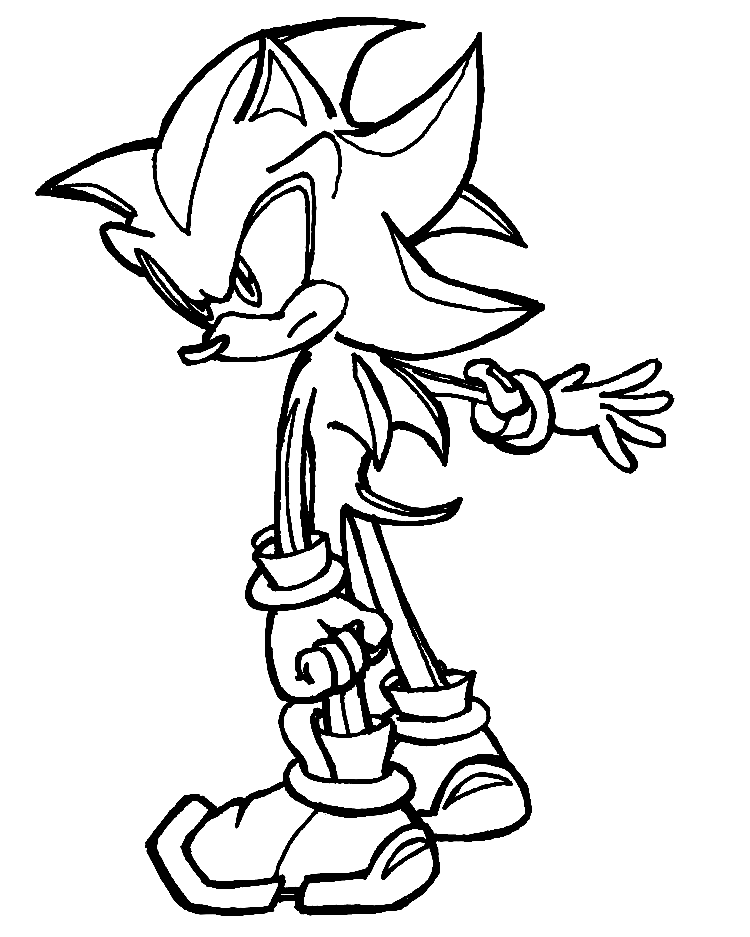
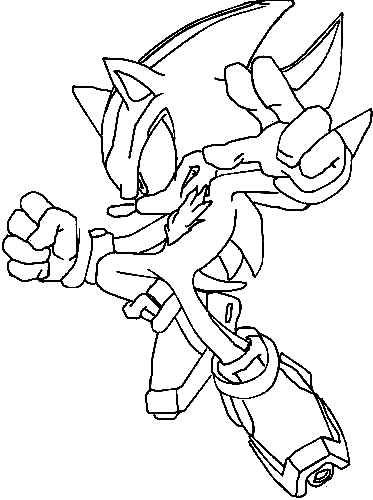
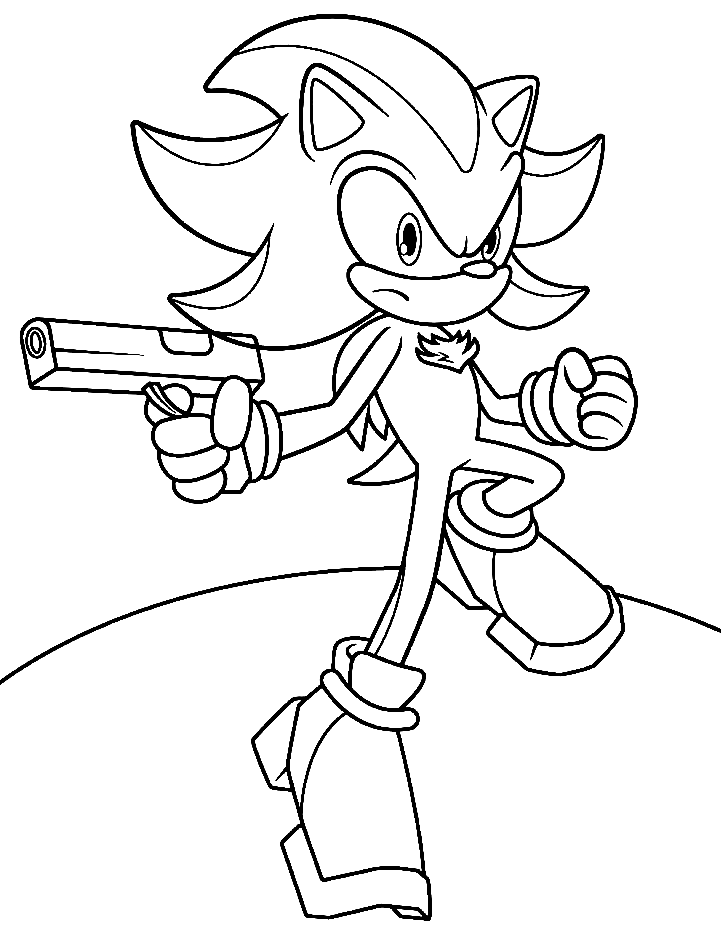
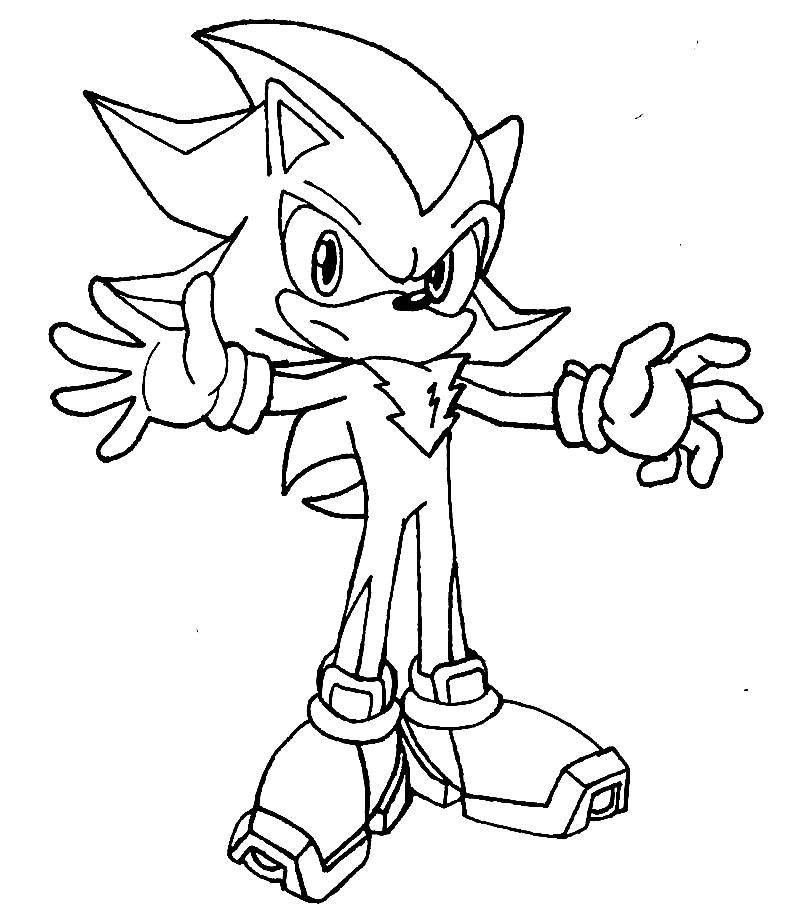
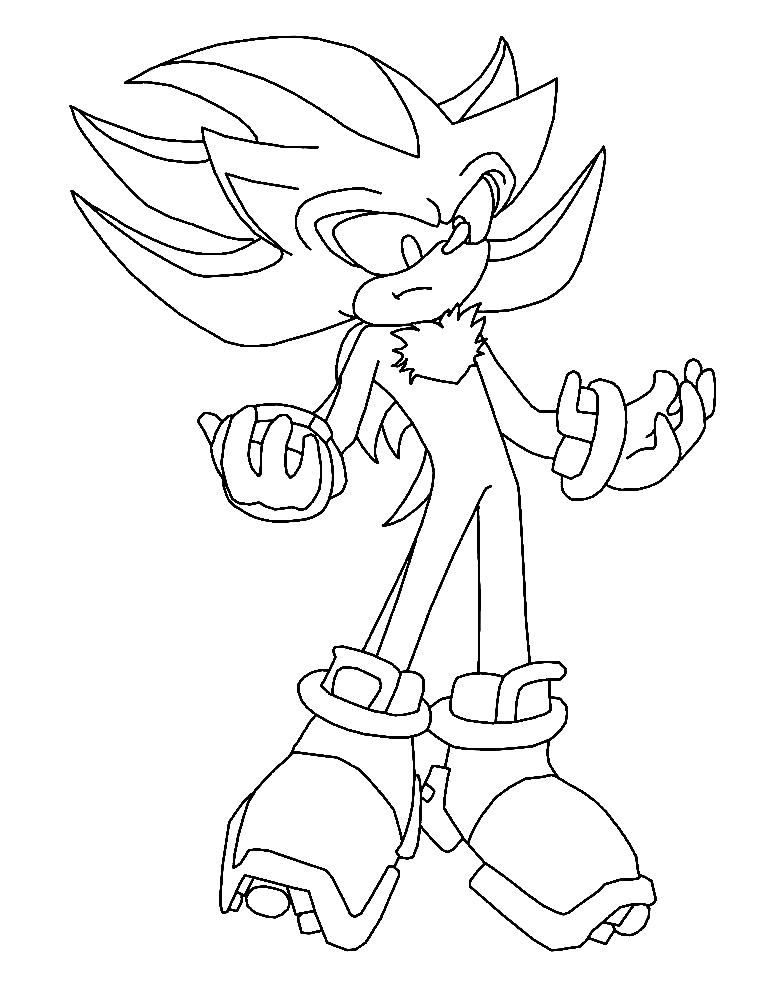
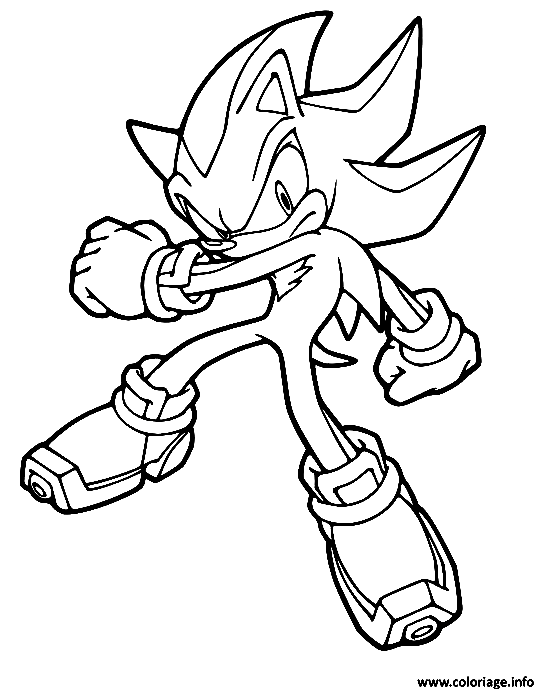
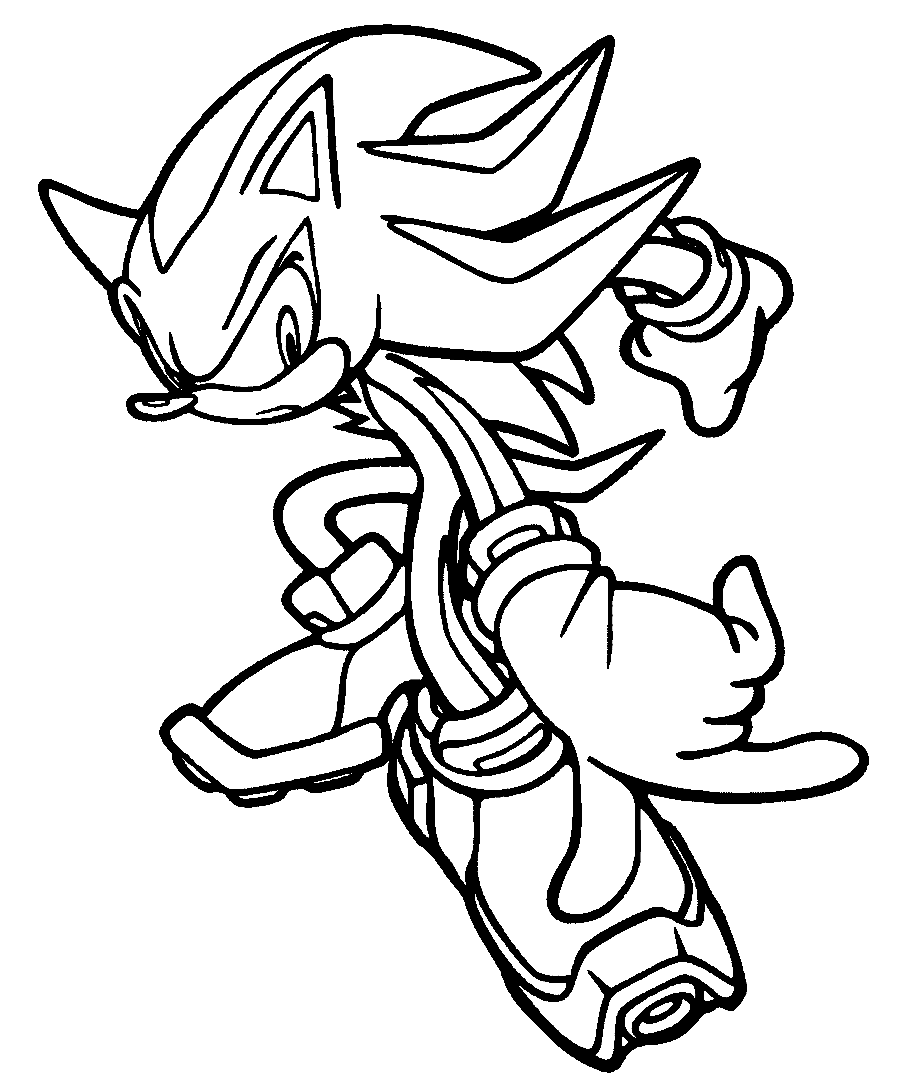
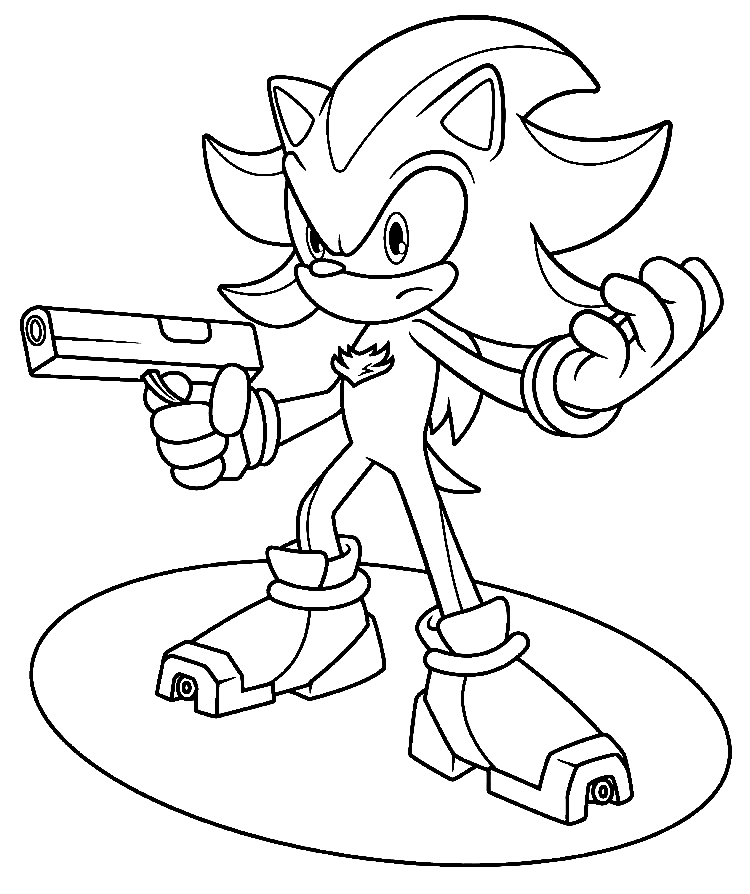
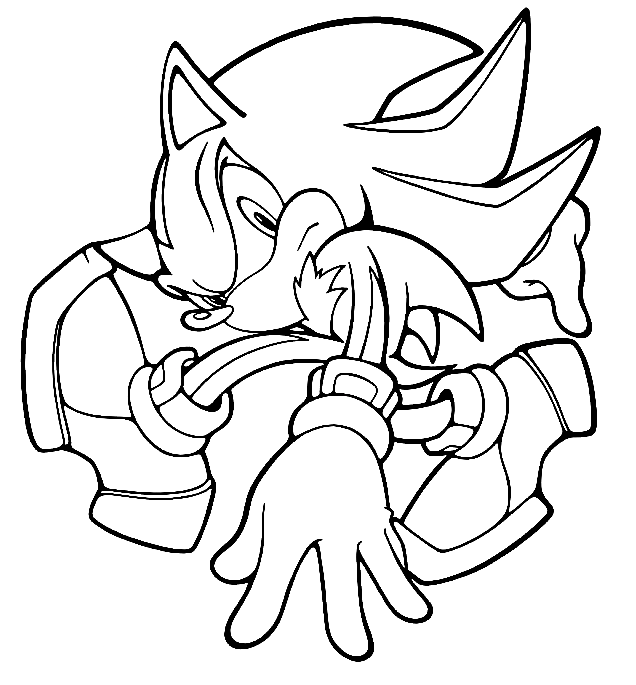
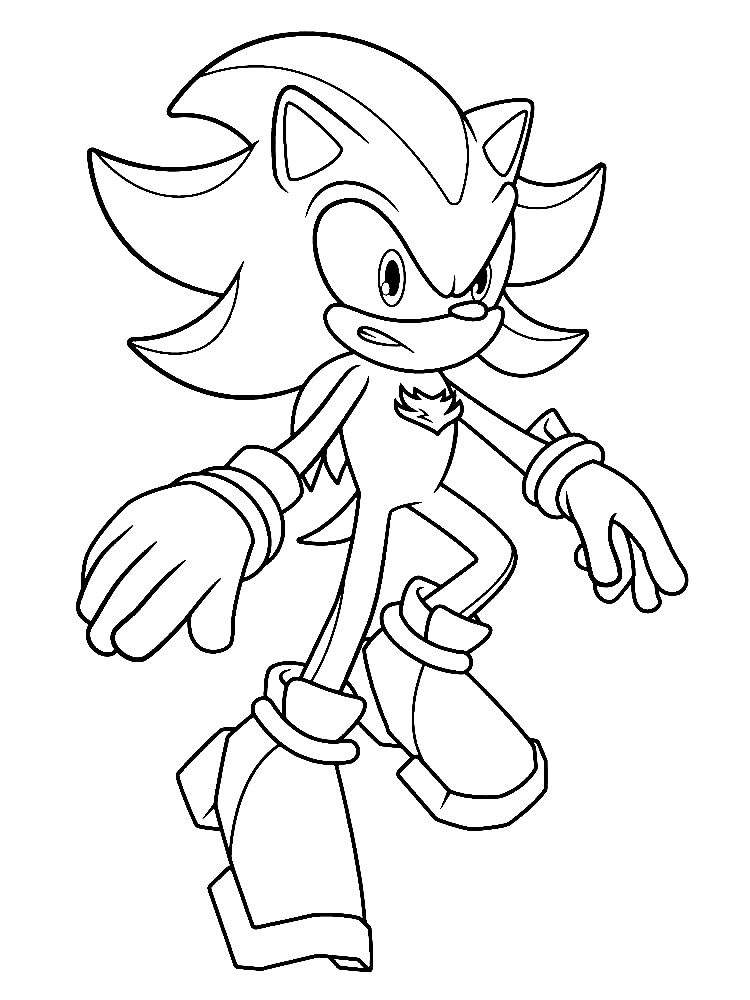
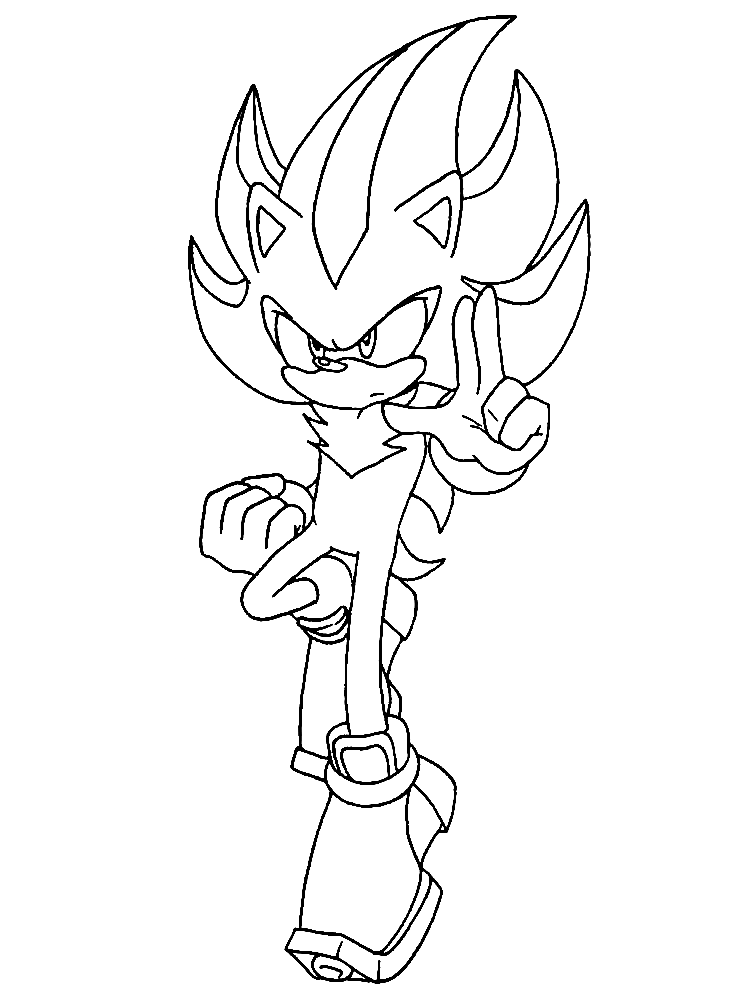
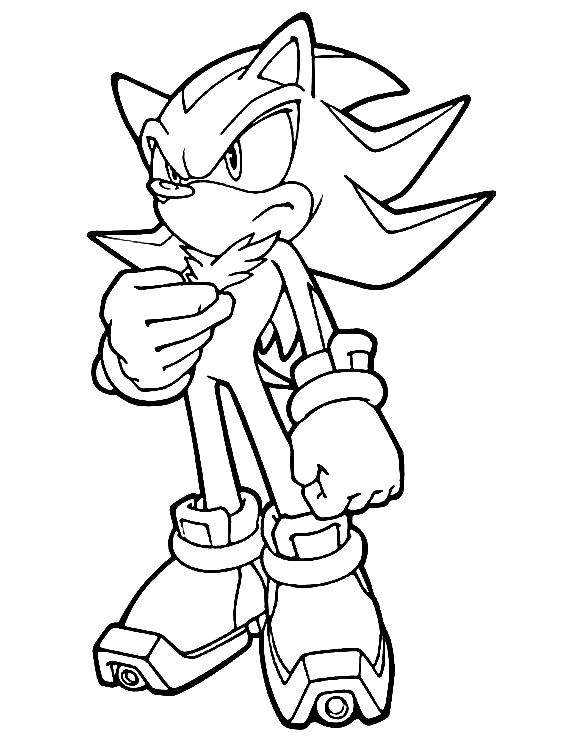
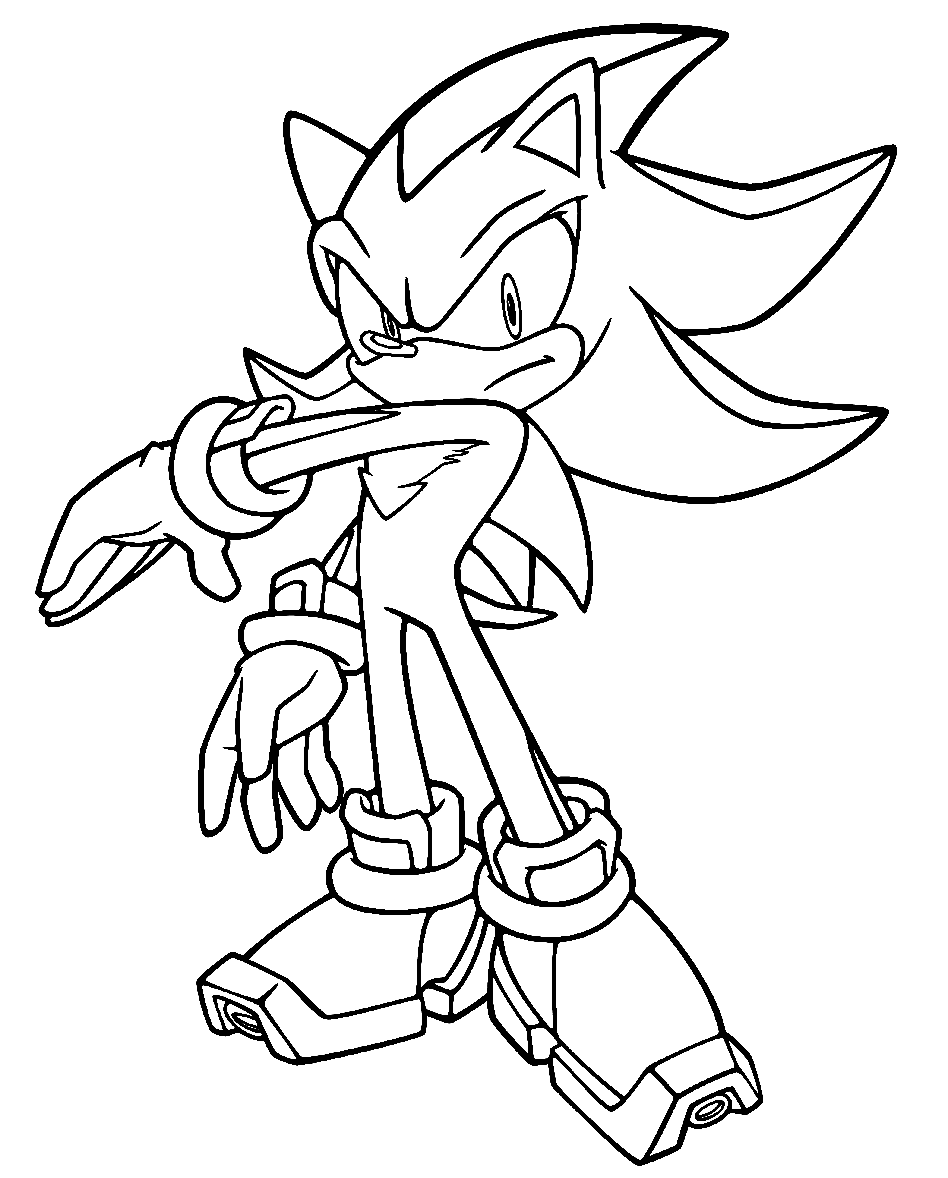
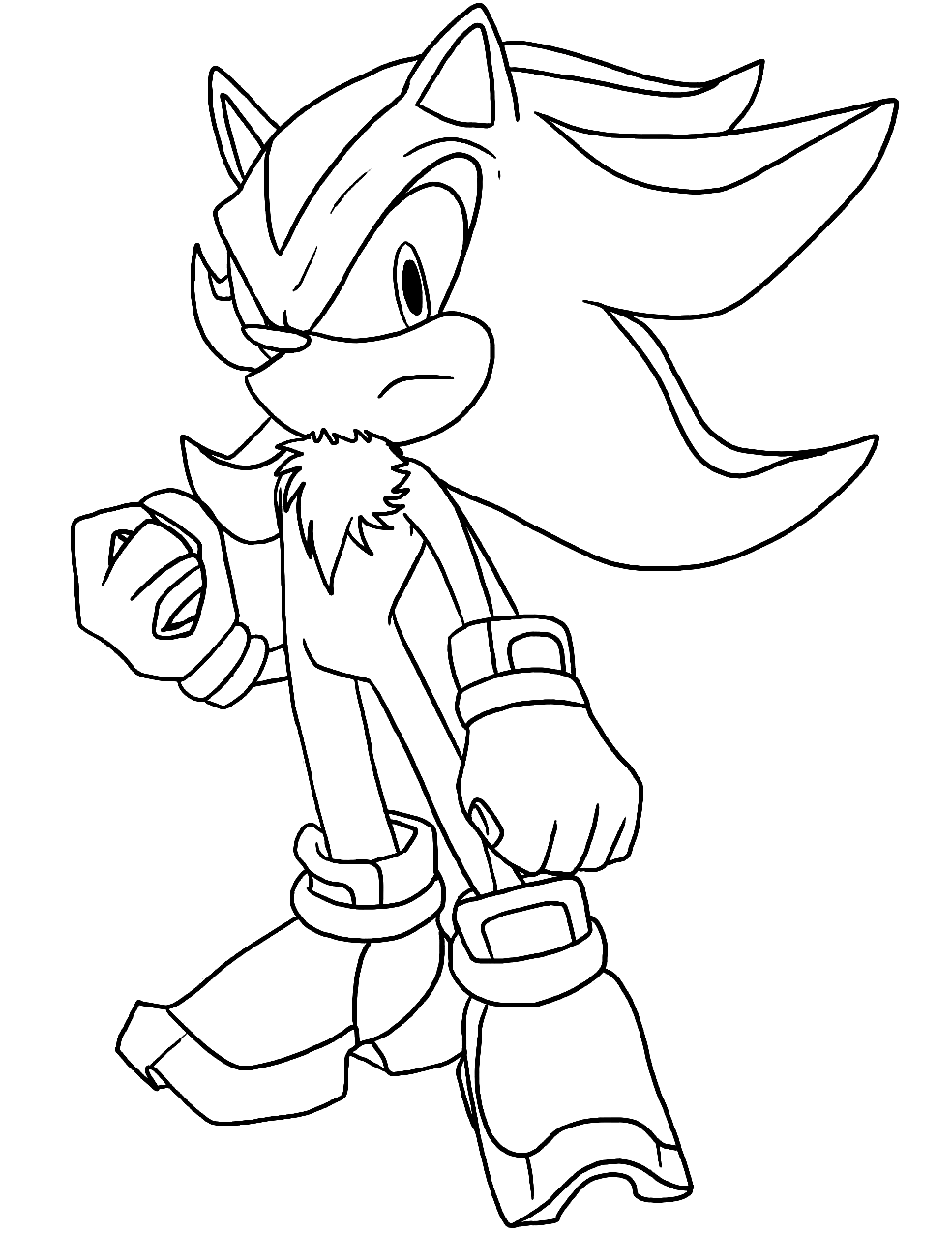
Free Shadow the Hedgehog coloring pages: 50+ pages featuring Shadow in his classic standing and combat poses with black fur and red stripe quills, Chaos Control energy burst scenes with Emerald glow effects, Chaos Spear and Chaos Blast action compositions, Super Shadow in gold transformation form, Team Dark group pages alongside Rouge the Bat and E-123 Omega, Shadow versus Sonic rival confrontations, Air Shoes hover-skate running sequences, close-up portrait studies showing his distinctive red eyes, Shadow from Sonic the Hedgehog 3 (2024) featuring the Paramount film design, the ARK Space Colony setting pages, chibi Shadow designs, and the full visual vocabulary of the Sonic franchise’s most complex and most narratively dense character. All free, printable PDF and online coloring for Sonic fans of all ages.
Shadow the Hedgehog first appeared in Sonic Adventure 2, released by Sega for the Dreamcast on June 19, 2001, in Japan and June 23, 2001, in North America, and subsequently ported to the Nintendo GameCube as Sonic Adventure 2: Battle on December 20, 2001, in Japan and February 11, 2002, in North America. The character was created by the Sonic Team, with Takashi Iizuka as producer and Shiro Maekawa as the primary writer responsible for Shadow’s backstory and character motivation. Shadow was designed as a direct counterpart to Sonic: a hedgehog of the same speed and physical capability but with an entirely different emotional register, origin story, and visual palette.
His design establishes the contrast immediately: black fur with vivid red stripe accents, where Sonic uses blue and white, red eyes, and a lower and more serious body posture, where Sonic’s posture reads as casual confidence. He is described within the Sonic universe as the Ultimate Life Form (究極生命体, Kyūkyoku Seimeitai), created by Professor Gerald Robotnik aboard the Space Colony ARK through research combining advanced genetics with the DNA of Black Doom, leader of an alien race called the Black Arms.
In December 2024, Shadow appeared as the primary antagonist in Sonic the Hedgehog 3, voiced by Keanu Reeves, marking the character’s first theatrical film appearance.
These 50+ free pages at ColoringPagesOnly.com cover Shadow across his full visual and narrative history. All free, PDF or PNG, print or color online.
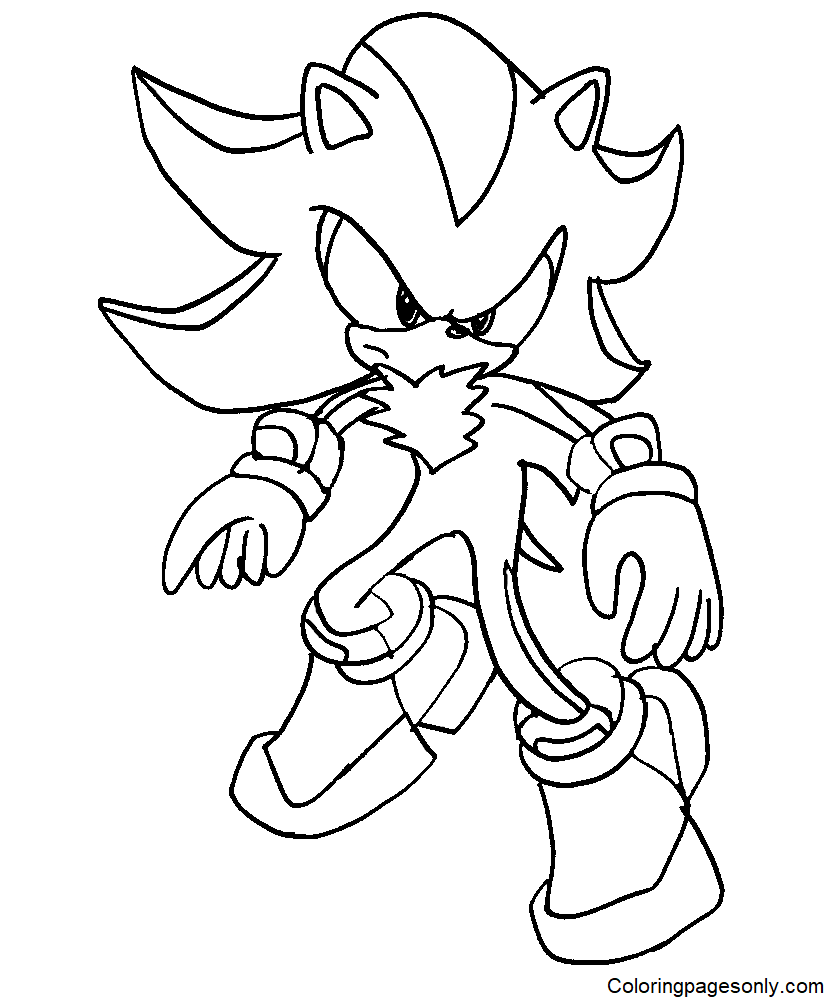

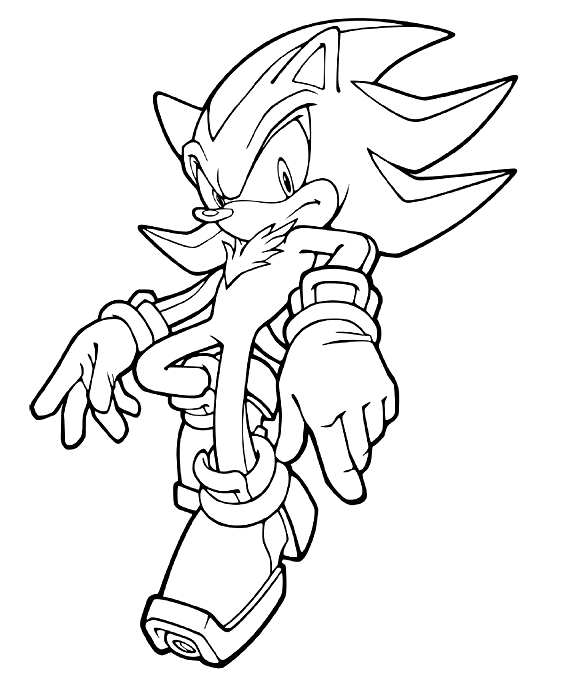
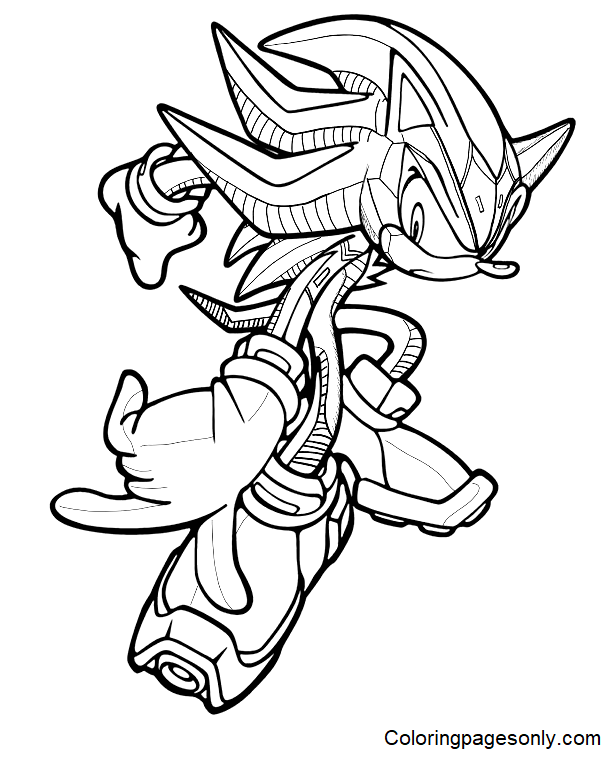


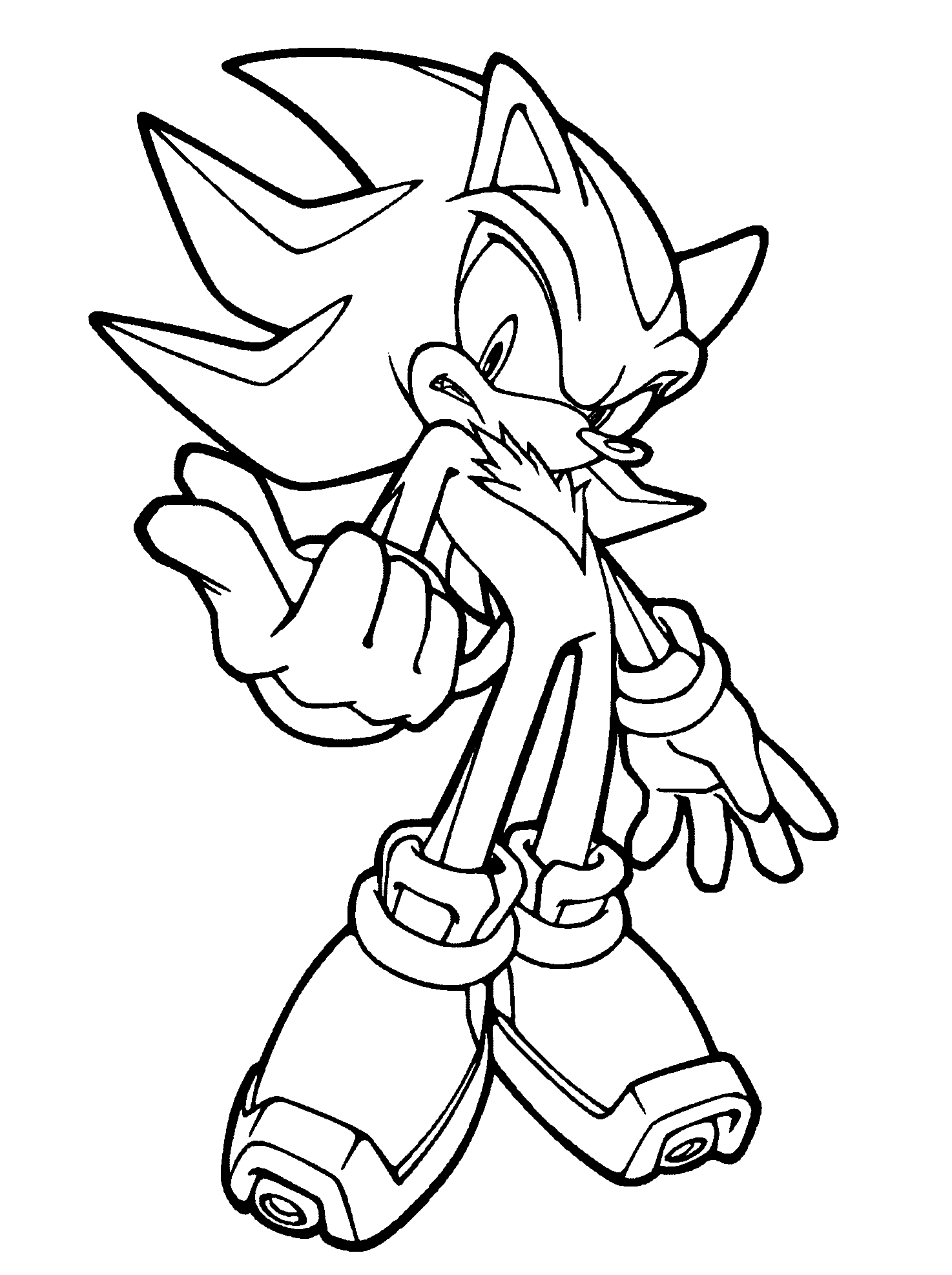
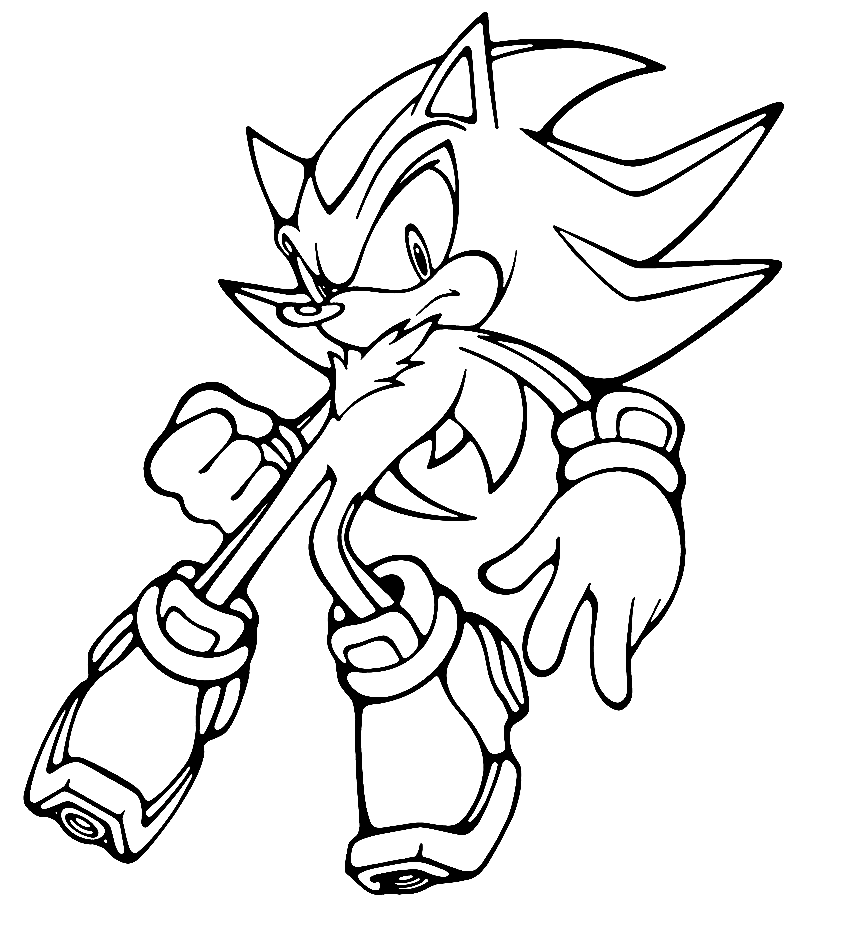
What’s Inside
Shadow: Portrait and Standing Pose Pages
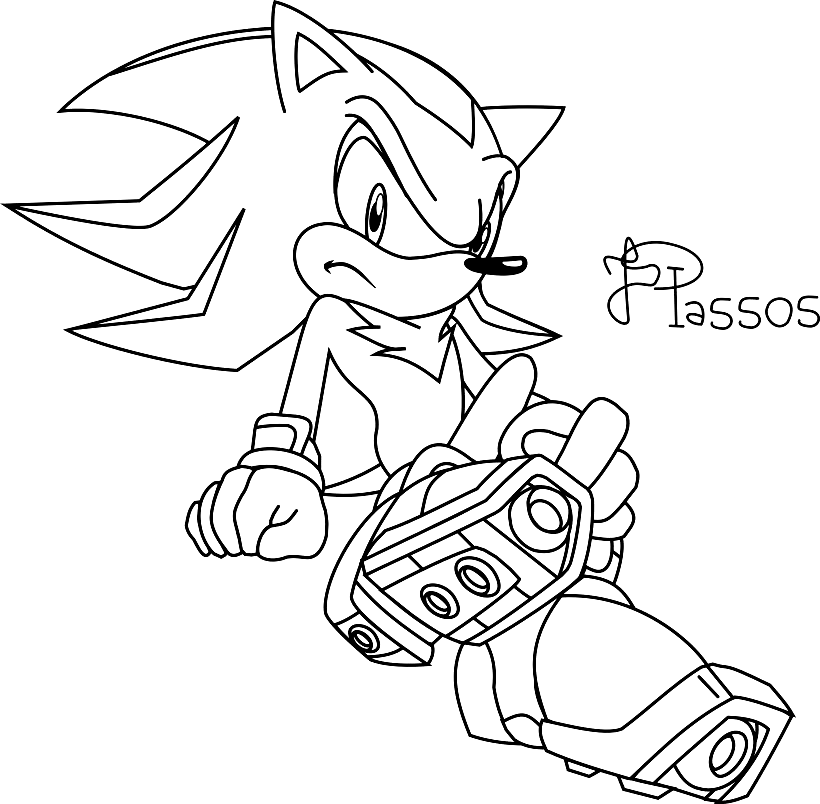
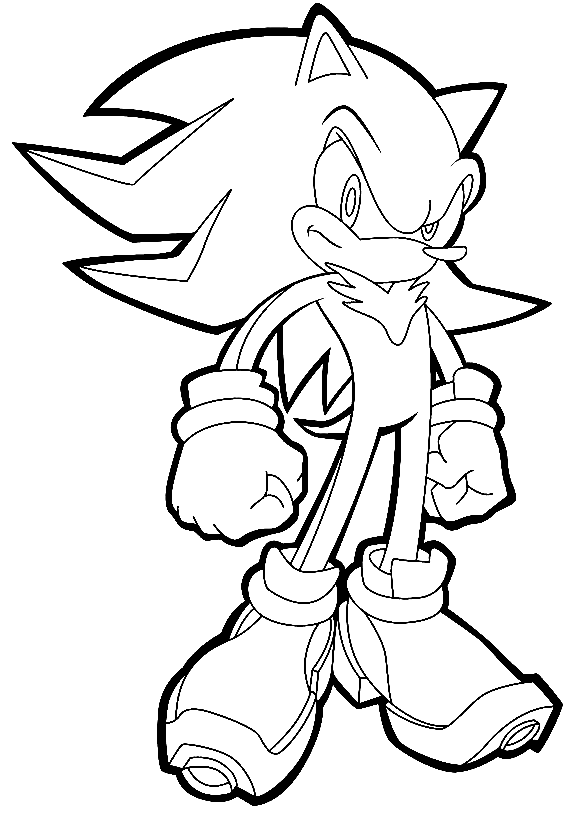
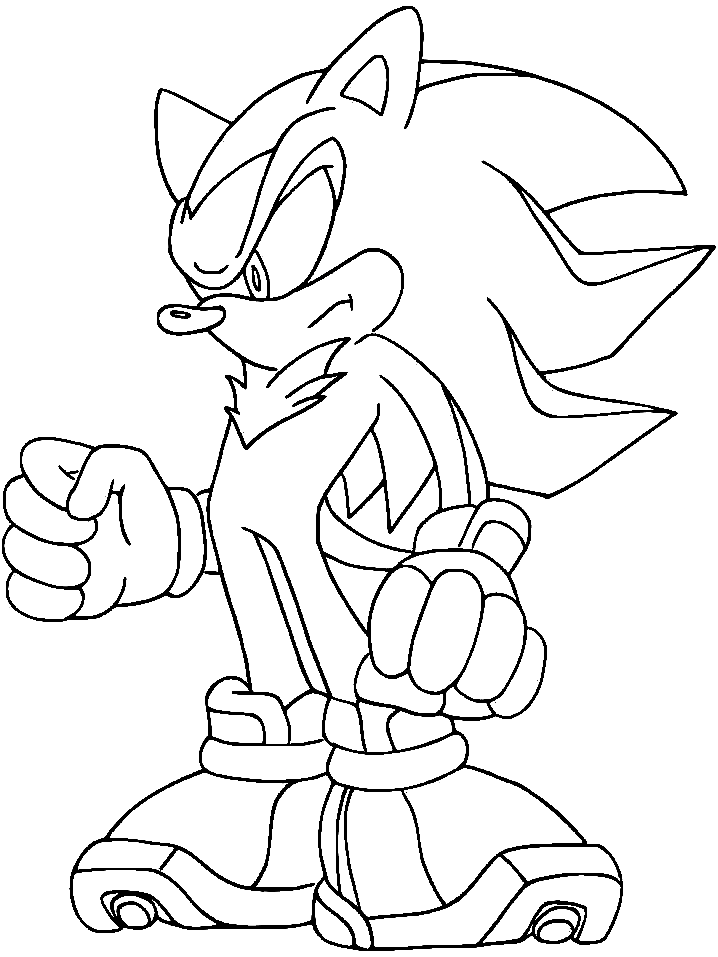
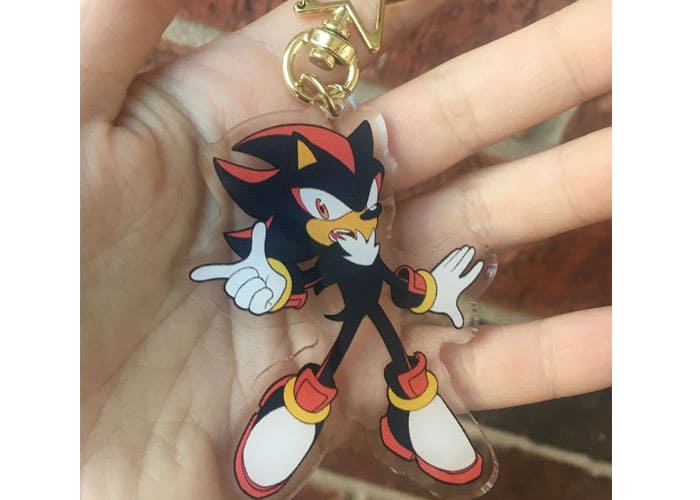
Shadow’s visual design is the Sonic franchise’s most specifically deliberate study in contrast with its title character. Every design element is chosen to communicate a difference from Sonic while maintaining the hedgehog species’ fundamental silhouette. The black fur covers the primary body surface. The vivid red stripe runs from the tip of each backward-pointing quill through the fur to the chest area. The red eyes read as both intensity and moral ambiguity. The Air Shoes (specialized hover-skating shoes) have a distinctive design with yellow soles and gold-tone accents that are more mechanical and purposeful in appearance than Sonic’s simpler red shoes.
Shadow’s quills point downward and backward in a specific pattern that differs from Sonic’s more upward arrangement. This directional difference gives Shadow a visually heavier, more forward-driven silhouette: Sonic’s quills suggest speed through their upward lift, while Shadow’s downward-swept quills suggest weight and determination. His body posture in most depictions is upright with crossed arms or hands in pockets, communicating the emotional reserve and self-containment that define his personality.
His white chest fur is the design’s only element shared with the same warm tone as many heroic Sonic characters: a small area of softness in an otherwise entirely cool, dark palette that suggests the capacity for connection his backstory documents, even as the dominant dark palette communicates his emotional distance.
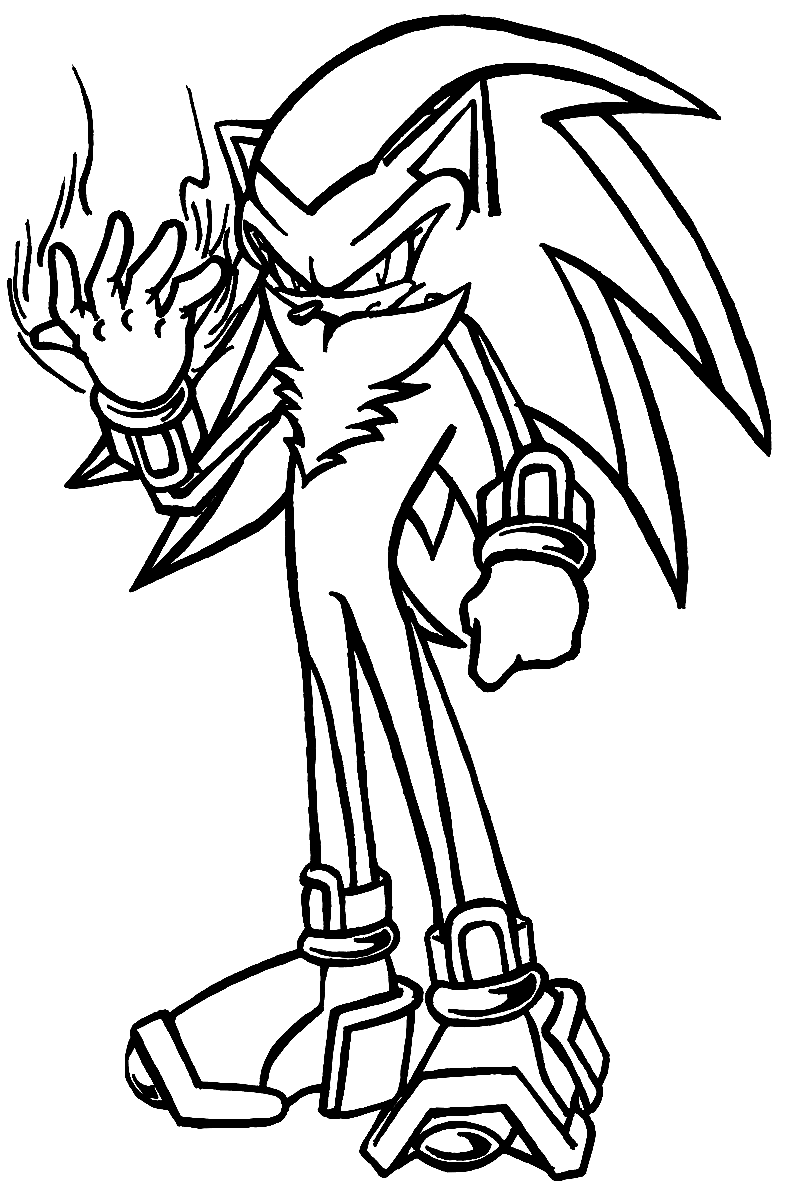
Coloring Shadow portrait pages: The fur is near-black or very dark charcoal, applied at full coverage across all fur areas: head, body, limbs, quills. The quill tips and the stripe running through the quills use vivid warm red, applied carefully along the stripe’s specific path from each quill’s tip toward the body. The eyes are vivid, warm red: the most vivid single color element in the composition, applied at full saturation in the small eye areas. The white chest area uses clean, bright white or very pale, warm cream. The Air Shoes use near-black for the primary shoe body with vivid yellow-gold at the sole trim and shoe detail elements.
Chaos Control and Chaos Emerald Pages
Chaos Control is Shadow’s signature ability: the power to manipulate space and time using the energy of the Chaos Emeralds. These seven mystical gemstones power many of the Sonic universe’s most significant plot events. The specific applications of Chaos Control include teleportation (warping himself or others through space), time manipulation (slowing or stopping time in a local area), and the energy-based combat moves Chaos Spear (a directed energy projectile) and Chaos Blast (a devastating explosion of Chaos energy that affects everything within its radius).
The visual language for Chaos Control in the Sonic games and animation uses purple-white or vivid purple energy effects radiating from Shadow’s body or from his extended hand, often with the specific visual of space-time distortion around the edges of the effect. Chaos Emeralds appear as vivid gemstones, each a different color: red, blue, green, yellow, purple, grey, and white (or cyan depending on the depiction).
Chaos Spear pages show Shadow in an offensive stance, arm or hand extended, with an energy projectile visualized as a yellow or yellow-white bolt of directed Chaos energy. Chaos Blast pages show the more devastating explosion variant: Shadow at the center of a sphere of expanding purple-red energy.
Coloring Chaos Control pages: The Chaos energy uses vivid purple as its primary color at the energy effect’s core, graduating outward to pale purple-white at the effect’s diffuse outer edge. The space-time distortion around the teleportation effect uses a slightly cooler, slightly more blue-shifted purple at the warping boundary lines. Any Chaos Emeralds shown use the specific color of each gem: apply the gem’s assigned color (vivid red, vivid blue, vivid green, vivid yellow, vivid purple, cool grey, clean white) at full saturation within the gem facet boundaries. Chaos Spear uses vivid yellow or pale yellow-white for the energy bolt’s core.
Super Shadow Pages
When Shadow collects all seven Chaos Emeralds simultaneously, he transforms into Super Shadow: a golden-furred version of his base form with dramatically amplified abilities, including unlimited Chaos Control, near-invincibility, and the ability to survive and operate in space without life support. The transformation parallels Sonic’s Super Sonic form (golden yellow fur, higher speed, invincibility), but with the specific quality of Shadow’s Chaos-based power amplified to its maximum expression.
Super Shadow makes his most narratively significant appearance at the climax of Sonic Adventure 2: Shadow and Sonic combine their Super forms to battle the Biolizard (the prototype of Shadow, a failed earlier version of Gerald Robotnik’s ultimate life form research), merged with the Space Colony ARK, which is falling toward Earth. They defeat the Biolizard in space, then use Chaos Control together to halt the ARK’s collision course. Shadow then falls toward Earth, his energy apparently exhausted, in what was intended as his death scene, and which the game treats as a genuine sacrifice.
Super Shadow’s visual is the collection’s most dramatically different from Shadow’s base form: the black fur is replaced throughout with vivid warm gold, maintaining the quill structure and body proportions but with every dark surface converted to the specific golden-yellow of the Super transformation.
Coloring Super Shadow pages: The fur is vivid, warm gold applied at full saturation across every fur surface that is black in the base form. The specific gold is a warm, vivid yellow-gold rather than a pale yellow or a brown-gold: it should read as the precious metal of gold rather than as simply yellow paint. Any Chaos energy effects shown alongside Super Shadow use the same vivid purple of standard Chaos Control, but at higher intensity and larger scale. The eyes may shift from red to vivid green in Super form depending on the specific page’s reference.
Shadow versus Sonic Rivalry Pages
The relationship between Shadow and Sonic is the Sonic franchise’s most specifically developed character dynamic after Sonic and Tails: they are rivals defined by their similarities as much as by their differences. Both are hedgehogs capable of extraordinary speed. Both are willing to take on threats that exceed their personal self-interest. Both have complicated relationships with authority, loyalty, and the concept of freedom. The difference is in their emotional baseline: Sonic operates from confidence and optimism, Shadow from determination shaped by grief and uncertainty about identity.
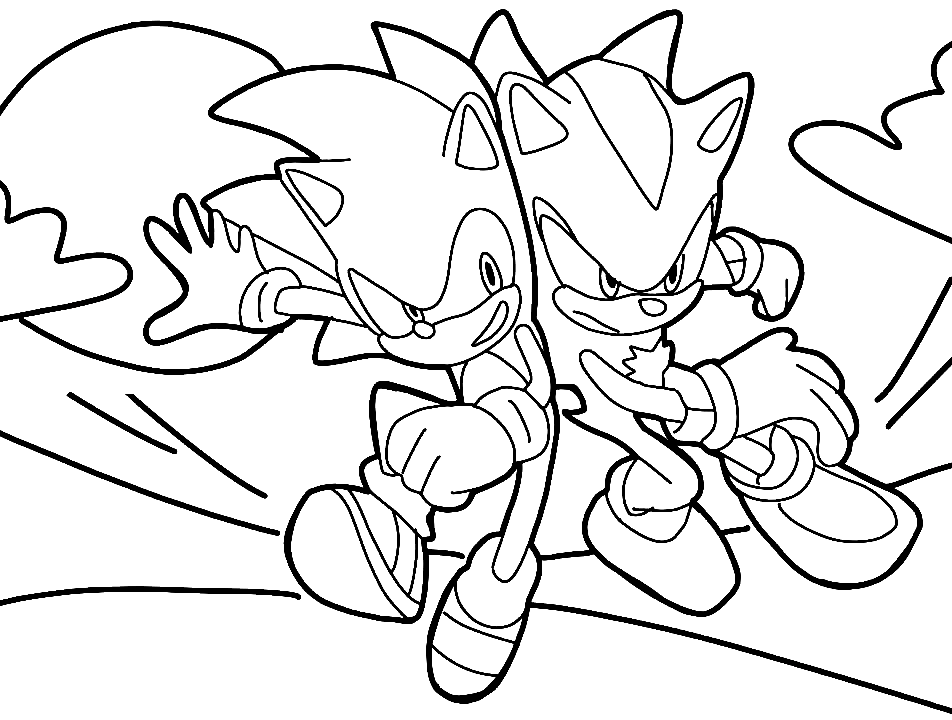
Their running side-by-side compositions are among the most depicted Sonic franchise images: the blue Hedgehog and the black-and-red Hedgehog full speed in parallel, the visual contrast between them communicating their dynamic in the most compressed possible form. Sonic looks at the horizon; Shadow often looks at Sonic or directly forward with the specific intensity of someone whose current situation matters more than the scenery.
Pages showing their confrontations or races are the collection’s most compositionally dynamic: two similar-sized, similarly-proportioned characters in high-contrast color palettes (blue-white-red against black-red-white) create a vivid visual opposition that rewards the maximum saturation the collection’s coloring tips emphasize.
Coloring Shadow and Sonic rival pages: Apply Shadow’s near-black fur and vivid red accents as detailed above. Apply Sonic’s vivid medium blue for his fur: a specific, clear, slightly bright blue that reads as clearly distinct from both the dark navy end of the blue family and the bright cyan-blue end. Their red shoe and red stripe elements are the same red family, creating the visual connection between the characters even as their primary colors oppose each other. Motion effect lines and speed blur elements use pale grey-white at minimum pressure, suggesting speed without becoming solid stripes.
Team Dark Pages
Team Dark, first assembled in Sonic Heroes (released December 30, 2003, in Japan), consists of Shadow the Hedgehog, Rouge the Bat, and E-123 Omega: three characters whose individual motivations and personalities are distinct but whose combat abilities complement each other. Shadow provides speed and Chaos-based power. Rouge (a jewel thief and government intelligence operative) provides flight and infiltration. E-123 Omega (a battle robot created by Eggman who rebelled and allied with Shadow and Rouge) provides firepower and strength.
Rouge the Bat’s design uses primarily dark purple-black and white: dark body with white wing membrane, white chest area, vivid blue or pink eyes. E-123 Omega uses a primarily red and black robotic design with yellow eyes and a heavy mechanical aesthetic.
Team Dark group pages are the collection’s most visually complex ensemble compositions: three characters with distinct silhouettes and color palettes (Shadow’s black and red, Rouge’s dark purple and white, Omega’s red and black metal) arranged in a unified team composition.
Coloring Team Dark pages: Shadow in canonical near-black and red as primary. Rouge uses very dark purple-grey or dark blue-grey for her primary body color with white wing membranes, white chest area, and vivid magenta or pink for her large eyes. E-123 Omega uses vivid red for his body panels (similar to Eggman’s robots’ red accents) with near-black for his structural components and vivid yellow for his eye elements. The three characters’ shared dark color family (black, dark purple, dark red) creates a unified team palette.
Shadow in the Sonic Movie (2024) Pages
Sonic the Hedgehog 3, released December 20, 2024, by Paramount Pictures and directed by Jeff Fowler, introduced Shadow the Hedgehog as the film’s primary antagonist, voiced by Keanu Reeves. The film adaptation of Shadow maintains its canonical black and red visual design while adapting it to the live-action, realistic CGI aesthetic established in the first two films (2020, 2022). The Sonic movie character designs use more detailed fur texture, more realistic eye rendering, and slightly adjusted proportions compared to the game designs.
Shadow’s motivation in the film draws from his core backstory: the ARK, Gerald Robotnik, the traumatic history that shapes his hostility toward humanity, and specifically toward GUN. The casting of Keanu Reeves, known for action roles in the John Wick franchise and The Matrix series, brought a specific tone to the character’s portrayal that matched Shadow’s established personality of controlled power and suppressed emotion.
Coloring Sonic movie Shadow pages: The movie design uses the same black and red color palette as the game design, but with more texture and depth in the fur rendering. Apply near-black at full coverage for the fur base. The red elements use vivid warm red in the same stripe positions as the game design, but with slightly softer boundaries between the red and black, suggesting the more organic quality of the film’s CGI fur rendering.
What These Pages Do
Sonic Adventure 2 (2001) is documented in game industry history as one of the final major releases for the Sega Dreamcast, a console that Sega discontinued in March 2001, three months before the game’s Japanese release. The game sold approximately 1.5 million units across its Dreamcast and GameCube releases and is consistently cited in retrospective game criticism as the point at which the Sonic franchise most successfully introduced genuine emotional stakes through narrative: Shadow’s story arc, and particularly the reveal of Maria Robotnik’s death and its connection to Shadow’s motivation, is cited in game design criticism as an example of emotional payoff achieved through the specific combination of limited resources and effective character writing.
Shiro Maekawa, the writer who created Shadow’s backstory for Sonic Adventure 2, has spoken in interviews about the deliberate intention to create a character whose moral position was genuinely ambiguous at introduction and whose motivations were rooted in grief and loyalty rather than in simple villainy or simple heroism. This ambiguity is documented as intentional in the character’s design documentation: Shadow was conceived not as a villain who becomes good or a hero who falls, but as a character whose fundamental orientation toward humanity depends on which version of a promise he chooses to keep.
The American Academy of Pediatrics identifies fine motor skill development as a key childhood milestone throughout early childhood. The precise red stripe path along Shadow’s quills, the Chaos energy gradient work in combat pages, the multi-character color management in Team Dark compositions, the Super Shadow gold transformation, and the small Chaos Emerald gem rendering all provide sustained fine motor challenge across the collection’s age range. The 2005 Art Therapy Journal study on structured coloring and anxiety reduction applies throughout.
How to Color These Pages Well
Shadow’s fur is near-black rather than true black, and this distinction matters for dimensional quality. Applying pure jet black at maximum pressure across Shadow’s fur produces a flat, dimensionless result. Apply very dark charcoal grey or near-black (a dark grey with a very slight warm or cool tone) at full coverage first. Then apply slightly darker near-black in the deepest shadow areas (the undersides of the quills, the shadow areas under the chin and behind the arms) and leave the original near-black as the mid-tone on flat, directly viewed surfaces. This two-tone near-black creates a dimensional quality in what would otherwise be an undifferentiated dark mass.
The red stripe on the quills requires planning of its exact path before any color is applied. The red stripe is Shadow’s most specific identifying design element and must follow the correct path: it runs from the tip of each backward-pointing quill through the quill base toward the body, continuing as the red portion of the chest and leg area markings. Before applying any color to a Shadow page, trace the stripe’s path with a light pencil mark or identify it clearly in the linework. Apply the vivid warm red stripe after the near-black fur base is complete, working the red carefully within the stripe boundaries.
The red eyes must be the composition’s most vivid single element. Shadow’s red eyes, small relative to the overall head size, are the primary emotional signal in any Shadow portrait: the intensity of the red and the specific position of the pupil within the iris communicate his emotional state. Apply the most vivid available warm red within the eye boundaries at full saturation and full pressure. Add a very small bright white highlight dot at the upper edge of each eye. The eyes should stand out as the most vivid, most contrasting element against the surrounding near-black fur.
Chaos energy effects require the purple-to-white gradient applied from the effect’s core outward. The Chaos energy that Shadow uses for his abilities uses vivid purple as its primary color. Apply the most vivid, most saturated purple at the energy effect’s most concentrated point (the hands or the center of a Chaos Blast). Then graduate outward through progressively lighter purple and pale purple-white to the diffuse outer edge of the effect. Any space-time distortion lines at a Chaos Control teleportation boundary use very dark blue-black, suggesting the fabric of space is being manipulated.
In Team Dark pages, distinguish E-123 Omega’s red from Shadow’s red stripe precisely. Both Shadow and Omega use red as a significant color. Still, the specific reds are different in quality: Shadow’s red is warm, vivid, and organic-feeling (the red of a biological creature’s accent color). Omega’s red is the more industrial, slightly cooler red of painted metal: apply it at full saturation but with a slightly more mechanical, flat quality than Shadow’s warmer stripe red. This distinction maintains visual separation between the two characters.
5 Creative Craft Ideas
The Maria Robotnik Memorial Page
Maria Robotnik is the emotional core of Shadow’s character: Gerald Robotnik’s granddaughter, terminally ill with NIDS (Neuro-Immuno Deficiency Syndrome), Shadow’s closest companion during the 50 years aboard the Space Colony ARK. When GUN agents raided the ARK, Maria pushed Shadow’s capsule toward Earth to save him, was shot in the process, and died. Her final words to Shadow: “Do it for me, Shadow. A future… for all people… and robots who live on that planet.”
Print a Shadow close-up portrait page. Color in full canonical near-black and red. Around the portrait, in the white space, write Maria’s last words in your own handwriting.
On the backing card: “Maria Robotnik. Character: Gerald Robotnik’s granddaughter. Condition: NIDS (Neuro-Immuno Deficiency Syndrome), fatal. Location: Space Colony ARK. Event: GUN agents raided the ARK. Maria’s action: pushed Shadow’s stasis capsule toward Earth to save him. Maria’s fate: shot by GUN agents. Maria’s final wish: ‘A future for all people and robots on that planet.’ Shadow’s response to her death: the question the entire Sonic Adventure 2 narrative asks. Shadow: created June 19, 2001 (Japan release). Maria: the reason he exists.”
The Ultimate Life Form Study
The designation “Ultimate Life Form” (究極生命体) is the specific description applied to Shadow within the Sonic universe’s internal mythology. Professor Gerald Robotnik’s research notes, shown across multiple games, document the attempt to create an immortal being by combining his research with the DNA of Black Doom. The result is a being with an indefinite lifespan, extraordinary physical capabilities, and access to Chaos energy that no other character in the franchise possesses to the same degree.
Print a Shadow in a confident standing pose page. Color in canonical colors with the Chaos energy effect added around his hands.
On the backing card: “Shadow the Hedgehog: Ultimate Life Form designation. Creator: Professor Gerald Robotnik, aboard Space Colony ARK. Research basis: Project: Shadow. Additional DNA contribution: Black Doom, leader of the Black Arms alien race. Stated properties: immortality, unlimited potential. First appearance: Sonic Adventure 2, June 19, 2001. The creation of an ultimate life form: the specific scientific ambition that produced Shadow. Eggman is Gerald’s grandson. Gerald created a shadow. Shadow and Eggman: share a family tree in the most unusual possible way.”
The Sonic Adventure 2 Sacrifice Scene
The climax of Sonic Adventure 2 shows Shadow, in Super Shadow form, using the last of his Chaos energy to halt the Space Colony ARK’s collision with Earth after defeating the Biolizard. His energy depleted, he falls toward Earth, apparently dying: the final image of the game’s main story is Shadow falling, with Sonic watching, unable to reach him. Rouge the Bat drops the Emeralds for the dying Shadow.
Print a Super Shadow page. Color the gold transformation at full vivid warm gold.
On the backing card: “Sonic Adventure 2. Climax event. Shadow and Sonic (both in Super form): defeat the Biolizard in space. The Biolizard: fused with the Space Colony ARK to prevent its collision with Earth. Shadow’s action: uses Chaos Control to redirect the ARK’s trajectory. Energy cost: all remaining Chaos energy. Shadow’s fate: falls toward Earth, energy depleted. Status at Sonic Adventure 2’s end: unclear. Sonic’s response: ‘Shadow, I don’t know if I could do what you did…’ Rouge’s response: drops the Emeralds to float down with Shadow. The scene’s intention: that it be Shadow’s permanent death. The franchise’s decision afterward: to revive him. Both were correct choices.”
The Rival Race Study
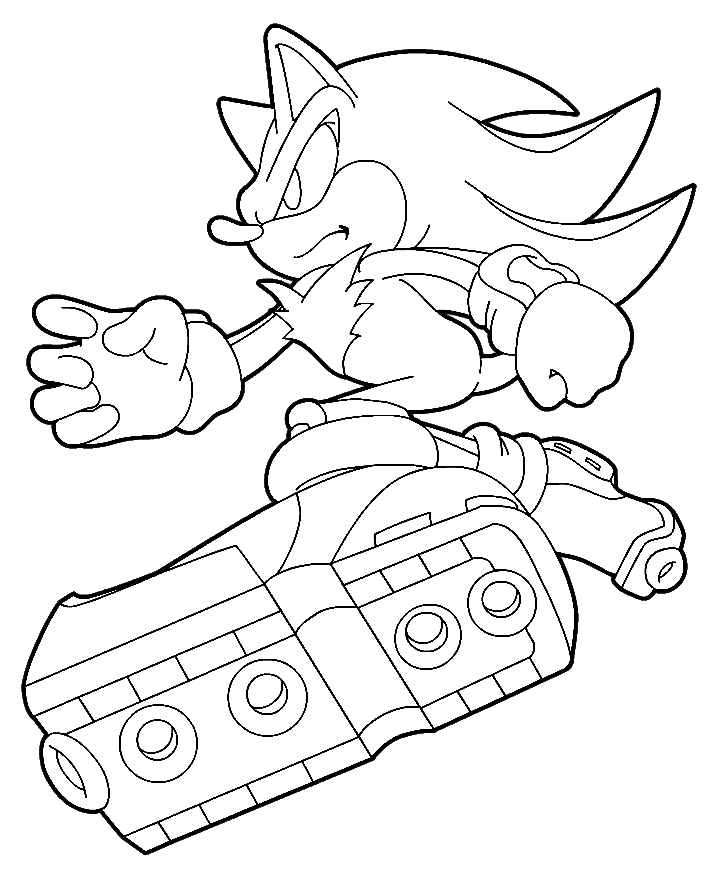
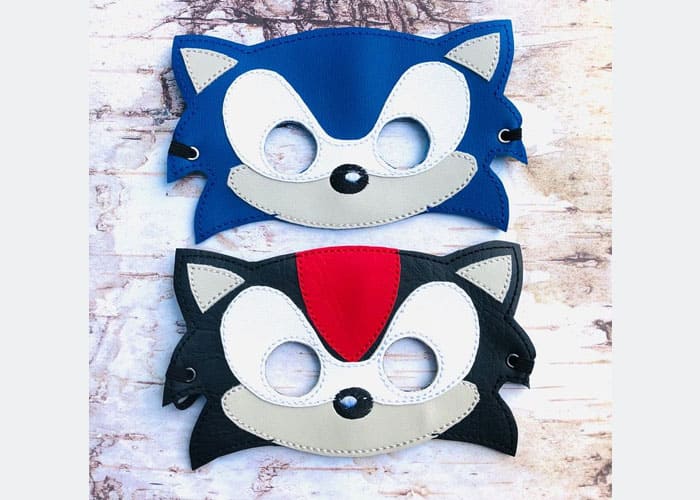
Shadow and Sonic have raced against each other across multiple games in the Sonic franchise. The specific nature of their competition, two hedgehogs of comparable speed, has been depicted in different ways: as a hostile confrontation, as an uneasy alliance, as mutual grudging respect. The visual of the two characters running side by side is one of the franchise’s most reproduced images.
Print one Shadow running pose page and one Sonic running pose page. Color Shadow in near-black and red—Color Sonic in the specific vivid medium blue of his canonical design.
Mount both side by side: “Shadow the Hedgehog: first appearance, June 19, 2001 (Sonic Adventure 2). Sonic the Hedgehog’s first appearance was on June 23, 1991 (Sonic the Hedgehog, Sega). Age difference between their debut dates: approximately 10 years. Speed comparison across games: approximately equivalent. Shadow’s stated advantage: Chaos Control allows instant spatial repositioning, making pure speed comparisons irrelevant. Sonic’s stated advantage: the desire to keep running. The race between them: unresolved across 23 years of franchise publication. Neither has definitively won. The franchise prefers it this way.”
The Keanu Reeves Casting Page
Paramount Pictures cast Keanu Reeves to voice Shadow the Hedgehog in Sonic the Hedgehog 3, released December 20, 2024. Reeves is known primarily for action roles, including Neo in The Matrix trilogy (1999, 2003, 2021) and John Wick in the John Wick franchise (2014, 2017, 2019, 2023). The casting aligned Shadow’s established personality (controlled, intense, driven by a specific purpose) with Reeves’ known performance register.
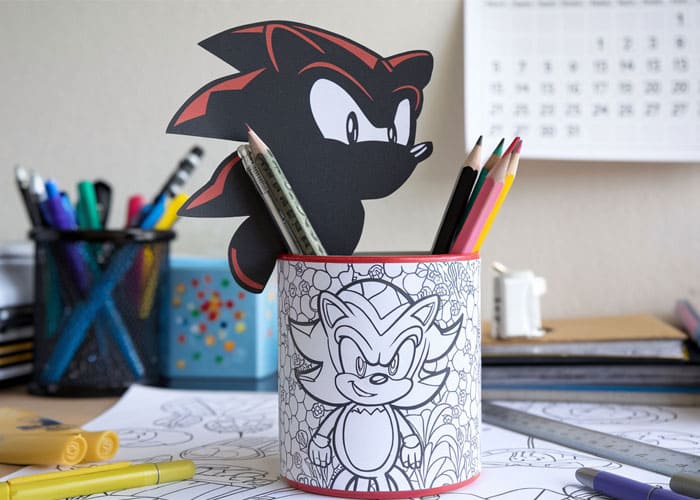
Print a Shadow from the Sonic movie design page. Color using the film’s near-black and vivid red palette.
On the backing card: “Shadow the Hedgehog, theatrical film debut: Sonic the Hedgehog 3, released December 20, 2024. Director: Jeff Fowler. Voice: Keanu Reeves. Previous Keanu Reeves roles: Neo, The Matrix (1999-2021); John Wick, John Wick franchise (2014-2023). Shadow’s game voice actors: Jason Griffith (2005-2010), Kirk Thornton (2010-present, games). Shadow’s Japanese voice: Kōji Yusa (2001-present). Shadow’s first appearance: June 19, 2001, Sonic Adventure 2. Film release: December 20, 2024. Time between first game appearance and first theatrical appearance: approximately 23 years.”

Frequently Asked Questions
Who is Shadow the Hedgehog, and when did he first appear? Shadow the Hedgehog,ogs a fictional character in Sega’s Sonic the Hedgehog franchise, first appeared in Sonic Adventure 2, released for the Sega Dreamcast on June 19, 2001, in Japan and June 23, 2001, in North America. The Sonic Team created him with Takashi Iizuka as producer and Shiro Maekawa as the character’s primary story writer. Within the Sonic universe, Shadow was created aboard the Space Colony ARK by Professor Gerald Robotnik using research combining advanced genetics with the DNA of Black Doom, the leader of an alien race called the Black Arms. He is designated the Ultimate Life Form (究極生命体) for his immortality and extreme capabilities. His closest companion was Gerald’s granddaughter Maria Robotnik, who died saving him, and her memory shapes his motivation throughout the franchise.
What is Shadow’s design, and how does it differ from Sonic’s? Shadow’s design is constructed as a deliberate visual contrast to Sonic the Hedgehog. Where Sonic has vivid medium blue fur, Shadow has near-black fur. Where Sonic has green eyes, Shadow has vivid red eyes. Where Sonic wears simple red and white shoes, Shadow wears Air Shoes (specialized hover-skating footwear) with yellow-gold accents against a darker body. A vivid red stripe runs from the tip of each of Shadow’s backward-pointing quills. His quills point downward and backward, giving his silhouette a heavier, more grounded quality compared to Sonic’s more upward quill arrangement. His white chest fur is the design’s single warm-toned element in an otherwise cool, dark palette. The contrast between blue-white Sonic and black-red Shadow creates the visual shorthand for their character opposition throughout the franchise.
What is Chaos Control, and what other abilities does Shadow have? Chaos Control is Shadow’s signature ability: the power to manipulate space and time using the energy of the Chaos Emeralds, seven mystical gemstones central to the Sonic universe’s mythology. Applications include teleportation (warping through space), time manipulation (slowing or stopping time locally), Chaos Spear (a directed energy projectile), and Chaos Blast (a devastating explosion of Chaos energy that affects everything within its radius). Shadow can also transform into Super Shadow when in possession of all seven Chaos Emeralds simultaneously, which replaces his black fur with vivid gold, amplifies his abilities to their maximum, and grants near-invincibility, including the ability to survive in space without life support. He uses Air Shoes that allow hover-skating movement and has demonstrated speed comparable to or exceeding Sonic’s in various game contexts.
What is Shadow’s connection to Maria Robotnik? Maria Robotnik is the emotional foundation of Shadow’s character: the granddaughter of Professor Gerald Robotnik, who created Shadow aboard the Space Colony ARK. Maria suffered from NIDS (Neuro-Immuno Deficiency Syndrome), a fatal disease, and one of Gerald’s motivations for creating the Ultimate Life Form was to advance medical research that could help her. Maria and Shadow formed a close bond during their time on the ARK. When GUN agents raided the ARK, Maria pushed Shadow’s stasis capsule toward Earth to save him and was shot in the process. Her dying wish was that Shadow protect humanity and give people a chance at happiness. Shadow’s actions across the Sonic franchise are shaped by his grief at her death and his attempt to honor her wish in a world that he initially regards with hostility.
What is Team Dark, and who are its members? Team Dark is a trio of characters first introduced together in Sonic Heroes (released December 30, 2003, in Japan), consisting of Shadow the Hedgehog, Rouge the Bat, and E-123 Omega. Shadow provides the team’s speed and Chaos-based combat capabilities. Rouge the Bat is a jewel thief and government intelligence operative who flies and specializes in infiltration and flexible combat. E-123 Omega is a battle robot created by Dr. Eggman, who rebelled after being shut down and locked away, joining Shadow and Rouge to pursue Eggman. The three characters’ distinct motivations (Shadow’s search for identity, Rouge’s dual loyalties to jewels and government work, Omega’s specific vendetta against Eggman) create a team whose internal dynamic has been explored across multiple Sonic games and the IDW Sonic the Hedgehog comic series.
What is Shadow the Hedgehog’s standalone game, and how was it received? Shadow the Hedgehog, a standalone game focused entirely on Shadow, was released in North America on November 15, 2005, for Nintendo GameCube, PlayStation 2, and Xbox, developed by Sega Studio USA. The game presented Shadow with moral choice mechanics: each level contained “Hero” objectives (helping allies), “Dark” objectives (assisting enemies), or “Neutral” options, with 326 possible story paths and 22 different endings depending on accumulated choices. The game notably allowed Shadow to use firearms, a controversial design choice for a Sonic franchise title. Critical reception was mixed, with reviewers citing uneven game design alongside its ambitious moral choice framework. The game explored Shadow’s connection to the Black Arms alien race and his identity questions through its multiple narrative paths.
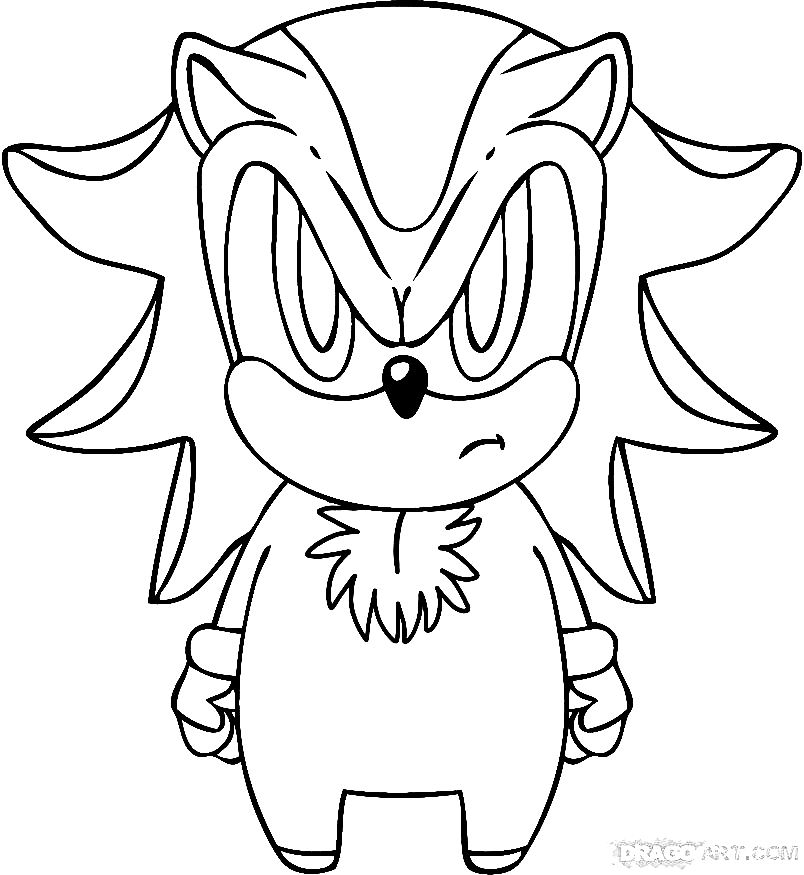
What age group are these pages best suited for? Shadow the Hedgehog coloring pages serve Sonic franchise fans across a wide age range. The simpler chibi and cartoon-style Shadow pages with large, clearly defined color areas are accessible from ages four and five, where the high-contrast black and red palette provides immediately clear coloring targets. The standard game-design Shadow portrait pages, requiring careful stripe placement, eye rendering, and the near-black dimensional technique, are most rewarding for ages six to ten. The Chaos energy effect pages, Super Shadow gold transformation pages, and Team Dark group compositions requiring management of three distinct character palettes simultaneously are most engaging for ages eight and up. The historical context craft projects connecting Shadow’s creation to Sonic Adventure 2‘s place in Sega Dreamcast history, and the thematic discussions of Maria Robotnik and Shadow’s motivation, are most meaningful for older children and adult fans of the franchise.
Browse the full collection at ColoringPagesOnly.com. All 50+ pages free, no sign-up, PDF or PNG, print or color online.
Shiro Maekawa created Shadow the Hedgehog for Sonic Adventure 2. The game was released on June 19, 2001, in Japan. The Dreamcast was discontinued three months before that. The game sold approximately 1.5 million units anyway.
Maria Robotnik was terminally ill. She pushed Shadow’s capsule toward Earth. GUN agents shot her. Her last words: “A future for all people and robots who live on that planet.” Shadow has been trying to decide what to do with that request since June 19, 2001.
In December 2024, Keanu Reeves voiced him in a Paramount Pictures theatrical film. That is 23 years between his first appearance and his first theatrical appearance. The franchise prefers its questions unresolved. Shadow is still deciding.
Pick up your near-black or very dark charcoal for the fur. Apply at full coverage. Find the path of the red stripe before applying any color. The stripe runs from the tip of each quill. Apply the vivid warm red within the stripe boundaries after the near-black base is complete. The red eyes go last: the most vivid element in the composition.
Share your work on Facebook and Pinterest and tag #Coloringpagesonly. The Maria Robotnik memorial page and the Sonic Adventure 2 sacrifice scene are particularly worth sharing.
Apply the near-black fur first at full coverage. Apply the red stripe along the correct quill path. The red eyes: the most vivid element in the composition. He has been the Ultimate Life Form since June 19, 2001. The question of what that means: still open.