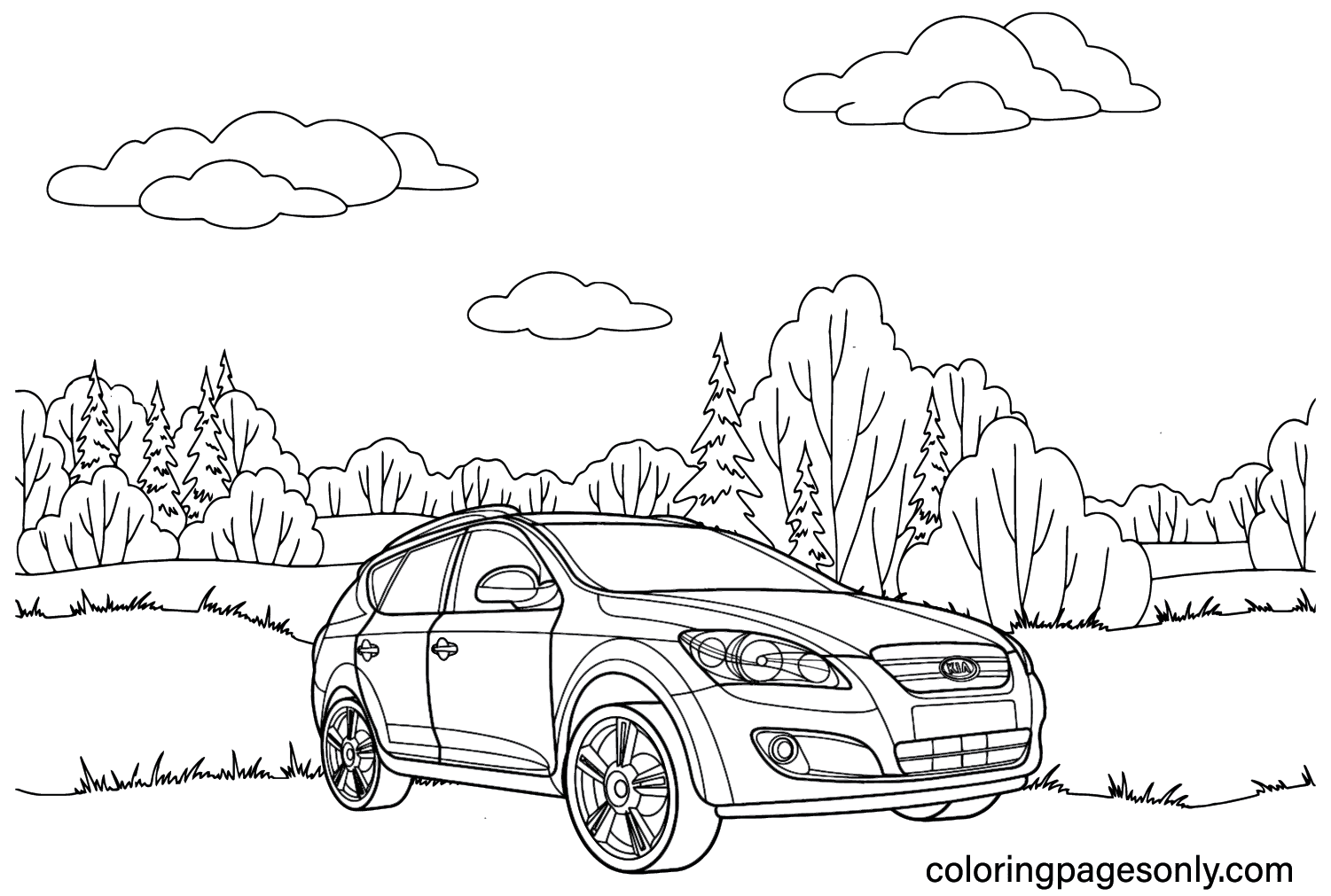
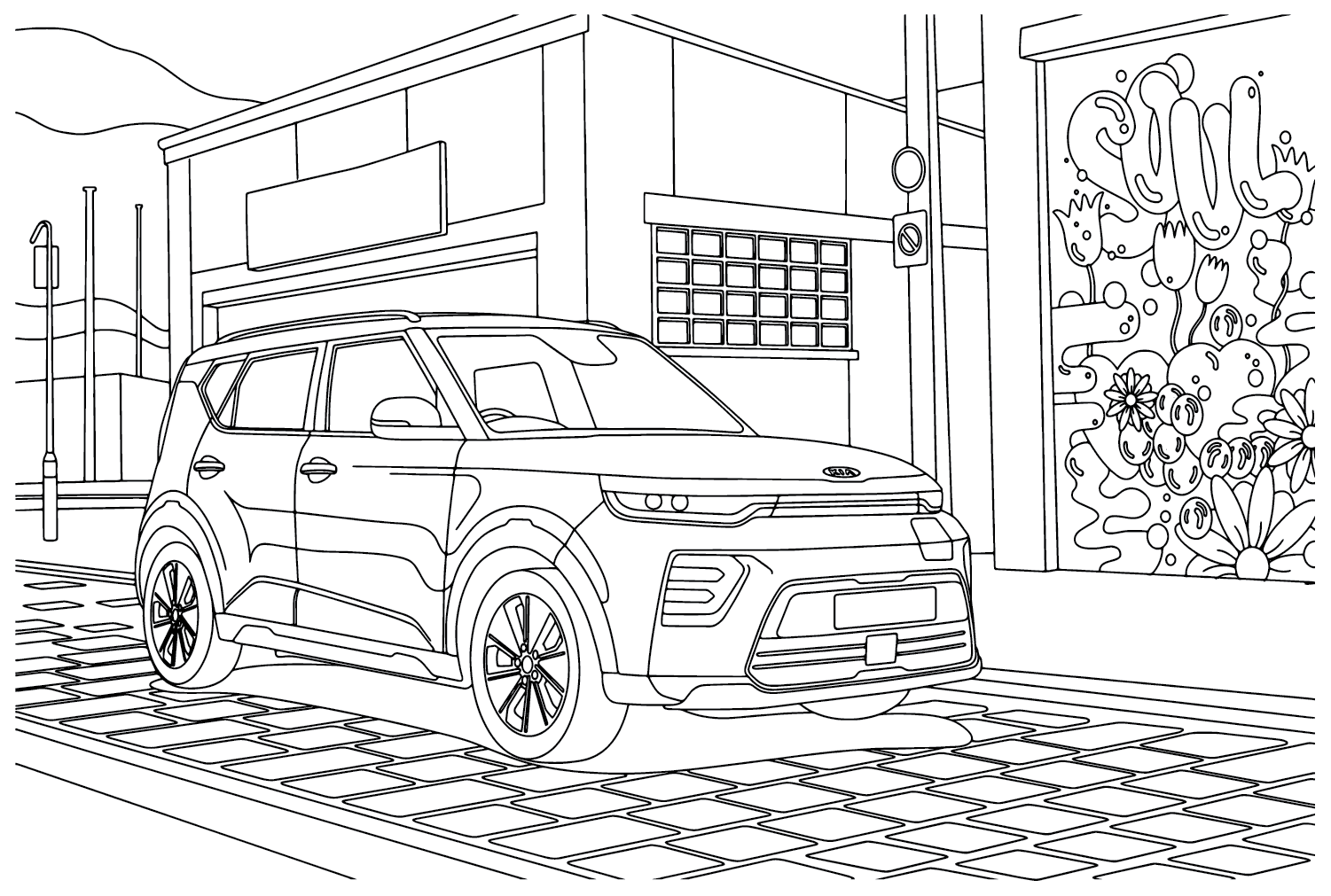
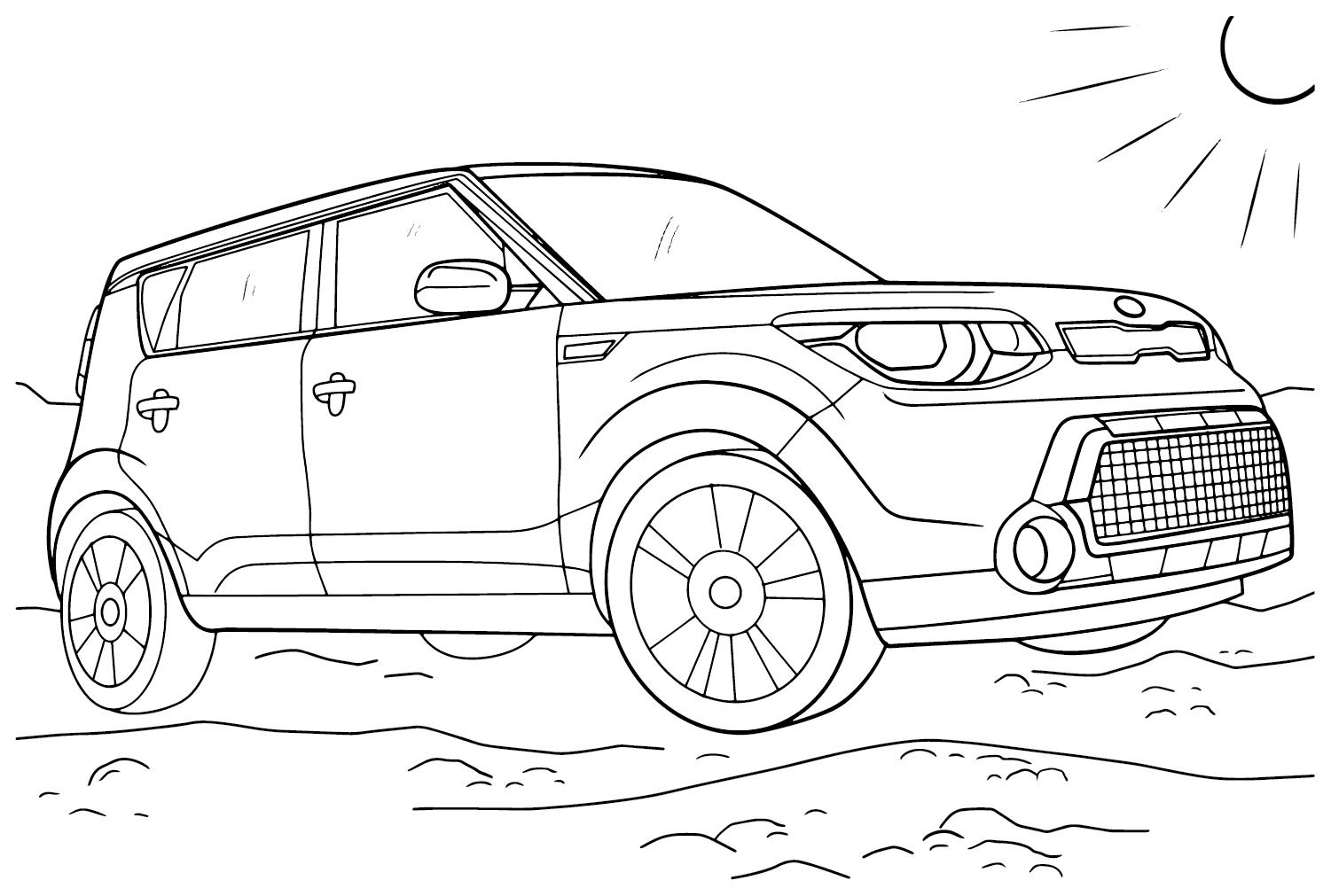
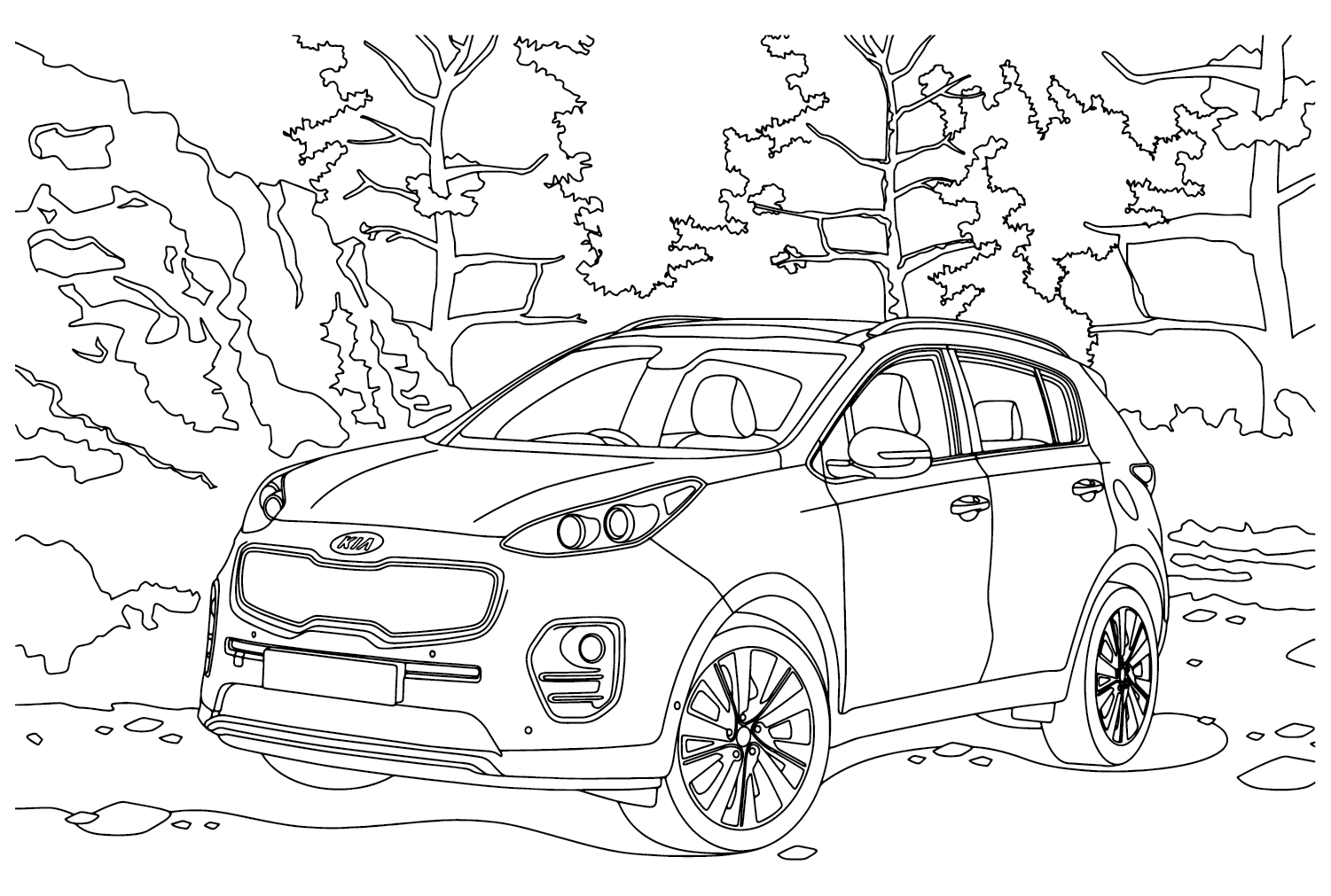
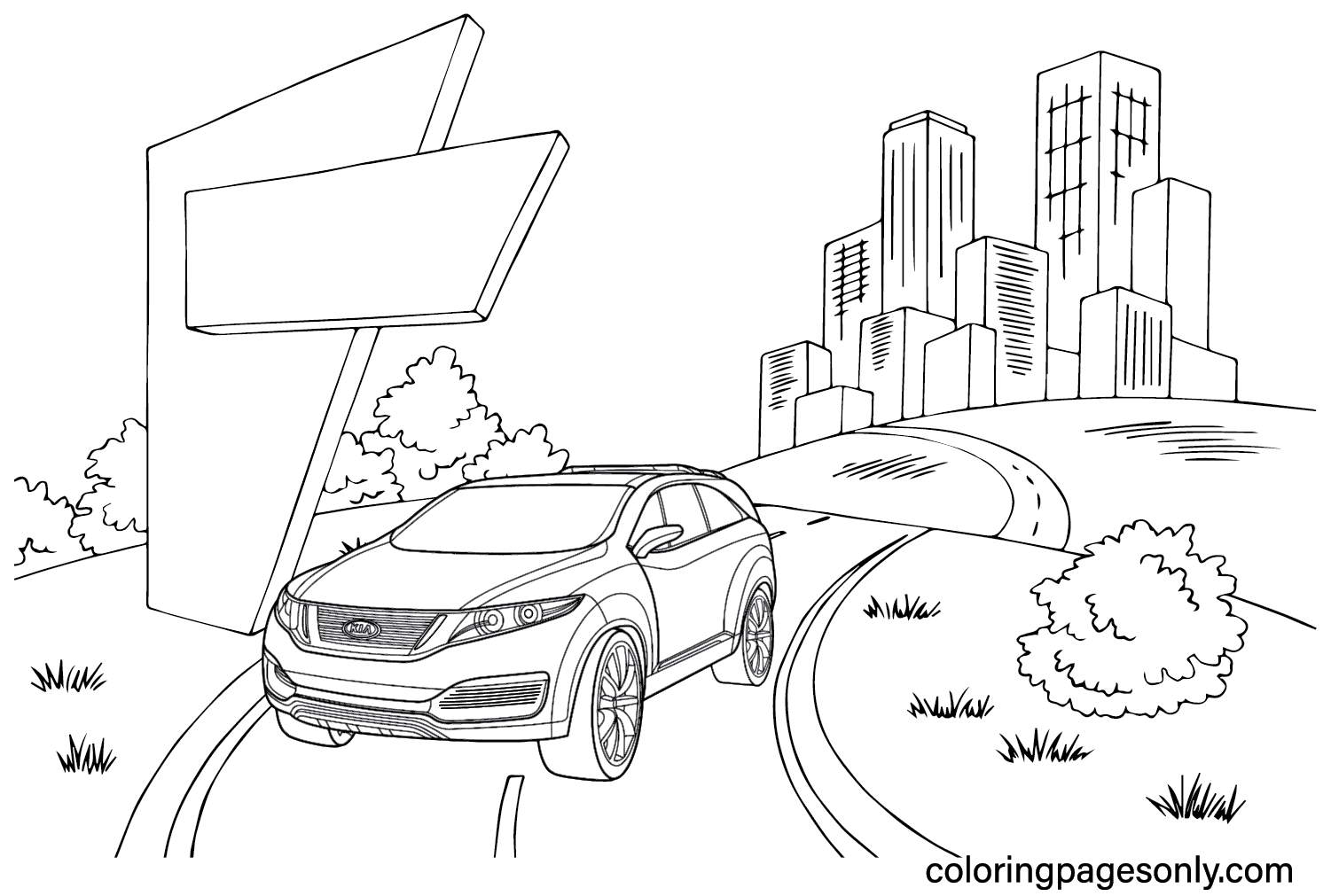
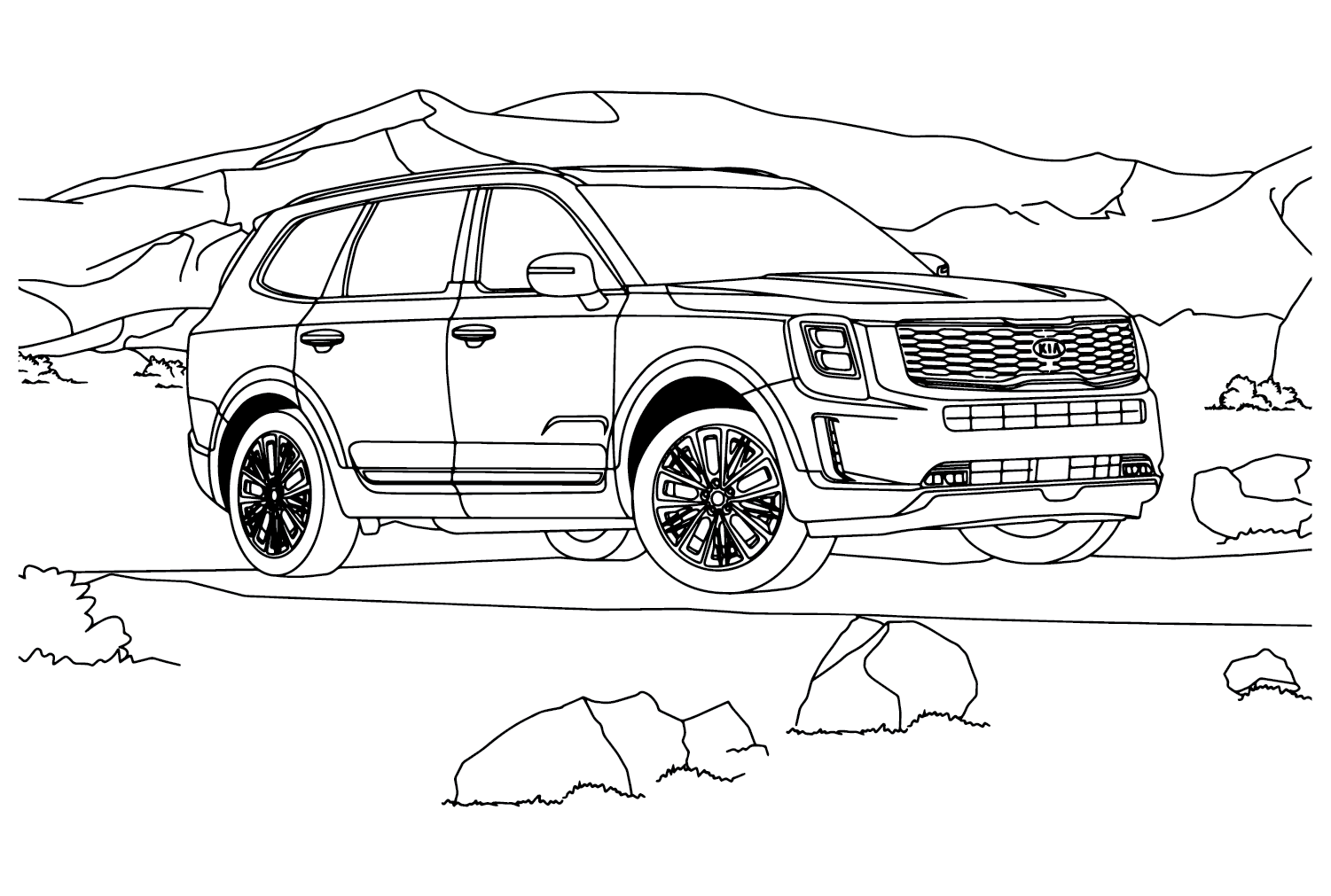
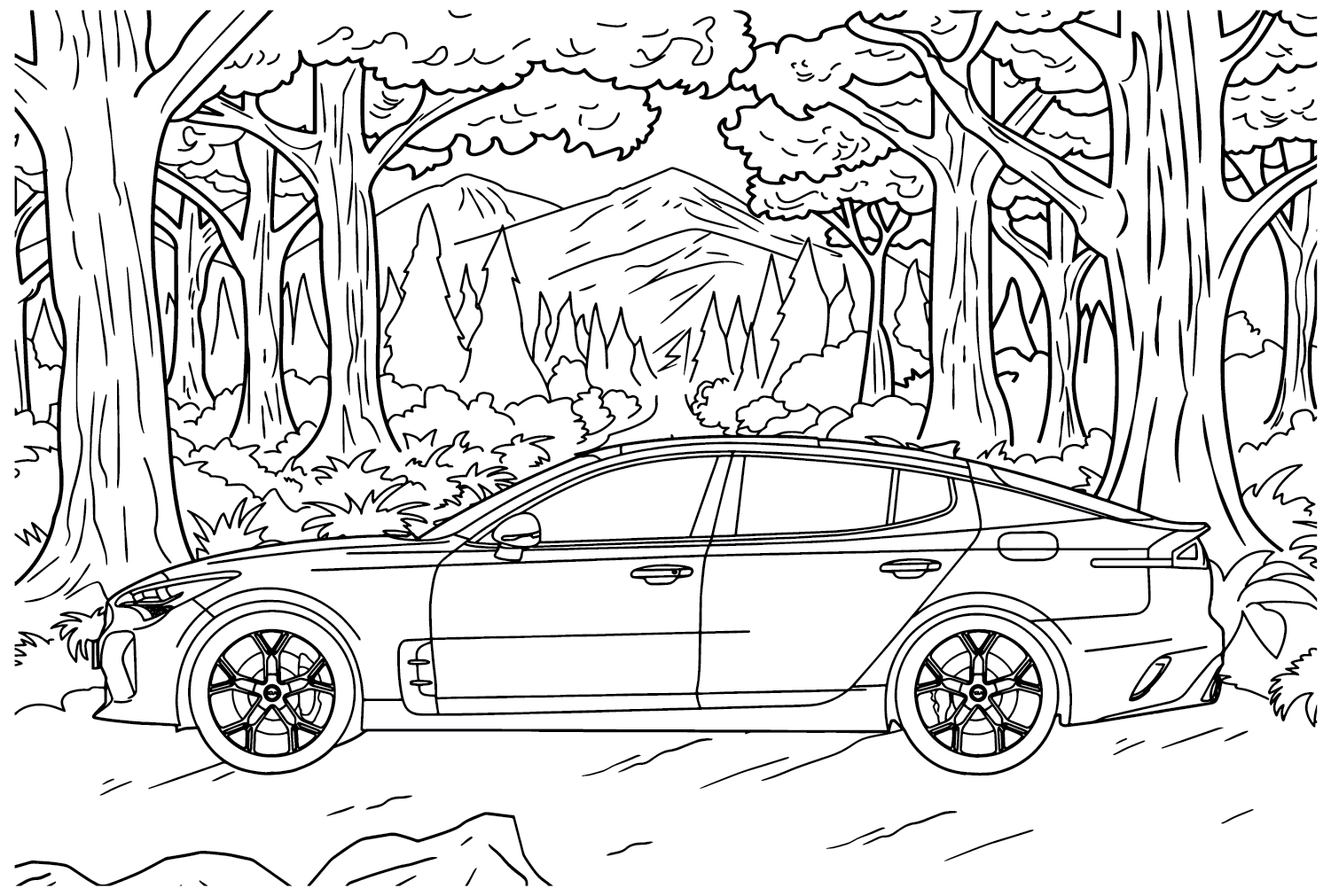
Free Kia Motors coloring pages – 20+ pages featuring the Kia Sportage, Sorento, Carnival, Optima, Picanto, Niro, Ceed, Pro Ceed, Borrego, Rondo, Koup Concept, KND-4, Mesa, and Kue concept – line drawings of real Kia models available as free printable PDF and online coloring for car enthusiasts, kids, and designers.

Kia’s name comes from Chinese characters: ki (起) means “to rise” and a (亞) stands for Asia – “to rise from Asia.” The company was founded in 1944 in Seoul as Kyungsung Precision Industry, originally manufacturing bicycle parts and steel tubing. It became Korea’s first domestic car manufacturer in 1962 with the T-2000 three-wheeled truck. By 1974, it had produced its first passenger car. By 2024, Kia had sold over 3 million vehicles in a single year globally – ranking among the top ten automakers in the world – and won the prestigious Red Dot Design Award for every model in its lineup, making it the first automaker to achieve this distinction across an entire vehicle range.

The transformation from bicycle parts manufacturer to global design leader in eight decades is one of the remarkable corporate stories in automotive history. These 20+ free pages at ColoringPagesOnly.com let you spend time with the line drawings of real Kia models – from the best-selling Sportage to concept cars that sketch where the brand is heading. All free, PDF or PNG, print or color online. Start your engines.

What’s Inside – The Models

Kia Sportage

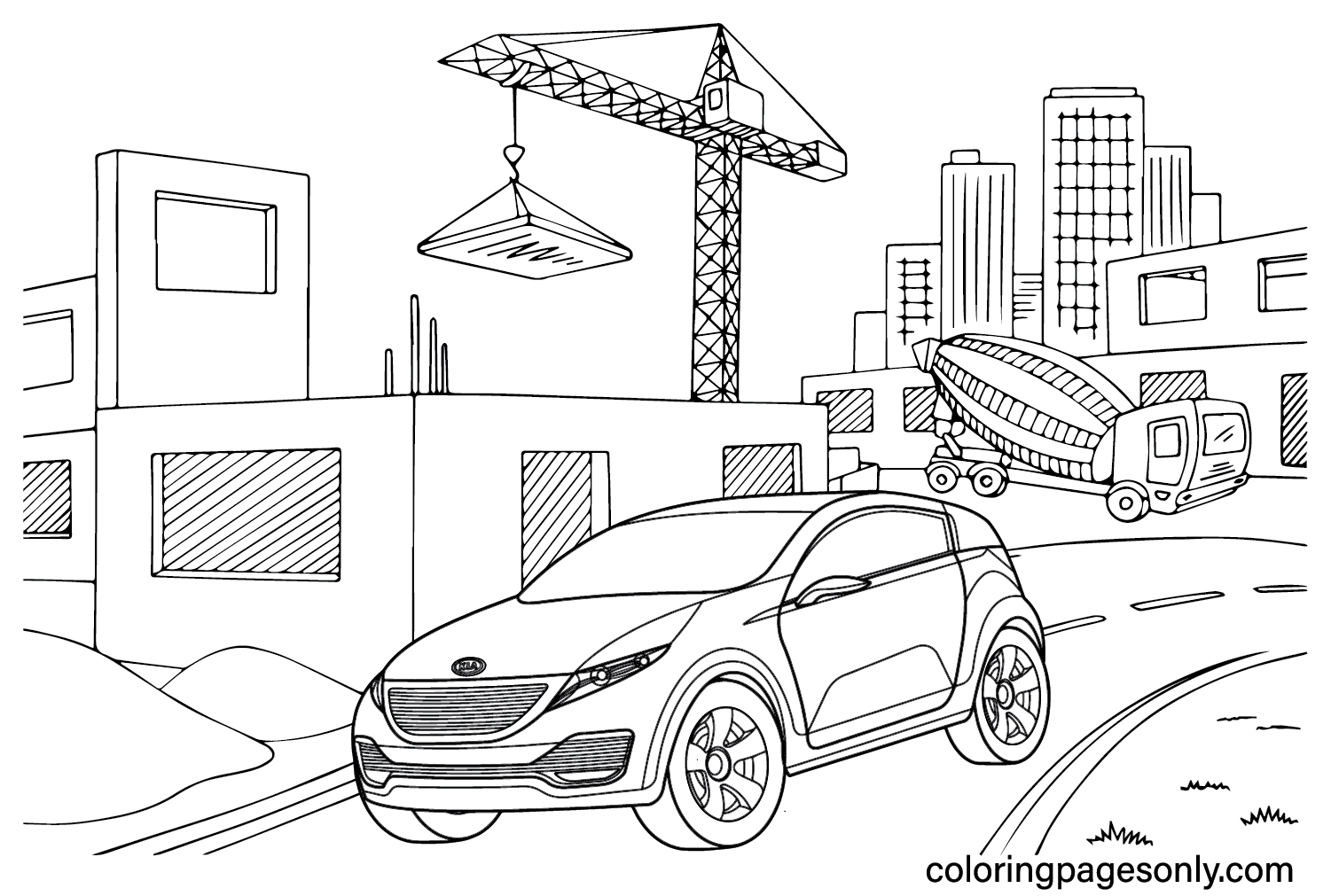
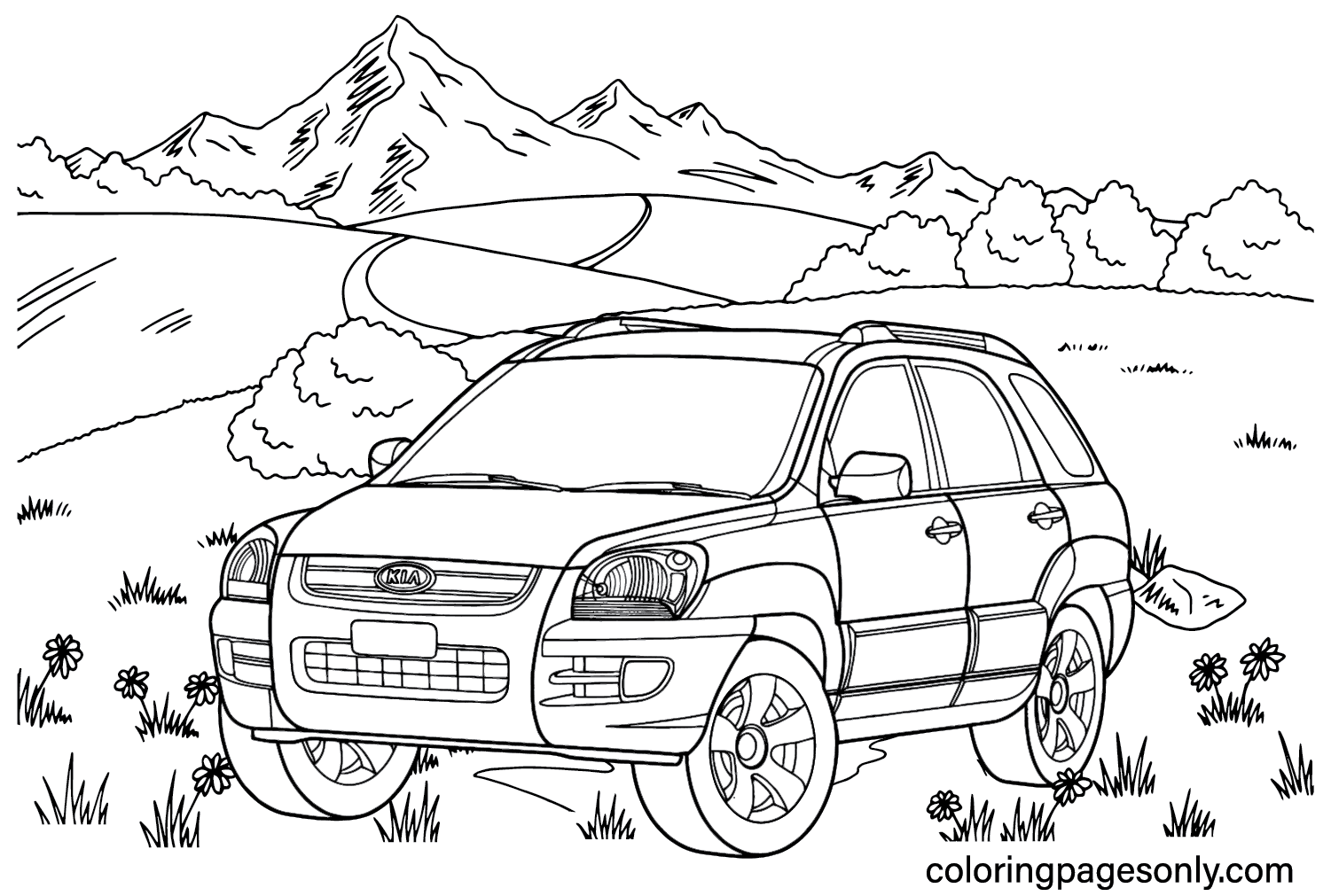
The Kia Sportage Coloring Page features Kia’s best-selling model globally – the compact SUV that has been in continuous production since 1993 and is currently in its fifth generation. The Sportage consistently ranks among the top-selling SUVs in Europe, Australia, and several Asian markets, and its design under Kia’s Chief Design Officer Peter Schreyer (who joined from Volkswagen Group in 2006 and is credited with transforming Kia’s global design identity) has become one of the most recognized compact SUV silhouettes in the world.

The fifth-generation Sportage, launched in 2021, introduced Kia’s “Opposites United” design philosophy – a visual approach that deliberately juxtaposes bold and subtle, geometric and organic – in one of the most striking exterior redesigns in the compact SUV segment. The hood’s character lines, the distinctive “boomerang” daytime running lights, and the muscular wheel arch treatment make it an unusually rewarding coloring subject: there is genuine visual drama in the body lines even in a two-dimensional line drawing.

Kia Sorento

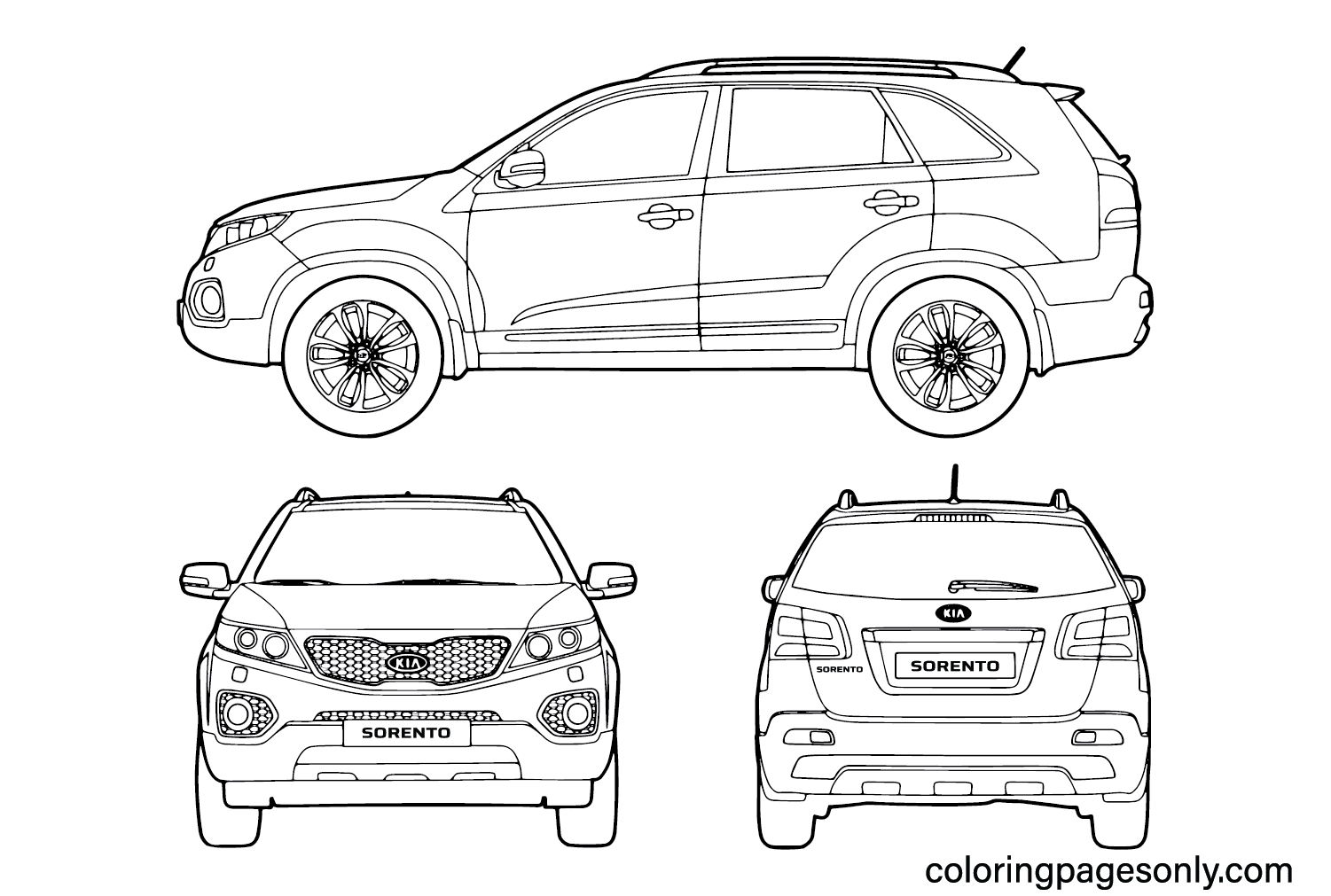
The Kia Sorento Coloring Page depicts Kia’s flagship mid-size SUV, which has been in production since 2002. The Sorento moved upmarket significantly with each generation – from a body-on-frame off-roader in its first generation to a sophisticated unibody family SUV in subsequent iterations. The fourth-generation Sorento, launched in 2020, is one of the brand’s most awarded vehicles: it received the 2021 Red Dot Design Award and is available in hybrid, plug-in hybrid, and traditional combustion configurations.

The Sorento’s design features Kia’s signature “tiger nose” grille – a design element introduced under Peter Schreyer that has become the defining front-face element across the Kia range. The tiger nose grille narrows toward the center at the lower edge, creating a predatory, forward-leaning visual effect that gives Kia’s vehicles an aggressive front presence unusual in Korean automotive design of the period when it was introduced.

Kia Carnival

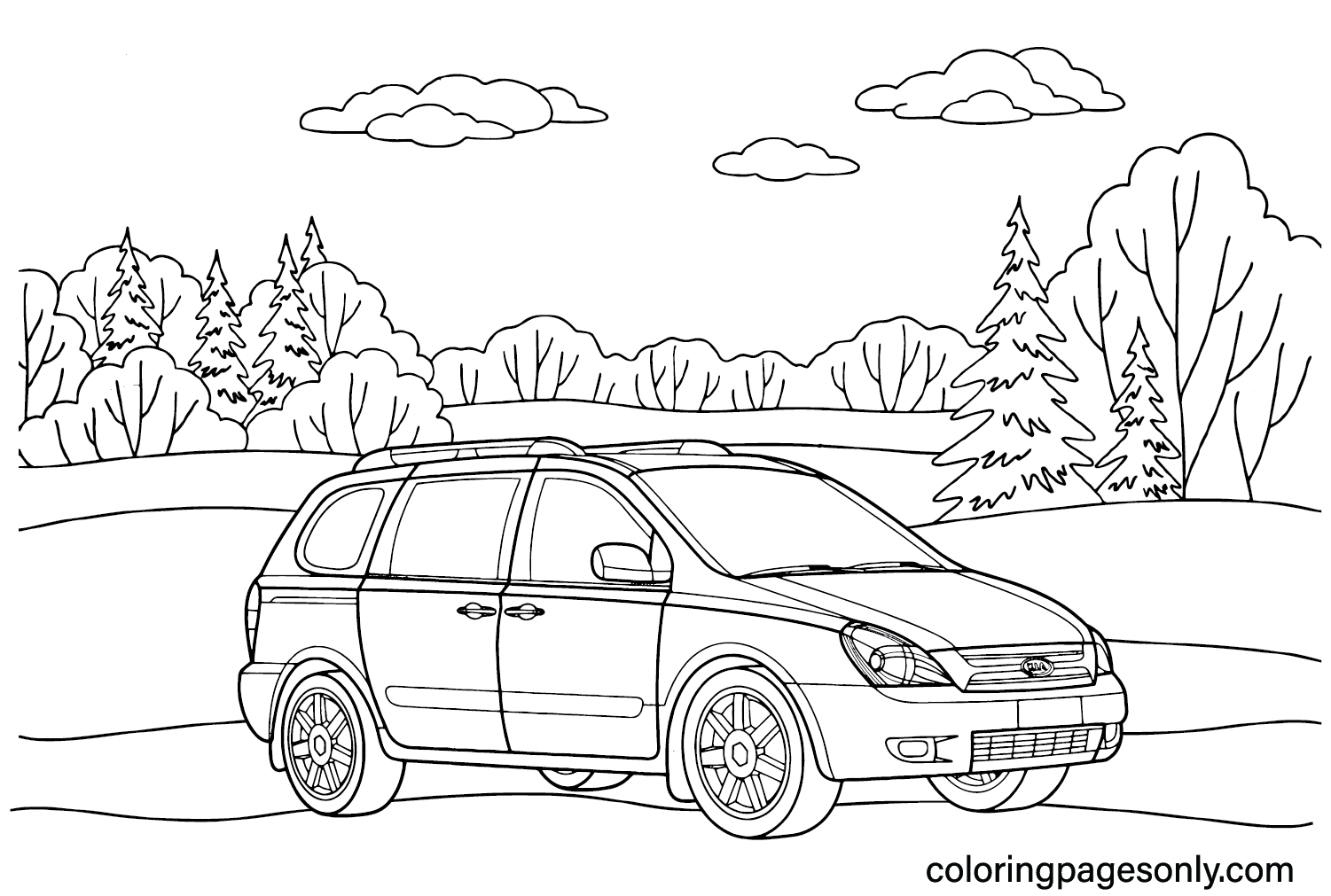
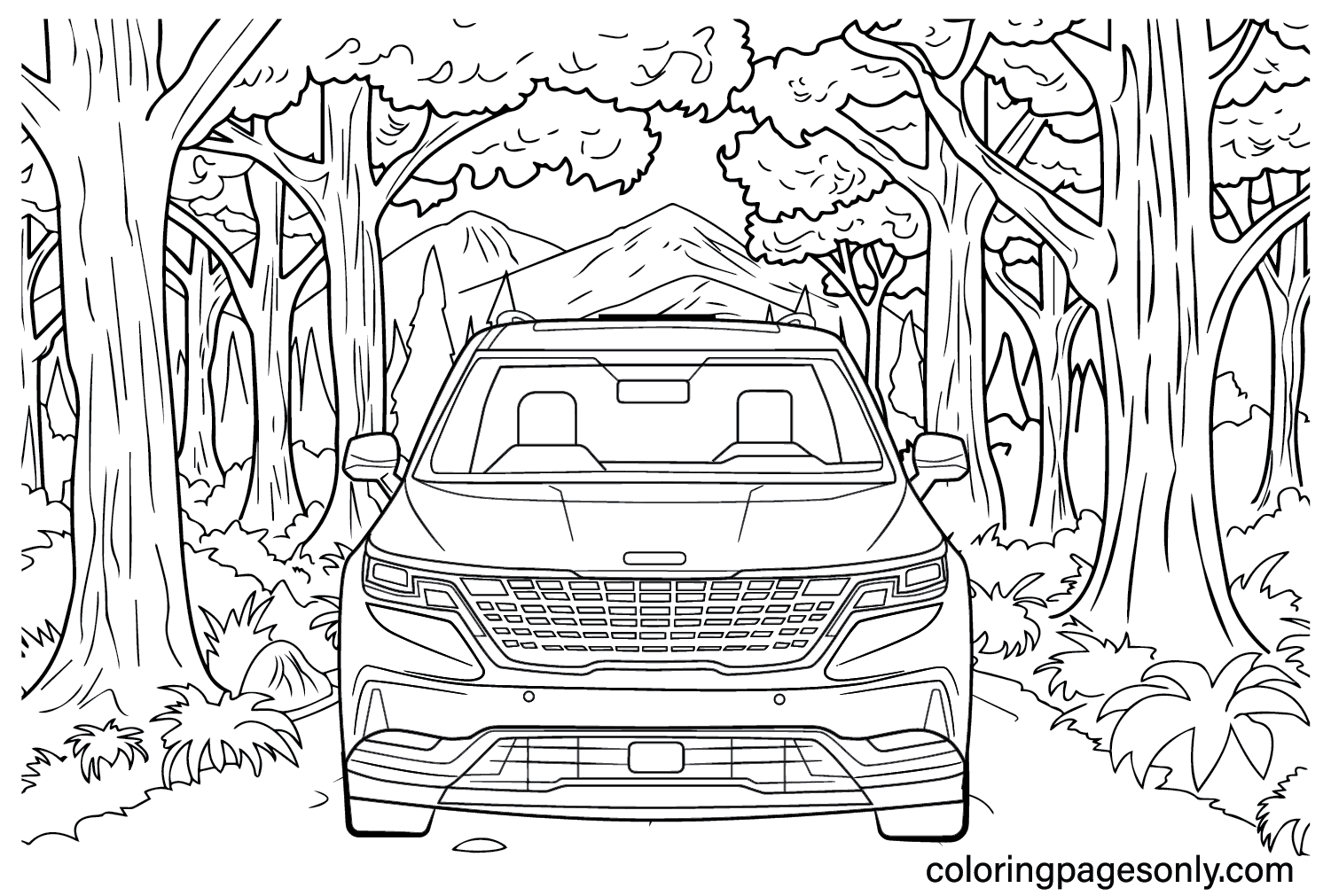
The Kia Carnival Coloring Page and Kia Carnival 2022 Coloring Page feature Kia’s premium minivan – a vehicle that, in its fourth generation, deliberately departed from conventional minivan design to adopt what Kia calls a “Grand Utility Vehicle” approach, combining the practicality of a people-carrier with the visual presence of a large SUV.

The 2021/2022 Carnival is remarkable in the minivan segment for looking genuinely imposing. Where most minivans prioritize packaging efficiency over visual drama, the Carnival’s low roofline at the leading edge, the wide horizontal grille, the flush door handles, and the sharply sculpted body sides create a vehicle that reads as an intentional design statement rather than a transportation appliance. In the United States, it replaced the Sedona nameplate in 2022. The two coloring pages show the vehicle from different angles and model years, with the 2022 page capturing the fourth-generation design.

Kia Optima

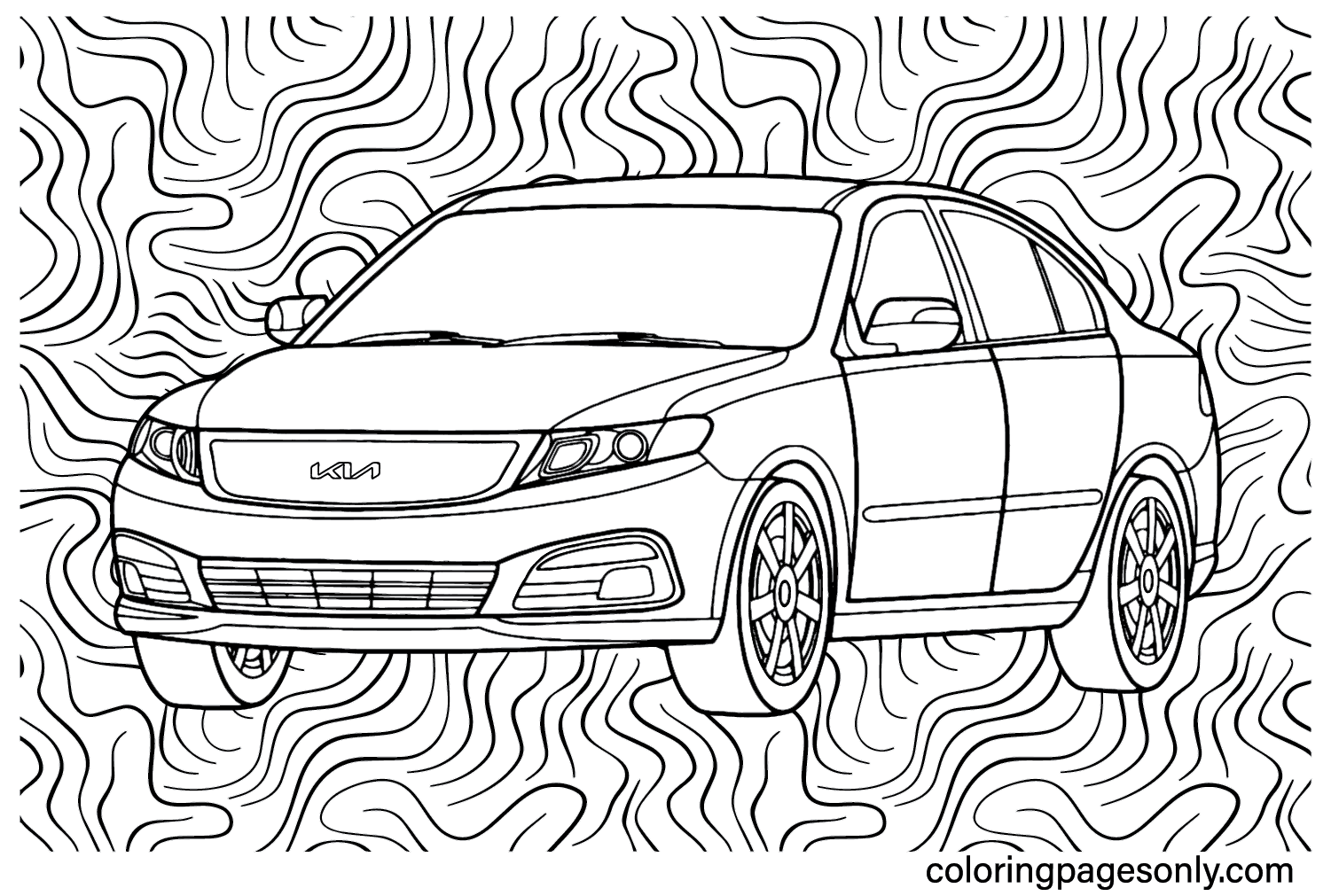
The Kia Optima Coloring Page depicts the midsize sedan that, when the second generation launched in 2010 at the Chicago Auto Show, genuinely shocked automotive journalists who had arrived expecting another competent but visually unremarkable Korean sedan. The Optima’s design – wide, low, aggressively surfaced – demonstrated that Peter Schreyer’s design transformation of the Kia brand had reached even its core volume segments.

The Optima was renamed the K5 in Korea and other markets with the fifth generation (2020), though it continued as the Optima in some markets. It represents the design language that established Kia’s reputation as a serious force in automotive design rather than merely a value-for-money proposition.

Kia Picanto

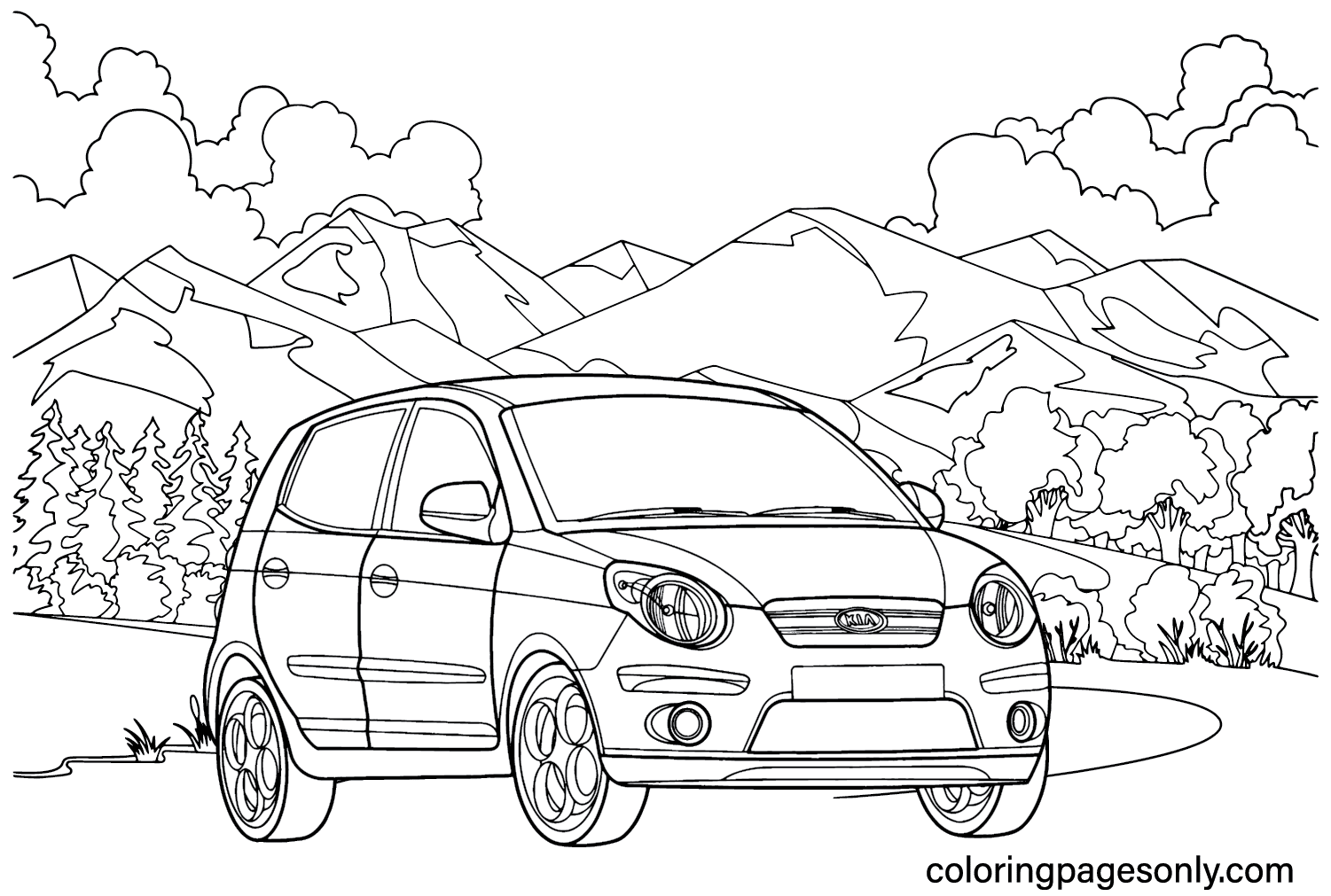
The Kia Picanto Coloring Page shows Kia’s entry-level city car – the smallest vehicle in the lineup and one of the most important in terms of the brand’s accessibility across diverse global markets. The Picanto has been produced since 2004 and is currently in its third generation, launched in 2017. In markets like Spain, Portugal, Italy, and several Southeast Asian and African countries, it is among the brand’s top-selling models.

The Picanto’s design challenge – making a very small car look charming and distinctive rather than merely compact – is one that Kia’s design team has addressed successfully in each generation. The current Picanto’s face, with its standard tiger nose grille adapted to a smaller scale, wears the family identity credibly while the light, almost playful proportions communicate its urban character. It is one of the more technically interesting coloring pages in the collection for anyone who wants to practice small-scale automotive illustration.

Kia Niro

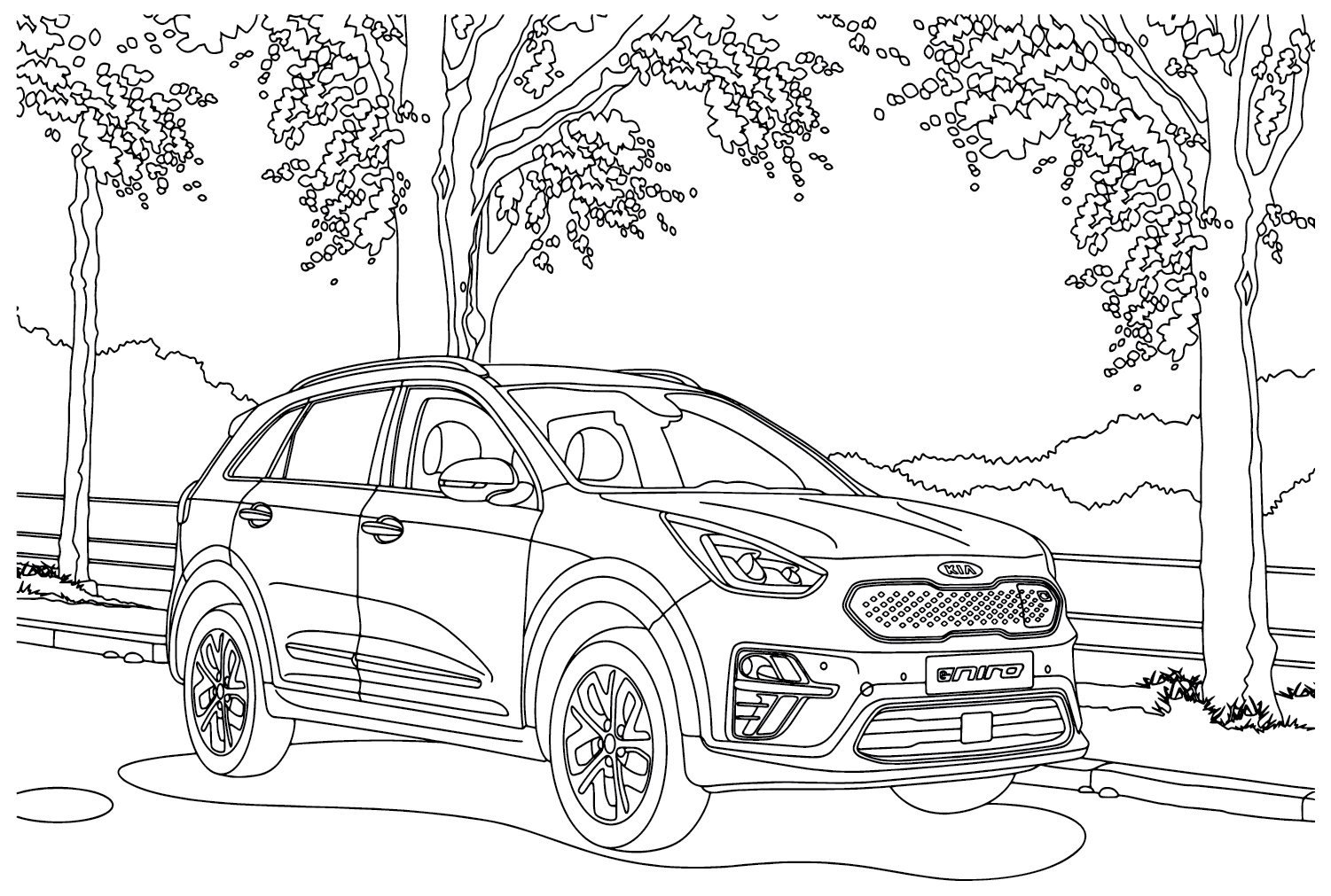
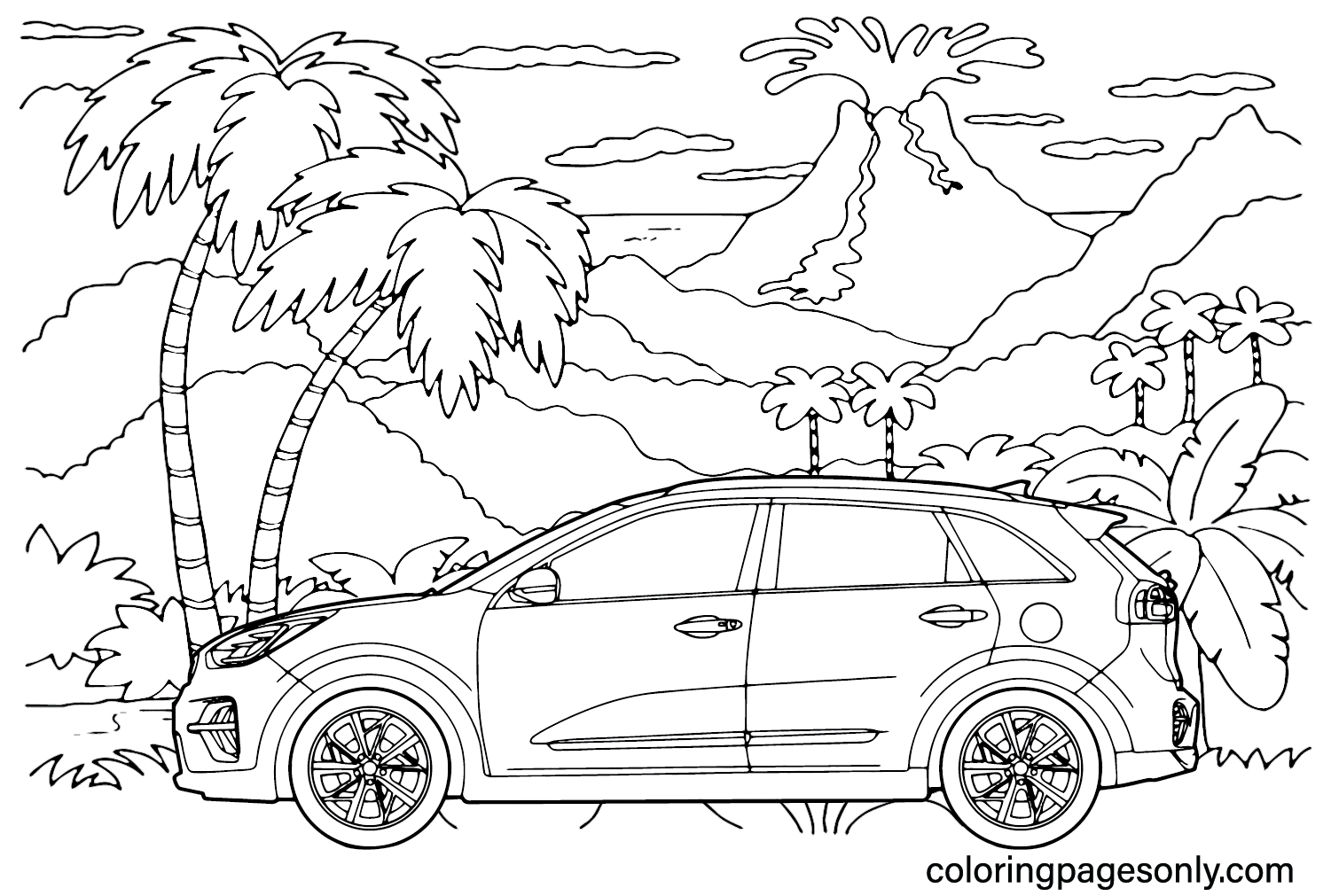
The Kia Niro Coloring Page features Kia’s dedicated eco-vehicle platform – a crossover available exclusively in hybrid, plug-in hybrid, and fully electric configurations. The Niro was first launched in 2016 as Kia’s most explicit commitment to electrified powertrains and has been updated with a second generation in 2022 that features one of the most visually distinctive designs in the compact crossover segment.

The second-generation Niro’s exterior uses a deliberate contrast between two-tone body color zones, a “Boomerang” light signature, and what Kia describes as a “Joyful” design philosophy – a lighter, more expressive approach than the Sportage or Sorento’s more muscular presence. The Niro EV, its electric variant, has become one of the more successful electric crossovers in European markets, where its 460km range (WLTP) and practical dimensions have proven particularly appropriate.

Kia Ceed and Pro Ceed

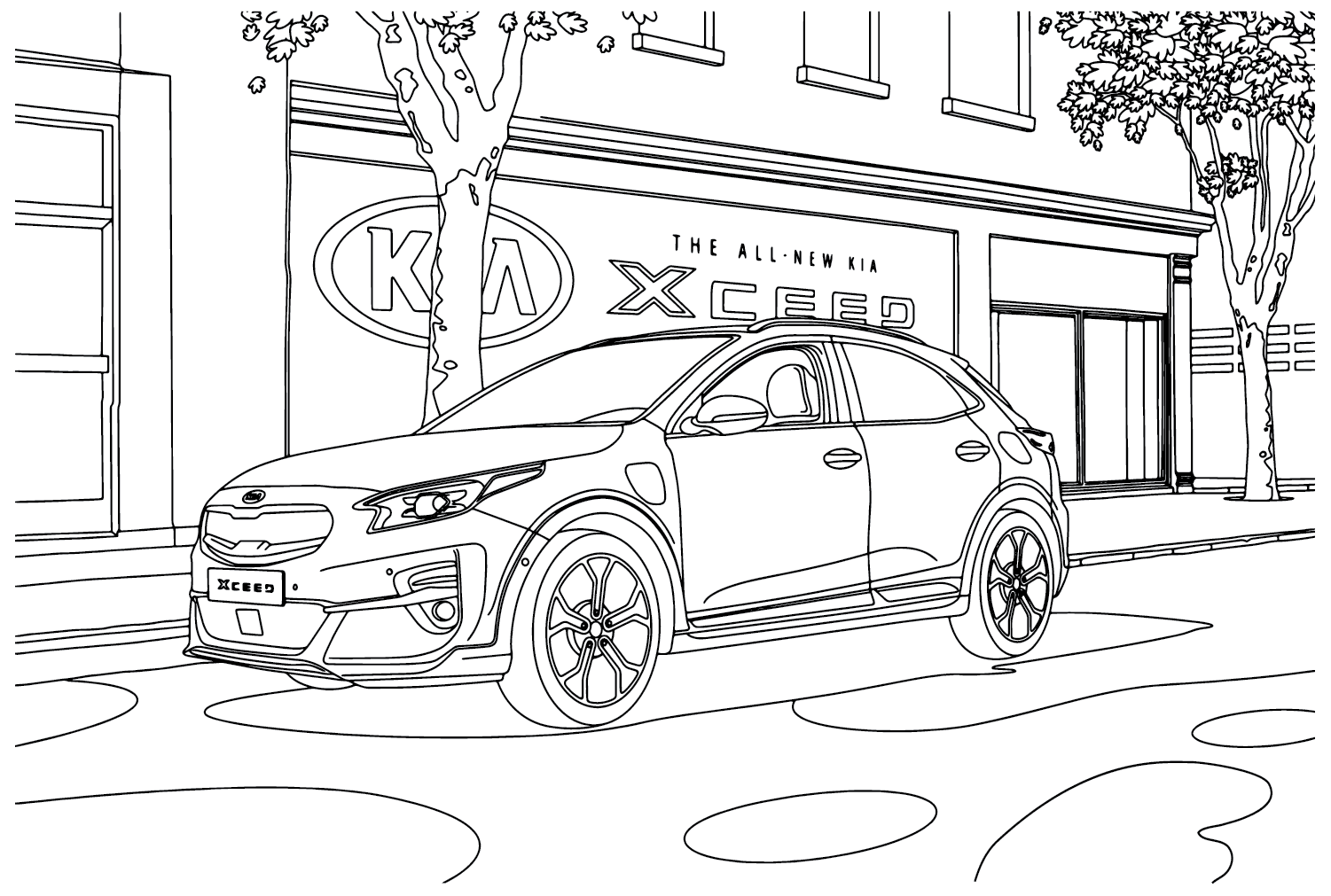
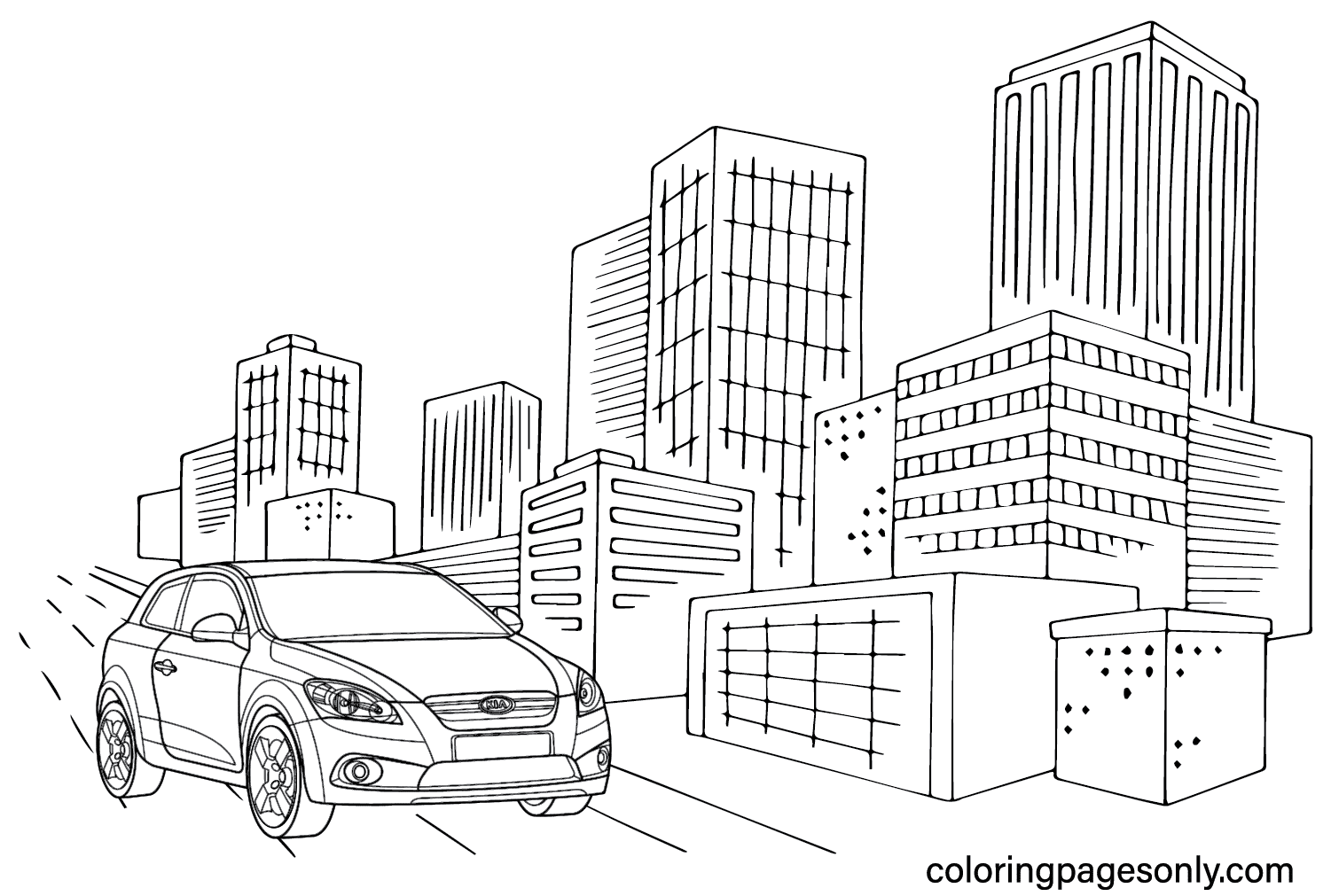
The Kia Ceed Sporty Wagon Coloring Page and Kia Pro Ceed Coloring Page feature two members of the Ceed family – a lineup developed specifically for the European market and manufactured in Slovakia at Kia’s Žilina plant.

The Ceed (originally spelled “cee’d” to indicate its European specificity – CE standing for the Community of Europe, D for its destiny) was launched in 2006 to provide a model developed with European driving preferences, road conditions, and regulatory requirements in mind. The Pro Ceed (now Pro Ceed) is the sportback/shooting brake variant – featuring a fastback roofline over a practical cargo area, creating one of the more elegant estate car silhouettes in the segment.

Kia Rondo and Borrego

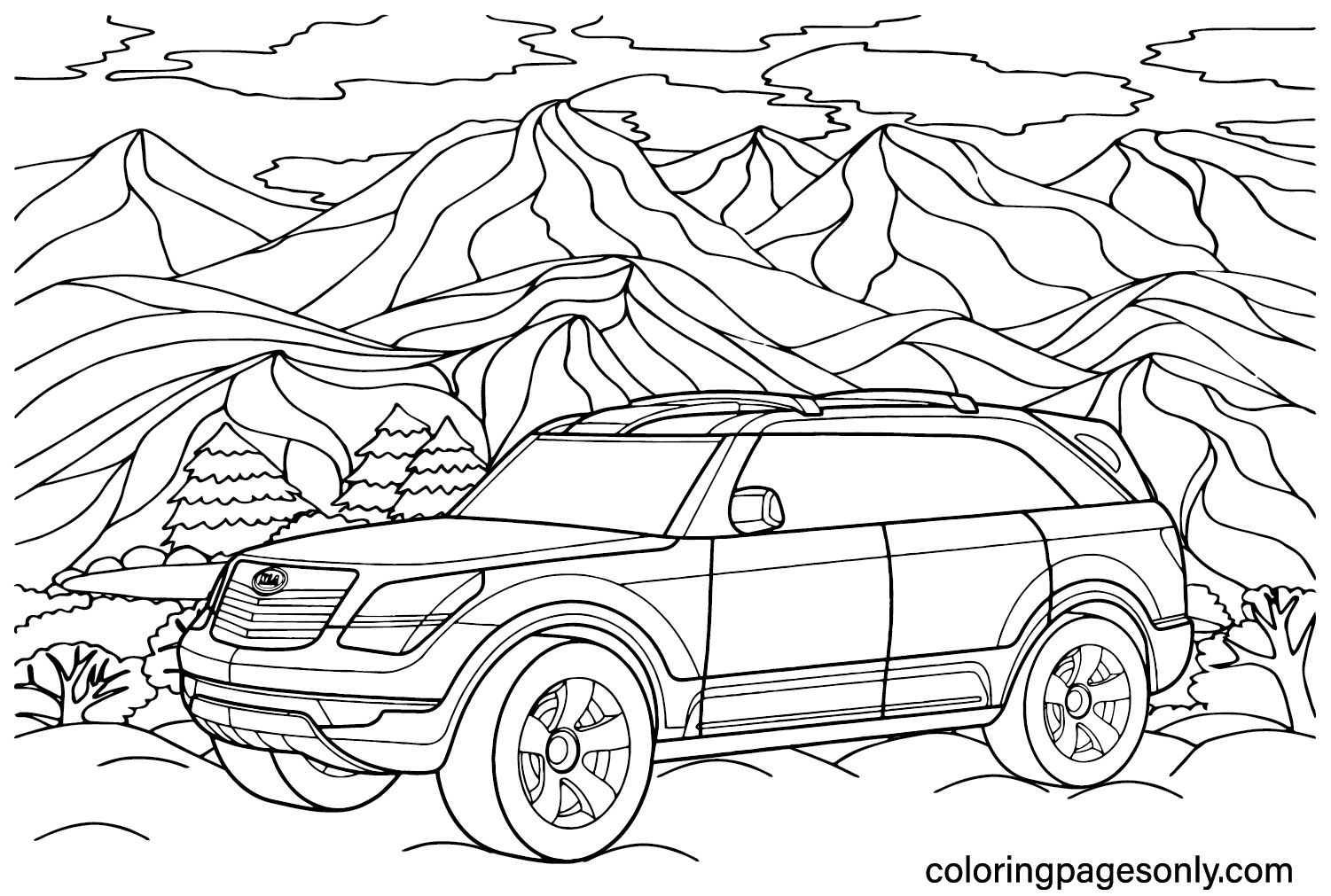
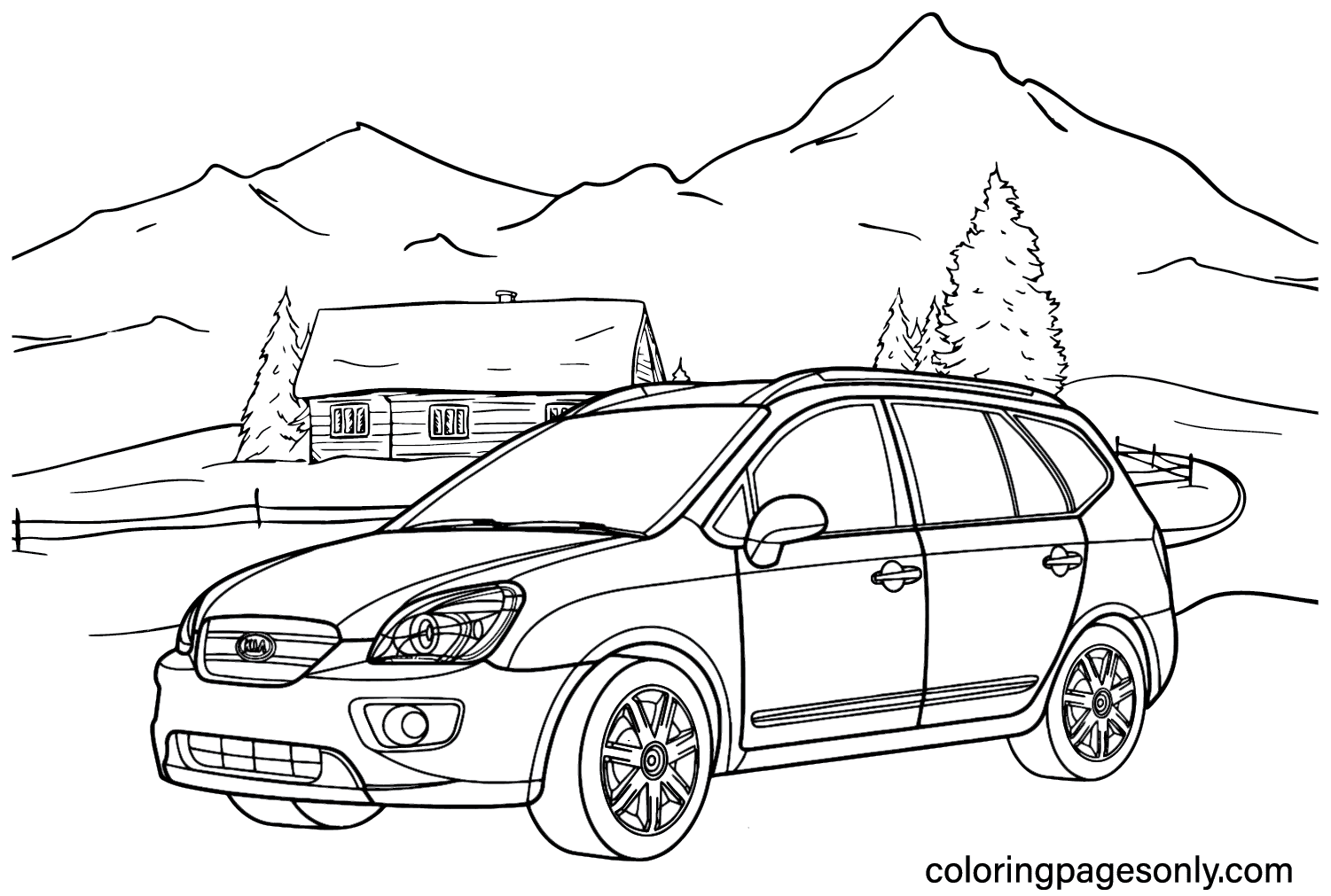
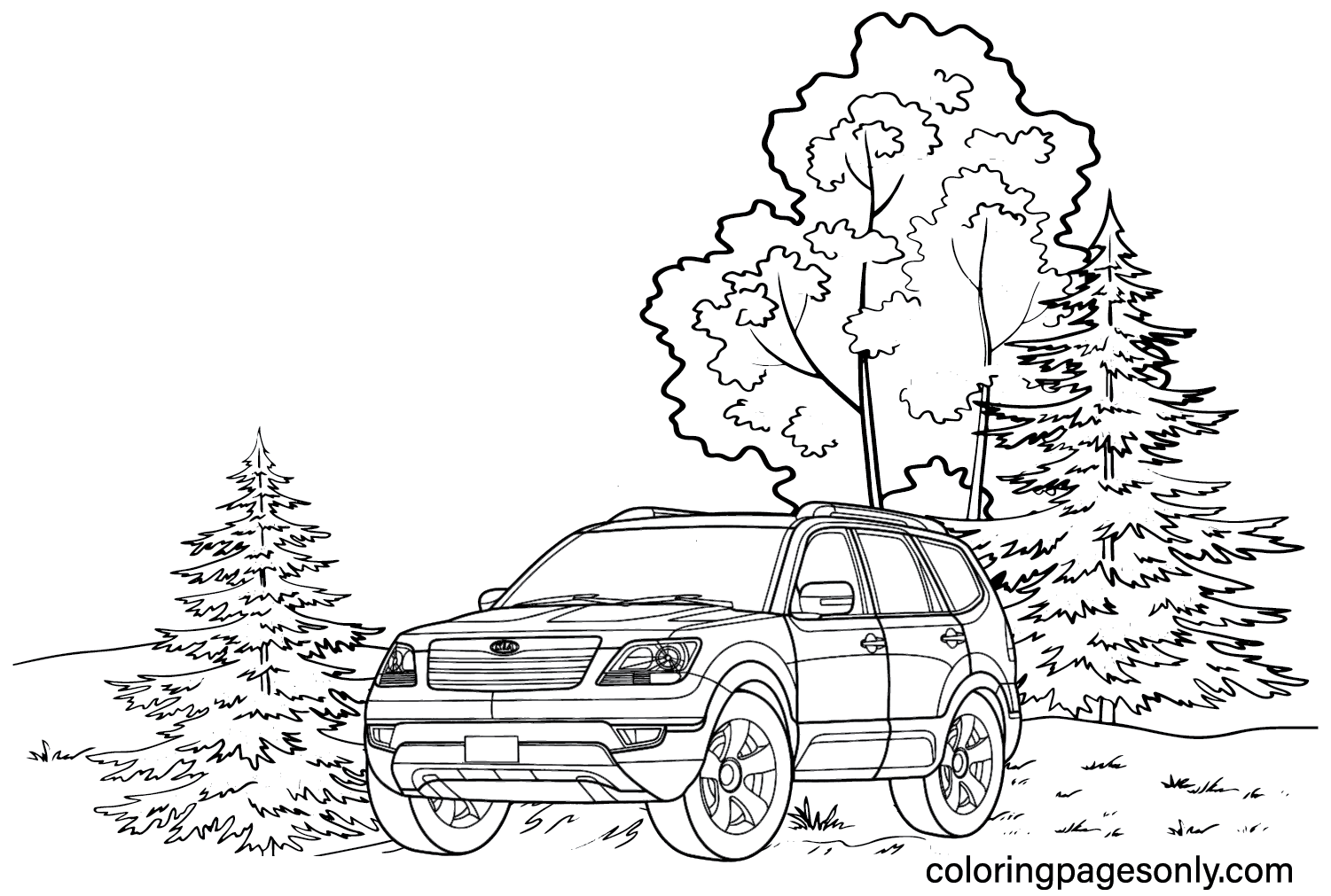
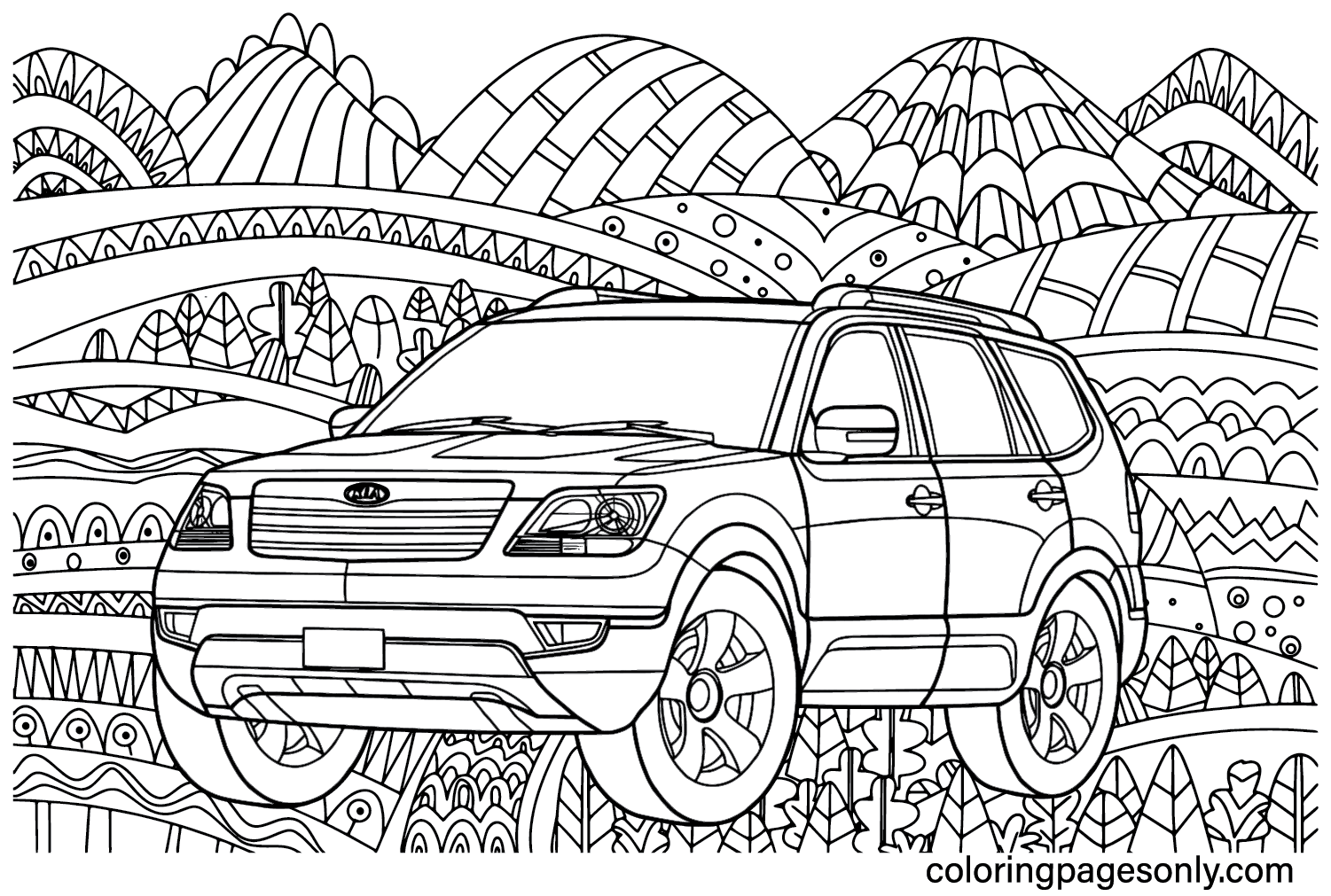
The Kia Rondo Coloring Page shows the compact MPV (multi-purpose vehicle) sold in various markets as the Rondo, Carens, or Carens – a seven-seat people mover positioned below the Carnival in the lineup. The Kia Borrego Coloring Page depicts the body-on-frame SUV sold in North America and Australia from 2008 to 2010, which was Kia’s most truck-like vehicle and represented a brief foray into the larger off-road SUV segment before the lineup consolidated around unibody crossovers.

Concept Cars – Kia’s Design Future

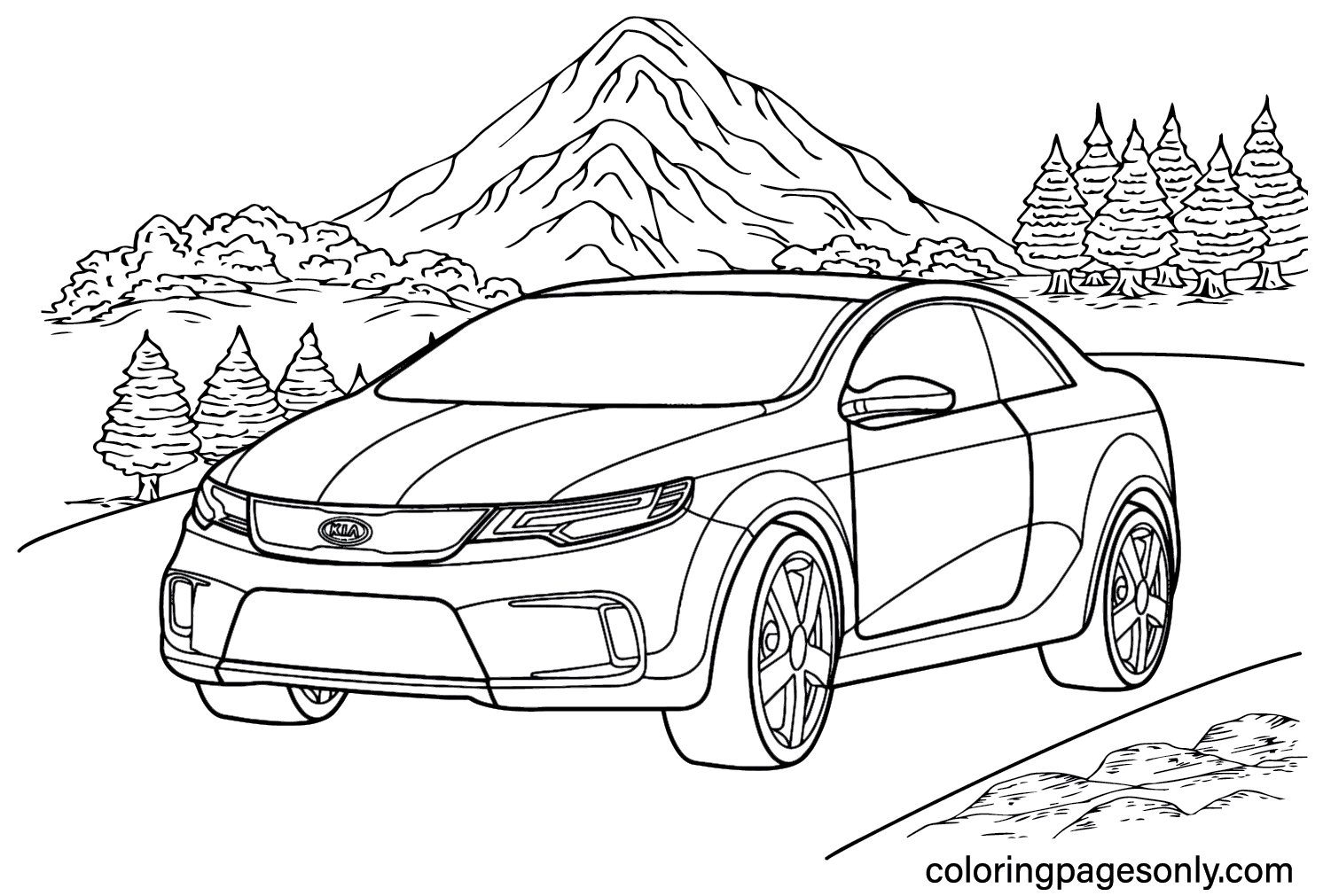
The Kia Koup Concept Coloring Page, Kia Mesa Coloring Page, Kia KND-4 Coloring Page, and Kia Kue Coloring Page are among the most fascinating pages in the collection because concept cars operate under different constraints from production vehicles – freed from the requirements of manufacturing feasibility, crash safety regulations, and dealer feedback, concept designers can explore forms that production reality will eventually moderate.

The Koup Concept (2008) previewed the Forte Koup production model – a two-door coupe that demonstrated Kia’s design ambition before the Optima arrived as the more dramatic statement. The Kue (2007) was a concept SUV that explored the tiger nose grille in its early form, previewing the design philosophy that would become standard across the Kia range. The Mesa and KND-4 represent Kia’s exploration of different vehicle categories and aesthetic directions. Coloring concept pages with more dramatic, less constrained color choices – vivid colors, metallic treatments, experimental two-tone combinations – is more appropriate than for production vehicle pages, where accuracy to real-world colors produces the most satisfying results.

Kia’s Design Transformation – The Story Behind the Cars

Kia’s rise from value-brand Korean automaker to global design award winner is one of the more instructive corporate transformations in automotive history, and it rests substantially on one decision made in 2006: hiring Peter Schreyer from the Volkswagen Group, where he had led the design of the Volkswagen New Beetle and the Audi TT – two of the most celebrated automotive designs of the 1990s.

Schreyer arrived at Kia with a mandate to transform the brand’s design identity from the inside out. His first contribution was the tiger nose grille – a narrow, horizontal grille element that widens toward the outer edges, giving Kia vehicles a distinctive face that is immediately recognizable as a family trait across all vehicle sizes. Introduced in 2006 on the Kee concept car, the tiger nose was applied progressively across the full Kia lineup through the late 2000s and early 2010s.

In 2012, Schreyer was appointed President of Kia Motors – the first foreigner to hold that position – alongside his role as Chief Design Officer of the Hyundai-Kia Automotive Group. Under his leadership and that of his successor Karim Habib (who joined from INFINITI in 2019), Kia’s design evolved from the initial tiger nose language through the “Opposites United” philosophy that defines the current lineup. The 2021 EV6 – Kia’s first dedicated electric vehicle platform – won the 2022 World Car of the Year award, the 2022 World Electric Vehicle of the Year, and the 2022 World Car Design of the Year simultaneously: a clean sweep that no other vehicle had previously achieved.

In 2021, Kia also rebranded its entire corporate identity – dropping the “Motors” designation, adopting a new script logo, and positioning itself simply as “Kia” – to reflect a broader ambition beyond automobiles to include mobility solutions, autonomous driving, and sustainable transportation.

How to Color These Pages Well

Automotive line drawings reward a systematic light source. Before picking up any color, decide where your imaginary light source is – for consistency across the collection, upper-left is the standard choice and feels the most natural. Every panel of the vehicle that faces the upper-left will receive your lightest tone of the chosen color. Every panel facing away – the underside of the front bumper, the lower door, the rear quarter under the roofline – will receive your darkest tone. The roof, directly below the light source, gets the lightest highlight.

Kia’s design language rewards high-contrast surface treatment. The character lines in Kia vehicles – the sharp body creases that run from front to rear across the door surfaces – are designed to create a contrast of light and shadow. In a real vehicle, these creases catch light dramatically on the upper surface and throw the lower surface into shadow. In coloring, you can replicate this by making the tone immediately above the crease line slightly lighter than the general body color and the tone immediately below the crease line slightly darker. The result is a body surface that reads as three-dimensional and sculptural rather than flat.

Production models work best in realistic automotive colors. The Sportage, Sorento, Carnival, and Optima are all produced in ranges of colors that include glacier whites, deep navy blues, phantom blacks, burnished coppers, and vivid reds. Any of these reads well on a coloring page. Metallic colors – particularly silver, grey, and dark navy – are the most technically challenging to render but the most satisfying when done well: apply a medium grey base, add a lighter tone on the upper panels and a darker tone on the lower panels, then add a very subtle shine line along the top of each major panel surface.

Concept cars invite creative freedom. The Koup, Kue, Mesa, and KND-4 were never produced in a single definitive color. This is your creative territory. Try vivid single-color treatments – a deep electric blue, a vivid orange, a metallic teal – or experiment with two-tone combinations that Kia’s actual production colors now employ. A white upper body with black lower panels, or a light silver with orange accent details, reads as authentically Kia-adjacent without copying any specific production color exactly.

The tiger nose grille deserves contrast. On most Kia vehicles in the lineup, the grille is finished in dark gloss black or dark chrome – significantly darker than the body color. When coloring the front face of any Kia page, establish the body color first, then apply the darkest available dark (deep charcoal or near-black) to the grille mesh area. The contrast between the body color and the dark grille is what makes the tiger nose read correctly as the design element it is.

5 Creative Activity Ideas

Personal Dream Kia Design

Use a Kia coloring page as the starting point for a design exercise – not to replicate any existing Kia color, but to design a Kia in a color combination you wish existed. Research Kia’s current color naming conventions (Kia uses names like “Runway Red,” “Gravity Blue,” “Glacier White,” “Quantum Blue”) and create a name for your invented color combination.

Color the vehicle in your chosen scheme. On a separate sheet, write a brief description of the color: its name, what it communicates about the car’s character, and why you chose it for this specific model. Tape the description to the bottom of the colored page.

This exercise, used in automotive design education programs at institutes including the Royal College of Art’s Vehicle Design program and the Pforzheim School of Design, develops exactly the connection between visual decision and verbal articulation that professional car designers use in their design presentations. At any age, the practice of naming and justifying a color choice sharpens both visual sensitivity and verbal precision.

Kia Model Range Comparison

Print six to eight pages covering the full range – Picanto, Ceed, Sportage, Niro, Optima, Sorento, Carnival, and a concept car. Color each one in a different color, but using the same color system: the same basic hue applied differently. For example, color every vehicle in a blue family – the Picanto in a pale light blue, the Ceed in a medium bright blue, the Sportage in a deep royal blue, the Sorento in a dark navy, the Carnival in a vivid electric blue. The same hue family across different vehicles shows how the same color can read completely differently depending on vehicle size, proportion, and surface complexity.

Mount all pages in a line, from smallest to largest vehicle, on a long horizontal strip of poster board. The finished display shows the full Kia lineup in a unified color study – a format that automotive design studios use internally for color strategy presentations. It also demonstrates visually how dramatically vehicle size and proportion affect color perception.

Tiger Nose Study

The tiger nose grille is the most consistent design element across the Kia lineup and the element most directly responsible for the brand’s visual coherence. This craft isolates that element for focused study.

Print five different Kia front-view or three-quarter front-view pages (any pages that show the grille clearly). Color each one, but on each page, treat the tiger nose grille differently: on page one, render it in deep gloss black. On page two, render it in dark chrome (mid-grey with a shine line). On page three, render it in the body color (a common treatment on higher specification trims). On page four, render it in a contrasting accent color. On page five, try a gradient from dark at the center to lighter at the edges.

Mount all five pages side by side on a backing sheet with a label under each: “Black,” “Chrome,” “Body Color,” “Accent,” “Gradient.” The finished display is a color treatment study of a single design element – the kind of comparative analysis that automotive designers and photographers use when exploring finish options.

Two-Tone Kia

Kia’s current design language increasingly uses two-tone color treatments – a contrasting roof color, a two-tone body with a clear delineation between upper and lower zones, or color-coded interior elements that extend the exterior color theme inside the vehicle. This craft explores that design direction.

Choose one Kia page – the Sportage or Niro works particularly well because their contemporary design already implies two-tone potential. Color the page twice, on two separate prints: on the first print, use a single solid color across the entire body. On the second print, use two colors – a primary color for the main body and a contrasting secondary color for the roof panel, the lower sill, or the rear quarter. Mount both versions side by side.

The comparison shows what two-tone treatment does to a vehicle’s visual proportion and character. Single-color vehicles read as simpler and more formal; two-tone versions read as more dynamic, more designed, more expensive. This is genuine automotive design knowledge, derived from looking closely rather than reading a textbook.

Kia Through the Decades Timeline

This project requires research alongside coloring. Print pages representing different eras of Kia design – the Borrego (older design language, pre-Schreyer), the Rondo (transitional period), the Optima (Schreyer’s transformation), the Sorento (mature Schreyer era), the Sportage or Niro (current “Opposites United” era), and a concept car (future direction).

Color each vehicle in colors appropriate to its era – older models in the more conservative palettes typical of their time, newer models in the more adventurous colors Kia now offers. Mount in chronological order on a long horizontal strip. Add the model name and launch year below each vehicle.

The finished timeline makes visible what words about “design transformation” describe but cannot fully convey: the difference between how a vehicle looked before and after a coherent design vision was applied. The before-and-after is visible in the surface tension, the proportion, and the confidence of the character lines. It is a real design history made tangible through careful coloring.

Frequently Asked Questions

What does “Kia” mean, and where is the company from? Kia is a South Korean automotive manufacturer founded in Seoul in 1944 as Kyungsung Precision Industry. The name comes from two Chinese characters: ki (起), meaning “to rise,” and a (亞), representing Asia, together conveying the aspiration “to rise from Asia.” The company began by manufacturing bicycle parts and steel tubing, produced its first three-wheeled truck in 1962 (Korea’s first domestically manufactured motor vehicle), and developed its first passenger car in 1974. In 2021, the company officially rebranded from “Kia Motors” to simply “Kia” to reflect a broader mobility vision beyond automobiles.

Who redesigned Kia’s visual identity, and what is the tiger nose grille? German designer Peter Schreyer, who joined Kia in 2006 from the Volkswagen Group (where he led the design of the VW New Beetle and Audi TT), is credited with transforming Kia’s design identity. His primary contribution to the brand’s visual language was the tiger nose grille – a horizontal grille element that narrows toward the center at the lower edge, creating a distinctive, predatory front face that is consistent across all Kia models regardless of size. The tiger nose was first applied to a production vehicle in 2008 and has been a standard Kia design element since approximately 2010. Schreyer was appointed President of Kia Motors in 2012, the first non-Korean to hold that position.

What is Kia’s “Opposites United” design philosophy? “Opposites United” is the design philosophy Kia adopted in the early 2020s under Chief Design Officer Karim Habib, who joined from INFINITI in 2019. It describes a deliberate approach to holding two apparently contradictory qualities in tension within a single design: bold and subtle, geometric and organic, high-tech and natural, energetic and calm. The philosophy is most fully realized in the EV6 (2021) and the fifth-generation Sportage (2021), both of which combine sharp, angular surfaces with flowing, organic transitions in ways that reward close visual inspection. The EV6 won the World Car of the Year, World Electric Vehicle of the Year, and World Car Design of the Year awards simultaneously in 2022 – a clean sweep no vehicle had previously achieved.

What are Kia’s best-selling models globally? The Kia Sportage is consistently Kia’s best-selling model globally, with over 6 million units sold across its five generations since 1993. The Kia Sorento is the brand’s flagship SUV and one of its strongest performers in North American and Australian markets. The Kia Carnival is the brand’s most successful people-carrier globally. In Europe, the Ceed family (Ceed, Sportswagon, Pro Ceed) is particularly strong. In Asia, the Kia Picanto and Kia K3 (Cerato/Forte) are among the volume leaders. The Kia EV6 has been Kia’s most critically successful recent launch globally.

What is the Kia Niro, and why is it significant? The Kia Niro is a compact crossover produced exclusively in electrified configurations – hybrid, plug-in hybrid, and full electric (Niro EV). Launched in 2016, it was Kia’s most explicit commitment to electrified powertrains and preceded the brand’s broader push into dedicated electric vehicle platforms. The second-generation Niro (2022) was significantly redesigned with a more expressive, distinctive appearance that departed from the more conservative first-generation design. The Niro EV variant has been particularly successful in European markets, where its combination of practical range and compact dimensions has made it one of the more popular electric crossovers in countries like the UK, Norway, and the Netherlands.

What design awards has Kia won? Kia has won the Red Dot Design Award – one of the world’s most prestigious product design awards – for every vehicle in its current lineup, making it the first automaker to achieve this distinction across an entire vehicle range. The Kia EV6 won the World Car of the Year, World Electric Vehicle of the Year, and World Car Design of the Year awards simultaneously in 2022. The fourth-generation Sorento (2020) won the Red Dot Design Award in 2021. Kia has received more Red Dot Design Awards than any other Korean automaker.

What age group are these coloring pages best suited for? The simpler vehicle pages – particularly the Picanto (smaller, more compact proportions) and the Rondo – work well from around age 6–8 for children who enjoy vehicle coloring. The more complex pages with multiple visible design details – the Sportage’s character lines, the Sorento’s sculpted surfaces, the Carnival’s distinctive face – reward the patience and fine motor control that develops from around age 9–10. Adults with an interest in automotive design, industrial design, or car culture will find the concept car pages (Koup, Mesa, KND-4, Kue) particularly interesting as design study exercises. The Two-Tone comparison craft and the Design Timeline project are most suited to ages 12 and up, and for adults.

Browse the full collection at ColoringPagesOnly.com. All pages free, no sign-up, PDF or PNG, print at home or color online.

In 1944, Kyungsung Precision Industry was making bicycle parts in Seoul. Eighty years later, Kia is winning the World Car of the Year, World Car Design of the Year, and World Electric Vehicle of the Year simultaneously with a single model, employing some of the most talented automotive designers in the world, and selling cars in over 190 countries. The design that made that transformation visible – the tiger nose, the character lines, the surfaces that reward looking at them slowly – is what these coloring pages are about.

Take your time with the body lines. Follow where the surface goes. Color something that knows exactly where it’s going.

Share your work on Facebook and Pinterest and tag #Coloringpagesonly. We especially want to see the two-tone comparisons and the decade timeline displays.

Color the line. Follow the crease. Rise from the page.

More from our automotive collections:

Nam Nguyen – CEO

Hello and welcome! I’m Nam Nguyen, the creator and founder of Coloringpagesonly.com. Driven by my love for art and the endless wonders of color, I started this platform to spark creativity and joy in people of all ages. Join me on this colorful journey, and let’s explore the magic of art together!