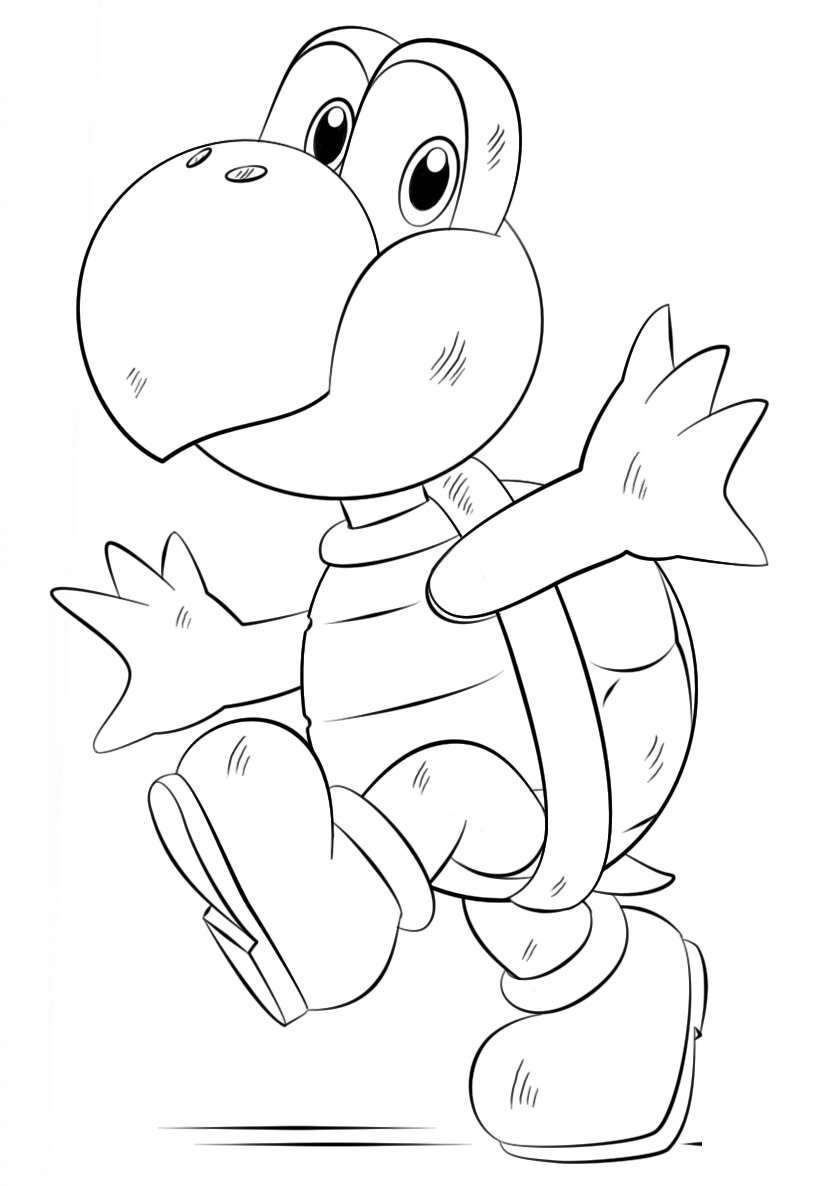
Koopalings Coloring Pages
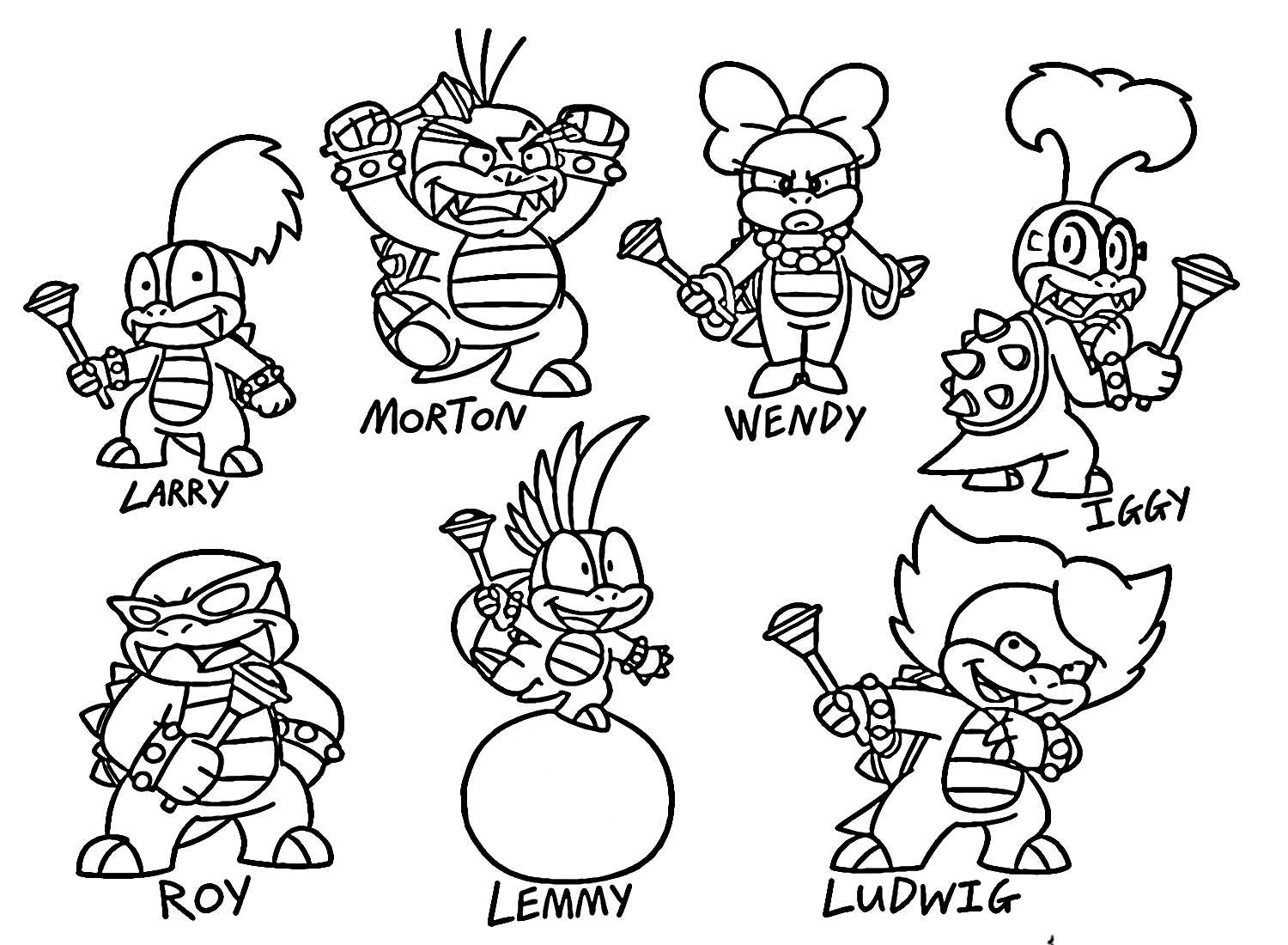
Free Koopalings coloring pages – 30+ pages featuring all seven Koopalings – Larry, Morton, Wendy, Iggy, Roy, Lemmy, and Ludwig – in individual portraits, group compositions, action poses from Super Mario Bros. 3, New Super Mario Bros. Wii, Mario Kart 8, and Super Smash Bros., plus pages showing their distinctive designs across Nintendo’s decades of Mario games – free printable PDF and online coloring for Super Mario fans.
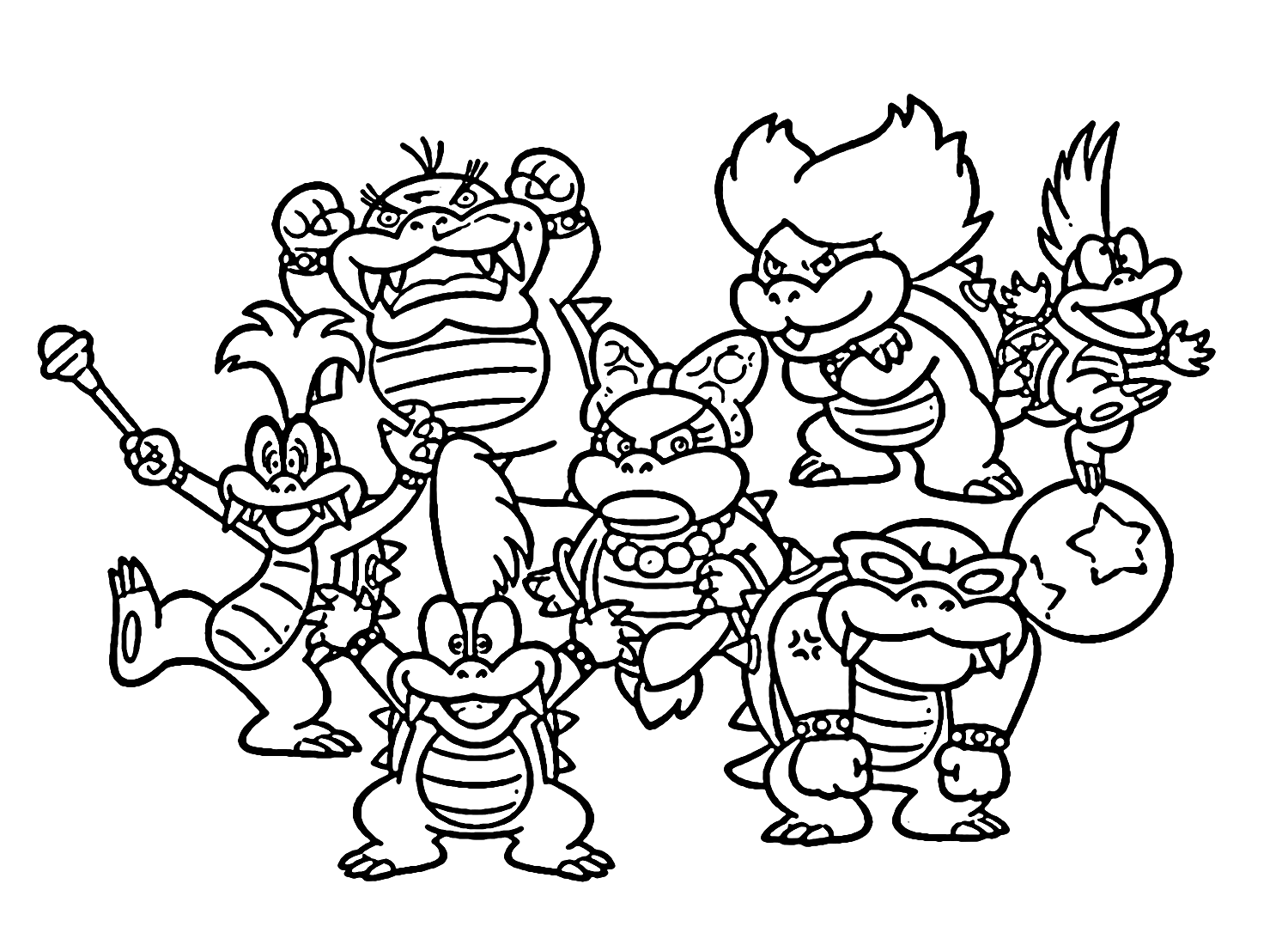
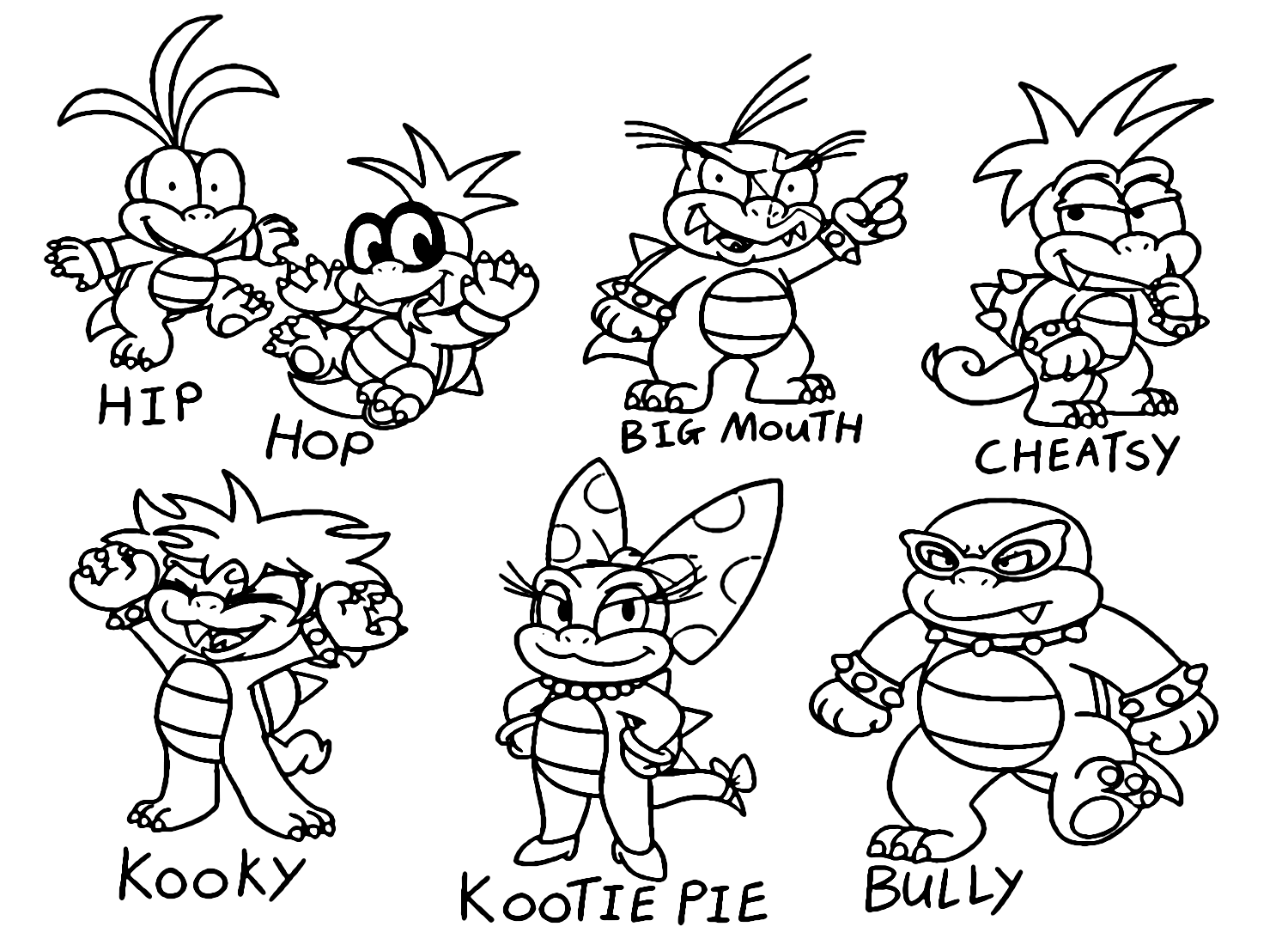
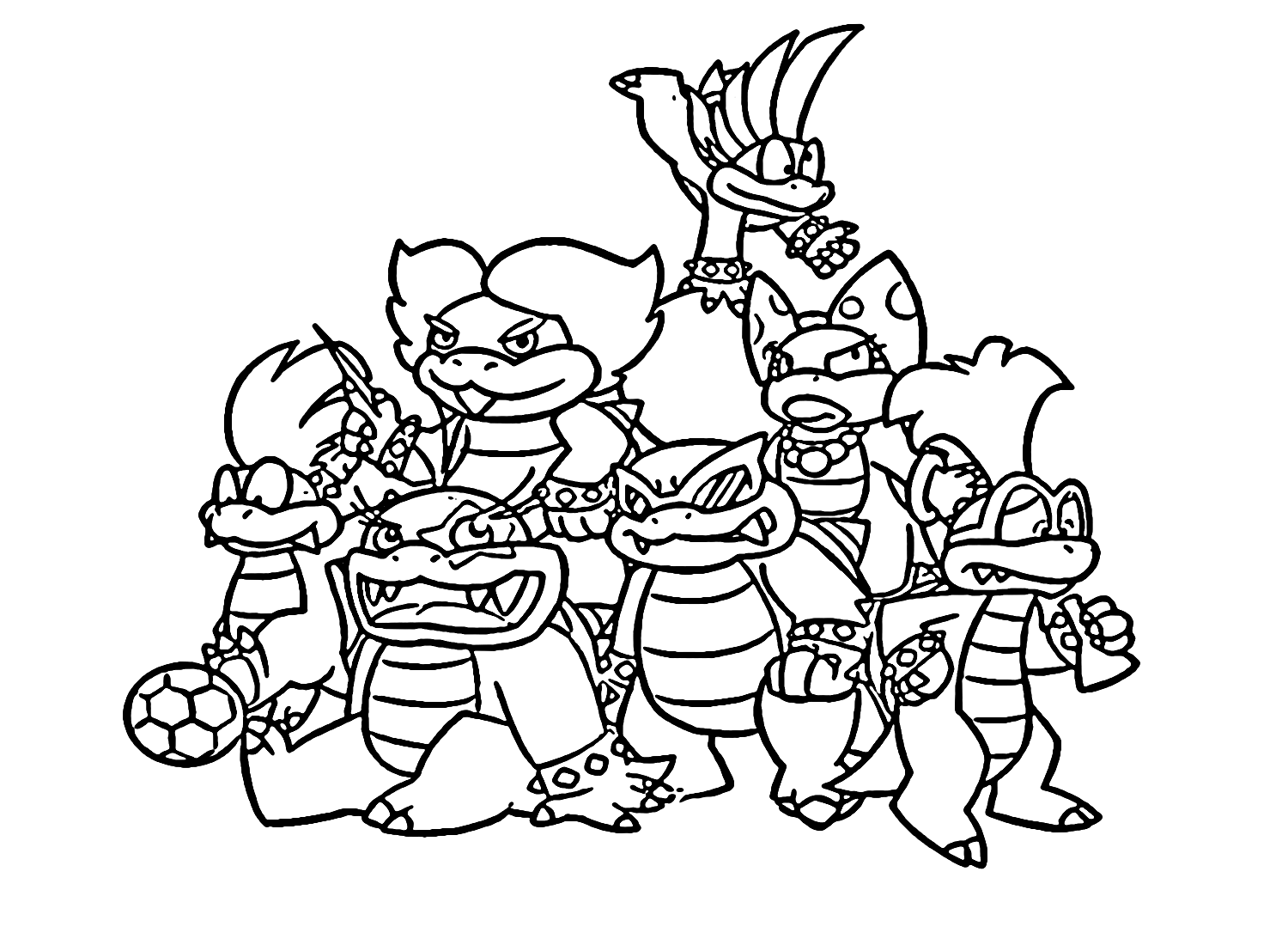
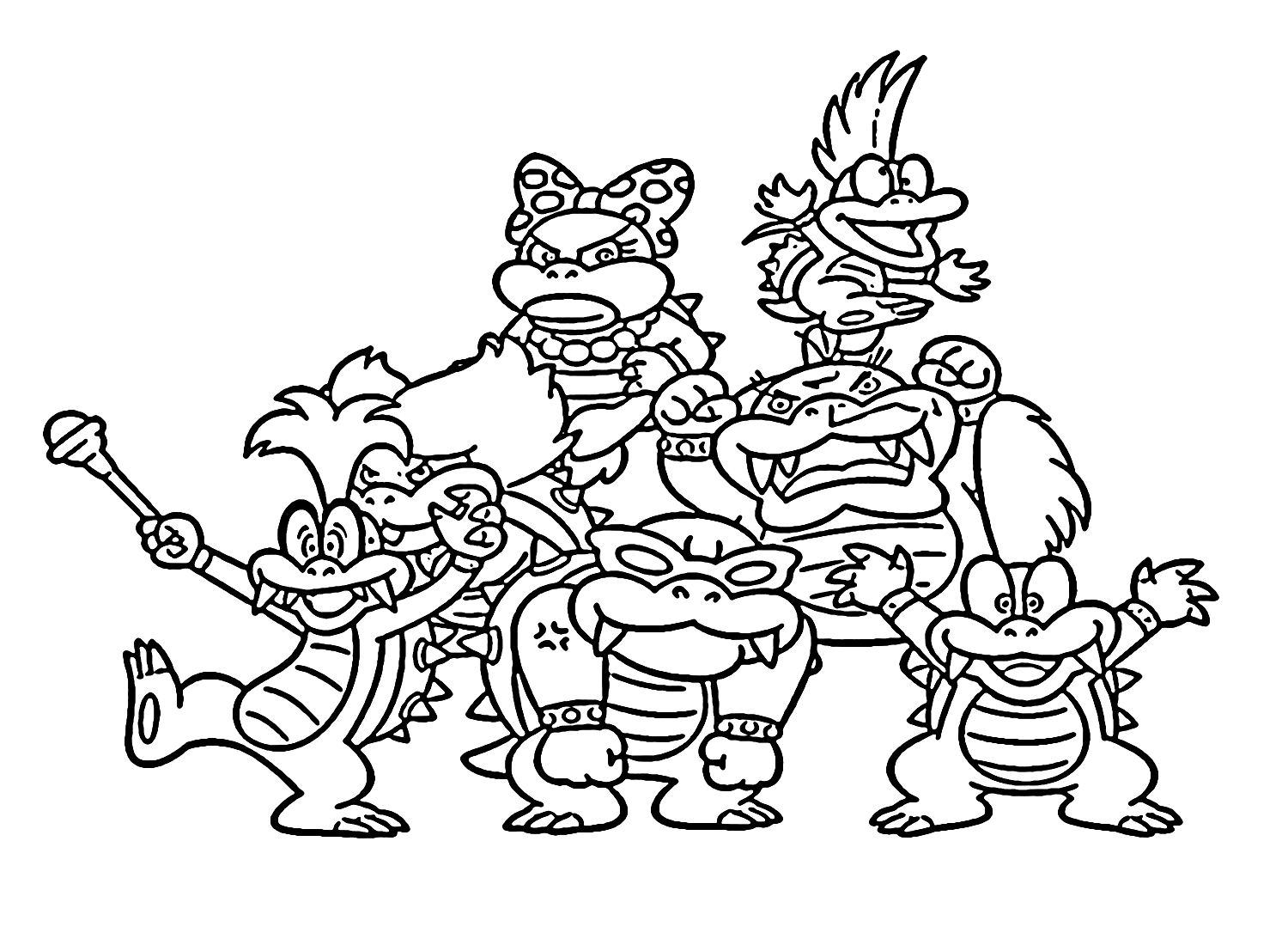
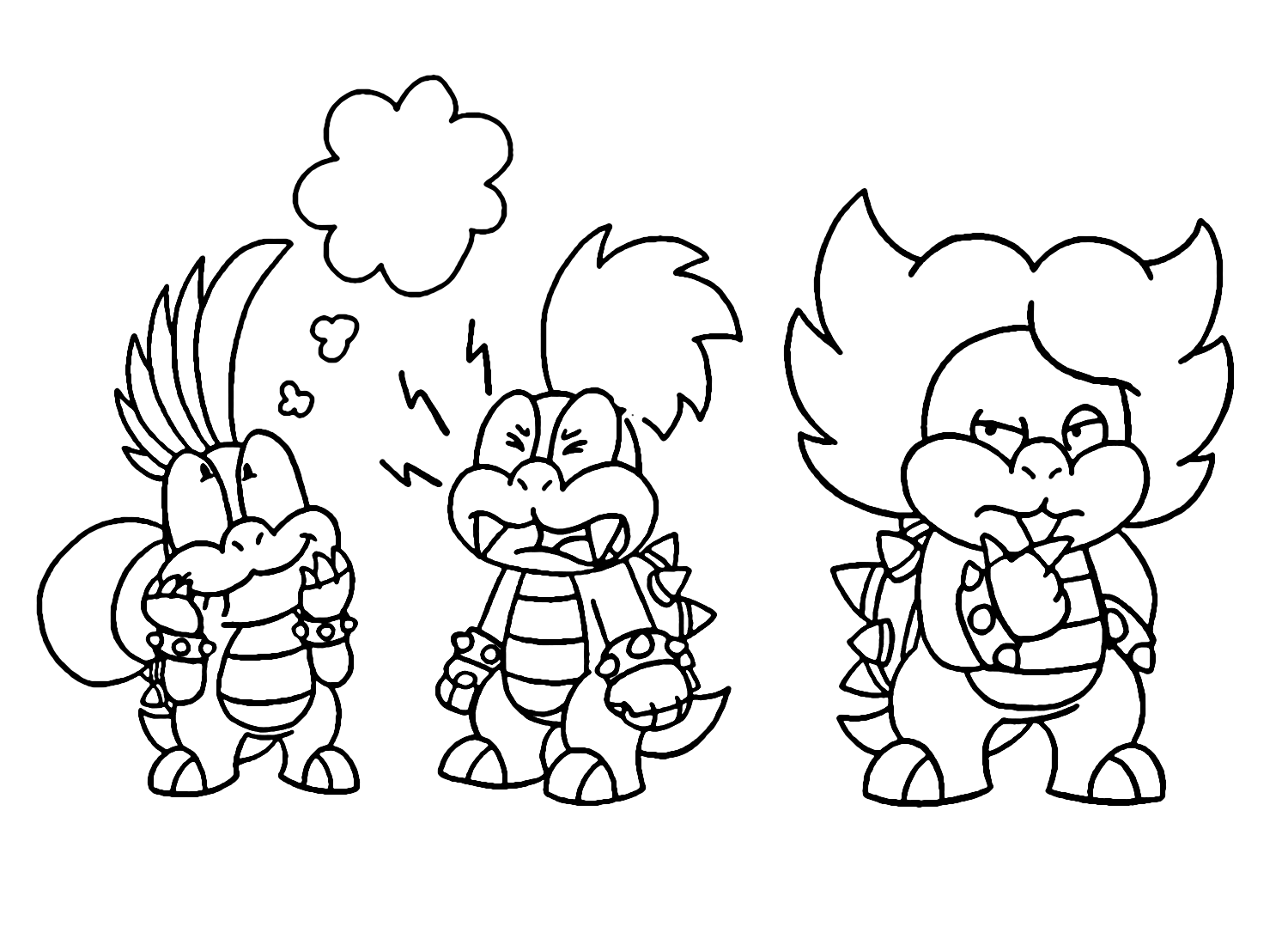
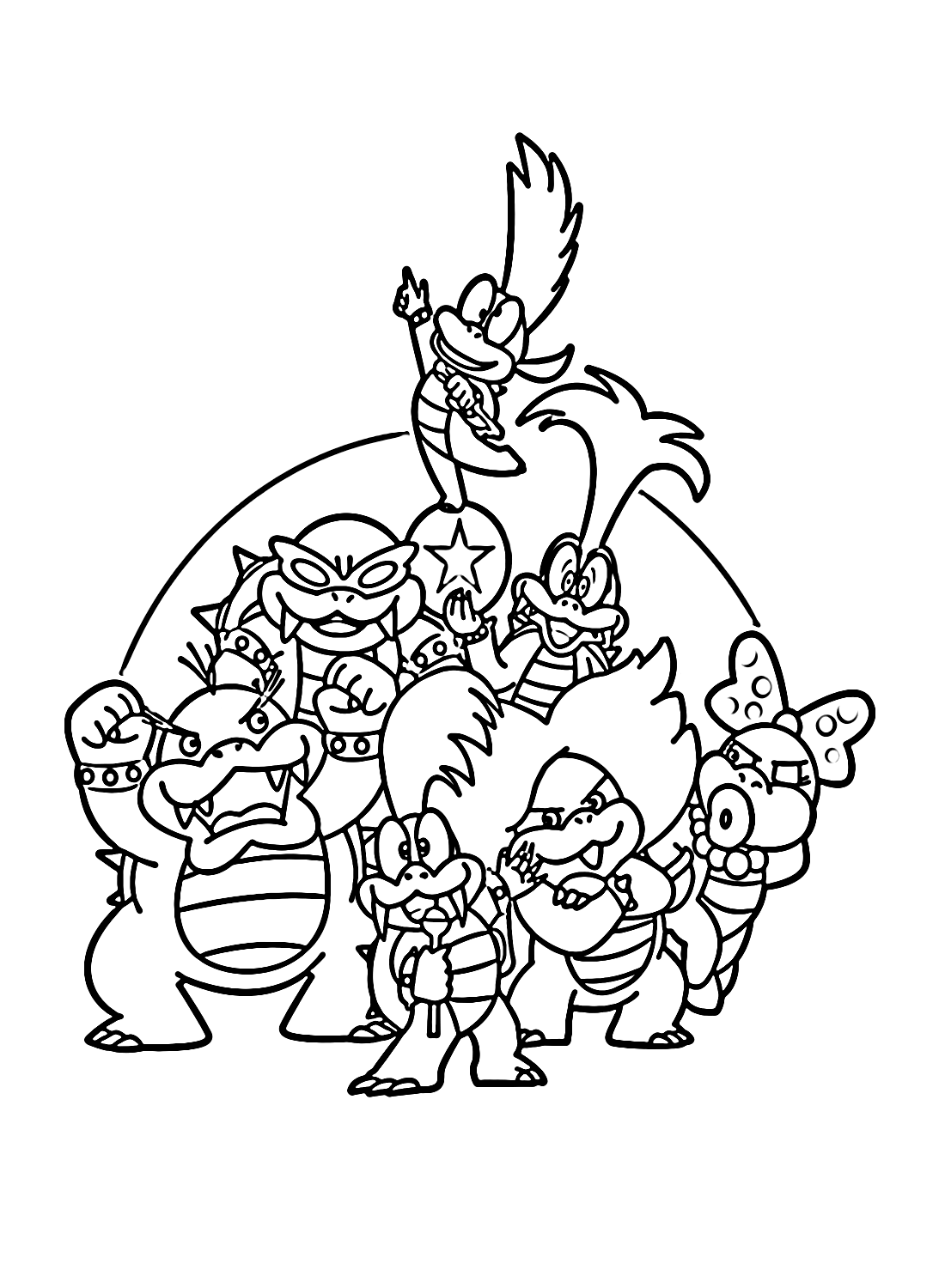
The Koopalings are seven Koopa characters who first appeared as boss characters in Super Mario Bros. 3, released in Japan on October 23, 1988, and in North America on February 12, 1990. Each guards a world in the game and must be defeated before Mario can recover the magic wand stolen from that world’s king. Their design is consistent in structure – green reptilian skin (with one exception), a shell on the back, and a distinctive hairstyle unique to each – but radically differentiated in color, proportion, and personality, making them seven immediately distinguishable characters who share a visual family identity.
Nintendo of America’s localization team assigned their English-language names. Each was named after a real musician: Larry after Larry Mullen Jr. of U2, Morton after television personality Morton Downey Jr., Wendy after punk rock singer Wendy O. Williams of the Plasmatics, Iggy after Iggy Pop, Roy after Roy Orbison, Lemmy after Lemmy Kilmister of Motörhead, and Ludwig after Ludwig van Beethoven. This naming convention – a children’s video game boss group named after rock musicians and a classical composer – is one of the more unexpected localization decisions in Nintendo’s history and one of the most discussed by fans who discover it.
These 30+ free pages at ColoringPagesOnly.com cover all seven. All free, PDF or PNG, print or color online.
What is Inside
Larry Koopa – The First Boss
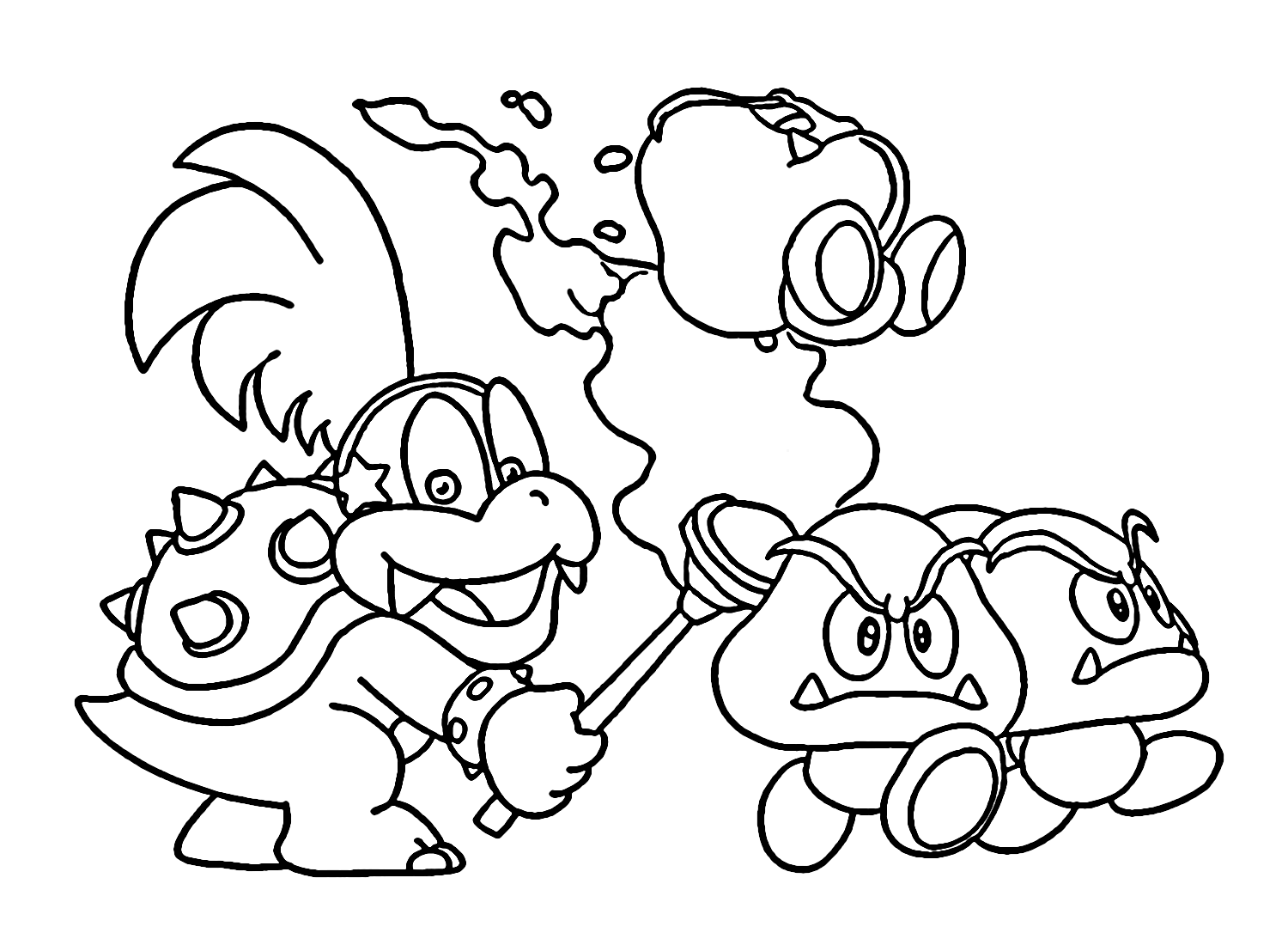
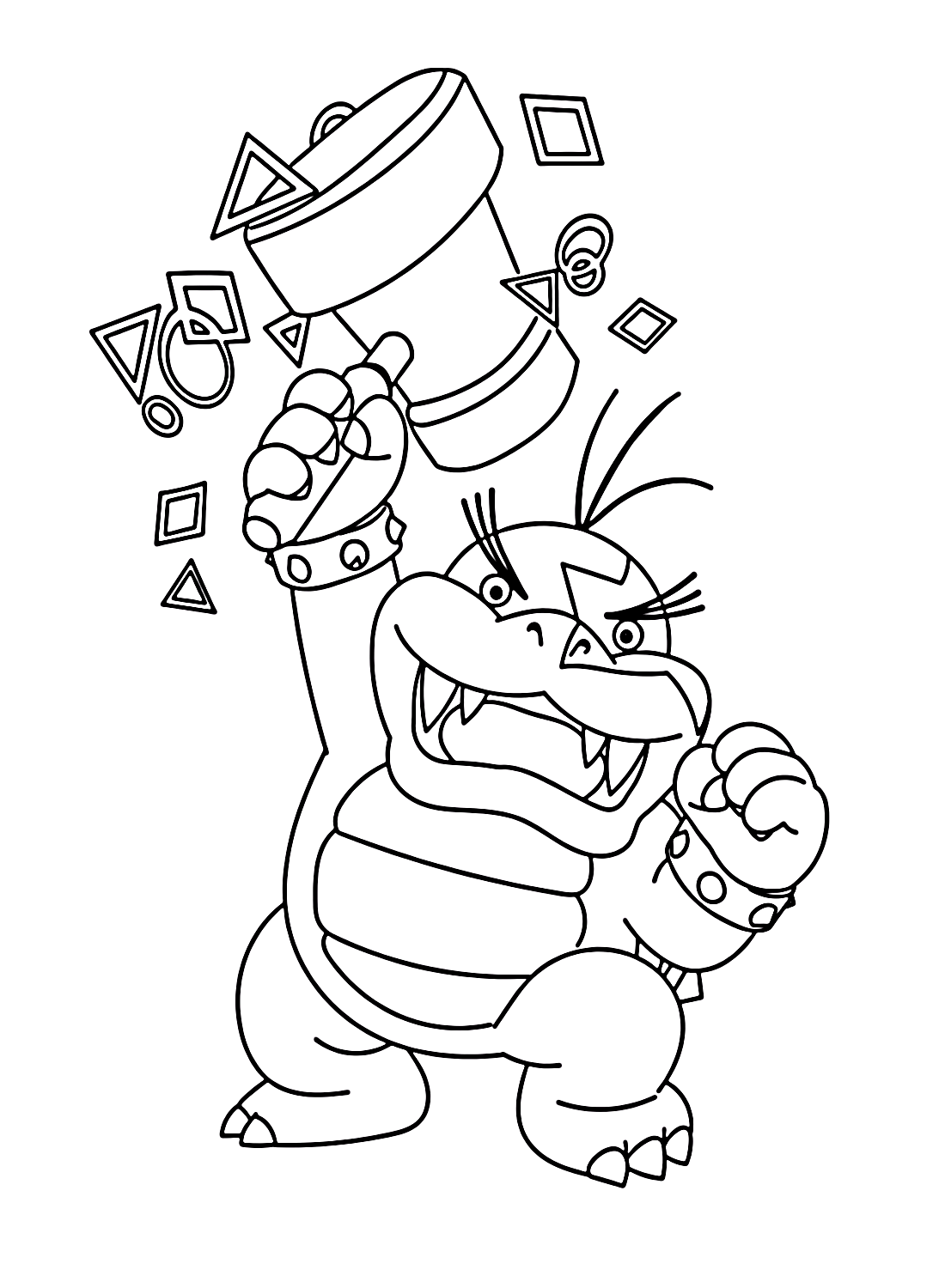
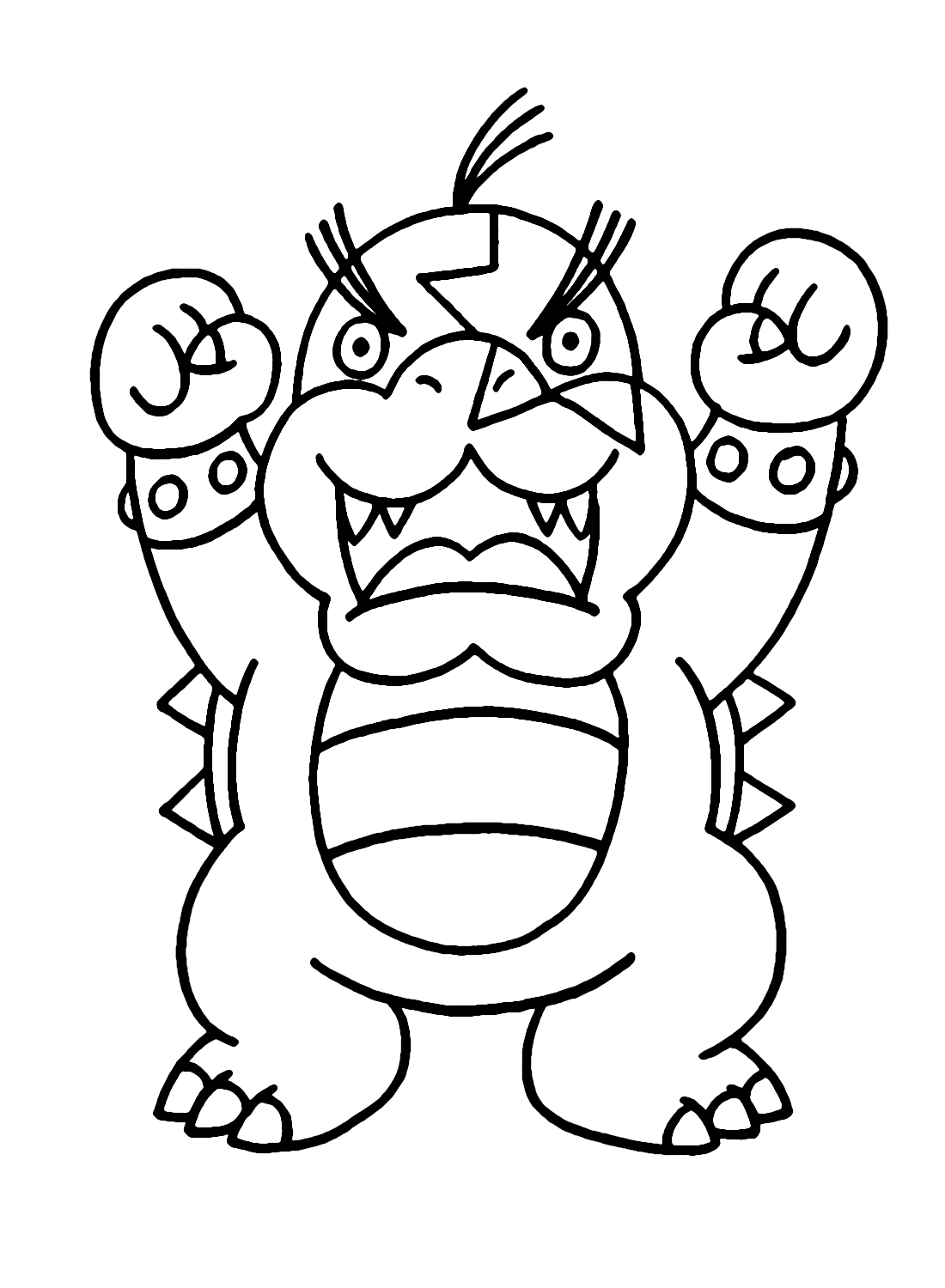
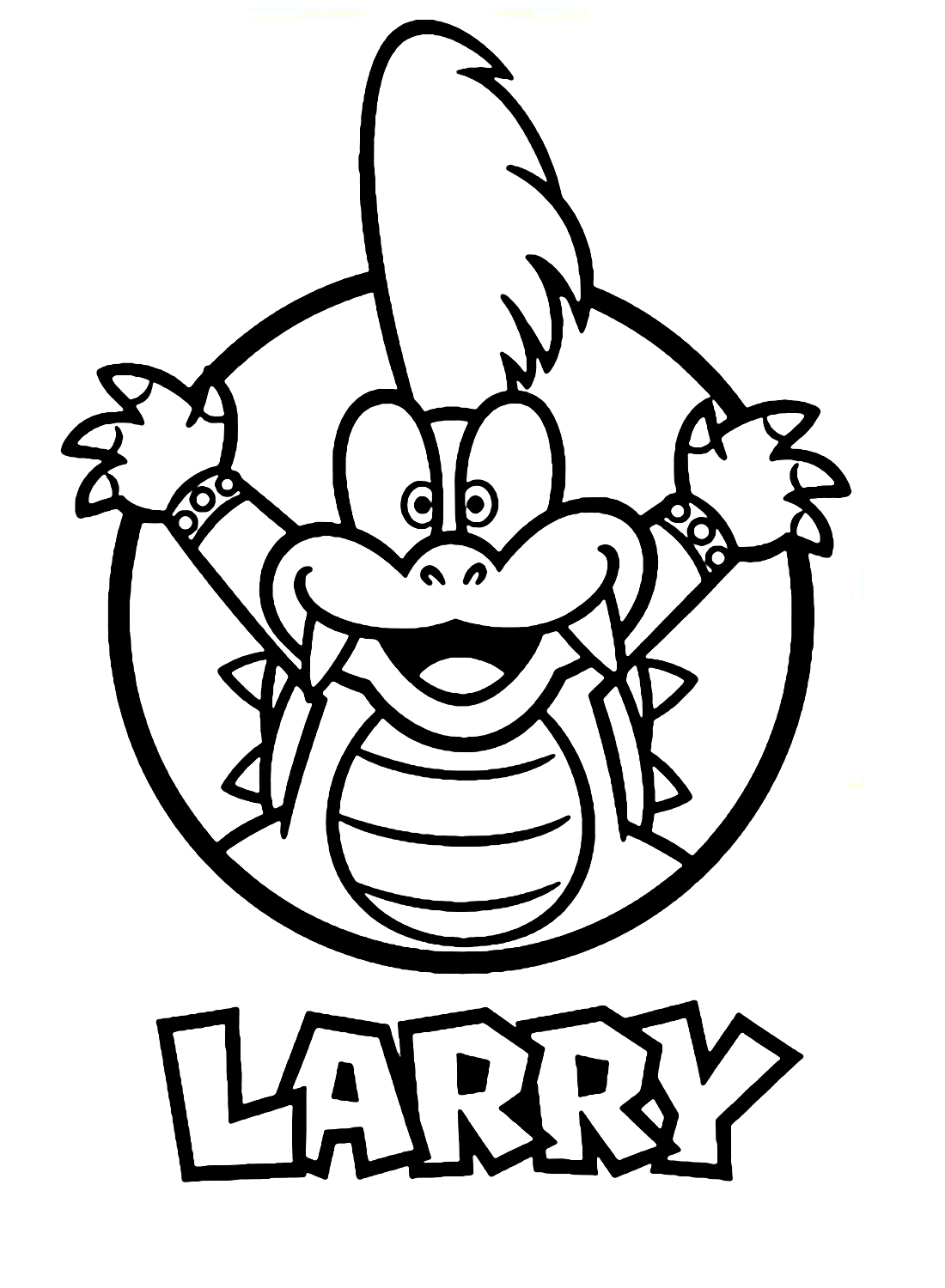
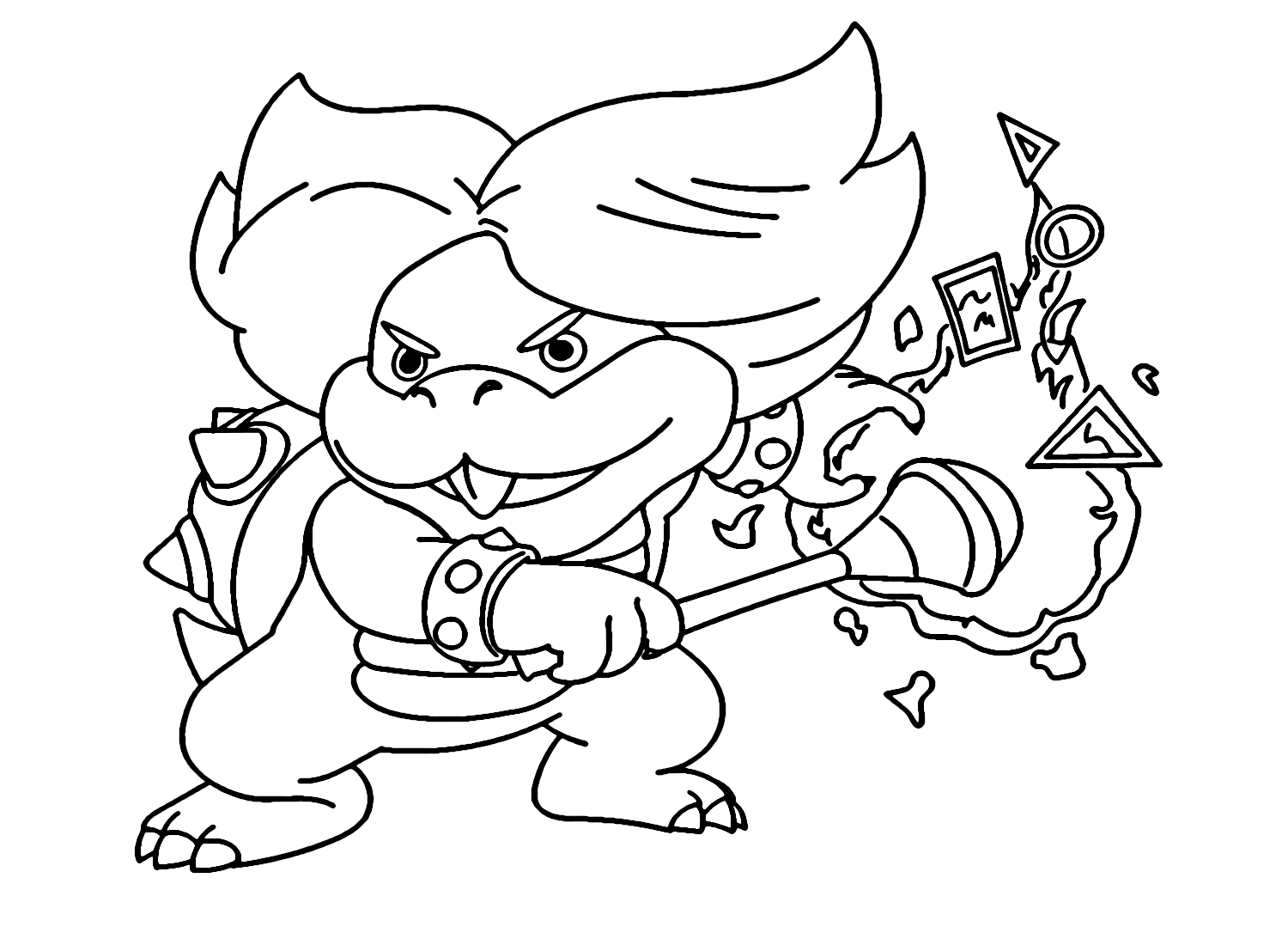
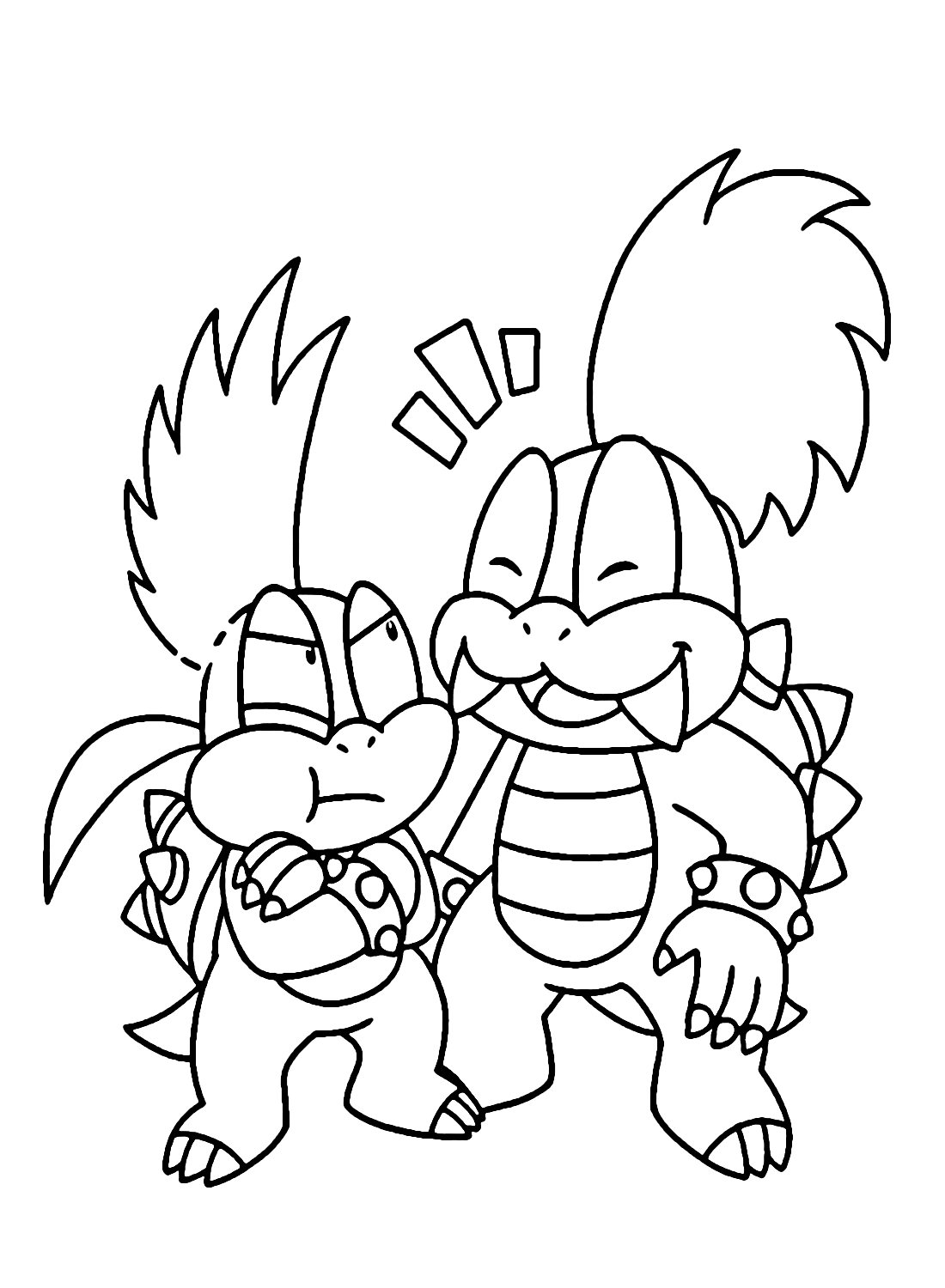
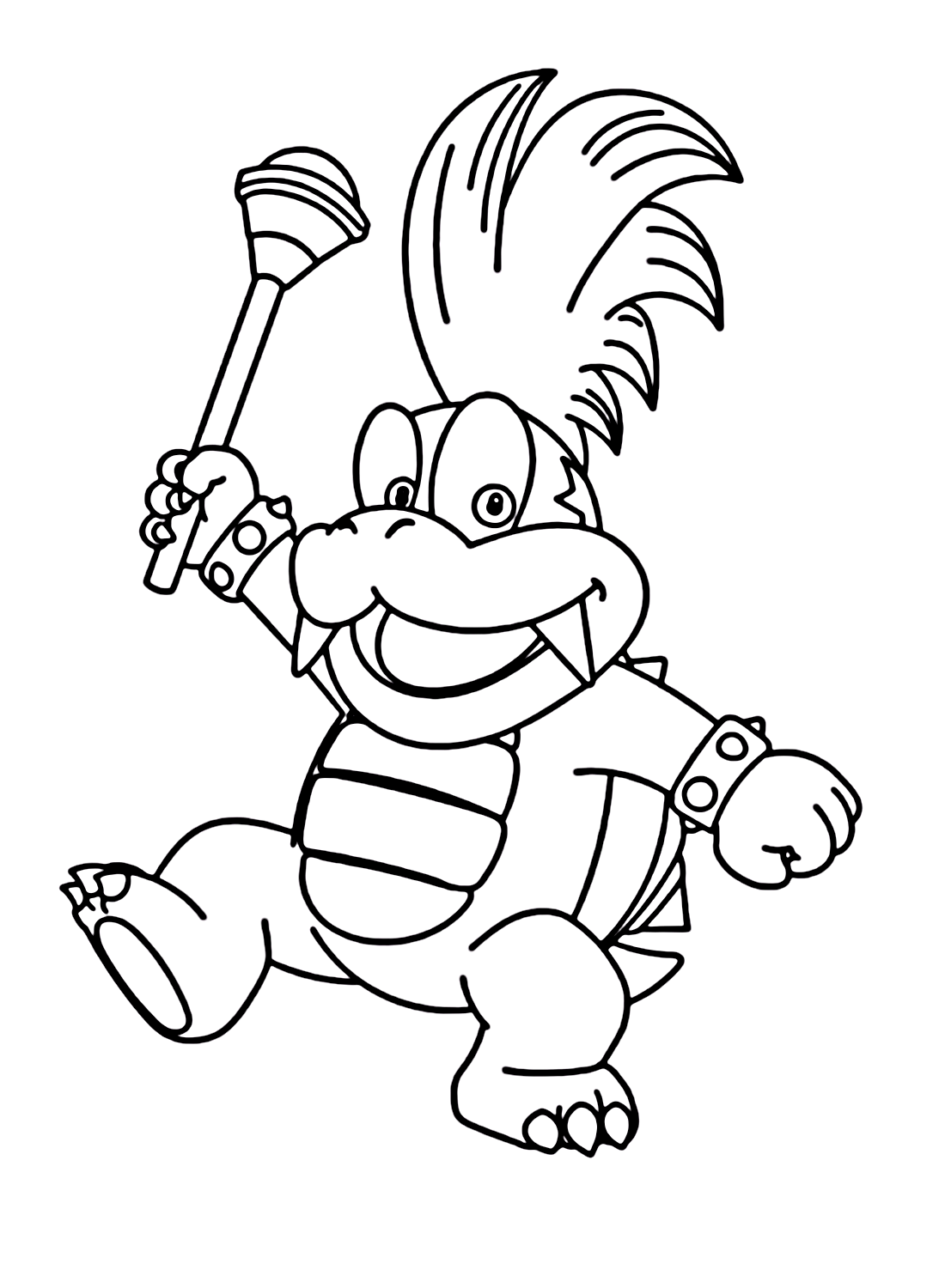
Larry is the first Koopaling encountered in Super Mario Bros. 3 – the World 1 boss, the entry point to the group – and is typically placed first in the group’s ordered lineup across most of their appearances. His design is compact and active: green skin, a blue mohawk hairstyle that rises from the top of his head, a blue shell, and the eager, ready energy of a character who has been given the opening position and intends to make the most of it.
His relative simplicity within the group – no accessories beyond the mohawk, no distinctive facial features beyond his green – makes him both the most approachable of the seven and the clearest demonstration of the base Koopaling design before the more elaborate character elements are added.
Coloring Larry: Green skin throughout – the standard Koopaling green that provides the base for the group’s shared visual identity. His mohawk is a vivid blue – a clear, medium blue that reads immediately as hair rather than as a head fin. His shell is the same blue as his hair. The color consistency between hair and shell is a key design decision across all seven Koopalings – each one’s hair color matches their shell color, creating visual coherence between their two most prominent color elements.
Morton Koopa Jr. – The Heavy
Morton is the most visually distinct Koopaling for two specific reasons: he is the only one with a skin tone other than green (his skin is a warm tan or beige), and he has a large star-shaped birthmark on the left side of his face. Both details make him immediately recognizable in any group composition and give him an immediately different visual register from his siblings.
His shell is dark – a very dark grey that reads almost as black – and he is the most physically imposing of the seven in terms of apparent mass and weight. His personality in the games is typically the “strong, blunt force” archetype – slow, heavy, hits hard.
Coloring Morton: Warm tan or beige skin – significantly different from the other six’s green, and warm enough to read as a distinct color choice rather than as a variation of the green palette. His star birthmark is dark – a dark grey or near-black star shape on the left cheek. His shell is very dark grey or dark charcoal – barely above black, but specifically grey rather than pure black to avoid losing surface detail.
Wendy O. Koopa – The Only Girl
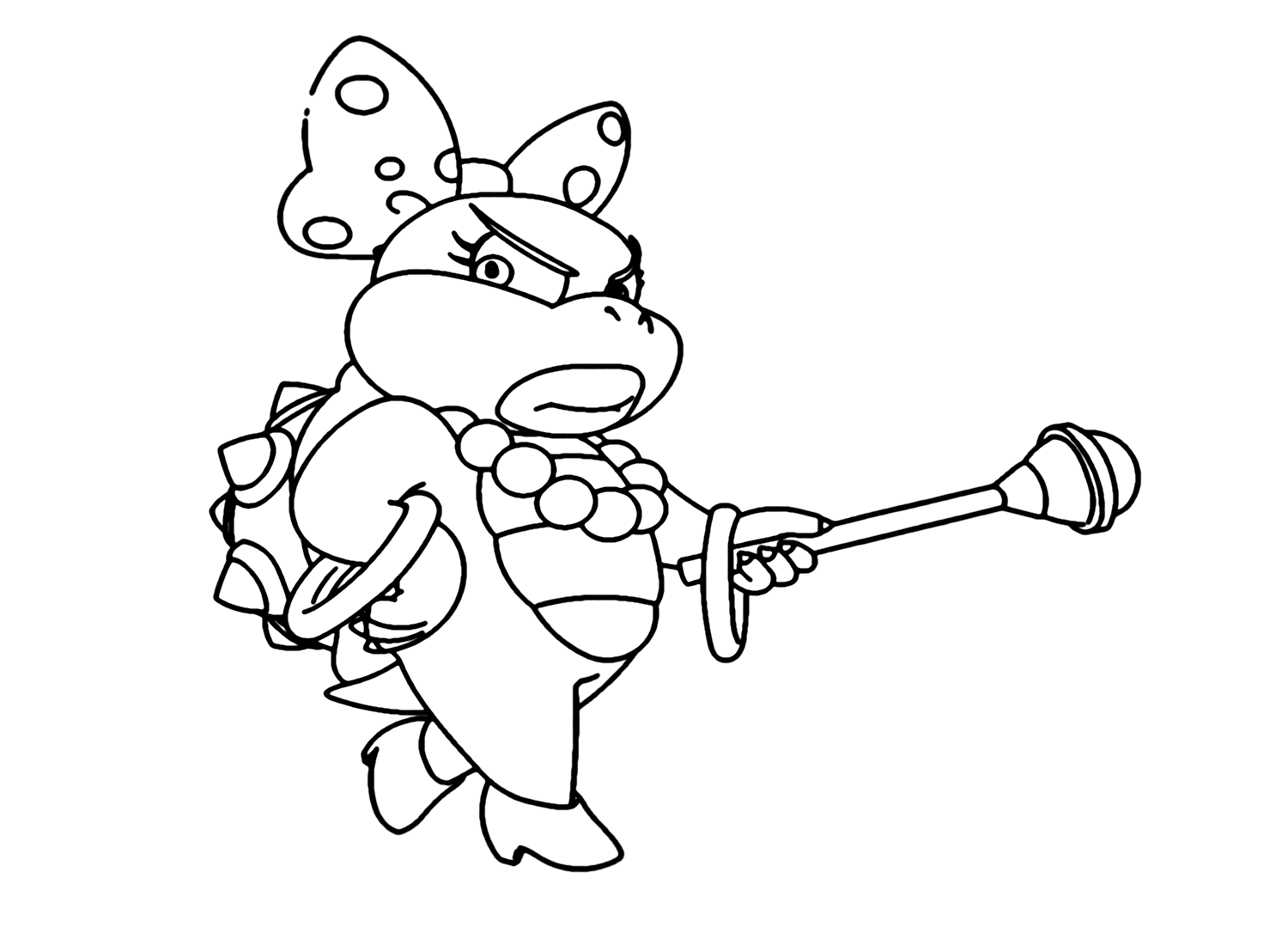
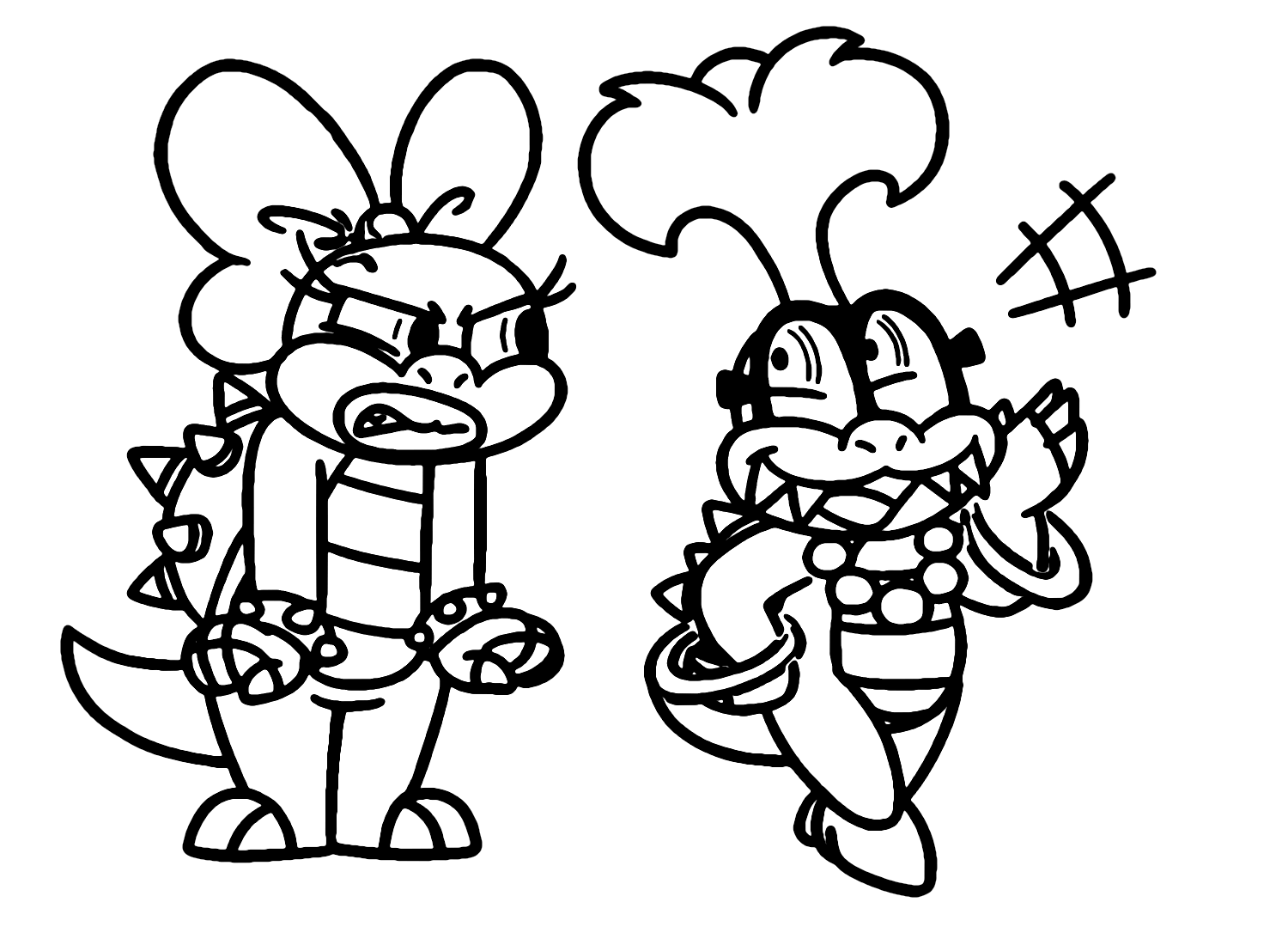
Wendy is the only female Koopaling and the one whose design most deliberately differentiates along gender lines: a large pink bow on top of her head, gold bracelets on each wrist, and a pink or red shell with white polka dots. Her design reads as the most overtly accessorized of the seven, which, combined with her personality – typically portrayed as vain, demanding, and competitive – gives her a specific character register that is immediately distinct from her siblings.
Named after punk rock singer Wendy O. Williams of the Plasmatics, she carries the naming convention’s most pointed juxtaposition: a children’s game character named after one of punk music’s most confrontational performers.
Coloring Wendy: Green skin with a pink bow prominently placed atop the head. The bow is a vivid pink – the most vivid pink in the composition, clearly reading as a bow. Her shell is red or pink with white polka dots – apply the base pink or red first, then add the white dots as a second layer of regular circular spots. Her gold bracelets on each wrist should be warm, vivid gold, clearly metallic in quality.
Iggy Koopa – The Wild One
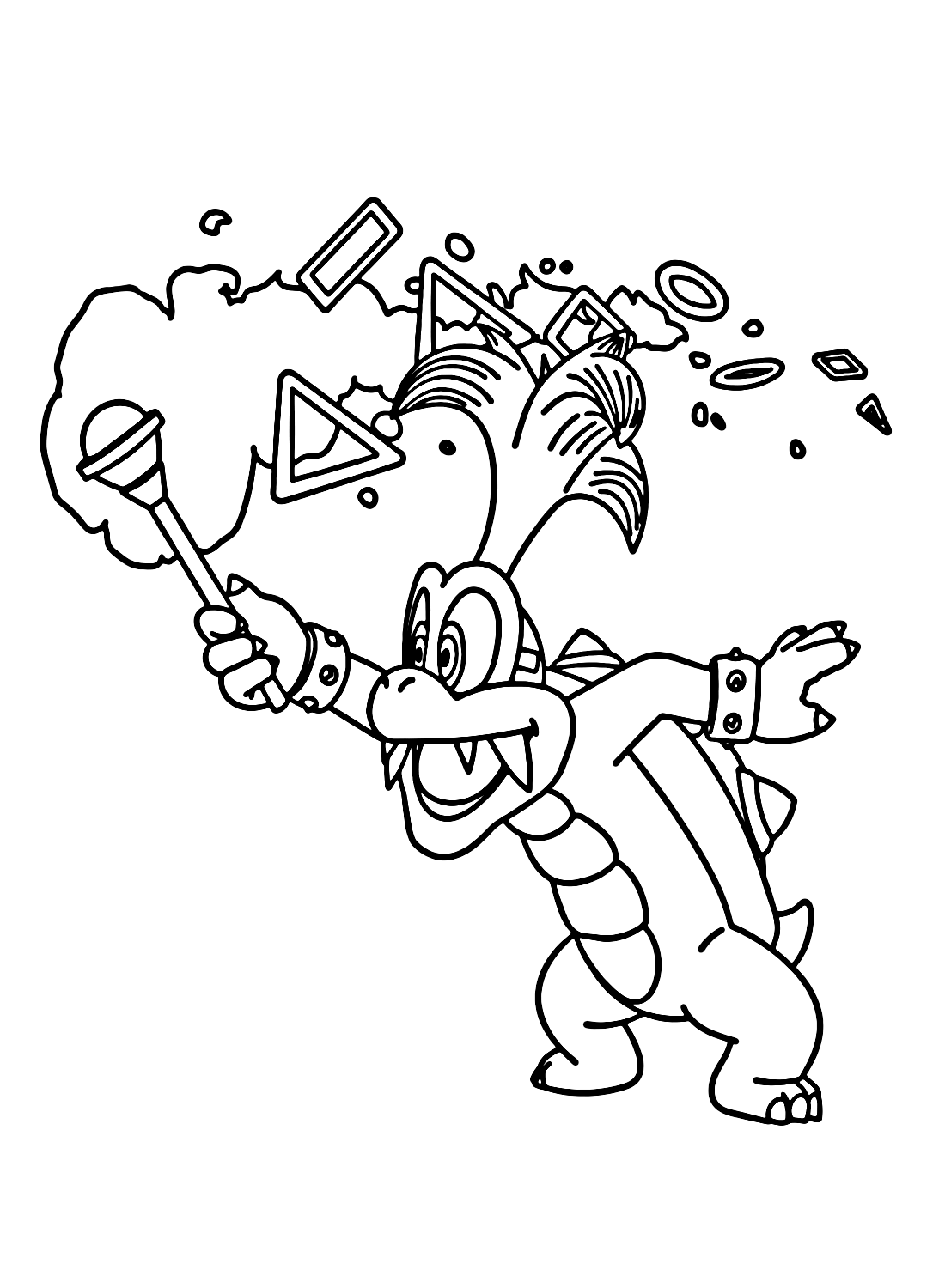
Iggy’s design is the most energetic of the seven in terms of hair – a wild, spiky green arrangement that rises above his head in an untamed cluster. Combined with the round glasses he wears, his design communicates the “eccentric inventor/scientist” archetype before his personality is established through gameplay.
His shell is lime green – a lighter, more vivid green than the standard Koopaling skin tone – and his glasses are a simple round-lens design. He is typically associated with chain chomps and mechanical devices across the series, connecting his “mad scientist” visual identity to his in-game mechanics.
Coloring Iggy: Skin green (standard Koopaling green), hair in a brighter, wilder lime green that is visually distinct from the skin tone. His shell is the same lime green as his hair. His glasses – round lenses in a simple frame – should be rendered in a dark frame color (dark grey or brown) with very pale lenses that suggest glass without completely obscuring the face beneath. The wild hair texture – multiple spikes radiating outward – should be given directional stroke application to suggest individual spike clusters rather than a uniform mass.
Roy Koopa – The Bully
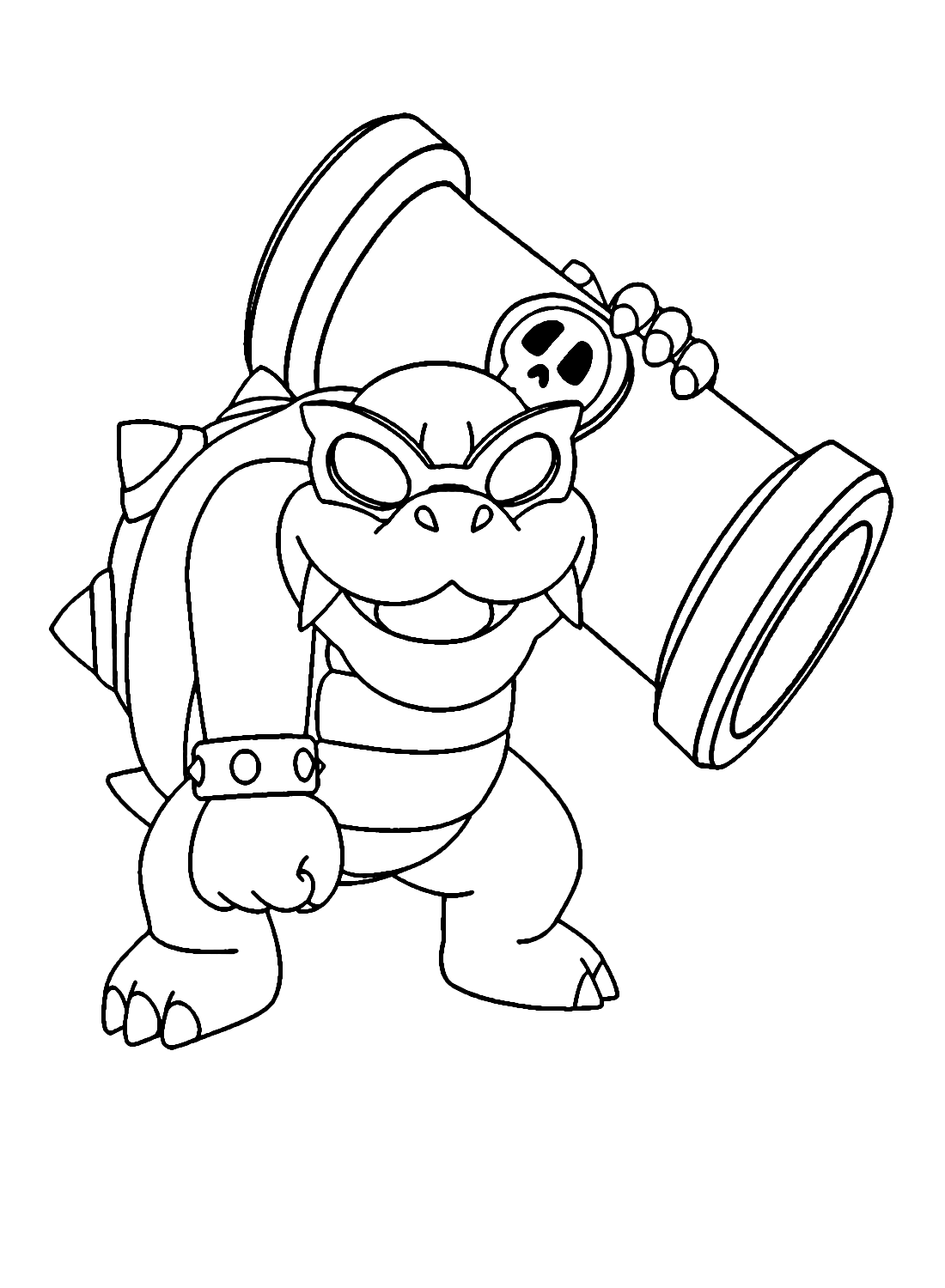
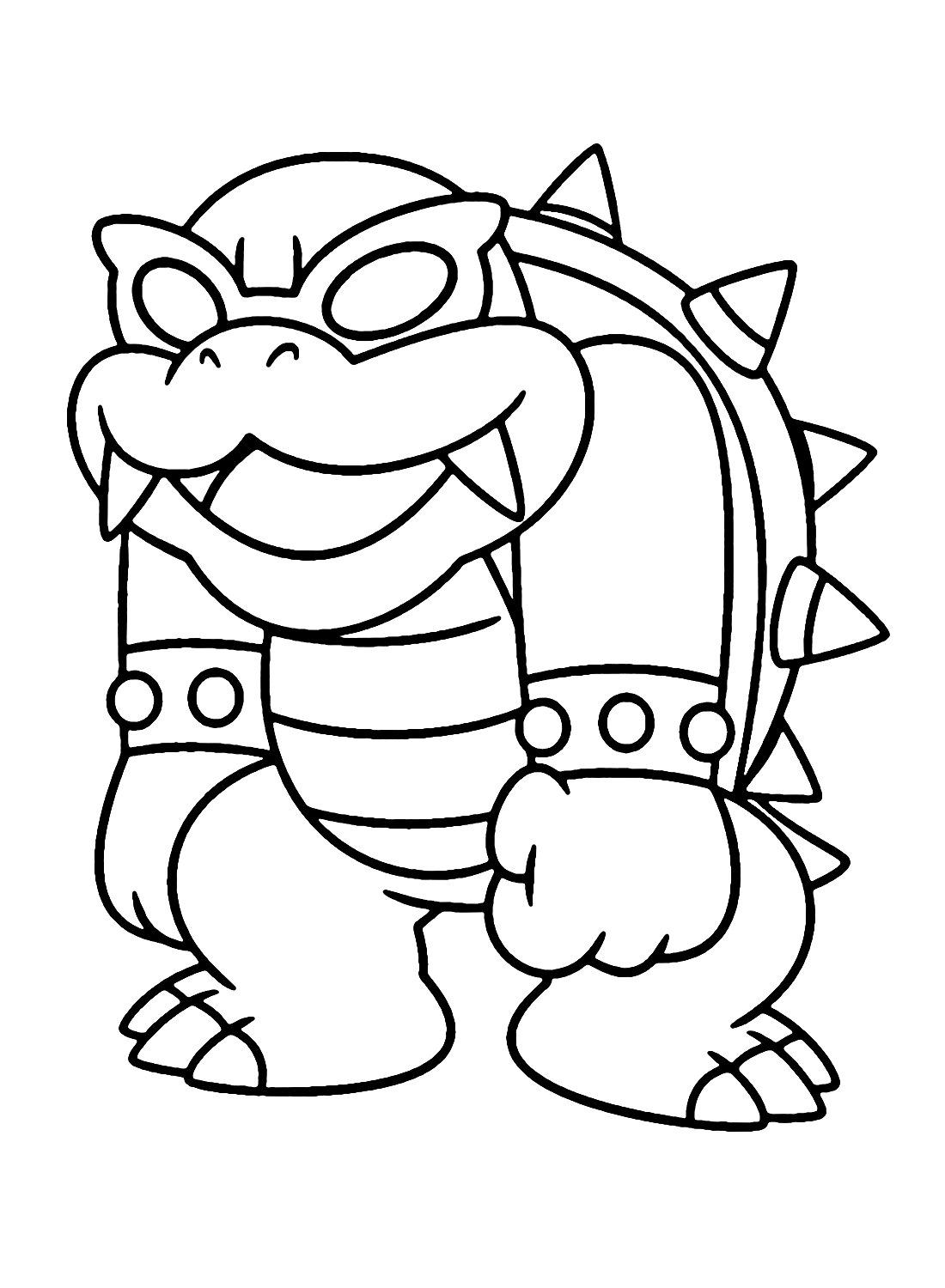
Roy is the physically imposing, aggressive Koopaling – large, muscular in proportion, and wearing sunglasses that contribute to his “tough guy” aesthetic. His color palette is the group’s most unexpected: his skin is purple rather than green, and his shell is pink or magenta – a warm, vivid pink that contrasts strikingly with his darker purple skin.
His pink hair, visible at the top of his head, is a pompadour-influenced style. His sunglasses are the most prominent accessory of any Koopaling. Named after Roy Orbison, his design’s pink-and-purple palette is one of the more striking character design choices in the Mario universe.
Coloring Roy: Purple skin – a medium, slightly warm purple that reads clearly as a different color family from the green skin of the other five green-skinned Koopalings. His shell is a vivid pink or magenta – the warm, bright pink end of the spectrum. His pink hair should match the shell’s pink. His sunglasses are dark – the darkest element in his composition, typically rendered in black or very dark grey with no visible lens detail to suggest mirrored lenses.
Lemmy Koopa – The Circus Performer
Lemmy is the smallest and most playful Koopaling – his design is built around circus performance energy: a multicolored ball that he balances on or carries as a prop, a cheerful disposition, and cross-eyes that are among the most frequently discussed character design details in the Koopaling group. His hair is styled in two orange pom-pom-like clusters, and his shell is orange with star patterns.
His personality across games is consistently the most lighthearted of the seven – he is the one who seems to be having the most fun in his villain role, which makes him one of the most enduringly popular with fans despite (or because of) not being the most threatening.
Coloring Lemmy: Green skin. Orange pom-pom hair clusters – a warm, vivid orange applied to two round clusters on the top of the head. His shell is orange with stars – same orange base, with yellow or gold star shapes applied as a second layer. The ball he carries is typically multicolored – a sphere with sections in different vivid colors, resembling a circus ball. His cross-eyes should be rendered with pupils pointing slightly inward rather than straight forward.
Ludwig von Koopa – The Eldest
Ludwig is the most elaborate of the seven in terms of design – a wild mane of dark blue hair that falls around his head, a darker green skin tone than the others, and the most theatrical, pompous personality of the group. Named after Ludwig van Beethoven, he is associated with music and high culture throughout his appearances, which gives him a specific irony: the most classically cultured-named Koopaling is also among the most theatrically villainous.
His hair is the most voluminous of the group – a large mass of dark blue that falls outward from his head in multiple directions, creating a silhouette that immediately distinguishes him from the shorter-haired or more tightly styled siblings. His shell is dark blue, matching his hair.
Coloring Ludwig: Skin green (notably slightly darker than the standard Koopaling green in many depictions – a deeper, richer green). His hair is a deep, dark blue – darker and more muted than Larry’s brighter blue, suggesting the richer blue-black of someone who takes their hair very seriously. His shell matches this deep blue. The volume and directionality of his hair are the most important aspects of his page – apply the dark blue in outward-radiating strokes from the head center to suggest the hair’s wild volume.
What These Pages Do
The Koopalings are one of the most successful ensemble boss designs in video game history. Seven characters who share a structural design but are completely individuated through color, proportion, and personality accessory – the group demonstrates how a single design template can generate diverse, memorable characters when the variation points are chosen carefully. Each Koopaling is immediately distinct from every other while remaining recognizably of the same family.
Their naming after real musicians is one of gaming’s most discussed localization decisions. A children’s game boss group named after Lemmy Kilmister, Iggy Pop, and Wendy O. Williams – with Ludwig van Beethoven for balance – is specific enough to reward adult fans who investigate the etymology and surprising enough to produce genuine delight when discovered. The naming convention gives each character a real-world cultural reference point that enriches their design beyond their in-game function.
The seven-character group teaches comparative color analysis. Each Koopaling’s canonical palette is specific and distinct: Larry’s medium blue, Morton’s near-black with tan skin, Wendy’s pink with polka dots, Iggy’s lime green, Roy’s magenta with purple skin, Lemmy’s orange with stars, and Ludwig’s dark blue. Coloring through all seven while maintaining each character’s specific palette develops color memory and color differentiation as direct practical skills.
Fine motor development. The American Academy of Pediatrics identifies fine motor skill development as a key childhood milestone throughout early childhood. Wendy’s polka dot shell pattern, Lemmy’s circus ball multicolor sections, Ludwig’s multi-directional hair mass, Roy’s sunglasses rendering – all provide motivated, sustained fine motor challenge. The 2005 Art Therapy Journal study on structured coloring and anxiety reduction applies throughout this collection.
How to Color These Pages Well
Hair and shell color matching is the most important accuracy rule. Each Koopaling’s hair color precisely matches their shell color – Larry’s blue hair and blue shell, Wendy’s pink hair and pink shell, Iggy’s lime green hair and lime green shell, and so on. In any page where both hair and shell are visible, maintain this exact color consistency: use the identical color for both elements rather than a lighter or darker version of one. The matching is an intentional design and should be respected in the coloring.
Morton’s tan skin is the most critical differentiation. Among a group of six green-skinned characters, Morton’s warm tan or beige skin is the single detail that most immediately distinguishes him in group pages. Apply a warm, medium tan – in the range of warm cream-brown – to Morton’s skin wherever the other Koopalings receive green. Resist any drift toward green in his skin tone. The contrast between his tan and his siblings’ green should be immediately visible.
Roy’s purple skin needs the right purple. Roy’s skin is a specific medium purple – warm enough to suggest a living skin tone rather than an abstract color, but clearly purple rather than grey or dark pink. It sits in the medium value range – not pale lavender and not deep violet, but the specific mid-value purple of his canonical design. His pink shell and hair should be a clear, vivid pink that contrasts with the purple skin.
Lemmy’s ball is a multi-step coloring project. The circus ball he carries or balances on is typically rendered in six or more vivid sections of different colors – a standard circus ball pattern with alternating sections in red, blue, yellow, green, orange, and purple (or similar combinations). Draw the section dividers first if the ball appears as a plain circle in the line drawing, then apply a different vivid color to each section. The ball’s visual success depends on equal saturation across all sections – no single color should be muted relative to the others.
Ludwig’s hair direction is the most technically demanding hair in the collection. Apply the dark blue base color across the entire hair mass. Then add a slightly darker blue along the length of each hair cluster in the direction it extends from the head – radiating outward from the crown. A thin, near-black line along each cluster’s outer edge gives the wild mass structure and separates individual clusters from each other. The result should read as voluminous, directional dark blue hair rather than as a dark blue blob around the head.
5 Creative Craft Ideas
All Seven in Order – The Boss Rush Display
Print one page for each of the seven Koopalings in their Super Mario Bros. 3 world order: Larry (World 1), Morton (World 2), Wendy (World 3), Iggy (World 4), Roy (World 5), Lemmy (World 6), Ludwig (World 7). Color each in its canonical palette.
Mount all seven in a horizontal row on a long backing sheet, with their world number below each character: “World 1 – Larry,” “World 2 – Morton,” through “World 7 – Ludwig.” Add a title: “Super Mario Bros. 3 – The Seven Koopalings, 1988.”
The finished display is the Koopalings in their original role – seven boss characters in sequence, the first time players would have encountered each one in the game that introduced them.
Rock Band Name Tags
Each Koopaling’s English name references a specific real musician. Print one portrait page per Koopaling. Color each in canonical colors. Cut each into a name tag format.
On each name tag, add a small biographical note: “Larry – Named after Larry Mullen Jr., drummer of U2.” “Lemmy – Named after Lemmy Kilmister, bassist of Motörhead.” “Ludwig – Named after Ludwig van Beethoven, classical composer.”
Mount all seven on a backing sheet as a display. The collection of name tags shows the naming convention as a complete system – the full range from 1980s punk and rock to 19th-century classical music, assembled into a Nintendo boss group in 1990.
Shell Collection
The seven shells – each matching its Koopaling’s hair color and featuring the character’s visual identity – are the most consistently present design element across all of their appearances. Print pages that show each Koopaling from behind or in a pose that prominently features their shell: Larry’s blue, Morton’s near-black, Wendy’s pink with polka dots, Iggy’s lime green, Roy’s pink/magenta, Lemmy’s orange with stars, Ludwig’s dark blue.
Cut each shell area from the finished pages and mount all seven shells in a row on a backing sheet – a gallery of just the shells, without the faces. Below each: the character’s name. The exercise isolates the design element that most visually connects the seven as a family while showing how differently each is individuated.
Then and Now – NES to Switch Design Evolution
The Koopalings have appeared across Nintendo hardware from the NES (1988) through the Nintendo Switch (2017+). Their pixel art versions in Super Mario Bros. 3 are radically simplified compared to their rendered 3D versions in New Super Mario Bros. Wii, Mario Kart 8, and Super Smash Bros. Ultimate.
Print any current-era Koopaling page and color it in canonical modern colors. On a separate piece of paper, draw a simplified pixel art interpretation of the same character – large squares of flat color in the NES style. Mount both side by side: “1988 – 8-bit” on the left, “Current” on the right.
The comparison shows thirty-five years of visual technology development represented in a single character’s evolution.
Design Your Own Eighth Koopaling
Print any Koopaling page as a reference for the group’s design system: reptilian base, distinctive hairstyle, matching shell color. On blank paper, design an eighth Koopaling following the established rules: green skin (or a different color if you choose), a unique hairstyle with a distinctive color, the same color on their shell, and a personality trait suggested by their design.
Name them after a musician of your choice, following the naming convention the localization team established. Write: the character’s name, their musical inspiration, their shell color, their special ability, and which world they would guard if they appeared in a Mario game.
Color the finished design in your chosen palette. The finished character exists within the Koopaling design system – a fan-made addition that follows all the rules.
Frequently Asked Questions
Who are the Koopalings and where did they first appear? The Koopalings are seven recurring boss characters in Nintendo’s Super Mario Bros. franchise: Larry, Morton, Wendy, Iggy, Roy, Lemmy, and Ludwig Koopa. They first appeared in Super Mario Bros. 3, released in Japan on October 23, 1988, and in North America on February 12, 1990. In that game, each guard guards one of the game’s seven worlds and must be defeated to recover a magic wand stolen from that world’s king. They have since appeared in numerous Mario games, including Super Mario World (1990), New Super Mario Bros. Wii (2009), Mario Kart 8 (2014), and Super Smash Bros. Ultimate (2018).
Why are the Koopalings named after rock musicians? The Koopalings’ English names were assigned by Nintendo of America’s localization team, with each name referencing a real musician or cultural figure: Larry after Larry Mullen Jr. of U2, Morton after television personality Morton Downey Jr., Wendy after punk singer Wendy O. Williams of the Plasmatics, Iggy after Iggy Pop, Roy after Roy Orbison, Lemmy after Lemmy Kilmister of Motörhead, and Ludwig after Ludwig van Beethoven. This naming convention was created during the localization of Super Mario Bros. 3 for North America and has been maintained in all subsequent English-language releases. The Japanese names for the Koopalings are different and follow a numbered naming system.
Are the Koopalings Bowser’s children? The Koopalings were originally presented as Bowser’s children in Super Mario Bros. 3 and several subsequent games and materials. In 2012, Nintendo’s Shigeru Miyamoto stated in an interview that only Bowser Jr. – introduced in Super Mario Sunshine (2002) – is Bowser’s son, and that the Koopalings are not his children. This clarification effectively retconned the earlier narrative. However, some Nintendo materials have continued to reference the Koopalings in familial terms, and the precise nature of their relationship to Bowser remains somewhat ambiguous in the current official canon. Bowser Jr. is definitely established as Bowser’s heir and son.
What makes each Koopaling visually distinct? Each Koopaling shares the same structural design – a Koopa’s reptilian body with a shell – but is individuated through specific color choices and distinctive features. Larry has a blue mohawk. Morton has tan skin and a star birthmark. Wendy has a pink bow, polka-dot shell, and gold bracelets. Iggy has wild lime green hair and round glasses. Roy has purple skin, a pink shell, and sunglasses. Lemmy has orange pom-pom hair and carries a circus ball. Ludwig has a large mass of dark blue hair. Each character’s hair color precisely matches their shell color – a design rule applied consistently across the group.
How do the Koopalings appear in Super Smash Bros.? In Super Smash Bros. for Wii U and 3DS (2014) and Super Smash Bros. Ultimate (2018), the Koopalings appear as alternate costume options for the playable character Bowser Jr. When a player selects Bowser Jr. and chooses an alternate costume, they play as one of the seven Koopalings instead – in their Koopa Clown Car, the same vehicle Bowser Jr. uses. All seven Koopalings are fully modeled and voiced as separate costumes, making this the only platform game in which all seven are simultaneously playable options with full visual fidelity to their modern designs.
What is the difference between the Koopalings and Bowser Jr.? Bowser Jr. is Bowser’s biological son and heir, introduced in Super Mario Sunshine (2002). He typically appears alongside Bowser in the main storyline and is more frequently featured as a primary antagonist. The Koopalings are a separate group of seven characters who serve as sub-bosses or secondary antagonists, typically appearing together as a group in games where they feature. While their exact relationship to Bowser is now ambiguous, they function narratively as his loyal commanders rather than as family members. Both groups appear in many of the same games but generally serve different narrative roles.
What age group are these pages best suited for? The simpler individual character portrait pages work well from ages four to six for young Mario fans who recognize the characters and want to color their favorites. The more detailed pages – showing multiple Koopalings in the same composition, character interaction scenes, or pages with complex shell pattern detail like Wendy’s polka dots or Lemmy’s star shell – are most rewarding from ages six to ten. The full-group lineup pages, which require maintaining seven distinct character palettes simultaneously and avoiding color contamination between adjacent same-green-skinned characters, are best approached from ages eight and up. Adult fans of the Mario franchise will find the design comparison and historical documentation aspects of the collection most engaging.
Browse the full collection at ColoringPagesOnly.com. All 30+ pages free, no sign-up, PDF or PNG, print or color online.
Nintendo of America’s localization team named a video game boss group after Lemmy Kilmister and Iggy Pop, and Ludwig van Beethoven in 1990, and did not explain why. The names remained. The musicians became permanent reference points for characters in a children’s game that has now been played for thirty-five years.
Seven Koopalings. Seven worlds. Seven shells, each matching its character’s hair. Seven musicians’ names on seven reptilian bosses.
Larry goes first. Ludwig goes last. Everyone in between has a polka-dot shell or a star birthmark or sunglasses or cross-eyes or a circus ball or a mohawk.
Pick up your blue. Larry is first. He always is.
Share your work on Facebook and Pinterest and tag #Coloringpagesonly. We especially want to see the boss rush displays and the eighth Koopaling design projects.
Color all seven. Learn the names. The world bosses are waiting.
More from our Super Mario collections: