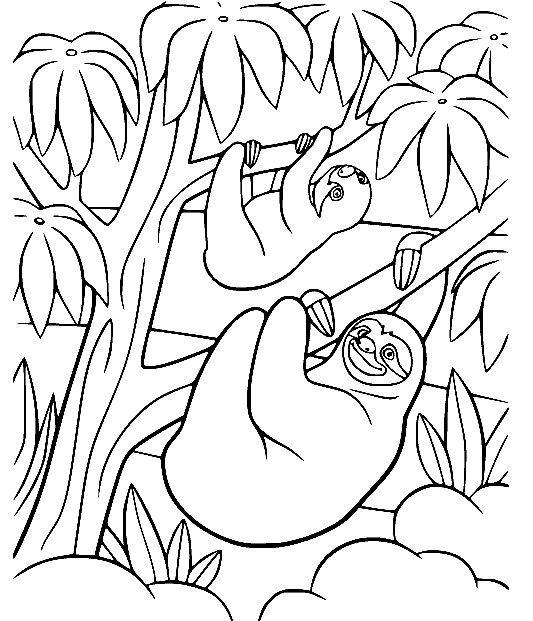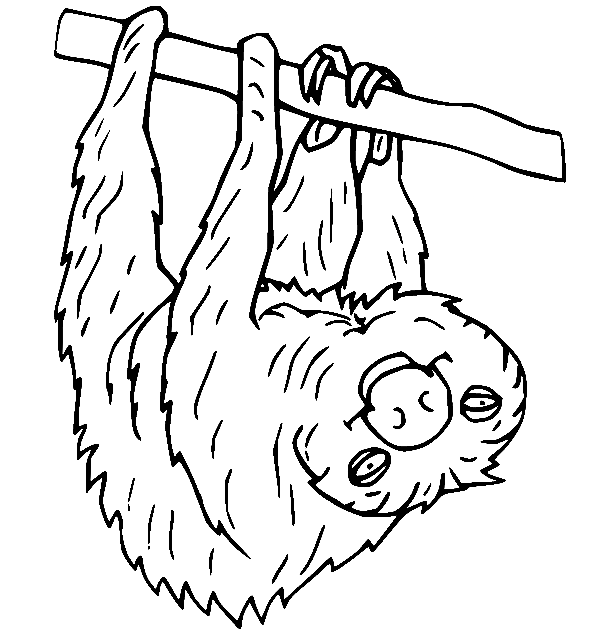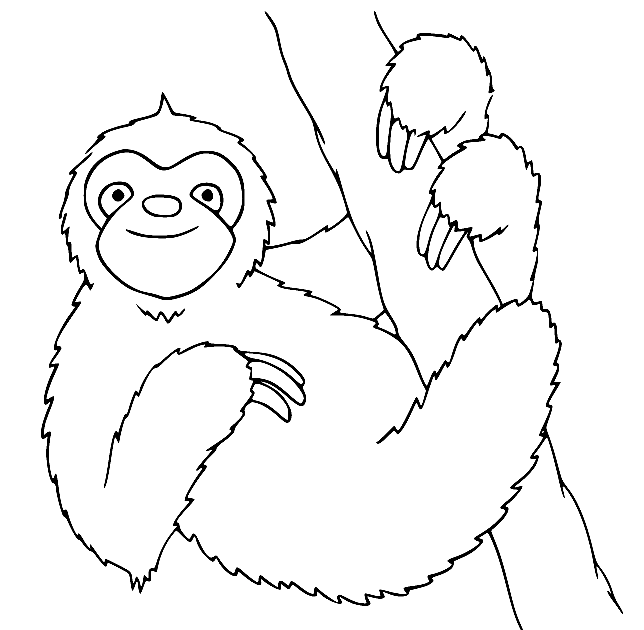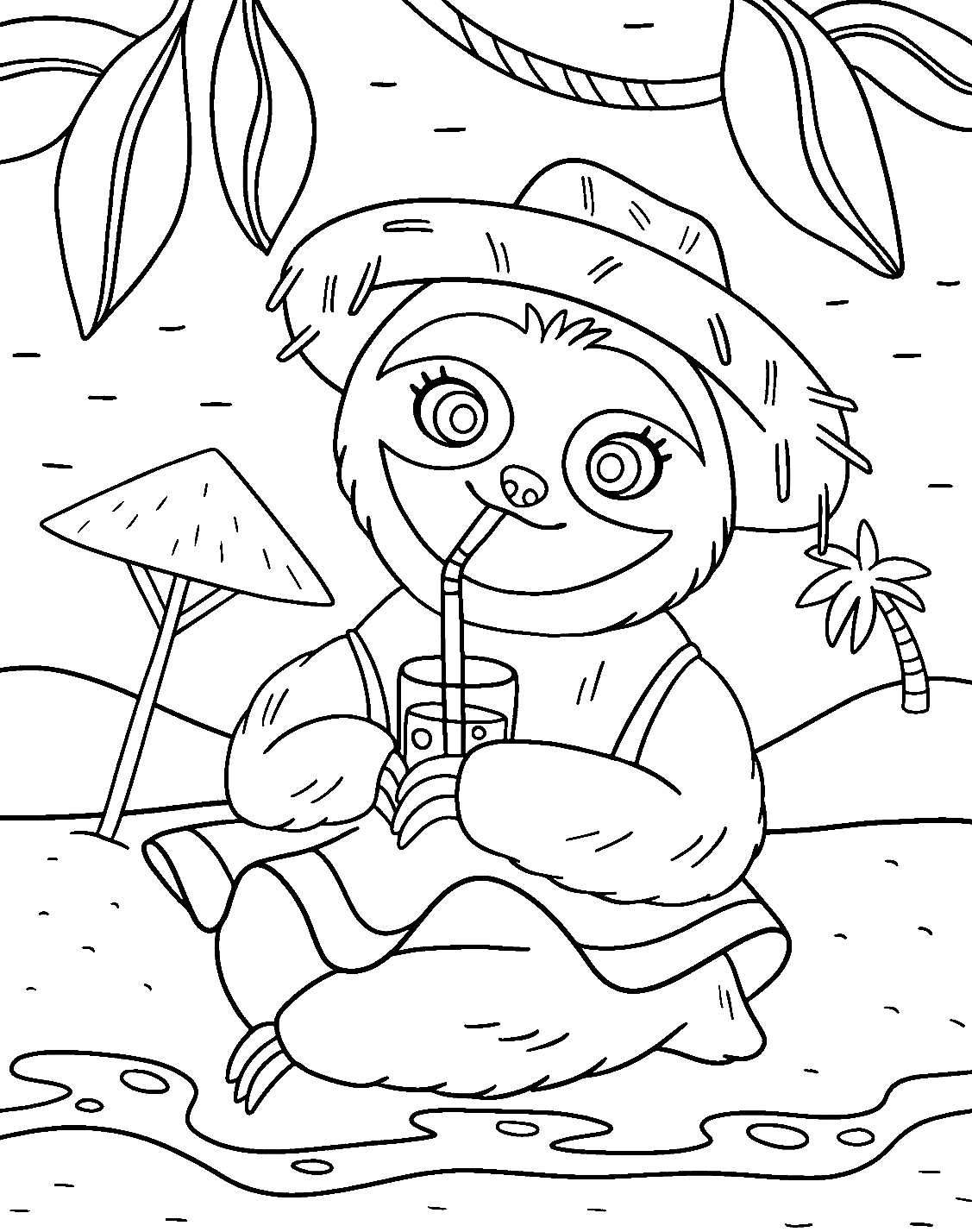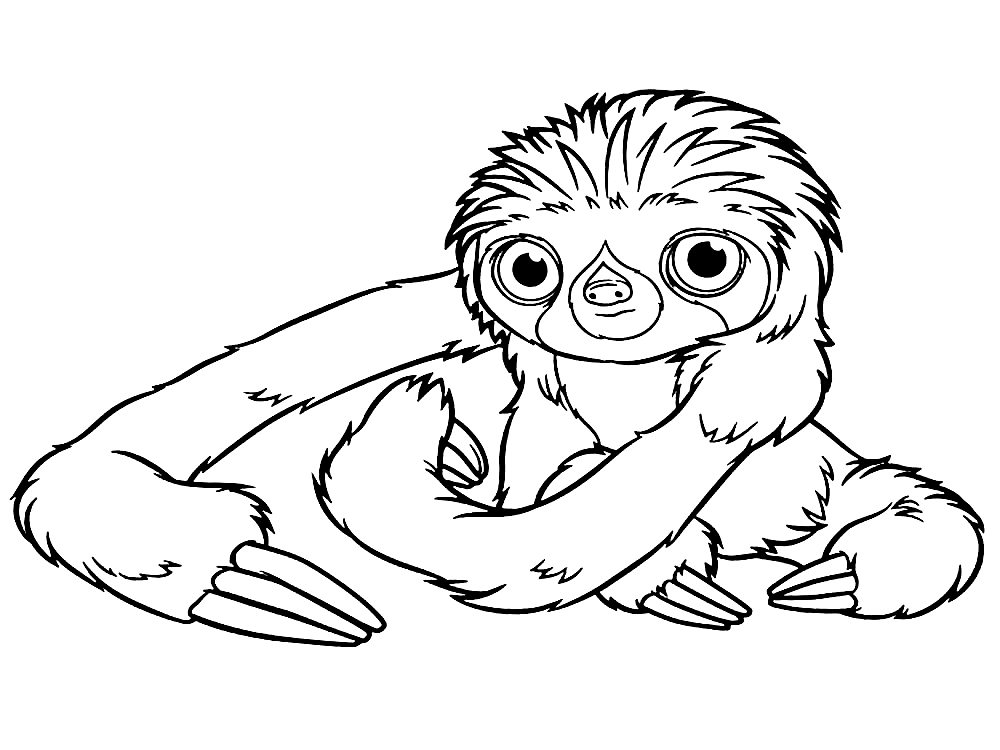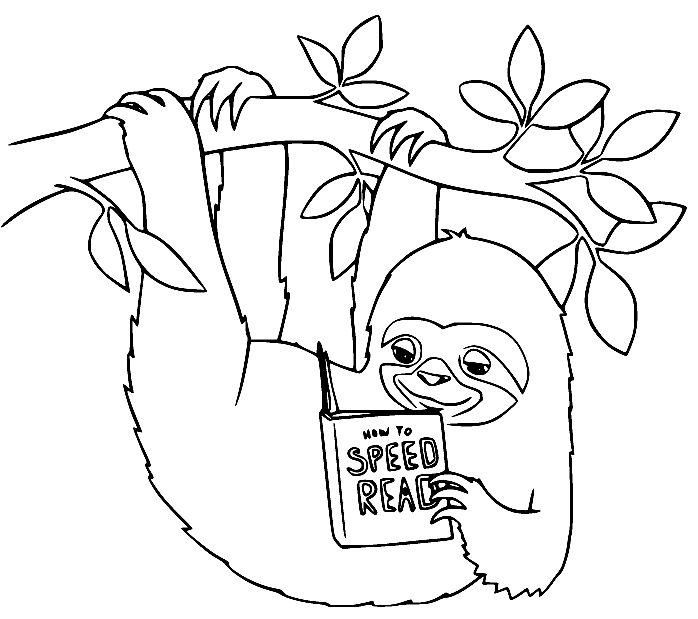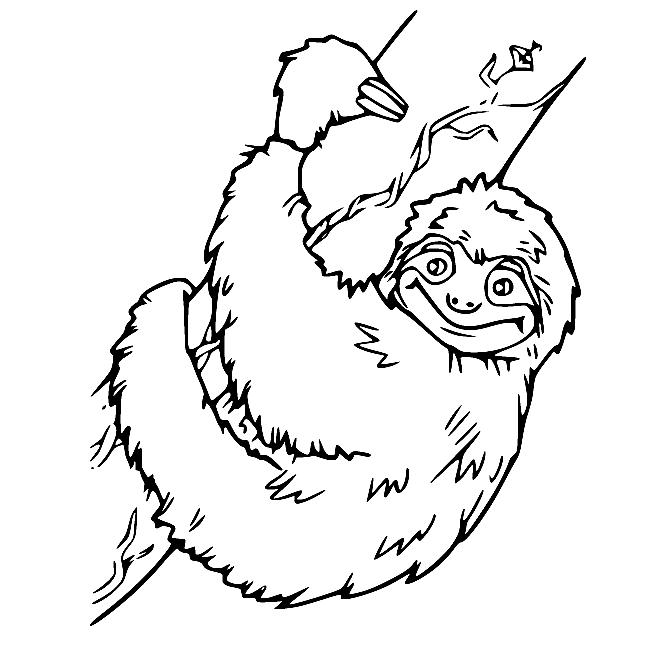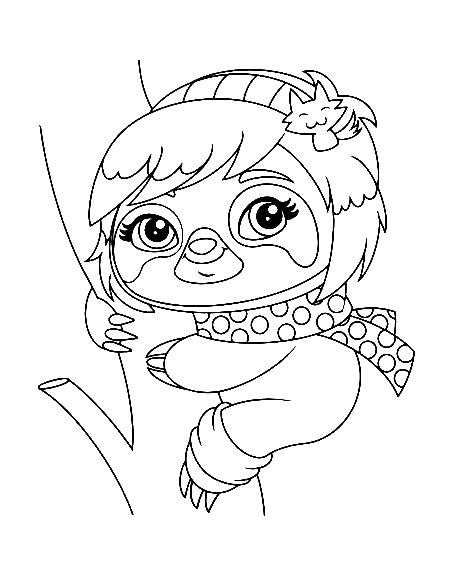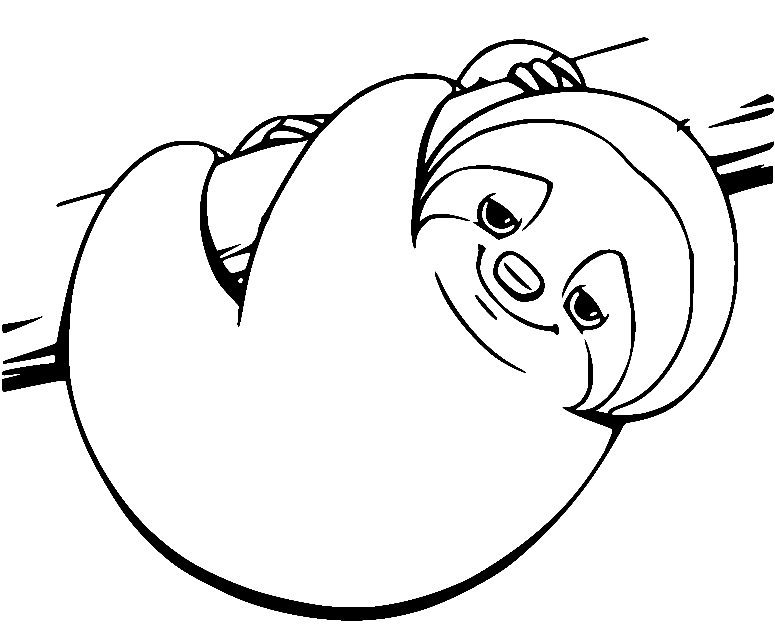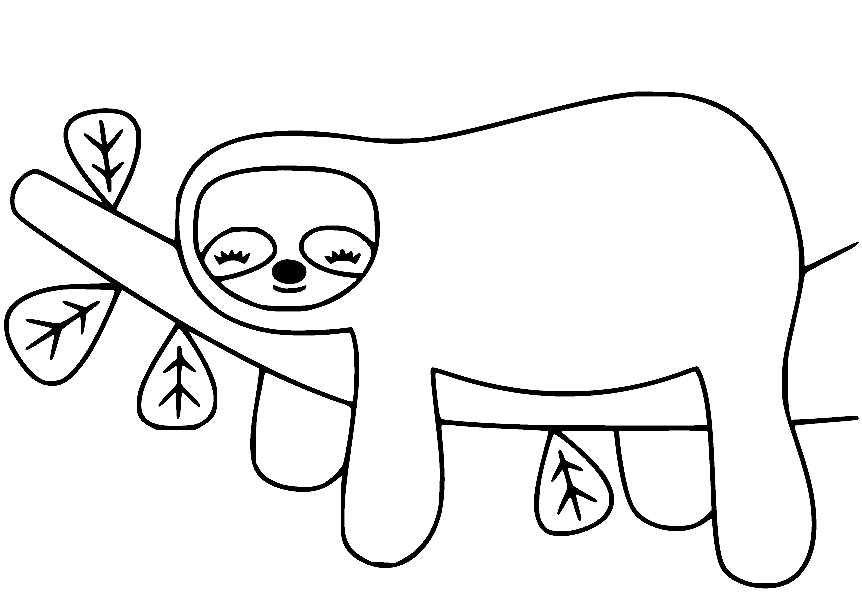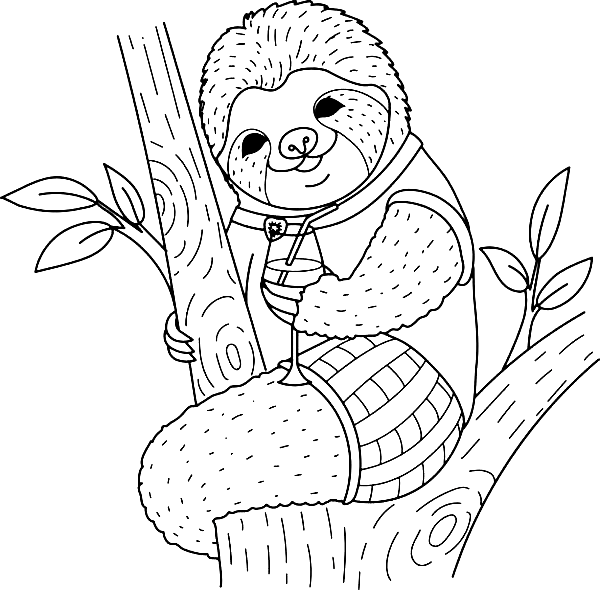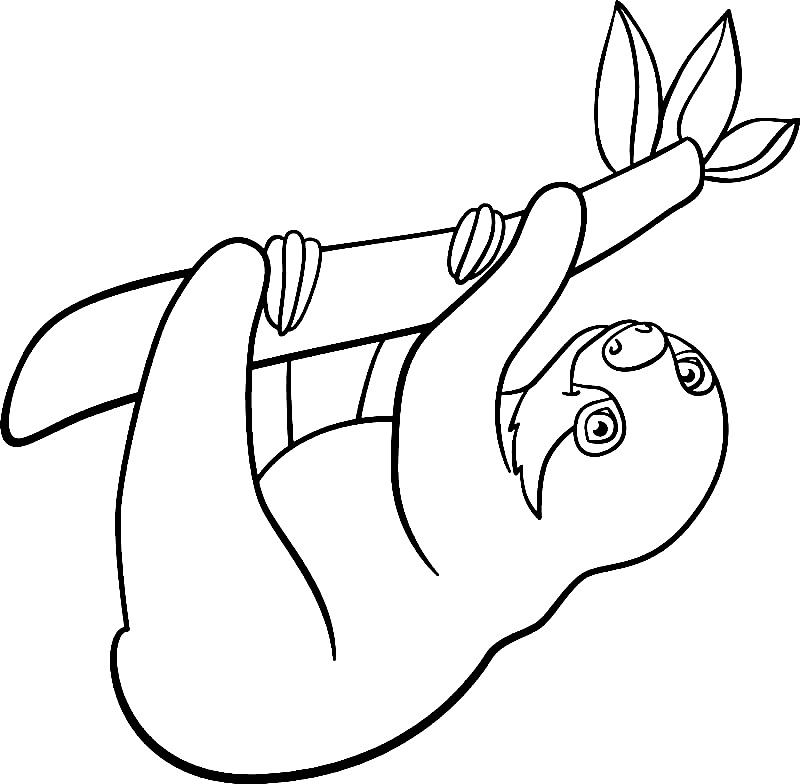
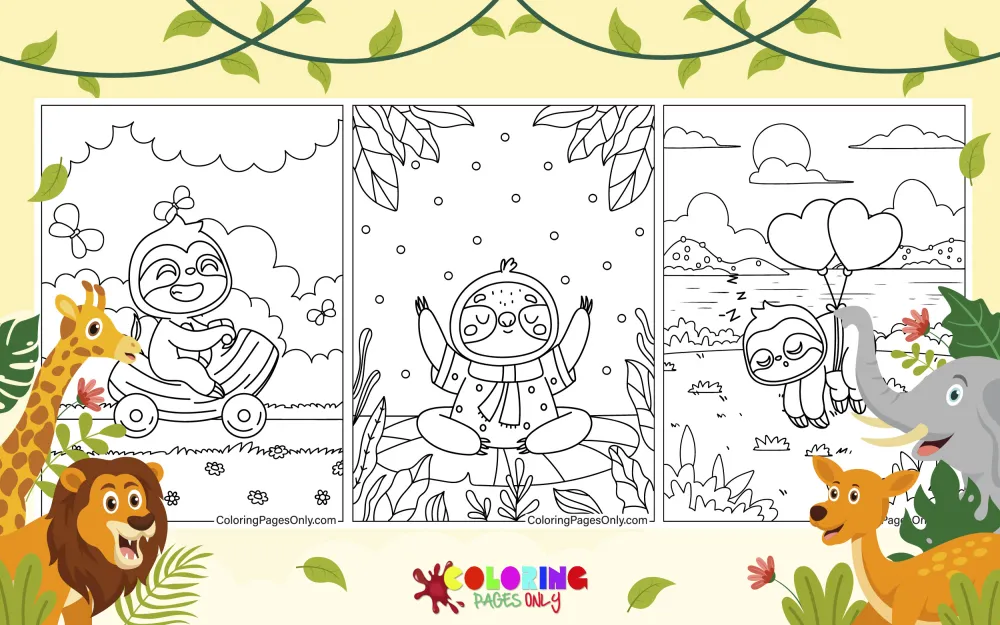
Free sloth coloring pages: 50+ pages featuring two-toed and three-toed sloths hanging from rainforest branches, mother-and-baby sloth portraits, close-up face studies showing the distinctive curved claws and relaxed expression, sloths in tropical tree canopy settings, cartoon and cute kawaii-style sloth designs, realistic wildlife portraits, swimming sloth scenes, and the full visual range of the world’s slowest-moving mammal across both its realistic and animated cultural forms. All free, printable PDFs and online coloring for wildlife enthusiasts and fans of the animal.
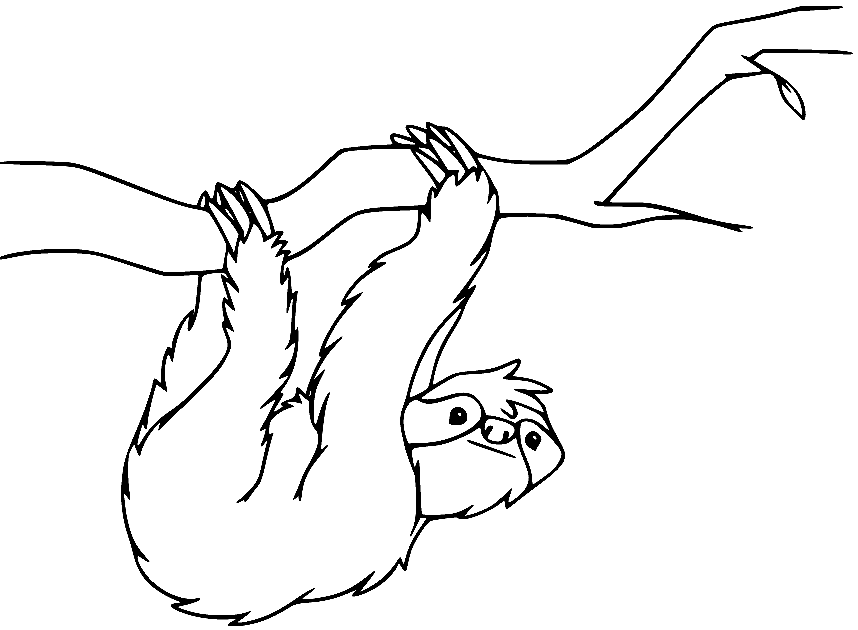
Sloths belong to the suborder Folivora within the order Pilosa, which they share with anteaters. Six living species exist across two distinct families: two-toed sloths (family Choloepodidae, two species) and three-toed sloths (family Bradypodidae, four species). The most widespread species is the brown-throated sloth (Bradypus variegatus), found across Central and South America from Honduras south to Bolivia and Brazil. The rarest is the pygmy three-toed sloth (Bradypus pygmaeus), classified as Critically Endangered by the IUCN Red List and found only on Isla Escudo de Veraguas, a small island off the coast of Panama.
Sloths are the slowest-moving mammals on Earth. Their average movement speed in the forest canopy is approximately 0.24 kilometers per hour (0.15 miles per hour). Their top speed when genuinely threatened reaches approximately 0.48 kilometers per hour (0.3 miles per hour). A sloth traveling at maximum speed for one hour would cover a distance that a walking human covers in approximately three minutes. This metabolic economy is not laziness: it is the precise biological adaptation that allows an animal living on a diet of nutritionally poor leaves to survive and thrive in the tropical rainforest canopy for 20 to 30 years.
These 50+ free pages at ColoringPagesOnly.com cover the full range of sloth portraiture. All free, PDF or PNG, print or color online.
What’s Inside
Hanging Sloth Portrait Pages
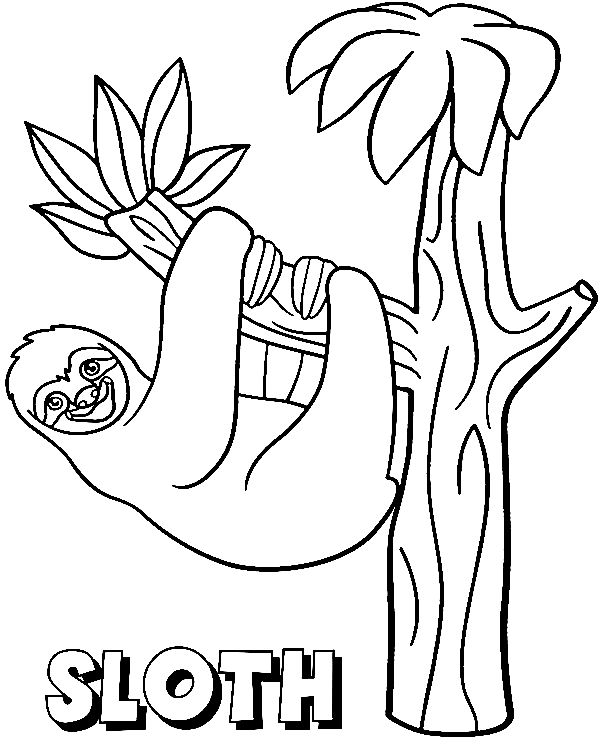
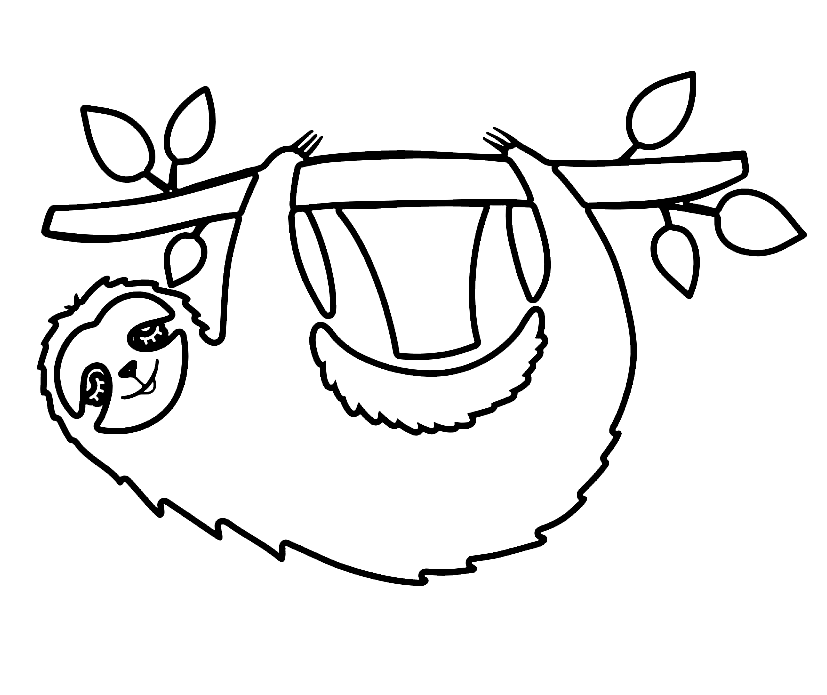
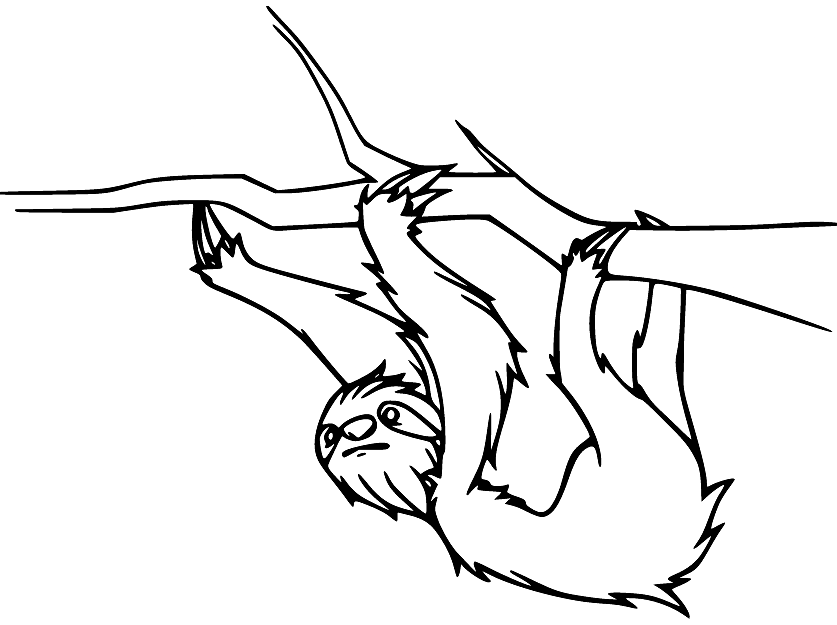
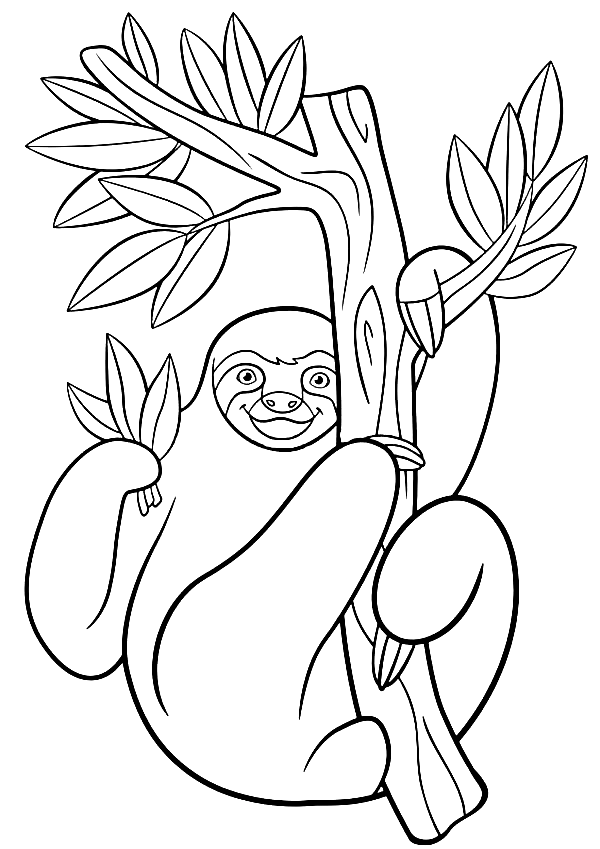
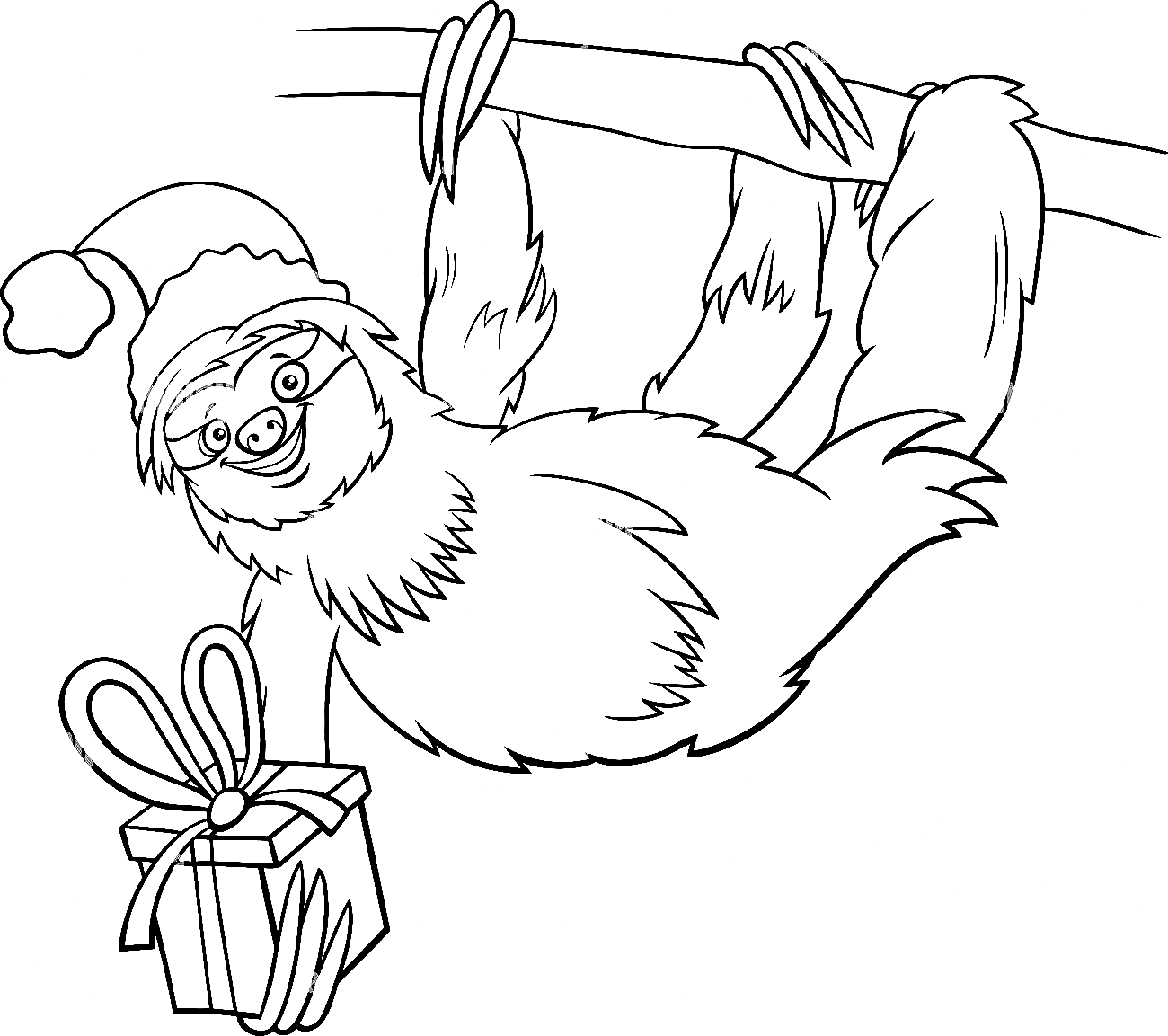
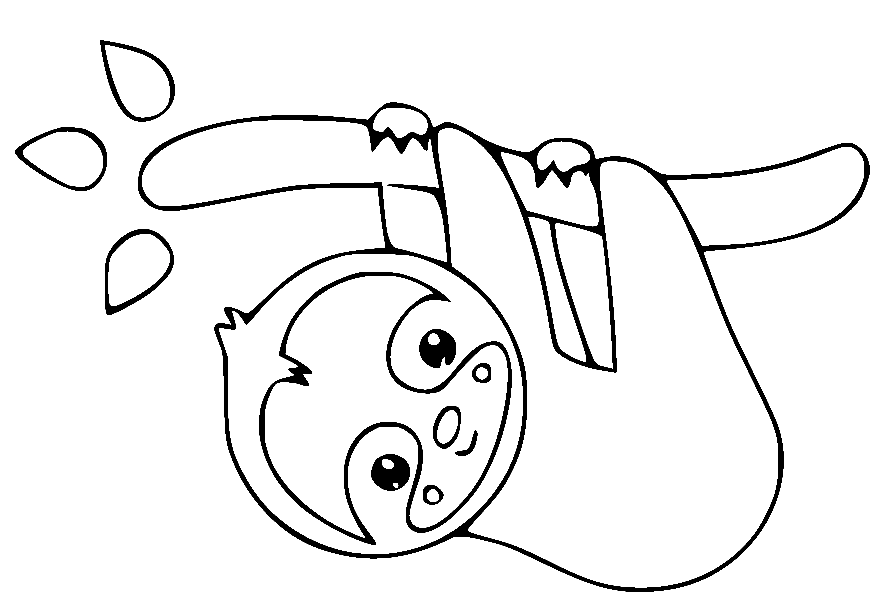
The sloth’s relationship to the branch it hangs from is the defining image of the animal in wildlife photography, natural history illustration, and popular culture. Hanging upside down from a branch using its long, curved claws, the sloth is doing the thing it does most of the time: it sleeps between 15 and 20 hours per day in this position, navigates the forest canopy while hanging, gives birth in this position, and may spend its entire adult life without once sleeping on a flat surface.
The adaptation that makes this possible is specific and biomechanically unusual: sloths have a tendon-locking mechanism in their forelimbs that allows them to grip a branch with their claws with virtually no muscular effort. The grip is maintained passively, the same way a coat hook holds a coat. A sloth found clinging to a branch after death is hanging with the same grip it maintained in life. This is why sloth hanging pages show a posture of complete relaxation rather than visible strain: the animal is genuinely relaxed, expending almost no energy to maintain its position.
Three-toed sloths can rotate their heads up to 270 degrees, a range that exceeds that of any other mammal. This extraordinary neck flexibility allows them to look upright. At the same time, their bodies hang inverted, which appears in some portrait pages as the sloth looking directly at the viewer with its body hanging below.
Coloring hanging sloth pages: The branch is the page’s structural anchor: apply dark brown to the branch bark first, with a slightly lighter warm brown at the upper edges where light hits. The claws gripping the branch are dark grey or near-black, long and curved, applied carefully where they contact the bark. The body fur is the composition’s primary warm tone: a medium warm grey-brown or tan-brown, applied across the body surface. Where the fur parts along the center of the belly (sloths’ fur parts down the center of the belly rather than the center of the back, an adaptation for their inverted lifestyle), a slightly lighter fur color is visible.
Two-Toed vs. Three-Toed Sloth Pages
The two families of sloths are distinguishable by their claw count and several other features, and pages in the collection may depict either family. Two-toed sloths (Choloepus species) have two claws on their front limbs and three on their back limbs, are generally larger than three-toed sloths, and have a more dog-like face with a broader snout. Three-toed sloths (Bradypus species) have three claws on all four limbs, are smaller and more uniform in body size, and have a rounder, more compact face with a distinctive dark mask pattern around the eyes in many species.
The brown-throated three-toed sloth (Bradypus variegatus), the most commonly depicted sloth species in natural history illustration and wildlife photography, has a distinctive facial pattern: a pale face with darker eye patches and a small dark nose, sometimes with a pale or yellowish area on top of the head. Males of this species have a distinctive dorsal speculum, a patch of orange and black fur on their backs visible in mature males.
Coloring species-specific pages: For three-toed sloth portraits, the face uses a light, slightly warm beige or pale tan for the face area, with darker warm brown-grey for the eye patches. The body fur is medium warm grey-brown. For two-toed sloth portraits, the face is more uniformly warm tan, with a broader muzzle area in a slightly lighter tone. The two-claw front foot detail should show exactly two elongated curved claws, where three-toed pages show three.
Mother and Baby Sloth Pages
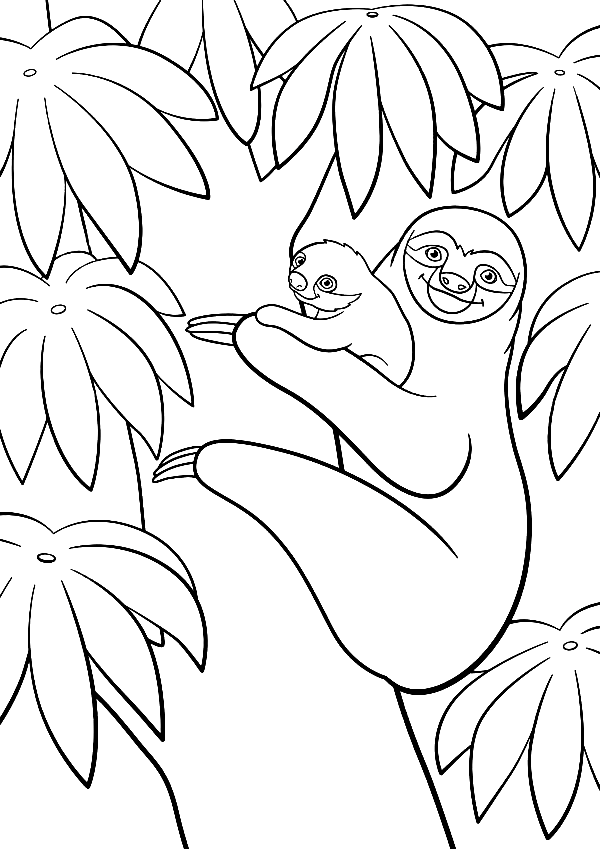
Female sloths give birth to one offspring at a time, and baby sloths spend the first six to twelve months of their lives clinging to their mothers, learning the forest canopy routes and food sources that will sustain them as adults. During this period, the baby clings to the mother’s belly or back continuously.
Mother-and-baby sloth pages are the collection’s most emotionally resonant: the combination of the large, slow-moving adult and the small, clinging infant produces the specific quality of protective warmth that makes this image among the most widely shared in wildlife photography. The baby’s proportions follow the standard baby schema that produces the caring response in observers: large eyes relative to head size, a round face, a small body, and a clinging posture.
Coloring mother and baby pages: Both animals share the same warm grey-brown fur color, but the baby’s fur should be rendered slightly lighter and softer than the mother’s, reflecting the baby’s less developed fur texture. The clinging posture means the baby’s small curved claws grip the mother’s fur, visible as very small dark claw marks at the points of contact. The mother’s expression, always relaxed in the sloth’s characteristic way, should maintain the same peaceful quality as any solo portrait.
Realistic Rainforest Setting Pages
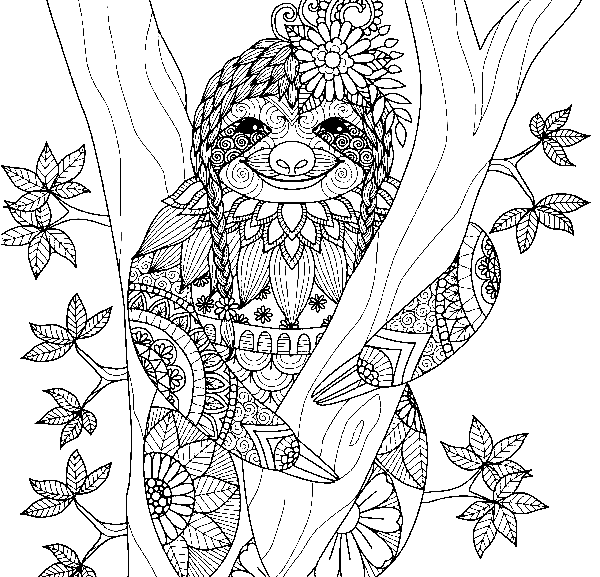
Pages that place sloths within their rainforest habitat provide the ecological context that wildlife-themed coloring pages serve best. The tropical rainforest of Central and South America is the sloth’s entire world: a vertical environment of branches, leaves, and filtered light where the sloth moves through a three-dimensional space at a pace that makes the forest seem to stand still around it.
The specific trees that sloths most commonly inhabit include Cecropia trees (genus Cecropia), which provide both food and a favored hanging location, and various fig trees and other canopy species across their range. The leaf canopy of a tropical rainforest creates a specific light quality: green and dappled, with shafts of direct light piercing through gaps in the canopy and areas of deep shadow between the branches.
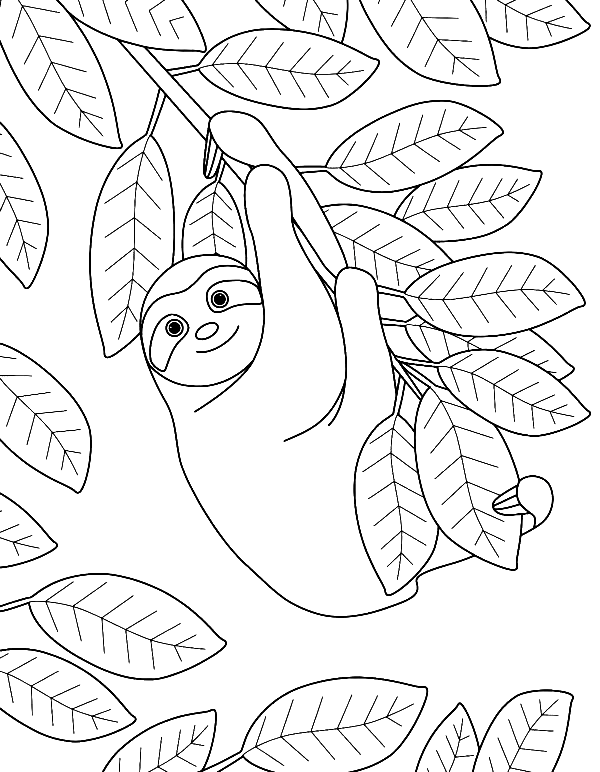
Coloring rainforest setting pages: The canopy background uses layered greens: bright yellow-green at the highest leaves catching direct sunlight, medium green in the mid-canopy, dark blue-green in the shadowed lower canopy. The sloth’s warm grey-brown fur provides significant contrast against the cool green background, making the animal visible without requiring the animal’s coloring to be unnaturally vivid. Shafts of warm golden light filtered through the canopy can be suggested by very lightly applying a warm yellow-gold across certain areas of the background.
Algae-Fur and Camouflage Pages
Sloths’ fur hosts a functioning ecosystem. Green algae grow within the hollow structure of individual sloth fur hairs, giving some sloths a greenish tint, particularly visible in animals that spend time in moist, high-humidity forest environments. This algae provides camouflage against the green canopy background. The fur also hosts moths, beetles, cockroaches, mites, and fungi in a relationship that scientists have studied for both its ecological complexity and its potential pharmaceutical applications: some fungal species found in sloth fur have demonstrated antibiotic properties in laboratory studies.
Pages that suggest this greenish fur tint give colorists the opportunity to explore one of the most unusual biological facts in the collection: an animal that functions as a portable habitat for an entire community of organisms.
Coloring algae-tinted sloth pages: The base fur color is warm grey-brown, as in any realistic sloth page. Over this base, apply a very light, transparent green-grey wash at minimum pressure across the upper surfaces of the body where algae accumulates: the back, the top of the head, and the outer surfaces of the limbs. The green tint should be subtle enough to read as discoloration rather than as a separate colored area. The result is the specific green-tinged grey-brown of a wild sloth carrying its living camouflage.
Cartoon and Cute Sloth Pages
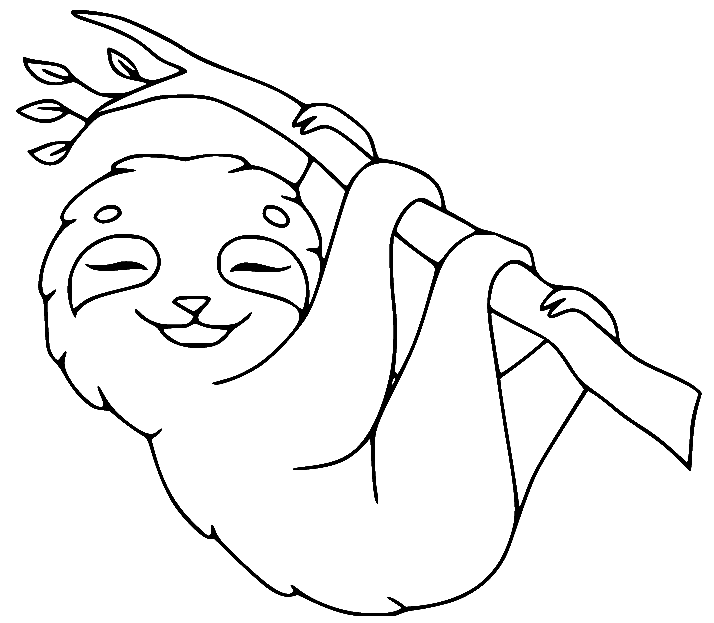
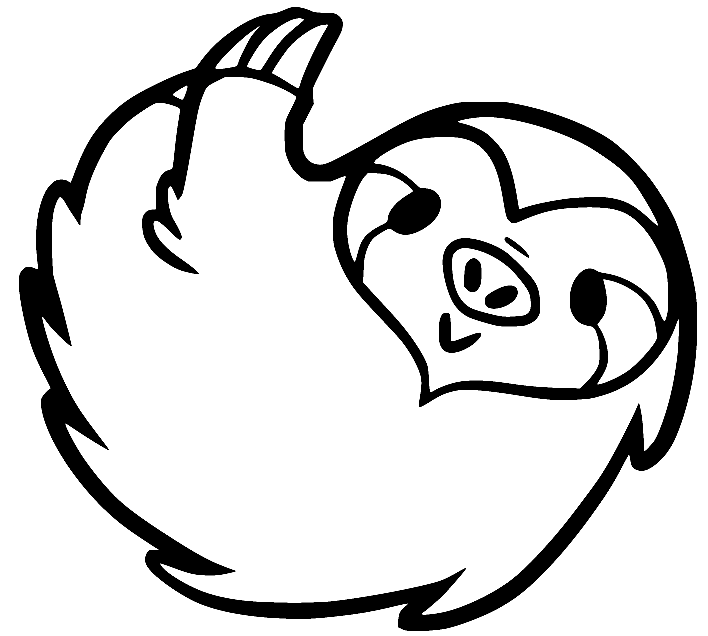
The sloth’s face has a naturally relaxed expression that maps easily onto the cartoon “happy” face: the wide-set eyes, the small upturned nose, and the mouth position that appears to be smiling produce a face that reads as friendly and content without any anthropomorphic modification. This natural alignment between the sloth’s actual expression and the cartoon “cute” aesthetic has made sloths among the most popular subjects for kawaii-style animal illustration.
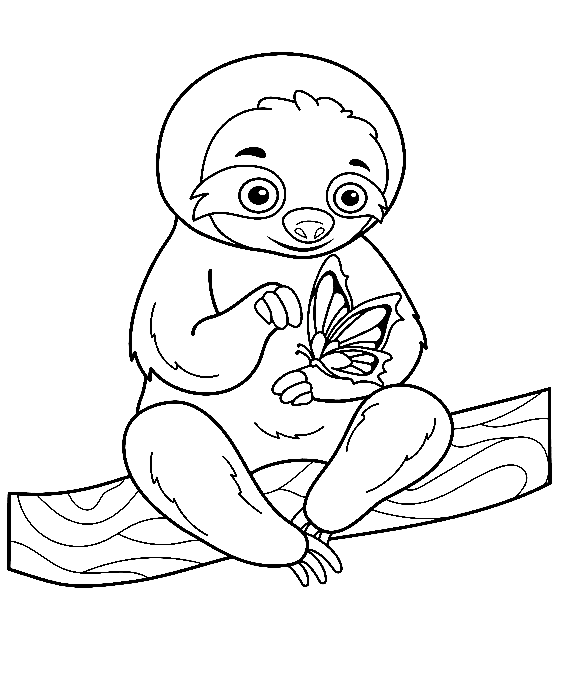
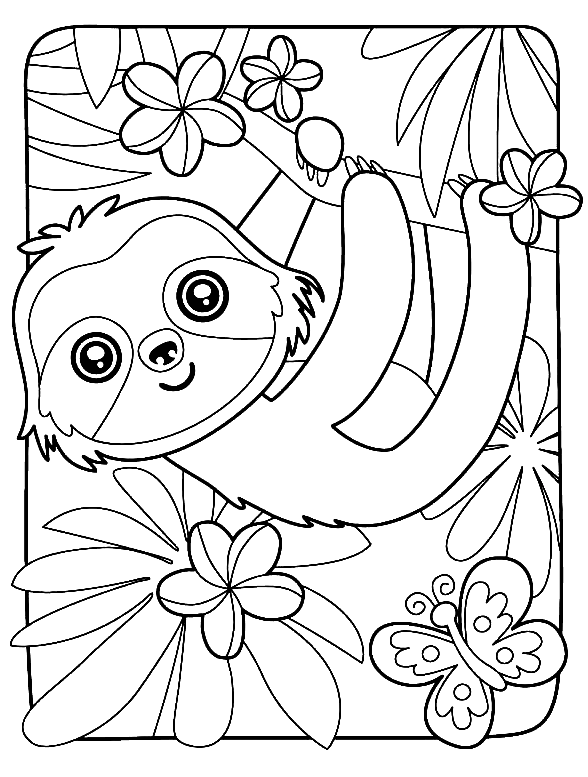
Cartoon sloth pages in the collection use exaggerated proportions from the kawaii design vocabulary: large, round eyes, simplified, rounded body, small, expressive limbs, and the relaxed hanging posture that the real animal maintains. These pages are the most accessible for young colorists and the most expressive for fans of the sloth as a cultural figure.
Coloring cartoon sloth pages: Vivid, fully saturated colors rather than naturalistic tones. The body can use vivid tan-brown, warm caramel, or even non-naturalistic colors depending on the specific page design’s cartoon register. The large, round eyes should receive a bright, vivid iris color with a prominent white highlight dot. The overall composition should read as cheerful and immediate: the cartoon sloth page’s job is to communicate friendly warmth before it communicates biological accuracy.
What These Pages Do
The sloth’s biology contains some of the most counterintuitive facts in the mammal world, and coloring pages that include this factual content give colorists something genuinely worth knowing after they set down the pencils. The weekly defecation cycle is perhaps the most extraordinary single behavioral fact: sloths descend from the canopy to defecate approximately once per seven days, losing up to one-third of their body weight in a single event. This weekly descent is one of the most dangerous activities in their life, as they are far more vulnerable to predators (harpy eagles, jaguars, anacondas) on the ground than in the canopy. Scientists have proposed various theories for why sloths maintain this risky habit rather than defecating from the canopy, including a possible benefit to the sloth moths that live in their fur, which lay eggs in the dung.
The sloths’ internal organ arrangement provides another specific biological fact: sloths’ internal organs are attached to their rib cage rather than hanging freely as in most mammals. This adaptation prevents the liver, stomach, and spleen from pressing against the diaphragm and impeding breathing while the animal hangs inverted. It is the precise anatomical solution to the problem of spending a life upside down.
The American Academy of Pediatrics identifies fine motor skill development as a key childhood milestone throughout early childhood. The detailed fur texture of realistic sloth pages, the precise curved-claw details at branch contact points, the layered canopy background work, and the facial feature rendering across the collection’s range of styles all provide motivated fine motor practice across every developmental level the collection serves. The 2005 Art Therapy Journal study on structured coloring and anxiety reduction applies throughout, with the sloth’s specifically relaxed visual register adding a thematic resonance to the calming acPygmyy.
The Pygmy three-toed sloth’s Critically Endangered status, found only on one small island off Panama, gives the collection’s pages an implicit conservation dimension. A child who knows this fact while coloring has a specific, verifiable reason to care about the animal beyond its visual appeal.
How to Color These Pages Well
Sloth fur is warm grey-brown with directional texture, not flat grey. The most common error on sloth portrait pages is applying a uniform flat grey that reads as an abstract color field rather than as fur. Apply the base warm grey-brown (with more brown warmth than cool grey) across all body surfaces. Then apply a slightly darker version of the same warm tone in short parallel strokes following the direction of fur growth on each body part. On the back, fur strokes run downward (toward the belly in a hanging animal). On the limbs, fur runs toward the claws. These directional strokes suggest texture without requiring individual hair rendering.
The claws are the most precise coloring element on any sloth page. Sloth claws measure 8 to 10 centimeters (3 to 4 inches) in length, making them one of the most proportionally dramatic physical features of any mammal relative to body size. They are dark grey to near-black at their base, transitioning to a slightly lighter grey at the very tip. Apply the dark grey at full pressure along the full length of each claw. At the very tip, lighten slightly: the sharp tip of the claw is the last point of contact with a branch, the most worn, and slightly lighter than the base. On three-toed pages, three distinct claw forms should be visible; on two-toed front limb pages, exactly two.
The face requires specific attention to the eye patches in three-toed species. Three-toed sloths have a distinctive facial pattern: a pale, almost white face area framing the eyes, with darker, warm brown-grey patches at and around the eyes. Apply the pale face base first across the entire face. Then apply the darker eye patch color carefully around the eye position, blending slightly at the edges. The contrast between the pale face and darker eye patches is the most immediately recognizable feature of a three-toed sloth portrait, and its accuracy is what makes the page read as a specific species rather than a generic animal.
Rainforest backgrounds use overlapping layers of green rather than a single green tone. A single flat green background behind a sloth reads as a green wall rather than as a forest canopy. Apply a medium green as the base background color. Then add darker green in the areas between leaves and branches where shadows accumulate. Add bright yellow-green at the points where sunlight hits the upper leaf surfaces directly. The three layers of green give the background the specific depth of a real forest without requiring detailed leaf-by-leaf rendering.
For algae-tinted fur, apply the green layer at the minimum possible pressure. The green tint of algae-bearing sloth fur is subtle: it reads as a color cast over the existing brown-grey rather than as a second color applied on top of it. Use a very light green pencil or crayon applied at the lightest possible pressure over the completed brown-grey fur base on the upper body surfaces. If the green is too vivid, the sloth will look painted rather than naturally tinted. The test: the result should look like the grey-brown might have a slight greenish quality, not like the animal is green.
5 Creative Craft Ideas
The Speed Comparison Study
A sloth moves at approximately 0.24 kilometers per hour in the forest canopy. A garden snail moves at approximately 0.05 kilometers per hour. A human walks at approximately 5 kilometers per hour. A cheetah runs at up to 120 kilometers per hour.
Print three sloth pages and color them in canonical warm grey-brown. On a long horizontal backing sheet, place one sloth page at the far left end, labeled “Sloth: 0.24 km/h.” Mark positions further right for the snail (barely further), the human (significantly further), and the cheetah (at the far right edge or beyond).
Title: The Speedplay: “Speed in the animal world. Everything is relative. The sloth has been exactly this fast for millions of years and shows no signs of changing.”

The Upside-Down Life
Sloths spend most of their lives hanging inverted from branches. Their fur parts down the center of their belly (rather than their back like most mammals) because rain runs downward off an upright animal’s back but upward off an inverted sloth’s belly. Their internal organs are attached to their ribcage to prevent crushing their lungs when inverted.
Print one sloth portrait page in the standard hanging-from-branch orientation. Color it in full, realistic colors.
After coloring, mount the page upside down on the backing sheet so the branch is at the bottom, and the sloth appears to hang from below. Add: “The sloth hangs upside down. Its fur parts down the center of its belly because rain runs upward (from the sloth’s perspective) along its back. Its organs are anchored to its ribcage. It sleeps 15-20 hours per day. All in this position.”

The Ecosystem in the Fur
A sloth’s fur hosts green algae, moths, beetles, cockroaches, mites, and fungi. Scientists have found antibiotic compounds in the fungi living in sloth fur. The algae provide camouflage. The sloth provides a habitat. It is a small moving forest.
Print a sloth portrait page with good fur surface area. Color the base fur in warm grey-brown. Apply a very light green wash over the upper body surfaces to suggest the algae tinting. Then add, at a very small scale in appropriate positions on the fur surface, tiny representations of the ecosystem residents: small moth shapes, tiny beetle forms, microscopic mite dots.
Label the display: “The organisms identified in one sloth’s fur: Cryptococcus species algae. Pyralid moths. Beetles. Cockroaches. Mites. Fungi with antibiotic properties. Total: one living ecosystem. Address: the back of a sloth.”

Baby Sloth Month by Month
Baby sloths cling to their mothers for 6 to 12 months before becoming independent. During this period, the baby learns the specific routes through the canopy, the trees that carry the best food, and the behaviors that will sustain it as an adult.
Print one mother-and-baby page. Color it in full, realistic, warm grey-brown tones.
On a timeline below the image, mark six monthly stages: “Month 1: Clings to mother’s belly. Weighs approximately 300 grams. Month 3: Begins eating leaves while still clinging. Month 6: Explores branches independently for short periods. Month 9: Returns to mother between solo explorations. Month 12: Independent. Knows the canopy routes. Begins a life that may last 30 years.”

The Island Pygmies
The pygmy three-toed sloth (Bradypus pygmaeus) lives only on Isla Escudo de Veraguas, an island of approximately 4.3 square kilometers (1.7 square miles) off the coast of Panama. It is Critically Endangered. It is the world’s smallest sloth species. Its entire global population is estimated at fewer than 500 individuals.
Print the smallest, most compact sloth portrait page in the collection. Color it in the specific pale, slightly washed-out tone of the pygmy species, which is smaller and slightly lighter in color than the mainland brown-throated sloth.
On the backing card, draw a small dot on a sketch map of Panama indicating Isla Escudo de Veraguas. Add: “Bradypus pygmaeus. Pygmy three-toed sloth. Found only here. Isla Escudo de Veraguas, Panamá. Area: 4.3 km². Estimated population: fewer than 500 individuals. IUCN status: Critically Endangered.”
Frequently Asked Questions
What is a sloth, and where do sloths live? Sloths are slow-moving mammals belonging to the suborder Folivora within the order Pilosa. Six living species exist across two families: two-toed sloths (family Choloepodidae, two species) and three-toed sloths (family Bradypodidae, four species). All six species live in Central and South America, inhabiting tropical rainforests, cloud forests, and mangrove forests. The most widespread species, the brown-throated three-toed sloth (Bradypus variegatus), ranges from Honduras south through Bolivia and Brazil. The rarest sPygmys, the pygmy three-toed sloth (Bradypus pygmaeus), lives exclusively on Isla Escudo de Veraguas, a small island off the coast of Panama.
How slow are sloths really? Sloths are the slowest-moving mammals on Earth. Their average movement speed through the forest canopy is approximately 0.24 kilometers per hour (0.15 miles per hour). Speedaximum speed when genuinely threatened, they can reach approximately 0.48 kilometers per hour (0.3 miles per hour). Despite their slowness in trees and on land, sloths are surprisingly capable swimmers: in water, they can move at approximately 0.53 kilometers per hour (0.33 mph), faster than their Speedstrial speed. They descend from trees specifically to cross rivers, using their long arms in a breaststroke motion. Their slow movement is a biological adaptation rather than a limitation: it minimizes the caloric expenditure required to survive on a diet of nutritionally poor leaves.
Why do sloths hang upside down? Sloths hang upside down from branches as their primary resting and movement posture, maintained for the majority of their lives. The adaptation is made possible by a tendon-locking mechanism in their forelimbs that allows the grip to be maintained with almost no muscular energy, similar to the way a coat hook holds a coat. This passive grip means that hanging costs the sloth almost nothing in terms of caloric expenditure. The inverted posture also explains several of the sloth’s other anatomical features: its fur parts down the center of its belly (rather than its back) so that rain runs off properly when hanging; its internal organs are attached to its ribcage rather than hanging freely, to prevent them from pressing against the diaphragm and impairing breathing.
What do sloths eat? Sloths are primarily folivores (leaf eaters), with most of their diet consisting of the leaves of trees in their range, supplemented by occasional flowers and fruit. Their leaf diet is nutritionally poor and difficult to digest. Sloths have a multi-chambered stomach similar in principle to a ruminant’s, in which leaves ferment and break down over a period of up to a week. A sloth’s stomach can account for up to 30 percent of its body weight when full of partially digested leaves. This slow digestion is consistent with their overall slow metabolism: the entire biological system is calibrated for minimal energy use on a low-energy diet.
What lives in a sloth’s fur? Sloth fur hosts a functioning microscopic ecosystem. Green algae grow inside the hollow structure of individual sloth hairs, giving some animals a visible greenish tint, particularly in humid forest environments. This algae provides camouflage against the green canopy. The fur also supports populations of moths (pyralid moths that breed in sloth dung), beetles, cockroaches, mites, and multiple fungal species. Scientists from the Smithsonian Tropical Research Institute and the University of Costa Rica have studied the fungi found in sloth fur and identified antibiotic compounds in some species, with potential pharmaceutical applications. The relationship between the sloth and its resident ecosystem represents one of the more complex examples of symbiosis in the mammal world.
How do sloths appear in popular culture and animated films? Sloths have become one of the most culturally prominent animals of the 2010s and 2020s, particularly in internet culture, where their slow movement and relaxed expression have made them synonymous with calm, patience, and the “slow living” lifestyle movement. In animated film, the most recognizable fictional sloths are Sid from Blue Sky Studios’ “Ice Age” franchise (beginning March 15, 2002, voiced by John Leguizamo), who is a Megatherium or similar prehistoric ground sloth, and Flash from Disney’s “Zootopia” (2016, directed by Byron Howard and Rich Moore), a three-toed sloth who works at the DMV in one of the film’s most comedically precise sequences. “Zootopia” won the Academy Award for Best Animated Feature at the 89th Academy Awards in 2017.
How large were prehistoric sloths compared to modern sloths? Modern sloths are relatively small: body length ranges from 41 to 74 centimeters (16 to 29 inches) and weight from 2.25 to 8 kilograms (5 to 17.6 pounds), depending on species. Prehistoric sloths were dramatically larger. Megatherium americanum, the giant ground sloth of the Pleistocene epoch, could reach 6 meters (approximately 20 feet) in length and weigh up to 4 metric tons (approximately 8,800 pounds), comparable in size to a modern African elephant. These giant ground sloths walked on all fours on the ground rather than hanging in trees, and their remains have been found throughout North and South America. Megatherium went extinct approximately 10,000 to 8,000 years ago, at the end of the last ice age, likely due to a combination of human hunting and climate change.
What age group are these pages best suited for? Sloth coloring pages serve a wide age range. The simplest cartoon and kawaii-style sloth pages are accessible from ages three and four, where the friendly, rounded face and simple body form provide a clear, achievable coloring target. The hanging-from-branch portrait pages with branch bark texture and claw detail are most rewarding from ages five to nine as fine motor control develops. The realistic rainforest setting pages, with their layered background work and species-specific facial pattern accuracy, are most engaging for ages seven and up. The scientific content that accompanies the collection, including the algae ecosystem, the weekly defecation habit, and the Critically Endangered pygmy sloth, is most fully appreciated by older children and adults who can engage with the biological facts as genuinely interesting information rather than as background.
Browse the full collection at ColoringPagesOnly.com. All 50+ pages free, no sign-up, PDF or PNG, print or color online.
The sloth moves at 0.24 kilometers per hour in the forest canopy. It sleeps between 15 and 20 hours per day, hanging from a branch using a tendon-locking mechanism that requires almost no muscular effort. It defecates once per week and descends from the canopy to do it, which is the most dangerous thing it does. Its fur hosts moths, algae, and fungi, some of which have antibiotic properties that scientists are still studying. Its internal organs are attached to its ribcage so they do not crush its lungs when it hangs upside down. It can live for 30 years.
It is not lazy. It is precisely adapted.
Pick up your warm grey-brown. The fur goes first in directional strokes. The claws go second in near-black. The face goes last: pale around the eyes in three-toed species, slightly darker patches at the eye positions.
Share your work on Facebook and Pinterest and tag #Coloringpagesonly. The ecosystem-in-the-fur displays, and the upside-down life pages are particularly worth sharing.
Color the fur. Apply the claws. The grip requires almost no energy. The sloth has understood something about efficiency that the rest of the mammals have not.